Cambridge IGCSE Biology (9-1) 0970 — 2025 May/June Paper 4 · Variant 1
0970/41/M/J/25 · 6 questions · 80 marks · ≈90 min
The question paper and its mark scheme, free to read here and free to download. This is Cambridge’s own paper, exactly as it was sat.
Question paper20 pages



Mark scheme13 pages
Answers below. Sit the paper first if you are practising.
Questions as text
Q1 · A pyramid of energy for an ecosystem
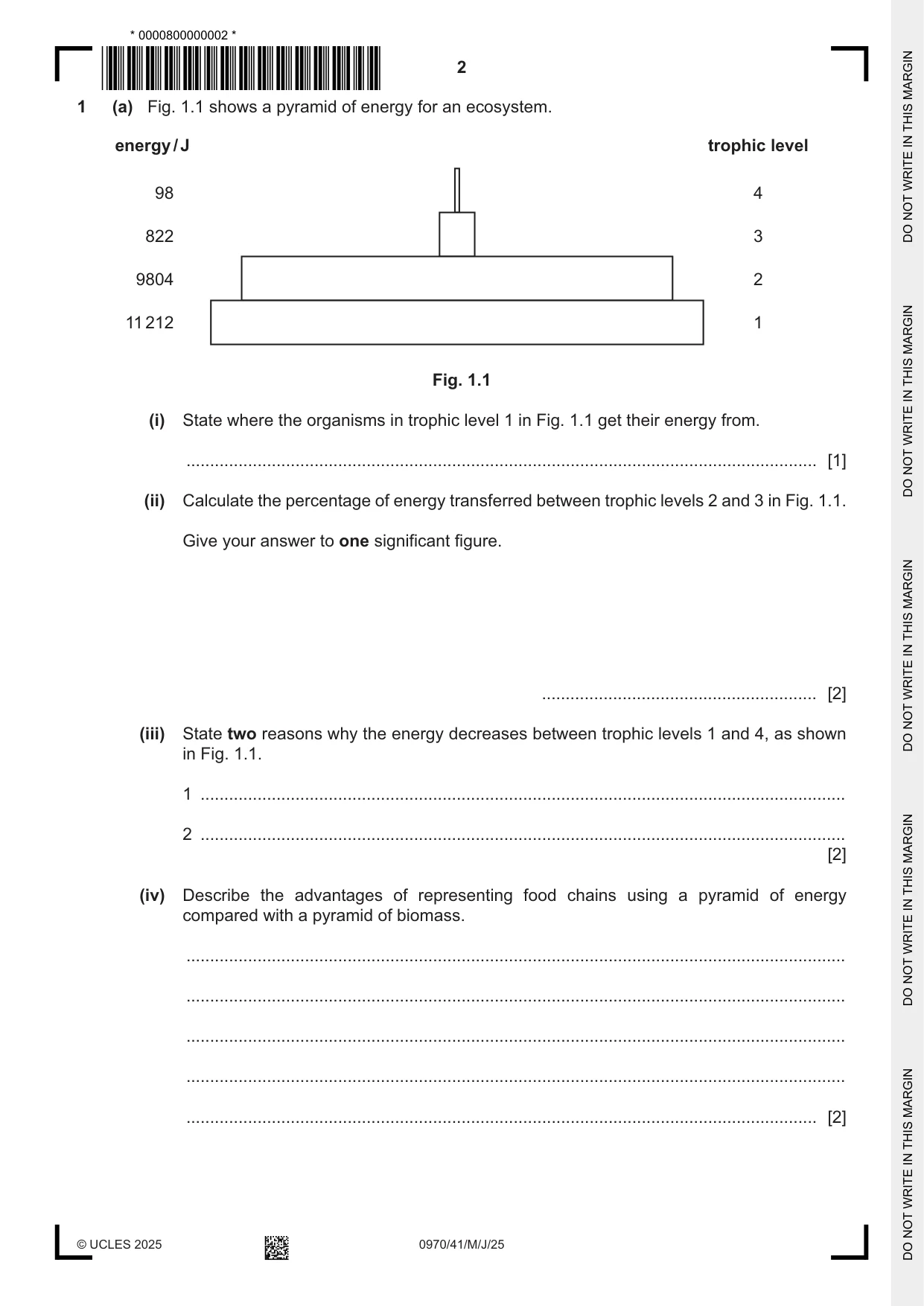
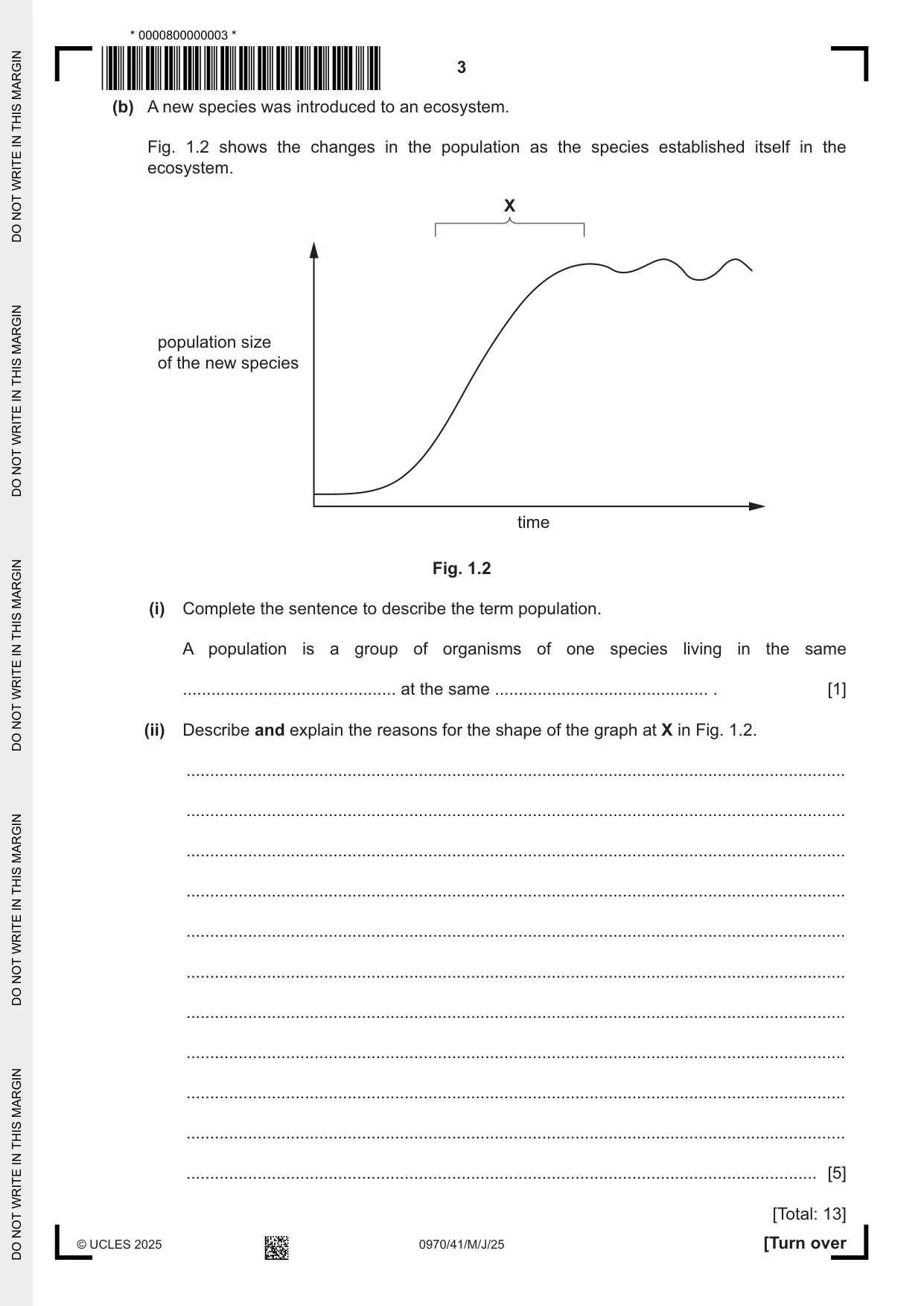
1 (a) Fig. 1.1 shows a pyramid of energy for an ecosystem. energy / J trophic level 98 4 822 3 9804 2 11 212 1 Fig. 1.1 (i) State where the organisms in trophic level 1 in Fig. 1.1 get their energy from. ..................................................................................................................................... [1] (ii) Calculate the percentage of energy transferred between trophic levels 2 and 3 in Fig. 1.1. Give your answer to one significant figure. .......................................................... [2] (iii) State two reasons why the energy decreases between trophic levels 1 and 4, as shown in Fig. 1.1. 1 ........................................................................................................................................ 2 ........................................................................................................................................ [2] (iv) Describe the advantages of representing food chains using a pyramid of energy compared with a pyramid of biomass. ........................................................................................................................................... ........................................................................................................................................... ........................................................................................................................................... ........................................................................................................................................... ..................................................................................................................................... [2] (b) A new species was introduced to an ecosystem. Fig. 1.2 shows the changes in the population as the species established itself in the ecosystem. X population size of the new species time Fig. 1.2 (i) Complete the sentence to describe the term population. A population is a group of organisms of one species living in the same ............................................. at the same ............................................. . [1] (ii) Describe and explain the reasons for the shape of the graph at X in Fig. 1.2. ........................................................................................................................................... ........................................................................................................................................... ........................................................................................................................................... ........................................................................................................................................... ........................................................................................................................................... ........................................................................................................................................... ........................................................................................................................................... ........................................................................................................................................... ........................................................................................................................................... ........................................................................................................................................... ..................................................................................................................................... [5] [Total: 13]
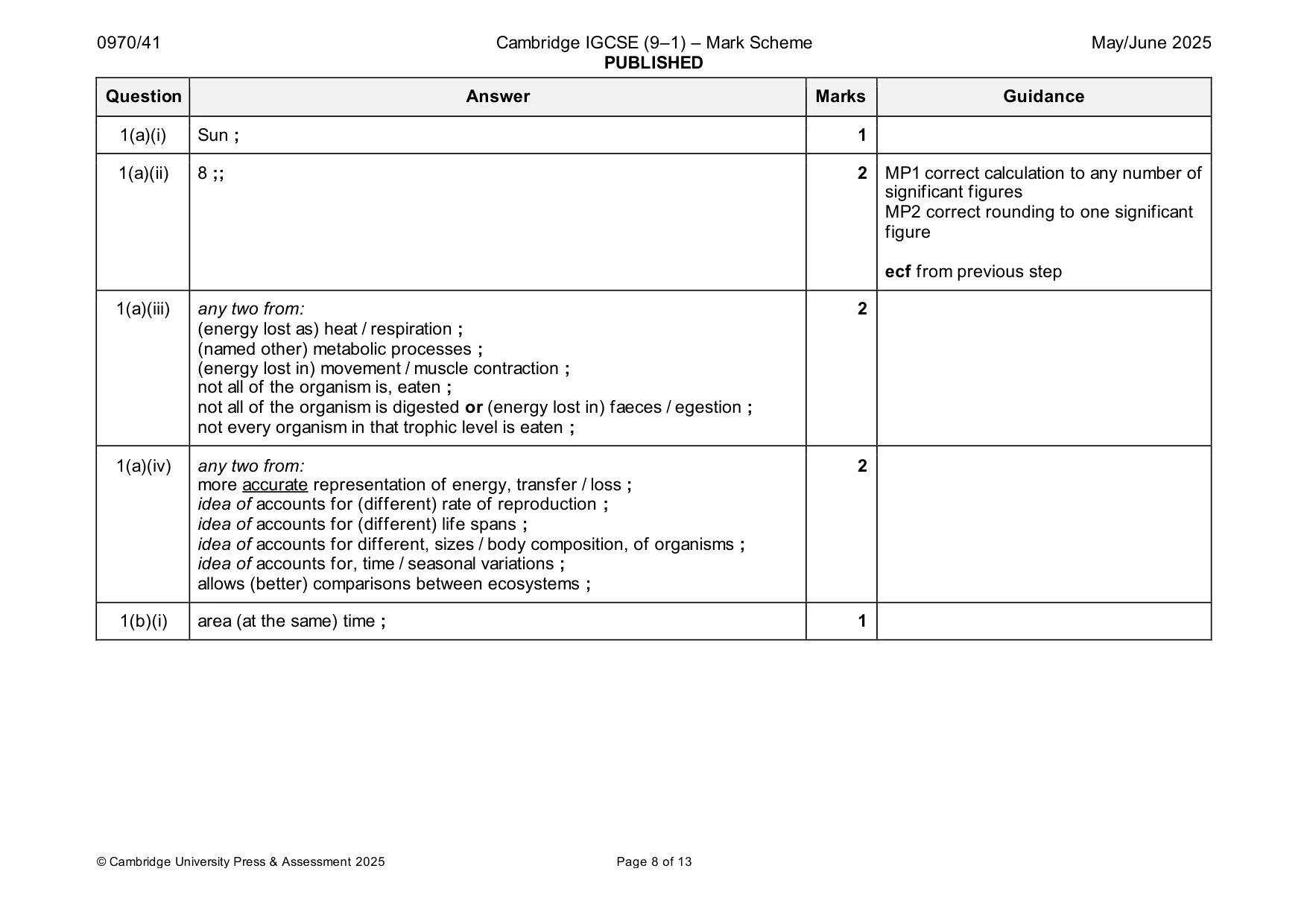
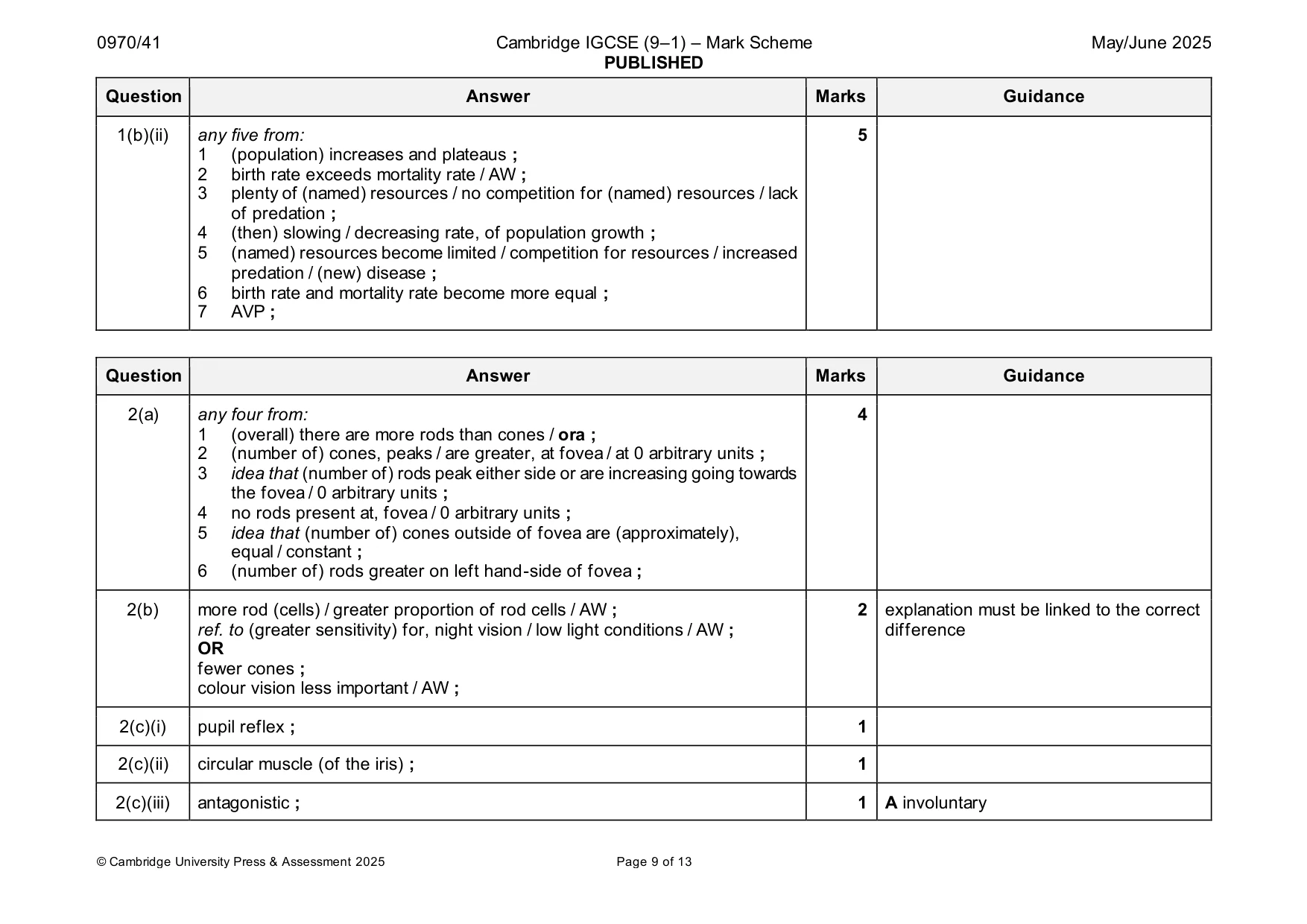
Mark scheme: Question Answer Marks Guidance 1(a)(i) Sun ; 1 1(a)(ii) 8 ;; 2 MP1 correct calculation to any number of significant figures MP2 correct rounding to one significant figure ecf from previous step 1(a)(iii) any two from: 2 (energy lost as) heat / respiration ; (named other) metabolic processes ; (energy lost in) movement / muscle contraction ; not all of the organism is, eaten ; not all of the organism is digested or (energy lost in) faeces / egestion ; not every organism in that trophic level is eaten ; 1(a)(iv) any two from: 2 more accurate representation of energy, transfer / loss ; idea of accounts for (different) rate of reproduction ; idea of accounts for (different) life spans ; idea of accounts for different, sizes / body composition, of organisms ; idea of accounts for, time / seasonal variations ; allows (better) comparisons between ecosystems ; 1(b)(i) area (at the same) time ; 1 1(b)(ii) any five from: 5 1 (population) increases and plateaus ; 2 birth rate exceeds mortality rate / AW ; 3 plenty of (named) resources / no competition for (named) resources / lack of predation ; 4 (then) slowing / decreasing rate, of population growth ; 5 (named) resources become limited / competition for resources / increased predation / (new) disease ; 6 birth rate and mortality rate become more equal ; 7 AVP ;
Q2 · The human retina contains receptor cells called rods and cones
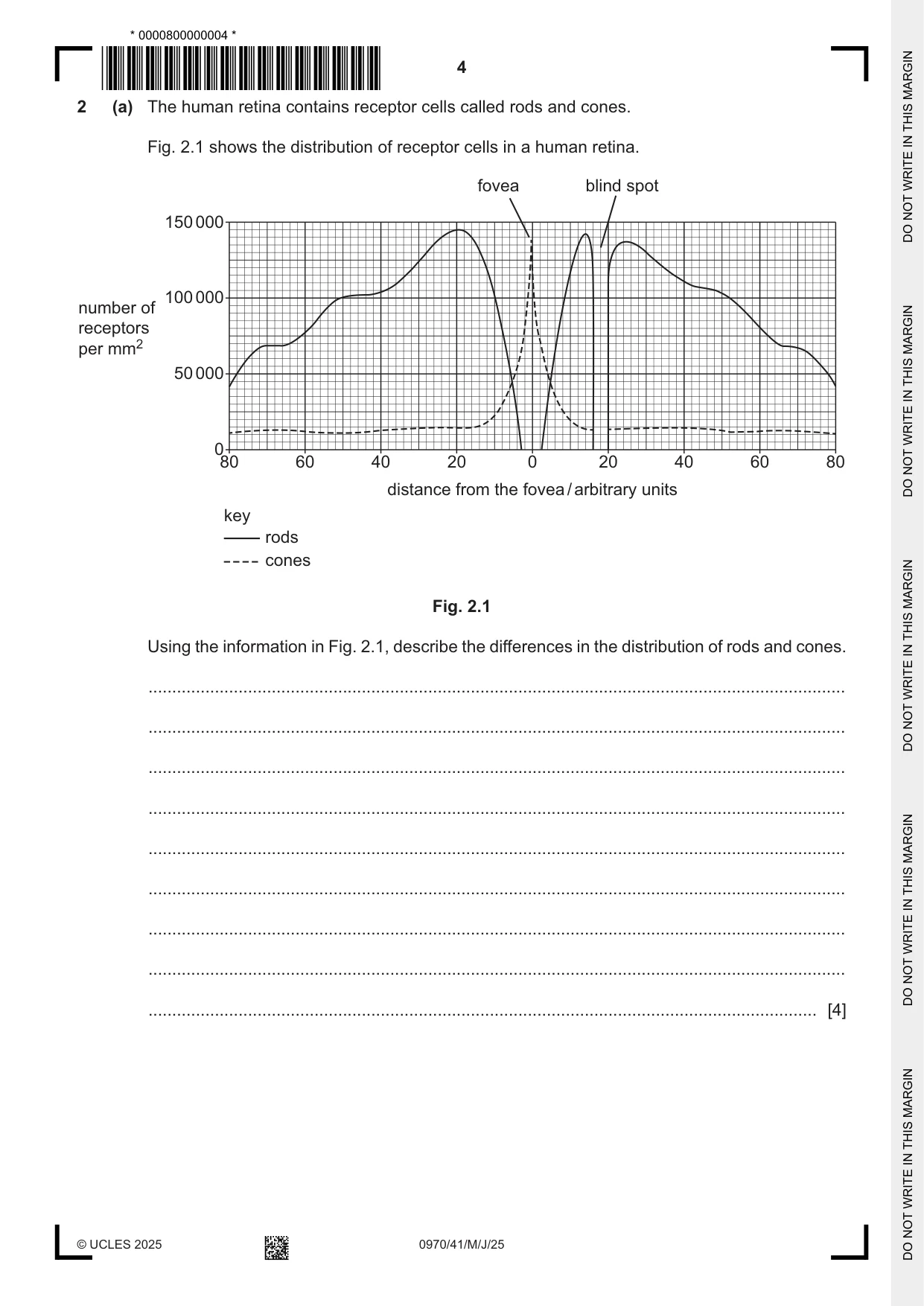
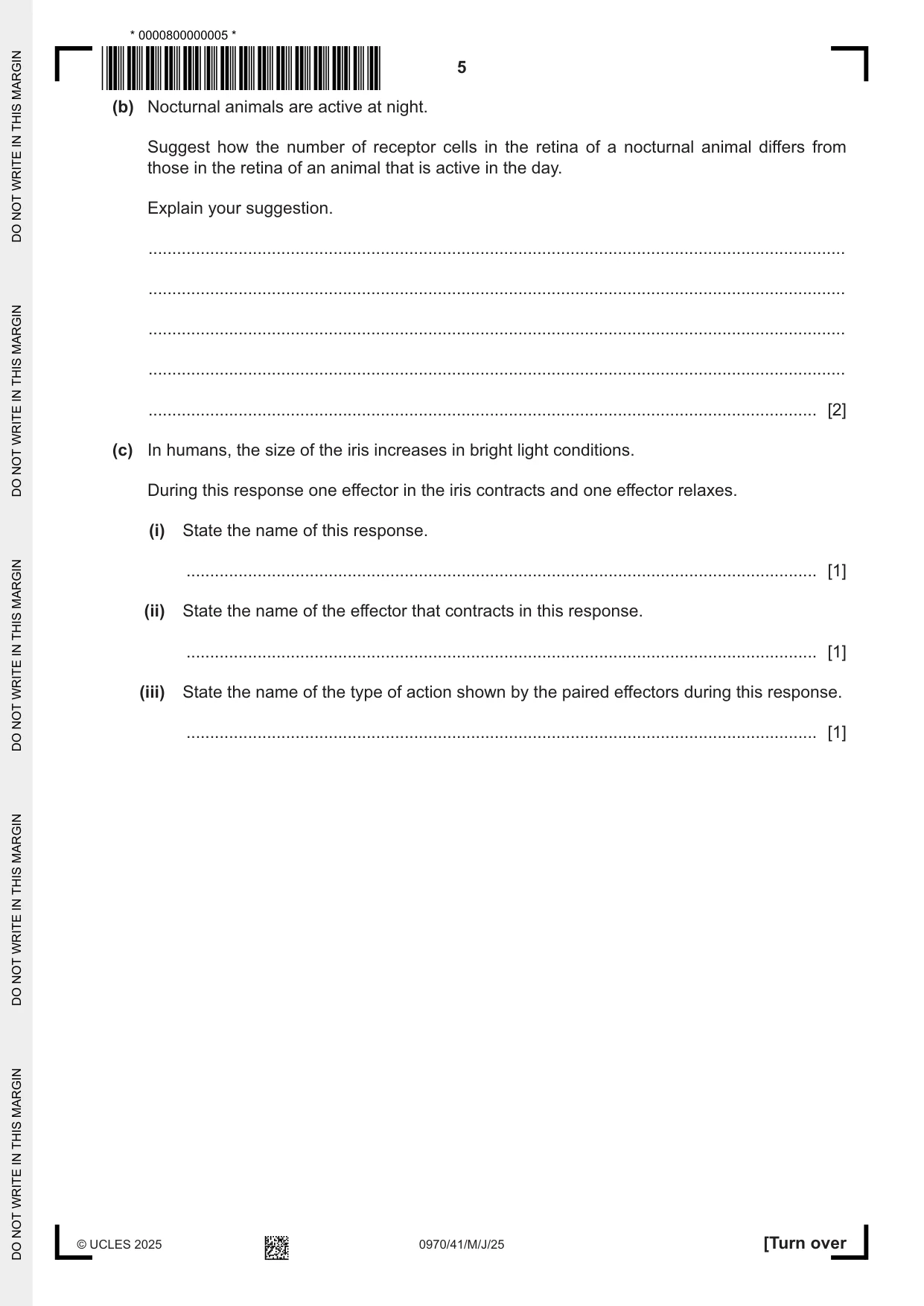
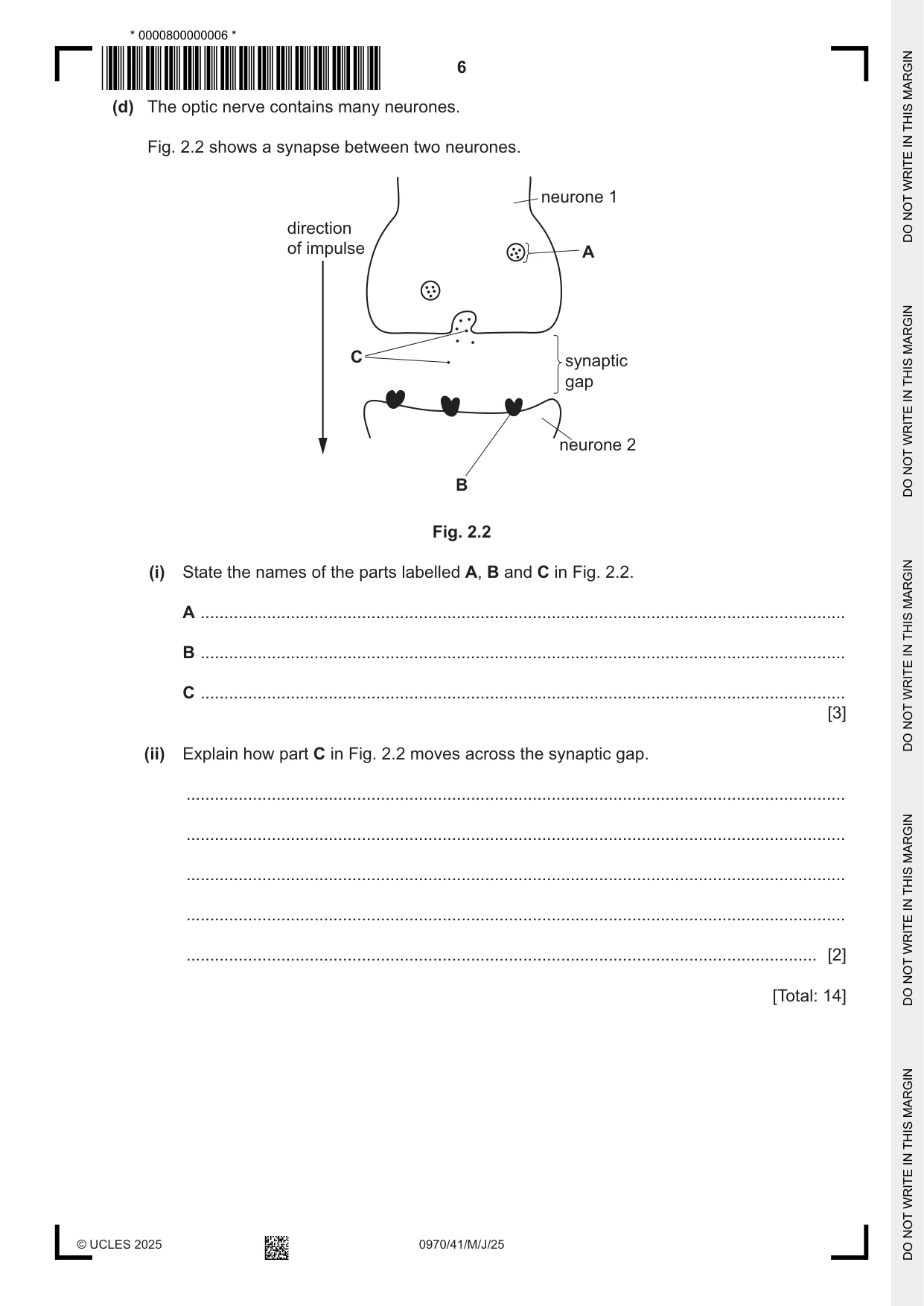
2 (a) The human retina contains receptor cells called rods and cones. Fig. 2.1 shows the distribution of receptor cells in a human retina. fovea blind spot 150 000 100 000 number of receptors per mm2 50 000 0 80 60 40 20 0 20 40 60 80 distance from the fovea / arbitrary units key rods cones Fig. 2.1 Using the information in Fig. 2.1, describe the differences in the distribution of rods and cones. ................................................................................................................................................... ................................................................................................................................................... ................................................................................................................................................... ................................................................................................................................................... ................................................................................................................................................... ................................................................................................................................................... ................................................................................................................................................... ................................................................................................................................................... ............................................................................................................................................. [4] (b) Nocturnal animals are active at night. Suggest how the number of receptor cells in the retina of a nocturnal animal differs from those in the retina of an animal that is active in the day. Explain your suggestion. ................................................................................................................................................... ................................................................................................................................................... ................................................................................................................................................... ................................................................................................................................................... ............................................................................................................................................. [2] (c) In humans, the size of the iris increases in bright light conditions. During this response one effector in the iris contracts and one effector relaxes. (i) State the name of this response. ..................................................................................................................................... [1] (ii) State the name of the effector that contracts in this response. ..................................................................................................................................... [1] (iii) State the name of the type of action shown by the paired effectors during this response. ..................................................................................................................................... [1] (d) The optic nerve contains many neurones. Fig. 2.2 shows a synapse between two neurones. neurone 1 direction of impulse A C synaptic gap neurone 2 B Fig. 2.2 (i) State the names of the parts labelled A, B and C in Fig. 2.2. A ........................................................................................................................................ B ........................................................................................................................................ C ........................................................................................................................................ [3] (ii) Explain how part C in Fig. 2.2 moves across the synaptic gap. ........................................................................................................................................... ........................................................................................................................................... ........................................................................................................................................... ........................................................................................................................................... ..................................................................................................................................... [2] [Total: 14]
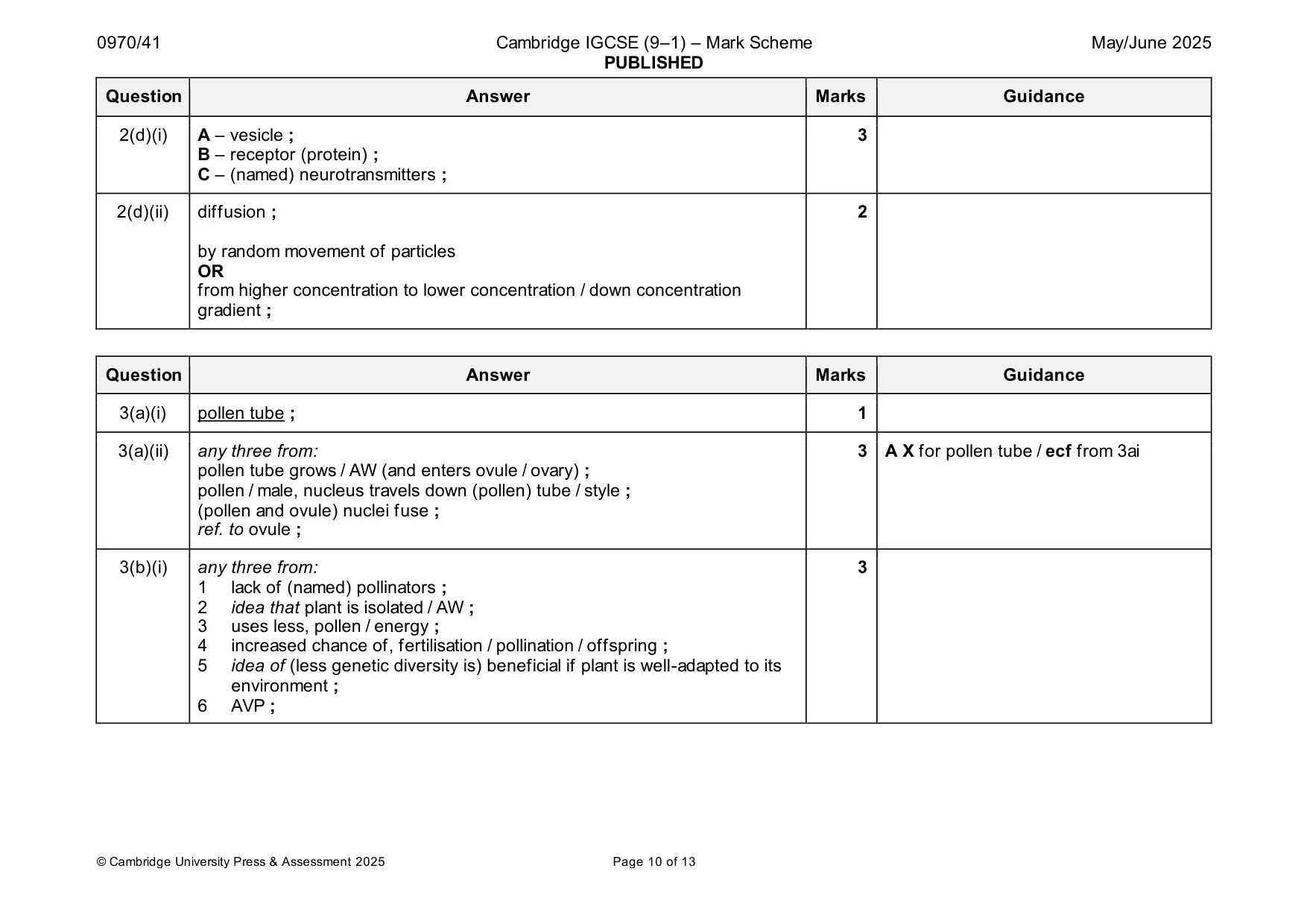
Mark scheme: 2(a) any four from: 4 1 (overall) there are more rods than cones / ora ; 2 (number of) cones, peaks / are greater, at fovea / at 0 arbitrary units ; 3 idea that (number of) rods peak either side or are increasing going towards the fovea / 0 arbitrary units ; 4 no rods present at, fovea / 0 arbitrary units ; 5 idea that (number of) cones outside of fovea are (approximately), equal / constant ; 6 (number of) rods greater on left hand-side of fovea ; 2(b) more rod (cells) / greater proportion of rod cells / AW ; 2 explanation must be linked to the correct ref. to (greater sensitivity) for, night vision / low light conditions / AW ; difference OR fewer cones ; colour vision less important / AW ; 2(c)(i) pupil reflex ; 1 2(c)(ii) circular muscle (of the iris) ; 1 2(c)(iii) antagonistic ; 1 A involuntary 2(d)(i) A – vesicle ; 3 B – receptor (protein) ; C – (named) neurotransmitters ; 2(d)(ii) diffusion ; 2 by random movement of particles OR from higher concentration to lower concentration / down concentration gradient ;
Q3 · One stage involved in plant reproduction after pollination
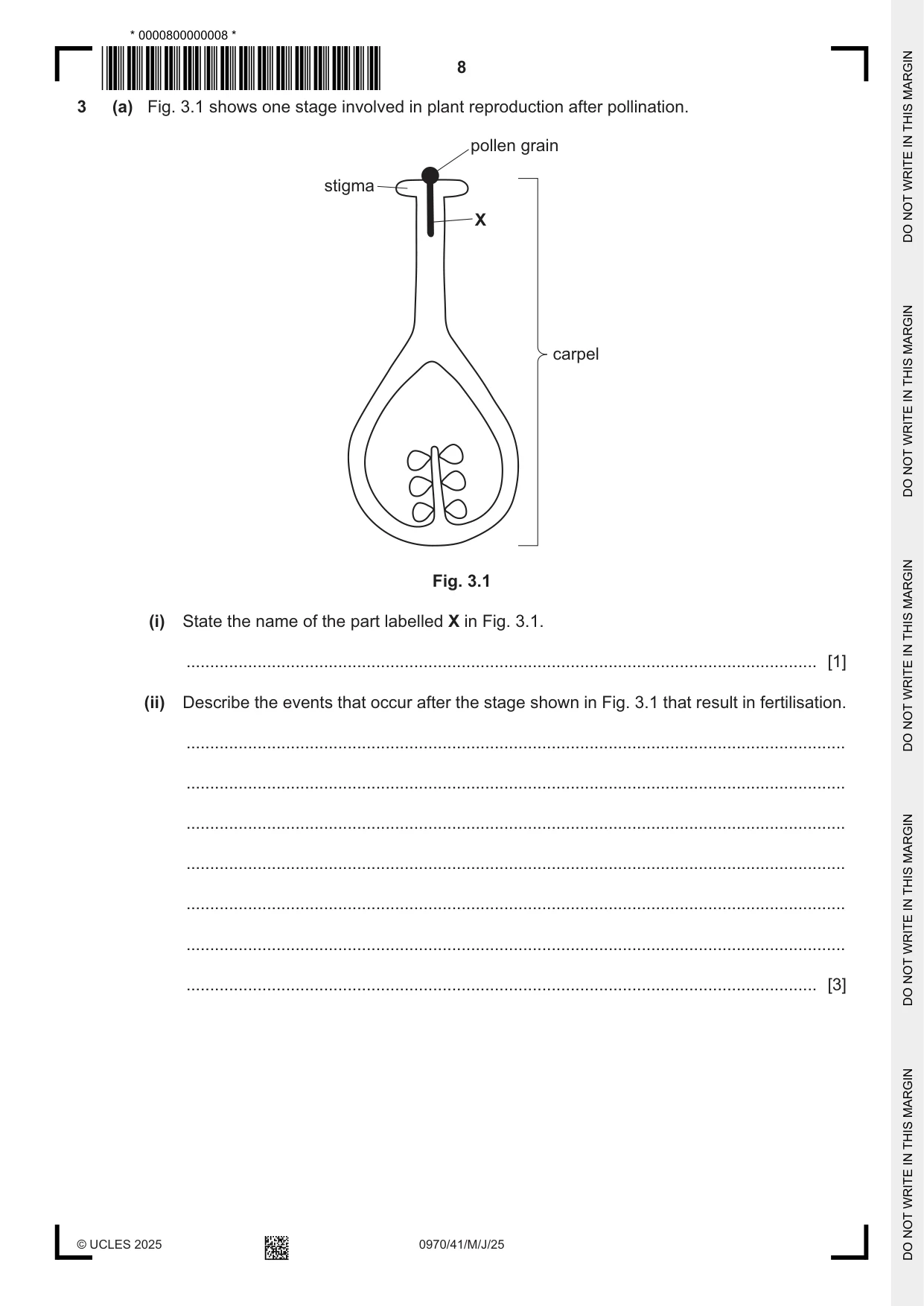
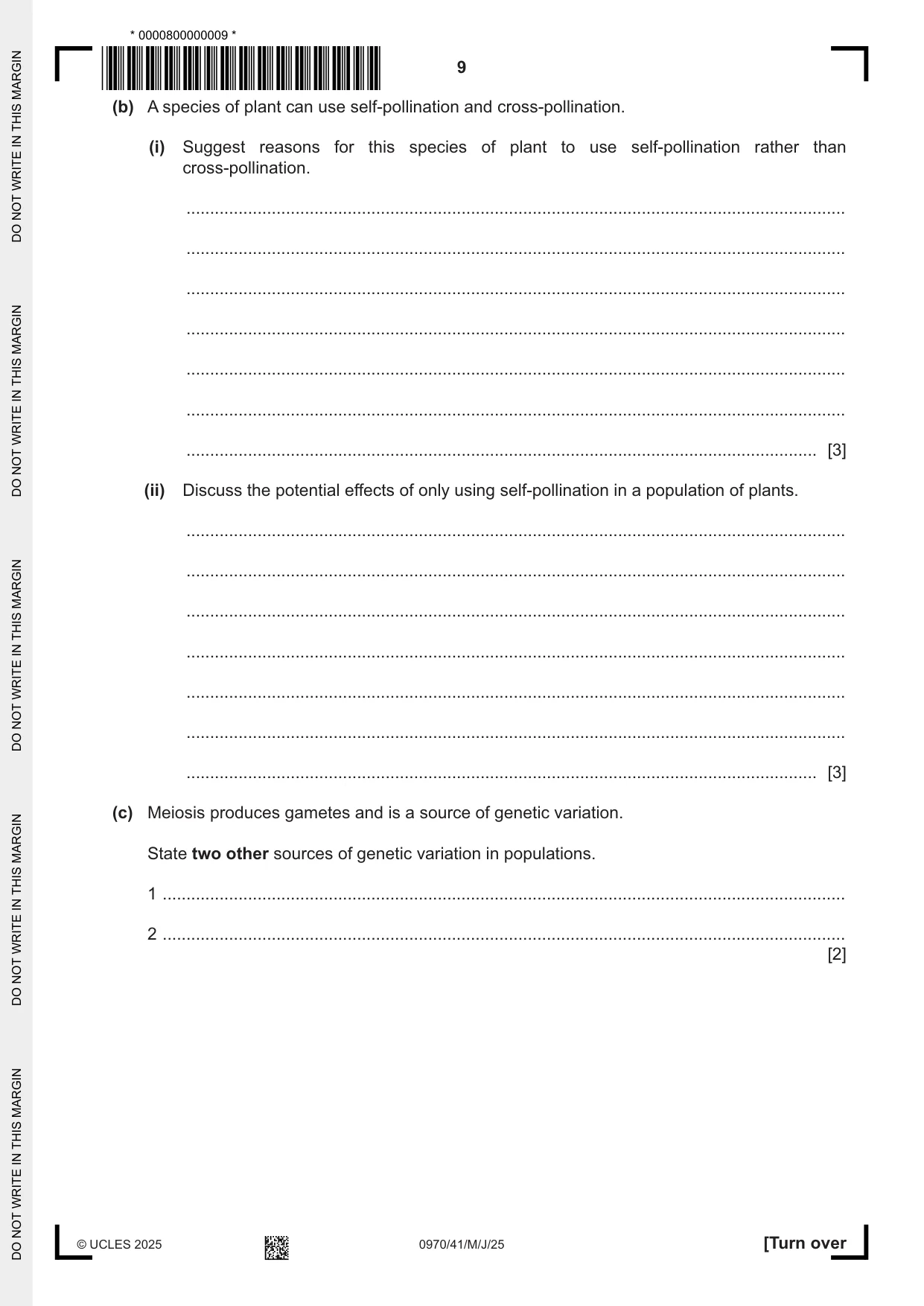
3 (a) Fig. 3.1 shows one stage involved in plant reproduction after pollination. pollen grain stigma X carpel Fig. 3.1 (i) State the name of the part labelled X in Fig. 3.1. ..................................................................................................................................... [1] (ii) Describe the events that occur after the stage shown in Fig. 3.1 that result in fertilisation. ........................................................................................................................................... ........................................................................................................................................... ........................................................................................................................................... ........................................................................................................................................... ........................................................................................................................................... ........................................................................................................................................... ..................................................................................................................................... [3] (b) A species of plant can use self-pollination and cross-pollination. (i) Suggest reasons for this species of plant to use self-pollination rather than cross-pollination. ........................................................................................................................................... ........................................................................................................................................... ........................................................................................................................................... ........................................................................................................................................... ........................................................................................................................................... ........................................................................................................................................... ..................................................................................................................................... [3] (ii) Discuss the potential effects of only using self-pollination in a population of plants. ........................................................................................................................................... ........................................................................................................................................... ........................................................................................................................................... ........................................................................................................................................... ........................................................................................................................................... ........................................................................................................................................... ..................................................................................................................................... [3] (c) Meiosis produces gametes and is a source of genetic variation. State two other sources of genetic variation in populations. 1 ................................................................................................................................................ 2 ................................................................................................................................................ [2] (d) Describe mitosis and its roles in organisms. ................................................................................................................................................... ................................................................................................................................................... ................................................................................................................................................... ................................................................................................................................................... ................................................................................................................................................... ................................................................................................................................................... ................................................................................................................................................... ................................................................................................................................................... ............................................................................................................................................. [4] (e) State the name of the unspecialised cells that divide by mitosis. ............................................................................................................................................. [1] [Total: 17]
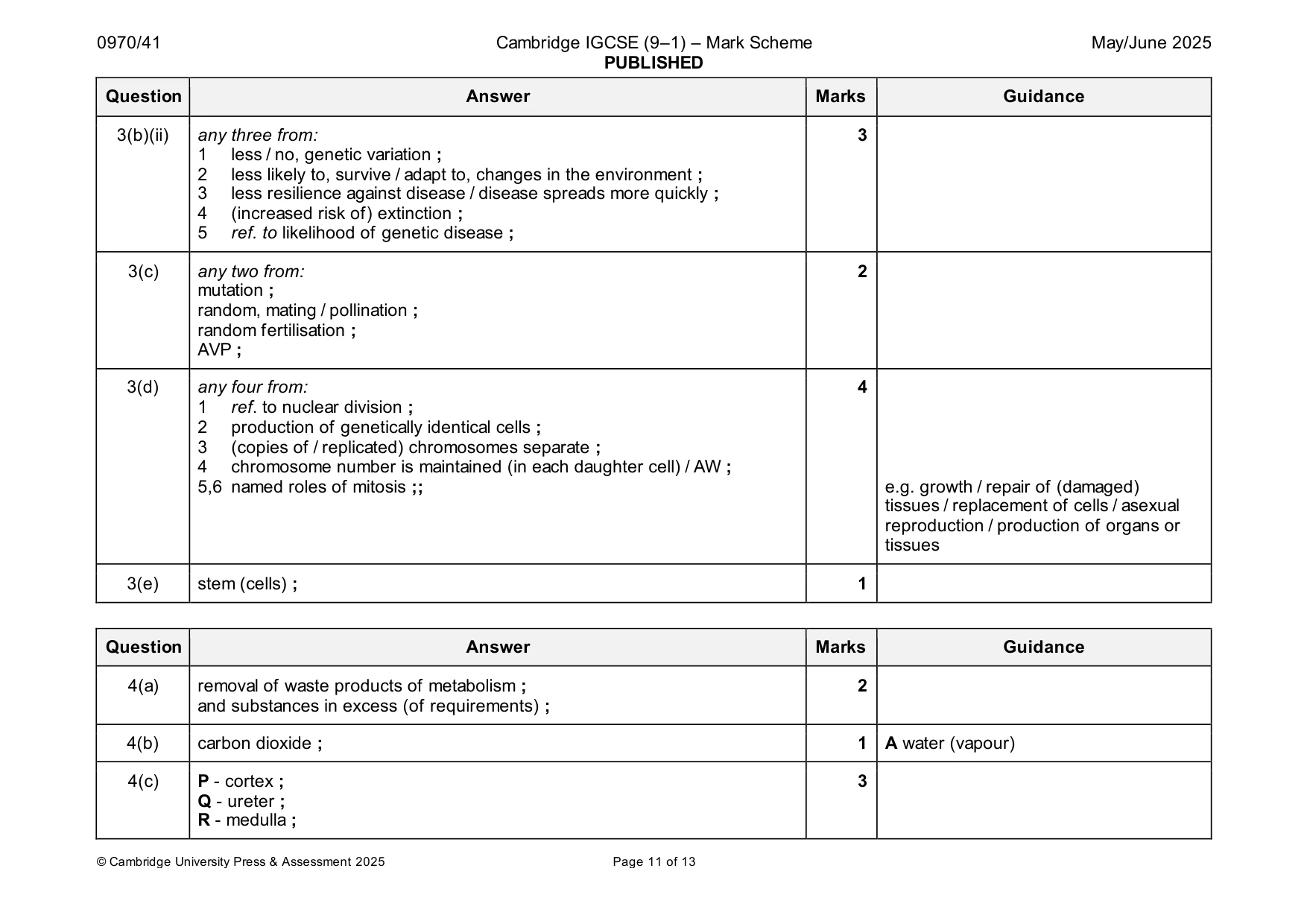
Mark scheme: 3(a)(i) pollen tube ; 1 3(a)(ii) any three from: 3 A X for pollen tube / ecf from 3ai pollen tube grows / AW (and enters ovule / ovary) ; pollen / male, nucleus travels down (pollen) tube / style ; (pollen and ovule) nuclei fuse ; ref. to ovule ; 3(b)(i) any three from: 3 1 lack of (named) pollinators ; 2 idea that plant is isolated / AW ; 3 uses less, pollen / energy ; 4 increased chance of, fertilisation / pollination / offspring ; 5 idea of (less genetic diversity is) beneficial if plant is well-adapted to its environment ; 6 AVP ; 3(b)(ii) any three from: 3 1 less / no, genetic variation ; 2 less likely to, survive / adapt to, changes in the environment ; 3 less resilience against disease / disease spreads more quickly ; 4 (increased risk of) extinction ; 5 ref. to likelihood of genetic disease ; 3(c) any two from: 2 mutation ; random, mating / pollination ; random fertilisation ; AVP ; 3(d) any four from: 4 1 ref. to nuclear division ; 2 production of genetically identical cells ; 3 (copies of / replicated) chromosomes separate ; 4 chromosome number is maintained (in each daughter cell) / AW ; 5,6 named roles of mitosis ;; e.g. growth / repair of (damaged) tissues / replacement of cells / asexual reproduction / production of organs or tissues 3(e) stem (cells) ; 1
Q4 · The kidney is an organ in the excretory system
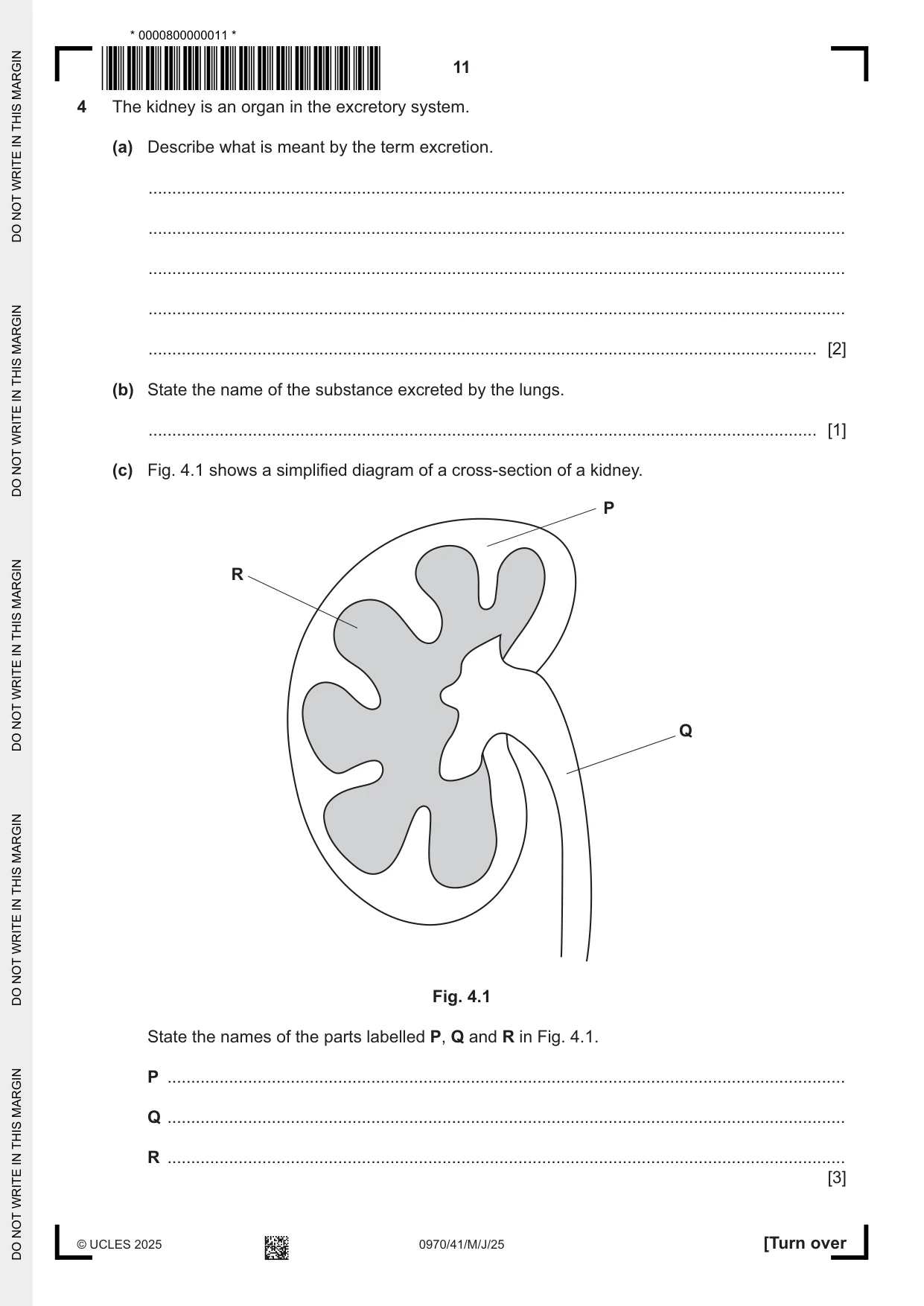
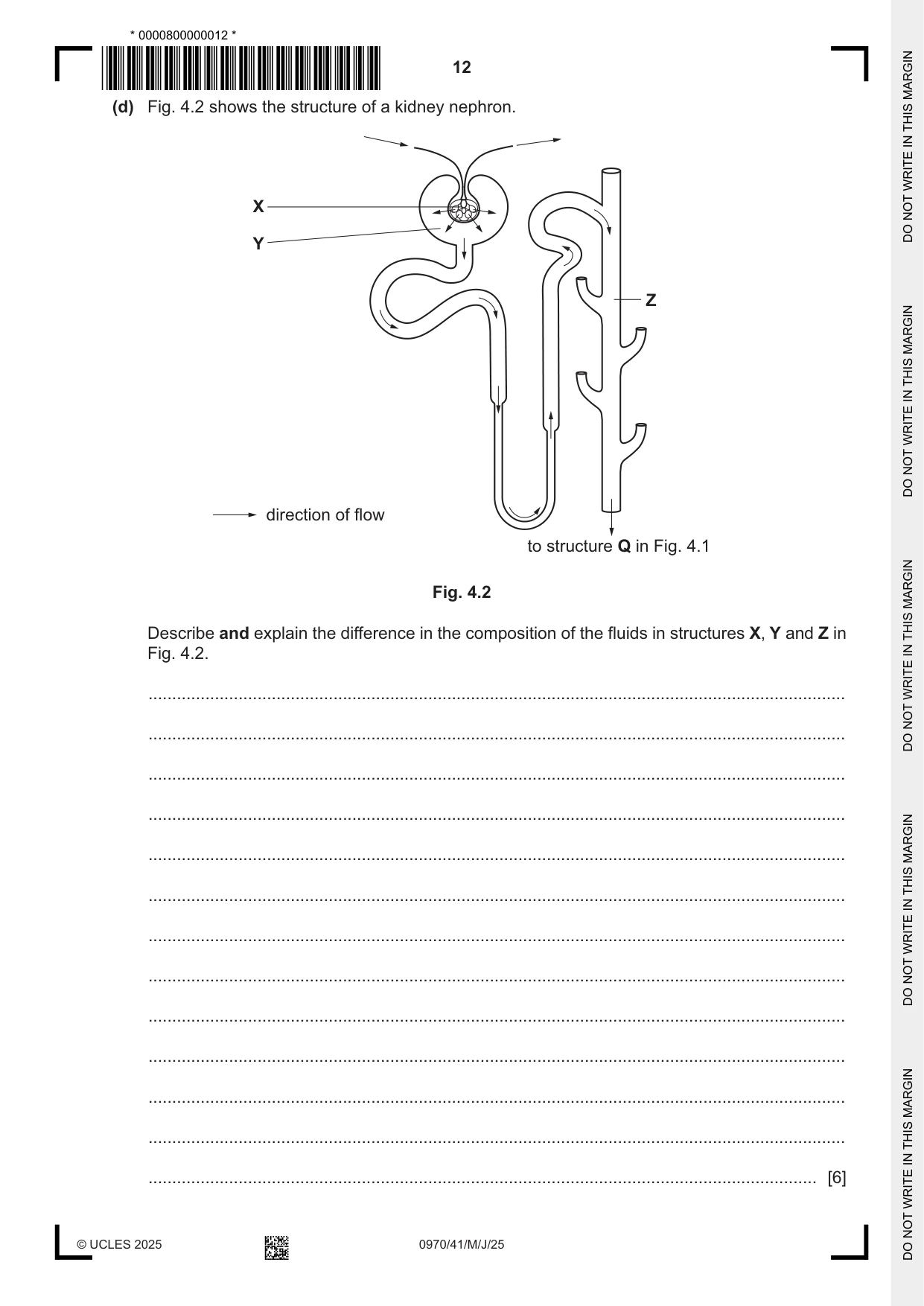
4 The kidney is an organ in the excretory system. (a) Describe what is meant by the term excretion. ................................................................................................................................................... ................................................................................................................................................... ................................................................................................................................................... ................................................................................................................................................... ............................................................................................................................................. [2] (b) State the name of the substance excreted by the lungs. ............................................................................................................................................. [1] (c) Fig. 4.1 shows a simplified diagram of a cross-section of a kidney. P R Q Fig. 4.1 State the names of the parts labelled P, Q and R in Fig. 4.1. P ............................................................................................................................................... Q ............................................................................................................................................... R ............................................................................................................................................... [3] (d) Fig. 4.2 shows the structure of a kidney nephron. X Y Z direction of flow to structure Q in Fig. 4.1 Fig. 4.2 Describe and explain the difference in the composition of the fluids in structures X, Y and Z in Fig. 4.2. ................................................................................................................................................... ................................................................................................................................................... ................................................................................................................................................... ................................................................................................................................................... ................................................................................................................................................... ................................................................................................................................................... ................................................................................................................................................... ................................................................................................................................................... ................................................................................................................................................... ................................................................................................................................................... ................................................................................................................................................... ................................................................................................................................................... ............................................................................................................................................. [6] (e) The liver is also involved in excretion. Describe two ways that amino acids are processed in the liver. 1 ................................................................................................................................................ 2 ................................................................................................................................................ [2] [Total: 14]
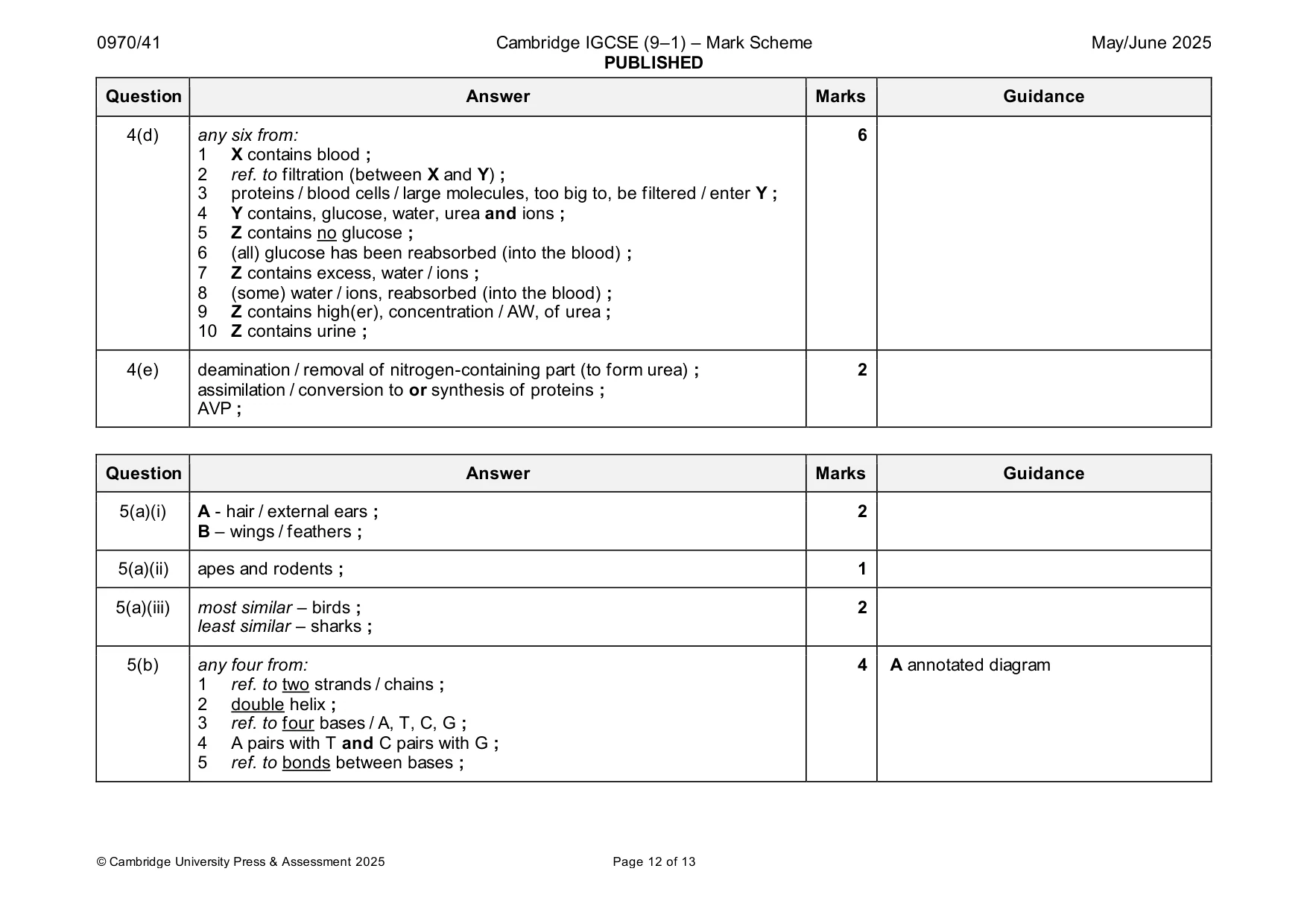
Mark scheme: 4(a) removal of waste products of metabolism ; 2 and substances in excess (of requirements) ; 4(b) carbon dioxide ; 1 A water (vapour) 4(c) P - cortex ; 3 Q - ureter ; R - medulla ; 4(d) any six from: 6 1 X contains blood ; 2 ref. to filtration (between X and Y) ; 3 proteins / blood cells / large molecules, too big to, be filtered / enter Y ; 4 Y contains, glucose, water, urea and ions ; 5 Z contains no glucose ; 6 (all) glucose has been reabsorbed (into the blood) ; 7 Z contains excess, water / ions ; 8 (some) water / ions, reabsorbed (into the blood) ; 9 Z contains high(er), concentration / AW, of urea ; 10 Z contains urine ; 4(e) deamination / removal of nitrogen-containing part (to form urea) ; 2 assimilation / conversion to or synthesis of proteins ; AVP ;
Q5 · Organisms can be classified by their features and by studying the sequence of bases in…
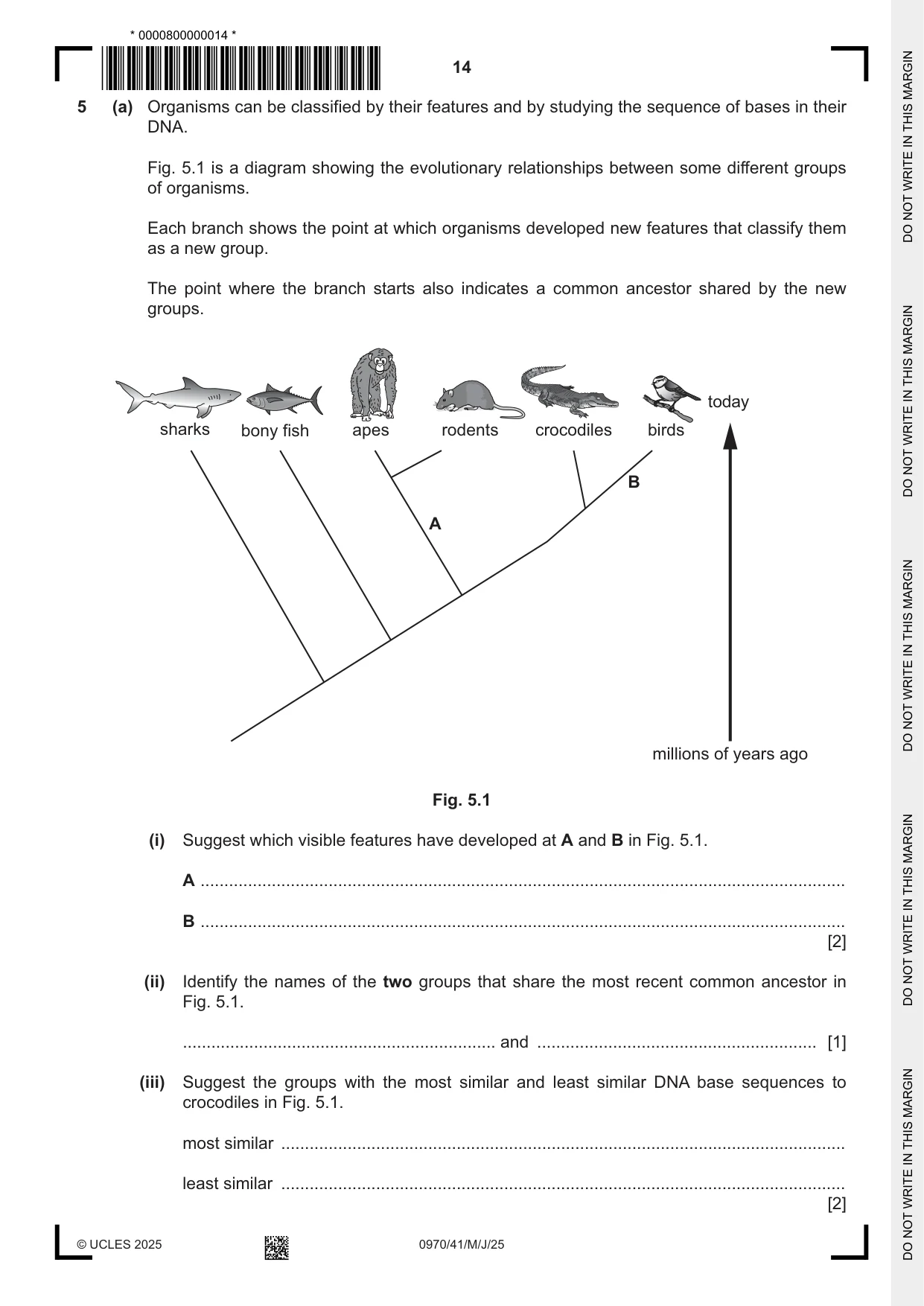
5 (a) Organisms can be classified by their features and by studying the sequence of bases in their DNA. Fig. 5.1 is a diagram showing the evolutionary relationships between some different groups of organisms. Each branch shows the point at which organisms developed new features that classify them as a new group. The point where the branch starts also indicates a common ancestor shared by the new groups. today sharks bony fish apes rodents crocodiles birds B A millions of years ago Fig. 5.1 (i) Suggest which visible features have developed at A and B in Fig. 5.1. A ........................................................................................................................................ B ........................................................................................................................................ [2] (ii) Identify the names of the two groups that share the most recent common ancestor in Fig. 5.1. .................................................................. and ........................................................... [1] (iii) Suggest the groups with the most similar and least similar DNA base sequences to crocodiles in Fig. 5.1. most similar ....................................................................................................................... least similar ....................................................................................................................... [2] (b) Describe the structure of a DNA molecule. ................................................................................................................................................... ................................................................................................................................................... ................................................................................................................................................... ................................................................................................................................................... ................................................................................................................................................... ................................................................................................................................................... ................................................................................................................................................... ................................................................................................................................................... ............................................................................................................................................. [4] (c) Outline how the base sequences in DNA control cell function. ................................................................................................................................................... ................................................................................................................................................... ................................................................................................................................................... ................................................................................................................................................... ................................................................................................................................................... ................................................................................................................................................... ............................................................................................................................................. [3] [Total: 12]
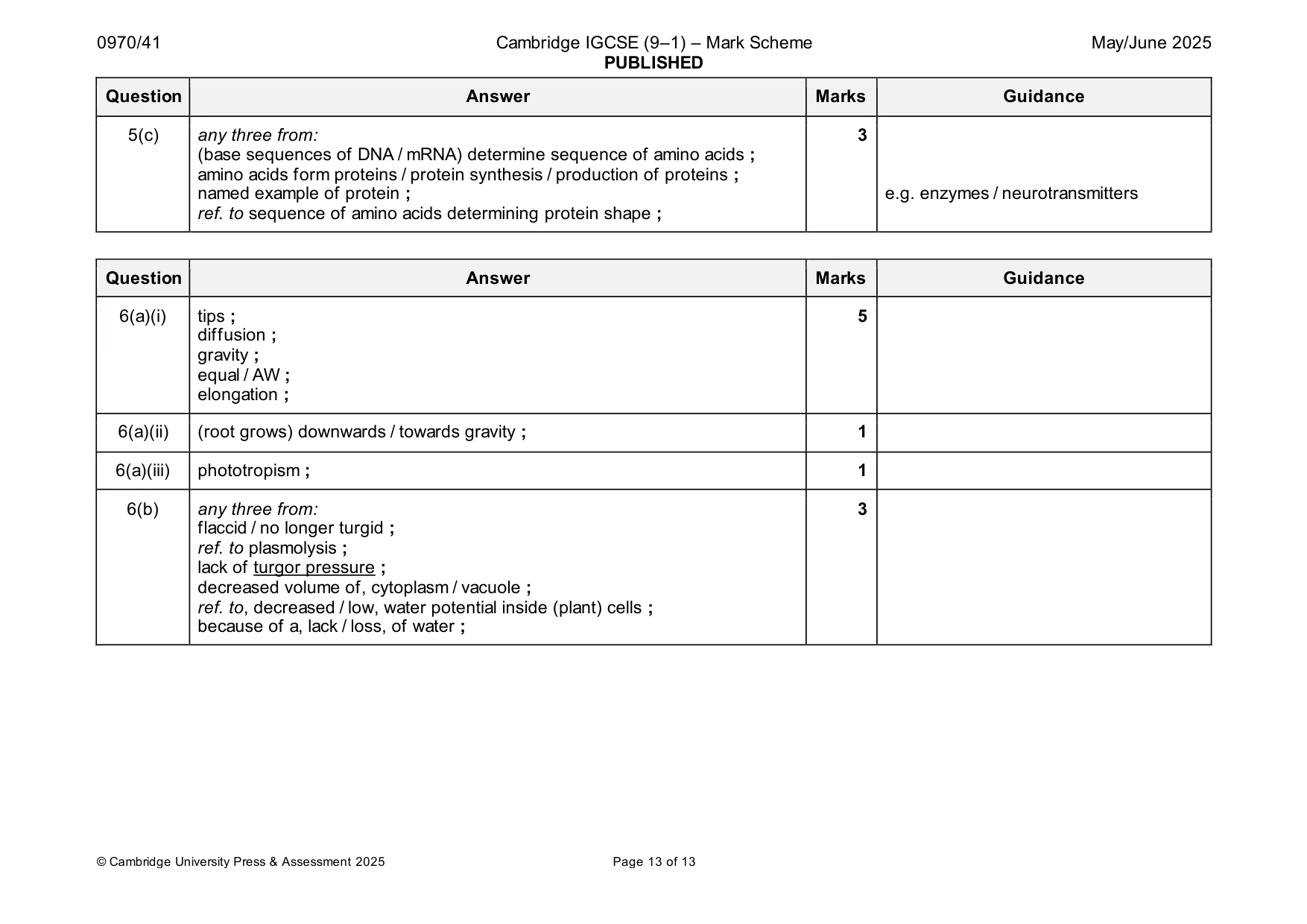
Mark scheme: 5(a)(i) A - hair / external ears ; 2 B – wings / feathers ; 5(a)(ii) apes and rodents ; 1 5(a)(iii) most similar – birds ; 2 least similar – sharks ; 5(b) any four from: 4 A annotated diagram 1 ref. to two strands / chains ; 2 double helix ; 3 ref. to four bases / A, T, C, G ; 4 A pairs with T and C pairs with G ; 5 ref. to bonds between bases ; 5(c) any three from: 3 (base sequences of DNA / mRNA) determine sequence of amino acids ; amino acids form proteins / protein synthesis / production of proteins ; named example of protein ; e.g. enzymes / neurotransmitters ref. to sequence of amino acids determining protein shape ;
Q6 · Some maize seeds were pinned on a board and provided with light from all directions
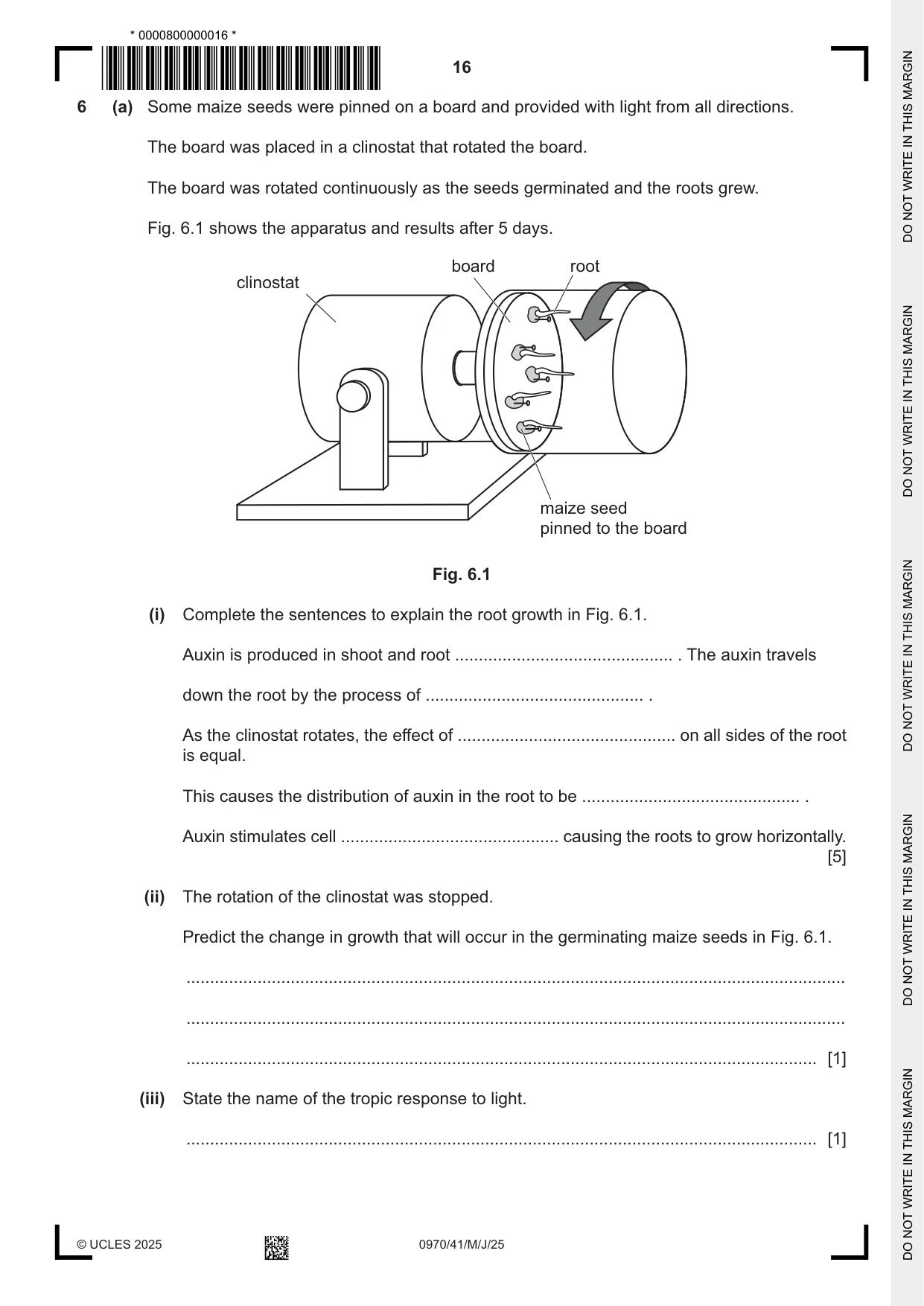
6 (a) Some maize seeds were pinned on a board and provided with light from all directions. The board was placed in a clinostat that rotated the board. The board was rotated continuously as the seeds germinated and the roots grew. Fig. 6.1 shows the apparatus and results after 5 days. board root clinostat maize seed pinned to the board Fig. 6.1 (i) Complete the sentences to explain the root growth in Fig. 6.1. Auxin is produced in shoot and root .............................................. . The auxin travels down the root by the process of .............................................. . As the clinostat rotates, the effect of .............................................. on all sides of the root is equal. This causes the distribution of auxin in the root to be .............................................. . Auxin stimulates cell .............................................. causing the roots to grow horizontally. [5] (ii) The rotation of the clinostat was stopped. Predict the change in growth that will occur in the germinating maize seeds in Fig. 6.1. ........................................................................................................................................... ........................................................................................................................................... ..................................................................................................................................... [1] (iii) State the name of the tropic response to light. ..................................................................................................................................... [1] (b) A student observed cells from a plant that had wilted. State and explain the expected appearance of the cells. ................................................................................................................................................... ................................................................................................................................................... ................................................................................................................................................... ................................................................................................................................................... ................................................................................................................................................... ................................................................................................................................................... ............................................................................................................................................. [3] [Total: 10]
Mark scheme: 6(a)(i) tips ; 5 diffusion ; gravity ; equal / AW ; elongation ; 6(a)(ii) (root grows) downwards / towards gravity ; 1 6(a)(iii) phototropism ; 1 6(b) any three from: 3 flaccid / no longer turgid ; ref. to plasmolysis ; lack of turgor pressure ; decreased volume of, cytoplasm / vacuole ; ref. to, decreased / low, water potential inside (plant) cells ; because of a, lack / loss, of water ;
What was in this paper
The subtopics covered by these 6 questions, and how many questions each got. Open one in a new tab to see every Cambridge question on it.
What you needed in this session
Cambridge’s own grade thresholds for 2025 May/June, Paper 4 · Variant 1. A higher threshold means an easier paper — the bar moves with how the cohort did.