Cambridge IGCSE Biology (9-1) 0970 — 2025 Oct/Nov Paper 4 · Variant 2
0970/42/O/N/25 · 6 questions · 80 marks · ≈90 min
The question paper and its mark scheme, free to read here and free to download. This is Cambridge’s own paper, exactly as it was sat.
Question paper20 pages


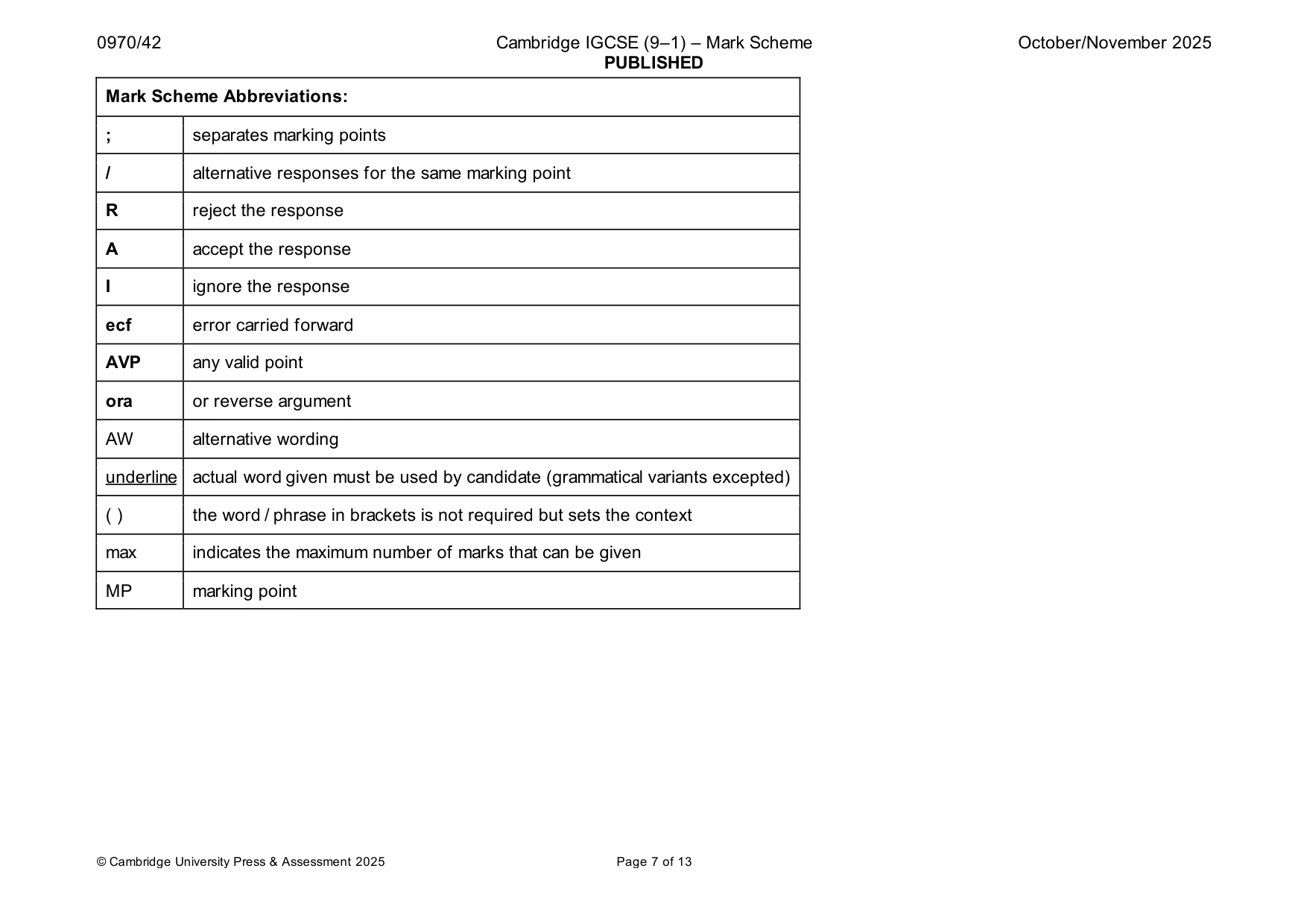
Mark scheme13 pages
Answers below. Sit the paper first if you are practising.
Questions as text
Q1 · Describe what is meant by the term physical digestion
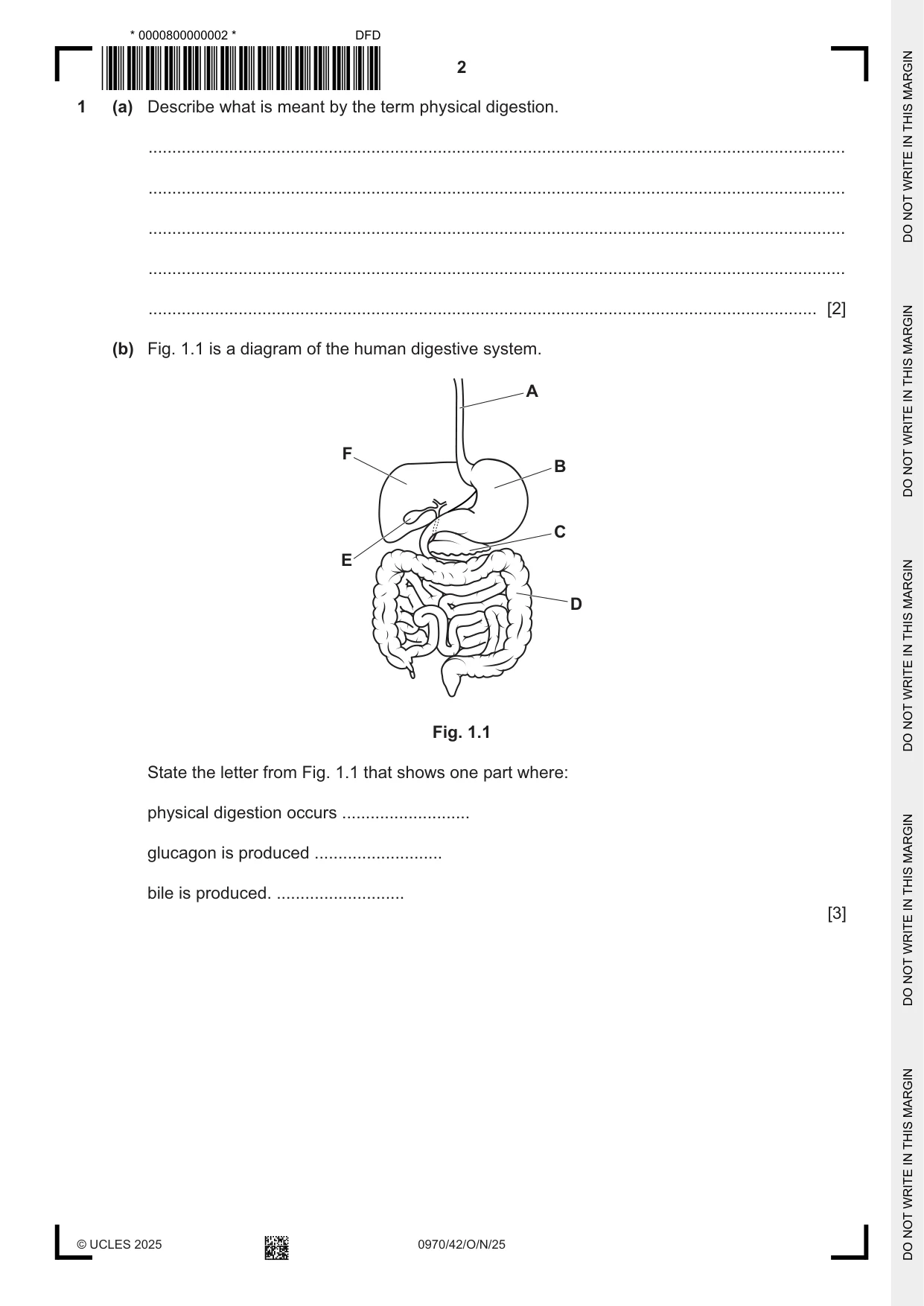
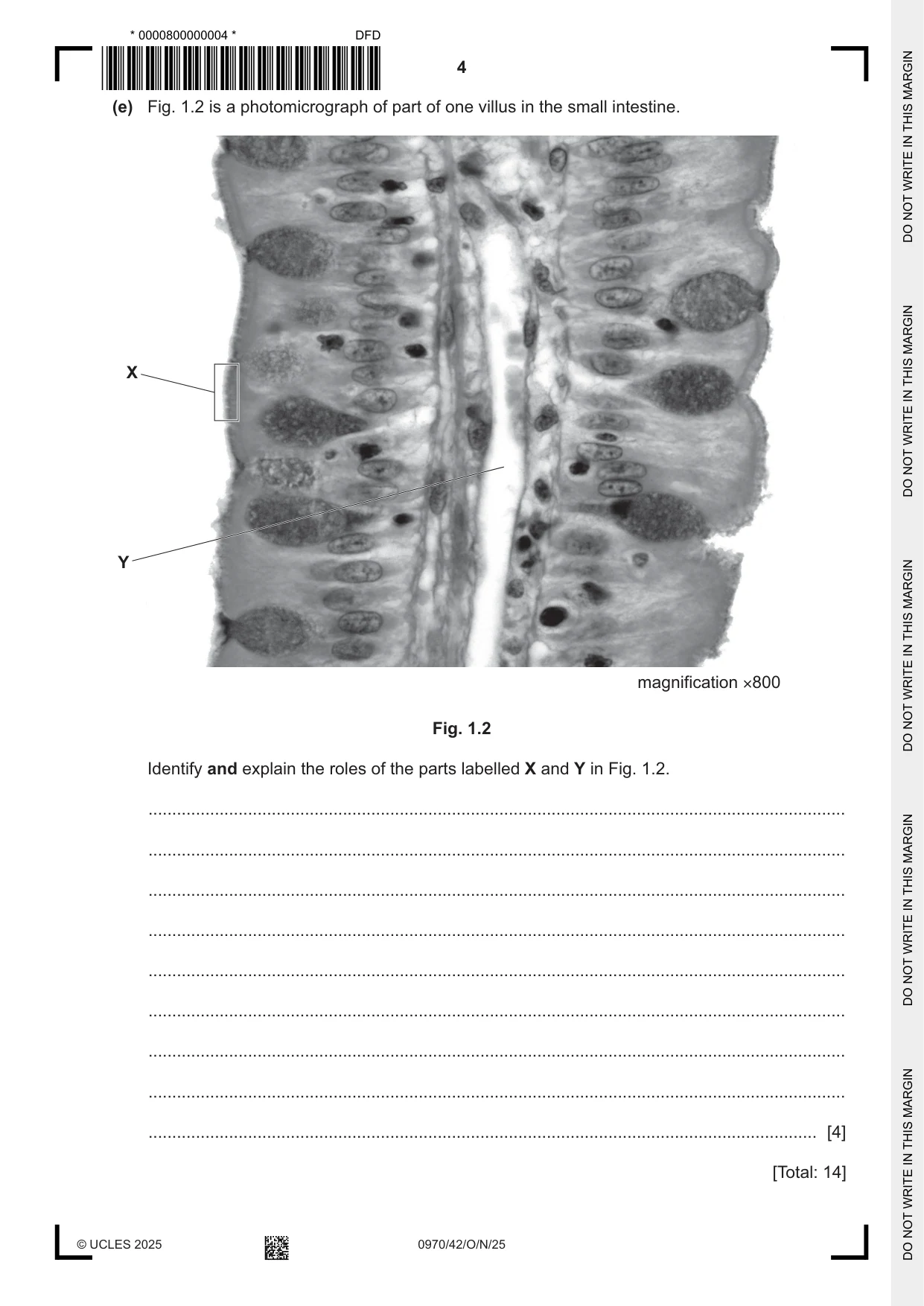
1 (a) Describe what is meant by the term physical digestion. ................................................................................................................................................... ................................................................................................................................................... ................................................................................................................................................... ................................................................................................................................................... ............................................................................................................................................. [2] (b) Fig. 1.1 is a diagram of the human digestive system. A F B C E D Fig. 1.1 State the letter from Fig. 1.1 that shows one part where: physical digestion occurs ........................... glucagon is produced ........................... bile is produced. ........................... [3] (c) Explain the role of bile in physical digestion. ................................................................................................................................................... ................................................................................................................................................... ................................................................................................................................................... ................................................................................................................................................... ................................................................................................................................................... ................................................................................................................................................... ............................................................................................................................................. [3] (d) Physical digestion also occurs in the mouth. State the names and functions of two types of human teeth. 1 ................................................................................................................................................ ................................................................................................................................................... 2 ................................................................................................................................................ ................................................................................................................................................... [2] (e) Fig. 1.2 is a photomicrograph of part of one villus in the small intestine. X Y magnification ×800 Fig. 1.2 Identify and explain the roles of the parts labelled X and Y in Fig. 1.2. ................................................................................................................................................... ................................................................................................................................................... ................................................................................................................................................... ................................................................................................................................................... ................................................................................................................................................... ................................................................................................................................................... ................................................................................................................................................... ................................................................................................................................................... ............................................................................................................................................. [4] [Total: 14]
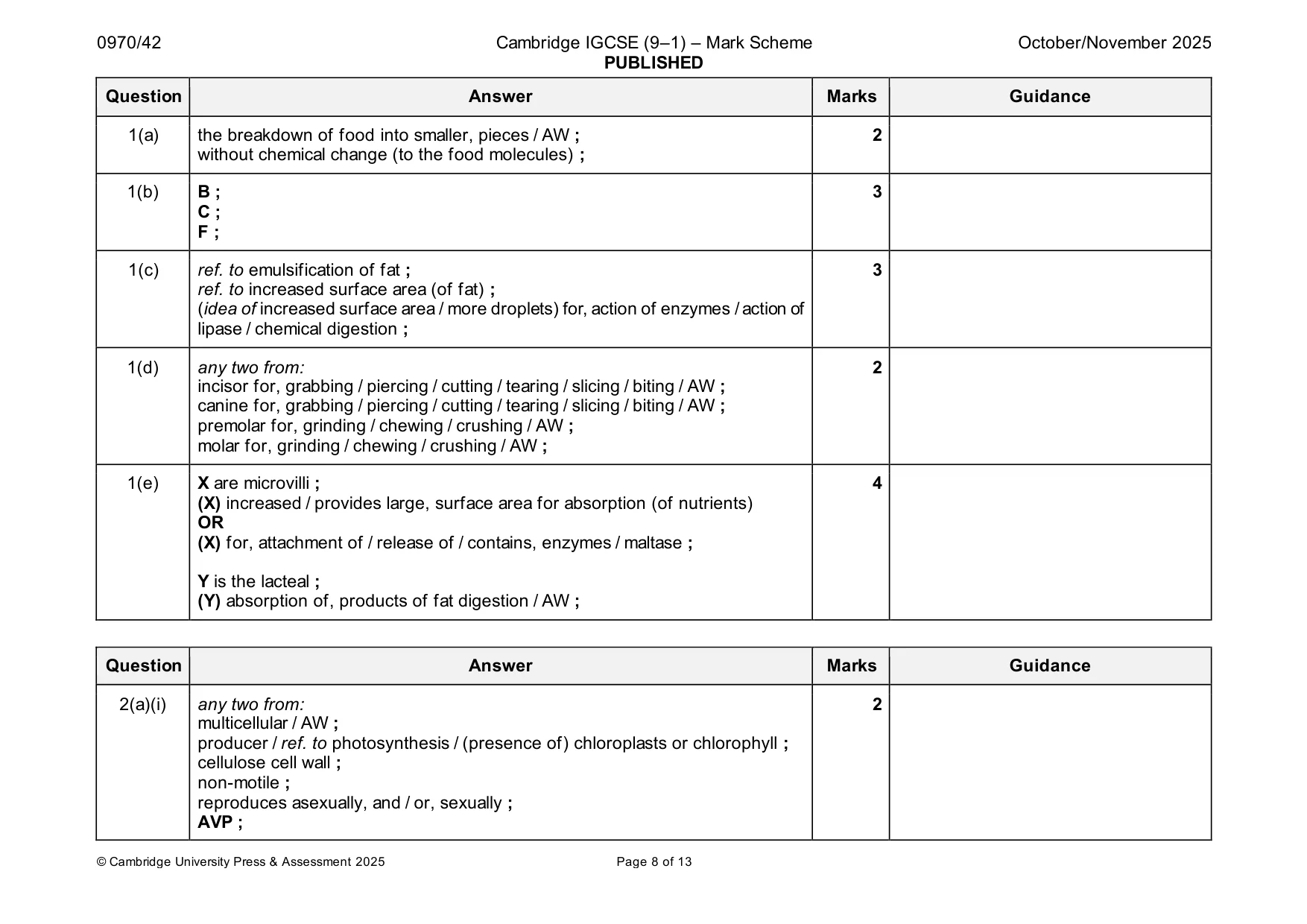
Mark scheme: Question Answer Marks Guidance 1(a) the breakdown of food into smaller, pieces / AW ; 2 without chemical change (to the food molecules) ; 1(b) B ; 3 C ; F ; 1(c) ref. to emulsification of fat ; 3 ref. to increased surface area (of fat) ; (idea of increased surface area / more droplets) for, action of enzymes / action of lipase / chemical digestion ; 1(d) any two from: 2 incisor for, grabbing / piercing / cutting / tearing / slicing / biting / AW ; canine for, grabbing / piercing / cutting / tearing / slicing / biting / AW ; premolar for, grinding / chewing / crushing / AW ; molar for, grinding / chewing / crushing / AW ; 1(e) X are microvilli ; 4 (X) increased / provides large, surface area for absorption (of nutrients) OR (X) for, attachment of / release of / contains, enzymes / maltase ; Y is the lacteal ; (Y) absorption of, products of fat digestion / AW ;
Q2 · Dicotyledons and monocotyledons belong to the plant kingdom
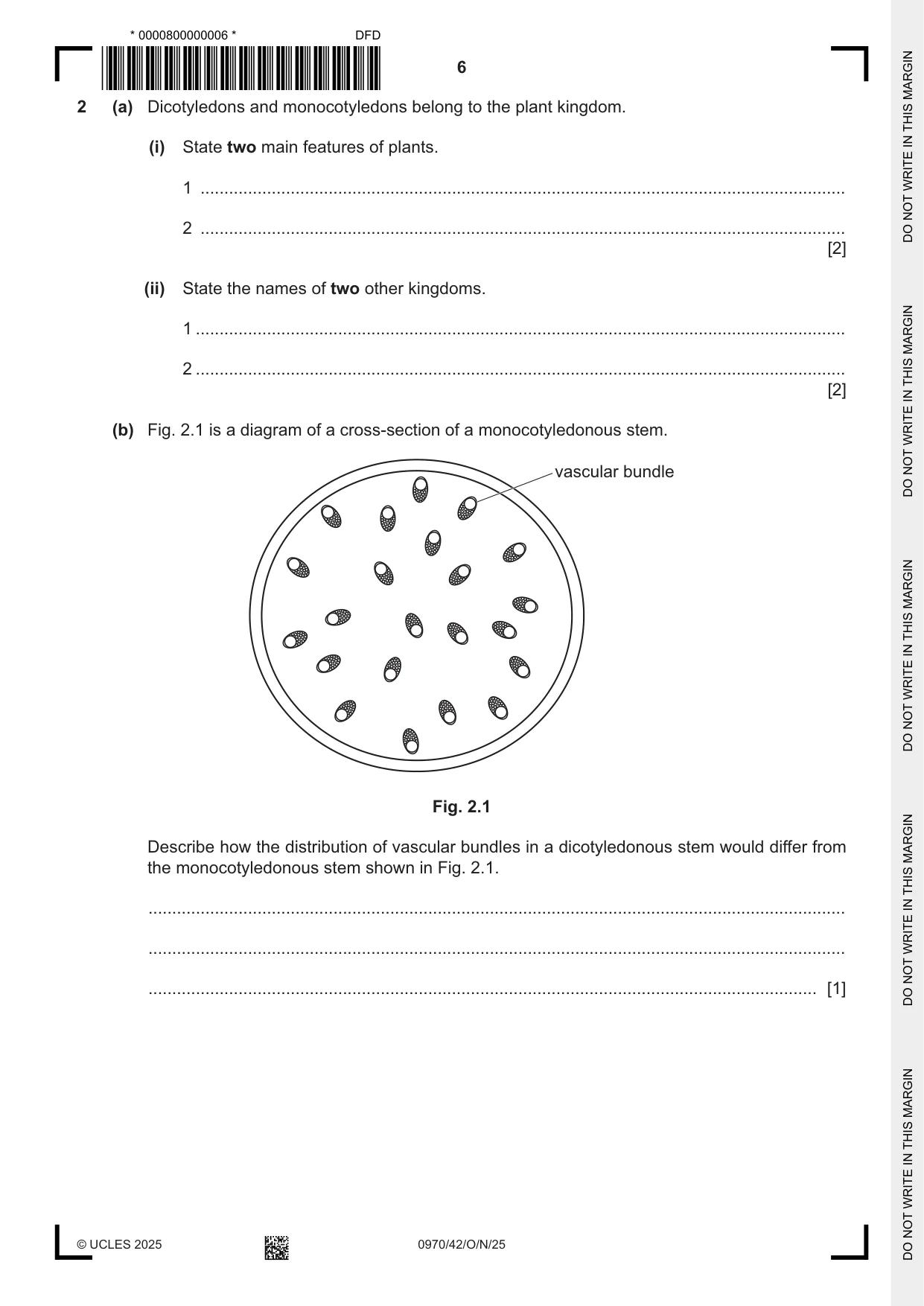
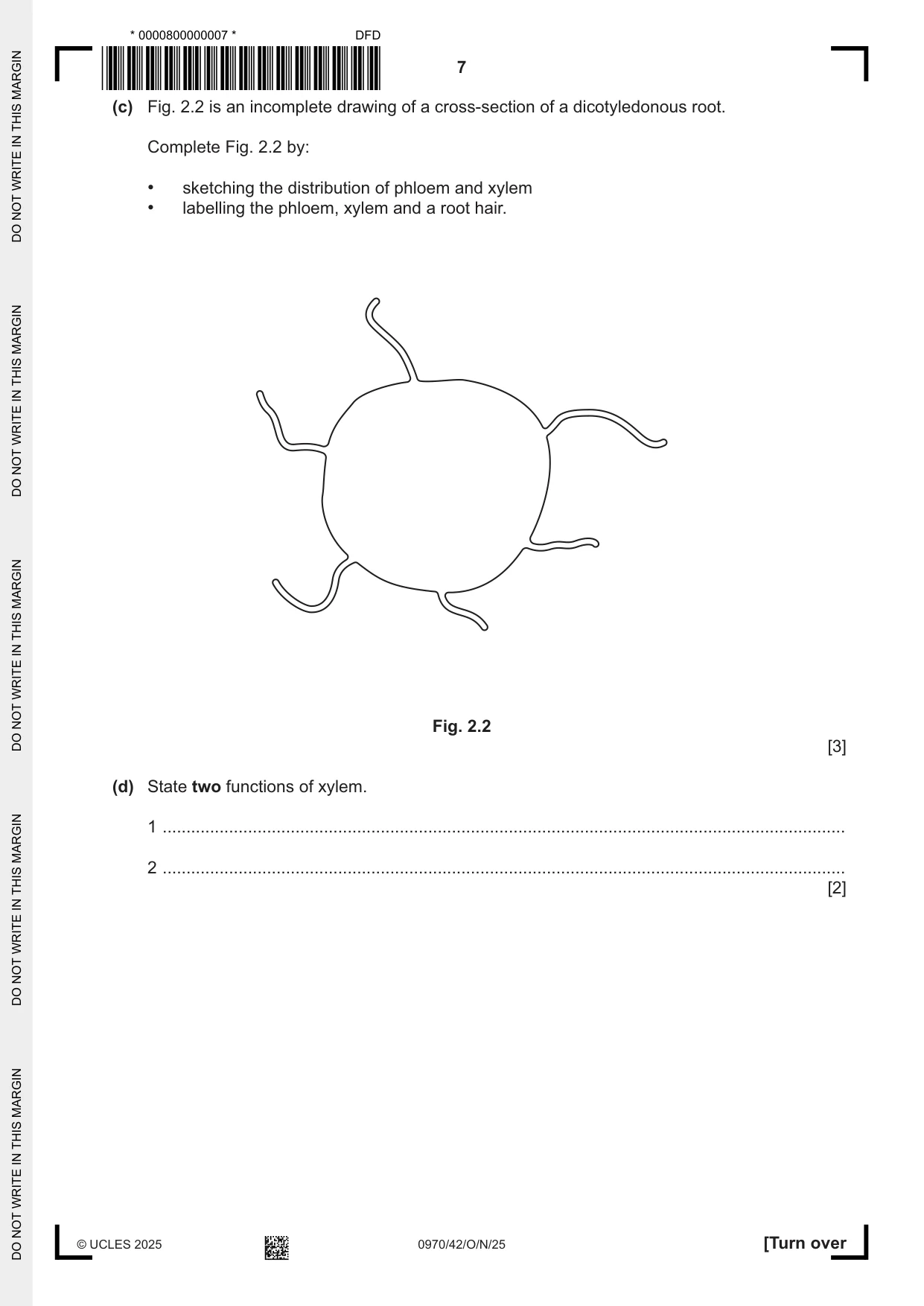
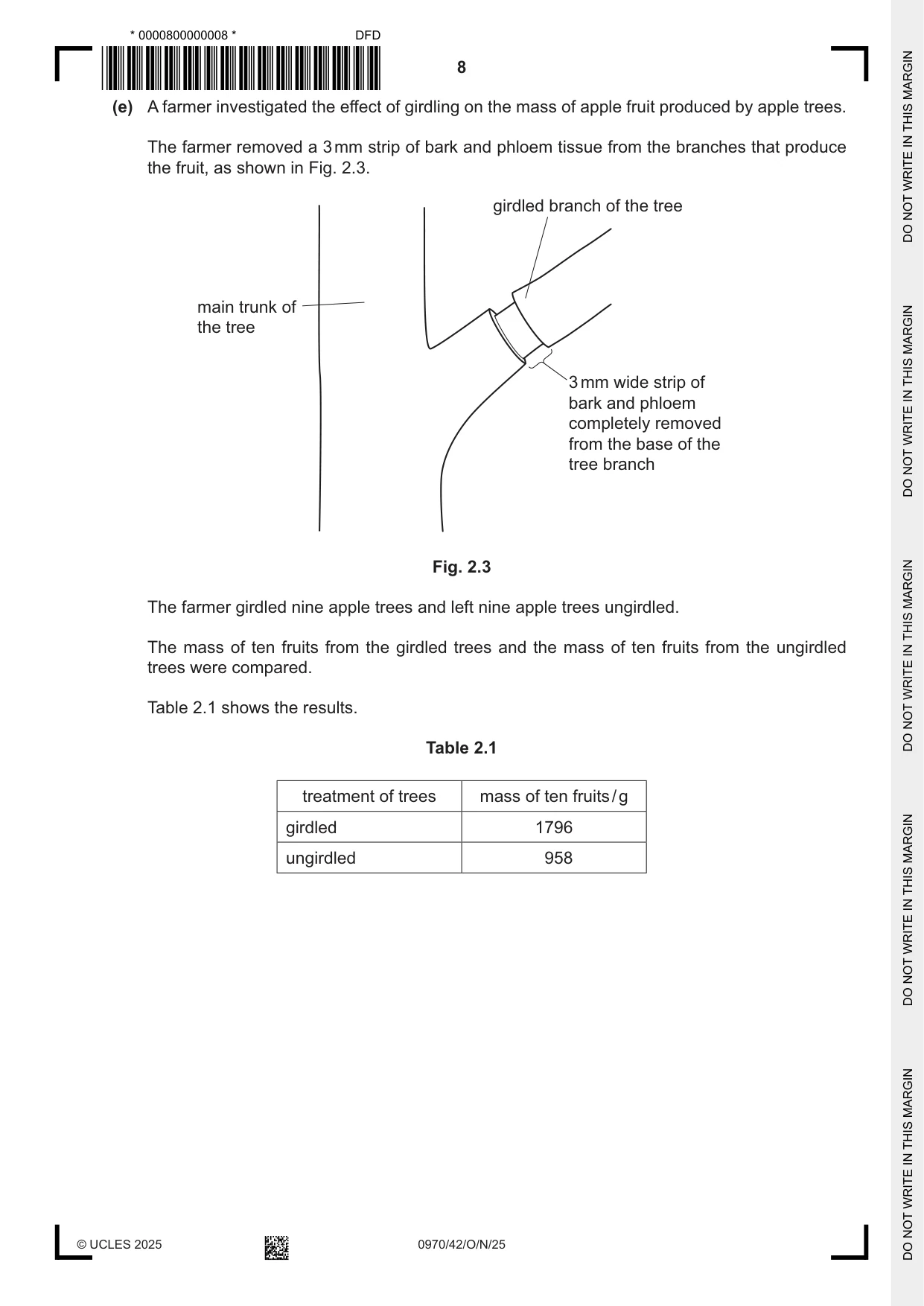
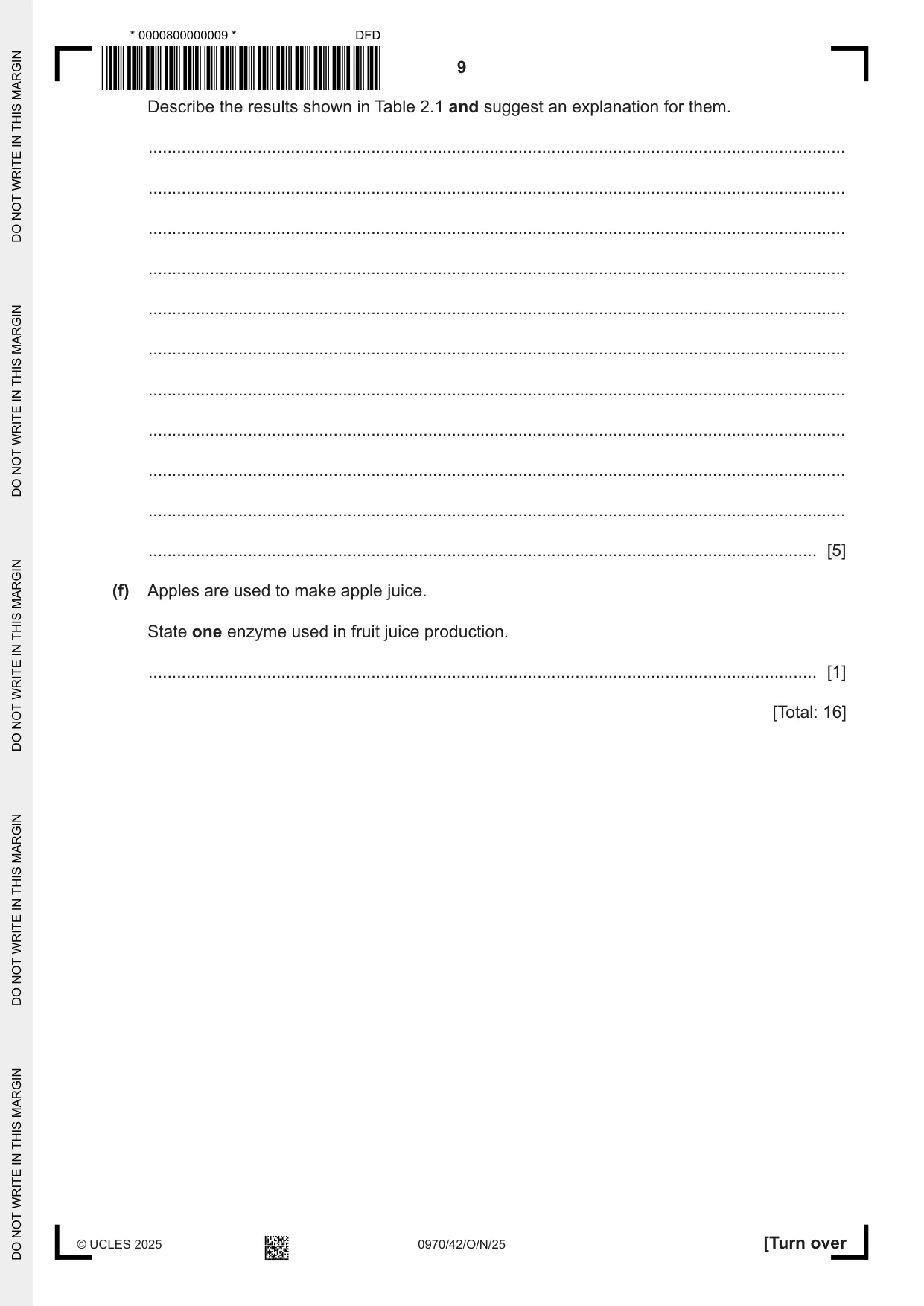
2 (a) Dicotyledons and monocotyledons belong to the plant kingdom. (i) State two main features of plants. 1 ........................................................................................................................................ 2 ........................................................................................................................................ [2] (ii) State the names of two other kingdoms. 1 ......................................................................................................................................... 2 ......................................................................................................................................... [2] (b) Fig. 2.1 is a diagram of a cross-section of a monocotyledonous stem. vascular bundle Fig. 2.1 Describe how the distribution of vascular bundles in a dicotyledonous stem would differ from the monocotyledonous stem shown in Fig. 2.1. ................................................................................................................................................... ................................................................................................................................................... ............................................................................................................................................. [1] (c) Fig. 2.2 is an incomplete drawing of a cross-section of a dicotyledonous root. Complete Fig. 2.2 by: • sketching the distribution of phloem and xylem • labelling the phloem, xylem and a root hair. Fig. 2.2 [3] (d) State two functions of xylem. 1 ................................................................................................................................................ 2 ................................................................................................................................................ [2] (e) A farmer investigated the effect of girdling on the mass of apple fruit produced by apple trees. The farmer removed a 3 mm strip of bark and phloem tissue from the branches that produce the fruit, as shown in Fig. 2.3. girdled branch of the tree main trunk of the tree 3 mm wide strip of bark and phloem completely removed from the base of the tree branch Fig. 2.3 The farmer girdled nine apple trees and left nine apple trees ungirdled. The mass of ten fruits from the girdled trees and the mass of ten fruits from the ungirdled trees were compared. Table 2.1 shows the results. Table 2.1 treatment of trees mass of ten fruits / g girdled 1796 ungirdled 958 Describe the results shown in Table 2.1 and suggest an explanation for them. ................................................................................................................................................... ................................................................................................................................................... ................................................................................................................................................... ................................................................................................................................................... ................................................................................................................................................... ................................................................................................................................................... ................................................................................................................................................... ................................................................................................................................................... ................................................................................................................................................... ................................................................................................................................................... ............................................................................................................................................. [5] (f) Apples are used to make apple juice. State one enzyme used in fruit juice production. ............................................................................................................................................. [1] [Total: 16]
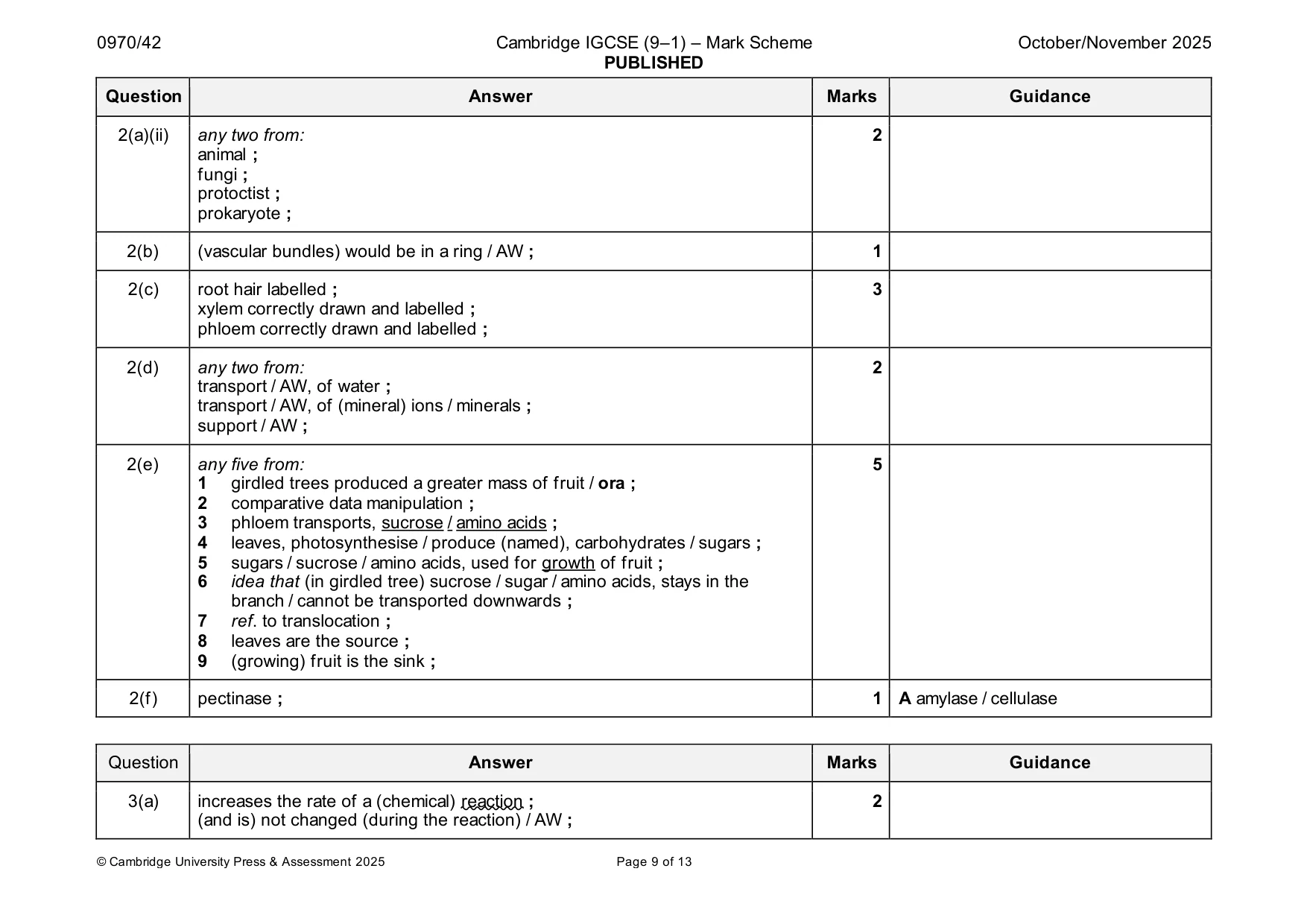
Mark scheme: 2(a)(i) any two from: 2 multicellular / AW ; producer / ref. to photosynthesis / (presence of) chloroplasts or chlorophyll ; cellulose cell wall ; non-motile ; reproduces asexually, and / or, sexually ; AVP ; 2(a)(ii) any two from: 2 animal ; fungi ; protoctist ; prokaryote ; 2(b) (vascular bundles) would be in a ring / AW ; 1 2(c) root hair labelled ; 3 xylem correctly drawn and labelled ; phloem correctly drawn and labelled ; 2(d) any two from: 2 transport / AW, of water ; transport / AW, of (mineral) ions / minerals ; support / AW ; 2(e) any five from: 5 1 girdled trees produced a greater mass of fruit / ora ; 2 comparative data manipulation ; 3 phloem transports, sucrose / amino acids ; 4 leaves, photosynthesise / produce (named), carbohydrates / sugars ; 5 sugars / sucrose / amino acids, used for growth of fruit ; 6 idea that (in girdled tree) sucrose / sugar / amino acids, stays in the branch / cannot be transported downwards ; 7 ref. to translocation ; 8 leaves are the source ; 9 (growing) fruit is the sink ; 2(f) pectinase ; 1 A amylase / cellulase
Q3 · Enzymes are biological catalysts
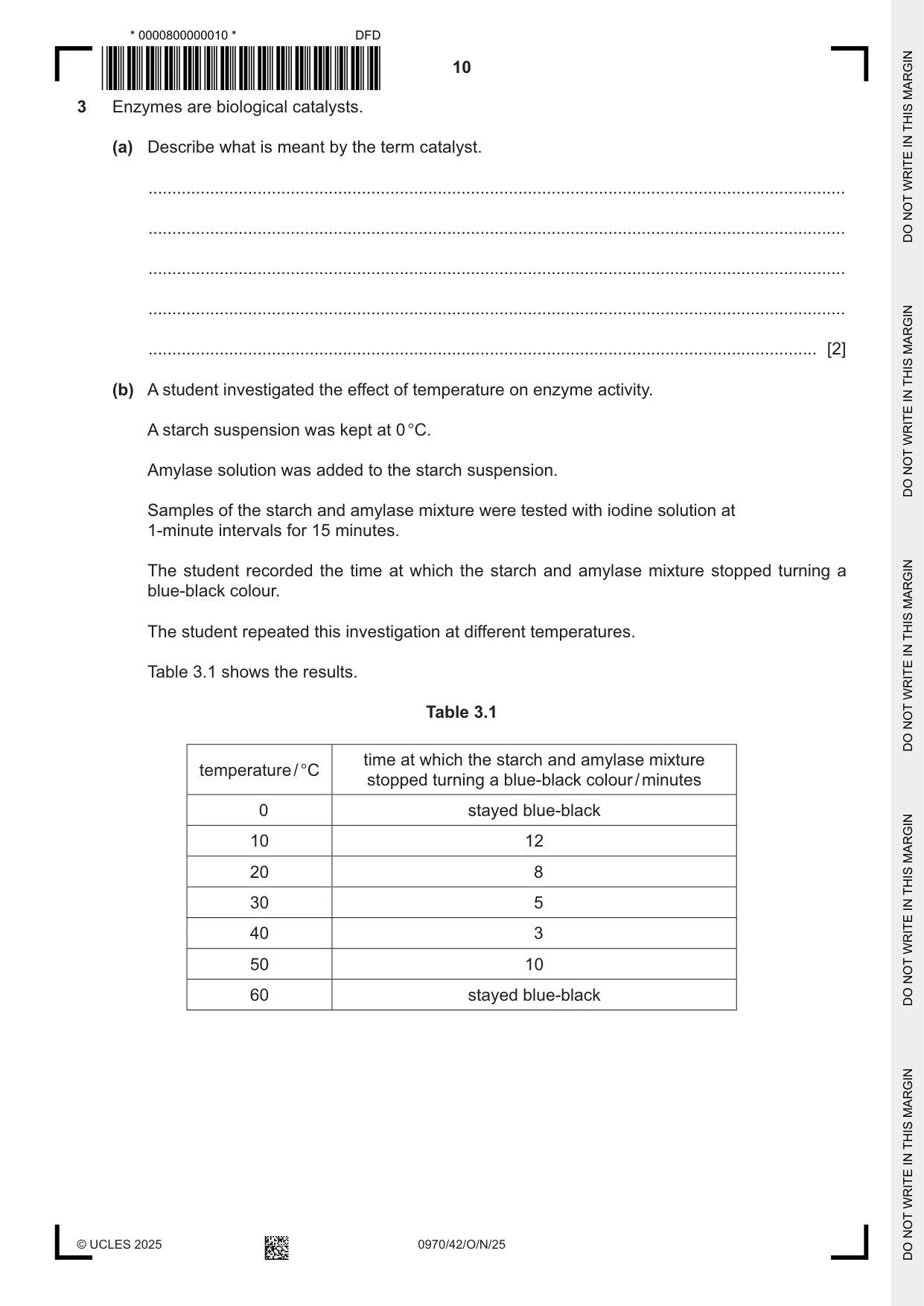
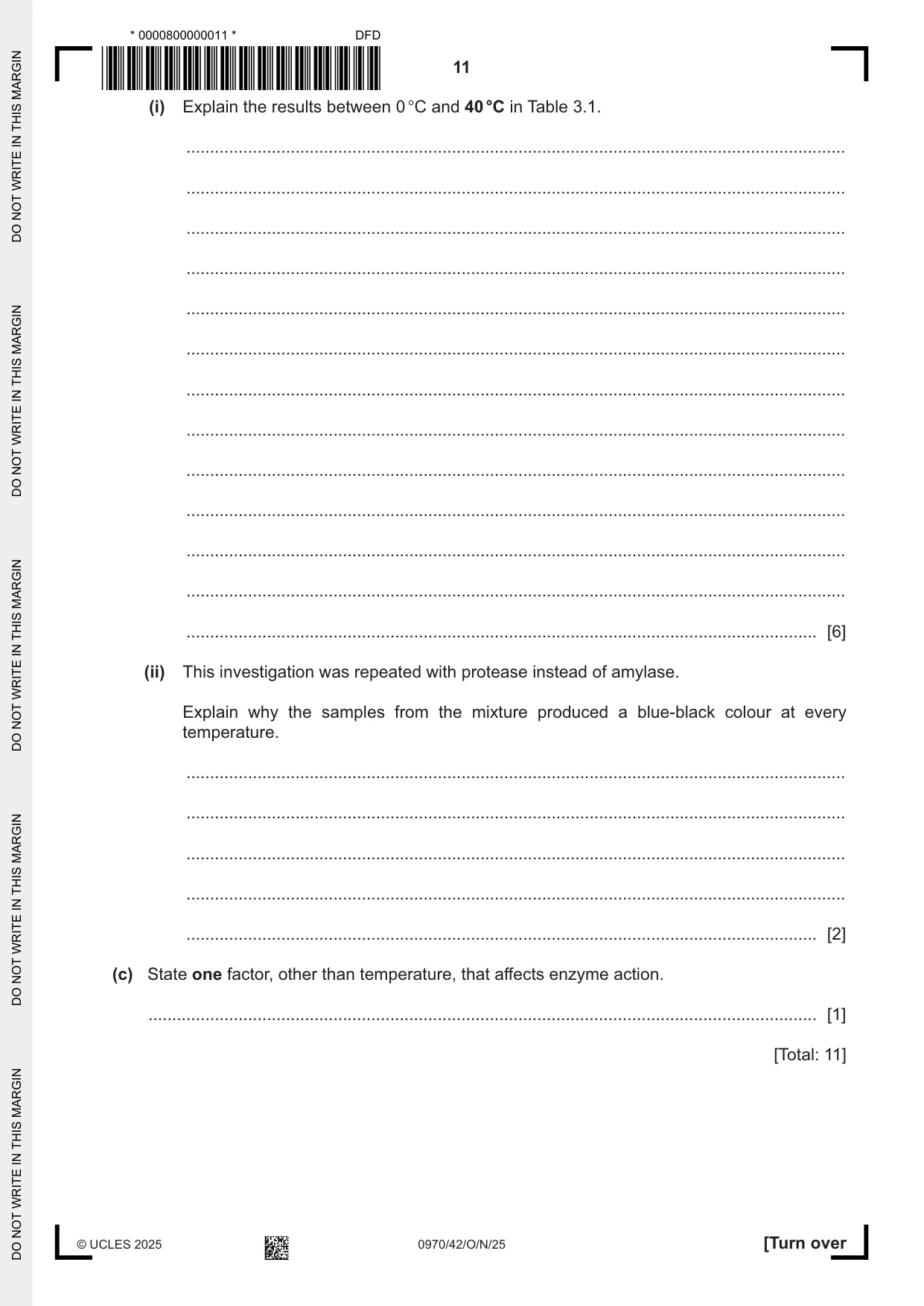
3 Enzymes are biological catalysts. (a) Describe what is meant by the term catalyst. ................................................................................................................................................... ................................................................................................................................................... ................................................................................................................................................... ................................................................................................................................................... ............................................................................................................................................. [2] (b) A student investigated the effect of temperature on enzyme activity. A starch suspension was kept at 0 °C. Amylase solution was added to the starch suspension. Samples of the starch and amylase mixture were tested with iodine solution at 1-minute intervals for 15 minutes. The student recorded the time at which the starch and amylase mixture stopped turning a blue-black colour. The student repeated this investigation at different temperatures. Table 3.1 shows the results. Table 3.1 time at which the starch and amylase mixture temperature / °C stopped turning a blue-black colour / minutes 0 stayed blue-black 10 12 20 8 30 5 40 3 50 10 60 stayed blue-black (i) Explain the results between 0 °C and 40 °C in Table 3.1. ........................................................................................................................................... ........................................................................................................................................... ........................................................................................................................................... ........................................................................................................................................... ........................................................................................................................................... ........................................................................................................................................... ........................................................................................................................................... ........................................................................................................................................... ........................................................................................................................................... ........................................................................................................................................... ........................................................................................................................................... ........................................................................................................................................... ..................................................................................................................................... [6] (ii) This investigation was repeated with protease instead of amylase. Explain why the samples from the mixture produced a blue-black colour at every temperature. ........................................................................................................................................... ........................................................................................................................................... ........................................................................................................................................... ........................................................................................................................................... ..................................................................................................................................... [2] (c) State one factor, other than temperature, that affects enzyme action. ............................................................................................................................................. [1] [Total: 11]
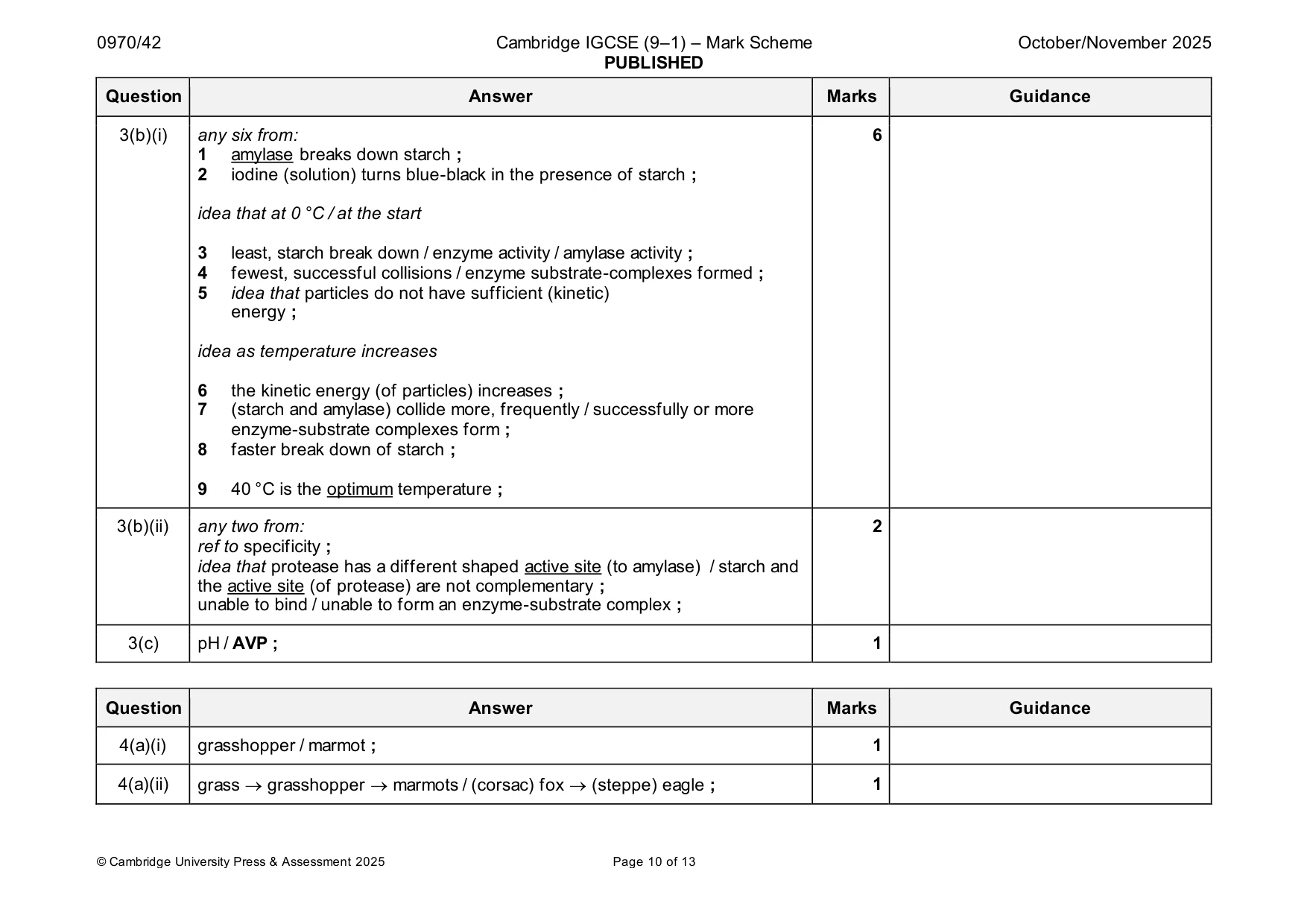
Mark scheme: 3(a) increases the rate of a (chemical) reaction ; 2 (and is) not changed (during the reaction) / AW ; 3(b)(i) any six from: 6 1 amylase breaks down starch ; 2 iodine (solution) turns blue-black in the presence of starch ; idea that at 0 °C / at the start 3 least, starch break down / enzyme activity / amylase activity ; 4 fewest, successful collisions / enzyme substrate-complexes formed ; 5 idea that particles do not have sufficient (kinetic) energy ; idea as temperature increases 6 the kinetic energy (of particles) increases ; 7 (starch and amylase) collide more, frequently / successfully or more enzyme-substrate complexes form ; 8 faster break down of starch ; 9 40 °C is the optimum temperature ; 3(b)(ii) any two from: 2 ref to specificity ; idea that protease has a different shaped active site (to amylase) / starch and the active site (of protease) are not complementary ; unable to bind / unable to form an enzyme-substrate complex ; 3(c) pH / AVP ; 1
Q4 · Steppe ecosystems are large areas of grasslands found in central Asia
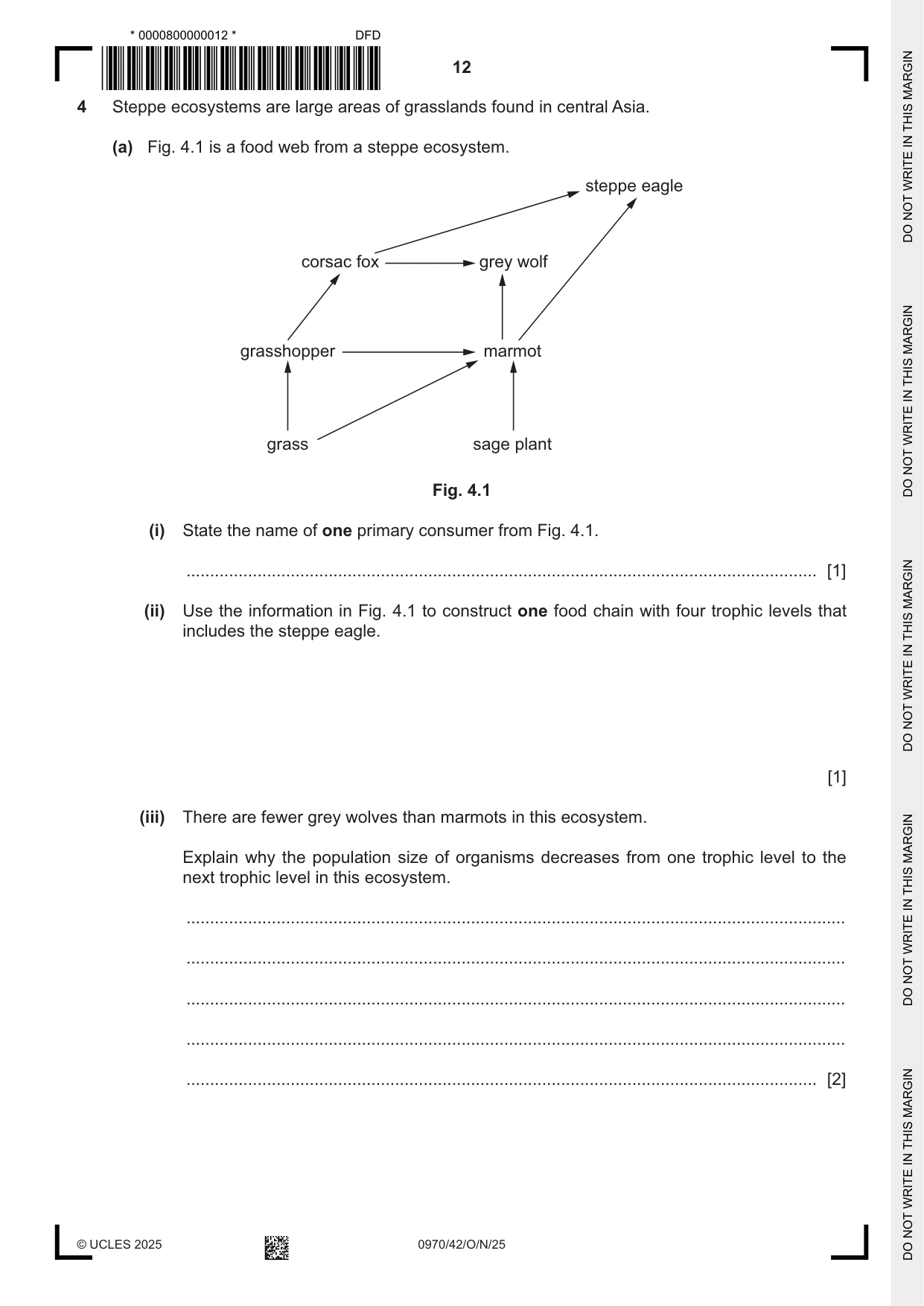
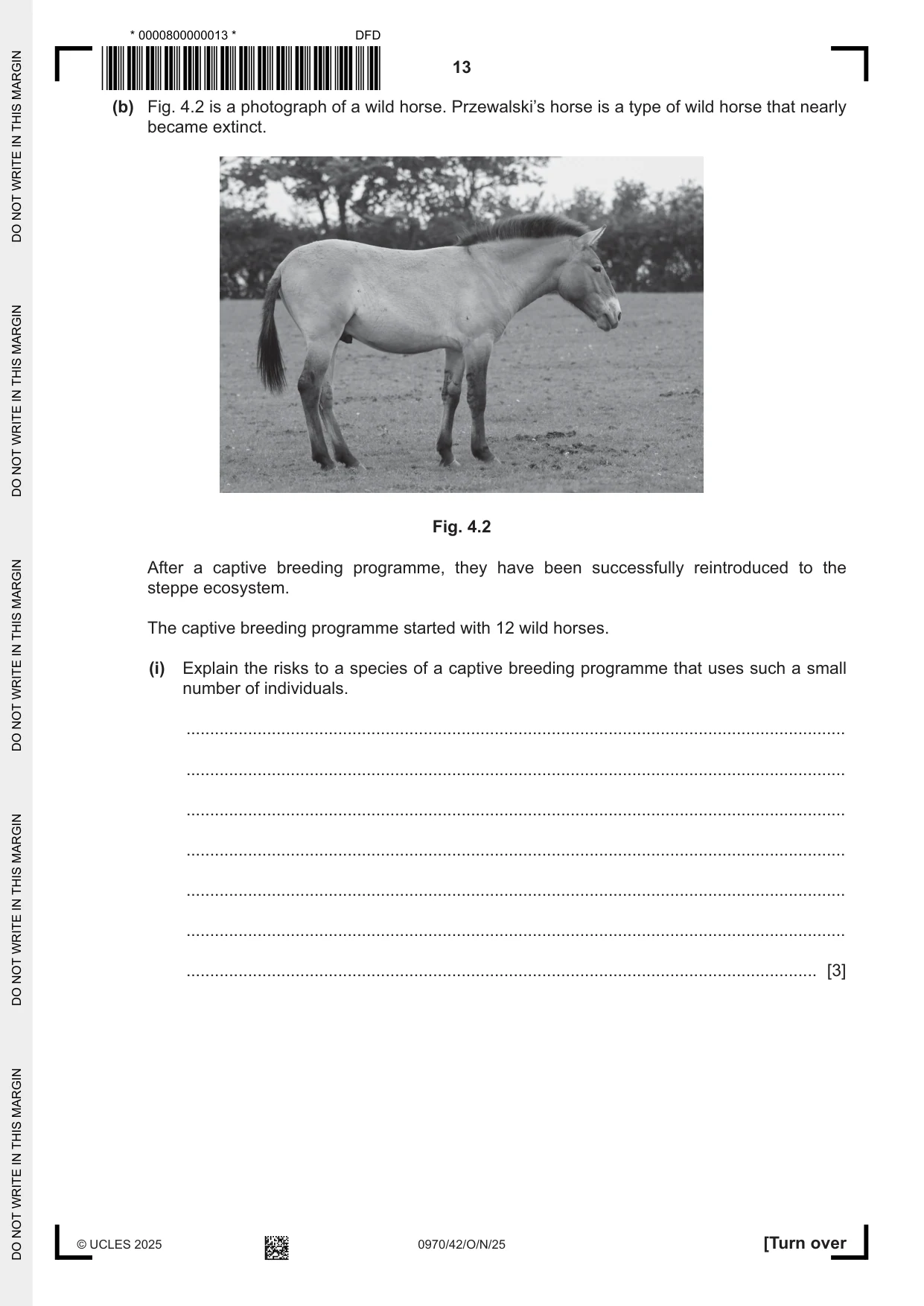
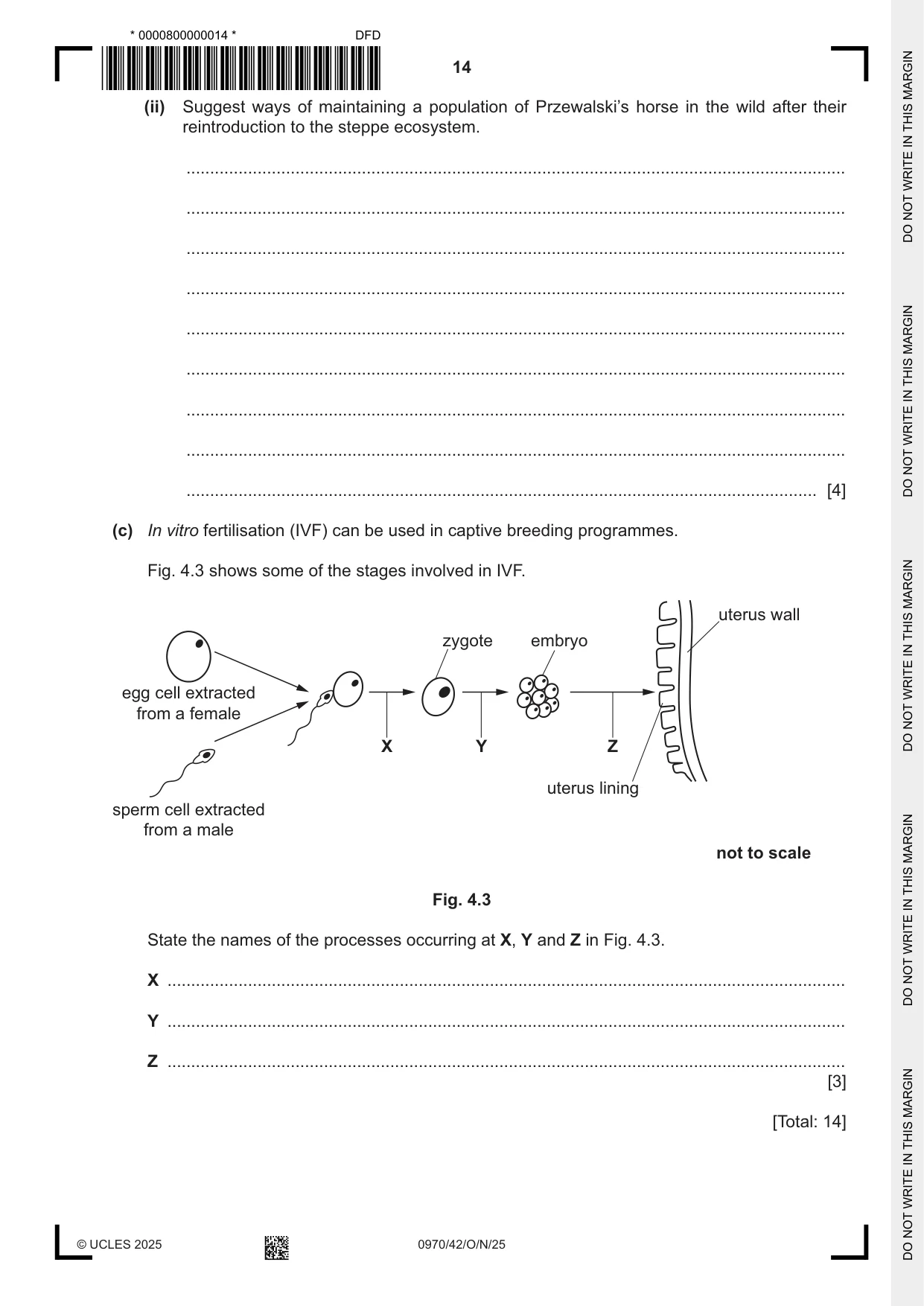
4 Steppe ecosystems are large areas of grasslands found in central Asia. (a) Fig. 4.1 is a food web from a steppe ecosystem. steppe eagle corsac fox grey wolf grasshopper marmot grass sage plant Fig. 4.1 (i) State the name of one primary consumer from Fig. 4.1. ..................................................................................................................................... [1] (ii) Use the information in Fig. 4.1 to construct one food chain with four trophic levels that includes the steppe eagle. [1] (iii) There are fewer grey wolves than marmots in this ecosystem. Explain why the population size of organisms decreases from one trophic level to the next trophic level in this ecosystem. ........................................................................................................................................... ........................................................................................................................................... ........................................................................................................................................... ........................................................................................................................................... ..................................................................................................................................... [2] (b) Fig. 4.2 is a photograph of a wild horse. Przewalski’s horse is a type of wild horse that nearly became extinct. Fig. 4.2 After a captive breeding programme, they have been successfully reintroduced to the steppe ecosystem. The captive breeding programme started with 12 wild horses. (i) Explain the risks to a species of a captive breeding programme that uses such a small number of individuals. ........................................................................................................................................... ........................................................................................................................................... ........................................................................................................................................... ........................................................................................................................................... ........................................................................................................................................... ........................................................................................................................................... ..................................................................................................................................... [3] (ii) Suggest ways of maintaining a population of Przewalski’s horse in the wild after their reintroduction to the steppe ecosystem. ........................................................................................................................................... ........................................................................................................................................... ........................................................................................................................................... ........................................................................................................................................... ........................................................................................................................................... ........................................................................................................................................... ........................................................................................................................................... ........................................................................................................................................... ..................................................................................................................................... [4] (c) In vitro fertilisation (IVF) can be used in captive breeding programmes. Fig. 4.3 shows some of the stages involved in IVF. uterus wall zygote embryo egg cell extracted from a female X Y Z uterus lining sperm cell extracted from a male not to scale Fig. 4.3 State the names of the processes occurring at X, Y and Z in Fig. 4.3. X ............................................................................................................................................... Y ............................................................................................................................................... Z ............................................................................................................................................... [3] [Total: 14]
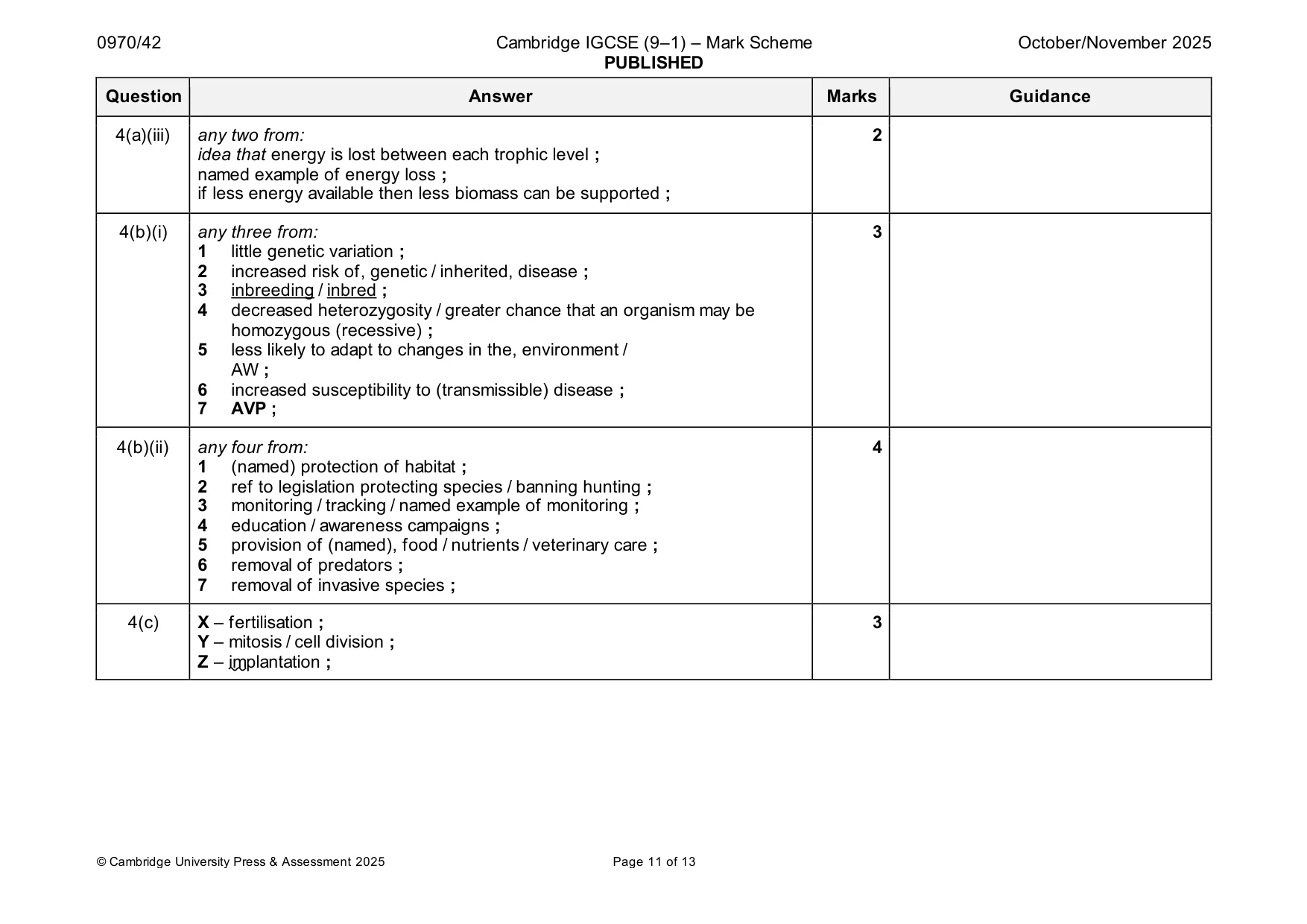
Mark scheme: 4(a)(i) grasshopper / marmot ; 1 4(a)(ii) grass → grasshopper → marmots / (corsac) fox → (steppe) eagle ; 1 4(a)(iii) any two from: 2 idea that energy is lost between each trophic level ; named example of energy loss ; if less energy available then less biomass can be supported ; 4(b)(i) any three from: 3 1 little genetic variation ; 2 increased risk of, genetic / inherited, disease ; 3 inbreeding / inbred ; 4 decreased heterozygosity / greater chance that an organism may be homozygous (recessive) ; 5 less likely to adapt to changes in the, environment / AW ; 6 increased susceptibility to (transmissible) disease ; 7 AVP ; 4(b)(ii) any four from: 4 1 (named) protection of habitat ; 2 ref to legislation protecting species / banning hunting ; 3 monitoring / tracking / named example of monitoring ; 4 education / awareness campaigns ; 5 provision of (named), food / nutrients / veterinary care ; 6 removal of predators ; 7 removal of invasive species ; 4(c) X – fertilisation ; 3 Y – mitosis / cell division ; Z – implantation ;
Q5 · Discuss the advantages of intensive livestock production
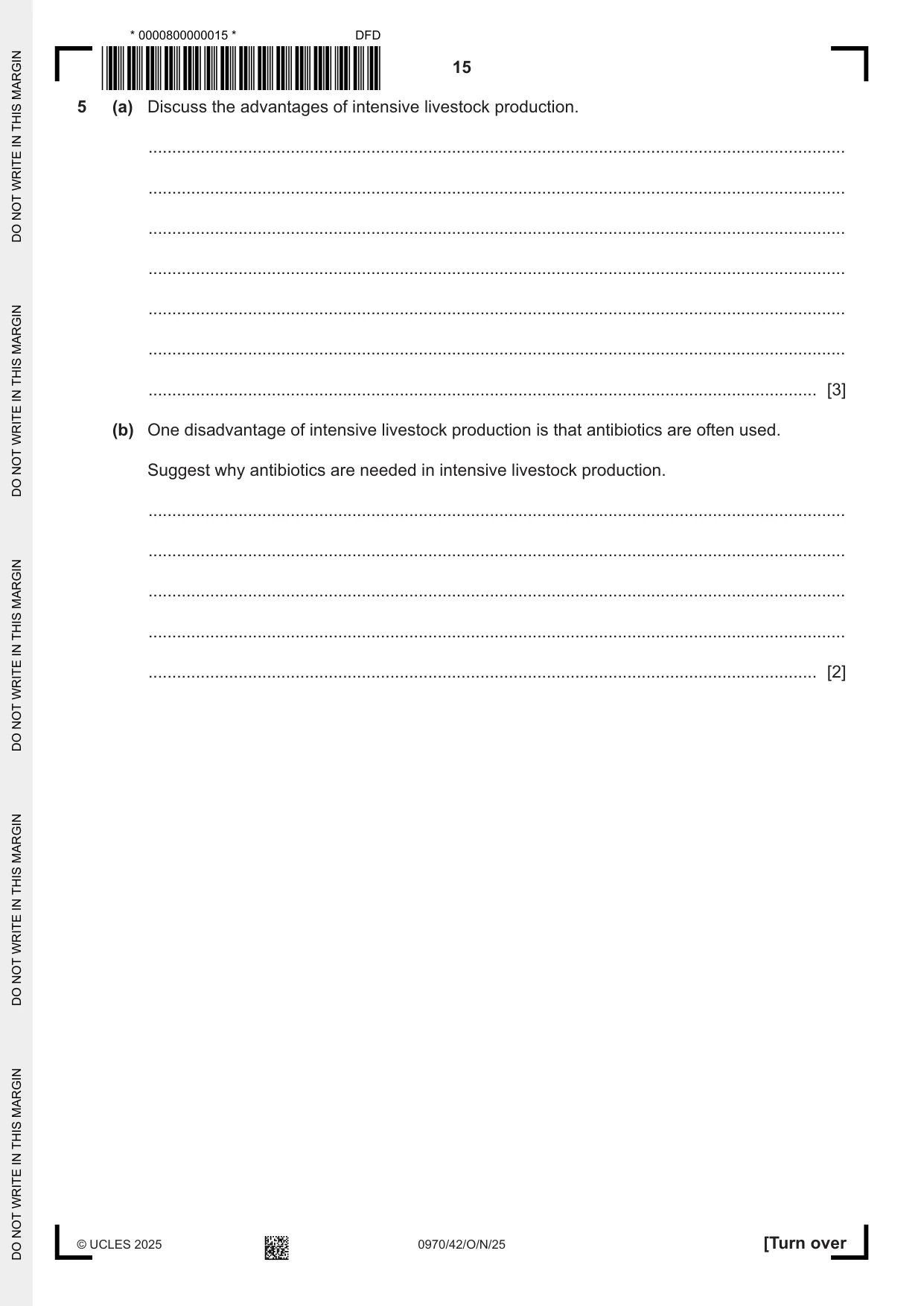
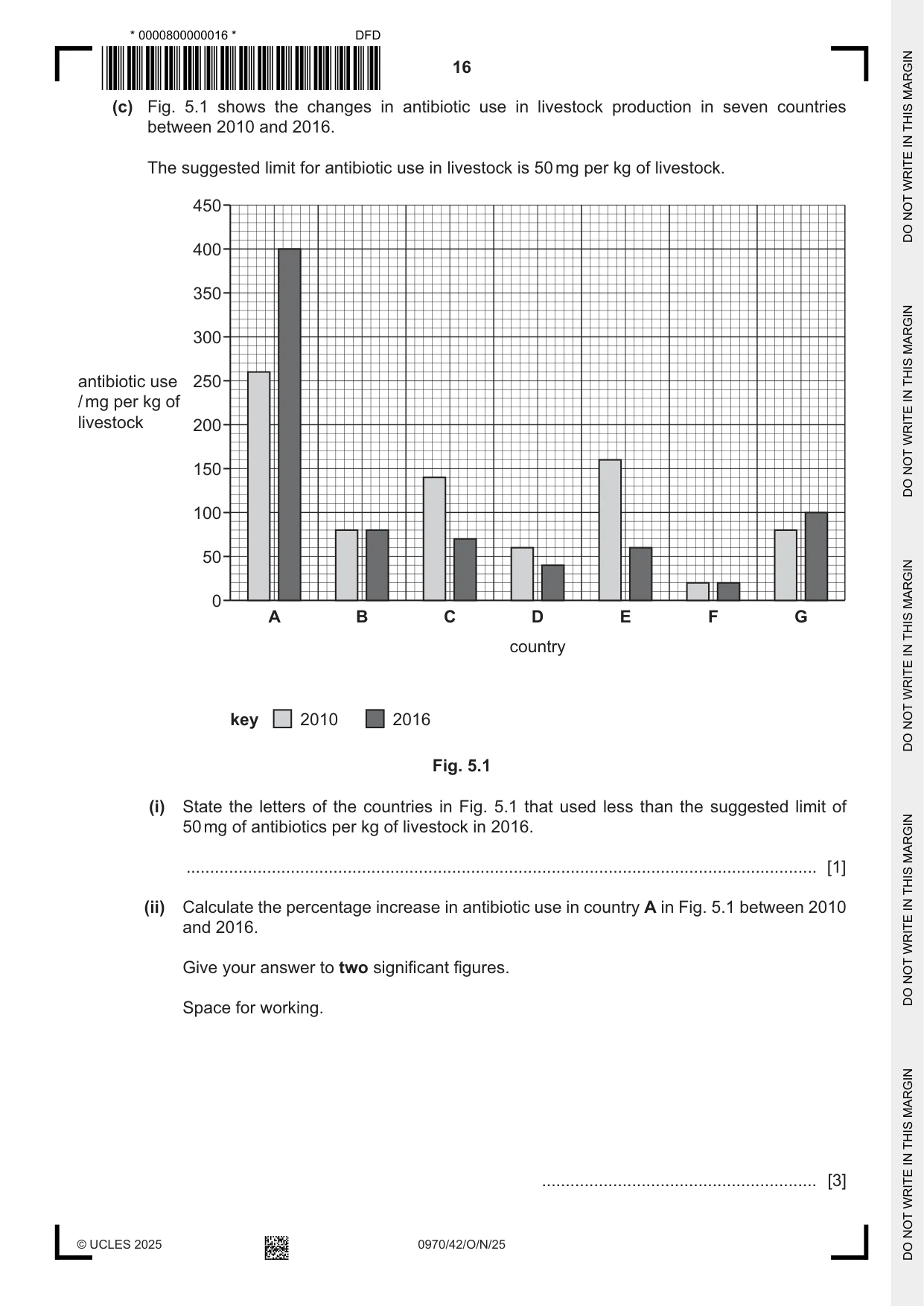
5 (a) Discuss the advantages of intensive livestock production. ................................................................................................................................................... ................................................................................................................................................... ................................................................................................................................................... ................................................................................................................................................... ................................................................................................................................................... ................................................................................................................................................... ............................................................................................................................................. [3] (b) One disadvantage of intensive livestock production is that antibiotics are often used. Suggest why antibiotics are needed in intensive livestock production. ................................................................................................................................................... ................................................................................................................................................... ................................................................................................................................................... ................................................................................................................................................... ............................................................................................................................................. [2] (c) Fig. 5.1 shows the changes in antibiotic use in livestock production in seven countries between 2010 and 2016. The suggested limit for antibiotic use in livestock is 50 mg per kg of livestock. 450 400 350 300 antibiotic use 250 / mg per kg of livestock 200 150 100 50 0 A B C D E F G country key 2010 2016 Fig. 5.1 (i) State the letters of the countries in Fig. 5.1 that used less than the suggested limit of 50 mg of antibiotics per kg of livestock in 2016. ..................................................................................................................................... [1] (ii) Calculate the percentage increase in antibiotic use in country A in Fig. 5.1 between 2010 and 2016. Give your answer to two significant figures. Space for working. .......................................................... [3] (iii) Explain the development of antibiotic resistance in bacteria. ........................................................................................................................................... ........................................................................................................................................... ........................................................................................................................................... ........................................................................................................................................... ........................................................................................................................................... ........................................................................................................................................... ........................................................................................................................................... ........................................................................................................................................... ..................................................................................................................................... [4] [Total: 13]
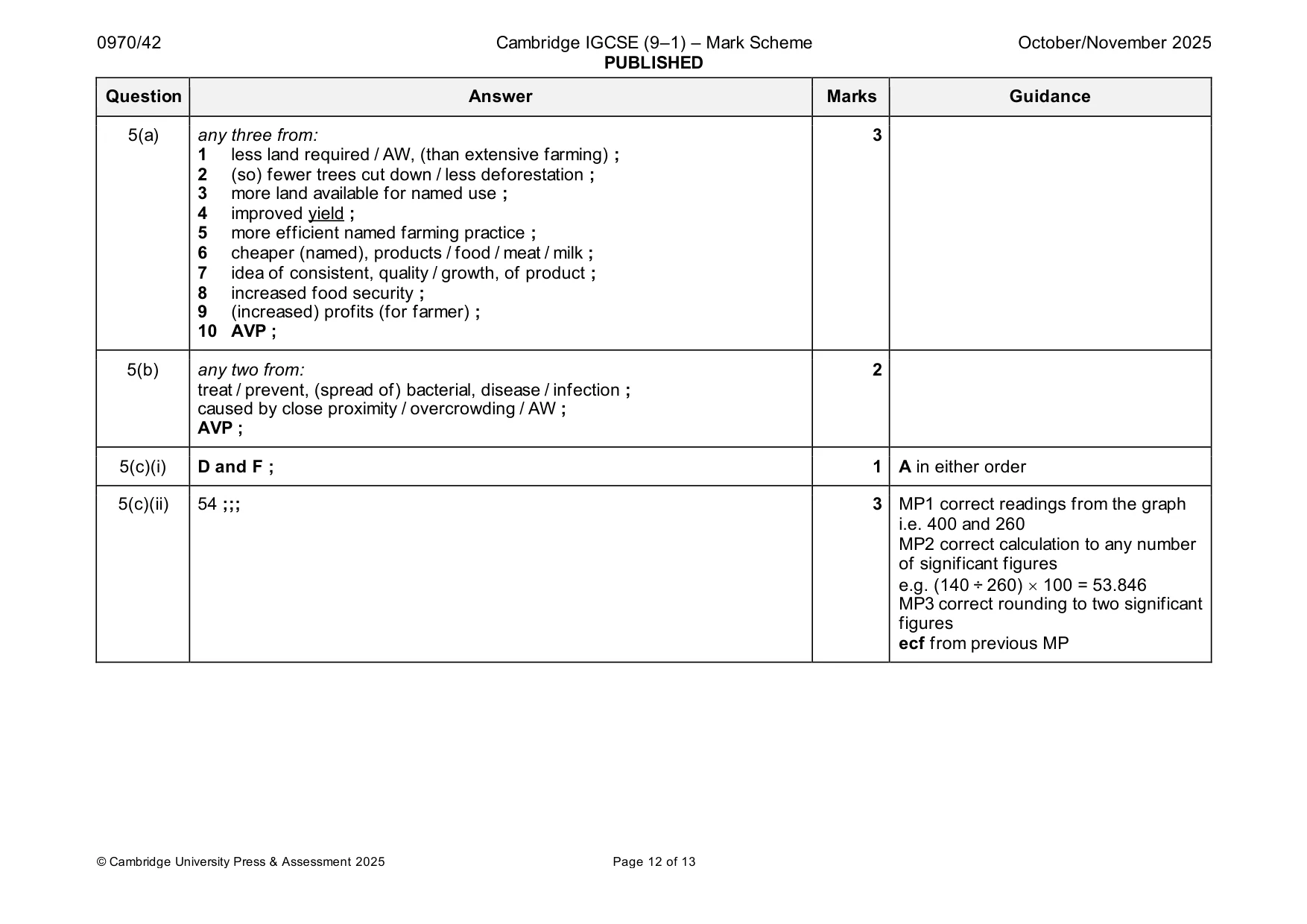
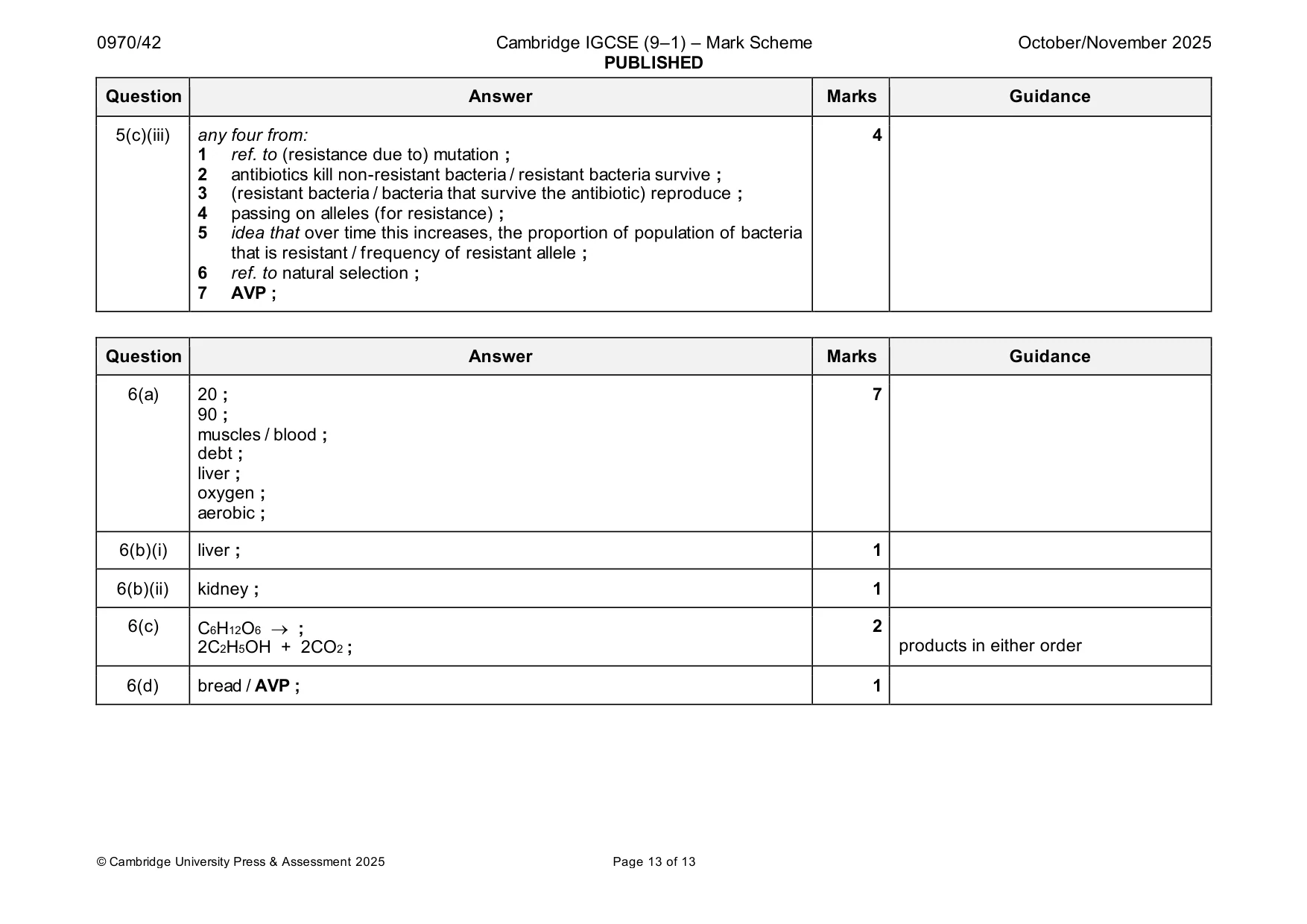
Mark scheme: 5(a) any three from: 3 1 less land required / AW, (than extensive farming) ; 2 (so) fewer trees cut down / less deforestation ; 3 more land available for named use ; 4 improved yield ; 5 more efficient named farming practice ; 6 cheaper (named), products / food / meat / milk ; 7 idea of consistent, quality / growth, of product ; 8 increased food security ; 9 (increased) profits (for farmer) ; 10 AVP ; 5(b) any two from: 2 treat / prevent, (spread of) bacterial, disease / infection ; caused by close proximity / overcrowding / AW ; AVP ; 5(c)(i) D and F ; 1 A in either order 5(c)(ii) 54 ;;; 3 MP1 correct readings from the graph i.e. 400 and 260 MP2 correct calculation to any number of significant figures e.g. (140 ÷ 260) 100 = 53.846 MP3 correct rounding to two significant figures ecf from previous MP 5(c)(iii) any four from: 4 1 ref. to (resistance due to) mutation ; 2 antibiotics kill non-resistant bacteria / resistant bacteria survive ; 3 (resistant bacteria / bacteria that survive the antibiotic) reproduce ; 4 passing on alleles (for resistance) ; 5 idea that over time this increases, the proportion of population of bacteria that is resistant / frequency of resistant allele ; 6 ref. to natural selection ; 7 AVP ;
Q6 · An athlete monitored their heart rate and breathing rate before, during and after…
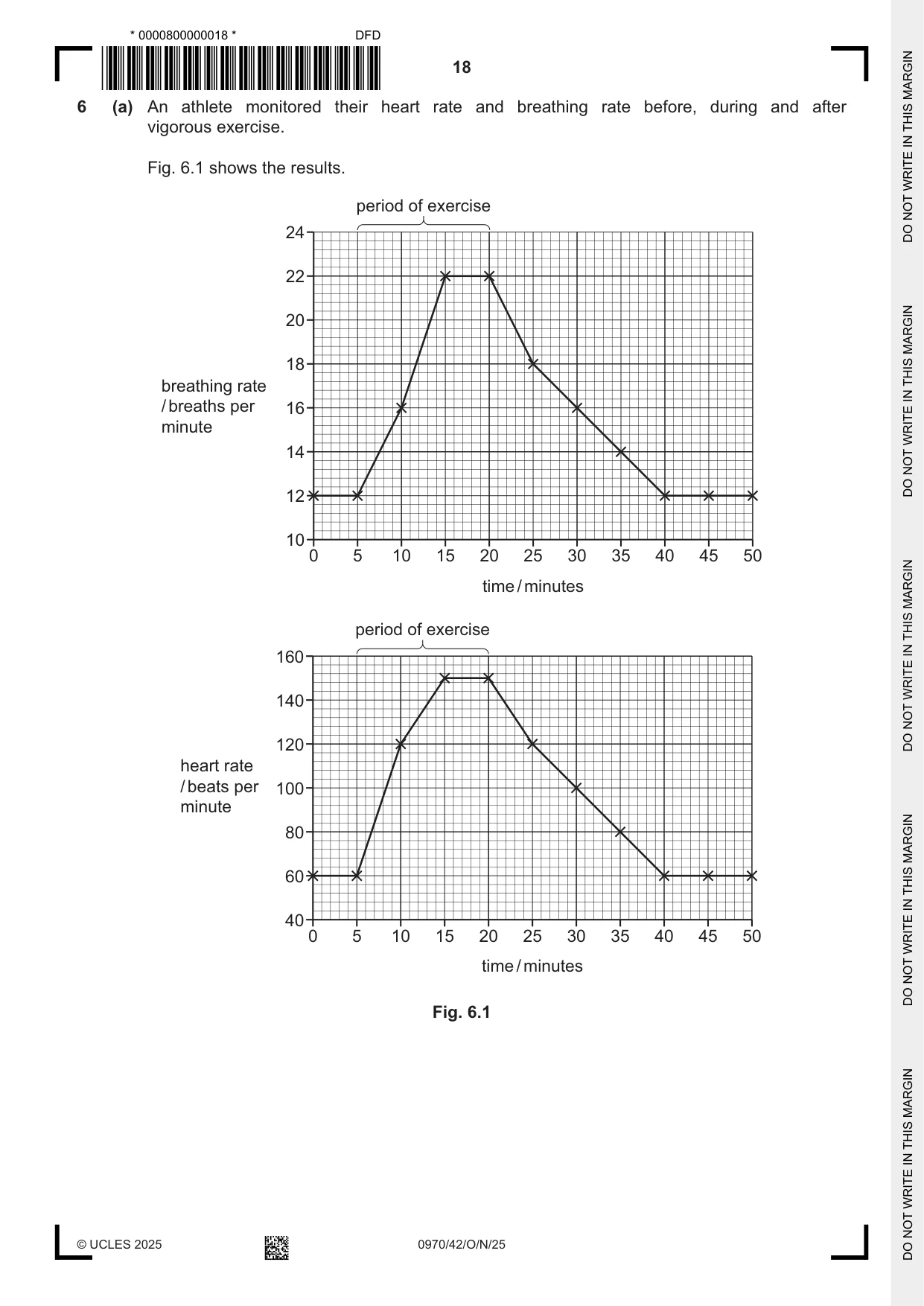
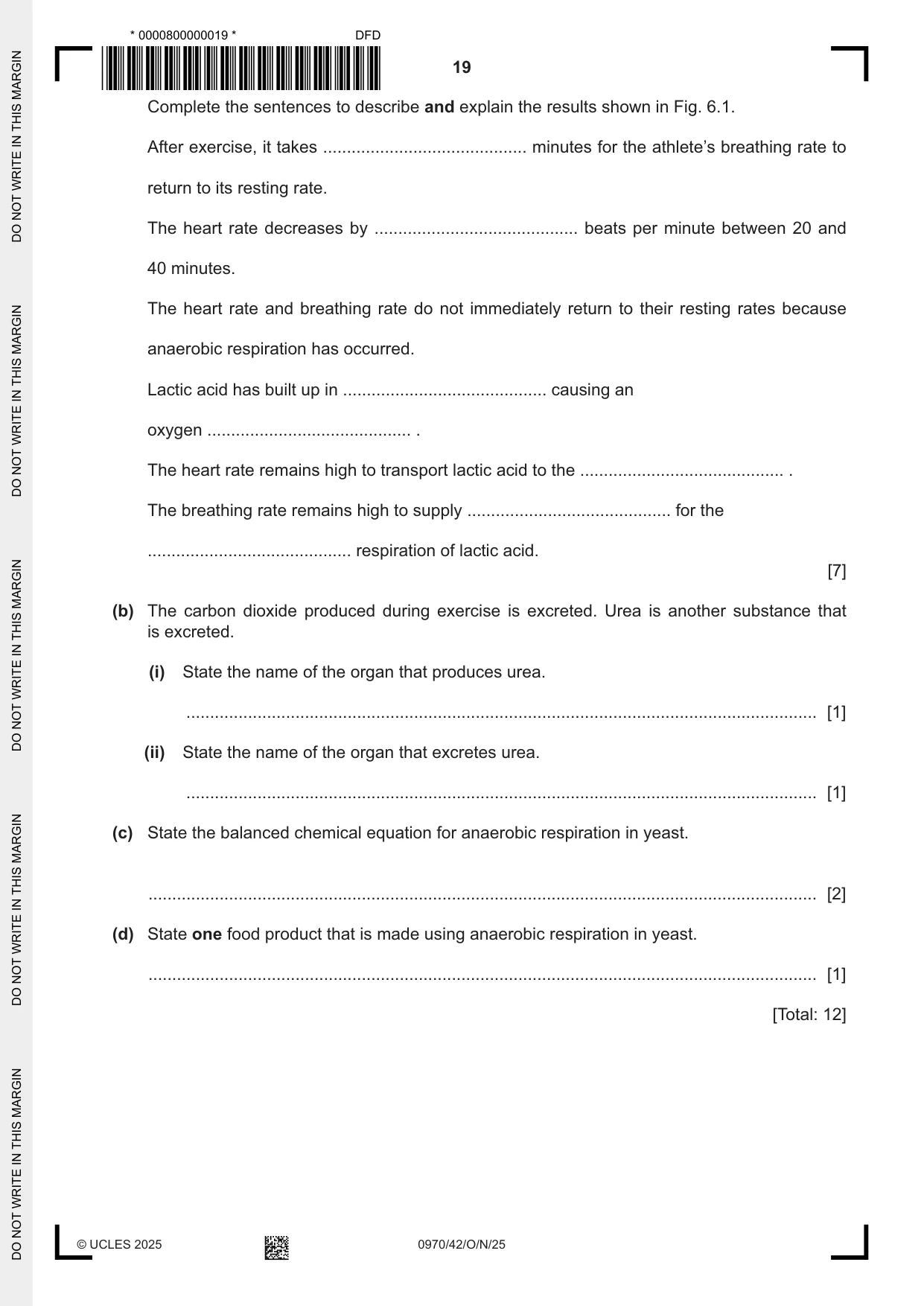
6 (a) An athlete monitored their heart rate and breathing rate before, during and after vigorous exercise. Fig. 6.1 shows the results. period of exercise 24 22 20 18 breathing rate / breaths per 16 minute 14 12 10 0 5 10 15 20 25 30 35 40 45 50 time / minutes period of exercise 160 140 120 heart rate / beats per 100 minute 80 60 40 0 5 10 15 20 25 30 35 40 45 50 time / minutes Fig. 6.1 Complete the sentences to describe and explain the results shown in Fig. 6.1. After exercise, it takes ........................................... minutes for the athlete’s breathing rate to return to its resting rate. The heart rate decreases by ........................................... beats per minute between 20 and 40 minutes. The heart rate and breathing rate do not immediately return to their resting rates because anaerobic respiration has occurred. Lactic acid has built up in ........................................... causing an oxygen ........................................... . The heart rate remains high to transport lactic acid to the ........................................... . The breathing rate remains high to supply ........................................... for the ........................................... respiration of lactic acid. [7] (b) The carbon dioxide produced during exercise is excreted. Urea is another substance that is excreted. (i) State the name of the organ that produces urea. ..................................................................................................................................... [1] (ii) State the name of the organ that excretes urea. ..................................................................................................................................... [1] (c) State the balanced chemical equation for anaerobic respiration in yeast. ............................................................................................................................................. [2] (d) State one food product that is made using anaerobic respiration in yeast. ............................................................................................................................................. [1] [Total: 12]
Mark scheme: 6(a) 20 ; 7 90 ; muscles / blood ; debt ; liver ; oxygen ; aerobic ; 6(b)(i) liver ; 1 6(b)(ii) kidney ; 1 6(c) C6H12O6 → ; 2 2C2H5OH + 2CO2 ; products in either order 6(d) bread / AVP ; 1
What was in this paper
The subtopics covered by these 6 questions, and how many questions each got. Open one in a new tab to see every Cambridge question on it.
What you needed in this session
Cambridge’s own grade thresholds for 2025 Oct/Nov, Paper 4 · Variant 2. A higher threshold means an easier paper — the bar moves with how the cohort did.