Cambridge IGCSE Biology (9-1) 0970 — 2022 May/June Paper 4 · Variant 2
0970/42/M/J/22 · 6 questions · 80 marks · ≈90 min
The question paper and its mark scheme, free to read here and free to download. This is Cambridge’s own paper, exactly as it was sat.
Question paper20 pages


Mark scheme12 pages
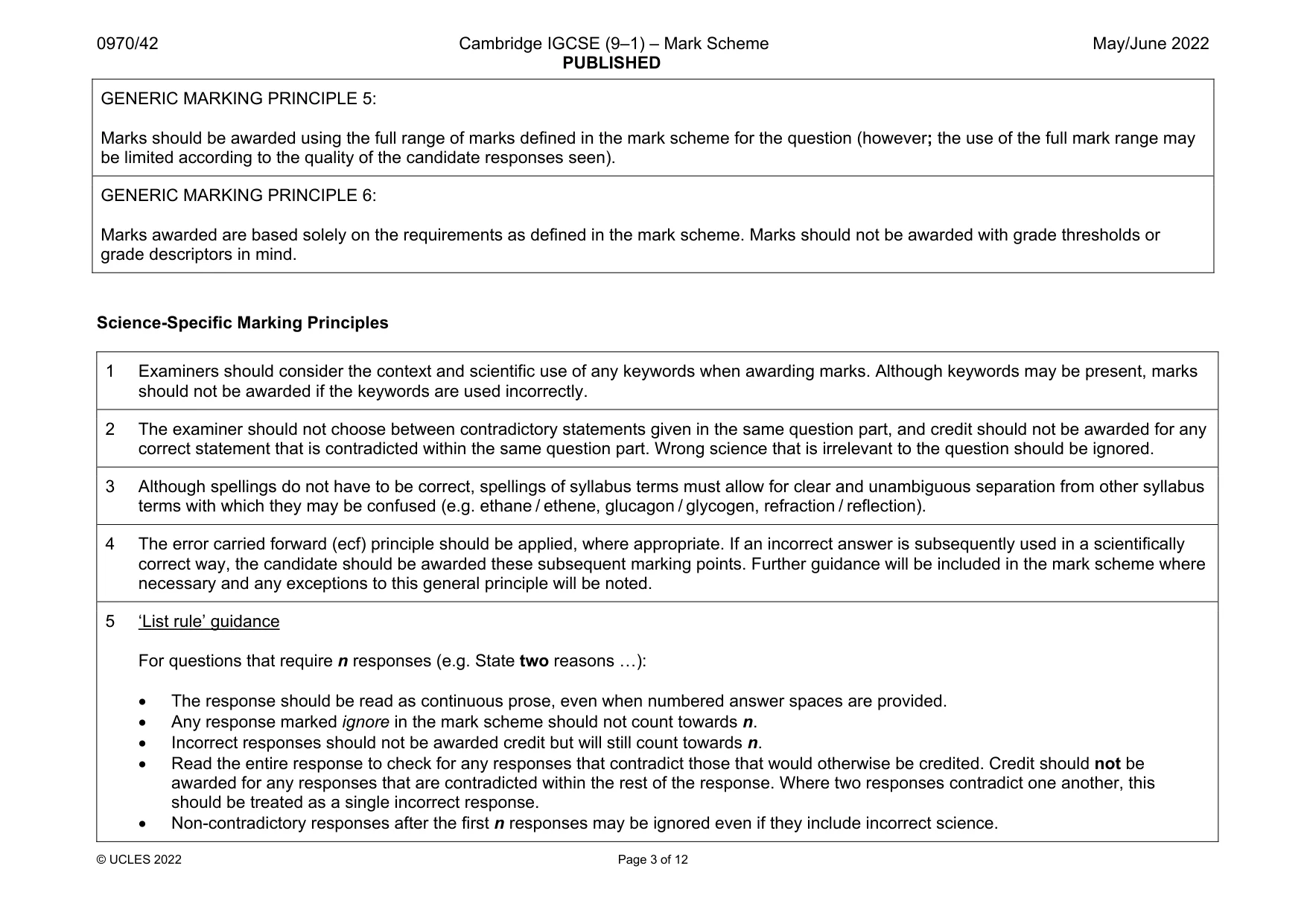
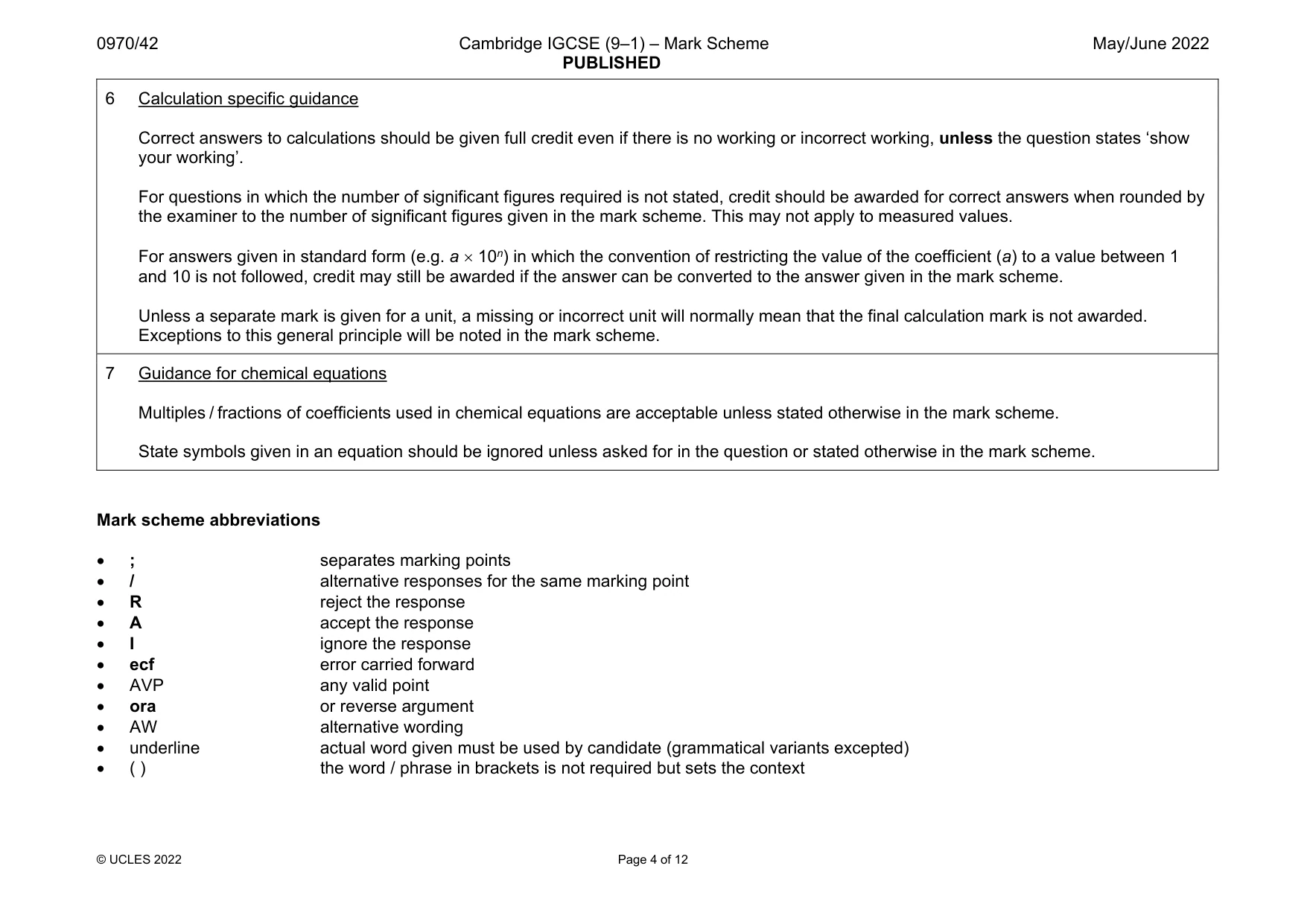
Answers below. Sit the paper first if you are practising.
Questions as text
Q1 · A spongy mesophyll cell from the leaf of a plant
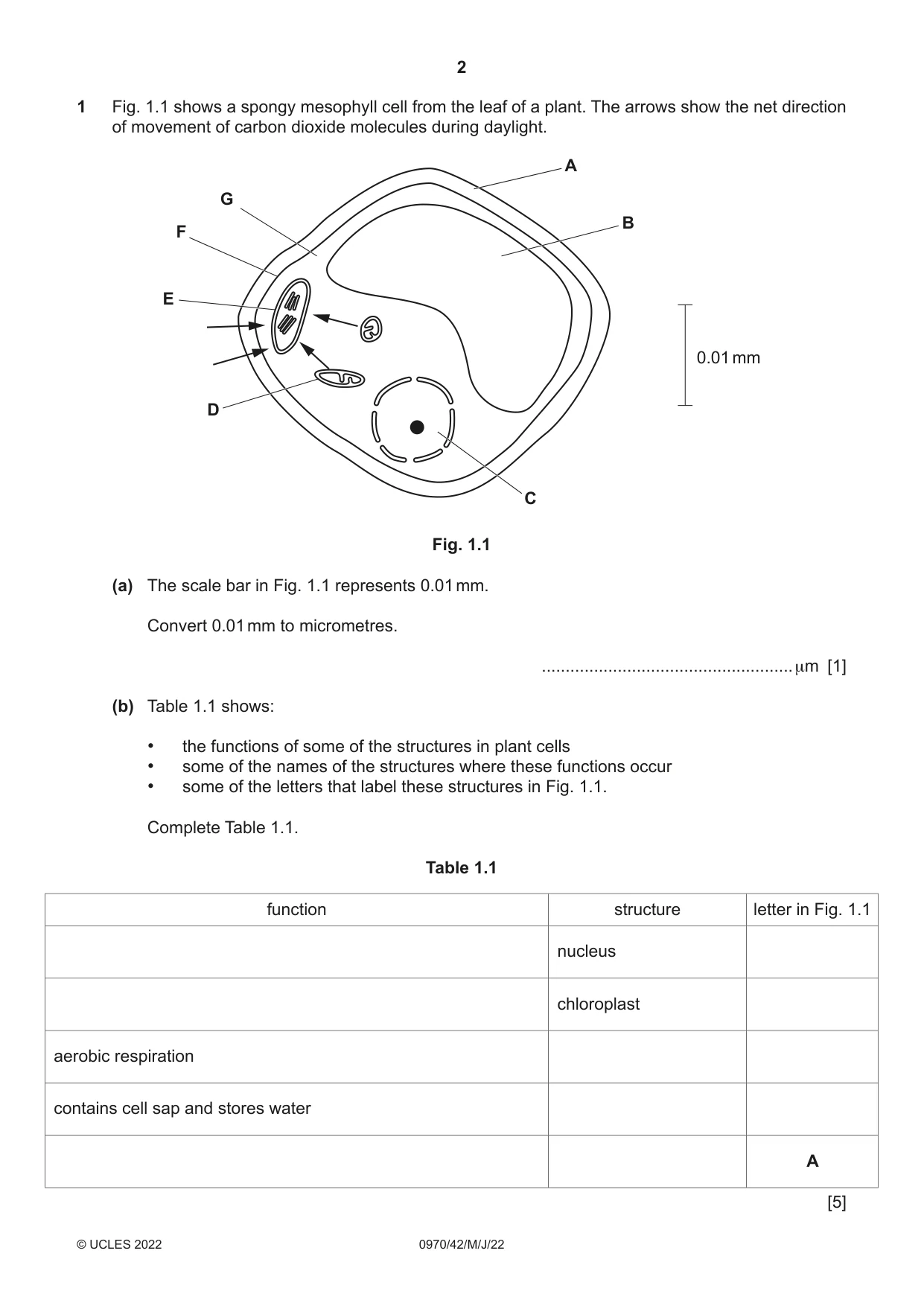
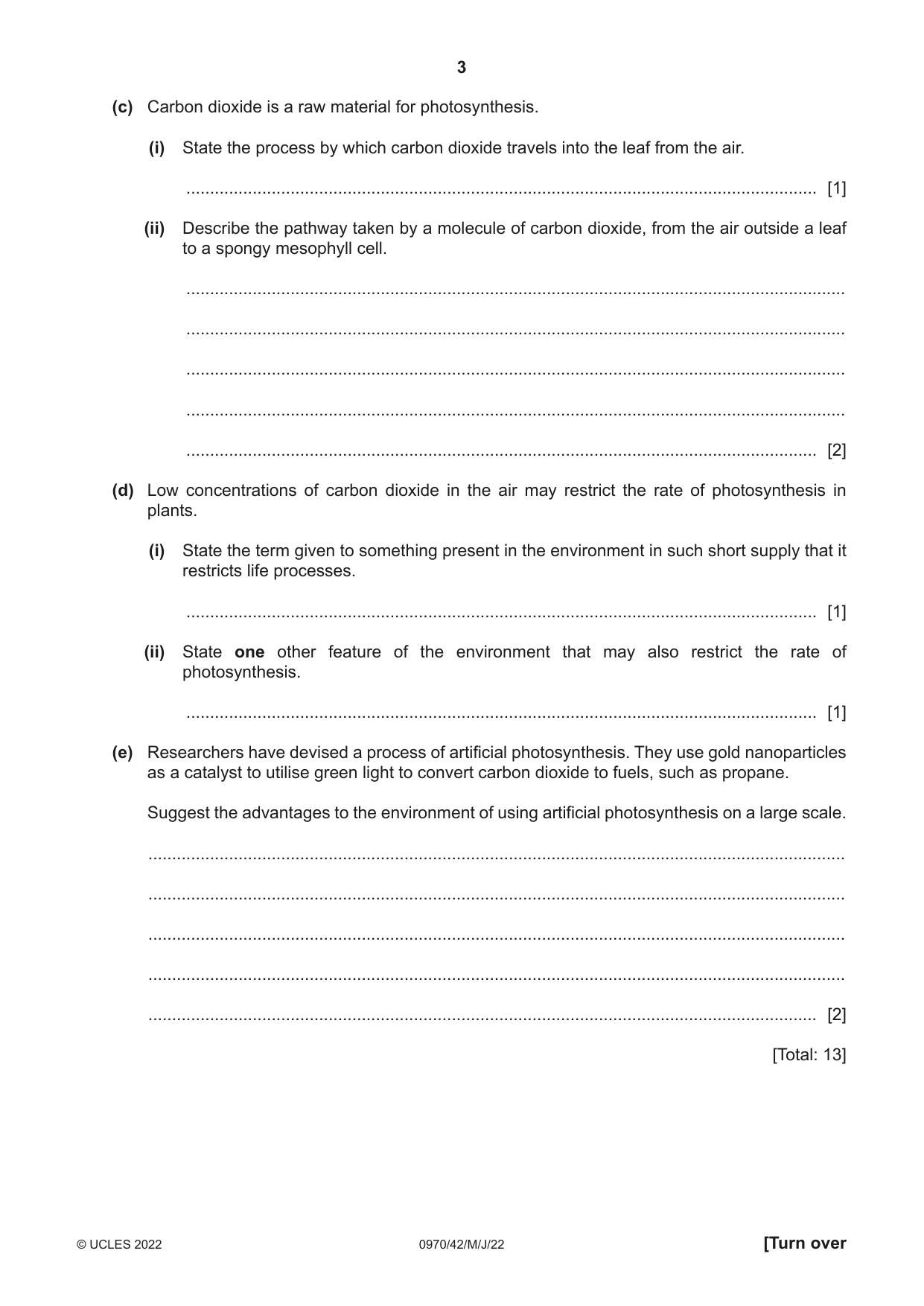
1 Fig. 1.1 shows a spongy mesophyll cell from the leaf of a plant. The arrows show the net direction of movement of carbon dioxide molecules during daylight. A G B F E 0.01 mm D C Fig. 1.1 (a) The scale bar in Fig. 1.1 represents 0.01 mm. Convert 0.01 mm to micrometres. ..................................................... μm [1] (b) Table 1.1 shows: • the functions of some of the structures in plant cells • some of the names of the structures where these functions occur • some of the letters that label these structures in Fig. 1.1. Complete Table 1.1. Table 1.1 function structure letter in Fig. 1.1 nucleus chloroplast aerobic respiration contains cell sap and stores water A [5] (c) Carbon dioxide is a raw material for photosynthesis. (i) State the process by which carbon dioxide travels into the leaf from the air. ..................................................................................................................................... [1] (ii) Describe the pathway taken by a molecule of carbon dioxide, from the air outside a leaf to a spongy mesophyll cell. ........................................................................................................................................... ........................................................................................................................................... ........................................................................................................................................... ........................................................................................................................................... ..................................................................................................................................... [2] (d) Low concentrations of carbon dioxide in the air may restrict the rate of photosynthesis in plants. (i) State the term given to something present in the environment in such short supply that it restricts life processes. ..................................................................................................................................... [1] (ii) State one other feature of the environment that may also restrict the rate of photosynthesis. ..................................................................................................................................... [1] (e) Researchers have devised a process of artificial photosynthesis. They use gold nanoparticles as a catalyst to utilise green light to convert carbon dioxide to fuels, such as propane. Suggest the advantages to the environment of using artificial photosynthesis on a large scale. ................................................................................................................................................... ................................................................................................................................................... ................................................................................................................................................... ................................................................................................................................................... ............................................................................................................................................. [2] [Total: 13]
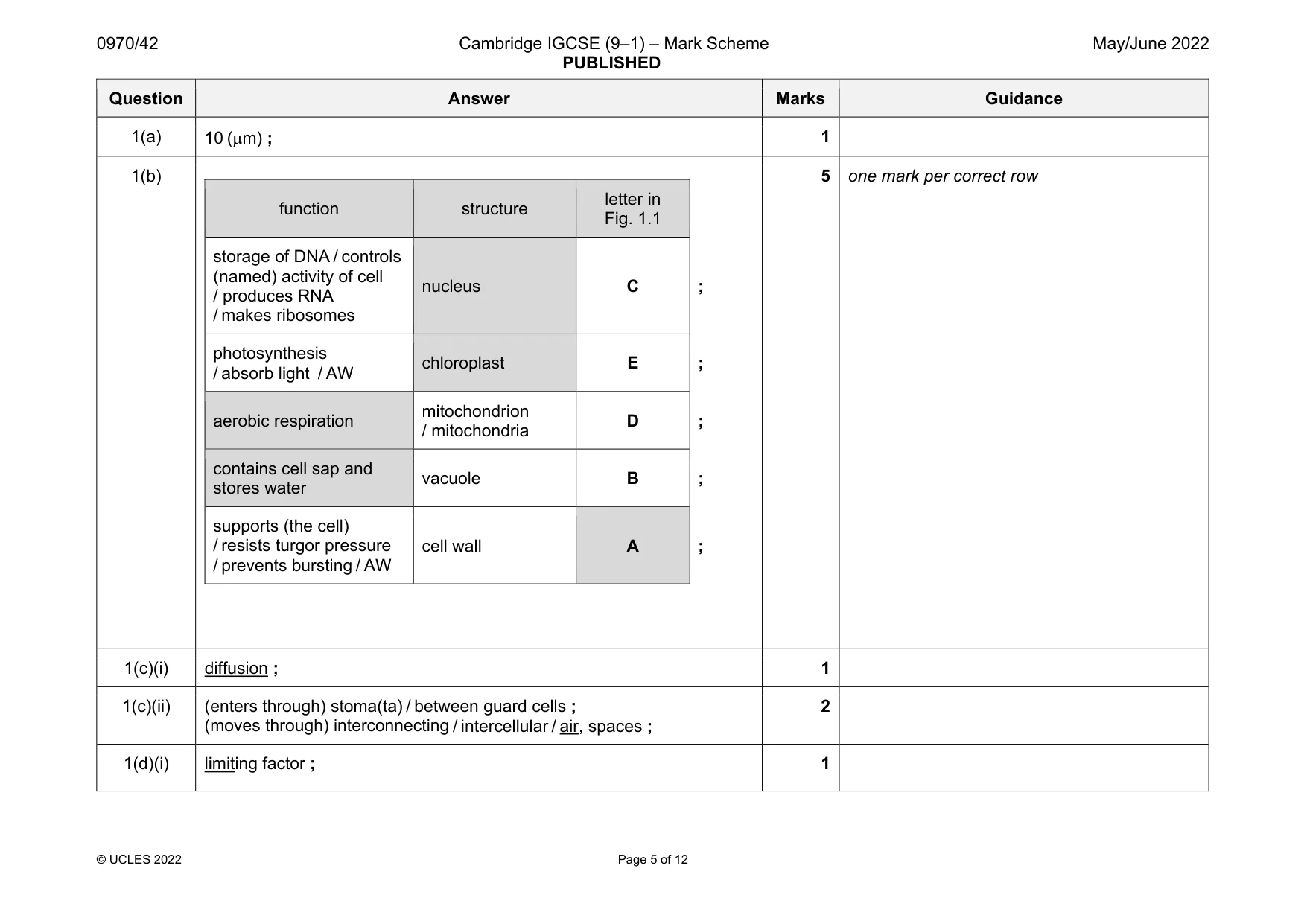
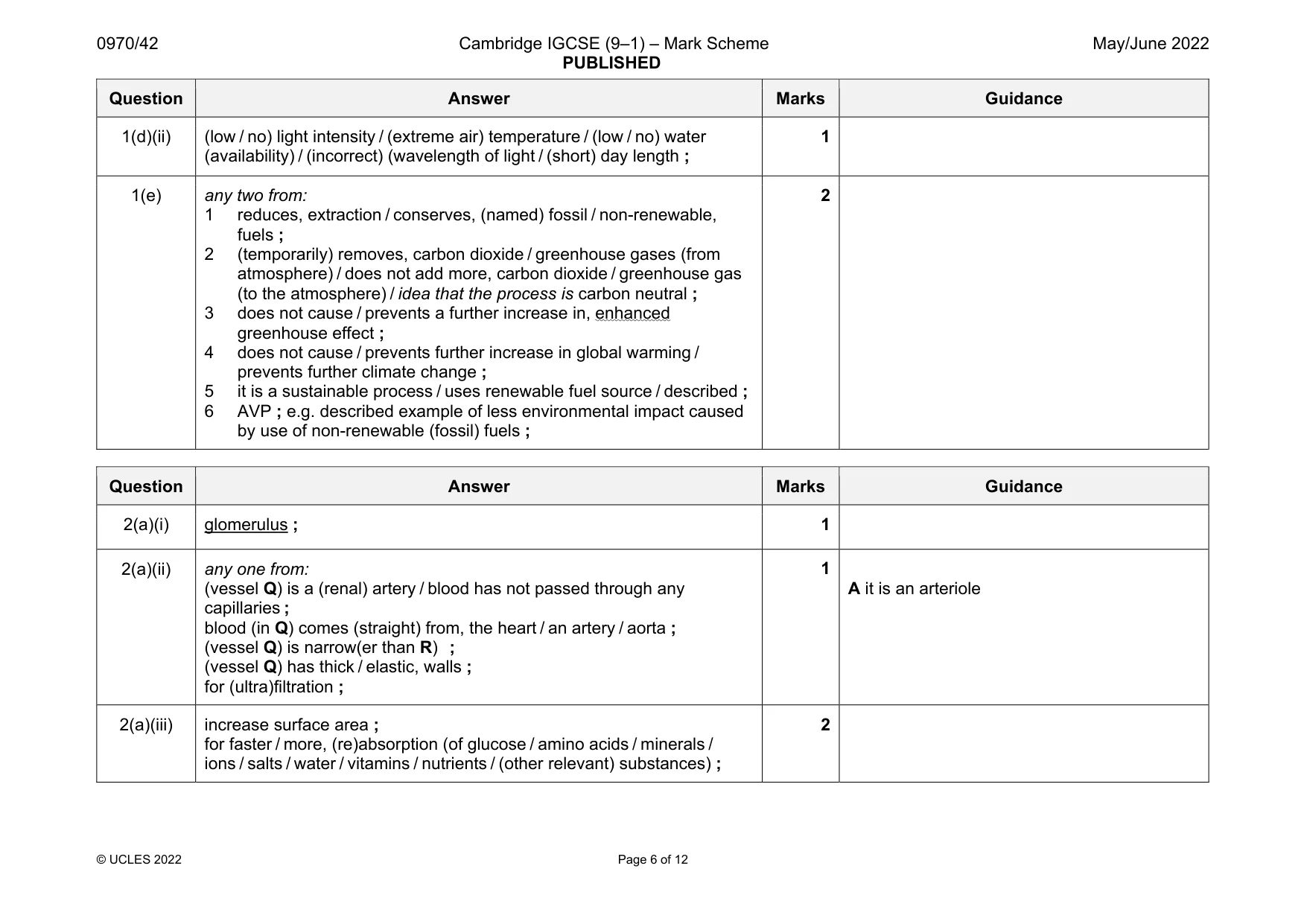
Mark scheme: 1(a) 1 1(b) function structure letter in Fig. 1.1 storage of DNA / controls (named) activity of cell / produces RNA / makes ribosomes nucleus C ; photosynthesis / absorb light / AW chloroplast E ; aerobic respiration mitochondrion / mitochondria D ; contains cell sap and stores water vacuole B ; supports (the cell) / resists turgor pressure / prevents bursting / AW cell wall A ; 5 one mark per correct row 1(c)(i) diffusion ; 1 1(c)(ii) (enters through) stoma(ta) / between guard cells ; (moves through) interconnecting / intercellular / air, spaces ; 2 1(d)(i) limiting factor ; 1 Question Answer Marks Guidance 1(d)(ii) (low / no) light intensity / (extreme air) temperature / (low / no) water (availability) / (incorrect) (wavelength of light / (short) day length ; 1 1(e) any two from: 1 reduces, extraction / conserves, (named) fossil / non-renewable, fuels ; 2 (temporarily) removes, carbon dioxide / greenhouse gases (from atmosphere) / does not add more, carbon dioxide / greenhouse gas (to the atmosphere) / idea that the process is carbon neutral ; 3 does not cause / prevents a further increase in, enhanced greenhouse effect ; 4 does not cause / prevents further increase in global warming / prevents further climate change ; 5 it is a sustainable process / uses renewable fuel source / described ; 6 AVP ; e.g. described example of less environmental impact caused by use of non-renewable (fossil) fuels ; 2
Q2 · The kidneys filter blood, separate useful molecules from excretory wastes and control the…
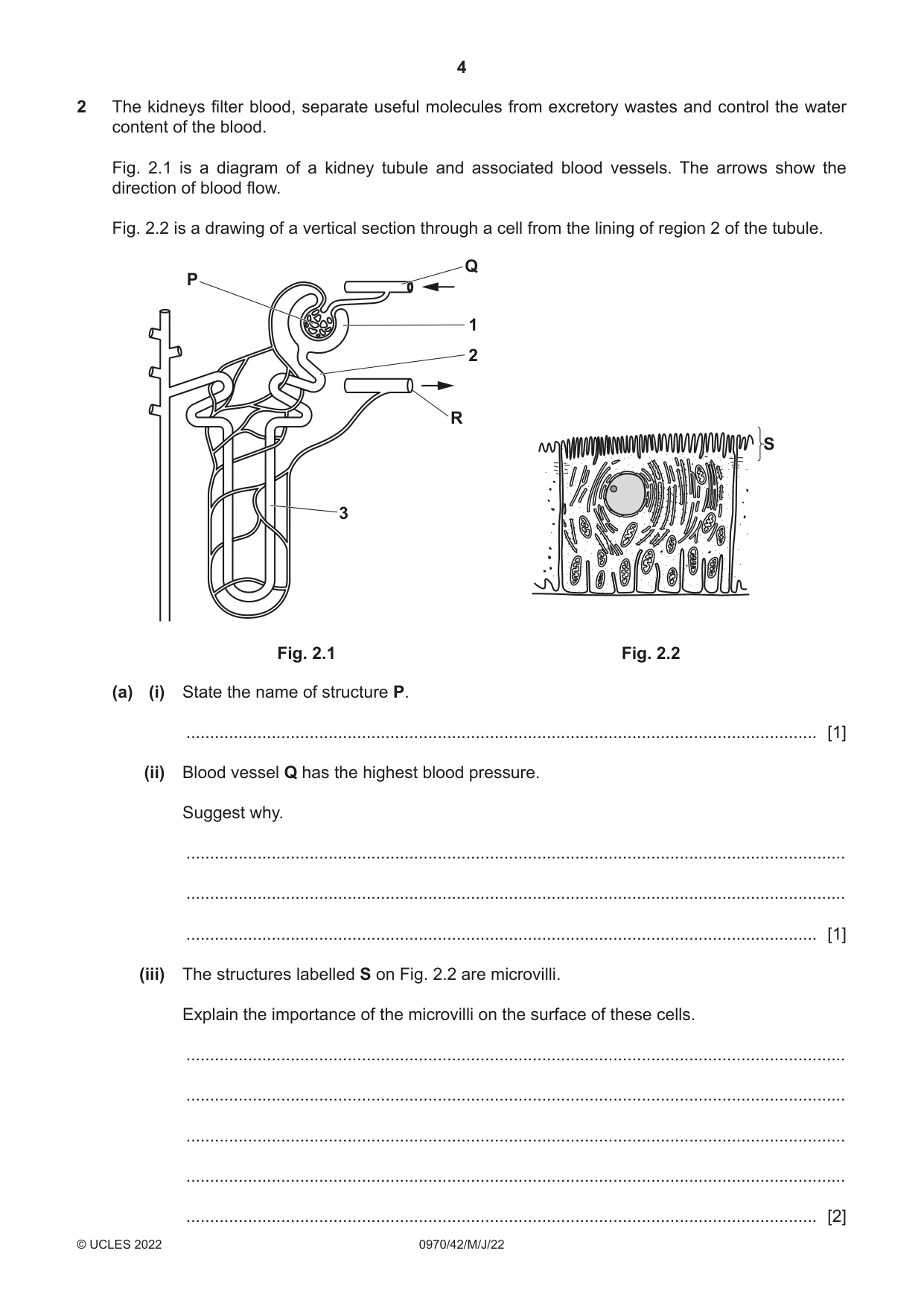
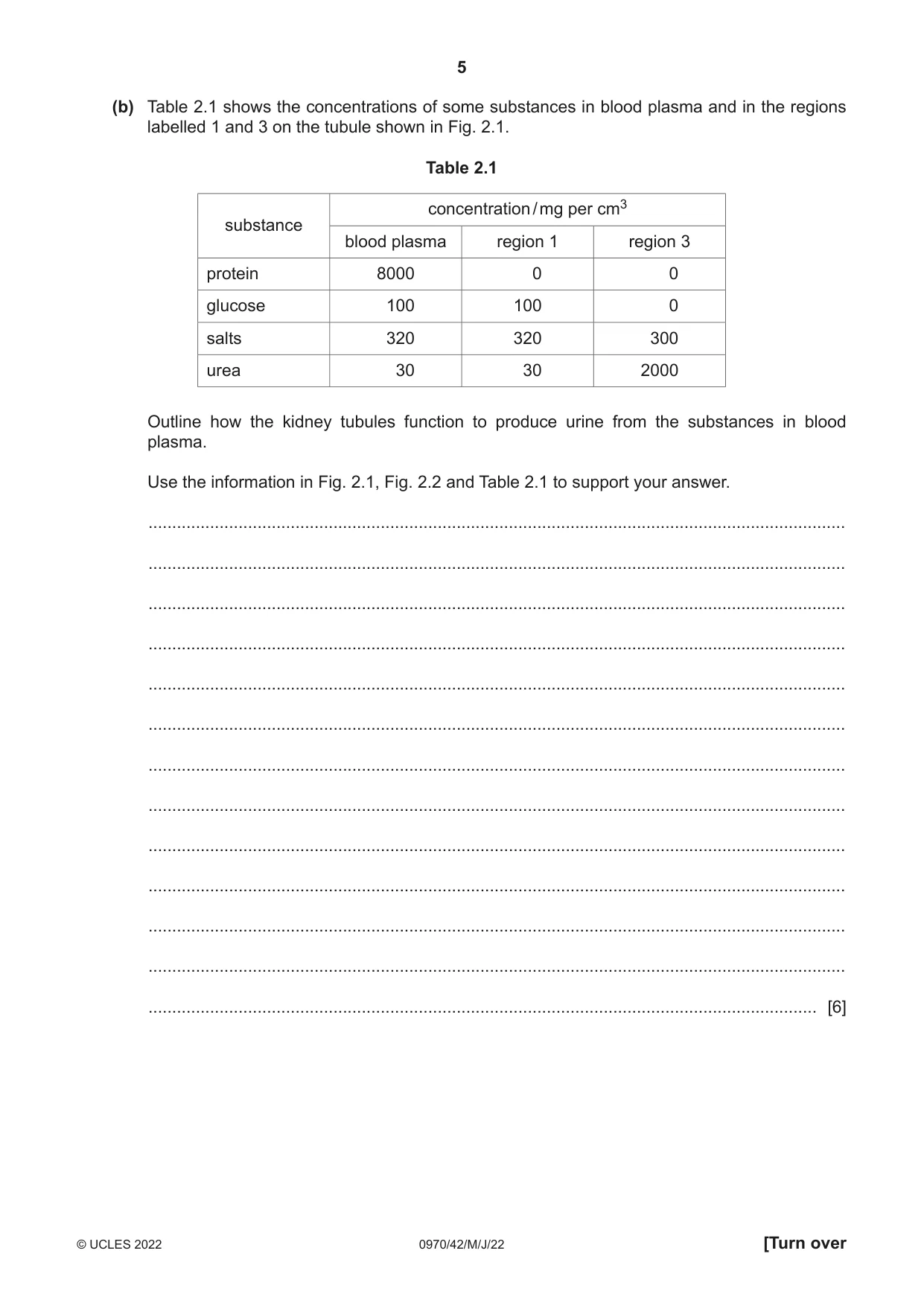
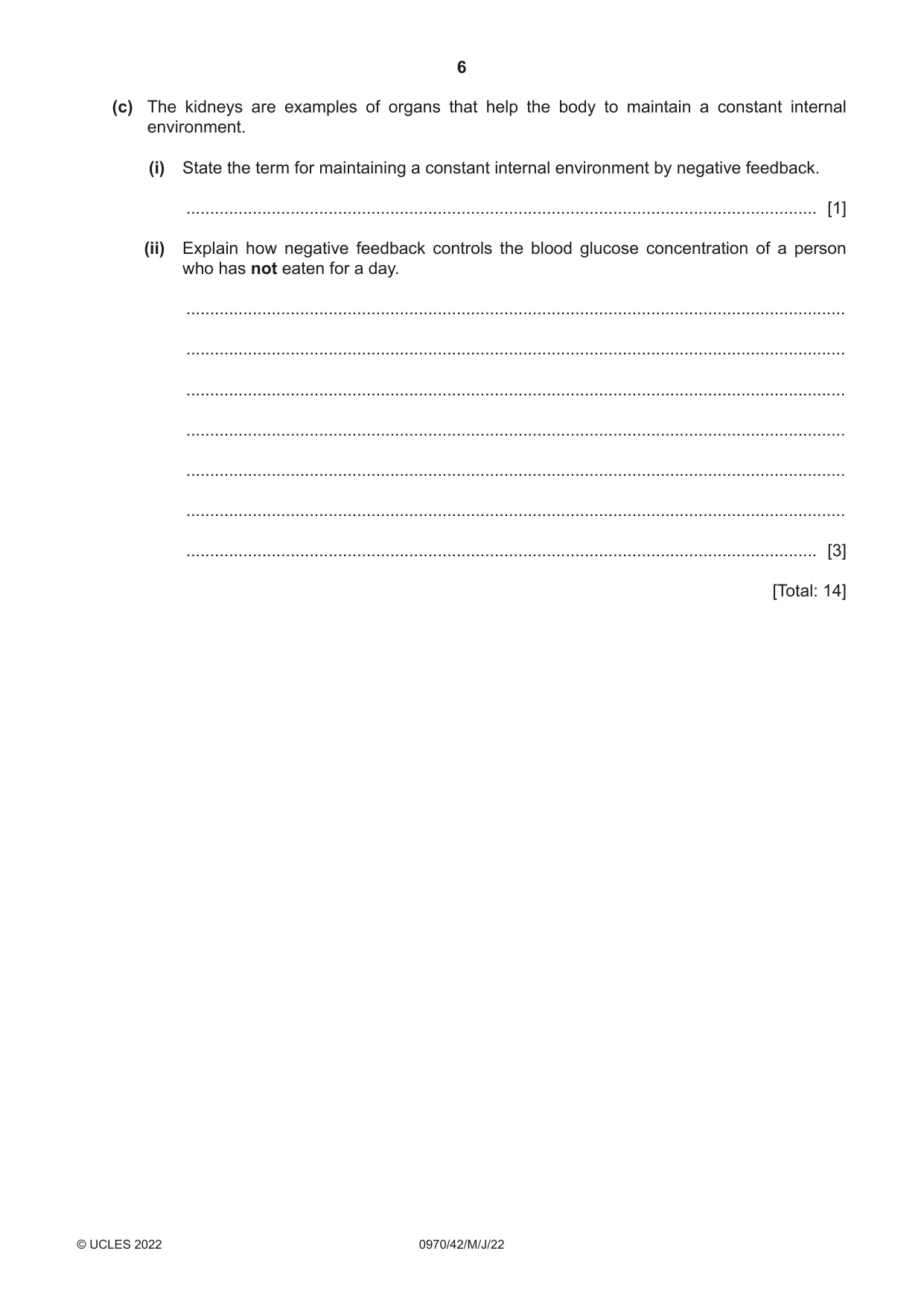
2 The kidneys filter blood, separate useful molecules from excretory wastes and control the water content of the blood. Fig. 2.1 is a diagram of a kidney tubule and associated blood vessels. The arrows show the direction of blood flow. Fig. 2.2 is a drawing of a vertical section through a cell from the lining of region 2 of the tubule. Q P 1 2 R S 3 Fig. 2.1 Fig. 2.2 (a) (i) State the name of structure P. ..................................................................................................................................... [1] (ii) Blood vessel Q has the highest blood pressure. Suggest why. ........................................................................................................................................... ........................................................................................................................................... ..................................................................................................................................... [1] (iii) The structures labelled S on Fig. 2.2 are microvilli. Explain the importance of the microvilli on the surface of these cells. ........................................................................................................................................... ........................................................................................................................................... ........................................................................................................................................... ........................................................................................................................................... ..................................................................................................................................... [2] (b) Table 2.1 shows the concentrations of some substances in blood plasma and in the regions labelled 1 and 3 on the tubule shown in Fig. 2.1. Table 2.1 concentration / mg per cm3 substance blood plasma region 1 region 3 protein 8000 0 0 glucose 100 100 0 salts 320 320 300 urea 30 30 2000 Outline how the kidney tubules function to produce urine from the substances in blood plasma. Use the information in Fig. 2.1, Fig. 2.2 and Table 2.1 to support your answer. ................................................................................................................................................... ................................................................................................................................................... ................................................................................................................................................... ................................................................................................................................................... ................................................................................................................................................... ................................................................................................................................................... ................................................................................................................................................... ................................................................................................................................................... ................................................................................................................................................... ................................................................................................................................................... ................................................................................................................................................... ................................................................................................................................................... ............................................................................................................................................. [6] (c) The kidneys are examples of organs that help the body to maintain a constant internal environment. (i) State the term for maintaining a constant internal environment by negative feedback. ..................................................................................................................................... [1] (ii) Explain how negative feedback controls the blood glucose concentration of a person who has not eaten for a day. ........................................................................................................................................... ........................................................................................................................................... ........................................................................................................................................... ........................................................................................................................................... ........................................................................................................................................... ........................................................................................................................................... ..................................................................................................................................... [3] [Total: 14]
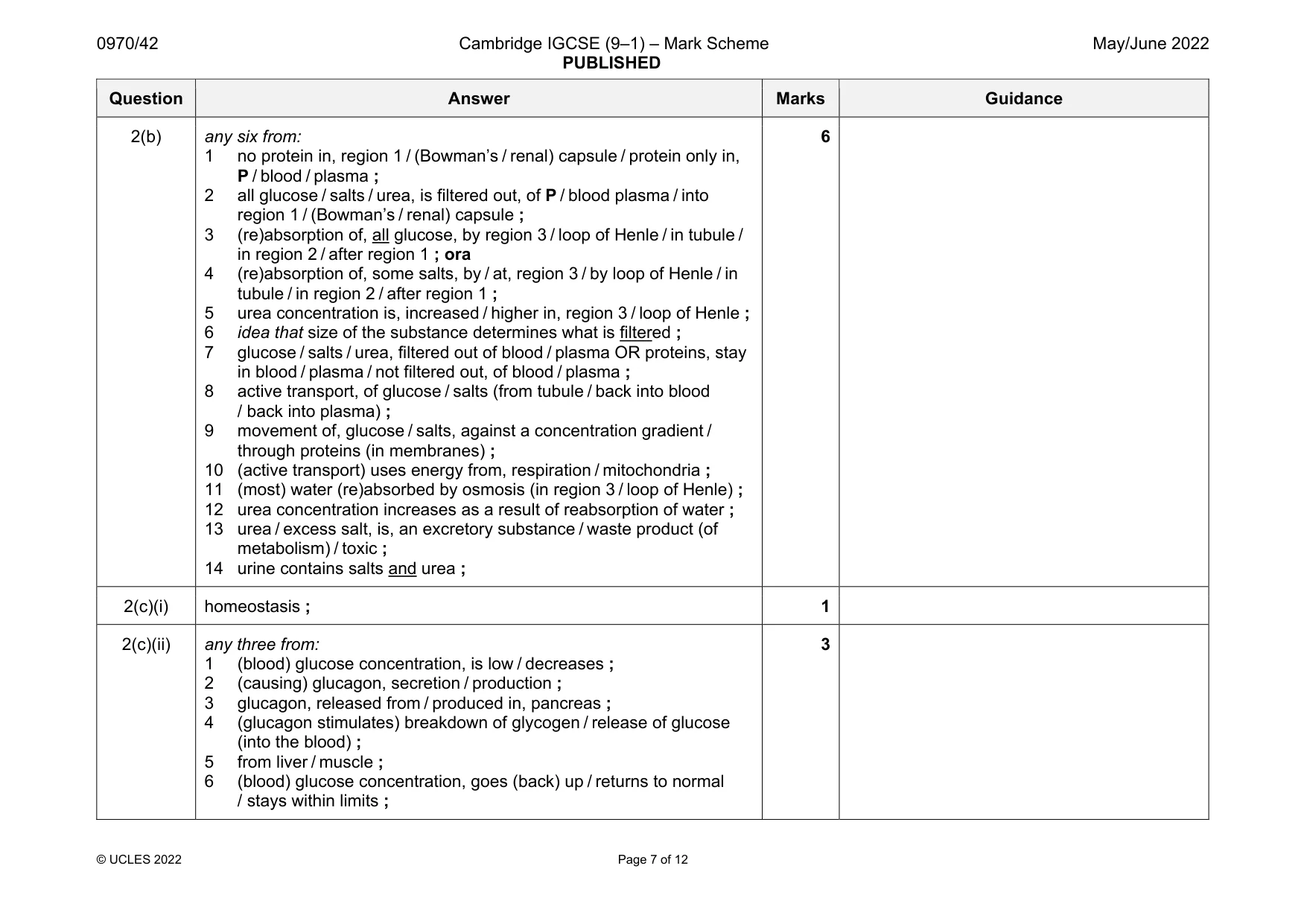
Mark scheme: 2(a)(i) glomerulus ; 1 2(a)(ii) any one from: (vessel Q) is a (renal) artery / blood has not passed through any capillaries ; blood (in Q) comes (straight) from, the heart / an artery / aorta ; (vessel Q) is narrow(er than R) ; (vessel Q) has thick / elastic, walls ; for (ultra)filtration ; 1 A it is an arteriole 2(a)(iii) increase surface area ; for faster / more, (re)absorption (of glucose / amino acids / minerals / ions / salts / water / vitamins / nutrients / (other relevant) substances) ; 2 Question Answer Marks Guidance 2(b) any six from: 1 no protein in, region 1 / (Bowman’s / renal) capsule / protein only in, P / blood / plasma ; 2 all glucose / salts / urea, is filtered out, of P / blood plasma / into region 1 / (Bowman’s / renal) capsule ; 3 (re)absorption of, all glucose, by region 3 / loop of Henle / in tubule / in region 2 / after region 1 ; ora 4 (re)absorption of, some salts, by / at, region 3 / by loop of Henle / in tubule / in region 2 / after region 1 ; 5 urea concentration is, increased / higher in, region 3 / loop of Henle ; 6 idea that size of the substance determines what is filtered ; 7 glucose / salts / urea, filtered out of blood / plasma OR proteins, stay in blood / plasma / not filtered out, of blood / plasma ; 8 active transport, of glucose / salts (from tubule / back into blood / back into plasma) ; 9 movement of, glucose / salts, against a concentration gradient / through proteins (in membranes) ; 10 (active transport) uses energy from, respiration / mitochondria ; 11 (most) water (re)absorbed by osmosis (in region 3 / loop of Henle) ; 12 urea concentration increases as a result of reabsorption of water ; 13 urea / excess salt, is, an excretory substance / waste product (of metabolism) / toxic ; 14 urine contains salts and urea ; 6 2(c)(i) homeostasis ; 1 2(c)(ii) any three from: 1 (blood) glucose concentration, is low / decreases ; 2 (causing) glucagon, secretion / production ; 3 glucagon, released from / produced in, pancreas ; 4 (glucagon stimulates) breakdown of glycogen / release of glucose (into the blood) ; 5 from liver / muscle ; 6 (blood) glucose concentration, goes (back) up / returns to normal / stays within limits ; 3
Q3 · The eye is adapted for focusing on near and distant objects
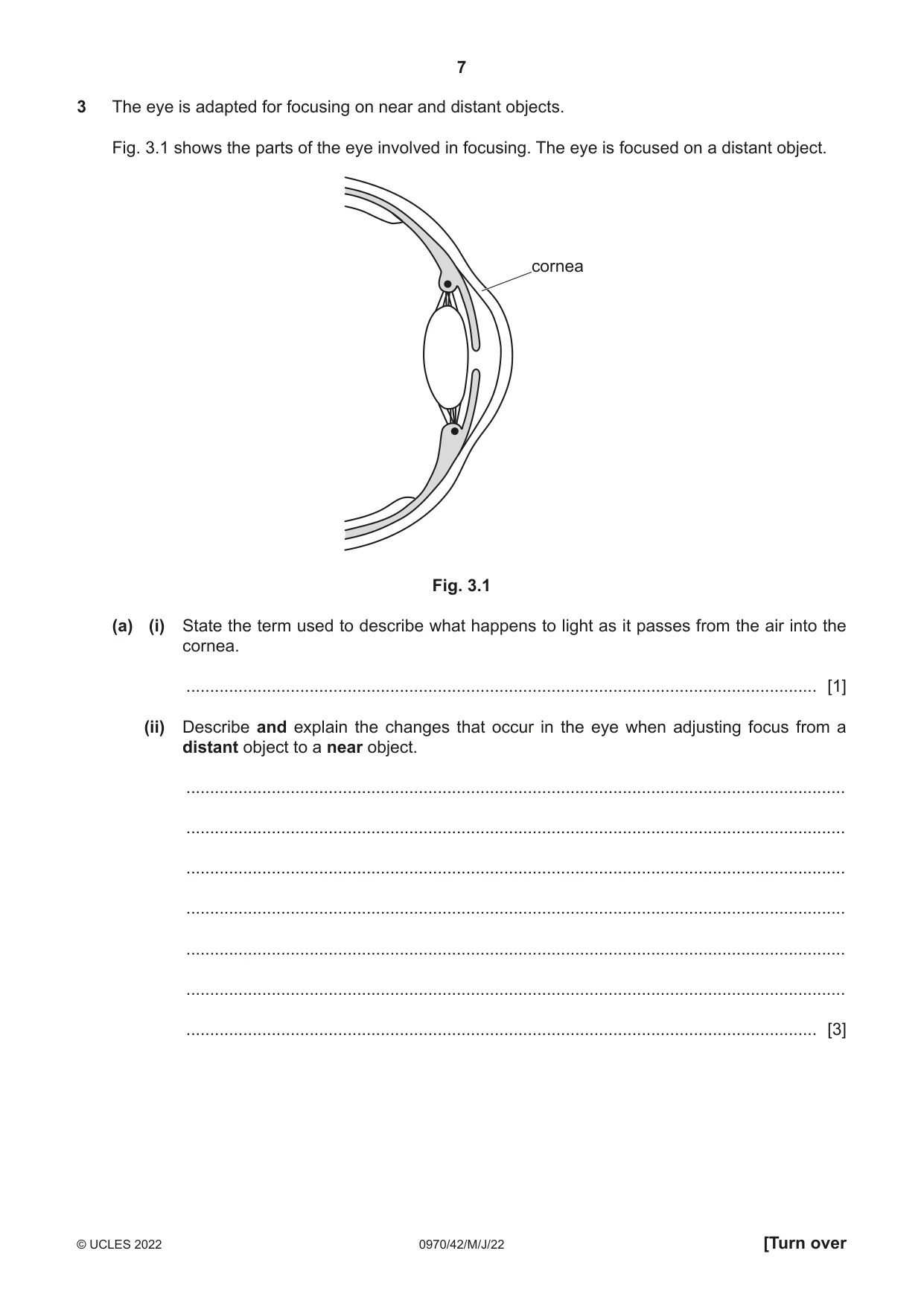
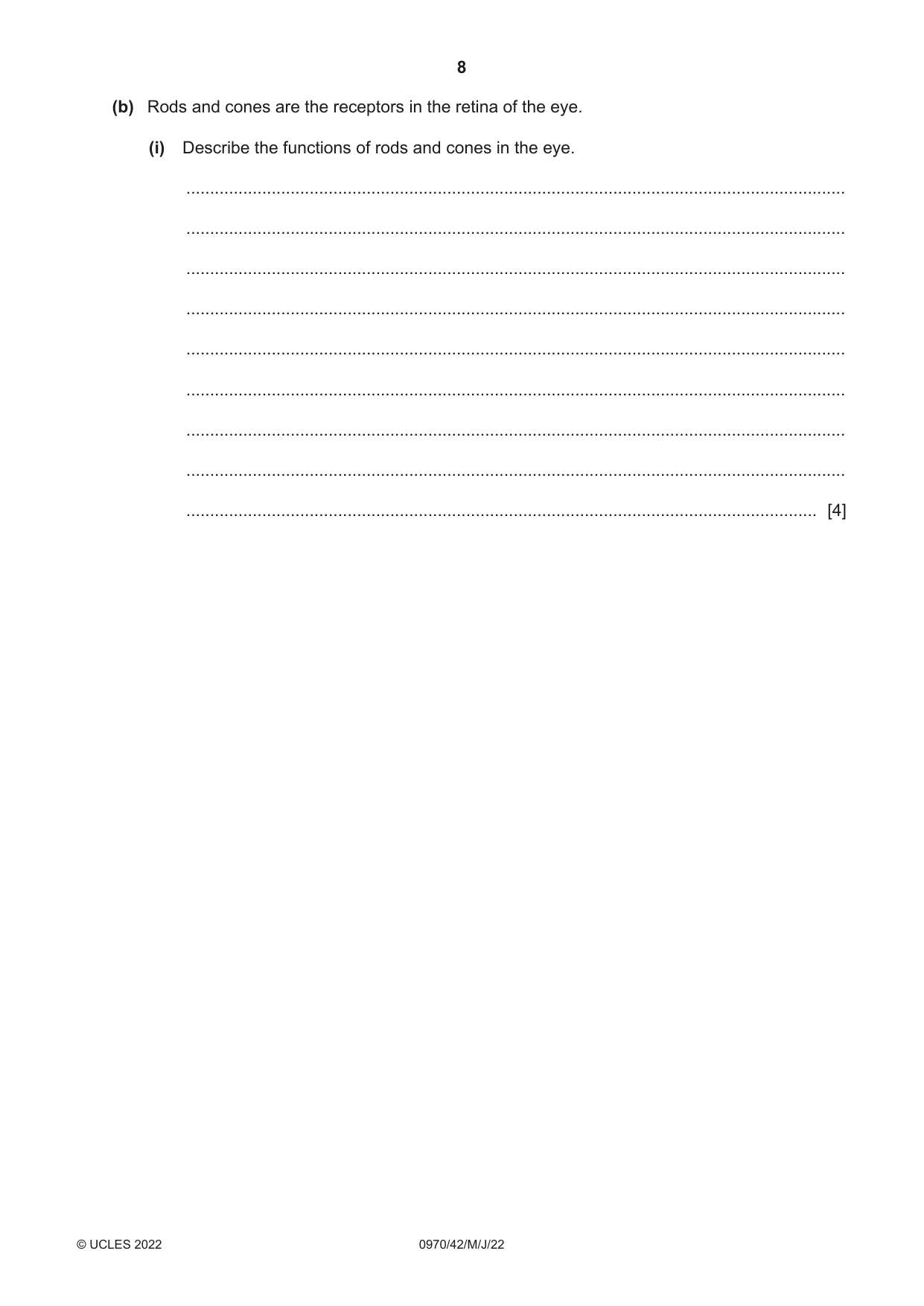
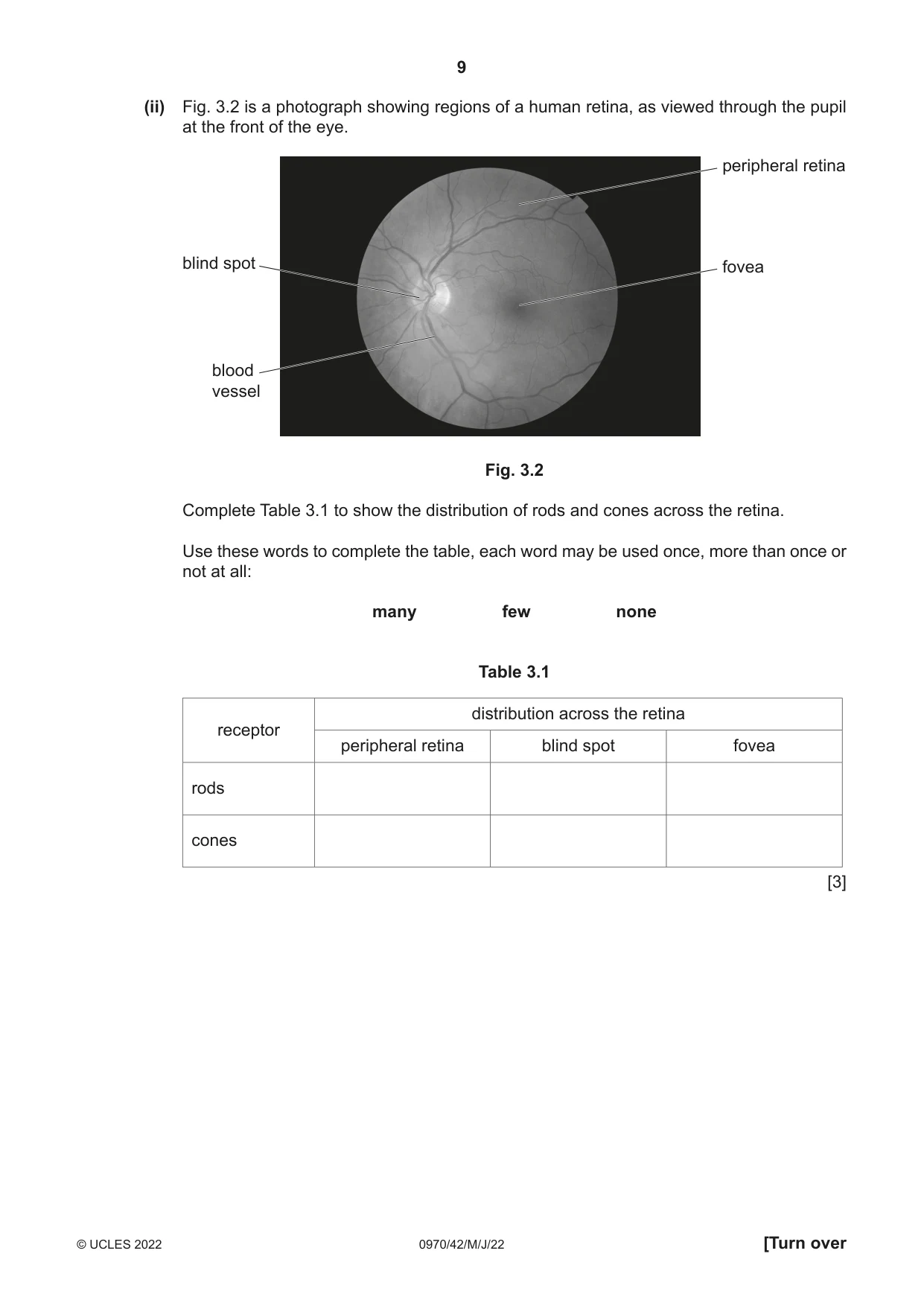
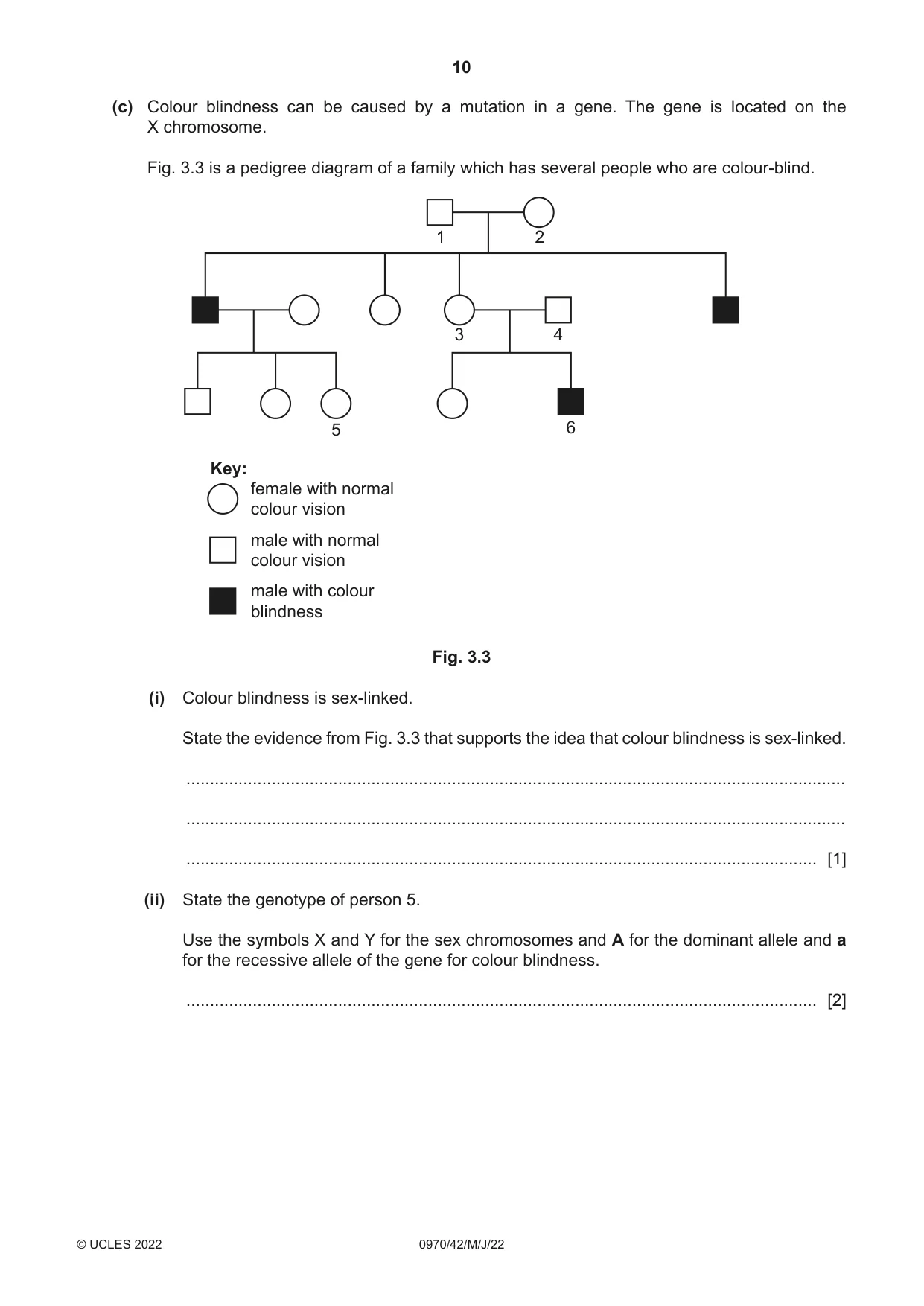
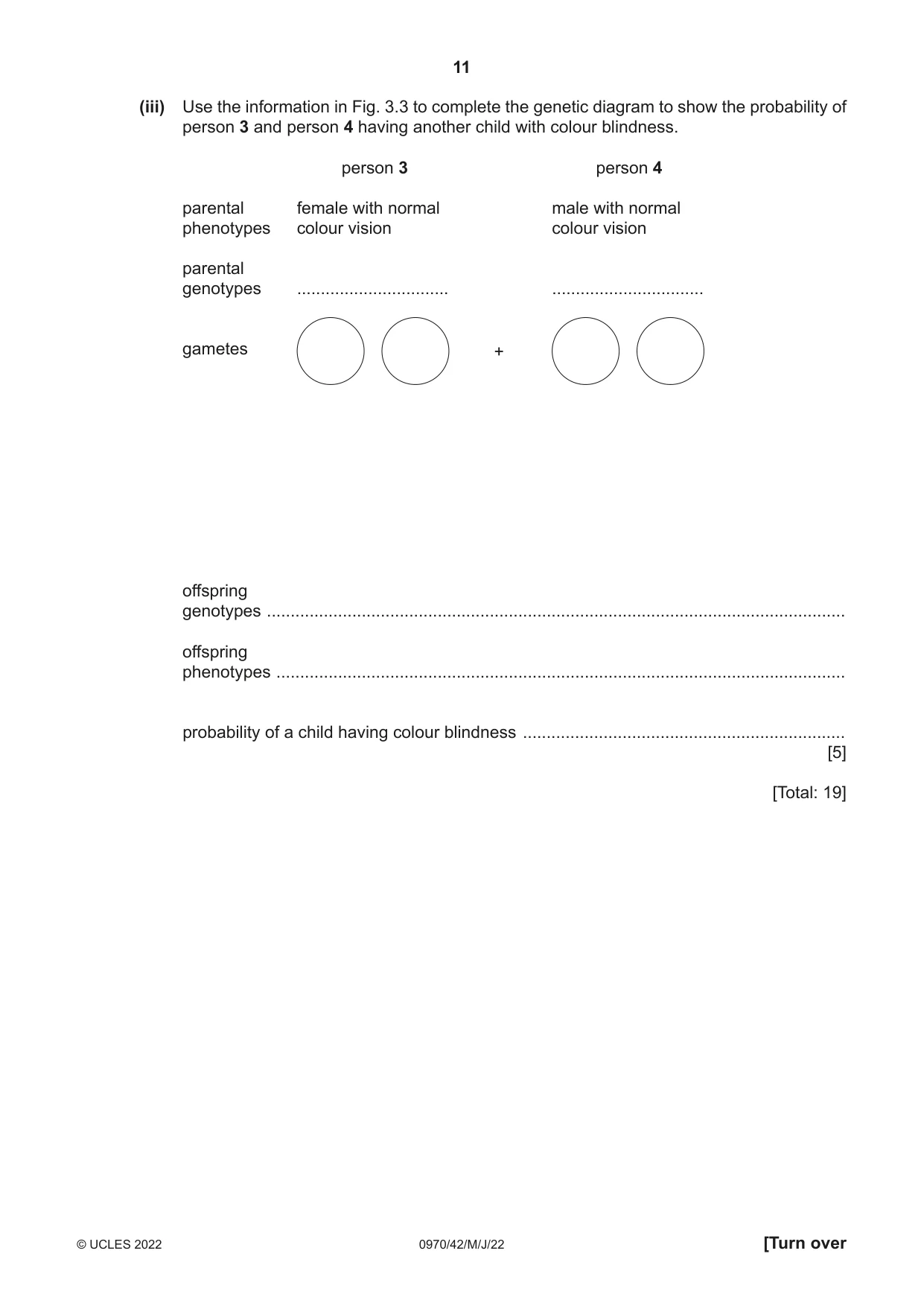
3 The eye is adapted for focusing on near and distant objects. Fig. 3.1 shows the parts of the eye involved in focusing. The eye is focused on a distant object. cornea Fig. 3.1 (a) (i) State the term used to describe what happens to light as it passes from the air into the cornea. ..................................................................................................................................... [1] (ii) Describe and explain the changes that occur in the eye when adjusting focus from a distant object to a near object. ........................................................................................................................................... ........................................................................................................................................... ........................................................................................................................................... ........................................................................................................................................... ........................................................................................................................................... ........................................................................................................................................... ..................................................................................................................................... [3] (b) Rods and cones are the receptors in the retina of the eye. (i) Describe the functions of rods and cones in the eye. ........................................................................................................................................... ........................................................................................................................................... ........................................................................................................................................... ........................................................................................................................................... ........................................................................................................................................... ........................................................................................................................................... ........................................................................................................................................... ........................................................................................................................................... ..................................................................................................................................... [4] (ii) Fig. 3.2 is a photograph showing regions of a human retina, as viewed through the pupil at the front of the eye. peripheral retina blind spot fovea blood vessel Fig. 3.2 Complete Table 3.1 to show the distribution of rods and cones across the retina. Use these words to complete the table, each word may be used once, more than once or not at all: many few none Table 3.1 distribution across the retina receptor peripheral retina blind spot fovea rods cones [3] (c) Colour blindness can be caused by a mutation in a gene. The gene is located on the X chromosome. Fig. 3.3 is a pedigree diagram of a family which has several people who are colour‑blind. 1 2 3 4 5 6 Key: female with normal colour vision male with normal colour vision male with colour blindness Fig. 3.3 (i) Colour blindness is sex‑linked. State the evidence from Fig. 3.3 that supports the idea that colour blindness is sex‑linked. ........................................................................................................................................... ........................................................................................................................................... ..................................................................................................................................... [1] (ii) State the genotype of person 5. Use the symbols X and Y for the sex chromosomes and A for the dominant allele and a for the recessive allele of the gene for colour blindness. ..................................................................................................................................... [2] (iii) Use the information in Fig. 3.3 to complete the genetic diagram to show the probability of person 3 and person 4 having another child with colour blindness. person 3 person 4 parental female with normal male with normal phenotypes colour vision colour vision parental genotypes ................................ ................................ gametes + offspring genotypes .......................................................................................................................... offspring phenotypes ........................................................................................................................ probability of a child having colour blindness .................................................................... [5] [Total: 19]
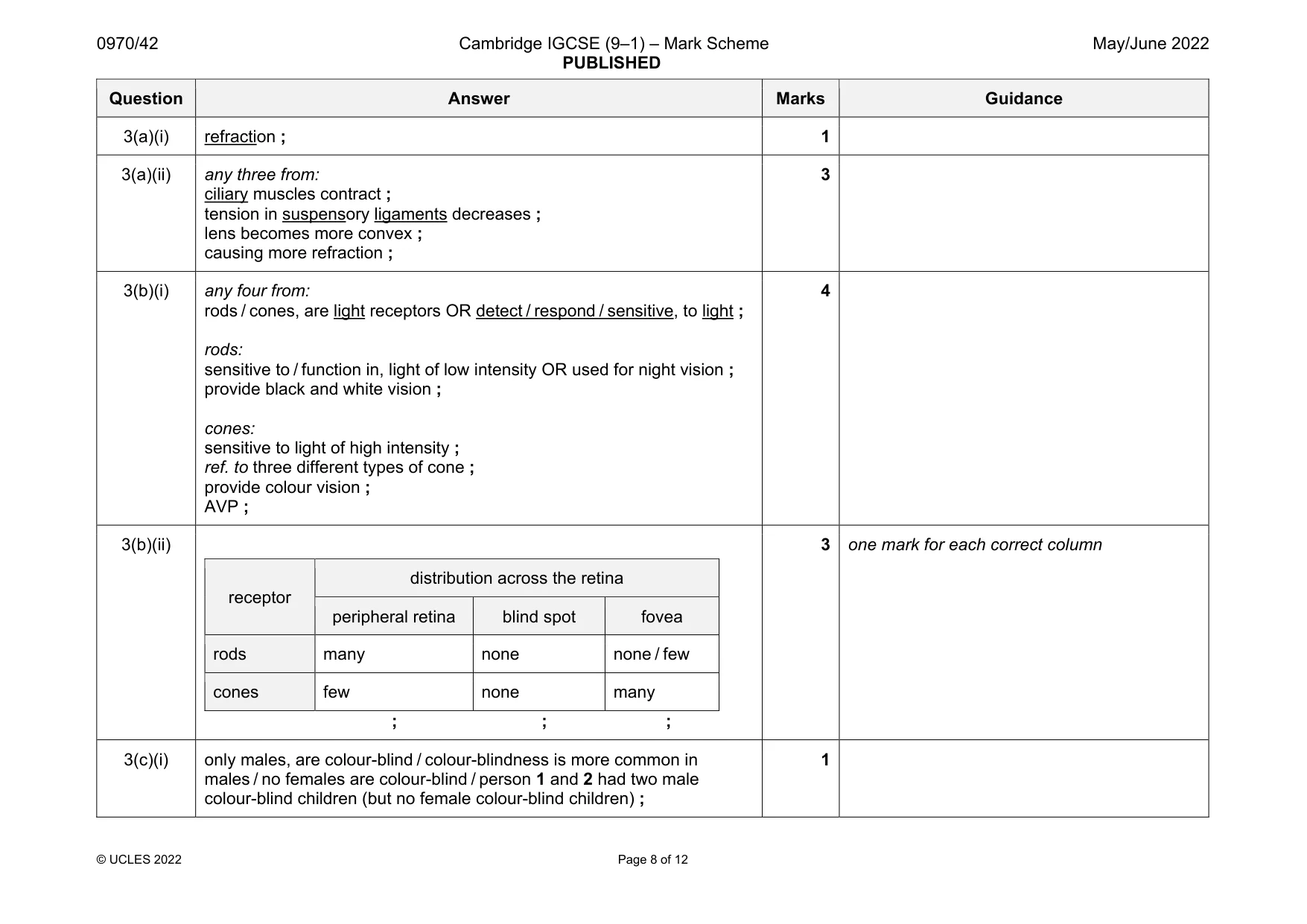
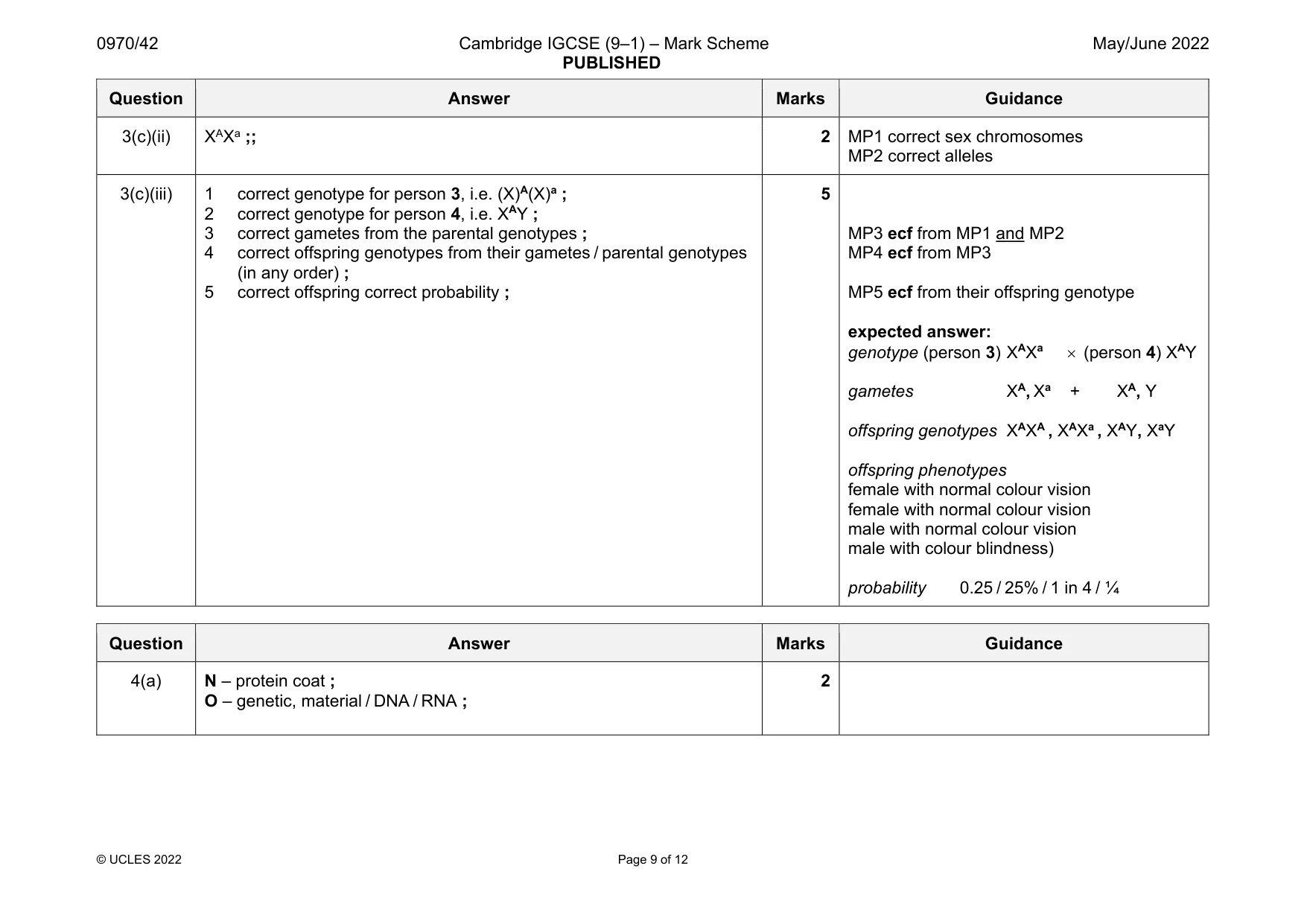
Mark scheme: 3(a)(i) refraction ; 1 3(a)(ii) any three from: ciliary muscles contract ; tension in suspensory ligaments decreases ; lens becomes more convex ; causing more refraction ; 3 3(b)(i) any four from: rods / cones, are light receptors OR detect / respond / sensitive, to light ; rods: sensitive to / function in, light of low intensity OR used for night vision ; provide black and white vision ; cones: sensitive to light of high intensity ; ref. to three different types of cone ; provide colour vision ; AVP ; 4 3(b)(ii) ; ; ; receptor distribution across the retina peripheral retina blind spot fovea rods many none none / few cones few none many 3 one mark for each correct column 3(c)(i) only males, are colour-blind / colour-blindness is more common in males / no females are colour-blind / person 1 and 2 had two male colour-blind children (but no female colour-blind children) ; 1 Question Answer Marks Guidance 3(c)(ii) XAXa ;; 2 MP1 correct sex chromosomes MP2 correct alleles 3(c)(iii) 1 correct genotype for person 3, i.e. (X)A(X)a ; 2 correct genotype for person 4, i.e. XAY ; 3 correct gametes from the parental genotypes ; 4 correct offspring genotypes from their gametes / parental genotypes (in any order) ; 5 correct offspring correct probability ; 5 MP3 ecf from MP1 and MP2 MP4 ecf from MP3 MP5 ecf from their offspring genotype expected answer: genotype (person 3) XAXa (person 4) XAY gametes XA, Xa + XA, Y offspring genotypes XAXA , XAXa , XAY, XaY offspring phenotypes female with normal colour vision female with normal colour vision male with normal colour vision male with colour blindness) probability 0.25 / 25% / 1 in 4 / ¼
Q4 · A diagram of a virus
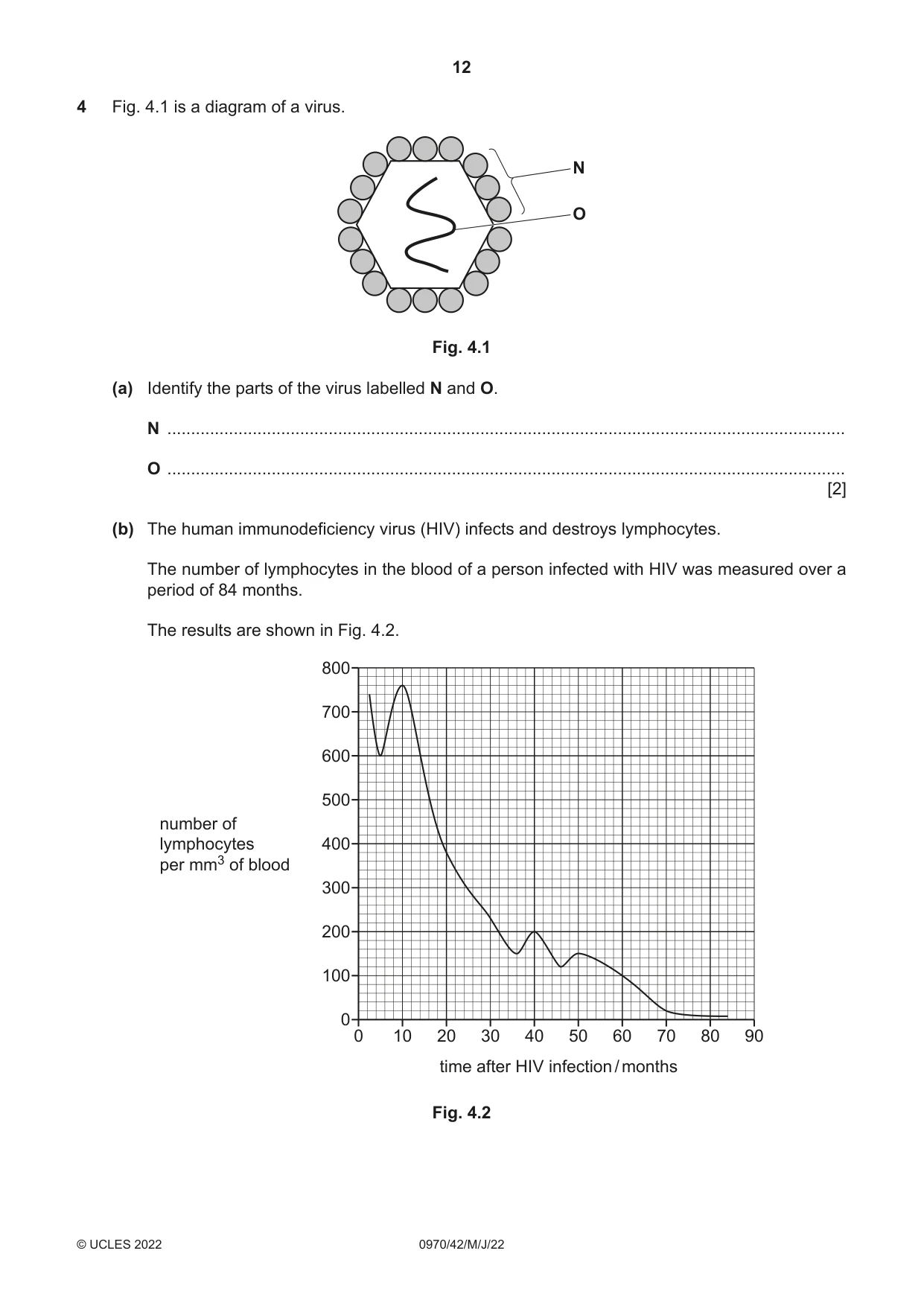
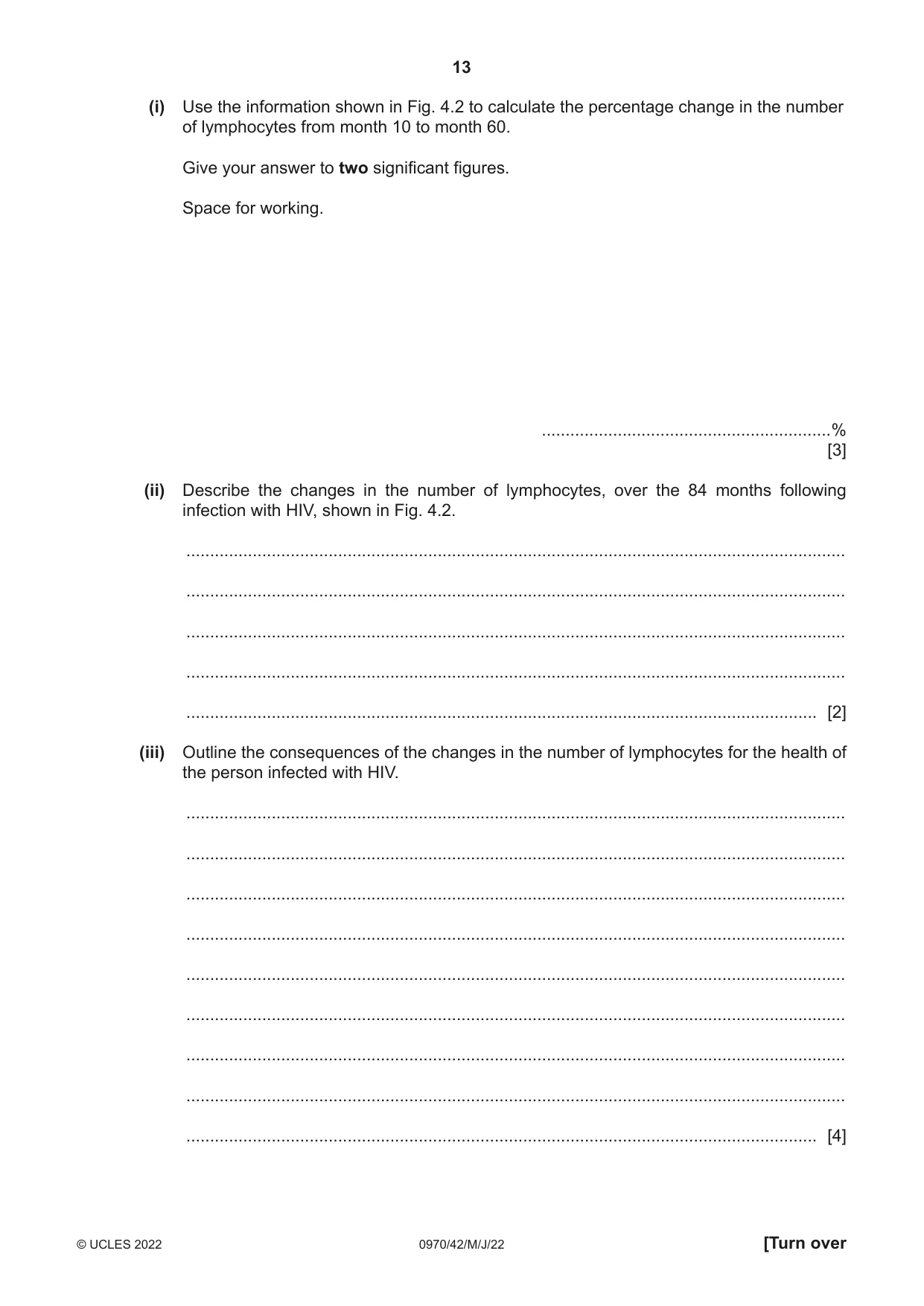
4 Fig. 4.1 is a diagram of a virus. N O Fig. 4.1 (a) Identify the parts of the virus labelled N and O. N ............................................................................................................................................... O ............................................................................................................................................... [2] (b) The human immunodeficiency virus (HIV) infects and destroys lymphocytes. The number of lymphocytes in the blood of a person infected with HIV was measured over a period of 84 months. The results are shown in Fig. 4.2. 800 700 600 500 number of lymphocytes 400 per mm3 of blood 300 200 100 0 0 10 20 30 40 50 60 70 80 90 time after HIV infection / months Fig. 4.2 (i) Use the information shown in Fig. 4.2 to calculate the percentage change in the number of lymphocytes from month 10 to month 60. Give your answer to two significant figures. Space for working. .............................................................% [3] (ii) Describe the changes in the number of lymphocytes, over the 84 months following infection with HIV, shown in Fig. 4.2. ........................................................................................................................................... ........................................................................................................................................... ........................................................................................................................................... ........................................................................................................................................... ..................................................................................................................................... [2] (iii) Outline the consequences of the changes in the number of lymphocytes for the health of the person infected with HIV. ........................................................................................................................................... ........................................................................................................................................... ........................................................................................................................................... ........................................................................................................................................... ........................................................................................................................................... ........................................................................................................................................... ........................................................................................................................................... ........................................................................................................................................... ..................................................................................................................................... [4] (iv) Explain why antibiotics are not used to treat viral infections. ........................................................................................................................................... ........................................................................................................................................... ........................................................................................................................................... ........................................................................................................................................... ..................................................................................................................................... [2] [Total: 13]
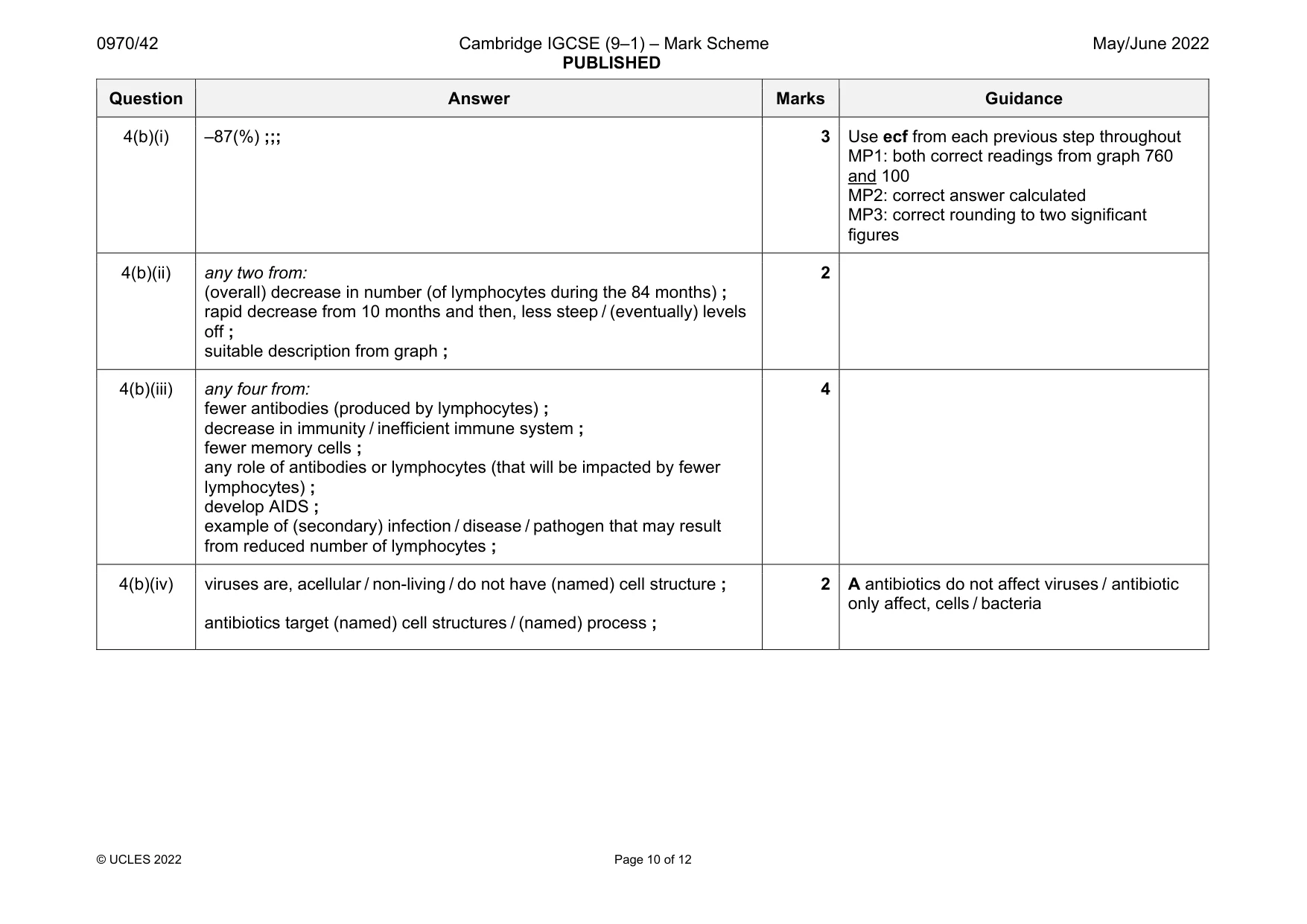
Mark scheme: 4(a) N – protein coat ; O – genetic, material / DNA / RNA ; 2 Question Answer Marks Guidance 4(b)(i) –87(%) ;;; 3 Use ecf from each previous step throughout MP1: both correct readings from graph 760 and 100 MP2: correct answer calculated MP3: correct rounding to two significant figures 4(b)(ii) any two from: (overall) decrease in number (of lymphocytes during the 84 months) ; rapid decrease from 10 months and then, less steep / (eventually) levels off ; suitable description from graph ; 2 4(b)(iii) any four from: fewer antibodies (produced by lymphocytes) ; decrease in immunity / inefficient immune system ; fewer memory cells ; any role of antibodies or lymphocytes (that will be impacted by fewer lymphocytes) ; develop AIDS ; example of (secondary) infection / disease / pathogen that may result from reduced number of lymphocytes ; 4 4(b)(iv) viruses are, acellular / non-living / do not have (named) cell structure ; antibiotics target (named) cell structures / (named) process ; 2 A antibiotics do not affect viruses / antibiotic only affect, cells / bacteria
Q5 · A diagram of the human gas exchange system
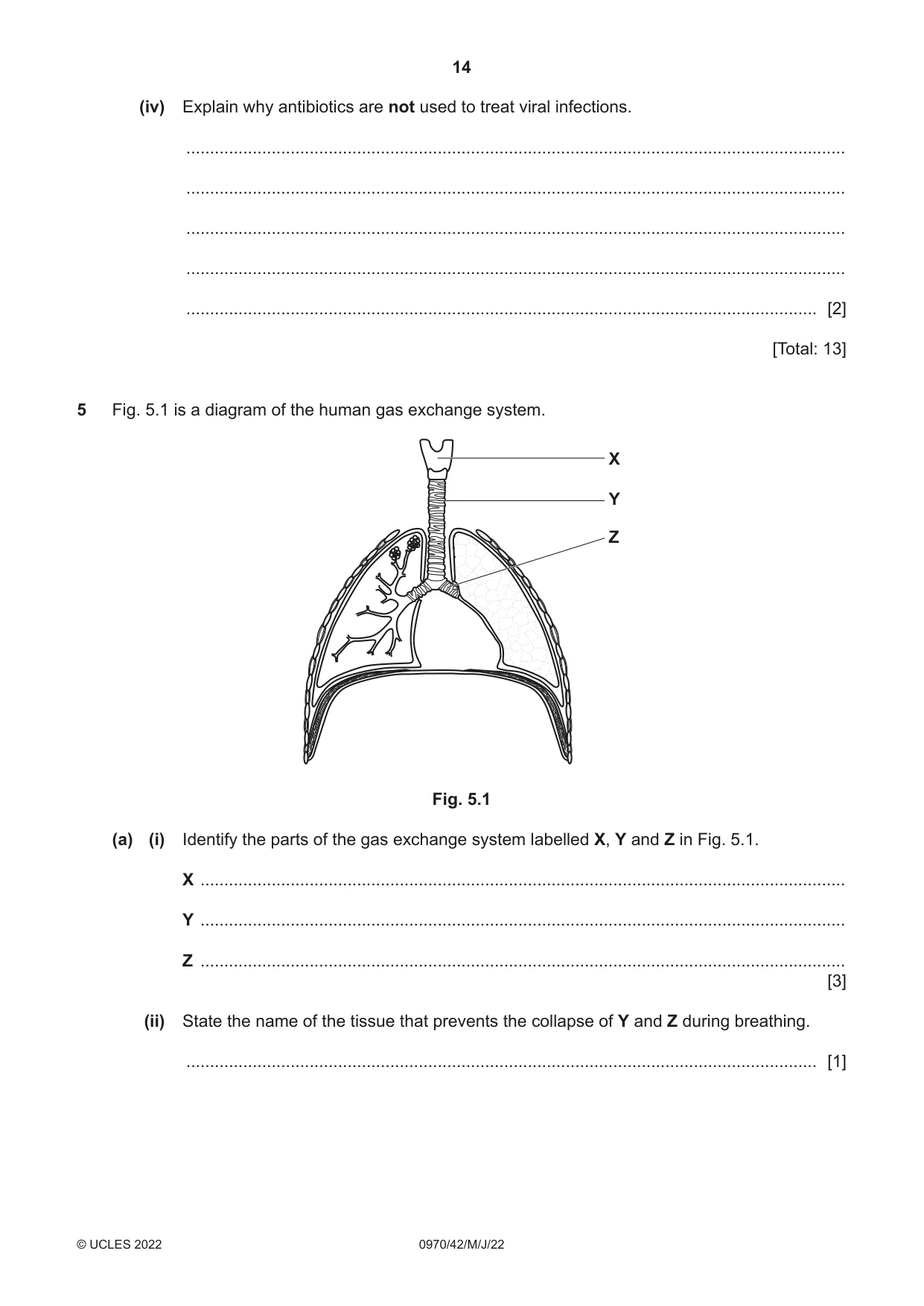
5 Fig. 5.1 is a diagram of the human gas exchange system. X Y Z Fig. 5.1 (a) (i) Identify the parts of the gas exchange system labelled X, Y and Z in Fig. 5.1. X ........................................................................................................................................ Y ........................................................................................................................................ Z ........................................................................................................................................ [3] (ii) State the name of the tissue that prevents the collapse of Y and Z during breathing. ..................................................................................................................................... [1] (b) Breathing involves the movement of the ribs and the diaphragm. Describe the process of inspiration. ................................................................................................................................................... ................................................................................................................................................... ................................................................................................................................................... ................................................................................................................................................... ................................................................................................................................................... ................................................................................................................................................... ................................................................................................................................................... ................................................................................................................................................... ............................................................................................................................................. [4] (c) State the name of the gas exchange surface in the lungs. ............................................................................................................................................. [1] [Total: 9]
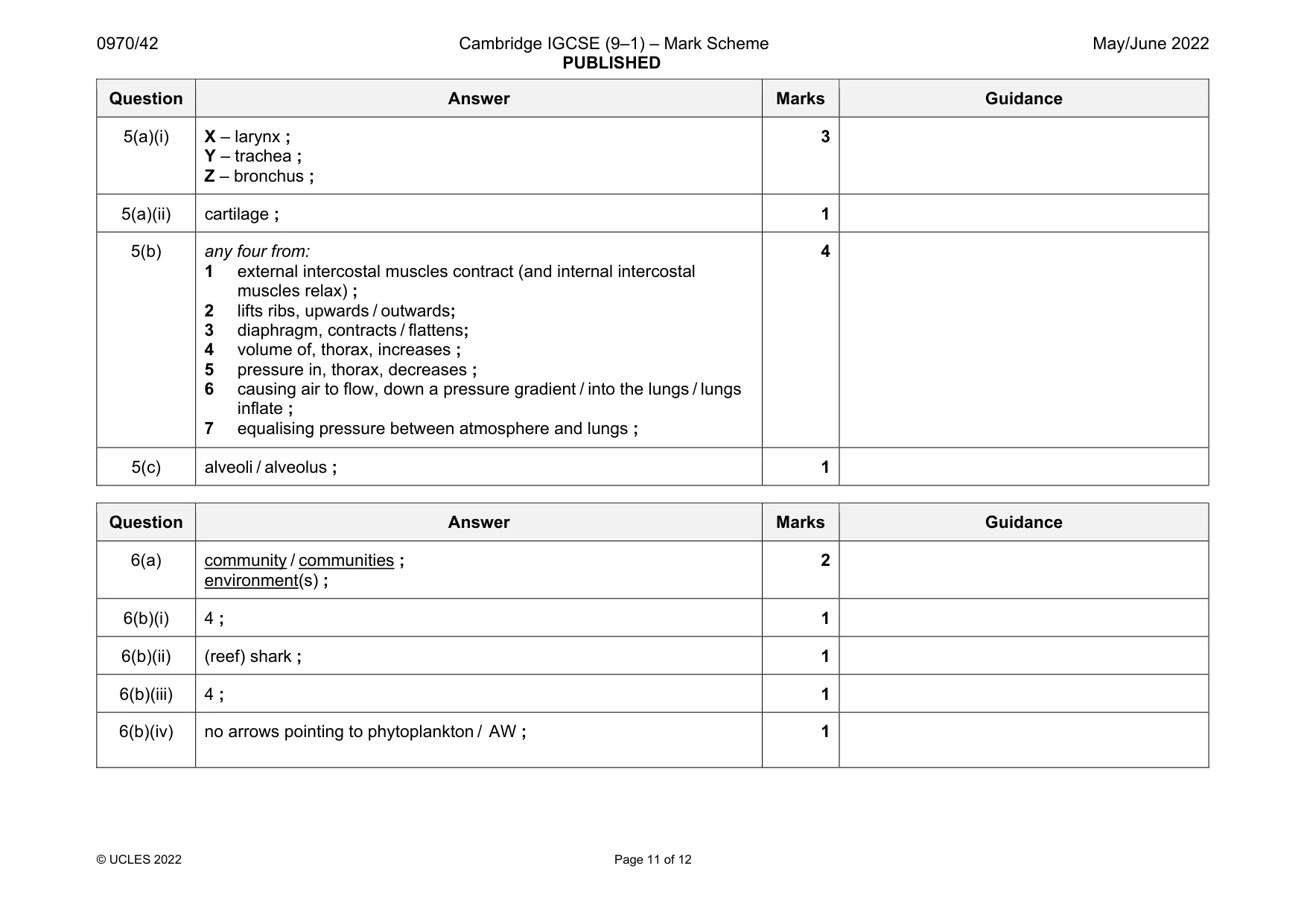
Mark scheme: 5(a)(i) X – larynx ; Y – trachea ; Z – bronchus ; 3 5(a)(ii) cartilage ; 1 5(b) any four from: 1 external intercostal muscles contract (and internal intercostal muscles relax) ; 2 lifts ribs, upwards / outwards; 3 diaphragm, contracts / flattens; 4 volume of, thorax, increases ; 5 pressure in, thorax, decreases ; 6 causing air to flow, down a pressure gradient / into the lungs / lungs inflate ; 7 equalising pressure between atmosphere and lungs ; 4 5(c) alveoli / alveolus ; 1
Q6 · Coral reefs are important ecosystems
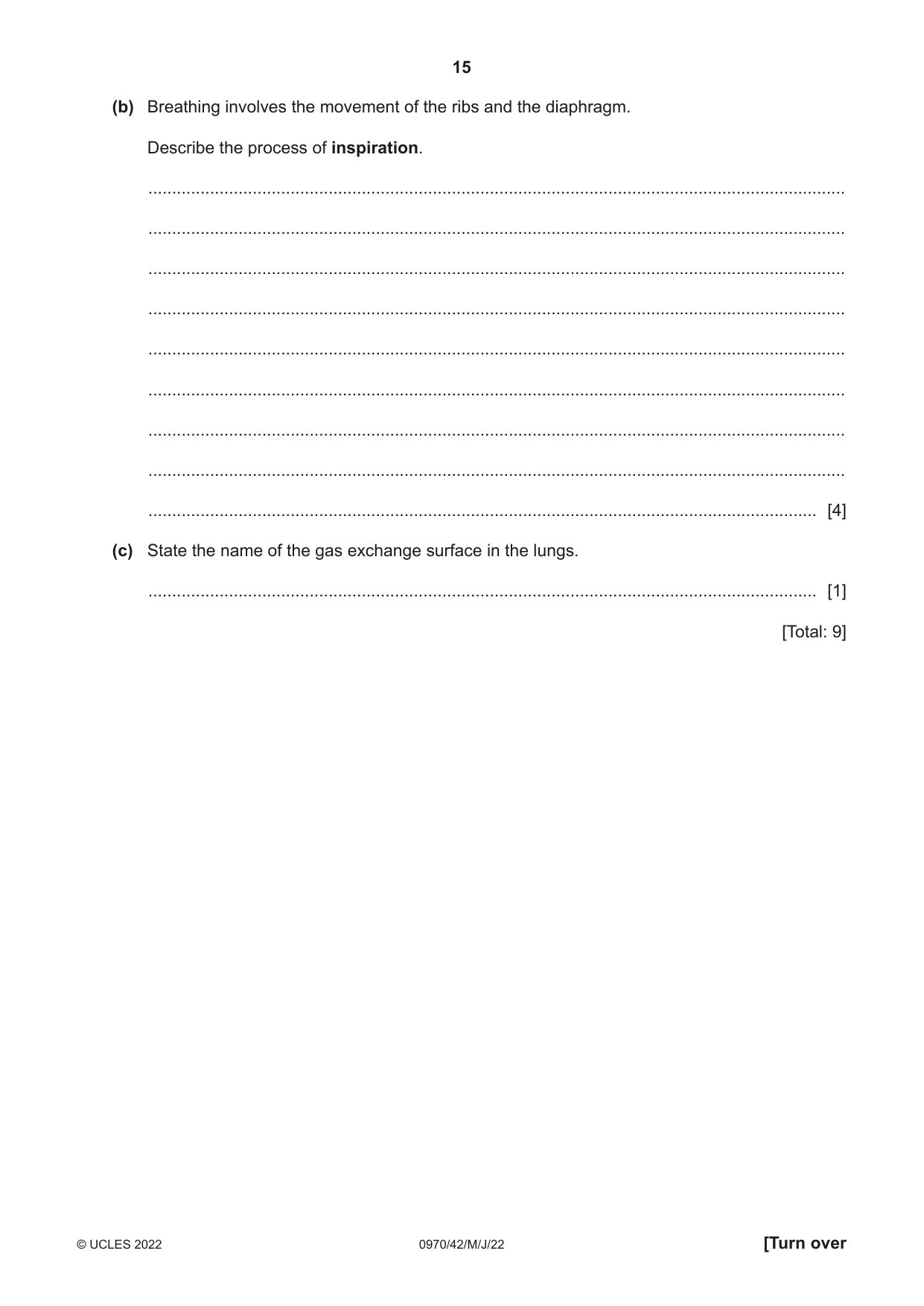
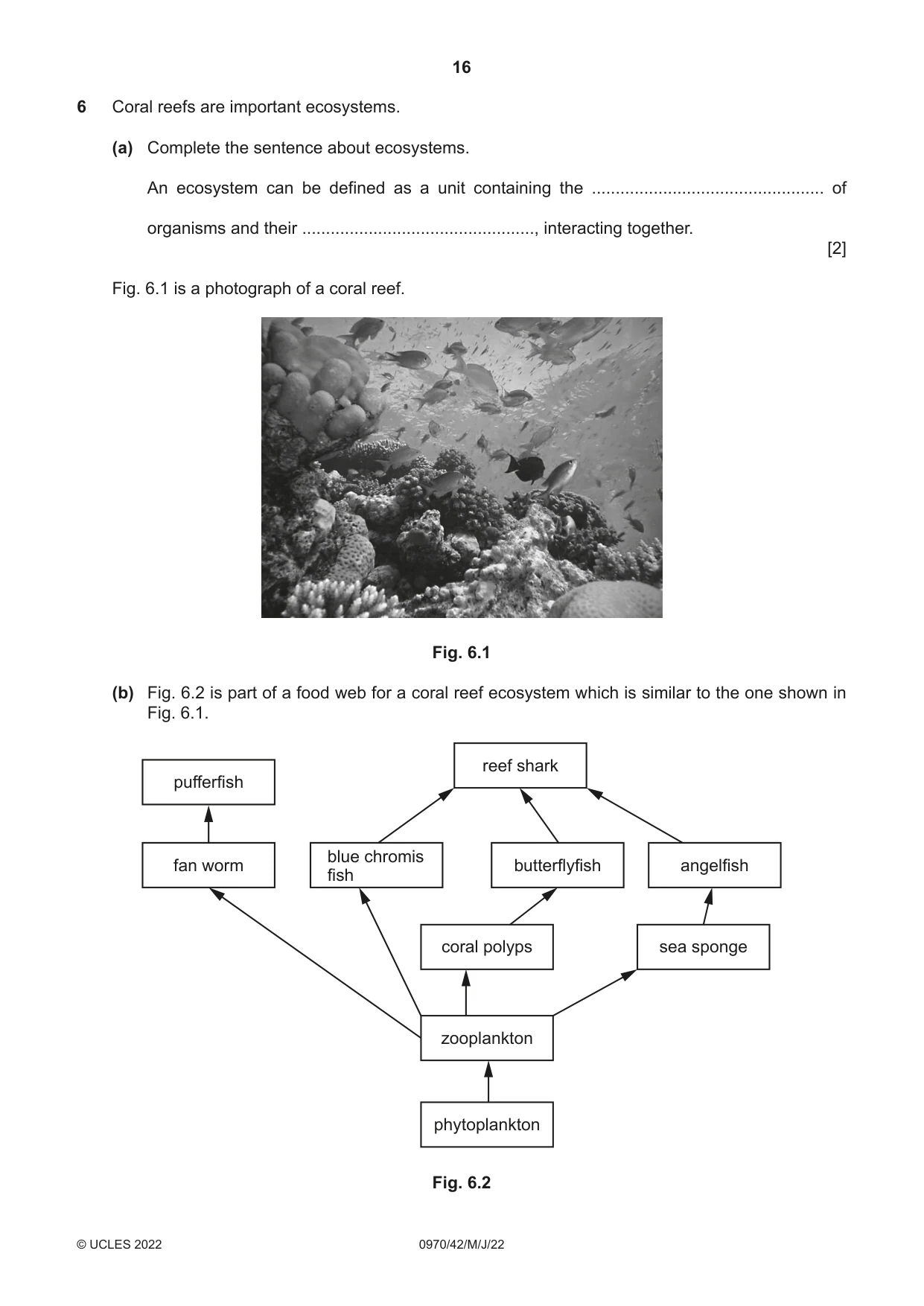
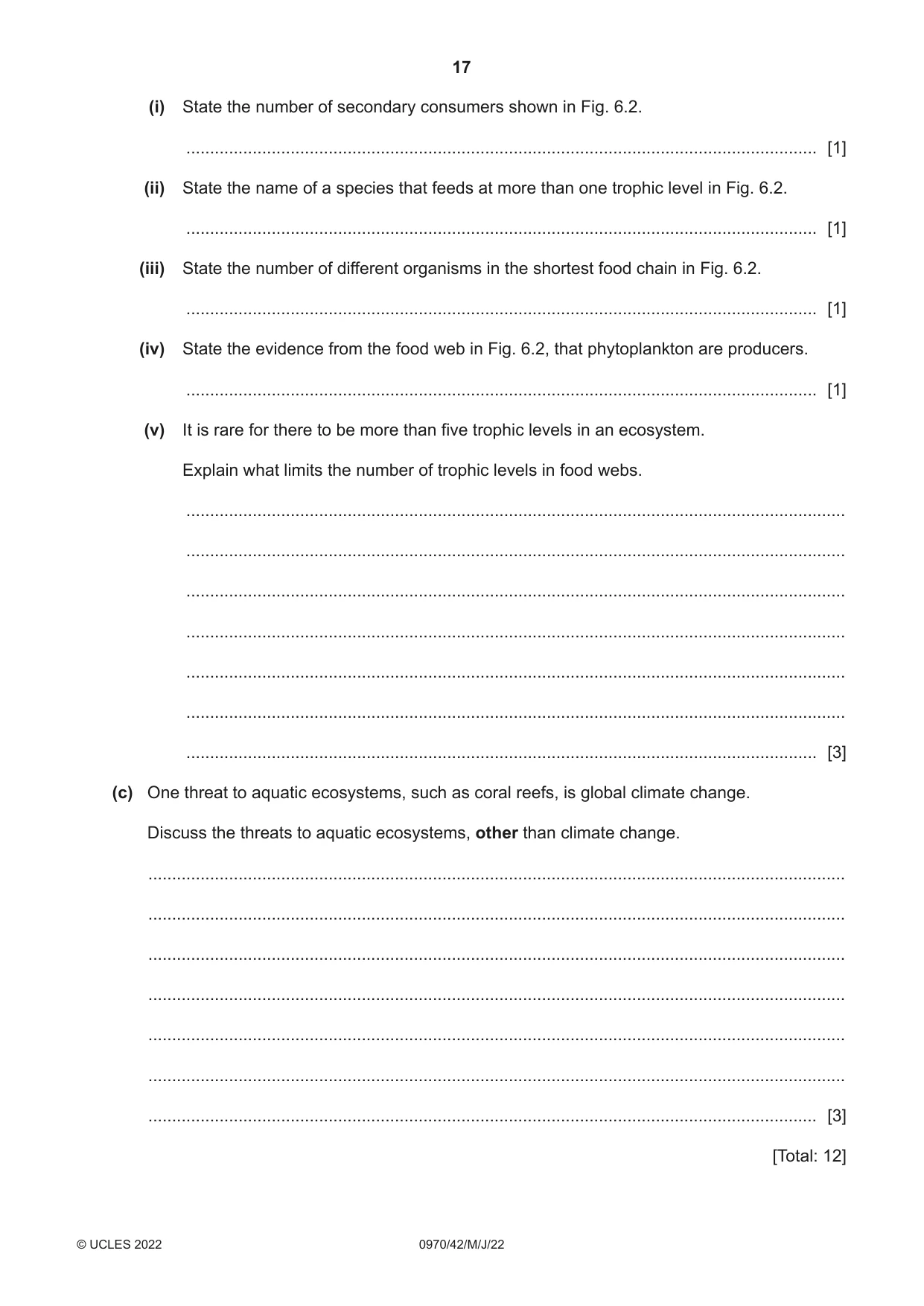
6 Coral reefs are important ecosystems. (a) Complete the sentence about ecosystems. An ecosystem can be defined as a unit containing the ................................................. of organisms and their ................................................., interacting together. [2] Fig. 6.1 is a photograph of a coral reef. Fig. 6.1 (b) Fig. 6.2 is part of a food web for a coral reef ecosystem which is similar to the one shown in Fig. 6.1. reef shark pufferfish blue chromis fan worm butterflyfish angelfish fish coral polyps sea sponge zooplankton phytoplankton Fig. 6.2 (i) State the number of secondary consumers shown in Fig. 6.2. ..................................................................................................................................... [1] (ii) State the name of a species that feeds at more than one trophic level in Fig. 6.2. ..................................................................................................................................... [1] (iii) State the number of different organisms in the shortest food chain in Fig. 6.2. ..................................................................................................................................... [1] (iv) State the evidence from the food web in Fig. 6.2, that phytoplankton are producers. ..................................................................................................................................... [1] (v) It is rare for there to be more than five trophic levels in an ecosystem. Explain what limits the number of trophic levels in food webs. ........................................................................................................................................... ........................................................................................................................................... ........................................................................................................................................... ........................................................................................................................................... ........................................................................................................................................... ........................................................................................................................................... ..................................................................................................................................... [3] (c) One threat to aquatic ecosystems, such as coral reefs, is global climate change. Discuss the threats to aquatic ecosystems, other than climate change. ................................................................................................................................................... ................................................................................................................................................... ................................................................................................................................................... ................................................................................................................................................... ................................................................................................................................................... ................................................................................................................................................... ............................................................................................................................................. [3] [Total: 12]
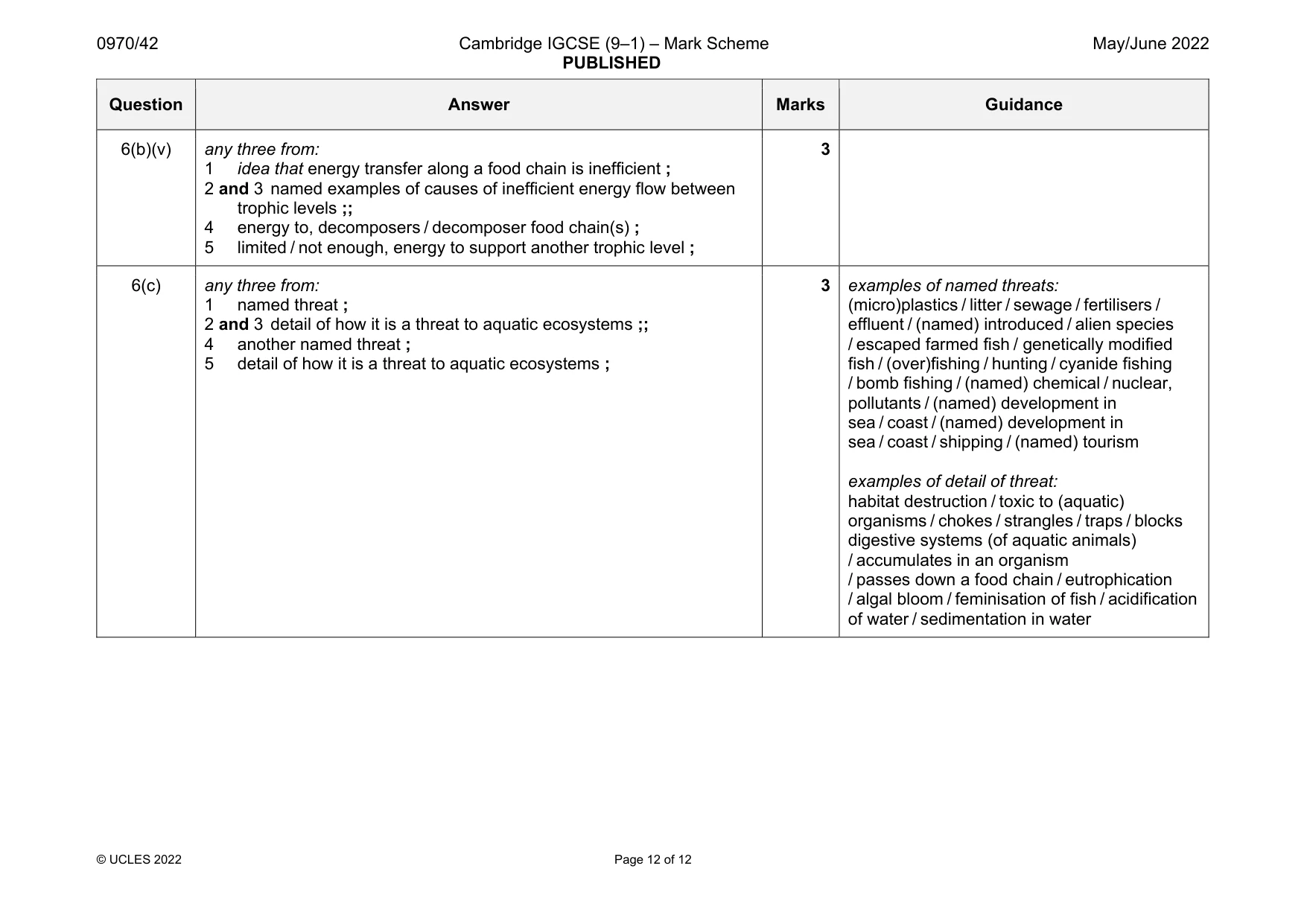
Mark scheme: 6(a) community / communities ; environment(s) ; 2 6(b)(i) 4 ; 1 6(b)(ii) (reef) shark ; 1 6(b)(iii) 4 ; 1 6(b)(iv) no arrows pointing to phytoplankton / AW ; 1 Question Answer Marks Guidance 6(b)(v) any three from: 1 idea that energy transfer along a food chain is inefficient ; 2 and 3 named examples of causes of inefficient energy flow between trophic levels ;; 4 energy to, decomposers / decomposer food chain(s) ; 5 limited / not enough, energy to support another trophic level ; 3 6(c) any three from: 1 named threat ; 2 and 3 detail of how it is a threat to aquatic ecosystems ;; 4 another named threat ; 5 detail of how it is a threat to aquatic ecosystems ; 3 examples of named threats: (micro)plastics / litter / sewage / fertilisers / effluent / (named) introduced / alien species / escaped farmed fish / genetically modified fish / (over)fishing / hunting / cyanide fishing / bomb fishing / (named) chemical / nuclear, pollutants / (named) development in sea / coast / (named) development in sea / coast / shipping / (named) tourism examples of detail of threat: habitat destruction / toxic to (aquatic) organisms / chokes / strangles / traps / blocks digestive systems (of aquatic animals) / accumulates in an organism / passes down a food chain / eutrophication / algal bloom / feminisation of fish / acidification of water / sedimentation in water
What was in this paper
The subtopics covered by these 6 questions, and how many questions each got. Open one in a new tab to see every Cambridge question on it.
What you needed in this session
Cambridge’s own grade thresholds for 2022 May/June, Paper 4 · Variant 2. A higher threshold means an easier paper — the bar moves with how the cohort did.