Cambridge IGCSE Biology (9-1) 0970 — 2025 May/June Paper 3 · Variant 1
0970/31/M/J/25 · 8 questions · 80 marks · ≈90 min
The question paper and its mark scheme, free to read here and free to download. This is Cambridge’s own paper, exactly as it was sat.
Question paper20 pages



Mark scheme14 pages
Answers below. Sit the paper first if you are practising.
Questions as text
Question 1
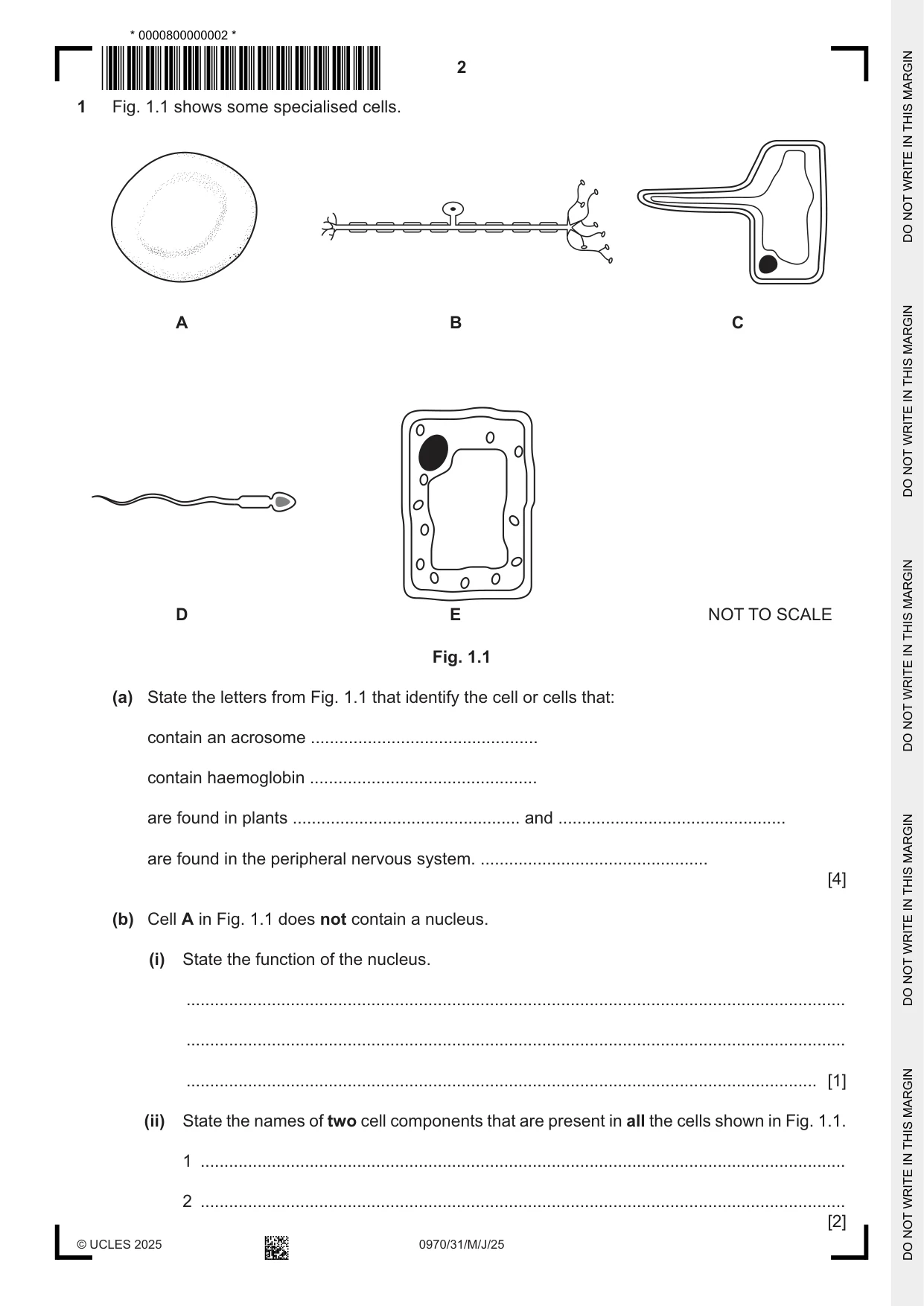
1 Fig. 1.1 shows some specialised cells. A B C D E NOT TO SCALE Fig. 1.1 (a) State the letters from Fig. 1.1 that identify the cell or cells that: contain an acrosome ................................................ contain haemoglobin ................................................ are found in plants ................................................ and ................................................ are found in the peripheral nervous system. ................................................ [4] (b) Cell A in Fig. 1.1 does not contain a nucleus. (i) State the function of the nucleus. ........................................................................................................................................... ........................................................................................................................................... ..................................................................................................................................... [1] (ii) State the names of two cell components that are present in all the cells shown in Fig. 1.1. 1 ........................................................................................................................................ 2 ........................................................................................................................................ [2] (c) Describe how cell C in Fig. 1.1 is adapted for its function. ................................................................................................................................................... ................................................................................................................................................... ................................................................................................................................................... ................................................................................................................................................... ............................................................................................................................................. [2] (d) State the two pieces of information needed to calculate the actual length of a cell when viewed using a light microscope. 1 ................................................................................................................................................ 2 ................................................................................................................................................ [2] [Total: 11]
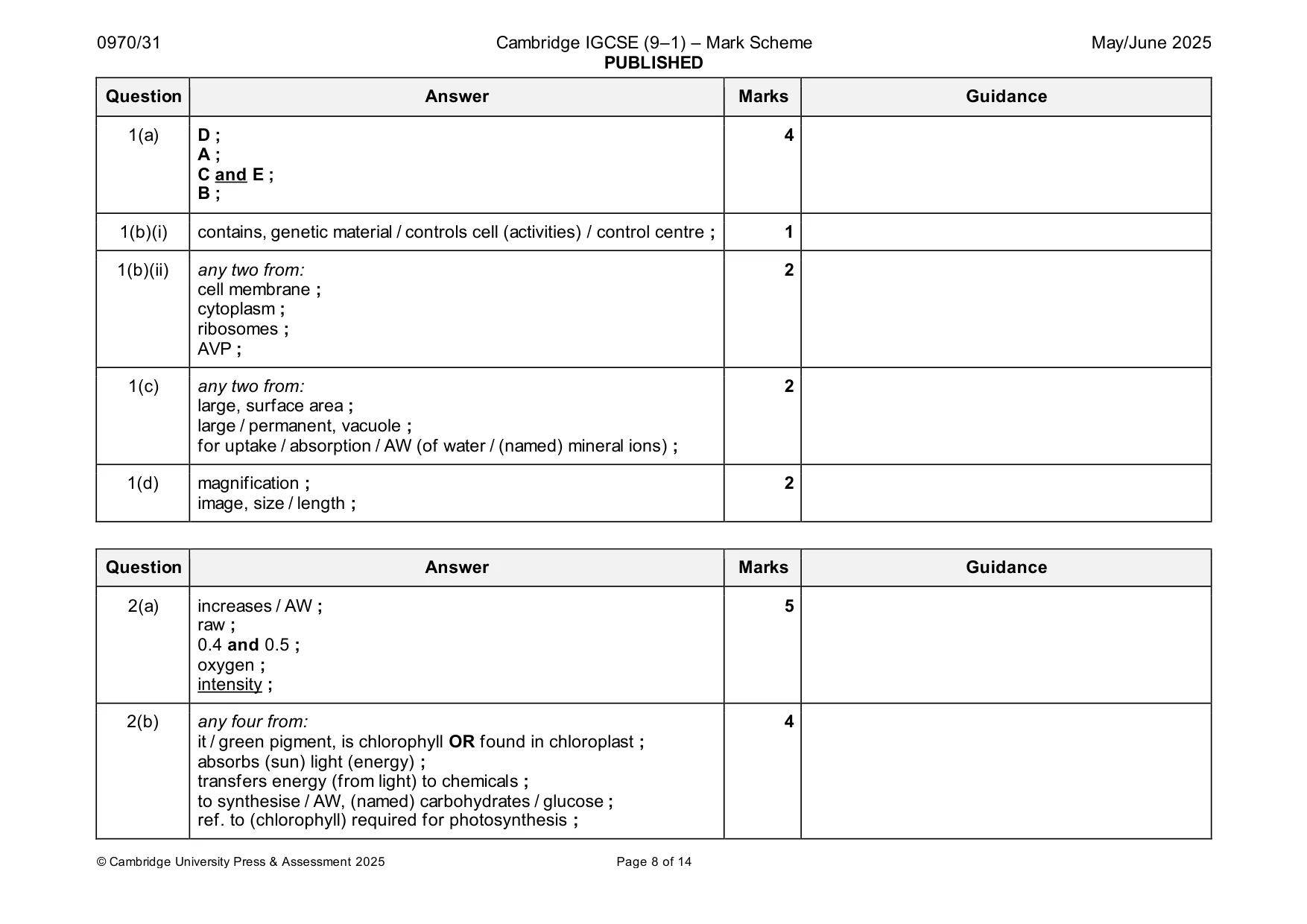
Mark scheme: Question Answer Marks Guidance 1(a) D ; 4 A ; C and E ; B ; 1(b)(i) contains, genetic material / controls cell (activities) / control centre ; 1 1(b)(ii) any two from: 2 cell membrane ; cytoplasm ; ribosomes ; AVP ; 1(c) any two from: 2 large, surface area ; large / permanent, vacuole ; for uptake / absorption / AW (of water / (named) mineral ions) ; 1(d) magnification ; 2 image, size / length ;
Q2 · A student investigated the effect of carbon dioxide concentration on the rate of…
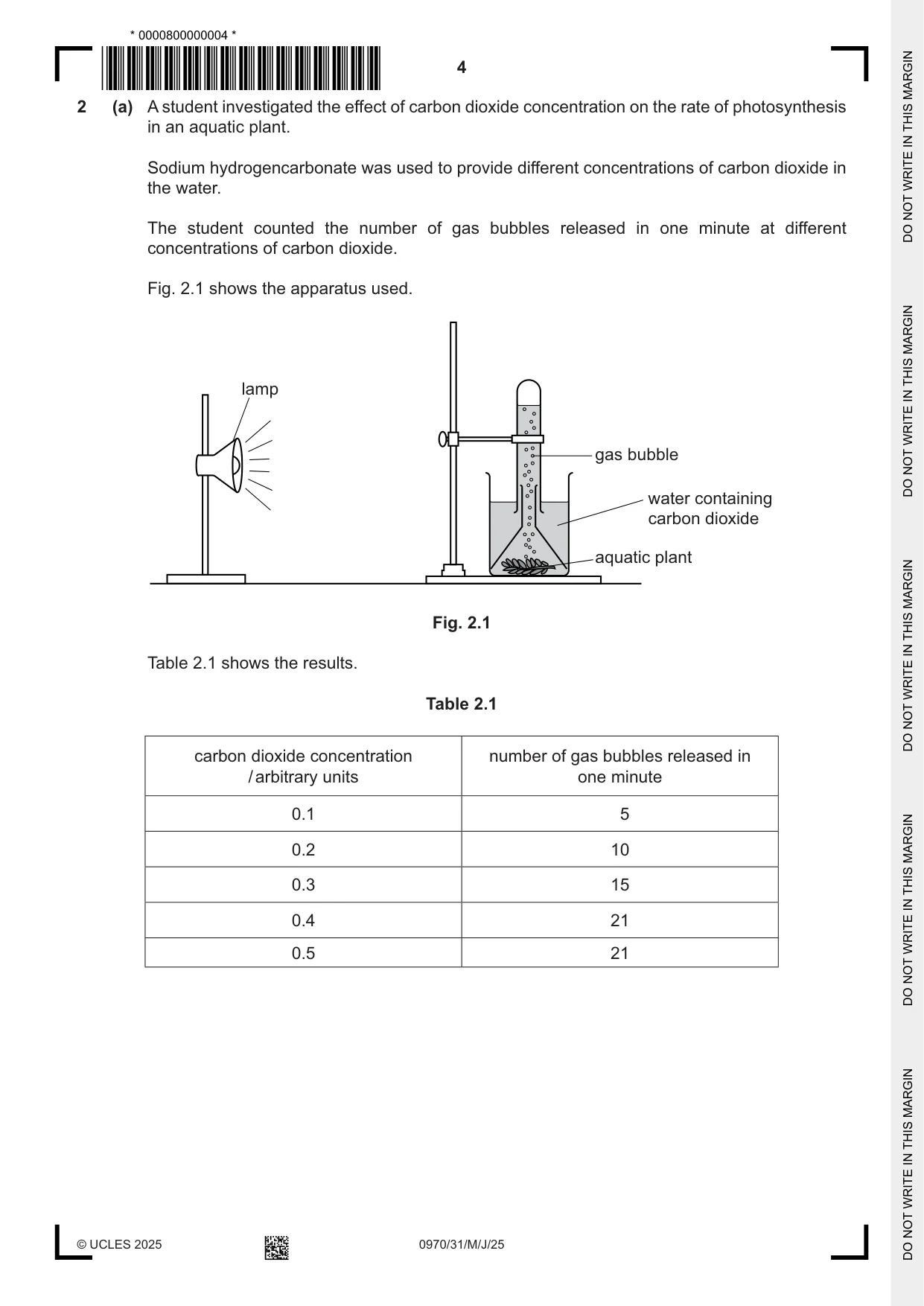
2 (a) A student investigated the effect of carbon dioxide concentration on the rate of photosynthesis in an aquatic plant. Sodium hydrogencarbonate was used to provide different concentrations of carbon dioxide in the water. The student counted the number of gas bubbles released in one minute at different concentrations of carbon dioxide. Fig. 2.1 shows the apparatus used. lamp gas bubble water containing carbon dioxide aquatic plant Fig. 2.1 Table 2.1 shows the results. Table 2.1 carbon dioxide concentration number of gas bubbles released in / arbitrary units one minute 0.1 5 0.2 10 0.3 15 0.4 21 0.5 21 Complete the sentences to describe and explain the results shown in Table 2.1. As the carbon dioxide concentration increases, the number of gas bubbles released in one minute ................................................ and then remains the same. This is because carbon dioxide is a ................................................ material required for photosynthesis. The number of gas bubbles released remains the same between the carbon dioxide concentrations of ...................................................... and ...................................................... arbitrary units. Photosynthesis produces ................................................ gas which is released as bubbles. The distance between the lamp and the aquatic plant is kept constant during the investigation so that the light ................................................ remains the same. [5] (b) Plants are usually green. Explain the importance of the green pigment in plant nutrition. ................................................................................................................................................... ................................................................................................................................................... ................................................................................................................................................... ................................................................................................................................................... ................................................................................................................................................... ................................................................................................................................................... ................................................................................................................................................... ................................................................................................................................................... ............................................................................................................................................. [4] (c) State the name of the process that produces carbon dioxide in plants. ............................................................................................................................................. [1] [Total: 10]
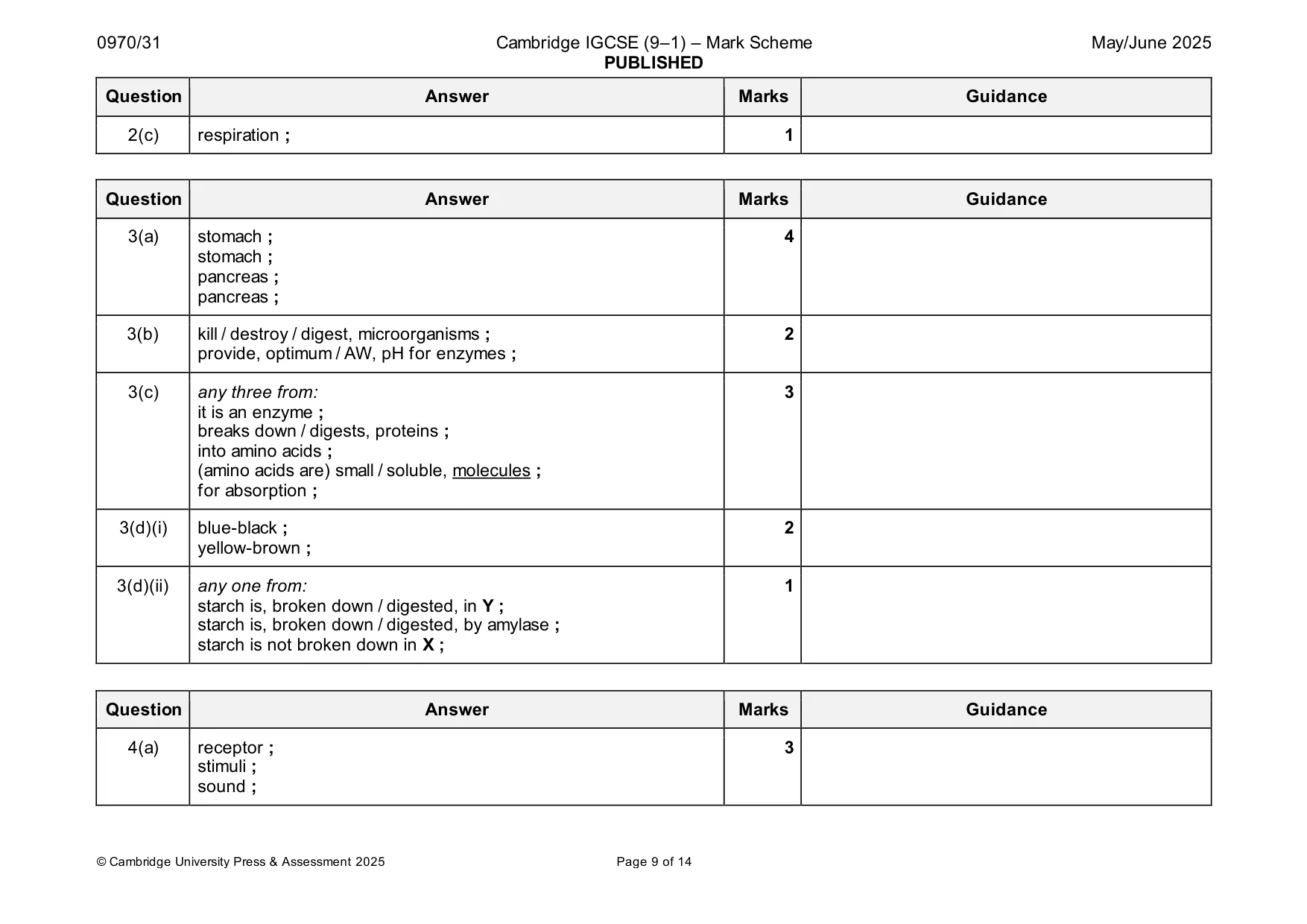
Mark scheme: 2(a) increases / AW ; 5 raw ; 0.4 and 0.5 ; oxygen ; intensity ; 2(b) any four from: 4 it / green pigment, is chlorophyll OR found in chloroplast ; absorbs (sun) light (energy) ; transfers energy (from light) to chemicals ; to synthesise / AW, (named) carbohydrates / glucose ; ref. to (chlorophyll) required for photosynthesis ; 2(c) respiration ; 1
Q3 · The list shows some of the organs in the digestive system
3 (a) The list shows some of the organs in the digestive system. large intestine liver oesophagus pancreas salivary gland stomach The words in the list can be used once, more than once or not at all. State the name of one organ from the list that: is where physical digestion occurs ................................................ releases hydrochloric acid ................................................ secretes protease and amylase ................................................ secretes insulin. ................................................ [4] (b) State two functions of hydrochloric acid in the digestive system. 1 ................................................................................................................................................ 2 ................................................................................................................................................ [2] (c) Describe the importance of protease in the digestive system. ................................................................................................................................................... ................................................................................................................................................... ................................................................................................................................................... ................................................................................................................................................... ................................................................................................................................................... ................................................................................................................................................... ............................................................................................................................................. [3] (d) A student investigated the effect of amylase on starch. Test-tube X contained starch only. Test-tube Y contained starch and amylase. After 30 minutes the contents of test-tubes X and Y were tested with iodine solution. The contents of test-tubes X and Y turned different colours. (i) Complete Table 3.1 with the expected results. Table 3.1 test-tube colour with iodine solution X Y [2] (ii) State the reason why the resulting colours were not the same for test-tubes X and Y. ........................................................................................................................................... ........................................................................................................................................... ..................................................................................................................................... [1] [Total: 12]
Mark scheme: 3(a) stomach ; 4 stomach ; pancreas ; pancreas ; 3(b) kill / destroy / digest, microorganisms ; 2 provide, optimum / AW, pH for enzymes ; 3(c) any three from: 3 it is an enzyme ; breaks down / digests, proteins ; into amino acids ; (amino acids are) small / soluble, molecules ; for absorption ; 3(d)(i) blue-black ; 2 yellow-brown ; 3(d)(ii) any one from: 1 starch is, broken down / digested, in Y ; starch is, broken down / digested, by amylase ; starch is not broken down in X ;
Q4 · The eye is a sense organ
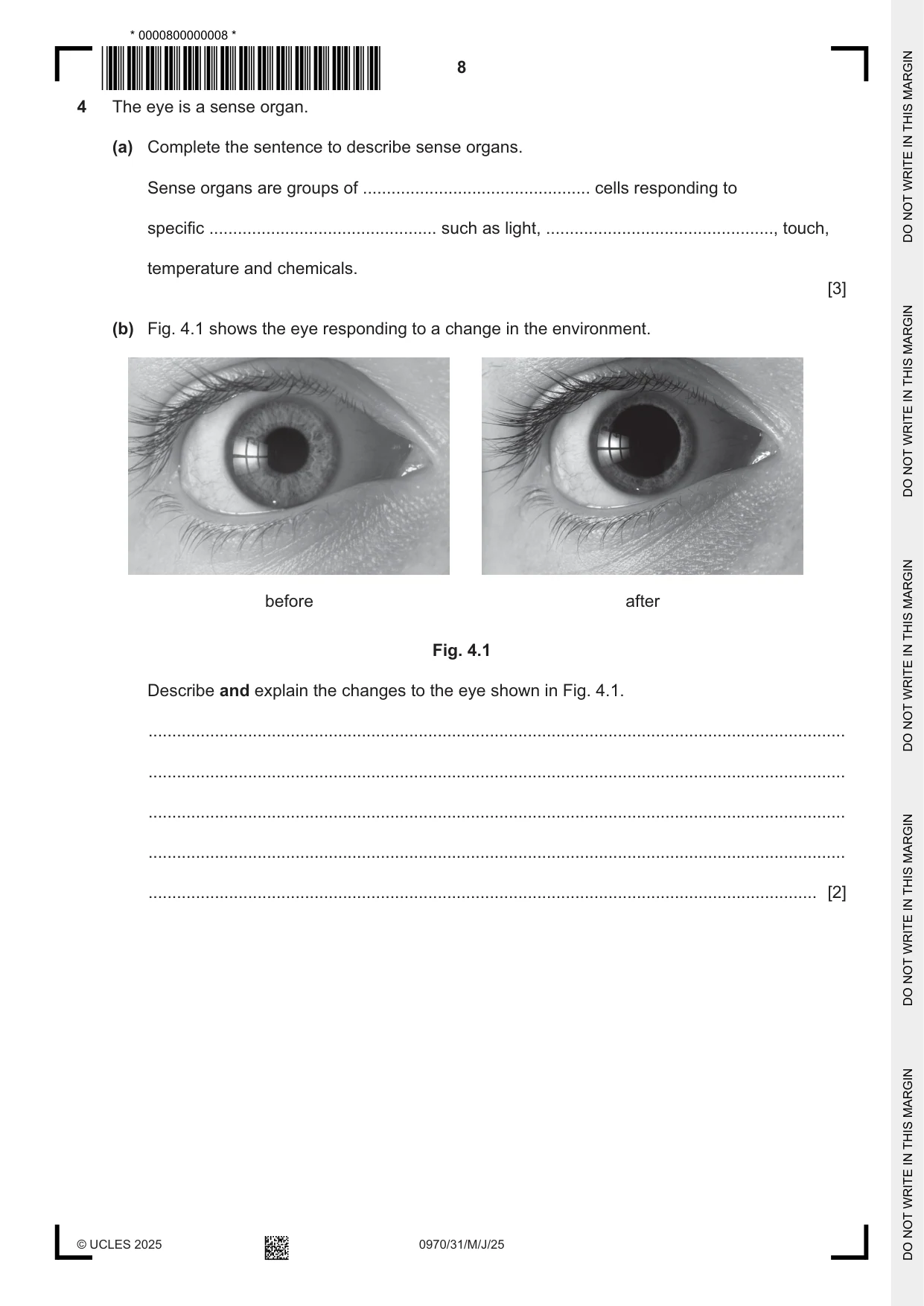
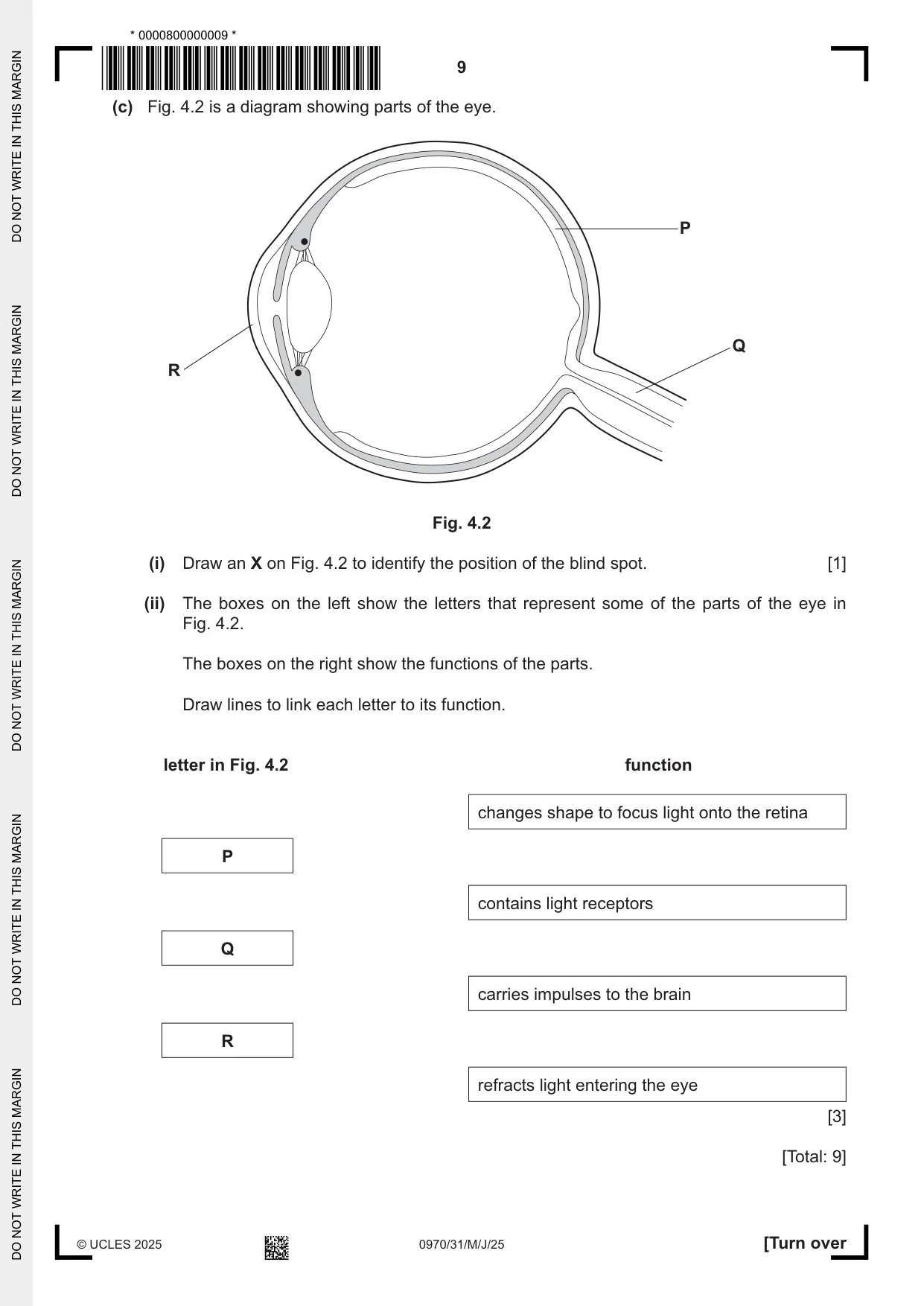
4 The eye is a sense organ. (a) Complete the sentence to describe sense organs. Sense organs are groups of ................................................ cells responding to specific ................................................ such as light, ................................................, touch, temperature and chemicals. [3] (b) Fig. 4.1 shows the eye responding to a change in the environment. before after Fig. 4.1 Describe and explain the changes to the eye shown in Fig. 4.1. ................................................................................................................................................... ................................................................................................................................................... ................................................................................................................................................... ................................................................................................................................................... ............................................................................................................................................. [2] (c) Fig. 4.2 is a diagram showing parts of the eye. P Q R Fig. 4.2 (i) Draw an X on Fig. 4.2 to identify the position of the blind spot. [1] (ii) The boxes on the left show the letters that represent some of the parts of the eye in Fig. 4.2. The boxes on the right show the functions of the parts. Draw lines to link each letter to its function. letter in Fig. 4.2 function changes shape to focus light onto the retina P contains light receptors Q carries impulses to the brain R refracts light entering the eye [3] [Total: 9]
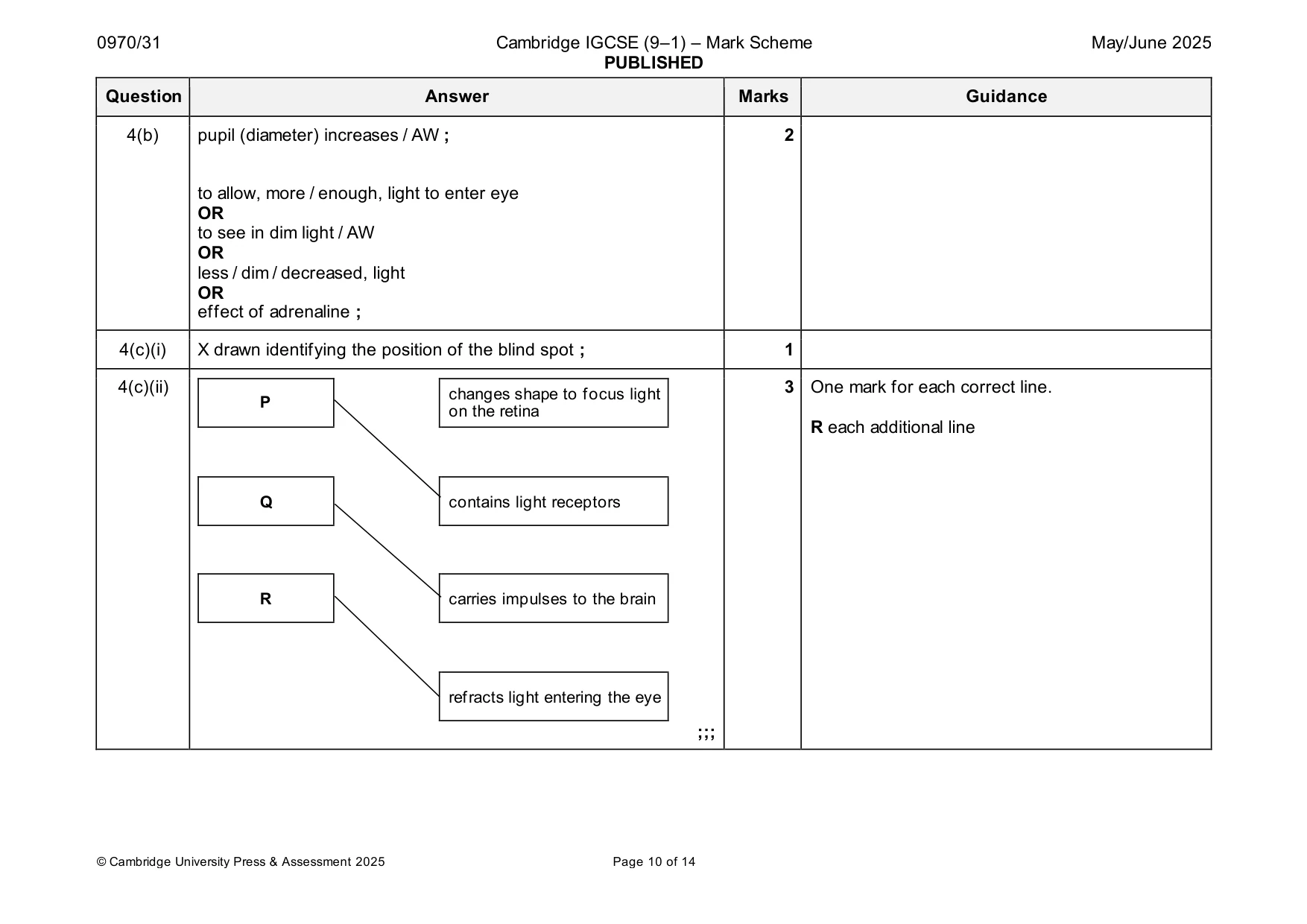
Mark scheme: 4(a) receptor ; 3 stimuli ; sound ; 4(b) pupil (diameter) increases / AW ; 2 to allow, more / enough, light to enter eye OR to see in dim light / AW OR less / dim / decreased, light OR effect of adrenaline ; 4(c)(i) X drawn identifying the position of the blind spot ; 1 4(c)(ii) 3 One mark for each correct line. changes shape to focus light P on the retina R each additional line Q contains light receptors R carries impulses to the brain refracts light entering the eye ;;;
Q5 · A student investigated the effect of immersing cylinders of potato tissue in different…
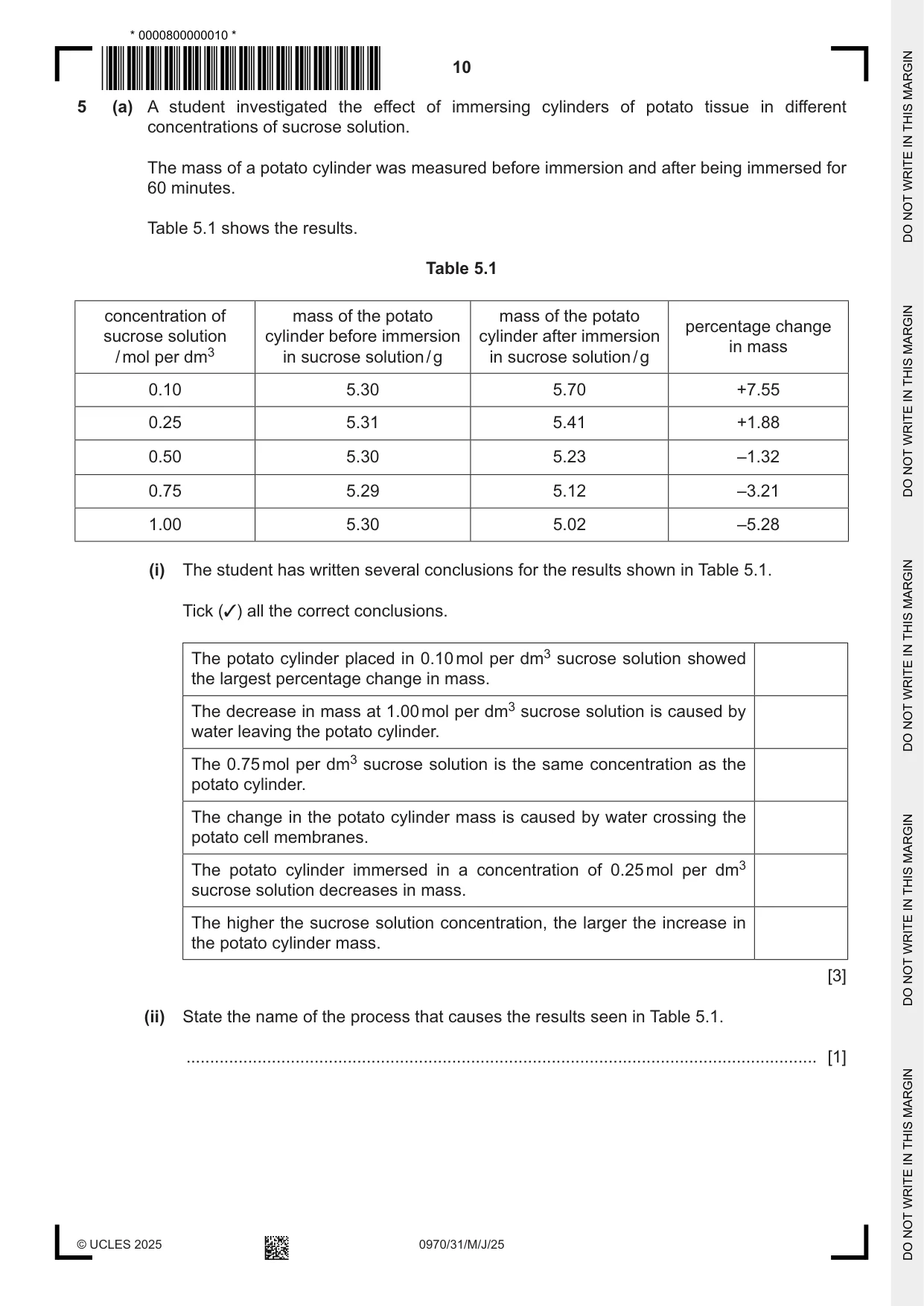
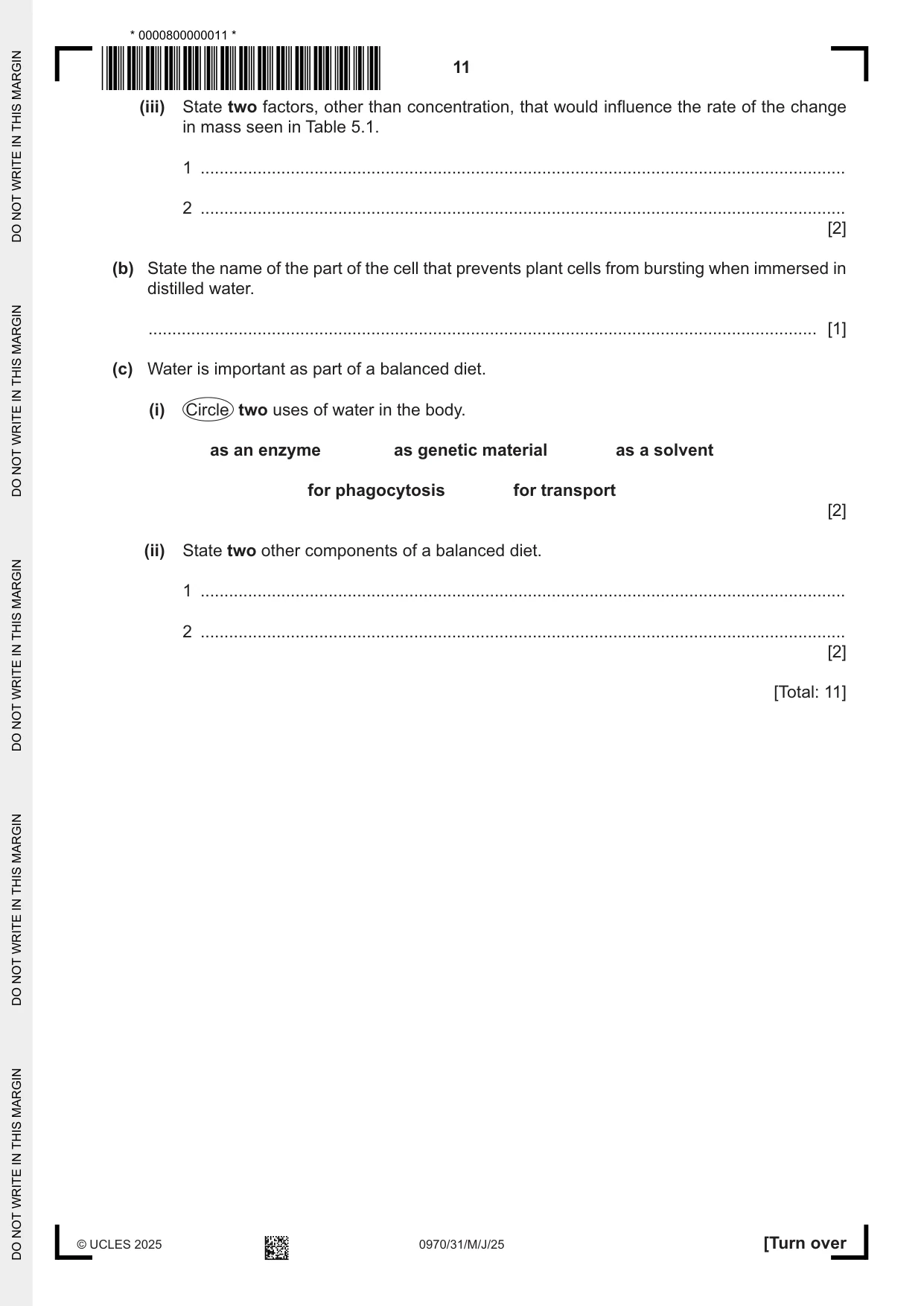
5 (a) A student investigated the effect of immersing cylinders of potato tissue in different concentrations of sucrose solution. The mass of a potato cylinder was measured before immersion and after being immersed for 60 minutes. Table 5.1 shows the results. Table 5.1 concentration of mass of the potato mass of the potato percentage change sucrose solution cylinder before immersion cylinder after immersion in mass / mol per dm3 in sucrose solution / g in sucrose solution / g 0.10 5.30 5.70 +7.55 0.25 5.31 5.41 +1.88 0.50 5.30 5.23 –1.32 0.75 5.29 5.12 –3.21 1.00 5.30 5.02 –5.28 (i) The student has written several conclusions for the results shown in Table 5.1. Tick (3) all the correct conclusions. The potato cylinder placed in 0.10 mol per dm3 sucrose solution showed the largest percentage change in mass. The decrease in mass at 1.00 mol per dm3 sucrose solution is caused by water leaving the potato cylinder. The 0.75 mol per dm3 sucrose solution is the same concentration as the potato cylinder. The change in the potato cylinder mass is caused by water crossing the potato cell membranes. The potato cylinder immersed in a concentration of 0.25 mol per dm3 sucrose solution decreases in mass. The higher the sucrose solution concentration, the larger the increase in the potato cylinder mass. [3] (ii) State the name of the process that causes the results seen in Table 5.1. ..................................................................................................................................... [1] (iii) State two factors, other than concentration, that would influence the rate of the change in mass seen in Table 5.1. 1 ........................................................................................................................................ 2 ........................................................................................................................................ [2] (b) State the name of the part of the cell that prevents plant cells from bursting when immersed in distilled water. ............................................................................................................................................. [1] (c) Water is important as part of a balanced diet. (i) Circle two uses of water in the body. as an enzyme as genetic material as a solvent for phagocytosis for transport [2] (ii) State two other components of a balanced diet. 1 ........................................................................................................................................ 2 ........................................................................................................................................ [2] [Total: 11]
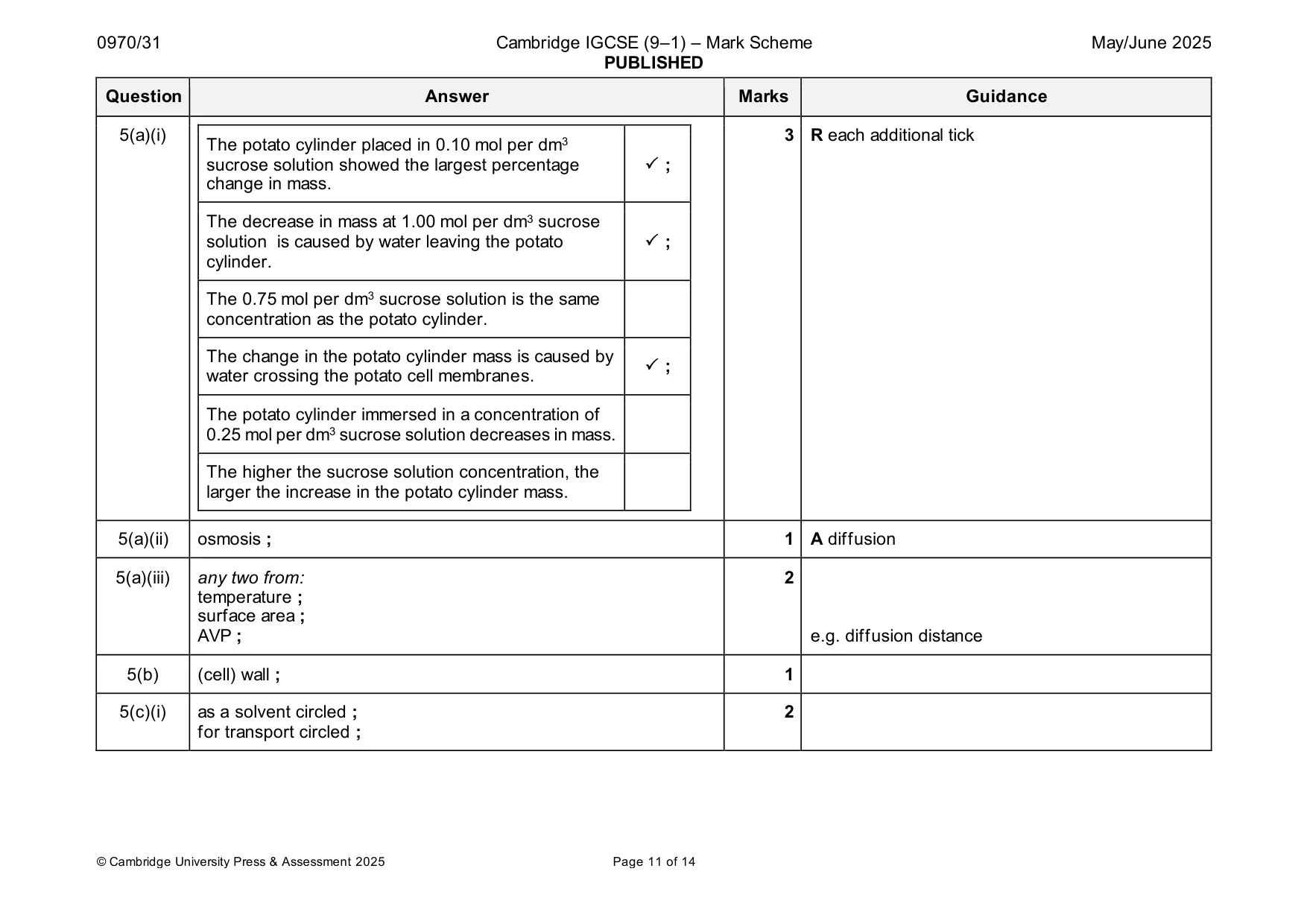
Mark scheme: 5(a)(i) 3 R each additional tick The potato cylinder placed in 0.10 mol per dm3 sucrose solution showed the largest percentage ; change in mass. The decrease in mass at 1.00 mol per dm3 sucrose solution is caused by water leaving the potato ; cylinder. The 0.75 mol per dm3 sucrose solution is the same concentration as the potato cylinder. The change in the potato cylinder mass is caused by ; water crossing the potato cell membranes. The potato cylinder immersed in a concentration of 0.25 mol per dm3 sucrose solution decreases in mass. The higher the sucrose solution concentration, the larger the increase in the potato cylinder mass. 5(a)(ii) osmosis ; 1 A diffusion 5(a)(iii) any two from: 2 temperature ; surface area ; AVP ; e.g. diffusion distance 5(b) (cell) wall ; 1 5(c)(i) as a solvent circled ; 2 for transport circled ; 5(c)(ii) any two from: 2 carbohydrate ; protein ; fat ; vitamins ; minerals ; fibre ;
Q6 · Some information about three different types of blood vessel
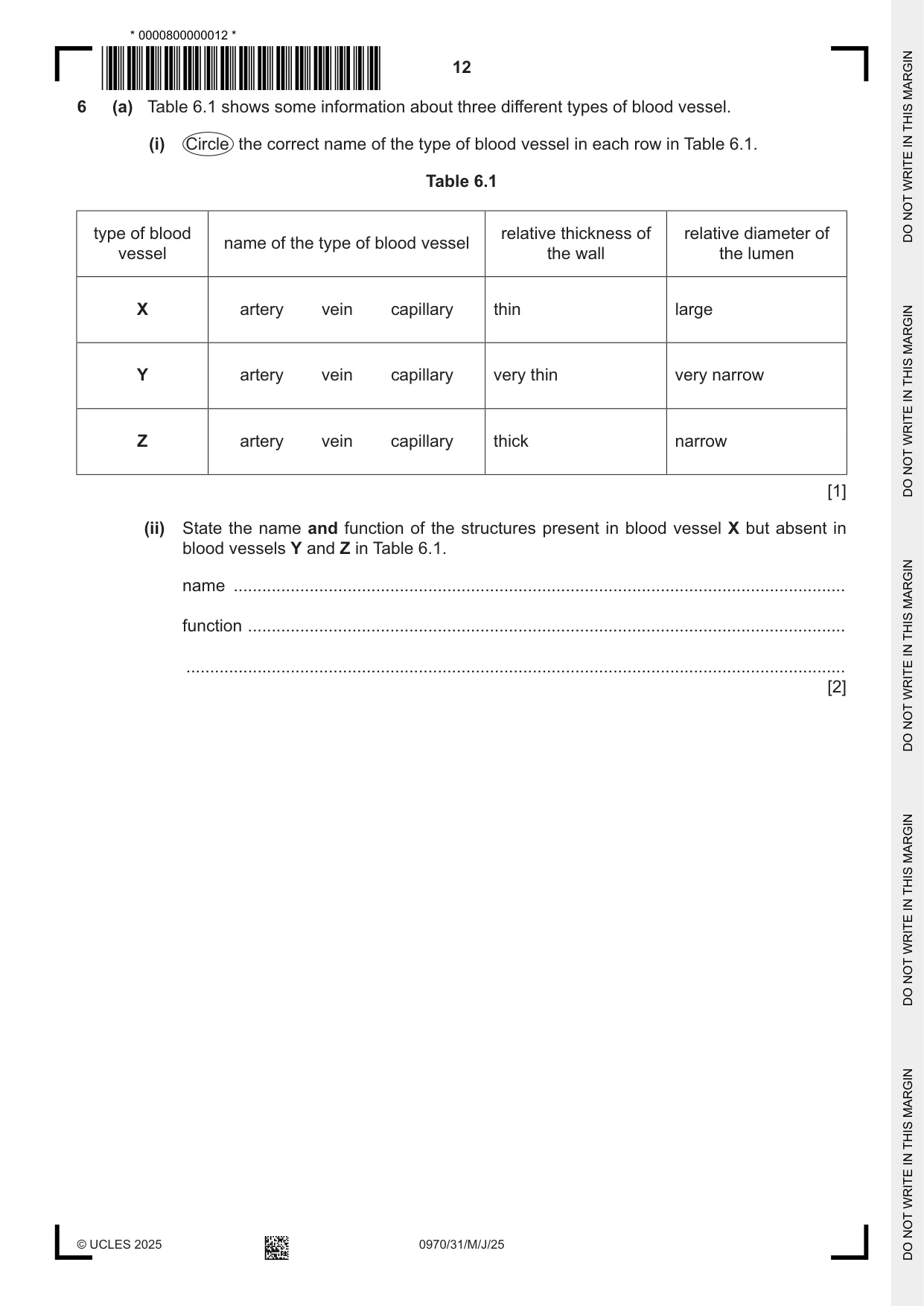
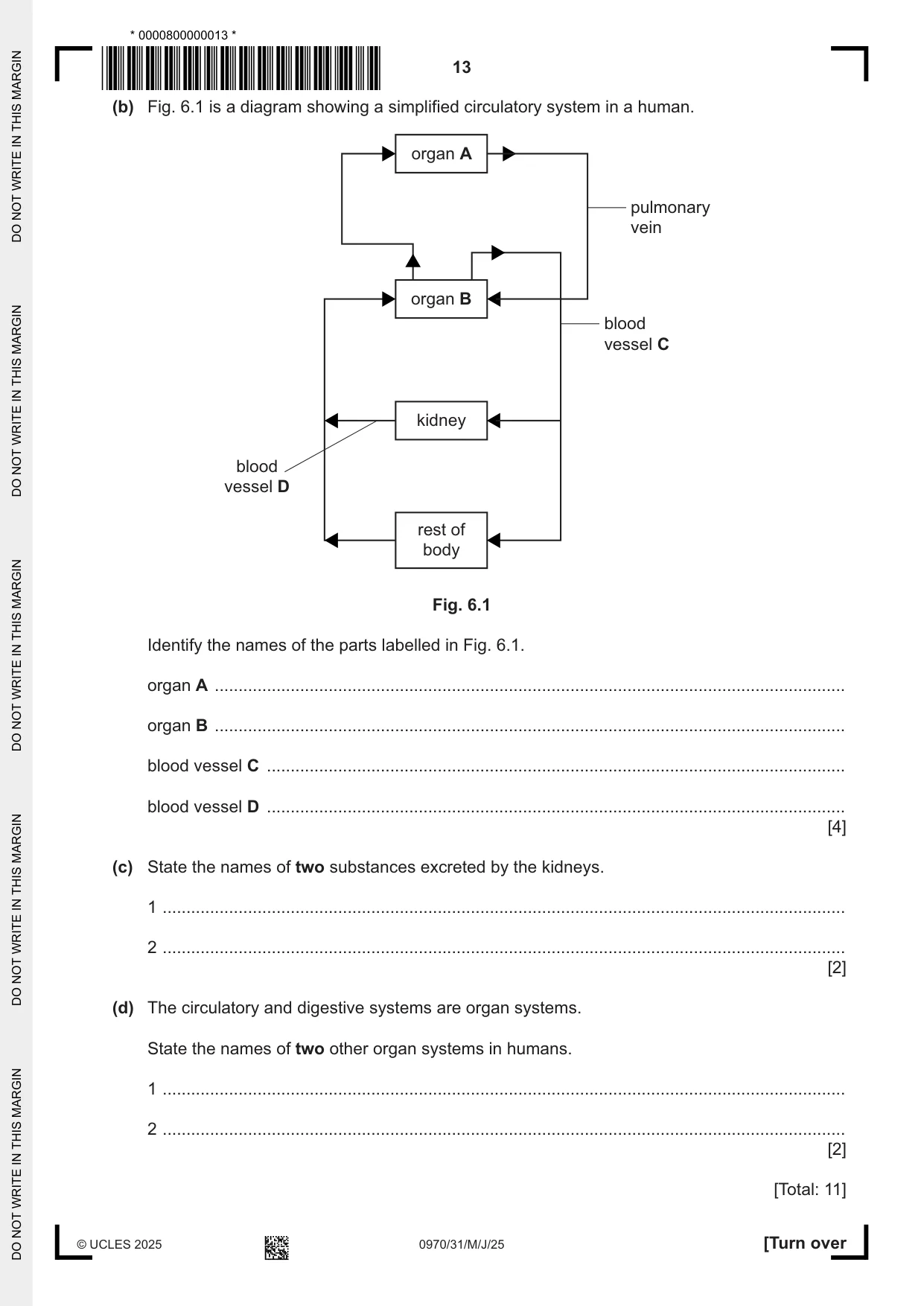
6 (a) Table 6.1 shows some information about three different types of blood vessel. (i) Circle the correct name of the type of blood vessel in each row in Table 6.1. Table 6.1 type of blood relative thickness of relative diameter of name of the type of blood vessel vessel the wall the lumen X artery vein capillary thin large Y artery vein capillary very thin very narrow Z artery vein capillary thick narrow [1] (ii) State the name and function of the structures present in blood vessel X but absent in blood vessels Y and Z in Table 6.1. name ................................................................................................................................. function .............................................................................................................................. ........................................................................................................................................... [2] (b) Fig. 6.1 is a diagram showing a simplified circulatory system in a human. organ A pulmonary vein organ B blood vessel C kidney blood vessel D rest of body Fig. 6.1 Identify the names of the parts labelled in Fig. 6.1. organ A ..................................................................................................................................... organ B ..................................................................................................................................... blood vessel C .......................................................................................................................... blood vessel D .......................................................................................................................... [4] (c) State the names of two substances excreted by the kidneys. 1 ................................................................................................................................................ 2 ................................................................................................................................................ [2] (d) The circulatory and digestive systems are organ systems. State the names of two other organ systems in humans. 1 ................................................................................................................................................ 2 ................................................................................................................................................ [2] [Total: 11]
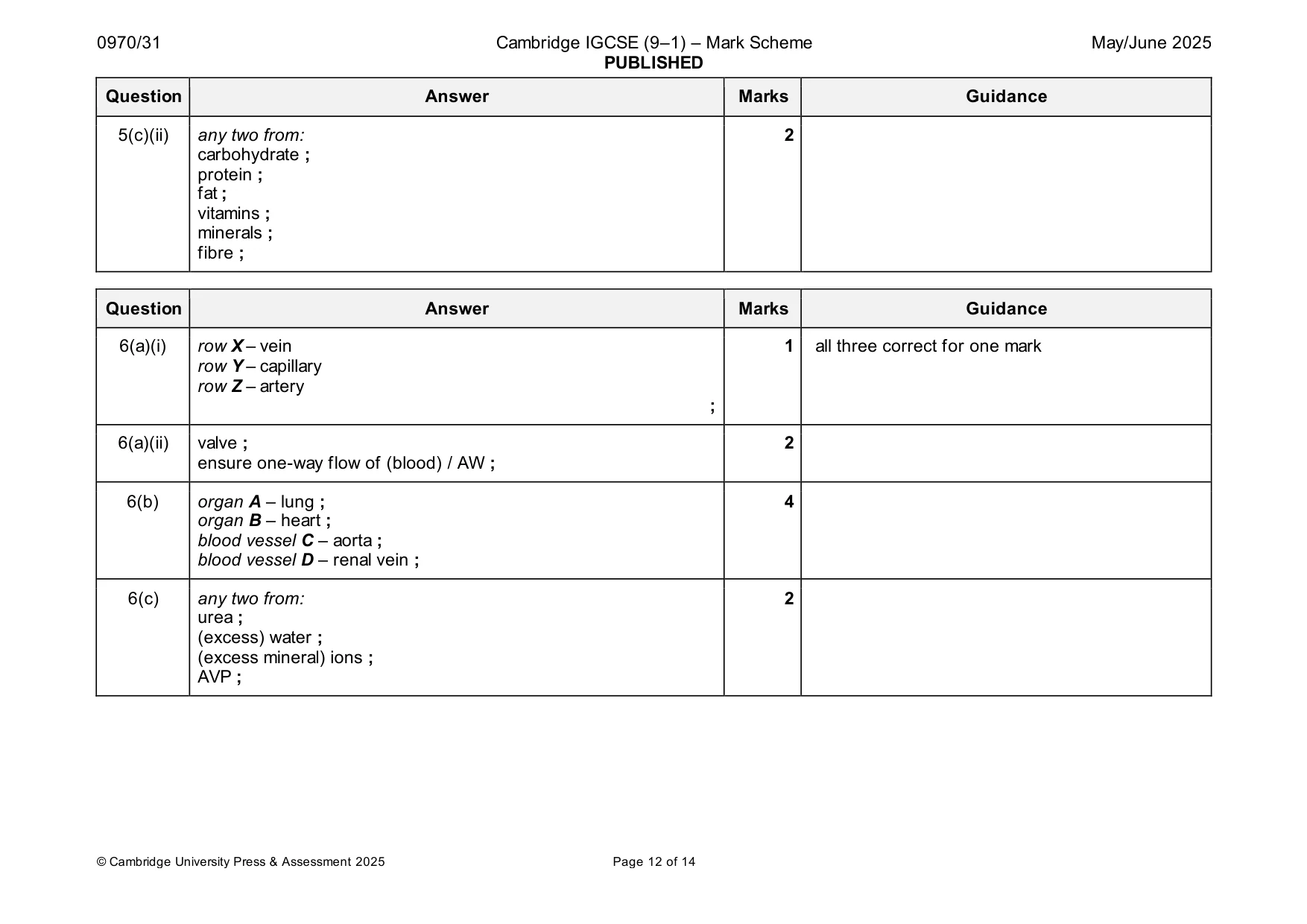
Mark scheme: 6(a)(i) row X – vein 1 all three correct for one mark row Y – capillary row Z – artery ; 6(a)(ii) valve ; 2 ensure one-way flow of (blood) / AW ; 6(b) organ A – lung ; 4 organ B – heart ; blood vessel C – aorta ; blood vessel D – renal vein ; 6(c) any two from: 2 urea ; (excess) water ; (excess mineral) ions ; AVP ; 6(d) any two from: 2 reproductive (system) ; breathing / gas exchange / respiratory (system) ; nervous (system) ; endocrine (system) ; excretory (system) ; AVP ;;
Q7 · Some pollution in oceans is caused by discarded plastics
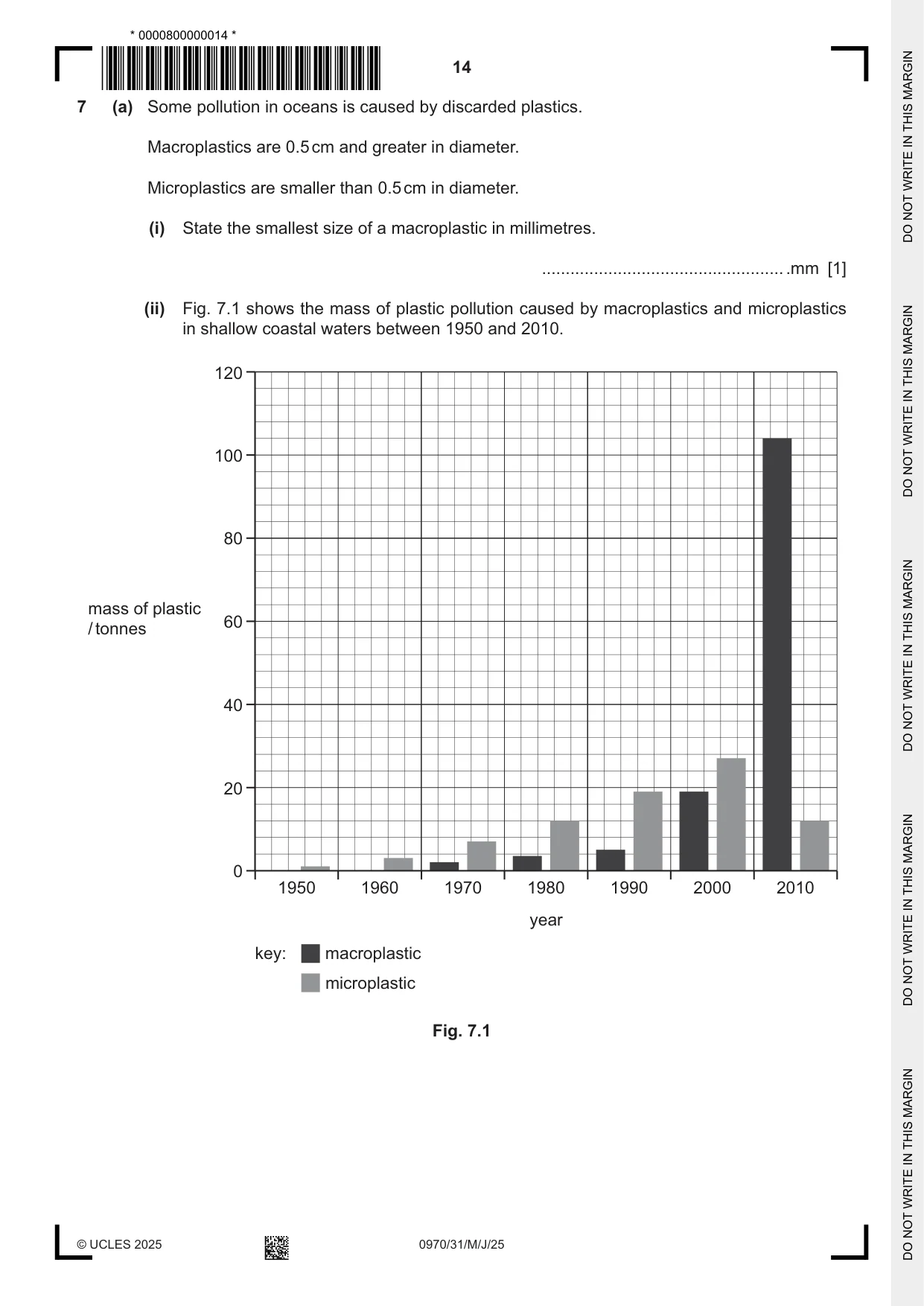
7 (a) Some pollution in oceans is caused by discarded plastics. Macroplastics are 0.5 cm and greater in diameter. Microplastics are smaller than 0.5 cm in diameter. (i) State the smallest size of a macroplastic in millimetres. ....................................................mm [1] (ii) Fig. 7.1 shows the mass of plastic pollution caused by macroplastics and microplastics in shallow coastal waters between 1950 and 2010. 120 100 80 mass of plastic 60 / tonnes 40 20 0 1950 1960 1970 1980 1990 2000 2010 year key: macroplastic microplastic Fig. 7.1 Describe the changes in the masses of macroplastics and microplastics shown in Fig. 7.1. ........................................................................................................................................... ........................................................................................................................................... ........................................................................................................................................... ........................................................................................................................................... ........................................................................................................................................... ........................................................................................................................................... ..................................................................................................................................... [3] (b) Describe two ways that plastics can harm animals in the ocean. 1 ................................................................................................................................................ ................................................................................................................................................... 2 ................................................................................................................................................ ................................................................................................................................................... [2] (c) Apart from plastics, state one other source of pollution in aquatic ecosystems. ............................................................................................................................................. [1] [Total: 7]
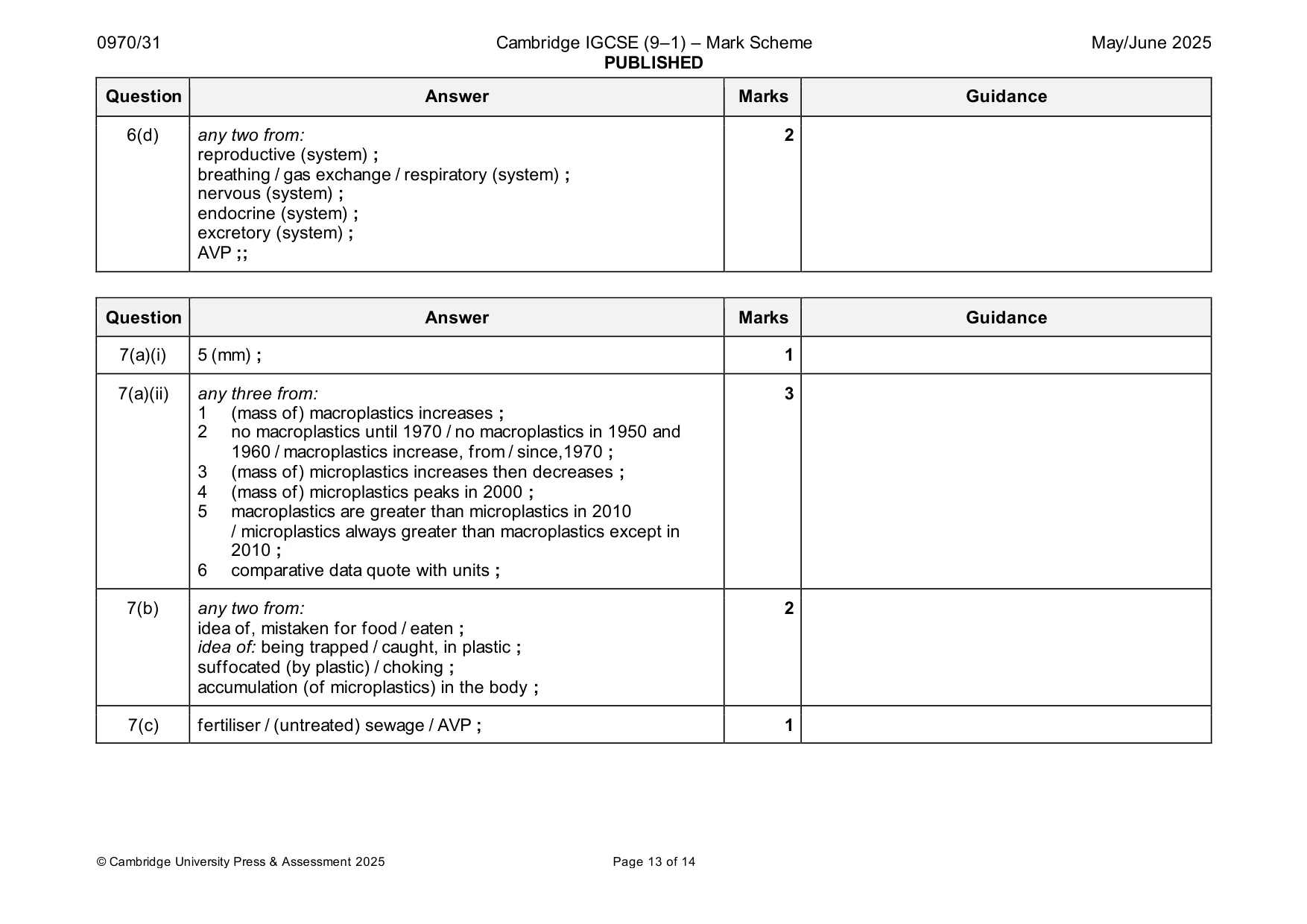
Mark scheme: 7(a)(i) 5 (mm) ; 1 7(a)(ii) any three from: 3 1 (mass of) macroplastics increases ; 2 no macroplastics until 1970 / no macroplastics in 1950 and 1960 / macroplastics increase, from / since,1970 ; 3 (mass of) microplastics increases then decreases ; 4 (mass of) microplastics peaks in 2000 ; 5 macroplastics are greater than microplastics in 2010 / microplastics always greater than macroplastics except in 2010 ; 6 comparative data quote with units ; 7(b) any two from: 2 idea of, mistaken for food / eaten ; idea of: being trapped / caught, in plastic ; suffocated (by plastic) / choking ; accumulation (of microplastics) in the body ; 7(c) fertiliser / (untreated) sewage / AVP ; 1
Q8 · Reproduction is one characteristic of living organisms
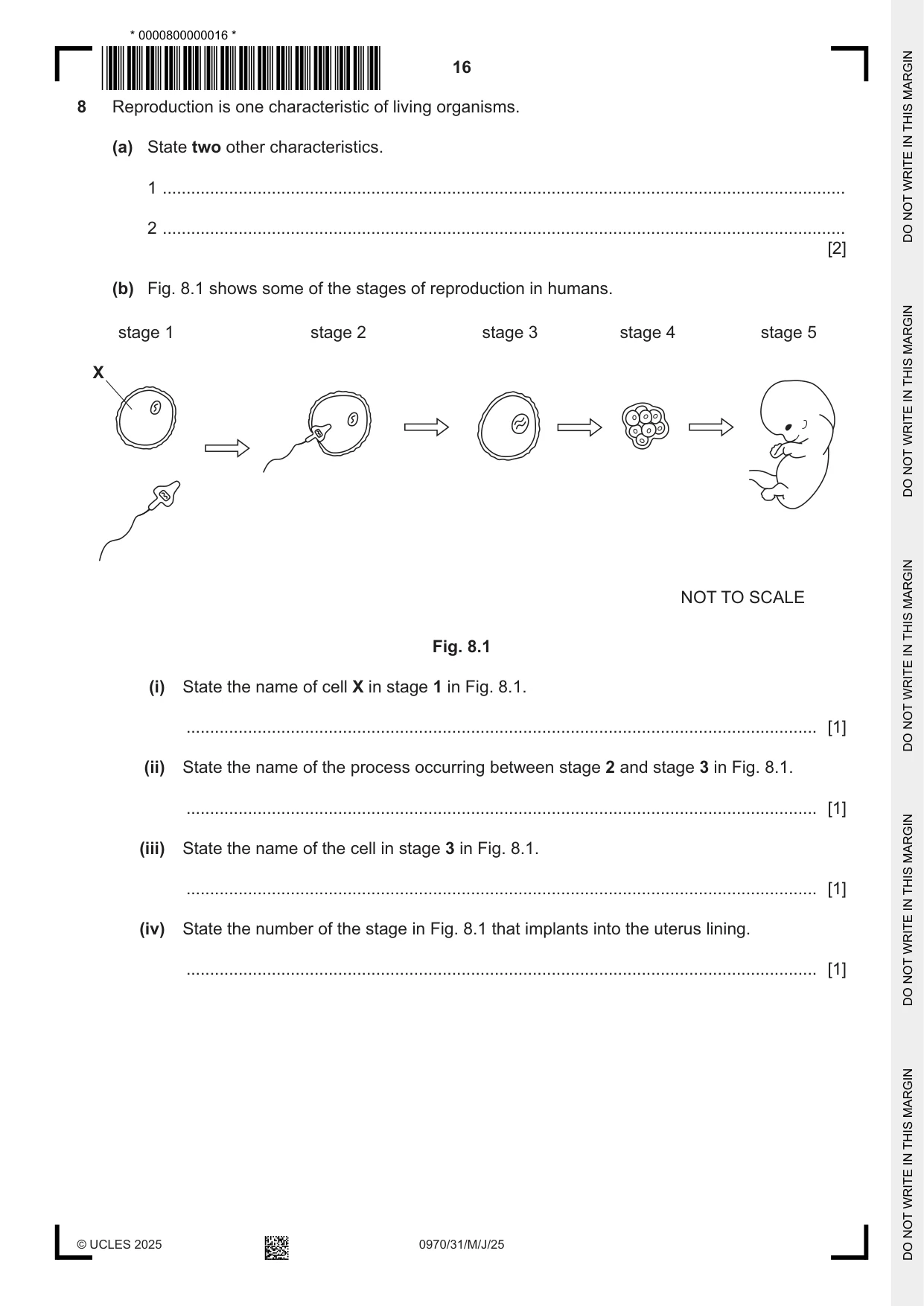
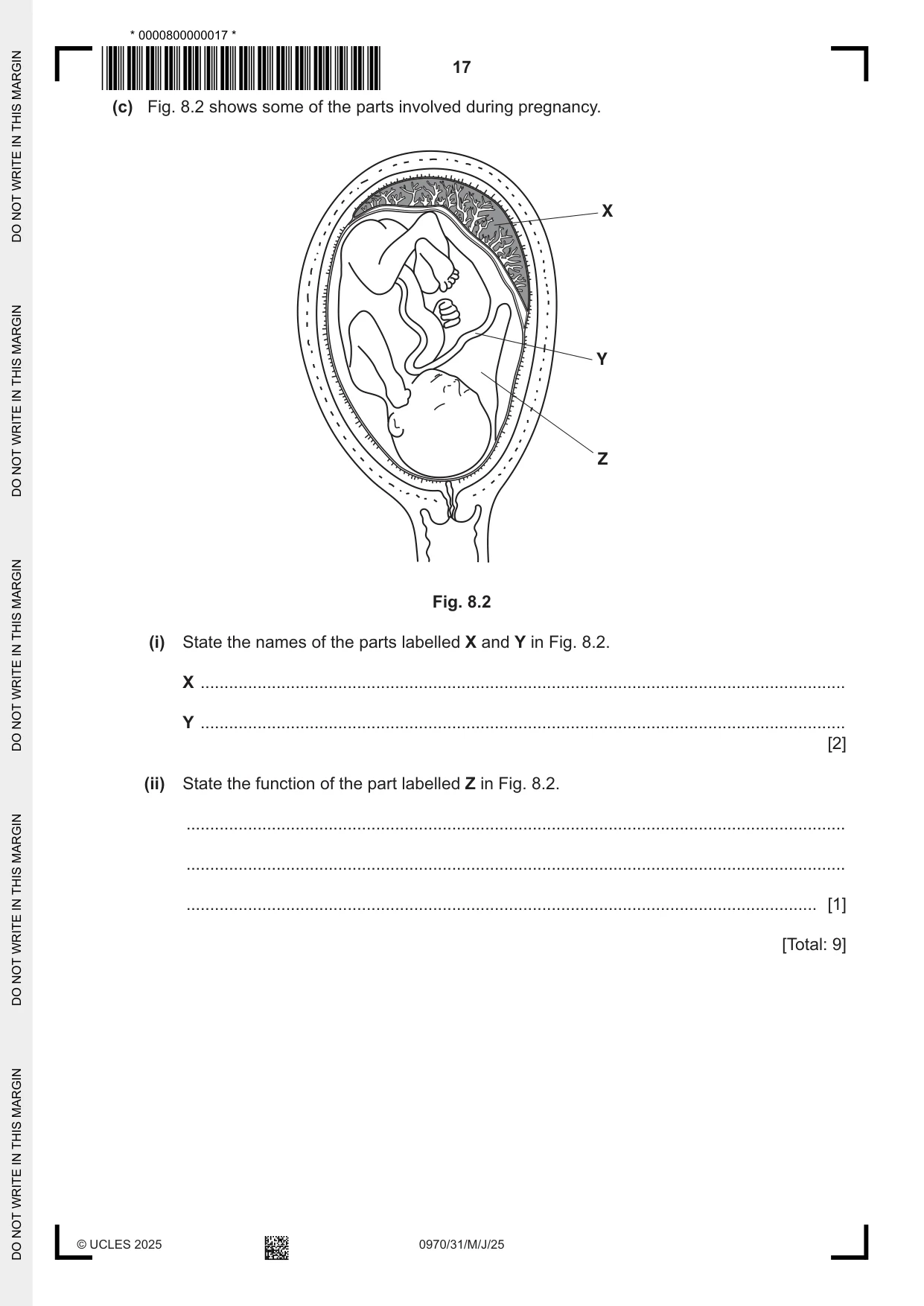
8 Reproduction is one characteristic of living organisms. (a) State two other characteristics. 1 ................................................................................................................................................ 2 ................................................................................................................................................ [2] (b) Fig. 8.1 shows some of the stages of reproduction in humans. stage 1 stage 2 stage 3 stage 4 stage 5 X NOT TO SCALE Fig. 8.1 (i) State the name of cell X in stage 1 in Fig. 8.1. ..................................................................................................................................... [1] (ii) State the name of the process occurring between stage 2 and stage 3 in Fig. 8.1. ..................................................................................................................................... [1] (iii) State the name of the cell in stage 3 in Fig. 8.1. ..................................................................................................................................... [1] (iv) State the number of the stage in Fig. 8.1 that implants into the uterus lining. ..................................................................................................................................... [1] (c) Fig. 8.2 shows some of the parts involved during pregnancy. X Y Z Fig. 8.2 (i) State the names of the parts labelled X and Y in Fig. 8.2. X ........................................................................................................................................ Y ........................................................................................................................................ [2] (ii) State the function of the part labelled Z in Fig. 8.2. ........................................................................................................................................... ........................................................................................................................................... ..................................................................................................................................... [1] [Total: 9]
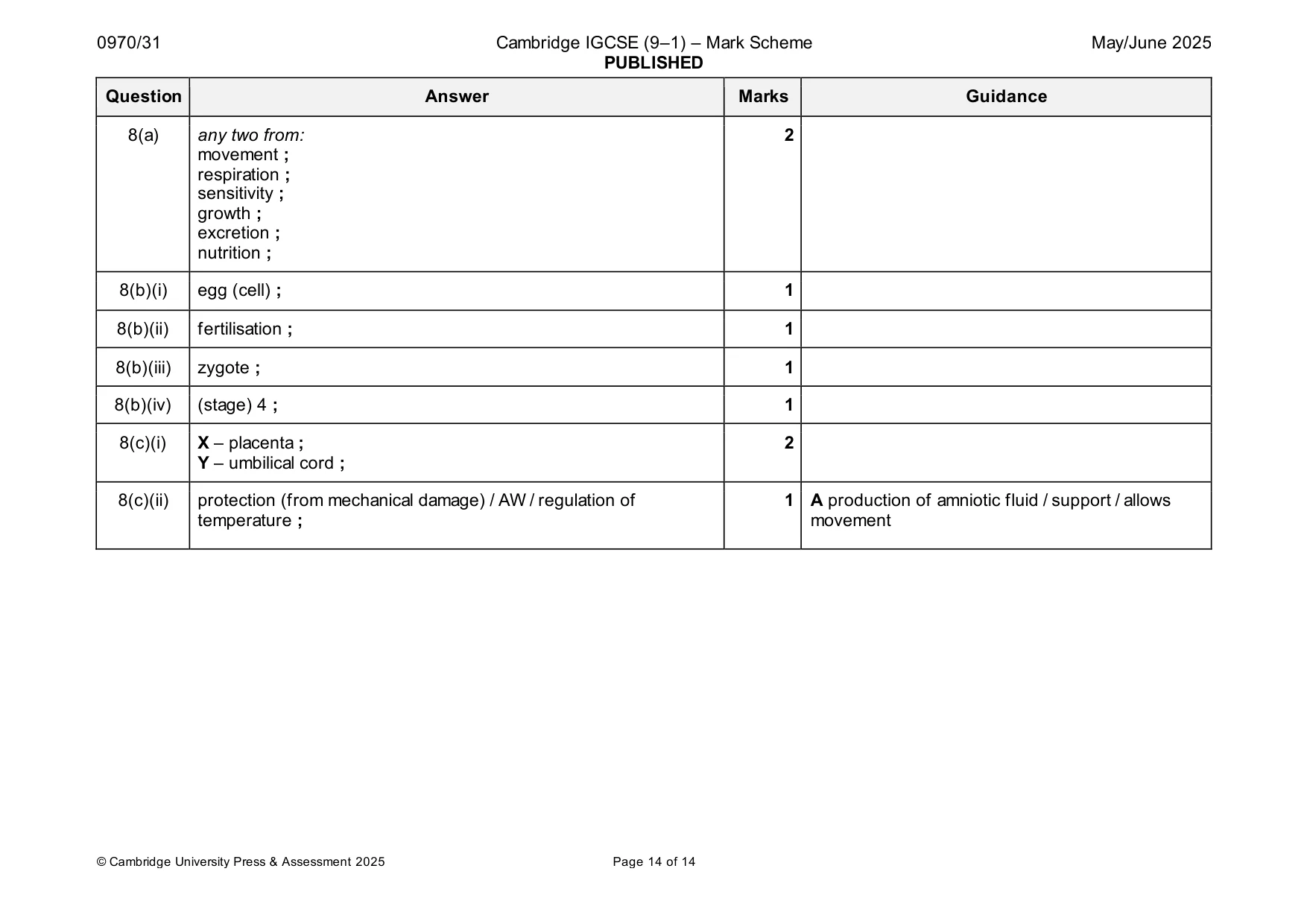
Mark scheme: 8(a) any two from: 2 movement ; respiration ; sensitivity ; growth ; excretion ; nutrition ; 8(b)(i) egg (cell) ; 1 8(b)(ii) fertilisation ; 1 8(b)(iii) zygote ; 1 8(b)(iv) (stage) 4 ; 1 8(c)(i) X – placenta ; 2 Y – umbilical cord ; 8(c)(ii) protection (from mechanical damage) / AW / regulation of 1 A production of amniotic fluid / support / allows temperature ; movement
What was in this paper
The subtopics covered by these 8 questions, and how many questions each got. Open one in a new tab to see every Cambridge question on it.
What you needed in this session
Cambridge’s own grade thresholds for 2025 May/June, Paper 3 · Variant 1. A higher threshold means an easier paper — the bar moves with how the cohort did.