Cambridge IGCSE Biology (9-1) 0970 — 2021 May/June Paper 3 · Variant 1
0970/31/M/J/21 · 8 questions · 80 marks · ≈90 min
The question paper and its mark scheme, free to read here and free to download. This is Cambridge’s own paper, exactly as it was sat.
Question paper20 pages



Mark scheme13 pages
Answers below. Sit the paper first if you are practising.
Questions as text
Question 1
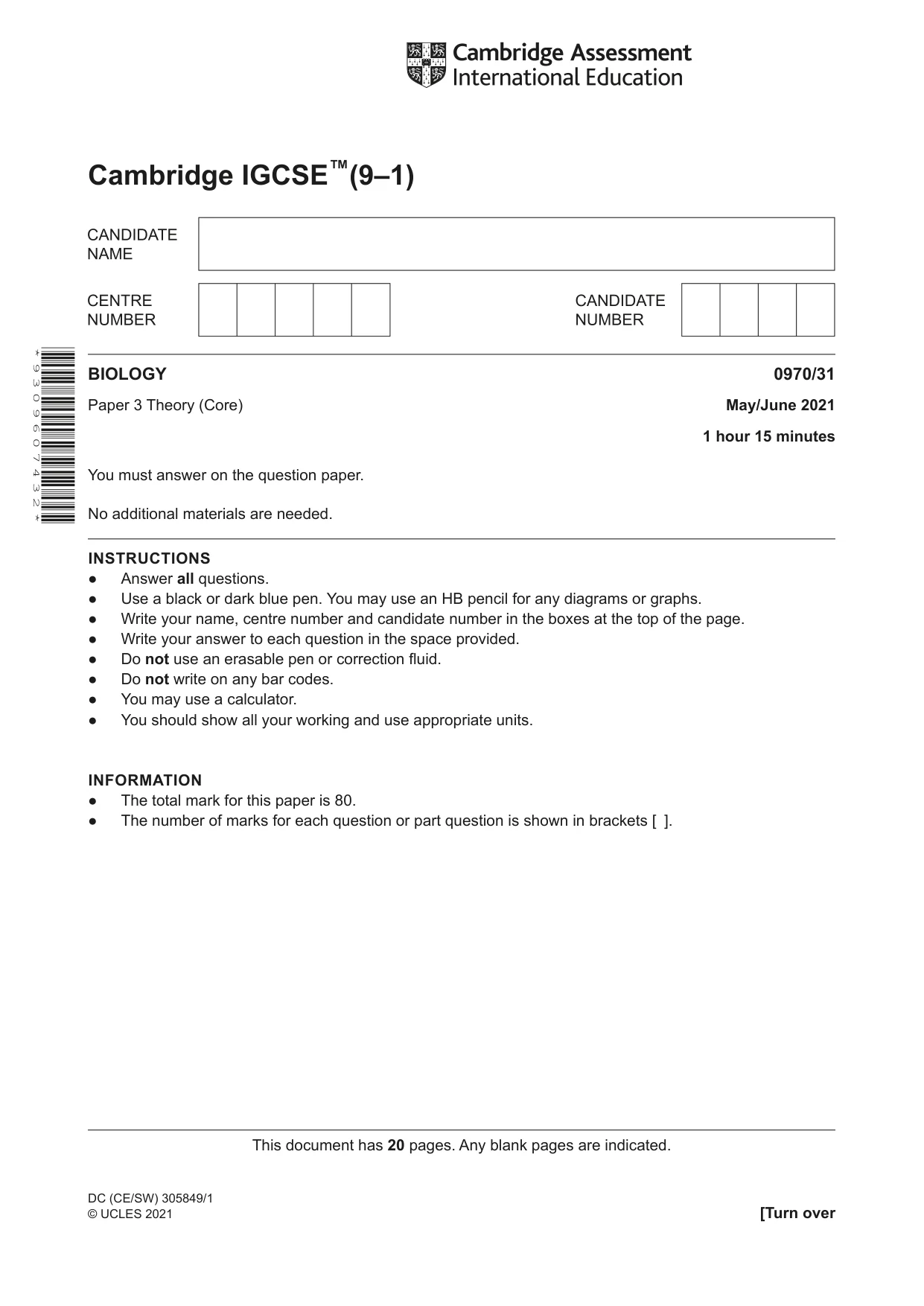
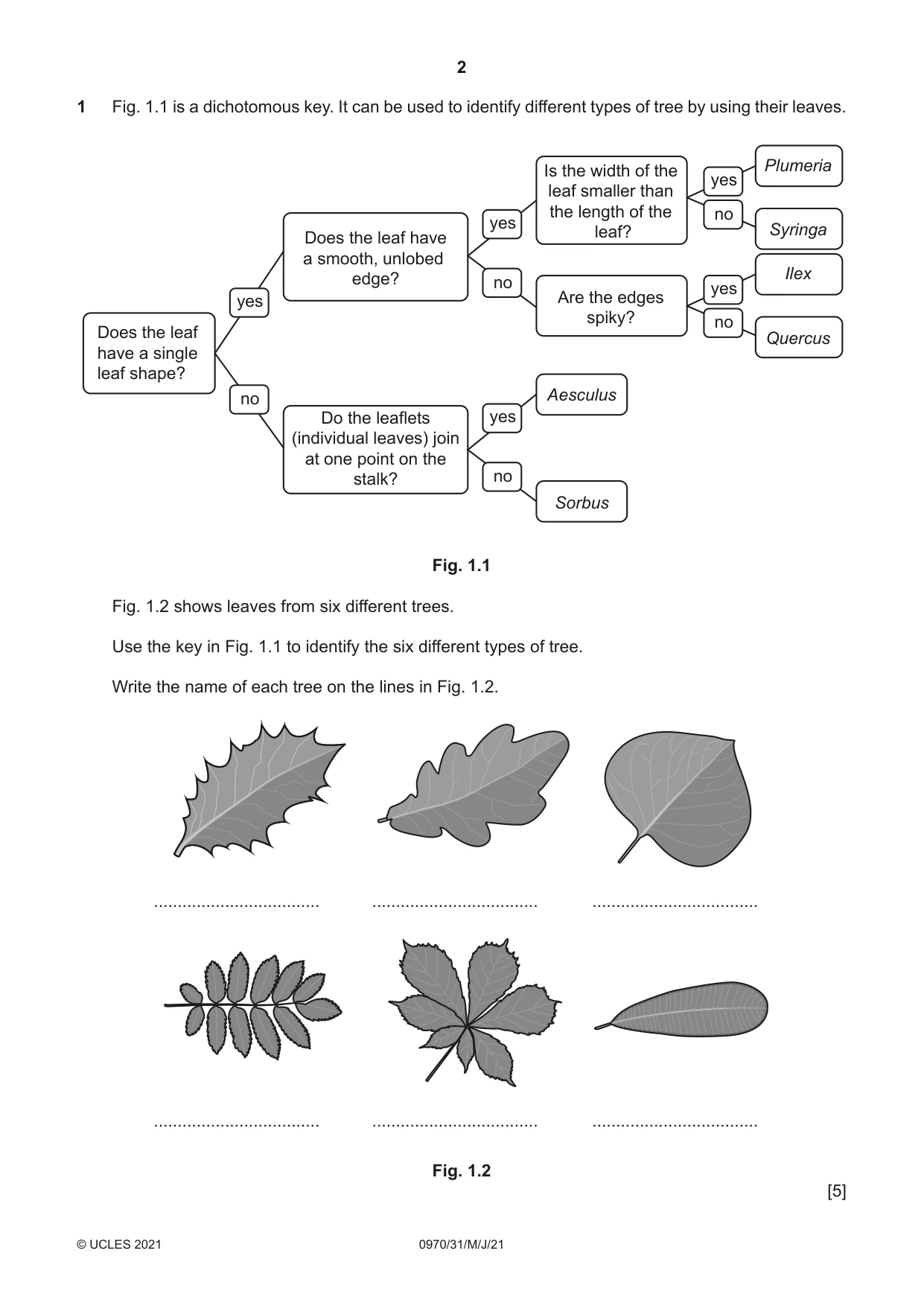
1 Fig. 1.1 is a dichotomous key. It can be used to identify different types of tree by using their leaves. Plumeria Is the width of the yes leaf smaller than the length of the no yes leaf? Syringa Does the leaf have a smooth, unlobed edge? no Ilex yes yes Are the edges spiky? no Does the leaf Quercus have a single leaf shape? no Aesculus Do the leaflets yes (individual leaves) join at one point on the stalk? no Sorbus Fig. 1.1 Fig. 1.2 shows leaves from six different trees. Use the key in Fig. 1.1 to identify the six different types of tree. Write the name of each tree on the lines in Fig. 1.2. ................................... ................................... ................................... ................................... ................................... ................................... Fig. 1.2 [5]
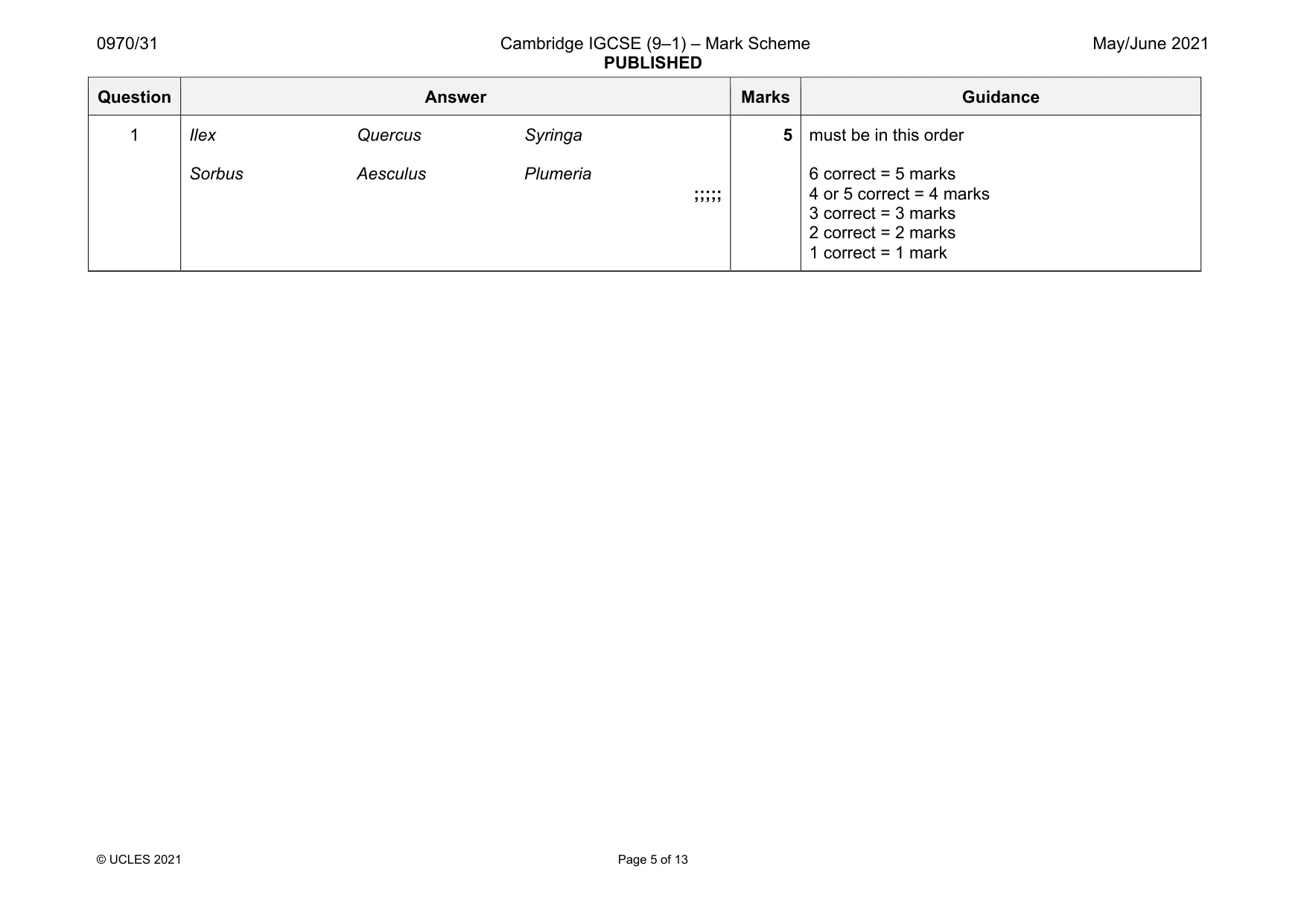
Mark scheme: 1 Ilex Quercus Syringa Sorbus Aesculus Plumeria ;;;;; 5 must be in this order 6 correct = 5 marks 4 or 5 correct = 4 marks 3 correct = 3 marks 2 correct = 2 marks 1 correct = 1 mark
More questions on Concept and uses of classification systems
Q2 · A front view diagram of the male reproductive system in humans
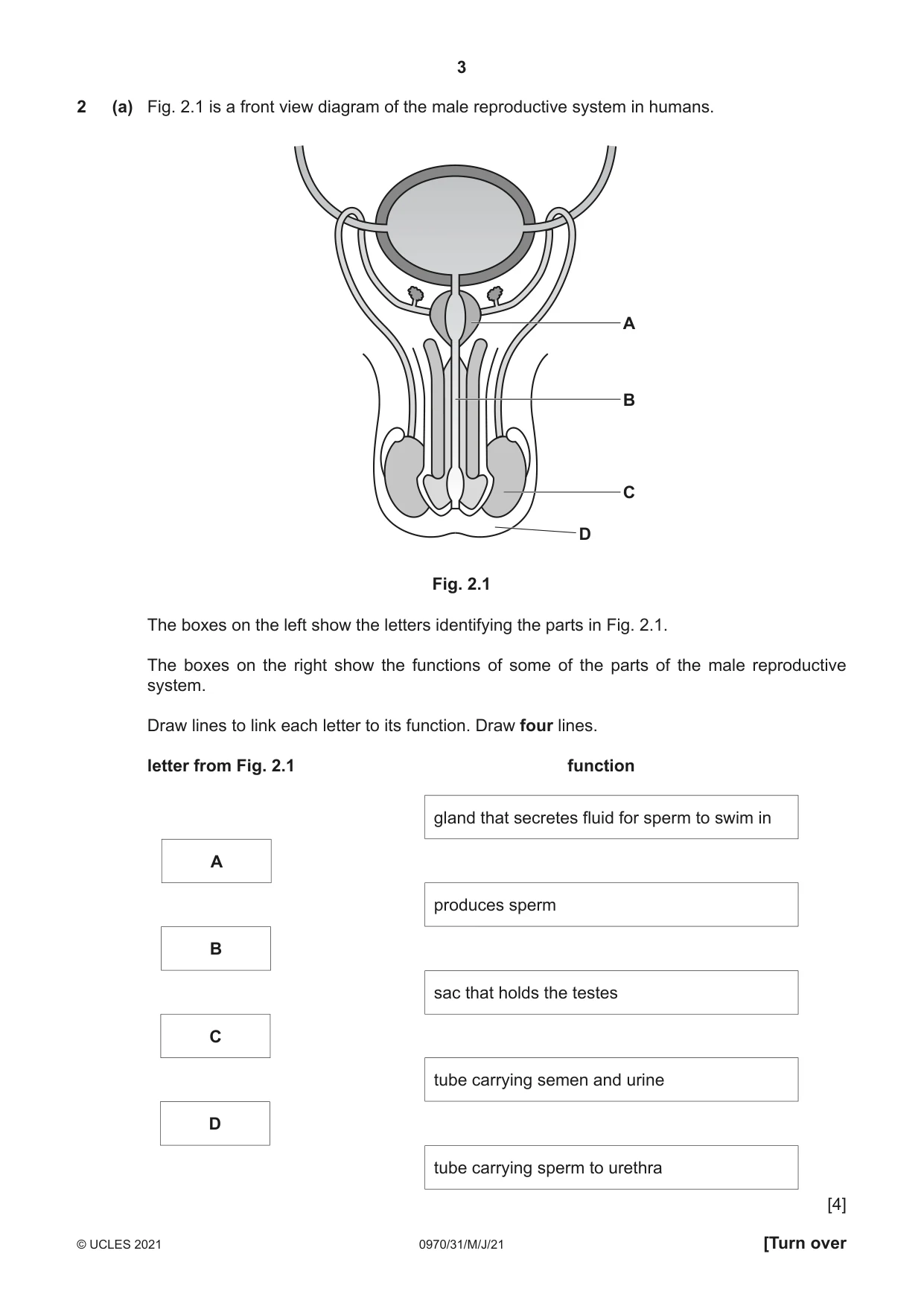
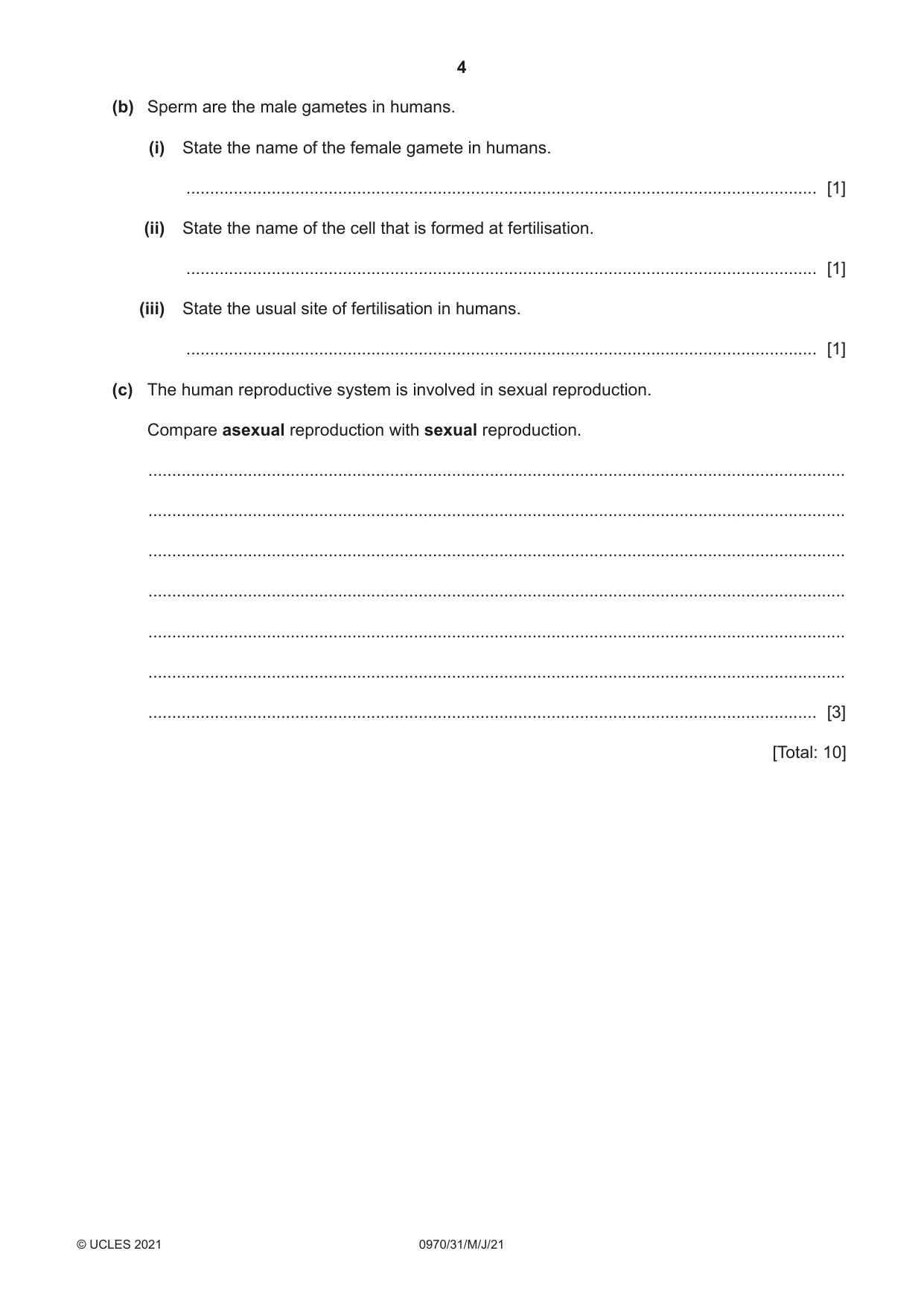
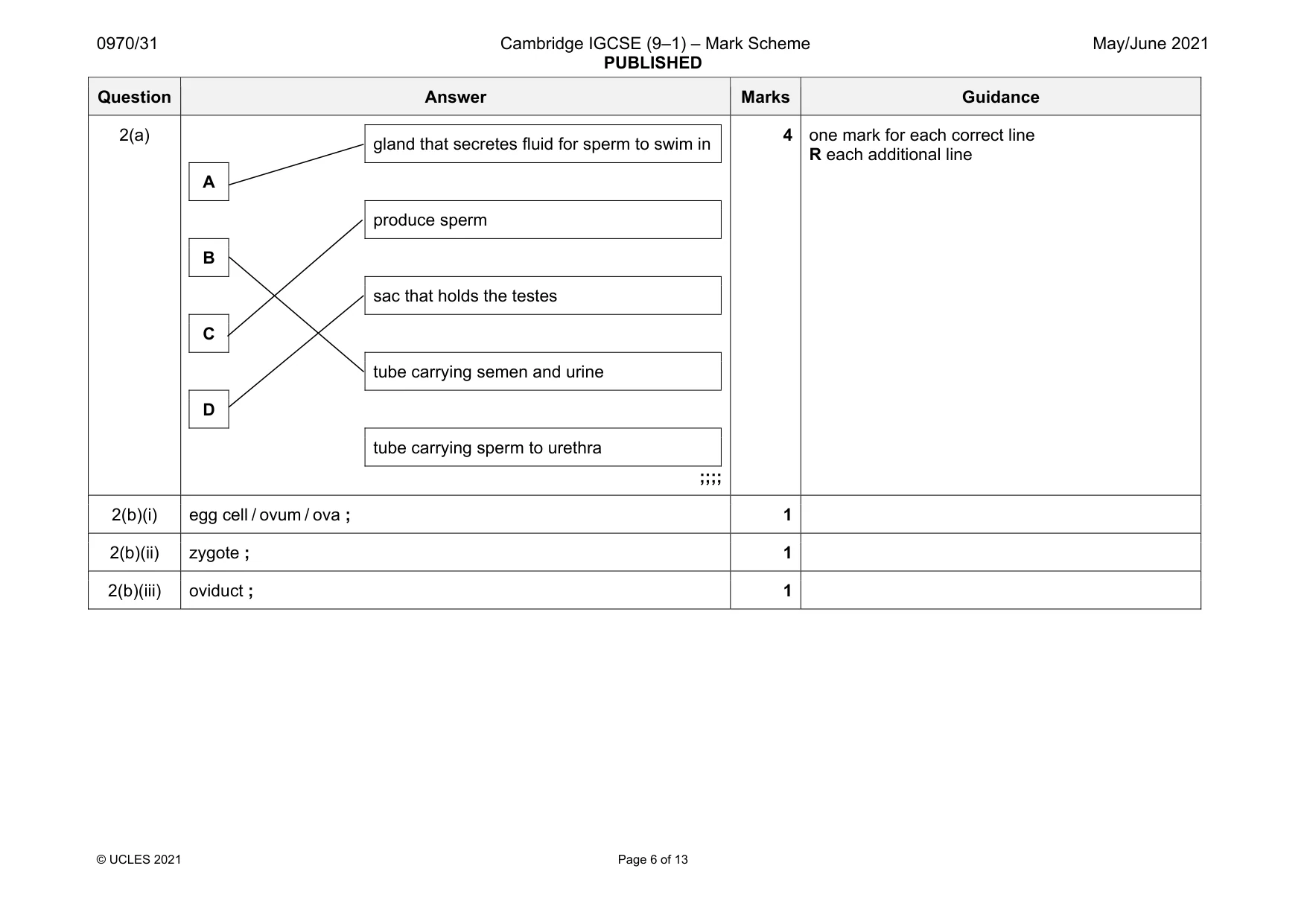
2 (a) Fig. 2.1 is a front view diagram of the male reproductive system in humans. A B C D Fig. 2.1 The boxes on the left show the letters identifying the parts in Fig. 2.1. The boxes on the right show the functions of some of the parts of the male reproductive system. Draw lines to link each letter to its function. Draw four lines. letter from Fig. 2.1 function gland that secretes fluid for sperm to swim in A produces sperm B sac that holds the testes C tube carrying semen and urine D tube carrying sperm to urethra [4] (b) Sperm are the male gametes in humans. (i) State the name of the female gamete in humans. ..................................................................................................................................... [1] (ii) State the name of the cell that is formed at fertilisation. ..................................................................................................................................... [1] (iii) State the usual site of fertilisation in humans. ..................................................................................................................................... [1] (c) The human reproductive system is involved in sexual reproduction. Compare asexual reproduction with sexual reproduction. ................................................................................................................................................... ................................................................................................................................................... ................................................................................................................................................... ................................................................................................................................................... ................................................................................................................................................... ................................................................................................................................................... ............................................................................................................................................. [3] [Total: 10]
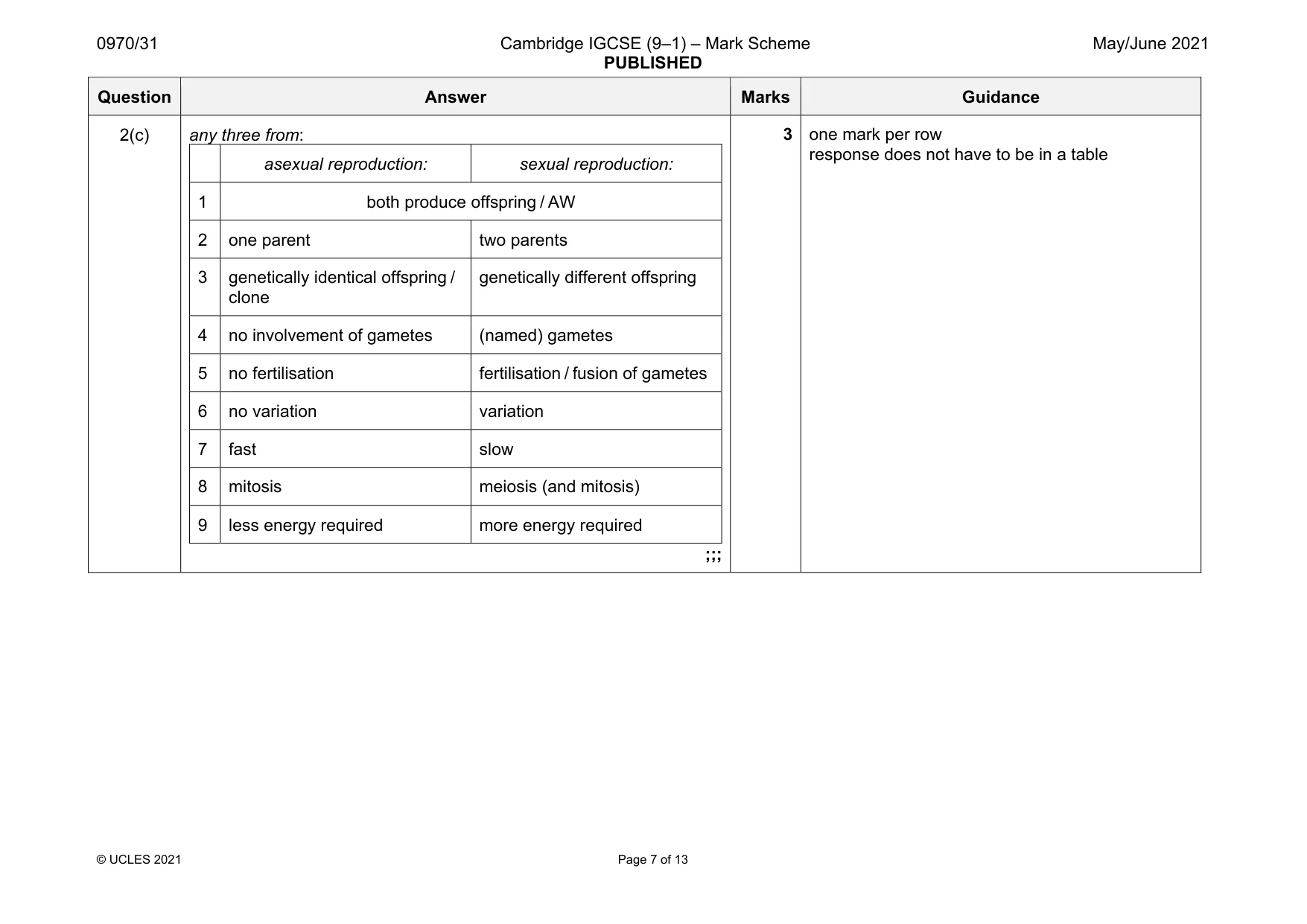
Mark scheme: 2(a) gland that secretes fluid for sperm to swim in A produce sperm B sac that holds the testes C tube carrying semen and urine D tube carrying sperm to urethra ;;;; 4 one mark for each correct line R each additional line 2(b)(i) egg cell / ovum / ova ; 1 2(b)(ii) zygote ; 1 2(b)(iii) oviduct ; 1 Question Answer Marks Guidance 2(c) any three from: asexual reproduction: sexual reproduction: 1 both produce offspring / AW 2 one parent two parents 3 genetically identical offspring / clone genetically different offspring 4 no involvement of gametes (named) gametes 5 no fertilisation fertilisation / fusion of gametes 6 no variation variation 7 fast slow 8 mitosis meiosis (and mitosis) 9 less energy required more energy required ;;; 3 one mark per row response does not have to be in a table
Q3 · The number of deaths in one country that were due to excessive alcohol consumption
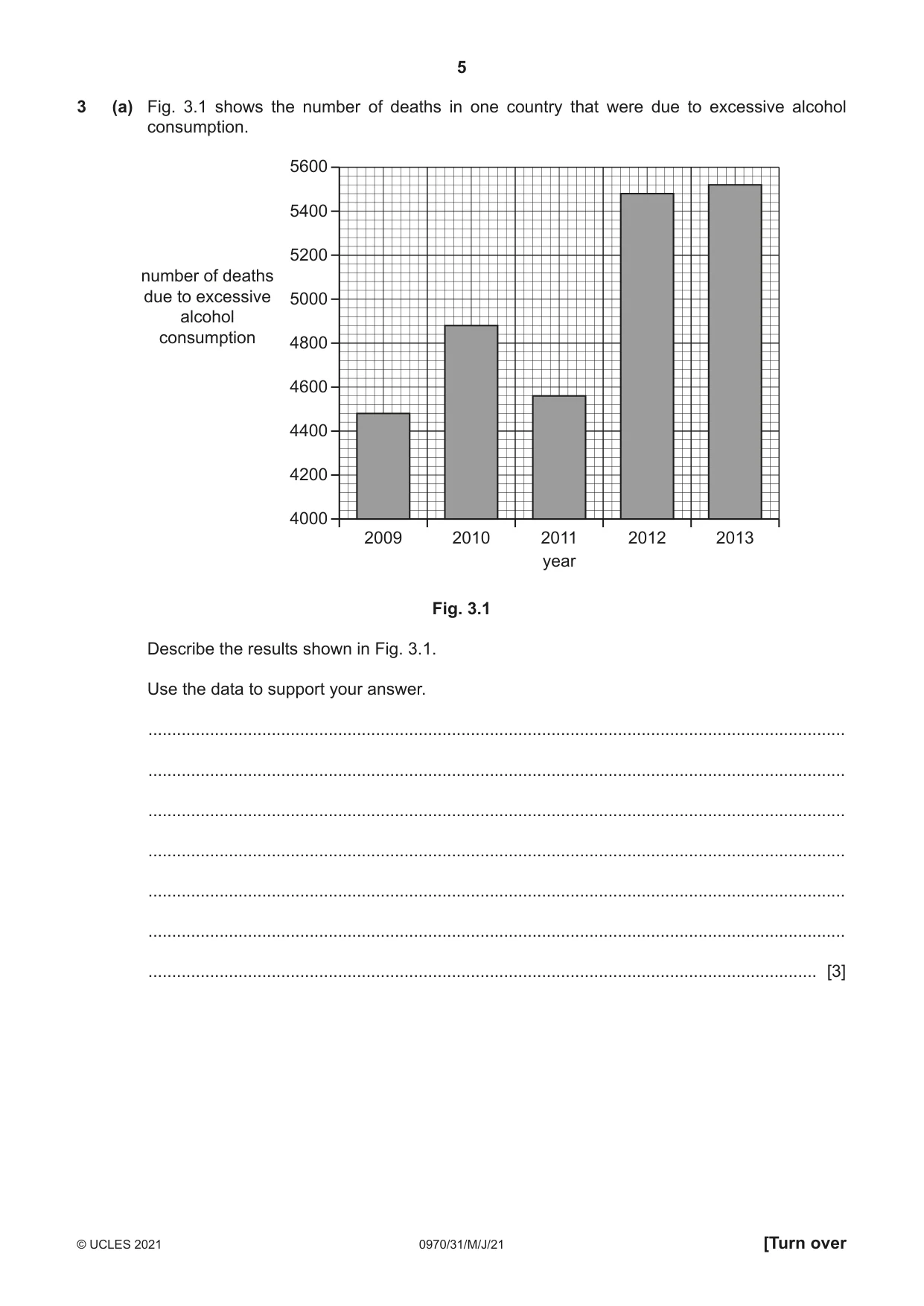
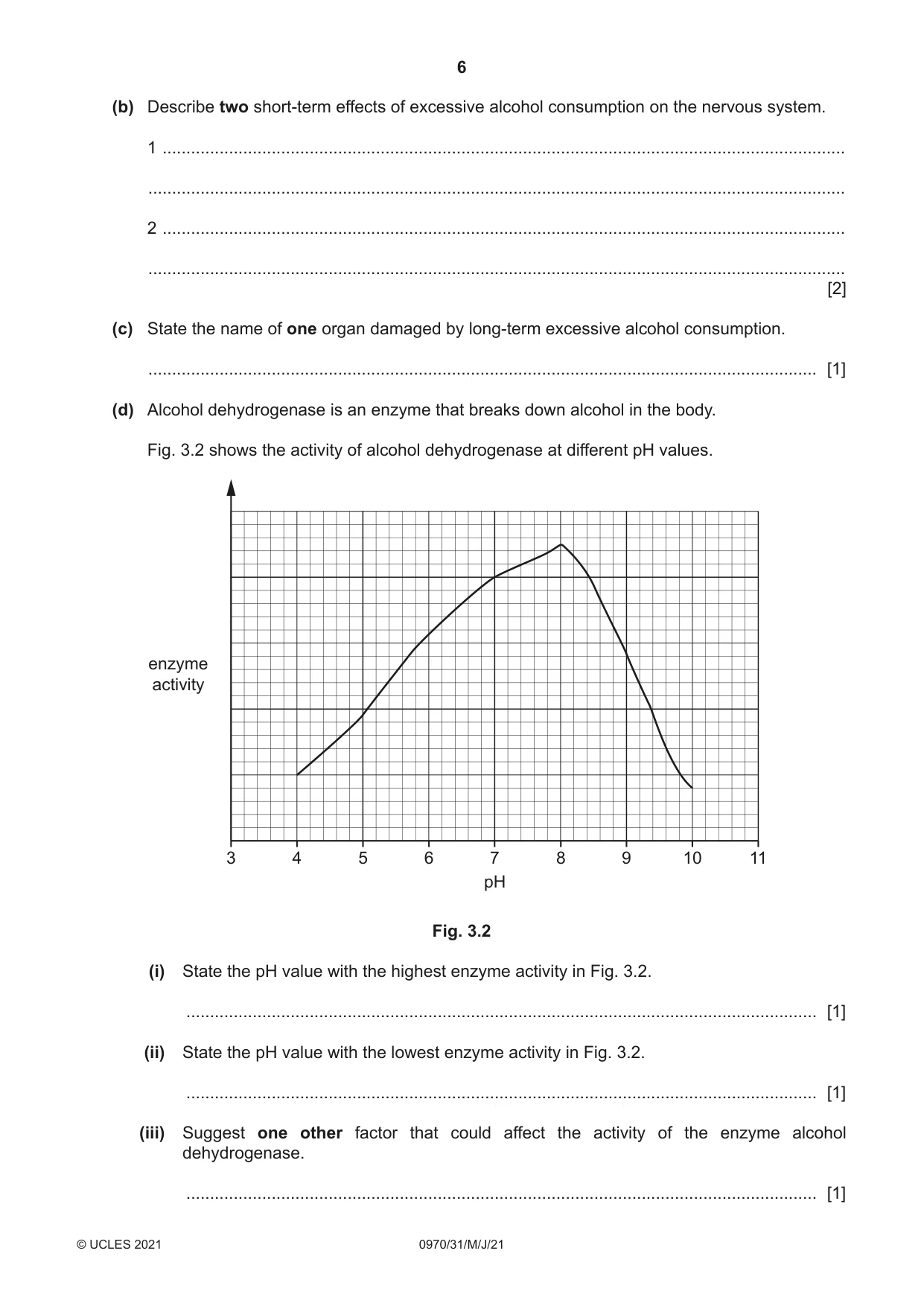
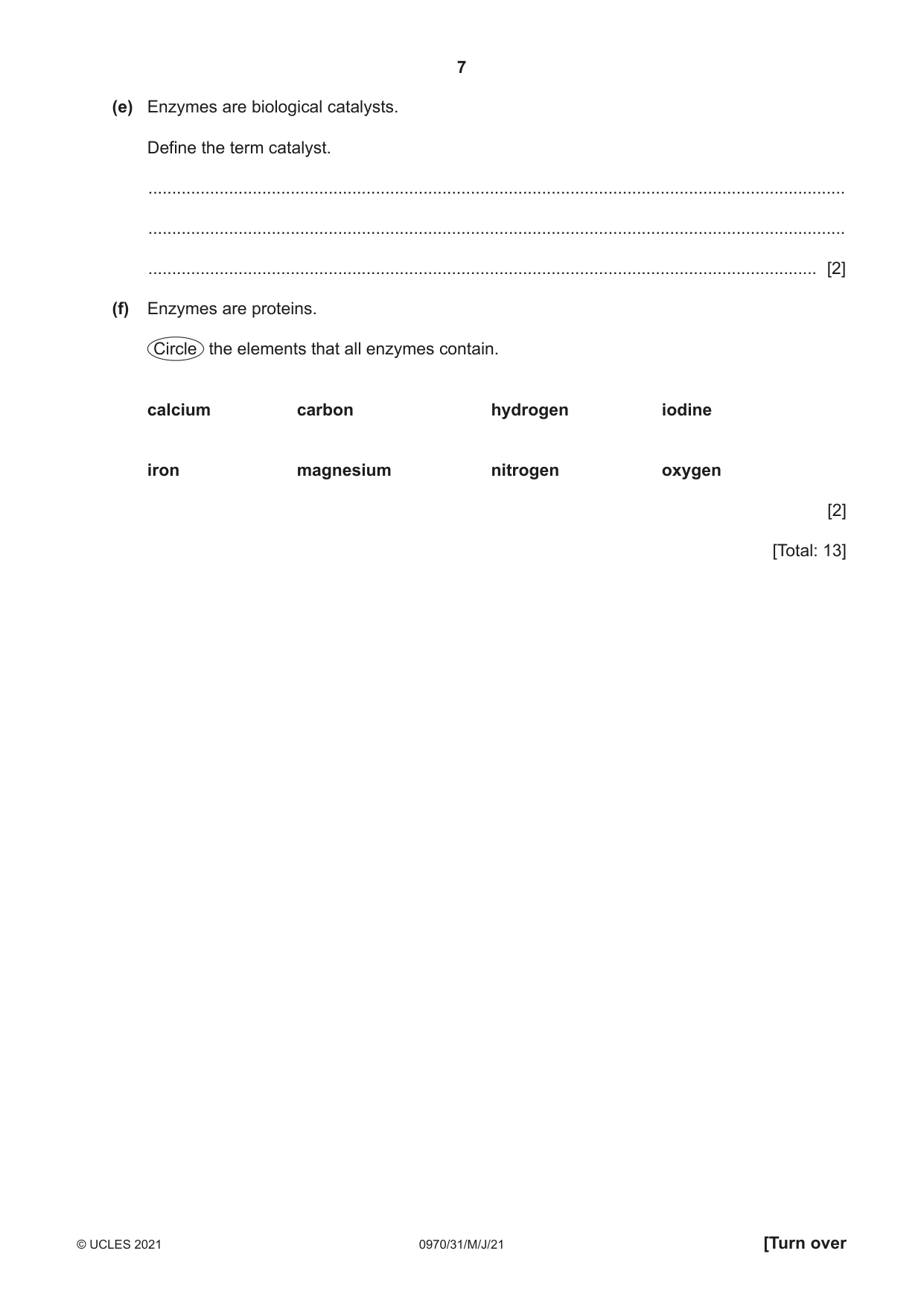
3 (a) Fig. 3.1 shows the number of deaths in one country that were due to excessive alcohol consumption. 5600 5400 5200 number of deaths due to excessive 5000 alcohol consumption 4800 4600 4400 4200 4000 2009 2010 2011 2012 2013 year Fig. 3.1 Describe the results shown in Fig. 3.1. Use the data to support your answer. ................................................................................................................................................... ................................................................................................................................................... ................................................................................................................................................... ................................................................................................................................................... ................................................................................................................................................... ................................................................................................................................................... ............................................................................................................................................. [3] (b) Describe two short-term effects of excessive alcohol consumption on the nervous system. 1 ................................................................................................................................................ ................................................................................................................................................... 2 ................................................................................................................................................ ................................................................................................................................................... [2] (c) State the name of one organ damaged by long-term excessive alcohol consumption. ............................................................................................................................................. [1] (d) Alcohol dehydrogenase is an enzyme that breaks down alcohol in the body. Fig. 3.2 shows the activity of alcohol dehydrogenase at different pH values. enzyme activity 3 4 5 6 7 8 9 10 11 pH Fig. 3.2 (i) State the pH value with the highest enzyme activity in Fig. 3.2. ..................................................................................................................................... [1] (ii) State the pH value with the lowest enzyme activity in Fig. 3.2. ..................................................................................................................................... [1] (iii) Suggest one other factor that could affect the activity of the enzyme alcohol dehydrogenase. ..................................................................................................................................... [1] (e) Enzymes are biological catalysts. Define the term catalyst. ................................................................................................................................................... ................................................................................................................................................... ............................................................................................................................................. [2] (f) Enzymes are proteins. Circle the elements that all enzymes contain. calcium carbon hydrogen iodine iron magnesium nitrogen oxygen [2] [Total: 13]
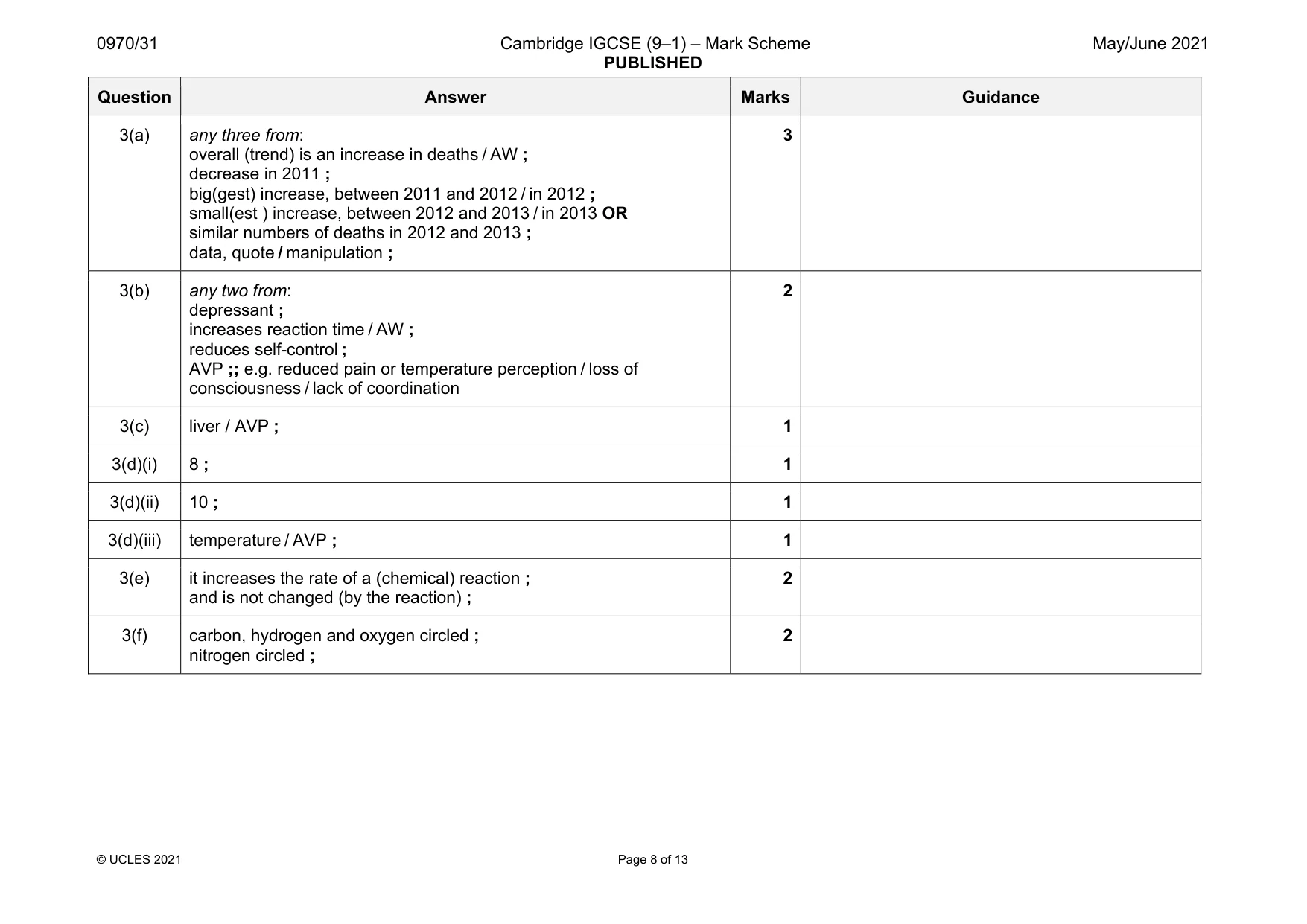
Mark scheme: 3(a) any three from: overall (trend) is an increase in deaths / AW ; decrease in 2011 ; big(gest) increase, between 2011 and 2012 / in 2012 ; small(est ) increase, between 2012 and 2013 / in 2013 OR similar numbers of deaths in 2012 and 2013 ; data, quote / manipulation ; 3 3(b) any two from: depressant ; increases reaction time / AW ; reduces self-control ; AVP ;; e.g. reduced pain or temperature perception / loss of consciousness / lack of coordination 2 3(c) liver / AVP ; 1 3(d)(i) 8 ; 1 3(d)(ii) 10 ; 1 3(d)(iii) temperature / AVP ; 1 3(e) it increases the rate of a (chemical) reaction ; and is not changed (by the reaction) ; 2 3(f) carbon, hydrogen and oxygen circled ; nitrogen circled ; 2
Q4 · The box on the left contains the words ‘Aerobic respiration’
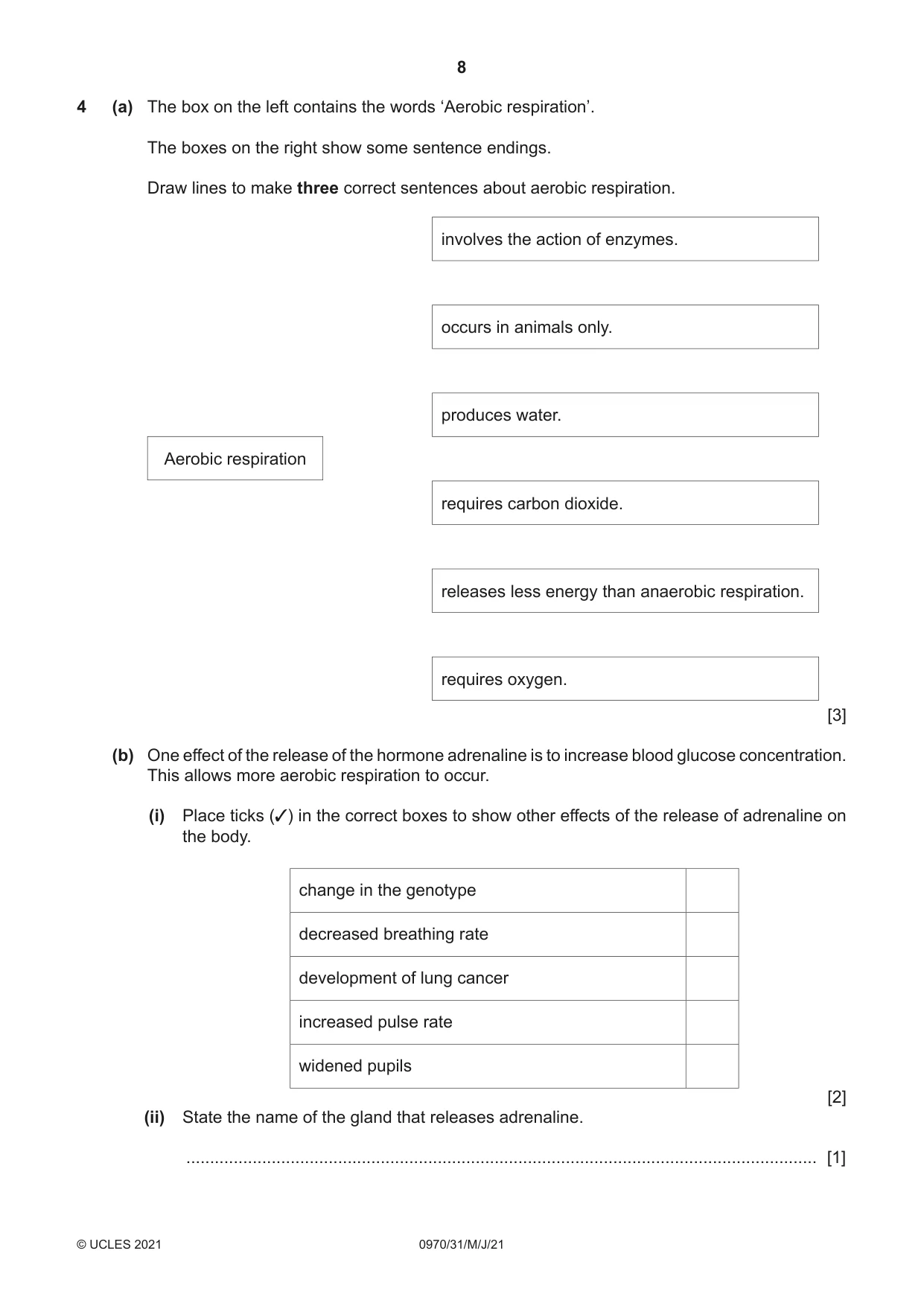
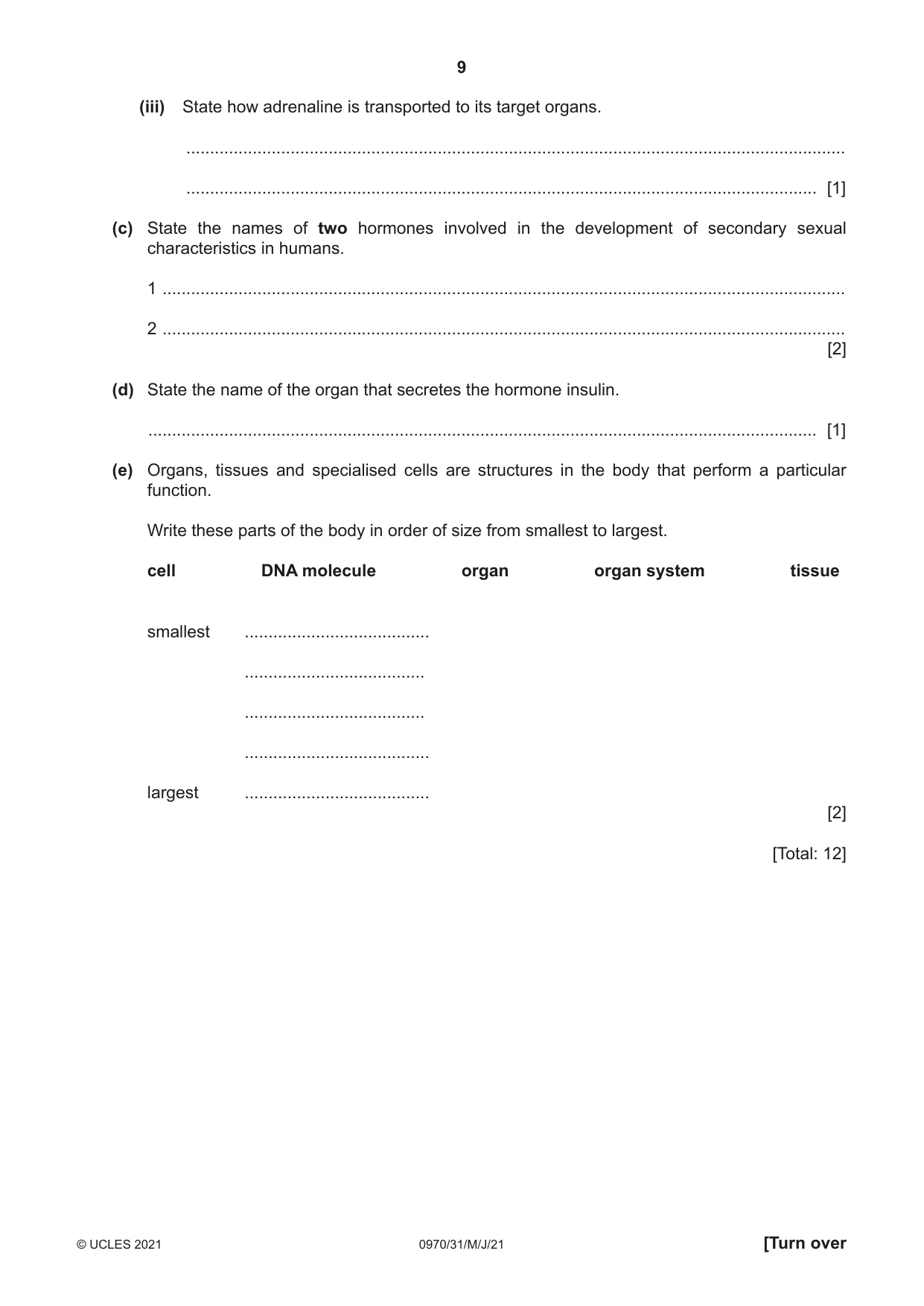
4 (a) The box on the left contains the words ‘Aerobic respiration’. The boxes on the right show some sentence endings. Draw lines to make three correct sentences about aerobic respiration. involves the action of enzymes. occurs in animals only. produces water. Aerobic respiration requires carbon dioxide. releases less energy than anaerobic respiration. requires oxygen. [3] (b) One effect of the release of the hormone adrenaline is to increase blood glucose concentration. This allows more aerobic respiration to occur. (i) Place ticks (✓) in the correct boxes to show other effects of the release of adrenaline on the body. change in the genotype decreased breathing rate development of lung cancer increased pulse rate widened pupils [2] (ii) State the name of the gland that releases adrenaline. ..................................................................................................................................... [1] (iii) State how adrenaline is transported to its target organs. ........................................................................................................................................... ..................................................................................................................................... [1] (c) State the names of two hormones involved in the development of secondary sexual characteristics in humans. 1 ................................................................................................................................................ 2 ................................................................................................................................................ [2] (d) State the name of the organ that secretes the hormone insulin. ............................................................................................................................................. [1] (e) Organs, tissues and specialised cells are structures in the body that perform a particular function. Write these parts of the body in order of size from smallest to largest. cell DNA molecule organ organ system tissue smallest ....................................... ...................................... ...................................... ....................................... largest ....................................... [2] [Total: 12]
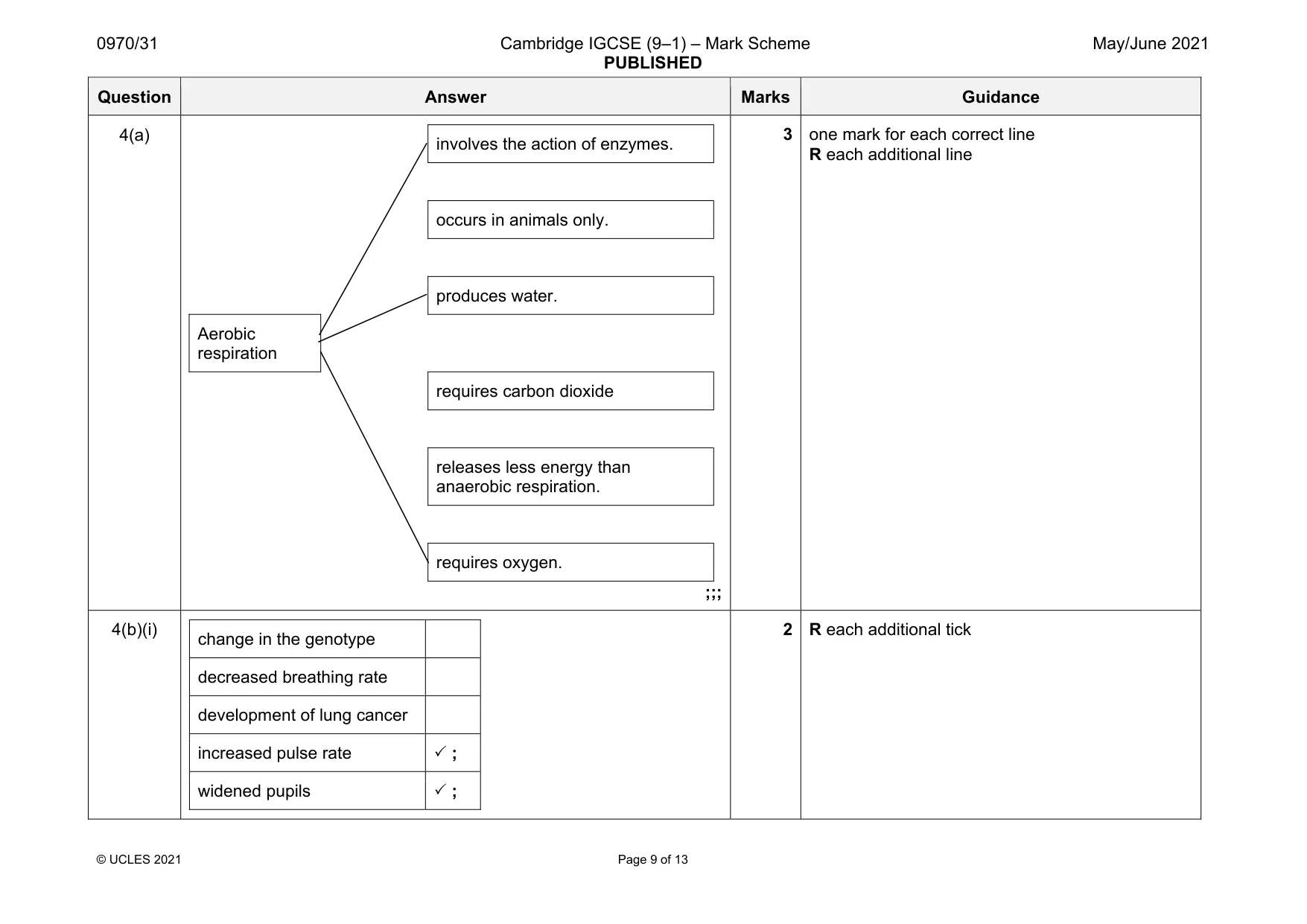
Mark scheme: 4(a) involves the action of enzymes. occurs in animals only. produces water. Aerobic respiration requires carbon dioxide releases less energy than anaerobic respiration. requires oxygen. ;;; R each additional line 4(b)(i) change in the genotype decreased breathing rate development of lung cancer increased pulse rate ; widened pupils ; 2 R each additional tick Question Answer Marks Guidance 4(b)(ii) adrenal (gland) ; 1 4(b)(iii) (in,) blood / plasma ; 1 4(c) testosterone ; oestrogen ; 2 either order 4(d) pancreas ; 1 4(e) smallest DNA molecule cell tissue organ largest organ system ;; 2 1 mark for DNA and organ system in correct place 1 mark for cell, tissue and organ in the correct order.
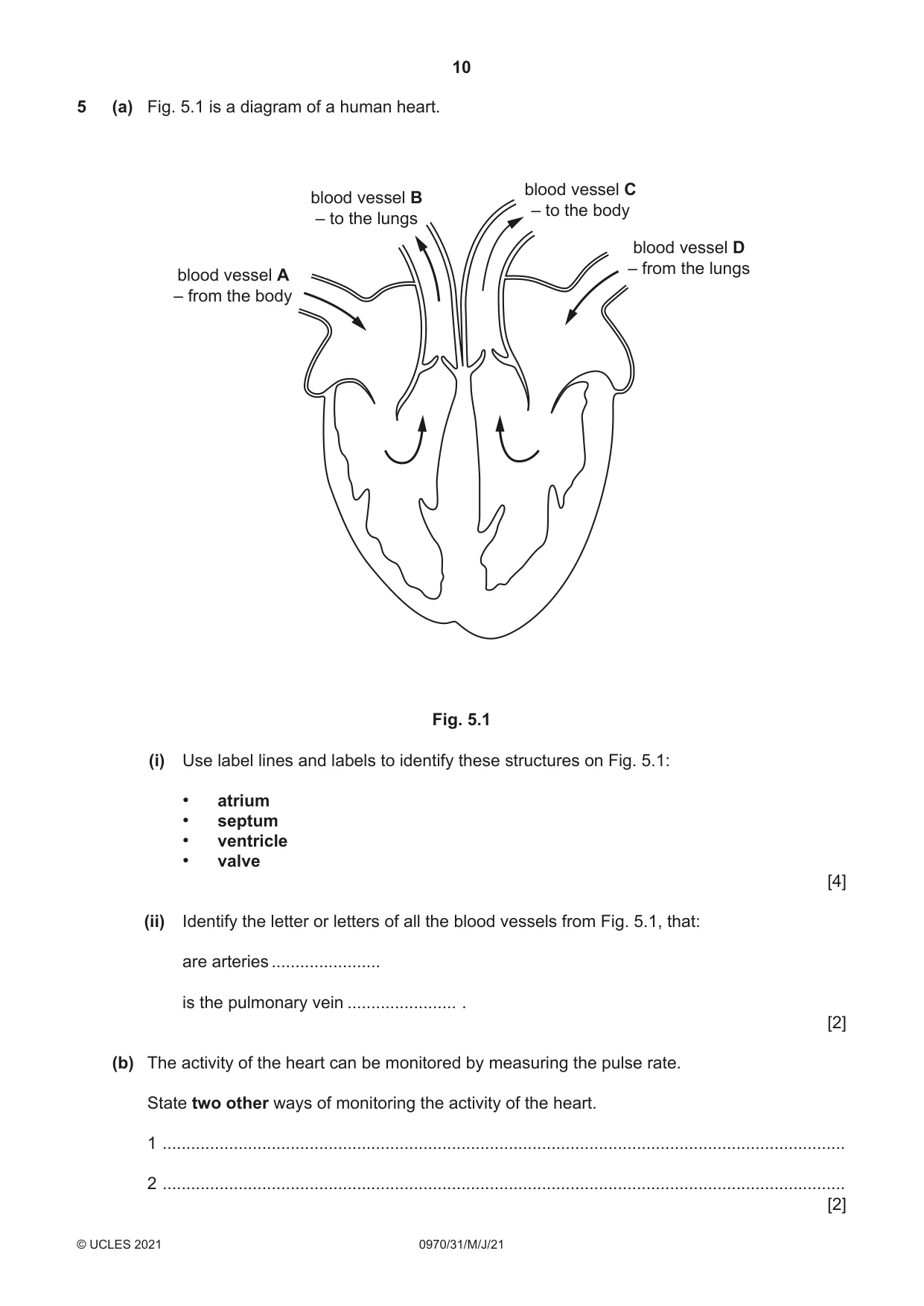
Q5 · A diagram of a human heart
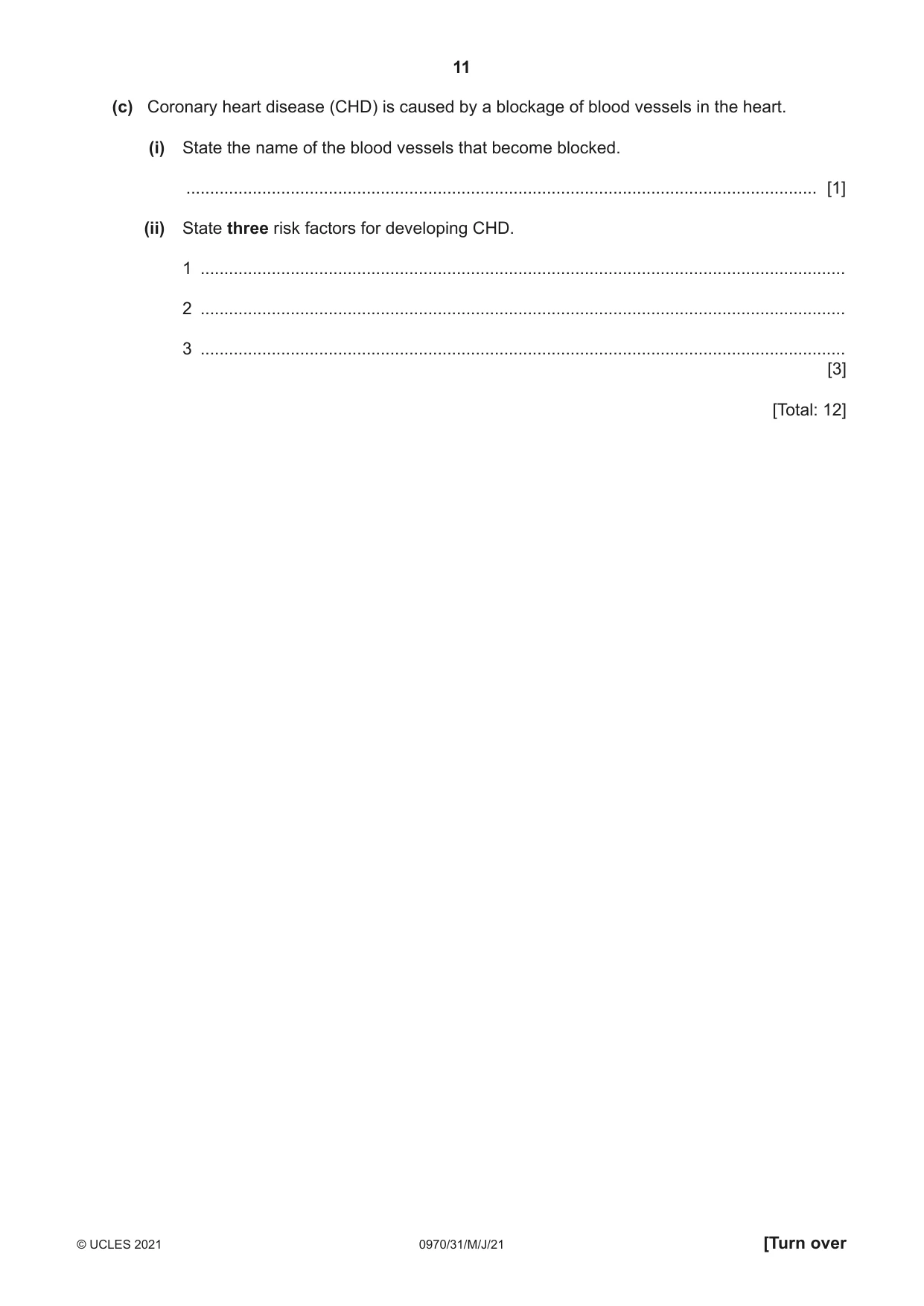
5 (a) Fig. 5.1 is a diagram of a human heart. blood vessel C blood vessel B – to the body – to the lungs blood vessel D – from the lungs blood vessel A – from the body Fig. 5.1 (i) Use label lines and labels to identify these structures on Fig. 5.1: • atrium • septum • ventricle • valve [4] (ii) Identify the letter or letters of all the blood vessels from Fig. 5.1, that: are arteries ....................... is the pulmonary vein ....................... . [2] (b) The activity of the heart can be monitored by measuring the pulse rate. State two other ways of monitoring the activity of the heart. 1 ................................................................................................................................................ 2 ................................................................................................................................................ [2] (c) Coronary heart disease (CHD) is caused by a blockage of blood vessels in the heart. (i) State the name of the blood vessels that become blocked. ..................................................................................................................................... [1] (ii) State three risk factors for developing CHD. 1 ........................................................................................................................................ 2 ........................................................................................................................................ 3 ........................................................................................................................................ [3] [Total: 12]
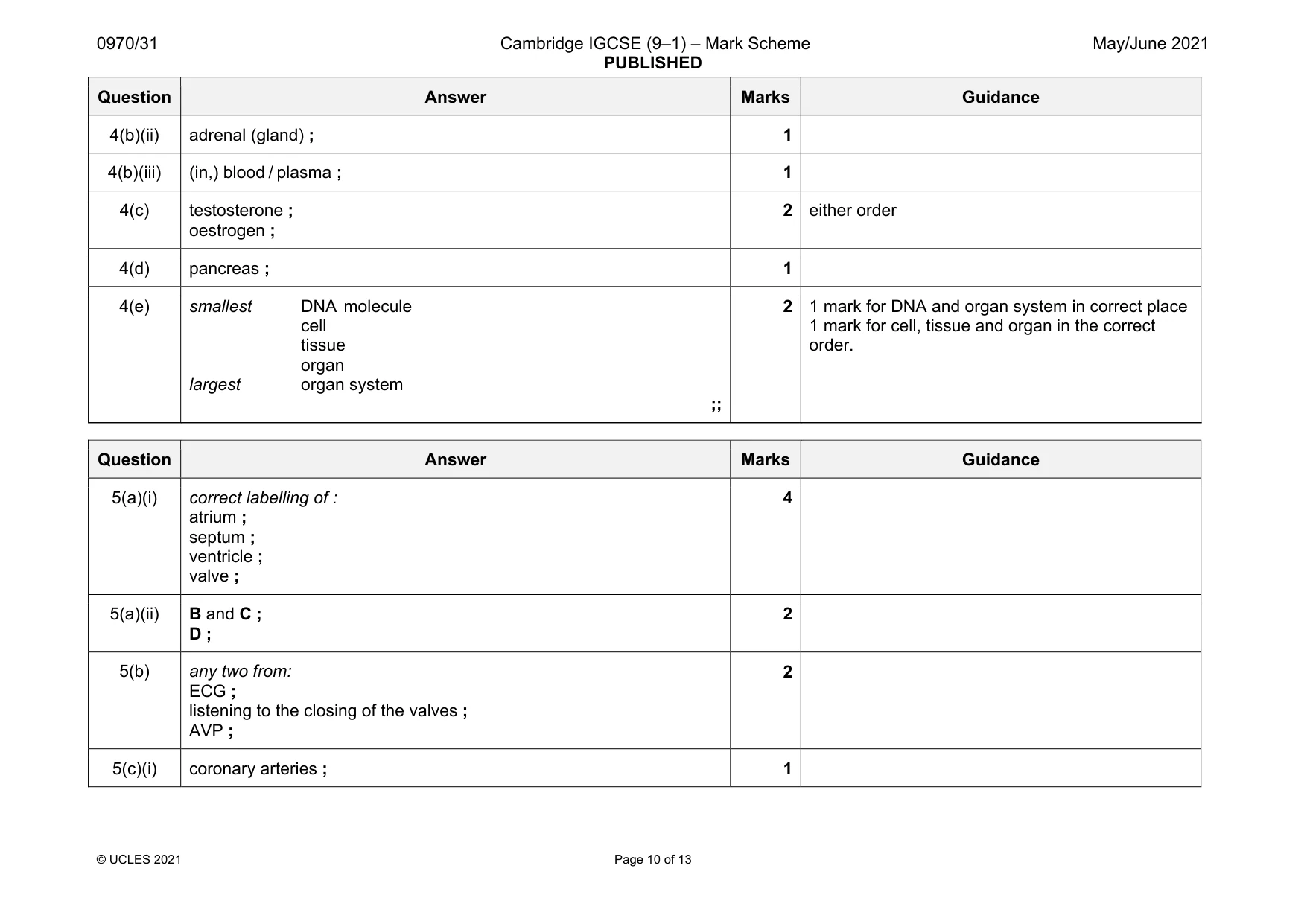
Mark scheme: 5(a)(i) correct labelling of : atrium ; septum ; ventricle ; valve ; 4 5(a)(ii) B and C ; D ; 2 5(b) any two from: ECG ; listening to the closing of the valves ; AVP ; 2 5(c)(i) coronary arteries ; 1 Question Answer Marks Guidance 5(c)(ii) any three from: diet (or described); obesity ; stress ; smoking ; genetic predisposition ; age ; sex ; AVP ;; 3
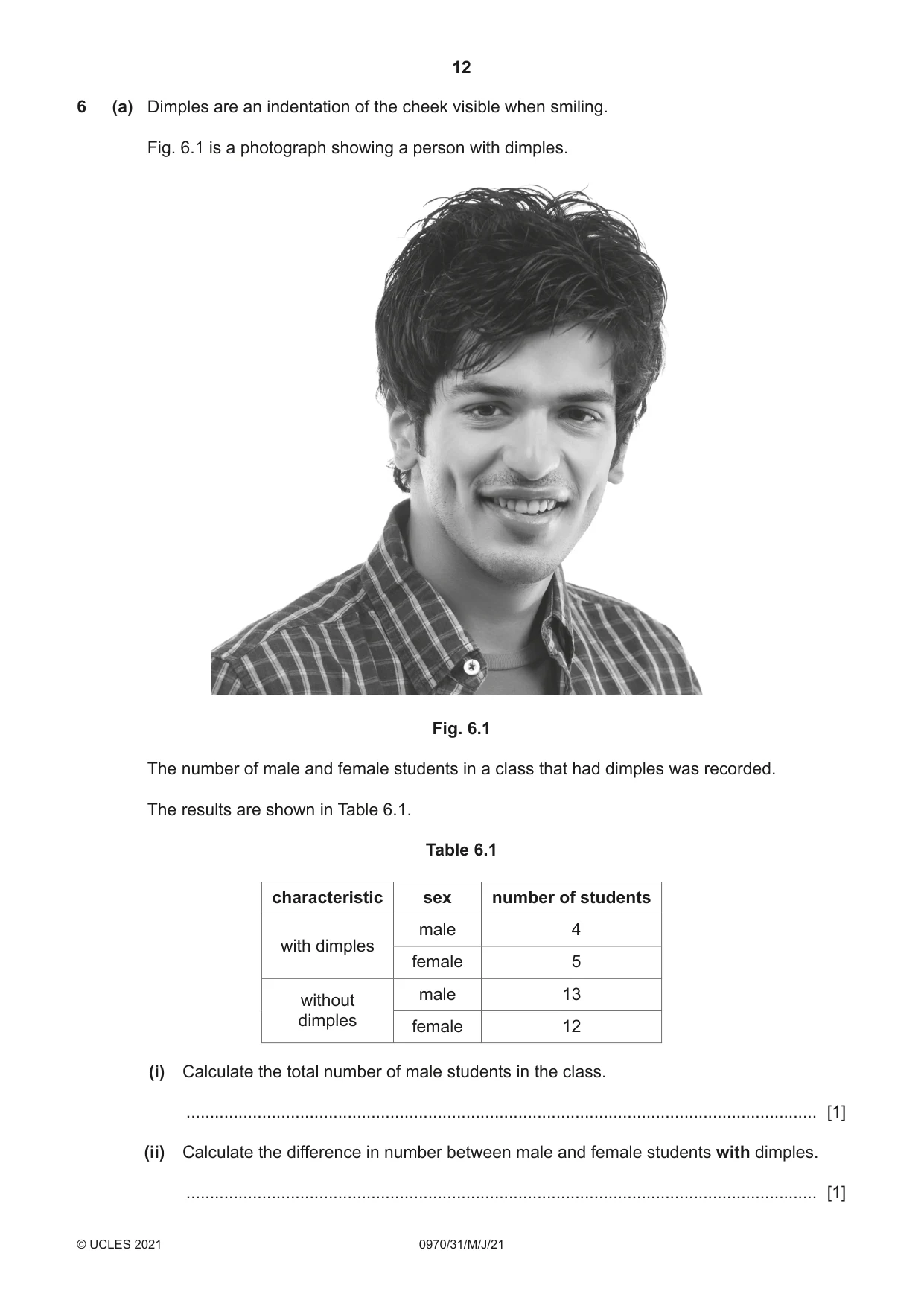
Q6 · Dimples are an indentation of the cheek visible when smiling
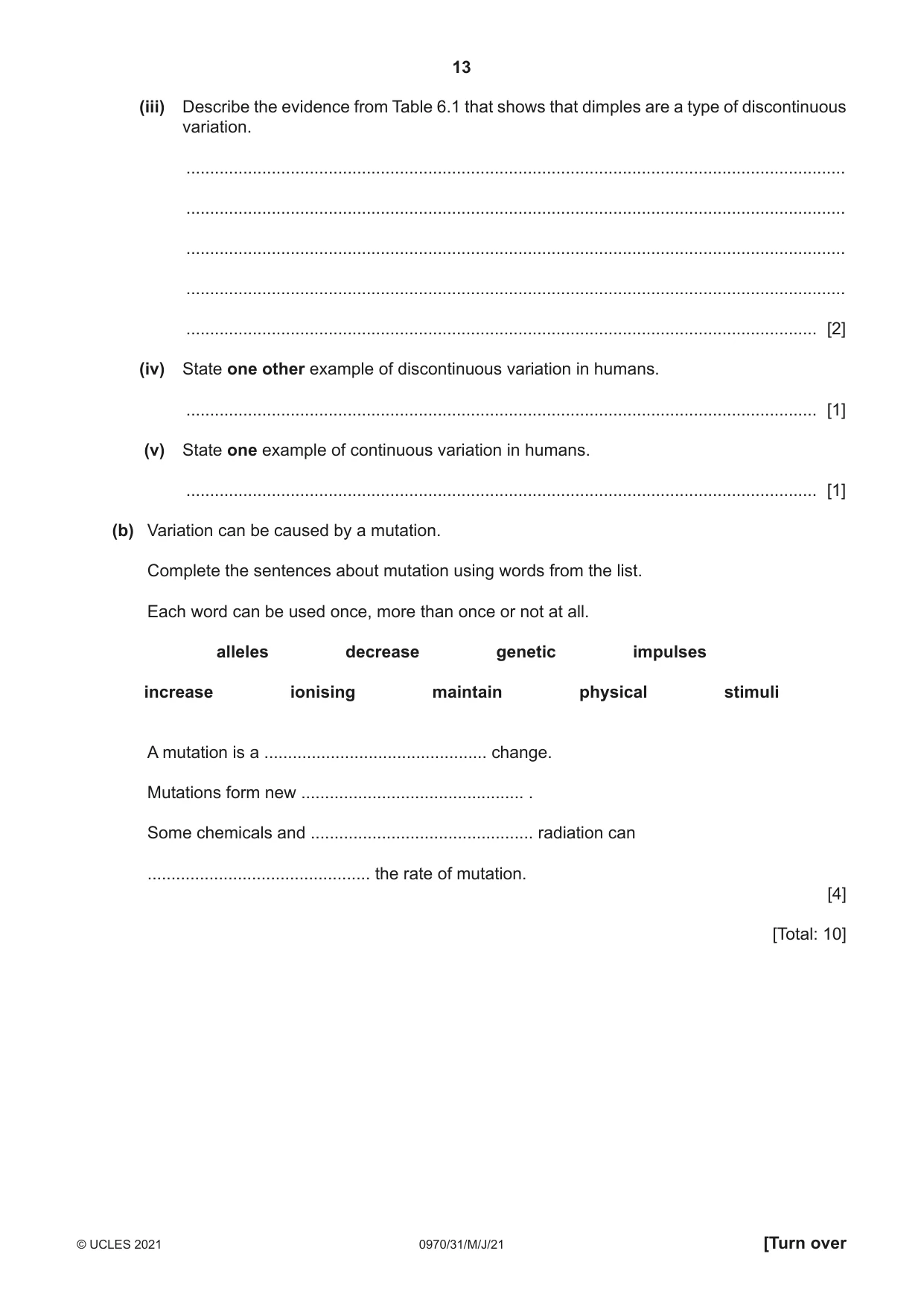
6 (a) Dimples are an indentation of the cheek visible when smiling. Fig. 6.1 is a photograph showing a person with dimples. Fig. 6.1 The number of male and female students in a class that had dimples was recorded. The results are shown in Table 6.1. Table 6.1 characteristic sex number of students male 4 with dimples female 5 male 13 without dimples female 12 (i) Calculate the total number of male students in the class. ..................................................................................................................................... [1] (ii) Calculate the difference in number between male and female students with dimples. ..................................................................................................................................... [1] (iii) Describe the evidence from Table 6.1 that shows that dimples are a type of discontinuous variation. ........................................................................................................................................... ........................................................................................................................................... ........................................................................................................................................... ........................................................................................................................................... ..................................................................................................................................... [2] (iv) State one other example of discontinuous variation in humans. ..................................................................................................................................... [1] (v) State one example of continuous variation in humans. ..................................................................................................................................... [1] (b) Variation can be caused by a mutation. Complete the sentences about mutation using words from the list. Each word can be used once, more than once or not at all. alleles decrease genetic impulses increase ionising maintain physical stimuli A mutation is a ............................................... change. Mutations form new ............................................... . Some chemicals and ............................................... radiation can ............................................... the rate of mutation. [4] [Total: 10]
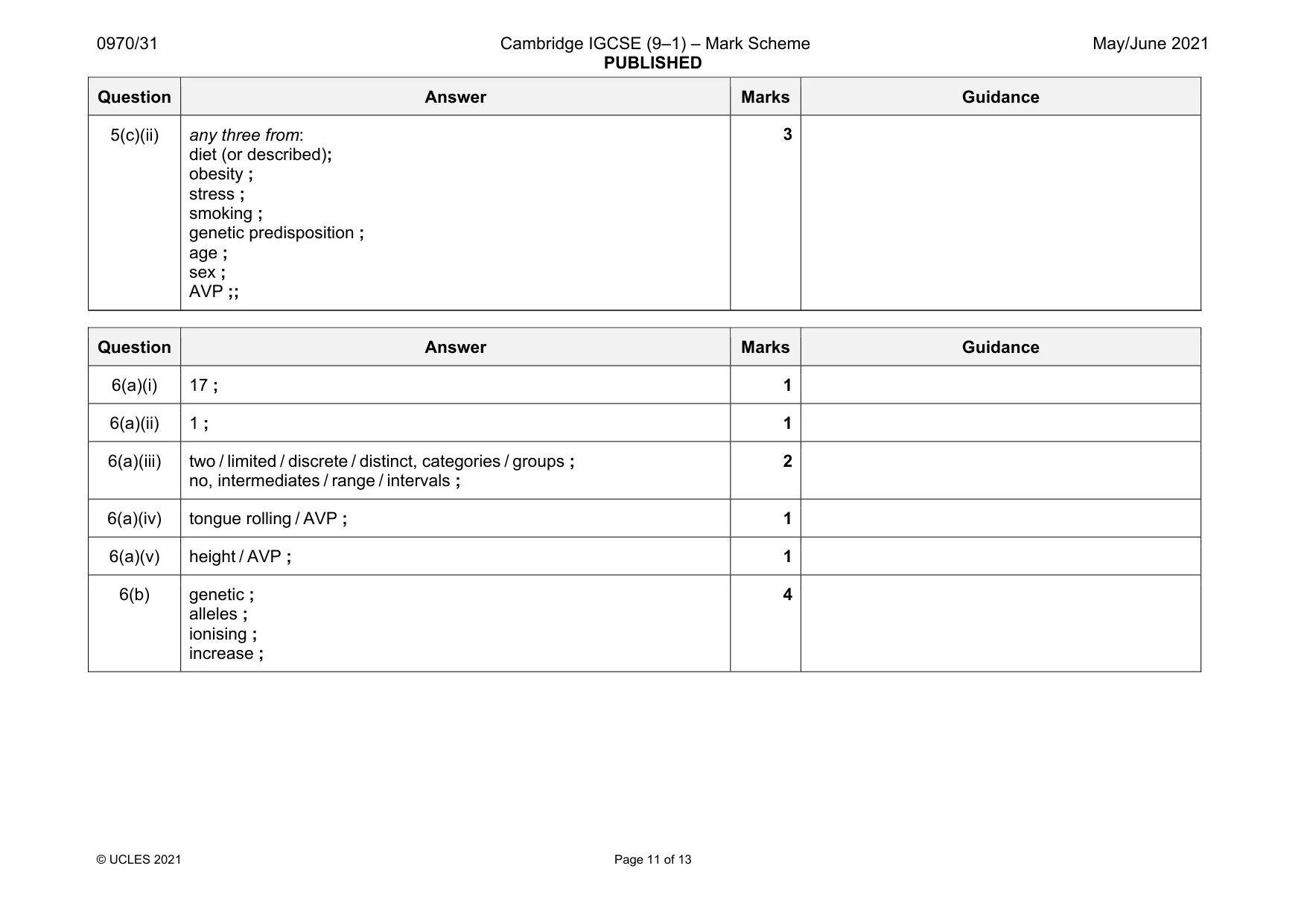
Mark scheme: 6(a)(i) 17 ; 1 6(a)(ii) 1 ; 1 6(a)(iii) two / limited / discrete / distinct, categories / groups ; no, intermediates / range / intervals ; 2 6(a)(iv) tongue rolling / AVP ; 1 6(a)(v) height / AVP ; 1 6(b) genetic ; alleles ; ionising ; increase ; 4
Q7 · Modern technology has improved food production
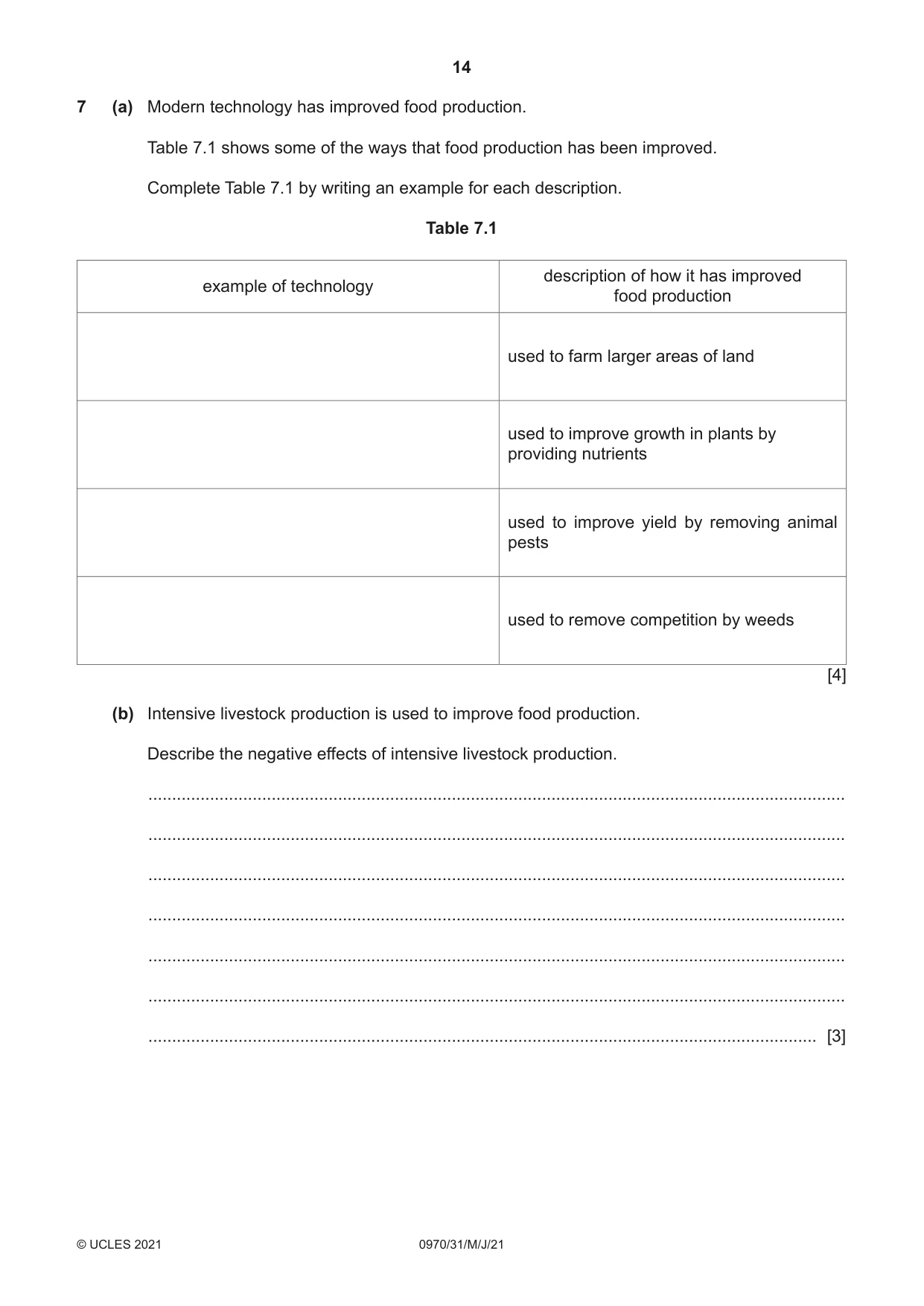
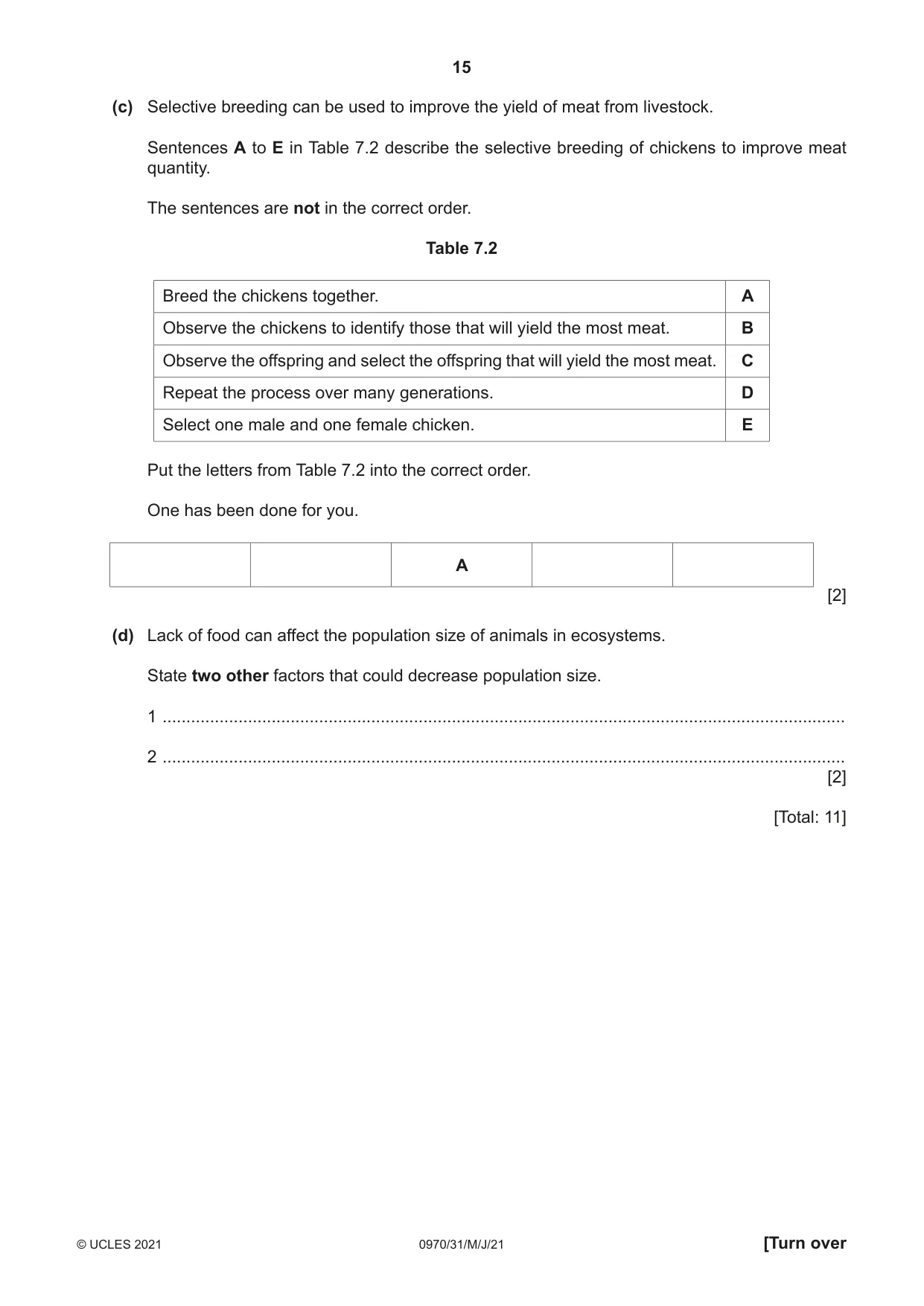
7 (a) Modern technology has improved food production. Table 7.1 shows some of the ways that food production has been improved. Complete Table 7.1 by writing an example for each description. Table 7.1 description of how it has improved example of technology food production used to farm larger areas of land used to improve growth in plants by providing nutrients used to improve yield by removing animal pests used to remove competition by weeds [4] (b) Intensive livestock production is used to improve food production. Describe the negative effects of intensive livestock production. ................................................................................................................................................... ................................................................................................................................................... ................................................................................................................................................... ................................................................................................................................................... ................................................................................................................................................... ................................................................................................................................................... ............................................................................................................................................. [3] (c) Selective breeding can be used to improve the yield of meat from livestock. Sentences A to E in Table 7.2 describe the selective breeding of chickens to improve meat quantity. The sentences are not in the correct order. Table 7.2 Breed the chickens together. A Observe the chickens to identify those that will yield the most meat. B Observe the offspring and select the offspring that will yield the most meat. C Repeat the process over many generations. D Select one male and one female chicken. E Put the letters from Table 7.2 into the correct order. One has been done for you. A [2] (d) Lack of food can affect the population size of animals in ecosystems. State two other factors that could decrease population size. 1 ................................................................................................................................................ 2 ................................................................................................................................................ [2] [Total: 11]
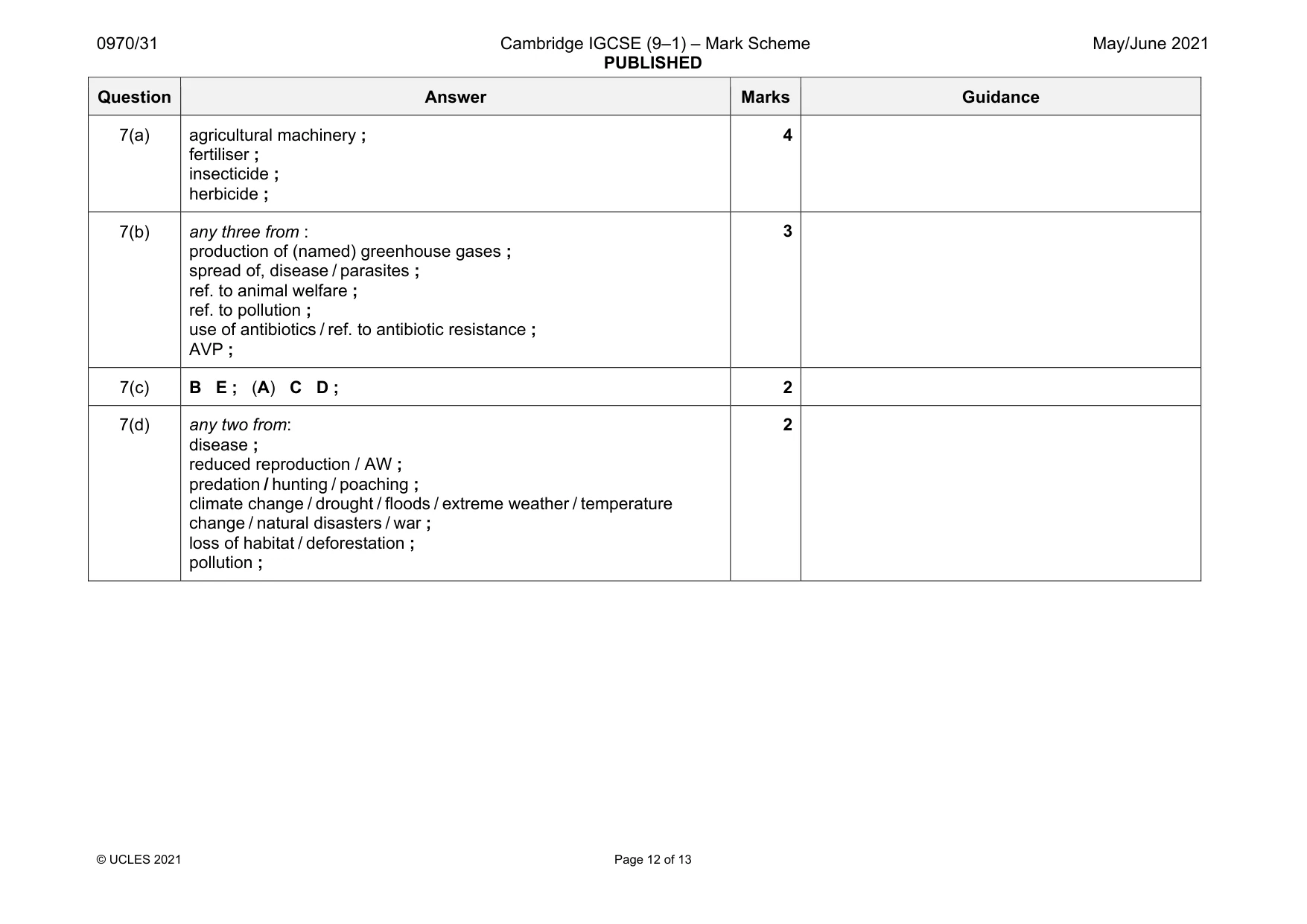
Mark scheme: 7(a) agricultural machinery ; fertiliser ; insecticide ; herbicide ; 4 7(b) any three from : production of (named) greenhouse gases ; spread of, disease / parasites ; ref. to animal welfare ; ref. to pollution ; use of antibiotics / ref. to antibiotic resistance ; AVP ; 3 7(c) B E ; (A) C D ; 2 7(d) any two from: disease ; reduced reproduction / AW ; predation / hunting / poaching ; climate change / drought / floods / extreme weather / temperature change / natural disasters / war ; loss of habitat / deforestation ; pollution ; 2
Q8 · A student investigated the conditions needed for germination of seeds
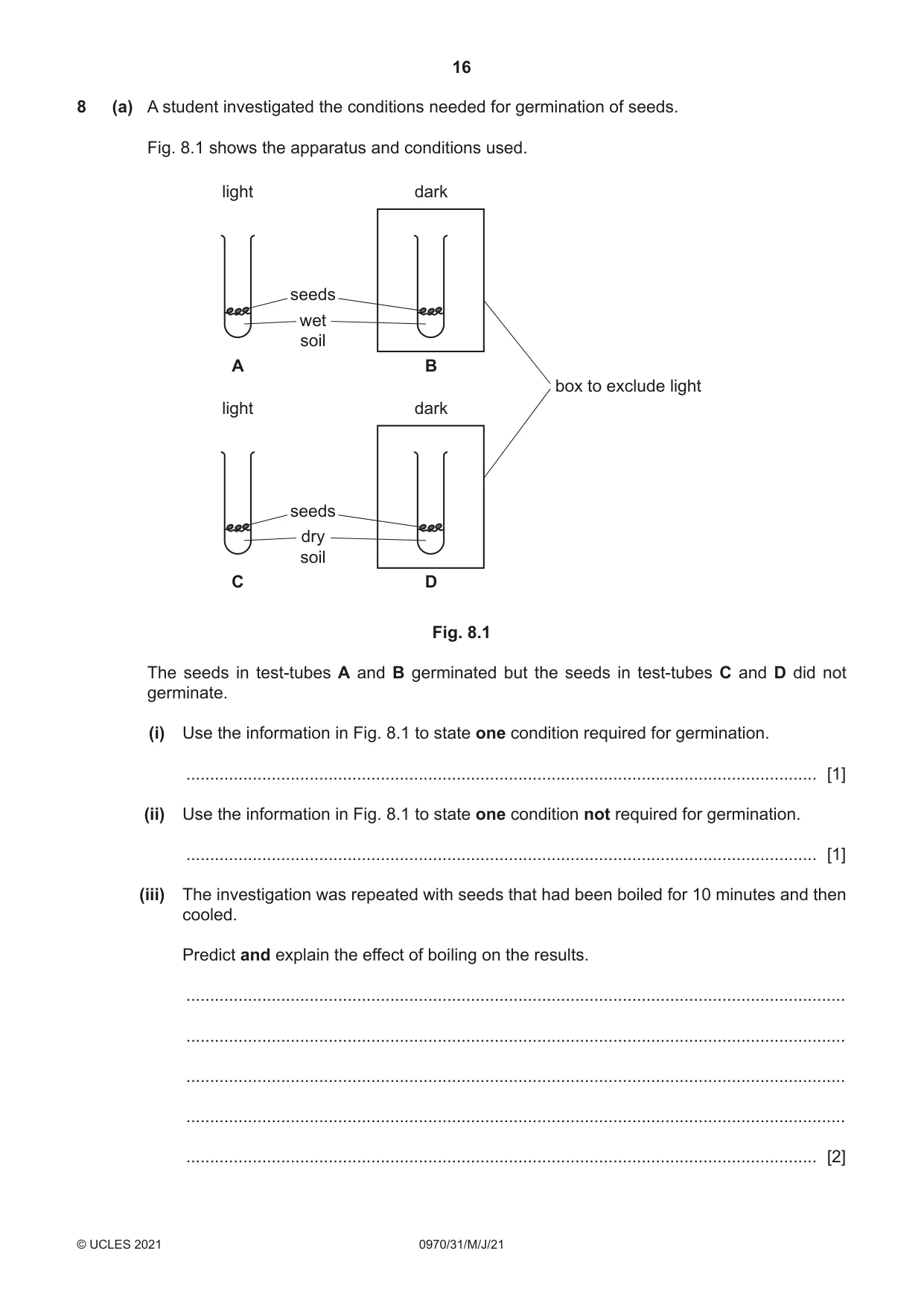
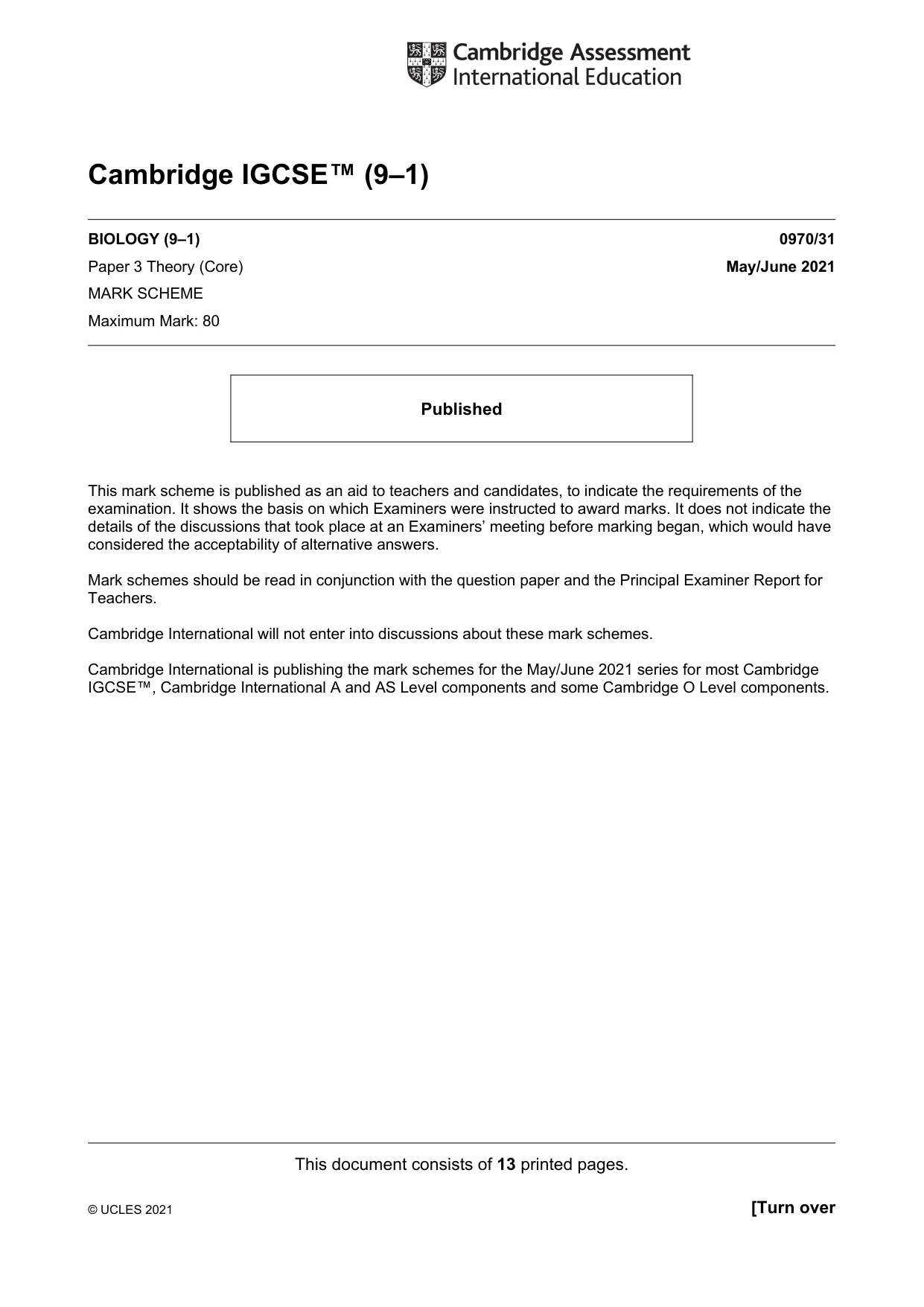
8 (a) A student investigated the conditions needed for germination of seeds. Fig. 8.1 shows the apparatus and conditions used. light dark seeds wet soil A B box to exclude light light dark seeds dry soil C D Fig. 8.1 The seeds in test-tubes A and B germinated but the seeds in test-tubes C and D did not germinate. (i) Use the information in Fig. 8.1 to state one condition required for germination. ..................................................................................................................................... [1] (ii) Use the information in Fig. 8.1 to state one condition not required for germination. ..................................................................................................................................... [1] (iii) The investigation was repeated with seeds that had been boiled for 10 minutes and then cooled. Predict and explain the effect of boiling on the results. ........................................................................................................................................... ........................................................................................................................................... ........................................................................................................................................... ........................................................................................................................................... ..................................................................................................................................... [2] (b) Photosynthesis and germination have different requirements. (i) State the word equation for photosynthesis. ..................................................................................................................................... [2] (ii) State the name of one condition needed for both photosynthesis and germination. ..................................................................................................................................... [1] [Total: 7]
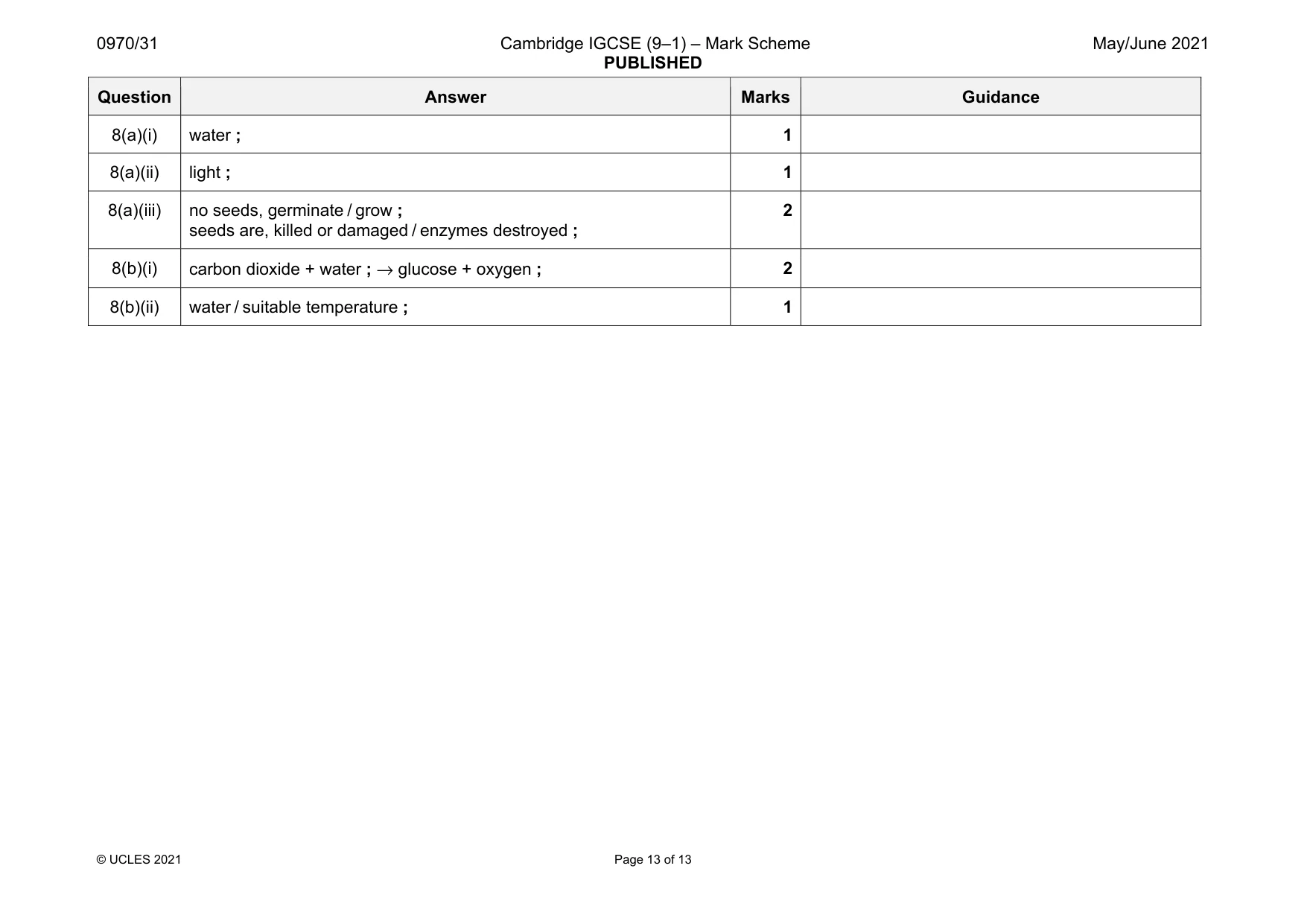
Mark scheme: 8(a)(i) water ; 1 8(a)(ii) light ; 1 8(a)(iii) no seeds, germinate / grow ; seeds are, killed or damaged / enzymes destroyed ; 2 8(b)(i) carbon dioxide + water ; → glucose + oxygen ; 2 8(b)(ii) water / suitable temperature ; 1
What was in this paper
The subtopics covered by these 8 questions, and how many questions each got. Open one in a new tab to see every Cambridge question on it.
What you needed in this session
Cambridge’s own grade thresholds for 2021 May/June, Paper 3 · Variant 1. A higher threshold means an easier paper — the bar moves with how the cohort did.