Cambridge IGCSE Biology (9-1) 0970 — 2024 May/June Paper 3 · Variant 1
0970/31/M/J/24 · 80 marks · ≈90 min
The question paper and its mark scheme, free to download. This is Cambridge’s own paper, exactly as it was sat — the on-screen preview is on its way; download below in the meantime.
Question paper
The on-screen preview isn’t ready for this paper yet — download it above instead.
Mark scheme11 pages
Answers below. Sit the paper first if you are practising.
Paper as text
Question paper, page 1
Skip to content [image] • Home • Past Papers • About • Contact • Log In • Register • Toggle website search
Question paper, page 2
Menu Close 404: Page Not Found 1. Home> 2. 404 Not Found This page could not be found! We are sorry, but the page you are looking for is not available. Perhaps you can try a new search. Back To Homepage • Home • About • Contact • Log In • Privacy Policy Copyright 2023@edupapers
Mark scheme, page 1
This document consists of 11 printed pages. © Cambridge University Press & Assessment 2024 [Turn over Cambridge IGCSE™ (9–1) BIOLOGY (9–1) 0970/31 Paper 3 Theory (Core) May/June 2024 MARK SCHEME Maximum Mark: 80 Published This mark scheme is published as an aid to teachers and candidates, to indicate the requirements of the examination. It shows the basis on which Examiners were instructed to award marks. It does not indicate the details of the discussions that took place at an Examiners’ meeting before marking began, which would have considered the acceptability of alternative answers. Mark schemes should be read in conjunction with the question paper and the Principal Examiner Report for Teachers. Cambridge International will not enter into discussions about these mark schemes. Cambridge International is publishing the mark schemes for the May/June 2024 series for most Cambridge IGCSE, Cambridge International A and AS Level and Cambridge Pre–U components, and some Cambridge O Level components.
Mark scheme, page 2
0970/31 Cambridge IGCSE (9–1) – Mark Scheme PUBLISHED May/June 2024 © Cambridge University Press & Assessment 2024 Page 2 of 11 Generic Marking Principles These general marking principles must be applied by all examiners when marking candidate answers. They should be applied alongside the specific content of the mark scheme or generic level descriptions for a question. Each question paper and mark scheme will also comply with these marking principles. GENERIC MARKING PRINCIPLE 1: Marks must be awarded in line with: the specific content of the mark scheme or the generic level descriptors for the question the specific skills defined in the mark scheme or in the generic level descriptors for the question the standard of response required by a candidate as exemplified by the standardisation scripts. GENERIC MARKING PRINCIPLE 2: Marks awarded are always whole marks (not half marks, or other fractions). GENERIC MARKING PRINCIPLE 3: Marks must be awarded positively: marks are awarded for correct/valid answers, as defined in the mark scheme. However, credit is given for valid answers which go beyond the scope of the syllabus and mark scheme, referring to your Team Leader as appropriate marks are awarded when candidates clearly demonstrate what they know and can do marks are not deducted for errors marks are not deducted for omissions answers should only be judged on the quality of spelling, punctuation and grammar when these features are specifically assessed by the question as indicated by the mark scheme. The meaning, however, should be unambiguous. GENERIC MARKING PRINCIPLE 4: Rules must be applied consistently, e.g. in situations where candidates have not followed instructions or in the application of generic level descriptors.
Mark scheme, page 3
0970/31 Cambridge IGCSE (9–1) – Mark Scheme PUBLISHED May/June 2024 © Cambridge University Press & Assessment 2024 Page 3 of 11 GENERIC MARKING PRINCIPLE 5: Marks should be awarded using the full range of marks defined in the mark scheme for the question (however; the use of the full mark range may be limited according to the quality of the candidate responses seen). GENERIC MARKING PRINCIPLE 6: Marks awarded are based solely on the requirements as defined in the mark scheme. Marks should not be awarded with grade thresholds or grade descriptors in mind. Science–Specific Marking Principles 1 Examiners should consider the context and scientific use of any keywords when awarding marks. Although keywords may be present, marks should not be awarded if the keywords are used incorrectly. 2 The examiner should not choose between contradictory statements given in the same question part, and credit should not be awarded for any correct statement that is contradicted within the same question part. Wrong science that is irrelevant to the question should be ignored. 3 Although spellings do not have to be correct, spellings of syllabus terms must allow for clear and unambiguous separation from other syllabus terms with which they may be confused (e.g. ethane / ethene, glucagon / glycogen, refraction / reflection). 4 The error carried forward (ecf) principle should be applied, where appropriate. If an incorrect answer is subsequently used in a scientifically correct way, the candidate should be awarded these subsequent marking points. Further guidance will be included in the mark scheme where necessary and any exceptions to this general principle will be noted. 5 ‘List rule’ guidance For questions that require n responses (e.g. State two reasons …): The response should be read as continuous prose, even when numbered answer spaces are provided. Any response marked ignore in the mark scheme should not count towards n. Incorrect responses should not be awarded credit but will still count towards n. Read the entire response to check for any responses that contradict those that would otherwise be credited. Credit should not be awarded for any responses that are contradicted within the rest of the response. Where two responses contradict one another, this should be treated as a single incorrect response. Non–contradictory responses after the first n responses may be ignored even if they include incorrect science.
Mark scheme, page 4
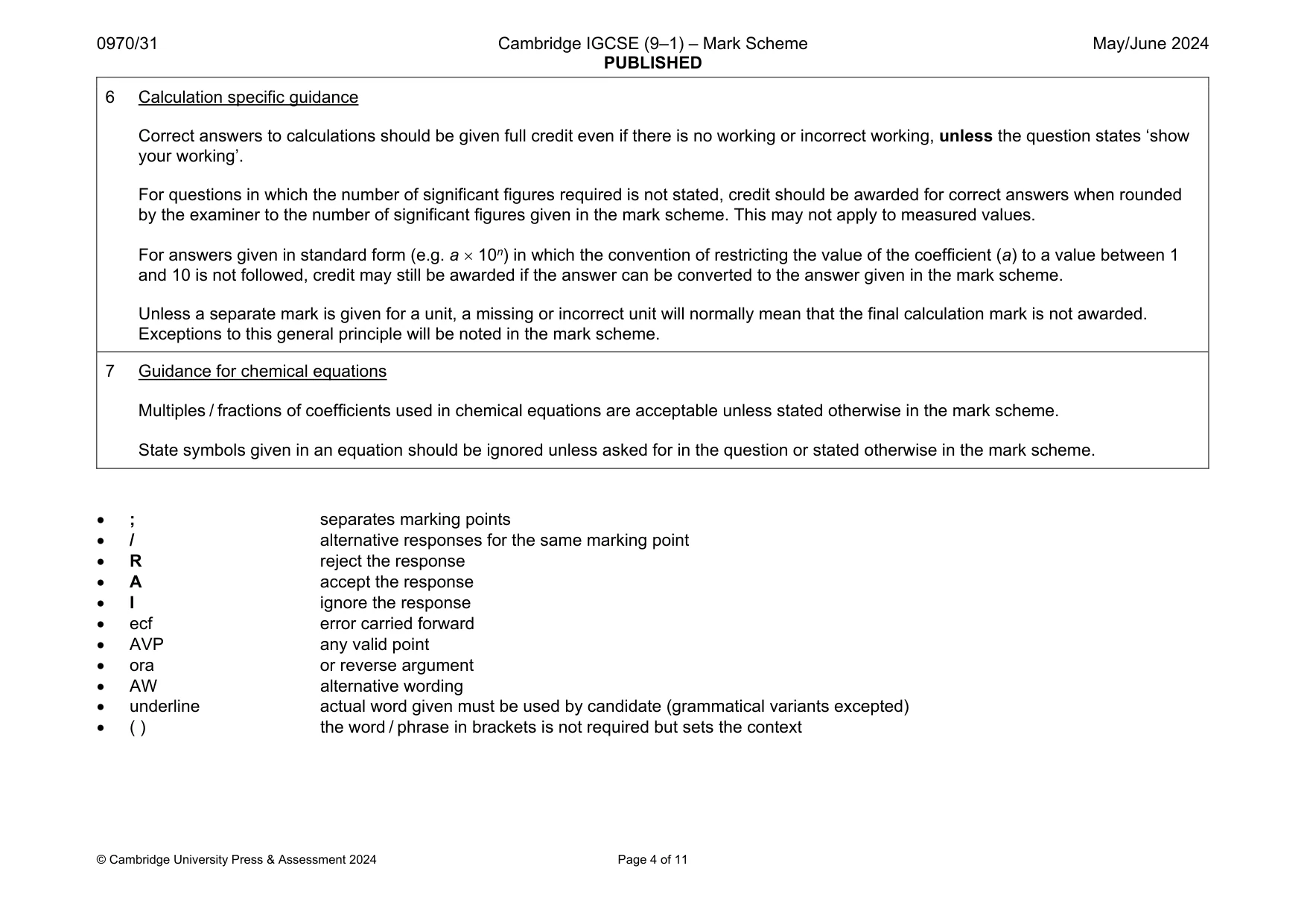
0970/31 Cambridge IGCSE (9–1) – Mark Scheme PUBLISHED May/June 2024 © Cambridge University Press & Assessment 2024 Page 4 of 11 6 Calculation specific guidance Correct answers to calculations should be given full credit even if there is no working or incorrect working, unless the question states ‘show your working’. For questions in which the number of significant figures required is not stated, credit should be awarded for correct answers when rounded by the examiner to the number of significant figures given in the mark scheme. This may not apply to measured values. For answers given in standard form (e.g. a 10n) in which the convention of restricting the value of the coefficient (a) to a value between 1 and 10 is not followed, credit may still be awarded if the answer can be converted to the answer given in the mark scheme. Unless a separate mark is given for a unit, a missing or incorrect unit will normally mean that the final calculation mark is not awarded. Exceptions to this general principle will be noted in the mark scheme. 7 Guidance for chemical equations Multiples / fractions of coefficients used in chemical equations are acceptable unless stated otherwise in the mark scheme. State symbols given in an equation should be ignored unless asked for in the question or stated otherwise in the mark scheme. ; separates marking points / alternative responses for the same marking point R reject the response A accept the response I ignore the response ecf error carried forward AVP any valid point ora or reverse argument AW alternative wording underline actual word given must be used by candidate (grammatical variants excepted) ( ) the word / phrase in brackets is not required but sets the context
Mark scheme, page 5
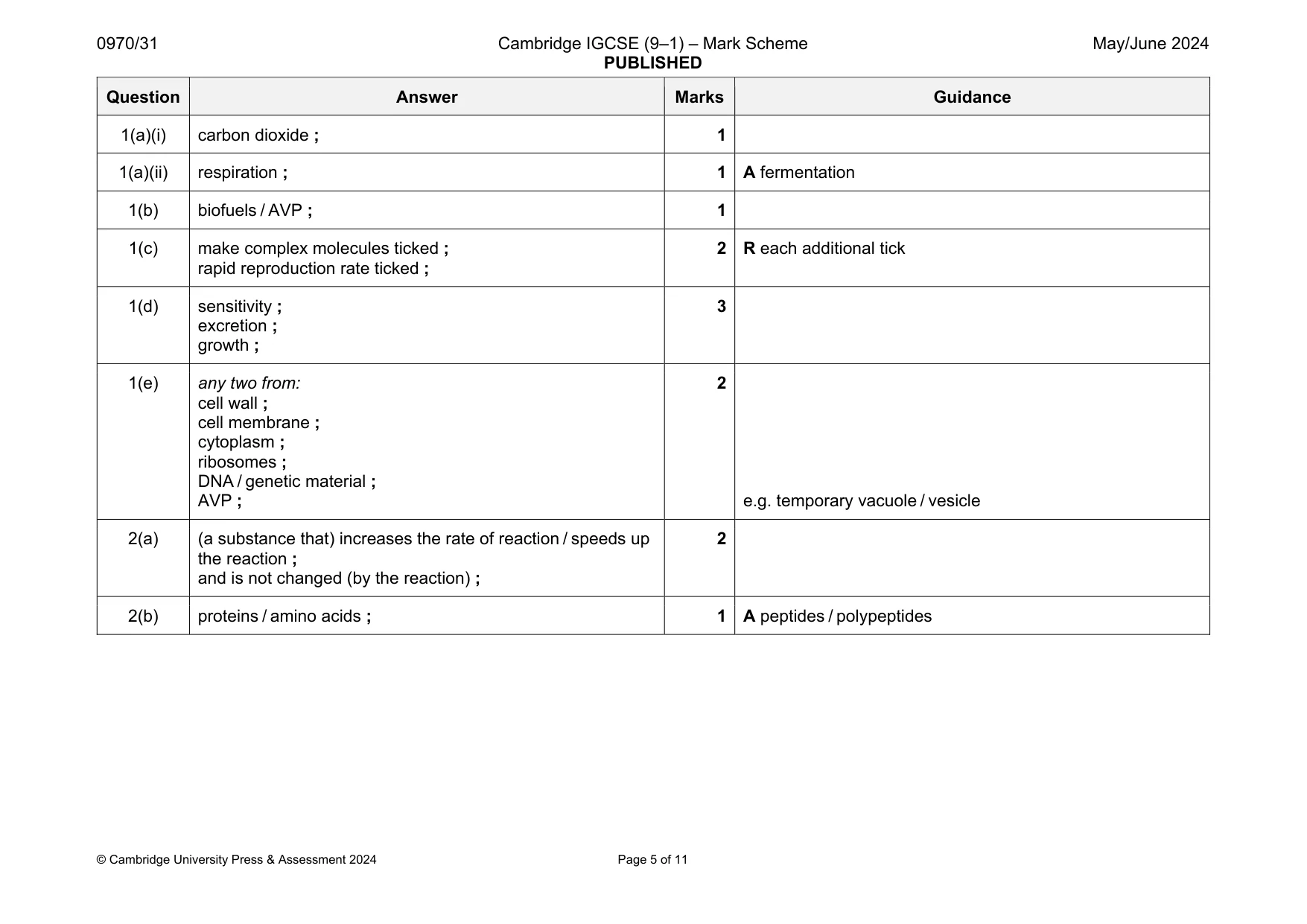
0970/31 Cambridge IGCSE (9–1) – Mark Scheme PUBLISHED May/June 2024 © Cambridge University Press & Assessment 2024 Page 5 of 11 Question Answer Marks Guidance 1(a)(i) carbon dioxide ; 1 1(a)(ii) respiration ; 1 A fermentation 1(b) biofuels / AVP ; 1 1(c) make complex molecules ticked ; rapid reproduction rate ticked ; 2 R each additional tick 1(d) sensitivity ; excretion ; growth ; 3 1(e) any two from: cell wall ; cell membrane ; cytoplasm ; ribosomes ; DNA / genetic material ; AVP ; 2 e.g. temporary vacuole / vesicle 2(a) (a substance that) increases the rate of reaction / speeds up the reaction ; and is not changed (by the reaction) ; 2 2(b) proteins / amino acids ; 1 A peptides / polypeptides
Mark scheme, page 6
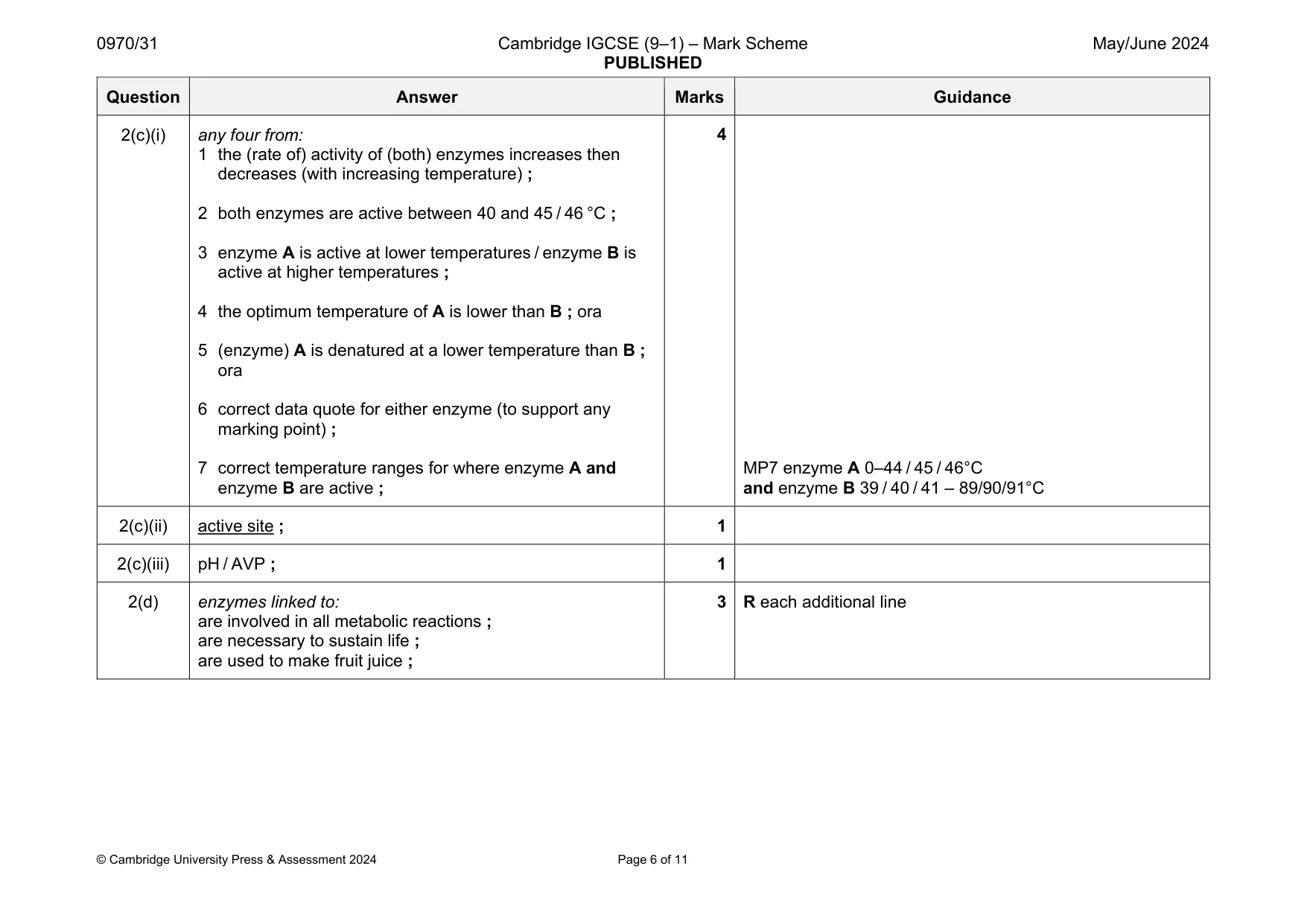
0970/31 Cambridge IGCSE (9–1) – Mark Scheme PUBLISHED May/June 2024 © Cambridge University Press & Assessment 2024 Page 6 of 11 Question Answer Marks Guidance 2(c)(i) any four from: 1 the (rate of) activity of (both) enzymes increases then decreases (with increasing temperature) ; 2 both enzymes are active between 40 and 45 / 46 °C ; 3 enzyme A is active at lower temperatures / enzyme B is active at higher temperatures ; 4 the optimum temperature of A is lower than B ; ora 5 (enzyme) A is denatured at a lower temperature than B ; ora 6 correct data quote for either enzyme (to support any marking point) ; 7 correct temperature ranges for where enzyme A and enzyme B are active ; 4 MP7 enzyme A 0–44 / 45 / 46°C and enzyme B 39 / 40 / 41 – 89/90/91°C 2(c)(ii) active site ; 1 2(c)(iii) pH / AVP ; 1 2(d) enzymes linked to: are involved in all metabolic reactions ; are necessary to sustain life ; are used to make fruit juice ; 3 R each additional line
Mark scheme, page 7
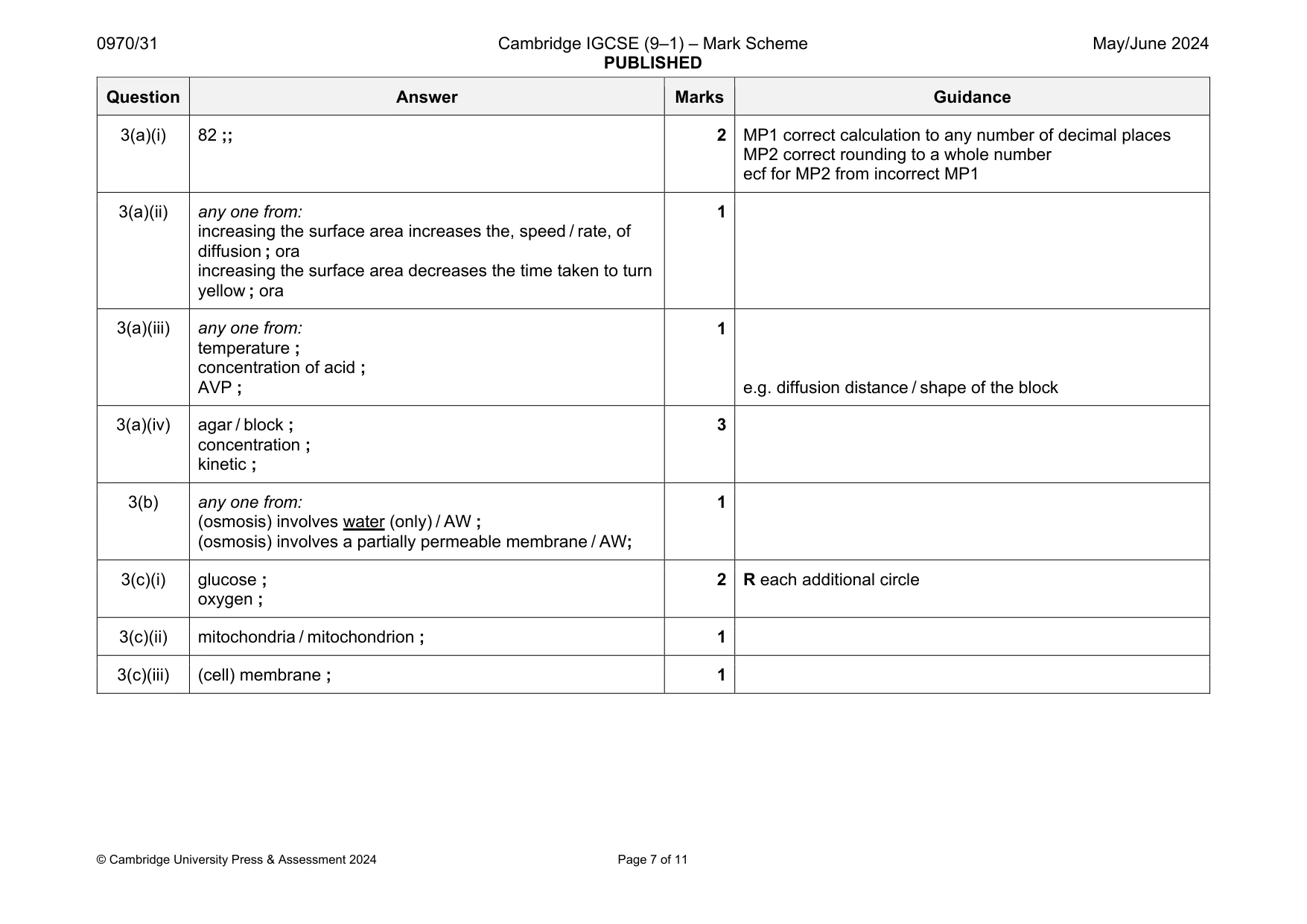
0970/31 Cambridge IGCSE (9–1) – Mark Scheme PUBLISHED May/June 2024 © Cambridge University Press & Assessment 2024 Page 7 of 11 Question Answer Marks Guidance 3(a)(i) 82 ;; 2 MP1 correct calculation to any number of decimal places MP2 correct rounding to a whole number ecf for MP2 from incorrect MP1 3(a)(ii) any one from: increasing the surface area increases the, speed / rate, of diffusion ; ora increasing the surface area decreases the time taken to turn yellow ; ora 1 3(a)(iii) any one from: temperature ; concentration of acid ; AVP ; 1 e.g. diffusion distance / shape of the block 3(a)(iv) agar / block ; concentration ; kinetic ; 3 3(b) any one from: (osmosis) involves water (only) / AW ; (osmosis) involves a partially permeable membrane / AW; 1 3(c)(i) glucose ; oxygen ; 2 R each additional circle 3(c)(ii) mitochondria / mitochondrion ; 1 3(c)(iii) (cell) membrane ; 1
Mark scheme, page 8
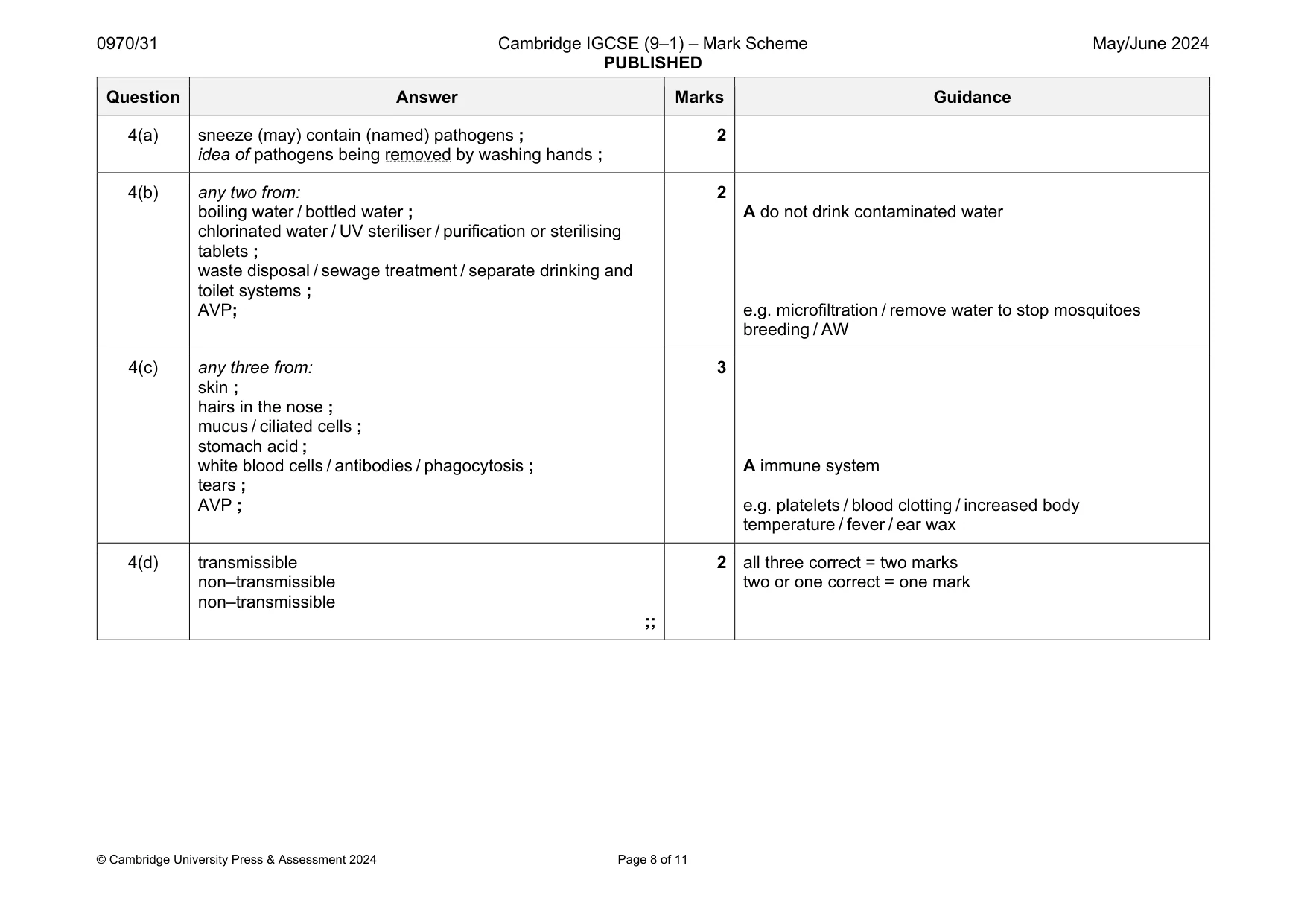
0970/31 Cambridge IGCSE (9–1) – Mark Scheme PUBLISHED May/June 2024 © Cambridge University Press & Assessment 2024 Page 8 of 11 Question Answer Marks Guidance 4(a) sneeze (may) contain (named) pathogens ; idea of pathogens being removed by washing hands ; 2 4(b) any two from: boiling water / bottled water ; chlorinated water / UV steriliser / purification or sterilising tablets ; waste disposal / sewage treatment / separate drinking and toilet systems ; AVP; 2 A do not drink contaminated water e.g. microfiltration / remove water to stop mosquitoes breeding / AW 4(c) any three from: skin ; hairs in the nose ; mucus / ciliated cells ; stomach acid ; white blood cells / antibodies / phagocytosis ; tears ; AVP ; 3 A immune system e.g. platelets / blood clotting / increased body temperature / fever / ear wax 4(d) transmissible non–transmissible non–transmissible ;; 2 all three correct = two marks two or one correct = one mark
Mark scheme, page 9
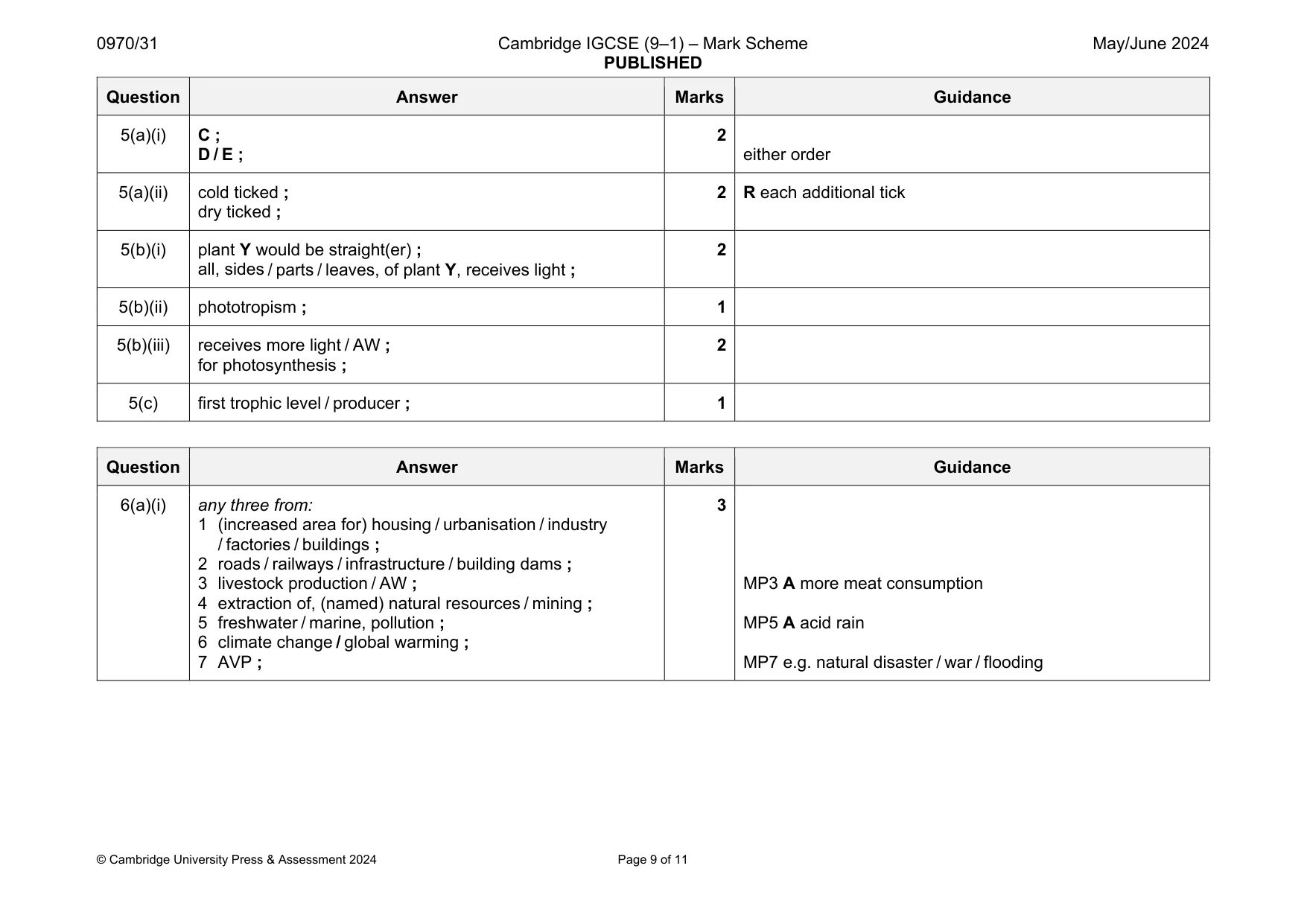
0970/31 Cambridge IGCSE (9–1) – Mark Scheme PUBLISHED May/June 2024 © Cambridge University Press & Assessment 2024 Page 9 of 11 Question Answer Marks Guidance 5(a)(i) C ; D / E ; 2 either order 5(a)(ii) cold ticked ; dry ticked ; 2 R each additional tick 5(b)(i) plant Y would be straight(er) ; all, sides / parts / leaves, of plant Y, receives light ; 2 5(b)(ii) phototropism ; 1 5(b)(iii) receives more light / AW ; for photosynthesis ; 2 5(c) first trophic level / producer ; 1 Question Answer Marks Guidance 6(a)(i) any three from: 1 (increased area for) housing / urbanisation / industry / factories / buildings ; 2 roads / railways / infrastructure / building dams ; 3 livestock production / AW ; 4 extraction of, (named) natural resources / mining ; 5 freshwater / marine, pollution ; 6 climate change / global warming ; 7 AVP ; 3 MP3 A more meat consumption MP5 A acid rain MP7 e.g. natural disaster / war / flooding
Mark scheme, page 10
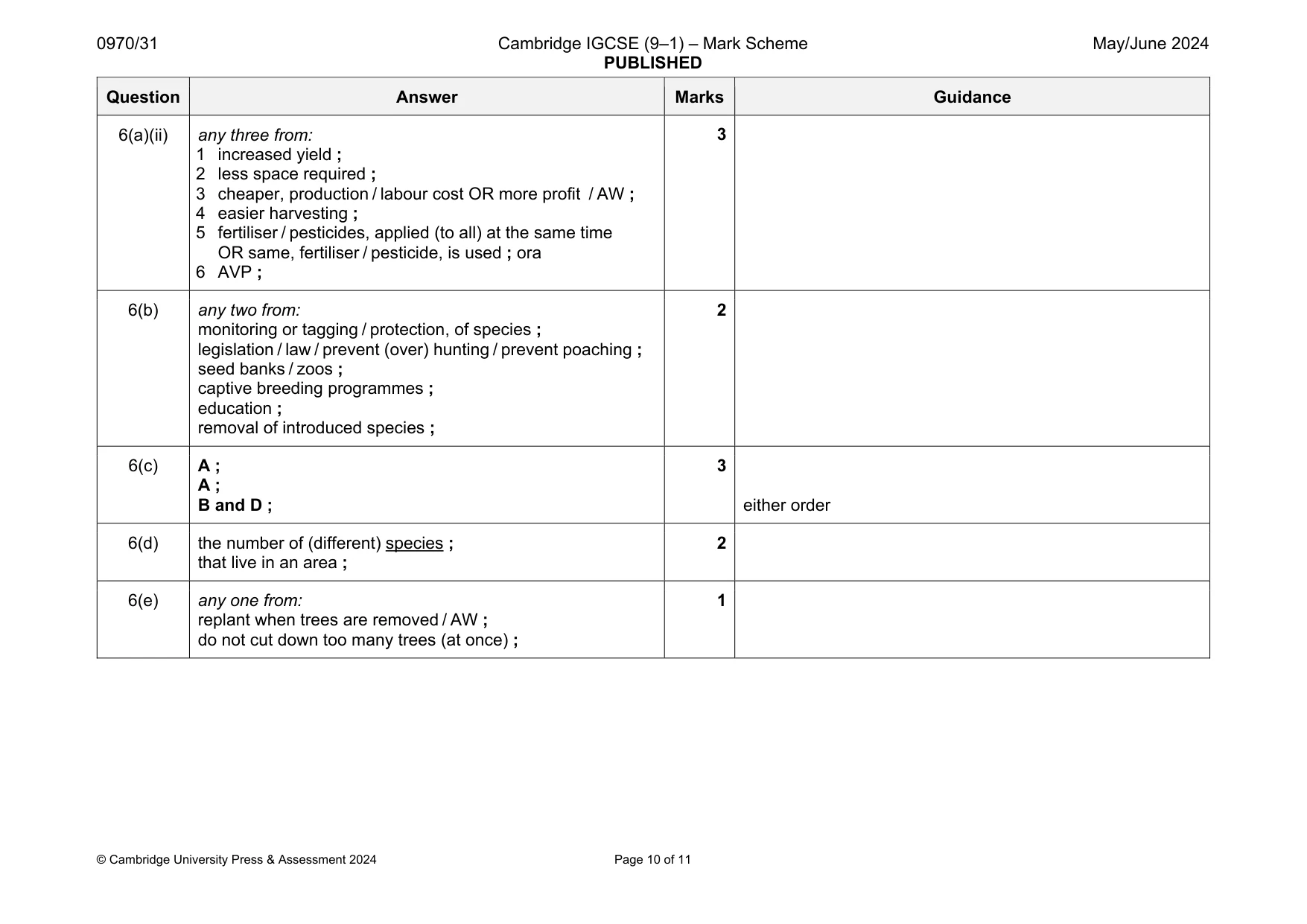
0970/31 Cambridge IGCSE (9–1) – Mark Scheme PUBLISHED May/June 2024 © Cambridge University Press & Assessment 2024 Page 10 of 11 Question Answer Marks Guidance 6(a)(ii) any three from: 1 increased yield ; 2 less space required ; 3 cheaper, production / labour cost OR more profit / AW ; 4 easier harvesting ; 5 fertiliser / pesticides, applied (to all) at the same time OR same, fertiliser / pesticide, is used ; ora 6 AVP ; 3 6(b) any two from: monitoring or tagging / protection, of species ; legislation / law / prevent (over) hunting / prevent poaching ; seed banks / zoos ; captive breeding programmes ; education ; removal of introduced species ; 2 6(c) A ; A ; B and D ; 3 either order 6(d) the number of (different) species ; that live in an area ; 2 6(e) any one from: replant when trees are removed / AW ; do not cut down too many trees (at once) ; 1
Mark scheme, page 11
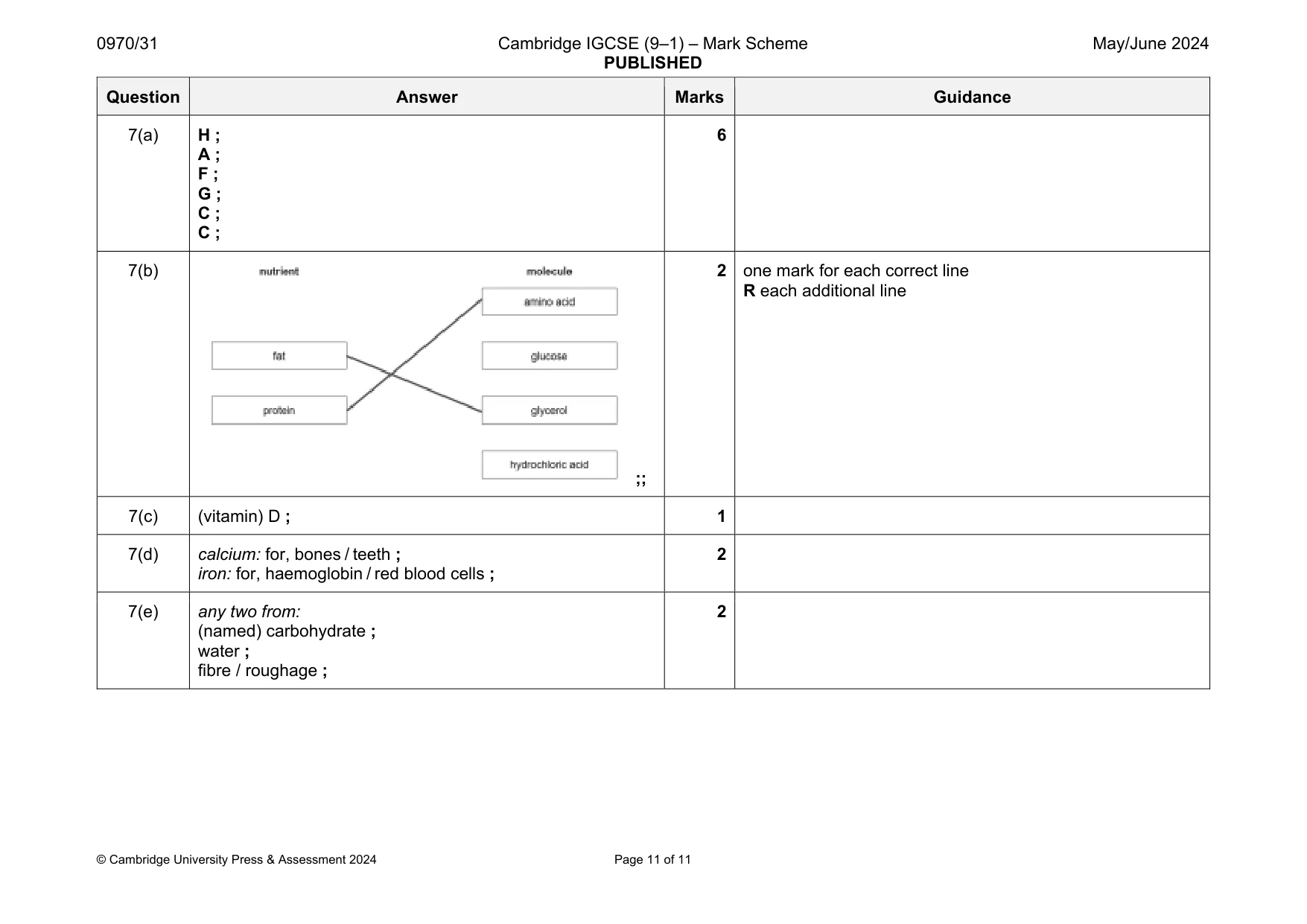
0970/31 Cambridge IGCSE (9–1) – Mark Scheme PUBLISHED May/June 2024 © Cambridge University Press & Assessment 2024 Page 11 of 11 Question Answer Marks Guidance 7(a) H ; A ; F ; G ; C ; C ; 6 7(b) ;; 2 one mark for each correct line R each additional line 7(c) (vitamin) D ; 1 7(d) calcium: for, bones / teeth ; iron: for, haemoglobin / red blood cells ; 2 7(e) any two from: (named) carbohydrate ; water ; fibre / roughage ; 2
What you needed in this session
Cambridge’s own grade thresholds for 2024 May/June, Paper 3 · Variant 1. A higher threshold means an easier paper — the bar moves with how the cohort did.