Cambridge IGCSE Biology (9-1) 0970 — 2019 May/June Paper 3 · Variant 1
0970/31/M/J/19 · 8 questions · 80 marks · ≈90 min
The question paper and its mark scheme, free to read here and free to download. This is Cambridge’s own paper, exactly as it was sat.
Question paper20 pages
Mark scheme11 pages
Answers below. Sit the paper first if you are practising.
Questions as text
Q1 · The boxes on the left contain the names of flower parts
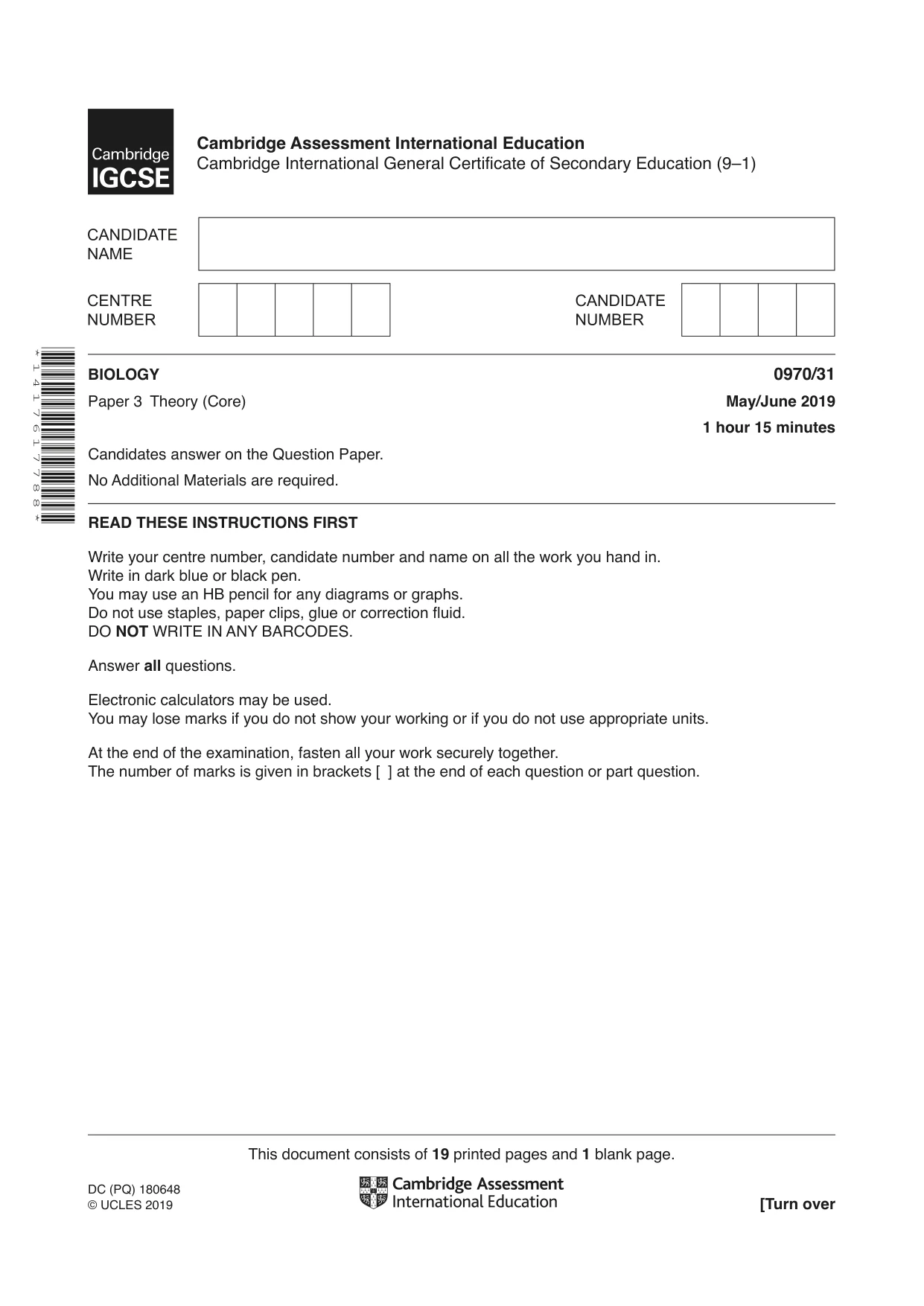
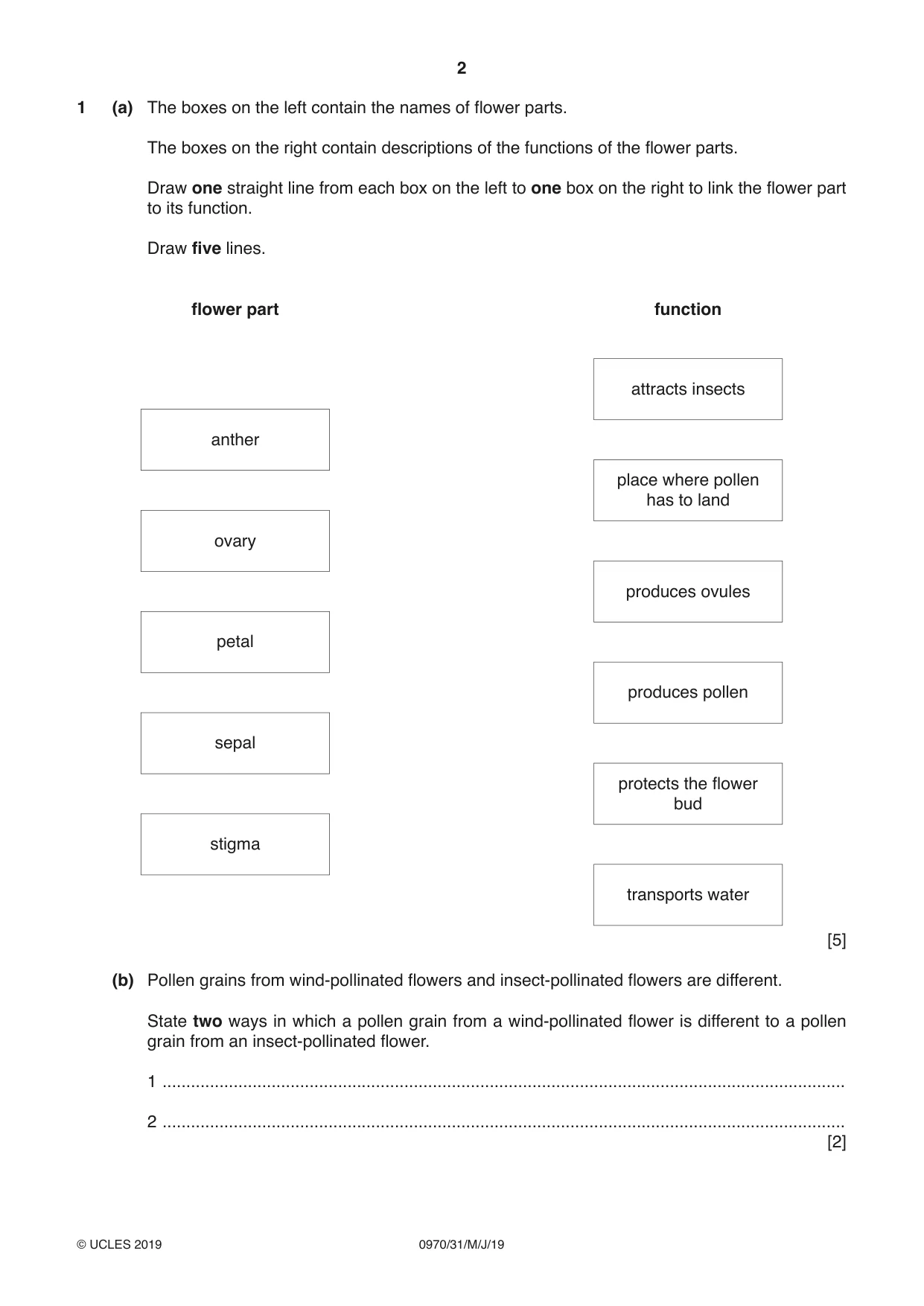
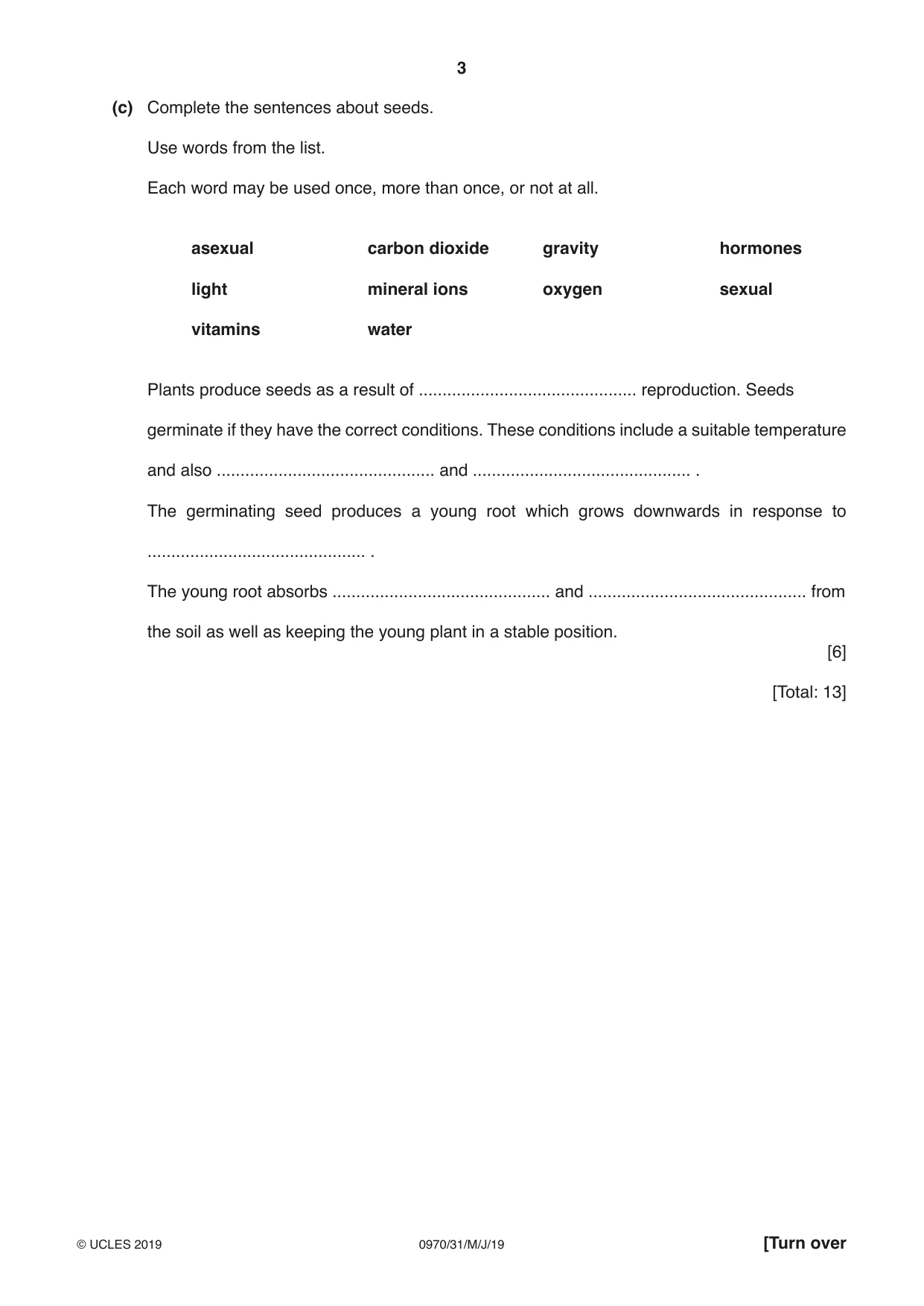
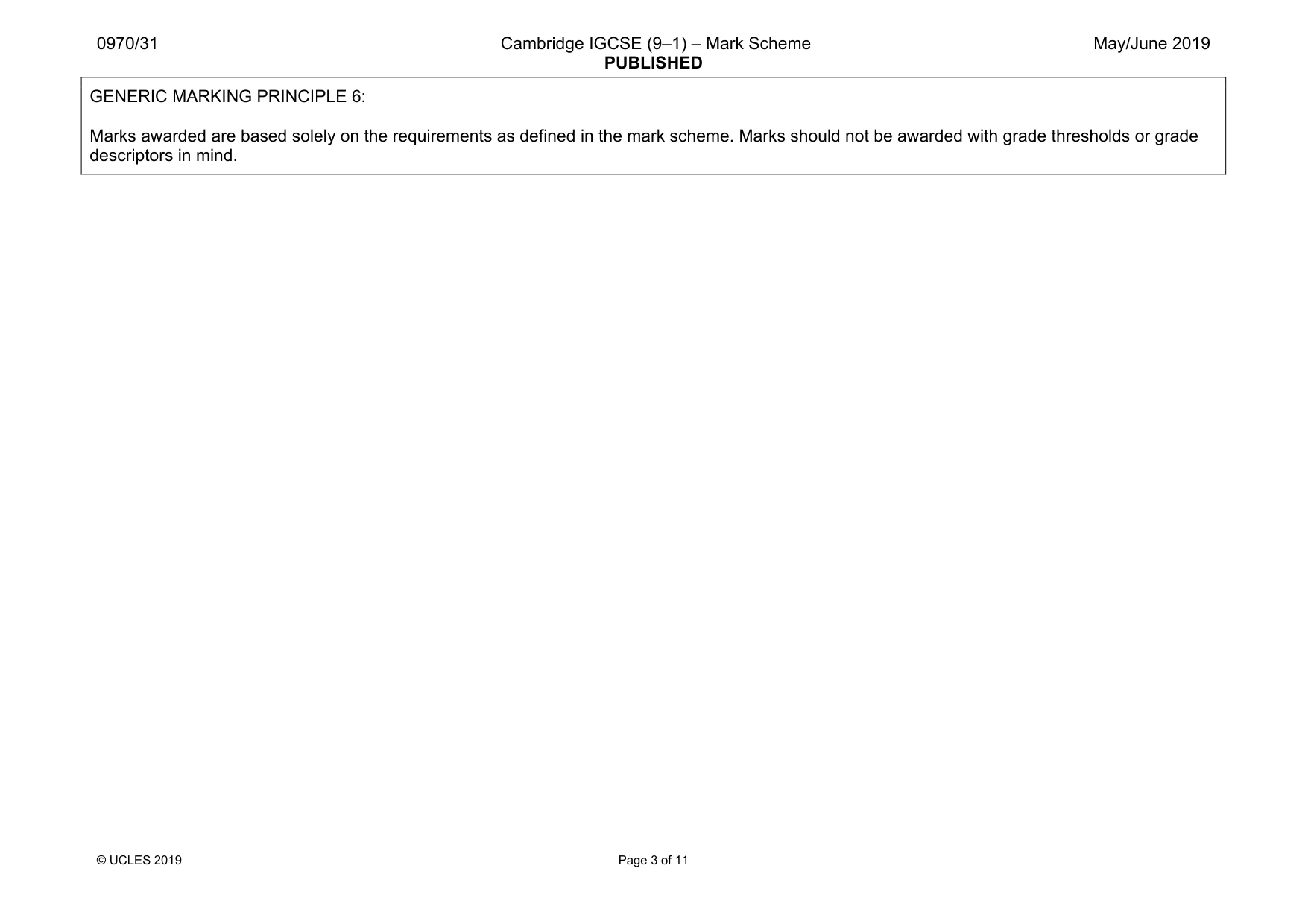
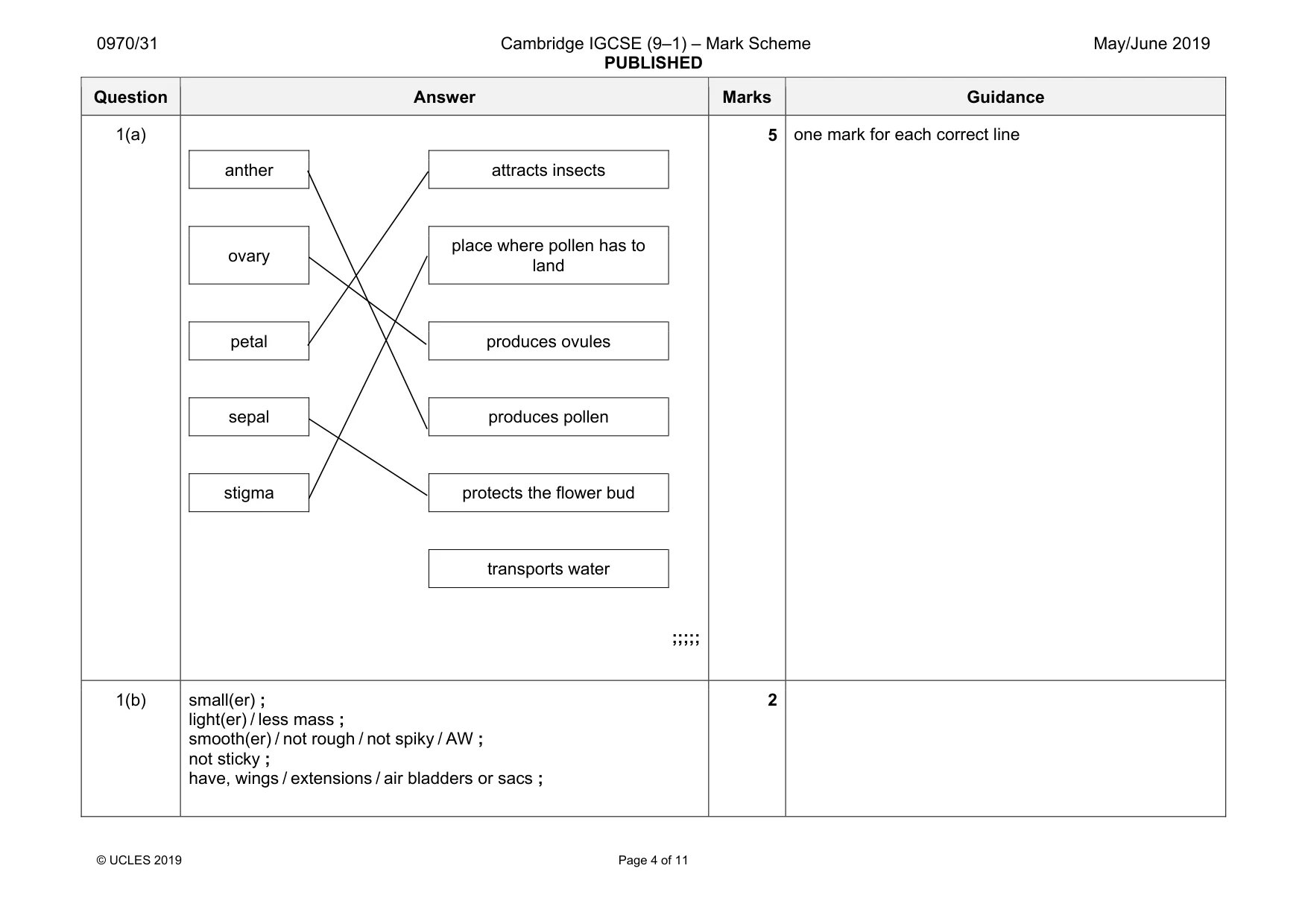
1 (a) The boxes on the left contain the names of flower parts. The boxes on the right contain descriptions of the functions of the flower parts. Draw one straight line from each box on the left to one box on the right to link the flower part to its function. Draw five lines. flower part function attracts insects anther place where pollen has to land ovary produces ovules petal produces pollen sepal protects the flower bud stigma transports water [5] (b) Pollen grains from wind-pollinated flowers and insect-pollinated flowers are different. State two ways in which a pollen grain from a wind-pollinated flower is different to a pollen grain from an insect-pollinated flower. 1 ................................................................................................................................................ 2 ................................................................................................................................................ [2] (c) Complete the sentences about seeds. Use words from the list. Each word may be used once, more than once, or not at all. asexual carbon dioxide gravity hormones light mineral ions oxygen sexual vitamins water Plants produce seeds as a result of .............................................. reproduction. Seeds germinate if they have the correct conditions. These conditions include a suitable temperature and also .............................................. and .............................................. . The germinating seed produces a young root which grows downwards in response to .............................................. . The young root absorbs .............................................. and .............................................. from the soil as well as keeping the young plant in a stable position. [6] [Total: 13]
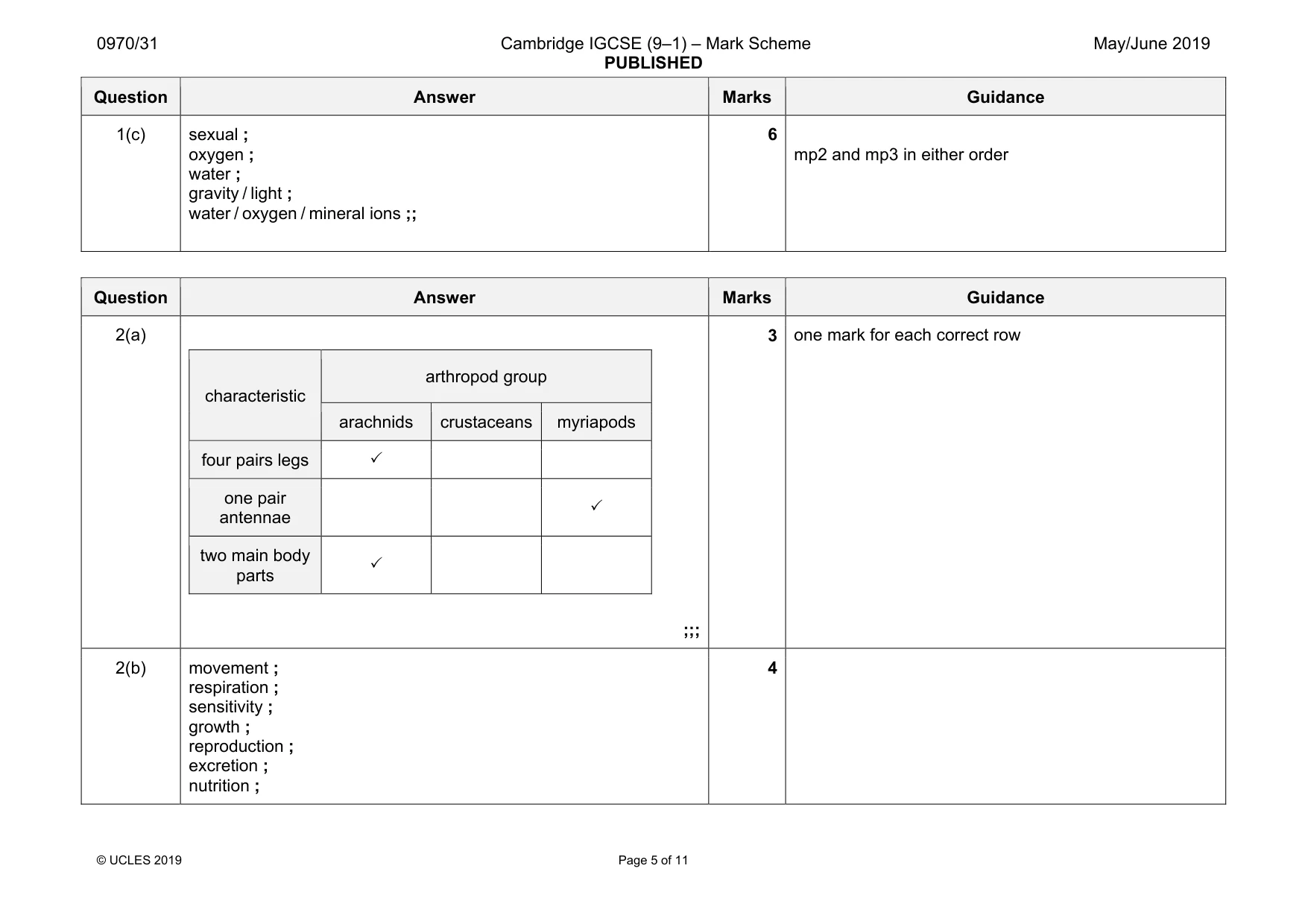
Mark scheme: 1(a) ;;;;; anther attracts insects ovary place where pollen has to land petal produces ovules sepal produces pollen stigma protects the flower bud transports water 5 1(b) small(er) ; light(er) / less mass ; smooth(er) / not rough / not spiky / AW ; not sticky ; have, wings / extensions / air bladders or sacs ; 2 Question Answer Marks Guidance 1(c) sexual ; oxygen ; water ; gravity / light ; water / oxygen / mineral ions ;; 6 mp2 and mp3 in either order
Q2 · The names of three groups of arthropods and some of their characteristics
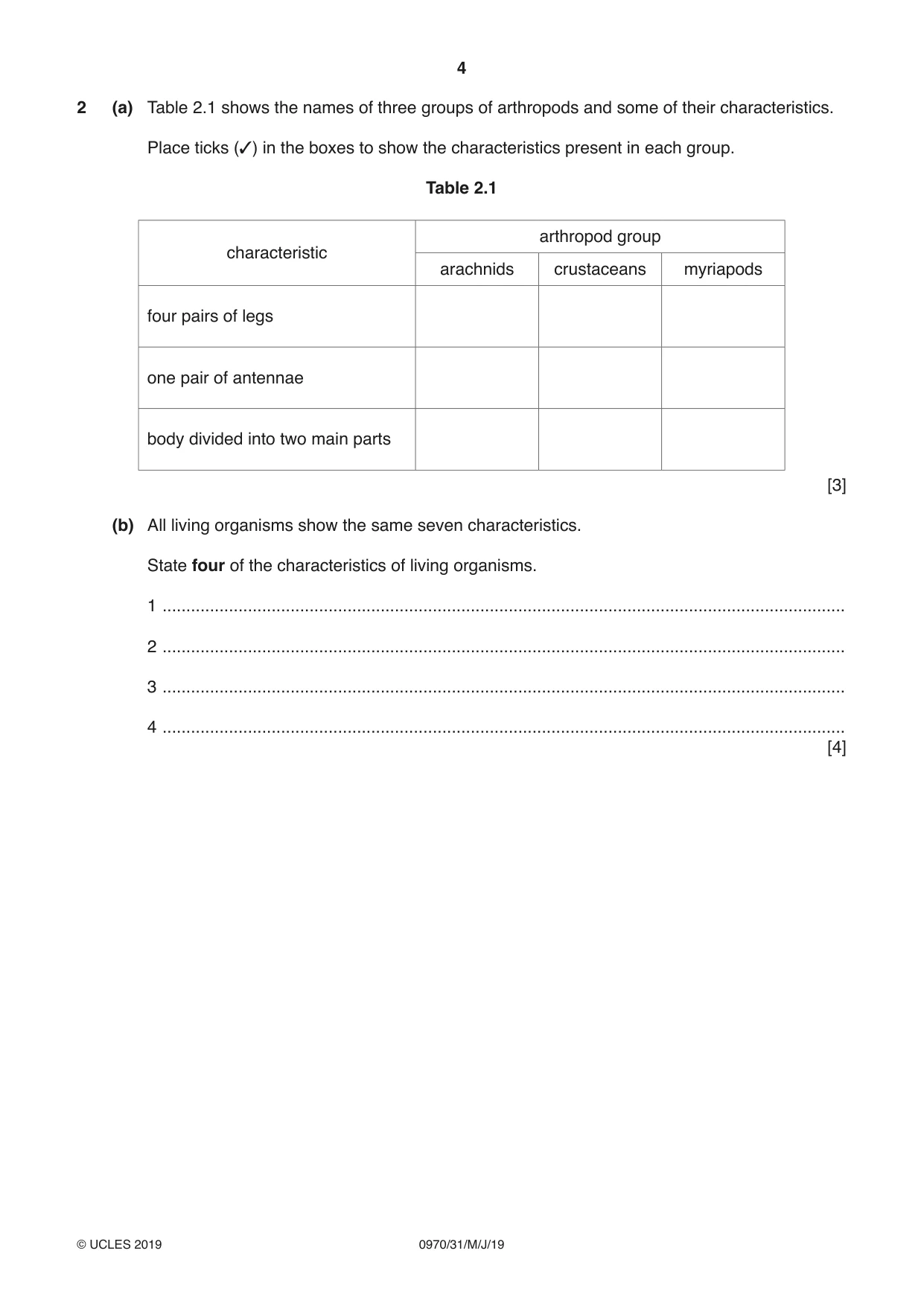
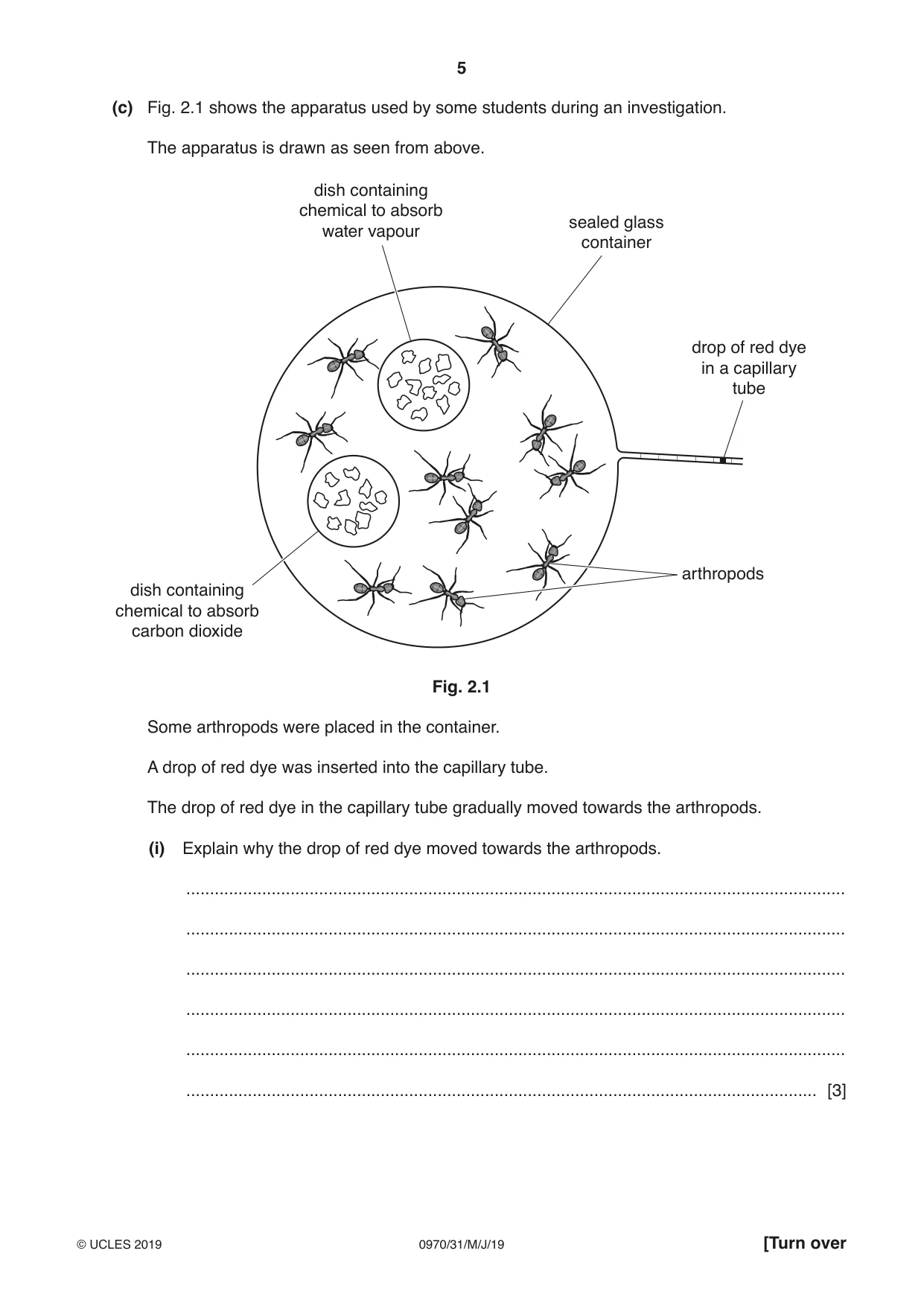
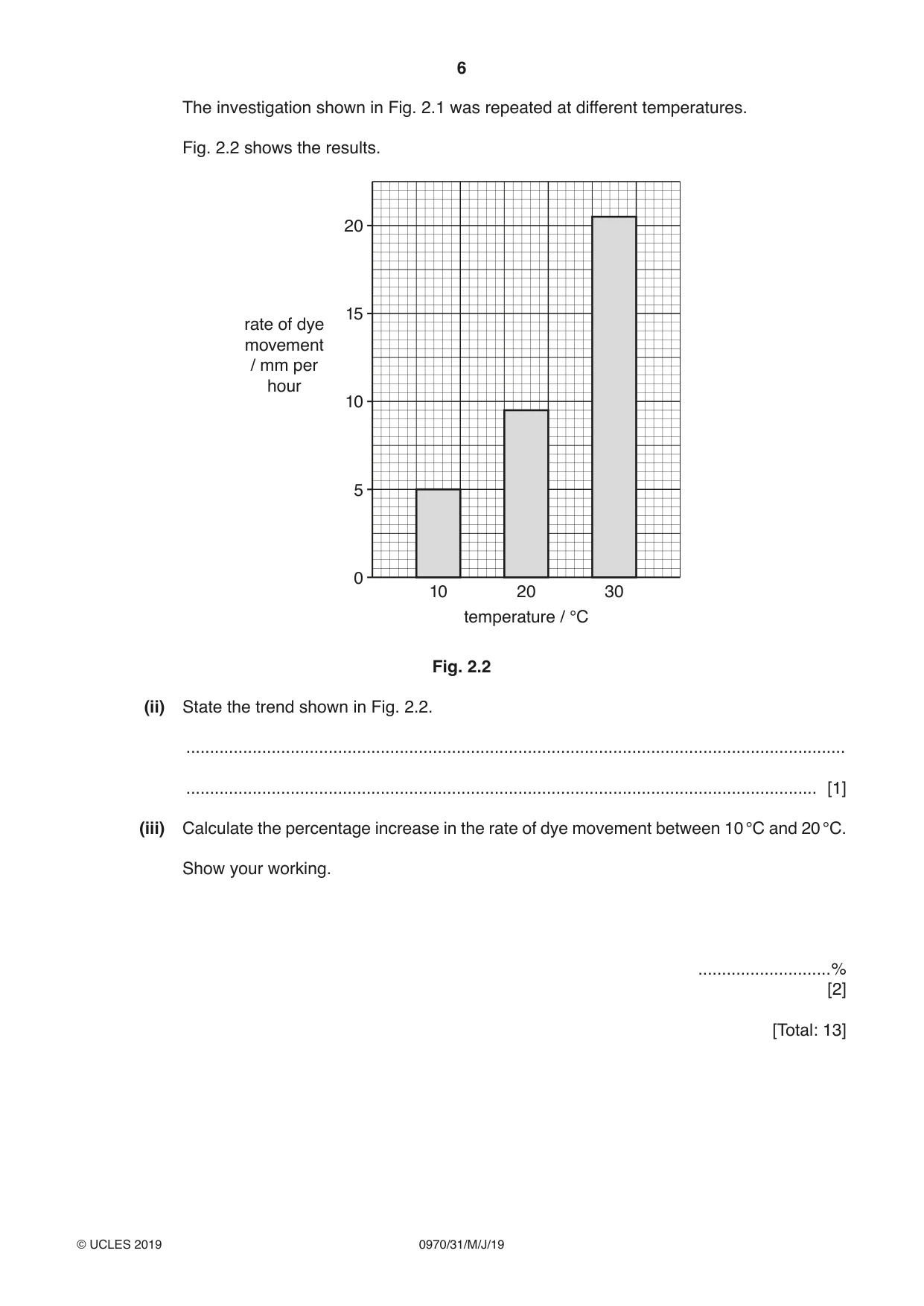
2 (a) Table 2.1 shows the names of three groups of arthropods and some of their characteristics. Place ticks (✓) in the boxes to show the characteristics present in each group. Table 2.1 arthropod group characteristic arachnids crustaceans myriapods four pairs of legs one pair of antennae body divided into two main parts [3] (b) All living organisms show the same seven characteristics. State four of the characteristics of living organisms. 1 ................................................................................................................................................ 2 ................................................................................................................................................ 3 ................................................................................................................................................ 4 ................................................................................................................................................ [4] (c) Fig. 2.1 shows the apparatus used by some students during an investigation. The apparatus is drawn as seen from above. dish containing chemical to absorb sealed glass water vapour container drop of red dye in a capillary tube arthropods dish containing chemical to absorb carbon dioxide Fig. 2.1 Some arthropods were placed in the container. A drop of red dye was inserted into the capillary tube. The drop of red dye in the capillary tube gradually moved towards the arthropods. (i) Explain why the drop of red dye moved towards the arthropods. ........................................................................................................................................... ........................................................................................................................................... ........................................................................................................................................... ........................................................................................................................................... ........................................................................................................................................... ..................................................................................................................................... [3] The investigation shown in Fig. 2.1 was repeated at different temperatures. Fig. 2.2 shows the results. 20 15 rate of dye movement / mm per hour 10 5 0 10 20 30 temperature / °C Fig. 2.2 (ii) State the trend shown in Fig. 2.2. ........................................................................................................................................... ..................................................................................................................................... [1] (iii) Calculate the percentage increase in the rate of dye movement between 10 °C and 20 °C. Show your working. ............................% [2] [Total: 13]
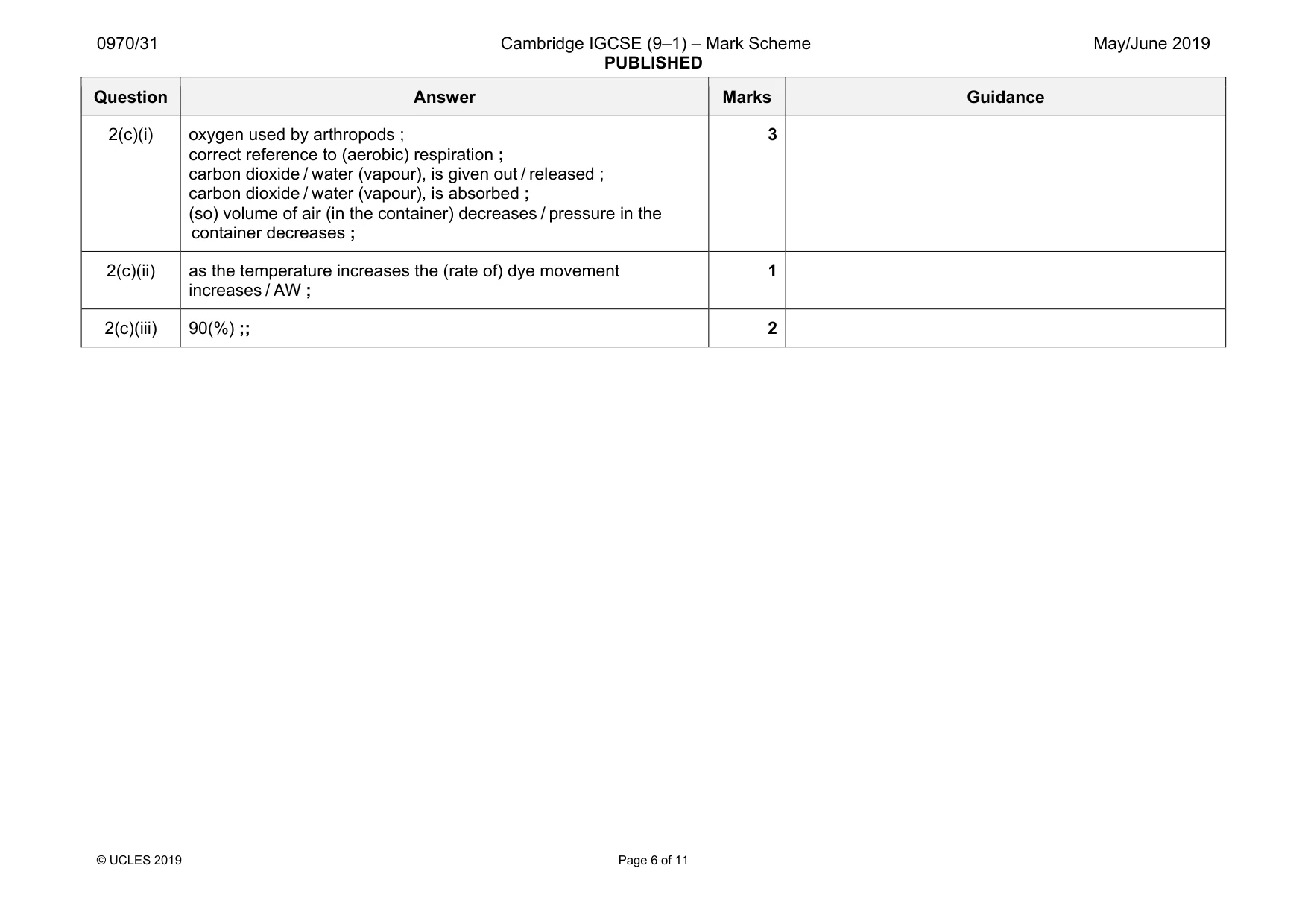
Mark scheme: 2(a) ;;; characteristic arthropod group arachnids crustaceans myriapods four pairs legs 3 one pair antennae 3 two main body parts 3 3 2(b) movement ; respiration ; sensitivity ; growth ; reproduction ; excretion ; nutrition ; 4 Question Answer Marks Guidance 2(c)(i) oxygen used by arthropods ; correct reference to (aerobic) respiration ; carbon dioxide / water (vapour), is given out / released ; carbon dioxide / water (vapour), is absorbed ; (so) volume of air (in the container) decreases / pressure in the container decreases ; 3 2(c)(ii) as the temperature increases the (rate of) dye movement increases / AW ; 1 2(c)(iii) 90(%) ;; 2
Q3 · A diagram of the alimentary canal and associated organs
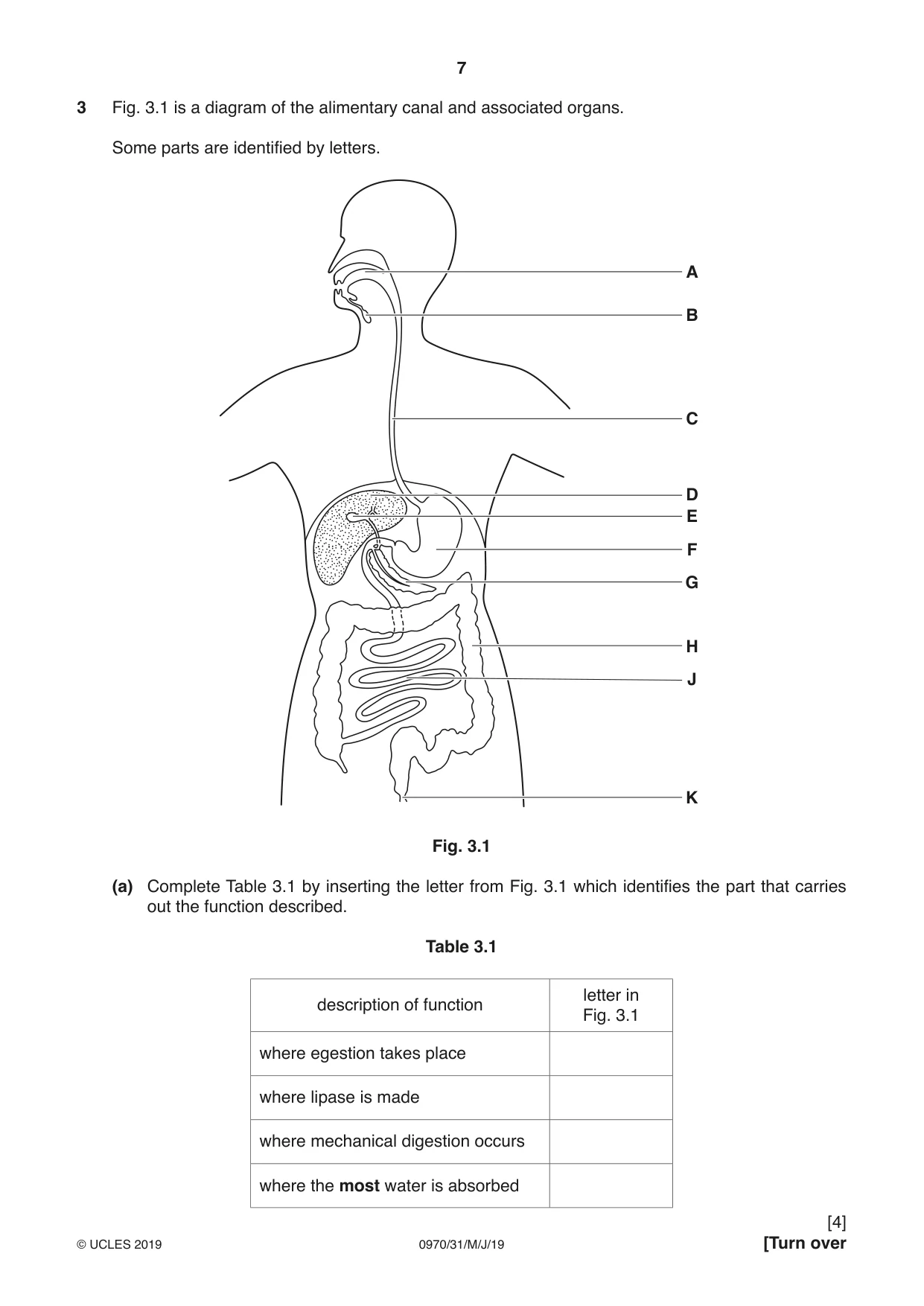
3 Fig. 3.1 is a diagram of the alimentary canal and associated organs. Some parts are identified by letters. A B C D E F G H J K Fig. 3.1 (a) Complete Table 3.1 by inserting the letter from Fig. 3.1 which identifies the part that carries out the function described. Table 3.1 letter in description of function Fig. 3.1 where egestion takes place where lipase is made where mechanical digestion occurs where the most water is absorbed (b) Cholera is a transmissible disease. (i) State the type of pathogen that causes cholera. ..................................................................................................................................... [1] (ii) One of the symptoms of cholera is diarrhoea. Describe what is meant by the term diarrhoea. ........................................................................................................................................... ..................................................................................................................................... [1] (iii) Outline the treatment for diarrhoea. ........................................................................................................................................... ........................................................................................................................................... ........................................................................................................................................... ........................................................................................................................................... ..................................................................................................................................... [2] (c) State two ways in which the body can defend itself against pathogens. 1 ................................................................................................................................................ 2 ................................................................................................................................................ [2] [Total: 10]
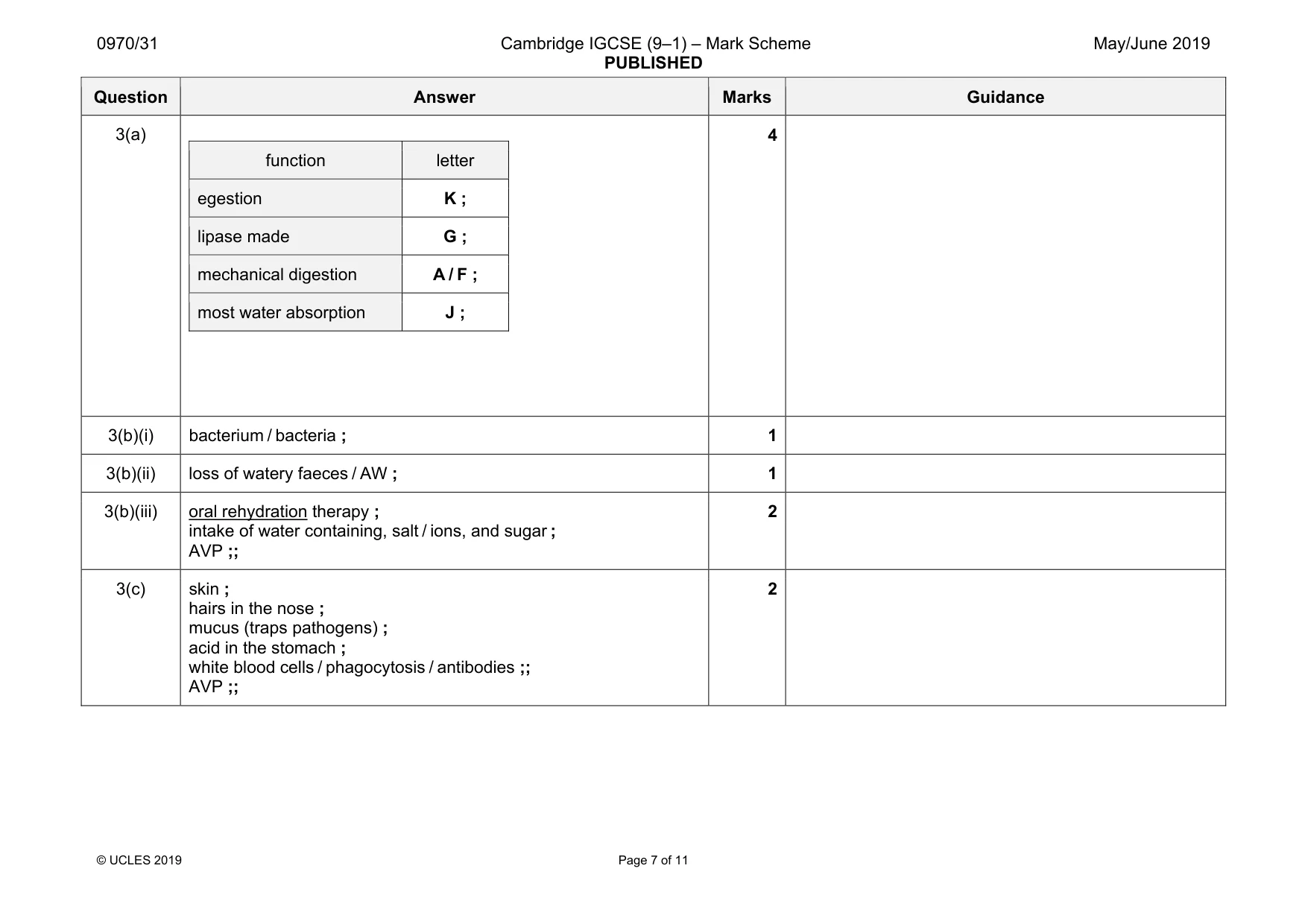
Mark scheme: 3(a) function letter egestion K ; lipase made G ; mechanical digestion A / F ; most water absorption J ; 4 3(b)(i) bacterium / bacteria ; 1 3(b)(ii) loss of watery faeces / AW ; 1 3(b)(iii) oral rehydration therapy ; intake of water containing, salt / ions, and sugar ; AVP ;; 2 3(c) skin ; hairs in the nose ; mucus (traps pathogens) ; acid in the stomach ; white blood cells / phagocytosis / antibodies ;; AVP ;; 2
Q4 · A diagram of a palisade mesophyll cell
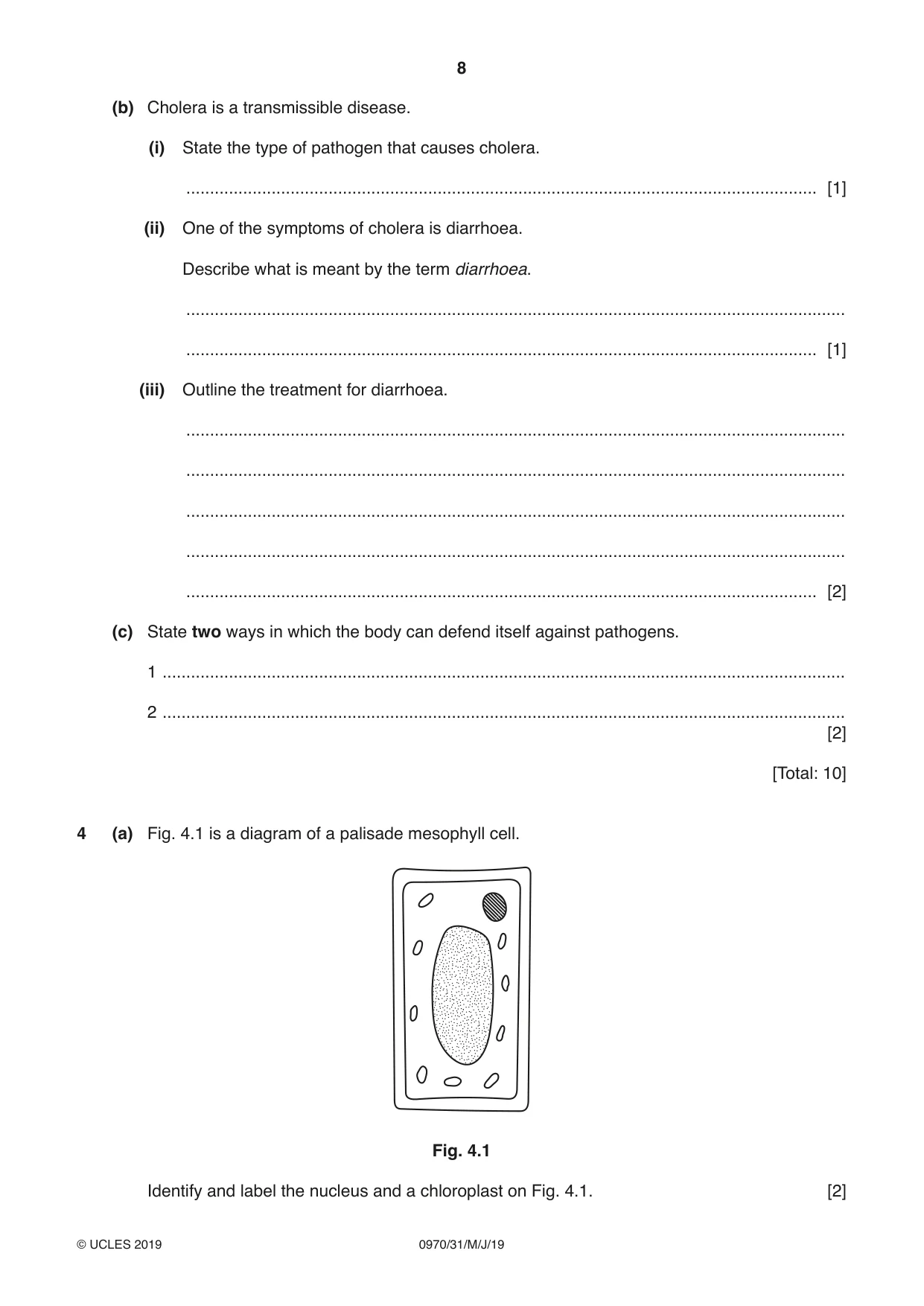
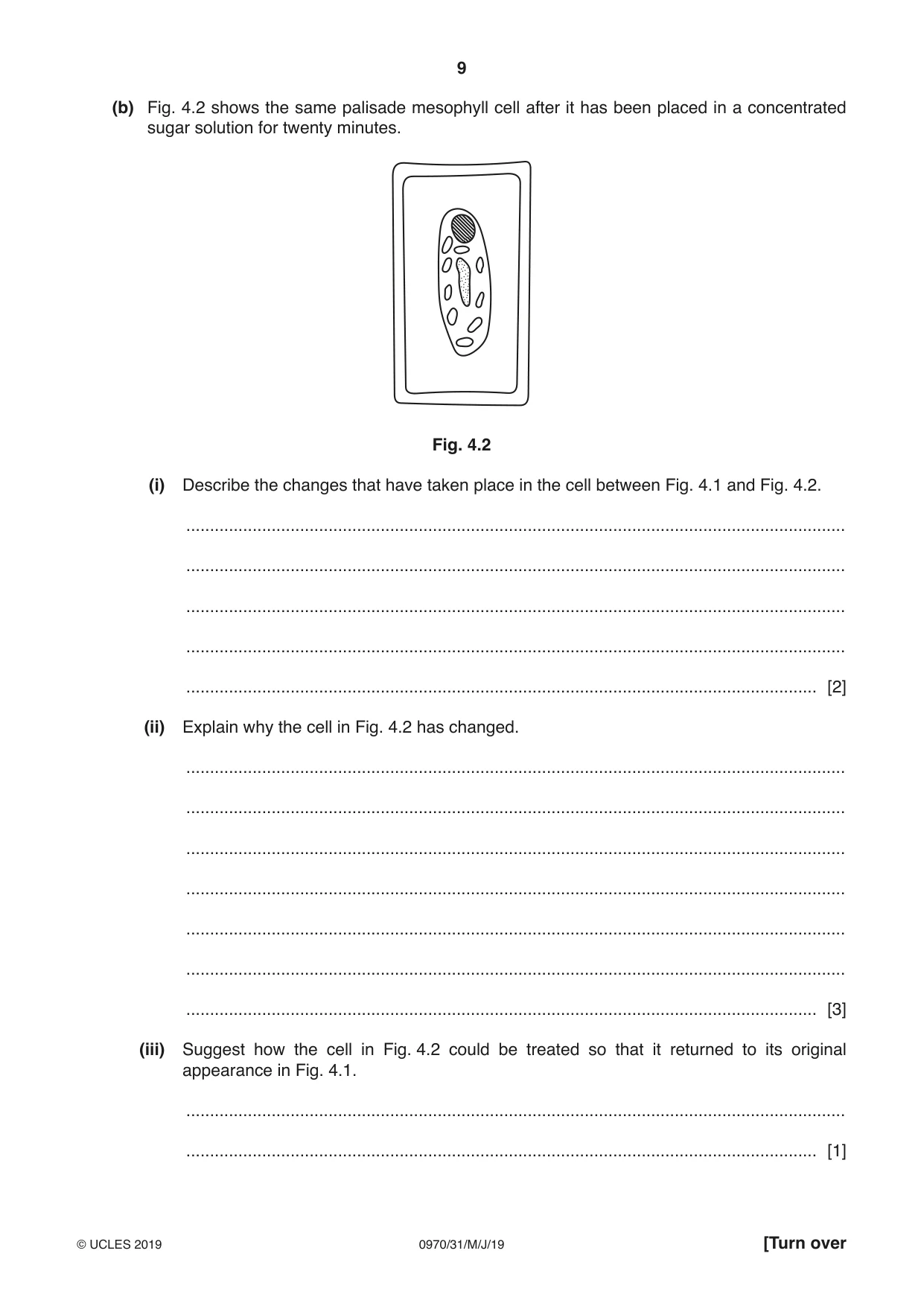
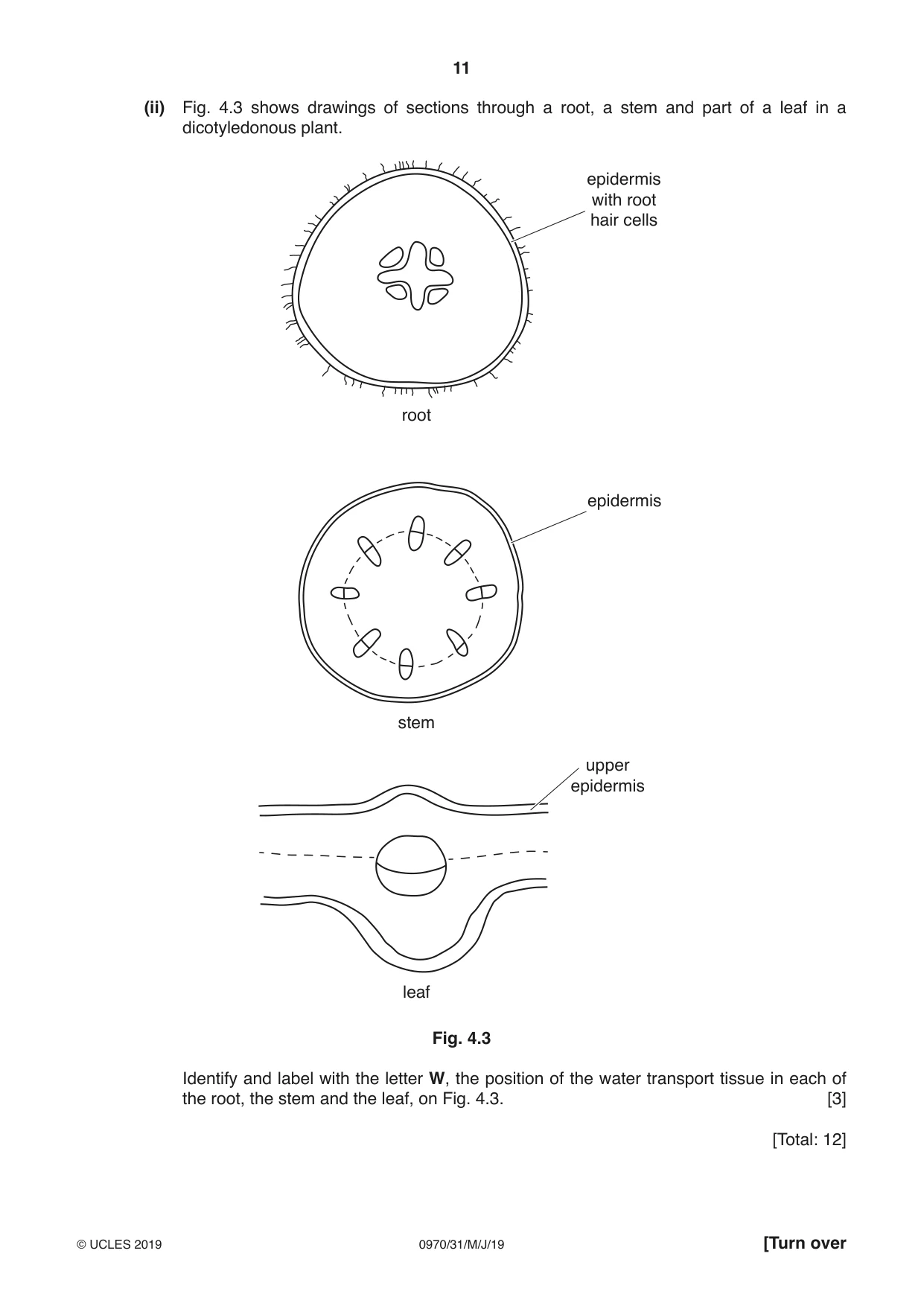
4 (a) Fig. 4.1 is a diagram of a palisade mesophyll cell. Fig. 4.1 Identify and label the nucleus and a chloroplast on Fig. 4.1. [2] (b) Fig. 4.2 shows the same palisade mesophyll cell after it has been placed in a concentrated sugar solution for twenty minutes. Fig. 4.2 (i) Describe the changes that have taken place in the cell between Fig. 4.1 and Fig. 4.2. ........................................................................................................................................... ........................................................................................................................................... ........................................................................................................................................... ........................................................................................................................................... ..................................................................................................................................... [2] (ii) Explain why the cell in Fig. 4.2 has changed. ........................................................................................................................................... ........................................................................................................................................... ........................................................................................................................................... ........................................................................................................................................... ........................................................................................................................................... ........................................................................................................................................... ..................................................................................................................................... [3] (iii) Suggest how the cell in Fig. 4.2 could be treated so that it returned to its original appearance in Fig. 4.1. ........................................................................................................................................... ..................................................................................................................................... [1] (c) (i) State the name of the tissue that transports water up the stem and into a leaf in a plant. ..................................................................................................................................... [1] (ii) Fig. 4.3 shows drawings of sections through a root, a stem and part of a leaf in a dicotyledonous plant. epidermis with root hair cells root epidermis stem upper epidermis leaf Fig. 4.3 Identify and label with the letter W, the position of the water transport tissue in each of the root, the stem and the leaf, on Fig. 4.3. [3] [Total: 12]
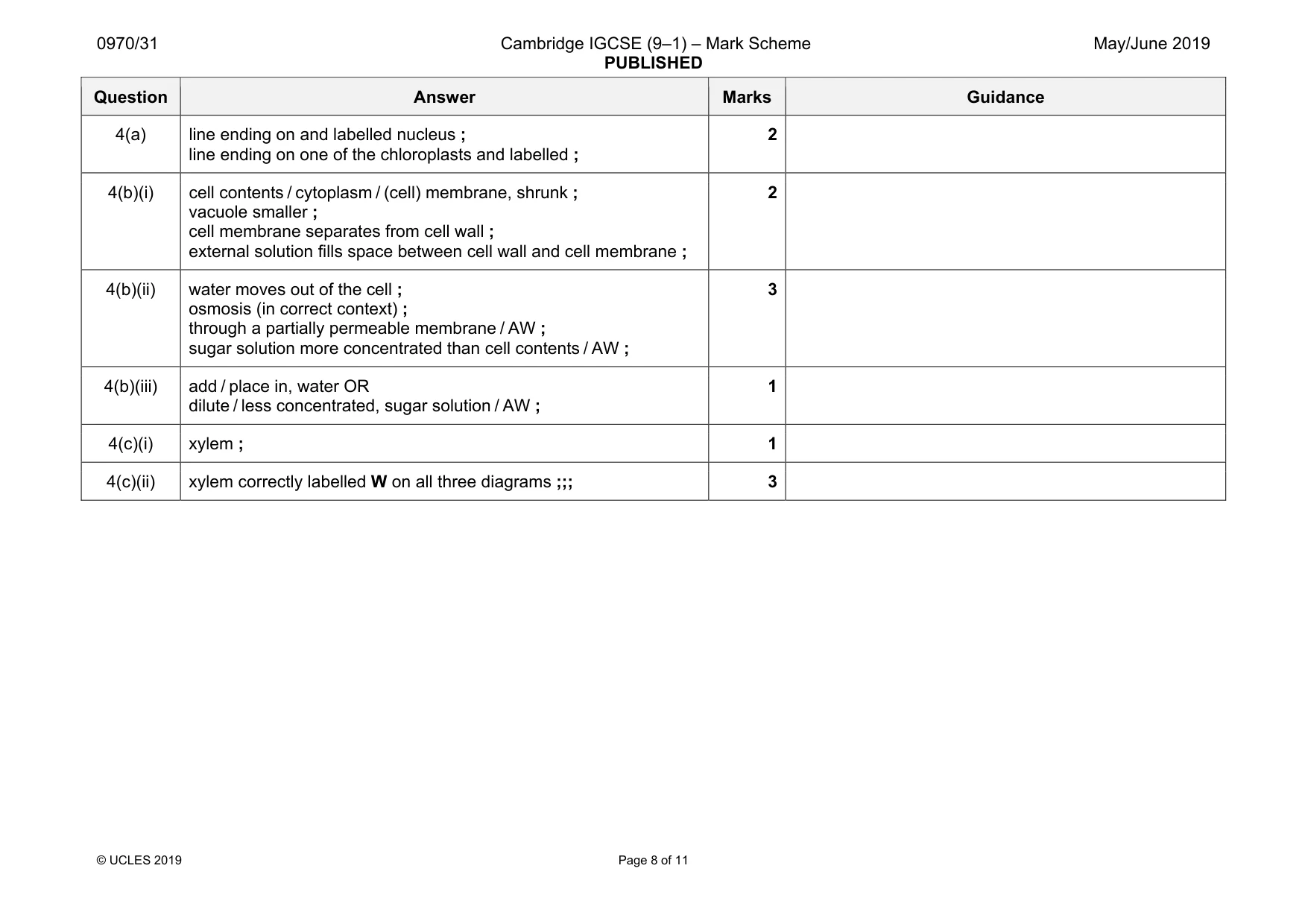
Mark scheme: 4(a) line ending on and labelled nucleus ; line ending on one of the chloroplasts and labelled ; 2 4(b)(i) cell contents / cytoplasm / (cell) membrane, shrunk ; vacuole smaller ; cell membrane separates from cell wall ; external solution fills space between cell wall and cell membrane ; 2 4(b)(ii) water moves out of the cell ; osmosis (in correct context) ; through a partially permeable membrane / AW ; sugar solution more concentrated than cell contents / AW ; 3 4(b)(iii) add / place in, water OR dilute / less concentrated, sugar solution / AW ; 1 4(c)(i) xylem ; 1 4(c)(ii) xylem correctly labelled W on all three diagrams ;;; 3
Question 5
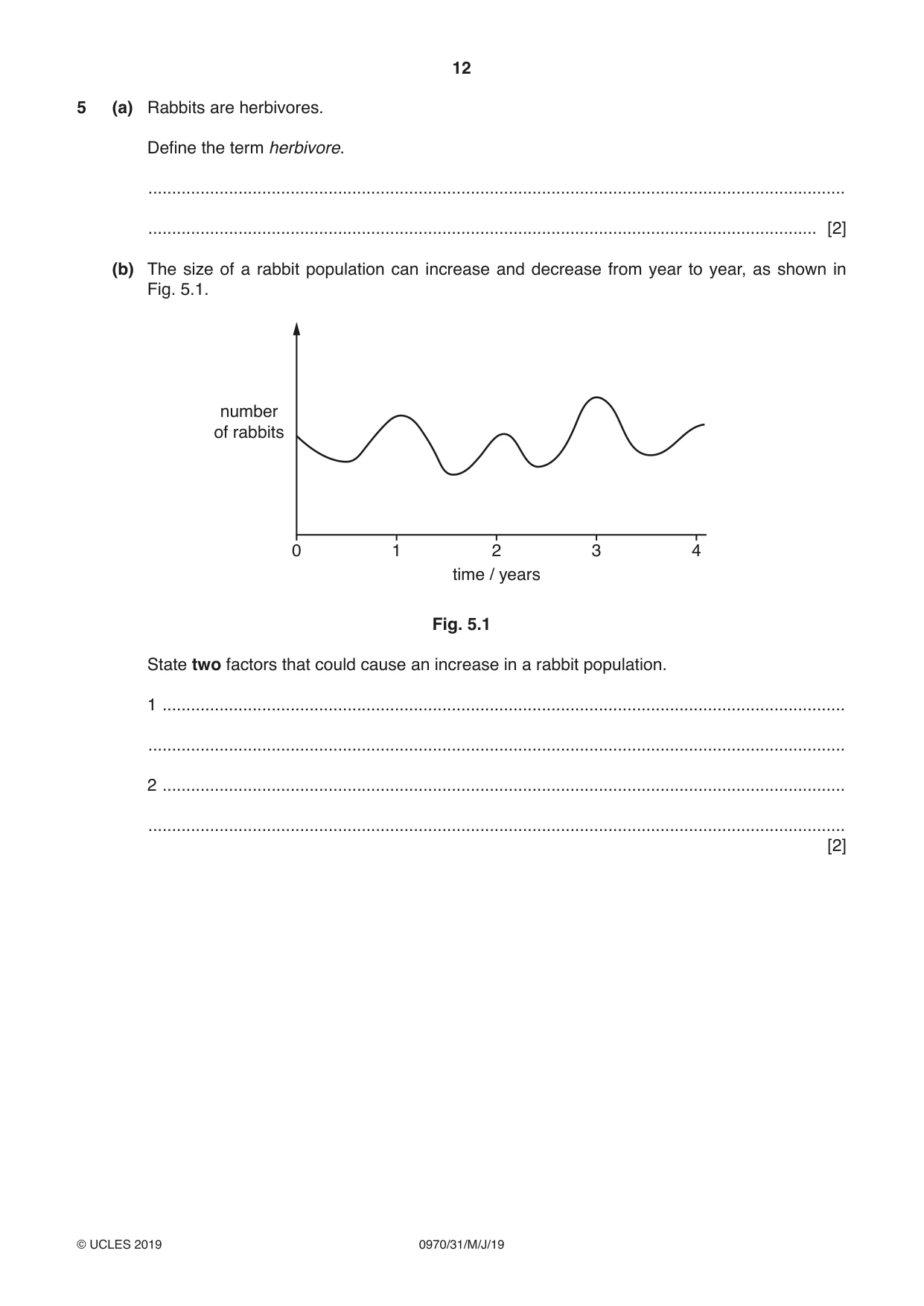
5 (a) Rabbits are herbivores. Define the term herbivore. ................................................................................................................................................... ............................................................................................................................................. [2] (b) The size of a rabbit population can increase and decrease from year to year, as shown in Fig. 5.1. number of rabbits 0 1 2 3 4 time / years Fig. 5.1 State two factors that could cause an increase in a rabbit population. 1 ................................................................................................................................................ ................................................................................................................................................... 2 ................................................................................................................................................ ................................................................................................................................................... [2] (c) Since 1800 the population of humans in the world has increased dramatically. State three ways in which this increase in the human population has affected marine ecosystems. 1 ................................................................................................................................................ ................................................................................................................................................... 2 ................................................................................................................................................ ................................................................................................................................................... 3 ................................................................................................................................................ ................................................................................................................................................... [3] [Total: 7]
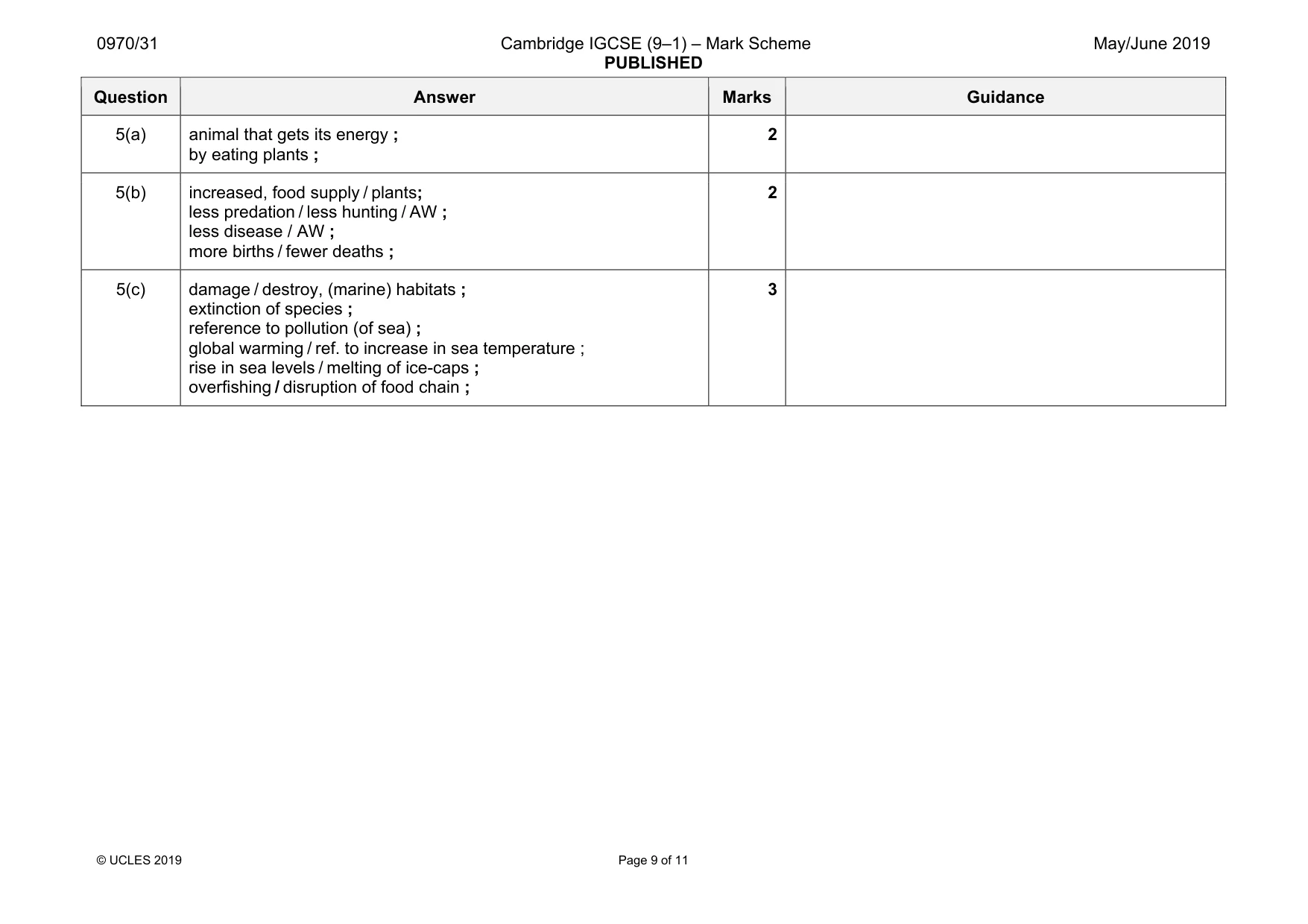
Mark scheme: 5(a) animal that gets its energy ; by eating plants ; 2 5(b) increased, food supply / plants; less predation / less hunting / AW ; less disease / AW ; more births / fewer deaths ; 2 5(c) damage / destroy, (marine) habitats ; extinction of species ; reference to pollution (of sea) ; global warming / ref. to increase in sea temperature ; rise in sea levels / melting of ice-caps ; overfishing / disruption of food chain ; 3
Q6 · Complete the sentences by stating the part of the human body that produces male gametes…
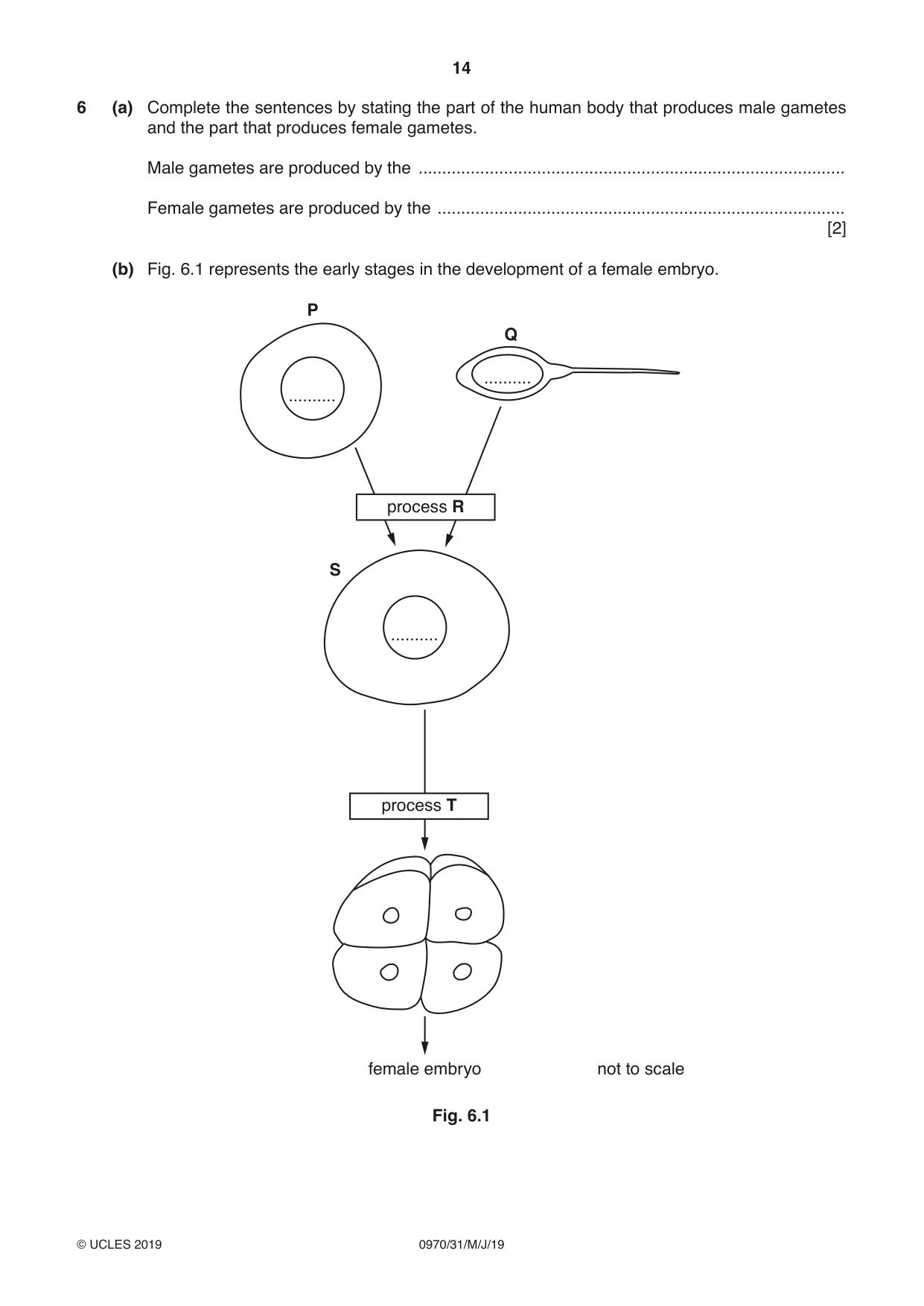
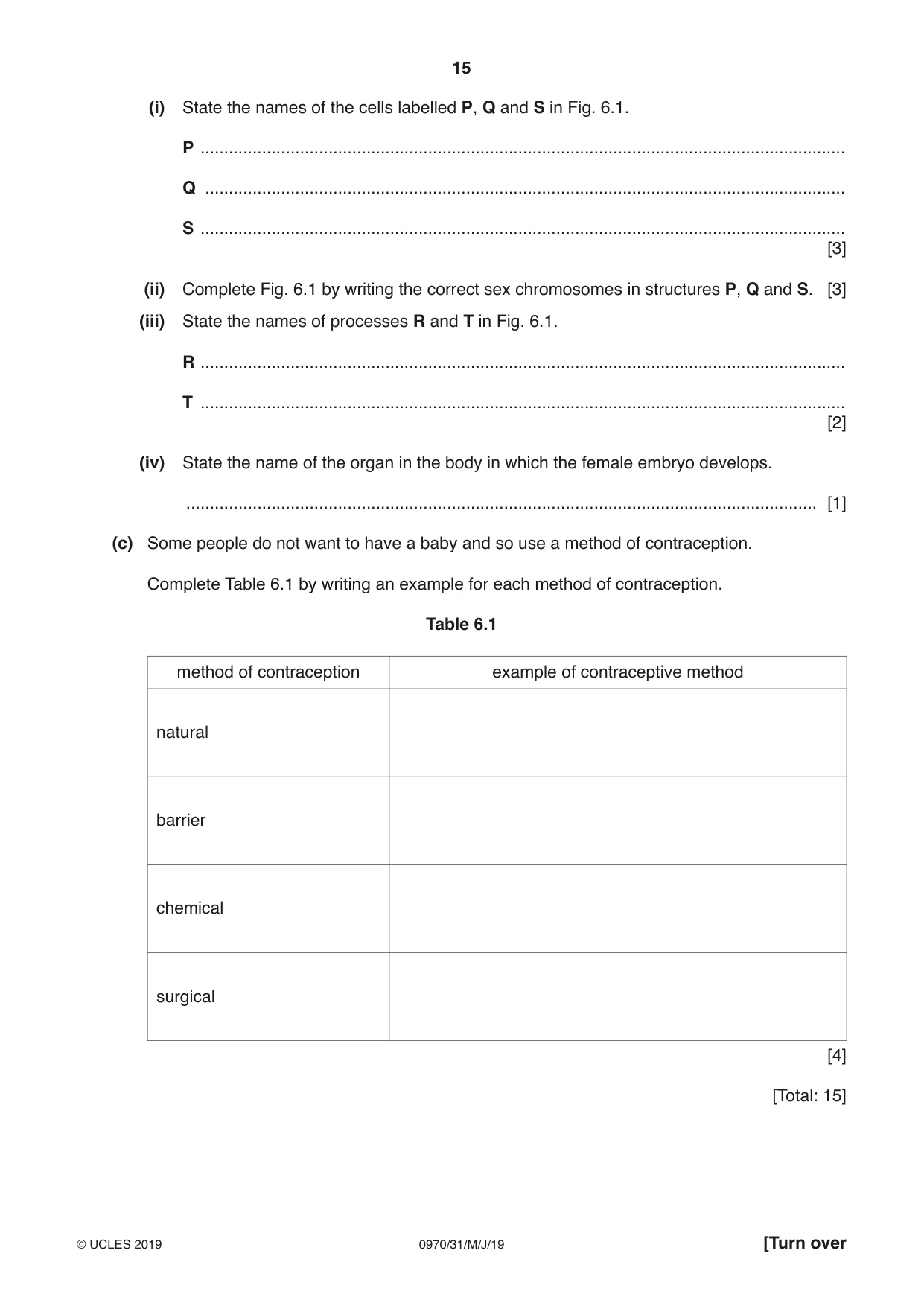
6 (a) Complete the sentences by stating the part of the human body that produces male gametes and the part that produces female gametes. Male gametes are produced by the .......................................................................................... Female gametes are produced by the ...................................................................................... [2] (b) Fig. 6.1 represents the early stages in the development of a female embryo. P Q .......... .......... process R S .......... process T female embryo not to scale Fig. 6.1 (i) State the names of the cells labelled P, Q and S in Fig. 6.1. P ........................................................................................................................................ Q ....................................................................................................................................... S ........................................................................................................................................ [3] (ii) Complete Fig. 6.1 by writing the correct sex chromosomes in structures P, Q and S. [3] (iii) State the names of processes R and T in Fig. 6.1. R ........................................................................................................................................ T ........................................................................................................................................ [2] (iv) State the name of the organ in the body in which the female embryo develops. ..................................................................................................................................... [1] (c) Some people do not want to have a baby and so use a method of contraception. Complete Table 6.1 by writing an example for each method of contraception. Table 6.1 method of contraception example of contraceptive method natural barrier chemical surgical [4] [Total: 15]
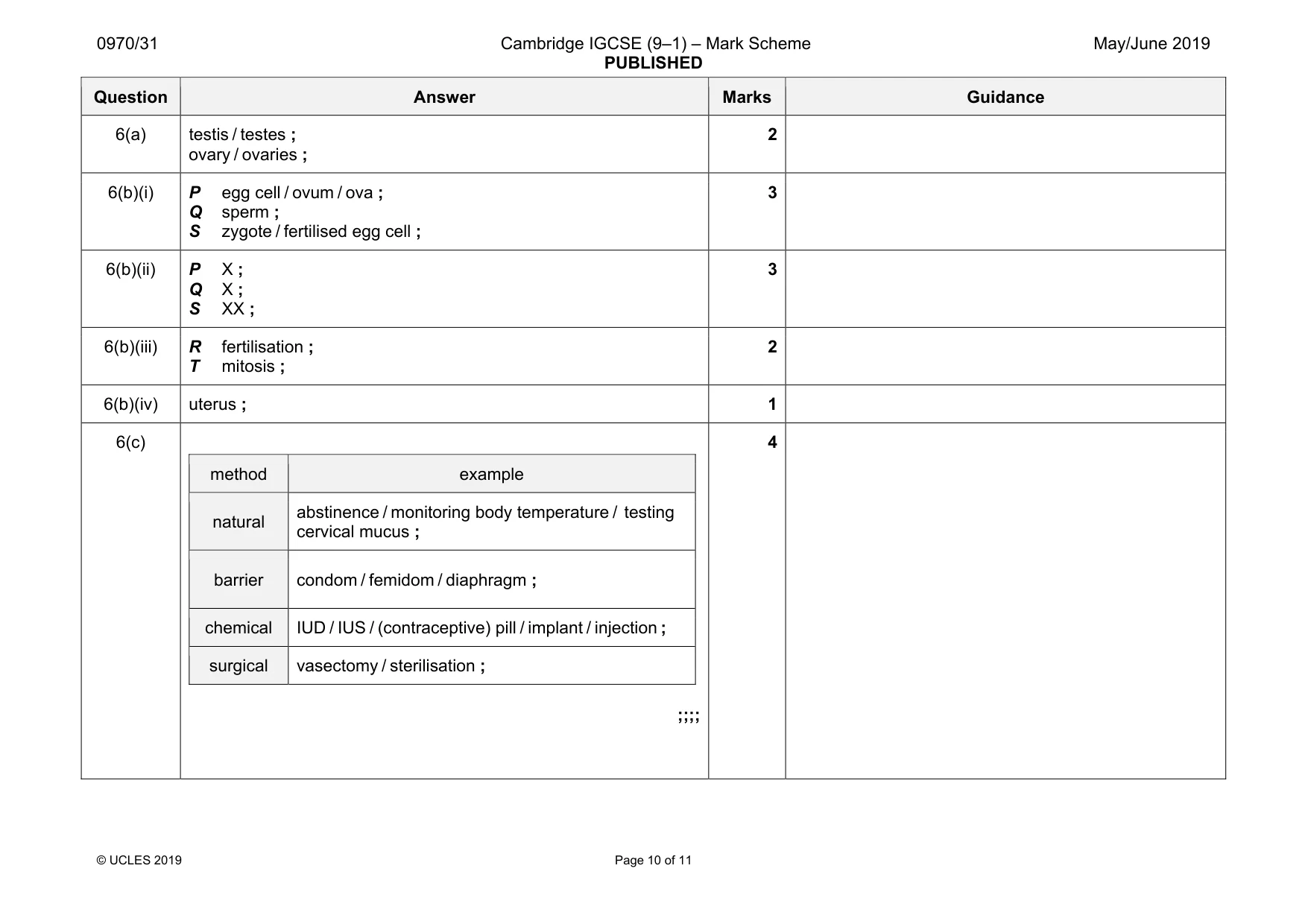
Mark scheme: 6(a) testis / testes ; ovary / ovaries ; 2 6(b)(i) P egg cell / ovum / ova ; Q sperm ; S zygote / fertilised egg cell ; 3 6(b)(ii) P X ; Q X ; S XX ; 3 6(b)(iii) R fertilisation ; T mitosis ; 2 6(b)(iv) uterus ; 1 6(c) ;;;; method example natural abstinence / monitoring body temperature / testing cervical mucus ; barrier condom / femidom / diaphragm ; chemical IUD / IUS / (contraceptive) pill / implant / injection ; surgical vasectomy / sterilisation ; 4
Q7 · Blood circulates round the body in arteries, veins and capillaries
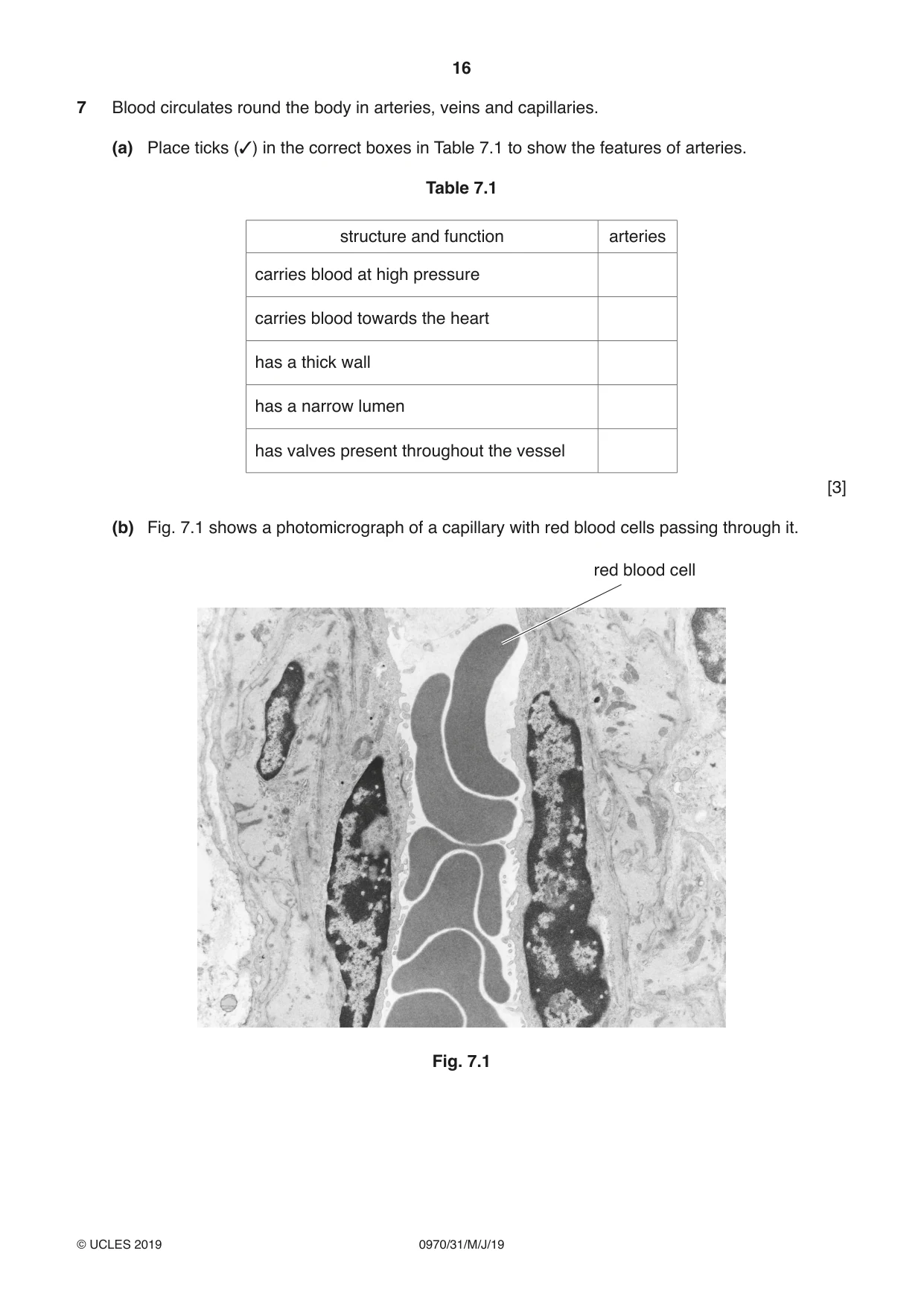
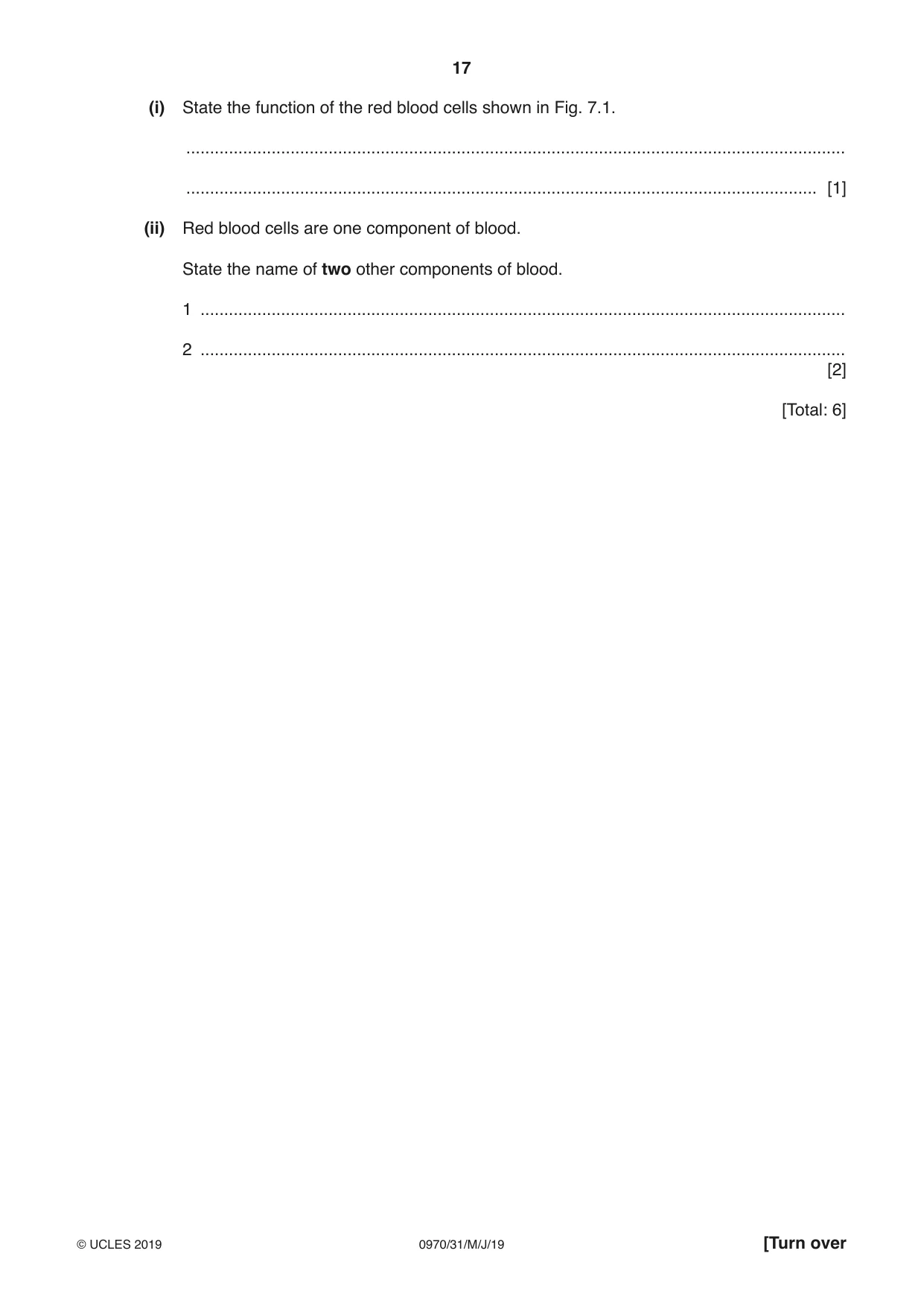
7 Blood circulates round the body in arteries, veins and capillaries. (a) Place ticks (✓) in the correct boxes in Table 7.1 to show the features of arteries. Table 7.1 structure and function arteries carries blood at high pressure carries blood towards the heart has a thick wall has a narrow lumen has valves present throughout the vessel [3] (b) Fig. 7.1 shows a photomicrograph of a capillary with red blood cells passing through it. red blood cell Fig. 7.1 (i) State the function of the red blood cells shown in Fig. 7.1. ........................................................................................................................................... ..................................................................................................................................... [1] (ii) Red blood cells are one component of blood. State the name of two other components of blood. 1 ........................................................................................................................................ 2 ........................................................................................................................................ [2] [Total: 6]
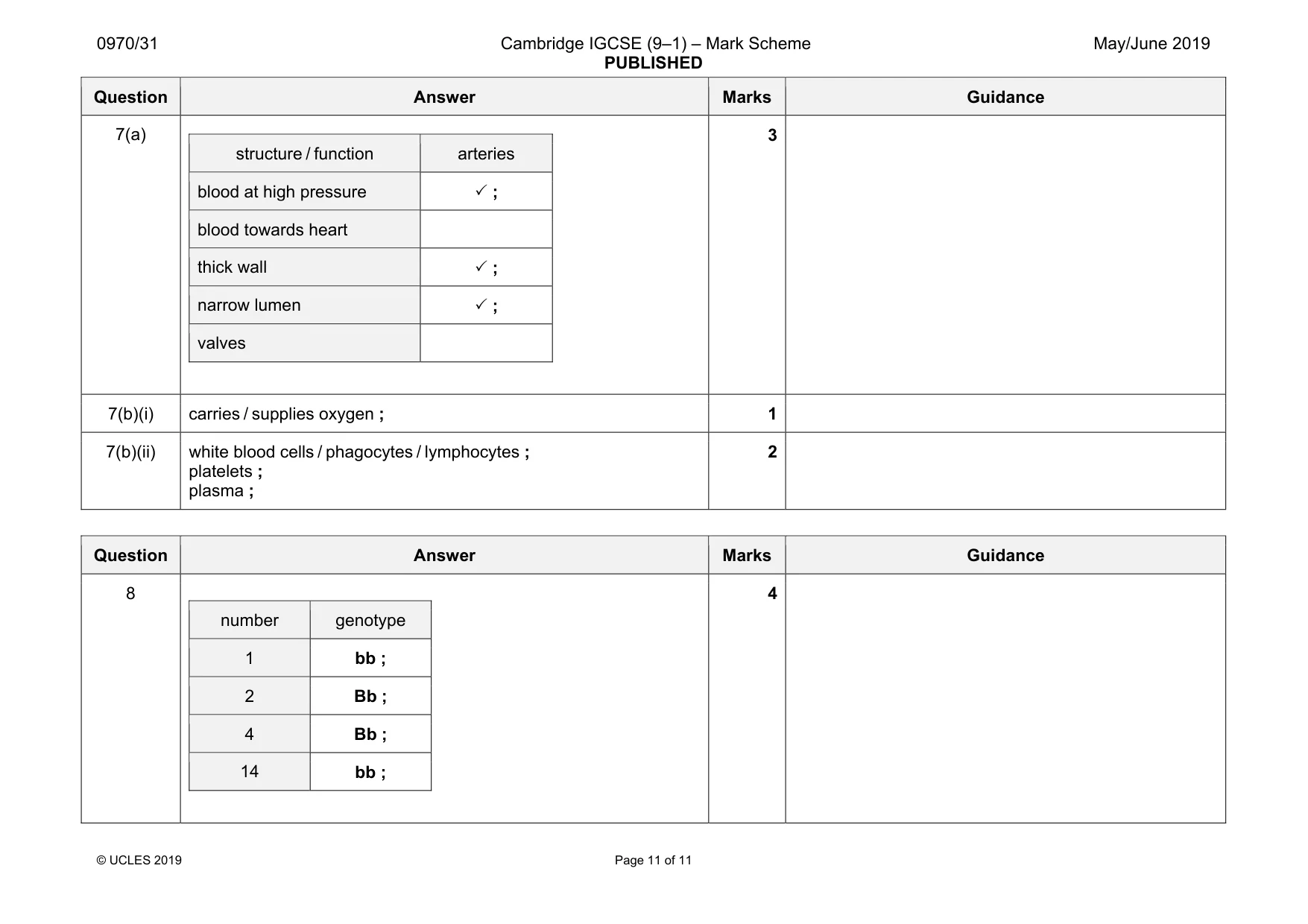
Mark scheme: 7(a) structure / function arteries blood at high pressure 3 ; blood towards heart thick wall 3 ; narrow lumen 3 ; valves 3 7(b)(i) carries / supplies oxygen ; 1 7(b)(ii) white blood cells / phagocytes / lymphocytes ; platelets ; plasma ; 2
Q8 · A cat with an inherited condition that means the cat has extra toes
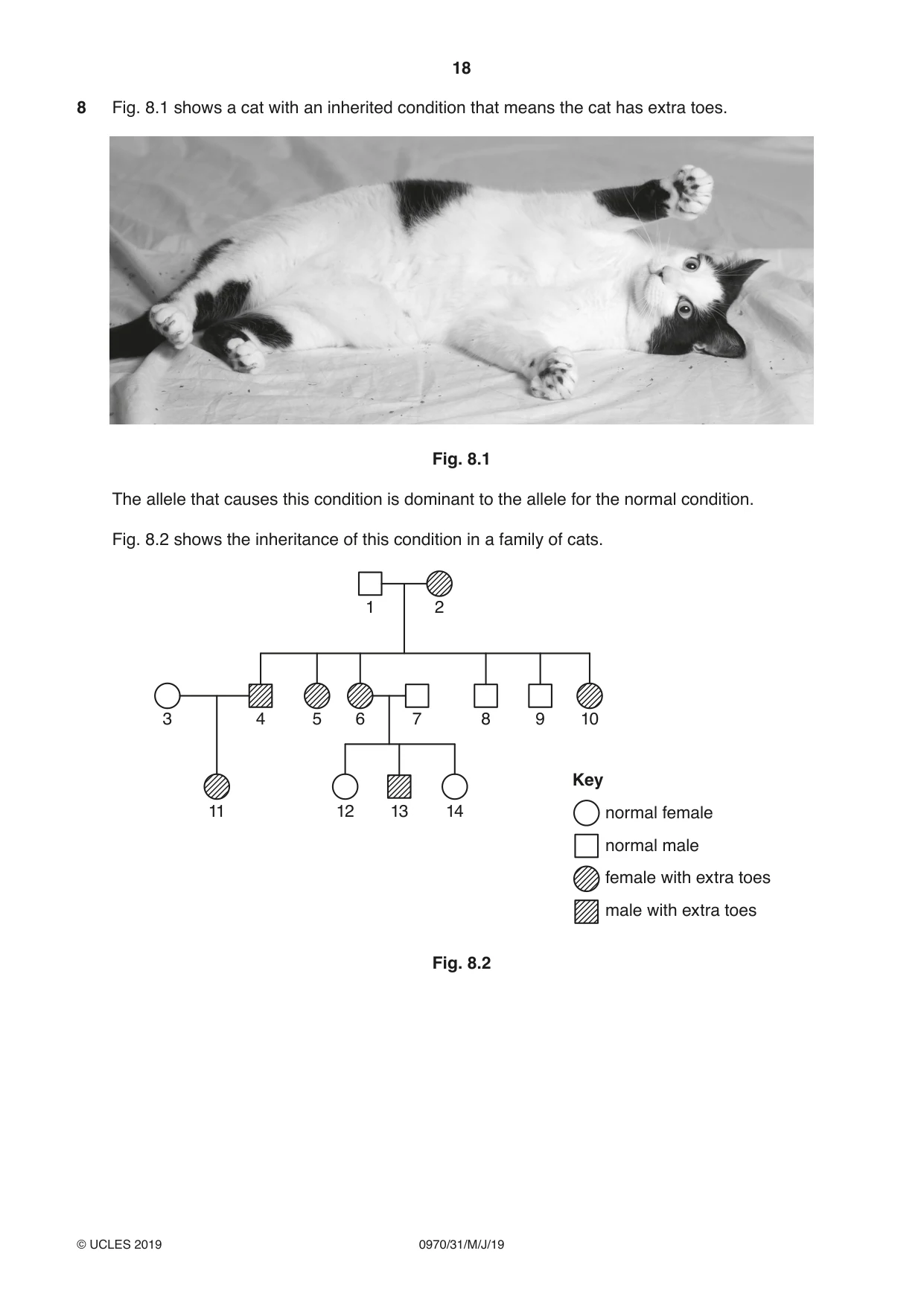
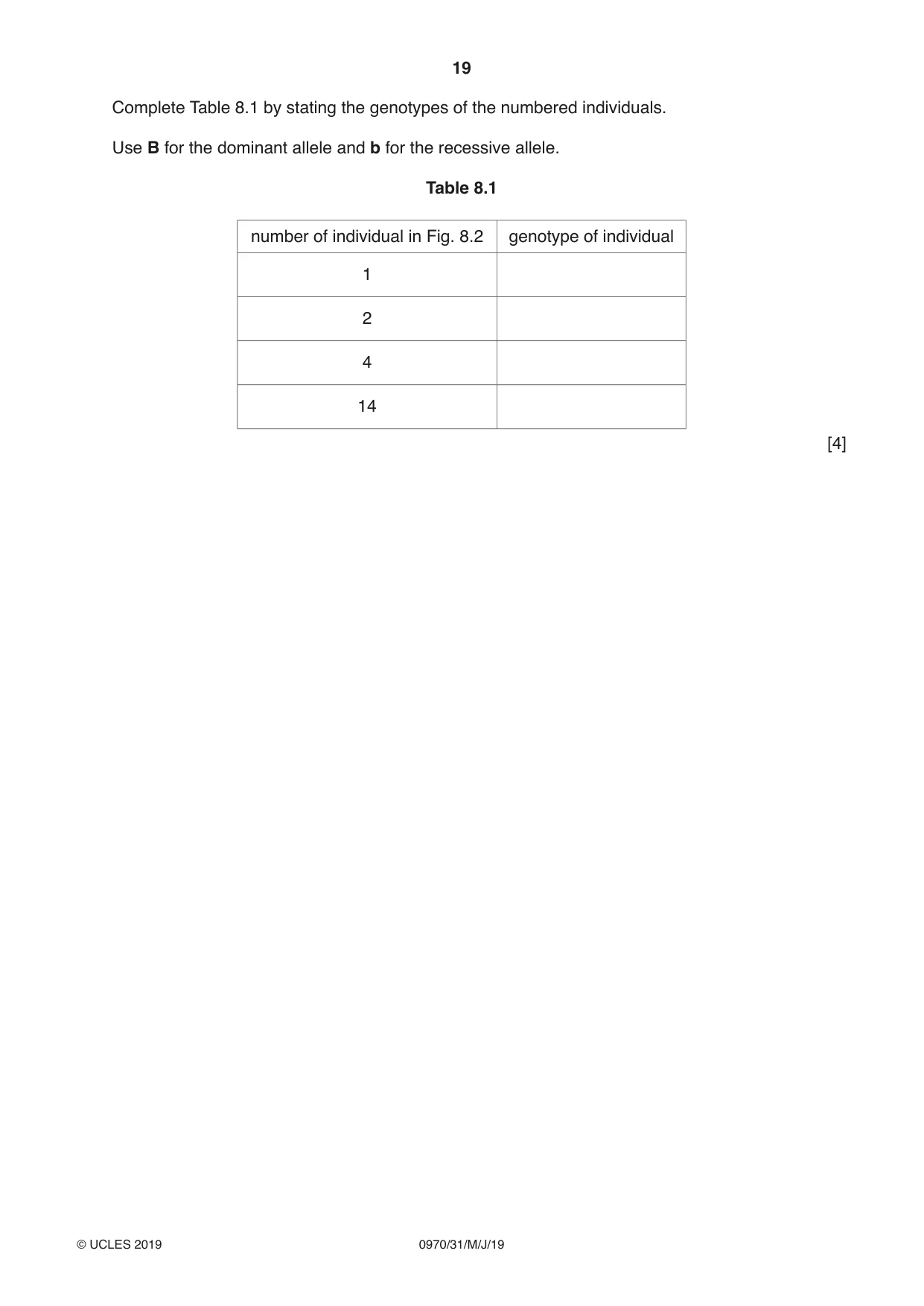
8 Fig. 8.1 shows a cat with an inherited condition that means the cat has extra toes. Fig. 8.1 The allele that causes this condition is dominant to the allele for the normal condition. Fig. 8.2 shows the inheritance of this condition in a family of cats. 1 2 3 4 5 6 7 8 9 10 Key 11 12 13 14 normal female normal male female with extra toes male with extra toes Fig. 8.2 Complete Table 8.1 by stating the genotypes of the numbered individuals. Use B for the dominant allele and b for the recessive allele. Table 8.1 number of individual in Fig. 8.2 genotype of individual 1 2 4 14 [4]
Mark scheme: 8 number genotype 1 bb ; 2 Bb ; 4 Bb ; 14 bb ; 4
What was in this paper
The subtopics covered by these 8 questions, and how many questions each got. Open one in a new tab to see every Cambridge question on it.
What you needed in this session
Cambridge’s own grade thresholds for 2019 May/June, Paper 3 · Variant 1. A higher threshold means an easier paper — the bar moves with how the cohort did.