Cambridge IGCSE Biology (9-1) 0970 — 2022 May/June Paper 3 · Variant 1
0970/31/M/J/22 · 8 questions · 80 marks · ≈90 min
The question paper and its mark scheme, free to read here and free to download. This is Cambridge’s own paper, exactly as it was sat.
Question paper20 pages

Mark scheme11 pages
Answers below. Sit the paper first if you are practising.
Questions as text
Q1 · A diagram of a plant cell
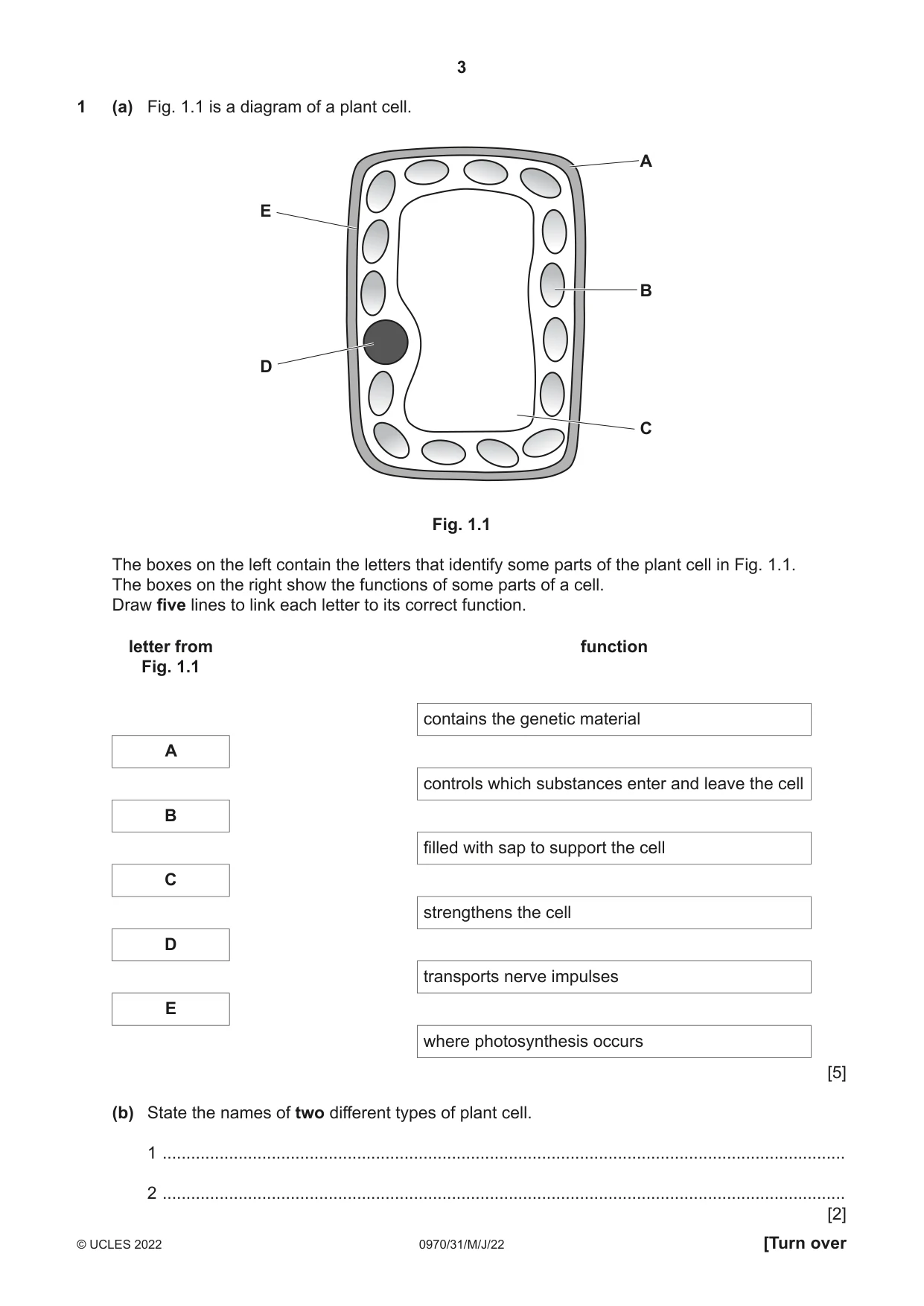
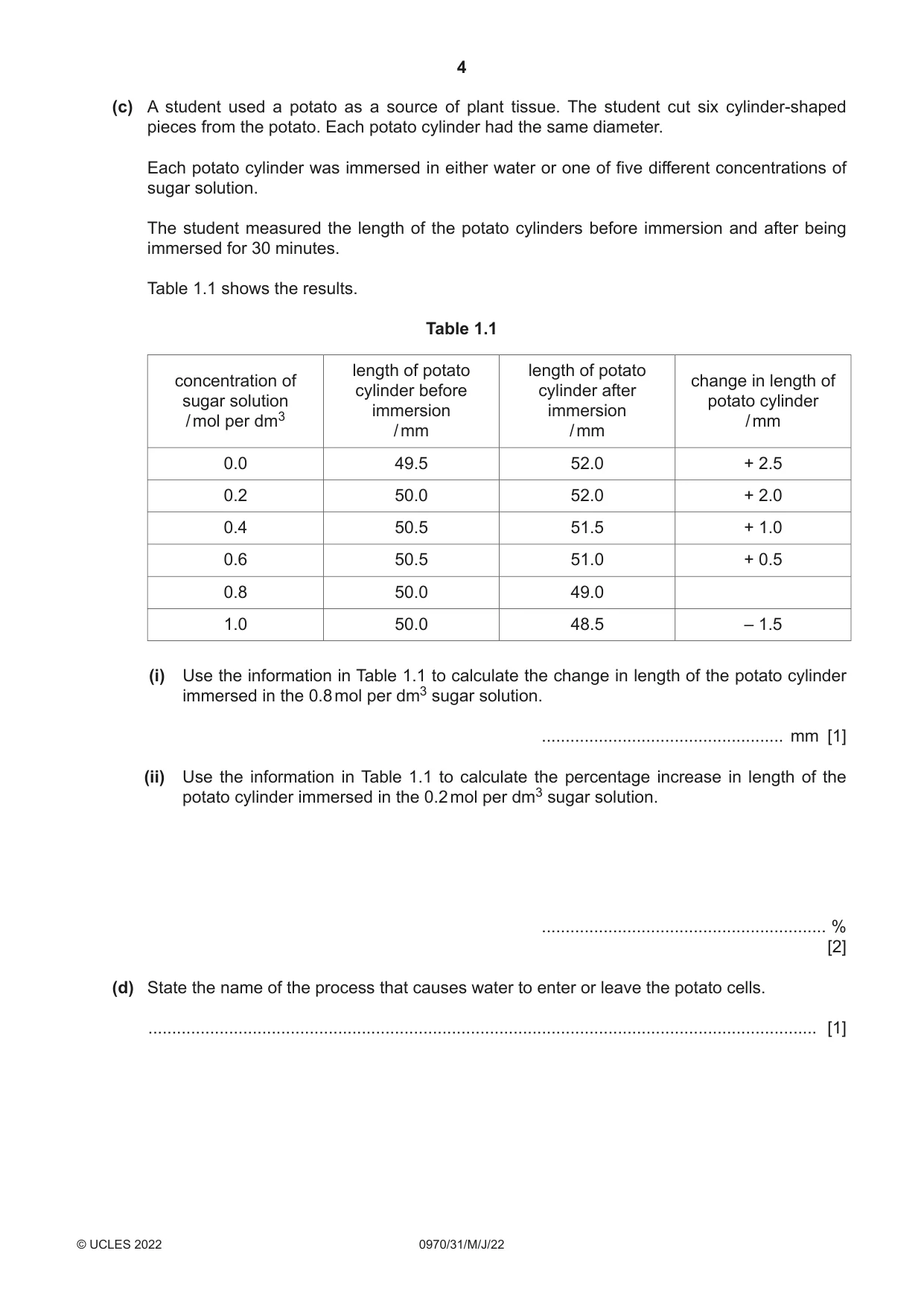
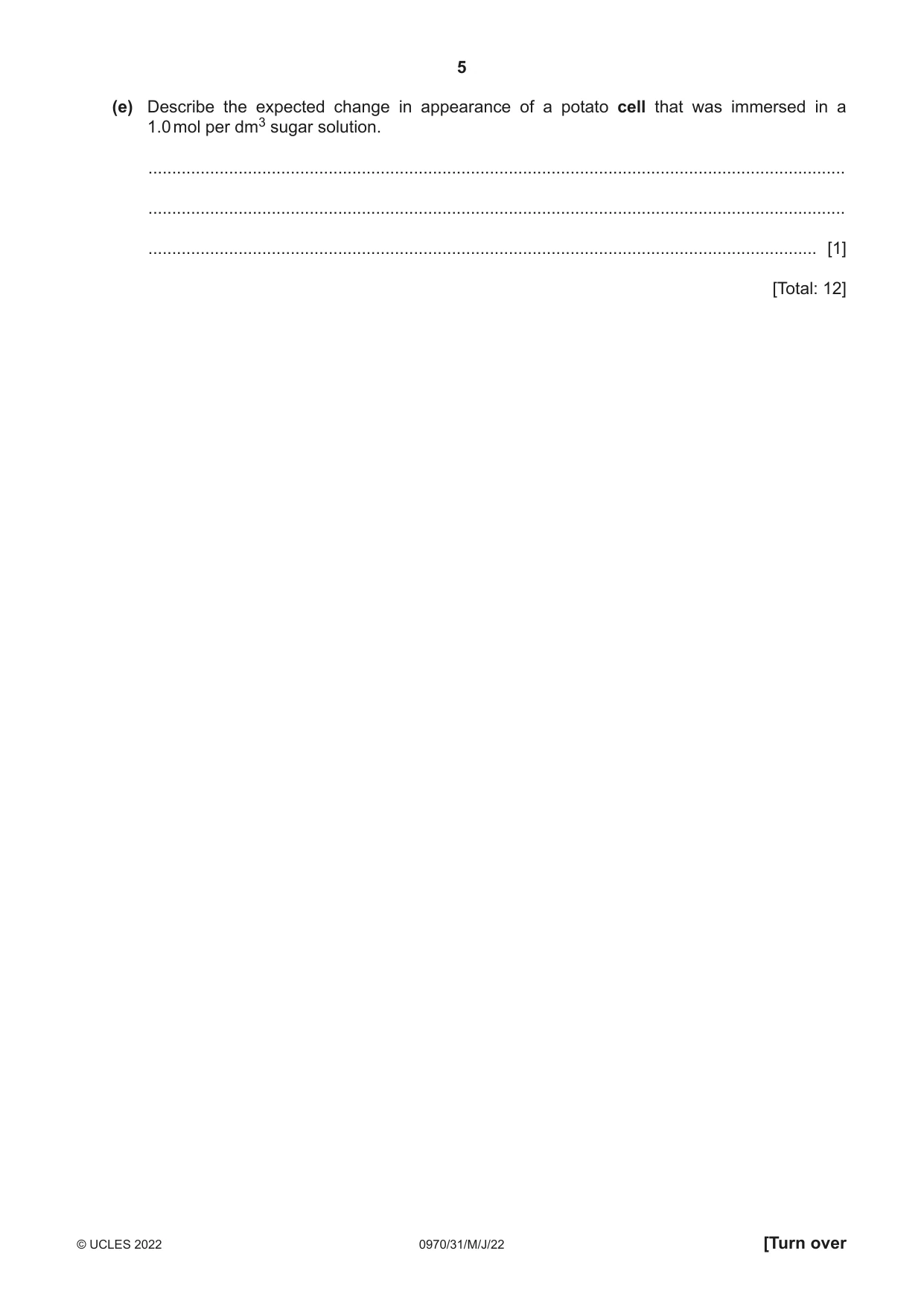
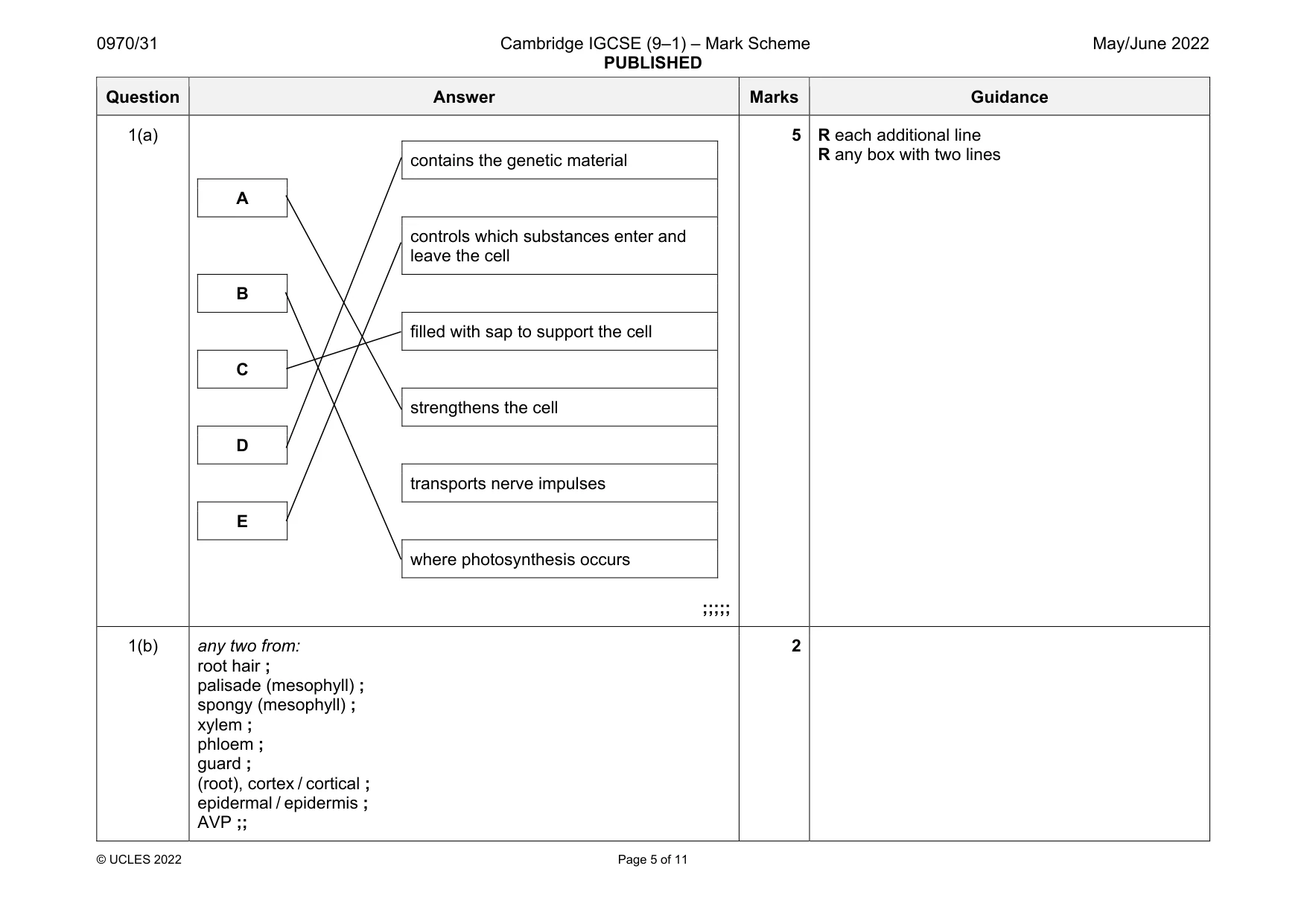
1 (a) Fig. 1.1 is a diagram of a plant cell. A E B D C Fig. 1.1 The boxes on the left contain the letters that identify some parts of the plant cell in Fig. 1.1. The boxes on the right show the functions of some parts of a cell. Draw five lines to link each letter to its correct function. letter from function Fig. 1.1 contains the genetic material A controls which substances enter and leave the cell B filled with sap to support the cell C strengthens the cell D transports nerve impulses E where photosynthesis occurs [5] (b) State the names of two different types of plant cell. 1 ................................................................................................................................................ 2 ................................................................................................................................................ [2] (c) A student used a potato as a source of plant tissue. The student cut six cylinder-shaped pieces from the potato. Each potato cylinder had the same diameter. Each potato cylinder was immersed in either water or one of five different concentrations of sugar solution. The student measured the length of the potato cylinders before immersion and after being immersed for 30 minutes. Table 1.1 shows the results. Table 1.1 length of potato length of potato concentration of change in length of cylinder before cylinder after sugar solution potato cylinder immersion immersion / mol per dm3 / mm / mm / mm 0.0 49.5 52.0 + 2.5 0.2 50.0 52.0 + 2.0 0.4 50.5 51.5 + 1.0 0.6 50.5 51.0 + 0.5 0.8 50.0 49.0 1.0 50.0 48.5 – 1.5 (i) Use the information in Table 1.1 to calculate the change in length of the potato cylinder immersed in the 0.8 mol per dm3 sugar solution. ................................................... mm [1] (ii) Use the information in Table 1.1 to calculate the percentage increase in length of the potato cylinder immersed in the 0.2 mol per dm3 sugar solution. ............................................................ % [2] (d) State the name of the process that causes water to enter or leave the potato cells. ............................................................................................................................................. [1] (e) Describe the expected change in appearance of a potato cell that was immersed in a 1.0 mol per dm3 sugar solution. ................................................................................................................................................... ................................................................................................................................................... ............................................................................................................................................. [1] [Total: 12]
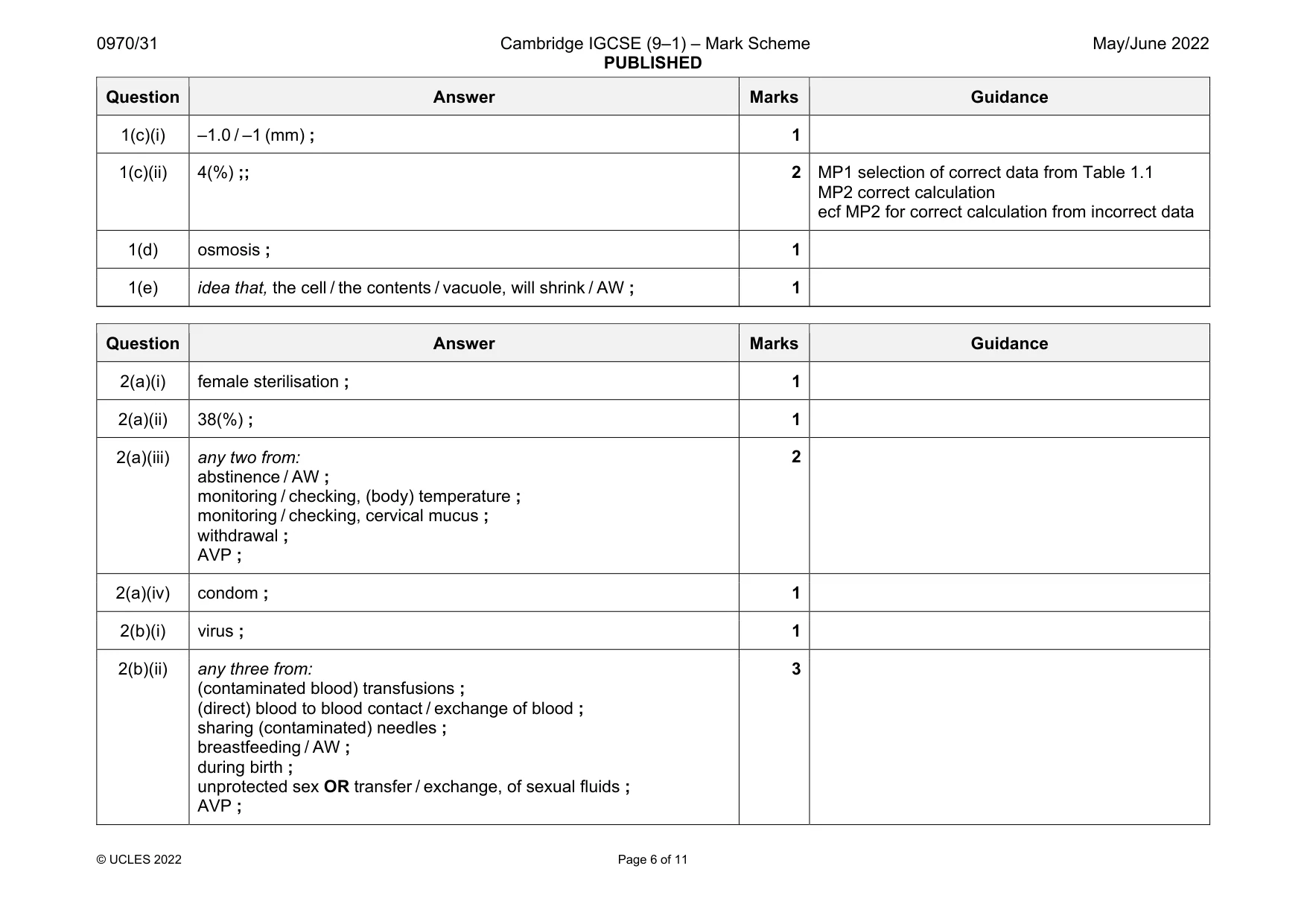
Mark scheme: 1(a) ;;;;; contains the genetic material A controls which substances enter and leave the cell B filled with sap to support the cell C strengthens the cell D transports nerve impulses E where photosynthesis occurs 5 R each additional line R any box with two lines 1(b) any two from: root hair ; palisade (mesophyll) ; spongy (mesophyll) ; xylem ; phloem ; guard ; (root), cortex / cortical ; epidermal / epidermis ; AVP ;; 2 Question Answer Marks Guidance 1(c)(i) –1.0 / –1 (mm) ; 1 1(c)(ii) 4(%) ;; 2 MP1 selection of correct data from Table 1.1 MP2 correct calculation ecf MP2 for correct calculation from incorrect data 1(d) osmosis ; 1 1(e) idea that, the cell / the contents / vacuole, will shrink / AW ; 1
Q2 · A pie chart showing the percentages of the different types of birth control that are used…
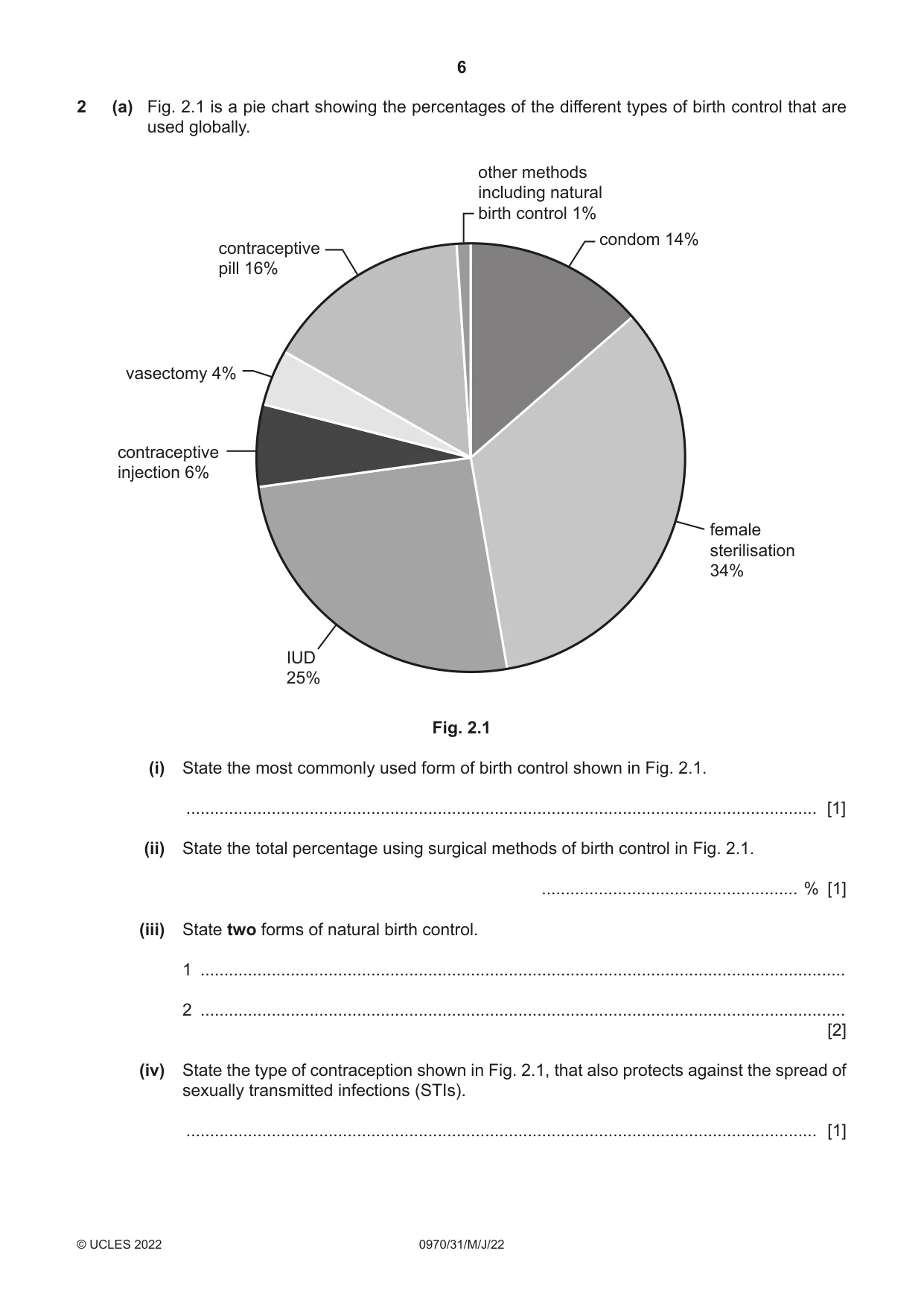
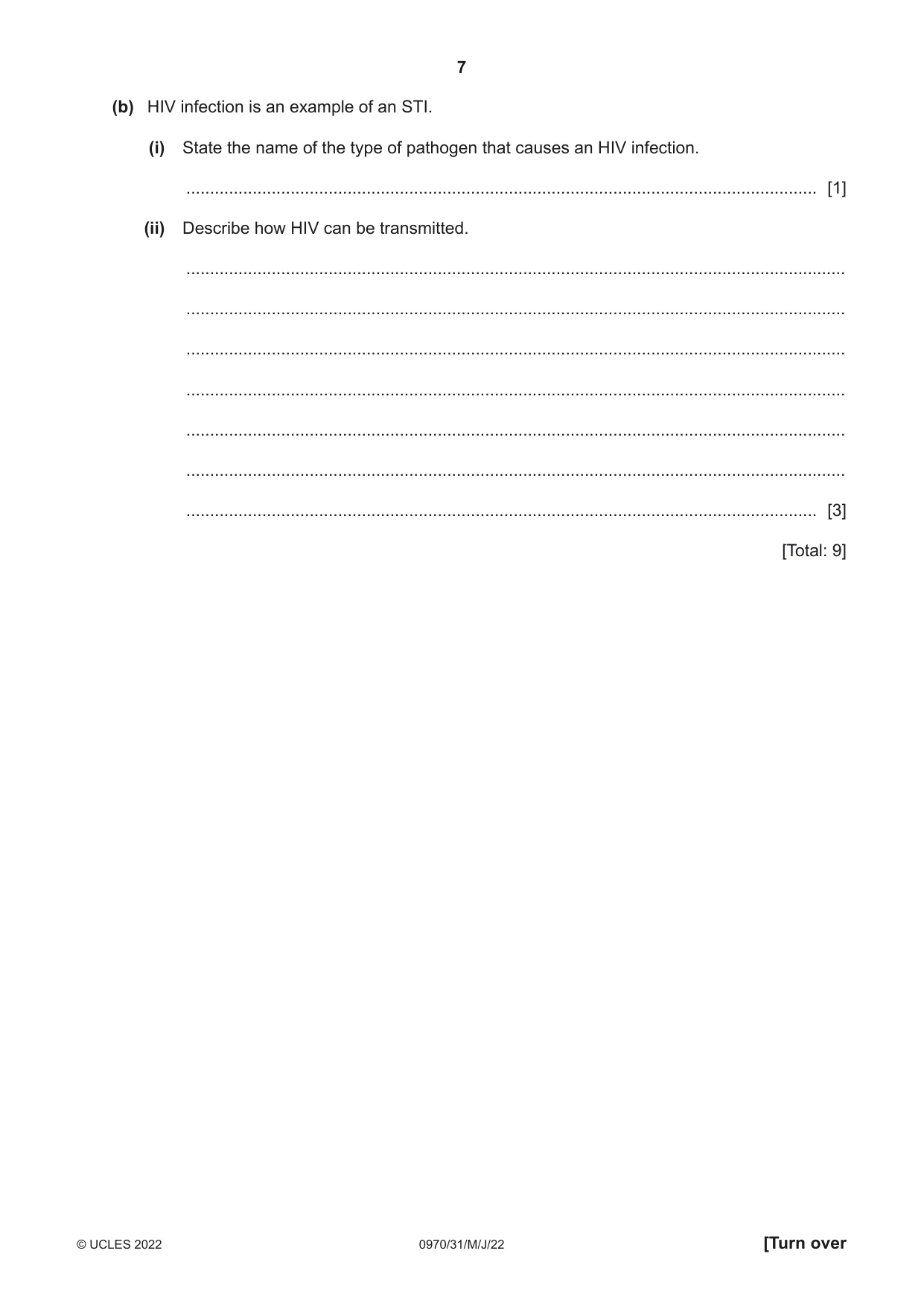
2 (a) Fig. 2.1 is a pie chart showing the percentages of the different types of birth control that are used globally. other methods including natural birth control 1% condom 14% contraceptive pill 16% vasectomy 4% contraceptive injection 6% female sterilisation 34% IUD 25% Fig. 2.1 (i) State the most commonly used form of birth control shown in Fig. 2.1. ..................................................................................................................................... [1] (ii) State the total percentage using surgical methods of birth control in Fig. 2.1. ...................................................... % [1] (iii) State two forms of natural birth control. 1 ........................................................................................................................................ 2 ........................................................................................................................................ [2] (iv) State the type of contraception shown in Fig. 2.1, that also protects against the spread of sexually transmitted infections (STIs). ..................................................................................................................................... [1] (b) HIV infection is an example of an STI. (i) State the name of the type of pathogen that causes an HIV infection. ..................................................................................................................................... [1] (ii) Describe how HIV can be transmitted. ........................................................................................................................................... ........................................................................................................................................... ........................................................................................................................................... ........................................................................................................................................... ........................................................................................................................................... ........................................................................................................................................... ..................................................................................................................................... [3] [Total: 9]
Mark scheme: 2(a)(i) female sterilisation ; 1 2(a)(ii) 38(%) ; 1 2(a)(iii) any two from: abstinence / AW ; monitoring / checking, (body) temperature ; monitoring / checking, cervical mucus ; withdrawal ; AVP ; 2 2(a)(iv) condom ; 1 2(b)(i) virus ; 1 2(b)(ii) any three from: (contaminated blood) transfusions ; (direct) blood to blood contact / exchange of blood ; sharing (contaminated) needles ; breastfeeding / AW ; during birth ; unprotected sex OR transfer / exchange, of sexual fluids ; AVP ; 3
Q3 · The inheritance of coat texture in guinea pigs is controlled by a single gene
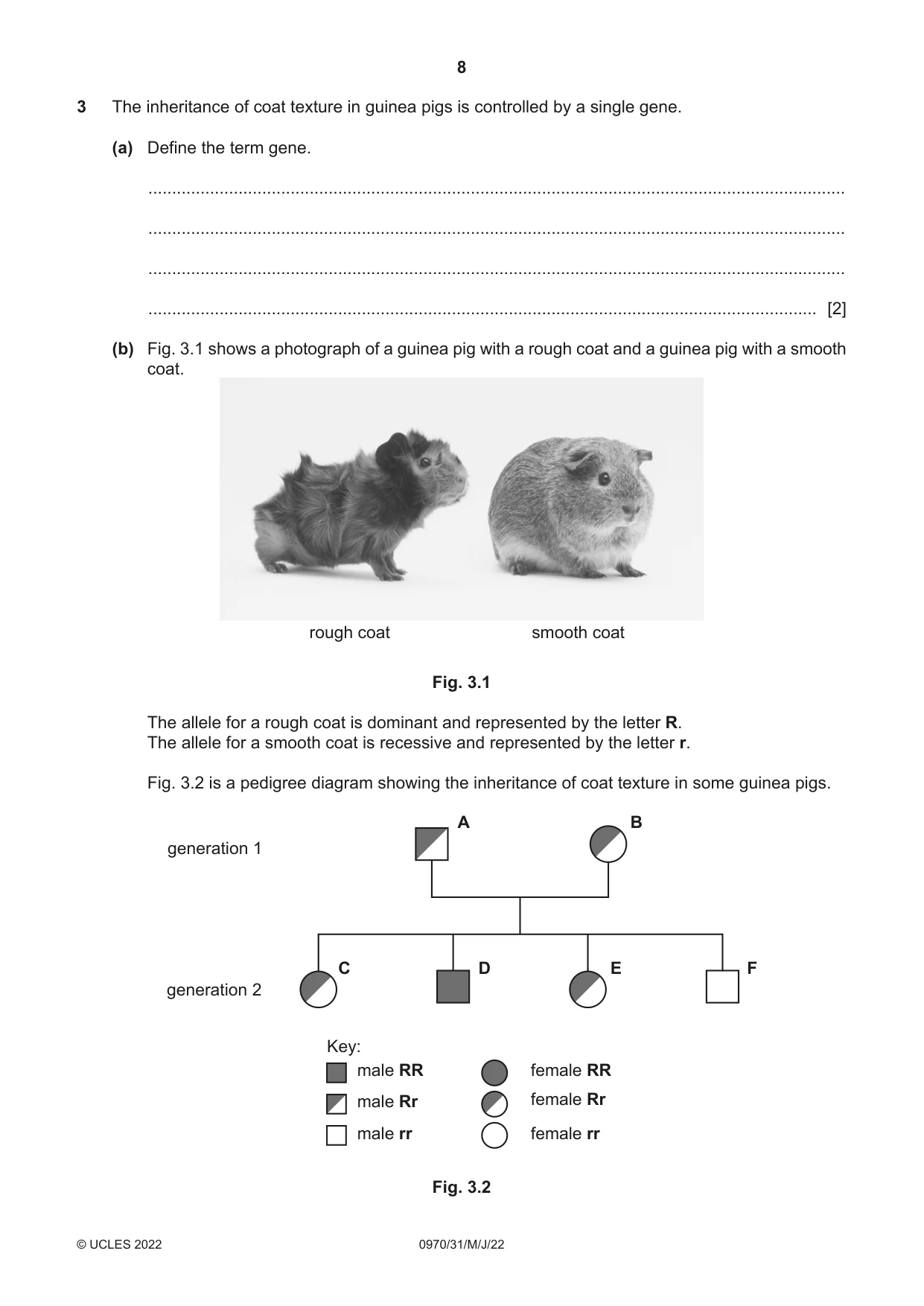
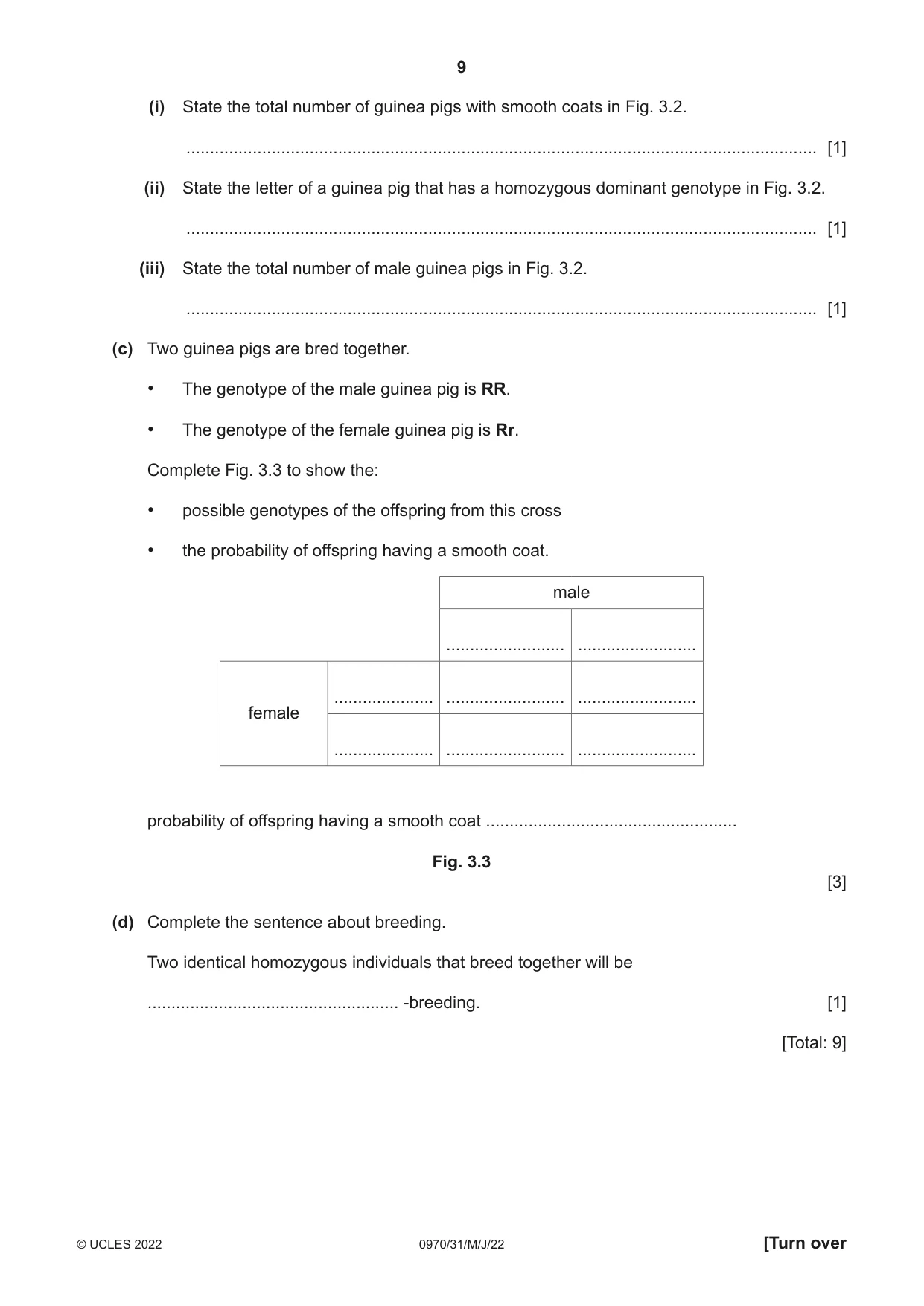
3 The inheritance of coat texture in guinea pigs is controlled by a single gene. (a) Define the term gene. ................................................................................................................................................... ................................................................................................................................................... ................................................................................................................................................... ............................................................................................................................................. [2] (b) Fig. 3.1 shows a photograph of a guinea pig with a rough coat and a guinea pig with a smooth coat. rough coat smooth coat Fig. 3.1 The allele for a rough coat is dominant and represented by the letter R. The allele for a smooth coat is recessive and represented by the letter r. Fig. 3.2 is a pedigree diagram showing the inheritance of coat texture in some guinea pigs. A B generation 1 C D E F generation 2 Key: male RR female RR male Rr female Rr male rr female rr Fig. 3.2 (i) State the total number of guinea pigs with smooth coats in Fig. 3.2. ..................................................................................................................................... [1] (ii) State the letter of a guinea pig that has a homozygous dominant genotype in Fig. 3.2. ..................................................................................................................................... [1] (iii) State the total number of male guinea pigs in Fig. 3.2. ..................................................................................................................................... [1] (c) Two guinea pigs are bred together. • The genotype of the male guinea pig is RR. • The genotype of the female guinea pig is Rr. Complete Fig. 3.3 to show the: • possible genotypes of the offspring from this cross • the probability of offspring having a smooth coat. male ......................... ......................... ..................... ......................... ......................... female ..................... ......................... ......................... probability of offspring having a smooth coat ..................................................... Fig. 3.3 [3] (d) Complete the sentence about breeding. Two identical homozygous individuals that breed together will be ..................................................... -breeding. [1] [Total: 9]
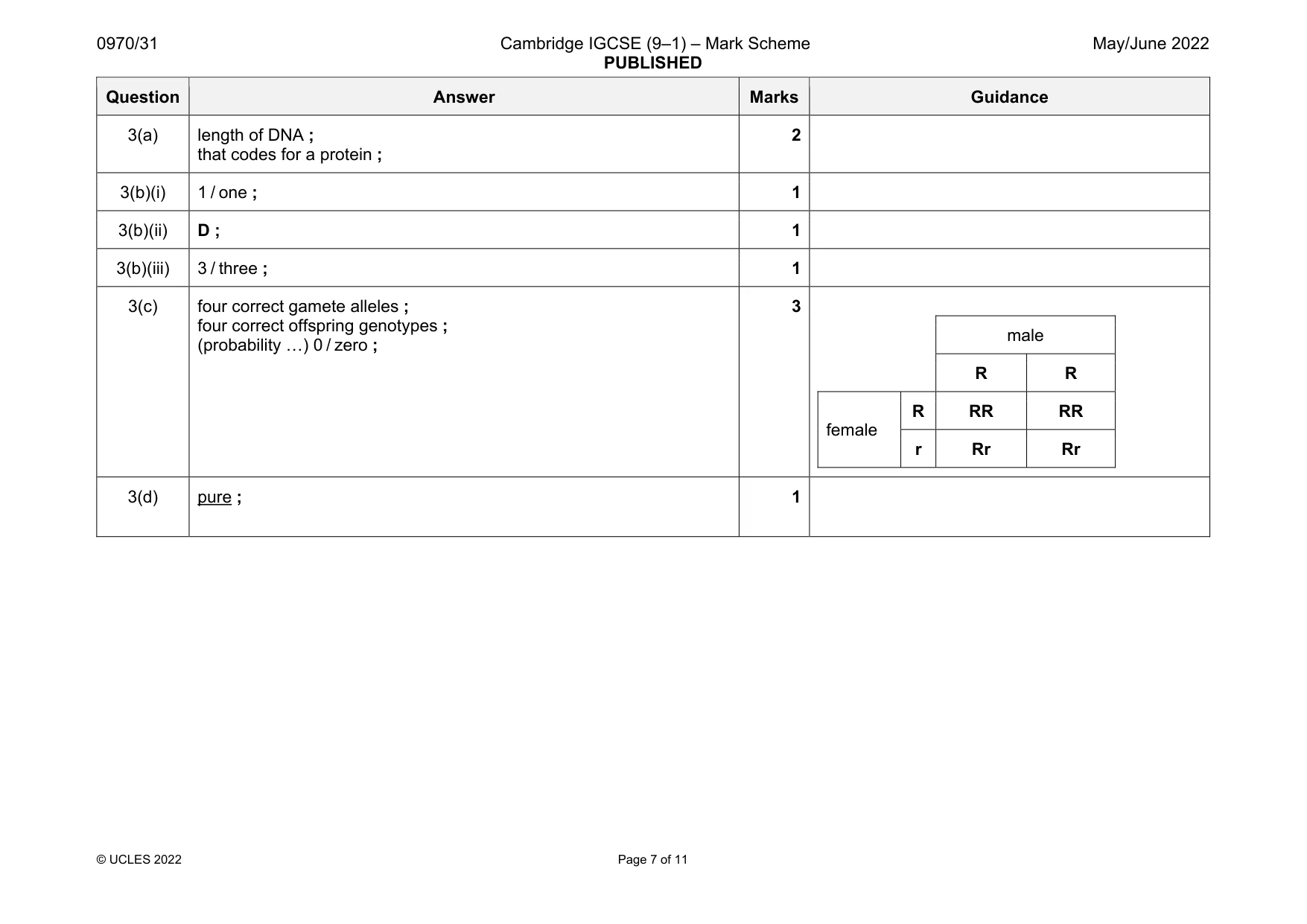
Mark scheme: 3(a) length of DNA ; that codes for a protein ; 2 3(b)(i) 1 / one ; 1 3(b)(ii) D ; 1 3(b)(iii) 3 / three ; 1 3(c) four correct gamete alleles ; four correct offspring genotypes ; (probability …) 0 / zero ; 3 male R R female R RR RR r Rr Rr 3(d) pure ; 1
Q4 · A diagram of the female reproductive system in humans
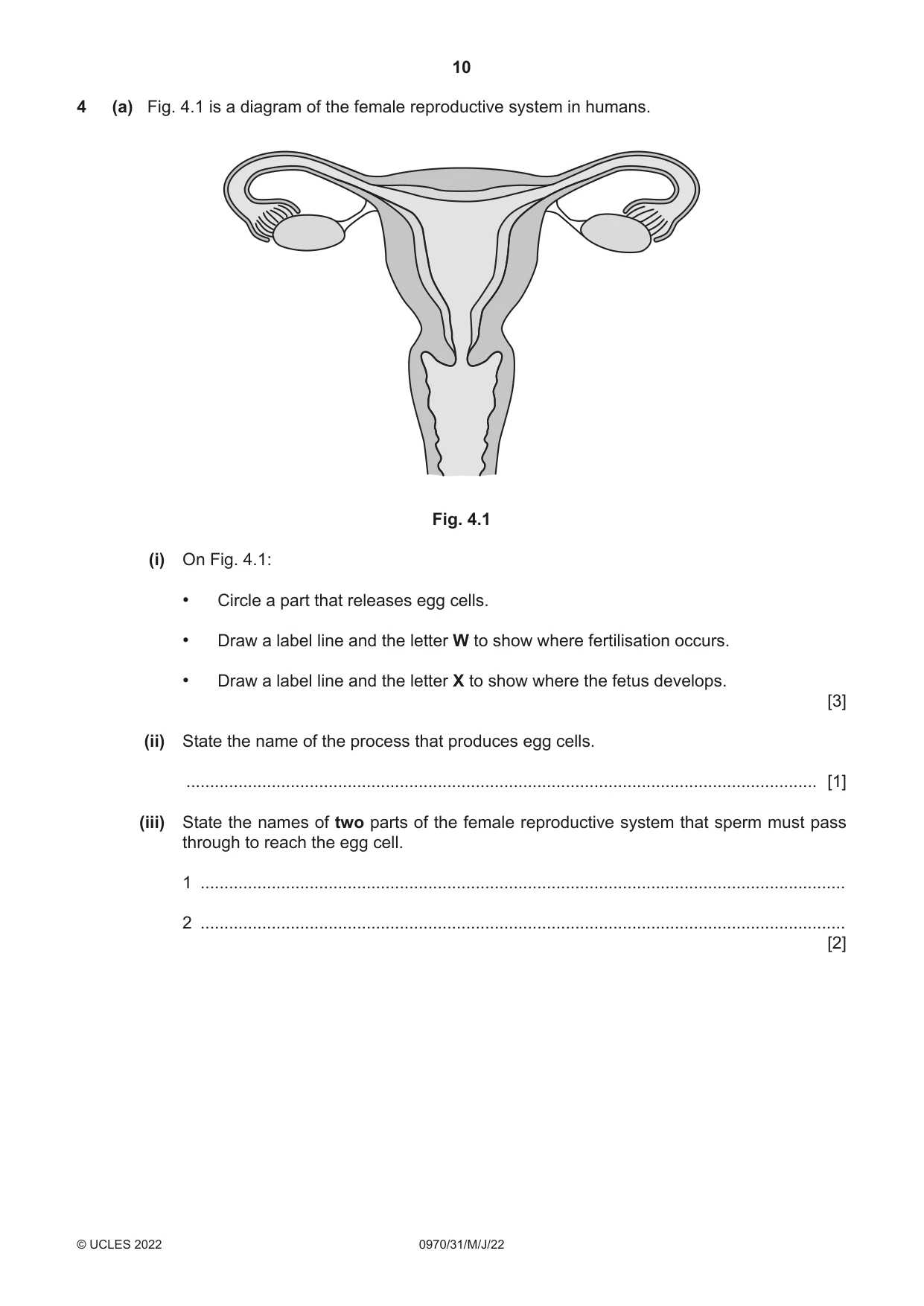
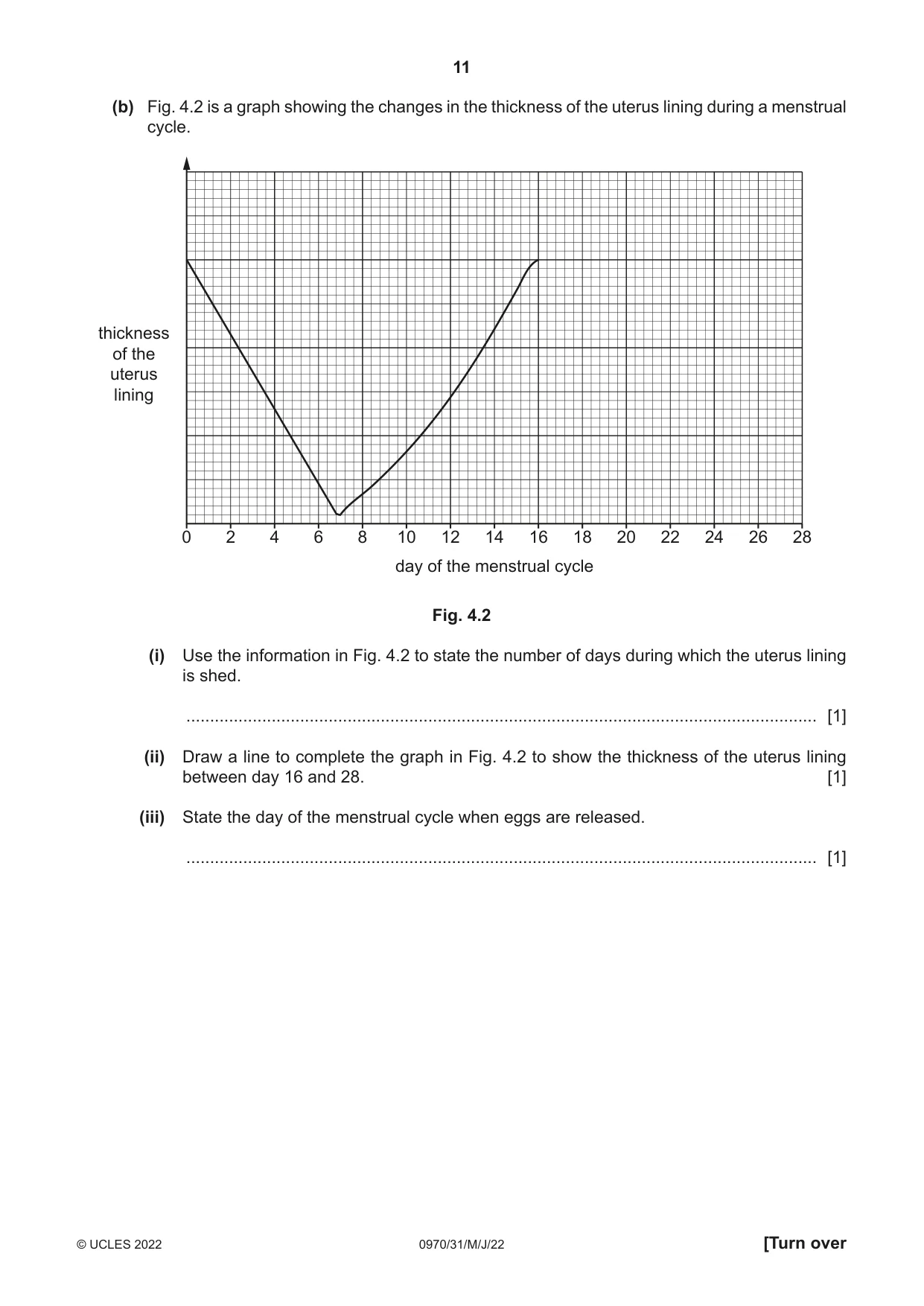
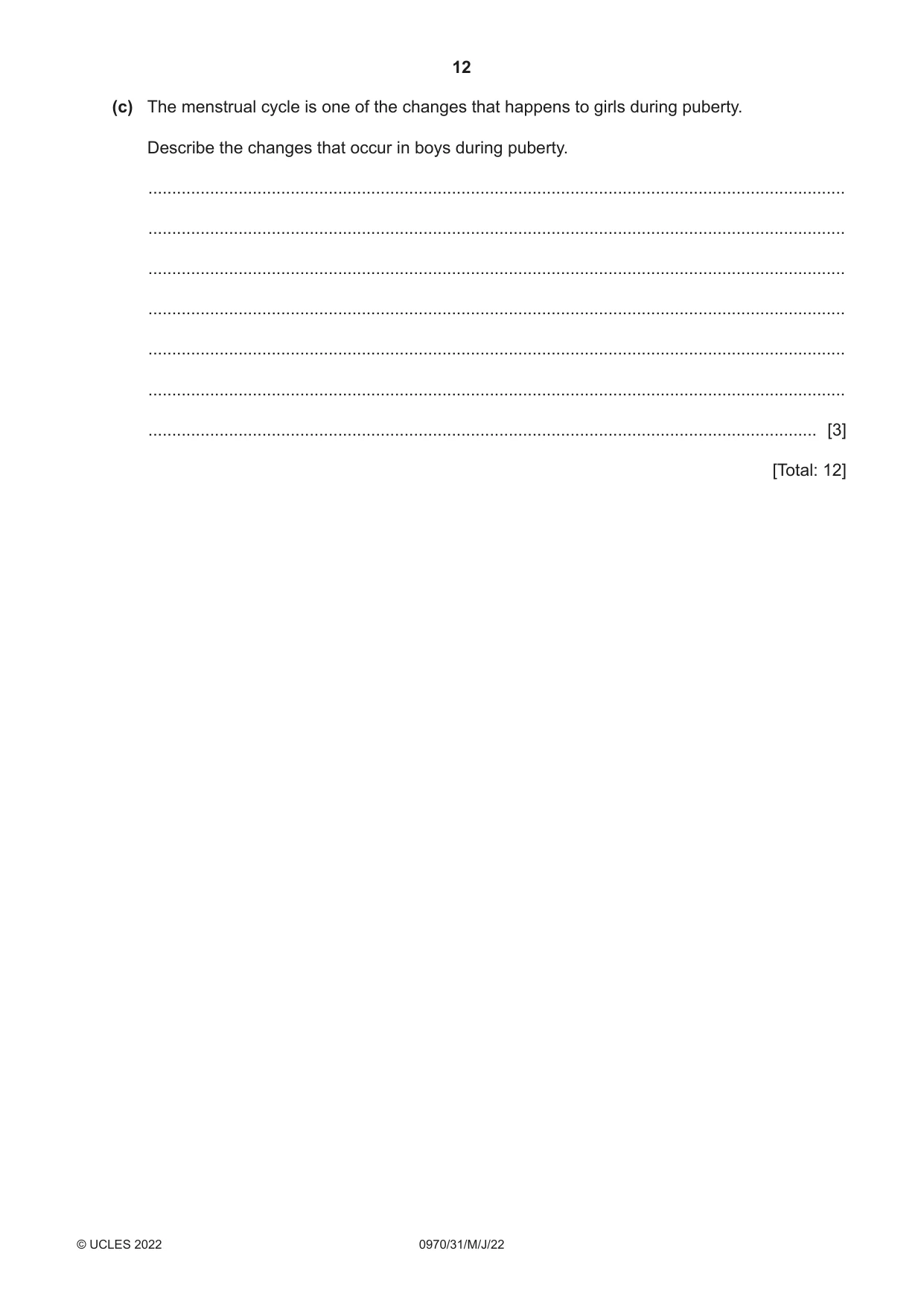
4 (a) Fig. 4.1 is a diagram of the female reproductive system in humans. Fig. 4.1 (i) On Fig. 4.1: • Circle a part that releases egg cells. • Draw a label line and the letter W to show where fertilisation occurs. • Draw a label line and the letter X to show where the fetus develops. [3] (ii) State the name of the process that produces egg cells. ..................................................................................................................................... [1] (iii) State the names of two parts of the female reproductive system that sperm must pass through to reach the egg cell. 1 ........................................................................................................................................ 2 ........................................................................................................................................ [2] (b) Fig. 4.2 is a graph showing the changes in the thickness of the uterus lining during a menstrual cycle. thickness of the uterus lining 0 2 4 6 8 10 12 14 16 18 20 22 24 26 28 day of the menstrual cycle Fig. 4.2 (i) Use the information in Fig. 4.2 to state the number of days during which the uterus lining is shed. ..................................................................................................................................... [1] (ii) Draw a line to complete the graph in Fig. 4.2 to show the thickness of the uterus lining between day 16 and 28. [1] (iii) State the day of the menstrual cycle when eggs are released. ..................................................................................................................................... [1] (c) The menstrual cycle is one of the changes that happens to girls during puberty. Describe the changes that occur in boys during puberty. ................................................................................................................................................... ................................................................................................................................................... ................................................................................................................................................... ................................................................................................................................................... ................................................................................................................................................... ................................................................................................................................................... ............................................................................................................................................. [3] [Total: 12]
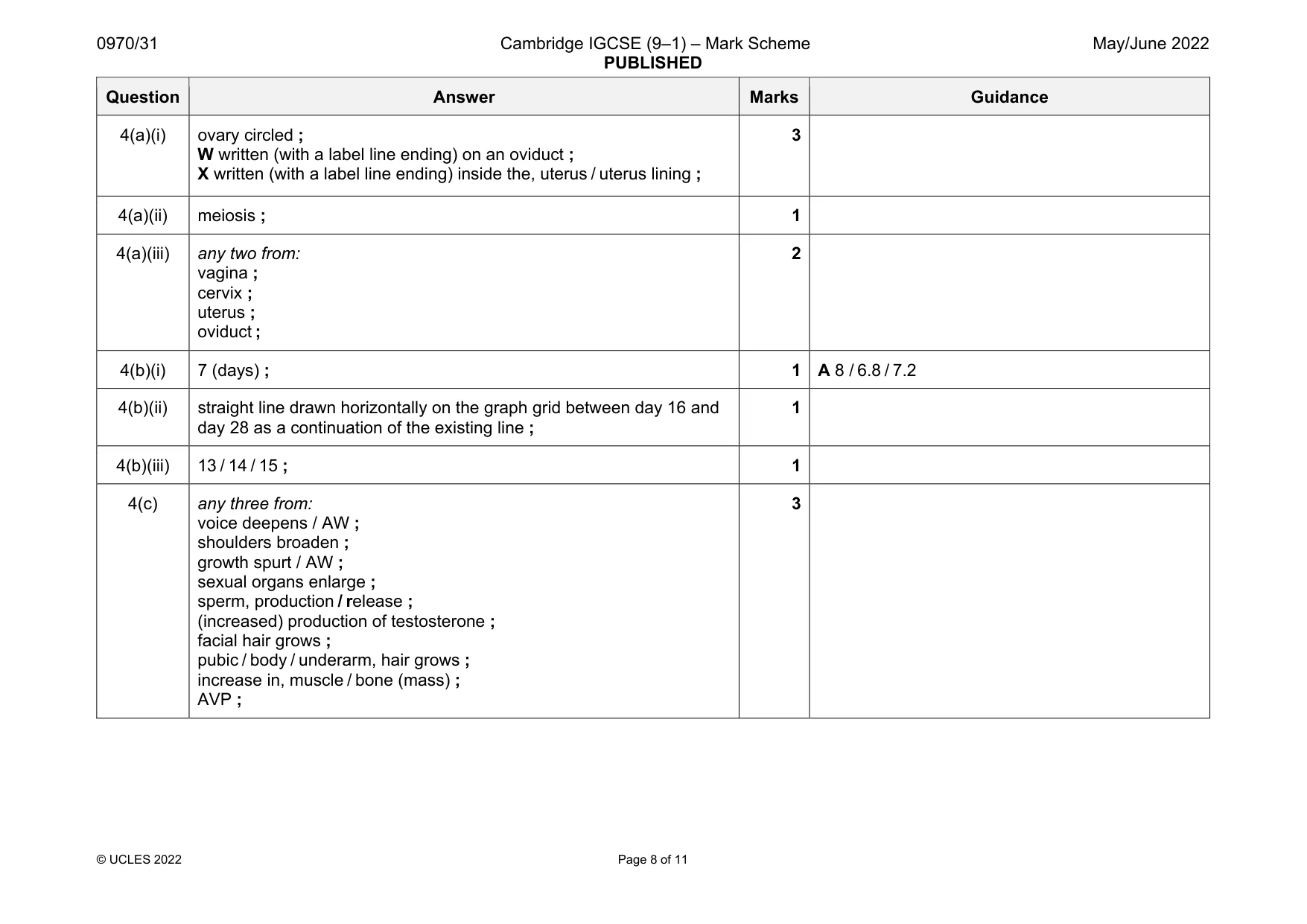
Mark scheme: 4(a)(i) ovary circled ; W written (with a label line ending) on an oviduct ; X written (with a label line ending) inside the, uterus / uterus lining ; 3 4(a)(ii) meiosis ; 1 4(a)(iii) any two from: vagina ; cervix ; uterus ; oviduct ; 2 4(b)(i) 7 (days) ; 1 A 8 / 6.8 / 7.2 4(b)(ii) straight line drawn horizontally on the graph grid between day 16 and day 28 as a continuation of the existing line ; 1 4(b)(iii) 13 / 14 / 15 ; 1 4(c) any three from: voice deepens / AW ; shoulders broaden ; growth spurt / AW ; sexual organs enlarge ; sperm, production / release ; (increased) production of testosterone ; facial hair grows ; pubic / body / underarm, hair grows ; increase in, muscle / bone (mass) ; AVP ; 3
Q5 · A diagram of the human gas exchange system
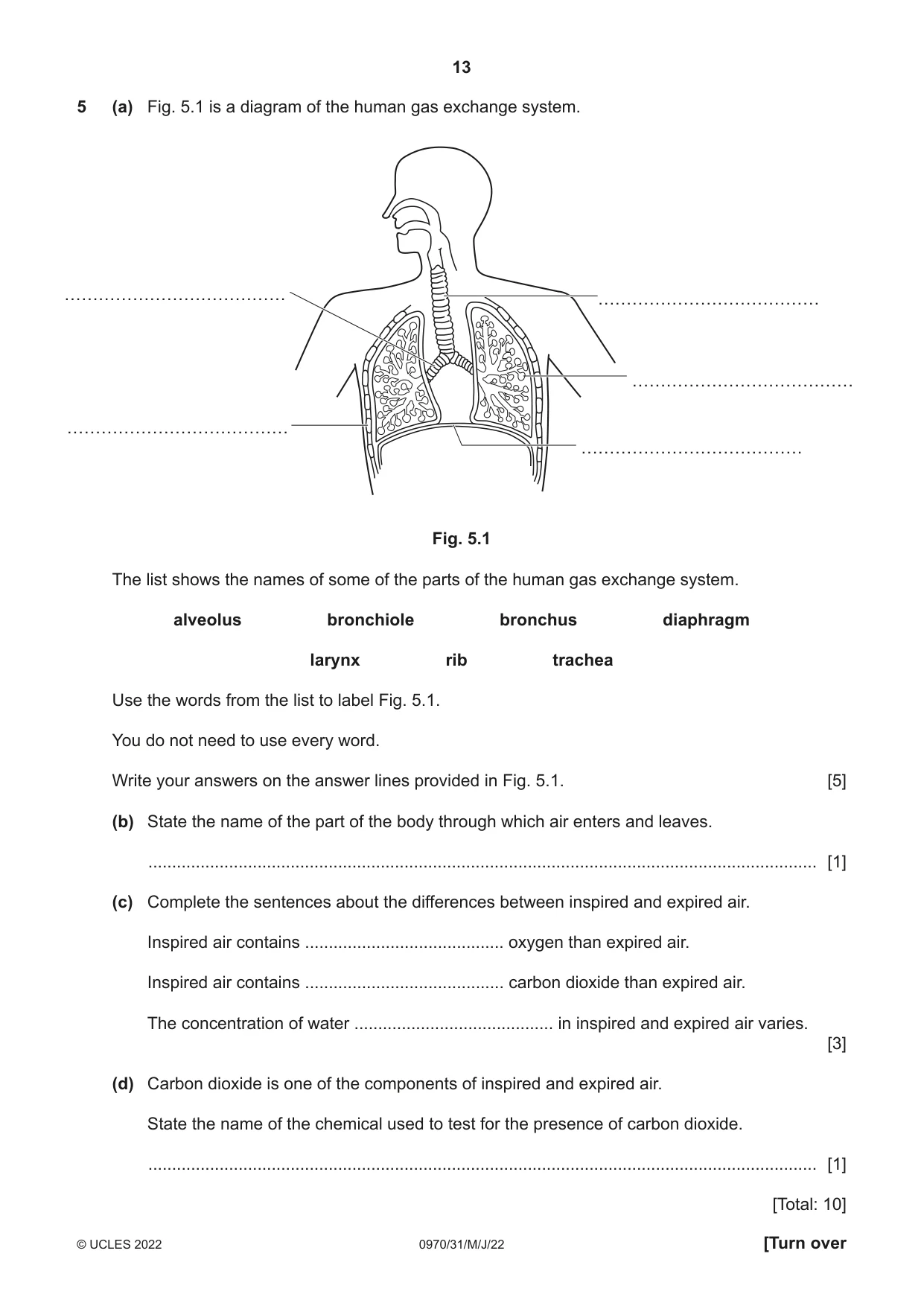
5 (a) Fig. 5.1 is a diagram of the human gas exchange system. Fig. 5.1 The list shows the names of some of the parts of the human gas exchange system. alveolus bronchiole bronchus diaphragm larynx rib trachea Use the words from the list to label Fig. 5.1. You do not need to use every word. Write your answers on the answer lines provided in Fig. 5.1. [5] (b) State the name of the part of the body through which air enters and leaves. ............................................................................................................................................. [1] (c) Complete the sentences about the differences between inspired and expired air. Inspired air contains .......................................... oxygen than expired air. Inspired air contains .......................................... carbon dioxide than expired air. The concentration of water .......................................... in inspired and expired air varies. [3] (d) Carbon dioxide is one of the components of inspired and expired air. State the name of the chemical used to test for the presence of carbon dioxide. ............................................................................................................................................. [1] [Total: 10]
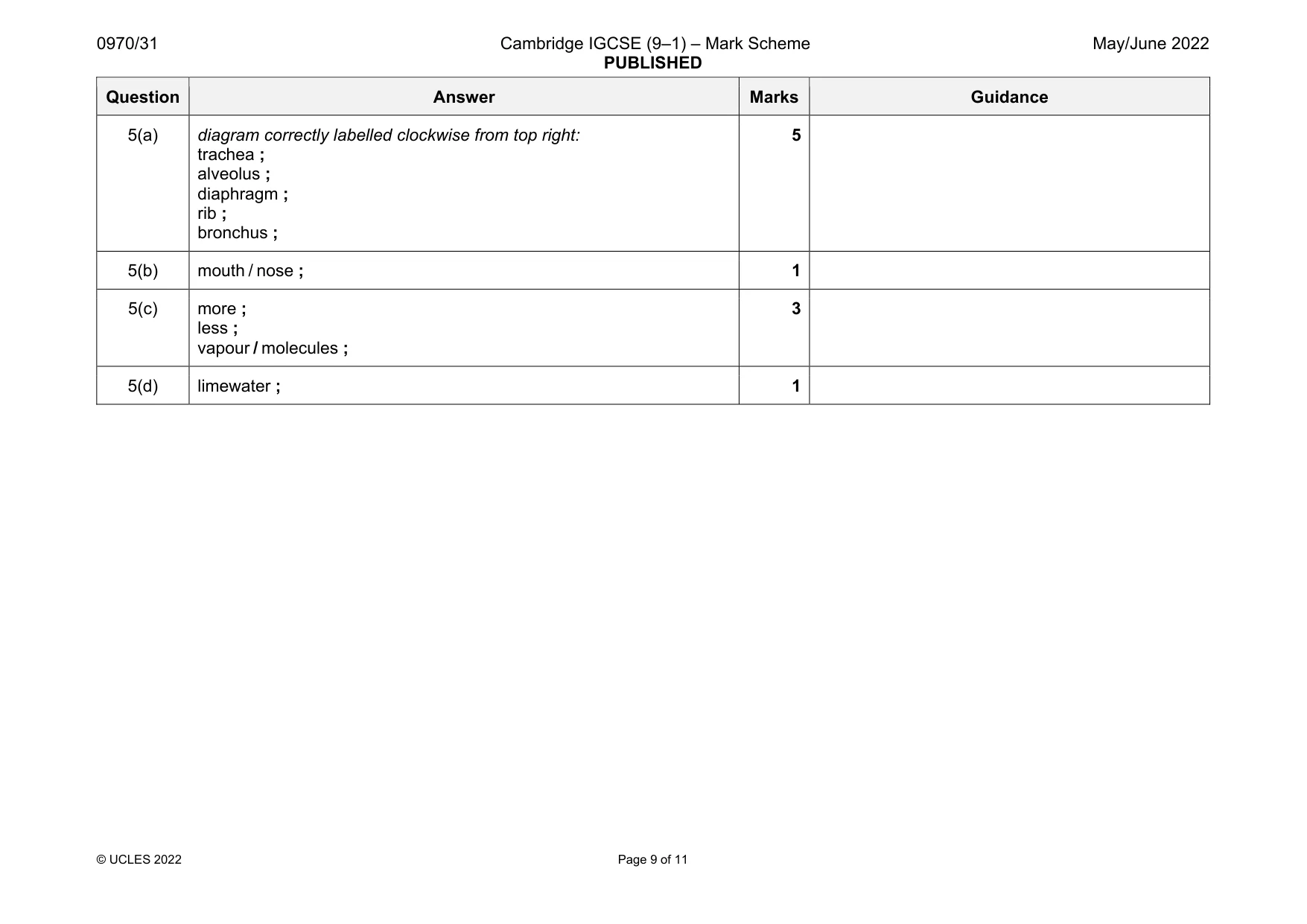
Mark scheme: 5(a) diagram correctly labelled clockwise from top right: trachea ; alveolus ; diaphragm ; rib ; bronchus ; 5 5(b) mouth / nose ; 1 5(c) more ; less ; vapour / molecules ; 3 5(d) limewater ; 1
Q6 · A photograph of a section through a flower
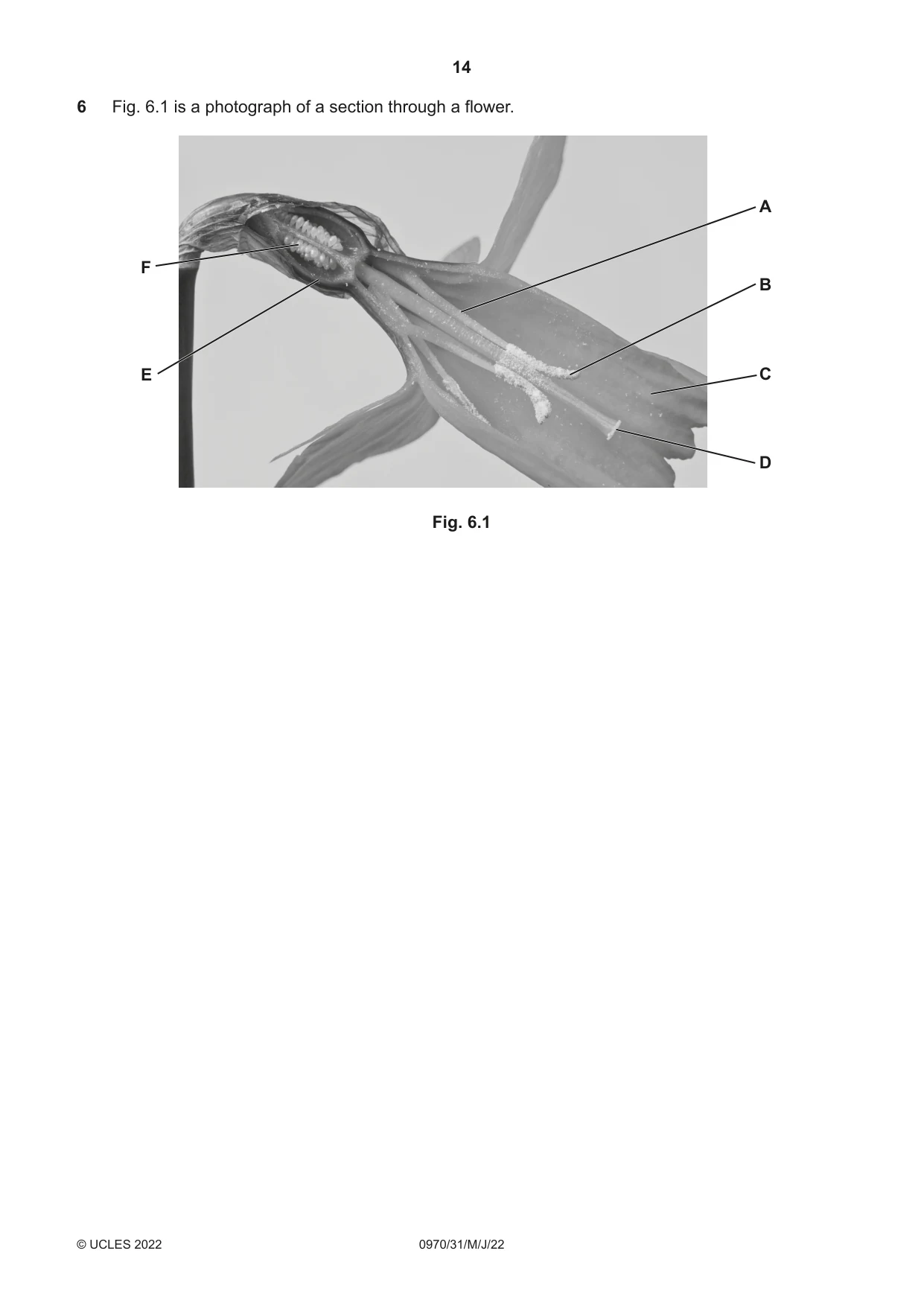
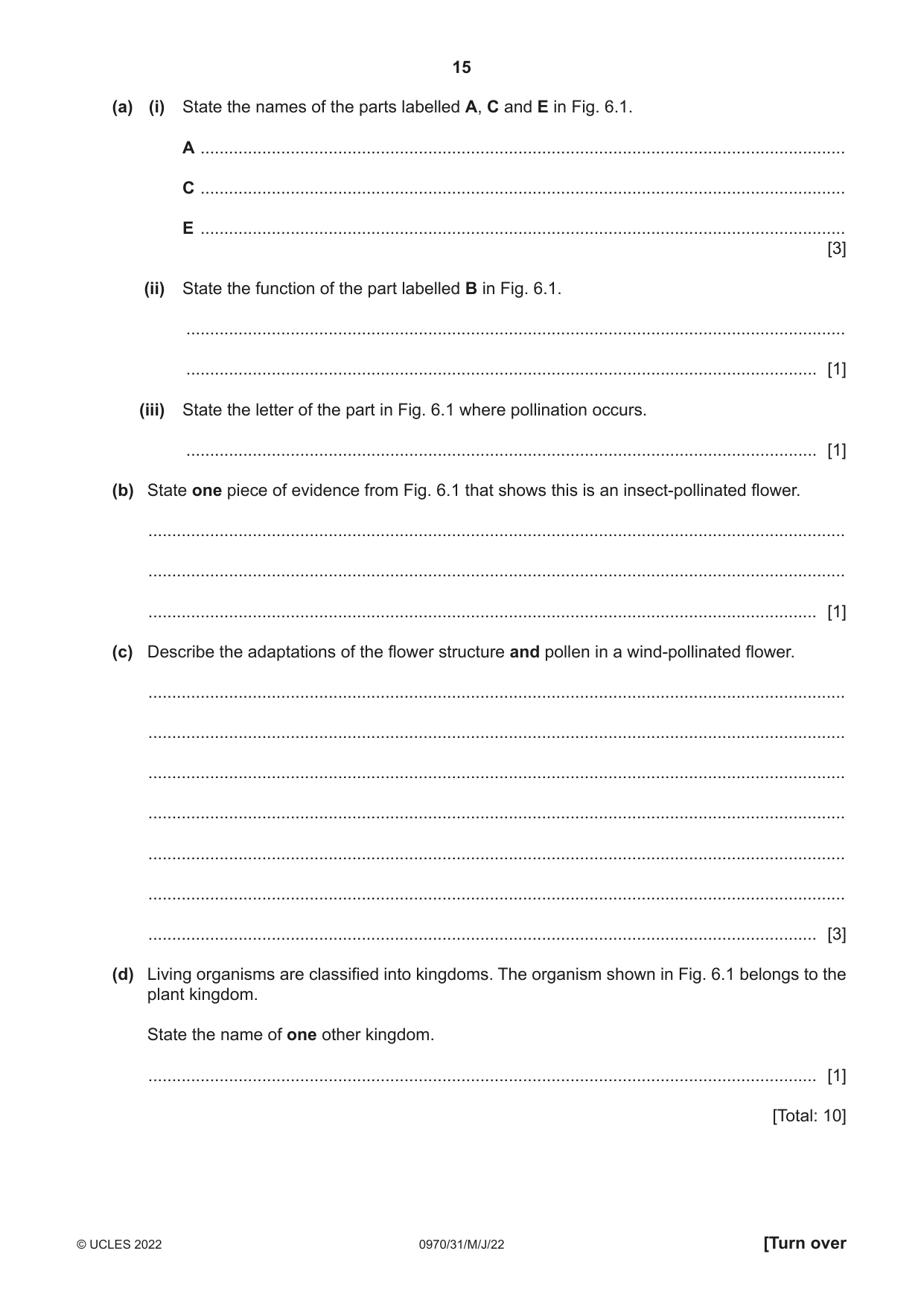
6 Fig. 6.1 is a photograph of a section through a flower. A F B E C D Fig. 6.1 (a) (i) State the names of the parts labelled A, C and E in Fig. 6.1. A ........................................................................................................................................ C ........................................................................................................................................ E ........................................................................................................................................ [3] (ii) State the function of the part labelled B in Fig. 6.1. ........................................................................................................................................... ..................................................................................................................................... [1] (iii) State the letter of the part in Fig. 6.1 where pollination occurs. ..................................................................................................................................... [1] (b) State one piece of evidence from Fig. 6.1 that shows this is an insect-pollinated flower. ................................................................................................................................................... ................................................................................................................................................... ............................................................................................................................................. [1] (c) Describe the adaptations of the flower structure and pollen in a wind-pollinated flower. ................................................................................................................................................... ................................................................................................................................................... ................................................................................................................................................... ................................................................................................................................................... ................................................................................................................................................... ................................................................................................................................................... ............................................................................................................................................. [3] (d) Living organisms are classified into kingdoms. The organism shown in Fig. 6.1 belongs to the plant kingdom. State the name of one other kingdom. ............................................................................................................................................. [1] [Total: 10]
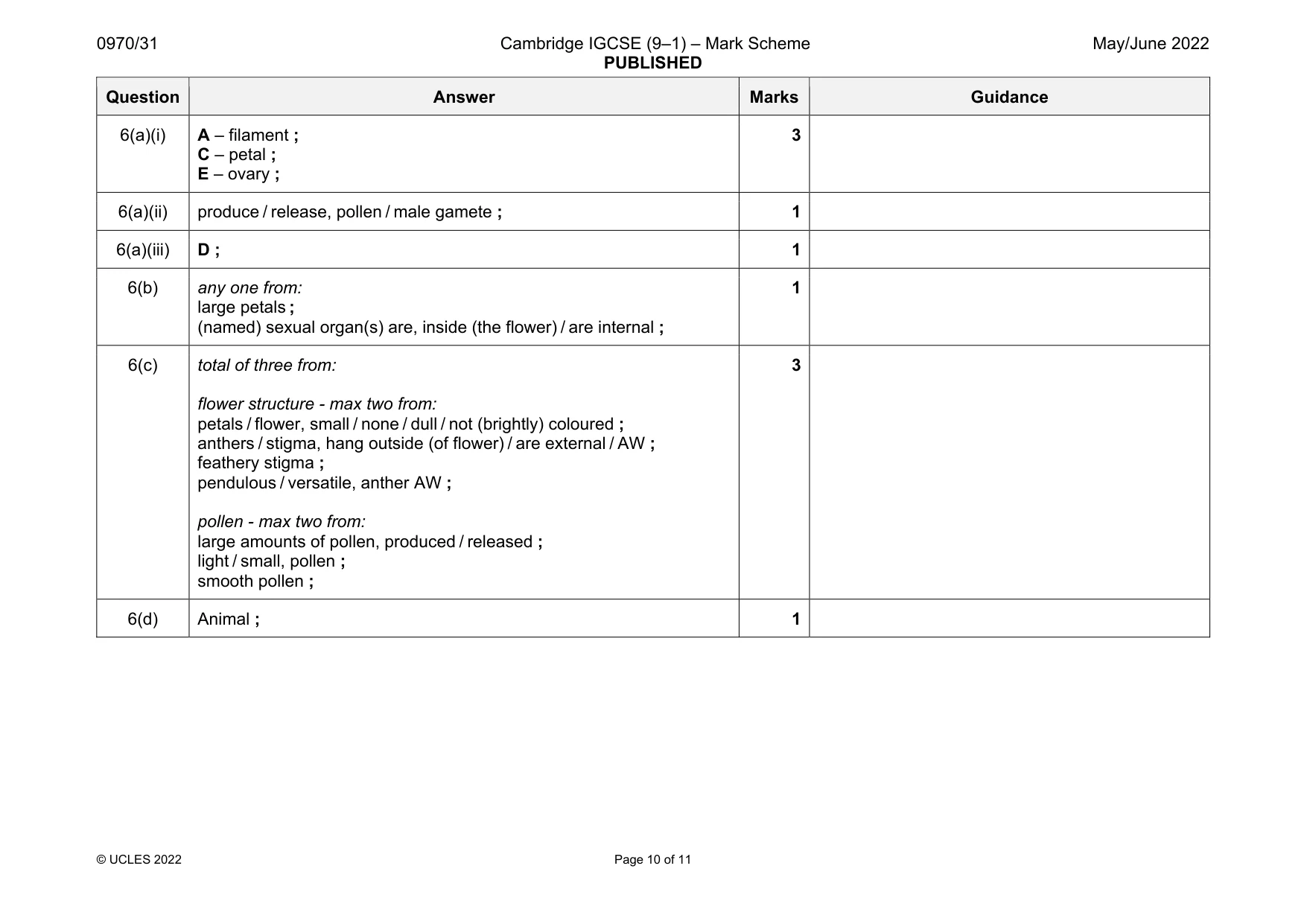
Mark scheme: 6(a)(i) A – filament ; C – petal ; E – ovary ; 3 6(a)(ii) produce / release, pollen / male gamete ; 1 6(a)(iii) D ; 1 6(b) any one from: large petals ; (named) sexual organ(s) are, inside (the flower) / are internal ; 1 6(c) total of three from: flower structure - max two from: petals / flower, small / none / dull / not (brightly) coloured ; anthers / stigma, hang outside (of flower) / are external / AW ; feathery stigma ; pendulous / versatile, anther AW ; pollen - max two from: large amounts of pollen, produced / released ; light / small, pollen ; smooth pollen ; 3 6(d) Animal ; 1
Q7 · A scientist measured the mass of carbon dioxide produced by anaerobic respiration in…
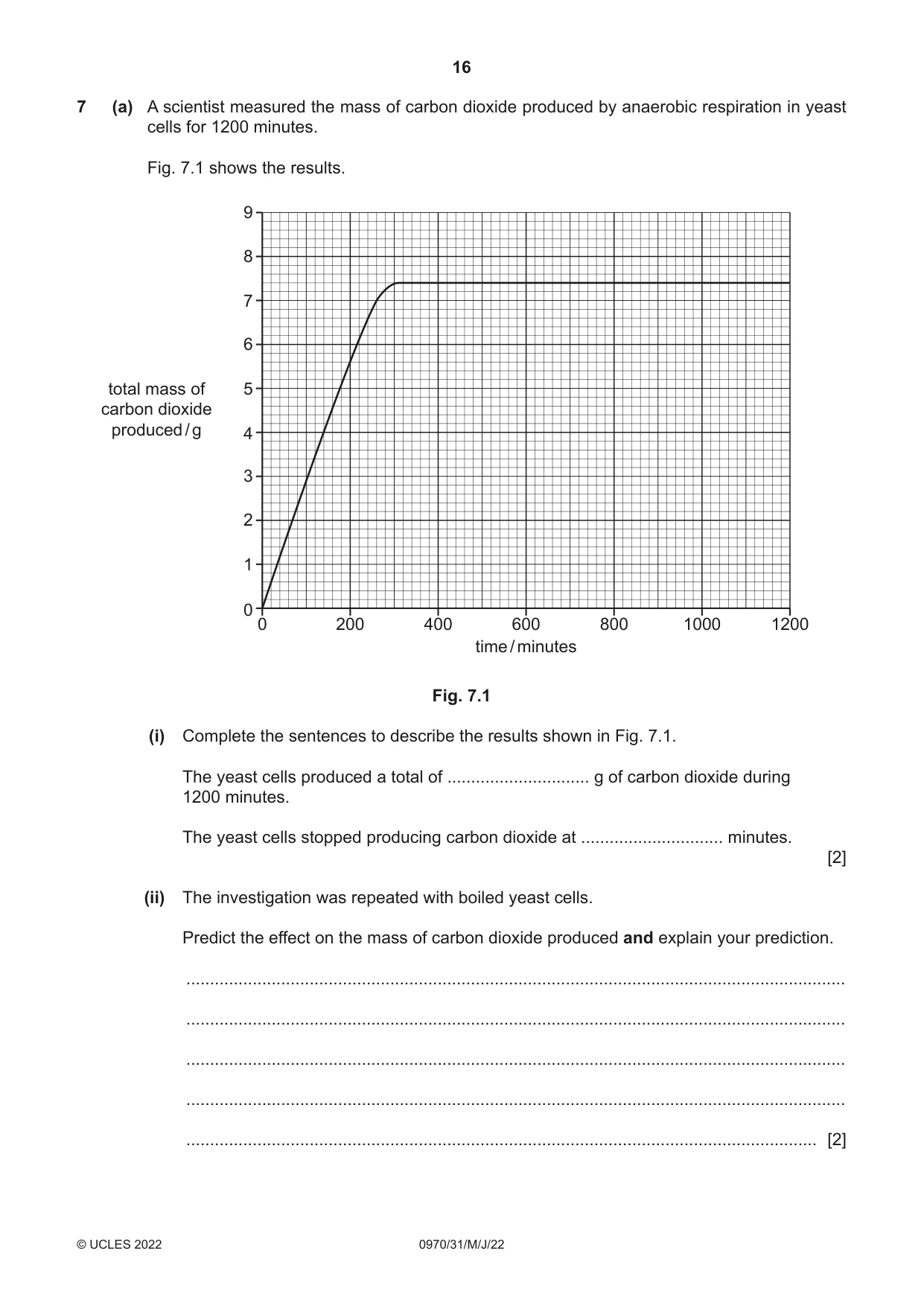
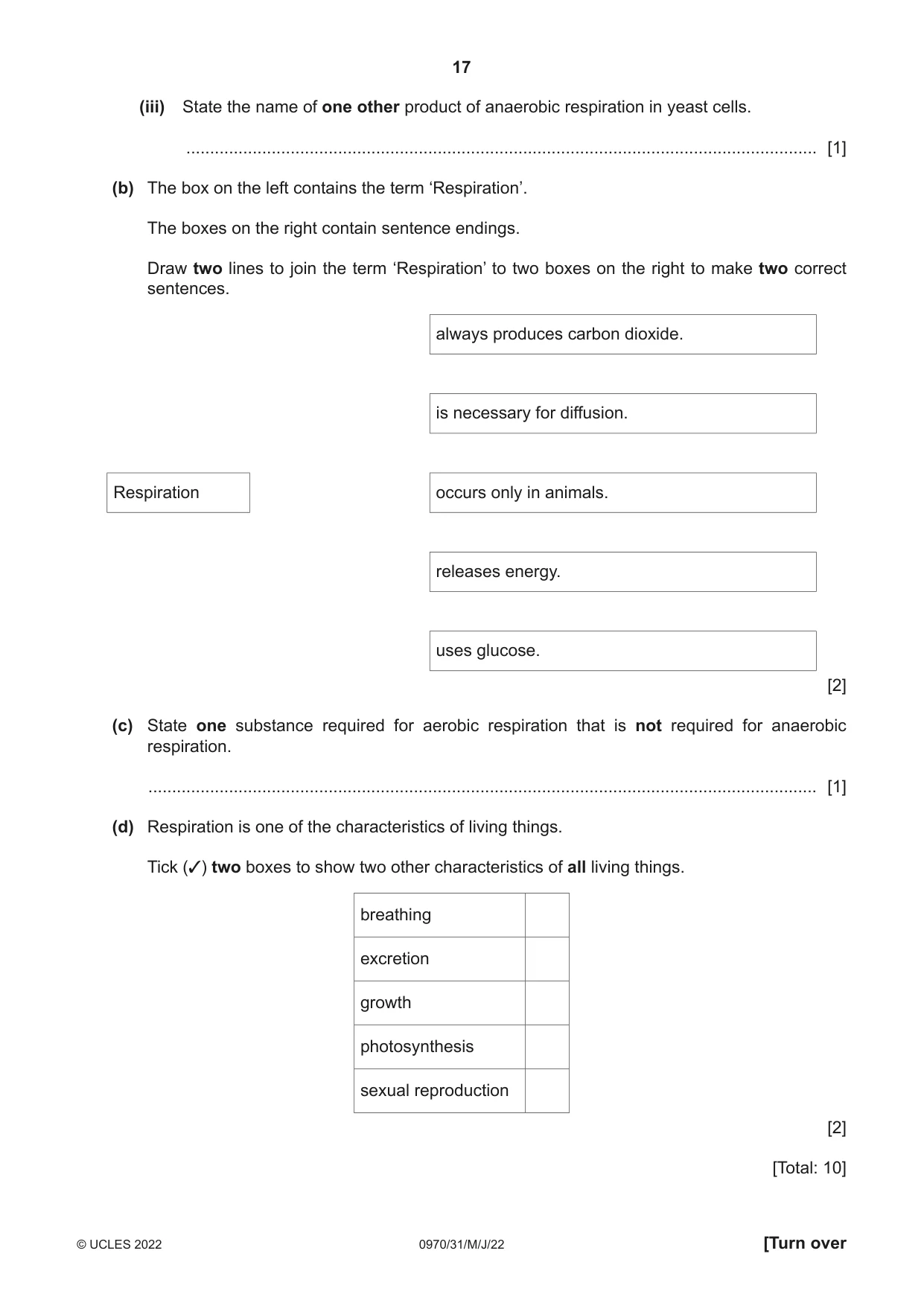
7 (a) A scientist measured the mass of carbon dioxide produced by anaerobic respiration in yeast cells for 1200 minutes. Fig. 7.1 shows the results. 9 8 7 6 total mass of 5 carbon dioxide produced / g 4 3 2 1 0 0 200 400 600 800 1000 1200 time / minutes Fig. 7.1 (i) Complete the sentences to describe the results shown in Fig. 7.1. The yeast cells produced a total of .............................. g of carbon dioxide during 1200 minutes. The yeast cells stopped producing carbon dioxide at .............................. minutes. [2] (ii) The investigation was repeated with boiled yeast cells. Predict the effect on the mass of carbon dioxide produced and explain your prediction. ........................................................................................................................................... ........................................................................................................................................... ........................................................................................................................................... ........................................................................................................................................... ..................................................................................................................................... [2] (iii) State the name of one other product of anaerobic respiration in yeast cells. ..................................................................................................................................... [1] (b) The box on the left contains the term ‘Respiration’. The boxes on the right contain sentence endings. Draw two lines to join the term ‘Respiration’ to two boxes on the right to make two correct sentences. always produces carbon dioxide. is necessary for diffusion. Respiration occurs only in animals. releases energy. uses glucose. [2] (c) State one substance required for aerobic respiration that is not required for anaerobic respiration. ............................................................................................................................................. [1] (d) Respiration is one of the characteristics of living things. Tick (3) two boxes to show two other characteristics of all living things. breathing excretion growth photosynthesis sexual reproduction [2] [Total: 10]
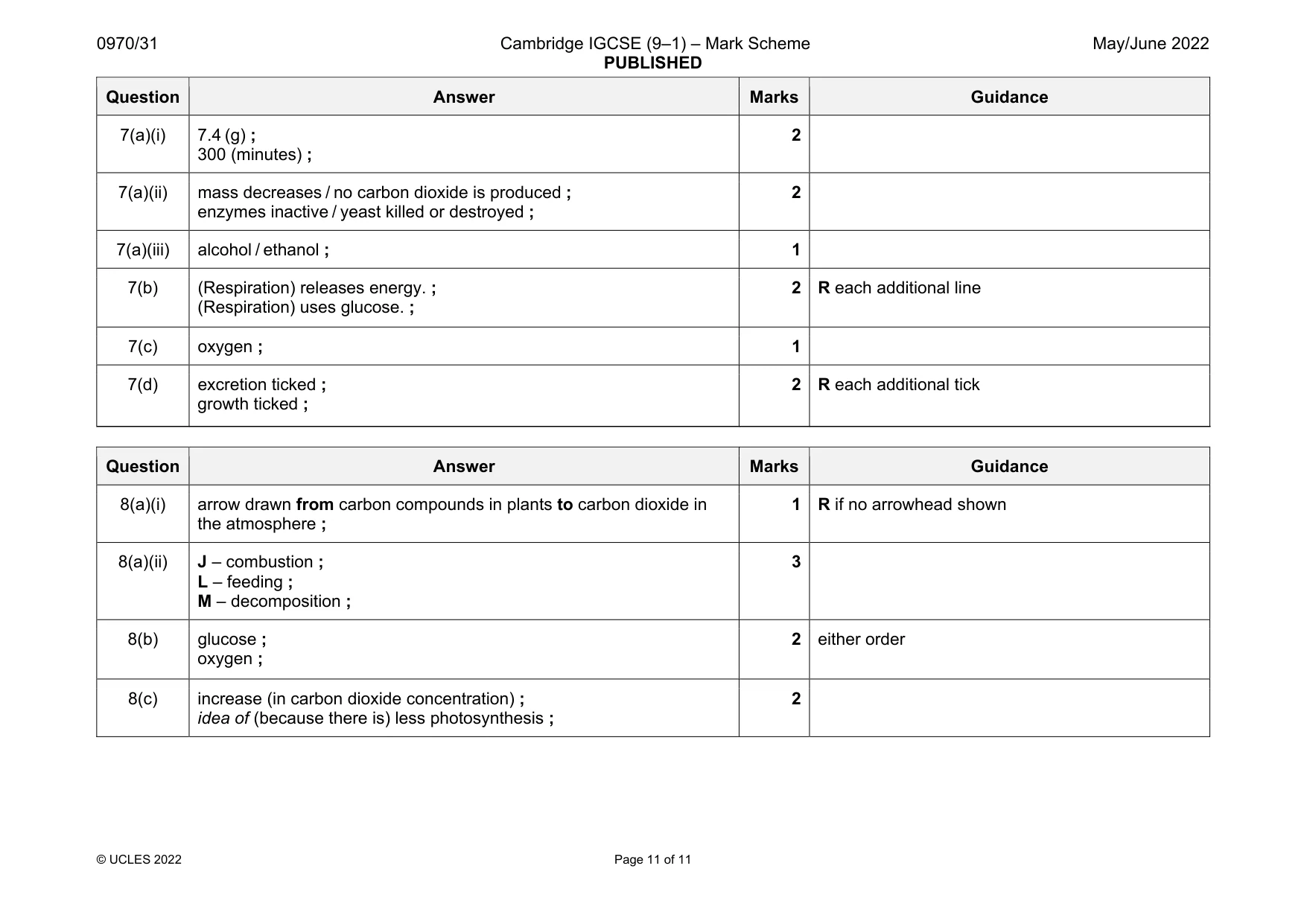
Mark scheme: 7(a)(i) 7.4 (g) ; 300 (minutes) ; 2 7(a)(ii) mass decreases / no carbon dioxide is produced ; enzymes inactive / yeast killed or destroyed ; 2 7(a)(iii) alcohol / ethanol ; 1 7(b) (Respiration) releases energy. ; (Respiration) uses glucose. ; 2 R each additional line 7(c) oxygen ; 1 7(d) excretion ticked ; growth ticked ; 2 R each additional tick
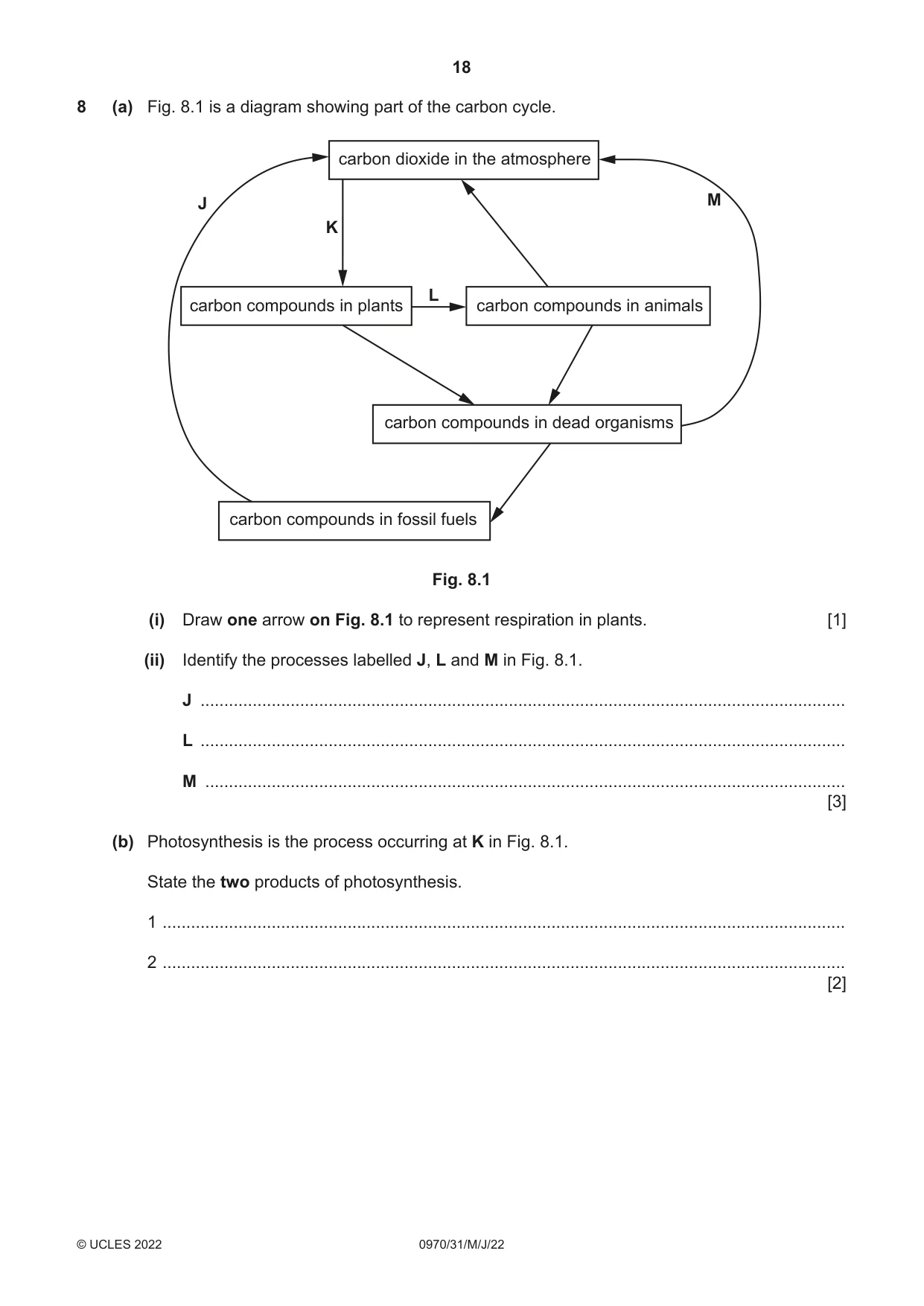
Q8 · A diagram showing part of the carbon cycle
8 (a) Fig. 8.1 is a diagram showing part of the carbon cycle. carbon dioxide in the atmosphere J M K L carbon compounds in plants carbon compounds in animals carbon compounds in dead organisms carbon compounds in fossil fuels Fig. 8.1 (i) Draw one arrow on Fig. 8.1 to represent respiration in plants. [1] (ii) Identify the processes labelled J, L and M in Fig. 8.1. J ........................................................................................................................................ L ........................................................................................................................................ M ....................................................................................................................................... [3] (b) Photosynthesis is the process occurring at K in Fig. 8.1. State the two products of photosynthesis. 1 ................................................................................................................................................ 2 ................................................................................................................................................ [2] (c) Explain the effect of deforestation on the concentration of carbon dioxide in the atmosphere. ................................................................................................................................................... ................................................................................................................................................... ................................................................................................................................................... ................................................................................................................................................... ............................................................................................................................................. [2] [Total: 8]
Mark scheme: 8(a)(i) arrow drawn from carbon compounds in plants to carbon dioxide in the atmosphere ; 1 R if no arrowhead shown 8(a)(ii) J – combustion ; L – feeding ; M – decomposition ; 3 8(b) glucose ; oxygen ; 2 either order 8(c) increase (in carbon dioxide concentration) ; idea of (because there is) less photosynthesis ; 2
What was in this paper
The subtopics covered by these 8 questions, and how many questions each got. Open one in a new tab to see every Cambridge question on it.
What you needed in this session
Cambridge’s own grade thresholds for 2022 May/June, Paper 3 · Variant 1. A higher threshold means an easier paper — the bar moves with how the cohort did.