Cambridge IGCSE Biology (9-1) 0970 — 2022 May/June Paper 4 · Variant 1
0970/41/M/J/22 · 6 questions · 80 marks · ≈90 min
The question paper and its mark scheme, free to read here and free to download. This is Cambridge’s own paper, exactly as it was sat.
Question paper20 pages


Mark scheme12 pages
Answers below. Sit the paper first if you are practising.
Questions as text
Q1 · Some students were studying the activity of yeast
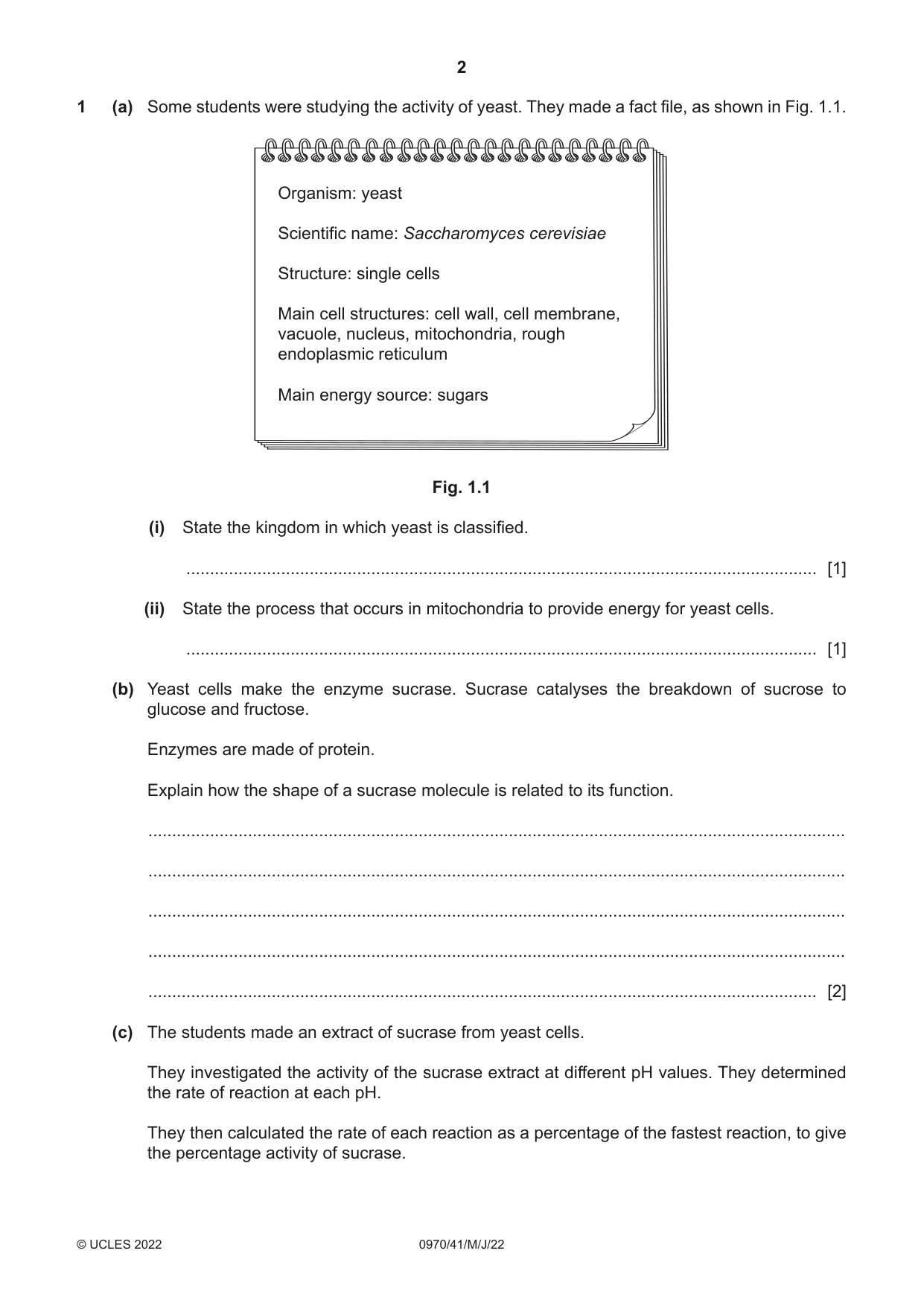
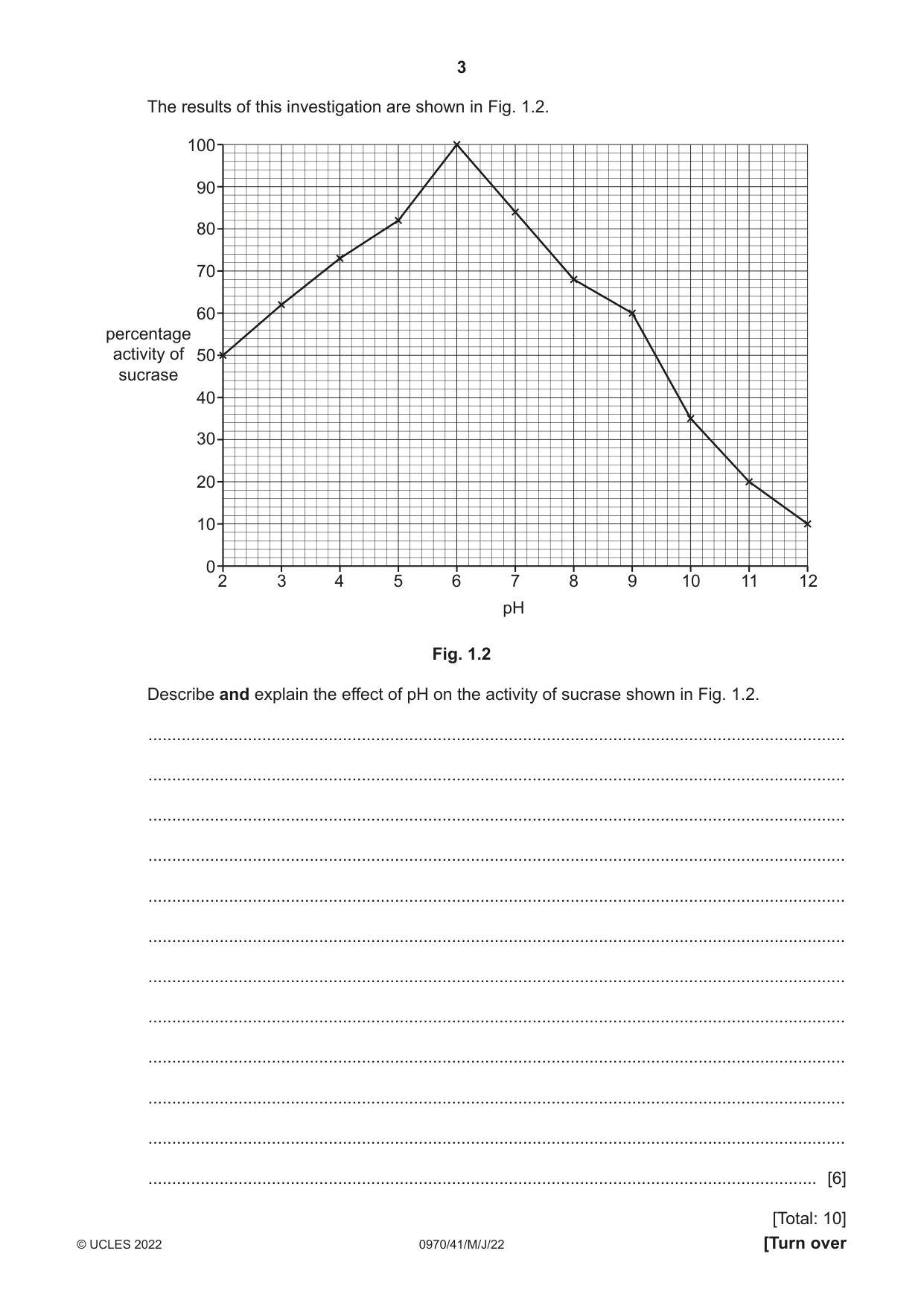
1 (a) Some students were studying the activity of yeast. They made a fact file, as shown in Fig. 1.1. Organism: yeast Scientific name: Saccharomyces cerevisiae Structure: single cells Main cell structures: cell wall, cell membrane, vacuole, nucleus, mitochondria, rough endoplasmic reticulum Main energy source: sugars Fig. 1.1 (i) State the kingdom in which yeast is classified. ..................................................................................................................................... [1] (ii) State the process that occurs in mitochondria to provide energy for yeast cells. ..................................................................................................................................... [1] (b) Yeast cells make the enzyme sucrase. Sucrase catalyses the breakdown of sucrose to glucose and fructose. Enzymes are made of protein. Explain how the shape of a sucrase molecule is related to its function. ................................................................................................................................................... ................................................................................................................................................... ................................................................................................................................................... ................................................................................................................................................... ............................................................................................................................................. [2] (c) The students made an extract of sucrase from yeast cells. They investigated the activity of the sucrase extract at different pH values. They determined the rate of reaction at each pH. They then calculated the rate of each reaction as a percentage of the fastest reaction, to give the percentage activity of sucrase. The results of this investigation are shown in Fig. 1.2. 100 90 80 70 60 percentage activity of 50 sucrase 40 30 20 10 0 2 3 4 5 6 7 8 9 10 11 12 pH Fig. 1.2 Describe and explain the effect of pH on the activity of sucrase shown in Fig. 1.2. ................................................................................................................................................... ................................................................................................................................................... ................................................................................................................................................... ................................................................................................................................................... ................................................................................................................................................... ................................................................................................................................................... ................................................................................................................................................... ................................................................................................................................................... ................................................................................................................................................... ................................................................................................................................................... ................................................................................................................................................... ............................................................................................................................................. [6] [Total: 10]
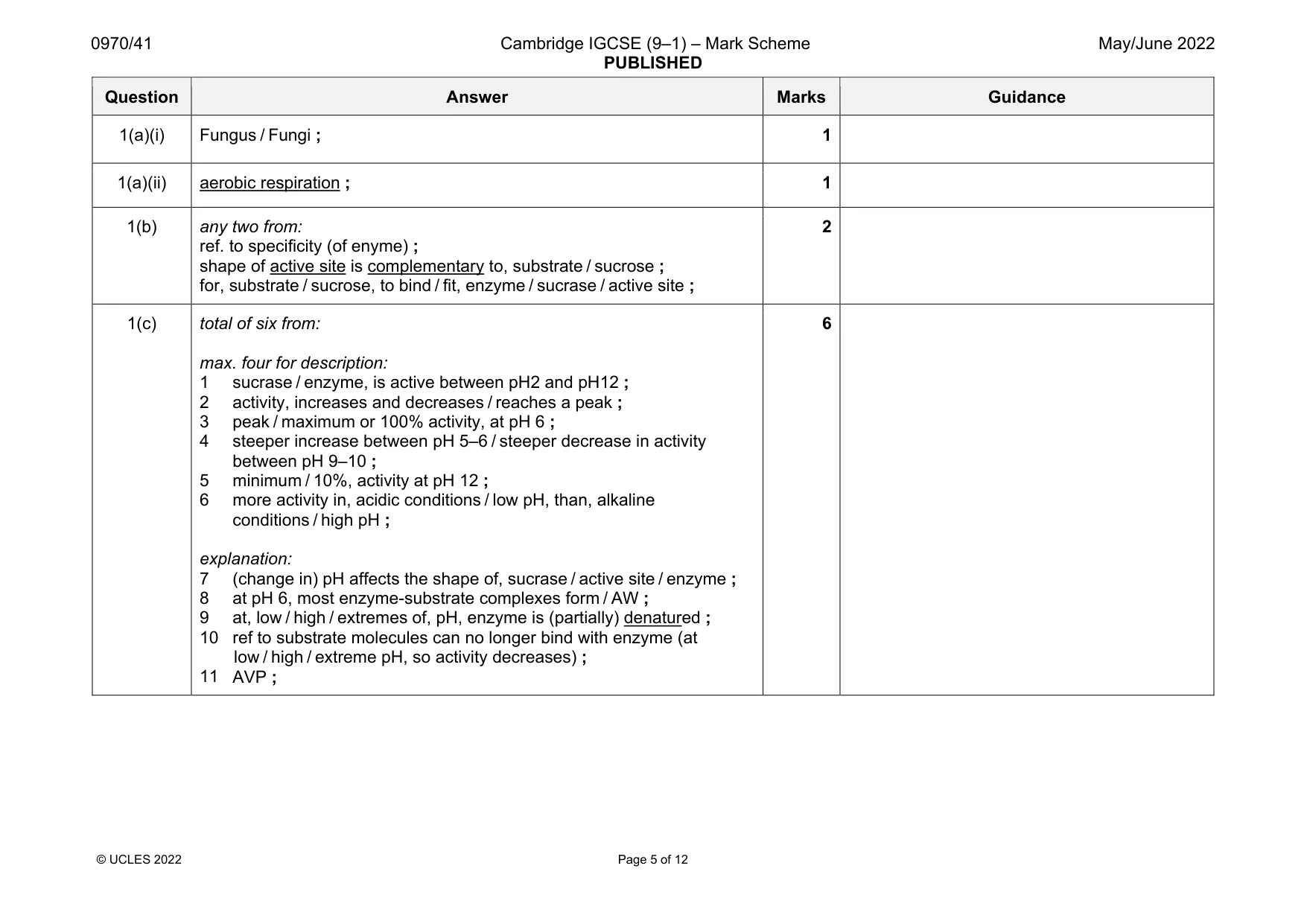
Mark scheme: 1(a)(i) Fungus / Fungi ; 1 1(a)(ii) aerobic respiration ; 1 1(b) any two from: ref. to specificity (of enyme) ; shape of active site is complementary to, substrate / sucrose ; for, substrate / sucrose, to bind / fit, enzyme / sucrase / active site ; 2 1(c) total of six from: max. four for description: 1 sucrase / enzyme, is active between pH2 and pH12 ; 2 activity, increases and decreases / reaches a peak ; 3 peak / maximum or 100% activity, at pH 6 ; 4 steeper increase between pH 5–6 / steeper decrease in activity between pH 9–10 ; 5 minimum / 10%, activity at pH 12 ; 6 more activity in, acidic conditions / low pH, than, alkaline conditions / high pH ; explanation: 7 (change in) pH affects the shape of, sucrase / active site / enzyme ; 8 at pH 6, most enzyme-substrate complexes form / AW ; 9 at, low / high / extremes of, pH, enzyme is (partially) denatured ; 10 ref to substrate molecules can no longer bind with enzyme (at low / high / extreme pH, so activity decreases) ; 11 AVP ; 6
Q2 · Mammals have a double circulation
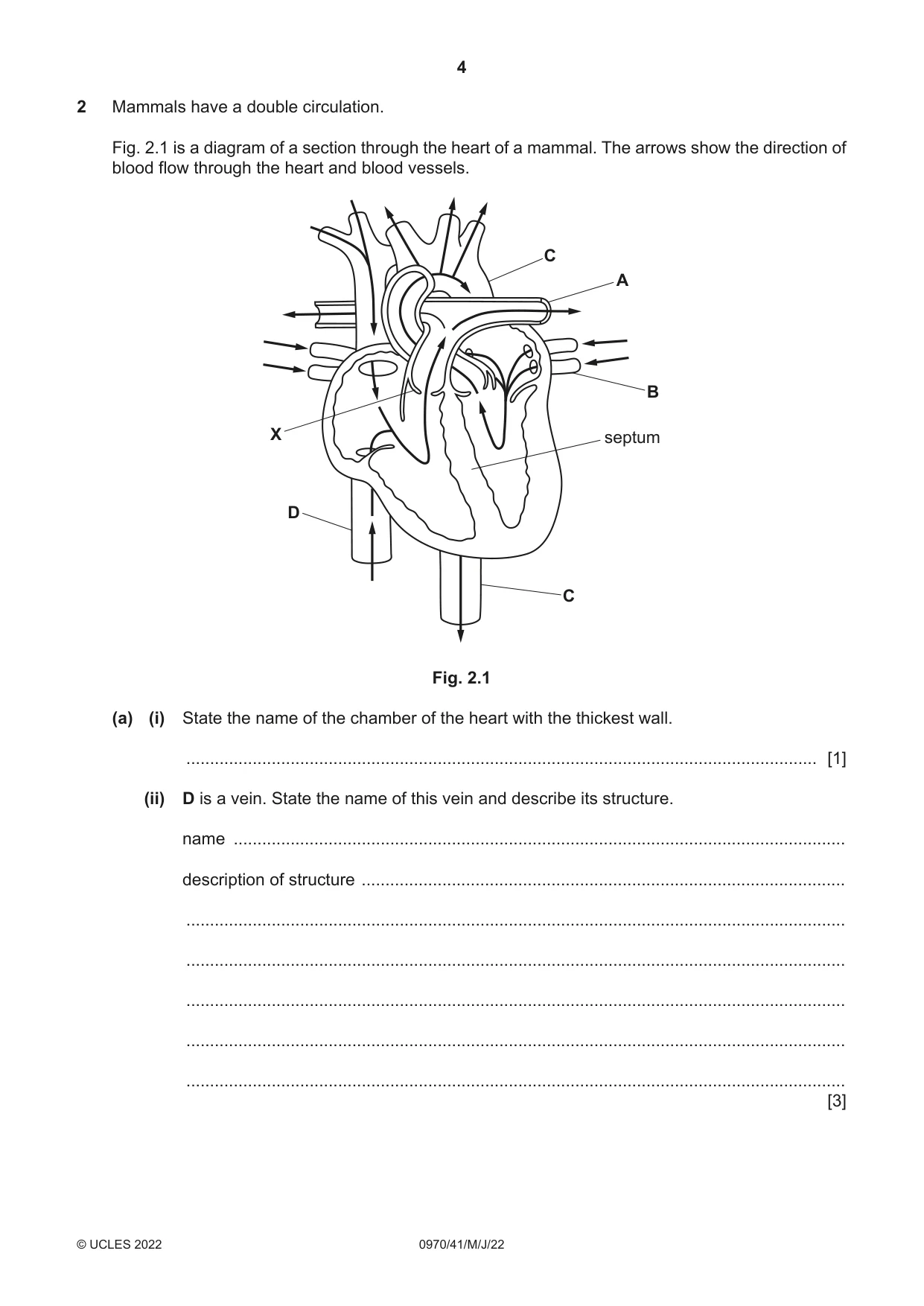
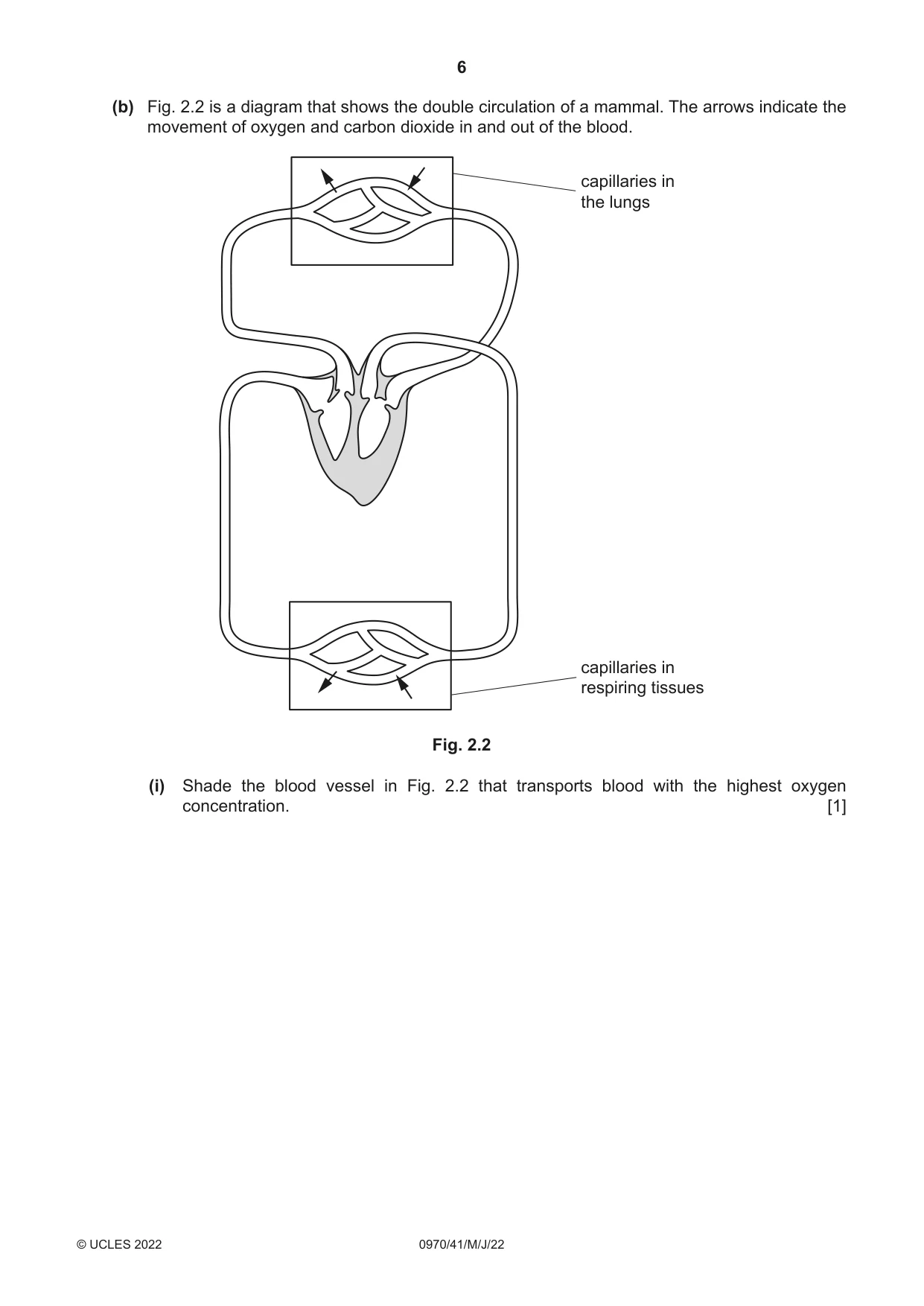
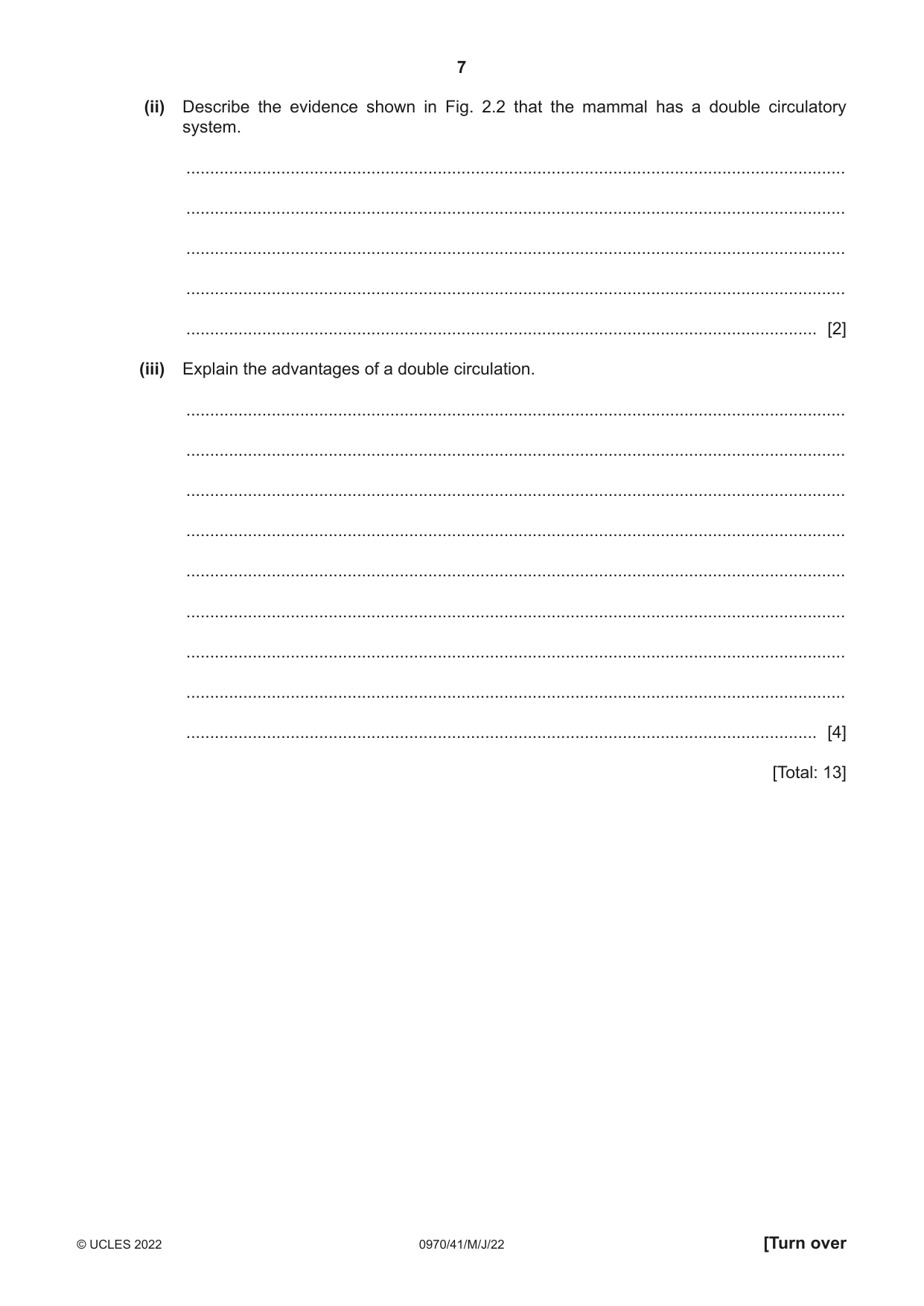
2 Mammals have a double circulation. Fig. 2.1 is a diagram of a section through the heart of a mammal. The arrows show the direction of blood flow through the heart and blood vessels. C A B X septum D C Fig. 2.1 (a) (i) State the name of the chamber of the heart with the thickest wall. ..................................................................................................................................... [1] (ii) D is a vein. State the name of this vein and describe its structure. name ................................................................................................................................. description of structure ...................................................................................................... ........................................................................................................................................... ........................................................................................................................................... ........................................................................................................................................... ........................................................................................................................................... ........................................................................................................................................... [3] (iii) Identify the structure labelled X in Fig. 2.1 and state its role in the heart. ........................................................................................................................................... ........................................................................................................................................... ........................................................................................................................................... ........................................................................................................................................... ..................................................................................................................................... [2] (b) Fig. 2.2 is a diagram that shows the double circulation of a mammal. The arrows indicate the movement of oxygen and carbon dioxide in and out of the blood. capillaries in the lungs capillaries in respiring tissues Fig. 2.2 (i) Shade the blood vessel in Fig. 2.2 that transports blood with the highest oxygen concentration. [1] (ii) Describe the evidence shown in Fig. 2.2 that the mammal has a double circulatory system. ........................................................................................................................................... ........................................................................................................................................... ........................................................................................................................................... ........................................................................................................................................... ..................................................................................................................................... [2] (iii) Explain the advantages of a double circulation. ........................................................................................................................................... ........................................................................................................................................... ........................................................................................................................................... ........................................................................................................................................... ........................................................................................................................................... ........................................................................................................................................... ........................................................................................................................................... ........................................................................................................................................... ..................................................................................................................................... [4] [Total: 13]
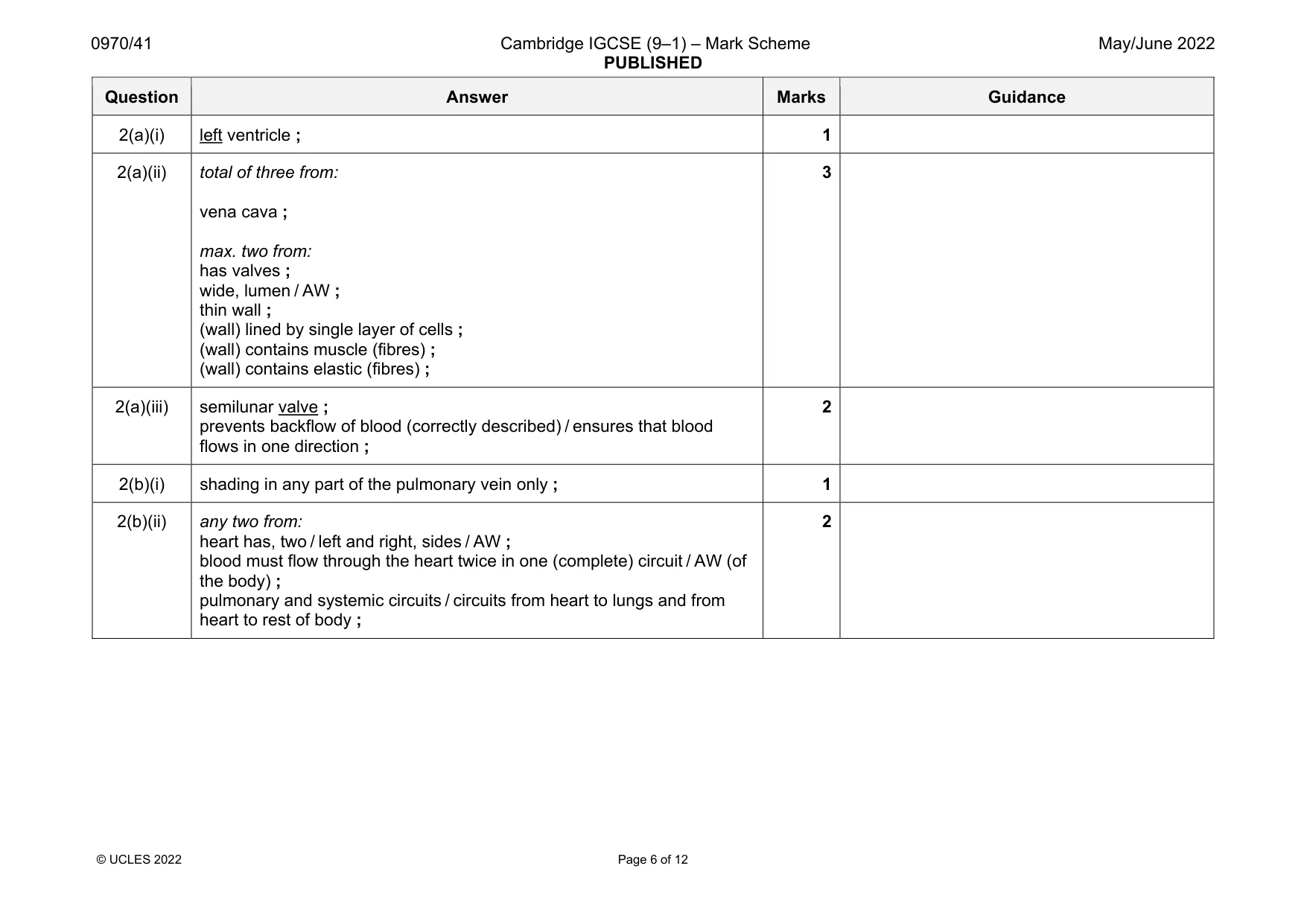
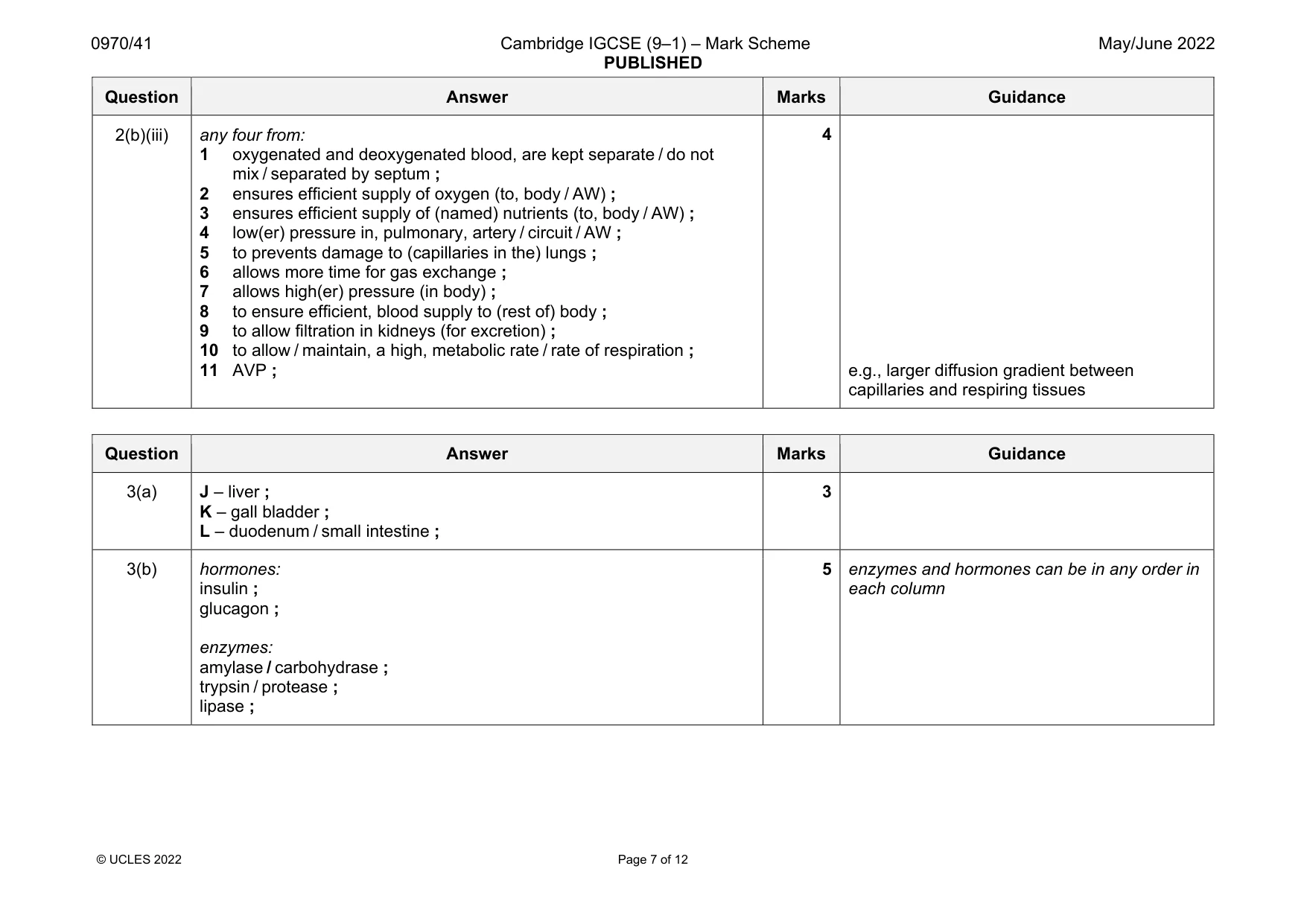
Mark scheme: 2(a)(i) left ventricle ; 1 2(a)(ii) total of three from: vena cava ; max. two from: has valves ; wide, lumen / AW ; thin wall ; (wall) lined by single layer of cells ; (wall) contains muscle (fibres) ; (wall) contains elastic (fibres) ; 3 2(a)(iii) semilunar valve ; prevents backflow of blood (correctly described) / ensures that blood flows in one direction ; 2 2(b)(i) shading in any part of the pulmonary vein only ; 1 2(b)(ii) any two from: heart has, two / left and right, sides / AW ; blood must flow through the heart twice in one (complete) circuit / AW (of the body) ; pulmonary and systemic circuits / circuits from heart to lungs and from heart to rest of body ; 2 Question Answer Marks Guidance 2(b)(iii) any four from: 1 oxygenated and deoxygenated blood, are kept separate / do not mix / separated by septum ; 2 ensures efficient supply of oxygen (to, body / AW) ; 3 ensures efficient supply of (named) nutrients (to, body / AW) ; 4 low(er) pressure in, pulmonary, artery / circuit / AW ; 5 to prevents damage to (capillaries in the) lungs ; 6 allows more time for gas exchange ; 7 allows high(er) pressure (in body) ; 8 to ensure efficient, blood supply to (rest of) body ; 9 to allow filtration in kidneys (for excretion) ; 10 to allow / maintain, a high, metabolic rate / rate of respiration ; 11 AVP ; 4 e.g., larger diffusion gradient between capillaries and respiring tissues
Q3 · The pancreas is an organ that has roles in the digestive and hormonal systems of humans
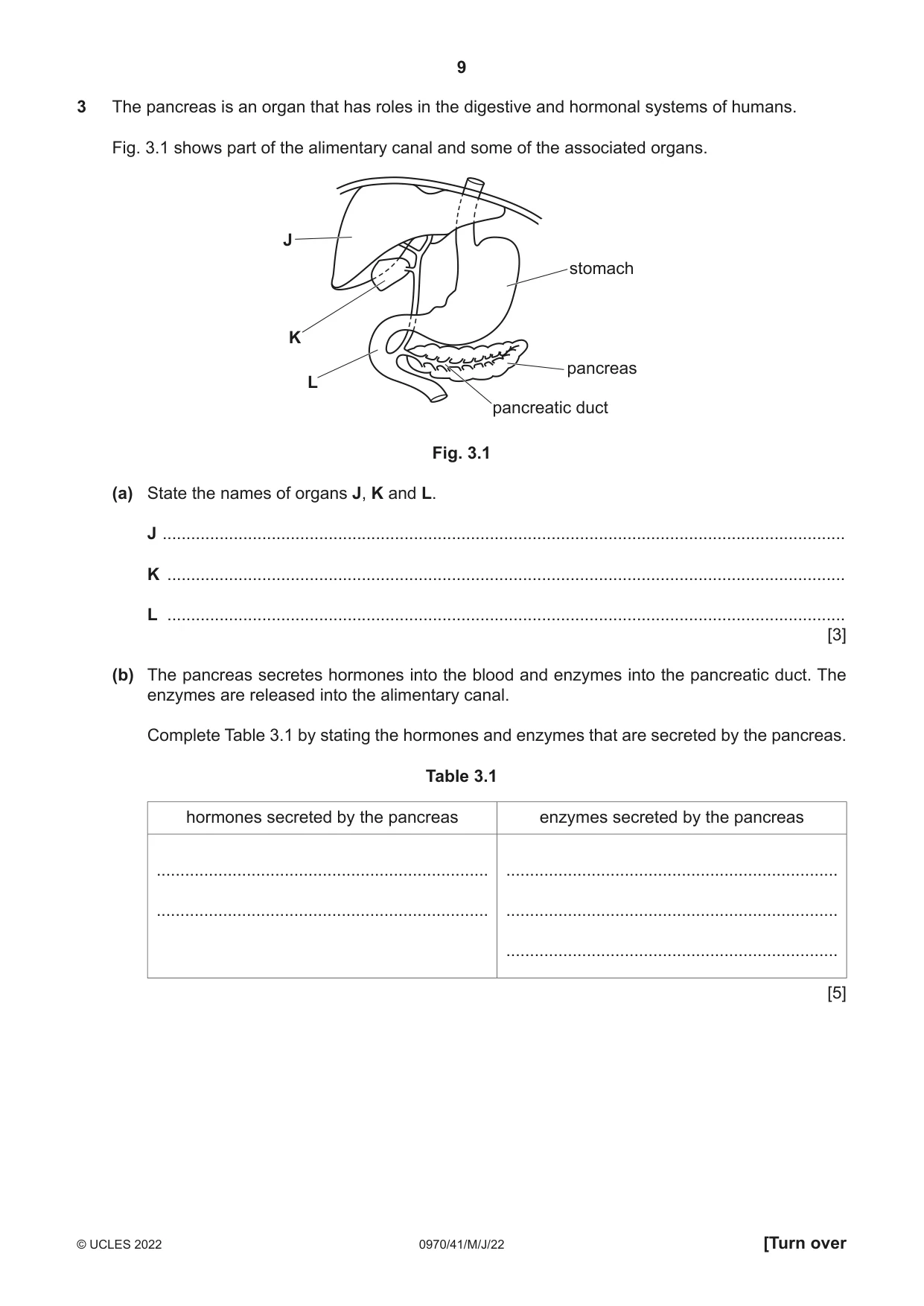
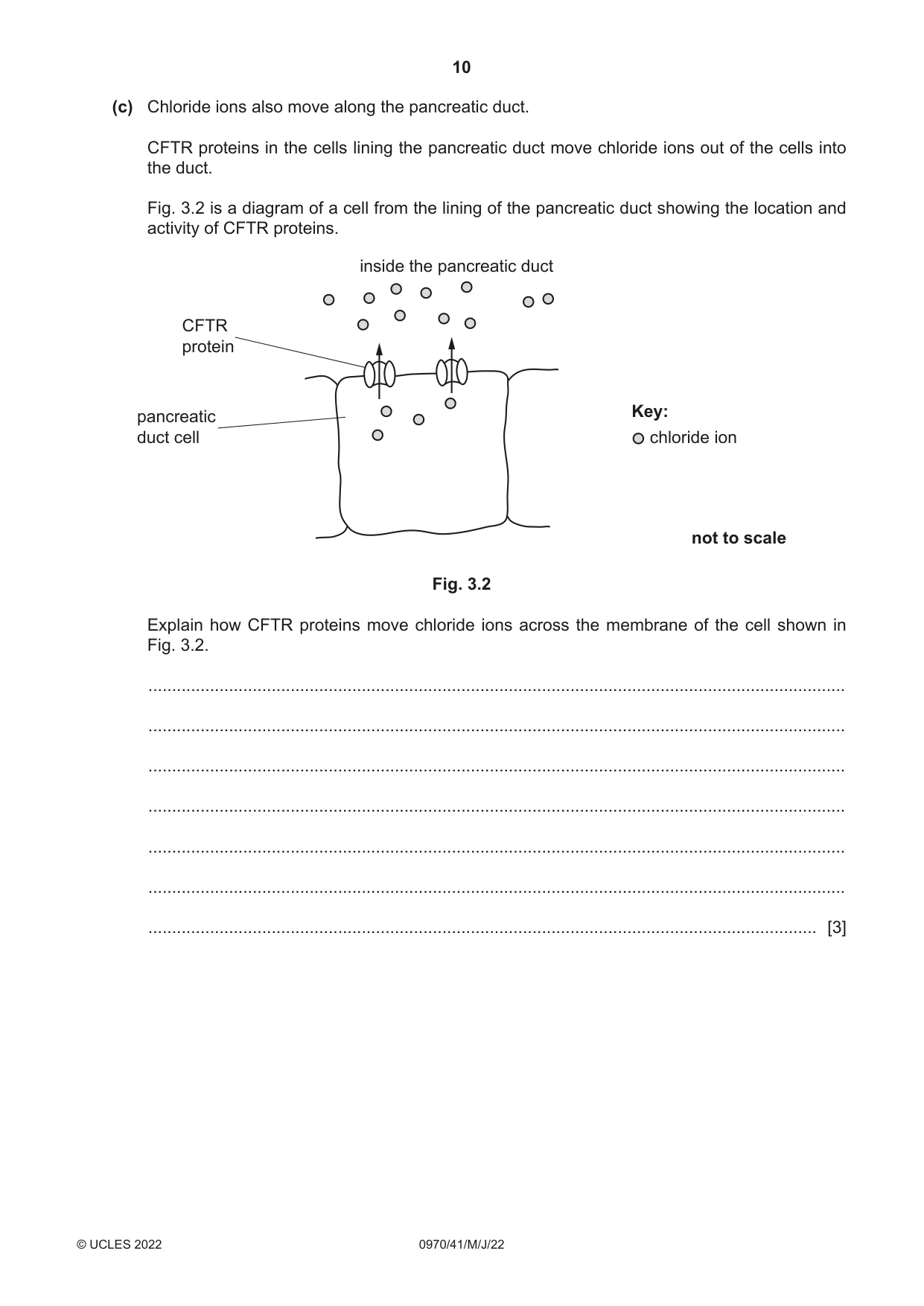
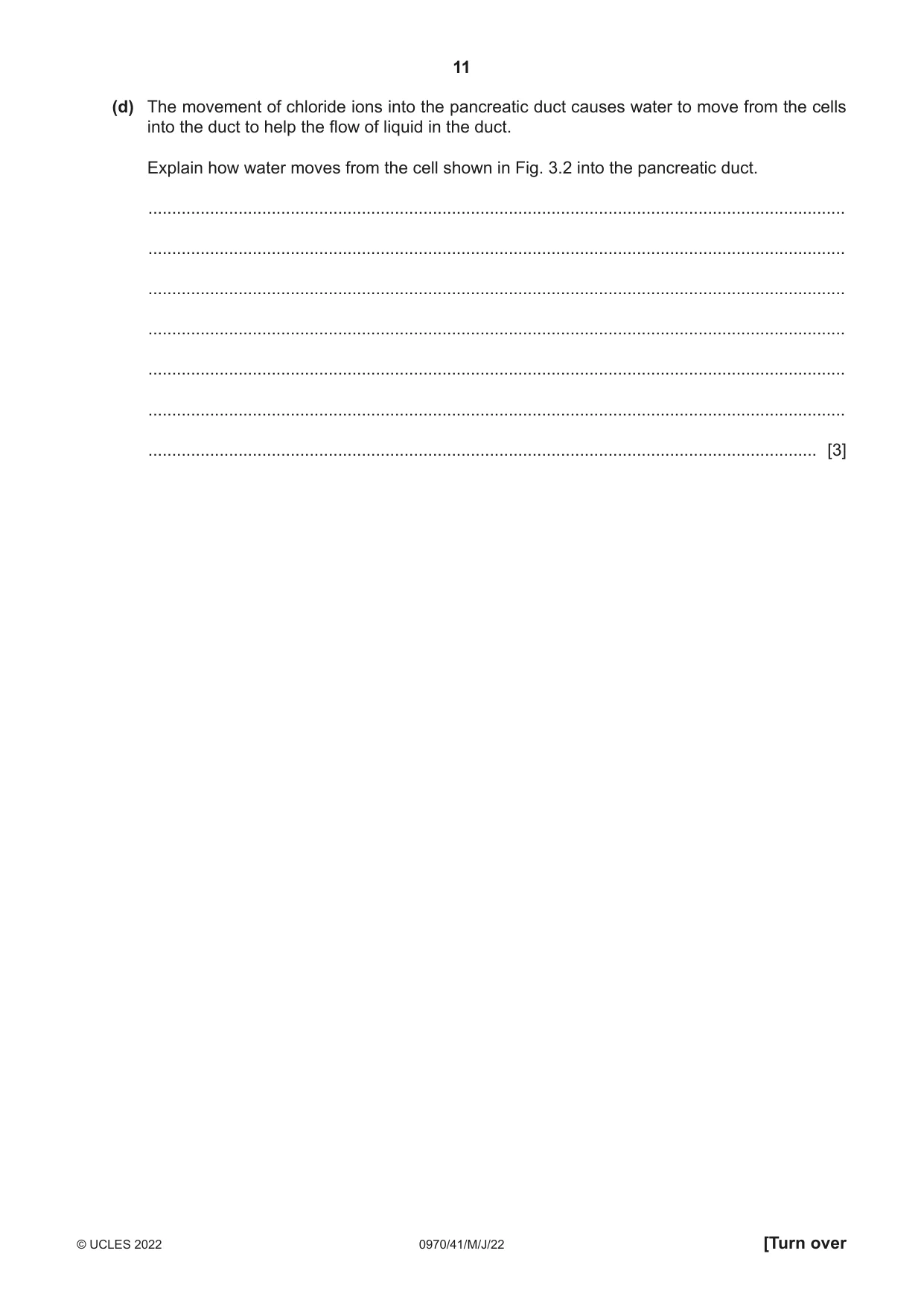
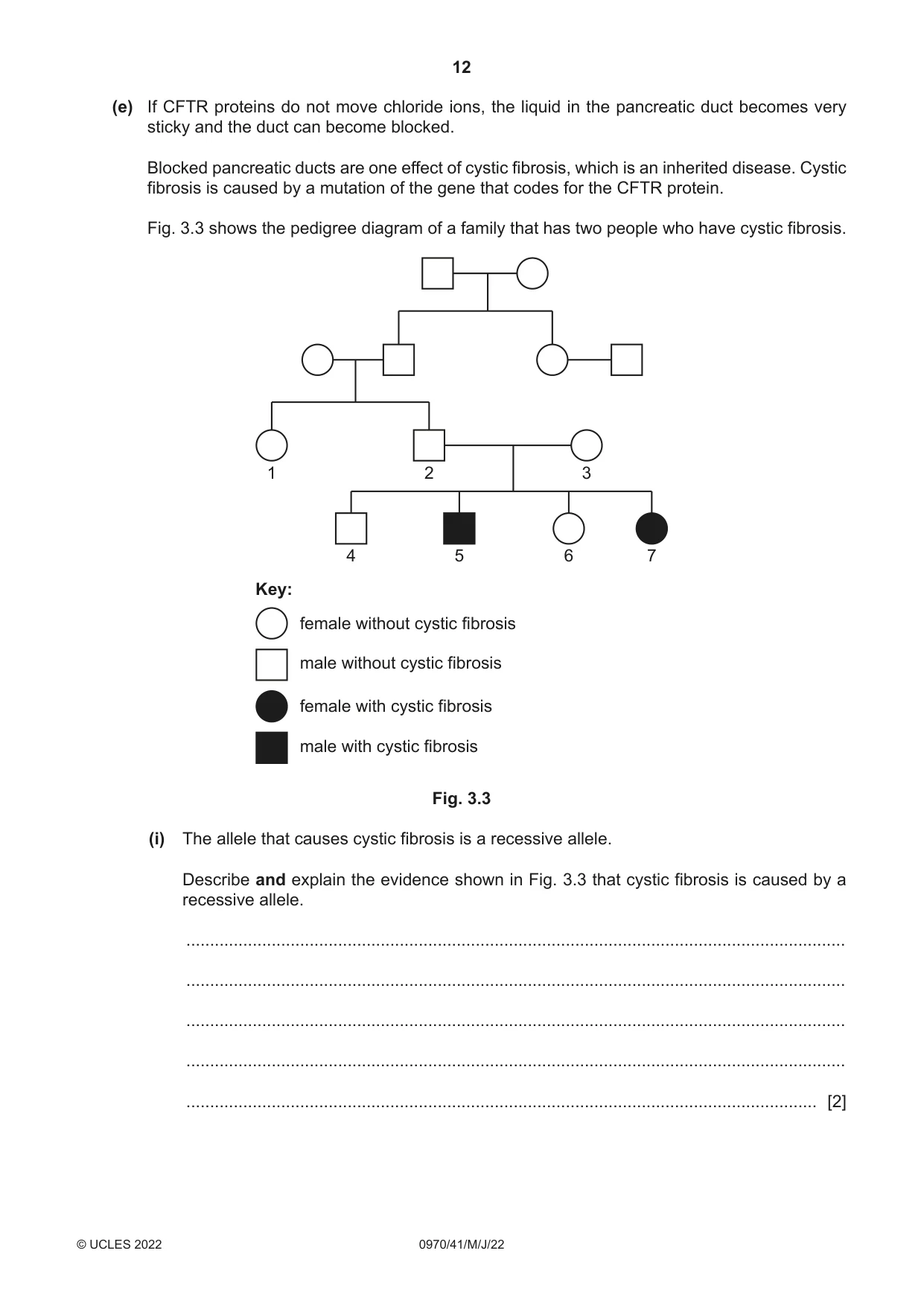
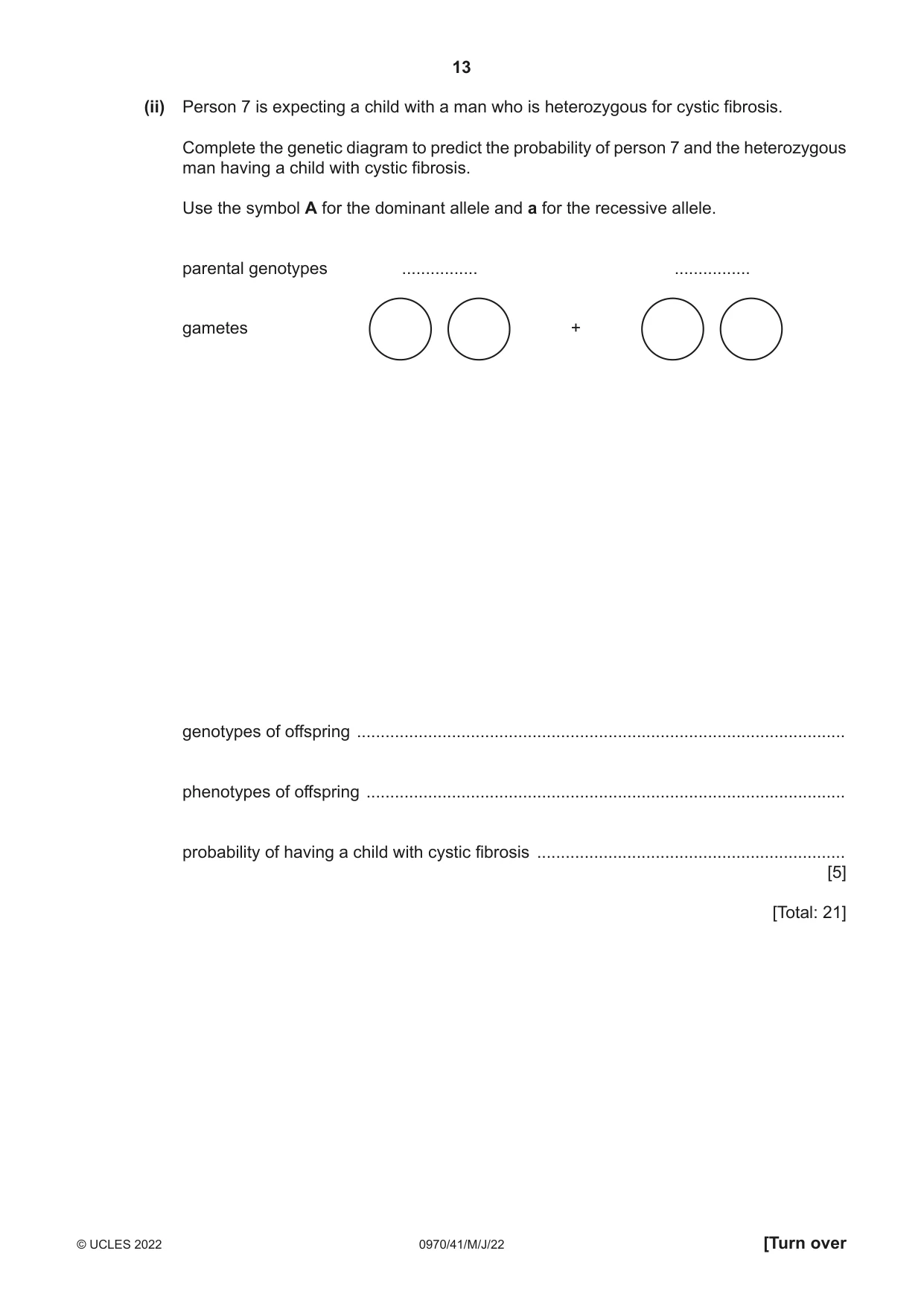
3 The pancreas is an organ that has roles in the digestive and hormonal systems of humans. Fig. 3.1 shows part of the alimentary canal and some of the associated organs. J stomach K pancreas L pancreatic duct Fig. 3.1 (a) State the names of organs J, K and L. J ................................................................................................................................................ K ............................................................................................................................................... L ............................................................................................................................................... [3] (b) The pancreas secretes hormones into the blood and enzymes into the pancreatic duct. The enzymes are released into the alimentary canal. Complete Table 3.1 by stating the hormones and enzymes that are secreted by the pancreas. Table 3.1 hormones secreted by the pancreas enzymes secreted by the pancreas ...................................................................... ...................................................................... ...................................................................... ...................................................................... ...................................................................... [5] (c) Chloride ions also move along the pancreatic duct. CFTR proteins in the cells lining the pancreatic duct move chloride ions out of the cells into the duct. Fig. 3.2 is a diagram of a cell from the lining of the pancreatic duct showing the location and activity of CFTR proteins. inside the pancreatic duct CFTR protein Key: pancreatic duct cell chloride ion not to scale Fig. 3.2 Explain how CFTR proteins move chloride ions across the membrane of the cell shown in Fig. 3.2. ................................................................................................................................................... ................................................................................................................................................... ................................................................................................................................................... ................................................................................................................................................... ................................................................................................................................................... ................................................................................................................................................... ............................................................................................................................................. [3] (d) The movement of chloride ions into the pancreatic duct causes water to move from the cells into the duct to help the flow of liquid in the duct. Explain how water moves from the cell shown in Fig. 3.2 into the pancreatic duct. ................................................................................................................................................... ................................................................................................................................................... ................................................................................................................................................... ................................................................................................................................................... ................................................................................................................................................... ................................................................................................................................................... ............................................................................................................................................. [3] (e) If CFTR proteins do not move chloride ions, the liquid in the pancreatic duct becomes very sticky and the duct can become blocked. Blocked pancreatic ducts are one effect of cystic fibrosis, which is an inherited disease. Cystic fibrosis is caused by a mutation of the gene that codes for the CFTR protein. Fig. 3.3 shows the pedigree diagram of a family that has two people who have cystic fibrosis. 1 2 3 4 5 6 7 Key: female without cystic fibrosis male without cystic fibrosis female with cystic fibrosis male with cystic fibrosis Fig. 3.3 (i) The allele that causes cystic fibrosis is a recessive allele. Describe and explain the evidence shown in Fig. 3.3 that cystic fibrosis is caused by a recessive allele. ........................................................................................................................................... ........................................................................................................................................... ........................................................................................................................................... ........................................................................................................................................... ..................................................................................................................................... [2] (ii) Person 7 is expecting a child with a man who is heterozygous for cystic fibrosis. Complete the genetic diagram to predict the probability of person 7 and the heterozygous man having a child with cystic fibrosis. Use the symbol A for the dominant allele and a for the recessive allele. parental genotypes ................ ................ gametes + genotypes of offspring ....................................................................................................... phenotypes of offspring ..................................................................................................... probability of having a child with cystic fibrosis ................................................................. [5] [Total: 21]
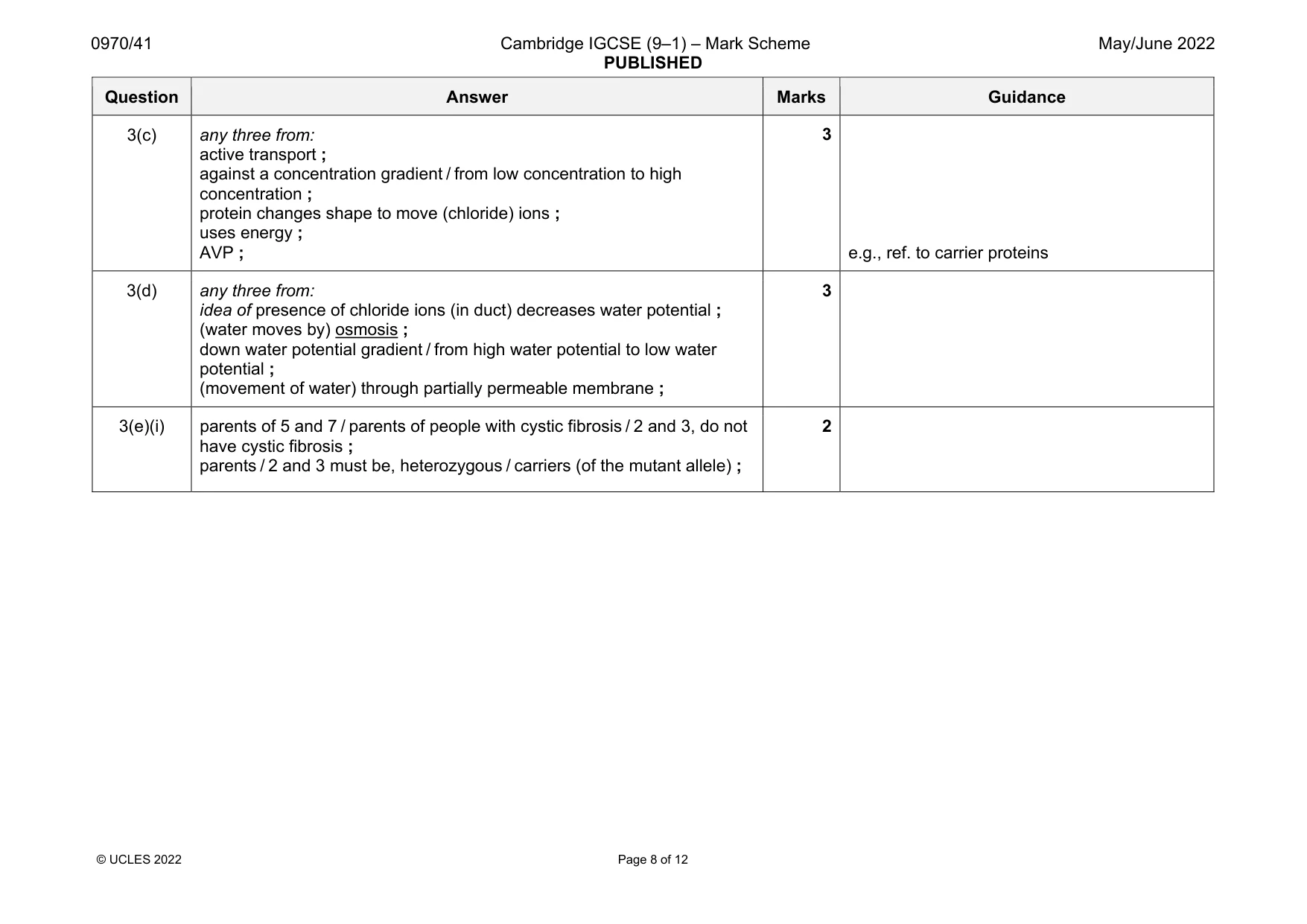
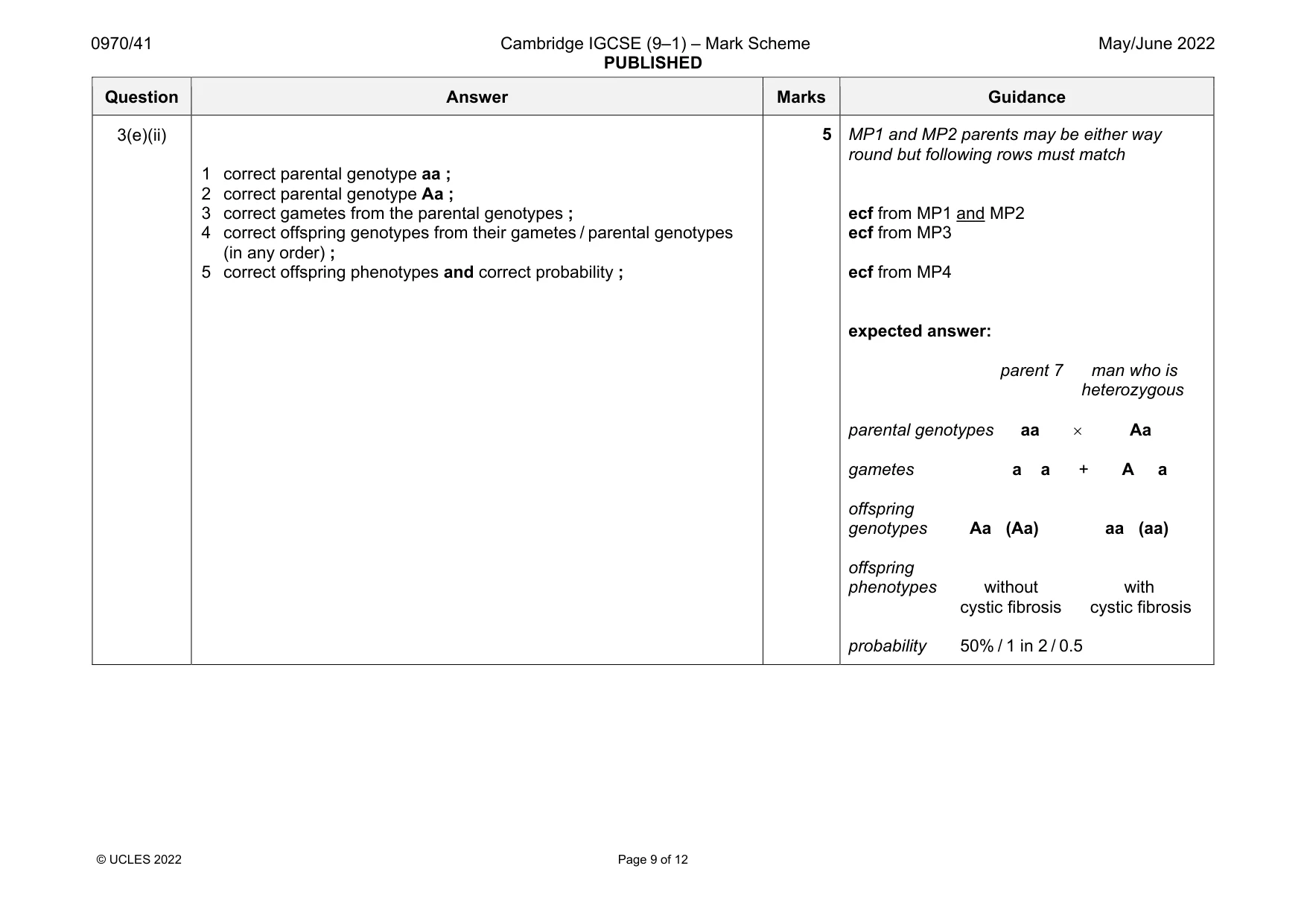
Mark scheme: 3(a) J – liver ; K – gall bladder ; L – duodenum / small intestine ; 3 3(b) hormones: insulin ; glucagon ; enzymes: amylase / carbohydrase ; trypsin / protease ; lipase ; 5 enzymes and hormones can be in any order in each column Question Answer Marks Guidance 3(c) any three from: active transport ; against a concentration gradient / from low concentration to high concentration ; protein changes shape to move (chloride) ions ; uses energy ; AVP ; 3 e.g., ref. to carrier proteins 3(d) any three from: idea of presence of chloride ions (in duct) decreases water potential ; (water moves by) osmosis ; down water potential gradient / from high water potential to low water potential ; (movement of water) through partially permeable membrane ; 3 3(e)(i) parents of 5 and 7 / parents of people with cystic fibrosis / 2 and 3, do not have cystic fibrosis ; parents / 2 and 3 must be, heterozygous / carriers (of the mutant allele) ; 2 Question Answer Marks Guidance 3(e)(ii) 1 correct parental genotype aa ; 2 correct parental genotype Aa ; 3 correct gametes from the parental genotypes ; 4 correct offspring genotypes from their gametes / parental genotypes (in any order) ; 5 correct offspring phenotypes and correct probability ; 5 MP1 and MP2 parents may be either way round but following rows must match ecf from MP1 and MP2 ecf from MP3 ecf from MP4 expected answer: parent 7 man who is heterozygous parental genotypes aa Aa gametes a a + A a offspring genotypes Aa (Aa) aa (aa) offspring phenotypes without with cystic fibrosis cystic fibrosis probability 50% / 1 in 2 / 0.5
Q4 · Researchers investigated the effect of adding cattle manure (cattle faeces) to fields…
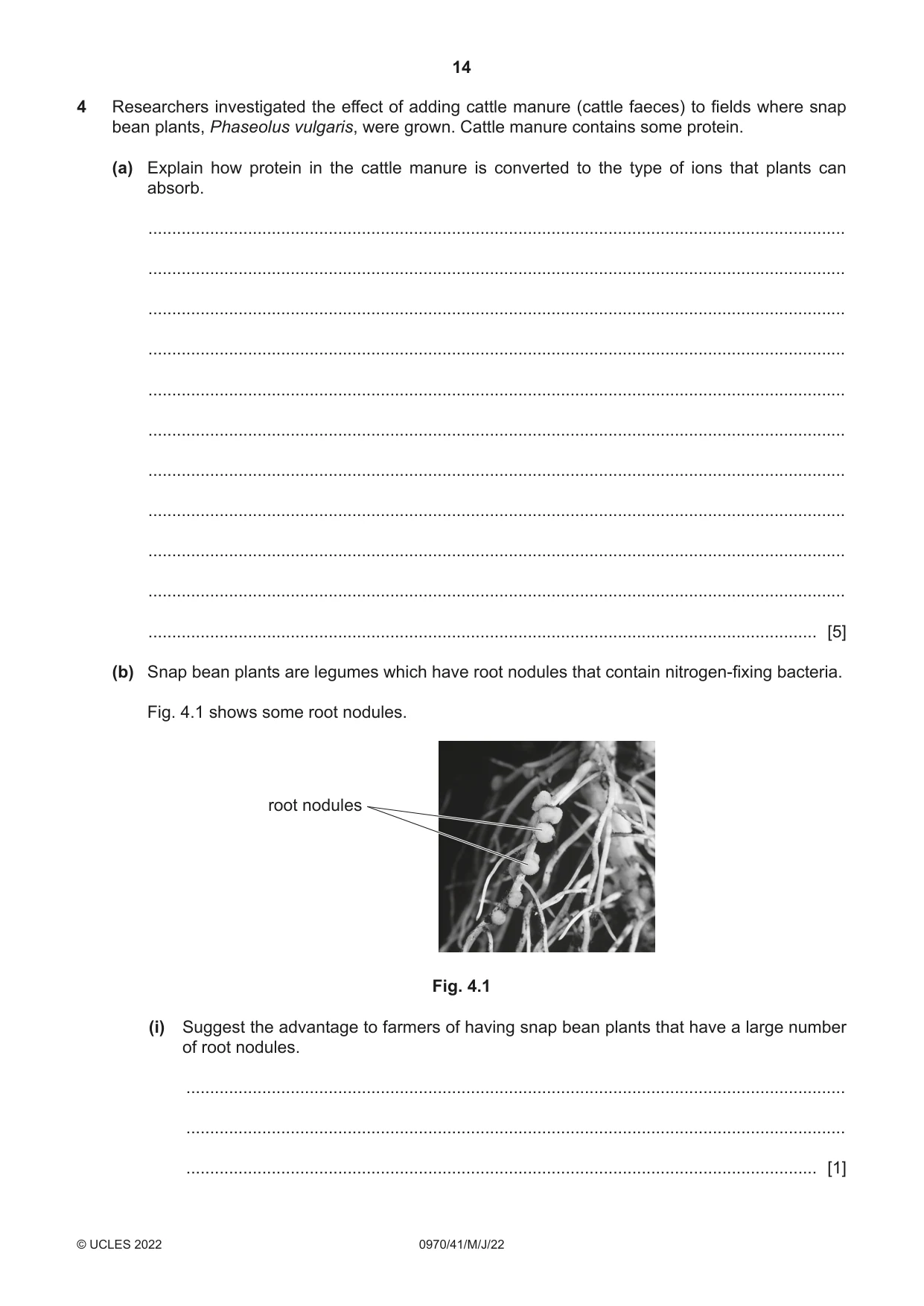
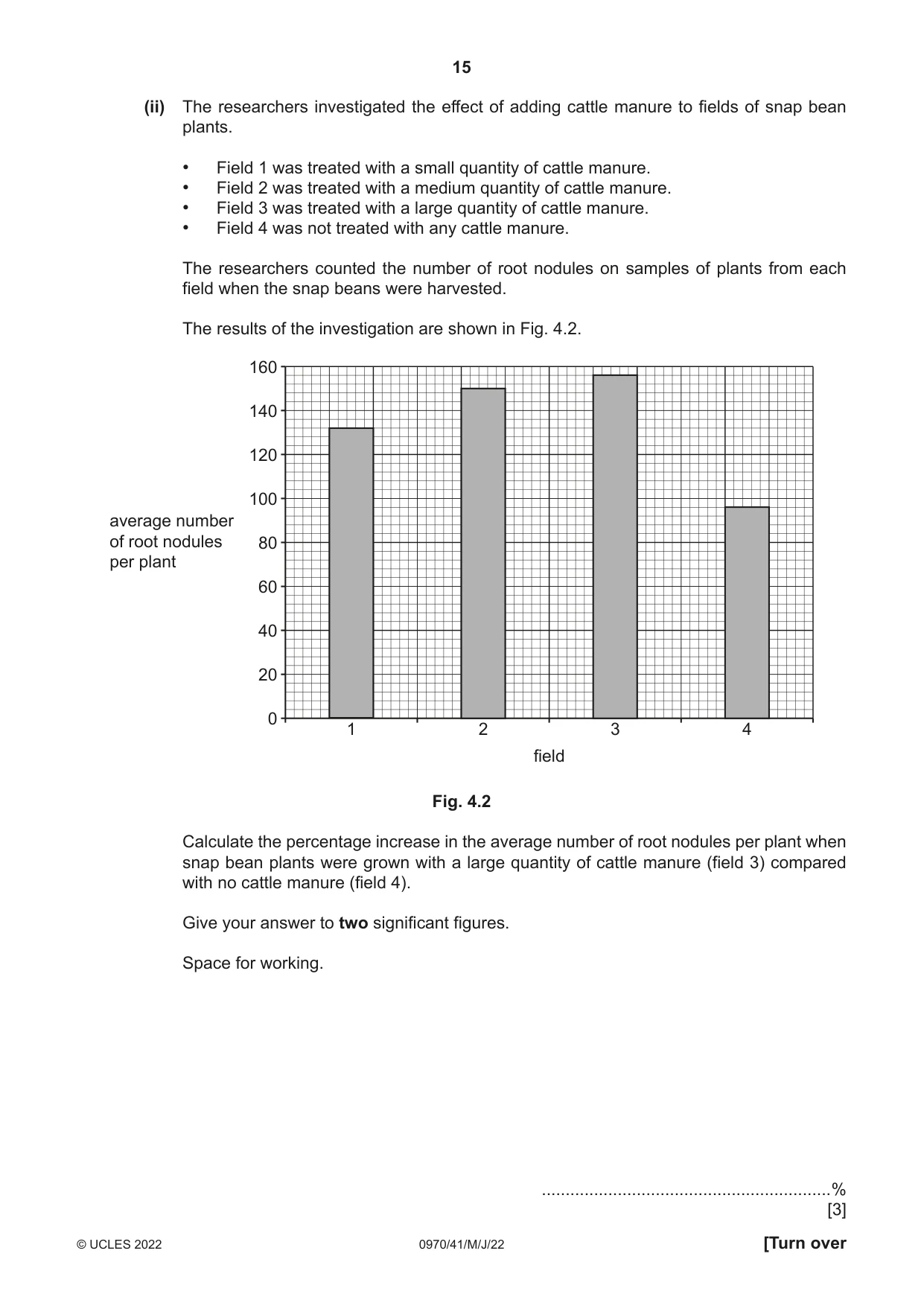
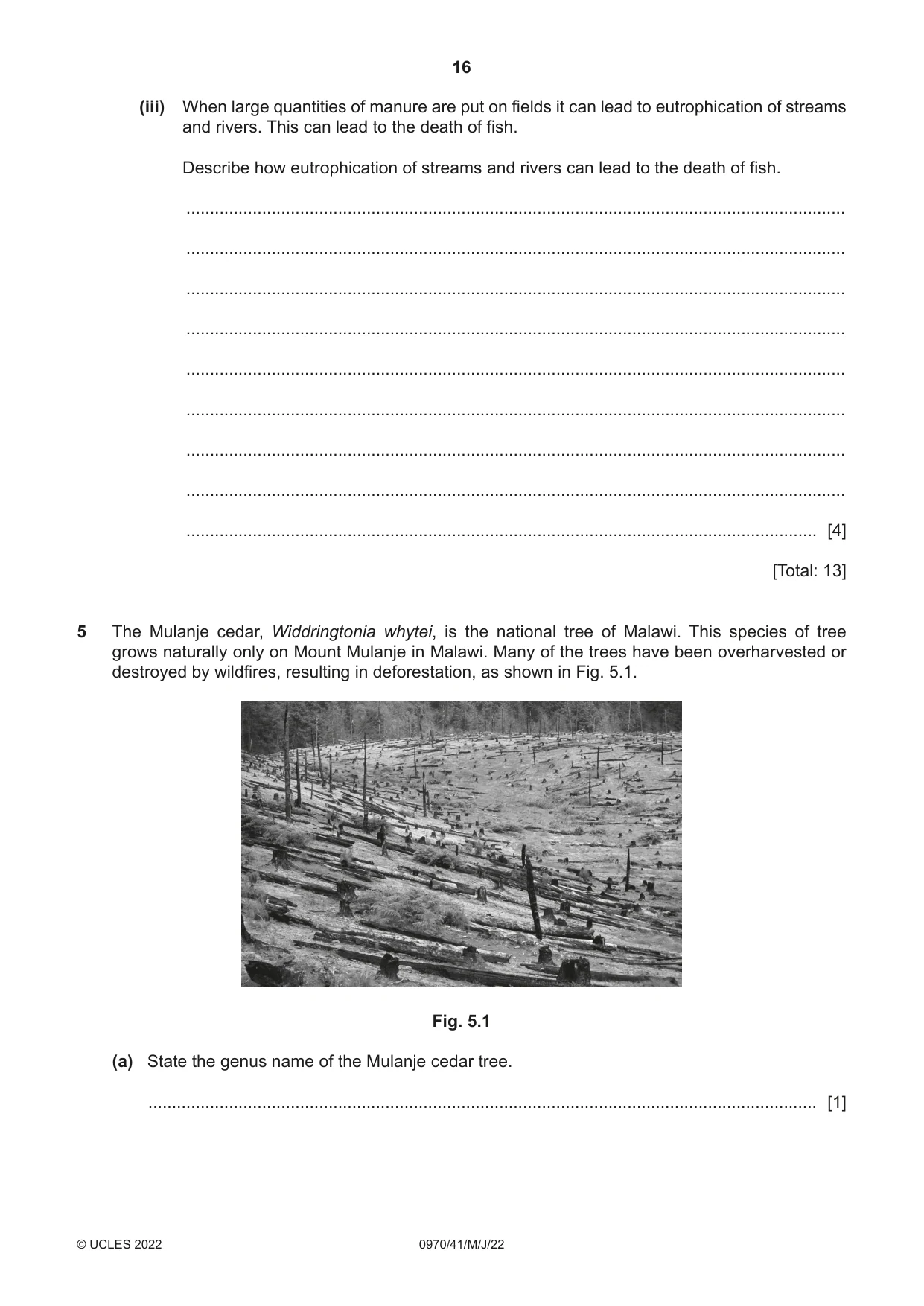
4 Researchers investigated the effect of adding cattle manure (cattle faeces) to fields where snap bean plants, Phaseolus vulgaris, were grown. Cattle manure contains some protein. (a) Explain how protein in the cattle manure is converted to the type of ions that plants can absorb. ................................................................................................................................................... ................................................................................................................................................... ................................................................................................................................................... ................................................................................................................................................... ................................................................................................................................................... ................................................................................................................................................... ................................................................................................................................................... ................................................................................................................................................... ................................................................................................................................................... ................................................................................................................................................... ............................................................................................................................................. [5] (b) Snap bean plants are legumes which have root nodules that contain nitrogen‑fixing bacteria. Fig. 4.1 shows some root nodules. root nodules Fig. 4.1 (i) Suggest the advantage to farmers of having snap bean plants that have a large number of root nodules. ........................................................................................................................................... ........................................................................................................................................... ..................................................................................................................................... [1] (ii) The researchers investigated the effect of adding cattle manure to fields of snap bean plants. • Field 1 was treated with a small quantity of cattle manure. • Field 2 was treated with a medium quantity of cattle manure. • Field 3 was treated with a large quantity of cattle manure. • Field 4 was not treated with any cattle manure. The researchers counted the number of root nodules on samples of plants from each field when the snap beans were harvested. The results of the investigation are shown in Fig. 4.2. 160 140 120 100 average number of root nodules 80 per plant 60 40 20 0 1 2 3 4 field Fig. 4.2 Calculate the percentage increase in the average number of root nodules per plant when snap bean plants were grown with a large quantity of cattle manure (field 3) compared with no cattle manure (field 4). Give your answer to two significant figures. Space for working. .............................................................% [3] (iii) When large quantities of manure are put on fields it can lead to eutrophication of streams and rivers. This can lead to the death of fish. Describe how eutrophication of streams and rivers can lead to the death of fish. ........................................................................................................................................... ........................................................................................................................................... ........................................................................................................................................... ........................................................................................................................................... ........................................................................................................................................... ........................................................................................................................................... ........................................................................................................................................... ........................................................................................................................................... ..................................................................................................................................... [4] [Total: 13]
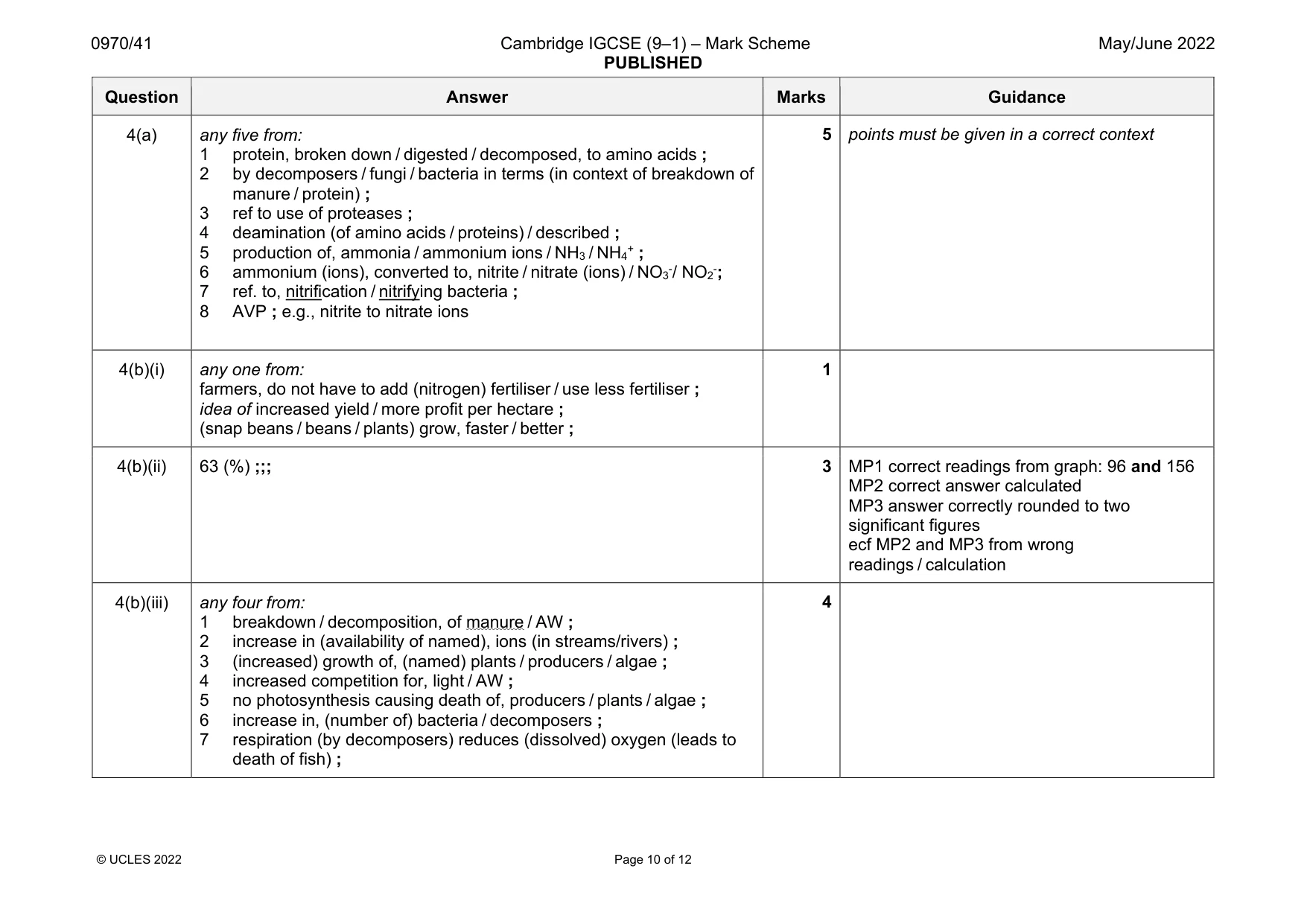
Mark scheme: 4(a) any five from: 1 protein, broken down / digested / decomposed, to amino acids ; 2 by decomposers / fungi / bacteria in terms (in context of breakdown of manure / protein) ; 3 ref to use of proteases ; 4 deamination (of amino acids / proteins) / described ; 5 production of, ammonia / ammonium ions / NH3 / NH4+ ; 6 ammonium (ions), converted to, nitrite / nitrate (ions) / NO3-/ NO2-; 7 ref. to, nitrification / nitrifying bacteria ; 8 AVP ; e.g., nitrite to nitrate ions 4(b)(i) any one from: farmers, do not have to add (nitrogen) fertiliser / use less fertiliser ; idea of increased yield / more profit per hectare ; (snap beans / beans / plants) grow, faster / better ; 1 4(b)(ii) 63 (%) ;;; 3 MP1 correct readings from graph: 96 and 156 MP2 correct answer calculated MP3 answer correctly rounded to two significant figures ecf MP2 and MP3 from wrong readings / calculation 4(b)(iii) any four from: 1 breakdown / decomposition, of manure / AW ; 2 increase in (availability of named), ions (in streams/rivers) ; 3 (increased) growth of, (named) plants / producers / algae ; 4 increased competition for, light / AW ; 5 no photosynthesis causing death of, producers / plants / algae ; 6 increase in, (number of) bacteria / decomposers ; 7 respiration (by decomposers) reduces (dissolved) oxygen (leads to death of fish) ; 4
Q5 · The Mulanje cedar, Widdringtonia whytei, is the national tree of Malawi
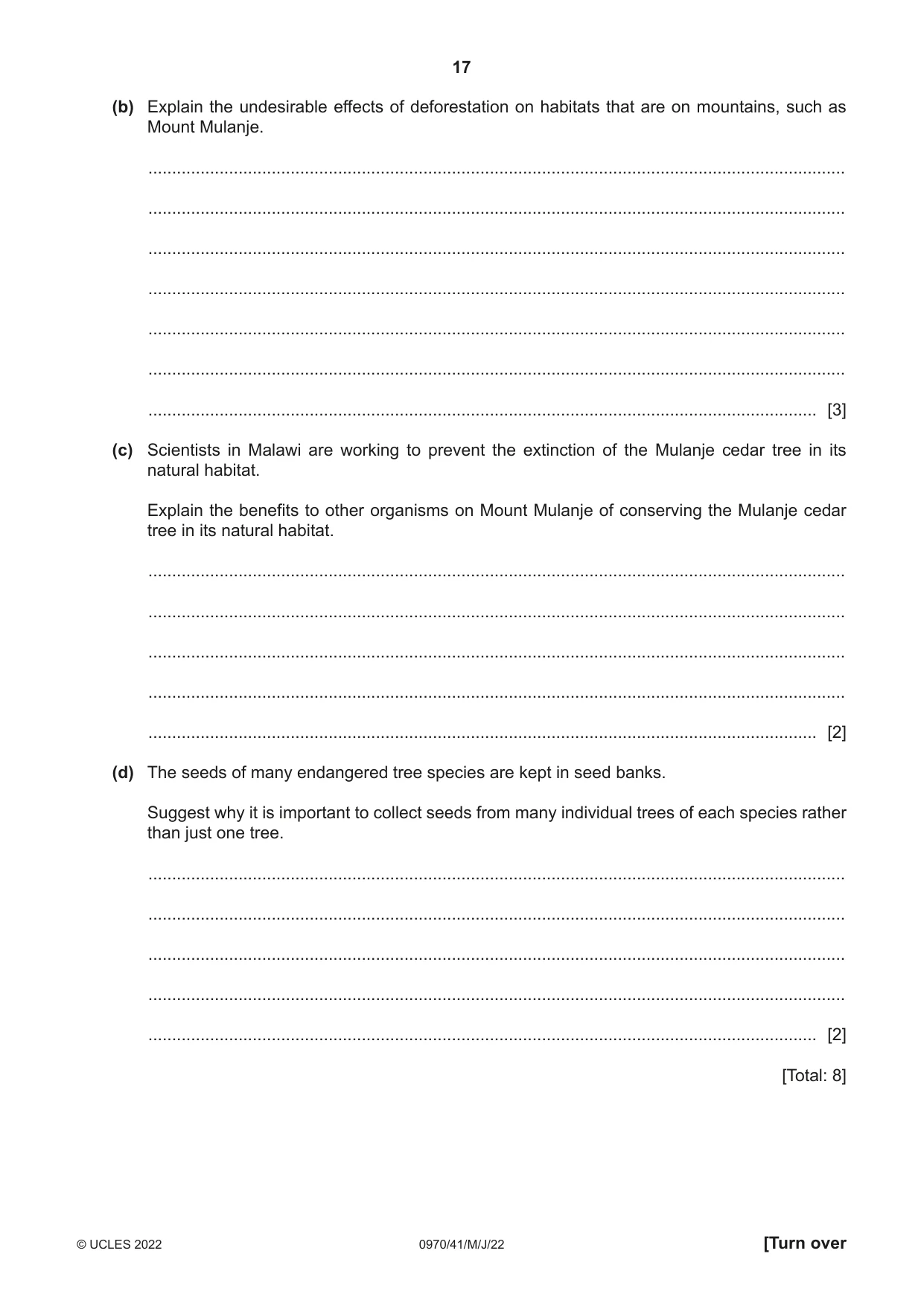
5 The Mulanje cedar, Widdringtonia whytei, is the national tree of Malawi. This species of tree grows naturally only on Mount Mulanje in Malawi. Many of the trees have been overharvested or destroyed by wildfires, resulting in deforestation, as shown in Fig. 5.1. Fig. 5.1 (a) State the genus name of the Mulanje cedar tree. ............................................................................................................................................. [1] (b) Explain the undesirable effects of deforestation on habitats that are on mountains, such as Mount Mulanje. ................................................................................................................................................... ................................................................................................................................................... ................................................................................................................................................... ................................................................................................................................................... ................................................................................................................................................... ................................................................................................................................................... ............................................................................................................................................. [3] (c) Scientists in Malawi are working to prevent the extinction of the Mulanje cedar tree in its natural habitat. Explain the benefits to other organisms on Mount Mulanje of conserving the Mulanje cedar tree in its natural habitat. ................................................................................................................................................... ................................................................................................................................................... ................................................................................................................................................... ................................................................................................................................................... ............................................................................................................................................. [2] (d) The seeds of many endangered tree species are kept in seed banks. Suggest why it is important to collect seeds from many individual trees of each species rather than just one tree. ................................................................................................................................................... ................................................................................................................................................... ................................................................................................................................................... ................................................................................................................................................... ............................................................................................................................................. [2] [Total: 8]
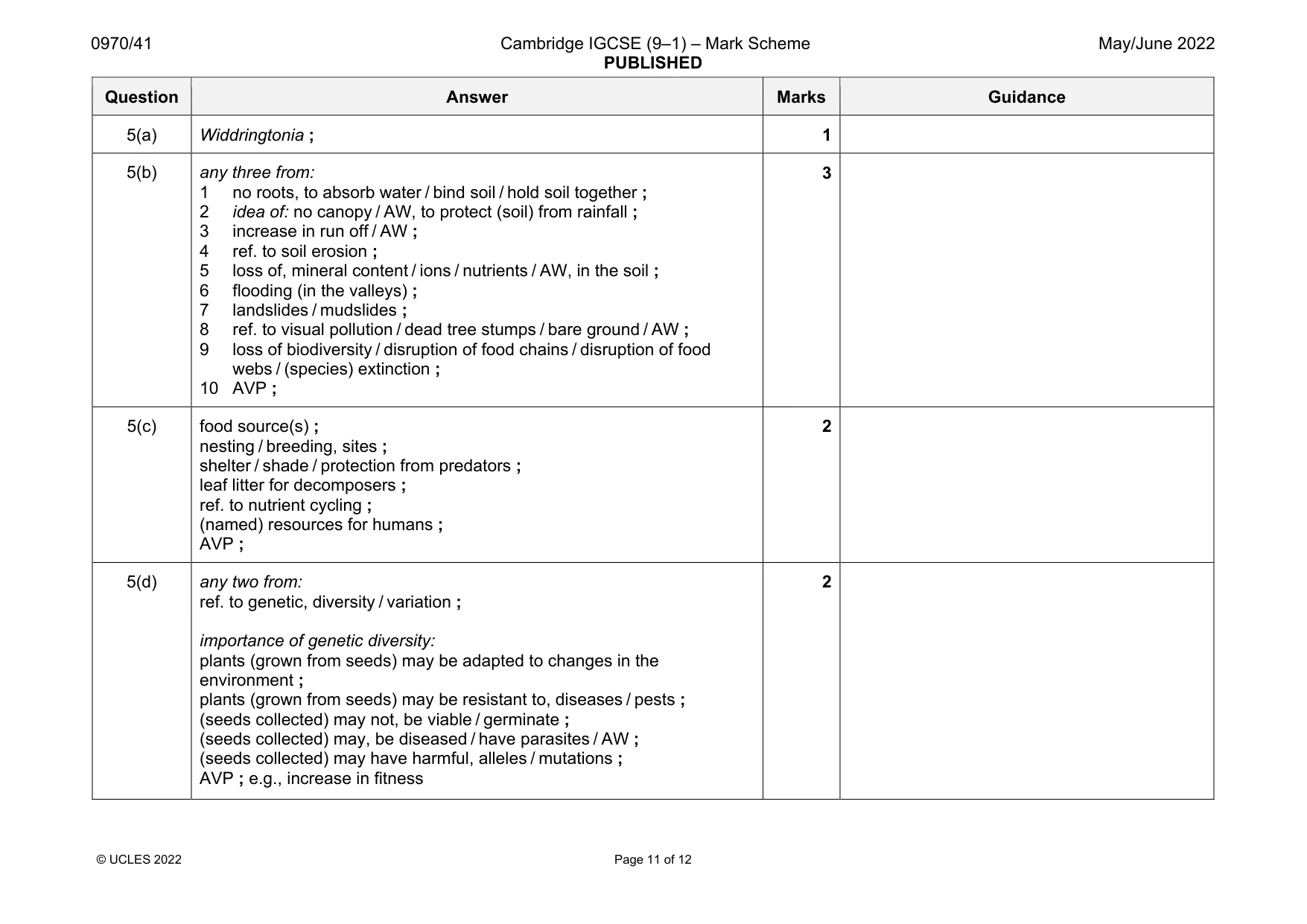
Mark scheme: 5(a) Widdringtonia ; 1 5(b) any three from: 1 no roots, to absorb water / bind soil / hold soil together ; 2 idea of: no canopy / AW, to protect (soil) from rainfall ; 3 increase in run off / AW ; 4 ref. to soil erosion ; 5 loss of, mineral content / ions / nutrients / AW, in the soil ; 6 flooding (in the valleys) ; 7 landslides / mudslides ; 8 ref. to visual pollution / dead tree stumps / bare ground / AW ; 9 loss of biodiversity / disruption of food chains / disruption of food webs / (species) extinction ; 10 AVP ; 3 5(c) food source(s) ; nesting / breeding, sites ; shelter / shade / protection from predators ; leaf litter for decomposers ; ref. to nutrient cycling ; (named) resources for humans ; AVP ; 2 5(d) any two from: ref. to genetic, diversity / variation ; importance of genetic diversity: plants (grown from seeds) may be adapted to changes in the environment ; plants (grown from seeds) may be resistant to, diseases / pests ; (seeds collected) may not, be viable / germinate ; (seeds collected) may, be diseased / have parasites / AW ; (seeds collected) may have harmful, alleles / mutations ; AVP ; e.g., increase in fitness 2
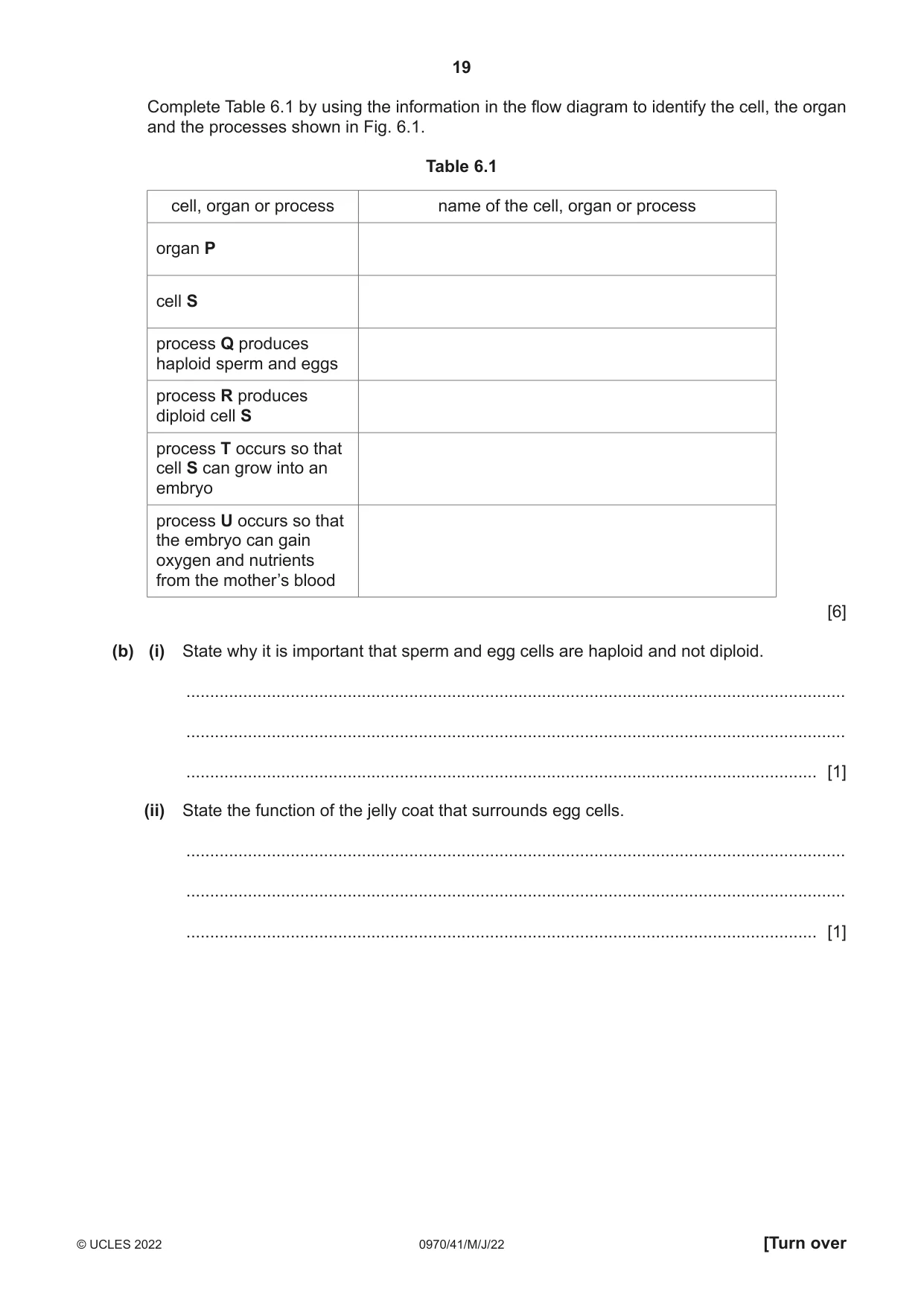
Q6 · A flow diagram showing the events that occur to form a human fetus
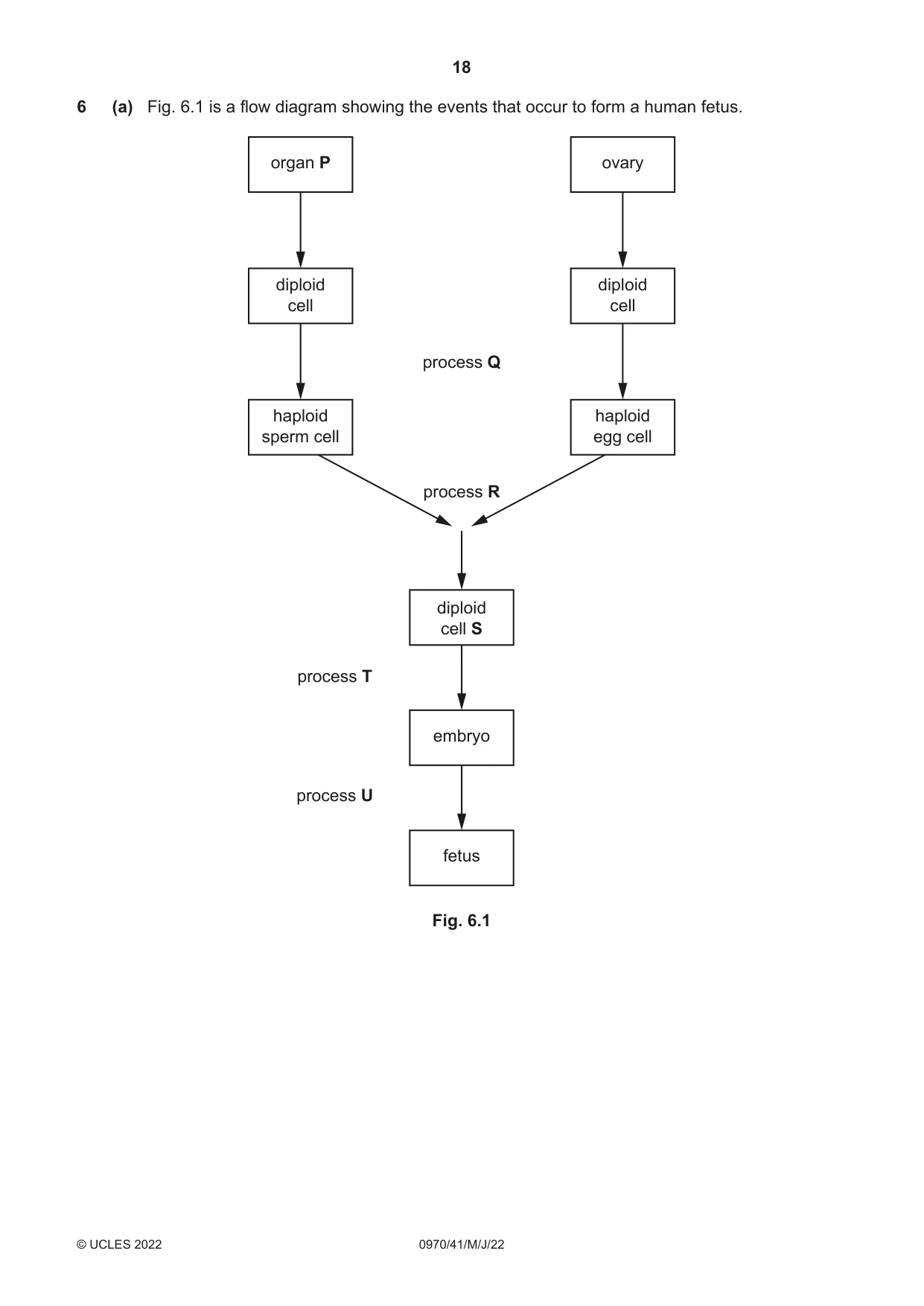
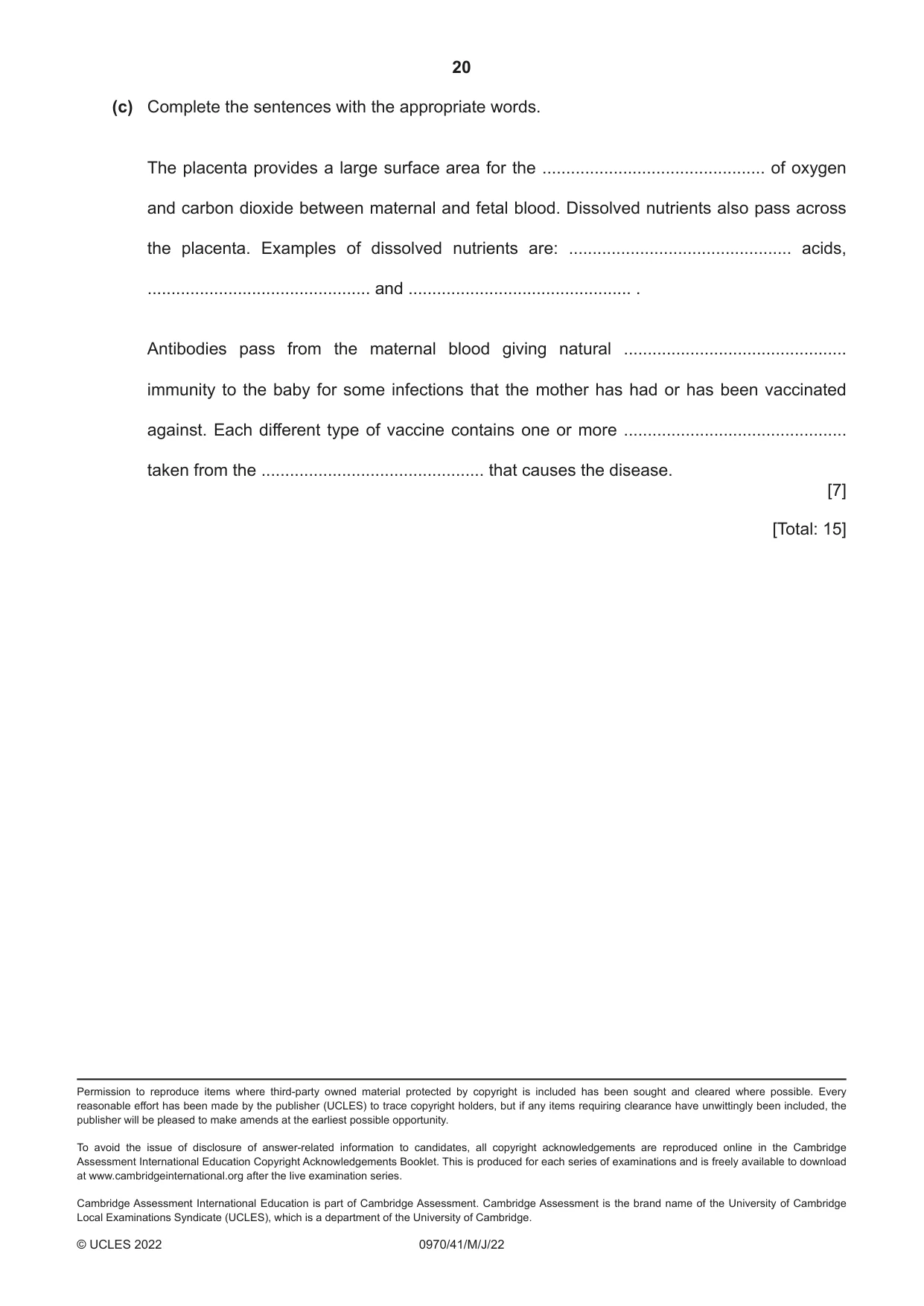
6 (a) Fig. 6.1 is a flow diagram showing the events that occur to form a human fetus. organ P ovary diploid diploid cell cell process Q haploid haploid sperm cell egg cell process R diploid cell S process T embryo process U fetus Fig. 6.1 Complete Table 6.1 by using the information in the flow diagram to identify the cell, the organ and the processes shown in Fig. 6.1. Table 6.1 cell, organ or process name of the cell, organ or process organ P cell S process Q produces haploid sperm and eggs process R produces diploid cell S process T occurs so that cell S can grow into an embryo process U occurs so that the embryo can gain oxygen and nutrients from the mother’s blood [6] (b) (i) State why it is important that sperm and egg cells are haploid and not diploid. ........................................................................................................................................... ........................................................................................................................................... ..................................................................................................................................... [1] (ii) State the function of the jelly coat that surrounds egg cells. ........................................................................................................................................... ........................................................................................................................................... ..................................................................................................................................... [1] (c) Complete the sentences with the appropriate words. The placenta provides a large surface area for the ............................................... of oxygen and carbon dioxide between maternal and fetal blood. Dissolved nutrients also pass across the placenta. Examples of dissolved nutrients are: ............................................... acids, ............................................... and ............................................... . Antibodies pass from the maternal blood giving natural ............................................... immunity to the baby for some infections that the mother has had or has been vaccinated against. Each different type of vaccine contains one or more ............................................... taken from the ............................................... that causes the disease. [7] [Total: 15]
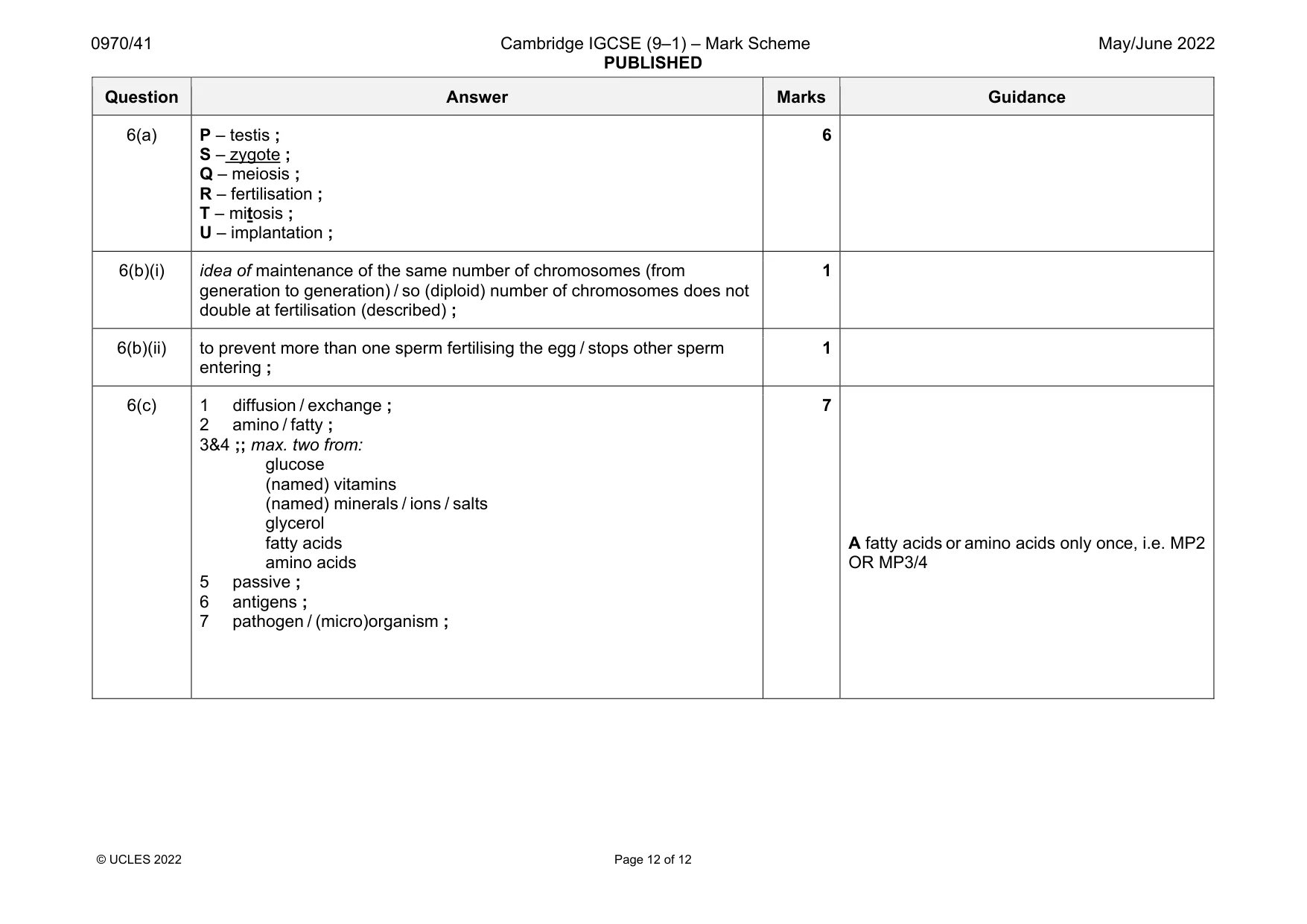
Mark scheme: 6(a) P – testis ; S – zygote ; Q – meiosis ; R – fertilisation ; T – mitosis ; U – implantation ; 6 6(b)(i) idea of maintenance of the same number of chromosomes (from generation to generation) / so (diploid) number of chromosomes does not double at fertilisation (described) ; 1 6(b)(ii) to prevent more than one sperm fertilising the egg / stops other sperm entering ; 1 6(c) 1 diffusion / exchange ; 2 amino / fatty ; 3&4 ;; max. two from: glucose (named) vitamins (named) minerals / ions / salts glycerol fatty acids amino acids 5 passive ; 6 antigens ; 7 pathogen / (micro)organism ; 7 A fatty acids or amino acids only once, i.e. MP2 OR MP3/4
What was in this paper
The subtopics covered by these 6 questions, and how many questions each got. Open one in a new tab to see every Cambridge question on it.
What you needed in this session
Cambridge’s own grade thresholds for 2022 May/June, Paper 4 · Variant 1. A higher threshold means an easier paper — the bar moves with how the cohort did.