Cambridge IGCSE Biology (9-1) 0970 — 2022 May/June Paper 3 · Variant 2
0970/32/M/J/22 · 7 questions · 80 marks · ≈90 min
The question paper and its mark scheme, free to read here and free to download. This is Cambridge’s own paper, exactly as it was sat.
Question paper16 pages
Mark scheme11 pages
Answers below. Sit the paper first if you are practising.
Questions as text
Q1 · A photograph of a plant
1 Fig. 1.1 is a photograph of a plant. Fig. 1.1 (a) (i) Draw two arrows on Fig. 1.1 to show the direction of movement of water into and out of the plant. [2] (ii) State the name of the type of tissue that transports water in a plant. ..................................................................................................................................... [1] (b) (i) Complete the definition of the term transpiration. Transpiration is the loss of water vapour from plant leaves by .............................................. of water at the surfaces of .............................................. cells, followed by diffusion of water vapour through the .............................................. . [3] (ii) Fig. 1.2 is a graph showing the effect of temperature on the rate of transpiration from the upper and lower surfaces of leaves. Key: lower surface upper surface transpiration rate temperature Fig. 1.2 State two conclusions for the data shown in Fig. 1.2. 1 ........................................................................................................................................ ........................................................................................................................................... ........................................................................................................................................... 2 ........................................................................................................................................ ........................................................................................................................................... ........................................................................................................................................... [2] (c) State the effect of increasing humidity on the rate of transpiration. ................................................................................................................................................... ................................................................................................................................................... ............................................................................................................................................. [1] (d) Fig. 1.3 is a diagram of the water cycle. YY XX not to scale Fig. 1.3 Identify processes X and Y in Fig. 1.3. X ............................................................................................................................................... Y ............................................................................................................................................... [2] [Total: 11]
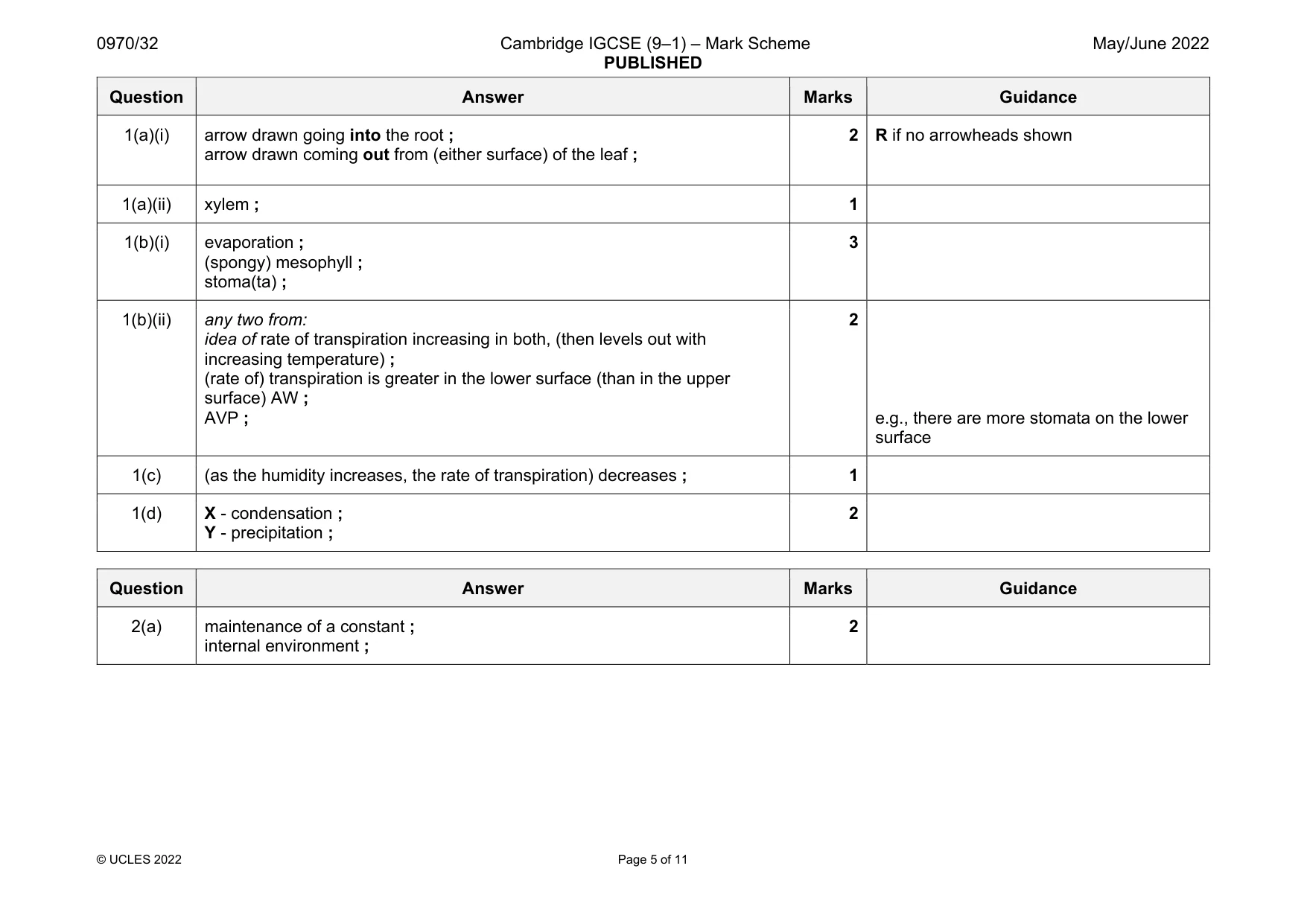
Mark scheme: 1(a)(i) arrow drawn going into the root ; arrow drawn coming out from (either surface) of the leaf ; 2 R if no arrowheads shown 1(a)(ii) xylem ; 1 1(b)(i) evaporation ; (spongy) mesophyll ; stoma(ta) ; 3 1(b)(ii) any two from: idea of rate of transpiration increasing in both, (then levels out with increasing temperature) ; (rate of) transpiration is greater in the lower surface (than in the upper surface) AW ; AVP ; 2 e.g., there are more stomata on the lower surface 1(c) (as the humidity increases, the rate of transpiration) decreases ; 1 1(d) X - condensation ; Y - precipitation ; 2
Q2 · Define the term homeostasis
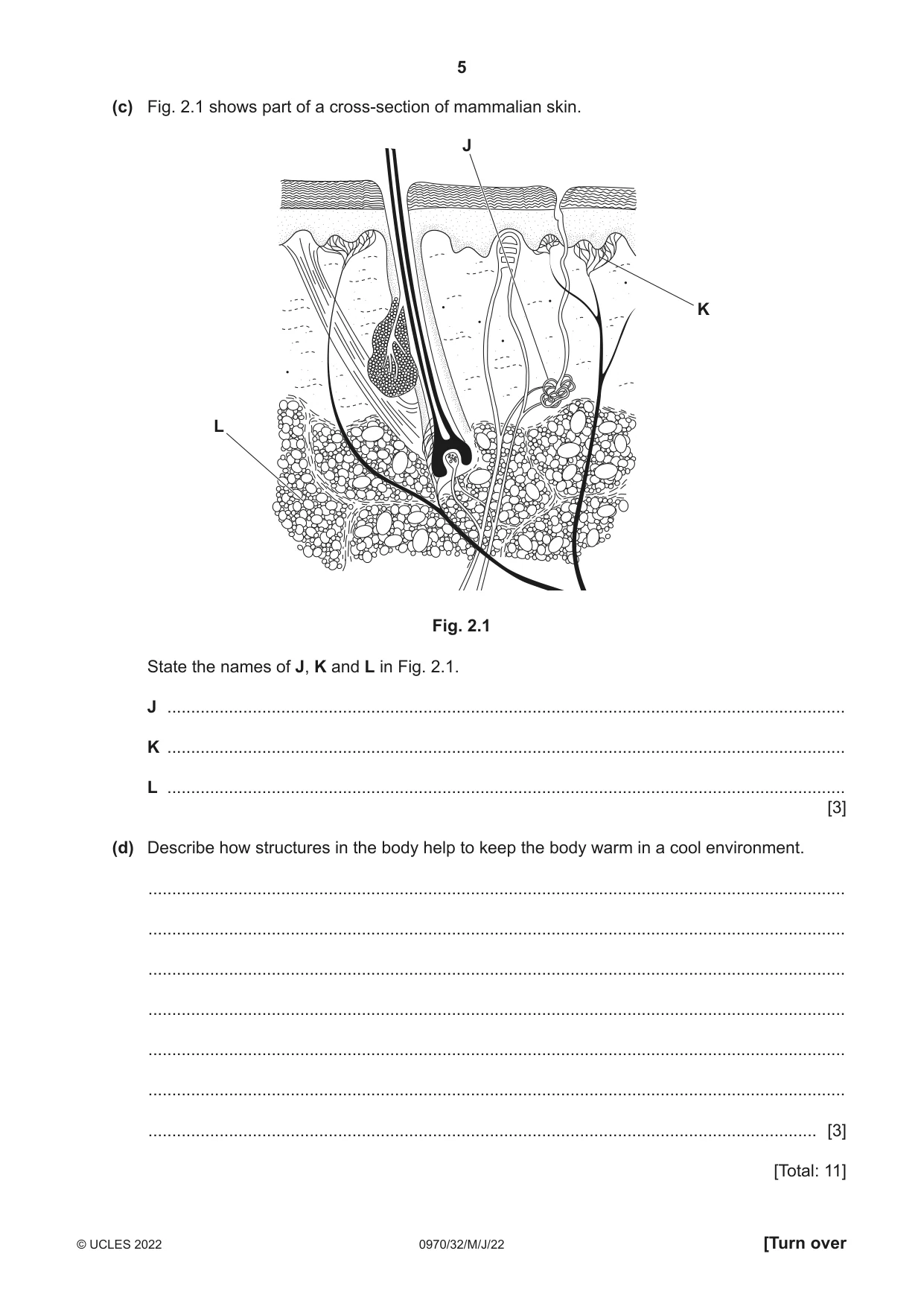
2 (a) Define the term homeostasis. ................................................................................................................................................... ................................................................................................................................................... ................................................................................................................................................... ................................................................................................................................................... ............................................................................................................................................. [2] (b) The box on the left shows the beginning of a sentence. The boxes on the right show some sentence endings. Draw three straight lines to make three correct sentences about the brain. and spinal cord are part of the peripheral nervous system. coordinates body functions. contains receptors that detect the temperature of the blood. The brain produces insulin. receives impulses from motor neurones. receives impulses from the optic nerve. [3] (c) Fig. 2.1 shows part of a cross-section of mammalian skin. J K L Fig. 2.1 State the names of J, K and L in Fig. 2.1. J ............................................................................................................................................... K ............................................................................................................................................... L ............................................................................................................................................... [3] (d) Describe how structures in the body help to keep the body warm in a cool environment. ................................................................................................................................................... ................................................................................................................................................... ................................................................................................................................................... ................................................................................................................................................... ................................................................................................................................................... ................................................................................................................................................... ............................................................................................................................................. [3] [Total: 11]
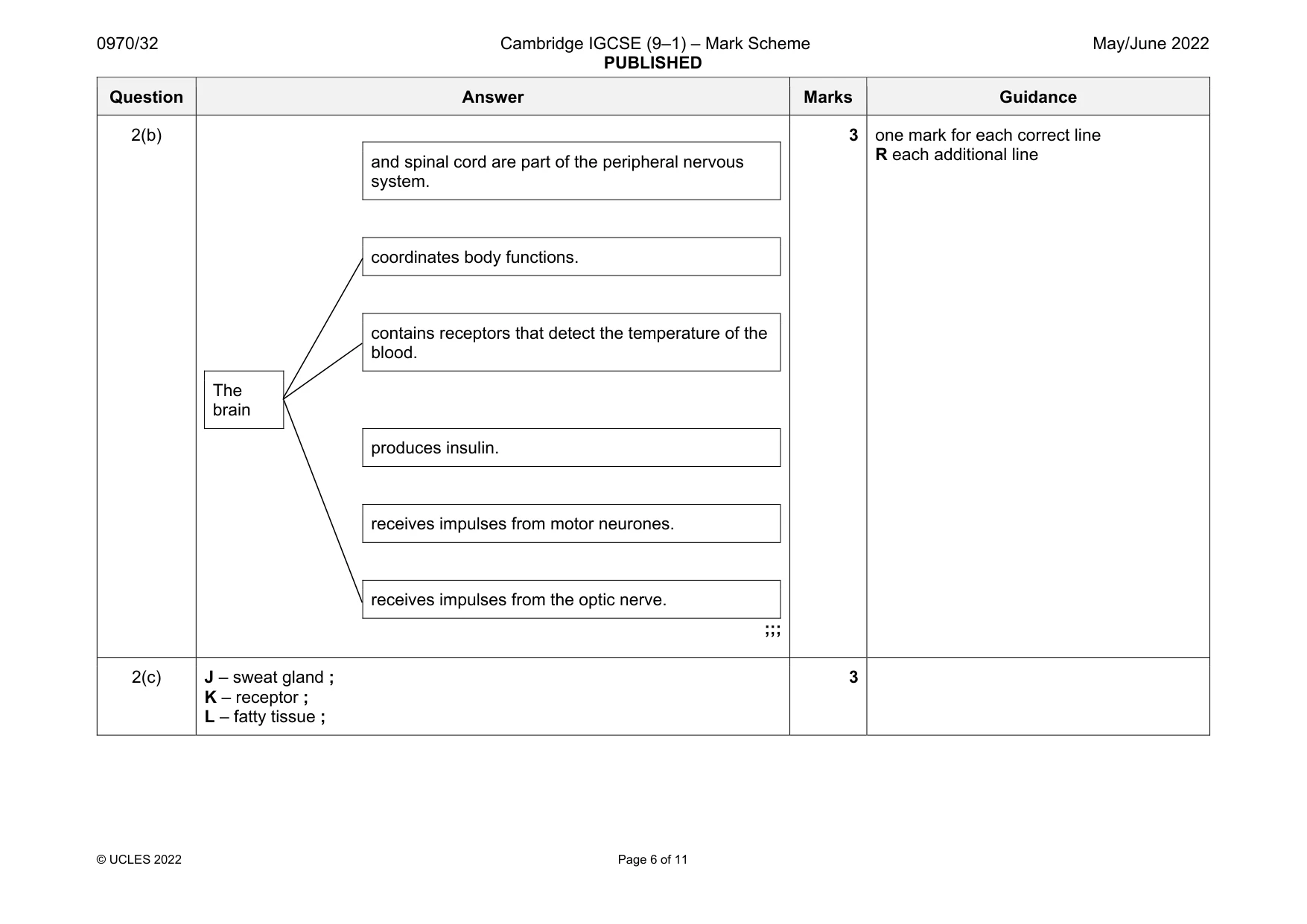
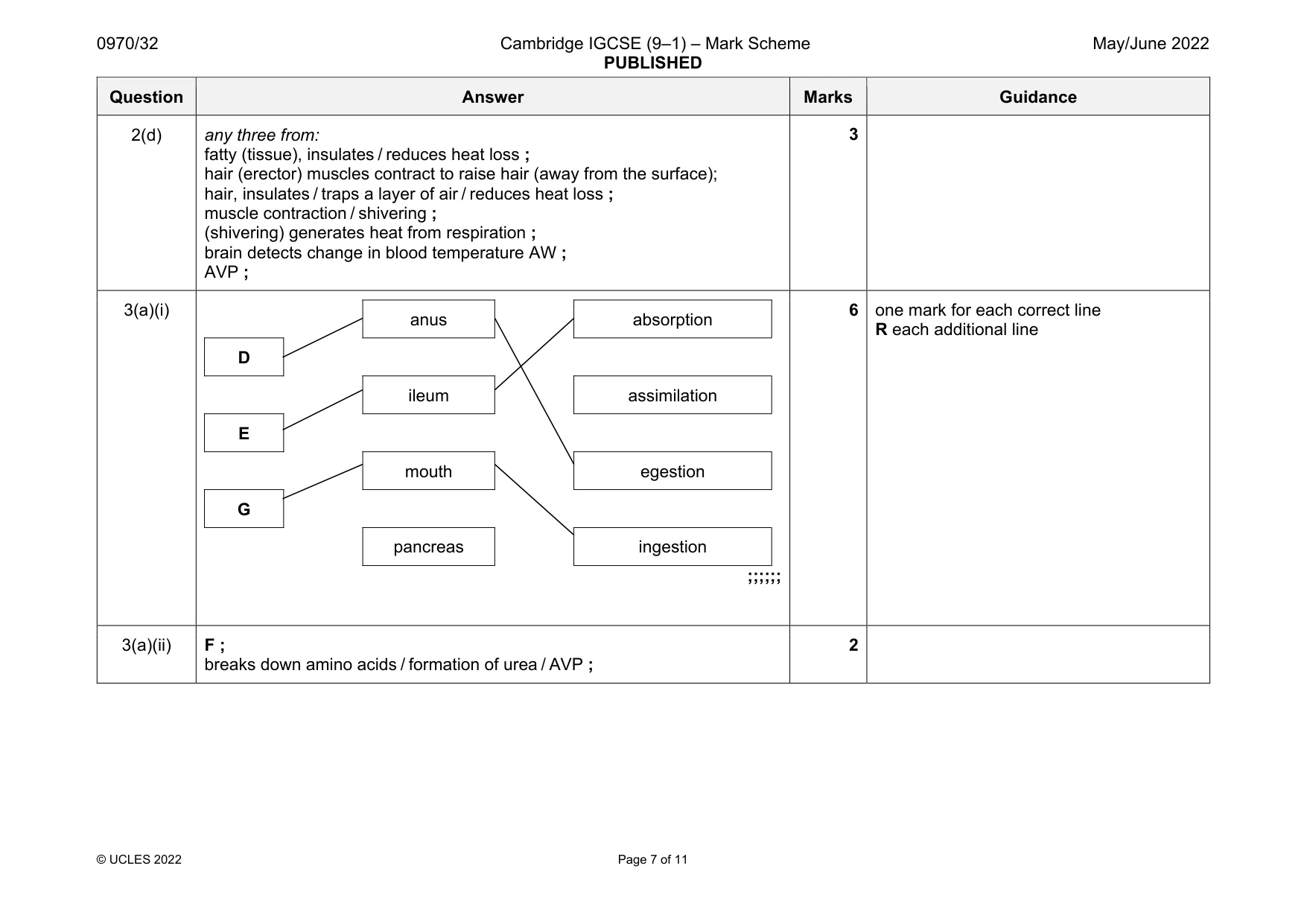
Mark scheme: 2(a) maintenance of a constant ; internal environment ; 2 Question Answer Marks Guidance 2(b) ;;; and spinal cord are part of the peripheral nervous system. coordinates body functions. contains receptors that detect the temperature of the blood. The brain produces insulin. receives impulses from motor neurones. receives impulses from the optic nerve. 3 one mark for each correct line R each additional line 2(c) J – sweat gland ; K – receptor ; L – fatty tissue ; 3 Question Answer Marks Guidance 2(d) any three from: fatty (tissue), insulates / reduces heat loss ; hair (erector) muscles contract to raise hair (away from the surface); hair, insulates / traps a layer of air / reduces heat loss ; muscle contraction / shivering ; (shivering) generates heat from respiration ; brain detects change in blood temperature AW ; AVP ; 3
Q3 · A diagram showing part of the human alimentary canal and associated organs
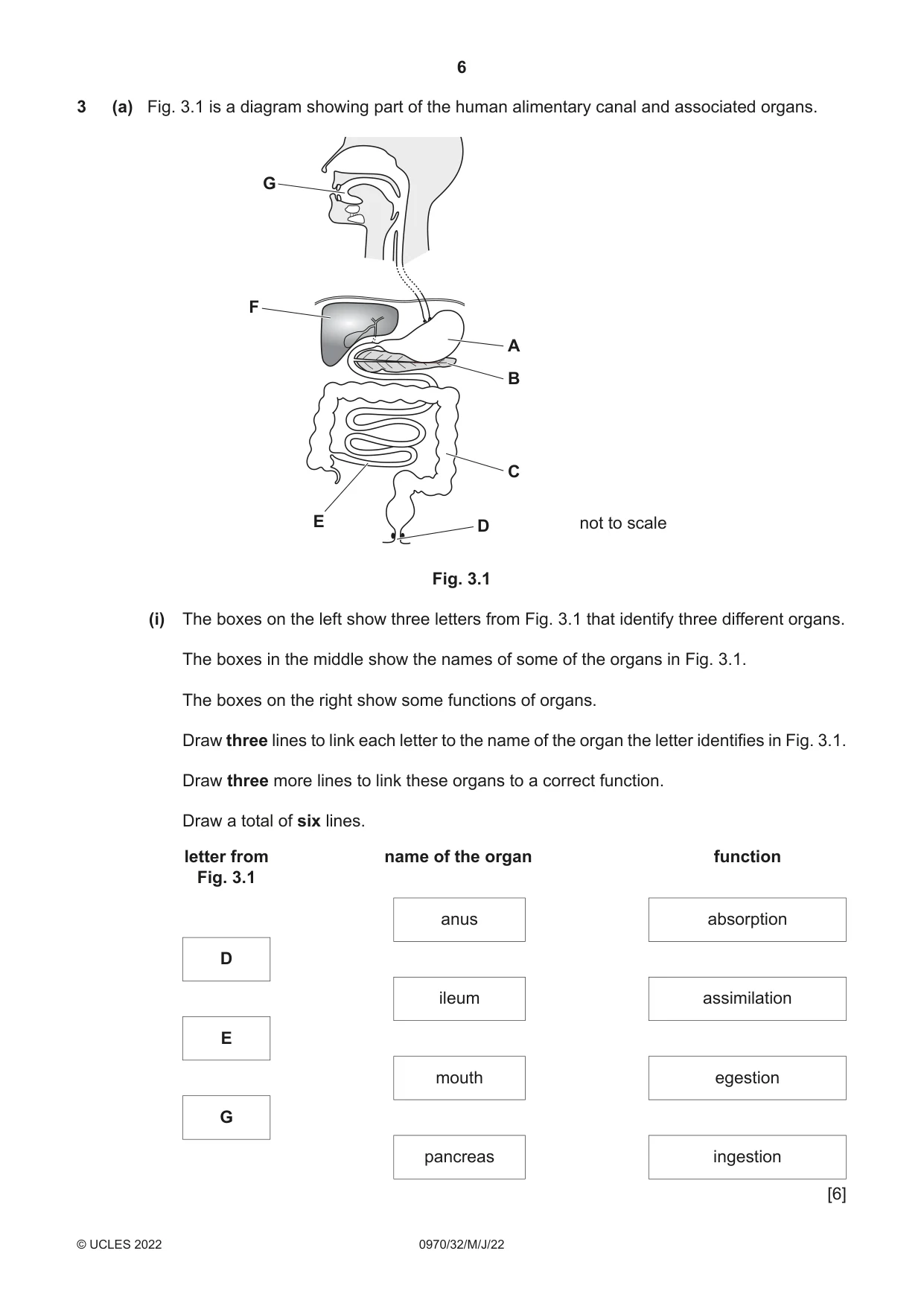
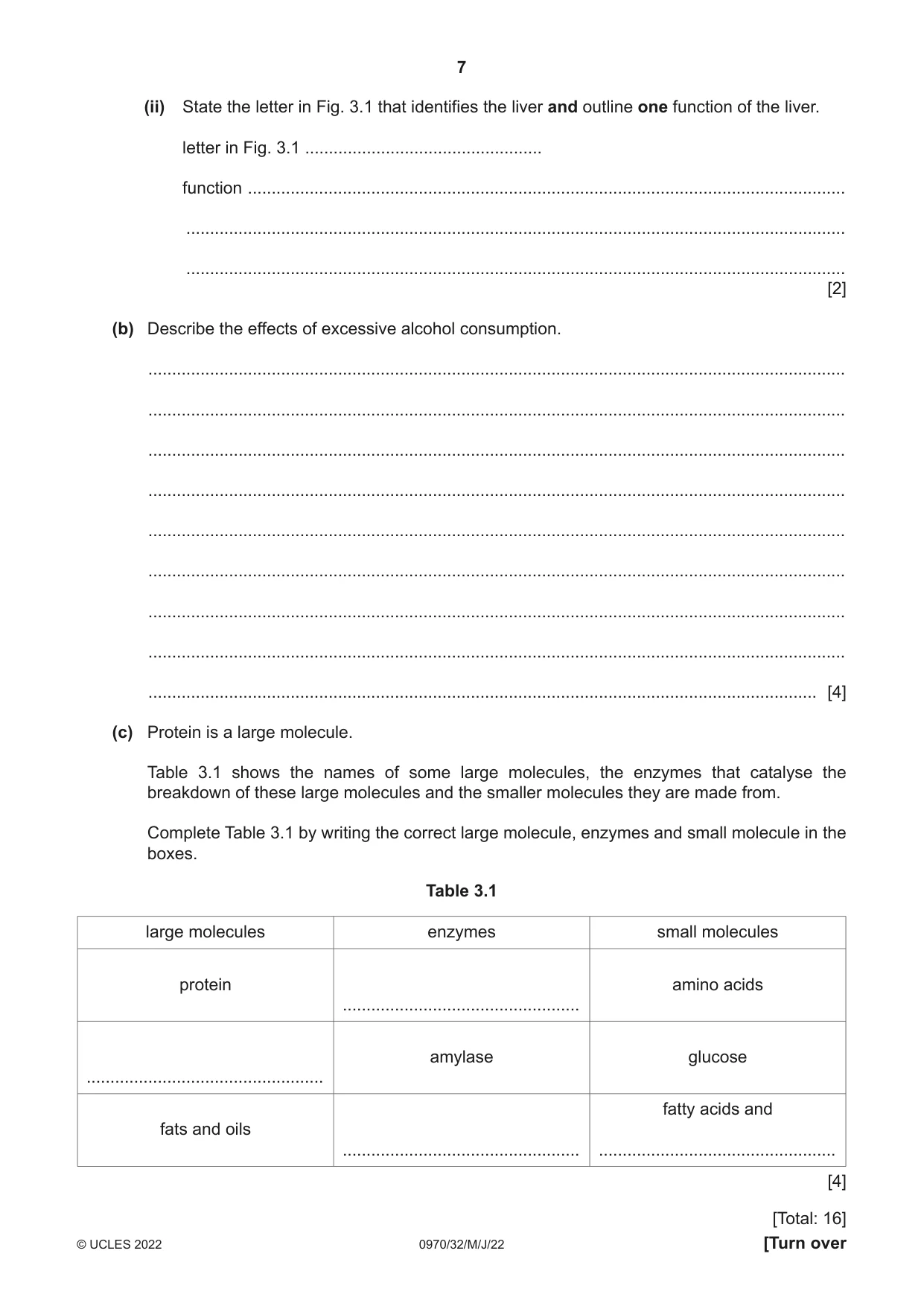
3 (a) Fig. 3.1 is a diagram showing part of the human alimentary canal and associated organs. G F A B C E D not to scale Fig. 3.1 (i) The boxes on the left show three letters from Fig. 3.1 that identify three different organs. The boxes in the middle show the names of some of the organs in Fig. 3.1. The boxes on the right show some functions of organs. Draw three lines to link each letter to the name of the organ the letter identifies in Fig. 3.1. Draw three more lines to link these organs to a correct function. Draw a total of six lines. letter from name of the organ function Fig. 3.1 anus absorption D ileum assimilation E mouth egestion G pancreas ingestion [6] (ii) State the letter in Fig. 3.1 that identifies the liver and outline one function of the liver. letter in Fig. 3.1 .................................................. function .............................................................................................................................. ........................................................................................................................................... ........................................................................................................................................... [2] (b) Describe the effects of excessive alcohol consumption. ................................................................................................................................................... ................................................................................................................................................... ................................................................................................................................................... ................................................................................................................................................... ................................................................................................................................................... ................................................................................................................................................... ................................................................................................................................................... ................................................................................................................................................... ............................................................................................................................................. [4] (c) Protein is a large molecule. Table 3.1 shows the names of some large molecules, the enzymes that catalyse the breakdown of these large molecules and the smaller molecules they are made from. Complete Table 3.1 by writing the correct large molecule, enzymes and small molecule in the boxes. Table 3.1 large molecules enzymes small molecules protein amino acids .................................................. amylase glucose .................................................. fatty acids and fats and oils .................................................. .................................................. [4] [Total: 16]
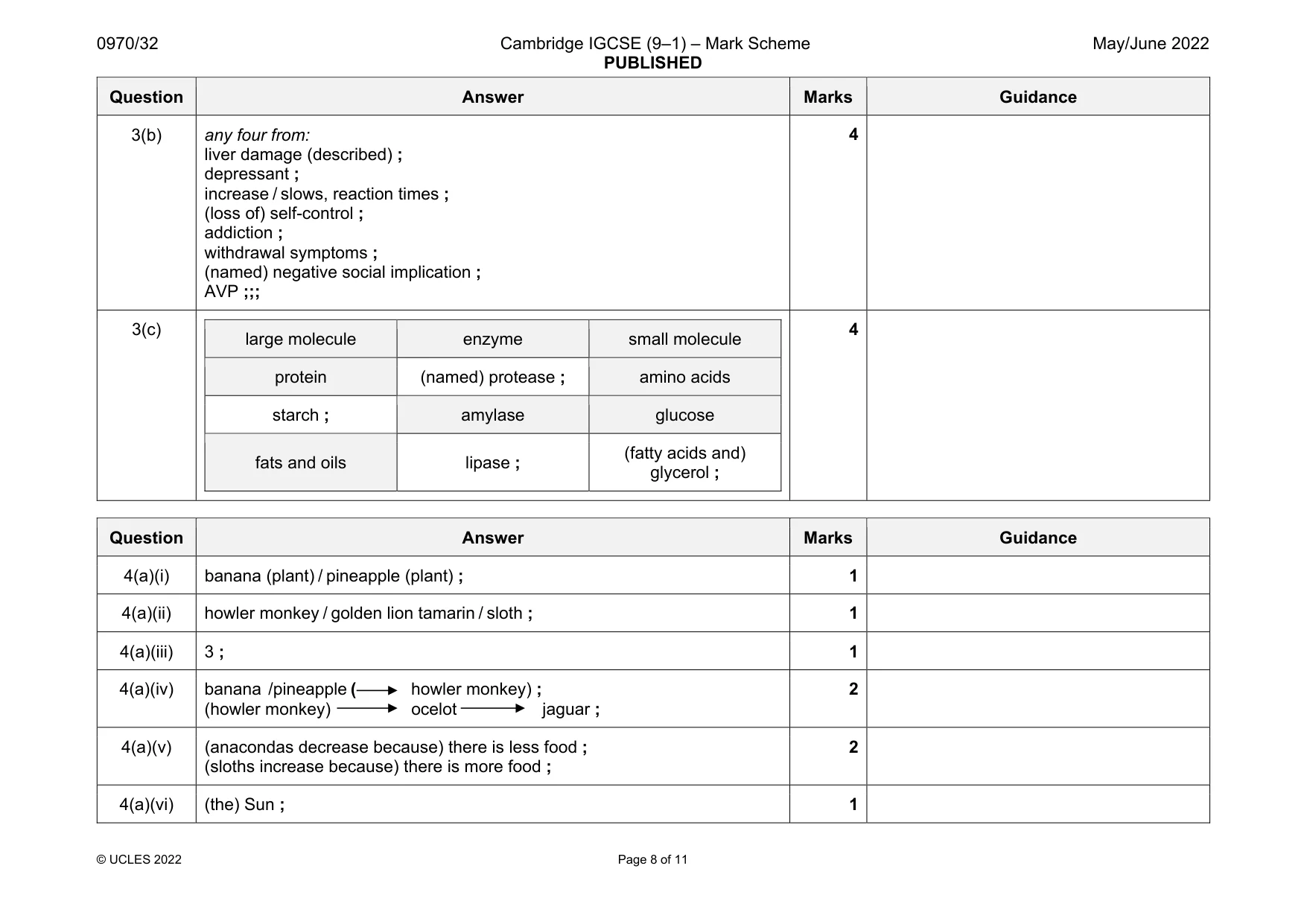
Mark scheme: 3(a)(i) anus absorption D ileum assimilation E mouth egestion G pancreas ingestion ;;;;;; 6 one mark for each correct line R each additional line 3(a)(ii) F ; breaks down amino acids / formation of urea / AVP ; 2 Question Answer Marks Guidance 3(b) any four from: liver damage (described) ; depressant ; increase / slows, reaction times ; (loss of) self-control ; addiction ; withdrawal symptoms ; (named) negative social implication ; AVP ;;; 4 3(c) large molecule enzyme small molecule protein (named) protease ; amino acids starch ; amylase glucose fats and oils lipase ; (fatty acids and) glycerol ; 4
Q4 · A drawing of a rainforest food web
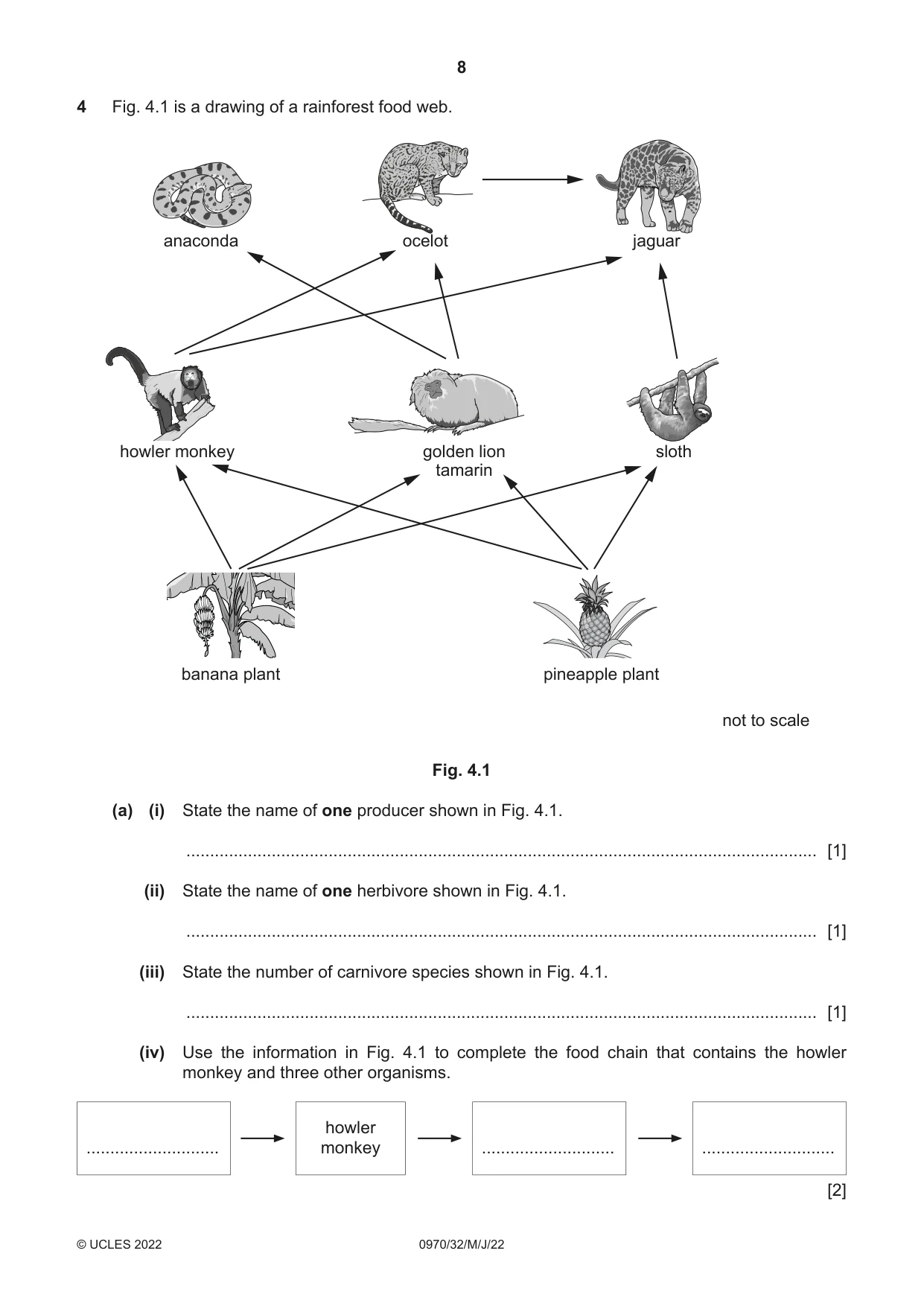
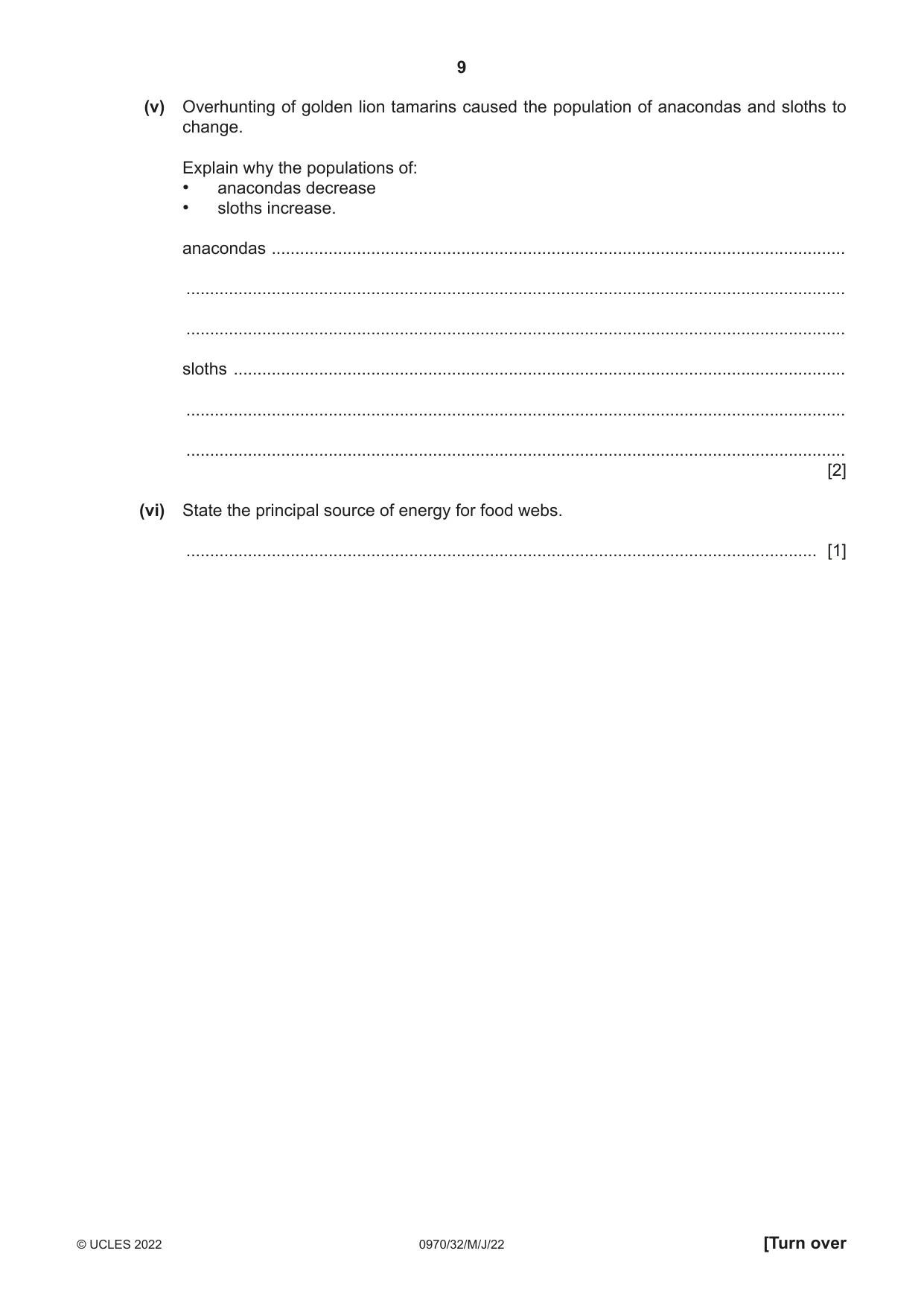
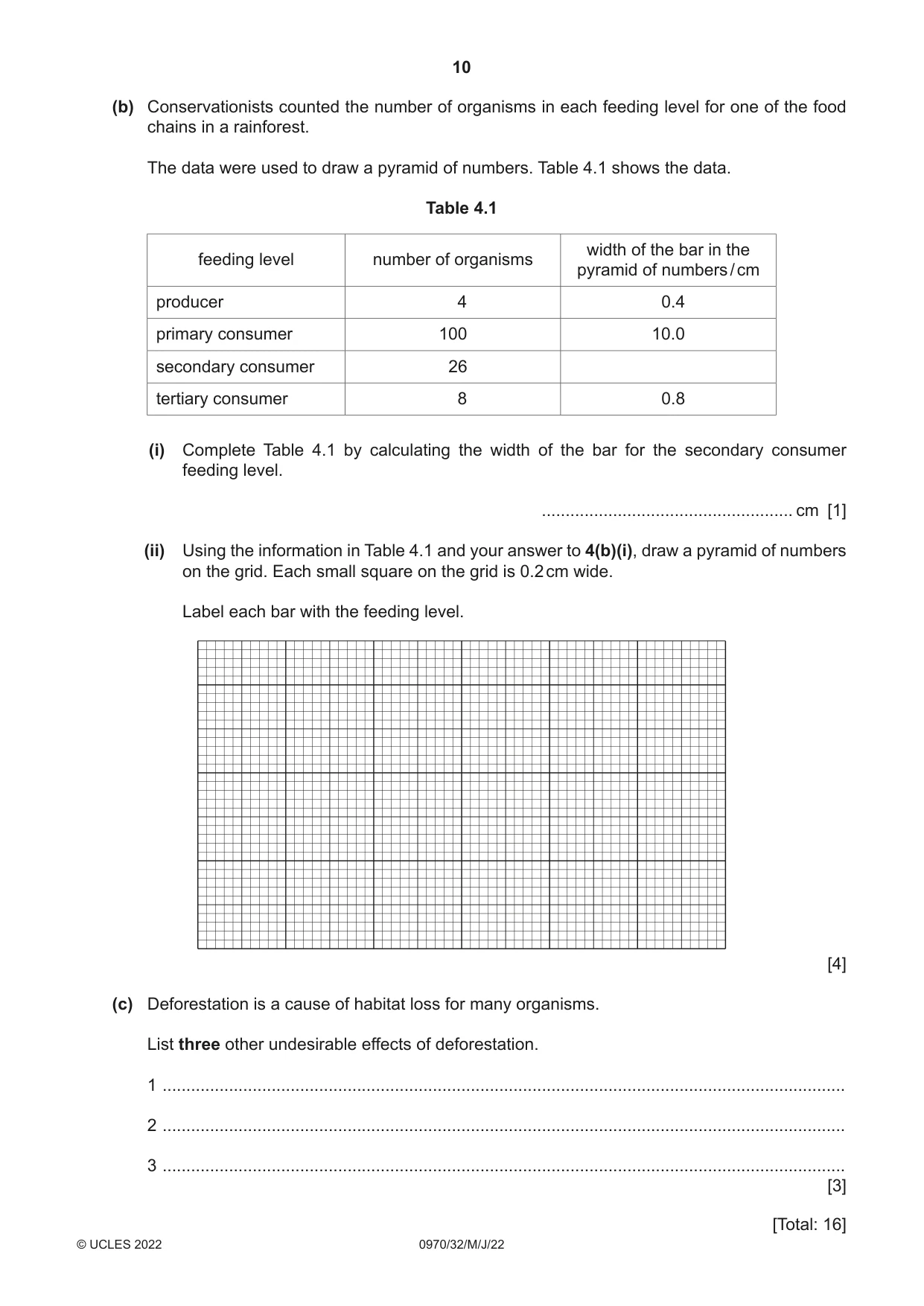
4 Fig. 4.1 is a drawing of a rainforest food web. anaconda ocelot jaguar howler monkey golden lion sloth tamarin banana plant pineapple plant not to scale Fig. 4.1 (a) (i) State the name of one producer shown in Fig. 4.1. ..................................................................................................................................... [1] (ii) State the name of one herbivore shown in Fig. 4.1. ..................................................................................................................................... [1] (iii) State the number of carnivore species shown in Fig. 4.1. ..................................................................................................................................... [1] (iv) Use the information in Fig. 4.1 to complete the food chain that contains the howler monkey and three other organisms. howler ............................ monkey ............................ ............................ [2] (v) Overhunting of golden lion tamarins caused the population of anacondas and sloths to change. Explain why the populations of: • anacondas decrease • sloths increase. anacondas ......................................................................................................................... ........................................................................................................................................... ........................................................................................................................................... sloths ................................................................................................................................. ........................................................................................................................................... ........................................................................................................................................... [2] (vi) State the principal source of energy for food webs. ..................................................................................................................................... [1] (b) Conservationists counted the number of organisms in each feeding level for one of the food chains in a rainforest. The data were used to draw a pyramid of numbers. Table 4.1 shows the data. Table 4.1 width of the bar in the feeding level number of organisms pyramid of numbers / cm producer 4 0.4 primary consumer 100 10.0 secondary consumer 26 tertiary consumer 8 0.8 (i) Complete Table 4.1 by calculating the width of the bar for the secondary consumer feeding level. ..................................................... cm [1] (ii) Using the information in Table 4.1 and your answer to 4(b)(i), draw a pyramid of numbers on the grid. Each small square on the grid is 0.2 cm wide. Label each bar with the feeding level. [4] (c) Deforestation is a cause of habitat loss for many organisms. List three other undesirable effects of deforestation. 1 ................................................................................................................................................ 2 ................................................................................................................................................ 3 ................................................................................................................................................ [3] [Total: 16]
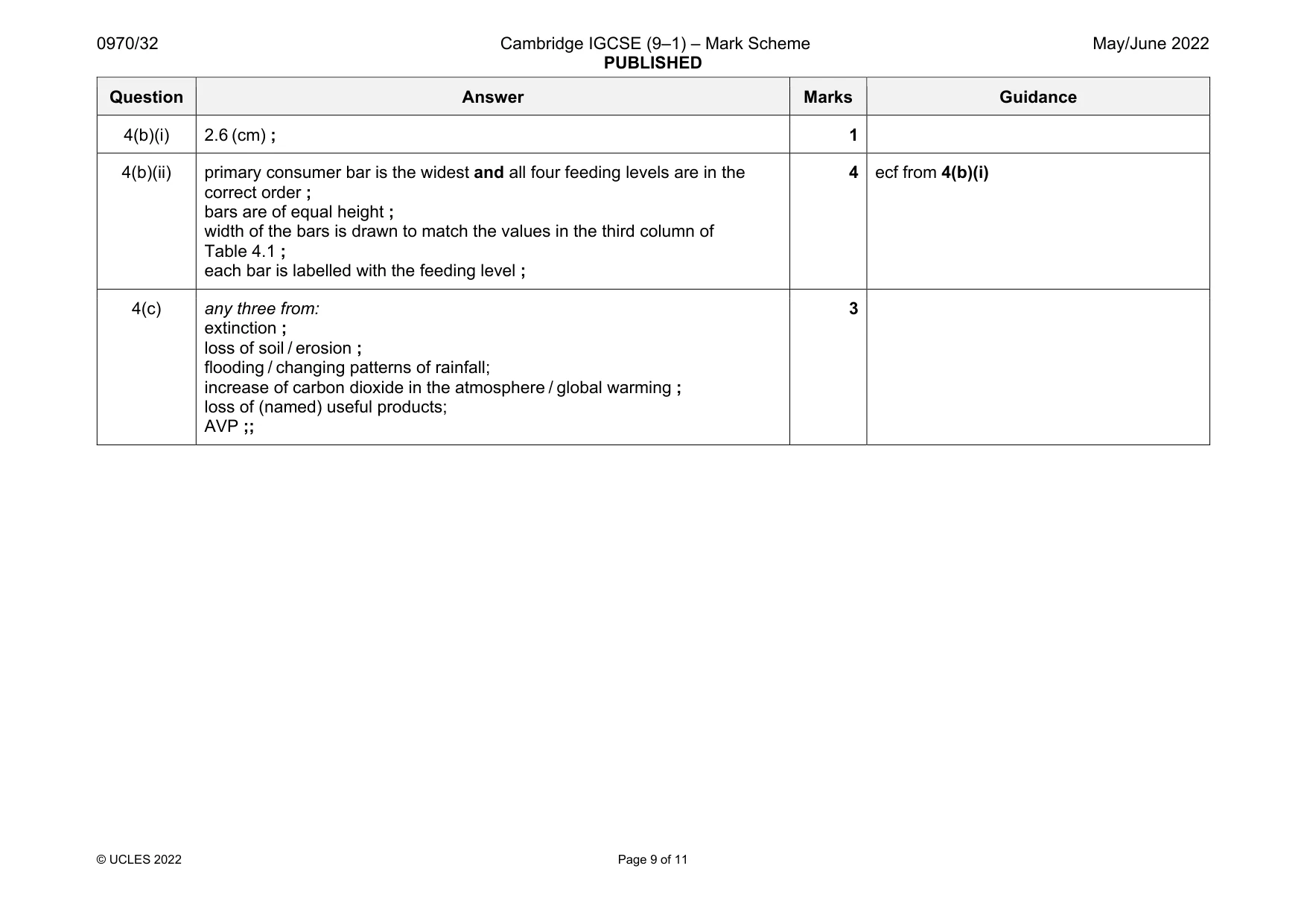
Mark scheme: 4(a)(i) banana (plant) / pineapple (plant) ; 1 4(a)(ii) howler monkey / golden lion tamarin / sloth ; 1 4(a)(iii) 3 ; 1 4(a)(iv) banana /pineapple ( howler monkey) ; (howler monkey) ocelot jaguar ; 2 4(a)(v) (anacondas decrease because) there is less food ; (sloths increase because) there is more food ; 2 4(a)(vi) (the) Sun ; 1 Question Answer Marks Guidance 4(b)(i) 2.6 (cm) ; 1 4(b)(ii) primary consumer bar is the widest and all four feeding levels are in the correct order ; bars are of equal height ; width of the bars is drawn to match the values in the third column of Table 4.1 ; each bar is labelled with the feeding level ; 4 ecf from 4(b)(i) 4(c) any three from: extinction ; loss of soil / erosion ; flooding / changing patterns of rainfall; increase of carbon dioxide in the atmosphere / global warming ; loss of (named) useful products; AVP ;; 3
Q5 · Blood group is inherited
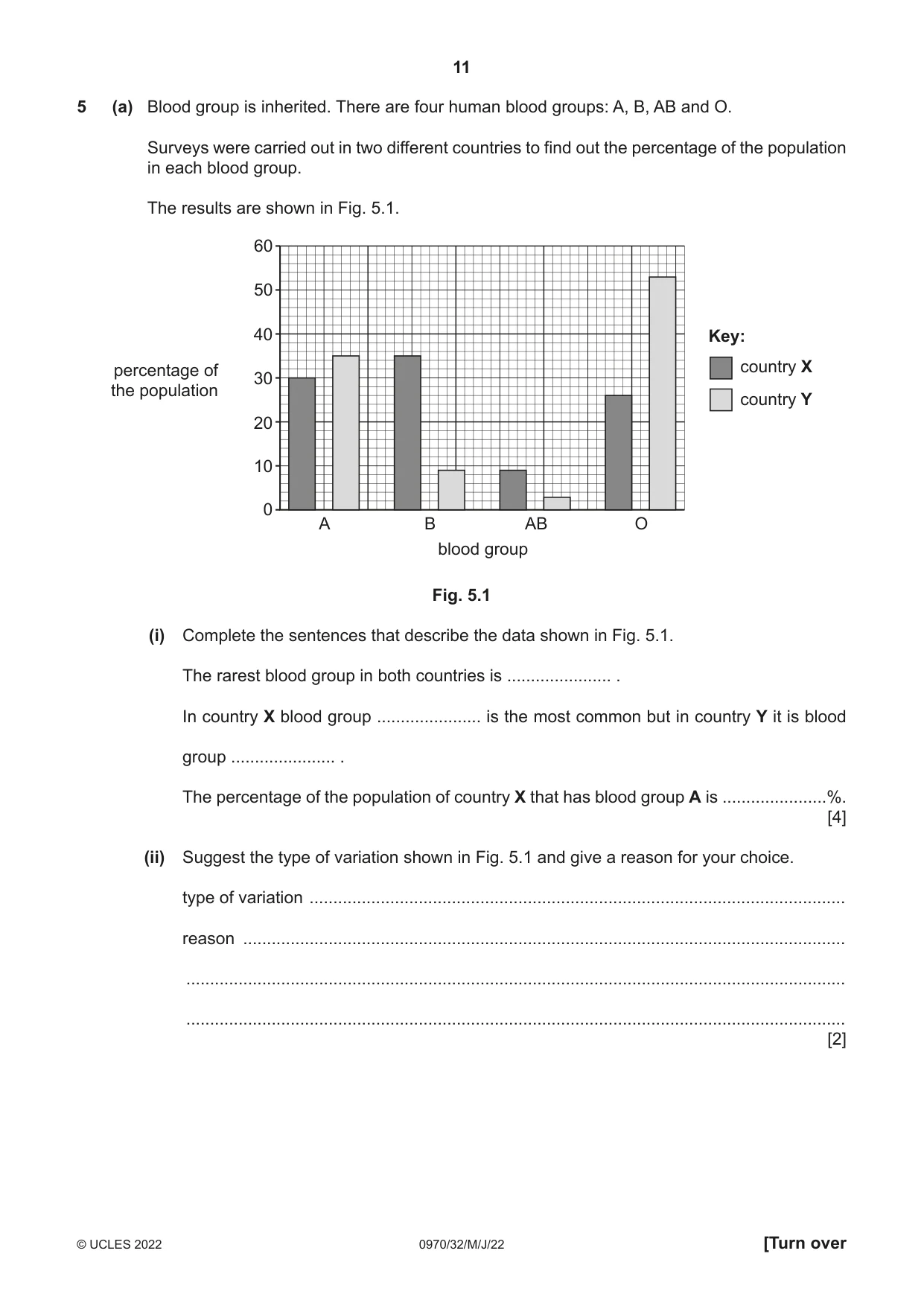
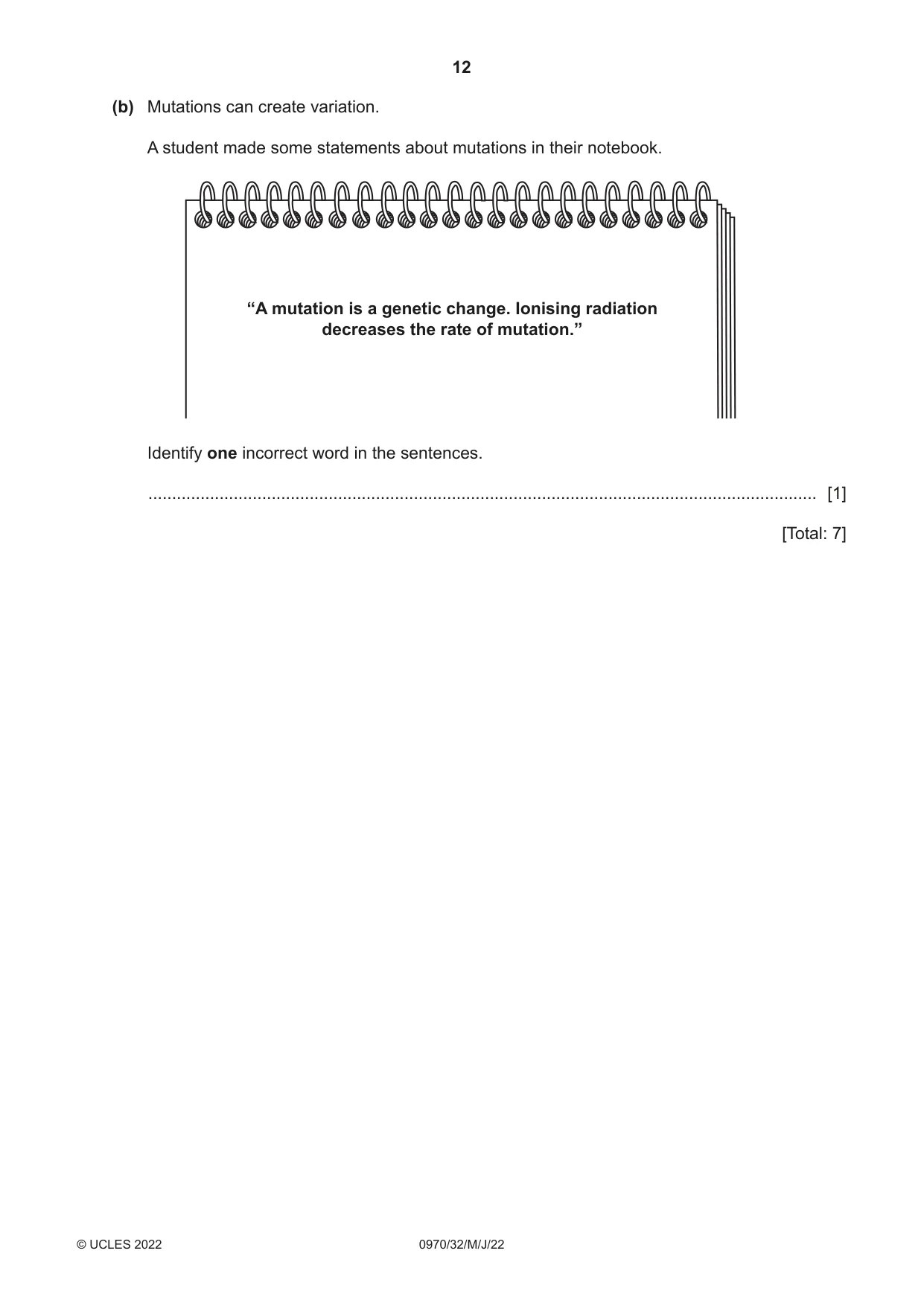
5 (a) Blood group is inherited. There are four human blood groups: A, B, AB and O. Surveys were carried out in two different countries to find out the percentage of the population in each blood group. The results are shown in Fig. 5.1. 60 50 40 Key: percentage of country X 30 the population country Y 20 10 0 A B AB O blood group Fig. 5.1 (i) Complete the sentences that describe the data shown in Fig. 5.1. The rarest blood group in both countries is ...................... . In country X blood group ...................... is the most common but in country Y it is blood group ...................... . The percentage of the population of country X that has blood group A is ......................%. [4] (ii) Suggest the type of variation shown in Fig. 5.1 and give a reason for your choice. type of variation ................................................................................................................. reason ............................................................................................................................... ........................................................................................................................................... ........................................................................................................................................... [2] (b) Mutations can create variation. A student made some statements about mutations in their notebook. “A mutation is a genetic change. Ionising radiation decreases the rate of mutation.” Identify one incorrect word in the sentences. ............................................................................................................................................. [1] [Total: 7]
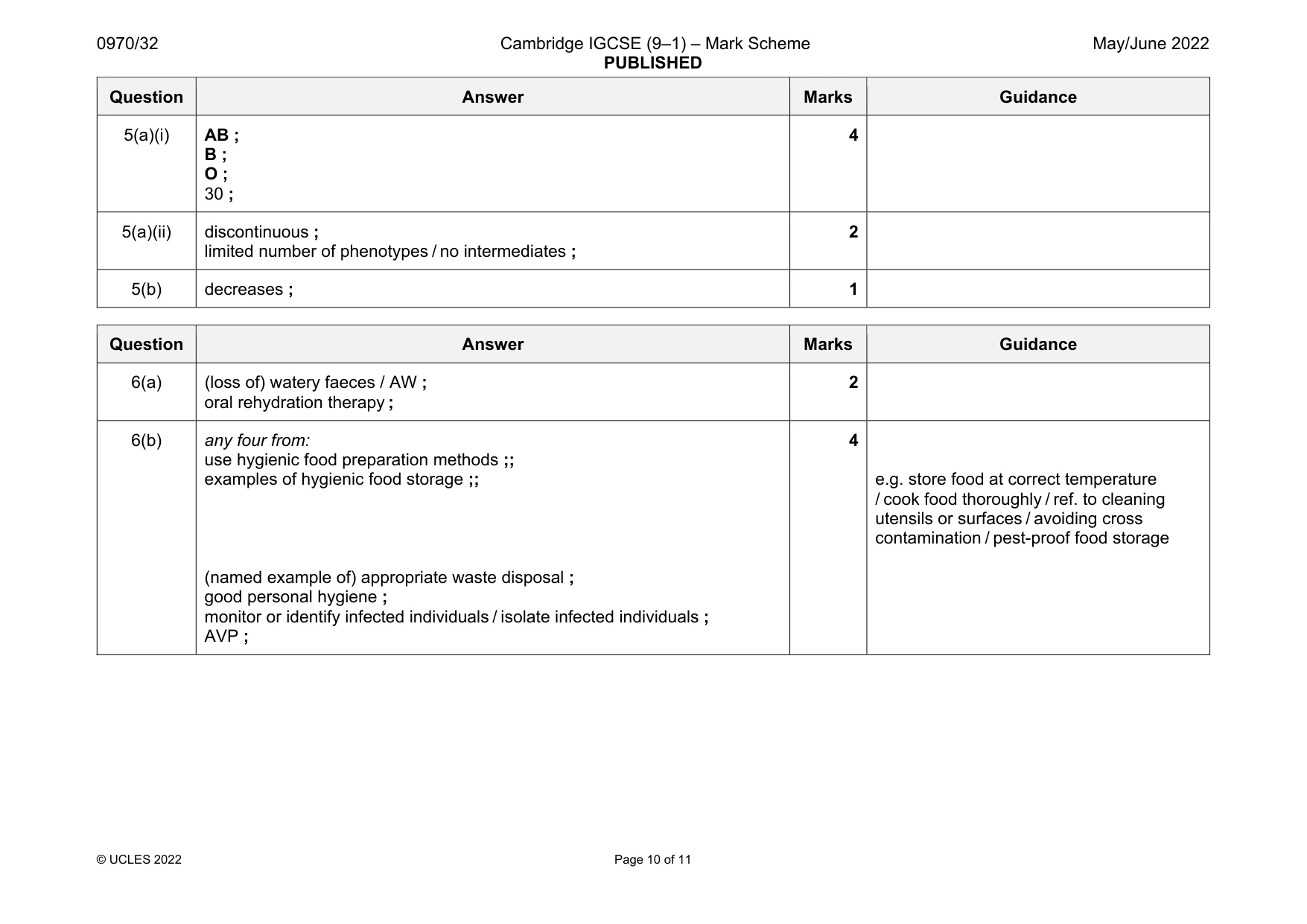
Mark scheme: 5(a)(i) AB ; B ; O ; 30 ; 4 5(a)(ii) discontinuous ; limited number of phenotypes / no intermediates ; 2 5(b) decreases ; 1
Q6 · Pathogens in food can cause diarrhoea
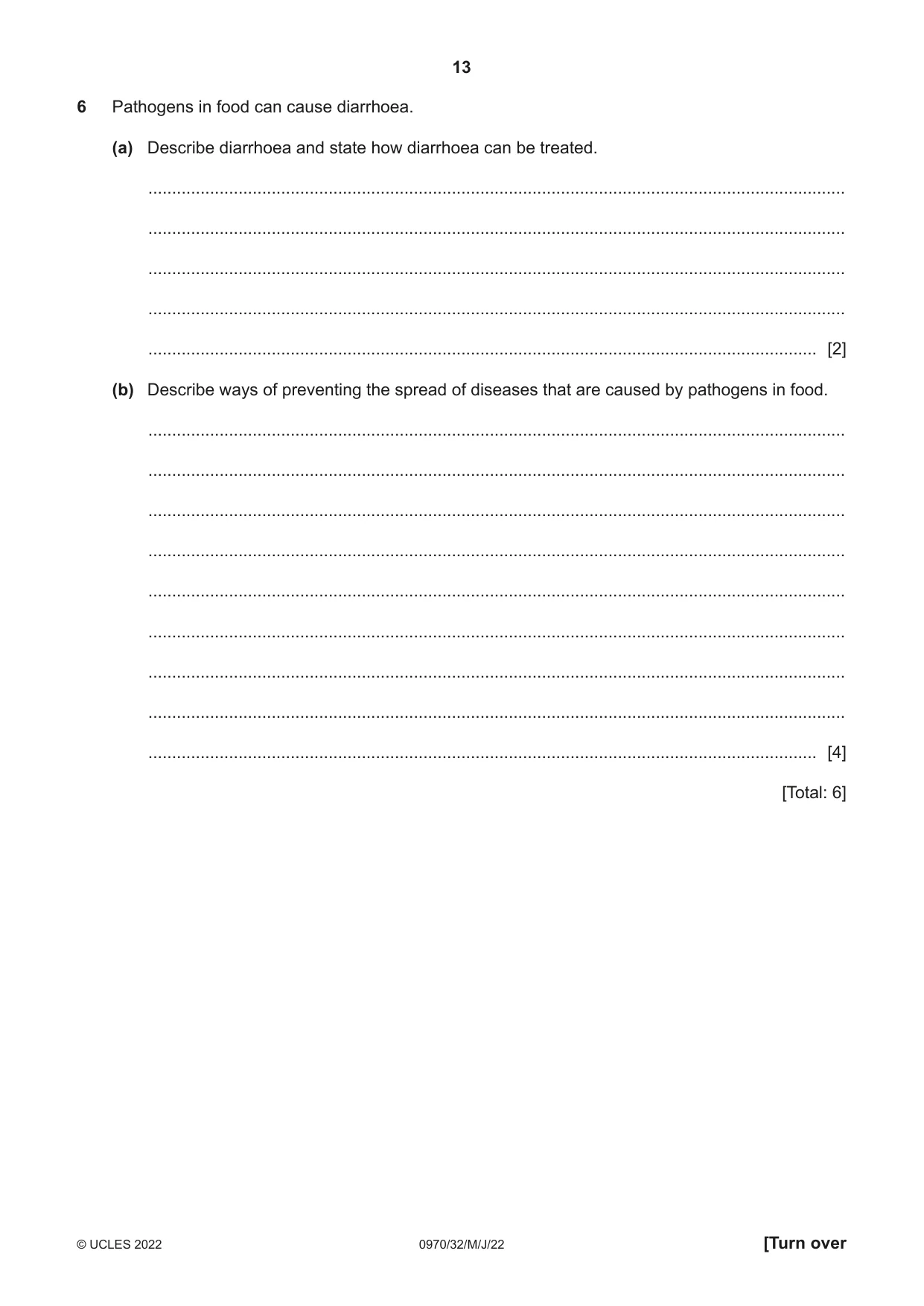
6 Pathogens in food can cause diarrhoea. (a) Describe diarrhoea and state how diarrhoea can be treated. ................................................................................................................................................... ................................................................................................................................................... ................................................................................................................................................... ................................................................................................................................................... ............................................................................................................................................. [2] (b) Describe ways of preventing the spread of diseases that are caused by pathogens in food. ................................................................................................................................................... ................................................................................................................................................... ................................................................................................................................................... ................................................................................................................................................... ................................................................................................................................................... ................................................................................................................................................... ................................................................................................................................................... ................................................................................................................................................... ............................................................................................................................................. [4] [Total: 6]
Mark scheme: 6(a) (loss of) watery faeces / AW ; oral rehydration therapy ; 2 6(b) any four from: use hygienic food preparation methods ;; examples of hygienic food storage ;; (named example of) appropriate waste disposal ; good personal hygiene ; monitor or identify infected individuals / isolate infected individuals ; AVP ; 4 e.g. store food at correct temperature / cook food thoroughly / ref. to cleaning utensils or surfaces / avoiding cross contamination / pest-proof food storage
Q7 · A student investigated plant growth responses
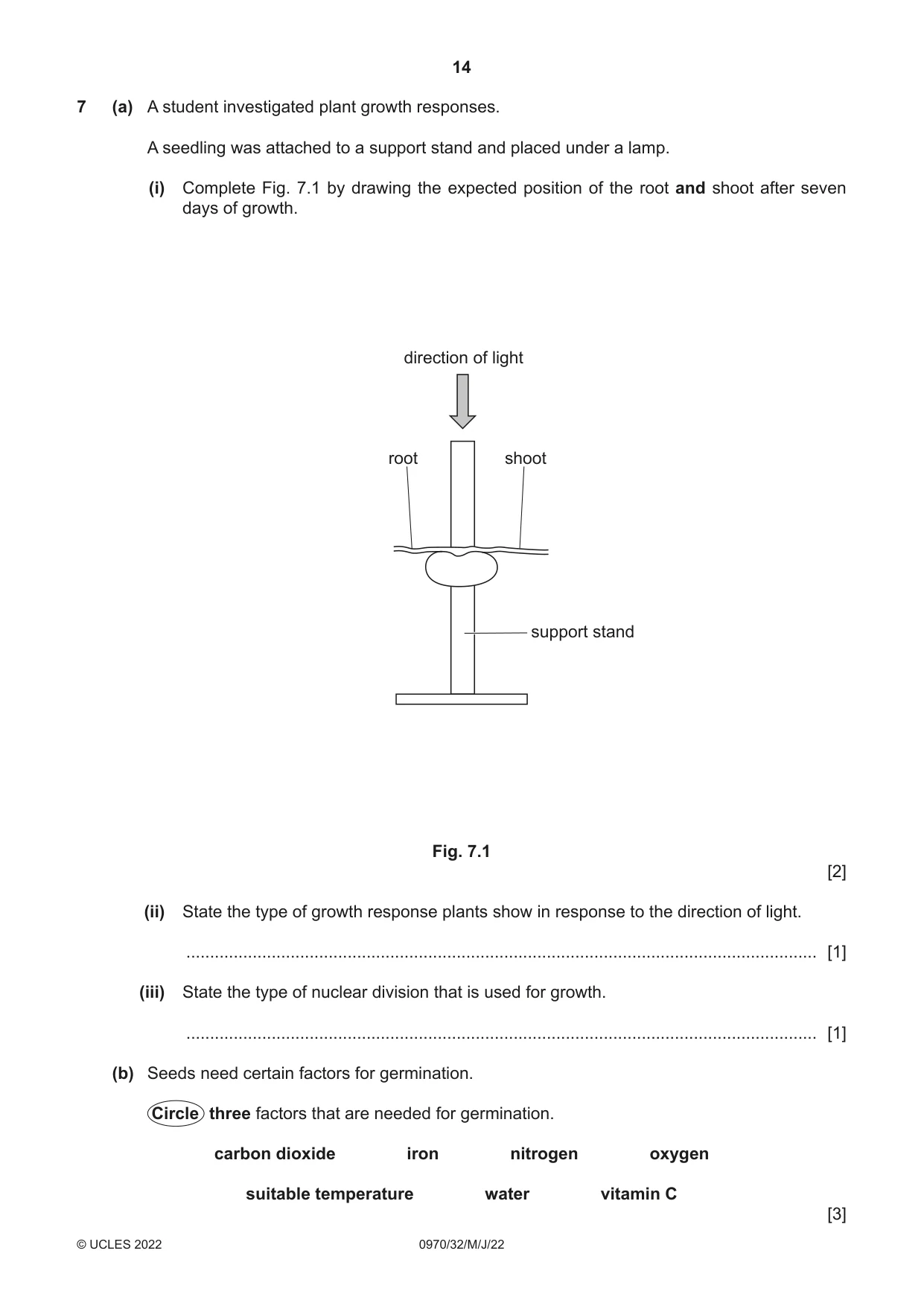
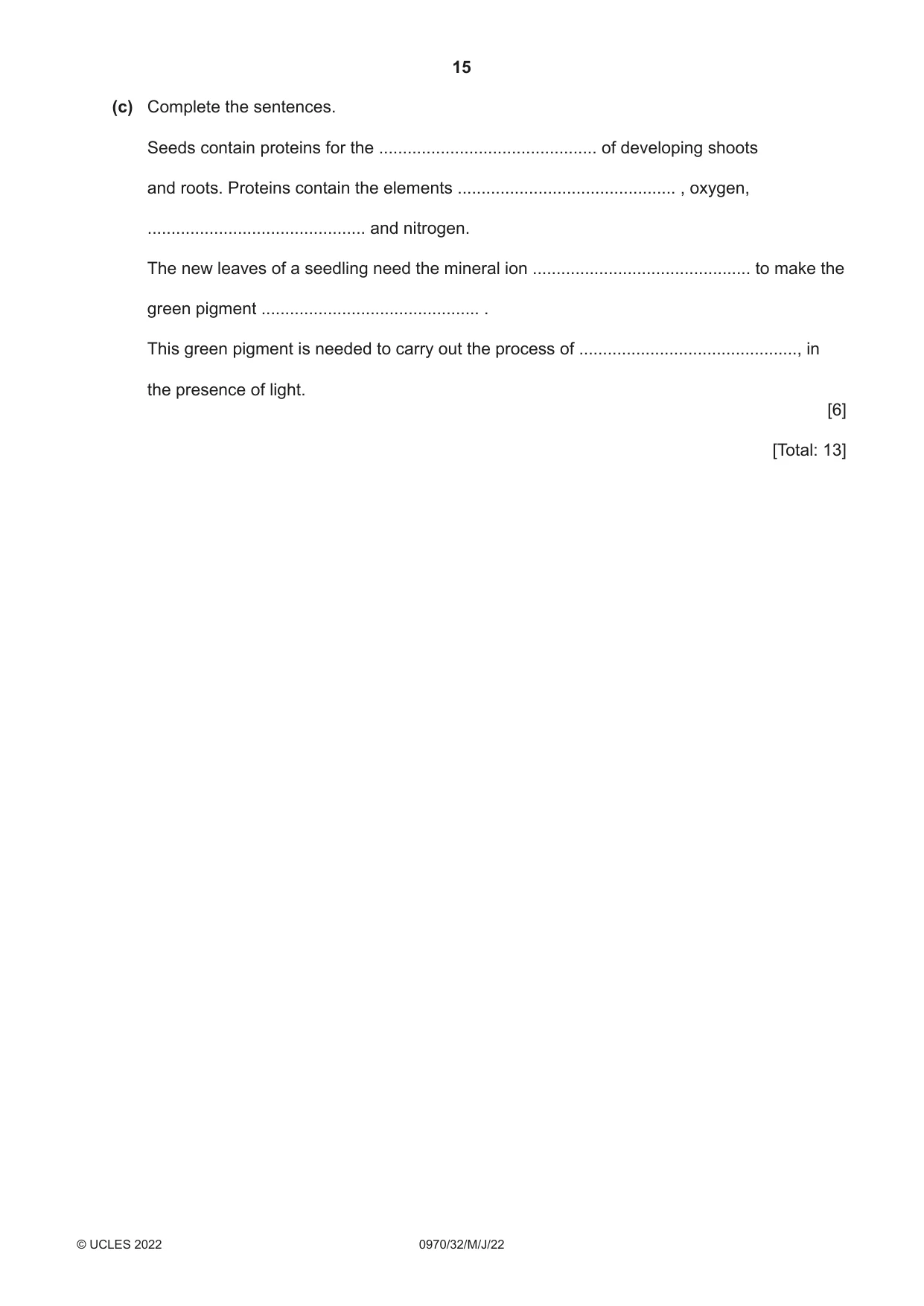
7 (a) A student investigated plant growth responses. A seedling was attached to a support stand and placed under a lamp. (i) Complete Fig. 7.1 by drawing the expected position of the root and shoot after seven days of growth. direction of light root shoot support stand Fig. 7.1 [2] (ii) State the type of growth response plants show in response to the direction of light. ..................................................................................................................................... [1] (iii) State the type of nuclear division that is used for growth. ..................................................................................................................................... [1] (b) Seeds need certain factors for germination. Circle three factors that are needed for germination. carbon dioxide iron nitrogen oxygen suitable temperature water vitamin C [3] (c) Complete the sentences. Seeds contain proteins for the .............................................. of developing shoots and roots. Proteins contain the elements .............................................. , oxygen, .............................................. and nitrogen. The new leaves of a seedling need the mineral ion .............................................. to make the green pigment .............................................. . This green pigment is needed to carry out the process of .............................................., in the presence of light. [6] [Total: 13]
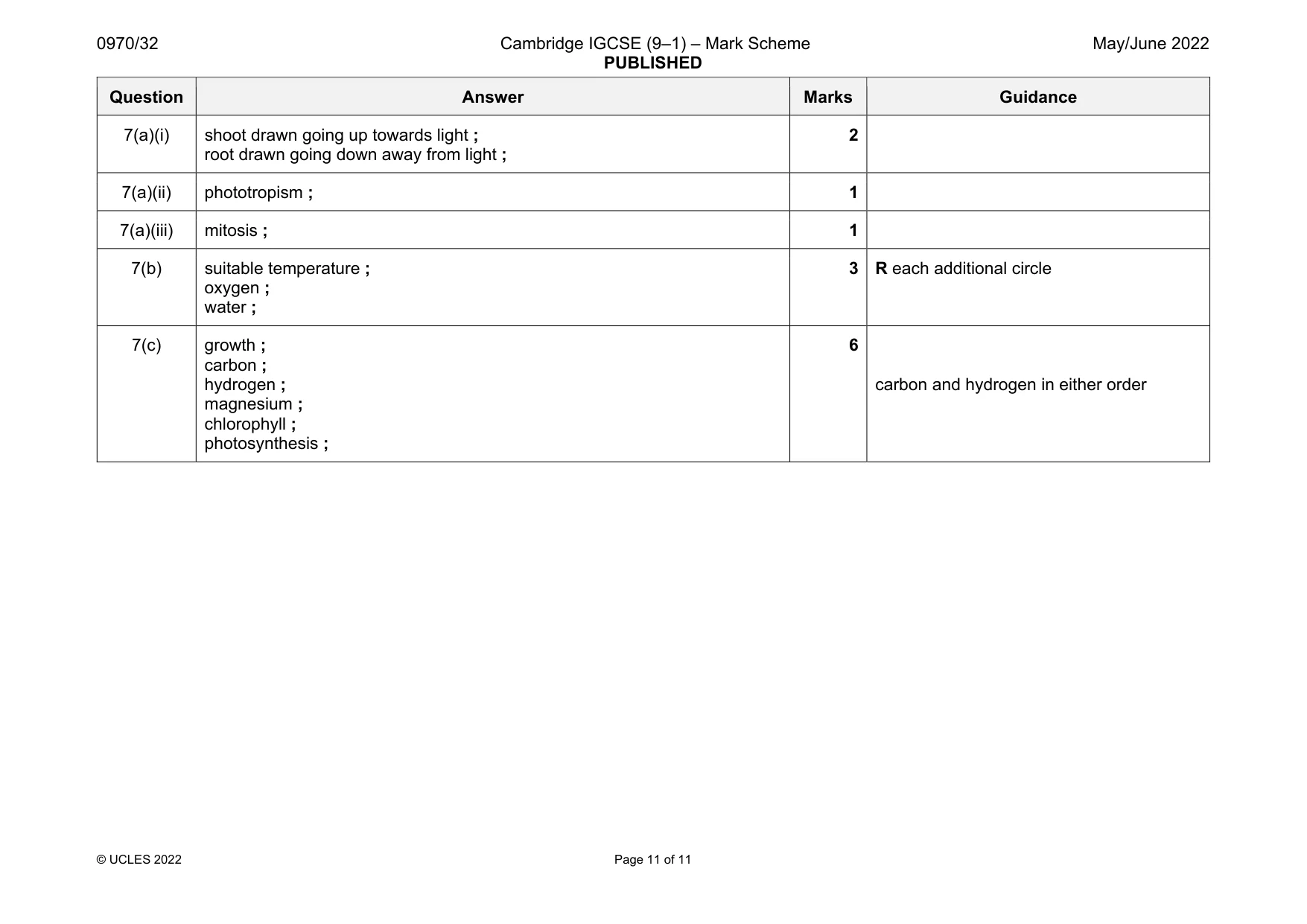
Mark scheme: 7(a)(i) shoot drawn going up towards light ; root drawn going down away from light ; 2 7(a)(ii) phototropism ; 1 7(a)(iii) mitosis ; 1 7(b) suitable temperature ; oxygen ; water ; 3 R each additional circle 7(c) growth ; carbon ; hydrogen ; magnesium ; chlorophyll ; photosynthesis ; 6 carbon and hydrogen in either order
What was in this paper
The subtopics covered by these 7 questions, and how many questions each got. Open one in a new tab to see every Cambridge question on it.
What you needed in this session
Cambridge’s own grade thresholds for 2022 May/June, Paper 3 · Variant 2. A higher threshold means an easier paper — the bar moves with how the cohort did.