Cambridge IGCSE Biology (9-1) 0970 — 2021 May/June Paper 4 · Variant 2
0970/42/M/J/21 · 6 questions · 80 marks · ≈90 min
The question paper and its mark scheme, free to read here and free to download. This is Cambridge’s own paper, exactly as it was sat.
Question paper20 pages

Mark scheme12 pages
Answers below. Sit the paper first if you are practising.
Questions as text
Q1 · Complete the sentence about the nervous system
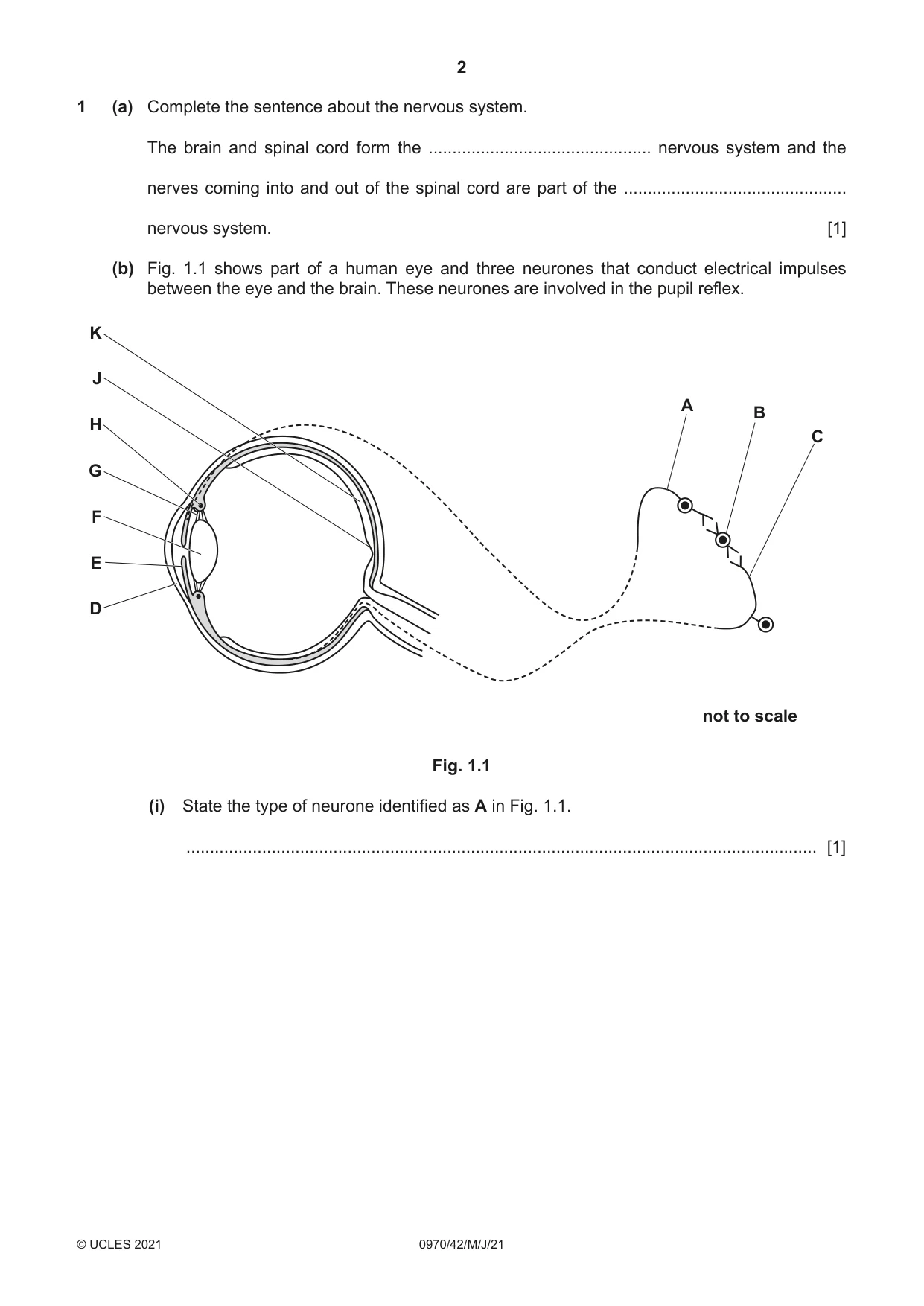
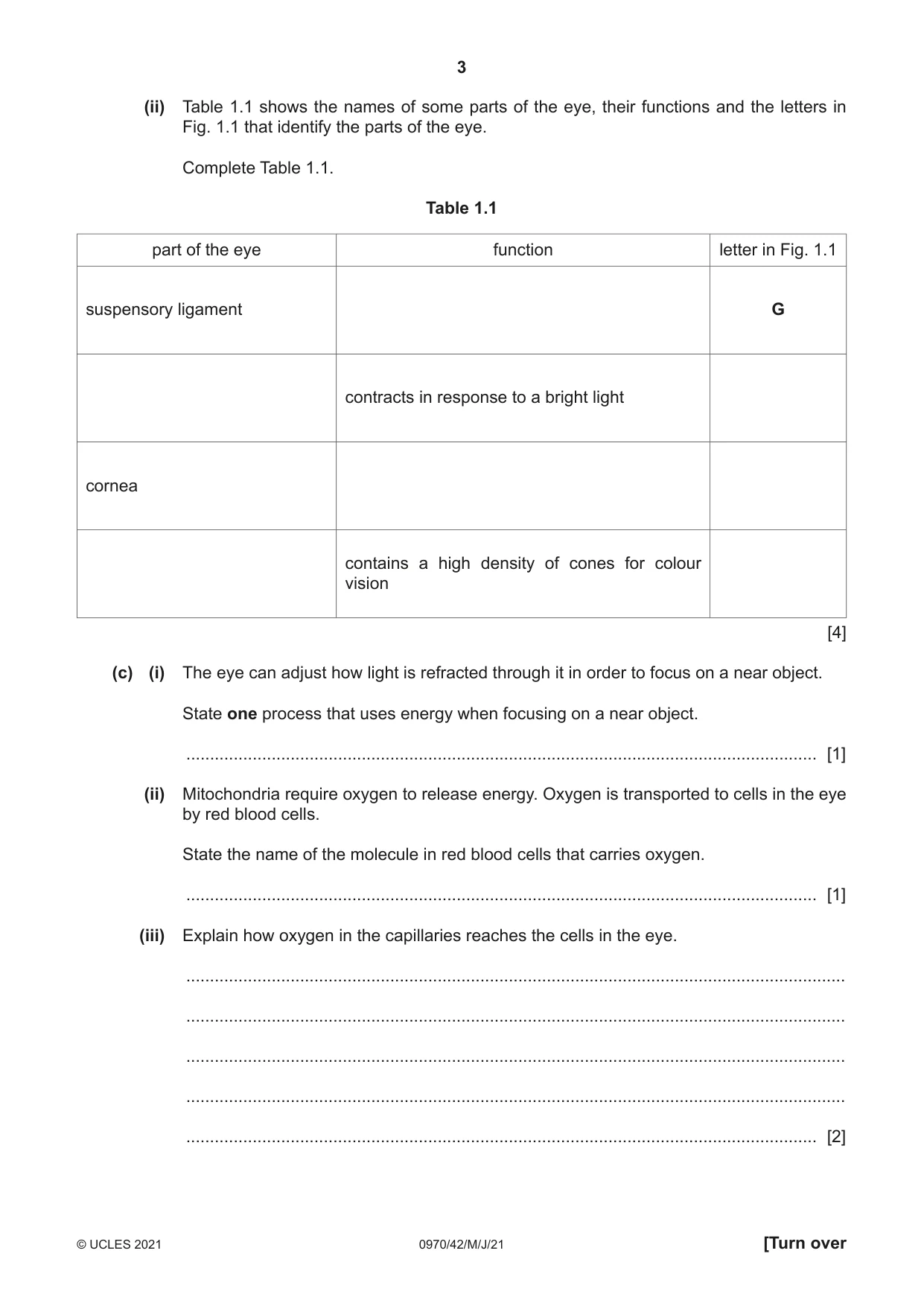
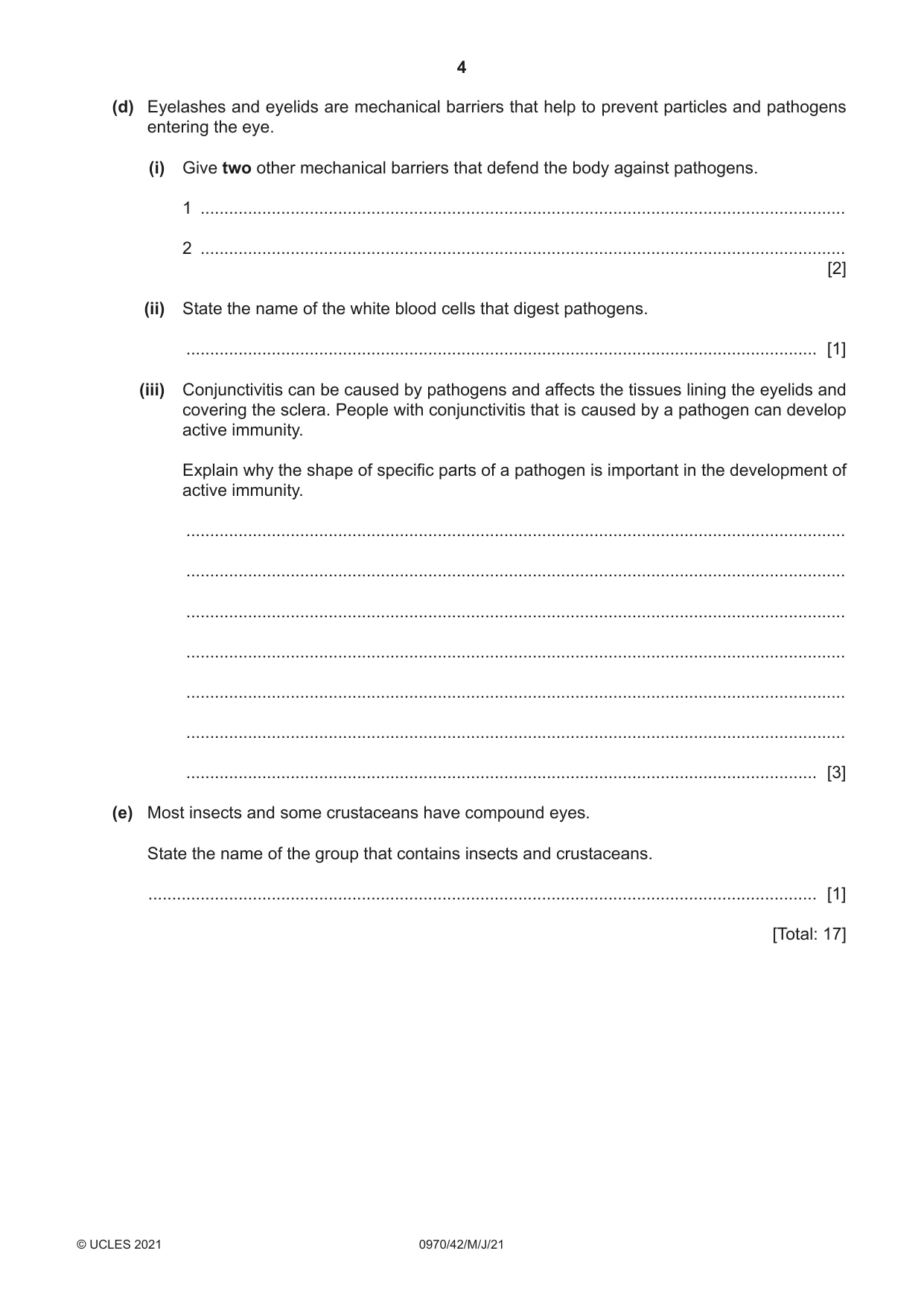
1 (a) Complete the sentence about the nervous system. The brain and spinal cord form the ............................................... nervous system and the nerves coming into and out of the spinal cord are part of the ............................................... nervous system. [1] (b) Fig. 1.1 shows part of a human eye and three neurones that conduct electrical impulses between the eye and the brain. These neurones are involved in the pupil reflex. K J A B H C G F E D not to scale Fig. 1.1 (i) State the type of neurone identified as A in Fig. 1.1. ..................................................................................................................................... [1] (ii) Table 1.1 shows the names of some parts of the eye, their functions and the letters in Fig. 1.1 that identify the parts of the eye. Complete Table 1.1. Table 1.1 part of the eye function letter in Fig. 1.1 suspensory ligament G contracts in response to a bright light cornea contains a high density of cones for colour vision [4] (c) (i) The eye can adjust how light is refracted through it in order to focus on a near object. State one process that uses energy when focusing on a near object. ..................................................................................................................................... [1] (ii) Mitochondria require oxygen to release energy. Oxygen is transported to cells in the eye by red blood cells. State the name of the molecule in red blood cells that carries oxygen. ..................................................................................................................................... [1] (iii) Explain how oxygen in the capillaries reaches the cells in the eye. ........................................................................................................................................... ........................................................................................................................................... ........................................................................................................................................... ........................................................................................................................................... ..................................................................................................................................... [2] (d) Eyelashes and eyelids are mechanical barriers that help to prevent particles and pathogens entering the eye. (i) Give two other mechanical barriers that defend the body against pathogens. 1 ........................................................................................................................................ 2 ........................................................................................................................................ [2] (ii) State the name of the white blood cells that digest pathogens. ..................................................................................................................................... [1] (iii) Conjunctivitis can be caused by pathogens and affects the tissues lining the eyelids and covering the sclera. People with conjunctivitis that is caused by a pathogen can develop active immunity. Explain why the shape of specific parts of a pathogen is important in the development of active immunity. ........................................................................................................................................... ........................................................................................................................................... ........................................................................................................................................... ........................................................................................................................................... ........................................................................................................................................... ........................................................................................................................................... ..................................................................................................................................... [3] (e) Most insects and some crustaceans have compound eyes. State the name of the group that contains insects and crustaceans. ............................................................................................................................................. [1] [Total: 17]
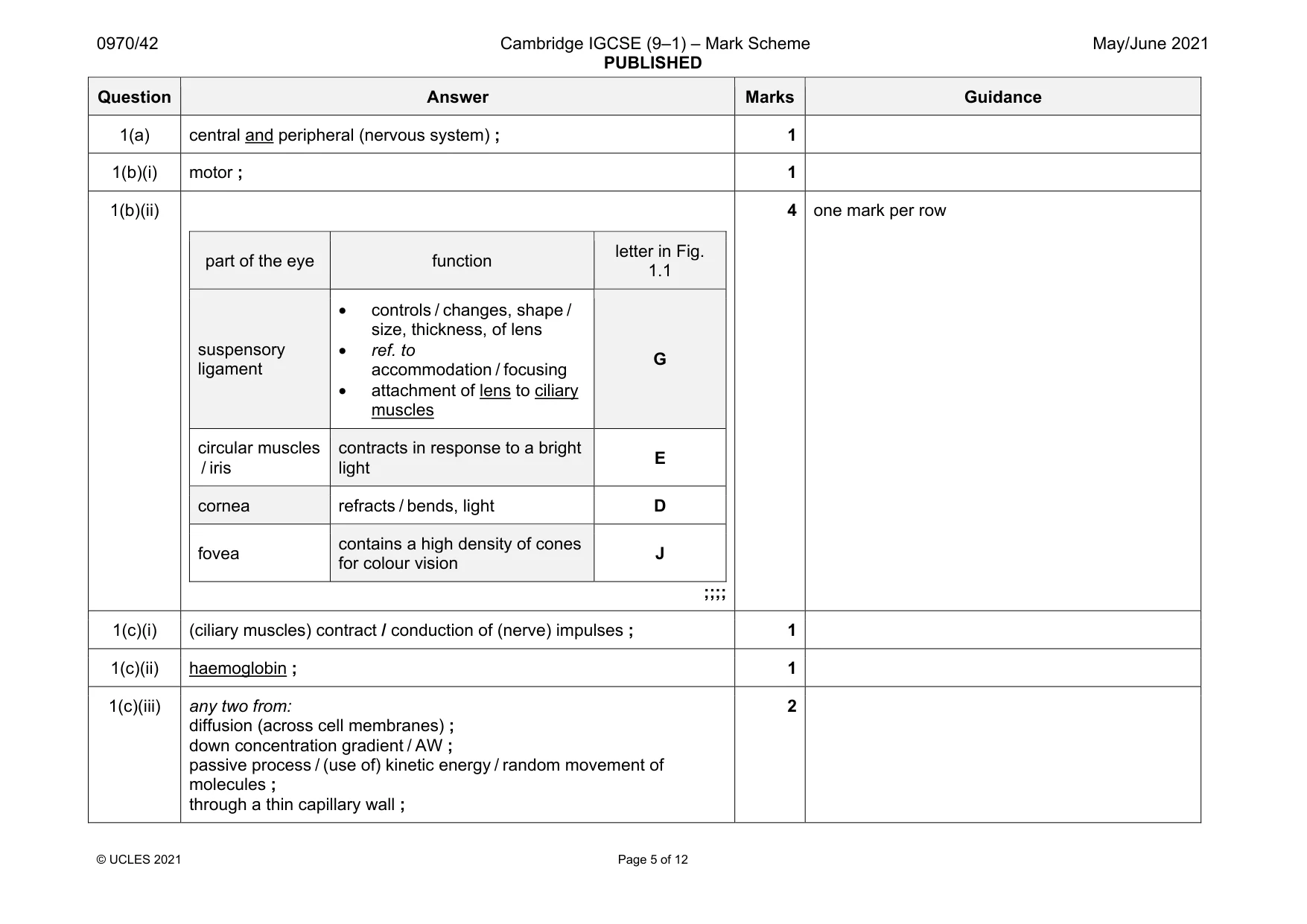
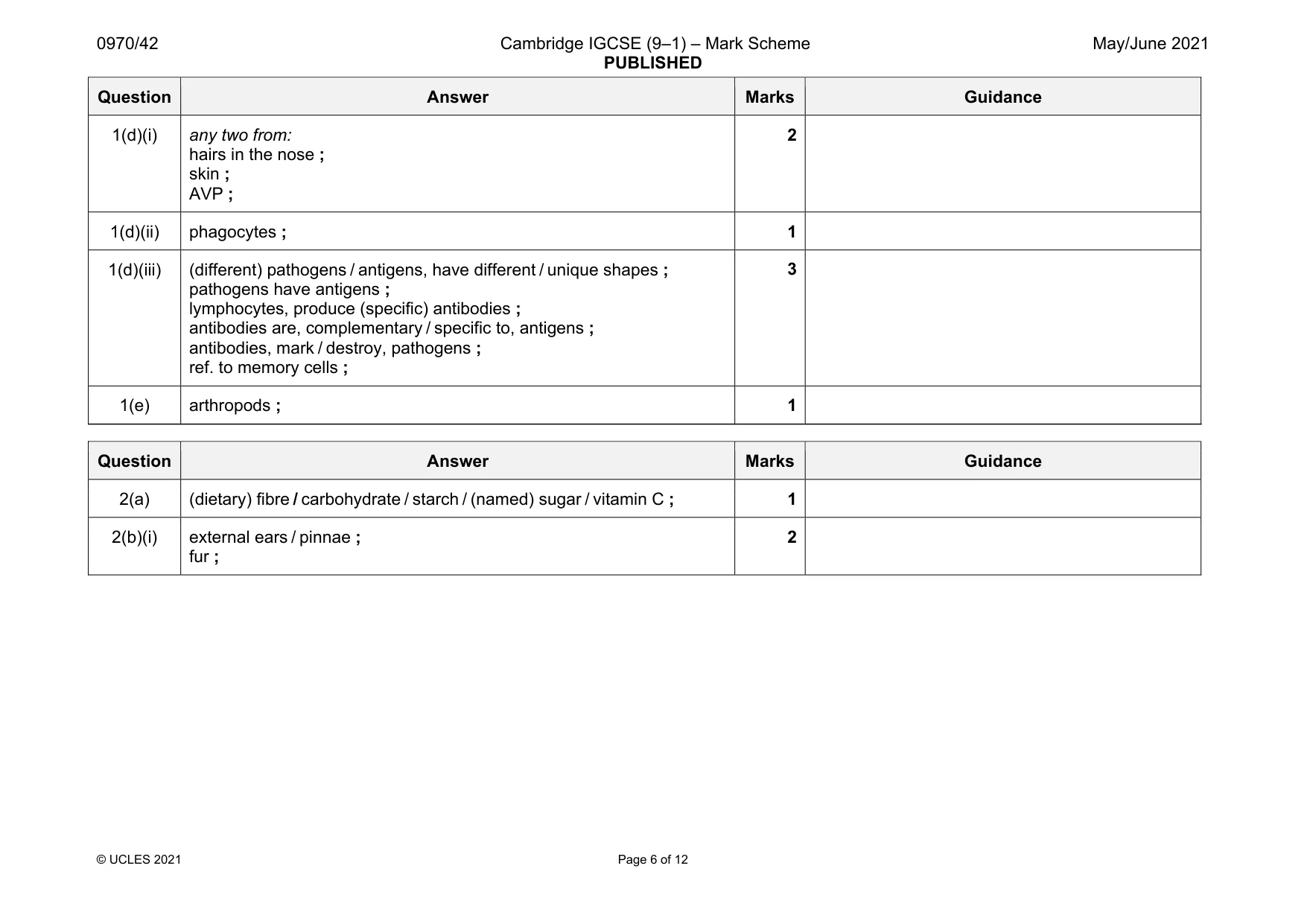
Mark scheme: 1(a) central and peripheral (nervous system) ; 1 1(b)(i) motor ; 1 1(b)(ii) ;;;; part of the eye function letter in Fig. 1.1 suspensory ligament • controls / changes, shape / size, thickness, of lens • ref. to accommodation / focusing • attachment of lens to ciliary muscles G circular muscles / iris contracts in response to a bright light E cornea refracts / bends, light D fovea contains a high density of cones for colour vision J 4 one mark per row 1(c)(i) (ciliary muscles) contract / conduction of (nerve) impulses ; 1 1(c)(ii) haemoglobin ; 1 1(c)(iii) any two from: diffusion (across cell membranes) ; down concentration gradient / AW ; passive process / (use of) kinetic energy / random movement of molecules ; through a thin capillary wall ; 2 Question Answer Marks Guidance 1(d)(i) any two from: hairs in the nose ; skin ; AVP ; 2 1(d)(ii) phagocytes ; 1 1(d)(iii) (different) pathogens / antigens, have different / unique shapes ; pathogens have antigens ; lymphocytes, produce (specific) antibodies ; antibodies are, complementary / specific to, antigens ; antibodies, mark / destroy, pathogens ; ref. to memory cells ; 3 1(e) arthropods ; 1
Q2 · The classification of giant pandas, Ailuropoda melanoleuca, is debated by many scientists
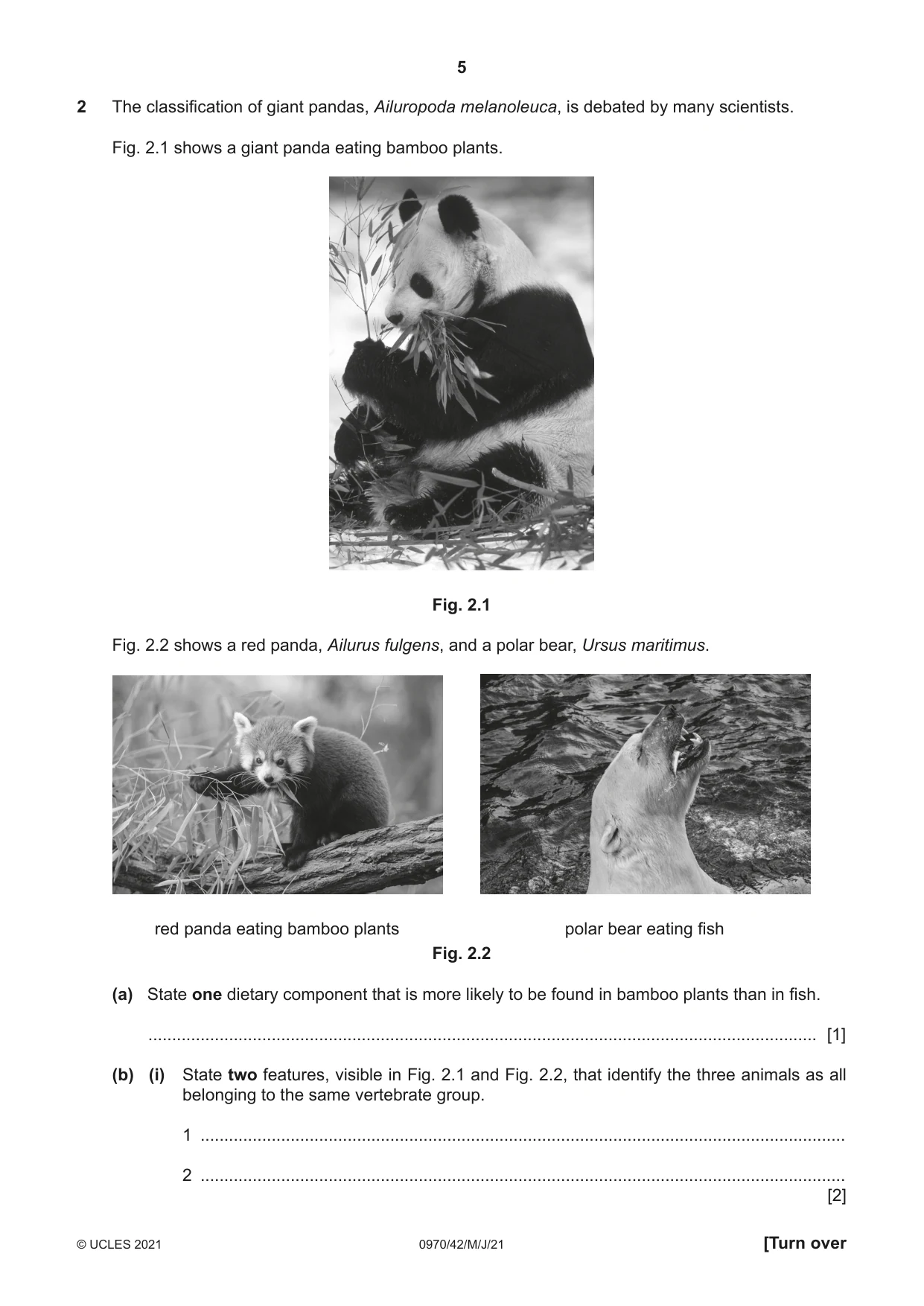
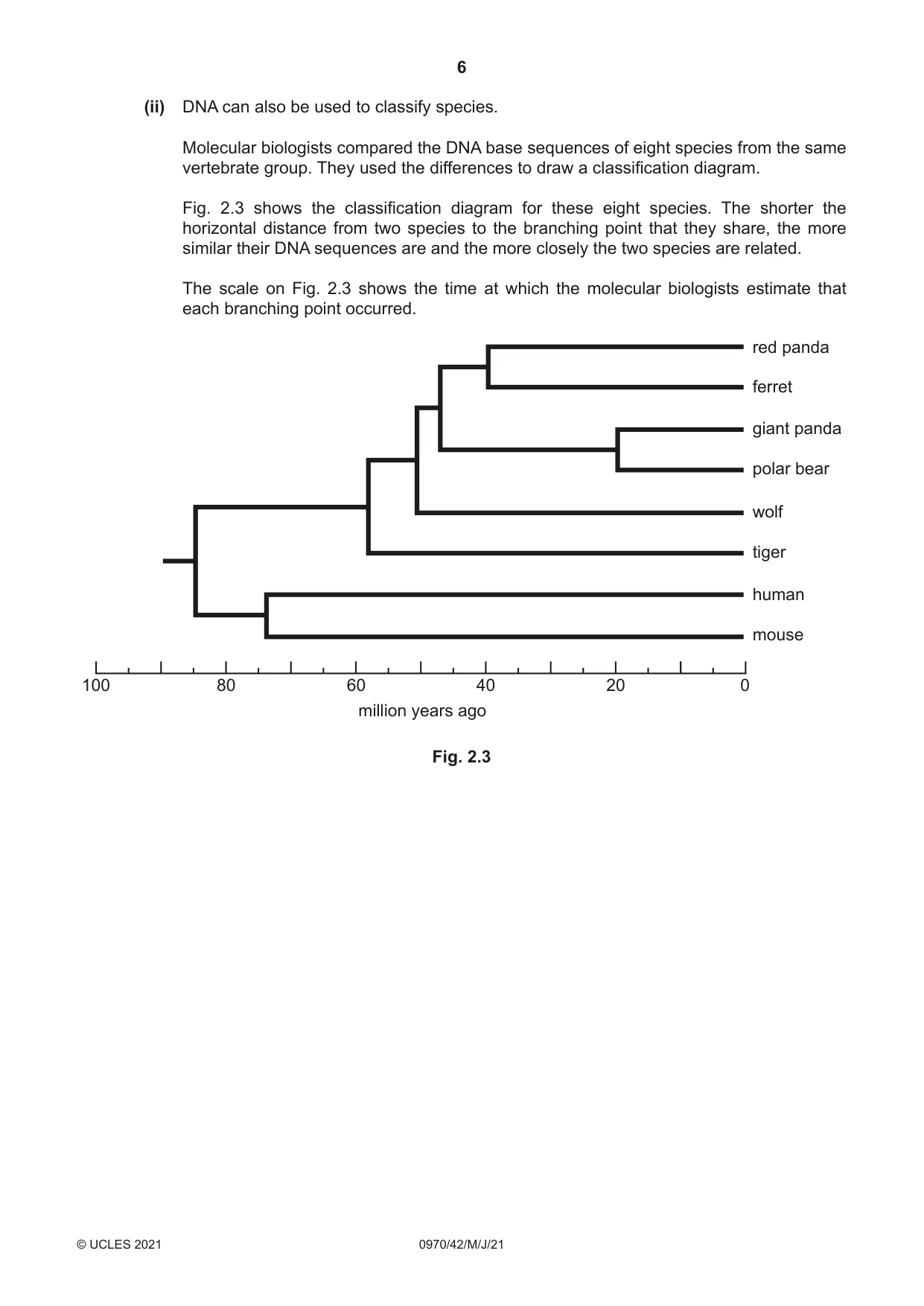
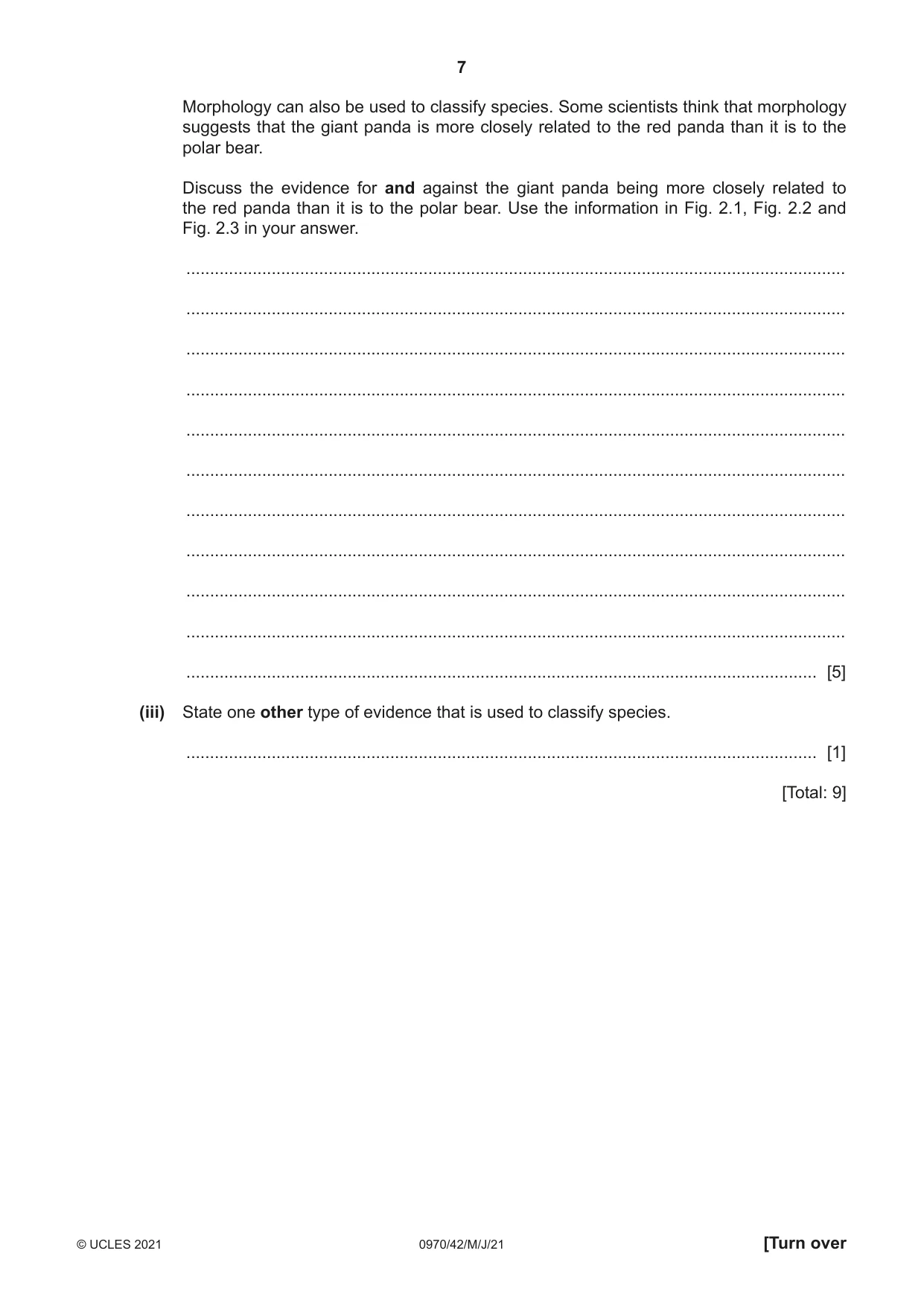
2 The classification of giant pandas, Ailuropoda melanoleuca, is debated by many scientists. Fig. 2.1 shows a giant panda eating bamboo plants. Fig. 2.1 Fig. 2.2 shows a red panda, Ailurus fulgens, and a polar bear, Ursus maritimus. red panda eating bamboo plants polar bear eating fish Fig. 2.2 (a) State one dietary component that is more likely to be found in bamboo plants than in fish. ............................................................................................................................................. [1] (b) (i) State two features, visible in Fig. 2.1 and Fig. 2.2, that identify the three animals as all belonging to the same vertebrate group. 1 ........................................................................................................................................ 2 ........................................................................................................................................ [2] (ii) DNA can also be used to classify species. Molecular biologists compared the DNA base sequences of eight species from the same vertebrate group. They used the differences to draw a classification diagram. Fig. 2.3 shows the classification diagram for these eight species. The shorter the horizontal distance from two species to the branching point that they share, the more similar their DNA sequences are and the more closely the two species are related. The scale on Fig. 2.3 shows the time at which the molecular biologists estimate that each branching point occurred. red panda ferret giant panda polar bear wolf tiger human mouse 100 80 60 40 20 0 million years ago Fig. 2.3 Morphology can also be used to classify species. Some scientists think that morphology suggests that the giant panda is more closely related to the red panda than it is to the polar bear. Discuss the evidence for and against the giant panda being more closely related to the red panda than it is to the polar bear. Use the information in Fig. 2.1, Fig. 2.2 and Fig. 2.3 in your answer. ........................................................................................................................................... ........................................................................................................................................... ........................................................................................................................................... ........................................................................................................................................... ........................................................................................................................................... ........................................................................................................................................... ........................................................................................................................................... ........................................................................................................................................... ........................................................................................................................................... ........................................................................................................................................... ..................................................................................................................................... [5] (iii) State one other type of evidence that is used to classify species. ..................................................................................................................................... [1] [Total: 9]
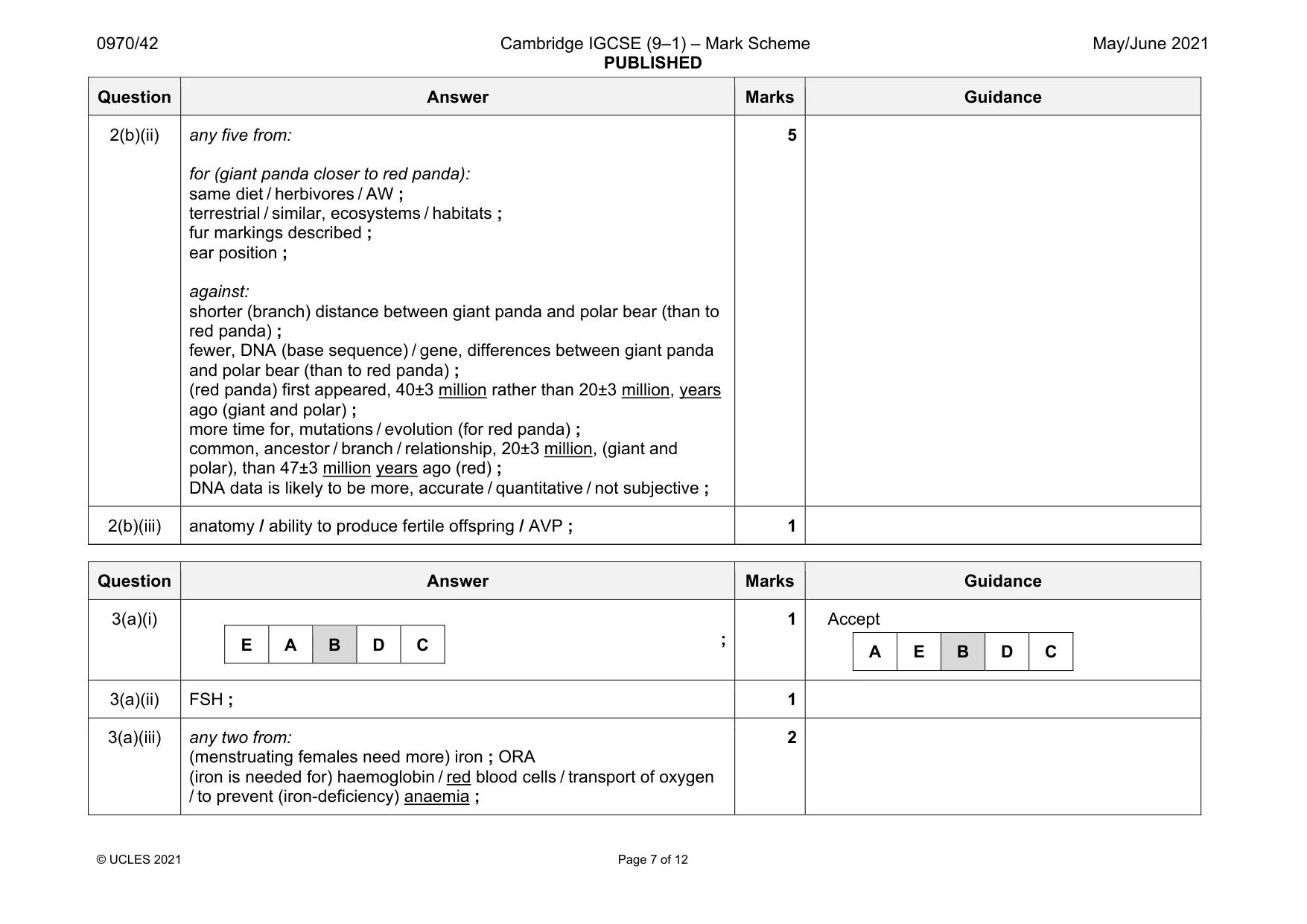
Mark scheme: 2(a) (dietary) fibre / carbohydrate / starch / (named) sugar / vitamin C ; 1 2(b)(i) external ears / pinnae ; fur ; 2 Question Answer Marks Guidance 2(b)(ii) any five from: for (giant panda closer to red panda): same diet / herbivores / AW ; terrestrial / similar, ecosystems / habitats ; fur markings described ; ear position ; against: shorter (branch) distance between giant panda and polar bear (than to red panda) ; fewer, DNA (base sequence) / gene, differences between giant panda and polar bear (than to red panda) ; (red panda) first appeared, 40±3 million rather than 20±3 million, years ago (giant and polar) ; more time for, mutations / evolution (for red panda) ; common, ancestor / branch / relationship, 20±3 million, (giant and polar), than 47±3 million years ago (red) ; DNA data is likely to be more, accurate / quantitative / not subjective ; 5 2(b)(iii) anatomy / ability to produce fertile offspring / AVP ; 1
Q3 · Some of the events that occur in the menstrual cycle
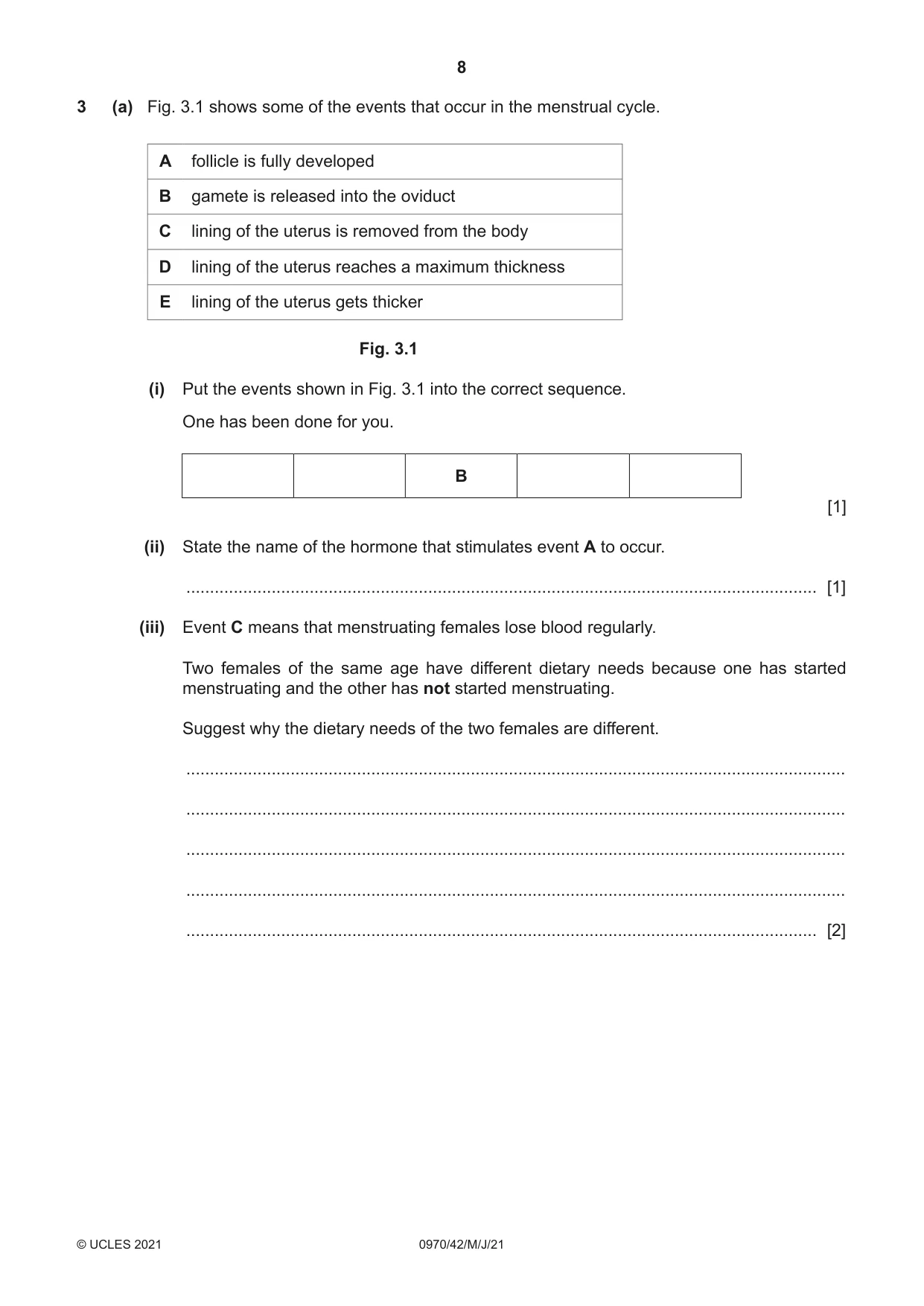
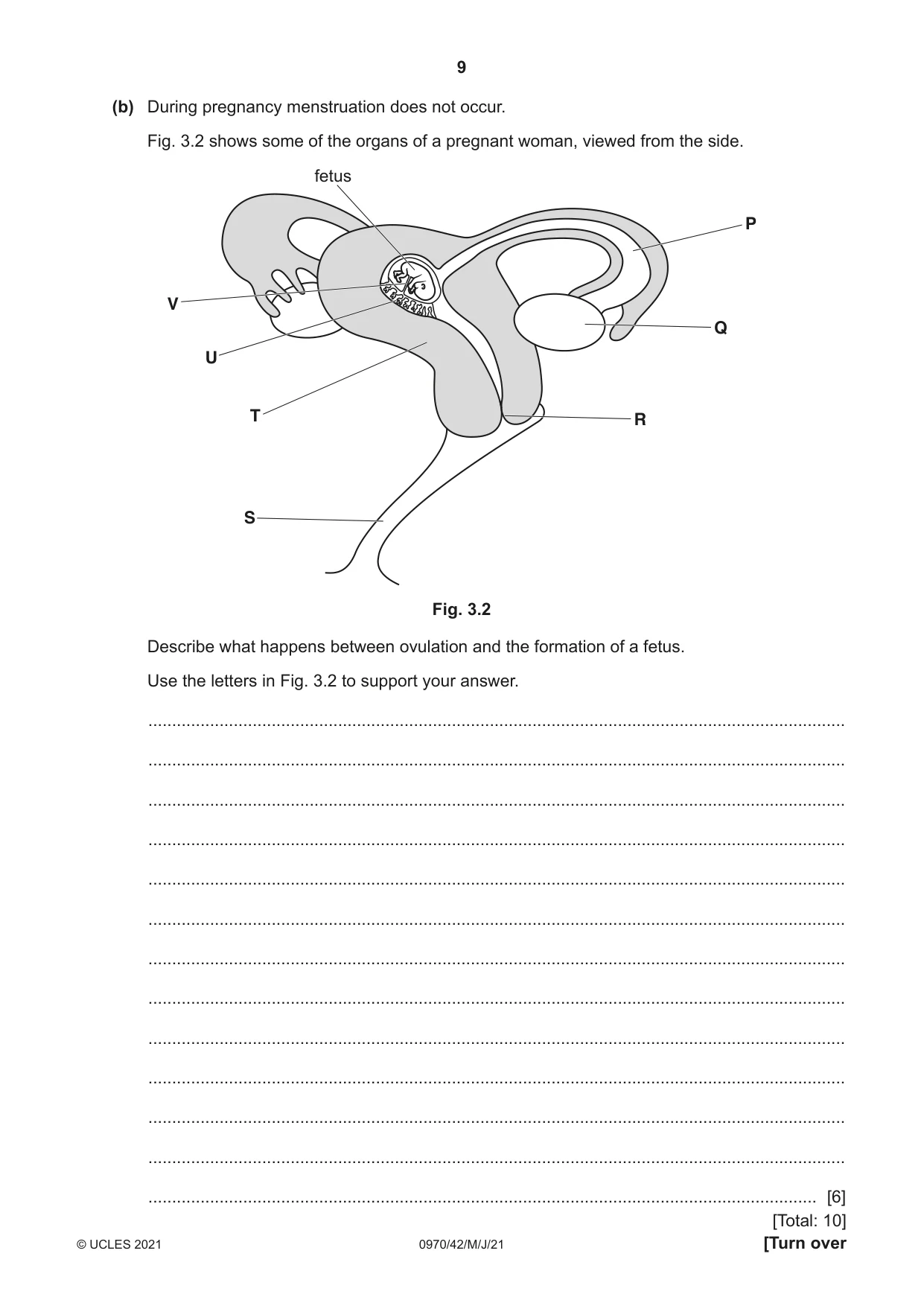
3 (a) Fig. 3.1 shows some of the events that occur in the menstrual cycle. A follicle is fully developed B gamete is released into the oviduct C lining of the uterus is removed from the body D lining of the uterus reaches a maximum thickness E lining of the uterus gets thicker Fig. 3.1 (i) Put the events shown in Fig. 3.1 into the correct sequence. One has been done for you. B [1] (ii) State the name of the hormone that stimulates event A to occur. ..................................................................................................................................... [1] (iii) Event C means that menstruating females lose blood regularly. Two females of the same age have different dietary needs because one has started menstruating and the other has not started menstruating. Suggest why the dietary needs of the two females are different. ........................................................................................................................................... ........................................................................................................................................... ........................................................................................................................................... ........................................................................................................................................... ..................................................................................................................................... [2] (b) During pregnancy menstruation does not occur. Fig. 3.2 shows some of the organs of a pregnant woman, viewed from the side. fetus P V Q U T R S Fig. 3.2 Describe what happens between ovulation and the formation of a fetus. Use the letters in Fig. 3.2 to support your answer. ................................................................................................................................................... ................................................................................................................................................... ................................................................................................................................................... ................................................................................................................................................... ................................................................................................................................................... ................................................................................................................................................... ................................................................................................................................................... ................................................................................................................................................... ................................................................................................................................................... ................................................................................................................................................... ................................................................................................................................................... ................................................................................................................................................... ............................................................................................................................................. [6] [Total: 10]
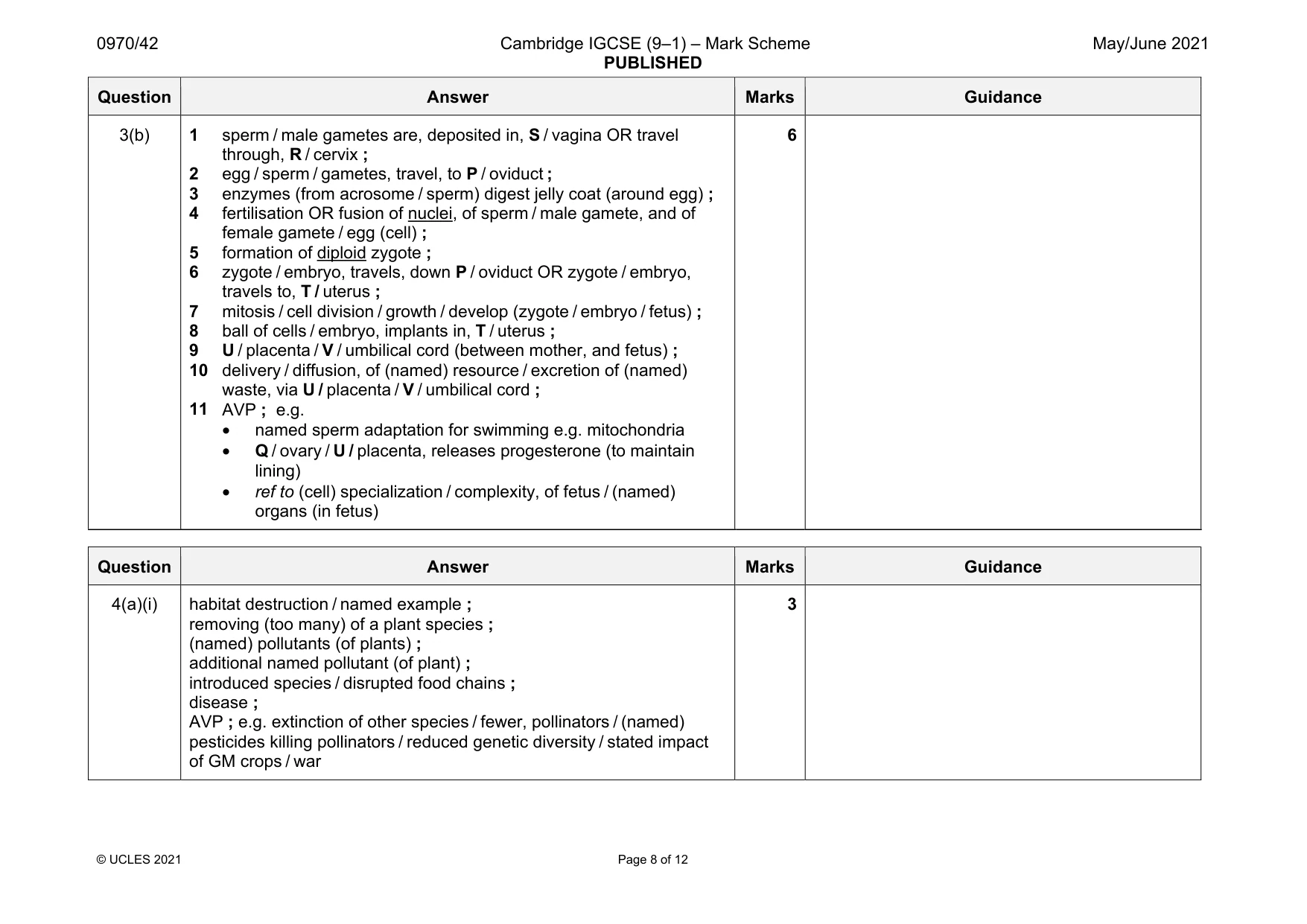
Mark scheme: 3(a)(i) ; E A B D C 1 Accept A E B D C 3(a)(ii) FSH ; 1 3(a)(iii) any two from: (menstruating females need more) iron ; ORA (iron is needed for) haemoglobin / red blood cells / transport of oxygen / to prevent (iron-deficiency) anaemia ; 2 Question Answer Marks Guidance 3(b) 1 sperm / male gametes are, deposited in, S / vagina OR travel through, R / cervix ; 2 egg / sperm / gametes, travel, to P / oviduct ; 3 enzymes (from acrosome / sperm) digest jelly coat (around egg) ; 4 fertilisation OR fusion of nuclei, of sperm / male gamete, and of female gamete / egg (cell) ; 5 formation of diploid zygote ; 6 zygote / embryo, travels, down P / oviduct OR zygote / embryo, travels to, T / uterus ; 7 mitosis / cell division / growth / develop (zygote / embryo / fetus) ; 8 ball of cells / embryo, implants in, T / uterus ; 9 U / placenta / V / umbilical cord (between mother, and fetus) ; 10 delivery / diffusion, of (named) resource / excretion of (named) waste, via U / placenta / V / umbilical cord ; 11 AVP ; e.g. • named sperm adaptation for swimming e.g. mitochondria • Q / ovary / U / placenta, releases progesterone (to maintain lining) • ref to (cell) specialization / complexity, of fetus / (named) organs (in fetus) 6
Q4 · Climate change is one reason why a plant species could become endangered
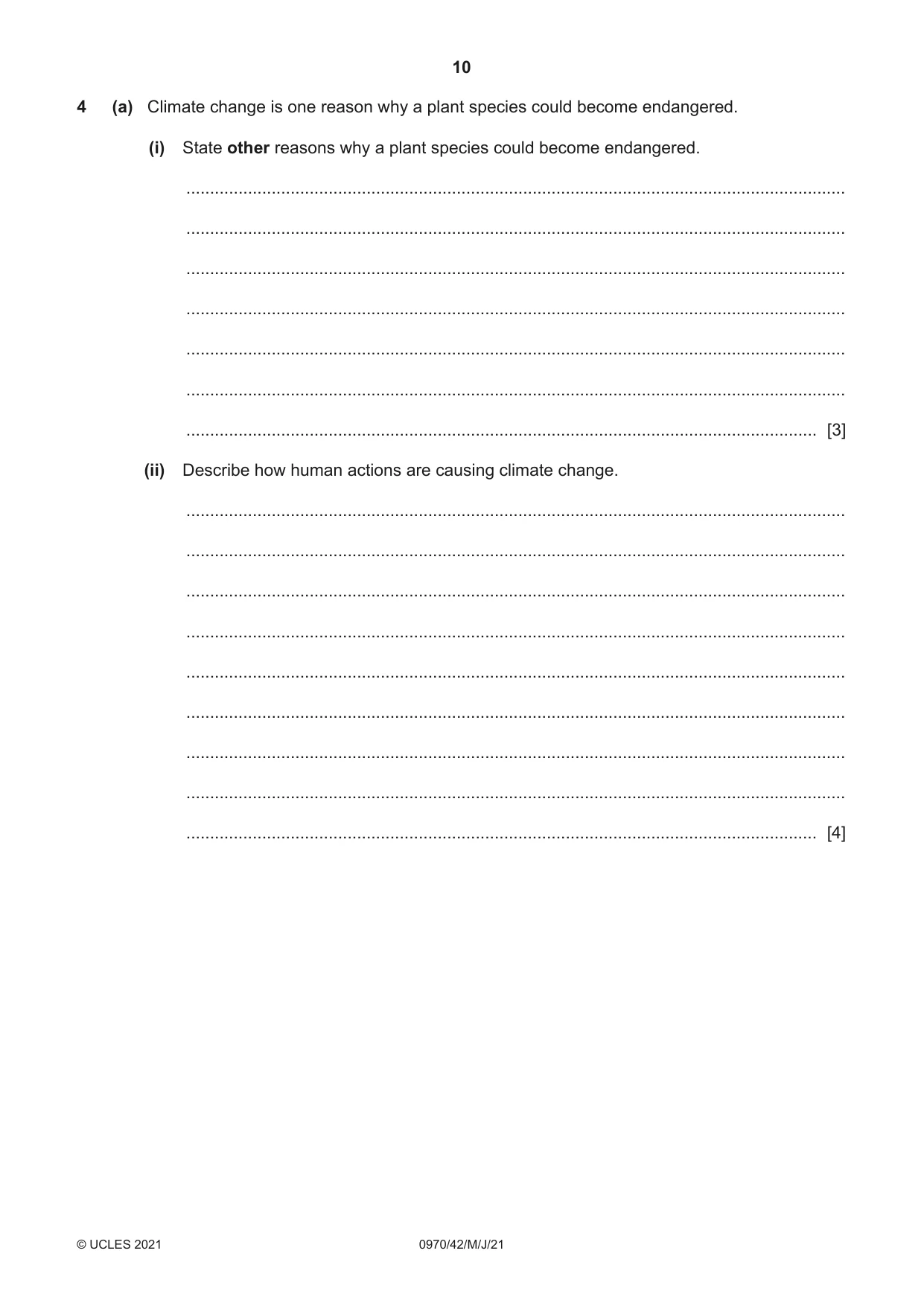
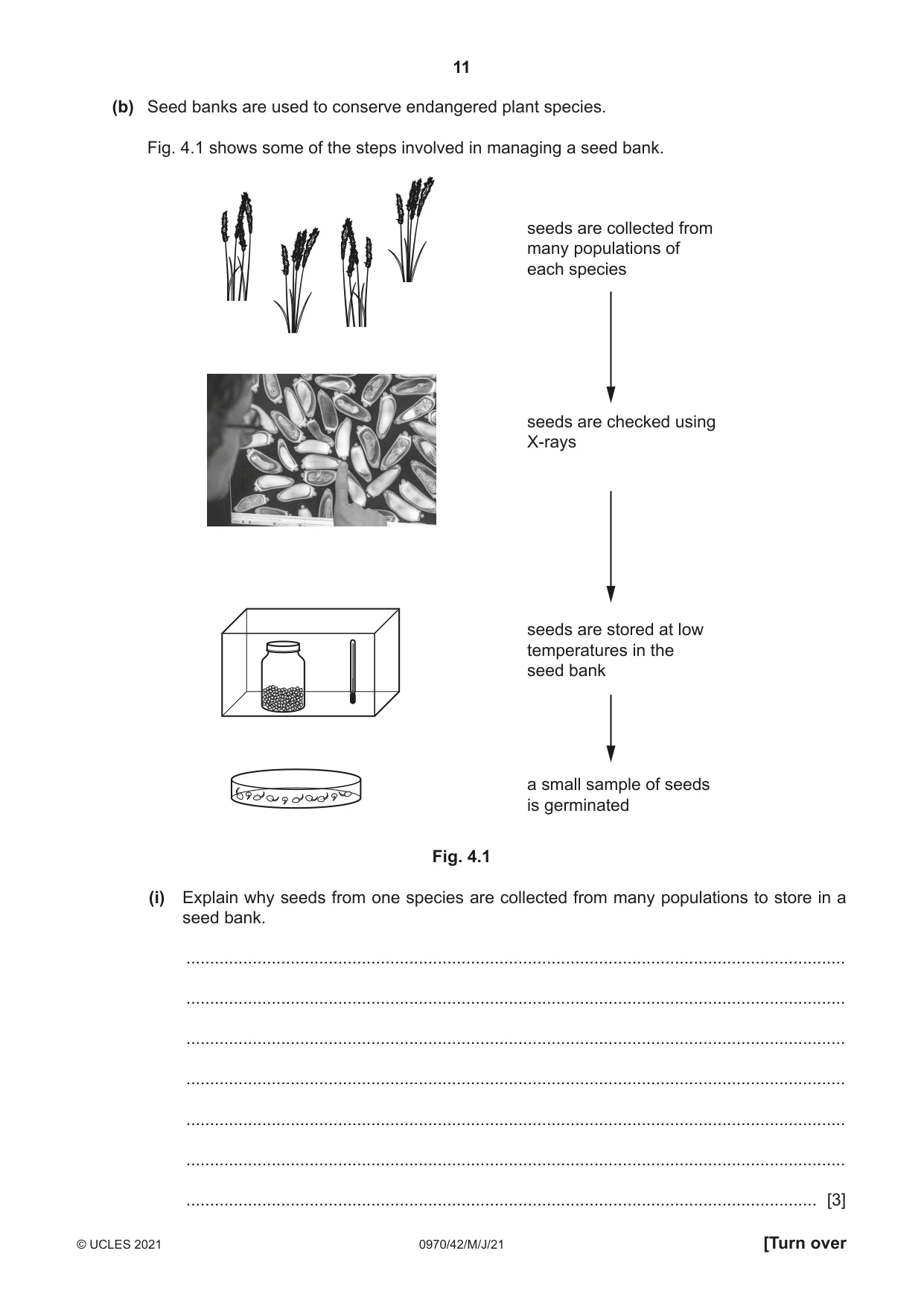
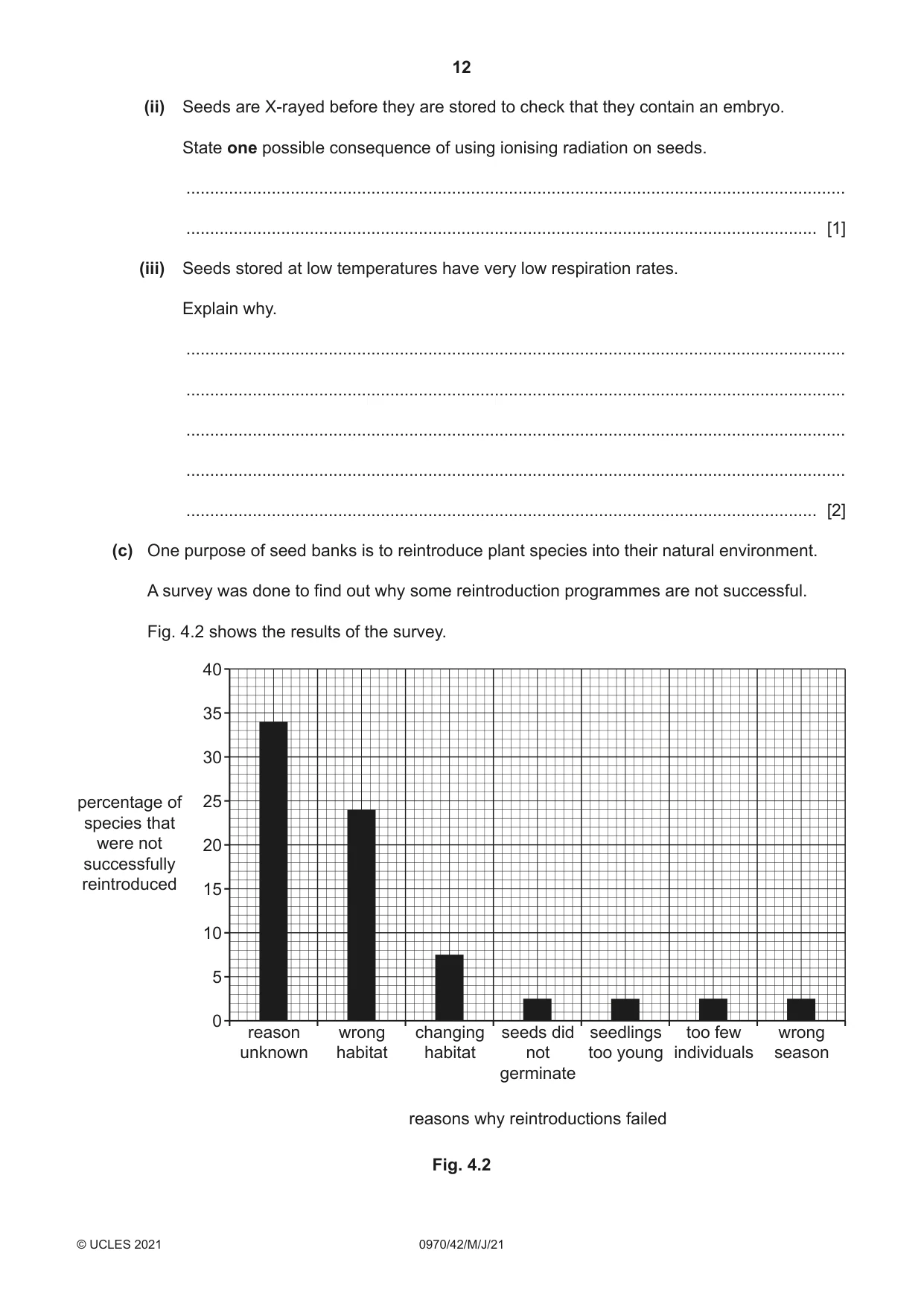
4 (a) Climate change is one reason why a plant species could become endangered. (i) State other reasons why a plant species could become endangered. ........................................................................................................................................... ........................................................................................................................................... ........................................................................................................................................... ........................................................................................................................................... ........................................................................................................................................... ........................................................................................................................................... ..................................................................................................................................... [3] (ii) Describe how human actions are causing climate change. ........................................................................................................................................... ........................................................................................................................................... ........................................................................................................................................... ........................................................................................................................................... ........................................................................................................................................... ........................................................................................................................................... ........................................................................................................................................... ........................................................................................................................................... ..................................................................................................................................... [4] (b) Seed banks are used to conserve endangered plant species. Fig. 4.1 shows some of the steps involved in managing a seed bank. seeds are collected from many populations of each species seeds are checked using X-rays seeds are stored at low temperatures in the seed bank a small sample of seeds is germinated Fig. 4.1 (i) Explain why seeds from one species are collected from many populations to store in a seed bank. ........................................................................................................................................... ........................................................................................................................................... ........................................................................................................................................... ........................................................................................................................................... ........................................................................................................................................... ........................................................................................................................................... ..................................................................................................................................... [3] (ii) Seeds are X-rayed before they are stored to check that they contain an embryo. State one possible consequence of using ionising radiation on seeds. ........................................................................................................................................... ..................................................................................................................................... [1] (iii) Seeds stored at low temperatures have very low respiration rates. Explain why. ........................................................................................................................................... ........................................................................................................................................... ........................................................................................................................................... ........................................................................................................................................... ..................................................................................................................................... [2] (c) One purpose of seed banks is to reintroduce plant species into their natural environment. A survey was done to find out why some reintroduction programmes are not successful. Fig. 4.2 shows the results of the survey. 40 35 30 percentage of 25 species that were not 20 successfully reintroduced 15 10 5 0 reason wrong changing seeds did seedlings too few wrong unknown habitat habitat not too young individuals season germinate reasons why reintroductions failed Fig. 4.2 (i) Some of the seeds in the reintroduction programmes did not germinate. State the conditions that are necessary for seeds to germinate. ........................................................................................................................................... ........................................................................................................................................... ........................................................................................................................................... ..................................................................................................................................... [3] (ii) Some reintroduction programmes failed because the seedlings were too young. Young seedlings only have a few small roots. Explain why it would be important to reintroduce plants with many large roots. ........................................................................................................................................... ........................................................................................................................................... ........................................................................................................................................... ........................................................................................................................................... ........................................................................................................................................... ........................................................................................................................................... ........................................................................................................................................... ........................................................................................................................................... ..................................................................................................................................... [4] (iii) The low number of individuals also caused some reintroduction programmes to fail. State the name of the phase in a population growth curve where the number of individuals is very low. ..................................................................................................................................... [1] [Total: 21]
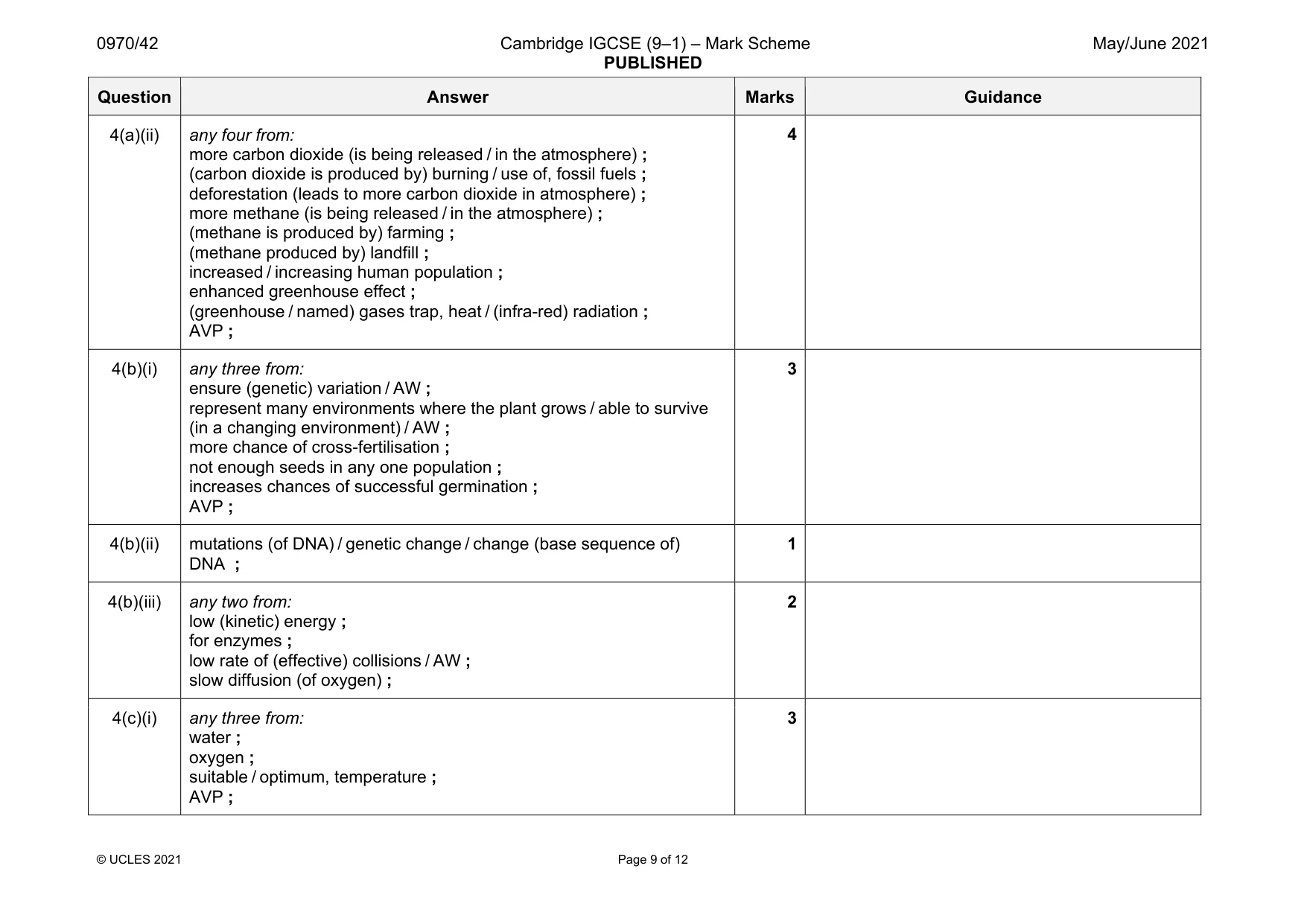
Mark scheme: 4(a)(i) habitat destruction / named example ; removing (too many) of a plant species ; (named) pollutants (of plants) ; additional named pollutant (of plant) ; introduced species / disrupted food chains ; disease ; AVP ; e.g. extinction of other species / fewer, pollinators / (named) pesticides killing pollinators / reduced genetic diversity / stated impact of GM crops / war Question Answer Marks Guidance 4(a)(ii) any four from: more carbon dioxide (is being released / in the atmosphere) ; (carbon dioxide is produced by) burning / use of, fossil fuels ; deforestation (leads to more carbon dioxide in atmosphere) ; more methane (is being released / in the atmosphere) ; (methane is produced by) farming ; (methane produced by) landfill ; increased / increasing human population ; enhanced greenhouse effect ; (greenhouse / named) gases trap, heat / (infra-red) radiation ; AVP ; 4 4(b)(i) any three from: ensure (genetic) variation / AW ; represent many environments where the plant grows / able to survive (in a changing environment) / AW ; more chance of cross-fertilisation ; not enough seeds in any one population ; increases chances of successful germination ; AVP ; 3 4(b)(ii) mutations (of DNA) / genetic change / change (base sequence of) DNA ; 1 4(b)(iii) any two from: low (kinetic) energy ; for enzymes ; low rate of (effective) collisions / AW ; slow diffusion (of oxygen) ; 2 4(c)(i) any three from: water ; oxygen ; suitable / optimum, temperature ; AVP ; 3 Question Answer Marks Guidance 4(c)(ii) obtain (named) resources from, larger / deeper, area ; so that they have enough roots to survive (the reintroduction process) ; ref. to large(r) surface area ; more root hair (cells) ; for (more) water and (named) minerals / ions / salts, uptake ; anchorage / described ; so that not pulled out (when animals grazing / wind etc) ; reduced soil erosion ; AVP ; e.g. named use of, water / mineral ion 4 4(c)(iii) lag ; 1 A death (phase)
Q5 · Some of the stages in the reproduction of the bacterium Escherichia coli
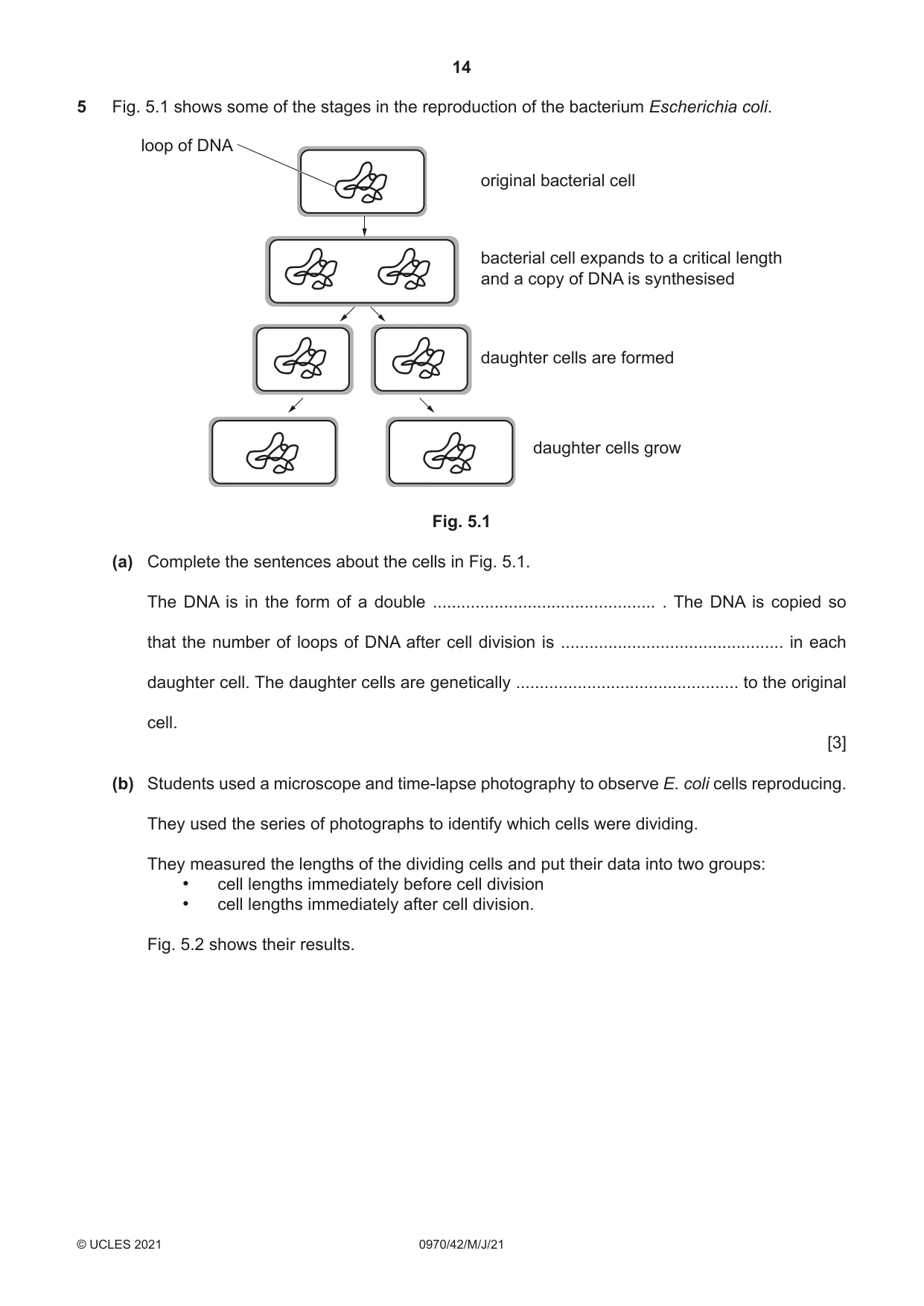
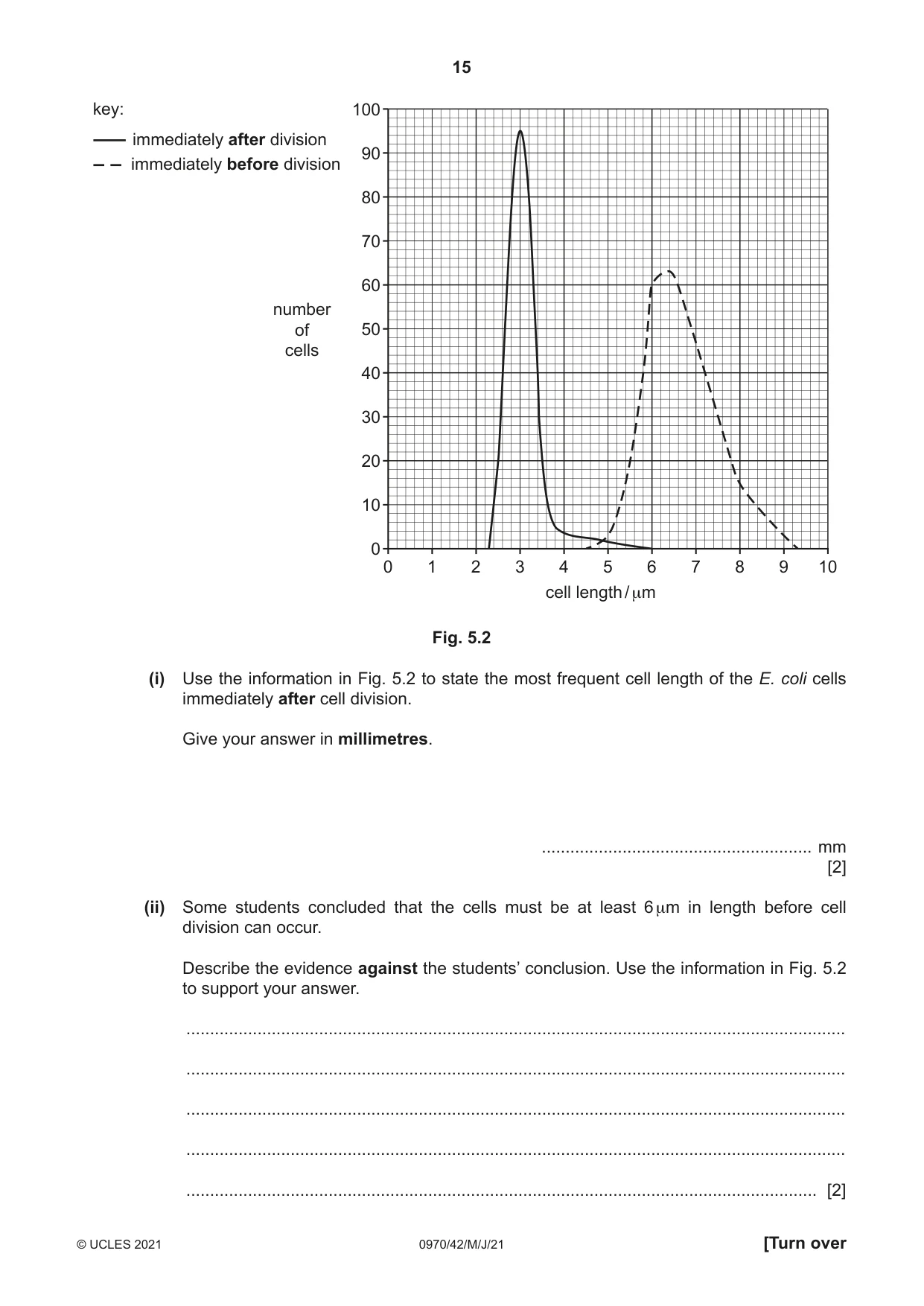
5 Fig. 5.1 shows some of the stages in the reproduction of the bacterium Escherichia coli. loop of DNA original bacterial cell bacterial cell expands to a critical length and a copy of DNA is synthesised daughter cells are formed daughter cells grow Fig. 5.1 (a) Complete the sentences about the cells in Fig. 5.1. The DNA is in the form of a double ............................................... . The DNA is copied so that the number of loops of DNA after cell division is ............................................... in each daughter cell. The daughter cells are genetically ............................................... to the original cell. [3] (b) Students used a microscope and time-lapse photography to observe E. coli cells reproducing. They used the series of photographs to identify which cells were dividing. They measured the lengths of the dividing cells and put their data into two groups: • cell lengths immediately before cell division • cell lengths immediately after cell division. Fig. 5.2 shows their results. key: 100 immediately after division 90 immediately before division 80 70 60 number of 50 cells 40 30 20 10 0 0 1 2 3 4 5 6 7 8 9 10 cell length / μm Fig. 5.2 (i) Use the information in Fig. 5.2 to state the most frequent cell length of the E. coli cells immediately after cell division. Give your answer in millimetres. ......................................................... mm [2] (ii) Some students concluded that the cells must be at least 6 µm in length before cell division can occur. Describe the evidence against the students’ conclusion. Use the information in Fig. 5.2 to support your answer. ........................................................................................................................................... ........................................................................................................................................... ........................................................................................................................................... ........................................................................................................................................... ..................................................................................................................................... [2] (c) Bacteria are useful in genetic engineering because they contain plasmids. (i) Describe how a plasmid is cut so that a new gene can be inserted into the plasmid. ........................................................................................................................................... ........................................................................................................................................... ..................................................................................................................................... [2] (ii) List two reasons, other than the presence of plasmids, that make bacteria and single-celled fungi useful to biotechnology industries. 1 ........................................................................................................................................ 2 ........................................................................................................................................ [2] [Total: 11]
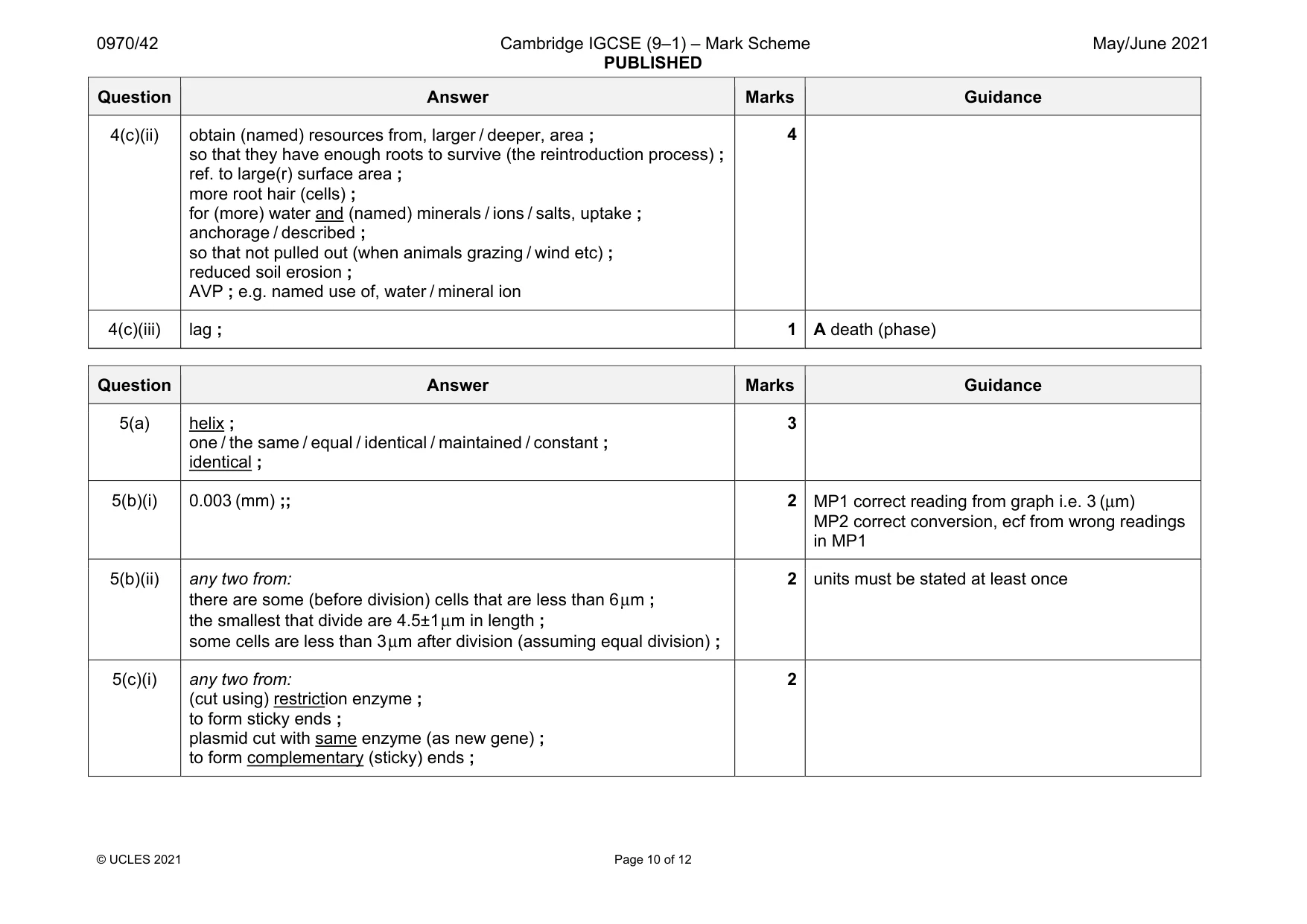
Mark scheme: 5(a) helix ; one / the same / equal / identical / maintained / constant ; identical ; 3 5(b)(i) 0.003 (mm) ;; 2 MP1 correct reading from graph i.e. 3 (μm) MP2 correct conversion, ecf from wrong readings in MP1 5(b)(ii) any two from: there are some (before division) cells that are less than 6 μm ; the smallest that divide are 4.5±1 μm in length ; some cells are less than 3 μm after division (assuming equal division) ; 2 units must be stated at least once 5(c)(i) any two from: (cut using) restriction enzyme ; to form sticky ends ; plasmid cut with same enzyme (as new gene) ; to form complementary (sticky) ends ; 2 Question Answer Marks Guidance 5(c)(ii) any two from: rapid rate of reproduction ; no ethical considerations ; share same genetic code as other organisms ; ability to make complex molecules ; AVP ; do not take up much space / cheap to maintain cultures 2
Q6 · Some students set up the apparatus shown in Fig
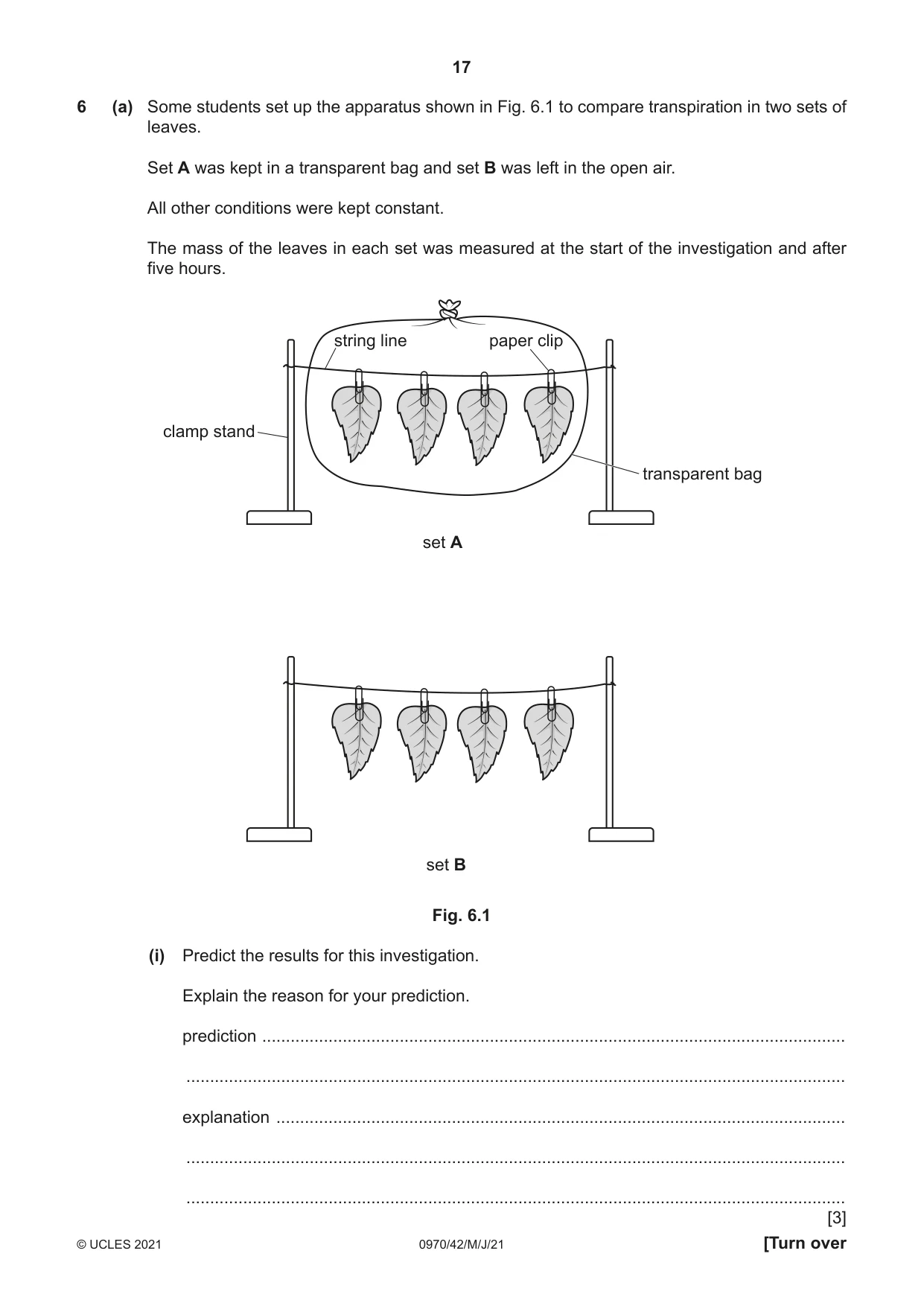
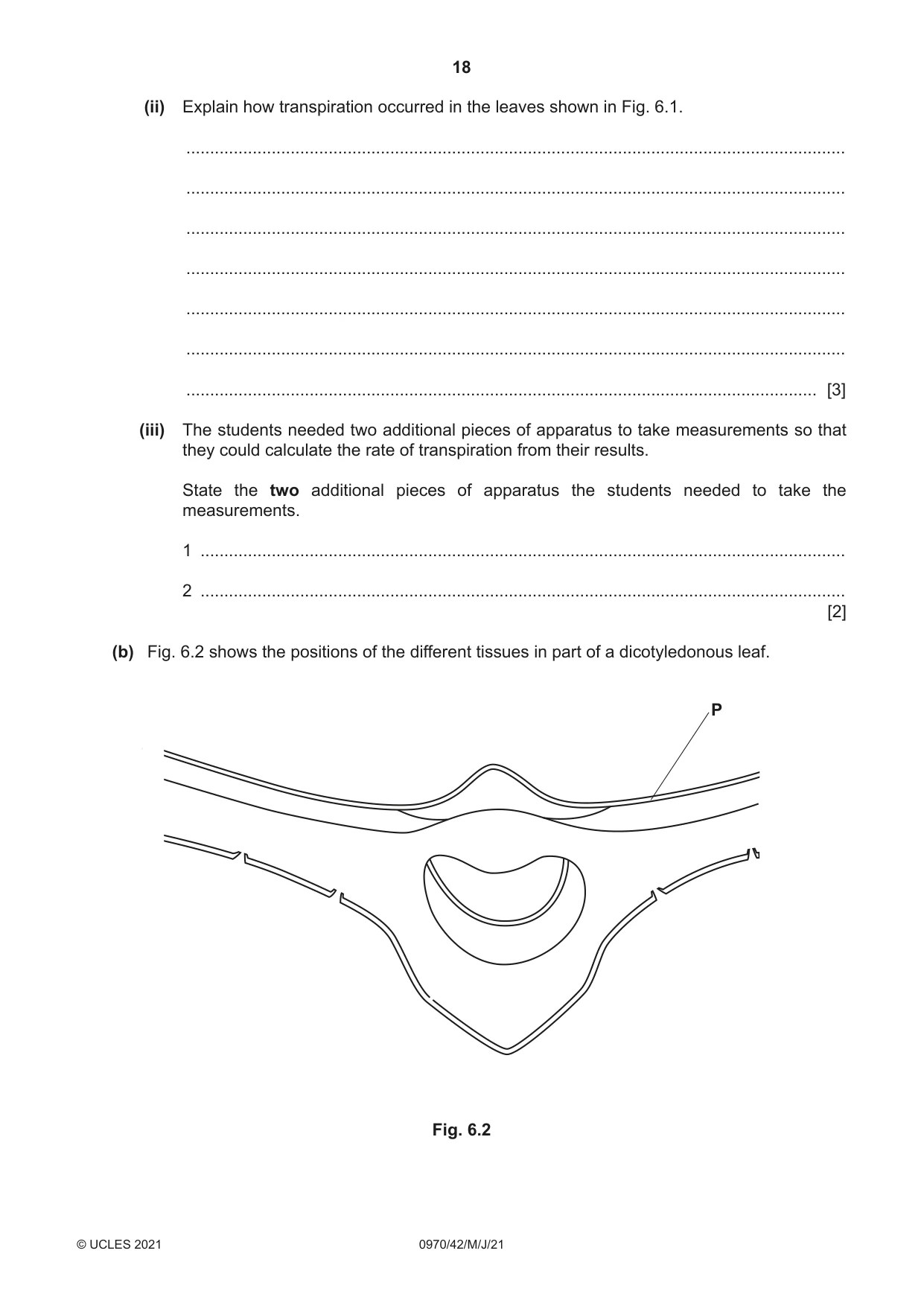
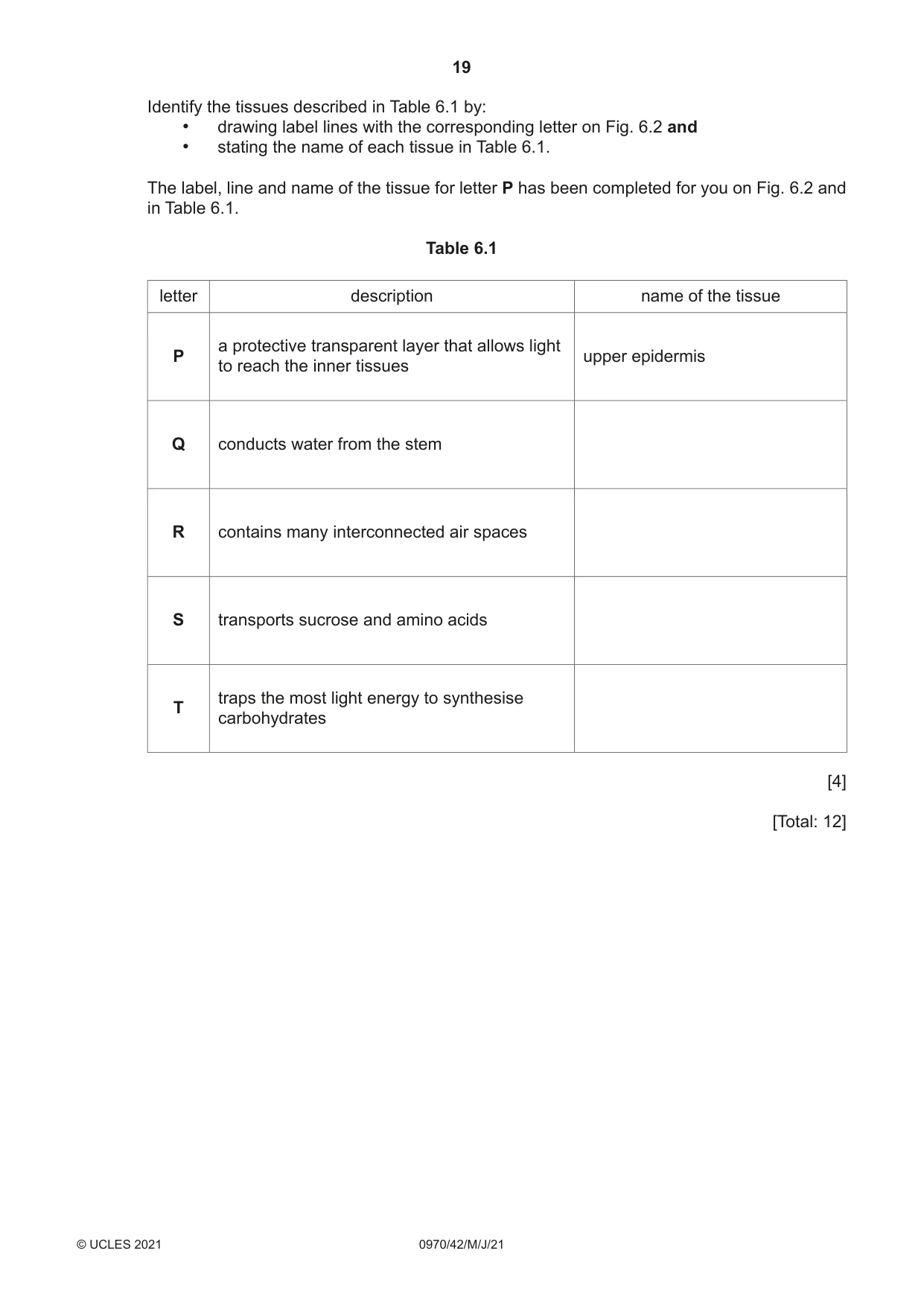
6 (a) Some students set up the apparatus shown in Fig. 6.1 to compare transpiration in two sets of leaves. Set A was kept in a transparent bag and set B was left in the open air. All other conditions were kept constant. The mass of the leaves in each set was measured at the start of the investigation and after five hours. string line paper clip clamp stand transparent bag set A set B Fig. 6.1 (i) Predict the results for this investigation. Explain the reason for your prediction. prediction ........................................................................................................................... ........................................................................................................................................... explanation ........................................................................................................................ ........................................................................................................................................... ........................................................................................................................................... [3] (ii) Explain how transpiration occurred in the leaves shown in Fig. 6.1. ........................................................................................................................................... ........................................................................................................................................... ........................................................................................................................................... ........................................................................................................................................... ........................................................................................................................................... ........................................................................................................................................... ..................................................................................................................................... [3] (iii) The students needed two additional pieces of apparatus to take measurements so that they could calculate the rate of transpiration from their results. State the two additional pieces of apparatus the students needed to take the measurements. 1 ........................................................................................................................................ 2 ........................................................................................................................................ [2] (b) Fig. 6.2 shows the positions of the different tissues in part of a dicotyledonous leaf. P Fig. 6.2 Identify the tissues described in Table 6.1 by: • drawing label lines with the corresponding letter on Fig. 6.2 and • stating the name of each tissue in Table 6.1. The label, line and name of the tissue for letter P has been completed for you on Fig. 6.2 and in Table 6.1. Table 6.1 letter description name of the tissue a protective transparent layer that allows light P upper epidermis to reach the inner tissues Q conducts water from the stem R contains many interconnected air spaces S transports sucrose and amino acids traps the most light energy to synthesise T carbohydrates [4] [Total: 12]
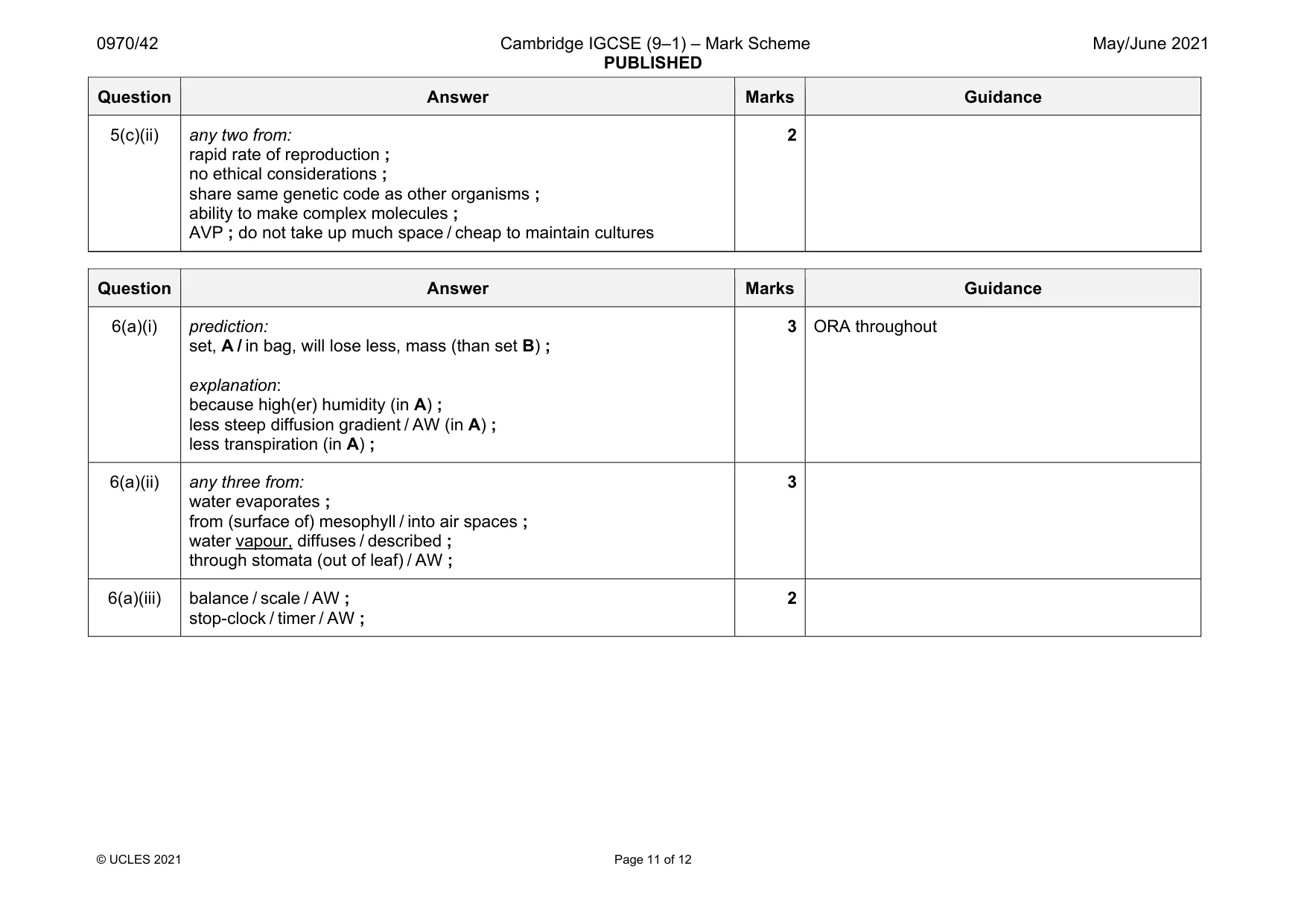
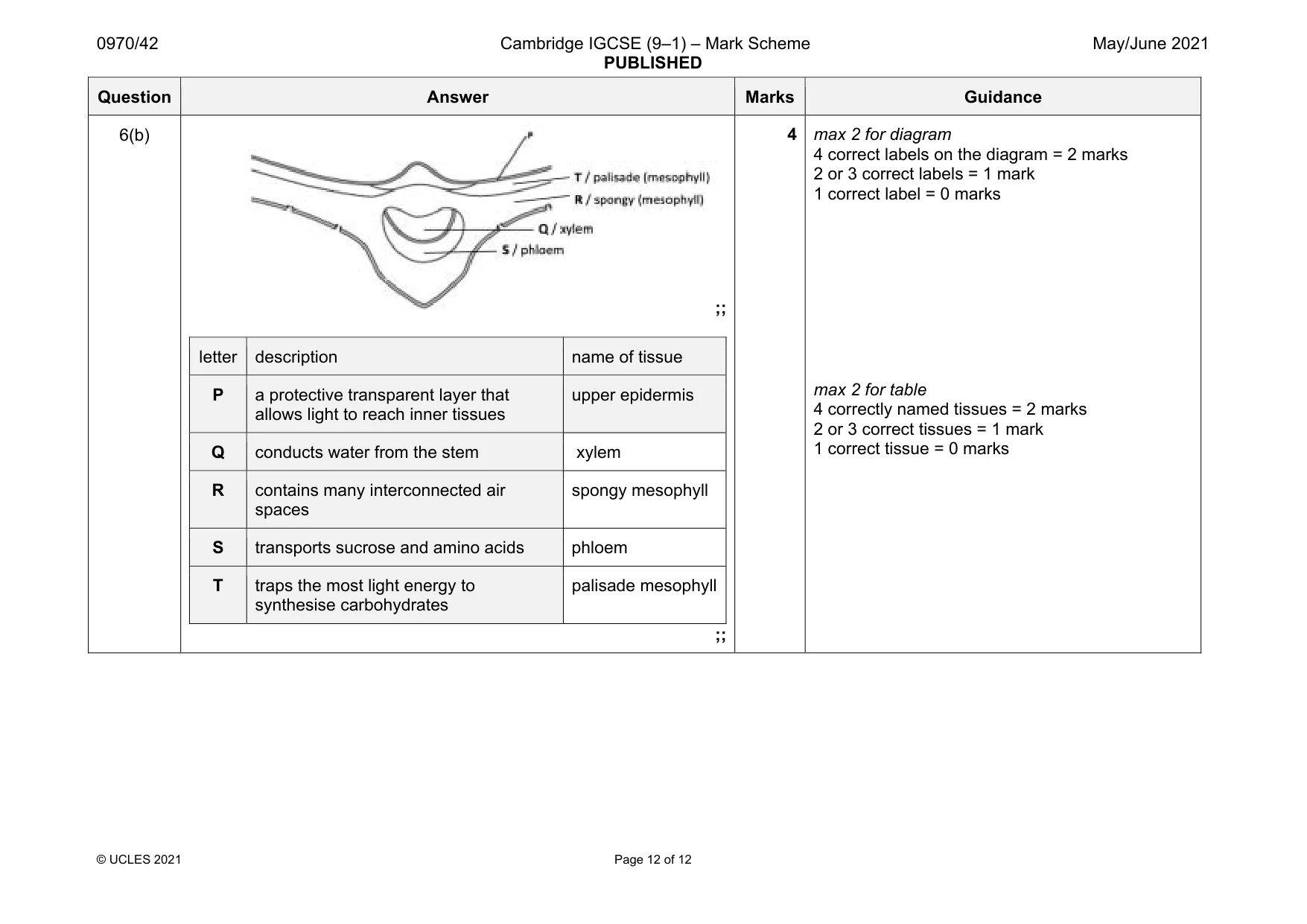
Mark scheme: 6(a)(i) prediction: set, A / in bag, will lose less, mass (than set B) ; explanation: because high(er) humidity (in A) ; less steep diffusion gradient / AW (in A) ; less transpiration (in A) ; 6(a)(ii) any three from: water evaporates ; from (surface of) mesophyll / into air spaces ; water vapour, diffuses / described ; through stomata (out of leaf) / AW ; 3 6(a)(iii) balance / scale / AW ; stop-clock / timer / AW ; 2 Question Answer Marks Guidance 6(b) ;; letter description name of tissue P a protective transparent layer that allows light to reach inner tissues upper epidermis Q conducts water from the stem xylem R contains many interconnected air spaces spongy mesophyll S transports sucrose and amino acids phloem T traps the most light energy to synthesise carbohydrates palisade mesophyll ;; 4 max 2 for diagram 4 correct labels on the diagram = 2 marks 2 or 3 correct labels = 1 mark 1 correct label = 0 marks max 2 for table 4 correctly named tissues = 2 marks 2 or 3 correct tissues = 1 mark 1 correct tissue = 0 marks
What was in this paper
The subtopics covered by these 6 questions, and how many questions each got. Open one in a new tab to see every Cambridge question on it.
What you needed in this session
Cambridge’s own grade thresholds for 2021 May/June, Paper 4 · Variant 2. A higher threshold means an easier paper — the bar moves with how the cohort did.