Cambridge IGCSE Biology (9-1) 0970 — 2021 May/June Paper 4 · Variant 1
0970/41/M/J/21 · 6 questions · 80 marks · ≈90 min
The question paper and its mark scheme, free to read here and free to download. This is Cambridge’s own paper, exactly as it was sat.
Question paper20 pages



Mark scheme13 pages
Answers below. Sit the paper first if you are practising.
Questions as text
Q1 · Baker’s yeast, Saccharomyces cerevisiae, is a single-celled organism that is classified…
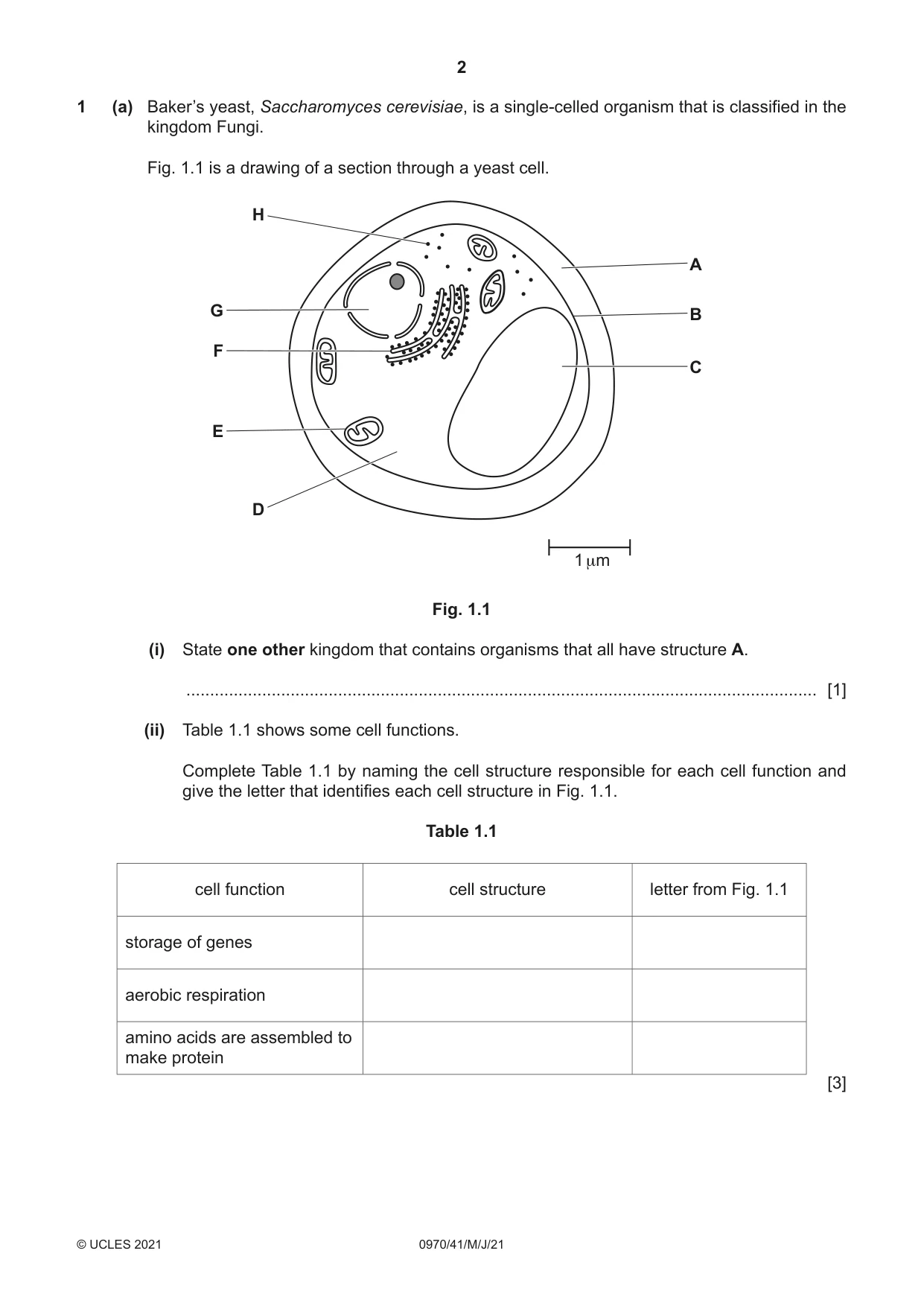
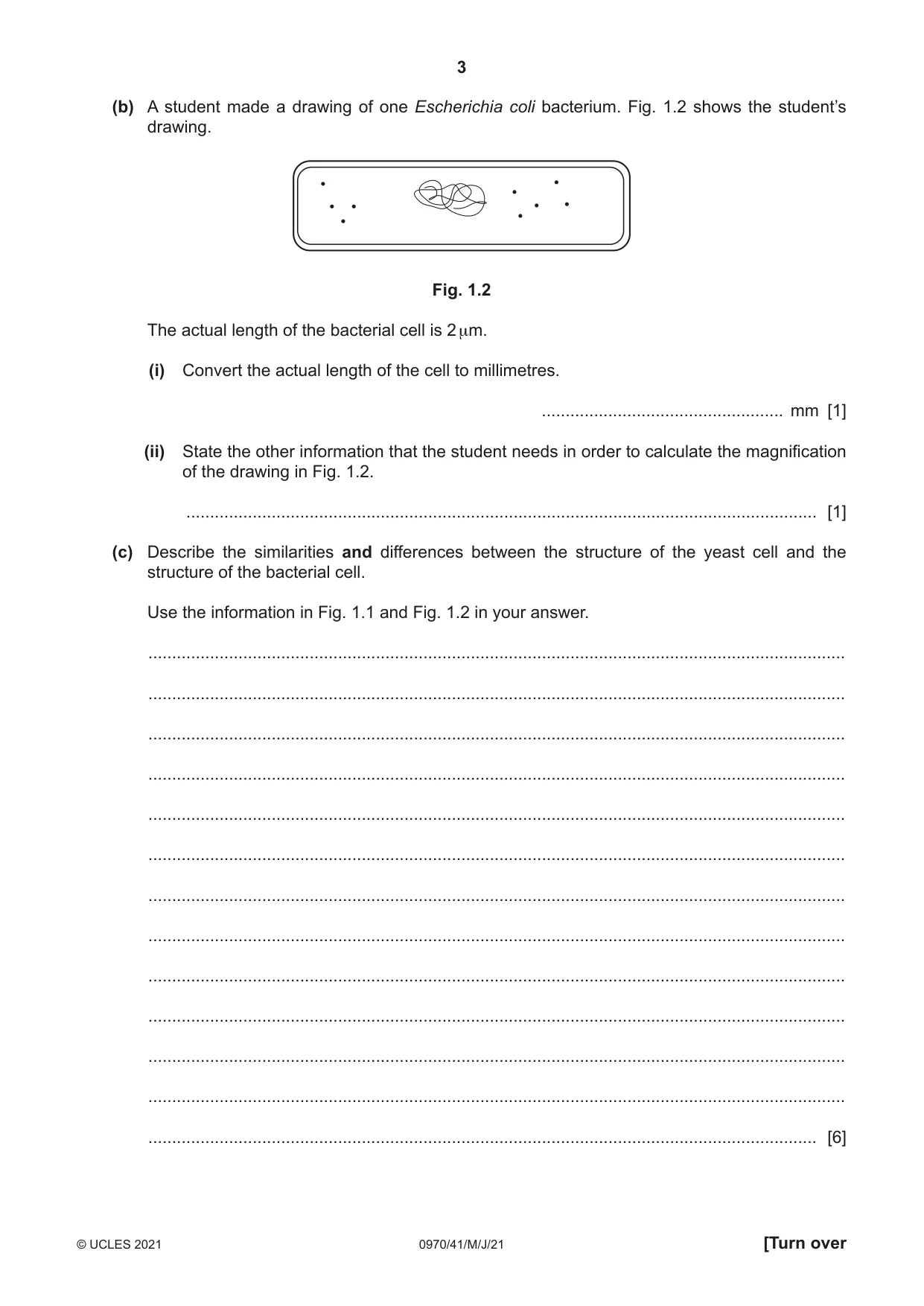
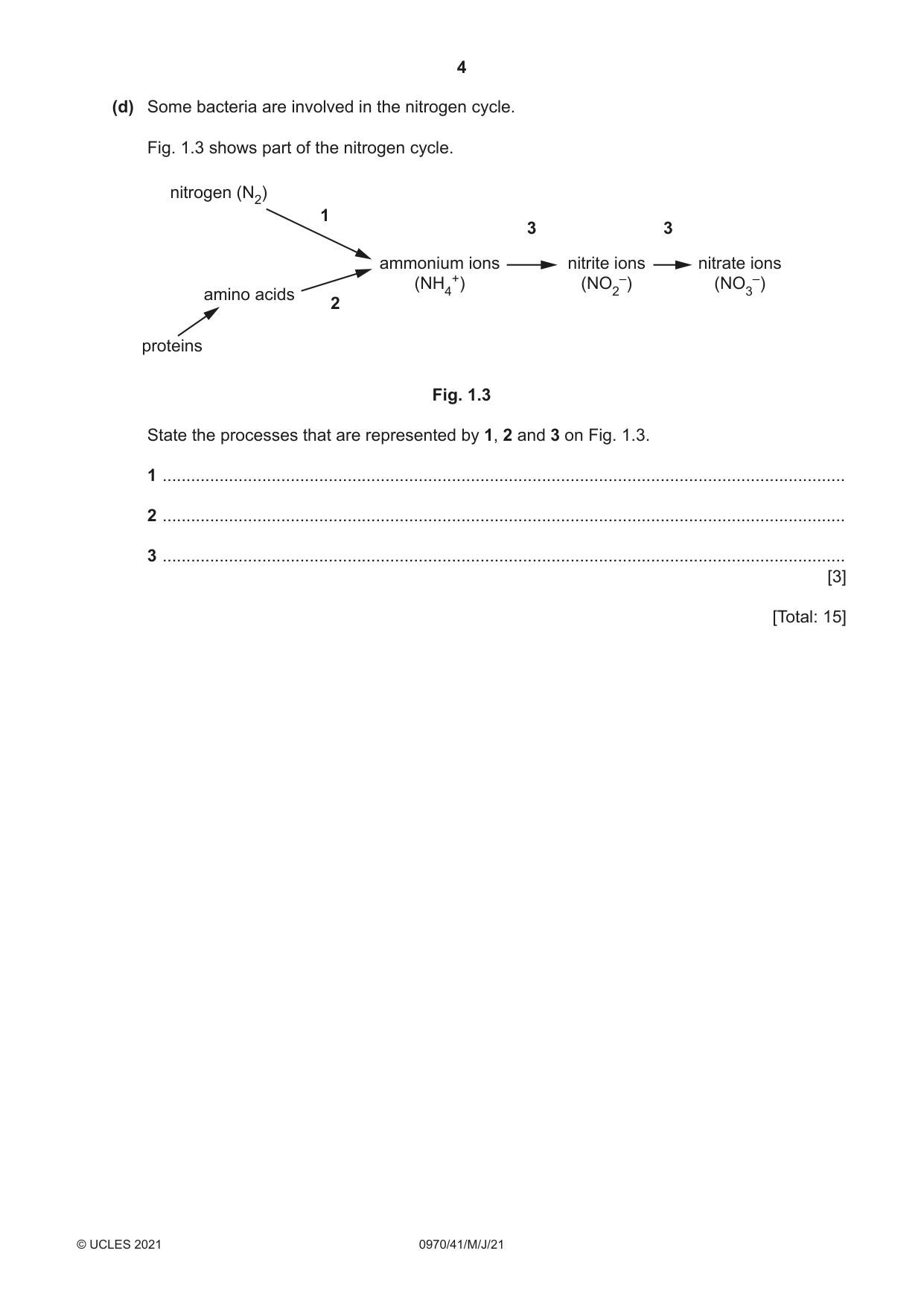
1 (a) Baker’s yeast, Saccharomyces cerevisiae, is a single-celled organism that is classified in the kingdom Fungi. Fig. 1.1 is a drawing of a section through a yeast cell. H A G B F C E D 1 μm Fig. 1.1 (i) State one other kingdom that contains organisms that all have structure A. ..................................................................................................................................... [1] (ii) Table 1.1 shows some cell functions. Complete Table 1.1 by naming the cell structure responsible for each cell function and give the letter that identifies each cell structure in Fig. 1.1. Table 1.1 cell function cell structure letter from Fig. 1.1 storage of genes aerobic respiration amino acids are assembled to make protein [3] (b) A student made a drawing of one Escherichia coli bacterium. Fig. 1.2 shows the student’s drawing. Fig. 1.2 The actual length of the bacterial cell is 2 μm. (i) Convert the actual length of the cell to millimetres. ................................................... mm [1] (ii) State the other information that the student needs in order to calculate the magnification of the drawing in Fig. 1.2. ..................................................................................................................................... [1] (c) Describe the similarities and differences between the structure of the yeast cell and the structure of the bacterial cell. Use the information in Fig. 1.1 and Fig. 1.2 in your answer. ................................................................................................................................................... ................................................................................................................................................... ................................................................................................................................................... ................................................................................................................................................... ................................................................................................................................................... ................................................................................................................................................... ................................................................................................................................................... ................................................................................................................................................... ................................................................................................................................................... ................................................................................................................................................... ................................................................................................................................................... ................................................................................................................................................... ............................................................................................................................................. [6] (d) Some bacteria are involved in the nitrogen cycle. Fig. 1.3 shows part of the nitrogen cycle. nitrogen (N2) 1 3 3 ammonium ions nitrite ions nitrate ions (NH4+) (NO2–) (NO3–) amino acids 2 proteins Fig. 1.3 State the processes that are represented by 1, 2 and 3 on Fig. 1.3. 1 ................................................................................................................................................ 2 ................................................................................................................................................ 3 ................................................................................................................................................ [3] [Total: 15]
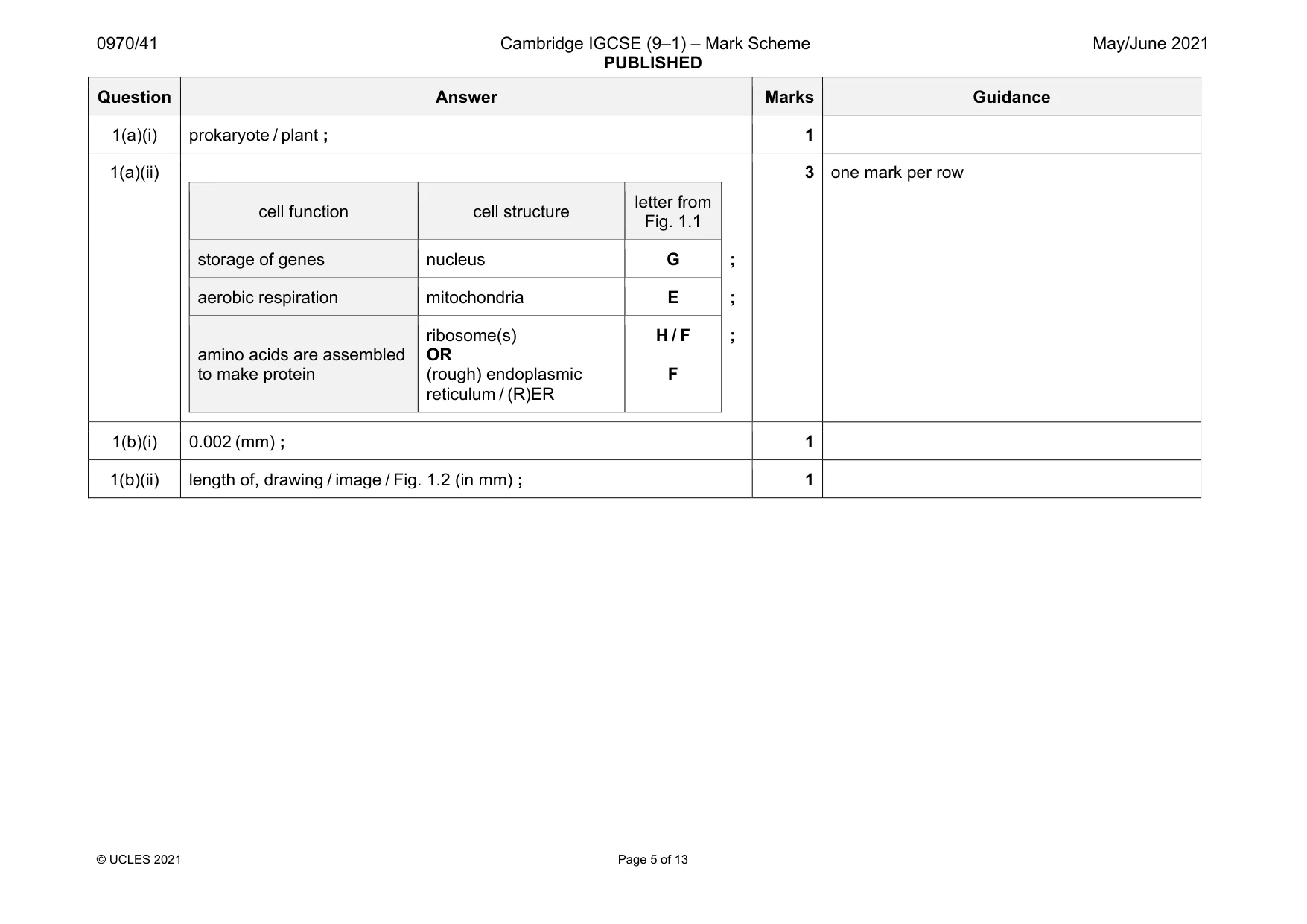
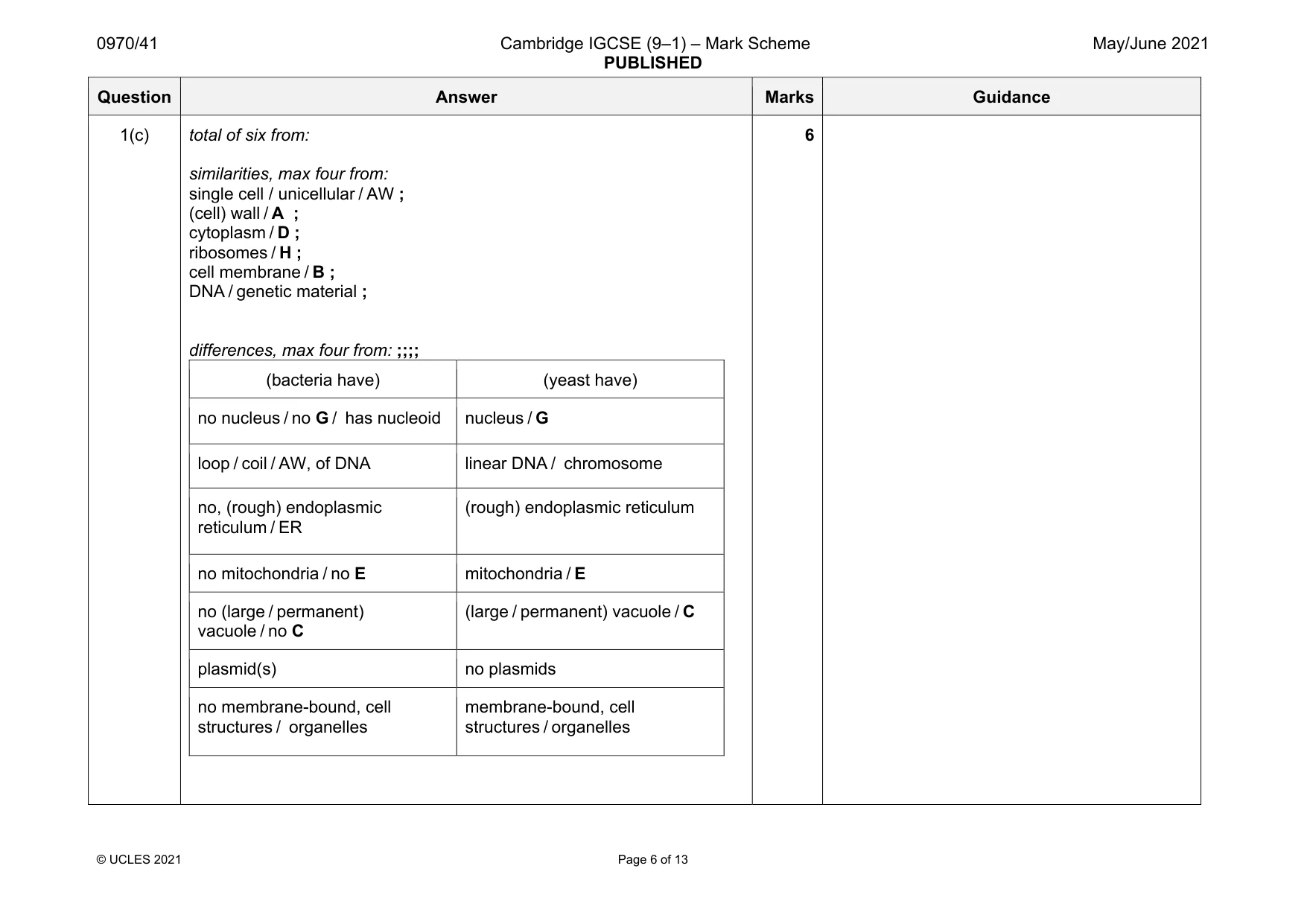
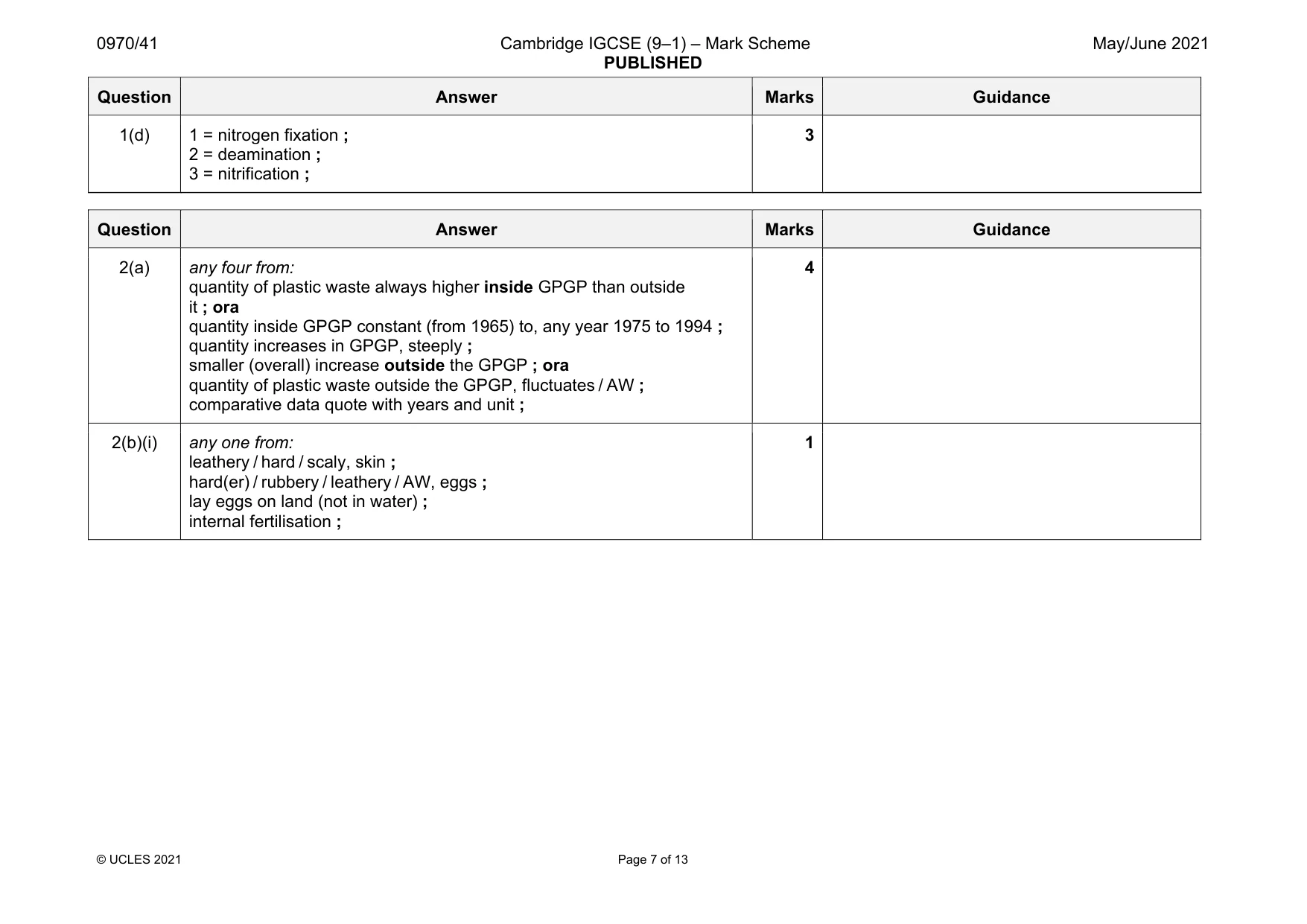
Mark scheme: 1(a)(i) prokaryote / plant ; 1 1(a)(ii) cell function cell structure letter from Fig. 1.1 storage of genes nucleus G ; aerobic respiration mitochondria E ; amino acids are assembled to make protein ribosome(s) OR (rough) endoplasmic reticulum / (R)ER H / F F ; 3 one mark per row 1(b)(i) 0.002 (mm) ; 1 1(b)(ii) length of, drawing / image / Fig. 1.2 (in mm) ; 1 Question Answer Marks Guidance 1(c) total of six from: similarities, max four from: single cell / unicellular / AW ; (cell) wall / A ; cytoplasm / D ; ribosomes / H ; cell membrane / B ; DNA / genetic material ; differences, max four from: ;;;; (bacteria have) (yeast have) no nucleus / no G / has nucleoid nucleus / G loop / coil / AW, of DNA linear DNA / chromosome no, (rough) endoplasmic reticulum / ER (rough) endoplasmic reticulum no mitochondria / no E mitochondria / E no (large / permanent) vacuole / no C (large / permanent) vacuole / C plasmid(s) no plasmids no membrane-bound, cell structures / organelles membrane-bound, cell structures / organelles 6 Question Answer Marks Guidance 1(d) 1 = nitrogen fixation ; 2 = deamination ; 3 = nitrification ; 3
Q2 · Large quantities of plastic waste are polluting the oceans
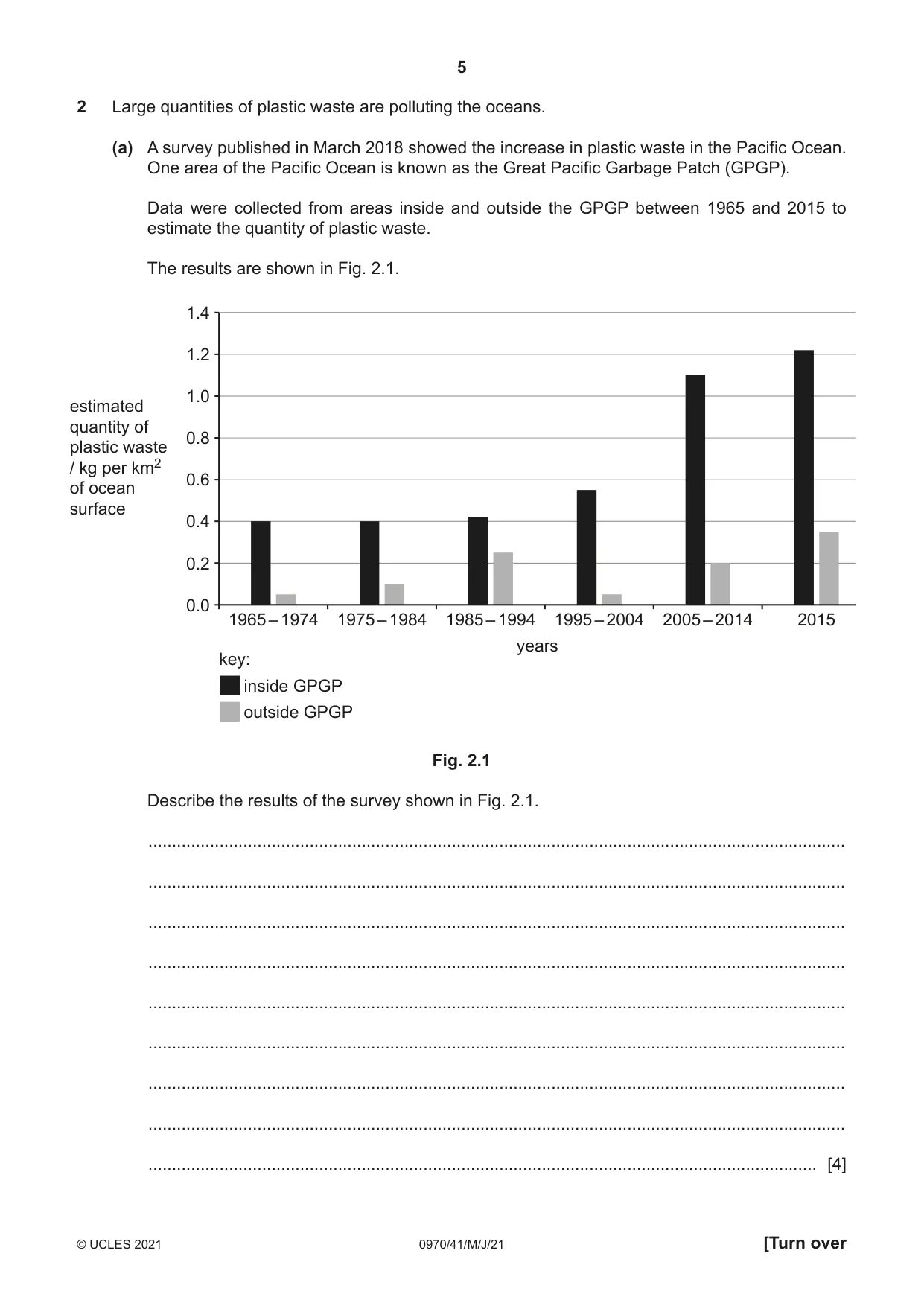
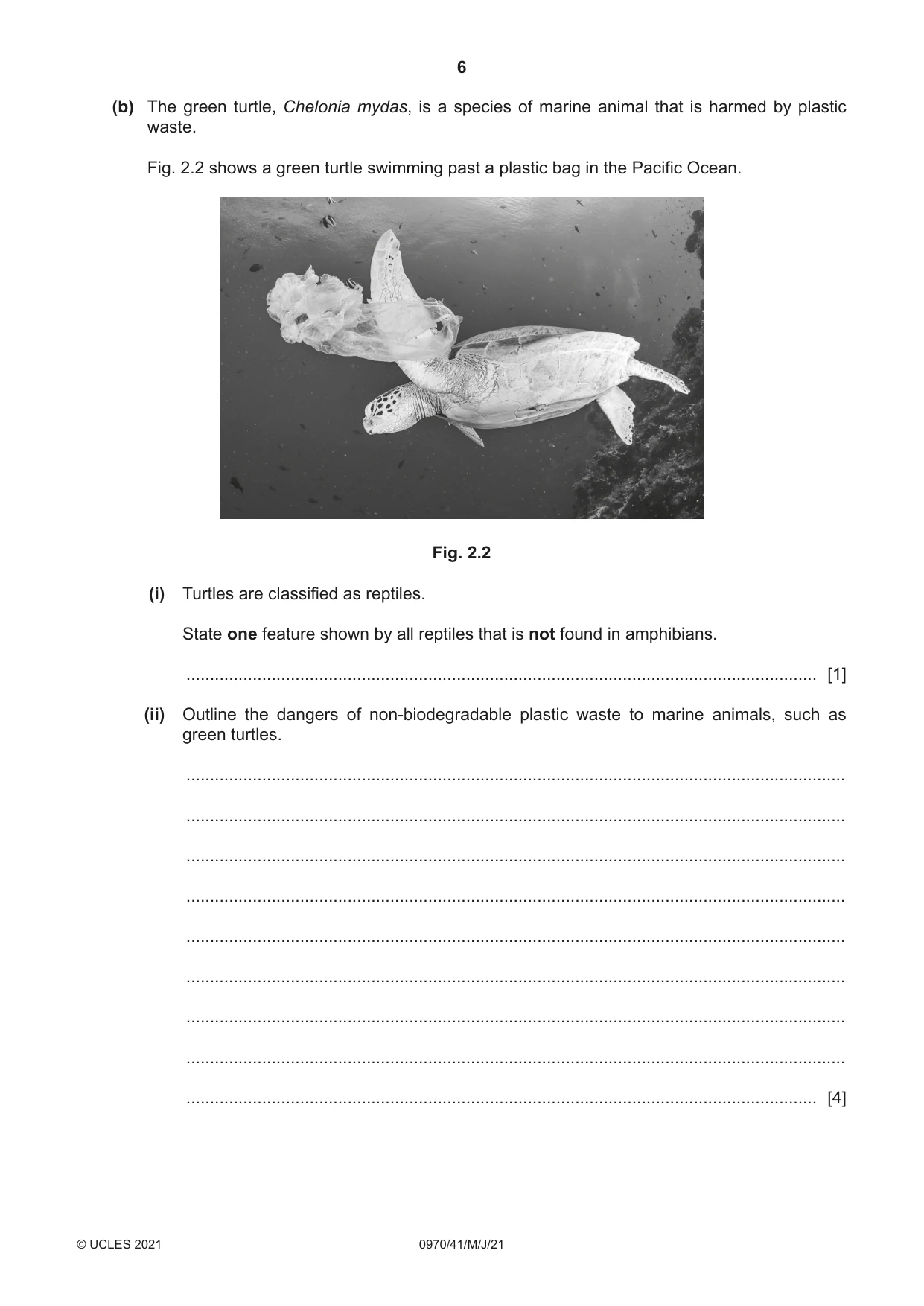
2 Large quantities of plastic waste are polluting the oceans. (a) A survey published in March 2018 showed the increase in plastic waste in the Pacific Ocean. One area of the Pacific Ocean is known as the Great Pacific Garbage Patch (GPGP). Data were collected from areas inside and outside the GPGP between 1965 and 2015 to estimate the quantity of plastic waste. The results are shown in Fig. 2.1. 1.4 1.2 1.0estimated quantity of 0.8plastic waste / kg per km2 0.6of ocean surface 0.4 0.2 0.0 1965 – 1974 1975 – 1984 1985 – 1994 1995 – 2004 2005 – 2014 2015 years key: inside GPGP outside GPGP Fig. 2.1 Describe the results of the survey shown in Fig. 2.1. ................................................................................................................................................... ................................................................................................................................................... ................................................................................................................................................... ................................................................................................................................................... ................................................................................................................................................... ................................................................................................................................................... ................................................................................................................................................... ................................................................................................................................................... ............................................................................................................................................. [4] (b) The green turtle, Chelonia mydas, is a species of marine animal that is harmed by plastic waste. Fig. 2.2 shows a green turtle swimming past a plastic bag in the Pacific Ocean. Fig. 2.2 (i) Turtles are classified as reptiles. State one feature shown by all reptiles that is not found in amphibians. ..................................................................................................................................... [1] (ii) Outline the dangers of non-biodegradable plastic waste to marine animals, such as green turtles. ........................................................................................................................................... ........................................................................................................................................... ........................................................................................................................................... ........................................................................................................................................... ........................................................................................................................................... ........................................................................................................................................... ........................................................................................................................................... ........................................................................................................................................... ..................................................................................................................................... [4] (iii) Suggest ways to reduce the quantity of plastic waste. ........................................................................................................................................... ........................................................................................................................................... ........................................................................................................................................... ........................................................................................................................................... ..................................................................................................................................... [2] [Total: 11]
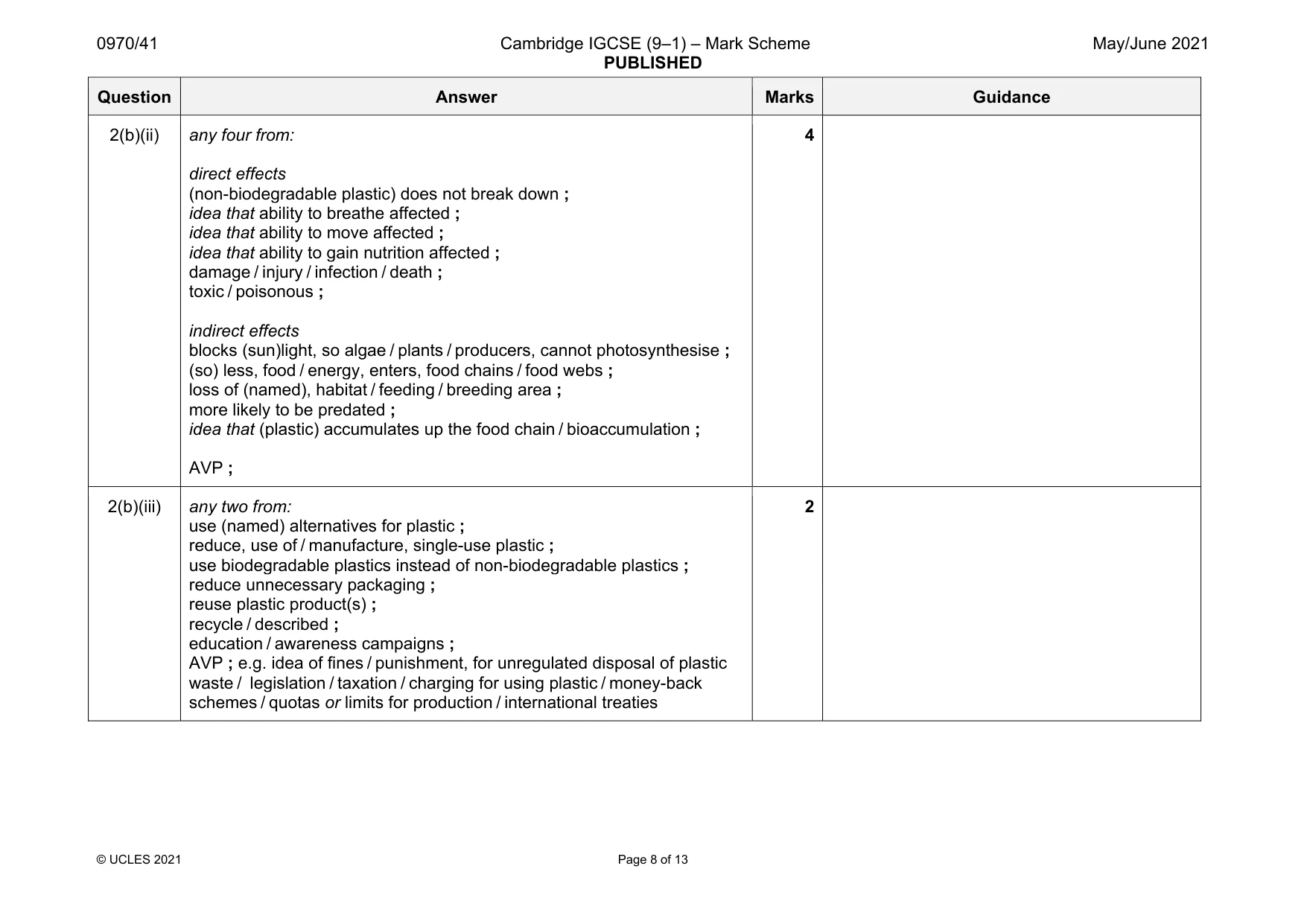
Mark scheme: 2(a) any four from: quantity of plastic waste always higher inside GPGP than outside it ; ora quantity inside GPGP constant (from 1965) to, any year 1975 to 1994 ; quantity increases in GPGP, steeply ; smaller (overall) increase outside the GPGP ; ora quantity of plastic waste outside the GPGP, fluctuates / AW ; comparative data quote with years and unit ; 4 2(b)(i) any one from: leathery / hard / scaly, skin ; hard(er) / rubbery / leathery / AW, eggs ; lay eggs on land (not in water) ; internal fertilisation ; 1 Question Answer Marks Guidance 2(b)(ii) any four from: direct effects (non-biodegradable plastic) does not break down ; idea that ability to breathe affected ; idea that ability to move affected ; idea that ability to gain nutrition affected ; damage / injury / infection / death ; toxic / poisonous ; indirect effects blocks (sun)light, so algae / plants / producers, cannot photosynthesise ; (so) less, food / energy, enters, food chains / food webs ; loss of (named), habitat / feeding / breeding area ; more likely to be predated ; idea that (plastic) accumulates up the food chain / bioaccumulation ; AVP ; 4 2(b)(iii) any two from: use (named) alternatives for plastic ; reduce, use of / manufacture, single-use plastic ; use biodegradable plastics instead of non-biodegradable plastics ; reduce unnecessary packaging ; reuse plastic product(s) ; recycle / described ; education / awareness campaigns ; AVP ; e.g. idea of fines / punishment, for unregulated disposal of plastic waste / legislation / taxation / charging for using plastic / money-back schemes / quotas or limits for production / international treaties 2
Q3 · Bacteria are used in many biotechnological processes
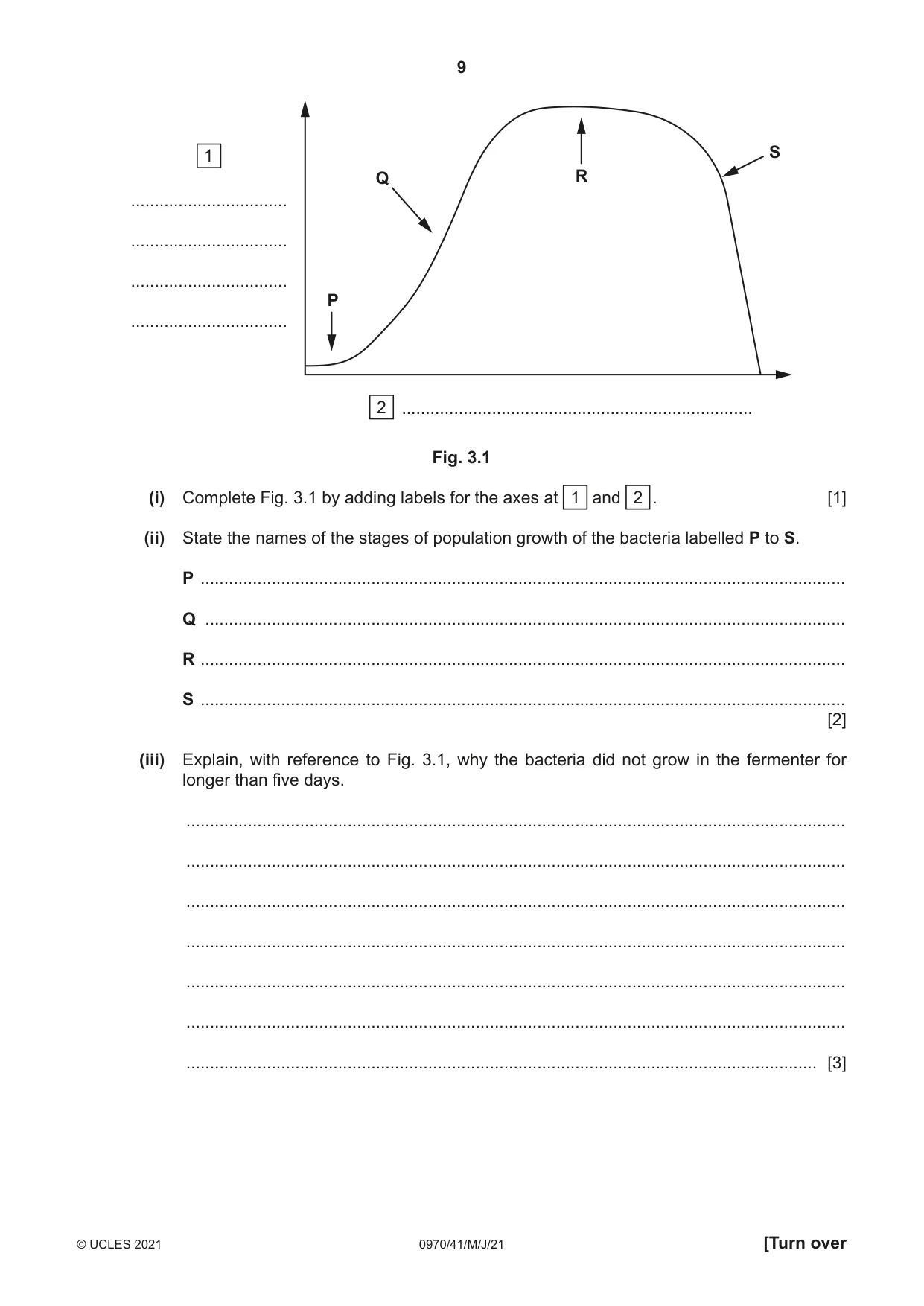
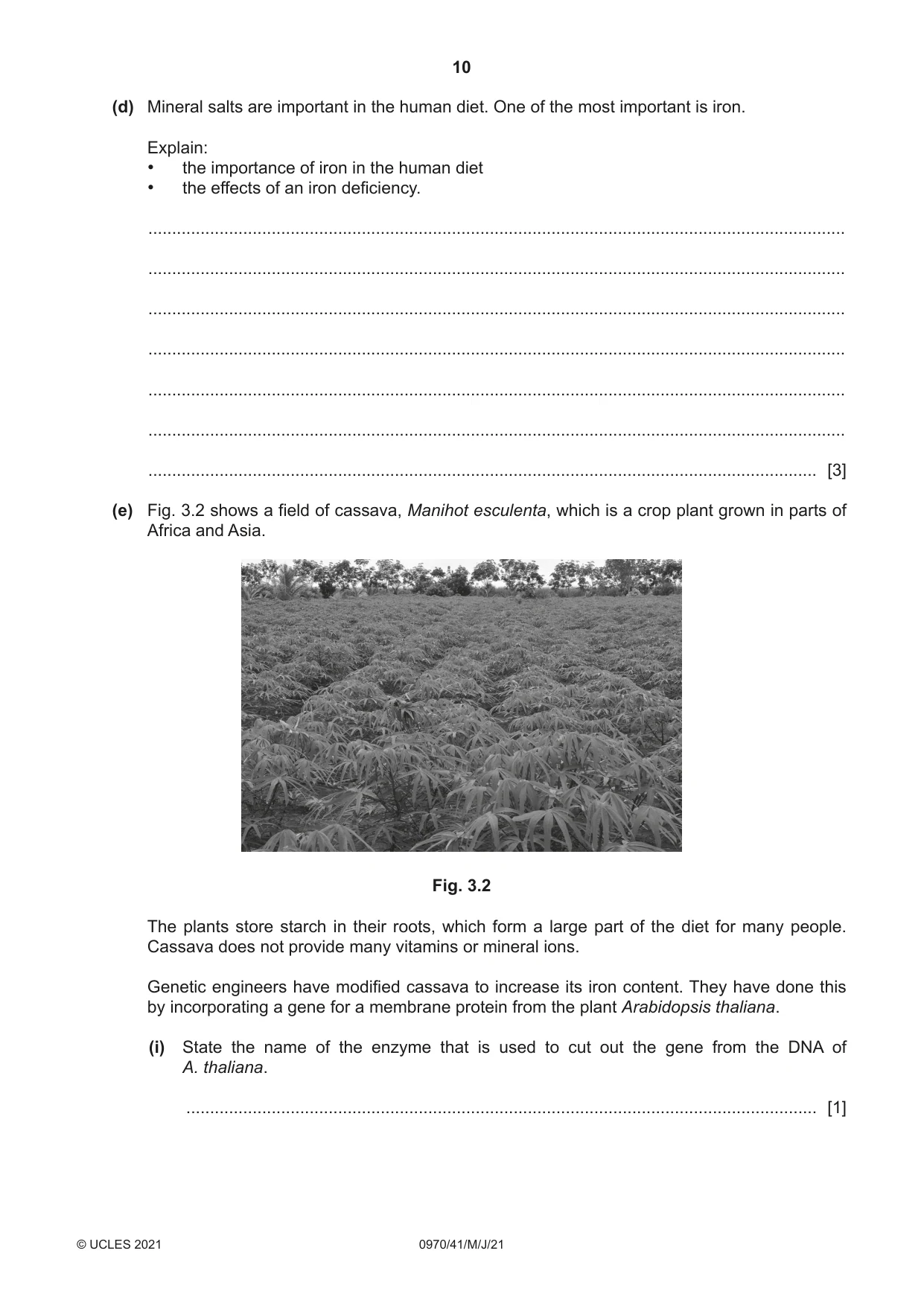
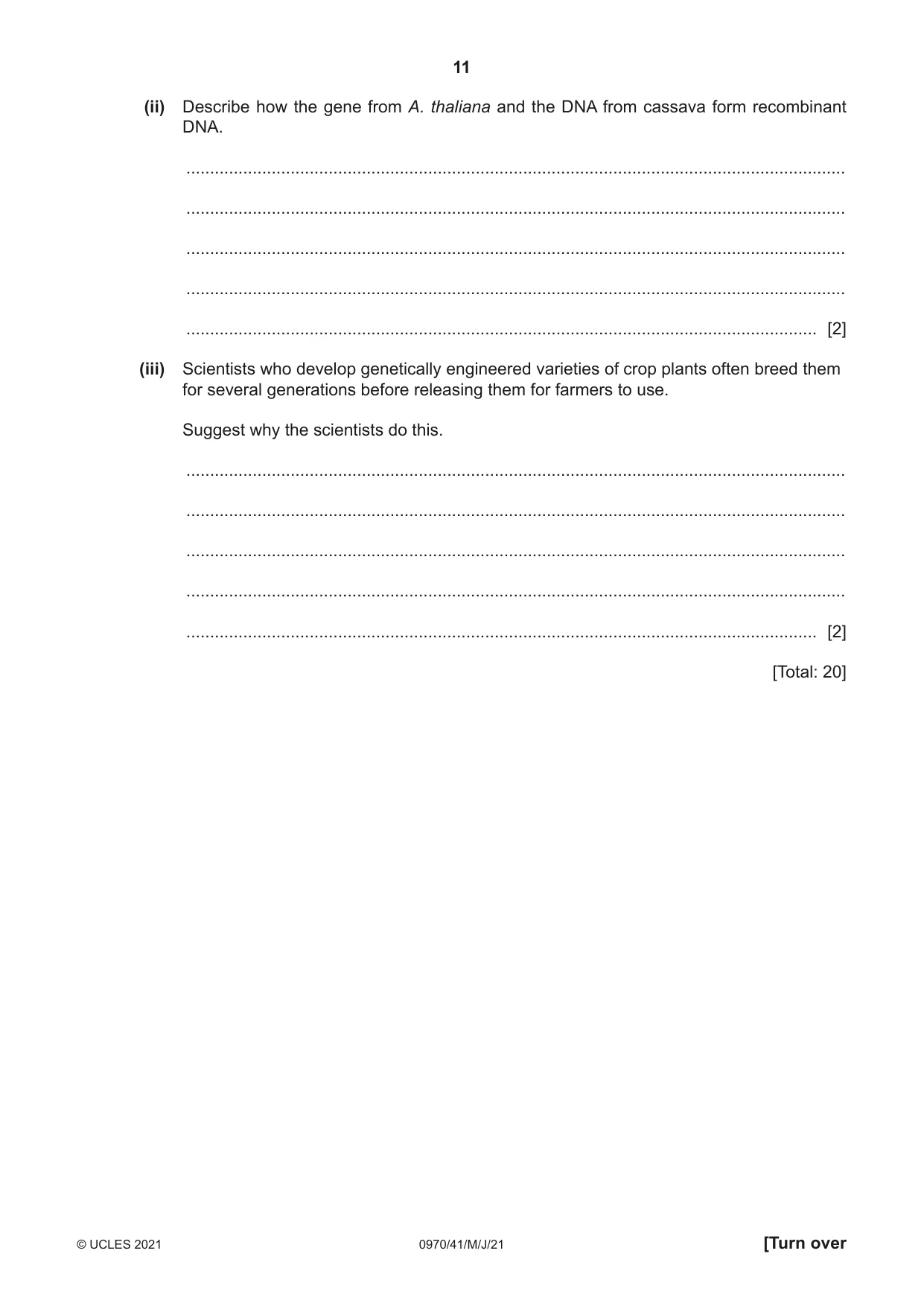
3 Bacteria are used in many biotechnological processes. (a) Explain why bacteria are useful in biotechnology. ................................................................................................................................................... ................................................................................................................................................... ................................................................................................................................................... ................................................................................................................................................... ................................................................................................................................................... ................................................................................................................................................... ............................................................................................................................................. [3] (b) Insulin is one of many human proteins that are made by genetically engineered bacteria. Some people cannot produce insulin because their immune system has destroyed the cells that make insulin. (i) State the organ that contains the cells that have been destroyed. ..................................................................................................................................... [1] (ii) State the name of the disease caused by the destruction of these cells. ..................................................................................................................................... [1] (iii) State the function of insulin in the body. ..................................................................................................................................... [1] (c) Genetically engineered bacteria that are used to make insulin were grown in a fermenter for five days. Samples were taken from the fermenter every six hours and the number of bacteria in 1.0 mm3 of the nutrient solution were counted. Changes in the numbers of living bacteria in the samples taken from the fermenter are shown in Fig. 3.1. 1 S Q R ................................. ................................. ................................. P ................................. 2 .......................................................................... Fig. 3.1 (i) Complete Fig. 3.1 by adding labels for the axes at 1 and 2 . [1] (ii) State the names of the stages of population growth of the bacteria labelled P to S. P ........................................................................................................................................ Q ....................................................................................................................................... R ........................................................................................................................................ S ........................................................................................................................................ [2] (iii) Explain, with reference to Fig. 3.1, why the bacteria did not grow in the fermenter for longer than five days. ........................................................................................................................................... ........................................................................................................................................... ........................................................................................................................................... ........................................................................................................................................... ........................................................................................................................................... ........................................................................................................................................... ..................................................................................................................................... [3] (d) Mineral salts are important in the human diet. One of the most important is iron. Explain: • the importance of iron in the human diet • the effects of an iron deficiency. ................................................................................................................................................... ................................................................................................................................................... ................................................................................................................................................... ................................................................................................................................................... ................................................................................................................................................... ................................................................................................................................................... ............................................................................................................................................. [3] (e) Fig. 3.2 shows a field of cassava, Manihot esculenta, which is a crop plant grown in parts of Africa and Asia. Fig. 3.2 The plants store starch in their roots, which form a large part of the diet for many people. Cassava does not provide many vitamins or mineral ions. Genetic engineers have modified cassava to increase its iron content. They have done this by incorporating a gene for a membrane protein from the plant Arabidopsis thaliana. (i) State the name of the enzyme that is used to cut out the gene from the DNA of A. thaliana. ..................................................................................................................................... [1] (ii) Describe how the gene from A. thaliana and the DNA from cassava form recombinant DNA. ........................................................................................................................................... ........................................................................................................................................... ........................................................................................................................................... ........................................................................................................................................... ..................................................................................................................................... [2] (iii) Scientists who develop genetically engineered varieties of crop plants often breed them for several generations before releasing them for farmers to use. Suggest why the scientists do this. ........................................................................................................................................... ........................................................................................................................................... ........................................................................................................................................... ........................................................................................................................................... ..................................................................................................................................... [2] [Total: 20]
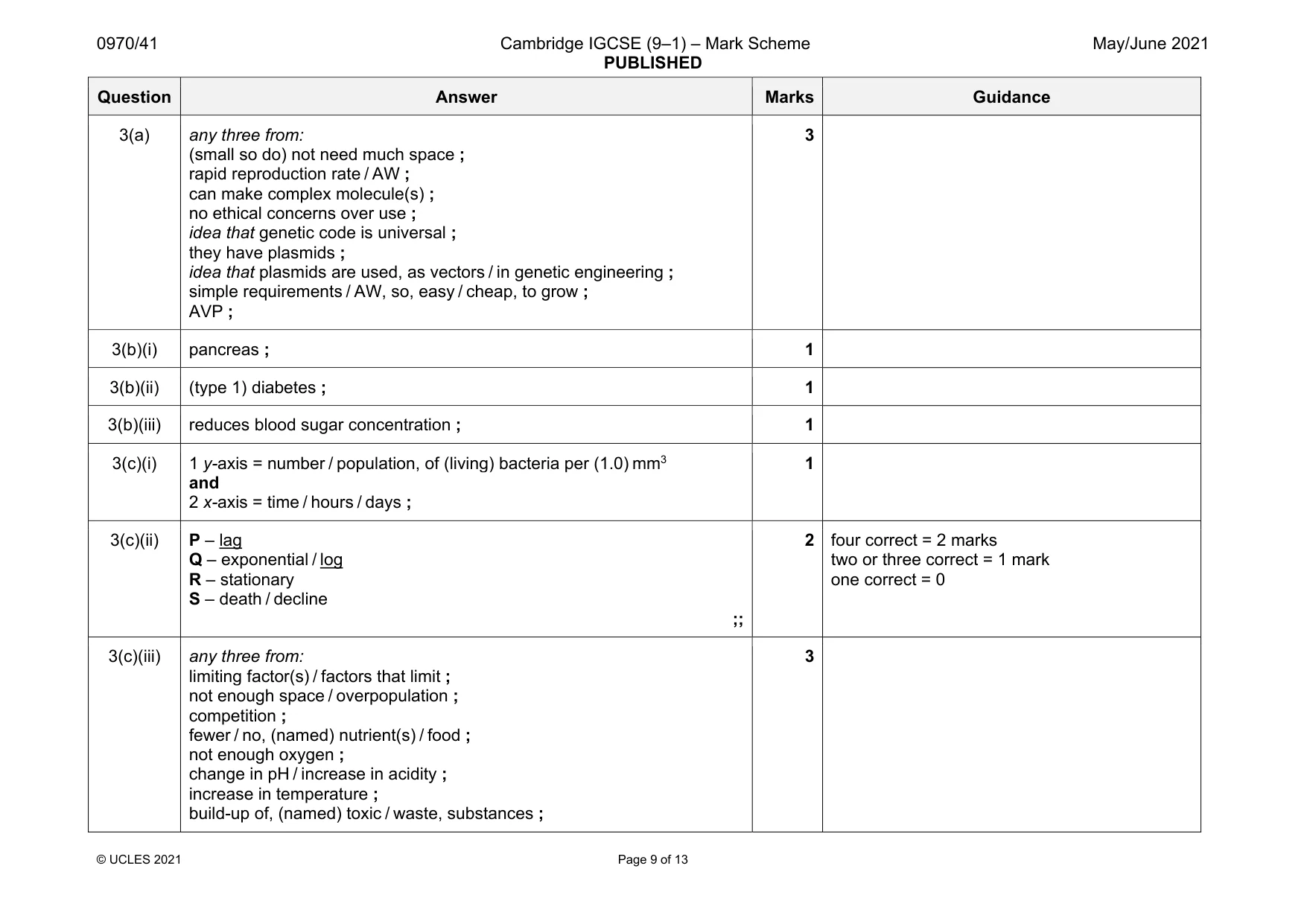
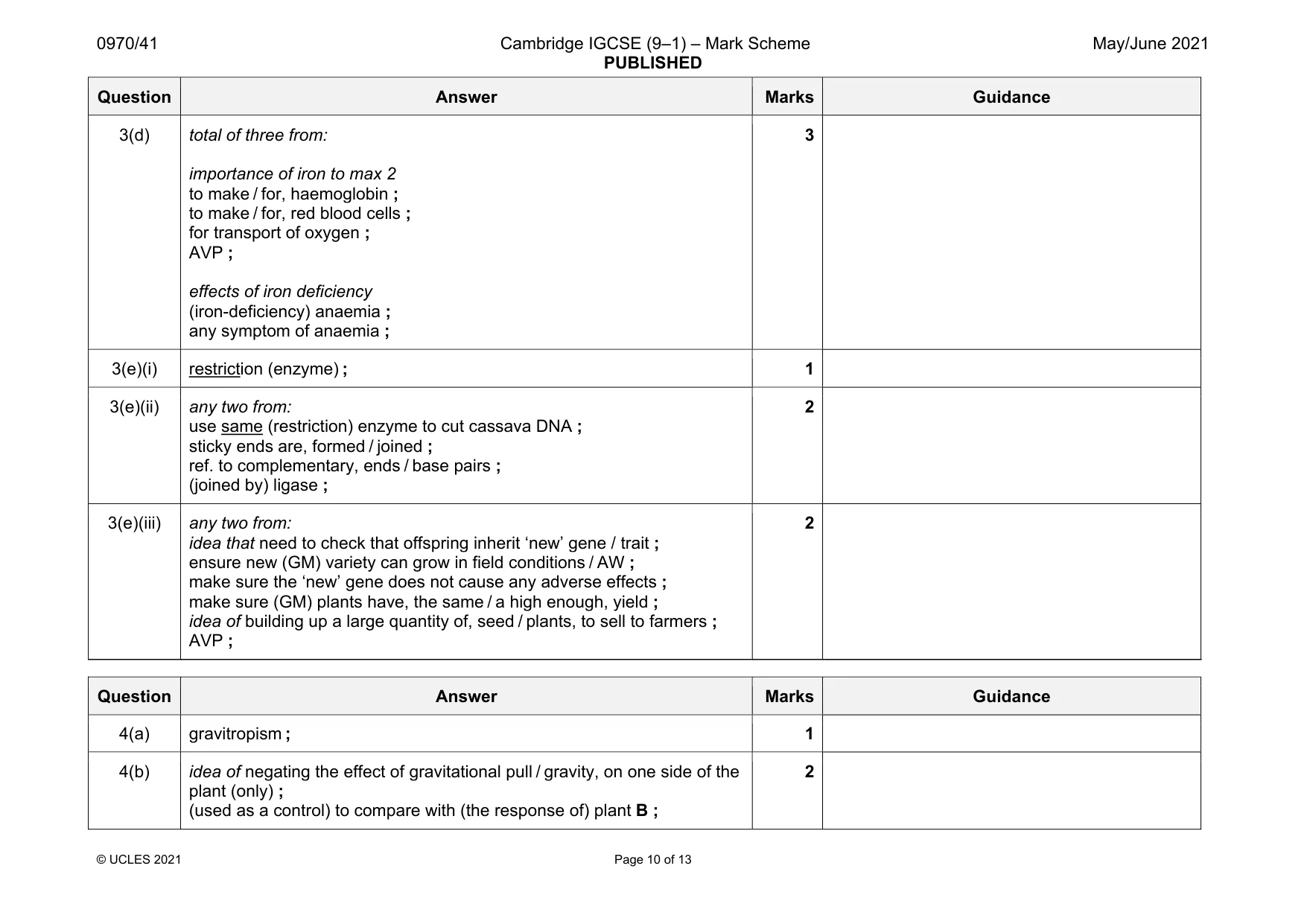
Mark scheme: 3(a) any three from: (small so do) not need much space ; rapid reproduction rate / AW ; can make complex molecule(s) ; no ethical concerns over use ; idea that genetic code is universal ; they have plasmids ; idea that plasmids are used, as vectors / in genetic engineering ; simple requirements / AW, so, easy / cheap, to grow ; AVP ; 3 3(b)(i) pancreas ; 1 3(b)(ii) (type 1) diabetes ; 1 3(b)(iii) reduces blood sugar concentration ; 1 3(c)(i) 1 y-axis = number / population, of (living) bacteria per (1.0) mm3 and 2 x-axis = time / hours / days ; 1 3(c)(ii) P – lag Q – exponential / log R – stationary S – death / decline ;; 2 four correct = 2 marks two or three correct = 1 mark one correct = 0 3(c)(iii) any three from: limiting factor(s) / factors that limit ; not enough space / overpopulation ; competition ; fewer / no, (named) nutrient(s) / food ; not enough oxygen ; change in pH / increase in acidity ; increase in temperature ; build-up of, (named) toxic / waste, substances ; 3 Question Answer Marks Guidance 3(d) total of three from: importance of iron to max 2 to make / for, haemoglobin ; to make / for, red blood cells ; for transport of oxygen ; AVP ; effects of iron deficiency (iron-deficiency) anaemia ; any symptom of anaemia ; 3 3(e)(i) restriction (enzyme) ; 1 3(e)(ii) any two from: use same (restriction) enzyme to cut cassava DNA ; sticky ends are, formed / joined ; ref. to complementary, ends / base pairs ; (joined by) ligase ; 2 3(e)(iii) any two from: idea that need to check that offspring inherit ‘new’ gene / trait ; ensure new (GM) variety can grow in field conditions / AW ; make sure the ‘new’ gene does not cause any adverse effects ; make sure (GM) plants have, the same / a high enough, yield ; idea of building up a large quantity of, seed / plants, to sell to farmers ; AVP ; 2
Q4 · Two identical potted plants were used to investigate plant responses
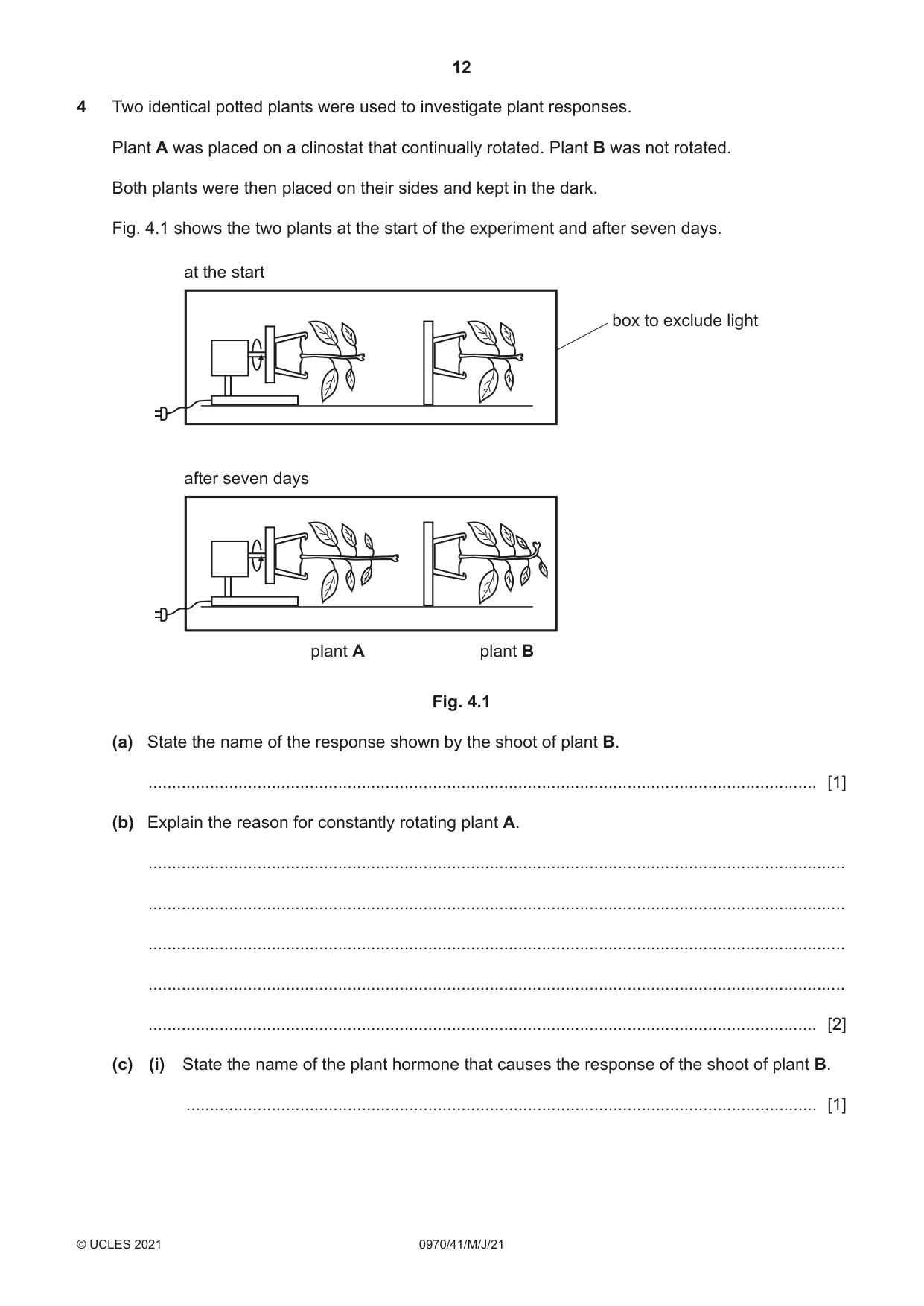
4 Two identical potted plants were used to investigate plant responses. Plant A was placed on a clinostat that continually rotated. Plant B was not rotated. Both plants were then placed on their sides and kept in the dark. Fig. 4.1 shows the two plants at the start of the experiment and after seven days. at the start box to exclude light after seven days plant A plant B Fig. 4.1 (a) State the name of the response shown by the shoot of plant B. ............................................................................................................................................. [1] (b) Explain the reason for constantly rotating plant A. ................................................................................................................................................... ................................................................................................................................................... ................................................................................................................................................... ................................................................................................................................................... ............................................................................................................................................. [2] (c) (i) State the name of the plant hormone that causes the response of the shoot of plant B. ..................................................................................................................................... [1] (ii) Explain how the plant hormone causes the response of plant B. ........................................................................................................................................... ........................................................................................................................................... ........................................................................................................................................... ........................................................................................................................................... ........................................................................................................................................... ........................................................................................................................................... ..................................................................................................................................... [3] (d) Seeds germinate in the soil. The seedlings that grow from seeds show the same response as shown by plant B in Fig. 4.1. Explain the advantages of this response to the survival of seedlings and mature plants. ................................................................................................................................................... ................................................................................................................................................... ................................................................................................................................................... ................................................................................................................................................... ................................................................................................................................................... ................................................................................................................................................... ............................................................................................................................................. [3] [Total: 10]
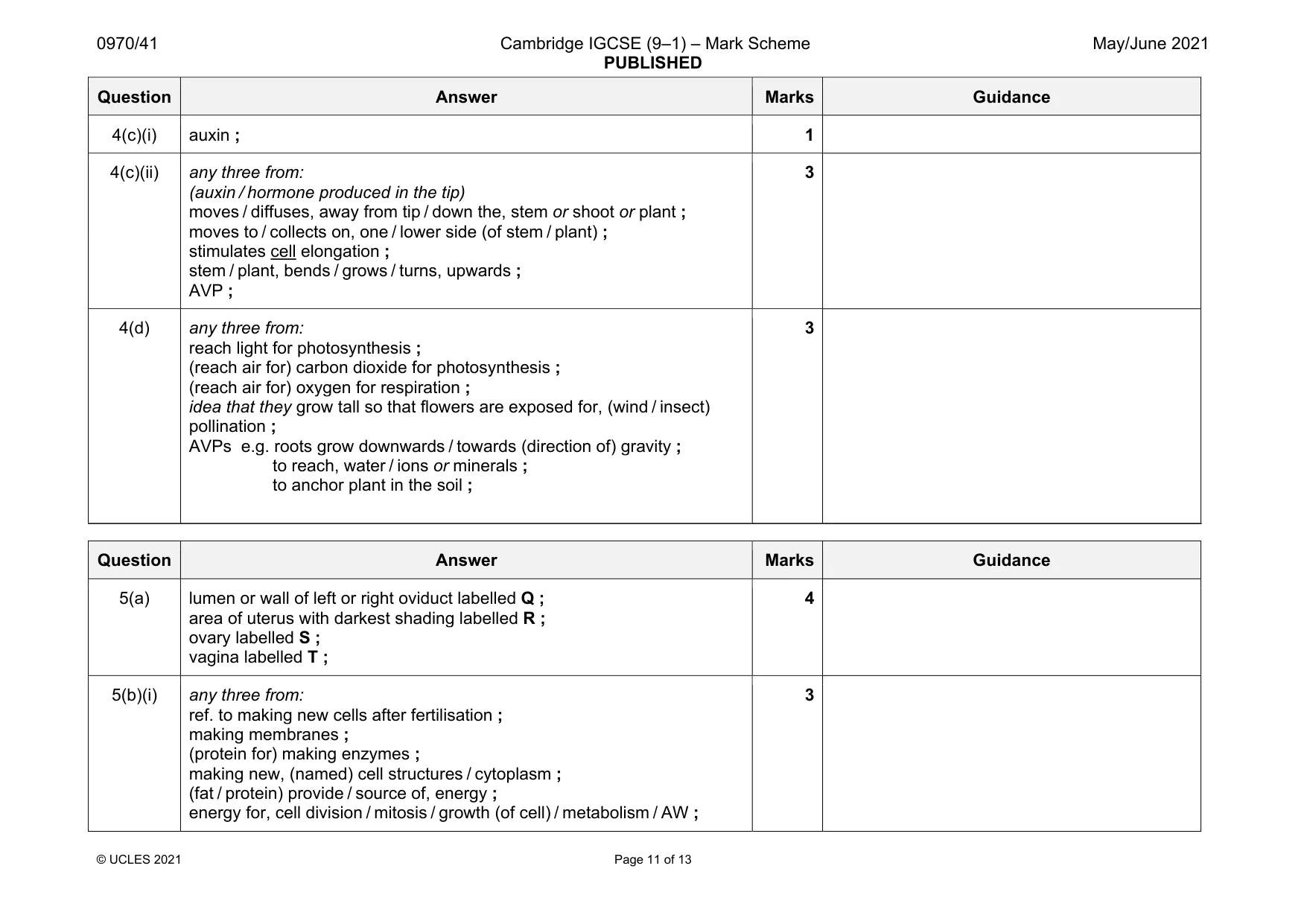
Mark scheme: 4(a) gravitropism ; 1 4(b) idea of negating the effect of gravitational pull / gravity, on one side of the plant (only) ; (used as a control) to compare with (the response of) plant B ; 2 Question Answer Marks Guidance 4(c)(i) auxin ; 1 4(c)(ii) any three from: (auxin / hormone produced in the tip) moves / diffuses, away from tip / down the, stem or shoot or plant ; moves to / collects on, one / lower side (of stem / plant) ; stimulates cell elongation ; stem / plant, bends / grows / turns, upwards ; AVP ; 3 4(d) any three from: reach light for photosynthesis ; (reach air for) carbon dioxide for photosynthesis ; (reach air for) oxygen for respiration ; idea that they grow tall so that flowers are exposed for, (wind / insect) pollination ; AVPs e.g. roots grow downwards / towards (direction of) gravity ; to reach, water / ions or minerals ; to anchor plant in the soil ; 3
Q5 · The female reproductive system
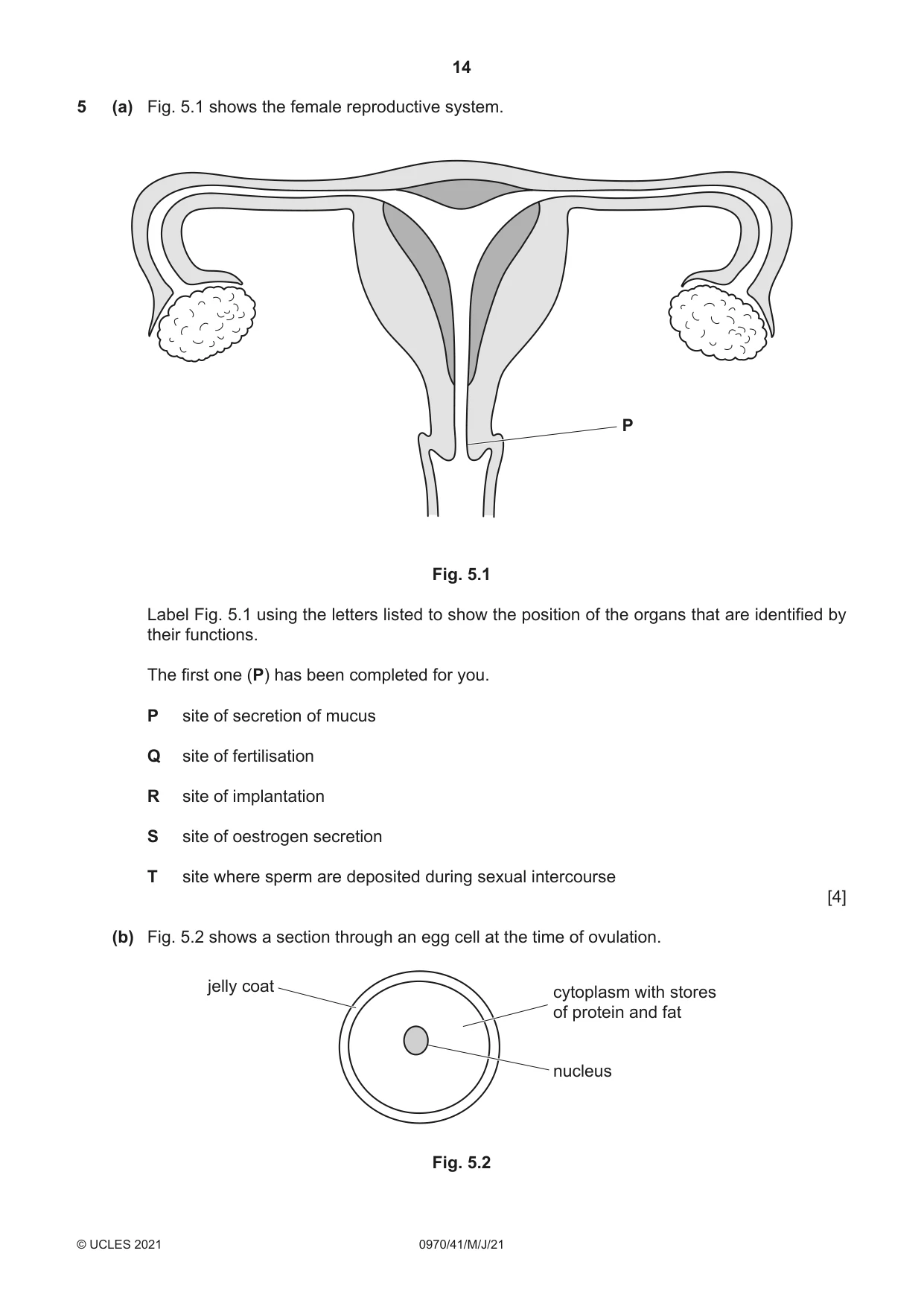
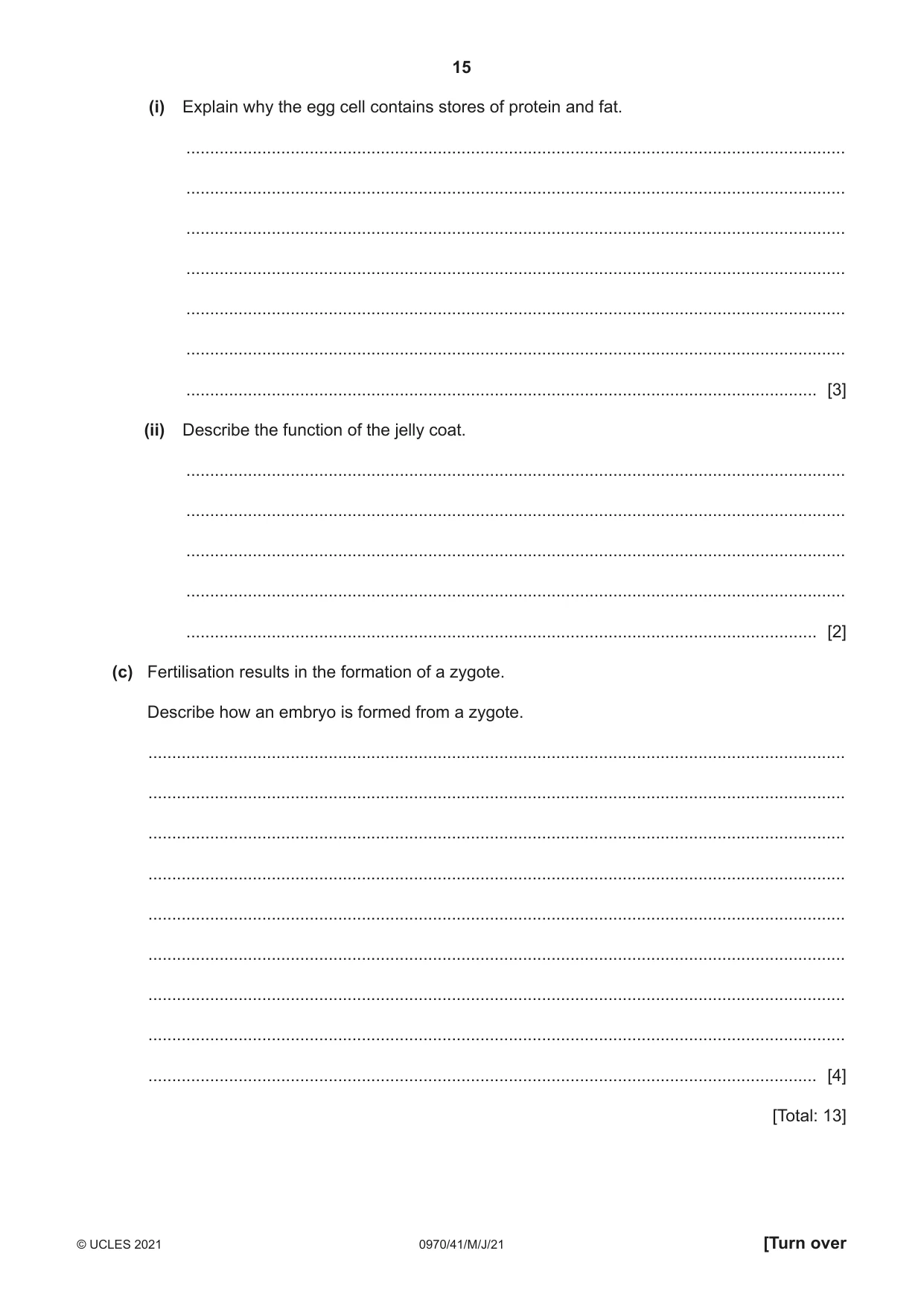
5 (a) Fig. 5.1 shows the female reproductive system. P Fig. 5.1 Label Fig. 5.1 using the letters listed to show the position of the organs that are identified by their functions. The first one (P) has been completed for you. P site of secretion of mucus Q site of fertilisation R site of implantation S site of oestrogen secretion T site where sperm are deposited during sexual intercourse [4] (b) Fig. 5.2 shows a section through an egg cell at the time of ovulation. jelly coat cytoplasm with stores of protein and fat nucleus Fig. 5.2 (i) Explain why the egg cell contains stores of protein and fat. ........................................................................................................................................... ........................................................................................................................................... ........................................................................................................................................... ........................................................................................................................................... ........................................................................................................................................... ........................................................................................................................................... ..................................................................................................................................... [3] (ii) Describe the function of the jelly coat. ........................................................................................................................................... ........................................................................................................................................... ........................................................................................................................................... ........................................................................................................................................... ..................................................................................................................................... [2] (c) Fertilisation results in the formation of a zygote. Describe how an embryo is formed from a zygote. ................................................................................................................................................... ................................................................................................................................................... ................................................................................................................................................... ................................................................................................................................................... ................................................................................................................................................... ................................................................................................................................................... ................................................................................................................................................... ................................................................................................................................................... ............................................................................................................................................. [4] [Total: 13]
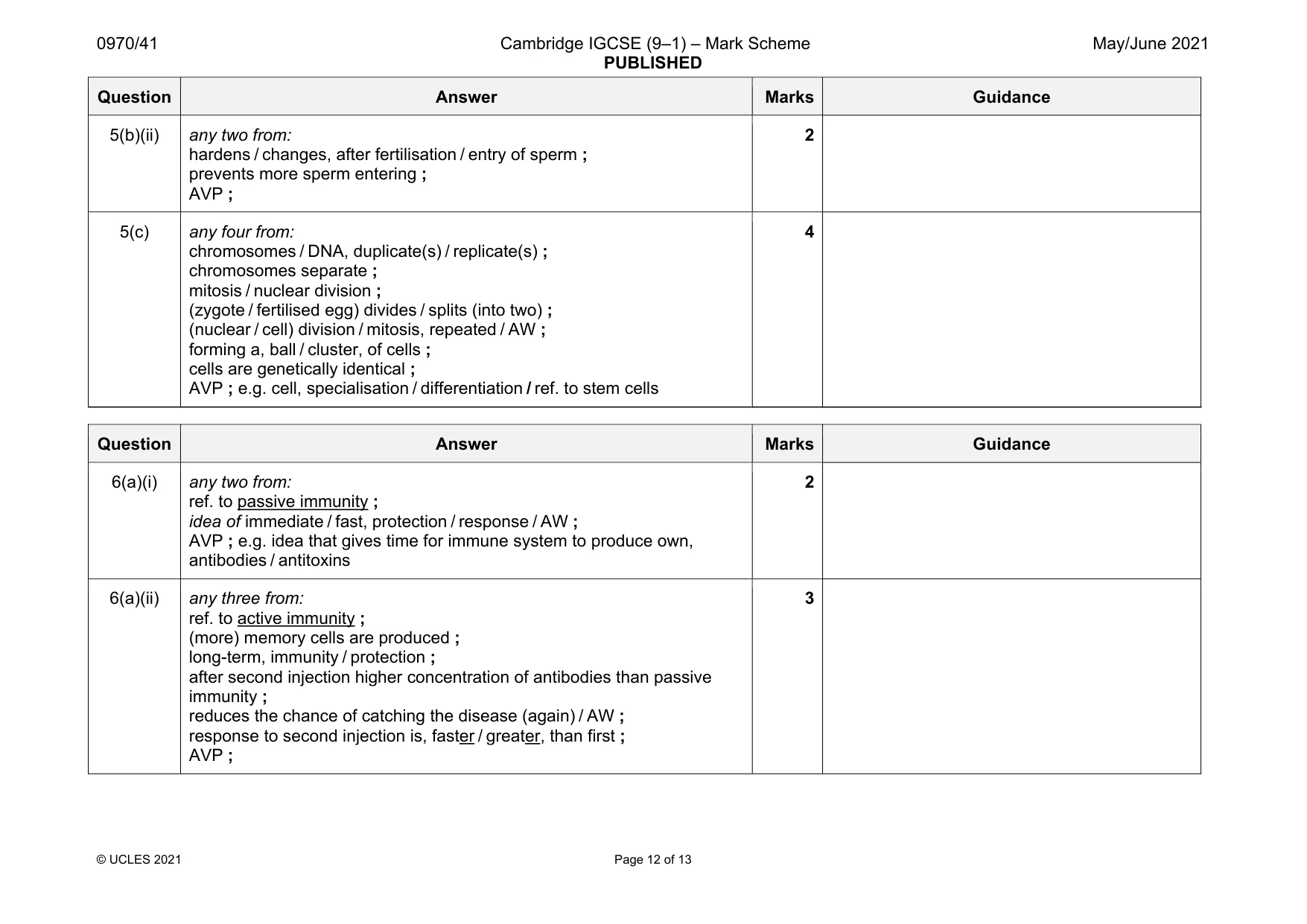
Mark scheme: 5(a) lumen or wall of left or right oviduct labelled Q ; area of uterus with darkest shading labelled R ; ovary labelled S ; vagina labelled T ; 4 5(b)(i) any three from: ref. to making new cells after fertilisation ; making membranes ; (protein for) making enzymes ; making new, (named) cell structures / cytoplasm ; (fat / protein) provide / source of, energy ; energy for, cell division / mitosis / growth (of cell) / metabolism / AW ; 3 Question Answer Marks Guidance 5(b)(ii) any two from: hardens / changes, after fertilisation / entry of sperm ; prevents more sperm entering ; AVP ; 2 5(c) any four from: chromosomes / DNA, duplicate(s) / replicate(s) ; chromosomes separate ; mitosis / nuclear division ; (zygote / fertilised egg) divides / splits (into two) ; (nuclear / cell) division / mitosis, repeated / AW ; forming a, ball / cluster, of cells ; cells are genetically identical ; AVP ; e.g. cell, specialisation / differentiation / ref. to stem cells 4
Q6 · Antibodies are proteins that are produced by lymphocytes
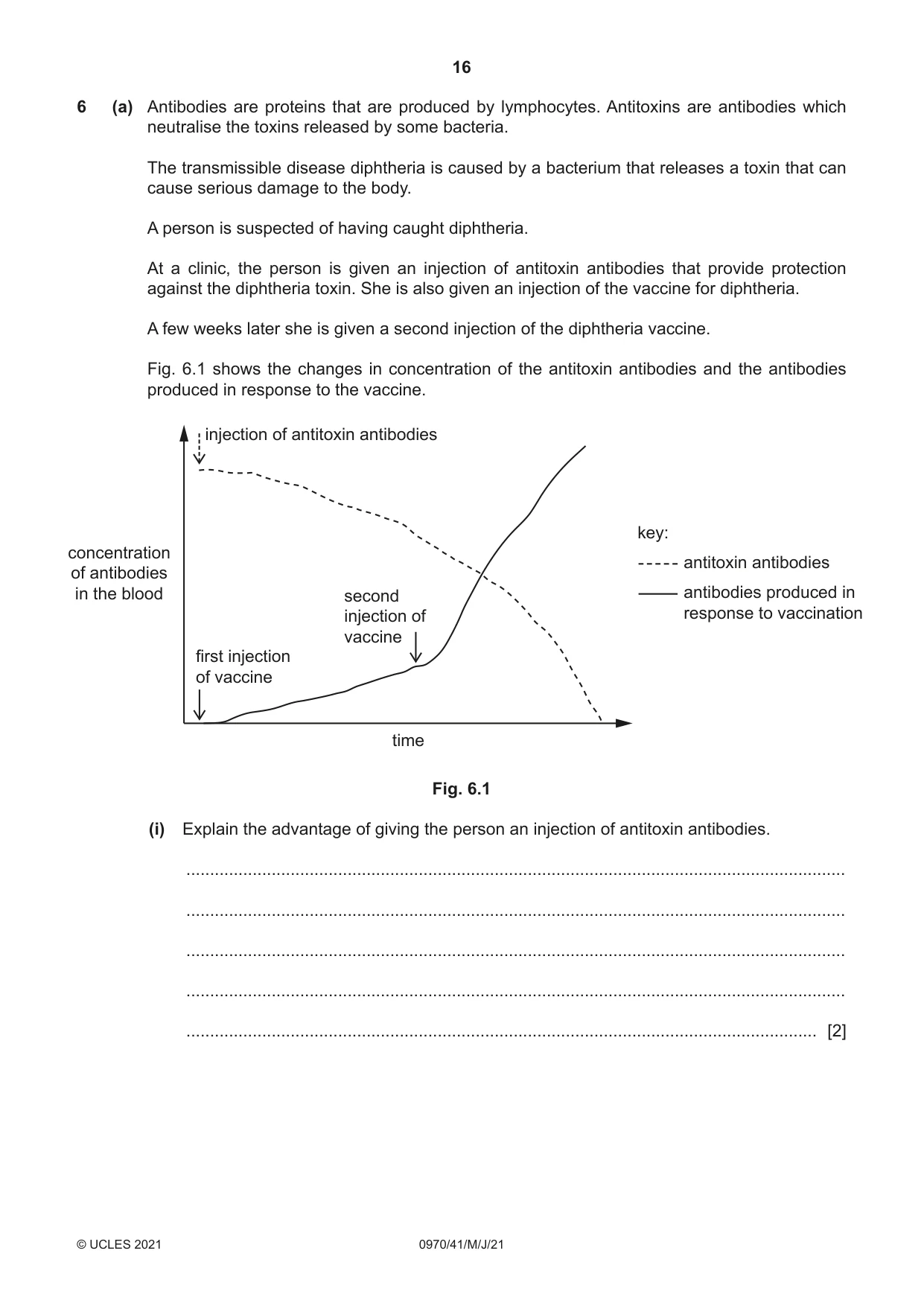
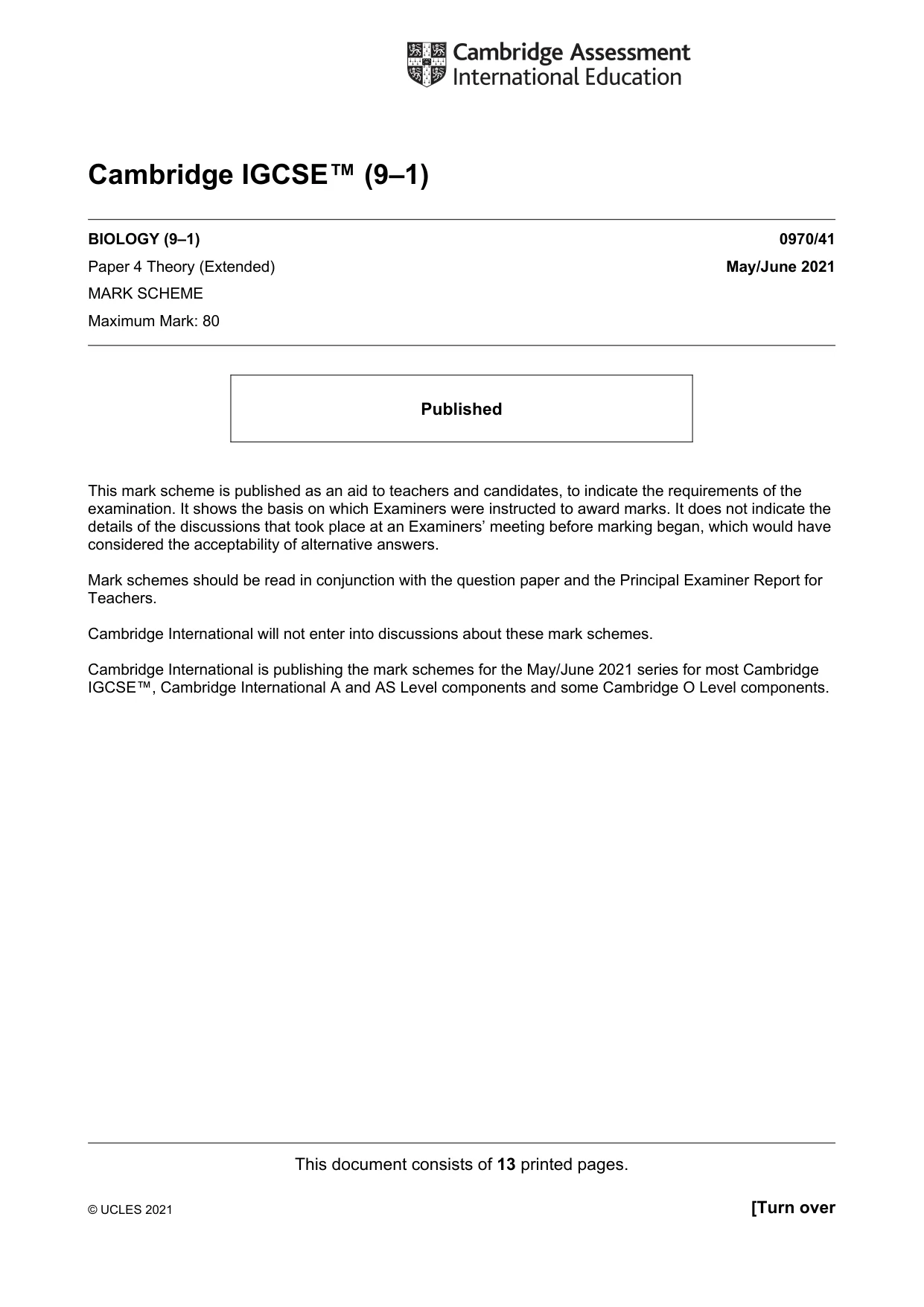
6 (a) Antibodies are proteins that are produced by lymphocytes. Antitoxins are antibodies which neutralise the toxins released by some bacteria. The transmissible disease diphtheria is caused by a bacterium that releases a toxin that can cause serious damage to the body. A person is suspected of having caught diphtheria. At a clinic, the person is given an injection of antitoxin antibodies that provide protection against the diphtheria toxin. She is also given an injection of the vaccine for diphtheria. A few weeks later she is given a second injection of the diphtheria vaccine. Fig. 6.1 shows the changes in concentration of the antitoxin antibodies and the antibodies produced in response to the vaccine. injection of antitoxin antibodies key: concentration antitoxin antibodiesof antibodies in the blood second antibodies produced in injection of response to vaccination vaccine first injection of vaccine time Fig. 6.1 (i) Explain the advantage of giving the person an injection of antitoxin antibodies. ........................................................................................................................................... ........................................................................................................................................... ........................................................................................................................................... ........................................................................................................................................... ..................................................................................................................................... [2] (ii) Explain how the two injections of the vaccine result in better protection against diphtheria than the injection of antitoxin antibodies. ........................................................................................................................................... ........................................................................................................................................... ........................................................................................................................................... ........................................................................................................................................... ........................................................................................................................................... ........................................................................................................................................... ..................................................................................................................................... [3] (b) Explain how antibodies protect the body against pathogens. ................................................................................................................................................... ................................................................................................................................................... ................................................................................................................................................... ................................................................................................................................................... ................................................................................................................................................... ................................................................................................................................................... ................................................................................................................................................... ................................................................................................................................................... ............................................................................................................................................. [4] (c) Antibodies can travel through the body in the lymphatic system. State two functions of the lymphatic system other than defence against disease. 1 ................................................................................................................................................ 2 ................................................................................................................................................ [2] [Total: 11]
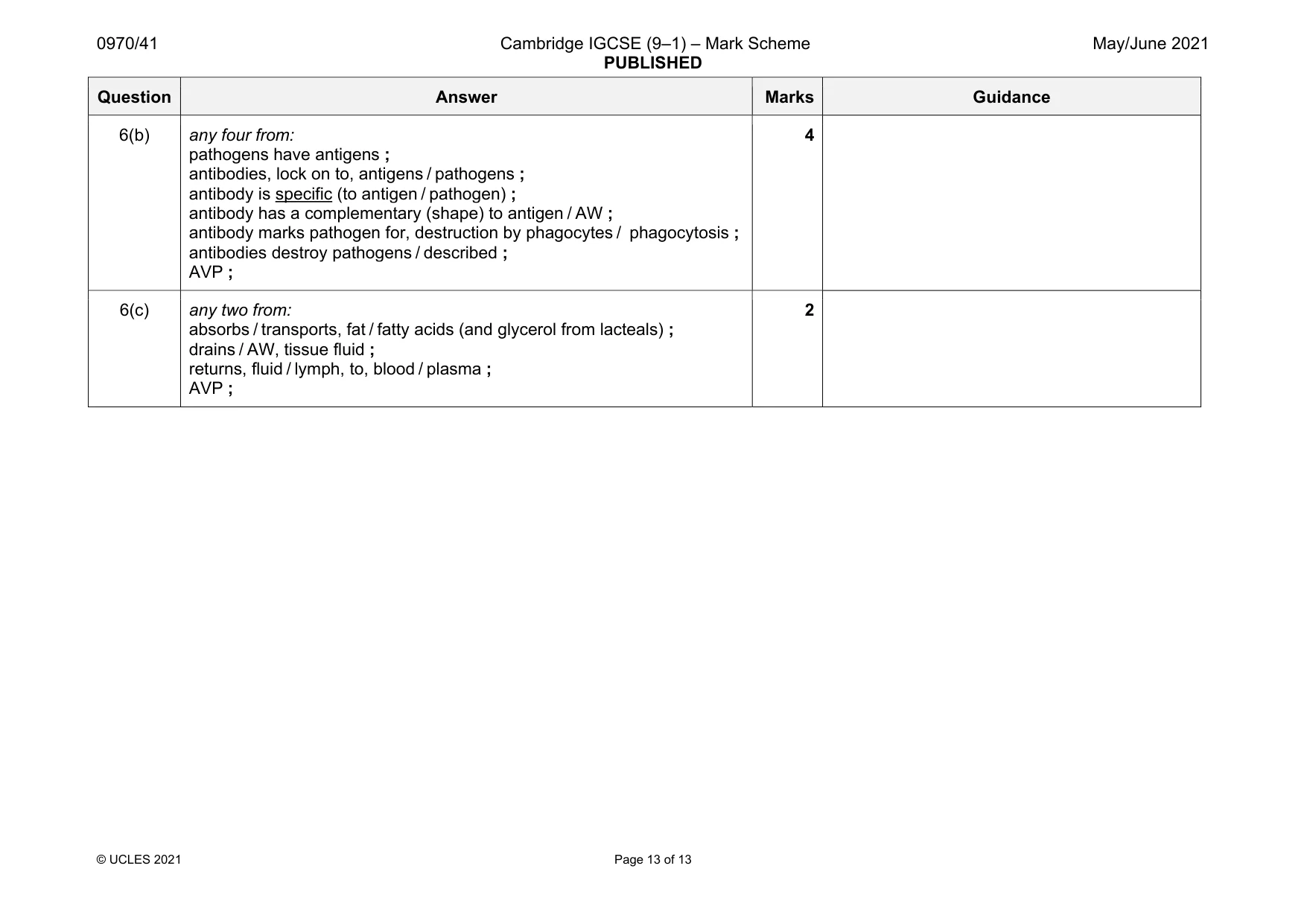
Mark scheme: 6(a)(i) any two from: ref. to passive immunity ; idea of immediate / fast, protection / response / AW ; AVP ; e.g. idea that gives time for immune system to produce own, antibodies / antitoxins 2 6(a)(ii) any three from: ref. to active immunity ; (more) memory cells are produced ; long-term, immunity / protection ; after second injection higher concentration of antibodies than passive immunity ; reduces the chance of catching the disease (again) / AW ; response to second injection is, faster / greater, than first ; AVP ; 3 Question Answer Marks Guidance 6(b) any four from: pathogens have antigens ; antibodies, lock on to, antigens / pathogens ; antibody is specific (to antigen / pathogen) ; antibody has a complementary (shape) to antigen / AW ; antibody marks pathogen for, destruction by phagocytes / phagocytosis ; antibodies destroy pathogens / described ; AVP ; 4 6(c) any two from: absorbs / transports, fat / fatty acids (and glycerol from lacteals) ; drains / AW, tissue fluid ; returns, fluid / lymph, to, blood / plasma ; AVP ; 2
What was in this paper
The subtopics covered by these 6 questions, and how many questions each got. Open one in a new tab to see every Cambridge question on it.
What you needed in this session
Cambridge’s own grade thresholds for 2021 May/June, Paper 4 · Variant 1. A higher threshold means an easier paper — the bar moves with how the cohort did.