Cambridge IGCSE Biology (9-1) 0970 — 2020 May/June Paper 4 · Variant 2
0970/42/M/J/20
The question paper and its mark scheme, free to read here and free to download. This is Cambridge’s own paper, exactly as it was sat.
Question paper24 pages






Mark scheme11 pages
Answers below. Sit the paper first if you are practising.
Paper as text
Question paper, page 1
Cambridge IGCSE™(9–1) DC (KS) 198901 © UCLES 2020 [Turn over BIOLOGY 0970/42 Paper 4 Theory (Extended) May/June 2020 1 hour 15 minutes You must answer on the question paper. No additional materials are needed. INSTRUCTIONS ● Answer all questions. ● Use a black or dark blue pen. You may use an HB pencil for any diagrams or graphs. ● Write your name, centre number and candidate number in the boxes at the top of the page. ● Write your answer to each question in the space provided. ● Do not use an erasable pen or correction fluid. ● Do not write on any bar codes. ● You may use a calculator. ● You should show all your working and use appropriate units. INFORMATION ● The total mark for this paper is 80. ● The number of marks for each question or part question is shown in brackets [ ]. This document has 24 pages. Blank pages are indicated. * 7 7 8 7 3 8 5 8 6 1 *
Question paper, page 2
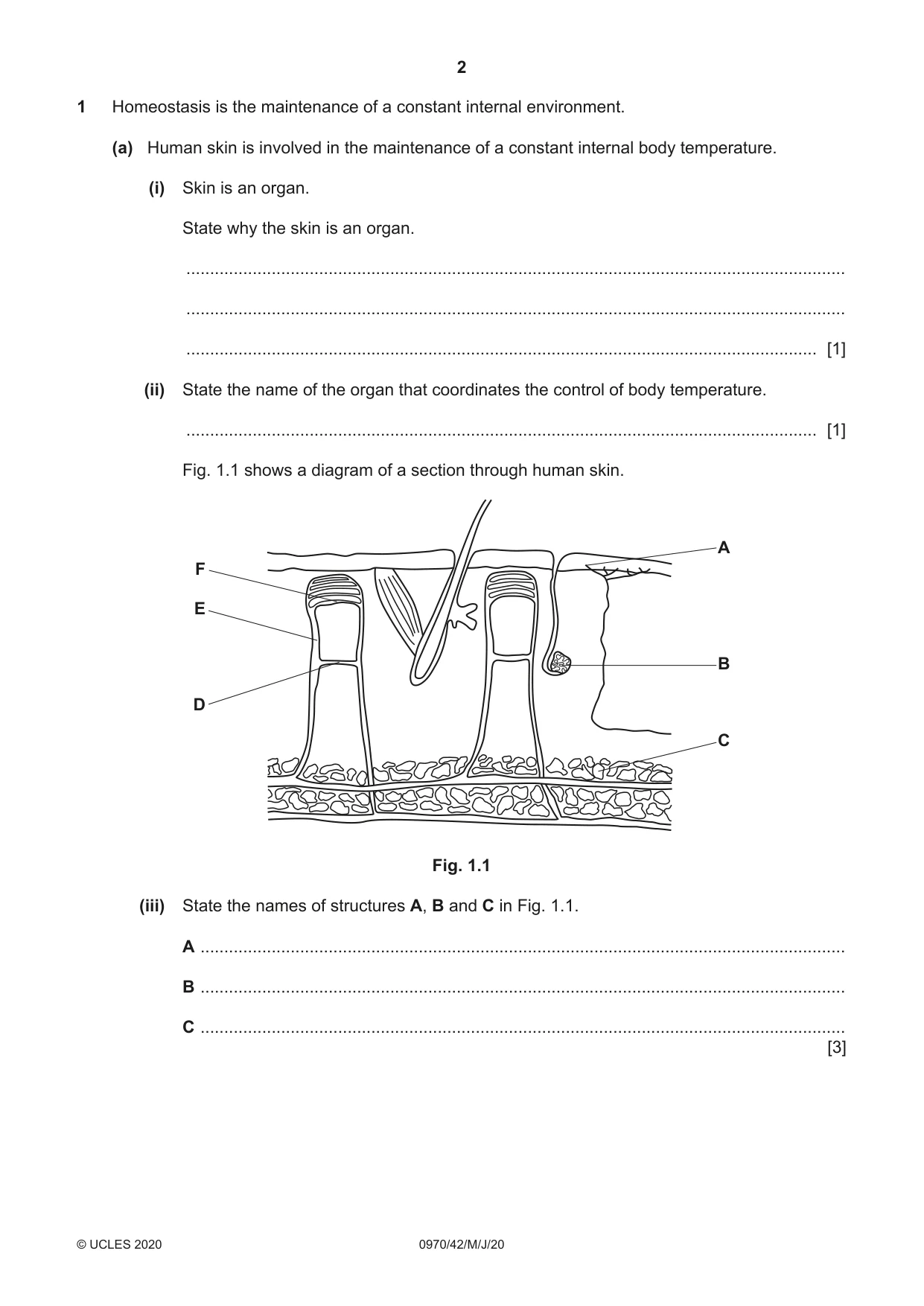
2 0970/42/M/J/20 © UCLES 2020 1 Homeostasis is the maintenance of a constant internal environment. (a) Human skin is involved in the maintenance of a constant internal body temperature. (i) Skin is an organ. State why the skin is an organ. … … … [1] (ii) State the name of the organ that coordinates the control of body temperature. … [1] Fig. 1.1 shows a diagram of a section through human skin. F E D A B C Fig. 1.1 (iii) State the names of structures A, B and C in Fig. 1.1. A … B … C … [3]
Question paper, page 3
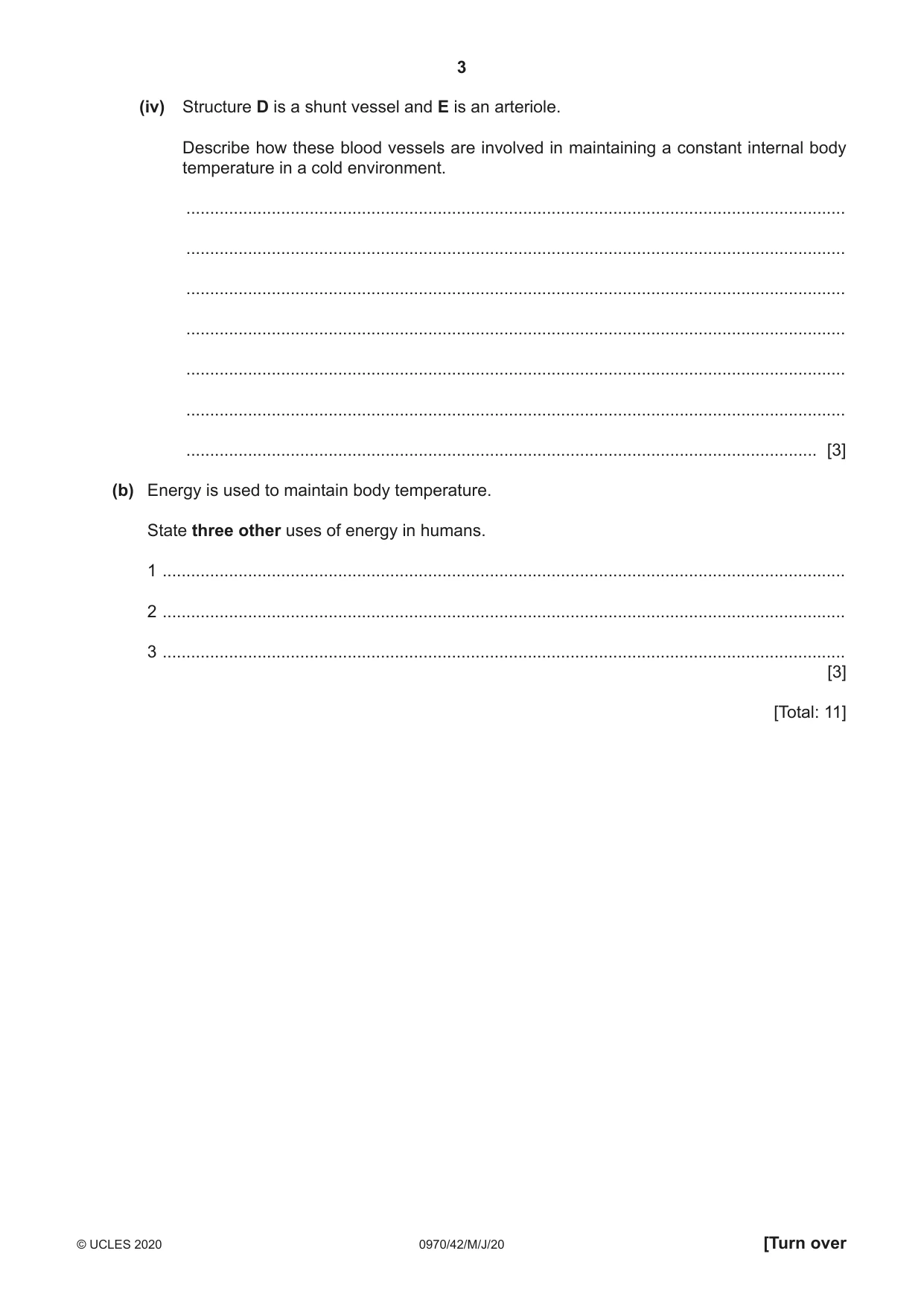
3 0970/42/M/J/20 © UCLES 2020 [Turn over (iv) Structure D is a shunt vessel and E is an arteriole. Describe how these blood vessels are involved in maintaining a constant internal body temperature in a cold environment. … … … … … … … [3] (b) Energy is used to maintain body temperature. State three other uses of energy in humans. 1 … 2 … 3 … [3] [Total: 11]
Question paper, page 4
4 0970/42/M/J/20 © UCLES 2020 2 Pregnancy can occur after the fusion of a male gamete and a female gamete. (a) State the name of the ball of cells that implants into the uterus after fertilisation. … [1] (b) There are many changes that occur in a fetus during pregnancy. Compare the development of a fetus in the early stages of pregnancy to its development in the late stages of pregnancy. … … … … … [2] (c) Describe the functions of amniotic fluid and the amniotic sac. … … … … … … … … … [4] (d) The umbilical artery is found in the umbilical cord. This artery transports blood away from the heart of the fetus. The umbilical artery is unusual because it transports deoxygenated blood. (i) State the name of one other artery in the mother that transports deoxygenated blood. … [1]
Question paper, page 5
5 0970/42/M/J/20 © UCLES 2020 [Turn over (ii) State one excretory product that is transported from the fetus to the placenta. … [1] (iii) State the name of the process that allows substances to move down a concentration gradient across the placenta. … [1]
Question paper, page 6
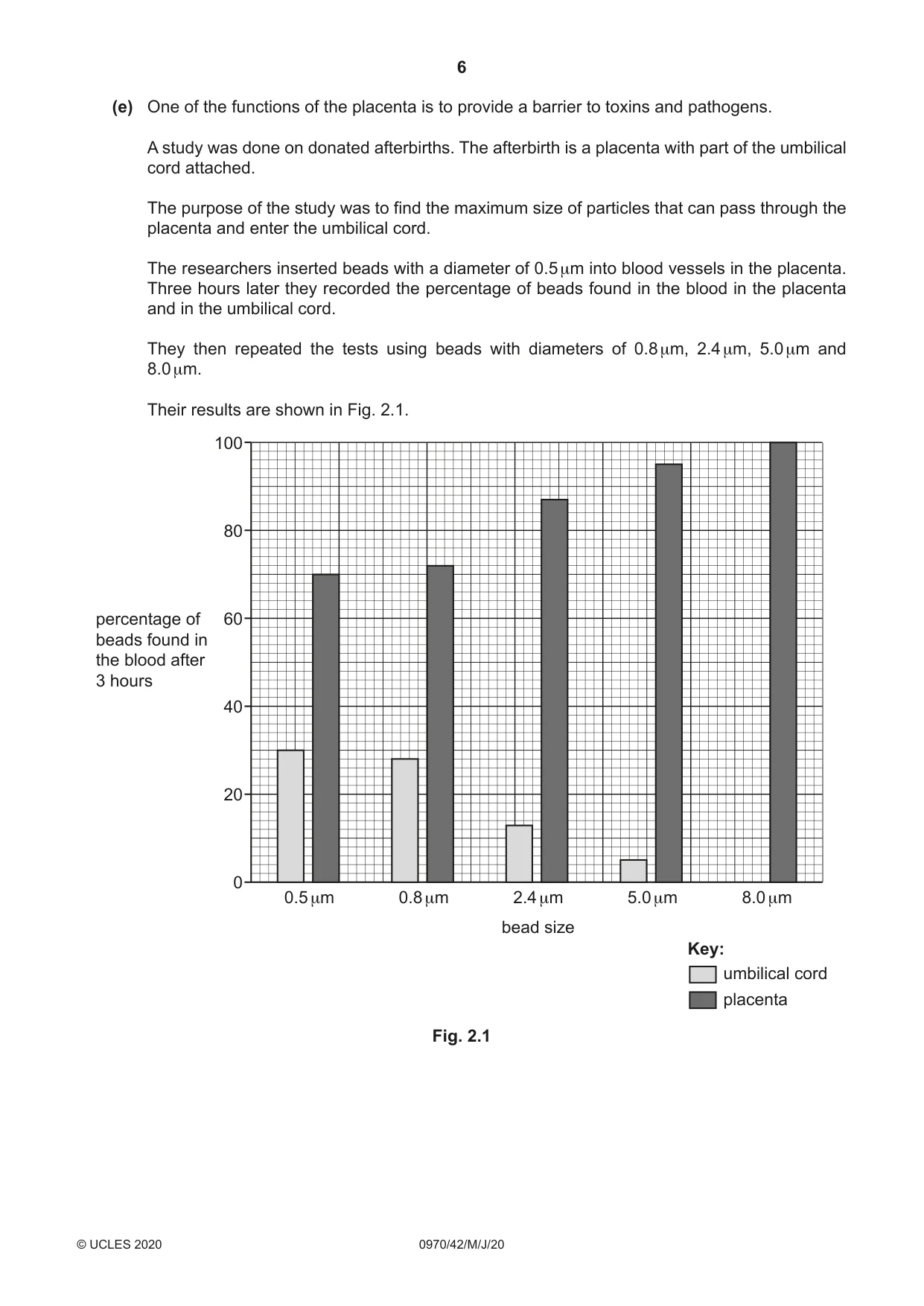
6 0970/42/M/J/20 © UCLES 2020 (e) One of the functions of the placenta is to provide a barrier to toxins and pathogens. A study was done on donated afterbirths. The afterbirth is a placenta with part of the umbilical cord attached. The purpose of the study was to find the maximum size of particles that can pass through the placenta and enter the umbilical cord. The researchers inserted beads with a diameter of 0.5 µm into blood vessels in the placenta. Three hours later they recorded the percentage of beads found in the blood in the placenta and in the umbilical cord. They then repeated the tests using beads with diameters of 0.8 µm, 2.4 µm, 5.0 µm and 8.0 µm. Their results are shown in Fig. 2.1. percentage of beads found in the blood after 3 hours 0 20 0.5 μm 0.8 μm 2.4 μm bead size 5.0 μm 8.0 μm 40 60 80 100 umbilical cord Key: placenta Fig. 2.1
Question paper, page 7
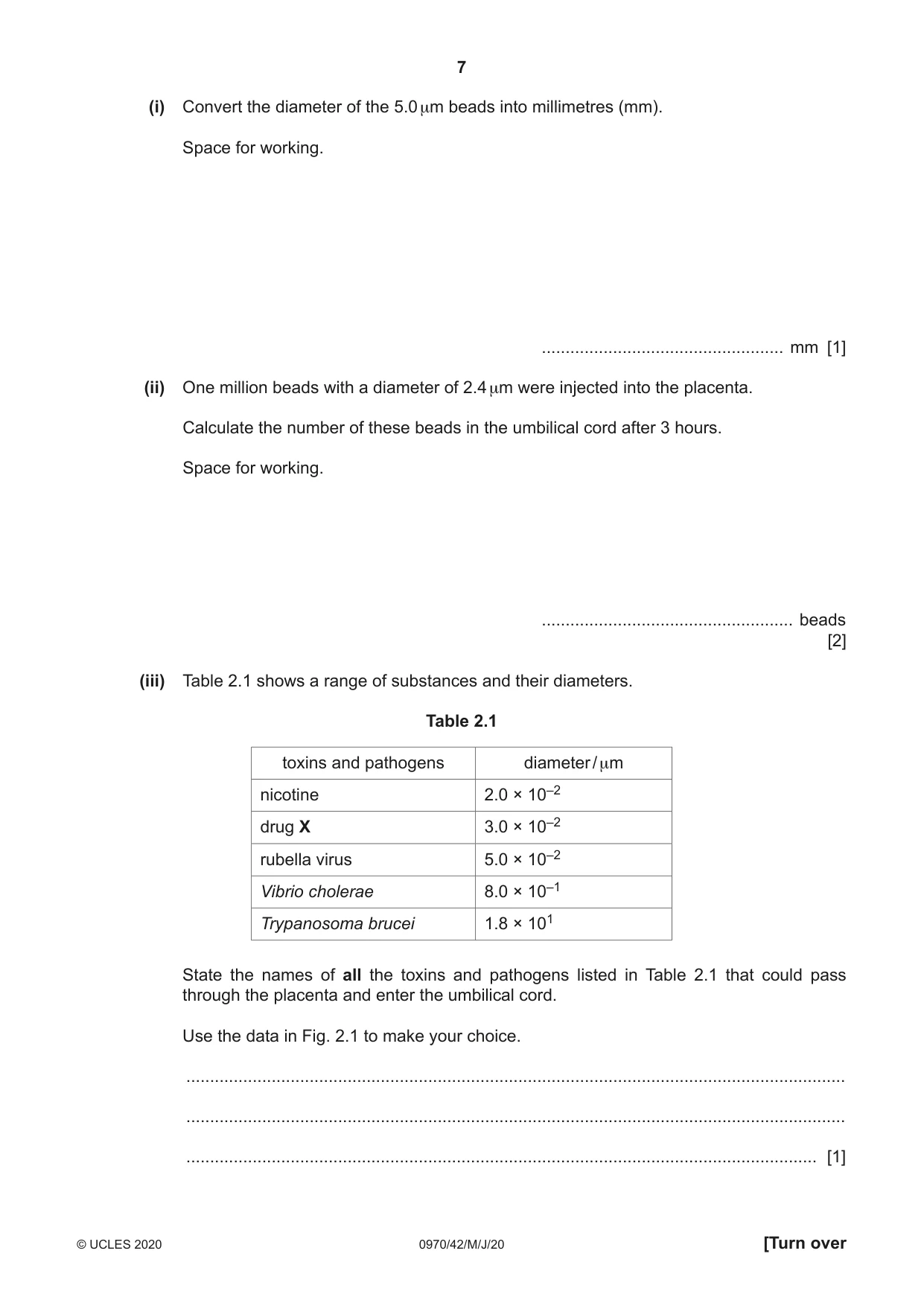
7 0970/42/M/J/20 © UCLES 2020 [Turn over (i) Convert the diameter of the 5.0 µm beads into millimetres (mm). Space for working. … mm [1] (ii) One million beads with a diameter of 2.4 µm were injected into the placenta. Calculate the number of these beads in the umbilical cord after 3 hours. Space for working. … beads [2] (iii) Table 2.1 shows a range of substances and their diameters. Table 2.1 toxins and pathogens diameter / µm nicotine 2.0 × 10⁻² drug X 3.0 × 10⁻² rubella virus 5.0 × 10⁻² Vibrio cholerae 8.0 × 10⁻¹ Trypanosoma brucei 1.8 × 101 State the names of all the toxins and pathogens listed in Table 2.1 that could pass through the placenta and enter the umbilical cord. Use the data in Fig. 2.1 to make your choice. … … … [1]
Question paper, page 8
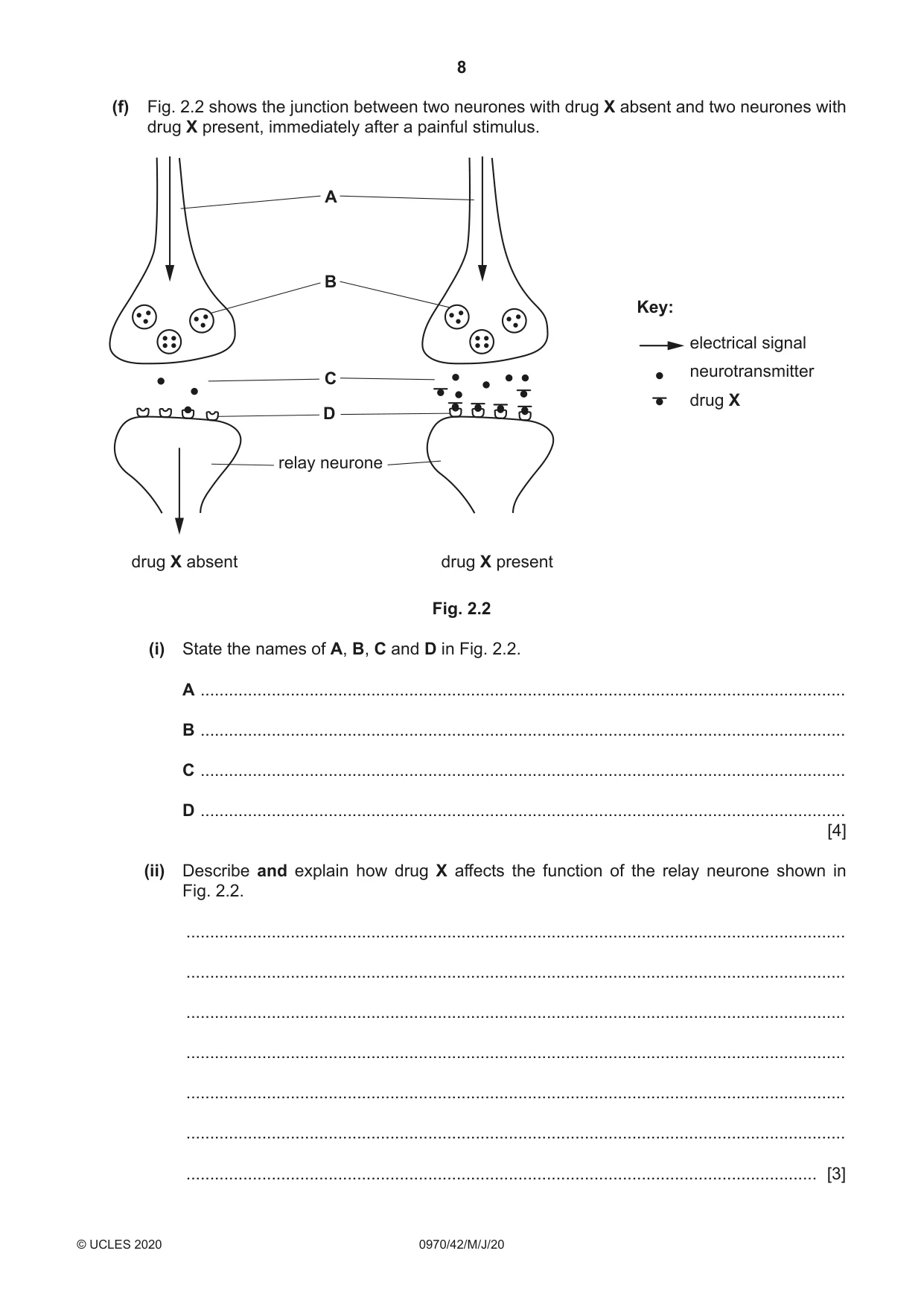
8 0970/42/M/J/20 © UCLES 2020 (f) Fig. 2.2 shows the junction between two neurones with drug X absent and two neurones with drug X present, immediately after a painful stimulus. drug X absent drug X present relay neurone B A C D Key: electrical signal neurotransmitter drug X Fig. 2.2 (i) State the names of A, B, C and D in Fig. 2.2. A … B … C … D … [4] (ii) Describe and explain how drug X affects the function of the relay neurone shown in Fig. 2.2. … … … … … … … [3]
Question paper, page 9
9 0970/42/M/J/20 © UCLES 2020 [Turn over (g) Drug X can be injected into the body. This is one way that HIV can be transmitted. Describe two other ways that HIV can be transmitted. 1 … … 2 … … [2] [Total: 23]
Question paper, page 10
10 0970/42/M/J/20 © UCLES 2020 BLANK PAGE
Question paper, page 11
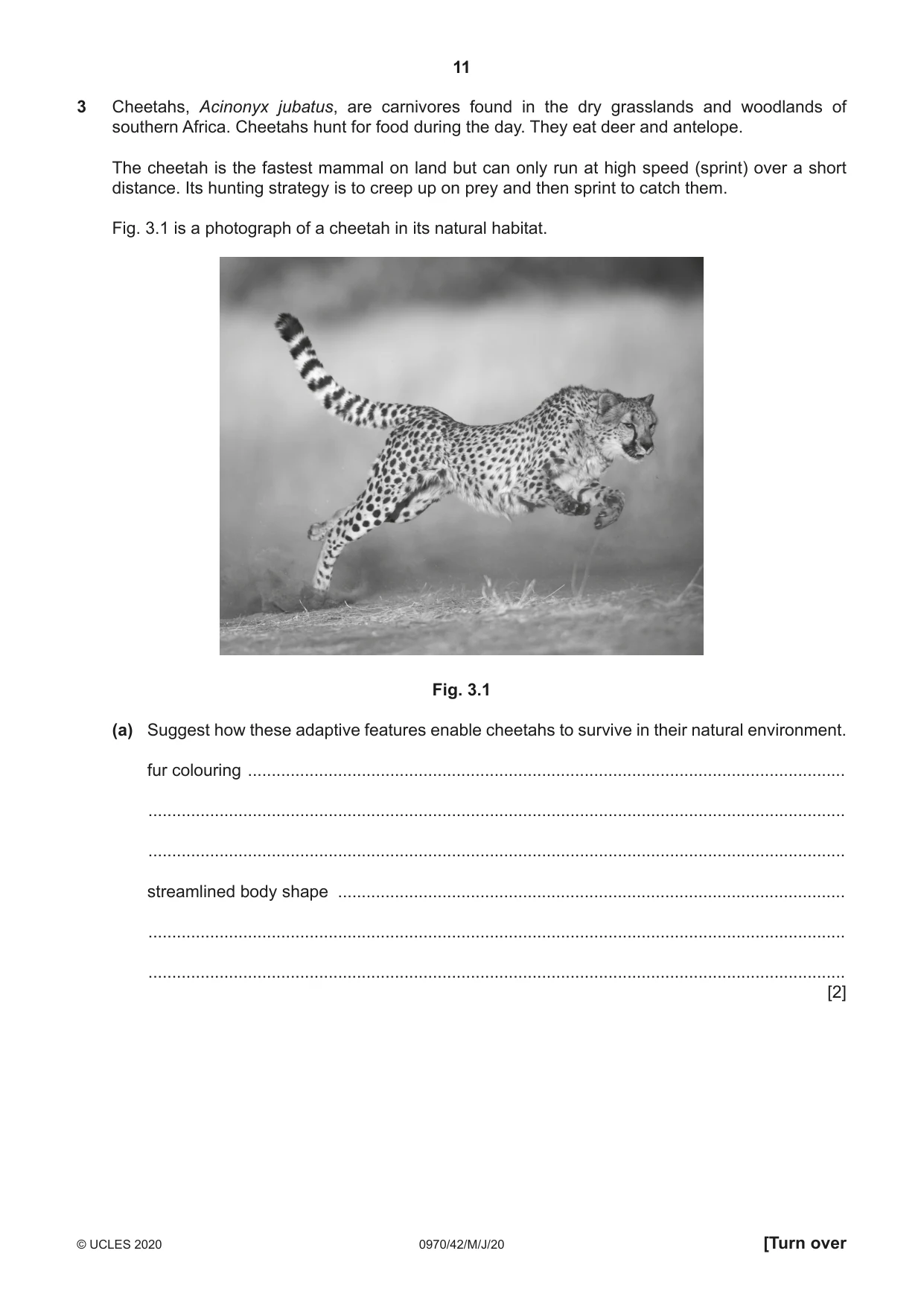
11 0970/42/M/J/20 © UCLES 2020 [Turn over 3 Cheetahs, Acinonyx jubatus, are carnivores found in the dry grasslands and woodlands of southern Africa. Cheetahs hunt for food during the day. They eat deer and antelope. The cheetah is the fastest mammal on land but can only run at high speed (sprint) over a short distance. Its hunting strategy is to creep up on prey and then sprint to catch them. Fig. 3.1 is a photograph of a cheetah in its natural habitat. Fig. 3.1 (a) Suggest how these adaptive features enable cheetahs to survive in their natural environment. fur colouring … … … streamlined body shape … … … [2]
Question paper, page 12
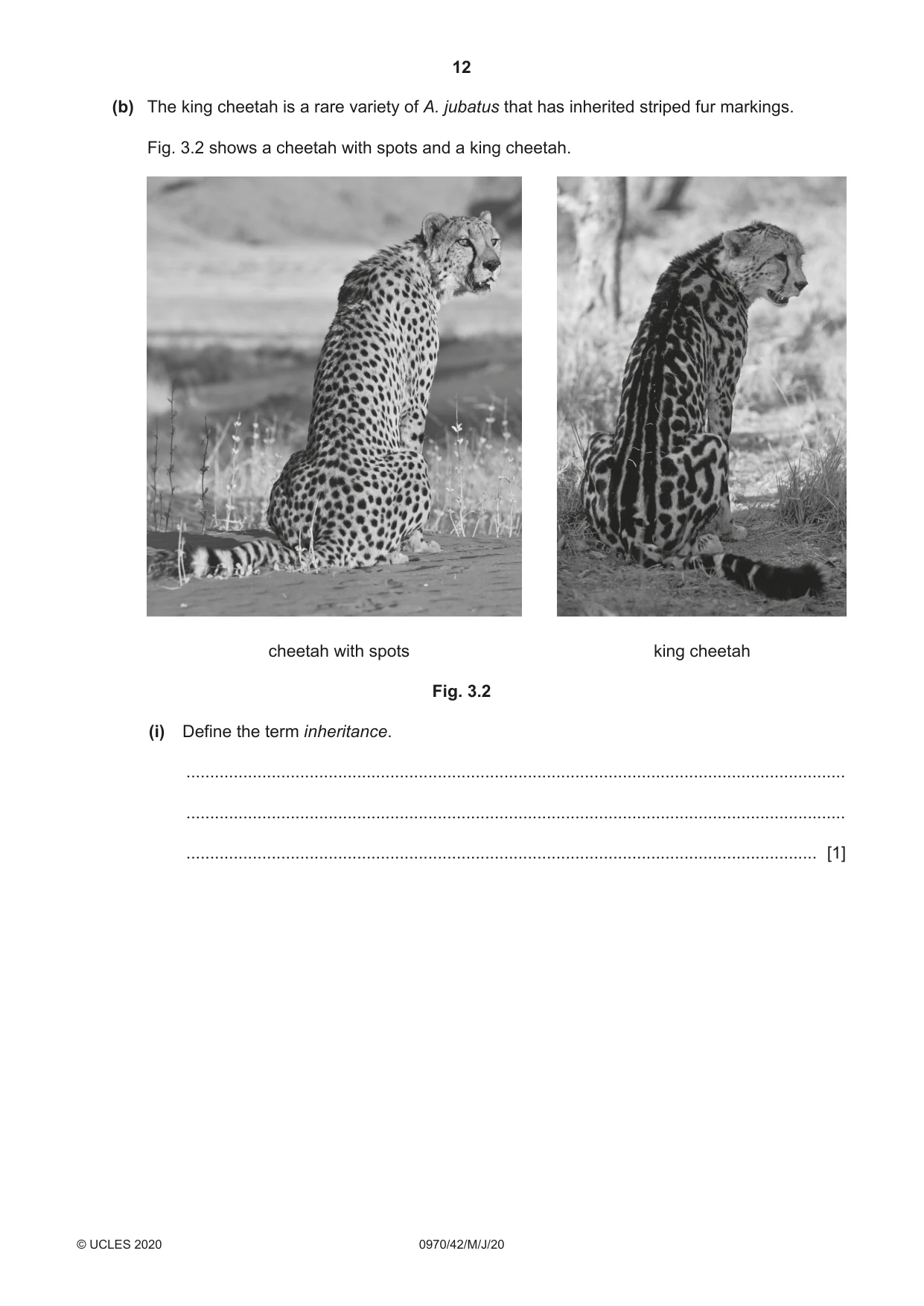
12 0970/42/M/J/20 © UCLES 2020 (b) The king cheetah is a rare variety of A. jubatus that has inherited striped fur markings. Fig. 3.2 shows a cheetah with spots and a king cheetah. cheetah with spots king cheetah Fig. 3.2 (i) Define the term inheritance. … … … [1]
Question paper, page 13
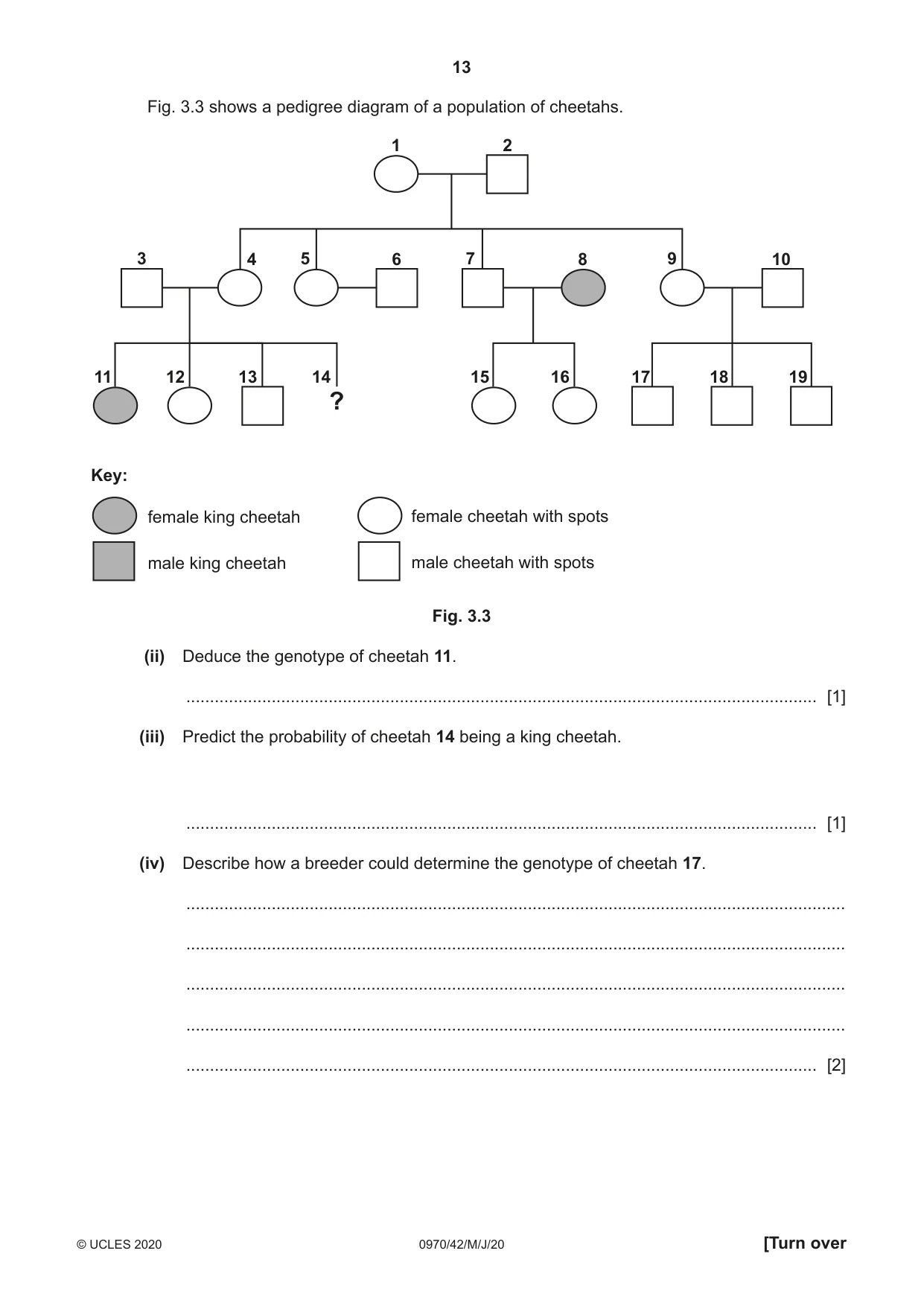
13 0970/42/M/J/20 © UCLES 2020 [Turn over Fig. 3.3 shows a pedigree diagram of a population of cheetahs. 1 2 male king cheetah female king cheetah male cheetah with spots female cheetah with spots Key: 3 4 11 12 13 14 ? 5 6 7 8 9 10 15 16 17 18 19 Fig. 3.3 (ii) Deduce the genotype of cheetah 11. … [1] (iii) Predict the probability of cheetah 14 being a king cheetah. … [1] (iv) Describe how a breeder could determine the genotype of cheetah 17. … … … … … [2]
Question paper, page 14
14 0970/42/M/J/20 © UCLES 2020 (v) When the king cheetah was first discovered it was thought that it was a new species. Pedigree diagrams of cheetahs proved it was not a new species. Suggest one type of evidence, other than pedigree diagrams, that can be used to determine how closely related organisms are. … … … [1] (c) Cheetahs are at risk of becoming endangered. (i) Suggest why the cheetah is at risk of becoming endangered. … … … … … … … [3] (ii) Describe how species like the cheetah can be conserved. … … … … … … … [3] [Total: 14]
Question paper, page 15
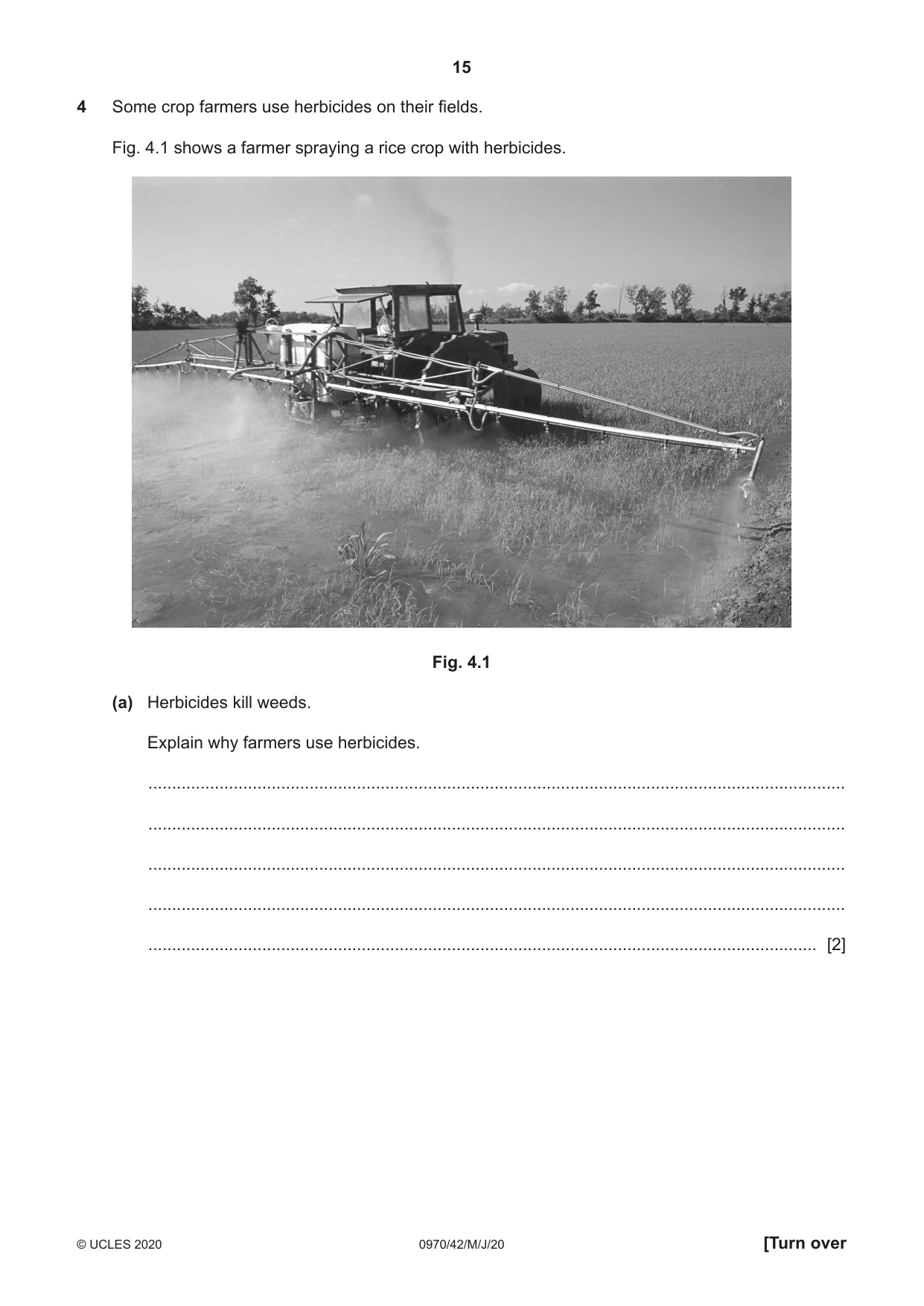
15 0970/42/M/J/20 © UCLES 2020 [Turn over 4 Some crop farmers use herbicides on their fields. Fig. 4.1 shows a farmer spraying a rice crop with herbicides. Fig. 4.1 (a) Herbicides kill weeds. Explain why farmers use herbicides. … … … … … [2]
Question paper, page 16
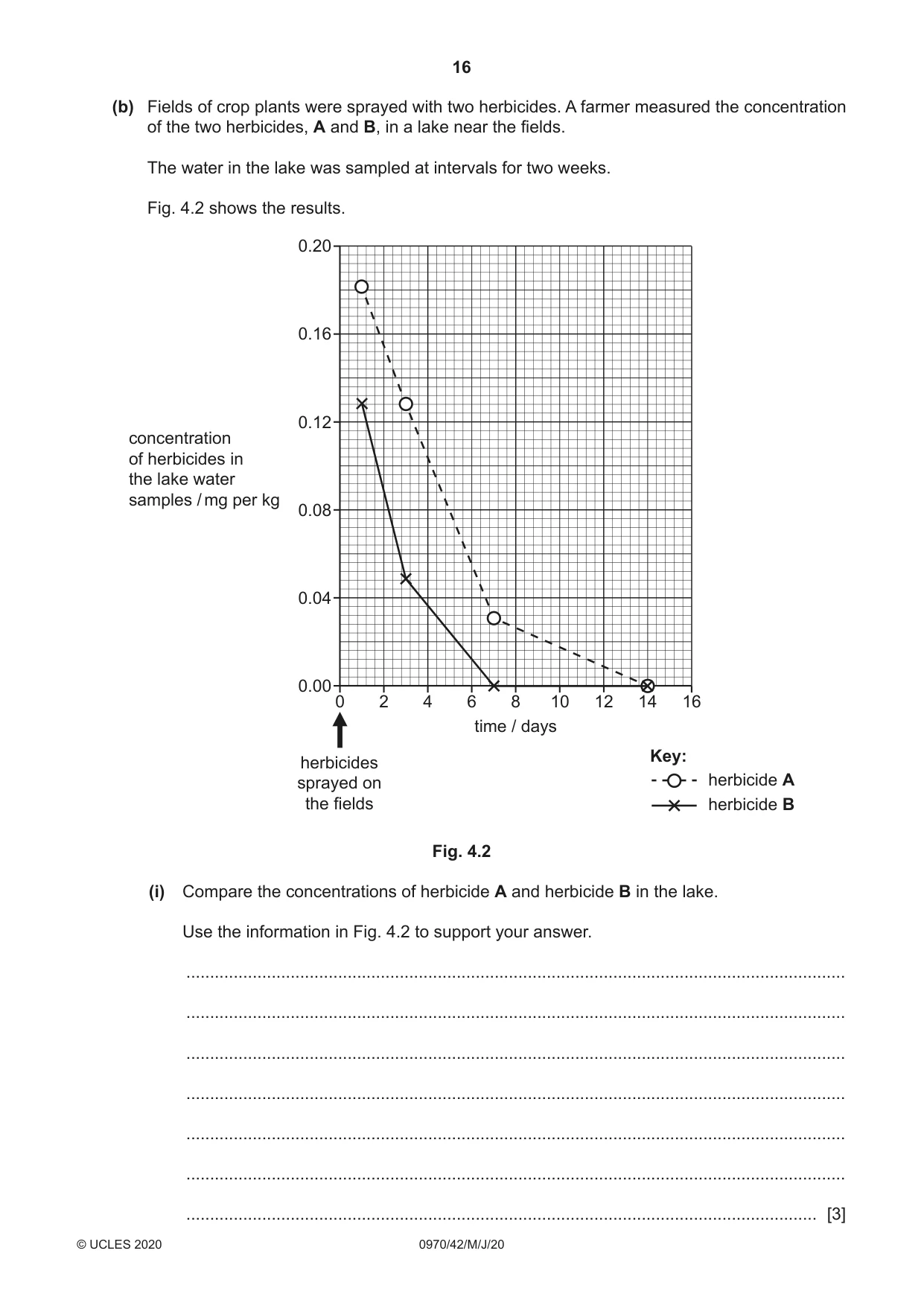
16 0970/42/M/J/20 © UCLES 2020 (b) Fields of crop plants were sprayed with two herbicides. A farmer measured the concentration of the two herbicides, A and B, in a lake near the fields. The water in the lake was sampled at intervals for two weeks. Fig. 4.2 shows the results. 0.00 0.04 0.08 0.12 0.16 0.20 0 2 4 6 8 time / days herbicides sprayed on the fields 10 12 16 14 concentration of herbicides in the lake water samples / mg per kg herbicide A Key: herbicide B Fig. 4.2 (i) Compare the concentrations of herbicide A and herbicide B in the lake. Use the information in Fig. 4.2 to support your answer. … … … … … … … [3]
Question paper, page 17
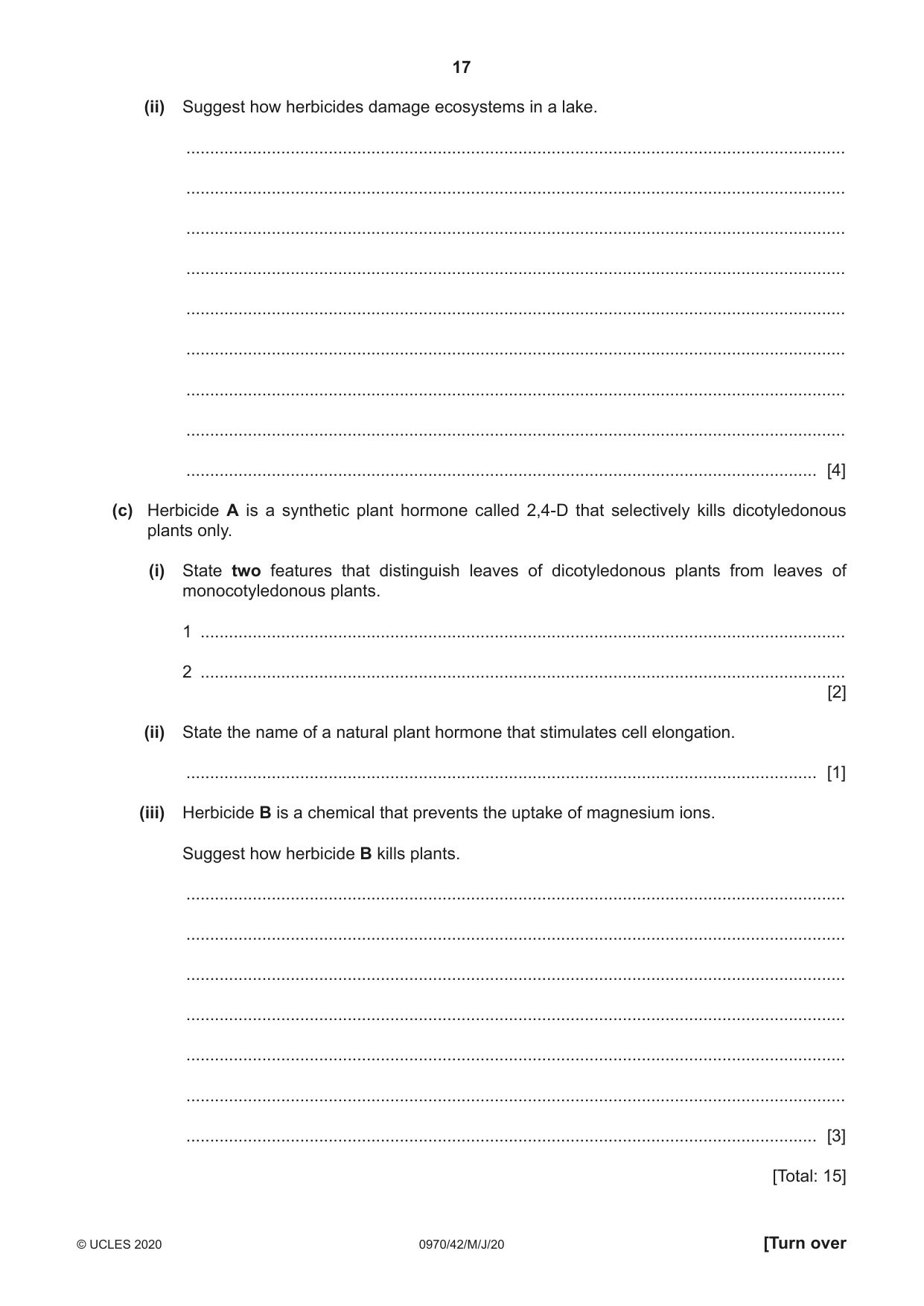
17 0970/42/M/J/20 © UCLES 2020 [Turn over (ii) Suggest how herbicides damage ecosystems in a lake. … … … … … … … … … [4] (c) Herbicide A is a synthetic plant hormone called 2,4-D that selectively kills dicotyledonous plants only. (i) State two features that distinguish leaves of dicotyledonous plants from leaves of monocotyledonous plants. 1 … 2 … [2] (ii) State the name of a natural plant hormone that stimulates cell elongation. … [1] (iii) Herbicide B is a chemical that prevents the uptake of magnesium ions. Suggest how herbicide B kills plants. … … … … … … … [3] [Total: 15]
Question paper, page 18
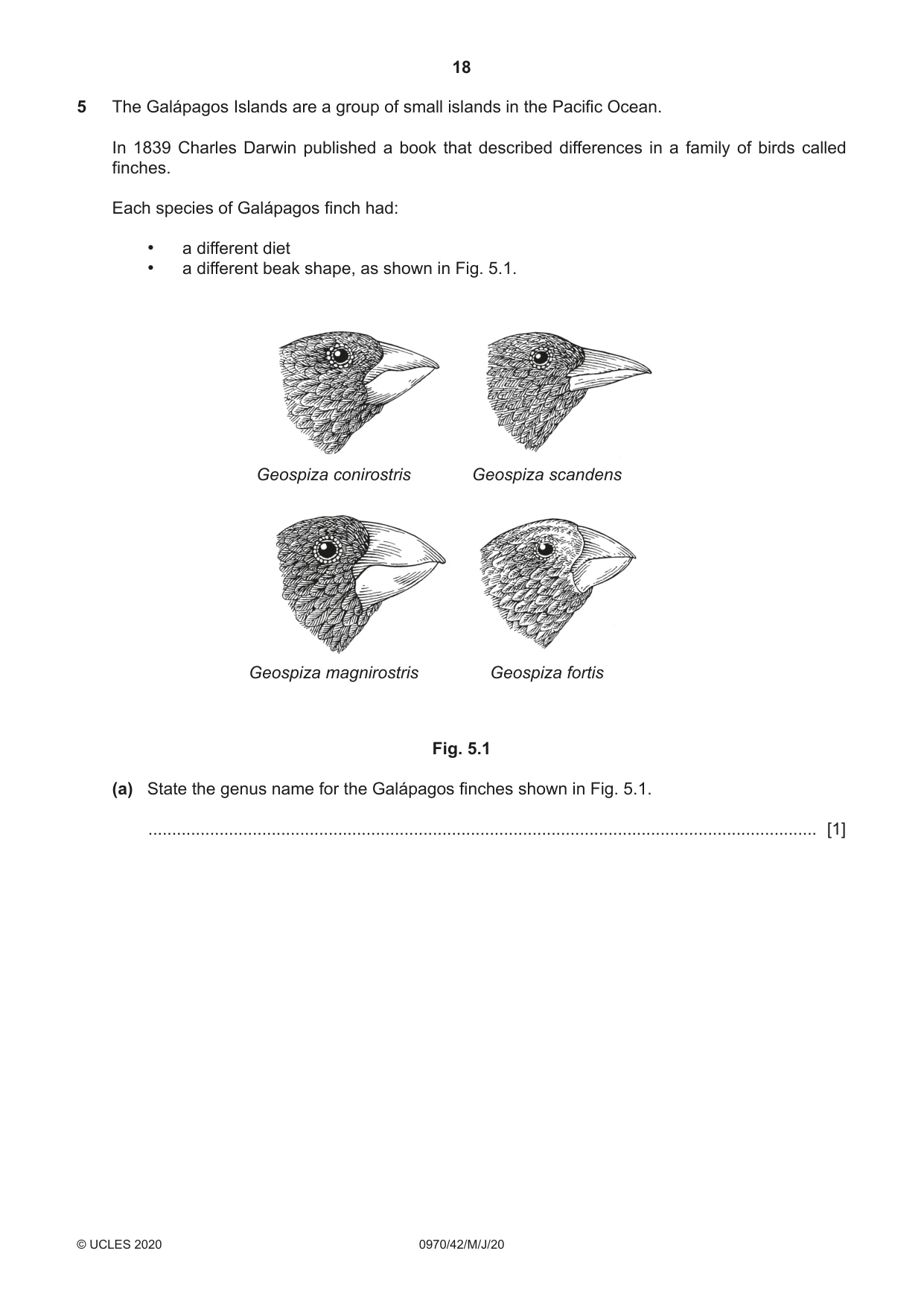
18 0970/42/M/J/20 © UCLES 2020 5 The Galápagos Islands are a group of small islands in the Pacific Ocean. In 1839 Charles Darwin published a book that described differences in a family of birds called finches. Each species of Galápagos finch had: • a different diet • a different beak shape, as shown in Fig. 5.1. Geospiza conirostris Geospiza scandens Geospiza magnirostris Geospiza fortis Fig. 5.1 (a) State the genus name for the Galápagos finches shown in Fig. 5.1. … [1]
Question paper, page 19
19 0970/42/M/J/20 © UCLES 2020 [Turn over (b) Galápagos finches share a common ancestor. Suggest how Galápagos finches have evolved different shaped beaks. … … … … … … … … … … … [5] [Total: 6]
Question paper, page 20
20 0970/42/M/J/20 © UCLES 2020 6 (a) Fig. 6.1 is a diagram showing some parts of a plant. The circle shows a magnified cross-section of part of the stem. not to scale A B C D E F G H M L K J Fig. 6.1 (i) Table 6.1 contains statements about the functions of some of the structures in Fig. 6.1. Complete the table by: • stating the name of the structure • identifying the letter that labels that structure. Table 6.1 function name of structure letter from Fig. 6.1 provides support to the stem protects flower bud produces glucose produces pollen delivers male nuclei to the site of fertilisation [5]
Question paper, page 21
21 0970/42/M/J/20 © UCLES 2020 (ii) State one letter from Fig. 6.1 that identifies a structure that contains a haploid nucleus. … [1] (iii) State the name of the process that describes the transport of sucrose in a plant. … [1] (iv) State one letter from Fig. 6.1 that is a structure that is an example of a source for sucrose transport. … [1] (b) In addition to sucrose, amino acids are also transported in plants. (i) State the name of a mineral ion that becomes part of an amino acid. … [1] (ii) State the name of the structures inside cells that assemble amino acids into proteins. … [1] (iii) State the name of the group of molecules that are made of proteins and act as catalysts. … [1] [Total: 11]
Question paper, page 22
22 0970/42/M/J/20 © UCLES 2020 BLANK PAGE
Question paper, page 23
23 0970/42/M/J/20 © UCLES 2020 BLANK PAGE
Question paper, page 24
24 0970/42/M/J/20 © UCLES 2020 Permission to reproduce items where third-party owned material protected by copyright is included has been sought and cleared where possible. Every reasonable effort has been made by the publisher (UCLES) to trace copyright holders, but if any items requiring clearance have unwittingly been included, the publisher will be pleased to make amends at the earliest possible opportunity. To avoid the issue of disclosure of answer-related information to candidates, all copyright acknowledgements are reproduced online in the Cambridge Assessment International Education Copyright Acknowledgements Booklet. This is produced for each series of examinations and is freely available to download at www.cambridgeinternational.org after the live examination series. Cambridge Assessment International Education is part of the Cambridge Assessment Group. Cambridge Assessment is the brand name of the University of Cambridge Local Examinations Syndicate (UCLES), which itself is a department of the University of Cambridge. BLANK PAGE
Mark scheme, page 1
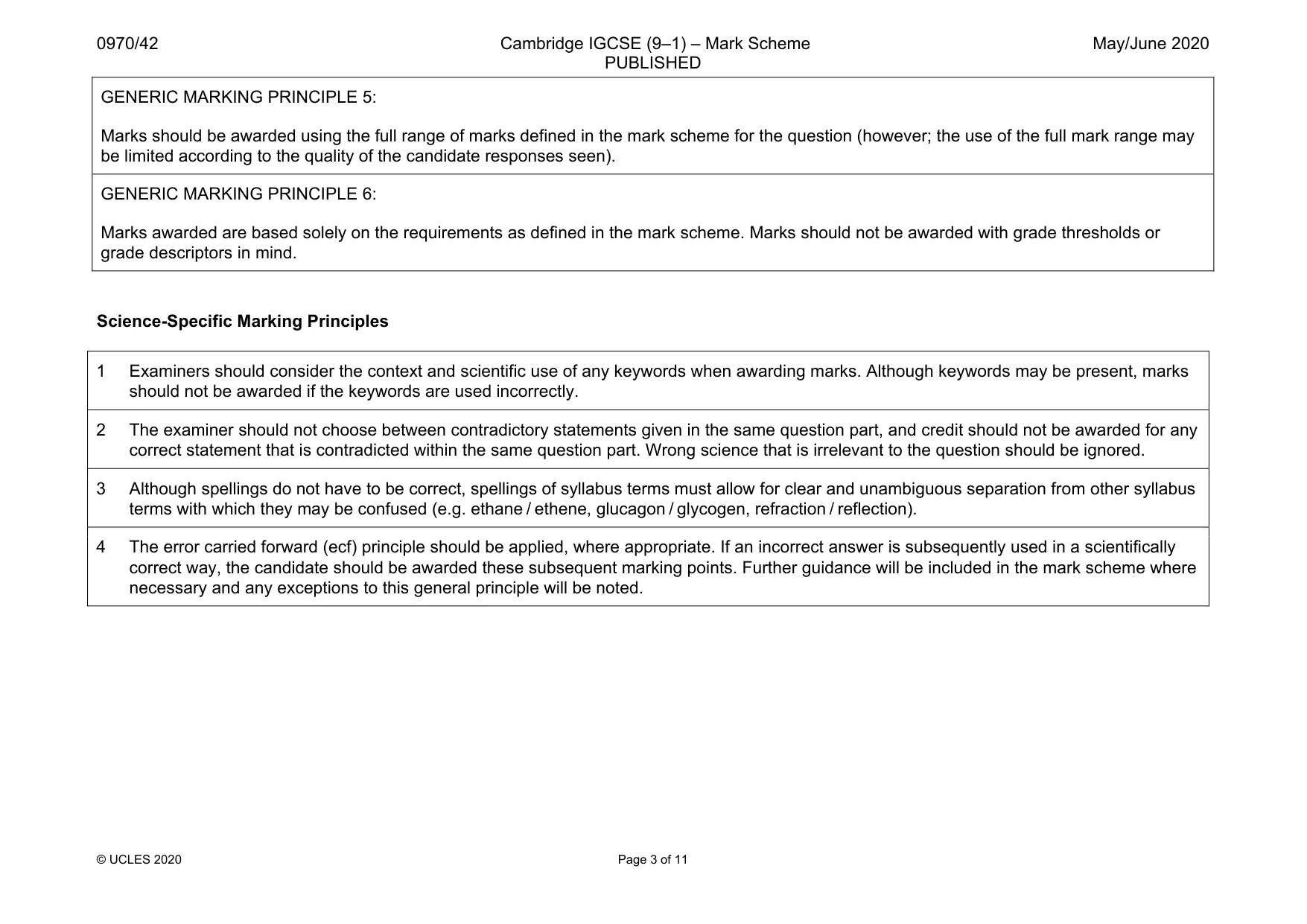
This document consists of 11 printed pages. © UCLES 2020 [Turn over Cambridge IGCSE™ (9–1) BIOLOGY (9–1) 0970/42 Paper 4 Theory (Extended) May/June 2020 MARK SCHEME Maximum Mark: 80 Published Students did not sit exam papers in the June 2020 series due to the Covid-19 global pandemic. This mark scheme is published to support teachers and students and should be read together with the question paper. It shows the requirements of the exam. The answer column of the mark scheme shows the proposed basis on which Examiners would award marks for this exam. Where appropriate, this column also provides the most likely acceptable alternative responses expected from students. Examiners usually review the mark scheme after they have seen student responses and update the mark scheme if appropriate. In the June series, Examiners were unable to consider the acceptability of alternative responses, as there were no student responses to consider. Mark schemes should usually be read together with the Principal Examiner Report for Teachers. However, because students did not sit exam papers, there is no Principal Examiner Report for Teachers for the June 2020 series. Cambridge International will not enter into discussions about these mark schemes. Cambridge International is publishing the mark schemes for the June 2020 series for most Cambridge IGCSE™ and Cambridge International A & AS Level components, and some Cambridge O Level components.
Mark scheme, page 2
0970/42 Cambridge IGCSE (9–1) – Mark Scheme PUBLISHED May/June 2020 © UCLES 2020 Page 2 of 11 Generic Marking Principles These general marking principles must be applied by all examiners when marking candidate answers. They should be applied alongside the specific content of the mark scheme or generic level descriptors for a question. Each question paper and mark scheme will also comply with these marking principles. GENERIC MARKING PRINCIPLE 1: Marks must be awarded in line with: • the specific content of the mark scheme or the generic level descriptors for the question • the specific skills defined in the mark scheme or in the generic level descriptors for the question • the standard of response required by a candidate as exemplified by the standardisation scripts. GENERIC MARKING PRINCIPLE 2: Marks awarded are always whole marks (not half marks, or other fractions). GENERIC MARKING PRINCIPLE 3: Marks must be awarded positively: • marks are awarded for correct/valid answers, as defined in the mark scheme. However, credit is given for valid answers which go beyond the scope of the syllabus and mark scheme, referring to your Team Leader as appropriate • marks are awarded when candidates clearly demonstrate what they know and can do • marks are not deducted for errors • marks are not deducted for omissions • answers should only be judged on the quality of spelling, punctuation and grammar when these features are specifically assessed by the question as indicated by the mark scheme. The meaning, however, should be unambiguous. GENERIC MARKING PRINCIPLE 4: Rules must be applied consistently e.g. in situations where candidates have not followed instructions or in the application of generic level descriptors.
Mark scheme, page 3
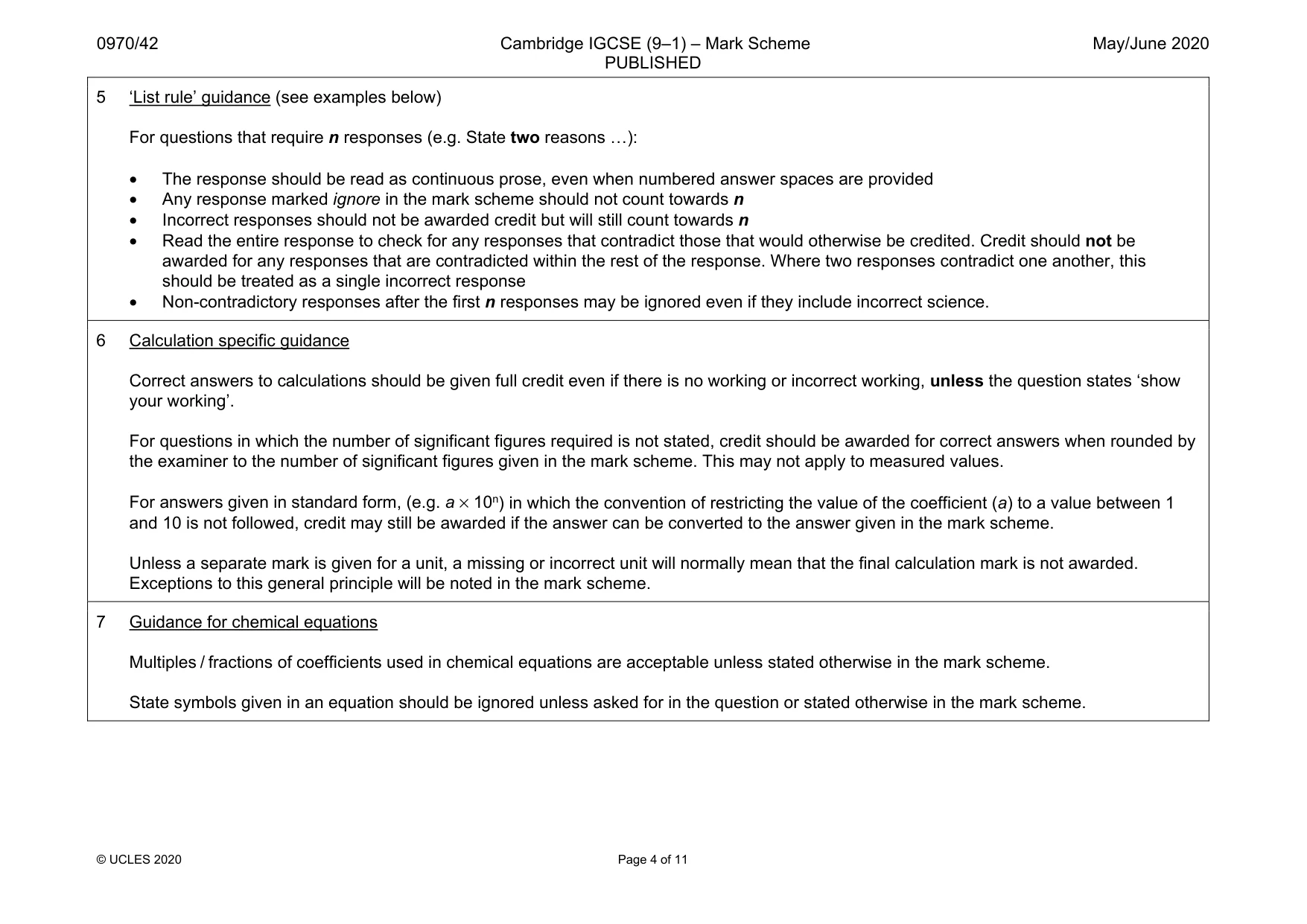
0970/42 Cambridge IGCSE (9–1) – Mark Scheme PUBLISHED May/June 2020 © UCLES 2020 Page 3 of 11 GENERIC MARKING PRINCIPLE 5: Marks should be awarded using the full range of marks defined in the mark scheme for the question (however; the use of the full mark range may be limited according to the quality of the candidate responses seen). GENERIC MARKING PRINCIPLE 6: Marks awarded are based solely on the requirements as defined in the mark scheme. Marks should not be awarded with grade thresholds or grade descriptors in mind. Science-Specific Marking Principles 1 Examiners should consider the context and scientific use of any keywords when awarding marks. Although keywords may be present, marks should not be awarded if the keywords are used incorrectly. 2 The examiner should not choose between contradictory statements given in the same question part, and credit should not be awarded for any correct statement that is contradicted within the same question part. Wrong science that is irrelevant to the question should be ignored. 3 Although spellings do not have to be correct, spellings of syllabus terms must allow for clear and unambiguous separation from other syllabus terms with which they may be confused (e.g. ethane / ethene, glucagon / glycogen, refraction / reflection). 4 The error carried forward (ecf) principle should be applied, where appropriate. If an incorrect answer is subsequently used in a scientifically correct way, the candidate should be awarded these subsequent marking points. Further guidance will be included in the mark scheme where necessary and any exceptions to this general principle will be noted.
Mark scheme, page 4
0970/42 Cambridge IGCSE (9–1) – Mark Scheme PUBLISHED May/June 2020 © UCLES 2020 Page 4 of 11 5 ‘List rule’ guidance (see examples below) For questions that require n responses (e.g. State two reasons …): • The response should be read as continuous prose, even when numbered answer spaces are provided • Any response marked ignore in the mark scheme should not count towards n • Incorrect responses should not be awarded credit but will still count towards n • Read the entire response to check for any responses that contradict those that would otherwise be credited. Credit should not be awarded for any responses that are contradicted within the rest of the response. Where two responses contradict one another, this should be treated as a single incorrect response • Non-contradictory responses after the first n responses may be ignored even if they include incorrect science. 6 Calculation specific guidance Correct answers to calculations should be given full credit even if there is no working or incorrect working, unless the question states ‘show your working’. For questions in which the number of significant figures required is not stated, credit should be awarded for correct answers when rounded by the examiner to the number of significant figures given in the mark scheme. This may not apply to measured values. For answers given in standard form, (e.g. a × 10n) in which the convention of restricting the value of the coefficient (a) to a value between 1 and 10 is not followed, credit may still be awarded if the answer can be converted to the answer given in the mark scheme. Unless a separate mark is given for a unit, a missing or incorrect unit will normally mean that the final calculation mark is not awarded. Exceptions to this general principle will be noted in the mark scheme. 7 Guidance for chemical equations Multiples / fractions of coefficients used in chemical equations are acceptable unless stated otherwise in the mark scheme. State symbols given in an equation should be ignored unless asked for in the question or stated otherwise in the mark scheme.
Mark scheme, page 5
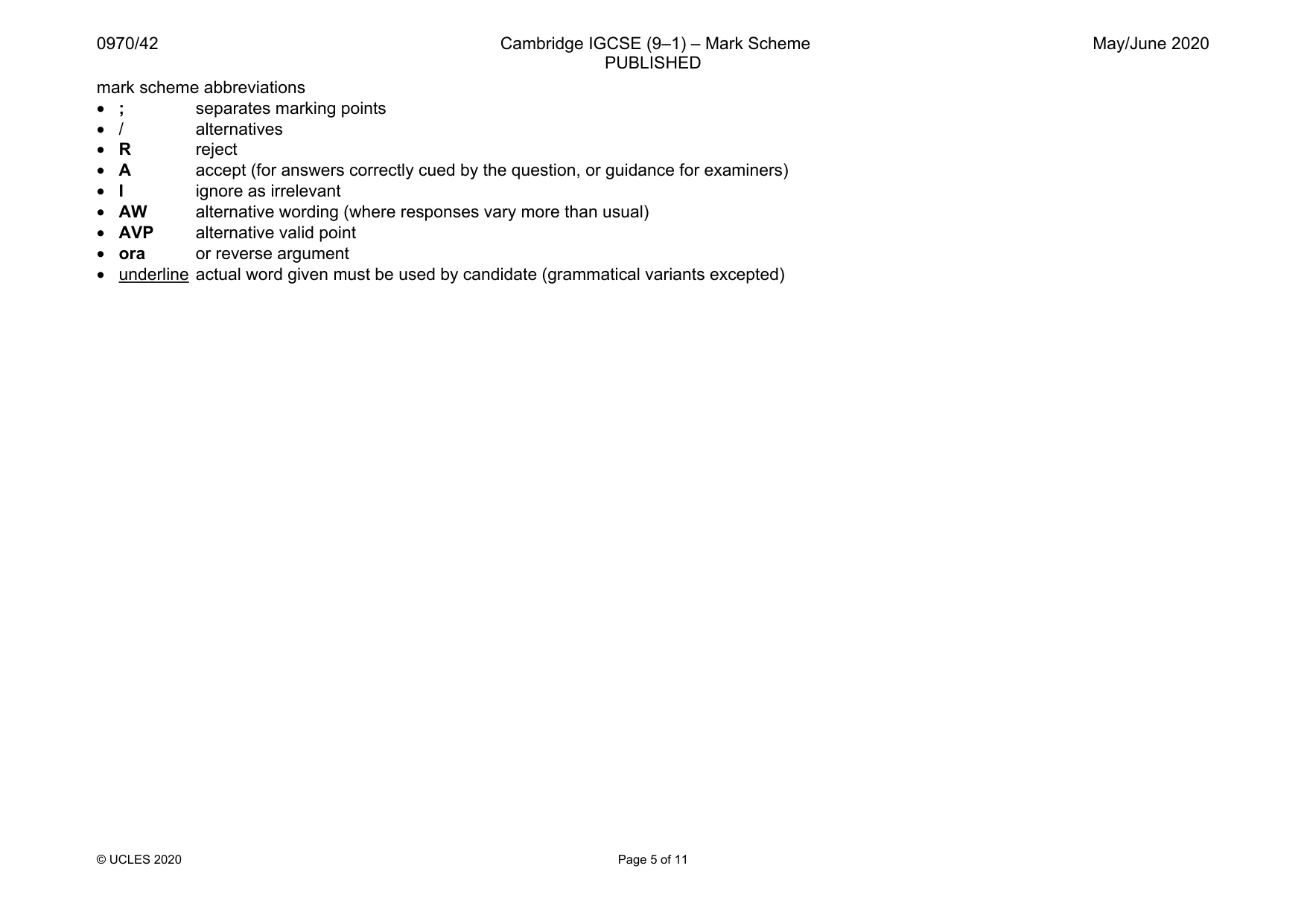
0970/42 Cambridge IGCSE (9–1) – Mark Scheme PUBLISHED May/June 2020 © UCLES 2020 Page 5 of 11 mark scheme abbreviations • ; separates marking points • / alternatives • R reject • A accept (for answers correctly cued by the question, or guidance for examiners) • I ignore as irrelevant • AW alternative wording (where responses vary more than usual) • AVP alternative valid point • ora or reverse argument • underline actual word given must be used by candidate (grammatical variants excepted)
Mark scheme, page 6
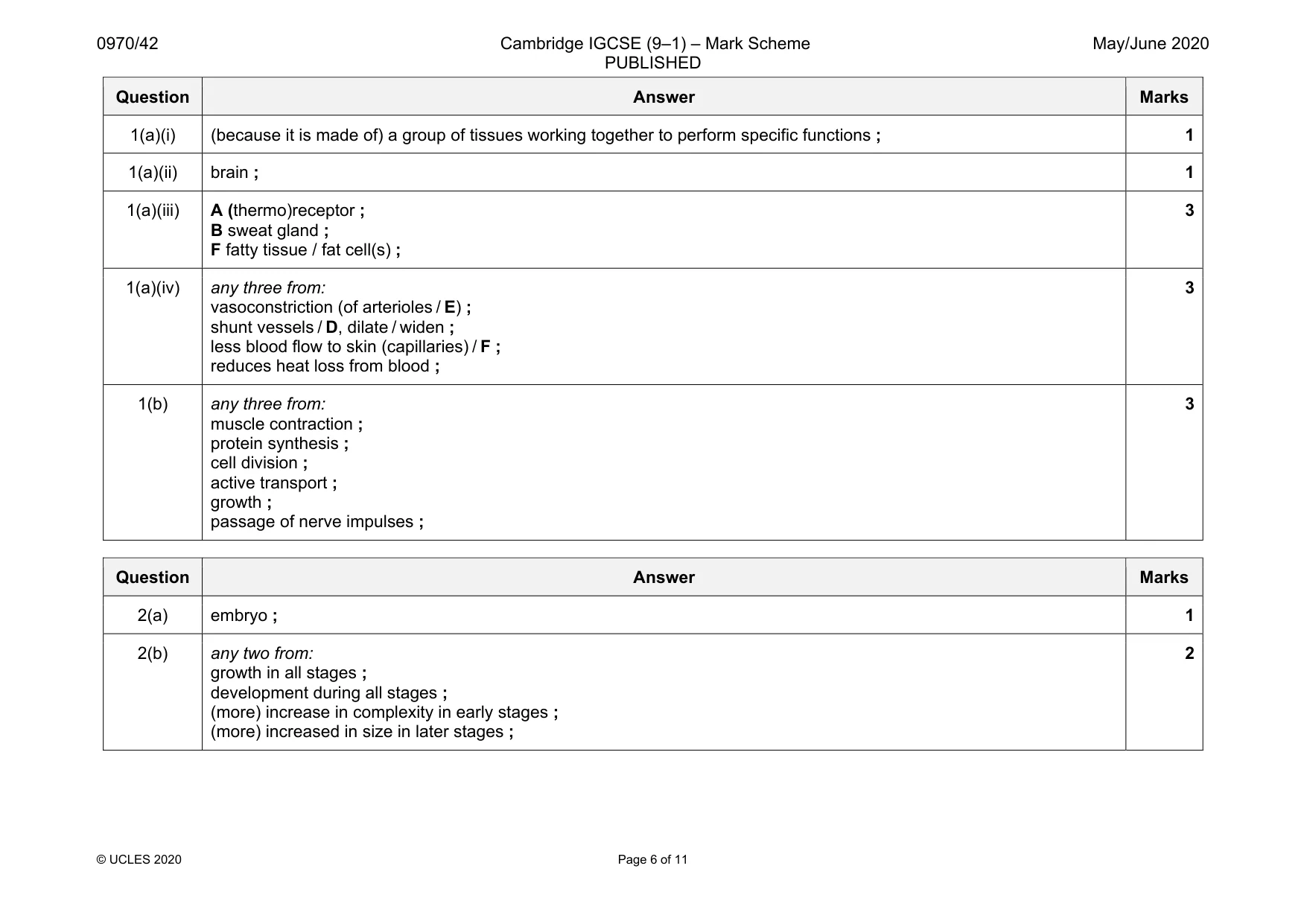
0970/42 Cambridge IGCSE (9–1) – Mark Scheme PUBLISHED May/June 2020 © UCLES 2020 Page 6 of 11 Question Answer Marks 1(a)(i) (because it is made of) a group of tissues working together to perform specific functions ; 1 1(a)(ii) brain ; 1 1(a)(iii) A (thermo)receptor ; B sweat gland ; F fatty tissue / fat cell(s) ; 3 1(a)(iv) any three from: vasoconstriction (of arterioles / E) ; shunt vessels / D, dilate / widen ; less blood flow to skin (capillaries) / F ; reduces heat loss from blood ; 3 1(b) any three from: muscle contraction ; protein synthesis ; cell division ; active transport ; growth ; passage of nerve impulses ; 3 Question Answer Marks 2(a) embryo ; 1 2(b) any two from: growth in all stages ; development during all stages ; (more) increase in complexity in early stages ; (more) increased in size in later stages ; 2
Mark scheme, page 7
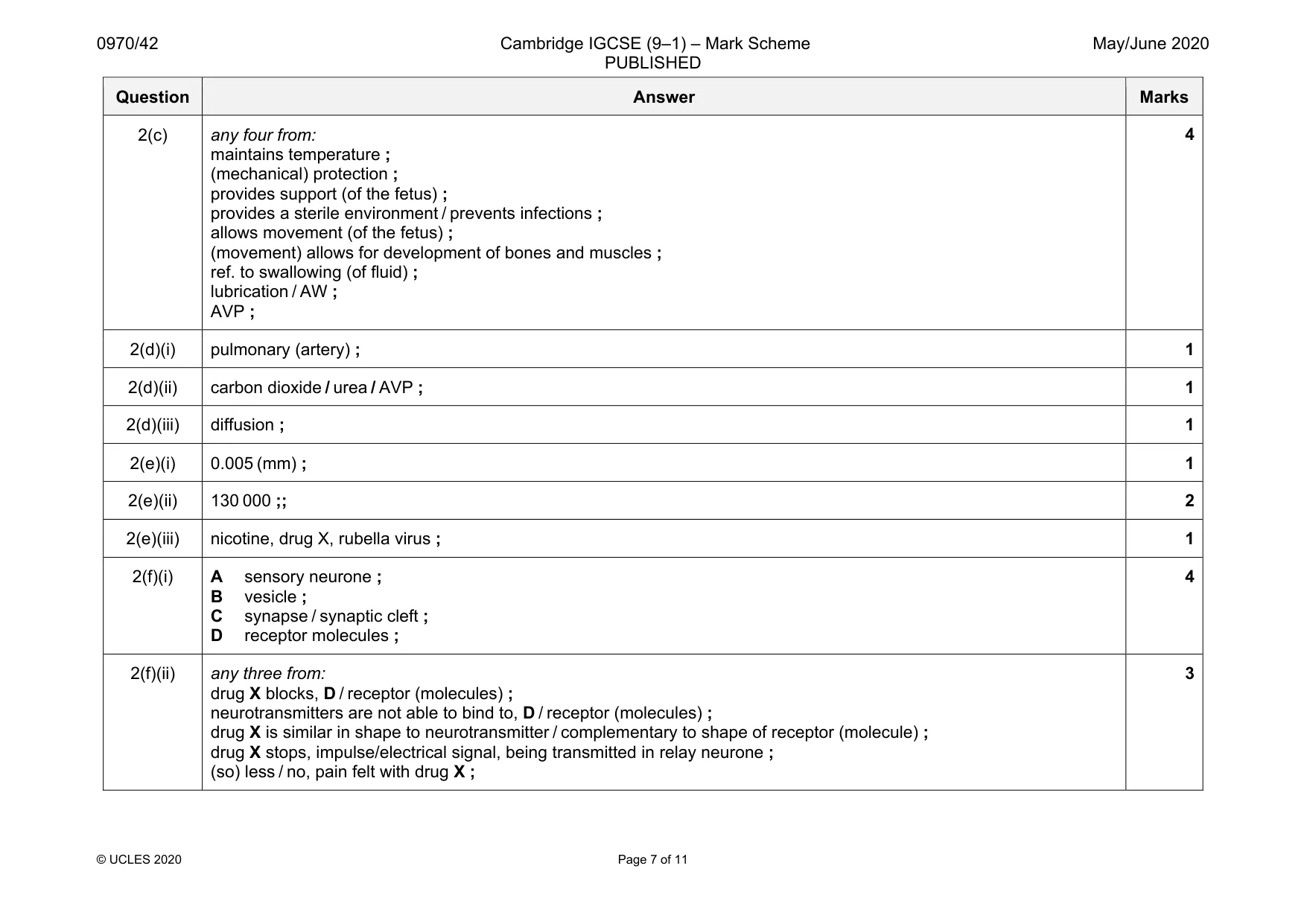
0970/42 Cambridge IGCSE (9–1) – Mark Scheme PUBLISHED May/June 2020 © UCLES 2020 Page 7 of 11 Question Answer Marks 2(c) any four from: maintains temperature ; (mechanical) protection ; provides support (of the fetus) ; provides a sterile environment / prevents infections ; allows movement (of the fetus) ; (movement) allows for development of bones and muscles ; ref. to swallowing (of fluid) ; lubrication / AW ; AVP ; 4 2(d)(i) pulmonary (artery) ; 1 2(d)(ii) carbon dioxide / urea / AVP ; 1 2(d)(iii) diffusion ; 1 2(e)(i) 0.005 (mm) ; 1 2(e)(ii) 130 000 ;; 2 2(e)(iii) nicotine, drug X, rubella virus ; 1 2(f)(i) A sensory neurone ; B vesicle ; C synapse / synaptic cleft ; D receptor molecules ; 4 2(f)(ii) any three from: drug X blocks, D / receptor (molecules) ; neurotransmitters are not able to bind to, D / receptor (molecules) ; drug X is similar in shape to neurotransmitter / complementary to shape of receptor (molecule) ; drug X stops, impulse/electrical signal, being transmitted in relay neurone ; (so) less / no, pain felt with drug X ; 3
Mark scheme, page 8
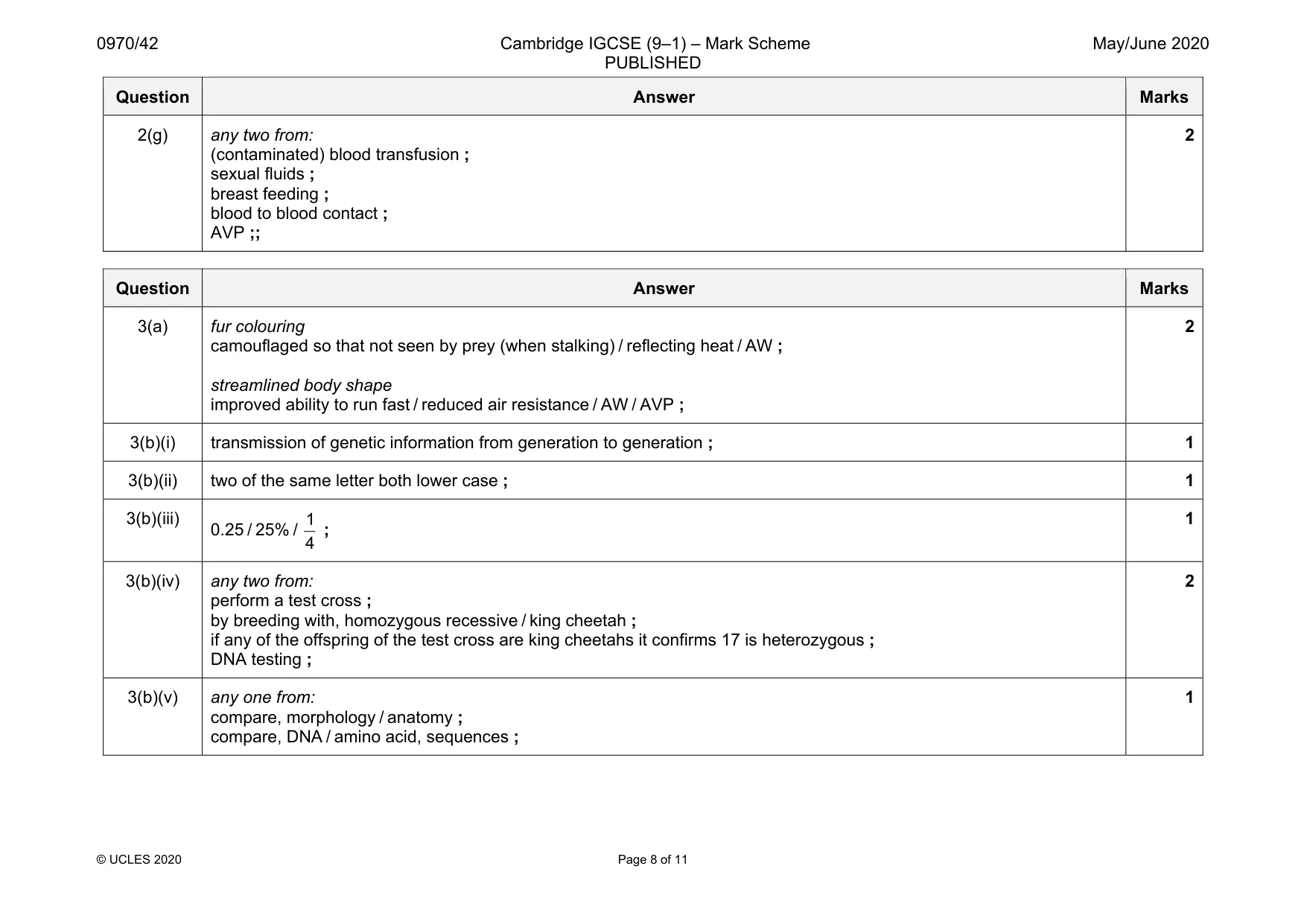
0970/42 Cambridge IGCSE (9–1) – Mark Scheme PUBLISHED May/June 2020 © UCLES 2020 Page 8 of 11 Question Answer Marks 2(g) any two from: (contaminated) blood transfusion ; sexual fluids ; breast feeding ; blood to blood contact ; AVP ;; 2 Question Answer Marks 3(a) fur colouring camouflaged so that not seen by prey (when stalking) / reflecting heat / AW ; streamlined body shape improved ability to run fast / reduced air resistance / AW / AVP ; 2 3(b)(i) transmission of genetic information from generation to generation ; 1 3(b)(ii) two of the same letter both lower case ; 1 3(b)(iii) 0.25 / 25% / 1 4 ; 1 3(b)(iv) any two from: perform a test cross ; by breeding with, homozygous recessive / king cheetah ; if any of the offspring of the test cross are king cheetahs it confirms 17 is heterozygous ; DNA testing ; 2 3(b)(v) any one from: compare, morphology / anatomy ; compare, DNA / amino acid, sequences ; 1
Mark scheme, page 9
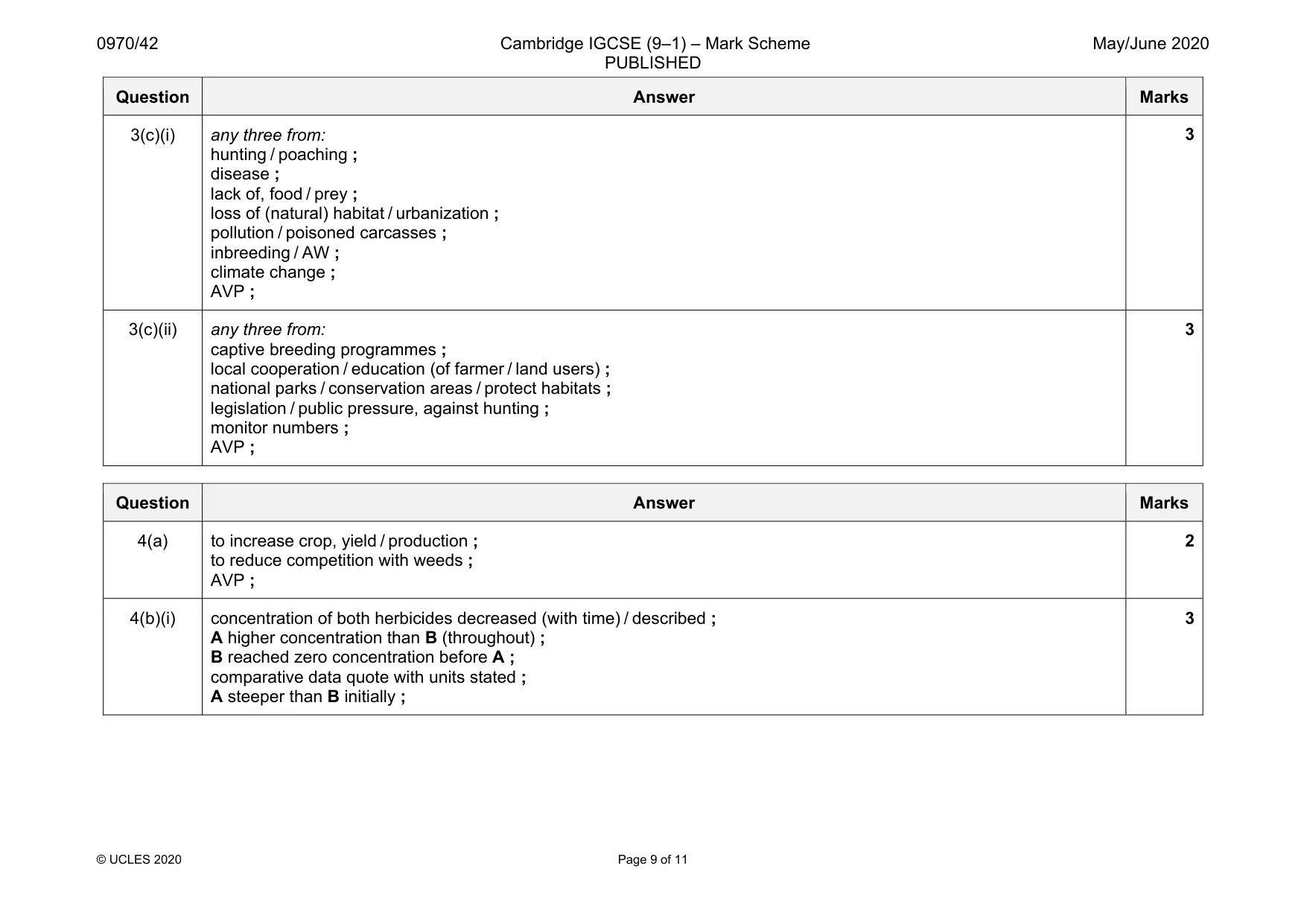
0970/42 Cambridge IGCSE (9–1) – Mark Scheme PUBLISHED May/June 2020 © UCLES 2020 Page 9 of 11 Question Answer Marks 3(c)(i) any three from: hunting / poaching ; disease ; lack of, food / prey ; loss of (natural) habitat / urbanization ; pollution / poisoned carcasses ; inbreeding / AW ; climate change ; AVP ; 3 3(c)(ii) any three from: captive breeding programmes ; local cooperation / education (of farmer / land users) ; national parks / conservation areas / protect habitats ; legislation / public pressure, against hunting ; monitor numbers ; AVP ; 3 Question Answer Marks 4(a) to increase crop, yield / production ; to reduce competition with weeds ; AVP ; 2 4(b)(i) concentration of both herbicides decreased (with time) / described ; A higher concentration than B (throughout) ; B reached zero concentration before A ; comparative data quote with units stated ; A steeper than B initially ; 3
Mark scheme, page 10
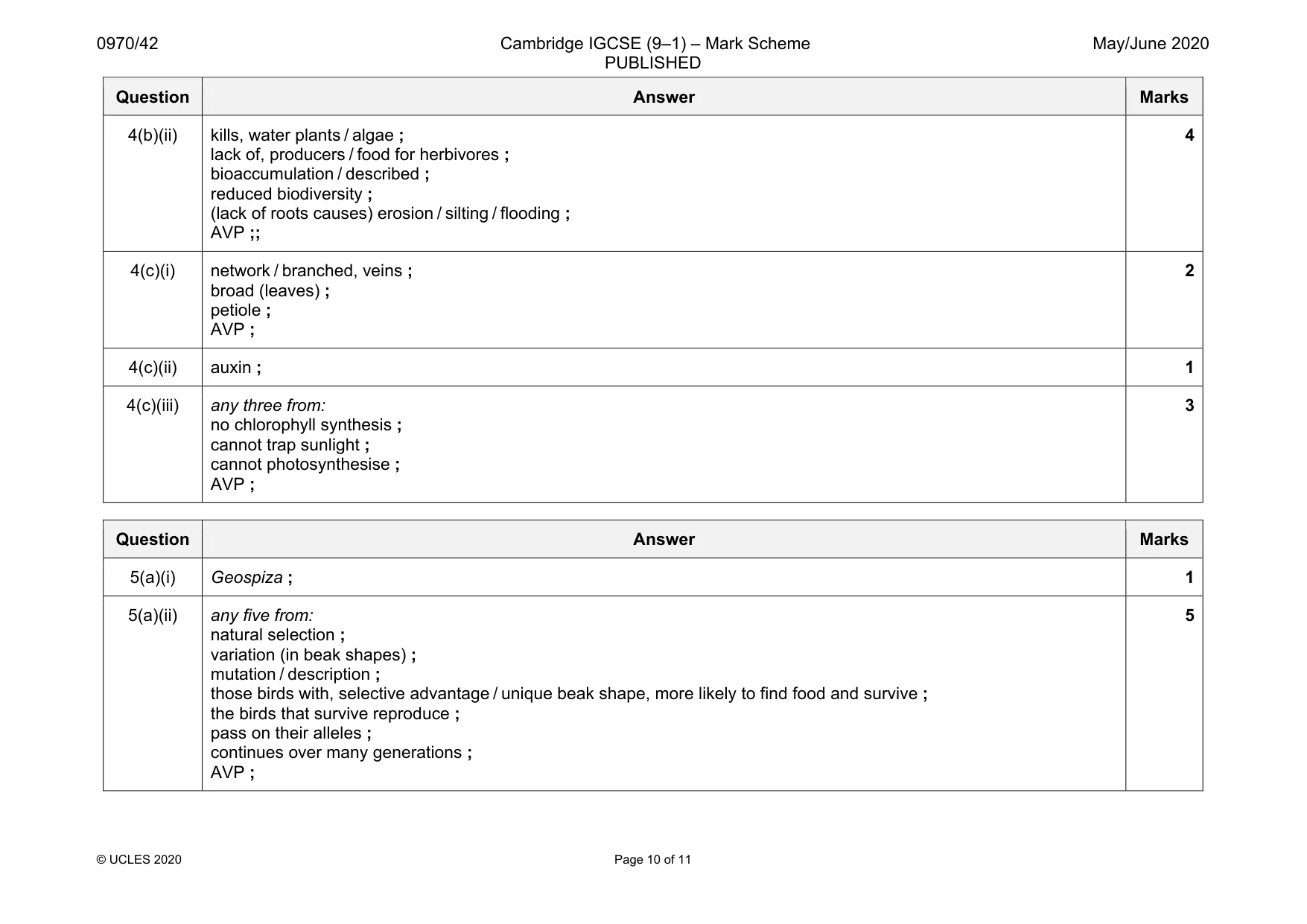
0970/42 Cambridge IGCSE (9–1) – Mark Scheme PUBLISHED May/June 2020 © UCLES 2020 Page 10 of 11 Question Answer Marks 4(b)(ii) kills, water plants / algae ; lack of, producers / food for herbivores ; bioaccumulation / described ; reduced biodiversity ; (lack of roots causes) erosion / silting / flooding ; AVP ;; 4 4(c)(i) network / branched, veins ; broad (leaves) ; petiole ; AVP ; 2 4(c)(ii) auxin ; 1 4(c)(iii) any three from: no chlorophyll synthesis ; cannot trap sunlight ; cannot photosynthesise ; AVP ; 3 Question Answer Marks 5(a)(i) Geospiza ; 1 5(a)(ii) any five from: natural selection ; variation (in beak shapes) ; mutation / description ; those birds with, selective advantage / unique beak shape, more likely to find food and survive ; the birds that survive reproduce ; pass on their alleles ; continues over many generations ; AVP ; 5
Mark scheme, page 11
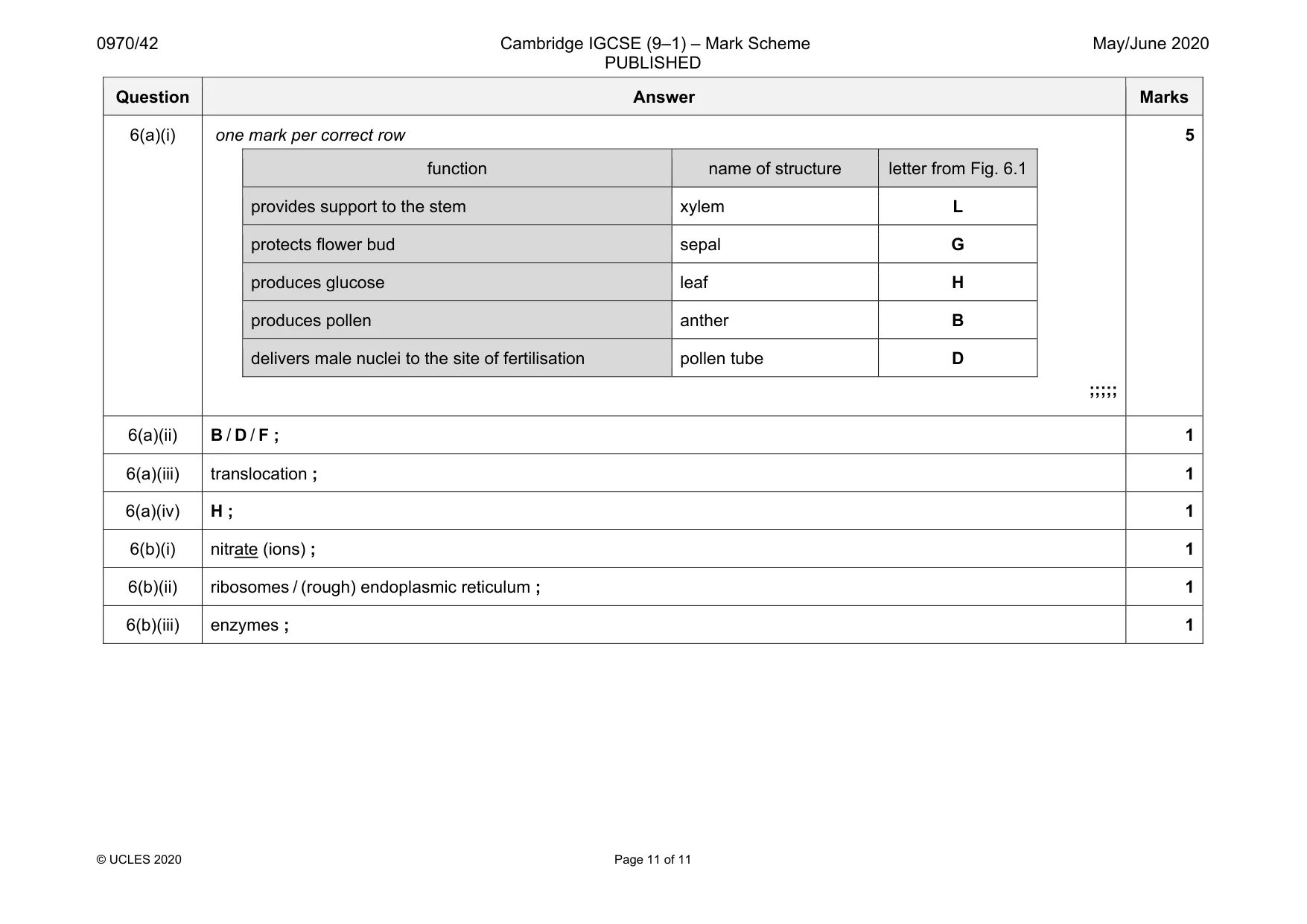
0970/42 Cambridge IGCSE (9–1) – Mark Scheme PUBLISHED May/June 2020 © UCLES 2020 Page 11 of 11 Question Answer Marks 6(a)(i) one mark per correct row ;;;;; function name of structure letter from Fig. 6.1 provides support to the stem xylem L protects flower bud sepal G produces glucose leaf H produces pollen anther B delivers male nuclei to the site of fertilisation pollen tube D 5 6(a)(ii) B / D / F ; 1 6(a)(iii) translocation ; 1 6(a)(iv) H ; 1 6(b)(i) nitrate (ions) ; 1 6(b)(ii) ribosomes / (rough) endoplasmic reticulum ; 1 6(b)(iii) enzymes ; 1