Cambridge IGCSE Biology (9-1) 0970 — 2020 May/June Paper 4 · Variant 1
0970/41/M/J/20 · 6 questions · 80 marks · ≈90 min
The question paper and its mark scheme, free to read here and free to download. This is Cambridge’s own paper, exactly as it was sat.
Question paper20 pages


Mark scheme13 pages
Answers below. Sit the paper first if you are practising.
Questions as text
Q1 · The gas exchange system is one of the organ systems of the human body
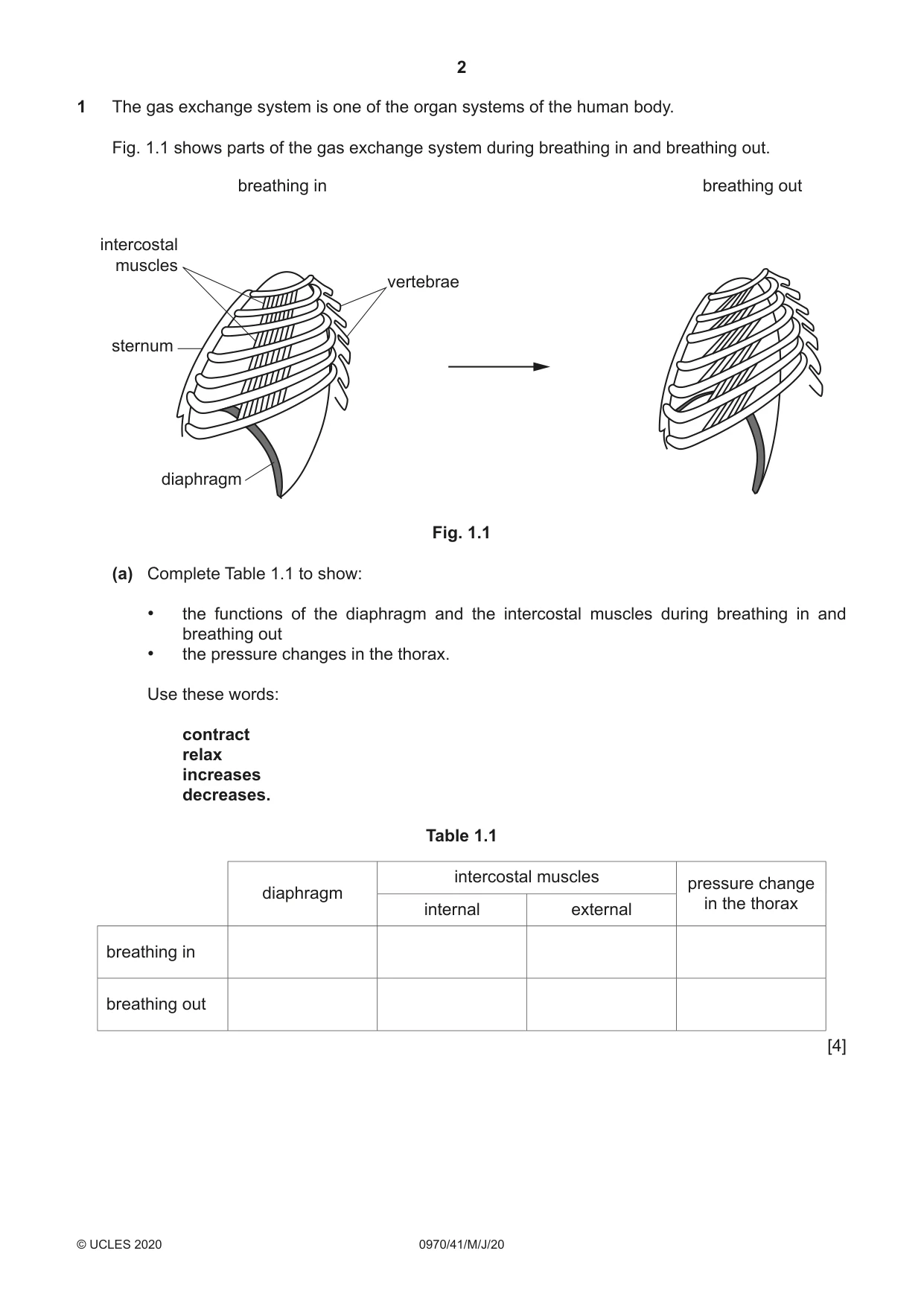
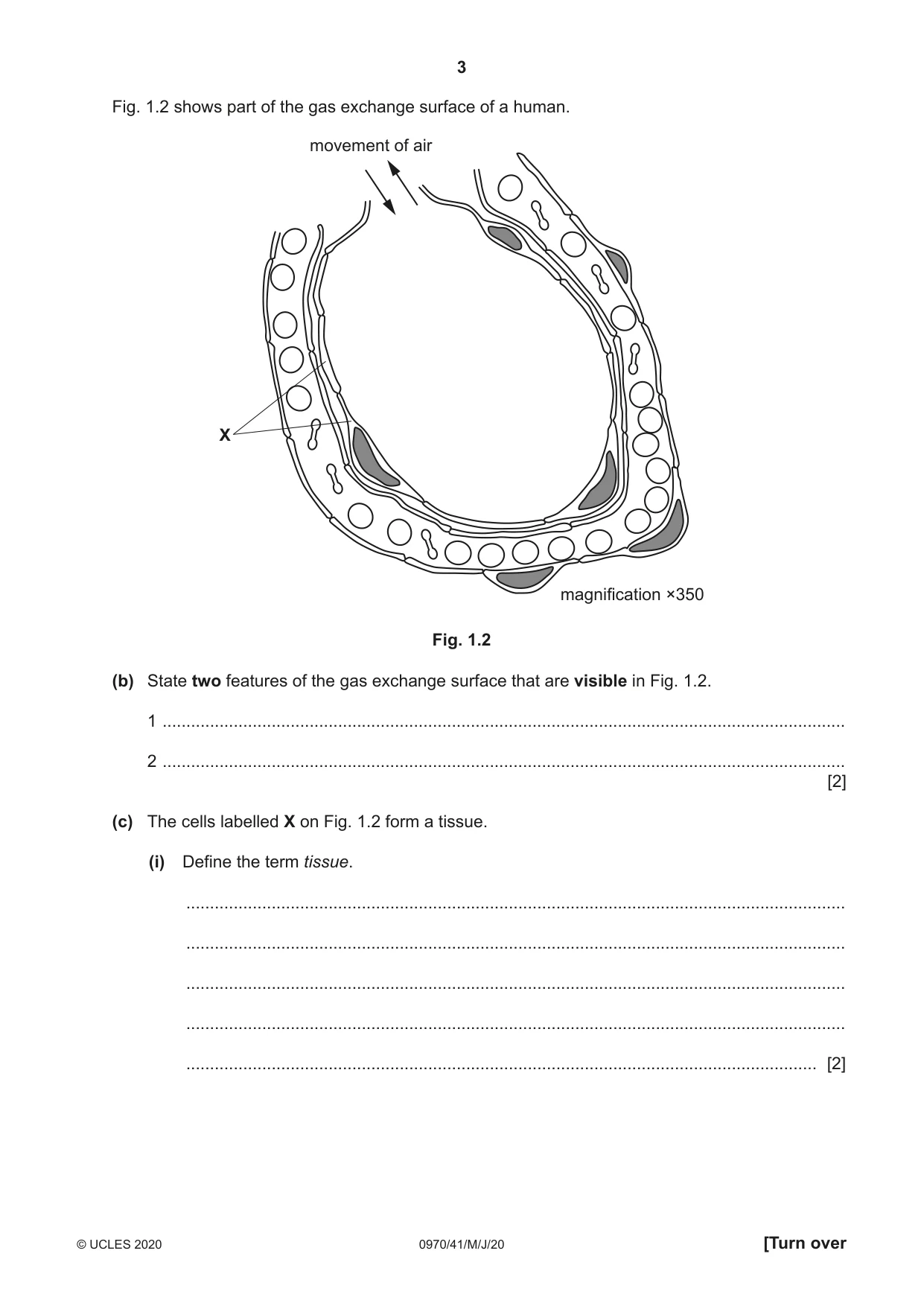
1 The gas exchange system is one of the organ systems of the human body. Fig. 1.1 shows parts of the gas exchange system during breathing in and breathing out. breathing in breathing out intercostal muscles vertebrae sternum diaphragm Fig. 1.1 (a) Complete Table 1.1 to show: • the functions of the diaphragm and the intercostal muscles during breathing in and breathing out • the pressure changes in the thorax. Use these words: contract relax increases decreases. Table 1.1 intercostal muscles pressure change diaphragm in the thorax internal external breathing in breathing out [4] Fig. 1.2 shows part of the gas exchange surface of a human. movement of air X magnification ×350 Fig. 1.2 (b) State two features of the gas exchange surface that are visible in Fig. 1.2. 1 ................................................................................................................................................ 2 ................................................................................................................................................ [2] (c) The cells labelled X on Fig. 1.2 form a tissue. (i) Define the term tissue. ........................................................................................................................................... ........................................................................................................................................... ........................................................................................................................................... ........................................................................................................................................... ..................................................................................................................................... [2] (ii) Cartilage is another tissue found in the gas exchange system. State the functions of cartilage in the gas exchange system. ........................................................................................................................................... ........................................................................................................................................... ........................................................................................................................................... ........................................................................................................................................... ..................................................................................................................................... [2] [Total: 10]
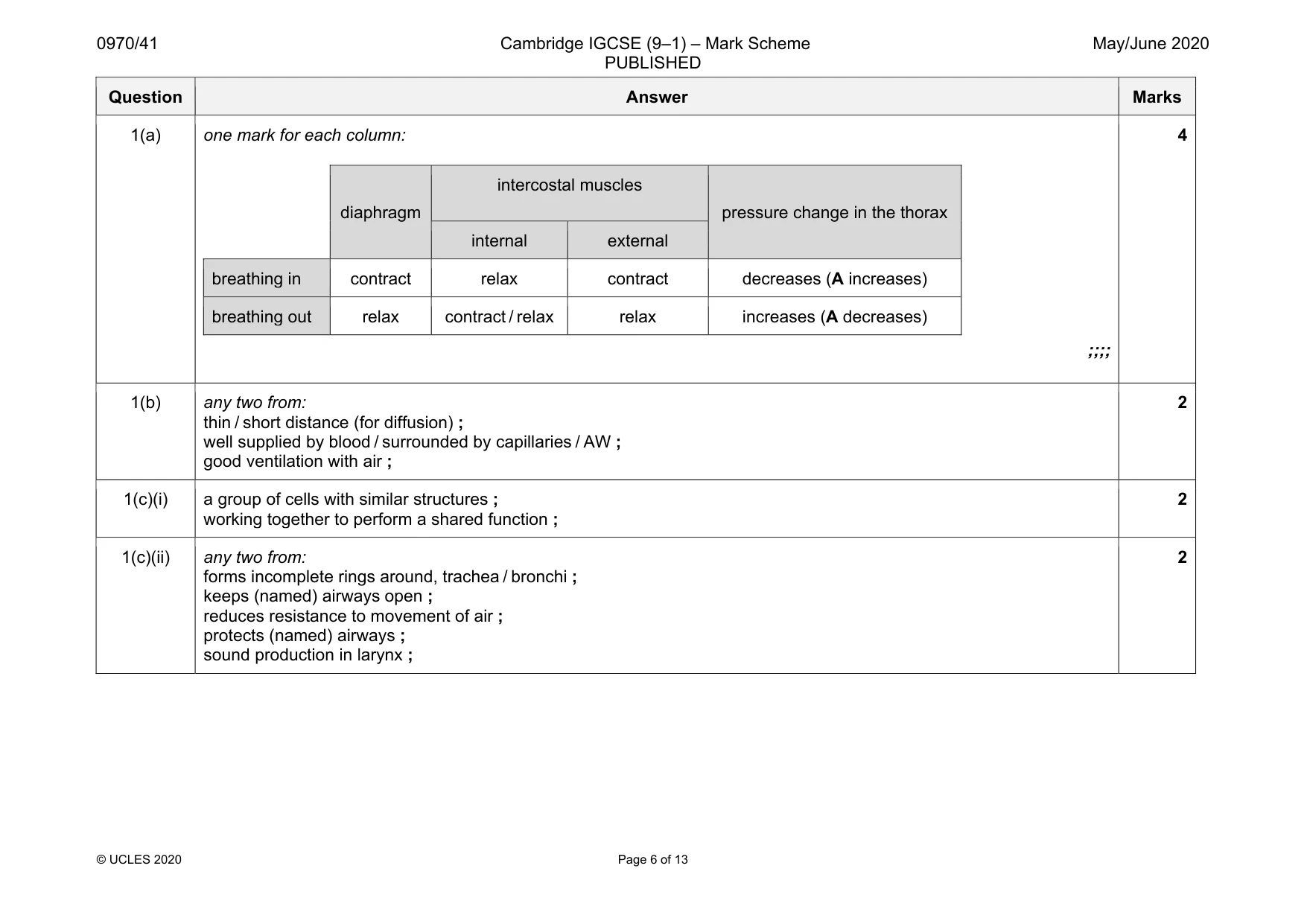
Mark scheme: 1(a) one mark for each column: ;;;; diaphragm intercostal muscles pressure change in the thorax internal external breathing in contract relax contract decreases (A increases) breathing out relax contract / relax relax increases (A decreases) 4 1(b) any two from: thin / short distance (for diffusion) ; well supplied by blood / surrounded by capillaries / AW ; good ventilation with air ; 2 1(c)(i) a group of cells with similar structures ; working together to perform a shared function ; 2 1(c)(ii) any two from: forms incomplete rings around, trachea / bronchi ; keeps (named) airways open ; reduces resistance to movement of air ; protects (named) airways ; sound production in larynx ; 2
Q2 · Biological washing powders contain enzymes that break down food stains
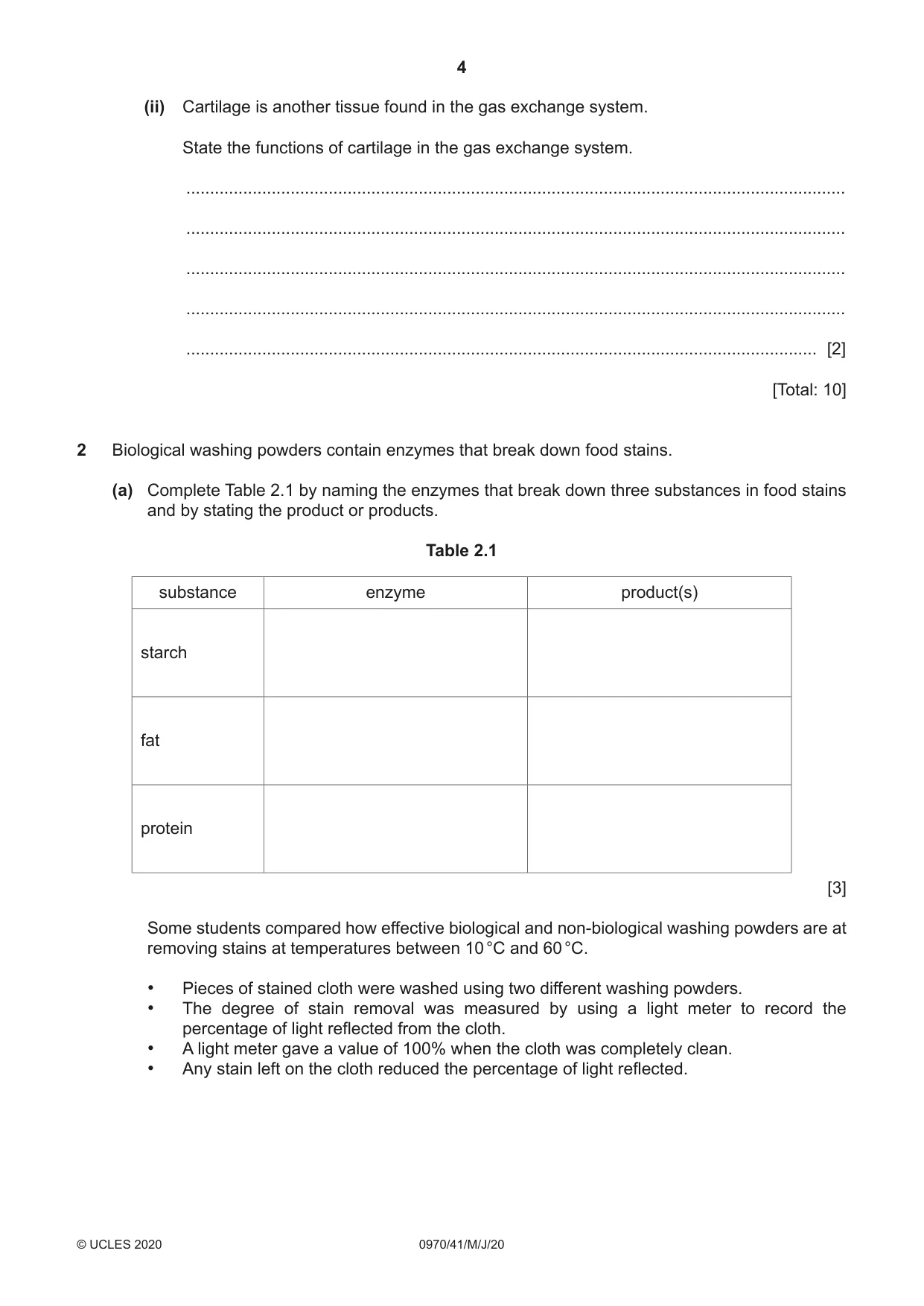
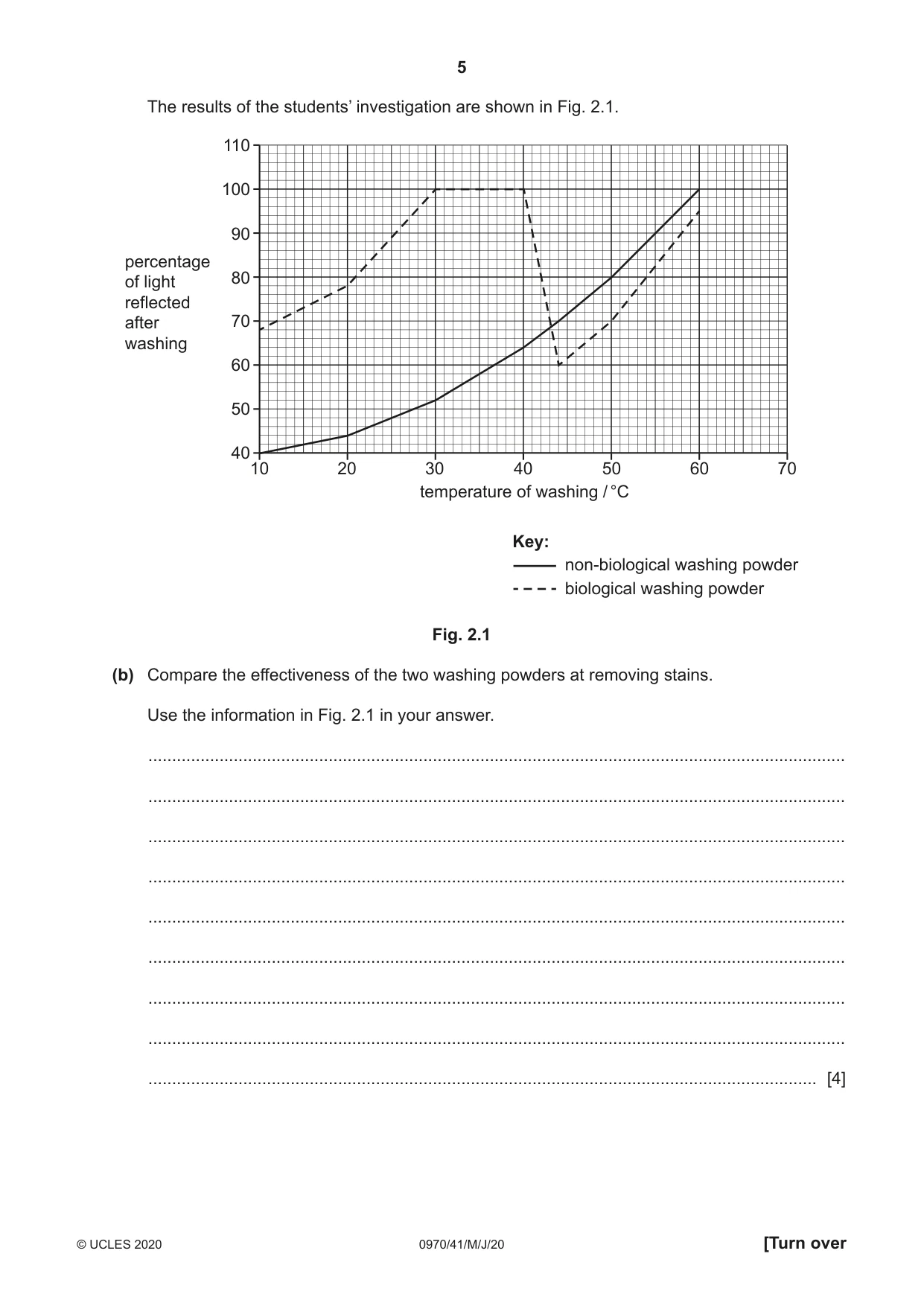
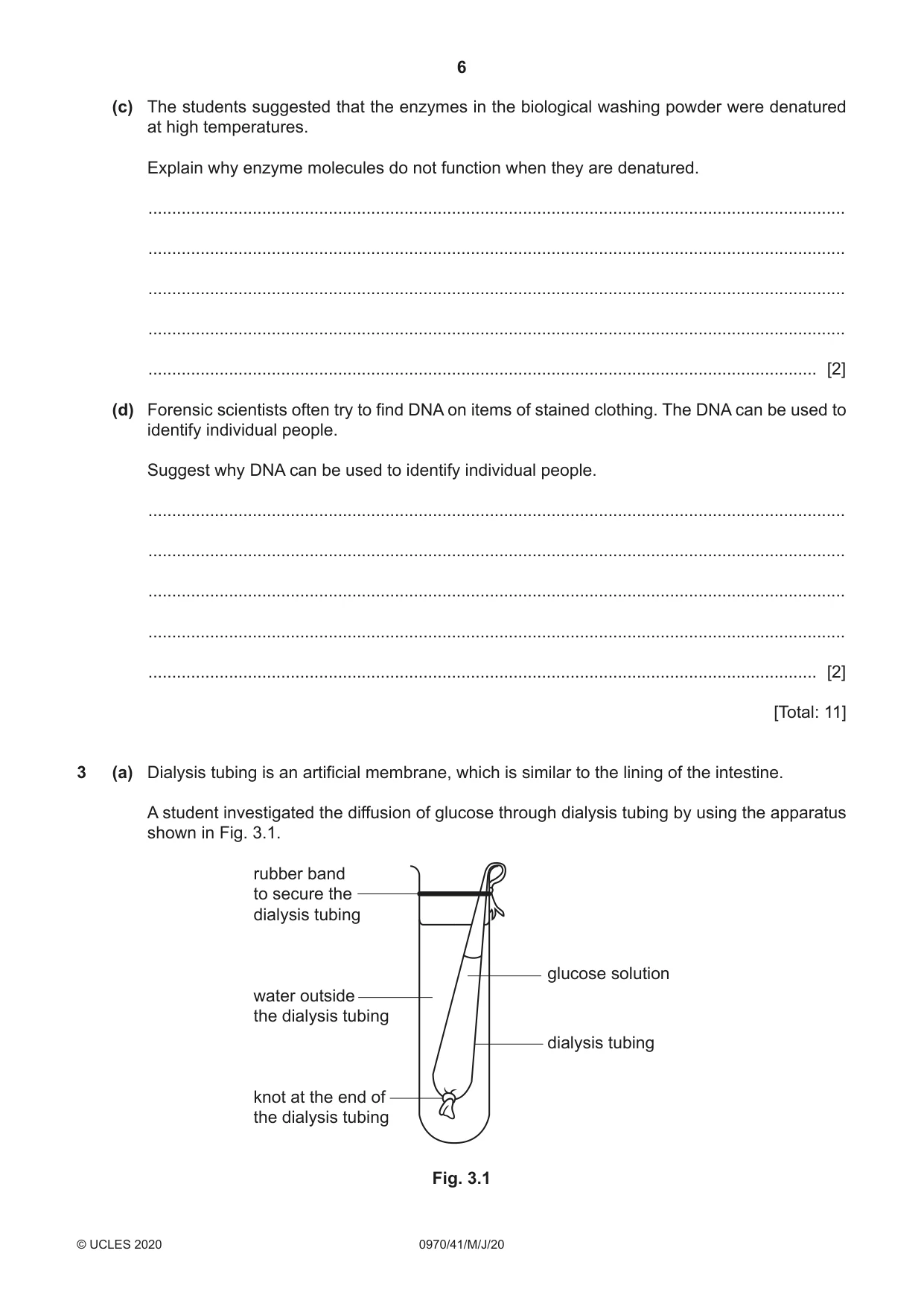
2 Biological washing powders contain enzymes that break down food stains. (a) Complete Table 2.1 by naming the enzymes that break down three substances in food stains and by stating the product or products. Table 2.1 substance enzyme product(s) starch fat protein [3] Some students compared how effective biological and non-biological washing powders are at removing stains at temperatures between 10 °C and 60 °C. • Pieces of stained cloth were washed using two different washing powders. • The degree of stain removal was measured by using a light meter to record the percentage of light reflected from the cloth. • A light meter gave a value of 100% when the cloth was completely clean. • Any stain left on the cloth reduced the percentage of light reflected. The results of the students’ investigation are shown in Fig. 2.1. 110 100 90 percentage of light 80 reflected after 70 washing 60 50 40 10 20 30 40 50 60 70 temperature of washing / °C Key: non-biological washing powder biological washing powder Fig. 2.1 (b) Compare the effectiveness of the two washing powders at removing stains. Use the information in Fig. 2.1 in your answer. ................................................................................................................................................... ................................................................................................................................................... ................................................................................................................................................... ................................................................................................................................................... ................................................................................................................................................... ................................................................................................................................................... ................................................................................................................................................... ................................................................................................................................................... ............................................................................................................................................. [4] (c) The students suggested that the enzymes in the biological washing powder were denatured at high temperatures. Explain why enzyme molecules do not function when they are denatured. ................................................................................................................................................... ................................................................................................................................................... ................................................................................................................................................... ................................................................................................................................................... ............................................................................................................................................. [2] (d) Forensic scientists often try to find DNA on items of stained clothing. The DNA can be used to identify individual people. Suggest why DNA can be used to identify individual people. ................................................................................................................................................... ................................................................................................................................................... ................................................................................................................................................... ................................................................................................................................................... ............................................................................................................................................. [2] [Total: 11]
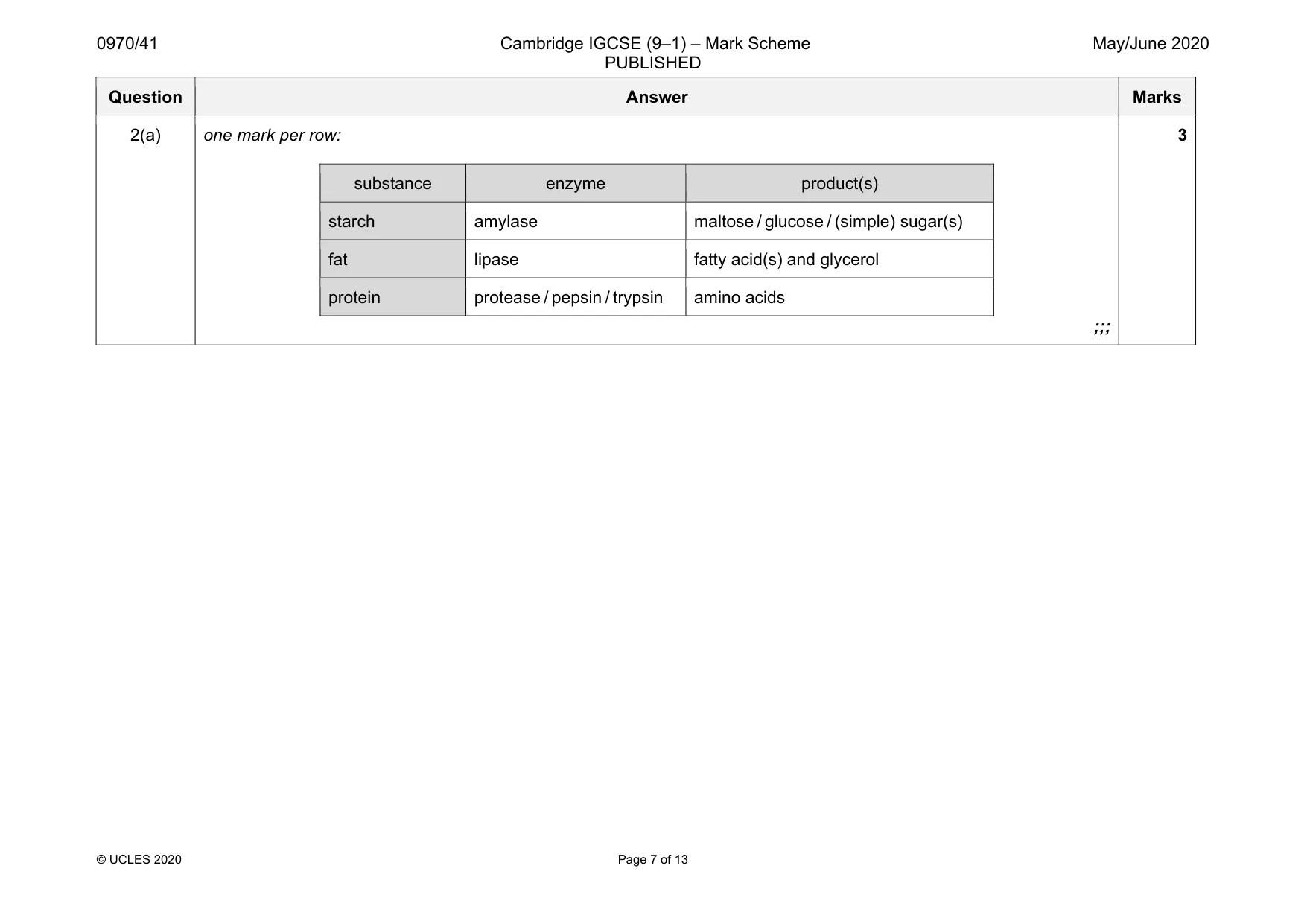
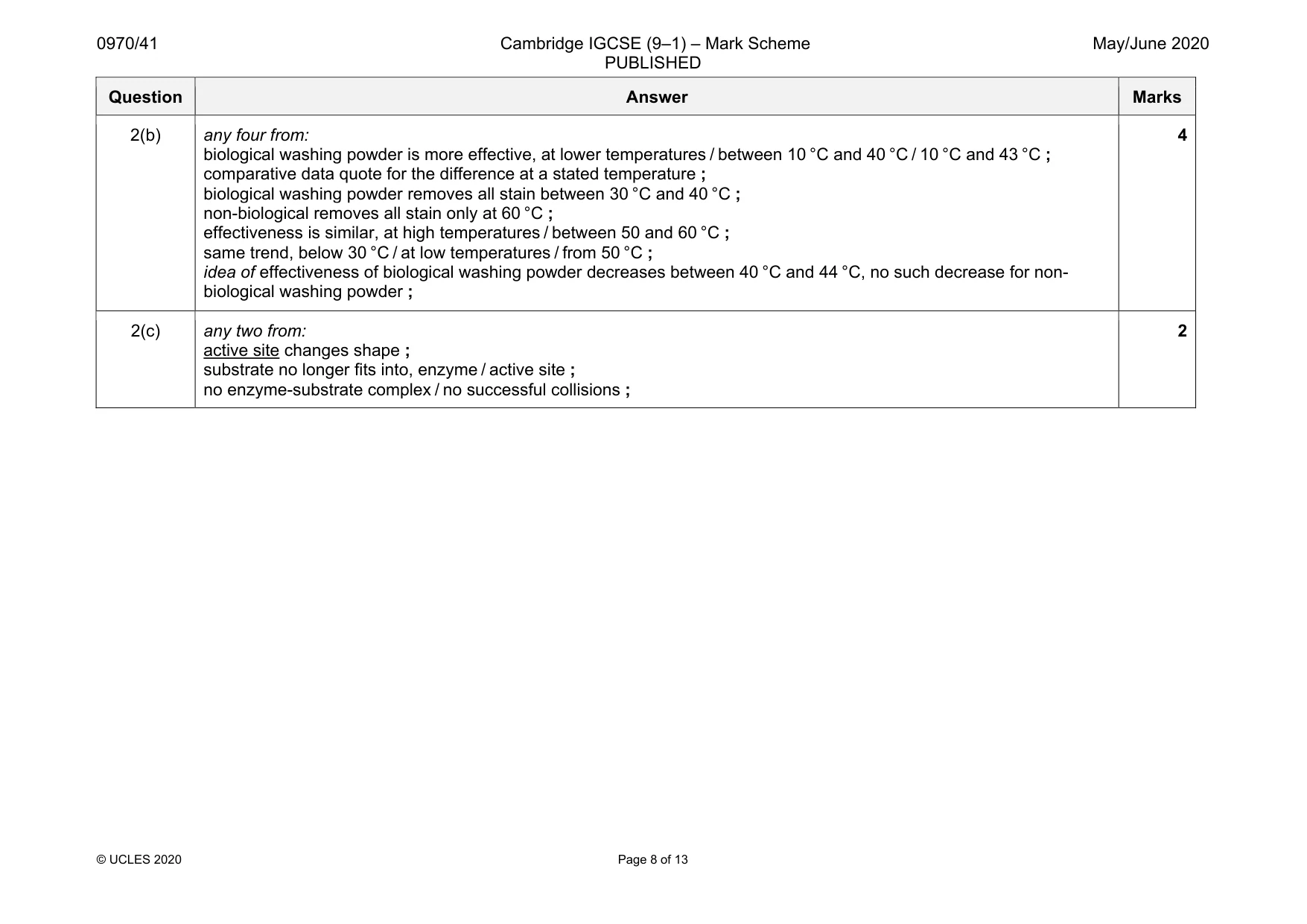
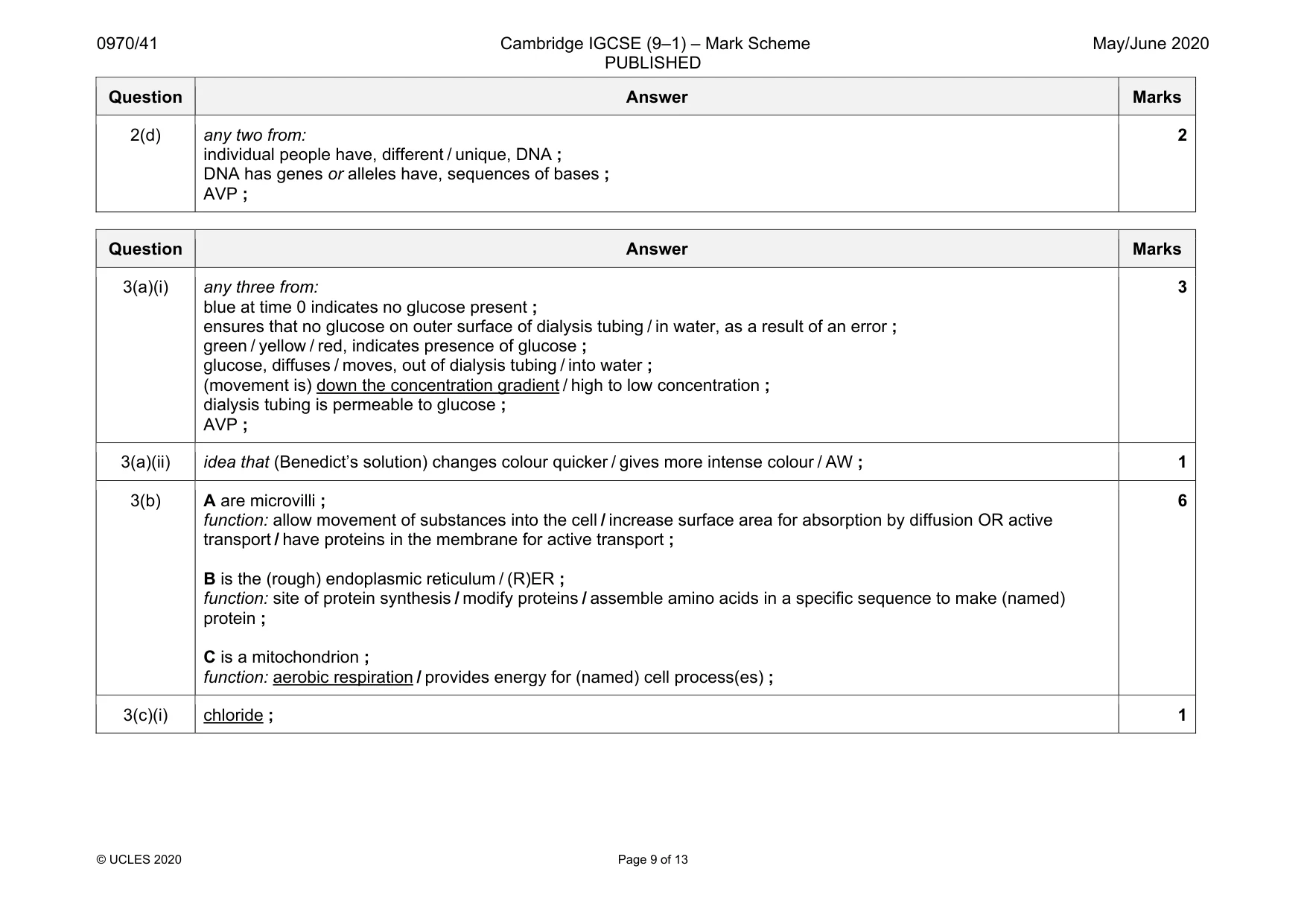
Mark scheme: 2(a) one mark per row: substance enzyme product(s) starch amylase maltose / glucose / (simple) sugar(s) fat lipase fatty acid(s) and glycerol protein protease / pepsin / trypsin amino acids ;;; 3 Question Answer Marks 2(b) any four from: biological washing powder is more effective, at lower temperatures / between 10 °C and 40 °C / 10 °C and 43 °C ; comparative data quote for the difference at a stated temperature ; biological washing powder removes all stain between 30 °C and 40 °C ; non-biological removes all stain only at 60 °C ; effectiveness is similar, at high temperatures / between 50 and 60 °C ; same trend, below 30 °C / at low temperatures / from 50 °C ; idea of effectiveness of biological washing powder decreases between 40 °C and 44 °C, no such decrease for non- biological washing powder ; 4 2(c) any two from: active site changes shape ; substrate no longer fits into, enzyme / active site ; no enzyme-substrate complex / no successful collisions ; 2 Question Answer Marks 2(d) any two from: individual people have, different / unique, DNA ; DNA has genes or alleles have, sequences of bases ; AVP ; 2
Q3 · Dialysis tubing is an artificial membrane, which is similar to the lining of the intestine
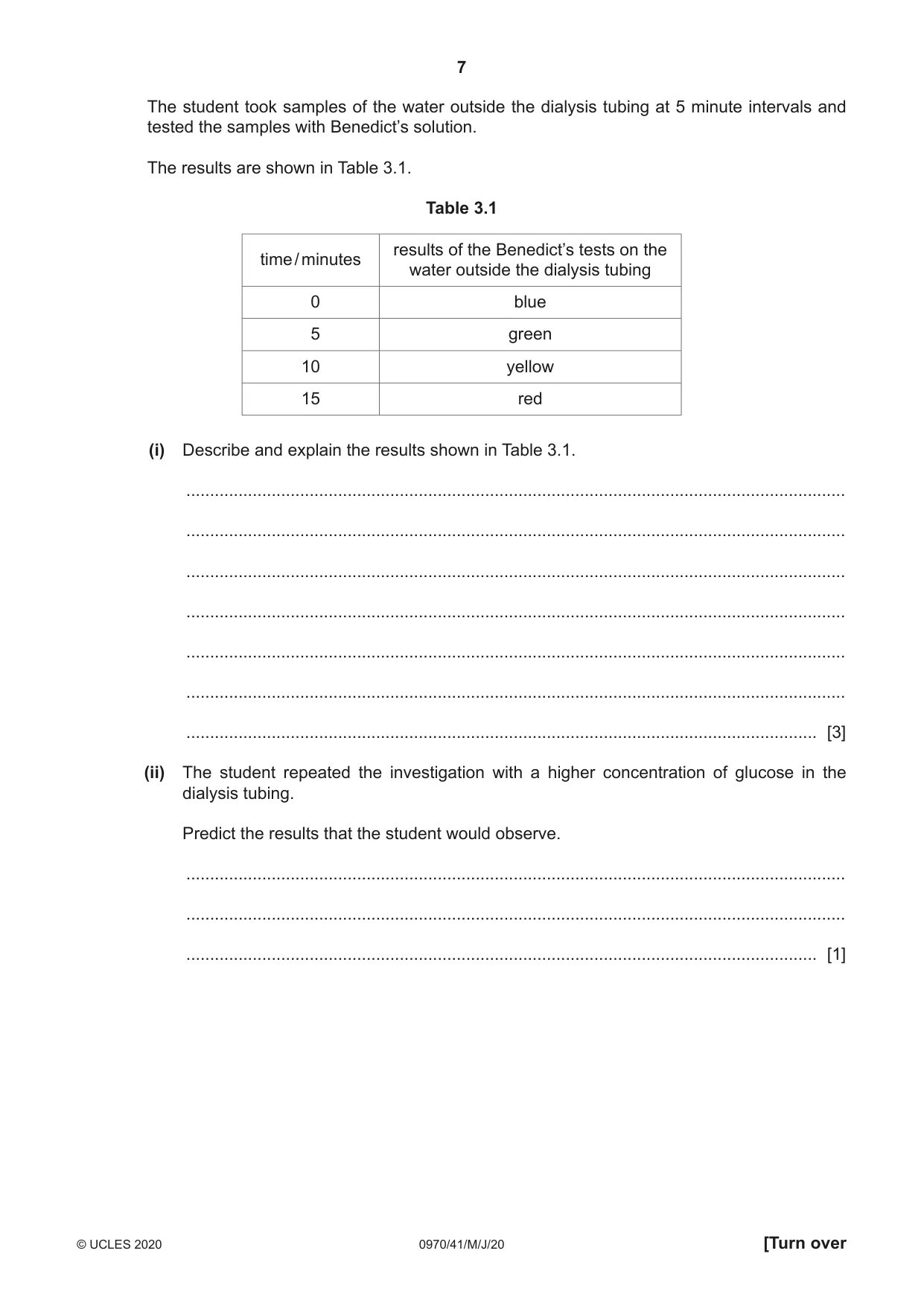
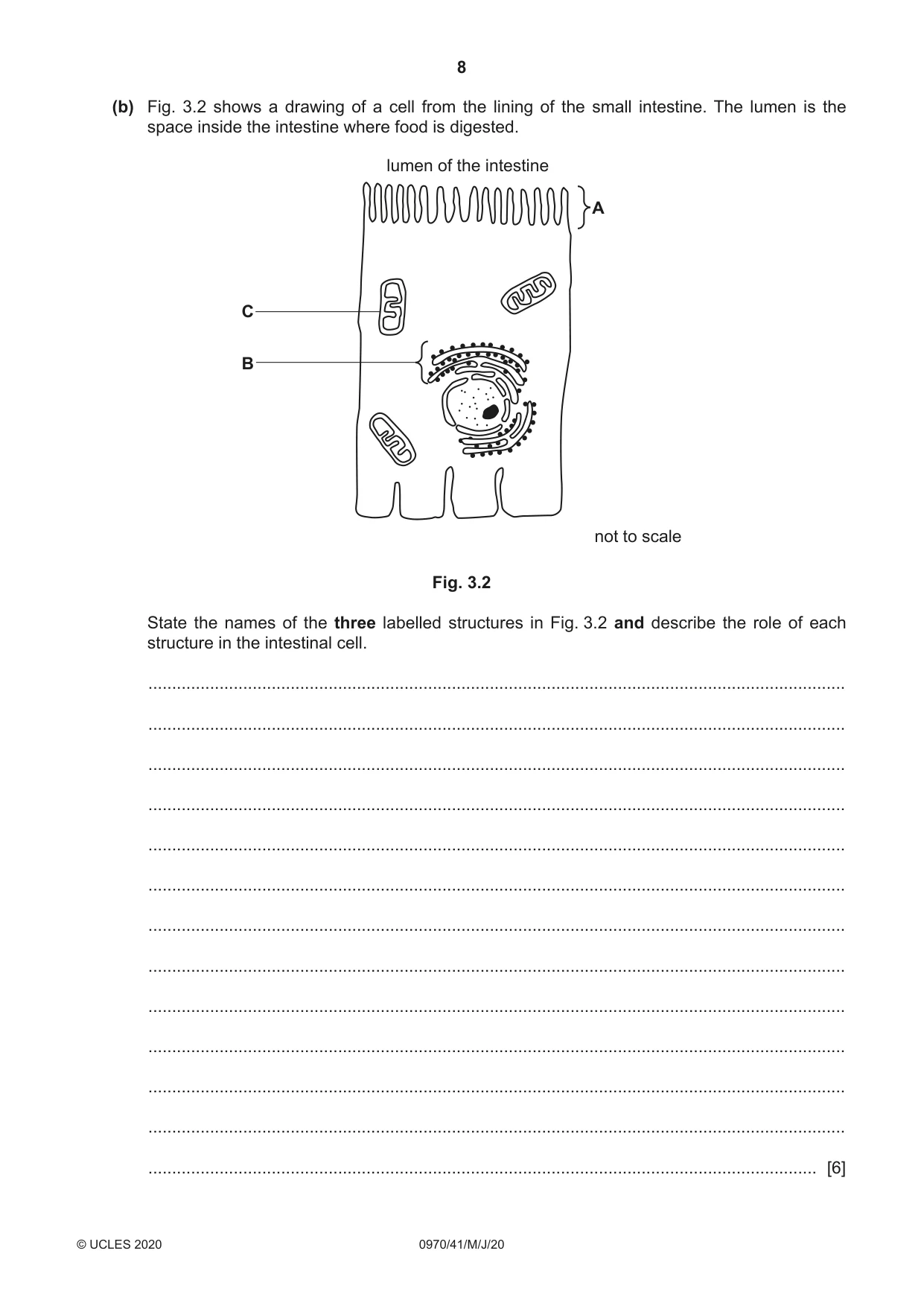
3 (a) Dialysis tubing is an artificial membrane, which is similar to the lining of the intestine. A student investigated the diffusion of glucose through dialysis tubing by using the apparatus shown in Fig. 3.1. rubber band to secure the dialysis tubing glucose solution water outside the dialysis tubing dialysis tubing knot at the end of the dialysis tubing Fig. 3.1 The student took samples of the water outside the dialysis tubing at 5 minute intervals and tested the samples with Benedict’s solution. The results are shown in Table 3.1. Table 3.1 results of the Benedict’s tests on the time / minutes water outside the dialysis tubing 0 blue 5 green 10 yellow 15 red (i) Describe and explain the results shown in Table 3.1. ........................................................................................................................................... ........................................................................................................................................... ........................................................................................................................................... ........................................................................................................................................... ........................................................................................................................................... ........................................................................................................................................... ..................................................................................................................................... [3] (ii) The student repeated the investigation with a higher concentration of glucose in the dialysis tubing. Predict the results that the student would observe. ........................................................................................................................................... ........................................................................................................................................... ..................................................................................................................................... [1] (b) Fig. 3.2 shows a drawing of a cell from the lining of the small intestine. The lumen is the space inside the intestine where food is digested. lumen of the intestine A C B not to scale Fig. 3.2 State the names of the three labelled structures in Fig. 3.2 and describe the role of each structure in the intestinal cell. ................................................................................................................................................... ................................................................................................................................................... ................................................................................................................................................... ................................................................................................................................................... ................................................................................................................................................... ................................................................................................................................................... ................................................................................................................................................... ................................................................................................................................................... ................................................................................................................................................... ................................................................................................................................................... ................................................................................................................................................... ................................................................................................................................................... ............................................................................................................................................. [6] (c) The cholera bacterium can survive in the small intestine and the large intestine. The bacterium releases a toxin that interacts with receptors on the surface of cells. Fig. 3.3 shows the effect of the toxin. The arrows indicate the direction of movement. lumen of the intestine bacterium Key: toxin ion X not to scale Fig. 3.3 The toxin stimulates the secretion of ion X out of the intestinal cell. (i) State the name of ion X. ..................................................................................................................................... [1] (ii) Describe the effects on the body of the secretion of ion X into the lumen of the intestine. ........................................................................................................................................... ........................................................................................................................................... ........................................................................................................................................... ........................................................................................................................................... ........................................................................................................................................... ........................................................................................................................................... ........................................................................................................................................... ........................................................................................................................................... ..................................................................................................................................... [4] [Total: 15]
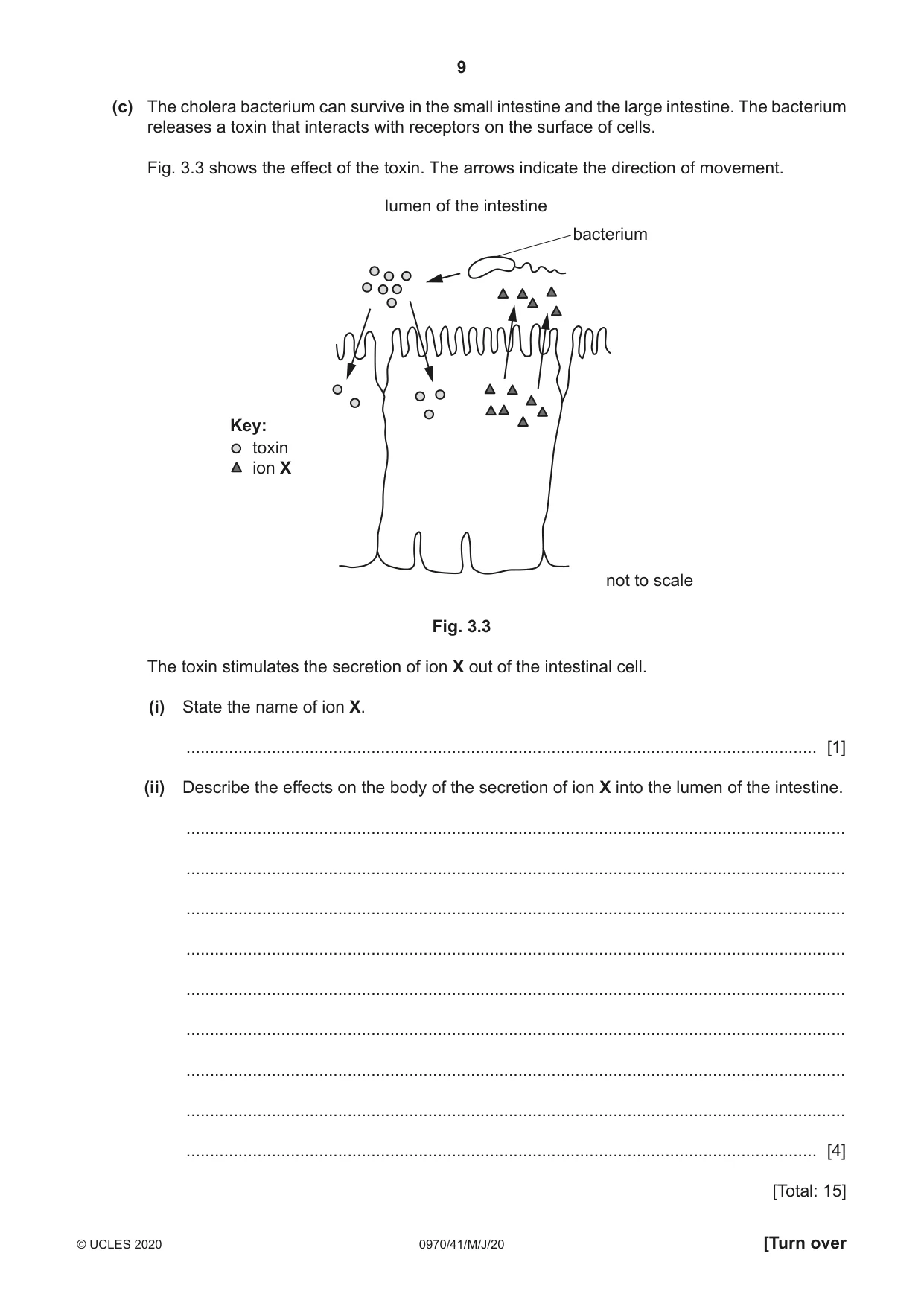
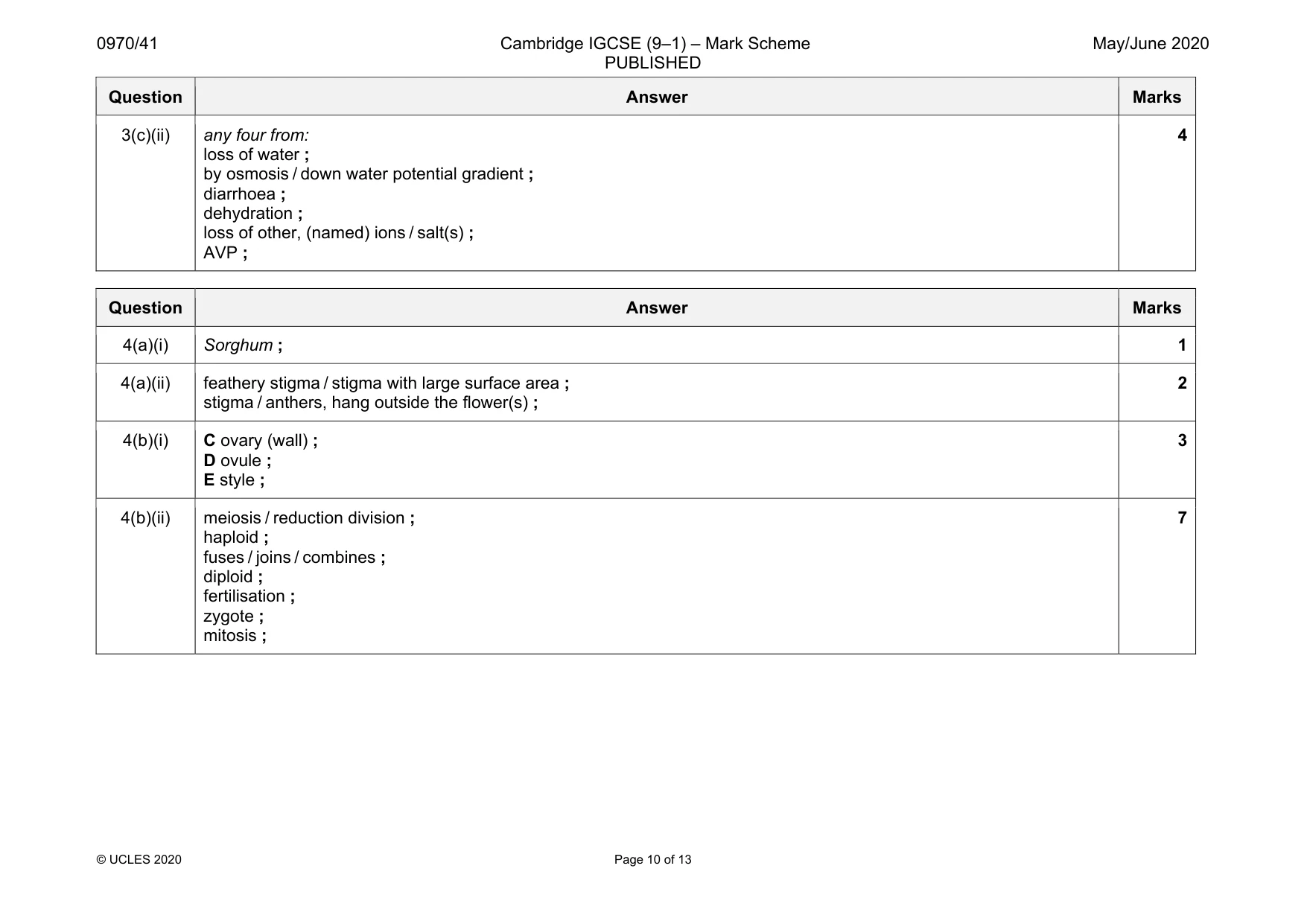
Mark scheme: 3(a)(i) any three from: blue at time 0 indicates no glucose present ; ensures that no glucose on outer surface of dialysis tubing / in water, as a result of an error ; green / yellow / red, indicates presence of glucose ; glucose, diffuses / moves, out of dialysis tubing / into water ; (movement is) down the concentration gradient / high to low concentration ; dialysis tubing is permeable to glucose ; AVP ; 3 3(a)(ii) idea that (Benedict’s solution) changes colour quicker / gives more intense colour / AW ; 1 3(b) A are microvilli ; function: allow movement of substances into the cell / increase surface area for absorption by diffusion OR active transport / have proteins in the membrane for active transport ; B is the (rough) endoplasmic reticulum / (R)ER ; function: site of protein synthesis / modify proteins / assemble amino acids in a specific sequence to make (named) protein ; C is a mitochondrion ; function: aerobic respiration / provides energy for (named) cell process(es) ; 6 3(c)(i) chloride ; 1 Question Answer Marks 3(c)(ii) any four from: loss of water ; by osmosis / down water potential gradient ; diarrhoea ; dehydration ; loss of other, (named) ions / salt(s) ; AVP ; 4
Q4 · Johnson grass, Sorghum halepense, is wind-pollinated
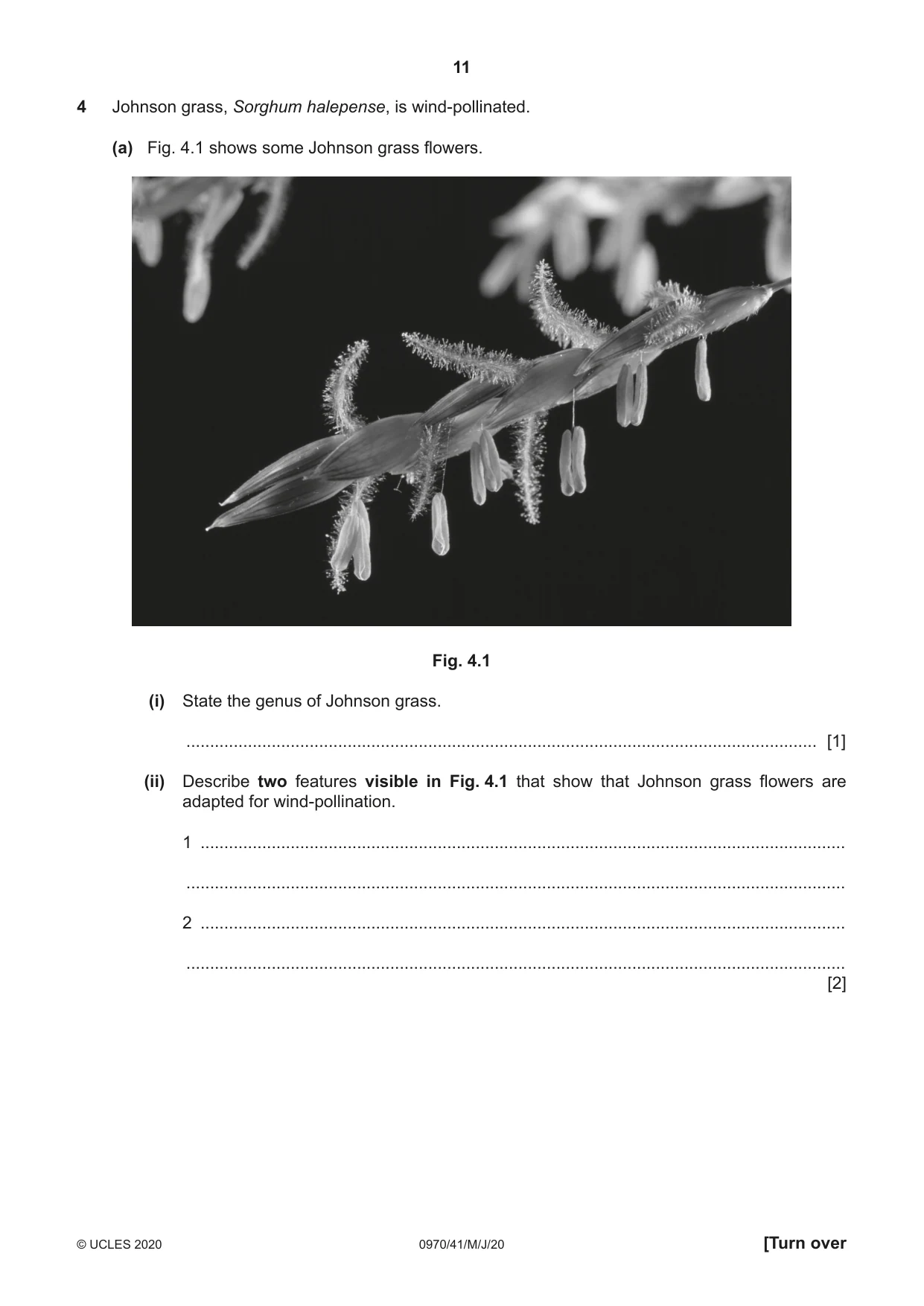
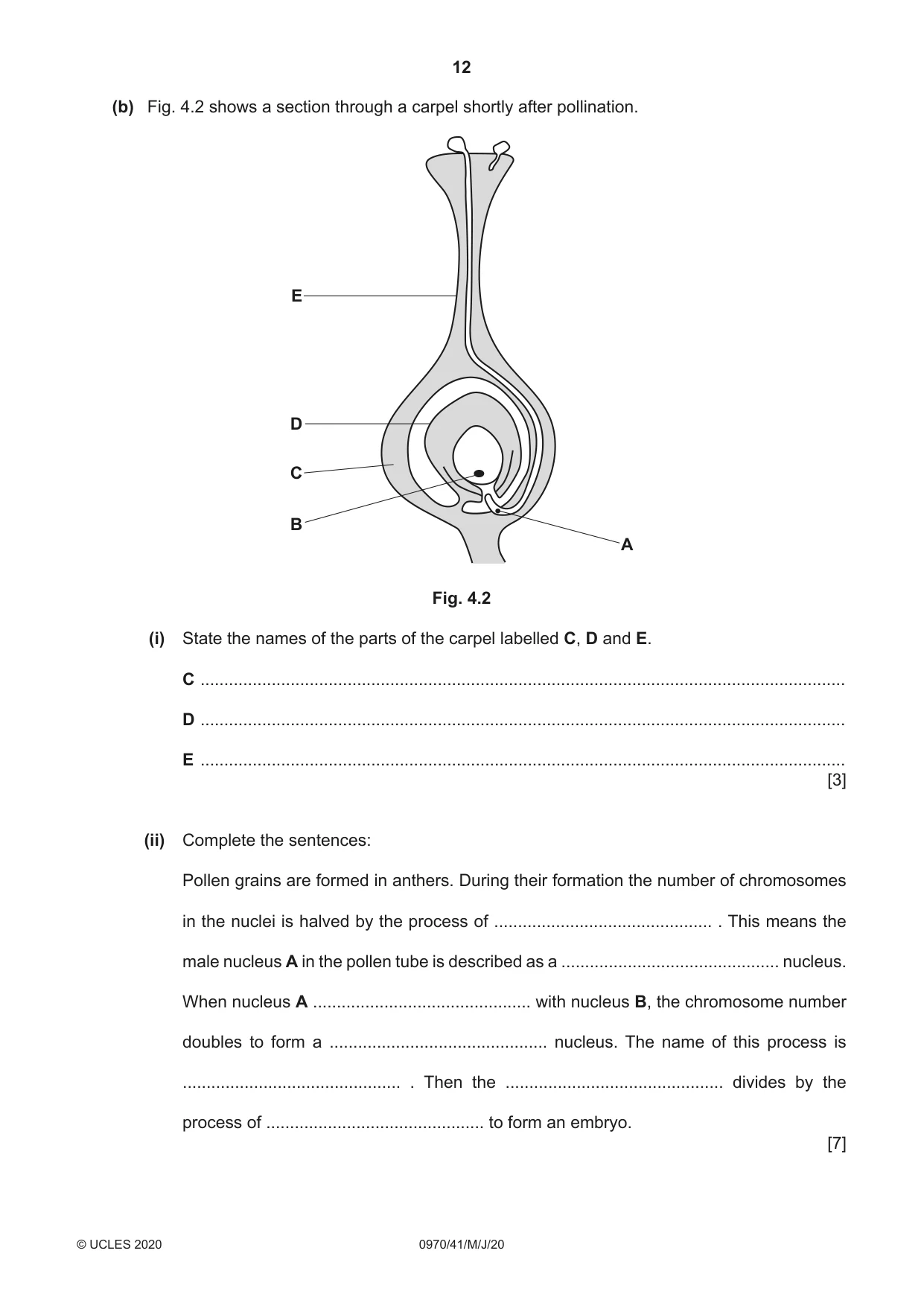
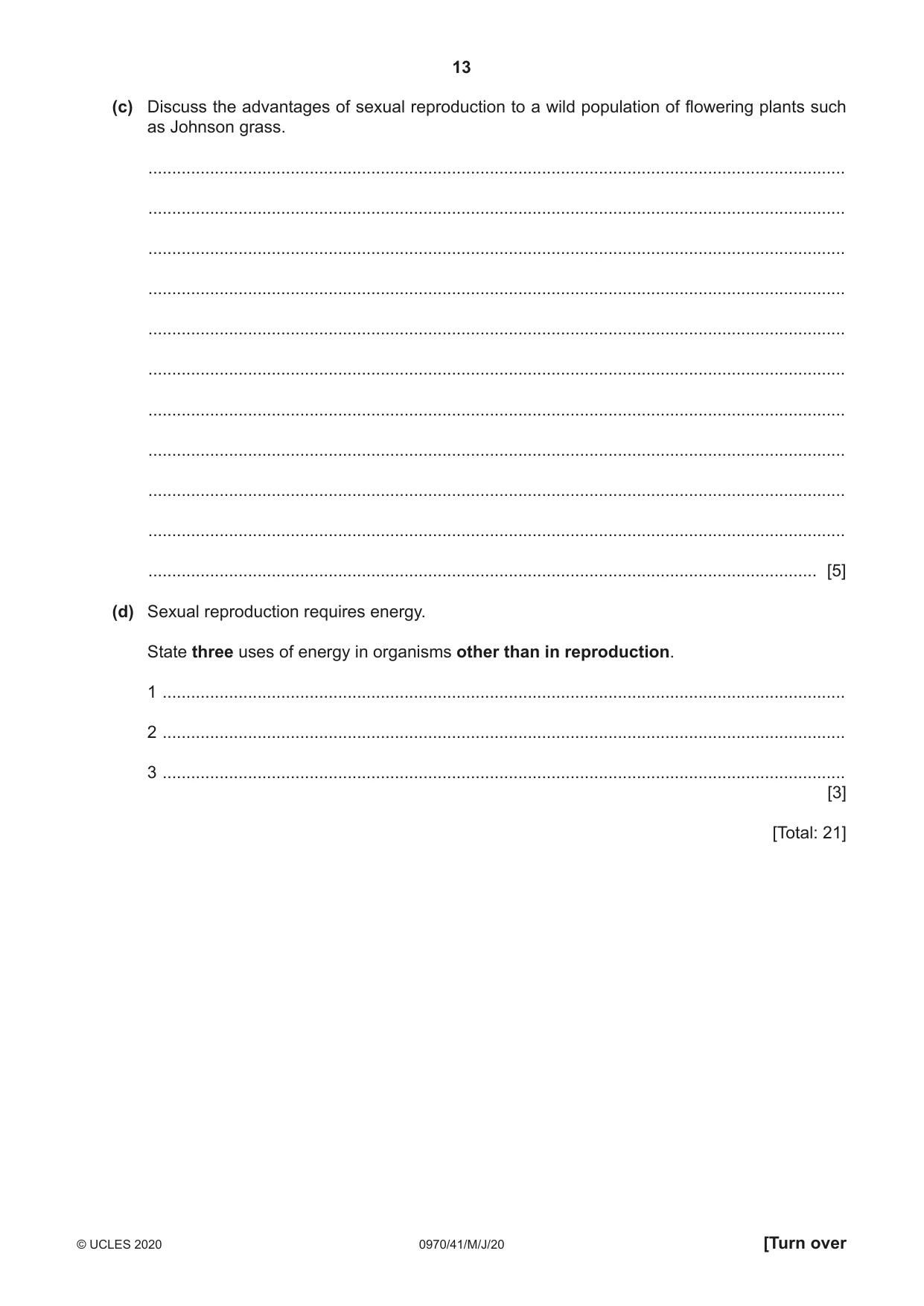
4 Johnson grass, Sorghum halepense, is wind-pollinated. (a) Fig. 4.1 shows some Johnson grass flowers. Fig. 4.1 (i) State the genus of Johnson grass. ..................................................................................................................................... [1] (ii) Describe two features visible in Fig. 4.1 that show that Johnson grass flowers are adapted for wind-pollination. 1 ........................................................................................................................................ ........................................................................................................................................... 2 ........................................................................................................................................ ........................................................................................................................................... [2] (b) Fig. 4.2 shows a section through a carpel shortly after pollination. E D C B A Fig. 4.2 (i) State the names of the parts of the carpel labelled C, D and E. C ........................................................................................................................................ D ........................................................................................................................................ E ........................................................................................................................................ [3] (ii) Complete the sentences: Pollen grains are formed in anthers. During their formation the number of chromosomes in the nuclei is halved by the process of .............................................. . This means the male nucleus A in the pollen tube is described as a .............................................. nucleus. When nucleus A .............................................. with nucleus B, the chromosome number doubles to form a .............................................. nucleus. The name of this process is .............................................. . Then the .............................................. divides by the process of .............................................. to form an embryo. [7] (c) Discuss the advantages of sexual reproduction to a wild population of flowering plants such as Johnson grass. ................................................................................................................................................... ................................................................................................................................................... ................................................................................................................................................... ................................................................................................................................................... ................................................................................................................................................... ................................................................................................................................................... ................................................................................................................................................... ................................................................................................................................................... ................................................................................................................................................... ................................................................................................................................................... ............................................................................................................................................. [5] (d) Sexual reproduction requires energy. State three uses of energy in organisms other than in reproduction. 1 ................................................................................................................................................ 2 ................................................................................................................................................ 3 ................................................................................................................................................ [3] [Total: 21]
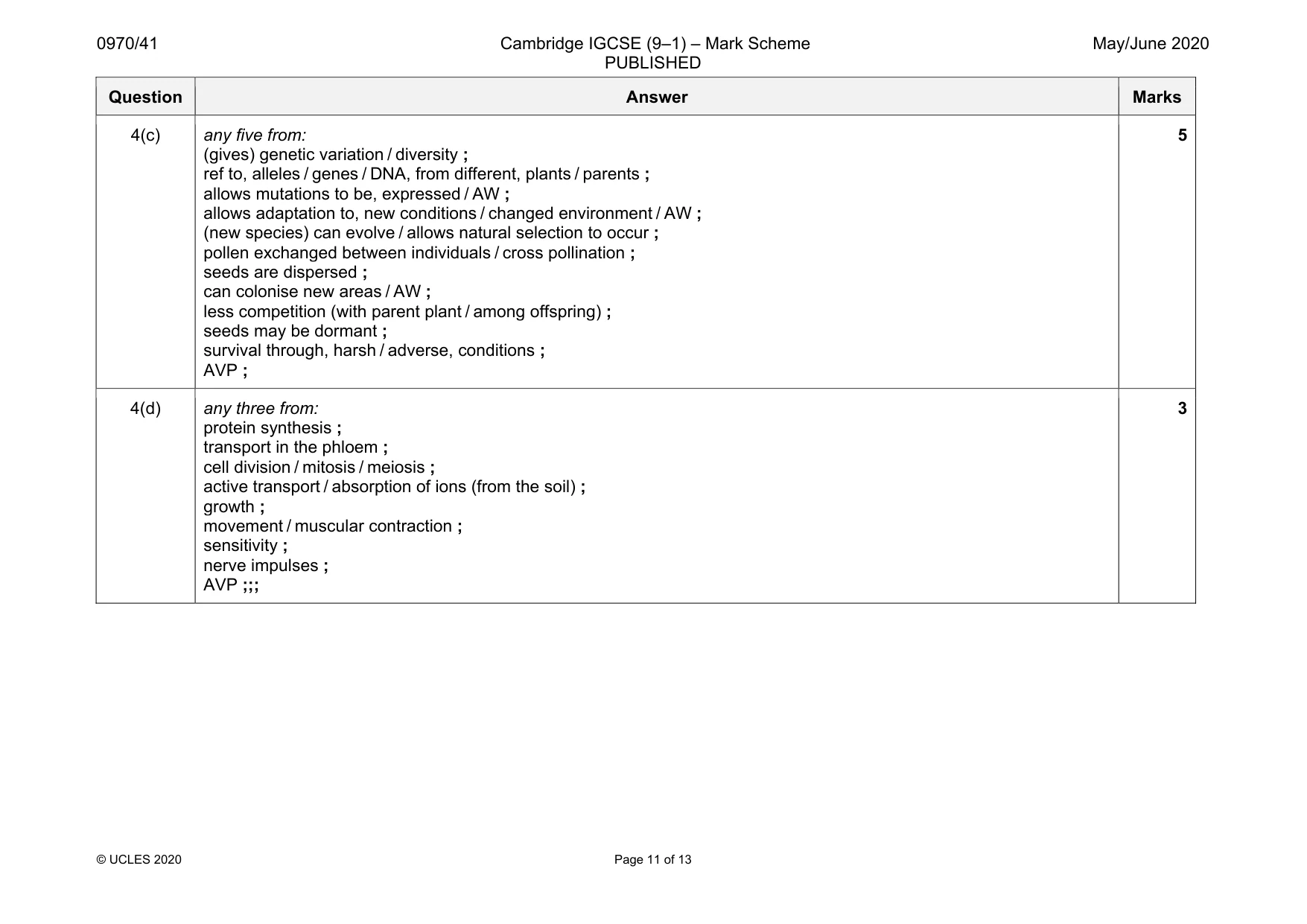
Mark scheme: 4(a)(i) Sorghum ; 1 4(a)(ii) feathery stigma / stigma with large surface area ; stigma / anthers, hang outside the flower(s) ; 2 4(b)(i) C ovary (wall) ; D ovule ; E style ; 3 4(b)(ii) meiosis / reduction division ; haploid ; fuses / joins / combines ; diploid ; fertilisation ; zygote ; mitosis ; 7 Question Answer Marks 4(c) any five from: (gives) genetic variation / diversity ; ref to, alleles / genes / DNA, from different, plants / parents ; allows mutations to be, expressed / AW ; allows adaptation to, new conditions / changed environment / AW ; (new species) can evolve / allows natural selection to occur ; pollen exchanged between individuals / cross pollination ; seeds are dispersed ; can colonise new areas / AW ; less competition (with parent plant / among offspring) ; seeds may be dormant ; survival through, harsh / adverse, conditions ; AVP ; 5 4(d) any three from: protein synthesis ; transport in the phloem ; cell division / mitosis / meiosis ; active transport / absorption of ions (from the soil) ; growth ; movement / muscular contraction ; sensitivity ; nerve impulses ; AVP ;;; 3
Q5 · Ciliates are classified in the kingdom Protoctist
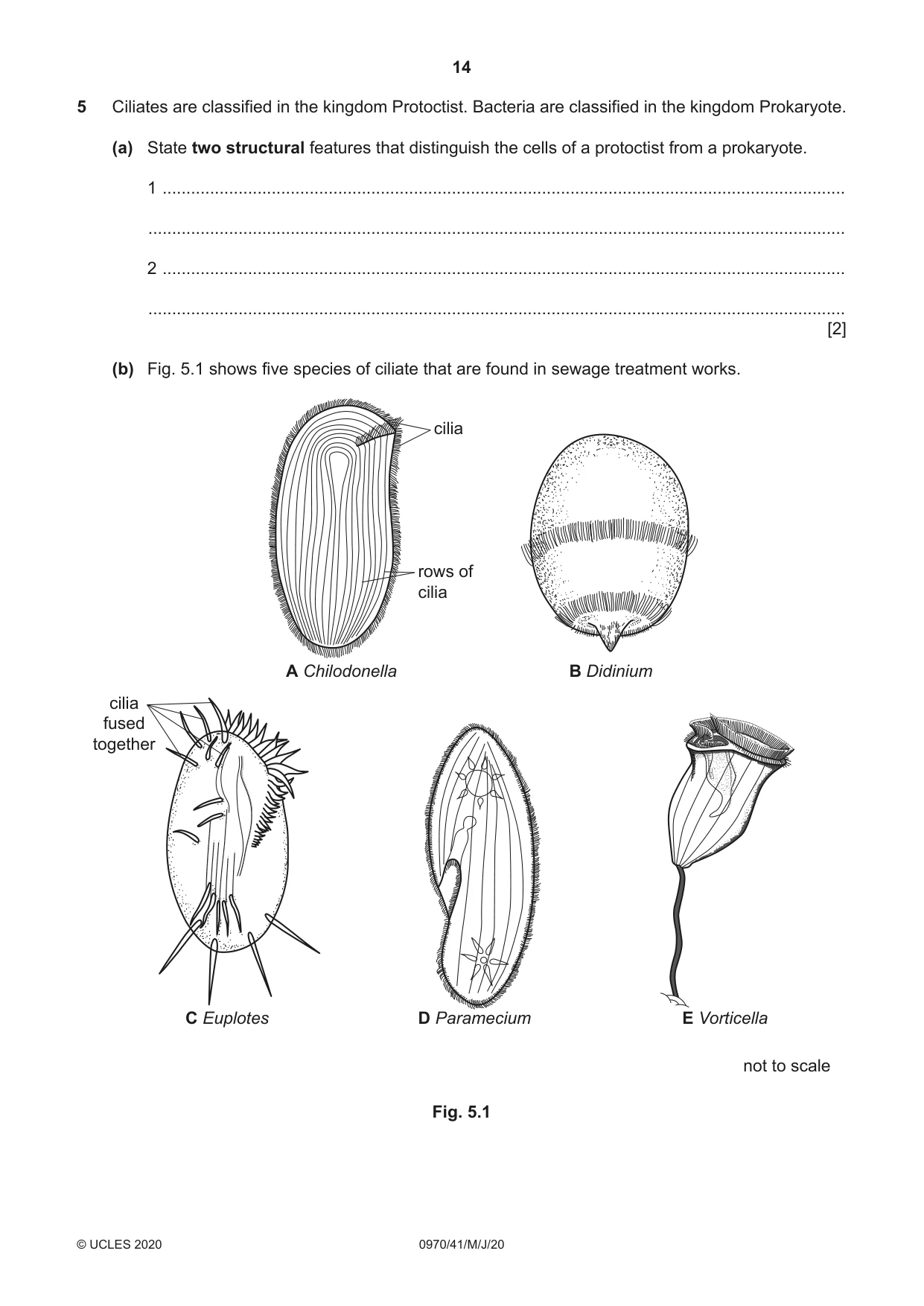
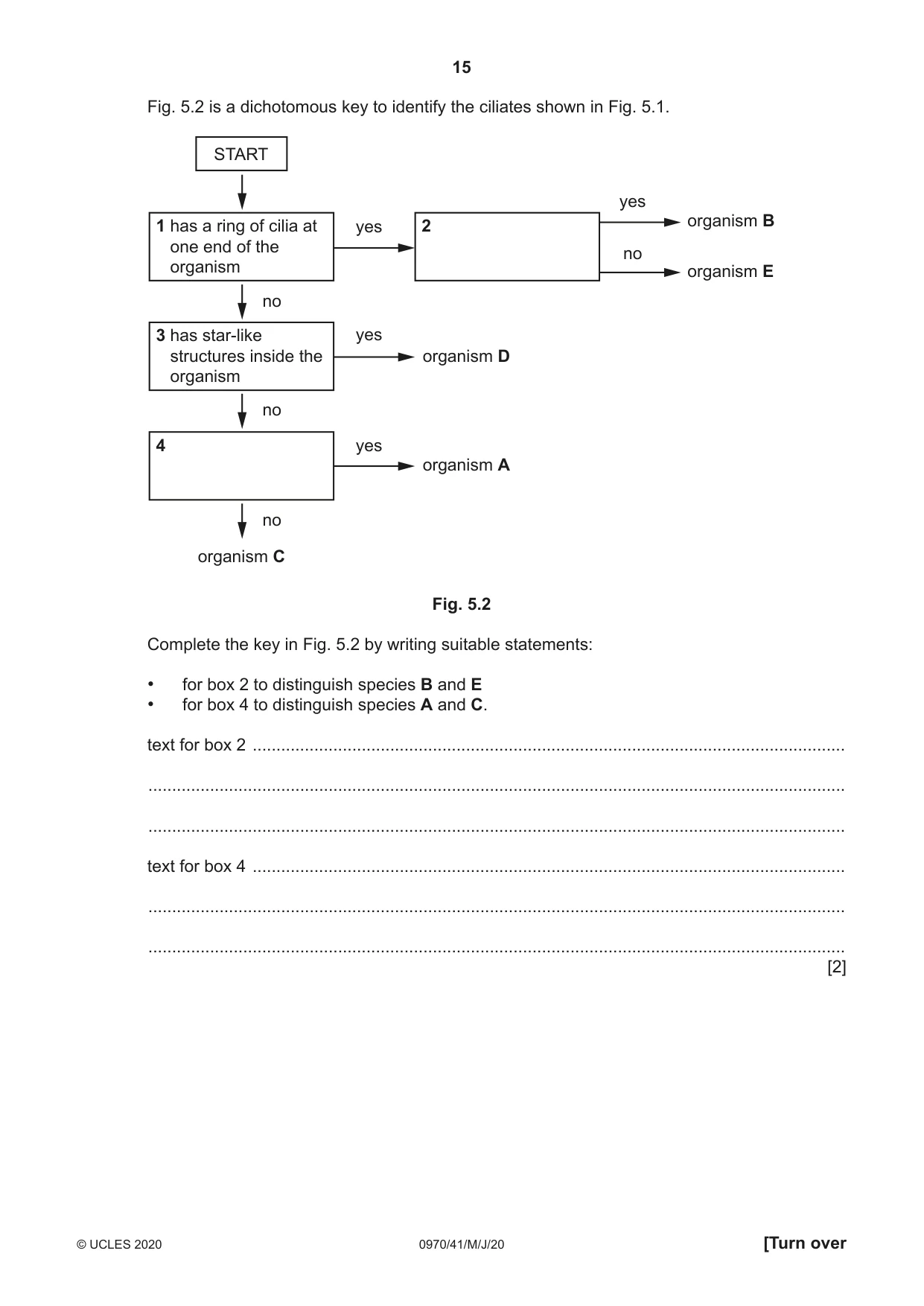
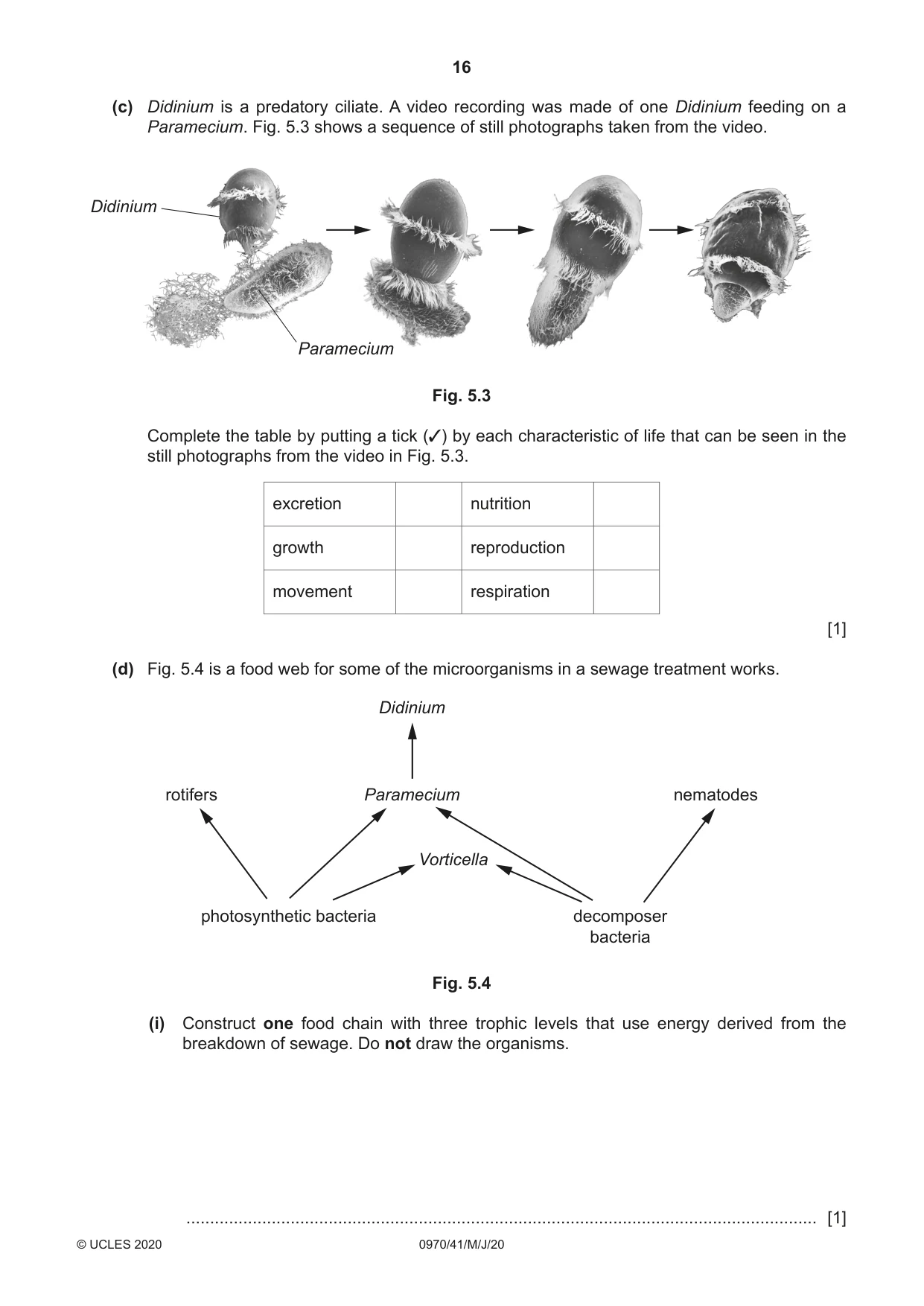
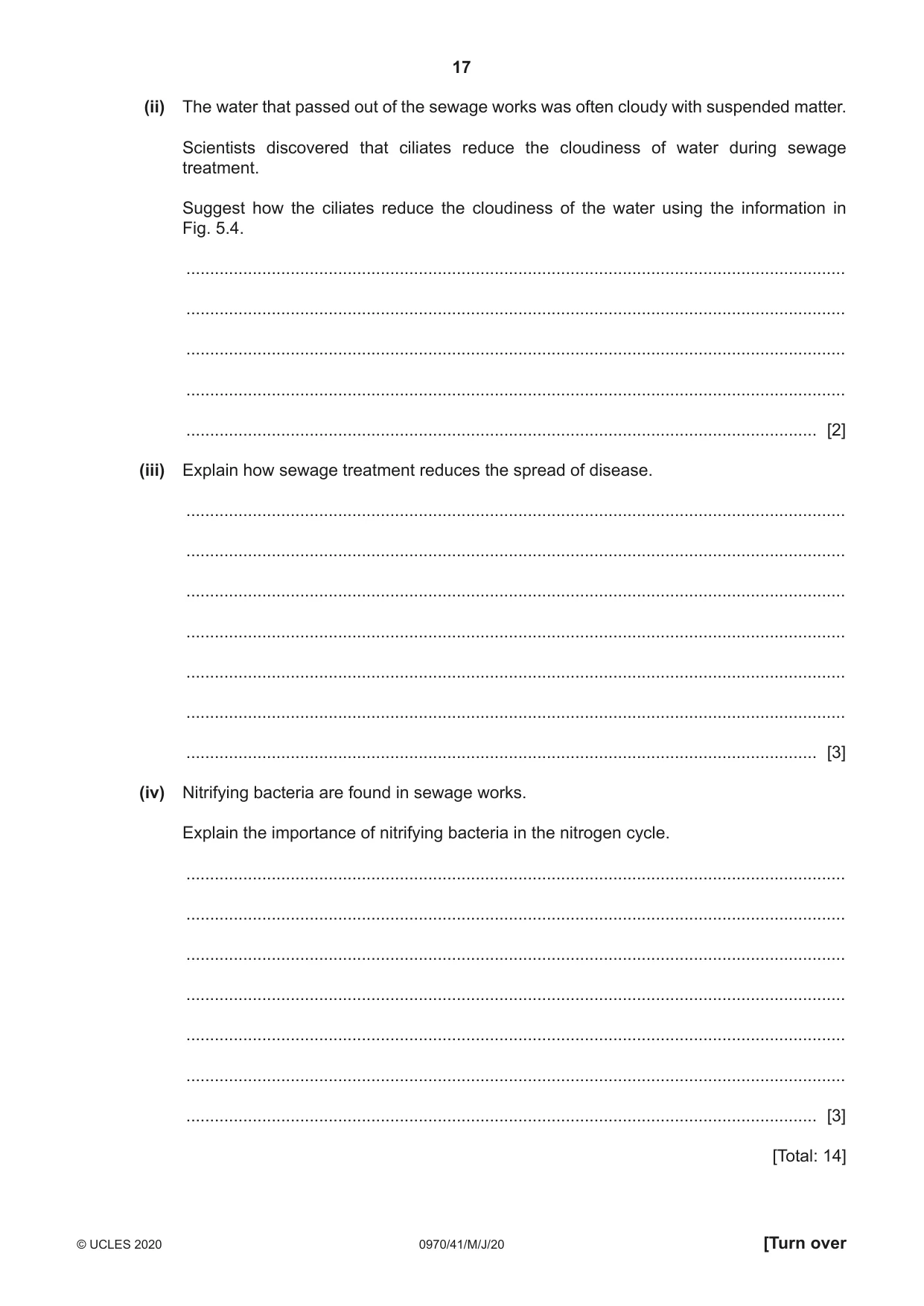
5 Ciliates are classified in the kingdom Protoctist. Bacteria are classified in the kingdom Prokaryote. (a) State two structural features that distinguish the cells of a protoctist from a prokaryote. 1 ................................................................................................................................................ ................................................................................................................................................... 2 ................................................................................................................................................ ................................................................................................................................................... [2] (b) Fig. 5.1 shows five species of ciliate that are found in sewage treatment works. cilia rows of cilia A Chilodonella B Didinium cilia fused together C Euplotes D Paramecium E Vorticella not to scale Fig. 5.1 Fig. 5.2 is a dichotomous key to identify the ciliates shown in Fig. 5.1. START yes organism B 1 has a ring of cilia at yes 2 one end of the no organism organism E no 3 has star-like yes structures inside the organism D organism no 4 yes organism A no organism C Fig. 5.2 Complete the key in Fig. 5.2 by writing suitable statements: • for box 2 to distinguish species B and E • for box 4 to distinguish species A and C. text for box 2 ............................................................................................................................. ................................................................................................................................................... ................................................................................................................................................... text for box 4 ............................................................................................................................. ................................................................................................................................................... ................................................................................................................................................... [2] (c) Didinium is a predatory ciliate. A video recording was made of one Didinium feeding on a Paramecium. Fig. 5.3 shows a sequence of still photographs taken from the video. Didinium Paramecium Fig. 5.3 Complete the table by putting a tick (✓) by each characteristic of life that can be seen in the still photographs from the video in Fig. 5.3. excretion nutrition growth reproduction movement respiration [1] (d) Fig. 5.4 is a food web for some of the microorganisms in a sewage treatment works. Didinium rotifers Paramecium nematodes Vorticella photosynthetic bacteria decomposer bacteria Fig. 5.4 (i) Construct one food chain with three trophic levels that use energy derived from the breakdown of sewage. Do not draw the organisms. ..................................................................................................................................... [1] (ii) The water that passed out of the sewage works was often cloudy with suspended matter. Scientists discovered that ciliates reduce the cloudiness of water during sewage treatment. Suggest how the ciliates reduce the cloudiness of the water using the information in Fig. 5.4. ........................................................................................................................................... ........................................................................................................................................... ........................................................................................................................................... ........................................................................................................................................... ..................................................................................................................................... [2] (iii) Explain how sewage treatment reduces the spread of disease. ........................................................................................................................................... ........................................................................................................................................... ........................................................................................................................................... ........................................................................................................................................... ........................................................................................................................................... ........................................................................................................................................... ..................................................................................................................................... [3] (iv) Nitrifying bacteria are found in sewage works. Explain the importance of nitrifying bacteria in the nitrogen cycle. ........................................................................................................................................... ........................................................................................................................................... ........................................................................................................................................... ........................................................................................................................................... ........................................................................................................................................... ........................................................................................................................................... ..................................................................................................................................... [3] [Total: 14]
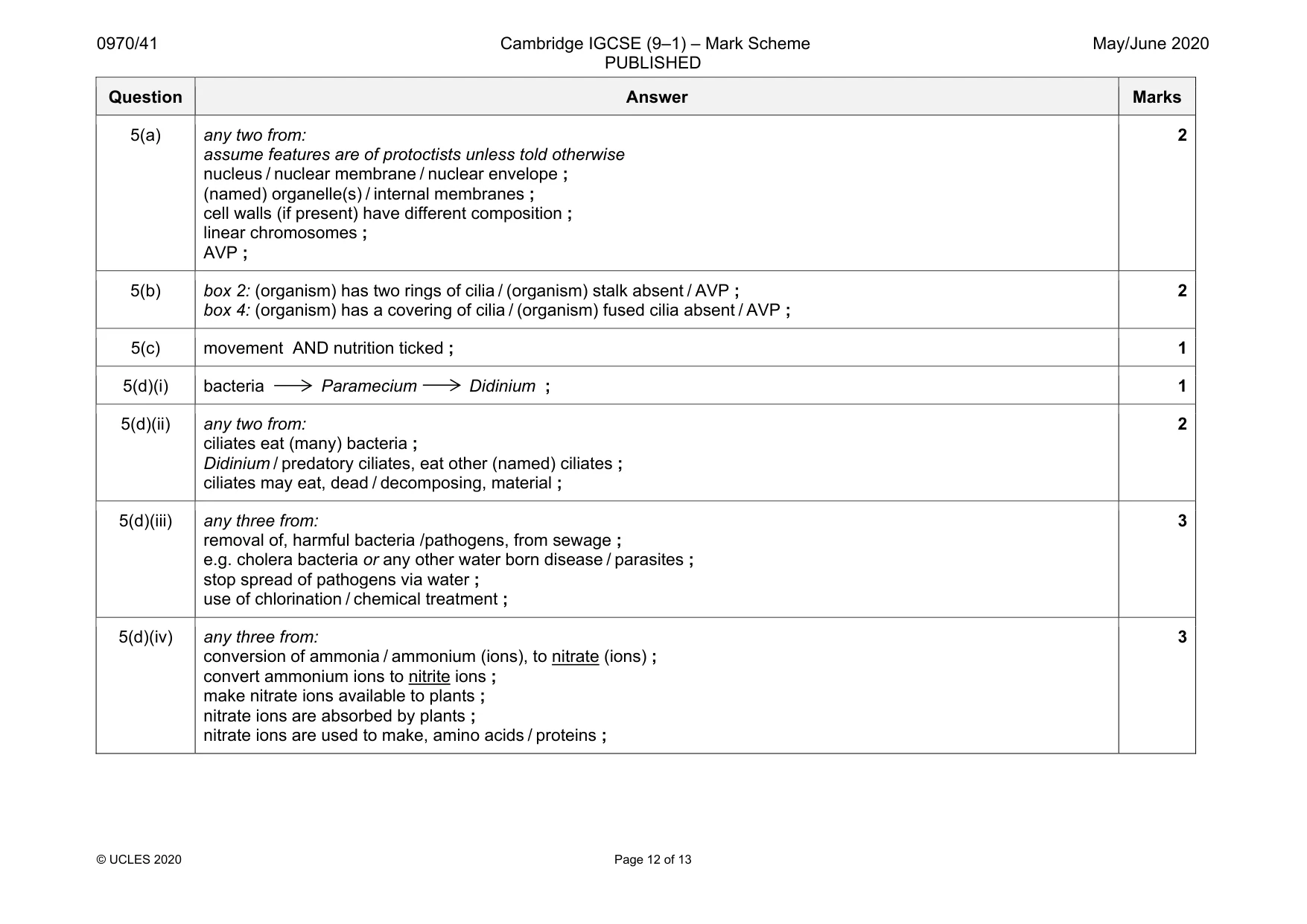
Mark scheme: 5(a) any two from: assume features are of protoctists unless told otherwise nucleus / nuclear membrane / nuclear envelope ; (named) organelle(s) / internal membranes ; cell walls (if present) have different composition ; linear chromosomes ; AVP ; 2 5(b) box 2: (organism) has two rings of cilia / (organism) stalk absent / AVP ; box 4: (organism) has a covering of cilia / (organism) fused cilia absent / AVP ; 2 5(c) movement AND nutrition ticked ; 1 5(d)(i) bacteria Paramecium Didinium ; 1 5(d)(ii) any two from: ciliates eat (many) bacteria ; Didinium / predatory ciliates, eat other (named) ciliates ; ciliates may eat, dead / decomposing, material ; 2 5(d)(iii) any three from: removal of, harmful bacteria /pathogens, from sewage ; e.g. cholera bacteria or any other water born disease / parasites ; stop spread of pathogens via water ; use of chlorination / chemical treatment ; 3 5(d)(iv) any three from: conversion of ammonia / ammonium (ions), to nitrate (ions) ; convert ammonium ions to nitrite ions ; make nitrate ions available to plants ; nitrate ions are absorbed by plants ; nitrate ions are used to make, amino acids / proteins ; 3
Q6 · Colour blindness is a characteristic that is inherited
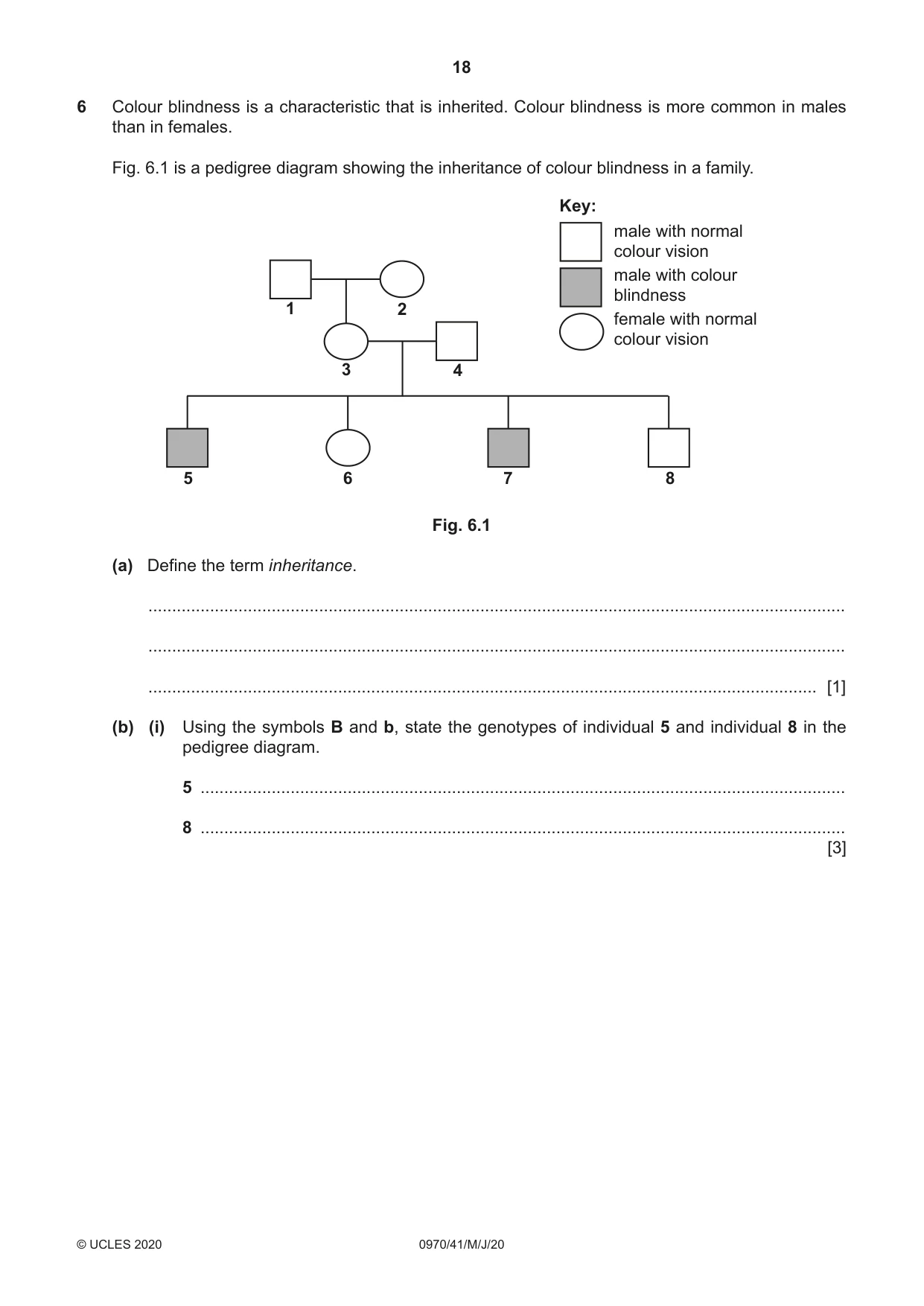
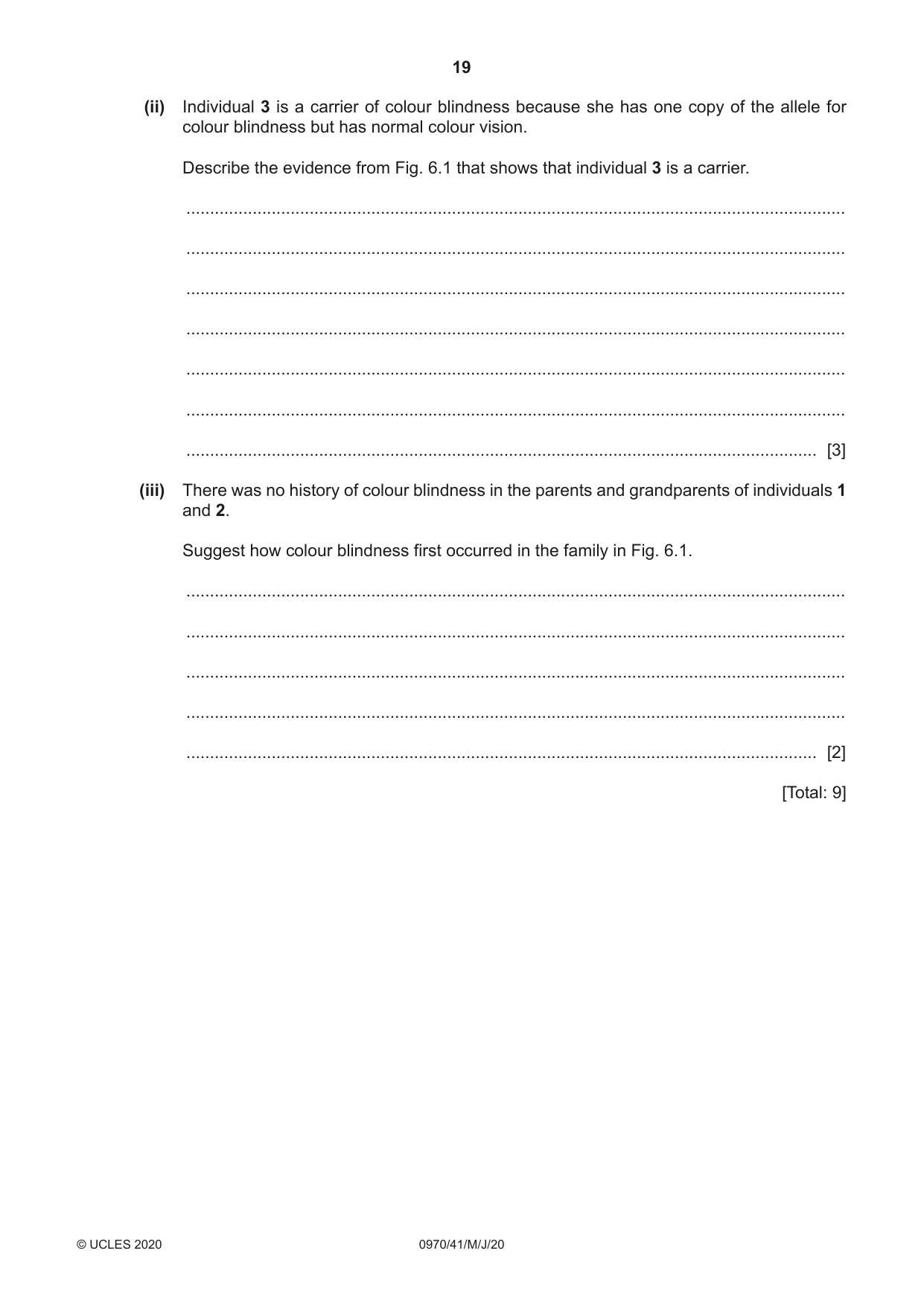
6 Colour blindness is a characteristic that is inherited. Colour blindness is more common in males than in females. Fig. 6.1 is a pedigree diagram showing the inheritance of colour blindness in a family. Key: male with normal colour vision male with colour blindness 1 2 female with normal colour vision 3 4 5 6 7 8 Fig. 6.1 (a) Define the term inheritance. ................................................................................................................................................... ................................................................................................................................................... ............................................................................................................................................. [1] (b) (i) Using the symbols B and b, state the genotypes of individual 5 and individual 8 in the pedigree diagram. 5 ........................................................................................................................................ 8 ........................................................................................................................................ [3] (ii) Individual 3 is a carrier of colour blindness because she has one copy of the allele for colour blindness but has normal colour vision. Describe the evidence from Fig. 6.1 that shows that individual 3 is a carrier. ........................................................................................................................................... ........................................................................................................................................... ........................................................................................................................................... ........................................................................................................................................... ........................................................................................................................................... ........................................................................................................................................... ..................................................................................................................................... [3] (iii) There was no history of colour blindness in the parents and grandparents of individuals 1 and 2. Suggest how colour blindness first occurred in the family in Fig. 6.1. ........................................................................................................................................... ........................................................................................................................................... ........................................................................................................................................... ........................................................................................................................................... ..................................................................................................................................... [2] [Total: 9]
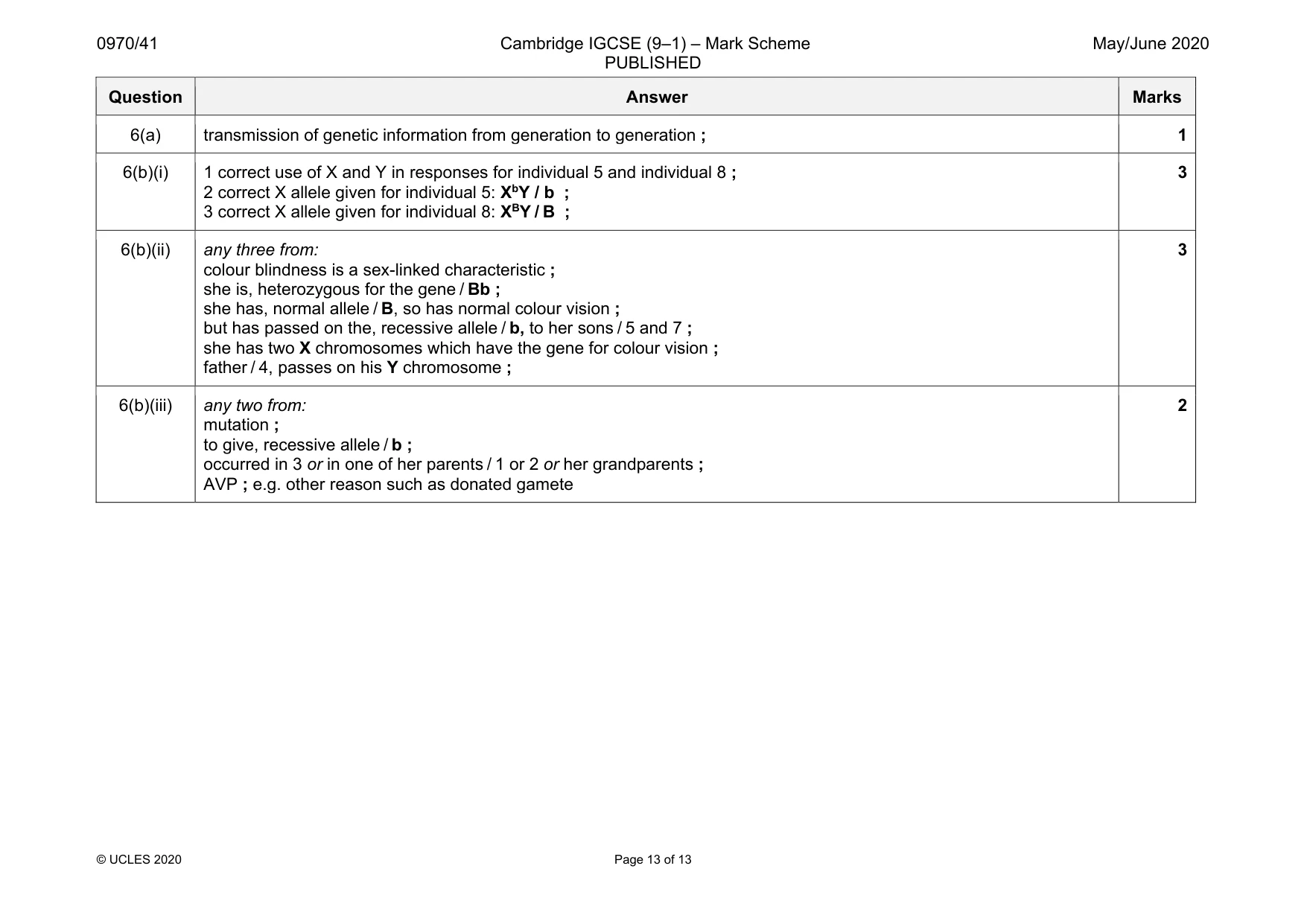
Mark scheme: 6(a) transmission of genetic information from generation to generation ; 1 6(b)(i) 1 correct use of X and Y in responses for individual 5 and individual 8 ; 2 correct X allele given for individual 5: XbY / b ; 3 correct X allele given for individual 8: XBY / B ; 3 6(b)(ii) any three from: colour blindness is a sex-linked characteristic ; she is, heterozygous for the gene / Bb ; she has, normal allele / B, so has normal colour vision ; but has passed on the, recessive allele / b, to her sons / 5 and 7 ; she has two X chromosomes which have the gene for colour vision ; father / 4, passes on his Y chromosome ; 3 6(b)(iii) any two from: mutation ; to give, recessive allele / b ; occurred in 3 or in one of her parents / 1 or 2 or her grandparents ; AVP ; e.g. other reason such as donated gamete 2
What was in this paper
The subtopics covered by these 6 questions, and how many questions each got. Open one in a new tab to see every Cambridge question on it.