Cambridge IGCSE Biology (9-1) 0970 — 2019 May/June Paper 4 · Variant 2
0970/42/M/J/19 · 6 questions · 80 marks · ≈90 min
The question paper and its mark scheme, free to read here and free to download. This is Cambridge’s own paper, exactly as it was sat.
Question paper20 pages


Mark scheme12 pages
Answers below. Sit the paper first if you are practising.
Questions as text
Q1 · Biotechnology is used in the process of bread-making
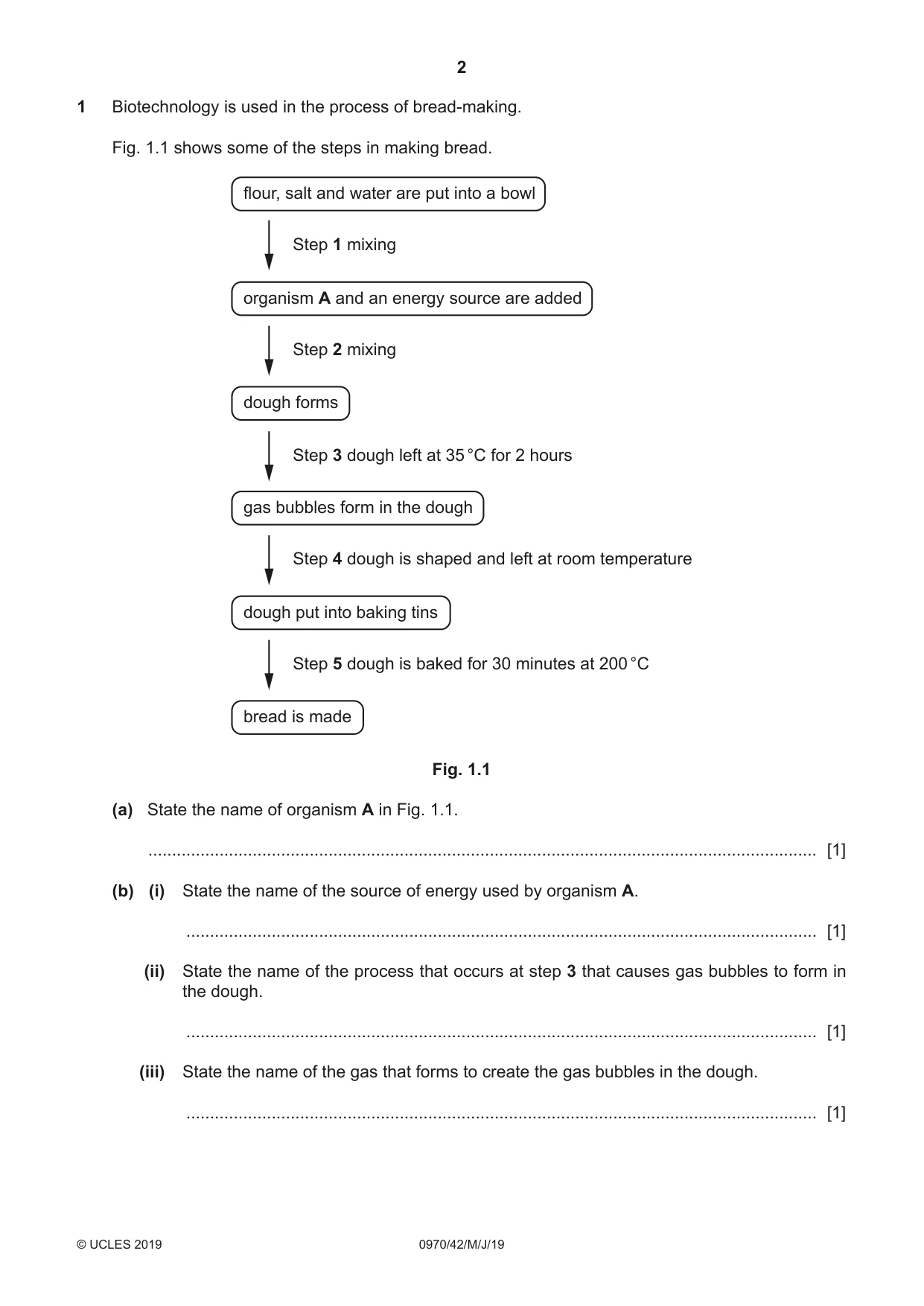
1 Biotechnology is used in the process of bread-making. Fig. 1.1 shows some of the steps in making bread. flour, salt and water are put into a bowl Step 1 mixing organism A and an energy source are added Step 2 mixing dough forms Step 3 dough left at 35 °C for 2 hours gas bubbles form in the dough Step 4 dough is shaped and left at room temperature dough put into baking tins Step 5 dough is baked for 30 minutes at 200 °C bread is made Fig. 1.1 (a) State the name of organism A in Fig. 1.1. ............................................................................................................................................. [1] (b) (i) State the name of the source of energy used by organism A. ..................................................................................................................................... [1] (ii) State the name of the process that occurs at step 3 that causes gas bubbles to form in the dough. ..................................................................................................................................... [1] (iii) State the name of the gas that forms to create the gas bubbles in the dough. ..................................................................................................................................... [1] (c) Explain the reasons for the different temperatures used in step 3 and step 5. ................................................................................................................................................... ................................................................................................................................................... ................................................................................................................................................... ................................................................................................................................................... ............................................................................................................................................. [2] (d) State the name of two products of biotechnology, other than bread, that make use of microorganisms. 1 ................................................................................................................................................ 2 ................................................................................................................................................ [2] [Total: 8]
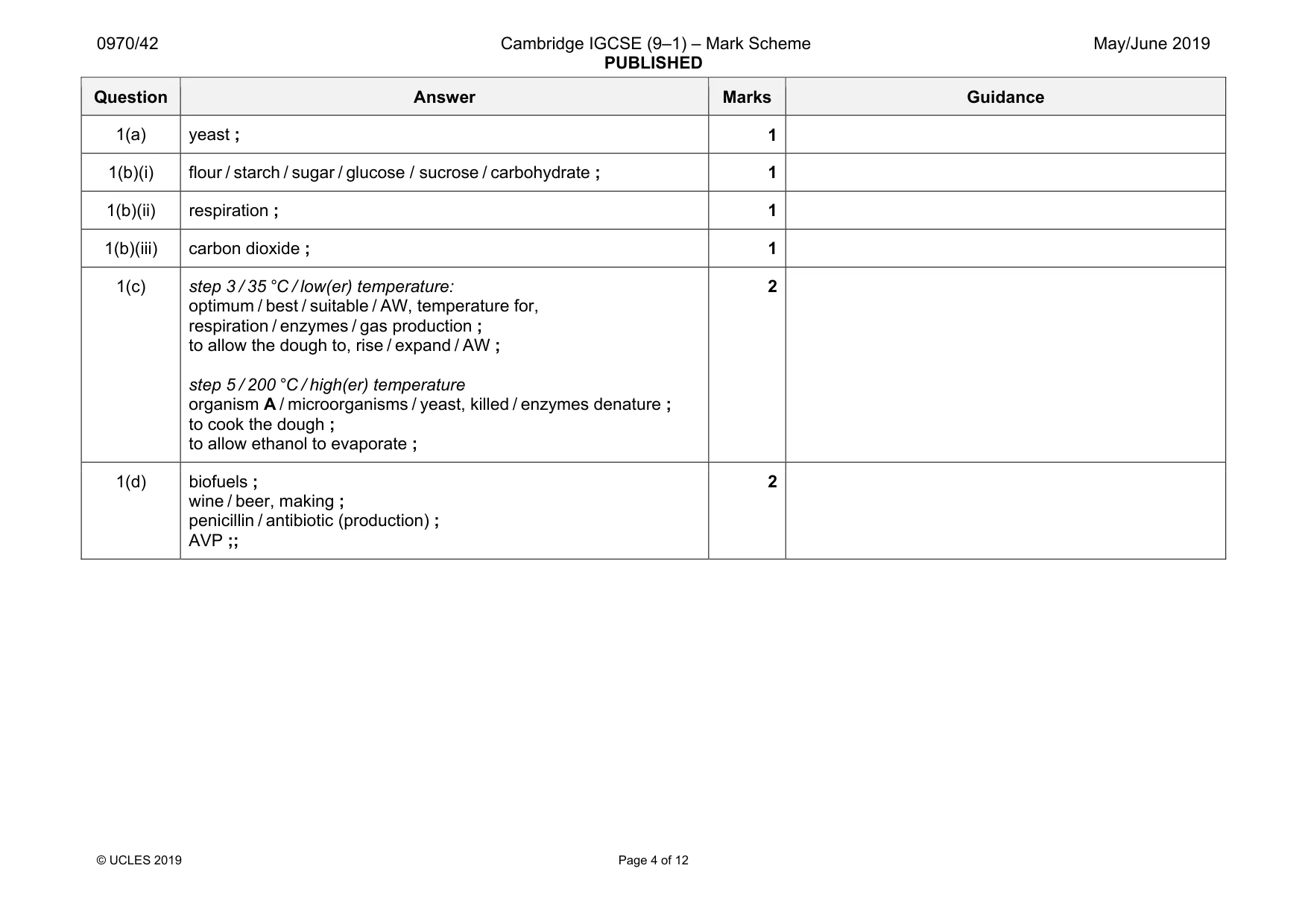
Mark scheme: 1(a) yeast ; 1 1(b)(i) flour / starch / sugar / glucose / sucrose / carbohydrate ; 1 1(b)(ii) respiration ; 1 1(b)(iii) carbon dioxide ; 1 1(c) step 3 / 35 °C / low(er) temperature: optimum / best / suitable / AW, temperature for, respiration / enzymes / gas production ; to allow the dough to, rise / expand / AW ; step 5 / 200 °C / high(er) temperature organism A / microorganisms / yeast, killed / enzymes denature ; to cook the dough ; to allow ethanol to evaporate ; 2 1(d) biofuels ; wine / beer, making ; penicillin / antibiotic (production) ; AVP ;; 2
Q2 · The concentration of atmospheric carbon dioxide has increased considerably in recent years
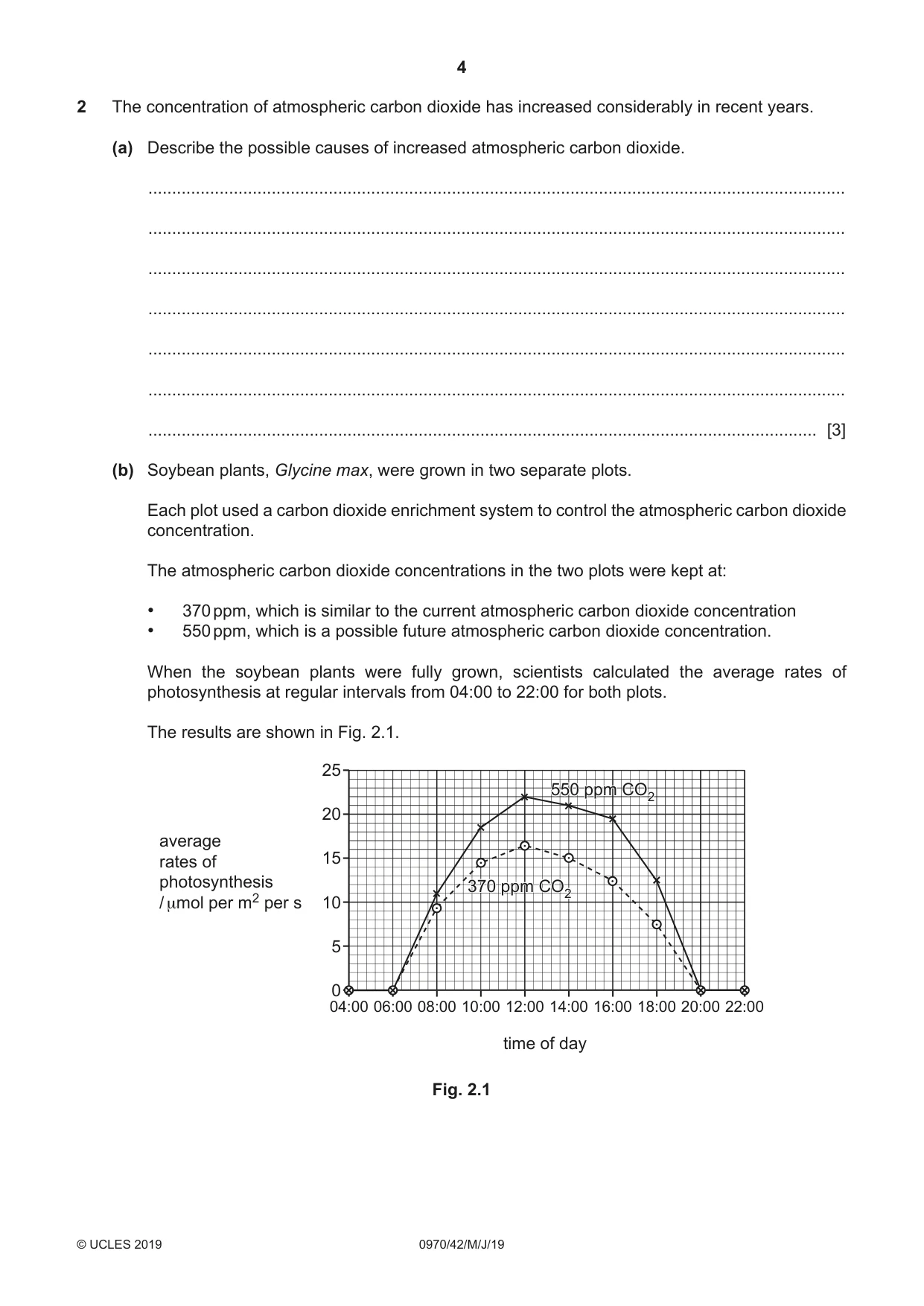
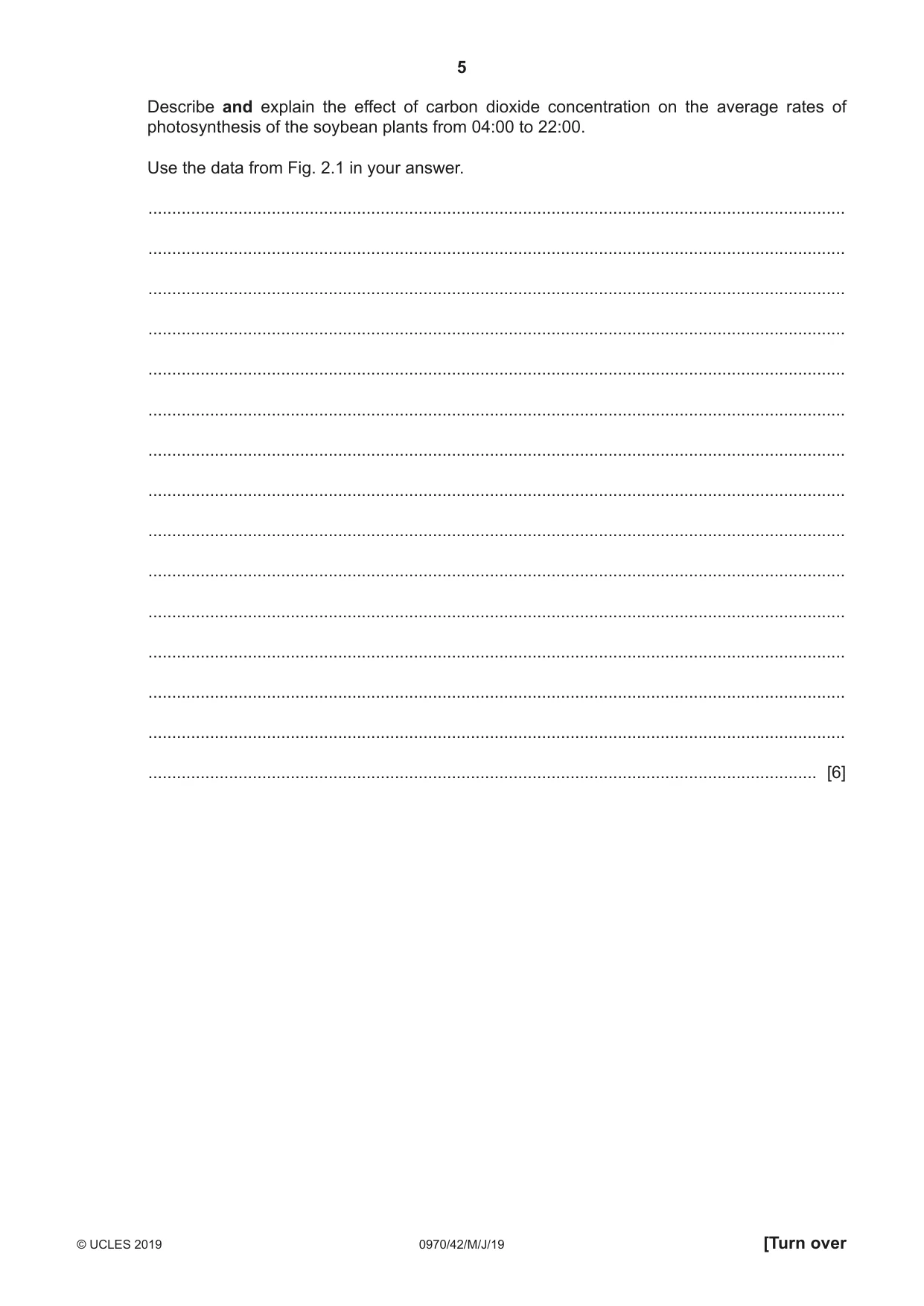
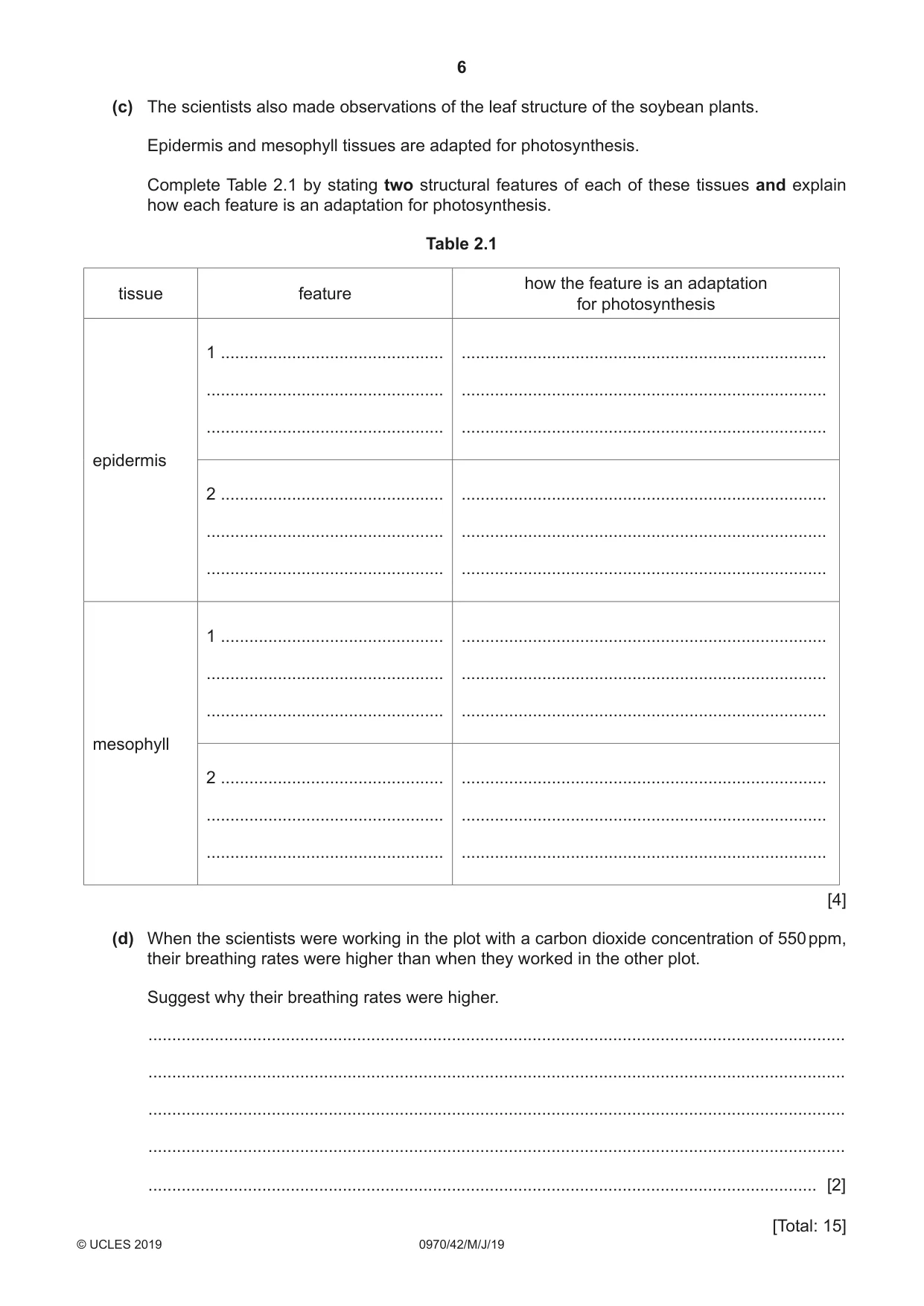
2 The concentration of atmospheric carbon dioxide has increased considerably in recent years. (a) Describe the possible causes of increased atmospheric carbon dioxide. ................................................................................................................................................... ................................................................................................................................................... ................................................................................................................................................... ................................................................................................................................................... ................................................................................................................................................... ................................................................................................................................................... ............................................................................................................................................. [3] (b) Soybean plants, Glycine max, were grown in two separate plots. Each plot used a carbon dioxide enrichment system to control the atmospheric carbon dioxide concentration. The atmospheric carbon dioxide concentrations in the two plots were kept at: • 370 ppm, which is similar to the current atmospheric carbon dioxide concentration • 550 ppm, which is a possible future atmospheric carbon dioxide concentration. When the soybean plants were fully grown, scientists calculated the average rates of photosynthesis at regular intervals from 04:00 to 22:00 for both plots. The results are shown in Fig. 2.1. 25 550550 ppmppm CO2CO2 20 average rates of 15 photosynthesis 370370 ppmppm CO2CO2 / μmol per m2 per s 10 5 0 04:00 06:00 08:00 10:00 12:00 14:00 16:00 18:00 20:00 22:00 time of day Fig. 2.1 Describe and explain the effect of carbon dioxide concentration on the average rates of photosynthesis of the soybean plants from 04:00 to 22:00. Use the data from Fig. 2.1 in your answer. ................................................................................................................................................... ................................................................................................................................................... ................................................................................................................................................... ................................................................................................................................................... ................................................................................................................................................... ................................................................................................................................................... ................................................................................................................................................... ................................................................................................................................................... ................................................................................................................................................... ................................................................................................................................................... ................................................................................................................................................... ................................................................................................................................................... ................................................................................................................................................... ................................................................................................................................................... ............................................................................................................................................. [6] (c) The scientists also made observations of the leaf structure of the soybean plants. Epidermis and mesophyll tissues are adapted for photosynthesis. Complete Table 2.1 by stating two structural features of each of these tissues and explain how each feature is an adaptation for photosynthesis. Table 2.1 how the feature is an adaptation tissue feature for photosynthesis 1 ............................................... ............................................................................. .................................................. ............................................................................. .................................................. ............................................................................. epidermis 2 ............................................... ............................................................................. .................................................. ............................................................................. .................................................. ............................................................................. 1 ............................................... ............................................................................. .................................................. ............................................................................. .................................................. ............................................................................. mesophyll 2 ............................................... ............................................................................. .................................................. ............................................................................. .................................................. ............................................................................. [4] (d) When the scientists were working in the plot with a carbon dioxide concentration of 550 ppm, their breathing rates were higher than when they worked in the other plot. Suggest why their breathing rates were higher. ................................................................................................................................................... ................................................................................................................................................... ................................................................................................................................................... ................................................................................................................................................... ............................................................................................................................................. [2] [Total: 15]
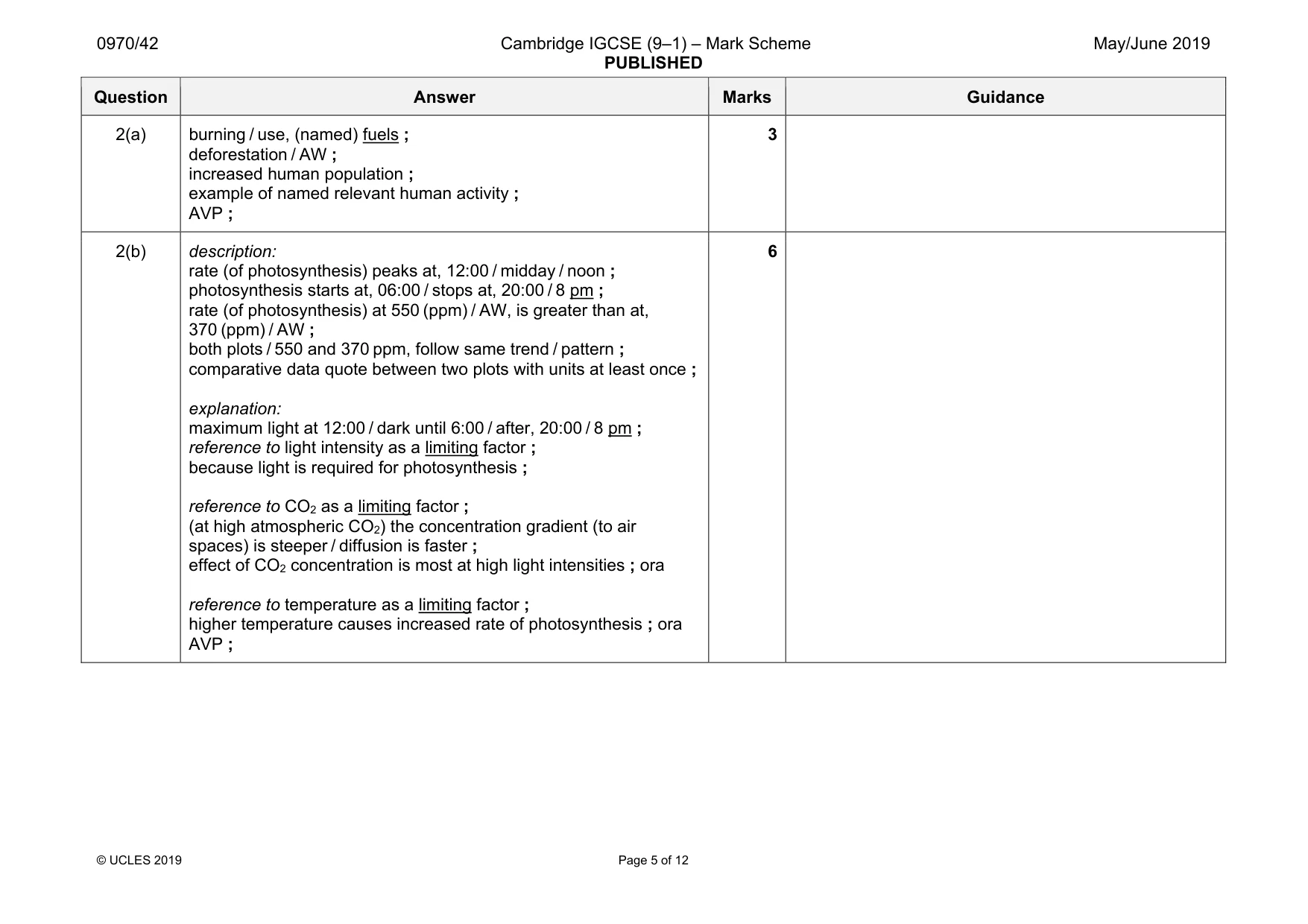
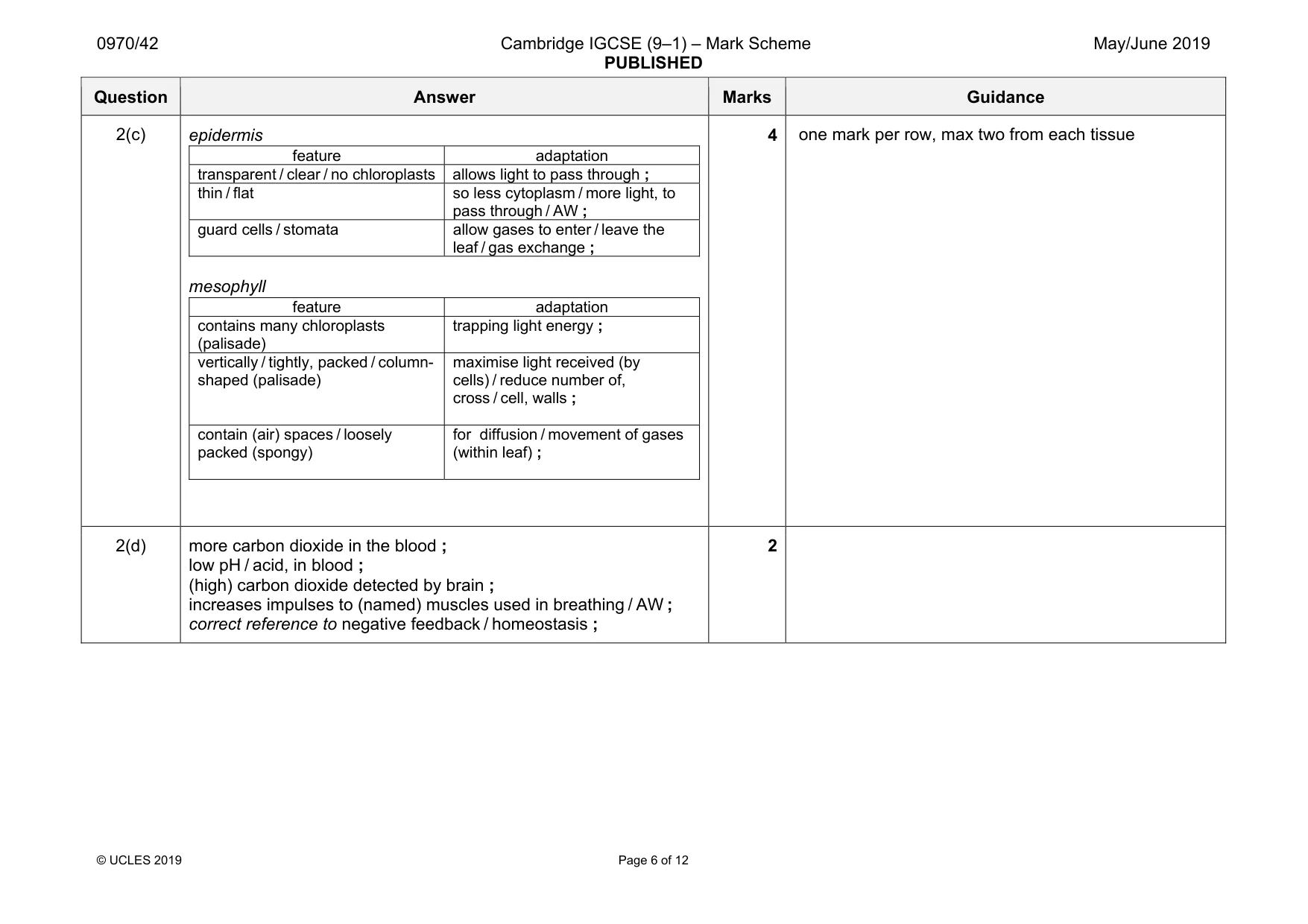
Mark scheme: 2(a) burning / use, (named) fuels ; deforestation / AW ; increased human population ; example of named relevant human activity ; AVP ; 3 2(b) description: rate (of photosynthesis) peaks at, 12:00 / midday / noon ; photosynthesis starts at, 06:00 / stops at, 20:00 / 8 pm ; rate (of photosynthesis) at 550 (ppm) / AW, is greater than at, 370 (ppm) / AW ; both plots / 550 and 370 ppm, follow same trend / pattern ; comparative data quote between two plots with units at least once ; explanation: maximum light at 12:00 / dark until 6:00 / after, 20:00 / 8 pm ; reference to light intensity as a limiting factor ; because light is required for photosynthesis ; reference to CO2 as a limiting factor ; (at high atmospheric CO2) the concentration gradient (to air spaces) is steeper / diffusion is faster ; effect of CO2 concentration is most at high light intensities ; ora reference to temperature as a limiting factor ; higher temperature causes increased rate of photosynthesis ; ora AVP ; 6 Question Answer Marks Guidance 2(c) epidermis mesophyll feature adaptation transparent / clear / no chloroplasts allows light to pass through ; thin / flat so less cytoplasm / more light, to pass through / AW ; guard cells / stomata allow gases to enter / leave the leaf / gas exchange ; feature adaptation contains many chloroplasts (palisade) trapping light energy ; vertically / tightly, packed / column- shaped (palisade) maximise light received (by cells) / reduce number of, cross / cell, walls ; contain (air) spaces / loosely packed (spongy) for diffusion / movement of gases (within leaf) ; 4 one mark per row, max two from each tissue 2(d) more carbon dioxide in the blood ; low pH / acid, in blood ; (high) carbon dioxide detected by brain ; increases impulses to (named) muscles used in breathing / AW ; correct reference to negative feedback / homeostasis ; 2
Q3 · Very small pieces of plastic, called microplastics, are found in many products such as…
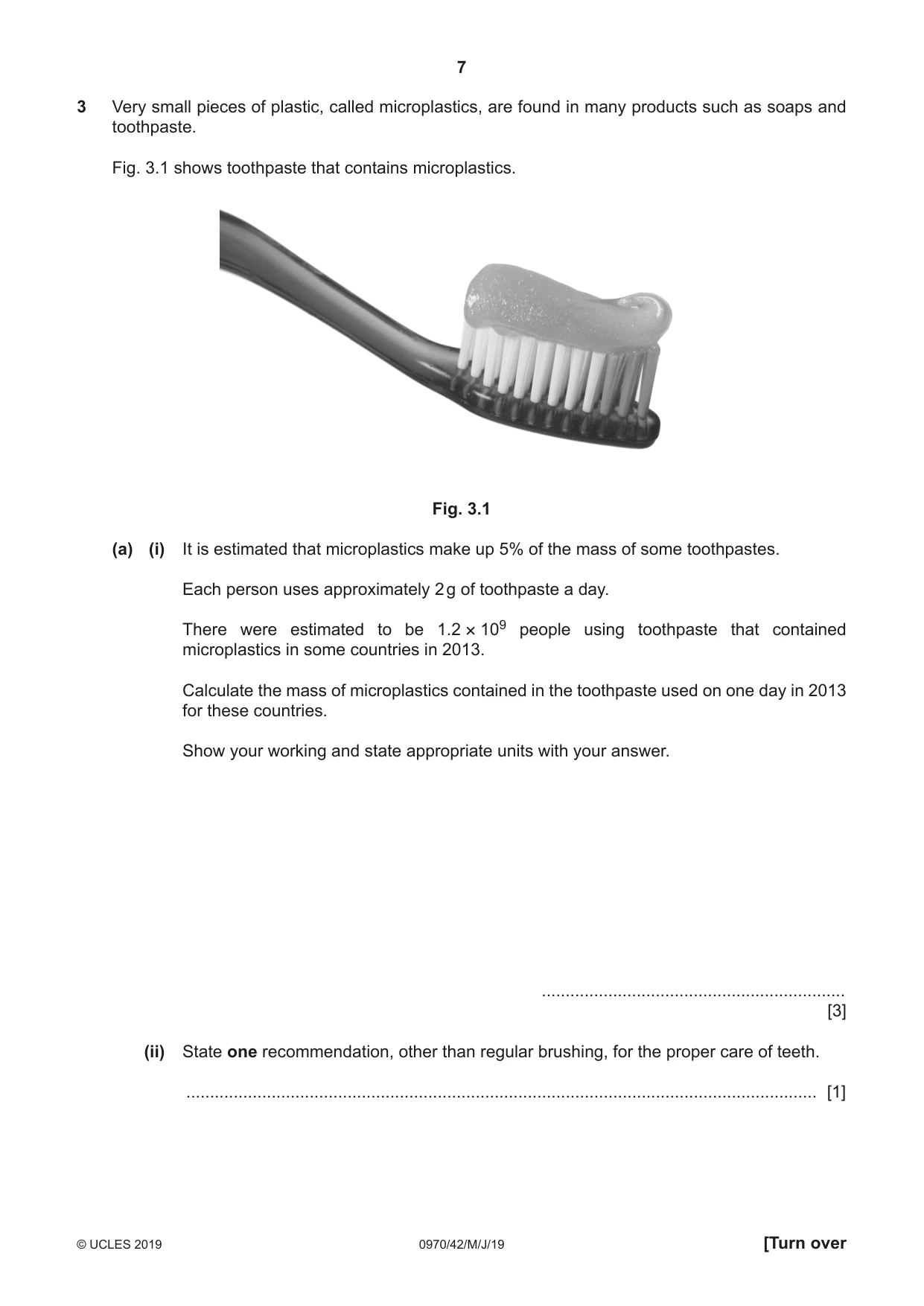
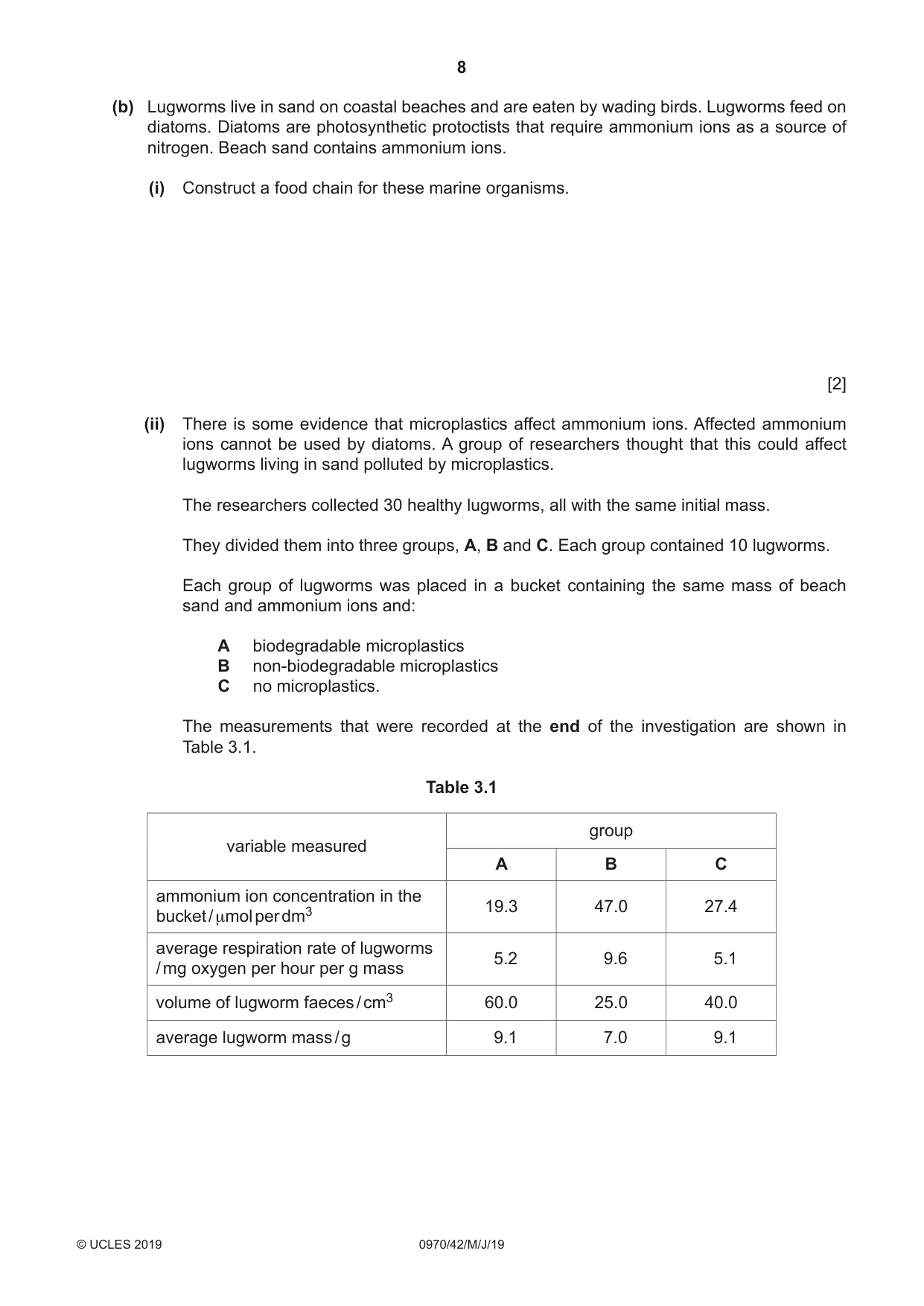
3 Very small pieces of plastic, called microplastics, are found in many products such as soaps and toothpaste. Fig. 3.1 shows toothpaste that contains microplastics. Fig. 3.1 (a) (i) It is estimated that microplastics make up 5% of the mass of some toothpastes. Each person uses approximately 2 g of toothpaste a day. There were estimated to be 1.2 × 10⁹ people using toothpaste that contained microplastics in some countries in 2013. Calculate the mass of microplastics contained in the toothpaste used on one day in 2013 for these countries. Show your working and state appropriate units with your answer. ................................................................ [3] (ii) State one recommendation, other than regular brushing, for the proper care of teeth. ..................................................................................................................................... [1] (b) Lugworms live in sand on coastal beaches and are eaten by wading birds. Lugworms feed on diatoms. Diatoms are photosynthetic protoctists that require ammonium ions as a source of nitrogen. Beach sand contains ammonium ions. (i) Construct a food chain for these marine organisms. [2] (ii) There is some evidence that microplastics affect ammonium ions. Affected ammonium ions cannot be used by diatoms. A group of researchers thought that this could affect lugworms living in sand polluted by microplastics. The researchers collected 30 healthy lugworms, all with the same initial mass. They divided them into three groups, A, B and C. Each group contained 10 lugworms. Each group of lugworms was placed in a bucket containing the same mass of beach sand and ammonium ions and: A biodegradable microplastics B non-biodegradable microplastics C no microplastics. The measurements that were recorded at the end of the investigation are shown in Table 3.1. Table 3.1 group variable measured A B C ammonium ion concentration in the 19.3 47.0 27.4 bucket / µmol per dm3 average respiration rate of lugworms 5.2 9.6 5.1 / mg oxygen per hour per g mass volume of lugworm faeces / cm3 60.0 25.0 40.0 average lugworm mass / g 9.1 7.0 9.1 Describe and explain why the researchers concluded that non-biodegradable microplastics are the most harmful to lugworms. Use the information in Table 3.1 in your answer. ........................................................................................................................................... ........................................................................................................................................... ........................................................................................................................................... ........................................................................................................................................... ........................................................................................................................................... ........................................................................................................................................... ........................................................................................................................................... ........................................................................................................................................... ..................................................................................................................................... [4] (c) Ammonium ions are an important part of the nitrogen cycle. They can be converted into nitrate ions, which are used by plants and protoctists such as diatoms. (i) State the name of the molecules that are converted into ammonium ions in the nitrogen cycle. ..................................................................................................................................... [1] (ii) State the name of the process of converting ammonium ions into nitrate ions. ..................................................................................................................................... [1] (iii) Explain the effects of nitrate ion deficiency on plant growth. ........................................................................................................................................... ........................................................................................................................................... ........................................................................................................................................... ........................................................................................................................................... ........................................................................................................................................... ........................................................................................................................................... ..................................................................................................................................... [3] (d) Non-biodegradable plastics are also harmful to terrestrial ecosystems. Discuss the effects of non-biodegradable plastics on terrestrial ecosystems. ................................................................................................................................................... ................................................................................................................................................... ................................................................................................................................................... ................................................................................................................................................... ................................................................................................................................................... ................................................................................................................................................... ................................................................................................................................................... ................................................................................................................................................... ................................................................................................................................................... ................................................................................................................................................... ............................................................................................................................................. [5] [Total: 20]
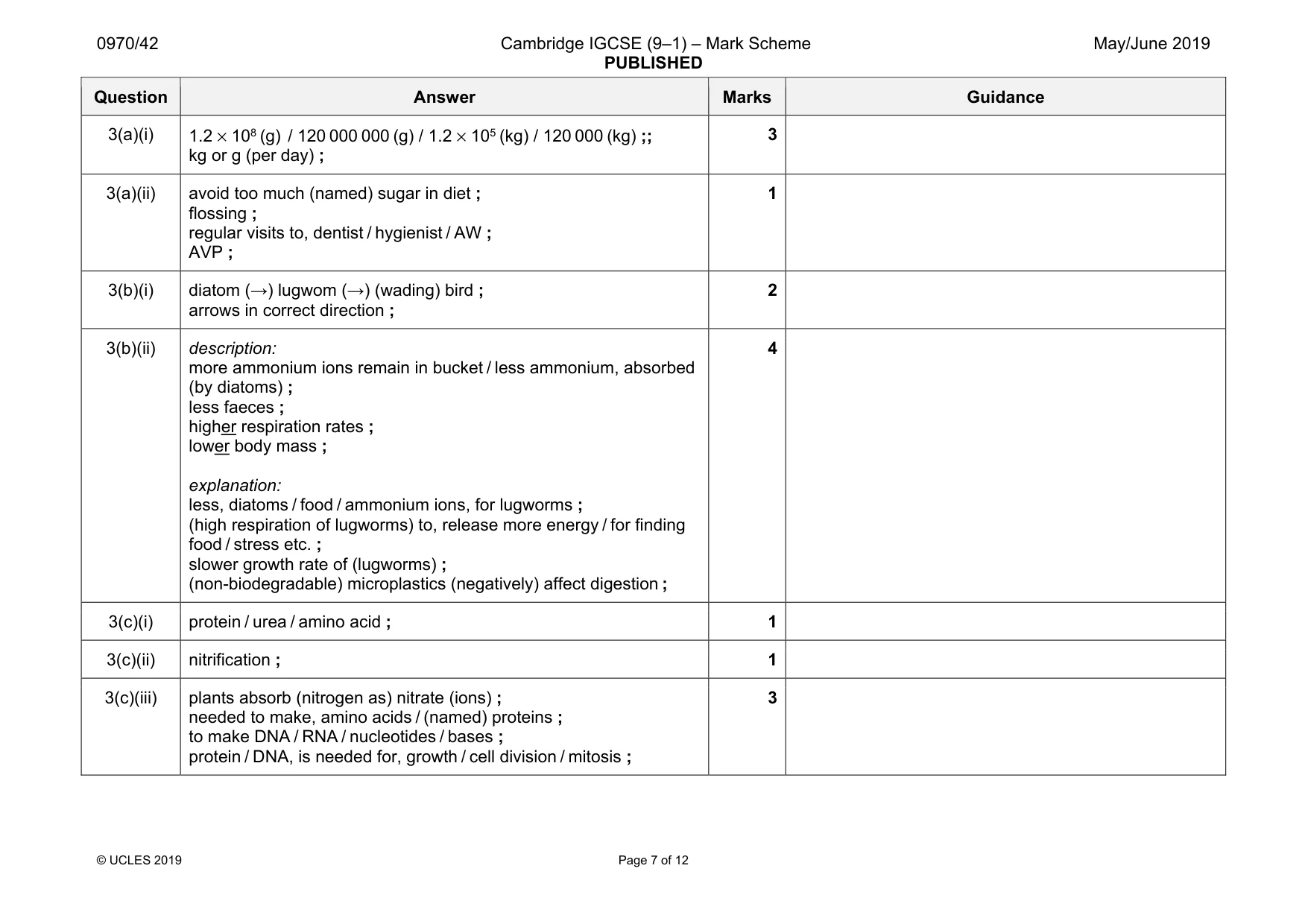
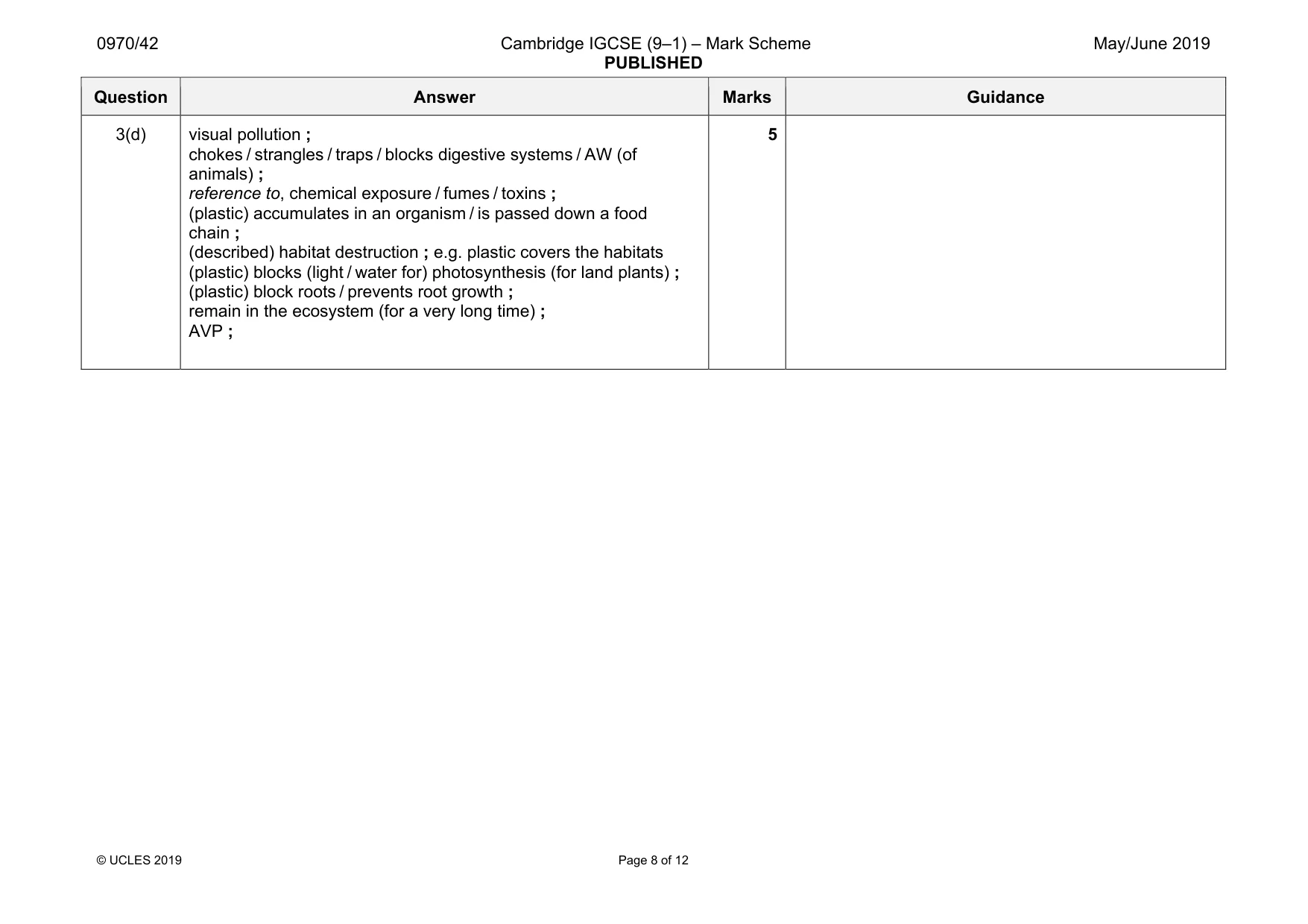
Mark scheme: 3(a)(i) kg or g (per day) ; 3 3(a)(ii) avoid too much (named) sugar in diet ; flossing ; regular visits to, dentist / hygienist / AW ; AVP ; 1 3(b)(i) diatom (→) lugwom (→) (wading) bird ; arrows in correct direction ; 2 3(b)(ii) description: more ammonium ions remain in bucket / less ammonium, absorbed (by diatoms) ; less faeces ; higher respiration rates ; lower body mass ; explanation: less, diatoms / food / ammonium ions, for lugworms ; (high respiration of lugworms) to, release more energy / for finding food / stress etc. ; slower growth rate of (lugworms) ; (non-biodegradable) microplastics (negatively) affect digestion ; 4 3(c)(i) protein / urea / amino acid ; 1 3(c)(ii) nitrification ; 1 3(c)(iii) plants absorb (nitrogen as) nitrate (ions) ; needed to make, amino acids / (named) proteins ; to make DNA / RNA / nucleotides / bases ; protein / DNA, is needed for, growth / cell division / mitosis ; 3 Question Answer Marks Guidance 3(d) visual pollution ; chokes / strangles / traps / blocks digestive systems / AW (of animals) ; reference to, chemical exposure / fumes / toxins ; (plastic) accumulates in an organism / is passed down a food chain ; (described) habitat destruction ; e.g. plastic covers the habitats (plastic) blocks (light / water for) photosynthesis (for land plants) ; (plastic) block roots / prevents root growth ; remain in the ecosystem (for a very long time) ; AVP ; 5
Q4 · Neurones are part of the nervous system
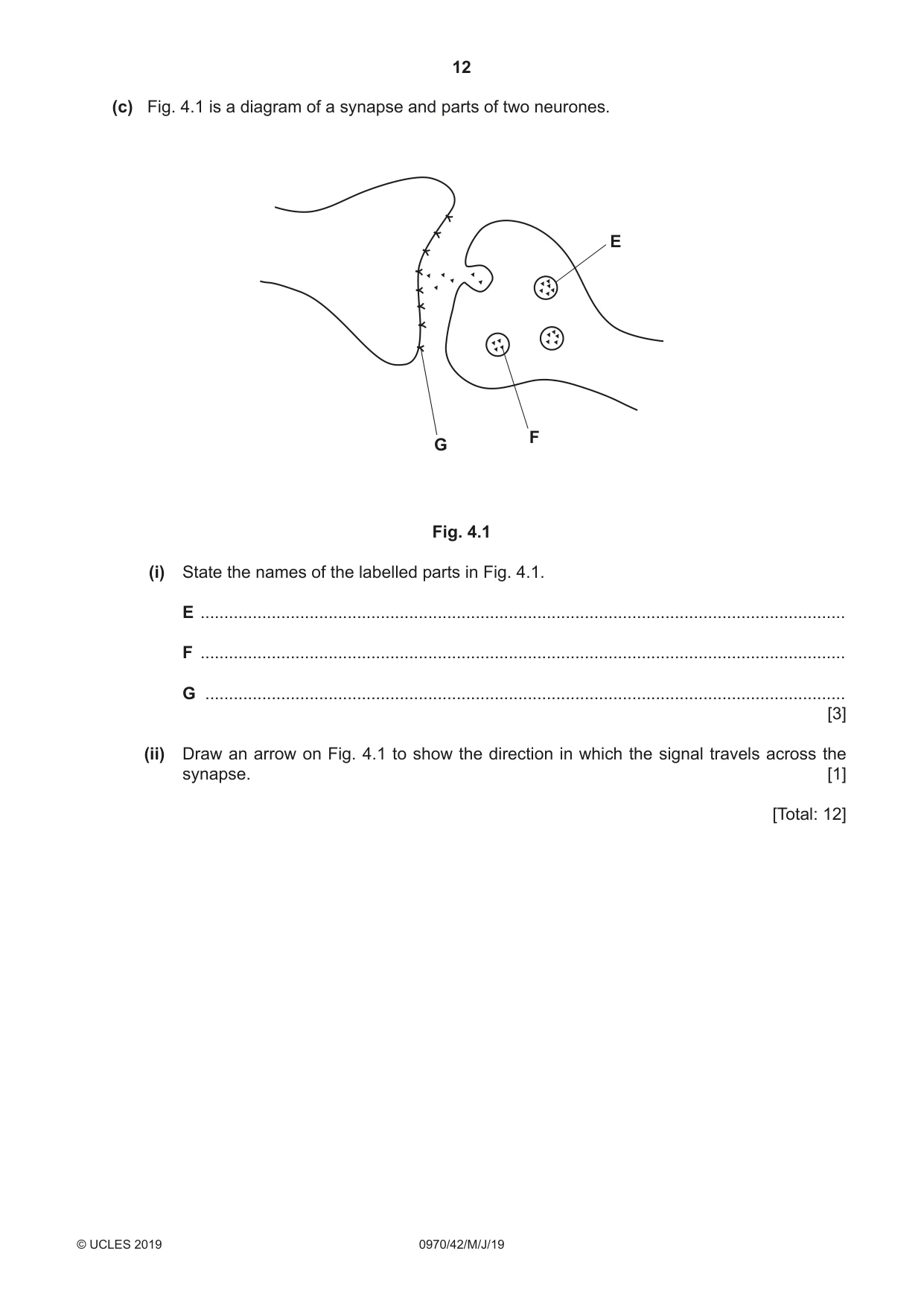
4 Neurones are part of the nervous system. Neurones are connected to each other by synapses. (a) (i) Describe how the structure of a neurone is related to its function. ........................................................................................................................................... ........................................................................................................................................... ........................................................................................................................................... ........................................................................................................................................... ........................................................................................................................................... ........................................................................................................................................... ..................................................................................................................................... [3] (ii) The nervous system is made up of the central nervous system and the peripheral nervous system. State the names of the organs that make up the central nervous system. ..................................................................................................................................... [1] (b) Reflex actions allow the body to respond rapidly to changes in the external environment. (i) Outline the pathway in a reflex arc in response to shining a bright light into the eye. ........................................................................................................................................... ........................................................................................................................................... ........................................................................................................................................... ........................................................................................................................................... ........................................................................................................................................... ........................................................................................................................................... ..................................................................................................................................... [3] (ii) Doctors sometimes check the reflexes of people who are unconscious. Suggest why reflexes occur in people who are unconscious. ..................................................................................................................................... [1] (c) Fig. 4.1 is a diagram of a synapse and parts of two neurones. E F G Fig. 4.1 (i) State the names of the labelled parts in Fig. 4.1. E ........................................................................................................................................ F ........................................................................................................................................ G ....................................................................................................................................... [3] (ii) Draw an arrow on Fig. 4.1 to show the direction in which the signal travels across the synapse. [1] [Total: 12]
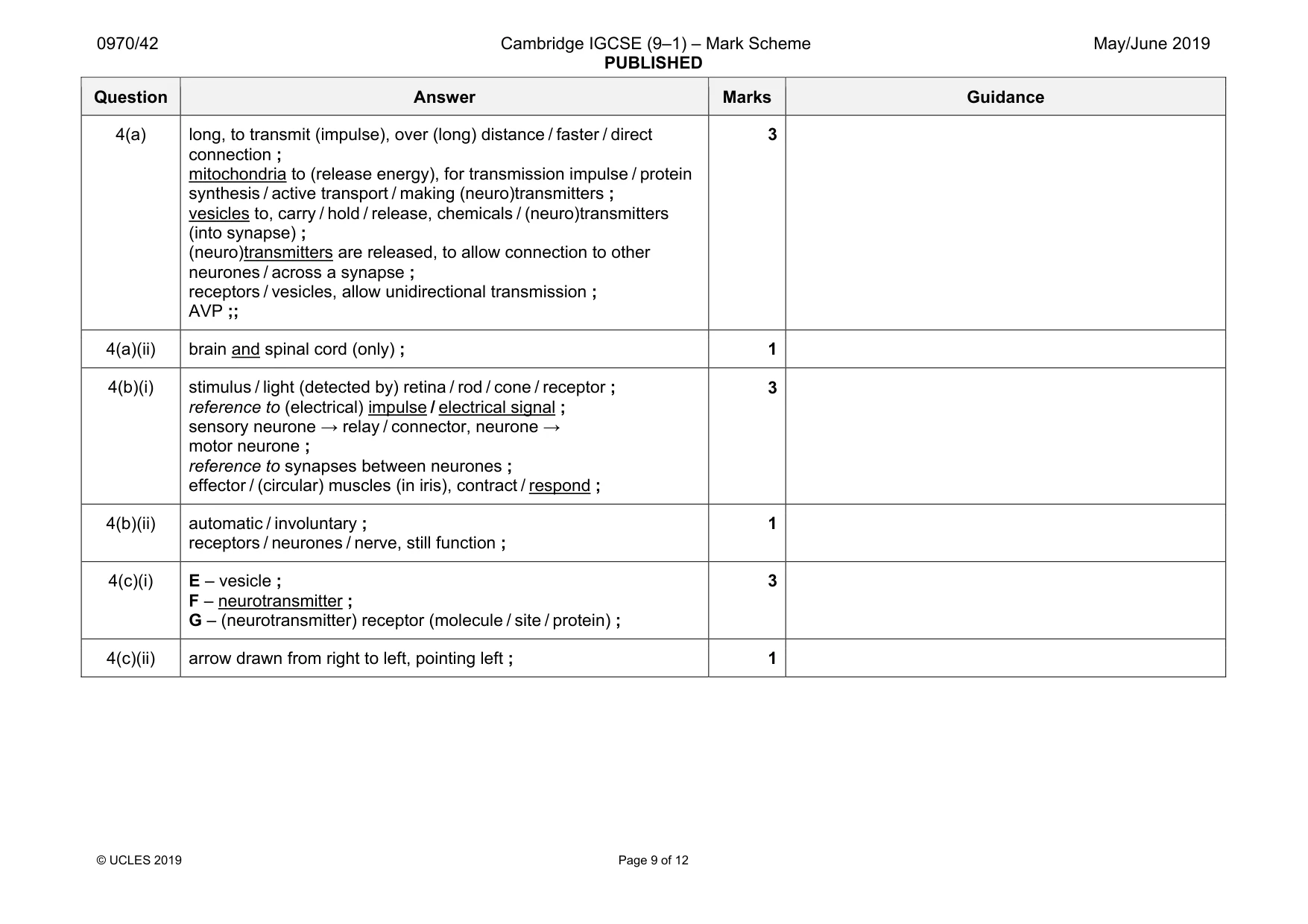
Mark scheme: 4(a) long, to transmit (impulse), over (long) distance / faster / direct connection ; mitochondria to (release energy), for transmission impulse / protein synthesis / active transport / making (neuro)transmitters ; vesicles to, carry / hold / release, chemicals / (neuro)transmitters (into synapse) ; (neuro)transmitters are released, to allow connection to other neurones / across a synapse ; receptors / vesicles, allow unidirectional transmission ; AVP ;; 3 4(a)(ii) brain and spinal cord (only) ; 1 4(b)(i) stimulus / light (detected by) retina / rod / cone / receptor ; reference to (electrical) impulse / electrical signal ; sensory neurone → relay / connector, neurone → motor neurone ; reference to synapses between neurones ; effector / (circular) muscles (in iris), contract / respond ; 3 4(b)(ii) automatic / involuntary ; receptors / neurones / nerve, still function ; 1 4(c)(i) E – vesicle ; F – neurotransmitter ; G – (neurotransmitter) receptor (molecule / site / protein) ; 3 4(c)(ii) arrow drawn from right to left, pointing left ; 1
Q5 · The testes are part of the endocrine system because they produce hormones
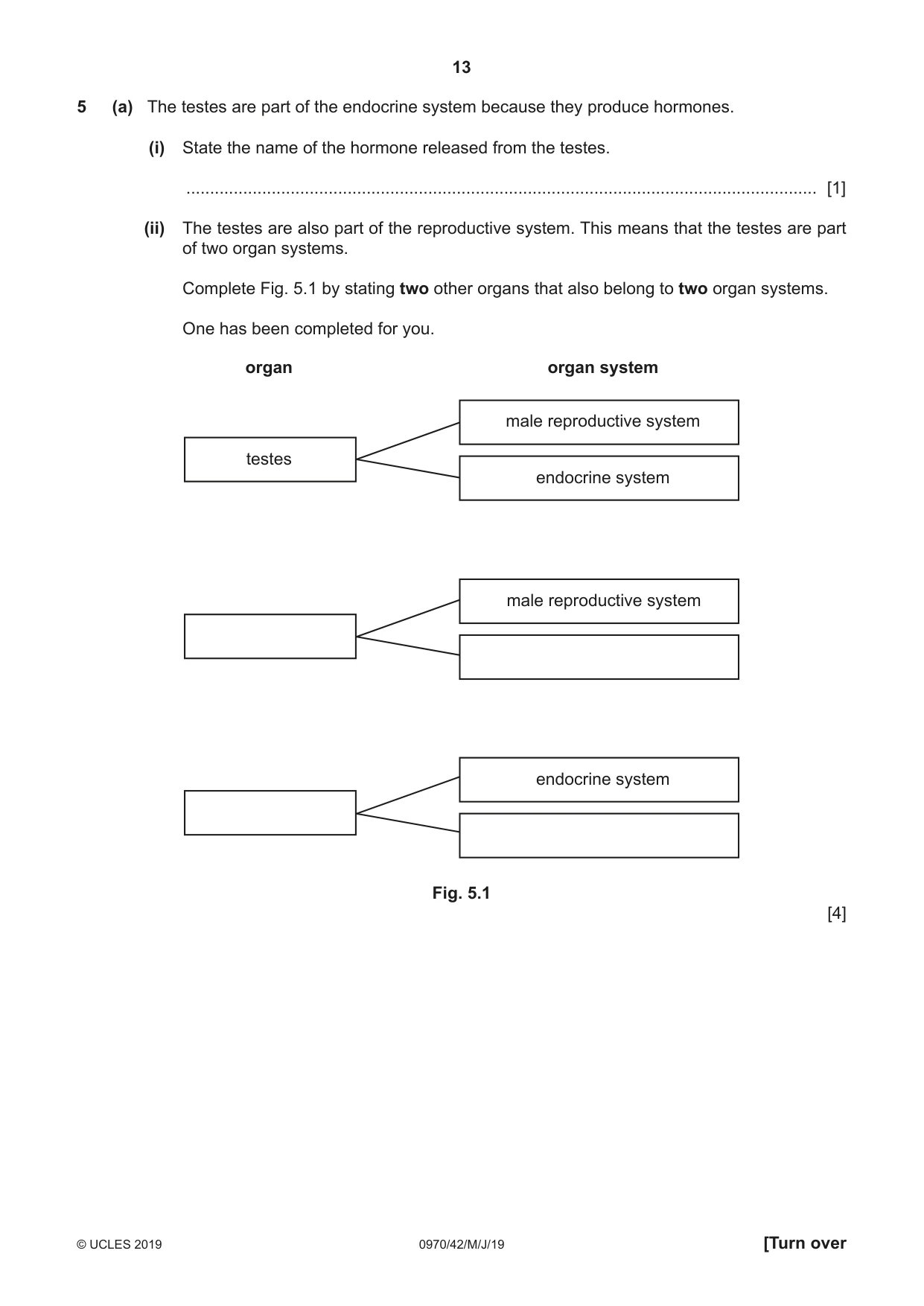
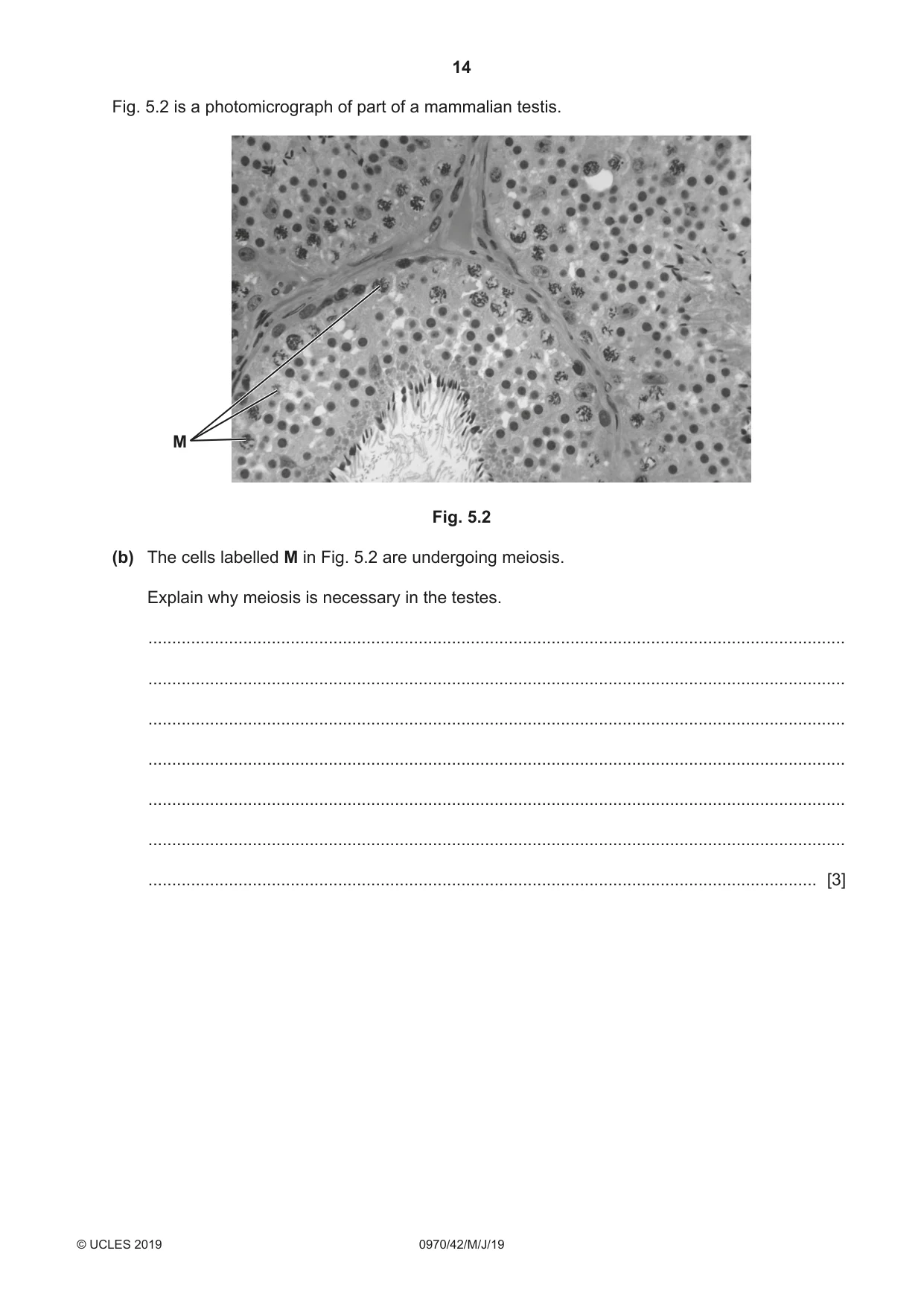
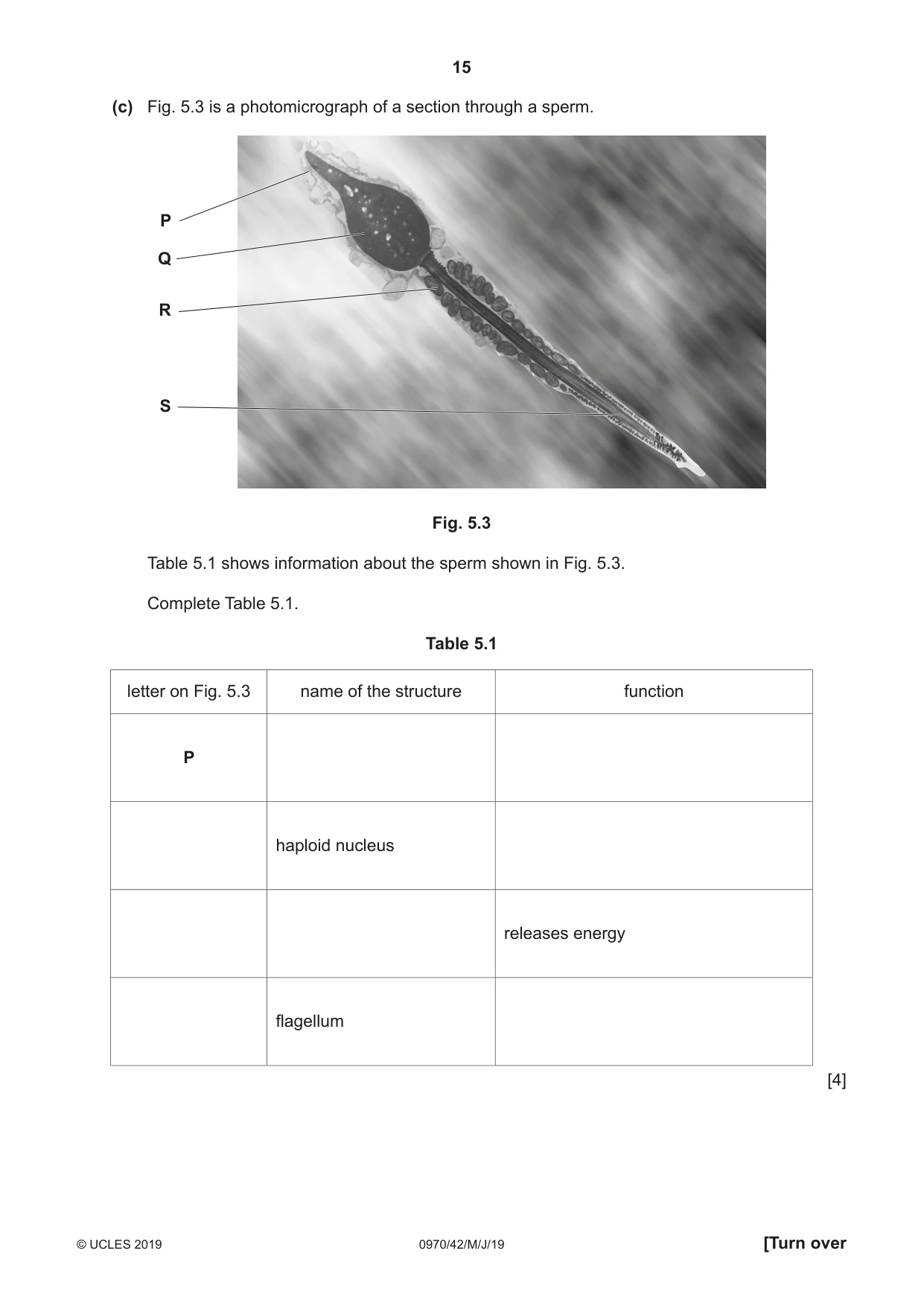
5 (a) The testes are part of the endocrine system because they produce hormones. (i) State the name of the hormone released from the testes. ..................................................................................................................................... [1] (ii) The testes are also part of the reproductive system. This means that the testes are part of two organ systems. Complete Fig. 5.1 by stating two other organs that also belong to two organ systems. One has been completed for you. organ organ system male reproductive system testes endocrine system male reproductive system endocrine system Fig. 5.1 [4] Fig. 5.2 is a photomicrograph of part of a mammalian testis. M Fig. 5.2 (b) The cells labelled M in Fig. 5.2 are undergoing meiosis. Explain why meiosis is necessary in the testes. ................................................................................................................................................... ................................................................................................................................................... ................................................................................................................................................... ................................................................................................................................................... ................................................................................................................................................... ................................................................................................................................................... ............................................................................................................................................. [3] (c) Fig. 5.3 is a photomicrograph of a section through a sperm. P Q R S Fig. 5.3 Table 5.1 shows information about the sperm shown in Fig. 5.3. Complete Table 5.1. Table 5.1 letter on Fig. 5.3 name of the structure function P haploid nucleus releases energy flagellum [4] (d) Draw and label one human egg cell. Include at least one labelled feature that is not found in a sperm cell. [3] (e) Describe what happens to a fertilised egg cell before implantation in the uterus. ................................................................................................................................................... ................................................................................................................................................... ................................................................................................................................................... ................................................................................................................................................... ................................................................................................................................................... ................................................................................................................................................... ............................................................................................................................................. [3] [Total: 18]
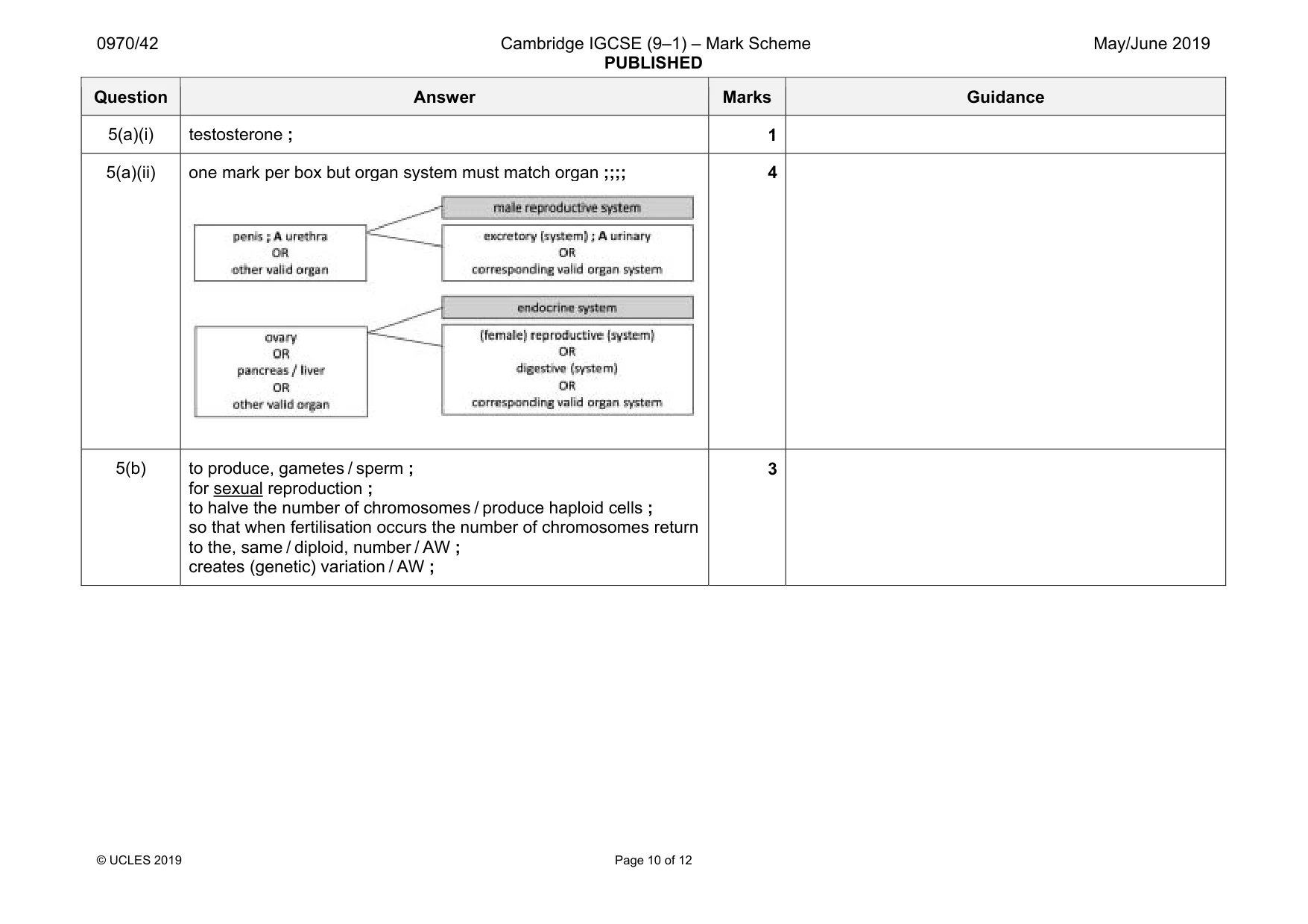
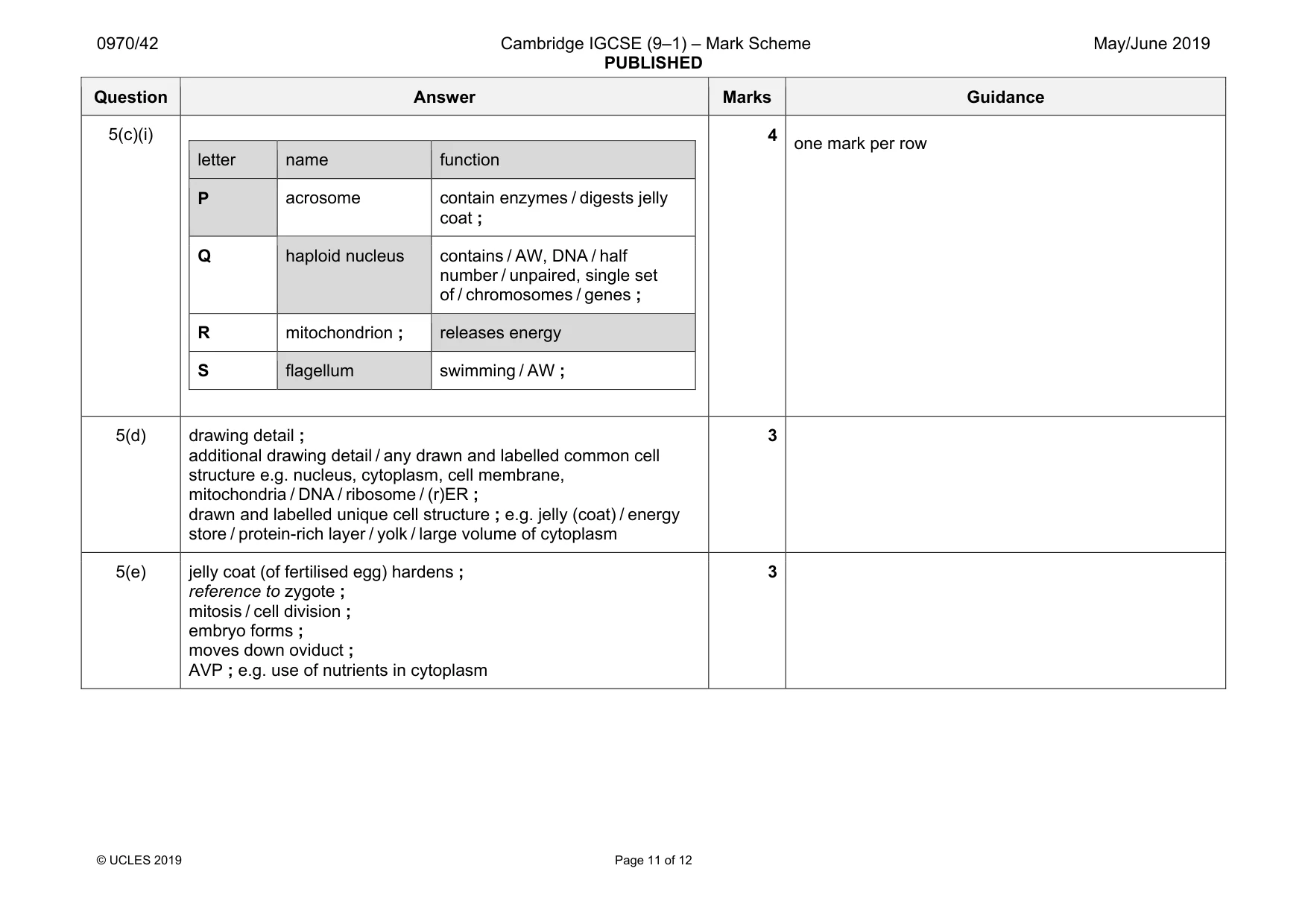
Mark scheme: 5(a)(i) testosterone ; 1 5(a)(ii) one mark per box but organ system must match organ ;;;; 4 5(b) to produce, gametes / sperm ; for sexual reproduction ; to halve the number of chromosomes / produce haploid cells ; so that when fertilisation occurs the number of chromosomes return to the, same / diploid, number / AW ; creates (genetic) variation / AW ; 3 Question Answer Marks Guidance 5(c)(i) letter name function P acrosome contain enzymes / digests jelly coat ; Q haploid nucleus contains / AW, DNA / half number / unpaired, single set of / chromosomes / genes ; R mitochondrion ; releases energy S flagellum swimming / AW ; 4 one mark per row 5(d) drawing detail ; additional drawing detail / any drawn and labelled common cell structure e.g. nucleus, cytoplasm, cell membrane, mitochondria / DNA / ribosome / (r)ER ; drawn and labelled unique cell structure ; e.g. jelly (coat) / energy store / protein-rich layer / yolk / large volume of cytoplasm 3 5(e) jelly coat (of fertilised egg) hardens ; reference to zygote ; mitosis / cell division ; embryo forms ; moves down oviduct ; AVP ; e.g. use of nutrients in cytoplasm 3
Q6 · Some of the many different varieties of potato, Solanum tuberosum, that are cultivated…
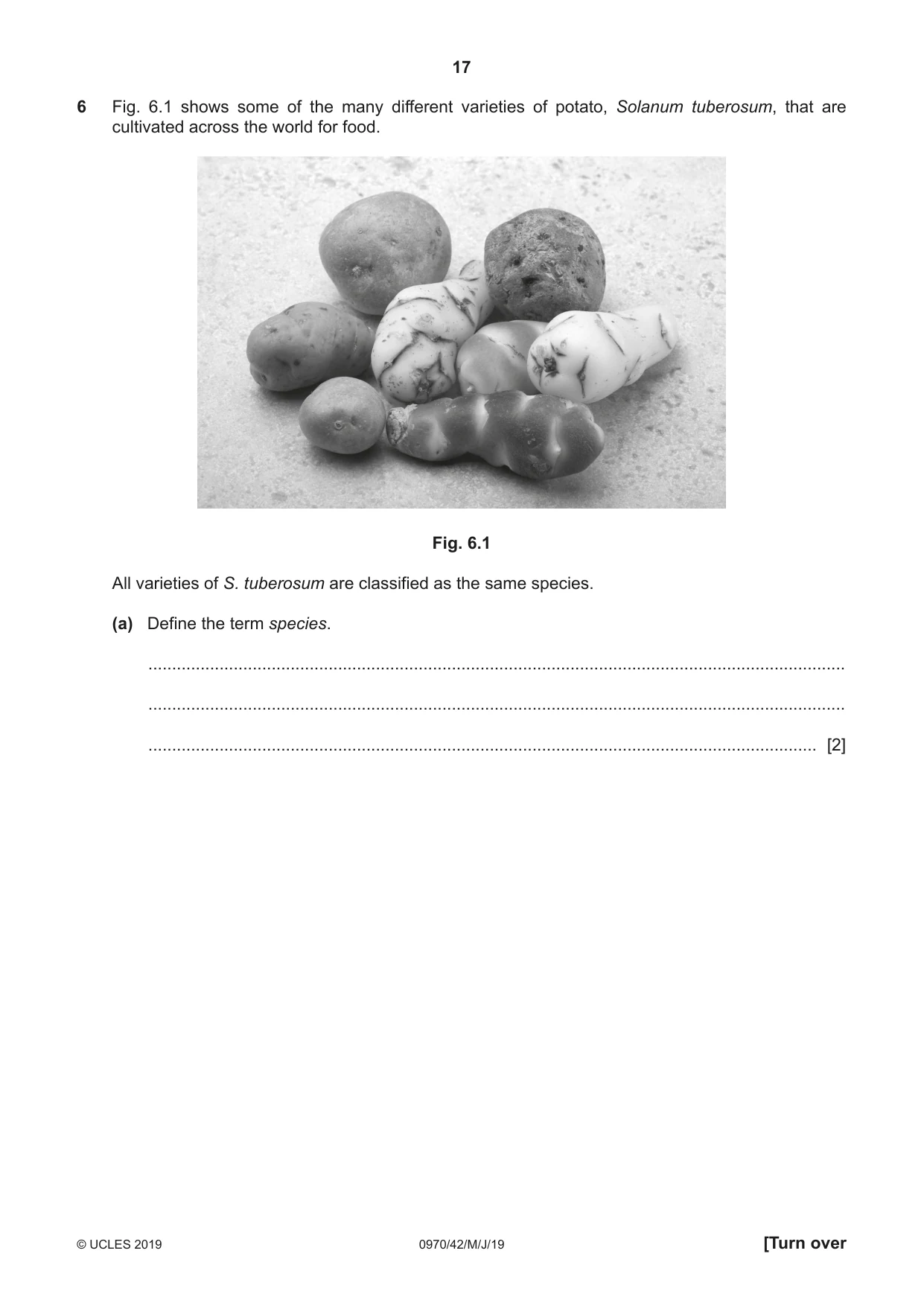
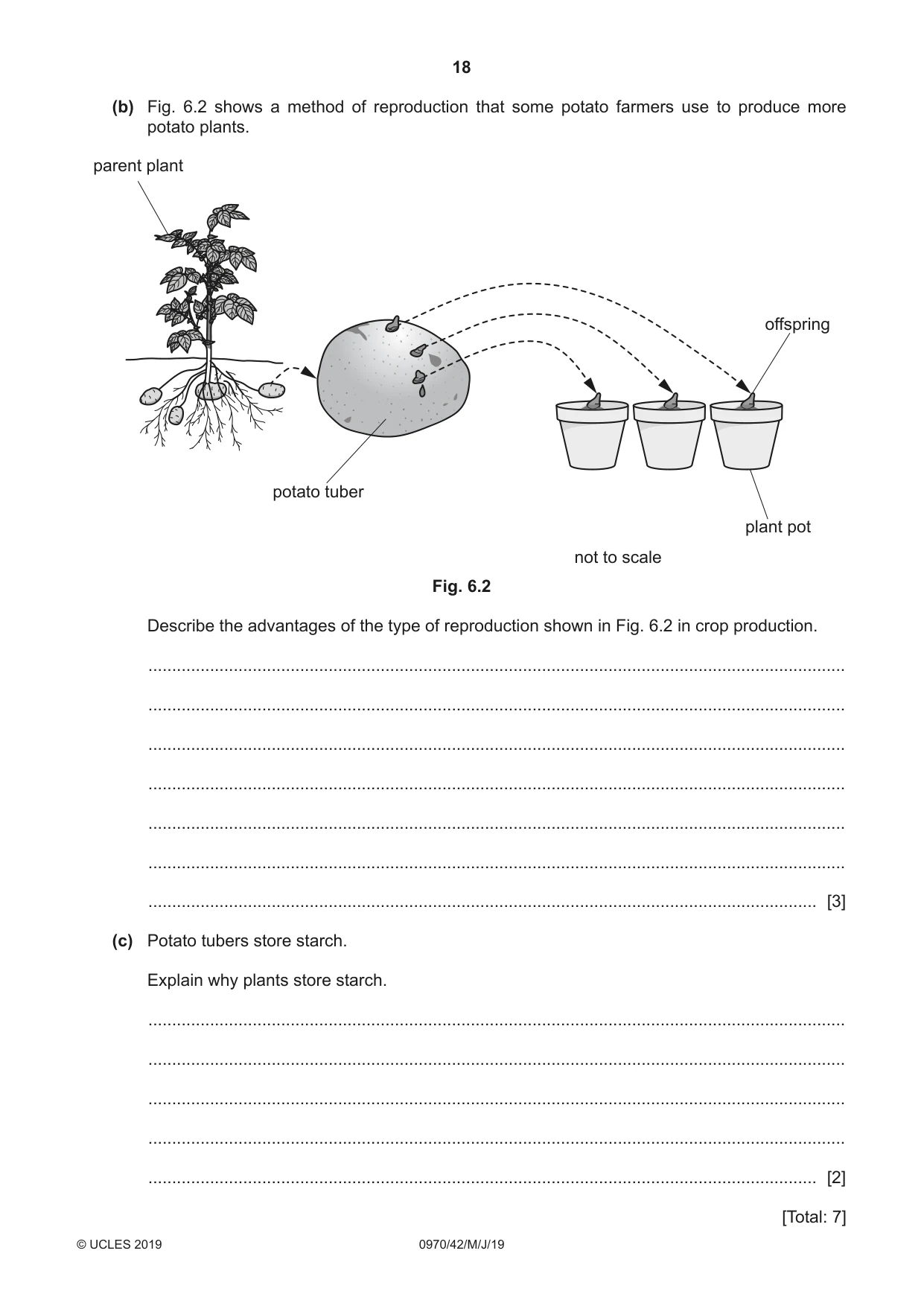
6 Fig. 6.1 shows some of the many different varieties of potato, Solanum tuberosum, that are cultivated across the world for food. Fig. 6.1 All varieties of S. tuberosum are classified as the same species. (a) Define the term species. ................................................................................................................................................... ................................................................................................................................................... ............................................................................................................................................. [2] (b) Fig. 6.2 shows a method of reproduction that some potato farmers use to produce more potato plants. parent plant offspring potato tuber plant pot not to scale Fig. 6.2 Describe the advantages of the type of reproduction shown in Fig. 6.2 in crop production. ................................................................................................................................................... ................................................................................................................................................... ................................................................................................................................................... ................................................................................................................................................... ................................................................................................................................................... ................................................................................................................................................... ............................................................................................................................................. [3] (c) Potato tubers store starch. Explain why plants store starch. ................................................................................................................................................... ................................................................................................................................................... ................................................................................................................................................... ................................................................................................................................................... ............................................................................................................................................. [2]
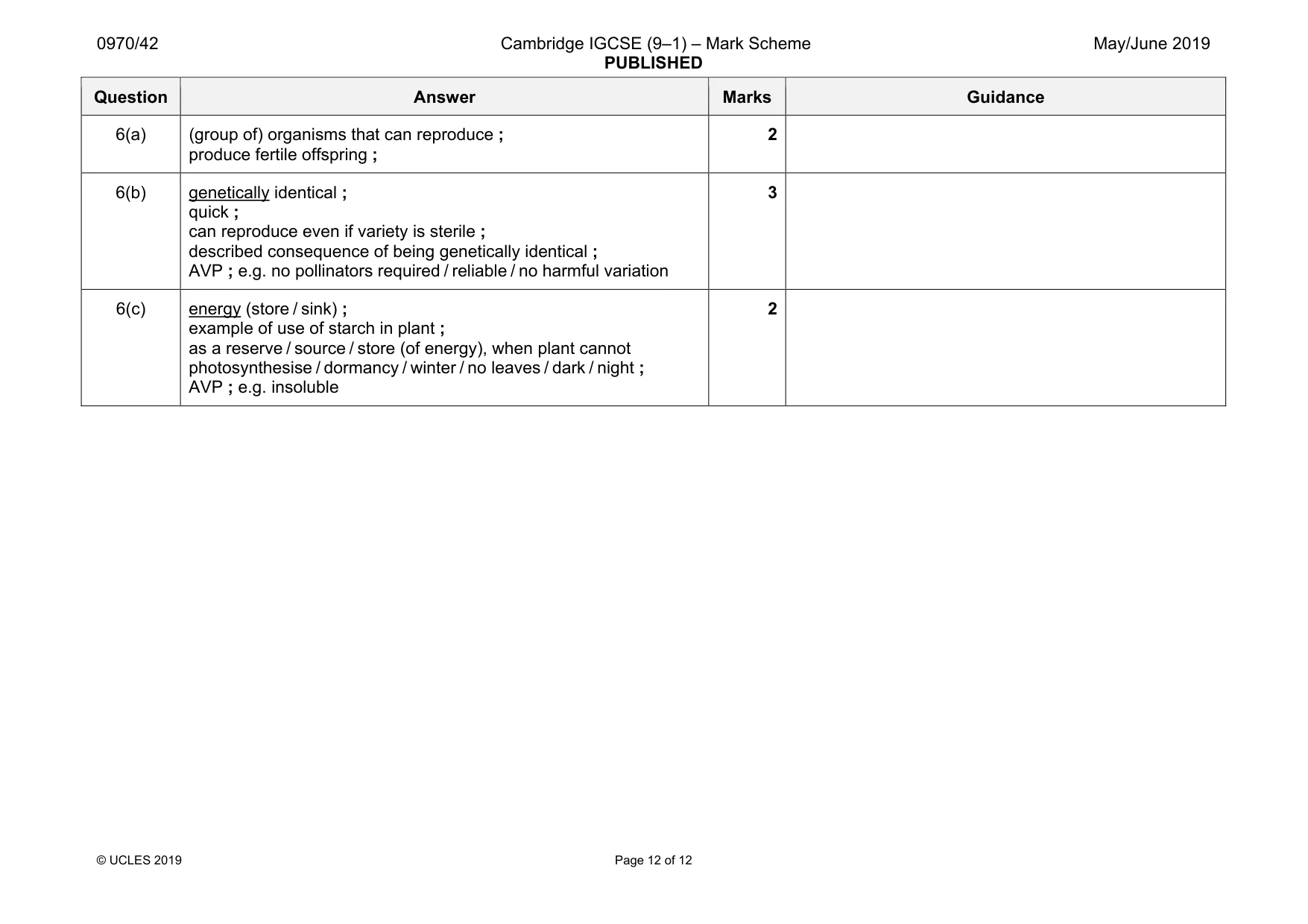
Mark scheme: 6(a) (group of) organisms that can reproduce ; produce fertile offspring ; 2 6(b) genetically identical ; quick ; can reproduce even if variety is sterile ; described consequence of being genetically identical ; AVP ; e.g. no pollinators required / reliable / no harmful variation 3 6(c) energy (store / sink) ; example of use of starch in plant ; as a reserve / source / store (of energy), when plant cannot photosynthesise / dormancy / winter / no leaves / dark / night ; AVP ; e.g. insoluble 2
What was in this paper
The subtopics covered by these 6 questions, and how many questions each got. Open one in a new tab to see every Cambridge question on it.
What you needed in this session
Cambridge’s own grade thresholds for 2019 May/June, Paper 4 · Variant 2. A higher threshold means an easier paper — the bar moves with how the cohort did.