Questions as text
Q1 · Which user of accounting statements is interested in past performance and taking remedial… 0452/11 May/June 2020
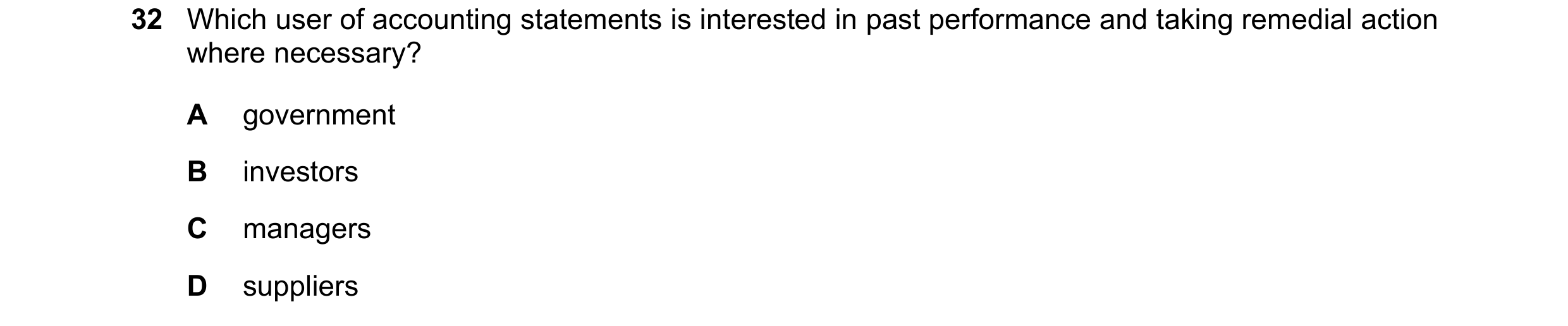
32 Which user of accounting statements is interested in past performance and taking remedial action where necessary? A government B investors C managers D suppliers
1 marks
Answer: C
This question in 0452/11 May/June 2020
Q2 · Which external parties would be interested in the accounting ratios of a business? 0452/12 May/June 2020
32 Which external parties would be interested in the accounting ratios of a business? A government B investors C managers D tax authorities
1 marks
Answer: B
This question in 0452/12 May/June 2020
Q3 · Which external parties would be interested in the accounting ratios of a business? 0452/13 May/June 2020
32 Which external parties would be interested in the accounting ratios of a business? A government B investors C managers D tax authorities
1 marks
Answer: B
This question in 0452/13 May/June 2020
Q4 · Which interested party uses the financial statements of a business to assess current… 0452/12 Oct/Nov 2020
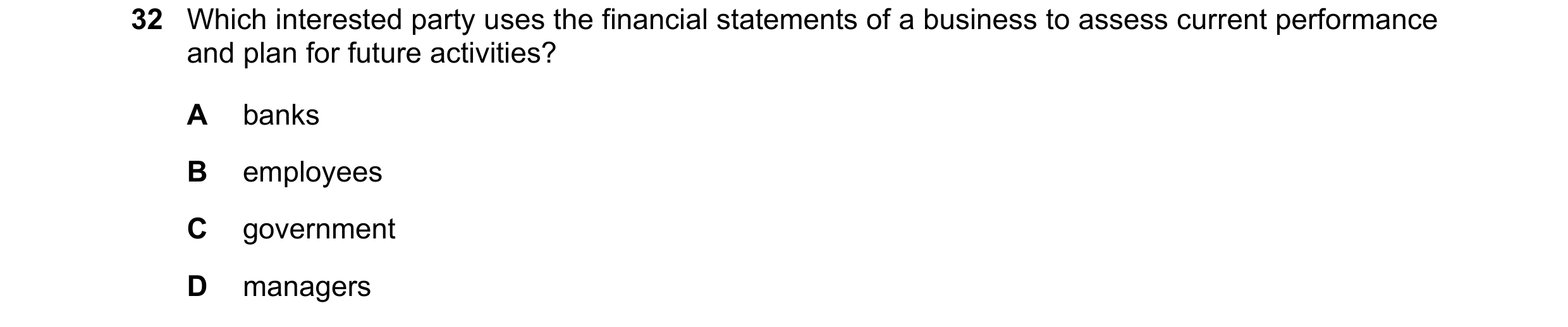
32 Which interested party uses the financial statements of a business to assess current performance and plan for future activities? A banks B employees C government D managers
1 marks
Answer: D
This question in 0452/12 Oct/Nov 2020
Q5 · Which external parties would be interested in the financial statements of a trader? 0452/11 May/June 2021
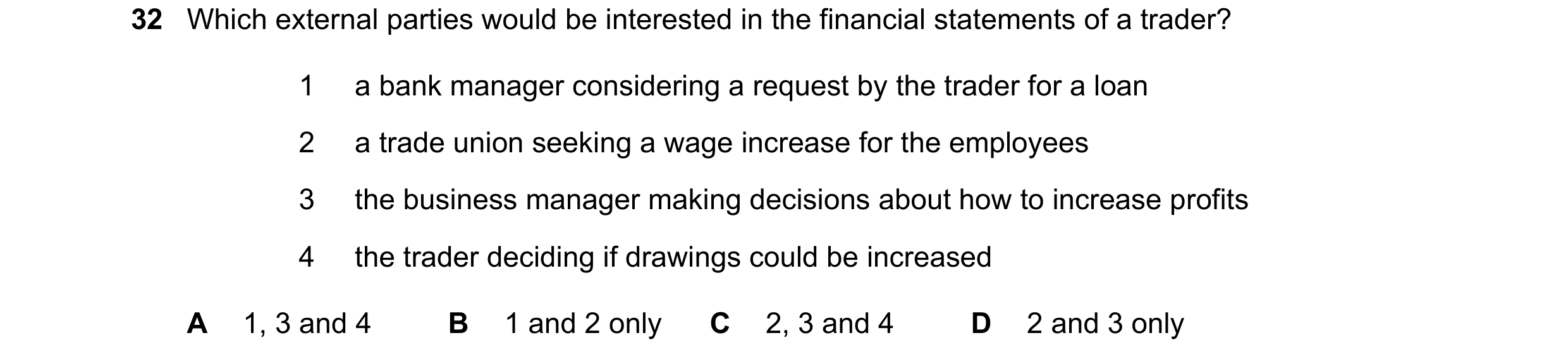
32 Which external parties would be interested in the financial statements of a trader? 1 a bank manager considering a request by the trader for a loan 2 a trade union seeking a wage increase for the employees 3 the business manager making decisions about how to increase profits 4 the trader deciding if drawings could be increased A 1, 3 and 4 B 1 and 2 only C 2, 3 and 4 D 2 and 3 only
1 marks
Answer: B
This question in 0452/11 May/June 2021
Q6 · Why would a supplier be interested in the financial statements of a credit customer? 0452/11 Oct/Nov 2021
34 Why would a supplier be interested in the financial statements of a credit customer? A to know if the customer can pay what he owes B to know the amount owed by trade receivables C to know the profit for the year D to know the value of the inventory
1 marks
Answer: A
This question in 0452/11 Oct/Nov 2021
Q7 · Why would the owner of a business want to see his financial statements at the end of the… 0452/12 Oct/Nov 2021
33 Why would the owner of a business want to see his financial statements at the end of the year? 1 to assess the performance and progress of the business 2 to determine the market value of the non-current assets 3 to make informed decisions for the following years A 1 only B 1 and 3 C 2 only D 2 and 3
1 marks
Answer: B
This question in 0452/12 Oct/Nov 2021
Q8 · Why would a supplier be interested in the financial statements of a credit customer? 0452/13 Oct/Nov 2021
34 Why would a supplier be interested in the financial statements of a credit customer? A to know if the customer can pay what he owes B to know the amount owed by trade receivables C to know the profit for the year D to know the value of the inventory
1 marks
Answer: A
This question in 0452/13 Oct/Nov 2021
Q9 · Why would a bank manager be interested in the financial statements of a business? 0452/12 May/June 2022
33 Why would a bank manager be interested in the financial statements of a business? A to calculate and assess the trade payables turnover B to check that the correct amount of tax is being paid C to ensure that employees are being paid the correct hourly rate D to ensure that funds are sufficient to cover loan interest
1 marks
Answer: D
This question in 0452/12 May/June 2022
Q10 · Why would a bank manager be interested in the financial statements of a business? 0452/13 May/June 2022
33 Why would a bank manager be interested in the financial statements of a business? A to calculate and assess the trade payables turnover B to check that the correct amount of tax is being paid C to ensure that employees are being paid the correct hourly rate D to ensure that funds are sufficient to cover loan interest
1 marks
Answer: D
This question in 0452/13 May/June 2022
Q11 · Ramiz works as a sales manager in a car showroom 0452/11 May/June 2023
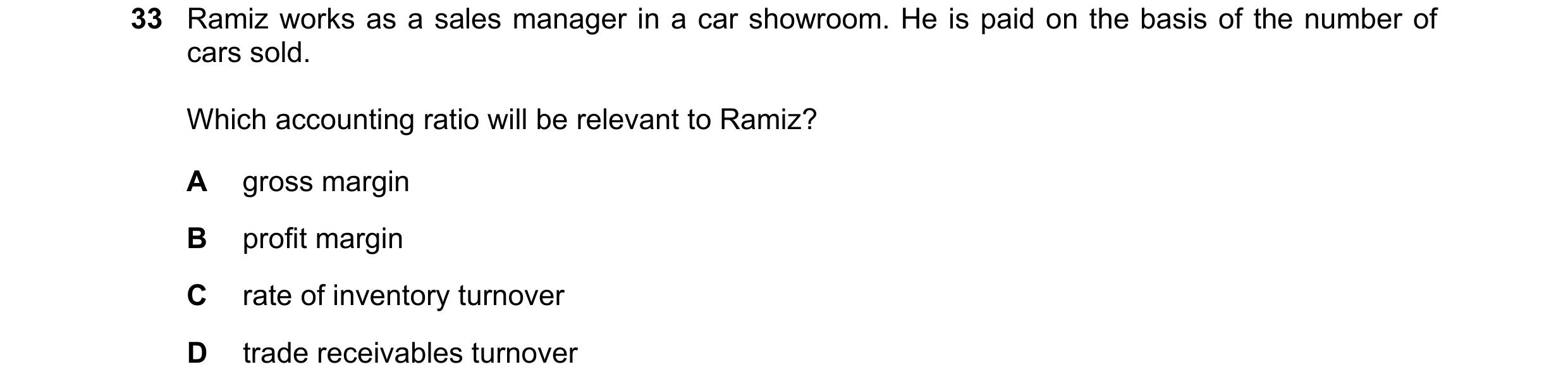
33 Ramiz works as a sales manager in a car showroom. He is paid on the basis of the number of cars sold. Which accounting ratio will be relevant to Ramiz? A gross margin B profit margin C rate of inventory turnover D trade receivables turnover
1 marks
Answer: C
This question in 0452/11 May/June 2023
Q12 · Jack is a shareholder in a company 0452/12 Oct/Nov 2023
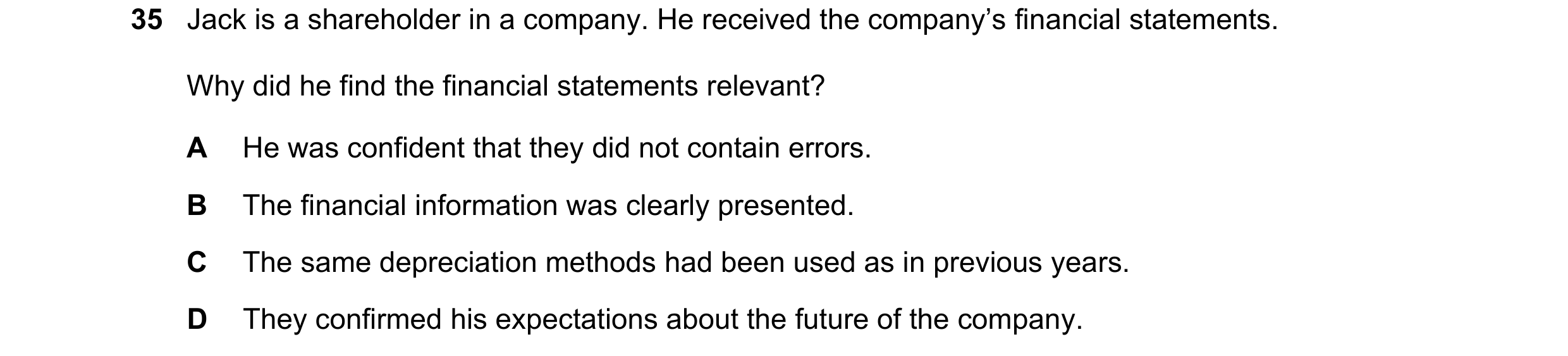
35 Jack is a shareholder in a company. He received the company’s financial statements. Why did he find the financial statements relevant? A He was confident that they did not contain errors. B The financial information was clearly presented. C The same depreciation methods had been used as in previous years. D They confirmed his expectations about the future of the company.
1 marks
Answer: D
This question in 0452/12 Oct/Nov 2023
Q13 · A limited company has invited potential investors to purchase shares in the business 0452/12 Feb/March 2024
33 A limited company has invited potential investors to purchase shares in the business. What information would be of interest to a potential investor? 1 the amount that they would pay for the shares 2 the expected future profits of the business 3 the expected rate of dividend that the business might pay 4 when the limited company will pay back the money invested A 1, 2 and 3 B 1, 3 and 4 C 1 and 2 only D 2 and 3 only
1 marks
Answer: A
This question in 0452/12 Feb/March 2024
Q14 · M Limited has made sure that its financial statements are comparable with those of… 0452/11 Oct/Nov 2024
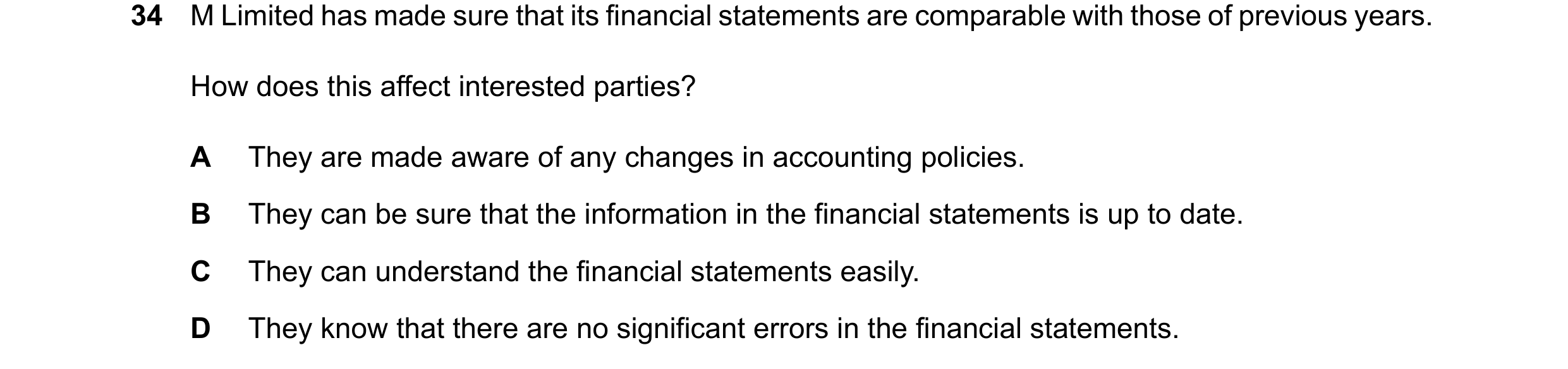
34 M Limited has made sure that its financial statements are comparable with those of previous years. How does this affect interested parties? A They are made aware of any changes in accounting policies. B They can be sure that the information in the financial statements is up to date. C They can understand the financial statements easily. D They know that there are no significant errors in the financial statements.
1 marks
Answer: A
This question in 0452/11 Oct/Nov 2024
Q15 · Who would be interested in the value of non-current assets which a business has available… 0452/12 Oct/Nov 2024
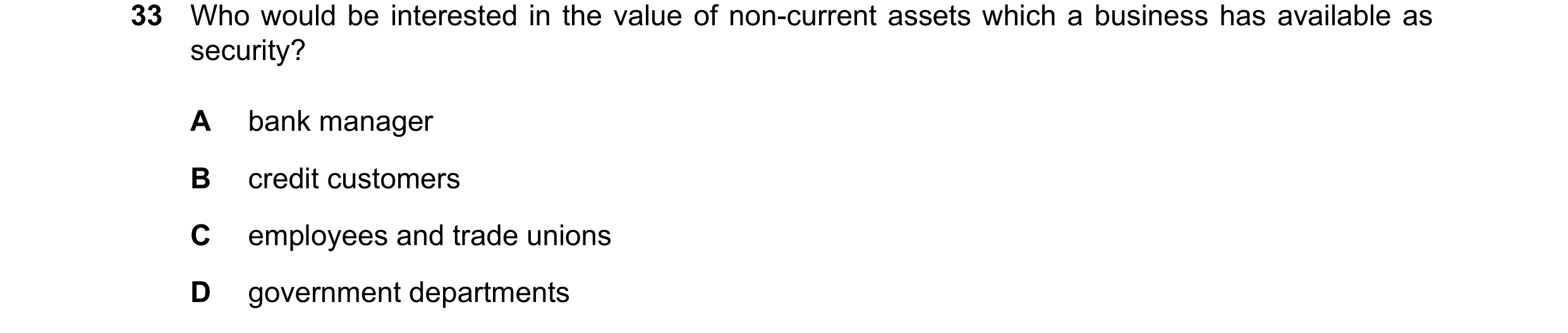
33 Who would be interested in the value of non-current assets which a business has available as security? A bank manager B credit customers C employees and trade unions D government departments
1 marks
Answer: A
This question in 0452/12 Oct/Nov 2024
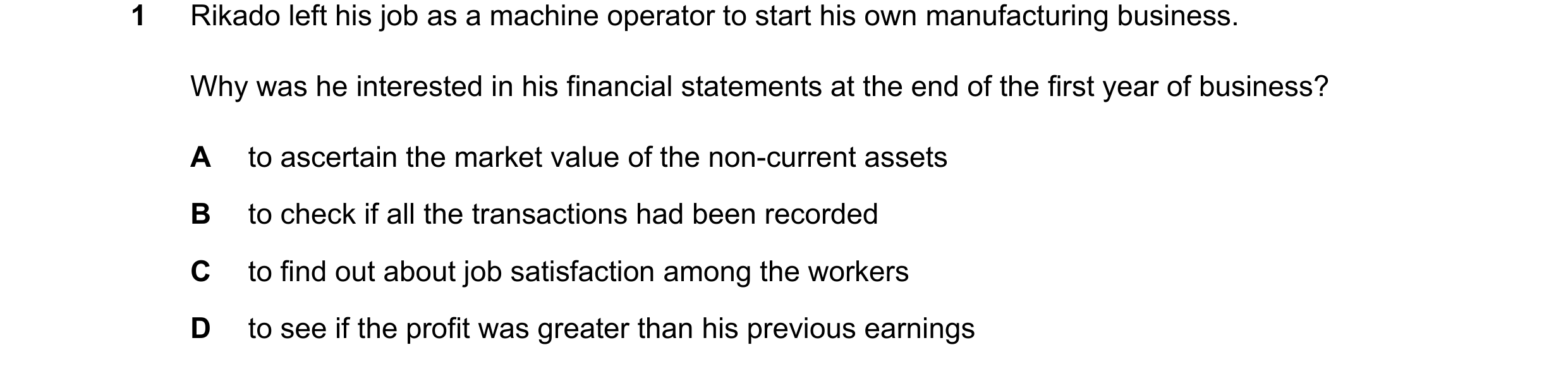
Q16 · Rikado left his job as a machine operator to start his own manufacturing business 0452/12 May/June 2025
1 Rikado left his job as a machine operator to start his own manufacturing business. Why was he interested in his financial statements at the end of the first year of business? A to ascertain the market value of the non-current assets B to check if all the transactions had been recorded C to find out about job satisfaction among the workers D to see if the profit was greater than his previous earnings
1 marks
Answer: D
This question in 0452/12 May/June 2025
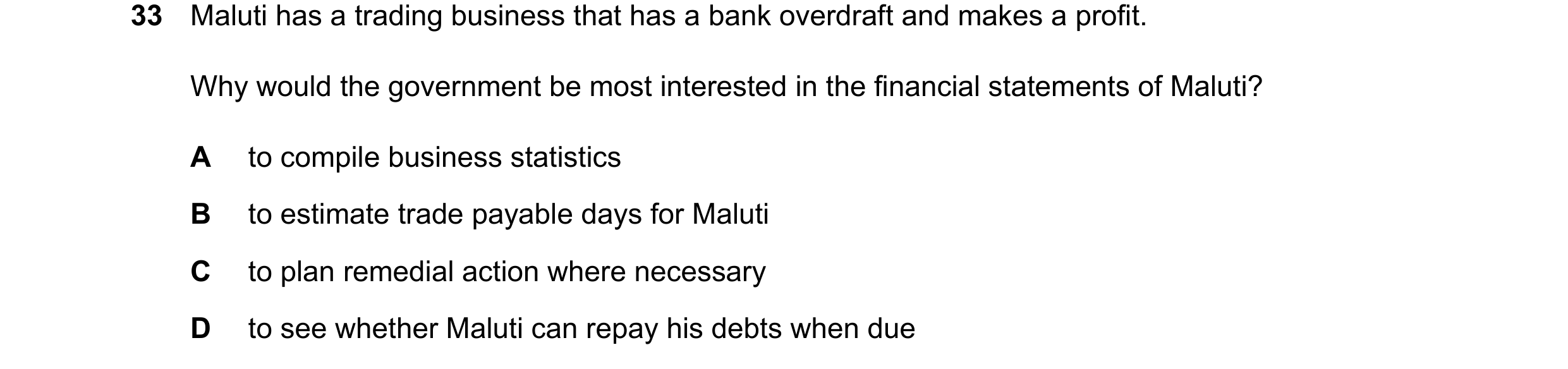
Q17 · Maluti has a trading business that has a bank overdraft and makes a profit 0452/12 May/June 2025
33 Maluti has a trading business that has a bank overdraft and makes a profit. Why would the government be most interested in the financial statements of Maluti? A to compile business statistics B to estimate trade payable days for Maluti C to plan remedial action where necessary D to see whether Maluti can repay his debts when due
1 marks
Answer: A
This question in 0452/12 May/June 2025


 1 / 3
1 / 3



 2 / 3
2 / 3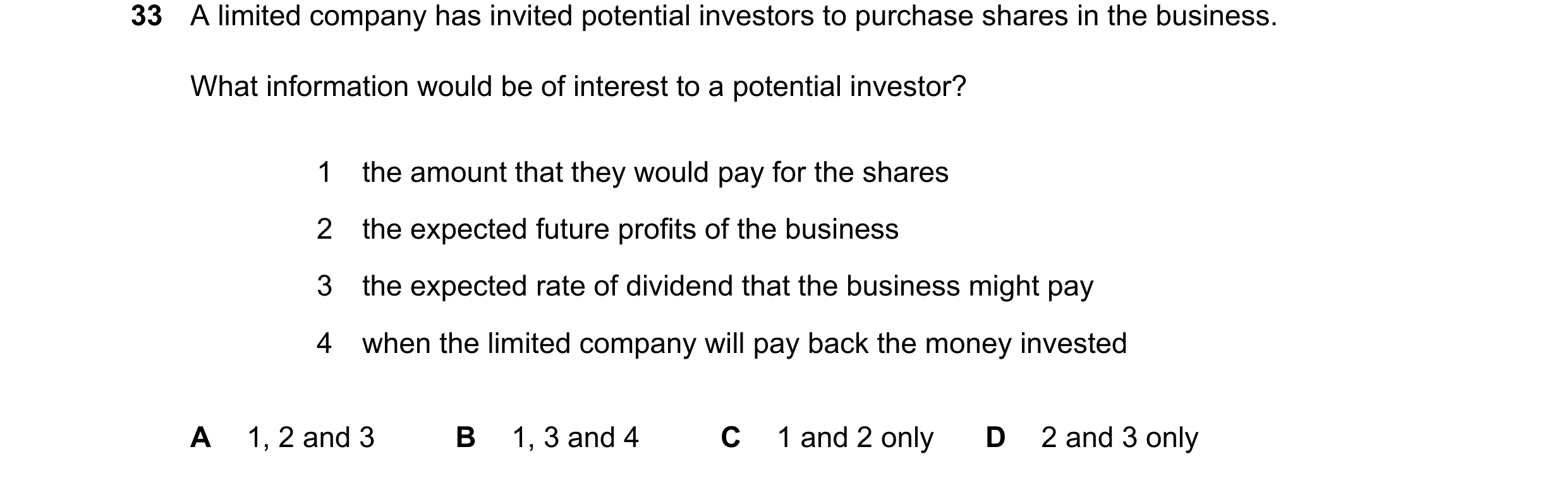
 3 / 3
3 / 3