Cambridge A Level Thinking Skills 9694 — 2022 May/June Paper 2 · Variant 1
9694/21/M/J/22 · 50 marks · ≈56 min
The question paper and its mark scheme, free to read here and free to download. This is Cambridge’s own paper, exactly as it was sat.
Question paper8 pages



Mark scheme13 pages
Answers below. Sit the paper first if you are practising.
Paper as text
Question paper, page 1
This document has 8 pages. Any blank pages are indicated. [Turn over Cambridge International AS & A Level DC (PQ/SG) 213992/1 © UCLES 2022 * 2 1 9 2 7 4 5 2 9 1 * THINKING SKILLS 9694/21 Paper 2 Critical Thinking May/June 2022 1 hour 45 minutes You must answer on the enclosed answer booklet. You will need: Answer booklet (enclosed) INSTRUCTIONS ● Answer all questions. ● Follow the instructions on the front cover of the answer booklet. If you need additional answer paper, ask the invigilator for a continuation booklet. INFORMATION ● The total mark for this paper is 50. ● The number of marks for each question or part question is shown in brackets [ ].
Question paper, page 2
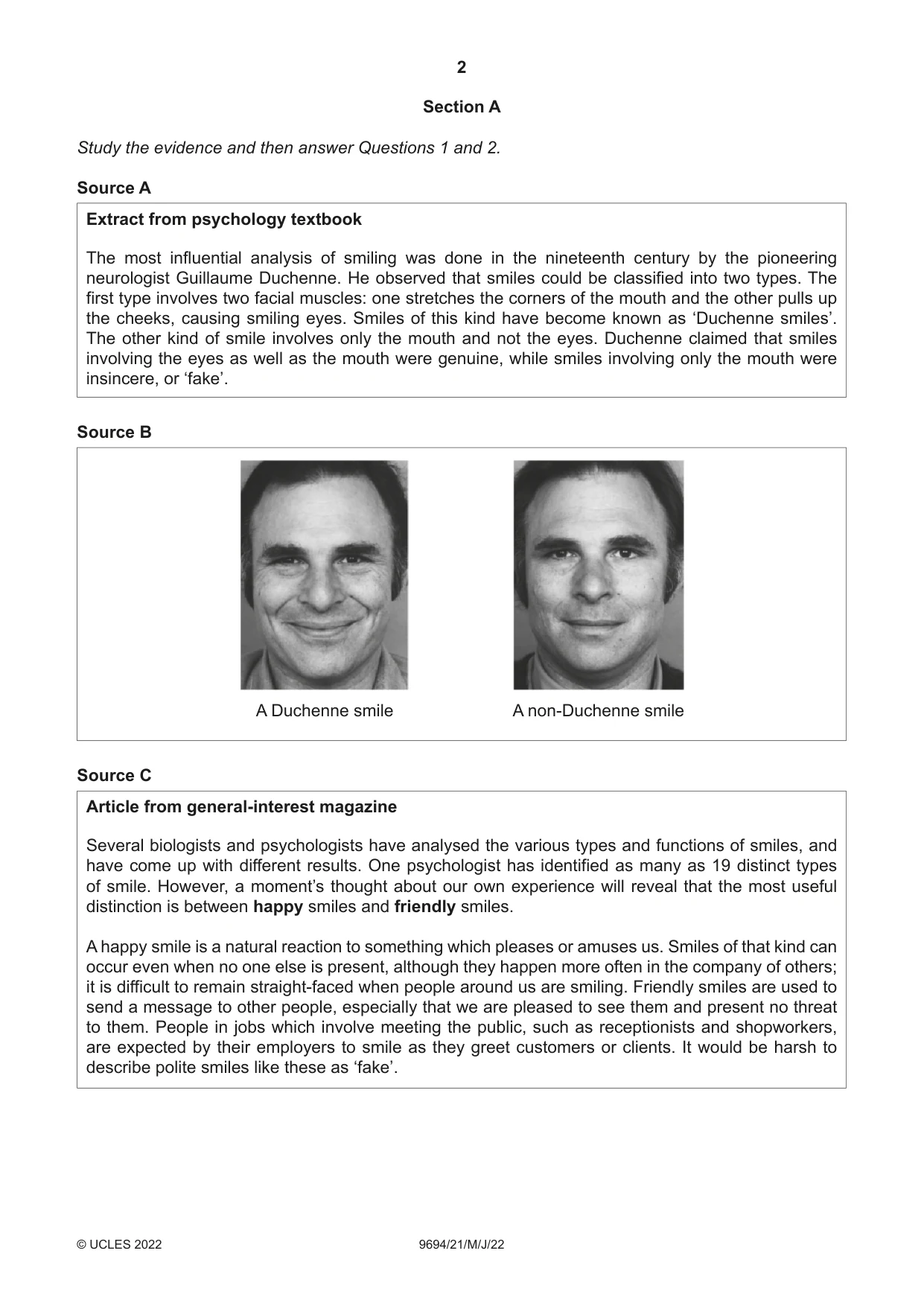
2 9694/21/M/J/22 © UCLES 2022 Section A Study the evidence and then answer Questions 1 and 2. Source A Extract from psychology textbook The most influential analysis of smiling was done in the nineteenth century by the pioneering neurologist Guillaume Duchenne. He observed that smiles could be classified into two types. The first type involves two facial muscles: one stretches the corners of the mouth and the other pulls up the cheeks, causing smiling eyes. Smiles of this kind have become known as ‘Duchenne smiles’. The other kind of smile involves only the mouth and not the eyes. Duchenne claimed that smiles involving the eyes as well as the mouth were genuine, while smiles involving only the mouth were insincere, or ‘fake’. Source B A Duchenne smile A non-Duchenne smile Source C Article from general-interest magazine Several biologists and psychologists have analysed the various types and functions of smiles, and have come up with different results. One psychologist has identified as many as 19 distinct types of smile. However, a moment’s thought about our own experience will reveal that the most useful distinction is between happy smiles and friendly smiles. A happy smile is a natural reaction to something which pleases or amuses us. Smiles of that kind can occur even when no one else is present, although they happen more often in the company of others; it is difficult to remain straight-faced when people around us are smiling. Friendly smiles are used to send a message to other people, especially that we are pleased to see them and present no threat to them. People in jobs which involve meeting the public, such as receptionists and shopworkers, are expected by their employers to smile as they greet customers or clients. It would be harsh to describe polite smiles like these as ‘fake’.
Question paper, page 3
3 9694/21/M/J/22 © UCLES 2022 [Turn over Source D Research report In 2010, researchers from Wayne State University in Detroit, Michigan, studied 230 baseball cards from the 1952 season. These cards, containing photographs of professional sportsmen, are used in the US and some other countries to promote the sale of various consumer products. The researchers divided the photographs into those where the players did not smile, those with non-Duchenne smiles and those with Duchenne smiles. Of the 230 players whose pictures were studied, 184 had died by the time the research took place, and the researchers concentrated on them. They discovered that players whose photographs showed them smiling with a Duchenne smile had lived on average five years longer than those with non-Duchenne (‘fake’) smiles and seven years longer than those who did not smile at all. They concluded that Duchenne smiles are an indicator of happiness and that happy people live longer than unhappy people. Source E Top Tips for a Happier Life • Practise smiling Practising smiling should be as much part of your morning routine as washing your face and brushing your teeth. Take a few minutes to stand in front of the mirror and smile. Extend your smile so that it uses both your mouth corners and your eye sockets. This body language will send feedback to your brain, immediately making you feel happy and relaxed. The more you practise smiling, the more natural it will become for you to smile spontaneously during the day. Greeting the day’s events with a smile will influence your own attitudes and will also make other people behave more positively towards you. 1 (a) How well does Source B support Source A? [2] (b) (i) To what extent does the credibility of Source C depend on the expertise of the author? [2] (ii) Explain how the reliability of Source D is strengthened by any two reliability criteria other than expertise. [2] (c) Identify two weaknesses in the support given by Source D for its claim that “happy people live longer than unhappy people.” [4] (d) Is Source E an argument? Explain your answer. [2] (e) Identify an inconsistency between Source A and Source E. [2] 2 You are advised to spend some time planning your answer before you begin to write it. ‘There is a significant difference between genuine and fake smiles.’ To what extent do you agree with this claim? Write a short, reasoned argument to support your conclusion, using and evaluating the evidence provided. [8]
Question paper, page 4
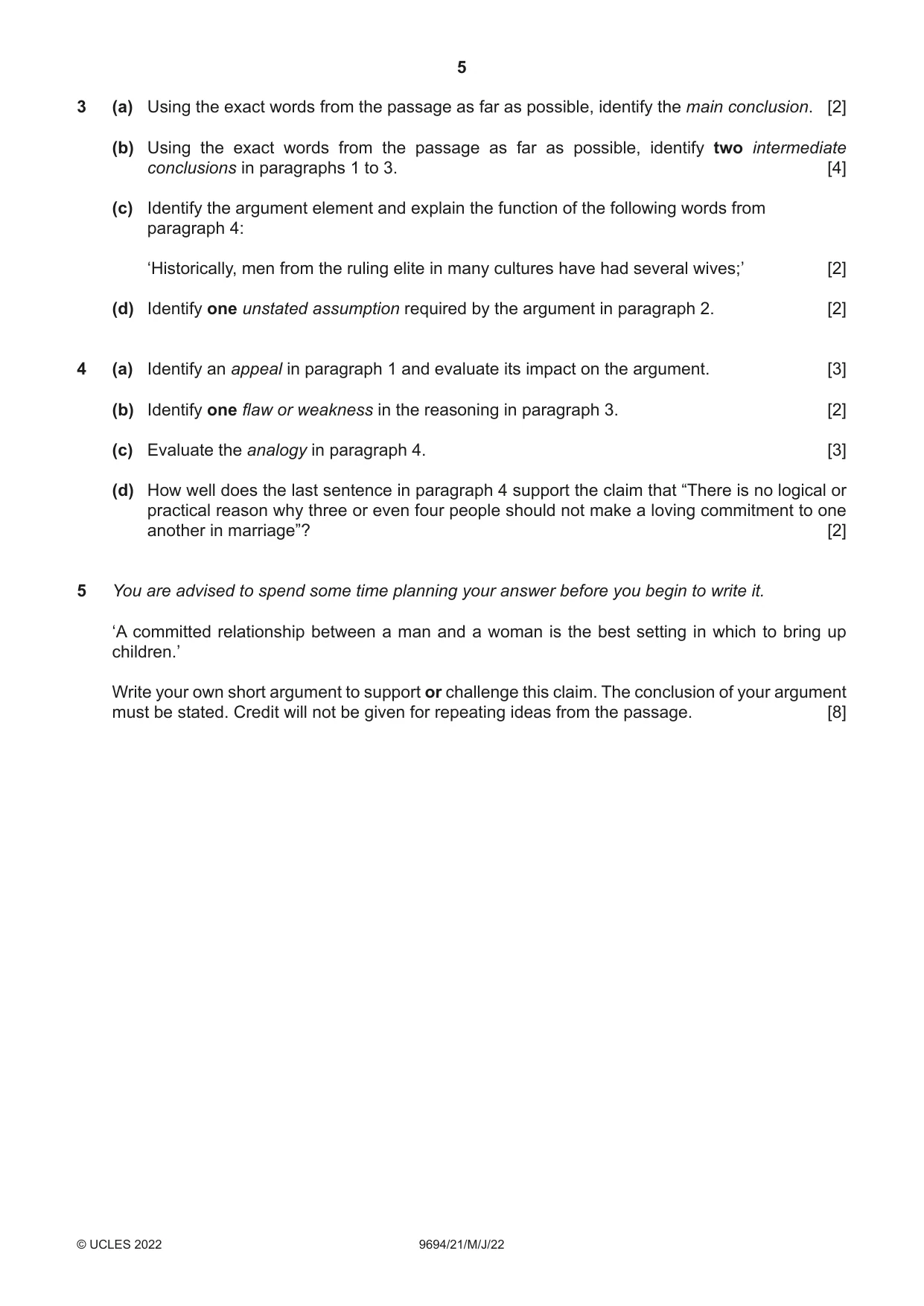
4 9694/21/M/J/22 © UCLES 2022 Section B Read the following passage and then answer Questions 3, 4 and 5. 1 The traditional definition of marriage has included that it should be exclusive, lifelong and between one man and one woman. This definition is too old to be relevant today, and it needs to be revised to make it fit for the mid-twenty-first century. Excluding other participants cannot be essential to marriage, because some husbands and wives agree in advance that each partner is free to have intimate relationships outside their marriage. 2 People tend to live longer now than when marriages could realistically be expected to satisfy both parties until the death of one. Many countries have recognised this development by allowing one spouse to divorce the other without accusing them of any wrongdoing. It is no longer reasonable for marriage to be a lifelong commitment. Some have even made this change in expectation explicit by replacing ‘till death do us part’ in their wedding vows with ‘as long as we both shall love’. 3 Recent legal reforms in many parts of the world have now acknowledged that it is possible to fall in love with someone of the same gender as oneself. Being of different sexes can therefore no longer be imposed as a necessary requirement for marriage. There is no force in the objection that marriage must include the ability to have children, because some couples marry when they are too old to have children, while same-sex couples can adopt children or use a donor or surrogate. 4 There is no logical or practical reason why three or even four people should not make a loving commitment to one another in marriage. Just as most parents find no problem in sharing parental love between all of their children, it must be equally possible for a man to love more than one wife or a woman more than one husband. Historically, men from the ruling elite in many cultures have had several wives; in parts of Tibet, Nepal and northern India two or more brothers share one wife and are considered as joint fathers of her children. A few people in the US have formed intimate, committed relationships involving three people, and they have coined the word ‘throuple’ to express their identity.
Question paper, page 5
5 9694/21/M/J/22 © UCLES 2022 3 (a) Using the exact words from the passage as far as possible, identify the main conclusion. [2] (b) Using the exact words from the passage as far as possible, identify two intermediate conclusions in paragraphs 1 to 3. [4] (c) Identify the argument element and explain the function of the following words from paragraph 4: ‘Historically, men from the ruling elite in many cultures have had several wives;’ [2] (d) Identify one unstated assumption required by the argument in paragraph 2. [2] 4 (a) Identify an appeal in paragraph 1 and evaluate its impact on the argument. [3] (b) Identify one flaw or weakness in the reasoning in paragraph 3. [2] (c) Evaluate the analogy in paragraph 4. [3] (d) How well does the last sentence in paragraph 4 support the claim that “There is no logical or practical reason why three or even four people should not make a loving commitment to one another in marriage”? [2] 5 You are advised to spend some time planning your answer before you begin to write it. ‘A committed relationship between a man and a woman is the best setting in which to bring up children.’ Write your own short argument to support or challenge this claim. The conclusion of your argument must be stated. Credit will not be given for repeating ideas from the passage. [8]
Question paper, page 6
6 9694/21/M/J/22 © UCLES 2022 BLANK PAGE
Question paper, page 7
7 9694/21/M/J/22 © UCLES 2022 BLANK PAGE
Question paper, page 8
8 9694/21/M/J/22 © UCLES 2022 Permission to reproduce items where third-party owned material protected by copyright is included has been sought and cleared where possible. Every reasonable effort has been made by the publisher (UCLES) to trace copyright holders, but if any items requiring clearance have unwittingly been included, the publisher will be pleased to make amends at the earliest possible opportunity. To avoid the issue of disclosure of answer-related information to candidates, all copyright acknowledgements are reproduced online in the Cambridge Assessment International Education Copyright Acknowledgements Booklet. This is produced for each series of examinations and is freely available to download at www.cambridgeinternational.org after the live examination series. Cambridge Assessment International Education is part of Cambridge Assessment. Cambridge Assessment is the brand name of the University of Cambridge Local Examinations Syndicate (UCLES), which is a department of the University of Cambridge. BLANK PAGE
Mark scheme, page 1
This document consists of 13 printed pages. © UCLES 2022 [Turn over Cambridge International AS & A Level THINKING SKILLS 9694/21 Paper 2 Critical Thinking May/June 2022 MARK SCHEME Maximum Mark: 50 Published This mark scheme is published as an aid to teachers and candidates, to indicate the requirements of the examination. It shows the basis on which Examiners were instructed to award marks. It does not indicate the details of the discussions that took place at an Examiners’ meeting before marking began, which would have considered the acceptability of alternative answers. Mark schemes should be read in conjunction with the question paper and the Principal Examiner Report for Teachers. Cambridge International will not enter into discussions about these mark schemes. Cambridge International is publishing the mark schemes for the May/June 2022 series for most Cambridge IGCSE, Cambridge International A and AS Level and Cambridge Pre-U components, and some Cambridge O Level components.
Mark scheme, page 2
9694/21 Cambridge International AS & A Level – Mark Scheme PUBLISHED May/June 2022 © UCLES 2022 Page 2 of 13 Generic Marking Principles These general marking principles must be applied by all examiners when marking candidate answers. They should be applied alongside the specific content of the mark scheme or generic level descriptors for a question. Each question paper and mark scheme will also comply with these marking principles. GENERIC MARKING PRINCIPLE 1: Marks must be awarded in line with: the specific content of the mark scheme or the generic level descriptors for the question the specific skills defined in the mark scheme or in the generic level descriptors for the question the standard of response required by a candidate as exemplified by the standardisation scripts. GENERIC MARKING PRINCIPLE 2: Marks awarded are always whole marks (not half marks, or other fractions). GENERIC MARKING PRINCIPLE 3: Marks must be awarded positively: marks are awarded for correct/valid answers, as defined in the mark scheme. However, credit is given for valid answers which go beyond the scope of the syllabus and mark scheme, referring to your Team Leader as appropriate marks are awarded when candidates clearly demonstrate what they know and can do marks are not deducted for errors marks are not deducted for omissions answers should only be judged on the quality of spelling, punctuation and grammar when these features are specifically assessed by the question as indicated by the mark scheme. The meaning, however, should be unambiguous. GENERIC MARKING PRINCIPLE 4: Rules must be applied consistently, e.g. in situations where candidates have not followed instructions or in the application of generic level descriptors. GENERIC MARKING PRINCIPLE 5: Marks should be awarded using the full range of marks defined in the mark scheme for the question (however; the use of the full mark range may be limited according to the quality of the candidate responses seen). GENERIC MARKING PRINCIPLE 6: Marks awarded are based solely on the requirements as defined in the mark scheme. Marks should not be awarded with grade thresholds or grade descriptors in mind.
Mark scheme, page 3
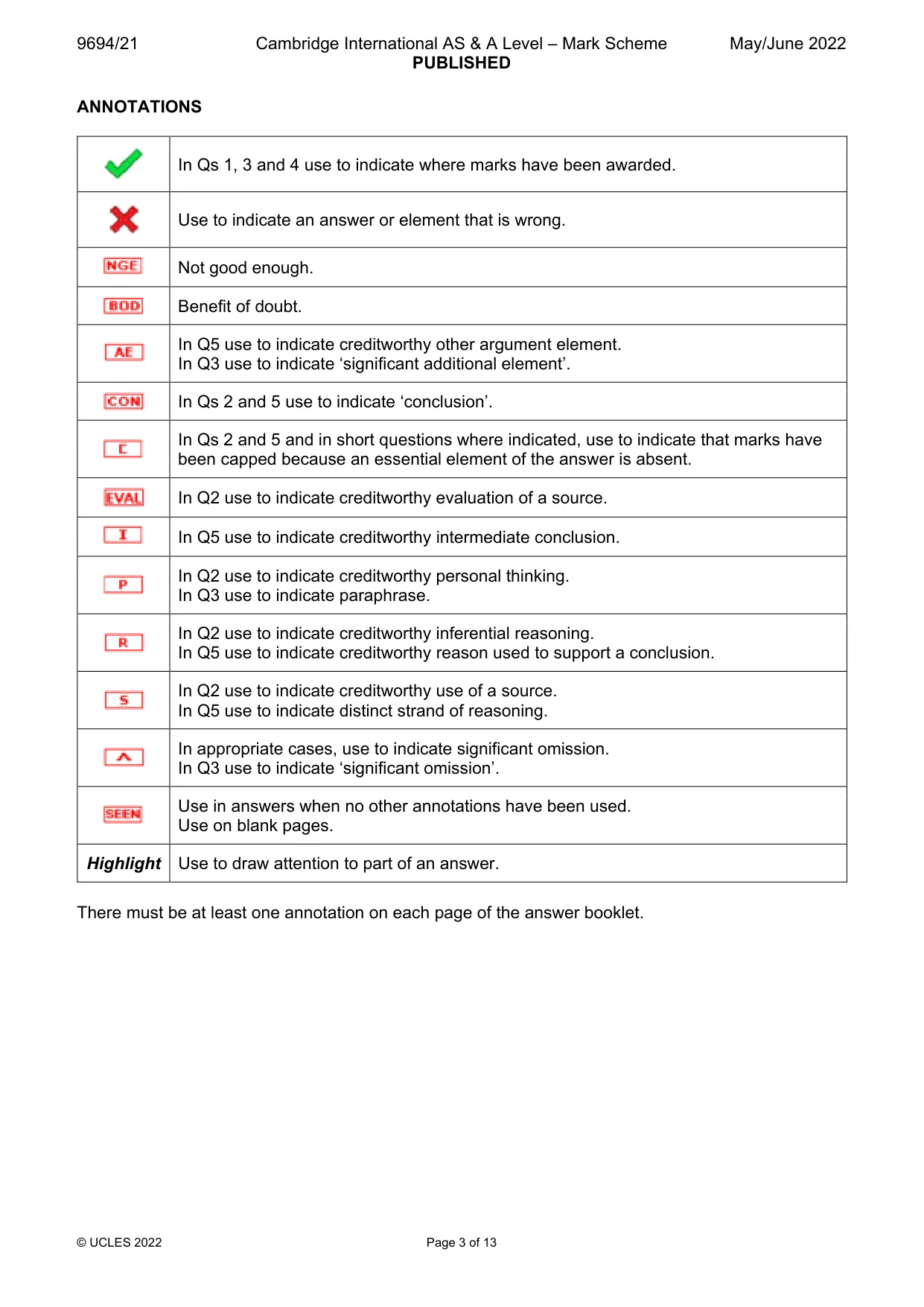
9694/21 Cambridge International AS & A Level – Mark Scheme PUBLISHED May/June 2022 © UCLES 2022 Page 3 of 13 ANNOTATIONS In Qs 1, 3 and 4 use to indicate where marks have been awarded. Use to indicate an answer or element that is wrong. Not good enough. Benefit of doubt. In Q5 use to indicate creditworthy other argument element. In Q3 use to indicate ‘significant additional element’. In Qs 2 and 5 use to indicate ‘conclusion’. In Qs 2 and 5 and in short questions where indicated, use to indicate that marks have been capped because an essential element of the answer is absent. In Q2 use to indicate creditworthy evaluation of a source. In Q5 use to indicate creditworthy intermediate conclusion. In Q2 use to indicate creditworthy personal thinking. In Q3 use to indicate paraphrase. In Q2 use to indicate creditworthy inferential reasoning. In Q5 use to indicate creditworthy reason used to support a conclusion. In Q2 use to indicate creditworthy use of a source. In Q5 use to indicate distinct strand of reasoning. In appropriate cases, use to indicate significant omission. In Q3 use to indicate ‘significant omission’. Use in answers when no other annotations have been used. Use on blank pages. Highlight Use to draw attention to part of an answer. There must be at least one annotation on each page of the answer booklet.
Mark scheme, page 4
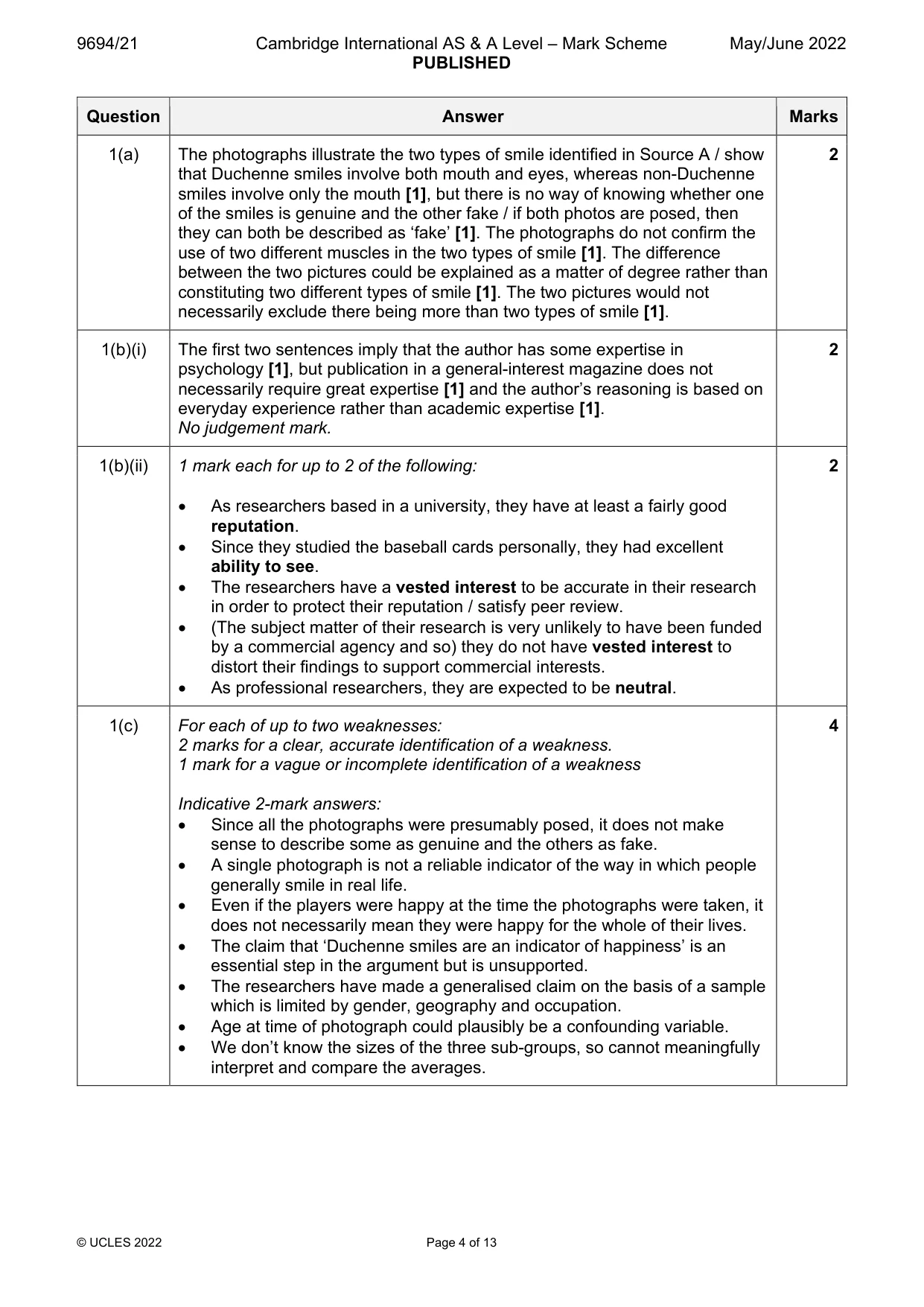
9694/21 Cambridge International AS & A Level – Mark Scheme PUBLISHED May/June 2022 © UCLES 2022 Page 4 of 13 Question Answer Marks 1(a) The photographs illustrate the two types of smile identified in Source A / show that Duchenne smiles involve both mouth and eyes, whereas non-Duchenne smiles involve only the mouth [1], but there is no way of knowing whether one of the smiles is genuine and the other fake / if both photos are posed, then they can both be described as ‘fake’ [1]. The photographs do not confirm the use of two different muscles in the two types of smile [1]. The difference between the two pictures could be explained as a matter of degree rather than constituting two different types of smile [1]. The two pictures would not necessarily exclude there being more than two types of smile [1]. 2 1(b)(i) The first two sentences imply that the author has some expertise in psychology [1], but publication in a general-interest magazine does not necessarily require great expertise [1] and the author’s reasoning is based on everyday experience rather than academic expertise [1]. No judgement mark. 2 1(b)(ii) 1 mark each for up to 2 of the following: As researchers based in a university, they have at least a fairly good reputation. Since they studied the baseball cards personally, they had excellent ability to see. The researchers have a vested interest to be accurate in their research in order to protect their reputation / satisfy peer review. (The subject matter of their research is very unlikely to have been funded by a commercial agency and so) they do not have vested interest to distort their findings to support commercial interests. As professional researchers, they are expected to be neutral. 2 1(c) For each of up to two weaknesses: 2 marks for a clear, accurate identification of a weakness. 1 mark for a vague or incomplete identification of a weakness Indicative 2-mark answers: Since all the photographs were presumably posed, it does not make sense to describe some as genuine and the others as fake. A single photograph is not a reliable indicator of the way in which people generally smile in real life. Even if the players were happy at the time the photographs were taken, it does not necessarily mean they were happy for the whole of their lives. The claim that ‘Duchenne smiles are an indicator of happiness’ is an essential step in the argument but is unsupported. The researchers have made a generalised claim on the basis of a sample which is limited by gender, geography and occupation. Age at time of photograph could plausibly be a confounding variable. We don’t know the sizes of the three sub-groups, so cannot meaningfully interpret and compare the averages. 4
Mark scheme, page 5
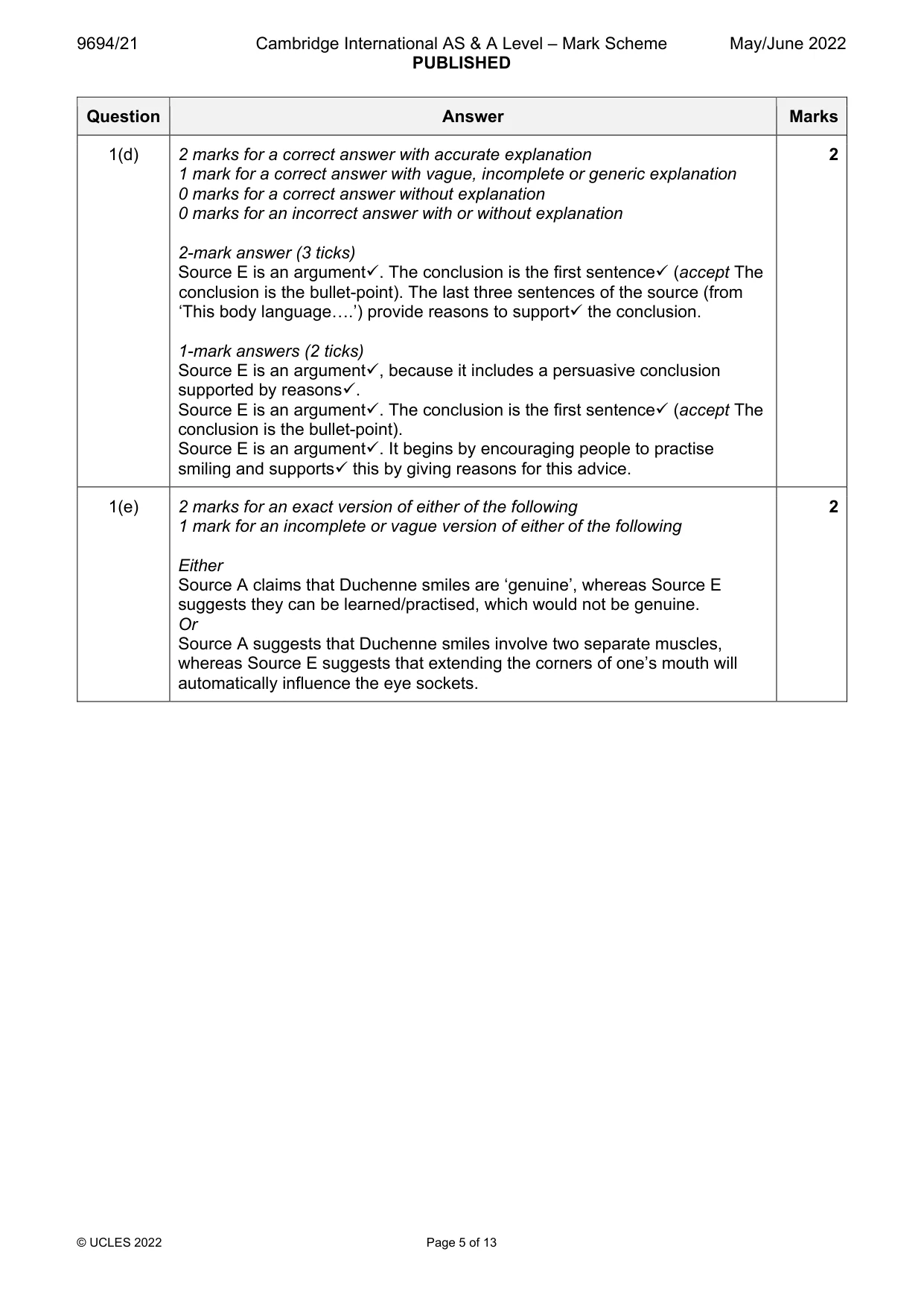
9694/21 Cambridge International AS & A Level – Mark Scheme PUBLISHED May/June 2022 © UCLES 2022 Page 5 of 13 Question Answer Marks 1(d) 2 marks for a correct answer with accurate explanation 1 mark for a correct answer with vague, incomplete or generic explanation 0 marks for a correct answer without explanation 0 marks for an incorrect answer with or without explanation 2-mark answer (3 ticks) Source E is an argument. The conclusion is the first sentence (accept The conclusion is the bullet-point). The last three sentences of the source (from ‘This body language….’) provide reasons to support the conclusion. 1-mark answers (2 ticks) Source E is an argument, because it includes a persuasive conclusion supported by reasons. Source E is an argument. The conclusion is the first sentence (accept The conclusion is the bullet-point). Source E is an argument. It begins by encouraging people to practise smiling and supports this by giving reasons for this advice. 2 1(e) 2 marks for an exact version of either of the following 1 mark for an incomplete or vague version of either of the following Either Source A claims that Duchenne smiles are ‘genuine’, whereas Source E suggests they can be learned/practised, which would not be genuine. Or Source A suggests that Duchenne smiles involve two separate muscles, whereas Source E suggests that extending the corners of one’s mouth will automatically influence the eye sockets. 2
Mark scheme, page 6
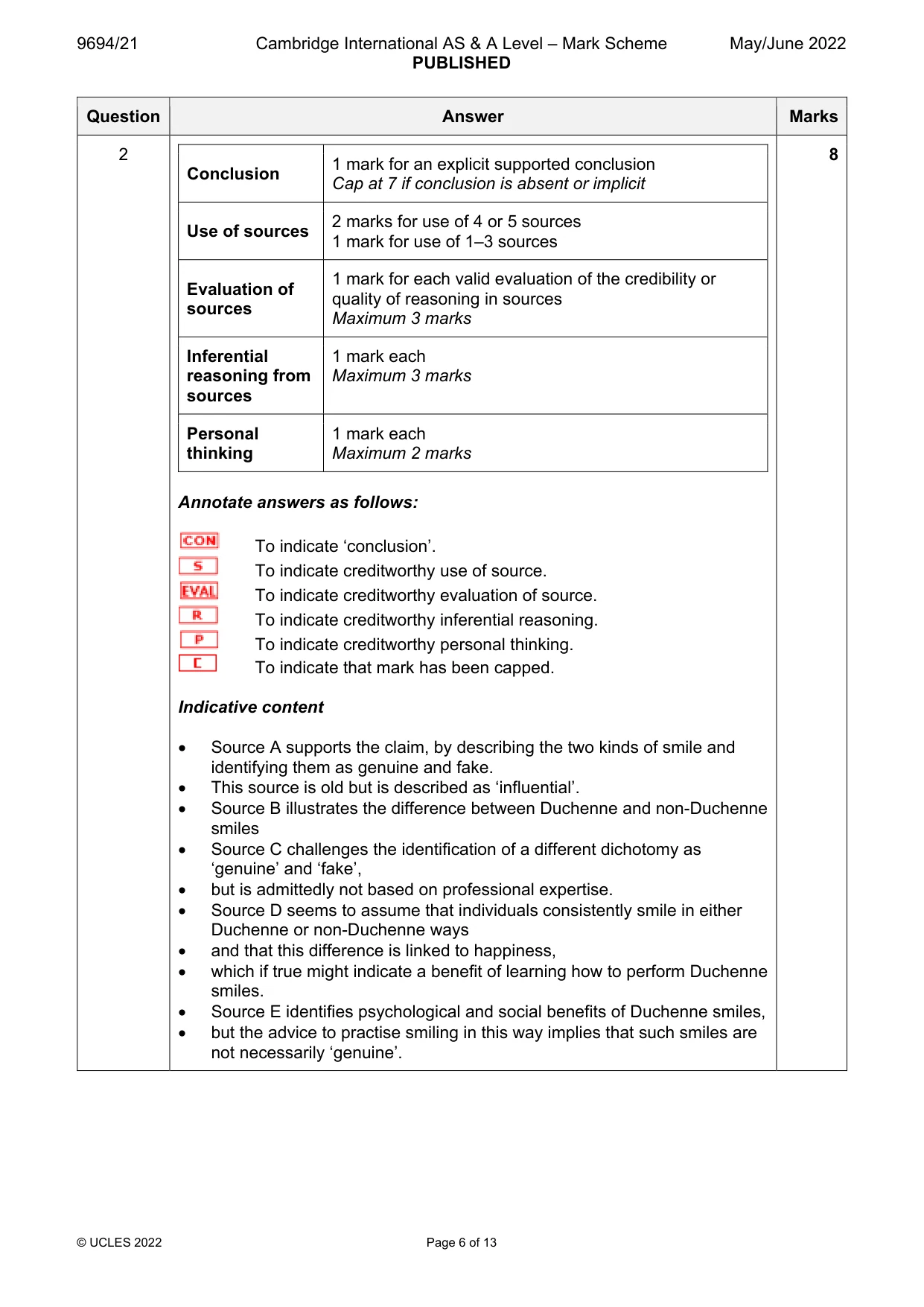
9694/21 Cambridge International AS & A Level – Mark Scheme PUBLISHED May/June 2022 © UCLES 2022 Page 6 of 13 Question Answer Marks 2 Conclusion 1 mark for an explicit supported conclusion Cap at 7 if conclusion is absent or implicit Use of sources 2 marks for use of 4 or 5 sources 1 mark for use of 1–3 sources Evaluation of sources 1 mark for each valid evaluation of the credibility or quality of reasoning in sources Maximum 3 marks Inferential reasoning from sources 1 mark each Maximum 3 marks Personal thinking 1 mark each Maximum 2 marks Annotate answers as follows: To indicate ‘conclusion’. To indicate creditworthy use of source. To indicate creditworthy evaluation of source. To indicate creditworthy inferential reasoning. To indicate creditworthy personal thinking. To indicate that mark has been capped. Indicative content Source A supports the claim, by describing the two kinds of smile and identifying them as genuine and fake. This source is old but is described as ‘influential’. Source B illustrates the difference between Duchenne and non-Duchenne smiles Source C challenges the identification of a different dichotomy as ‘genuine’ and ‘fake’, but is admittedly not based on professional expertise. Source D seems to assume that individuals consistently smile in either Duchenne or non-Duchenne ways and that this difference is linked to happiness, which if true might indicate a benefit of learning how to perform Duchenne smiles. Source E identifies psychological and social benefits of Duchenne smiles, but the advice to practise smiling in this way implies that such smiles are not necessarily ‘genuine’. 8
Mark scheme, page 7
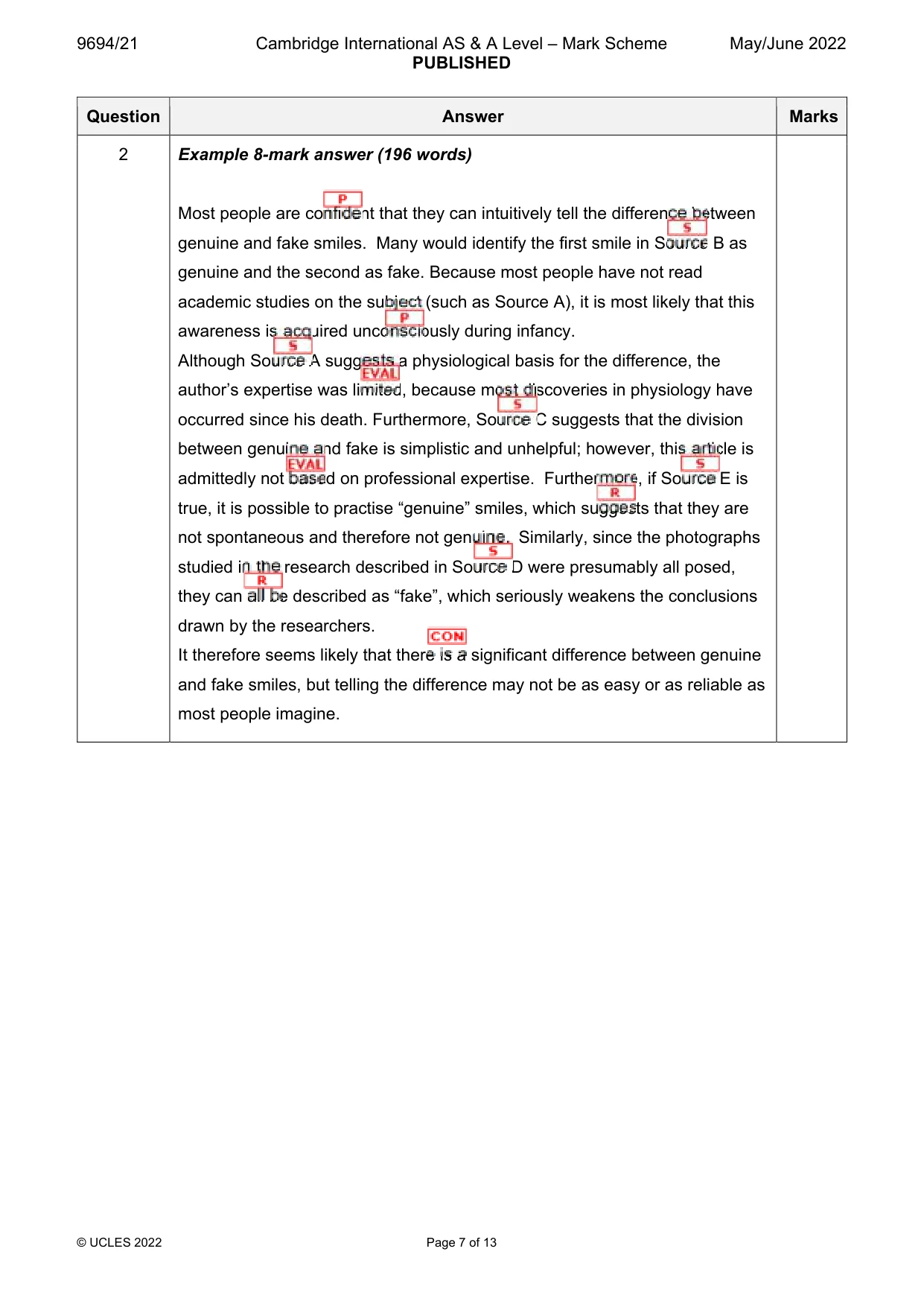
9694/21 Cambridge International AS & A Level – Mark Scheme PUBLISHED May/June 2022 © UCLES 2022 Page 7 of 13 Question Answer Marks 2 Example 8-mark answer (196 words) Most people are confident that they can intuitively tell the difference between genuine and fake smiles. Many would identify the first smile in Source B as genuine and the second as fake. Because most people have not read academic studies on the subject (such as Source A), it is most likely that this awareness is acquired unconsciously during infancy. Although Source A suggests a physiological basis for the difference, the author’s expertise was limited, because most discoveries in physiology have occurred since his death. Furthermore, Source C suggests that the division between genuine and fake is simplistic and unhelpful; however, this article is admittedly not based on professional expertise. Furthermore, if Source E is true, it is possible to practise “genuine” smiles, which suggests that they are not spontaneous and therefore not genuine. Similarly, since the photographs studied in the research described in Source D were presumably all posed, they can all be described as “fake”, which seriously weakens the conclusions drawn by the researchers. It therefore seems likely that there is a significant difference between genuine and fake smiles, but telling the difference may not be as easy or as reliable as most people imagine.
Mark scheme, page 8
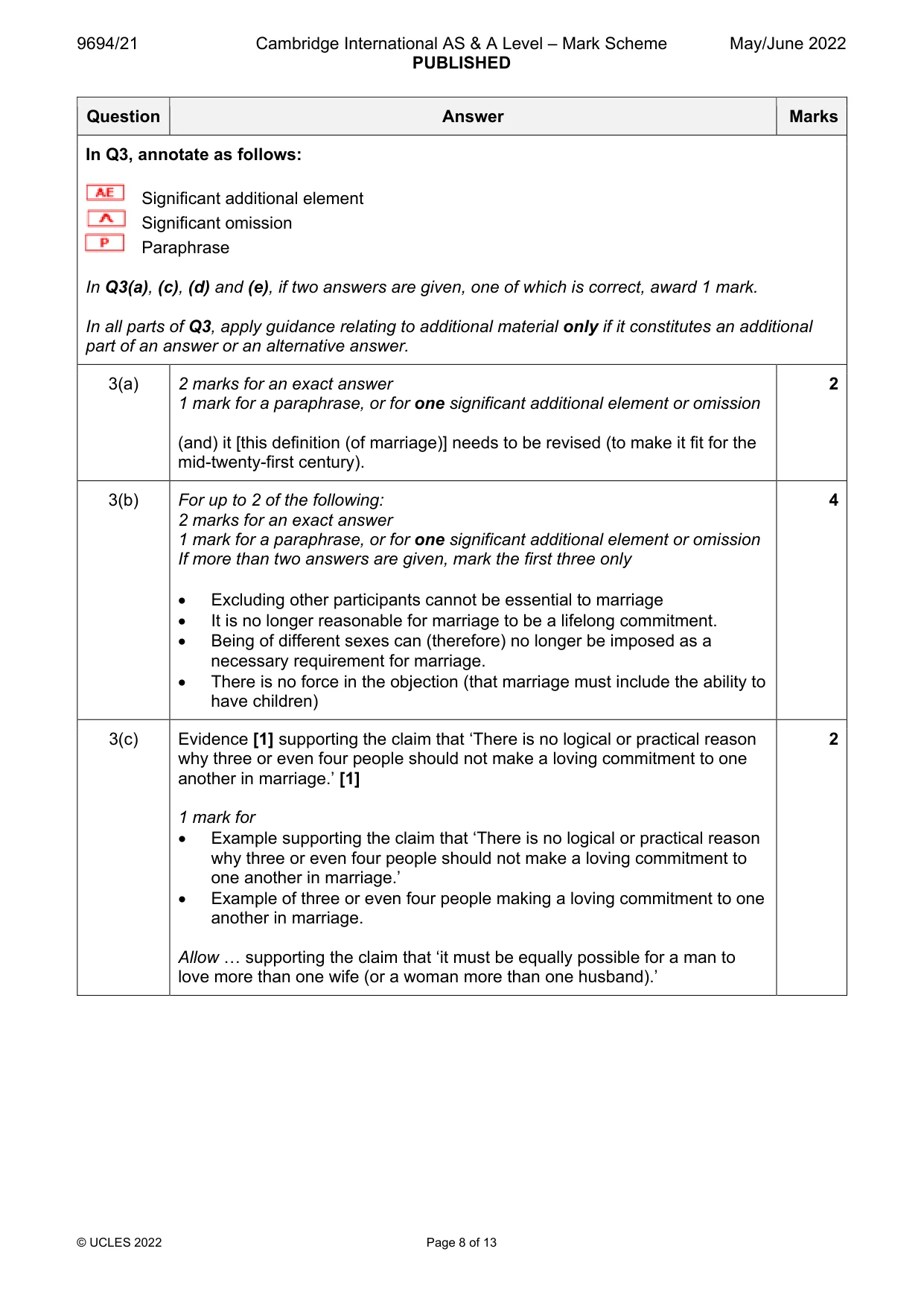
9694/21 Cambridge International AS & A Level – Mark Scheme PUBLISHED May/June 2022 © UCLES 2022 Page 8 of 13 Question Answer Marks In Q3, annotate as follows: Significant additional element Significant omission Paraphrase In Q3(a), (c), (d) and (e), if two answers are given, one of which is correct, award 1 mark. In all parts of Q3, apply guidance relating to additional material only if it constitutes an additional part of an answer or an alternative answer. 3(a) 2 marks for an exact answer 1 mark for a paraphrase, or for one significant additional element or omission (and) it [this definition (of marriage)] needs to be revised (to make it fit for the mid-twenty-first century). 2 3(b) For up to 2 of the following: 2 marks for an exact answer 1 mark for a paraphrase, or for one significant additional element or omission If more than two answers are given, mark the first three only Excluding other participants cannot be essential to marriage It is no longer reasonable for marriage to be a lifelong commitment. Being of different sexes can (therefore) no longer be imposed as a necessary requirement for marriage. There is no force in the objection (that marriage must include the ability to have children) 4 3(c) Evidence [1] supporting the claim that ‘There is no logical or practical reason why three or even four people should not make a loving commitment to one another in marriage.’ [1] 1 mark for Example supporting the claim that ‘There is no logical or practical reason why three or even four people should not make a loving commitment to one another in marriage.’ Example of three or even four people making a loving commitment to one another in marriage. Allow … supporting the claim that ‘it must be equally possible for a man to love more than one wife (or a woman more than one husband).’ 2
Mark scheme, page 9
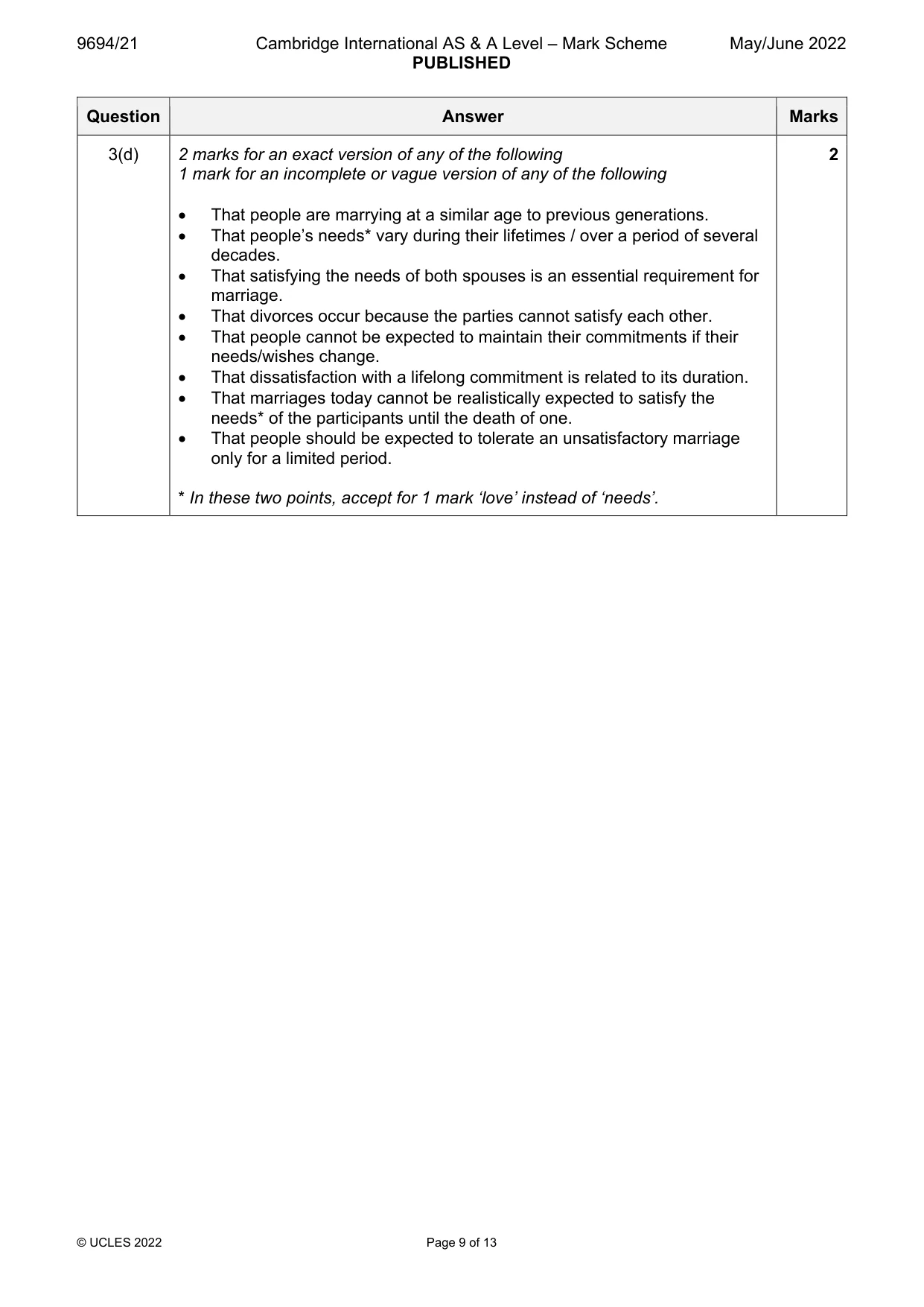
9694/21 Cambridge International AS & A Level – Mark Scheme PUBLISHED May/June 2022 © UCLES 2022 Page 9 of 13 Question Answer Marks 3(d) 2 marks for an exact version of any of the following 1 mark for an incomplete or vague version of any of the following That people are marrying at a similar age to previous generations. That people’s needs* vary during their lifetimes / over a period of several decades. That satisfying the needs of both spouses is an essential requirement for marriage. That divorces occur because the parties cannot satisfy each other. That people cannot be expected to maintain their commitments if their needs/wishes change. That dissatisfaction with a lifelong commitment is related to its duration. That marriages today cannot be realistically expected to satisfy the needs* of the participants until the death of one. That people should be expected to tolerate an unsatisfactory marriage only for a limited period. * In these two points, accept for 1 mark ‘love’ instead of ‘needs’. 2
Mark scheme, page 10
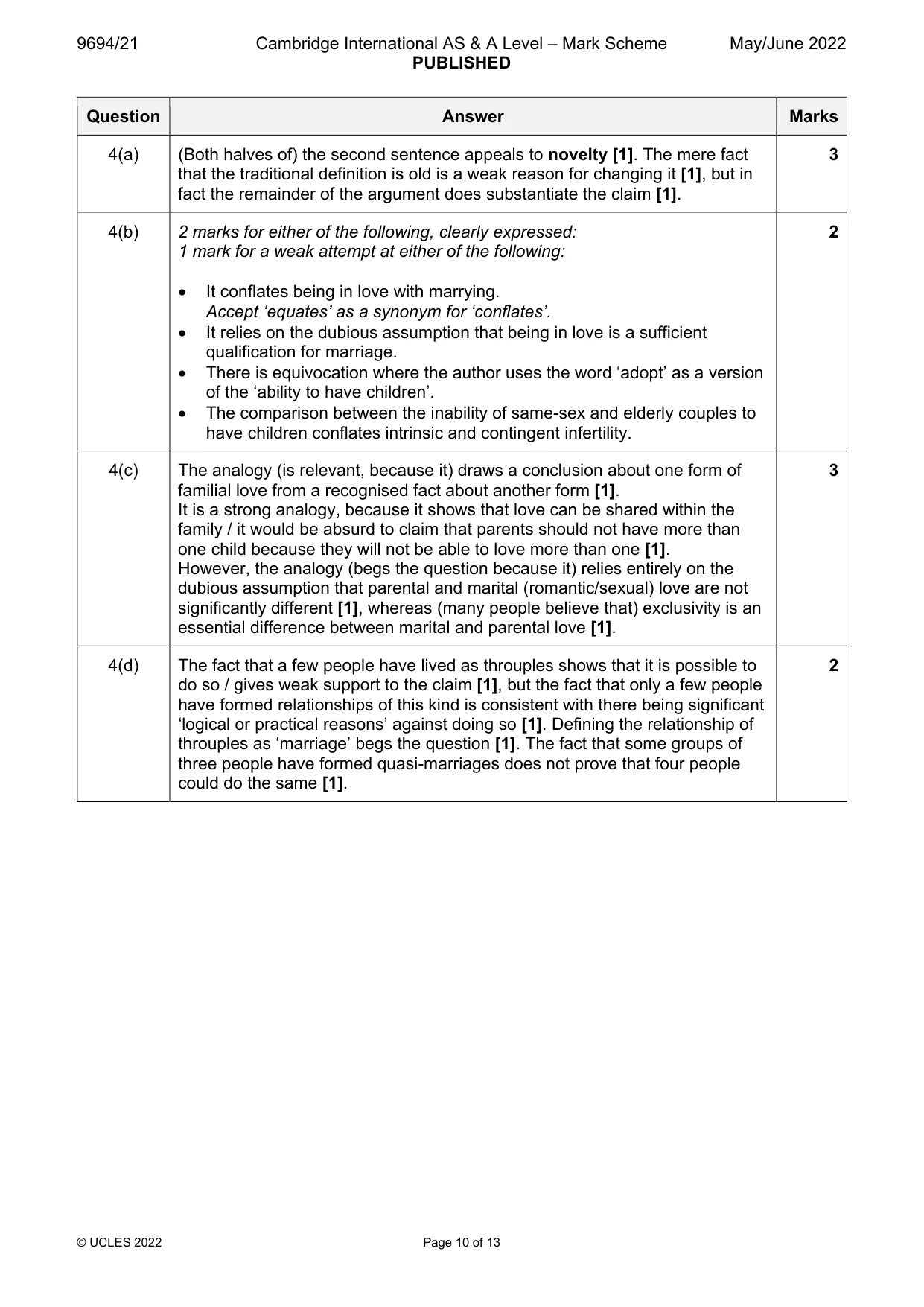
9694/21 Cambridge International AS & A Level – Mark Scheme PUBLISHED May/June 2022 © UCLES 2022 Page 10 of 13 Question Answer Marks 4(a) (Both halves of) the second sentence appeals to novelty [1]. The mere fact that the traditional definition is old is a weak reason for changing it [1], but in fact the remainder of the argument does substantiate the claim [1]. 3 4(b) 2 marks for either of the following, clearly expressed: 1 mark for a weak attempt at either of the following: It conflates being in love with marrying. Accept ‘equates’ as a synonym for ‘conflates’. It relies on the dubious assumption that being in love is a sufficient qualification for marriage. There is equivocation where the author uses the word ‘adopt’ as a version of the ‘ability to have children’. The comparison between the inability of same-sex and elderly couples to have children conflates intrinsic and contingent infertility. 2 4(c) The analogy (is relevant, because it) draws a conclusion about one form of familial love from a recognised fact about another form [1]. It is a strong analogy, because it shows that love can be shared within the family / it would be absurd to claim that parents should not have more than one child because they will not be able to love more than one [1]. However, the analogy (begs the question because it) relies entirely on the dubious assumption that parental and marital (romantic/sexual) love are not significantly different [1], whereas (many people believe that) exclusivity is an essential difference between marital and parental love [1]. 3 4(d) The fact that a few people have lived as throuples shows that it is possible to do so / gives weak support to the claim [1], but the fact that only a few people have formed relationships of this kind is consistent with there being significant ‘logical or practical reasons’ against doing so [1]. Defining the relationship of throuples as ‘marriage’ begs the question [1]. The fact that some groups of three people have formed quasi-marriages does not prove that four people could do the same [1]. 2
Mark scheme, page 11
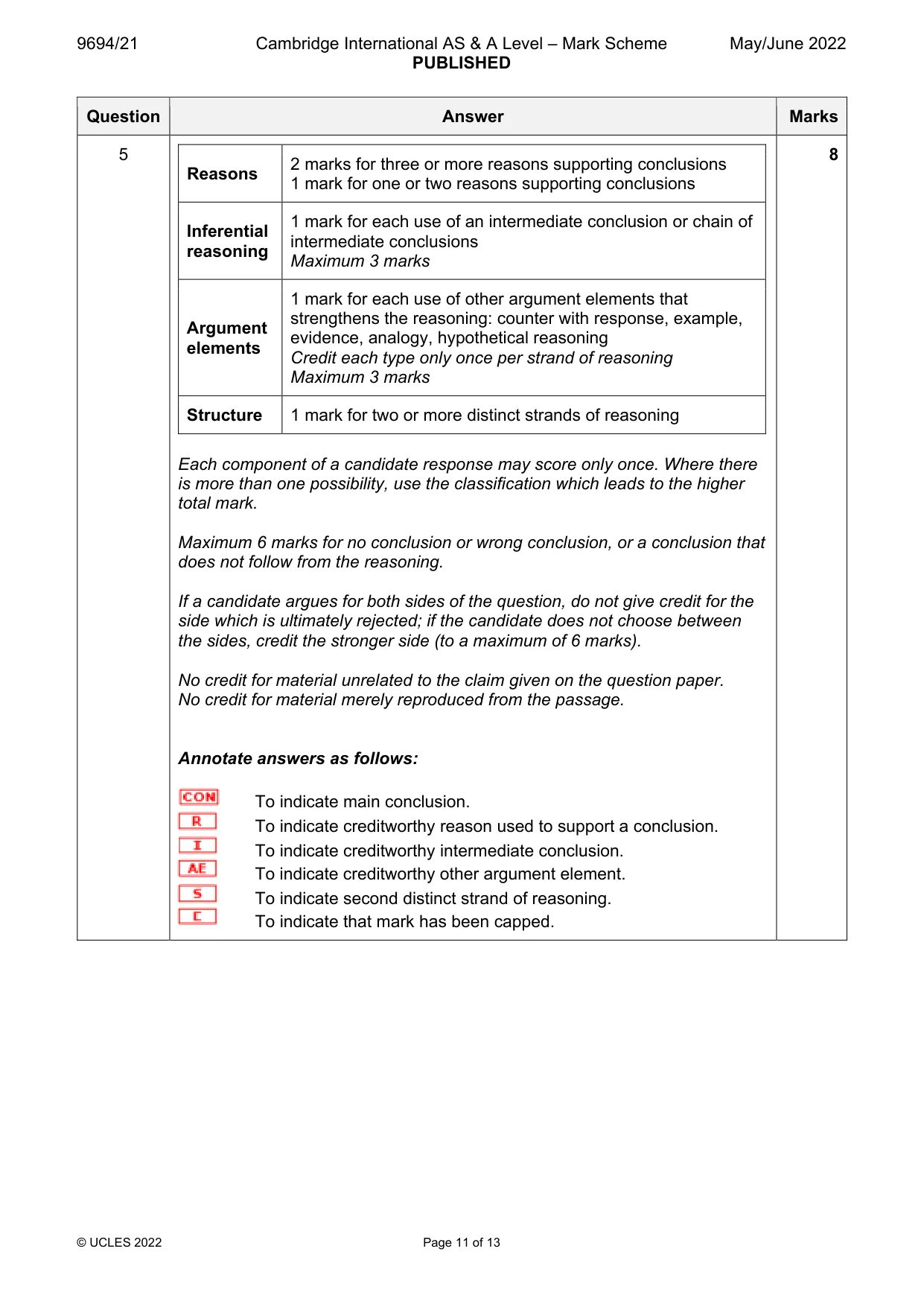
9694/21 Cambridge International AS & A Level – Mark Scheme PUBLISHED May/June 2022 © UCLES 2022 Page 11 of 13 Question Answer Marks 5 Reasons 2 marks for three or more reasons supporting conclusions 1 mark for one or two reasons supporting conclusions Inferential reasoning 1 mark for each use of an intermediate conclusion or chain of intermediate conclusions Maximum 3 marks Argument elements 1 mark for each use of other argument elements that strengthens the reasoning: counter with response, example, evidence, analogy, hypothetical reasoning Credit each type only once per strand of reasoning Maximum 3 marks Structure 1 mark for two or more distinct strands of reasoning Each component of a candidate response may score only once. Where there is more than one possibility, use the classification which leads to the higher total mark. Maximum 6 marks for no conclusion or wrong conclusion, or a conclusion that does not follow from the reasoning. If a candidate argues for both sides of the question, do not give credit for the side which is ultimately rejected; if the candidate does not choose between the sides, credit the stronger side (to a maximum of 6 marks). No credit for material unrelated to the claim given on the question paper. No credit for material merely reproduced from the passage. Annotate answers as follows: To indicate main conclusion. To indicate creditworthy reason used to support a conclusion. To indicate creditworthy intermediate conclusion. To indicate creditworthy other argument element. To indicate second distinct strand of reasoning. To indicate that mark has been capped. 8
Mark scheme, page 12
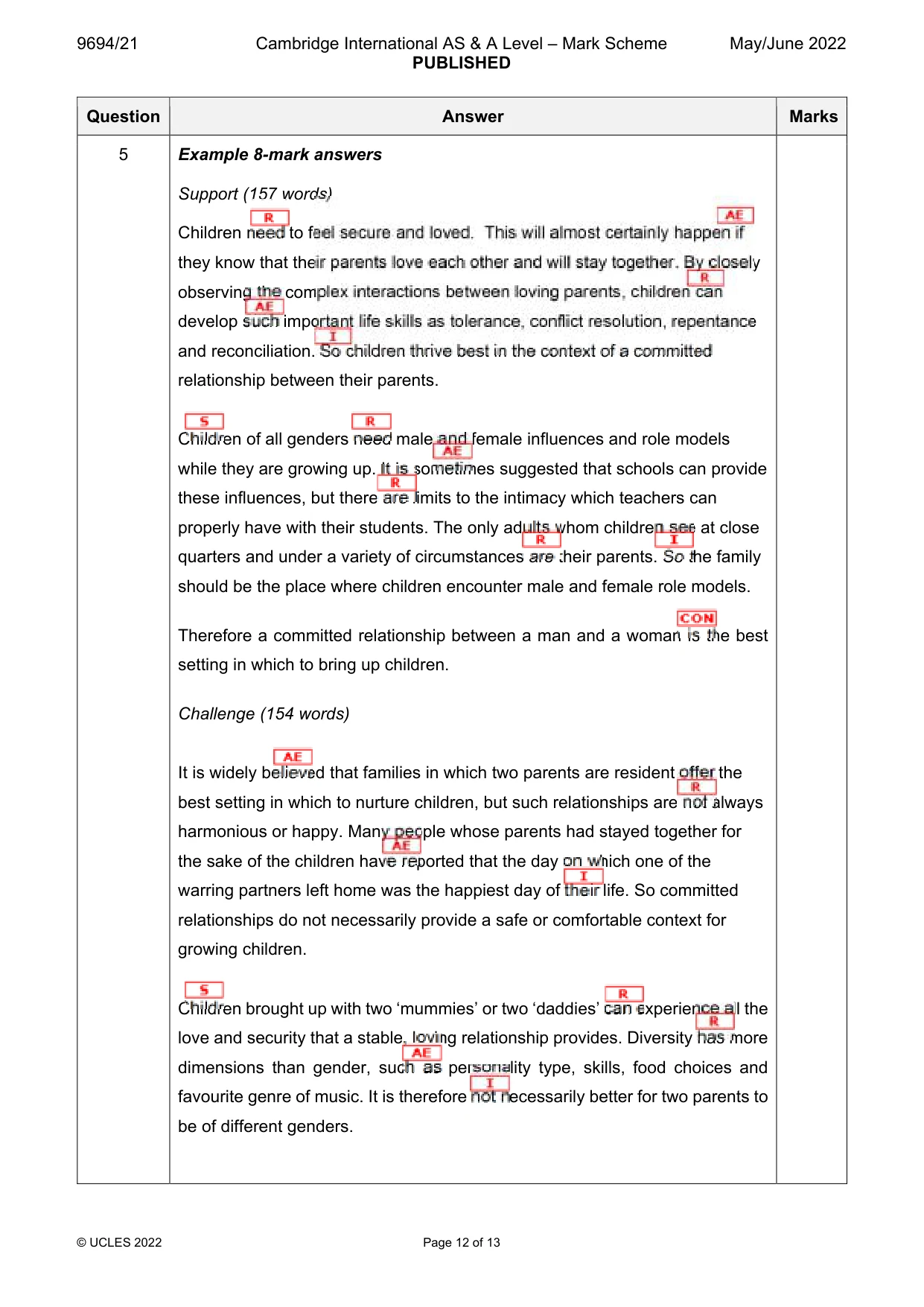
9694/21 Cambridge International AS & A Level – Mark Scheme PUBLISHED May/June 2022 © UCLES 2022 Page 12 of 13 Question Answer Marks 5 Example 8-mark answers Support (157 words) Children need to feel secure and loved. This will almost certainly happen if they know that their parents love each other and will stay together. By closely observing the complex interactions between loving parents, children can develop such important life skills as tolerance, conflict resolution, repentance and reconciliation. So children thrive best in the context of a committed relationship between their parents. Children of all genders need male and female influences and role models while they are growing up. It is sometimes suggested that schools can provide these influences, but there are limits to the intimacy which teachers can properly have with their students. The only adults whom children see at close quarters and under a variety of circumstances are their parents. So the family should be the place where children encounter male and female role models. Therefore a committed relationship between a man and a woman is the best setting in which to bring up children. Challenge (154 words) It is widely believed that families in which two parents are resident offer the best setting in which to nurture children, but such relationships are not always harmonious or happy. Many people whose parents had stayed together for the sake of the children have reported that the day on which one of the warring partners left home was the happiest day of their life. So committed relationships do not necessarily provide a safe or comfortable context for growing children. Children brought up with two ‘mummies’ or two ‘daddies’ can experience all the love and security that a stable, loving relationship provides. Diversity has more dimensions than gender, such as personality type, skills, food choices and favourite genre of music. It is therefore not necessarily better for two parents to be of different genders.
Mark scheme, page 13
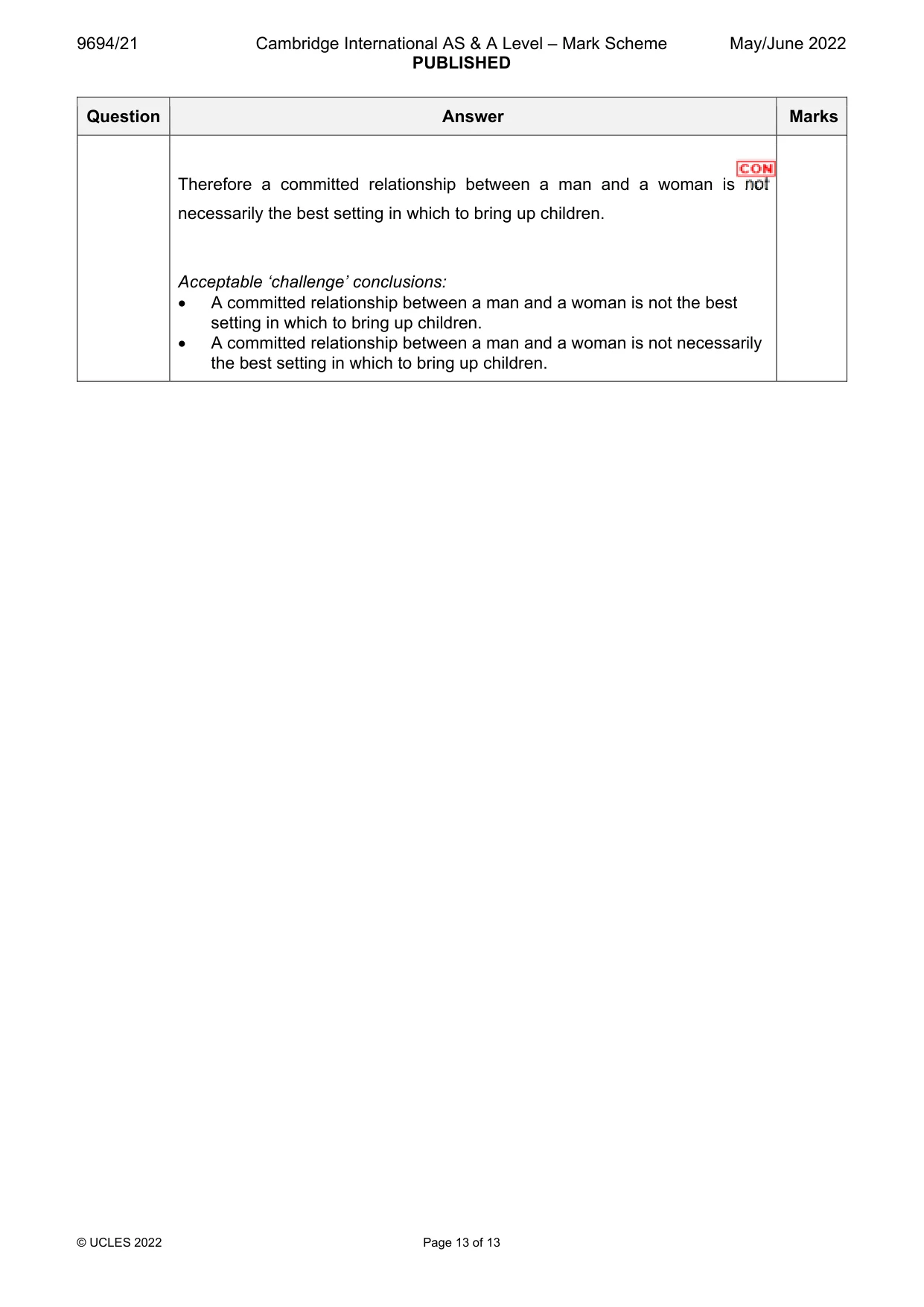
9694/21 Cambridge International AS & A Level – Mark Scheme PUBLISHED May/June 2022 © UCLES 2022 Page 13 of 13 Question Answer Marks Therefore a committed relationship between a man and a woman is not necessarily the best setting in which to bring up children. Acceptable ‘challenge’ conclusions: A committed relationship between a man and a woman is not the best setting in which to bring up children. A committed relationship between a man and a woman is not necessarily the best setting in which to bring up children.
What you needed in this session
Cambridge’s own grade thresholds for 2022 May/June, Paper 2 · Variant 1. A higher threshold means an easier paper — the bar moves with how the cohort did.