Cambridge A Level Thinking Skills 9694 — 2025 Oct/Nov Paper 2 · Variant 2
9694/22/O/N/25 · 50 marks · ≈56 min
The question paper and its mark scheme, free to read here and free to download. This is Cambridge’s own paper, exactly as it was sat.
Question paper8 pages



Mark scheme14 pages
Answers below. Sit the paper first if you are practising.

Paper as text
Question paper, page 1
This document has 8 pages. Any blank pages are indicated. [Turn over Cambridge International AS & A Level * 6 1 5 7 6 1 6 3 6 0 * THINKING SKILLS 9694/22 Paper 2 Critical Thinking October/November 2025 1 hour 45 minutes You must answer on the enclosed answer booklet. You will need: Answer booklet (enclosed) INSTRUCTIONS ● Answer all questions. ● Follow the instructions on the front cover of the answer booklet. If you need additional answer paper, ask the invigilator for a continuation booklet. INFORMATION ● The total mark for this paper is 50. ● The number of marks for each question or part question is shown in brackets [ ]. DC (ST/CT) 342354/1 © UCLES 2025
Question paper, page 2
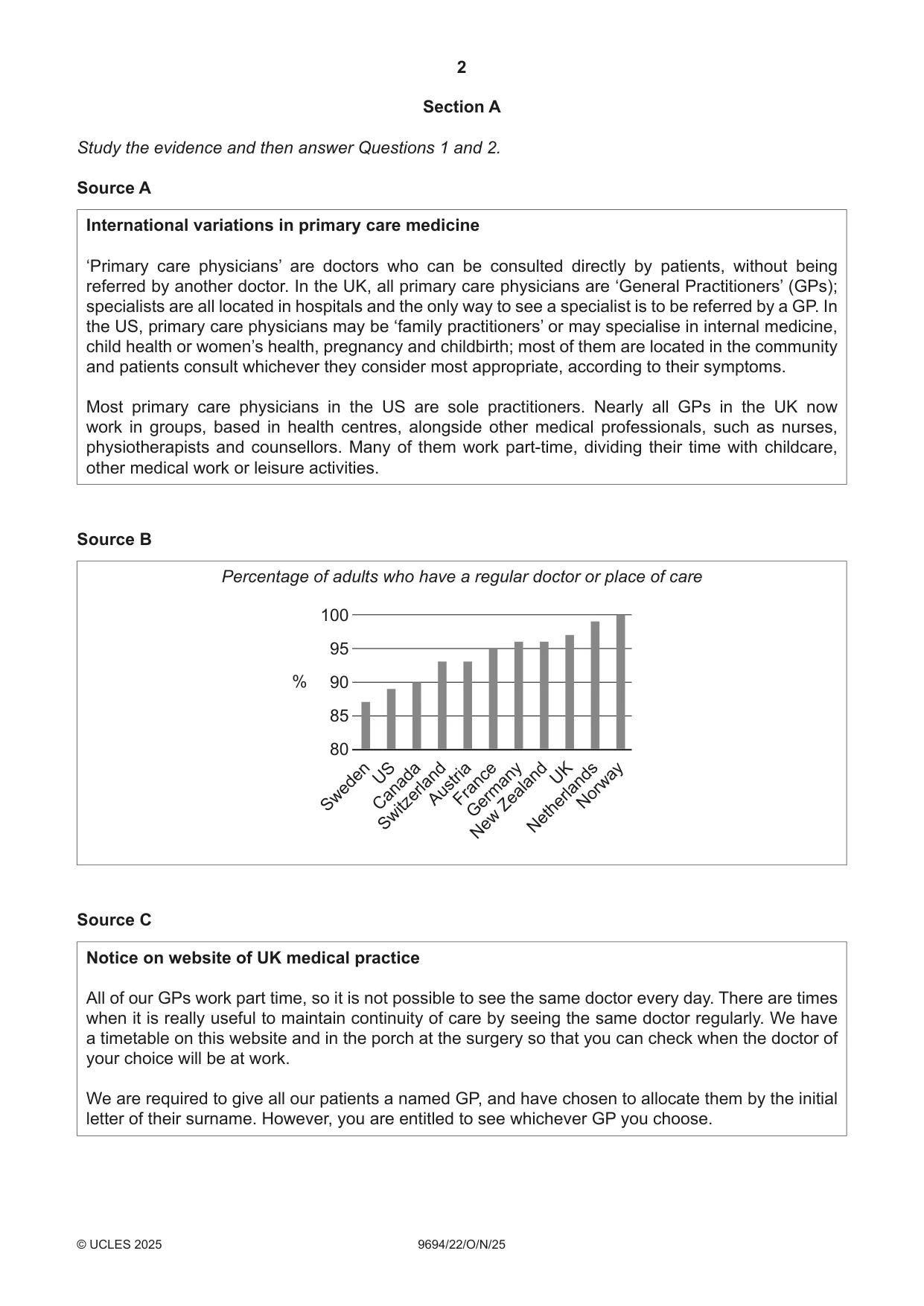
2 9694/22/O/N/25 © UCLES 2025 Section A Study the evidence and then answer Questions 1 and 2. Source A International variations in primary care medicine ‘Primary care physicians’ are doctors who can be consulted directly by patients, without being referred by another doctor. In the UK, all primary care physicians are ‘General Practitioners’ (GPs); specialists are all located in hospitals and the only way to see a specialist is to be referred by a GP. In the US, primary care physicians may be ‘family practitioners’ or may specialise in internal medicine, child health or women’s health, pregnancy and childbirth; most of them are located in the community and patients consult whichever they consider most appropriate, according to their symptoms. Most primary care physicians in the US are sole practitioners. Nearly all GPs in the UK now work in groups, based in health centres, alongside other medical professionals, such as nurses, physiotherapists and counsellors. Many of them work part-time, dividing their time with childcare, other medical work or leisure activities. Source B Percentage of adults who have a regular doctor or place of care % 80 85 90 95 100 Sweden US Canada Switzerland Austria France Germany New Zealand UK Netherlands Norway Source C Notice on website of UK medical practice All of our GPs work part time, so it is not possible to see the same doctor every day. There are times when it is really useful to maintain continuity of care by seeing the same doctor regularly. We have a timetable on this website and in the porch at the surgery so that you can check when the doctor of your choice will be at work. We are required to give all our patients a named GP, and have chosen to allocate them by the initial letter of their surname. However, you are entitled to see whichever GP you choose.
Question paper, page 3
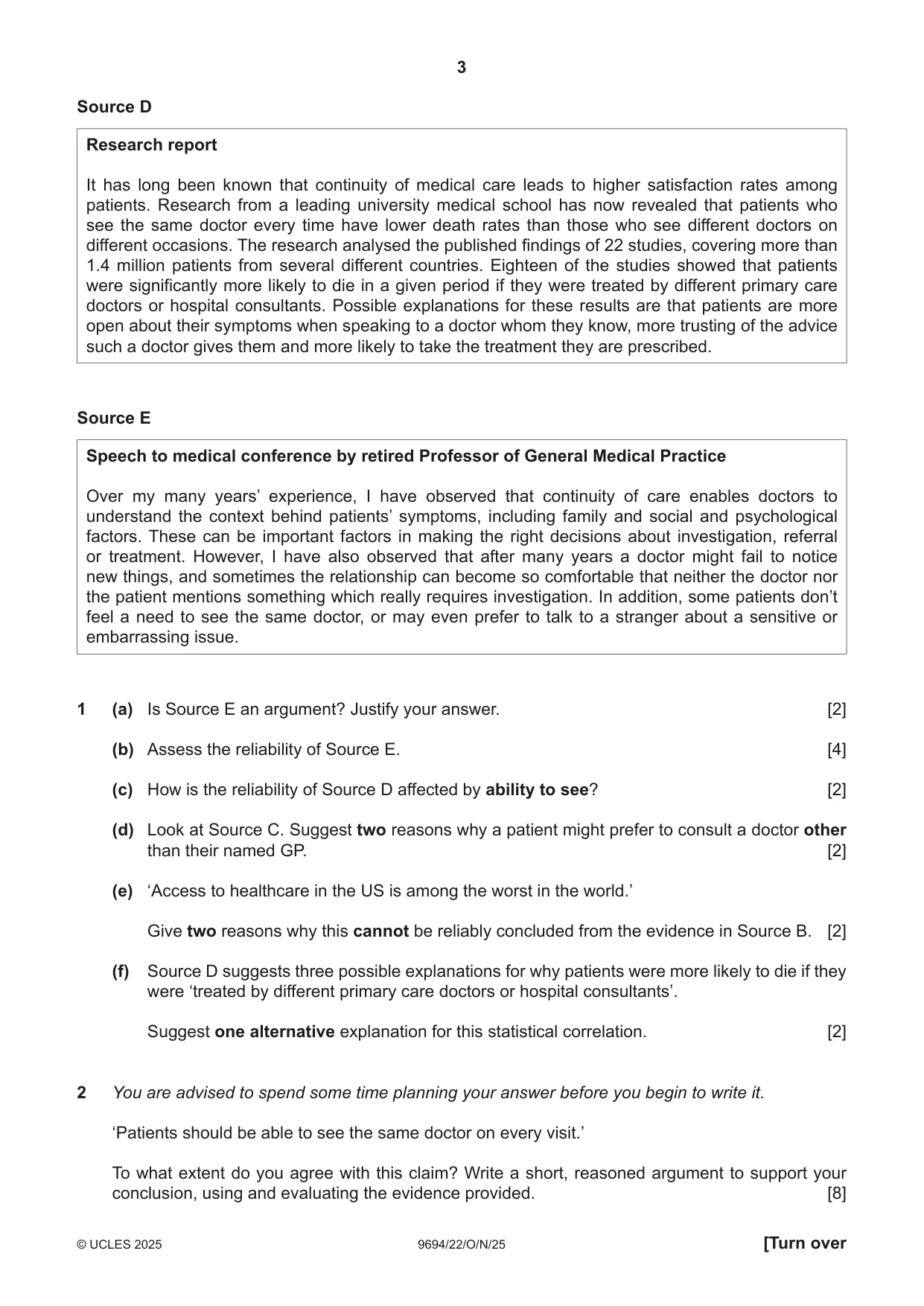
3 9694/22/O/N/25 © UCLES 2025 [Turn over Source D Research report It has long been known that continuity of medical care leads to higher satisfaction rates among patients. Research from a leading university medical school has now revealed that patients who see the same doctor every time have lower death rates than those who see different doctors on different occasions. The research analysed the published findings of 22 studies, covering more than 1.4 million patients from several different countries. Eighteen of the studies showed that patients were significantly more likely to die in a given period if they were treated by different primary care doctors or hospital consultants. Possible explanations for these results are that patients are more open about their symptoms when speaking to a doctor whom they know, more trusting of the advice such a doctor gives them and more likely to take the treatment they are prescribed. Source E Speech to medical conference by retired Professor of General Medical Practice Over my many years’ experience, I have observed that continuity of care enables doctors to understand the context behind patients’ symptoms, including family and social and psychological factors. These can be important factors in making the right decisions about investigation, referral or treatment. However, I have also observed that after many years a doctor might fail to notice new things, and sometimes the relationship can become so comfortable that neither the doctor nor the patient mentions something which really requires investigation. In addition, some patients don’t feel a need to see the same doctor, or may even prefer to talk to a stranger about a sensitive or embarrassing issue. 1 (a) Is Source E an argument? Justify your answer. [2] (b) Assess the reliability of Source E. [4] (c) How is the reliability of Source D affected by ability to see? [2] (d) Look at Source C. Suggest two reasons why a patient might prefer to consult a doctor other than their named GP. [2] (e) ‘Access to healthcare in the US is among the worst in the world.’ Give two reasons why this cannot be reliably concluded from the evidence in Source B. [2] (f) Source D suggests three possible explanations for why patients were more likely to die if they were ‘treated by different primary care doctors or hospital consultants’. Suggest one alternative explanation for this statistical correlation. [2] 2 You are advised to spend some time planning your answer before you begin to write it. ‘Patients should be able to see the same doctor on every visit.’ To what extent do you agree with this claim? Write a short, reasoned argument to support your conclusion, using and evaluating the evidence provided. [8]
Question paper, page 4
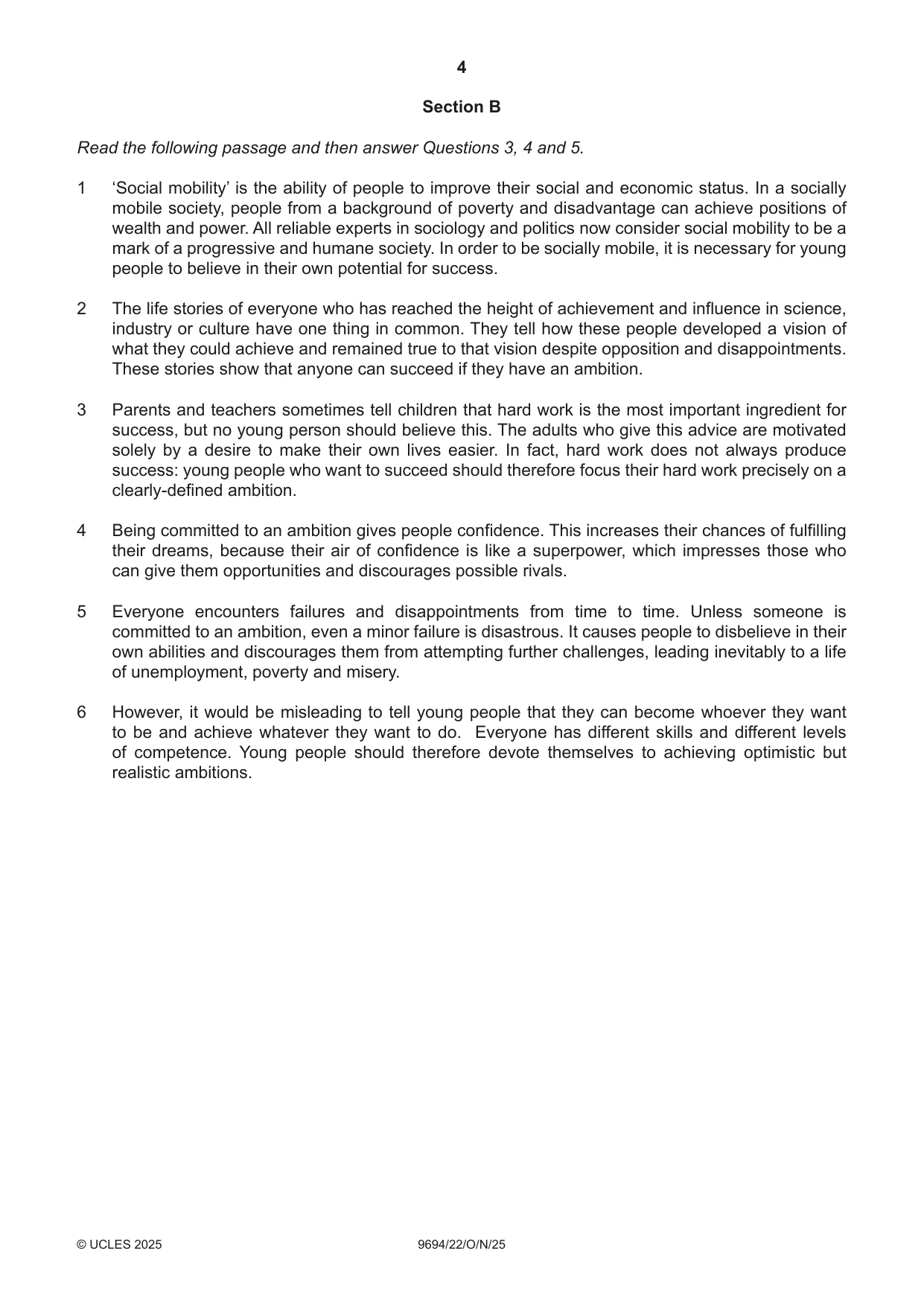
4 9694/22/O/N/25 © UCLES 2025 Section B Read the following passage and then answer Questions 3, 4 and 5. 1 ‘Social mobility’ is the ability of people to improve their social and economic status. In a socially mobile society, people from a background of poverty and disadvantage can achieve positions of wealth and power. All reliable experts in sociology and politics now consider social mobility to be a mark of a progressive and humane society. In order to be socially mobile, it is necessary for young people to believe in their own potential for success. 2 The life stories of everyone who has reached the height of achievement and influence in science, industry or culture have one thing in common. They tell how these people developed a vision of what they could achieve and remained true to that vision despite opposition and disappointments. These stories show that anyone can succeed if they have an ambition. 3 Parents and teachers sometimes tell children that hard work is the most important ingredient for success, but no young person should believe this. The adults who give this advice are motivated solely by a desire to make their own lives easier. In fact, hard work does not always produce success: young people who want to succeed should therefore focus their hard work precisely on a clearly-defined ambition. 4 Being committed to an ambition gives people confidence. This increases their chances of fulfilling their dreams, because their air of confidence is like a superpower, which impresses those who can give them opportunities and discourages possible rivals. 5 Everyone encounters failures and disappointments from time to time. Unless someone is committed to an ambition, even a minor failure is disastrous. It causes people to disbelieve in their own abilities and discourages them from attempting further challenges, leading inevitably to a life of unemployment, poverty and misery. 6 However, it would be misleading to tell young people that they can become whoever they want to be and achieve whatever they want to do. Everyone has different skills and different levels of competence. Young people should therefore devote themselves to achieving optimistic but realistic ambitions.
Question paper, page 5
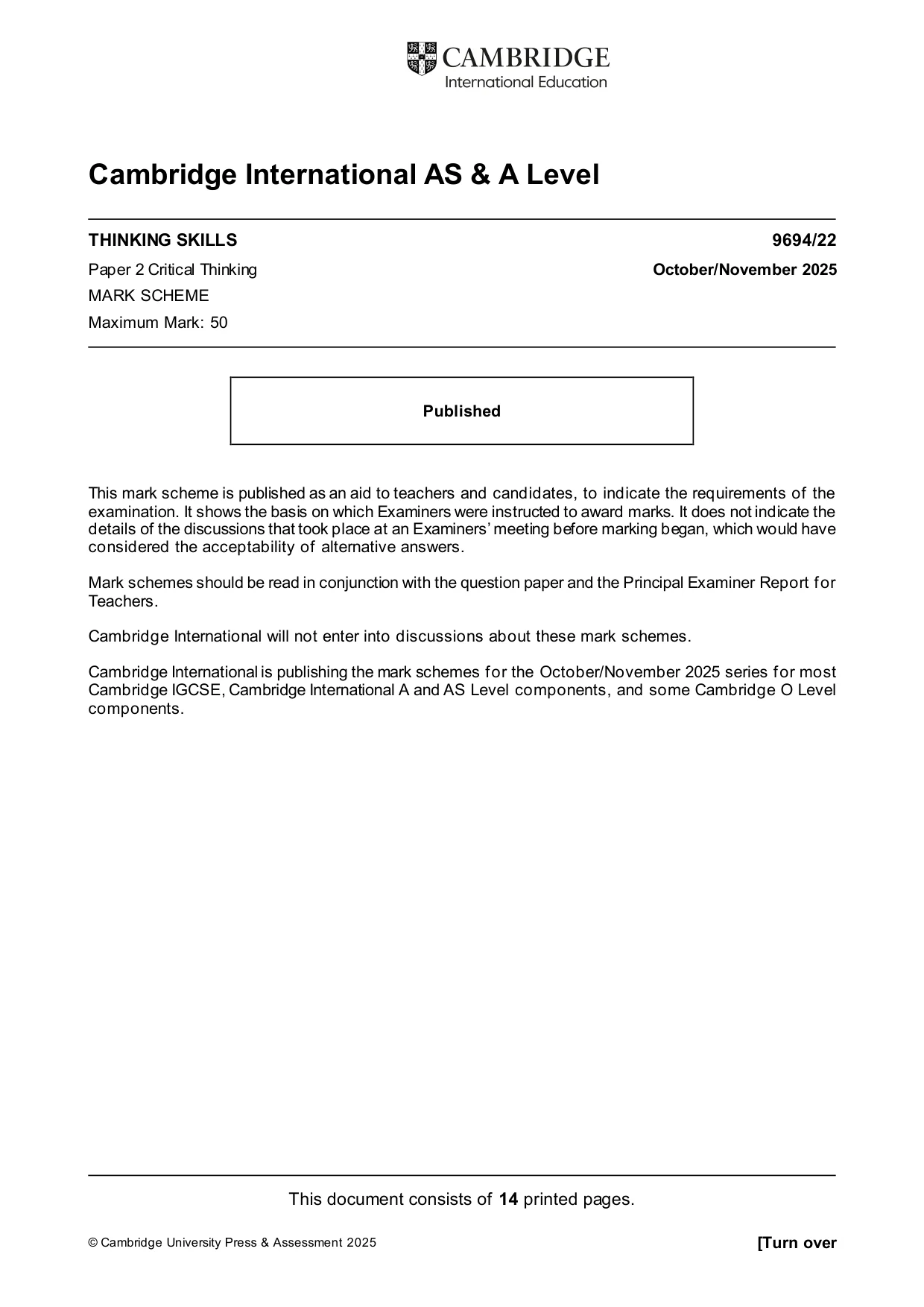
5 9694/22/O/N/25 © UCLES 2025 3 (a) Using the exact words from the passage as far as possible, identify the main conclusion. [2] (b) Using the exact words from the passage as far as possible, identify two intermediate conclusions from paragraphs 4 to 6. [4] (c) Using the exact words from the passage as far as possible, identify one counter-assertion. [2] (d) Identify one unstated assumption required by the argument in paragraph 3. [2] 4 (a) Identify and evaluate an appeal in paragraph 1. [3] (b) Identify and explain one flaw or weakness in the reasoning in paragraph 2. [2] (c) Evaluate an analogy in paragraph 4. [3] (d) Explain how the reasoning in paragraph 5 is weakened by the flaw of slippery slope. [2] 5 You are advised to spend some time planning your answer before you begin to write it. ‘Relationships are more important than work.’ Write your own short argument to support or challenge this claim. The conclusion of your argument must be stated. Credit will not be given for repeating ideas from the passage. [8]
Question paper, page 6
6 9694/22/O/N/25 © UCLES 2025 BLANK PAGE
Question paper, page 7
7 9694/22/O/N/25 © UCLES 2025 BLANK PAGE
Question paper, page 8
8 9694/22/O/N/25 © UCLES 2025 Permission to reproduce items where third-party owned material protected by copyright is included has been sought and cleared where possible. Every reasonable effort has been made by the publisher (UCLES) to trace copyright holders, but if any items requiring clearance have unwittingly been included, the publisher will be pleased to make amends at the earliest possible opportunity. To avoid the issue of disclosure of answer-related information to candidates, all copyright acknowledgements are reproduced online in the Cambridge Assessment International Education Copyright Acknowledgements Booklet. This is produced for each series of examinations and is freely available to download at www.cambridgeinternational.org after the live examination series. Cambridge Assessment International Education is part of Cambridge Assessment. Cambridge Assessment is the brand name of the University of Cambridge Local Examinations Syndicate (UCLES), which is a department of the University of Cambridge. BLANK PAGE
Mark scheme, page 1
This document consists of 14 printed pages. © Cambridge University Press & Assessment 2025 [Turn over Cambridge International AS & A Level THINKING SKILLS 9694/22 Paper 2 Critical Thinking October/November 2025 MARK SCHEME Maximum Mark: 50 Published This mark scheme is published as an aid to teachers and candidates, to indicate the requirements of the examination. It shows the basis on which Examiners were instructed to award marks. It does not indicate the details of the discussions that took place at an Examiners’ meeting before marking began, which would have considered the acceptability of alternative answers. Mark schemes should be read in conjunction with the question paper and the Principal Examiner Report for Teachers. Cambridge International will not enter into discussions about these mark schemes. Cambridge International is publishing the mark schemes for the October/November 2025 series for most Cambridge IGCSE, Cambridge International A and AS Level components, and some Cambridge O Level components.
Mark scheme, page 2
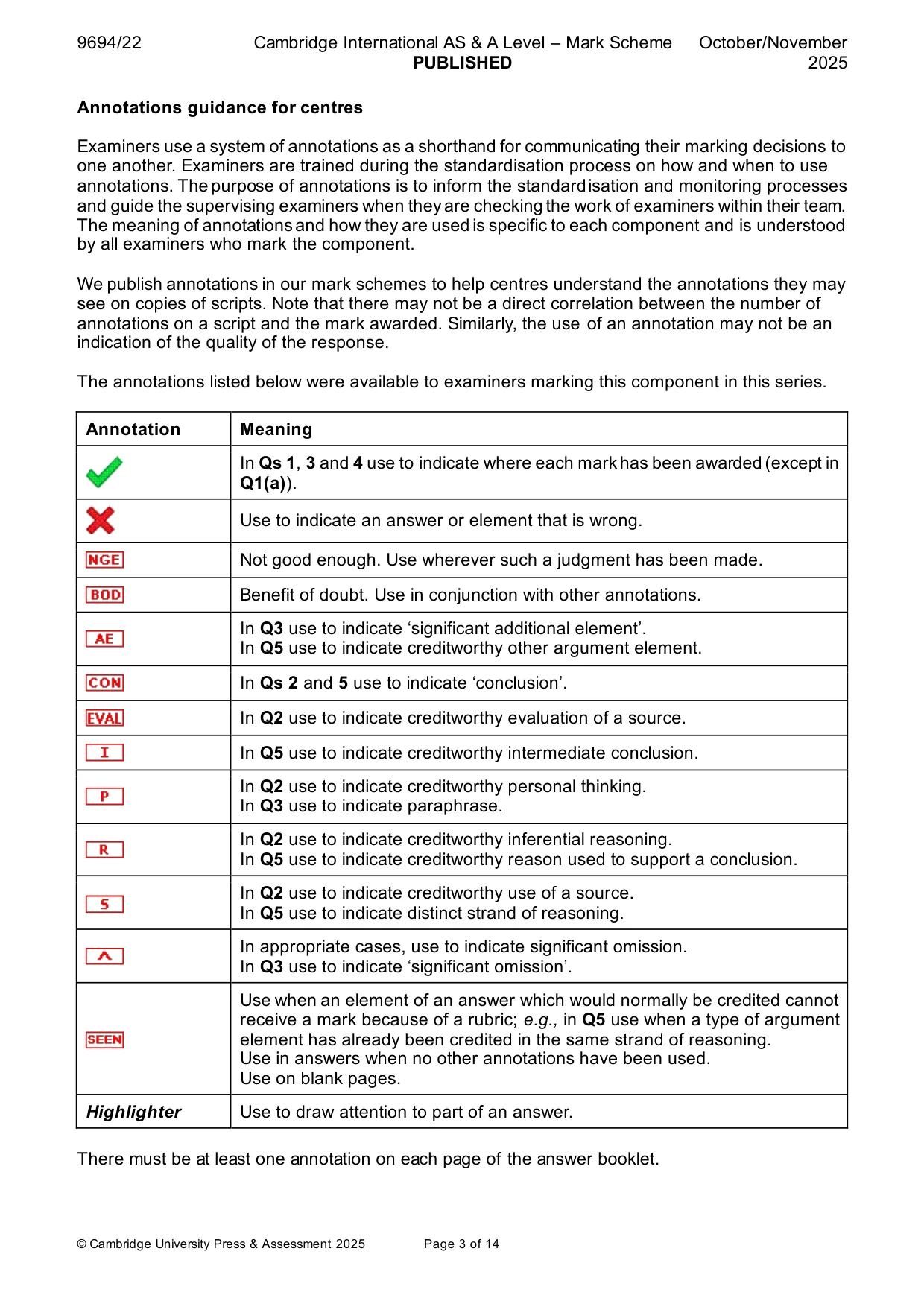
9694/22 Cambridge International AS & A Level – Mark Scheme PUBLISHED October/November 2025 © Cambridge University Press & Assessment 2025 Page 2 of 14 Generic Marking Principles These general marking principles must be applied by all examiners when marking candidate answers. They should be applied alongside the specific content of the mark scheme or generic level descriptions for a question. Each question paper and mark scheme will also comply with these marking principles. GENERIC MARKING PRINCIPLE 1: Marks must be awarded in line with: • the specific content of the mark scheme or the generic level descriptors for the question • the specific skills defined in the mark scheme or in the generic level descriptors for the question • the standard of response required by a candidate as exemplified by the standardisation scripts. GENERIC MARKING PRINCIPLE 2: Marks awarded are always whole marks (not half marks, or other fractions). GENERIC MARKING PRINCIPLE 3: Marks must be awarded positively: • marks are awarded for correct/valid answers, as defined in the mark scheme. However, credit is given for valid answers which go beyond the scope of the syllabus and mark scheme, referring to your Team Leader as appropriate • marks are awarded when candidates clearly demonstrate what they know and can do • marks are not deducted for errors • marks are not deducted for omissions • answers should only be judged on the quality of spelling, punctuation and grammar when these features are specifically assessed by the question as indicated by the mark scheme. The meaning, however, should be unambiguous. GENERIC MARKING PRINCIPLE 4: Rules must be applied consistently, e.g. in situations where candidates have not followed instructions or in the application of generic level descriptors. GENERIC MARKING PRINCIPLE 5: Marks should be awarded using the full range of marks defined in the mark scheme for the question (however; the use of the full mark range may be limited according to the quality of the candidate responses seen). GENERIC MARKING PRINCIPLE 6: Marks awarded are based solely on the requirements as defined in the mark scheme. Marks should not be awarded with grade thresholds or grade descriptors in mind.
Mark scheme, page 3
9694/22 Cambridge International AS & A Level – Mark Scheme PUBLISHED October/November 2025 © Cambridge University Press & Assessment 2025 Page 3 of 14 Annotations guidance for centres Examiners use a system of annotations as a shorthand for communicating their marking decisions to one another. Examiners are trained during the standardisation process on how and when to use annotations. The purpose of annotations is to inform the standardisation and monitoring processes and guide the supervising examiners when they are checking the work of examiners within their team. The meaning of annotations and how they are used is specific to each component and is understood by all examiners who mark the component. We publish annotations in our mark schemes to help centres understand the annotations they may see on copies of scripts. Note that there may not be a direct correlation between the number of annotations on a script and the mark awarded. Similarly, the use of an annotation may not be an indication of the quality of the response. The annotations listed below were available to examiners marking this component in this series. Annotation Meaning In Qs 1, 3 and 4 use to indicate where each mark has been awarded (except in Q1(a)). Use to indicate an answer or element that is wrong. Not good enough. Use wherever such a judgment has been made. Benefit of doubt. Use in conjunction with other annotations. In Q3 use to indicate ‘significant additional element’. In Q5 use to indicate creditworthy other argument element. In Qs 2 and 5 use to indicate ‘conclusion’. In Q2 use to indicate creditworthy evaluation of a source. In Q5 use to indicate creditworthy intermediate conclusion. In Q2 use to indicate creditworthy personal thinking. In Q3 use to indicate paraphrase. In Q2 use to indicate creditworthy inferential reasoning. In Q5 use to indicate creditworthy reason used to support a conclusion. In Q2 use to indicate creditworthy use of a source. In Q5 use to indicate distinct strand of reasoning. In appropriate cases, use to indicate significant omission. In Q3 use to indicate ‘significant omission’. Use when an element of an answer which would normally be credited cannot receive a mark because of a rubric; e.g., in Q5 use when a type of argument element has already been credited in the same strand of reasoning. Use in answers when no other annotations have been used. Use on blank pages. Highlighter Use to draw attention to part of an answer. There must be at least one annotation on each page of the answer booklet.
Mark scheme, page 4
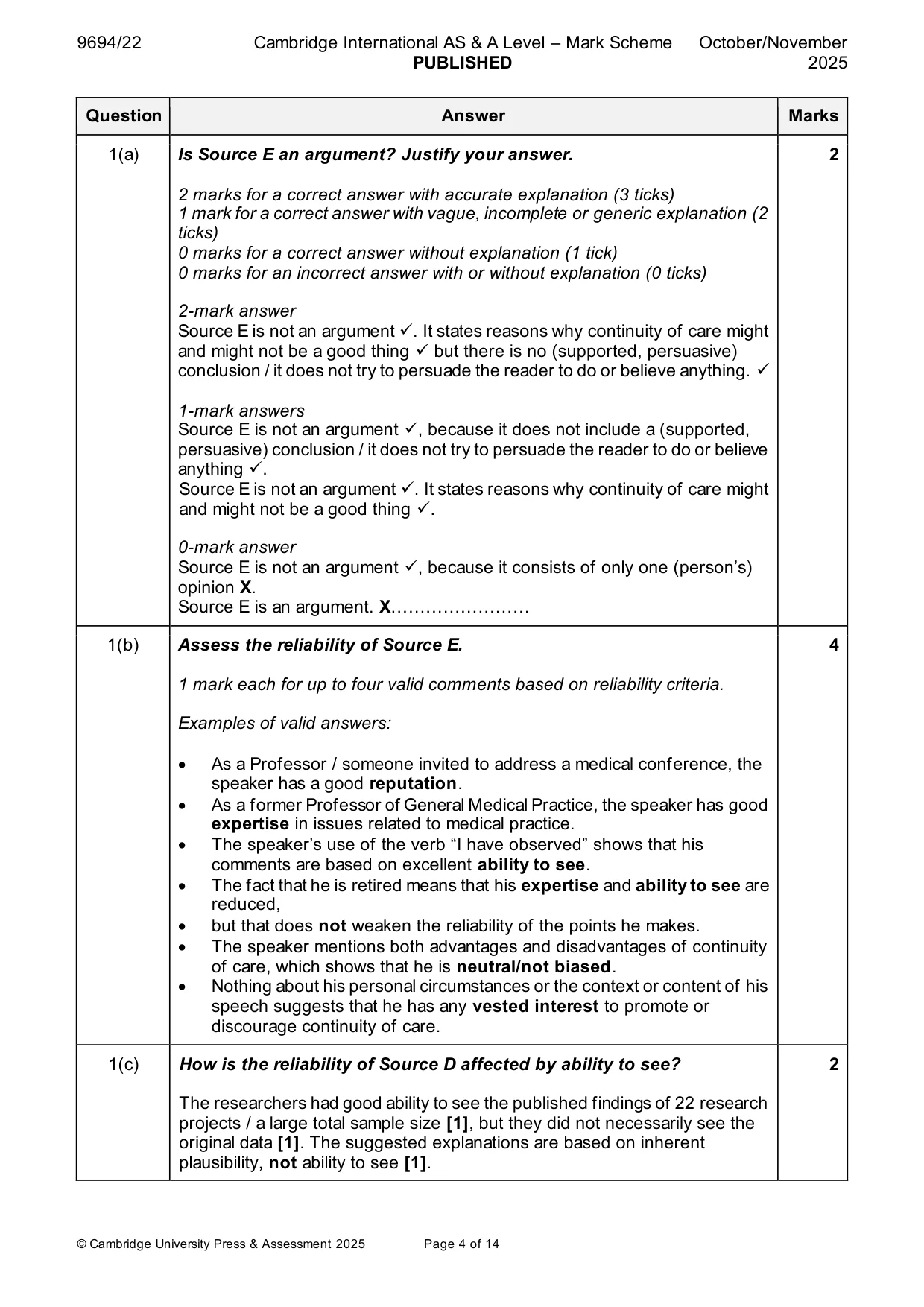
9694/22 Cambridge International AS & A Level – Mark Scheme PUBLISHED October/November 2025 © Cambridge University Press & Assessment 2025 Page 4 of 14 Question Answer Marks 1(a) Is Source E an argument? Justify your answer. 2 marks for a correct answer with accurate explanation (3 ticks) 1 mark for a correct answer with vague, incomplete or generic explanation (2 ticks) 0 marks for a correct answer without explanation (1 tick) 0 marks for an incorrect answer with or without explanation (0 ticks) 2-mark answer Source E is not an argument ✓. It states reasons why continuity of care might and might not be a good thing ✓ but there is no (supported, persuasive) conclusion / it does not try to persuade the reader to do or believe anything. ✓ 1-mark answers Source E is not an argument ✓, because it does not include a (supported, persuasive) conclusion / it does not try to persuade the reader to do or believe anything ✓. Source E is not an argument ✓. It states reasons why continuity of care might and might not be a good thing ✓. 0-mark answer Source E is not an argument ✓, because it consists of only one (person’s) opinion X. Source E is an argument. X…………………… 2 1(b) Assess the reliability of Source E. 1 mark each for up to four valid comments based on reliability criteria. Examples of valid answers: • As a Professor / someone invited to address a medical conference, the speaker has a good reputation. • As a former Professor of General Medical Practice, the speaker has good expertise in issues related to medical practice. • The speaker’s use of the verb “I have observed” shows that his comments are based on excellent ability to see. • The fact that he is retired means that his expertise and ability to see are reduced, • but that does not weaken the reliability of the points he makes. • The speaker mentions both advantages and disadvantages of continuity of care, which shows that he is neutral/not biased. • Nothing about his personal circumstances or the context or content of his speech suggests that he has any vested interest to promote or discourage continuity of care. 4 1(c) How is the reliability of Source D affected by ability to see? The researchers had good ability to see the published findings of 22 research projects / a large total sample size [1], but they did not necessarily see the original data [1]. The suggested explanations are based on inherent plausibility, not ability to see [1]. 2
Mark scheme, page 5
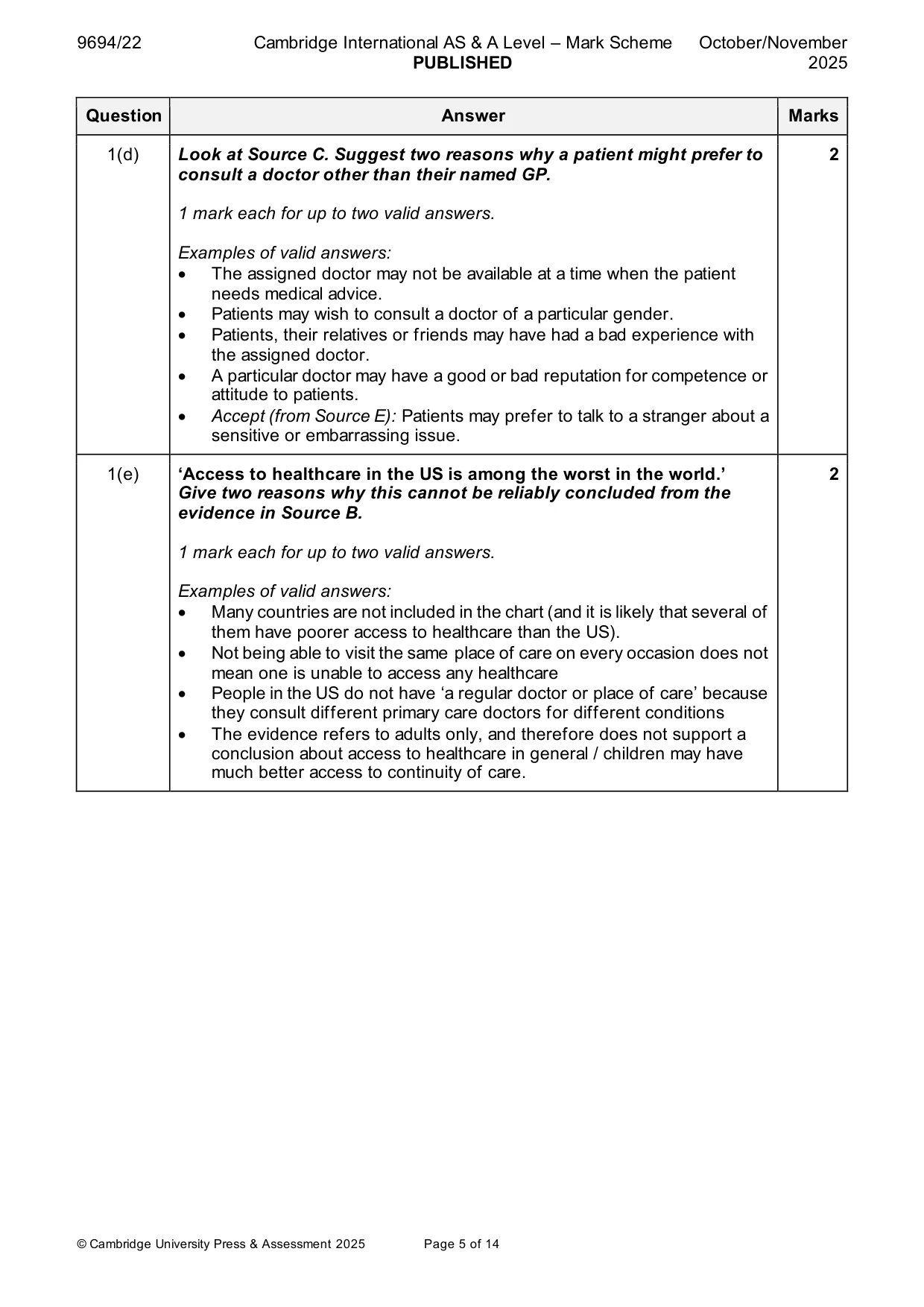
9694/22 Cambridge International AS & A Level – Mark Scheme PUBLISHED October/November 2025 © Cambridge University Press & Assessment 2025 Page 5 of 14 Question Answer Marks 1(d) Look at Source C. Suggest two reasons why a patient might prefer to consult a doctor other than their named GP. 1 mark each for up to two valid answers. Examples of valid answers: • The assigned doctor may not be available at a time when the patient needs medical advice. • Patients may wish to consult a doctor of a particular gender. • Patients, their relatives or friends may have had a bad experience with the assigned doctor. • A particular doctor may have a good or bad reputation for competence or attitude to patients. • Accept (from Source E): Patients may prefer to talk to a stranger about a sensitive or embarrassing issue. 2 1(e) ‘Access to healthcare in the US is among the worst in the world.’ Give two reasons why this cannot be reliably concluded from the evidence in Source B. 1 mark each for up to two valid answers. Examples of valid answers: • Many countries are not included in the chart (and it is likely that several of them have poorer access to healthcare than the US). • Not being able to visit the same place of care on every occasion does not mean one is unable to access any healthcare • People in the US do not have ‘a regular doctor or place of care’ because they consult different primary care doctors for different conditions • The evidence refers to adults only, and therefore does not support a conclusion about access to healthcare in general / children may have much better access to continuity of care. 2
Mark scheme, page 6
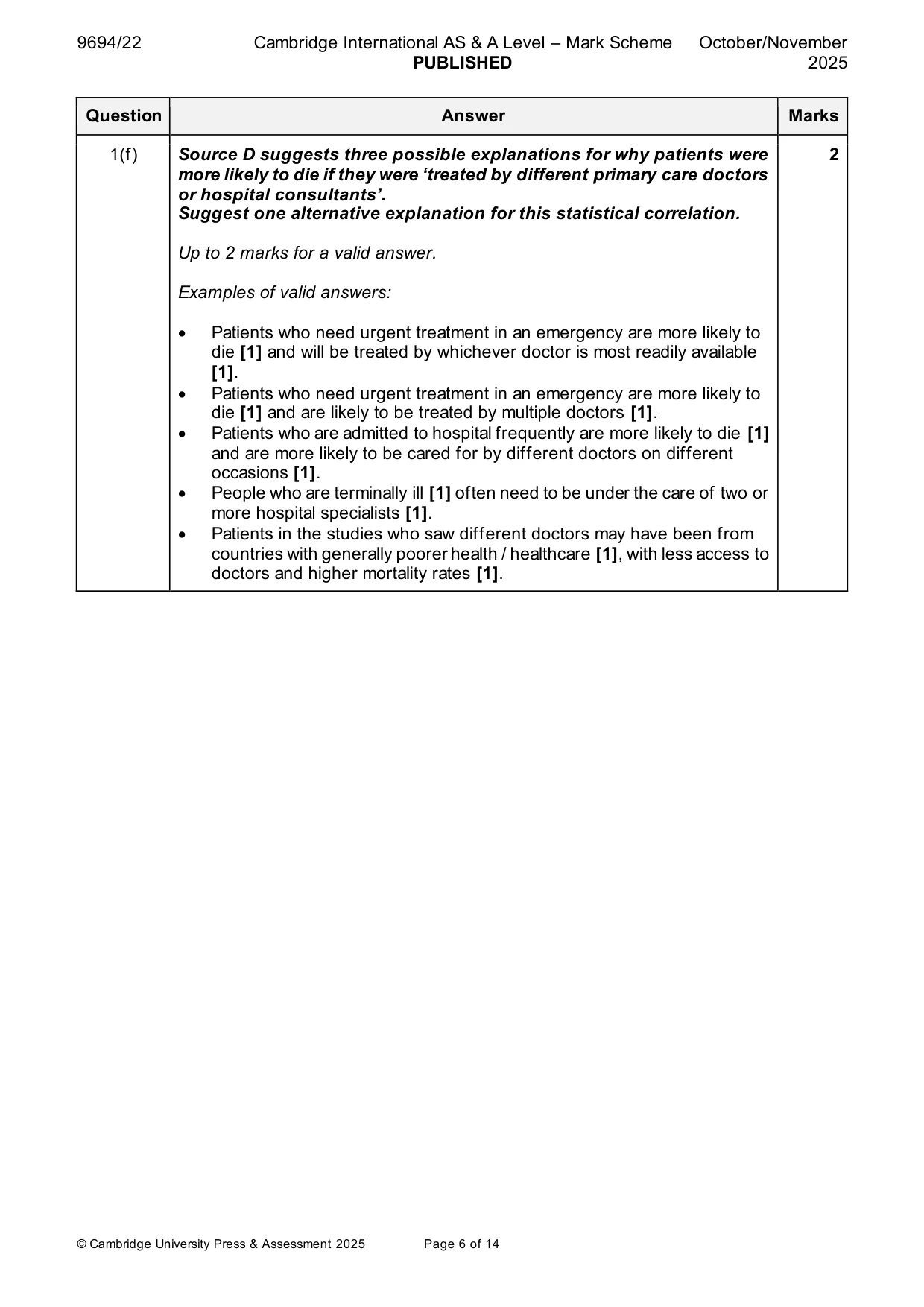
9694/22 Cambridge International AS & A Level – Mark Scheme PUBLISHED October/November 2025 © Cambridge University Press & Assessment 2025 Page 6 of 14 Question Answer Marks 1(f) Source D suggests three possible explanations for why patients were more likely to die if they were ‘treated by different primary care doctors or hospital consultants’. Suggest one alternative explanation for this statistical correlation. Up to 2 marks for a valid answer. Examples of valid answers: • Patients who need urgent treatment in an emergency are more likely to die [1] and will be treated by whichever doctor is most readily available [1]. • Patients who need urgent treatment in an emergency are more likely to die [1] and are likely to be treated by multiple doctors [1]. • Patients who are admitted to hospital frequently are more likely to die [1] and are more likely to be cared for by different doctors on different occasions [1]. • People who are terminally ill [1] often need to be under the care of two or more hospital specialists [1]. • Patients in the studies who saw different doctors may have been from countries with generally poorer health / healthcare [1], with less access to doctors and higher mortality rates [1]. 2
Mark scheme, page 7
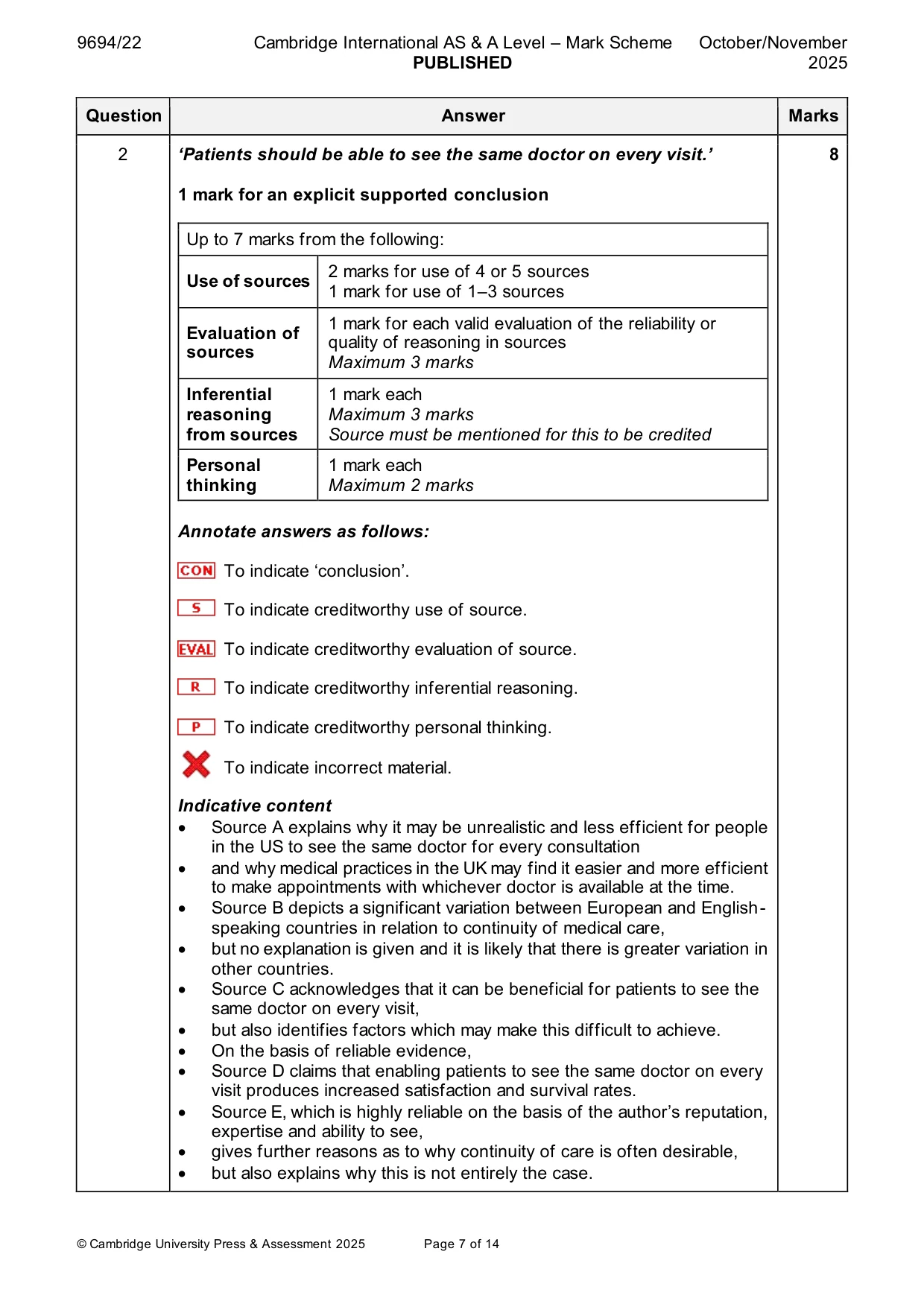
9694/22 Cambridge International AS & A Level – Mark Scheme PUBLISHED October/November 2025 © Cambridge University Press & Assessment 2025 Page 7 of 14 Question Answer Marks 2 ‘Patients should be able to see the same doctor on every visit.’ 1 mark for an explicit supported conclusion Up to 7 marks from the following: Use of sources 2 marks for use of 4 or 5 sources 1 mark for use of 1–3 sources Evaluation of sources 1 mark for each valid evaluation of the reliability or quality of reasoning in sources Maximum 3 marks Inferential reasoning from sources 1 mark each Maximum 3 marks Source must be mentioned for this to be credited Personal thinking 1 mark each Maximum 2 marks Annotate answers as follows: To indicate ‘conclusion’. To indicate creditworthy use of source. To indicate creditworthy evaluation of source. To indicate creditworthy inferential reasoning. To indicate creditworthy personal thinking. To indicate incorrect material. Indicative content • Source A explains why it may be unrealistic and less efficient for people in the US to see the same doctor for every consultation • and why medical practices in the UK may find it easier and more efficient to make appointments with whichever doctor is available at the time. • Source B depicts a significant variation between European and English- speaking countries in relation to continuity of medical care, • but no explanation is given and it is likely that there is greater variation in other countries. • Source C acknowledges that it can be beneficial for patients to see the same doctor on every visit, • but also identifies factors which may make this difficult to achieve. • On the basis of reliable evidence, • Source D claims that enabling patients to see the same doctor on every visit produces increased satisfaction and survival rates. • Source E, which is highly reliable on the basis of the author’s reputation, expertise and ability to see, • gives further reasons as to why continuity of care is often desirable, • but also explains why this is not entirely the case. 8
Mark scheme, page 8
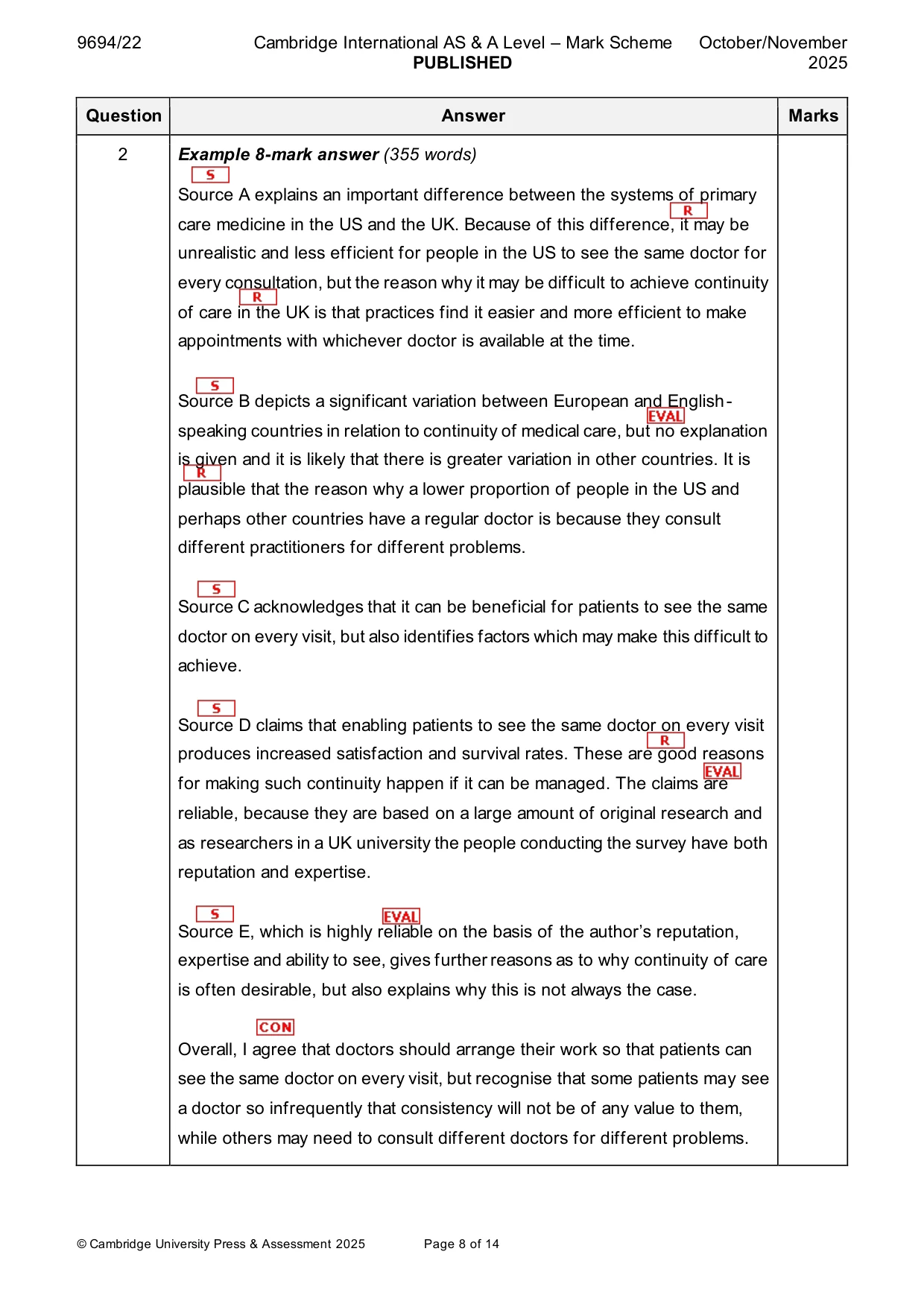
9694/22 Cambridge International AS & A Level – Mark Scheme PUBLISHED October/November 2025 © Cambridge University Press & Assessment 2025 Page 8 of 14 Question Answer Marks 2 Example 8-mark answer (355 words) Source A explains an important difference between the systems of primary care medicine in the US and the UK. Because of this difference, it may be unrealistic and less efficient for people in the US to see the same doctor for every consultation, but the reason why it may be difficult to achieve continuity of care in the UK is that practices find it easier and more efficient to make appointments with whichever doctor is available at the time. Source B depicts a significant variation between European and English- speaking countries in relation to continuity of medical care, but no explanation is given and it is likely that there is greater variation in other countries. It is plausible that the reason why a lower proportion of people in the US and perhaps other countries have a regular doctor is because they consult different practitioners for different problems. Source C acknowledges that it can be beneficial for patients to see the same doctor on every visit, but also identifies factors which may make this difficult to achieve. Source D claims that enabling patients to see the same doctor on every visit produces increased satisfaction and survival rates. These are good reasons for making such continuity happen if it can be managed. The claims are reliable, because they are based on a large amount of original research and as researchers in a UK university the people conducting the survey have both reputation and expertise. Source E, which is highly reliable on the basis of the author’s reputation, expertise and ability to see, gives further reasons as to why continuity of care is often desirable, but also explains why this is not always the case. Overall, I agree that doctors should arrange their work so that patients can see the same doctor on every visit, but recognise that some patients may see a doctor so infrequently that consistency will not be of any value to them, while others may need to consult different doctors for different problems.
Mark scheme, page 9
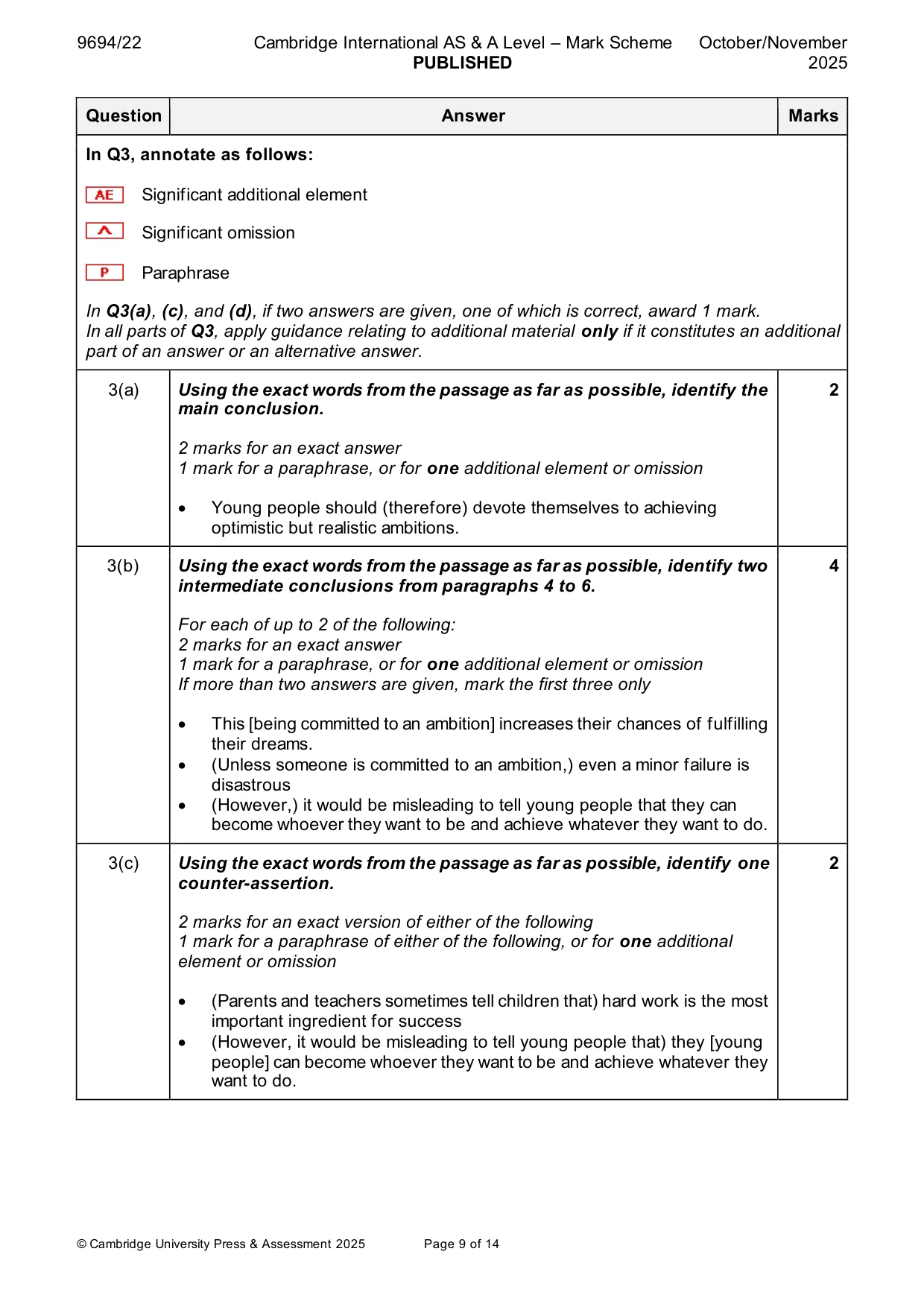
9694/22 Cambridge International AS & A Level – Mark Scheme PUBLISHED October/November 2025 © Cambridge University Press & Assessment 2025 Page 9 of 14 Question Answer Marks In Q3, annotate as follows: Significant additional element Significant omission Paraphrase In Q3(a), (c), and (d), if two answers are given, one of which is correct, award 1 mark. In all parts of Q3, apply guidance relating to additional material only if it constitutes an additional part of an answer or an alternative answer. 3(a) Using the exact words from the passage as far as possible, identify the main conclusion. 2 marks for an exact answer 1 mark for a paraphrase, or for one additional element or omission • Young people should (therefore) devote themselves to achieving optimistic but realistic ambitions. 2 3(b) Using the exact words from the passage as far as possible, identify two intermediate conclusions from paragraphs 4 to 6. For each of up to 2 of the following: 2 marks for an exact answer 1 mark for a paraphrase, or for one additional element or omission If more than two answers are given, mark the first three only • This [being committed to an ambition] increases their chances of fulfilling their dreams. • (Unless someone is committed to an ambition,) even a minor failure is disastrous • (However,) it would be misleading to tell young people that they can become whoever they want to be and achieve whatever they want to do. 4 3(c) Using the exact words from the passage as far as possible, identify one counter-assertion. 2 marks for an exact version of either of the following 1 mark for a paraphrase of either of the following, or for one additional element or omission • (Parents and teachers sometimes tell children that) hard work is the most important ingredient for success • (However, it would be misleading to tell young people that) they [young people] can become whoever they want to be and achieve whatever they want to do. 2
Mark scheme, page 10
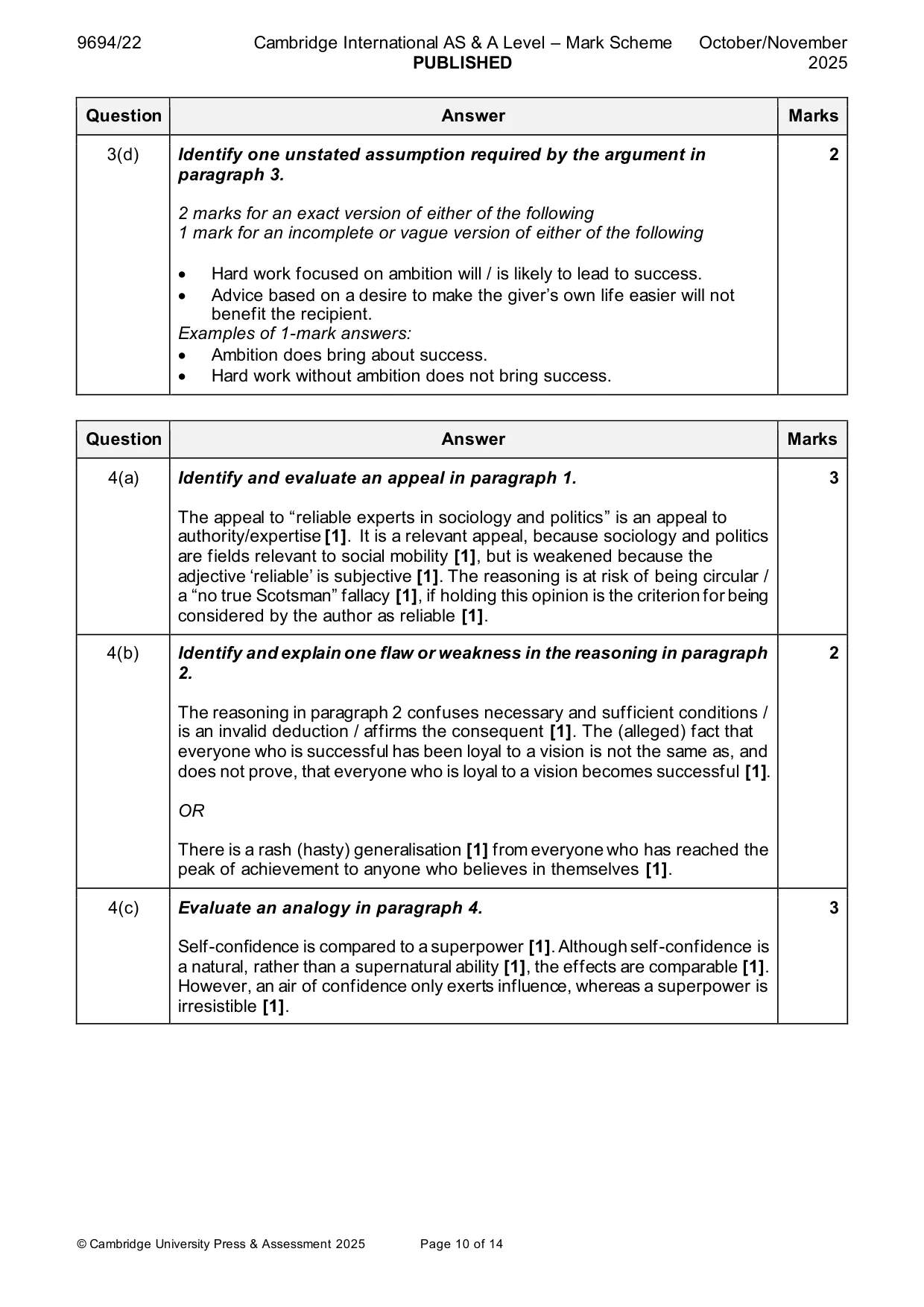
9694/22 Cambridge International AS & A Level – Mark Scheme PUBLISHED October/November 2025 © Cambridge University Press & Assessment 2025 Page 10 of 14 Question Answer Marks 3(d) Identify one unstated assumption required by the argument in paragraph 3. 2 marks for an exact version of either of the following 1 mark for an incomplete or vague version of either of the following • Hard work focused on ambition will / is likely to lead to success. • Advice based on a desire to make the giver’s own life easier will not benefit the recipient. Examples of 1-mark answers: • Ambition does bring about success. • Hard work without ambition does not bring success. 2 Question Answer Marks 4(a) Identify and evaluate an appeal in paragraph 1. The appeal to “reliable experts in sociology and politics” is an appeal to authority/expertise [1]. It is a relevant appeal, because sociology and politics are fields relevant to social mobility [1], but is weakened because the adjective ‘reliable’ is subjective [1]. The reasoning is at risk of being circular / a “no true Scotsman” fallacy [1], if holding this opinion is the criterion for being considered by the author as reliable [1]. 3 4(b) Identify and explain one flaw or weakness in the reasoning in paragraph 2. The reasoning in paragraph 2 confuses necessary and sufficient conditions / is an invalid deduction / affirms the consequent [1]. The (alleged) fact that everyone who is successful has been loyal to a vision is not the same as, and does not prove, that everyone who is loyal to a vision becomes successful [1]. OR There is a rash (hasty) generalisation [1] from everyone who has reached the peak of achievement to anyone who believes in themselves [1]. 2 4(c) Evaluate an analogy in paragraph 4. Self-confidence is compared to a superpower [1]. Although self-confidence is a natural, rather than a supernatural ability [1], the effects are comparable [1]. However, an air of confidence only exerts influence, whereas a superpower is irresistible [1]. 3
Mark scheme, page 11
9694/22 Cambridge International AS & A Level – Mark Scheme PUBLISHED October/November 2025 © Cambridge University Press & Assessment 2025 Page 11 of 14 Question Answer Marks 4(d) Explain how the reasoning in paragraph 5 is weakened by the flaw of slippery slope. The claim that even a minor failure ‘discourages them from attempting further challenges’ is not synonymous with saying that it will prevent them from making any further such attempts [1], and even if that were true, it is not inevitable that doing so ‘will lead to a life of unemployment, poverty and misery’ [1]. Viable alternatives are available at every stage of this slippery slope [1]. 2
Mark scheme, page 12
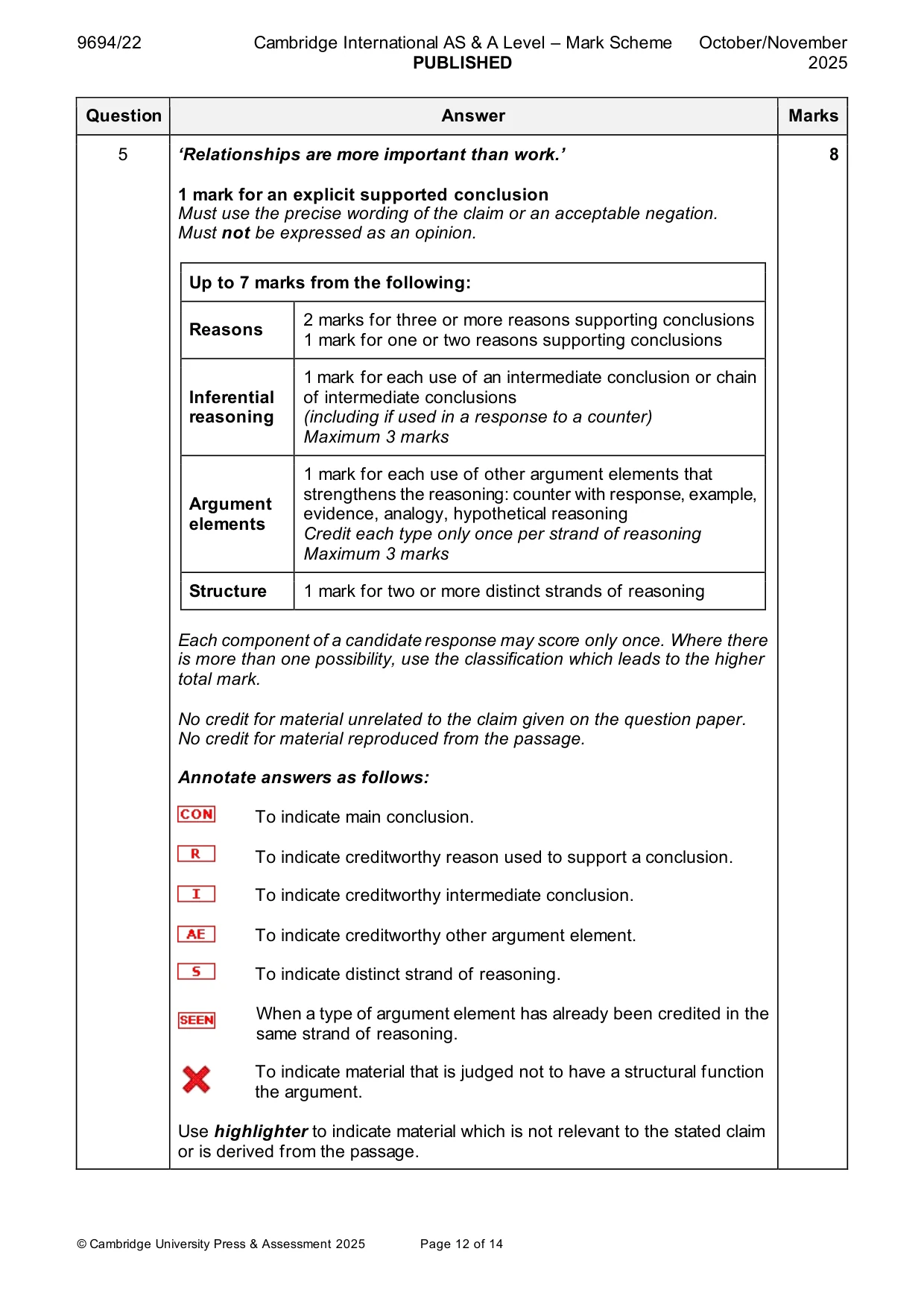
9694/22 Cambridge International AS & A Level – Mark Scheme PUBLISHED October/November 2025 © Cambridge University Press & Assessment 2025 Page 12 of 14 Question Answer Marks 5 ‘Relationships are more important than work.’ 1 mark for an explicit supported conclusion Must use the precise wording of the claim or an acceptable negation. Must not be expressed as an opinion. Up to 7 marks from the following: Reasons 2 marks for three or more reasons supporting conclusions 1 mark for one or two reasons supporting conclusions Inferential reasoning 1 mark for each use of an intermediate conclusion or chain of intermediate conclusions (including if used in a response to a counter) Maximum 3 marks Argument elements 1 mark for each use of other argument elements that strengthens the reasoning: counter with response, example, evidence, analogy, hypothetical reasoning Credit each type only once per strand of reasoning Maximum 3 marks Structure 1 mark for two or more distinct strands of reasoning Each component of a candidate response may score only once. Where there is more than one possibility, use the classification which leads to the higher total mark. No credit for material unrelated to the claim given on the question paper. No credit for material reproduced from the passage. Annotate answers as follows: To indicate main conclusion. To indicate creditworthy reason used to support a conclusion. To indicate creditworthy intermediate conclusion. To indicate creditworthy other argument element. To indicate distinct strand of reasoning. When a type of argument element has already been credited in the same strand of reasoning. To indicate material that is judged not to have a structural function in the argument. Use highlighter to indicate material which is not relevant to the stated claim or is derived from the passage. 8
Mark scheme, page 13
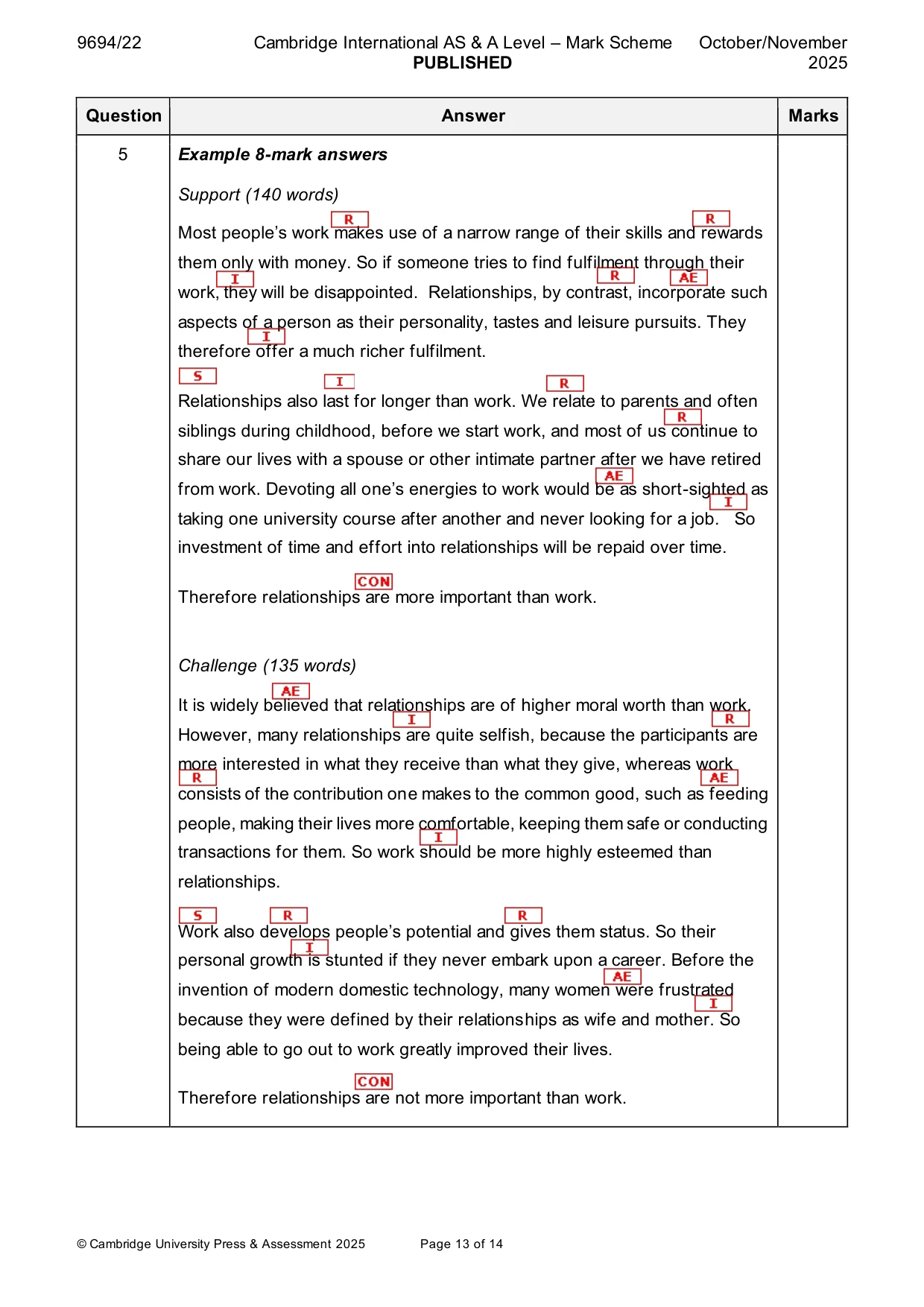
9694/22 Cambridge International AS & A Level – Mark Scheme PUBLISHED October/November 2025 © Cambridge University Press & Assessment 2025 Page 13 of 14 Question Answer Marks 5 Example 8-mark answers Support (140 words) Most people’s work makes use of a narrow range of their skills and rewards them only with money. So if someone tries to find fulfilment through their work, they will be disappointed. Relationships, by contrast, incorporate such aspects of a person as their personality, tastes and leisure pursuits. They therefore offer a much richer fulfilment. Relationships also last for longer than work. We relate to parents and often siblings during childhood, before we start work, and most of us continue to share our lives with a spouse or other intimate partner after we have retired from work. Devoting all one’s energies to work would be as short-sighted as taking one university course after another and never looking for a job. So investment of time and effort into relationships will be repaid over time. Therefore relationships are more important than work. Challenge (135 words) It is widely believed that relationships are of higher moral worth than work. However, many relationships are quite selfish, because the participants are more interested in what they receive than what they give, whereas work consists of the contribution one makes to the common good, such as feeding people, making their lives more comfortable, keeping them safe or conducting transactions for them. So work should be more highly esteemed than relationships. Work also develops people’s potential and gives them status. So their personal growth is stunted if they never embark upon a career. Before the invention of modern domestic technology, many women were frustrated because they were defined by their relationships as wife and mother. So being able to go out to work greatly improved their lives. Therefore relationships are not more important than work.
Mark scheme, page 14
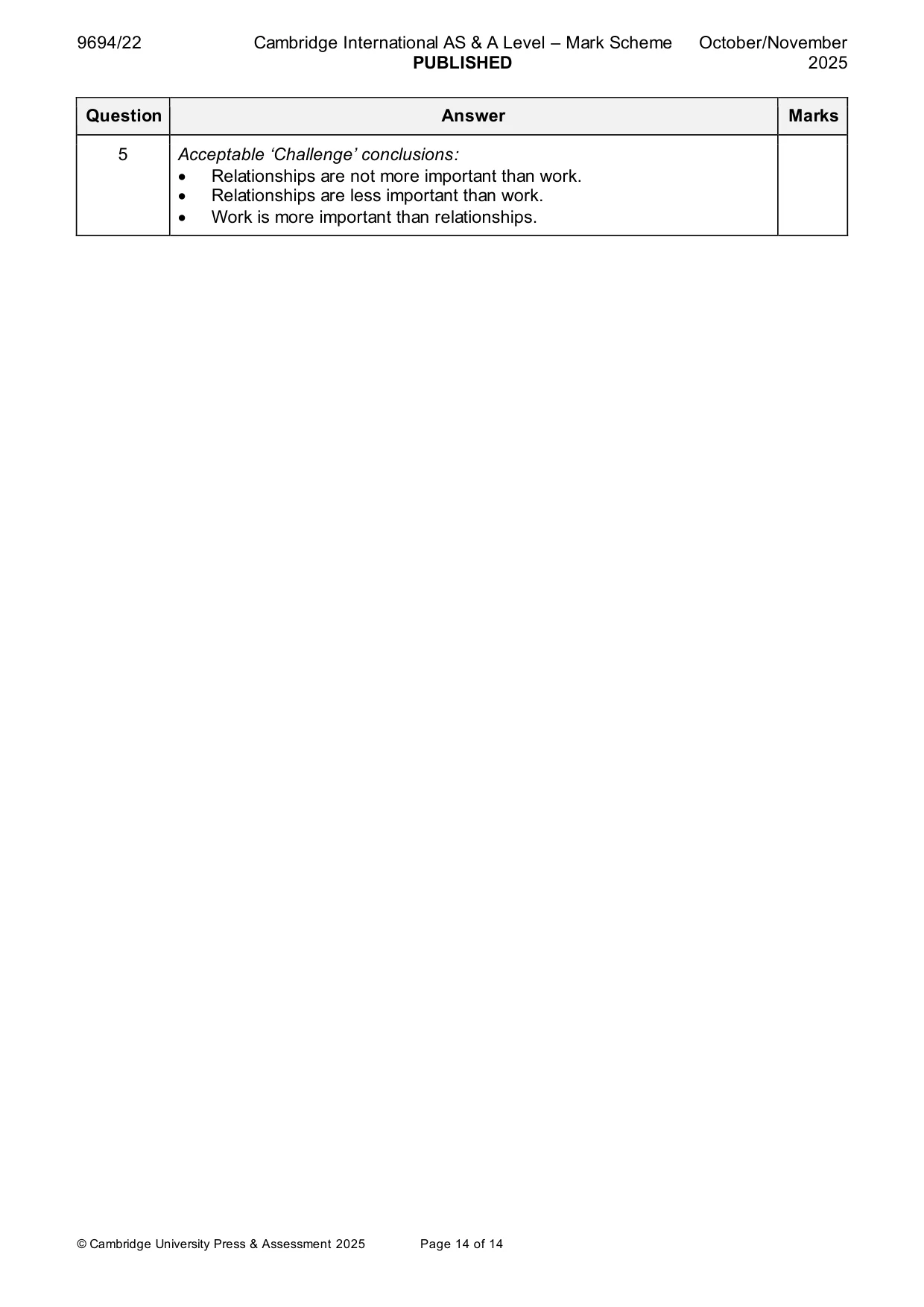
9694/22 Cambridge International AS & A Level – Mark Scheme PUBLISHED October/November 2025 © Cambridge University Press & Assessment 2025 Page 14 of 14 Question Answer Marks 5 Acceptable ‘Challenge’ conclusions: • Relationships are not more important than work. • Relationships are less important than work. • Work is more important than relationships.
What you needed in this session
Cambridge’s own grade thresholds for 2025 Oct/Nov, Paper 2 · Variant 2. A higher threshold means an easier paper — the bar moves with how the cohort did.