Cambridge A Level Thinking Skills 9694 — 2025 May/June Paper 2 · Variant 2
9694/22/M/J/25 · 50 marks · ≈56 min
The question paper and its mark scheme, free to read here and free to download. This is Cambridge’s own paper, exactly as it was sat.
Question paper8 pages



Mark scheme14 pages
Answers below. Sit the paper first if you are practising.
Paper as text
Question paper, page 1
This document has 8 pages. Any blank pages are indicated. [Turn over Cambridge International AS & A Level THINKING SKILLS 9694/22 Paper 2 Critical Thinking May/June 2025 1 hour 45 minutes You must answer on the enclosed answer booklet. You will need: Answer booklet (enclosed) INSTRUCTIONS ● Answer all questions. ● Follow the instructions on the front cover of the answer booklet. If you need additional answer paper, ask the invigilator for a continuation booklet. INFORMATION ● The total mark for this paper is 50. ● The number of marks for each question or part question is shown in brackets [ ]. * 4 2 3 6 5 9 2 9 2 4 * DC (PQ) 342352/2 © UCLES 2025
Question paper, page 2
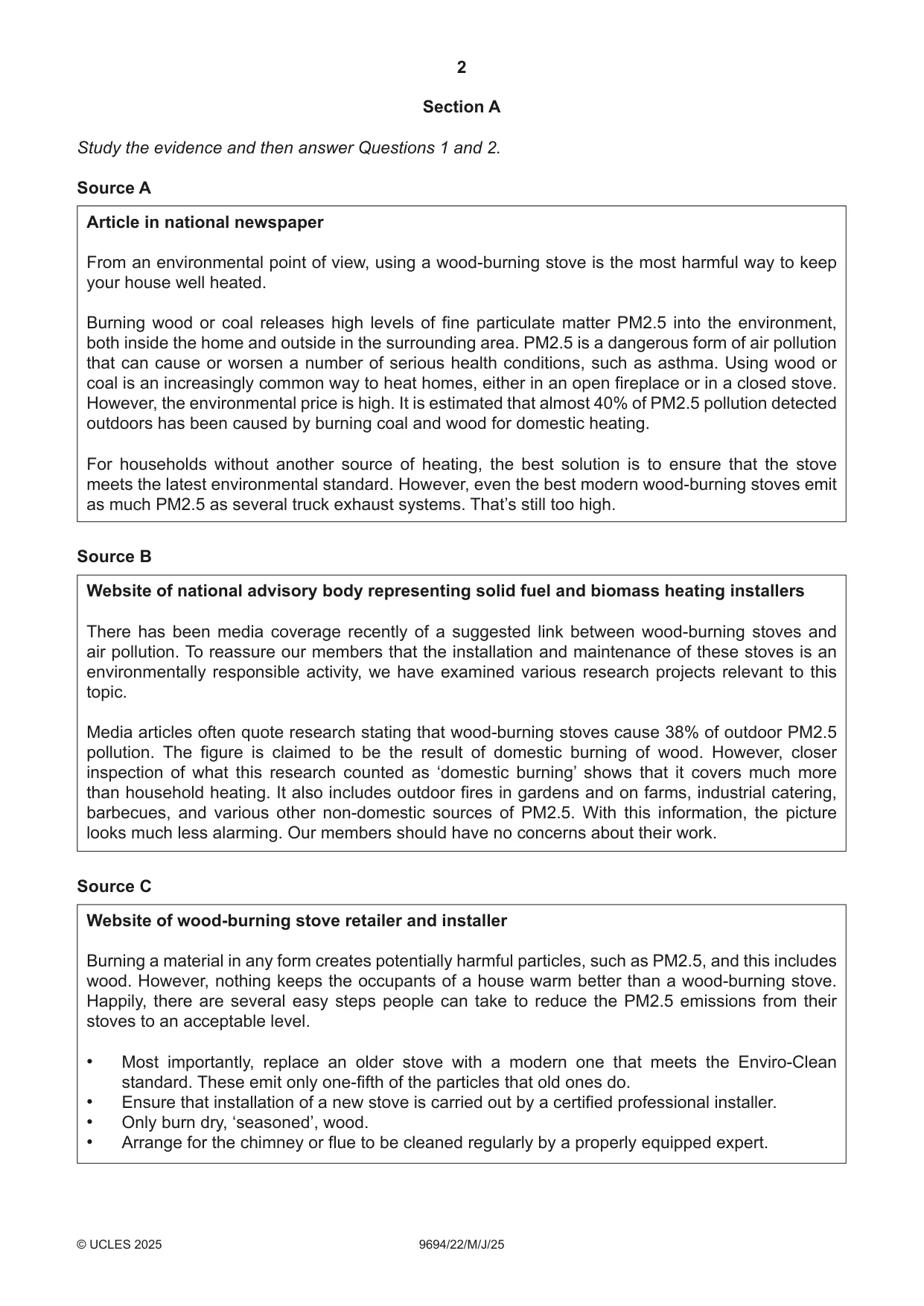
2 9694/22/M/J/25 © UCLES 2025 Section A Study the evidence and then answer Questions 1 and 2. Source A Article in national newspaper From an environmental point of view, using a wood-burning stove is the most harmful way to keep your house well heated. Burning wood or coal releases high levels of fine particulate matter PM2.5 into the environment, both inside the home and outside in the surrounding area. PM2.5 is a dangerous form of air pollution that can cause or worsen a number of serious health conditions, such as asthma. Using wood or coal is an increasingly common way to heat homes, either in an open fireplace or in a closed stove. However, the environmental price is high. It is estimated that almost 40% of PM2.5 pollution detected outdoors has been caused by burning coal and wood for domestic heating. For households without another source of heating, the best solution is to ensure that the stove meets the latest environmental standard. However, even the best modern wood-burning stoves emit as much PM2.5 as several truck exhaust systems. That’s still too high. Source B Website of national advisory body representing solid fuel and biomass heating installers There has been media coverage recently of a suggested link between wood-burning stoves and air pollution. To reassure our members that the installation and maintenance of these stoves is an environmentally responsible activity, we have examined various research projects relevant to this topic. Media articles often quote research stating that wood-burning stoves cause 38% of outdoor PM2.5 pollution. The figure is claimed to be the result of domestic burning of wood. However, closer inspection of what this research counted as ‘domestic burning’ shows that it covers much more than household heating. It also includes outdoor fires in gardens and on farms, industrial catering, barbecues, and various other non-domestic sources of PM2.5. With this information, the picture looks much less alarming. Our members should have no concerns about their work. Source C Website of wood-burning stove retailer and installer Burning a material in any form creates potentially harmful particles, such as PM2.5, and this includes wood. However, nothing keeps the occupants of a house warm better than a wood-burning stove. Happily, there are several easy steps people can take to reduce the PM2.5 emissions from their stoves to an acceptable level. • Most importantly, replace an older stove with a modern one that meets the Enviro-Clean standard. These emit only one-fifth of the particles that old ones do. • Ensure that installation of a new stove is carried out by a certified professional installer. • Only burn dry, ‘seasoned’, wood. • Arrange for the chimney or flue to be cleaned regularly by a properly equipped expert.
Question paper, page 3
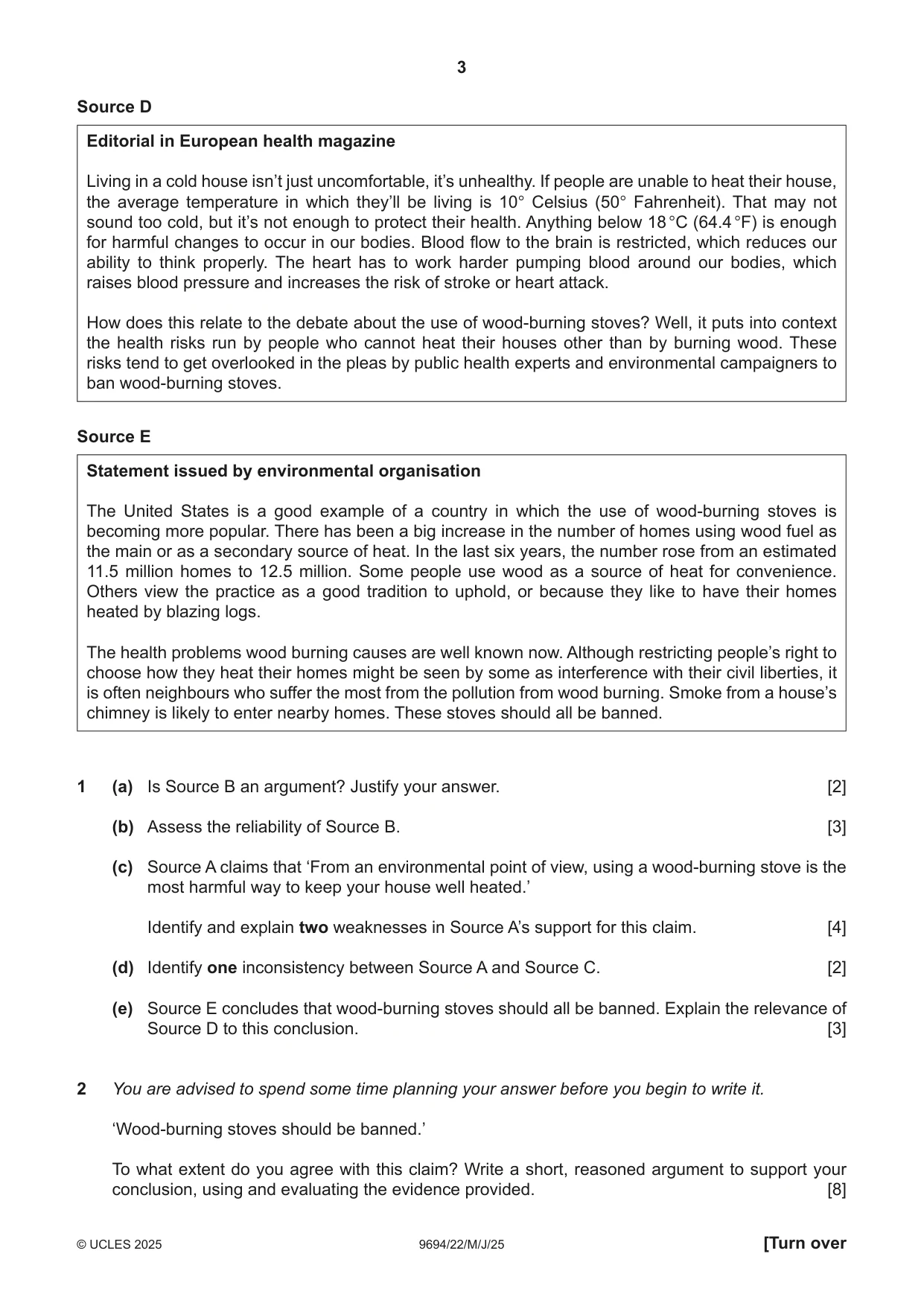
3 9694/22/M/J/25 © UCLES 2025 [Turn over Source D Editorial in European health magazine Living in a cold house isn’t just uncomfortable, it’s unhealthy. If people are unable to heat their house, the average temperature in which they’ll be living is 10° Celsius (50° Fahrenheit). That may not sound too cold, but it’s not enough to protect their health. Anything below 18 °C (64.4 °F) is enough for harmful changes to occur in our bodies. Blood flow to the brain is restricted, which reduces our ability to think properly. The heart has to work harder pumping blood around our bodies, which raises blood pressure and increases the risk of stroke or heart attack. How does this relate to the debate about the use of wood-burning stoves? Well, it puts into context the health risks run by people who cannot heat their houses other than by burning wood. These risks tend to get overlooked in the pleas by public health experts and environmental campaigners to ban wood-burning stoves. Source E Statement issued by environmental organisation The United States is a good example of a country in which the use of wood-burning stoves is becoming more popular. There has been a big increase in the number of homes using wood fuel as the main or as a secondary source of heat. In the last six years, the number rose from an estimated 11.5 million homes to 12.5 million. Some people use wood as a source of heat for convenience. Others view the practice as a good tradition to uphold, or because they like to have their homes heated by blazing logs. The health problems wood burning causes are well known now. Although restricting people’s right to choose how they heat their homes might be seen by some as interference with their civil liberties, it is often neighbours who suffer the most from the pollution from wood burning. Smoke from a house’s chimney is likely to enter nearby homes. These stoves should all be banned. 1 (a) Is Source B an argument? Justify your answer. [2] (b) Assess the reliability of Source B. [3] (c) Source A claims that ‘From an environmental point of view, using a wood-burning stove is the most harmful way to keep your house well heated.’ Identify and explain two weaknesses in Source A’s support for this claim. [4] (d) Identify one inconsistency between Source A and Source C. [2] (e) Source E concludes that wood-burning stoves should all be banned. Explain the relevance of Source D to this conclusion. [3] 2 You are advised to spend some time planning your answer before you begin to write it. ‘Wood-burning stoves should be banned.’ To what extent do you agree with this claim? Write a short, reasoned argument to support your conclusion, using and evaluating the evidence provided. [8]
Question paper, page 4
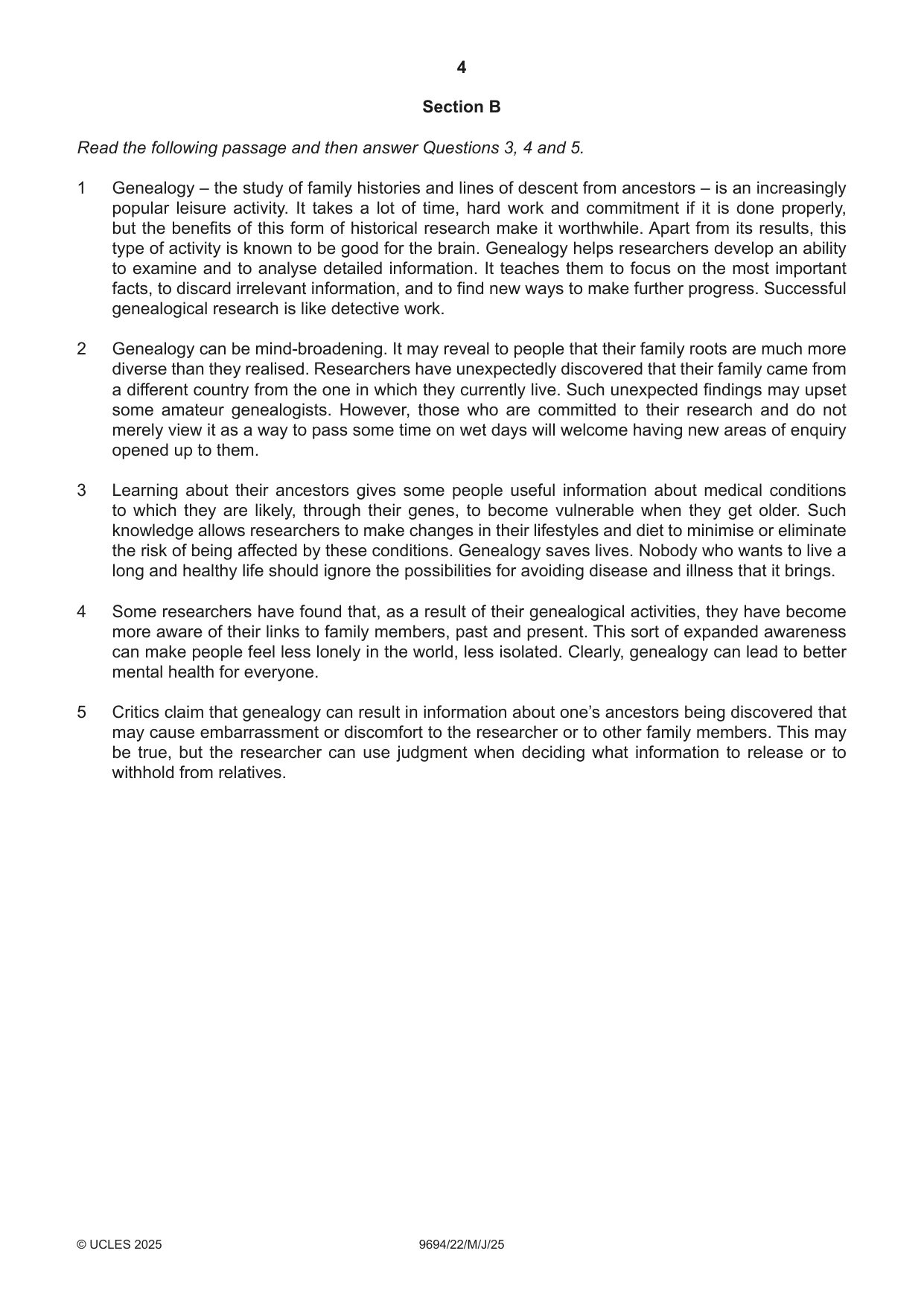
4 9694/22/M/J/25 © UCLES 2025 Section B Read the following passage and then answer Questions 3, 4 and 5. 1 Genealogy – the study of family histories and lines of descent from ancestors – is an increasingly popular leisure activity. It takes a lot of time, hard work and commitment if it is done properly, but the benefits of this form of historical research make it worthwhile. Apart from its results, this type of activity is known to be good for the brain. Genealogy helps researchers develop an ability to examine and to analyse detailed information. It teaches them to focus on the most important facts, to discard irrelevant information, and to find new ways to make further progress. Successful genealogical research is like detective work. 2 Genealogy can be mind-broadening. It may reveal to people that their family roots are much more diverse than they realised. Researchers have unexpectedly discovered that their family came from a different country from the one in which they currently live. Such unexpected findings may upset some amateur genealogists. However, those who are committed to their research and do not merely view it as a way to pass some time on wet days will welcome having new areas of enquiry opened up to them. 3 Learning about their ancestors gives some people useful information about medical conditions to which they are likely, through their genes, to become vulnerable when they get older. Such knowledge allows researchers to make changes in their lifestyles and diet to minimise or eliminate the risk of being affected by these conditions. Genealogy saves lives. Nobody who wants to live a long and healthy life should ignore the possibilities for avoiding disease and illness that it brings. 4 Some researchers have found that, as a result of their genealogical activities, they have become more aware of their links to family members, past and present. This sort of expanded awareness can make people feel less lonely in the world, less isolated. Clearly, genealogy can lead to better mental health for everyone. 5 Critics claim that genealogy can result in information about one’s ancestors being discovered that may cause embarrassment or discomfort to the researcher or to other family members. This may be true, but the researcher can use judgment when deciding what information to release or to withhold from relatives.
Question paper, page 5
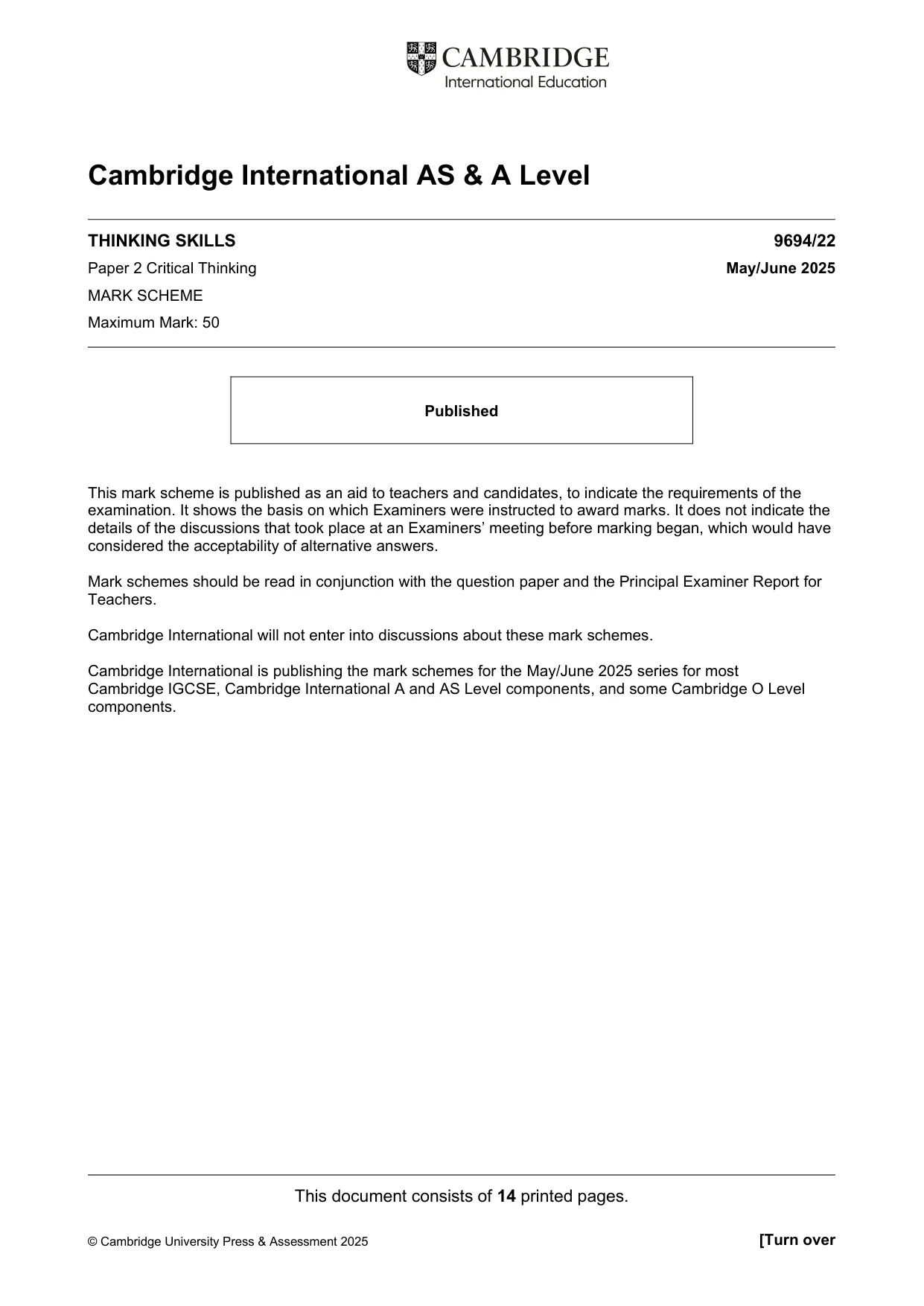
5 9694/22/M/J/25 © UCLES 2025 3 (a) Using the exact words from the passage as far as possible, identify the main conclusion. [2] (b) Using the exact words from the passage as far as possible, identify two intermediate conclusions from paragraphs 2 to 3. [4] (c) Using the exact words from the passage as far as possible, identify one counter-assertion in paragraphs 1 to 4. [2] (d) Identify one unstated assumption required by the reasoning in paragraph 3. [2] 4 (a) Explain why the reasoning in paragraph 1 does not rely on an appeal to popularity. [2] (b) Identify and explain one flaw or weakness in the reasoning in paragraph 4. [2] (c) What use does the argument in paragraph 1 make of an analogy ? [2] (d) The first sentence of paragraph 5 contains a counter-assertion. Explain why the response to this assertion is only partially successful. [2] (e) Identify and explain one flaw or weakness in the reasoning in paragraph 2. [2] 5 You are advised to spend some time planning your answer before you begin to write it. ‘Relationships with friends are more important than those with family members.’ Write your own short argument to support or challenge this claim. The conclusion of your argument must be stated. Credit will not be given for repeating ideas from the passage. [8]
Question paper, page 6
6 9694/22/M/J/25 © UCLES 2025 BLANK PAGE
Question paper, page 7
7 9694/22/M/J/25 © UCLES 2025 BLANK PAGE
Question paper, page 8
8 9694/22/M/J/25 © UCLES 2025 Permission to reproduce items where third-party owned material protected by copyright is included has been sought and cleared where possible. Every reasonable effort has been made by the publisher (UCLES) to trace copyright holders, but if any items requiring clearance have unwittingly been included, the publisher will be pleased to make amends at the earliest possible opportunity. To avoid the issue of disclosure of answer-related information to candidates, all copyright acknowledgements are reproduced online in the Cambridge Assessment International Education Copyright Acknowledgements Booklet. This is produced for each series of examinations and is freely available to download at www.cambridgeinternational.org after the live examination series. Cambridge Assessment International Education is part of Cambridge Assessment. Cambridge Assessment is the brand name of the University of Cambridge Local Examinations Syndicate (UCLES), which is a department of the University of Cambridge. BLANK PAGE
Mark scheme, page 1
This document consists of 14 printed pages. © Cambridge University Press & Assessment 2025 [Turn over Cambridge International AS & A Level THINKING SKILLS 9694/22 Paper 2 Critical Thinking May/June 2025 MARK SCHEME Maximum Mark: 50 Published This mark scheme is published as an aid to teachers and candidates, to indicate the requirements of the examination. It shows the basis on which Examiners were instructed to award marks. It does not indicate the details of the discussions that took place at an Examiners’ meeting before marking began, which would have considered the acceptability of alternative answers. Mark schemes should be read in conjunction with the question paper and the Principal Examiner Report for Teachers. Cambridge International will not enter into discussions about these mark schemes. Cambridge International is publishing the mark schemes for the May/June 2025 series for most Cambridge IGCSE, Cambridge International A and AS Level components, and some Cambridge O Level components.
Mark scheme, page 2
9694/22 Cambridge International AS & A Level – Mark Scheme PUBLISHED May/June 2025 © Cambridge University Press & Assessment 2025 Page 2 of 14 Generic Marking Principles These general marking principles must be applied by all examiners when marking candidate answers. They should be applied alongside the specific content of the mark scheme or generic level descriptions for a question. Each question paper and mark scheme will also comply with these marking principles. GENERIC MARKING PRINCIPLE 1: Marks must be awarded in line with: • the specific content of the mark scheme or the generic level descriptors for the question • the specific skills defined in the mark scheme or in the generic level descriptors for the question • the standard of response required by a candidate as exemplified by the standardisation scripts. GENERIC MARKING PRINCIPLE 2: Marks awarded are always whole marks (not half marks, or other fractions). GENERIC MARKING PRINCIPLE 3: Marks must be awarded positively: • marks are awarded for correct/valid answers, as defined in the mark scheme. However, credit is given for valid answers which go beyond the scope of the syllabus and mark scheme, referring to your Team Leader as appropriate • marks are awarded when candidates clearly demonstrate what they know and can do • marks are not deducted for errors • marks are not deducted for omissions • answers should only be judged on the quality of spelling, punctuation and grammar when these features are specifically assessed by the question as indicated by the mark scheme. The meaning, however, should be unambiguous. GENERIC MARKING PRINCIPLE 4: Rules must be applied consistently, e.g. in situations where candidates have not followed instructions or in the application of generic level descriptors. GENERIC MARKING PRINCIPLE 5: Marks should be awarded using the full range of marks defined in the mark scheme for the question (however; the use of the full mark range may be limited according to the quality of the candidate responses seen). GENERIC MARKING PRINCIPLE 6: Marks awarded are based solely on the requirements as defined in the mark scheme. Marks should not be awarded with grade thresholds or grade descriptors in mind.
Mark scheme, page 3
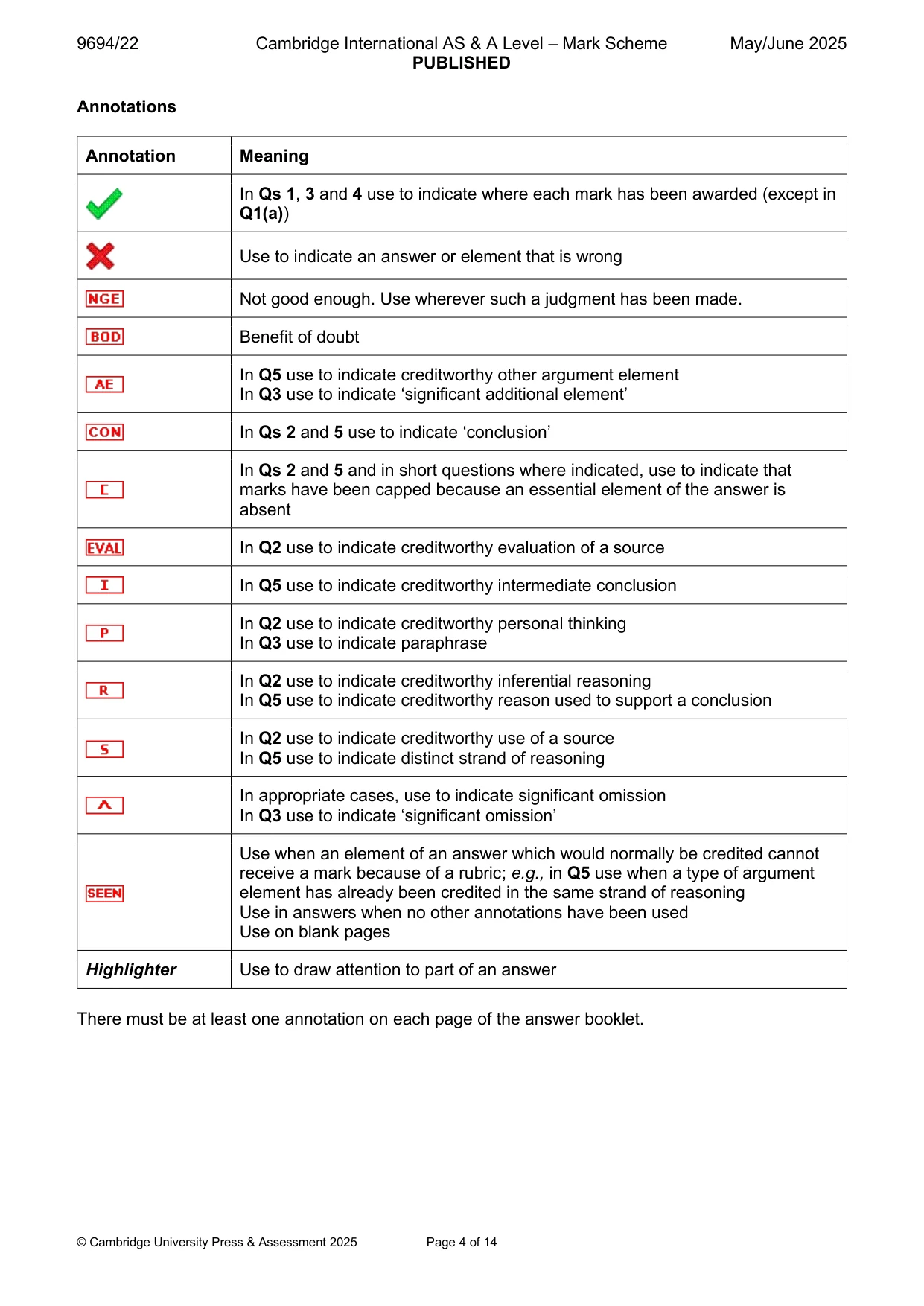
9694/22 Cambridge International AS & A Level – Mark Scheme PUBLISHED May/June 2025 © Cambridge University Press & Assessment 2025 Page 3 of 14 Annotations guidance for centres Examiners use a system of annotations as a shorthand for communicating their marking decisions to one another. Examiners are trained during the standardisation process on how and when to use annotations. The purpose of annotations is to inform the standardisation and monitoring processes and guide the supervising examiners when they are checking the work of examiners within their team. The meaning of annotations and how they are used is specific to each component and is understood by all examiners who mark the component. We publish annotations in our mark schemes to help centres understand the annotations they may see on copies of scripts. Note that there may not be a direct correlation between the number of annotations on a script and the mark awarded. Similarly, the use of an annotation may not be an indication of the quality of the response. The annotations listed below were available to examiners marking this component in this series.
Mark scheme, page 4
9694/22 Cambridge International AS & A Level – Mark Scheme PUBLISHED May/June 2025 © Cambridge University Press & Assessment 2025 Page 4 of 14 Annotations Annotation Meaning In Qs 1, 3 and 4 use to indicate where each mark has been awarded (except in Q1(a)) Use to indicate an answer or element that is wrong Not good enough. Use wherever such a judgment has been made. Benefit of doubt In Q5 use to indicate creditworthy other argument element In Q3 use to indicate ‘significant additional element’ In Qs 2 and 5 use to indicate ‘conclusion’ In Qs 2 and 5 and in short questions where indicated, use to indicate that marks have been capped because an essential element of the answer is absent In Q2 use to indicate creditworthy evaluation of a source In Q5 use to indicate creditworthy intermediate conclusion In Q2 use to indicate creditworthy personal thinking In Q3 use to indicate paraphrase In Q2 use to indicate creditworthy inferential reasoning In Q5 use to indicate creditworthy reason used to support a conclusion In Q2 use to indicate creditworthy use of a source In Q5 use to indicate distinct strand of reasoning In appropriate cases, use to indicate significant omission In Q3 use to indicate ‘significant omission’ Use when an element of an answer which would normally be credited cannot receive a mark because of a rubric; e.g., in Q5 use when a type of argument element has already been credited in the same strand of reasoning Use in answers when no other annotations have been used Use on blank pages Highlighter Use to draw attention to part of an answer There must be at least one annotation on each page of the answer booklet.
Mark scheme, page 5
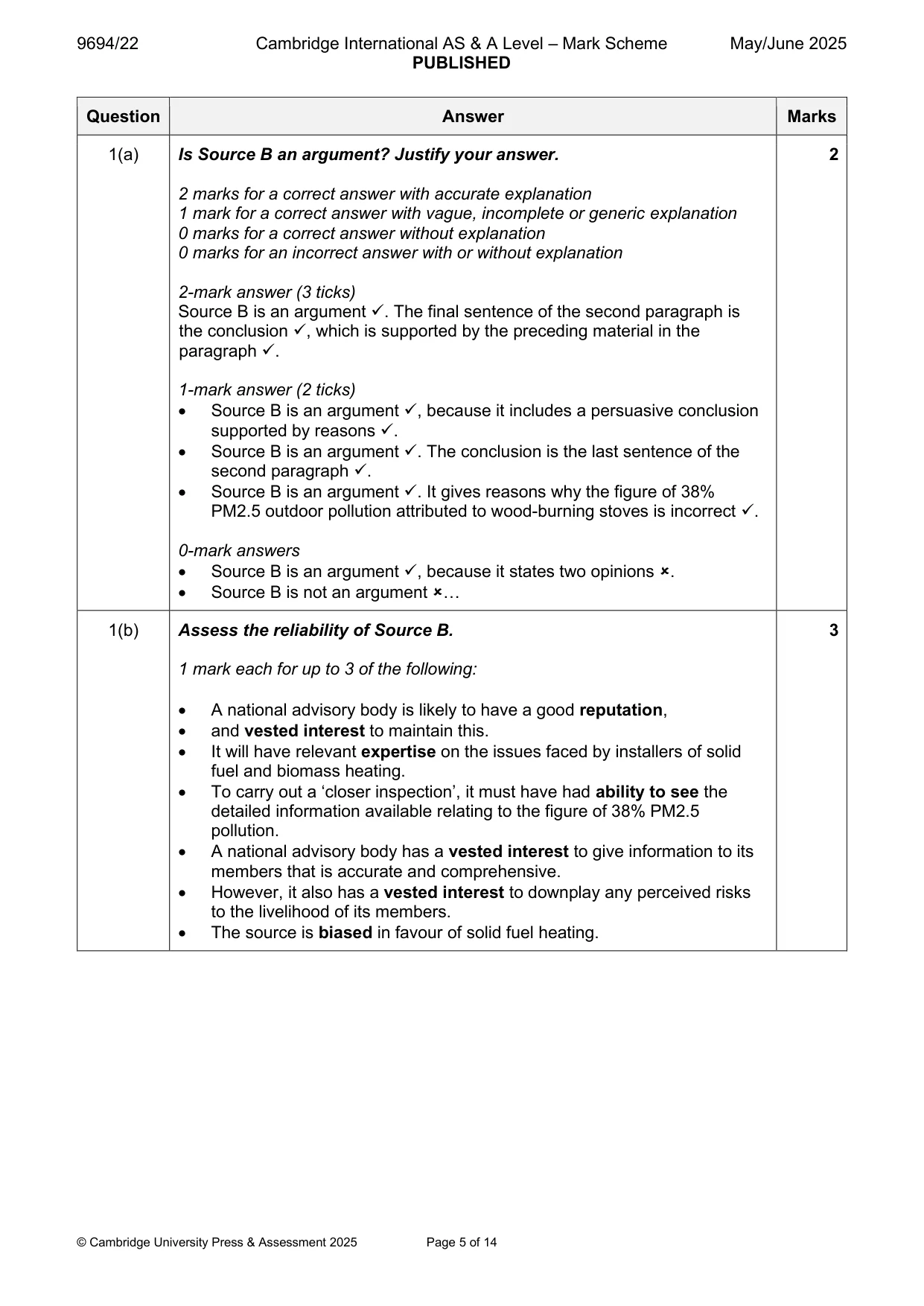
9694/22 Cambridge International AS & A Level – Mark Scheme PUBLISHED May/June 2025 © Cambridge University Press & Assessment 2025 Page 5 of 14 Question Answer Marks 1(a) Is Source B an argument? Justify your answer. 2 marks for a correct answer with accurate explanation 1 mark for a correct answer with vague, incomplete or generic explanation 0 marks for a correct answer without explanation 0 marks for an incorrect answer with or without explanation 2-mark answer (3 ticks) Source B is an argument ✓. The final sentence of the second paragraph is the conclusion ✓, which is supported by the preceding material in the paragraph ✓. 1-mark answer (2 ticks) • Source B is an argument ✓, because it includes a persuasive conclusion supported by reasons ✓. • Source B is an argument ✓. The conclusion is the last sentence of the second paragraph ✓. • Source B is an argument ✓. It gives reasons why the figure of 38% PM2.5 outdoor pollution attributed to wood-burning stoves is incorrect ✓. 0-mark answers • Source B is an argument ✓, because it states two opinions . • Source B is not an argument … 2 1(b) Assess the reliability of Source B. 1 mark each for up to 3 of the following: • A national advisory body is likely to have a good reputation, • and vested interest to maintain this. • It will have relevant expertise on the issues faced by installers of solid fuel and biomass heating. • To carry out a ‘closer inspection’, it must have had ability to see the detailed information available relating to the figure of 38% PM2.5 pollution. • A national advisory body has a vested interest to give information to its members that is accurate and comprehensive. • However, it also has a vested interest to downplay any perceived risks to the livelihood of its members. • The source is biased in favour of solid fuel heating. 3
Mark scheme, page 6
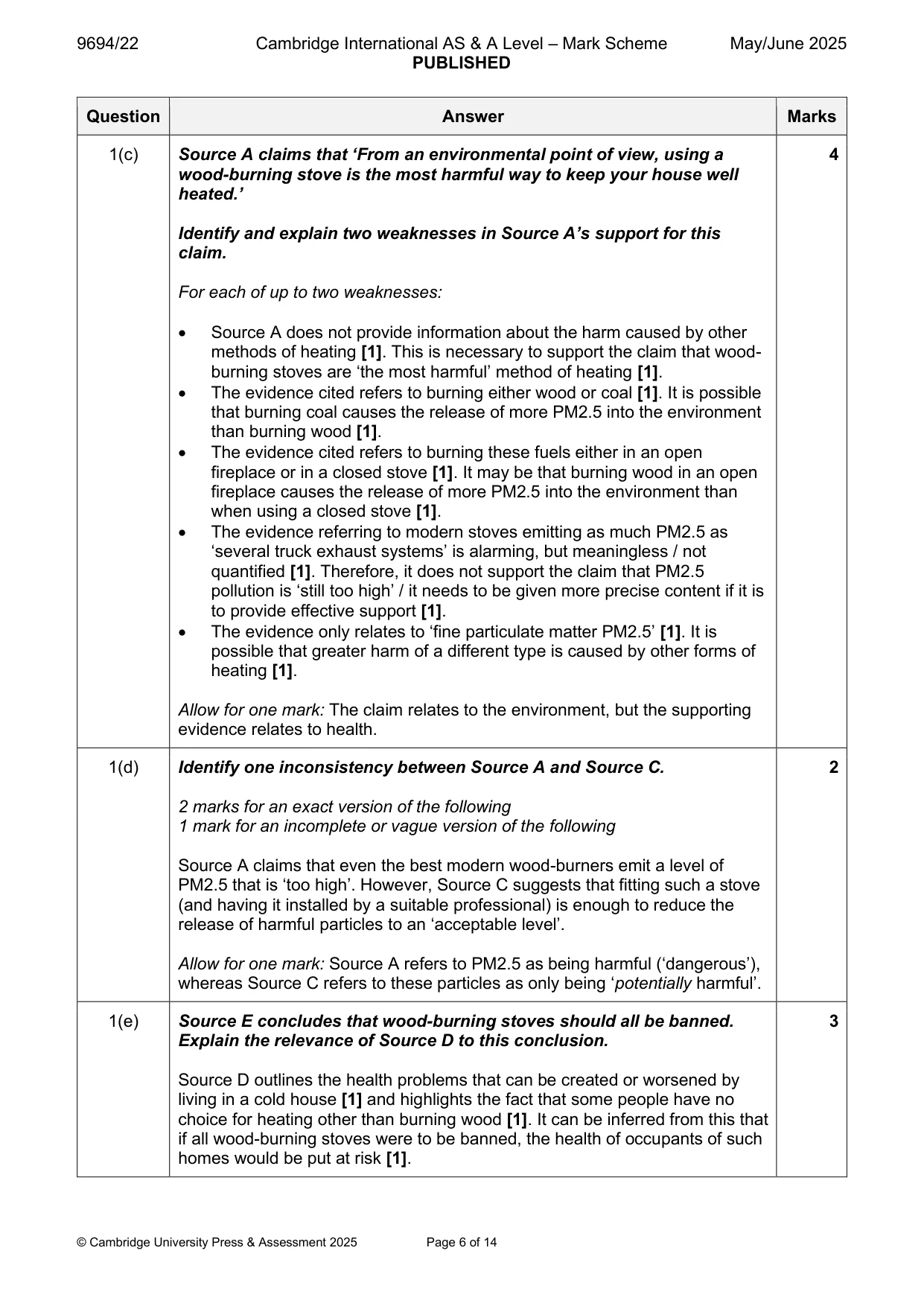
9694/22 Cambridge International AS & A Level – Mark Scheme PUBLISHED May/June 2025 © Cambridge University Press & Assessment 2025 Page 6 of 14 Question Answer Marks 1(c) Source A claims that ‘From an environmental point of view, using a wood-burning stove is the most harmful way to keep your house well heated.’ Identify and explain two weaknesses in Source A’s support for this claim. For each of up to two weaknesses: • Source A does not provide information about the harm caused by other methods of heating [1]. This is necessary to support the claim that wood- burning stoves are ‘the most harmful’ method of heating [1]. • The evidence cited refers to burning either wood or coal [1]. It is possible that burning coal causes the release of more PM2.5 into the environment than burning wood [1]. • The evidence cited refers to burning these fuels either in an open fireplace or in a closed stove [1]. It may be that burning wood in an open fireplace causes the release of more PM2.5 into the environment than when using a closed stove [1]. • The evidence referring to modern stoves emitting as much PM2.5 as ‘several truck exhaust systems’ is alarming, but meaningless / not quantified [1]. Therefore, it does not support the claim that PM2.5 pollution is ‘still too high’ / it needs to be given more precise content if it is to provide effective support [1]. • The evidence only relates to ‘fine particulate matter PM2.5’ [1]. It is possible that greater harm of a different type is caused by other forms of heating [1]. Allow for one mark: The claim relates to the environment, but the supporting evidence relates to health. 4 1(d) Identify one inconsistency between Source A and Source C. 2 marks for an exact version of the following 1 mark for an incomplete or vague version of the following Source A claims that even the best modern wood-burners emit a level of PM2.5 that is ‘too high’. However, Source C suggests that fitting such a stove (and having it installed by a suitable professional) is enough to reduce the release of harmful particles to an ‘acceptable level’. Allow for one mark: Source A refers to PM2.5 as being harmful (‘dangerous’), whereas Source C refers to these particles as only being ‘potentially harmful’. 2 1(e) Source E concludes that wood-burning stoves should all be banned. Explain the relevance of Source D to this conclusion. Source D outlines the health problems that can be created or worsened by living in a cold house [1] and highlights the fact that some people have no choice for heating other than burning wood [1]. It can be inferred from this that if all wood-burning stoves were to be banned, the health of occupants of such homes would be put at risk [1]. 3
Mark scheme, page 7
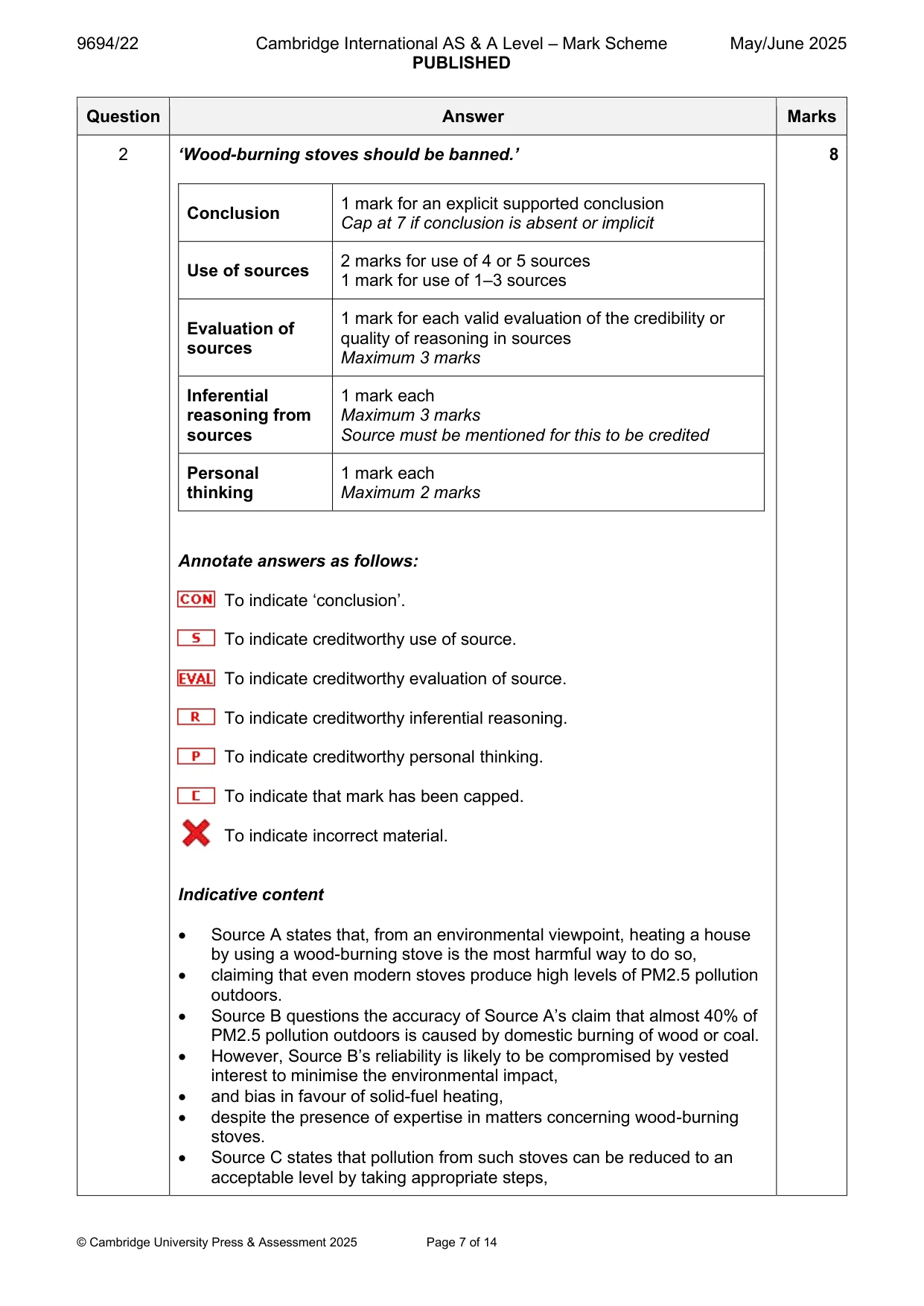
9694/22 Cambridge International AS & A Level – Mark Scheme PUBLISHED May/June 2025 © Cambridge University Press & Assessment 2025 Page 7 of 14 Question Answer Marks 2 ‘Wood-burning stoves should be banned.’ Conclusion 1 mark for an explicit supported conclusion Cap at 7 if conclusion is absent or implicit Use of sources 2 marks for use of 4 or 5 sources 1 mark for use of 1–3 sources Evaluation of sources 1 mark for each valid evaluation of the credibility or quality of reasoning in sources Maximum 3 marks Inferential reasoning from sources 1 mark each Maximum 3 marks Source must be mentioned for this to be credited Personal thinking 1 mark each Maximum 2 marks Annotate answers as follows: To indicate ‘conclusion’. To indicate creditworthy use of source. To indicate creditworthy evaluation of source. To indicate creditworthy inferential reasoning. To indicate creditworthy personal thinking. To indicate that mark has been capped. To indicate incorrect material. Indicative content • Source A states that, from an environmental viewpoint, heating a house by using a wood-burning stove is the most harmful way to do so, • claiming that even modern stoves produce high levels of PM2.5 pollution outdoors. • Source B questions the accuracy of Source A’s claim that almost 40% of PM2.5 pollution outdoors is caused by domestic burning of wood or coal. • However, Source B’s reliability is likely to be compromised by vested interest to minimise the environmental impact, • and bias in favour of solid-fuel heating, • despite the presence of expertise in matters concerning wood-burning stoves. • Source C states that pollution from such stoves can be reduced to an acceptable level by taking appropriate steps, 8
Mark scheme, page 8
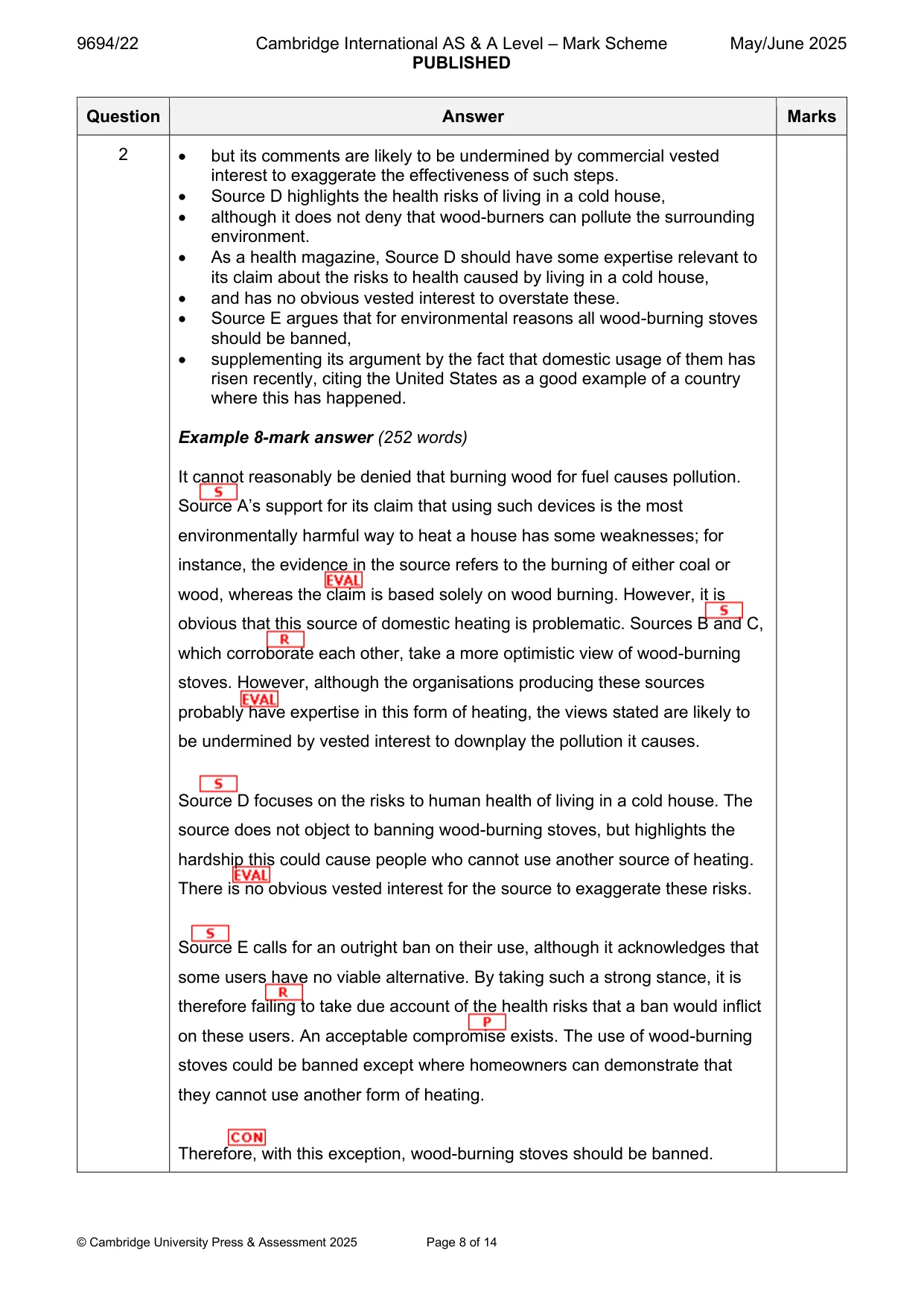
9694/22 Cambridge International AS & A Level – Mark Scheme PUBLISHED May/June 2025 © Cambridge University Press & Assessment 2025 Page 8 of 14 Question Answer Marks 2 • but its comments are likely to be undermined by commercial vested interest to exaggerate the effectiveness of such steps. • Source D highlights the health risks of living in a cold house, • although it does not deny that wood-burners can pollute the surrounding environment. • As a health magazine, Source D should have some expertise relevant to its claim about the risks to health caused by living in a cold house, • and has no obvious vested interest to overstate these. • Source E argues that for environmental reasons all wood-burning stoves should be banned, • supplementing its argument by the fact that domestic usage of them has risen recently, citing the United States as a good example of a country where this has happened. Example 8-mark answer (252 words) It cannot reasonably be denied that burning wood for fuel causes pollution. Source A’s support for its claim that using such devices is the most environmentally harmful way to heat a house has some weaknesses; for instance, the evidence in the source refers to the burning of either coal or wood, whereas the claim is based solely on wood burning. However, it is obvious that this source of domestic heating is problematic. Sources B and C, which corroborate each other, take a more optimistic view of wood-burning stoves. However, although the organisations producing these sources probably have expertise in this form of heating, the views stated are likely to be undermined by vested interest to downplay the pollution it causes. Source D focuses on the risks to human health of living in a cold house. The source does not object to banning wood-burning stoves, but highlights the hardship this could cause people who cannot use another source of heating. There is no obvious vested interest for the source to exaggerate these risks. Source E calls for an outright ban on their use, although it acknowledges that some users have no viable alternative. By taking such a strong stance, it is therefore failing to take due account of the health risks that a ban would inflict on these users. An acceptable compromise exists. The use of wood-burning stoves could be banned except where homeowners can demonstrate that they cannot use another form of heating. Therefore, with this exception, wood-burning stoves should be banned.
Mark scheme, page 9
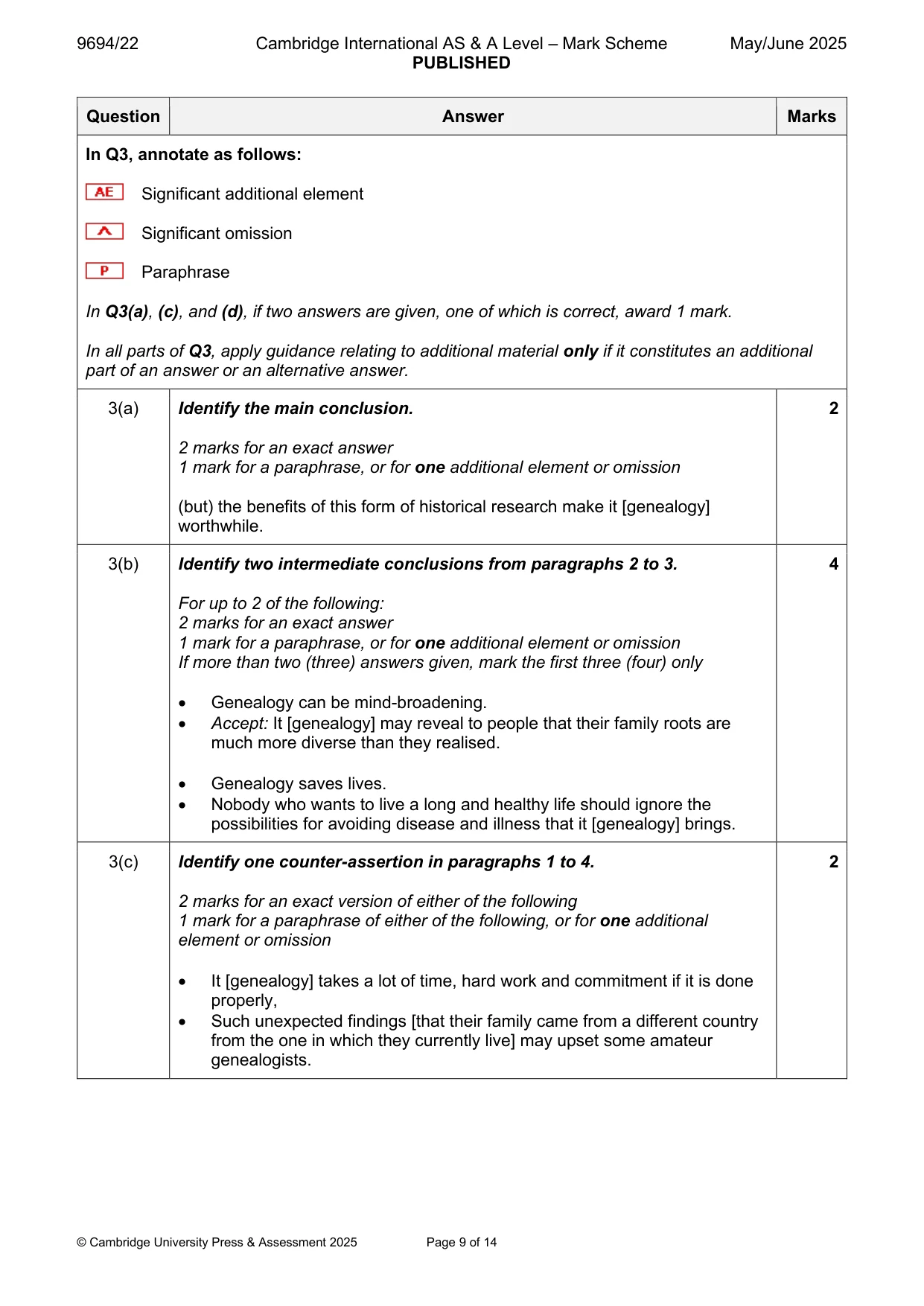
9694/22 Cambridge International AS & A Level – Mark Scheme PUBLISHED May/June 2025 © Cambridge University Press & Assessment 2025 Page 9 of 14 Question Answer Marks In Q3, annotate as follows: Significant additional element Significant omission Paraphrase In Q3(a), (c), and (d), if two answers are given, one of which is correct, award 1 mark. In all parts of Q3, apply guidance relating to additional material only if it constitutes an additional part of an answer or an alternative answer. 3(a) Identify the main conclusion. 2 marks for an exact answer 1 mark for a paraphrase, or for one additional element or omission (but) the benefits of this form of historical research make it [genealogy] worthwhile. 2 3(b) Identify two intermediate conclusions from paragraphs 2 to 3. For up to 2 of the following: 2 marks for an exact answer 1 mark for a paraphrase, or for one additional element or omission If more than two (three) answers given, mark the first three (four) only • Genealogy can be mind-broadening. • Accept: It [genealogy] may reveal to people that their family roots are much more diverse than they realised. • Genealogy saves lives. • Nobody who wants to live a long and healthy life should ignore the possibilities for avoiding disease and illness that it [genealogy] brings. 4 3(c) Identify one counter-assertion in paragraphs 1 to 4. 2 marks for an exact version of either of the following 1 mark for a paraphrase of either of the following, or for one additional element or omission • It [genealogy] takes a lot of time, hard work and commitment if it is done properly, • Such unexpected findings [that their family came from a different country from the one in which they currently live] may upset some amateur genealogists. 2
Mark scheme, page 10
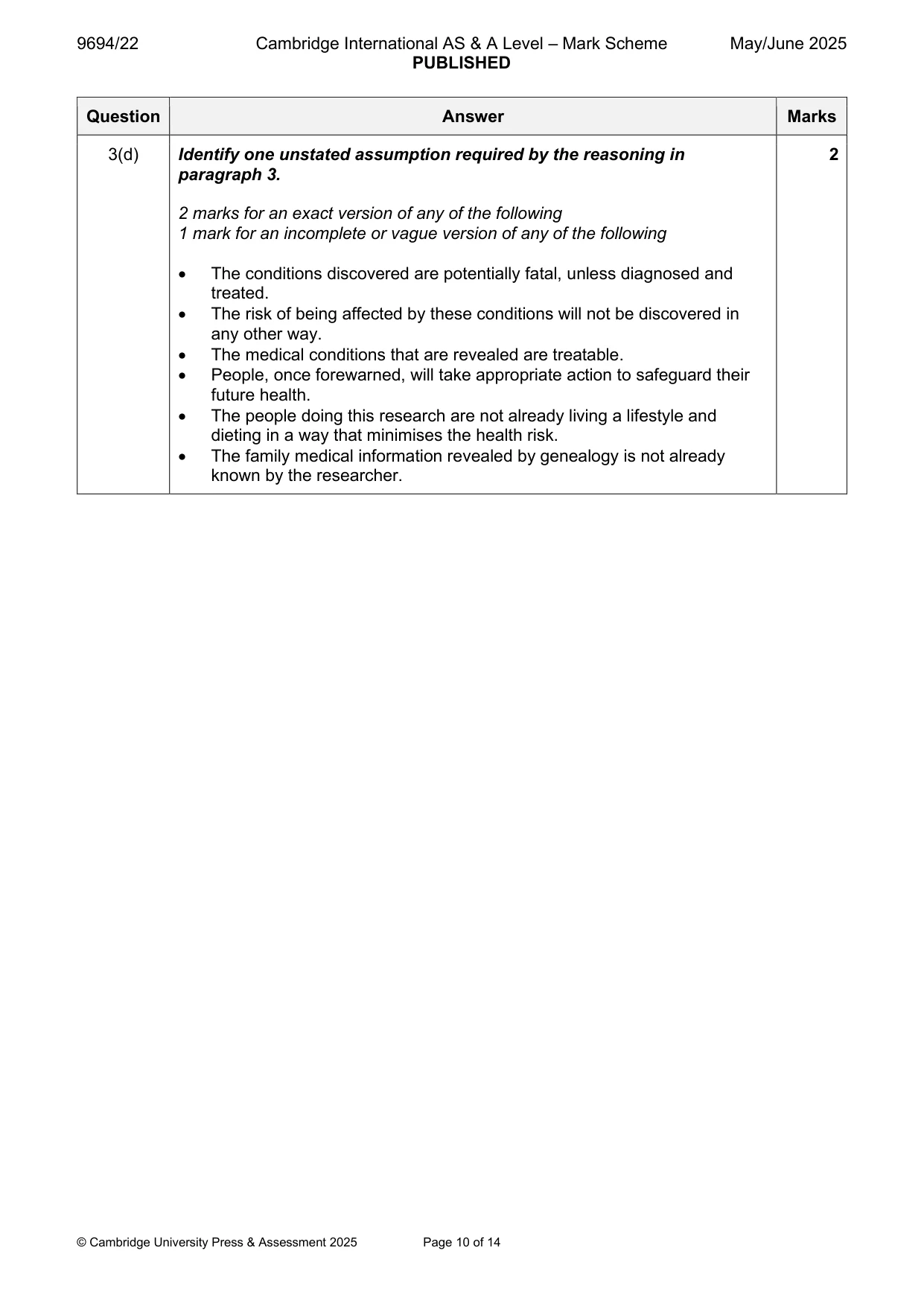
9694/22 Cambridge International AS & A Level – Mark Scheme PUBLISHED May/June 2025 © Cambridge University Press & Assessment 2025 Page 10 of 14 Question Answer Marks 3(d) Identify one unstated assumption required by the reasoning in paragraph 3. 2 marks for an exact version of any of the following 1 mark for an incomplete or vague version of any of the following • The conditions discovered are potentially fatal, unless diagnosed and treated. • The risk of being affected by these conditions will not be discovered in any other way. • The medical conditions that are revealed are treatable. • People, once forewarned, will take appropriate action to safeguard their future health. • The people doing this research are not already living a lifestyle and dieting in a way that minimises the health risk. • The family medical information revealed by genealogy is not already known by the researcher. 2
Mark scheme, page 11
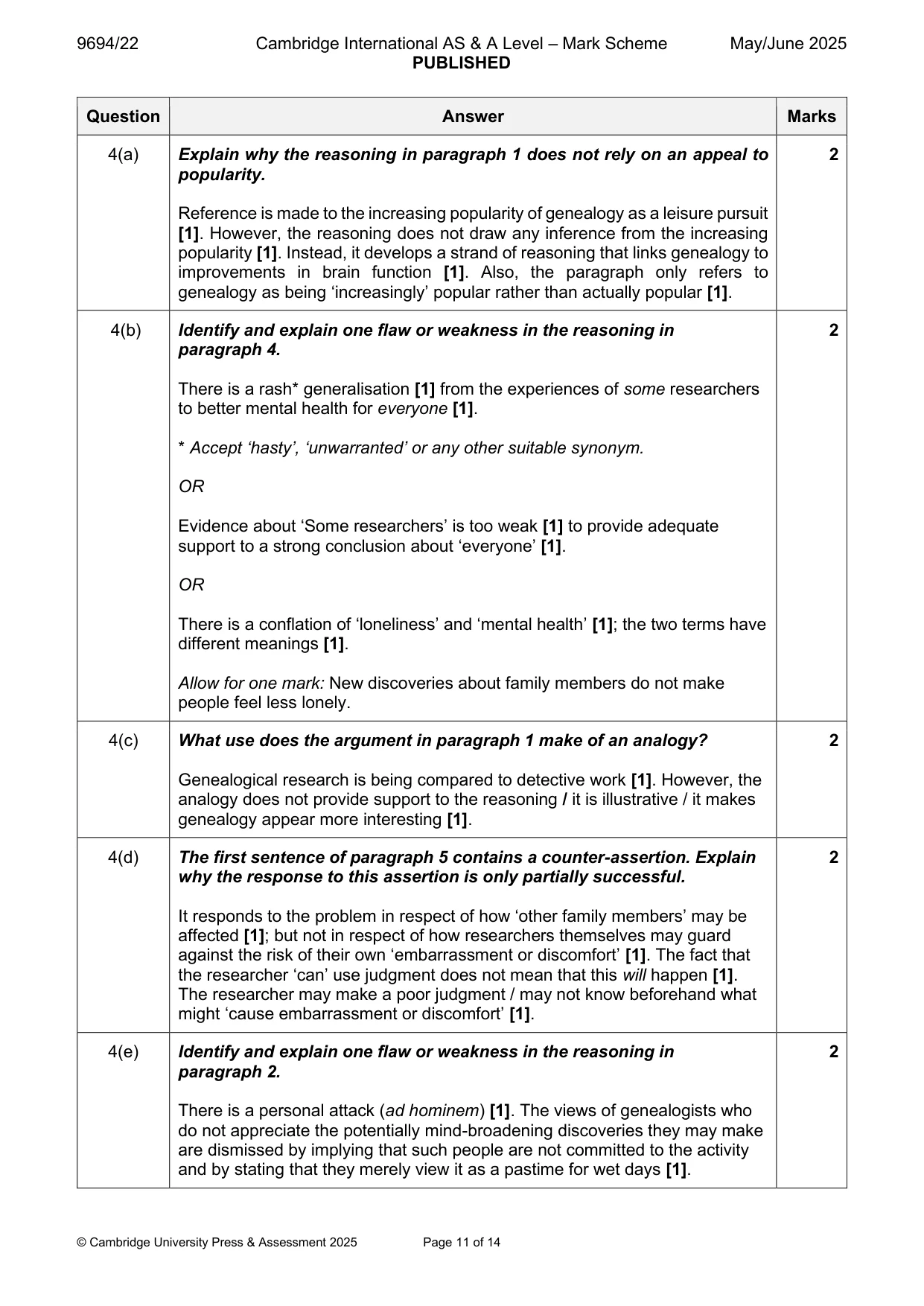
9694/22 Cambridge International AS & A Level – Mark Scheme PUBLISHED May/June 2025 © Cambridge University Press & Assessment 2025 Page 11 of 14 Question Answer Marks 4(a) Explain why the reasoning in paragraph 1 does not rely on an appeal to popularity. Reference is made to the increasing popularity of genealogy as a leisure pursuit [1]. However, the reasoning does not draw any inference from the increasing popularity [1]. Instead, it develops a strand of reasoning that links genealogy to improvements in brain function [1]. Also, the paragraph only refers to genealogy as being ‘increasingly’ popular rather than actually popular [1]. 2 4(b) Identify and explain one flaw or weakness in the reasoning in paragraph 4. There is a rash* generalisation [1] from the experiences of some researchers to better mental health for everyone [1]. * Accept ‘hasty’, ‘unwarranted’ or any other suitable synonym. OR Evidence about ‘Some researchers’ is too weak [1] to provide adequate support to a strong conclusion about ‘everyone’ [1]. OR There is a conflation of ‘loneliness’ and ‘mental health’ [1]; the two terms have different meanings [1]. Allow for one mark: New discoveries about family members do not make people feel less lonely. 2 4(c) What use does the argument in paragraph 1 make of an analogy? Genealogical research is being compared to detective work [1]. However, the analogy does not provide support to the reasoning / it is illustrative / it makes genealogy appear more interesting [1]. 2 4(d) The first sentence of paragraph 5 contains a counter-assertion. Explain why the response to this assertion is only partially successful. It responds to the problem in respect of how ‘other family members’ may be affected [1]; but not in respect of how researchers themselves may guard against the risk of their own ‘embarrassment or discomfort’ [1]. The fact that the researcher ‘can’ use judgment does not mean that this will happen [1]. The researcher may make a poor judgment / may not know beforehand what might ‘cause embarrassment or discomfort’ [1]. 2 4(e) Identify and explain one flaw or weakness in the reasoning in paragraph 2. There is a personal attack (ad hominem) [1]. The views of genealogists who do not appreciate the potentially mind-broadening discoveries they may make are dismissed by implying that such people are not committed to the activity and by stating that they merely view it as a pastime for wet days [1]. 2
Mark scheme, page 12
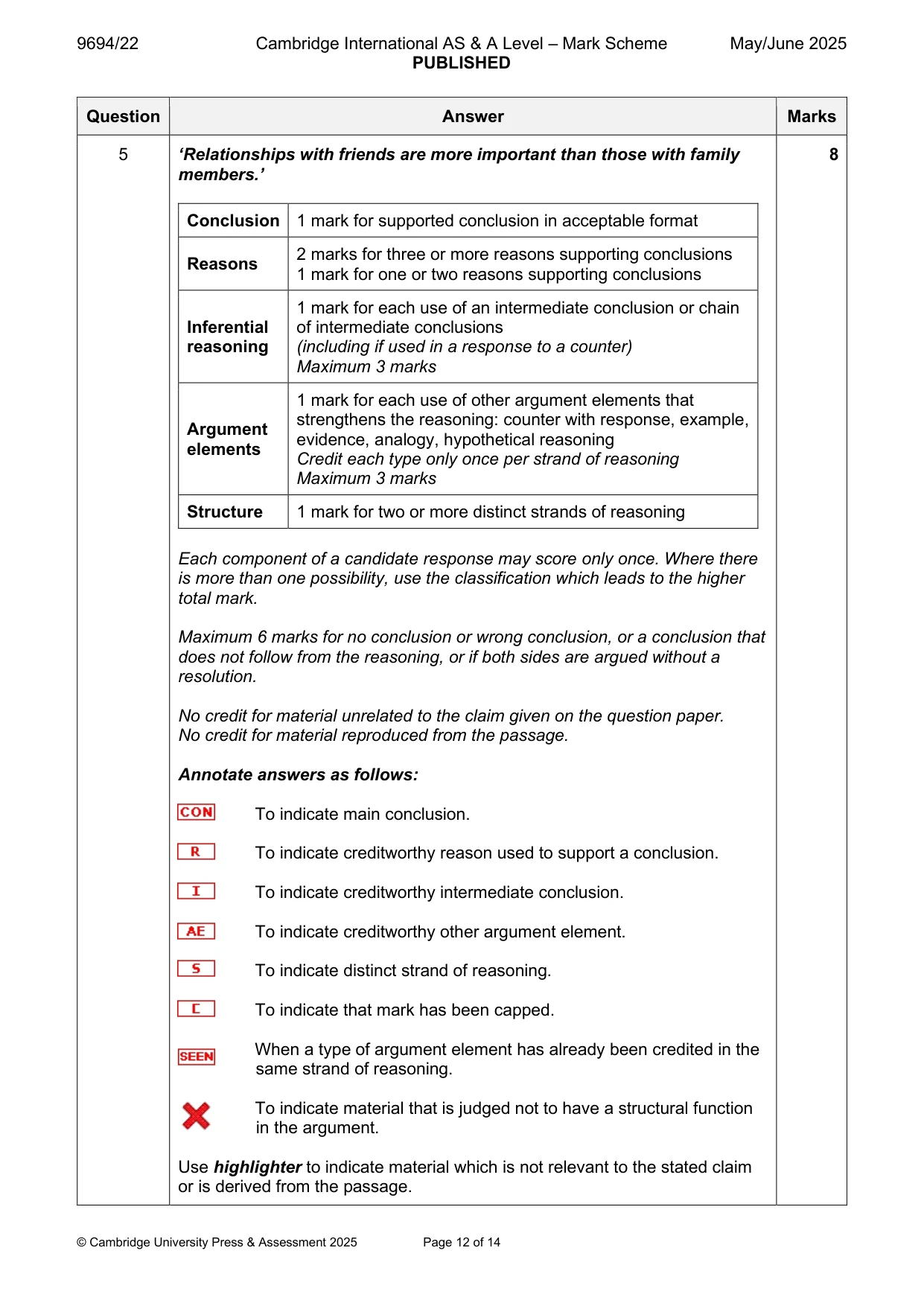
9694/22 Cambridge International AS & A Level – Mark Scheme PUBLISHED May/June 2025 © Cambridge University Press & Assessment 2025 Page 12 of 14 Question Answer Marks 5 ‘Relationships with friends are more important than those with family members.’ Conclusion 1 mark for supported conclusion in acceptable format Reasons 2 marks for three or more reasons supporting conclusions 1 mark for one or two reasons supporting conclusions Inferential reasoning 1 mark for each use of an intermediate conclusion or chain of intermediate conclusions (including if used in a response to a counter) Maximum 3 marks Argument elements 1 mark for each use of other argument elements that strengthens the reasoning: counter with response, example, evidence, analogy, hypothetical reasoning Credit each type only once per strand of reasoning Maximum 3 marks Structure 1 mark for two or more distinct strands of reasoning Each component of a candidate response may score only once. Where there is more than one possibility, use the classification which leads to the higher total mark. Maximum 6 marks for no conclusion or wrong conclusion, or a conclusion that does not follow from the reasoning, or if both sides are argued without a resolution. No credit for material unrelated to the claim given on the question paper. No credit for material reproduced from the passage. Annotate answers as follows: To indicate main conclusion. To indicate creditworthy reason used to support a conclusion. To indicate creditworthy intermediate conclusion. To indicate creditworthy other argument element. To indicate distinct strand of reasoning. To indicate that mark has been capped. When a type of argument element has already been credited in the same strand of reasoning. To indicate material that is judged not to have a structural function in the argument. Use highlighter to indicate material which is not relevant to the stated claim or is derived from the passage. 8
Mark scheme, page 13
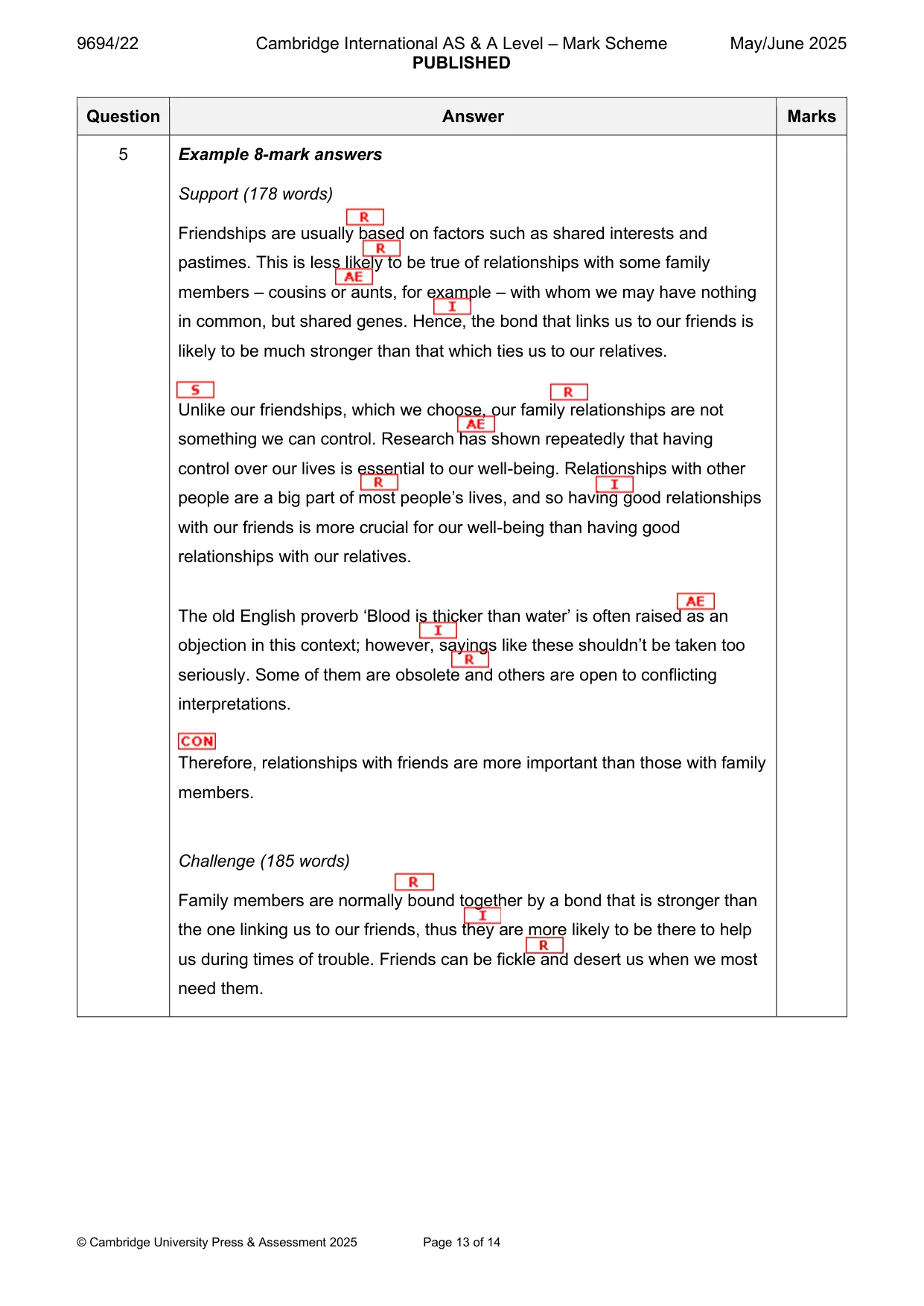
9694/22 Cambridge International AS & A Level – Mark Scheme PUBLISHED May/June 2025 © Cambridge University Press & Assessment 2025 Page 13 of 14 Question Answer Marks 5 Example 8-mark answers Support (178 words) Friendships are usually based on factors such as shared interests and pastimes. This is less likely to be true of relationships with some family members – cousins or aunts, for example – with whom we may have nothing in common, but shared genes. Hence, the bond that links us to our friends is likely to be much stronger than that which ties us to our relatives. Unlike our friendships, which we choose, our family relationships are not something we can control. Research has shown repeatedly that having control over our lives is essential to our well-being. Relationships with other people are a big part of most people’s lives, and so having good relationships with our friends is more crucial for our well-being than having good relationships with our relatives. The old English proverb ‘Blood is thicker than water’ is often raised as an objection in this context; however, sayings like these shouldn’t be taken too seriously. Some of them are obsolete and others are open to conflicting interpretations. Therefore, relationships with friends are more important than those with family members. Challenge (185 words) Family members are normally bound together by a bond that is stronger than the one linking us to our friends, thus they are more likely to be there to help us during times of trouble. Friends can be fickle and desert us when we most need them.
Mark scheme, page 14
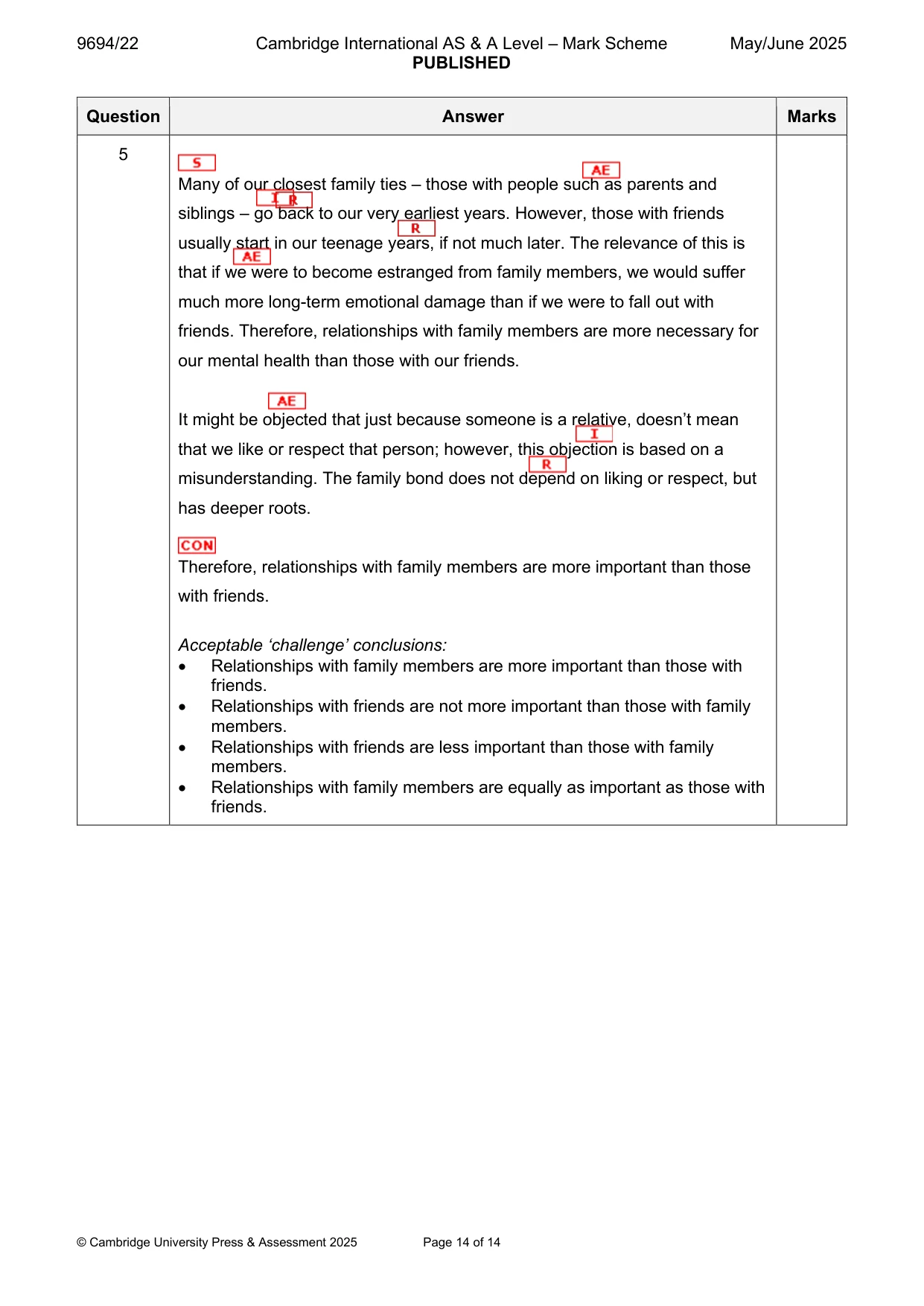
9694/22 Cambridge International AS & A Level – Mark Scheme PUBLISHED May/June 2025 © Cambridge University Press & Assessment 2025 Page 14 of 14 Question Answer Marks 5 Many of our closest family ties – those with people such as parents and siblings – go back to our very earliest years. However, those with friends usually start in our teenage years, if not much later. The relevance of this is that if we were to become estranged from family members, we would suffer much more long-term emotional damage than if we were to fall out with friends. Therefore, relationships with family members are more necessary for our mental health than those with our friends. It might be objected that just because someone is a relative, doesn’t mean that we like or respect that person; however, this objection is based on a misunderstanding. The family bond does not depend on liking or respect, but has deeper roots. Therefore, relationships with family members are more important than those with friends. Acceptable ‘challenge’ conclusions: • Relationships with family members are more important than those with friends. • Relationships with friends are not more important than those with family members. • Relationships with friends are less important than those with family members. • Relationships with family members are equally as important as those with friends.
What you needed in this session
Cambridge’s own grade thresholds for 2025 May/June, Paper 2 · Variant 2. A higher threshold means an easier paper — the bar moves with how the cohort did.