Cambridge A Level Thinking Skills 9694 — 2024 Oct/Nov Paper 2 · Variant 2
9694/22/O/N/24 · 50 marks · ≈56 min
The question paper and its mark scheme, free to read here and free to download. This is Cambridge’s own paper, exactly as it was sat.
Question paper8 pages



Mark scheme12 pages
Answers below. Sit the paper first if you are practising.

Paper as text
Question paper, page 1
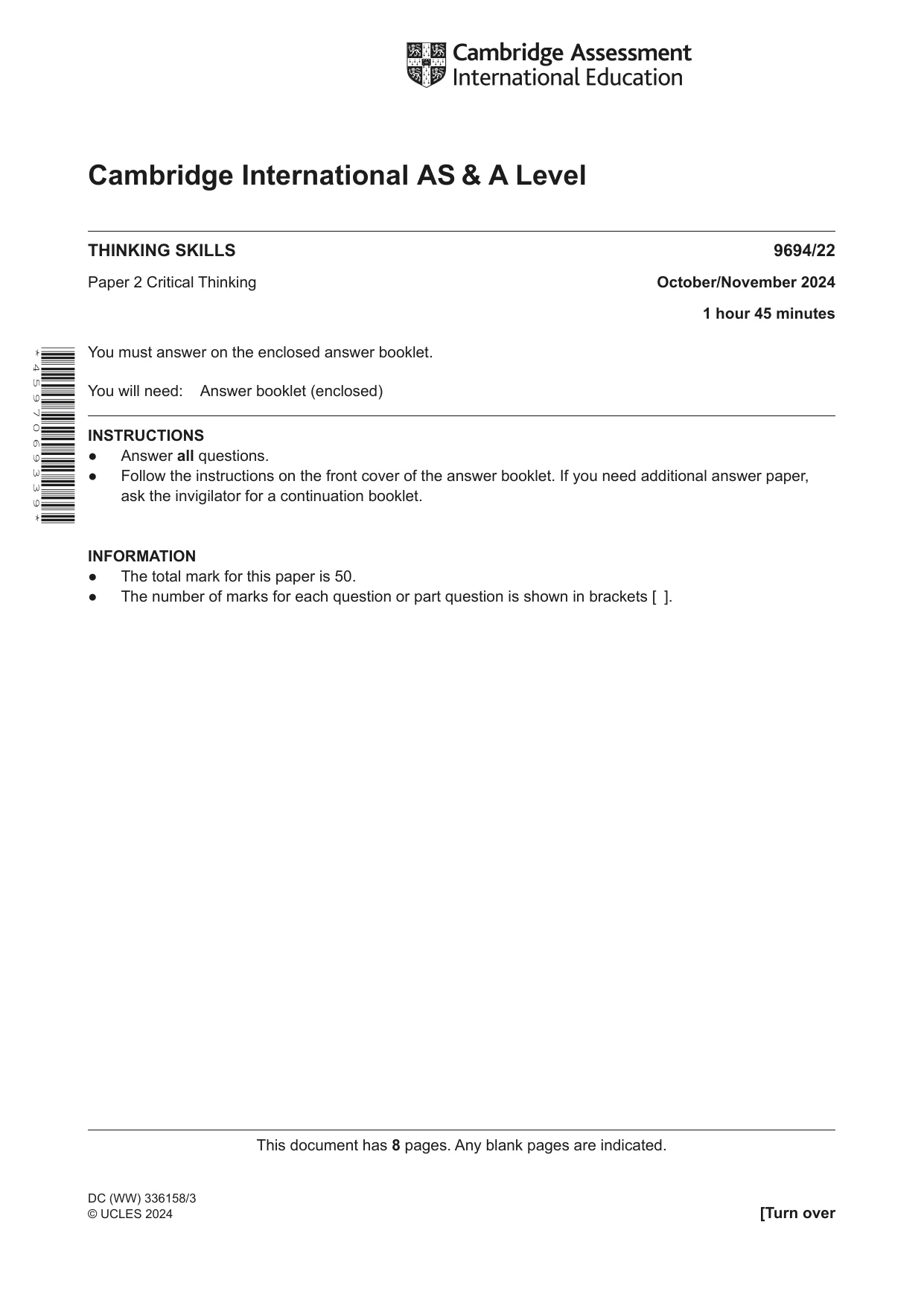
[Turn over This document has 8 pages. Any blank pages are indicated. * 4 5 9 7 0 6 9 3 3 9 * DC (WW) 336158/3 © UCLES 2024 THINKING SKILLS 9694/22 Paper 2 Critical Thinking October/November 2024 1 hour 45 minutes You must answer on the enclosed answer booklet. You will need: Answer booklet (enclosed) INSTRUCTIONS ● Answer all questions. ● Follow the instructions on the front cover of the answer booklet. If you need additional answer paper, ask the invigilator for a continuation booklet. INFORMATION ● The total mark for this paper is 50. ● The number of marks for each question or part question is shown in brackets [ ]. Cambridge International AS & A Level
Question paper, page 2
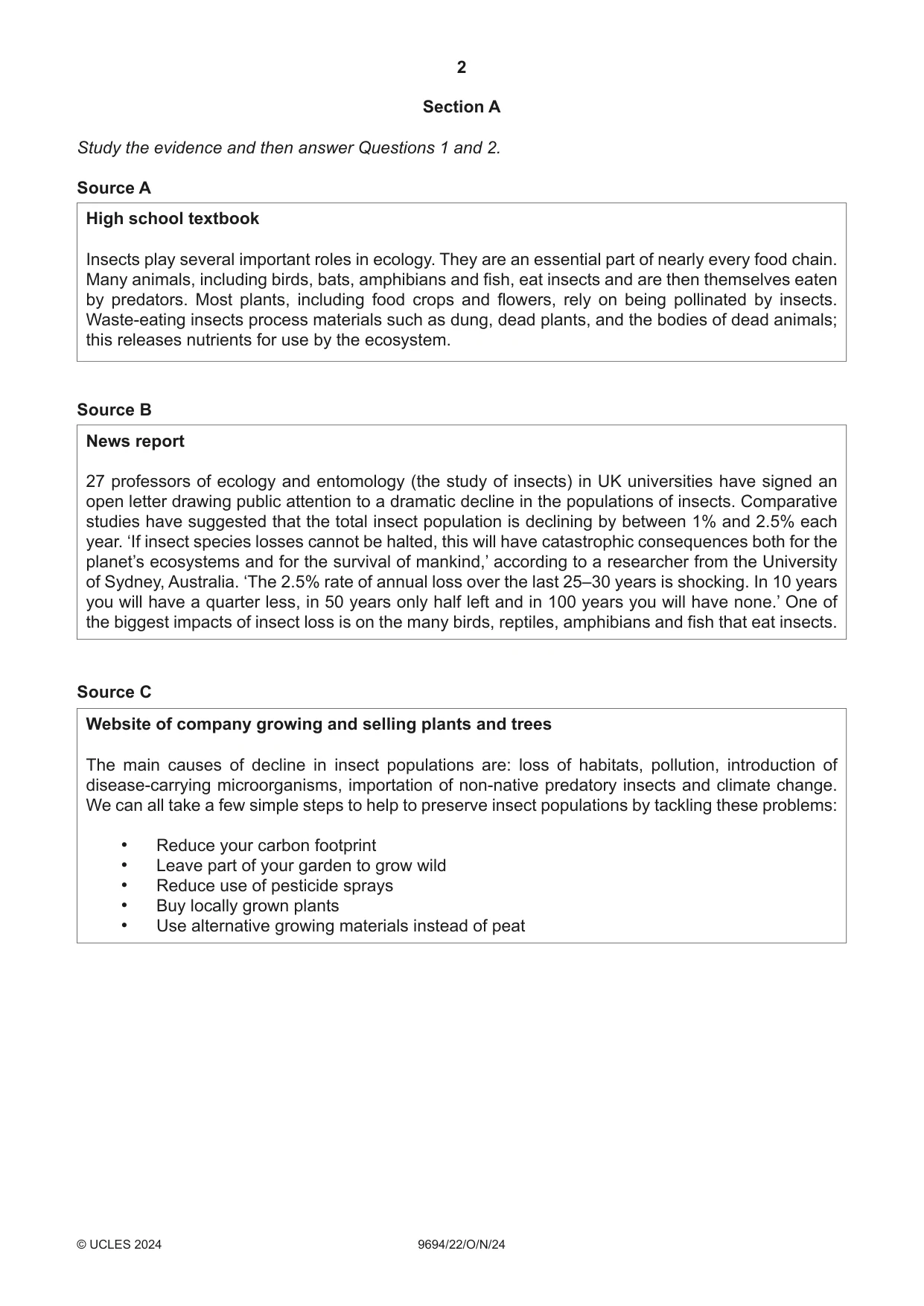
2 9694/22/O/N/24 © UCLES 2024 Section A Study the evidence and then answer Questions 1 and 2. Source A Source B Source C High school textbook Insects play several important roles in ecology. They are an essential part of nearly every food chain. Many animals, including birds, bats, amphibians and fish, eat insects and are then themselves eaten by predators. Most plants, including food crops and flowers, rely on being pollinated by insects. Waste-eating insects process materials such as dung, dead plants, and the bodies of dead animals; this releases nutrients for use by the ecosystem. News report 27 professors of ecology and entomology (the study of insects) in UK universities have signed an open letter drawing public attention to a dramatic decline in the populations of insects. Comparative studies have suggested that the total insect population is declining by between 1% and 2.5% each year. ‘If insect species losses cannot be halted, this will have catastrophic consequences both for the planet’s ecosystems and for the survival of mankind,’ according to a researcher from the University of Sydney, Australia. ‘The 2.5% rate of annual loss over the last 25–30 years is shocking. In 10 years you will have a quarter less, in 50 years only half left and in 100 years you will have none.’ One of the biggest impacts of insect loss is on the many birds, reptiles, amphibians and fish that eat insects. Website of company growing and selling plants and trees The main causes of decline in insect populations are: loss of habitats, pollution, introduction of disease-carrying microorganisms, importation of non-native predatory insects and climate change. We can all take a few simple steps to help to preserve insect populations by tackling these problems: • Reduce your carbon footprint • Leave part of your garden to grow wild • Reduce use of pesticide sprays • Buy locally grown plants • Use alternative growing materials instead of peat
Question paper, page 3
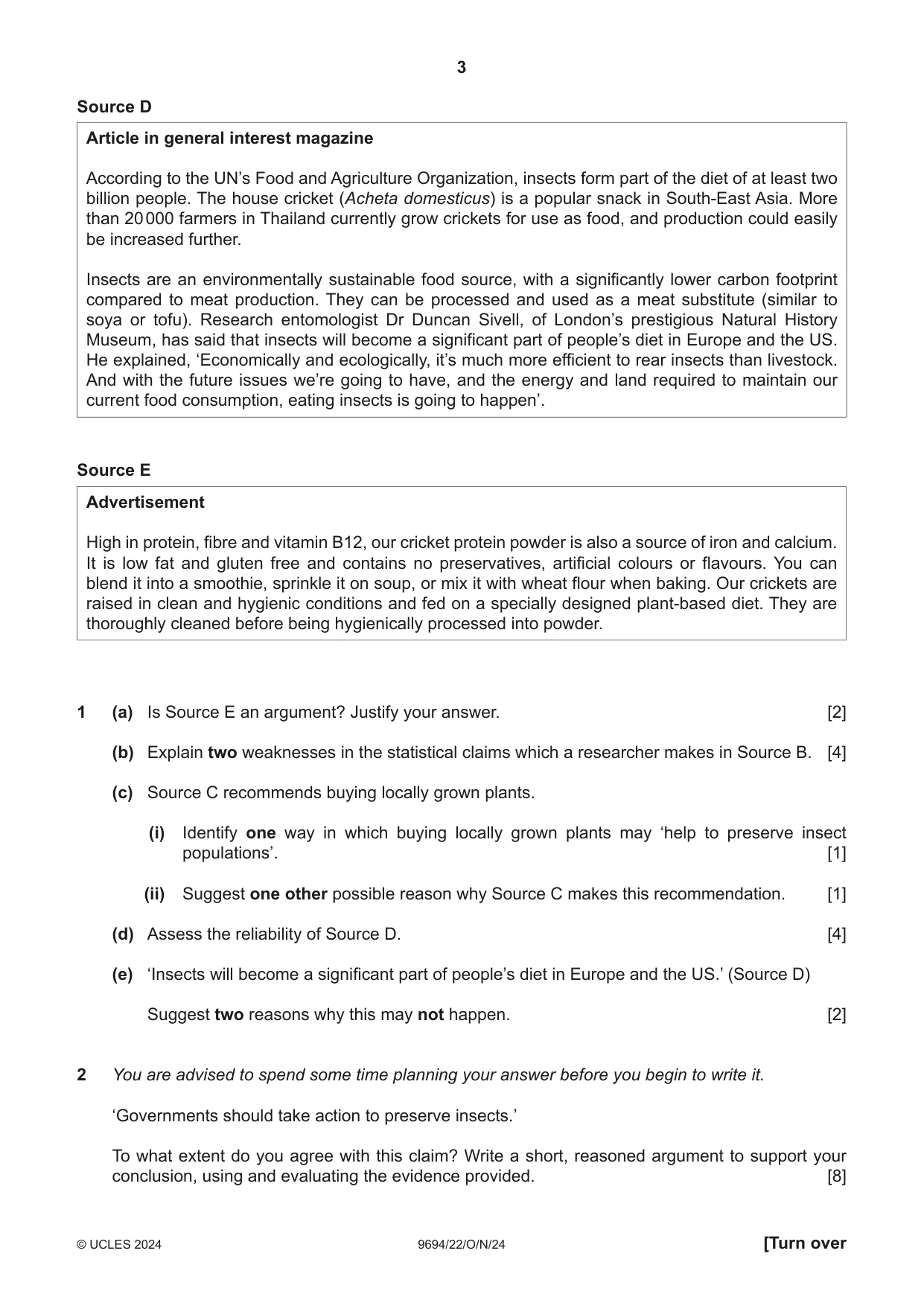
3 9694/22/O/N/24 © UCLES 2024 [Turn over Source D Source E 1 (a) Is Source E an argument? Justify your answer. [2] (b) Explain two weaknesses in the statistical claims which a researcher makes in Source B. [4] (c) Source C recommends buying locally grown plants. (i) Identify one way in which buying locally grown plants may ‘help to preserve insect populations’. [1] (ii) Suggest one other possible reason why Source C makes this recommendation. [1] (d) Assess the reliability of Source D. [4] (e) ‘Insects will become a significant part of people’s diet in Europe and the US.’ (Source D) Suggest two reasons why this may not happen. [2] 2 You are advised to spend some time planning your answer before you begin to write it. ‘Governments should take action to preserve insects.’ To what extent do you agree with this claim? Write a short, reasoned argument to support your conclusion, using and evaluating the evidence provided. [8] Advertisement High in protein, fibre and vitamin B12, our cricket protein powder is also a source of iron and calcium. It is low fat and gluten free and contains no preservatives, artificial colours or flavours. You can blend it into a smoothie, sprinkle it on soup, or mix it with wheat flour when baking. Our crickets are raised in clean and hygienic conditions and fed on a specially designed plant-based diet. They are thoroughly cleaned before being hygienically processed into powder. Article in general interest magazine According to the UN’s Food and Agriculture Organization, insects form part of the diet of at least two billion people. The house cricket (Acheta domesticus) is a popular snack in South-East Asia. More than 20 000 farmers in Thailand currently grow crickets for use as food, and production could easily be increased further. Insects are an environmentally sustainable food source, with a significantly lower carbon footprint compared to meat production. They can be processed and used as a meat substitute (similar to soya or tofu). Research entomologist Dr Duncan Sivell, of London’s prestigious Natural History Museum, has said that insects will become a significant part of people’s diet in Europe and the US. He explained, ‘Economically and ecologically, it’s much more efficient to rear insects than livestock. And with the future issues we’re going to have, and the energy and land required to maintain our current food consumption, eating insects is going to happen’.
Question paper, page 4
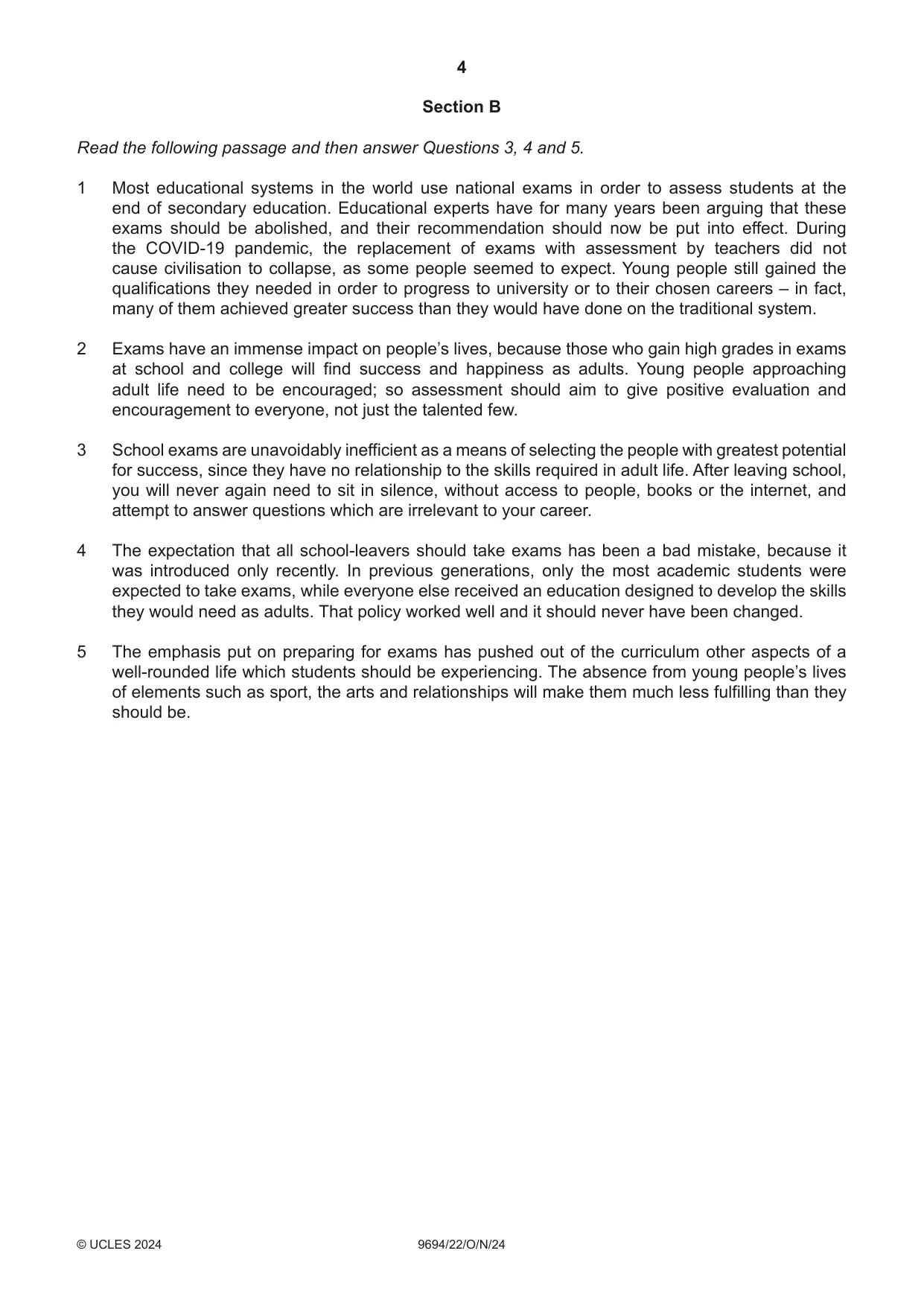
4 9694/22/O/N/24 © UCLES 2024 Section B Read the following passage and then answer Questions 3, 4 and 5. 1 Most educational systems in the world use national exams in order to assess students at the end of secondary education. Educational experts have for many years been arguing that these exams should be abolished, and their recommendation should now be put into effect. During the COVID-19 pandemic, the replacement of exams with assessment by teachers did not cause civilisation to collapse, as some people seemed to expect. Young people still gained the qualifications they needed in order to progress to university or to their chosen careers – in fact, many of them achieved greater success than they would have done on the traditional system. 2 Exams have an immense impact on people’s lives, because those who gain high grades in exams at school and college will find success and happiness as adults. Young people approaching adult life need to be encouraged; so assessment should aim to give positive evaluation and encouragement to everyone, not just the talented few. 3 School exams are unavoidably inefficient as a means of selecting the people with greatest potential for success, since they have no relationship to the skills required in adult life. After leaving school, you will never again need to sit in silence, without access to people, books or the internet, and attempt to answer questions which are irrelevant to your career. 4 The expectation that all school-leavers should take exams has been a bad mistake, because it was introduced only recently. In previous generations, only the most academic students were expected to take exams, while everyone else received an education designed to develop the skills they would need as adults. That policy worked well and it should never have been changed. 5 The emphasis put on preparing for exams has pushed out of the curriculum other aspects of a well-rounded life which students should be experiencing. The absence from young people’s lives of elements such as sport, the arts and relationships will make them much less fulfilling than they should be.
Question paper, page 5
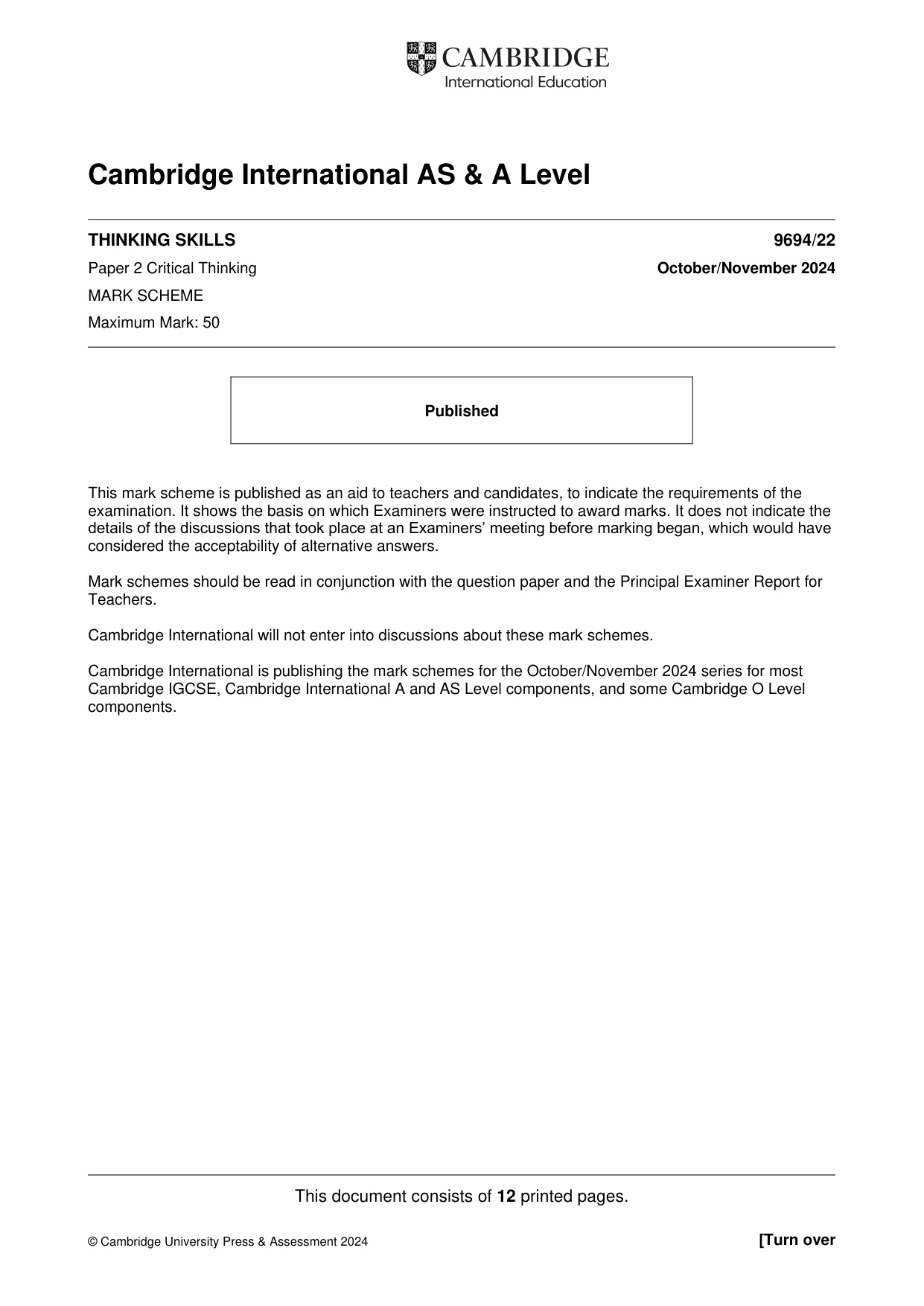
5 9694/22/O/N/24 © UCLES 2024 3 (a) Using the exact words from the passage as far as possible, identify the main conclusion. [2] (b) Using the exact words from the passage as far as possible, identify two intermediate conclusions from paragraphs 2 to 3. [4] (c) Identify the argument element and explain the function of the following words from paragraph 5: ‘sport, the arts and relationships’ [2] (d) Identify one unstated assumption required by the reasoning in paragraph 5. [2] 4 (a) Identify and explain one flaw or weakness in the reasoning in paragraph 1. [2] (b) To what extent is the reasoning in paragraph 2 weakened by a causal flaw? [3] (c) The reasoning in paragraph 3 relies on the unstated assumption that it will not be possible to change exams to allow reference to the internet and other resources. To what extent does reliance on this assumption weaken the reasoning in this paragraph? [2] (d) Identify and evaluate an appeal in paragraph 4. [3] 5 You are advised to spend some time planning your answer before you begin to write it. ‘The purpose of education should be to prepare students for employment.’ Write your own short argument to support or challenge this claim. The conclusion of your argument must be stated. Credit will not be given for repeating ideas from the passage. [8]
Question paper, page 6
6 9694/22/O/N/24 © UCLES 2024 BLANK PAGE
Question paper, page 7
7 9694/22/O/N/24 © UCLES 2024 BLANK PAGE
Question paper, page 8
8 9694/22/O/N/24 © UCLES 2024 Permission to reproduce items where third-party owned material protected by copyright is included has been sought and cleared where possible. Every reasonable effort has been made by the publisher (UCLES) to trace copyright holders, but if any items requiring clearance have unwittingly been included, the publisher will be pleased to make amends at the earliest possible opportunity. To avoid the issue of disclosure of answer-related information to candidates, all copyright acknowledgements are reproduced online in the Cambridge Assessment International Education Copyright Acknowledgements Booklet. This is produced for each series of examinations and is freely available to download at www.cambridgeinternational.org after the live examination series. Cambridge Assessment International Education is part of Cambridge Assessment. Cambridge Assessment is the brand name of the University of Cambridge Local Examinations Syndicate (UCLES), which is a department of the University of Cambridge. BLANK PAGE
Mark scheme, page 1
This document consists of 12 printed pages. © Cambridge University Press & Assessment 2024 [Turn over Cambridge International AS & A Level THINKING SKILLS 9694/22 Paper 2 Critical Thinking October/November 2024 MARK SCHEME Maximum Mark: 50 Published This mark scheme is published as an aid to teachers and candidates, to indicate the requirements of the examination. It shows the basis on which Examiners were instructed to award marks. It does not indicate the details of the discussions that took place at an Examiners’ meeting before marking began, which would have considered the acceptability of alternative answers. Mark schemes should be read in conjunction with the question paper and the Principal Examiner Report for Teachers. Cambridge International will not enter into discussions about these mark schemes. Cambridge International is publishing the mark schemes for the October/November 2024 series for most Cambridge IGCSE, Cambridge International A and AS Level components, and some Cambridge O Level components.
Mark scheme, page 2
9694/22 Cambridge International AS & A Level – Mark Scheme PUBLISHED October/November 2024 © Cambridge University Press & Assessment 2024 Page 2 of 12 Generic Marking Principles These general marking principles must be applied by all examiners when marking candidate answers. They should be applied alongside the specific content of the mark scheme or generic level descriptions for a question. Each question paper and mark scheme will also comply with these marking principles. GENERIC MARKING PRINCIPLE 1: Marks must be awarded in line with: • the specific content of the mark scheme or the generic level descriptors for the question • the specific skills defined in the mark scheme or in the generic level descriptors for the question • the standard of response required by a candidate as exemplified by the standardisation scripts. GENERIC MARKING PRINCIPLE 2: Marks awarded are always whole marks (not half marks, or other fractions). GENERIC MARKING PRINCIPLE 3: Marks must be awarded positively: • marks are awarded for correct/valid answers, as defined in the mark scheme. However, credit is given for valid answers which go beyond the scope of the syllabus and mark scheme, referring to your Team Leader as appropriate • marks are awarded when candidates clearly demonstrate what they know and can do • marks are not deducted for errors • marks are not deducted for omissions • answers should only be judged on the quality of spelling, punctuation and grammar when these features are specifically assessed by the question as indicated by the mark scheme. The meaning, however, should be unambiguous. GENERIC MARKING PRINCIPLE 4: Rules must be applied consistently, e.g. in situations where candidates have not followed instructions or in the application of generic level descriptors. GENERIC MARKING PRINCIPLE 5: Marks should be awarded using the full range of marks defined in the mark scheme for the question (however; the use of the full mark range may be limited according to the quality of the candidate responses seen). GENERIC MARKING PRINCIPLE 6: Marks awarded are based solely on the requirements as defined in the mark scheme. Marks should not be awarded with grade thresholds or grade descriptors in mind.
Mark scheme, page 3
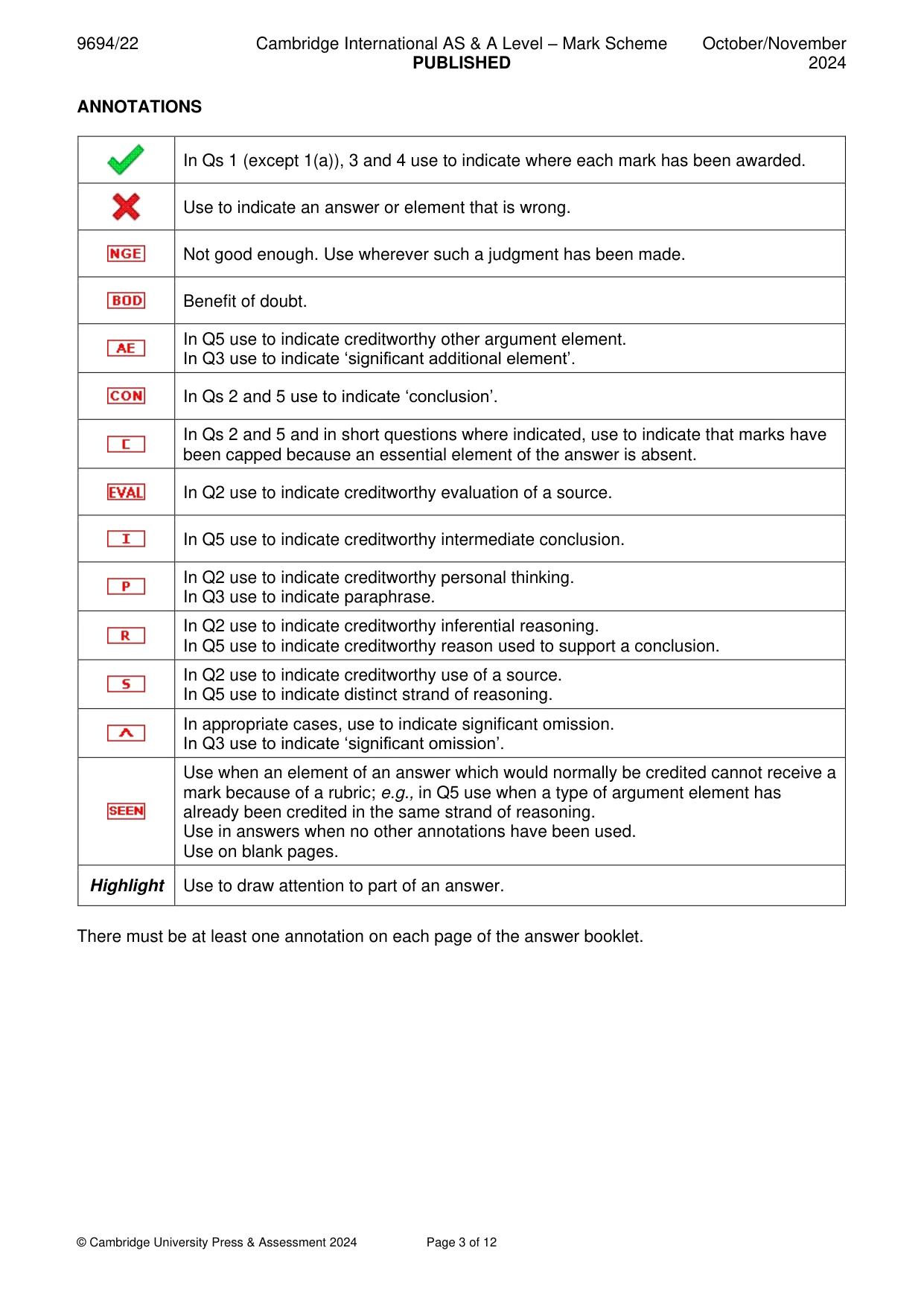
9694/22 Cambridge International AS & A Level – Mark Scheme PUBLISHED October/November 2024 © Cambridge University Press & Assessment 2024 Page 3 of 12 ANNOTATIONS In Qs 1 (except 1(a)), 3 and 4 use to indicate where each mark has been awarded. Use to indicate an answer or element that is wrong. Not good enough. Use wherever such a judgment has been made. Benefit of doubt. In Q5 use to indicate creditworthy other argument element. In Q3 use to indicate ‘significant additional element’. In Qs 2 and 5 use to indicate ‘conclusion’. In Qs 2 and 5 and in short questions where indicated, use to indicate that marks have been capped because an essential element of the answer is absent. In Q2 use to indicate creditworthy evaluation of a source. In Q5 use to indicate creditworthy intermediate conclusion. In Q2 use to indicate creditworthy personal thinking. In Q3 use to indicate paraphrase. In Q2 use to indicate creditworthy inferential reasoning. In Q5 use to indicate creditworthy reason used to support a conclusion. In Q2 use to indicate creditworthy use of a source. In Q5 use to indicate distinct strand of reasoning. In appropriate cases, use to indicate significant omission. In Q3 use to indicate ‘significant omission’. Use when an element of an answer which would normally be credited cannot receive a mark because of a rubric; e.g., in Q5 use when a type of argument element has already been credited in the same strand of reasoning. Use in answers when no other annotations have been used. Use on blank pages. Highlight Use to draw attention to part of an answer. There must be at least one annotation on each page of the answer booklet.
Mark scheme, page 4
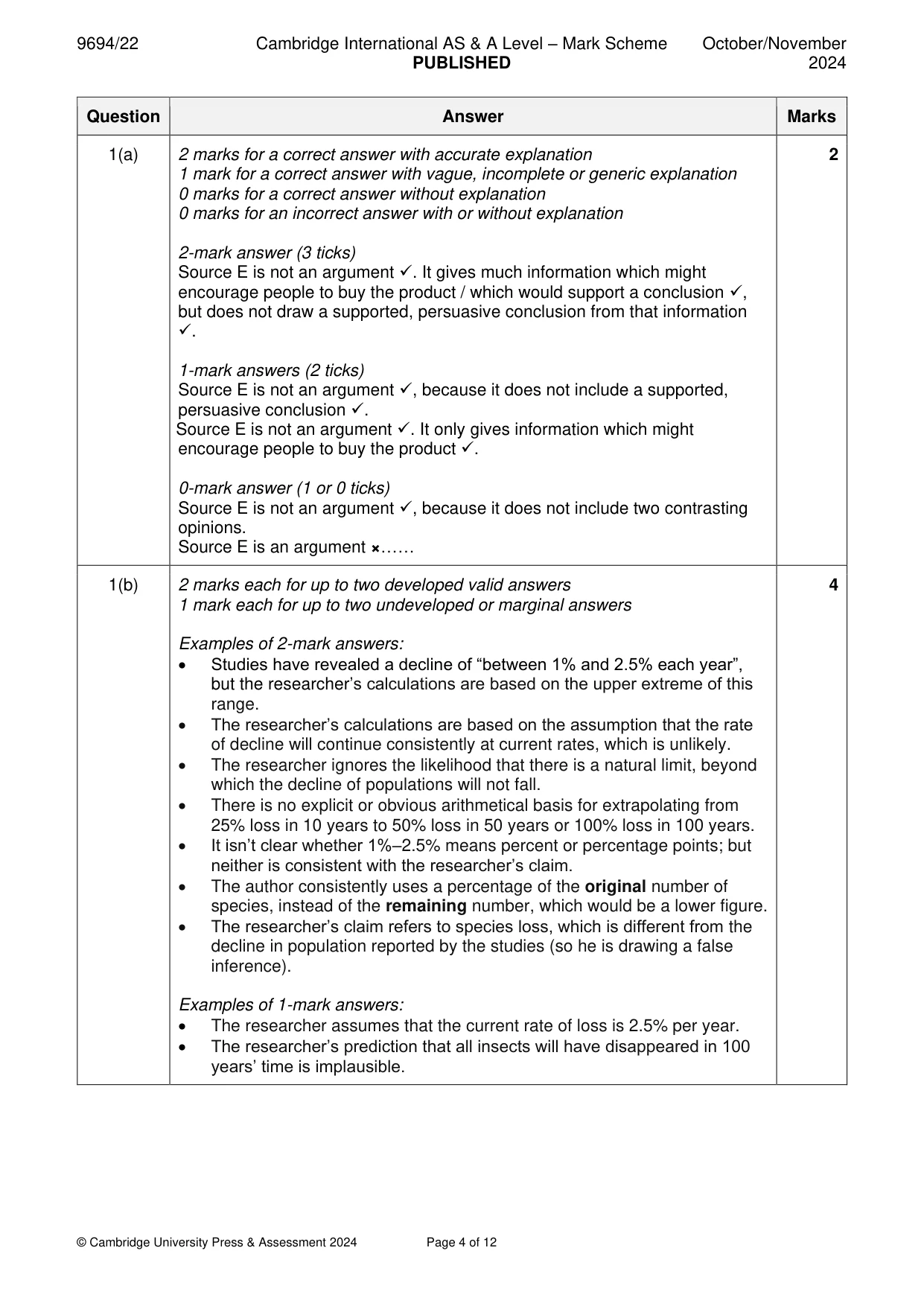
9694/22 Cambridge International AS & A Level – Mark Scheme PUBLISHED October/November 2024 © Cambridge University Press & Assessment 2024 Page 4 of 12 Question Answer Marks 1(a) 2 marks for a correct answer with accurate explanation 1 mark for a correct answer with vague, incomplete or generic explanation 0 marks for a correct answer without explanation 0 marks for an incorrect answer with or without explanation 2-mark answer (3 ticks) Source E is not an argument ✓. It gives much information which might encourage people to buy the product / which would support a conclusion ✓, but does not draw a supported, persuasive conclusion from that information ✓. 1-mark answers (2 ticks) Source E is not an argument ✓, because it does not include a supported, persuasive conclusion ✓. Source E is not an argument ✓. It only gives information which might encourage people to buy the product ✓. 0-mark answer (1 or 0 ticks) Source E is not an argument ✓, because it does not include two contrasting opinions. Source E is an argument ×…… 2 1(b) 2 marks each for up to two developed valid answers 1 mark each for up to two undeveloped or marginal answers Examples of 2-mark answers: • Studies have revealed a decline of “between 1% and 2.5% each year”, but the researcher’s calculations are based on the upper extreme of this range. • The researcher’s calculations are based on the assumption that the rate of decline will continue consistently at current rates, which is unlikely. • The researcher ignores the likelihood that there is a natural limit, beyond which the decline of populations will not fall. • There is no explicit or obvious arithmetical basis for extrapolating from 25% loss in 10 years to 50% loss in 50 years or 100% loss in 100 years. • It isn’t clear whether 1%–2.5% means percent or percentage points; but neither is consistent with the researcher’s claim. • The author consistently uses a percentage of the original number of species, instead of the remaining number, which would be a lower figure. • The researcher’s claim refers to species loss, which is different from the decline in population reported by the studies (so he is drawing a false inference). Examples of 1-mark answers: • The researcher assumes that the current rate of loss is 2.5% per year. • The researcher’s prediction that all insects will have disappeared in 100 years’ time is implausible. 4
Mark scheme, page 5
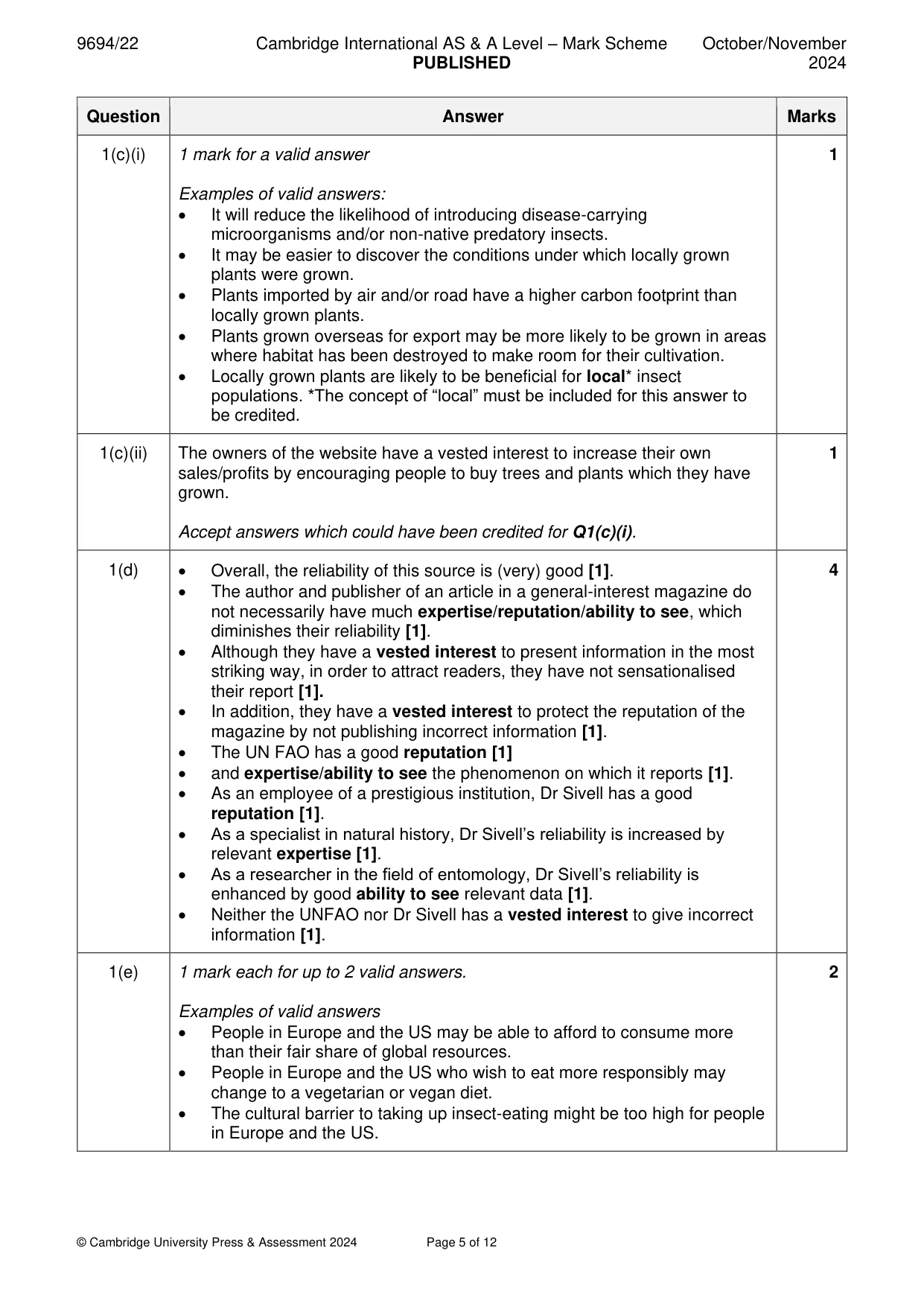
9694/22 Cambridge International AS & A Level – Mark Scheme PUBLISHED October/November 2024 © Cambridge University Press & Assessment 2024 Page 5 of 12 Question Answer Marks 1(c)(i) 1 mark for a valid answer Examples of valid answers: • It will reduce the likelihood of introducing disease-carrying microorganisms and/or non-native predatory insects. • It may be easier to discover the conditions under which locally grown plants were grown. • Plants imported by air and/or road have a higher carbon footprint than locally grown plants. • Plants grown overseas for export may be more likely to be grown in areas where habitat has been destroyed to make room for their cultivation. • Locally grown plants are likely to be beneficial for local* insect populations. *The concept of “local” must be included for this answer to be credited. 1 1(c)(ii) The owners of the website have a vested interest to increase their own sales/profits by encouraging people to buy trees and plants which they have grown. Accept answers which could have been credited for Q1(c)(i). 1 1(d) • Overall, the reliability of this source is (very) good [1]. • The author and publisher of an article in a general-interest magazine do not necessarily have much expertise/reputation/ability to see, which diminishes their reliability [1]. • Although they have a vested interest to present information in the most striking way, in order to attract readers, they have not sensationalised their report [1]. • In addition, they have a vested interest to protect the reputation of the magazine by not publishing incorrect information [1]. • The UN FAO has a good reputation [1] • and expertise/ability to see the phenomenon on which it reports [1]. • As an employee of a prestigious institution, Dr Sivell has a good reputation [1]. • As a specialist in natural history, Dr Sivell’s reliability is increased by relevant expertise [1]. • As a researcher in the field of entomology, Dr Sivell’s reliability is enhanced by good ability to see relevant data [1]. • Neither the UNFAO nor Dr Sivell has a vested interest to give incorrect information [1]. 4 1(e) 1 mark each for up to 2 valid answers. Examples of valid answers • People in Europe and the US may be able to afford to consume more than their fair share of global resources. • People in Europe and the US who wish to eat more responsibly may change to a vegetarian or vegan diet. • The cultural barrier to taking up insect-eating might be too high for people in Europe and the US. 2
Mark scheme, page 6
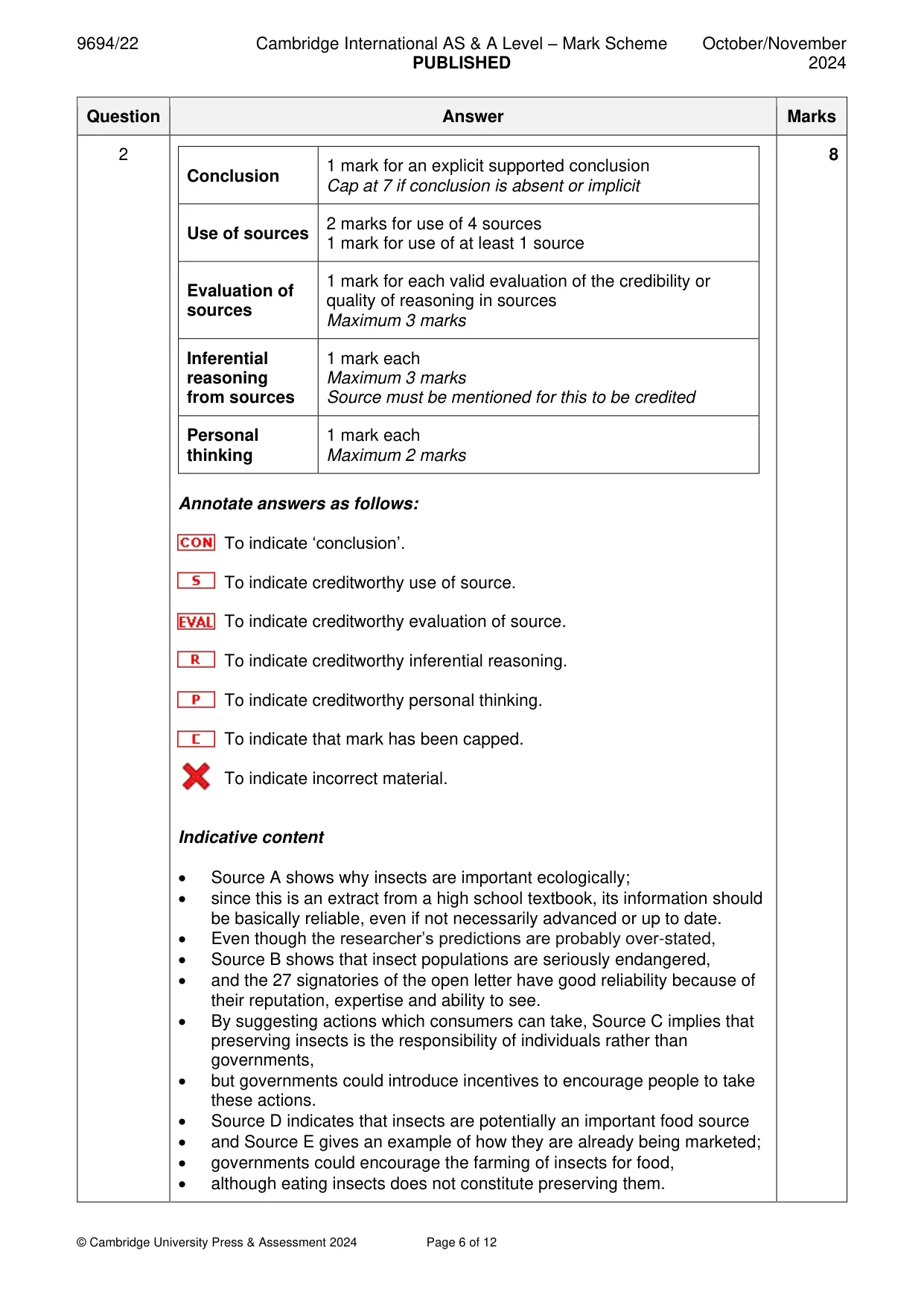
9694/22 Cambridge International AS & A Level – Mark Scheme PUBLISHED October/November 2024 © Cambridge University Press & Assessment 2024 Page 6 of 12 Question Answer Marks 2 Conclusion 1 mark for an explicit supported conclusion Cap at 7 if conclusion is absent or implicit Use of sources 2 marks for use of 4 sources 1 mark for use of at least 1 source Evaluation of sources 1 mark for each valid evaluation of the credibility or quality of reasoning in sources Maximum 3 marks Inferential reasoning from sources 1 mark each Maximum 3 marks Source must be mentioned for this to be credited Personal thinking 1 mark each Maximum 2 marks Annotate answers as follows: To indicate ‘conclusion’. To indicate creditworthy use of source. To indicate creditworthy evaluation of source. To indicate creditworthy inferential reasoning. To indicate creditworthy personal thinking. To indicate that mark has been capped. To indicate incorrect material. Indicative content • Source A shows why insects are important ecologically; • since this is an extract from a high school textbook, its information should be basically reliable, even if not necessarily advanced or up to date. • Even though the researcher’s predictions are probably over-stated, • Source B shows that insect populations are seriously endangered, • and the 27 signatories of the open letter have good reliability because of their reputation, expertise and ability to see. • By suggesting actions which consumers can take, Source C implies that preserving insects is the responsibility of individuals rather than governments, • but governments could introduce incentives to encourage people to take these actions. • Source D indicates that insects are potentially an important food source • and Source E gives an example of how they are already being marketed; • governments could encourage the farming of insects for food, • although eating insects does not constitute preserving them. 8
Mark scheme, page 7
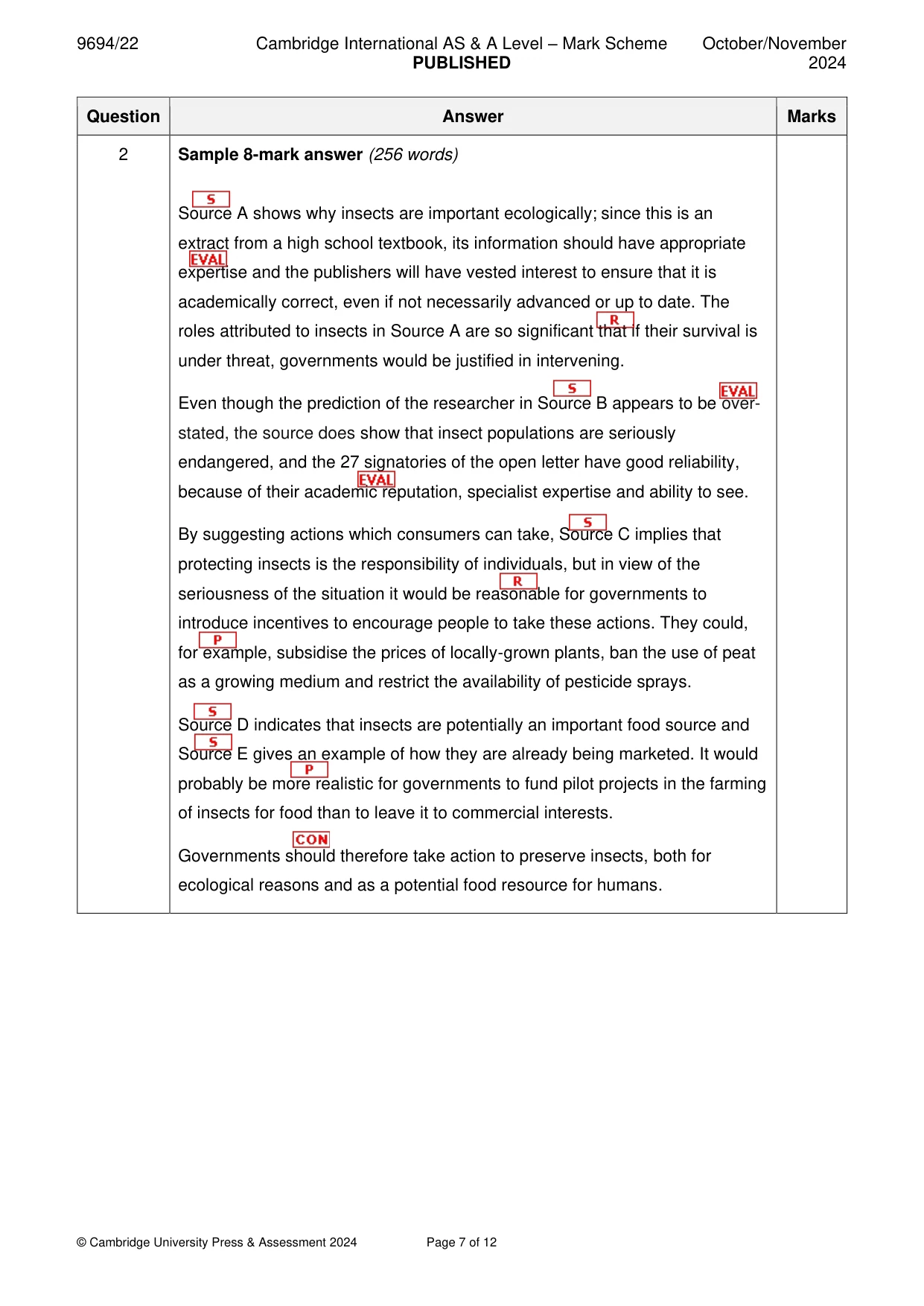
9694/22 Cambridge International AS & A Level – Mark Scheme PUBLISHED October/November 2024 © Cambridge University Press & Assessment 2024 Page 7 of 12 Question Answer Marks 2 Sample 8-mark answer (256 words) Source A shows why insects are important ecologically; since this is an extract from a high school textbook, its information should have appropriate expertise and the publishers will have vested interest to ensure that it is academically correct, even if not necessarily advanced or up to date. The roles attributed to insects in Source A are so significant that if their survival is under threat, governments would be justified in intervening. Even though the prediction of the researcher in Source B appears to be over- stated, the source does show that insect populations are seriously endangered, and the 27 signatories of the open letter have good reliability, because of their academic reputation, specialist expertise and ability to see. By suggesting actions which consumers can take, Source C implies that protecting insects is the responsibility of individuals, but in view of the seriousness of the situation it would be reasonable for governments to introduce incentives to encourage people to take these actions. They could, for example, subsidise the prices of locally-grown plants, ban the use of peat as a growing medium and restrict the availability of pesticide sprays. Source D indicates that insects are potentially an important food source and Source E gives an example of how they are already being marketed. It would probably be more realistic for governments to fund pilot projects in the farming of insects for food than to leave it to commercial interests. Governments should therefore take action to preserve insects, both for ecological reasons and as a potential food resource for humans.
Mark scheme, page 8
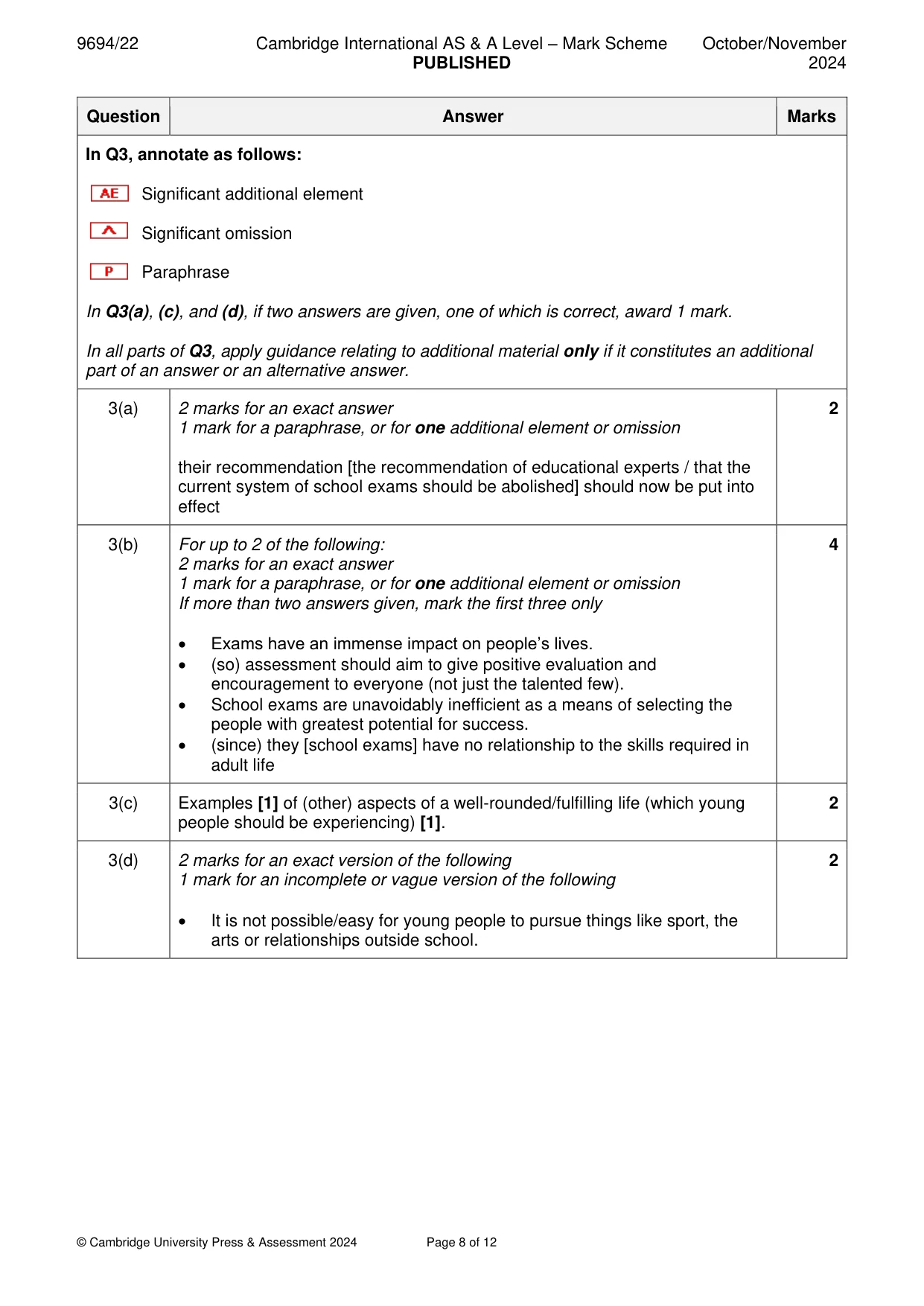
9694/22 Cambridge International AS & A Level – Mark Scheme PUBLISHED October/November 2024 © Cambridge University Press & Assessment 2024 Page 8 of 12 Question Answer Marks In Q3, annotate as follows: Significant additional element Significant omission Paraphrase In Q3(a), (c), and (d), if two answers are given, one of which is correct, award 1 mark. In all parts of Q3, apply guidance relating to additional material only if it constitutes an additional part of an answer or an alternative answer. 3(a) 2 marks for an exact answer 1 mark for a paraphrase, or for one additional element or omission their recommendation [the recommendation of educational experts / that the current system of school exams should be abolished] should now be put into effect 2 3(b) For up to 2 of the following: 2 marks for an exact answer 1 mark for a paraphrase, or for one additional element or omission If more than two answers given, mark the first three only • Exams have an immense impact on people’s lives. • (so) assessment should aim to give positive evaluation and encouragement to everyone (not just the talented few). • School exams are unavoidably inefficient as a means of selecting the people with greatest potential for success. • (since) they [school exams] have no relationship to the skills required in adult life 4 3(c) Examples [1] of (other) aspects of a well-rounded/fulfilling life (which young people should be experiencing) [1]. 2 3(d) 2 marks for an exact version of the following 1 mark for an incomplete or vague version of the following • It is not possible/easy for young people to pursue things like sport, the arts or relationships outside school. 2
Mark scheme, page 9
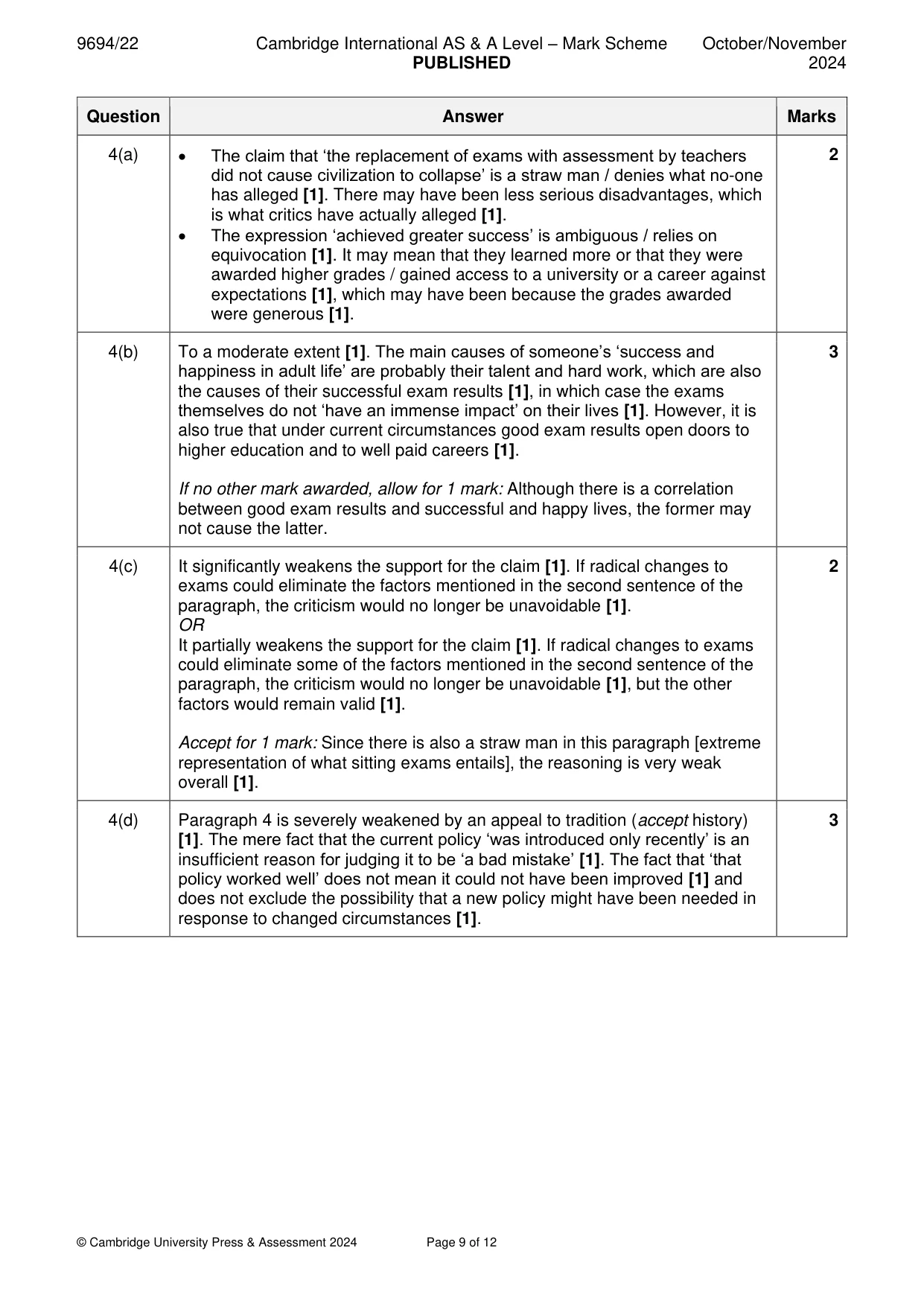
9694/22 Cambridge International AS & A Level – Mark Scheme PUBLISHED October/November 2024 © Cambridge University Press & Assessment 2024 Page 9 of 12 Question Answer Marks 4(a) • The claim that ‘the replacement of exams with assessment by teachers did not cause civilization to collapse’ is a straw man / denies what no-one has alleged [1]. There may have been less serious disadvantages, which is what critics have actually alleged [1]. • The expression ‘achieved greater success’ is ambiguous / relies on equivocation [1]. It may mean that they learned more or that they were awarded higher grades / gained access to a university or a career against expectations [1], which may have been because the grades awarded were generous [1]. 2 4(b) To a moderate extent [1]. The main causes of someone’s ‘success and happiness in adult life’ are probably their talent and hard work, which are also the causes of their successful exam results [1], in which case the exams themselves do not ‘have an immense impact’ on their lives [1]. However, it is also true that under current circumstances good exam results open doors to higher education and to well paid careers [1]. If no other mark awarded, allow for 1 mark: Although there is a correlation between good exam results and successful and happy lives, the former may not cause the latter. 3 4(c) It significantly weakens the support for the claim [1]. If radical changes to exams could eliminate the factors mentioned in the second sentence of the paragraph, the criticism would no longer be unavoidable [1]. OR It partially weakens the support for the claim [1]. If radical changes to exams could eliminate some of the factors mentioned in the second sentence of the paragraph, the criticism would no longer be unavoidable [1], but the other factors would remain valid [1]. Accept for 1 mark: Since there is also a straw man in this paragraph [extreme representation of what sitting exams entails], the reasoning is very weak overall [1]. 2 4(d) Paragraph 4 is severely weakened by an appeal to tradition (accept history) [1]. The mere fact that the current policy ‘was introduced only recently’ is an insufficient reason for judging it to be ‘a bad mistake’ [1]. The fact that ‘that policy worked well’ does not mean it could not have been improved [1] and does not exclude the possibility that a new policy might have been needed in response to changed circumstances [1]. 3
Mark scheme, page 10
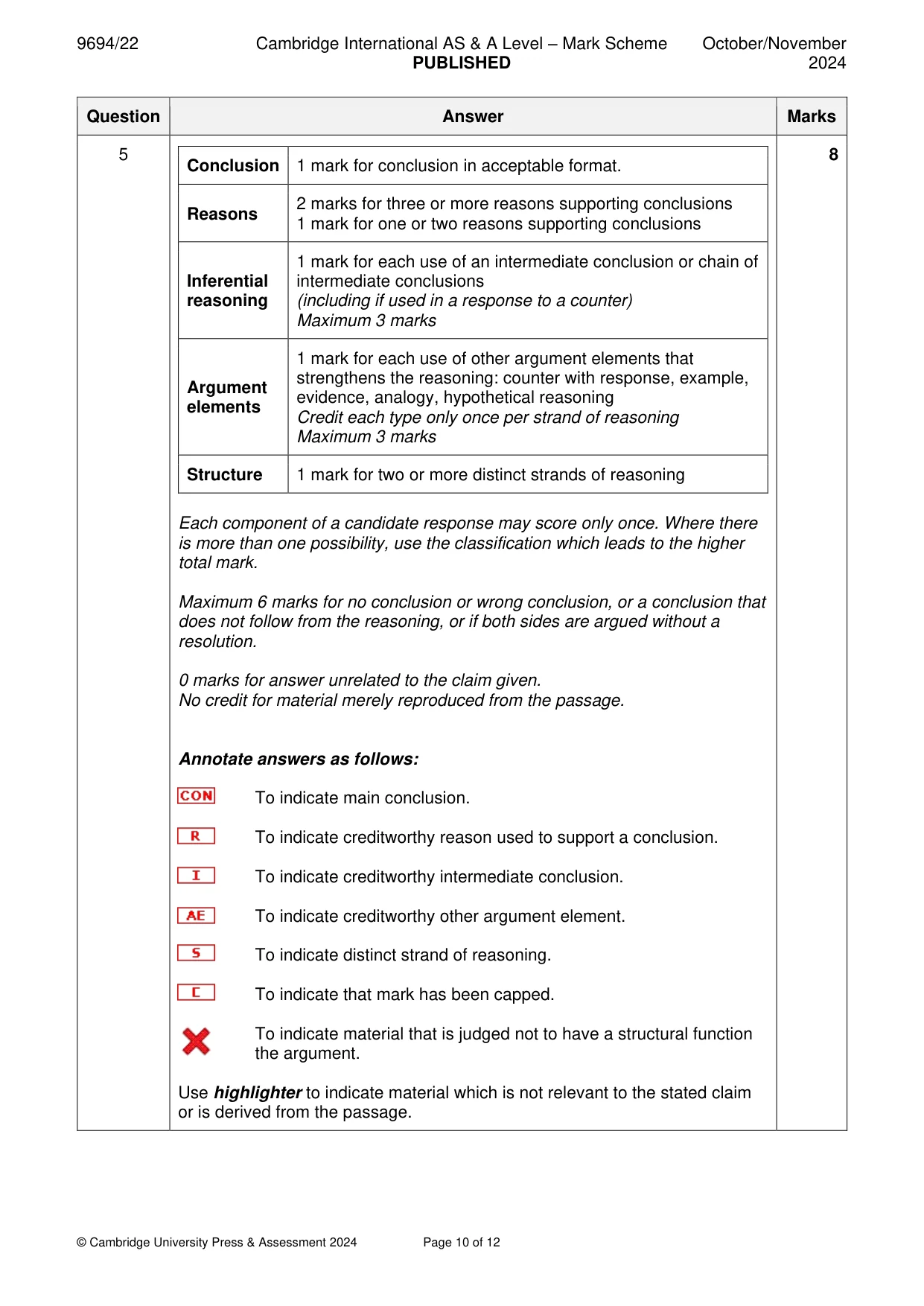
9694/22 Cambridge International AS & A Level – Mark Scheme PUBLISHED October/November 2024 © Cambridge University Press & Assessment 2024 Page 10 of 12 Question Answer Marks 5 Conclusion 1 mark for conclusion in acceptable format. Reasons 2 marks for three or more reasons supporting conclusions 1 mark for one or two reasons supporting conclusions Inferential reasoning 1 mark for each use of an intermediate conclusion or chain of intermediate conclusions (including if used in a response to a counter) Maximum 3 marks Argument elements 1 mark for each use of other argument elements that strengthens the reasoning: counter with response, example, evidence, analogy, hypothetical reasoning Credit each type only once per strand of reasoning Maximum 3 marks Structure 1 mark for two or more distinct strands of reasoning Each component of a candidate response may score only once. Where there is more than one possibility, use the classification which leads to the higher total mark. Maximum 6 marks for no conclusion or wrong conclusion, or a conclusion that does not follow from the reasoning, or if both sides are argued without a resolution. 0 marks for answer unrelated to the claim given. No credit for material merely reproduced from the passage. Annotate answers as follows: To indicate main conclusion. To indicate creditworthy reason used to support a conclusion. To indicate creditworthy intermediate conclusion. To indicate creditworthy other argument element. To indicate distinct strand of reasoning. To indicate that mark has been capped. To indicate material that is judged not to have a structural function in the argument. Use highlighter to indicate material which is not relevant to the stated claim or is derived from the passage. 8
Mark scheme, page 11
9694/22 Cambridge International AS & A Level – Mark Scheme PUBLISHED October/November 2024 © Cambridge University Press & Assessment 2024 Page 11 of 12 Question Answer Marks 5 Example 8-mark answers Support (213 words) Young people sacrifice a lot for the sake of their education. Instead of having their own income and enjoying social activities with friends, they rely on their parents for pocket money and spend their time studying. These sacrifices are a rational choice only if the studying will be rewarded by qualifications which open the door to well-paid jobs. So it would be a waste of time and effort to study subjects which cannot lead to lucrative employment. Learning about things which are not relevant to the world of work would be as irresponsible as spending one’s whole teenage years playing video games. Every country invests a large amount of money in educating its young people. It does this in the expectation that its investment will eventually be repaid from the work which former students do as adults and from the taxes they pay on their earnings. If some people were unable to repay the investments in these ways in later life, they would be failing to keep their side of the tacit bargain. So it would be wrong for schools or colleges to offer courses in subjects like literature, history or music, which will not pay for themselves in future earnings. Therefore the purpose of education should be to prepare students for employment. Challenge (163 words) Some politicians appear to believe that the only criterion for assessing educational programmes is how well they prepare students for employment. However, this approach is based on an impoverished understanding of human life. There is more to life than work and people are more than what they contribute to the common good. So education should also aim to give students the skills they need to make the most of leisure activities and to enjoy healthy relationships and family life.
Mark scheme, page 12
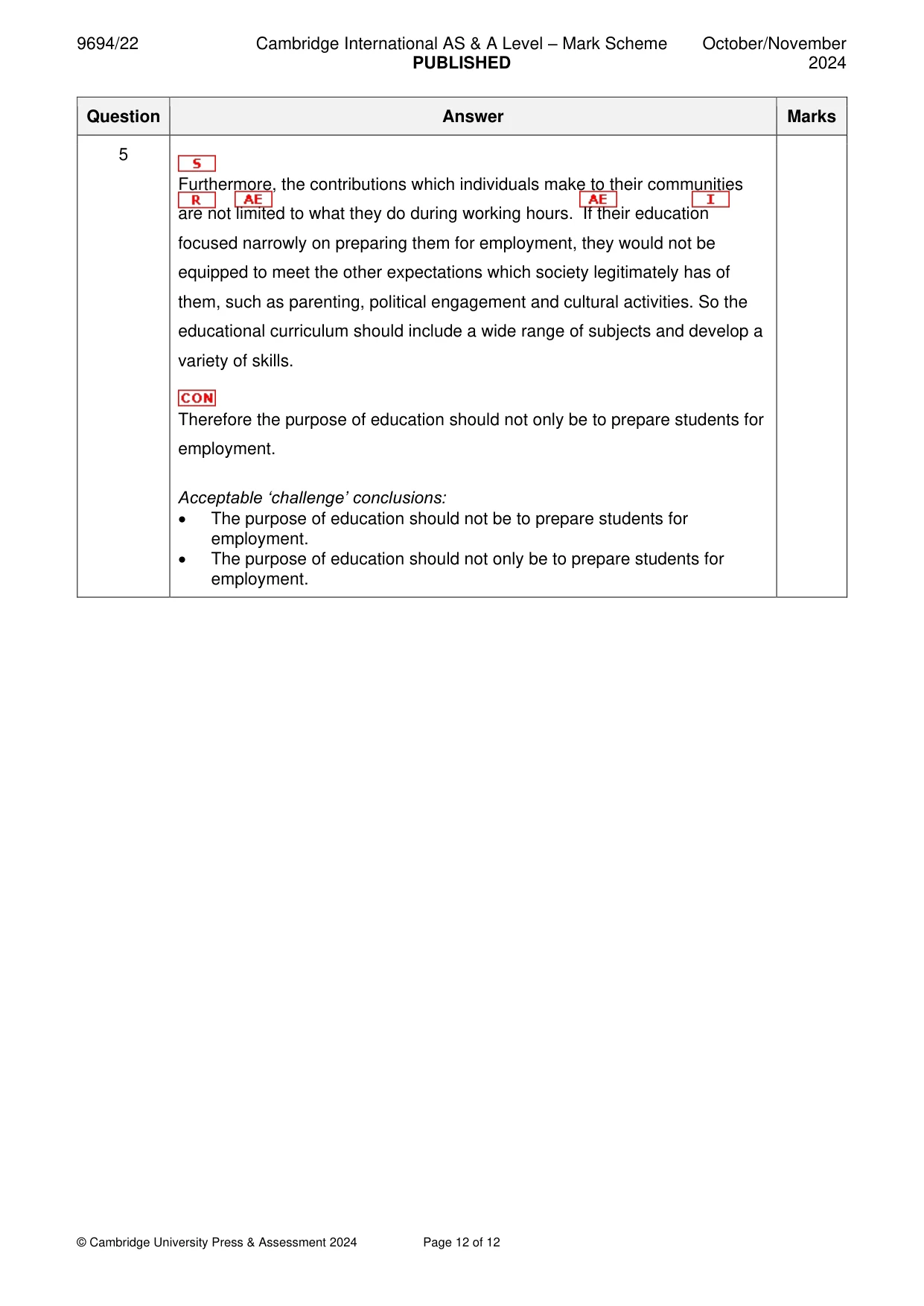
9694/22 Cambridge International AS & A Level – Mark Scheme PUBLISHED October/November 2024 © Cambridge University Press & Assessment 2024 Page 12 of 12 Question Answer Marks 5 Furthermore, the contributions which individuals make to their communities are not limited to what they do during working hours. If their education focused narrowly on preparing them for employment, they would not be equipped to meet the other expectations which society legitimately has of them, such as parenting, political engagement and cultural activities. So the educational curriculum should include a wide range of subjects and develop a variety of skills. Therefore the purpose of education should not only be to prepare students for employment. Acceptable ‘challenge’ conclusions: • The purpose of education should not be to prepare students for employment. • The purpose of education should not only be to prepare students for employment.
What you needed in this session
Cambridge’s own grade thresholds for 2024 Oct/Nov, Paper 2 · Variant 2. A higher threshold means an easier paper — the bar moves with how the cohort did.