Cambridge A Level Thinking Skills 9694 — 2024 May/June Paper 2 · Variant 2
9694/22/M/J/24 · 50 marks · ≈56 min
The question paper and its mark scheme, free to read here and free to download. This is Cambridge’s own paper, exactly as it was sat.
Question paper8 pages



Mark scheme13 pages
Answers below. Sit the paper first if you are practising.
Paper as text
Question paper, page 1
This document has 8 pages. Any blank pages are indicated. [Turn over DC (JP) 328335 © UCLES 2024 * 1 8 5 6 0 1 6 6 8 6 * Cambridge International AS & A Level THINKING SKILLS 9694/22 Paper 2 Critical Thinking May/June 2024 1 hour 45 minutes You must answer on the enclosed answer booklet. You will need: Answer booklet (enclosed) INSTRUCTIONS ● Answer all questions. ● Follow the instructions on the front cover of the answer booklet. If you need additional answer paper, ask the invigilator for a continuation booklet. INFORMATION ● The total mark for this paper is 50. ● The number of marks for each question or part question is shown in brackets [ ].
Question paper, page 2
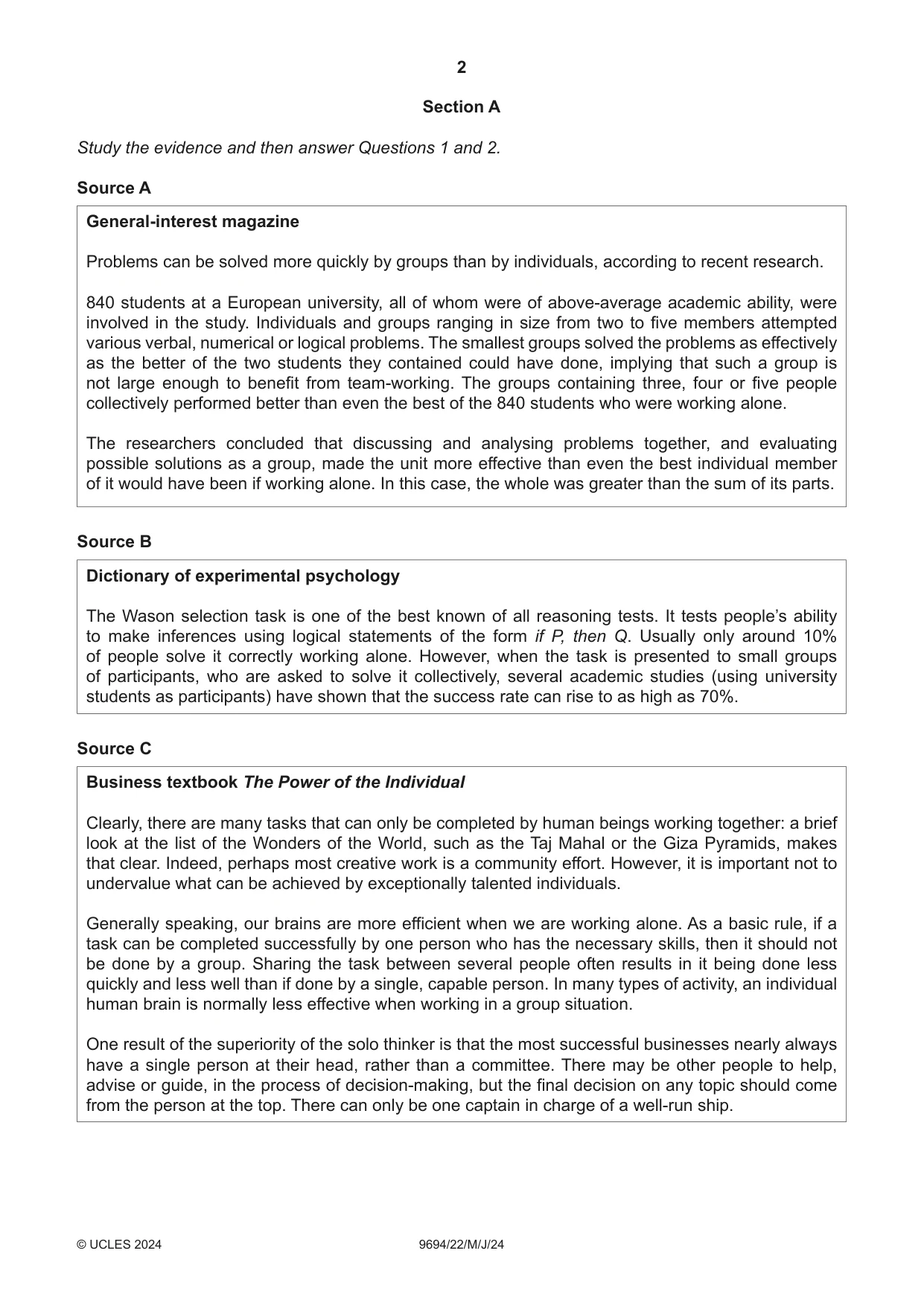
2 9694/22/M/J/24 © UCLES 2024 Section A Study the evidence and then answer Questions 1 and 2. Source A General-interest magazine Problems can be solved more quickly by groups than by individuals, according to recent research. 840 students at a European university, all of whom were of above-average academic ability, were involved in the study. Individuals and groups ranging in size from two to five members attempted various verbal, numerical or logical problems. The smallest groups solved the problems as effectively as the better of the two students they contained could have done, implying that such a group is not large enough to benefit from team-working. The groups containing three, four or five people collectively performed better than even the best of the 840 students who were working alone. The researchers concluded that discussing and analysing problems together, and evaluating possible solutions as a group, made the unit more effective than even the best individual member of it would have been if working alone. In this case, the whole was greater than the sum of its parts. Source B Dictionary of experimental psychology The Wason selection task is one of the best known of all reasoning tests. It tests people’s ability to make inferences using logical statements of the form if P, then Q. Usually only around 10% of people solve it correctly working alone. However, when the task is presented to small groups of participants, who are asked to solve it collectively, several academic studies (using university students as participants) have shown that the success rate can rise to as high as 70%. Source C Business textbook The Power of the Individual Clearly, there are many tasks that can only be completed by human beings working together: a brief look at the list of the Wonders of the World, such as the Taj Mahal or the Giza Pyramids, makes that clear. Indeed, perhaps most creative work is a community effort. However, it is important not to undervalue what can be achieved by exceptionally talented individuals. Generally speaking, our brains are more efficient when we are working alone. As a basic rule, if a task can be completed successfully by one person who has the necessary skills, then it should not be done by a group. Sharing the task between several people often results in it being done less quickly and less well than if done by a single, capable person. In many types of activity, an individual human brain is normally less effective when working in a group situation. One result of the superiority of the solo thinker is that the most successful businesses nearly always have a single person at their head, rather than a committee. There may be other people to help, advise or guide, in the process of decision-making, but the final decision on any topic should come from the person at the top. There can only be one captain in charge of a well-run ship.
Question paper, page 3
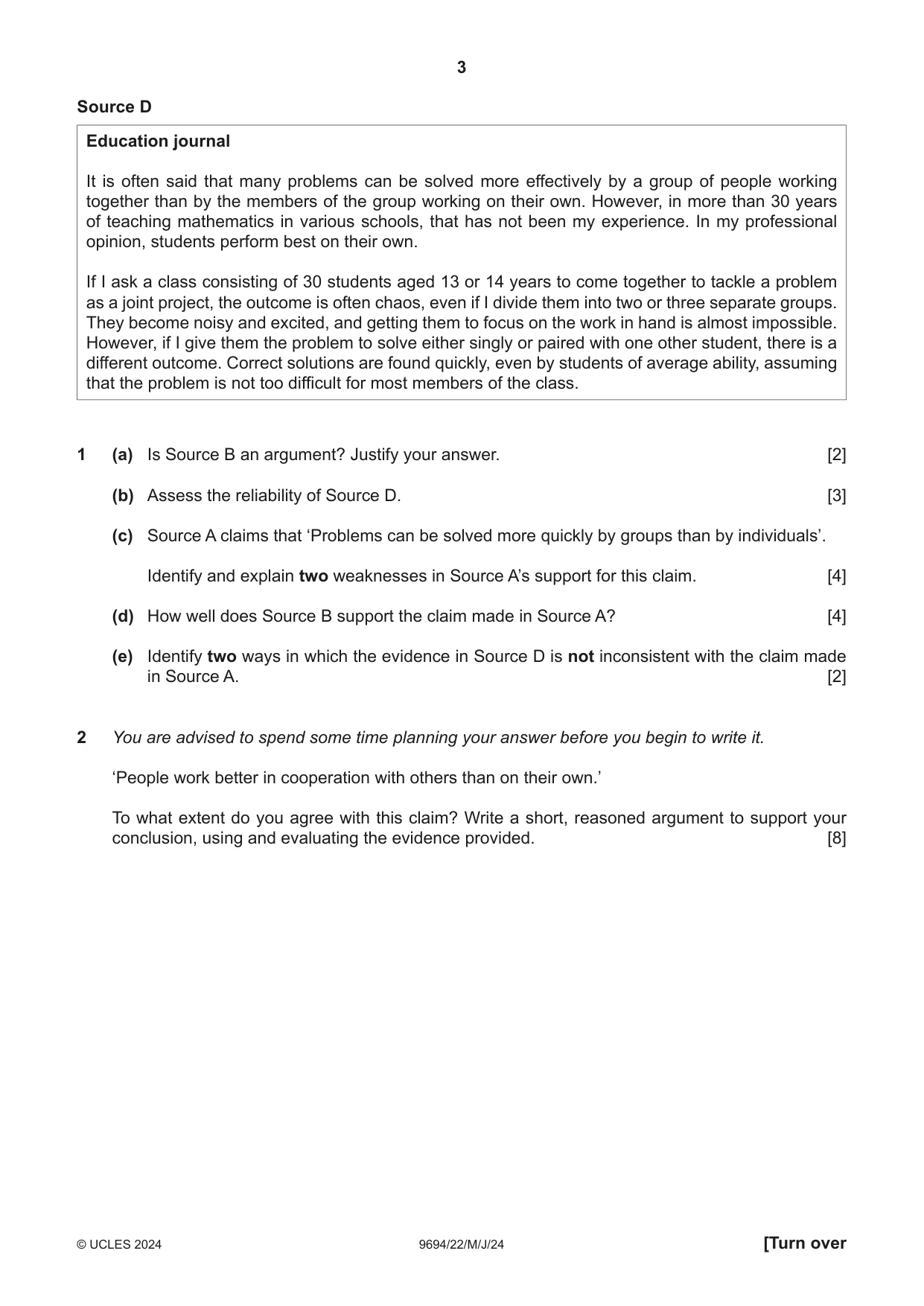
3 9694/22/M/J/24 © UCLES 2024 [Turn over Source D Education journal It is often said that many problems can be solved more effectively by a group of people working together than by the members of the group working on their own. However, in more than 30 years of teaching mathematics in various schools, that has not been my experience. In my professional opinion, students perform best on their own. If I ask a class consisting of 30 students aged 13 or 14 years to come together to tackle a problem as a joint project, the outcome is often chaos, even if I divide them into two or three separate groups. They become noisy and excited, and getting them to focus on the work in hand is almost impossible. However, if I give them the problem to solve either singly or paired with one other student, there is a different outcome. Correct solutions are found quickly, even by students of average ability, assuming that the problem is not too difficult for most members of the class. 1 (a) Is Source B an argument? Justify your answer. [2] (b) Assess the reliability of Source D. [3] (c) Source A claims that ‘Problems can be solved more quickly by groups than by individuals’. Identify and explain two weaknesses in Source A’s support for this claim. [4] (d) How well does Source B support the claim made in Source A? [4] (e) Identify two ways in which the evidence in Source D is not inconsistent with the claim made in Source A. [2] 2 You are advised to spend some time planning your answer before you begin to write it. ‘People work better in cooperation with others than on their own.’ To what extent do you agree with this claim? Write a short, reasoned argument to support your conclusion, using and evaluating the evidence provided. [8]
Question paper, page 4
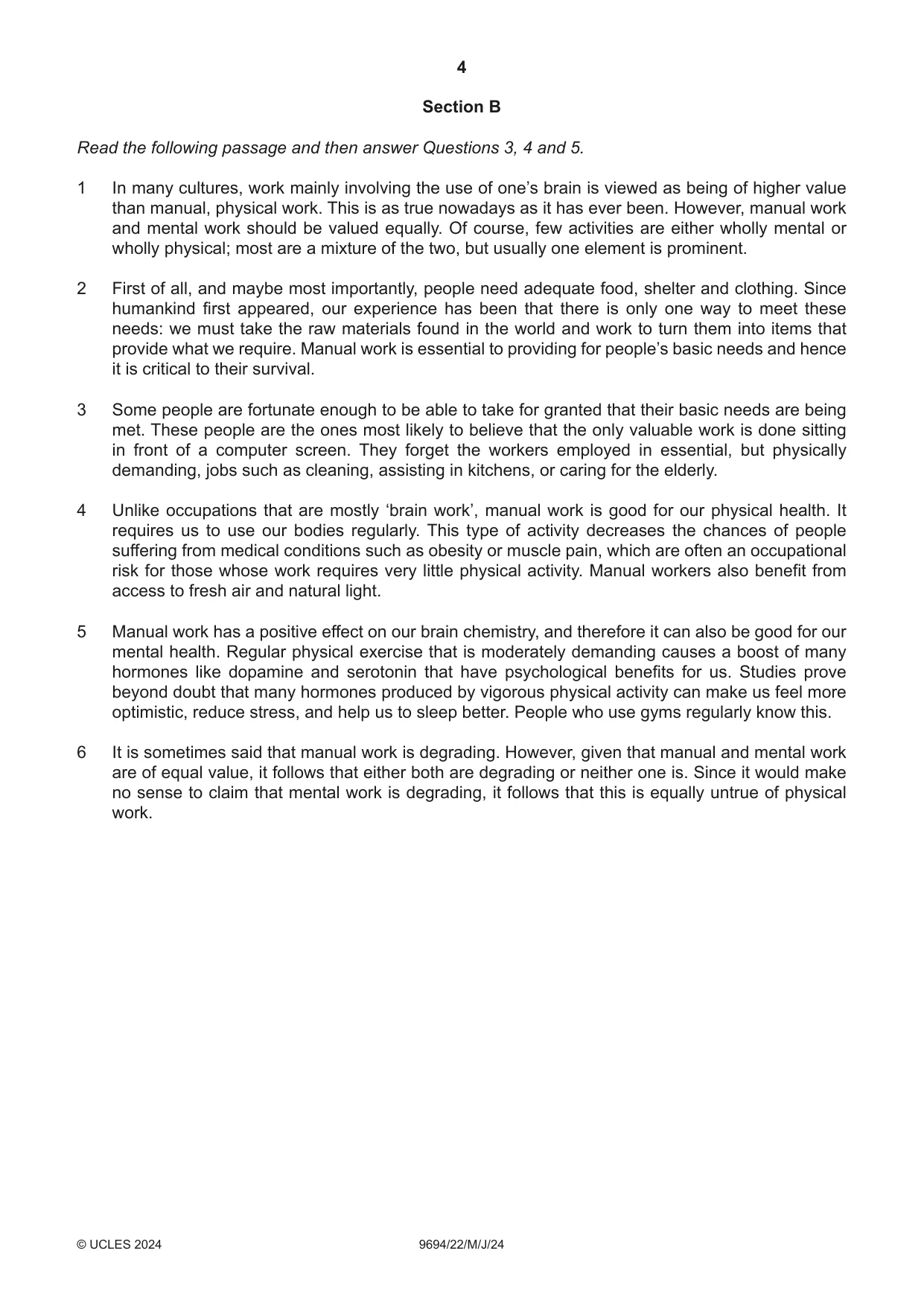
4 9694/22/M/J/24 © UCLES 2024 Section B Read the following passage and then answer Questions 3, 4 and 5. 1 In many cultures, work mainly involving the use of one’s brain is viewed as being of higher value than manual, physical work. This is as true nowadays as it has ever been. However, manual work and mental work should be valued equally. Of course, few activities are either wholly mental or wholly physical; most are a mixture of the two, but usually one element is prominent. 2 First of all, and maybe most importantly, people need adequate food, shelter and clothing. Since humankind first appeared, our experience has been that there is only one way to meet these needs: we must take the raw materials found in the world and work to turn them into items that provide what we require. Manual work is essential to providing for people’s basic needs and hence it is critical to their survival. 3 Some people are fortunate enough to be able to take for granted that their basic needs are being met. These people are the ones most likely to believe that the only valuable work is done sitting in front of a computer screen. They forget the workers employed in essential, but physically demanding, jobs such as cleaning, assisting in kitchens, or caring for the elderly. 4 Unlike occupations that are mostly ‘brain work’, manual work is good for our physical health. It requires us to use our bodies regularly. This type of activity decreases the chances of people suffering from medical conditions such as obesity or muscle pain, which are often an occupational risk for those whose work requires very little physical activity. Manual workers also benefit from access to fresh air and natural light. 5 Manual work has a positive effect on our brain chemistry, and therefore it can also be good for our mental health. Regular physical exercise that is moderately demanding causes a boost of many hormones like dopamine and serotonin that have psychological benefits for us. Studies prove beyond doubt that many hormones produced by vigorous physical activity can make us feel more optimistic, reduce stress, and help us to sleep better. People who use gyms regularly know this. 6 It is sometimes said that manual work is degrading. However, given that manual and mental work are of equal value, it follows that either both are degrading or neither one is. Since it would make no sense to claim that mental work is degrading, it follows that this is equally untrue of physical work.
Question paper, page 5
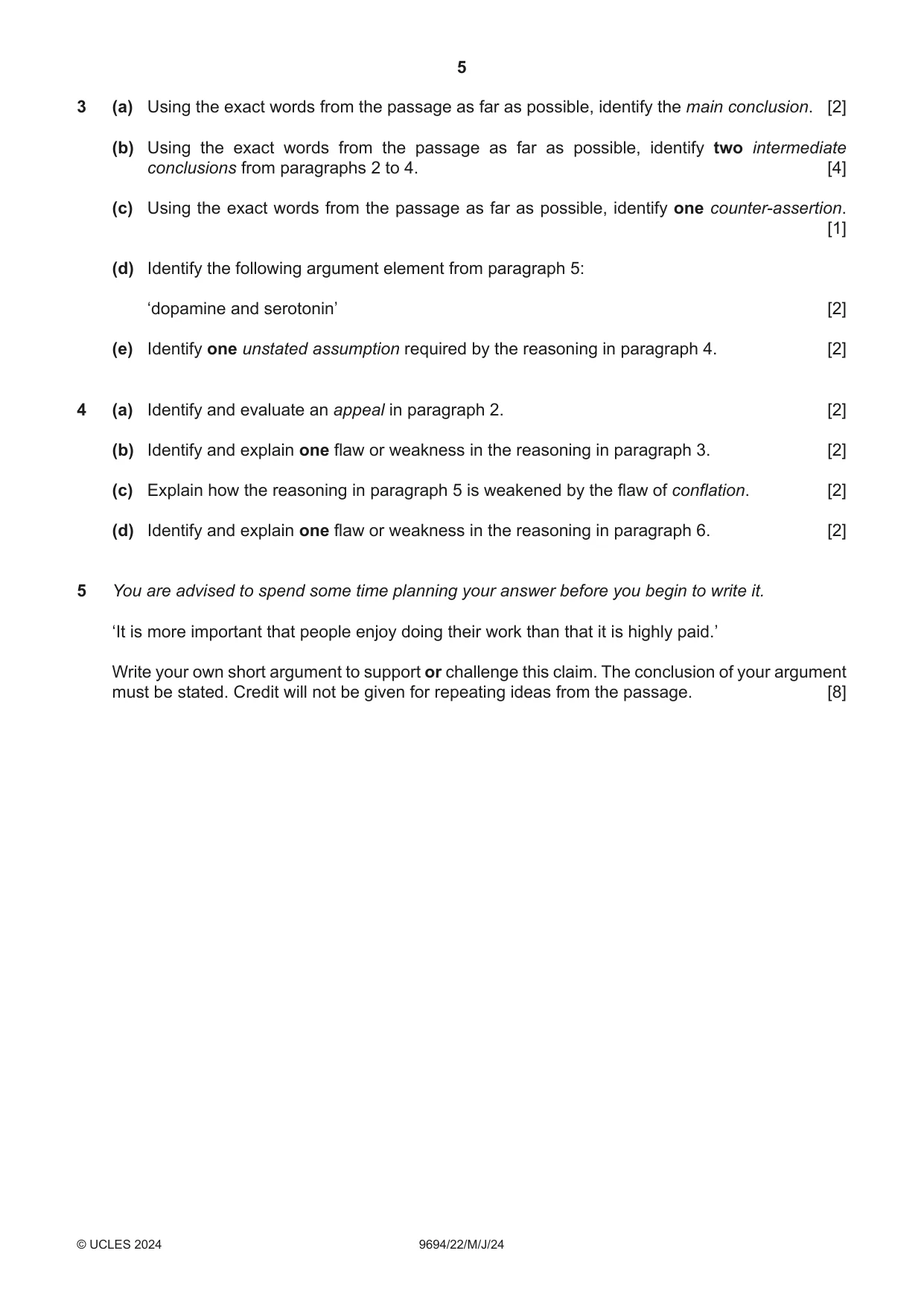
5 9694/22/M/J/24 © UCLES 2024 3 (a) Using the exact words from the passage as far as possible, identify the main conclusion. [2] (b) Using the exact words from the passage as far as possible, identify two intermediate conclusions from paragraphs 2 to 4. [4] (c) Using the exact words from the passage as far as possible, identify one counter-assertion. [1] (d) Identify the following argument element from paragraph 5: ‘dopamine and serotonin’ [2] (e) Identify one unstated assumption required by the reasoning in paragraph 4. [2] 4 (a) Identify and evaluate an appeal in paragraph 2. [2] (b) Identify and explain one flaw or weakness in the reasoning in paragraph 3. [2] (c) Explain how the reasoning in paragraph 5 is weakened by the flaw of conflation. [2] (d) Identify and explain one flaw or weakness in the reasoning in paragraph 6. [2] 5 You are advised to spend some time planning your answer before you begin to write it. ‘It is more important that people enjoy doing their work than that it is highly paid.’ Write your own short argument to support or challenge this claim. The conclusion of your argument must be stated. Credit will not be given for repeating ideas from the passage. [8]
Question paper, page 6
6 9694/22/M/J/24 © UCLES 2024 BLANK PAGE
Question paper, page 7
7 9694/22/M/J/24 © UCLES 2024 BLANK PAGE
Question paper, page 8
8 9694/22/M/J/24 © UCLES 2024 Permission to reproduce items where third-party owned material protected by copyright is included has been sought and cleared where possible. Every reasonable effort has been made by the publisher (UCLES) to trace copyright holders, but if any items requiring clearance have unwittingly been included, the publisher will be pleased to make amends at the earliest possible opportunity. To avoid the issue of disclosure of answer-related information to candidates, all copyright acknowledgements are reproduced online in the Cambridge Assessment International Education Copyright Acknowledgements Booklet. This is produced for each series of examinations and is freely available to download at www.cambridgeinternational.org after the live examination series. Cambridge Assessment International Education is part of Cambridge Assessment. Cambridge Assessment is the brand name of the University of Cambridge Local Examinations Syndicate (UCLES), which is a department of the University of Cambridge. BLANK PAGE
Mark scheme, page 1
This document consists of 13 printed pages. © Cambridge University Press & Assessment 2024 [Turn over Cambridge International AS & A Level THINKING SKILLS 9694/22 Paper 2 Critical Thinking May/June 2024 MARK SCHEME Maximum Mark: 50 Published This mark scheme is published as an aid to teachers and candidates, to indicate the requirements of the examination. It shows the basis on which Examiners were instructed to award marks. It does not indicate the details of the discussions that took place at an Examiners’ meeting before marking began, which would have considered the acceptability of alternative answers. Mark schemes should be read in conjunction with the question paper and the Principal Examiner Report for Teachers. Cambridge International will not enter into discussions about these mark schemes. Cambridge International is publishing the mark schemes for the May/June 2024 series for most Cambridge IGCSE, Cambridge International A and AS Level and Cambridge Pre-U components, and some Cambridge O Level components.
Mark scheme, page 2
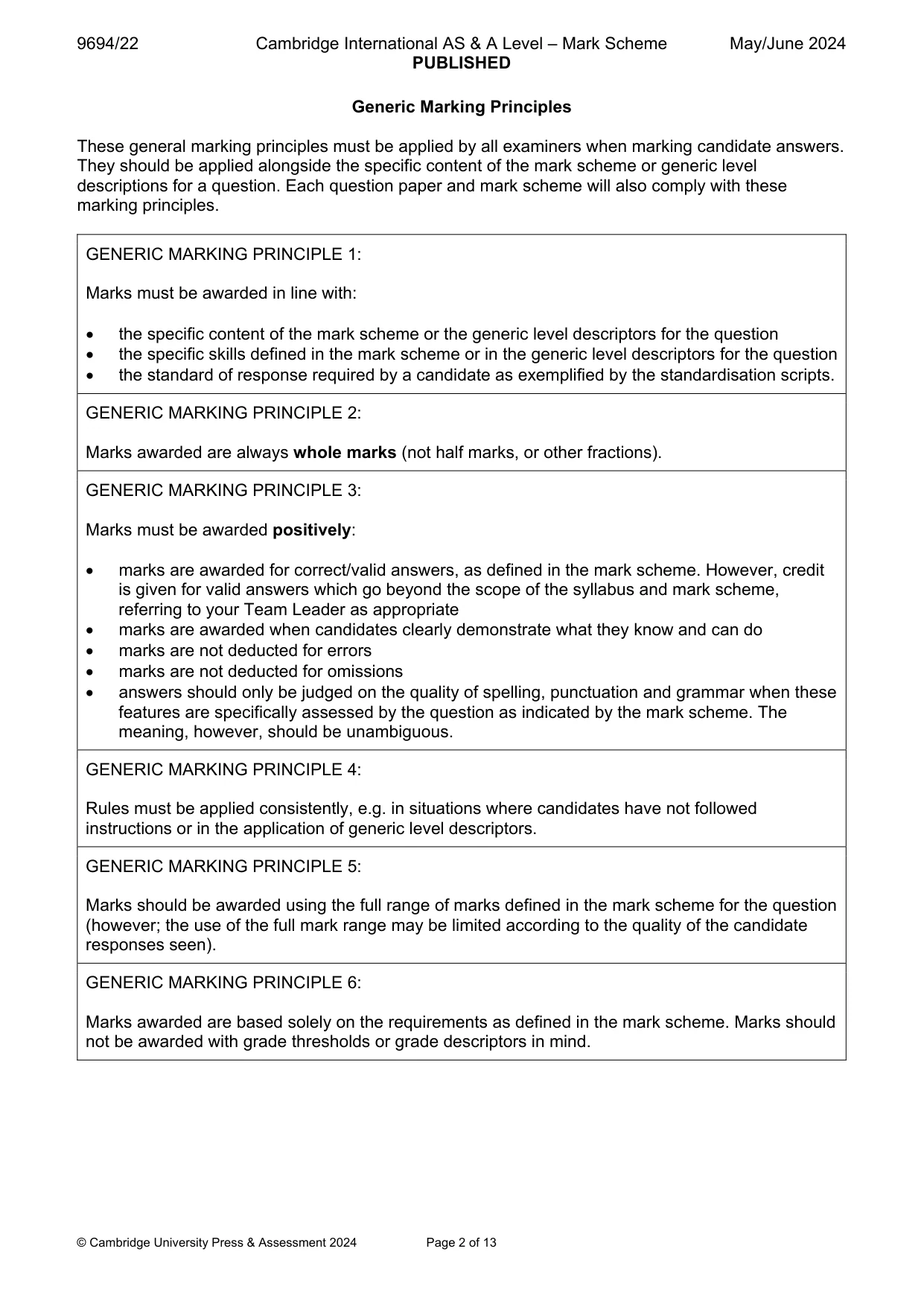
9694/22 Cambridge International AS & A Level – Mark Scheme PUBLISHED May/June 2024 © Cambridge University Press & Assessment 2024 Page 2 of 13 Generic Marking Principles These general marking principles must be applied by all examiners when marking candidate answers. They should be applied alongside the specific content of the mark scheme or generic level descriptions for a question. Each question paper and mark scheme will also comply with these marking principles. GENERIC MARKING PRINCIPLE 1: Marks must be awarded in line with: the specific content of the mark scheme or the generic level descriptors for the question the specific skills defined in the mark scheme or in the generic level descriptors for the question the standard of response required by a candidate as exemplified by the standardisation scripts. GENERIC MARKING PRINCIPLE 2: Marks awarded are always whole marks (not half marks, or other fractions). GENERIC MARKING PRINCIPLE 3: Marks must be awarded positively: marks are awarded for correct/valid answers, as defined in the mark scheme. However, credit is given for valid answers which go beyond the scope of the syllabus and mark scheme, referring to your Team Leader as appropriate marks are awarded when candidates clearly demonstrate what they know and can do marks are not deducted for errors marks are not deducted for omissions answers should only be judged on the quality of spelling, punctuation and grammar when these features are specifically assessed by the question as indicated by the mark scheme. The meaning, however, should be unambiguous. GENERIC MARKING PRINCIPLE 4: Rules must be applied consistently, e.g. in situations where candidates have not followed instructions or in the application of generic level descriptors. GENERIC MARKING PRINCIPLE 5: Marks should be awarded using the full range of marks defined in the mark scheme for the question (however; the use of the full mark range may be limited according to the quality of the candidate responses seen). GENERIC MARKING PRINCIPLE 6: Marks awarded are based solely on the requirements as defined in the mark scheme. Marks should not be awarded with grade thresholds or grade descriptors in mind.
Mark scheme, page 3
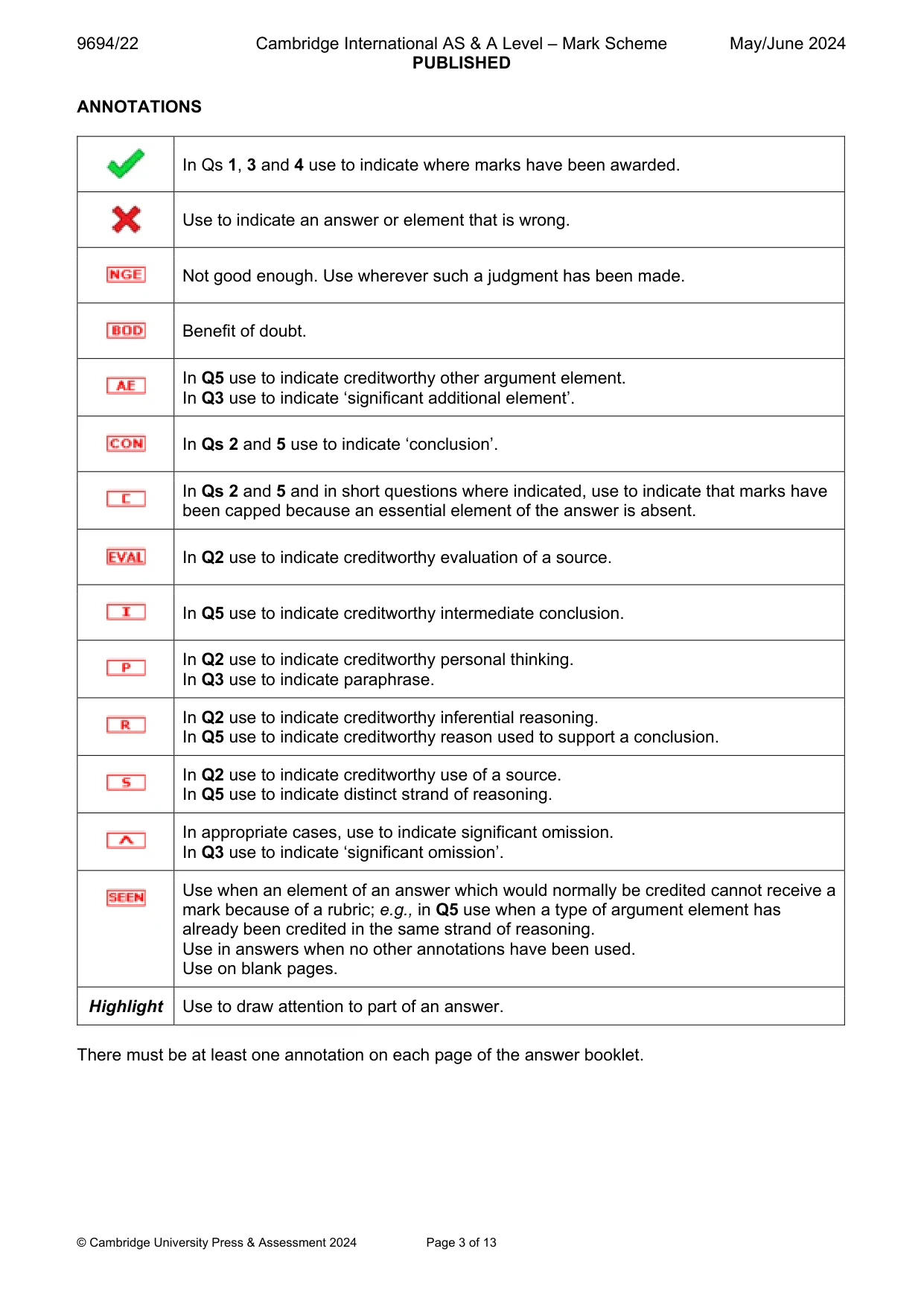
9694/22 Cambridge International AS & A Level – Mark Scheme PUBLISHED May/June 2024 © Cambridge University Press & Assessment 2024 Page 3 of 13 ANNOTATIONS In Qs 1, 3 and 4 use to indicate where marks have been awarded. Use to indicate an answer or element that is wrong. Not good enough. Use wherever such a judgment has been made. Benefit of doubt. In Q5 use to indicate creditworthy other argument element. In Q3 use to indicate ‘significant additional element’. In Qs 2 and 5 use to indicate ‘conclusion’. In Qs 2 and 5 and in short questions where indicated, use to indicate that marks have been capped because an essential element of the answer is absent. In Q2 use to indicate creditworthy evaluation of a source. In Q5 use to indicate creditworthy intermediate conclusion. In Q2 use to indicate creditworthy personal thinking. In Q3 use to indicate paraphrase. In Q2 use to indicate creditworthy inferential reasoning. In Q5 use to indicate creditworthy reason used to support a conclusion. In Q2 use to indicate creditworthy use of a source. In Q5 use to indicate distinct strand of reasoning. In appropriate cases, use to indicate significant omission. In Q3 use to indicate ‘significant omission’. Use when an element of an answer which would normally be credited cannot receive a mark because of a rubric; e.g., in Q5 use when a type of argument element has already been credited in the same strand of reasoning. Use in answers when no other annotations have been used. Use on blank pages. Highlight Use to draw attention to part of an answer. There must be at least one annotation on each page of the answer booklet.
Mark scheme, page 4
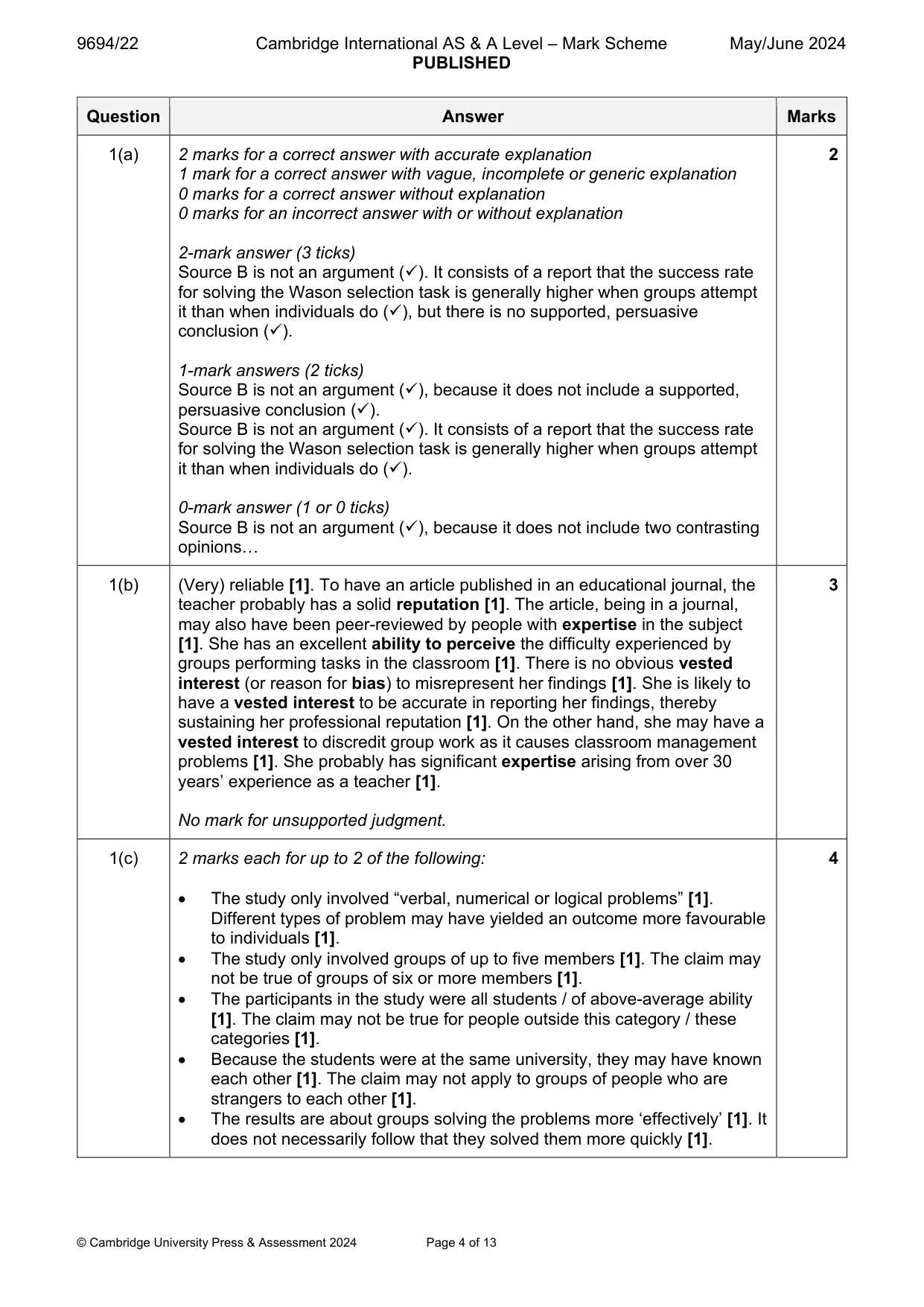
9694/22 Cambridge International AS & A Level – Mark Scheme PUBLISHED May/June 2024 © Cambridge University Press & Assessment 2024 Page 4 of 13 Question Answer Marks 1(a) 2 marks for a correct answer with accurate explanation 1 mark for a correct answer with vague, incomplete or generic explanation 0 marks for a correct answer without explanation 0 marks for an incorrect answer with or without explanation 2-mark answer (3 ticks) Source B is not an argument (). It consists of a report that the success rate for solving the Wason selection task is generally higher when groups attempt it than when individuals do (), but there is no supported, persuasive conclusion (). 1-mark answers (2 ticks) Source B is not an argument (), because it does not include a supported, persuasive conclusion (). Source B is not an argument (). It consists of a report that the success rate for solving the Wason selection task is generally higher when groups attempt it than when individuals do (). 0-mark answer (1 or 0 ticks) Source B is not an argument (), because it does not include two contrasting opinions… 2 1(b) (Very) reliable [1]. To have an article published in an educational journal, the teacher probably has a solid reputation [1]. The article, being in a journal, may also have been peer-reviewed by people with expertise in the subject [1]. She has an excellent ability to perceive the difficulty experienced by groups performing tasks in the classroom [1]. There is no obvious vested interest (or reason for bias) to misrepresent her findings [1]. She is likely to have a vested interest to be accurate in reporting her findings, thereby sustaining her professional reputation [1]. On the other hand, she may have a vested interest to discredit group work as it causes classroom management problems [1]. She probably has significant expertise arising from over 30 years’ experience as a teacher [1]. No mark for unsupported judgment. 3 1(c) 2 marks each for up to 2 of the following: The study only involved “verbal, numerical or logical problems” [1]. Different types of problem may have yielded an outcome more favourable to individuals [1]. The study only involved groups of up to five members [1]. The claim may not be true of groups of six or more members [1]. The participants in the study were all students / of above-average ability [1]. The claim may not be true for people outside this category / these categories [1]. Because the students were at the same university, they may have known each other [1]. The claim may not apply to groups of people who are strangers to each other [1]. The results are about groups solving the problems more ‘effectively’ [1]. It does not necessarily follow that they solved them more quickly [1]. 4
Mark scheme, page 5
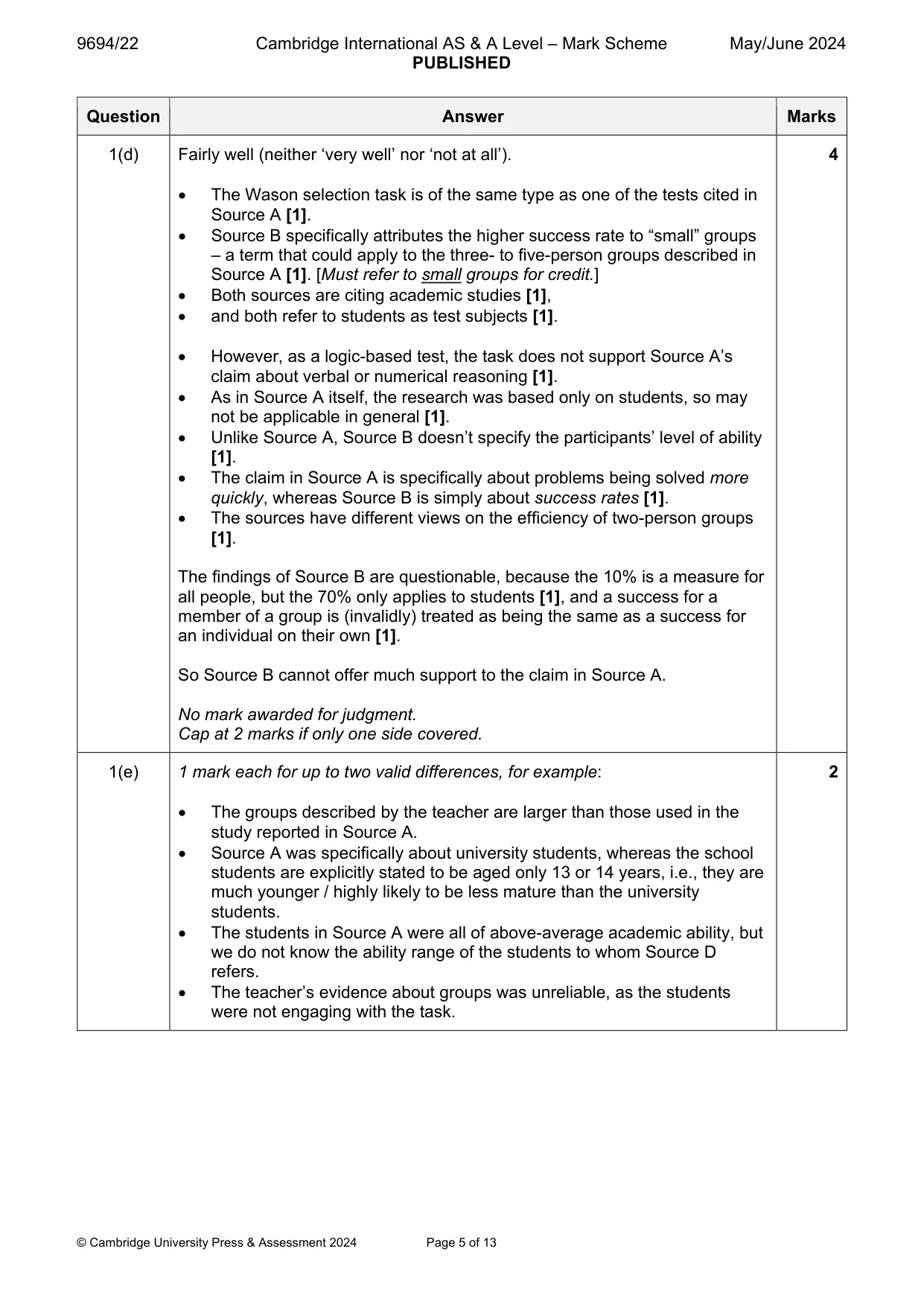
9694/22 Cambridge International AS & A Level – Mark Scheme PUBLISHED May/June 2024 © Cambridge University Press & Assessment 2024 Page 5 of 13 Question Answer Marks 1(d) Fairly well (neither ‘very well’ nor ‘not at all’). The Wason selection task is of the same type as one of the tests cited in Source A [1]. Source B specifically attributes the higher success rate to “small” groups – a term that could apply to the three- to five-person groups described in Source A [1]. [Must refer to small groups for credit.] Both sources are citing academic studies [1], and both refer to students as test subjects [1]. However, as a logic-based test, the task does not support Source A’s claim about verbal or numerical reasoning [1]. As in Source A itself, the research was based only on students, so may not be applicable in general [1]. Unlike Source A, Source B doesn’t specify the participants’ level of ability [1]. The claim in Source A is specifically about problems being solved more quickly, whereas Source B is simply about success rates [1]. The sources have different views on the efficiency of two-person groups [1]. The findings of Source B are questionable, because the 10% is a measure for all people, but the 70% only applies to students [1], and a success for a member of a group is (invalidly) treated as being the same as a success for an individual on their own [1]. So Source B cannot offer much support to the claim in Source A. No mark awarded for judgment. Cap at 2 marks if only one side covered. 4 1(e) 1 mark each for up to two valid differences, for example: The groups described by the teacher are larger than those used in the study reported in Source A. Source A was specifically about university students, whereas the school students are explicitly stated to be aged only 13 or 14 years, i.e., they are much younger / highly likely to be less mature than the university students. The students in Source A were all of above-average academic ability, but we do not know the ability range of the students to whom Source D refers. The teacher’s evidence about groups was unreliable, as the students were not engaging with the task. 2
Mark scheme, page 6
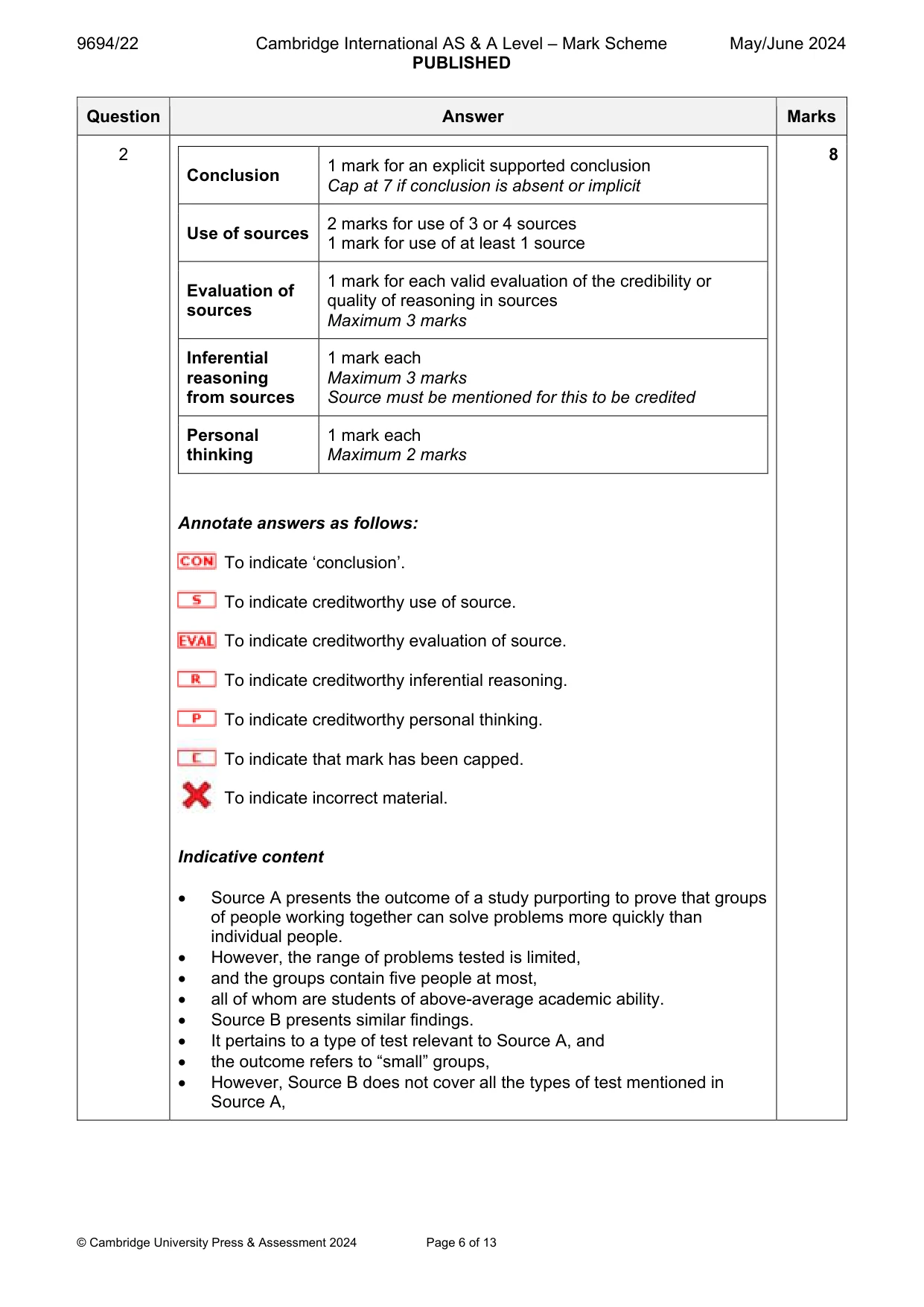
9694/22 Cambridge International AS & A Level – Mark Scheme PUBLISHED May/June 2024 © Cambridge University Press & Assessment 2024 Page 6 of 13 Question Answer Marks 2 Conclusion 1 mark for an explicit supported conclusion Cap at 7 if conclusion is absent or implicit Use of sources 2 marks for use of 3 or 4 sources 1 mark for use of at least 1 source Evaluation of sources 1 mark for each valid evaluation of the credibility or quality of reasoning in sources Maximum 3 marks Inferential reasoning from sources 1 mark each Maximum 3 marks Source must be mentioned for this to be credited Personal thinking 1 mark each Maximum 2 marks Annotate answers as follows: To indicate ‘conclusion’. To indicate creditworthy use of source. To indicate creditworthy evaluation of source. To indicate creditworthy inferential reasoning. To indicate creditworthy personal thinking. To indicate that mark has been capped. To indicate incorrect material. Indicative content Source A presents the outcome of a study purporting to prove that groups of people working together can solve problems more quickly than individual people. However, the range of problems tested is limited, and the groups contain five people at most, all of whom are students of above-average academic ability. Source B presents similar findings. It pertains to a type of test relevant to Source A, and the outcome refers to “small” groups, However, Source B does not cover all the types of test mentioned in Source A, 8
Mark scheme, page 7
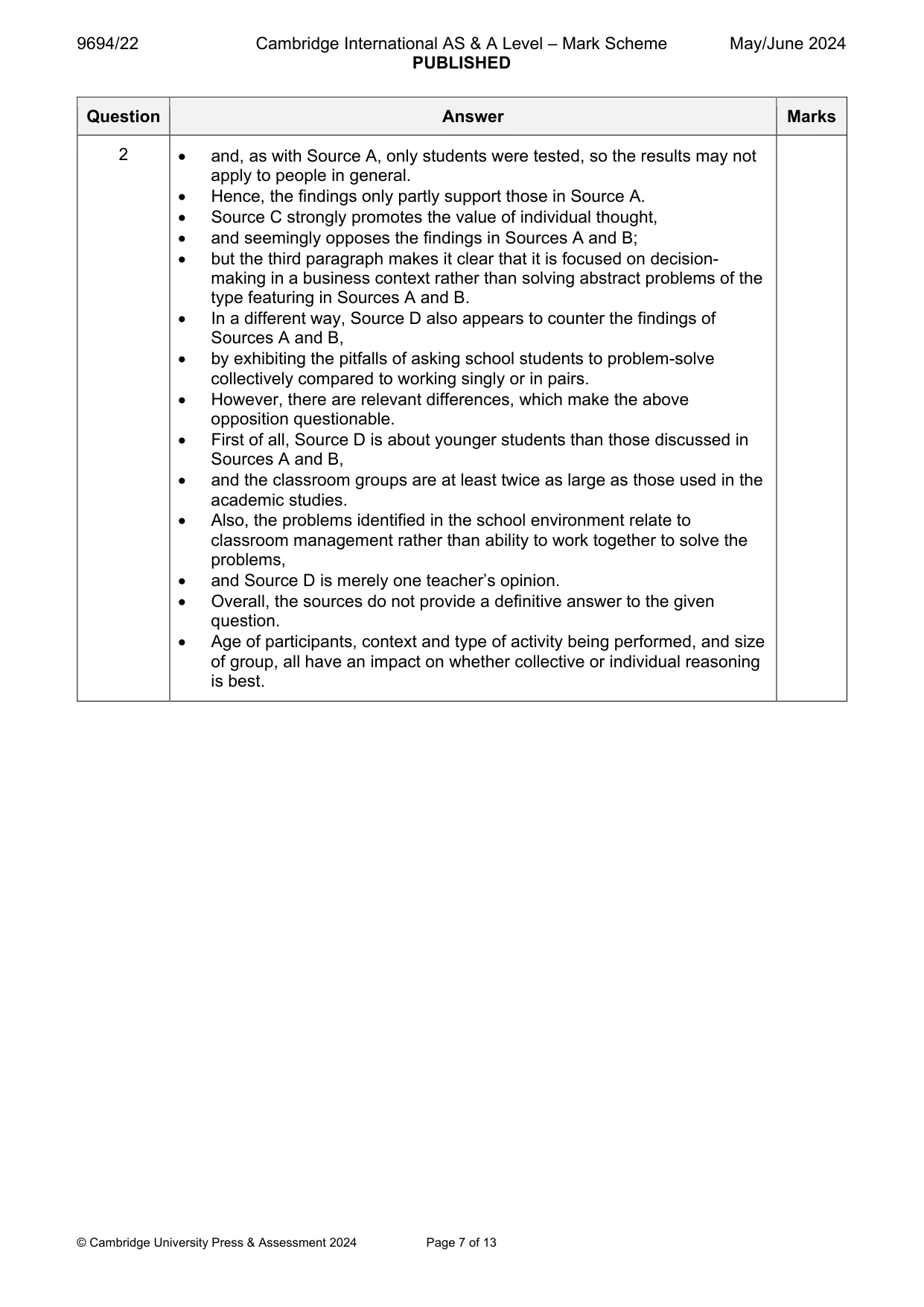
9694/22 Cambridge International AS & A Level – Mark Scheme PUBLISHED May/June 2024 © Cambridge University Press & Assessment 2024 Page 7 of 13 Question Answer Marks 2 and, as with Source A, only students were tested, so the results may not apply to people in general. Hence, the findings only partly support those in Source A. Source C strongly promotes the value of individual thought, and seemingly opposes the findings in Sources A and B; but the third paragraph makes it clear that it is focused on decision- making in a business context rather than solving abstract problems of the type featuring in Sources A and B. In a different way, Source D also appears to counter the findings of Sources A and B, by exhibiting the pitfalls of asking school students to problem-solve collectively compared to working singly or in pairs. However, there are relevant differences, which make the above opposition questionable. First of all, Source D is about younger students than those discussed in Sources A and B, and the classroom groups are at least twice as large as those used in the academic studies. Also, the problems identified in the school environment relate to classroom management rather than ability to work together to solve the problems, and Source D is merely one teacher’s opinion. Overall, the sources do not provide a definitive answer to the given question. Age of participants, context and type of activity being performed, and size of group, all have an impact on whether collective or individual reasoning is best.
Mark scheme, page 8
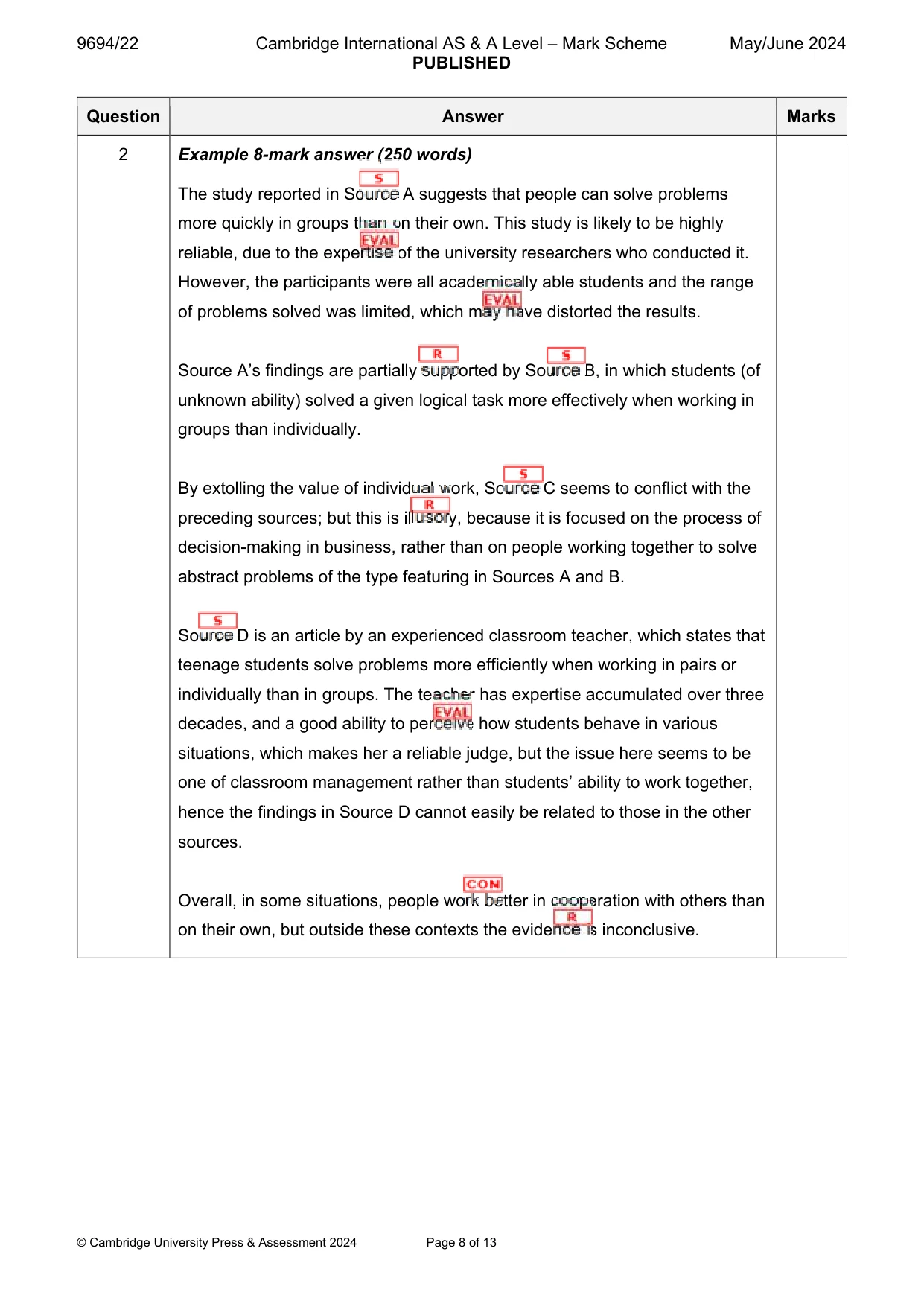
9694/22 Cambridge International AS & A Level – Mark Scheme PUBLISHED May/June 2024 © Cambridge University Press & Assessment 2024 Page 8 of 13 Question Answer Marks 2 Example 8-mark answer (250 words) The study reported in Source A suggests that people can solve problems more quickly in groups than on their own. This study is likely to be highly reliable, due to the expertise of the university researchers who conducted it. However, the participants were all academically able students and the range of problems solved was limited, which may have distorted the results. Source A’s findings are partially supported by Source B, in which students (of unknown ability) solved a given logical task more effectively when working in groups than individually. By extolling the value of individual work, Source C seems to conflict with the preceding sources; but this is illusory, because it is focused on the process of decision-making in business, rather than on people working together to solve abstract problems of the type featuring in Sources A and B. Source D is an article by an experienced classroom teacher, which states that teenage students solve problems more efficiently when working in pairs or individually than in groups. The teacher has expertise accumulated over three decades, and a good ability to perceive how students behave in various situations, which makes her a reliable judge, but the issue here seems to be one of classroom management rather than students’ ability to work together, hence the findings in Source D cannot easily be related to those in the other sources. Overall, in some situations, people work better in cooperation with others than on their own, but outside these contexts the evidence is inconclusive.
Mark scheme, page 9
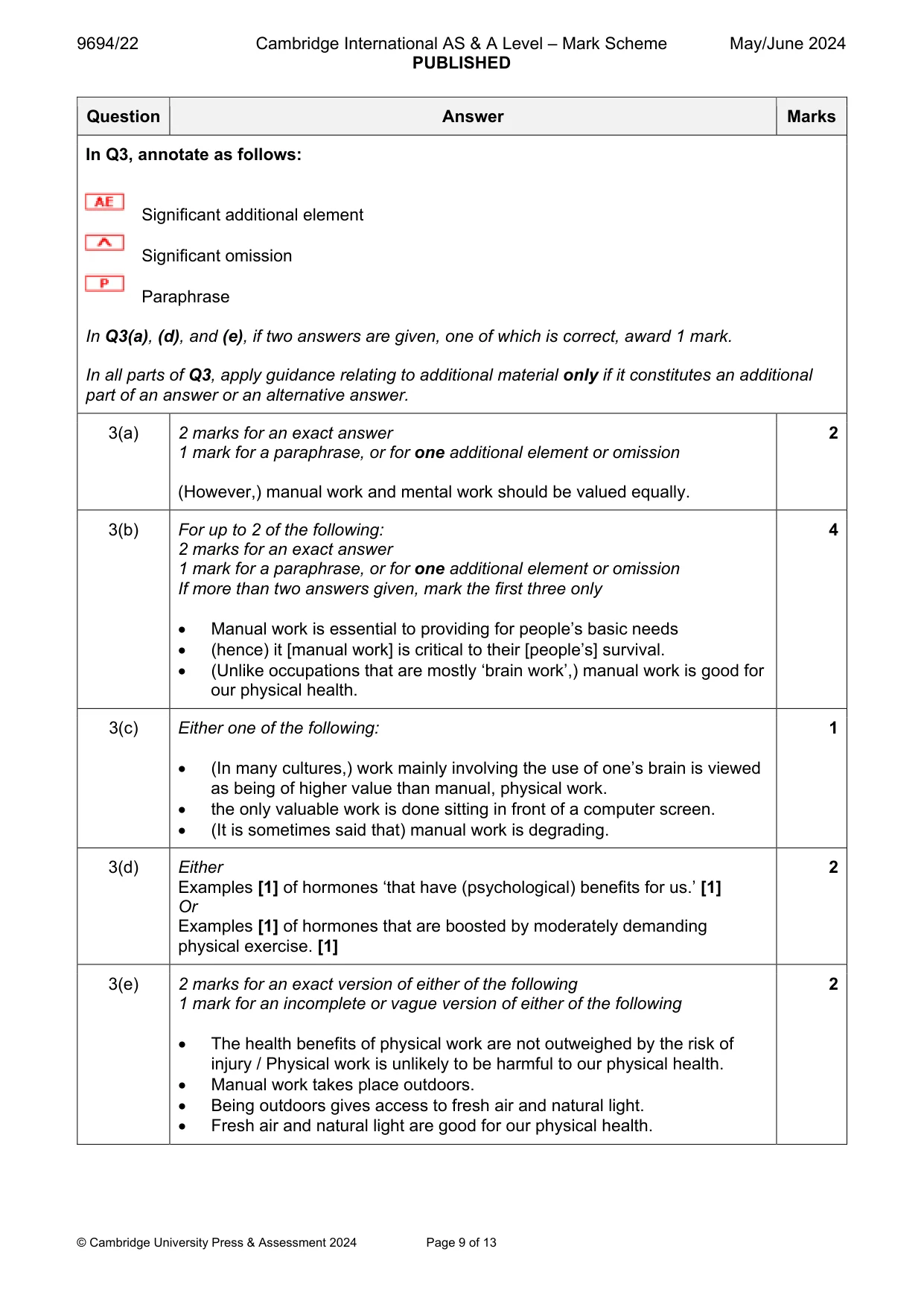
9694/22 Cambridge International AS & A Level – Mark Scheme PUBLISHED May/June 2024 © Cambridge University Press & Assessment 2024 Page 9 of 13 Question Answer Marks In Q3, annotate as follows: Significant additional element Significant omission Paraphrase In Q3(a), (d), and (e), if two answers are given, one of which is correct, award 1 mark. In all parts of Q3, apply guidance relating to additional material only if it constitutes an additional part of an answer or an alternative answer. 3(a) 2 marks for an exact answer 1 mark for a paraphrase, or for one additional element or omission (However,) manual work and mental work should be valued equally. 2 3(b) For up to 2 of the following: 2 marks for an exact answer 1 mark for a paraphrase, or for one additional element or omission If more than two answers given, mark the first three only Manual work is essential to providing for people’s basic needs (hence) it [manual work] is critical to their [people’s] survival. (Unlike occupations that are mostly ‘brain work’,) manual work is good for our physical health. 4 3(c) Either one of the following: (In many cultures,) work mainly involving the use of one’s brain is viewed as being of higher value than manual, physical work. the only valuable work is done sitting in front of a computer screen. (It is sometimes said that) manual work is degrading. 1 3(d) Either Examples [1] of hormones ‘that have (psychological) benefits for us.’ [1] Or Examples [1] of hormones that are boosted by moderately demanding physical exercise. [1] 2 3(e) 2 marks for an exact version of either of the following 1 mark for an incomplete or vague version of either of the following The health benefits of physical work are not outweighed by the risk of injury / Physical work is unlikely to be harmful to our physical health. Manual work takes place outdoors. Being outdoors gives access to fresh air and natural light. Fresh air and natural light are good for our physical health. 2
Mark scheme, page 10
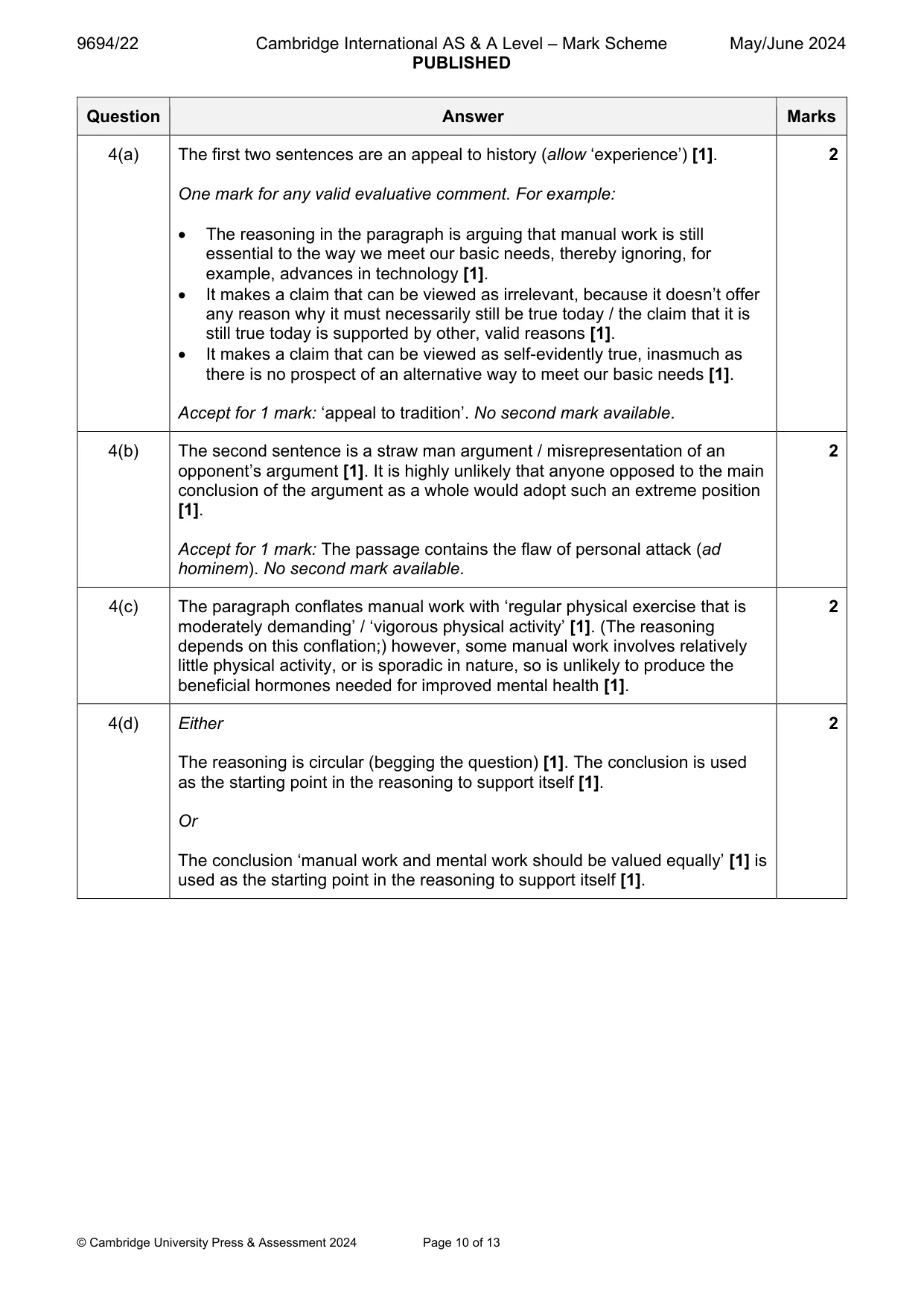
9694/22 Cambridge International AS & A Level – Mark Scheme PUBLISHED May/June 2024 © Cambridge University Press & Assessment 2024 Page 10 of 13 Question Answer Marks 4(a) The first two sentences are an appeal to history (allow ‘experience’) [1]. One mark for any valid evaluative comment. For example: The reasoning in the paragraph is arguing that manual work is still essential to the way we meet our basic needs, thereby ignoring, for example, advances in technology [1]. It makes a claim that can be viewed as irrelevant, because it doesn’t offer any reason why it must necessarily still be true today / the claim that it is still true today is supported by other, valid reasons [1]. It makes a claim that can be viewed as self-evidently true, inasmuch as there is no prospect of an alternative way to meet our basic needs [1]. Accept for 1 mark: ‘appeal to tradition’. No second mark available. 2 4(b) The second sentence is a straw man argument / misrepresentation of an opponent’s argument [1]. It is highly unlikely that anyone opposed to the main conclusion of the argument as a whole would adopt such an extreme position [1]. Accept for 1 mark: The passage contains the flaw of personal attack (ad hominem). No second mark available. 2 4(c) The paragraph conflates manual work with ‘regular physical exercise that is moderately demanding’ / ‘vigorous physical activity’ [1]. (The reasoning depends on this conflation;) however, some manual work involves relatively little physical activity, or is sporadic in nature, so is unlikely to produce the beneficial hormones needed for improved mental health [1]. 2 4(d) Either The reasoning is circular (begging the question) [1]. The conclusion is used as the starting point in the reasoning to support itself [1]. Or The conclusion ‘manual work and mental work should be valued equally’ [1] is used as the starting point in the reasoning to support itself [1]. 2
Mark scheme, page 11
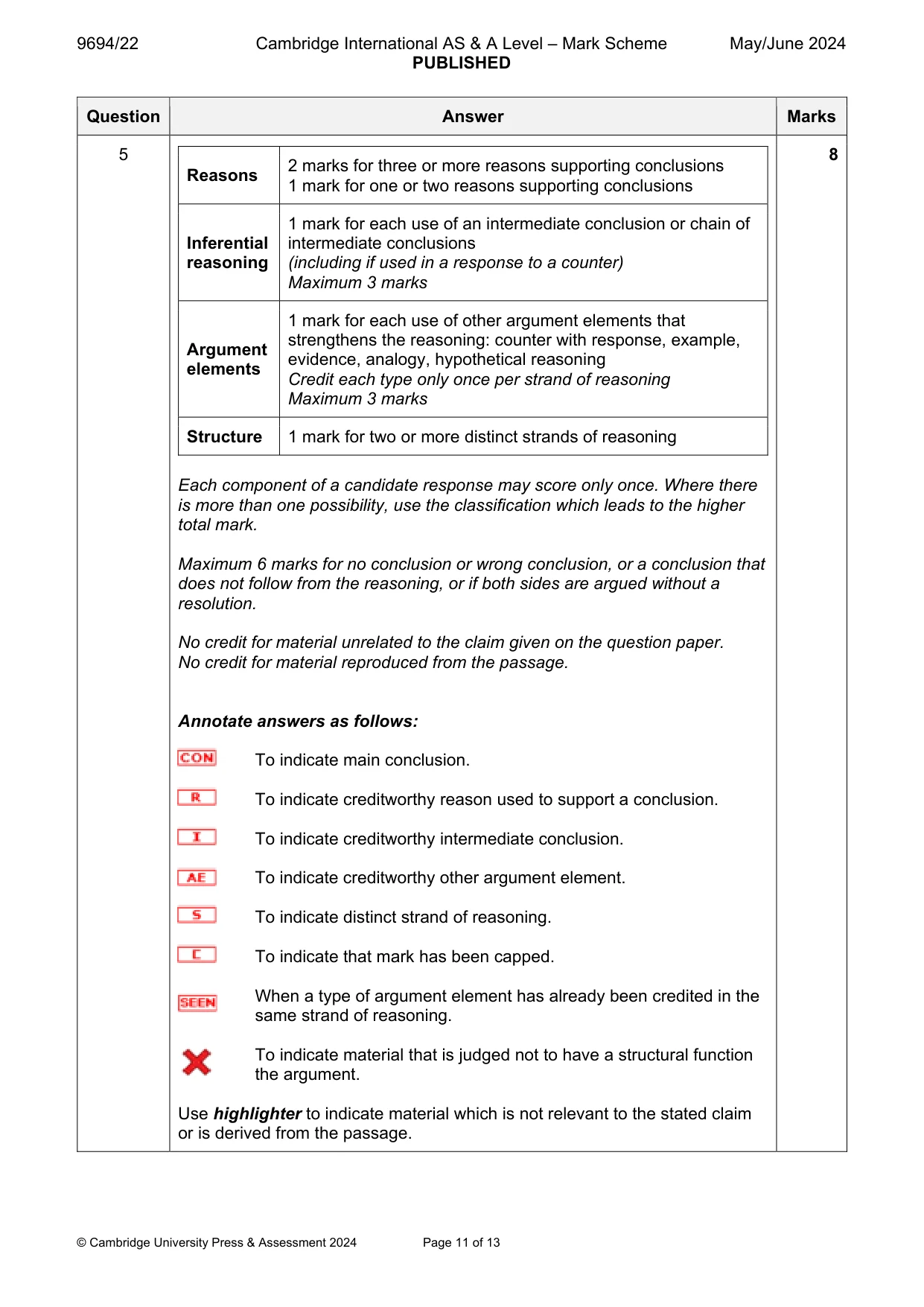
9694/22 Cambridge International AS & A Level – Mark Scheme PUBLISHED May/June 2024 © Cambridge University Press & Assessment 2024 Page 11 of 13 Question Answer Marks 5 Reasons 2 marks for three or more reasons supporting conclusions 1 mark for one or two reasons supporting conclusions Inferential reasoning 1 mark for each use of an intermediate conclusion or chain of intermediate conclusions (including if used in a response to a counter) Maximum 3 marks Argument elements 1 mark for each use of other argument elements that strengthens the reasoning: counter with response, example, evidence, analogy, hypothetical reasoning Credit each type only once per strand of reasoning Maximum 3 marks Structure 1 mark for two or more distinct strands of reasoning Each component of a candidate response may score only once. Where there is more than one possibility, use the classification which leads to the higher total mark. Maximum 6 marks for no conclusion or wrong conclusion, or a conclusion that does not follow from the reasoning, or if both sides are argued without a resolution. No credit for material unrelated to the claim given on the question paper. No credit for material reproduced from the passage. Annotate answers as follows: To indicate main conclusion. To indicate creditworthy reason used to support a conclusion. To indicate creditworthy intermediate conclusion. To indicate creditworthy other argument element. To indicate distinct strand of reasoning. To indicate that mark has been capped. When a type of argument element has already been credited in the same strand of reasoning. To indicate material that is judged not to have a structural function in the argument. Use highlighter to indicate material which is not relevant to the stated claim or is derived from the passage. 8
Mark scheme, page 12
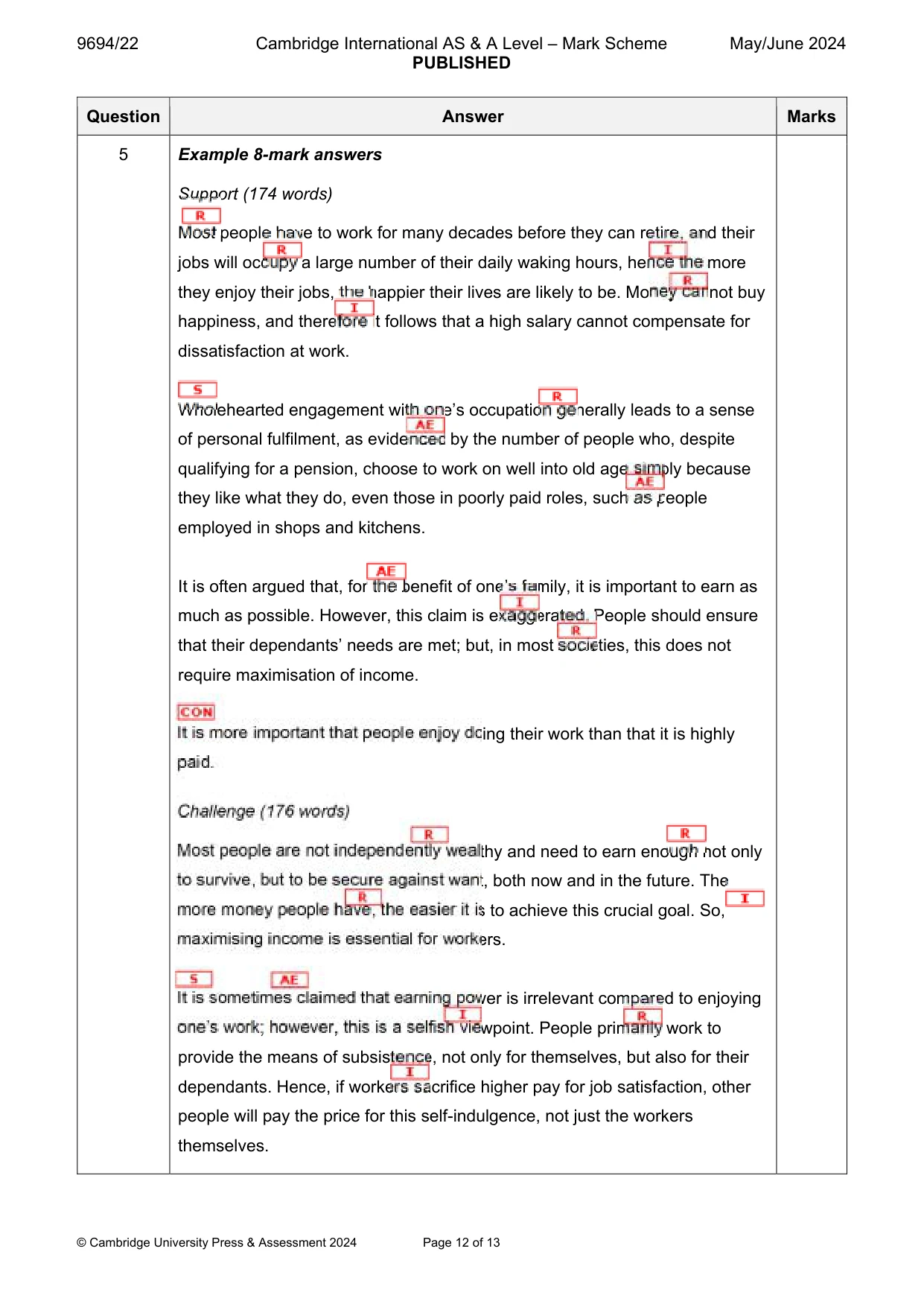
9694/22 Cambridge International AS & A Level – Mark Scheme PUBLISHED May/June 2024 © Cambridge University Press & Assessment 2024 Page 12 of 13 Question Answer Marks 5 Example 8-mark answers Support (174 words) Most people have to work for many decades before they can retire, and their jobs will occupy a large number of their daily waking hours, hence the more they enjoy their jobs, the happier their lives are likely to be. Money cannot buy happiness, and therefore it follows that a high salary cannot compensate for dissatisfaction at work. Wholehearted engagement with one’s occupation generally leads to a sense of personal fulfilment, as evidenced by the number of people who, despite qualifying for a pension, choose to work on well into old age simply because they like what they do, even those in poorly paid roles, such as people employed in shops and kitchens. It is often argued that, for the benefit of one’s family, it is important to earn as much as possible. However, this claim is exaggerated. People should ensure that their dependants’ needs are met; but, in most societies, this does not require maximisation of income. It is more important that people enjoy doing their work than that it is highly paid. Challenge (176 words) Most people are not independently wealthy and need to earn enough not only to survive, but to be secure against want, both now and in the future. The more money people have, the easier it is to achieve this crucial goal. So, maximising income is essential for workers. It is sometimes claimed that earning power is irrelevant compared to enjoying one’s work; however, this is a selfish viewpoint. People primarily work to provide the means of subsistence, not only for themselves, but also for their dependants. Hence, if workers sacrifice higher pay for job satisfaction, other people will pay the price for this self-indulgence, not just the workers themselves.
Mark scheme, page 13
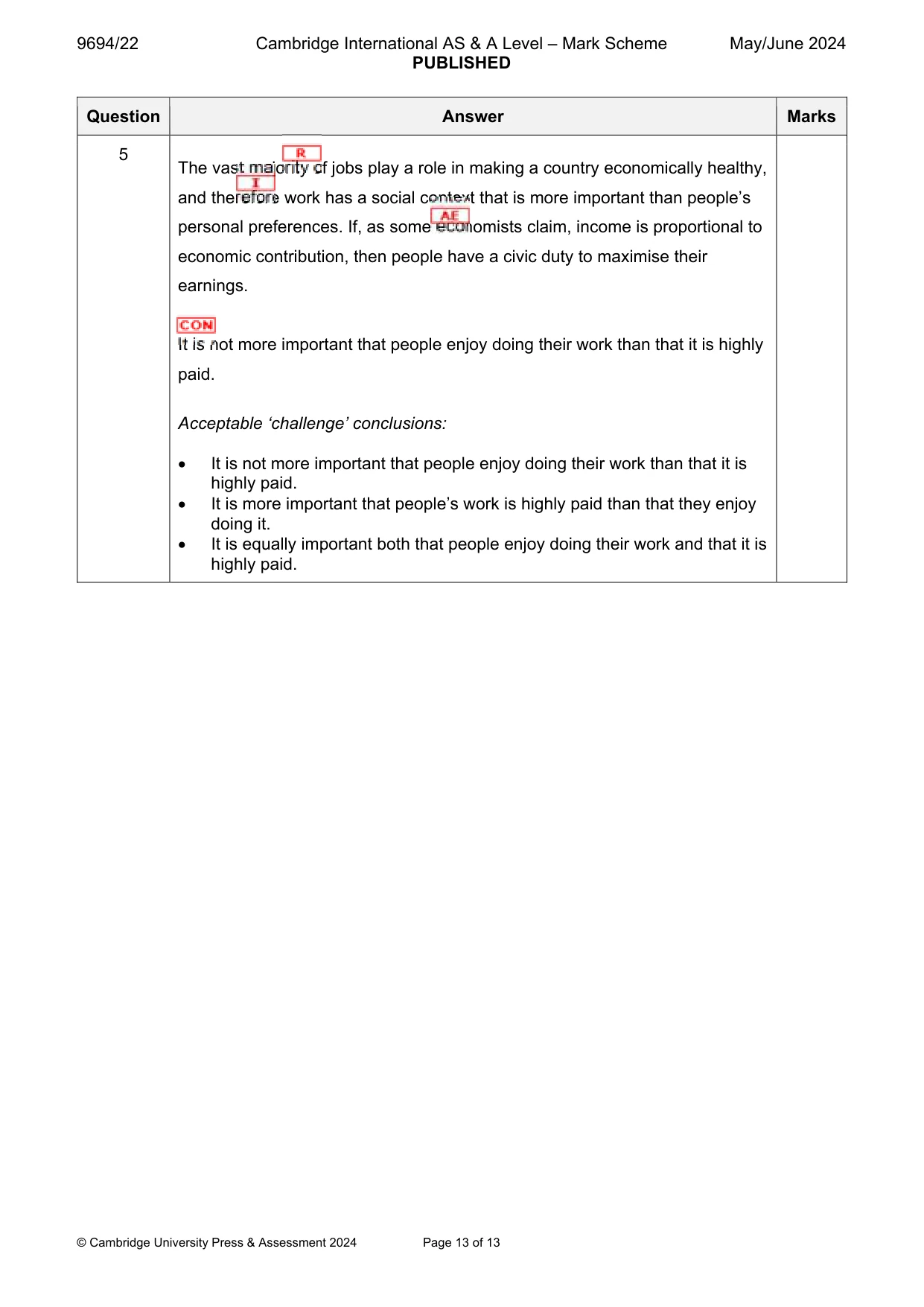
9694/22 Cambridge International AS & A Level – Mark Scheme PUBLISHED May/June 2024 © Cambridge University Press & Assessment 2024 Page 13 of 13 Question Answer Marks 5 The vast majority of jobs play a role in making a country economically healthy, and therefore work has a social context that is more important than people’s personal preferences. If, as some economists claim, income is proportional to economic contribution, then people have a civic duty to maximise their earnings. It is not more important that people enjoy doing their work than that it is highly paid. Acceptable ‘challenge’ conclusions: It is not more important that people enjoy doing their work than that it is highly paid. It is more important that people’s work is highly paid than that they enjoy doing it. It is equally important both that people enjoy doing their work and that it is highly paid.
What you needed in this session
Cambridge’s own grade thresholds for 2024 May/June, Paper 2 · Variant 2. A higher threshold means an easier paper — the bar moves with how the cohort did.