Cambridge A Level Thinking Skills 9694 — 2023 Oct/Nov Paper 2 · Variant 3
9694/23/O/N/23 · 50 marks · ≈56 min
The question paper and its mark scheme, free to read here and free to download. This is Cambridge’s own paper, exactly as it was sat.
Question paper8 pages



Mark scheme12 pages
Answers below. Sit the paper first if you are practising.
Paper as text
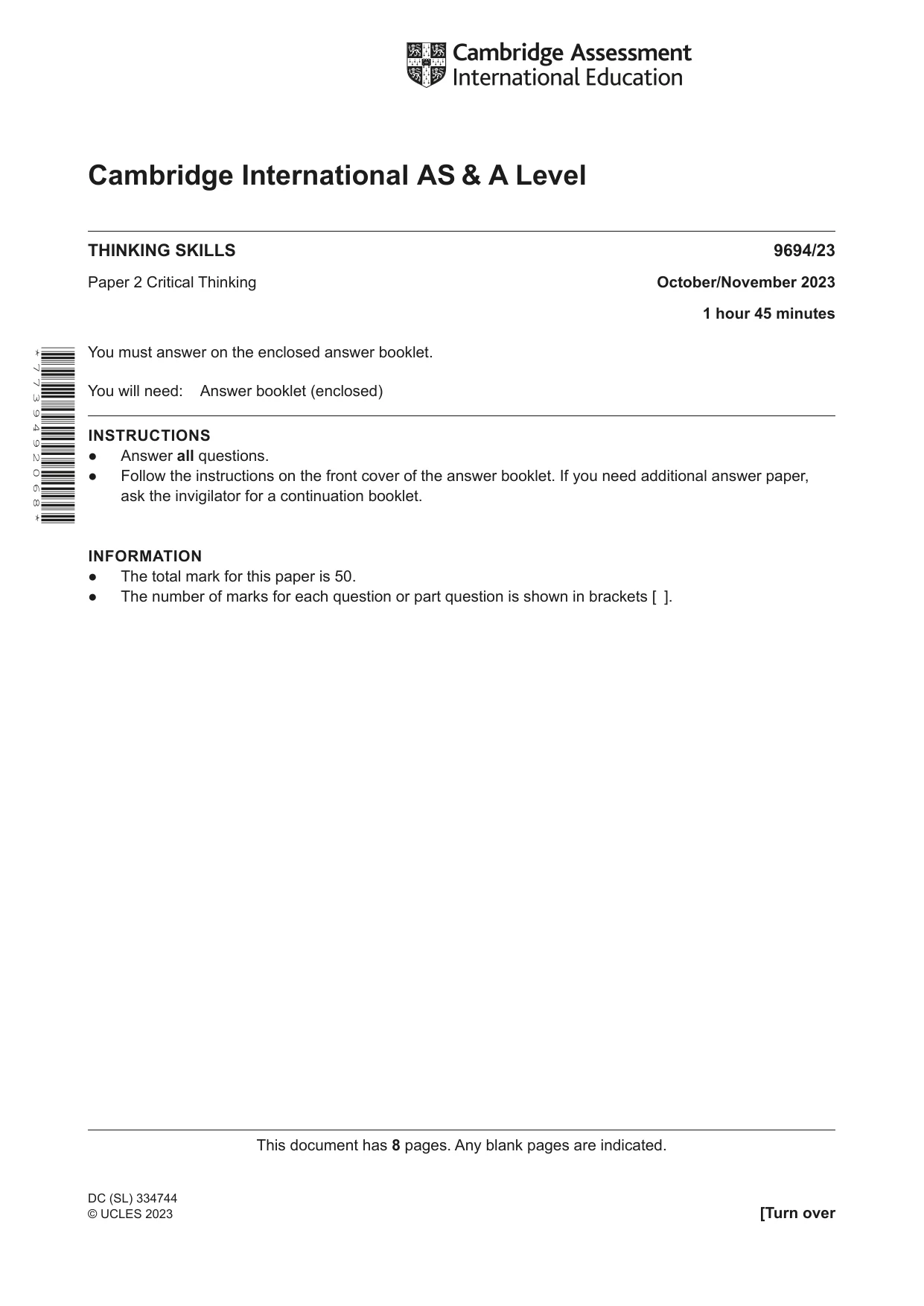
Question paper, page 1
This document has 8 pages. Any blank pages are indicated. [Turn over Cambridge International AS & A Level THINKING SKILLS 9694/23 Paper 2 Critical Thinking October/November 2023 1 hour 45 minutes You must answer on the enclosed answer booklet. You will need: Answer booklet (enclosed) INSTRUCTIONS ● Answer all questions. ● Follow the instructions on the front cover of the answer booklet. If you need additional answer paper, ask the invigilator for a continuation booklet. INFORMATION ● The total mark for this paper is 50. ● The number of marks for each question or part question is shown in brackets [ ]. * 7 7 3 9 4 9 2 0 6 8 * DC (SL) 334744 © UCLES 2023
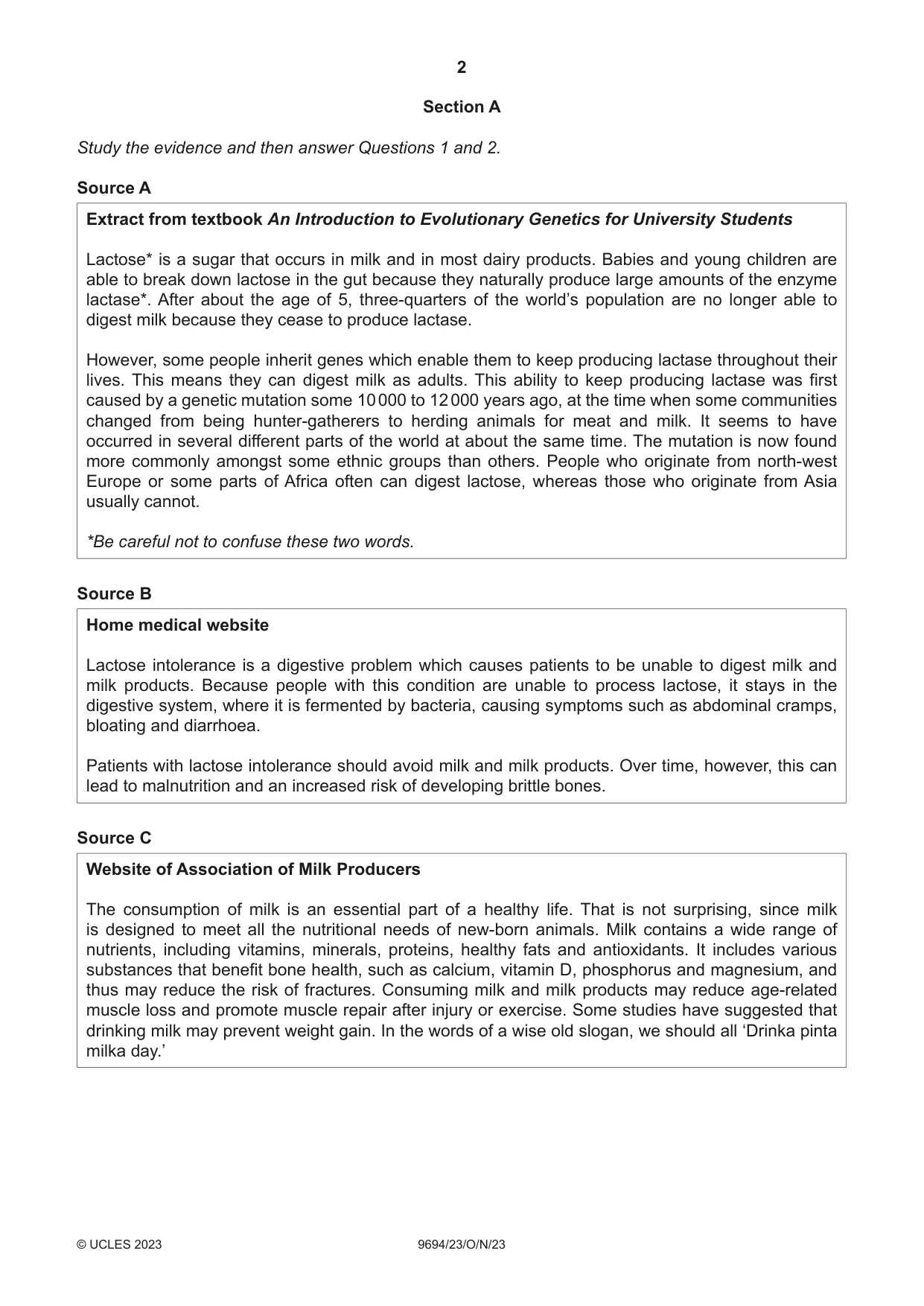
Question paper, page 2
2 9694/23/O/N/23 © UCLES 2023 Section A Study the evidence and then answer Questions 1 and 2. Source A Extract from textbook An Introduction to Evolutionary Genetics for University Students Lactose* is a sugar that occurs in milk and in most dairy products. Babies and young children are able to break down lactose in the gut because they naturally produce large amounts of the enzyme lactase*. After about the age of 5, three-quarters of the world’s population are no longer able to digest milk because they cease to produce lactase. However, some people inherit genes which enable them to keep producing lactase throughout their lives. This means they can digest milk as adults. This ability to keep producing lactase was first caused by a genetic mutation some 10 000 to 12 000 years ago, at the time when some communities changed from being hunter-gatherers to herding animals for meat and milk. It seems to have occurred in several different parts of the world at about the same time. The mutation is now found more commonly amongst some ethnic groups than others. People who originate from north-west Europe or some parts of Africa often can digest lactose, whereas those who originate from Asia usually cannot. *Be careful not to confuse these two words. Source B Home medical website Lactose intolerance is a digestive problem which causes patients to be unable to digest milk and milk products. Because people with this condition are unable to process lactose, it stays in the digestive system, where it is fermented by bacteria, causing symptoms such as abdominal cramps, bloating and diarrhoea. Patients with lactose intolerance should avoid milk and milk products. Over time, however, this can lead to malnutrition and an increased risk of developing brittle bones. Source C Website of Association of Milk Producers The consumption of milk is an essential part of a healthy life. That is not surprising, since milk is designed to meet all the nutritional needs of new-born animals. Milk contains a wide range of nutrients, including vitamins, minerals, proteins, healthy fats and antioxidants. It includes various substances that benefit bone health, such as calcium, vitamin D, phosphorus and magnesium, and thus may reduce the risk of fractures. Consuming milk and milk products may reduce age-related muscle loss and promote muscle repair after injury or exercise. Some studies have suggested that drinking milk may prevent weight gain. In the words of a wise old slogan, we should all ‘Drinka pinta milka day.’
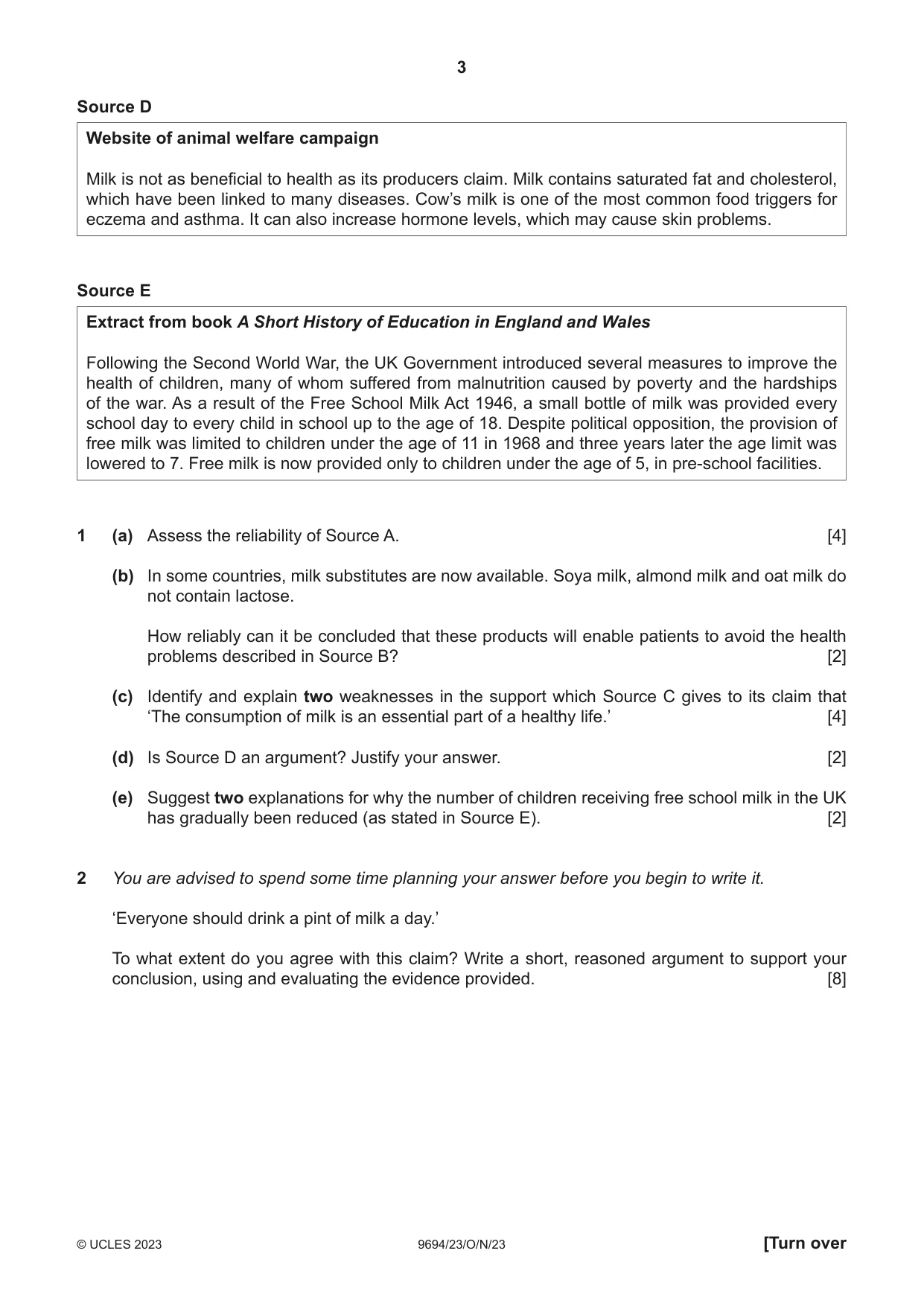
Question paper, page 3
3 9694/23/O/N/23 © UCLES 2023 [Turn over Source D Website of animal welfare campaign Milk is not as beneficial to health as its producers claim. Milk contains saturated fat and cholesterol, which have been linked to many diseases. Cow’s milk is one of the most common food triggers for eczema and asthma. It can also increase hormone levels, which may cause skin problems. Source E Extract from book A Short History of Education in England and Wales Following the Second World War, the UK Government introduced several measures to improve the health of children, many of whom suffered from malnutrition caused by poverty and the hardships of the war. As a result of the Free School Milk Act 1946, a small bottle of milk was provided every school day to every child in school up to the age of 18. Despite political opposition, the provision of free milk was limited to children under the age of 11 in 1968 and three years later the age limit was lowered to 7. Free milk is now provided only to children under the age of 5, in pre-school facilities. 1 (a) Assess the reliability of Source A. [4] (b) In some countries, milk substitutes are now available. Soya milk, almond milk and oat milk do not contain lactose. How reliably can it be concluded that these products will enable patients to avoid the health problems described in Source B? [2] (c) Identify and explain two weaknesses in the support which Source C gives to its claim that ‘The consumption of milk is an essential part of a healthy life.’ [4] (d) Is Source D an argument? Justify your answer. [2] (e) Suggest two explanations for why the number of children receiving free school milk in the UK has gradually been reduced (as stated in Source E). [2] 2 You are advised to spend some time planning your answer before you begin to write it. ‘Everyone should drink a pint of milk a day.’ To what extent do you agree with this claim? Write a short, reasoned argument to support your conclusion, using and evaluating the evidence provided. [8]
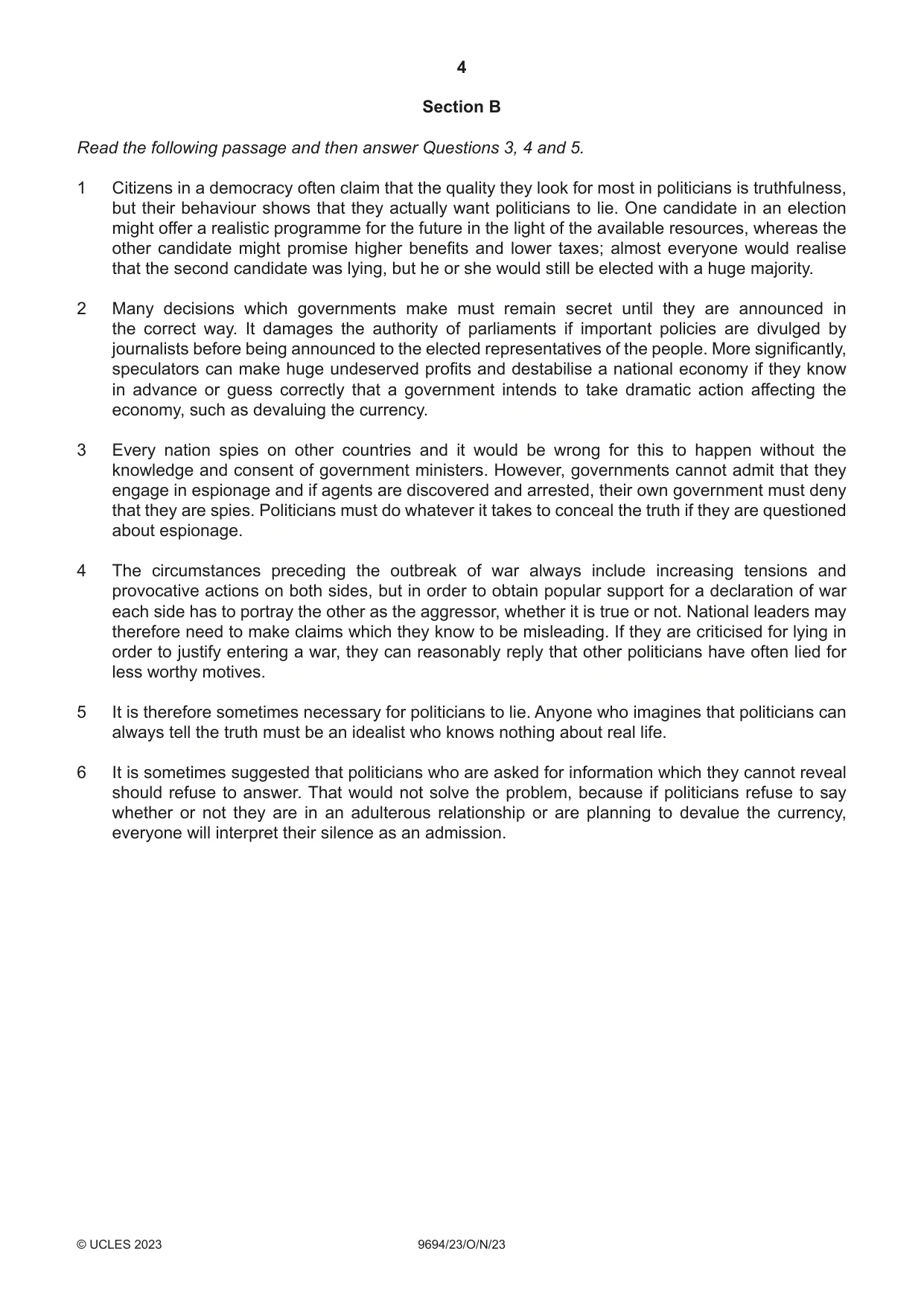
Question paper, page 4
4 9694/23/O/N/23 © UCLES 2023 Section B Read the following passage and then answer Questions 3, 4 and 5. 1 Citizens in a democracy often claim that the quality they look for most in politicians is truthfulness, but their behaviour shows that they actually want politicians to lie. One candidate in an election might offer a realistic programme for the future in the light of the available resources, whereas the other candidate might promise higher benefits and lower taxes; almost everyone would realise that the second candidate was lying, but he or she would still be elected with a huge majority. 2 Many decisions which governments make must remain secret until they are announced in the correct way. It damages the authority of parliaments if important policies are divulged by journalists before being announced to the elected representatives of the people. More significantly, speculators can make huge undeserved profits and destabilise a national economy if they know in advance or guess correctly that a government intends to take dramatic action affecting the economy, such as devaluing the currency. 3 Every nation spies on other countries and it would be wrong for this to happen without the knowledge and consent of government ministers. However, governments cannot admit that they engage in espionage and if agents are discovered and arrested, their own government must deny that they are spies. Politicians must do whatever it takes to conceal the truth if they are questioned about espionage. 4 The circumstances preceding the outbreak of war always include increasing tensions and provocative actions on both sides, but in order to obtain popular support for a declaration of war each side has to portray the other as the aggressor, whether it is true or not. National leaders may therefore need to make claims which they know to be misleading. If they are criticised for lying in order to justify entering a war, they can reasonably reply that other politicians have often lied for less worthy motives. 5 It is therefore sometimes necessary for politicians to lie. Anyone who imagines that politicians can always tell the truth must be an idealist who knows nothing about real life. 6 It is sometimes suggested that politicians who are asked for information which they cannot reveal should refuse to answer. That would not solve the problem, because if politicians refuse to say whether or not they are in an adulterous relationship or are planning to devalue the currency, everyone will interpret their silence as an admission.
Question paper, page 5
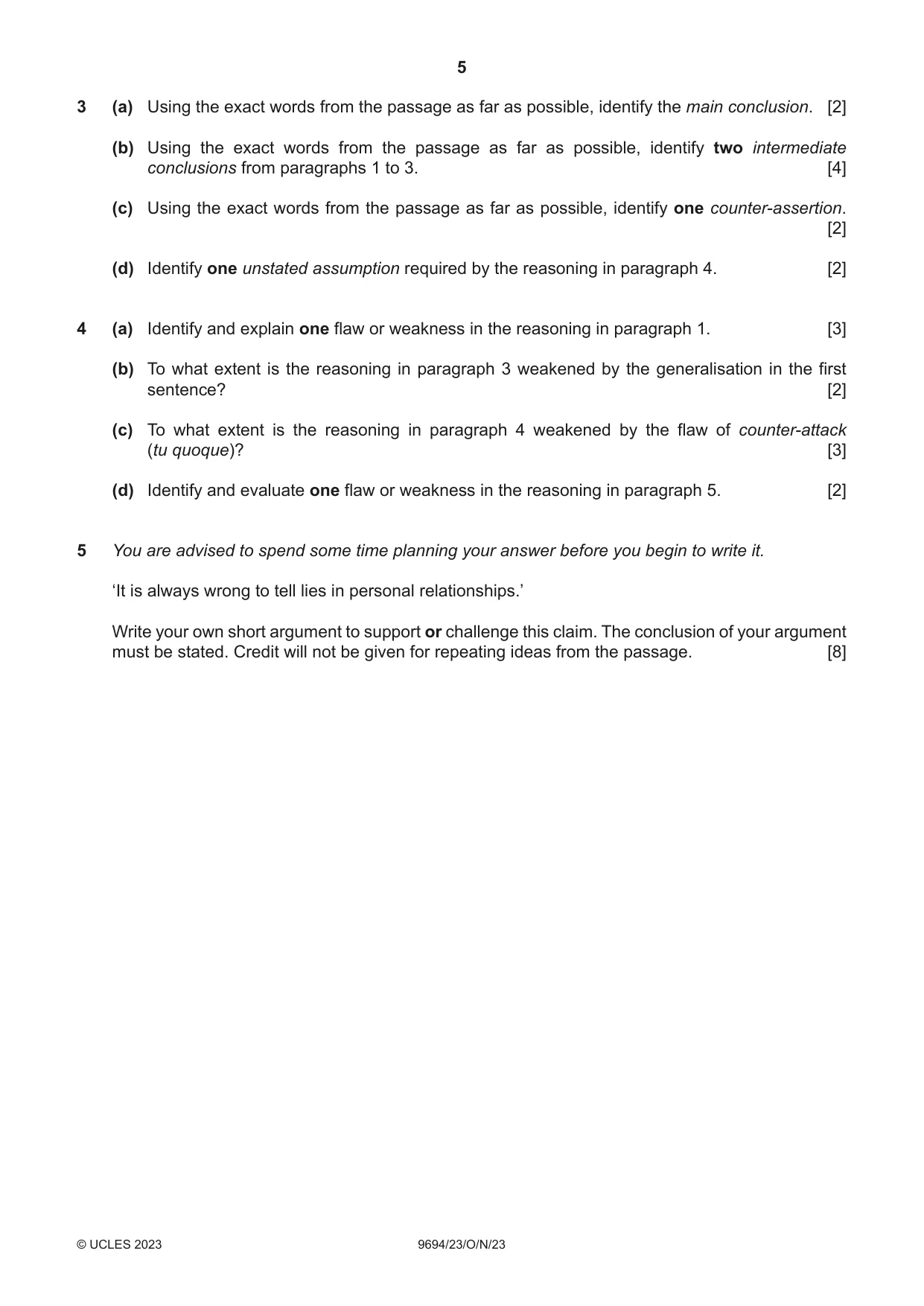
5 9694/23/O/N/23 © UCLES 2023 3 (a) Using the exact words from the passage as far as possible, identify the main conclusion. [2] (b) Using the exact words from the passage as far as possible, identify two intermediate conclusions from paragraphs 1 to 3. [4] (c) Using the exact words from the passage as far as possible, identify one counter-assertion. [2] (d) Identify one unstated assumption required by the reasoning in paragraph 4. [2] 4 (a) Identify and explain one flaw or weakness in the reasoning in paragraph 1. [3] (b) To what extent is the reasoning in paragraph 3 weakened by the generalisation in the first sentence? [2] (c) To what extent is the reasoning in paragraph 4 weakened by the flaw of counter-attack (tu quoque)? [3] (d) Identify and evaluate one flaw or weakness in the reasoning in paragraph 5. [2] 5 You are advised to spend some time planning your answer before you begin to write it. ‘It is always wrong to tell lies in personal relationships.’ Write your own short argument to support or challenge this claim. The conclusion of your argument must be stated. Credit will not be given for repeating ideas from the passage. [8]
Question paper, page 6
6 9694/23/O/N/23 © UCLES 2023 BLANK PAGE
Question paper, page 7
7 9694/23/O/N/23 © UCLES 2023 BLANK PAGE
Question paper, page 8
8 9694/23/O/N/23 © UCLES 2023 Permission to reproduce items where third-party owned material protected by copyright is included has been sought and cleared where possible. Every reasonable effort has been made by the publisher (UCLES) to trace copyright holders, but if any items requiring clearance have unwittingly been included, the publisher will be pleased to make amends at the earliest possible opportunity. To avoid the issue of disclosure of answer-related information to candidates, all copyright acknowledgements are reproduced online in the Cambridge Assessment International Education Copyright Acknowledgements Booklet. This is produced for each series of examinations and is freely available to download at www.cambridgeinternational.org after the live examination series. Cambridge Assessment International Education is part of Cambridge Assessment. Cambridge Assessment is the brand name of the University of Cambridge Local Examinations Syndicate (UCLES), which is a department of the University of Cambridge. BLANK PAGE
Mark scheme, page 1
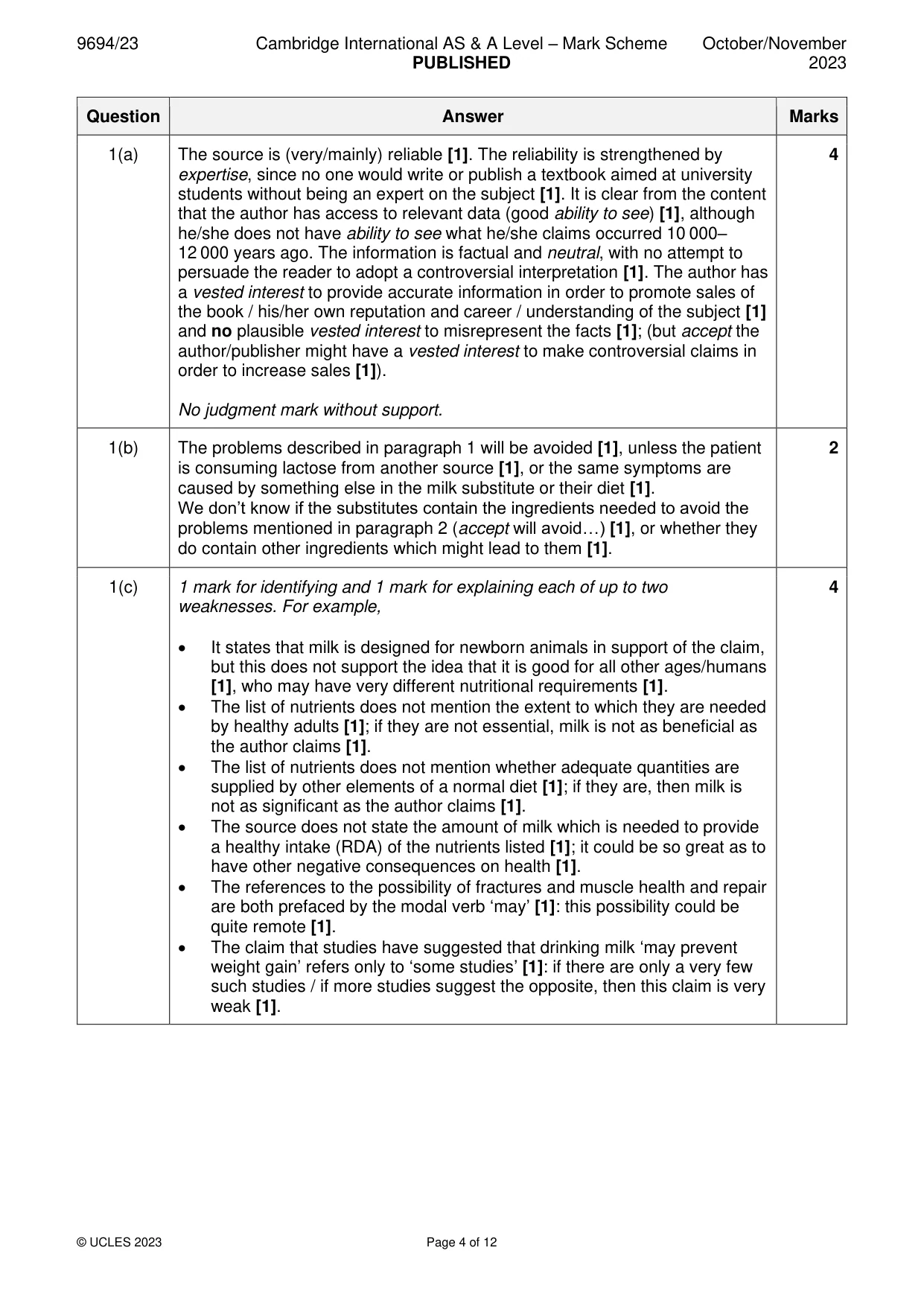
This document consists of 12 printed pages. © UCLES 2023 [Turn over Cambridge International AS & A Level THINKING SKILLS 9694/23 Paper 2 Critical Thinking October/November 2023 MARK SCHEME Maximum Mark: 50 Published This mark scheme is published as an aid to teachers and candidates, to indicate the requirements of the examination. It shows the basis on which Examiners were instructed to award marks. It does not indicate the details of the discussions that took place at an Examiners’ meeting before marking began, which would have considered the acceptability of alternative answers. Mark schemes should be read in conjunction with the question paper and the Principal Examiner Report for Teachers. Cambridge International will not enter into discussions about these mark schemes. Cambridge International is publishing the mark schemes for the October/November 2023 series for most Cambridge IGCSE, Cambridge International A and AS Level components, and some Cambridge O Level components.
Mark scheme, page 2
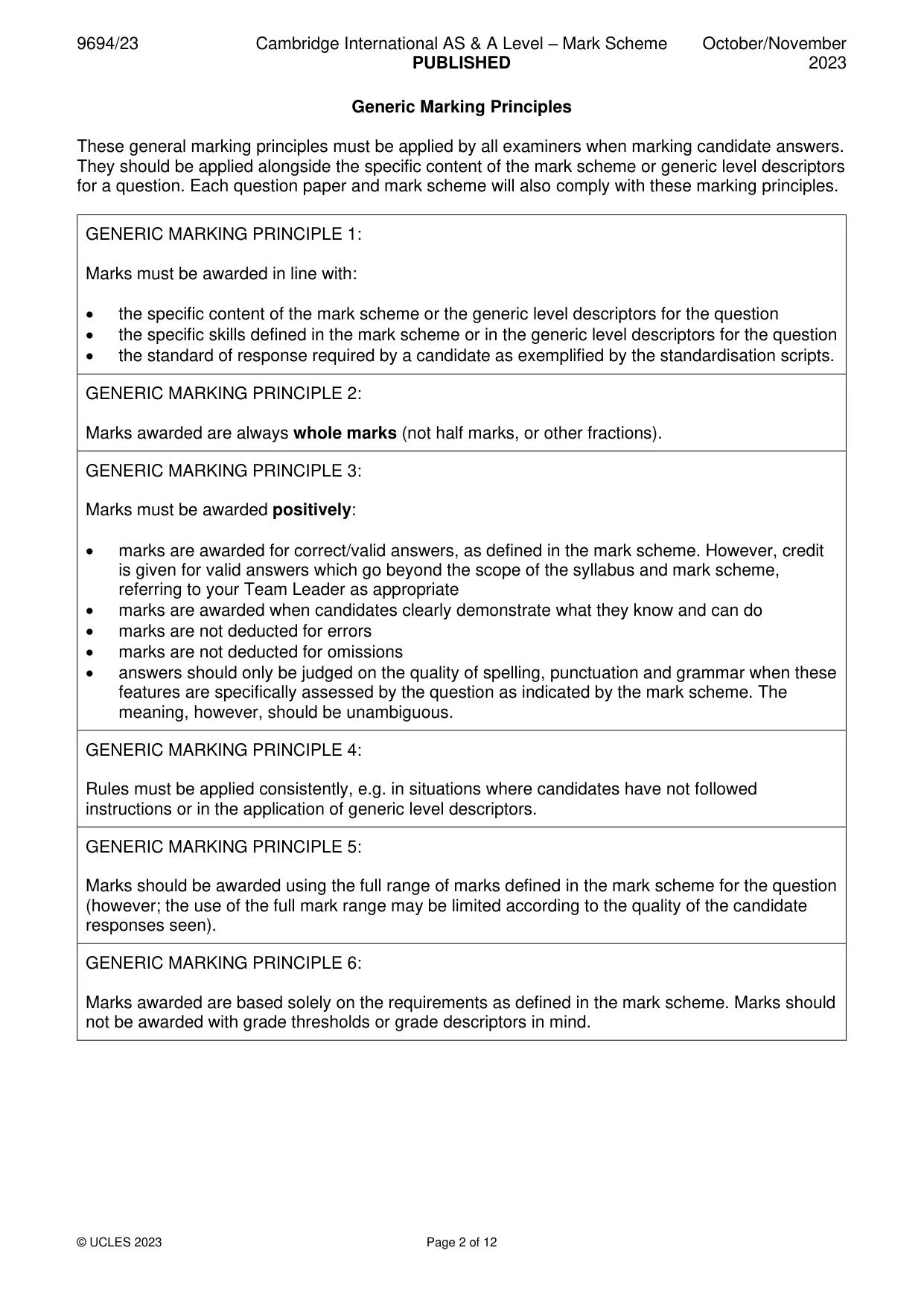
9694/23 Cambridge International AS & A Level – Mark Scheme PUBLISHED October/November 2023 © UCLES 2023 Page 2 of 12 Generic Marking Principles These general marking principles must be applied by all examiners when marking candidate answers. They should be applied alongside the specific content of the mark scheme or generic level descriptors for a question. Each question paper and mark scheme will also comply with these marking principles. GENERIC MARKING PRINCIPLE 1: Marks must be awarded in line with: • the specific content of the mark scheme or the generic level descriptors for the question • the specific skills defined in the mark scheme or in the generic level descriptors for the question • the standard of response required by a candidate as exemplified by the standardisation scripts. GENERIC MARKING PRINCIPLE 2: Marks awarded are always whole marks (not half marks, or other fractions). GENERIC MARKING PRINCIPLE 3: Marks must be awarded positively: • marks are awarded for correct/valid answers, as defined in the mark scheme. However, credit is given for valid answers which go beyond the scope of the syllabus and mark scheme, referring to your Team Leader as appropriate • marks are awarded when candidates clearly demonstrate what they know and can do • marks are not deducted for errors • marks are not deducted for omissions • answers should only be judged on the quality of spelling, punctuation and grammar when these features are specifically assessed by the question as indicated by the mark scheme. The meaning, however, should be unambiguous. GENERIC MARKING PRINCIPLE 4: Rules must be applied consistently, e.g. in situations where candidates have not followed instructions or in the application of generic level descriptors. GENERIC MARKING PRINCIPLE 5: Marks should be awarded using the full range of marks defined in the mark scheme for the question (however; the use of the full mark range may be limited according to the quality of the candidate responses seen). GENERIC MARKING PRINCIPLE 6: Marks awarded are based solely on the requirements as defined in the mark scheme. Marks should not be awarded with grade thresholds or grade descriptors in mind.
Mark scheme, page 3
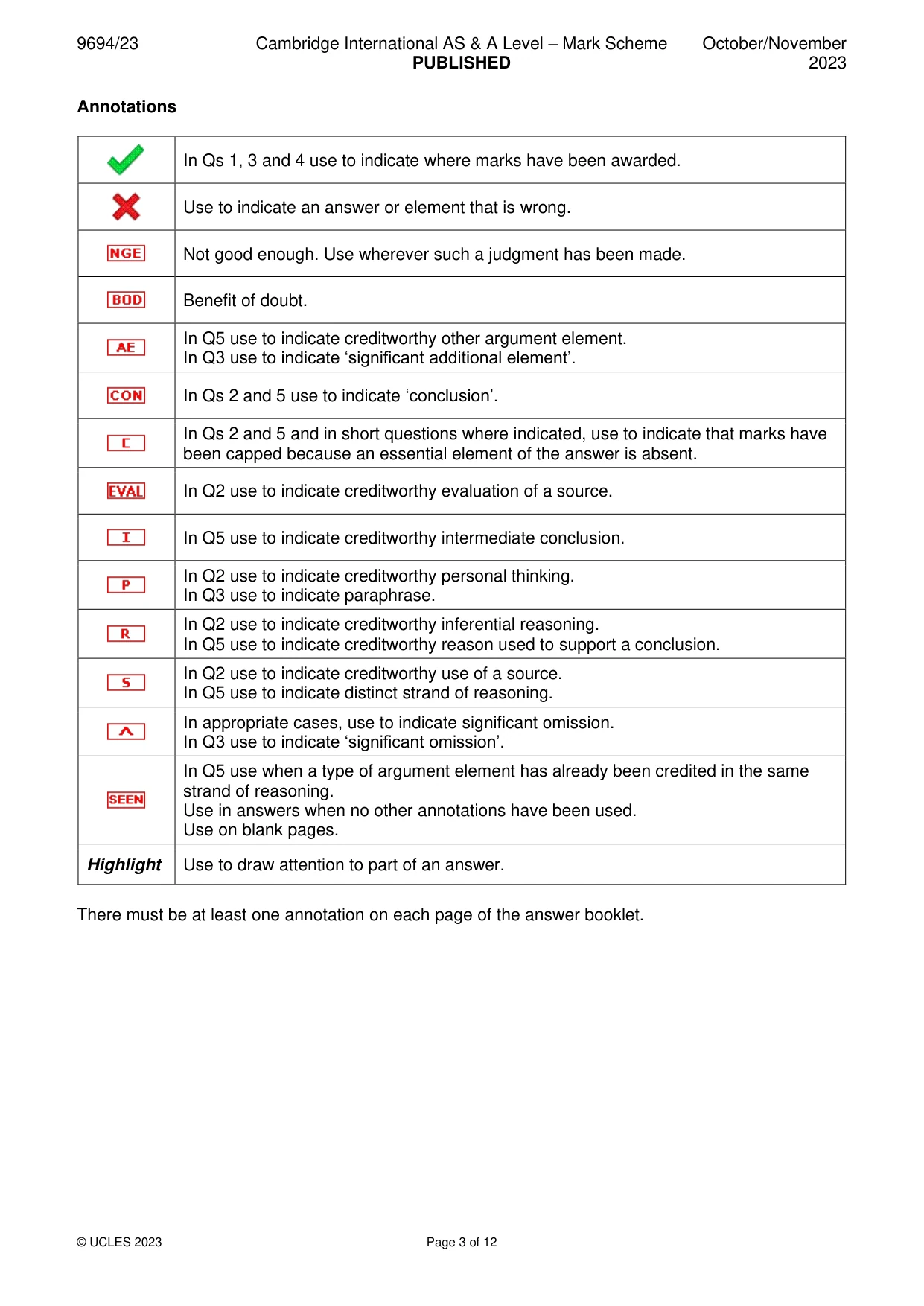
9694/23 Cambridge International AS & A Level – Mark Scheme PUBLISHED October/November 2023 © UCLES 2023 Page 3 of 12 Annotations In Qs 1, 3 and 4 use to indicate where marks have been awarded. Use to indicate an answer or element that is wrong. Not good enough. Use wherever such a judgment has been made. Benefit of doubt. In Q5 use to indicate creditworthy other argument element. In Q3 use to indicate ‘significant additional element’. In Qs 2 and 5 use to indicate ‘conclusion’. In Qs 2 and 5 and in short questions where indicated, use to indicate that marks have been capped because an essential element of the answer is absent. In Q2 use to indicate creditworthy evaluation of a source. In Q5 use to indicate creditworthy intermediate conclusion. In Q2 use to indicate creditworthy personal thinking. In Q3 use to indicate paraphrase. In Q2 use to indicate creditworthy inferential reasoning. In Q5 use to indicate creditworthy reason used to support a conclusion. In Q2 use to indicate creditworthy use of a source. In Q5 use to indicate distinct strand of reasoning. In appropriate cases, use to indicate significant omission. In Q3 use to indicate ‘significant omission’. In Q5 use when a type of argument element has already been credited in the same strand of reasoning. Use in answers when no other annotations have been used. Use on blank pages. Highlight Use to draw attention to part of an answer. There must be at least one annotation on each page of the answer booklet.
Mark scheme, page 4
9694/23 Cambridge International AS & A Level – Mark Scheme PUBLISHED October/November 2023 © UCLES 2023 Page 4 of 12 Question Answer Marks 1(a) The source is (very/mainly) reliable [1]. The reliability is strengthened by expertise, since no one would write or publish a textbook aimed at university students without being an expert on the subject [1]. It is clear from the content that the author has access to relevant data (good ability to see) [1], although he/she does not have ability to see what he/she claims occurred 10 000– 12 000 years ago. The information is factual and neutral, with no attempt to persuade the reader to adopt a controversial interpretation [1]. The author has a vested interest to provide accurate information in order to promote sales of the book / his/her own reputation and career / understanding of the subject [1] and no plausible vested interest to misrepresent the facts [1]; (but accept the author/publisher might have a vested interest to make controversial claims in order to increase sales [1]). No judgment mark without support. 4 1(b) The problems described in paragraph 1 will be avoided [1], unless the patient is consuming lactose from another source [1], or the same symptoms are caused by something else in the milk substitute or their diet [1]. We don’t know if the substitutes contain the ingredients needed to avoid the problems mentioned in paragraph 2 (accept will avoid…) [1], or whether they do contain other ingredients which might lead to them [1]. 2 1(c) 1 mark for identifying and 1 mark for explaining each of up to two weaknesses. For example, • It states that milk is designed for newborn animals in support of the claim, but this does not support the idea that it is good for all other ages/humans [1], who may have very different nutritional requirements [1]. • The list of nutrients does not mention the extent to which they are needed by healthy adults [1]; if they are not essential, milk is not as beneficial as the author claims [1]. • The list of nutrients does not mention whether adequate quantities are supplied by other elements of a normal diet [1]; if they are, then milk is not as significant as the author claims [1]. • The source does not state the amount of milk which is needed to provide a healthy intake (RDA) of the nutrients listed [1]; it could be so great as to have other negative consequences on health [1]. • The references to the possibility of fractures and muscle health and repair are both prefaced by the modal verb ‘may’ [1]: this possibility could be quite remote [1]. • The claim that studies have suggested that drinking milk ‘may prevent weight gain’ refers only to ‘some studies’ [1]: if there are only a very few such studies / if more studies suggest the opposite, then this claim is very weak [1]. 4
Mark scheme, page 5
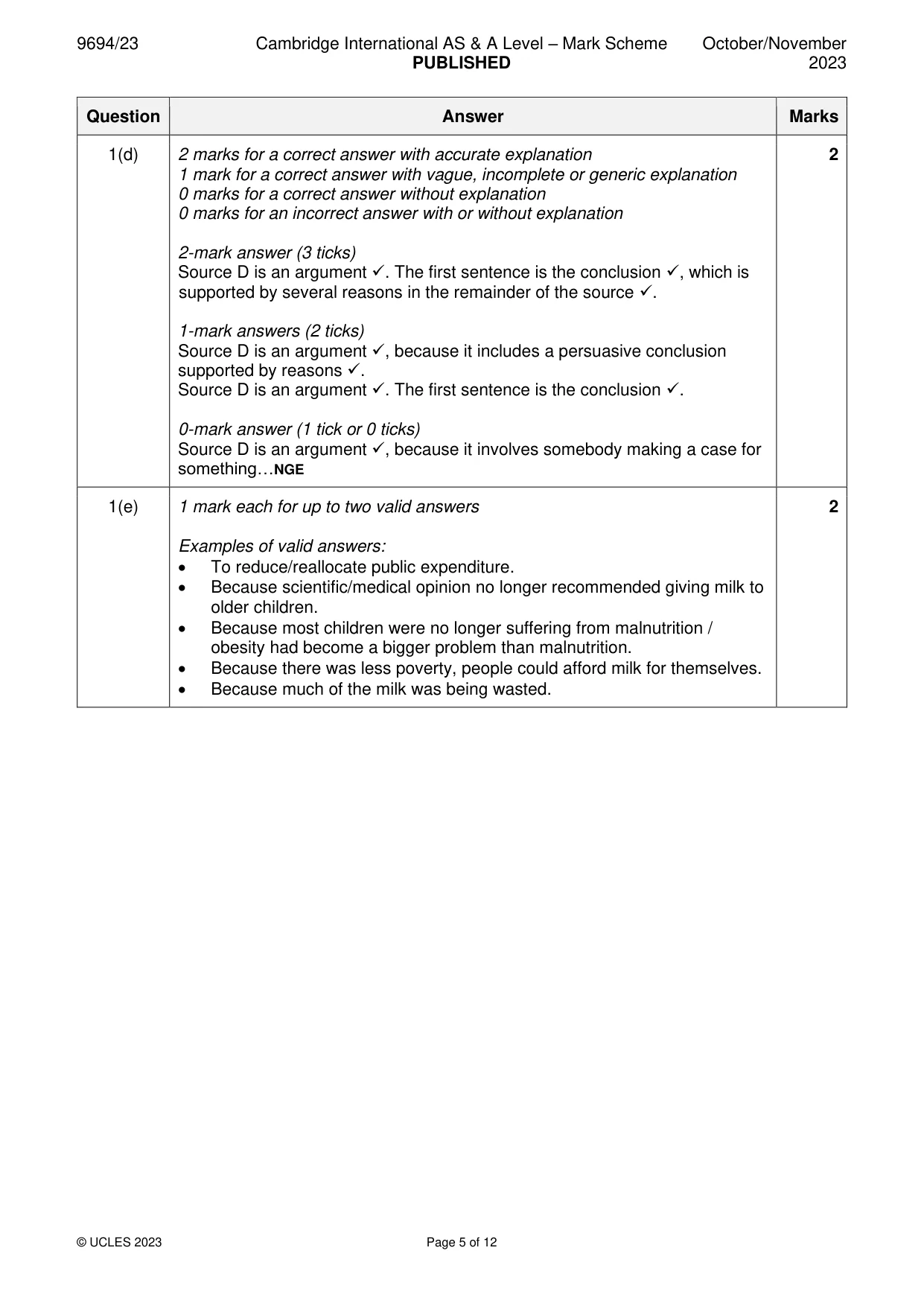
9694/23 Cambridge International AS & A Level – Mark Scheme PUBLISHED October/November 2023 © UCLES 2023 Page 5 of 12 Question Answer Marks 1(d) 2 marks for a correct answer with accurate explanation 1 mark for a correct answer with vague, incomplete or generic explanation 0 marks for a correct answer without explanation 0 marks for an incorrect answer with or without explanation 2-mark answer (3 ticks) Source D is an argument ✓. The first sentence is the conclusion ✓, which is supported by several reasons in the remainder of the source ✓. 1-mark answers (2 ticks) Source D is an argument ✓, because it includes a persuasive conclusion supported by reasons ✓. Source D is an argument ✓. The first sentence is the conclusion ✓. 0-mark answer (1 tick or 0 ticks) Source D is an argument ✓, because it involves somebody making a case for something…NGE 2 1(e) 1 mark each for up to two valid answers Examples of valid answers: • To reduce/reallocate public expenditure. • Because scientific/medical opinion no longer recommended giving milk to older children. • Because most children were no longer suffering from malnutrition / obesity had become a bigger problem than malnutrition. • Because there was less poverty, people could afford milk for themselves. • Because much of the milk was being wasted. 2
Mark scheme, page 6
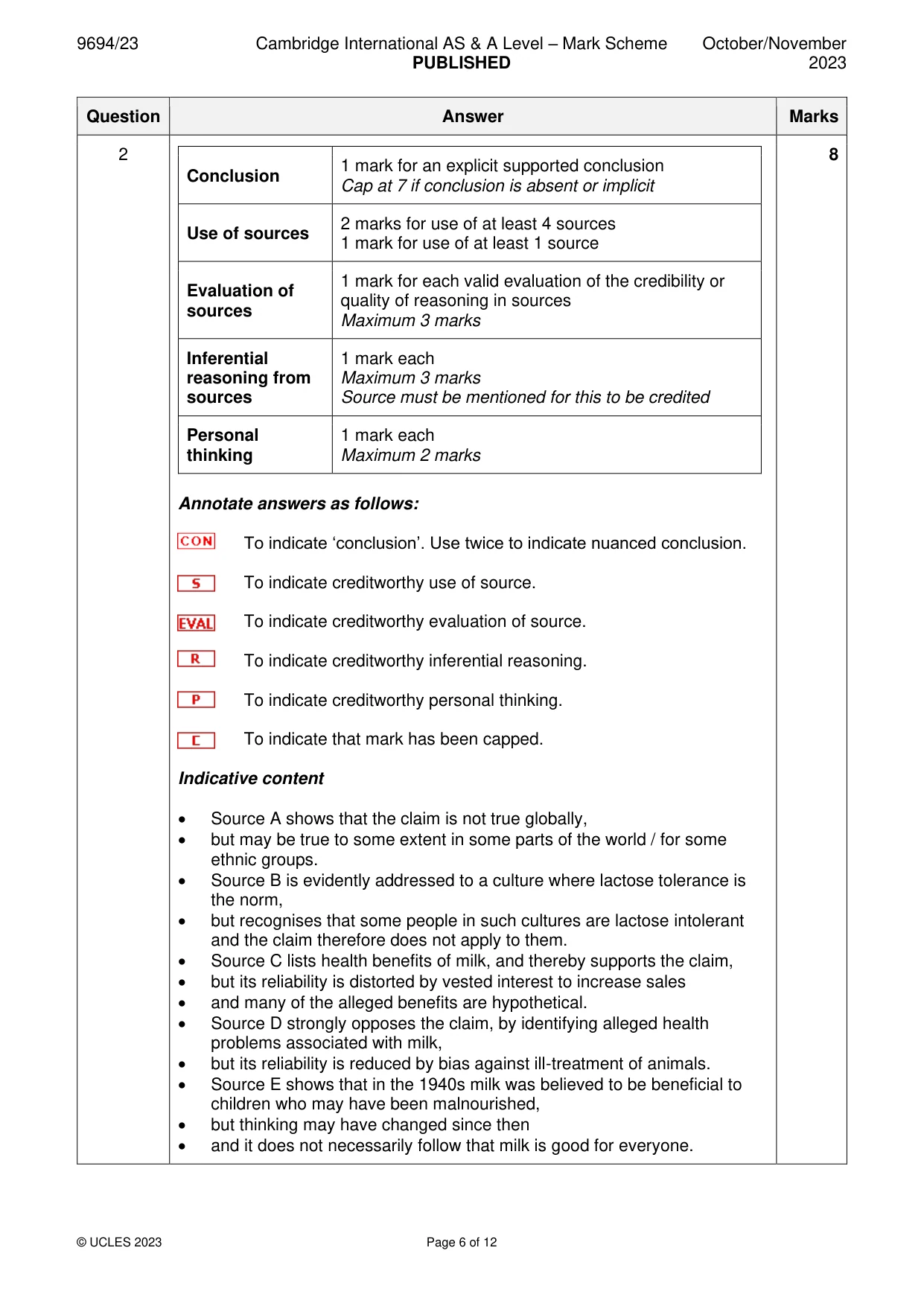
9694/23 Cambridge International AS & A Level – Mark Scheme PUBLISHED October/November 2023 © UCLES 2023 Page 6 of 12 Question Answer Marks 2 Conclusion 1 mark for an explicit supported conclusion Cap at 7 if conclusion is absent or implicit Use of sources 2 marks for use of at least 4 sources 1 mark for use of at least 1 source Evaluation of sources 1 mark for each valid evaluation of the credibility or quality of reasoning in sources Maximum 3 marks Inferential reasoning from sources 1 mark each Maximum 3 marks Source must be mentioned for this to be credited Personal thinking 1 mark each Maximum 2 marks Annotate answers as follows: To indicate ‘conclusion’. Use twice to indicate nuanced conclusion. To indicate creditworthy use of source. To indicate creditworthy evaluation of source. To indicate creditworthy inferential reasoning. To indicate creditworthy personal thinking. To indicate that mark has been capped. Indicative content • Source A shows that the claim is not true globally, • but may be true to some extent in some parts of the world / for some ethnic groups. • Source B is evidently addressed to a culture where lactose tolerance is the norm, • but recognises that some people in such cultures are lactose intolerant and the claim therefore does not apply to them. • Source C lists health benefits of milk, and thereby supports the claim, • but its reliability is distorted by vested interest to increase sales • and many of the alleged benefits are hypothetical. • Source D strongly opposes the claim, by identifying alleged health problems associated with milk, • but its reliability is reduced by bias against ill-treatment of animals. • Source E shows that in the 1940s milk was believed to be beneficial to children who may have been malnourished, • but thinking may have changed since then • and it does not necessarily follow that milk is good for everyone. 8
Mark scheme, page 7
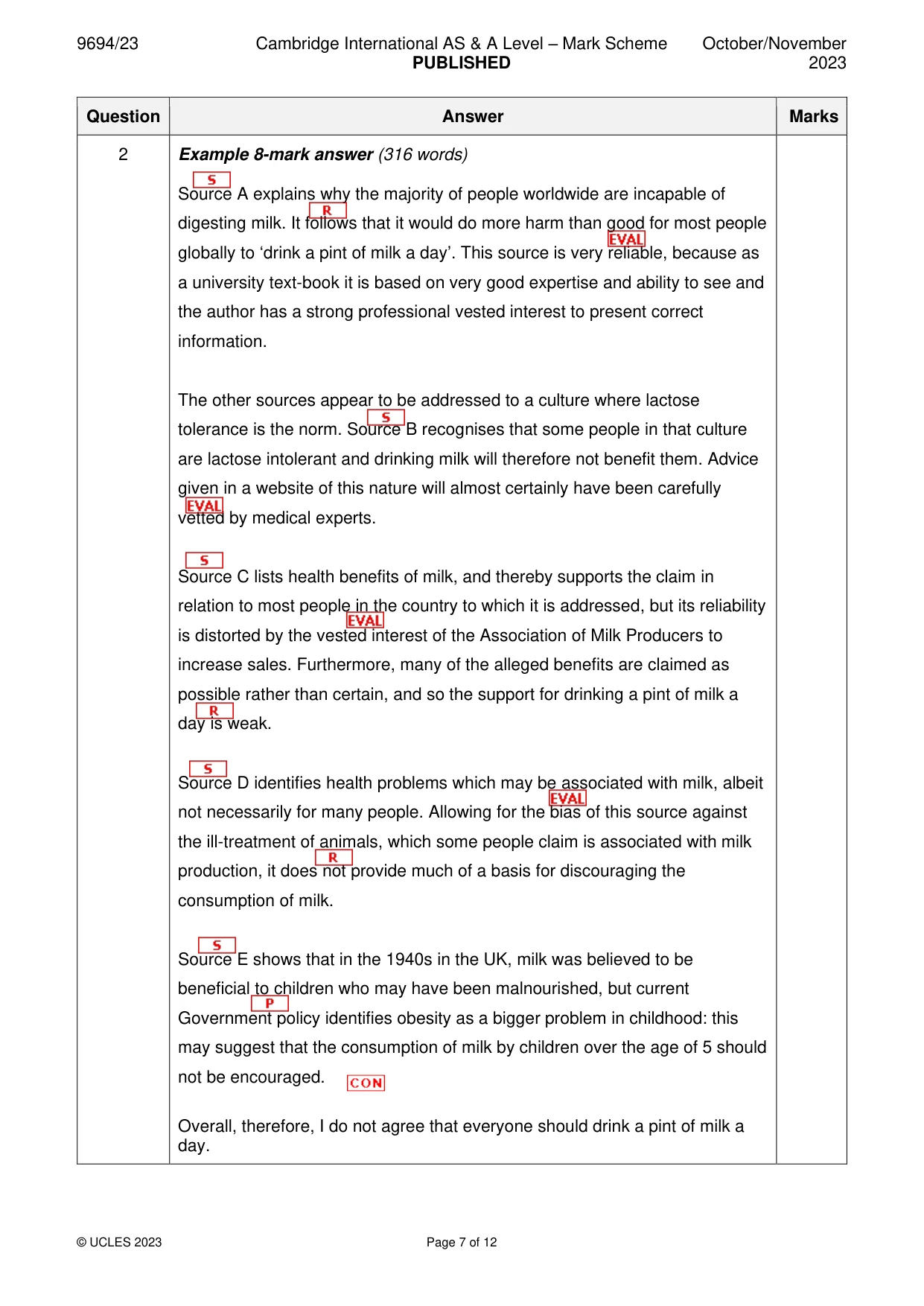
9694/23 Cambridge International AS & A Level – Mark Scheme PUBLISHED October/November 2023 © UCLES 2023 Page 7 of 12 Question Answer Marks 2 Example 8-mark answer (316 words) Source A explains why the majority of people worldwide are incapable of digesting milk. It follows that it would do more harm than good for most people globally to ‘drink a pint of milk a day’. This source is very reliable, because as a university text-book it is based on very good expertise and ability to see and the author has a strong professional vested interest to present correct information. The other sources appear to be addressed to a culture where lactose tolerance is the norm. Source B recognises that some people in that culture are lactose intolerant and drinking milk will therefore not benefit them. Advice given in a website of this nature will almost certainly have been carefully vetted by medical experts. Source C lists health benefits of milk, and thereby supports the claim in relation to most people in the country to which it is addressed, but its reliability is distorted by the vested interest of the Association of Milk Producers to increase sales. Furthermore, many of the alleged benefits are claimed as possible rather than certain, and so the support for drinking a pint of milk a day is weak. Source D identifies health problems which may be associated with milk, albeit not necessarily for many people. Allowing for the bias of this source against the ill-treatment of animals, which some people claim is associated with milk production, it does not provide much of a basis for discouraging the consumption of milk. Source E shows that in the 1940s in the UK, milk was believed to be beneficial to children who may have been malnourished, but current Government policy identifies obesity as a bigger problem in childhood: this may suggest that the consumption of milk by children over the age of 5 should not be encouraged. Overall, therefore, I do not agree that everyone should drink a pint of milk a day.
Mark scheme, page 8
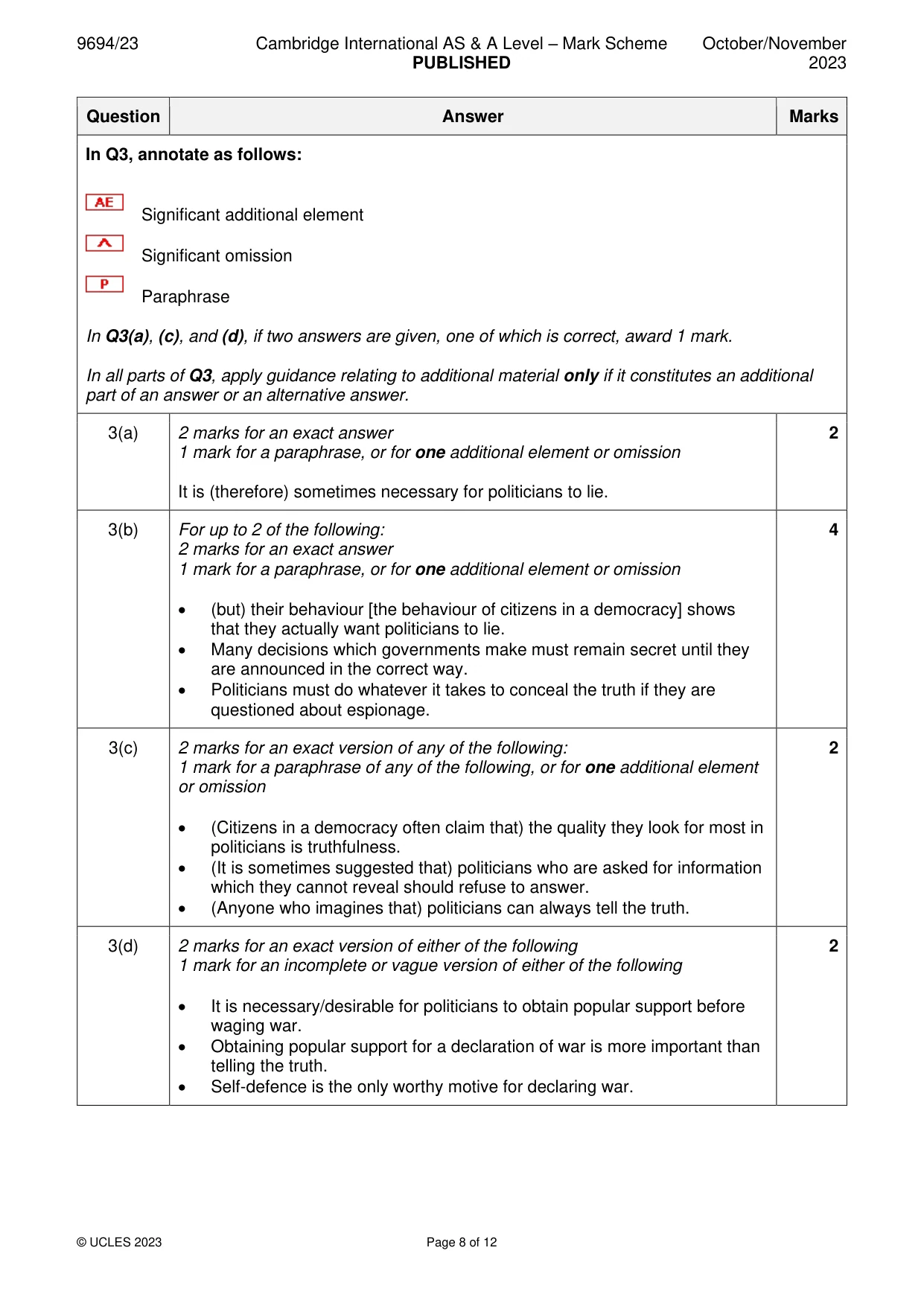
9694/23 Cambridge International AS & A Level – Mark Scheme PUBLISHED October/November 2023 © UCLES 2023 Page 8 of 12 Question Answer Marks In Q3, annotate as follows: Significant additional element Significant omission Paraphrase In Q3(a), (c), and (d), if two answers are given, one of which is correct, award 1 mark. In all parts of Q3, apply guidance relating to additional material only if it constitutes an additional part of an answer or an alternative answer. 3(a) 2 marks for an exact answer 1 mark for a paraphrase, or for one additional element or omission It is (therefore) sometimes necessary for politicians to lie. 2 3(b) For up to 2 of the following: 2 marks for an exact answer 1 mark for a paraphrase, or for one additional element or omission • (but) their behaviour [the behaviour of citizens in a democracy] shows that they actually want politicians to lie. • Many decisions which governments make must remain secret until they are announced in the correct way. • Politicians must do whatever it takes to conceal the truth if they are questioned about espionage. 4 3(c) 2 marks for an exact version of any of the following: 1 mark for a paraphrase of any of the following, or for one additional element or omission • (Citizens in a democracy often claim that) the quality they look for most in politicians is truthfulness. • (It is sometimes suggested that) politicians who are asked for information which they cannot reveal should refuse to answer. • (Anyone who imagines that) politicians can always tell the truth. 2 3(d) 2 marks for an exact version of either of the following 1 mark for an incomplete or vague version of either of the following • It is necessary/desirable for politicians to obtain popular support before waging war. • Obtaining popular support for a declaration of war is more important than telling the truth. • Self-defence is the only worthy motive for declaring war. 2
Mark scheme, page 9
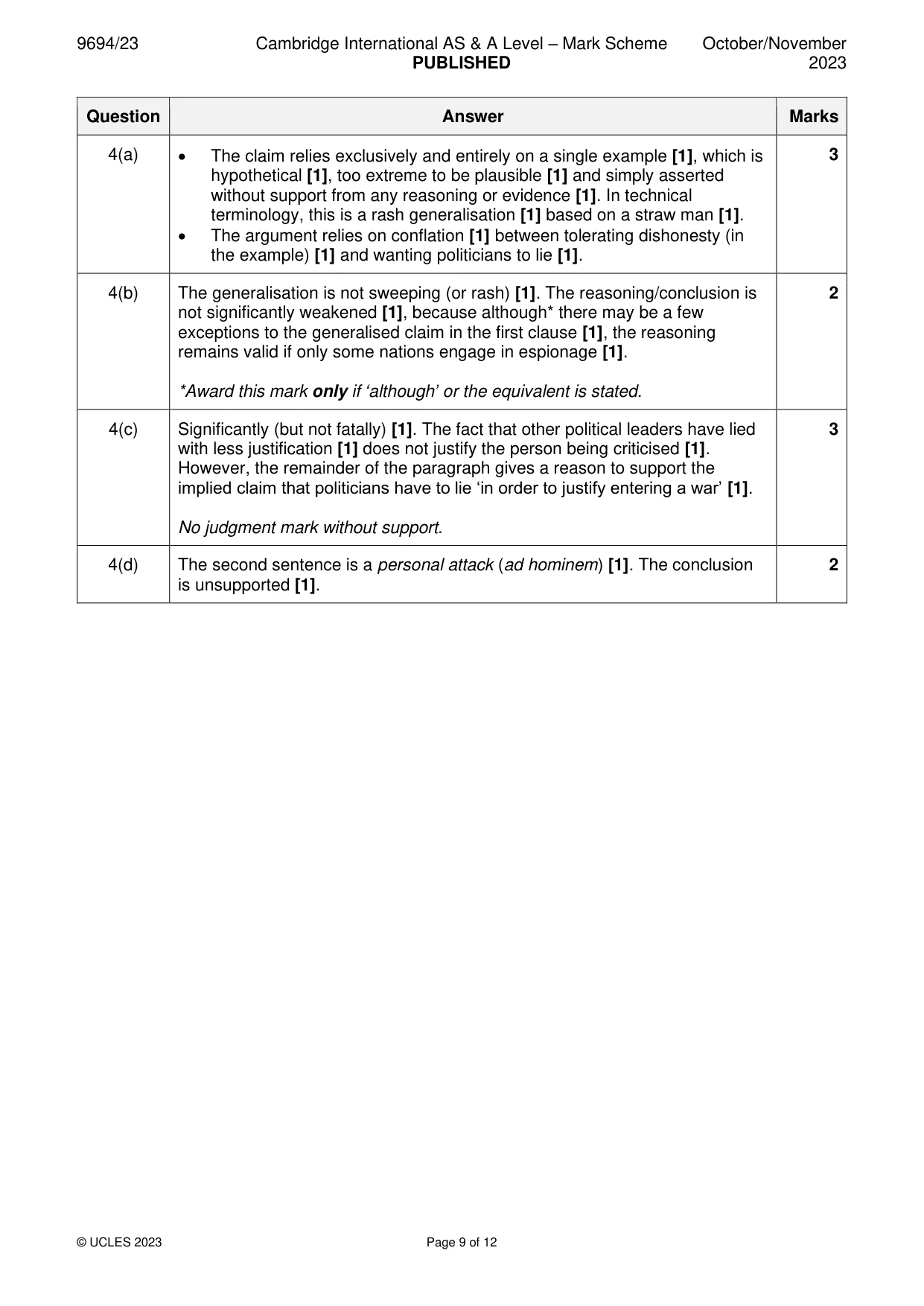
9694/23 Cambridge International AS & A Level – Mark Scheme PUBLISHED October/November 2023 © UCLES 2023 Page 9 of 12 Question Answer Marks 4(a) • The claim relies exclusively and entirely on a single example [1], which is hypothetical [1], too extreme to be plausible [1] and simply asserted without support from any reasoning or evidence [1]. In technical terminology, this is a rash generalisation [1] based on a straw man [1]. • The argument relies on conflation [1] between tolerating dishonesty (in the example) [1] and wanting politicians to lie [1]. 3 4(b) The generalisation is not sweeping (or rash) [1]. The reasoning/conclusion is not significantly weakened [1], because although* there may be a few exceptions to the generalised claim in the first clause [1], the reasoning remains valid if only some nations engage in espionage [1]. *Award this mark only if ‘although’ or the equivalent is stated. 2 4(c) Significantly (but not fatally) [1]. The fact that other political leaders have lied with less justification [1] does not justify the person being criticised [1]. However, the remainder of the paragraph gives a reason to support the implied claim that politicians have to lie ‘in order to justify entering a war’ [1]. No judgment mark without support. 3 4(d) The second sentence is a personal attack (ad hominem) [1]. The conclusion is unsupported [1]. 2
Mark scheme, page 10
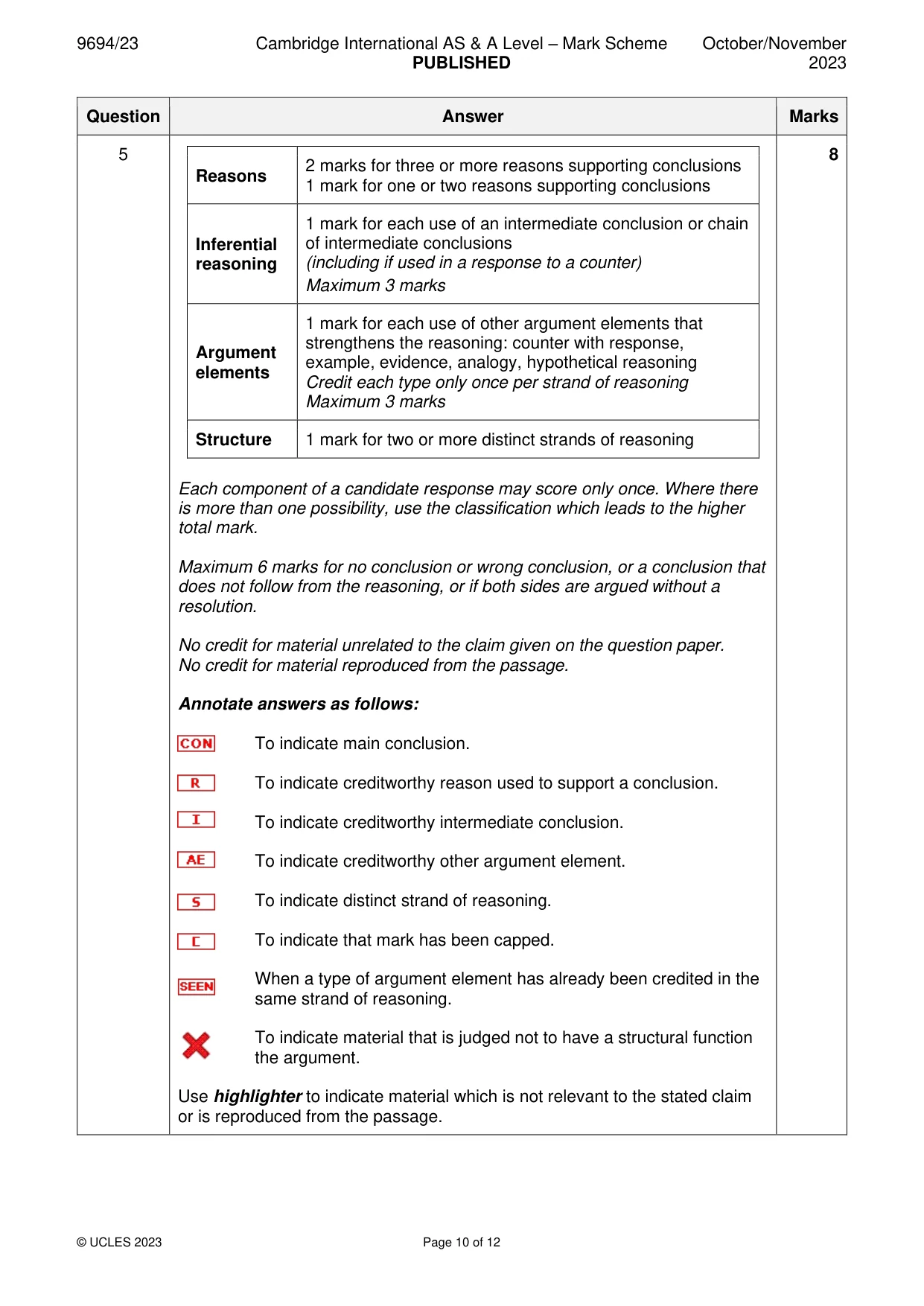
9694/23 Cambridge International AS & A Level – Mark Scheme PUBLISHED October/November 2023 © UCLES 2023 Page 10 of 12 Question Answer Marks 5 Reasons 2 marks for three or more reasons supporting conclusions 1 mark for one or two reasons supporting conclusions Inferential reasoning 1 mark for each use of an intermediate conclusion or chain of intermediate conclusions (including if used in a response to a counter) Maximum 3 marks Argument elements 1 mark for each use of other argument elements that strengthens the reasoning: counter with response, example, evidence, analogy, hypothetical reasoning Credit each type only once per strand of reasoning Maximum 3 marks Structure 1 mark for two or more distinct strands of reasoning Each component of a candidate response may score only once. Where there is more than one possibility, use the classification which leads to the higher total mark. Maximum 6 marks for no conclusion or wrong conclusion, or a conclusion that does not follow from the reasoning, or if both sides are argued without a resolution. No credit for material unrelated to the claim given on the question paper. No credit for material reproduced from the passage. Annotate answers as follows: To indicate main conclusion. To indicate creditworthy reason used to support a conclusion. To indicate creditworthy intermediate conclusion. To indicate creditworthy other argument element. To indicate distinct strand of reasoning. To indicate that mark has been capped. When a type of argument element has already been credited in the same strand of reasoning. To indicate material that is judged not to have a structural function in the argument. Use highlighter to indicate material which is not relevant to the stated claim or is reproduced from the passage. 8
Mark scheme, page 11
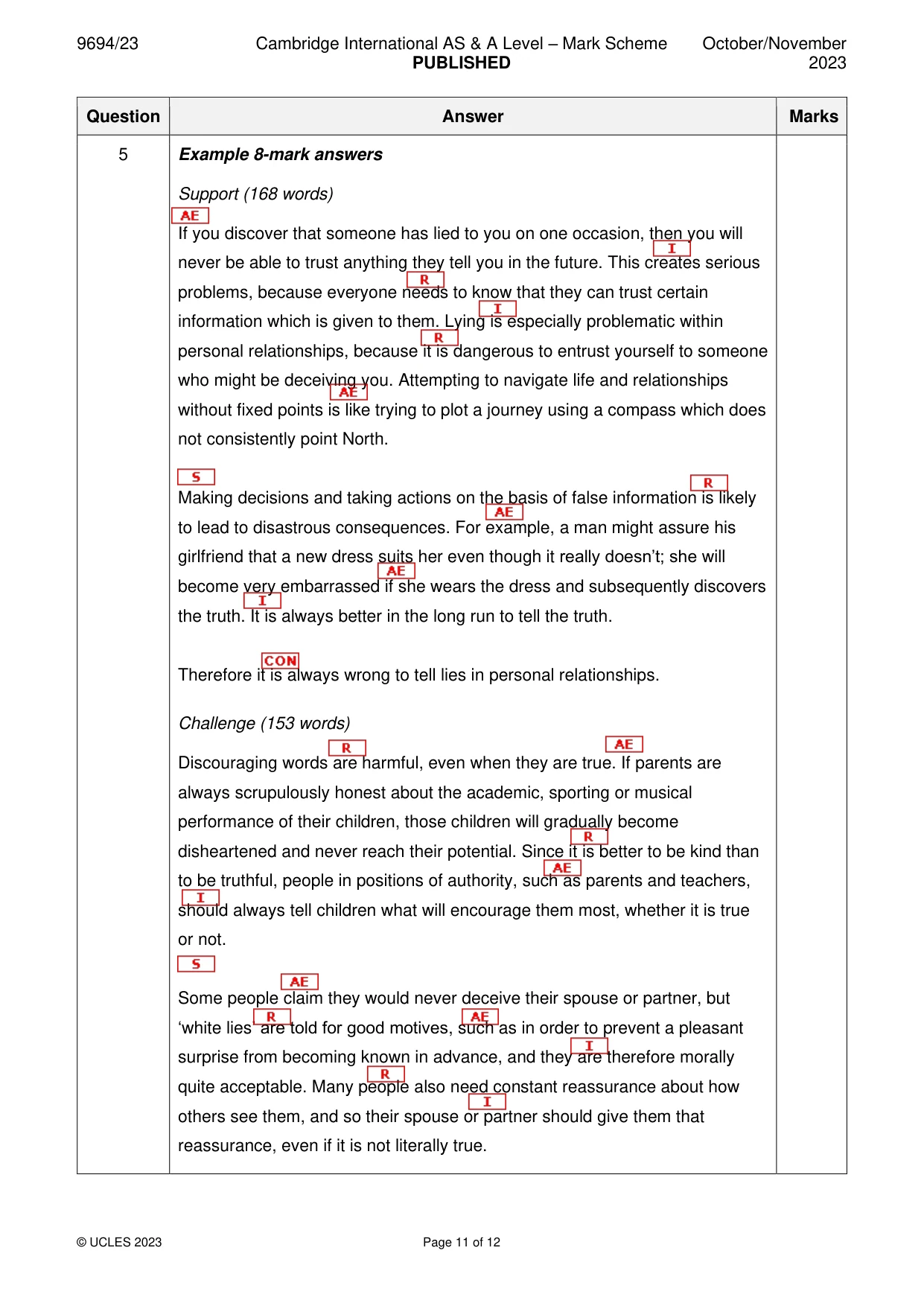
9694/23 Cambridge International AS & A Level – Mark Scheme PUBLISHED October/November 2023 © UCLES 2023 Page 11 of 12 Question Answer Marks 5 Example 8-mark answers Support (168 words) If you discover that someone has lied to you on one occasion, then you will never be able to trust anything they tell you in the future. This creates serious problems, because everyone needs to know that they can trust certain information which is given to them. Lying is especially problematic within personal relationships, because it is dangerous to entrust yourself to someone who might be deceiving you. Attempting to navigate life and relationships without fixed points is like trying to plot a journey using a compass which does not consistently point North. Making decisions and taking actions on the basis of false information is likely to lead to disastrous consequences. For example, a man might assure his girlfriend that a new dress suits her even though it really doesn’t; she will become very embarrassed if she wears the dress and subsequently discovers the truth. It is always better in the long run to tell the truth. Therefore it is always wrong to tell lies in personal relationships. Challenge (153 words) Discouraging words are harmful, even when they are true. If parents are always scrupulously honest about the academic, sporting or musical performance of their children, those children will gradually become disheartened and never reach their potential. Since it is better to be kind than to be truthful, people in positions of authority, such as parents and teachers, should always tell children what will encourage them most, whether it is true or not. Some people claim they would never deceive their spouse or partner, but ‘white lies’ are told for good motives, such as in order to prevent a pleasant surprise from becoming known in advance, and they are therefore morally quite acceptable. Many people also need constant reassurance about how others see them, and so their spouse or partner should give them that reassurance, even if it is not literally true.
Mark scheme, page 12
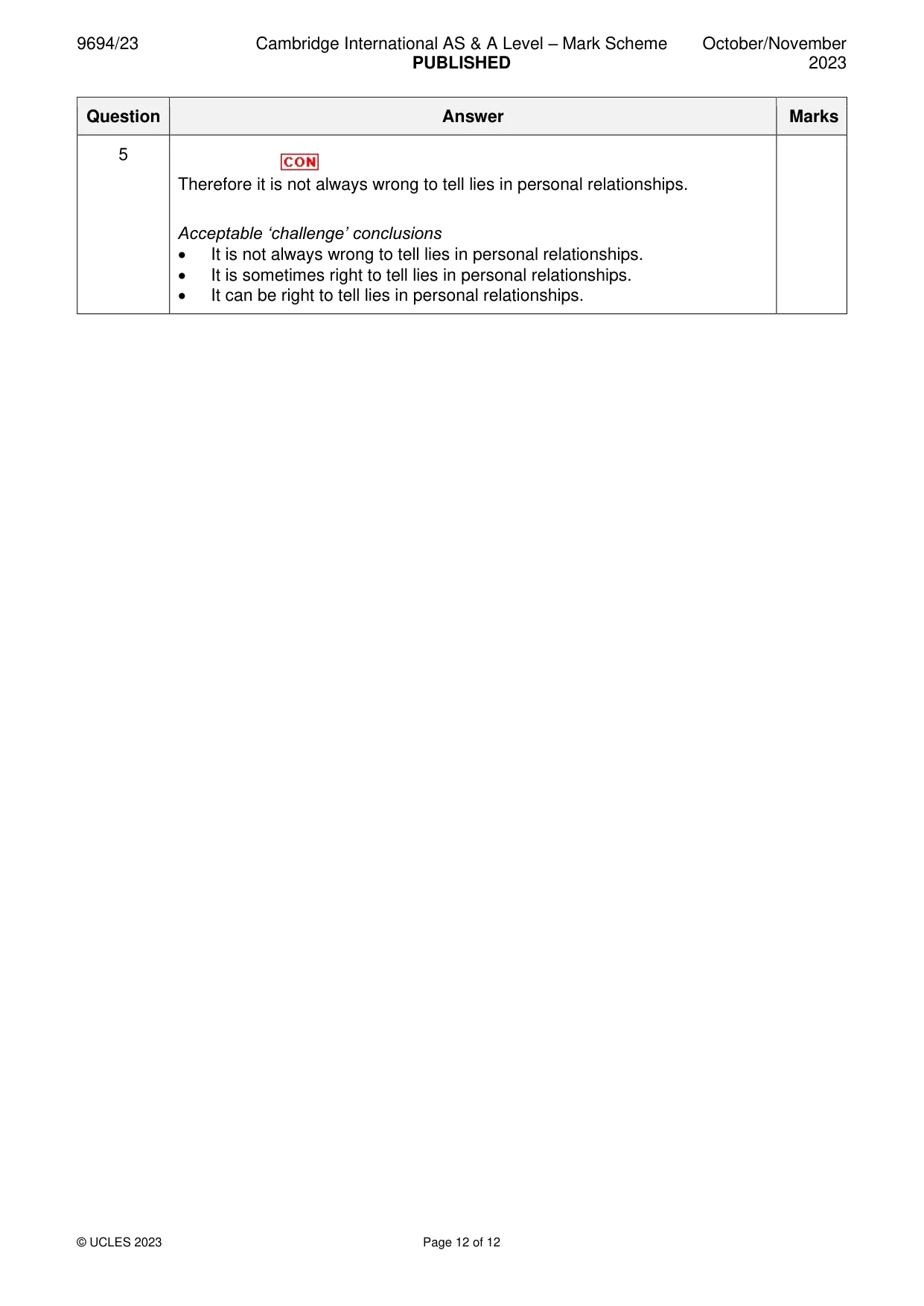
9694/23 Cambridge International AS & A Level – Mark Scheme PUBLISHED October/November 2023 © UCLES 2023 Page 12 of 12 Question Answer Marks 5 Therefore it is not always wrong to tell lies in personal relationships. Acceptable ‘challenge’ conclusions • It is not always wrong to tell lies in personal relationships. • It is sometimes right to tell lies in personal relationships. • It can be right to tell lies in personal relationships.
What you needed in this session
Cambridge’s own grade thresholds for 2023 Oct/Nov, Paper 2 · Variant 3. A higher threshold means an easier paper — the bar moves with how the cohort did.