Cambridge A Level Thinking Skills 9694 — 2023 May/June Paper 2 · Variant 2
9694/22/M/J/23 · 50 marks · ≈56 min
The question paper and its mark scheme, free to read here and free to download. This is Cambridge’s own paper, exactly as it was sat.
Question paper8 pages



Mark scheme12 pages
Answers below. Sit the paper first if you are practising.
Paper as text
Question paper, page 1
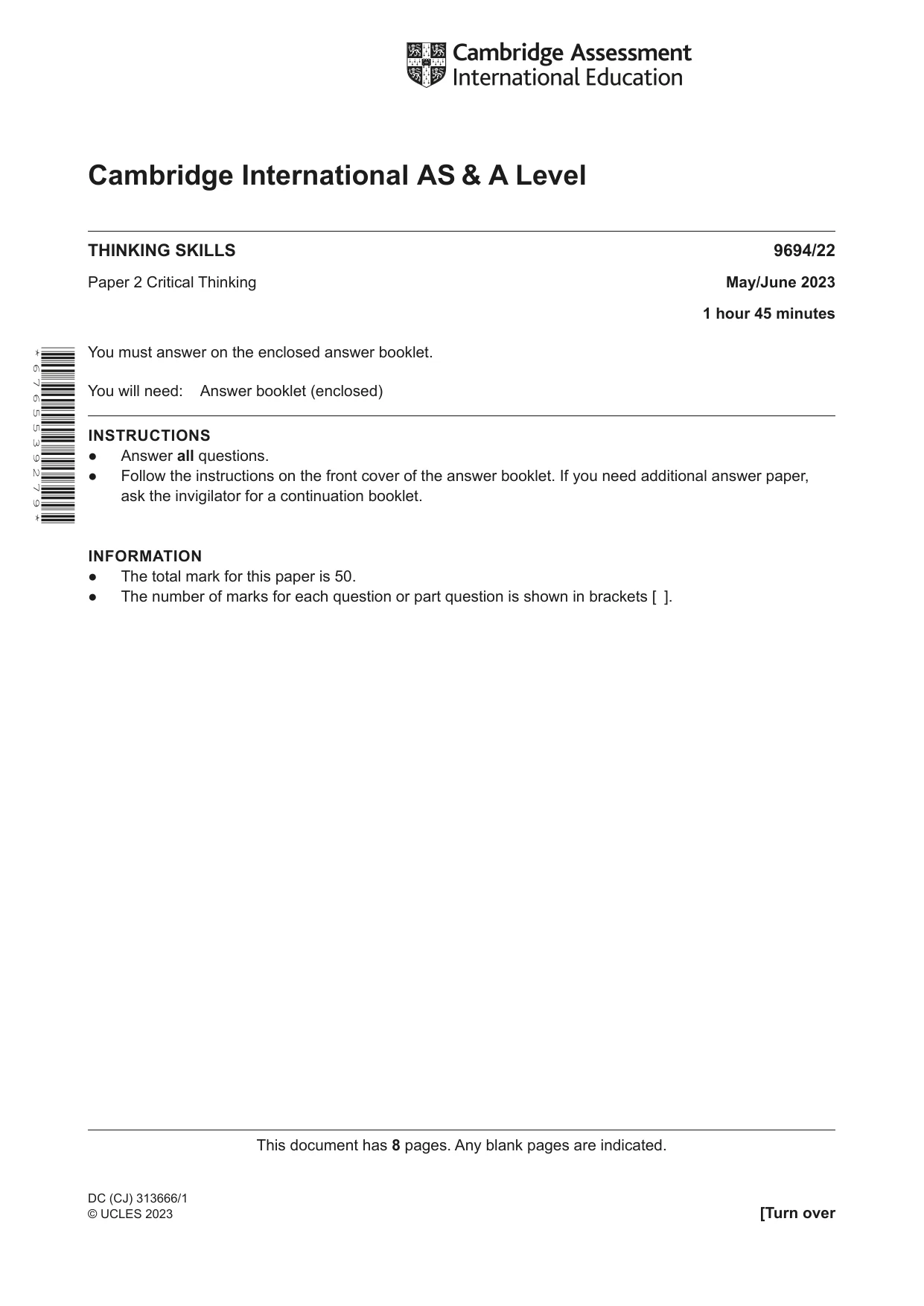
This document has 8 pages. Any blank pages are indicated. [Turn over Cambridge International AS & A Level THINKING SKILLS 9694/22 Paper 2 Critical Thinking May/June 2023 1 hour 45 minutes You must answer on the enclosed answer booklet. You will need: Answer booklet (enclosed) INSTRUCTIONS ● Answer all questions. ● Follow the instructions on the front cover of the answer booklet. If you need additional answer paper, ask the invigilator for a continuation booklet. INFORMATION ● The total mark for this paper is 50. ● The number of marks for each question or part question is shown in brackets [ ]. * 6 7 6 5 5 3 9 2 7 9 * DC (CJ) 313666/1 © UCLES 2023
Question paper, page 2
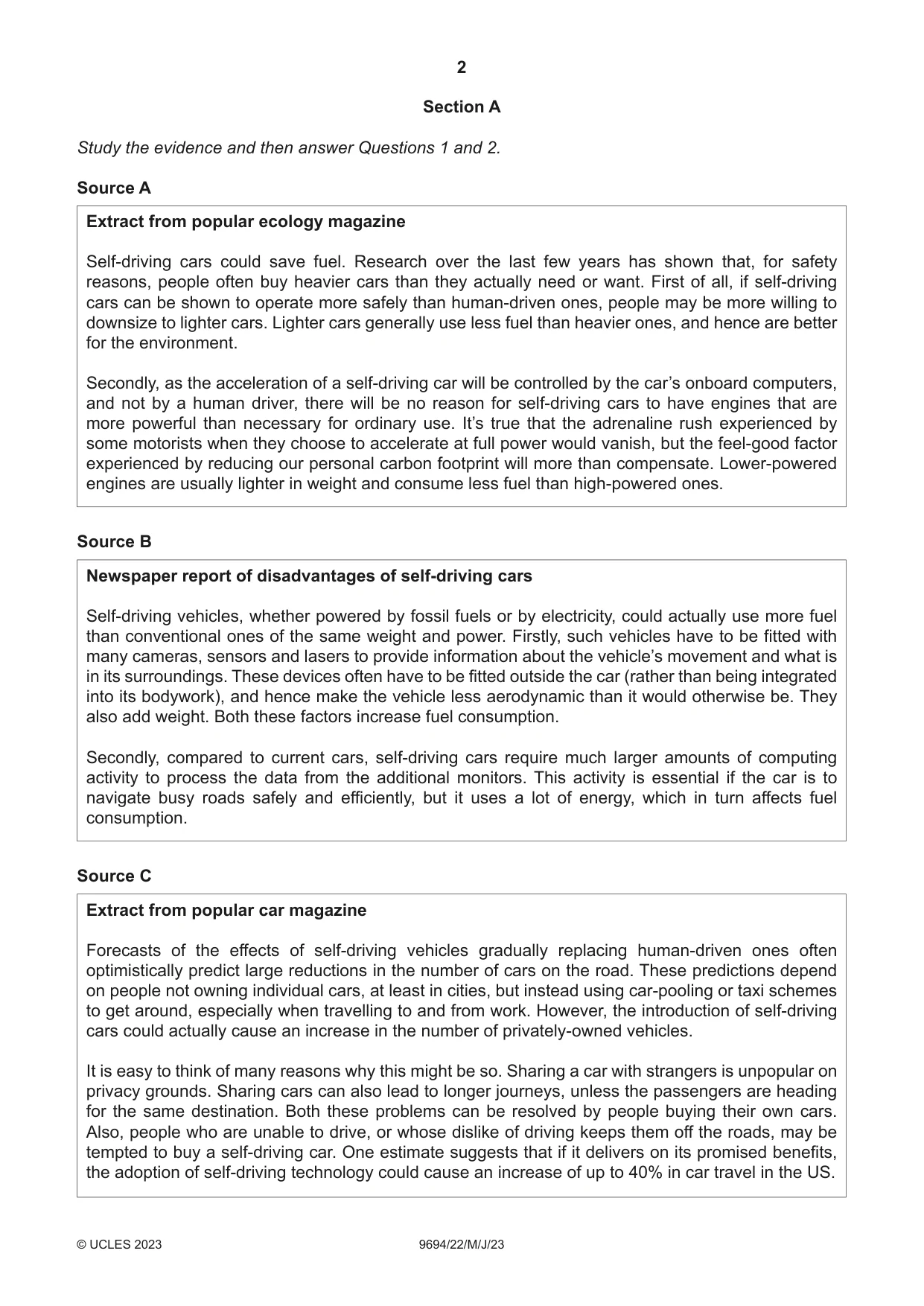
2 9694/22/M/J/23 © UCLES 2023 Section A Study the evidence and then answer Questions 1 and 2. Source A Extract from popular ecology magazine Self-driving cars could save fuel. Research over the last few years has shown that, for safety reasons, people often buy heavier cars than they actually need or want. First of all, if self-driving cars can be shown to operate more safely than human-driven ones, people may be more willing to downsize to lighter cars. Lighter cars generally use less fuel than heavier ones, and hence are better for the environment. Secondly, as the acceleration of a self-driving car will be controlled by the car’s onboard computers, and not by a human driver, there will be no reason for self-driving cars to have engines that are more powerful than necessary for ordinary use. It’s true that the adrenaline rush experienced by some motorists when they choose to accelerate at full power would vanish, but the feel-good factor experienced by reducing our personal carbon footprint will more than compensate. Lower-powered engines are usually lighter in weight and consume less fuel than high-powered ones. Source B Newspaper report of disadvantages of self-driving cars Self-driving vehicles, whether powered by fossil fuels or by electricity, could actually use more fuel than conventional ones of the same weight and power. Firstly, such vehicles have to be fitted with many cameras, sensors and lasers to provide information about the vehicle’s movement and what is in its surroundings. These devices often have to be fitted outside the car (rather than being integrated into its bodywork), and hence make the vehicle less aerodynamic than it would otherwise be. They also add weight. Both these factors increase fuel consumption. Secondly, compared to current cars, self-driving cars require much larger amounts of computing activity to process the data from the additional monitors. This activity is essential if the car is to navigate busy roads safely and efficiently, but it uses a lot of energy, which in turn affects fuel consumption. Source C Extract from popular car magazine Forecasts of the effects of self-driving vehicles gradually replacing human-driven ones often optimistically predict large reductions in the number of cars on the road. These predictions depend on people not owning individual cars, at least in cities, but instead using car-pooling or taxi schemes to get around, especially when travelling to and from work. However, the introduction of self-driving cars could actually cause an increase in the number of privately-owned vehicles. It is easy to think of many reasons why this might be so. Sharing a car with strangers is unpopular on privacy grounds. Sharing cars can also lead to longer journeys, unless the passengers are heading for the same destination. Both these problems can be resolved by people buying their own cars. Also, people who are unable to drive, or whose dislike of driving keeps them off the roads, may be tempted to buy a self-driving car. One estimate suggests that if it delivers on its promised benefits, the adoption of self-driving technology could cause an increase of up to 40% in car travel in the US.
Question paper, page 3
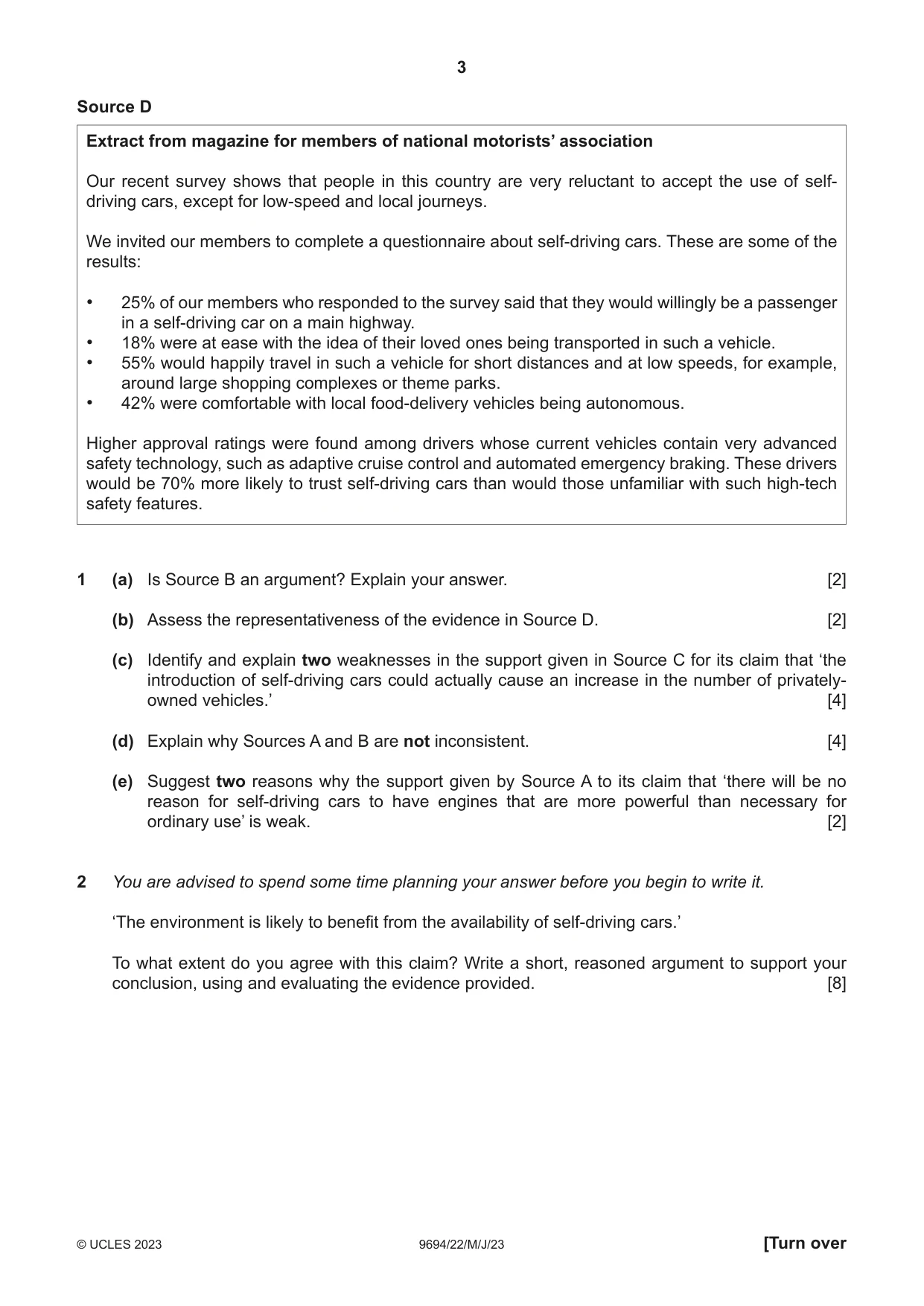
3 9694/22/M/J/23 © UCLES 2023 [Turn over Source D Extract from magazine for members of national motorists’ association Our recent survey shows that people in this country are very reluctant to accept the use of self- driving cars, except for low-speed and local journeys. We invited our members to complete a questionnaire about self-driving cars. These are some of the results: • 25% of our members who responded to the survey said that they would willingly be a passenger in a self-driving car on a main highway. • 18% were at ease with the idea of their loved ones being transported in such a vehicle. • 55% would happily travel in such a vehicle for short distances and at low speeds, for example, around large shopping complexes or theme parks. • 42% were comfortable with local food-delivery vehicles being autonomous. Higher approval ratings were found among drivers whose current vehicles contain very advanced safety technology, such as adaptive cruise control and automated emergency braking. These drivers would be 70% more likely to trust self-driving cars than would those unfamiliar with such high-tech safety features. 1 (a) Is Source B an argument? Explain your answer. [2] (b) Assess the representativeness of the evidence in Source D. [2] (c) Identify and explain two weaknesses in the support given in Source C for its claim that ‘the introduction of self-driving cars could actually cause an increase in the number of privately- owned vehicles.’ [4] (d) Explain why Sources A and B are not inconsistent. [4] (e) Suggest two reasons why the support given by Source A to its claim that ‘there will be no reason for self-driving cars to have engines that are more powerful than necessary for ordinary use’ is weak. [2] 2 You are advised to spend some time planning your answer before you begin to write it. ‘The environment is likely to benefit from the availability of self-driving cars.’ To what extent do you agree with this claim? Write a short, reasoned argument to support your conclusion, using and evaluating the evidence provided. [8]
Question paper, page 4
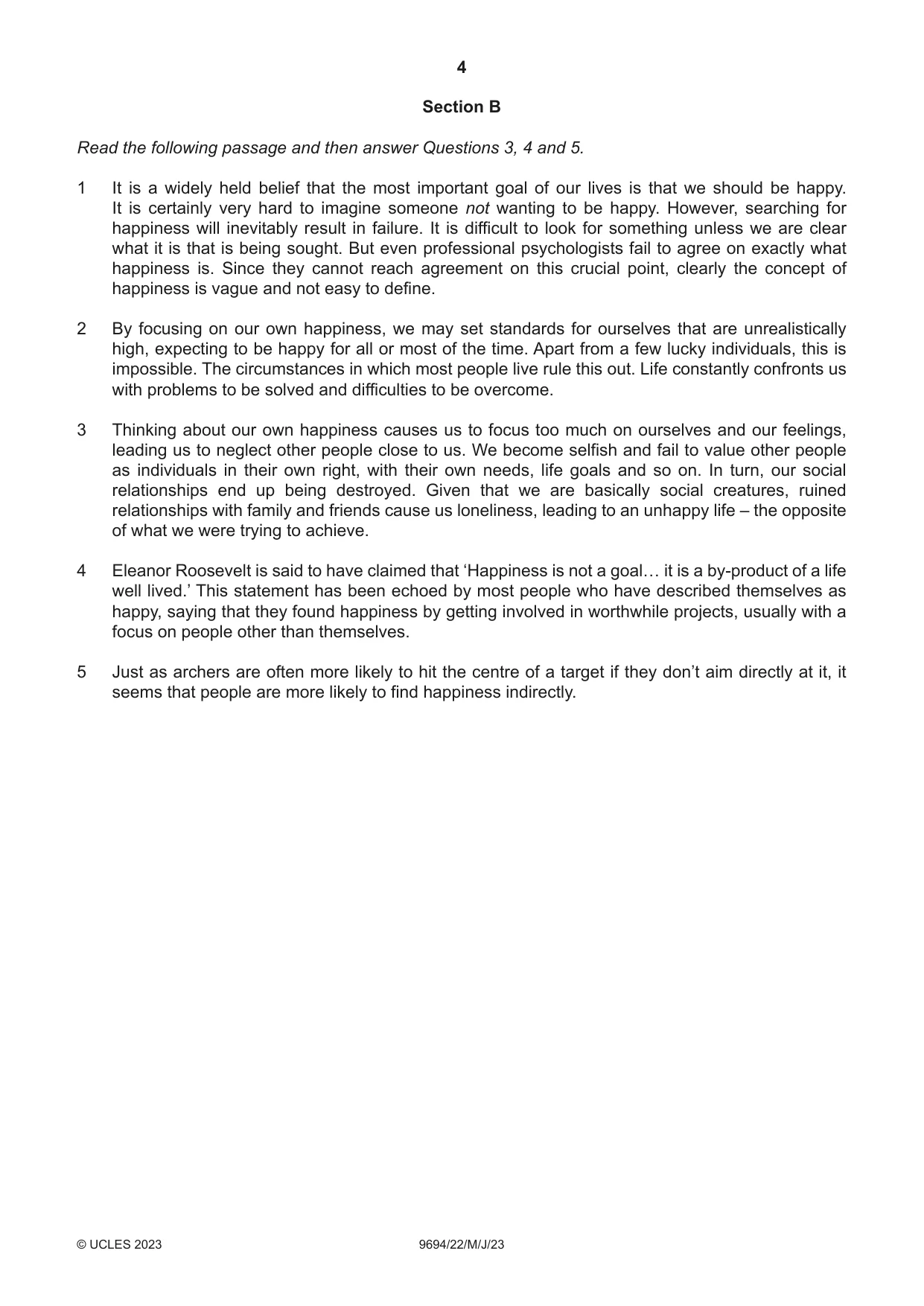
4 9694/22/M/J/23 © UCLES 2023 Section B Read the following passage and then answer Questions 3, 4 and 5. 1 It is a widely held belief that the most important goal of our lives is that we should be happy. It is certainly very hard to imagine someone not wanting to be happy. However, searching for happiness will inevitably result in failure. It is difficult to look for something unless we are clear what it is that is being sought. But even professional psychologists fail to agree on exactly what happiness is. Since they cannot reach agreement on this crucial point, clearly the concept of happiness is vague and not easy to define. 2 By focusing on our own happiness, we may set standards for ourselves that are unrealistically high, expecting to be happy for all or most of the time. Apart from a few lucky individuals, this is impossible. The circumstances in which most people live rule this out. Life constantly confronts us with problems to be solved and difficulties to be overcome. 3 Thinking about our own happiness causes us to focus too much on ourselves and our feelings, leading us to neglect other people close to us. We become selfish and fail to value other people as individuals in their own right, with their own needs, life goals and so on. In turn, our social relationships end up being destroyed. Given that we are basically social creatures, ruined relationships with family and friends cause us loneliness, leading to an unhappy life – the opposite of what we were trying to achieve. 4 Eleanor Roosevelt is said to have claimed that ‘Happiness is not a goal… it is a by-product of a life well lived.’ This statement has been echoed by most people who have described themselves as happy, saying that they found happiness by getting involved in worthwhile projects, usually with a focus on people other than themselves. 5 Just as archers are often more likely to hit the centre of a target if they don’t aim directly at it, it seems that people are more likely to find happiness indirectly.
Question paper, page 5
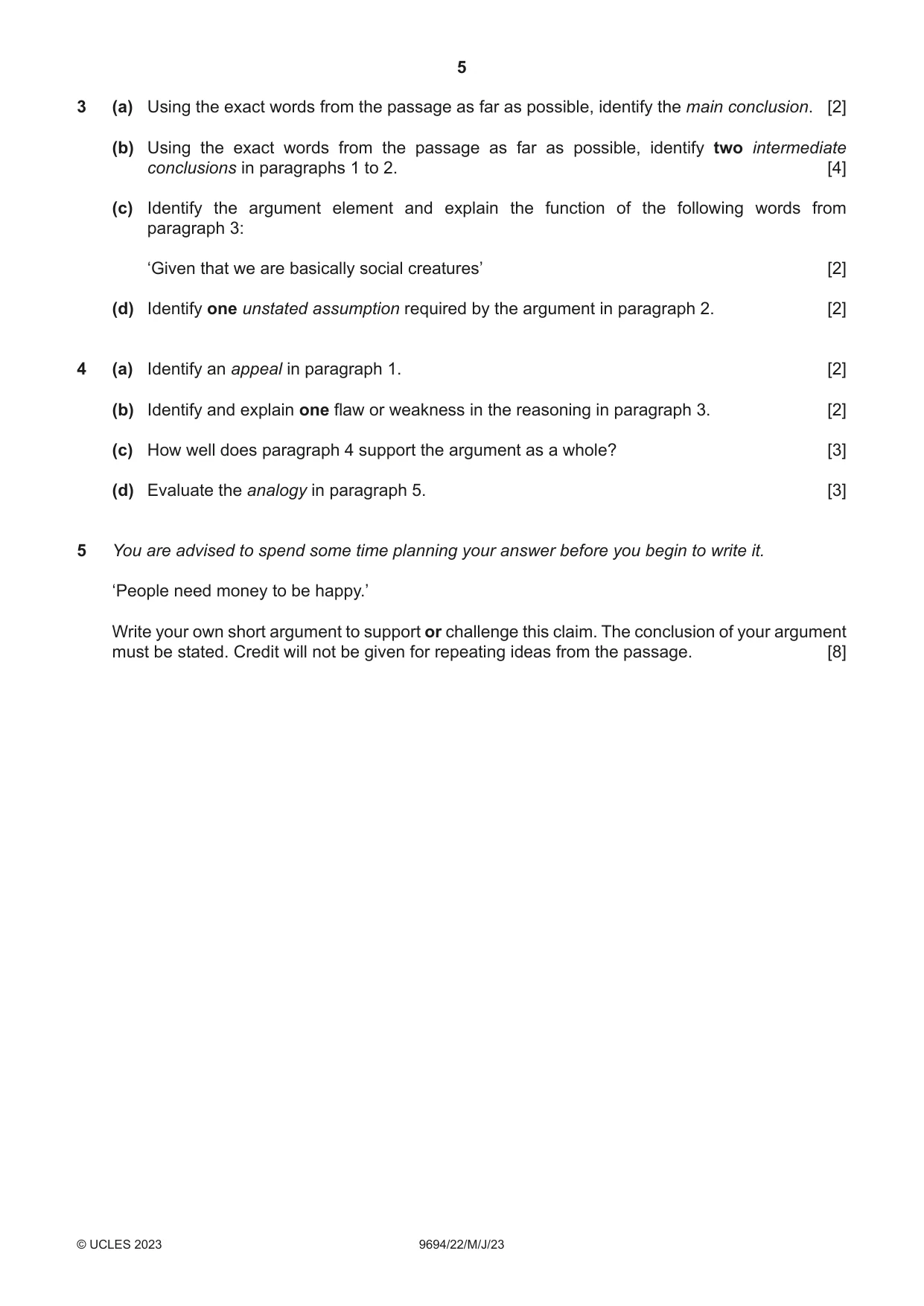
5 9694/22/M/J/23 © UCLES 2023 3 (a) Using the exact words from the passage as far as possible, identify the main conclusion. [2] (b) Using the exact words from the passage as far as possible, identify two intermediate conclusions in paragraphs 1 to 2. [4] (c) Identify the argument element and explain the function of the following words from paragraph 3: ‘Given that we are basically social creatures’ [2] (d) Identify one unstated assumption required by the argument in paragraph 2. [2] 4 (a) Identify an appeal in paragraph 1. [2] (b) Identify and explain one flaw or weakness in the reasoning in paragraph 3. [2] (c) How well does paragraph 4 support the argument as a whole? [3] (d) Evaluate the analogy in paragraph 5. [3] 5 You are advised to spend some time planning your answer before you begin to write it. ‘People need money to be happy.’ Write your own short argument to support or challenge this claim. The conclusion of your argument must be stated. Credit will not be given for repeating ideas from the passage. [8]
Question paper, page 6
6 9694/22/M/J/23 © UCLES 2023 BLANK PAGE
Question paper, page 7
7 9694/22/M/J/23 © UCLES 2023 BLANK PAGE
Question paper, page 8
8 9694/22/M/J/23 © UCLES 2023 Permission to reproduce items where third-party owned material protected by copyright is included has been sought and cleared where possible. Every reasonable effort has been made by the publisher (UCLES) to trace copyright holders, but if any items requiring clearance have unwittingly been included, the publisher will be pleased to make amends at the earliest possible opportunity. To avoid the issue of disclosure of answer-related information to candidates, all copyright acknowledgements are reproduced online in the Cambridge Assessment International Education Copyright Acknowledgements Booklet. This is produced for each series of examinations and is freely available to download at www.cambridgeinternational.org after the live examination series. Cambridge Assessment International Education is part of Cambridge Assessment. Cambridge Assessment is the brand name of the University of Cambridge Local Examinations Syndicate (UCLES), which is a department of the University of Cambridge. BLANK PAGE
Mark scheme, page 1
This document consists of 12 printed pages. © UCLES 2023 [Turn over Cambridge International AS & A Level THINKING SKILLS 9694/22 Paper 2 Critical Thinking May/June 2023 MARK SCHEME Maximum Mark: 50 Published This mark scheme is published as an aid to teachers and candidates, to indicate the requirements of the examination. It shows the basis on which Examiners were instructed to award marks. It does not indicate the details of the discussions that took place at an Examiners’ meeting before marking began, which would have considered the acceptability of alternative answers. Mark schemes should be read in conjunction with the question paper and the Principal Examiner Report for Teachers. Cambridge International will not enter into discussions about these mark schemes. Cambridge International is publishing the mark schemes for the May/June 2023 series for most Cambridge IGCSE, Cambridge International A and AS Level and Cambridge Pre-U components, and some Cambridge O Level components.
Mark scheme, page 2
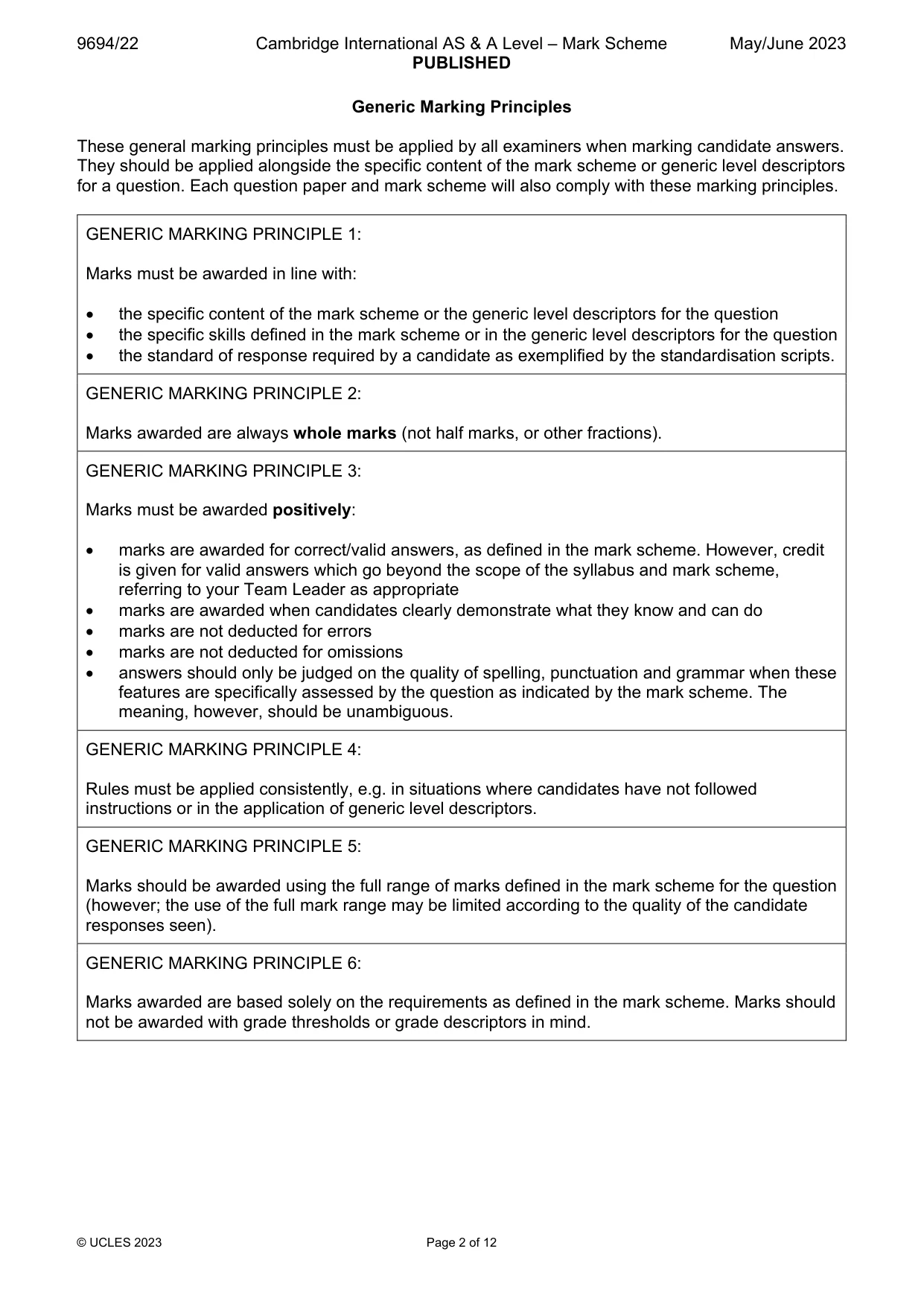
9694/22 Cambridge International AS & A Level – Mark Scheme PUBLISHED May/June 2023 © UCLES 2023 Page 2 of 12 Generic Marking Principles These general marking principles must be applied by all examiners when marking candidate answers. They should be applied alongside the specific content of the mark scheme or generic level descriptors for a question. Each question paper and mark scheme will also comply with these marking principles. GENERIC MARKING PRINCIPLE 1: Marks must be awarded in line with: the specific content of the mark scheme or the generic level descriptors for the question the specific skills defined in the mark scheme or in the generic level descriptors for the question the standard of response required by a candidate as exemplified by the standardisation scripts. GENERIC MARKING PRINCIPLE 2: Marks awarded are always whole marks (not half marks, or other fractions). GENERIC MARKING PRINCIPLE 3: Marks must be awarded positively: marks are awarded for correct/valid answers, as defined in the mark scheme. However, credit is given for valid answers which go beyond the scope of the syllabus and mark scheme, referring to your Team Leader as appropriate marks are awarded when candidates clearly demonstrate what they know and can do marks are not deducted for errors marks are not deducted for omissions answers should only be judged on the quality of spelling, punctuation and grammar when these features are specifically assessed by the question as indicated by the mark scheme. The meaning, however, should be unambiguous. GENERIC MARKING PRINCIPLE 4: Rules must be applied consistently, e.g. in situations where candidates have not followed instructions or in the application of generic level descriptors. GENERIC MARKING PRINCIPLE 5: Marks should be awarded using the full range of marks defined in the mark scheme for the question (however; the use of the full mark range may be limited according to the quality of the candidate responses seen). GENERIC MARKING PRINCIPLE 6: Marks awarded are based solely on the requirements as defined in the mark scheme. Marks should not be awarded with grade thresholds or grade descriptors in mind.
Mark scheme, page 3
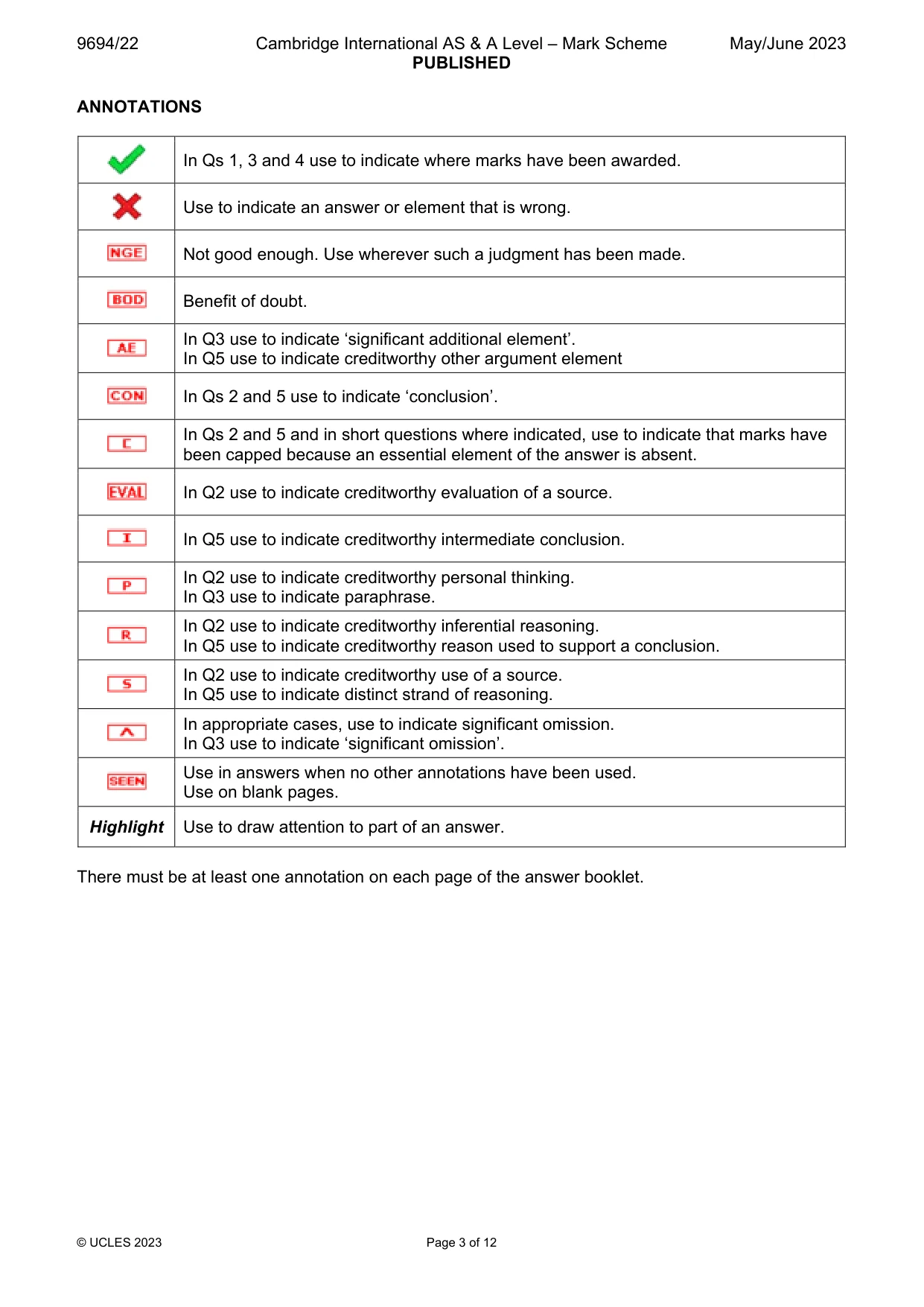
9694/22 Cambridge International AS & A Level – Mark Scheme PUBLISHED May/June 2023 © UCLES 2023 Page 3 of 12 ANNOTATIONS In Qs 1, 3 and 4 use to indicate where marks have been awarded. Use to indicate an answer or element that is wrong. Not good enough. Use wherever such a judgment has been made. Benefit of doubt. In Q3 use to indicate ‘significant additional element’. In Q5 use to indicate creditworthy other argument element In Qs 2 and 5 use to indicate ‘conclusion’. In Qs 2 and 5 and in short questions where indicated, use to indicate that marks have been capped because an essential element of the answer is absent. In Q2 use to indicate creditworthy evaluation of a source. In Q5 use to indicate creditworthy intermediate conclusion. In Q2 use to indicate creditworthy personal thinking. In Q3 use to indicate paraphrase. In Q2 use to indicate creditworthy inferential reasoning. In Q5 use to indicate creditworthy reason used to support a conclusion. In Q2 use to indicate creditworthy use of a source. In Q5 use to indicate distinct strand of reasoning. In appropriate cases, use to indicate significant omission. In Q3 use to indicate ‘significant omission’. Use in answers when no other annotations have been used. Use on blank pages. Highlight Use to draw attention to part of an answer. There must be at least one annotation on each page of the answer booklet.
Mark scheme, page 4
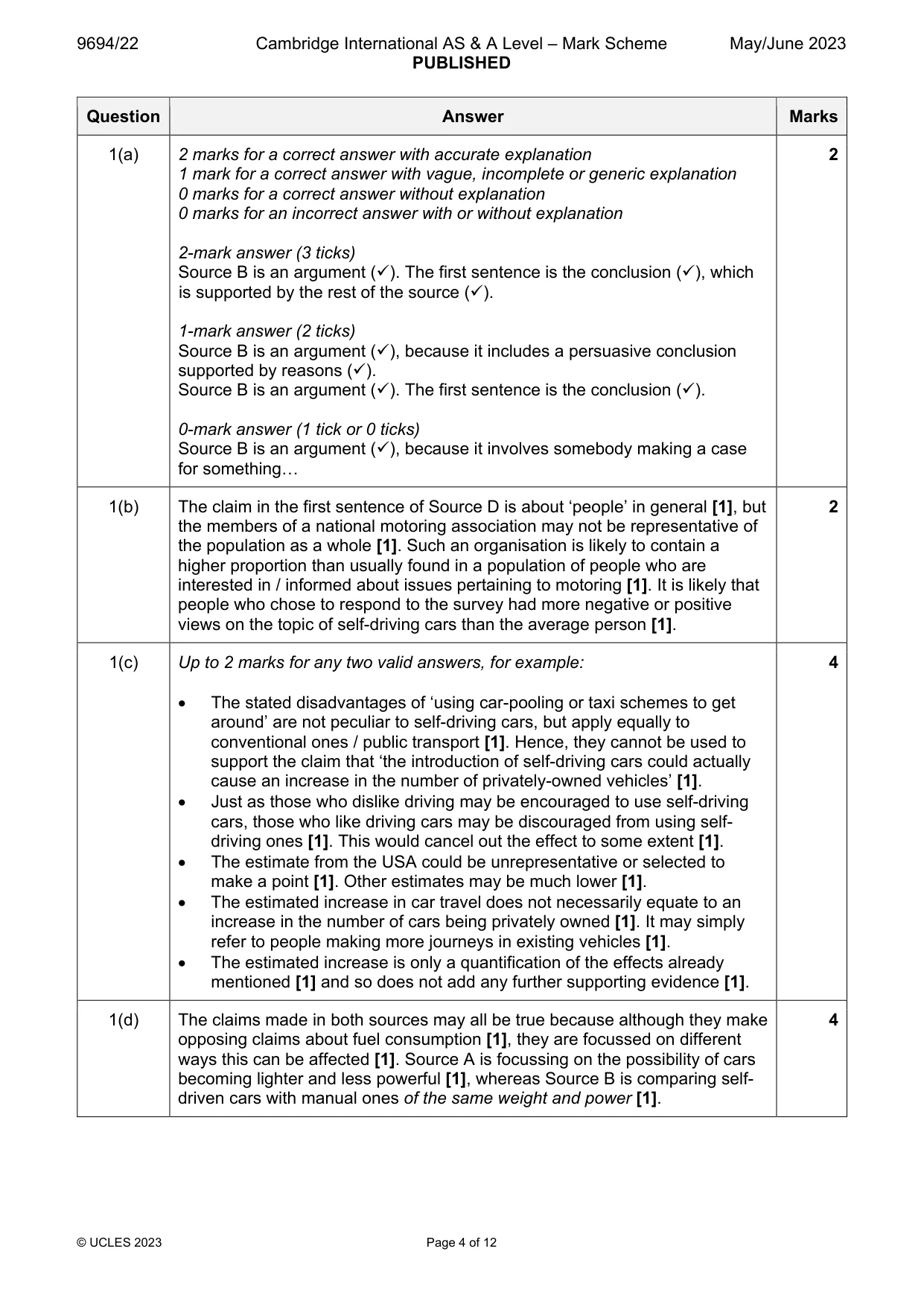
9694/22 Cambridge International AS & A Level – Mark Scheme PUBLISHED May/June 2023 © UCLES 2023 Page 4 of 12 Question Answer Marks 1(a) 2 marks for a correct answer with accurate explanation 1 mark for a correct answer with vague, incomplete or generic explanation 0 marks for a correct answer without explanation 0 marks for an incorrect answer with or without explanation 2-mark answer (3 ticks) Source B is an argument (). The first sentence is the conclusion (), which is supported by the rest of the source (). 1-mark answer (2 ticks) Source B is an argument (), because it includes a persuasive conclusion supported by reasons (). Source B is an argument (). The first sentence is the conclusion (). 0-mark answer (1 tick or 0 ticks) Source B is an argument (), because it involves somebody making a case for something… 2 1(b) The claim in the first sentence of Source D is about ‘people’ in general [1], but the members of a national motoring association may not be representative of the population as a whole [1]. Such an organisation is likely to contain a higher proportion than usually found in a population of people who are interested in / informed about issues pertaining to motoring [1]. It is likely that people who chose to respond to the survey had more negative or positive views on the topic of self-driving cars than the average person [1]. 2 1(c) Up to 2 marks for any two valid answers, for example: The stated disadvantages of ‘using car-pooling or taxi schemes to get around’ are not peculiar to self-driving cars, but apply equally to conventional ones / public transport [1]. Hence, they cannot be used to support the claim that ‘the introduction of self-driving cars could actually cause an increase in the number of privately-owned vehicles’ [1]. Just as those who dislike driving may be encouraged to use self-driving cars, those who like driving cars may be discouraged from using self- driving ones [1]. This would cancel out the effect to some extent [1]. The estimate from the USA could be unrepresentative or selected to make a point [1]. Other estimates may be much lower [1]. The estimated increase in car travel does not necessarily equate to an increase in the number of cars being privately owned [1]. It may simply refer to people making more journeys in existing vehicles [1]. The estimated increase is only a quantification of the effects already mentioned [1] and so does not add any further supporting evidence [1]. 4 1(d) The claims made in both sources may all be true because although they make opposing claims about fuel consumption [1], they are focussed on different ways this can be affected [1]. Source A is focussing on the possibility of cars becoming lighter and less powerful [1], whereas Source B is comparing self- driven cars with manual ones of the same weight and power [1]. 4
Mark scheme, page 5
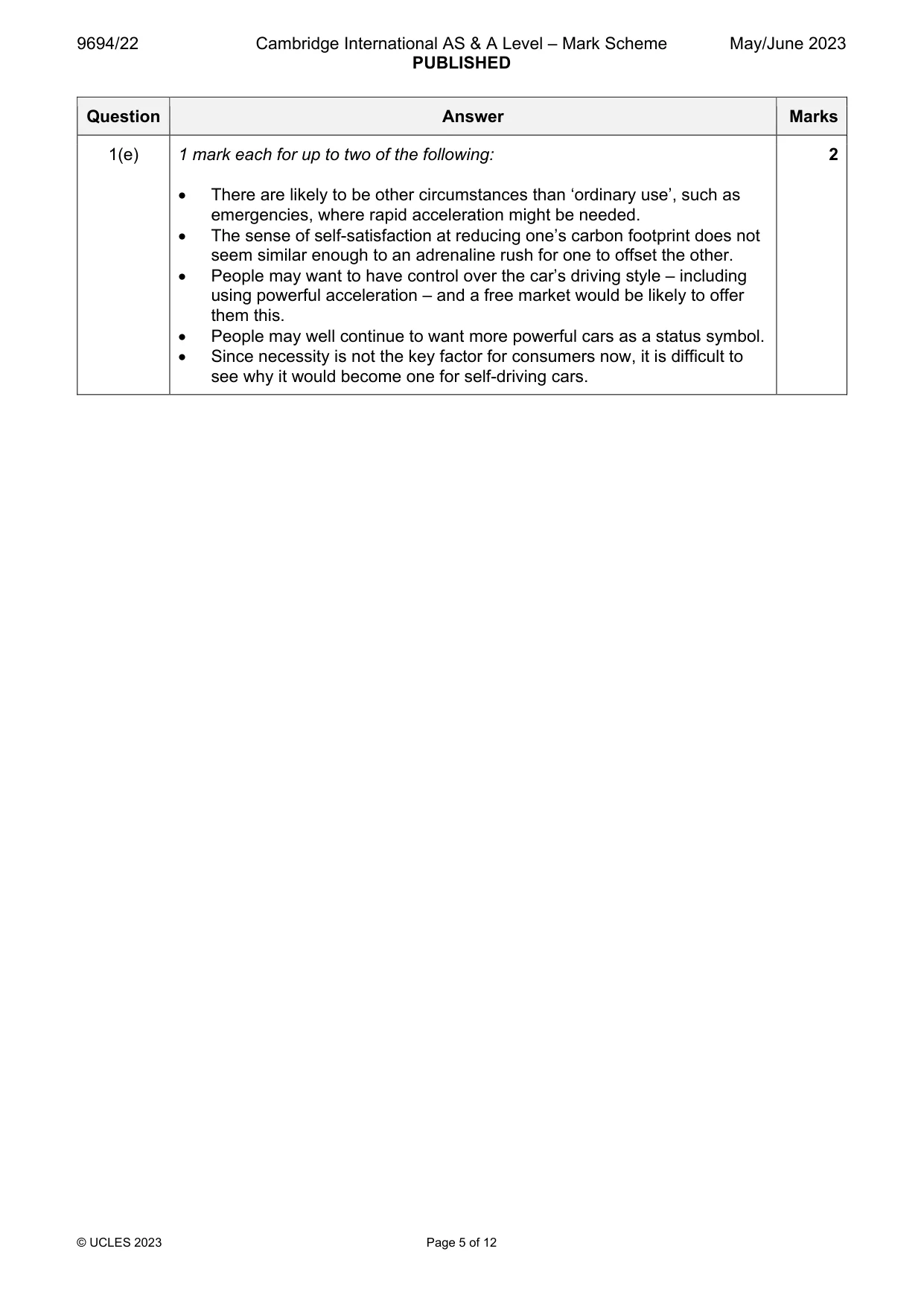
9694/22 Cambridge International AS & A Level – Mark Scheme PUBLISHED May/June 2023 © UCLES 2023 Page 5 of 12 Question Answer Marks 1(e) 1 mark each for up to two of the following: There are likely to be other circumstances than ‘ordinary use’, such as emergencies, where rapid acceleration might be needed. The sense of self-satisfaction at reducing one’s carbon footprint does not seem similar enough to an adrenaline rush for one to offset the other. People may want to have control over the car’s driving style – including using powerful acceleration – and a free market would be likely to offer them this. People may well continue to want more powerful cars as a status symbol. Since necessity is not the key factor for consumers now, it is difficult to see why it would become one for self-driving cars. 2
Mark scheme, page 6
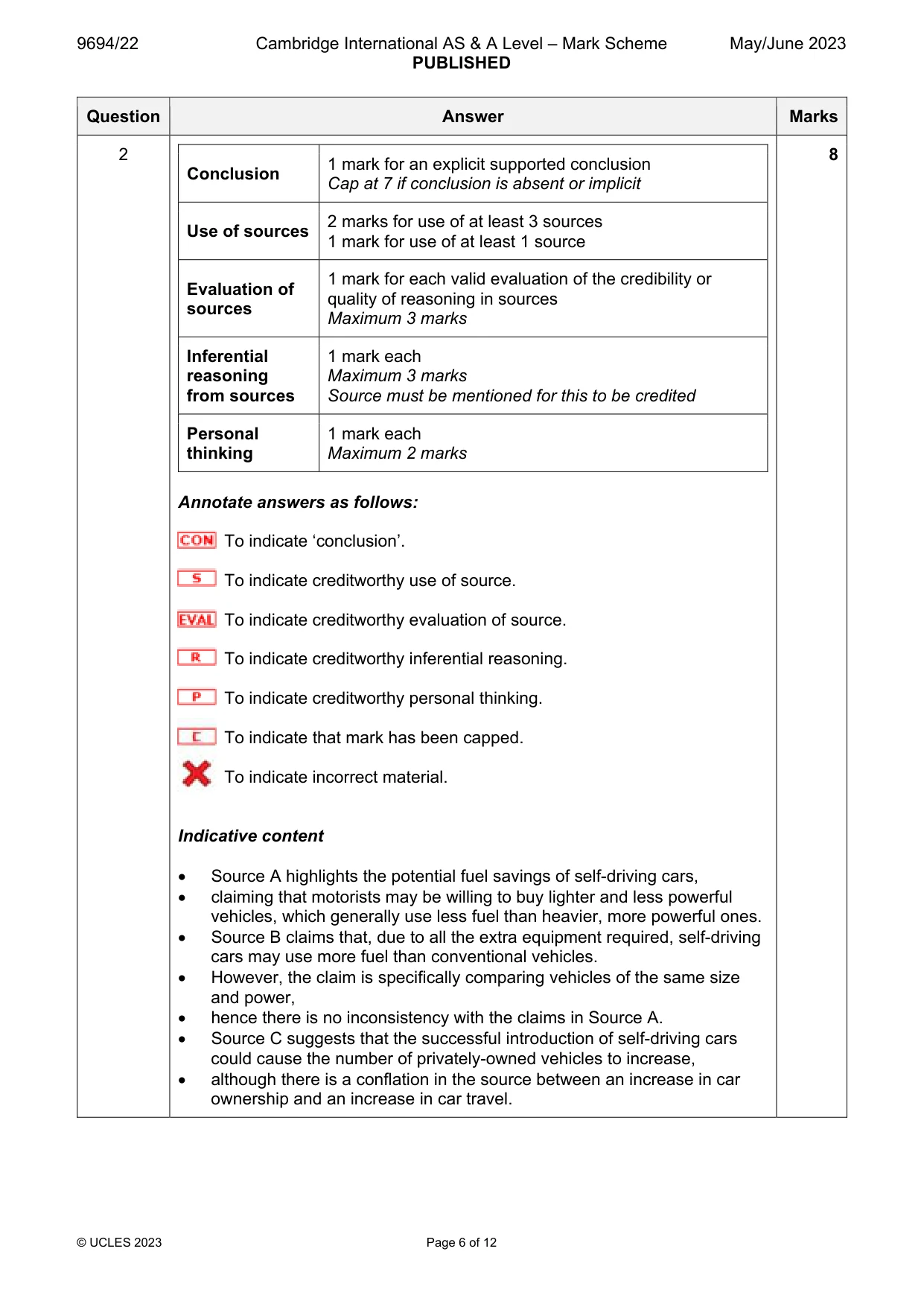
9694/22 Cambridge International AS & A Level – Mark Scheme PUBLISHED May/June 2023 © UCLES 2023 Page 6 of 12 Question Answer Marks 2 Conclusion 1 mark for an explicit supported conclusion Cap at 7 if conclusion is absent or implicit Use of sources 2 marks for use of at least 3 sources 1 mark for use of at least 1 source Evaluation of sources 1 mark for each valid evaluation of the credibility or quality of reasoning in sources Maximum 3 marks Inferential reasoning from sources 1 mark each Maximum 3 marks Source must be mentioned for this to be credited Personal thinking 1 mark each Maximum 2 marks Annotate answers as follows: To indicate ‘conclusion’. To indicate creditworthy use of source. To indicate creditworthy evaluation of source. To indicate creditworthy inferential reasoning. To indicate creditworthy personal thinking. To indicate that mark has been capped. To indicate incorrect material. Indicative content Source A highlights the potential fuel savings of self-driving cars, claiming that motorists may be willing to buy lighter and less powerful vehicles, which generally use less fuel than heavier, more powerful ones. Source B claims that, due to all the extra equipment required, self-driving cars may use more fuel than conventional vehicles. However, the claim is specifically comparing vehicles of the same size and power, hence there is no inconsistency with the claims in Source A. Source C suggests that the successful introduction of self-driving cars could cause the number of privately-owned vehicles to increase, although there is a conflation in the source between an increase in car ownership and an increase in car travel. 8
Mark scheme, page 7
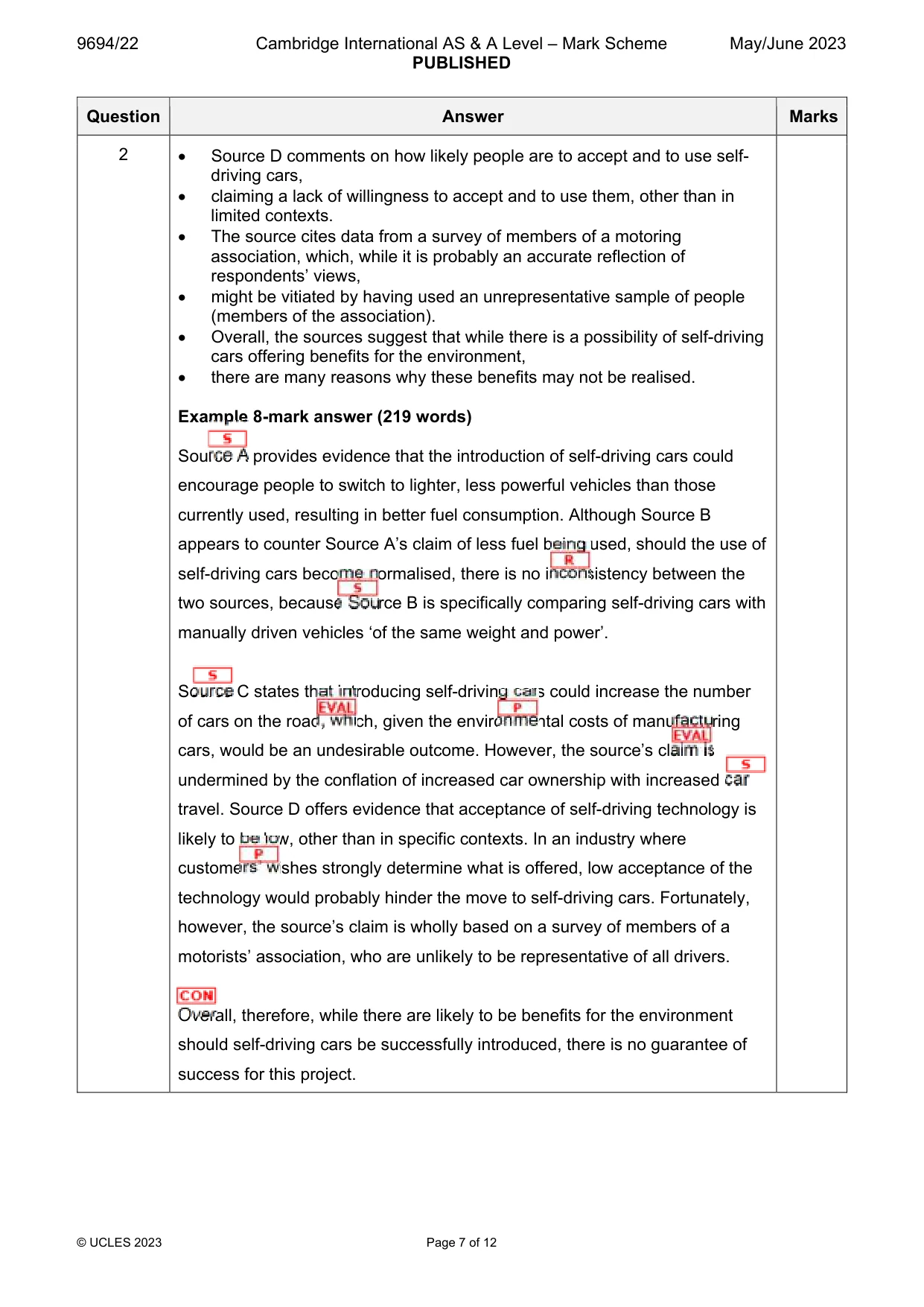
9694/22 Cambridge International AS & A Level – Mark Scheme PUBLISHED May/June 2023 © UCLES 2023 Page 7 of 12 Question Answer Marks 2 Source D comments on how likely people are to accept and to use self- driving cars, claiming a lack of willingness to accept and to use them, other than in limited contexts. The source cites data from a survey of members of a motoring association, which, while it is probably an accurate reflection of respondents’ views, might be vitiated by having used an unrepresentative sample of people (members of the association). Overall, the sources suggest that while there is a possibility of self-driving cars offering benefits for the environment, there are many reasons why these benefits may not be realised. Example 8-mark answer (219 words) Source A provides evidence that the introduction of self-driving cars could encourage people to switch to lighter, less powerful vehicles than those currently used, resulting in better fuel consumption. Although Source B appears to counter Source A’s claim of less fuel being used, should the use of self-driving cars become normalised, there is no inconsistency between the two sources, because Source B is specifically comparing self-driving cars with manually driven vehicles ‘of the same weight and power’. Source C states that introducing self-driving cars could increase the number of cars on the road, which, given the environmental costs of manufacturing cars, would be an undesirable outcome. However, the source’s claim is undermined by the conflation of increased car ownership with increased car travel. Source D offers evidence that acceptance of self-driving technology is likely to be low, other than in specific contexts. In an industry where customers’ wishes strongly determine what is offered, low acceptance of the technology would probably hinder the move to self-driving cars. Fortunately, however, the source’s claim is wholly based on a survey of members of a motorists’ association, who are unlikely to be representative of all drivers. Overall, therefore, while there are likely to be benefits for the environment should self-driving cars be successfully introduced, there is no guarantee of success for this project.
Mark scheme, page 8
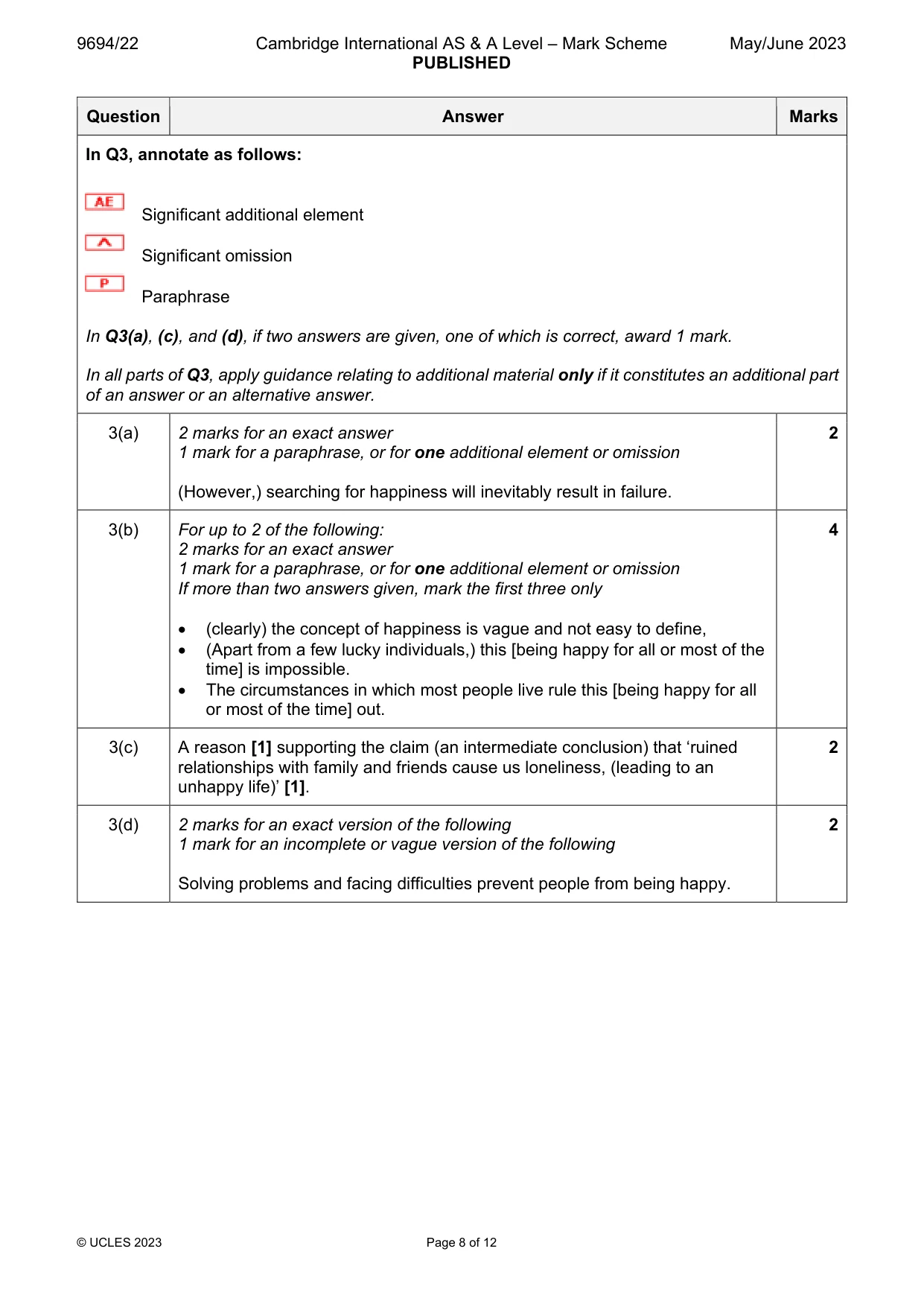
9694/22 Cambridge International AS & A Level – Mark Scheme PUBLISHED May/June 2023 © UCLES 2023 Page 8 of 12 Question Answer Marks In Q3, annotate as follows: Significant additional element Significant omission Paraphrase In Q3(a), (c), and (d), if two answers are given, one of which is correct, award 1 mark. In all parts of Q3, apply guidance relating to additional material only if it constitutes an additional part of an answer or an alternative answer. 3(a) 2 marks for an exact answer 1 mark for a paraphrase, or for one additional element or omission (However,) searching for happiness will inevitably result in failure. 2 3(b) For up to 2 of the following: 2 marks for an exact answer 1 mark for a paraphrase, or for one additional element or omission If more than two answers given, mark the first three only (clearly) the concept of happiness is vague and not easy to define, (Apart from a few lucky individuals,) this [being happy for all or most of the time] is impossible. The circumstances in which most people live rule this [being happy for all or most of the time] out. 4 3(c) A reason [1] supporting the claim (an intermediate conclusion) that ‘ruined relationships with family and friends cause us loneliness, (leading to an unhappy life)’ [1]. 2 3(d) 2 marks for an exact version of the following 1 mark for an incomplete or vague version of the following Solving problems and facing difficulties prevent people from being happy. 2
Mark scheme, page 9
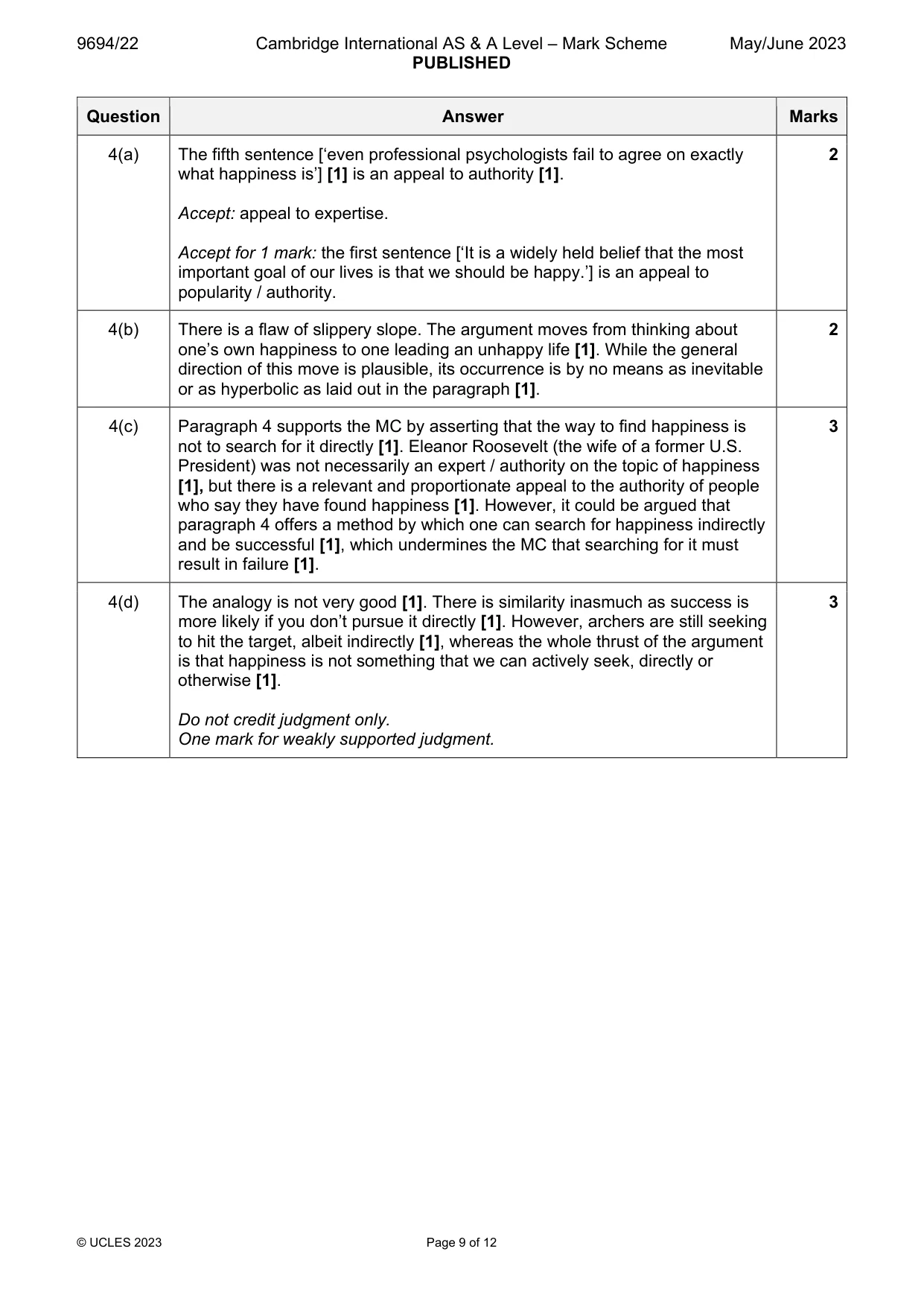
9694/22 Cambridge International AS & A Level – Mark Scheme PUBLISHED May/June 2023 © UCLES 2023 Page 9 of 12 Question Answer Marks 4(a) The fifth sentence [‘even professional psychologists fail to agree on exactly what happiness is’] [1] is an appeal to authority [1]. Accept: appeal to expertise. Accept for 1 mark: the first sentence [‘It is a widely held belief that the most important goal of our lives is that we should be happy.’] is an appeal to popularity / authority. 2 4(b) There is a flaw of slippery slope. The argument moves from thinking about one’s own happiness to one leading an unhappy life [1]. While the general direction of this move is plausible, its occurrence is by no means as inevitable or as hyperbolic as laid out in the paragraph [1]. 2 4(c) Paragraph 4 supports the MC by asserting that the way to find happiness is not to search for it directly [1]. Eleanor Roosevelt (the wife of a former U.S. President) was not necessarily an expert / authority on the topic of happiness [1], but there is a relevant and proportionate appeal to the authority of people who say they have found happiness [1]. However, it could be argued that paragraph 4 offers a method by which one can search for happiness indirectly and be successful [1], which undermines the MC that searching for it must result in failure [1]. 3 4(d) The analogy is not very good [1]. There is similarity inasmuch as success is more likely if you don’t pursue it directly [1]. However, archers are still seeking to hit the target, albeit indirectly [1], whereas the whole thrust of the argument is that happiness is not something that we can actively seek, directly or otherwise [1]. Do not credit judgment only. One mark for weakly supported judgment. 3
Mark scheme, page 10
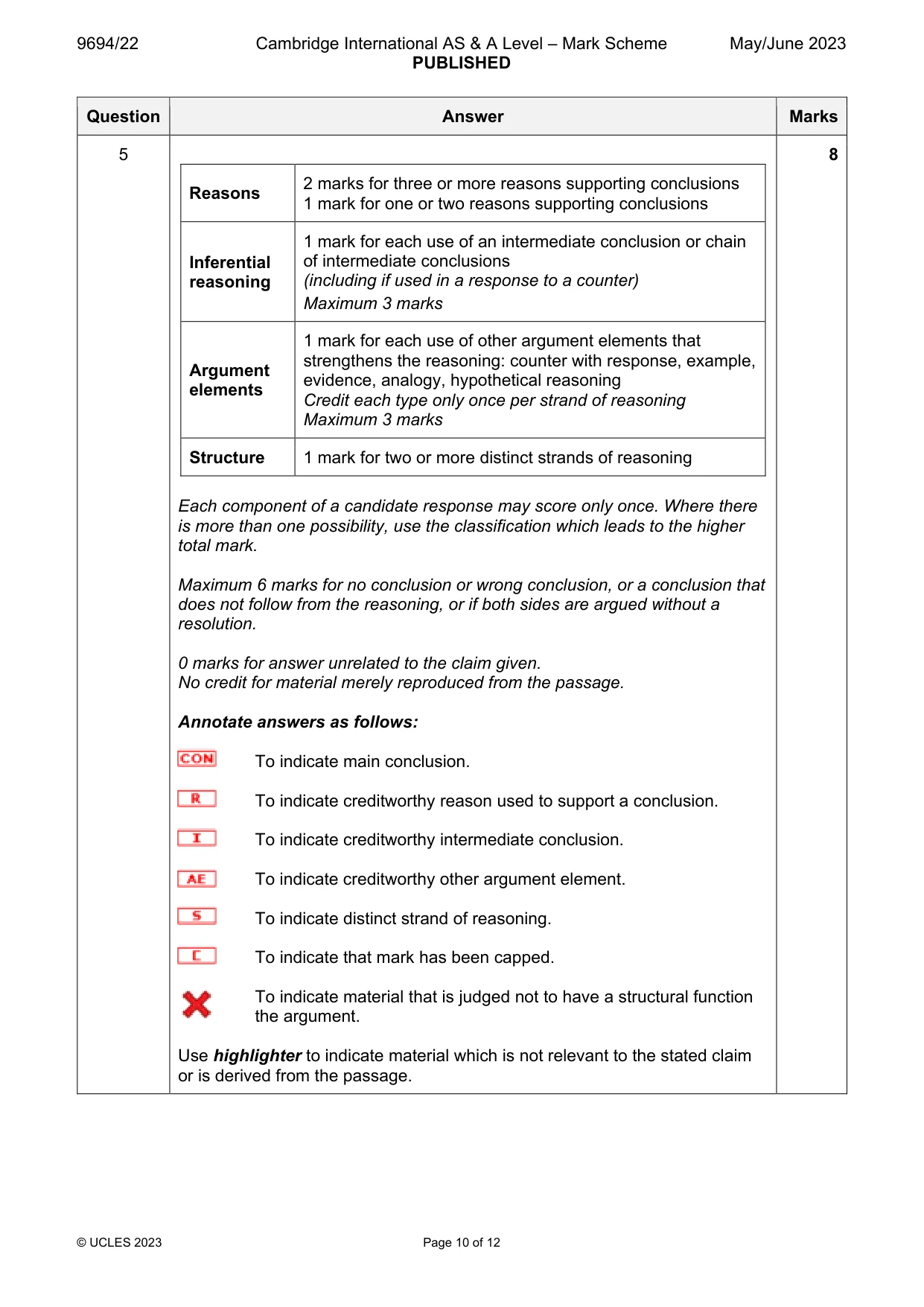
9694/22 Cambridge International AS & A Level – Mark Scheme PUBLISHED May/June 2023 © UCLES 2023 Page 10 of 12 Question Answer Marks 5 Reasons 2 marks for three or more reasons supporting conclusions 1 mark for one or two reasons supporting conclusions Inferential reasoning 1 mark for each use of an intermediate conclusion or chain of intermediate conclusions (including if used in a response to a counter) Maximum 3 marks Argument elements 1 mark for each use of other argument elements that strengthens the reasoning: counter with response, example, evidence, analogy, hypothetical reasoning Credit each type only once per strand of reasoning Maximum 3 marks Structure 1 mark for two or more distinct strands of reasoning Each component of a candidate response may score only once. Where there is more than one possibility, use the classification which leads to the higher total mark. Maximum 6 marks for no conclusion or wrong conclusion, or a conclusion that does not follow from the reasoning, or if both sides are argued without a resolution. 0 marks for answer unrelated to the claim given. No credit for material merely reproduced from the passage. Annotate answers as follows: To indicate main conclusion. To indicate creditworthy reason used to support a conclusion. To indicate creditworthy intermediate conclusion. To indicate creditworthy other argument element. To indicate distinct strand of reasoning. To indicate that mark has been capped. To indicate material that is judged not to have a structural function in the argument. Use highlighter to indicate material which is not relevant to the stated claim or is derived from the passage. 8
Mark scheme, page 11
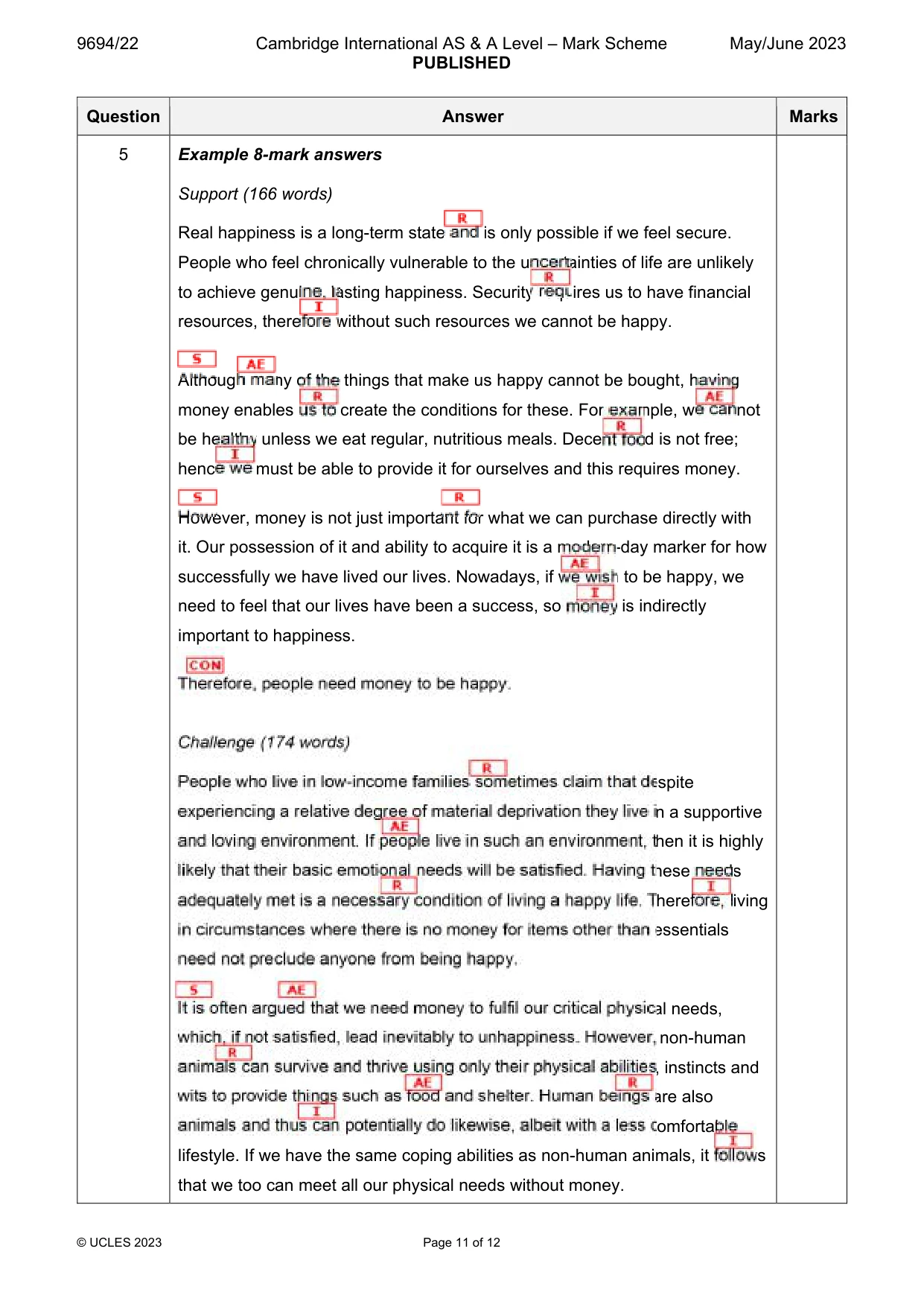
9694/22 Cambridge International AS & A Level – Mark Scheme PUBLISHED May/June 2023 © UCLES 2023 Page 11 of 12 Question Answer Marks 5 Example 8-mark answers Support (166 words) Real happiness is a long-term state and is only possible if we feel secure. People who feel chronically vulnerable to the uncertainties of life are unlikely to achieve genuine, lasting happiness. Security requires us to have financial resources, therefore without such resources we cannot be happy. Although many of the things that make us happy cannot be bought, having money enables us to create the conditions for these. For example, we cannot be healthy unless we eat regular, nutritious meals. Decent food is not free; hence we must be able to provide it for ourselves and this requires money. However, money is not just important for what we can purchase directly with it. Our possession of it and ability to acquire it is a modern-day marker for how successfully we have lived our lives. Nowadays, if we wish to be happy, we need to feel that our lives have been a success, so money is indirectly important to happiness. Therefore, people need money to be happy. Challenge (174 words) People who live in low-income families sometimes claim that despite experiencing a relative degree of material deprivation they live in a supportive and loving environment. If people live in such an environment, then it is highly likely that their basic emotional needs will be satisfied. Having these needs adequately met is a necessary condition of living a happy life. Therefore, living in circumstances where there is no money for items other than essentials need not preclude anyone from being happy. It is often argued that we need money to fulfil our critical physical needs, which, if not satisfied, lead inevitably to unhappiness. However, non-human animals can survive and thrive using only their physical abilities, instincts and wits to provide things such as food and shelter. Human beings are also animals and thus can potentially do likewise, albeit with a less comfortable lifestyle. If we have the same coping abilities as non-human animals, it follows that we too can meet all our physical needs without money.
Mark scheme, page 12
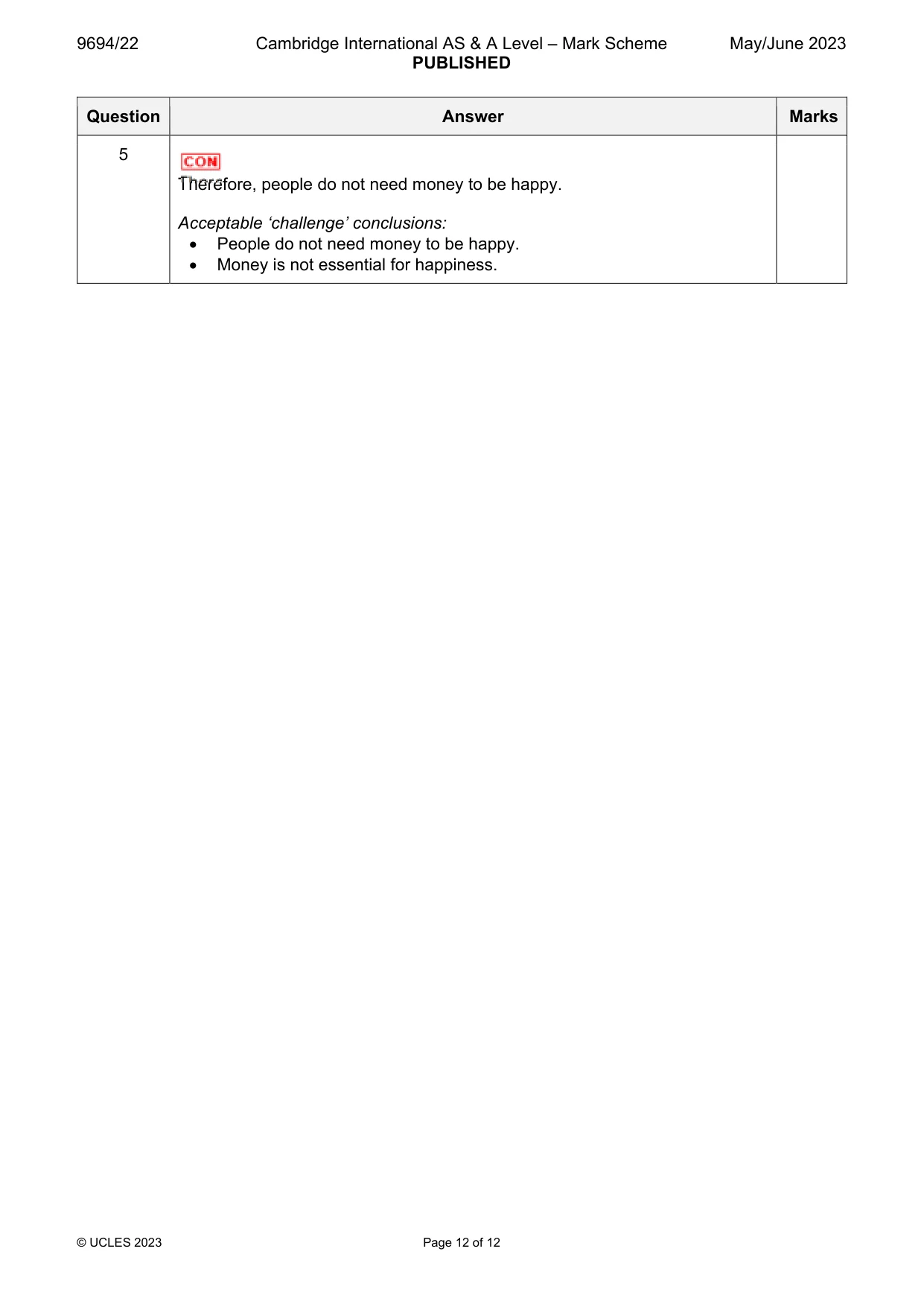
9694/22 Cambridge International AS & A Level – Mark Scheme PUBLISHED May/June 2023 © UCLES 2023 Page 12 of 12 Question Answer Marks 5 Therefore, people do not need money to be happy. Acceptable ‘challenge’ conclusions: People do not need money to be happy. Money is not essential for happiness.
What you needed in this session
Cambridge’s own grade thresholds for 2023 May/June, Paper 2 · Variant 2. A higher threshold means an easier paper — the bar moves with how the cohort did.