Cambridge A Level Thinking Skills 9694 — 2022 May/June Paper 2 · Variant 2
9694/22/M/J/22 · 50 marks · ≈56 min
The question paper and its mark scheme, free to read here and free to download. This is Cambridge’s own paper, exactly as it was sat.
Question paper8 pages



Mark scheme12 pages
Answers below. Sit the paper first if you are practising.
Paper as text
Question paper, page 1
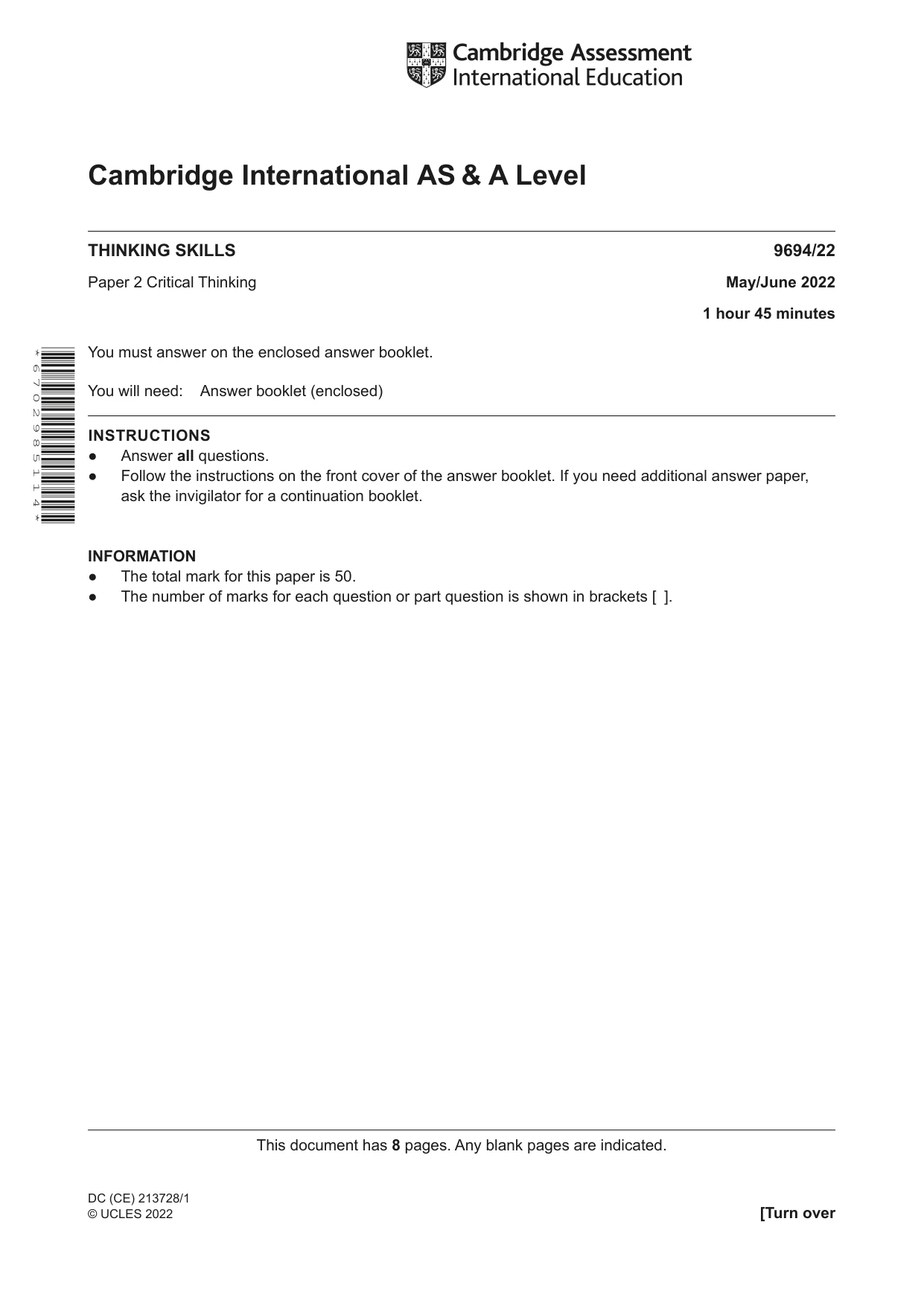
This document has 8 pages. Any blank pages are indicated. [Turn over Cambridge International AS & A Level DC (CE) 213728/1 © UCLES 2022 THINKING SKILLS 9694/22 Paper 2 Critical Thinking May/June 2022 1 hour 45 minutes You must answer on the enclosed answer booklet. You will need: Answer booklet (enclosed) INSTRUCTIONS ● Answer all questions. ● Follow the instructions on the front cover of the answer booklet. If you need additional answer paper, ask the invigilator for a continuation booklet. INFORMATION ● The total mark for this paper is 50. ● The number of marks for each question or part question is shown in brackets [ ]. * 6 7 0 2 9 8 5 1 1 4 *
Question paper, page 2
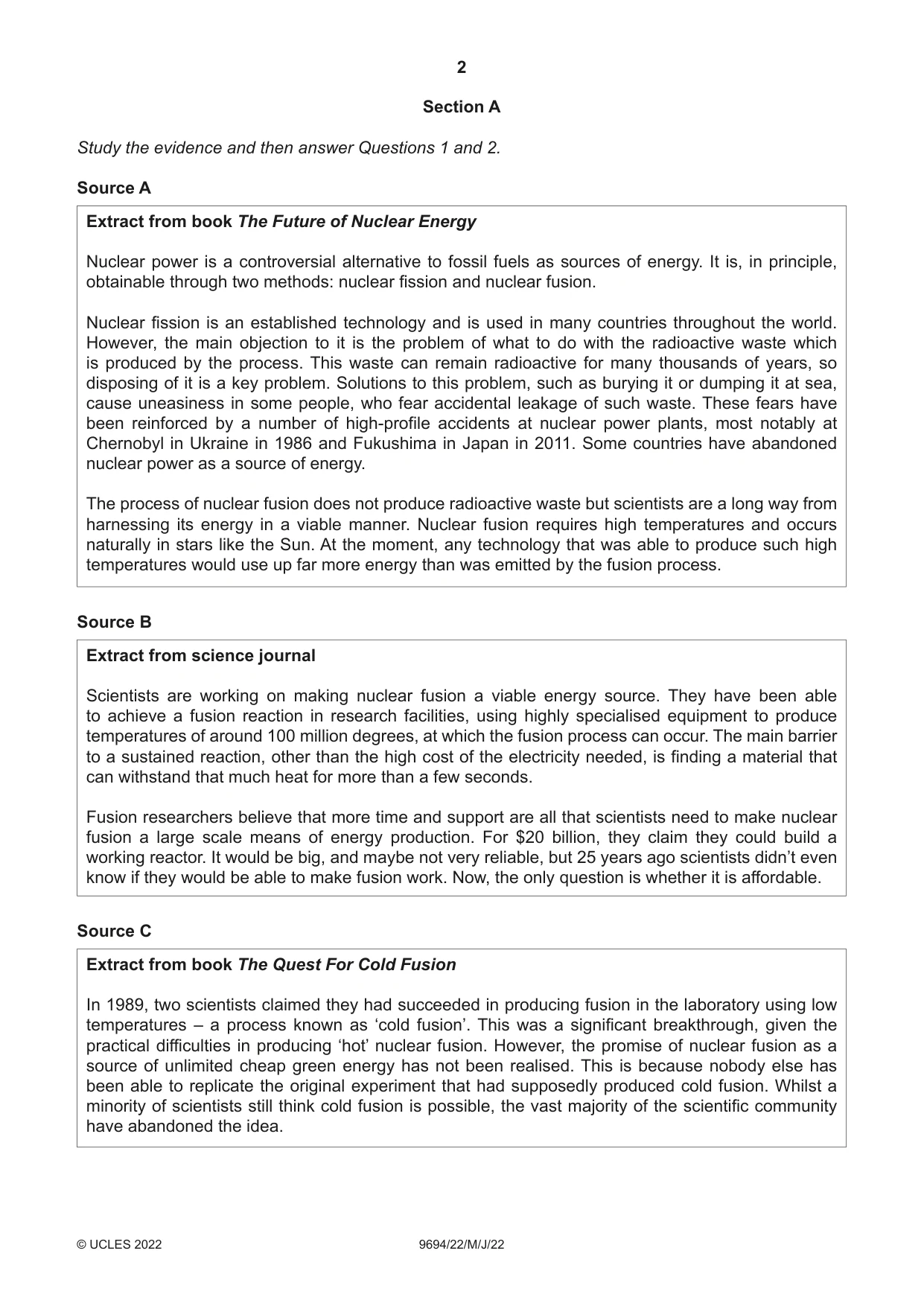
2 9694/22/M/J/22 © UCLES 2022 Section A Study the evidence and then answer Questions 1 and 2. Source A Extract from book The Future of Nuclear Energy Nuclear power is a controversial alternative to fossil fuels as sources of energy. It is, in principle, obtainable through two methods: nuclear fission and nuclear fusion. Nuclear fission is an established technology and is used in many countries throughout the world. However, the main objection to it is the problem of what to do with the radioactive waste which is produced by the process. This waste can remain radioactive for many thousands of years, so disposing of it is a key problem. Solutions to this problem, such as burying it or dumping it at sea, cause uneasiness in some people, who fear accidental leakage of such waste. These fears have been reinforced by a number of high-profile accidents at nuclear power plants, most notably at Chernobyl in Ukraine in 1986 and Fukushima in Japan in 2011. Some countries have abandoned nuclear power as a source of energy. The process of nuclear fusion does not produce radioactive waste but scientists are a long way from harnessing its energy in a viable manner. Nuclear fusion requires high temperatures and occurs naturally in stars like the Sun. At the moment, any technology that was able to produce such high temperatures would use up far more energy than was emitted by the fusion process. Source B Extract from science journal Scientists are working on making nuclear fusion a viable energy source. They have been able to achieve a fusion reaction in research facilities, using highly specialised equipment to produce temperatures of around 100 million degrees, at which the fusion process can occur. The main barrier to a sustained reaction, other than the high cost of the electricity needed, is finding a material that can withstand that much heat for more than a few seconds. Fusion researchers believe that more time and support are all that scientists need to make nuclear fusion a large scale means of energy production. For $20 billion, they claim they could build a working reactor. It would be big, and maybe not very reliable, but 25 years ago scientists didn’t even know if they would be able to make fusion work. Now, the only question is whether it is affordable. Source C Extract from book The Quest For Cold Fusion In 1989, two scientists claimed they had succeeded in producing fusion in the laboratory using low temperatures – a process known as ‘cold fusion’. This was a significant breakthrough, given the practical difficulties in producing ‘hot’ nuclear fusion. However, the promise of nuclear fusion as a source of unlimited cheap green energy has not been realised. This is because nobody else has been able to replicate the original experiment that had supposedly produced cold fusion. Whilst a minority of scientists still think cold fusion is possible, the vast majority of the scientific community have abandoned the idea.
Question paper, page 3
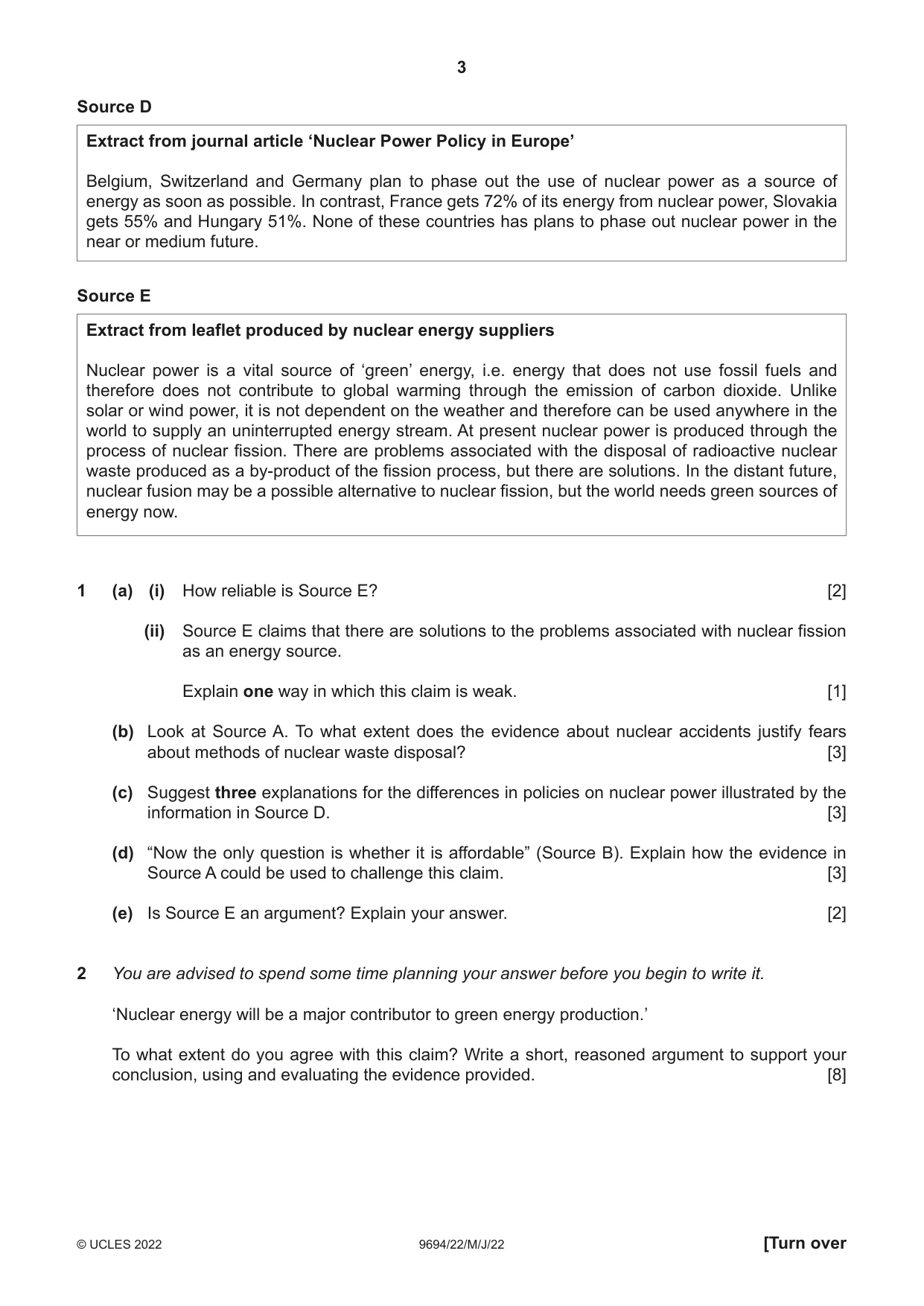
3 9694/22/M/J/22 © UCLES 2022 [Turn over Source D Extract from journal article ‘Nuclear Power Policy in Europe’ Belgium, Switzerland and Germany plan to phase out the use of nuclear power as a source of energy as soon as possible. In contrast, France gets 72% of its energy from nuclear power, Slovakia gets 55% and Hungary 51%. None of these countries has plans to phase out nuclear power in the near or medium future. Source E Extract from leaflet produced by nuclear energy suppliers Nuclear power is a vital source of ‘green’ energy, i.e. energy that does not use fossil fuels and therefore does not contribute to global warming through the emission of carbon dioxide. Unlike solar or wind power, it is not dependent on the weather and therefore can be used anywhere in the world to supply an uninterrupted energy stream. At present nuclear power is produced through the process of nuclear fission. There are problems associated with the disposal of radioactive nuclear waste produced as a by-product of the fission process, but there are solutions. In the distant future, nuclear fusion may be a possible alternative to nuclear fission, but the world needs green sources of energy now. 1 (a) (i) How reliable is Source E? [2] (ii) Source E claims that there are solutions to the problems associated with nuclear fission as an energy source. Explain one way in which this claim is weak. [1] (b) Look at Source A. To what extent does the evidence about nuclear accidents justify fears about methods of nuclear waste disposal? [3] (c) Suggest three explanations for the differences in policies on nuclear power illustrated by the information in Source D. [3] (d) “Now the only question is whether it is affordable” (Source B). Explain how the evidence in Source A could be used to challenge this claim. [3] (e) Is Source E an argument? Explain your answer. [2] 2 You are advised to spend some time planning your answer before you begin to write it. ‘Nuclear energy will be a major contributor to green energy production.’ To what extent do you agree with this claim? Write a short, reasoned argument to support your conclusion, using and evaluating the evidence provided. [8]
Question paper, page 4
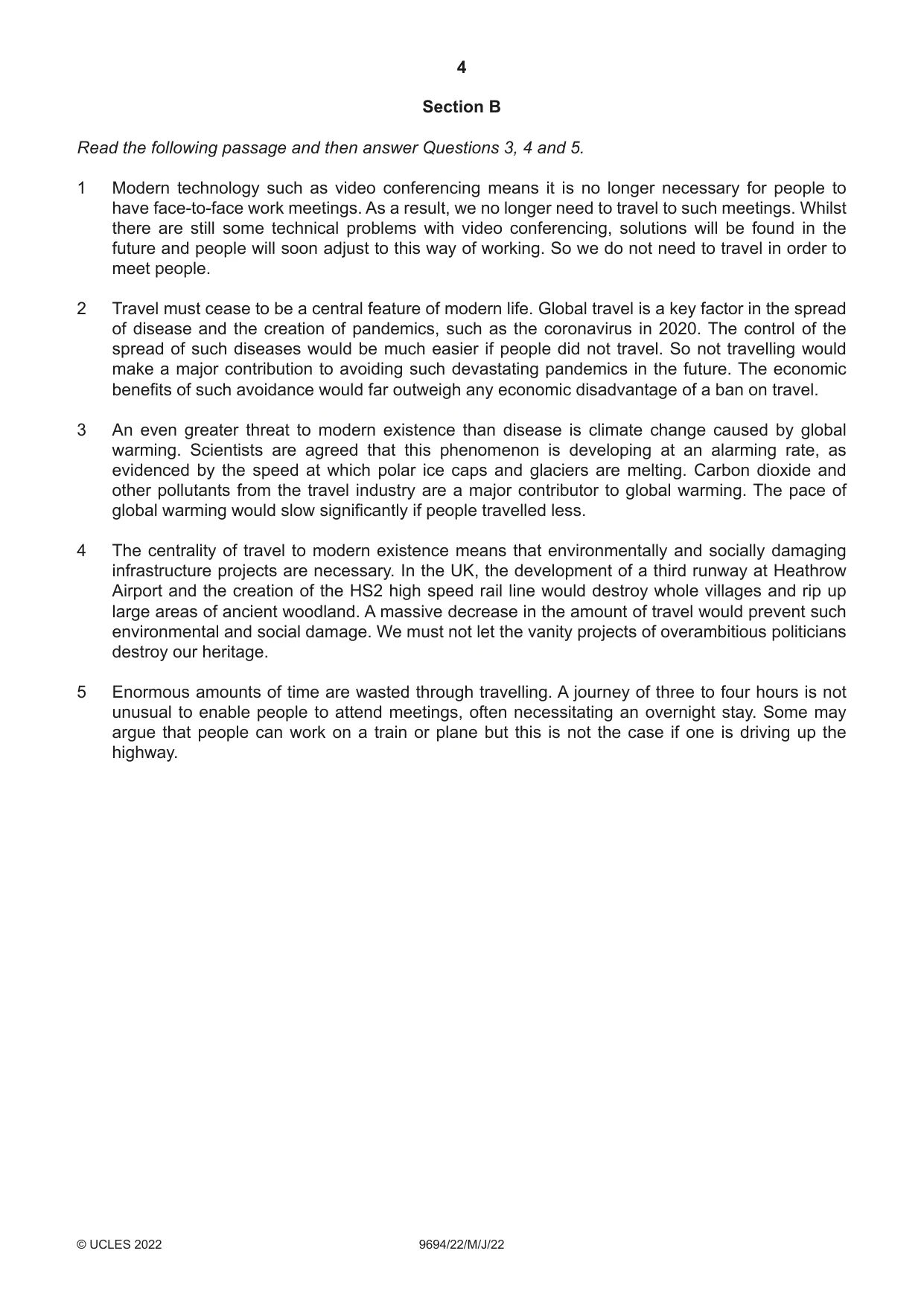
4 9694/22/M/J/22 © UCLES 2022 Section B Read the following passage and then answer Questions 3, 4 and 5. 1 Modern technology such as video conferencing means it is no longer necessary for people to have face-to-face work meetings. As a result, we no longer need to travel to such meetings. Whilst there are still some technical problems with video conferencing, solutions will be found in the future and people will soon adjust to this way of working. So we do not need to travel in order to meet people. 2 Travel must cease to be a central feature of modern life. Global travel is a key factor in the spread of disease and the creation of pandemics, such as the coronavirus in 2020. The control of the spread of such diseases would be much easier if people did not travel. So not travelling would make a major contribution to avoiding such devastating pandemics in the future. The economic benefits of such avoidance would far outweigh any economic disadvantage of a ban on travel. 3 An even greater threat to modern existence than disease is climate change caused by global warming. Scientists are agreed that this phenomenon is developing at an alarming rate, as evidenced by the speed at which polar ice caps and glaciers are melting. Carbon dioxide and other pollutants from the travel industry are a major contributor to global warming. The pace of global warming would slow significantly if people travelled less. 4 The centrality of travel to modern existence means that environmentally and socially damaging infrastructure projects are necessary. In the UK, the development of a third runway at Heathrow Airport and the creation of the HS2 high speed rail line would destroy whole villages and rip up large areas of ancient woodland. A massive decrease in the amount of travel would prevent such environmental and social damage. We must not let the vanity projects of overambitious politicians destroy our heritage. 5 Enormous amounts of time are wasted through travelling. A journey of three to four hours is not unusual to enable people to attend meetings, often necessitating an overnight stay. Some may argue that people can work on a train or plane but this is not the case if one is driving up the highway.
Question paper, page 5
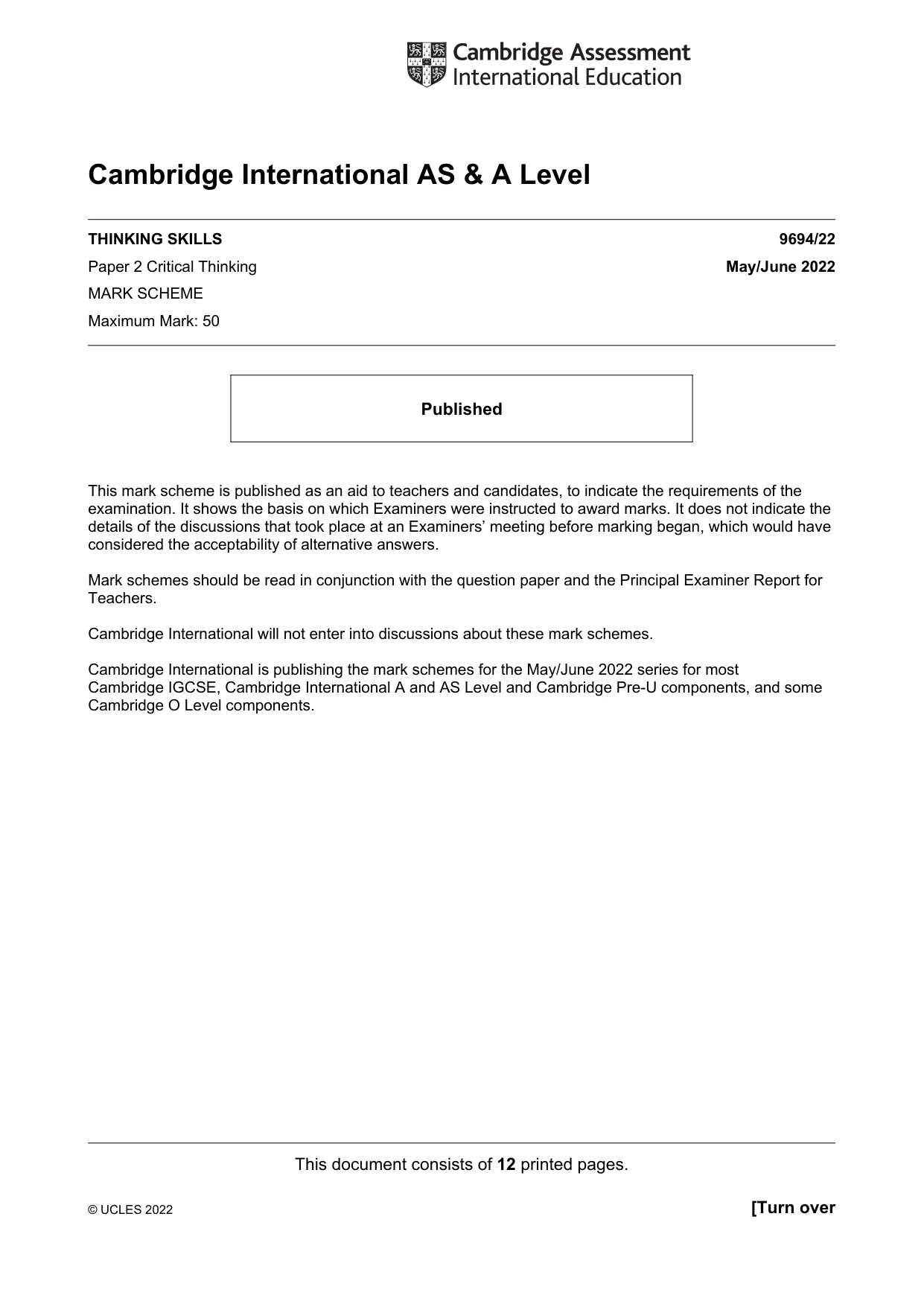
5 9694/22/M/J/22 © UCLES 2022 3 (a) Using the exact words from the passage as far as possible, identify the main conclusion. [2] (b) Using the exact words from the passage as far as possible, identify two intermediate conclusions in paragraphs 2 to 4. [4] (c) Identify an example in paragraph 2. [2] (d) Identify two unstated assumptions required by the reasoning in paragraph 1. [4] 4 (a) Identify and evaluate an appeal in paragraph 3. [3] (b) Identify a personal attack (ad hominem) flaw in paragraph 4 and assess its impact on the strength of the reasoning. [2] (c) Explain why the reasoning in paragraph 5 is weak. [3] 5 You are advised to spend some time planning your answer before you begin to write it. ‘It is good for people to have to leave their home to go to their workplace.’ Write your own short argument to support or challenge this claim. The conclusion of your argument must be stated. Credit will not be given for repeating ideas from the passage. [8]
Question paper, page 6
6 9694/22/M/J/22 © UCLES 2022 BLANK PAGE
Question paper, page 7
7 9694/22/M/J/22 © UCLES 2022 BLANK PAGE
Question paper, page 8
8 9694/22/M/J/22 © UCLES 2022 Permission to reproduce items where third-party owned material protected by copyright is included has been sought and cleared where possible. Every reasonable effort has been made by the publisher (UCLES) to trace copyright holders, but if any items requiring clearance have unwittingly been included, the publisher will be pleased to make amends at the earliest possible opportunity. To avoid the issue of disclosure of answer-related information to candidates, all copyright acknowledgements are reproduced online in the Cambridge Assessment International Education Copyright Acknowledgements Booklet. This is produced for each series of examinations and is freely available to download at www.cambridgeinternational.org after the live examination series. Cambridge Assessment International Education is part of Cambridge Assessment. Cambridge Assessment is the brand name of the University of Cambridge Local Examinations Syndicate (UCLES), which is a department of the University of Cambridge. BLANK PAGE
Mark scheme, page 1
This document consists of 12 printed pages. © UCLES 2022 [Turn over Cambridge International AS & A Level THINKING SKILLS 9694/22 Paper 2 Critical Thinking May/June 2022 MARK SCHEME Maximum Mark: 50 Published This mark scheme is published as an aid to teachers and candidates, to indicate the requirements of the examination. It shows the basis on which Examiners were instructed to award marks. It does not indicate the details of the discussions that took place at an Examiners’ meeting before marking began, which would have considered the acceptability of alternative answers. Mark schemes should be read in conjunction with the question paper and the Principal Examiner Report for Teachers. Cambridge International will not enter into discussions about these mark schemes. Cambridge International is publishing the mark schemes for the May/June 2022 series for most Cambridge IGCSE, Cambridge International A and AS Level and Cambridge Pre-U components, and some Cambridge O Level components.
Mark scheme, page 2
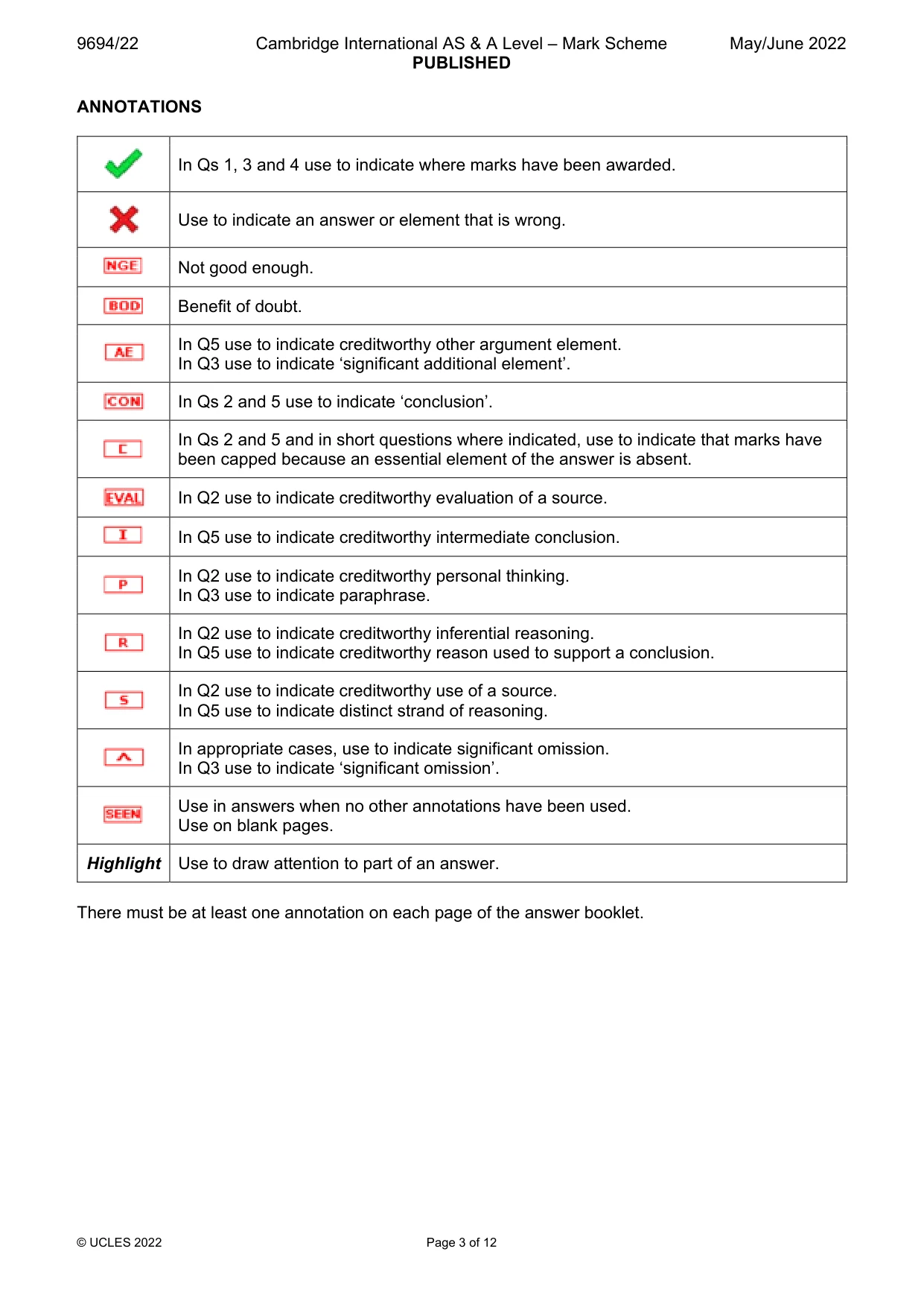
9694/22 Cambridge International AS & A Level – Mark Scheme PUBLISHED May/June 2022 © UCLES 2022 Page 2 of 12 Generic Marking Principles These general marking principles must be applied by all examiners when marking candidate answers. They should be applied alongside the specific content of the mark scheme or generic level descriptors for a question. Each question paper and mark scheme will also comply with these marking principles. GENERIC MARKING PRINCIPLE 1: Marks must be awarded in line with: the specific content of the mark scheme or the generic level descriptors for the question the specific skills defined in the mark scheme or in the generic level descriptors for the question the standard of response required by a candidate as exemplified by the standardisation scripts. GENERIC MARKING PRINCIPLE 2: Marks awarded are always whole marks (not half marks, or other fractions). GENERIC MARKING PRINCIPLE 3: Marks must be awarded positively: marks are awarded for correct/valid answers, as defined in the mark scheme. However, credit is given for valid answers which go beyond the scope of the syllabus and mark scheme, referring to your Team Leader as appropriate marks are awarded when candidates clearly demonstrate what they know and can do marks are not deducted for errors marks are not deducted for omissions answers should only be judged on the quality of spelling, punctuation and grammar when these features are specifically assessed by the question as indicated by the mark scheme. The meaning, however, should be unambiguous. GENERIC MARKING PRINCIPLE 4: Rules must be applied consistently, e.g. in situations where candidates have not followed instructions or in the application of generic level descriptors. GENERIC MARKING PRINCIPLE 5: Marks should be awarded using the full range of marks defined in the mark scheme for the question (however; the use of the full mark range may be limited according to the quality of the candidate responses seen). GENERIC MARKING PRINCIPLE 6: Marks awarded are based solely on the requirements as defined in the mark scheme. Marks should not be awarded with grade thresholds or grade descriptors in mind.
Mark scheme, page 3
9694/22 Cambridge International AS & A Level – Mark Scheme PUBLISHED May/June 2022 © UCLES 2022 Page 3 of 12 ANNOTATIONS In Qs 1, 3 and 4 use to indicate where marks have been awarded. Use to indicate an answer or element that is wrong. Not good enough. Benefit of doubt. In Q5 use to indicate creditworthy other argument element. In Q3 use to indicate ‘significant additional element’. In Qs 2 and 5 use to indicate ‘conclusion’. In Qs 2 and 5 and in short questions where indicated, use to indicate that marks have been capped because an essential element of the answer is absent. In Q2 use to indicate creditworthy evaluation of a source. In Q5 use to indicate creditworthy intermediate conclusion. In Q2 use to indicate creditworthy personal thinking. In Q3 use to indicate paraphrase. In Q2 use to indicate creditworthy inferential reasoning. In Q5 use to indicate creditworthy reason used to support a conclusion. In Q2 use to indicate creditworthy use of a source. In Q5 use to indicate distinct strand of reasoning. In appropriate cases, use to indicate significant omission. In Q3 use to indicate ‘significant omission’. Use in answers when no other annotations have been used. Use on blank pages. Highlight Use to draw attention to part of an answer. There must be at least one annotation on each page of the answer booklet.
Mark scheme, page 4
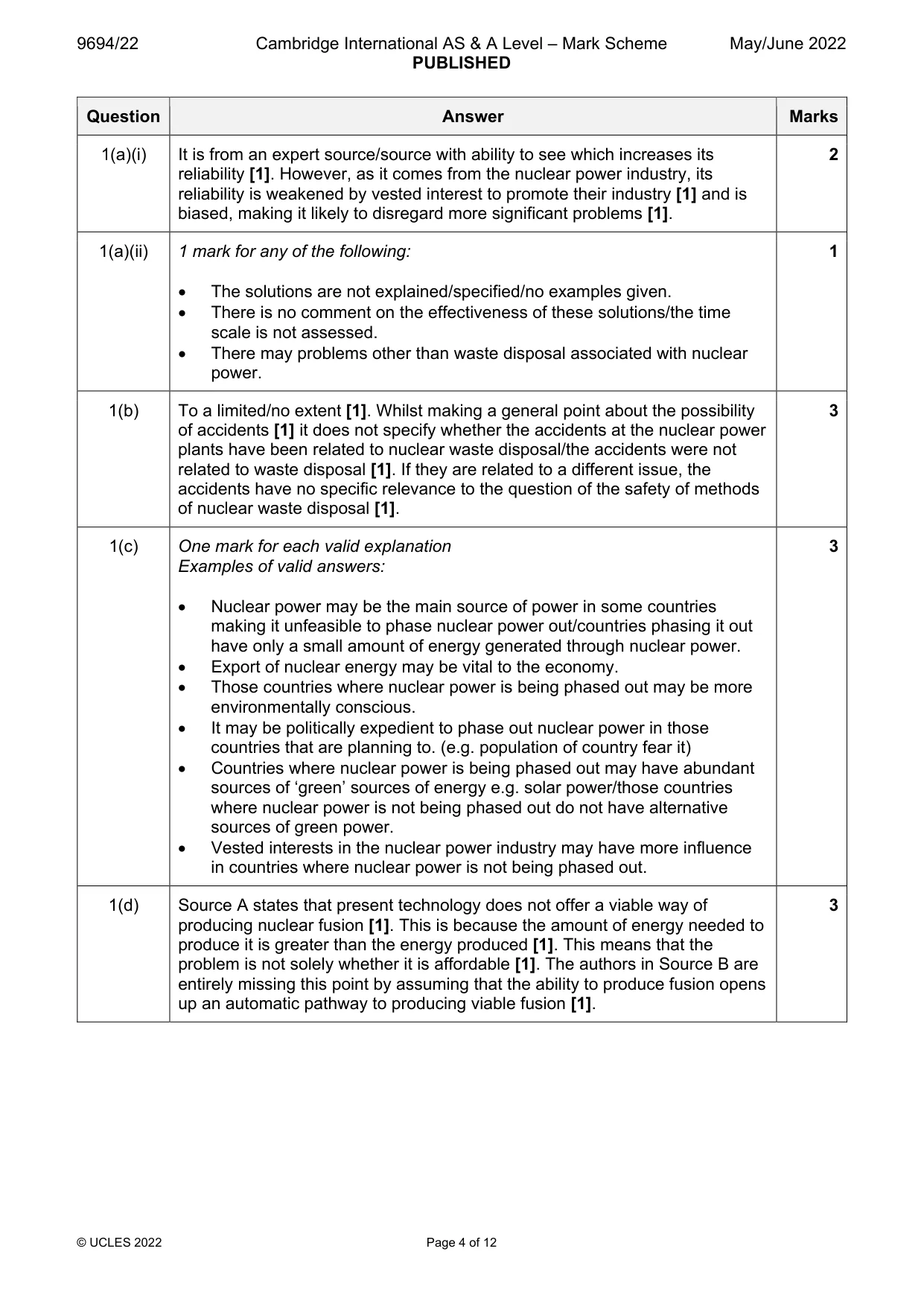
9694/22 Cambridge International AS & A Level – Mark Scheme PUBLISHED May/June 2022 © UCLES 2022 Page 4 of 12 Question Answer Marks 1(a)(i) It is from an expert source/source with ability to see which increases its reliability [1]. However, as it comes from the nuclear power industry, its reliability is weakened by vested interest to promote their industry [1] and is biased, making it likely to disregard more significant problems [1]. 2 1(a)(ii) 1 mark for any of the following: The solutions are not explained/specified/no examples given. There is no comment on the effectiveness of these solutions/the time scale is not assessed. There may problems other than waste disposal associated with nuclear power. 1 1(b) To a limited/no extent [1]. Whilst making a general point about the possibility of accidents [1] it does not specify whether the accidents at the nuclear power plants have been related to nuclear waste disposal/the accidents were not related to waste disposal [1]. If they are related to a different issue, the accidents have no specific relevance to the question of the safety of methods of nuclear waste disposal [1]. 3 1(c) One mark for each valid explanation Examples of valid answers: Nuclear power may be the main source of power in some countries making it unfeasible to phase nuclear power out/countries phasing it out have only a small amount of energy generated through nuclear power. Export of nuclear energy may be vital to the economy. Those countries where nuclear power is being phased out may be more environmentally conscious. It may be politically expedient to phase out nuclear power in those countries that are planning to. (e.g. population of country fear it) Countries where nuclear power is being phased out may have abundant sources of ‘green’ sources of energy e.g. solar power/those countries where nuclear power is not being phased out do not have alternative sources of green power. Vested interests in the nuclear power industry may have more influence in countries where nuclear power is not being phased out. 3 1(d) Source A states that present technology does not offer a viable way of producing nuclear fusion [1]. This is because the amount of energy needed to produce it is greater than the energy produced [1]. This means that the problem is not solely whether it is affordable [1]. The authors in Source B are entirely missing this point by assuming that the ability to produce fusion opens up an automatic pathway to producing viable fusion [1]. 3
Mark scheme, page 5
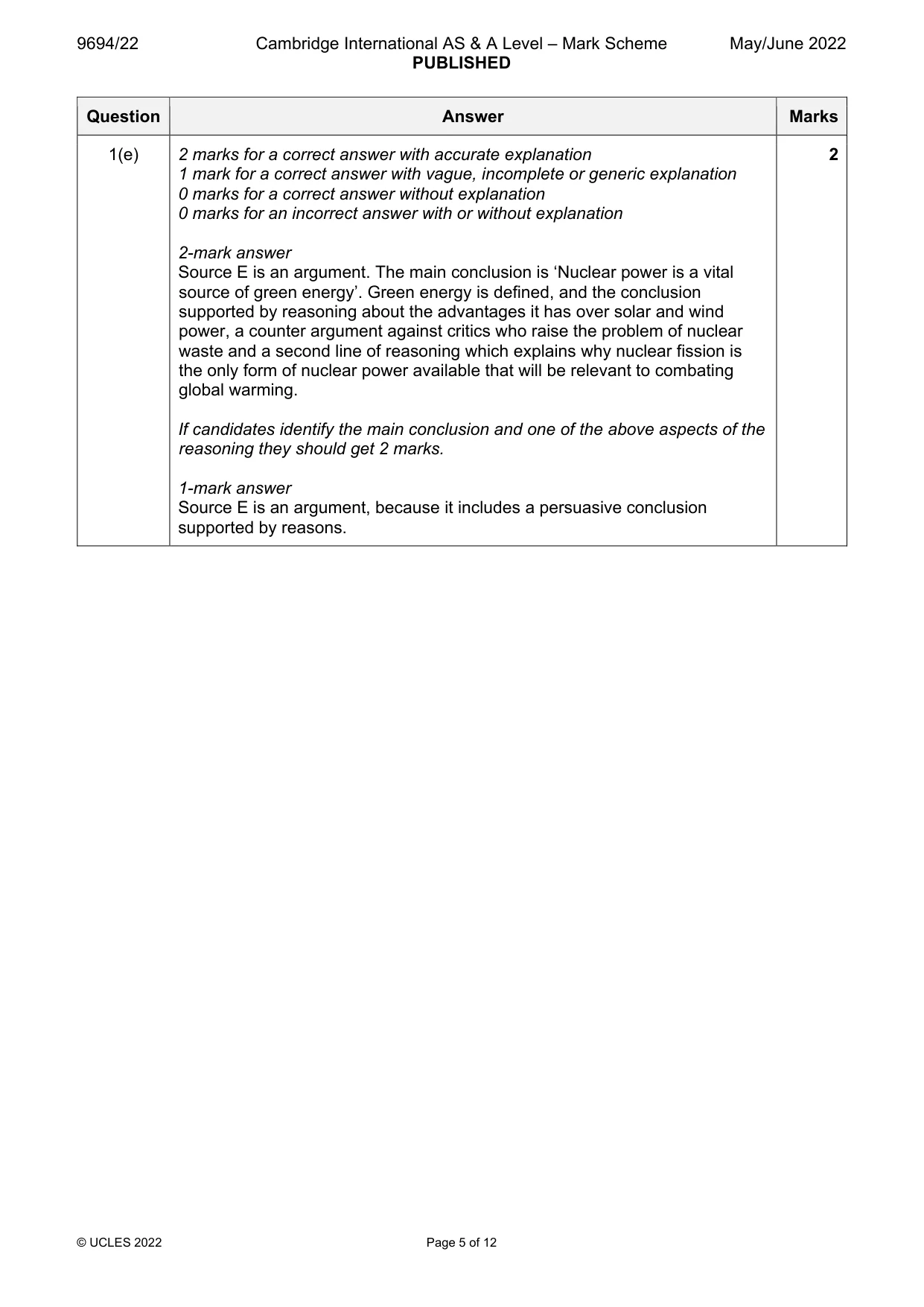
9694/22 Cambridge International AS & A Level – Mark Scheme PUBLISHED May/June 2022 © UCLES 2022 Page 5 of 12 Question Answer Marks 1(e) 2 marks for a correct answer with accurate explanation 1 mark for a correct answer with vague, incomplete or generic explanation 0 marks for a correct answer without explanation 0 marks for an incorrect answer with or without explanation 2-mark answer Source E is an argument. The main conclusion is ‘Nuclear power is a vital source of green energy’. Green energy is defined, and the conclusion supported by reasoning about the advantages it has over solar and wind power, a counter argument against critics who raise the problem of nuclear waste and a second line of reasoning which explains why nuclear fission is the only form of nuclear power available that will be relevant to combating global warming. If candidates identify the main conclusion and one of the above aspects of the reasoning they should get 2 marks. 1-mark answer Source E is an argument, because it includes a persuasive conclusion supported by reasons. 2
Mark scheme, page 6
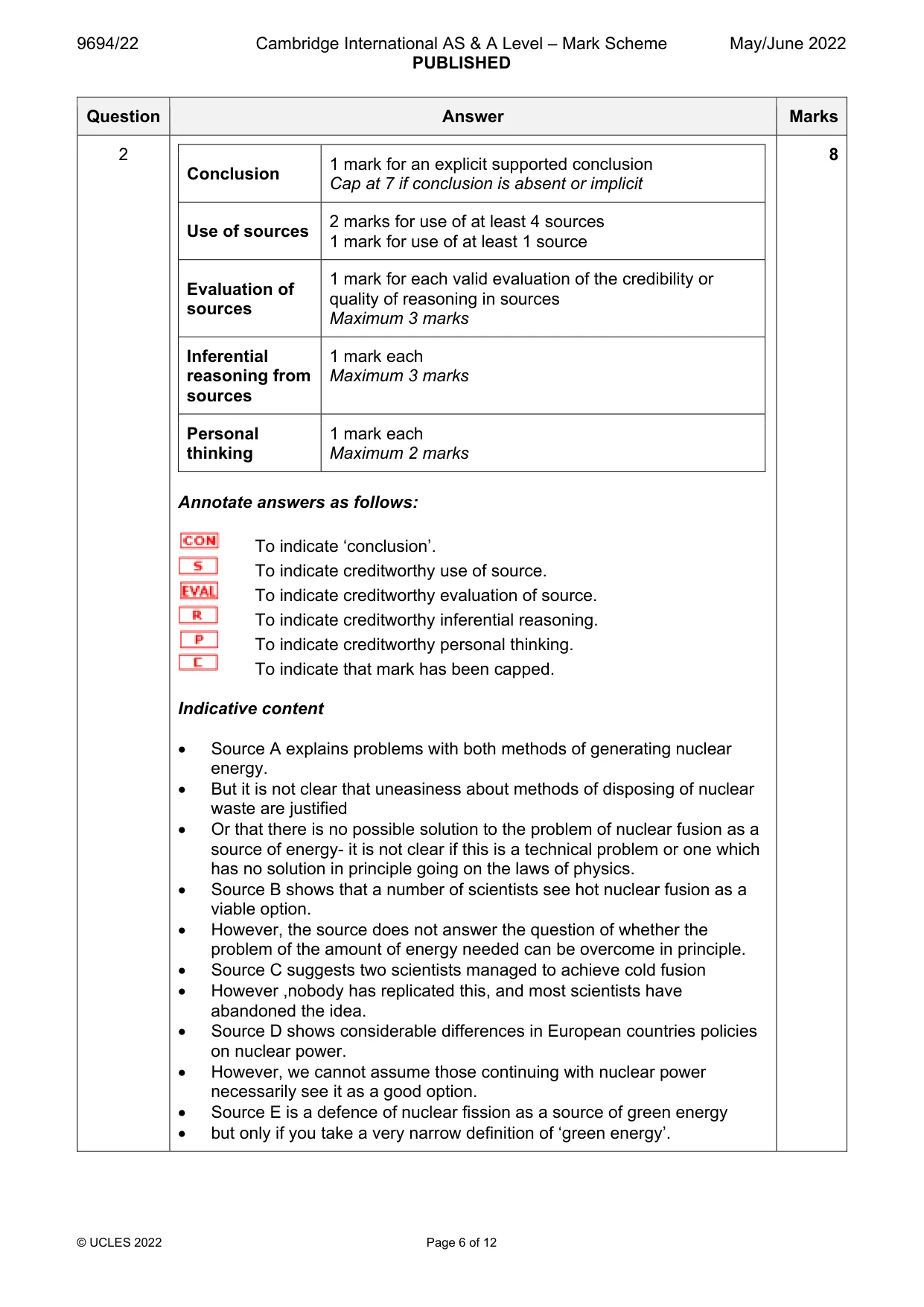
9694/22 Cambridge International AS & A Level – Mark Scheme PUBLISHED May/June 2022 © UCLES 2022 Page 6 of 12 Question Answer Marks 2 Conclusion 1 mark for an explicit supported conclusion Cap at 7 if conclusion is absent or implicit Use of sources 2 marks for use of at least 4 sources 1 mark for use of at least 1 source Evaluation of sources 1 mark for each valid evaluation of the credibility or quality of reasoning in sources Maximum 3 marks Inferential reasoning from sources 1 mark each Maximum 3 marks Personal thinking 1 mark each Maximum 2 marks Annotate answers as follows: To indicate ‘conclusion’. To indicate creditworthy use of source. To indicate creditworthy evaluation of source. To indicate creditworthy inferential reasoning. To indicate creditworthy personal thinking. To indicate that mark has been capped. Indicative content Source A explains problems with both methods of generating nuclear energy. But it is not clear that uneasiness about methods of disposing of nuclear waste are justified Or that there is no possible solution to the problem of nuclear fusion as a source of energy- it is not clear if this is a technical problem or one which has no solution in principle going on the laws of physics. Source B shows that a number of scientists see hot nuclear fusion as a viable option. However, the source does not answer the question of whether the problem of the amount of energy needed can be overcome in principle. Source C suggests two scientists managed to achieve cold fusion However ,nobody has replicated this, and most scientists have abandoned the idea. Source D shows considerable differences in European countries policies on nuclear power. However, we cannot assume those continuing with nuclear power necessarily see it as a good option. Source E is a defence of nuclear fission as a source of green energy but only if you take a very narrow definition of ‘green energy’. 8
Mark scheme, page 7
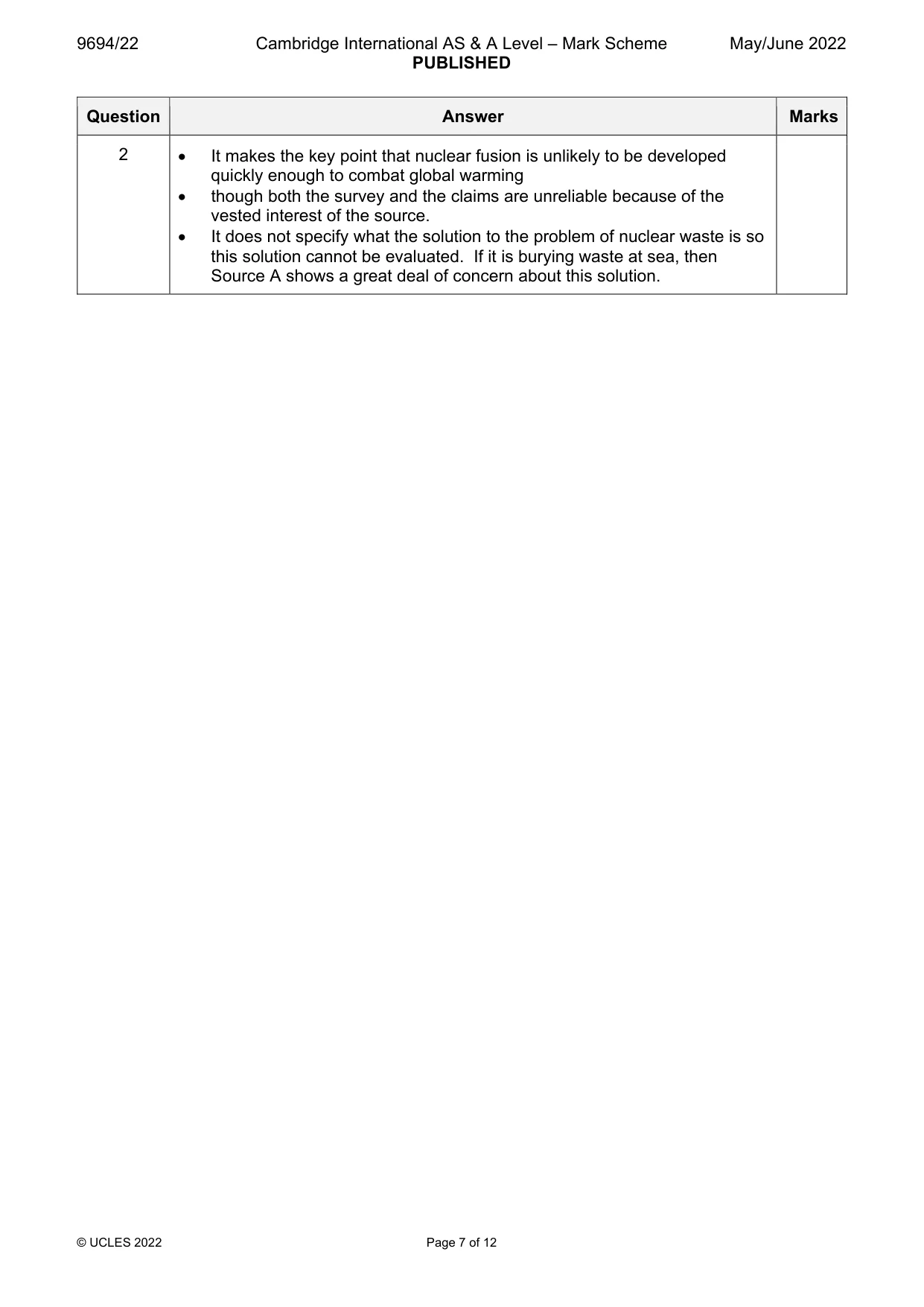
9694/22 Cambridge International AS & A Level – Mark Scheme PUBLISHED May/June 2022 © UCLES 2022 Page 7 of 12 Question Answer Marks 2 It makes the key point that nuclear fusion is unlikely to be developed quickly enough to combat global warming though both the survey and the claims are unreliable because of the vested interest of the source. It does not specify what the solution to the problem of nuclear waste is so this solution cannot be evaluated. If it is burying waste at sea, then Source A shows a great deal of concern about this solution.
Mark scheme, page 8
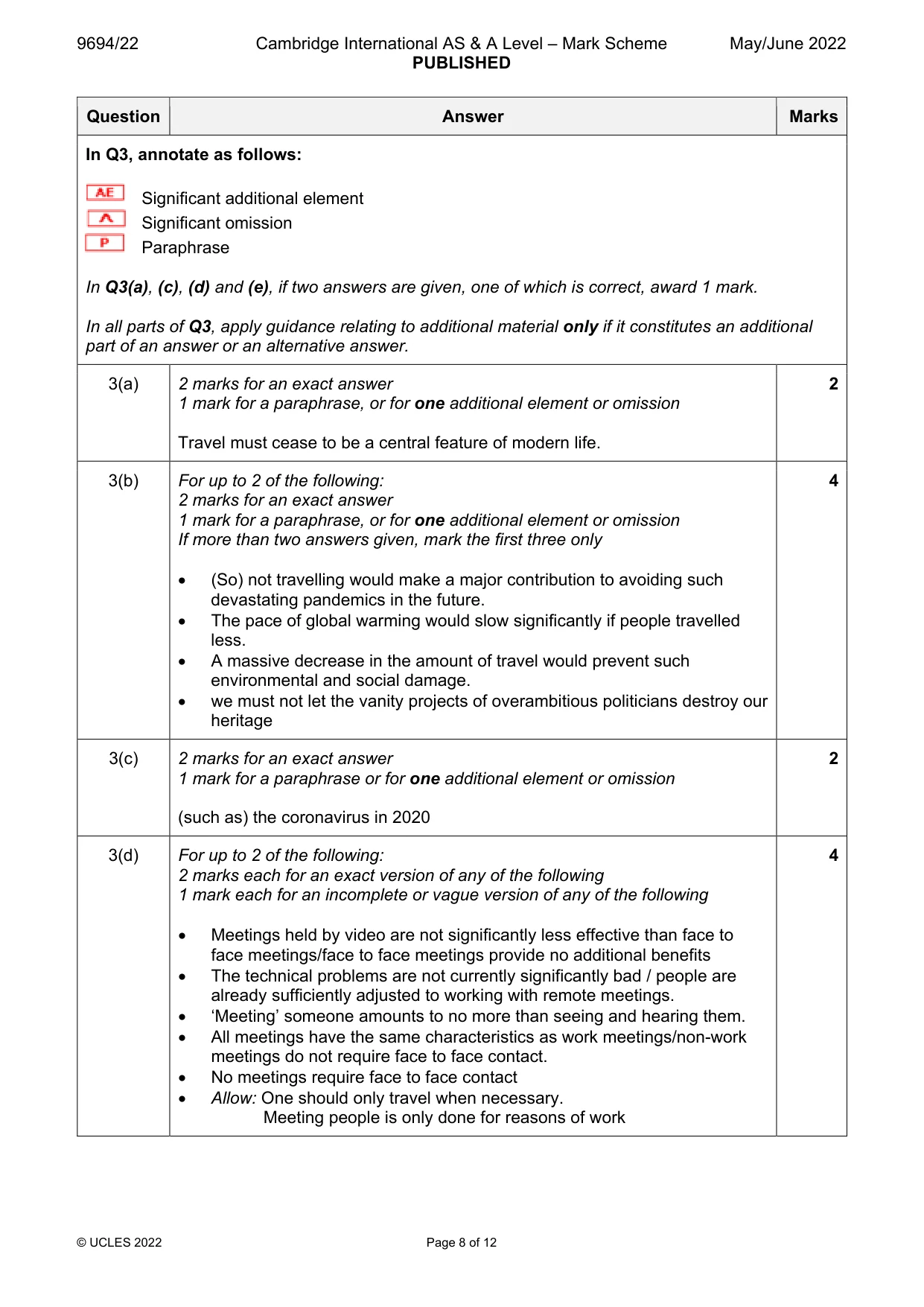
9694/22 Cambridge International AS & A Level – Mark Scheme PUBLISHED May/June 2022 © UCLES 2022 Page 8 of 12 Question Answer Marks In Q3, annotate as follows: Significant additional element Significant omission Paraphrase In Q3(a), (c), (d) and (e), if two answers are given, one of which is correct, award 1 mark. In all parts of Q3, apply guidance relating to additional material only if it constitutes an additional part of an answer or an alternative answer. 3(a) 2 marks for an exact answer 1 mark for a paraphrase, or for one additional element or omission Travel must cease to be a central feature of modern life. 2 3(b) For up to 2 of the following: 2 marks for an exact answer 1 mark for a paraphrase, or for one additional element or omission If more than two answers given, mark the first three only (So) not travelling would make a major contribution to avoiding such devastating pandemics in the future. The pace of global warming would slow significantly if people travelled less. A massive decrease in the amount of travel would prevent such environmental and social damage. we must not let the vanity projects of overambitious politicians destroy our heritage 4 3(c) 2 marks for an exact answer 1 mark for a paraphrase or for one additional element or omission (such as) the coronavirus in 2020 2 3(d) For up to 2 of the following: 2 marks each for an exact version of any of the following 1 mark each for an incomplete or vague version of any of the following Meetings held by video are not significantly less effective than face to face meetings/face to face meetings provide no additional benefits The technical problems are not currently significantly bad / people are already sufficiently adjusted to working with remote meetings. ‘Meeting’ someone amounts to no more than seeing and hearing them. All meetings have the same characteristics as work meetings/non-work meetings do not require face to face contact. No meetings require face to face contact Allow: One should only travel when necessary. Meeting people is only done for reasons of work 4
Mark scheme, page 9
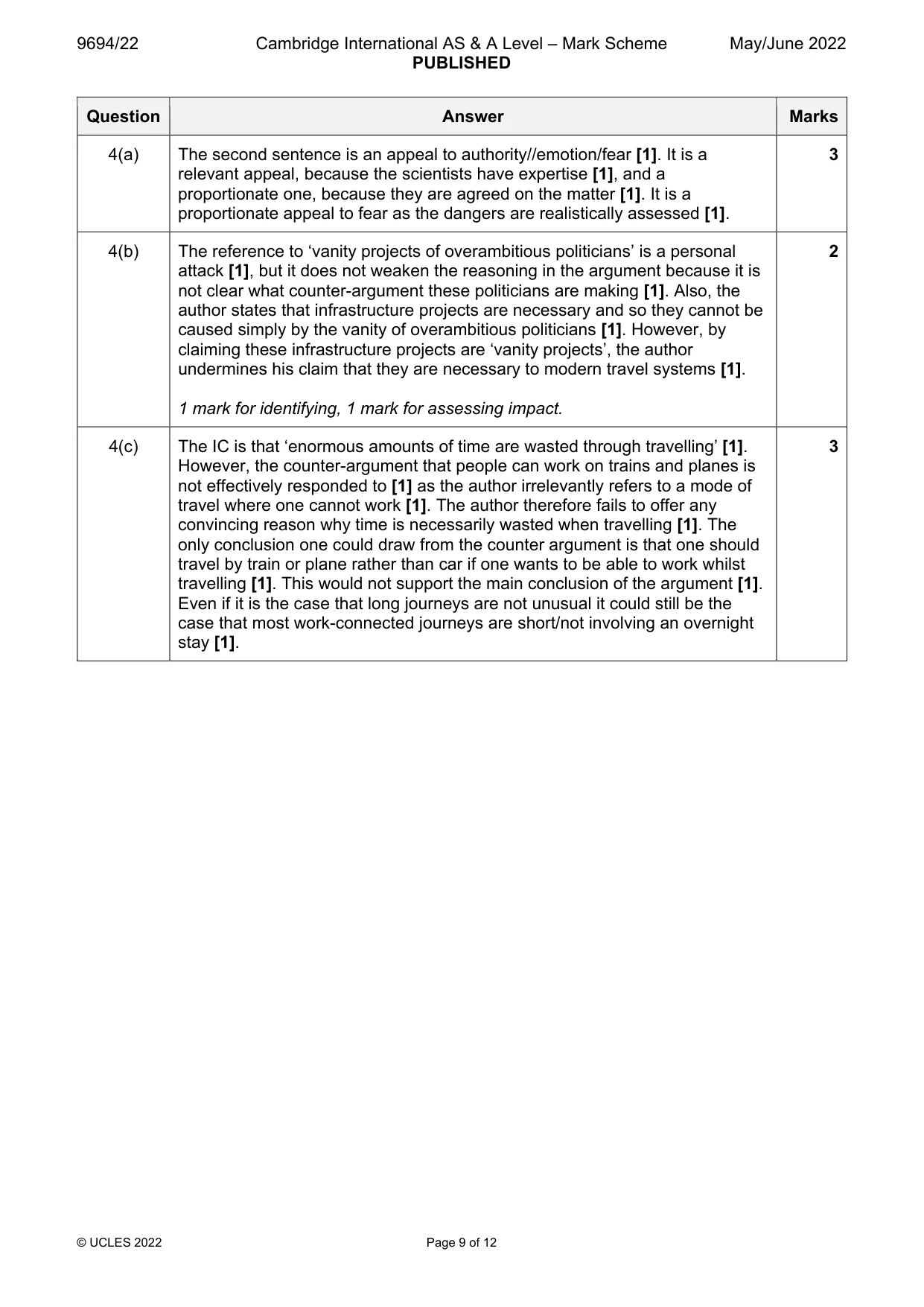
9694/22 Cambridge International AS & A Level – Mark Scheme PUBLISHED May/June 2022 © UCLES 2022 Page 9 of 12 Question Answer Marks 4(a) The second sentence is an appeal to authority//emotion/fear [1]. It is a relevant appeal, because the scientists have expertise [1], and a proportionate one, because they are agreed on the matter [1]. It is a proportionate appeal to fear as the dangers are realistically assessed [1]. 3 4(b) The reference to ‘vanity projects of overambitious politicians’ is a personal attack [1], but it does not weaken the reasoning in the argument because it is not clear what counter-argument these politicians are making [1]. Also, the author states that infrastructure projects are necessary and so they cannot be caused simply by the vanity of overambitious politicians [1]. However, by claiming these infrastructure projects are ‘vanity projects’, the author undermines his claim that they are necessary to modern travel systems [1]. 1 mark for identifying, 1 mark for assessing impact. 2 4(c) The IC is that ‘enormous amounts of time are wasted through travelling’ [1]. However, the counter-argument that people can work on trains and planes is not effectively responded to [1] as the author irrelevantly refers to a mode of travel where one cannot work [1]. The author therefore fails to offer any convincing reason why time is necessarily wasted when travelling [1]. The only conclusion one could draw from the counter argument is that one should travel by train or plane rather than car if one wants to be able to work whilst travelling [1]. This would not support the main conclusion of the argument [1]. Even if it is the case that long journeys are not unusual it could still be the case that most work-connected journeys are short/not involving an overnight stay [1]. 3
Mark scheme, page 10
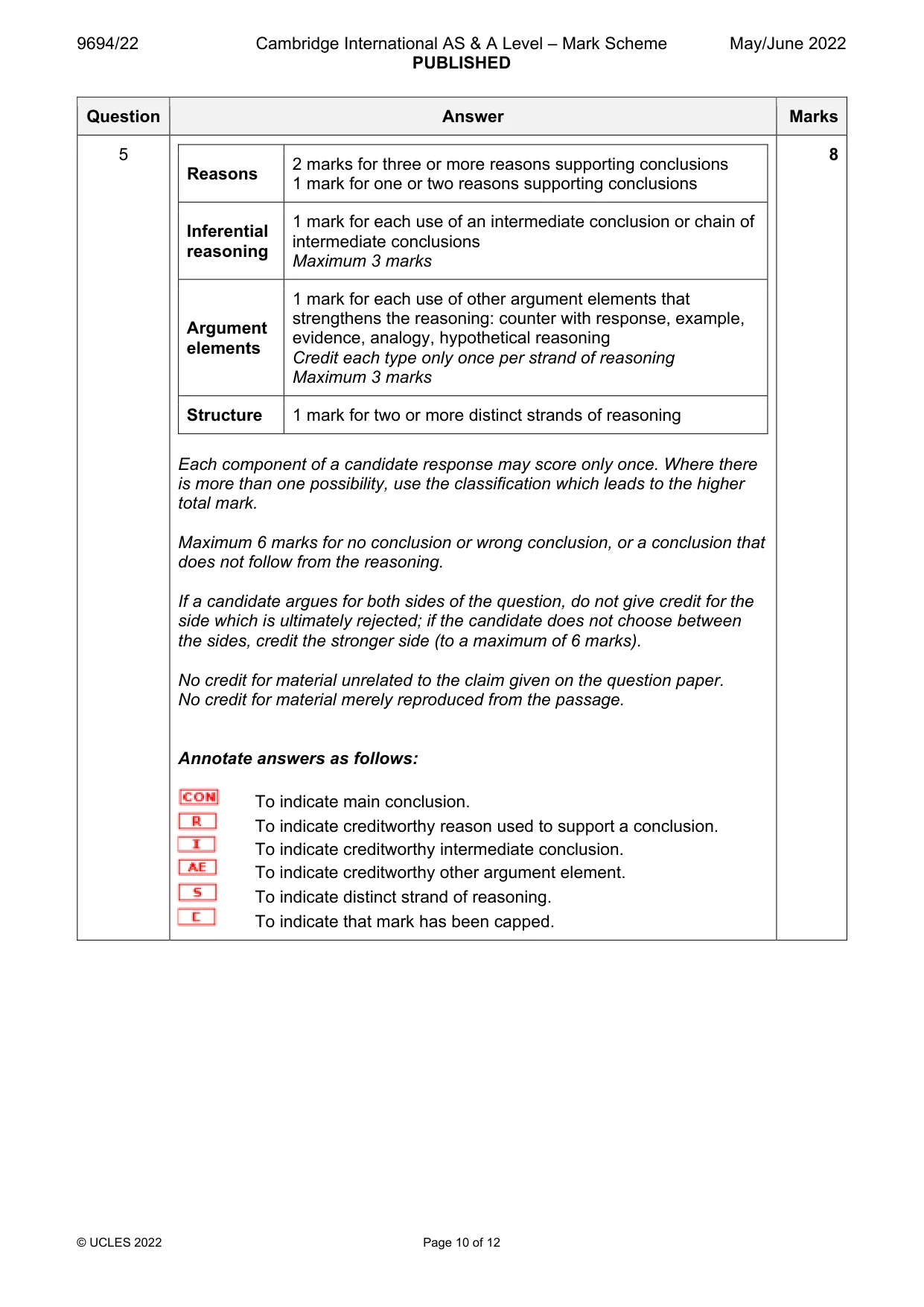
9694/22 Cambridge International AS & A Level – Mark Scheme PUBLISHED May/June 2022 © UCLES 2022 Page 10 of 12 Question Answer Marks 5 Reasons 2 marks for three or more reasons supporting conclusions 1 mark for one or two reasons supporting conclusions Inferential reasoning 1 mark for each use of an intermediate conclusion or chain of intermediate conclusions Maximum 3 marks Argument elements 1 mark for each use of other argument elements that strengthens the reasoning: counter with response, example, evidence, analogy, hypothetical reasoning Credit each type only once per strand of reasoning Maximum 3 marks Structure 1 mark for two or more distinct strands of reasoning Each component of a candidate response may score only once. Where there is more than one possibility, use the classification which leads to the higher total mark. Maximum 6 marks for no conclusion or wrong conclusion, or a conclusion that does not follow from the reasoning. If a candidate argues for both sides of the question, do not give credit for the side which is ultimately rejected; if the candidate does not choose between the sides, credit the stronger side (to a maximum of 6 marks). No credit for material unrelated to the claim given on the question paper. No credit for material merely reproduced from the passage. Annotate answers as follows: To indicate main conclusion. To indicate creditworthy reason used to support a conclusion. To indicate creditworthy intermediate conclusion. To indicate creditworthy other argument element. To indicate distinct strand of reasoning. To indicate that mark has been capped. 8
Mark scheme, page 11
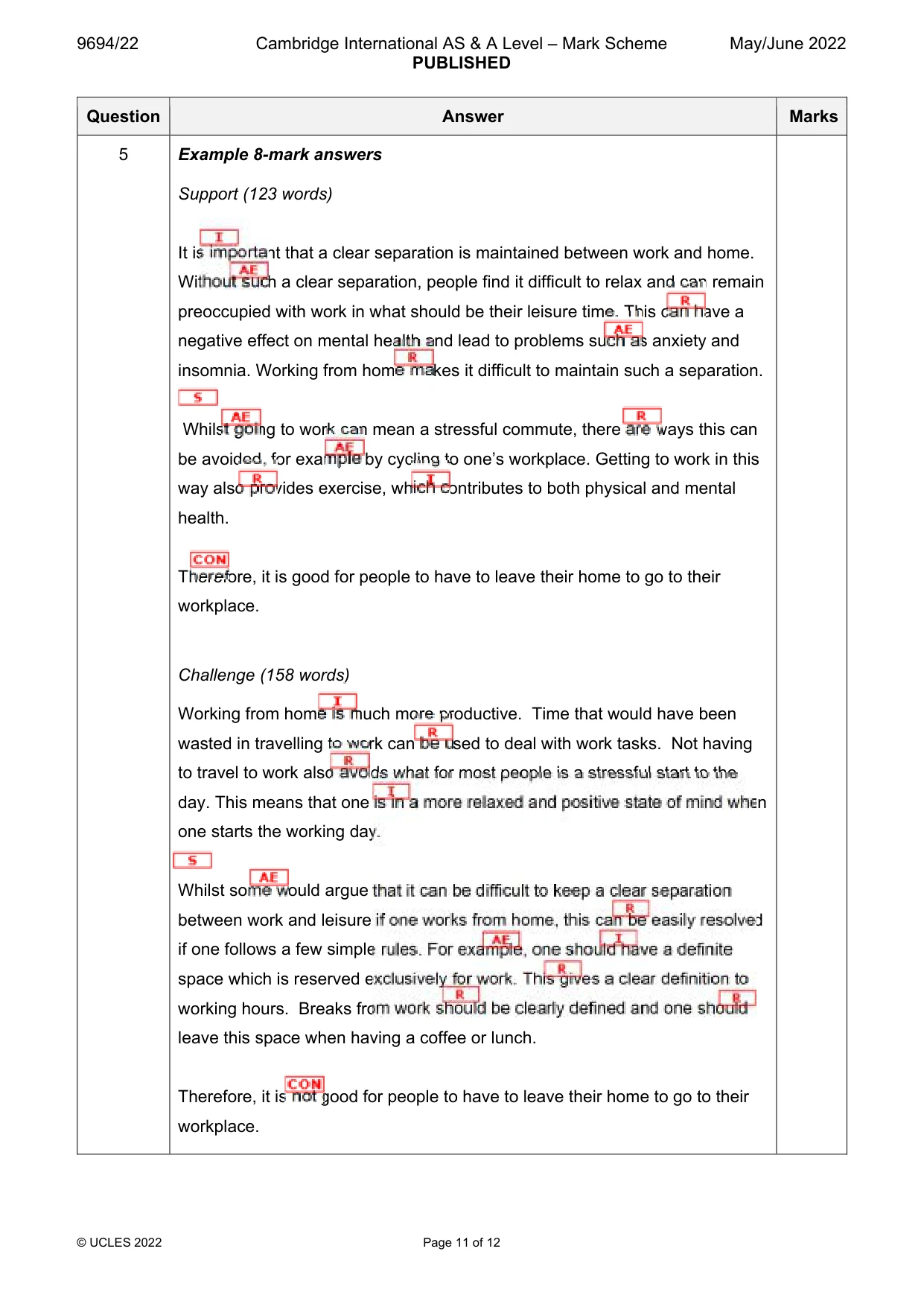
9694/22 Cambridge International AS & A Level – Mark Scheme PUBLISHED May/June 2022 © UCLES 2022 Page 11 of 12 Question Answer Marks 5 Example 8-mark answers Support (123 words) It is important that a clear separation is maintained between work and home. Without such a clear separation, people find it difficult to relax and can remain preoccupied with work in what should be their leisure time. This can have a negative effect on mental health and lead to problems such as anxiety and insomnia. Working from home makes it difficult to maintain such a separation. Whilst going to work can mean a stressful commute, there are ways this can be avoided, for example by cycling to one’s workplace. Getting to work in this way also provides exercise, which contributes to both physical and mental health. Therefore, it is good for people to have to leave their home to go to their workplace. Challenge (158 words) Working from home is much more productive. Time that would have been wasted in travelling to work can be used to deal with work tasks. Not having to travel to work also avoids what for most people is a stressful start to the day. This means that one is in a more relaxed and positive state of mind when one starts the working day. Whilst some would argue that it can be difficult to keep a clear separation between work and leisure if one works from home, this can be easily resolved if one follows a few simple rules. For example, one should have a definite space which is reserved exclusively for work. This gives a clear definition to working hours. Breaks from work should be clearly defined and one should leave this space when having a coffee or lunch. Therefore, it is not good for people to have to leave their home to go to their workplace.
Mark scheme, page 12
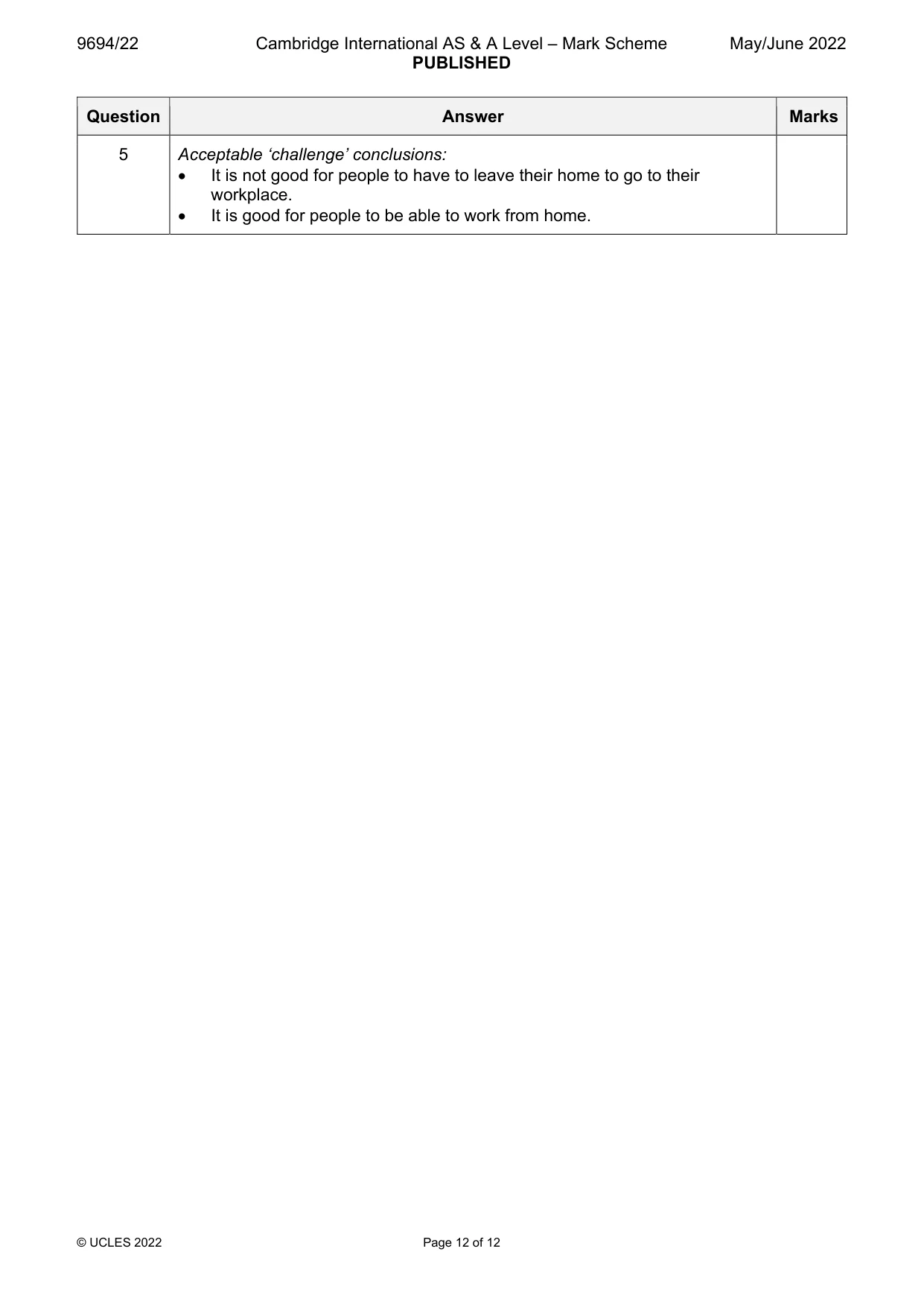
9694/22 Cambridge International AS & A Level – Mark Scheme PUBLISHED May/June 2022 © UCLES 2022 Page 12 of 12 Question Answer Marks 5 Acceptable ‘challenge’ conclusions: It is not good for people to have to leave their home to go to their workplace. It is good for people to be able to work from home.
What you needed in this session
Cambridge’s own grade thresholds for 2022 May/June, Paper 2 · Variant 2. A higher threshold means an easier paper — the bar moves with how the cohort did.