Cambridge A Level Thinking Skills 9694 — 2021 May/June Paper 2 · Variant 1
9694/21/M/J/21 · 50 marks · ≈56 min
The question paper and its mark scheme, free to read here and free to download. This is Cambridge’s own paper, exactly as it was sat.
Question paper8 pages



Mark scheme11 pages
Answers below. Sit the paper first if you are practising.
Paper as text
Question paper, page 1
This document has 8 pages. Any blank pages are indicated. Cambridge International AS & A Level DC (KS/SG) 199203/1 © UCLES 2021 [Turn over * 7 0 8 6 3 8 8 0 3 0 * THINKING SKILLS 9694/21 Paper 2 Critical Thinking May/June 2021 1 hour 45 minutes You must answer on the enclosed answer booklet. You will need: Answer booklet (enclosed) INSTRUCTIONS ● Answer all questions. ● Follow the instructions on the front cover of the answer booklet. If you need additional answer paper, ask the invigilator for a continuation booklet. INFORMATION ● The total mark for this paper is 50. ● The number of marks for each question or part question is shown in brackets [ ].
Question paper, page 2
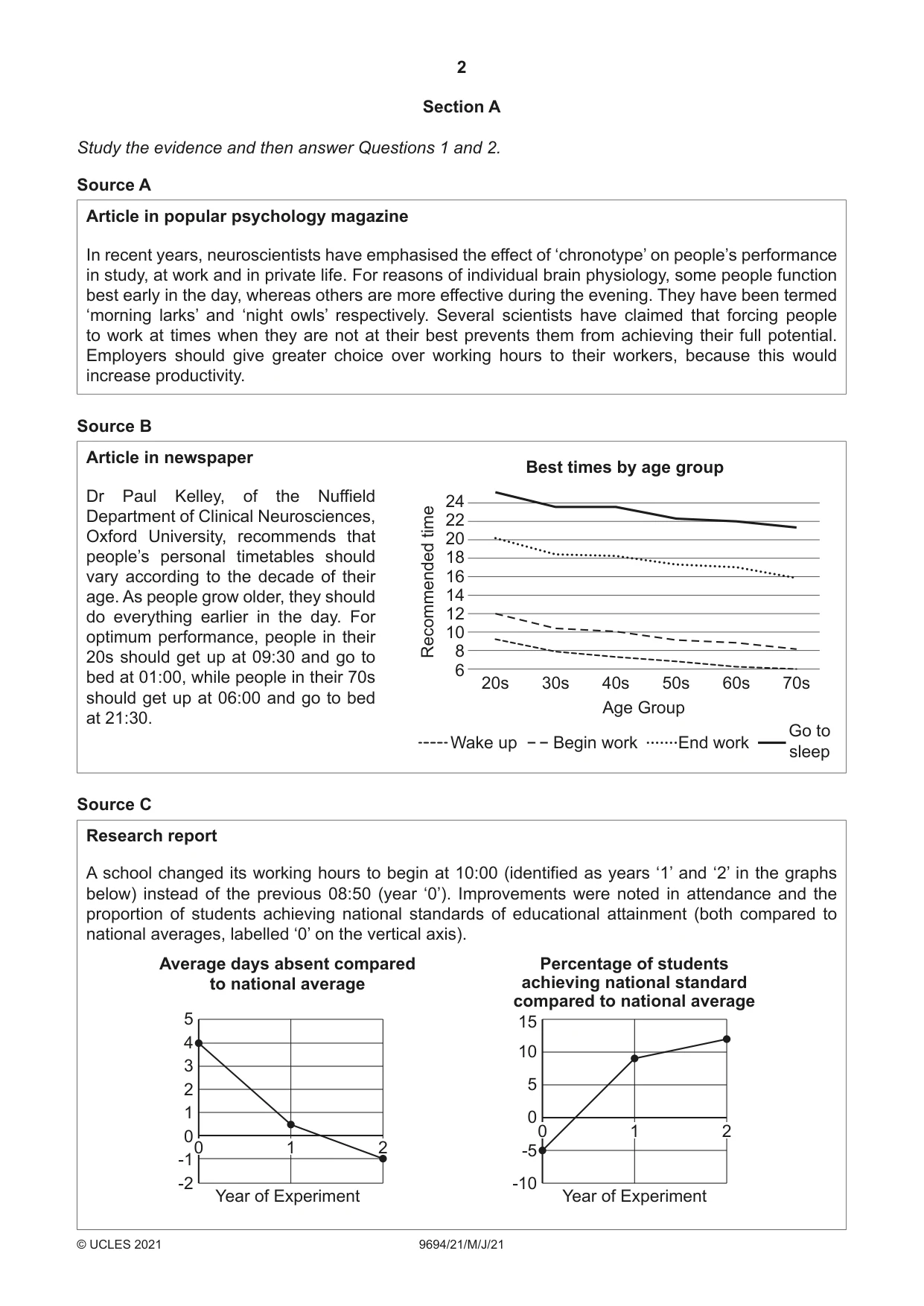
2 9694/21/M/J/21 © UCLES 2021 Section A Study the evidence and then answer Questions 1 and 2. Source A Article in popular psychology magazine In recent years, neuroscientists have emphasised the effect of ‘chronotype’ on people’s performance in study, at work and in private life. For reasons of individual brain physiology, some people function best early in the day, whereas others are more effective during the evening. They have been termed ‘morning larks’ and ‘night owls’ respectively. Several scientists have claimed that forcing people to work at times when they are not at their best prevents them from achieving their full potential. Employers should give greater choice over working hours to their workers, because this would increase productivity. Source B Article in newspaper Dr Paul Kelley, of the Nuffield Department of Clinical Neurosciences, Oxford University, recommends that people’s personal timetables should vary according to the decade of their age. As people grow older, they should do everything earlier in the day. For optimum performance, people in their 20s should get up at 09:30 and go to bed at 01:00, while people in their 70s should get up at 06:00 and go to bed at 21:30. Best times by age group 24 22 20 18 16 14 12 10 8 6 20s 30s 40s Age Group 50s 60s 70s Recommended time Wake up Begin work End work Go to sleep Source C Research report A school changed its working hours to begin at 10:00 (identified as years ‘1’ and ‘2’ in the graphs below) instead of the previous 08:50 (year ‘0’). Improvements were noted in attendance and the proportion of students achieving national standards of educational attainment (both compared to national averages, labelled ‘0’ on the vertical axis). 0 1 Year of Experiment 2 5 4 3 2 1 0 -1 -2 Average days absent compared to national average 0 1 Year of Experiment 2 15 10 5 0 -5 -10 Percentage of students achieving national standard compared to national average
Question paper, page 3
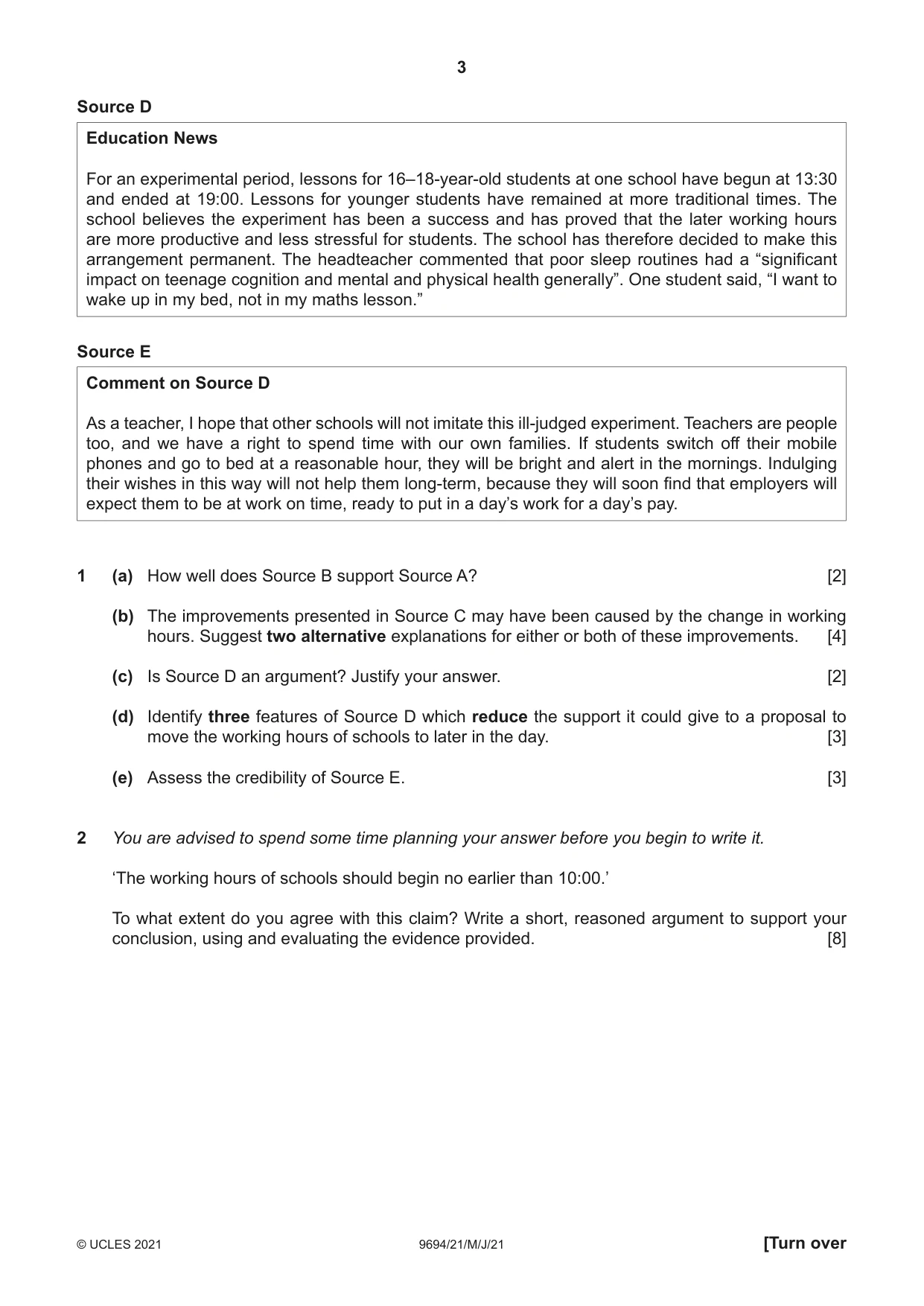
3 9694/21/M/J/21 © UCLES 2021 [Turn over Source D Education News For an experimental period, lessons for 16–18-year-old students at one school have begun at 13:30 and ended at 19:00. Lessons for younger students have remained at more traditional times. The school believes the experiment has been a success and has proved that the later working hours are more productive and less stressful for students. The school has therefore decided to make this arrangement permanent. The headteacher commented that poor sleep routines had a “significant impact on teenage cognition and mental and physical health generally”. One student said, “I want to wake up in my bed, not in my maths lesson.” Source E Comment on Source D As a teacher, I hope that other schools will not imitate this ill-judged experiment. Teachers are people too, and we have a right to spend time with our own families. If students switch off their mobile phones and go to bed at a reasonable hour, they will be bright and alert in the mornings. Indulging their wishes in this way will not help them long-term, because they will soon find that employers will expect them to be at work on time, ready to put in a day’s work for a day’s pay. 1 (a) How well does Source B support Source A? [2] (b) The improvements presented in Source C may have been caused by the change in working hours. Suggest two alternative explanations for either or both of these improvements. [4] (c) Is Source D an argument? Justify your answer. [2] (d) Identify three features of Source D which reduce the support it could give to a proposal to move the working hours of schools to later in the day. [3] (e) Assess the credibility of Source E. [3] 2 You are advised to spend some time planning your answer before you begin to write it. ‘The working hours of schools should begin no earlier than 10:00.’ To what extent do you agree with this claim? Write a short, reasoned argument to support your conclusion, using and evaluating the evidence provided. [8]
Question paper, page 4
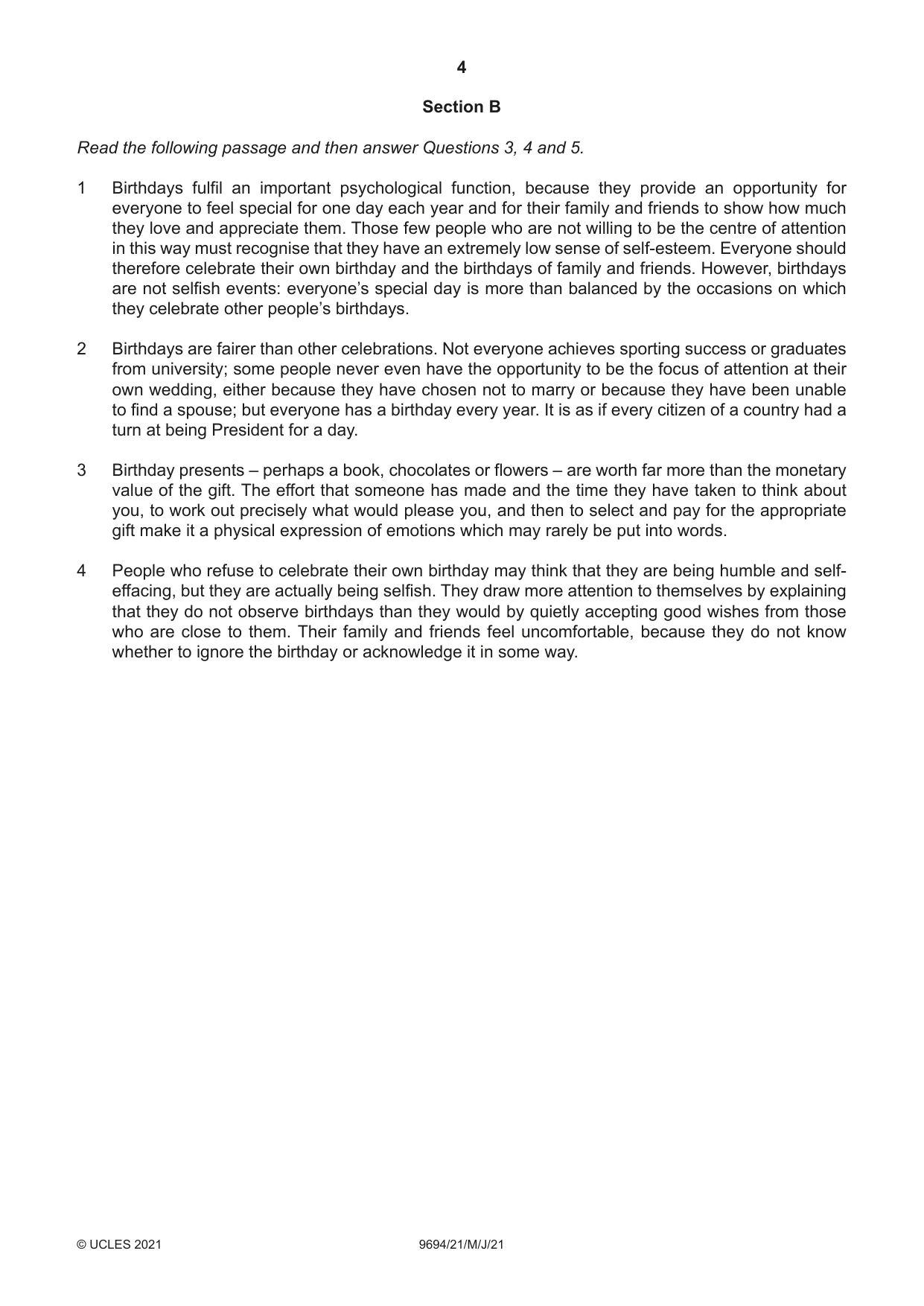
4 9694/21/M/J/21 © UCLES 2021 Section B Read the following passage and then answer Questions 3, 4 and 5. 1 Birthdays fulfil an important psychological function, because they provide an opportunity for everyone to feel special for one day each year and for their family and friends to show how much they love and appreciate them. Those few people who are not willing to be the centre of attention in this way must recognise that they have an extremely low sense of self-esteem. Everyone should therefore celebrate their own birthday and the birthdays of family and friends. However, birthdays are not selfish events: everyone’s special day is more than balanced by the occasions on which they celebrate other people’s birthdays. 2 Birthdays are fairer than other celebrations. Not everyone achieves sporting success or graduates from university; some people never even have the opportunity to be the focus of attention at their own wedding, either because they have chosen not to marry or because they have been unable to find a spouse; but everyone has a birthday every year. It is as if every citizen of a country had a turn at being President for a day. 3 Birthday presents – perhaps a book, chocolates or flowers – are worth far more than the monetary value of the gift. The effort that someone has made and the time they have taken to think about you, to work out precisely what would please you, and then to select and pay for the appropriate gift make it a physical expression of emotions which may rarely be put into words. 4 People who refuse to celebrate their own birthday may think that they are being humble and self- effacing, but they are actually being selfish. They draw more attention to themselves by explaining that they do not observe birthdays than they would by quietly accepting good wishes from those who are close to them. Their family and friends feel uncomfortable, because they do not know whether to ignore the birthday or acknowledge it in some way.
Question paper, page 5
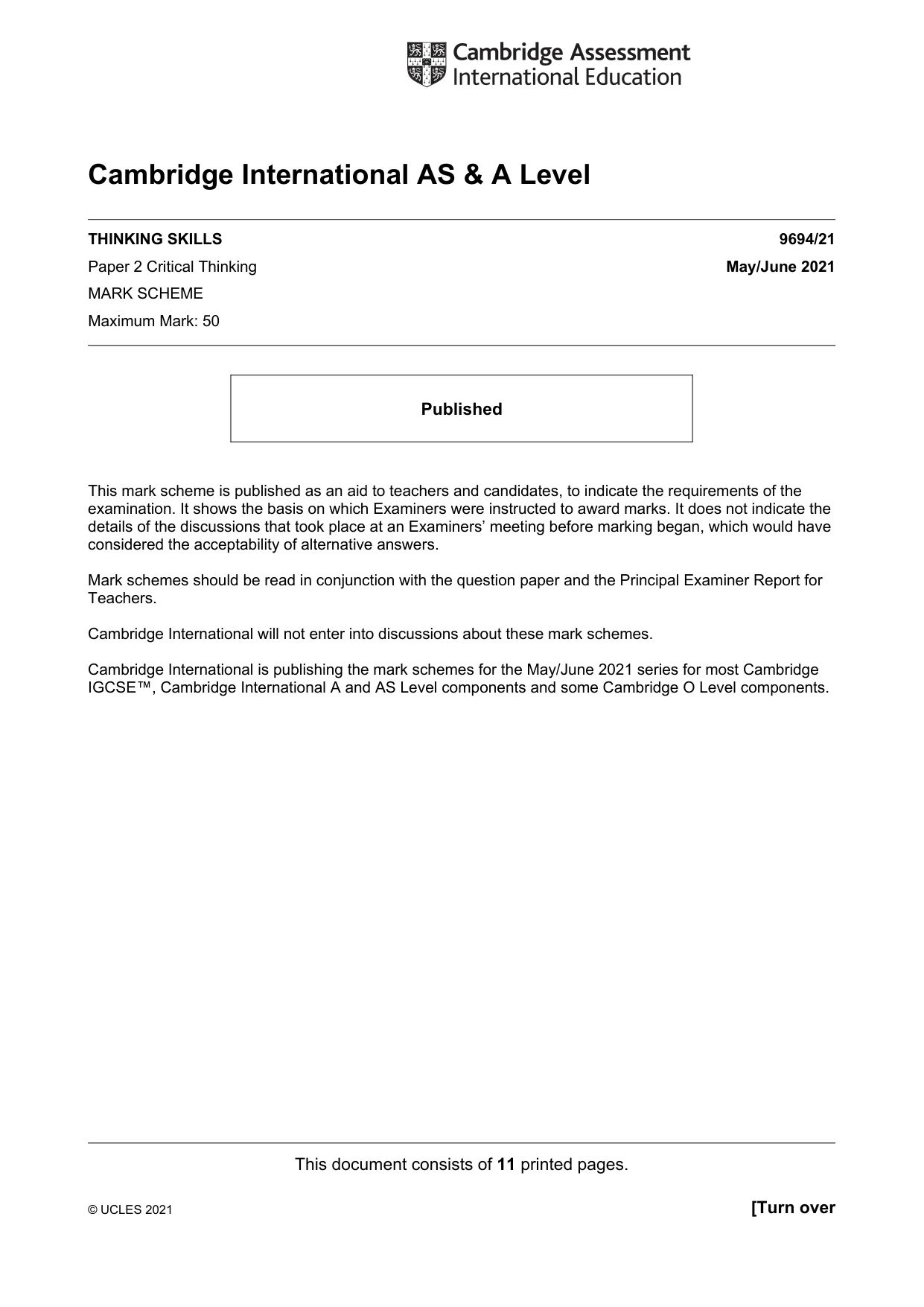
5 9694/21/M/J/21 © UCLES 2021 3 (a) Using the exact words from the passage as far as possible, identify the main conclusion. [2] (b) Using the exact words from the passage as far as possible, identify two intermediate conclusions from paragraphs 2 to 4. [4] (c) Using the exact words from the passage as far as possible, identify a counter-assertion. [2] (d) Identify the argument element and explain the function of the following words from paragraph 3: ‘a book, chocolates or flowers’ [2] (e) Identify an unstated assumption required by the reasoning in paragraph 3. [2] 4 (a) Explain how the reasoning in paragraph 1 is weakened by a flaw of restricting the options. [2] (b) ‘It is as if every citizen of a country had a turn at being President for a day’ (Paragraph 2). Evaluate this analogy. [2] (c) Explain why the claim in paragraph 4 that some people “are actually being selfish” is not an example of the flaw of personal attack (ad hominem). [2] (d) Identify an inconsistency in the reasoning in paragraphs 1 and 4. [2] 5 You are advised to spend some time planning your answer before you begin to write it. ‘Young people need to know that they are special.’ Write your own short argument to support or challenge this claim. The conclusion of your argument must be stated. Credit will not be given for repeating ideas from the passage. [8]
Question paper, page 6
6 9694/21/M/J/21 © UCLES 2021 BLANK PAGE
Question paper, page 7
7 9694/21/M/J/21 © UCLES 2021 BLANK PAGE
Question paper, page 8
8 9694/21/M/J/21 © UCLES 2021 Permission to reproduce items where third-party owned material protected by copyright is included has been sought and cleared where possible. Every reasonable effort has been made by the publisher (UCLES) to trace copyright holders, but if any items requiring clearance have unwittingly been included, the publisher will be pleased to make amends at the earliest possible opportunity. To avoid the issue of disclosure of answer-related information to candidates, all copyright acknowledgements are reproduced online in the Cambridge Assessment International Education Copyright Acknowledgements Booklet. This is produced for each series of examinations and is freely available to download at www.cambridgeinternational.org after the live examination series. Cambridge Assessment International Education is part of the Cambridge Assessment Group. Cambridge Assessment is the brand name of the University of Cambridge Local Examinations Syndicate (UCLES), which itself is a department of the University of Cambridge. BLANK PAGE
Mark scheme, page 1
This document consists of 11 printed pages. © UCLES 2021 [Turn over Cambridge International AS & A Level THINKING SKILLS 9694/21 Paper 2 Critical Thinking May/June 2021 MARK SCHEME Maximum Mark: 50 Published This mark scheme is published as an aid to teachers and candidates, to indicate the requirements of the examination. It shows the basis on which Examiners were instructed to award marks. It does not indicate the details of the discussions that took place at an Examiners’ meeting before marking began, which would have considered the acceptability of alternative answers. Mark schemes should be read in conjunction with the question paper and the Principal Examiner Report for Teachers. Cambridge International will not enter into discussions about these mark schemes. Cambridge International is publishing the mark schemes for the May/June 2021 series for most Cambridge IGCSE™, Cambridge International A and AS Level components and some Cambridge O Level components.
Mark scheme, page 2
9694/21 Cambridge International AS & A Level – Mark Scheme PUBLISHED May/June 2021 © UCLES 2021 Page 2 of 11 Generic Marking Principles These general marking principles must be applied by all examiners when marking candidate answers. They should be applied alongside the specific content of the mark scheme or generic level descriptors for a question. Each question paper and mark scheme will also comply with these marking principles. GENERIC MARKING PRINCIPLE 1: Marks must be awarded in line with: • the specific content of the mark scheme or the generic level descriptors for the question • the specific skills defined in the mark scheme or in the generic level descriptors for the question • the standard of response required by a candidate as exemplified by the standardisation scripts. GENERIC MARKING PRINCIPLE 2: Marks awarded are always whole marks (not half marks, or other fractions). GENERIC MARKING PRINCIPLE 3: Marks must be awarded positively: • marks are awarded for correct/valid answers, as defined in the mark scheme. However, credit is given for valid answers which go beyond the scope of the syllabus and mark scheme, referring to your Team Leader as appropriate • marks are awarded when candidates clearly demonstrate what they know and can do • marks are not deducted for errors • marks are not deducted for omissions • answers should only be judged on the quality of spelling, punctuation and grammar when these features are specifically assessed by the question as indicated by the mark scheme. The meaning, however, should be unambiguous. GENERIC MARKING PRINCIPLE 4: Rules must be applied consistently, e.g. in situations where candidates have not followed instructions or in the application of generic level descriptors. GENERIC MARKING PRINCIPLE 5: Marks should be awarded using the full range of marks defined in the mark scheme for the question (however; the use of the full mark range may be limited according to the quality of the candidate responses seen). GENERIC MARKING PRINCIPLE 6: Marks awarded are based solely on the requirements as defined in the mark scheme. Marks should not be awarded with grade thresholds or grade descriptors in mind.
Mark scheme, page 3
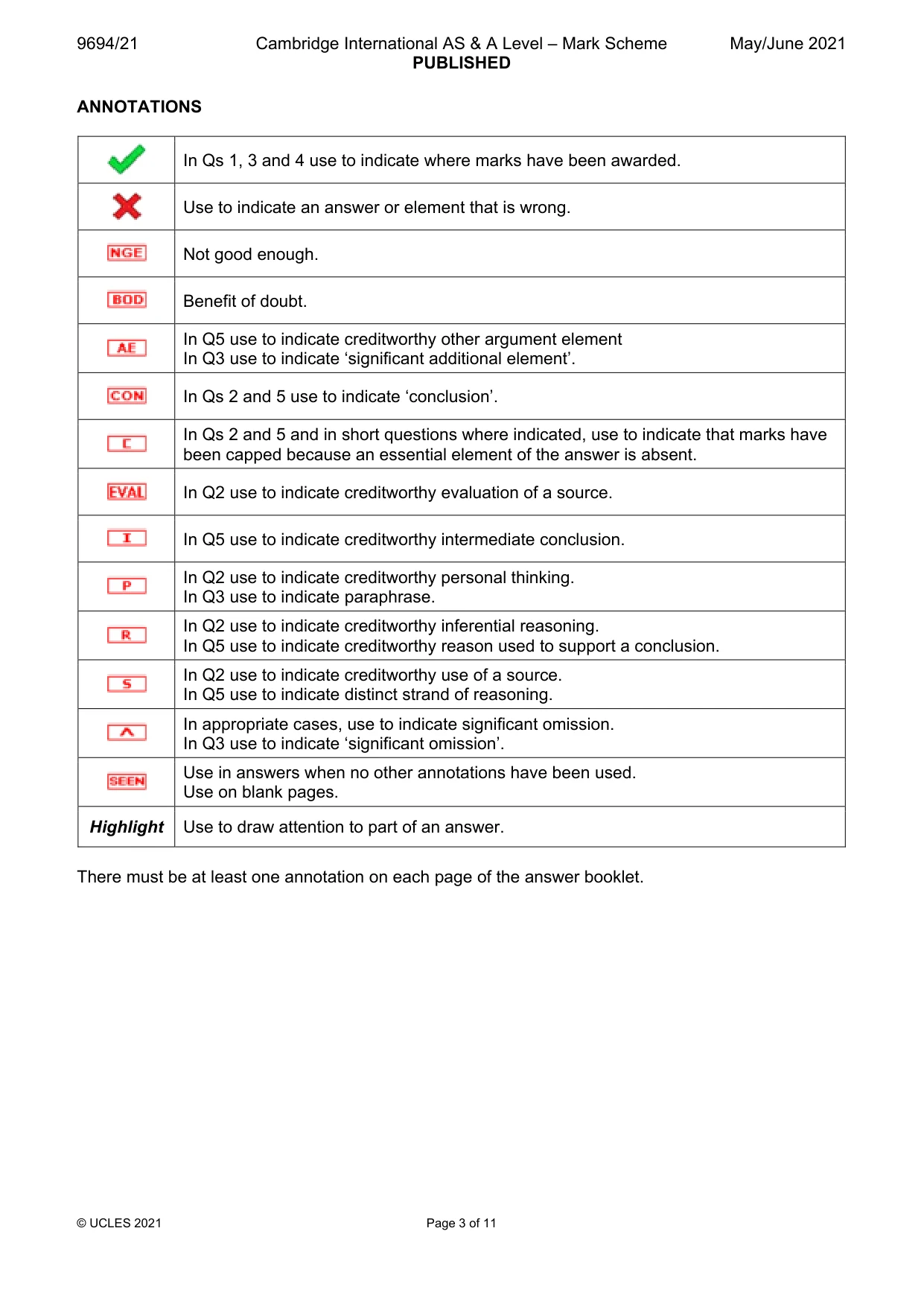
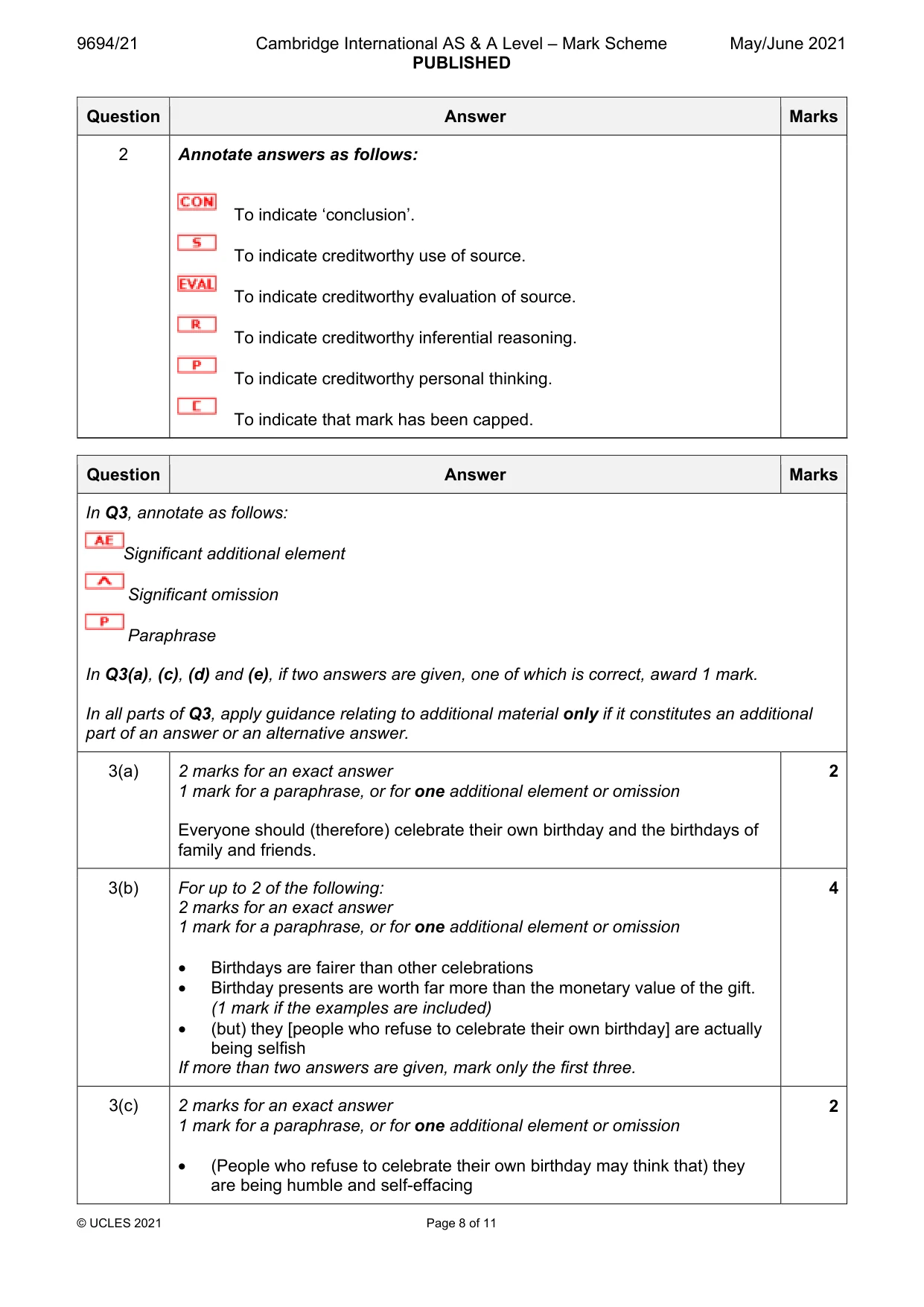
9694/21 Cambridge International AS & A Level – Mark Scheme PUBLISHED May/June 2021 © UCLES 2021 Page 3 of 11 ANNOTATIONS In Qs 1, 3 and 4 use to indicate where marks have been awarded. Use to indicate an answer or element that is wrong. Not good enough. Benefit of doubt. In Q5 use to indicate creditworthy other argument element In Q3 use to indicate ‘significant additional element’. In Qs 2 and 5 use to indicate ‘conclusion’. In Qs 2 and 5 and in short questions where indicated, use to indicate that marks have been capped because an essential element of the answer is absent. In Q2 use to indicate creditworthy evaluation of a source. In Q5 use to indicate creditworthy intermediate conclusion. In Q2 use to indicate creditworthy personal thinking. In Q3 use to indicate paraphrase. In Q2 use to indicate creditworthy inferential reasoning. In Q5 use to indicate creditworthy reason used to support a conclusion. In Q2 use to indicate creditworthy use of a source. In Q5 use to indicate distinct strand of reasoning. In appropriate cases, use to indicate significant omission. In Q3 use to indicate ‘significant omission’. Use in answers when no other annotations have been used. Use on blank pages. Highlight Use to draw attention to part of an answer. There must be at least one annotation on each page of the answer booklet.
Mark scheme, page 4
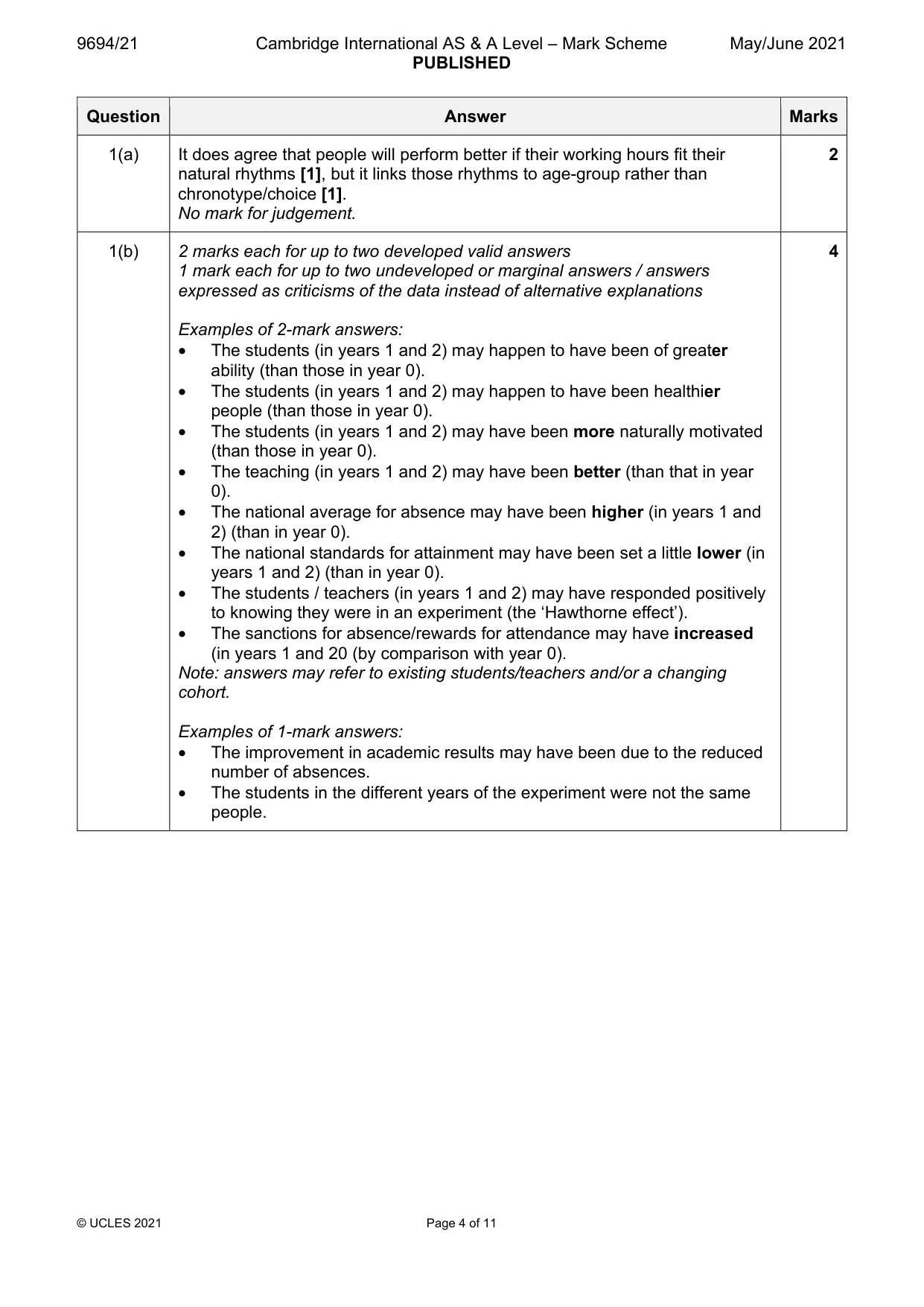
9694/21 Cambridge International AS & A Level – Mark Scheme PUBLISHED May/June 2021 © UCLES 2021 Page 4 of 11 Question Answer Marks 1(a) It does agree that people will perform better if their working hours fit their natural rhythms [1], but it links those rhythms to age-group rather than chronotype/choice [1]. No mark for judgement. 2 1(b) 2 marks each for up to two developed valid answers 1 mark each for up to two undeveloped or marginal answers / answers expressed as criticisms of the data instead of alternative explanations Examples of 2-mark answers: • The students (in years 1 and 2) may happen to have been of greater ability (than those in year 0). • The students (in years 1 and 2) may happen to have been healthier people (than those in year 0). • The students (in years 1 and 2) may have been more naturally motivated (than those in year 0). • The teaching (in years 1 and 2) may have been better (than that in year 0). • The national average for absence may have been higher (in years 1 and 2) (than in year 0). • The national standards for attainment may have been set a little lower (in years 1 and 2) (than in year 0). • The students / teachers (in years 1 and 2) may have responded positively to knowing they were in an experiment (the ‘Hawthorne effect’). • The sanctions for absence/rewards for attendance may have increased (in years 1 and 20 (by comparison with year 0). Note: answers may refer to existing students/teachers and/or a changing cohort. Examples of 1-mark answers: • The improvement in academic results may have been due to the reduced number of absences. • The students in the different years of the experiment were not the same people. 4
Mark scheme, page 5
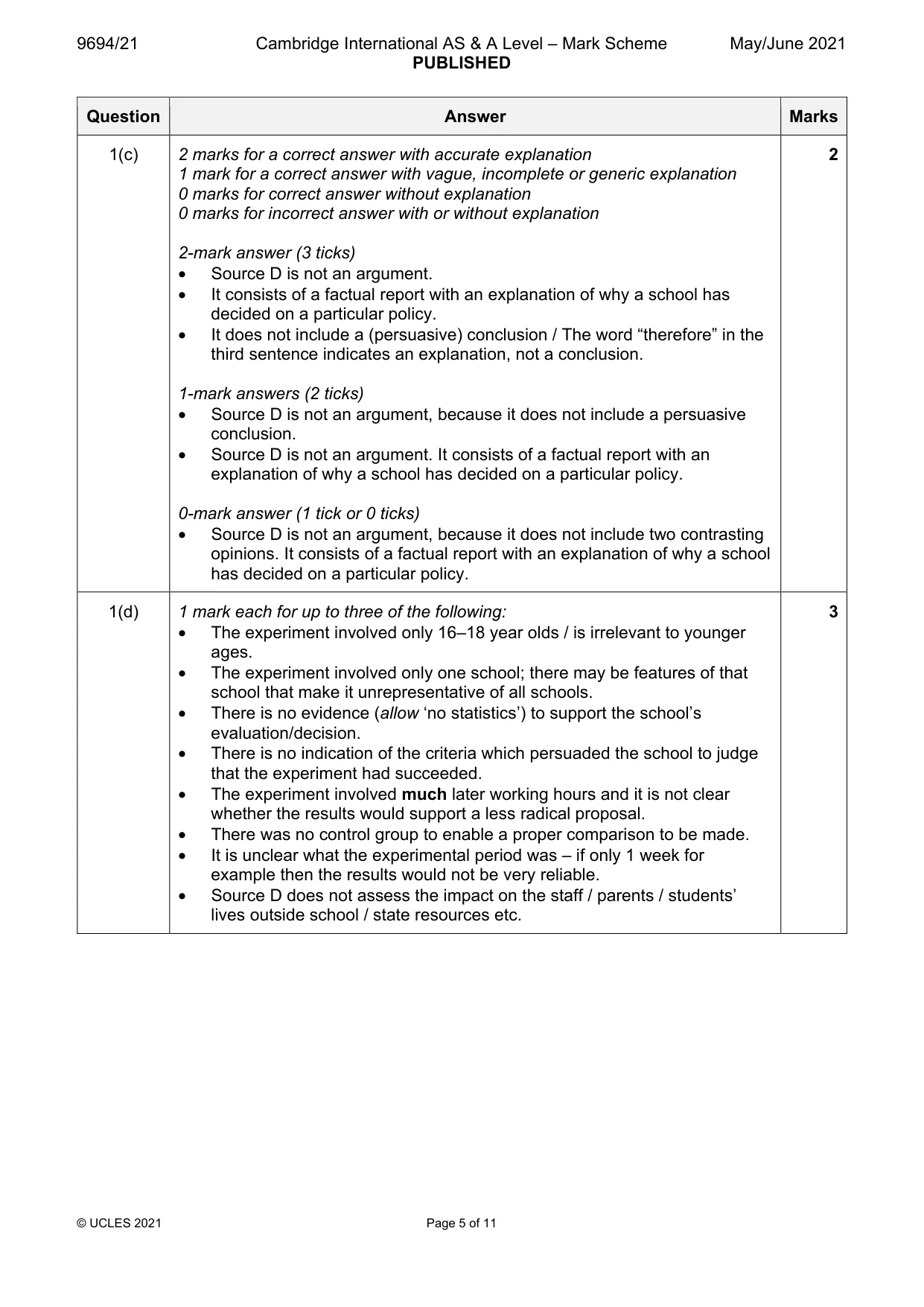
9694/21 Cambridge International AS & A Level – Mark Scheme PUBLISHED May/June 2021 © UCLES 2021 Page 5 of 11 Question Answer Marks 1(c) 2 marks for a correct answer with accurate explanation 1 mark for a correct answer with vague, incomplete or generic explanation 0 marks for correct answer without explanation 0 marks for incorrect answer with or without explanation 2-mark answer (3 ticks) • Source D is not an argument. • It consists of a factual report with an explanation of why a school has decided on a particular policy. • It does not include a (persuasive) conclusion / The word “therefore” in the third sentence indicates an explanation, not a conclusion. 1-mark answers (2 ticks) • Source D is not an argument, because it does not include a persuasive conclusion. • Source D is not an argument. It consists of a factual report with an explanation of why a school has decided on a particular policy. 0-mark answer (1 tick or 0 ticks) • Source D is not an argument, because it does not include two contrasting opinions. It consists of a factual report with an explanation of why a school has decided on a particular policy. 2 1(d) 1 mark each for up to three of the following: • The experiment involved only 16–18 year olds / is irrelevant to younger ages. • The experiment involved only one school; there may be features of that school that make it unrepresentative of all schools. • There is no evidence (allow ‘no statistics’) to support the school’s evaluation/decision. • There is no indication of the criteria which persuaded the school to judge that the experiment had succeeded. • The experiment involved much later working hours and it is not clear whether the results would support a less radical proposal. • There was no control group to enable a proper comparison to be made. • It is unclear what the experimental period was – if only 1 week for example then the results would not be very reliable. • Source D does not assess the impact on the staff / parents / students’ lives outside school / state resources etc. 3
Mark scheme, page 6
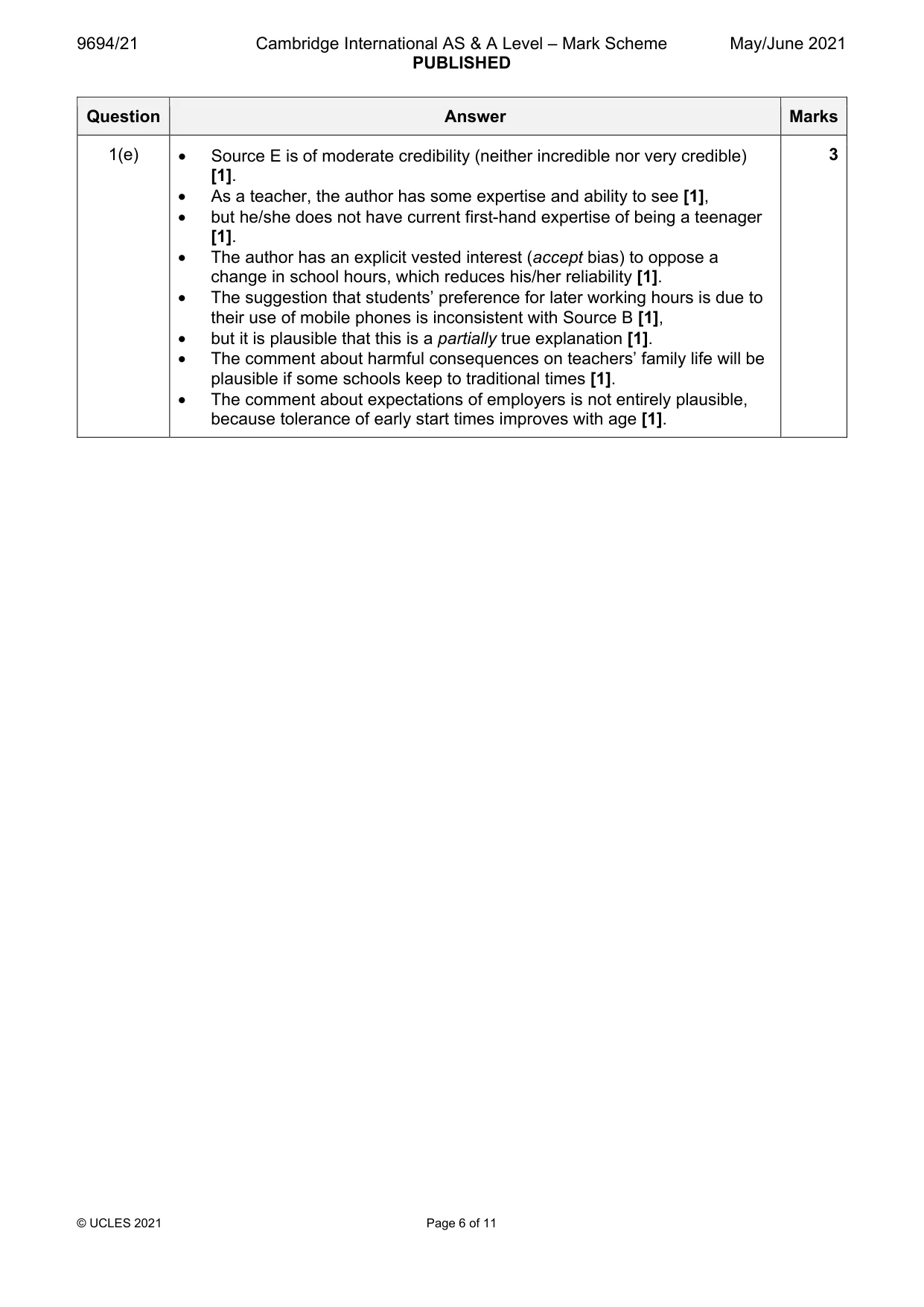
9694/21 Cambridge International AS & A Level – Mark Scheme PUBLISHED May/June 2021 © UCLES 2021 Page 6 of 11 Question Answer Marks 1(e) • Source E is of moderate credibility (neither incredible nor very credible) [1]. • As a teacher, the author has some expertise and ability to see [1], • but he/she does not have current first-hand expertise of being a teenager [1]. • The author has an explicit vested interest (accept bias) to oppose a change in school hours, which reduces his/her reliability [1]. • The suggestion that students’ preference for later working hours is due to their use of mobile phones is inconsistent with Source B [1], • but it is plausible that this is a partially true explanation [1]. • The comment about harmful consequences on teachers’ family life will be plausible if some schools keep to traditional times [1]. • The comment about expectations of employers is not entirely plausible, because tolerance of early start times improves with age [1]. 3
Mark scheme, page 7
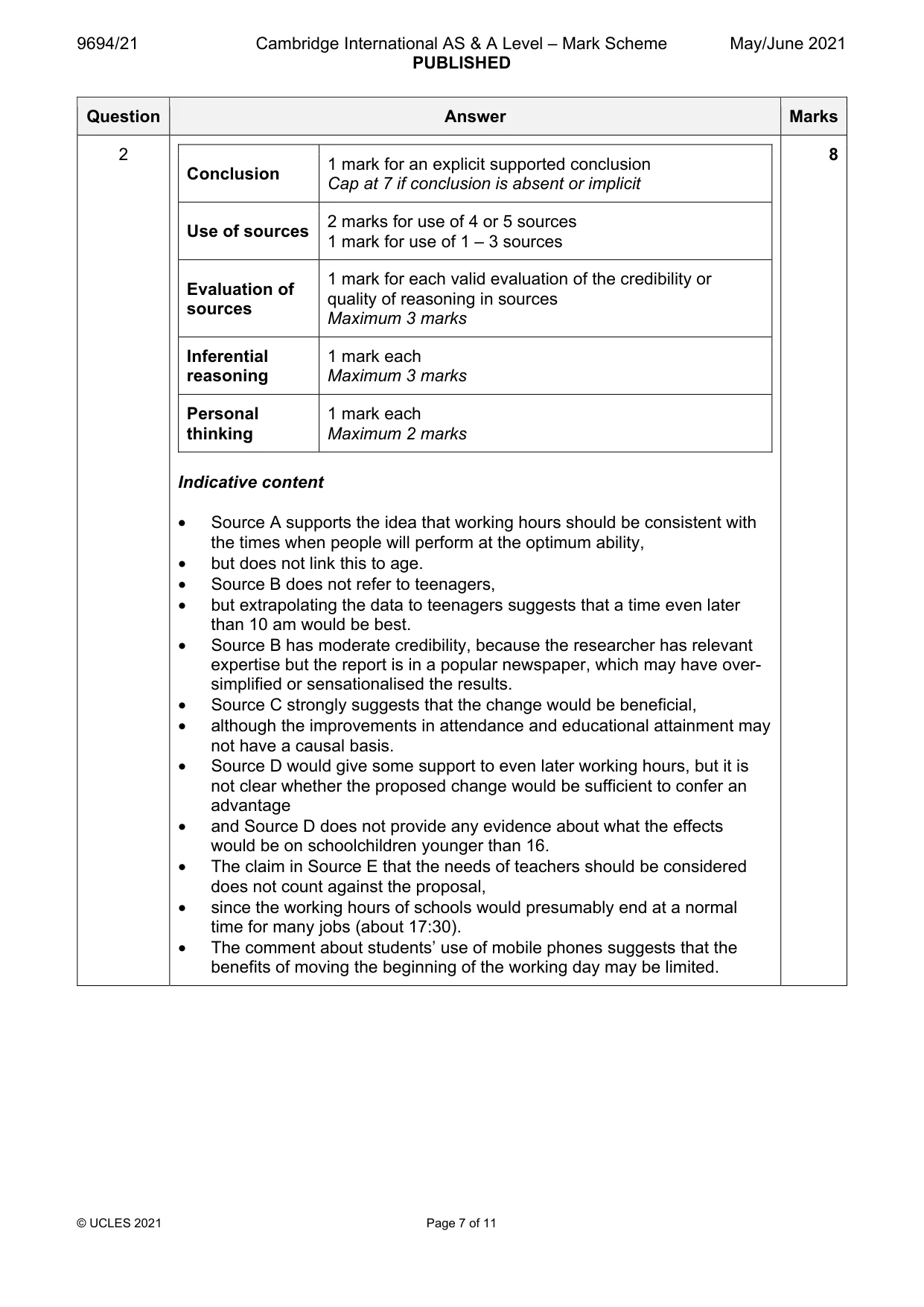
9694/21 Cambridge International AS & A Level – Mark Scheme PUBLISHED May/June 2021 © UCLES 2021 Page 7 of 11 Question Answer Marks 2 Conclusion 1 mark for an explicit supported conclusion Cap at 7 if conclusion is absent or implicit Use of sources 2 marks for use of 4 or 5 sources 1 mark for use of 1 – 3 sources Evaluation of sources 1 mark for each valid evaluation of the credibility or quality of reasoning in sources Maximum 3 marks Inferential reasoning 1 mark each Maximum 3 marks Personal thinking 1 mark each Maximum 2 marks Indicative content • Source A supports the idea that working hours should be consistent with the times when people will perform at the optimum ability, • but does not link this to age. • Source B does not refer to teenagers, • but extrapolating the data to teenagers suggests that a time even later than 10 am would be best. • Source B has moderate credibility, because the researcher has relevant expertise but the report is in a popular newspaper, which may have over- simplified or sensationalised the results. • Source C strongly suggests that the change would be beneficial, • although the improvements in attendance and educational attainment may not have a causal basis. • Source D would give some support to even later working hours, but it is not clear whether the proposed change would be sufficient to confer an advantage • and Source D does not provide any evidence about what the effects would be on schoolchildren younger than 16. • The claim in Source E that the needs of teachers should be considered does not count against the proposal, • since the working hours of schools would presumably end at a normal time for many jobs (about 17:30). • The comment about students’ use of mobile phones suggests that the benefits of moving the beginning of the working day may be limited. 8
Mark scheme, page 8
9694/21 Cambridge International AS & A Level – Mark Scheme PUBLISHED May/June 2021 © UCLES 2021 Page 8 of 11 Question Answer Marks 2 Annotate answers as follows: To indicate ‘conclusion’. To indicate creditworthy use of source. To indicate creditworthy evaluation of source. To indicate creditworthy inferential reasoning. To indicate creditworthy personal thinking. To indicate that mark has been capped. Question Answer Marks In Q3, annotate as follows: Significant additional element Significant omission Paraphrase In Q3(a), (c), (d) and (e), if two answers are given, one of which is correct, award 1 mark. In all parts of Q3, apply guidance relating to additional material only if it constitutes an additional part of an answer or an alternative answer. 3(a) 2 marks for an exact answer 1 mark for a paraphrase, or for one additional element or omission Everyone should (therefore) celebrate their own birthday and the birthdays of family and friends. 2 3(b) For up to 2 of the following: 2 marks for an exact answer 1 mark for a paraphrase, or for one additional element or omission • Birthdays are fairer than other celebrations • Birthday presents are worth far more than the monetary value of the gift. (1 mark if the examples are included) • (but) they [people who refuse to celebrate their own birthday] are actually being selfish If more than two answers are given, mark only the first three. 4 3(c) 2 marks for an exact answer 1 mark for a paraphrase, or for one additional element or omission • (People who refuse to celebrate their own birthday may think that) they are being humble and self-effacing 2
Mark scheme, page 9
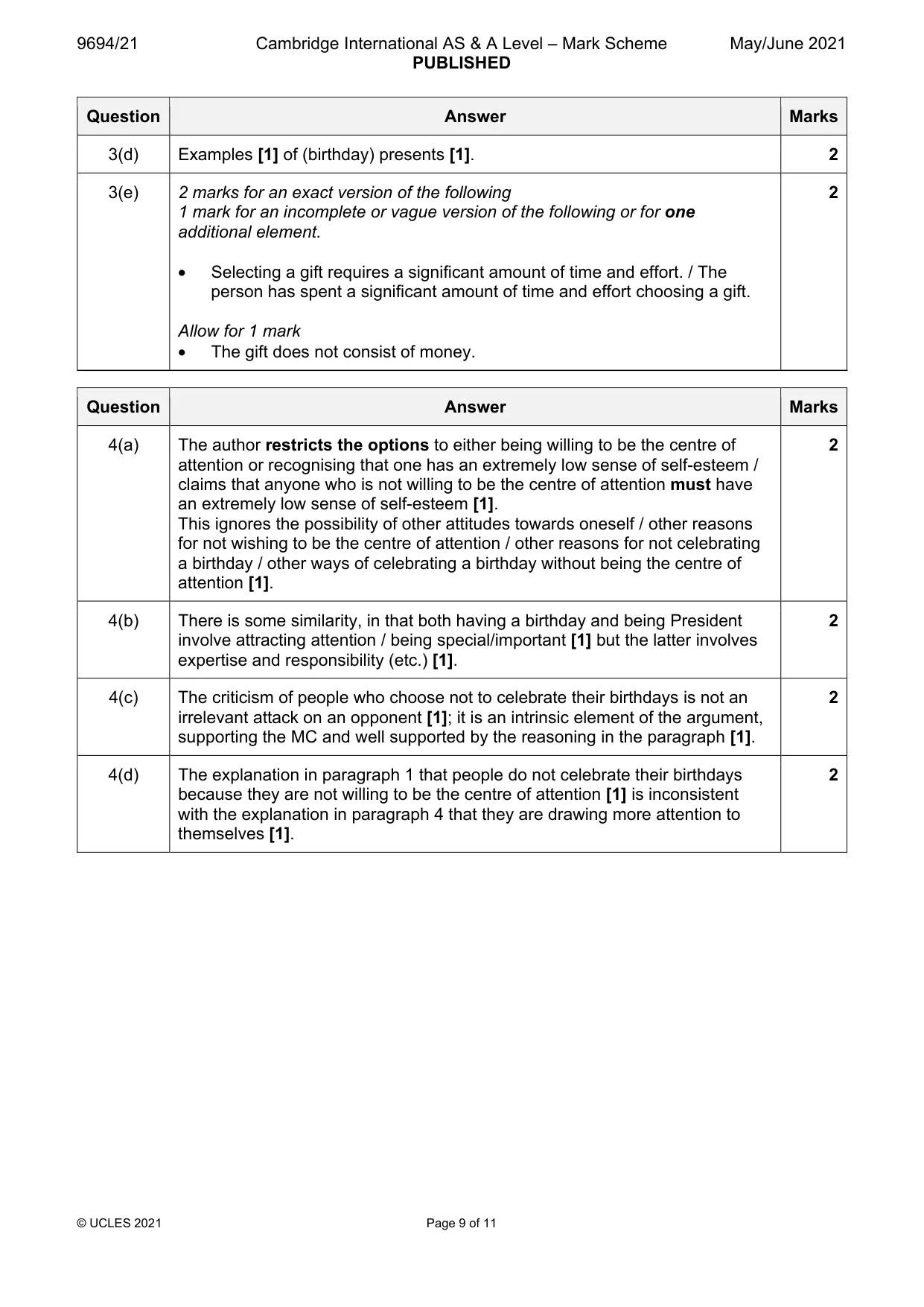
9694/21 Cambridge International AS & A Level – Mark Scheme PUBLISHED May/June 2021 © UCLES 2021 Page 9 of 11 Question Answer Marks 3(d) Examples [1] of (birthday) presents [1]. 2 3(e) 2 marks for an exact version of the following 1 mark for an incomplete or vague version of the following or for one additional element. • Selecting a gift requires a significant amount of time and effort. / The person has spent a significant amount of time and effort choosing a gift. Allow for 1 mark • The gift does not consist of money. 2 Question Answer Marks 4(a) The author restricts the options to either being willing to be the centre of attention or recognising that one has an extremely low sense of self-esteem / claims that anyone who is not willing to be the centre of attention must have an extremely low sense of self-esteem [1]. This ignores the possibility of other attitudes towards oneself / other reasons for not wishing to be the centre of attention / other reasons for not celebrating a birthday / other ways of celebrating a birthday without being the centre of attention [1]. 2 4(b) There is some similarity, in that both having a birthday and being President involve attracting attention / being special/important [1] but the latter involves expertise and responsibility (etc.) [1]. 2 4(c) The criticism of people who choose not to celebrate their birthdays is not an irrelevant attack on an opponent [1]; it is an intrinsic element of the argument, supporting the MC and well supported by the reasoning in the paragraph [1]. 2 4(d) The explanation in paragraph 1 that people do not celebrate their birthdays because they are not willing to be the centre of attention [1] is inconsistent with the explanation in paragraph 4 that they are drawing more attention to themselves [1]. 2
Mark scheme, page 10
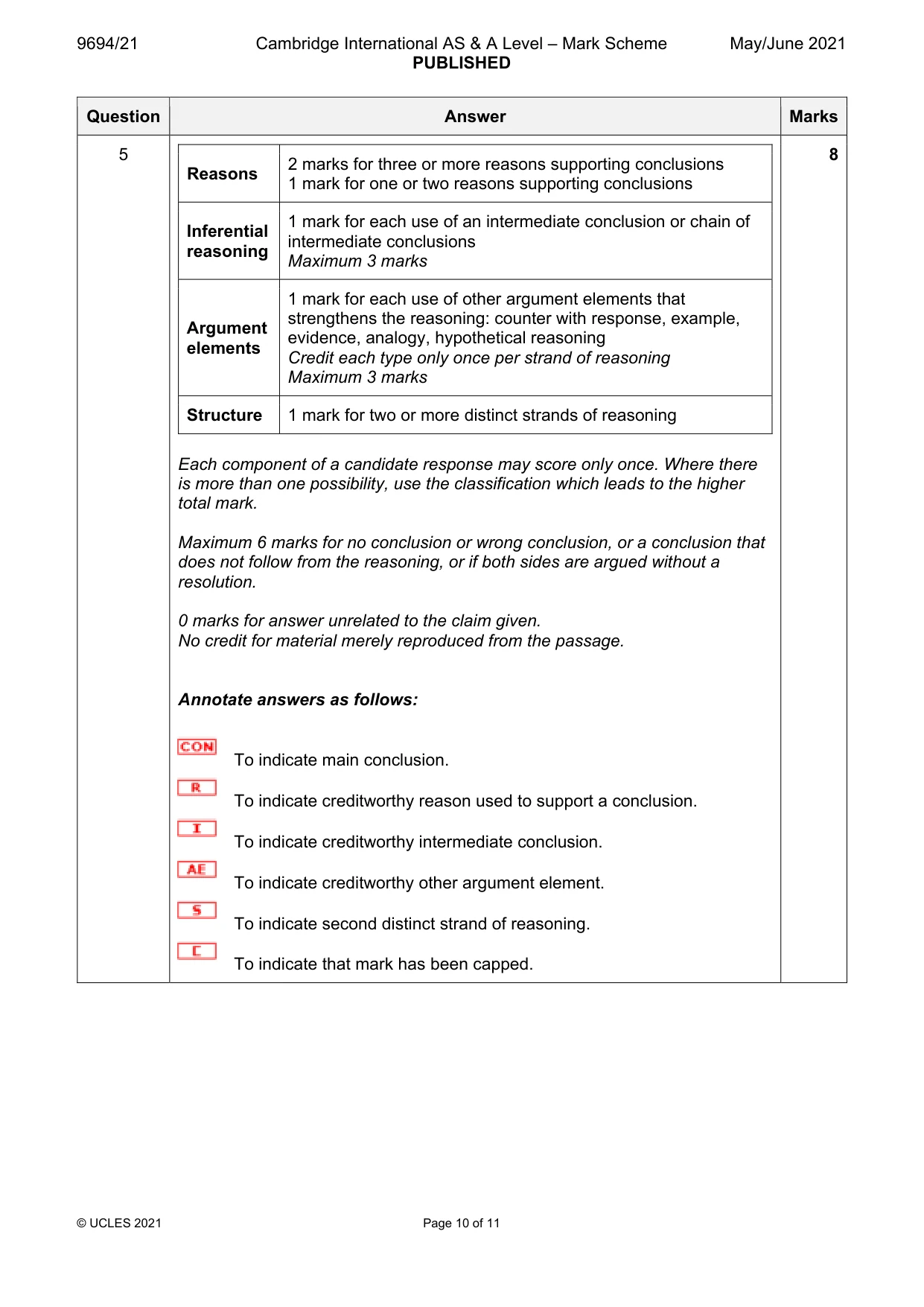
9694/21 Cambridge International AS & A Level – Mark Scheme PUBLISHED May/June 2021 © UCLES 2021 Page 10 of 11 Question Answer Marks 5 Reasons 2 marks for three or more reasons supporting conclusions 1 mark for one or two reasons supporting conclusions Inferential reasoning 1 mark for each use of an intermediate conclusion or chain of intermediate conclusions Maximum 3 marks Argument elements 1 mark for each use of other argument elements that strengthens the reasoning: counter with response, example, evidence, analogy, hypothetical reasoning Credit each type only once per strand of reasoning Maximum 3 marks Structure 1 mark for two or more distinct strands of reasoning Each component of a candidate response may score only once. Where there is more than one possibility, use the classification which leads to the higher total mark. Maximum 6 marks for no conclusion or wrong conclusion, or a conclusion that does not follow from the reasoning, or if both sides are argued without a resolution. 0 marks for answer unrelated to the claim given. No credit for material merely reproduced from the passage. Annotate answers as follows: To indicate main conclusion. To indicate creditworthy reason used to support a conclusion. To indicate creditworthy intermediate conclusion. To indicate creditworthy other argument element. To indicate second distinct strand of reasoning. To indicate that mark has been capped. 8
Mark scheme, page 11
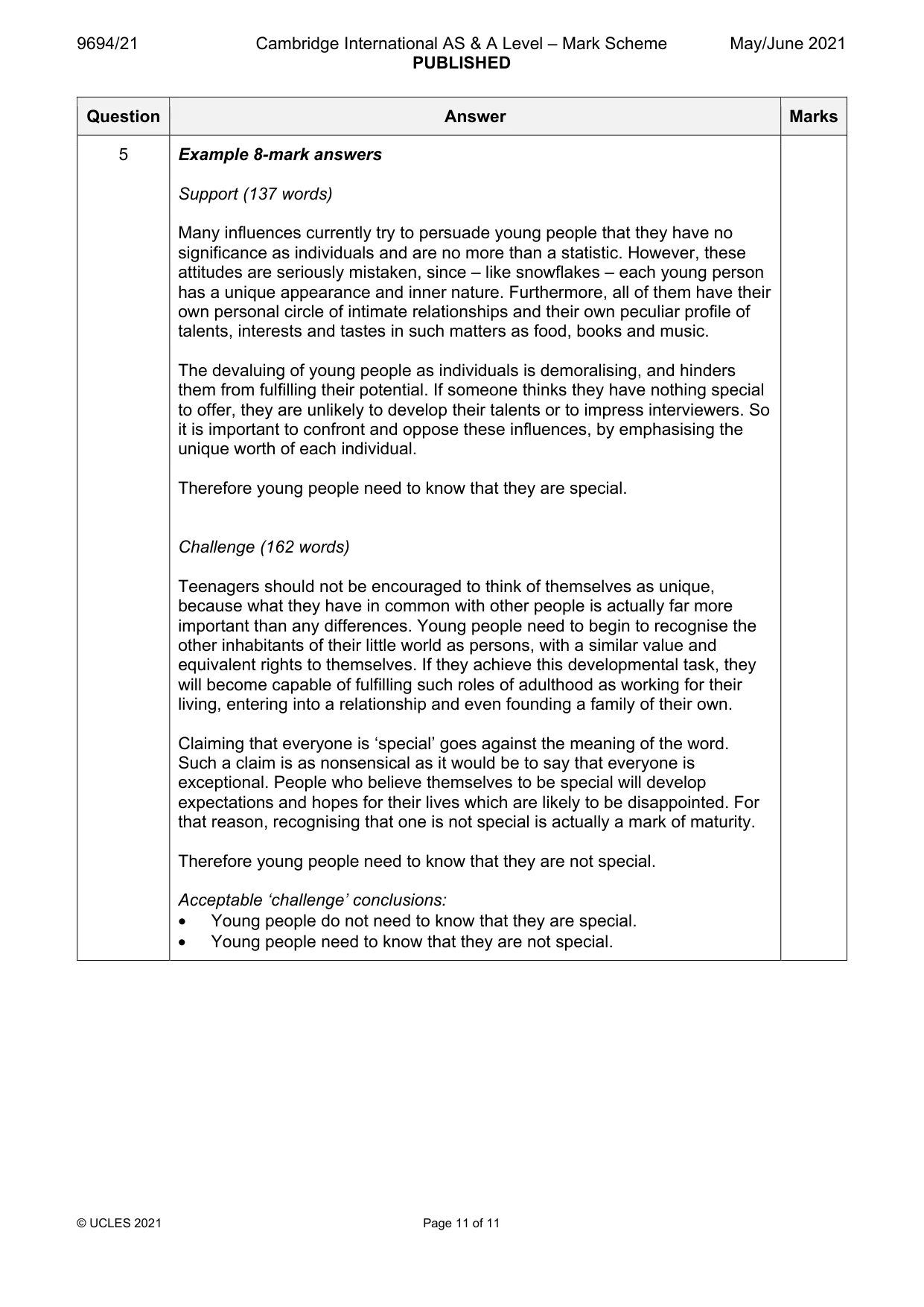
9694/21 Cambridge International AS & A Level – Mark Scheme PUBLISHED May/June 2021 © UCLES 2021 Page 11 of 11 Question Answer Marks 5 Example 8-mark answers Support (137 words) Many influences currently try to persuade young people that they have no significance as individuals and are no more than a statistic. However, these attitudes are seriously mistaken, since – like snowflakes – each young person has a unique appearance and inner nature. Furthermore, all of them have their own personal circle of intimate relationships and their own peculiar profile of talents, interests and tastes in such matters as food, books and music. The devaluing of young people as individuals is demoralising, and hinders them from fulfilling their potential. If someone thinks they have nothing special to offer, they are unlikely to develop their talents or to impress interviewers. So it is important to confront and oppose these influences, by emphasising the unique worth of each individual. Therefore young people need to know that they are special. Challenge (162 words) Teenagers should not be encouraged to think of themselves as unique, because what they have in common with other people is actually far more important than any differences. Young people need to begin to recognise the other inhabitants of their little world as persons, with a similar value and equivalent rights to themselves. If they achieve this developmental task, they will become capable of fulfilling such roles of adulthood as working for their living, entering into a relationship and even founding a family of their own. Claiming that everyone is ‘special’ goes against the meaning of the word. Such a claim is as nonsensical as it would be to say that everyone is exceptional. People who believe themselves to be special will develop expectations and hopes for their lives which are likely to be disappointed. For that reason, recognising that one is not special is actually a mark of maturity. Therefore young people need to know that they are not special. Acceptable ‘challenge’ conclusions: • Young people do not need to know that they are special. • Young people need to know that they are not special.
What you needed in this session
Cambridge’s own grade thresholds for 2021 May/June, Paper 2 · Variant 1. A higher threshold means an easier paper — the bar moves with how the cohort did.