Cambridge A Level Thinking Skills 9694 — 2021 May/June Paper 2 · Variant 2
9694/22/M/J/21 · 50 marks · ≈56 min
The question paper and its mark scheme, free to read here and free to download. This is Cambridge’s own paper, exactly as it was sat.
Question paper8 pages


Mark scheme10 pages
Answers below. Sit the paper first if you are practising.
Paper as text
Question paper, page 1
Cambridge International AS & A Level This document has 8 pages. Any blank pages are indicated. DC (LEG/FC) 199204/1 © UCLES 2021 [Turn over * 9 0 1 8 9 8 9 6 7 5 * THINKING SKILLS 9694/22 Paper 2 Critical Thinking May/June 2021 1 hour 45 minutes You must answer on the enclosed answer booklet. You will need: Answer booklet (enclosed) INSTRUCTIONS ● Answer all questions. ● Follow the instructions on the front cover of the answer booklet. If you need additional answer paper, ask the invigilator for a continuation booklet. INFORMATION ● The total mark for this paper is 50. ● The number of marks for each question or part question is shown in brackets [ ].
Question paper, page 2
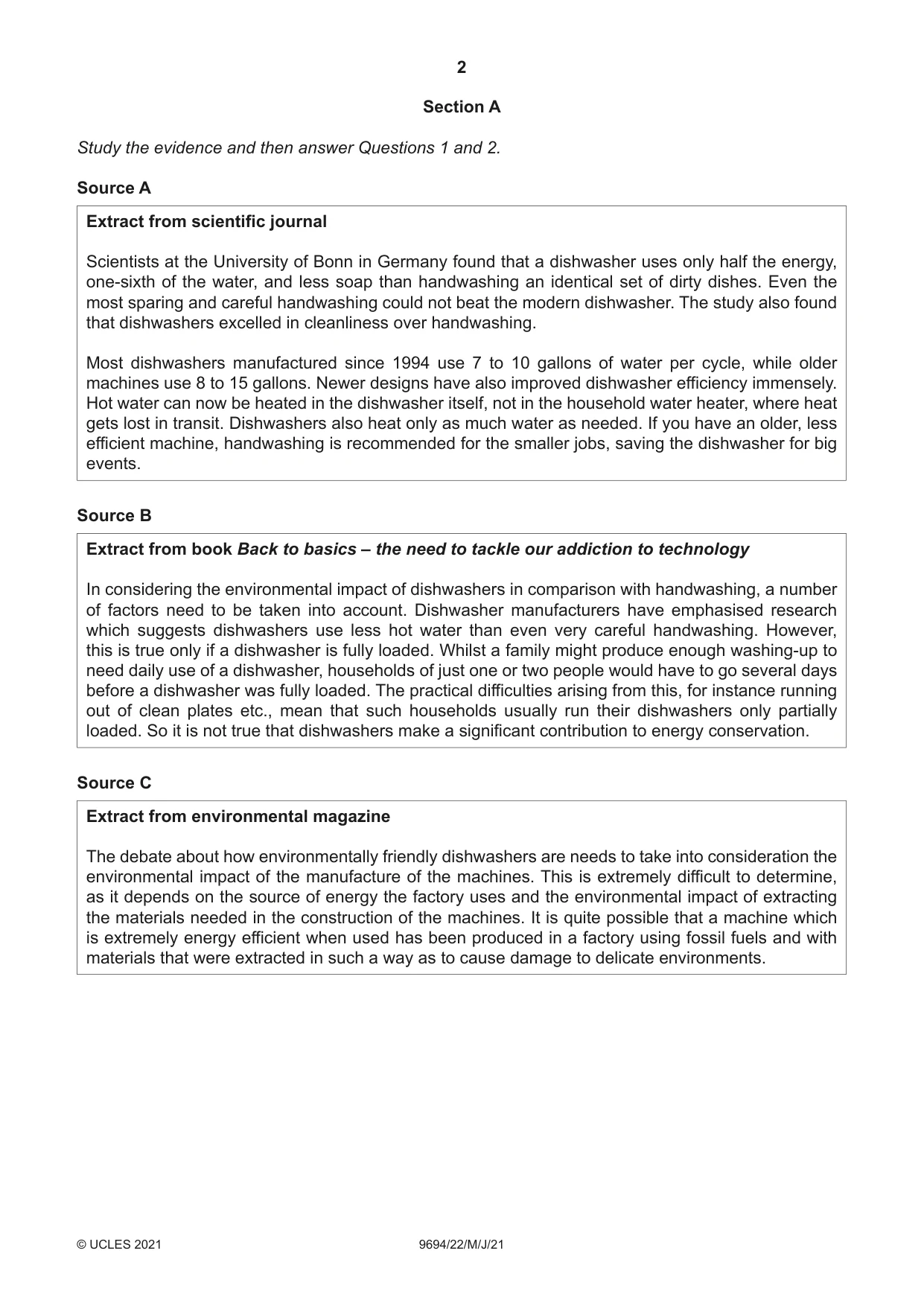
2 9694/22/M/J/21 © UCLES 2021 Section A Study the evidence and then answer Questions 1 and 2. Source A Extract from scientific journal Scientists at the University of Bonn in Germany found that a dishwasher uses only half the energy, one-sixth of the water, and less soap than handwashing an identical set of dirty dishes. Even the most sparing and careful handwashing could not beat the modern dishwasher. The study also found that dishwashers excelled in cleanliness over handwashing. Most dishwashers manufactured since 1994 use 7 to 10 gallons of water per cycle, while older machines use 8 to 15 gallons. Newer designs have also improved dishwasher efficiency immensely. Hot water can now be heated in the dishwasher itself, not in the household water heater, where heat gets lost in transit. Dishwashers also heat only as much water as needed. If you have an older, less efficient machine, handwashing is recommended for the smaller jobs, saving the dishwasher for big events. Source B Extract from book Back to basics – the need to tackle our addiction to technology In considering the environmental impact of dishwashers in comparison with handwashing, a number of factors need to be taken into account. Dishwasher manufacturers have emphasised research which suggests dishwashers use less hot water than even very careful handwashing. However, this is true only if a dishwasher is fully loaded. Whilst a family might produce enough washing-up to need daily use of a dishwasher, households of just one or two people would have to go several days before a dishwasher was fully loaded. The practical difficulties arising from this, for instance running out of clean plates etc., mean that such households usually run their dishwashers only partially loaded. So it is not true that dishwashers make a significant contribution to energy conservation. Source C Extract from environmental magazine The debate about how environmentally friendly dishwashers are needs to take into consideration the environmental impact of the manufacture of the machines. This is extremely difficult to determine, as it depends on the source of energy the factory uses and the environmental impact of extracting the materials needed in the construction of the machines. It is quite possible that a machine which is extremely energy efficient when used has been produced in a factory using fossil fuels and with materials that were extracted in such a way as to cause damage to delicate environments.
Question paper, page 3
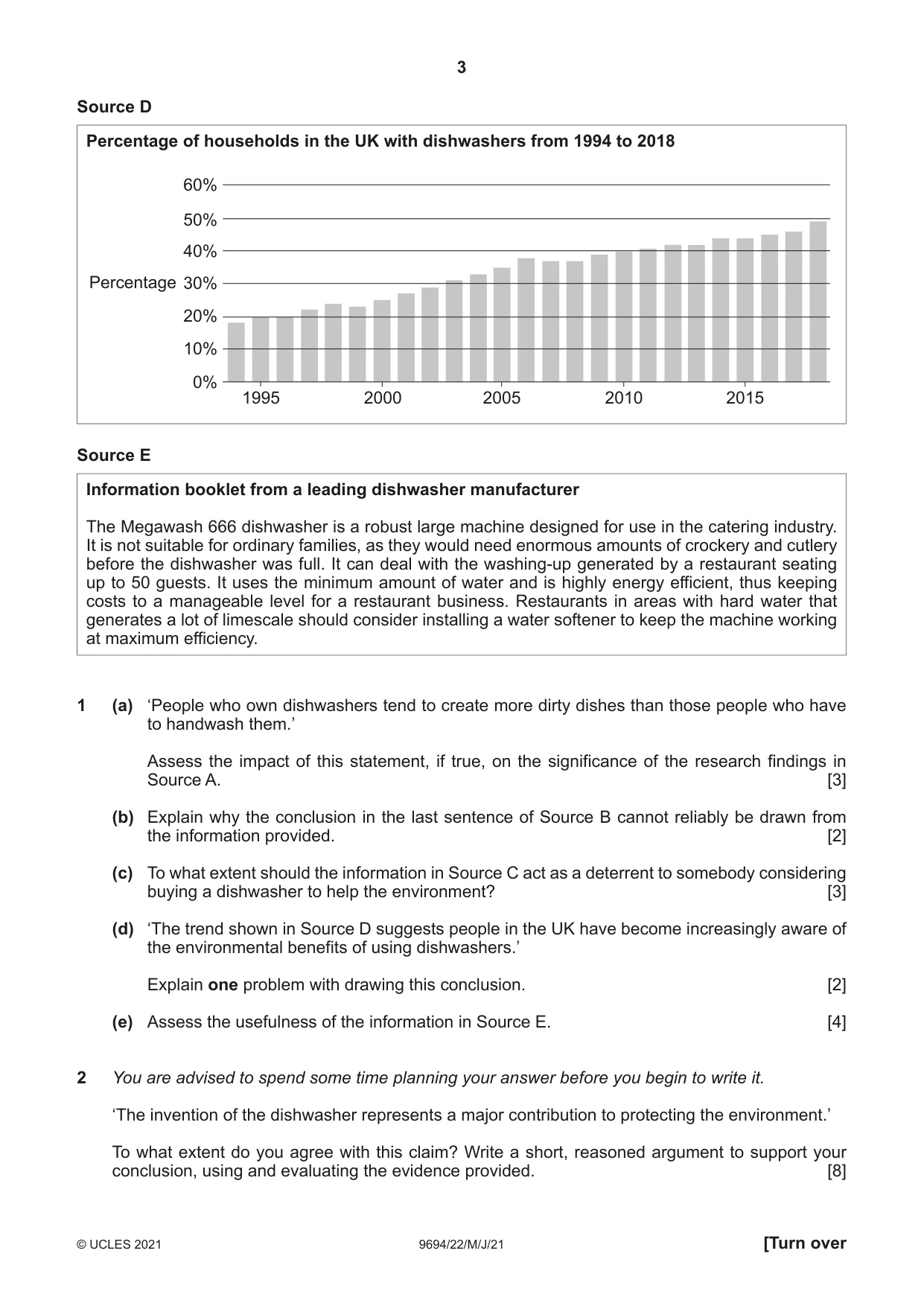
3 9694/22/M/J/21 © UCLES 2021 [Turn over Source D Percentage of households in the UK with dishwashers from 1994 to 2018 60% 50% 40% 30% Percentage 20% 10% 0% 1995 2000 2005 2010 2015 Source E Information booklet from a leading dishwasher manufacturer The Megawash 666 dishwasher is a robust large machine designed for use in the catering industry. It is not suitable for ordinary families, as they would need enormous amounts of crockery and cutlery before the dishwasher was full. It can deal with the washing-up generated by a restaurant seating up to 50 guests. It uses the minimum amount of water and is highly energy efficient, thus keeping costs to a manageable level for a restaurant business. Restaurants in areas with hard water that generates a lot of limescale should consider installing a water softener to keep the machine working at maximum efficiency. 1 (a) ‘People who own dishwashers tend to create more dirty dishes than those people who have to handwash them.’ Assess the impact of this statement, if true, on the significance of the research findings in Source A. [3] (b) Explain why the conclusion in the last sentence of Source B cannot reliably be drawn from the information provided. [2] (c) To what extent should the information in Source C act as a deterrent to somebody considering buying a dishwasher to help the environment? [3] (d) ‘The trend shown in Source D suggests people in the UK have become increasingly aware of the environmental benefits of using dishwashers.’ Explain one problem with drawing this conclusion. [2] (e) Assess the usefulness of the information in Source E. [4] 2 You are advised to spend some time planning your answer before you begin to write it. ‘The invention of the dishwasher represents a major contribution to protecting the environment.’ To what extent do you agree with this claim? Write a short, reasoned argument to support your conclusion, using and evaluating the evidence provided. [8]
Question paper, page 4
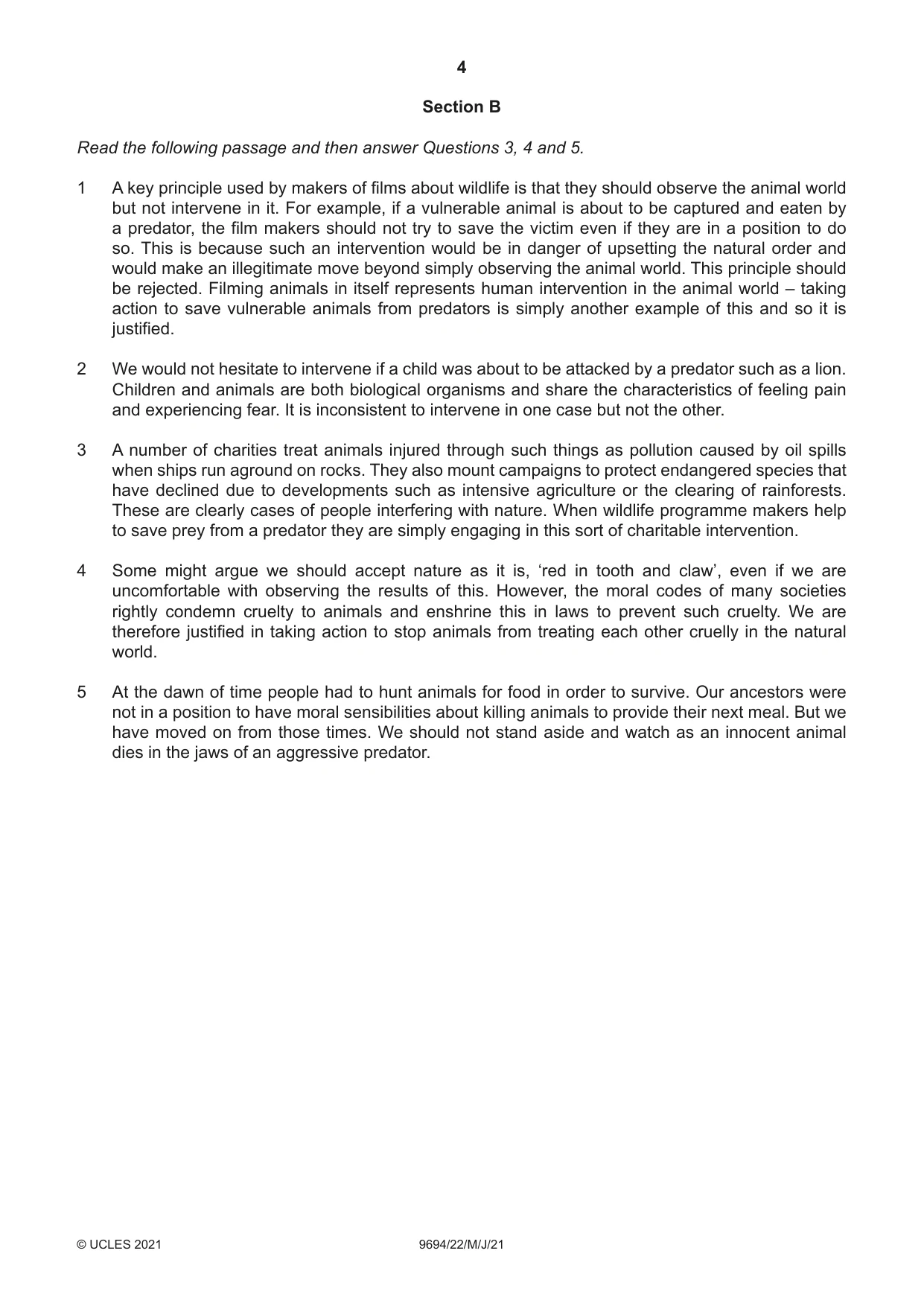
4 9694/22/M/J/21 © UCLES 2021 Section B Read the following passage and then answer Questions 3, 4 and 5. 1 A key principle used by makers of films about wildlife is that they should observe the animal world but not intervene in it. For example, if a vulnerable animal is about to be captured and eaten by a predator, the film makers should not try to save the victim even if they are in a position to do so. This is because such an intervention would be in danger of upsetting the natural order and would make an illegitimate move beyond simply observing the animal world. This principle should be rejected. Filming animals in itself represents human intervention in the animal world – taking action to save vulnerable animals from predators is simply another example of this and so it is justified. 2 We would not hesitate to intervene if a child was about to be attacked by a predator such as a lion. Children and animals are both biological organisms and share the characteristics of feeling pain and experiencing fear. It is inconsistent to intervene in one case but not the other. 3 A number of charities treat animals injured through such things as pollution caused by oil spills when ships run aground on rocks. They also mount campaigns to protect endangered species that have declined due to developments such as intensive agriculture or the clearing of rainforests. These are clearly cases of people interfering with nature. When wildlife programme makers help to save prey from a predator they are simply engaging in this sort of charitable intervention. 4 Some might argue we should accept nature as it is, ‘red in tooth and claw’, even if we are uncomfortable with observing the results of this. However, the moral codes of many societies rightly condemn cruelty to animals and enshrine this in laws to prevent such cruelty. We are therefore justified in taking action to stop animals from treating each other cruelly in the natural world. 5 At the dawn of time people had to hunt animals for food in order to survive. Our ancestors were not in a position to have moral sensibilities about killing animals to provide their next meal. But we have moved on from those times. We should not stand aside and watch as an innocent animal dies in the jaws of an aggressive predator.
Question paper, page 5
5 9694/22/M/J/21 © UCLES 2021 3 (a) Using the exact words from the passage as far as possible, identify the main conclusion. [2] (b) Using the exact words from the passage as far as possible, identify three intermediate conclusions in paragraphs 1 to 4. [6] (c) Identify an unstated assumption required by the reasoning in paragraph 2. [2] (d) Identify the argument element and explain the function of the following words from paragraph 5: ‘But we have moved on from those times.’ [2] 4 (a) Identify and explain one flaw or weakness in the reasoning in paragraph 1. [2] (b) Identify a flaw of conflation in paragraph 3. [2] (c) Explain how the reasoning in paragraph 4 is weakened by reliance on a questionable assumption. [2] (d) Explain why the reasoning in paragraph 5 fails to support the main conclusion. [2] 5 You are advised to spend some time planning your answer before you begin to write it. ‘The continued development of human society is not compatible with the preservation of the natural world.’ Write your own short argument to support or challenge this claim. The conclusion of your argument must be stated. Credit will not be given for repeating ideas from the passage. [8]
Question paper, page 6
6 9694/22/M/J/21 © UCLES 2021 BLANK PAGE
Question paper, page 7
7 9694/22/M/J/21 © UCLES 2021 BLANK PAGE
Question paper, page 8
8 9694/22/M/J/21 © UCLES 2021 Permission to reproduce items where third-party owned material protected by copyright is included has been sought and cleared where possible. Every reasonable effort has been made by the publisher (UCLES) to trace copyright holders, but if any items requiring clearance have unwittingly been included, the publisher will be pleased to make amends at the earliest possible opportunity. To avoid the issue of disclosure of answer-related information to candidates, all copyright acknowledgements are reproduced online in the Cambridge Assessment International Education Copyright Acknowledgements Booklet. This is produced for each series of examinations and is freely available to download at www.cambridgeinternational.org after the live examination series. Cambridge Assessment International Education is part of the Cambridge Assessment Group. Cambridge Assessment is the brand name of the University of Cambridge Local Examinations Syndicate (UCLES), which itself is a department of the University of Cambridge. BLANK PAGE
Mark scheme, page 1
This document consists of 10 printed pages. © UCLES 2021 [Turn over Cambridge International AS & A Level THINKING SKILLS 9694/22 Paper 2 Critical Thinking May/June 2021 MARK SCHEME Maximum Mark: 50 Published This mark scheme is published as an aid to teachers and candidates, to indicate the requirements of the examination. It shows the basis on which Examiners were instructed to award marks. It does not indicate the details of the discussions that took place at an Examiners’ meeting before marking began, which would have considered the acceptability of alternative answers. Mark schemes should be read in conjunction with the question paper and the Principal Examiner Report for Teachers. Cambridge International will not enter into discussions about these mark schemes. Cambridge International is publishing the mark schemes for the May/June 2021 series for most Cambridge IGCSE™, Cambridge International A and AS Level components and some Cambridge O Level components.
Mark scheme, page 2
9694/22 Cambridge International AS & A Level – Mark Scheme PUBLISHED May/June 2021 © UCLES 2021 Page 2 of 10 Generic Marking Principles These general marking principles must be applied by all examiners when marking candidate answers. They should be applied alongside the specific content of the mark scheme or generic level descriptors for a question. Each question paper and mark scheme will also comply with these marking principles. GENERIC MARKING PRINCIPLE 1: Marks must be awarded in line with: • the specific content of the mark scheme or the generic level descriptors for the question • the specific skills defined in the mark scheme or in the generic level descriptors for the question • the standard of response required by a candidate as exemplified by the standardisation scripts. GENERIC MARKING PRINCIPLE 2: Marks awarded are always whole marks (not half marks, or other fractions). GENERIC MARKING PRINCIPLE 3: Marks must be awarded positively: • marks are awarded for correct/valid answers, as defined in the mark scheme. However, credit is given for valid answers which go beyond the scope of the syllabus and mark scheme, referring to your Team Leader as appropriate • marks are awarded when candidates clearly demonstrate what they know and can do • marks are not deducted for errors • marks are not deducted for omissions • answers should only be judged on the quality of spelling, punctuation and grammar when these features are specifically assessed by the question as indicated by the mark scheme. The meaning, however, should be unambiguous. GENERIC MARKING PRINCIPLE 4: Rules must be applied consistently, e.g. in situations where candidates have not followed instructions or in the application of generic level descriptors. GENERIC MARKING PRINCIPLE 5: Marks should be awarded using the full range of marks defined in the mark scheme for the question (however; the use of the full mark range may be limited according to the quality of the candidate responses seen). GENERIC MARKING PRINCIPLE 6: Marks awarded are based solely on the requirements as defined in the mark scheme. Marks should not be awarded with grade thresholds or grade descriptors in mind.
Mark scheme, page 3
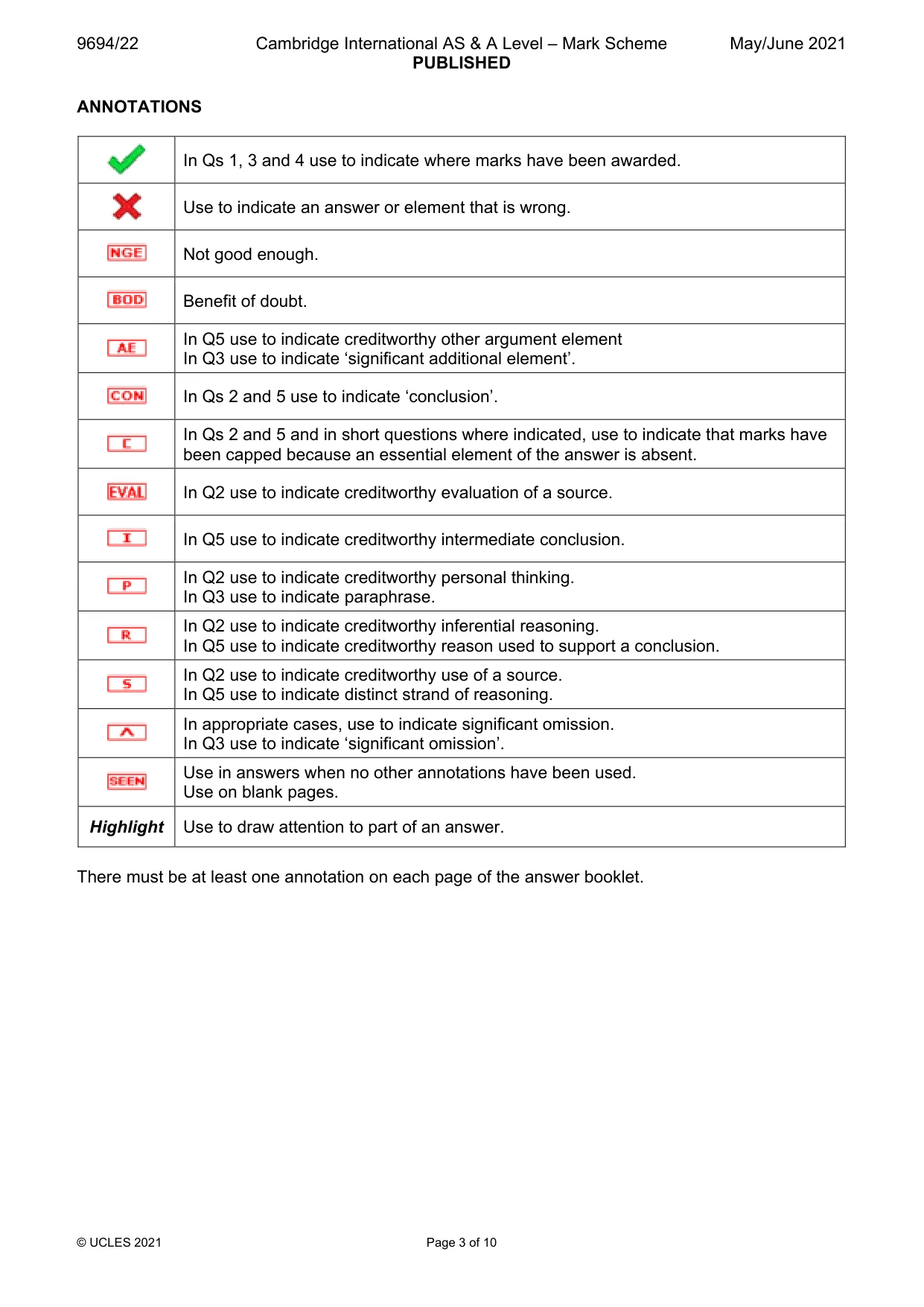
9694/22 Cambridge International AS & A Level – Mark Scheme PUBLISHED May/June 2021 © UCLES 2021 Page 3 of 10 ANNOTATIONS In Qs 1, 3 and 4 use to indicate where marks have been awarded. Use to indicate an answer or element that is wrong. Not good enough. Benefit of doubt. In Q5 use to indicate creditworthy other argument element In Q3 use to indicate ‘significant additional element’. In Qs 2 and 5 use to indicate ‘conclusion’. In Qs 2 and 5 and in short questions where indicated, use to indicate that marks have been capped because an essential element of the answer is absent. In Q2 use to indicate creditworthy evaluation of a source. In Q5 use to indicate creditworthy intermediate conclusion. In Q2 use to indicate creditworthy personal thinking. In Q3 use to indicate paraphrase. In Q2 use to indicate creditworthy inferential reasoning. In Q5 use to indicate creditworthy reason used to support a conclusion. In Q2 use to indicate creditworthy use of a source. In Q5 use to indicate distinct strand of reasoning. In appropriate cases, use to indicate significant omission. In Q3 use to indicate ‘significant omission’. Use in answers when no other annotations have been used. Use on blank pages. Highlight Use to draw attention to part of an answer. There must be at least one annotation on each page of the answer booklet.
Mark scheme, page 4
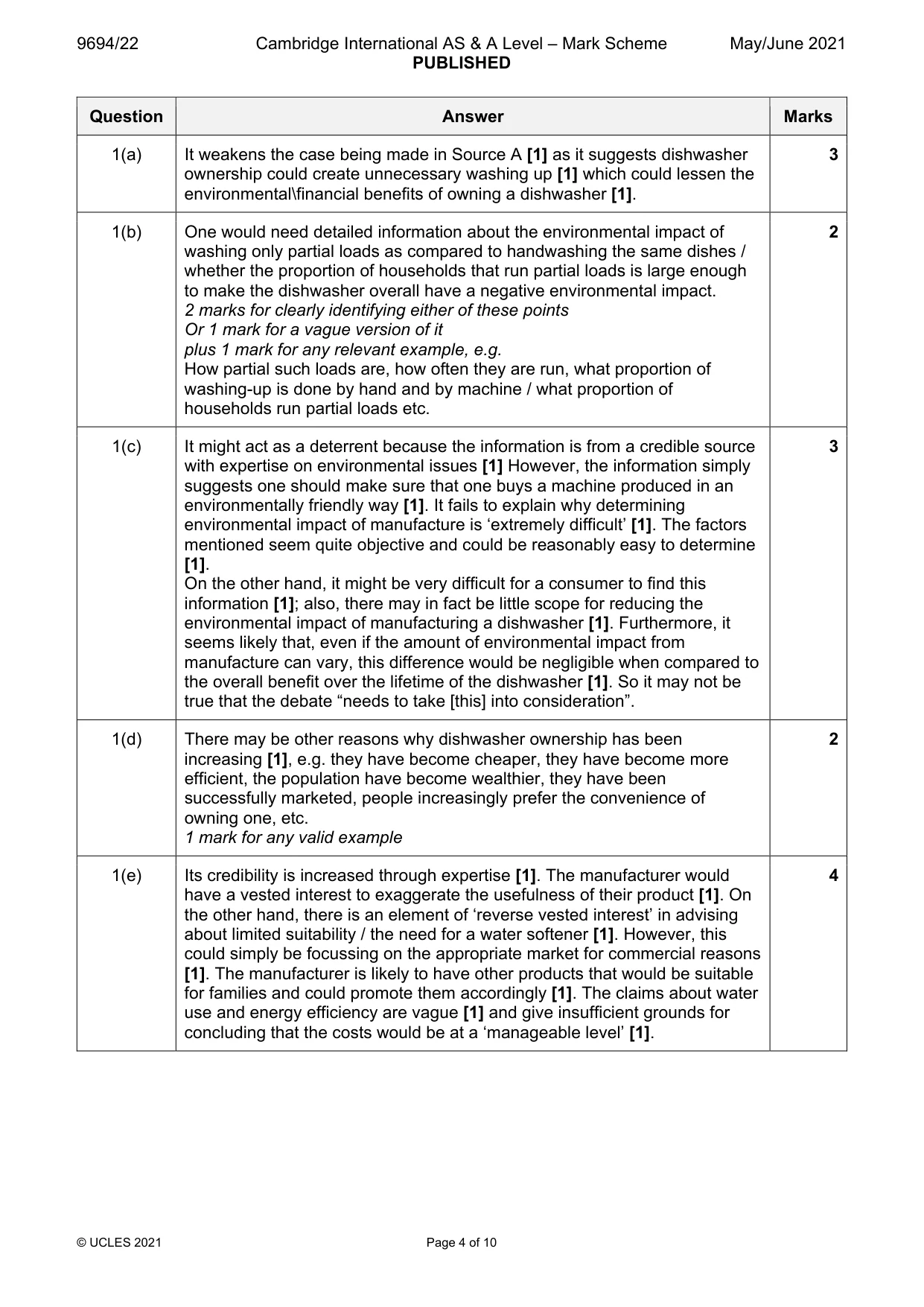
9694/22 Cambridge International AS & A Level – Mark Scheme PUBLISHED May/June 2021 © UCLES 2021 Page 4 of 10 Question Answer Marks 1(a) It weakens the case being made in Source A [1] as it suggests dishwasher ownership could create unnecessary washing up [1] which could lessen the environmental\financial benefits of owning a dishwasher [1]. 3 1(b) One would need detailed information about the environmental impact of washing only partial loads as compared to handwashing the same dishes / whether the proportion of households that run partial loads is large enough to make the dishwasher overall have a negative environmental impact. 2 marks for clearly identifying either of these points Or 1 mark for a vague version of it plus 1 mark for any relevant example, e.g. How partial such loads are, how often they are run, what proportion of washing-up is done by hand and by machine / what proportion of households run partial loads etc. 2 1(c) It might act as a deterrent because the information is from a credible source with expertise on environmental issues [1] However, the information simply suggests one should make sure that one buys a machine produced in an environmentally friendly way [1]. It fails to explain why determining environmental impact of manufacture is ‘extremely difficult’ [1]. The factors mentioned seem quite objective and could be reasonably easy to determine [1]. On the other hand, it might be very difficult for a consumer to find this information [1]; also, there may in fact be little scope for reducing the environmental impact of manufacturing a dishwasher [1]. Furthermore, it seems likely that, even if the amount of environmental impact from manufacture can vary, this difference would be negligible when compared to the overall benefit over the lifetime of the dishwasher [1]. So it may not be true that the debate “needs to take [this] into consideration”. 3 1(d) There may be other reasons why dishwasher ownership has been increasing [1], e.g. they have become cheaper, they have become more efficient, the population have become wealthier, they have been successfully marketed, people increasingly prefer the convenience of owning one, etc. 1 mark for any valid example 2 1(e) Its credibility is increased through expertise [1]. The manufacturer would have a vested interest to exaggerate the usefulness of their product [1]. On the other hand, there is an element of ‘reverse vested interest’ in advising about limited suitability / the need for a water softener [1]. However, this could simply be focussing on the appropriate market for commercial reasons [1]. The manufacturer is likely to have other products that would be suitable for families and could promote them accordingly [1]. The claims about water use and energy efficiency are vague [1] and give insufficient grounds for concluding that the costs would be at a ‘manageable level’ [1]. 4
Mark scheme, page 5
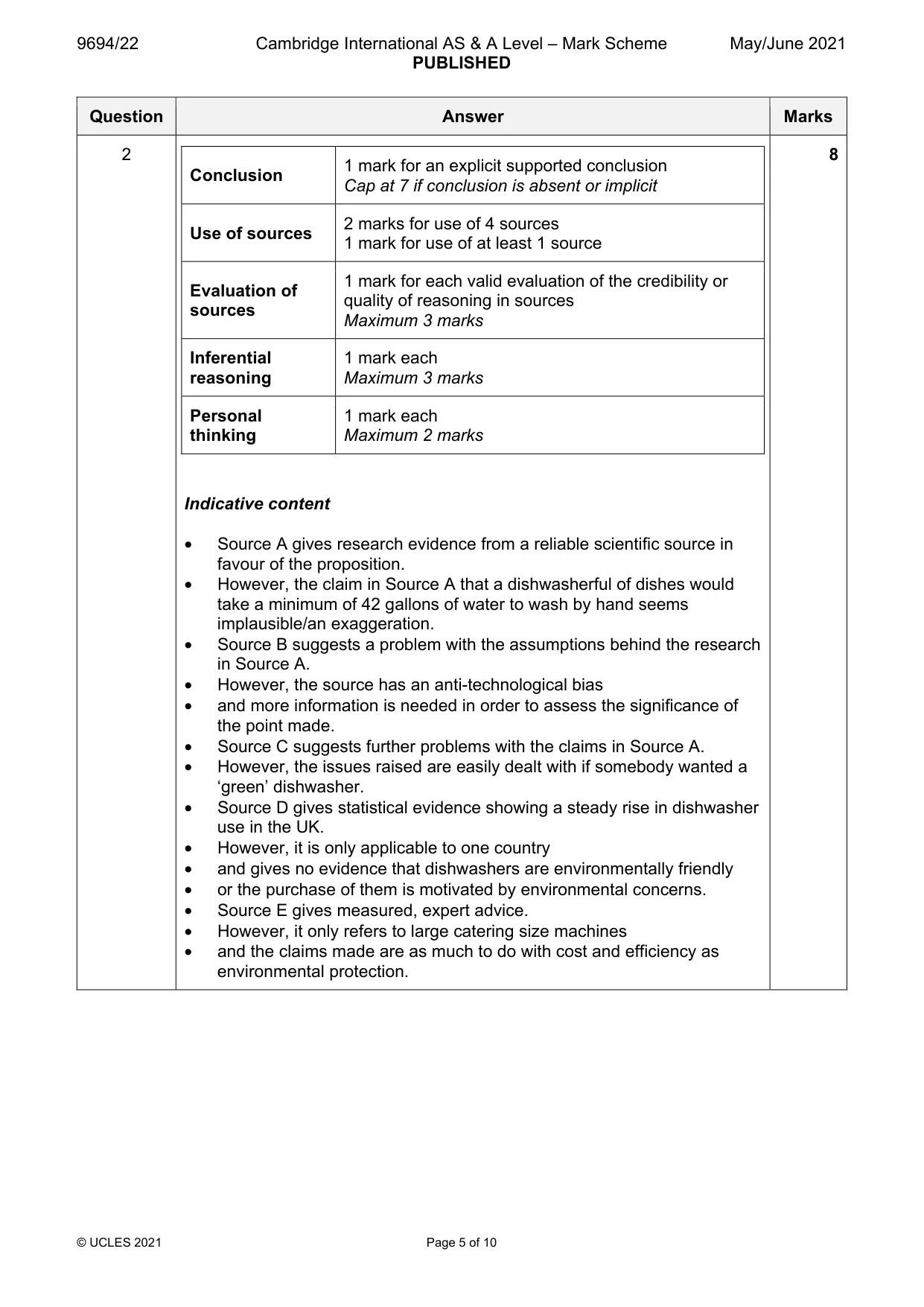
9694/22 Cambridge International AS & A Level – Mark Scheme PUBLISHED May/June 2021 © UCLES 2021 Page 5 of 10 Question Answer Marks 2 Conclusion 1 mark for an explicit supported conclusion Cap at 7 if conclusion is absent or implicit Use of sources 2 marks for use of 4 sources 1 mark for use of at least 1 source Evaluation of sources 1 mark for each valid evaluation of the credibility or quality of reasoning in sources Maximum 3 marks Inferential reasoning 1 mark each Maximum 3 marks Personal thinking 1 mark each Maximum 2 marks Indicative content • Source A gives research evidence from a reliable scientific source in favour of the proposition. • However, the claim in Source A that a dishwasherful of dishes would take a minimum of 42 gallons of water to wash by hand seems implausible/an exaggeration. • Source B suggests a problem with the assumptions behind the research in Source A. • However, the source has an anti-technological bias • and more information is needed in order to assess the significance of the point made. • Source C suggests further problems with the claims in Source A. • However, the issues raised are easily dealt with if somebody wanted a ‘green’ dishwasher. • Source D gives statistical evidence showing a steady rise in dishwasher use in the UK. • However, it is only applicable to one country • and gives no evidence that dishwashers are environmentally friendly • or the purchase of them is motivated by environmental concerns. • Source E gives measured, expert advice. • However, it only refers to large catering size machines • and the claims made are as much to do with cost and efficiency as environmental protection. 8
Mark scheme, page 6
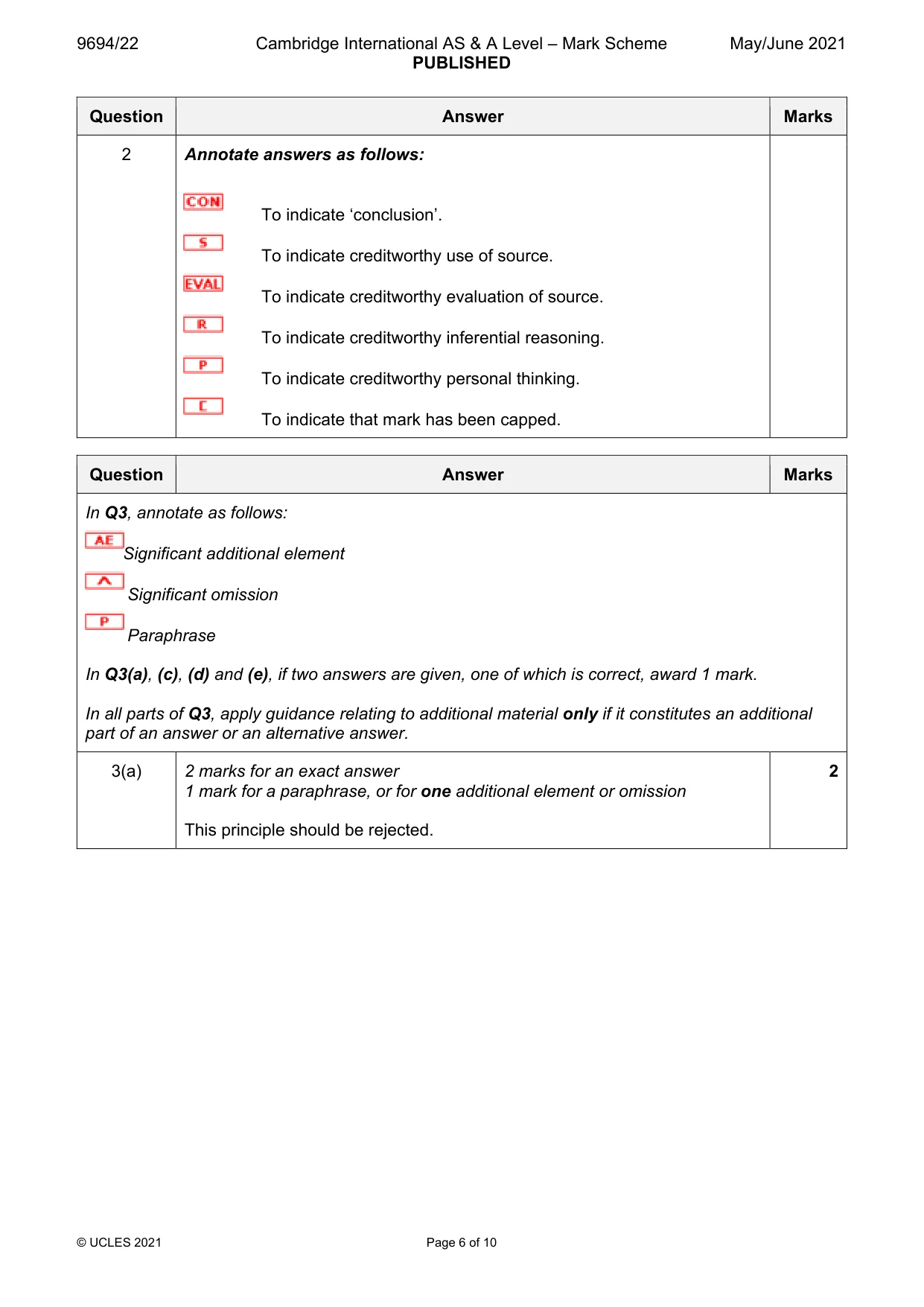
9694/22 Cambridge International AS & A Level – Mark Scheme PUBLISHED May/June 2021 © UCLES 2021 Page 6 of 10 Question Answer Marks 2 Annotate answers as follows: To indicate ‘conclusion’. To indicate creditworthy use of source. To indicate creditworthy evaluation of source. To indicate creditworthy inferential reasoning. To indicate creditworthy personal thinking. To indicate that mark has been capped. Question Answer Marks In Q3, annotate as follows: Significant additional element Significant omission Paraphrase In Q3(a), (c), (d) and (e), if two answers are given, one of which is correct, award 1 mark. In all parts of Q3, apply guidance relating to additional material only if it constitutes an additional part of an answer or an alternative answer. 3(a) 2 marks for an exact answer 1 mark for a paraphrase, or for one additional element or omission This principle should be rejected. 2
Mark scheme, page 7
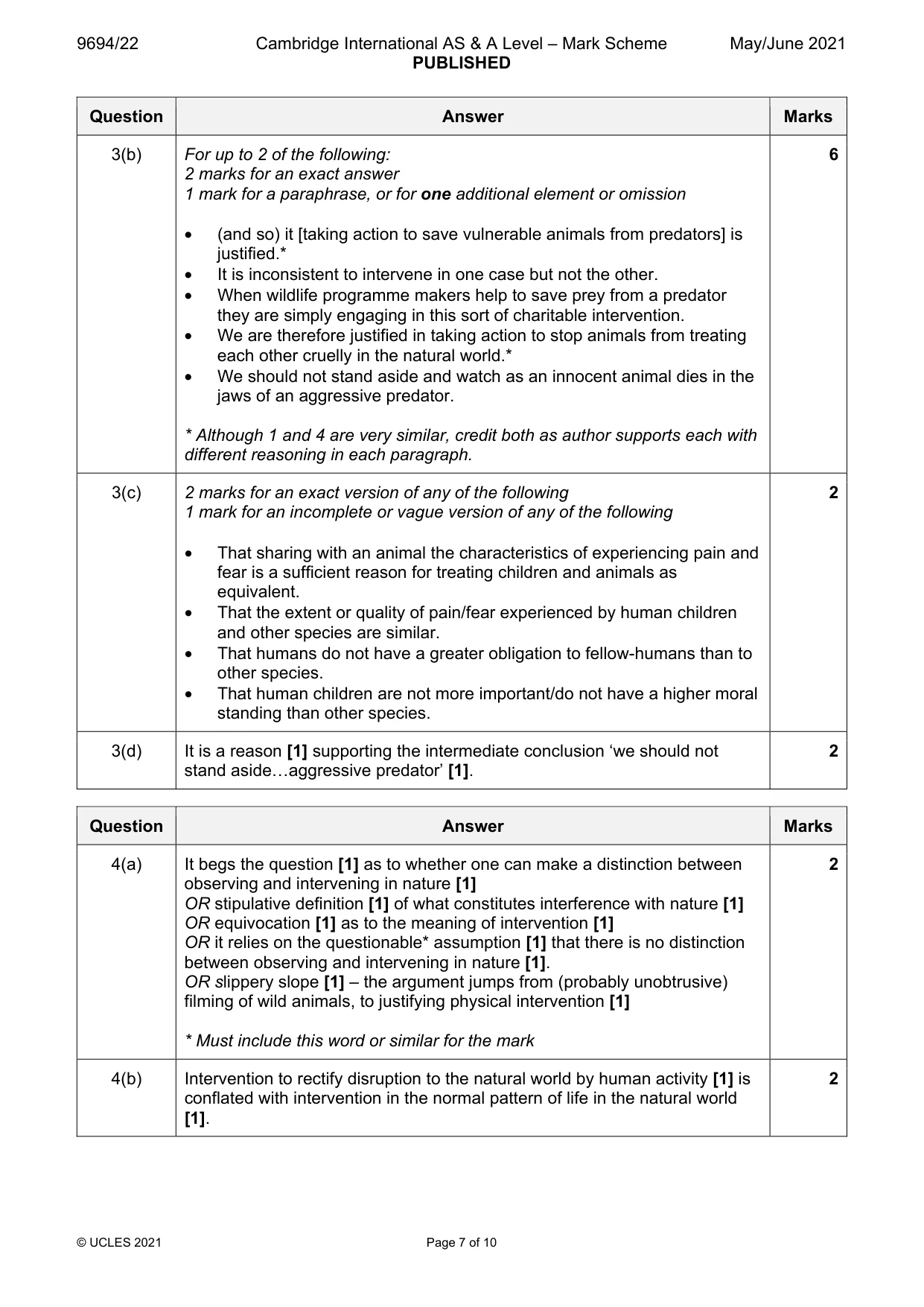
9694/22 Cambridge International AS & A Level – Mark Scheme PUBLISHED May/June 2021 © UCLES 2021 Page 7 of 10 Question Answer Marks 3(b) For up to 2 of the following: 2 marks for an exact answer 1 mark for a paraphrase, or for one additional element or omission • (and so) it [taking action to save vulnerable animals from predators] is justified.* • It is inconsistent to intervene in one case but not the other. • When wildlife programme makers help to save prey from a predator they are simply engaging in this sort of charitable intervention. • We are therefore justified in taking action to stop animals from treating each other cruelly in the natural world.* • We should not stand aside and watch as an innocent animal dies in the jaws of an aggressive predator. * Although 1 and 4 are very similar, credit both as author supports each with different reasoning in each paragraph. 6 3(c) 2 marks for an exact version of any of the following 1 mark for an incomplete or vague version of any of the following • That sharing with an animal the characteristics of experiencing pain and fear is a sufficient reason for treating children and animals as equivalent. • That the extent or quality of pain/fear experienced by human children and other species are similar. • That humans do not have a greater obligation to fellow-humans than to other species. • That human children are not more important/do not have a higher moral standing than other species. 2 3(d) It is a reason [1] supporting the intermediate conclusion ‘we should not stand aside…aggressive predator’ [1]. 2 Question Answer Marks 4(a) It begs the question [1] as to whether one can make a distinction between observing and intervening in nature [1] OR stipulative definition [1] of what constitutes interference with nature [1] OR equivocation [1] as to the meaning of intervention [1] OR it relies on the questionable* assumption [1] that there is no distinction between observing and intervening in nature [1]. OR slippery slope [1] – the argument jumps from (probably unobtrusive) filming of wild animals, to justifying physical intervention [1] * Must include this word or similar for the mark 2 4(b) Intervention to rectify disruption to the natural world by human activity [1] is conflated with intervention in the normal pattern of life in the natural world [1]. 2
Mark scheme, page 8
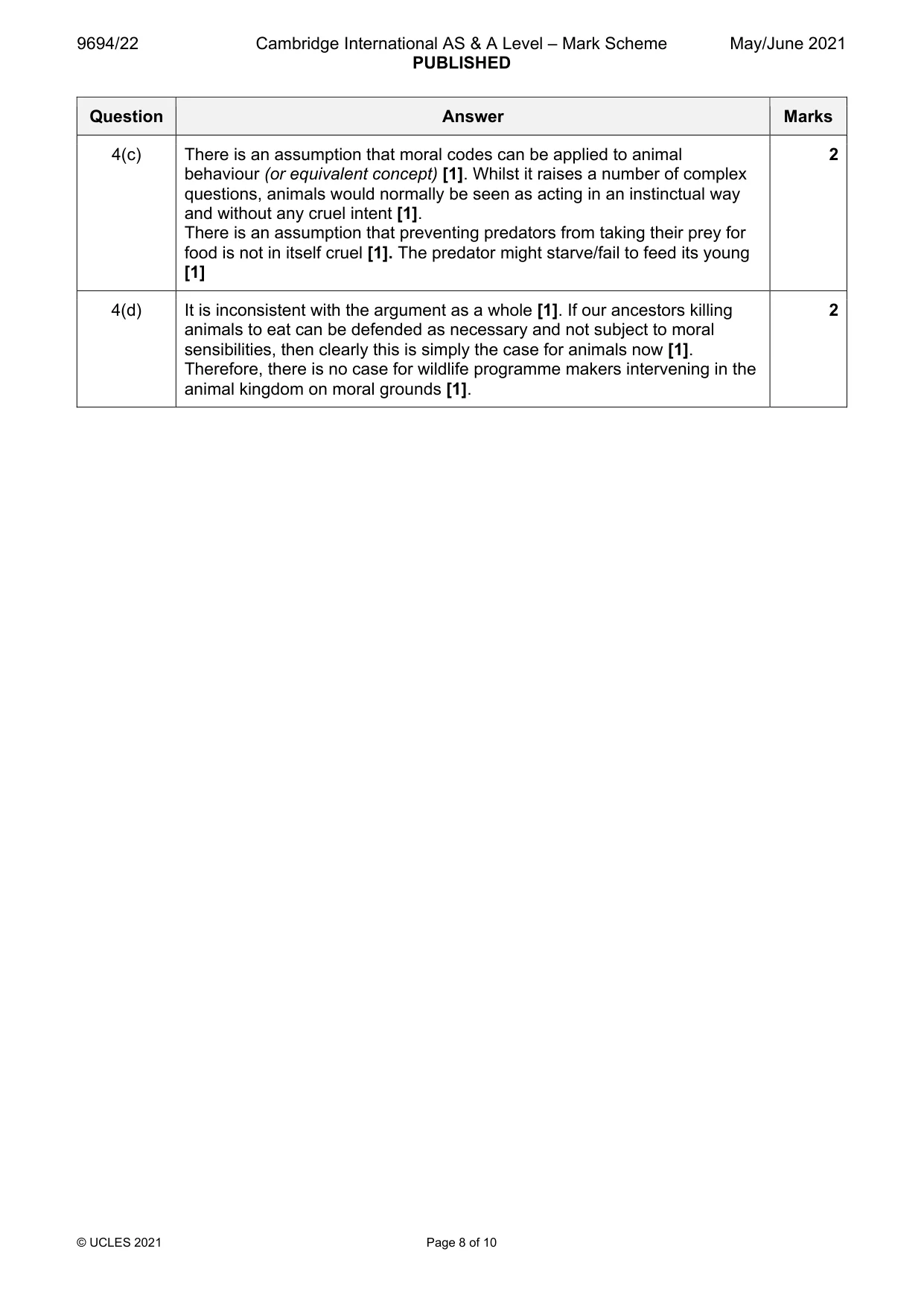
9694/22 Cambridge International AS & A Level – Mark Scheme PUBLISHED May/June 2021 © UCLES 2021 Page 8 of 10 Question Answer Marks 4(c) There is an assumption that moral codes can be applied to animal behaviour (or equivalent concept) [1]. Whilst it raises a number of complex questions, animals would normally be seen as acting in an instinctual way and without any cruel intent [1]. There is an assumption that preventing predators from taking their prey for food is not in itself cruel [1]. The predator might starve/fail to feed its young [1] 2 4(d) It is inconsistent with the argument as a whole [1]. If our ancestors killing animals to eat can be defended as necessary and not subject to moral sensibilities, then clearly this is simply the case for animals now [1]. Therefore, there is no case for wildlife programme makers intervening in the animal kingdom on moral grounds [1]. 2
Mark scheme, page 9
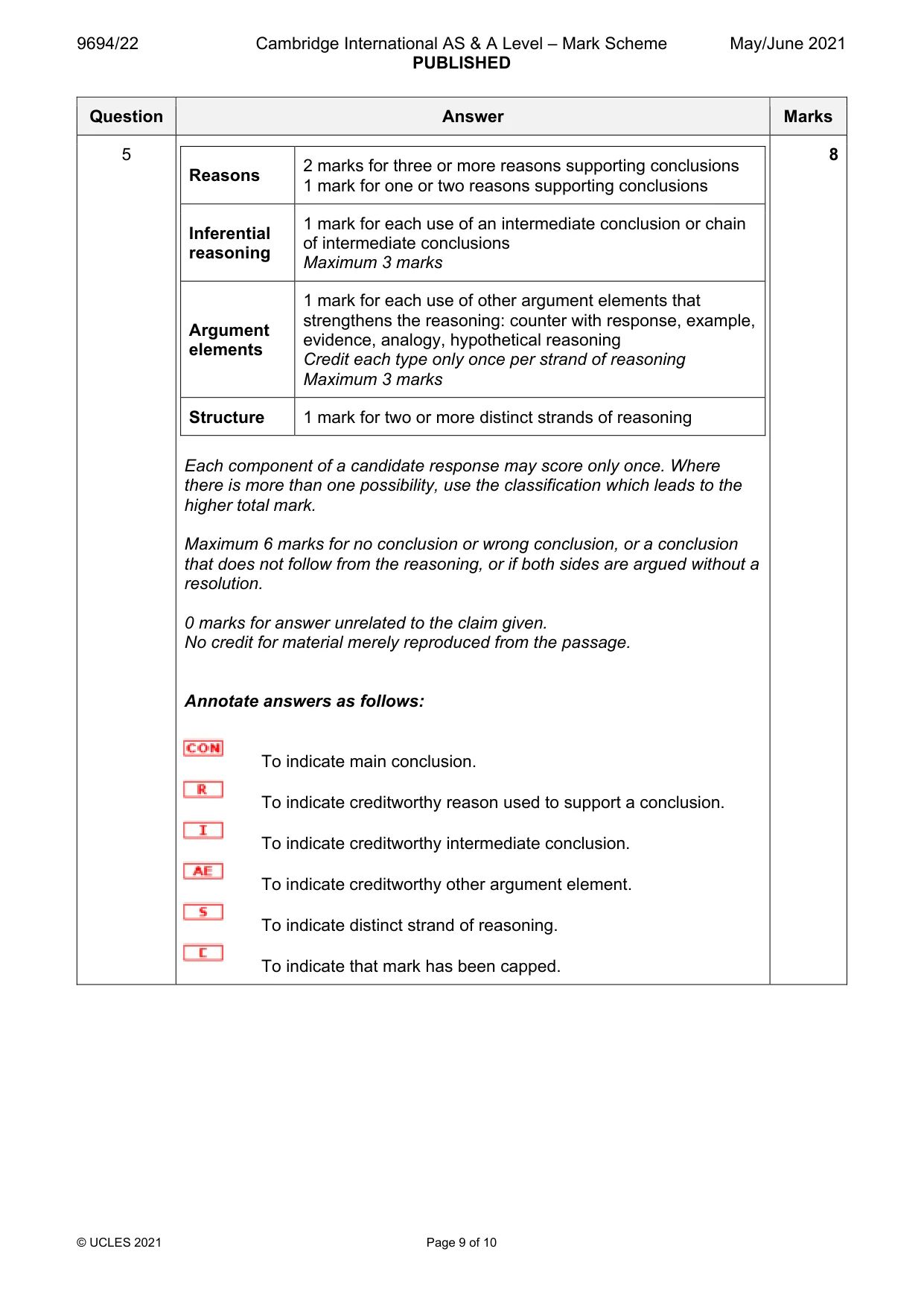
9694/22 Cambridge International AS & A Level – Mark Scheme PUBLISHED May/June 2021 © UCLES 2021 Page 9 of 10 Question Answer Marks 5 Reasons 2 marks for three or more reasons supporting conclusions 1 mark for one or two reasons supporting conclusions Inferential reasoning 1 mark for each use of an intermediate conclusion or chain of intermediate conclusions Maximum 3 marks Argument elements 1 mark for each use of other argument elements that strengthens the reasoning: counter with response, example, evidence, analogy, hypothetical reasoning Credit each type only once per strand of reasoning Maximum 3 marks Structure 1 mark for two or more distinct strands of reasoning Each component of a candidate response may score only once. Where there is more than one possibility, use the classification which leads to the higher total mark. Maximum 6 marks for no conclusion or wrong conclusion, or a conclusion that does not follow from the reasoning, or if both sides are argued without a resolution. 0 marks for answer unrelated to the claim given. No credit for material merely reproduced from the passage. Annotate answers as follows: To indicate main conclusion. To indicate creditworthy reason used to support a conclusion. To indicate creditworthy intermediate conclusion. To indicate creditworthy other argument element. To indicate distinct strand of reasoning. To indicate that mark has been capped. 8
Mark scheme, page 10
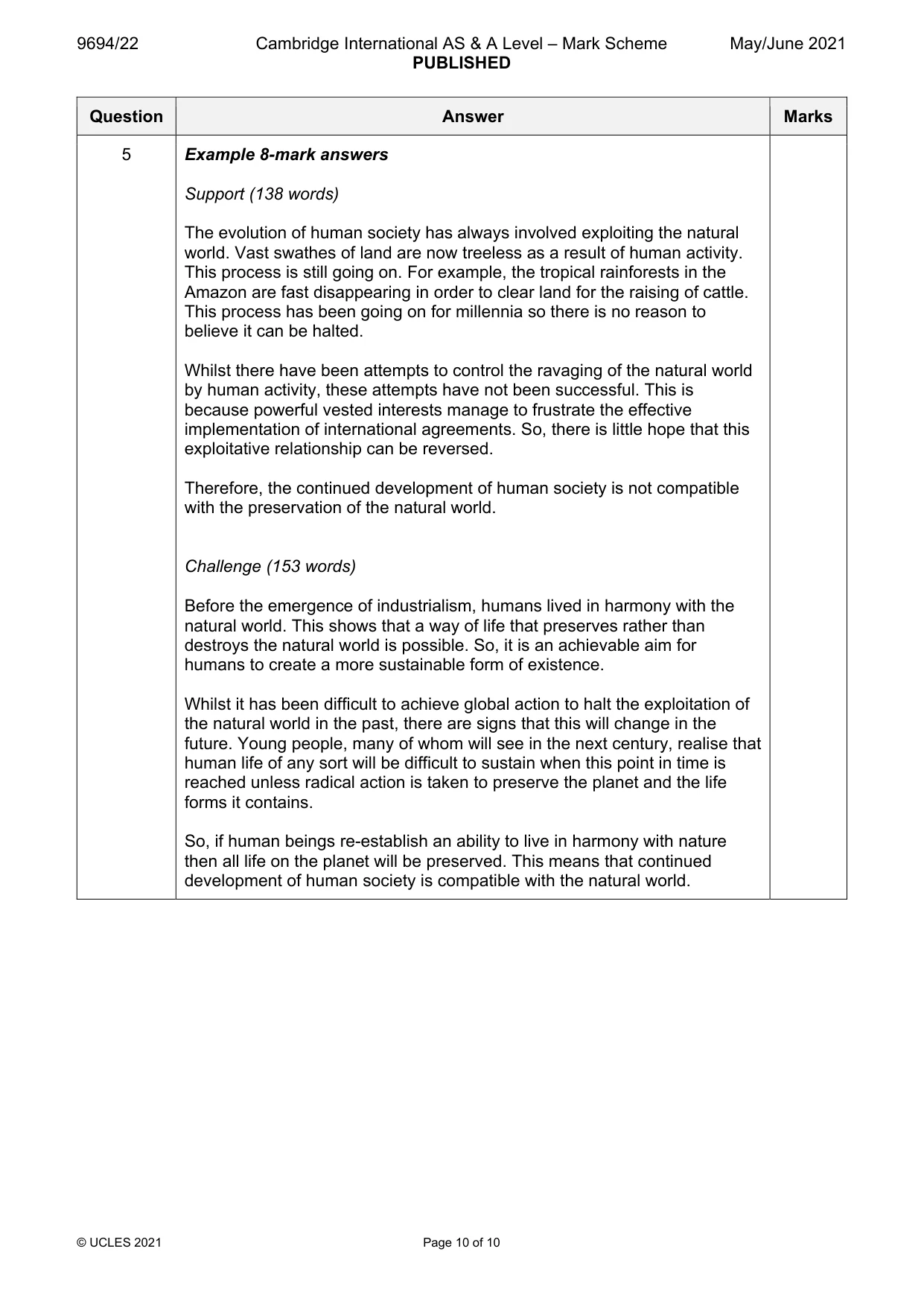
9694/22 Cambridge International AS & A Level – Mark Scheme PUBLISHED May/June 2021 © UCLES 2021 Page 10 of 10 Question Answer Marks 5 Example 8-mark answers Support (138 words) The evolution of human society has always involved exploiting the natural world. Vast swathes of land are now treeless as a result of human activity. This process is still going on. For example, the tropical rainforests in the Amazon are fast disappearing in order to clear land for the raising of cattle. This process has been going on for millennia so there is no reason to believe it can be halted. Whilst there have been attempts to control the ravaging of the natural world by human activity, these attempts have not been successful. This is because powerful vested interests manage to frustrate the effective implementation of international agreements. So, there is little hope that this exploitative relationship can be reversed. Therefore, the continued development of human society is not compatible with the preservation of the natural world. Challenge (153 words) Before the emergence of industrialism, humans lived in harmony with the natural world. This shows that a way of life that preserves rather than destroys the natural world is possible. So, it is an achievable aim for humans to create a more sustainable form of existence. Whilst it has been difficult to achieve global action to halt the exploitation of the natural world in the past, there are signs that this will change in the future. Young people, many of whom will see in the next century, realise that human life of any sort will be difficult to sustain when this point in time is reached unless radical action is taken to preserve the planet and the life forms it contains. So, if human beings re-establish an ability to live in harmony with nature then all life on the planet will be preserved. This means that continued development of human society is compatible with the natural world.
What you needed in this session
Cambridge’s own grade thresholds for 2021 May/June, Paper 2 · Variant 2. A higher threshold means an easier paper — the bar moves with how the cohort did.