Cambridge A Level Thinking Skills 9694 — 2016 Oct/Nov Paper 2 · Variant 1
9694/21/O/N/16 · 45 marks · ≈51 min
The question paper and its mark scheme, free to read here and free to download. This is Cambridge’s own paper, exactly as it was sat.
Question paper8 pages

Mark scheme9 pages
Answers below. Sit the paper first if you are practising.
Paper as text
Question paper, page 1
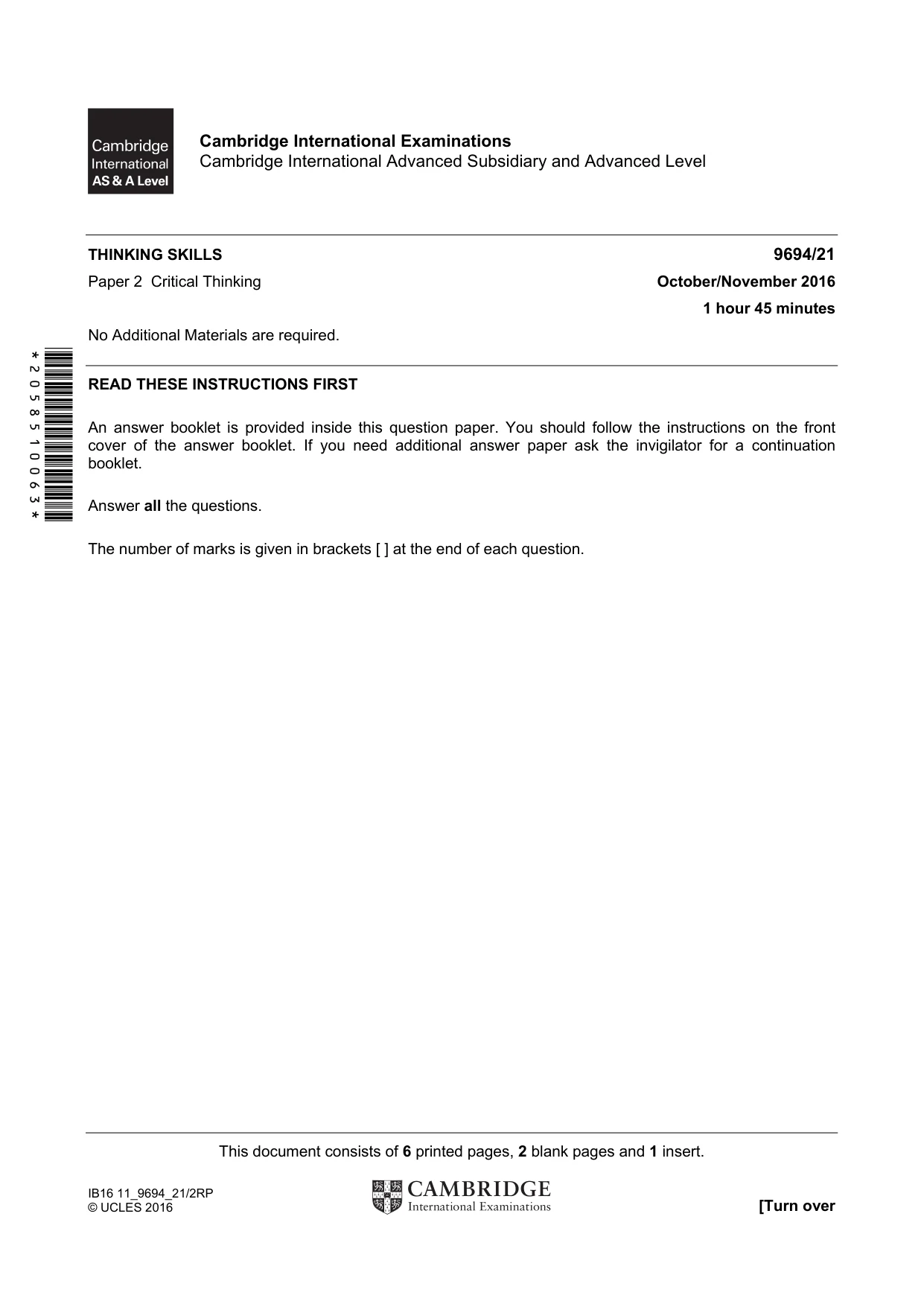
This document consists of 6 printed pages, 2 blank pages and 1 insert. IB16 11_9694_21/2RP © UCLES 2016 [Turn over *2058510063* Cambridge International Examinations Cambridge International Advanced Subsidiary and Advanced Level THINKING SKILLS 9694/21 Paper 2 Critical Thinking October/November 2016 1 hour 45 minutes No Additional Materials are required. READ THESE INSTRUCTIONS FIRST An answer booklet is provided inside this question paper. You should follow the instructions on the front cover of the answer booklet. If you need additional answer paper ask the invigilator for a continuation booklet. Answer all the questions. The number of marks is given in brackets [ ] at the end of each question.
Question paper, page 2
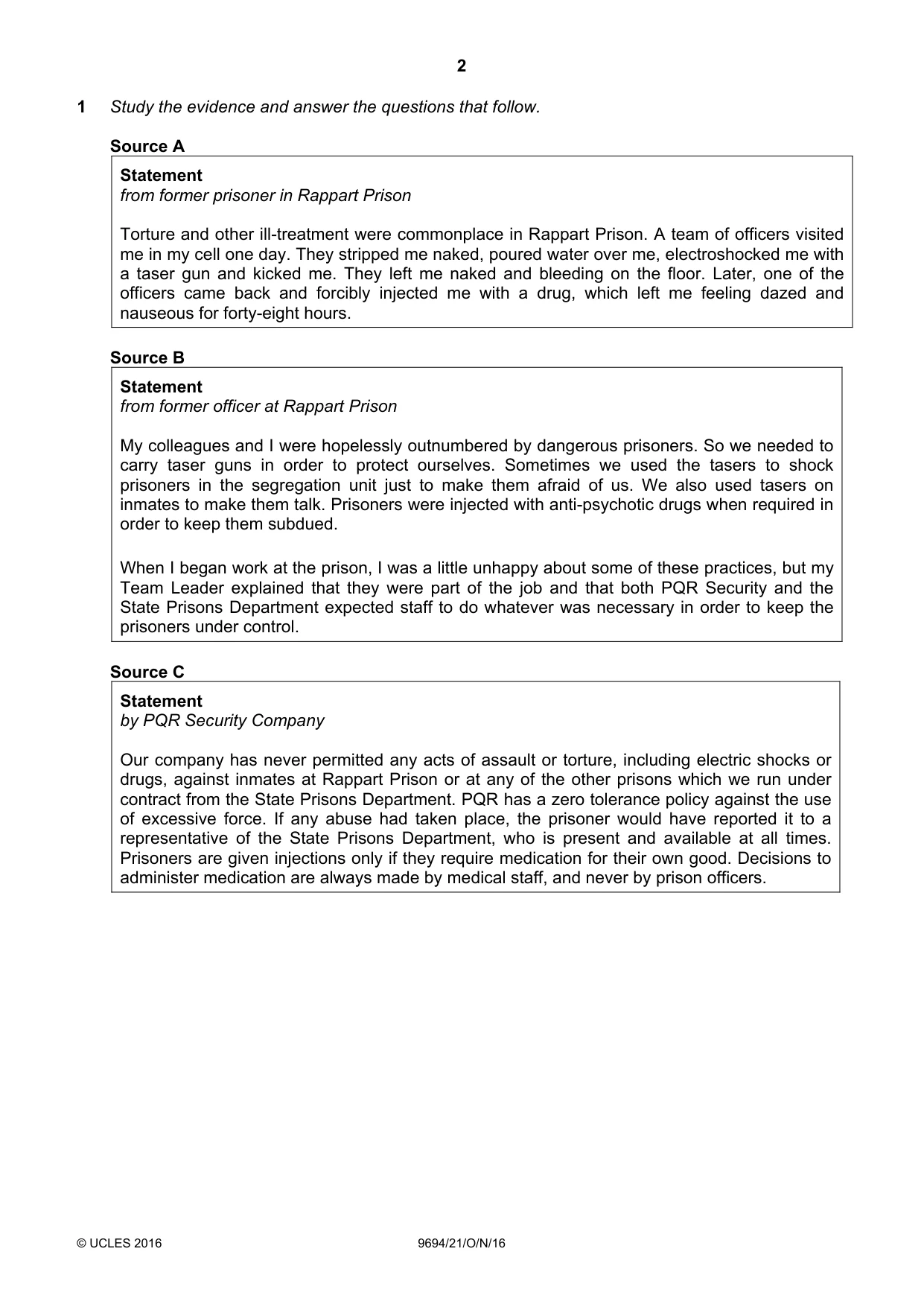
2 © UCLES 2016 9694/21/O/N/16 1 Study the evidence and answer the questions that follow. Source A Statement from former prisoner in Rappart Prison Torture and other ill-treatment were commonplace in Rappart Prison. A team of officers visited me in my cell one day. They stripped me naked, poured water over me, electroshocked me with a taser gun and kicked me. They left me naked and bleeding on the floor. Later, one of the officers came back and forcibly injected me with a drug, which left me feeling dazed and nauseous for forty-eight hours. Source B Statement from former officer at Rappart Prison My colleagues and I were hopelessly outnumbered by dangerous prisoners. So we needed to carry taser guns in order to protect ourselves. Sometimes we used the tasers to shock prisoners in the segregation unit just to make them afraid of us. We also used tasers on inmates to make them talk. Prisoners were injected with anti-psychotic drugs when required in order to keep them subdued. When I began work at the prison, I was a little unhappy about some of these practices, but my Team Leader explained that they were part of the job and that both PQR Security and the State Prisons Department expected staff to do whatever was necessary in order to keep the prisoners under control. Source C Statement by PQR Security Company Our company has never permitted any acts of assault or torture, including electric shocks or drugs, against inmates at Rappart Prison or at any of the other prisons which we run under contract from the State Prisons Department. PQR has a zero tolerance policy against the use of excessive force. If any abuse had taken place, the prisoner would have reported it to a representative of the State Prisons Department, who is present and available at all times. Prisoners are given injections only if they require medication for their own good. Decisions to administer medication are always made by medical staff, and never by prison officers.
Question paper, page 3
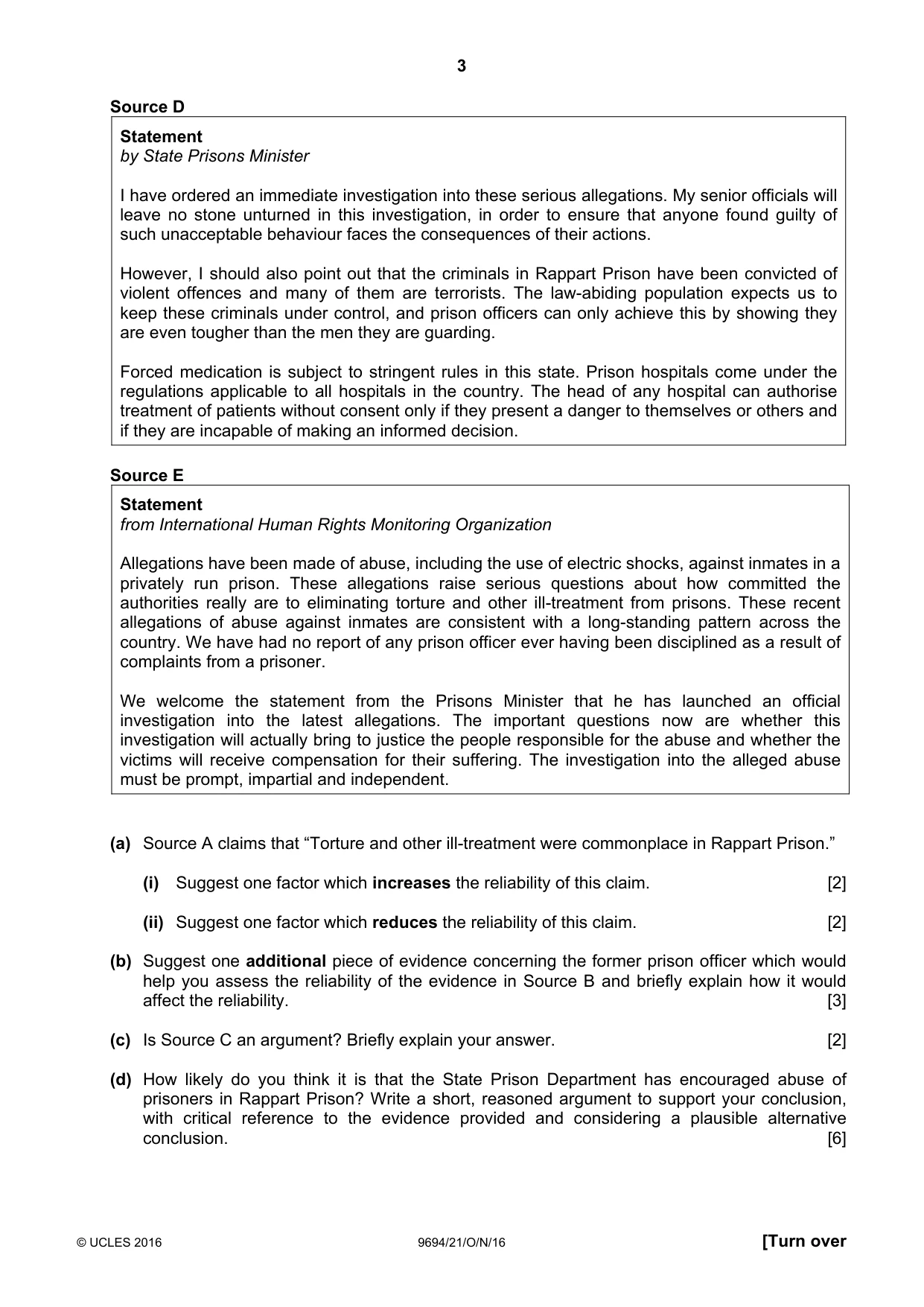
3 © UCLES 2016 9694/21/O/N/16 [Turn over Source D Statement by State Prisons Minister I have ordered an immediate investigation into these serious allegations. My senior officials will leave no stone unturned in this investigation, in order to ensure that anyone found guilty of such unacceptable behaviour faces the consequences of their actions. However, I should also point out that the criminals in Rappart Prison have been convicted of violent offences and many of them are terrorists. The law-abiding population expects us to keep these criminals under control, and prison officers can only achieve this by showing they are even tougher than the men they are guarding. Forced medication is subject to stringent rules in this state. Prison hospitals come under the regulations applicable to all hospitals in the country. The head of any hospital can authorise treatment of patients without consent only if they present a danger to themselves or others and if they are incapable of making an informed decision. Source E Statement from International Human Rights Monitoring Organization Allegations have been made of abuse, including the use of electric shocks, against inmates in a privately run prison. These allegations raise serious questions about how committed the authorities really are to eliminating torture and other ill-treatment from prisons. These recent allegations of abuse against inmates are consistent with a long-standing pattern across the country. We have had no report of any prison officer ever having been disciplined as a result of complaints from a prisoner. We welcome the statement from the Prisons Minister that he has launched an official investigation into the latest allegations. The important questions now are whether this investigation will actually bring to justice the people responsible for the abuse and whether the victims will receive compensation for their suffering. The investigation into the alleged abuse must be prompt, impartial and independent. (a) Source A claims that “Torture and other ill-treatment were commonplace in Rappart Prison.” (i) Suggest one factor which increases the reliability of this claim. [2] (ii) Suggest one factor which reduces the reliability of this claim. [2] (b) Suggest one additional piece of evidence concerning the former prison officer which would help you assess the reliability of the evidence in Source B and briefly explain how it would affect the reliability. [3] (c) Is Source C an argument? Briefly explain your answer. [2] (d) How likely do you think it is that the State Prison Department has encouraged abuse of prisoners in Rappart Prison? Write a short, reasoned argument to support your conclusion, with critical reference to the evidence provided and considering a plausible alternative conclusion. [6]
Question paper, page 4
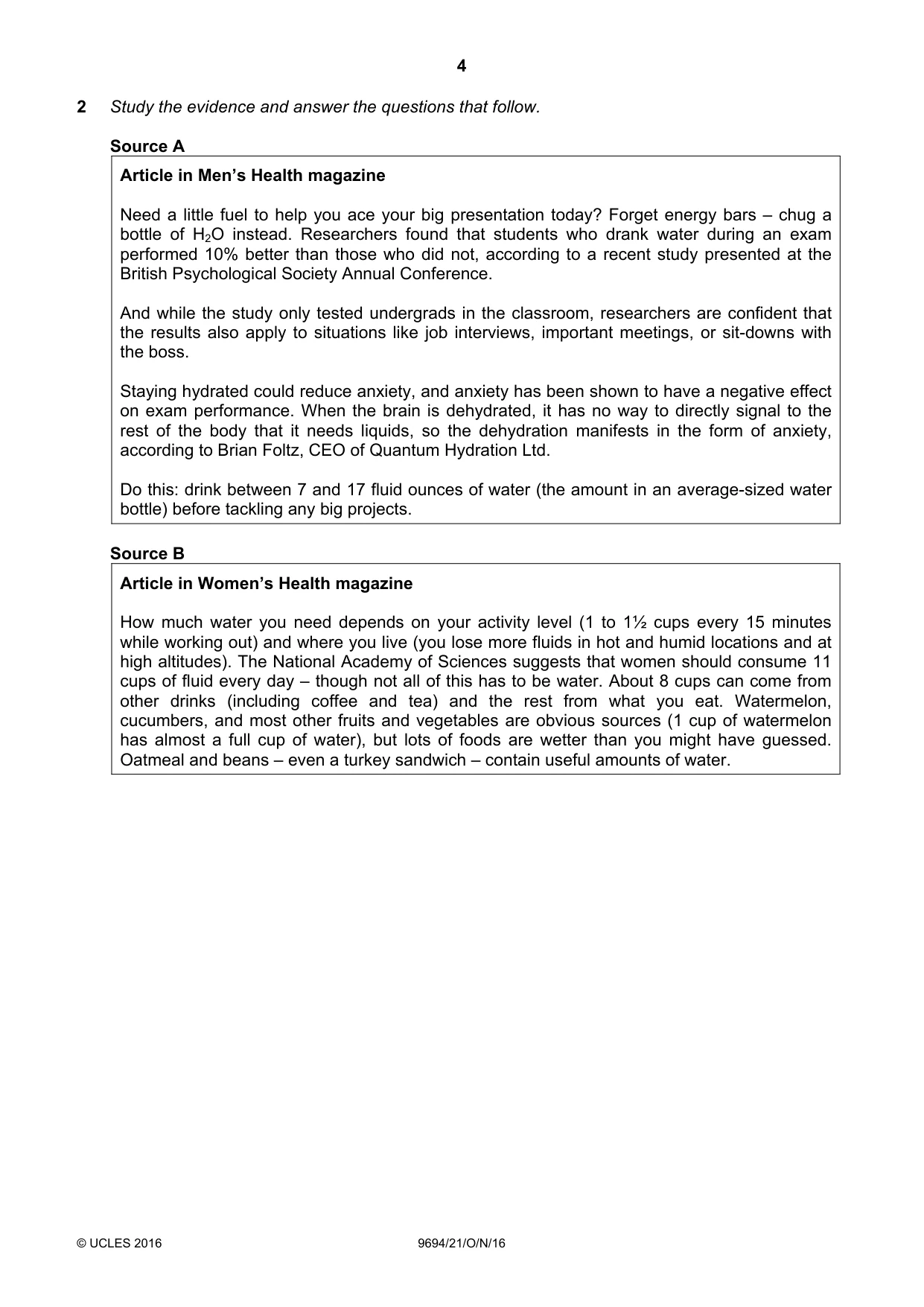
4 © UCLES 2016 9694/21/O/N/16 2 Study the evidence and answer the questions that follow. Source A Article in Men’s Health magazine Need a little fuel to help you ace your big presentation today? Forget energy bars – chug a bottle of H2O instead. Researchers found that students who drank water during an exam performed 10% better than those who did not, according to a recent study presented at the British Psychological Society Annual Conference. And while the study only tested undergrads in the classroom, researchers are confident that the results also apply to situations like job interviews, important meetings, or sit-downs with the boss. Staying hydrated could reduce anxiety, and anxiety has been shown to have a negative effect on exam performance. When the brain is dehydrated, it has no way to directly signal to the rest of the body that it needs liquids, so the dehydration manifests in the form of anxiety, according to Brian Foltz, CEO of Quantum Hydration Ltd. Do this: drink between 7 and 17 fluid ounces of water (the amount in an average-sized water bottle) before tackling any big projects. Source B Article in Women’s Health magazine How much water you need depends on your activity level (1 to 1½ cups every 15 minutes while working out) and where you live (you lose more fluids in hot and humid locations and at high altitudes). The National Academy of Sciences suggests that women should consume 11 cups of fluid every day – though not all of this has to be water. About 8 cups can come from other drinks (including coffee and tea) and the rest from what you eat. Watermelon, cucumbers, and most other fruits and vegetables are obvious sources (1 cup of watermelon has almost a full cup of water), but lots of foods are wetter than you might have guessed. Oatmeal and beans – even a turkey sandwich – contain useful amounts of water.
Question paper, page 5
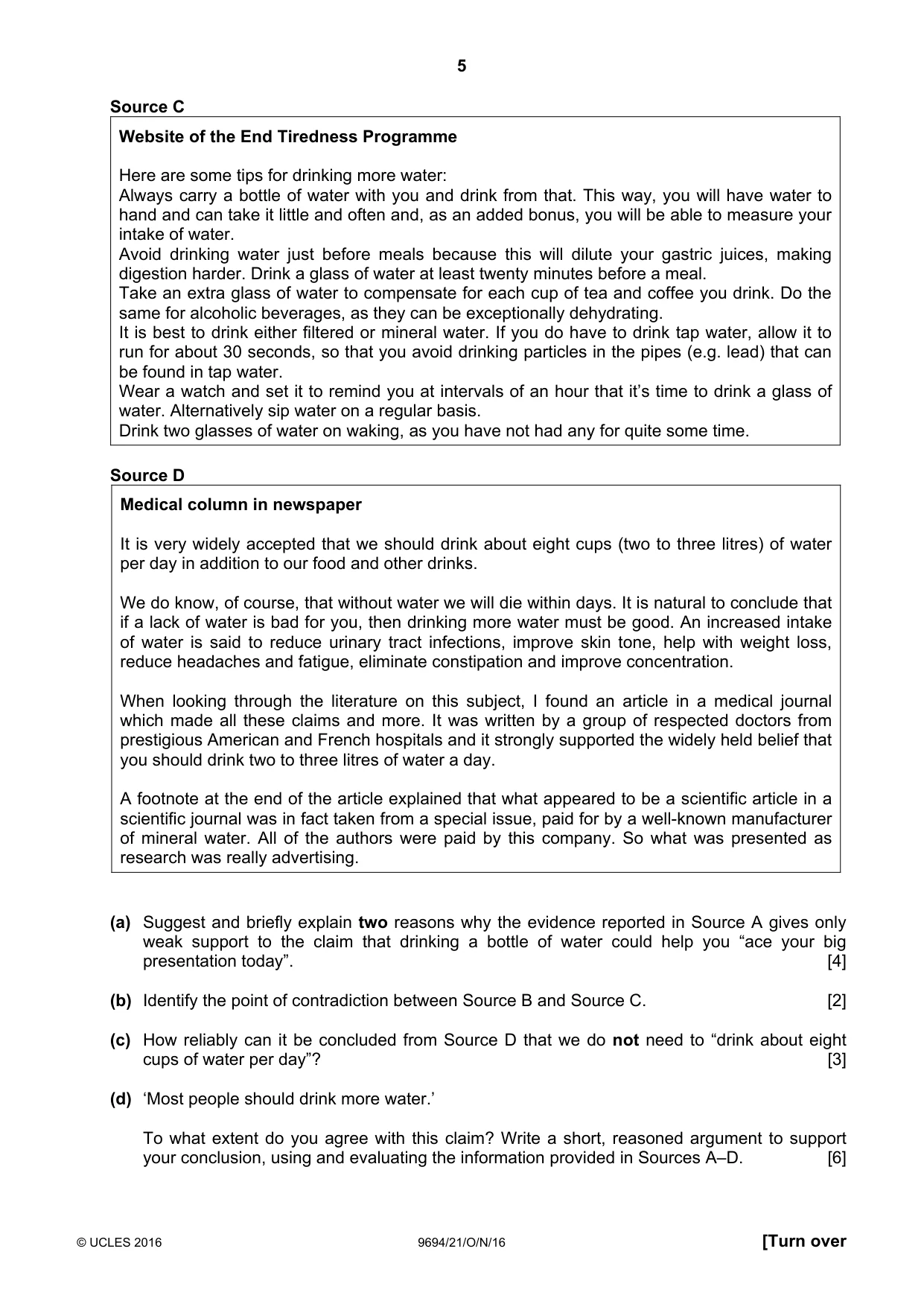
5 © UCLES 2016 9694/21/O/N/16 [Turn over Source C Website of the End Tiredness Programme Here are some tips for drinking more water: Always carry a bottle of water with you and drink from that. This way, you will have water to hand and can take it little and often and, as an added bonus, you will be able to measure your intake of water. Avoid drinking water just before meals because this will dilute your gastric juices, making digestion harder. Drink a glass of water at least twenty minutes before a meal. Take an extra glass of water to compensate for each cup of tea and coffee you drink. Do the same for alcoholic beverages, as they can be exceptionally dehydrating. It is best to drink either filtered or mineral water. If you do have to drink tap water, allow it to run for about 30 seconds, so that you avoid drinking particles in the pipes (e.g. lead) that can be found in tap water. Wear a watch and set it to remind you at intervals of an hour that it’s time to drink a glass of water. Alternatively sip water on a regular basis. Drink two glasses of water on waking, as you have not had any for quite some time. Source D Medical column in newspaper It is very widely accepted that we should drink about eight cups (two to three litres) of water per day in addition to our food and other drinks. We do know, of course, that without water we will die within days. It is natural to conclude that if a lack of water is bad for you, then drinking more water must be good. An increased intake of water is said to reduce urinary tract infections, improve skin tone, help with weight loss, reduce headaches and fatigue, eliminate constipation and improve concentration. When looking through the literature on this subject, I found an article in a medical journal which made all these claims and more. It was written by a group of respected doctors from prestigious American and French hospitals and it strongly supported the widely held belief that you should drink two to three litres of water a day. A footnote at the end of the article explained that what appeared to be a scientific article in a scientific journal was in fact taken from a special issue, paid for by a well-known manufacturer of mineral water. All of the authors were paid by this company. So what was presented as research was really advertising. (a) Suggest and briefly explain two reasons why the evidence reported in Source A gives only weak support to the claim that drinking a bottle of water could help you “ace your big presentation today”. [4] (b) Identify the point of contradiction between Source B and Source C. [2] (c) How reliably can it be concluded from Source D that we do not need to “drink about eight cups of water per day”? [3] (d) ‘Most people should drink more water.’ To what extent do you agree with this claim? Write a short, reasoned argument to support your conclusion, using and evaluating the information provided in Sources A–D. [6]
Question paper, page 6
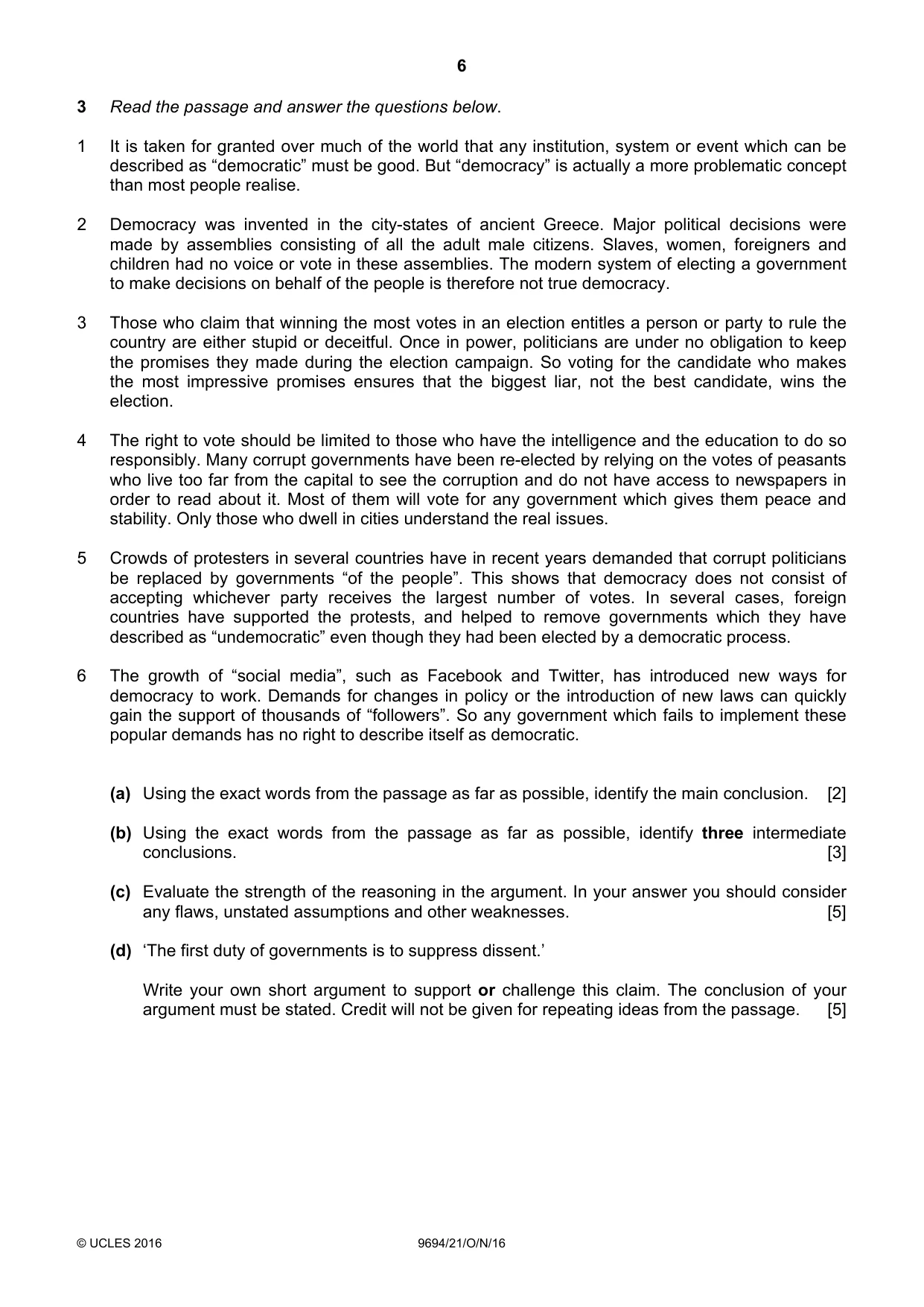
6 © UCLES 2016 9694/21/O/N/16 3 Read the passage and answer the questions below. 1 It is taken for granted over much of the world that any institution, system or event which can be described as “democratic” must be good. But “democracy” is actually a more problematic concept than most people realise. 2 Democracy was invented in the city-states of ancient Greece. Major political decisions were made by assemblies consisting of all the adult male citizens. Slaves, women, foreigners and children had no voice or vote in these assemblies. The modern system of electing a government to make decisions on behalf of the people is therefore not true democracy. 3 Those who claim that winning the most votes in an election entitles a person or party to rule the country are either stupid or deceitful. Once in power, politicians are under no obligation to keep the promises they made during the election campaign. So voting for the candidate who makes the most impressive promises ensures that the biggest liar, not the best candidate, wins the election. 4 The right to vote should be limited to those who have the intelligence and the education to do so responsibly. Many corrupt governments have been re-elected by relying on the votes of peasants who live too far from the capital to see the corruption and do not have access to newspapers in order to read about it. Most of them will vote for any government which gives them peace and stability. Only those who dwell in cities understand the real issues. 5 Crowds of protesters in several countries have in recent years demanded that corrupt politicians be replaced by governments “of the people”. This shows that democracy does not consist of accepting whichever party receives the largest number of votes. In several cases, foreign countries have supported the protests, and helped to remove governments which they have described as “undemocratic” even though they had been elected by a democratic process. 6 The growth of “social media”, such as Facebook and Twitter, has introduced new ways for democracy to work. Demands for changes in policy or the introduction of new laws can quickly gain the support of thousands of “followers”. So any government which fails to implement these popular demands has no right to describe itself as democratic. (a) Using the exact words from the passage as far as possible, identify the main conclusion. [2] (b) Using the exact words from the passage as far as possible, identify three intermediate conclusions. [3] (c) Evaluate the strength of the reasoning in the argument. In your answer you should consider any flaws, unstated assumptions and other weaknesses. [5] (d) ‘The first duty of governments is to suppress dissent.’ Write your own short argument to support or challenge this claim. The conclusion of your argument must be stated. Credit will not be given for repeating ideas from the passage. [5]
Question paper, page 7
7 © UCLES 2016 9694/21/O/N/16 BLANK PAGE
Question paper, page 8
8 Permission to reproduce items where third-party owned material protected by copyright is included has been sought and cleared where possible. Every reasonable effort has been made by the publisher (UCLES) to trace copyright holders, but if any items requiring clearance have unwittingly been included, the publisher will be pleased to make amends at the earliest possible opportunity. To avoid the issue of disclosure of answer-related information to candidates, all copyright acknowledgements are reproduced online in the Cambridge International Examinations Copyright Acknowledgements Booklet. This is produced for each series of examinations and is freely available to download at www.cie.org.uk after the live examination series. Cambridge International Examinations is part of the Cambridge Assessment Group. Cambridge Assessment is the brand name of University of Cambridge Local Examinations Syndicate (UCLES), which is itself a department of the University of Cambridge. © UCLES 2016 9694/21/O/N/16 BLANK PAGE
Mark scheme, page 1
® IGCSE is the registered trademark of Cambridge International Examinations. This document consists of 9 printed pages. © UCLES 2016 [Turn over Cambridge International Examinations Cambridge International Advanced Subsidiary and Advanced Level THINKING SKILLS 9694/21 Paper 2 Critical Thinking October/November 2016 MARK SCHEME Maximum Mark: 45 Published This mark scheme is published as an aid to teachers and candidates, to indicate the requirements of the examination. It shows the basis on which Examiners were instructed to award marks. It does not indicate the details of the discussions that took place at an Examiners’ meeting before marking began, which would have considered the acceptability of alternative answers. Mark schemes should be read in conjunction with the question paper and the Principal Examiner Report for Teachers. Cambridge will not enter into discussions about these mark schemes. Cambridge is publishing the mark schemes for the October/November 2016 series for most Cambridge IGCSE®, Cambridge International A and AS Level components and some Cambridge O Level components.
Mark scheme, page 2
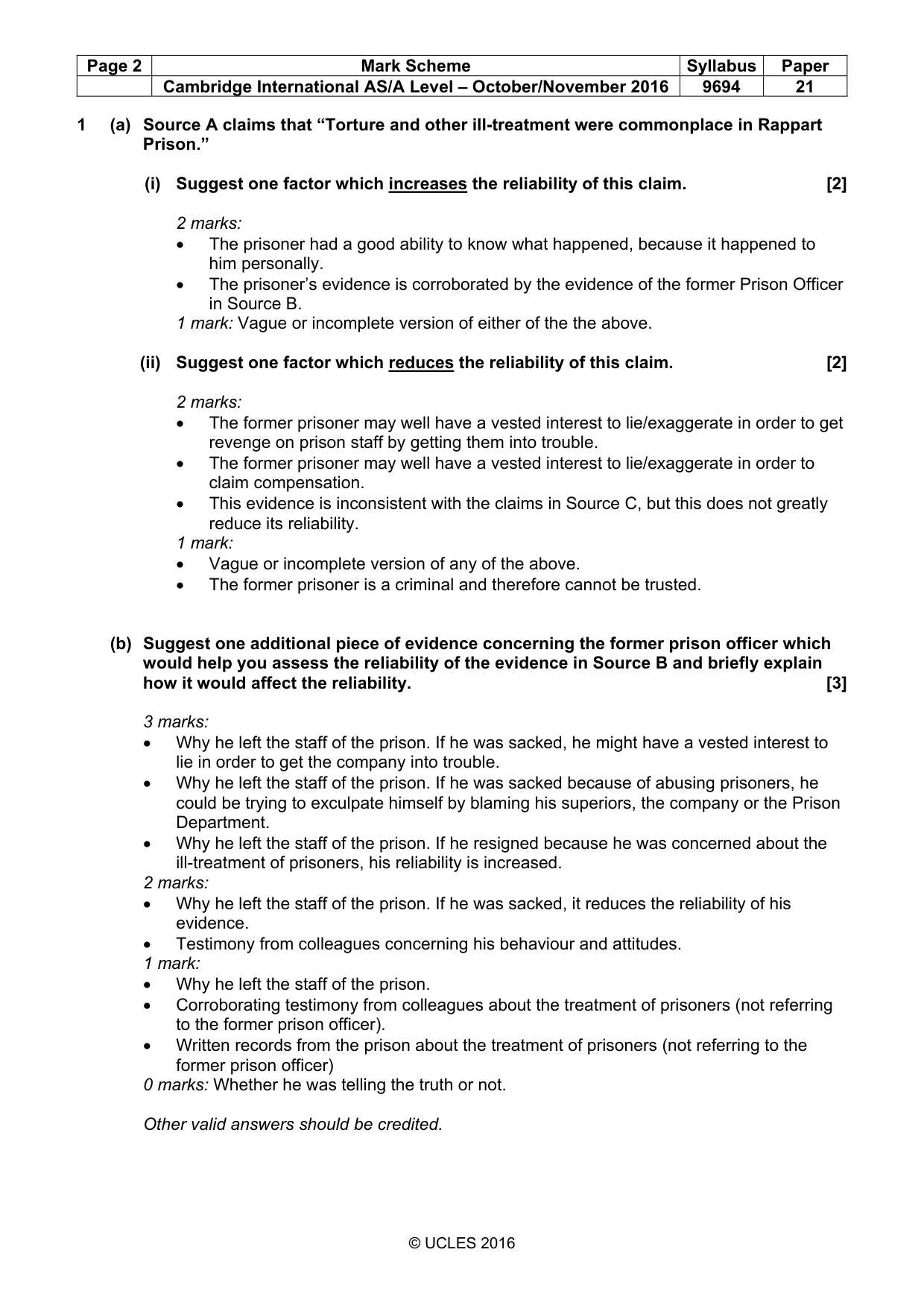
Page 2 Mark Scheme Syllabus Paper Cambridge International AS/A Level – October/November 2016 9694 21 © UCLES 2016 1 (a) Source A claims that “Torture and other ill-treatment were commonplace in Rappart Prison.” (i) Suggest one factor which increases the reliability of this claim. [2] 2 marks: • The prisoner had a good ability to know what happened, because it happened to him personally. • The prisoner’s evidence is corroborated by the evidence of the former Prison Officer in Source B. 1 mark: Vague or incomplete version of either of the the above. (ii) Suggest one factor which reduces the reliability of this claim. [2] 2 marks: • The former prisoner may well have a vested interest to lie/exaggerate in order to get revenge on prison staff by getting them into trouble. • The former prisoner may well have a vested interest to lie/exaggerate in order to claim compensation. • This evidence is inconsistent with the claims in Source C, but this does not greatly reduce its reliability. 1 mark: • Vague or incomplete version of any of the above. • The former prisoner is a criminal and therefore cannot be trusted. (b) Suggest one additional piece of evidence concerning the former prison officer which would help you assess the reliability of the evidence in Source B and briefly explain how it would affect the reliability. [3] 3 marks: • Why he left the staff of the prison. If he was sacked, he might have a vested interest to lie in order to get the company into trouble. • Why he left the staff of the prison. If he was sacked because of abusing prisoners, he could be trying to exculpate himself by blaming his superiors, the company or the Prison Department. • Why he left the staff of the prison. If he resigned because he was concerned about the ill-treatment of prisoners, his reliability is increased. 2 marks: • Why he left the staff of the prison. If he was sacked, it reduces the reliability of his evidence. • Testimony from colleagues concerning his behaviour and attitudes. 1 mark: • Why he left the staff of the prison. • Corroborating testimony from colleagues about the treatment of prisoners (not referring to the former prison officer). • Written records from the prison about the treatment of prisoners (not referring to the former prison officer) 0 marks: Whether he was telling the truth or not. Other valid answers should be credited.
Mark scheme, page 3
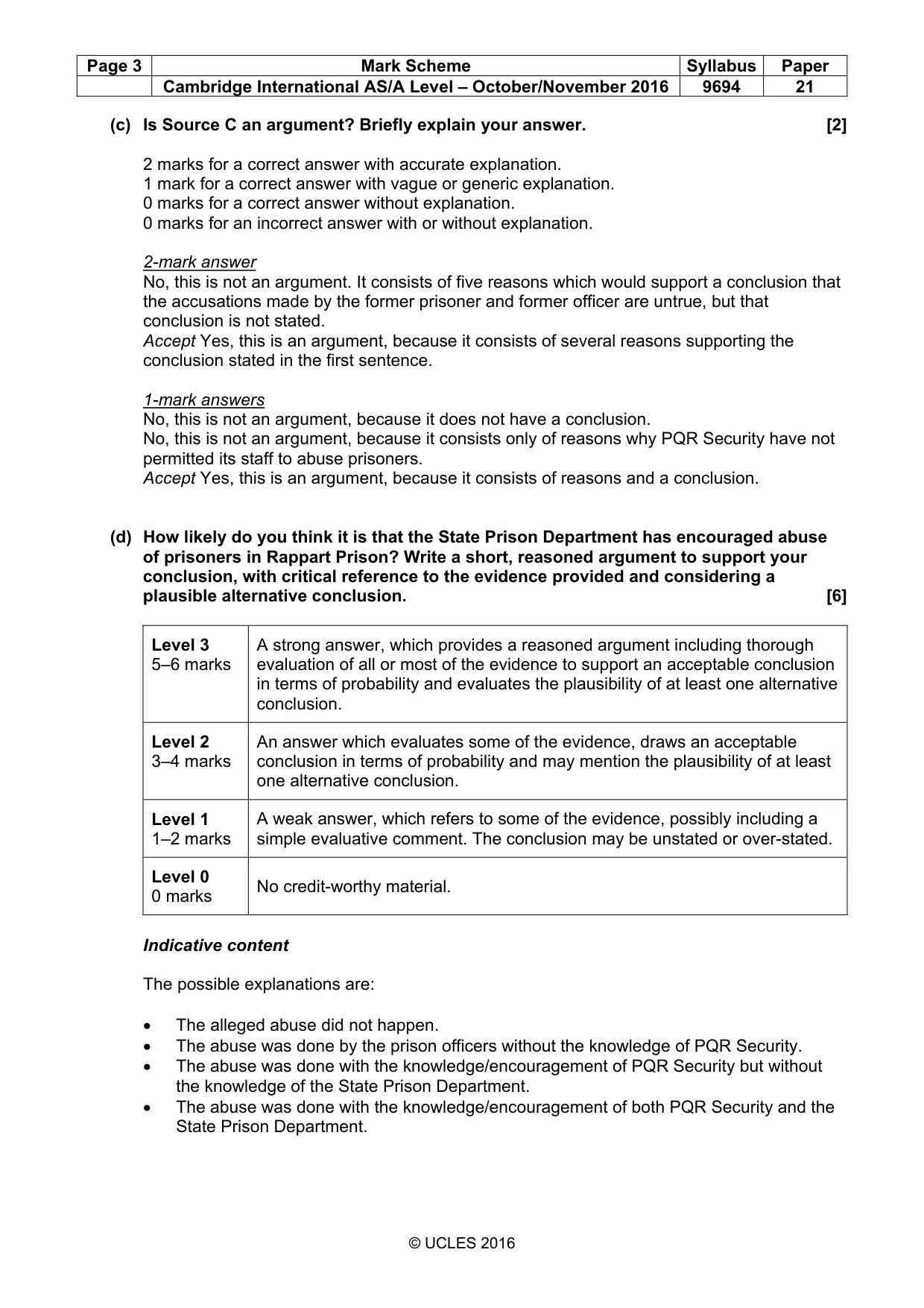
Page 3 Mark Scheme Syllabus Paper Cambridge International AS/A Level – October/November 2016 9694 21 © UCLES 2016 (c) Is Source C an argument? Briefly explain your answer. [2] 2 marks for a correct answer with accurate explanation. 1 mark for a correct answer with vague or generic explanation. 0 marks for a correct answer without explanation. 0 marks for an incorrect answer with or without explanation. 2-mark answer No, this is not an argument. It consists of five reasons which would support a conclusion that the accusations made by the former prisoner and former officer are untrue, but that conclusion is not stated. Accept Yes, this is an argument, because it consists of several reasons supporting the conclusion stated in the first sentence. 1-mark answers No, this is not an argument, because it does not have a conclusion. No, this is not an argument, because it consists only of reasons why PQR Security have not permitted its staff to abuse prisoners. Accept Yes, this is an argument, because it consists of reasons and a conclusion. (d) How likely do you think it is that the State Prison Department has encouraged abuse of prisoners in Rappart Prison? Write a short, reasoned argument to support your conclusion, with critical reference to the evidence provided and considering a plausible alternative conclusion. [6] Level 3 5–6 marks A strong answer, which provides a reasoned argument including thorough evaluation of all or most of the evidence to support an acceptable conclusion in terms of probability and evaluates the plausibility of at least one alternative conclusion. Level 2 3–4 marks An answer which evaluates some of the evidence, draws an acceptable conclusion in terms of probability and may mention the plausibility of at least one alternative conclusion. Level 1 1–2 marks A weak answer, which refers to some of the evidence, possibly including a simple evaluative comment. The conclusion may be unstated or over-stated. Level 0 0 marks No credit-worthy material. Indicative content The possible explanations are: • The alleged abuse did not happen. • The abuse was done by the prison officers without the knowledge of PQR Security. • The abuse was done with the knowledge/encouragement of PQR Security but without the knowledge of the State Prison Department. • The abuse was done with the knowledge/encouragement of both PQR Security and the State Prison Department.
Mark scheme, page 4
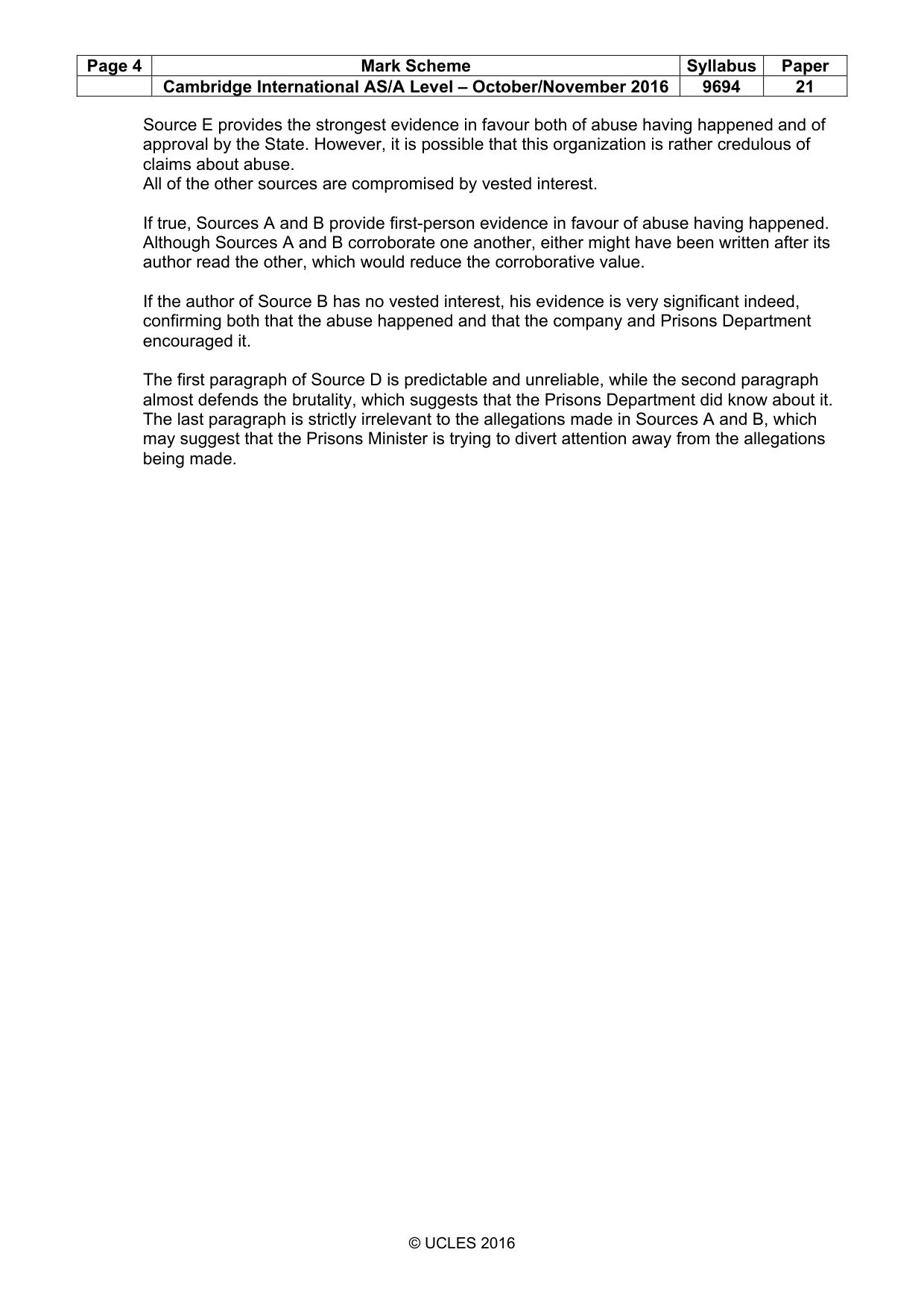
Page 4 Mark Scheme Syllabus Paper Cambridge International AS/A Level – October/November 2016 9694 21 © UCLES 2016 Source E provides the strongest evidence in favour both of abuse having happened and of approval by the State. However, it is possible that this organization is rather credulous of claims about abuse. All of the other sources are compromised by vested interest. If true, Sources A and B provide first-person evidence in favour of abuse having happened. Although Sources A and B corroborate one another, either might have been written after its author read the other, which would reduce the corroborative value. If the author of Source B has no vested interest, his evidence is very significant indeed, confirming both that the abuse happened and that the company and Prisons Department encouraged it. The first paragraph of Source D is predictable and unreliable, while the second paragraph almost defends the brutality, which suggests that the Prisons Department did know about it. The last paragraph is strictly irrelevant to the allegations made in Sources A and B, which may suggest that the Prisons Minister is trying to divert attention away from the allegations being made.
Mark scheme, page 5
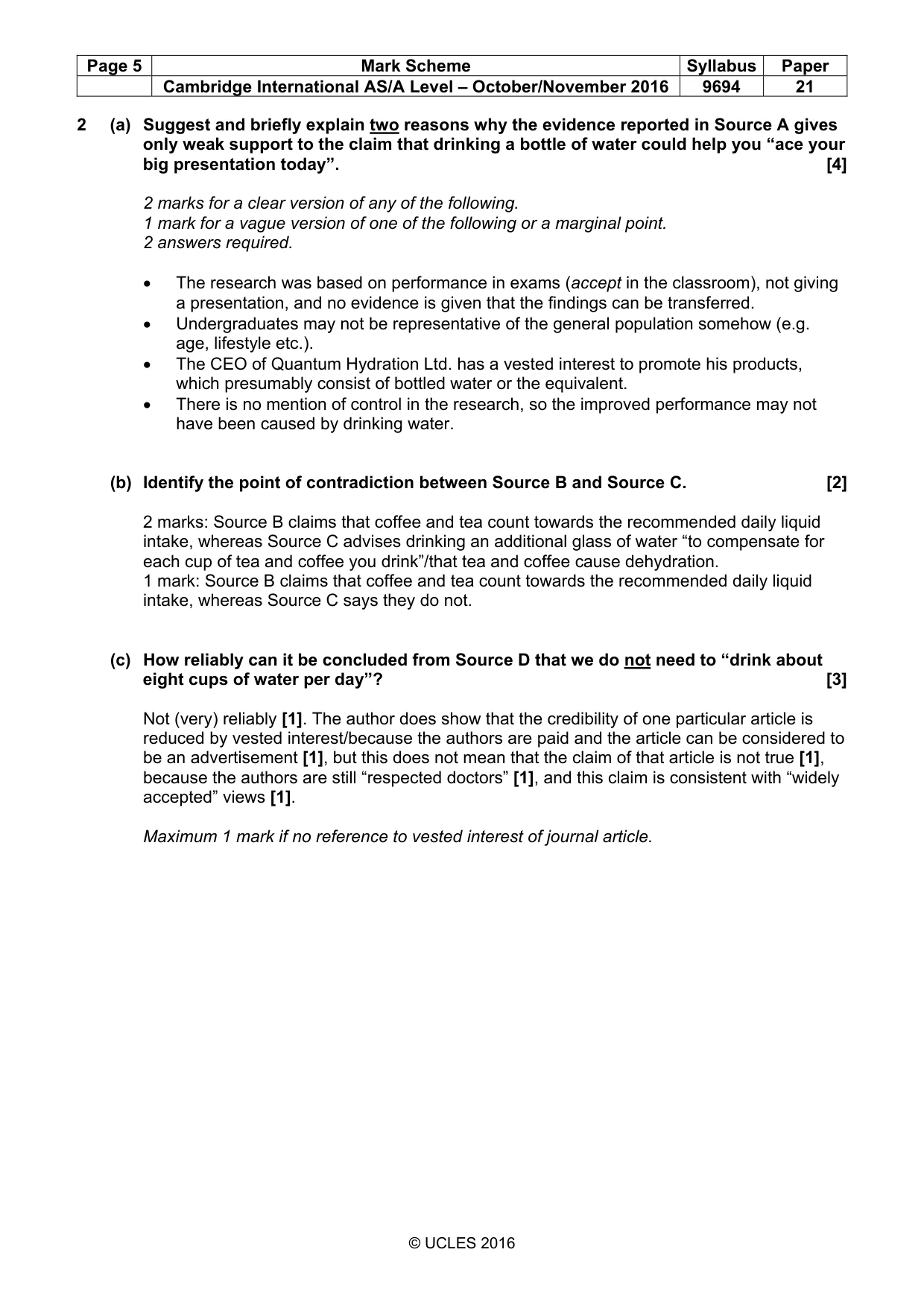
Page 5 Mark Scheme Syllabus Paper Cambridge International AS/A Level – October/November 2016 9694 21 © UCLES 2016 2 (a) Suggest and briefly explain two reasons why the evidence reported in Source A gives only weak support to the claim that drinking a bottle of water could help you “ace your big presentation today”. [4] 2 marks for a clear version of any of the following. 1 mark for a vague version of one of the following or a marginal point. 2 answers required. • The research was based on performance in exams (accept in the classroom), not giving a presentation, and no evidence is given that the findings can be transferred. • Undergraduates may not be representative of the general population somehow (e.g. age, lifestyle etc.). • The CEO of Quantum Hydration Ltd. has a vested interest to promote his products, which presumably consist of bottled water or the equivalent. • There is no mention of control in the research, so the improved performance may not have been caused by drinking water. (b) Identify the point of contradiction between Source B and Source C. [2] 2 marks: Source B claims that coffee and tea count towards the recommended daily liquid intake, whereas Source C advises drinking an additional glass of water “to compensate for each cup of tea and coffee you drink”/that tea and coffee cause dehydration. 1 mark: Source B claims that coffee and tea count towards the recommended daily liquid intake, whereas Source C says they do not. (c) How reliably can it be concluded from Source D that we do not need to “drink about eight cups of water per day”? [3] Not (very) reliably [1]. The author does show that the credibility of one particular article is reduced by vested interest/because the authors are paid and the article can be considered to be an advertisement [1], but this does not mean that the claim of that article is not true [1], because the authors are still “respected doctors” [1], and this claim is consistent with “widely accepted” views [1]. Maximum 1 mark if no reference to vested interest of journal article.
Mark scheme, page 6
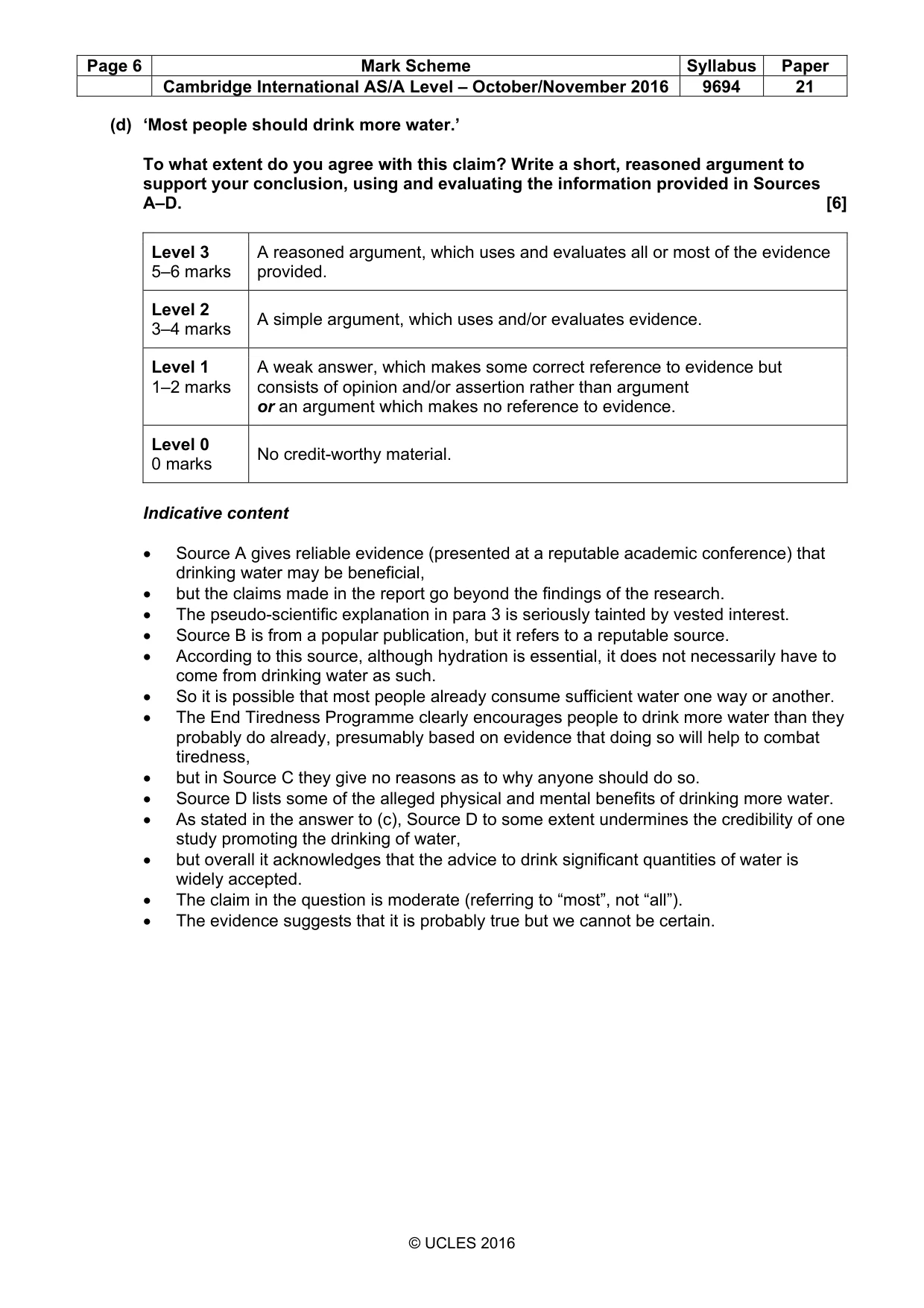
Page 6 Mark Scheme Syllabus Paper Cambridge International AS/A Level – October/November 2016 9694 21 © UCLES 2016 (d) ‘Most people should drink more water.’ To what extent do you agree with this claim? Write a short, reasoned argument to support your conclusion, using and evaluating the information provided in Sources A–D. [6] Level 3 5–6 marks A reasoned argument, which uses and evaluates all or most of the evidence provided. Level 2 3–4 marks A simple argument, which uses and/or evaluates evidence. Level 1 1–2 marks A weak answer, which makes some correct reference to evidence but consists of opinion and/or assertion rather than argument or an argument which makes no reference to evidence. Level 0 0 marks No credit-worthy material. Indicative content • Source A gives reliable evidence (presented at a reputable academic conference) that drinking water may be beneficial, • but the claims made in the report go beyond the findings of the research. • The pseudo-scientific explanation in para 3 is seriously tainted by vested interest. • Source B is from a popular publication, but it refers to a reputable source. • According to this source, although hydration is essential, it does not necessarily have to come from drinking water as such. • So it is possible that most people already consume sufficient water one way or another. • The End Tiredness Programme clearly encourages people to drink more water than they probably do already, presumably based on evidence that doing so will help to combat tiredness, • but in Source C they give no reasons as to why anyone should do so. • Source D lists some of the alleged physical and mental benefits of drinking more water. • As stated in the answer to (c), Source D to some extent undermines the credibility of one study promoting the drinking of water, • but overall it acknowledges that the advice to drink significant quantities of water is widely accepted. • The claim in the question is moderate (referring to “most”, not “all”). • The evidence suggests that it is probably true but we cannot be certain.
Mark scheme, page 7
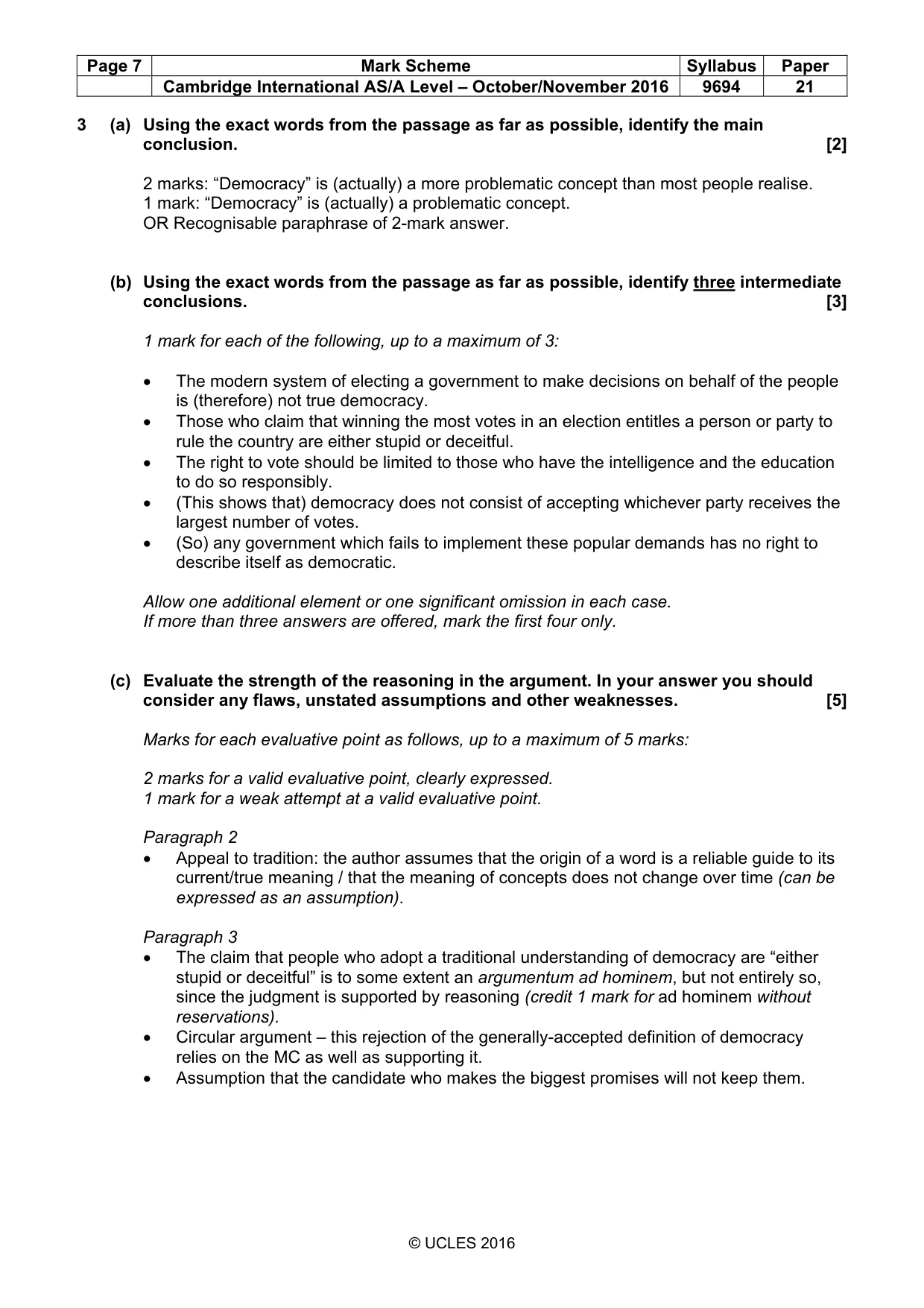
Page 7 Mark Scheme Syllabus Paper Cambridge International AS/A Level – October/November 2016 9694 21 © UCLES 2016 3 (a) Using the exact words from the passage as far as possible, identify the main conclusion. [2] 2 marks: “Democracy” is (actually) a more problematic concept than most people realise. 1 mark: “Democracy” is (actually) a problematic concept. OR Recognisable paraphrase of 2-mark answer. (b) Using the exact words from the passage as far as possible, identify three intermediate conclusions. [3] 1 mark for each of the following, up to a maximum of 3: • The modern system of electing a government to make decisions on behalf of the people is (therefore) not true democracy. • Those who claim that winning the most votes in an election entitles a person or party to rule the country are either stupid or deceitful. • The right to vote should be limited to those who have the intelligence and the education to do so responsibly. • (This shows that) democracy does not consist of accepting whichever party receives the largest number of votes. • (So) any government which fails to implement these popular demands has no right to describe itself as democratic. Allow one additional element or one significant omission in each case. If more than three answers are offered, mark the first four only. (c) Evaluate the strength of the reasoning in the argument. In your answer you should consider any flaws, unstated assumptions and other weaknesses. [5] Marks for each evaluative point as follows, up to a maximum of 5 marks: 2 marks for a valid evaluative point, clearly expressed. 1 mark for a weak attempt at a valid evaluative point. Paragraph 2 • Appeal to tradition: the author assumes that the origin of a word is a reliable guide to its current/true meaning / that the meaning of concepts does not change over time (can be expressed as an assumption). Paragraph 3 • The claim that people who adopt a traditional understanding of democracy are “either stupid or deceitful” is to some extent an argumentum ad hominem, but not entirely so, since the judgment is supported by reasoning (credit 1 mark for ad hominem without reservations). • Circular argument – this rejection of the generally-accepted definition of democracy relies on the MC as well as supporting it. • Assumption that the candidate who makes the biggest promises will not keep them.
Mark scheme, page 8
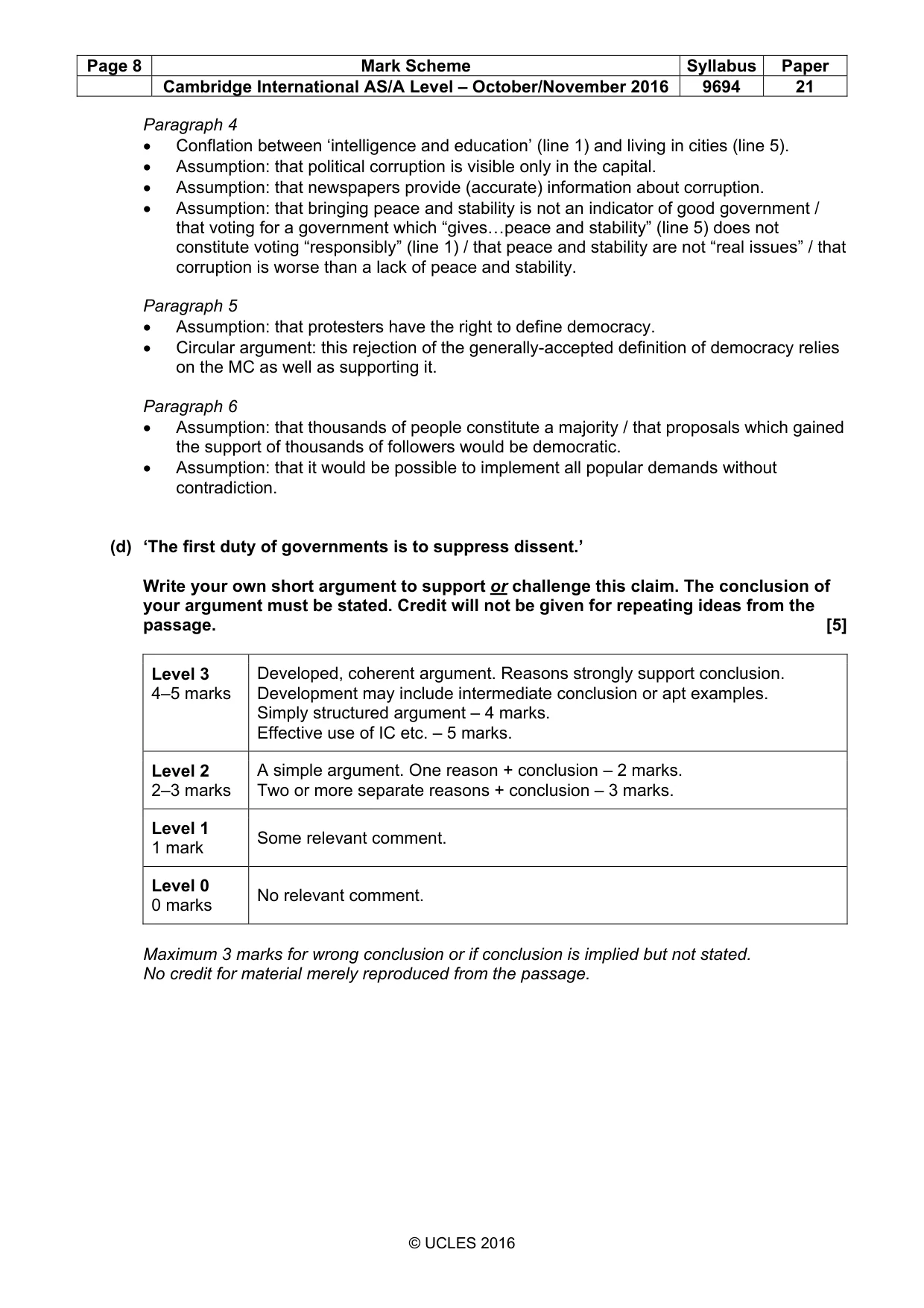
Page 8 Mark Scheme Syllabus Paper Cambridge International AS/A Level – October/November 2016 9694 21 © UCLES 2016 Paragraph 4 • Conflation between ‘intelligence and education’ (line 1) and living in cities (line 5). • Assumption: that political corruption is visible only in the capital. • Assumption: that newspapers provide (accurate) information about corruption. • Assumption: that bringing peace and stability is not an indicator of good government / that voting for a government which “gives…peace and stability” (line 5) does not constitute voting “responsibly” (line 1) / that peace and stability are not “real issues” / that corruption is worse than a lack of peace and stability. Paragraph 5 • Assumption: that protesters have the right to define democracy. • Circular argument: this rejection of the generally-accepted definition of democracy relies on the MC as well as supporting it. Paragraph 6 • Assumption: that thousands of people constitute a majority / that proposals which gained the support of thousands of followers would be democratic. • Assumption: that it would be possible to implement all popular demands without contradiction. (d) ‘The first duty of governments is to suppress dissent.’ Write your own short argument to support or challenge this claim. The conclusion of your argument must be stated. Credit will not be given for repeating ideas from the passage. [5] Level 3 4–5 marks Developed, coherent argument. Reasons strongly support conclusion. Development may include intermediate conclusion or apt examples. Simply structured argument – 4 marks. Effective use of IC etc. – 5 marks. Level 2 2–3 marks A simple argument. One reason + conclusion – 2 marks. Two or more separate reasons + conclusion – 3 marks. Level 1 1 mark Some relevant comment. Level 0 0 marks No relevant comment. Maximum 3 marks for wrong conclusion or if conclusion is implied but not stated. No credit for material merely reproduced from the passage.
Mark scheme, page 9
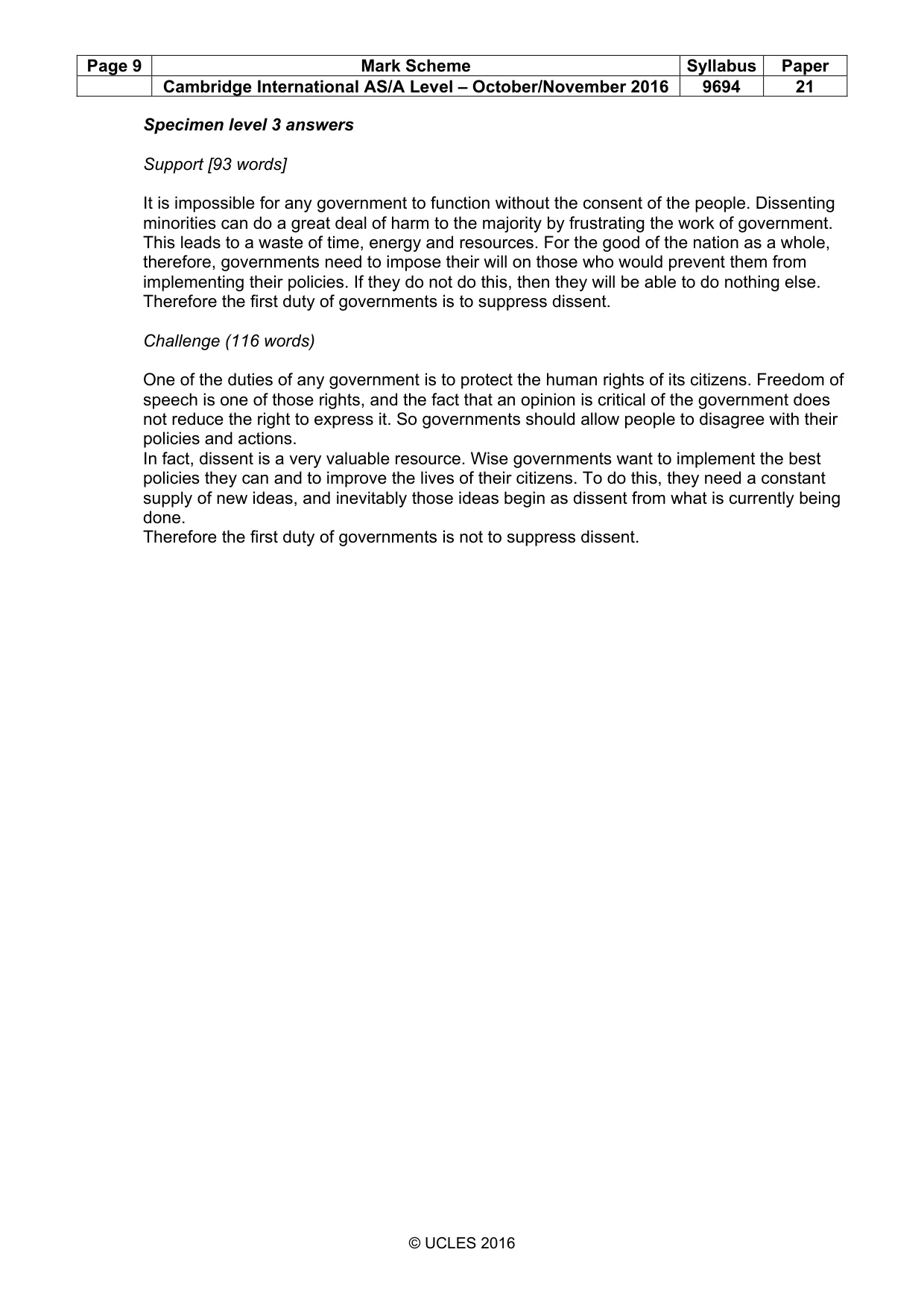
Page 9 Mark Scheme Syllabus Paper Cambridge International AS/A Level – October/November 2016 9694 21 © UCLES 2016 Specimen level 3 answers Support [93 words] It is impossible for any government to function without the consent of the people. Dissenting minorities can do a great deal of harm to the majority by frustrating the work of government. This leads to a waste of time, energy and resources. For the good of the nation as a whole, therefore, governments need to impose their will on those who would prevent them from implementing their policies. If they do not do this, then they will be able to do nothing else. Therefore the first duty of governments is to suppress dissent. Challenge (116 words) One of the duties of any government is to protect the human rights of its citizens. Freedom of speech is one of those rights, and the fact that an opinion is critical of the government does not reduce the right to express it. So governments should allow people to disagree with their policies and actions. In fact, dissent is a very valuable resource. Wise governments want to implement the best policies they can and to improve the lives of their citizens. To do this, they need a constant supply of new ideas, and inevitably those ideas begin as dissent from what is currently being done. Therefore the first duty of governments is not to suppress dissent.
What you needed in this session
Cambridge’s own grade thresholds for 2016 Oct/Nov, Paper 2 · Variant 1. A higher threshold means an easier paper — the bar moves with how the cohort did.