Cambridge A Level Thinking Skills 9694 — 2014 May/June Paper 2 · Variant 1
9694/21/M/J/14 · 45 marks · ≈51 min
The question paper and its mark scheme, free to read here and free to download. This is Cambridge’s own paper, exactly as it was sat.
Question paper8 pages



Mark scheme7 pages
Answers below. Sit the paper first if you are practising.


Paper as text
Question paper, page 1
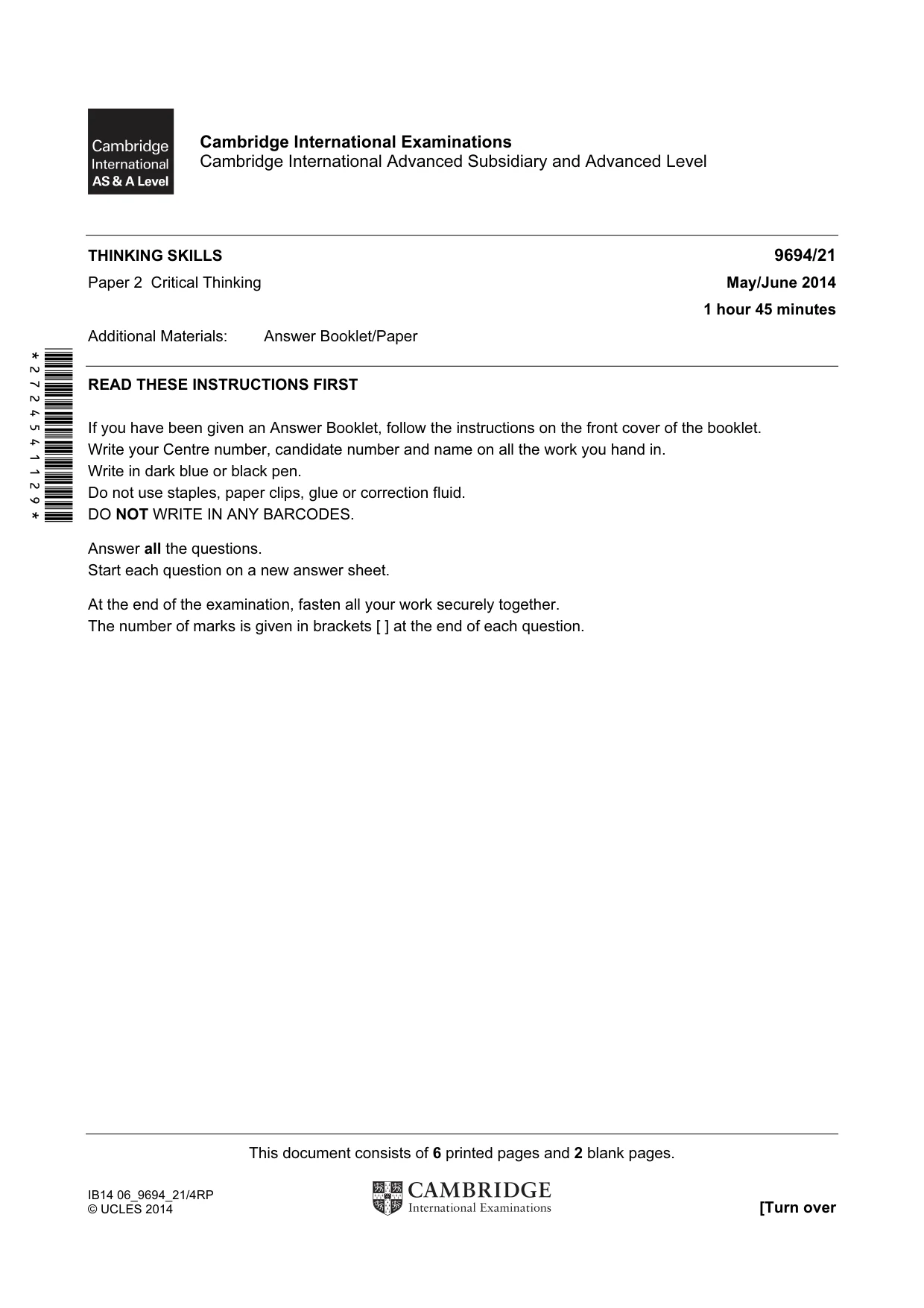
This document consists of 6 printed pages and 2 blank pages. IB14 06_9694_21/4RP © UCLES 2014 [Turn over *2724541129* Cambridge International Examinations Cambridge International Advanced Subsidiary and Advanced Level THINKING SKILLS 9694/21 Paper 2 Critical Thinking May/June 2014 1 hour 45 minutes Additional Materials: Answer Booklet/Paper READ THESE INSTRUCTIONS FIRST If you have been given an Answer Booklet, follow the instructions on the front cover of the booklet. Write your Centre number, candidate number and name on all the work you hand in. Write in dark blue or black pen. Do not use staples, paper clips, glue or correction fluid. DO NOT WRITE IN ANY BARCODES. Answer all the questions. Start each question on a new answer sheet. At the end of the examination, fasten all your work securely together. The number of marks is given in brackets [ ] at the end of each question.
Question paper, page 2
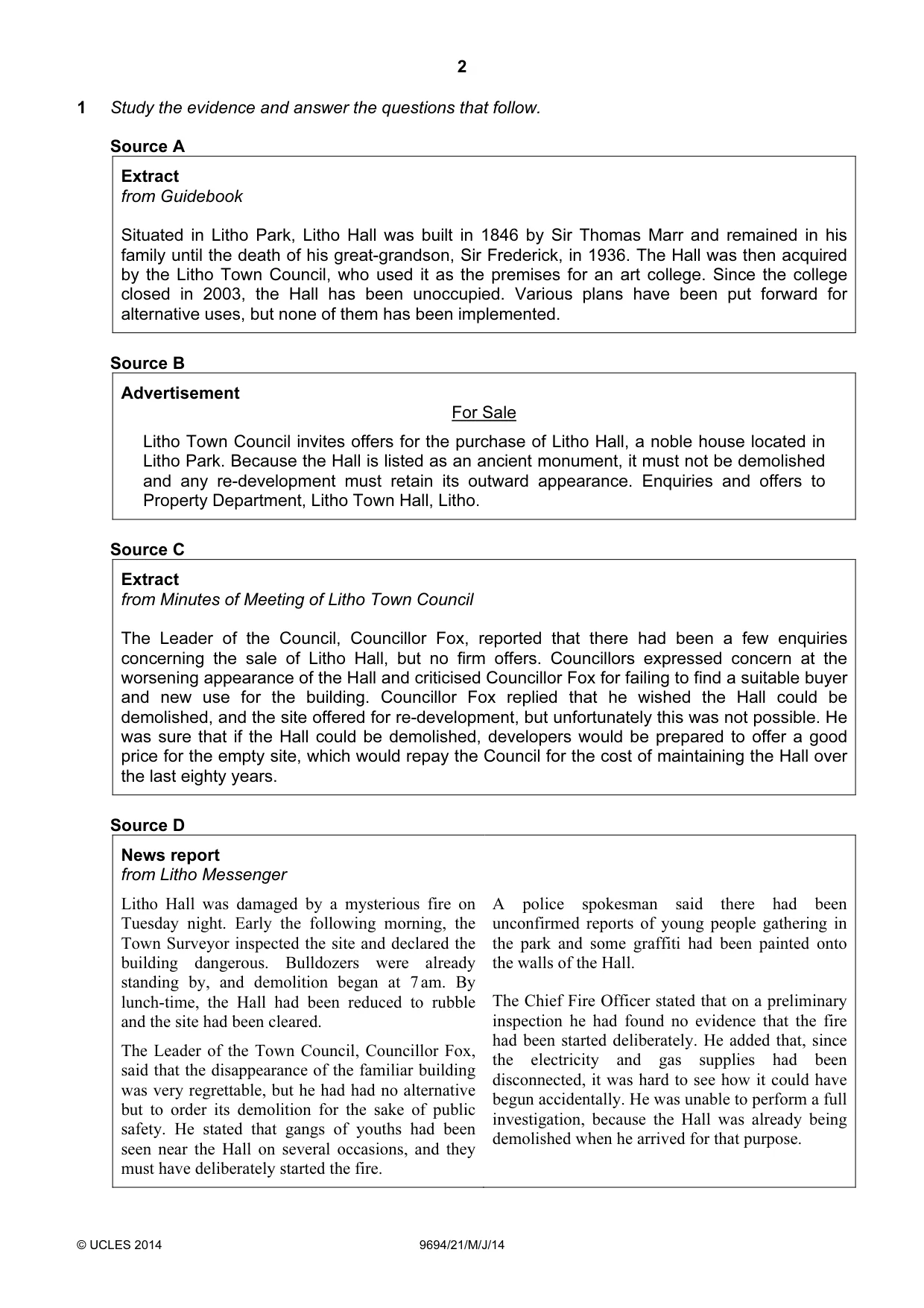
2 © UCLES 2014 9694/21/M/J/14 1 Study the evidence and answer the questions that follow. Source A Extract from Guidebook Situated in Litho Park, Litho Hall was built in 1846 by Sir Thomas Marr and remained in his family until the death of his great-grandson, Sir Frederick, in 1936. The Hall was then acquired by the Litho Town Council, who used it as the premises for an art college. Since the college closed in 2003, the Hall has been unoccupied. Various plans have been put forward for alternative uses, but none of them has been implemented. Source B Advertisement For Sale Litho Town Council invites offers for the purchase of Litho Hall, a noble house located in Litho Park. Because the Hall is listed as an ancient monument, it must not be demolished and any re-development must retain its outward appearance. Enquiries and offers to Property Department, Litho Town Hall, Litho. Source C Extract from Minutes of Meeting of Litho Town Council The Leader of the Council, Councillor Fox, reported that there had been a few enquiries concerning the sale of Litho Hall, but no firm offers. Councillors expressed concern at the worsening appearance of the Hall and criticised Councillor Fox for failing to find a suitable buyer and new use for the building. Councillor Fox replied that he wished the Hall could be demolished, and the site offered for re-development, but unfortunately this was not possible. He was sure that if the Hall could be demolished, developers would be prepared to offer a good price for the empty site, which would repay the Council for the cost of maintaining the Hall over the last eighty years. Source D News report from Litho Messenger Litho Hall was damaged by a mysterious fire on Tuesday night. Early the following morning, the Town Surveyor inspected the site and declared the building dangerous. Bulldozers were already standing by, and demolition began at 7 am. By lunch-time, the Hall had been reduced to rubble and the site had been cleared. The Leader of the Town Council, Councillor Fox, said that the disappearance of the familiar building was very regrettable, but he had had no alternative but to order its demolition for the sake of public safety. He stated that gangs of youths had been seen near the Hall on several occasions, and they must have deliberately started the fire. A police spokesman said there had been unconfirmed reports of young people gathering in the park and some graffiti had been painted onto the walls of the Hall. The Chief Fire Officer stated that on a preliminary inspection he had found no evidence that the fire had been started deliberately. He added that, since the electricity and gas supplies had been disconnected, it was hard to see how it could have begun accidentally. He was unable to perform a full investigation, because the Hall was already being demolished when he arrived for that purpose.
Question paper, page 3
3 © UCLES 2014 9694/21/M/J/14 [Turn over (a) How significant is the advertisement in Source B in relation to the fire which damaged Litho Hall and caused it to be demolished? [3] (b) How reliable is the evidence of Councillor Fox regarding the likely cause of the fire, as reported in Source D? [3] (c) How significant is the evidence of the police spokesman in Source D in relation to the fire which damaged Litho Hall and caused it to be demolished? [3] (d) Who or what do you think caused the fire which damaged Litho Hall and caused it to be demolished? Write a short, reasoned argument to support your conclusion, with critical reference to the evidence provided and considering plausible alternative scenarios. [6]
Question paper, page 4
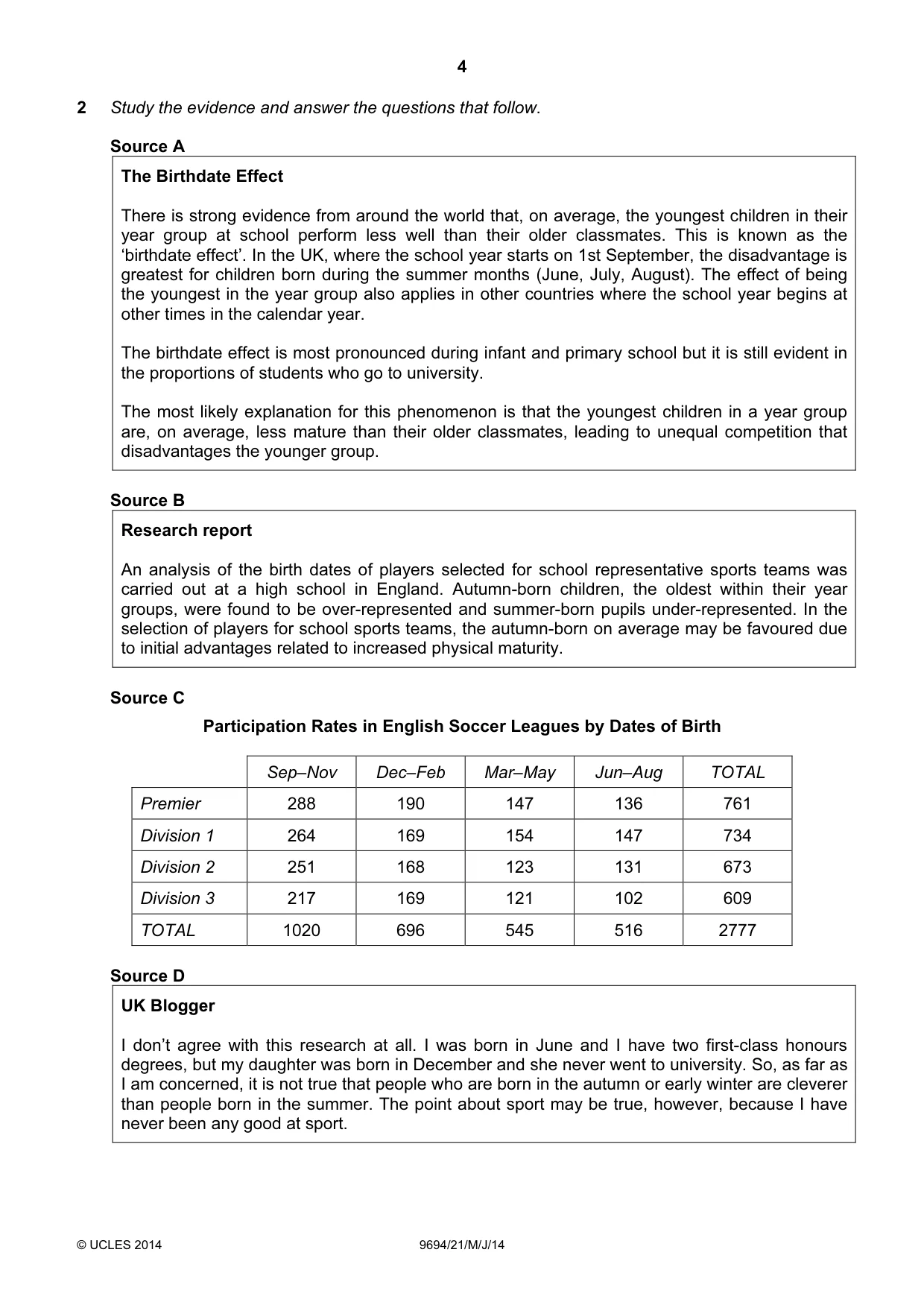
4 © UCLES 2014 9694/21/M/J/14 2 Study the evidence and answer the questions that follow. Source A The Birthdate Effect There is strong evidence from around the world that, on average, the youngest children in their year group at school perform less well than their older classmates. This is known as the ‘birthdate effect’. In the UK, where the school year starts on 1st September, the disadvantage is greatest for children born during the summer months (June, July, August). The effect of being the youngest in the year group also applies in other countries where the school year begins at other times in the calendar year. The birthdate effect is most pronounced during infant and primary school but it is still evident in the proportions of students who go to university. The most likely explanation for this phenomenon is that the youngest children in a year group are, on average, less mature than their older classmates, leading to unequal competition that disadvantages the younger group. Source B Research report An analysis of the birth dates of players selected for school representative sports teams was carried out at a high school in England. Autumn-born children, the oldest within their year groups, were found to be over-represented and summer-born pupils under-represented. In the selection of players for school sports teams, the autumn-born on average may be favoured due to initial advantages related to increased physical maturity. Source C Participation Rates in English Soccer Leagues by Dates of Birth Sep–Nov Dec–Feb Mar–May Jun–Aug TOTAL Premier 288 190 147 136 761 Division 1 264 169 154 147 734 Division 2 251 168 123 131 673 Division 3 217 169 121 102 609 TOTAL 1020 696 545 516 2777 Source D UK Blogger I don’t agree with this research at all. I was born in June and I have two first-class honours degrees, but my daughter was born in December and she never went to university. So, as far as I am concerned, it is not true that people who are born in the autumn or early winter are cleverer than people born in the summer. The point about sport may be true, however, because I have never been any good at sport.
Question paper, page 5
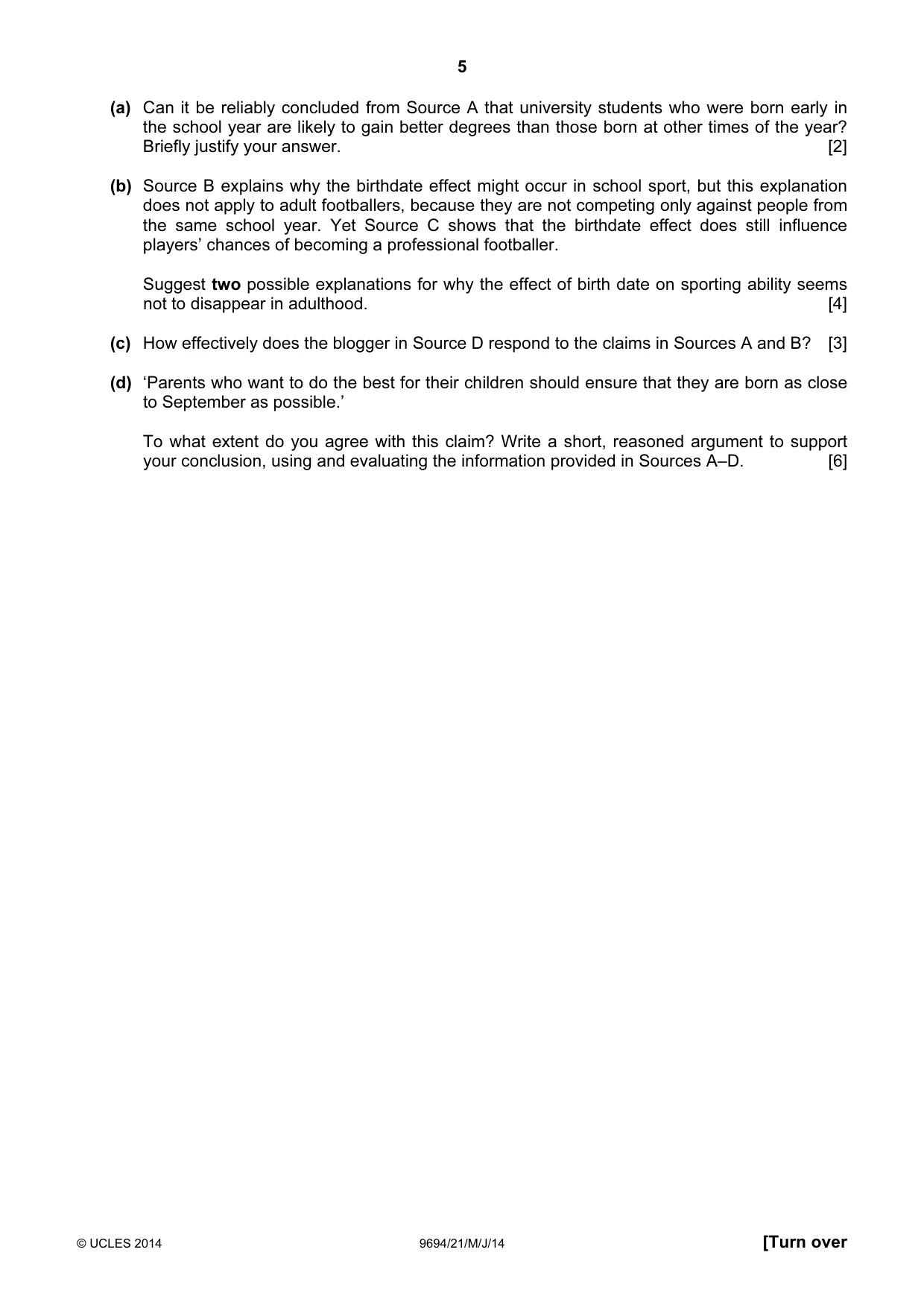
5 © UCLES 2014 9694/21/M/J/14 [Turn over (a) Can it be reliably concluded from Source A that university students who were born early in the school year are likely to gain better degrees than those born at other times of the year? Briefly justify your answer. [2] (b) Source B explains why the birthdate effect might occur in school sport, but this explanation does not apply to adult footballers, because they are not competing only against people from the same school year. Yet Source C shows that the birthdate effect does still influence players’ chances of becoming a professional footballer. Suggest two possible explanations for why the effect of birth date on sporting ability seems not to disappear in adulthood. [4] (c) How effectively does the blogger in Source D respond to the claims in Sources A and B? [3] (d) ‘Parents who want to do the best for their children should ensure that they are born as close to September as possible.’ To what extent do you agree with this claim? Write a short, reasoned argument to support your conclusion, using and evaluating the information provided in Sources A–D. [6]
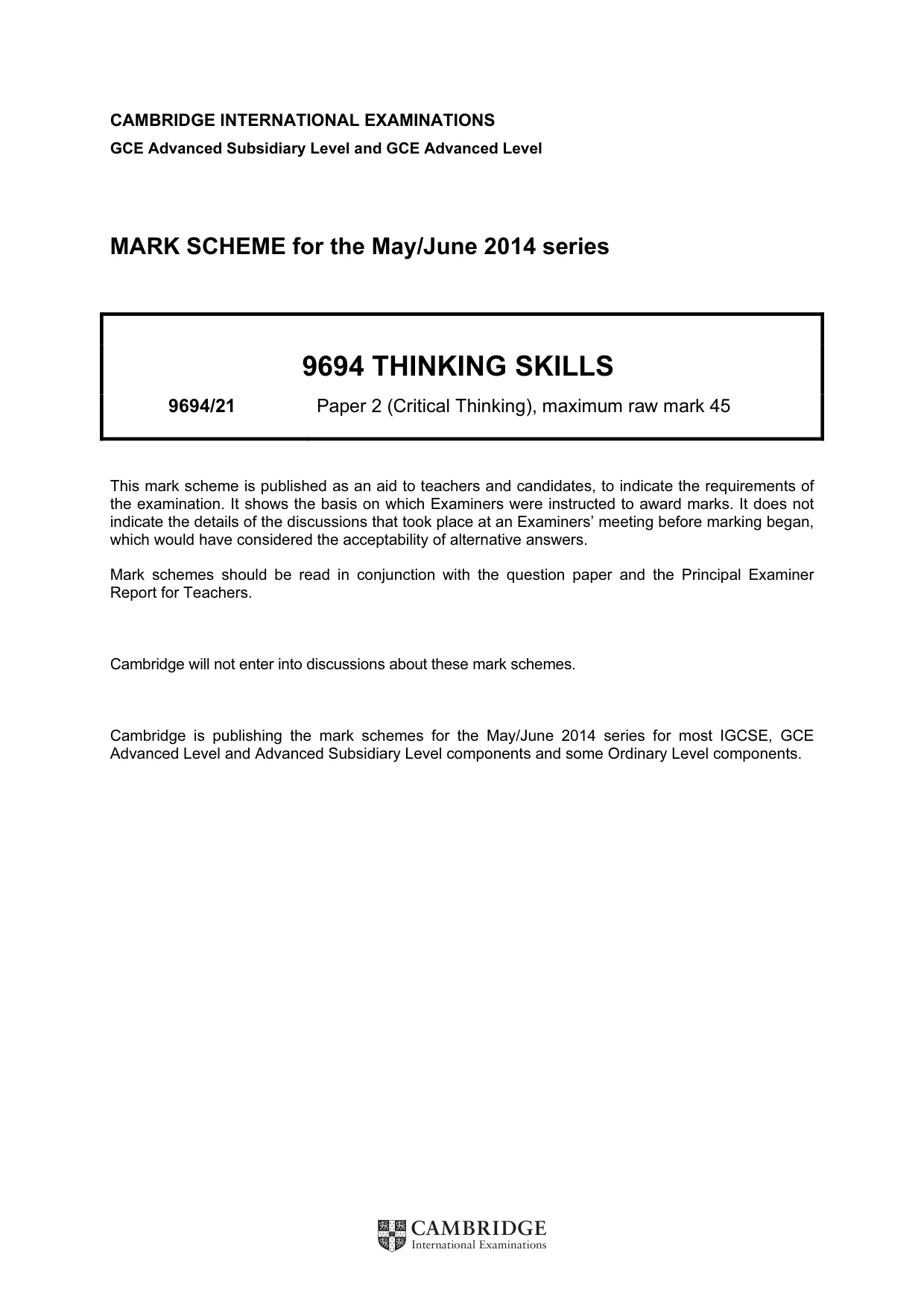
Question paper, page 6
6 © UCLES 2014 9694/21/M/J/14 3 Read the passage and answer the questions below. 1 It has often been proposed that an international language should be introduced alongside national languages, in order to make communication between different countries easier. Since wars are caused by misunderstanding, the introduction of a single language would bring about world peace. 2 During the first half of the 20th century, several artificial languages were published for this purpose, but more recently it has become generally agreed that a new language is not needed, since English has already become the international language. However, to use any natural language for international communications is doubly unfair on the speakers of other languages. Those whose language is chosen are spared the time and effort needed to master a foreign language, and they have a greater ability at using the international language than anyone who has had to learn it alongside their own language. 3 Of all the languages already devised for international use, Esperanto is the most suitable. It has far more speakers than any other artificial language. It is easy to learn, because its grammar is perfectly regular and it draws its vocabulary from natural languages. 4 There would be big educational advantages in introducing Esperanto into the school curriculum. Even children with little ability at languages can learn it, while it is an excellent introduction to language-learning for those who do have an aptitude for languages. For all these reasons, Esperanto should be adopted as the international language. 5 The only reason why some people might be reluctant to learn this international language is that at first it will be of little use to them, because so few people already know it. These objectors are motivated by their own comfort and convenience rather than long-term benefits to everyone. Furthermore, that is a very weak objection, because all new methods of communication – such as cars, telephones and the Internet – are of little use until a significant number of people have adopted them, but once some brave people have taken the plunge they become essential parts of everyday life. (a) Using the exact words from the passage as far as possible, identify the main conclusion. [2] (b) Using the exact words from the passage as far as possible, identify three reasons used to support the main conclusion. [3] (c) Evaluate the strength of the reasoning in the argument. In your answer you should consider any flaws, unstated assumptions and other weaknesses. [5] (d) ‘All children should learn a foreign language at school.’ Write your own short argument to support or challenge this claim. The conclusion of your argument must be stated. [5]
Question paper, page 7
7 © UCLES 2014 9694/21/M/J/14 BLANK PAGE
Question paper, page 8
8 Permission to reproduce items where third-party owned material protected by copyright is included has been sought and cleared where possible. Every reasonable effort has been made by the publisher (UCLES) to trace copyright holders, but if any items requiring clearance have unwittingly been included, the publisher will be pleased to make amends at the earliest possible opportunity. Cambridge International Examinations is part of the Cambridge Assessment Group. Cambridge Assessment is the brand name of University of Cambridge Local Examinations Syndicate (UCLES), which is itself a department of the University of Cambridge. © UCLES 2014 9694/21/M/J/14 BLANK PAGE
Mark scheme, page 1
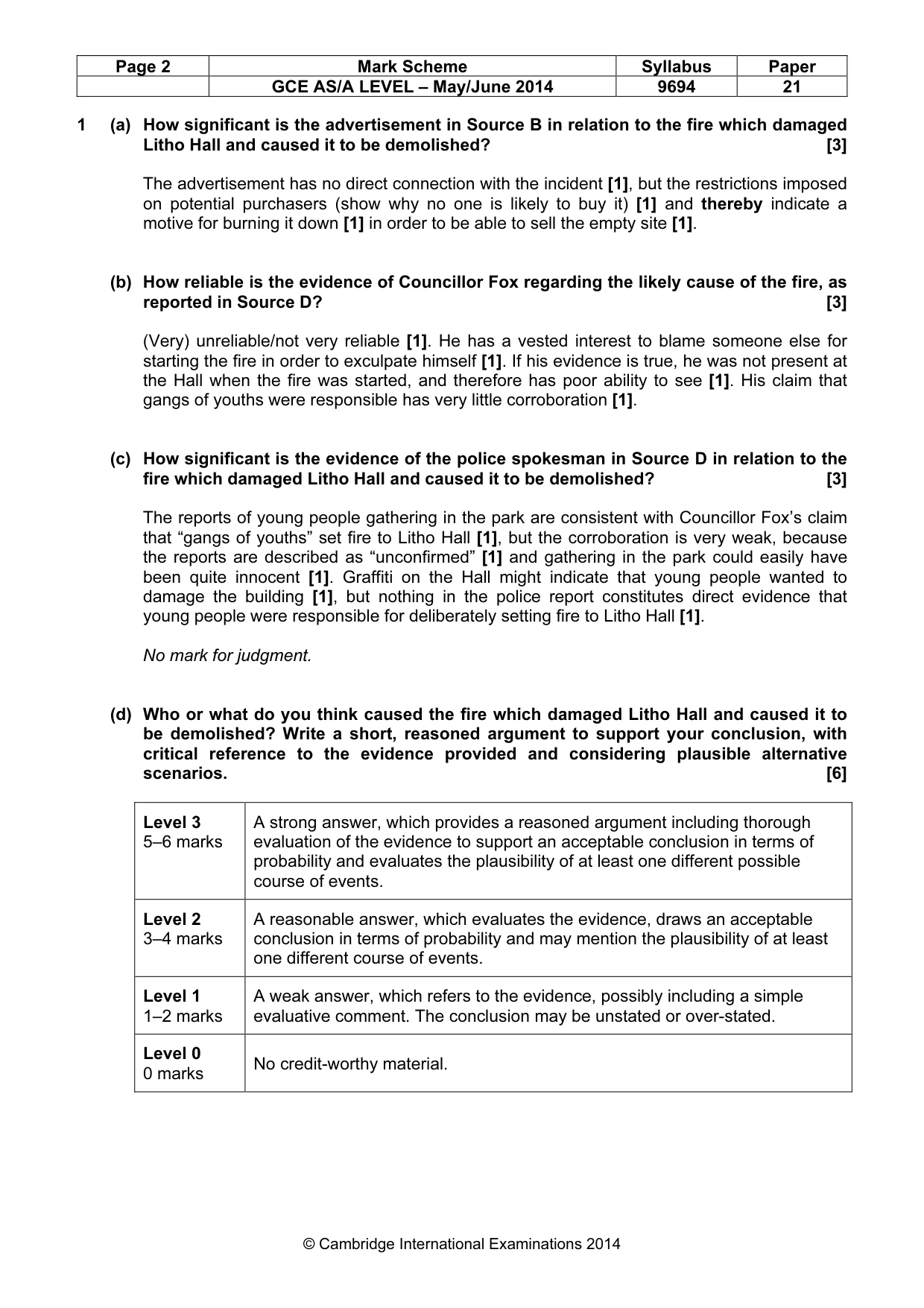
CAMBRIDGE INTERNATIONAL EXAMINATIONS GCE Advanced Subsidiary Level and GCE Advanced Level MARK SCHEME for the May/June 2014 series 9694 THINKING SKILLS 9694/21 Paper 2 (Critical Thinking), maximum raw mark 45 This mark scheme is published as an aid to teachers and candidates, to indicate the requirements of the examination. It shows the basis on which Examiners were instructed to award marks. It does not indicate the details of the discussions that took place at an Examiners’ meeting before marking began, which would have considered the acceptability of alternative answers. Mark schemes should be read in conjunction with the question paper and the Principal Examiner Report for Teachers. Cambridge will not enter into discussions about these mark schemes. Cambridge is publishing the mark schemes for the May/June 2014 series for most IGCSE, GCE Advanced Level and Advanced Subsidiary Level components and some Ordinary Level components.
Mark scheme, page 2
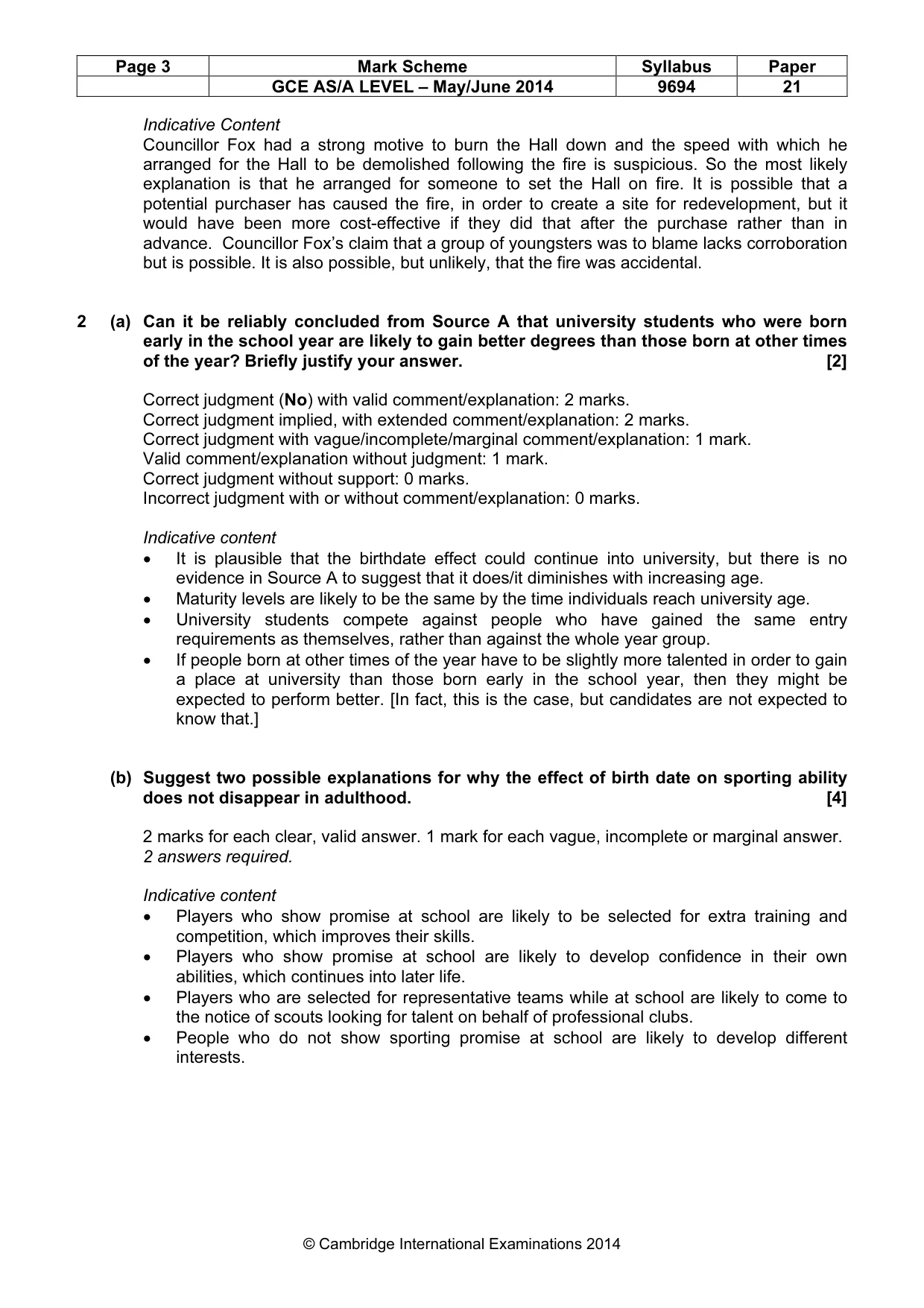
Page 2 Mark Scheme Syllabus Paper GCE AS/A LEVEL – May/June 2014 9694 21 © Cambridge International Examinations 2014 1 (a) How significant is the advertisement in Source B in relation to the fire which damaged Litho Hall and caused it to be demolished? [3] The advertisement has no direct connection with the incident [1], but the restrictions imposed on potential purchasers (show why no one is likely to buy it) [1] and thereby indicate a motive for burning it down [1] in order to be able to sell the empty site [1]. (b) How reliable is the evidence of Councillor Fox regarding the likely cause of the fire, as reported in Source D? [3] (Very) unreliable/not very reliable [1]. He has a vested interest to blame someone else for starting the fire in order to exculpate himself [1]. If his evidence is true, he was not present at the Hall when the fire was started, and therefore has poor ability to see [1]. His claim that gangs of youths were responsible has very little corroboration [1]. (c) How significant is the evidence of the police spokesman in Source D in relation to the fire which damaged Litho Hall and caused it to be demolished? [3] The reports of young people gathering in the park are consistent with Councillor Fox’s claim that “gangs of youths” set fire to Litho Hall [1], but the corroboration is very weak, because the reports are described as “unconfirmed” [1] and gathering in the park could easily have been quite innocent [1]. Graffiti on the Hall might indicate that young people wanted to damage the building [1], but nothing in the police report constitutes direct evidence that young people were responsible for deliberately setting fire to Litho Hall [1]. No mark for judgment. (d) Who or what do you think caused the fire which damaged Litho Hall and caused it to be demolished? Write a short, reasoned argument to support your conclusion, with critical reference to the evidence provided and considering plausible alternative scenarios. [6] Level 3 5–6 marks A strong answer, which provides a reasoned argument including thorough evaluation of the evidence to support an acceptable conclusion in terms of probability and evaluates the plausibility of at least one different possible course of events. Level 2 3–4 marks A reasonable answer, which evaluates the evidence, draws an acceptable conclusion in terms of probability and may mention the plausibility of at least one different course of events. Level 1 1–2 marks A weak answer, which refers to the evidence, possibly including a simple evaluative comment. The conclusion may be unstated or over-stated. Level 0 0 marks No credit-worthy material.
Mark scheme, page 3
Page 3 Mark Scheme Syllabus Paper GCE AS/A LEVEL – May/June 2014 9694 21 © Cambridge International Examinations 2014 Indicative Content Councillor Fox had a strong motive to burn the Hall down and the speed with which he arranged for the Hall to be demolished following the fire is suspicious. So the most likely explanation is that he arranged for someone to set the Hall on fire. It is possible that a potential purchaser has caused the fire, in order to create a site for redevelopment, but it would have been more cost-effective if they did that after the purchase rather than in advance. Councillor Fox’s claim that a group of youngsters was to blame lacks corroboration but is possible. It is also possible, but unlikely, that the fire was accidental. 2 (a) Can it be reliably concluded from Source A that university students who were born early in the school year are likely to gain better degrees than those born at other times of the year? Briefly justify your answer. [2] Correct judgment (No) with valid comment/explanation: 2 marks. Correct judgment implied, with extended comment/explanation: 2 marks. Correct judgment with vague/incomplete/marginal comment/explanation: 1 mark. Valid comment/explanation without judgment: 1 mark. Correct judgment without support: 0 marks. Incorrect judgment with or without comment/explanation: 0 marks. Indicative content • It is plausible that the birthdate effect could continue into university, but there is no evidence in Source A to suggest that it does/it diminishes with increasing age. • Maturity levels are likely to be the same by the time individuals reach university age. • University students compete against people who have gained the same entry requirements as themselves, rather than against the whole year group. • If people born at other times of the year have to be slightly more talented in order to gain a place at university than those born early in the school year, then they might be expected to perform better. [In fact, this is the case, but candidates are not expected to know that.] (b) Suggest two possible explanations for why the effect of birth date on sporting ability does not disappear in adulthood. [4] 2 marks for each clear, valid answer. 1 mark for each vague, incomplete or marginal answer. 2 answers required. Indicative content • Players who show promise at school are likely to be selected for extra training and competition, which improves their skills. • Players who show promise at school are likely to develop confidence in their own abilities, which continues into later life. • Players who are selected for representative teams while at school are likely to come to the notice of scouts looking for talent on behalf of professional clubs. • People who do not show sporting promise at school are likely to develop different interests.
Mark scheme, page 4
Page 4 Mark Scheme Syllabus Paper GCE AS/A LEVEL – May/June 2014 9694 21 © Cambridge International Examinations 2014 (c) How effectively does the blogger in Source D respond to the claims in Sources A and B? [3] Very ineffectively [1]. The research projects reported in Sources A and B refer to probability, not certainty [1]. So they are not disproved by the existence of exceptions [1]. The blogger is illegitimately generalising from the experience of herself and her daughter [1]. The issue is one of maturity, not cleverness or intelligence [1]. Sources A and B are about school and do not necessarily apply to university [1]. (d) ‘Parents who want to do the best for their children should ensure that they are born as close to September as possible.’ To what extent do you agree with this claim? Write a short, reasoned argument to support your conclusion, using and evaluating the information provided in Sources A–D. [6] Level 3 5–6 marks A strong, reasoned argument, which uses and evaluates all or most of the evidence provided. Level 2 3–4 marks A reasonable, simple argument, which uses and/or evaluates evidence. Level 1 1–2 marks A weak answer, which makes some correct reference to evidence but consists of opinion and/or assertion rather than argument or a weak argument, which makes no reference to evidence. Level 0 0 marks No credit-worthy material. Indicative content • Applies to people educated in the UK but not in Southern Hemisphere. • Close to = after, not before (August is “close to September”). • Source A supports (intellectual) • Source B supports (sport) • Source C supports (lifelong consequences) • Source D is a weak argument • but reminds there are many exceptions. • Other factors may be more significant.
Mark scheme, page 5
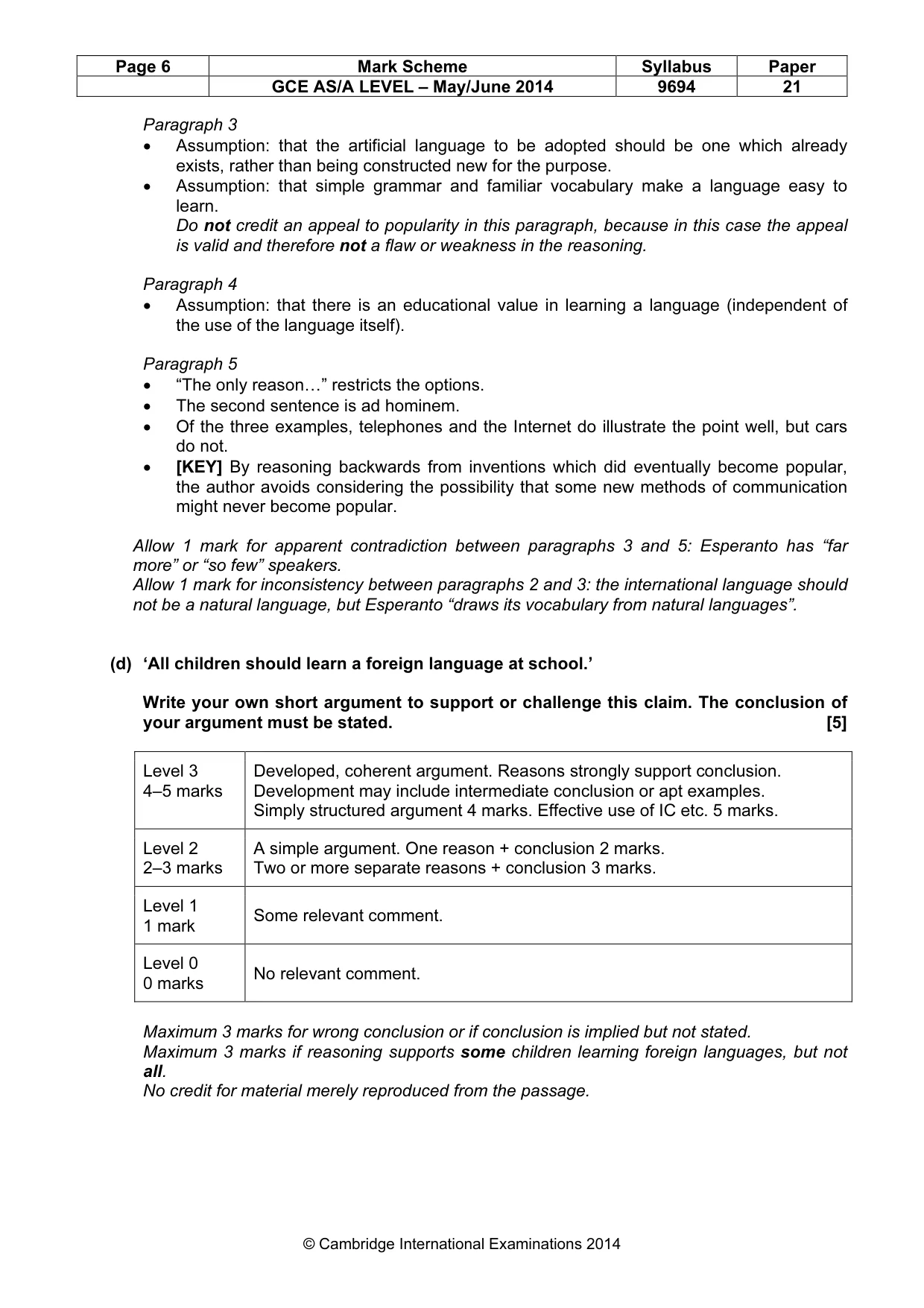
Page 5 Mark Scheme Syllabus Paper GCE AS/A LEVEL – May/June 2014 9694 21 © Cambridge International Examinations 2014 3 (a) Using the exact words from the passage as far as possible, identify the main conclusion. [2] 2 marks: (For all these reasons) Esperanto should be adopted as the international language. 1 mark: Esperanto should be adopted. 1 mark: Paraphrase of the 2-mark answer. (b) Using the exact words from the passage as far as possible, identify three reasons used to support the main conclusion. [3] • The introduction of a single language would bring about world peace. • (However,) to use any existing language for international communications is doubly unfair on the speakers of other languages. • Of all the languages devised for international use, Esperanto is the most suitable. • There would be big educational advantages in introducing Esperanto into the school curriculum. • That [at first it will be of little use to them] is a very weak objection. (c) Evaluate the strength of the reasoning in the argument. In your answer you should consider any flaws, unstated assumptions and other weaknesses. [5] Marks for each evaluative point as follows, up to a maximum of 5 marks: 3 marks Key evaluative point, clearly expressed. 2 marks Key evaluative point, incompletely or vaguely expressed or Valid evaluative point, clearly expressed but less significant than a key point. 1 mark Weak attempt at a valid evaluative point. Candidates who achieve 0 or 1 marks for evaluative points may be awarded up to 2 marks for partial performance, as follows, in respect of answers which have misinterpreted the nature of the task but have shown some understanding: 2 marks: Relevant extended counter-argument/agreement or multiple specific counter- assertions/agreements. 1 mark: General counter/agreement or single specific counter/agreement. Partial performance marks must not be added to one another or to marks from the main part of the mark scheme. Paragraph 1 • [KEY] Slippery slope: it is highly unlikely that the introduction of an auxiliary language is sufficient to bring about world peace. • [KEY] The reasoning in the last sentence relies on equivocation in the word “misunderstanding”. • Assumption: that there are no causes of war other than misunderstanding (this point can alternatively be expressed in terms of necessary and sufficient conditions; allow 1 mark for interpreting this point as “restricting the options”). • Assumption: that world leaders would become sufficiently skilled in the international language to eliminate misunderstandings.
Mark scheme, page 6
Page 6 Mark Scheme Syllabus Paper GCE AS/A LEVEL – May/June 2014 9694 21 © Cambridge International Examinations 2014 Paragraph 3 • Assumption: that the artificial language to be adopted should be one which already exists, rather than being constructed new for the purpose. • Assumption: that simple grammar and familiar vocabulary make a language easy to learn. Do not credit an appeal to popularity in this paragraph, because in this case the appeal is valid and therefore not a flaw or weakness in the reasoning. Paragraph 4 • Assumption: that there is an educational value in learning a language (independent of the use of the language itself). Paragraph 5 • “The only reason…” restricts the options. • The second sentence is ad hominem. • Of the three examples, telephones and the Internet do illustrate the point well, but cars do not. • [KEY] By reasoning backwards from inventions which did eventually become popular, the author avoids considering the possibility that some new methods of communication might never become popular. Allow 1 mark for apparent contradiction between paragraphs 3 and 5: Esperanto has “far more” or “so few” speakers. Allow 1 mark for inconsistency between paragraphs 2 and 3: the international language should not be a natural language, but Esperanto “draws its vocabulary from natural languages”. (d) ‘All children should learn a foreign language at school.’ Write your own short argument to support or challenge this claim. The conclusion of your argument must be stated. [5] Level 3 4–5 marks Developed, coherent argument. Reasons strongly support conclusion. Development may include intermediate conclusion or apt examples. Simply structured argument 4 marks. Effective use of IC etc. 5 marks. Level 2 2–3 marks A simple argument. One reason + conclusion 2 marks. Two or more separate reasons + conclusion 3 marks. Level 1 1 mark Some relevant comment. Level 0 0 marks No relevant comment. Maximum 3 marks for wrong conclusion or if conclusion is implied but not stated. Maximum 3 marks if reasoning supports some children learning foreign languages, but not all. No credit for material merely reproduced from the passage.
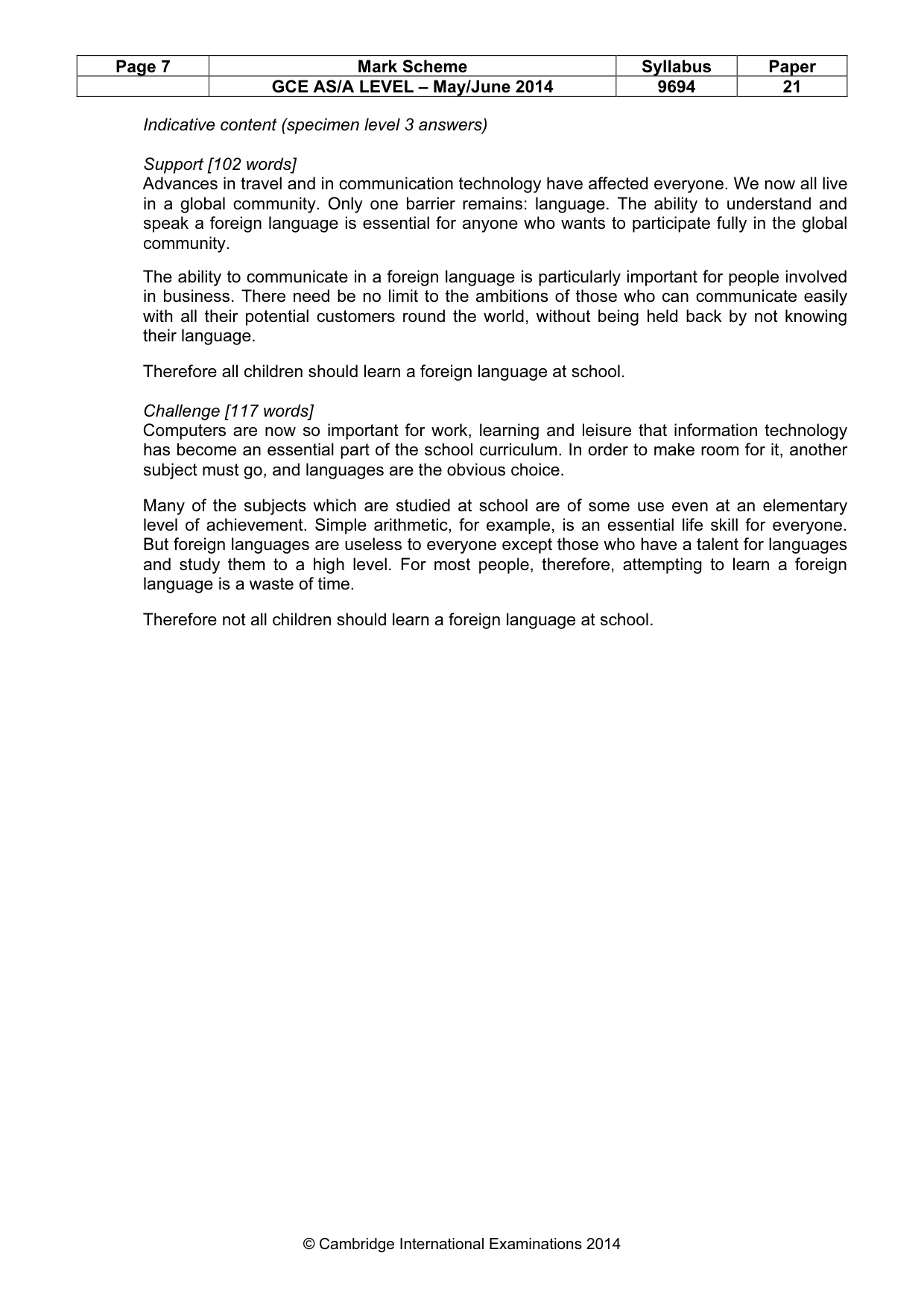
Mark scheme, page 7
Page 7 Mark Scheme Syllabus Paper GCE AS/A LEVEL – May/June 2014 9694 21 © Cambridge International Examinations 2014 Indicative content (specimen level 3 answers) Support [102 words] Advances in travel and in communication technology have affected everyone. We now all live in a global community. Only one barrier remains: language. The ability to understand and speak a foreign language is essential for anyone who wants to participate fully in the global community. The ability to communicate in a foreign language is particularly important for people involved in business. There need be no limit to the ambitions of those who can communicate easily with all their potential customers round the world, without being held back by not knowing their language. Therefore all children should learn a foreign language at school. Challenge [117 words] Computers are now so important for work, learning and leisure that information technology has become an essential part of the school curriculum. In order to make room for it, another subject must go, and languages are the obvious choice. Many of the subjects which are studied at school are of some use even at an elementary level of achievement. Simple arithmetic, for example, is an essential life skill for everyone. But foreign languages are useless to everyone except those who have a talent for languages and study them to a high level. For most people, therefore, attempting to learn a foreign language is a waste of time. Therefore not all children should learn a foreign language at school.
What you needed in this session
Cambridge’s own grade thresholds for 2014 May/June, Paper 2 · Variant 1. A higher threshold means an easier paper — the bar moves with how the cohort did.