Cambridge A Level Thinking Skills 9694 — 2014 May/June Paper 2 · Variant 3
9694/23/M/J/14 · 45 marks · ≈51 min
The question paper and its mark scheme, free to read here and free to download. This is Cambridge’s own paper, exactly as it was sat.
Question paper8 pages
Mark scheme8 pages
Answers below. Sit the paper first if you are practising.
Paper as text
Question paper, page 1
This document consists of 6 printed pages and 2 blank pages. IB14 06_9694_23/3RP © UCLES 2014 [Turn over *3354773747* Cambridge International Examinations Cambridge International Advanced Subsidiary and Advanced Level THINKING SKILLS 9694/23 Paper 2 Critical Thinking May/June 2014 1 hour 45 minutes Additional Materials: Answer Booklet/Paper READ THESE INSTRUCTIONS FIRST If you have been given an Answer Booklet, follow the instructions on the front cover of the booklet. Write your Centre number, candidate number and name on all the work you hand in. Write in dark blue or black pen. Do not use staples, paper clips, glue or correction fluid. DO NOT WRITE IN ANY BARCODES. Answer all the questions. Start each question on a new answer sheet. At the end of the examination, fasten all your work securely together. The number of marks is given in brackets [ ] at the end of each question.
Question paper, page 2
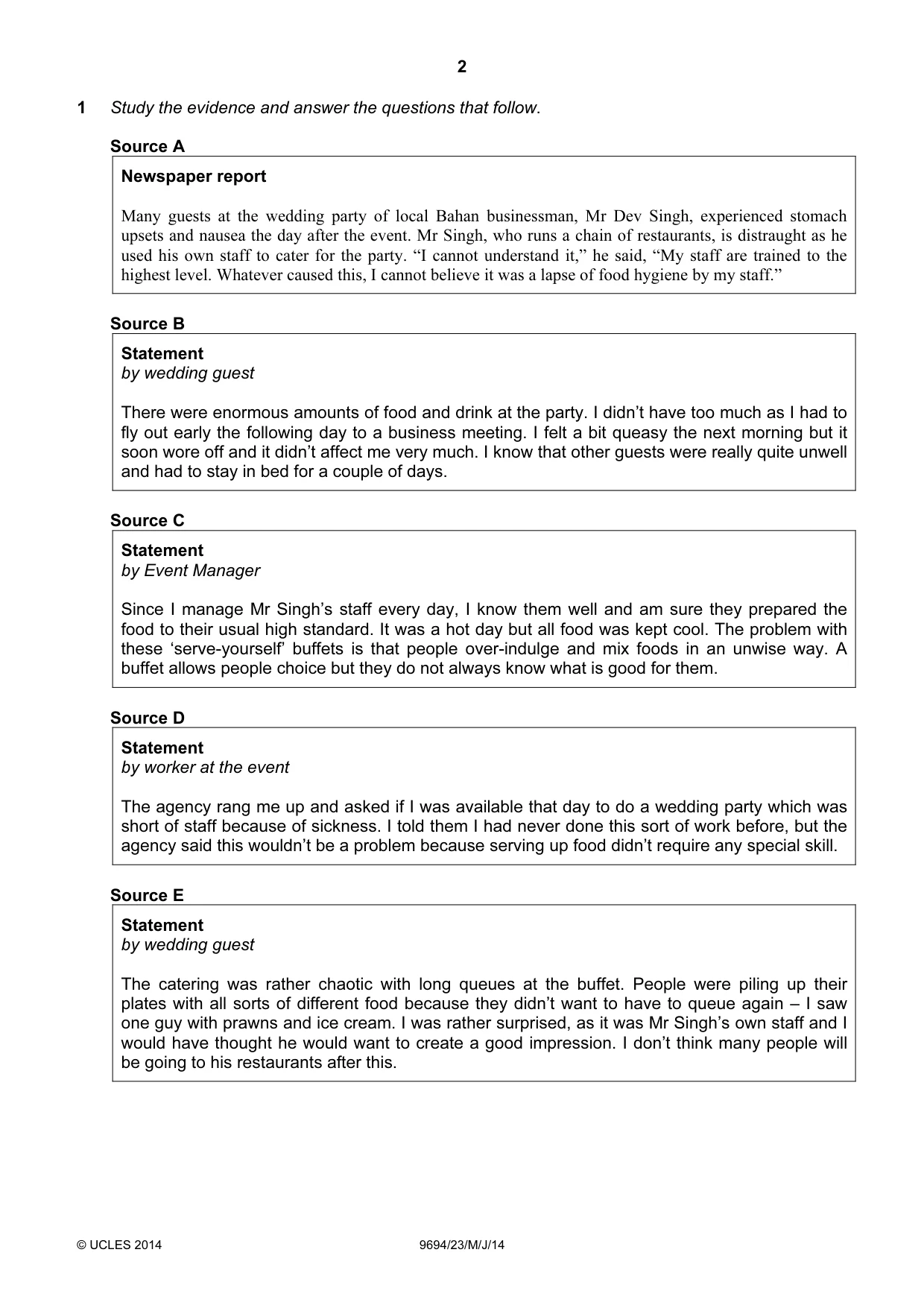
2 © UCLES 2014 9694/23/M/J/14 1 Study the evidence and answer the questions that follow. Source A Newspaper report Many guests at the wedding party of local Bahan businessman, Mr Dev Singh, experienced stomach upsets and nausea the day after the event. Mr Singh, who runs a chain of restaurants, is distraught as he used his own staff to cater for the party. “I cannot understand it,” he said, “My staff are trained to the highest level. Whatever caused this, I cannot believe it was a lapse of food hygiene by my staff.” Source B Statement by wedding guest There were enormous amounts of food and drink at the party. I didn’t have too much as I had to fly out early the following day to a business meeting. I felt a bit queasy the next morning but it soon wore off and it didn’t affect me very much. I know that other guests were really quite unwell and had to stay in bed for a couple of days. Source C Statement by Event Manager Since I manage Mr Singh’s staff every day, I know them well and am sure they prepared the food to their usual high standard. It was a hot day but all food was kept cool. The problem with these ‘serve-yourself’ buffets is that people over-indulge and mix foods in an unwise way. A buffet allows people choice but they do not always know what is good for them. Source D Statement by worker at the event The agency rang me up and asked if I was available that day to do a wedding party which was short of staff because of sickness. I told them I had never done this sort of work before, but the agency said this wouldn’t be a problem because serving up food didn’t require any special skill. Source E Statement by wedding guest The catering was rather chaotic with long queues at the buffet. People were piling up their plates with all sorts of different food because they didn’t want to have to queue again – I saw one guy with prawns and ice cream. I was rather surprised, as it was Mr Singh’s own staff and I would have thought he would want to create a good impression. I don’t think many people will be going to his restaurants after this.
Question paper, page 3
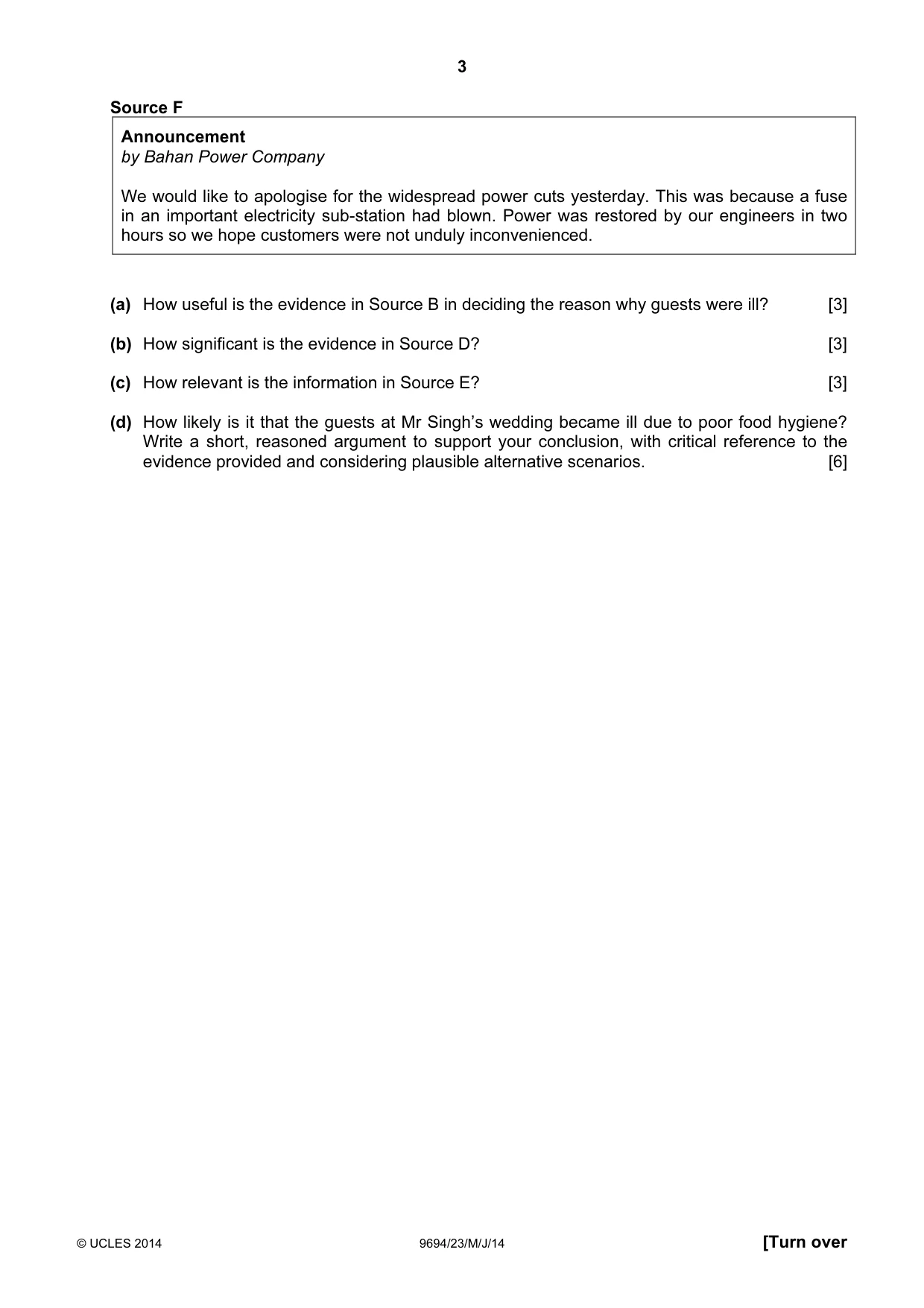
3 © UCLES 2014 9694/23/M/J/14 [Turn over Source F Announcement by Bahan Power Company We would like to apologise for the widespread power cuts yesterday. This was because a fuse in an important electricity sub-station had blown. Power was restored by our engineers in two hours so we hope customers were not unduly inconvenienced. (a) How useful is the evidence in Source B in deciding the reason why guests were ill? [3] (b) How significant is the evidence in Source D? [3] (c) How relevant is the information in Source E? [3] (d) How likely is it that the guests at Mr Singh’s wedding became ill due to poor food hygiene? Write a short, reasoned argument to support your conclusion, with critical reference to the evidence provided and considering plausible alternative scenarios. [6]
Question paper, page 4
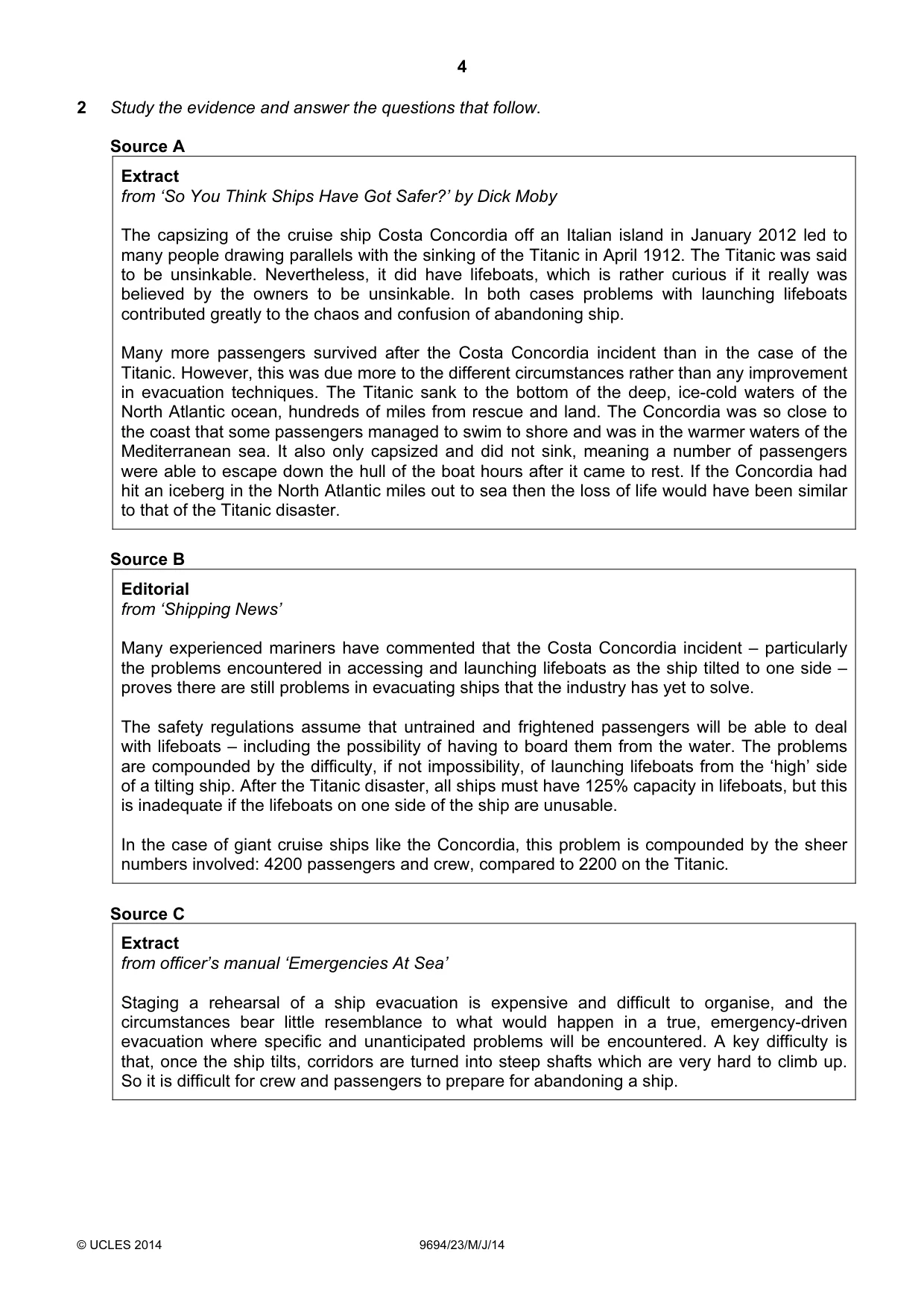
4 © UCLES 2014 9694/23/M/J/14 2 Study the evidence and answer the questions that follow. Source A Extract from ‘So You Think Ships Have Got Safer?’ by Dick Moby The capsizing of the cruise ship Costa Concordia off an Italian island in January 2012 led to many people drawing parallels with the sinking of the Titanic in April 1912. The Titanic was said to be unsinkable. Nevertheless, it did have lifeboats, which is rather curious if it really was believed by the owners to be unsinkable. In both cases problems with launching lifeboats contributed greatly to the chaos and confusion of abandoning ship. Many more passengers survived after the Costa Concordia incident than in the case of the Titanic. However, this was due more to the different circumstances rather than any improvement in evacuation techniques. The Titanic sank to the bottom of the deep, ice-cold waters of the North Atlantic ocean, hundreds of miles from rescue and land. The Concordia was so close to the coast that some passengers managed to swim to shore and was in the warmer waters of the Mediterranean sea. It also only capsized and did not sink, meaning a number of passengers were able to escape down the hull of the boat hours after it came to rest. If the Concordia had hit an iceberg in the North Atlantic miles out to sea then the loss of life would have been similar to that of the Titanic disaster. Source B Editorial from ‘Shipping News’ Many experienced mariners have commented that the Costa Concordia incident – particularly the problems encountered in accessing and launching lifeboats as the ship tilted to one side – proves there are still problems in evacuating ships that the industry has yet to solve. The safety regulations assume that untrained and frightened passengers will be able to deal with lifeboats – including the possibility of having to board them from the water. The problems are compounded by the difficulty, if not impossibility, of launching lifeboats from the ‘high’ side of a tilting ship. After the Titanic disaster, all ships must have 125% capacity in lifeboats, but this is inadequate if the lifeboats on one side of the ship are unusable. In the case of giant cruise ships like the Concordia, this problem is compounded by the sheer numbers involved: 4200 passengers and crew, compared to 2200 on the Titanic. Source C Extract from officer’s manual ‘Emergencies At Sea’ Staging a rehearsal of a ship evacuation is expensive and difficult to organise, and the circumstances bear little resemblance to what would happen in a true, emergency-driven evacuation where specific and unanticipated problems will be encountered. A key difficulty is that, once the ship tilts, corridors are turned into steep shafts which are very hard to climb up. So it is difficult for crew and passengers to prepare for abandoning a ship.
Question paper, page 5
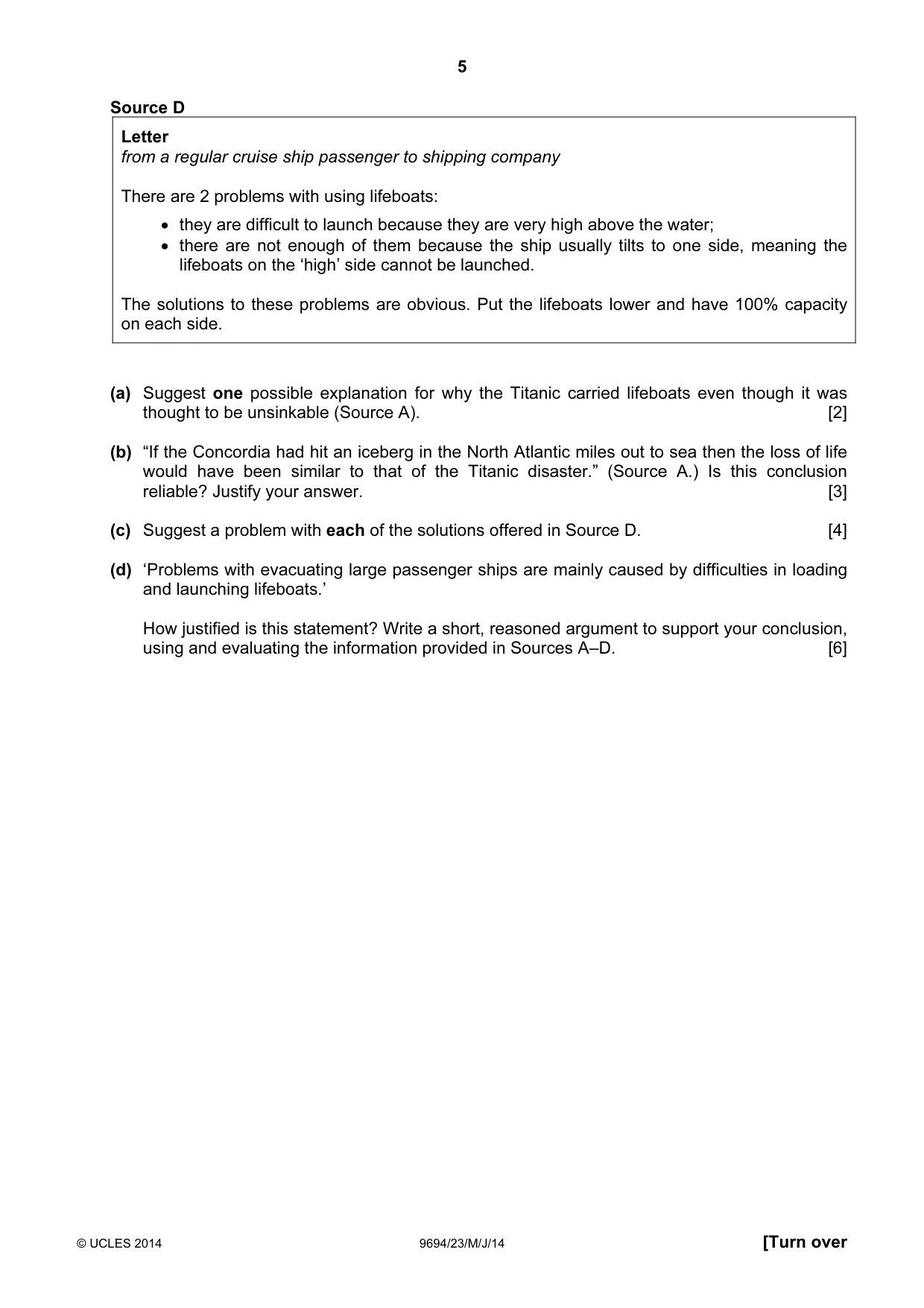
5 © UCLES 2014 9694/23/M/J/14 [Turn over Source D Letter from a regular cruise ship passenger to shipping company There are 2 problems with using lifeboats: • they are difficult to launch because they are very high above the water; • there are not enough of them because the ship usually tilts to one side, meaning the lifeboats on the ‘high’ side cannot be launched. The solutions to these problems are obvious. Put the lifeboats lower and have 100% capacity on each side. (a) Suggest one possible explanation for why the Titanic carried lifeboats even though it was thought to be unsinkable (Source A). [2] (b) “If the Concordia had hit an iceberg in the North Atlantic miles out to sea then the loss of life would have been similar to that of the Titanic disaster.” (Source A.) Is this conclusion reliable? Justify your answer. [3] (c) Suggest a problem with each of the solutions offered in Source D. [4] (d) ‘Problems with evacuating large passenger ships are mainly caused by difficulties in loading and launching lifeboats.’ How justified is this statement? Write a short, reasoned argument to support your conclusion, using and evaluating the information provided in Sources A–D. [6]
Question paper, page 6
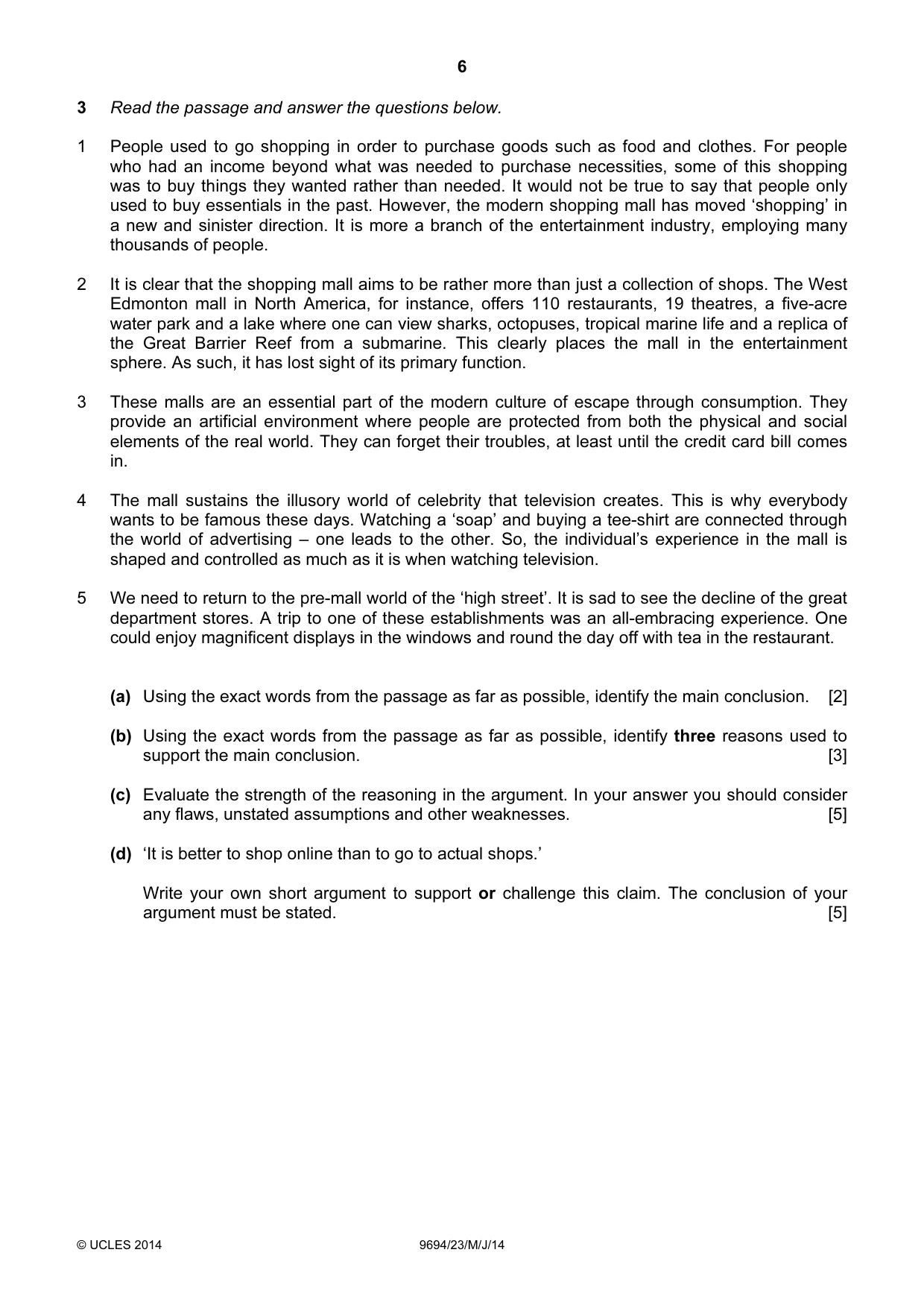
6 © UCLES 2014 9694/23/M/J/14 3 Read the passage and answer the questions below. 1 People used to go shopping in order to purchase goods such as food and clothes. For people who had an income beyond what was needed to purchase necessities, some of this shopping was to buy things they wanted rather than needed. It would not be true to say that people only used to buy essentials in the past. However, the modern shopping mall has moved ‘shopping’ in a new and sinister direction. It is more a branch of the entertainment industry, employing many thousands of people. 2 It is clear that the shopping mall aims to be rather more than just a collection of shops. The West Edmonton mall in North America, for instance, offers 110 restaurants, 19 theatres, a five-acre water park and a lake where one can view sharks, octopuses, tropical marine life and a replica of the Great Barrier Reef from a submarine. This clearly places the mall in the entertainment sphere. As such, it has lost sight of its primary function. 3 These malls are an essential part of the modern culture of escape through consumption. They provide an artificial environment where people are protected from both the physical and social elements of the real world. They can forget their troubles, at least until the credit card bill comes in. 4 The mall sustains the illusory world of celebrity that television creates. This is why everybody wants to be famous these days. Watching a ‘soap’ and buying a tee-shirt are connected through the world of advertising – one leads to the other. So, the individual’s experience in the mall is shaped and controlled as much as it is when watching television. 5 We need to return to the pre-mall world of the ‘high street’. It is sad to see the decline of the great department stores. A trip to one of these establishments was an all-embracing experience. One could enjoy magnificent displays in the windows and round the day off with tea in the restaurant. (a) Using the exact words from the passage as far as possible, identify the main conclusion. [2] (b) Using the exact words from the passage as far as possible, identify three reasons used to support the main conclusion. [3] (c) Evaluate the strength of the reasoning in the argument. In your answer you should consider any flaws, unstated assumptions and other weaknesses. [5] (d) ‘It is better to shop online than to go to actual shops.’ Write your own short argument to support or challenge this claim. The conclusion of your argument must be stated. [5]
Question paper, page 7
7 © UCLES 2014 9694/23/M/J/14 BLANK PAGE
Question paper, page 8
8 Permission to reproduce items where third-party owned material protected by copyright is included has been sought and cleared where possible. Every reasonable effort has been made by the publisher (UCLES) to trace copyright holders, but if any items requiring clearance have unwittingly been included, the publisher will be pleased to make amends at the earliest possible opportunity. Cambridge International Examinations is part of the Cambridge Assessment Group. Cambridge Assessment is the brand name of University of Cambridge Local Examinations Syndicate (UCLES), which is itself a department of the University of Cambridge. © UCLES 2014 9694/23/M/J/14 BLANK PAGE
Mark scheme, page 1
CAMBRIDGE INTERNATIONAL EXAMINATIONS GCE Advanced Subsidiary Level and GCE Advanced Level MARK SCHEME for the May/June 2014 series 9694 THINKING SKILLS 9694/23 Paper 2 (Critical Thinking), maximum raw mark 45 This mark scheme is published as an aid to teachers and candidates, to indicate the requirements of the examination. It shows the basis on which Examiners were instructed to award marks. It does not indicate the details of the discussions that took place at an Examiners’ meeting before marking began, which would have considered the acceptability of alternative answers. Mark schemes should be read in conjunction with the question paper and the Principal Examiner Report for Teachers. Cambridge will not enter into discussions about these mark schemes. Cambridge is publishing the mark schemes for the May/June 2014 series for most IGCSE, GCE Advanced Level and Advanced Subsidiary Level components and some Ordinary Level components.
Mark scheme, page 2
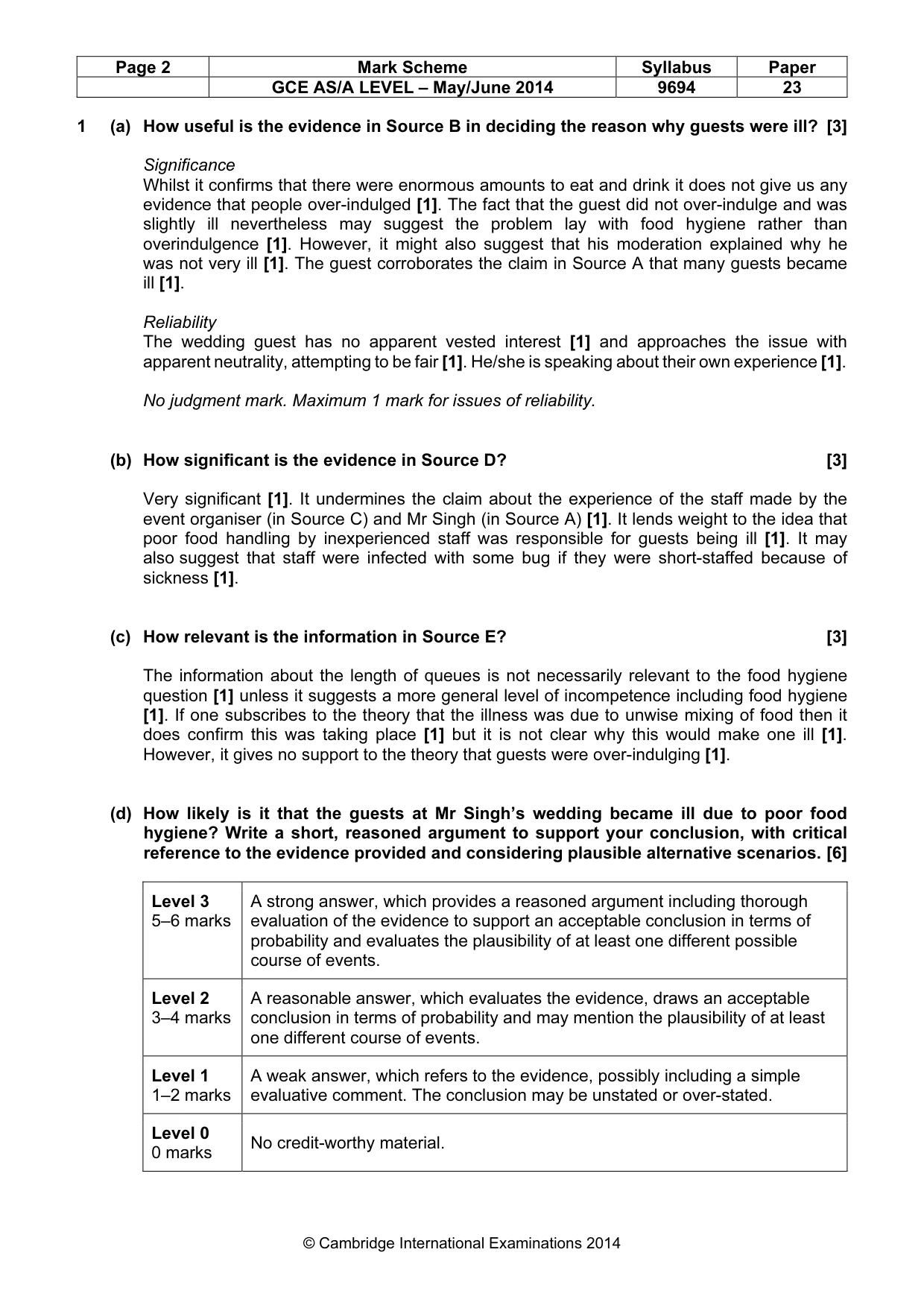
Page 2 Mark Scheme Syllabus Paper GCE AS/A LEVEL – May/June 2014 9694 23 © Cambridge International Examinations 2014 1 (a) How useful is the evidence in Source B in deciding the reason why guests were ill? [3] Significance Whilst it confirms that there were enormous amounts to eat and drink it does not give us any evidence that people over-indulged [1]. The fact that the guest did not over-indulge and was slightly ill nevertheless may suggest the problem lay with food hygiene rather than overindulgence [1]. However, it might also suggest that his moderation explained why he was not very ill [1]. The guest corroborates the claim in Source A that many guests became ill [1]. Reliability The wedding guest has no apparent vested interest [1] and approaches the issue with apparent neutrality, attempting to be fair [1]. He/she is speaking about their own experience [1]. No judgment mark. Maximum 1 mark for issues of reliability. (b) How significant is the evidence in Source D? [3] Very significant [1]. It undermines the claim about the experience of the staff made by the event organiser (in Source C) and Mr Singh (in Source A) [1]. It lends weight to the idea that poor food handling by inexperienced staff was responsible for guests being ill [1]. It may also suggest that staff were infected with some bug if they were short-staffed because of sickness [1]. (c) How relevant is the information in Source E? [3] The information about the length of queues is not necessarily relevant to the food hygiene question [1] unless it suggests a more general level of incompetence including food hygiene [1]. If one subscribes to the theory that the illness was due to unwise mixing of food then it does confirm this was taking place [1] but it is not clear why this would make one ill [1]. However, it gives no support to the theory that guests were over-indulging [1]. (d) How likely is it that the guests at Mr Singh’s wedding became ill due to poor food hygiene? Write a short, reasoned argument to support your conclusion, with critical reference to the evidence provided and considering plausible alternative scenarios. [6] Level 3 5–6 marks A strong answer, which provides a reasoned argument including thorough evaluation of the evidence to support an acceptable conclusion in terms of probability and evaluates the plausibility of at least one different possible course of events. Level 2 3–4 marks A reasonable answer, which evaluates the evidence, draws an acceptable conclusion in terms of probability and may mention the plausibility of at least one different course of events. Level 1 1–2 marks A weak answer, which refers to the evidence, possibly including a simple evaluative comment. The conclusion may be unstated or over-stated. Level 0 0 marks No credit-worthy material.
Mark scheme, page 3
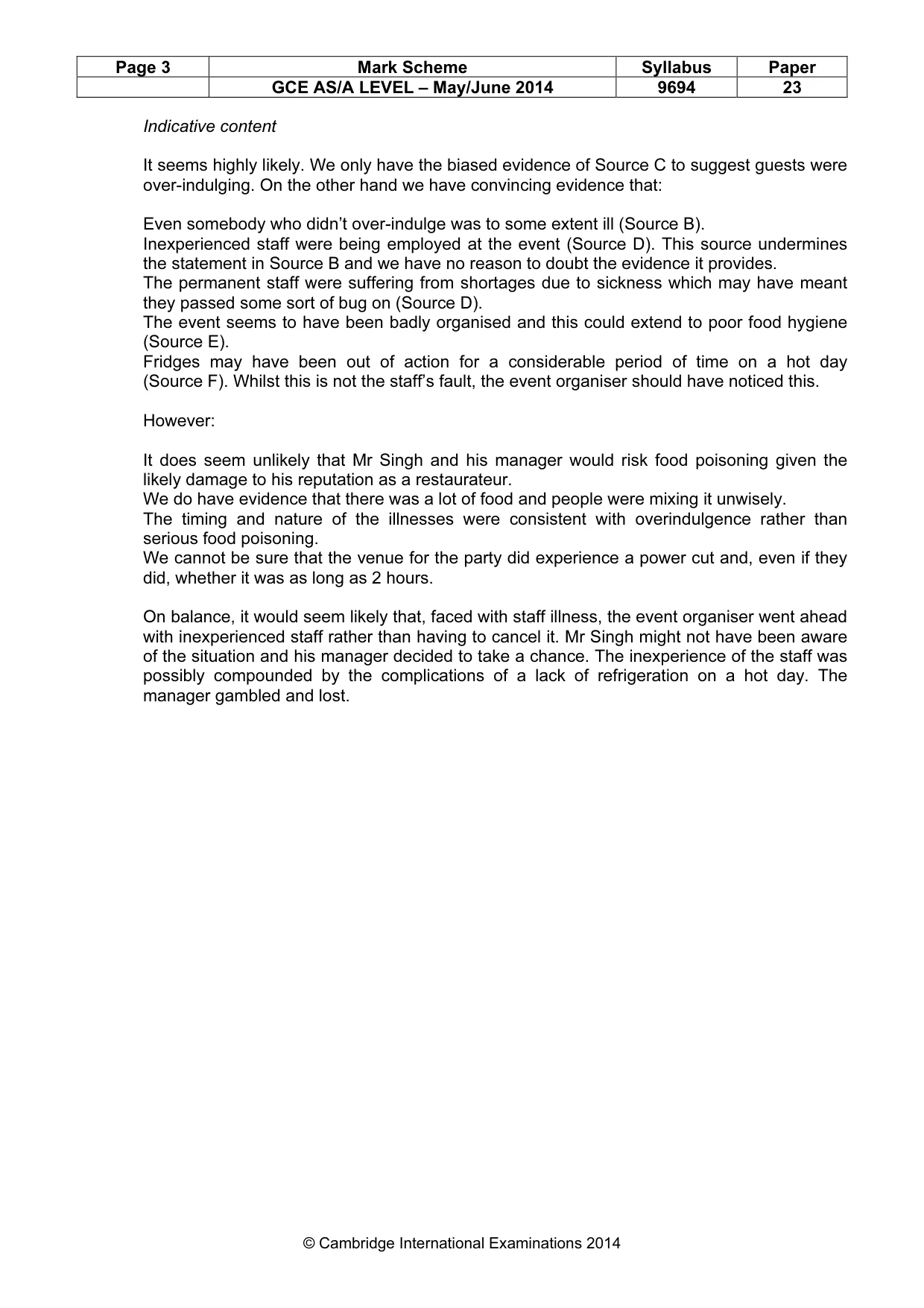
Page 3 Mark Scheme Syllabus Paper GCE AS/A LEVEL – May/June 2014 9694 23 © Cambridge International Examinations 2014 Indicative content It seems highly likely. We only have the biased evidence of Source C to suggest guests were over-indulging. On the other hand we have convincing evidence that: Even somebody who didn’t over-indulge was to some extent ill (Source B). Inexperienced staff were being employed at the event (Source D). This source undermines the statement in Source B and we have no reason to doubt the evidence it provides. The permanent staff were suffering from shortages due to sickness which may have meant they passed some sort of bug on (Source D). The event seems to have been badly organised and this could extend to poor food hygiene (Source E). Fridges may have been out of action for a considerable period of time on a hot day (Source F). Whilst this is not the staff’s fault, the event organiser should have noticed this. However: It does seem unlikely that Mr Singh and his manager would risk food poisoning given the likely damage to his reputation as a restaurateur. We do have evidence that there was a lot of food and people were mixing it unwisely. The timing and nature of the illnesses were consistent with overindulgence rather than serious food poisoning. We cannot be sure that the venue for the party did experience a power cut and, even if they did, whether it was as long as 2 hours. On balance, it would seem likely that, faced with staff illness, the event organiser went ahead with inexperienced staff rather than having to cancel it. Mr Singh might not have been aware of the situation and his manager decided to take a chance. The inexperience of the staff was possibly compounded by the complications of a lack of refrigeration on a hot day. The manager gambled and lost.
Mark scheme, page 4
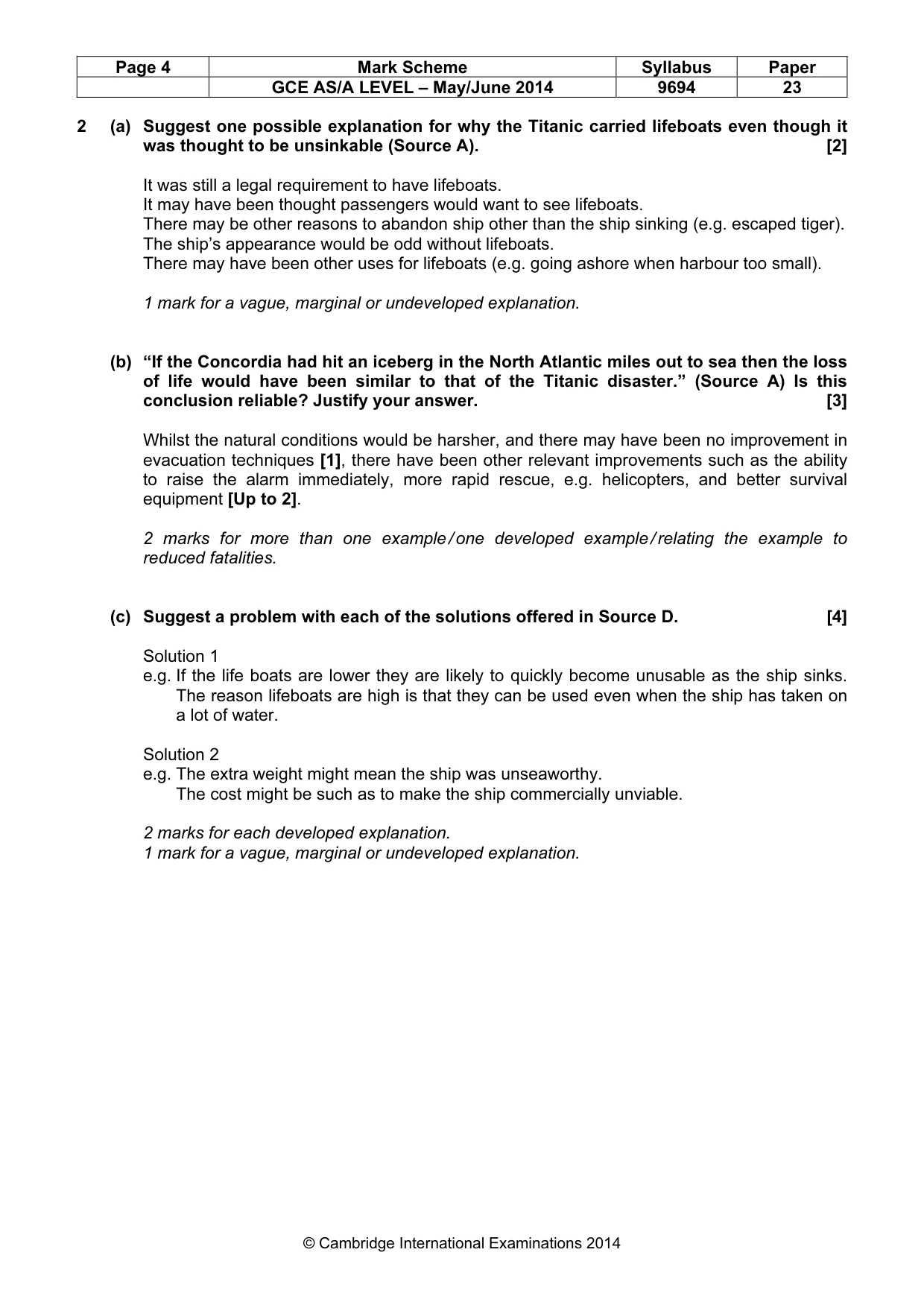
Page 4 Mark Scheme Syllabus Paper GCE AS/A LEVEL – May/June 2014 9694 23 © Cambridge International Examinations 2014 2 (a) Suggest one possible explanation for why the Titanic carried lifeboats even though it was thought to be unsinkable (Source A). [2] It was still a legal requirement to have lifeboats. It may have been thought passengers would want to see lifeboats. There may be other reasons to abandon ship other than the ship sinking (e.g. escaped tiger). The ship’s appearance would be odd without lifeboats. There may have been other uses for lifeboats (e.g. going ashore when harbour too small). 1 mark for a vague, marginal or undeveloped explanation. (b) “If the Concordia had hit an iceberg in the North Atlantic miles out to sea then the loss of life would have been similar to that of the Titanic disaster.” (Source A) Is this conclusion reliable? Justify your answer. [3] Whilst the natural conditions would be harsher, and there may have been no improvement in evacuation techniques [1], there have been other relevant improvements such as the ability to raise the alarm immediately, more rapid rescue, e.g. helicopters, and better survival equipment [Up to 2]. 2 marks for more than one example / one developed example / relating the example to reduced fatalities. (c) Suggest a problem with each of the solutions offered in Source D. [4] Solution 1 e.g. If the life boats are lower they are likely to quickly become unusable as the ship sinks. The reason lifeboats are high is that they can be used even when the ship has taken on a lot of water. Solution 2 e.g. The extra weight might mean the ship was unseaworthy. The cost might be such as to make the ship commercially unviable. 2 marks for each developed explanation. 1 mark for a vague, marginal or undeveloped explanation.
Mark scheme, page 5
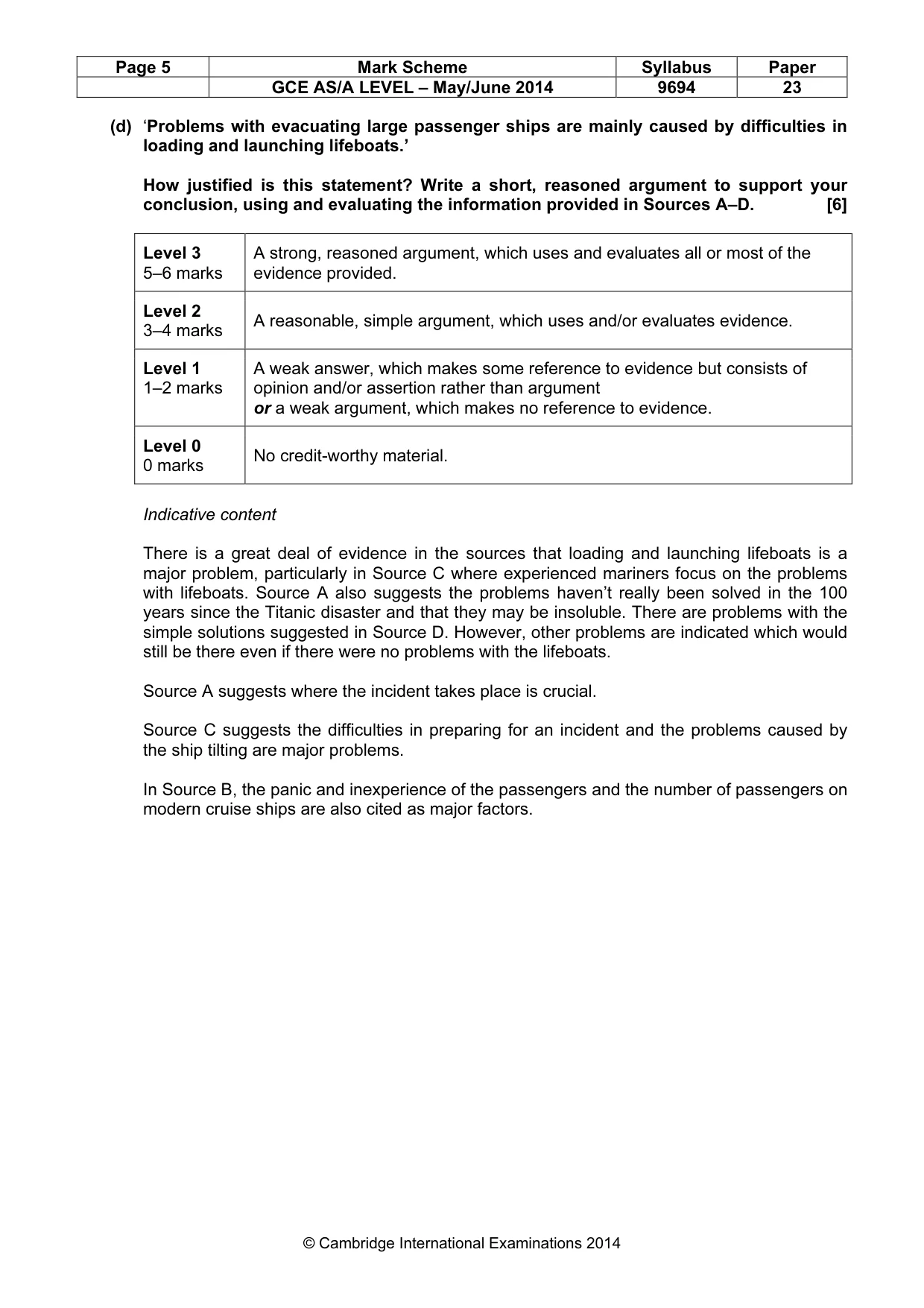
Page 5 Mark Scheme Syllabus Paper GCE AS/A LEVEL – May/June 2014 9694 23 © Cambridge International Examinations 2014 (d) ‘Problems with evacuating large passenger ships are mainly caused by difficulties in loading and launching lifeboats.’ How justified is this statement? Write a short, reasoned argument to support your conclusion, using and evaluating the information provided in Sources A–D. [6] Level 3 5–6 marks A strong, reasoned argument, which uses and evaluates all or most of the evidence provided. Level 2 3–4 marks A reasonable, simple argument, which uses and/or evaluates evidence. Level 1 1–2 marks A weak answer, which makes some reference to evidence but consists of opinion and/or assertion rather than argument or a weak argument, which makes no reference to evidence. Level 0 0 marks No credit-worthy material. Indicative content There is a great deal of evidence in the sources that loading and launching lifeboats is a major problem, particularly in Source C where experienced mariners focus on the problems with lifeboats. Source A also suggests the problems haven’t really been solved in the 100 years since the Titanic disaster and that they may be insoluble. There are problems with the simple solutions suggested in Source D. However, other problems are indicated which would still be there even if there were no problems with the lifeboats. Source A suggests where the incident takes place is crucial. Source C suggests the difficulties in preparing for an incident and the problems caused by the ship tilting are major problems. In Source B, the panic and inexperience of the passengers and the number of passengers on modern cruise ships are also cited as major factors.
Mark scheme, page 6
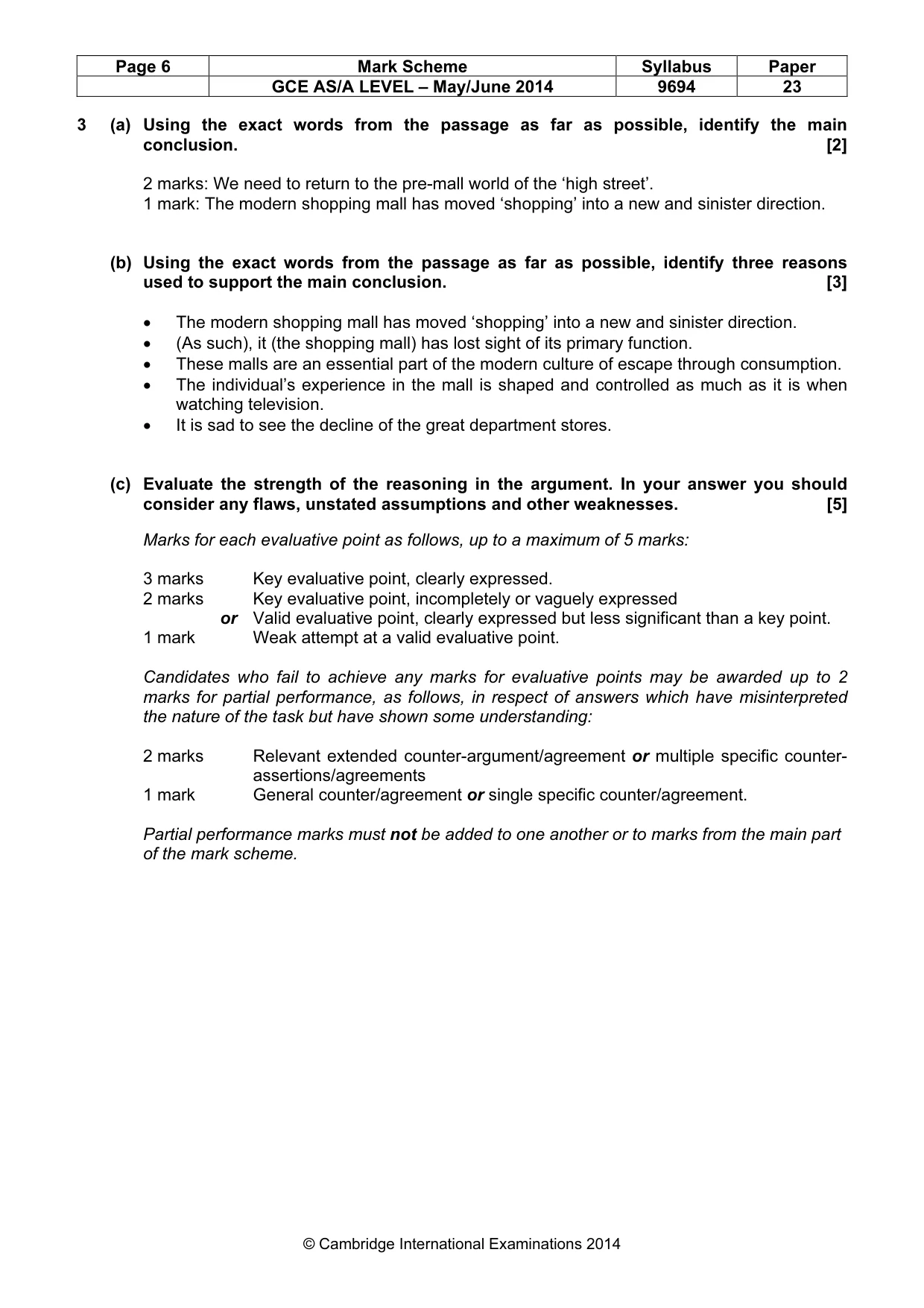
Page 6 Mark Scheme Syllabus Paper GCE AS/A LEVEL – May/June 2014 9694 23 © Cambridge International Examinations 2014 3 (a) Using the exact words from the passage as far as possible, identify the main conclusion. [2] 2 marks: We need to return to the pre-mall world of the ‘high street’. 1 mark: The modern shopping mall has moved ‘shopping’ into a new and sinister direction. (b) Using the exact words from the passage as far as possible, identify three reasons used to support the main conclusion. [3] • The modern shopping mall has moved ‘shopping’ into a new and sinister direction. • (As such), it (the shopping mall) has lost sight of its primary function. • These malls are an essential part of the modern culture of escape through consumption. • The individual’s experience in the mall is shaped and controlled as much as it is when watching television. • It is sad to see the decline of the great department stores. (c) Evaluate the strength of the reasoning in the argument. In your answer you should consider any flaws, unstated assumptions and other weaknesses. [5] Marks for each evaluative point as follows, up to a maximum of 5 marks: 3 marks Key evaluative point, clearly expressed. 2 marks Key evaluative point, incompletely or vaguely expressed or Valid evaluative point, clearly expressed but less significant than a key point. 1 mark Weak attempt at a valid evaluative point. Candidates who fail to achieve any marks for evaluative points may be awarded up to 2 marks for partial performance, as follows, in respect of answers which have misinterpreted the nature of the task but have shown some understanding: 2 marks Relevant extended counter-argument/agreement or multiple specific counter- assertions/agreements 1 mark General counter/agreement or single specific counter/agreement. Partial performance marks must not be added to one another or to marks from the main part of the mark scheme.
Mark scheme, page 7
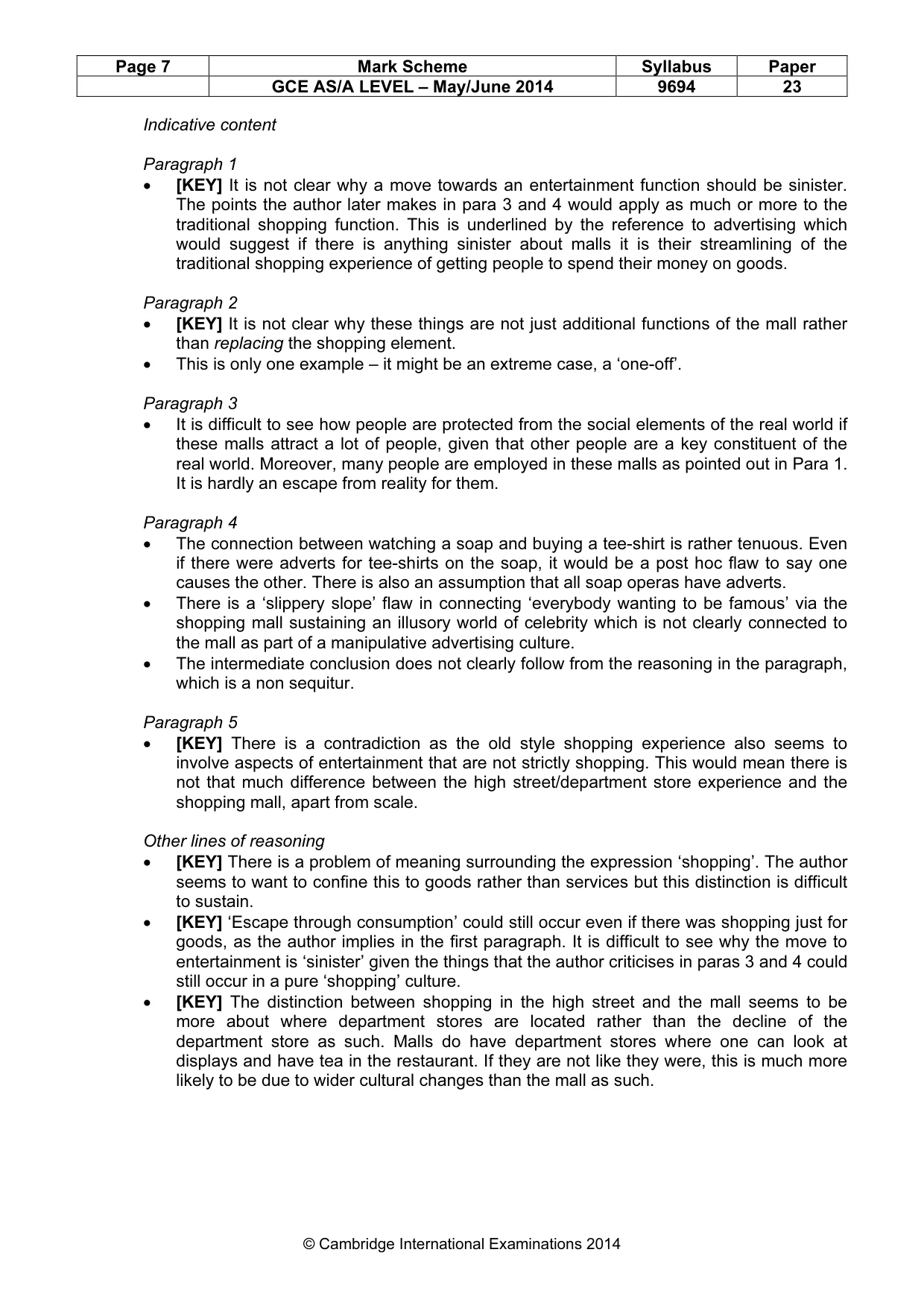
Page 7 Mark Scheme Syllabus Paper GCE AS/A LEVEL – May/June 2014 9694 23 © Cambridge International Examinations 2014 Indicative content Paragraph 1 • [KEY] It is not clear why a move towards an entertainment function should be sinister. The points the author later makes in para 3 and 4 would apply as much or more to the traditional shopping function. This is underlined by the reference to advertising which would suggest if there is anything sinister about malls it is their streamlining of the traditional shopping experience of getting people to spend their money on goods. Paragraph 2 • [KEY] It is not clear why these things are not just additional functions of the mall rather than replacing the shopping element. • This is only one example – it might be an extreme case, a ‘one-off’. Paragraph 3 • It is difficult to see how people are protected from the social elements of the real world if these malls attract a lot of people, given that other people are a key constituent of the real world. Moreover, many people are employed in these malls as pointed out in Para 1. It is hardly an escape from reality for them. Paragraph 4 • The connection between watching a soap and buying a tee-shirt is rather tenuous. Even if there were adverts for tee-shirts on the soap, it would be a post hoc flaw to say one causes the other. There is also an assumption that all soap operas have adverts. • There is a ‘slippery slope’ flaw in connecting ‘everybody wanting to be famous’ via the shopping mall sustaining an illusory world of celebrity which is not clearly connected to the mall as part of a manipulative advertising culture. • The intermediate conclusion does not clearly follow from the reasoning in the paragraph, which is a non sequitur. Paragraph 5 • [KEY] There is a contradiction as the old style shopping experience also seems to involve aspects of entertainment that are not strictly shopping. This would mean there is not that much difference between the high street/department store experience and the shopping mall, apart from scale. Other lines of reasoning • [KEY] There is a problem of meaning surrounding the expression ‘shopping’. The author seems to want to confine this to goods rather than services but this distinction is difficult to sustain. • [KEY] ‘Escape through consumption’ could still occur even if there was shopping just for goods, as the author implies in the first paragraph. It is difficult to see why the move to entertainment is ‘sinister’ given the things that the author criticises in paras 3 and 4 could still occur in a pure ‘shopping’ culture. • [KEY] The distinction between shopping in the high street and the mall seems to be more about where department stores are located rather than the decline of the department store as such. Malls do have department stores where one can look at displays and have tea in the restaurant. If they are not like they were, this is much more likely to be due to wider cultural changes than the mall as such.
Mark scheme, page 8
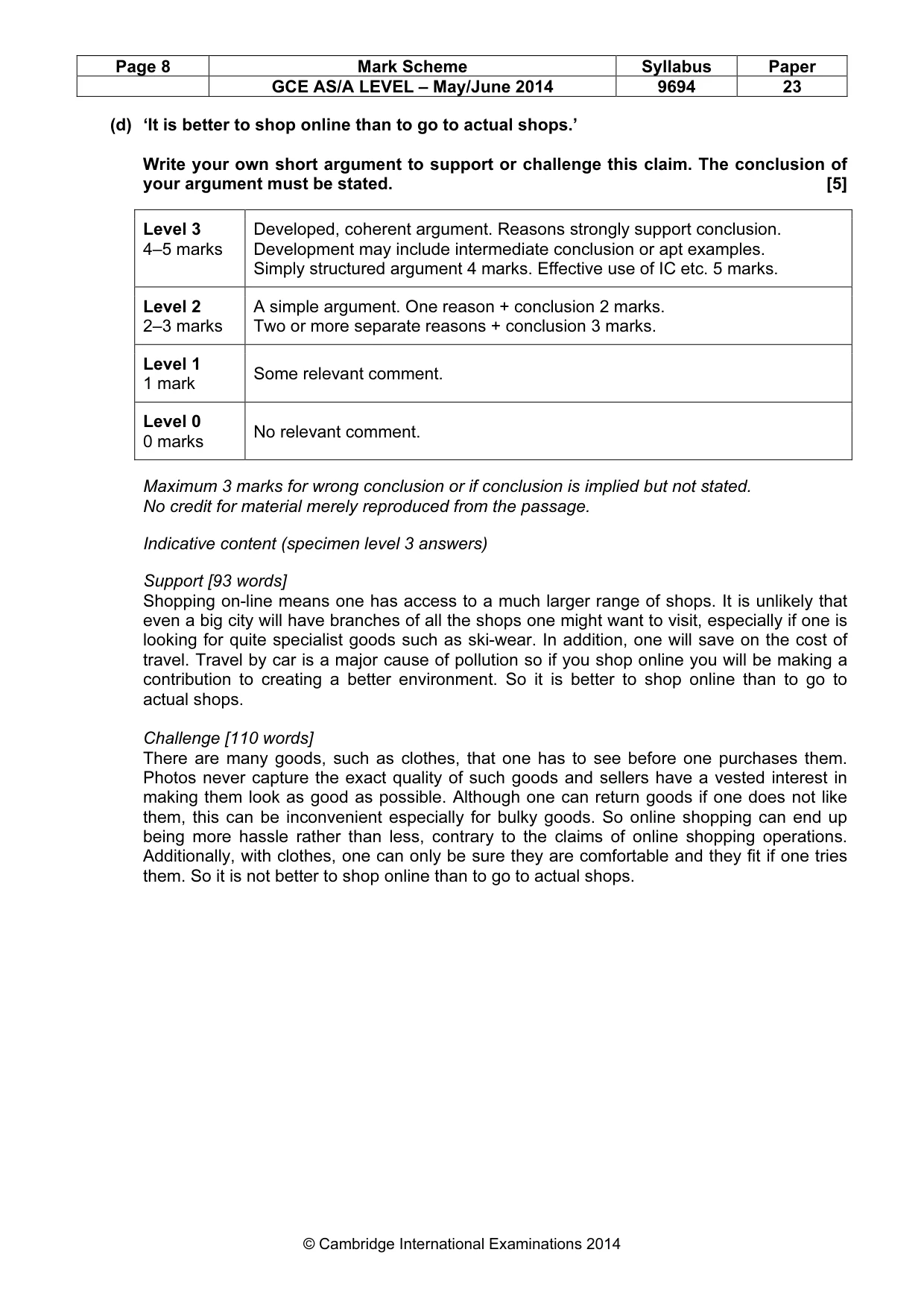
Page 8 Mark Scheme Syllabus Paper GCE AS/A LEVEL – May/June 2014 9694 23 © Cambridge International Examinations 2014 (d) ‘It is better to shop online than to go to actual shops.’ Write your own short argument to support or challenge this claim. The conclusion of your argument must be stated. [5] Level 3 4–5 marks Developed, coherent argument. Reasons strongly support conclusion. Development may include intermediate conclusion or apt examples. Simply structured argument 4 marks. Effective use of IC etc. 5 marks. Level 2 2–3 marks A simple argument. One reason + conclusion 2 marks. Two or more separate reasons + conclusion 3 marks. Level 1 1 mark Some relevant comment. Level 0 0 marks No relevant comment. Maximum 3 marks for wrong conclusion or if conclusion is implied but not stated. No credit for material merely reproduced from the passage. Indicative content (specimen level 3 answers) Support [93 words] Shopping on-line means one has access to a much larger range of shops. It is unlikely that even a big city will have branches of all the shops one might want to visit, especially if one is looking for quite specialist goods such as ski-wear. In addition, one will save on the cost of travel. Travel by car is a major cause of pollution so if you shop online you will be making a contribution to creating a better environment. So it is better to shop online than to go to actual shops. Challenge [110 words] There are many goods, such as clothes, that one has to see before one purchases them. Photos never capture the exact quality of such goods and sellers have a vested interest in making them look as good as possible. Although one can return goods if one does not like them, this can be inconvenient especially for bulky goods. So online shopping can end up being more hassle rather than less, contrary to the claims of online shopping operations. Additionally, with clothes, one can only be sure they are comfortable and they fit if one tries them. So it is not better to shop online than to go to actual shops.
What you needed in this session
Cambridge’s own grade thresholds for 2014 May/June, Paper 2 · Variant 3. A higher threshold means an easier paper — the bar moves with how the cohort did.