Cambridge A Level Thinking Skills 9694 — 2010 Oct/Nov Paper 2 · Variant 1
9694/21/O/N/10 · 45 marks · ≈51 min
The question paper and its mark scheme, free to read here and free to download. This is Cambridge’s own paper, exactly as it was sat.
Question paper8 pages

Mark scheme8 pages
Answers below. Sit the paper first if you are practising.
Paper as text
Question paper, page 1
This document consists of 6 printed pages and 2 blank pages. IB10 11_9694_21/3RP © UCLES 2010 [Turn over *9562278066* UNIVERSITY OF CAMBRIDGE INTERNATIONAL EXAMINATIONS General Certificate of Education Advanced Subsidiary Level and Advanced Level THINKING SKILLS 9694/21 Paper 2 Critical Reasoning October/November 2010 1 hour 30 minutes Additional Materials: Answer Booklet/Paper READ THESE INSTRUCTIONS FIRST If you have been given an Answer Booklet, follow the instructions on the front cover of the booklet. Write your Centre number, candidate number and name on all the work you hand in. Write in dark blue or black pen. Do not use staples, paper clips, highlighters, glue or correction fluid. DO NOT WRITE IN ANY BARCODES. Answer all the questions. Start each question on a new answer sheet. At the end of the examination, fasten all your work securely together. The number of marks is given in brackets [ ] at the end of each question.
Question paper, page 2
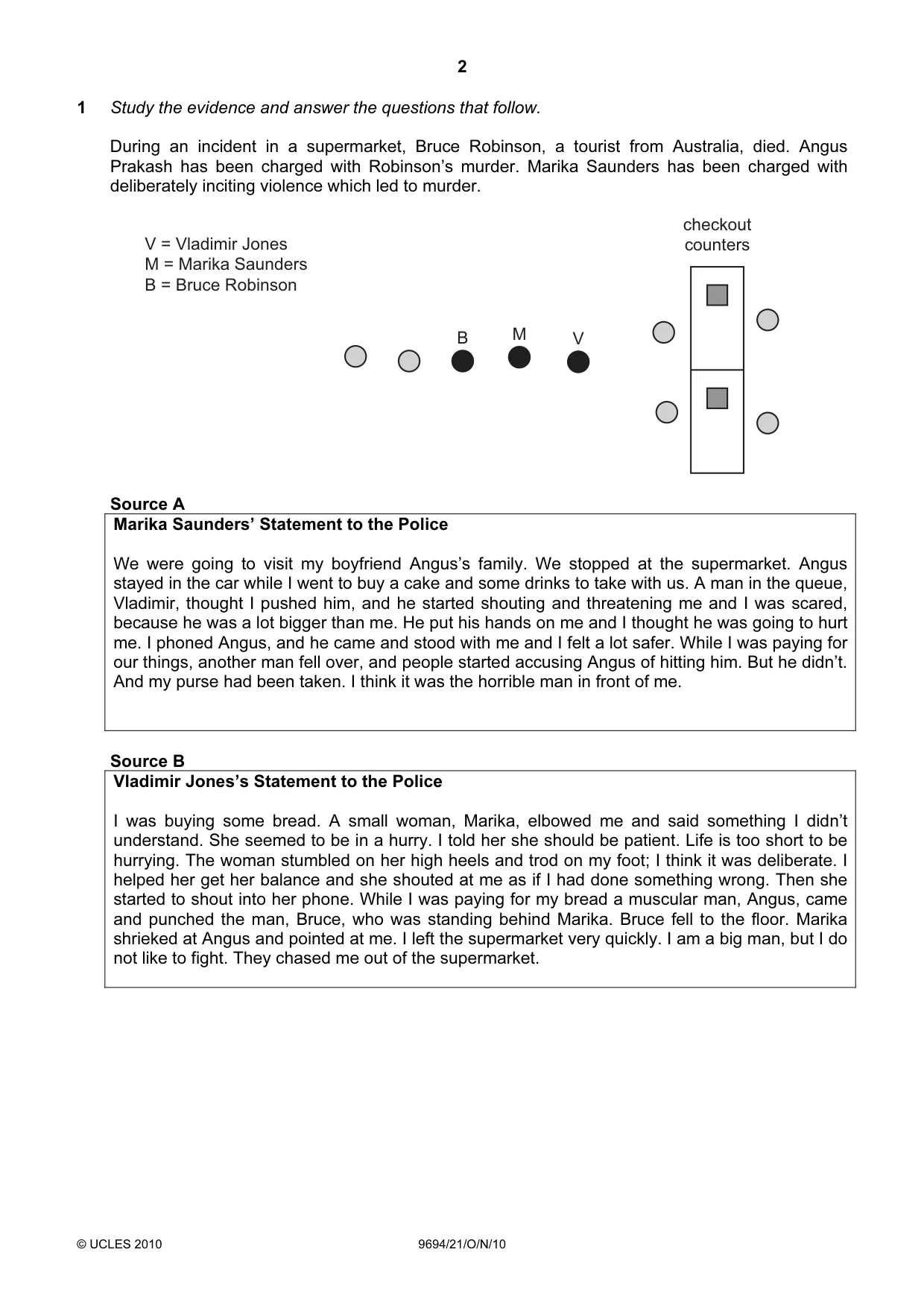
2 © UCLES 2010 9694/21/O/N/10 1 Study the evidence and answer the questions that follow. During an incident in a supermarket, Bruce Robinson, a tourist from Australia, died. Angus Prakash has been charged with Robinson’s murder. Marika Saunders has been charged with deliberately inciting violence which led to murder. checkout counters B M V V = Vladimir Jones M = Marika Saunders B = Bruce Robinson Source A Marika Saunders’ Statement to the Police We were going to visit my boyfriend Angus’s family. We stopped at the supermarket. Angus stayed in the car while I went to buy a cake and some drinks to take with us. A man in the queue, Vladimir, thought I pushed him, and he started shouting and threatening me and I was scared, because he was a lot bigger than me. He put his hands on me and I thought he was going to hurt me. I phoned Angus, and he came and stood with me and I felt a lot safer. While I was paying for our things, another man fell over, and people started accusing Angus of hitting him. But he didn’t. And my purse had been taken. I think it was the horrible man in front of me. Source B Vladimir Jones’s Statement to the Police I was buying some bread. A small woman, Marika, elbowed me and said something I didn’t understand. She seemed to be in a hurry. I told her she should be patient. Life is too short to be hurrying. The woman stumbled on her high heels and trod on my foot; I think it was deliberate. I helped her get her balance and she shouted at me as if I had done something wrong. Then she started to shout into her phone. While I was paying for my bread a muscular man, Angus, came and punched the man, Bruce, who was standing behind Marika. Bruce fell to the floor. Marika shrieked at Angus and pointed at me. I left the supermarket very quickly. I am a big man, but I do not like to fight. They chased me out of the supermarket.
Question paper, page 3
3 © UCLES 2010 9694/21/O/N/10 [Turn over Source C Paramedic’s Statement to the Police I was called to the supermarket on Commercial Road to treat the victim of an assault, Bruce Robinson. There were marks on his neck consistent with a single, hard punch. He had fallen over backwards and hit his head on a shelf. His heart had stopped beating and he was not breathing, so I gave him emergency treatment. He was taken to hospital. When I arrived at the supermarket, security guards were leading people I now know to be Marika Saunders and Angus Prakash into the supermarket. Marika was shouting at Angus. All I heard was, “stupid idiot” and “wrong one”. I do not know what she meant. Source D Other Evidence The security camera’s view of the incident was largely blocked by a supermarket employee who was unloading a large container of fresh produce onto the shelves. However, the employee moved the container for a short time towards the end of the incident. It was possible to see a small, angry woman pointing at a man running away. There was a muscular man beside her and a man lying on the floor by their feet. Marika’s purse was found in bushes outside the supermarket. It still contained her money and credit cards. It did not have Vladimir’s fingerprints on it. (a) How reliable is Vladimir’s account of the incident? Justify your answer. [3] (b) How useful is the paramedic’s evidence in deciding what actually happened during the incident? Justify your answer. [3] (c) Suggest one piece of additional information that it would be useful to have about this incident. Explain how this would help you make a decision about what happened. [3] (d) How likely is it that Marika intended Angus to use violence? Support your answer with critical reference to the evidence and a consideration of the plausibility of different possible courses of events. [6]
Question paper, page 4
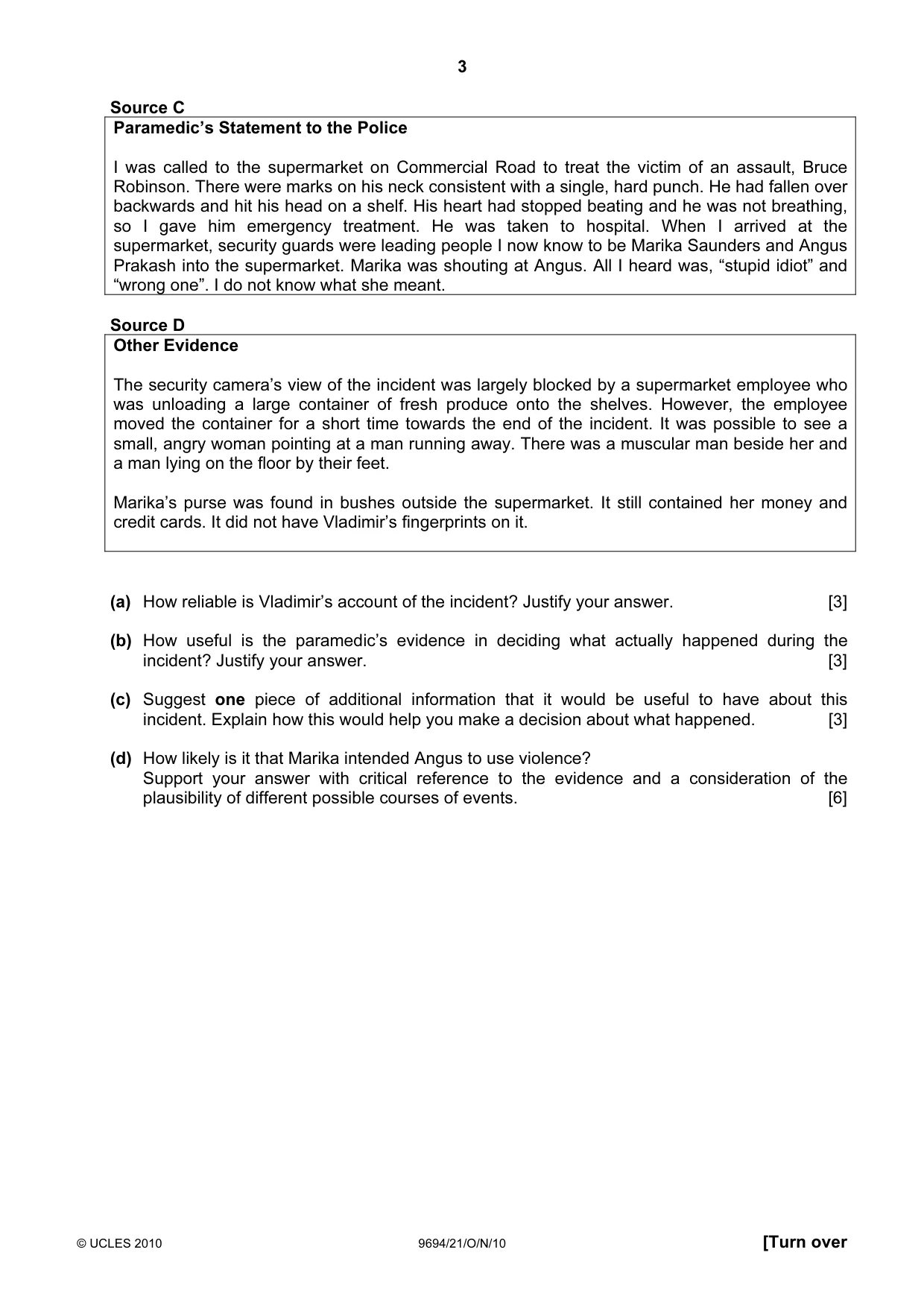
4 © UCLES 2010 9694/21/O/N/10 2 Study the evidence and answer the questions that follow. Source A Experiment Researchers from Plymouth University, UK, conducted an experiment to see how doodling* affects our memory. There were 40 test subjects, 35 women and 5 men, all members of the British public aged between 18 and 55 years. They were asked to listen to a dull phone message which lasted for two and a half minutes. It included places and the names of people who could and could not attend a party. Half the group was asked to doodle by shading squares and circles. The other half did not doodle. The test subjects were then asked to write down the names of eight people who could attend the party and eight place names. The test subjects who had doodled remembered on average 7.5 names and place names. Those who had not doodled remembered only 5.8. Source B Newspaper Report You should doodle in dull meetings Experiments show that doodling improves your memory. Experts from the University of Plymouth explained this effect by suggesting that doodling stops you from daydreaming, which allows you to concentrate better on a dull task. The experiment showed that doodlers remembered 29% more. Source C Blog and Reactions to Newspaper Report JayZeeTee Our psychology teacher used to encourage us to doodle. She said it linked images and memories of physical movement to concepts being taught. She didn’t say anything about daydreaming. PurpleDog Doodling is distracting. I take notes. I never read them, but they help me keep focused on what is being said. VroomZoom Note-taking and doodling are different and they work in different ways. Note-taking keeps you focused on what is being said. Doodling just stops you getting too interested in anything else (like daydreaming). Ellie_Jay I think there’s more to doodling than anyone’s suggested. I think it does two things. It brings your creative right brain into action and allows it to work on what you’re listening to. It also helps to put you into a sort of mental state where what you hear goes straight into your memory instead of getting lost in the conscious bits of your brain. RhubarbandCustard wow i must be smart i doodle in my margins in science and english!!!
Question paper, page 5
5 © UCLES 2010 9694/21/O/N/10 [Turn over Source D Samples of Doodles by Different People * To doodle: to draw pictures or patterns while thinking about something else or when you are bored. (a) Consider the test subjects in the experiment (Source A). How representative is this sample? Justify your answer. [3] (b) Consider the task used in the experiment (Source A). Is this a reasonable test of whether doodling affects memory? Explain your answer. [3] (c) “wow i must be smart i doodle in my margins in science and english!!!” (Source C). Explain what is wrong with this reasoning. [3] (d) Does doodling improve memory because it stops daydreaming? Write a short, reasoned argument to support your conclusion, using and evaluating the information provided in Sources A to D. [6]
Question paper, page 6
6 © UCLES 2010 9694/21/O/N/10 3 Read the passage and answer the questions below. 1 Reality TV should be banned from our televisions. At the moment entire channels are devoted to reality TV. This is a potential disaster both for vulnerable individuals and for society as a whole. 2 Vulnerable people are put under a great deal of pressure during and after the filming of reality TV shows. They want fame, but do not realise how stressful it is to always be watched, to be on trial, and to have your struggles and weaknesses highlighted and broadcast to the world. On reality talent shows, judges can be brutal in their assessment of a candidate’s performance, often going beyond honesty to nastiness. Telling a singer that his voice is not good enough is one thing; telling him he is good for nothing is quite another. In other cases, people who are given the chance to change their lives simply can’t deal with the pressure. One talented boxer took his own life because he could not take the stress of life in front of the cameras. He is not alone. 3 Very few participants in reality TV shows gain long-term stardom. They have their fifteen minutes of fame, and are then supposed to fit back into normal life. One television company cancelled a woman’s cosmetic surgery because it didn’t fit in with the makeover show’s production schedule. She was not even offered counselling by the television show to help her deal with the disappointment. We can see that reality TV treats people like garbage. 4 It is argued that we should accept reality TV because people like it – but people like witch hunts and public executions too. That doesn’t mean we should accept them. This kind of television show destroys people’s lives. 5 Reality TV also encourages a superficial view of humanity because it is based on a freak-show mentality. It is not good for us all to spend so much time laughing at other people’s attempts to sing, dance or improve themselves. (a) Identify the main conclusion. [1] (b) Identify three reasons given to support the main conclusion. [3] (c) Evaluate the reasoning in the argument. In your answer you could consider any strengths, weaknesses, flaws and unstated assumptions. [6] (d) “People should be allowed to make their own choices, even foolish ones.” Write your own short argument to support this claim. [5]
Question paper, page 7
7 © UCLES 2010 9694/21/O/N/10 BLANK PAGE
Question paper, page 8
8 Permission to reproduce items where third-party owned material protected by copyright is included has been sought and cleared where possible. Every reasonable effort has been made by the publisher (UCLES) to trace copyright holders, but if any items requiring clearance have unwittingly been included, the publisher will be pleased to make amends at the earliest possible opportunity. University of Cambridge International Examinations is part of the Cambridge Assessment Group. Cambridge Assessment is the brand name of University of Cambridge Local Examinations Syndicate (UCLES), which is itself a department of the University of Cambridge. © UCLES 2010 9694/21/O/N/10 BLANK PAGE
Mark scheme, page 1
UNIVERSITY OF CAMBRIDGE INTERNATIONAL EXAMINATIONS GCE Advanced Subsidiary Level and GCE Advanced Level MARK SCHEME for the October/November 2010 question paper for the guidance of teachers 9694 THINKING SKILLS 9694/21 Paper 2 (Critical Reasoning), maximum raw mark 45 This mark scheme is published as an aid to teachers and candidates, to indicate the requirements of the examination. It shows the basis on which Examiners were instructed to award marks. It does not indicate the details of the discussions that took place at an Examiners’ meeting before marking began, which would have considered the acceptability of alternative answers. Mark schemes must be read in conjunction with the question papers and the report on the examination. • CIE will not enter into discussions or correspondence in connection with these mark schemes. CIE is publishing the mark schemes for the October/November 2010 question papers for most IGCSE, GCE Advanced Level and Advanced Subsidiary Level syllabuses and some Ordinary Level syllabuses.
Mark scheme, page 2
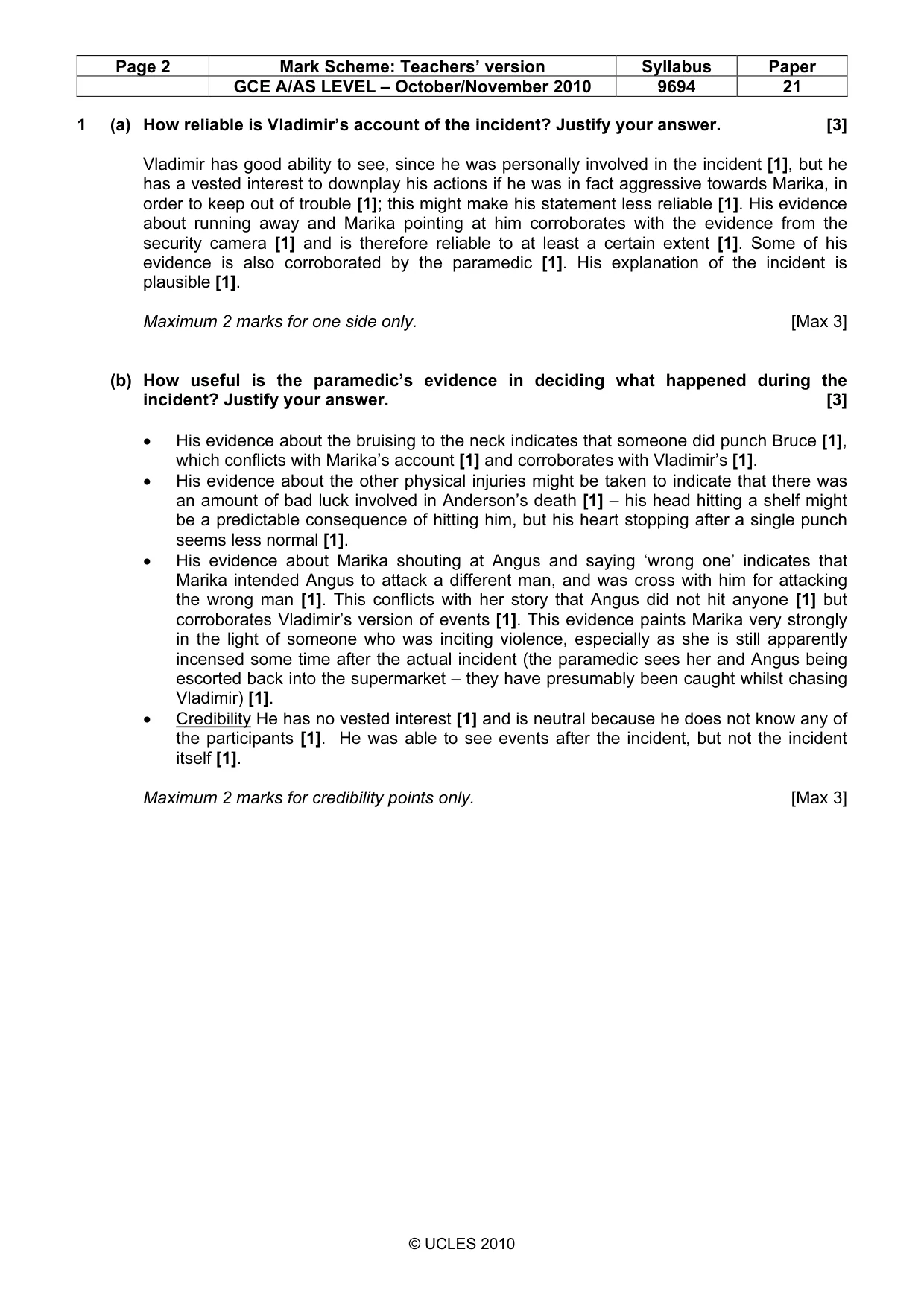
Page 2 Mark Scheme: Teachers’ version Syllabus Paper GCE A/AS LEVEL – October/November 2010 9694 21 © UCLES 2010 1 (a) How reliable is Vladimir’s account of the incident? Justify your answer. [3] Vladimir has good ability to see, since he was personally involved in the incident [1], but he has a vested interest to downplay his actions if he was in fact aggressive towards Marika, in order to keep out of trouble [1]; this might make his statement less reliable [1]. His evidence about running away and Marika pointing at him corroborates with the evidence from the security camera [1] and is therefore reliable to at least a certain extent [1]. Some of his evidence is also corroborated by the paramedic [1]. His explanation of the incident is plausible [1]. Maximum 2 marks for one side only. [Max 3] (b) How useful is the paramedic’s evidence in deciding what happened during the incident? Justify your answer. [3] • His evidence about the bruising to the neck indicates that someone did punch Bruce [1], which conflicts with Marika’s account [1] and corroborates with Vladimir’s [1]. • His evidence about the other physical injuries might be taken to indicate that there was an amount of bad luck involved in Anderson’s death [1] – his head hitting a shelf might be a predictable consequence of hitting him, but his heart stopping after a single punch seems less normal [1]. • His evidence about Marika shouting at Angus and saying ‘wrong one’ indicates that Marika intended Angus to attack a different man, and was cross with him for attacking the wrong man [1]. This conflicts with her story that Angus did not hit anyone [1] but corroborates Vladimir’s version of events [1]. This evidence paints Marika very strongly in the light of someone who was inciting violence, especially as she is still apparently incensed some time after the actual incident (the paramedic sees her and Angus being escorted back into the supermarket – they have presumably been caught whilst chasing Vladimir) [1]. • Credibility He has no vested interest [1] and is neutral because he does not know any of the participants [1]. He was able to see events after the incident, but not the incident itself [1]. Maximum 2 marks for credibility points only. [Max 3]
Mark scheme, page 3
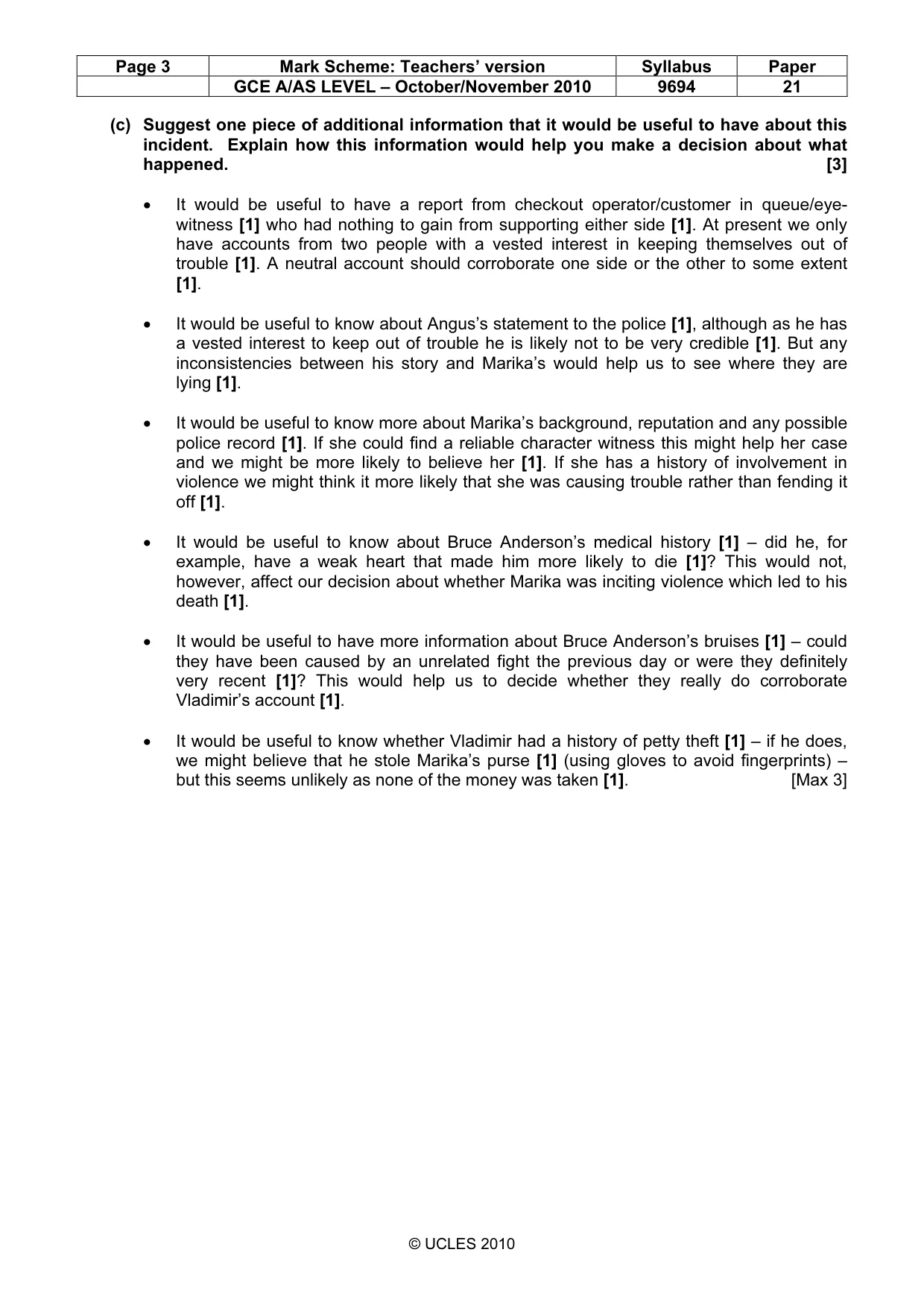
Page 3 Mark Scheme: Teachers’ version Syllabus Paper GCE A/AS LEVEL – October/November 2010 9694 21 © UCLES 2010 (c) Suggest one piece of additional information that it would be useful to have about this incident. Explain how this information would help you make a decision about what happened. [3] • It would be useful to have a report from checkout operator/customer in queue/eye- witness [1] who had nothing to gain from supporting either side [1]. At present we only have accounts from two people with a vested interest in keeping themselves out of trouble [1]. A neutral account should corroborate one side or the other to some extent [1]. • It would be useful to know about Angus’s statement to the police [1], although as he has a vested interest to keep out of trouble he is likely not to be very credible [1]. But any inconsistencies between his story and Marika’s would help us to see where they are lying [1]. • It would be useful to know more about Marika’s background, reputation and any possible police record [1]. If she could find a reliable character witness this might help her case and we might be more likely to believe her [1]. If she has a history of involvement in violence we might think it more likely that she was causing trouble rather than fending it off [1]. • It would be useful to know about Bruce Anderson’s medical history [1] – did he, for example, have a weak heart that made him more likely to die [1]? This would not, however, affect our decision about whether Marika was inciting violence which led to his death [1]. • It would be useful to have more information about Bruce Anderson’s bruises [1] – could they have been caused by an unrelated fight the previous day or were they definitely very recent [1]? This would help us to decide whether they really do corroborate Vladimir’s account [1]. • It would be useful to know whether Vladimir had a history of petty theft [1] – if he does, we might believe that he stole Marika’s purse [1] (using gloves to avoid fingerprints) – but this seems unlikely as none of the money was taken [1]. [Max 3]
Mark scheme, page 4
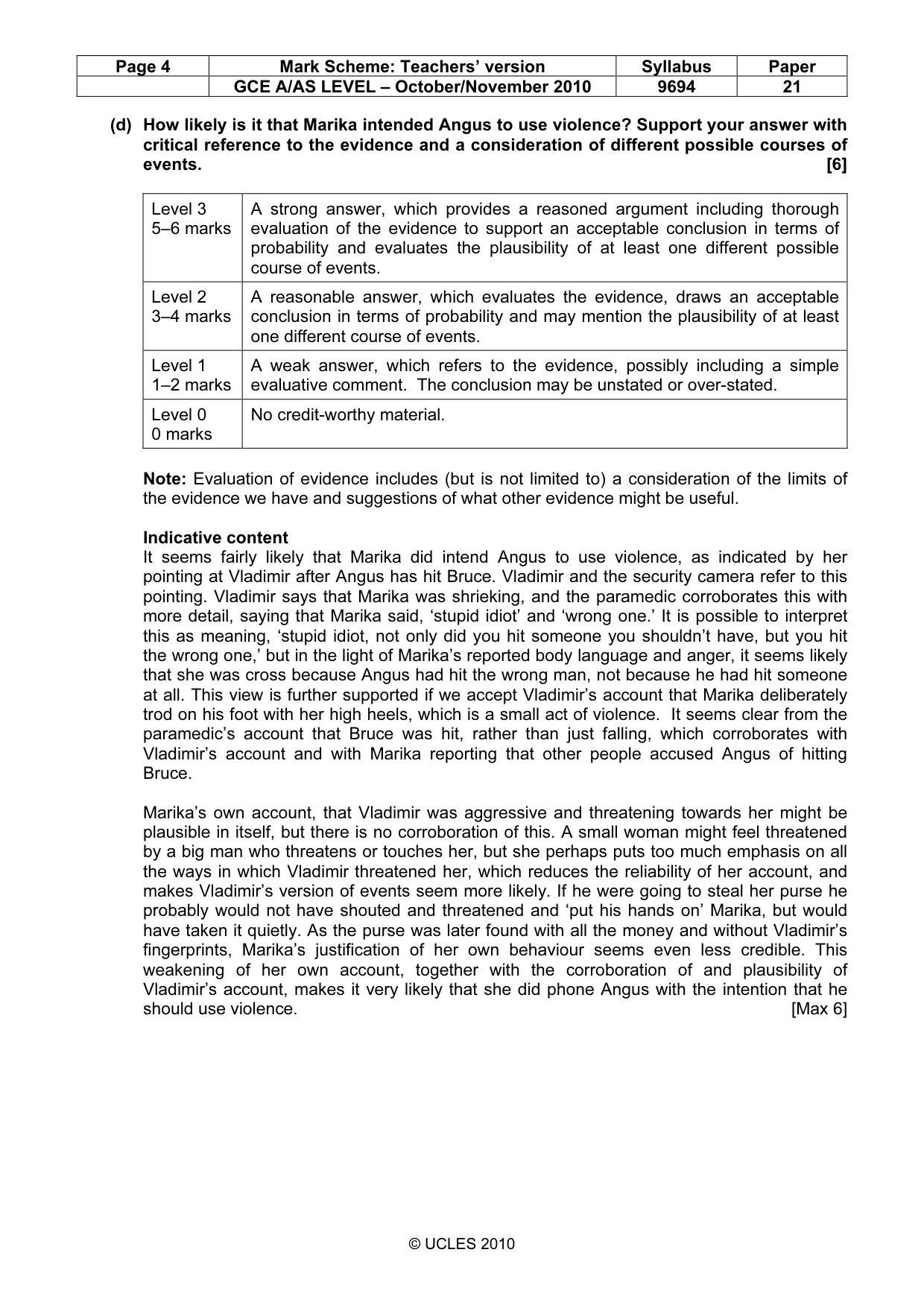
Page 4 Mark Scheme: Teachers’ version Syllabus Paper GCE A/AS LEVEL – October/November 2010 9694 21 © UCLES 2010 (d) How likely is it that Marika intended Angus to use violence? Support your answer with critical reference to the evidence and a consideration of different possible courses of events. [6] Level 3 5–6 marks A strong answer, which provides a reasoned argument including thorough evaluation of the evidence to support an acceptable conclusion in terms of probability and evaluates the plausibility of at least one different possible course of events. Level 2 3–4 marks A reasonable answer, which evaluates the evidence, draws an acceptable conclusion in terms of probability and may mention the plausibility of at least one different course of events. Level 1 1–2 marks A weak answer, which refers to the evidence, possibly including a simple evaluative comment. The conclusion may be unstated or over-stated. Level 0 0 marks No credit-worthy material. Note: Evaluation of evidence includes (but is not limited to) a consideration of the limits of the evidence we have and suggestions of what other evidence might be useful. Indicative content It seems fairly likely that Marika did intend Angus to use violence, as indicated by her pointing at Vladimir after Angus has hit Bruce. Vladimir and the security camera refer to this pointing. Vladimir says that Marika was shrieking, and the paramedic corroborates this with more detail, saying that Marika said, ‘stupid idiot’ and ‘wrong one.’ It is possible to interpret this as meaning, ‘stupid idiot, not only did you hit someone you shouldn’t have, but you hit the wrong one,’ but in the light of Marika’s reported body language and anger, it seems likely that she was cross because Angus had hit the wrong man, not because he had hit someone at all. This view is further supported if we accept Vladimir’s account that Marika deliberately trod on his foot with her high heels, which is a small act of violence. It seems clear from the paramedic’s account that Bruce was hit, rather than just falling, which corroborates with Vladimir’s account and with Marika reporting that other people accused Angus of hitting Bruce. Marika’s own account, that Vladimir was aggressive and threatening towards her might be plausible in itself, but there is no corroboration of this. A small woman might feel threatened by a big man who threatens or touches her, but she perhaps puts too much emphasis on all the ways in which Vladimir threatened her, which reduces the reliability of her account, and makes Vladimir’s version of events seem more likely. If he were going to steal her purse he probably would not have shouted and threatened and ‘put his hands on’ Marika, but would have taken it quietly. As the purse was later found with all the money and without Vladimir’s fingerprints, Marika’s justification of her own behaviour seems even less credible. This weakening of her own account, together with the corroboration of and plausibility of Vladimir’s account, makes it very likely that she did phone Angus with the intention that he should use violence. [Max 6]
Mark scheme, page 5
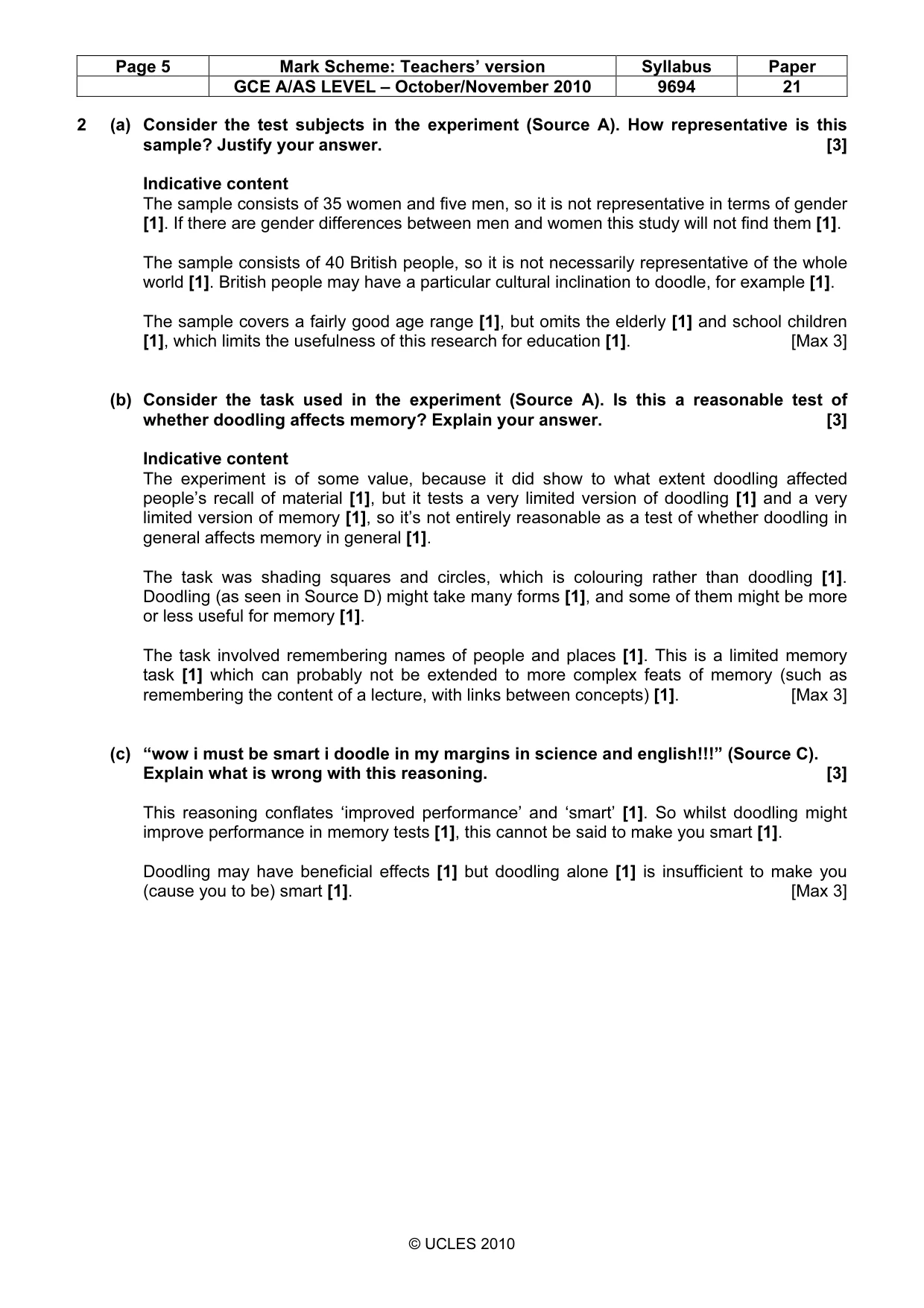
Page 5 Mark Scheme: Teachers’ version Syllabus Paper GCE A/AS LEVEL – October/November 2010 9694 21 © UCLES 2010 2 (a) Consider the test subjects in the experiment (Source A). How representative is this sample? Justify your answer. [3] Indicative content The sample consists of 35 women and five men, so it is not representative in terms of gender [1]. If there are gender differences between men and women this study will not find them [1]. The sample consists of 40 British people, so it is not necessarily representative of the whole world [1]. British people may have a particular cultural inclination to doodle, for example [1]. The sample covers a fairly good age range [1], but omits the elderly [1] and school children [1], which limits the usefulness of this research for education [1]. [Max 3] (b) Consider the task used in the experiment (Source A). Is this a reasonable test of whether doodling affects memory? Explain your answer. [3] Indicative content The experiment is of some value, because it did show to what extent doodling affected people’s recall of material [1], but it tests a very limited version of doodling [1] and a very limited version of memory [1], so it’s not entirely reasonable as a test of whether doodling in general affects memory in general [1]. The task was shading squares and circles, which is colouring rather than doodling [1]. Doodling (as seen in Source D) might take many forms [1], and some of them might be more or less useful for memory [1]. The task involved remembering names of people and places [1]. This is a limited memory task [1] which can probably not be extended to more complex feats of memory (such as remembering the content of a lecture, with links between concepts) [1]. [Max 3] (c) “wow i must be smart i doodle in my margins in science and english!!!” (Source C). Explain what is wrong with this reasoning. [3] This reasoning conflates ‘improved performance’ and ‘smart’ [1]. So whilst doodling might improve performance in memory tests [1], this cannot be said to make you smart [1]. Doodling may have beneficial effects [1] but doodling alone [1] is insufficient to make you (cause you to be) smart [1]. [Max 3]
Mark scheme, page 6
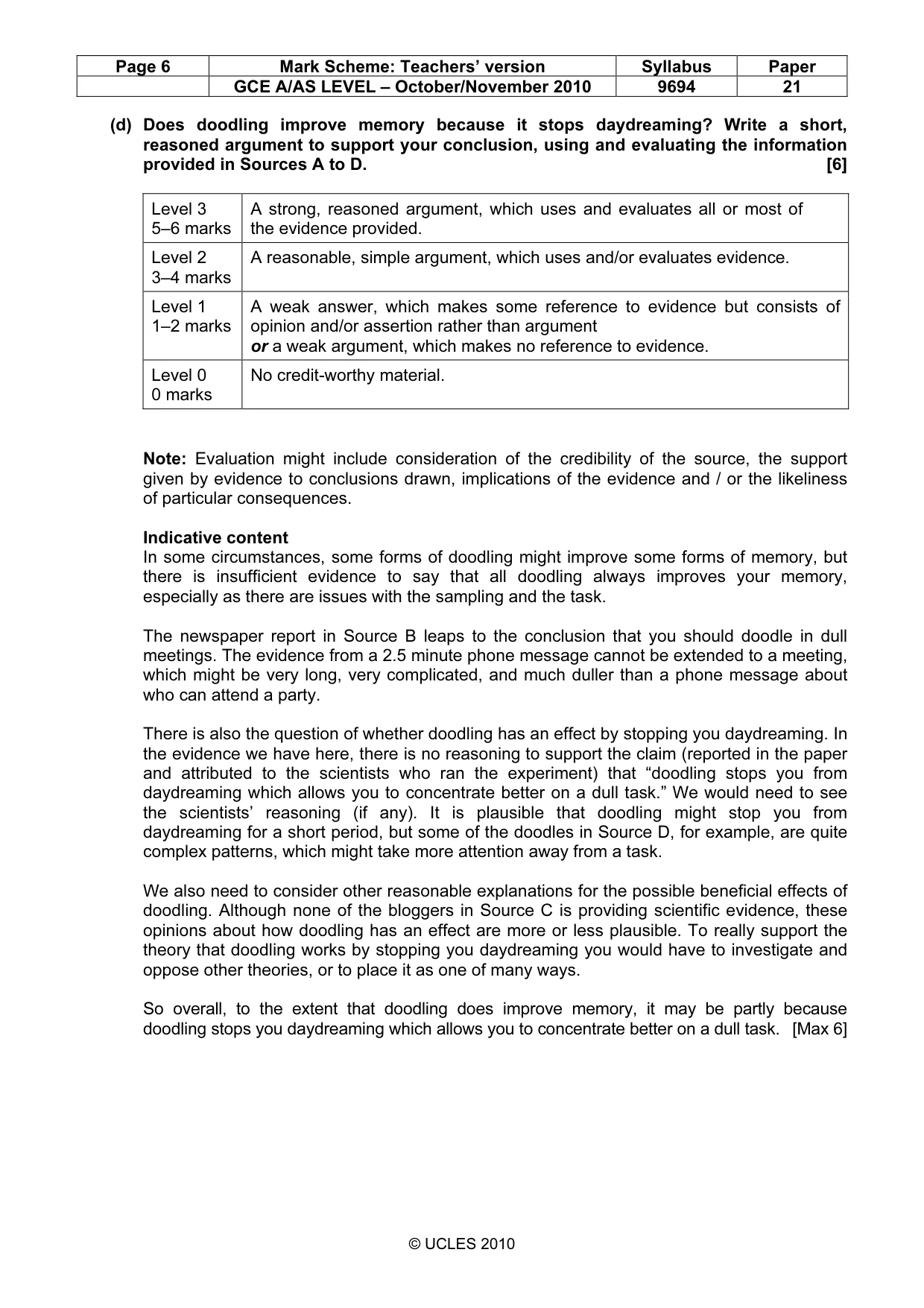
Page 6 Mark Scheme: Teachers’ version Syllabus Paper GCE A/AS LEVEL – October/November 2010 9694 21 © UCLES 2010 (d) Does doodling improve memory because it stops daydreaming? Write a short, reasoned argument to support your conclusion, using and evaluating the information provided in Sources A to D. [6] Level 3 5–6 marks A strong, reasoned argument, which uses and evaluates all or most of the evidence provided. Level 2 3–4 marks A reasonable, simple argument, which uses and/or evaluates evidence. Level 1 1–2 marks A weak answer, which makes some reference to evidence but consists of opinion and/or assertion rather than argument or a weak argument, which makes no reference to evidence. Level 0 0 marks No credit-worthy material. Note: Evaluation might include consideration of the credibility of the source, the support given by evidence to conclusions drawn, implications of the evidence and / or the likeliness of particular consequences. Indicative content In some circumstances, some forms of doodling might improve some forms of memory, but there is insufficient evidence to say that all doodling always improves your memory, especially as there are issues with the sampling and the task. The newspaper report in Source B leaps to the conclusion that you should doodle in dull meetings. The evidence from a 2.5 minute phone message cannot be extended to a meeting, which might be very long, very complicated, and much duller than a phone message about who can attend a party. There is also the question of whether doodling has an effect by stopping you daydreaming. In the evidence we have here, there is no reasoning to support the claim (reported in the paper and attributed to the scientists who ran the experiment) that “doodling stops you from daydreaming which allows you to concentrate better on a dull task.” We would need to see the scientists’ reasoning (if any). It is plausible that doodling might stop you from daydreaming for a short period, but some of the doodles in Source D, for example, are quite complex patterns, which might take more attention away from a task. We also need to consider other reasonable explanations for the possible beneficial effects of doodling. Although none of the bloggers in Source C is providing scientific evidence, these opinions about how doodling has an effect are more or less plausible. To really support the theory that doodling works by stopping you daydreaming you would have to investigate and oppose other theories, or to place it as one of many ways. So overall, to the extent that doodling does improve memory, it may be partly because doodling stops you daydreaming which allows you to concentrate better on a dull task. [Max 6]
Mark scheme, page 7
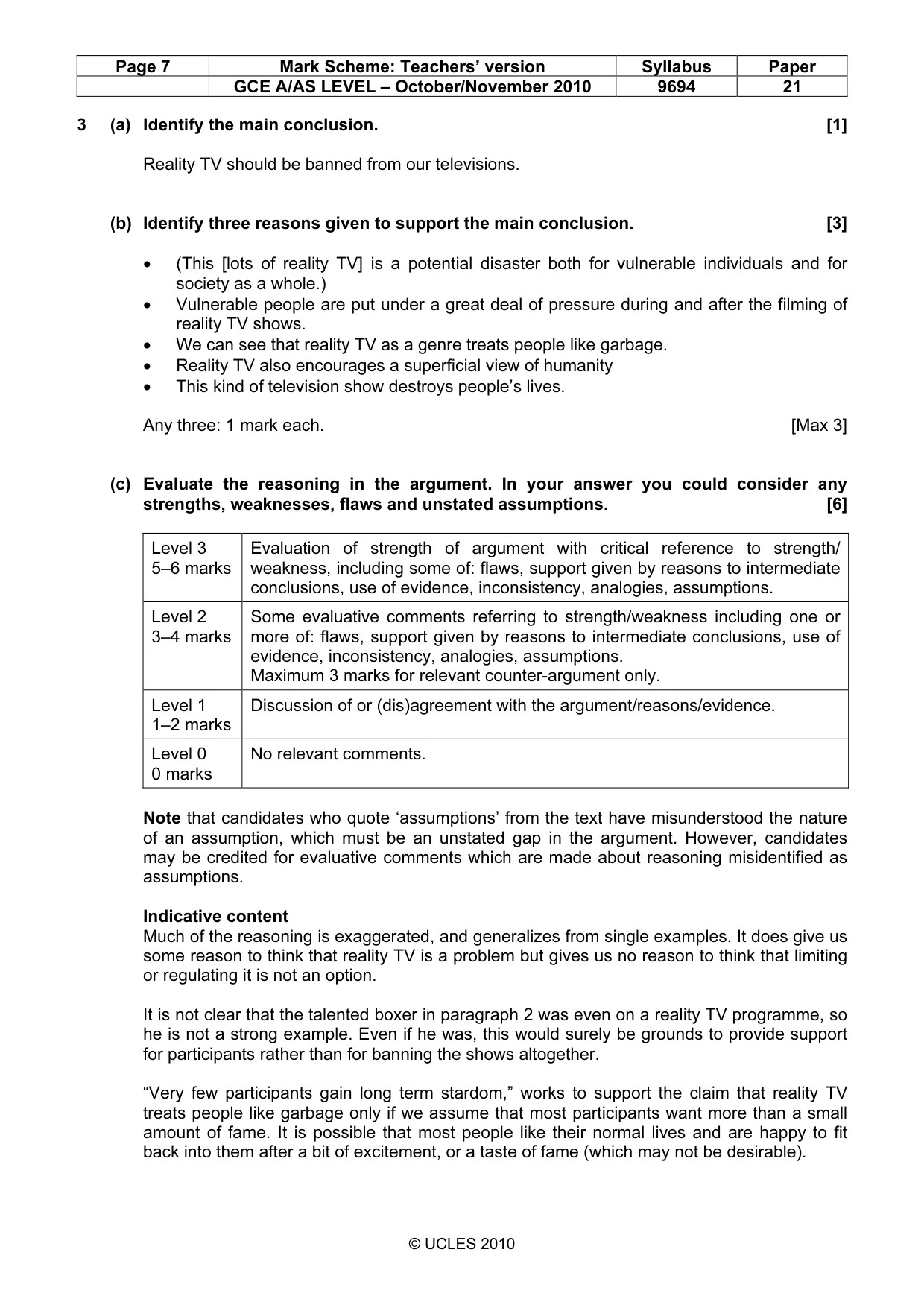
Page 7 Mark Scheme: Teachers’ version Syllabus Paper GCE A/AS LEVEL – October/November 2010 9694 21 © UCLES 2010 3 (a) Identify the main conclusion. [1] Reality TV should be banned from our televisions. (b) Identify three reasons given to support the main conclusion. [3] • (This [lots of reality TV] is a potential disaster both for vulnerable individuals and for society as a whole.) • Vulnerable people are put under a great deal of pressure during and after the filming of reality TV shows. • We can see that reality TV as a genre treats people like garbage. • Reality TV also encourages a superficial view of humanity • This kind of television show destroys people’s lives. Any three: 1 mark each. [Max 3] (c) Evaluate the reasoning in the argument. In your answer you could consider any strengths, weaknesses, flaws and unstated assumptions. [6] Level 3 5–6 marks Evaluation of strength of argument with critical reference to strength/ weakness, including some of: flaws, support given by reasons to intermediate conclusions, use of evidence, inconsistency, analogies, assumptions. Level 2 3–4 marks Some evaluative comments referring to strength/weakness including one or more of: flaws, support given by reasons to intermediate conclusions, use of evidence, inconsistency, analogies, assumptions. Maximum 3 marks for relevant counter-argument only. Level 1 1–2 marks Discussion of or (dis)agreement with the argument/reasons/evidence. Level 0 0 marks No relevant comments. Note that candidates who quote ‘assumptions’ from the text have misunderstood the nature of an assumption, which must be an unstated gap in the argument. However, candidates may be credited for evaluative comments which are made about reasoning misidentified as assumptions. Indicative content Much of the reasoning is exaggerated, and generalizes from single examples. It does give us some reason to think that reality TV is a problem but gives us no reason to think that limiting or regulating it is not an option. It is not clear that the talented boxer in paragraph 2 was even on a reality TV programme, so he is not a strong example. Even if he was, this would surely be grounds to provide support for participants rather than for banning the shows altogether. “Very few participants gain long term stardom,” works to support the claim that reality TV treats people like garbage only if we assume that most participants want more than a small amount of fame. It is possible that most people like their normal lives and are happy to fit back into them after a bit of excitement, or a taste of fame (which may not be desirable).
Mark scheme, page 8
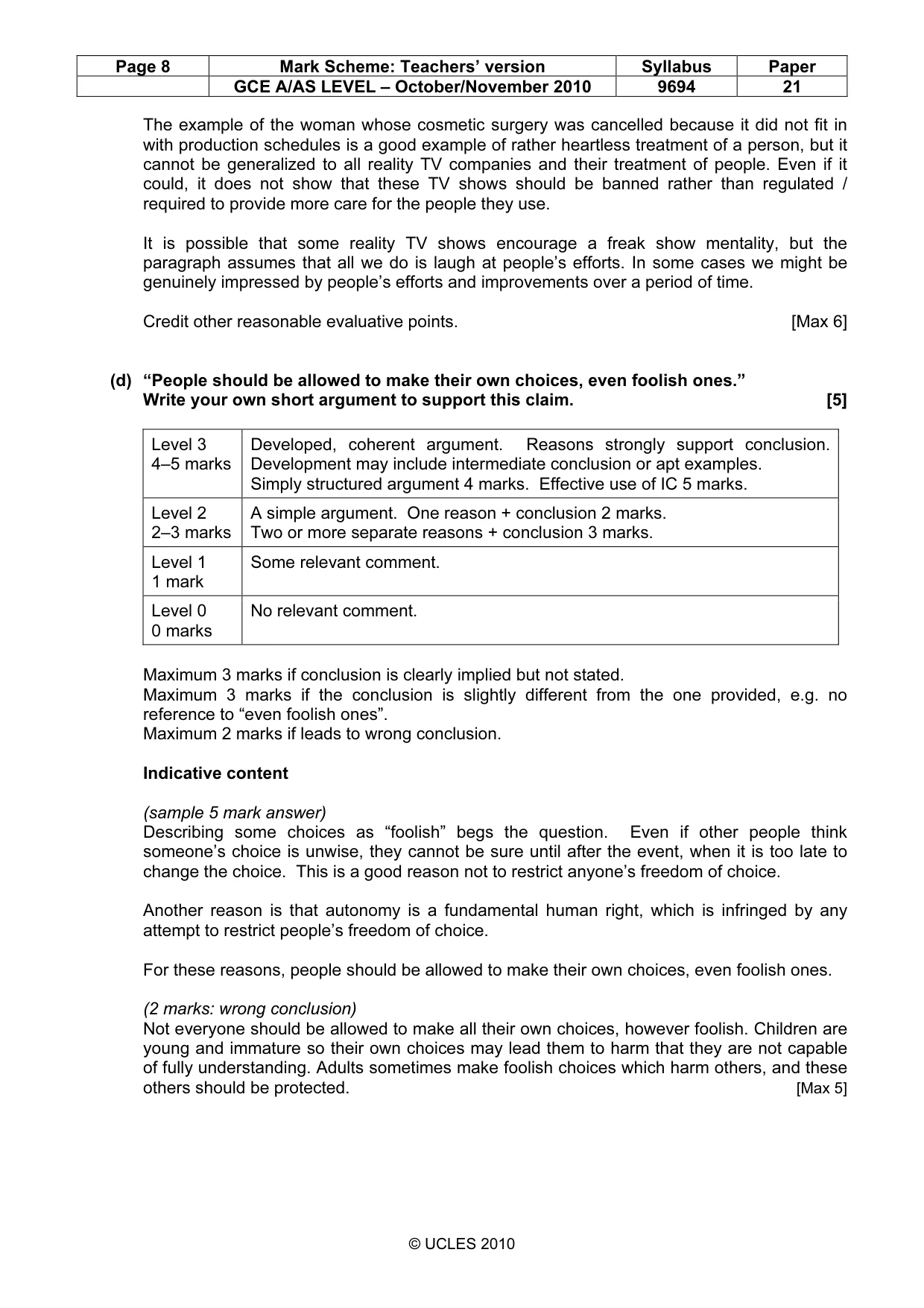
Page 8 Mark Scheme: Teachers’ version Syllabus Paper GCE A/AS LEVEL – October/November 2010 9694 21 © UCLES 2010 The example of the woman whose cosmetic surgery was cancelled because it did not fit in with production schedules is a good example of rather heartless treatment of a person, but it cannot be generalized to all reality TV companies and their treatment of people. Even if it could, it does not show that these TV shows should be banned rather than regulated / required to provide more care for the people they use. It is possible that some reality TV shows encourage a freak show mentality, but the paragraph assumes that all we do is laugh at people’s efforts. In some cases we might be genuinely impressed by people’s efforts and improvements over a period of time. Credit other reasonable evaluative points. [Max 6] (d) “People should be allowed to make their own choices, even foolish ones.” Write your own short argument to support this claim. [5] Level 3 4–5 marks Developed, coherent argument. Reasons strongly support conclusion. Development may include intermediate conclusion or apt examples. Simply structured argument 4 marks. Effective use of IC 5 marks. Level 2 2–3 marks A simple argument. One reason + conclusion 2 marks. Two or more separate reasons + conclusion 3 marks. Level 1 1 mark Some relevant comment. Level 0 0 marks No relevant comment. Maximum 3 marks if conclusion is clearly implied but not stated. Maximum 3 marks if the conclusion is slightly different from the one provided, e.g. no reference to “even foolish ones”. Maximum 2 marks if leads to wrong conclusion. Indicative content (sample 5 mark answer) Describing some choices as “foolish” begs the question. Even if other people think someone’s choice is unwise, they cannot be sure until after the event, when it is too late to change the choice. This is a good reason not to restrict anyone’s freedom of choice. Another reason is that autonomy is a fundamental human right, which is infringed by any attempt to restrict people’s freedom of choice. For these reasons, people should be allowed to make their own choices, even foolish ones. (2 marks: wrong conclusion) Not everyone should be allowed to make all their own choices, however foolish. Children are young and immature so their own choices may lead them to harm that they are not capable of fully understanding. Adults sometimes make foolish choices which harm others, and these others should be protected. [Max 5]
What you needed in this session
Cambridge’s own grade thresholds for 2010 Oct/Nov, Paper 2 · Variant 1. A higher threshold means an easier paper — the bar moves with how the cohort did.