Cambridge A Level Thinking Skills 9694 — 2010 Oct/Nov Paper 2 · Variant 3
9694/23/O/N/10 · 45 marks · ≈51 min
The question paper and its mark scheme, free to read here and free to download. This is Cambridge’s own paper, exactly as it was sat.
Question paper8 pages


Mark scheme9 pages
Answers below. Sit the paper first if you are practising.
Paper as text
Question paper, page 1
This document consists of 6 printed pages and 2 blank pages. IB10 11_9694_23/FP © UCLES 2010 [Turn over *5633429328* UNIVERSITY OF CAMBRIDGE INTERNATIONAL EXAMINATIONS General Certificate of Education Advanced Subsidiary Level and Advanced Level THINKING SKILLS 9694/23 Paper 2 Critical Reasoning October/November 2010 1 hour 30 minutes Additional Materials: Answer Booklet/Paper READ THESE INSTRUCTIONS FIRST If you have been given an Answer Booklet, follow the instructions on the front cover of the booklet. Write your Centre number, candidate number and name on all the work you hand in. Write in dark blue or black pen. Do not use staples, paper clips, highlighters, glue or correction fluid. DO NOT WRITE IN ANY BARCODES. Answer all the questions. Start each question on a new answer sheet. At the end of the examination, fasten all your work securely together. The number of marks is given in brackets [ ] at the end of each question.
Question paper, page 2
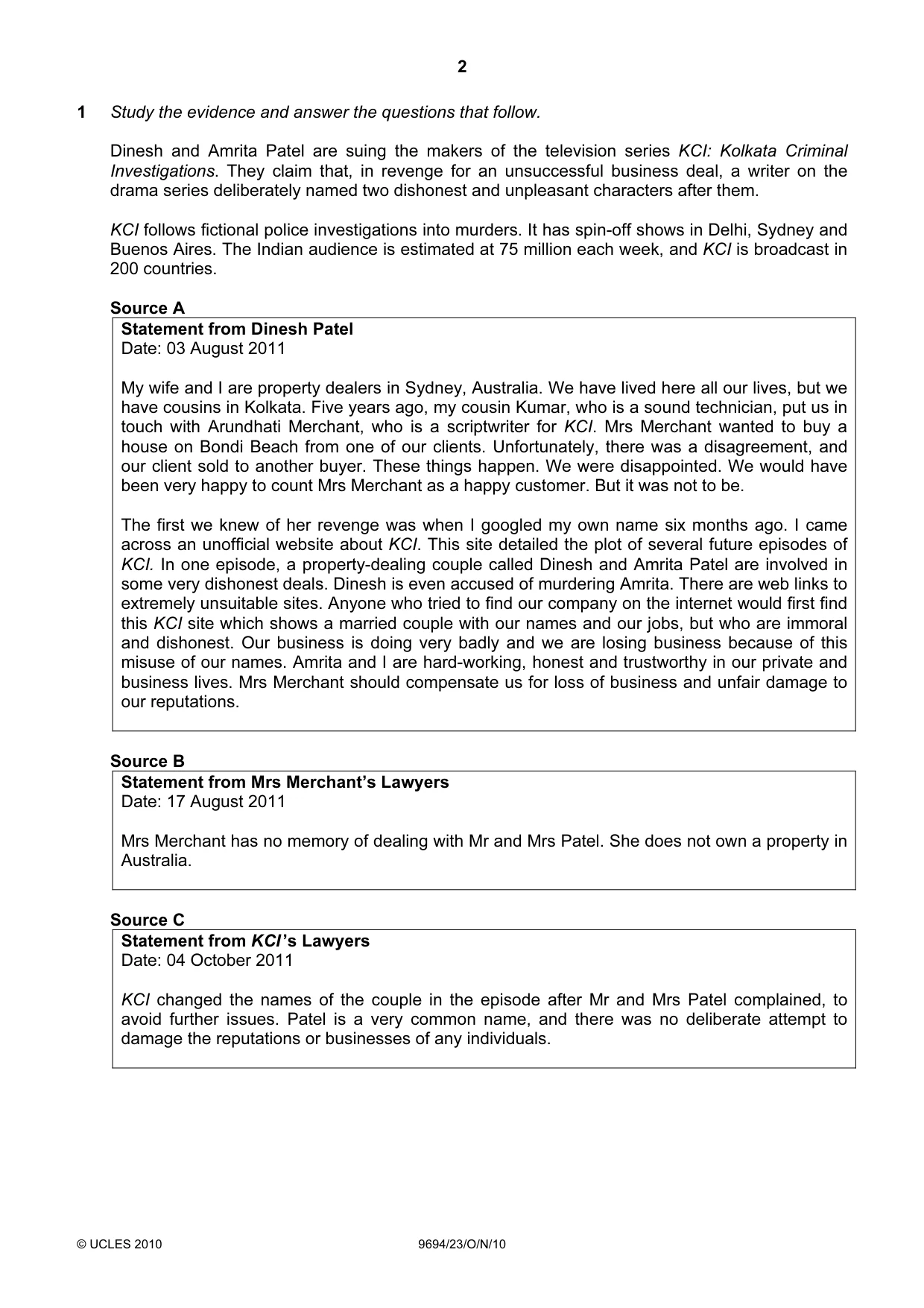
2 © UCLES 2010 9694/23/O/N/10 1 Study the evidence and answer the questions that follow. Dinesh and Amrita Patel are suing the makers of the television series KCI: Kolkata Criminal Investigations. They claim that, in revenge for an unsuccessful business deal, a writer on the drama series deliberately named two dishonest and unpleasant characters after them. KCI follows fictional police investigations into murders. It has spin-off shows in Delhi, Sydney and Buenos Aires. The Indian audience is estimated at 75 million each week, and KCI is broadcast in 200 countries. Source A Statement from Dinesh Patel Date: 03 August 2011 My wife and I are property dealers in Sydney, Australia. We have lived here all our lives, but we have cousins in Kolkata. Five years ago, my cousin Kumar, who is a sound technician, put us in touch with Arundhati Merchant, who is a scriptwriter for KCI. Mrs Merchant wanted to buy a house on Bondi Beach from one of our clients. Unfortunately, there was a disagreement, and our client sold to another buyer. These things happen. We were disappointed. We would have been very happy to count Mrs Merchant as a happy customer. But it was not to be. The first we knew of her revenge was when I googled my own name six months ago. I came across an unofficial website about KCI. This site detailed the plot of several future episodes of KCI. In one episode, a property-dealing couple called Dinesh and Amrita Patel are involved in some very dishonest deals. Dinesh is even accused of murdering Amrita. There are web links to extremely unsuitable sites. Anyone who tried to find our company on the internet would first find this KCI site which shows a married couple with our names and our jobs, but who are immoral and dishonest. Our business is doing very badly and we are losing business because of this misuse of our names. Amrita and I are hard-working, honest and trustworthy in our private and business lives. Mrs Merchant should compensate us for loss of business and unfair damage to our reputations. Source B Statement from Mrs Merchant’s Lawyers Date: 17 August 2011 Mrs Merchant has no memory of dealing with Mr and Mrs Patel. She does not own a property in Australia. Source C Statement from KCI ’s Lawyers Date: 04 October 2011 KCI changed the names of the couple in the episode after Mr and Mrs Patel complained, to avoid further issues. Patel is a very common name, and there was no deliberate attempt to damage the reputations or businesses of any individuals.
Question paper, page 3
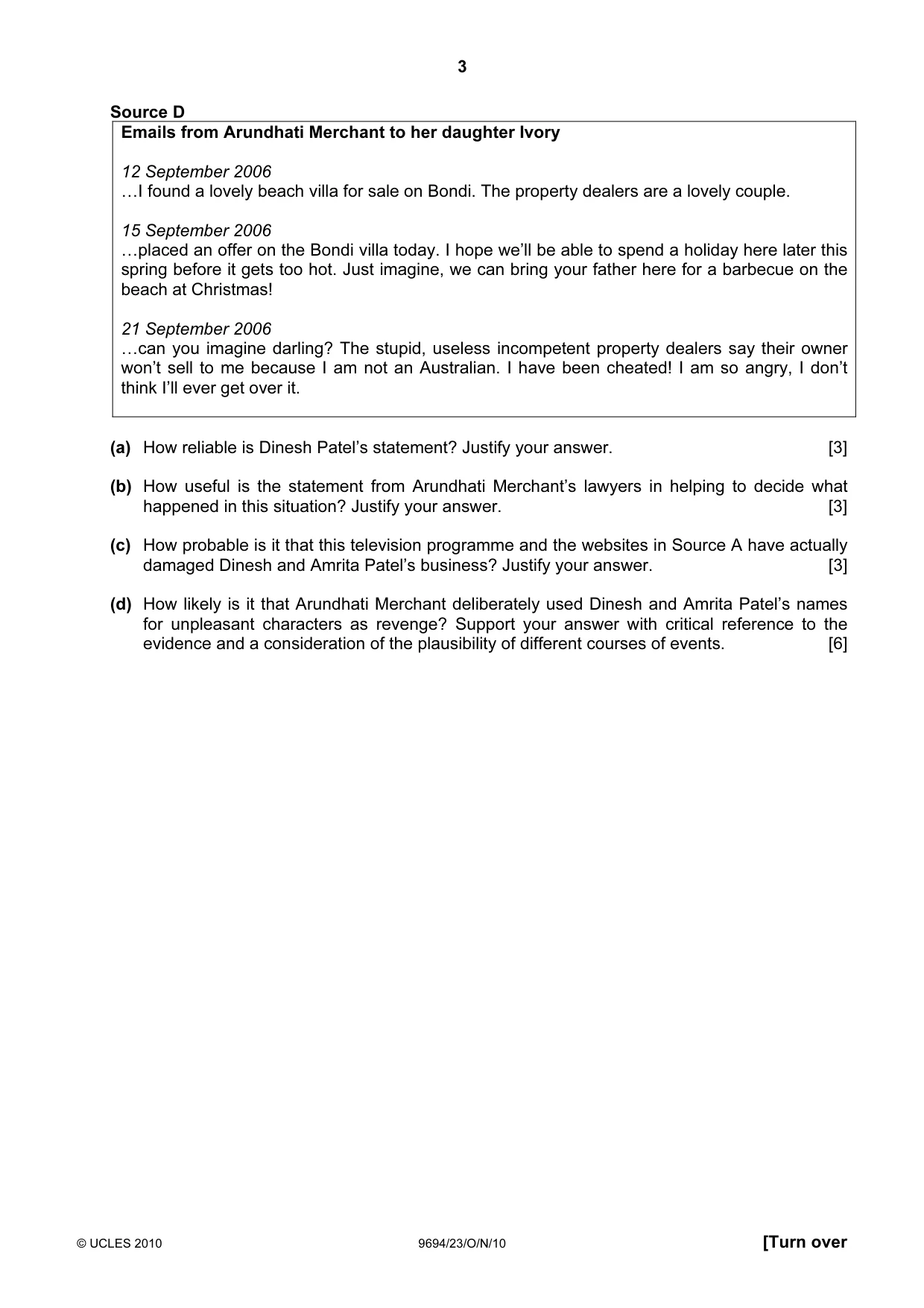
3 © UCLES 2010 9694/23/O/N/10 [Turn over Source D Emails from Arundhati Merchant to her daughter Ivory 12 September 2006 …I found a lovely beach villa for sale on Bondi. The property dealers are a lovely couple. 15 September 2006 …placed an offer on the Bondi villa today. I hope we’ll be able to spend a holiday here later this spring before it gets too hot. Just imagine, we can bring your father here for a barbecue on the beach at Christmas! 21 September 2006 …can you imagine darling? The stupid, useless incompetent property dealers say their owner won’t sell to me because I am not an Australian. I have been cheated! I am so angry, I don’t think I’ll ever get over it. (a) How reliable is Dinesh Patel’s statement? Justify your answer. [3] (b) How useful is the statement from Arundhati Merchant’s lawyers in helping to decide what happened in this situation? Justify your answer. [3] (c) How probable is it that this television programme and the websites in Source A have actually damaged Dinesh and Amrita Patel’s business? Justify your answer. [3] (d) How likely is it that Arundhati Merchant deliberately used Dinesh and Amrita Patel’s names for unpleasant characters as revenge? Support your answer with critical reference to the evidence and a consideration of the plausibility of different courses of events. [6]
Question paper, page 4
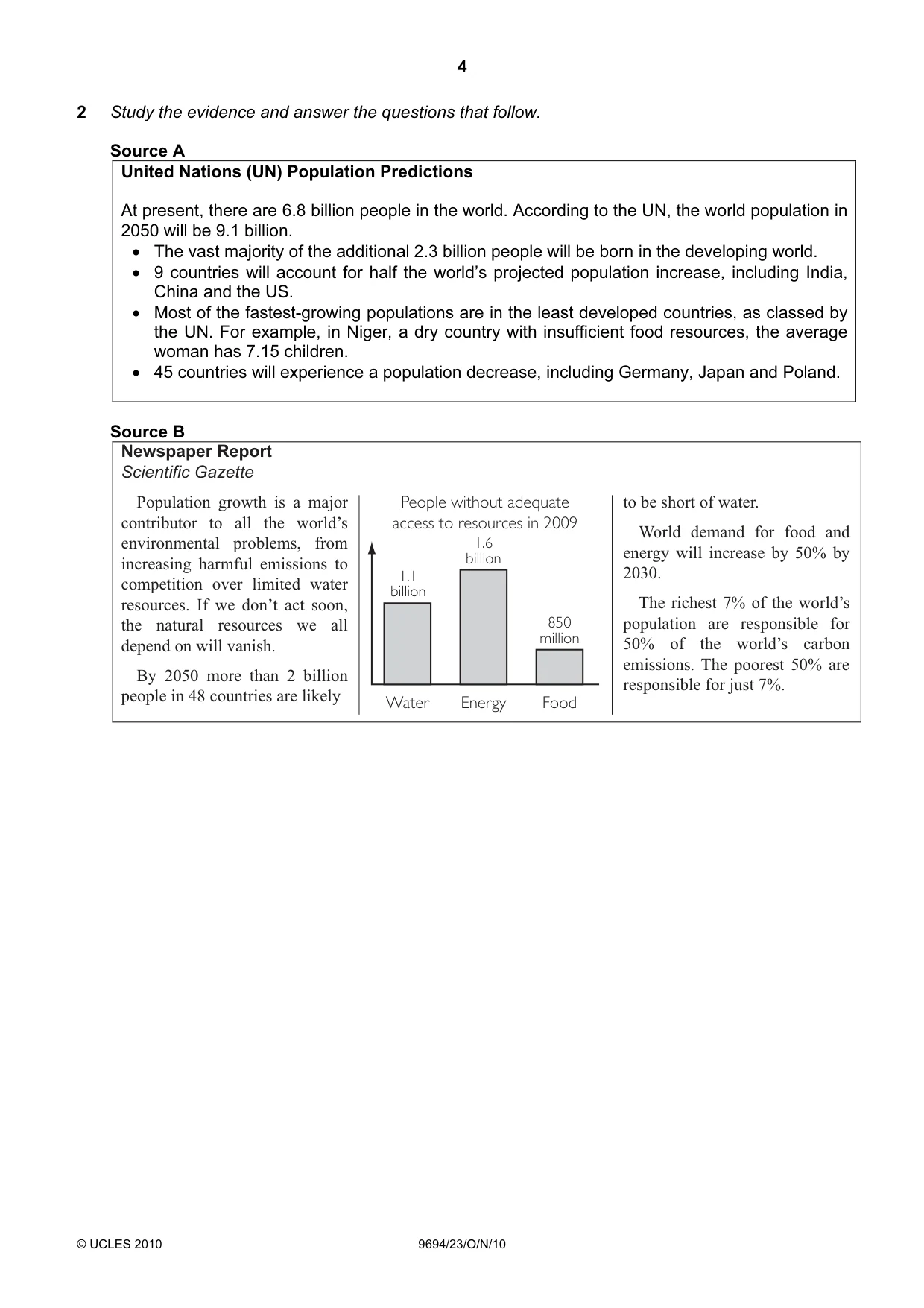
4 © UCLES 2010 9694/23/O/N/10 2 Study the evidence and answer the questions that follow. Source A United Nations (UN) Population Predictions At present, there are 6.8 billion people in the world. According to the UN, the world population in 2050 will be 9.1 billion. • The vast majority of the additional 2.3 billion people will be born in the developing world. • 9 countries will account for half the world’s projected population increase, including India, China and the US. • Most of the fastest-growing populations are in the least developed countries, as classed by the UN. For example, in Niger, a dry country with insufficient food resources, the average woman has 7.15 children. • 45 countries will experience a population decrease, including Germany, Japan and Poland. Source B Newspaper Report Scientific Gazette Population growth is a major contributor to all the world’s environmental problems, from increasing harmful emissions to competition over limited water resources. If we don’t act soon, the natural resources we all depend on will vanish. By 2050 more than 2 billion people in 48 countries are likely to be short of water. World demand for food and energy will increase by 50% by 2030. The richest 7% of the world’s population are responsible for 50% of the world’s carbon emissions. The poorest 50% are responsible for just 7%. People without adequate access to resources in 2009 Food Energy Water 850 million 1.6 billion 1.1 billion
Question paper, page 5
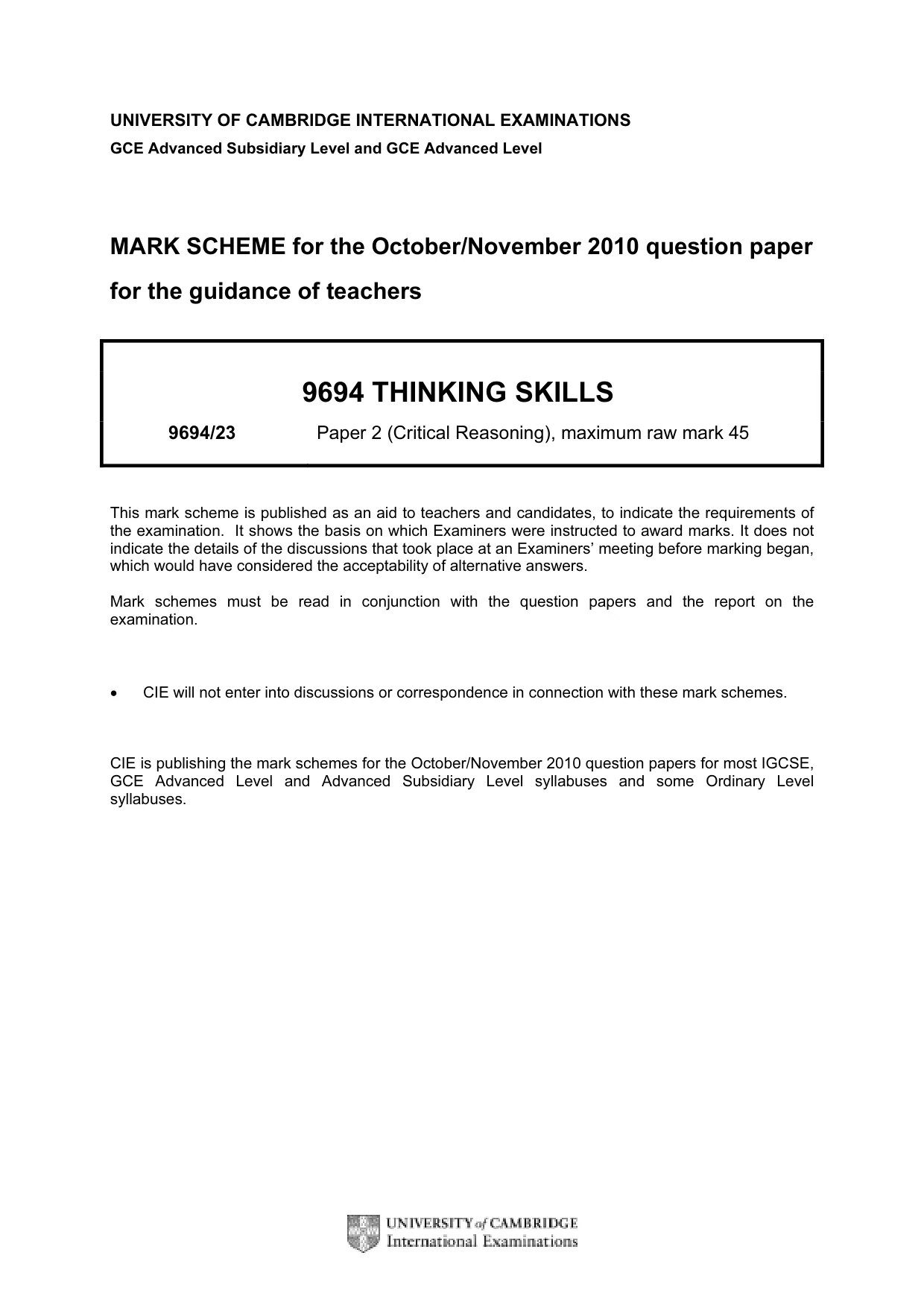
5 © UCLES 2010 9694/23/O/N/10 [Turn over Source C Reader’s Letter to the Scientific Gazette Dear Sir We must control the population. It’s simple. The world’s resources are like a cake. The more people you share with, the smaller the piece of cake. Eventually, there just won’t be enough cake to go round. At some point, human population growth must stop. Either we take control and there are fewer births, or there will be more deaths because of starvation, illness and war. There is no third way of indefinite population growth. In my view, the options for population control are: • Encourage family planning. The Optimum Population Trust promotes a ‘Stop at Two’ policy, encouraging people to see a third child as a drain on world resources. • Make reliable contraceptives available. • Pass laws to restrict the number of children people can have. The Chinese ‘one child’ policy has been in place since 1978 and has probably prevented 4OO million births. • Forced sterilisation. We must do something now before it is too late. Yours Faithfully Peter Jones (a) “According to the UN, the world population in 2050 will be 9.1 billion.” (Source A). Suggest one factor that might affect the accuracy of this prediction. Explain your answer. [3] (b) “If we don’t act soon, the natural resources we all depend on will disappear.” (Source B). How reasonable is this claim? Justify your answer. [3] (c) “The world’s resources are like a cake.” (Source C). How effective is this analogy? Justify your answer. [3] (d) Should controlling population growth be a top priority for world leaders? Write a short, reasoned argument to support your conclusion, using and evaluating the information provided in Sources A to C. [6]
Question paper, page 6
6 © UCLES 2010 9694/23/O/N/10 3 Read the passage and answer the questions that follow. 1 Some people argue that the increasing use of English around the world is a new form of imperialism and that we should therefore put more effort into promoting local languages. Poor people who do not have access to education, or people who are just not good at learning languages, have a serious disadvantage. In addition, the constant use of English means that films and books in other languages never gain a world audience. These people claim that we are all being drowned by English-language culture. 2 However, we should actively promote the use of English because there are many advantages to having one world language. 3 Using just one language to communicate is efficient. In business it is faster if people can speak directly to each other rather than using translators. For example, a deal can be done between companies in China, Brazil and Swaziland, and all partners can use English. If companies can easily communicate in one language with potential business partners then they are less likely to lose business. There are currently businesses in the UK, for example, which lose business in Spain because they do not have enough Spanish speakers. 4 Science also gains from the use of a shared language. Scientists from around the world can read each other’s work and build on it. This means that scientists speaking different languages do not need to repeat each other’s work, and progress can be made more quickly. 5 If we educate as many children as possible in English, these children will be able to share their understanding, and soon everyone will have access to English and all its benefits. English does not need to be the main language spoken in a country. Many people use English for business and a different language at home. Khowar speakers talk of this language of the hearth and home being the language of the heart; English will not replace this, merely add to it. (a) Identify the main conclusion. [1] (b) Identify three reasons given to support the main conclusion. [3] (c) Evaluate the reasoning in the argument. In your answer you could consider any strengths, weaknesses, flaws and unstated assumptions. [6] (d) “It is important to encourage films, songs and books in local languages.” Write your own short argument to support this claim. [5]
Question paper, page 7
7 © UCLES 2010 9694/23/O/N/10 BLANK PAGE
Question paper, page 8
8 Permission to reproduce items where third-party owned material protected by copyright is included has been sought and cleared where possible. Every reasonable effort has been made by the publisher (UCLES) to trace copyright holders, but if any items requiring clearance have unwittingly been included, the publisher will be pleased to make amends at the earliest possible opportunity. University of Cambridge International Examinations is part of the Cambridge Assessment Group. Cambridge Assessment is the brand name of University of Cambridge Local Examinations Syndicate (UCLES), which is itself a department of the University of Cambridge. © UCLES 2010 9694/23/O/N/10 BLANK PAGE
Mark scheme, page 1
UNIVERSITY OF CAMBRIDGE INTERNATIONAL EXAMINATIONS GCE Advanced Subsidiary Level and GCE Advanced Level MARK SCHEME for the October/November 2010 question paper for the guidance of teachers 9694 THINKING SKILLS 9694/23 Paper 2 (Critical Reasoning), maximum raw mark 45 This mark scheme is published as an aid to teachers and candidates, to indicate the requirements of the examination. It shows the basis on which Examiners were instructed to award marks. It does not indicate the details of the discussions that took place at an Examiners’ meeting before marking began, which would have considered the acceptability of alternative answers. Mark schemes must be read in conjunction with the question papers and the report on the examination. • CIE will not enter into discussions or correspondence in connection with these mark schemes. CIE is publishing the mark schemes for the October/November 2010 question papers for most IGCSE, GCE Advanced Level and Advanced Subsidiary Level syllabuses and some Ordinary Level syllabuses.
Mark scheme, page 2
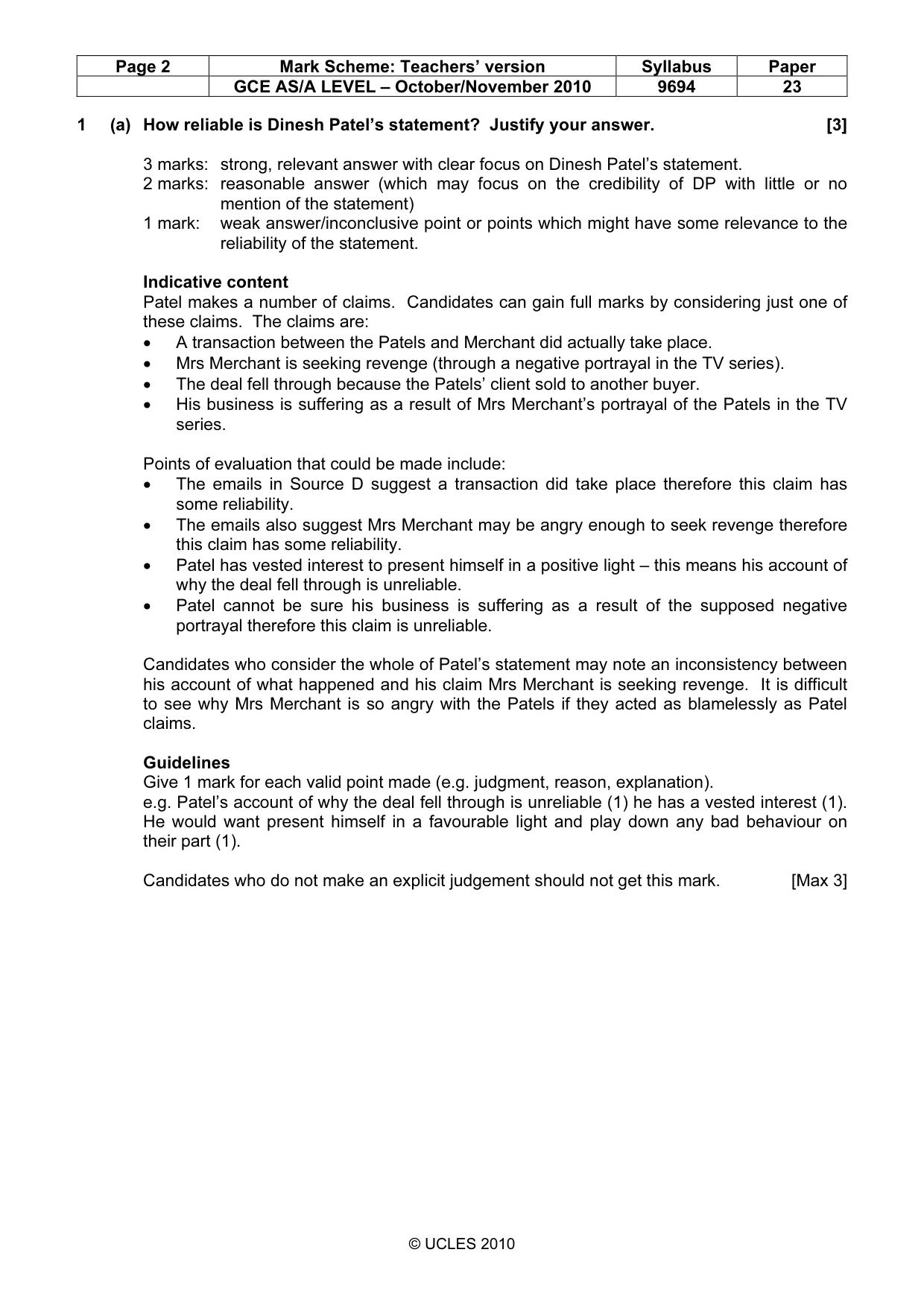
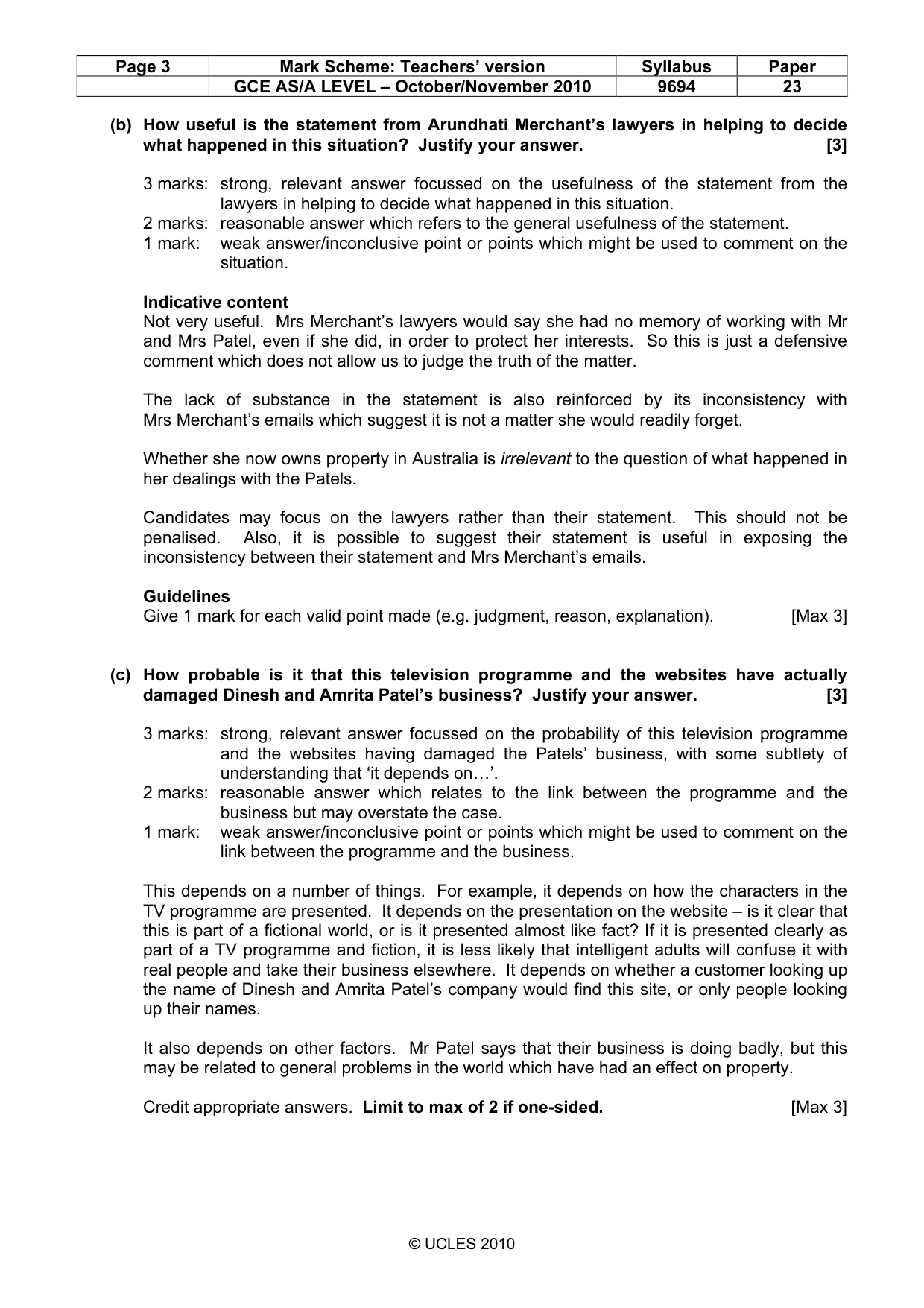
Page 2 Mark Scheme: Teachers’ version Syllabus Paper GCE AS/A LEVEL – October/November 2010 9694 23 © UCLES 2010 1 (a) How reliable is Dinesh Patel’s statement? Justify your answer. [3] 3 marks: strong, relevant answer with clear focus on Dinesh Patel’s statement. 2 marks: reasonable answer (which may focus on the credibility of DP with little or no mention of the statement) 1 mark: weak answer/inconclusive point or points which might have some relevance to the reliability of the statement. Indicative content Patel makes a number of claims. Candidates can gain full marks by considering just one of these claims. The claims are: • A transaction between the Patels and Merchant did actually take place. • Mrs Merchant is seeking revenge (through a negative portrayal in the TV series). • The deal fell through because the Patels’ client sold to another buyer. • His business is suffering as a result of Mrs Merchant’s portrayal of the Patels in the TV series. Points of evaluation that could be made include: • The emails in Source D suggest a transaction did take place therefore this claim has some reliability. • The emails also suggest Mrs Merchant may be angry enough to seek revenge therefore this claim has some reliability. • Patel has vested interest to present himself in a positive light – this means his account of why the deal fell through is unreliable. • Patel cannot be sure his business is suffering as a result of the supposed negative portrayal therefore this claim is unreliable. Candidates who consider the whole of Patel’s statement may note an inconsistency between his account of what happened and his claim Mrs Merchant is seeking revenge. It is difficult to see why Mrs Merchant is so angry with the Patels if they acted as blamelessly as Patel claims. Guidelines Give 1 mark for each valid point made (e.g. judgment, reason, explanation). e.g. Patel’s account of why the deal fell through is unreliable (1) he has a vested interest (1). He would want present himself in a favourable light and play down any bad behaviour on their part (1). Candidates who do not make an explicit judgement should not get this mark. [Max 3]
Mark scheme, page 3
Page 3 Mark Scheme: Teachers’ version Syllabus Paper GCE AS/A LEVEL – October/November 2010 9694 23 © UCLES 2010 (b) How useful is the statement from Arundhati Merchant’s lawyers in helping to decide what happened in this situation? Justify your answer. [3] 3 marks: strong, relevant answer focussed on the usefulness of the statement from the lawyers in helping to decide what happened in this situation. 2 marks: reasonable answer which refers to the general usefulness of the statement. 1 mark: weak answer/inconclusive point or points which might be used to comment on the situation. Indicative content Not very useful. Mrs Merchant’s lawyers would say she had no memory of working with Mr and Mrs Patel, even if she did, in order to protect her interests. So this is just a defensive comment which does not allow us to judge the truth of the matter. The lack of substance in the statement is also reinforced by its inconsistency with Mrs Merchant’s emails which suggest it is not a matter she would readily forget. Whether she now owns property in Australia is irrelevant to the question of what happened in her dealings with the Patels. Candidates may focus on the lawyers rather than their statement. This should not be penalised. Also, it is possible to suggest their statement is useful in exposing the inconsistency between their statement and Mrs Merchant’s emails. Guidelines Give 1 mark for each valid point made (e.g. judgment, reason, explanation). [Max 3] (c) How probable is it that this television programme and the websites have actually damaged Dinesh and Amrita Patel’s business? Justify your answer. [3] 3 marks: strong, relevant answer focussed on the probability of this television programme and the websites having damaged the Patels’ business, with some subtlety of understanding that ‘it depends on…’. 2 marks: reasonable answer which relates to the link between the programme and the business but may overstate the case. 1 mark: weak answer/inconclusive point or points which might be used to comment on the link between the programme and the business. This depends on a number of things. For example, it depends on how the characters in the TV programme are presented. It depends on the presentation on the website – is it clear that this is part of a fictional world, or is it presented almost like fact? If it is presented clearly as part of a TV programme and fiction, it is less likely that intelligent adults will confuse it with real people and take their business elsewhere. It depends on whether a customer looking up the name of Dinesh and Amrita Patel’s company would find this site, or only people looking up their names. It also depends on other factors. Mr Patel says that their business is doing badly, but this may be related to general problems in the world which have had an effect on property. Credit appropriate answers. Limit to max of 2 if one-sided. [Max 3]
Mark scheme, page 4
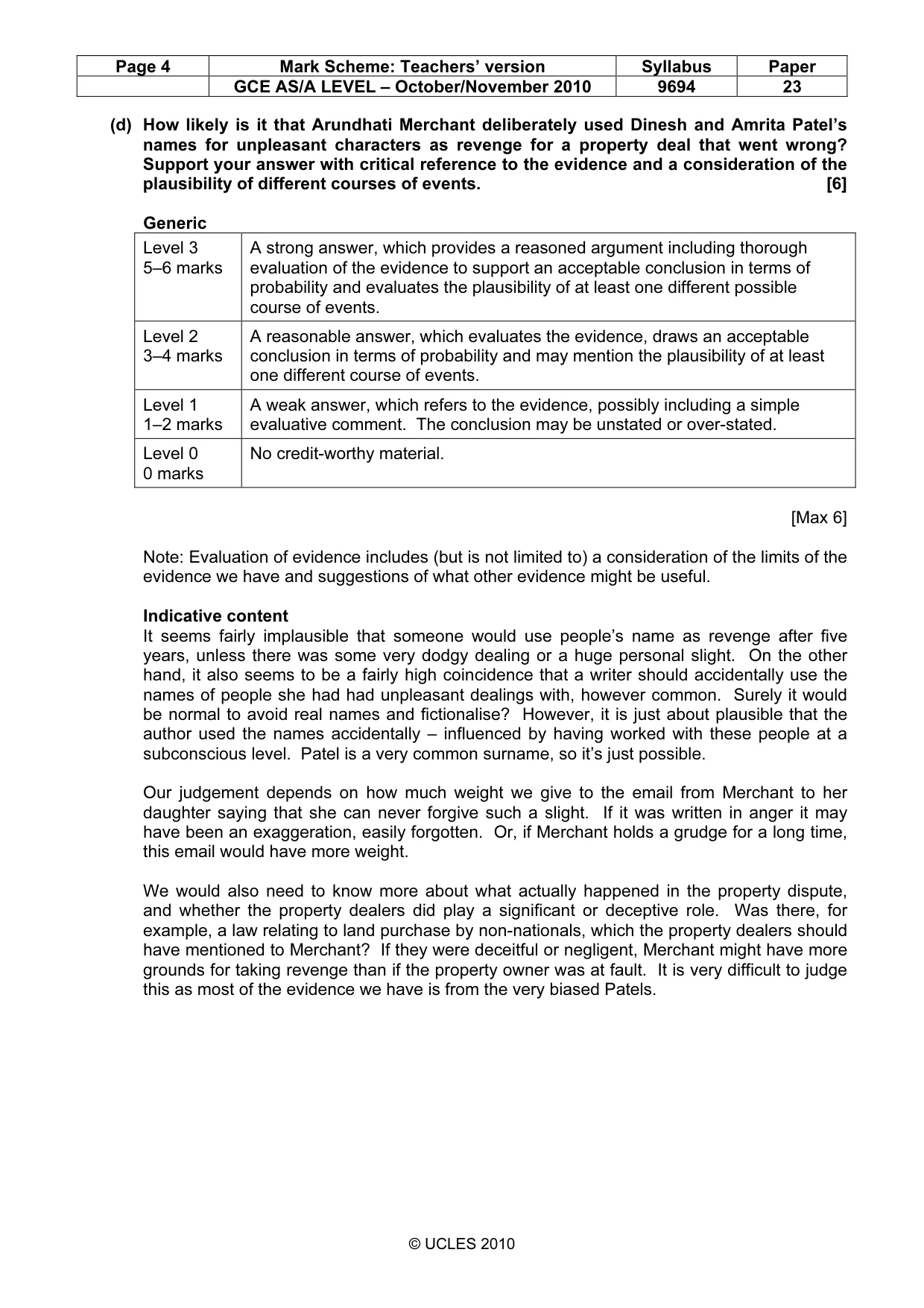
Page 4 Mark Scheme: Teachers’ version Syllabus Paper GCE AS/A LEVEL – October/November 2010 9694 23 © UCLES 2010 (d) How likely is it that Arundhati Merchant deliberately used Dinesh and Amrita Patel’s names for unpleasant characters as revenge for a property deal that went wrong? Support your answer with critical reference to the evidence and a consideration of the plausibility of different courses of events. [6] Generic Level 3 5–6 marks A strong answer, which provides a reasoned argument including thorough evaluation of the evidence to support an acceptable conclusion in terms of probability and evaluates the plausibility of at least one different possible course of events. Level 2 3–4 marks A reasonable answer, which evaluates the evidence, draws an acceptable conclusion in terms of probability and may mention the plausibility of at least one different course of events. Level 1 1–2 marks A weak answer, which refers to the evidence, possibly including a simple evaluative comment. The conclusion may be unstated or over-stated. Level 0 0 marks No credit-worthy material. [Max 6] Note: Evaluation of evidence includes (but is not limited to) a consideration of the limits of the evidence we have and suggestions of what other evidence might be useful. Indicative content It seems fairly implausible that someone would use people’s name as revenge after five years, unless there was some very dodgy dealing or a huge personal slight. On the other hand, it also seems to be a fairly high coincidence that a writer should accidentally use the names of people she had had unpleasant dealings with, however common. Surely it would be normal to avoid real names and fictionalise? However, it is just about plausible that the author used the names accidentally – influenced by having worked with these people at a subconscious level. Patel is a very common surname, so it’s just possible. Our judgement depends on how much weight we give to the email from Merchant to her daughter saying that she can never forgive such a slight. If it was written in anger it may have been an exaggeration, easily forgotten. Or, if Merchant holds a grudge for a long time, this email would have more weight. We would also need to know more about what actually happened in the property dispute, and whether the property dealers did play a significant or deceptive role. Was there, for example, a law relating to land purchase by non-nationals, which the property dealers should have mentioned to Merchant? If they were deceitful or negligent, Merchant might have more grounds for taking revenge than if the property owner was at fault. It is very difficult to judge this as most of the evidence we have is from the very biased Patels.
Mark scheme, page 5
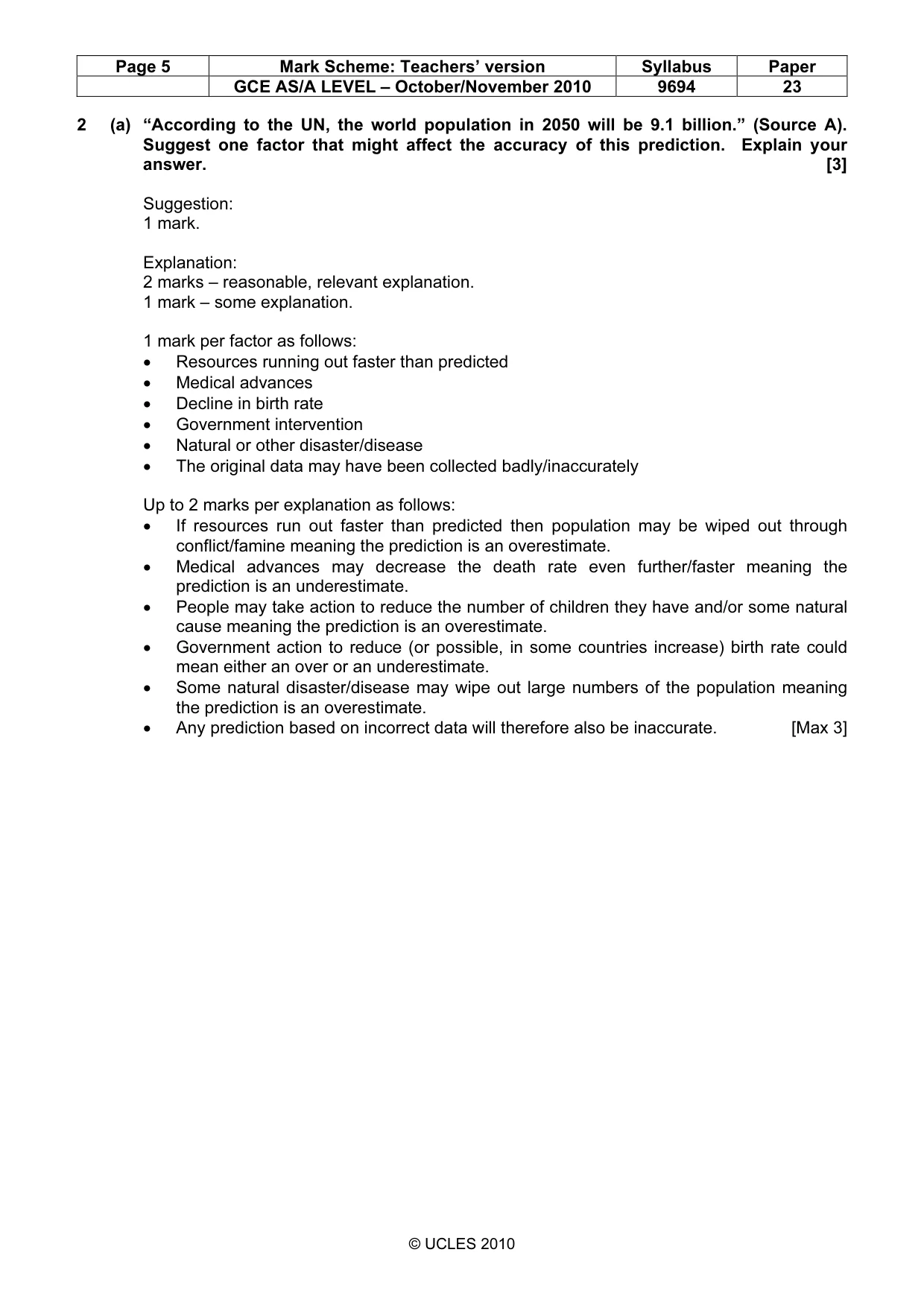
Page 5 Mark Scheme: Teachers’ version Syllabus Paper GCE AS/A LEVEL – October/November 2010 9694 23 © UCLES 2010 2 (a) “According to the UN, the world population in 2050 will be 9.1 billion.” (Source A). Suggest one factor that might affect the accuracy of this prediction. Explain your answer. [3] Suggestion: 1 mark. Explanation: 2 marks – reasonable, relevant explanation. 1 mark – some explanation. 1 mark per factor as follows: • Resources running out faster than predicted • Medical advances • Decline in birth rate • Government intervention • Natural or other disaster/disease • The original data may have been collected badly/inaccurately Up to 2 marks per explanation as follows: • If resources run out faster than predicted then population may be wiped out through conflict/famine meaning the prediction is an overestimate. • Medical advances may decrease the death rate even further/faster meaning the prediction is an underestimate. • People may take action to reduce the number of children they have and/or some natural cause meaning the prediction is an overestimate. • Government action to reduce (or possible, in some countries increase) birth rate could mean either an over or an underestimate. • Some natural disaster/disease may wipe out large numbers of the population meaning the prediction is an overestimate. • Any prediction based on incorrect data will therefore also be inaccurate. [Max 3]
Mark scheme, page 6
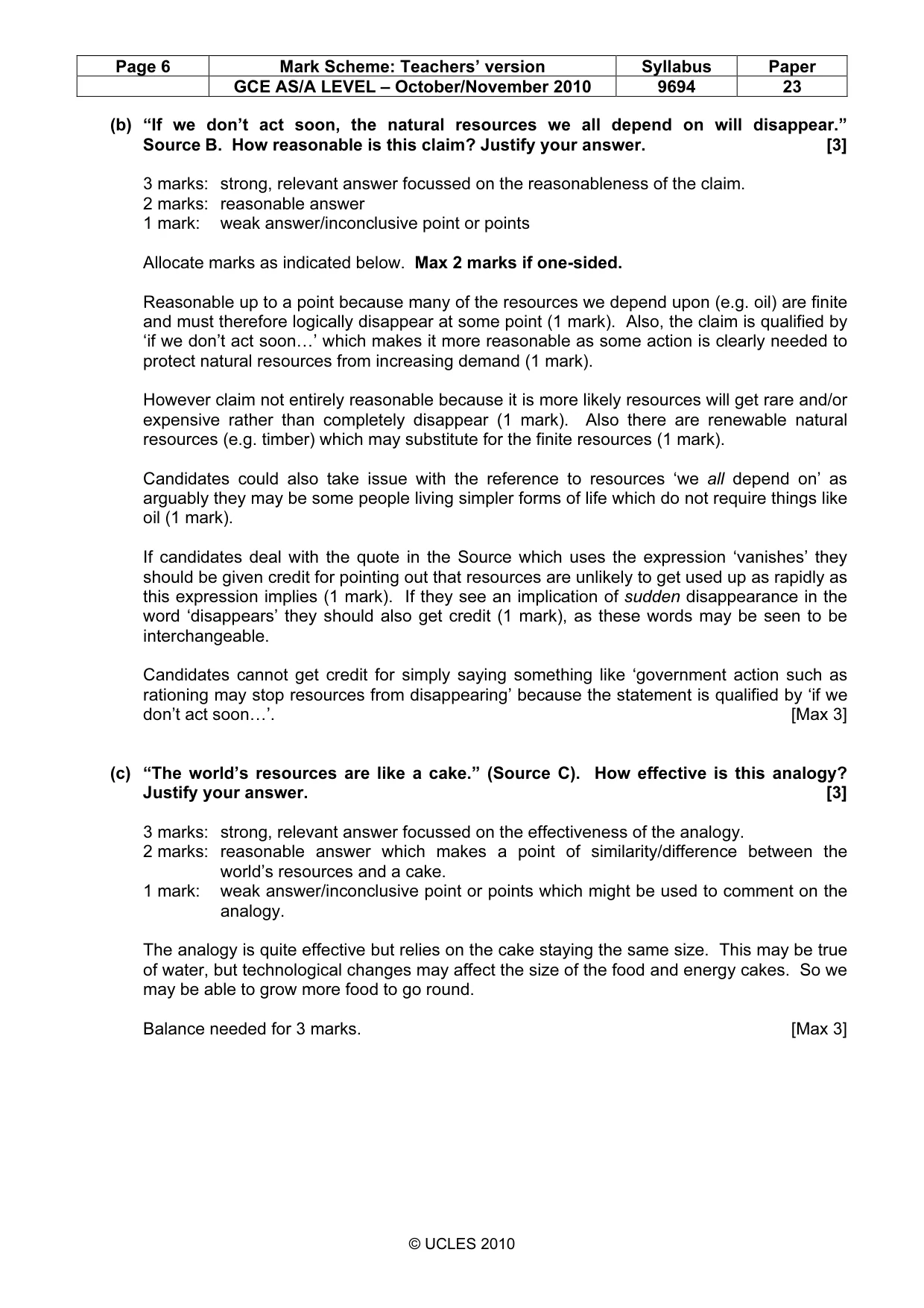
Page 6 Mark Scheme: Teachers’ version Syllabus Paper GCE AS/A LEVEL – October/November 2010 9694 23 © UCLES 2010 (b) “If we don’t act soon, the natural resources we all depend on will disappear.” Source B. How reasonable is this claim? Justify your answer. [3] 3 marks: strong, relevant answer focussed on the reasonableness of the claim. 2 marks: reasonable answer 1 mark: weak answer/inconclusive point or points Allocate marks as indicated below. Max 2 marks if one-sided. Reasonable up to a point because many of the resources we depend upon (e.g. oil) are finite and must therefore logically disappear at some point (1 mark). Also, the claim is qualified by ‘if we don’t act soon…’ which makes it more reasonable as some action is clearly needed to protect natural resources from increasing demand (1 mark). However claim not entirely reasonable because it is more likely resources will get rare and/or expensive rather than completely disappear (1 mark). Also there are renewable natural resources (e.g. timber) which may substitute for the finite resources (1 mark). Candidates could also take issue with the reference to resources ‘we all depend on’ as arguably they may be some people living simpler forms of life which do not require things like oil (1 mark). If candidates deal with the quote in the Source which uses the expression ‘vanishes’ they should be given credit for pointing out that resources are unlikely to get used up as rapidly as this expression implies (1 mark). If they see an implication of sudden disappearance in the word ‘disappears’ they should also get credit (1 mark), as these words may be seen to be interchangeable. Candidates cannot get credit for simply saying something like ‘government action such as rationing may stop resources from disappearing’ because the statement is qualified by ‘if we don’t act soon…’. [Max 3] (c) “The world’s resources are like a cake.” (Source C). How effective is this analogy? Justify your answer. [3] 3 marks: strong, relevant answer focussed on the effectiveness of the analogy. 2 marks: reasonable answer which makes a point of similarity/difference between the world’s resources and a cake. 1 mark: weak answer/inconclusive point or points which might be used to comment on the analogy. The analogy is quite effective but relies on the cake staying the same size. This may be true of water, but technological changes may affect the size of the food and energy cakes. So we may be able to grow more food to go round. Balance needed for 3 marks. [Max 3]
Mark scheme, page 7
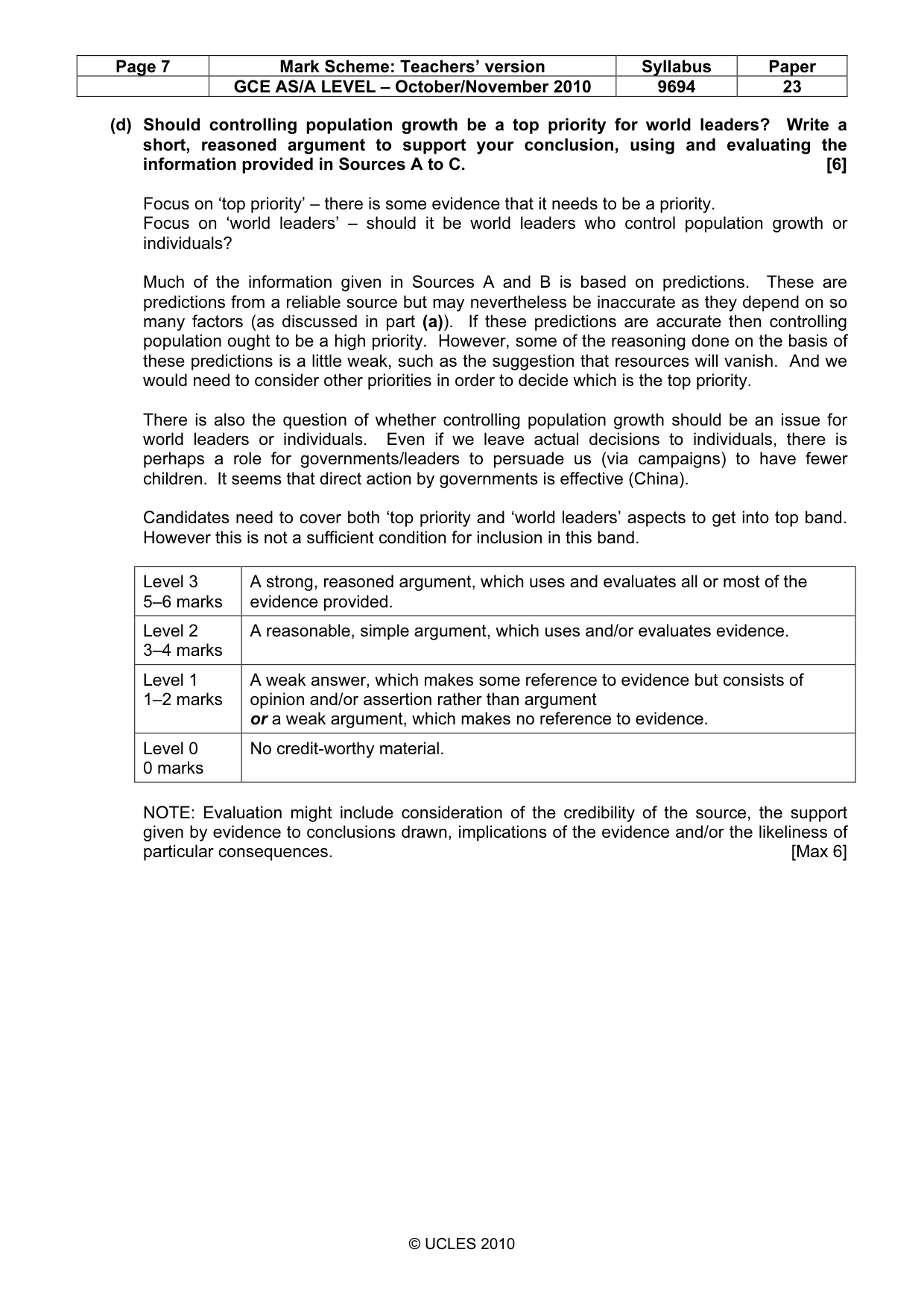
Page 7 Mark Scheme: Teachers’ version Syllabus Paper GCE AS/A LEVEL – October/November 2010 9694 23 © UCLES 2010 (d) Should controlling population growth be a top priority for world leaders? Write a short, reasoned argument to support your conclusion, using and evaluating the information provided in Sources A to C. [6] Focus on ‘top priority’ – there is some evidence that it needs to be a priority. Focus on ‘world leaders’ – should it be world leaders who control population growth or individuals? Much of the information given in Sources A and B is based on predictions. These are predictions from a reliable source but may nevertheless be inaccurate as they depend on so many factors (as discussed in part (a)). If these predictions are accurate then controlling population ought to be a high priority. However, some of the reasoning done on the basis of these predictions is a little weak, such as the suggestion that resources will vanish. And we would need to consider other priorities in order to decide which is the top priority. There is also the question of whether controlling population growth should be an issue for world leaders or individuals. Even if we leave actual decisions to individuals, there is perhaps a role for governments/leaders to persuade us (via campaigns) to have fewer children. It seems that direct action by governments is effective (China). Candidates need to cover both ‘top priority and ‘world leaders’ aspects to get into top band. However this is not a sufficient condition for inclusion in this band. Level 3 5–6 marks A strong, reasoned argument, which uses and evaluates all or most of the evidence provided. Level 2 3–4 marks A reasonable, simple argument, which uses and/or evaluates evidence. Level 1 1–2 marks A weak answer, which makes some reference to evidence but consists of opinion and/or assertion rather than argument or a weak argument, which makes no reference to evidence. Level 0 0 marks No credit-worthy material. NOTE: Evaluation might include consideration of the credibility of the source, the support given by evidence to conclusions drawn, implications of the evidence and/or the likeliness of particular consequences. [Max 6]
Mark scheme, page 8
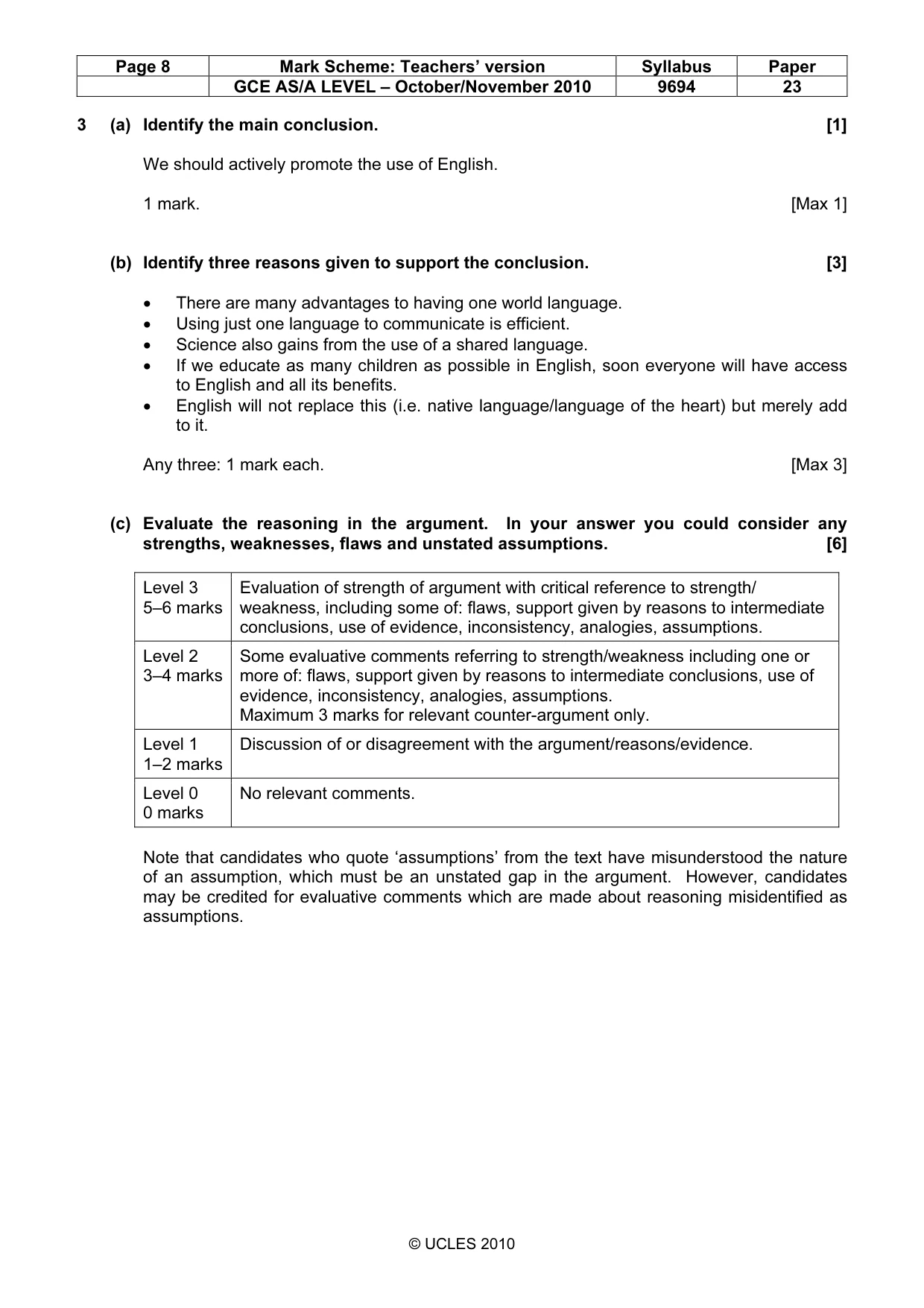
Page 8 Mark Scheme: Teachers’ version Syllabus Paper GCE AS/A LEVEL – October/November 2010 9694 23 © UCLES 2010 3 (a) Identify the main conclusion. [1] We should actively promote the use of English. 1 mark. [Max 1] (b) Identify three reasons given to support the conclusion. [3] • There are many advantages to having one world language. • Using just one language to communicate is efficient. • Science also gains from the use of a shared language. • If we educate as many children as possible in English, soon everyone will have access to English and all its benefits. • English will not replace this (i.e. native language/language of the heart) but merely add to it. Any three: 1 mark each. [Max 3] (c) Evaluate the reasoning in the argument. In your answer you could consider any strengths, weaknesses, flaws and unstated assumptions. [6] Level 3 5–6 marks Evaluation of strength of argument with critical reference to strength/ weakness, including some of: flaws, support given by reasons to intermediate conclusions, use of evidence, inconsistency, analogies, assumptions. Level 2 3–4 marks Some evaluative comments referring to strength/weakness including one or more of: flaws, support given by reasons to intermediate conclusions, use of evidence, inconsistency, analogies, assumptions. Maximum 3 marks for relevant counter-argument only. Level 1 1–2 marks Discussion of or disagreement with the argument/reasons/evidence. Level 0 0 marks No relevant comments. Note that candidates who quote ‘assumptions’ from the text have misunderstood the nature of an assumption, which must be an unstated gap in the argument. However, candidates may be credited for evaluative comments which are made about reasoning misidentified as assumptions.
Mark scheme, page 9
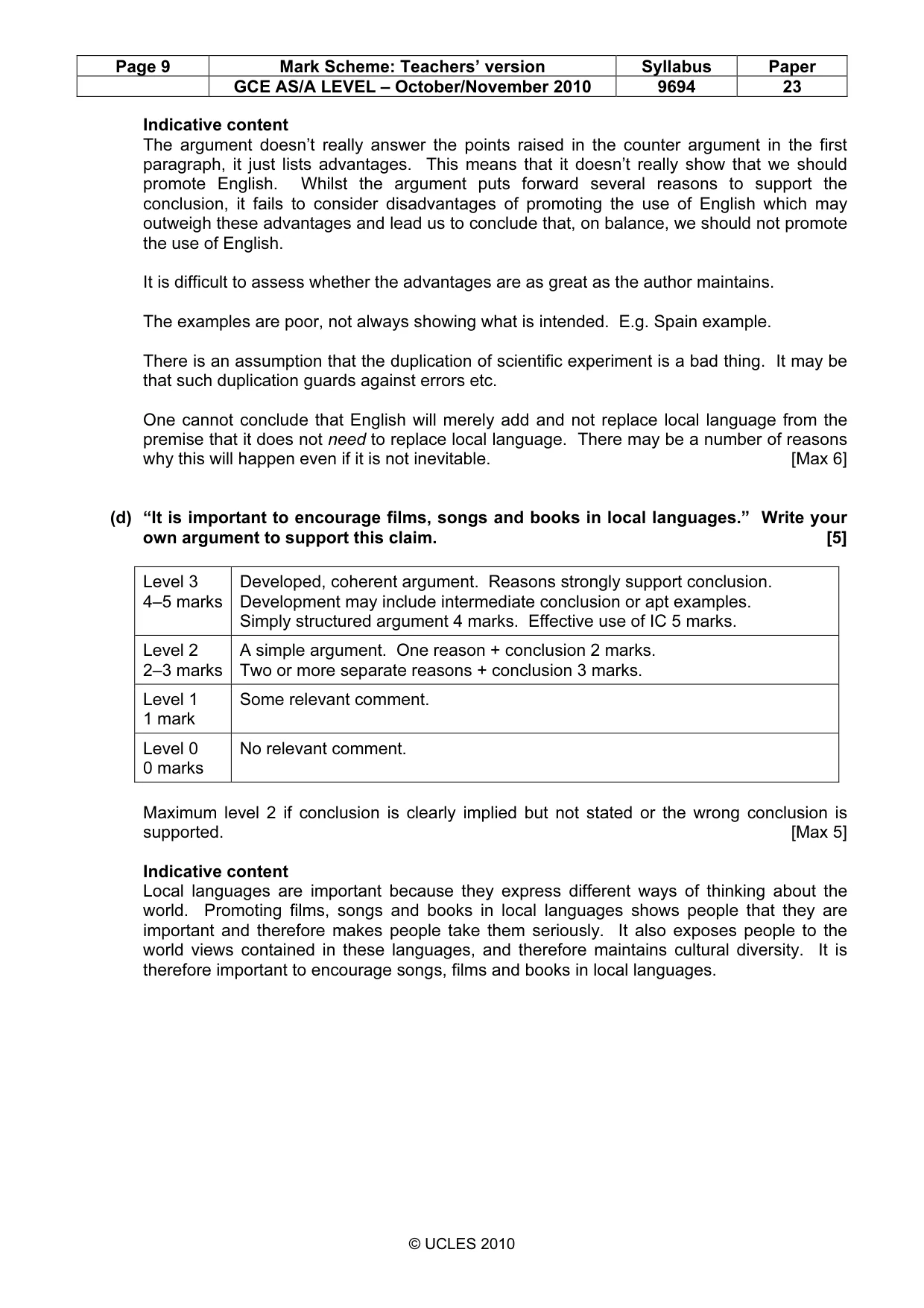
Page 9 Mark Scheme: Teachers’ version Syllabus Paper GCE AS/A LEVEL – October/November 2010 9694 23 © UCLES 2010 Indicative content The argument doesn’t really answer the points raised in the counter argument in the first paragraph, it just lists advantages. This means that it doesn’t really show that we should promote English. Whilst the argument puts forward several reasons to support the conclusion, it fails to consider disadvantages of promoting the use of English which may outweigh these advantages and lead us to conclude that, on balance, we should not promote the use of English. It is difficult to assess whether the advantages are as great as the author maintains. The examples are poor, not always showing what is intended. E.g. Spain example. There is an assumption that the duplication of scientific experiment is a bad thing. It may be that such duplication guards against errors etc. One cannot conclude that English will merely add and not replace local language from the premise that it does not need to replace local language. There may be a number of reasons why this will happen even if it is not inevitable. [Max 6] (d) “It is important to encourage films, songs and books in local languages.” Write your own argument to support this claim. [5] Level 3 4–5 marks Developed, coherent argument. Reasons strongly support conclusion. Development may include intermediate conclusion or apt examples. Simply structured argument 4 marks. Effective use of IC 5 marks. Level 2 2–3 marks A simple argument. One reason + conclusion 2 marks. Two or more separate reasons + conclusion 3 marks. Level 1 1 mark Some relevant comment. Level 0 0 marks No relevant comment. Maximum level 2 if conclusion is clearly implied but not stated or the wrong conclusion is supported. [Max 5] Indicative content Local languages are important because they express different ways of thinking about the world. Promoting films, songs and books in local languages shows people that they are important and therefore makes people take them seriously. It also exposes people to the world views contained in these languages, and therefore maintains cultural diversity. It is therefore important to encourage songs, films and books in local languages.
What you needed in this session
Cambridge’s own grade thresholds for 2010 Oct/Nov, Paper 2 · Variant 3. A higher threshold means an easier paper — the bar moves with how the cohort did.