Cambridge A Level Thinking Skills 9694 — 2010 May/June Paper 2 · Variant 1
9694/21/M/J/10 · 45 marks · ≈51 min
The question paper and its mark scheme, free to read here and free to download. This is Cambridge’s own paper, exactly as it was sat.
Question paper8 pages

Mark scheme7 pages
Answers below. Sit the paper first if you are practising.
Paper as text
Question paper, page 1
This document consists of 6 printed pages and 2 blank pages. IB10 06_9694_21/2RP © UCLES 2010 [Turn over *1259631419* UNIVERSITY OF CAMBRIDGE INTERNATIONAL EXAMINATIONS General Certificate of Education Advanced Subsidiary Level and Advanced Level THINKING SKILLS 9694/21 Paper 2 Critical Reasoning May/June 2010 1 hour 30 minutes Additional Materials: Answer Booklet/Paper READ THESE INSTRUCTIONS FIRST If you have been given an Answer Booklet, follow the instructions on the front cover of the booklet. Write your Centre number, candidate number and name on all the work you hand in. Write in dark blue or black pen. Do not use staples, paper clips, highlighters, glue and correction fluid. DO NOT WRITE IN ANY BARCODES. Answer all the questions. Start each question on a new answer sheet. At the end of the examination, fasten all your work securely together. The number of marks is given in brackets [ ] at the end of each question.
Question paper, page 2
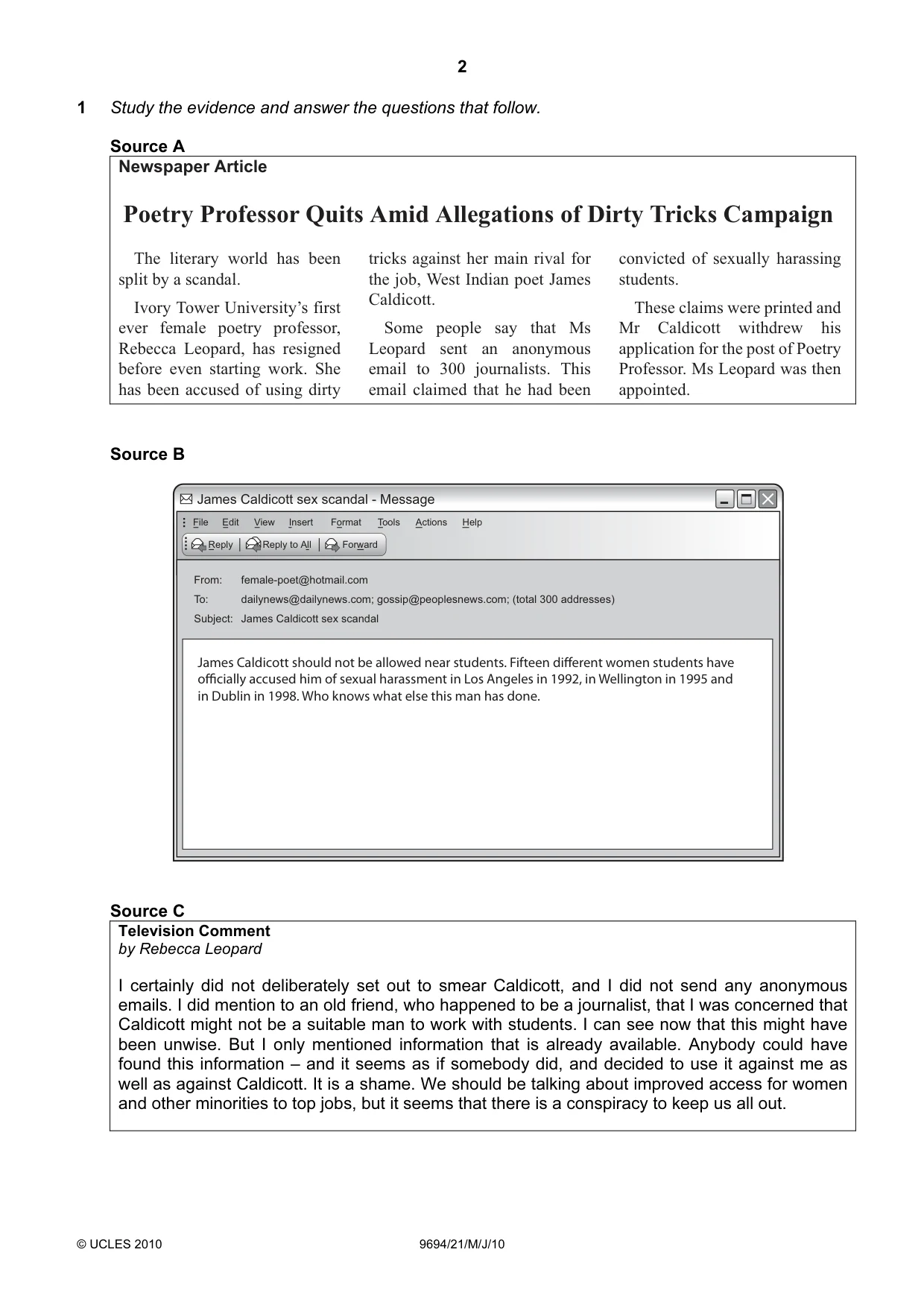
2 © UCLES 2010 9694/21/M/J/10 1 Study the evidence and answer the questions that follow. Source A Newspaper Article Poetry Professor Quits Amid Allegations of Dirty Tricks Campaign The literary world has been split by a scandal. Ivory Tower University’s first ever female poetry professor, Rebecca Leopard, has resigned before even starting work. She has been accused of using dirty tricks against her main rival for the job, West Indian poet James Caldicott. Some people say that Ms Leopard sent an anonymous email to 300 journalists. This email claimed that he had been convicted of sexually harassing students. These claims were printed and Mr Caldicott withdrew his application for the post of Poetry Professor. Ms Leopard was then appointed. Source B File Edit View Insert Format Tools Actions Help Reply Forward Reply to All James Caldicott sex scandal - Message From: female-poet@hotmail.com To: dailynews@dailynews.com; gossip@peoplesnews.com; (total 300 addresses) Subject: James Caldicott sex scandal James Caldicott should not be allowed near students. Fifteen different women students have officially accused him of sexual harassment in Los Angeles in 1992, in Wellington in 1995 and in Dublin in 1998. Who knows what else this man has done. Source C Television Comment by Rebecca Leopard I certainly did not deliberately set out to smear Caldicott, and I did not send any anonymous emails. I did mention to an old friend, who happened to be a journalist, that I was concerned that Caldicott might not be a suitable man to work with students. I can see now that this might have been unwise. But I only mentioned information that is already available. Anybody could have found this information – and it seems as if somebody did, and decided to use it against me as well as against Caldicott. It is a shame. We should be talking about improved access for women and other minorities to top jobs, but it seems that there is a conspiracy to keep us all out.
Question paper, page 3
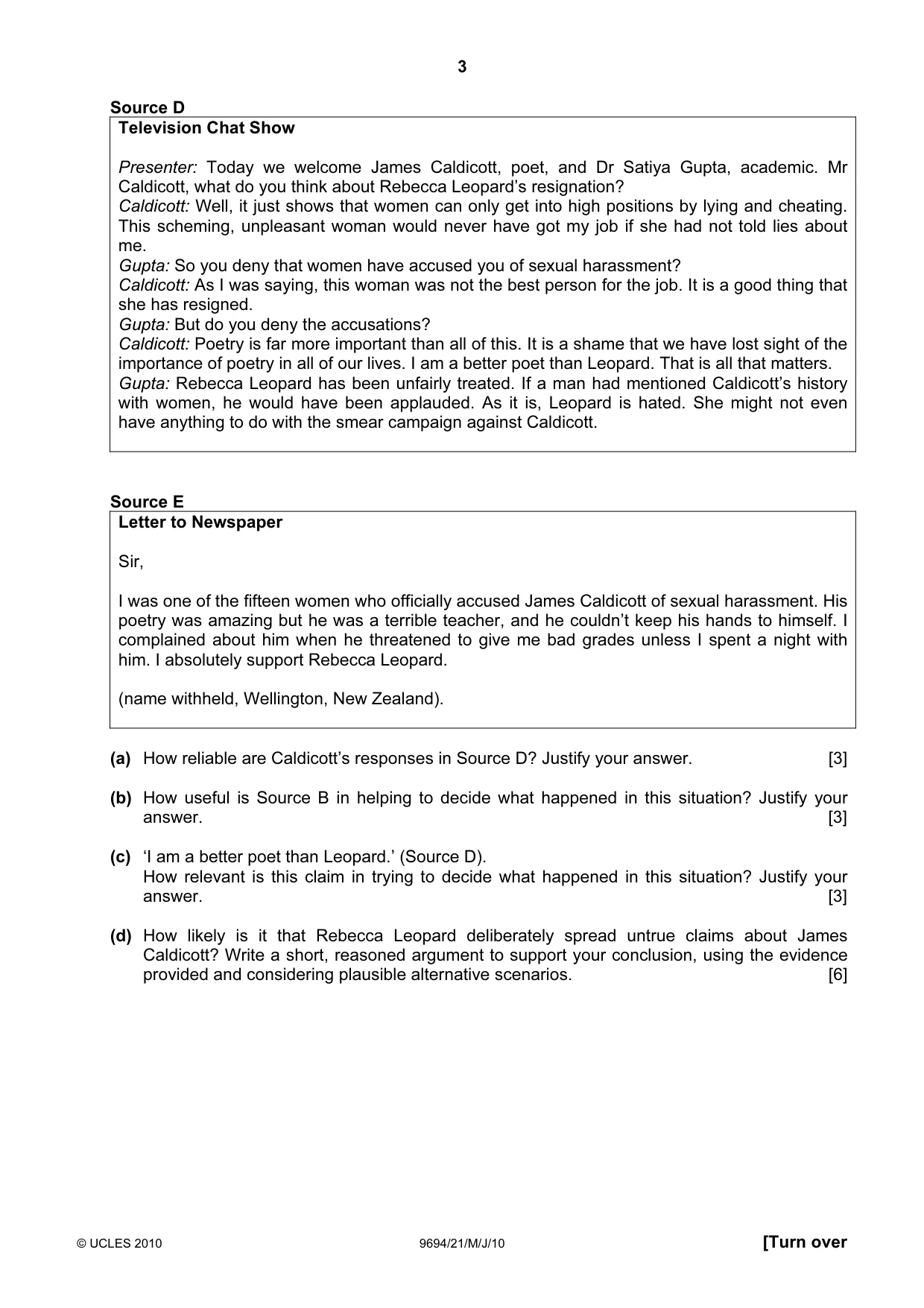
3 © UCLES 2010 9694/21/M/J/10 [Turn over Source D Television Chat Show Presenter: Today we welcome James Caldicott, poet, and Dr Satiya Gupta, academic. Mr Caldicott, what do you think about Rebecca Leopard’s resignation? Caldicott: Well, it just shows that women can only get into high positions by lying and cheating. This scheming, unpleasant woman would never have got my job if she had not told lies about me. Gupta: So you deny that women have accused you of sexual harassment? Caldicott: As I was saying, this woman was not the best person for the job. It is a good thing that she has resigned. Gupta: But do you deny the accusations? Caldicott: Poetry is far more important than all of this. It is a shame that we have lost sight of the importance of poetry in all of our lives. I am a better poet than Leopard. That is all that matters. Gupta: Rebecca Leopard has been unfairly treated. If a man had mentioned Caldicott’s history with women, he would have been applauded. As it is, Leopard is hated. She might not even have anything to do with the smear campaign against Caldicott. Source E Letter to Newspaper Sir, I was one of the fifteen women who officially accused James Caldicott of sexual harassment. His poetry was amazing but he was a terrible teacher, and he couldn’t keep his hands to himself. I complained about him when he threatened to give me bad grades unless I spent a night with him. I absolutely support Rebecca Leopard. (name withheld, Wellington, New Zealand). (a) How reliable are Caldicott’s responses in Source D? Justify your answer. [3] (b) How useful is Source B in helping to decide what happened in this situation? Justify your answer. [3] (c) ‘I am a better poet than Leopard.’ (Source D). How relevant is this claim in trying to decide what happened in this situation? Justify your answer. [3] (d) How likely is it that Rebecca Leopard deliberately spread untrue claims about James Caldicott? Write a short, reasoned argument to support your conclusion, using the evidence provided and considering plausible alternative scenarios. [6]
Question paper, page 4
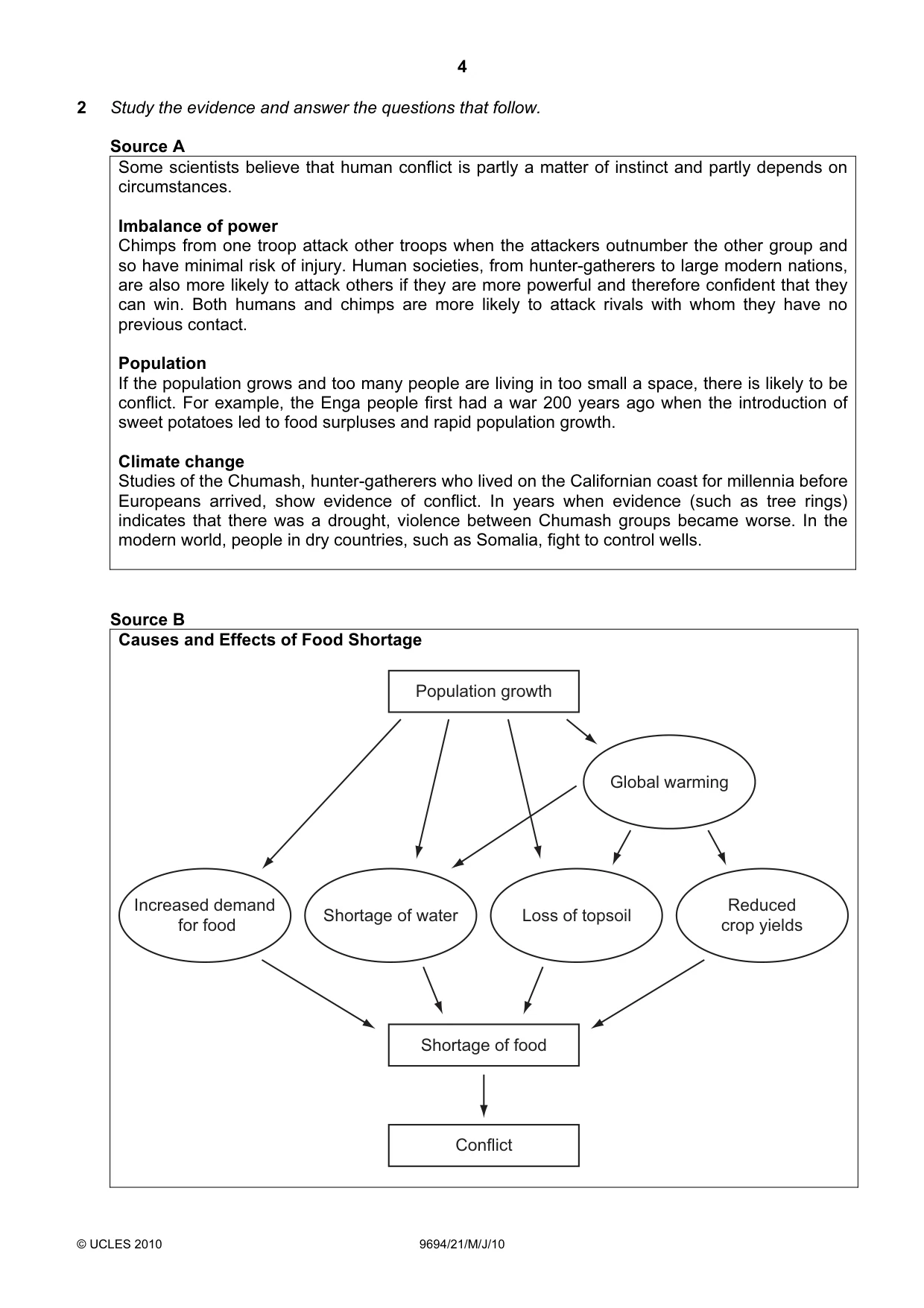
4 © UCLES 2010 9694/21/M/J/10 2 Study the evidence and answer the questions that follow. Source A Some scientists believe that human conflict is partly a matter of instinct and partly depends on circumstances. Imbalance of power Chimps from one troop attack other troops when the attackers outnumber the other group and so have minimal risk of injury. Human societies, from hunter-gatherers to large modern nations, are also more likely to attack others if they are more powerful and therefore confident that they can win. Both humans and chimps are more likely to attack rivals with whom they have no previous contact. Population If the population grows and too many people are living in too small a space, there is likely to be conflict. For example, the Enga people first had a war 200 years ago when the introduction of sweet potatoes led to food surpluses and rapid population growth. Climate change Studies of the Chumash, hunter-gatherers who lived on the Californian coast for millennia before Europeans arrived, show evidence of conflict. In years when evidence (such as tree rings) indicates that there was a drought, violence between Chumash groups became worse. In the modern world, people in dry countries, such as Somalia, fight to control wells. Source B Causes and Effects of Food Shortage Population growth Increased demand for food Shortage of food Shortage of water Loss of topsoil Reduced crop yields Global warming Conflict
Question paper, page 5
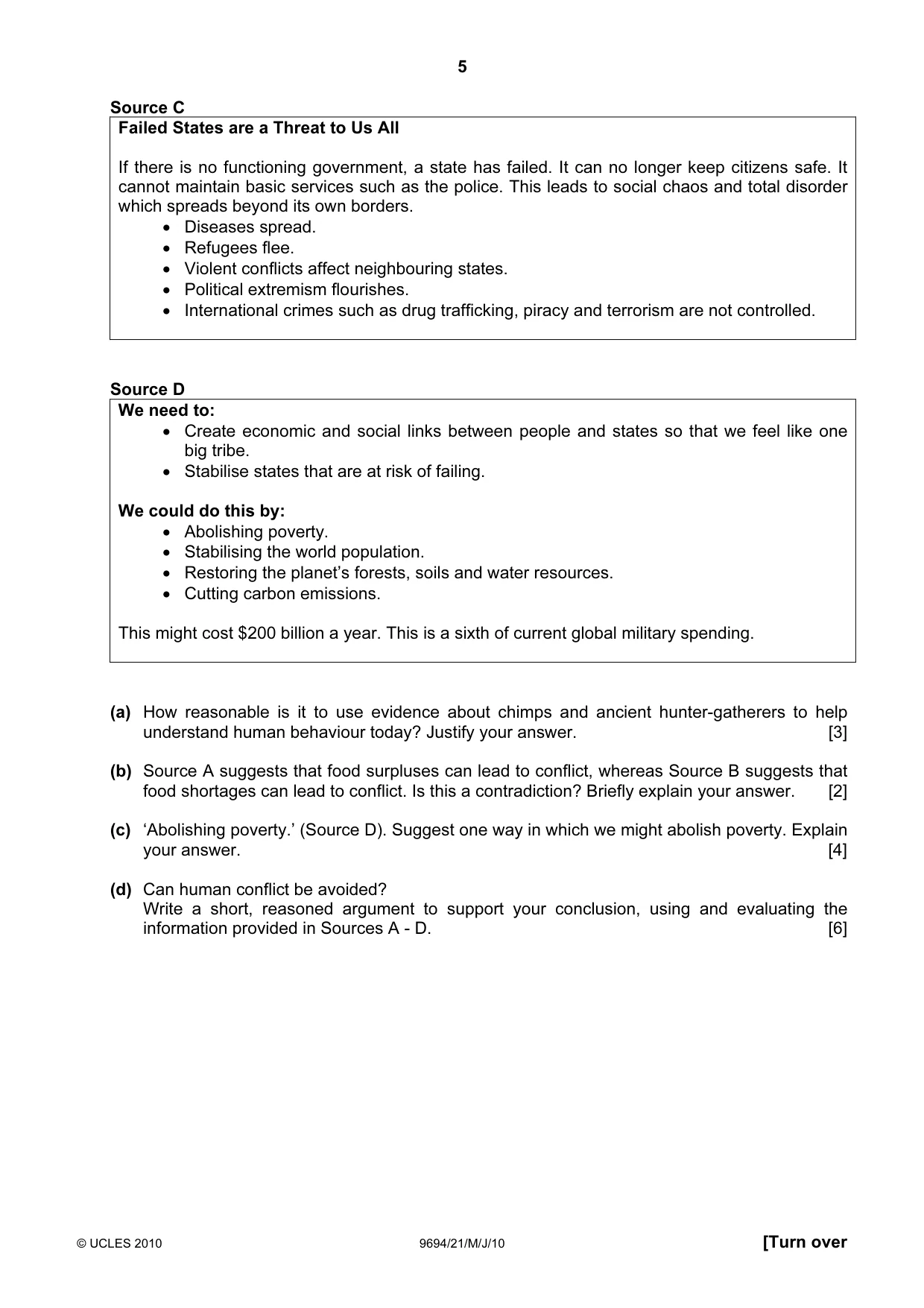
5 © UCLES 2010 9694/21/M/J/10 [Turn over Source C Failed States are a Threat to Us All If there is no functioning government, a state has failed. It can no longer keep citizens safe. It cannot maintain basic services such as the police. This leads to social chaos and total disorder which spreads beyond its own borders. • Diseases spread. • Refugees flee. • Violent conflicts affect neighbouring states. • Political extremism flourishes. • International crimes such as drug trafficking, piracy and terrorism are not controlled. Source D We need to: • Create economic and social links between people and states so that we feel like one big tribe. • Stabilise states that are at risk of failing. We could do this by: • Abolishing poverty. • Stabilising the world population. • Restoring the planet’s forests, soils and water resources. • Cutting carbon emissions. This might cost $200 billion a year. This is a sixth of current global military spending. (a) How reasonable is it to use evidence about chimps and ancient hunter-gatherers to help understand human behaviour today? Justify your answer. [3] (b) Source A suggests that food surpluses can lead to conflict, whereas Source B suggests that food shortages can lead to conflict. Is this a contradiction? Briefly explain your answer. [2] (c) ‘Abolishing poverty.’ (Source D). Suggest one way in which we might abolish poverty. Explain your answer. [4] (d) Can human conflict be avoided? Write a short, reasoned argument to support your conclusion, using and evaluating the information provided in Sources A - D. [6]
Question paper, page 6
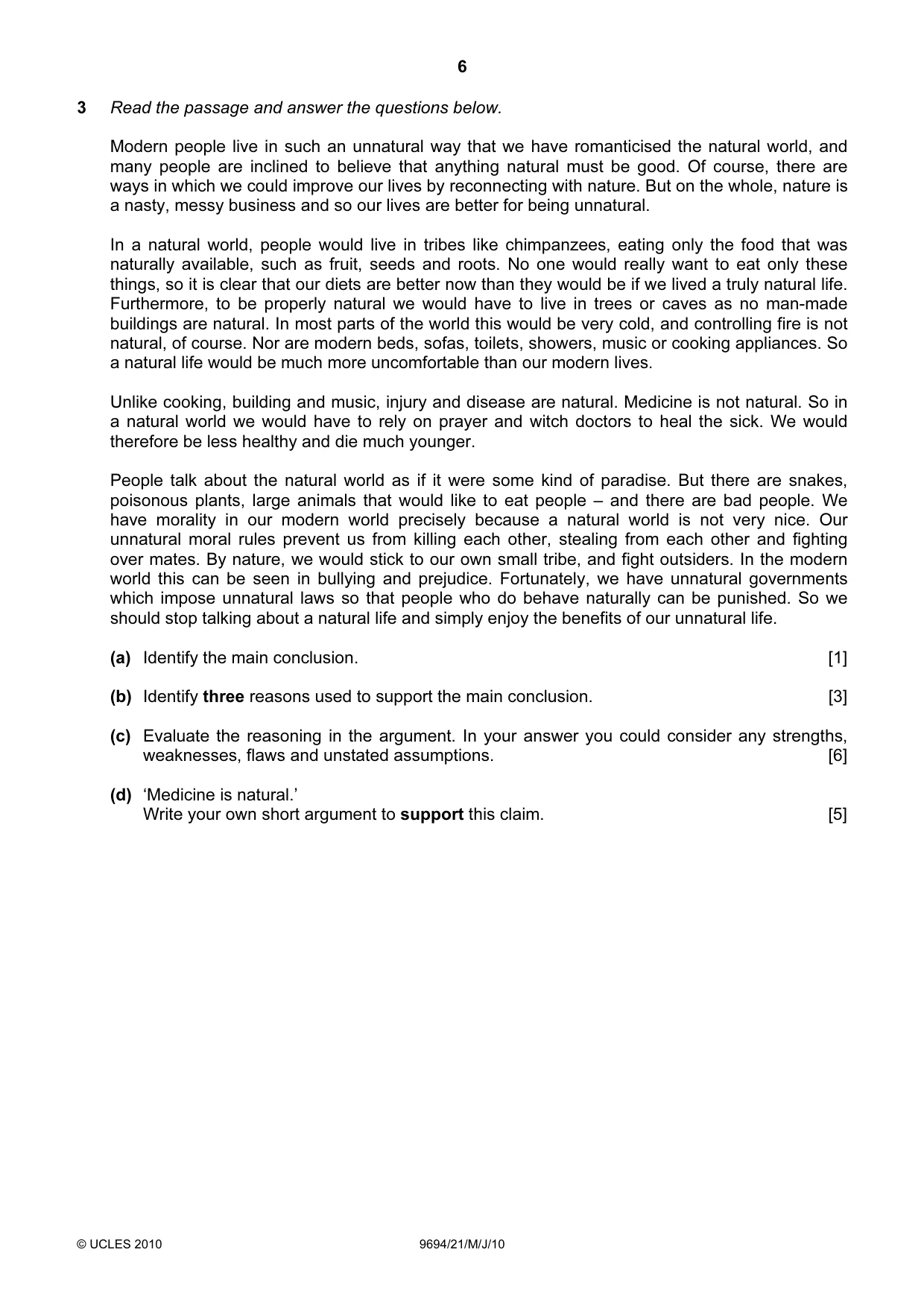
6 © UCLES 2010 9694/21/M/J/10 3 Read the passage and answer the questions below. Modern people live in such an unnatural way that we have romanticised the natural world, and many people are inclined to believe that anything natural must be good. Of course, there are ways in which we could improve our lives by reconnecting with nature. But on the whole, nature is a nasty, messy business and so our lives are better for being unnatural. In a natural world, people would live in tribes like chimpanzees, eating only the food that was naturally available, such as fruit, seeds and roots. No one would really want to eat only these things, so it is clear that our diets are better now than they would be if we lived a truly natural life. Furthermore, to be properly natural we would have to live in trees or caves as no man-made buildings are natural. In most parts of the world this would be very cold, and controlling fire is not natural, of course. Nor are modern beds, sofas, toilets, showers, music or cooking appliances. So a natural life would be much more uncomfortable than our modern lives. Unlike cooking, building and music, injury and disease are natural. Medicine is not natural. So in a natural world we would have to rely on prayer and witch doctors to heal the sick. We would therefore be less healthy and die much younger. People talk about the natural world as if it were some kind of paradise. But there are snakes, poisonous plants, large animals that would like to eat people – and there are bad people. We have morality in our modern world precisely because a natural world is not very nice. Our unnatural moral rules prevent us from killing each other, stealing from each other and fighting over mates. By nature, we would stick to our own small tribe, and fight outsiders. In the modern world this can be seen in bullying and prejudice. Fortunately, we have unnatural governments which impose unnatural laws so that people who do behave naturally can be punished. So we should stop talking about a natural life and simply enjoy the benefits of our unnatural life. (a) Identify the main conclusion. [1] (b) Identify three reasons used to support the main conclusion. [3] (c) Evaluate the reasoning in the argument. In your answer you could consider any strengths, weaknesses, flaws and unstated assumptions. [6] (d) ‘Medicine is natural.’ Write your own short argument to support this claim. [5]
Question paper, page 7
7 © UCLES 2010 9694/21/M/J/10 BLANK PAGE
Question paper, page 8
8 Permission to reproduce items where third-party owned material protected by copyright is included has been sought and cleared where possible. Every reasonable effort has been made by the publisher (UCLES) to trace copyright holders, but if any items requiring clearance have unwittingly been included, the publisher will be pleased to make amends at the earliest possible opportunity. University of Cambridge International Examinations is part of the Cambridge Assessment Group. Cambridge Assessment is the brand name of University of Cambridge Local Examinations Syndicate (UCLES), which is itself a department of the University of Cambridge. © UCLES 2010 9694/21/M/J/10 BLANK PAGE
Mark scheme, page 1
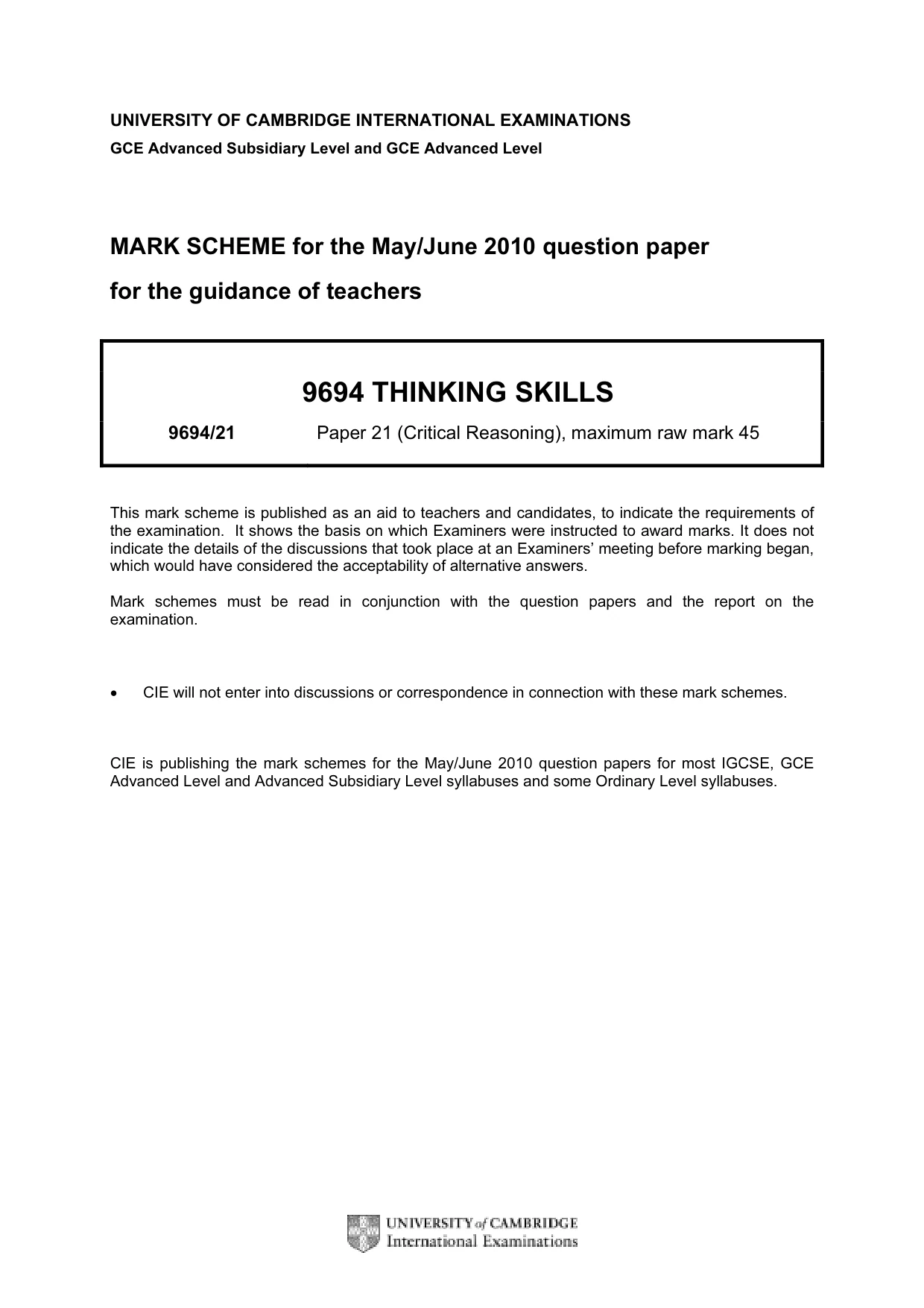
UNIVERSITY OF CAMBRIDGE INTERNATIONAL EXAMINATIONS GCE Advanced Subsidiary Level and GCE Advanced Level MARK SCHEME for the May/June 2010 question paper for the guidance of teachers 9694 THINKING SKILLS 9694/21 Paper 21 (Critical Reasoning), maximum raw mark 45 This mark scheme is published as an aid to teachers and candidates, to indicate the requirements of the examination. It shows the basis on which Examiners were instructed to award marks. It does not indicate the details of the discussions that took place at an Examiners’ meeting before marking began, which would have considered the acceptability of alternative answers. Mark schemes must be read in conjunction with the question papers and the report on the examination. • CIE will not enter into discussions or correspondence in connection with these mark schemes. CIE is publishing the mark schemes for the May/June 2010 question papers for most IGCSE, GCE Advanced Level and Advanced Subsidiary Level syllabuses and some Ordinary Level syllabuses.
Mark scheme, page 2
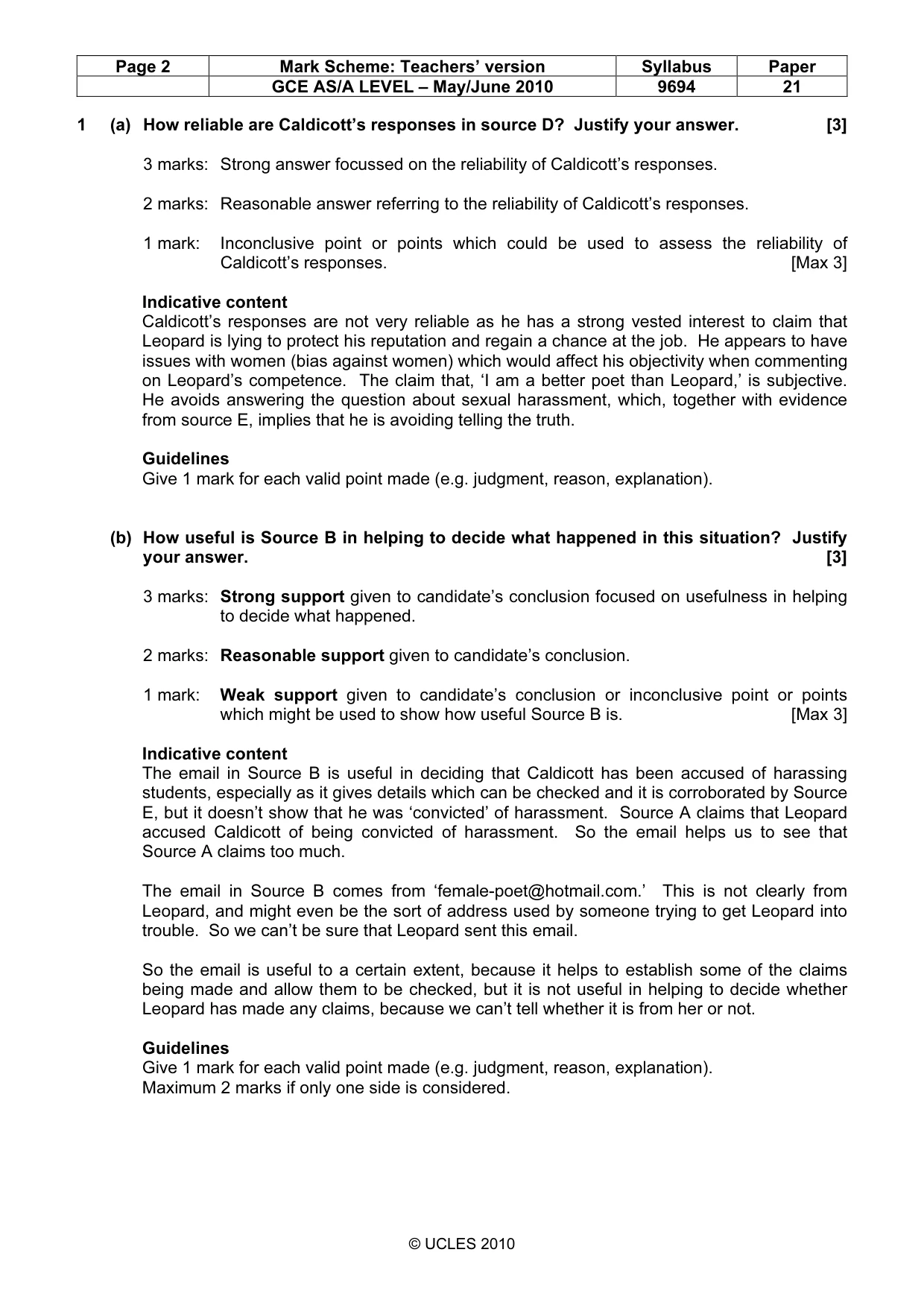
Page 2 Mark Scheme: Teachers’ version Syllabus Paper GCE AS/A LEVEL – May/June 2010 9694 21 © UCLES 2010 1 (a) How reliable are Caldicott’s responses in source D? Justify your answer. [3] 3 marks: Strong answer focussed on the reliability of Caldicott’s responses. 2 marks: Reasonable answer referring to the reliability of Caldicott’s responses. 1 mark: Inconclusive point or points which could be used to assess the reliability of Caldicott’s responses. [Max 3] Indicative content Caldicott’s responses are not very reliable as he has a strong vested interest to claim that Leopard is lying to protect his reputation and regain a chance at the job. He appears to have issues with women (bias against women) which would affect his objectivity when commenting on Leopard’s competence. The claim that, ‘I am a better poet than Leopard,’ is subjective. He avoids answering the question about sexual harassment, which, together with evidence from source E, implies that he is avoiding telling the truth. Guidelines Give 1 mark for each valid point made (e.g. judgment, reason, explanation). (b) How useful is Source B in helping to decide what happened in this situation? Justify your answer. [3] 3 marks: Strong support given to candidate’s conclusion focused on usefulness in helping to decide what happened. 2 marks: Reasonable support given to candidate’s conclusion. 1 mark: Weak support given to candidate’s conclusion or inconclusive point or points which might be used to show how useful Source B is. [Max 3] Indicative content The email in Source B is useful in deciding that Caldicott has been accused of harassing students, especially as it gives details which can be checked and it is corroborated by Source E, but it doesn’t show that he was ‘convicted’ of harassment. Source A claims that Leopard accused Caldicott of being convicted of harassment. So the email helps us to see that Source A claims too much. The email in Source B comes from ‘female-poet@hotmail.com.’ This is not clearly from Leopard, and might even be the sort of address used by someone trying to get Leopard into trouble. So we can’t be sure that Leopard sent this email. So the email is useful to a certain extent, because it helps to establish some of the claims being made and allow them to be checked, but it is not useful in helping to decide whether Leopard has made any claims, because we can’t tell whether it is from her or not. Guidelines Give 1 mark for each valid point made (e.g. judgment, reason, explanation). Maximum 2 marks if only one side is considered.
Mark scheme, page 3
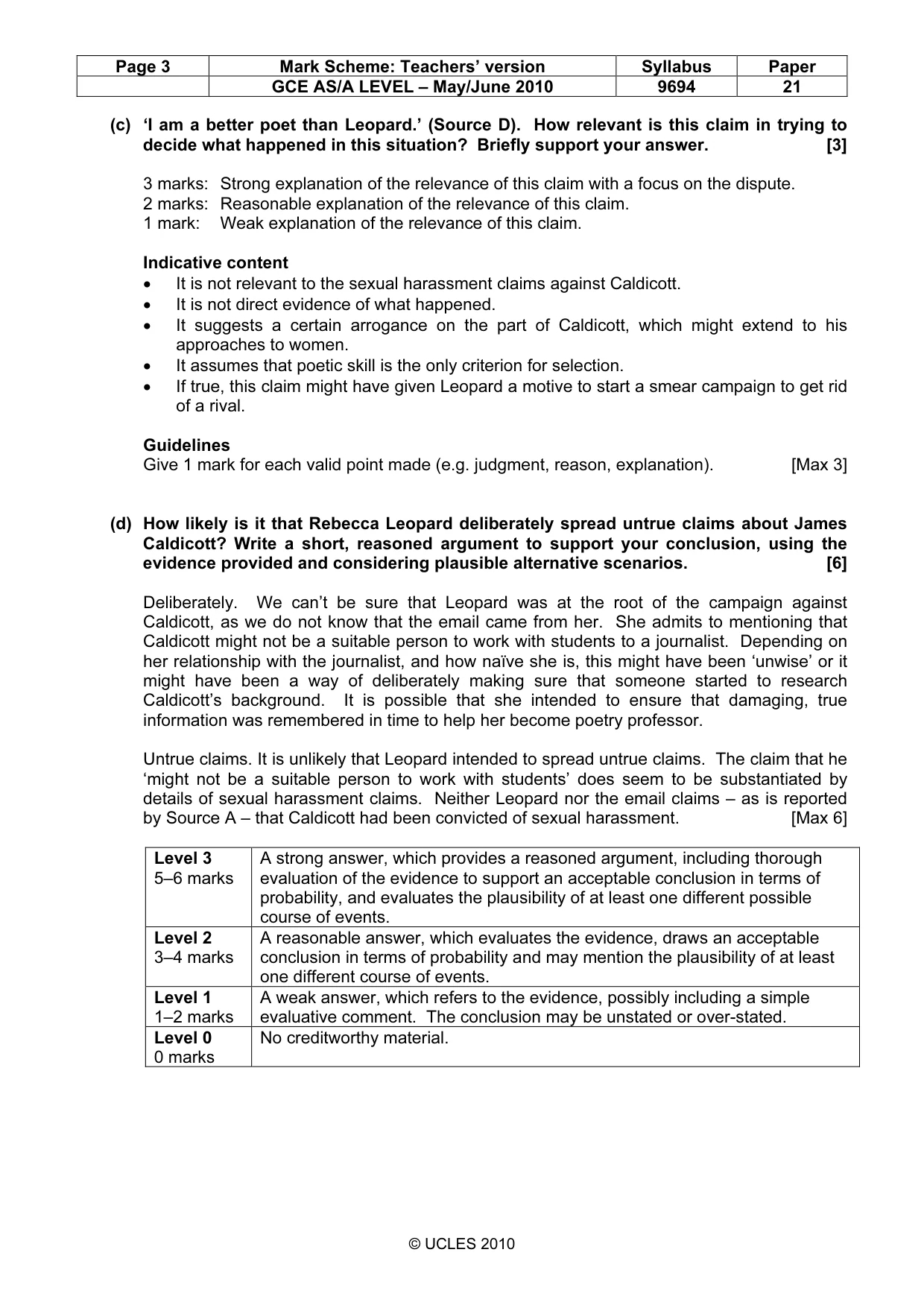
Page 3 Mark Scheme: Teachers’ version Syllabus Paper GCE AS/A LEVEL – May/June 2010 9694 21 © UCLES 2010 (c) ‘I am a better poet than Leopard.’ (Source D). How relevant is this claim in trying to decide what happened in this situation? Briefly support your answer. [3] 3 marks: Strong explanation of the relevance of this claim with a focus on the dispute. 2 marks: Reasonable explanation of the relevance of this claim. 1 mark: Weak explanation of the relevance of this claim. Indicative content • It is not relevant to the sexual harassment claims against Caldicott. • It is not direct evidence of what happened. • It suggests a certain arrogance on the part of Caldicott, which might extend to his approaches to women. • It assumes that poetic skill is the only criterion for selection. • If true, this claim might have given Leopard a motive to start a smear campaign to get rid of a rival. Guidelines Give 1 mark for each valid point made (e.g. judgment, reason, explanation). [Max 3] (d) How likely is it that Rebecca Leopard deliberately spread untrue claims about James Caldicott? Write a short, reasoned argument to support your conclusion, using the evidence provided and considering plausible alternative scenarios. [6] Deliberately. We can’t be sure that Leopard was at the root of the campaign against Caldicott, as we do not know that the email came from her. She admits to mentioning that Caldicott might not be a suitable person to work with students to a journalist. Depending on her relationship with the journalist, and how naïve she is, this might have been ‘unwise’ or it might have been a way of deliberately making sure that someone started to research Caldicott’s background. It is possible that she intended to ensure that damaging, true information was remembered in time to help her become poetry professor. Untrue claims. It is unlikely that Leopard intended to spread untrue claims. The claim that he ‘might not be a suitable person to work with students’ does seem to be substantiated by details of sexual harassment claims. Neither Leopard nor the email claims – as is reported by Source A – that Caldicott had been convicted of sexual harassment. [Max 6] Level 3 5–6 marks A strong answer, which provides a reasoned argument, including thorough evaluation of the evidence to support an acceptable conclusion in terms of probability, and evaluates the plausibility of at least one different possible course of events. Level 2 3–4 marks A reasonable answer, which evaluates the evidence, draws an acceptable conclusion in terms of probability and may mention the plausibility of at least one different course of events. Level 1 1–2 marks A weak answer, which refers to the evidence, possibly including a simple evaluative comment. The conclusion may be unstated or over-stated. Level 0 0 marks No creditworthy material.
Mark scheme, page 4
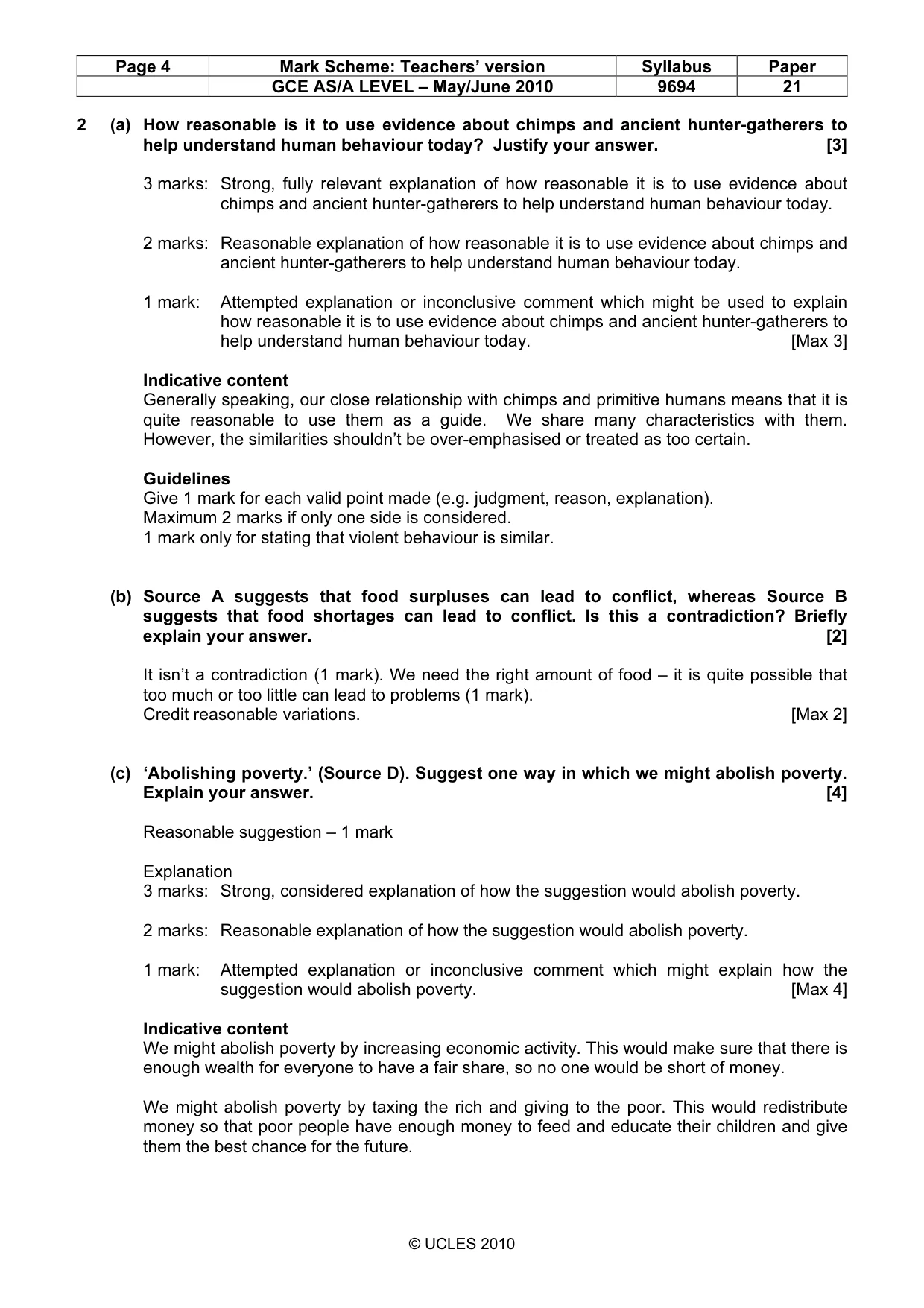
Page 4 Mark Scheme: Teachers’ version Syllabus Paper GCE AS/A LEVEL – May/June 2010 9694 21 © UCLES 2010 2 (a) How reasonable is it to use evidence about chimps and ancient hunter-gatherers to help understand human behaviour today? Justify your answer. [3] 3 marks: Strong, fully relevant explanation of how reasonable it is to use evidence about chimps and ancient hunter-gatherers to help understand human behaviour today. 2 marks: Reasonable explanation of how reasonable it is to use evidence about chimps and ancient hunter-gatherers to help understand human behaviour today. 1 mark: Attempted explanation or inconclusive comment which might be used to explain how reasonable it is to use evidence about chimps and ancient hunter-gatherers to help understand human behaviour today. [Max 3] Indicative content Generally speaking, our close relationship with chimps and primitive humans means that it is quite reasonable to use them as a guide. We share many characteristics with them. However, the similarities shouldn’t be over-emphasised or treated as too certain. Guidelines Give 1 mark for each valid point made (e.g. judgment, reason, explanation). Maximum 2 marks if only one side is considered. 1 mark only for stating that violent behaviour is similar. (b) Source A suggests that food surpluses can lead to conflict, whereas Source B suggests that food shortages can lead to conflict. Is this a contradiction? Briefly explain your answer. [2] It isn’t a contradiction (1 mark). We need the right amount of food – it is quite possible that too much or too little can lead to problems (1 mark). Credit reasonable variations. [Max 2] (c) ‘Abolishing poverty.’ (Source D). Suggest one way in which we might abolish poverty. Explain your answer. [4] Reasonable suggestion – 1 mark Explanation 3 marks: Strong, considered explanation of how the suggestion would abolish poverty. 2 marks: Reasonable explanation of how the suggestion would abolish poverty. 1 mark: Attempted explanation or inconclusive comment which might explain how the suggestion would abolish poverty. [Max 4] Indicative content We might abolish poverty by increasing economic activity. This would make sure that there is enough wealth for everyone to have a fair share, so no one would be short of money. We might abolish poverty by taxing the rich and giving to the poor. This would redistribute money so that poor people have enough money to feed and educate their children and give them the best chance for the future.
Mark scheme, page 5
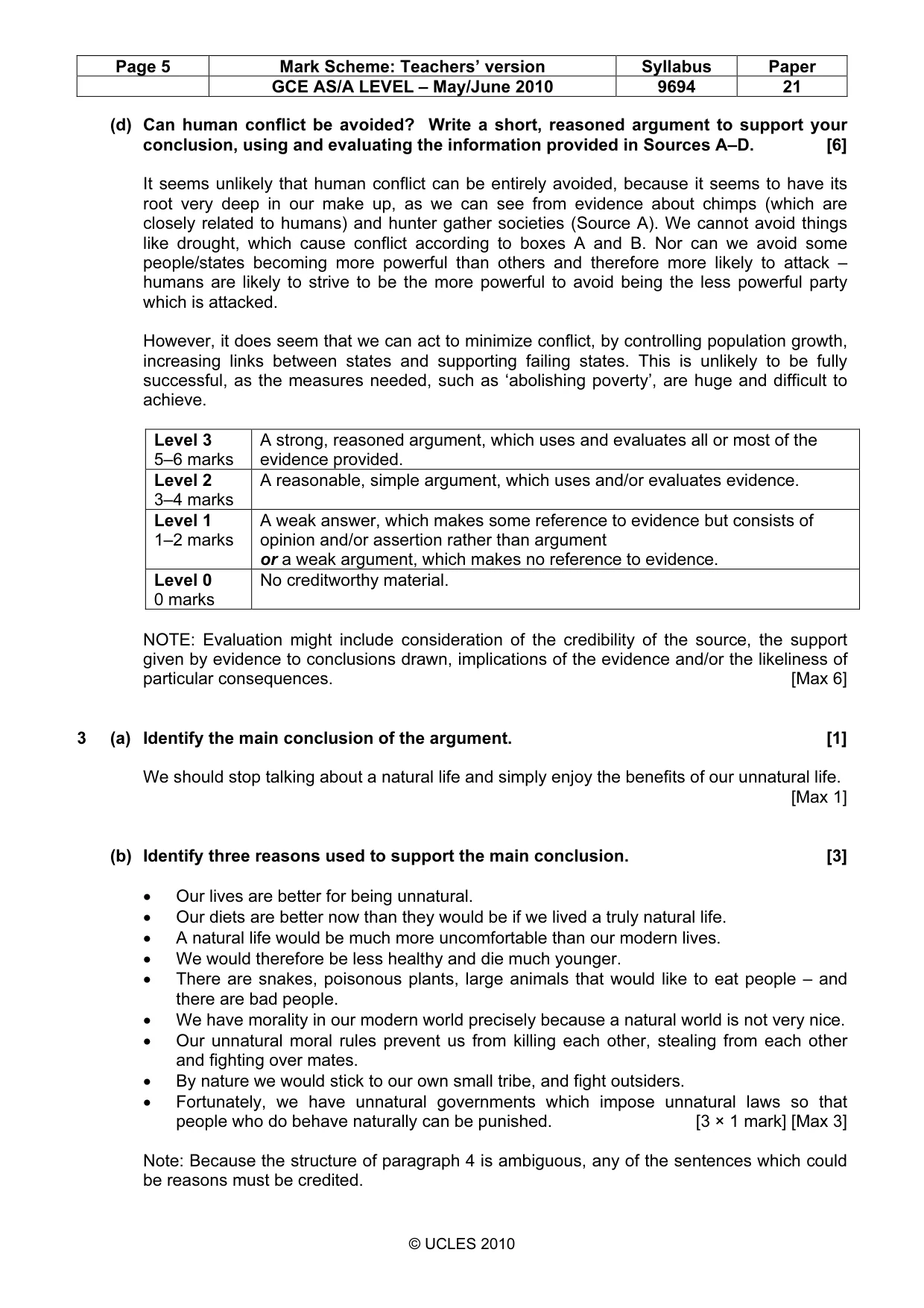
Page 5 Mark Scheme: Teachers’ version Syllabus Paper GCE AS/A LEVEL – May/June 2010 9694 21 © UCLES 2010 (d) Can human conflict be avoided? Write a short, reasoned argument to support your conclusion, using and evaluating the information provided in Sources A–D. [6] It seems unlikely that human conflict can be entirely avoided, because it seems to have its root very deep in our make up, as we can see from evidence about chimps (which are closely related to humans) and hunter gather societies (Source A). We cannot avoid things like drought, which cause conflict according to boxes A and B. Nor can we avoid some people/states becoming more powerful than others and therefore more likely to attack – humans are likely to strive to be the more powerful to avoid being the less powerful party which is attacked. However, it does seem that we can act to minimize conflict, by controlling population growth, increasing links between states and supporting failing states. This is unlikely to be fully successful, as the measures needed, such as ‘abolishing poverty’, are huge and difficult to achieve. Level 3 5–6 marks A strong, reasoned argument, which uses and evaluates all or most of the evidence provided. Level 2 3–4 marks A reasonable, simple argument, which uses and/or evaluates evidence. Level 1 1–2 marks A weak answer, which makes some reference to evidence but consists of opinion and/or assertion rather than argument or a weak argument, which makes no reference to evidence. Level 0 0 marks No creditworthy material. NOTE: Evaluation might include consideration of the credibility of the source, the support given by evidence to conclusions drawn, implications of the evidence and/or the likeliness of particular consequences. [Max 6] 3 (a) Identify the main conclusion of the argument. [1] We should stop talking about a natural life and simply enjoy the benefits of our unnatural life. [Max 1] (b) Identify three reasons used to support the main conclusion. [3] • Our lives are better for being unnatural. • Our diets are better now than they would be if we lived a truly natural life. • A natural life would be much more uncomfortable than our modern lives. • We would therefore be less healthy and die much younger. • There are snakes, poisonous plants, large animals that would like to eat people – and there are bad people. • We have morality in our modern world precisely because a natural world is not very nice. • Our unnatural moral rules prevent us from killing each other, stealing from each other and fighting over mates. • By nature we would stick to our own small tribe, and fight outsiders. • Fortunately, we have unnatural governments which impose unnatural laws so that people who do behave naturally can be punished. [3 × 1 mark] [Max 3] Note: Because the structure of paragraph 4 is ambiguous, any of the sentences which could be reasons must be credited.
Mark scheme, page 6
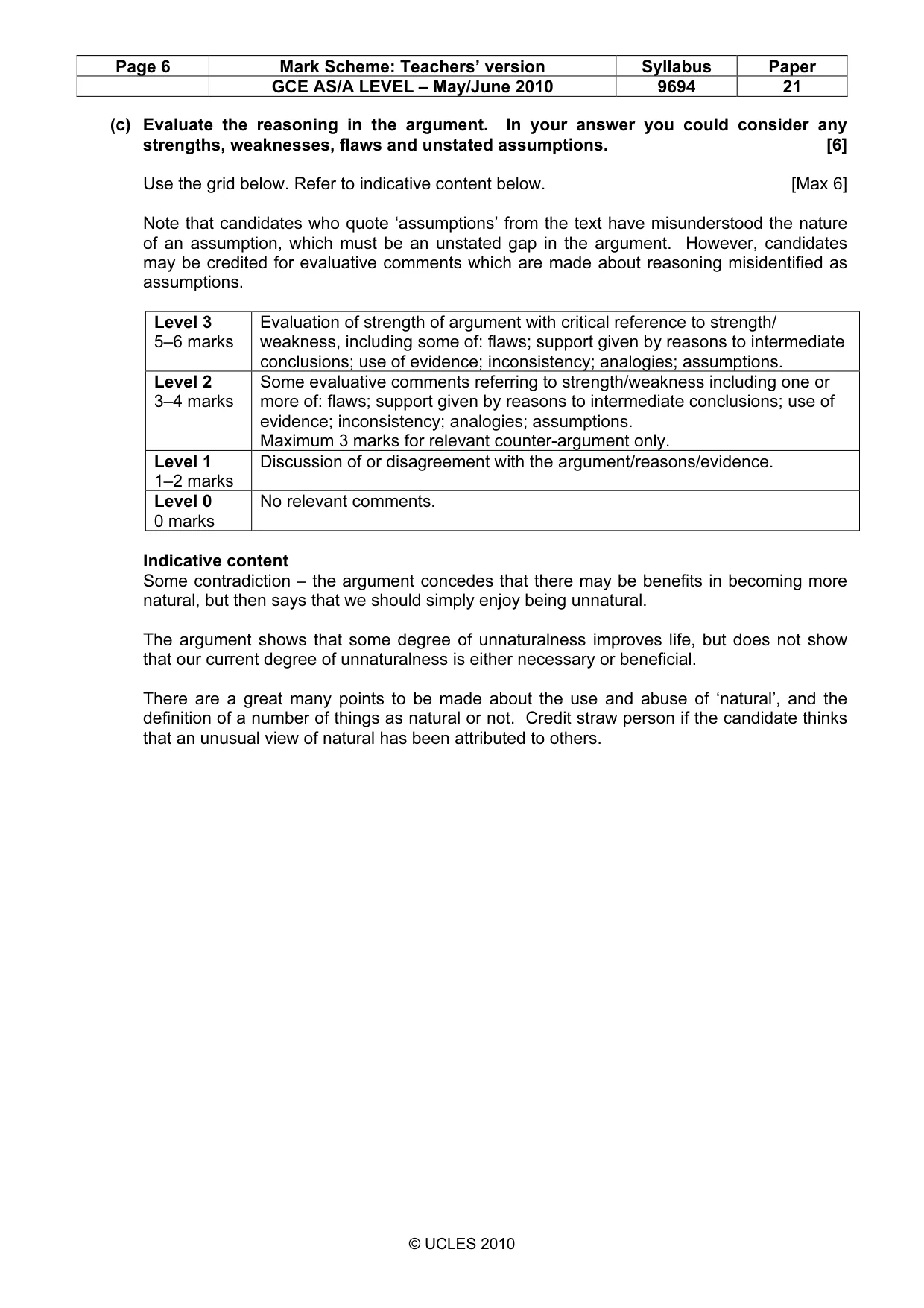
Page 6 Mark Scheme: Teachers’ version Syllabus Paper GCE AS/A LEVEL – May/June 2010 9694 21 © UCLES 2010 (c) Evaluate the reasoning in the argument. In your answer you could consider any strengths, weaknesses, flaws and unstated assumptions. [6] Use the grid below. Refer to indicative content below. [Max 6] Note that candidates who quote ‘assumptions’ from the text have misunderstood the nature of an assumption, which must be an unstated gap in the argument. However, candidates may be credited for evaluative comments which are made about reasoning misidentified as assumptions. Level 3 5–6 marks Evaluation of strength of argument with critical reference to strength/ weakness, including some of: flaws; support given by reasons to intermediate conclusions; use of evidence; inconsistency; analogies; assumptions. Level 2 3–4 marks Some evaluative comments referring to strength/weakness including one or more of: flaws; support given by reasons to intermediate conclusions; use of evidence; inconsistency; analogies; assumptions. Maximum 3 marks for relevant counter-argument only. Level 1 1–2 marks Discussion of or disagreement with the argument/reasons/evidence. Level 0 0 marks No relevant comments. Indicative content Some contradiction – the argument concedes that there may be benefits in becoming more natural, but then says that we should simply enjoy being unnatural. The argument shows that some degree of unnaturalness improves life, but does not show that our current degree of unnaturalness is either necessary or beneficial. There are a great many points to be made about the use and abuse of ‘natural’, and the definition of a number of things as natural or not. Credit straw person if the candidate thinks that an unusual view of natural has been attributed to others.
Mark scheme, page 7
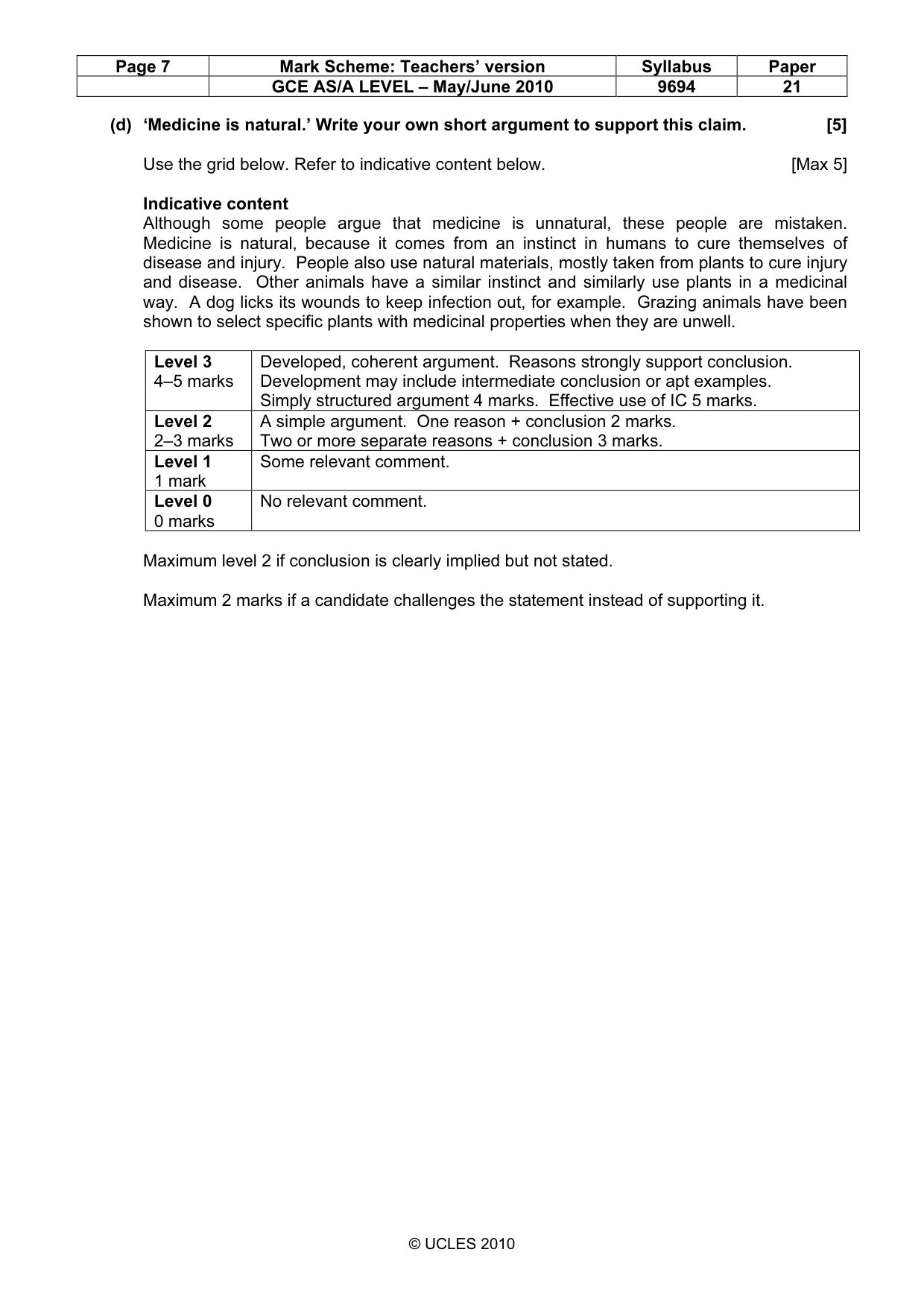
Page 7 Mark Scheme: Teachers’ version Syllabus Paper GCE AS/A LEVEL – May/June 2010 9694 21 © UCLES 2010 (d) ‘Medicine is natural.’ Write your own short argument to support this claim. [5] Use the grid below. Refer to indicative content below. [Max 5] Indicative content Although some people argue that medicine is unnatural, these people are mistaken. Medicine is natural, because it comes from an instinct in humans to cure themselves of disease and injury. People also use natural materials, mostly taken from plants to cure injury and disease. Other animals have a similar instinct and similarly use plants in a medicinal way. A dog licks its wounds to keep infection out, for example. Grazing animals have been shown to select specific plants with medicinal properties when they are unwell. Level 3 4–5 marks Developed, coherent argument. Reasons strongly support conclusion. Development may include intermediate conclusion or apt examples. Simply structured argument 4 marks. Effective use of IC 5 marks. Level 2 2–3 marks A simple argument. One reason + conclusion 2 marks. Two or more separate reasons + conclusion 3 marks. Level 1 1 mark Some relevant comment. Level 0 0 marks No relevant comment. Maximum level 2 if conclusion is clearly implied but not stated. Maximum 2 marks if a candidate challenges the statement instead of supporting it.
What you needed in this session
Cambridge’s own grade thresholds for 2010 May/June, Paper 2 · Variant 1. A higher threshold means an easier paper — the bar moves with how the cohort did.