Cambridge A Level Thinking Skills 9694 — 2010 May/June Paper 2 · Variant 2
9694/22/M/J/10 · 45 marks · ≈51 min
The question paper and its mark scheme, free to read here and free to download. This is Cambridge’s own paper, exactly as it was sat.
Question paper8 pages

Mark scheme8 pages
Answers below. Sit the paper first if you are practising.
Paper as text
Question paper, page 1
This document consists of 6 printed pages and 2 blank pages. IB10 06_9694_22/6RP © UCLES 2010 [Turn over *5412399887* UNIVERSITY OF CAMBRIDGE INTERNATIONAL EXAMINATIONS General Certificate of Education Advanced Subsidiary Level and Advanced Level THINKING SKILLS 9694/22 Paper 2 Critical Reasoning May/June 2010 1 hour 30 minutes Additional Materials: Answer Booklet/Paper READ THESE INSTRUCTIONS FIRST If you have been given an Answer Booklet, follow the instructions on the front cover of the booklet. Write your Centre number, candidate number and name on all the work you hand in. Write in dark blue or black pen. Do not use staples, paper clips, highlighters, glue and correction fluid. DO NOT WRITE IN ANY BARCODES. Answer all the questions. Start each question on a new answer sheet. At the end of the examination, fasten all your work securely together. The number of marks is given in brackets [ ] at the end of each question.
Question paper, page 2
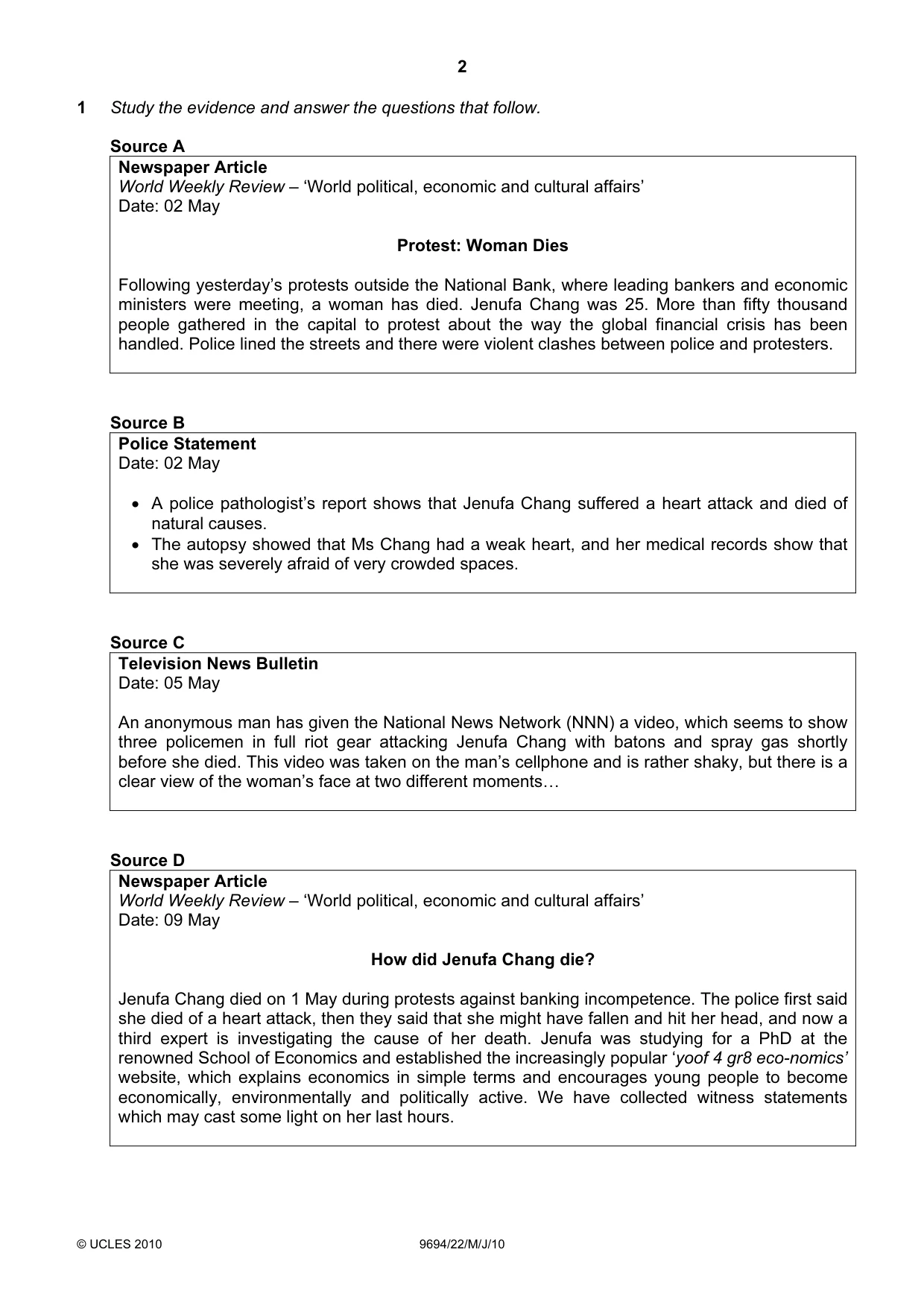
2 © UCLES 2010 9694/22/M/J/10 1 Study the evidence and answer the questions that follow. Source A Newspaper Article World Weekly Review – ‘World political, economic and cultural affairs’ Date: 02 May Protest: Woman Dies Following yesterday’s protests outside the National Bank, where leading bankers and economic ministers were meeting, a woman has died. Jenufa Chang was 25. More than fifty thousand people gathered in the capital to protest about the way the global financial crisis has been handled. Police lined the streets and there were violent clashes between police and protesters. Source B Police Statement Date: 02 May • A police pathologist’s report shows that Jenufa Chang suffered a heart attack and died of natural causes. • The autopsy showed that Ms Chang had a weak heart, and her medical records show that she was severely afraid of very crowded spaces. Source C Television News Bulletin Date: 05 May An anonymous man has given the National News Network (NNN) a video, which seems to show three policemen in full riot gear attacking Jenufa Chang with batons and spray gas shortly before she died. This video was taken on the man’s cellphone and is rather shaky, but there is a clear view of the woman’s face at two different moments… Source D Newspaper Article World Weekly Review – ‘World political, economic and cultural affairs’ Date: 09 May How did Jenufa Chang die? Jenufa Chang died on 1 May during protests against banking incompetence. The police first said she died of a heart attack, then they said that she might have fallen and hit her head, and now a third expert is investigating the cause of her death. Jenufa was studying for a PhD at the renowned School of Economics and established the increasingly popular ‘yoof 4 gr8 eco-nomics’ website, which explains economics in simple terms and encourages young people to become economically, environmentally and politically active. We have collected witness statements which may cast some light on her last hours.
Question paper, page 3
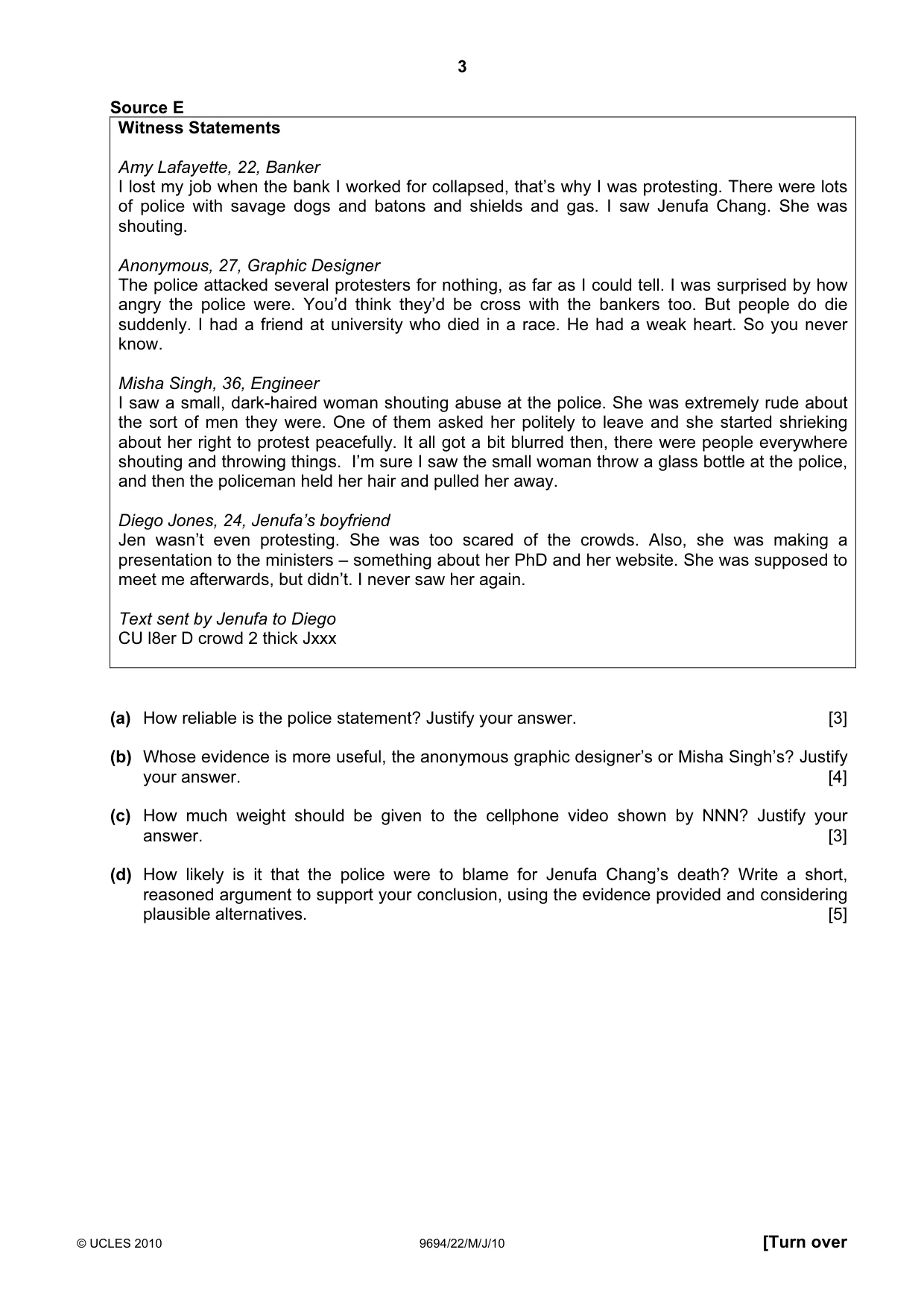
3 © UCLES 2010 9694/22/M/J/10 [Turn over Source E Witness Statements Amy Lafayette, 22, Banker I lost my job when the bank I worked for collapsed, that’s why I was protesting. There were lots of police with savage dogs and batons and shields and gas. I saw Jenufa Chang. She was shouting. Anonymous, 27, Graphic Designer The police attacked several protesters for nothing, as far as I could tell. I was surprised by how angry the police were. You’d think they’d be cross with the bankers too. But people do die suddenly. I had a friend at university who died in a race. He had a weak heart. So you never know. Misha Singh, 36, Engineer I saw a small, dark-haired woman shouting abuse at the police. She was extremely rude about the sort of men they were. One of them asked her politely to leave and she started shrieking about her right to protest peacefully. It all got a bit blurred then, there were people everywhere shouting and throwing things. I’m sure I saw the small woman throw a glass bottle at the police, and then the policeman held her hair and pulled her away. Diego Jones, 24, Jenufa’s boyfriend Jen wasn’t even protesting. She was too scared of the crowds. Also, she was making a presentation to the ministers – something about her PhD and her website. She was supposed to meet me afterwards, but didn’t. I never saw her again. Text sent by Jenufa to Diego CU l8er D crowd 2 thick Jxxx (a) How reliable is the police statement? Justify your answer. [3] (b) Whose evidence is more useful, the anonymous graphic designer’s or Misha Singh’s? Justify your answer. [4] (c) How much weight should be given to the cellphone video shown by NNN? Justify your answer. [3] (d) How likely is it that the police were to blame for Jenufa Chang’s death? Write a short, reasoned argument to support your conclusion, using the evidence provided and considering plausible alternatives. [5]
Question paper, page 4
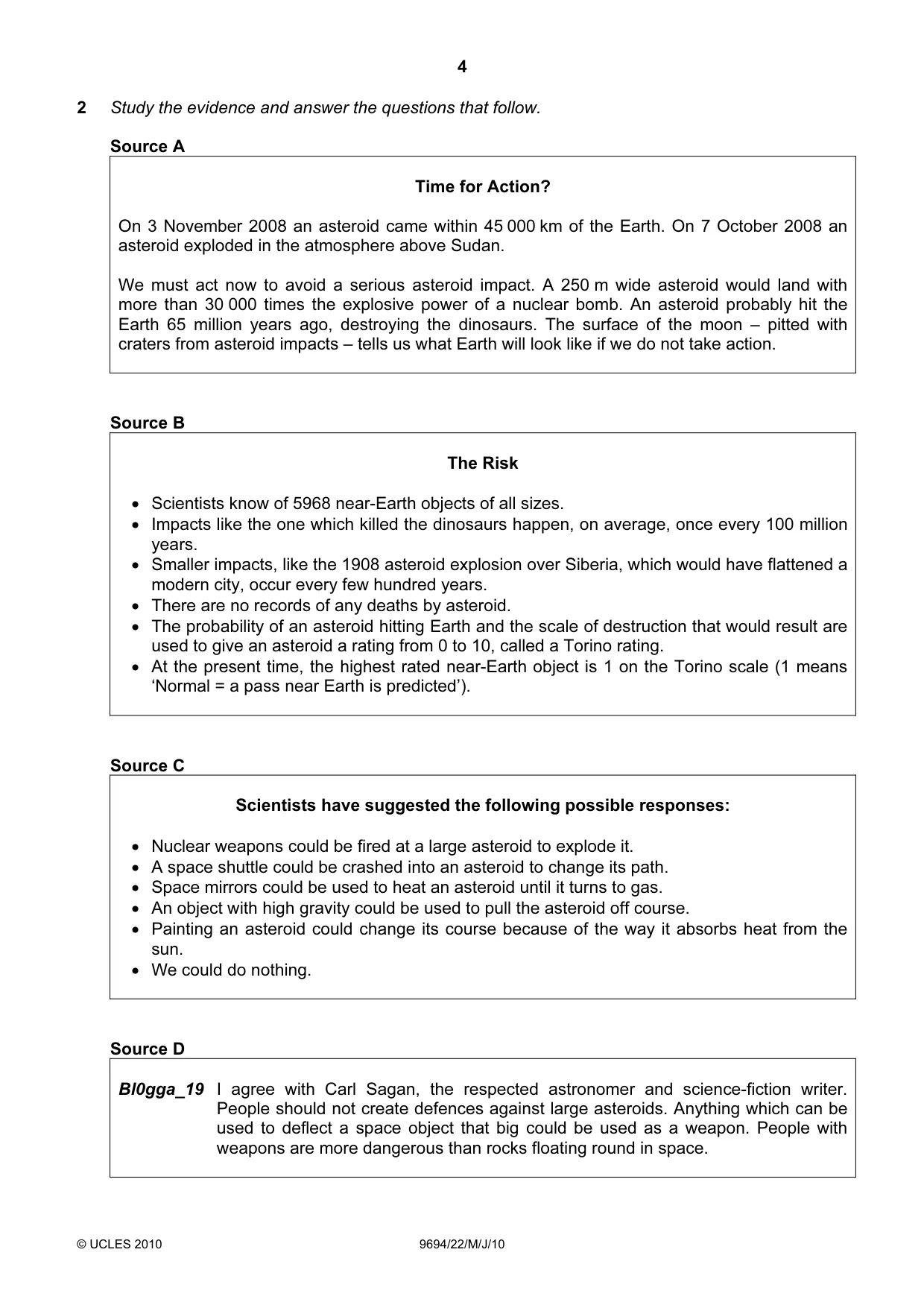
4 © UCLES 2010 9694/22/M/J/10 2 Study the evidence and answer the questions that follow. Source A Time for Action? On 3 November 2008 an asteroid came within 45 000 km of the Earth. On 7 October 2008 an asteroid exploded in the atmosphere above Sudan. We must act now to avoid a serious asteroid impact. A 250 m wide asteroid would land with more than 30 000 times the explosive power of a nuclear bomb. An asteroid probably hit the Earth 65 million years ago, destroying the dinosaurs. The surface of the moon – pitted with craters from asteroid impacts – tells us what Earth will look like if we do not take action. Source B The Risk • Scientists know of 5968 near-Earth objects of all sizes. • Impacts like the one which killed the dinosaurs happen, on average, once every 100 million years. • Smaller impacts, like the 1908 asteroid explosion over Siberia, which would have flattened a modern city, occur every few hundred years. • There are no records of any deaths by asteroid. • The probability of an asteroid hitting Earth and the scale of destruction that would result are used to give an asteroid a rating from 0 to 10, called a Torino rating. • At the present time, the highest rated near-Earth object is 1 on the Torino scale (1 means ‘Normal = a pass near Earth is predicted’). Source C Scientists have suggested the following possible responses: • Nuclear weapons could be fired at a large asteroid to explode it. • A space shuttle could be crashed into an asteroid to change its path. • Space mirrors could be used to heat an asteroid until it turns to gas. • An object with high gravity could be used to pull the asteroid off course. • Painting an asteroid could change its course because of the way it absorbs heat from the sun. • We could do nothing. Source D Bl0gga_19 I agree with Carl Sagan, the respected astronomer and science-fiction writer. People should not create defences against large asteroids. Anything which can be used to deflect a space object that big could be used as a weapon. People with weapons are more dangerous than rocks floating round in space.
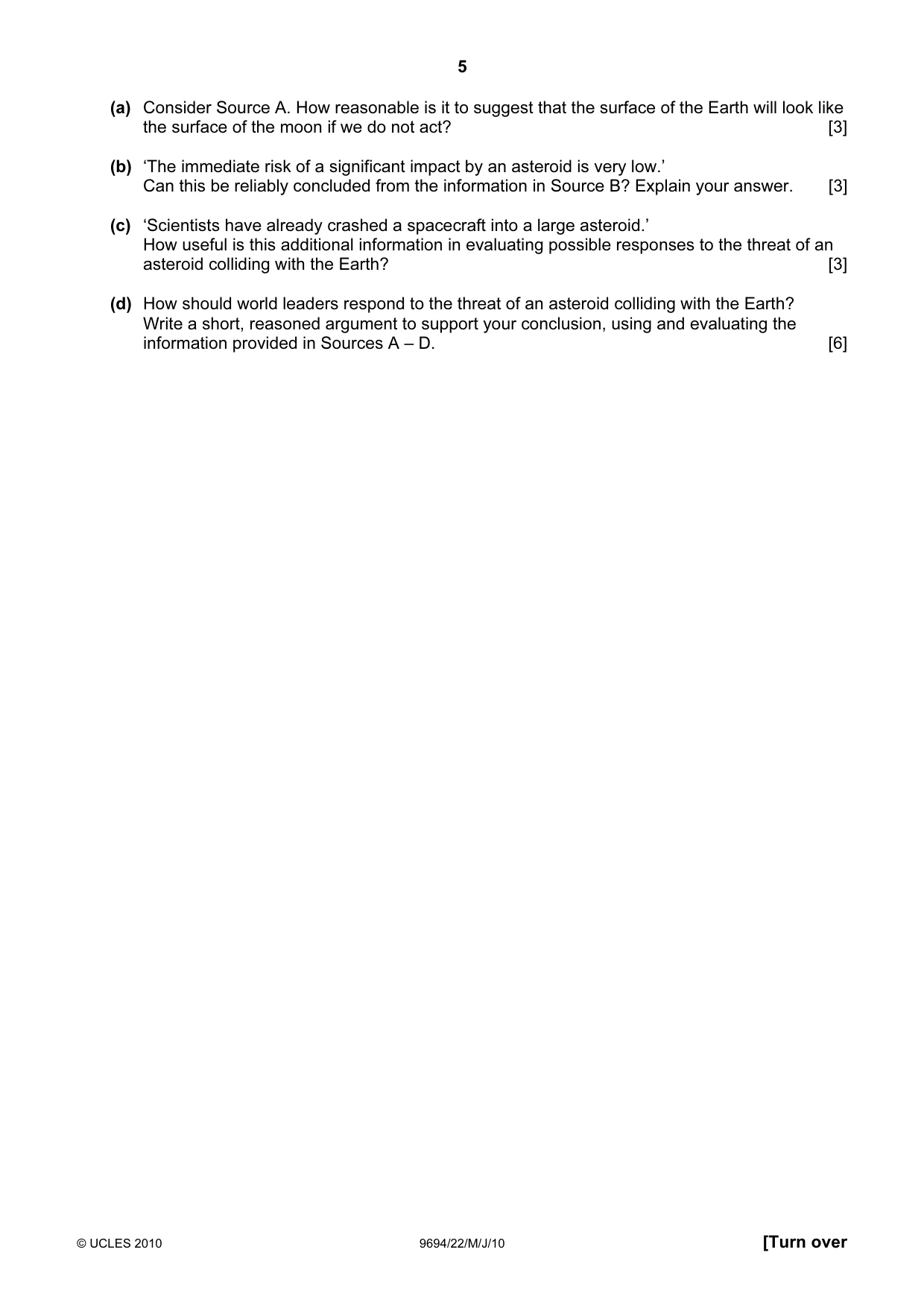
Question paper, page 5
5 © UCLES 2010 9694/22/M/J/10 [Turn over (a) Consider Source A. How reasonable is it to suggest that the surface of the Earth will look like the surface of the moon if we do not act? [3] (b) ‘The immediate risk of a significant impact by an asteroid is very low.’ Can this be reliably concluded from the information in Source B? Explain your answer. [3] (c) ‘Scientists have already crashed a spacecraft into a large asteroid.’ How useful is this additional information in evaluating possible responses to the threat of an asteroid colliding with the Earth? [3] (d) How should world leaders respond to the threat of an asteroid colliding with the Earth? Write a short, reasoned argument to support your conclusion, using and evaluating the information provided in Sources A – D. [6]
Question paper, page 6
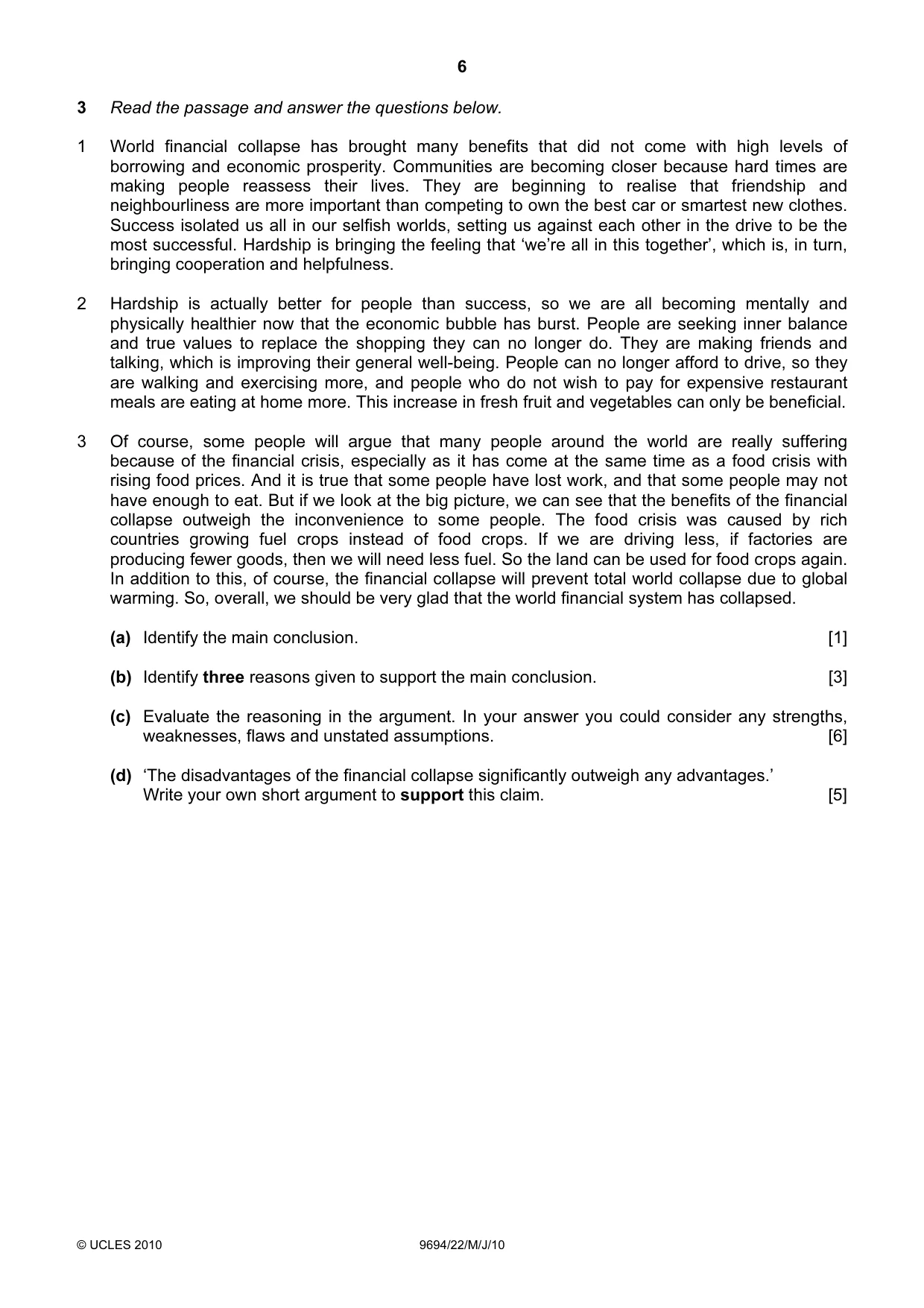
6 © UCLES 2010 9694/22/M/J/10 3 Read the passage and answer the questions below. 1 World financial collapse has brought many benefits that did not come with high levels of borrowing and economic prosperity. Communities are becoming closer because hard times are making people reassess their lives. They are beginning to realise that friendship and neighbourliness are more important than competing to own the best car or smartest new clothes. Success isolated us all in our selfish worlds, setting us against each other in the drive to be the most successful. Hardship is bringing the feeling that ‘we’re all in this together’, which is, in turn, bringing cooperation and helpfulness. 2 Hardship is actually better for people than success, so we are all becoming mentally and physically healthier now that the economic bubble has burst. People are seeking inner balance and true values to replace the shopping they can no longer do. They are making friends and talking, which is improving their general well-being. People can no longer afford to drive, so they are walking and exercising more, and people who do not wish to pay for expensive restaurant meals are eating at home more. This increase in fresh fruit and vegetables can only be beneficial. 3 Of course, some people will argue that many people around the world are really suffering because of the financial crisis, especially as it has come at the same time as a food crisis with rising food prices. And it is true that some people have lost work, and that some people may not have enough to eat. But if we look at the big picture, we can see that the benefits of the financial collapse outweigh the inconvenience to some people. The food crisis was caused by rich countries growing fuel crops instead of food crops. If we are driving less, if factories are producing fewer goods, then we will need less fuel. So the land can be used for food crops again. In addition to this, of course, the financial collapse will prevent total world collapse due to global warming. So, overall, we should be very glad that the world financial system has collapsed. (a) Identify the main conclusion. [1] (b) Identify three reasons given to support the main conclusion. [3] (c) Evaluate the reasoning in the argument. In your answer you could consider any strengths, weaknesses, flaws and unstated assumptions. [6] (d) ‘The disadvantages of the financial collapse significantly outweigh any advantages.’ Write your own short argument to support this claim. [5]
Question paper, page 7
7 © UCLES 2010 9694/22/M/J/10 BLANK PAGE
Question paper, page 8
8 Permission to reproduce items where third-party owned material protected by copyright is included has been sought and cleared where possible. Every reasonable effort has been made by the publisher (UCLES) to trace copyright holders, but if any items requiring clearance have unwittingly been included, the publisher will be pleased to make amends at the earliest possible opportunity. University of Cambridge International Examinations is part of the Cambridge Assessment Group. Cambridge Assessment is the brand name of University of Cambridge Local Examinations Syndicate (UCLES), which is itself a department of the University of Cambridge. © UCLES 2010 9694/22/M/J/10 BLANK PAGE
Mark scheme, page 1
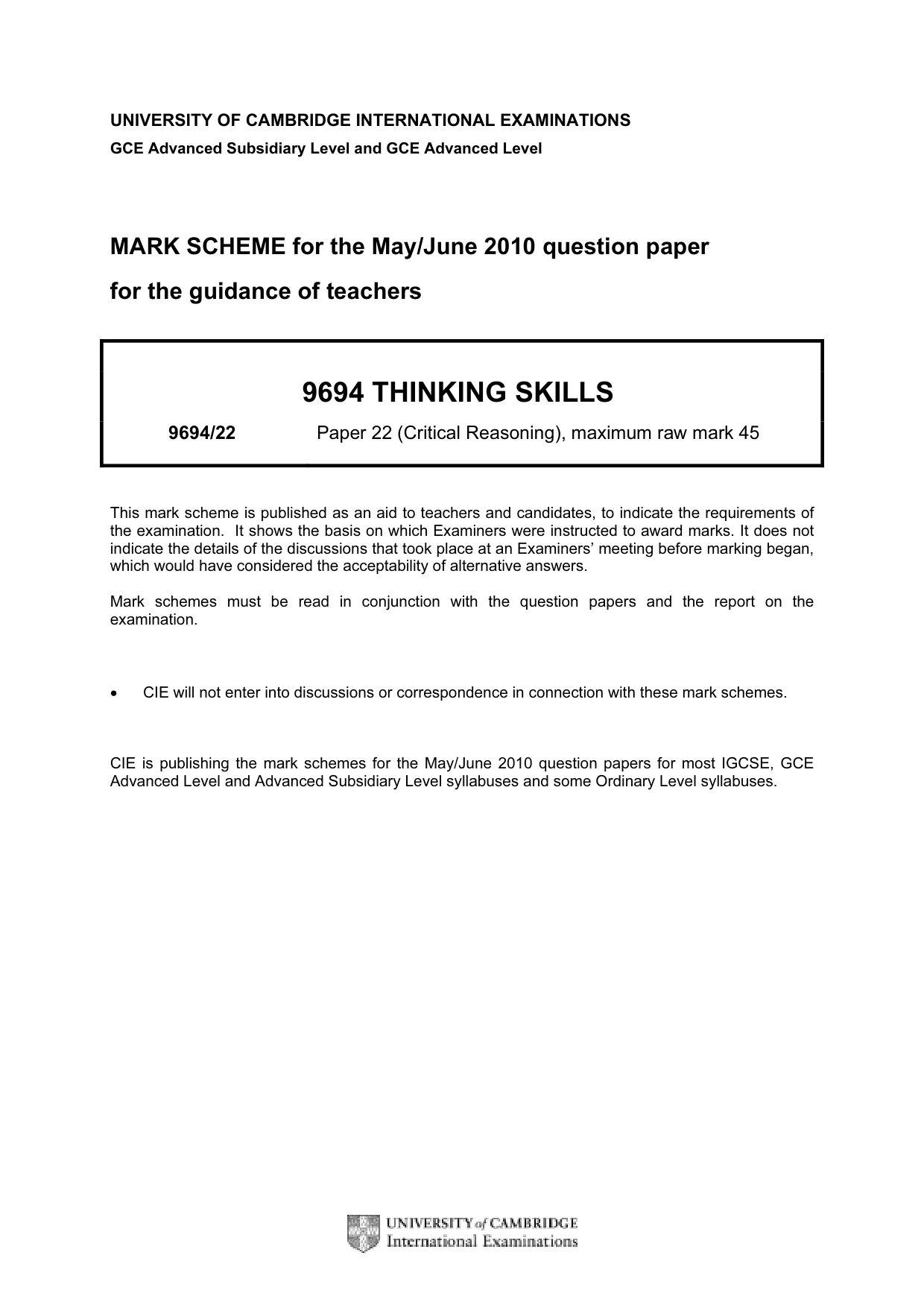
UNIVERSITY OF CAMBRIDGE INTERNATIONAL EXAMINATIONS GCE Advanced Subsidiary Level and GCE Advanced Level MARK SCHEME for the May/June 2010 question paper for the guidance of teachers 9694 THINKING SKILLS 9694/22 Paper 22 (Critical Reasoning), maximum raw mark 45 This mark scheme is published as an aid to teachers and candidates, to indicate the requirements of the examination. It shows the basis on which Examiners were instructed to award marks. It does not indicate the details of the discussions that took place at an Examiners’ meeting before marking began, which would have considered the acceptability of alternative answers. Mark schemes must be read in conjunction with the question papers and the report on the examination. • CIE will not enter into discussions or correspondence in connection with these mark schemes. CIE is publishing the mark schemes for the May/June 2010 question papers for most IGCSE, GCE Advanced Level and Advanced Subsidiary Level syllabuses and some Ordinary Level syllabuses.
Mark scheme, page 2
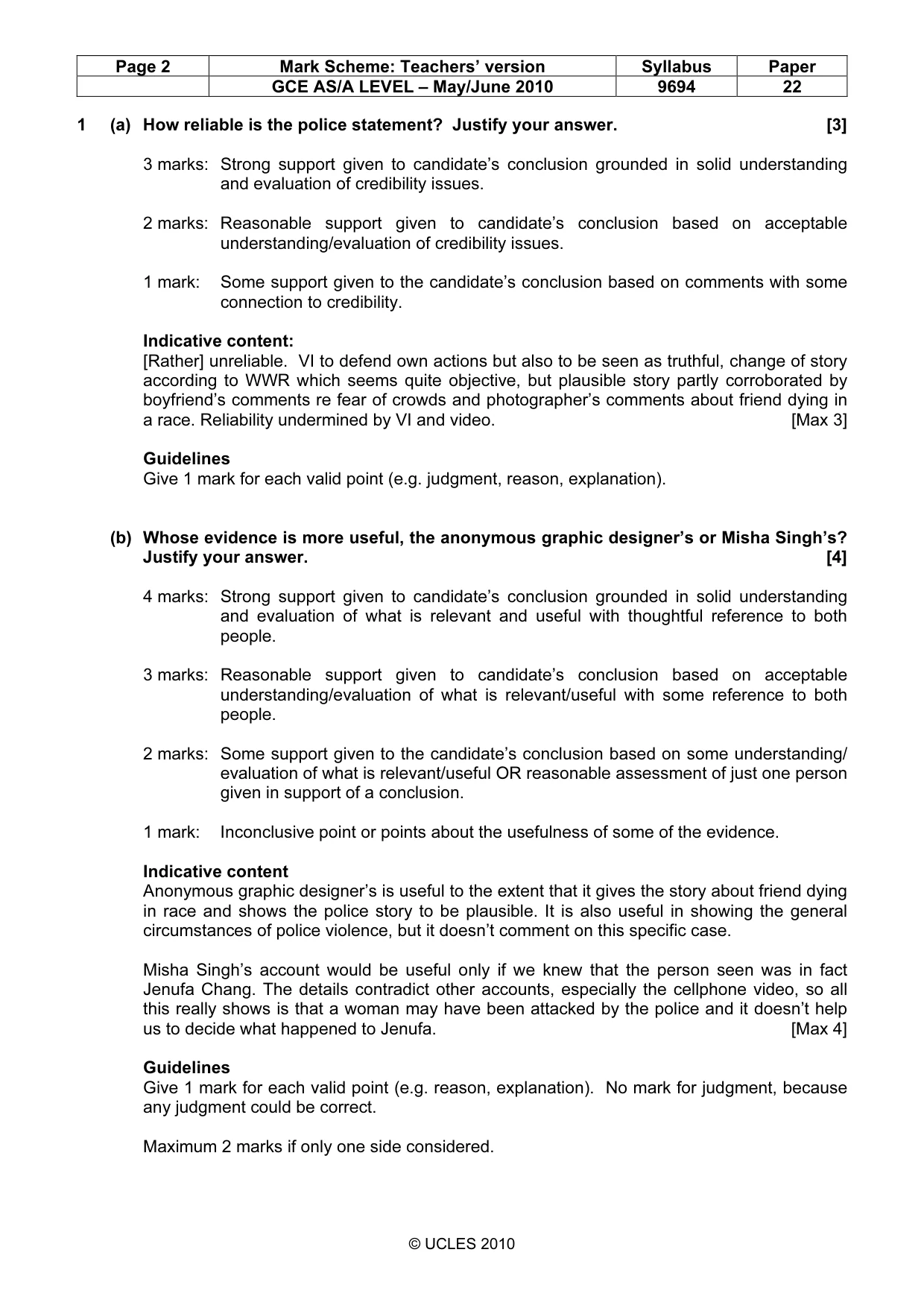
Page 2 Mark Scheme: Teachers’ version Syllabus Paper GCE AS/A LEVEL – May/June 2010 9694 22 © UCLES 2010 1 (a) How reliable is the police statement? Justify your answer. [3] 3 marks: Strong support given to candidate’s conclusion grounded in solid understanding and evaluation of credibility issues. 2 marks: Reasonable support given to candidate’s conclusion based on acceptable understanding/evaluation of credibility issues. 1 mark: Some support given to the candidate’s conclusion based on comments with some connection to credibility. Indicative content: [Rather] unreliable. VI to defend own actions but also to be seen as truthful, change of story according to WWR which seems quite objective, but plausible story partly corroborated by boyfriend’s comments re fear of crowds and photographer’s comments about friend dying in a race. Reliability undermined by VI and video. [Max 3] Guidelines Give 1 mark for each valid point (e.g. judgment, reason, explanation). (b) Whose evidence is more useful, the anonymous graphic designer’s or Misha Singh’s? Justify your answer. [4] 4 marks: Strong support given to candidate’s conclusion grounded in solid understanding and evaluation of what is relevant and useful with thoughtful reference to both people. 3 marks: Reasonable support given to candidate’s conclusion based on acceptable understanding/evaluation of what is relevant/useful with some reference to both people. 2 marks: Some support given to the candidate’s conclusion based on some understanding/ evaluation of what is relevant/useful OR reasonable assessment of just one person given in support of a conclusion. 1 mark: Inconclusive point or points about the usefulness of some of the evidence. Indicative content Anonymous graphic designer’s is useful to the extent that it gives the story about friend dying in race and shows the police story to be plausible. It is also useful in showing the general circumstances of police violence, but it doesn’t comment on this specific case. Misha Singh’s account would be useful only if we knew that the person seen was in fact Jenufa Chang. The details contradict other accounts, especially the cellphone video, so all this really shows is that a woman may have been attacked by the police and it doesn’t help us to decide what happened to Jenufa. [Max 4] Guidelines Give 1 mark for each valid point (e.g. reason, explanation). No mark for judgment, because any judgment could be correct. Maximum 2 marks if only one side considered.
Mark scheme, page 3
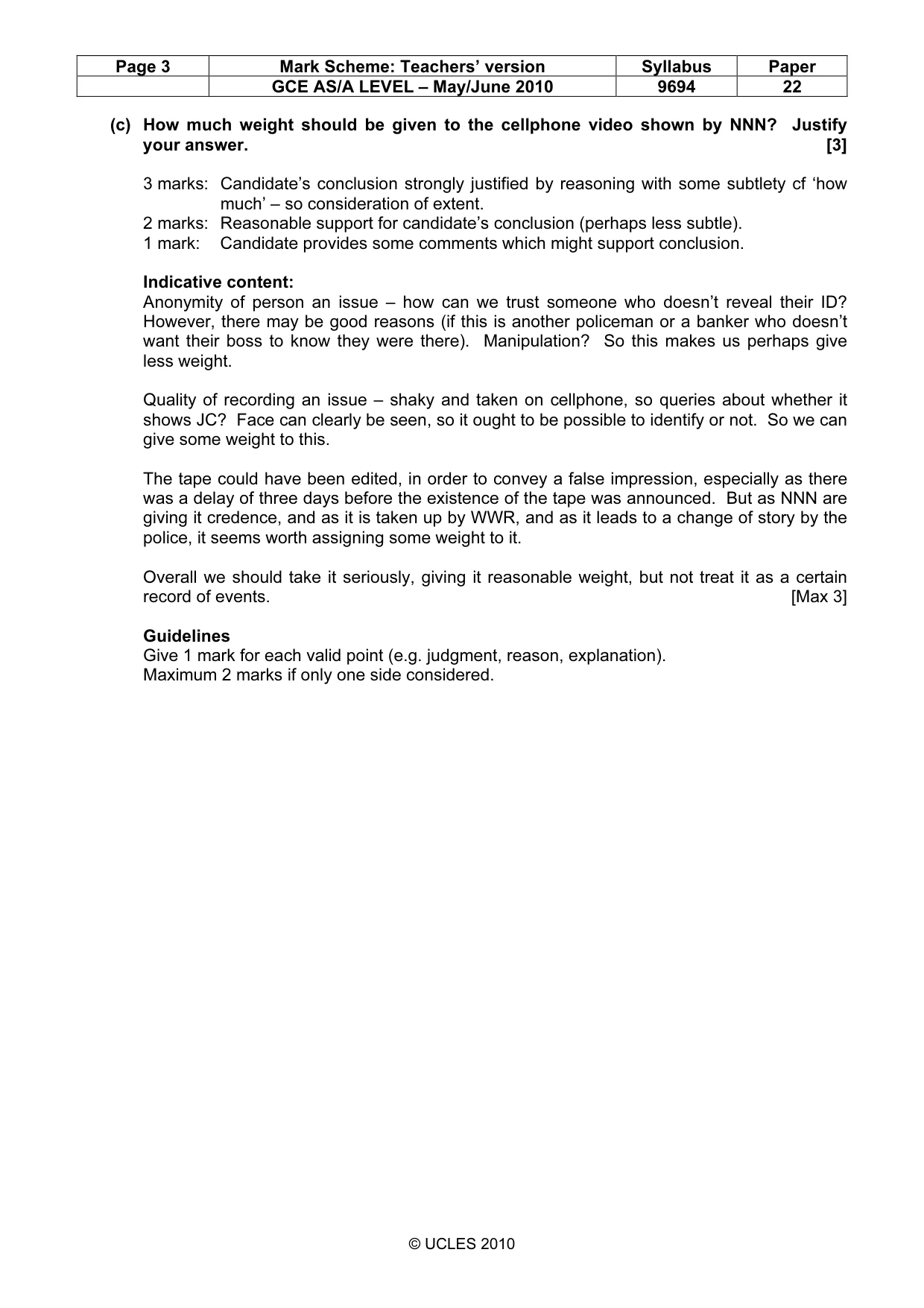
Page 3 Mark Scheme: Teachers’ version Syllabus Paper GCE AS/A LEVEL – May/June 2010 9694 22 © UCLES 2010 (c) How much weight should be given to the cellphone video shown by NNN? Justify your answer. [3] 3 marks: Candidate’s conclusion strongly justified by reasoning with some subtlety cf ‘how much’ – so consideration of extent. 2 marks: Reasonable support for candidate’s conclusion (perhaps less subtle). 1 mark: Candidate provides some comments which might support conclusion. Indicative content: Anonymity of person an issue – how can we trust someone who doesn’t reveal their ID? However, there may be good reasons (if this is another policeman or a banker who doesn’t want their boss to know they were there). Manipulation? So this makes us perhaps give less weight. Quality of recording an issue – shaky and taken on cellphone, so queries about whether it shows JC? Face can clearly be seen, so it ought to be possible to identify or not. So we can give some weight to this. The tape could have been edited, in order to convey a false impression, especially as there was a delay of three days before the existence of the tape was announced. But as NNN are giving it credence, and as it is taken up by WWR, and as it leads to a change of story by the police, it seems worth assigning some weight to it. Overall we should take it seriously, giving it reasonable weight, but not treat it as a certain record of events. [Max 3] Guidelines Give 1 mark for each valid point (e.g. judgment, reason, explanation). Maximum 2 marks if only one side considered.
Mark scheme, page 4
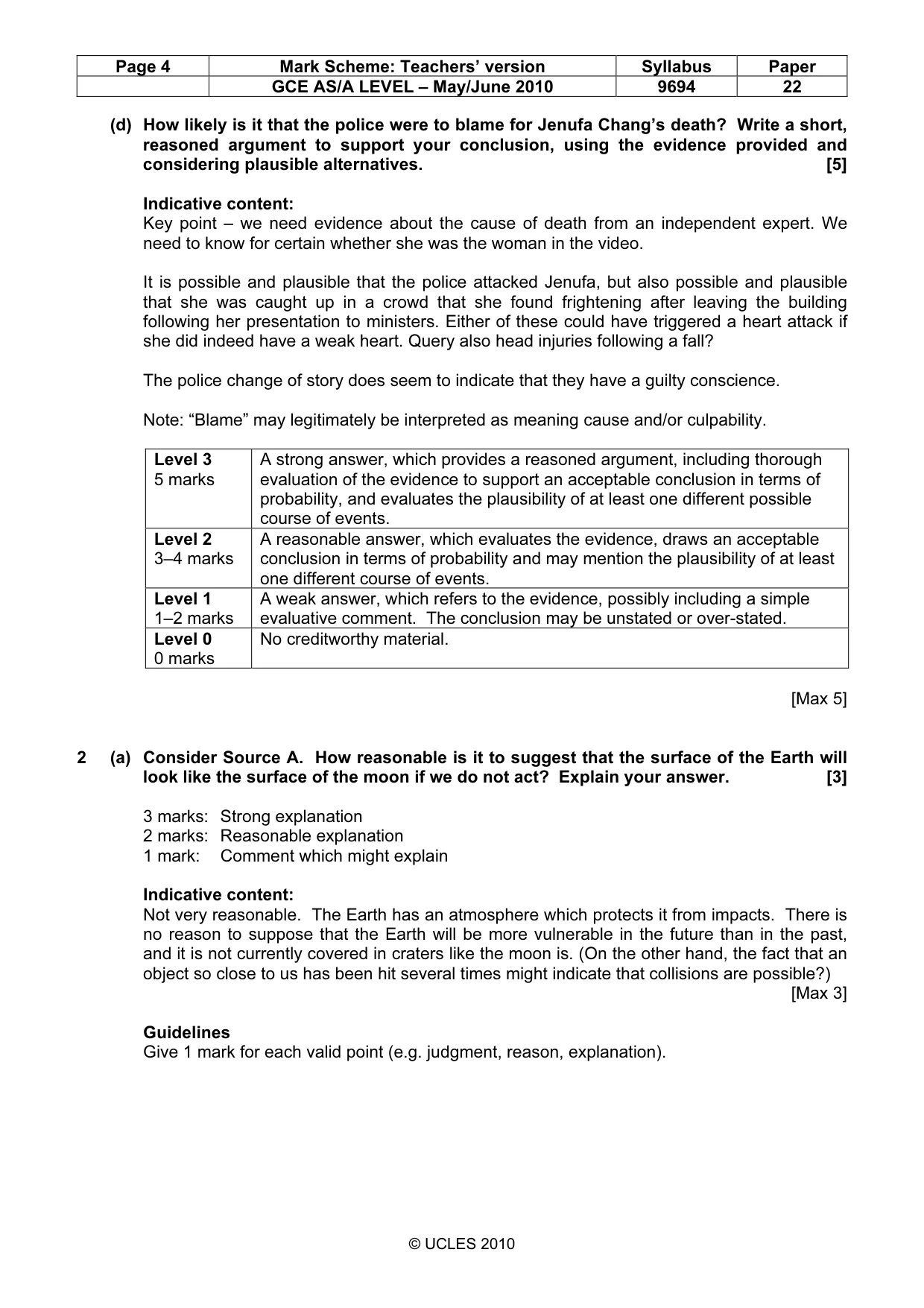
Page 4 Mark Scheme: Teachers’ version Syllabus Paper GCE AS/A LEVEL – May/June 2010 9694 22 © UCLES 2010 (d) How likely is it that the police were to blame for Jenufa Chang’s death? Write a short, reasoned argument to support your conclusion, using the evidence provided and considering plausible alternatives. [5] Indicative content: Key point – we need evidence about the cause of death from an independent expert. We need to know for certain whether she was the woman in the video. It is possible and plausible that the police attacked Jenufa, but also possible and plausible that she was caught up in a crowd that she found frightening after leaving the building following her presentation to ministers. Either of these could have triggered a heart attack if she did indeed have a weak heart. Query also head injuries following a fall? The police change of story does seem to indicate that they have a guilty conscience. Note: “Blame” may legitimately be interpreted as meaning cause and/or culpability. Level 3 5 marks A strong answer, which provides a reasoned argument, including thorough evaluation of the evidence to support an acceptable conclusion in terms of probability, and evaluates the plausibility of at least one different possible course of events. Level 2 3–4 marks A reasonable answer, which evaluates the evidence, draws an acceptable conclusion in terms of probability and may mention the plausibility of at least one different course of events. Level 1 1–2 marks A weak answer, which refers to the evidence, possibly including a simple evaluative comment. The conclusion may be unstated or over-stated. Level 0 0 marks No creditworthy material. [Max 5] 2 (a) Consider Source A. How reasonable is it to suggest that the surface of the Earth will look like the surface of the moon if we do not act? Explain your answer. [3] 3 marks: Strong explanation 2 marks: Reasonable explanation 1 mark: Comment which might explain Indicative content: Not very reasonable. The Earth has an atmosphere which protects it from impacts. There is no reason to suppose that the Earth will be more vulnerable in the future than in the past, and it is not currently covered in craters like the moon is. (On the other hand, the fact that an object so close to us has been hit several times might indicate that collisions are possible?) [Max 3] Guidelines Give 1 mark for each valid point (e.g. judgment, reason, explanation).
Mark scheme, page 5
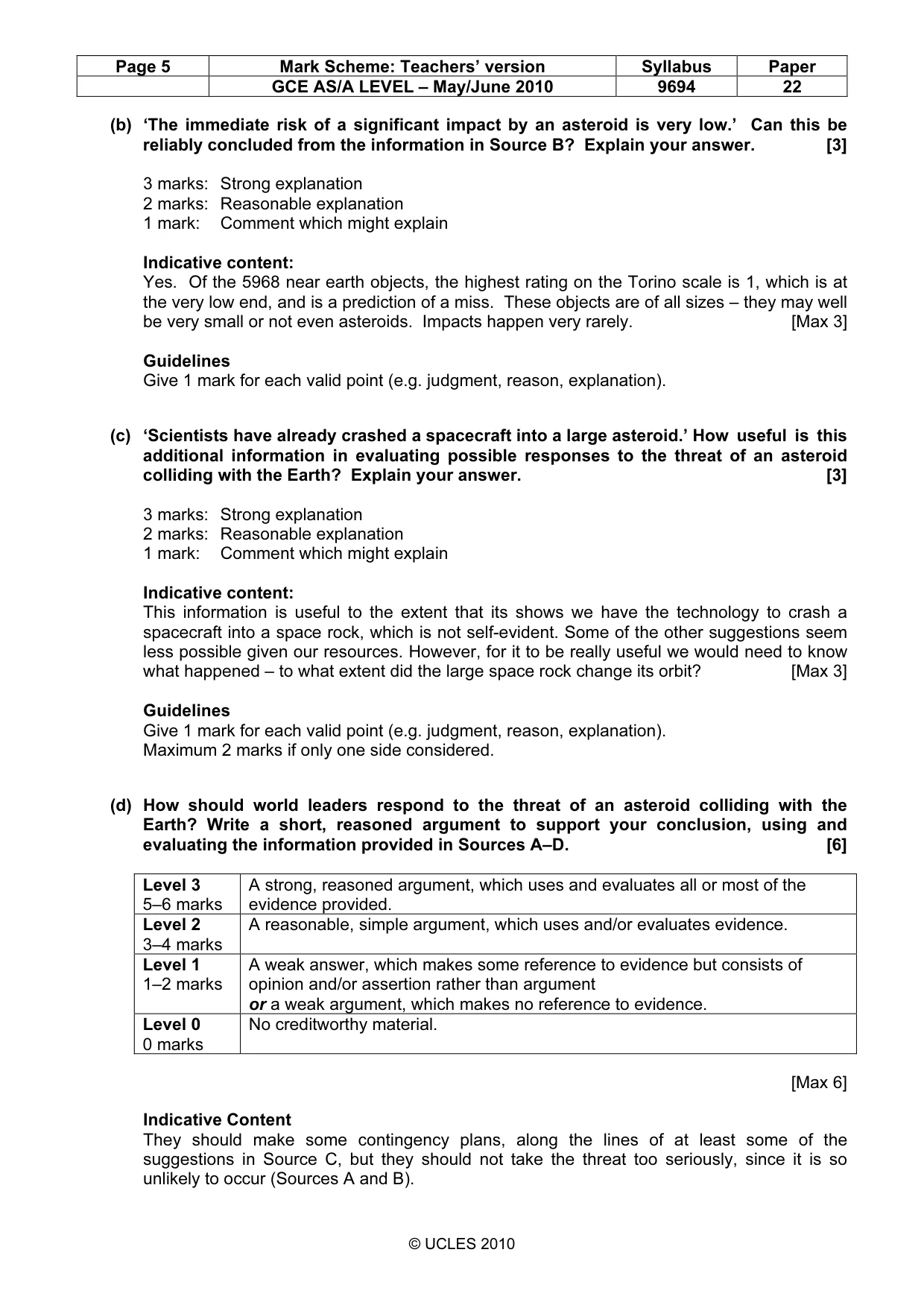
Page 5 Mark Scheme: Teachers’ version Syllabus Paper GCE AS/A LEVEL – May/June 2010 9694 22 © UCLES 2010 (b) ‘The immediate risk of a significant impact by an asteroid is very low.’ Can this be reliably concluded from the information in Source B? Explain your answer. [3] 3 marks: Strong explanation 2 marks: Reasonable explanation 1 mark: Comment which might explain Indicative content: Yes. Of the 5968 near earth objects, the highest rating on the Torino scale is 1, which is at the very low end, and is a prediction of a miss. These objects are of all sizes – they may well be very small or not even asteroids. Impacts happen very rarely. [Max 3] Guidelines Give 1 mark for each valid point (e.g. judgment, reason, explanation). (c) ‘Scientists have already crashed a spacecraft into a large asteroid.’ How useful is this additional information in evaluating possible responses to the threat of an asteroid colliding with the Earth? Explain your answer. [3] 3 marks: Strong explanation 2 marks: Reasonable explanation 1 mark: Comment which might explain Indicative content: This information is useful to the extent that its shows we have the technology to crash a spacecraft into a space rock, which is not self-evident. Some of the other suggestions seem less possible given our resources. However, for it to be really useful we would need to know what happened – to what extent did the large space rock change its orbit? [Max 3] Guidelines Give 1 mark for each valid point (e.g. judgment, reason, explanation). Maximum 2 marks if only one side considered. (d) How should world leaders respond to the threat of an asteroid colliding with the Earth? Write a short, reasoned argument to support your conclusion, using and evaluating the information provided in Sources A–D. [6] Level 3 5–6 marks A strong, reasoned argument, which uses and evaluates all or most of the evidence provided. Level 2 3–4 marks A reasonable, simple argument, which uses and/or evaluates evidence. Level 1 1–2 marks A weak answer, which makes some reference to evidence but consists of opinion and/or assertion rather than argument or a weak argument, which makes no reference to evidence. Level 0 0 marks No creditworthy material. [Max 6] Indicative Content They should make some contingency plans, along the lines of at least some of the suggestions in Source C, but they should not take the threat too seriously, since it is so unlikely to occur (Sources A and B).
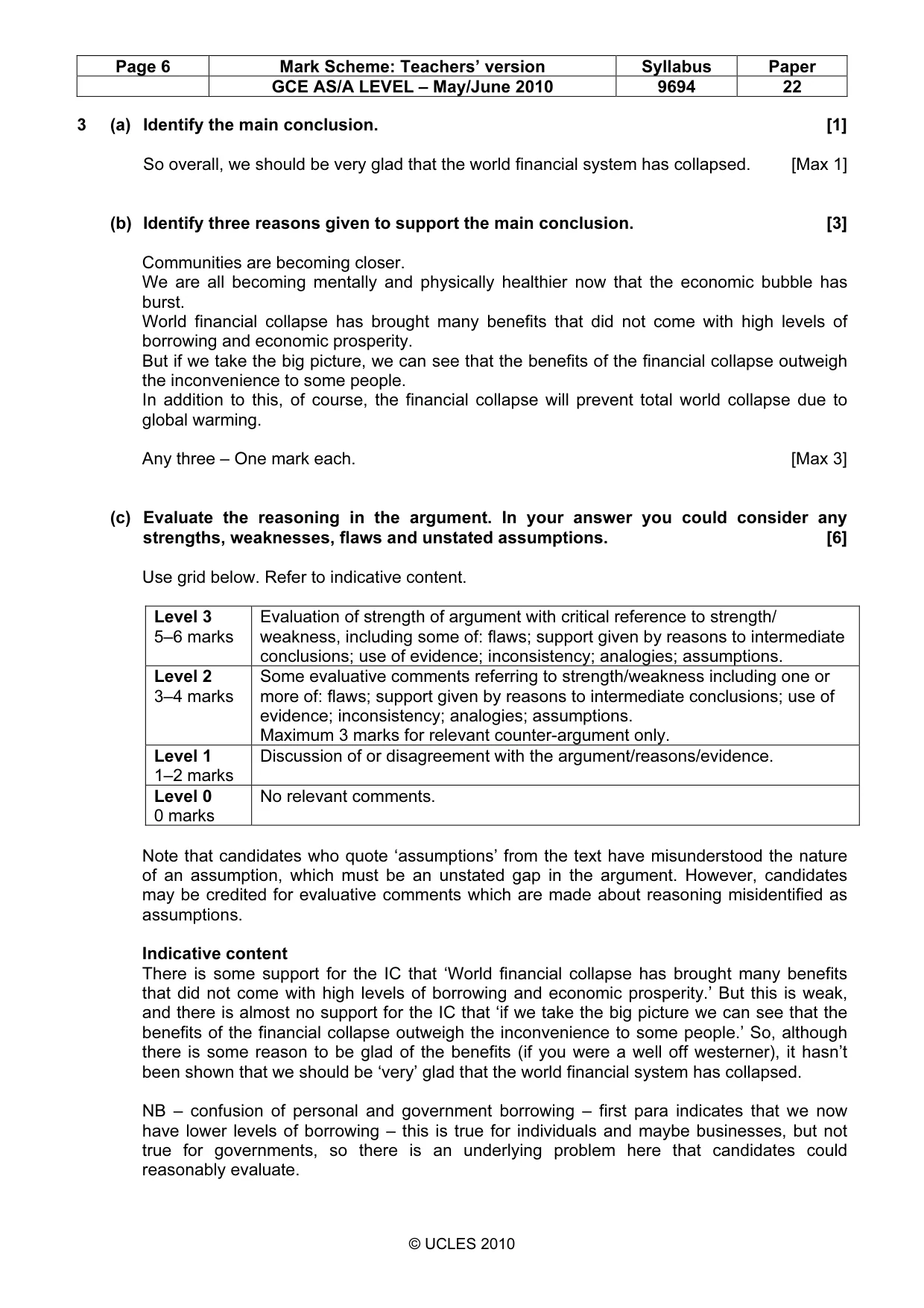
Mark scheme, page 6
Page 6 Mark Scheme: Teachers’ version Syllabus Paper GCE AS/A LEVEL – May/June 2010 9694 22 © UCLES 2010 3 (a) Identify the main conclusion. [1] So overall, we should be very glad that the world financial system has collapsed. [Max 1] (b) Identify three reasons given to support the main conclusion. [3] Communities are becoming closer. We are all becoming mentally and physically healthier now that the economic bubble has burst. World financial collapse has brought many benefits that did not come with high levels of borrowing and economic prosperity. But if we take the big picture, we can see that the benefits of the financial collapse outweigh the inconvenience to some people. In addition to this, of course, the financial collapse will prevent total world collapse due to global warming. Any three – One mark each. [Max 3] (c) Evaluate the reasoning in the argument. In your answer you could consider any strengths, weaknesses, flaws and unstated assumptions. [6] Use grid below. Refer to indicative content. Level 3 5–6 marks Evaluation of strength of argument with critical reference to strength/ weakness, including some of: flaws; support given by reasons to intermediate conclusions; use of evidence; inconsistency; analogies; assumptions. Level 2 3–4 marks Some evaluative comments referring to strength/weakness including one or more of: flaws; support given by reasons to intermediate conclusions; use of evidence; inconsistency; analogies; assumptions. Maximum 3 marks for relevant counter-argument only. Level 1 1–2 marks Discussion of or disagreement with the argument/reasons/evidence. Level 0 0 marks No relevant comments. Note that candidates who quote ‘assumptions’ from the text have misunderstood the nature of an assumption, which must be an unstated gap in the argument. However, candidates may be credited for evaluative comments which are made about reasoning misidentified as assumptions. Indicative content There is some support for the IC that ‘World financial collapse has brought many benefits that did not come with high levels of borrowing and economic prosperity.’ But this is weak, and there is almost no support for the IC that ‘if we take the big picture we can see that the benefits of the financial collapse outweigh the inconvenience to some people.’ So, although there is some reason to be glad of the benefits (if you were a well off westerner), it hasn’t been shown that we should be ‘very’ glad that the world financial system has collapsed. NB – confusion of personal and government borrowing – first para indicates that we now have lower levels of borrowing – this is true for individuals and maybe businesses, but not true for governments, so there is an underlying problem here that candidates could reasonably evaluate.
Mark scheme, page 7
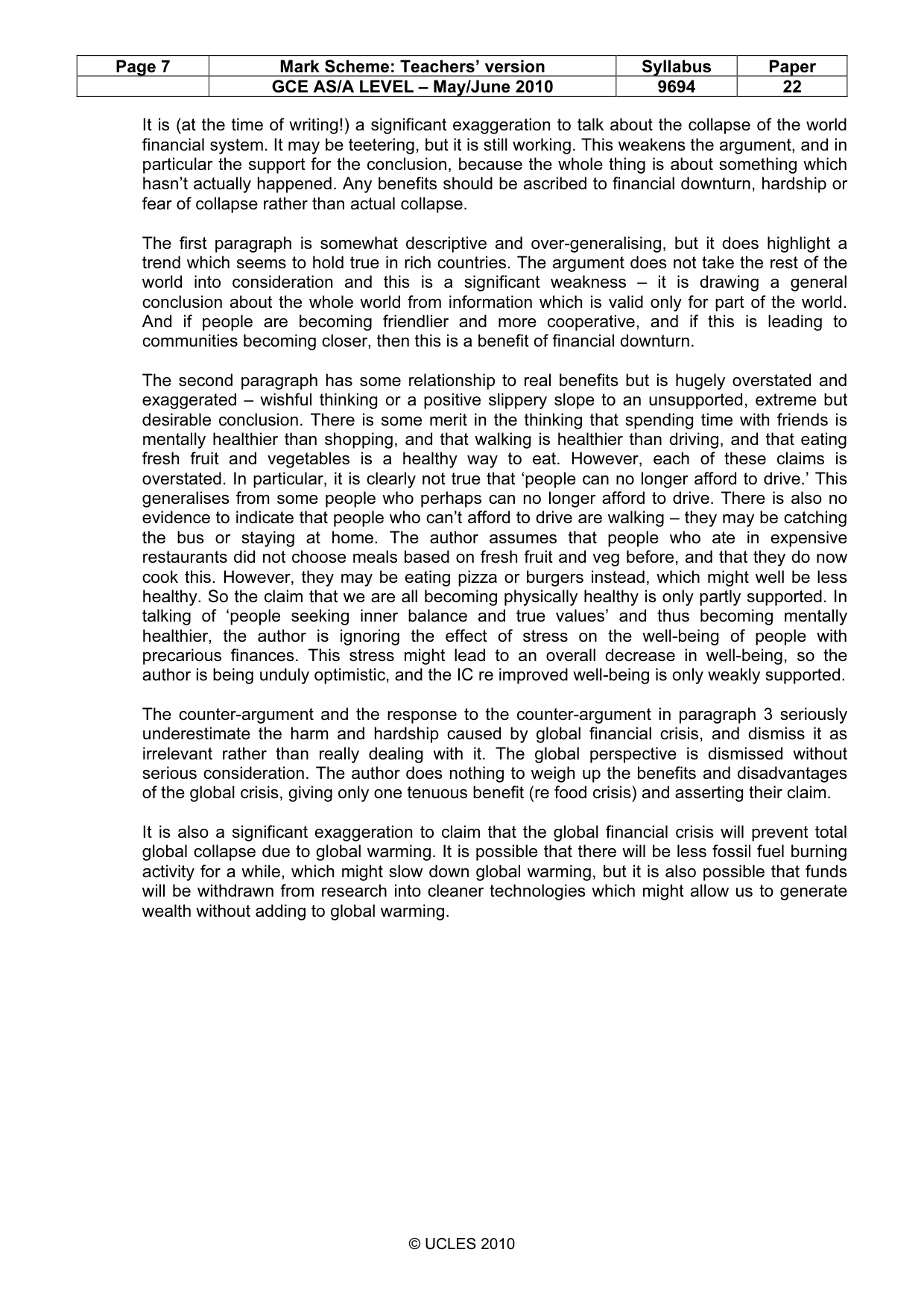
Page 7 Mark Scheme: Teachers’ version Syllabus Paper GCE AS/A LEVEL – May/June 2010 9694 22 © UCLES 2010 It is (at the time of writing!) a significant exaggeration to talk about the collapse of the world financial system. It may be teetering, but it is still working. This weakens the argument, and in particular the support for the conclusion, because the whole thing is about something which hasn’t actually happened. Any benefits should be ascribed to financial downturn, hardship or fear of collapse rather than actual collapse. The first paragraph is somewhat descriptive and over-generalising, but it does highlight a trend which seems to hold true in rich countries. The argument does not take the rest of the world into consideration and this is a significant weakness – it is drawing a general conclusion about the whole world from information which is valid only for part of the world. And if people are becoming friendlier and more cooperative, and if this is leading to communities becoming closer, then this is a benefit of financial downturn. The second paragraph has some relationship to real benefits but is hugely overstated and exaggerated – wishful thinking or a positive slippery slope to an unsupported, extreme but desirable conclusion. There is some merit in the thinking that spending time with friends is mentally healthier than shopping, and that walking is healthier than driving, and that eating fresh fruit and vegetables is a healthy way to eat. However, each of these claims is overstated. In particular, it is clearly not true that ‘people can no longer afford to drive.’ This generalises from some people who perhaps can no longer afford to drive. There is also no evidence to indicate that people who can’t afford to drive are walking – they may be catching the bus or staying at home. The author assumes that people who ate in expensive restaurants did not choose meals based on fresh fruit and veg before, and that they do now cook this. However, they may be eating pizza or burgers instead, which might well be less healthy. So the claim that we are all becoming physically healthy is only partly supported. In talking of ‘people seeking inner balance and true values’ and thus becoming mentally healthier, the author is ignoring the effect of stress on the well-being of people with precarious finances. This stress might lead to an overall decrease in well-being, so the author is being unduly optimistic, and the IC re improved well-being is only weakly supported. The counter-argument and the response to the counter-argument in paragraph 3 seriously underestimate the harm and hardship caused by global financial crisis, and dismiss it as irrelevant rather than really dealing with it. The global perspective is dismissed without serious consideration. The author does nothing to weigh up the benefits and disadvantages of the global crisis, giving only one tenuous benefit (re food crisis) and asserting their claim. It is also a significant exaggeration to claim that the global financial crisis will prevent total global collapse due to global warming. It is possible that there will be less fossil fuel burning activity for a while, which might slow down global warming, but it is also possible that funds will be withdrawn from research into cleaner technologies which might allow us to generate wealth without adding to global warming.
Mark scheme, page 8
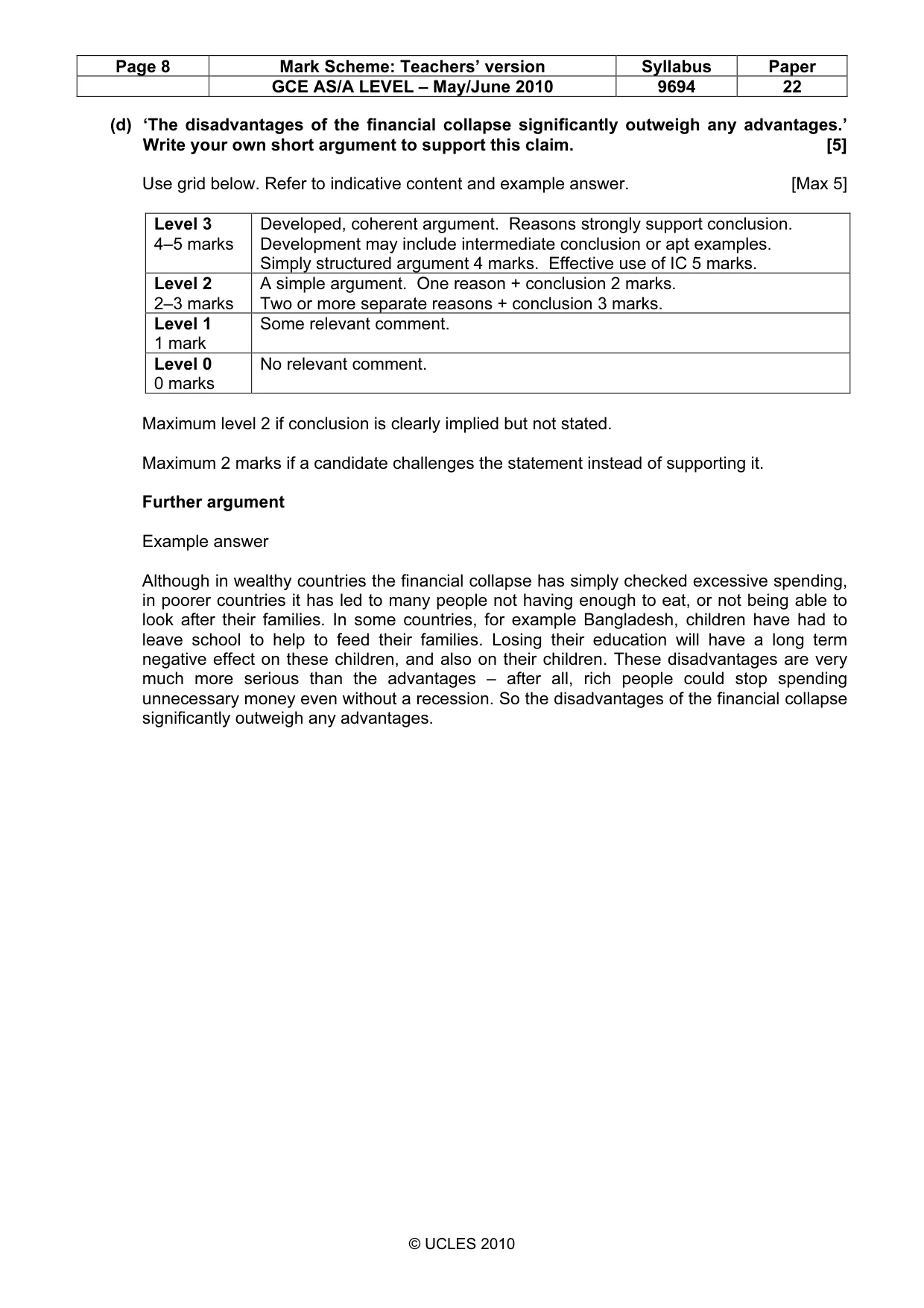
Page 8 Mark Scheme: Teachers’ version Syllabus Paper GCE AS/A LEVEL – May/June 2010 9694 22 © UCLES 2010 (d) ‘The disadvantages of the financial collapse significantly outweigh any advantages.’ Write your own short argument to support this claim. [5] Use grid below. Refer to indicative content and example answer. [Max 5] Level 3 4–5 marks Developed, coherent argument. Reasons strongly support conclusion. Development may include intermediate conclusion or apt examples. Simply structured argument 4 marks. Effective use of IC 5 marks. Level 2 2–3 marks A simple argument. One reason + conclusion 2 marks. Two or more separate reasons + conclusion 3 marks. Level 1 1 mark Some relevant comment. Level 0 0 marks No relevant comment. Maximum level 2 if conclusion is clearly implied but not stated. Maximum 2 marks if a candidate challenges the statement instead of supporting it. Further argument Example answer Although in wealthy countries the financial collapse has simply checked excessive spending, in poorer countries it has led to many people not having enough to eat, or not being able to look after their families. In some countries, for example Bangladesh, children have had to leave school to help to feed their families. Losing their education will have a long term negative effect on these children, and also on their children. These disadvantages are very much more serious than the advantages – after all, rich people could stop spending unnecessary money even without a recession. So the disadvantages of the financial collapse significantly outweigh any advantages.
What you needed in this session
Cambridge’s own grade thresholds for 2010 May/June, Paper 2 · Variant 2. A higher threshold means an easier paper — the bar moves with how the cohort did.