Cambridge A Level Psychology (from 2018) 9990 — 2023 May/June Paper 3 · Variant 2
9990/32/M/J/23 · 60 marks · ≈68 min
The question paper and its mark scheme, free to read here and free to download. This is Cambridge’s own paper, exactly as it was sat.
Question paper4 pages

Mark scheme26 pages
Answers below. Sit the paper first if you are practising.

Paper as text
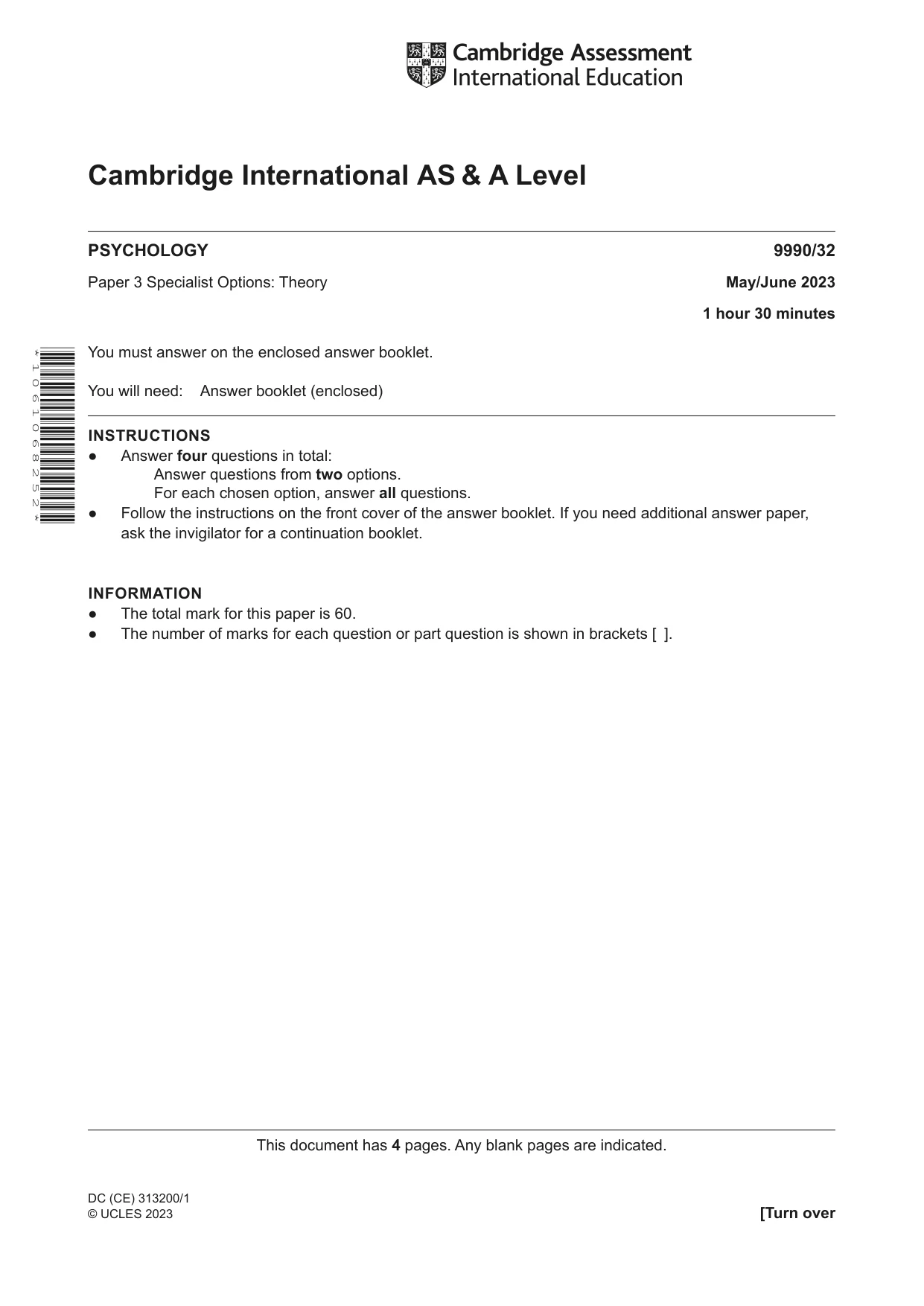
Question paper, page 1
This document has 4 pages. Any blank pages are indicated. [Turn over Cambridge International AS & A Level * 1 0 6 1 0 6 8 2 5 2 * PSYCHOLOGY 9990/32 Paper 3 Specialist Options: Theory May/June 2023 1 hour 30 minutes You must answer on the enclosed answer booklet. You will need: Answer booklet (enclosed) INSTRUCTIONS ● Answer four questions in total: Answer questions from two options. For each chosen option, answer all questions. ● Follow the instructions on the front cover of the answer booklet. If you need additional answer paper, ask the invigilator for a continuation booklet. INFORMATION ● The total mark for this paper is 60. ● The number of marks for each question or part question is shown in brackets [ ]. DC (CE) 313200/1 © UCLES 2023
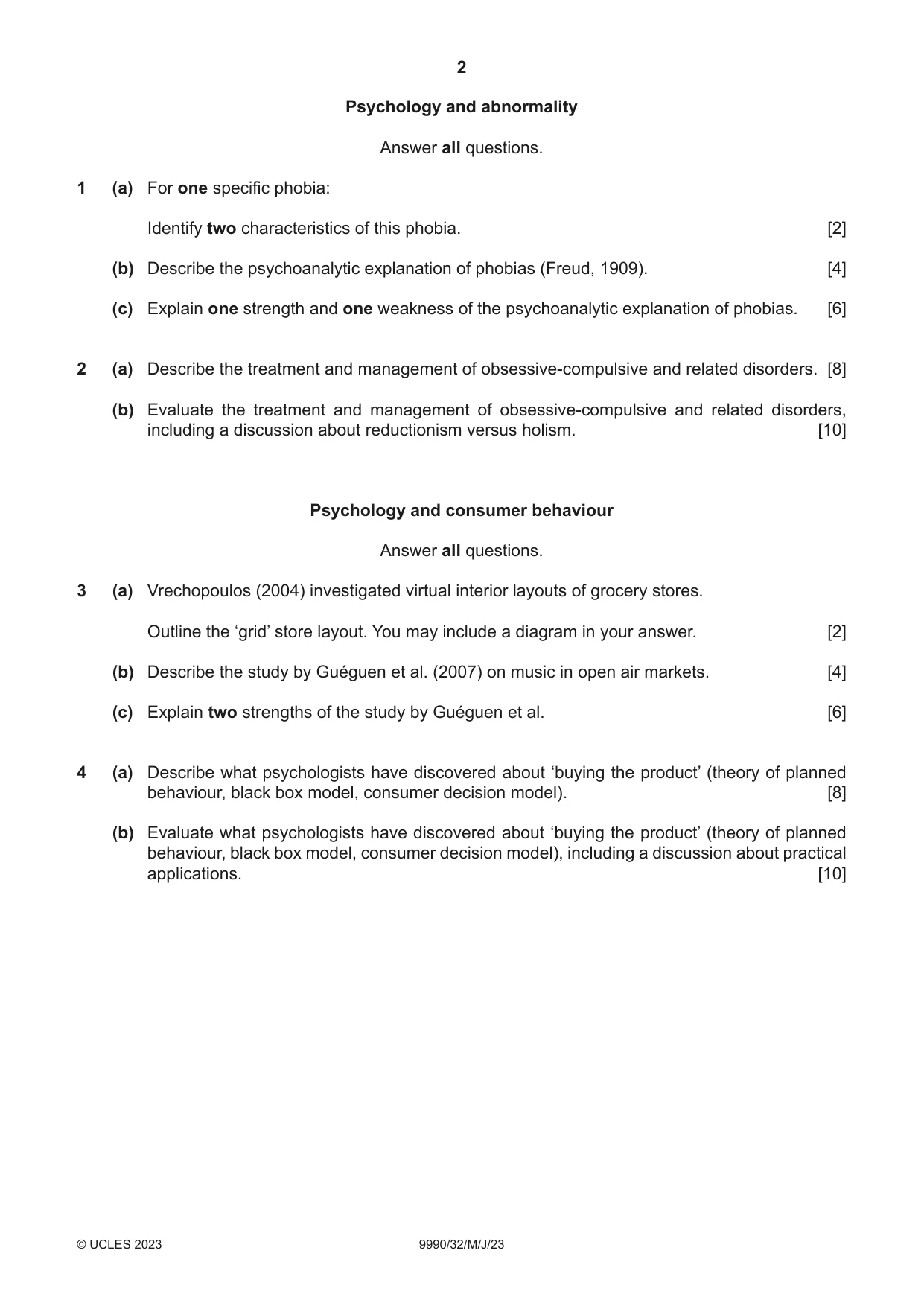
Question paper, page 2
2 9990/32/M/J/23 © UCLES 2023 Psychology and abnormality Answer all questions. 1 (a) For one specific phobia: Identify two characteristics of this phobia. [2] (b) Describe the psychoanalytic explanation of phobias (Freud, 1909). [4] (c) Explain one strength and one weakness of the psychoanalytic explanation of phobias. [6] 2 (a) Describe the treatment and management of obsessive-compulsive and related disorders. [8] (b) Evaluate the treatment and management of obsessive-compulsive and related disorders, including a discussion about reductionism versus holism. [10] Psychology and consumer behaviour Answer all questions. 3 (a) Vrechopoulos (2004) investigated virtual interior layouts of grocery stores. Outline the ‘grid’ store layout. You may include a diagram in your answer. [2] (b) Describe the study by Guéguen et al. (2007) on music in open air markets. [4] (c) Explain two strengths of the study by Guéguen et al. [6] 4 (a) Describe what psychologists have discovered about ‘buying the product’ (theory of planned behaviour, black box model, consumer decision model). [8] (b) Evaluate what psychologists have discovered about ‘buying the product’ (theory of planned behaviour, black box model, consumer decision model), including a discussion about practical applications. [10]
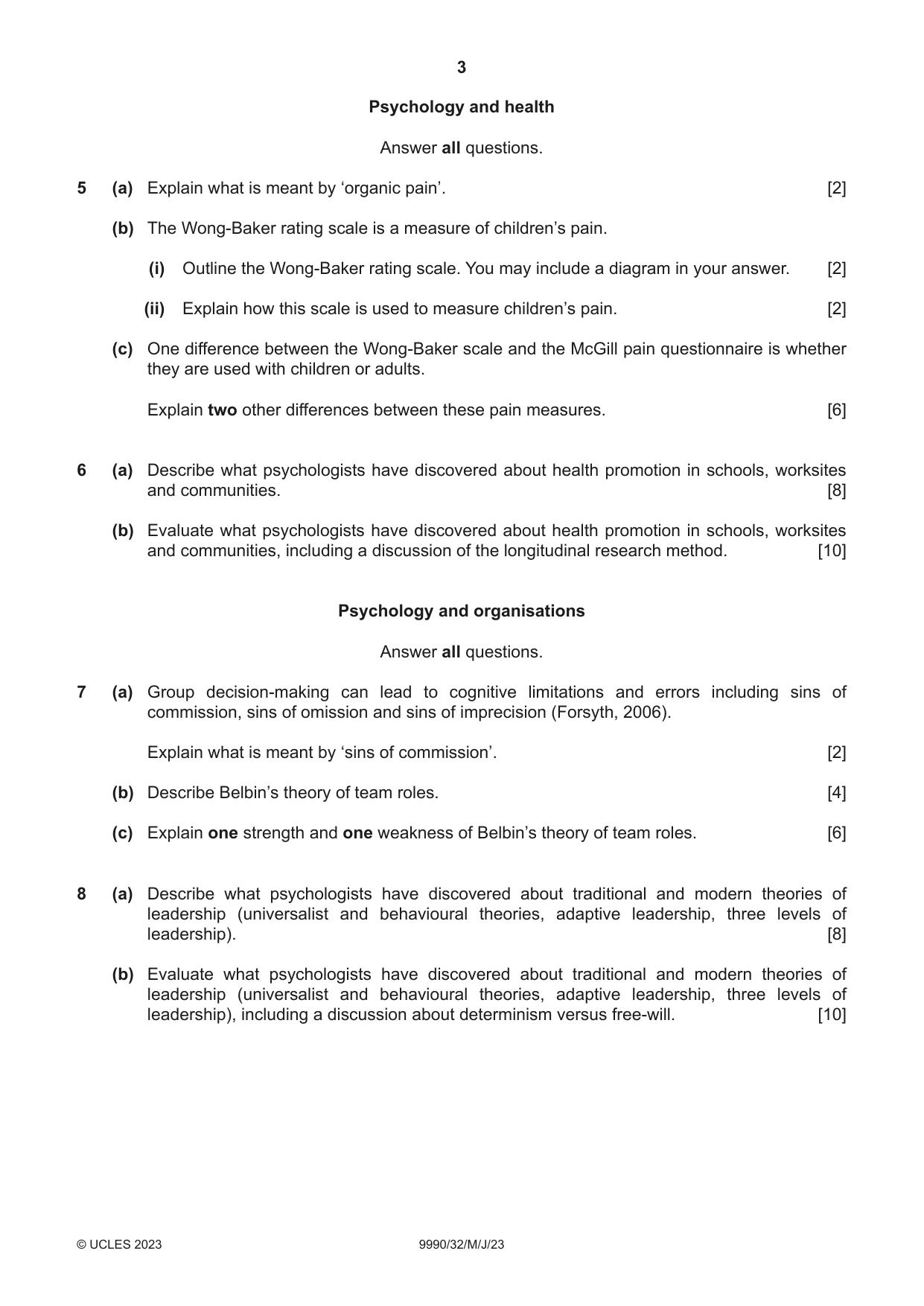
Question paper, page 3
3 9990/32/M/J/23 © UCLES 2023 Psychology and health Answer all questions. 5 (a) Explain what is meant by ‘organic pain’. [2] (b) The Wong-Baker rating scale is a measure of children’s pain. (i) Outline the Wong-Baker rating scale. You may include a diagram in your answer. [2] (ii) Explain how this scale is used to measure children’s pain. [2] (c) One difference between the Wong-Baker scale and the McGill pain questionnaire is whether they are used with children or adults. Explain two other differences between these pain measures. [6] 6 (a) Describe what psychologists have discovered about health promotion in schools, worksites and communities. [8] (b) Evaluate what psychologists have discovered about health promotion in schools, worksites and communities, including a discussion of the longitudinal research method. [10] Psychology and organisations Answer all questions. 7 (a) Group decision-making can lead to cognitive limitations and errors including sins of commission, sins of omission and sins of imprecision (Forsyth, 2006). Explain what is meant by ‘sins of commission’. [2] (b) Describe Belbin’s theory of team roles. [4] (c) Explain one strength and one weakness of Belbin’s theory of team roles. [6] 8 (a) Describe what psychologists have discovered about traditional and modern theories of leadership (universalist and behavioural theories, adaptive leadership, three levels of leadership). [8] (b) Evaluate what psychologists have discovered about traditional and modern theories of leadership (universalist and behavioural theories, adaptive leadership, three levels of leadership), including a discussion about determinism versus free-will. [10]
Question paper, page 4
4 9990/32/M/J/23 © UCLES 2023 Permission to reproduce items where third-party owned material protected by copyright is included has been sought and cleared where possible. Every reasonable effort has been made by the publisher (UCLES) to trace copyright holders, but if any items requiring clearance have unwittingly been included, the publisher will be pleased to make amends at the earliest possible opportunity. To avoid the issue of disclosure of answer-related information to candidates, all copyright acknowledgements are reproduced online in the Cambridge Assessment International Education Copyright Acknowledgements Booklet. This is produced for each series of examinations and is freely available to download at www.cambridgeinternational.org after the live examination series. Cambridge Assessment International Education is part of Cambridge Assessment. Cambridge Assessment is the brand name of the University of Cambridge Local Examinations Syndicate (UCLES), which is a department of the University of Cambridge. BLANK PAGE
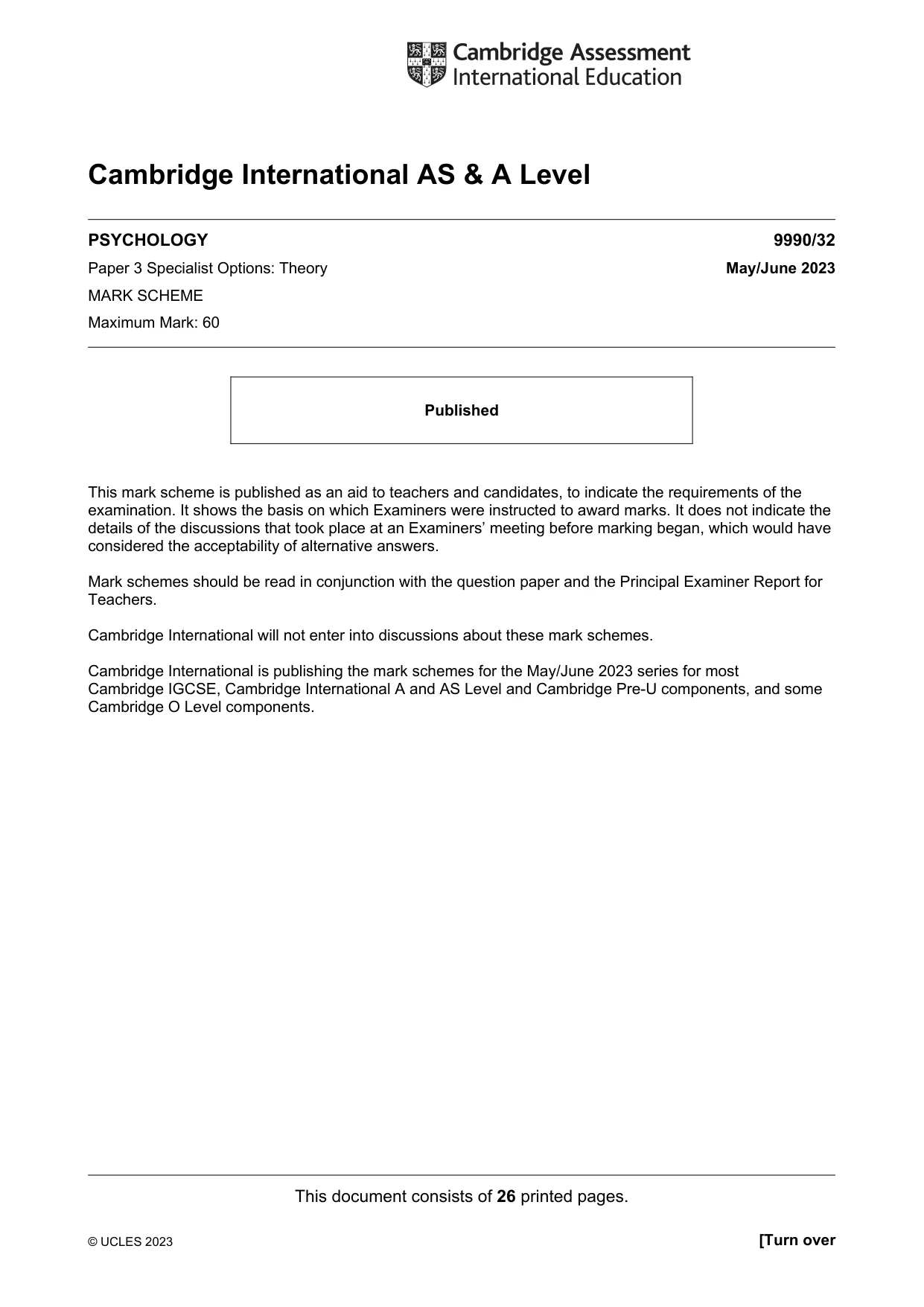
Mark scheme, page 1
This document consists of 26 printed pages. © UCLES 2023 [Turn over Cambridge International AS & A Level PSYCHOLOGY 9990/32 Paper 3 Specialist Options: Theory May/June 2023 MARK SCHEME Maximum Mark: 60 Published This mark scheme is published as an aid to teachers and candidates, to indicate the requirements of the examination. It shows the basis on which Examiners were instructed to award marks. It does not indicate the details of the discussions that took place at an Examiners’ meeting before marking began, which would have considered the acceptability of alternative answers. Mark schemes should be read in conjunction with the question paper and the Principal Examiner Report for Teachers. Cambridge International will not enter into discussions about these mark schemes. Cambridge International is publishing the mark schemes for the May/June 2023 series for most Cambridge IGCSE, Cambridge International A and AS Level and Cambridge Pre-U components, and some Cambridge O Level components.
Mark scheme, page 2
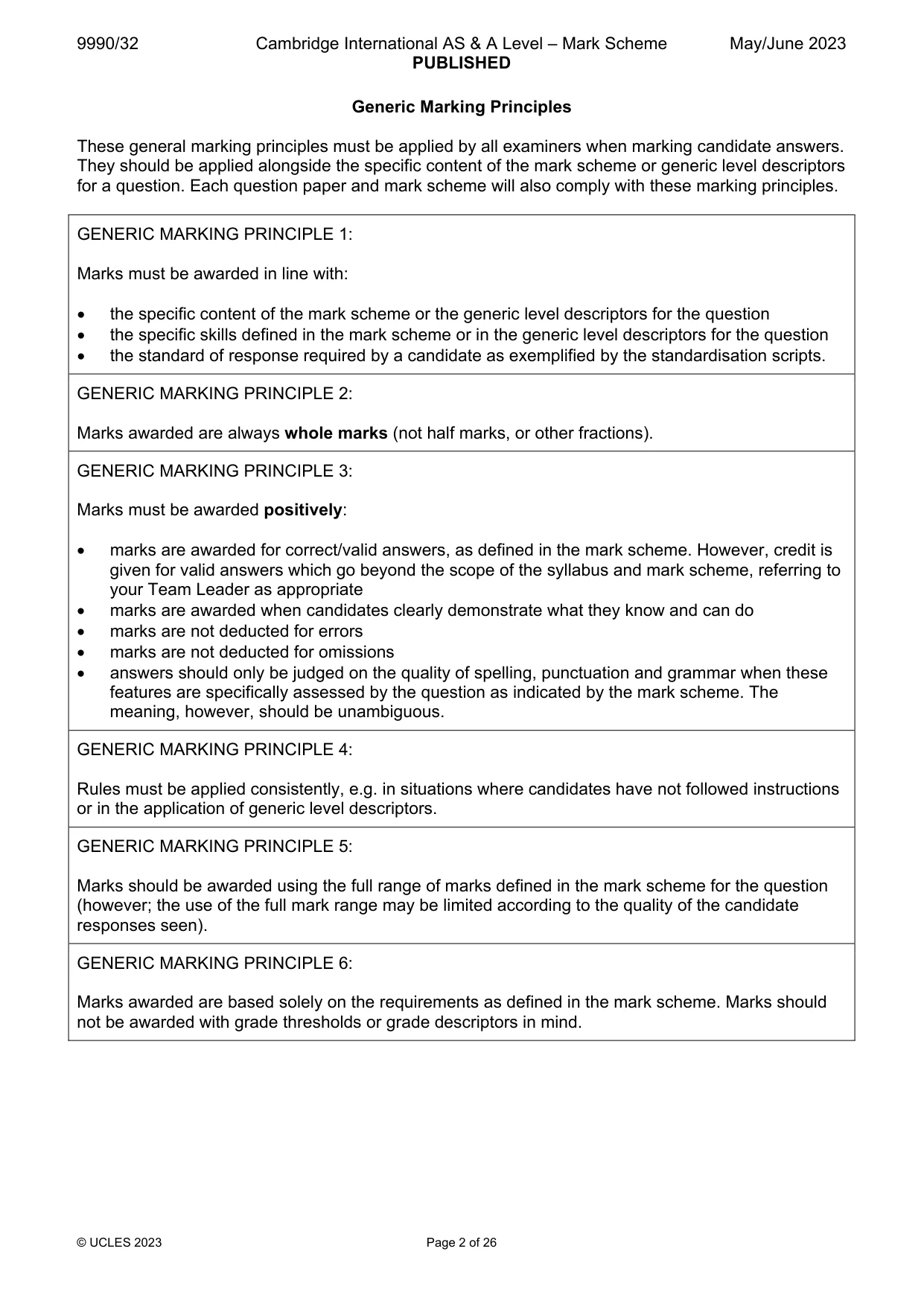
9990/32 Cambridge International AS & A Level – Mark Scheme PUBLISHED May/June 2023 © UCLES 2023 Page 2 of 26 Generic Marking Principles These general marking principles must be applied by all examiners when marking candidate answers. They should be applied alongside the specific content of the mark scheme or generic level descriptors for a question. Each question paper and mark scheme will also comply with these marking principles. GENERIC MARKING PRINCIPLE 1: Marks must be awarded in line with: the specific content of the mark scheme or the generic level descriptors for the question the specific skills defined in the mark scheme or in the generic level descriptors for the question the standard of response required by a candidate as exemplified by the standardisation scripts. GENERIC MARKING PRINCIPLE 2: Marks awarded are always whole marks (not half marks, or other fractions). GENERIC MARKING PRINCIPLE 3: Marks must be awarded positively: marks are awarded for correct/valid answers, as defined in the mark scheme. However, credit is given for valid answers which go beyond the scope of the syllabus and mark scheme, referring to your Team Leader as appropriate marks are awarded when candidates clearly demonstrate what they know and can do marks are not deducted for errors marks are not deducted for omissions answers should only be judged on the quality of spelling, punctuation and grammar when these features are specifically assessed by the question as indicated by the mark scheme. The meaning, however, should be unambiguous. GENERIC MARKING PRINCIPLE 4: Rules must be applied consistently, e.g. in situations where candidates have not followed instructions or in the application of generic level descriptors. GENERIC MARKING PRINCIPLE 5: Marks should be awarded using the full range of marks defined in the mark scheme for the question (however; the use of the full mark range may be limited according to the quality of the candidate responses seen). GENERIC MARKING PRINCIPLE 6: Marks awarded are based solely on the requirements as defined in the mark scheme. Marks should not be awarded with grade thresholds or grade descriptors in mind.
Mark scheme, page 3
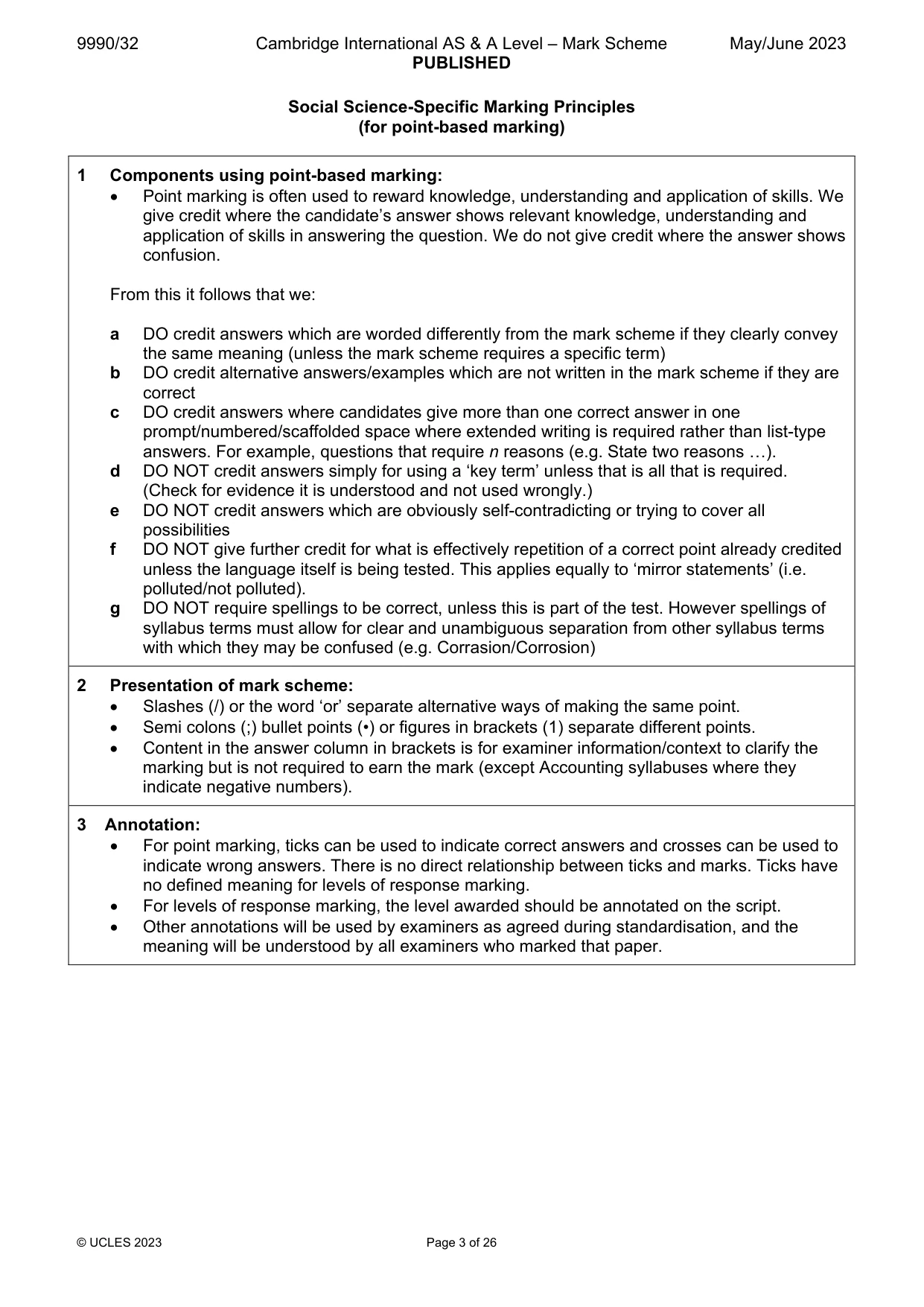
9990/32 Cambridge International AS & A Level – Mark Scheme PUBLISHED May/June 2023 © UCLES 2023 Page 3 of 26 Social Science-Specific Marking Principles (for point-based marking) 1 Components using point-based marking: Point marking is often used to reward knowledge, understanding and application of skills. We give credit where the candidate’s answer shows relevant knowledge, understanding and application of skills in answering the question. We do not give credit where the answer shows confusion. From this it follows that we: a DO credit answers which are worded differently from the mark scheme if they clearly convey the same meaning (unless the mark scheme requires a specific term) b DO credit alternative answers/examples which are not written in the mark scheme if they are correct c DO credit answers where candidates give more than one correct answer in one prompt/numbered/scaffolded space where extended writing is required rather than list-type answers. For example, questions that require n reasons (e.g. State two reasons …). d DO NOT credit answers simply for using a ‘key term’ unless that is all that is required. (Check for evidence it is understood and not used wrongly.) e DO NOT credit answers which are obviously self-contradicting or trying to cover all possibilities f DO NOT give further credit for what is effectively repetition of a correct point already credited unless the language itself is being tested. This applies equally to ‘mirror statements’ (i.e. polluted/not polluted). g DO NOT require spellings to be correct, unless this is part of the test. However spellings of syllabus terms must allow for clear and unambiguous separation from other syllabus terms with which they may be confused (e.g. Corrasion/Corrosion) 2 Presentation of mark scheme: Slashes (/) or the word ‘or’ separate alternative ways of making the same point. Semi colons (;) bullet points (•) or figures in brackets (1) separate different points. Content in the answer column in brackets is for examiner information/context to clarify the marking but is not required to earn the mark (except Accounting syllabuses where they indicate negative numbers). 3 Annotation: For point marking, ticks can be used to indicate correct answers and crosses can be used to indicate wrong answers. There is no direct relationship between ticks and marks. Ticks have no defined meaning for levels of response marking. For levels of response marking, the level awarded should be annotated on the script. Other annotations will be used by examiners as agreed during standardisation, and the meaning will be understood by all examiners who marked that paper.
Mark scheme, page 4
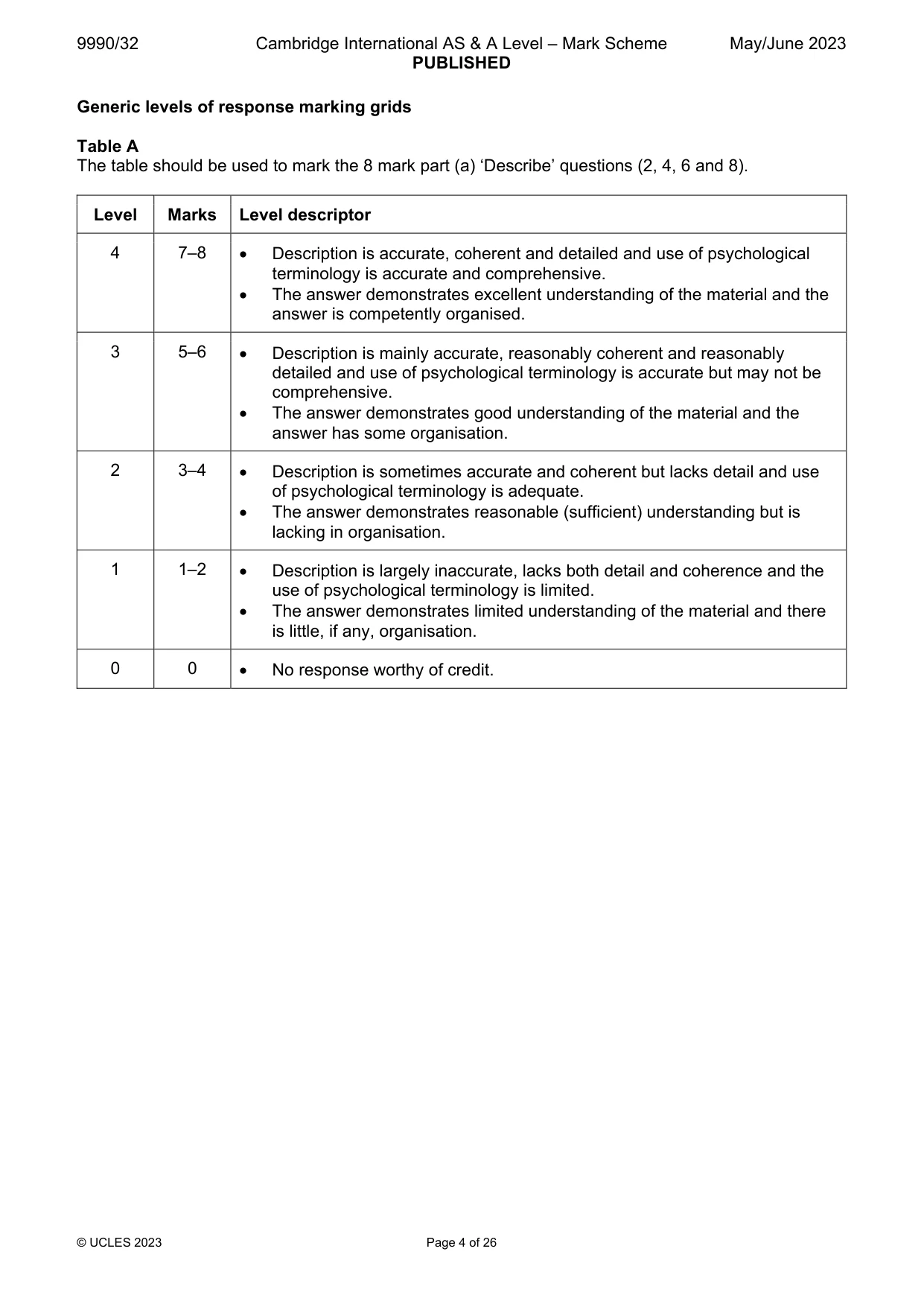
9990/32 Cambridge International AS & A Level – Mark Scheme PUBLISHED May/June 2023 © UCLES 2023 Page 4 of 26 Generic levels of response marking grids Table A The table should be used to mark the 8 mark part (a) ‘Describe’ questions (2, 4, 6 and 8). Level Marks Level descriptor 4 7–8 Description is accurate, coherent and detailed and use of psychological terminology is accurate and comprehensive. The answer demonstrates excellent understanding of the material and the answer is competently organised. 3 5–6 Description is mainly accurate, reasonably coherent and reasonably detailed and use of psychological terminology is accurate but may not be comprehensive. The answer demonstrates good understanding of the material and the answer has some organisation. 2 3–4 Description is sometimes accurate and coherent but lacks detail and use of psychological terminology is adequate. The answer demonstrates reasonable (sufficient) understanding but is lacking in organisation. 1 1–2 Description is largely inaccurate, lacks both detail and coherence and the use of psychological terminology is limited. The answer demonstrates limited understanding of the material and there is little, if any, organisation. 0 0 No response worthy of credit.
Mark scheme, page 5
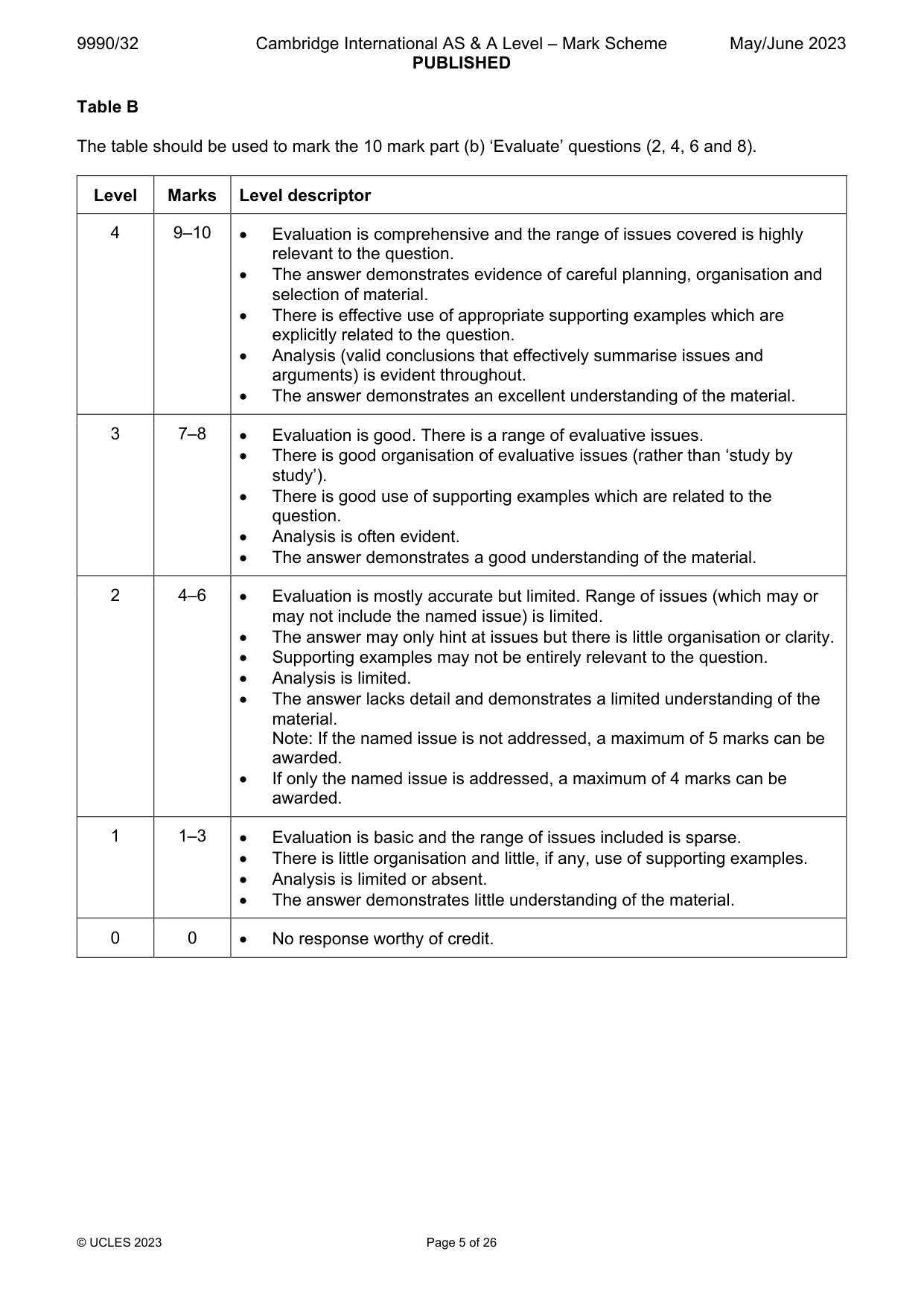
9990/32 Cambridge International AS & A Level – Mark Scheme PUBLISHED May/June 2023 © UCLES 2023 Page 5 of 26 Table B The table should be used to mark the 10 mark part (b) ‘Evaluate’ questions (2, 4, 6 and 8). Level Marks Level descriptor 4 9–10 Evaluation is comprehensive and the range of issues covered is highly relevant to the question. The answer demonstrates evidence of careful planning, organisation and selection of material. There is effective use of appropriate supporting examples which are explicitly related to the question. Analysis (valid conclusions that effectively summarise issues and arguments) is evident throughout. The answer demonstrates an excellent understanding of the material. 3 7–8 Evaluation is good. There is a range of evaluative issues. There is good organisation of evaluative issues (rather than ‘study by study’). There is good use of supporting examples which are related to the question. Analysis is often evident. The answer demonstrates a good understanding of the material. 2 4–6 Evaluation is mostly accurate but limited. Range of issues (which may or may not include the named issue) is limited. The answer may only hint at issues but there is little organisation or clarity. Supporting examples may not be entirely relevant to the question. Analysis is limited. The answer lacks detail and demonstrates a limited understanding of the material. Note: If the named issue is not addressed, a maximum of 5 marks can be awarded. If only the named issue is addressed, a maximum of 4 marks can be awarded. 1 1–3 Evaluation is basic and the range of issues included is sparse. There is little organisation and little, if any, use of supporting examples. Analysis is limited or absent. The answer demonstrates little understanding of the material. 0 0 No response worthy of credit.
Mark scheme, page 6
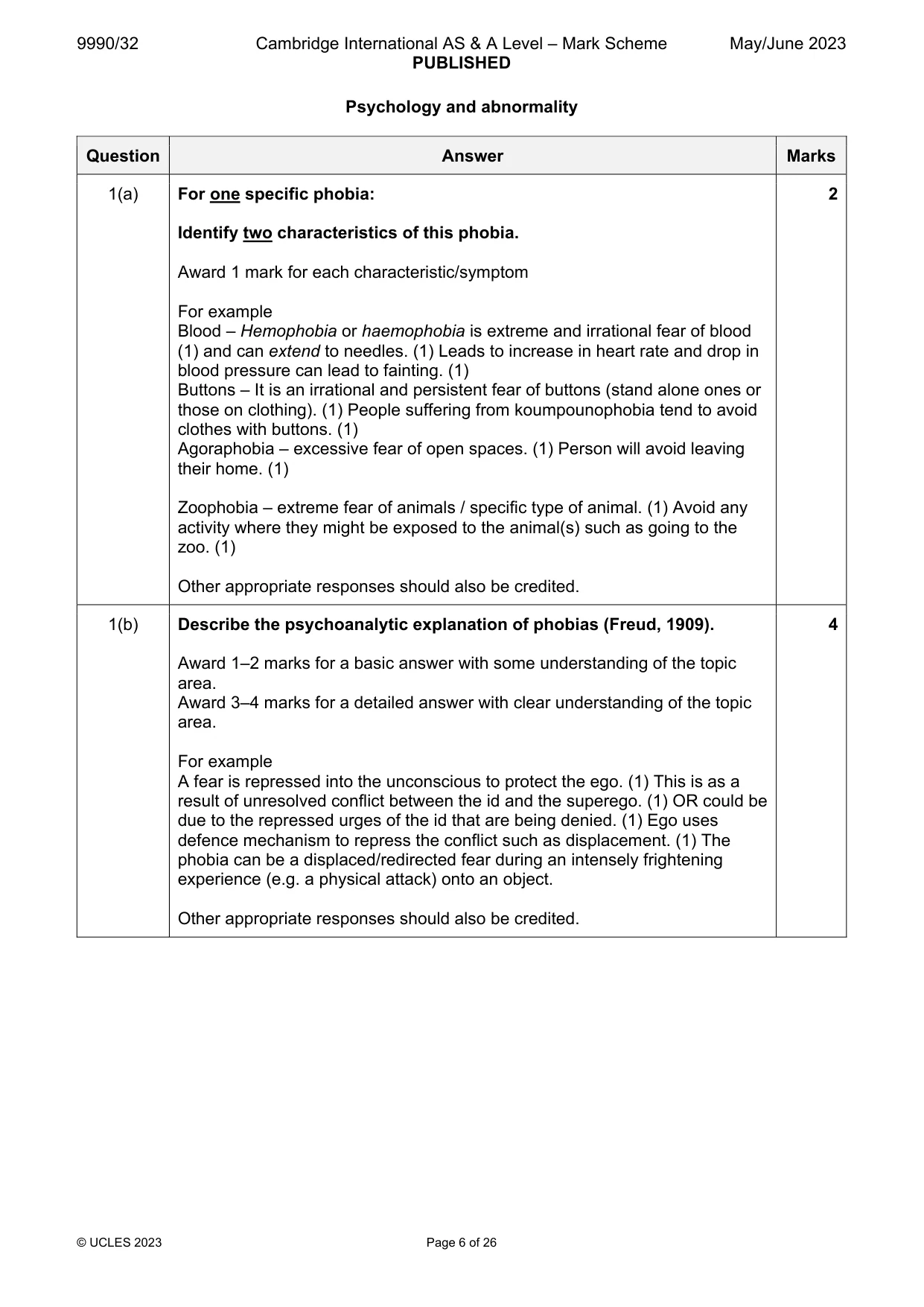
9990/32 Cambridge International AS & A Level – Mark Scheme PUBLISHED May/June 2023 © UCLES 2023 Page 6 of 26 Psychology and abnormality Question Answer Marks 1(a) For one specific phobia: Identify two characteristics of this phobia. Award 1 mark for each characteristic/symptom For example Blood – Hemophobia or haemophobia is extreme and irrational fear of blood (1) and can extend to needles. (1) Leads to increase in heart rate and drop in blood pressure can lead to fainting. (1) Buttons – It is an irrational and persistent fear of buttons (stand alone ones or those on clothing). (1) People suffering from koumpounophobia tend to avoid clothes with buttons. (1) Agoraphobia – excessive fear of open spaces. (1) Person will avoid leaving their home. (1) Zoophobia – extreme fear of animals / specific type of animal. (1) Avoid any activity where they might be exposed to the animal(s) such as going to the zoo. (1) Other appropriate responses should also be credited. 2 1(b) Describe the psychoanalytic explanation of phobias (Freud, 1909). Award 1–2 marks for a basic answer with some understanding of the topic area. Award 3–4 marks for a detailed answer with clear understanding of the topic area. For example A fear is repressed into the unconscious to protect the ego. (1) This is as a result of unresolved conflict between the id and the superego. (1) OR could be due to the repressed urges of the id that are being denied. (1) Ego uses defence mechanism to repress the conflict such as displacement. (1) The phobia can be a displaced/redirected fear during an intensely frightening experience (e.g. a physical attack) onto an object. Other appropriate responses should also be credited. 4
Mark scheme, page 7
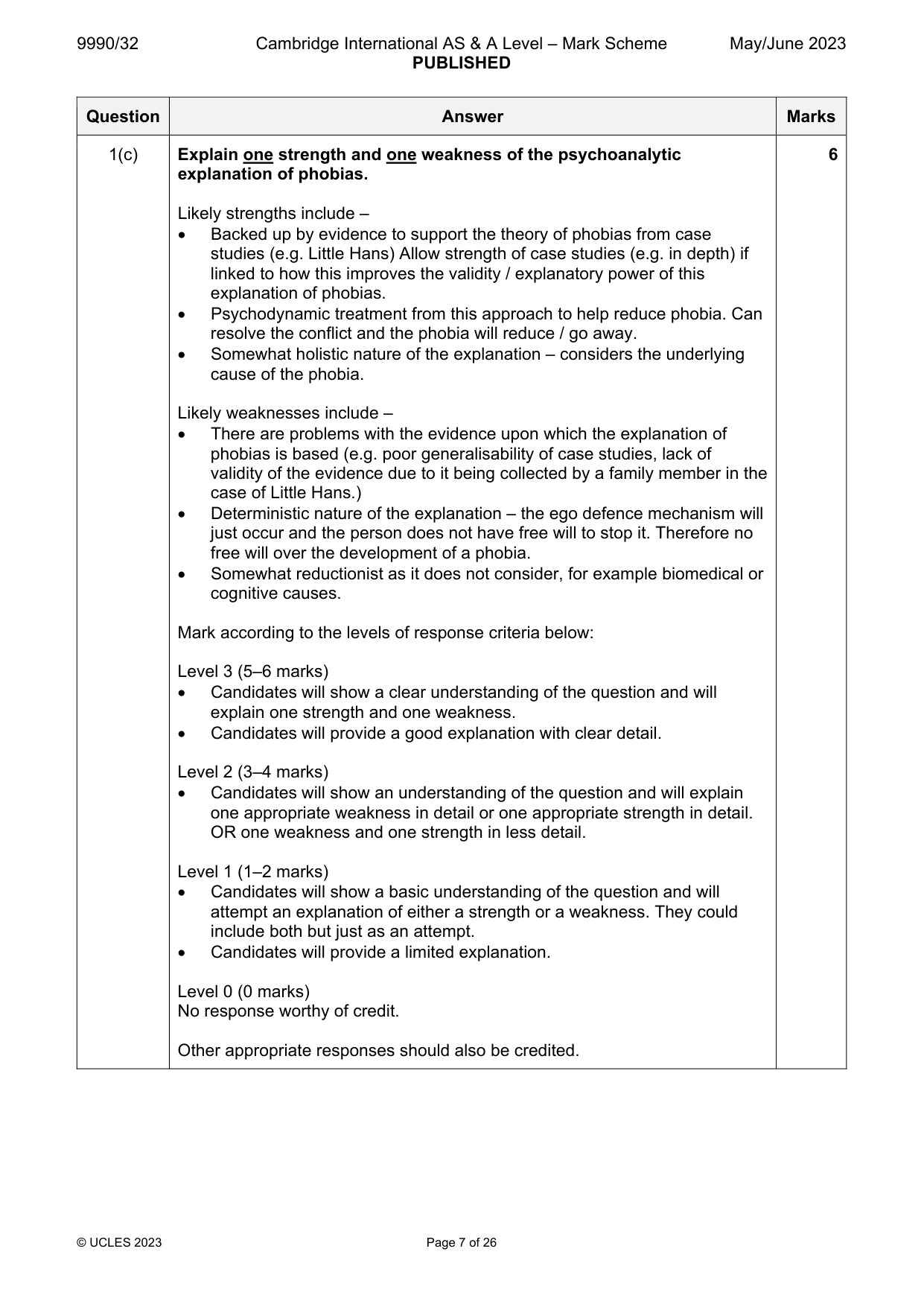
9990/32 Cambridge International AS & A Level – Mark Scheme PUBLISHED May/June 2023 © UCLES 2023 Page 7 of 26 Question Answer Marks 1(c) Explain one strength and one weakness of the psychoanalytic explanation of phobias. Likely strengths include – Backed up by evidence to support the theory of phobias from case studies (e.g. Little Hans) Allow strength of case studies (e.g. in depth) if linked to how this improves the validity / explanatory power of this explanation of phobias. Psychodynamic treatment from this approach to help reduce phobia. Can resolve the conflict and the phobia will reduce / go away. Somewhat holistic nature of the explanation – considers the underlying cause of the phobia. Likely weaknesses include – There are problems with the evidence upon which the explanation of phobias is based (e.g. poor generalisability of case studies, lack of validity of the evidence due to it being collected by a family member in the case of Little Hans.) Deterministic nature of the explanation – the ego defence mechanism will just occur and the person does not have free will to stop it. Therefore no free will over the development of a phobia. Somewhat reductionist as it does not consider, for example biomedical or cognitive causes. Mark according to the levels of response criteria below: Level 3 (5–6 marks) Candidates will show a clear understanding of the question and will explain one strength and one weakness. Candidates will provide a good explanation with clear detail. Level 2 (3–4 marks) Candidates will show an understanding of the question and will explain one appropriate weakness in detail or one appropriate strength in detail. OR one weakness and one strength in less detail. Level 1 (1–2 marks) Candidates will show a basic understanding of the question and will attempt an explanation of either a strength or a weakness. They could include both but just as an attempt. Candidates will provide a limited explanation. Level 0 (0 marks) No response worthy of credit. Other appropriate responses should also be credited. 6
Mark scheme, page 8
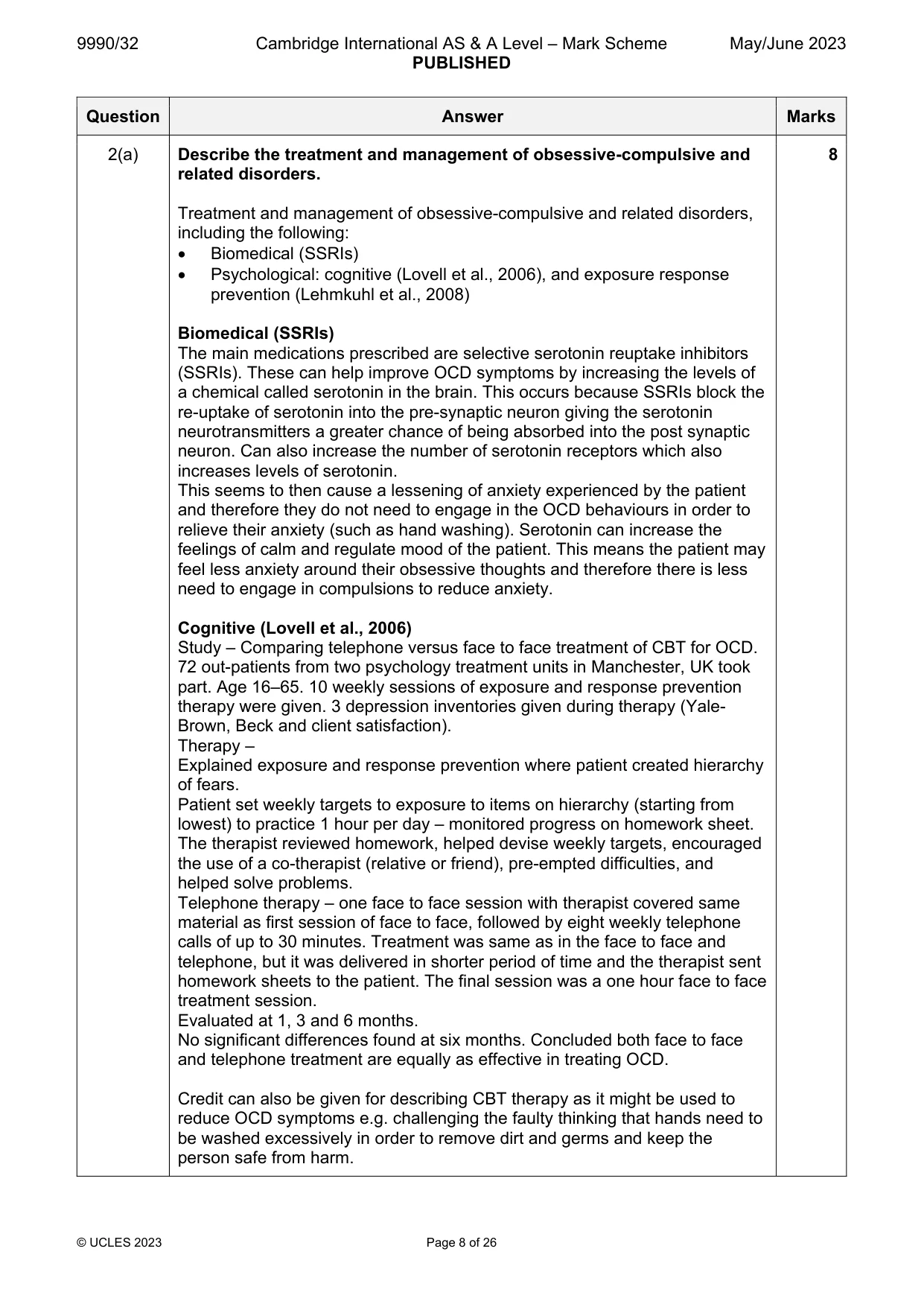
9990/32 Cambridge International AS & A Level – Mark Scheme PUBLISHED May/June 2023 © UCLES 2023 Page 8 of 26 Question Answer Marks 2(a) Describe the treatment and management of obsessive-compulsive and related disorders. Treatment and management of obsessive-compulsive and related disorders, including the following: Biomedical (SSRIs) Psychological: cognitive (Lovell et al., 2006), and exposure response prevention (Lehmkuhl et al., 2008) Biomedical (SSRIs) The main medications prescribed are selective serotonin reuptake inhibitors (SSRIs). These can help improve OCD symptoms by increasing the levels of a chemical called serotonin in the brain. This occurs because SSRIs block the re-uptake of serotonin into the pre-synaptic neuron giving the serotonin neurotransmitters a greater chance of being absorbed into the post synaptic neuron. Can also increase the number of serotonin receptors which also increases levels of serotonin. This seems to then cause a lessening of anxiety experienced by the patient and therefore they do not need to engage in the OCD behaviours in order to relieve their anxiety (such as hand washing). Serotonin can increase the feelings of calm and regulate mood of the patient. This means the patient may feel less anxiety around their obsessive thoughts and therefore there is less need to engage in compulsions to reduce anxiety. Cognitive (Lovell et al., 2006) Study – Comparing telephone versus face to face treatment of CBT for OCD. 72 out-patients from two psychology treatment units in Manchester, UK took part. Age 16–65. 10 weekly sessions of exposure and response prevention therapy were given. 3 depression inventories given during therapy (Yale- Brown, Beck and client satisfaction). Therapy – Explained exposure and response prevention where patient created hierarchy of fears. Patient set weekly targets to exposure to items on hierarchy (starting from lowest) to practice 1 hour per day – monitored progress on homework sheet. The therapist reviewed homework, helped devise weekly targets, encouraged the use of a co-therapist (relative or friend), pre-empted difficulties, and helped solve problems. Telephone therapy – one face to face session with therapist covered same material as first session of face to face, followed by eight weekly telephone calls of up to 30 minutes. Treatment was same as in the face to face and telephone, but it was delivered in shorter period of time and the therapist sent homework sheets to the patient. The final session was a one hour face to face treatment session. Evaluated at 1, 3 and 6 months. No significant differences found at six months. Concluded both face to face and telephone treatment are equally as effective in treating OCD. Credit can also be given for describing CBT therapy as it might be used to reduce OCD symptoms e.g. challenging the faulty thinking that hands need to be washed excessively in order to remove dirt and germs and keep the person safe from harm. 8
Mark scheme, page 9
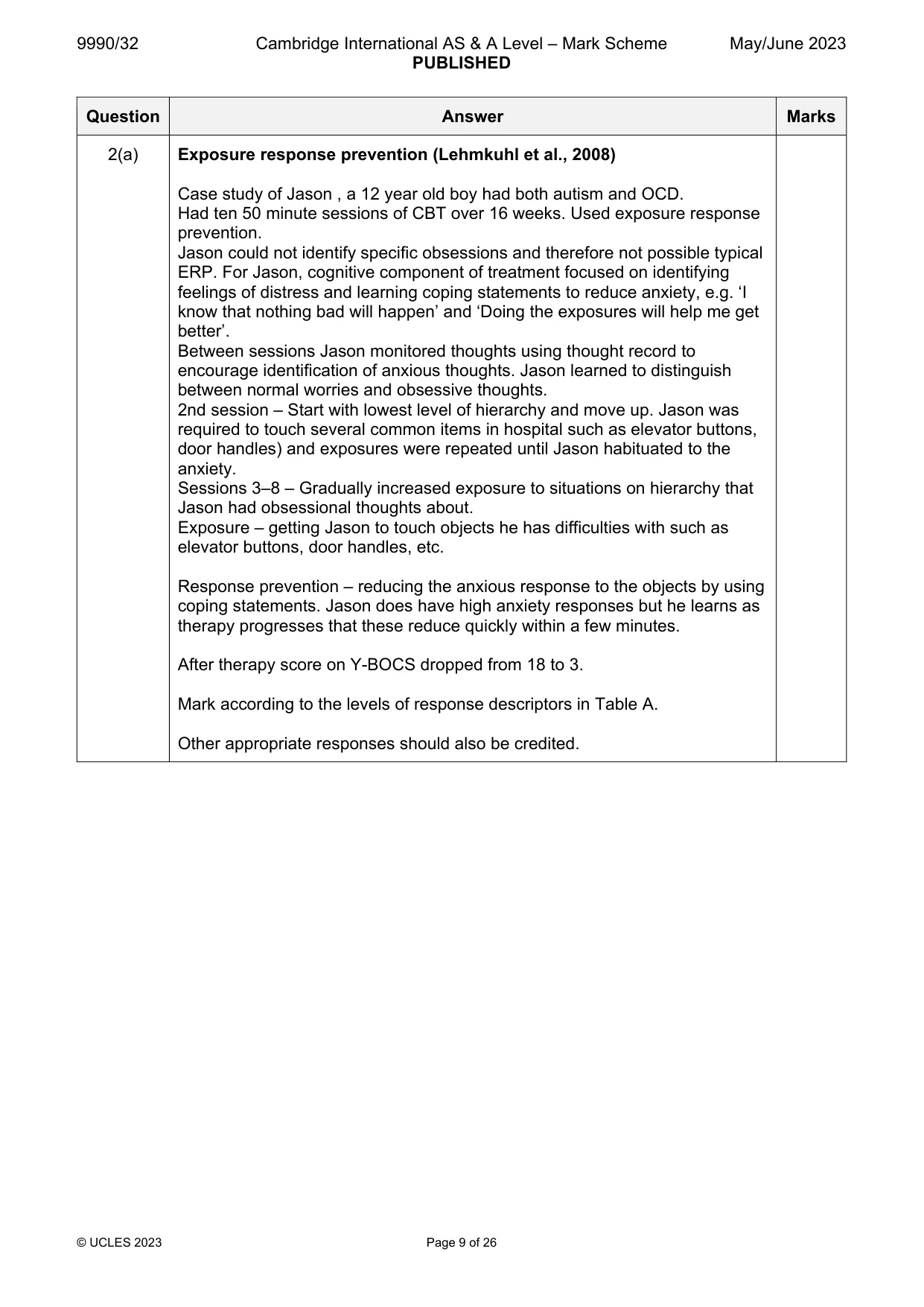
9990/32 Cambridge International AS & A Level – Mark Scheme PUBLISHED May/June 2023 © UCLES 2023 Page 9 of 26 Question Answer Marks 2(a) Exposure response prevention (Lehmkuhl et al., 2008) Case study of Jason , a 12 year old boy had both autism and OCD. Had ten 50 minute sessions of CBT over 16 weeks. Used exposure response prevention. Jason could not identify specific obsessions and therefore not possible typical ERP. For Jason, cognitive component of treatment focused on identifying feelings of distress and learning coping statements to reduce anxiety, e.g. ‘I know that nothing bad will happen’ and ‘Doing the exposures will help me get better’. Between sessions Jason monitored thoughts using thought record to encourage identification of anxious thoughts. Jason learned to distinguish between normal worries and obsessive thoughts. 2nd session – Start with lowest level of hierarchy and move up. Jason was required to touch several common items in hospital such as elevator buttons, door handles) and exposures were repeated until Jason habituated to the anxiety. Sessions 3–8 – Gradually increased exposure to situations on hierarchy that Jason had obsessional thoughts about. Exposure – getting Jason to touch objects he has difficulties with such as elevator buttons, door handles, etc. Response prevention – reducing the anxious response to the objects by using coping statements. Jason does have high anxiety responses but he learns as therapy progresses that these reduce quickly within a few minutes. After therapy score on Y-BOCS dropped from 18 to 3. Mark according to the levels of response descriptors in Table A. Other appropriate responses should also be credited.
Mark scheme, page 10
9990/32 Cambridge International AS & A Level – Mark Scheme PUBLISHED May/June 2023 © UCLES 2023 Page 10 of 26 Question Answer Marks 2(b) Evaluate treatment and management of obsessive-compulsive and related disorders, including a discussion about reductionism versus holism. A range of issues could be used for evaluation here. These include: Named issue – Reductionism versus holism – e.g. biomedical is more reductionist as they focus on the biomedical cause of OCD which they then aim to treat through medication such as SSRIs which cause serotonin levels to increase in the patient. This approach to treatment ignores the cognitive causes of OCD and related disorders and might therefore be less effective. However, the psychological therapies such as exposure and response prevention are more holistic as they focus on both cognitive and biological changes in the body (that cause the anxiety response). As the patient is exposed to the stimuli / intrusive thoughts that causes the anxiety they experience a heightened fear response but as time passes this fear response will lessen. This highlights that this therapy does acknowledge both cognitive (thoughts about the stimuli) and biochemical (fight or flight response that will eventually lesson as the stimuli isn’t dangerous). Candidates may also argue that this approach focuses more on cognitive/behavioural than it does on biochemical and these type of responses are also creditworthy. determinism versus free-will validity application of psychology to everyday life (with reference to treatments) nature versus nurture debate with reference to the various treatments (via the approaches upon which they are based) comparisons of different treatments usefulness (effectiveness) of different treatments reductionist nature of the treatments appropriateness of treatments cost of treatments ethics of psychological treatments Mark according to the levels of response descriptors in Table B. Other appropriate responses should also be credited. 10
Mark scheme, page 11
9990/32 Cambridge International AS & A Level – Mark Scheme PUBLISHED May/June 2023 © UCLES 2023 Page 11 of 26 Psychology and consumer behaviour Question Answer Marks 3(a) Vrechopoulos (2004) investigated virtual interior layouts of grocery stores. Outline the ‘grid’ store layout. You may include a diagram in your answer. Award 1 mark for a basic outline of the term/concept. Award 2 marks for a detailed outline of the term/concept. For example: Rectangular arrangement of displays (1). Long aisles that run parallel to one another. (1) Distinct traffic aisles. (1) Full credit allowed for diagram with some labelling, e.g. Aisle 1, Aisle 2. Other appropriate responses should also be credited. 2 3(b) Describe the study by Guéguen et al. (2007) on music in open air markets. Award 1–2 marks for a basic answer with some understanding of the topic area. Award 3–4 marks for a detailed answer with clear understanding of the topic area. For example: 154 men / 86 women were selected when visiting a market stall. (1) Participants were randomly assigned to either the music or no music condition. (1) Time spent at the stall, number of customers who purchased at least one item and amount spent were recorded. (1) When music was being played customers stayed longer at the stalls, were more likely to purchase at least one item and some higher spend was reported. (1) Other appropriate responses should also be credited. 4
Mark scheme, page 12
9990/32 Cambridge International AS & A Level – Mark Scheme PUBLISHED May/June 2023 © UCLES 2023 Page 12 of 26 Question Answer Marks 3(c) Explain two strengths of the study by Guéguen et al. Likely strengths include – Wide range of participants used (240) with a good mix of males and female customers (154/86) Good ecological validity as natural environment (market stall) and music is normal occurrence while shopping at an outdoor market. Customers not aware they are in a study so no demand characteristics / social desirability Quantitative data collected so comparisons can be made. Customers were randomly assigned to conditions which helps to prevent researcher bias. Useful findings of how music can be used to encourage increased time customers spend in a retail environment and the amount spent. Good ethics – just exposing some participants to music and then measuring time of visit and purchasing behaviour (if they bought something and if so, amount spent). Not harmful, confidentiality maintained, public place – consent not required as just briefly observing each participant in a way they would expect to be observed an open air market. Mark according to the levels of response criteria below: Level 3 (5–6 marks) Candidates will show a clear understanding of the question and will explain two strengths. Candidates will provide a good explanation with clear detail. Level 2 (3–4 marks) Candidates will show an understanding of the question and will explain one appropriate strength in detail. OR two strengths in less detail. Level 1 (1–2 marks) Candidates will show a basic understanding of the question and will attempt an explanation of a strength. They could include two strengths but just as an attempt. Candidates will provide a limited explanation. Level 0 (0 marks) No response worthy of credit. Other appropriate responses should also be credited. 6
Mark scheme, page 13
9990/32 Cambridge International AS & A Level – Mark Scheme PUBLISHED May/June 2023 © UCLES 2023 Page 13 of 26 Question Answer Marks 4(a) Describe what psychologists have discovered about ‘buying the product’ (theory of planned behaviour, black box model, consumer decision model). Buying the product, including the following: Purchase decisions: theory of planned behaviour (Ajzen, 1991) Black box (stimulus-response) model Consumer decision model. Theory of planned behaviour – the consumer’s behaviour is a function of intention to perform the behaviour in question – this could be intention to purchase a product. The stronger the intention the more likely the behaviour will occur e.g. strong desire to buy new mobile phone as current phone is broken. the intention is based on: attitude (e.g. towards the product – may have a positive attitude towards a certain brand) subjective norm (customer’s view about what others think e.g. a customer thinks it is important that a product has good reviews) perceived behavioural control (e.g. having access to the money to make the purchase) with respect to the behaviour. These factors are determined, respectively, by behavioural, normative, and control beliefs. For example, our attitude about our perceived behavioural control. The customer may be able to get a loan for buying the new phone but their attitude is that they don’t like going into debt so even though the loan is within their control, they still choose not to purchase the phone. The theory allows us to predict intentions and behaviour with respect to the purchase or use of a single brand or product as well as in relation to choice among different brands or products. Black-box model – Behaviourist theory that assumes consumers respond to the stimuli in the retail environment (for example). Stimuli could include marketing, price, the store environment. The black box is how the consumer thinks about/is effected by this stimuli depending on the personal characteristics of the consumer. The retailer can try to design a pleasant environment to encourage the consumer to respond positively and purchase the product (response). Consumer decision model – The model is structured around a 5 point decision process: 1 Need/problem recognition (has a need for the product) 2 Search of information both internally and externally (internal – attitude about the product/brand/price and external – search for product/reviews), 3 Evaluation of alternatives (comparing products to each other), 4 Purchase (buying the product), 5 Post purchase reflection (feelings post purchase – e.g. feels product met expectation and price or not). Could lead to positive or negative heuristic about product/brand. 8
Mark scheme, page 14
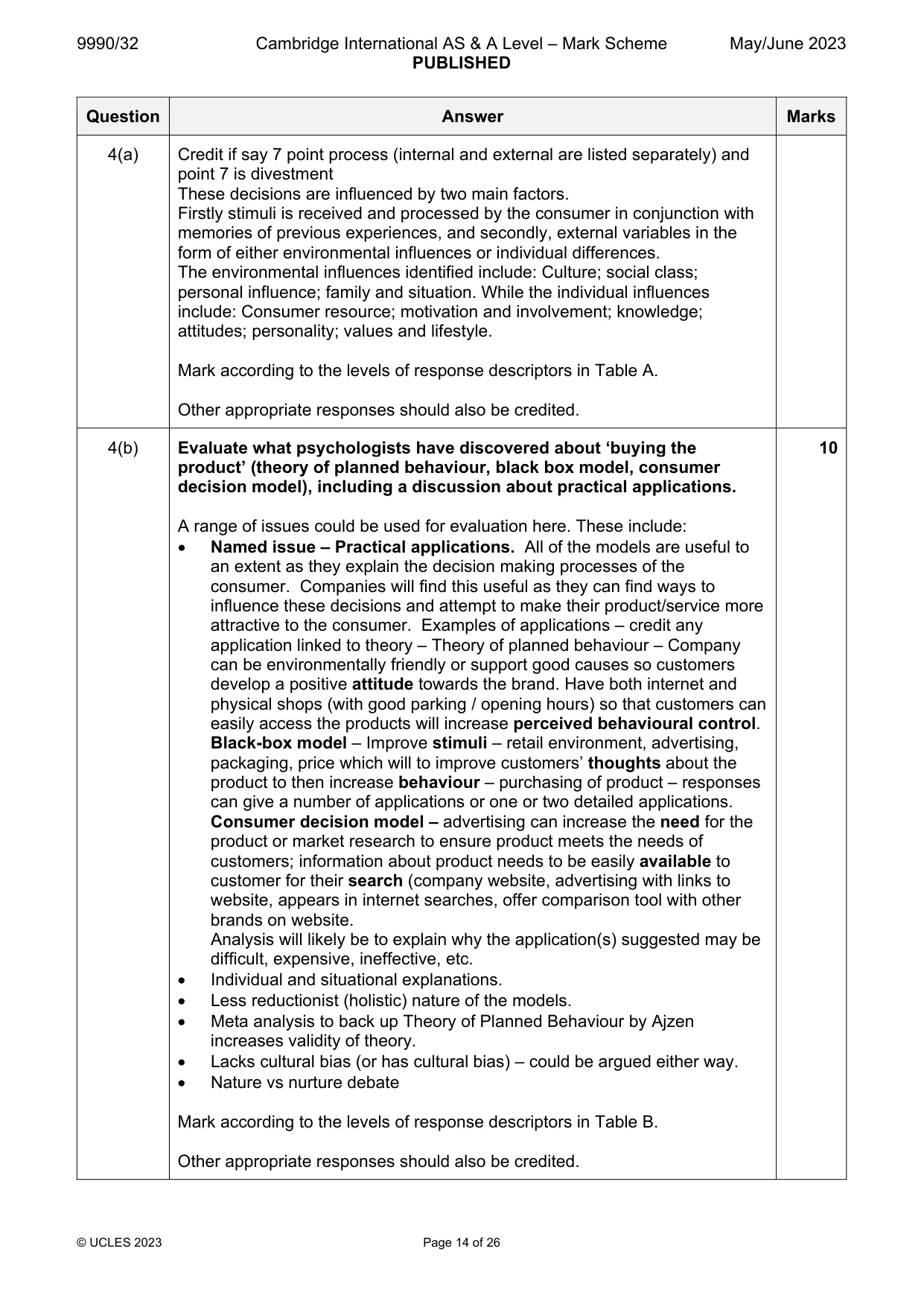
9990/32 Cambridge International AS & A Level – Mark Scheme PUBLISHED May/June 2023 © UCLES 2023 Page 14 of 26 Question Answer Marks 4(a) Credit if say 7 point process (internal and external are listed separately) and point 7 is divestment These decisions are influenced by two main factors. Firstly stimuli is received and processed by the consumer in conjunction with memories of previous experiences, and secondly, external variables in the form of either environmental influences or individual differences. The environmental influences identified include: Culture; social class; personal influence; family and situation. While the individual influences include: Consumer resource; motivation and involvement; knowledge; attitudes; personality; values and lifestyle. Mark according to the levels of response descriptors in Table A. Other appropriate responses should also be credited. 4(b) Evaluate what psychologists have discovered about ‘buying the product’ (theory of planned behaviour, black box model, consumer decision model), including a discussion about practical applications. A range of issues could be used for evaluation here. These include: Named issue – Practical applications. All of the models are useful to an extent as they explain the decision making processes of the consumer. Companies will find this useful as they can find ways to influence these decisions and attempt to make their product/service more attractive to the consumer. Examples of applications – credit any application linked to theory – Theory of planned behaviour – Company can be environmentally friendly or support good causes so customers develop a positive attitude towards the brand. Have both internet and physical shops (with good parking / opening hours) so that customers can easily access the products will increase perceived behavioural control. Black-box model – Improve stimuli – retail environment, advertising, packaging, price which will to improve customers’ thoughts about the product to then increase behaviour – purchasing of product – responses can give a number of applications or one or two detailed applications. Consumer decision model – advertising can increase the need for the product or market research to ensure product meets the needs of customers; information about product needs to be easily available to customer for their search (company website, advertising with links to website, appears in internet searches, offer comparison tool with other brands on website. Analysis will likely be to explain why the application(s) suggested may be difficult, expensive, ineffective, etc. Individual and situational explanations. Less reductionist (holistic) nature of the models. Meta analysis to back up Theory of Planned Behaviour by Ajzen increases validity of theory. Lacks cultural bias (or has cultural bias) – could be argued either way. Nature vs nurture debate Mark according to the levels of response descriptors in Table B. Other appropriate responses should also be credited. 10
Mark scheme, page 15
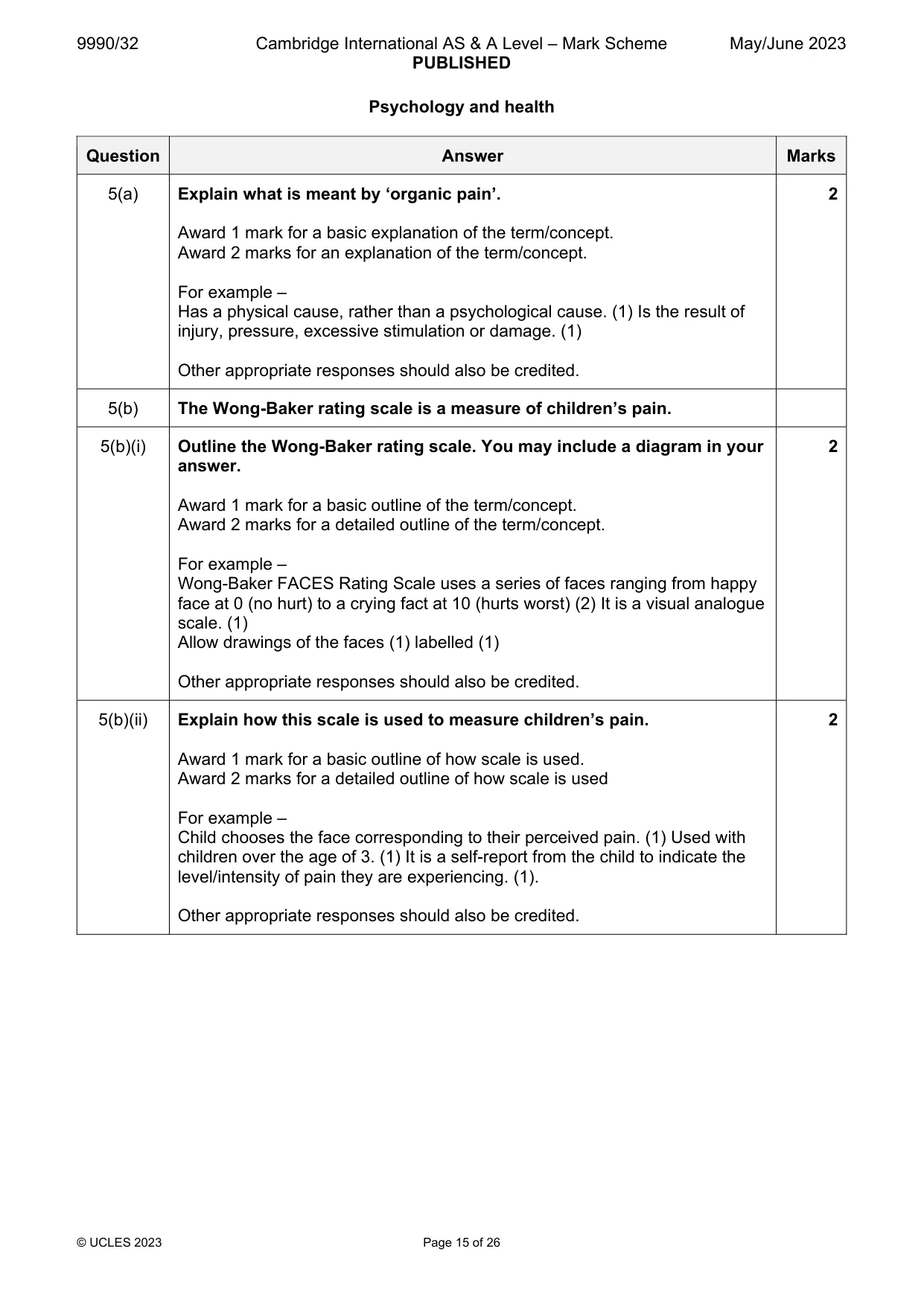
9990/32 Cambridge International AS & A Level – Mark Scheme PUBLISHED May/June 2023 © UCLES 2023 Page 15 of 26 Psychology and health Question Answer Marks 5(a) Explain what is meant by ‘organic pain’. Award 1 mark for a basic explanation of the term/concept. Award 2 marks for an explanation of the term/concept. For example – Has a physical cause, rather than a psychological cause. (1) Is the result of injury, pressure, excessive stimulation or damage. (1) Other appropriate responses should also be credited. 2 5(b) The Wong-Baker rating scale is a measure of children’s pain. 5(b)(i) Outline the Wong-Baker rating scale. You may include a diagram in your answer. Award 1 mark for a basic outline of the term/concept. Award 2 marks for a detailed outline of the term/concept. For example – Wong-Baker FACES Rating Scale uses a series of faces ranging from happy face at 0 (no hurt) to a crying fact at 10 (hurts worst) (2) It is a visual analogue scale. (1) Allow drawings of the faces (1) labelled (1) Other appropriate responses should also be credited. 2 5(b)(ii) Explain how this scale is used to measure children’s pain. Award 1 mark for a basic outline of how scale is used. Award 2 marks for a detailed outline of how scale is used For example – Child chooses the face corresponding to their perceived pain. (1) Used with children over the age of 3. (1) It is a self-report from the child to indicate the level/intensity of pain they are experiencing. (1). Other appropriate responses should also be credited. 2
Mark scheme, page 16
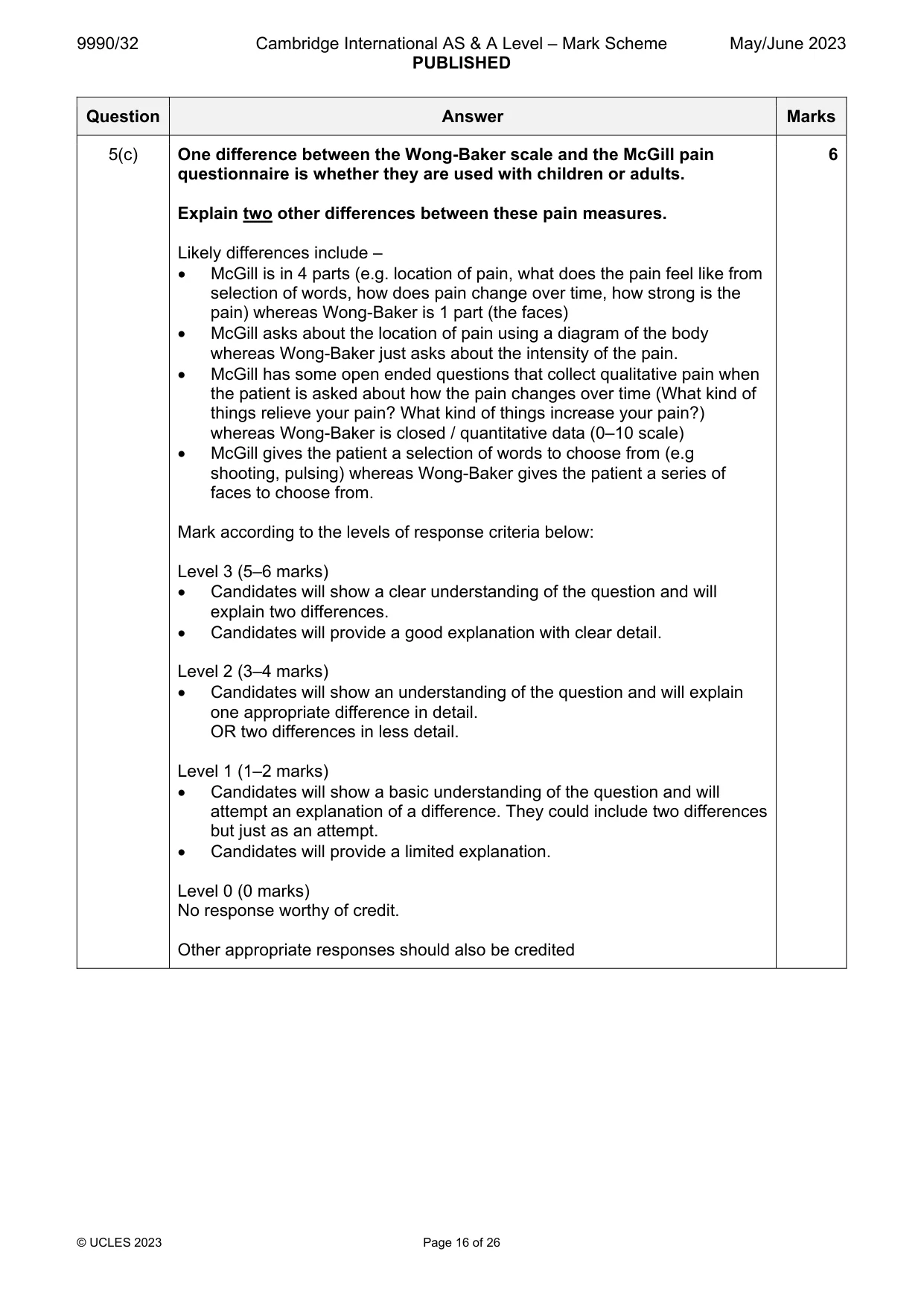
9990/32 Cambridge International AS & A Level – Mark Scheme PUBLISHED May/June 2023 © UCLES 2023 Page 16 of 26 Question Answer Marks 5(c) One difference between the Wong-Baker scale and the McGill pain questionnaire is whether they are used with children or adults. Explain two other differences between these pain measures. Likely differences include – McGill is in 4 parts (e.g. location of pain, what does the pain feel like from selection of words, how does pain change over time, how strong is the pain) whereas Wong-Baker is 1 part (the faces) McGill asks about the location of pain using a diagram of the body whereas Wong-Baker just asks about the intensity of the pain. McGill has some open ended questions that collect qualitative pain when the patient is asked about how the pain changes over time (What kind of things relieve your pain? What kind of things increase your pain?) whereas Wong-Baker is closed / quantitative data (0–10 scale) McGill gives the patient a selection of words to choose from (e.g shooting, pulsing) whereas Wong-Baker gives the patient a series of faces to choose from. Mark according to the levels of response criteria below: Level 3 (5–6 marks) Candidates will show a clear understanding of the question and will explain two differences. Candidates will provide a good explanation with clear detail. Level 2 (3–4 marks) Candidates will show an understanding of the question and will explain one appropriate difference in detail. OR two differences in less detail. Level 1 (1–2 marks) Candidates will show a basic understanding of the question and will attempt an explanation of a difference. They could include two differences but just as an attempt. Candidates will provide a limited explanation. Level 0 (0 marks) No response worthy of credit. Other appropriate responses should also be credited 6
Mark scheme, page 17
9990/32 Cambridge International AS & A Level – Mark Scheme PUBLISHED May/June 2023 © UCLES 2023 Page 17 of 26 Question Answer Marks 6(a) Describe what psychologists have discovered about health promotion in schools, worksites and communities. Health promotion in schools, worksite and communities, including the following: Tapper et al. (2003) on schools Fox et al. (1987) on worksites Farquhar et al. (1985) Five City Project on communities Tapper et al. likely to outline one or more of these studies. Food dudes at home – small study of 5–6 year olds where children watched video of Food Dudes. Given rewards such as Food Dude stickers, pens and erasers, awarded to the children for eating target amounts of fruit and vegetables. Results combination of peer modelling and rewards was very effective at increasing children’s consumption of both fruit and vegetables. Fruit increased from 4% to 100% and vegetables from 1% to 83%. Jess and Jarvis at the nursery – 26 two- to four-year-olds attending the university’s daycare nursery. Video of Jess and Jarvis around fruit and vegetable eating. The results – fruit consumption at snacktime rose from 30 per cent to 71 per cent. The intervention was followed by a maintenance phase during which there were no videos and the rewards became more intermittent. At follow-up, 15 months later, consumption levels were 79 per cent. The effects at lunchtime mirrored those at snack time, rising from 17 per cent to 76 per cent at the 15-month follow-up. Food dudes – Whole school programme of 4–11 year olds in a primary school. Shown food dudes programmes of 6 videos and given a course of lesson materials including stickers, letters, home pack, staff manual and briefing video, set educational support materials, etc. Lasted for 16 days and was covered each day in school. Children were enthusiastic about the work and improved their attendance. Programme resulted in large increases in fruit and vegetable consumption in all three schools at both snack time and at lunchtime. The increases occurred for both boys and girls in infant and junior classes (4–7 and 7–11 years respectively). After four months reported to continue to be eating more fruit and vegetables. Fox et al. Workers at two open-pit mines used as participants. Employees earned stamps for working without lost-time injuries, not being involved in equipment damaging accidents, adopting safety suggestions and behaviour which prevent injury/accident. No stamps given if they / other workers injured, caused equipment damage or failed to report injury/accident. Stamps could be exchanged for thousands of items in a shop on site. Results – large reduction in lost days due to injuries, lost time injuries and costs of accidents/injuries. Reduction in costs far exceed the cost of token economy and improvements maintained over several years. 8
Mark scheme, page 18
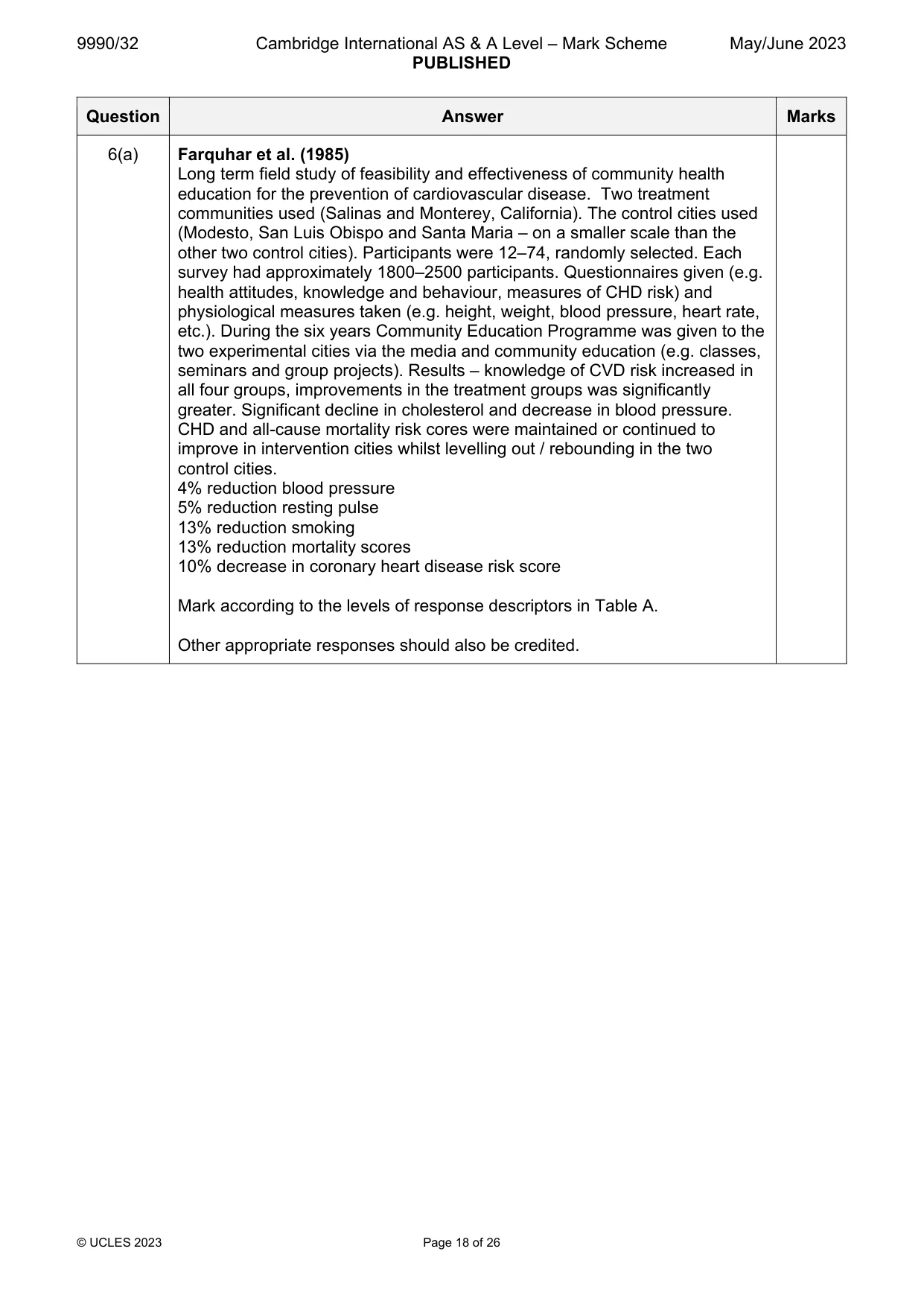
9990/32 Cambridge International AS & A Level – Mark Scheme PUBLISHED May/June 2023 © UCLES 2023 Page 18 of 26 Question Answer Marks 6(a) Farquhar et al. (1985) Long term field study of feasibility and effectiveness of community health education for the prevention of cardiovascular disease. Two treatment communities used (Salinas and Monterey, California). The control cities used (Modesto, San Luis Obispo and Santa Maria – on a smaller scale than the other two control cities). Participants were 12–74, randomly selected. Each survey had approximately 1800–2500 participants. Questionnaires given (e.g. health attitudes, knowledge and behaviour, measures of CHD risk) and physiological measures taken (e.g. height, weight, blood pressure, heart rate, etc.). During the six years Community Education Programme was given to the two experimental cities via the media and community education (e.g. classes, seminars and group projects). Results – knowledge of CVD risk increased in all four groups, improvements in the treatment groups was significantly greater. Significant decline in cholesterol and decrease in blood pressure. CHD and all-cause mortality risk cores were maintained or continued to improve in intervention cities whilst levelling out / rebounding in the two control cities. 4% reduction blood pressure 5% reduction resting pulse 13% reduction smoking 13% reduction mortality scores 10% decrease in coronary heart disease risk score Mark according to the levels of response descriptors in Table A. Other appropriate responses should also be credited.
Mark scheme, page 19
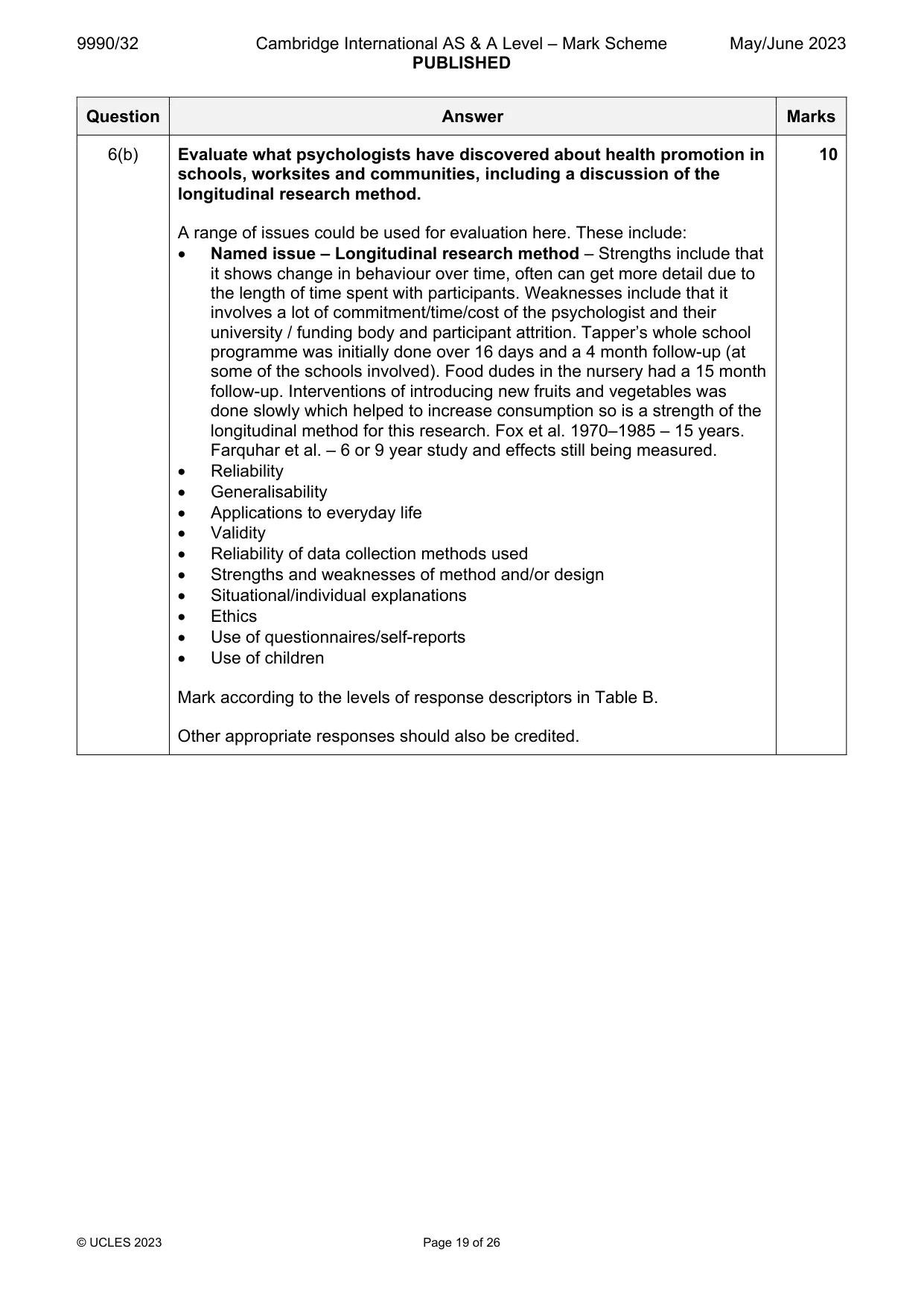
9990/32 Cambridge International AS & A Level – Mark Scheme PUBLISHED May/June 2023 © UCLES 2023 Page 19 of 26 Question Answer Marks 6(b) Evaluate what psychologists have discovered about health promotion in schools, worksites and communities, including a discussion of the longitudinal research method. A range of issues could be used for evaluation here. These include: Named issue – Longitudinal research method – Strengths include that it shows change in behaviour over time, often can get more detail due to the length of time spent with participants. Weaknesses include that it involves a lot of commitment/time/cost of the psychologist and their university / funding body and participant attrition. Tapper’s whole school programme was initially done over 16 days and a 4 month follow-up (at some of the schools involved). Food dudes in the nursery had a 15 month follow-up. Interventions of introducing new fruits and vegetables was done slowly which helped to increase consumption so is a strength of the longitudinal method for this research. Fox et al. 1970–1985 – 15 years. Farquhar et al. – 6 or 9 year study and effects still being measured. Reliability Generalisability Applications to everyday life Validity Reliability of data collection methods used Strengths and weaknesses of method and/or design Situational/individual explanations Ethics Use of questionnaires/self-reports Use of children Mark according to the levels of response descriptors in Table B. Other appropriate responses should also be credited. 10
Mark scheme, page 20
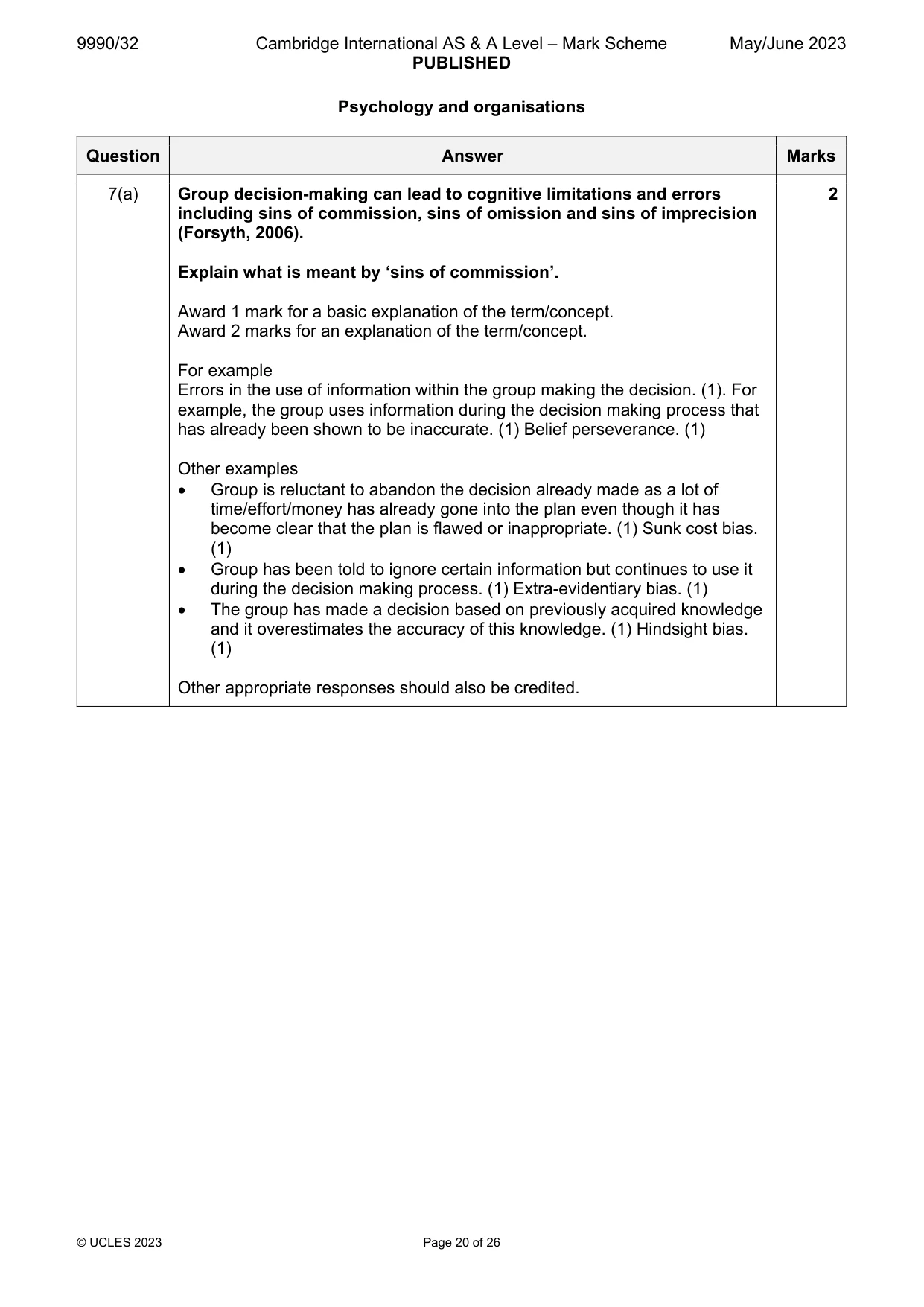
9990/32 Cambridge International AS & A Level – Mark Scheme PUBLISHED May/June 2023 © UCLES 2023 Page 20 of 26 Psychology and organisations Question Answer Marks 7(a) Group decision-making can lead to cognitive limitations and errors including sins of commission, sins of omission and sins of imprecision (Forsyth, 2006). Explain what is meant by ‘sins of commission’. Award 1 mark for a basic explanation of the term/concept. Award 2 marks for an explanation of the term/concept. For example Errors in the use of information within the group making the decision. (1). For example, the group uses information during the decision making process that has already been shown to be inaccurate. (1) Belief perseverance. (1) Other examples Group is reluctant to abandon the decision already made as a lot of time/effort/money has already gone into the plan even though it has become clear that the plan is flawed or inappropriate. (1) Sunk cost bias. (1) Group has been told to ignore certain information but continues to use it during the decision making process. (1) Extra-evidentiary bias. (1) The group has made a decision based on previously acquired knowledge and it overestimates the accuracy of this knowledge. (1) Hindsight bias. (1) Other appropriate responses should also be credited. 2
Mark scheme, page 21
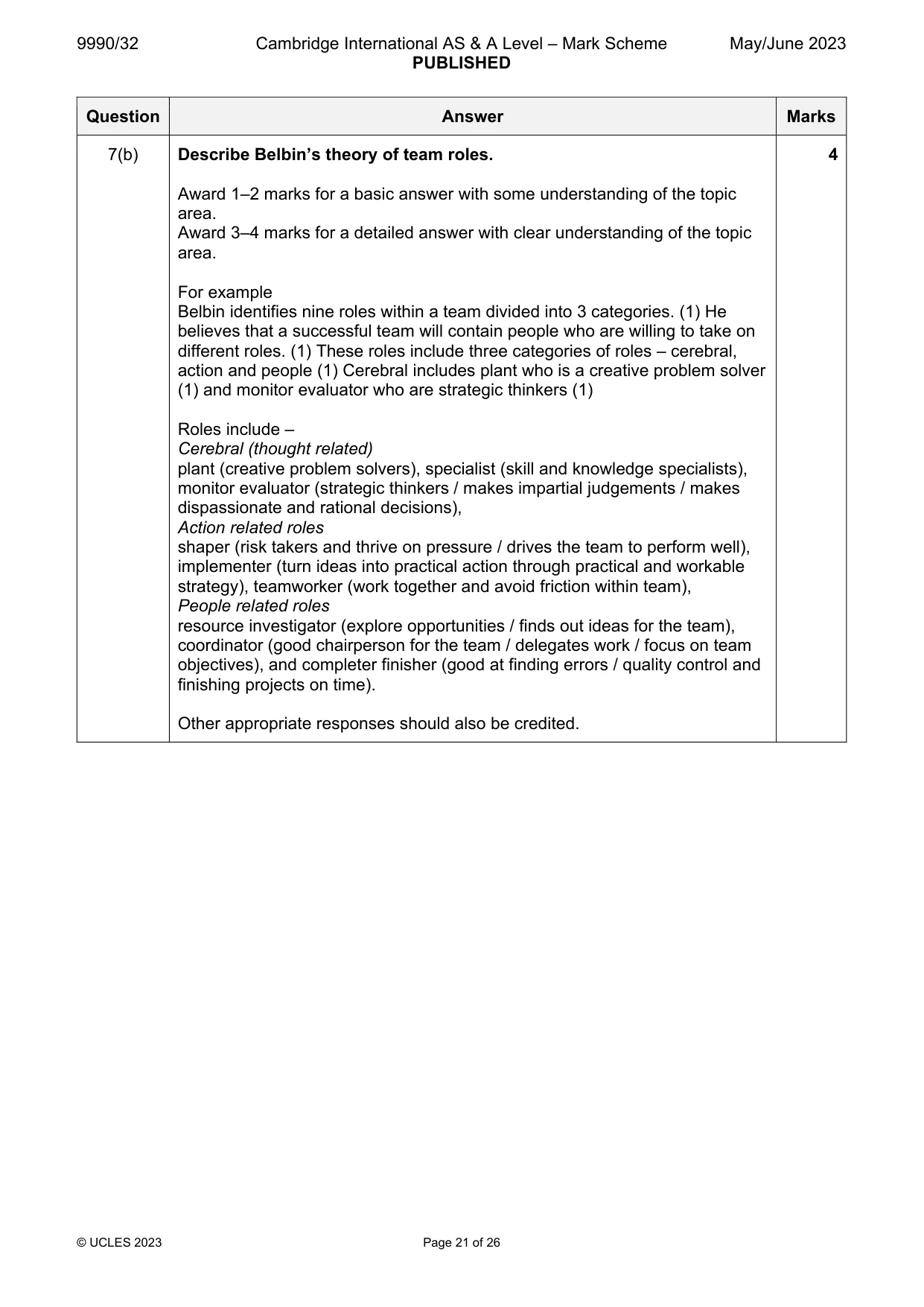
9990/32 Cambridge International AS & A Level – Mark Scheme PUBLISHED May/June 2023 © UCLES 2023 Page 21 of 26 Question Answer Marks 7(b) Describe Belbin’s theory of team roles. Award 1–2 marks for a basic answer with some understanding of the topic area. Award 3–4 marks for a detailed answer with clear understanding of the topic area. For example Belbin identifies nine roles within a team divided into 3 categories. (1) He believes that a successful team will contain people who are willing to take on different roles. (1) These roles include three categories of roles – cerebral, action and people (1) Cerebral includes plant who is a creative problem solver (1) and monitor evaluator who are strategic thinkers (1) Roles include – Cerebral (thought related) plant (creative problem solvers), specialist (skill and knowledge specialists), monitor evaluator (strategic thinkers / makes impartial judgements / makes dispassionate and rational decisions), Action related roles shaper (risk takers and thrive on pressure / drives the team to perform well), implementer (turn ideas into practical action through practical and workable strategy), teamworker (work together and avoid friction within team), People related roles resource investigator (explore opportunities / finds out ideas for the team), coordinator (good chairperson for the team / delegates work / focus on team objectives), and completer finisher (good at finding errors / quality control and finishing projects on time). Other appropriate responses should also be credited. 4
Mark scheme, page 22
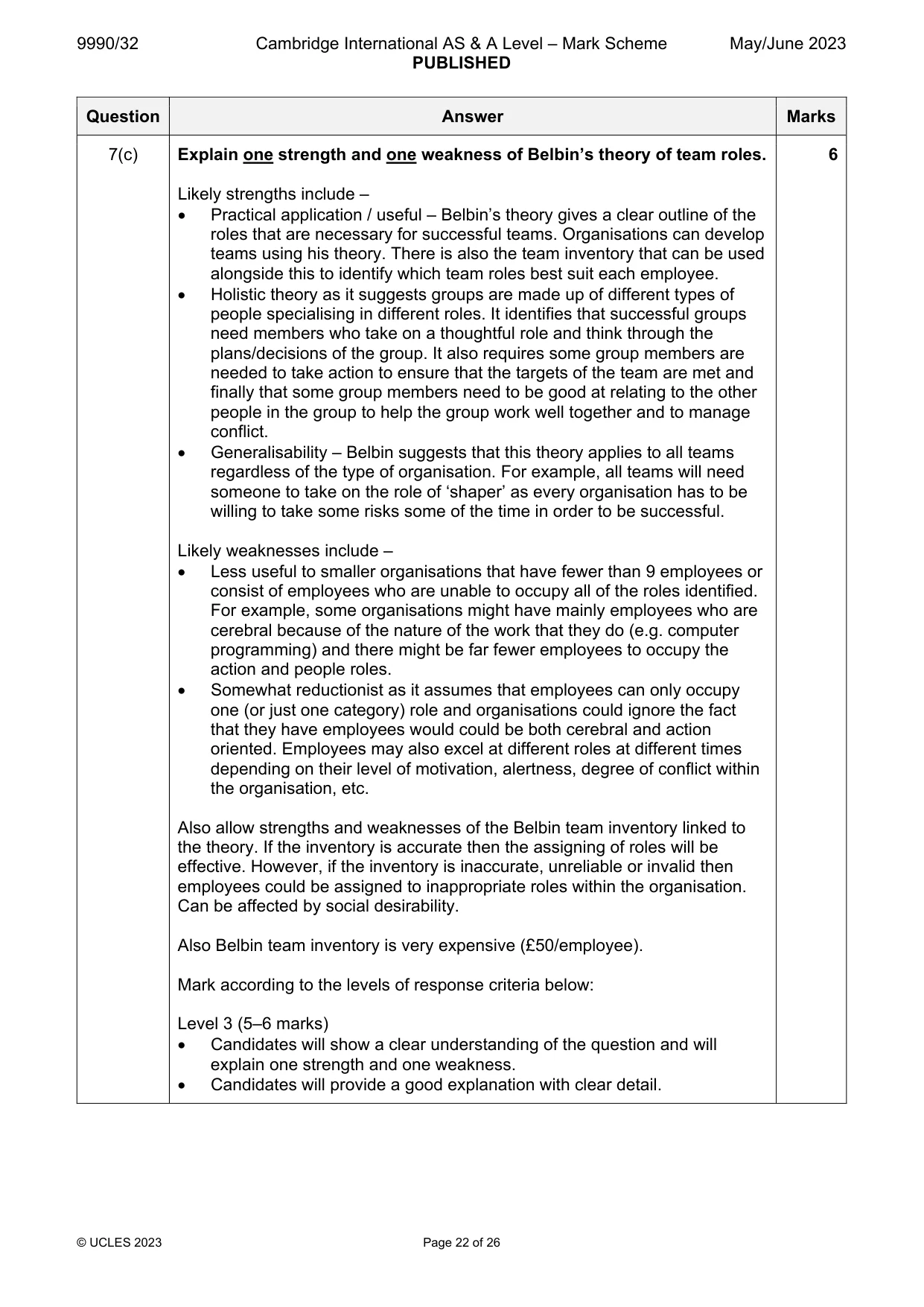
9990/32 Cambridge International AS & A Level – Mark Scheme PUBLISHED May/June 2023 © UCLES 2023 Page 22 of 26 Question Answer Marks 7(c) Explain one strength and one weakness of Belbin’s theory of team roles. Likely strengths include – Practical application / useful – Belbin’s theory gives a clear outline of the roles that are necessary for successful teams. Organisations can develop teams using his theory. There is also the team inventory that can be used alongside this to identify which team roles best suit each employee. Holistic theory as it suggests groups are made up of different types of people specialising in different roles. It identifies that successful groups need members who take on a thoughtful role and think through the plans/decisions of the group. It also requires some group members are needed to take action to ensure that the targets of the team are met and finally that some group members need to be good at relating to the other people in the group to help the group work well together and to manage conflict. Generalisability – Belbin suggests that this theory applies to all teams regardless of the type of organisation. For example, all teams will need someone to take on the role of ‘shaper’ as every organisation has to be willing to take some risks some of the time in order to be successful. Likely weaknesses include – Less useful to smaller organisations that have fewer than 9 employees or consist of employees who are unable to occupy all of the roles identified. For example, some organisations might have mainly employees who are cerebral because of the nature of the work that they do (e.g. computer programming) and there might be far fewer employees to occupy the action and people roles. Somewhat reductionist as it assumes that employees can only occupy one (or just one category) role and organisations could ignore the fact that they have employees would could be both cerebral and action oriented. Employees may also excel at different roles at different times depending on their level of motivation, alertness, degree of conflict within the organisation, etc. Also allow strengths and weaknesses of the Belbin team inventory linked to the theory. If the inventory is accurate then the assigning of roles will be effective. However, if the inventory is inaccurate, unreliable or invalid then employees could be assigned to inappropriate roles within the organisation. Can be affected by social desirability. Also Belbin team inventory is very expensive (£50/employee). Mark according to the levels of response criteria below: Level 3 (5–6 marks) Candidates will show a clear understanding of the question and will explain one strength and one weakness. Candidates will provide a good explanation with clear detail. 6
Mark scheme, page 23
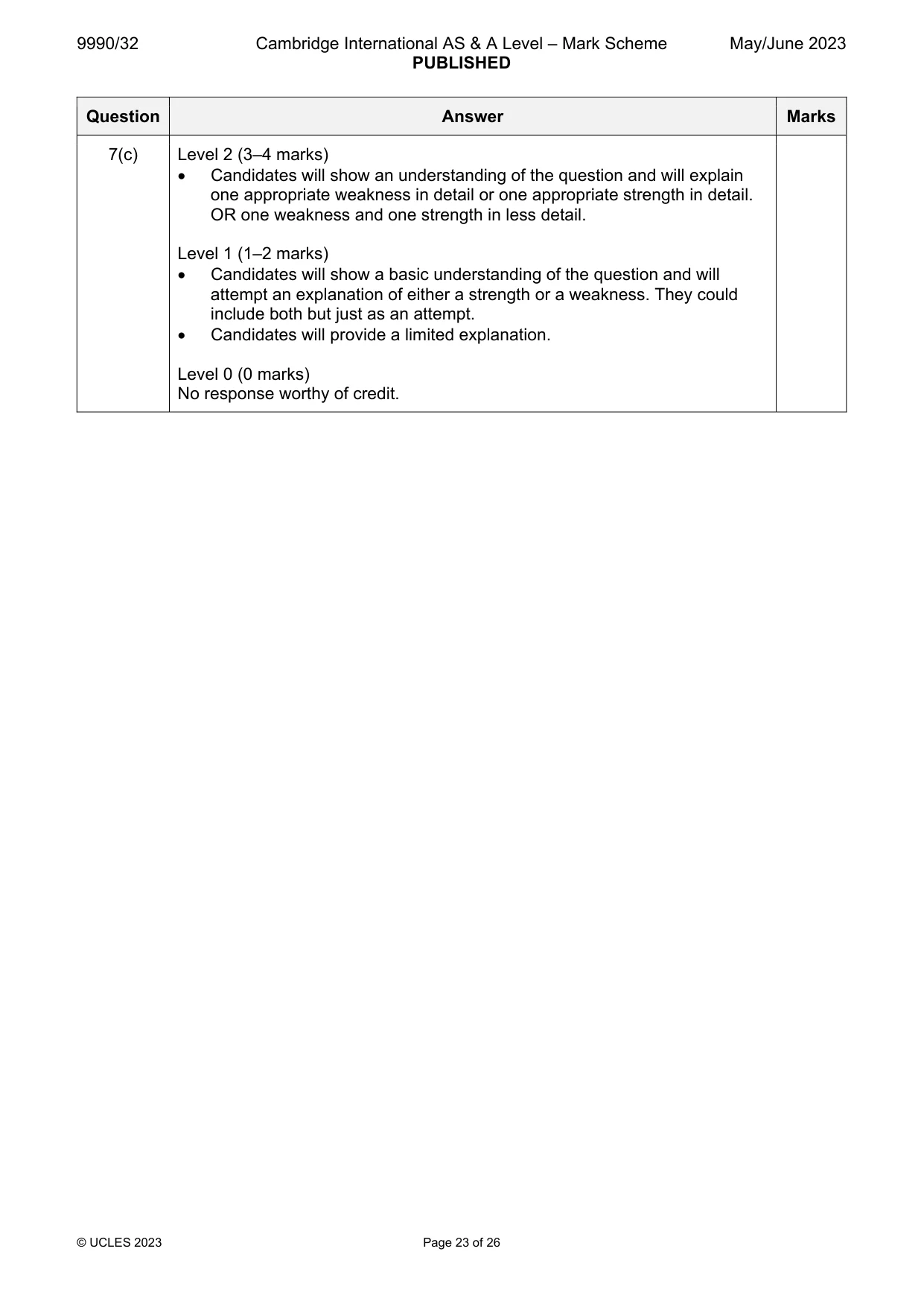
9990/32 Cambridge International AS & A Level – Mark Scheme PUBLISHED May/June 2023 © UCLES 2023 Page 23 of 26 Question Answer Marks 7(c) Level 2 (3–4 marks) Candidates will show an understanding of the question and will explain one appropriate weakness in detail or one appropriate strength in detail. OR one weakness and one strength in less detail. Level 1 (1–2 marks) Candidates will show a basic understanding of the question and will attempt an explanation of either a strength or a weakness. They could include both but just as an attempt. Candidates will provide a limited explanation. Level 0 (0 marks) No response worthy of credit.
Mark scheme, page 24
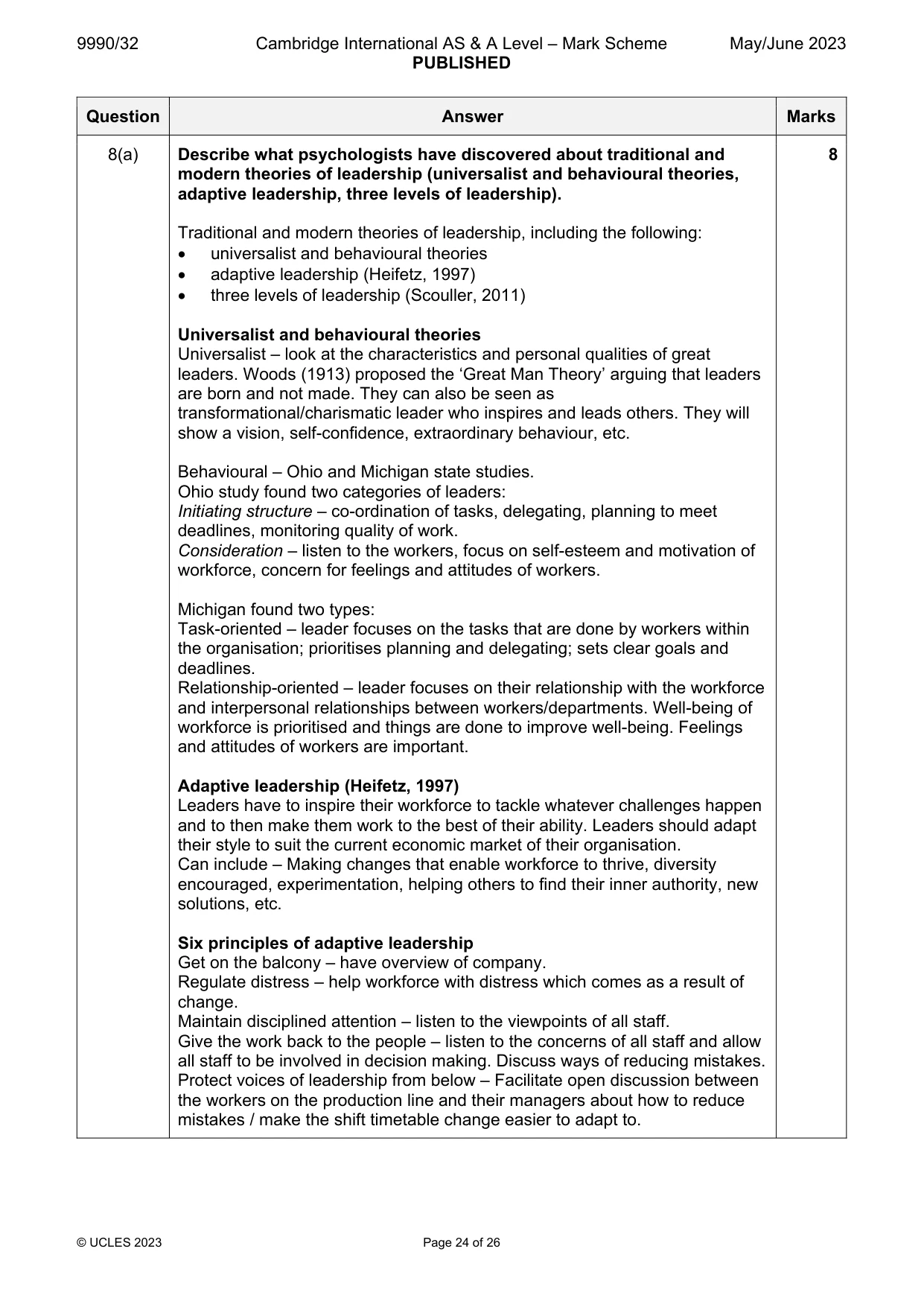
9990/32 Cambridge International AS & A Level – Mark Scheme PUBLISHED May/June 2023 © UCLES 2023 Page 24 of 26 Question Answer Marks 8(a) Describe what psychologists have discovered about traditional and modern theories of leadership (universalist and behavioural theories, adaptive leadership, three levels of leadership). Traditional and modern theories of leadership, including the following: universalist and behavioural theories adaptive leadership (Heifetz, 1997) three levels of leadership (Scouller, 2011) Universalist and behavioural theories Universalist – look at the characteristics and personal qualities of great leaders. Woods (1913) proposed the ‘Great Man Theory’ arguing that leaders are born and not made. They can also be seen as transformational/charismatic leader who inspires and leads others. They will show a vision, self-confidence, extraordinary behaviour, etc. Behavioural – Ohio and Michigan state studies. Ohio study found two categories of leaders: Initiating structure – co-ordination of tasks, delegating, planning to meet deadlines, monitoring quality of work. Consideration – listen to the workers, focus on self-esteem and motivation of workforce, concern for feelings and attitudes of workers. Michigan found two types: Task-oriented – leader focuses on the tasks that are done by workers within the organisation; prioritises planning and delegating; sets clear goals and deadlines. Relationship-oriented – leader focuses on their relationship with the workforce and interpersonal relationships between workers/departments. Well-being of workforce is prioritised and things are done to improve well-being. Feelings and attitudes of workers are important. Adaptive leadership (Heifetz, 1997) Leaders have to inspire their workforce to tackle whatever challenges happen and to then make them work to the best of their ability. Leaders should adapt their style to suit the current economic market of their organisation. Can include – Making changes that enable workforce to thrive, diversity encouraged, experimentation, helping others to find their inner authority, new solutions, etc. Six principles of adaptive leadership Get on the balcony – have overview of company. Regulate distress – help workforce with distress which comes as a result of change. Maintain disciplined attention – listen to the viewpoints of all staff. Give the work back to the people – listen to the concerns of all staff and allow all staff to be involved in decision making. Discuss ways of reducing mistakes. Protect voices of leadership from below – Facilitate open discussion between the workers on the production line and their managers about how to reduce mistakes / make the shift timetable change easier to adapt to. 8
Mark scheme, page 25
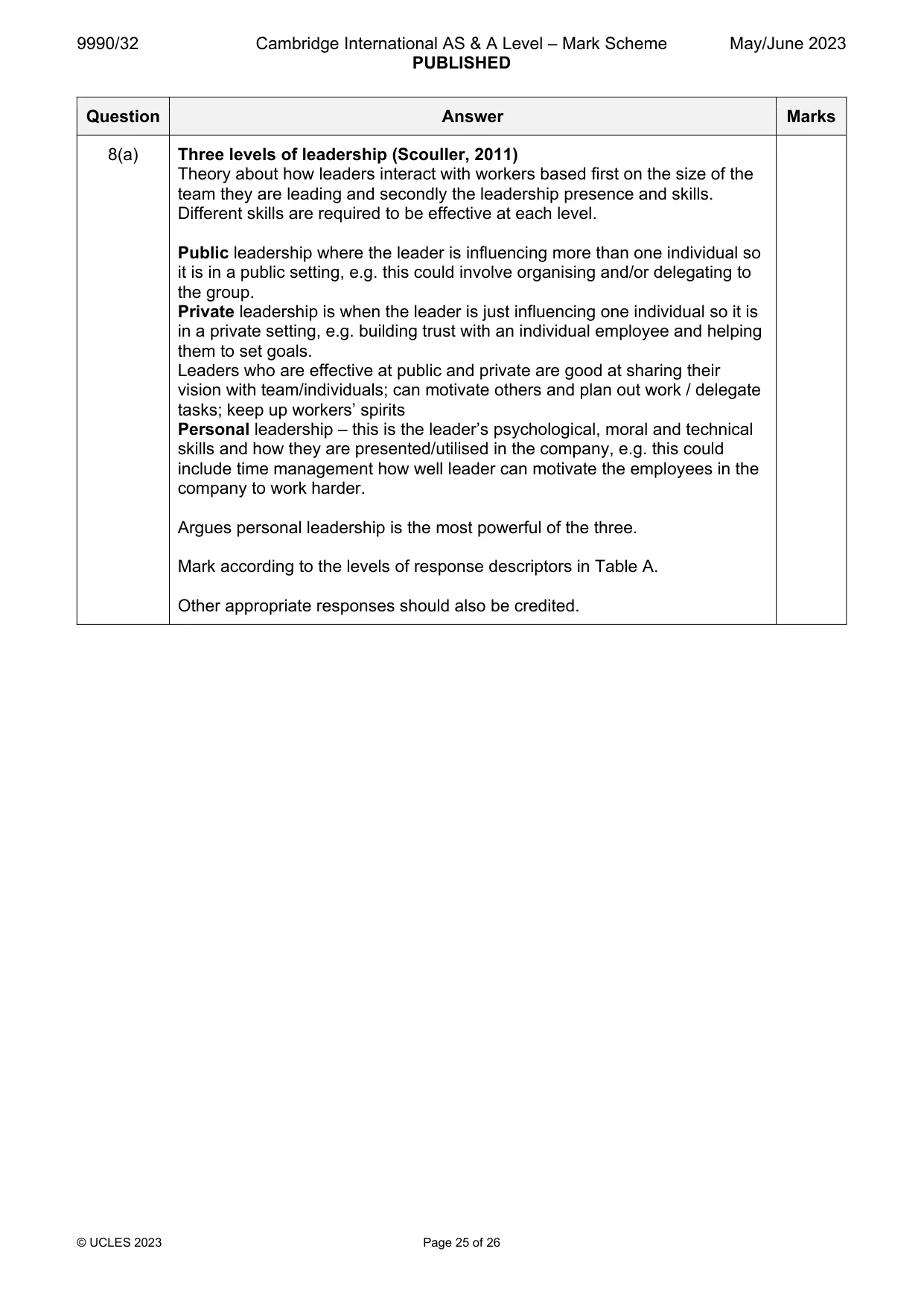
9990/32 Cambridge International AS & A Level – Mark Scheme PUBLISHED May/June 2023 © UCLES 2023 Page 25 of 26 Question Answer Marks 8(a) Three levels of leadership (Scouller, 2011) Theory about how leaders interact with workers based first on the size of the team they are leading and secondly the leadership presence and skills. Different skills are required to be effective at each level. Public leadership where the leader is influencing more than one individual so it is in a public setting, e.g. this could involve organising and/or delegating to the group. Private leadership is when the leader is just influencing one individual so it is in a private setting, e.g. building trust with an individual employee and helping them to set goals. Leaders who are effective at public and private are good at sharing their vision with team/individuals; can motivate others and plan out work / delegate tasks; keep up workers’ spirits Personal leadership – this is the leader’s psychological, moral and technical skills and how they are presented/utilised in the company, e.g. this could include time management how well leader can motivate the employees in the company to work harder. Argues personal leadership is the most powerful of the three. Mark according to the levels of response descriptors in Table A. Other appropriate responses should also be credited.
Mark scheme, page 26
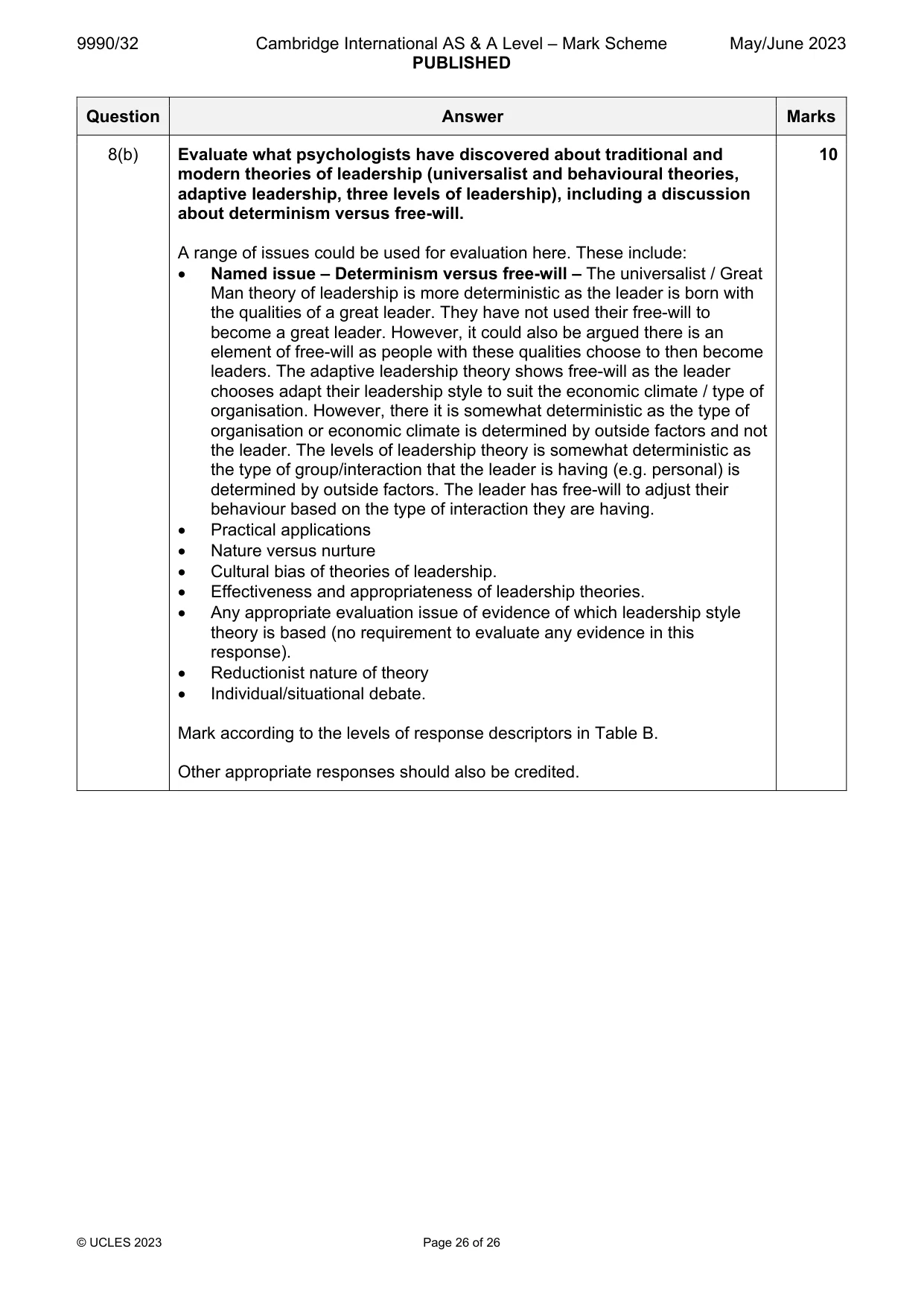
9990/32 Cambridge International AS & A Level – Mark Scheme PUBLISHED May/June 2023 © UCLES 2023 Page 26 of 26 Question Answer Marks 8(b) Evaluate what psychologists have discovered about traditional and modern theories of leadership (universalist and behavioural theories, adaptive leadership, three levels of leadership), including a discussion about determinism versus free-will. A range of issues could be used for evaluation here. These include: Named issue – Determinism versus free-will – The universalist / Great Man theory of leadership is more deterministic as the leader is born with the qualities of a great leader. They have not used their free-will to become a great leader. However, it could also be argued there is an element of free-will as people with these qualities choose to then become leaders. The adaptive leadership theory shows free-will as the leader chooses adapt their leadership style to suit the economic climate / type of organisation. However, there it is somewhat deterministic as the type of organisation or economic climate is determined by outside factors and not the leader. The levels of leadership theory is somewhat deterministic as the type of group/interaction that the leader is having (e.g. personal) is determined by outside factors. The leader has free-will to adjust their behaviour based on the type of interaction they are having. Practical applications Nature versus nurture Cultural bias of theories of leadership. Effectiveness and appropriateness of leadership theories. Any appropriate evaluation issue of evidence of which leadership style theory is based (no requirement to evaluate any evidence in this response). Reductionist nature of theory Individual/situational debate. Mark according to the levels of response descriptors in Table B. Other appropriate responses should also be credited. 10
What you needed in this session
Cambridge’s own grade thresholds for 2023 May/June, Paper 3 · Variant 2. A higher threshold means an easier paper — the bar moves with how the cohort did.