Cambridge A Level Psychology (from 2018) 9990 — 2023 May/June Paper 3 · Variant 3
9990/33/M/J/23 · 8 questions · 60 marks · ≈68 min
The question paper and its mark scheme, free to read here and free to download. This is Cambridge’s own paper, exactly as it was sat.
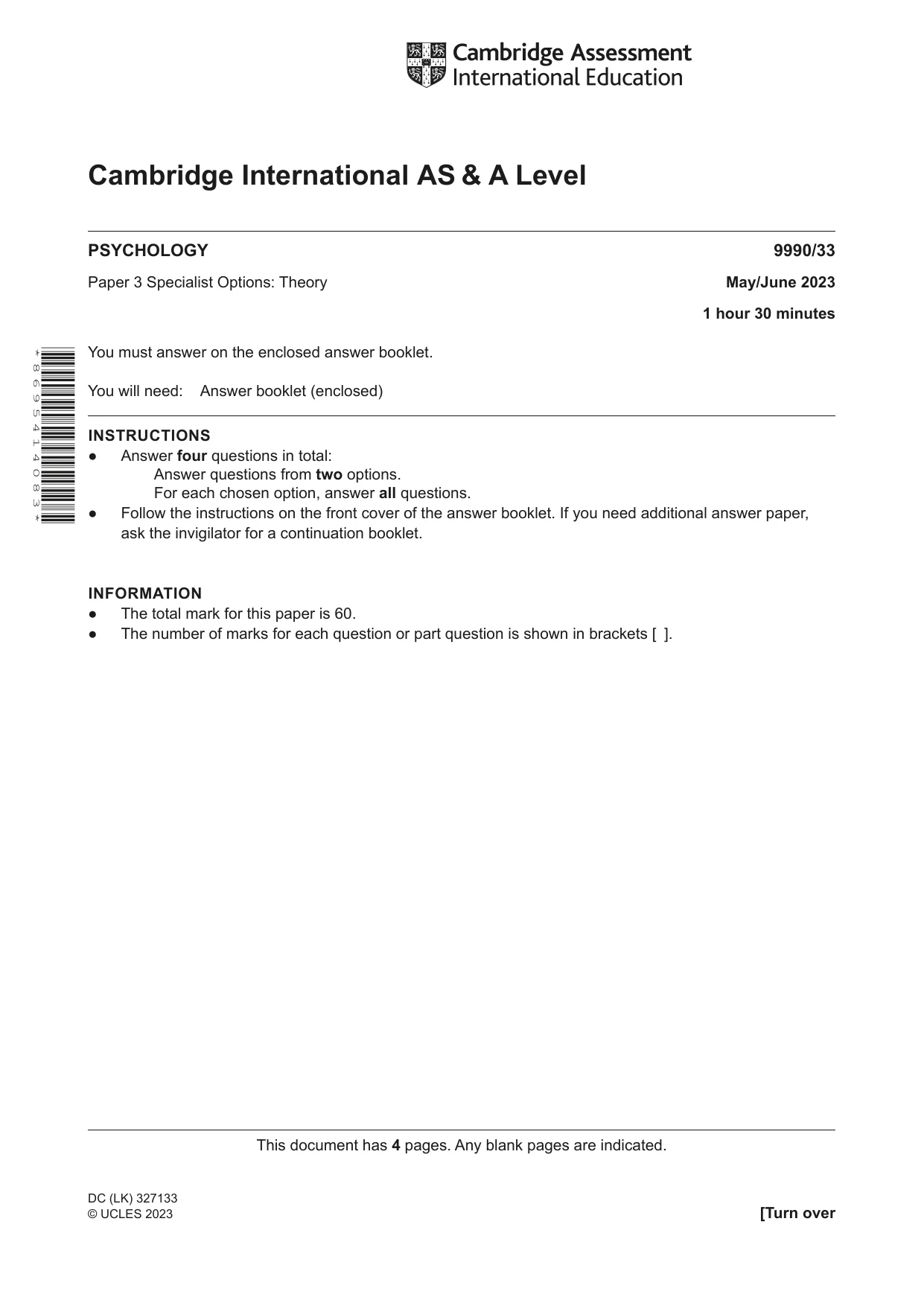
Question paper4 pages

Mark scheme23 pages
Answers below. Sit the paper first if you are practising.
Questions as text
Q1 · Explain what is meant by ‘pyromania’
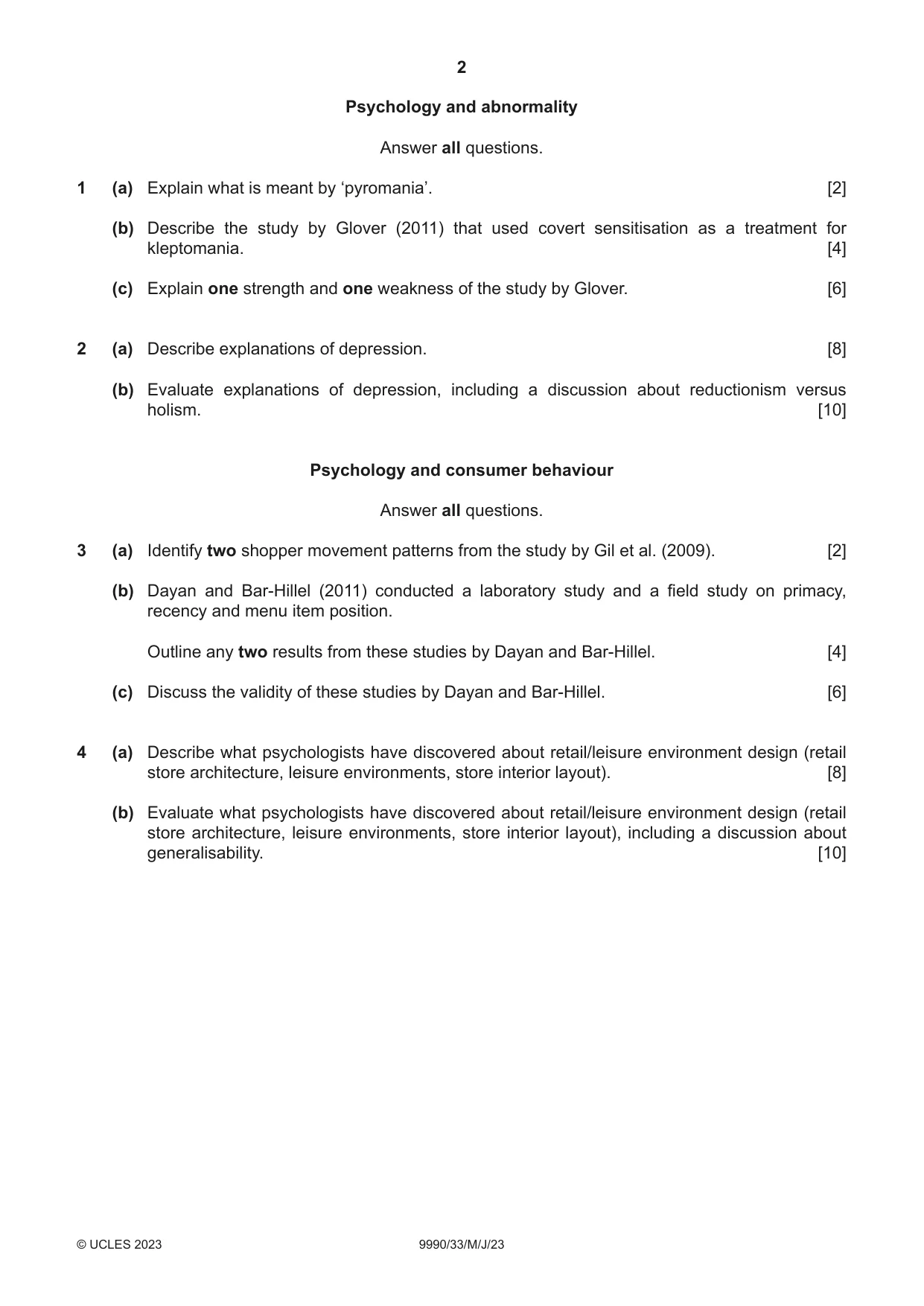
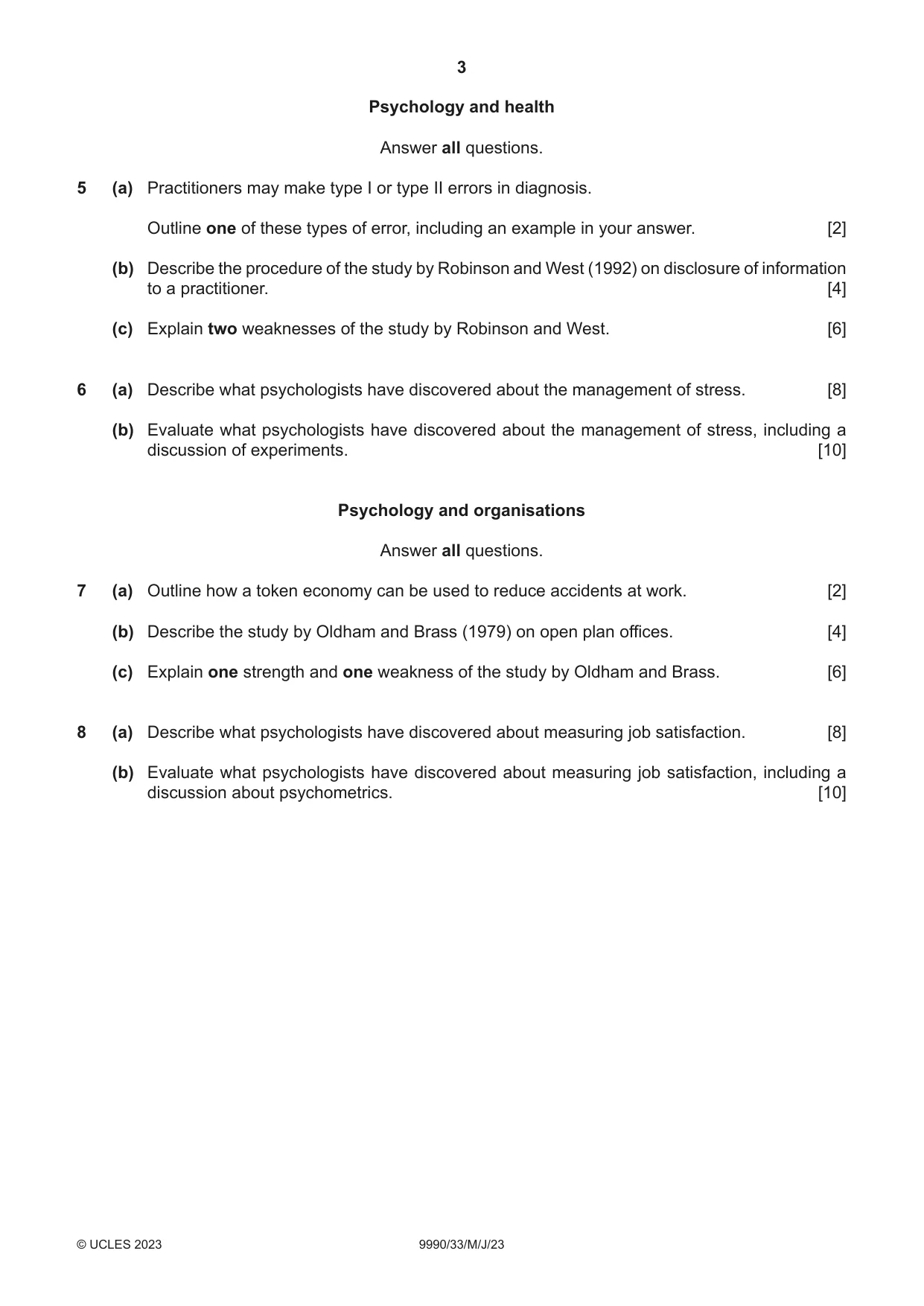
1 (a) Explain what is meant by ‘pyromania’. [2] (b) Describe the study by Glover (2011) that used covert sensitisation as a treatment for kleptomania. [4] (c) Explain one strength and one weakness of the study by Glover. [6]
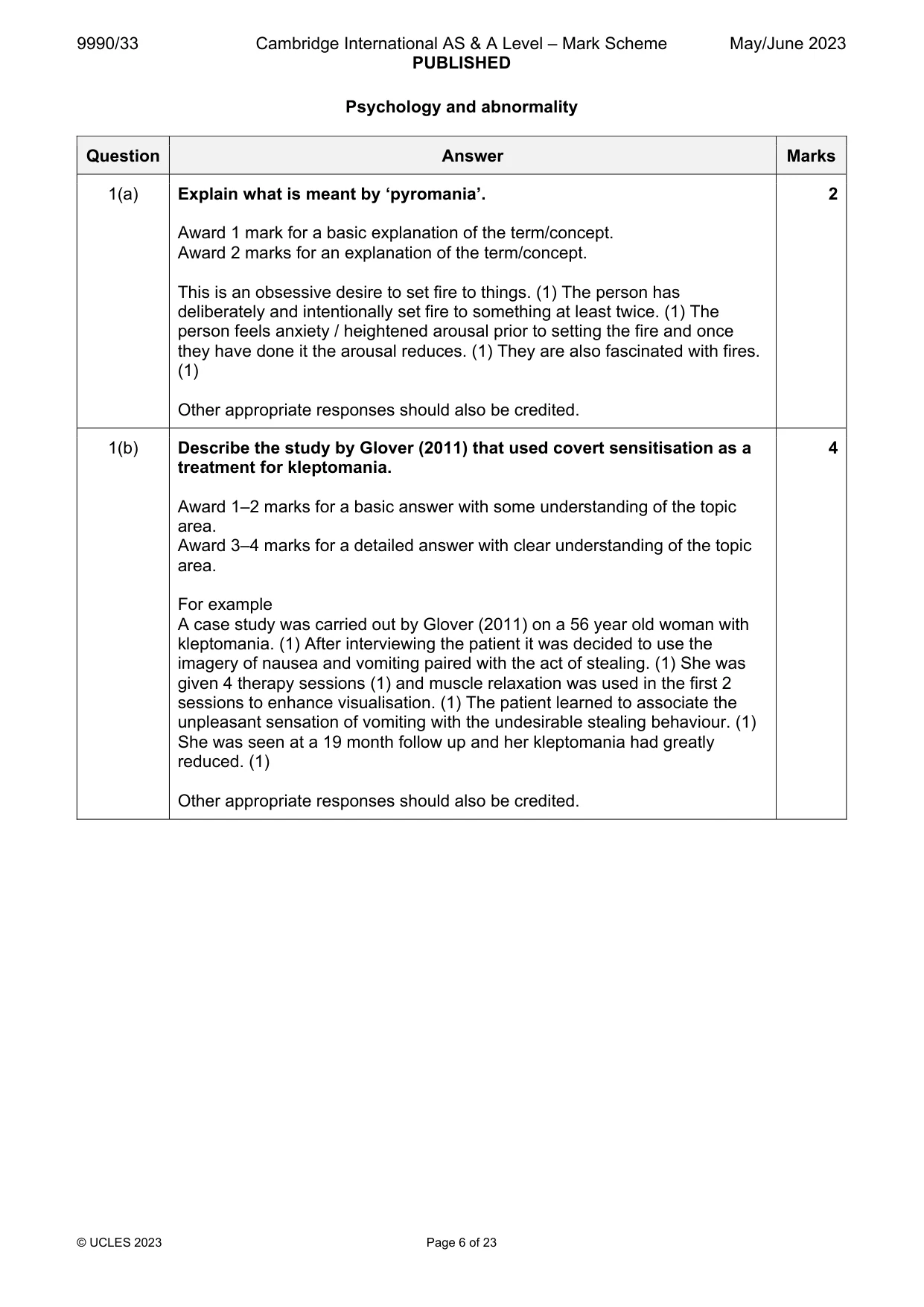
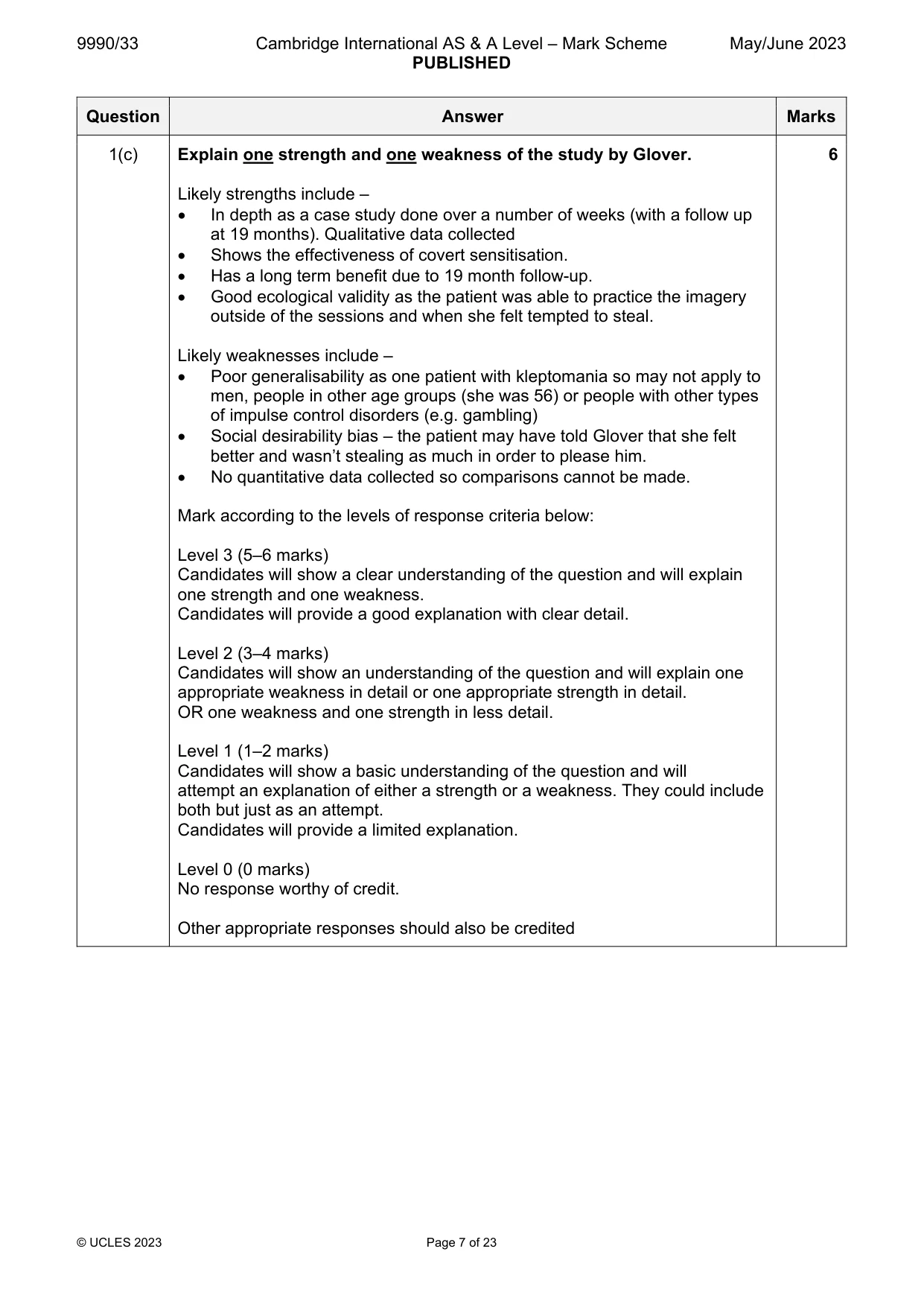
Mark scheme: Question Answer Marks 1(a) Explain what is meant by ‘pyromania’. 2 Award 1 mark for a basic explanation of the term/concept. Award 2 marks for an explanation of the term/concept. This is an obsessive desire to set fire to things. (1) The person has deliberately and intentionally set fire to something at least twice. (1) The person feels anxiety / heightened arousal prior to setting the fire and once they have done it the arousal reduces. (1) They are also fascinated with fires. (1) Other appropriate responses should also be credited. 1(b) Describe the study by Glover (2011) that used covert sensitisation as a 4 treatment for kleptomania. Award 1–2 marks for a basic answer with some understanding of the topic area. Award 3–4 marks for a detailed answer with clear understanding of the topic area. For example A case study was carried out by Glover (2011) on a 56 year old woman with kleptomania. (1) After interviewing the patient it was decided to use the imagery of nausea and vomiting paired with the act of stealing. (1) She was given 4 therapy sessions (1) and muscle relaxation was used in the first 2 sessions to enhance visualisation. (1) The patient learned to associate the unpleasant sensation of vomiting with the undesirable stealing behaviour. (1) She was seen at a 19 month follow up and her kleptomania had greatly reduced. (1) Other appropriate responses should also be credited. 1(c) Explain one strength and one weakness of the study by Glover. 6 Likely strengths include – In depth as a case study done over a number of weeks (with a follow up at 19 months). Qualitative data collected Shows the effectiveness of covert sensitisation. Has a long term benefit due to 19 month follow-up. Good ecological validity as the patient was able to practice the imagery outside of the sessions and when she felt tempted to steal. Likely weaknesses include – Poor generalisability as one patient with kleptomania so may not apply to men, people in other age groups (she was 56) or people with other types of impulse control disorders (e.g. gambling) Social desirability bias – the patient may have told Glover that she felt better and wasn’t stealing as much in order to please him. No quantitative data collected so comparisons cannot be made. Mark according to the levels of response criteria below: Level 3 (5–6 marks) Candidates will show a clear understanding of the question and will explain one strength and one weakness. Candidates will provide a good explanation with clear detail. Level 2 (3–4 marks) Candidates will show an understanding of the question and will explain one appropriate weakness in detail or one appropriate strength in detail. OR one weakness and one strength in less detail. Level 1 (1–2 marks) Candidates will show a basic understanding of the question and will attempt an explanation of either a strength or a weakness. They could include both but just as an attempt. Candidates will provide a limited explanation. Level 0 (0 marks) No response worthy of credit. Other appropriate responses should also be credited
Q2 · Describe explanations of depression
2 (a) Describe explanations of depression. [8] (b) Evaluate explanations of depression, including a discussion about reductionism versus holism. [10] Psychology and consumer behaviour Answer all questions.
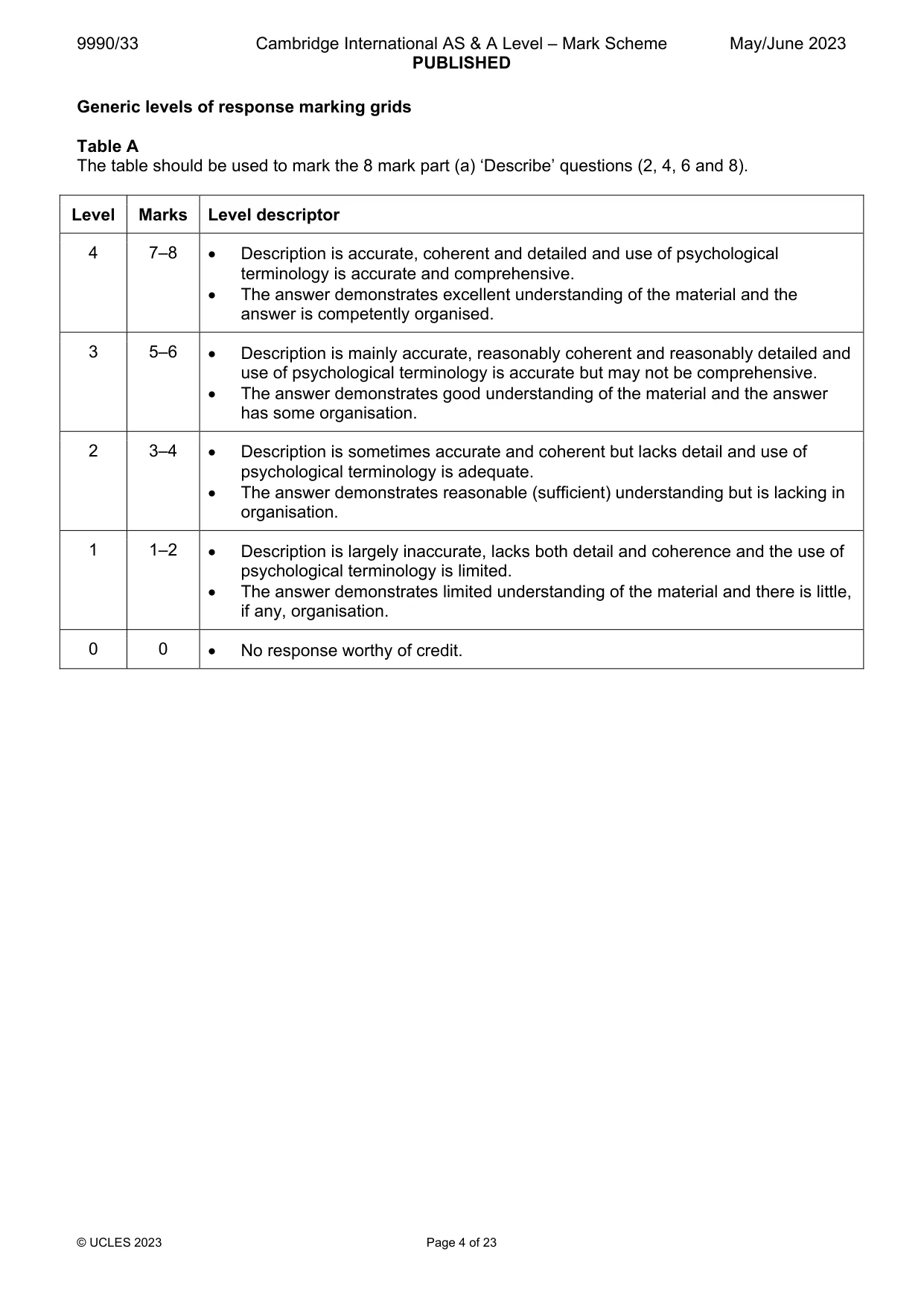
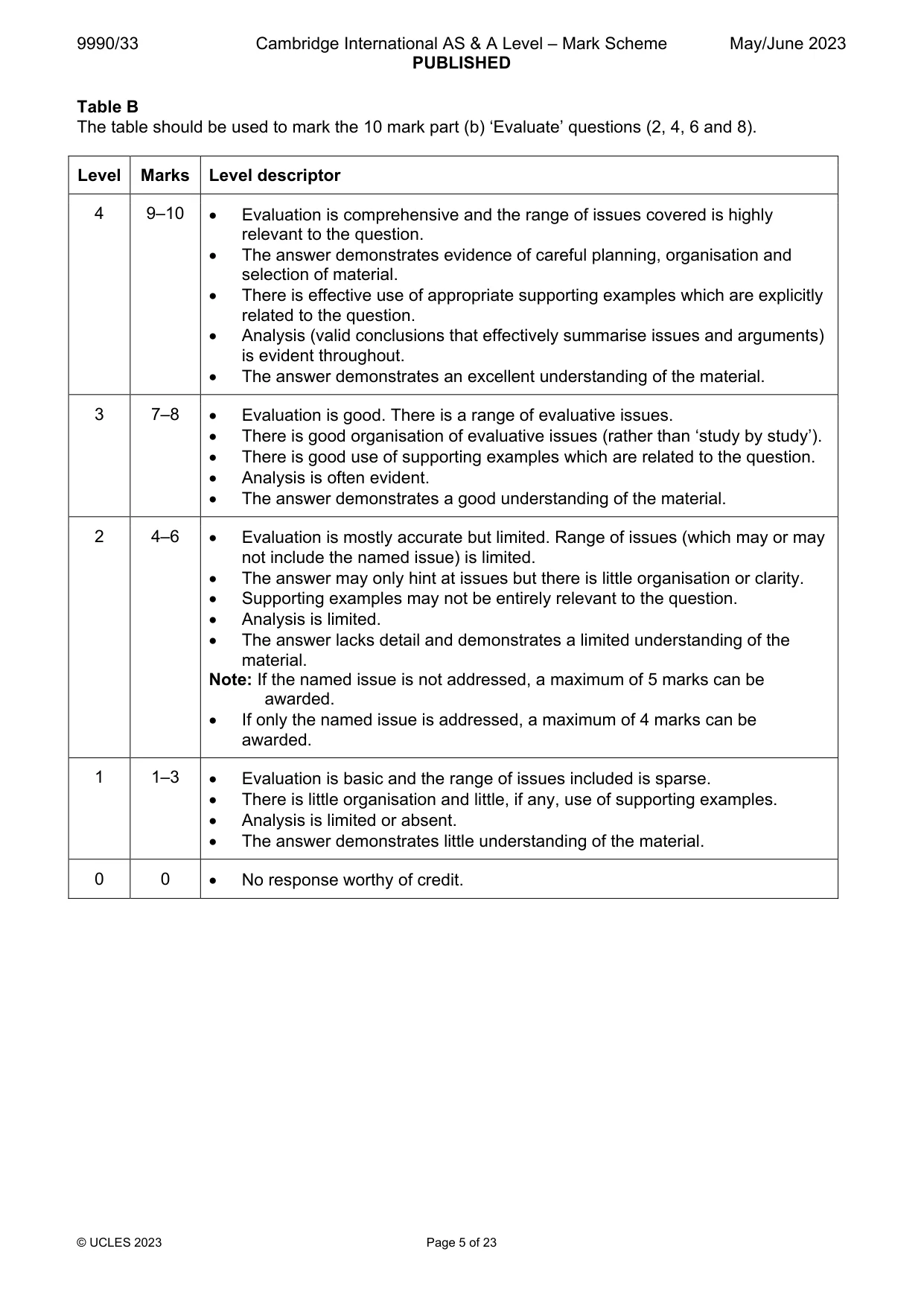
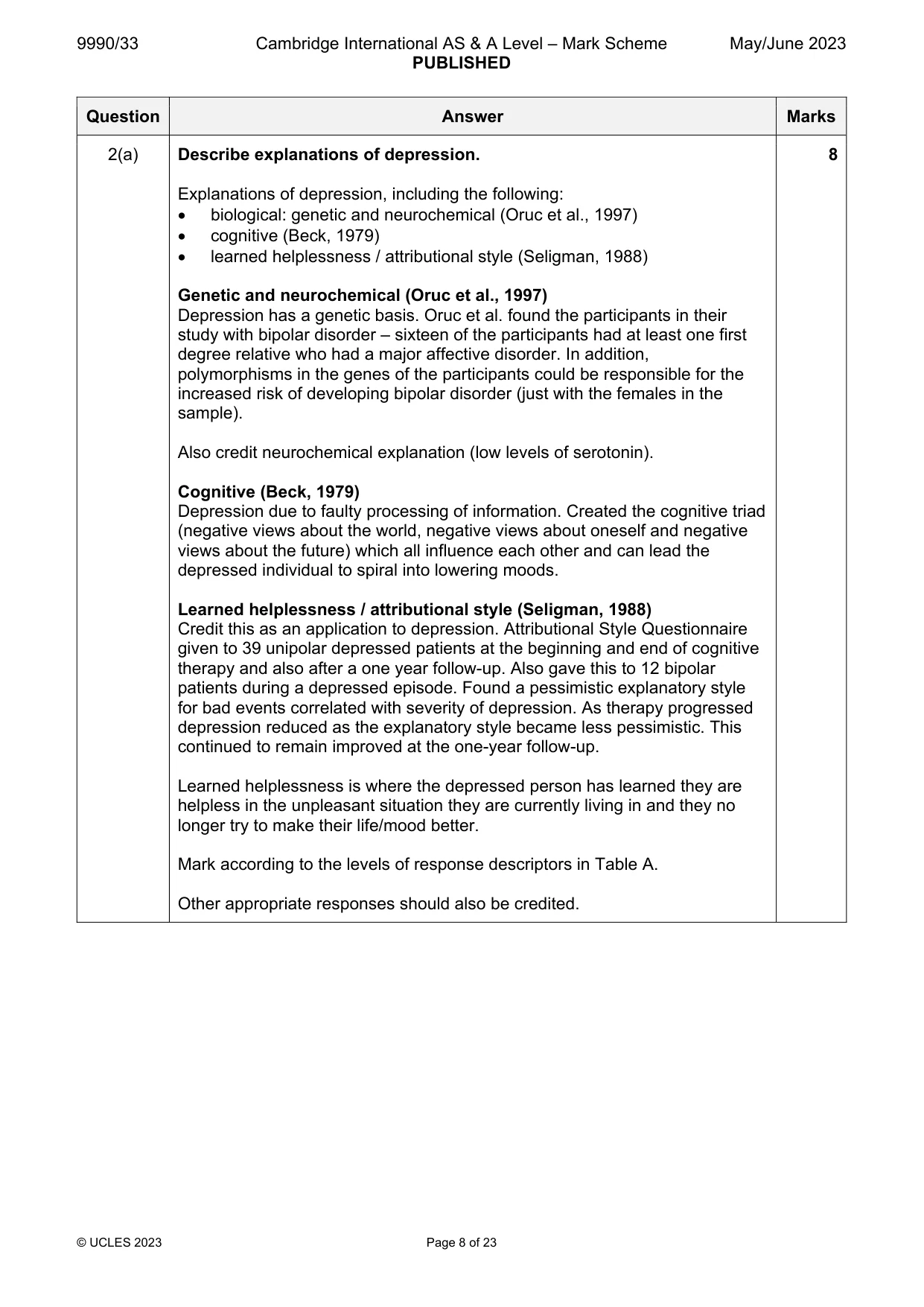
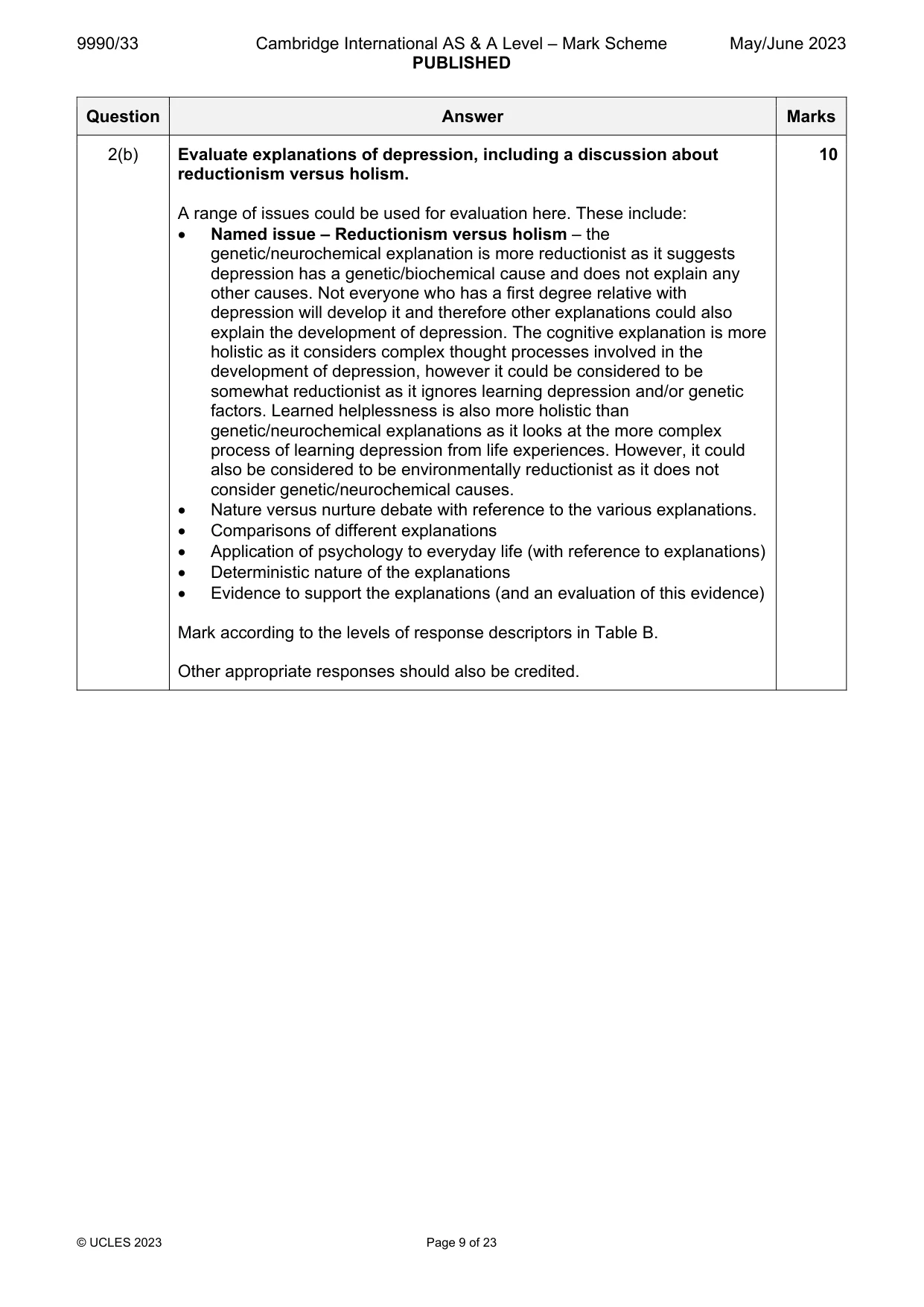
Mark scheme: 2(a) Describe explanations of depression. 8 Explanations of depression, including the following: biological: genetic and neurochemical (Oruc et al., 1997) cognitive (Beck, 1979) learned helplessness / attributional style (Seligman, 1988) Genetic and neurochemical (Oruc et al., 1997) Depression has a genetic basis. Oruc et al. found the participants in their study with bipolar disorder – sixteen of the participants had at least one first degree relative who had a major affective disorder. In addition, polymorphisms in the genes of the participants could be responsible for the increased risk of developing bipolar disorder (just with the females in the sample). Also credit neurochemical explanation (low levels of serotonin). Cognitive (Beck, 1979) Depression due to faulty processing of information. Created the cognitive triad (negative views about the world, negative views about oneself and negative views about the future) which all influence each other and can lead the depressed individual to spiral into lowering moods. Learned helplessness / attributional style (Seligman, 1988) Credit this as an application to depression. Attributional Style Questionnaire given to 39 unipolar depressed patients at the beginning and end of cognitive therapy and also after a one year follow-up. Also gave this to 12 bipolar patients during a depressed episode. Found a pessimistic explanatory style for bad events correlated with severity of depression. As therapy progressed depression reduced as the explanatory style became less pessimistic. This continued to remain improved at the one-year follow-up. Learned helplessness is where the depressed person has learned they are helpless in the unpleasant situation they are currently living in and they no longer try to make their life/mood better. Mark according to the levels of response descriptors in Table A. Other appropriate responses should also be credited. 2(b) Evaluate explanations of depression, including a discussion about 10 reductionism versus holism. A range of issues could be used for evaluation here. These include: Named issue – Reductionism versus holism – the genetic/neurochemical explanation is more reductionist as it suggests depression has a genetic/biochemical cause and does not explain any other causes. Not everyone who has a first degree relative with depression will develop it and therefore other explanations could also explain the development of depression. The cognitive explanation is more holistic as it considers complex thought processes involved in the development of depression, however it could be considered to be somewhat reductionist as it ignores learning depression and/or genetic factors. Learned helplessness is also more holistic than genetic/neurochemical explanations as it looks at the more complex process of learning depression from life experiences. However, it could also be considered to be environmentally reductionist as it does not consider genetic/neurochemical causes. Nature versus nurture debate with reference to the various explanations. Comparisons of different explanations Application of psychology to everyday life (with reference to explanations) Deterministic nature of the explanations Evidence to support the explanations (and an evaluation of this evidence) Mark according to the levels of response descriptors in Table B. Other appropriate responses should also be credited. Psychology and consumer behaviour
More questions on Mood (affective) disorders: depressive disorder (unipolar) and bipolar disorder
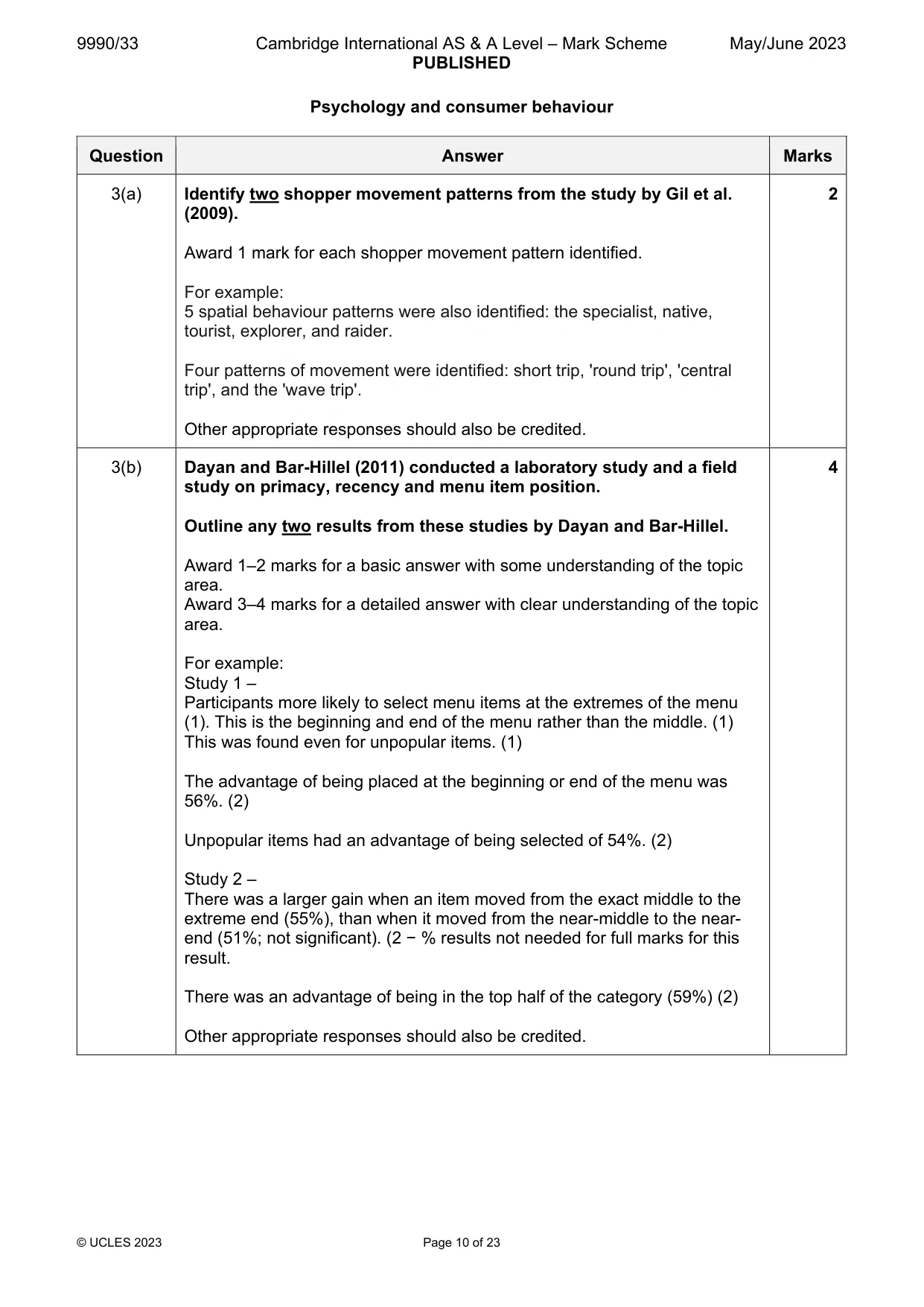
Q3 · Identify two shopper movement patterns from the study by Gil et al
3 (a) Identify two shopper movement patterns from the study by Gil et al. (2009). [2] (b) Dayan and Bar‑Hillel (2011) conducted a laboratory study and a field study on primacy, recency and menu item position. Outline any two results from these studies by Dayan and Bar‑Hillel. [4] (c) Discuss the validity of these studies by Dayan and Bar‑Hillel. [6]
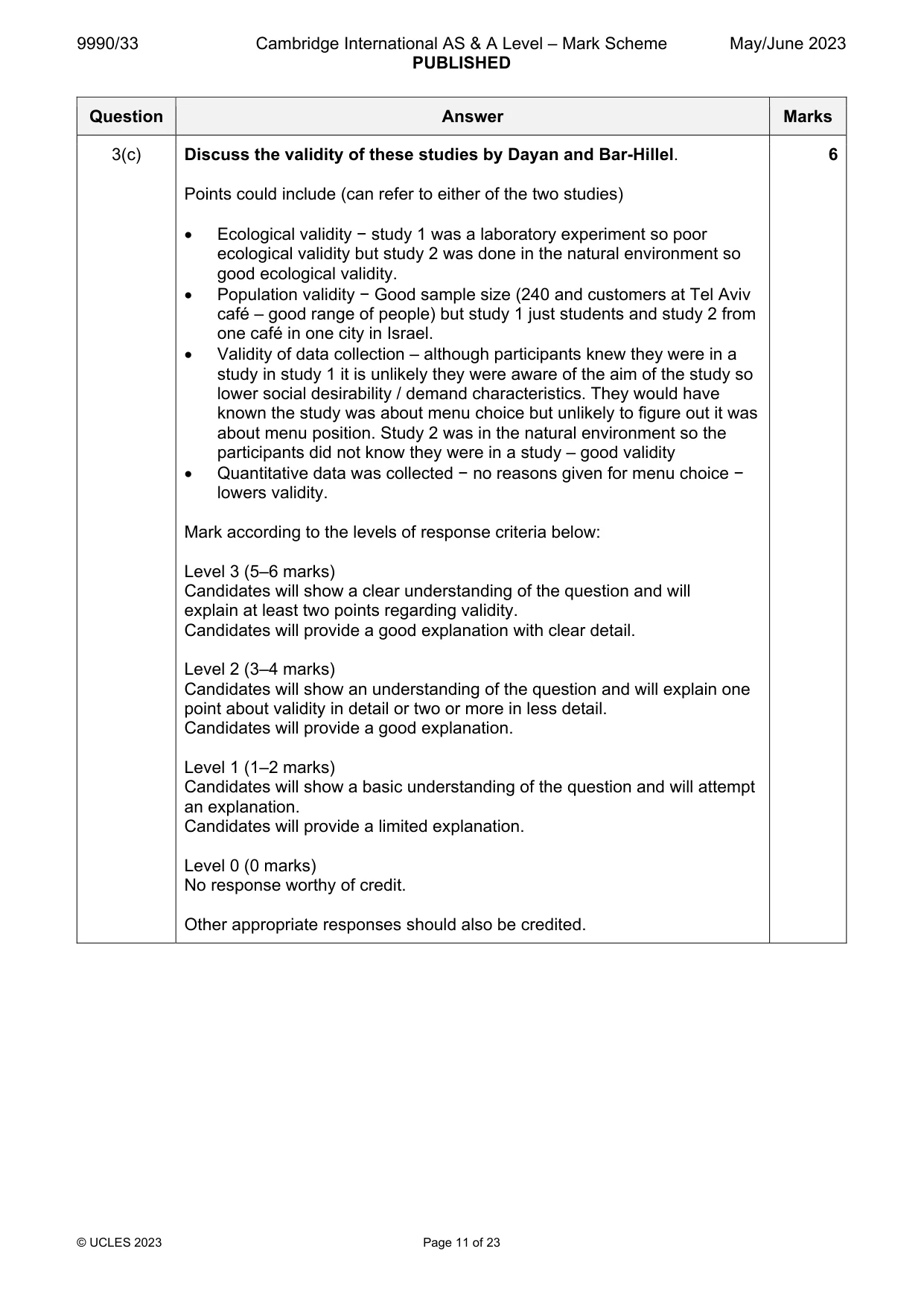
Mark scheme: 3(a) Identify two shopper movement patterns from the study by Gil et al. 2 (2009). Award 1 mark for each shopper movement pattern identified. For example: 5 spatial behaviour patterns were also identified: the specialist, native, tourist, explorer, and raider. Four patterns of movement were identified: short trip, 'round trip', 'central trip', and the 'wave trip'. Other appropriate responses should also be credited. 3(b) Dayan and Bar-Hillel (2011) conducted a laboratory study and a field 4 study on primacy, recency and menu item position. Outline any two results from these studies by Dayan and Bar-Hillel. Award 1–2 marks for a basic answer with some understanding of the topic area. Award 3–4 marks for a detailed answer with clear understanding of the topic area. For example: Study 1 – Participants more likely to select menu items at the extremes of the menu (1). This is the beginning and end of the menu rather than the middle. (1) This was found even for unpopular items. (1) The advantage of being placed at the beginning or end of the menu was 56%. (2) Unpopular items had an advantage of being selected of 54%. (2) Study 2 – There was a larger gain when an item moved from the exact middle to the extreme end (55%), than when it moved from the near-middle to the near- end (51%; not significant). (2 − % results not needed for full marks for this result. There was an advantage of being in the top half of the category (59%) (2) Other appropriate responses should also be credited. 3(c) Discuss the validity of these studies by Dayan and Bar-Hillel. 6 Points could include (can refer to either of the two studies) Ecological validity − study 1 was a laboratory experiment so poor ecological validity but study 2 was done in the natural environment so good ecological validity. Population validity − Good sample size (240 and customers at Tel Aviv café – good range of people) but study 1 just students and study 2 from one café in one city in Israel. Validity of data collection – although participants knew they were in a study in study 1 it is unlikely they were aware of the aim of the study so lower social desirability / demand characteristics. They would have known the study was about menu choice but unlikely to figure out it was about menu position. Study 2 was in the natural environment so the participants did not know they were in a study – good validity Quantitative data was collected − no reasons given for menu choice − lowers validity. Mark according to the levels of response criteria below: Level 3 (5–6 marks) Candidates will show a clear understanding of the question and will explain at least two points regarding validity. Candidates will provide a good explanation with clear detail. Level 2 (3–4 marks) Candidates will show an understanding of the question and will explain one point about validity in detail or two or more in less detail. Candidates will provide a good explanation. Level 1 (1–2 marks) Candidates will show a basic understanding of the question and will attempt an explanation. Candidates will provide a limited explanation. Level 0 (0 marks) No response worthy of credit. Other appropriate responses should also be credited.
Q4 · Describe what psychologists have discovered about retail/leisure environment design…
4 (a) Describe what psychologists have discovered about retail/leisure environment design (retail store architecture, leisure environments, store interior layout). [8] (b) Evaluate what psychologists have discovered about retail/leisure environment design (retail store architecture, leisure environments, store interior layout), including a discussion about generalisability. [10] Psychology and health Answer all questions.
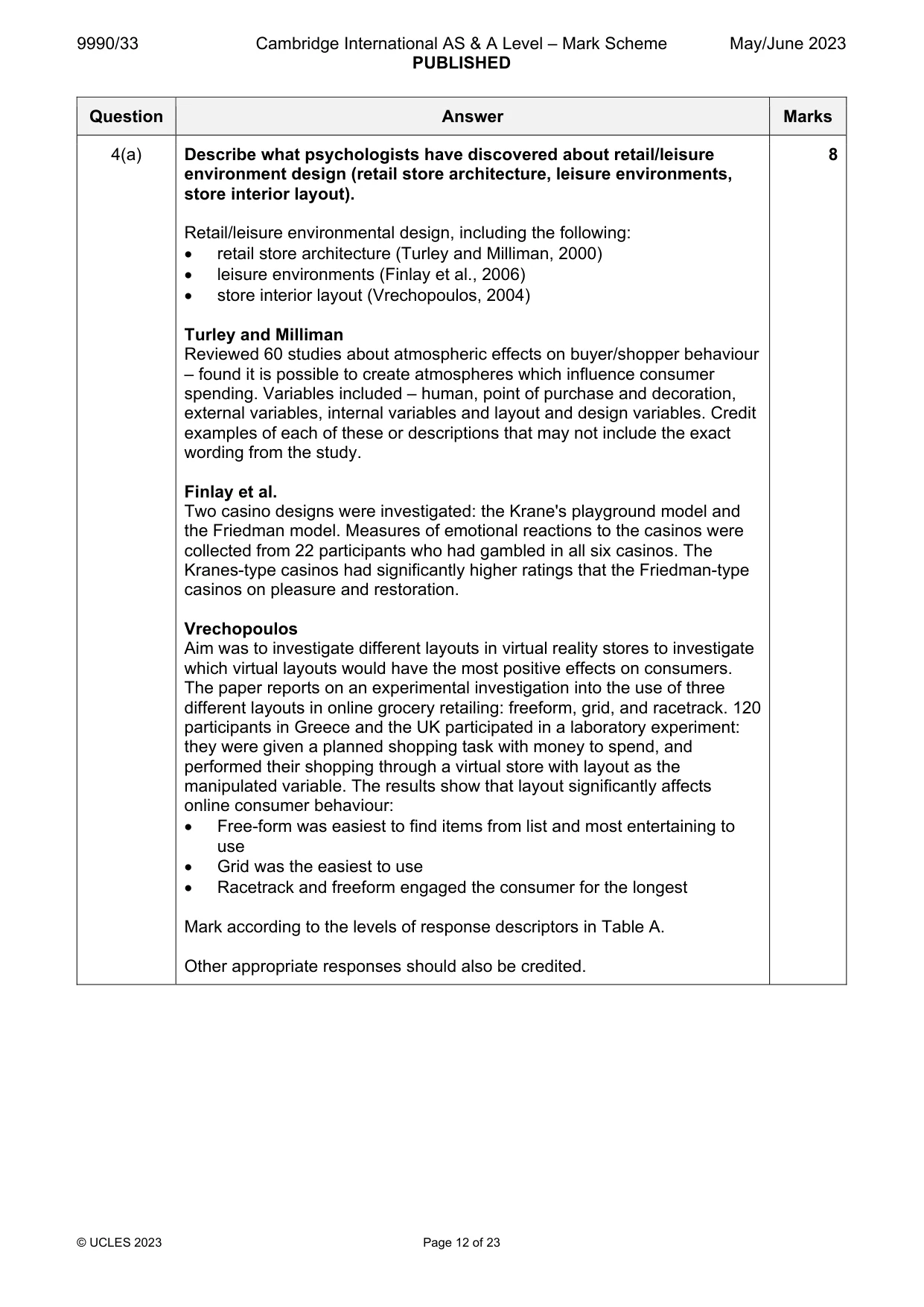
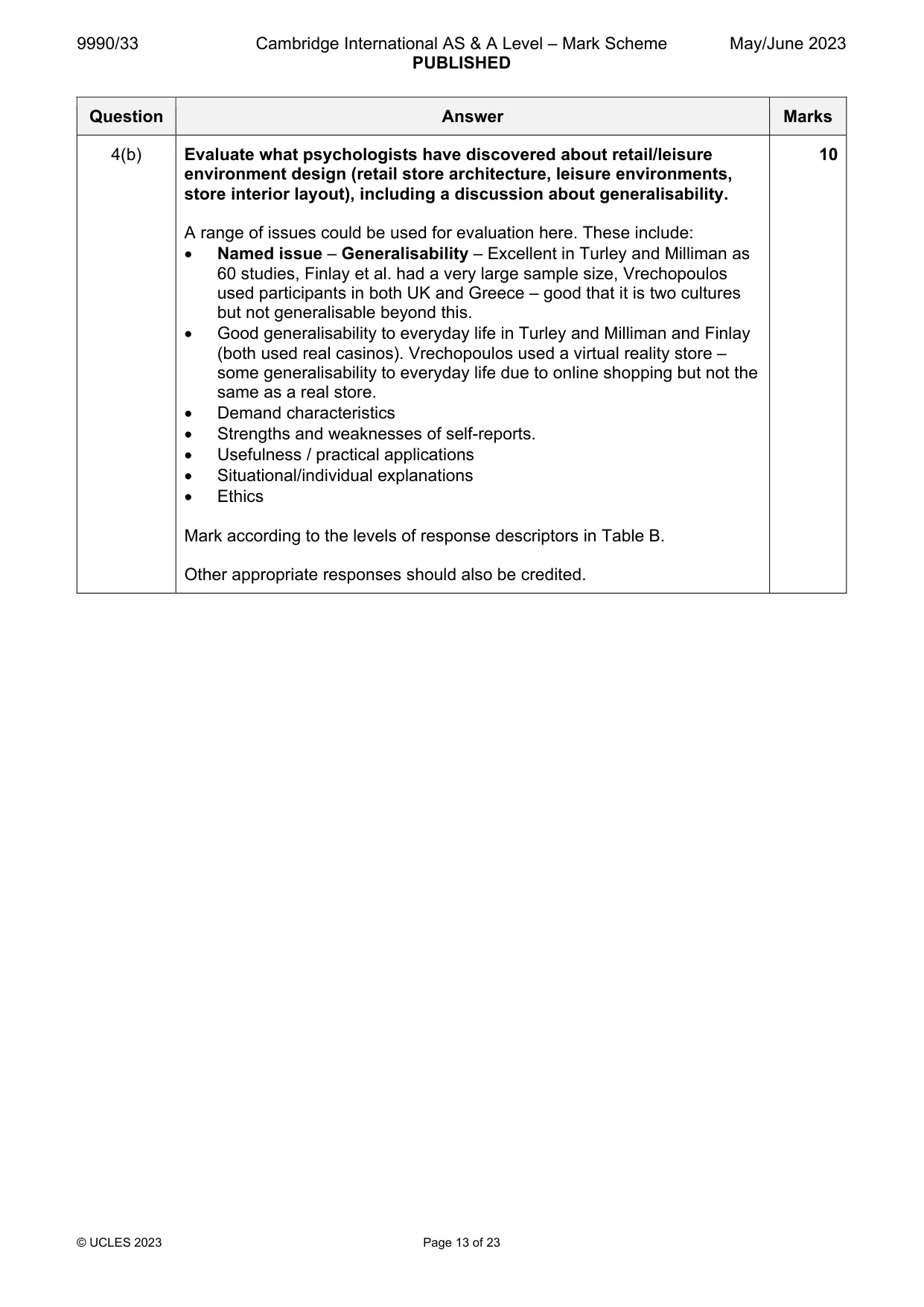
Mark scheme: 4(a) Describe what psychologists have discovered about retail/leisure 8 environment design (retail store architecture, leisure environments, store interior layout). Retail/leisure environmental design, including the following: retail store architecture (Turley and Milliman, 2000) leisure environments (Finlay et al., 2006) store interior layout (Vrechopoulos, 2004) Turley and Milliman Reviewed 60 studies about atmospheric effects on buyer/shopper behaviour – found it is possible to create atmospheres which influence consumer spending. Variables included – human, point of purchase and decoration, external variables, internal variables and layout and design variables. Credit examples of each of these or descriptions that may not include the exact wording from the study. Finlay et al. Two casino designs were investigated: the Krane's playground model and the Friedman model. Measures of emotional reactions to the casinos were collected from 22 participants who had gambled in all six casinos. The Kranes-type casinos had significantly higher ratings that the Friedman-type casinos on pleasure and restoration. Vrechopoulos Aim was to investigate different layouts in virtual reality stores to investigate which virtual layouts would have the most positive effects on consumers. The paper reports on an experimental investigation into the use of three different layouts in online grocery retailing: freeform, grid, and racetrack. 120 participants in Greece and the UK participated in a laboratory experiment: they were given a planned shopping task with money to spend, and performed their shopping through a virtual store with layout as the manipulated variable. The results show that layout significantly affects online consumer behaviour: Free-form was easiest to find items from list and most entertaining to use Grid was the easiest to use Racetrack and freeform engaged the consumer for the longest Mark according to the levels of response descriptors in Table A. Other appropriate responses should also be credited. 4(b) Evaluate what psychologists have discovered about retail/leisure 10 environment design (retail store architecture, leisure environments, store interior layout), including a discussion about generalisability. A range of issues could be used for evaluation here. These include: Named issue – Generalisability – Excellent in Turley and Milliman as 60 studies, Finlay et al. had a very large sample size, Vrechopoulos used participants in both UK and Greece – good that it is two cultures but not generalisable beyond this. Good generalisability to everyday life in Turley and Milliman and Finlay (both used real casinos). Vrechopoulos used a virtual reality store – some generalisability to everyday life due to online shopping but not the same as a real store. Demand characteristics Strengths and weaknesses of self-reports. Usefulness / practical applications Situational/individual explanations Ethics Mark according to the levels of response descriptors in Table B. Other appropriate responses should also be credited. Psychology and health
Q5 · Practitioners may make type I or type II errors in diagnosis
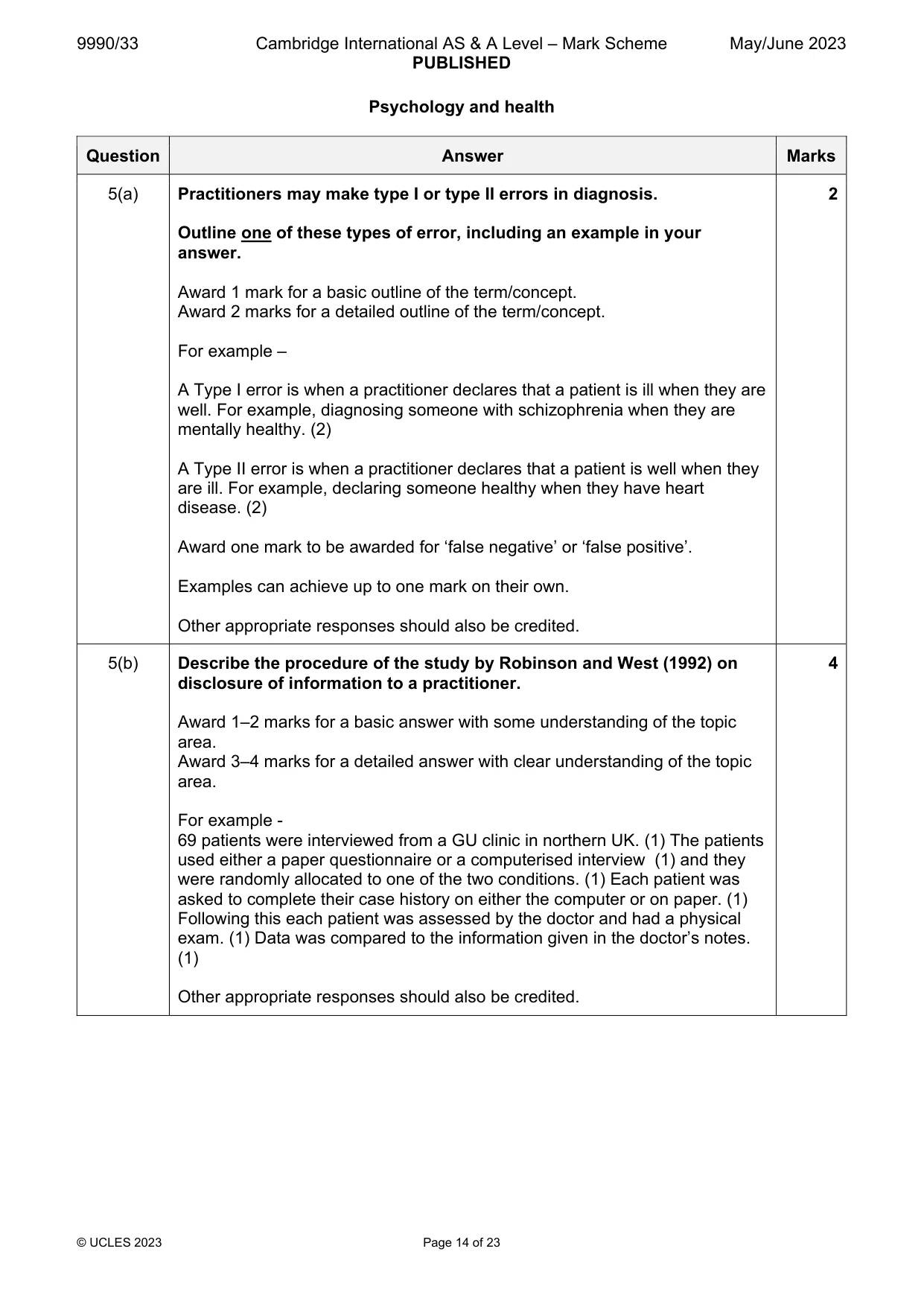
5 (a) Practitioners may make type I or type II errors in diagnosis. Outline one of these types of error, including an example in your answer. [2] (b) Describe the procedure of the study by Robinson and West (1992) on disclosure of information to a practitioner. [4] (c) Explain two weaknesses of the study by Robinson and West. [6]
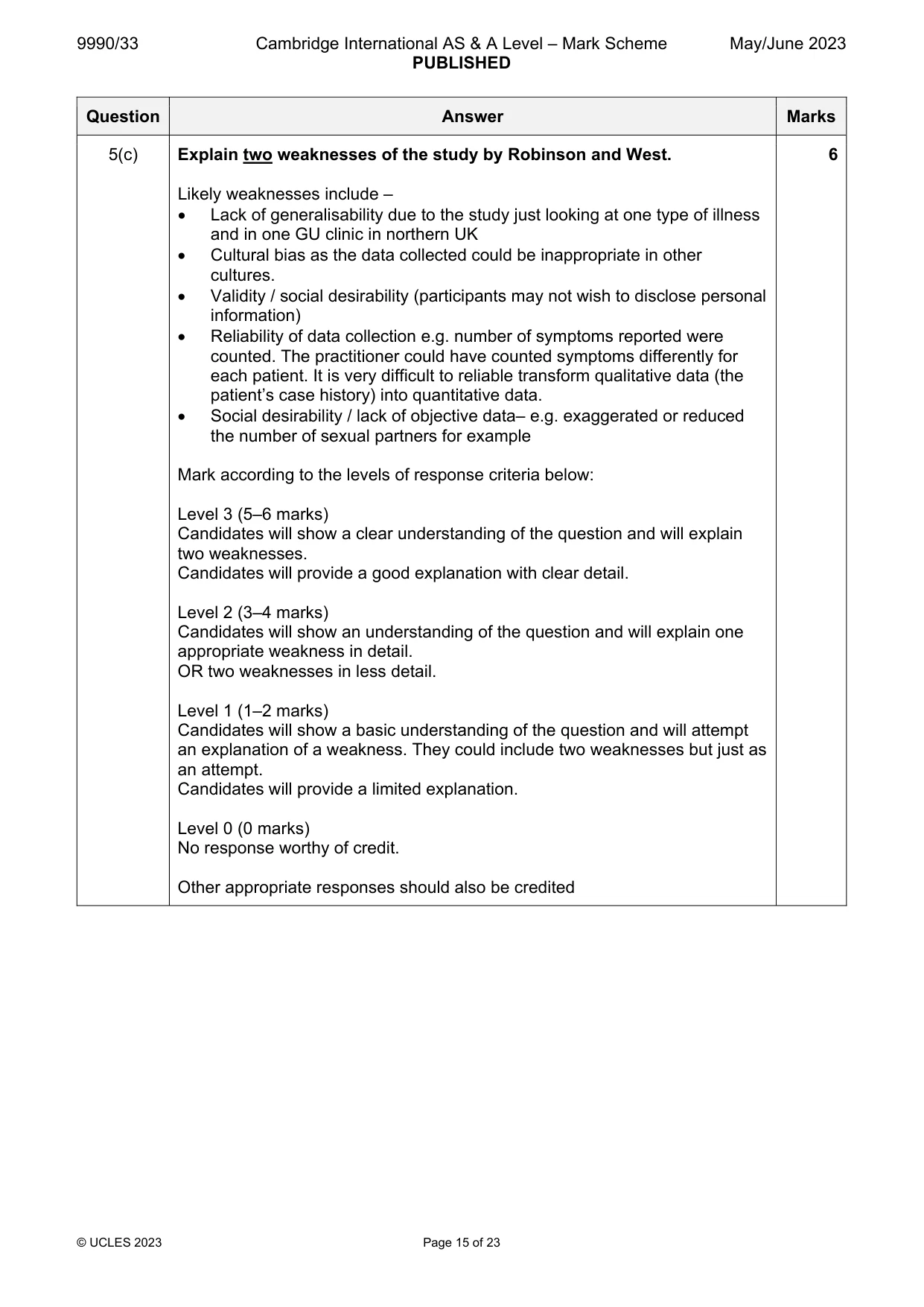
Mark scheme: 5(a) Practitioners may make type I or type II errors in diagnosis. 2 Outline one of these types of error, including an example in your answer. Award 1 mark for a basic outline of the term/concept. Award 2 marks for a detailed outline of the term/concept. For example – A Type I error is when a practitioner declares that a patient is ill when they are well. For example, diagnosing someone with schizophrenia when they are mentally healthy. (2) A Type II error is when a practitioner declares that a patient is well when they are ill. For example, declaring someone healthy when they have heart disease. (2) Award one mark to be awarded for ‘false negative’ or ‘false positive’. Examples can achieve up to one mark on their own. Other appropriate responses should also be credited. 5(b) Describe the procedure of the study by Robinson and West (1992) on 4 disclosure of information to a practitioner. Award 1–2 marks for a basic answer with some understanding of the topic area. Award 3–4 marks for a detailed answer with clear understanding of the topic area. For example - 69 patients were interviewed from a GU clinic in northern UK. (1) The patients used either a paper questionnaire or a computerised interview (1) and they were randomly allocated to one of the two conditions. (1) Each patient was asked to complete their case history on either the computer or on paper. (1) Following this each patient was assessed by the doctor and had a physical exam. (1) Data was compared to the information given in the doctor’s notes. (1) Other appropriate responses should also be credited. 5(c) Explain two weaknesses of the study by Robinson and West. 6 Likely weaknesses include – Lack of generalisability due to the study just looking at one type of illness and in one GU clinic in northern UK Cultural bias as the data collected could be inappropriate in other cultures. Validity / social desirability (participants may not wish to disclose personal information) Reliability of data collection e.g. number of symptoms reported were counted. The practitioner could have counted symptoms differently for each patient. It is very difficult to reliable transform qualitative data (the patient’s case history) into quantitative data. Social desirability / lack of objective data– e.g. exaggerated or reduced the number of sexual partners for example Mark according to the levels of response criteria below: Level 3 (5–6 marks) Candidates will show a clear understanding of the question and will explain two weaknesses. Candidates will provide a good explanation with clear detail. Level 2 (3–4 marks) Candidates will show an understanding of the question and will explain one appropriate weakness in detail. OR two weaknesses in less detail. Level 1 (1–2 marks) Candidates will show a basic understanding of the question and will attempt an explanation of a weakness. They could include two weaknesses but just as an attempt. Candidates will provide a limited explanation. Level 0 (0 marks) No response worthy of credit. Other appropriate responses should also be credited
Q6 · Describe what psychologists have discovered about the management of stress
6 (a) Describe what psychologists have discovered about the management of stress. [8] (b) Evaluate what psychologists have discovered about the management of stress, including a discussion of experiments. [10] Psychology and organisations Answer all questions.
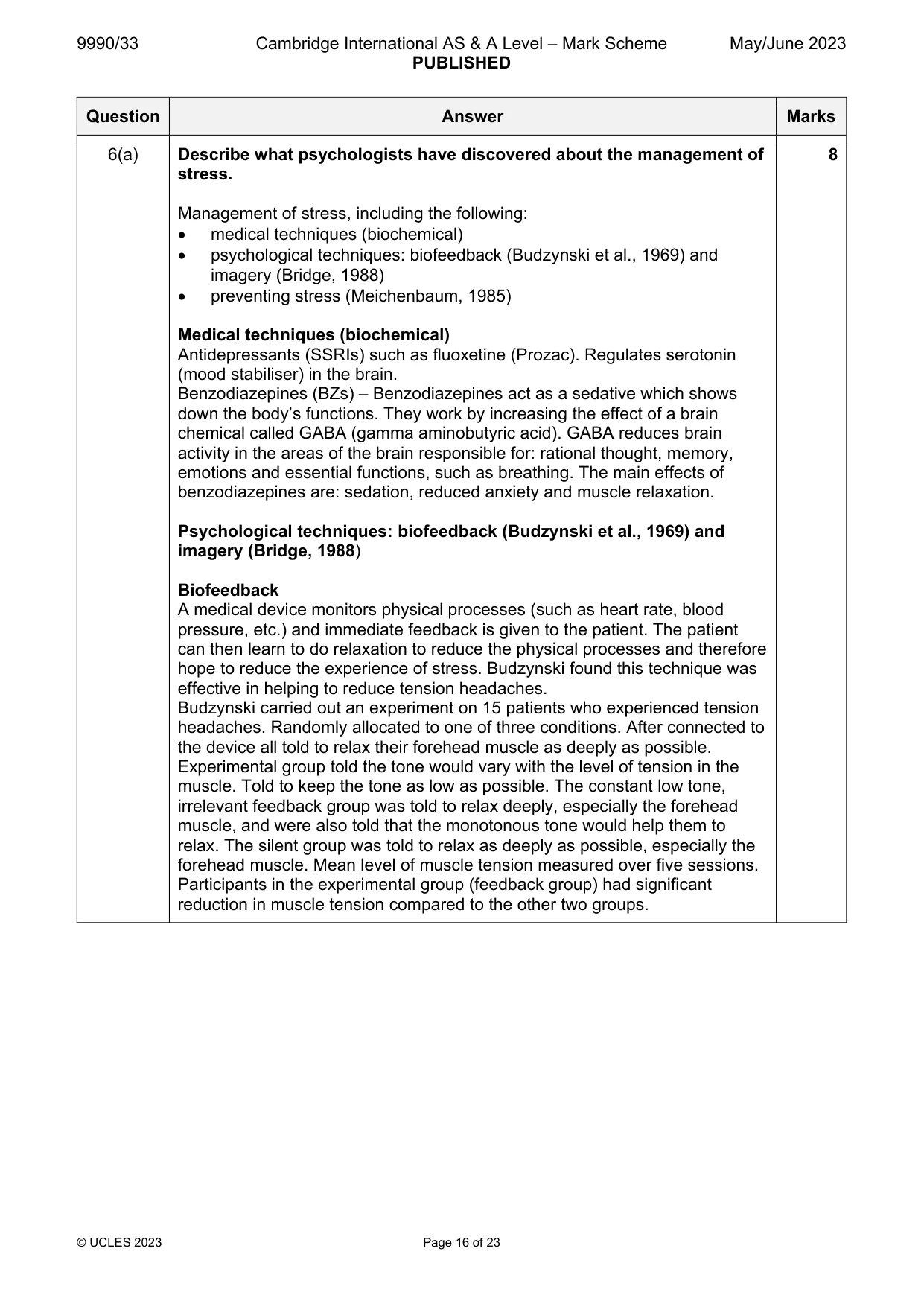
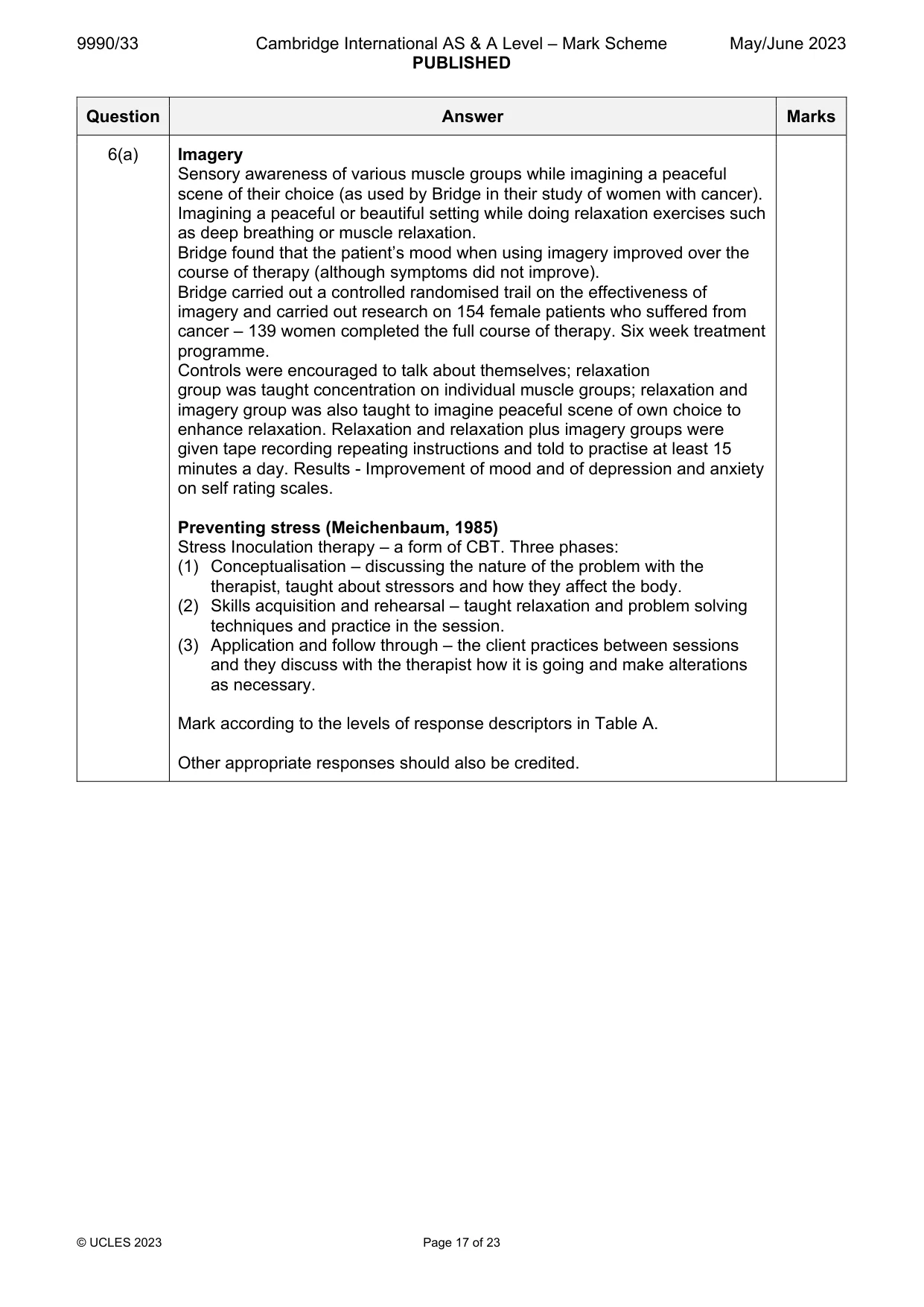
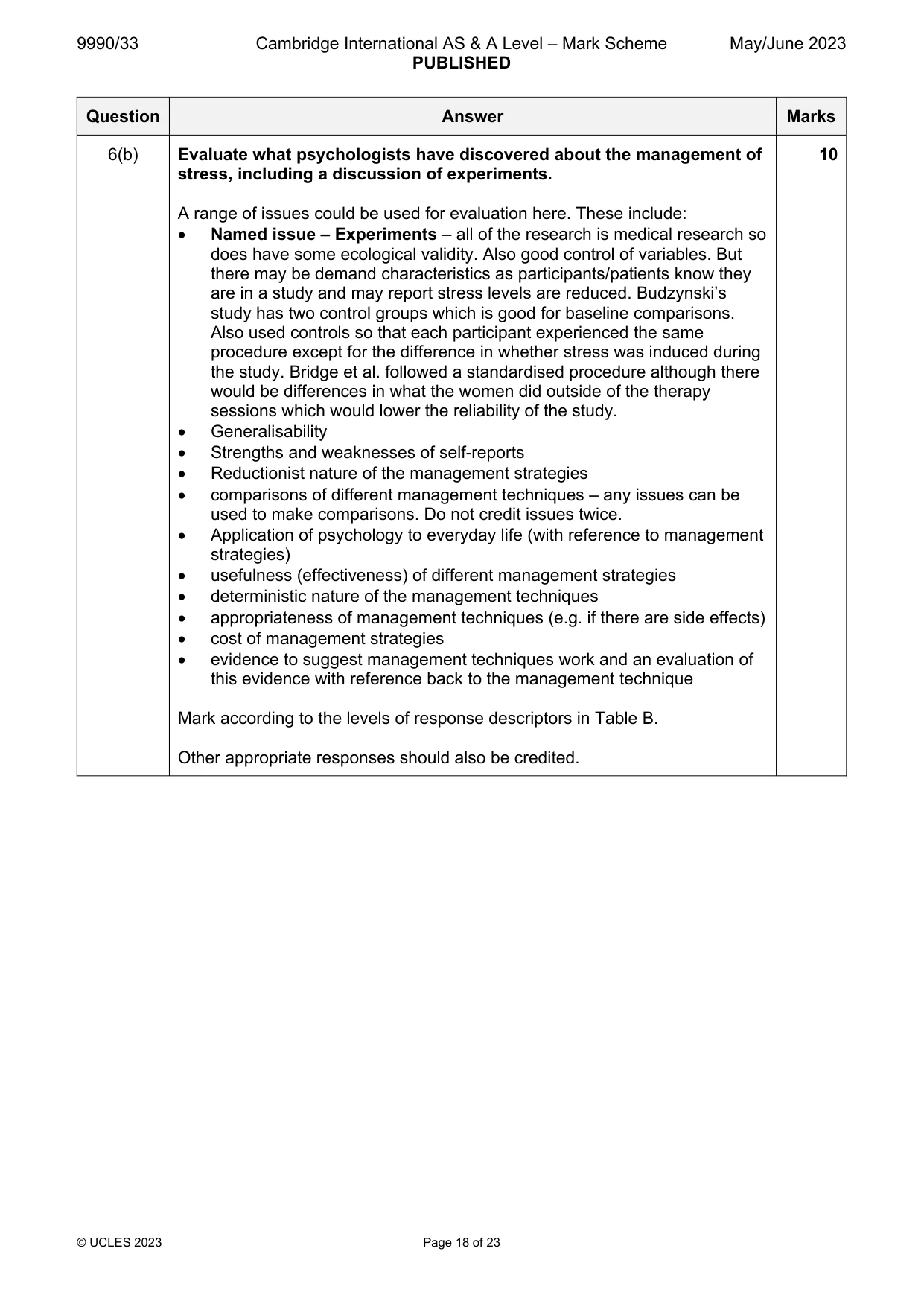
Mark scheme: 6(a) Describe what psychologists have discovered about the management of 8 stress. Management of stress, including the following: medical techniques (biochemical) psychological techniques: biofeedback (Budzynski et al., 1969) and imagery (Bridge, 1988) preventing stress (Meichenbaum, 1985) Medical techniques (biochemical) Antidepressants (SSRIs) such as fluoxetine (Prozac). Regulates serotonin (mood stabiliser) in the brain. Benzodiazepines (BZs) – Benzodiazepines act as a sedative which shows down the body’s functions. They work by increasing the effect of a brain chemical called GABA (gamma aminobutyric acid). GABA reduces brain activity in the areas of the brain responsible for: rational thought, memory, emotions and essential functions, such as breathing. The main effects of benzodiazepines are: sedation, reduced anxiety and muscle relaxation. Psychological techniques: biofeedback (Budzynski et al., 1969) and imagery (Bridge, 1988) Biofeedback A medical device monitors physical processes (such as heart rate, blood pressure, etc.) and immediate feedback is given to the patient. The patient can then learn to do relaxation to reduce the physical processes and therefore hope to reduce the experience of stress. Budzynski found this technique was effective in helping to reduce tension headaches. Budzynski carried out an experiment on 15 patients who experienced tension headaches. Randomly allocated to one of three conditions. After connected to the device all told to relax their forehead muscle as deeply as possible. Experimental group told the tone would vary with the level of tension in the muscle. Told to keep the tone as low as possible. The constant low tone, irrelevant feedback group was told to relax deeply, especially the forehead muscle, and were also told that the monotonous tone would help them to relax. The silent group was told to relax as deeply as possible, especially the forehead muscle. Mean level of muscle tension measured over five sessions. Participants in the experimental group (feedback group) had significant reduction in muscle tension compared to the other two groups. 6(a) Imagery Sensory awareness of various muscle groups while imagining a peaceful scene of their choice (as used by Bridge in their study of women with cancer). Imagining a peaceful or beautiful setting while doing relaxation exercises such as deep breathing or muscle relaxation. Bridge found that the patient’s mood when using imagery improved over the course of therapy (although symptoms did not improve). Bridge carried out a controlled randomised trail on the effectiveness of imagery and carried out research on 154 female patients who suffered from cancer – 139 women completed the full course of therapy. Six week treatment programme. Controls were encouraged to talk about themselves; relaxation group was taught concentration on individual muscle groups; relaxation and imagery group was also taught to imagine peaceful scene of own choice to enhance relaxation. Relaxation and relaxation plus imagery groups were given tape recording repeating instructions and told to practise at least 15 minutes a day. Results - Improvement of mood and of depression and anxiety on self rating scales. Preventing stress (Meichenbaum, 1985) Stress Inoculation therapy – a form of CBT. Three phases: (1) Conceptualisation – discussing the nature of the problem with the therapist, taught about stressors and how they affect the body. (2) Skills acquisition and rehearsal – taught relaxation and problem solving techniques and practice in the session. (3) Application and follow through – the client practices between sessions and they discuss with the therapist how it is going and make alterations as necessary. Mark according to the levels of response descriptors in Table A. Other appropriate responses should also be credited. 6(b) Evaluate what psychologists have discovered about the management of 10 stress, including a discussion of experiments. A range of issues could be used for evaluation here. These include: Named issue – Experiments – all of the research is medical research so does have some ecological validity. Also good control of variables. But there may be demand characteristics as participants/patients know they are in a study and may report stress levels are reduced. Budzynski’s study has two control groups which is good for baseline comparisons. Also used controls so that each participant experienced the same procedure except for the difference in whether stress was induced during the study. Bridge et al. followed a standardised procedure although there would be differences in what the women did outside of the therapy sessions which would lower the reliability of the study. Generalisability Strengths and weaknesses of self-reports Reductionist nature of the management strategies comparisons of different management techniques – any issues can be used to make comparisons. Do not credit issues twice. Application of psychology to everyday life (with reference to management strategies) usefulness (effectiveness) of different management strategies deterministic nature of the management techniques appropriateness of management techniques (e.g. if there are side effects) cost of management strategies evidence to suggest management techniques work and an evaluation of this evidence with reference back to the management technique Mark according to the levels of response descriptors in Table B. Other appropriate responses should also be credited. Psychology and organisations
Q7 · Outline how a token economy can be used to reduce accidents at work
7 (a) Outline how a token economy can be used to reduce accidents at work. [2] (b) Describe the study by Oldham and Brass (1979) on open plan offices. [4] (c) Explain one strength and one weakness of the study by Oldham and Brass. [6]
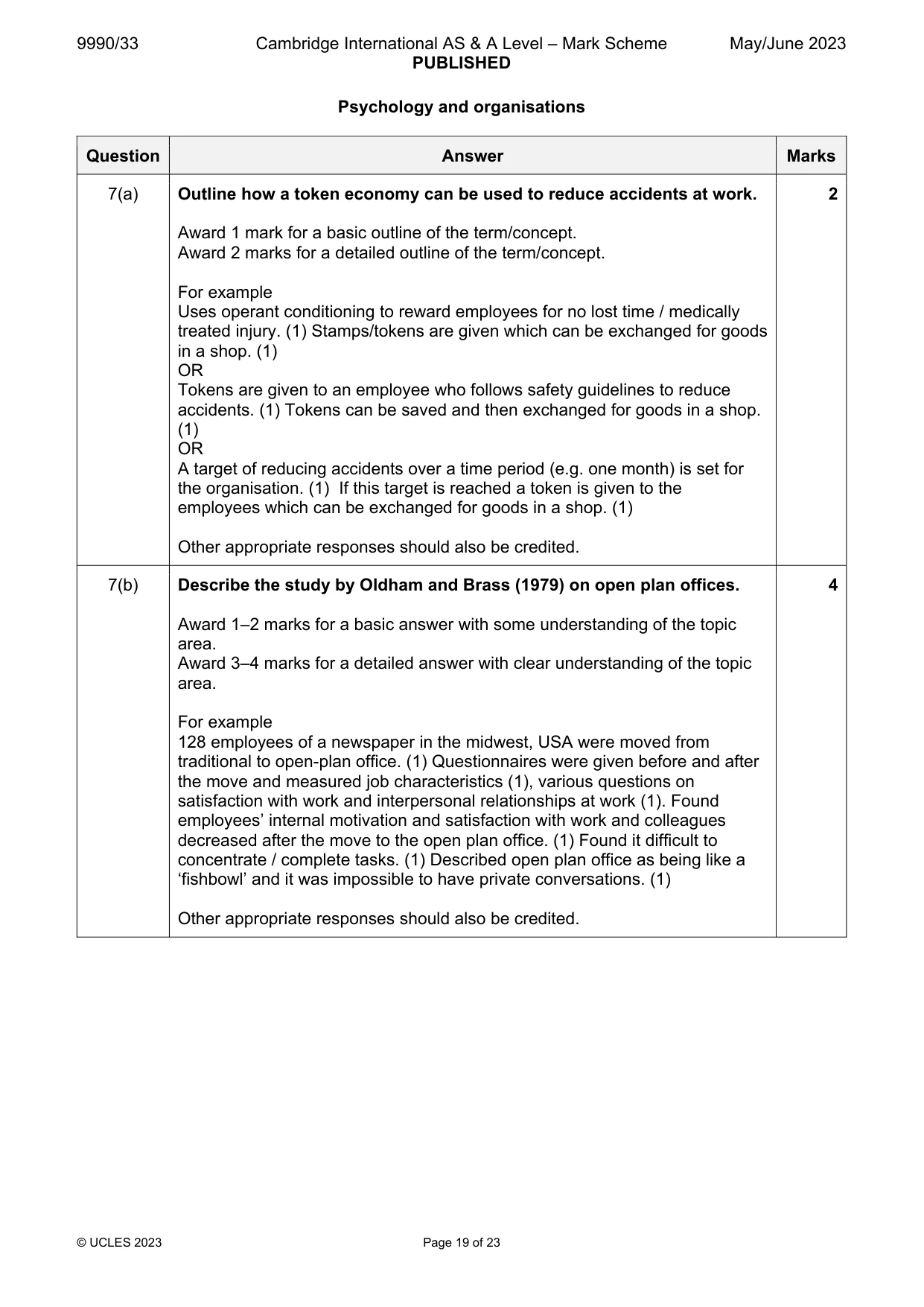
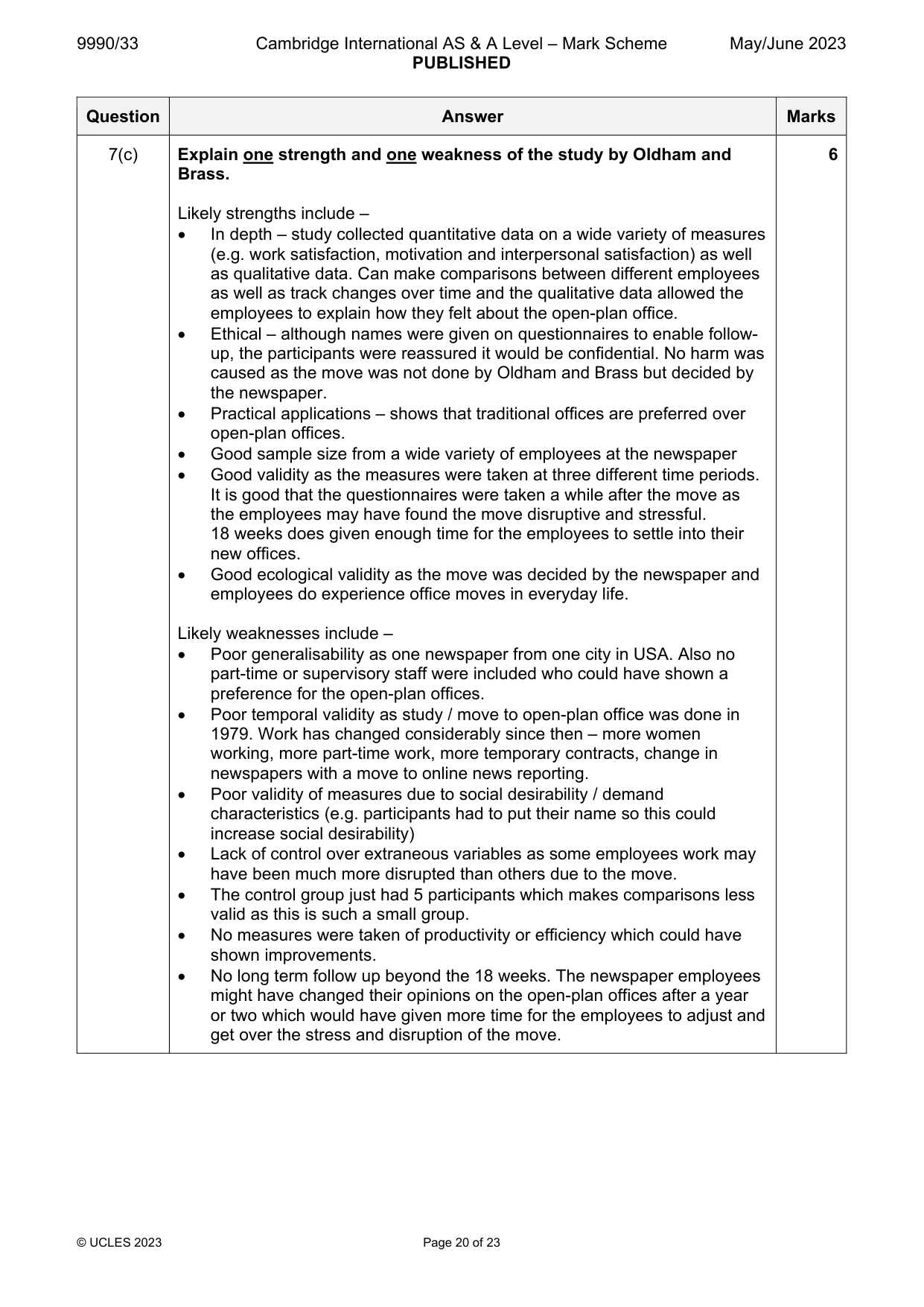
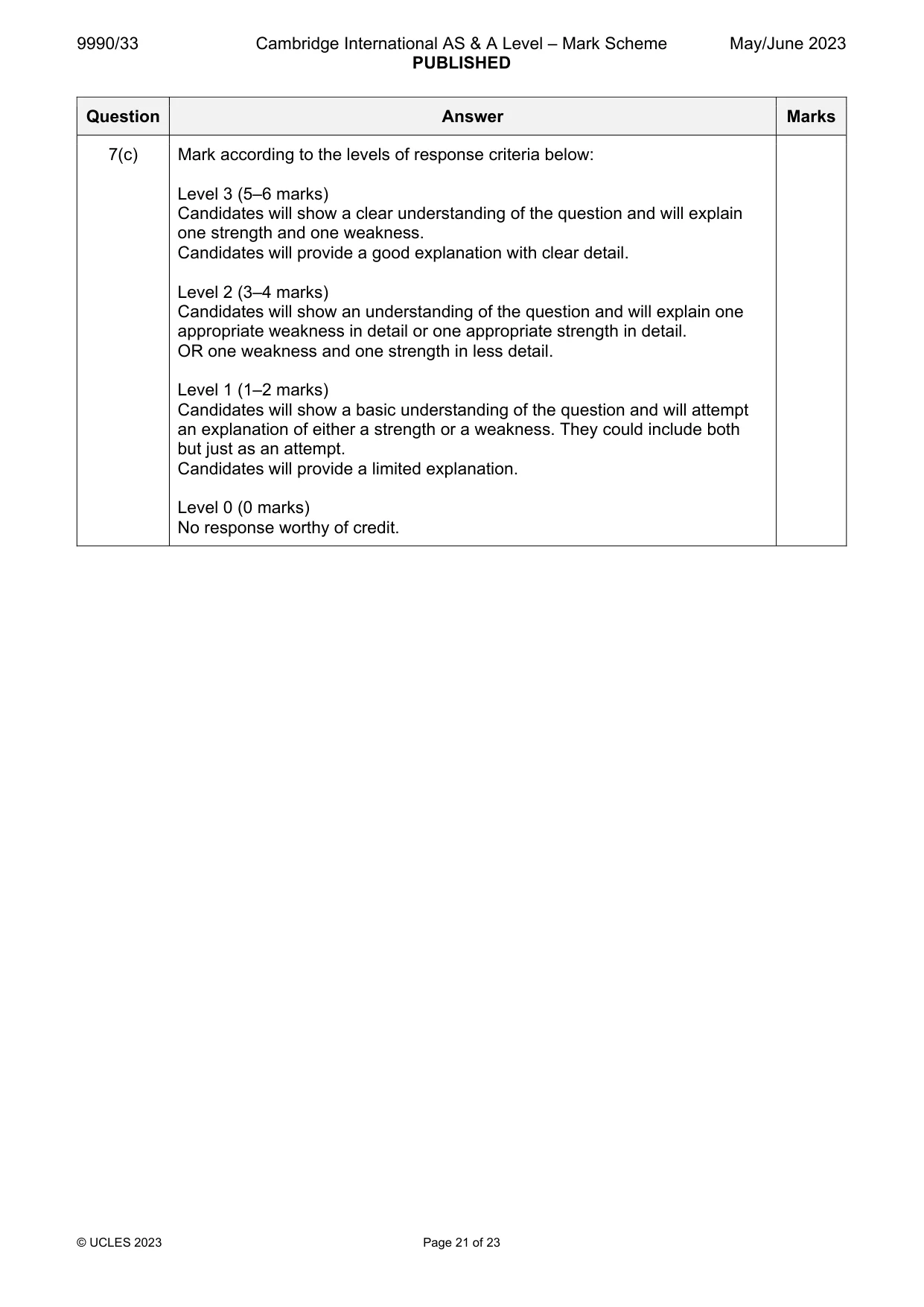
Mark scheme: 7(a) Outline how a token economy can be used to reduce accidents at work. 2 Award 1 mark for a basic outline of the term/concept. Award 2 marks for a detailed outline of the term/concept. For example Uses operant conditioning to reward employees for no lost time / medically treated injury. (1) Stamps/tokens are given which can be exchanged for goods in a shop. (1) OR Tokens are given to an employee who follows safety guidelines to reduce accidents. (1) Tokens can be saved and then exchanged for goods in a shop. (1) OR A target of reducing accidents over a time period (e.g. one month) is set for the organisation. (1) If this target is reached a token is given to the employees which can be exchanged for goods in a shop. (1) Other appropriate responses should also be credited. 7(b) Describe the study by Oldham and Brass (1979) on open plan offices. 4 Award 1–2 marks for a basic answer with some understanding of the topic area. Award 3–4 marks for a detailed answer with clear understanding of the topic area. For example 128 employees of a newspaper in the midwest, USA were moved from traditional to open-plan office. (1) Questionnaires were given before and after the move and measured job characteristics (1), various questions on satisfaction with work and interpersonal relationships at work (1). Found employees’ internal motivation and satisfaction with work and colleagues decreased after the move to the open plan office. (1) Found it difficult to concentrate / complete tasks. (1) Described open plan office as being like a ‘fishbowl’ and it was impossible to have private conversations. (1) Other appropriate responses should also be credited. 7(c) Explain one strength and one weakness of the study by Oldham and 6 Brass. Likely strengths include – In depth – study collected quantitative data on a wide variety of measures (e.g. work satisfaction, motivation and interpersonal satisfaction) as well as qualitative data. Can make comparisons between different employees as well as track changes over time and the qualitative data allowed the employees to explain how they felt about the open-plan office. Ethical – although names were given on questionnaires to enable follow- up, the participants were reassured it would be confidential. No harm was caused as the move was not done by Oldham and Brass but decided by the newspaper. Practical applications – shows that traditional offices are preferred over open-plan offices. Good sample size from a wide variety of employees at the newspaper Good validity as the measures were taken at three different time periods. It is good that the questionnaires were taken a while after the move as the employees may have found the move disruptive and stressful. 18 weeks does given enough time for the employees to settle into their new offices. Good ecological validity as the move was decided by the newspaper and employees do experience office moves in everyday life. Likely weaknesses include – Poor generalisability as one newspaper from one city in USA. Also no part-time or supervisory staff were included who could have shown a preference for the open-plan offices. Poor temporal validity as study / move to open-plan office was done in 1979. Work has changed considerably since then – more women working, more part-time work, more temporary contracts, change in newspapers with a move to online news reporting. Poor validity of measures due to social desirability / demand characteristics (e.g. participants had to put their name so this could increase social desirability) Lack of control over extraneous variables as some employees work may have been much more disrupted than others due to the move. The control group just had 5 participants which makes comparisons less valid as this is such a small group. No measures were taken of productivity or efficiency which could have shown improvements. No long term follow up beyond the 18 weeks. The newspaper employees might have changed their opinions on the open-plan offices after a year or two which would have given more time for the employees to adjust and get over the stress and disruption of the move. 7(c) Mark according to the levels of response criteria below: Level 3 (5–6 marks) Candidates will show a clear understanding of the question and will explain one strength and one weakness. Candidates will provide a good explanation with clear detail. Level 2 (3–4 marks) Candidates will show an understanding of the question and will explain one appropriate weakness in detail or one appropriate strength in detail. OR one weakness and one strength in less detail. Level 1 (1–2 marks) Candidates will show a basic understanding of the question and will attempt an explanation of either a strength or a weakness. They could include both but just as an attempt. Candidates will provide a limited explanation. Level 0 (0 marks) No response worthy of credit.
Q8 · Describe what psychologists have discovered about measuring job satisfaction
8 (a) Describe what psychologists have discovered about measuring job satisfaction. [8] (b) Evaluate what psychologists have discovered about measuring job satisfaction, including a discussion about psychometrics. [10]
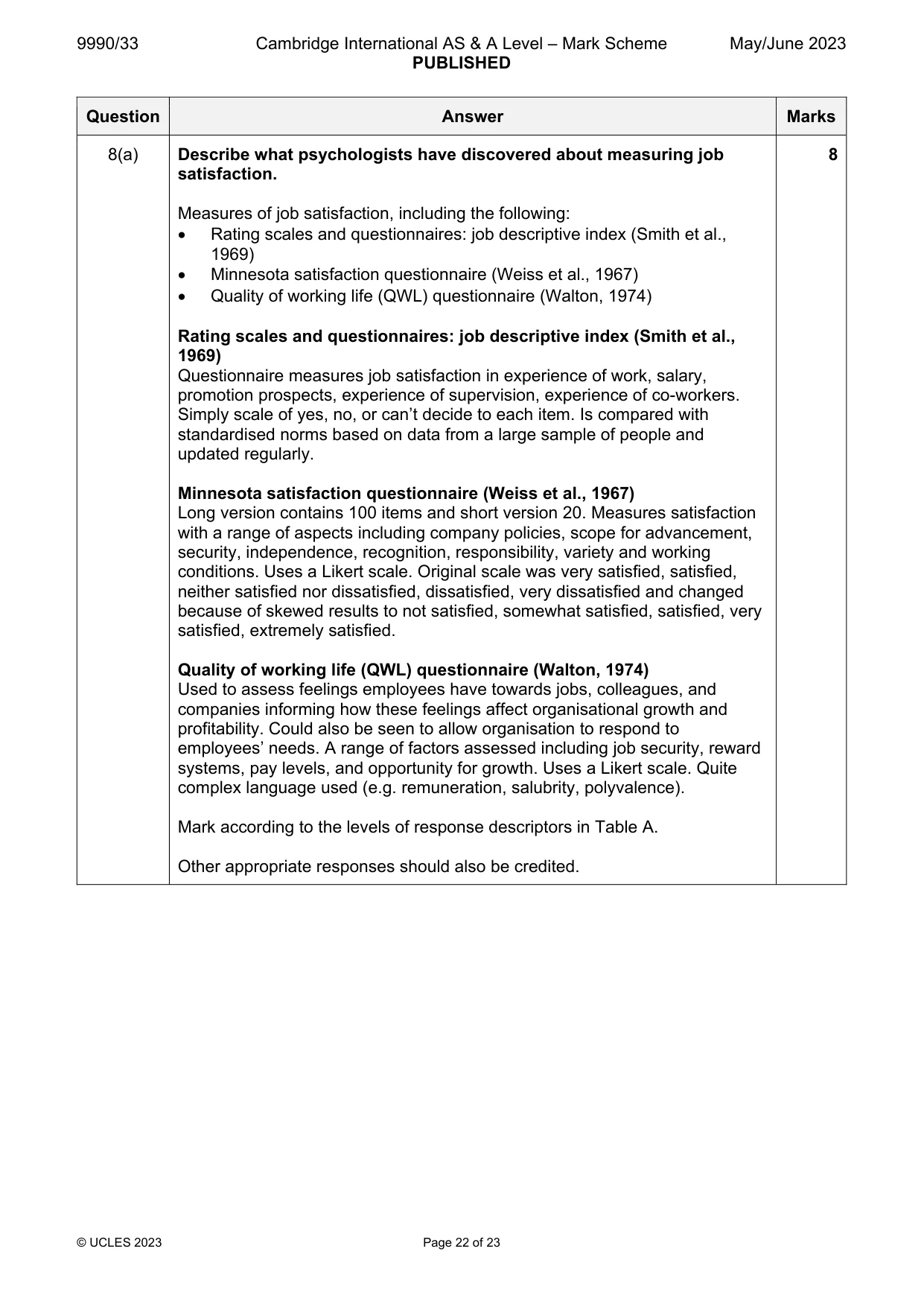
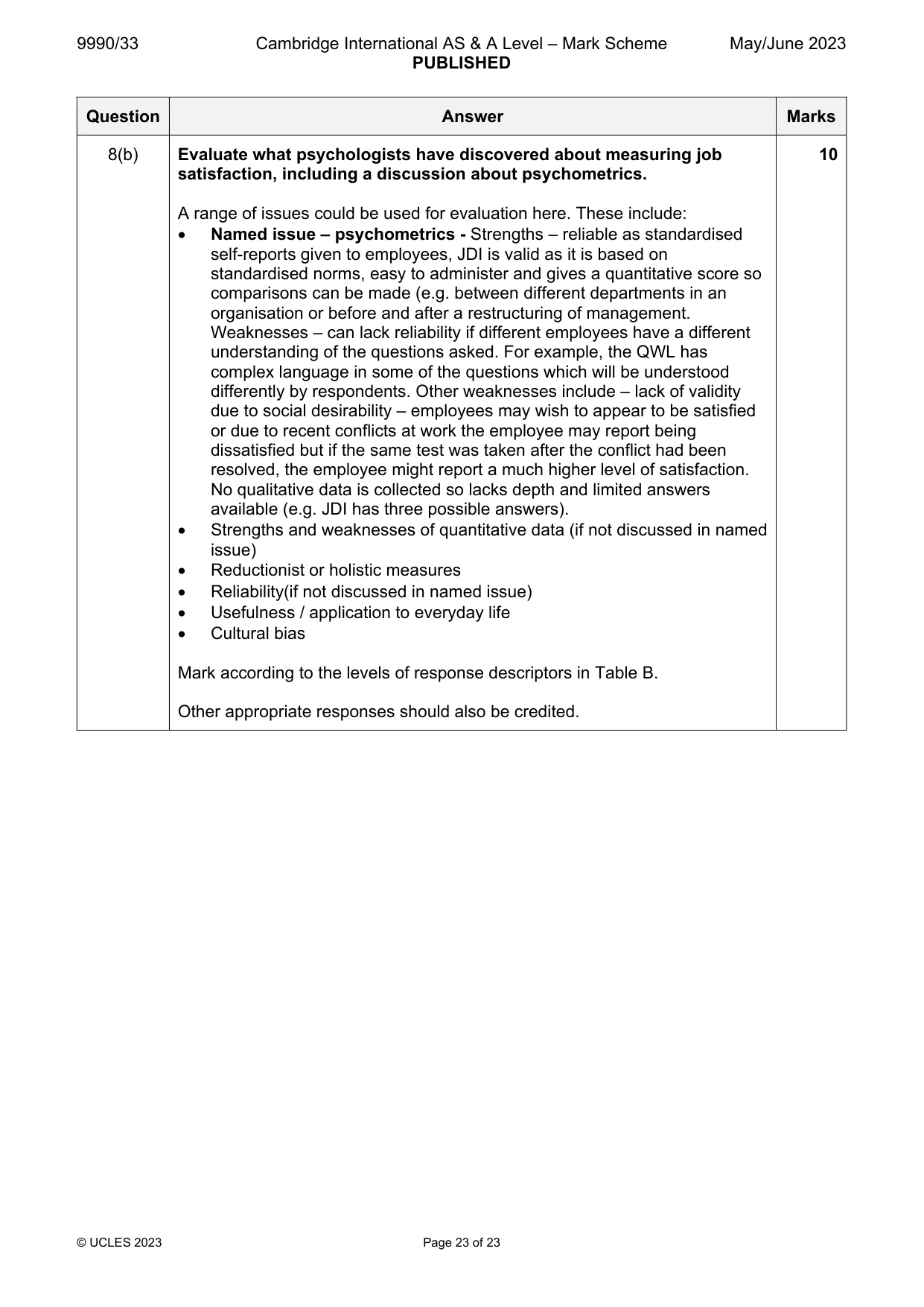
Mark scheme: 8(a) Describe what psychologists have discovered about measuring job 8 satisfaction. Measures of job satisfaction, including the following: Rating scales and questionnaires: job descriptive index (Smith et al., 1969) Minnesota satisfaction questionnaire (Weiss et al., 1967) Quality of working life (QWL) questionnaire (Walton, 1974) Rating scales and questionnaires: job descriptive index (Smith et al., 1969) Questionnaire measures job satisfaction in experience of work, salary, promotion prospects, experience of supervision, experience of co-workers. Simply scale of yes, no, or can’t decide to each item. Is compared with standardised norms based on data from a large sample of people and updated regularly. Minnesota satisfaction questionnaire (Weiss et al., 1967) Long version contains 100 items and short version 20. Measures satisfaction with a range of aspects including company policies, scope for advancement, security, independence, recognition, responsibility, variety and working conditions. Uses a Likert scale. Original scale was very satisfied, satisfied, neither satisfied nor dissatisfied, dissatisfied, very dissatisfied and changed because of skewed results to not satisfied, somewhat satisfied, satisfied, very satisfied, extremely satisfied. Quality of working life (QWL) questionnaire (Walton, 1974) Used to assess feelings employees have towards jobs, colleagues, and companies informing how these feelings affect organisational growth and profitability. Could also be seen to allow organisation to respond to employees’ needs. A range of factors assessed including job security, reward systems, pay levels, and opportunity for growth. Uses a Likert scale. Quite complex language used (e.g. remuneration, salubrity, polyvalence). Mark according to the levels of response descriptors in Table A. Other appropriate responses should also be credited. 8(b) Evaluate what psychologists have discovered about measuring job 10 satisfaction, including a discussion about psychometrics. A range of issues could be used for evaluation here. These include: Named issue – psychometrics - Strengths – reliable as standardised self-reports given to employees, JDI is valid as it is based on standardised norms, easy to administer and gives a quantitative score so comparisons can be made (e.g. between different departments in an organisation or before and after a restructuring of management. Weaknesses – can lack reliability if different employees have a different understanding of the questions asked. For example, the QWL has complex language in some of the questions which will be understood differently by respondents. Other weaknesses include – lack of validity due to social desirability – employees may wish to appear to be satisfied or due to recent conflicts at work the employee may report being dissatisfied but if the same test was taken after the conflict had been resolved, the employee might report a much higher level of satisfaction. No qualitative data is collected so lacks depth and limited answers available (e.g. JDI has three possible answers). Strengths and weaknesses of quantitative data (if not discussed in named issue) Reductionist or holistic measures Reliability(if not discussed in named issue) Usefulness / application to everyday life Cultural bias Mark according to the levels of response descriptors in Table B. Other appropriate responses should also be credited.
What was in this paper
The subtopics covered by these 8 questions, and how many questions each got. Open one in a new tab to see every Cambridge question on it.
What you needed in this session
Cambridge’s own grade thresholds for 2023 May/June, Paper 3 · Variant 3. A higher threshold means an easier paper — the bar moves with how the cohort did.