Cambridge A Level Psychology (from 2018) 9990 — 2021 May/June Paper 3 · Variant 2
9990/32/M/J/21 · 8 questions · 60 marks · ≈68 min
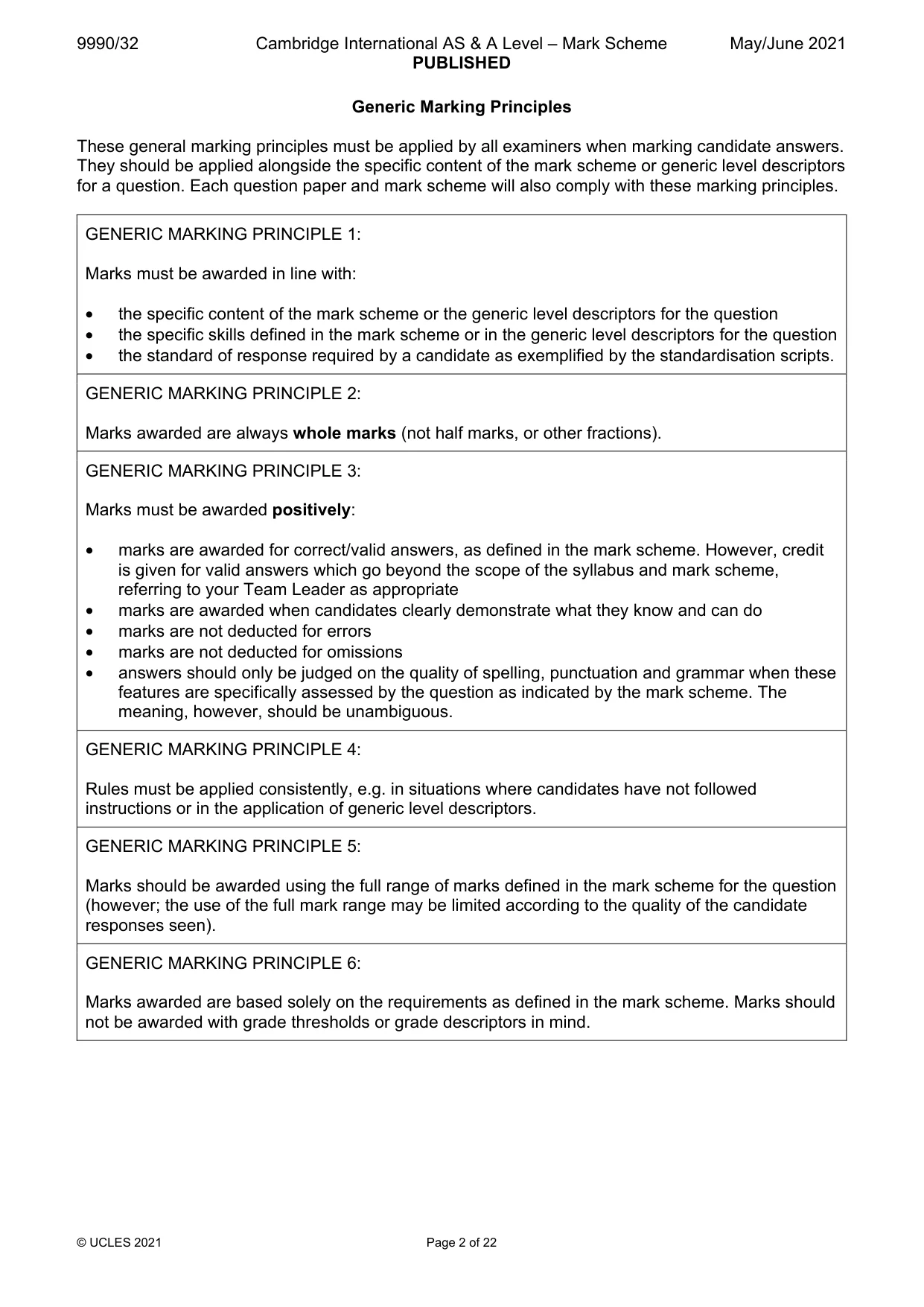
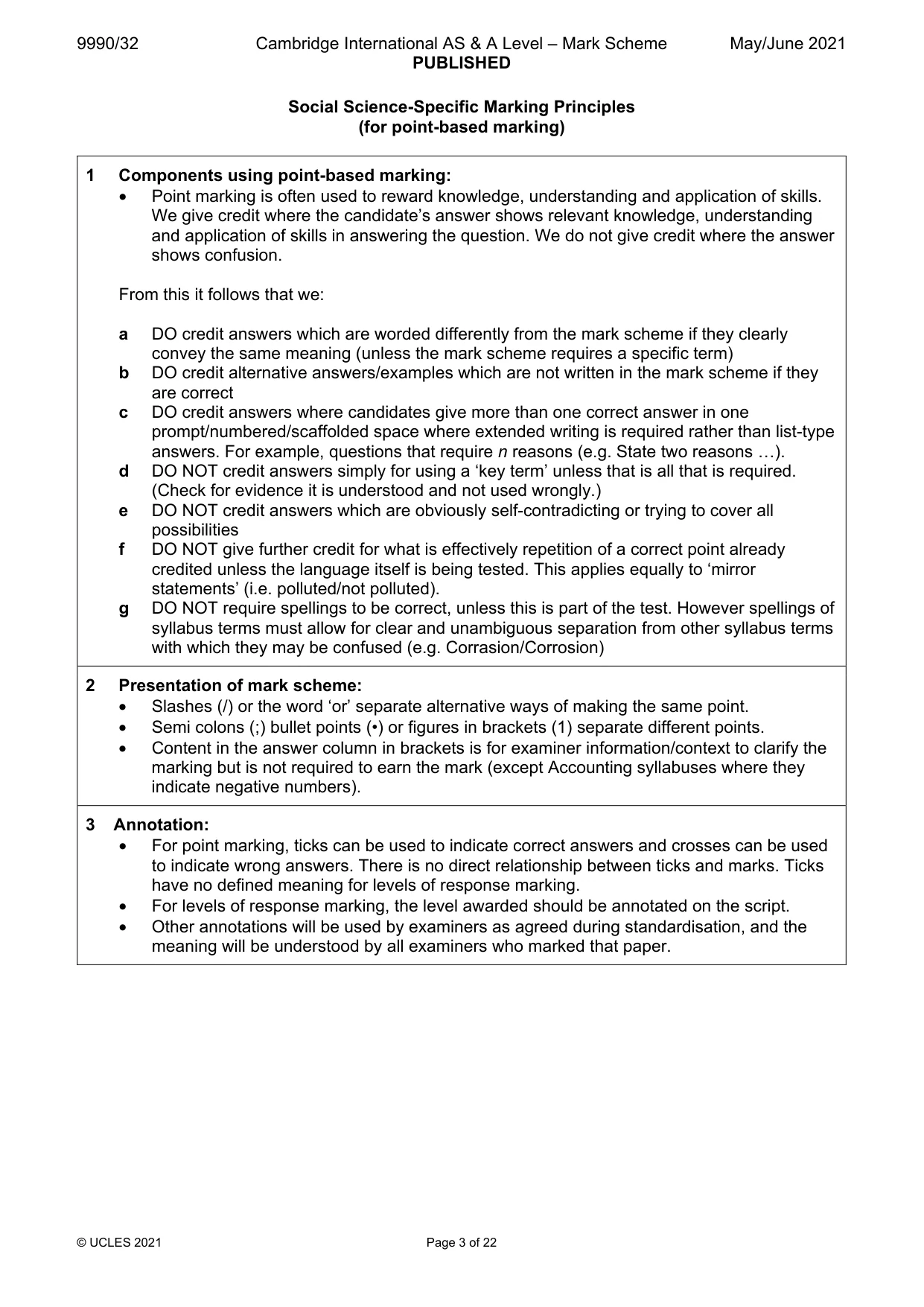
The question paper and its mark scheme, free to read here and free to download. This is Cambridge’s own paper, exactly as it was sat.
Question paper4 pages
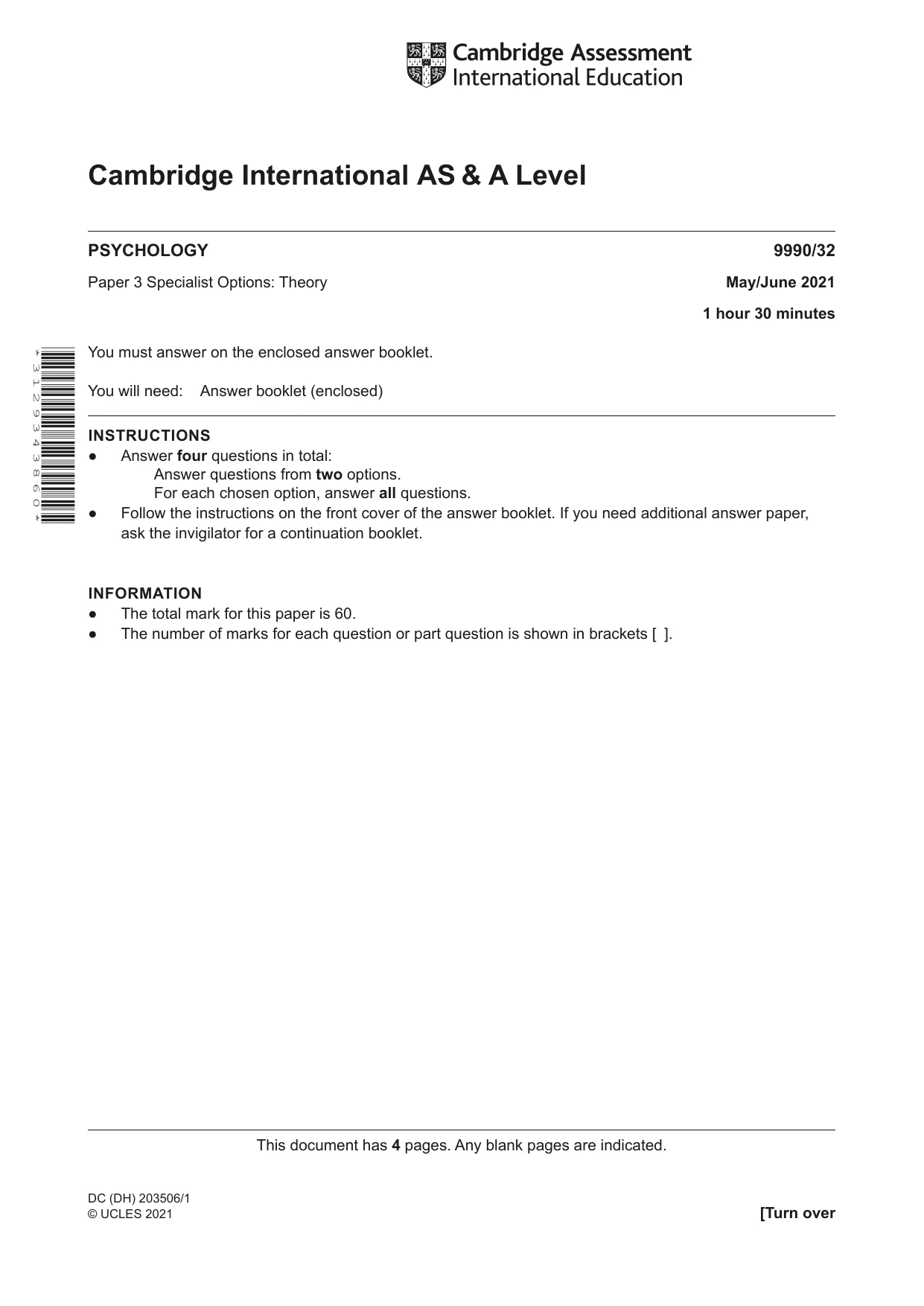
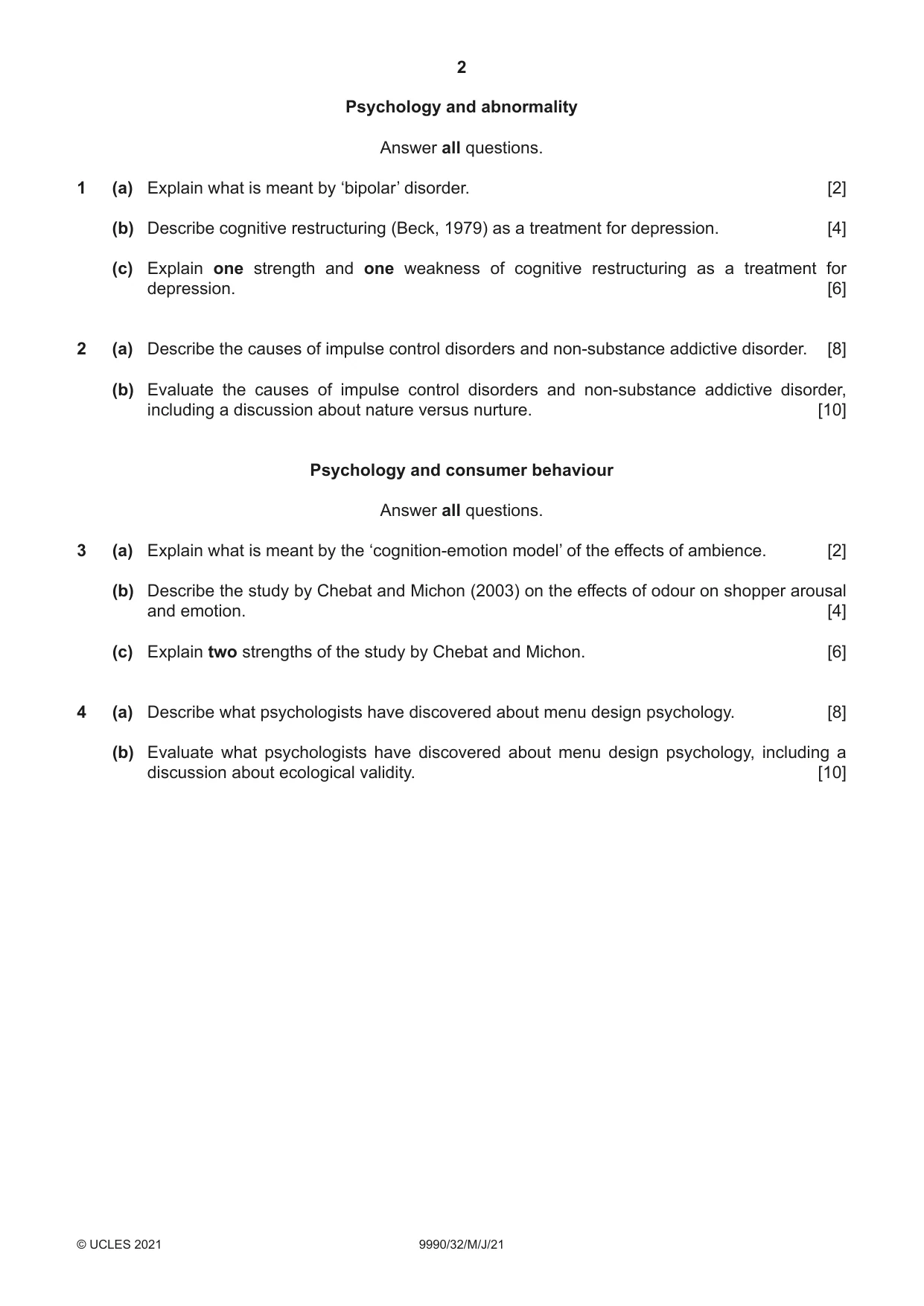
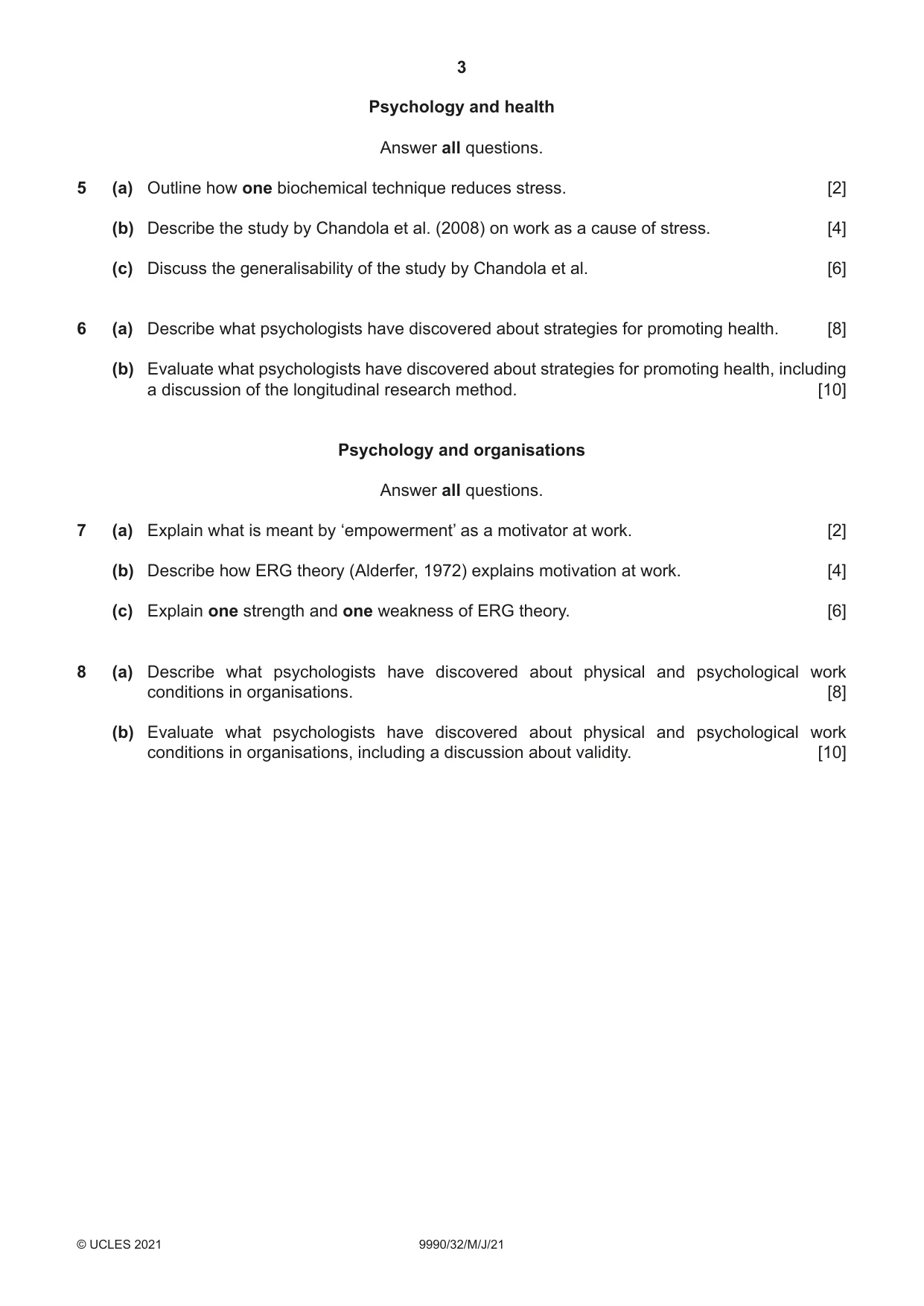

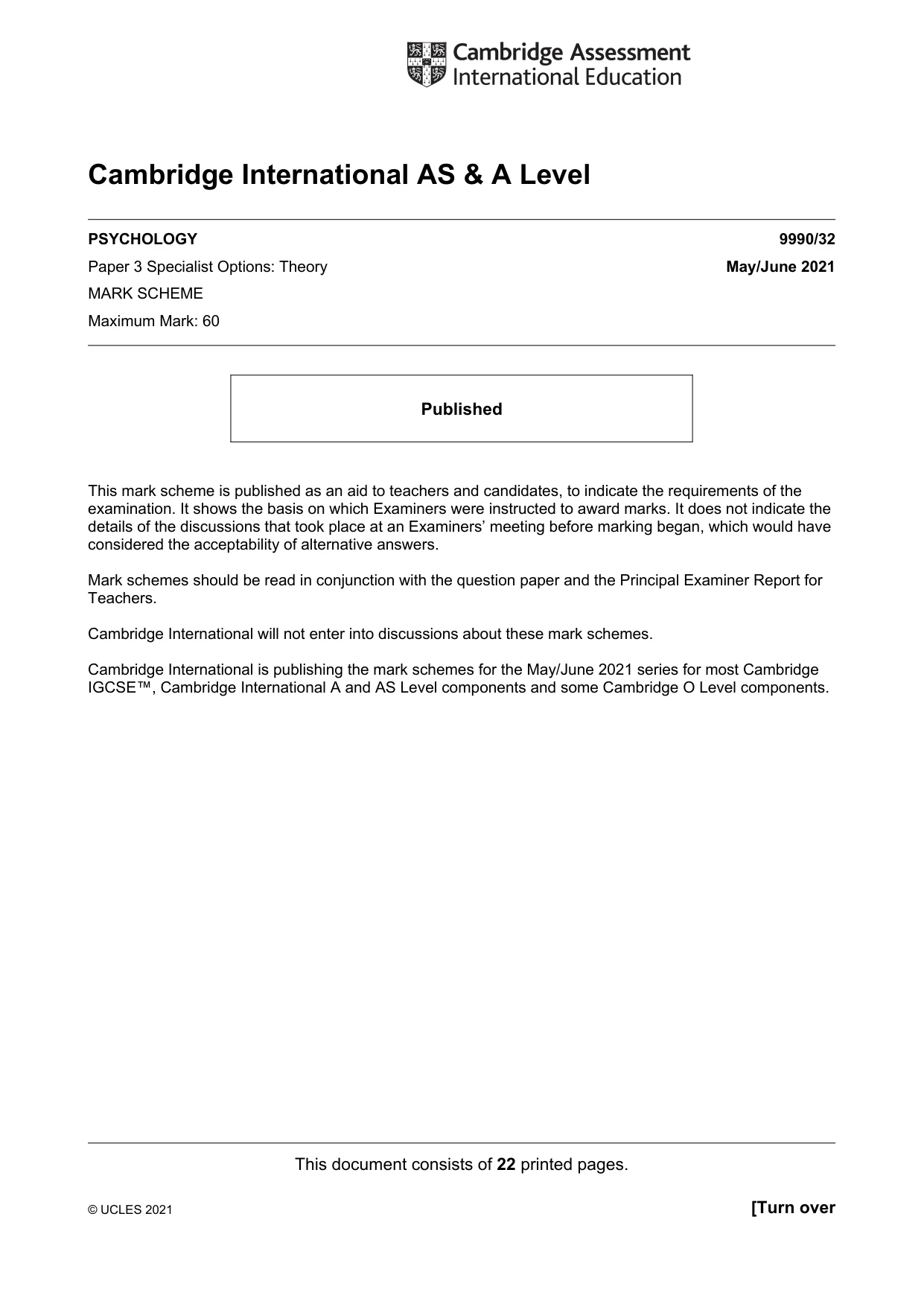
Mark scheme22 pages
Answers below. Sit the paper first if you are practising.


Questions as text
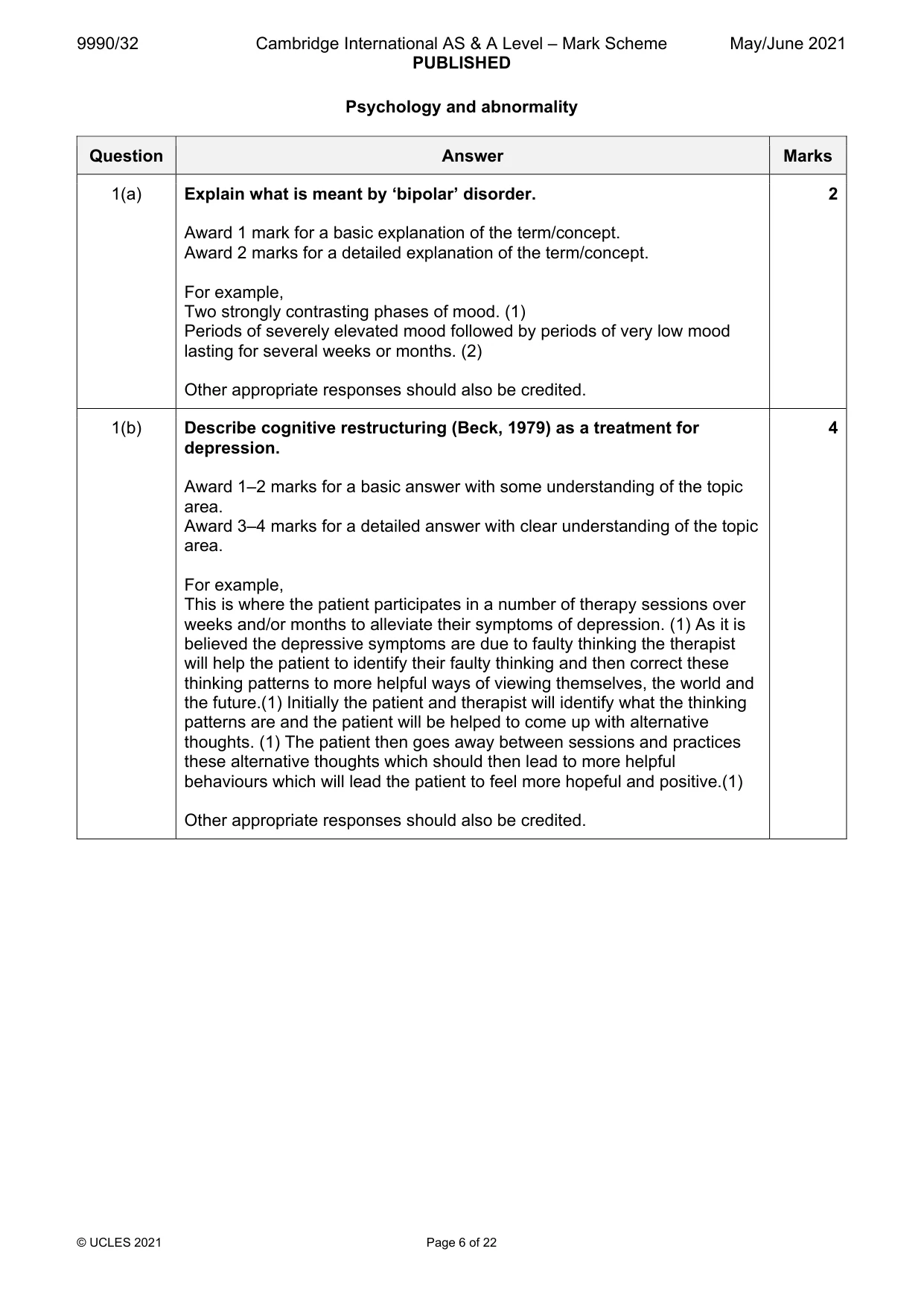
Q1 · Explain what is meant by ‘bipolar’ disorder
1 (a) Explain what is meant by ‘bipolar’ disorder. [2] (b) Describe cognitive restructuring (Beck, 1979) as a treatment for depression. [4] (c) Explain one strength and one weakness of cognitive restructuring as a treatment for depression. [6]
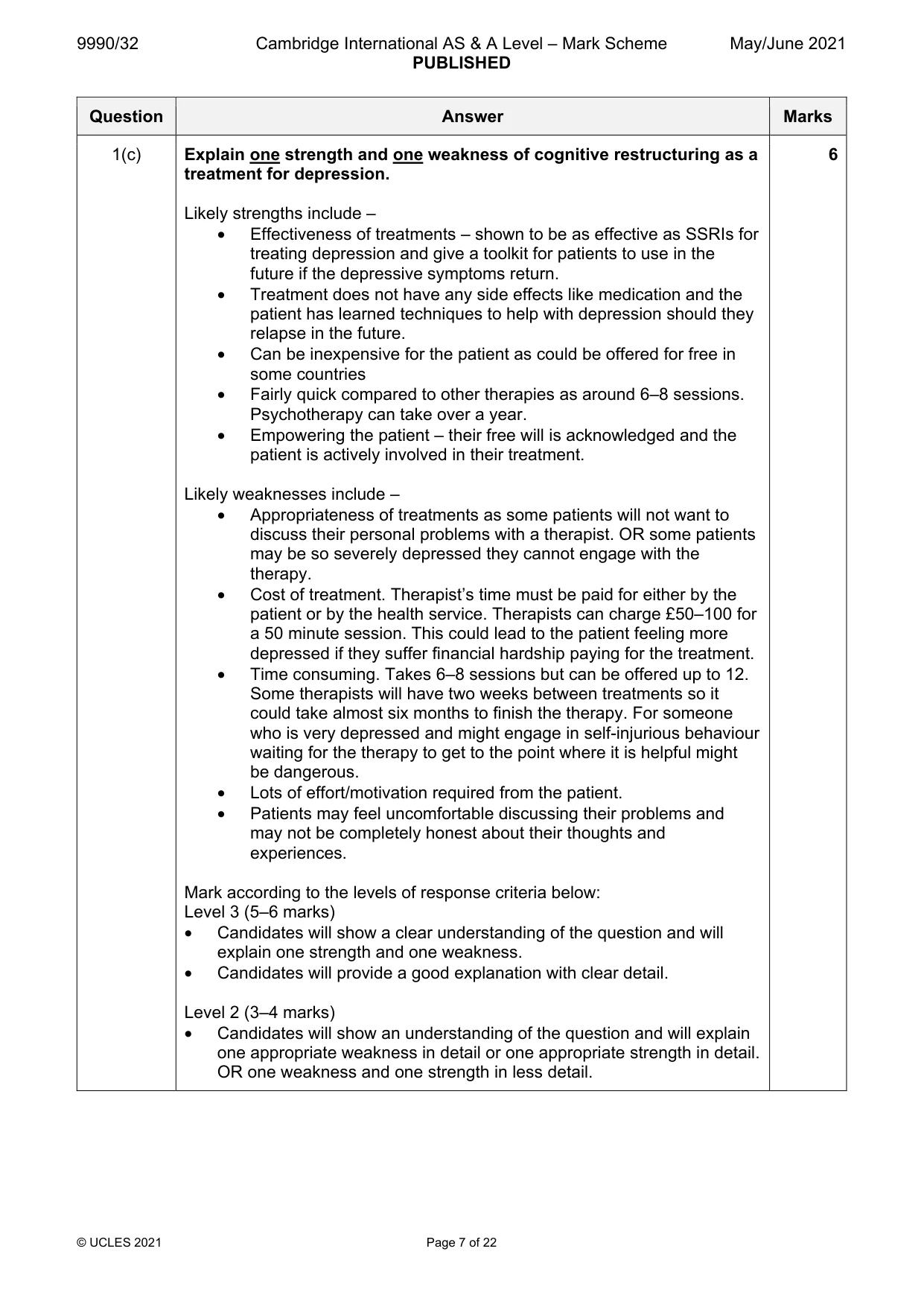
Mark scheme: Question Answer Marks 1(a) Explain what is meant by ‘bipolar’ disorder. 2 Award 1 mark for a basic explanation of the term/concept. Award 2 marks for a detailed explanation of the term/concept. For example, Two strongly contrasting phases of mood. (1) Periods of severely elevated mood followed by periods of very low mood lasting for several weeks or months. (2) Other appropriate responses should also be credited. 1(b) Describe cognitive restructuring (Beck, 1979) as a treatment for 4 depression. Award 1–2 marks for a basic answer with some understanding of the topic area. Award 3–4 marks for a detailed answer with clear understanding of the topic area. For example, This is where the patient participates in a number of therapy sessions over weeks and/or months to alleviate their symptoms of depression. (1) As it is believed the depressive symptoms are due to faulty thinking the therapist will help the patient to identify their faulty thinking and then correct these thinking patterns to more helpful ways of viewing themselves, the world and the future.(1) Initially the patient and therapist will identify what the thinking patterns are and the patient will be helped to come up with alternative thoughts. (1) The patient then goes away between sessions and practices these alternative thoughts which should then lead to more helpful behaviours which will lead the patient to feel more hopeful and positive.(1) Other appropriate responses should also be credited. 1(c) Explain one strength and one weakness of cognitive restructuring as a 6 treatment for depression. Likely strengths include – • Effectiveness of treatments – shown to be as effective as SSRIs for treating depression and give a toolkit for patients to use in the future if the depressive symptoms return. • Treatment does not have any side effects like medication and the patient has learned techniques to help with depression should they relapse in the future. • Can be inexpensive for the patient as could be offered for free in some countries • Fairly quick compared to other therapies as around 6–8 sessions. Psychotherapy can take over a year. • Empowering the patient – their free will is acknowledged and the patient is actively involved in their treatment. Likely weaknesses include – • Appropriateness of treatments as some patients will not want to discuss their personal problems with a therapist. OR some patients may be so severely depressed they cannot engage with the therapy. • Cost of treatment. Therapist’s time must be paid for either by the patient or by the health service. Therapists can charge £50–100 for a 50 minute session. This could lead to the patient feeling more depressed if they suffer financial hardship paying for the treatment. • Time consuming. Takes 6–8 sessions but can be offered up to 12. Some therapists will have two weeks between treatments so it could take almost six months to finish the therapy. For someone who is very depressed and might engage in self-injurious behaviour waiting for the therapy to get to the point where it is helpful might be dangerous. • Lots of effort/motivation required from the patient. • Patients may feel uncomfortable discussing their problems and may not be completely honest about their thoughts and experiences. Mark according to the levels of response criteria below: Level 3 (5–6 marks) • Candidates will show a clear understanding of the question and will explain one strength and one weakness. • Candidates will provide a good explanation with clear detail. Level 2 (3–4 marks) • Candidates will show an understanding of the question and will explain one appropriate weakness in detail or one appropriate strength in detail. OR one weakness and one strength in less detail. 1(c) Level 1 (1–2 marks) • Candidates will show a basic understanding of the question and will attempt an explanation of either a strength or a weakness. They could include both but just as an attempt. • Candidates will provide a limited explanation. Level 0 (0 marks) No response worthy of credit. Other appropriate responses should also be credited.
More questions on Mood (affective) disorders: depressive disorder (unipolar) and bipolar disorder
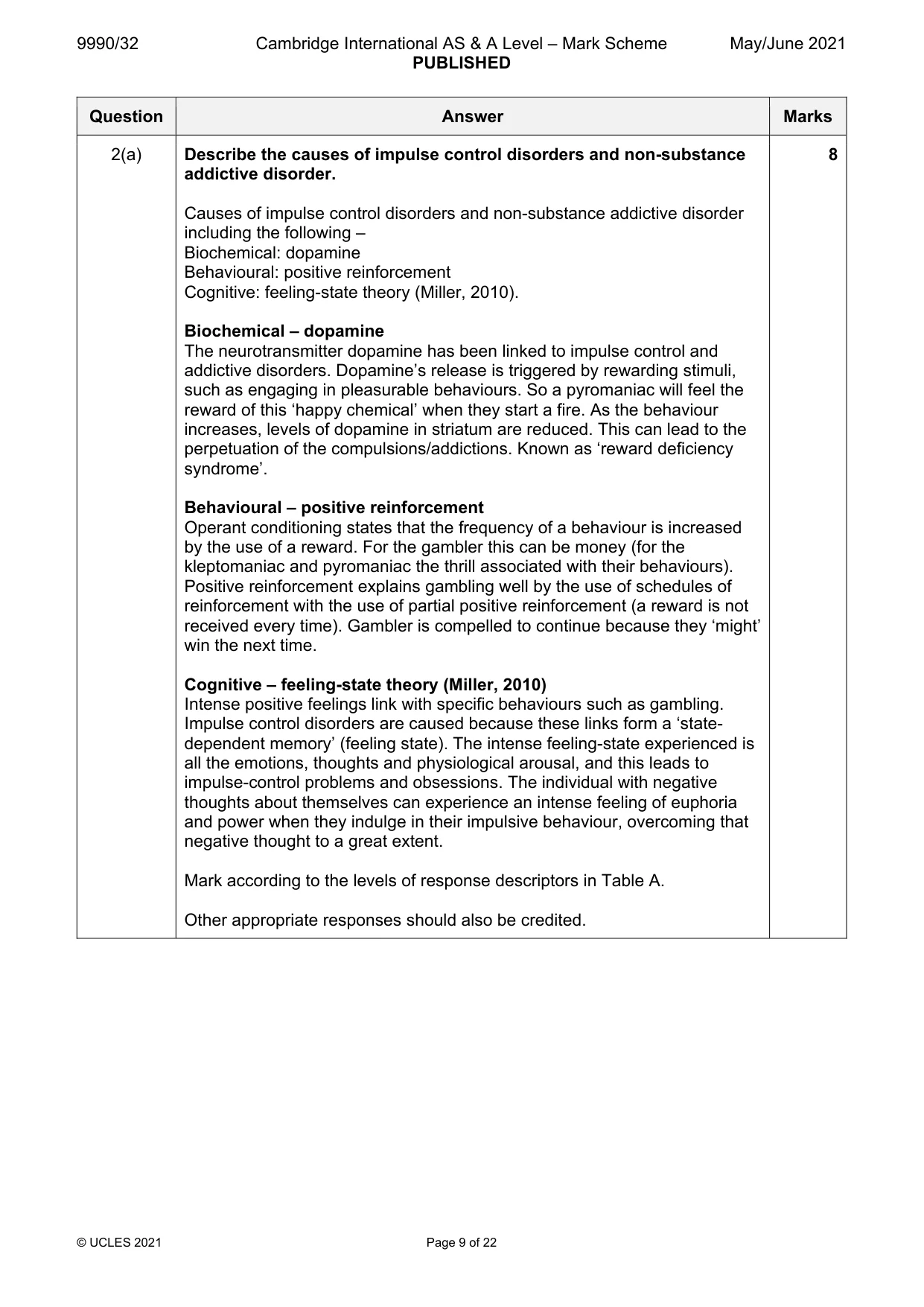
Q2 · Describe the causes of impulse control disorders and non-substance addictive disorder
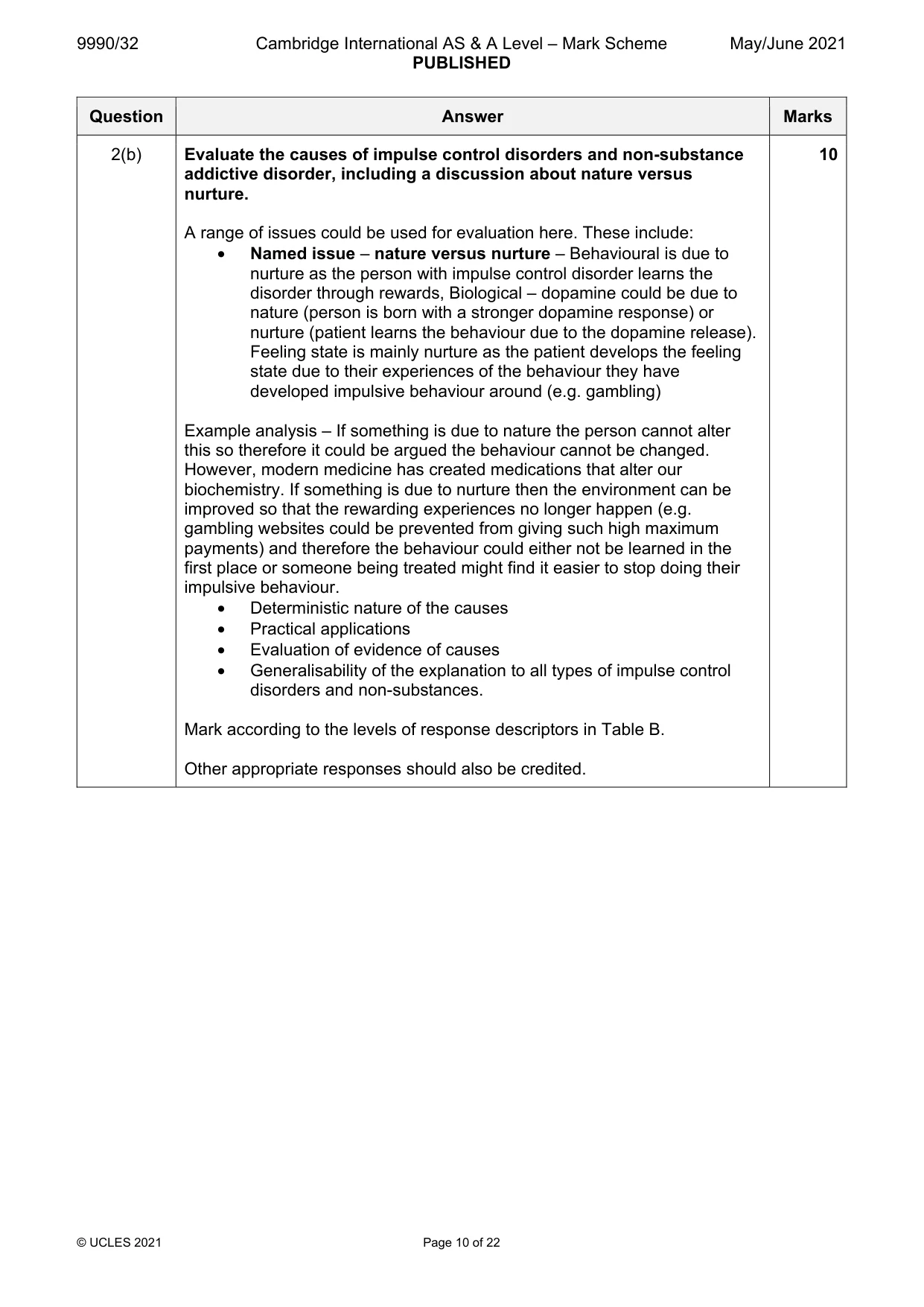
2 (a) Describe the causes of impulse control disorders and non-substance addictive disorder. [8] (b) Evaluate the causes of impulse control disorders and non-substance addictive disorder, including a discussion about nature versus nurture. [10] Psychology and consumer behaviour Answer all questions.
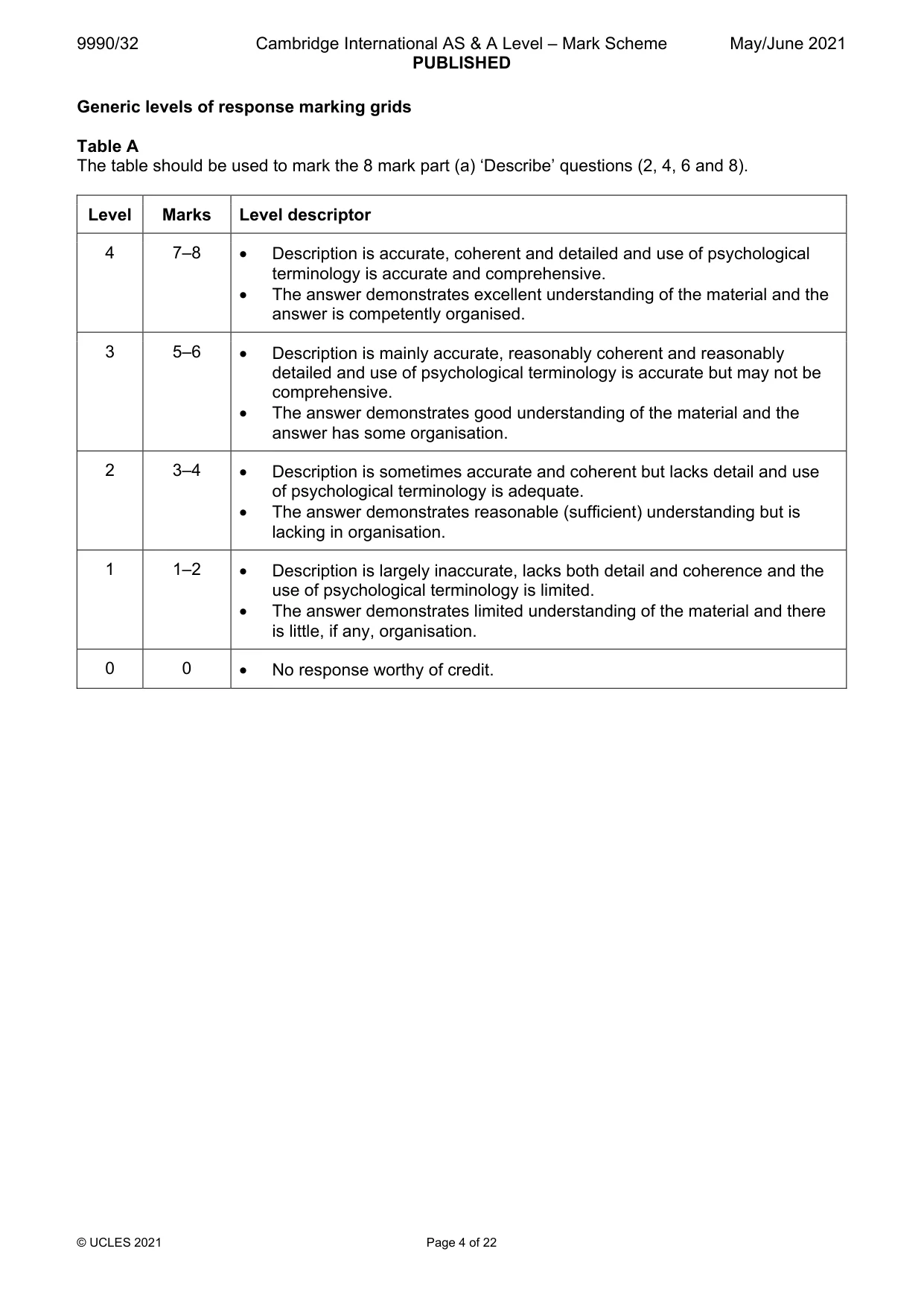
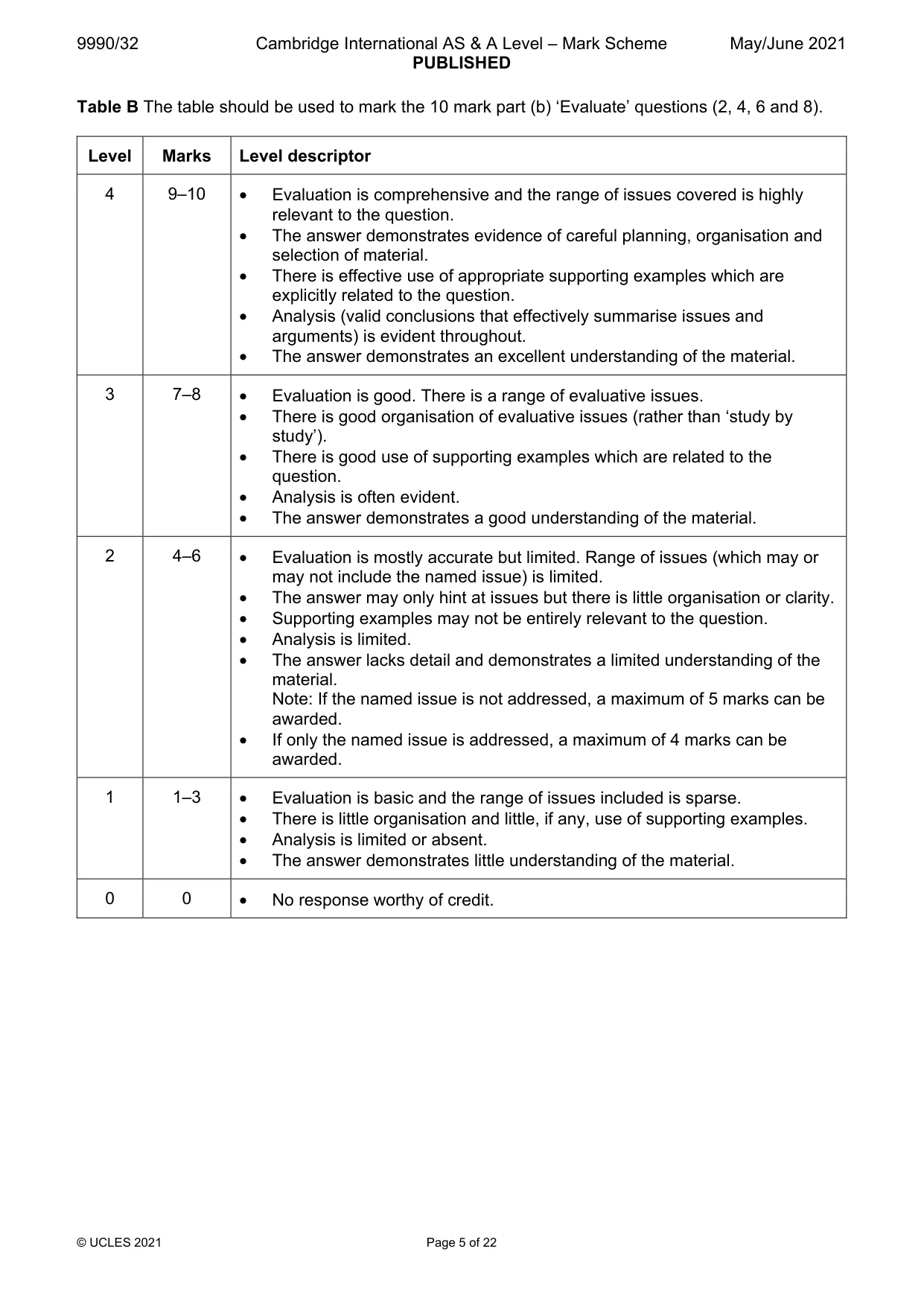
Mark scheme: 2(a) Describe the causes of impulse control disorders and non-substance 8 addictive disorder. Causes of impulse control disorders and non-substance addictive disorder including the following – Biochemical: dopamine Behavioural: positive reinforcement Cognitive: feeling-state theory (Miller, 2010). Biochemical – dopamine The neurotransmitter dopamine has been linked to impulse control and addictive disorders. Dopamine’s release is triggered by rewarding stimuli, such as engaging in pleasurable behaviours. So a pyromaniac will feel the reward of this ‘happy chemical’ when they start a fire. As the behaviour increases, levels of dopamine in striatum are reduced. This can lead to the perpetuation of the compulsions/addictions. Known as ‘reward deficiency syndrome’. Behavioural – positive reinforcement Operant conditioning states that the frequency of a behaviour is increased by the use of a reward. For the gambler this can be money (for the kleptomaniac and pyromaniac the thrill associated with their behaviours). Positive reinforcement explains gambling well by the use of schedules of reinforcement with the use of partial positive reinforcement (a reward is not received every time). Gambler is compelled to continue because they ‘might’ win the next time. Cognitive – feeling-state theory (Miller, 2010) Intense positive feelings link with specific behaviours such as gambling. Impulse control disorders are caused because these links form a ‘state- dependent memory’ (feeling state). The intense feeling-state experienced is all the emotions, thoughts and physiological arousal, and this leads to impulse-control problems and obsessions. The individual with negative thoughts about themselves can experience an intense feeling of euphoria and power when they indulge in their impulsive behaviour, overcoming that negative thought to a great extent. Mark according to the levels of response descriptors in Table A. Other appropriate responses should also be credited. 2(b) Evaluate the causes of impulse control disorders and non-substance 10 addictive disorder, including a discussion about nature versus nurture. A range of issues could be used for evaluation here. These include: • Named issue – nature versus nurture – Behavioural is due to nurture as the person with impulse control disorder learns the disorder through rewards, Biological – dopamine could be due to nature (person is born with a stronger dopamine response) or nurture (patient learns the behaviour due to the dopamine release). Feeling state is mainly nurture as the patient develops the feeling state due to their experiences of the behaviour they have developed impulsive behaviour around (e.g. gambling) Example analysis – If something is due to nature the person cannot alter this so therefore it could be argued the behaviour cannot be changed. However, modern medicine has created medications that alter our biochemistry. If something is due to nurture then the environment can be improved so that the rewarding experiences no longer happen (e.g. gambling websites could be prevented from giving such high maximum payments) and therefore the behaviour could either not be learned in the first place or someone being treated might find it easier to stop doing their impulsive behaviour. • Deterministic nature of the causes • Practical applications • Evaluation of evidence of causes • Generalisability of the explanation to all types of impulse control disorders and non-substances. Mark according to the levels of response descriptors in Table B. Other appropriate responses should also be credited. Psychology and consumer behaviour
Q3 · Explain what is meant by the ‘cognition-emotion model’ of the effects of ambience
3 (a) Explain what is meant by the ‘cognition-emotion model’ of the effects of ambience. [2] (b) Describe the study by Chebat and Michon (2003) on the effects of odour on shopper arousal and emotion. [4] (c) Explain two strengths of the study by Chebat and Michon. [6]
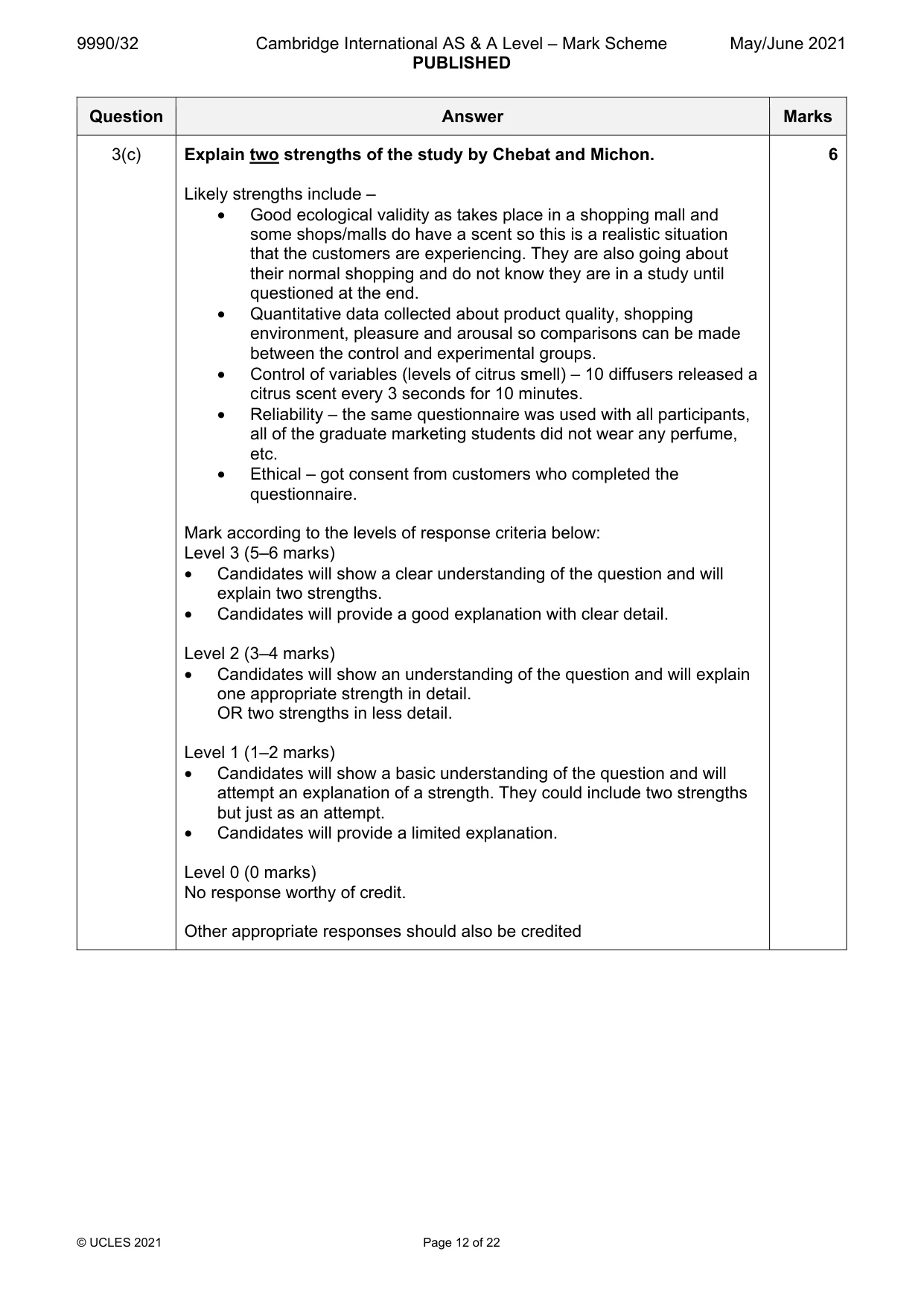
Mark scheme: 3(a) Explain what is meant by the ‘cognition-emotion model’ of the effects 2 of ambience. Award 1 mark for a basic explanation of the term/concept. Award 2 marks for a detailed explanation of the term/concept. For example: Zajonc & Markus (1984) propose emotion can be generated by biological, sensory, and cognitive events.(1) So cognition may produce emotion but does not necessarily cause emotion. (1) Therefore, the ambience of a retail environment/shop can produce cognitions that lead to emotions in the consumer. (1) For example, a light colour may produce the cognition of ‘expensive’ which make the consumer feel good when they purchase a product.(1) Other appropriate responses should also be credited. 3(b) Describe the study by Chebat and Michon (2003) on the effects of 4 odour on shopper arousal and emotion. Award 1–2 marks for a basic answer with some understanding of the topic area. Award 3–4 marks for a detailed answer with clear understanding of the topic area. For example: Field experiment in a shopping mall in Canada over two weeks. (1) Week 1 was a control week/group where no scent was put into the mall. In the second week a pleasing scent (citrus) was put into the mall’s main corridor.(1) 145 participants during the scent week (447 in the control week). (1) Self-administered questionnaire given to participants by graduate marketing students not wearing any perfume. (1) This questionnaire asked the participants about their shopping trip on product quality, the shopping environment, and the pleasure and arousal felt while shopping.(1) Found a more favourable perception of the product quality and shopping environment was reported.(1) Other appropriate responses should also be credited. 3(c) Explain two strengths of the study by Chebat and Michon. 6 Likely strengths include – • Good ecological validity as takes place in a shopping mall and some shops/malls do have a scent so this is a realistic situation that the customers are experiencing. They are also going about their normal shopping and do not know they are in a study until questioned at the end. • Quantitative data collected about product quality, shopping environment, pleasure and arousal so comparisons can be made between the control and experimental groups. • Control of variables (levels of citrus smell) – 10 diffusers released a citrus scent every 3 seconds for 10 minutes. • Reliability – the same questionnaire was used with all participants, all of the graduate marketing students did not wear any perfume, etc. • Ethical – got consent from customers who completed the questionnaire. Mark according to the levels of response criteria below: Level 3 (5–6 marks) • Candidates will show a clear understanding of the question and will explain two strengths. • Candidates will provide a good explanation with clear detail. Level 2 (3–4 marks) • Candidates will show an understanding of the question and will explain one appropriate strength in detail. OR two strengths in less detail. Level 1 (1–2 marks) • Candidates will show a basic understanding of the question and will attempt an explanation of a strength. They could include two strengths but just as an attempt. • Candidates will provide a limited explanation. Level 0 (0 marks) No response worthy of credit. Other appropriate responses should also be credited
Q4 · Describe what psychologists have discovered about menu design psychology
4 (a) Describe what psychologists have discovered about menu design psychology. [8] (b) Evaluate what psychologists have discovered about menu design psychology, including a discussion about ecological validity. [10] Psychology and health Answer all questions.
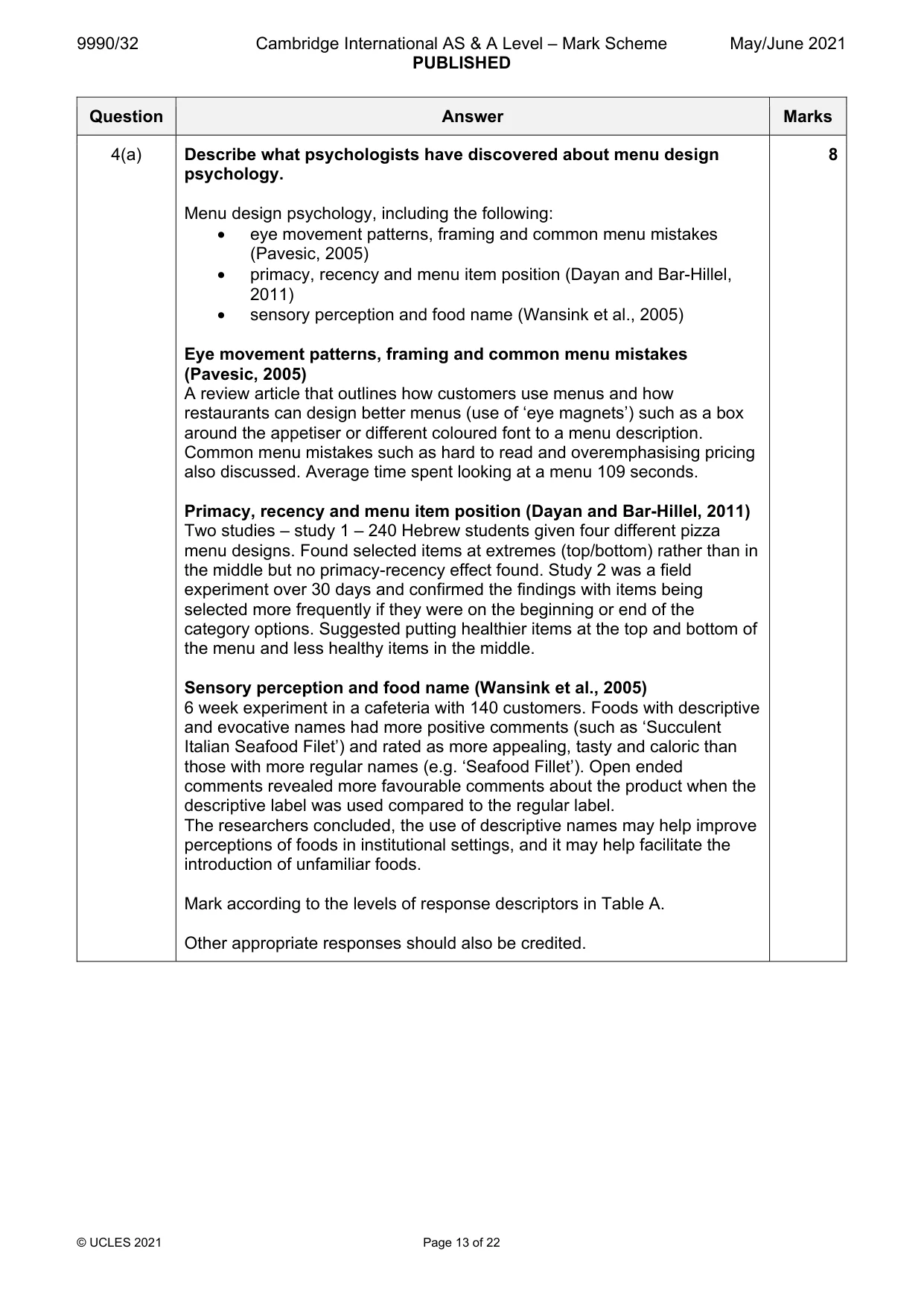
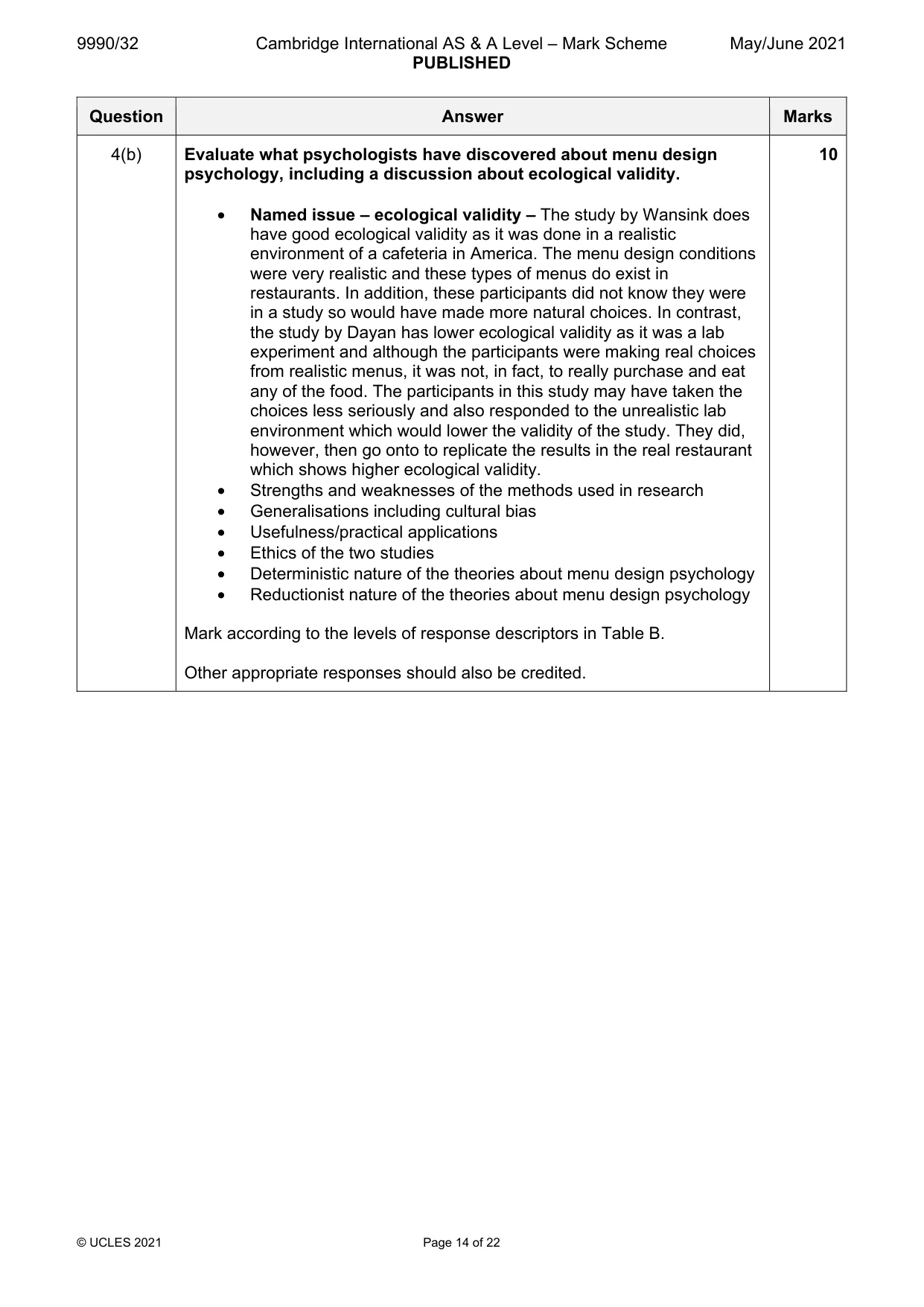
Mark scheme: 4(a) Describe what psychologists have discovered about menu design 8 psychology. Menu design psychology, including the following: • eye movement patterns, framing and common menu mistakes (Pavesic, 2005) • primacy, recency and menu item position (Dayan and Bar-Hillel, 2011) • sensory perception and food name (Wansink et al., 2005) Eye movement patterns, framing and common menu mistakes (Pavesic, 2005) A review article that outlines how customers use menus and how restaurants can design better menus (use of ‘eye magnets’) such as a box around the appetiser or different coloured font to a menu description. Common menu mistakes such as hard to read and overemphasising pricing also discussed. Average time spent looking at a menu 109 seconds. Primacy, recency and menu item position (Dayan and Bar-Hillel, 2011) Two studies – study 1 – 240 Hebrew students given four different pizza menu designs. Found selected items at extremes (top/bottom) rather than in the middle but no primacy-recency effect found. Study 2 was a field experiment over 30 days and confirmed the findings with items being selected more frequently if they were on the beginning or end of the category options. Suggested putting healthier items at the top and bottom of the menu and less healthy items in the middle. Sensory perception and food name (Wansink et al., 2005) 6 week experiment in a cafeteria with 140 customers. Foods with descriptive and evocative names had more positive comments (such as ‘Succulent Italian Seafood Filet’) and rated as more appealing, tasty and caloric than those with more regular names (e.g. ‘Seafood Fillet’). Open ended comments revealed more favourable comments about the product when the descriptive label was used compared to the regular label. The researchers concluded, the use of descriptive names may help improve perceptions of foods in institutional settings, and it may help facilitate the introduction of unfamiliar foods. Mark according to the levels of response descriptors in Table A. Other appropriate responses should also be credited. 4(b) Evaluate what psychologists have discovered about menu design 10 psychology, including a discussion about ecological validity. • Named issue – ecological validity – The study by Wansink does have good ecological validity as it was done in a realistic environment of a cafeteria in America. The menu design conditions were very realistic and these types of menus do exist in restaurants. In addition, these participants did not know they were in a study so would have made more natural choices. In contrast, the study by Dayan has lower ecological validity as it was a lab experiment and although the participants were making real choices from realistic menus, it was not, in fact, to really purchase and eat any of the food. The participants in this study may have taken the choices less seriously and also responded to the unrealistic lab environment which would lower the validity of the study. They did, however, then go onto to replicate the results in the real restaurant which shows higher ecological validity. • Strengths and weaknesses of the methods used in research • Generalisations including cultural bias • Usefulness/practical applications • Ethics of the two studies • Deterministic nature of the theories about menu design psychology • Reductionist nature of the theories about menu design psychology Mark according to the levels of response descriptors in Table B. Other appropriate responses should also be credited. Psychology and health
Q5 · Outline how one biochemical technique reduces stress
5 (a) Outline how one biochemical technique reduces stress. [2] (b) Describe the study by Chandola et al. (2008) on work as a cause of stress. [4] (c) Discuss the generalisability of the study by Chandola et al. [6]
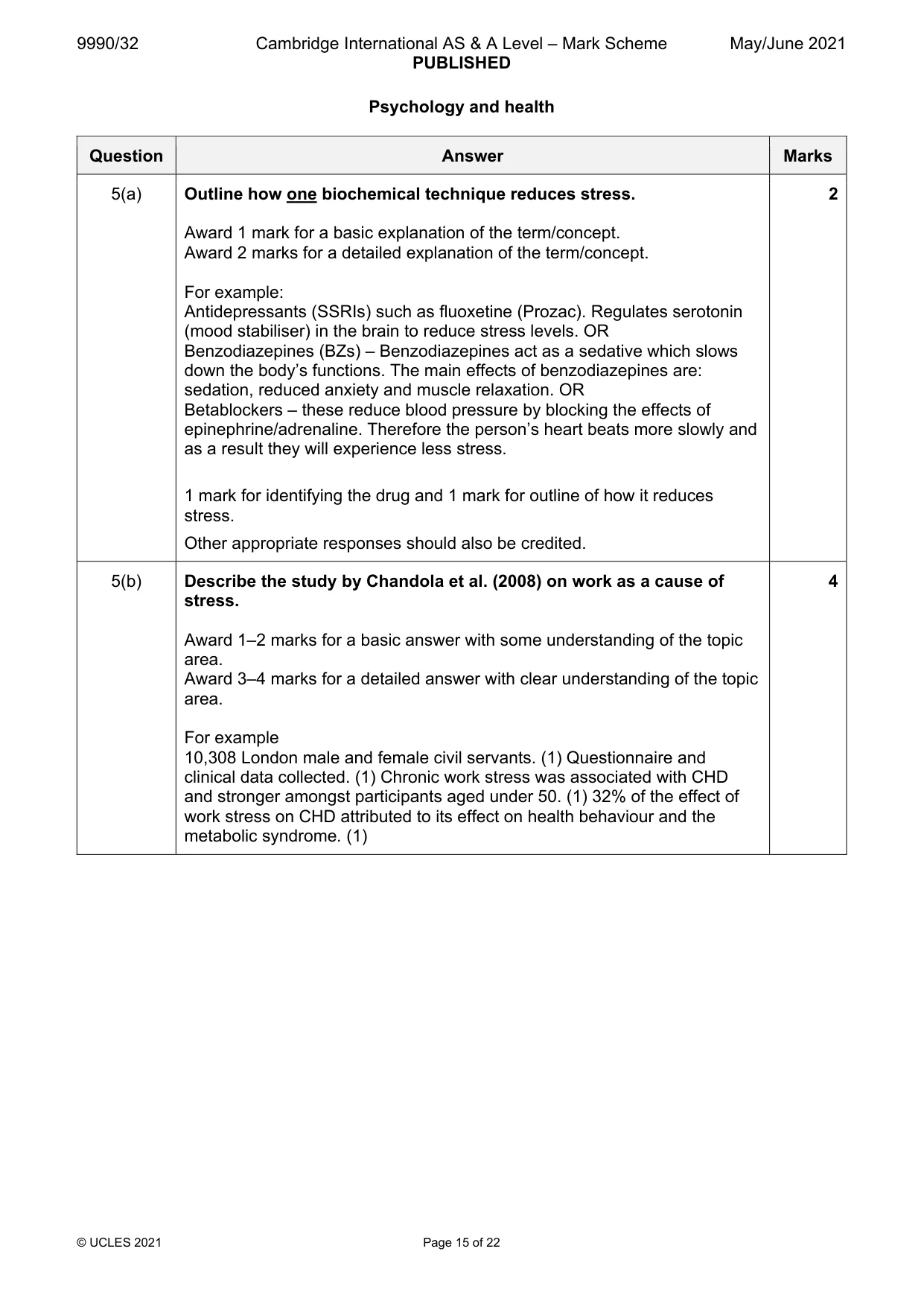
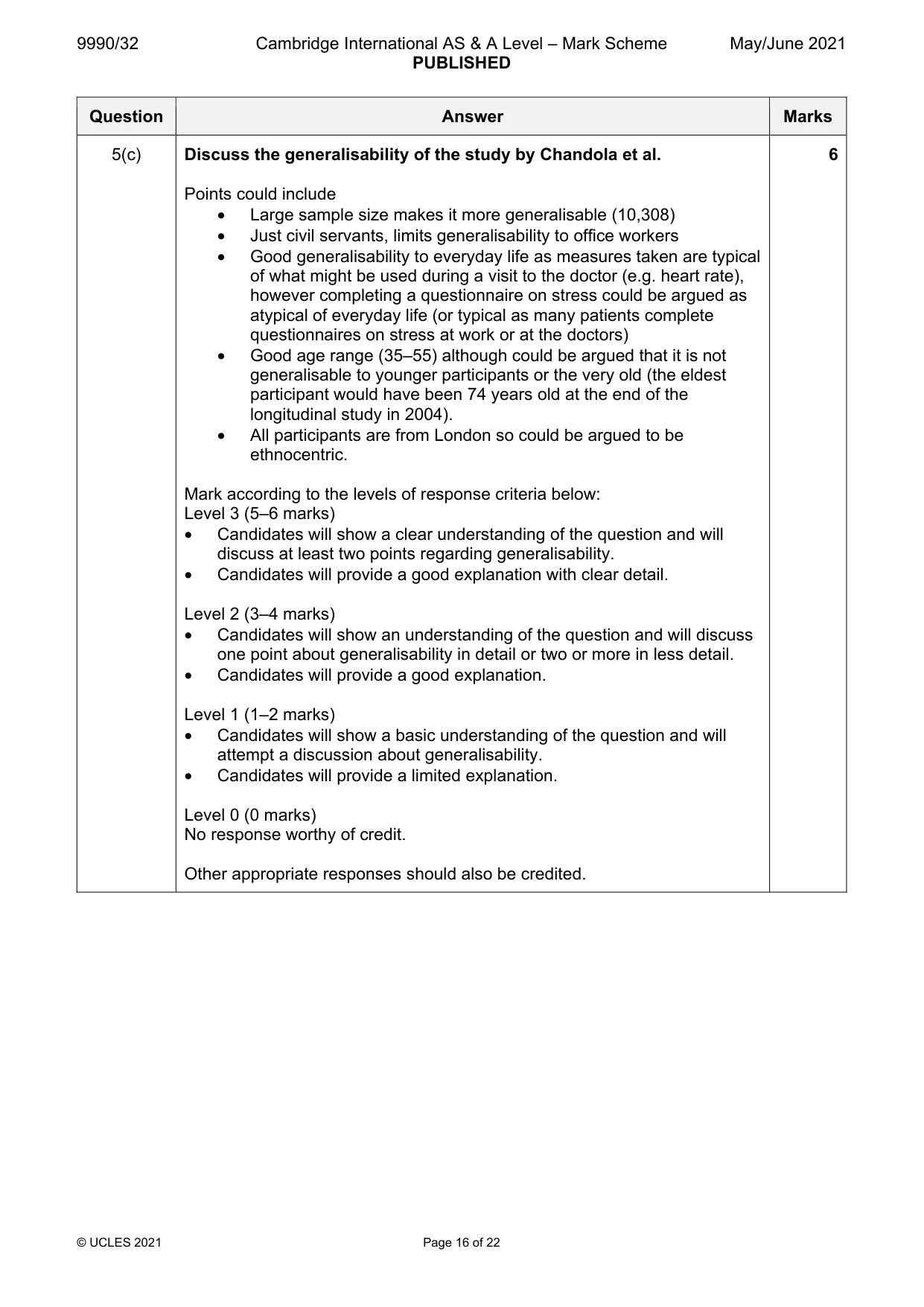
Mark scheme: 5(a) Outline how one biochemical technique reduces stress. 2 Award 1 mark for a basic explanation of the term/concept. Award 2 marks for a detailed explanation of the term/concept. For example: Antidepressants (SSRIs) such as fluoxetine (Prozac). Regulates serotonin (mood stabiliser) in the brain to reduce stress levels. OR Benzodiazepines (BZs) – Benzodiazepines act as a sedative which slows down the body’s functions. The main effects of benzodiazepines are: sedation, reduced anxiety and muscle relaxation. OR Betablockers – these reduce blood pressure by blocking the effects of epinephrine/adrenaline. Therefore the person’s heart beats more slowly and as a result they will experience less stress. 1 mark for identifying the drug and 1 mark for outline of how it reduces stress. Other appropriate responses should also be credited. 5(b) Describe the study by Chandola et al. (2008) on work as a cause of 4 stress. Award 1–2 marks for a basic answer with some understanding of the topic area. Award 3–4 marks for a detailed answer with clear understanding of the topic area. For example 10,308 London male and female civil servants. (1) Questionnaire and clinical data collected. (1) Chronic work stress was associated with CHD and stronger amongst participants aged under 50. (1) 32% of the effect of work stress on CHD attributed to its effect on health behaviour and the metabolic syndrome. (1) 5(c) Discuss the generalisability of the study by Chandola et al. 6 Points could include • Large sample size makes it more generalisable (10,308) • Just civil servants, limits generalisability to office workers • Good generalisability to everyday life as measures taken are typical of what might be used during a visit to the doctor (e.g. heart rate), however completing a questionnaire on stress could be argued as atypical of everyday life (or typical as many patients complete questionnaires on stress at work or at the doctors) • Good age range (35–55) although could be argued that it is not generalisable to younger participants or the very old (the eldest participant would have been 74 years old at the end of the longitudinal study in 2004). • All participants are from London so could be argued to be ethnocentric. Mark according to the levels of response criteria below: Level 3 (5–6 marks) • Candidates will show a clear understanding of the question and will discuss at least two points regarding generalisability. • Candidates will provide a good explanation with clear detail. Level 2 (3–4 marks) • Candidates will show an understanding of the question and will discuss one point about generalisability in detail or two or more in less detail. • Candidates will provide a good explanation. Level 1 (1–2 marks) • Candidates will show a basic understanding of the question and will attempt a discussion about generalisability. • Candidates will provide a limited explanation. Level 0 (0 marks) No response worthy of credit. Other appropriate responses should also be credited.
Q6 · Describe what psychologists have discovered about strategies for promoting health
6 (a) Describe what psychologists have discovered about strategies for promoting health. [8] (b) Evaluate what psychologists have discovered about strategies for promoting health, including a discussion of the longitudinal research method. [10] Psychology and organisations Answer all questions.
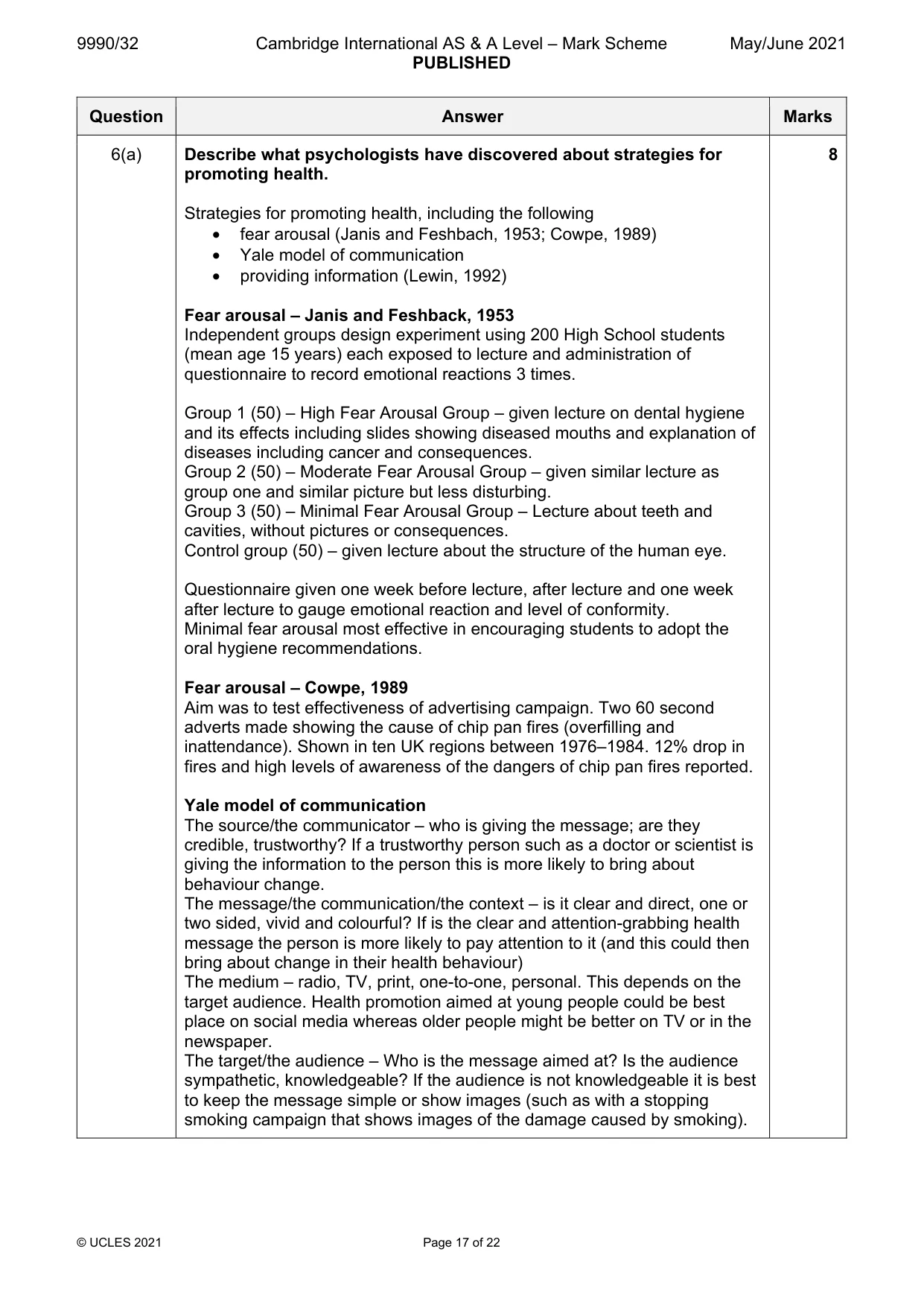
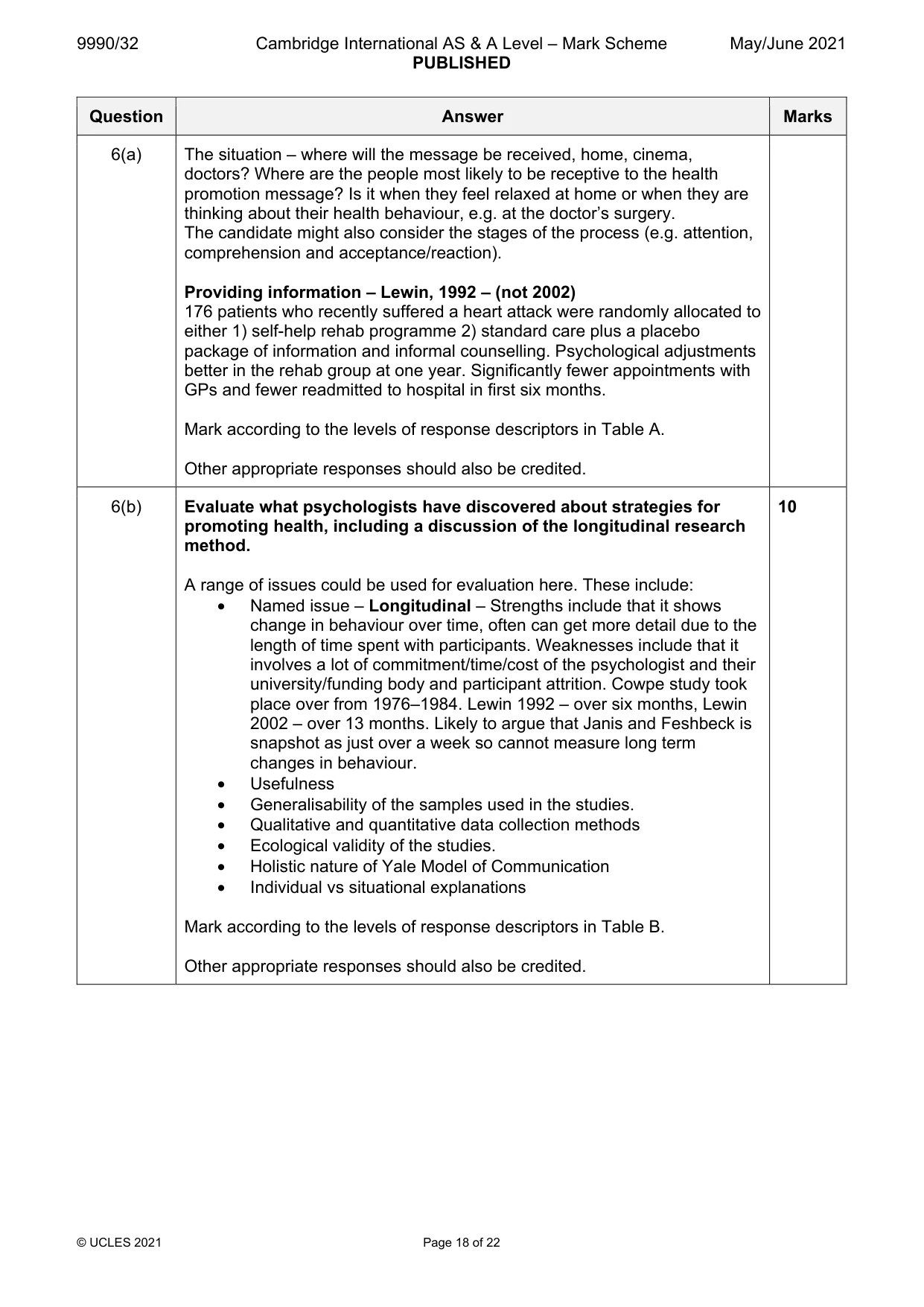
Mark scheme: 6(a) Describe what psychologists have discovered about strategies for 8 promoting health. Strategies for promoting health, including the following • fear arousal (Janis and Feshbach, 1953; Cowpe, 1989) • Yale model of communication • providing information (Lewin, 1992) Fear arousal – Janis and Feshback, 1953 Independent groups design experiment using 200 High School students (mean age 15 years) each exposed to lecture and administration of questionnaire to record emotional reactions 3 times. Group 1 (50) – High Fear Arousal Group – given lecture on dental hygiene and its effects including slides showing diseased mouths and explanation of diseases including cancer and consequences. Group 2 (50) – Moderate Fear Arousal Group – given similar lecture as group one and similar picture but less disturbing. Group 3 (50) – Minimal Fear Arousal Group – Lecture about teeth and cavities, without pictures or consequences. Control group (50) – given lecture about the structure of the human eye. Questionnaire given one week before lecture, after lecture and one week after lecture to gauge emotional reaction and level of conformity. Minimal fear arousal most effective in encouraging students to adopt the oral hygiene recommendations. Fear arousal – Cowpe, 1989 Aim was to test effectiveness of advertising campaign. Two 60 second adverts made showing the cause of chip pan fires (overfilling and inattendance). Shown in ten UK regions between 1976–1984. 12% drop in fires and high levels of awareness of the dangers of chip pan fires reported. Yale model of communication The source/the communicator – who is giving the message; are they credible, trustworthy? If a trustworthy person such as a doctor or scientist is giving the information to the person this is more likely to bring about behaviour change. The message/the communication/the context – is it clear and direct, one or two sided, vivid and colourful? If is the clear and attention-grabbing health message the person is more likely to pay attention to it (and this could then bring about change in their health behaviour) The medium – radio, TV, print, one-to-one, personal. This depends on the target audience. Health promotion aimed at young people could be best place on social media whereas older people might be better on TV or in the newspaper. The target/the audience – Who is the message aimed at? Is the audience sympathetic, knowledgeable? If the audience is not knowledgeable it is best to keep the message simple or show images (such as with a stopping smoking campaign that shows images of the damage caused by smoking). 6(a) The situation – where will the message be received, home, cinema, doctors? Where are the people most likely to be receptive to the health promotion message? Is it when they feel relaxed at home or when they are thinking about their health behaviour, e.g. at the doctor’s surgery. The candidate might also consider the stages of the process (e.g. attention, comprehension and acceptance/reaction). Providing information – Lewin, 1992 – (not 2002) 176 patients who recently suffered a heart attack were randomly allocated to either 1) self-help rehab programme 2) standard care plus a placebo package of information and informal counselling. Psychological adjustments better in the rehab group at one year. Significantly fewer appointments with GPs and fewer readmitted to hospital in first six months. Mark according to the levels of response descriptors in Table A. Other appropriate responses should also be credited. 6(b) Evaluate what psychologists have discovered about strategies for 10 promoting health, including a discussion of the longitudinal research method. A range of issues could be used for evaluation here. These include: • Named issue – Longitudinal – Strengths include that it shows change in behaviour over time, often can get more detail due to the length of time spent with participants. Weaknesses include that it involves a lot of commitment/time/cost of the psychologist and their university/funding body and participant attrition. Cowpe study took place over from 1976–1984. Lewin 1992 – over six months, Lewin 2002 – over 13 months. Likely to argue that Janis and Feshbeck is snapshot as just over a week so cannot measure long term changes in behaviour. • Usefulness • Generalisability of the samples used in the studies. • Qualitative and quantitative data collection methods • Ecological validity of the studies. • Holistic nature of Yale Model of Communication • Individual vs situational explanations Mark according to the levels of response descriptors in Table B. Other appropriate responses should also be credited. Psychology and organisations
More questions on 2 Health promotion in schools and worksites
Q7 · Explain what is meant by ‘empowerment’ as a motivator at work
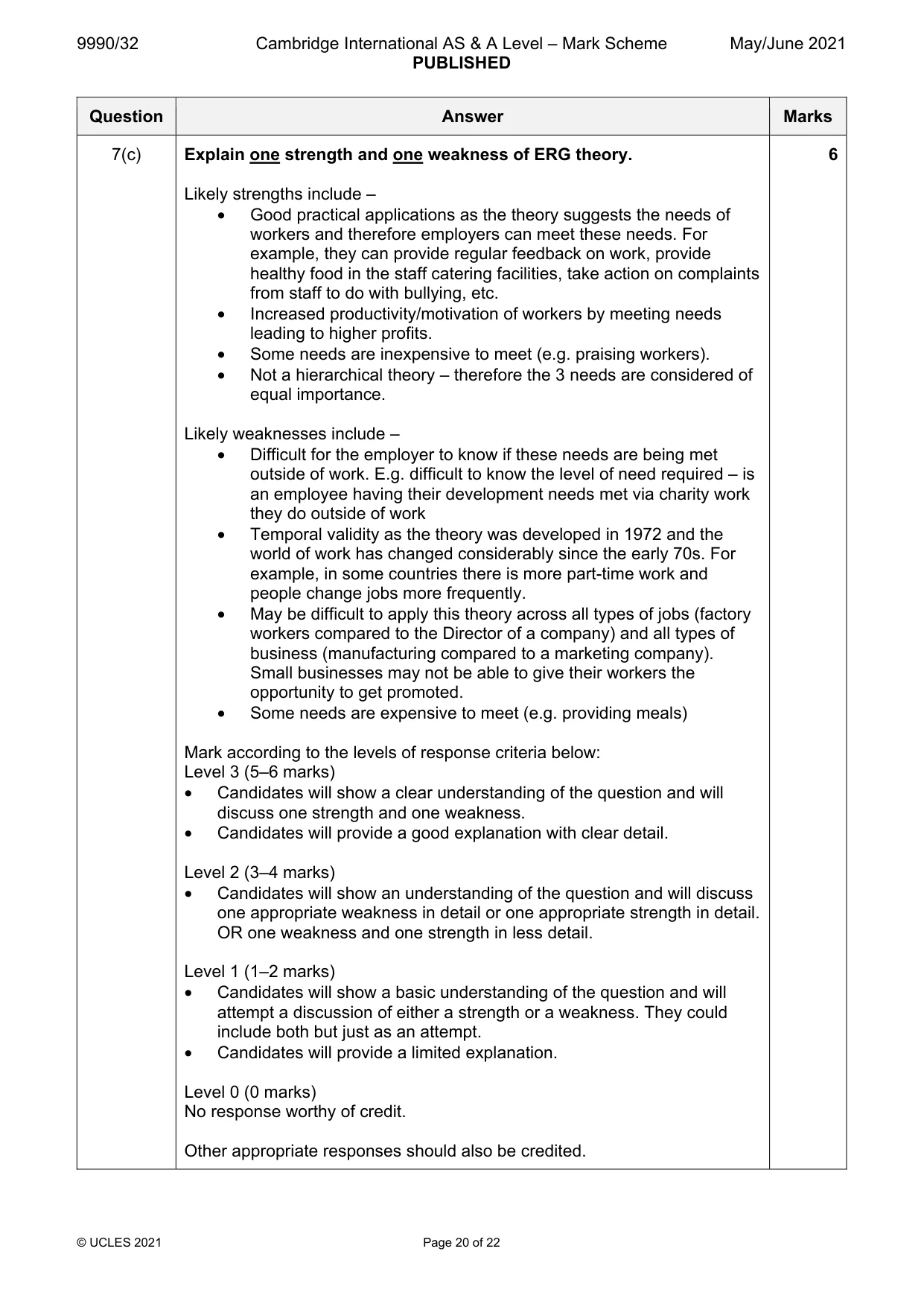
7 (a) Explain what is meant by ‘empowerment’ as a motivator at work. [2] (b) Describe how ERG theory (Alderfer, 1972) explains motivation at work. [4] (c) Explain one strength and one weakness of ERG theory. [6]
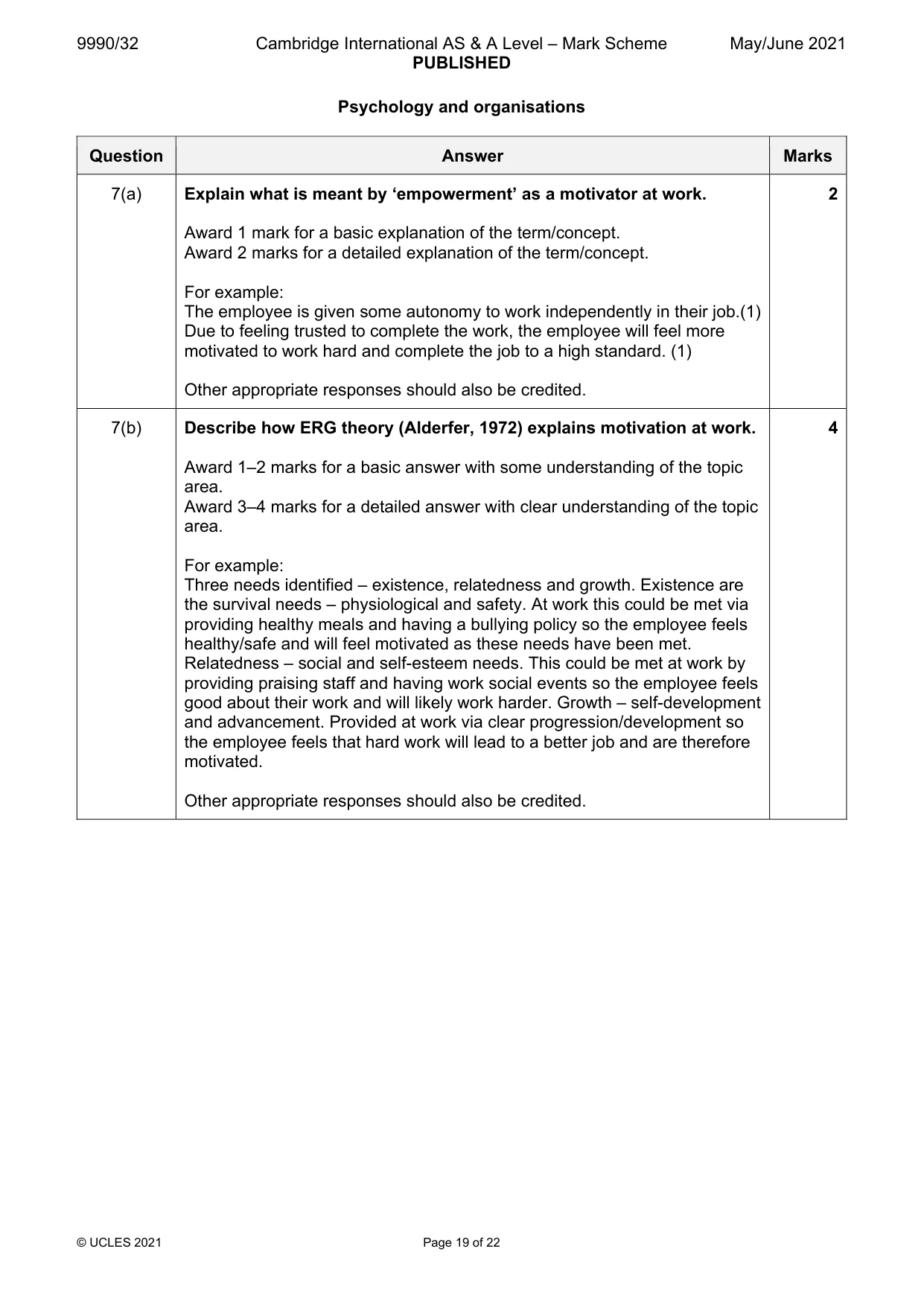
Mark scheme: 7(a) Explain what is meant by ‘empowerment’ as a motivator at work. 2 Award 1 mark for a basic explanation of the term/concept. Award 2 marks for a detailed explanation of the term/concept. For example: The employee is given some autonomy to work independently in their job.(1) Due to feeling trusted to complete the work, the employee will feel more motivated to work hard and complete the job to a high standard. (1) Other appropriate responses should also be credited. 7(b) Describe how ERG theory (Alderfer, 1972) explains motivation at work. 4 Award 1–2 marks for a basic answer with some understanding of the topic area. Award 3–4 marks for a detailed answer with clear understanding of the topic area. For example: Three needs identified – existence, relatedness and growth. Existence are the survival needs – physiological and safety. At work this could be met via providing healthy meals and having a bullying policy so the employee feels healthy/safe and will feel motivated as these needs have been met. Relatedness – social and self-esteem needs. This could be met at work by providing praising staff and having work social events so the employee feels good about their work and will likely work harder. Growth – self-development and advancement. Provided at work via clear progression/development so the employee feels that hard work will lead to a better job and are therefore motivated. Other appropriate responses should also be credited. 7(c) Explain one strength and one weakness of ERG theory. 6 Likely strengths include – • Good practical applications as the theory suggests the needs of workers and therefore employers can meet these needs. For example, they can provide regular feedback on work, provide healthy food in the staff catering facilities, take action on complaints from staff to do with bullying, etc. • Increased productivity/motivation of workers by meeting needs leading to higher profits. • Some needs are inexpensive to meet (e.g. praising workers). • Not a hierarchical theory – therefore the 3 needs are considered of equal importance. Likely weaknesses include – • Difficult for the employer to know if these needs are being met outside of work. E.g. difficult to know the level of need required – is an employee having their development needs met via charity work they do outside of work • Temporal validity as the theory was developed in 1972 and the world of work has changed considerably since the early 70s. For example, in some countries there is more part-time work and people change jobs more frequently. • May be difficult to apply this theory across all types of jobs (factory workers compared to the Director of a company) and all types of business (manufacturing compared to a marketing company). Small businesses may not be able to give their workers the opportunity to get promoted. • Some needs are expensive to meet (e.g. providing meals) Mark according to the levels of response criteria below: Level 3 (5–6 marks) • Candidates will show a clear understanding of the question and will discuss one strength and one weakness. • Candidates will provide a good explanation with clear detail. Level 2 (3–4 marks) • Candidates will show an understanding of the question and will discuss one appropriate weakness in detail or one appropriate strength in detail. OR one weakness and one strength in less detail. Level 1 (1–2 marks) • Candidates will show a basic understanding of the question and will attempt a discussion of either a strength or a weakness. They could include both but just as an attempt. • Candidates will provide a limited explanation. Level 0 (0 marks) No response worthy of credit. Other appropriate responses should also be credited.
Q8 · Describe what psychologists have discovered about physical and psychological work…
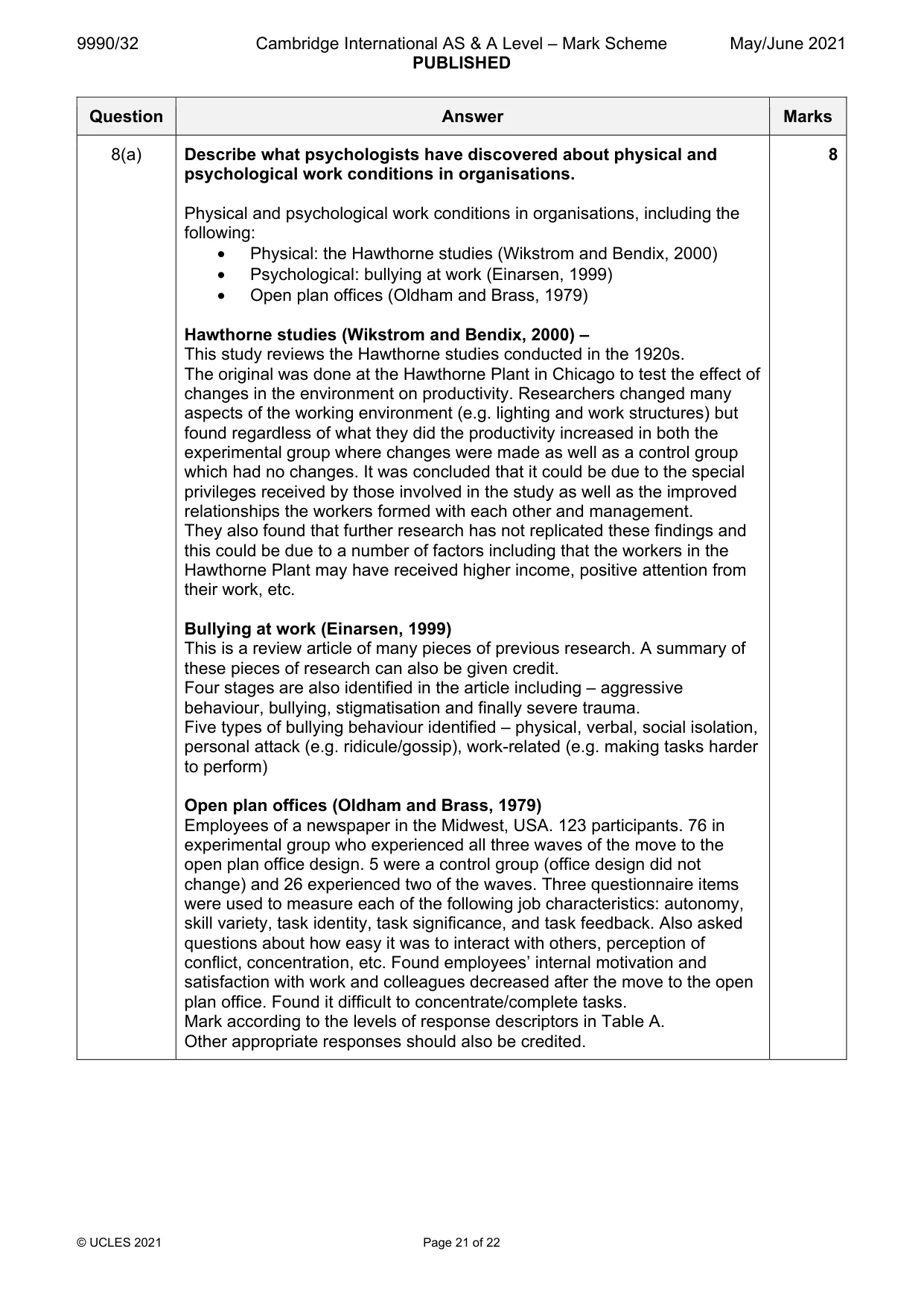
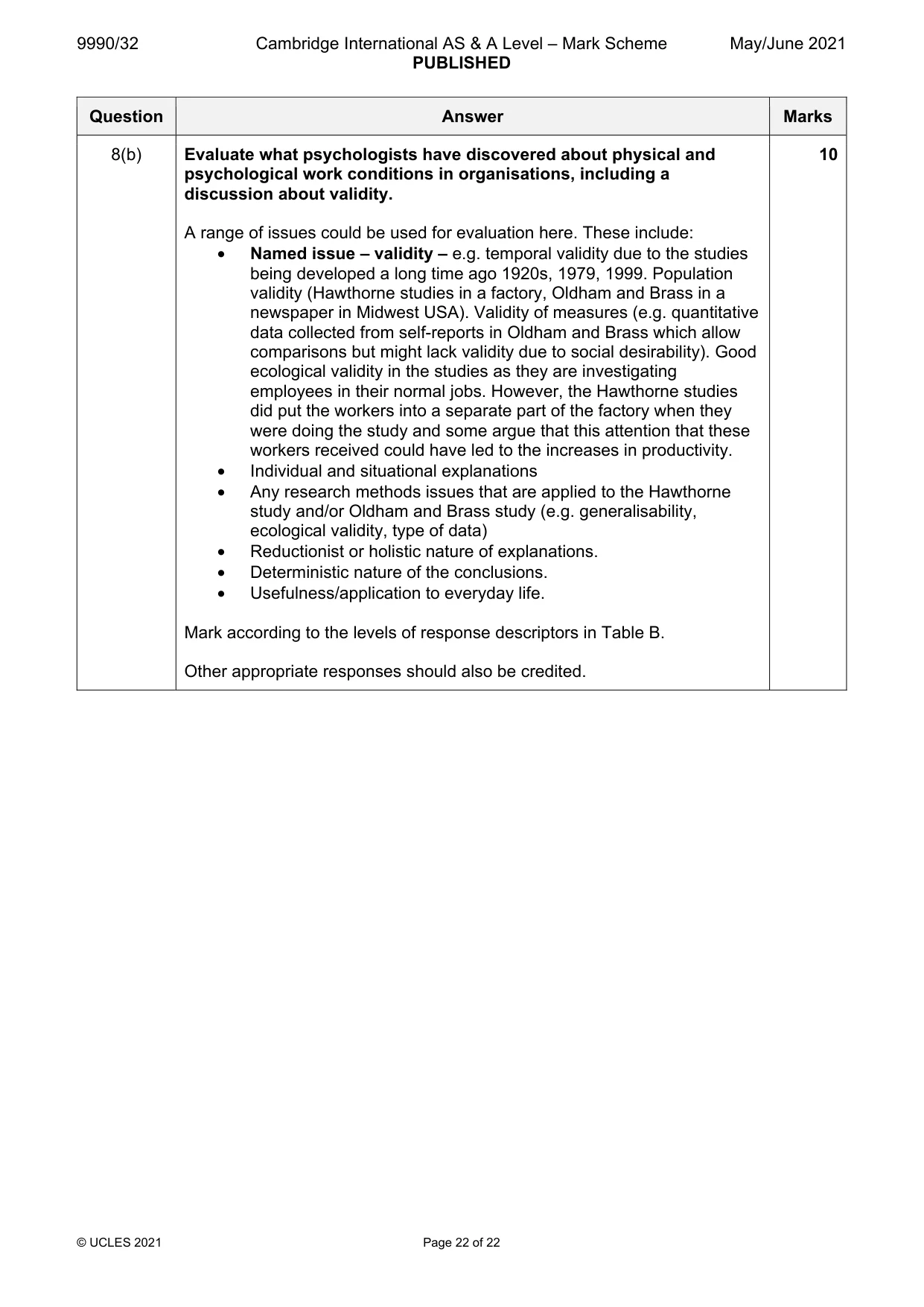
8 (a) Describe what psychologists have discovered about physical and psychological work conditions in organisations. [8] (b) Evaluate what psychologists have discovered about physical and psychological work conditions in organisations, including a discussion about validity. [10]
Mark scheme: 8(a) Describe what psychologists have discovered about physical and 8 psychological work conditions in organisations. Physical and psychological work conditions in organisations, including the following: • Physical: the Hawthorne studies (Wikstrom and Bendix, 2000) • Psychological: bullying at work (Einarsen, 1999) • Open plan offices (Oldham and Brass, 1979) Hawthorne studies (Wikstrom and Bendix, 2000) – This study reviews the Hawthorne studies conducted in the 1920s. The original was done at the Hawthorne Plant in Chicago to test the effect of changes in the environment on productivity. Researchers changed many aspects of the working environment (e.g. lighting and work structures) but found regardless of what they did the productivity increased in both the experimental group where changes were made as well as a control group which had no changes. It was concluded that it could be due to the special privileges received by those involved in the study as well as the improved relationships the workers formed with each other and management. They also found that further research has not replicated these findings and this could be due to a number of factors including that the workers in the Hawthorne Plant may have received higher income, positive attention from their work, etc. Bullying at work (Einarsen, 1999) This is a review article of many pieces of previous research. A summary of these pieces of research can also be given credit. Four stages are also identified in the article including – aggressive behaviour, bullying, stigmatisation and finally severe trauma. Five types of bullying behaviour identified – physical, verbal, social isolation, personal attack (e.g. ridicule/gossip), work-related (e.g. making tasks harder to perform) Open plan offices (Oldham and Brass, 1979) Employees of a newspaper in the Midwest, USA. 123 participants. 76 in experimental group who experienced all three waves of the move to the open plan office design. 5 were a control group (office design did not change) and 26 experienced two of the waves. Three questionnaire items were used to measure each of the following job characteristics: autonomy, skill variety, task identity, task significance, and task feedback. Also asked questions about how easy it was to interact with others, perception of conflict, concentration, etc. Found employees’ internal motivation and satisfaction with work and colleagues decreased after the move to the open plan office. Found it difficult to concentrate/complete tasks. Mark according to the levels of response descriptors in Table A. Other appropriate responses should also be credited. 8(b) Evaluate what psychologists have discovered about physical and 10 psychological work conditions in organisations, including a discussion about validity. A range of issues could be used for evaluation here. These include: • Named issue – validity – e.g. temporal validity due to the studies being developed a long time ago 1920s, 1979, 1999. Population validity (Hawthorne studies in a factory, Oldham and Brass in a newspaper in Midwest USA). Validity of measures (e.g. quantitative data collected from self-reports in Oldham and Brass which allow comparisons but might lack validity due to social desirability). Good ecological validity in the studies as they are investigating employees in their normal jobs. However, the Hawthorne studies did put the workers into a separate part of the factory when they were doing the study and some argue that this attention that these workers received could have led to the increases in productivity. • Individual and situational explanations • Any research methods issues that are applied to the Hawthorne study and/or Oldham and Brass study (e.g. generalisability, ecological validity, type of data) • Reductionist or holistic nature of explanations. • Deterministic nature of the conclusions. • Usefulness/application to everyday life. Mark according to the levels of response descriptors in Table B. Other appropriate responses should also be credited.
What was in this paper
The subtopics covered by these 8 questions, and how many questions each got. Open one in a new tab to see every Cambridge question on it.
What you needed in this session
Cambridge’s own grade thresholds for 2021 May/June, Paper 3 · Variant 2. A higher threshold means an easier paper — the bar moves with how the cohort did.