Cambridge A Level Psychology (from 2018) 9990 — 2021 May/June Paper 3 · Variant 1
9990/31/M/J/21 · 60 marks · ≈68 min
The question paper and its mark scheme, free to read here and free to download. This is Cambridge’s own paper, exactly as it was sat.
Question paper4 pages

Mark scheme22 pages
Answers below. Sit the paper first if you are practising.
Paper as text
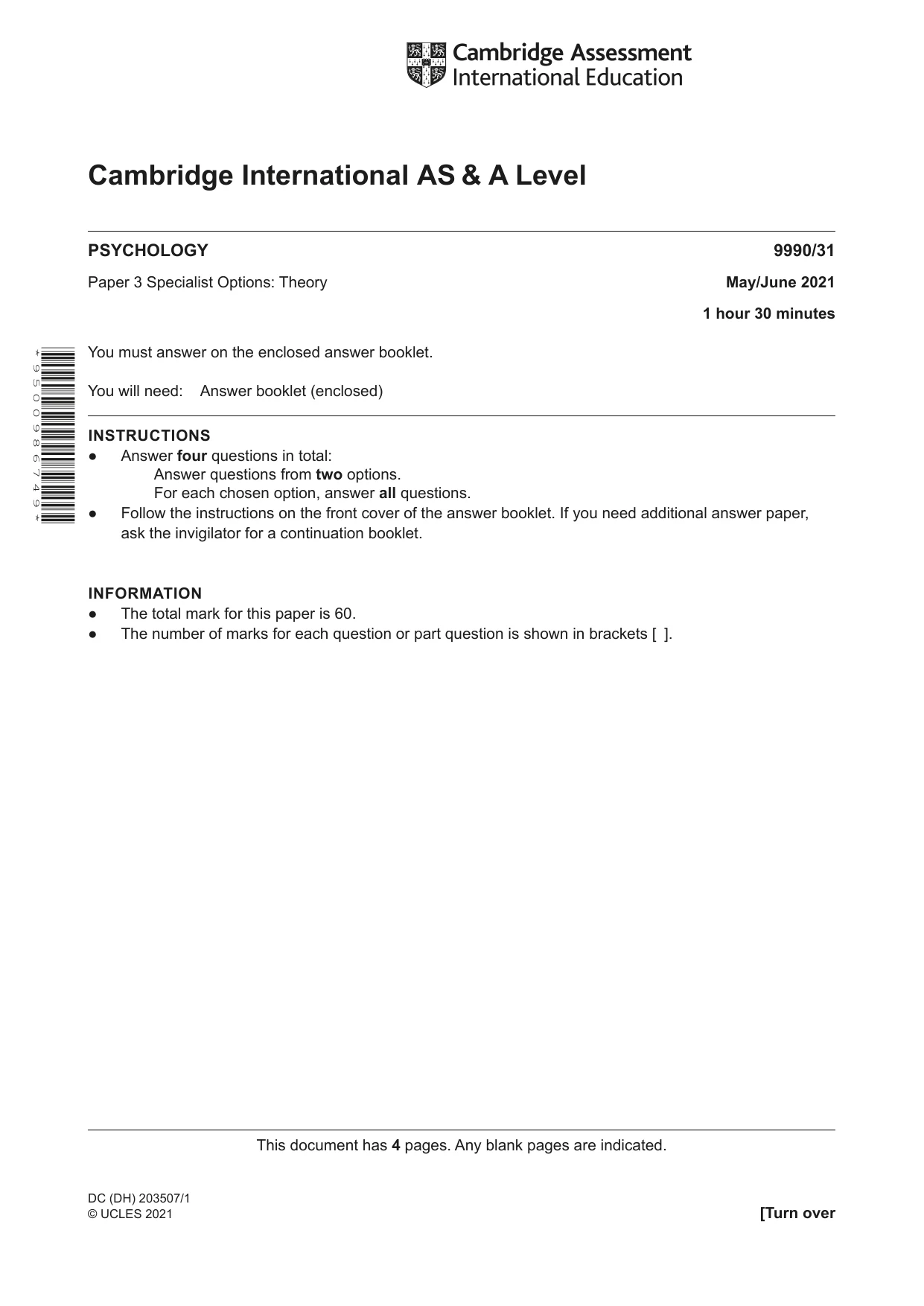
Question paper, page 1
This document has 4 pages. Any blank pages are indicated. Cambridge International AS & A Level DC (DH) 203507/1 © UCLES 2021 [Turn over * 9 5 0 0 9 8 6 7 4 9 * PSYCHOLOGY 9990/31 Paper 3 Specialist Options: Theory May/June 2021 1 hour 30 minutes You must answer on the enclosed answer booklet. You will need: Answer booklet (enclosed) INSTRUCTIONS ● Answer four questions in total: Answer questions from two options. For each chosen option, answer all questions. ● Follow the instructions on the front cover of the answer booklet. If you need additional answer paper, ask the invigilator for a continuation booklet. INFORMATION ● The total mark for this paper is 60. ● The number of marks for each question or part question is shown in brackets [ ].
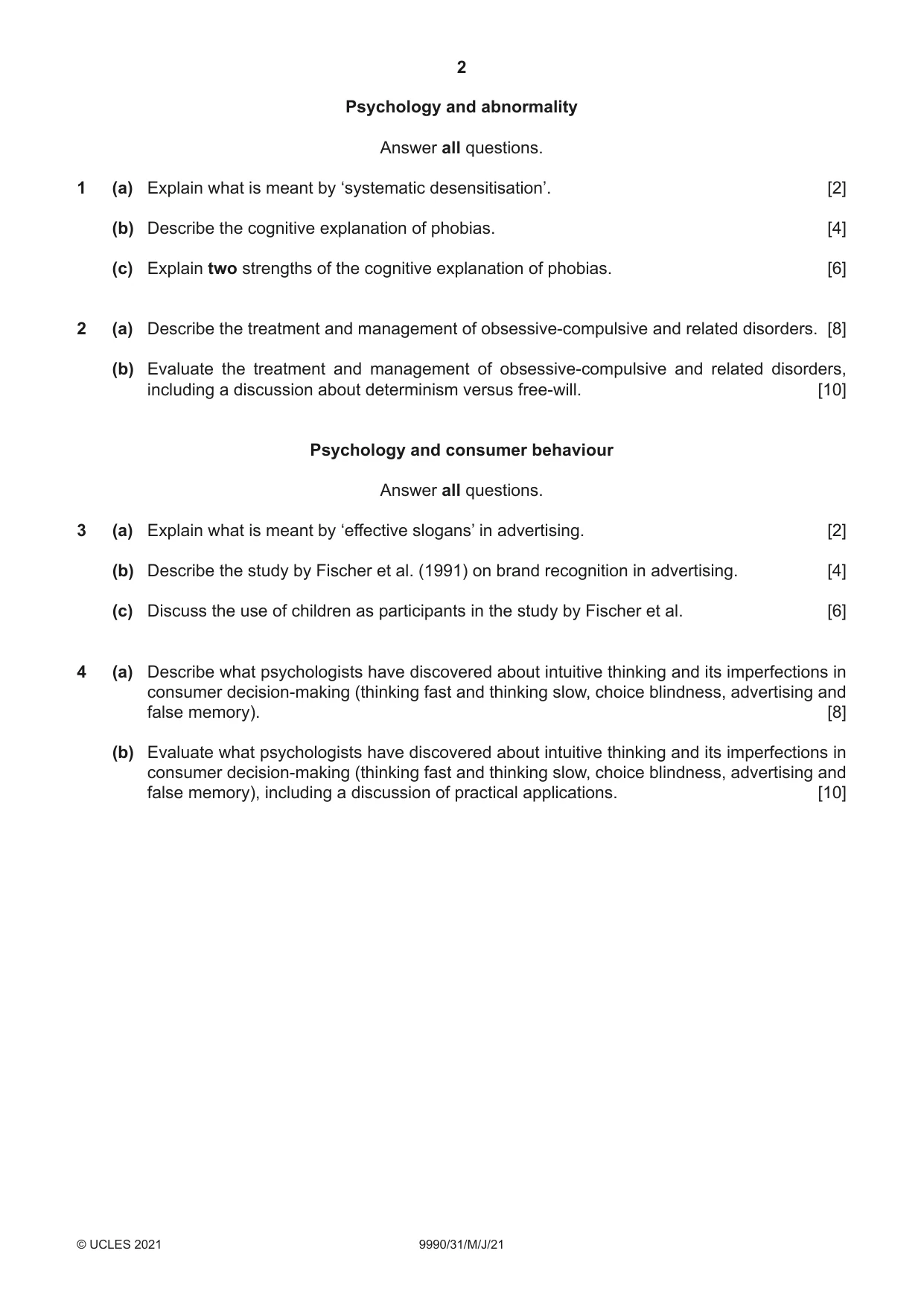
Question paper, page 2
2 9990/31/M/J/21 © UCLES 2021 Psychology and abnormality Answer all questions. 1 (a) Explain what is meant by ‘systematic desensitisation’. [2] (b) Describe the cognitive explanation of phobias. [4] (c) Explain two strengths of the cognitive explanation of phobias. [6] 2 (a) Describe the treatment and management of obsessive-compulsive and related disorders. [8] (b) Evaluate the treatment and management of obsessive-compulsive and related disorders, including a discussion about determinism versus free-will. [10] Psychology and consumer behaviour Answer all questions. 3 (a) Explain what is meant by ‘effective slogans’ in advertising. [2] (b) Describe the study by Fischer et al. (1991) on brand recognition in advertising. [4] (c) Discuss the use of children as participants in the study by Fischer et al. [6] 4 (a) Describe what psychologists have discovered about intuitive thinking and its imperfections in consumer decision-making (thinking fast and thinking slow, choice blindness, advertising and false memory). [8] (b) Evaluate what psychologists have discovered about intuitive thinking and its imperfections in consumer decision-making (thinking fast and thinking slow, choice blindness, advertising and false memory), including a discussion of practical applications. [10]
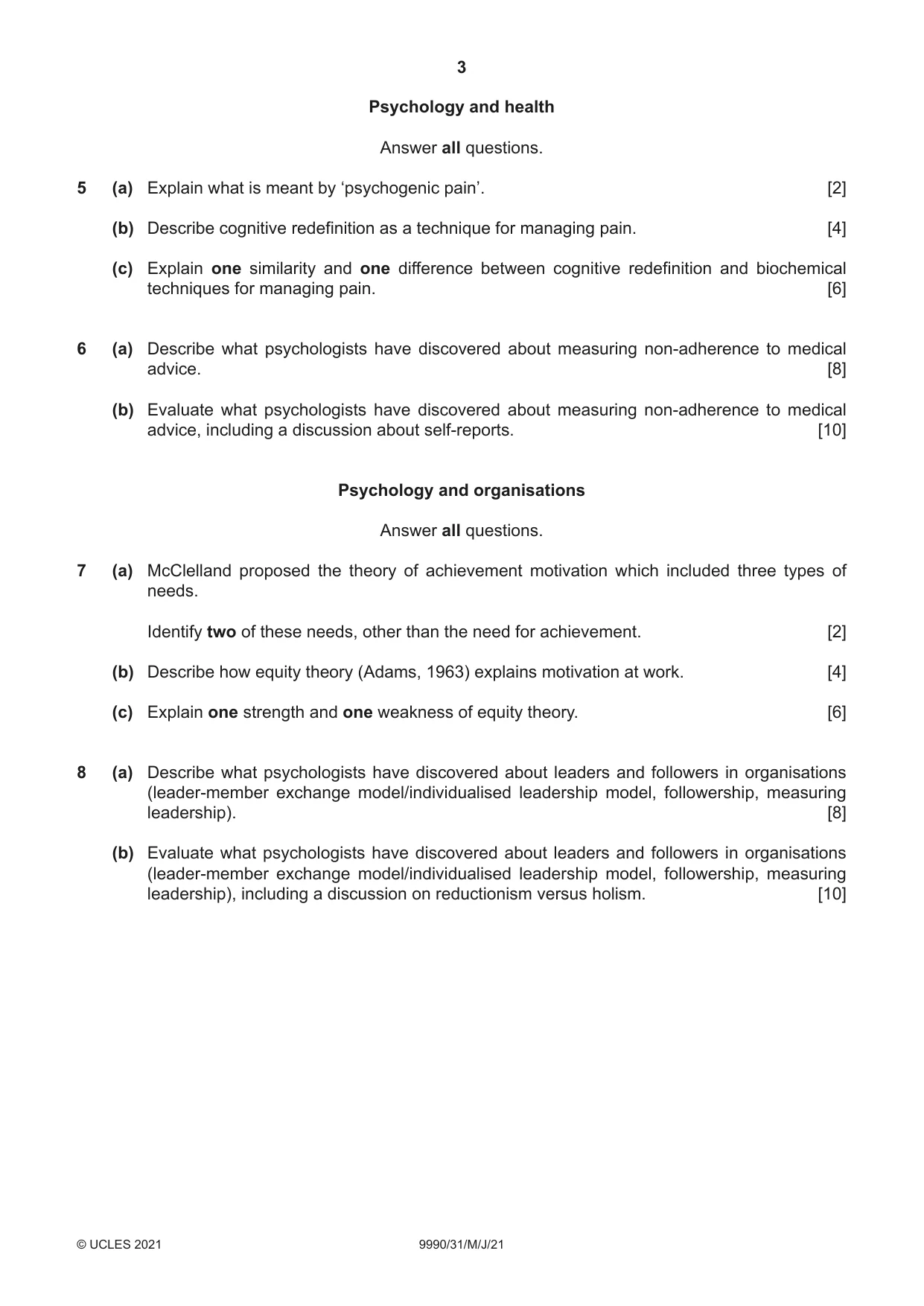
Question paper, page 3
3 9990/31/M/J/21 © UCLES 2021 Psychology and health Answer all questions. 5 (a) Explain what is meant by ‘psychogenic pain’. [2] (b) Describe cognitive redefinition as a technique for managing pain. [4] (c) Explain one similarity and one difference between cognitive redefinition and biochemical techniques for managing pain. [6] 6 (a) Describe what psychologists have discovered about measuring non-adherence to medical advice. [8] (b) Evaluate what psychologists have discovered about measuring non-adherence to medical advice, including a discussion about self-reports. [10] Psychology and organisations Answer all questions. 7 (a) McClelland proposed the theory of achievement motivation which included three types of needs. Identify two of these needs, other than the need for achievement. [2] (b) Describe how equity theory (Adams, 1963) explains motivation at work. [4] (c) Explain one strength and one weakness of equity theory. [6] 8 (a) Describe what psychologists have discovered about leaders and followers in organisations (leader-member exchange model/individualised leadership model, followership, measuring leadership). [8] (b) Evaluate what psychologists have discovered about leaders and followers in organisations (leader-member exchange model/individualised leadership model, followership, measuring leadership), including a discussion on reductionism versus holism. [10]
Question paper, page 4
4 9990/31/M/J/21 © UCLES 2021 Permission to reproduce items where third-party owned material protected by copyright is included has been sought and cleared where possible. Every reasonable effort has been made by the publisher (UCLES) to trace copyright holders, but if any items requiring clearance have unwittingly been included, the publisher will be pleased to make amends at the earliest possible opportunity. To avoid the issue of disclosure of answer-related information to candidates, all copyright acknowledgements are reproduced online in the Cambridge Assessment International Education Copyright Acknowledgements Booklet. This is produced for each series of examinations and is freely available to download at www.cambridgeinternational.org after the live examination series. Cambridge Assessment International Education is part of the Cambridge Assessment Group. Cambridge Assessment is the brand name of the University of Cambridge Local Examinations Syndicate (UCLES), which itself is a department of the University of Cambridge. BLANK PAGE
Mark scheme, page 1
This document consists of 22 printed pages. © UCLES 2021 [Turn over Cambridge International AS & A Level PSYCHOLOGY 9990/31 Paper 3 Specialist Options: Theory May/June 2021 MARK SCHEME Maximum Mark: 60 Published This mark scheme is published as an aid to teachers and candidates, to indicate the requirements of the examination. It shows the basis on which Examiners were instructed to award marks. It does not indicate the details of the discussions that took place at an Examiners’ meeting before marking began, which would have considered the acceptability of alternative answers. Mark schemes should be read in conjunction with the question paper and the Principal Examiner Report for Teachers. Cambridge International will not enter into discussions about these mark schemes. Cambridge International is publishing the mark schemes for the May/June 2021 series for most Cambridge IGCSE™, Cambridge International A and AS Level components and some Cambridge O Level components.
Mark scheme, page 2
9990/31 Cambridge International AS & A Level – Mark Scheme PUBLISHED May/June 2021 © UCLES 2021 Page 2 of 22 Generic Marking Principles These general marking principles must be applied by all examiners when marking candidate answers. They should be applied alongside the specific content of the mark scheme or generic level descriptors for a question. Each question paper and mark scheme will also comply with these marking principles. GENERIC MARKING PRINCIPLE 1: Marks must be awarded in line with: • the specific content of the mark scheme or the generic level descriptors for the question • the specific skills defined in the mark scheme or in the generic level descriptors for the question • the standard of response required by a candidate as exemplified by the standardisation scripts. GENERIC MARKING PRINCIPLE 2: Marks awarded are always whole marks (not half marks, or other fractions). GENERIC MARKING PRINCIPLE 3: Marks must be awarded positively: • marks are awarded for correct/valid answers, as defined in the mark scheme. However, credit is given for valid answers which go beyond the scope of the syllabus and mark scheme, referring to your Team Leader as appropriate • marks are awarded when candidates clearly demonstrate what they know and can do • marks are not deducted for errors • marks are not deducted for omissions • answers should only be judged on the quality of spelling, punctuation and grammar when these features are specifically assessed by the question as indicated by the mark scheme. The meaning, however, should be unambiguous. GENERIC MARKING PRINCIPLE 4: Rules must be applied consistently, e.g. in situations where candidates have not followed instructions or in the application of generic level descriptors. GENERIC MARKING PRINCIPLE 5: Marks should be awarded using the full range of marks defined in the mark scheme for the question (however; the use of the full mark range may be limited according to the quality of the candidate responses seen). GENERIC MARKING PRINCIPLE 6: Marks awarded are based solely on the requirements as defined in the mark scheme. Marks should not be awarded with grade thresholds or grade descriptors in mind.
Mark scheme, page 3
9990/31 Cambridge International AS & A Level – Mark Scheme PUBLISHED May/June 2021 © UCLES 2021 Page 3 of 22 Social Science-Specific Marking Principles (for point-based marking) 1 Components using point-based marking: • Point marking is often used to reward knowledge, understanding and application of skills. We give credit where the candidate’s answer shows relevant knowledge, understanding and application of skills in answering the question. We do not give credit where the answer shows confusion. From this it follows that we: a DO credit answers which are worded differently from the mark scheme if they clearly convey the same meaning (unless the mark scheme requires a specific term) b DO credit alternative answers/examples which are not written in the mark scheme if they are correct c DO credit answers where candidates give more than one correct answer in one prompt/numbered/scaffolded space where extended writing is required rather than list-type answers. For example, questions that require n reasons (e.g. State two reasons …). d DO NOT credit answers simply for using a ‘key term’ unless that is all that is required. (Check for evidence it is understood and not used wrongly.) e DO NOT credit answers which are obviously self-contradicting or trying to cover all possibilities f DO NOT give further credit for what is effectively repetition of a correct point already credited unless the language itself is being tested. This applies equally to ‘mirror statements’ (i.e. polluted/not polluted). g DO NOT require spellings to be correct, unless this is part of the test. However spellings of syllabus terms must allow for clear and unambiguous separation from other syllabus terms with which they may be confused (e.g. Corrasion/Corrosion) 2 Presentation of mark scheme: • Slashes (/) or the word ‘or’ separate alternative ways of making the same point. • Semi colons (;) bullet points (•) or figures in brackets (1) separate different points. • Content in the answer column in brackets is for examiner information/context to clarify the marking but is not required to earn the mark (except Accounting syllabuses where they indicate negative numbers). 3 Annotation: • For point marking, ticks can be used to indicate correct answers and crosses can be used to indicate wrong answers. There is no direct relationship between ticks and marks. Ticks have no defined meaning for levels of response marking. • For levels of response marking, the level awarded should be annotated on the script. • Other annotations will be used by examiners as agreed during standardisation, and the meaning will be understood by all examiners who marked that paper.
Mark scheme, page 4
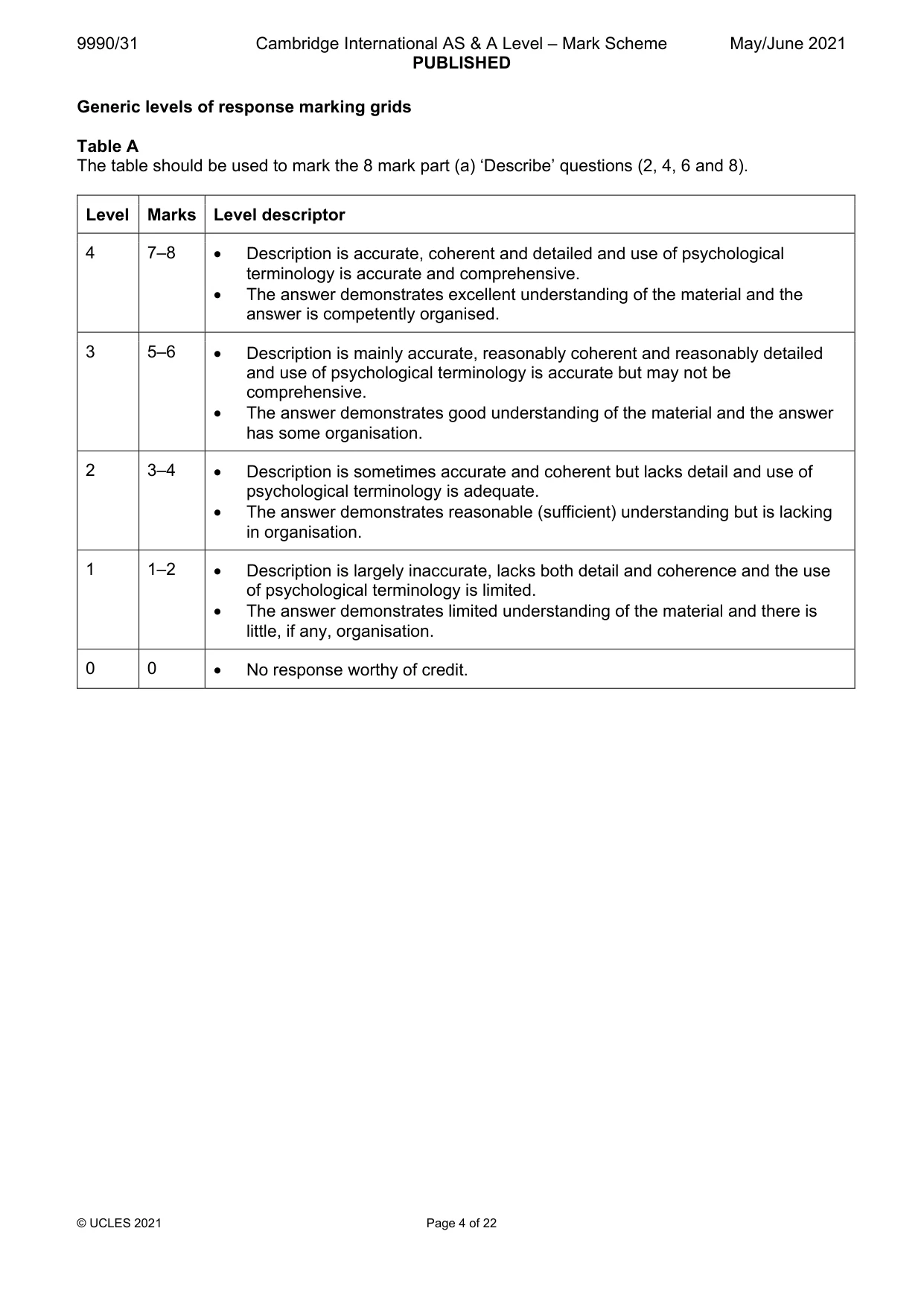
9990/31 Cambridge International AS & A Level – Mark Scheme PUBLISHED May/June 2021 © UCLES 2021 Page 4 of 22 Generic levels of response marking grids Table A The table should be used to mark the 8 mark part (a) ‘Describe’ questions (2, 4, 6 and 8). Level Marks Level descriptor 4 7–8 • Description is accurate, coherent and detailed and use of psychological terminology is accurate and comprehensive. • The answer demonstrates excellent understanding of the material and the answer is competently organised. 3 5–6 • Description is mainly accurate, reasonably coherent and reasonably detailed and use of psychological terminology is accurate but may not be comprehensive. • The answer demonstrates good understanding of the material and the answer has some organisation. 2 3–4 • Description is sometimes accurate and coherent but lacks detail and use of psychological terminology is adequate. • The answer demonstrates reasonable (sufficient) understanding but is lacking in organisation. 1 1–2 • Description is largely inaccurate, lacks both detail and coherence and the use of psychological terminology is limited. • The answer demonstrates limited understanding of the material and there is little, if any, organisation. 0 0 • No response worthy of credit.
Mark scheme, page 5
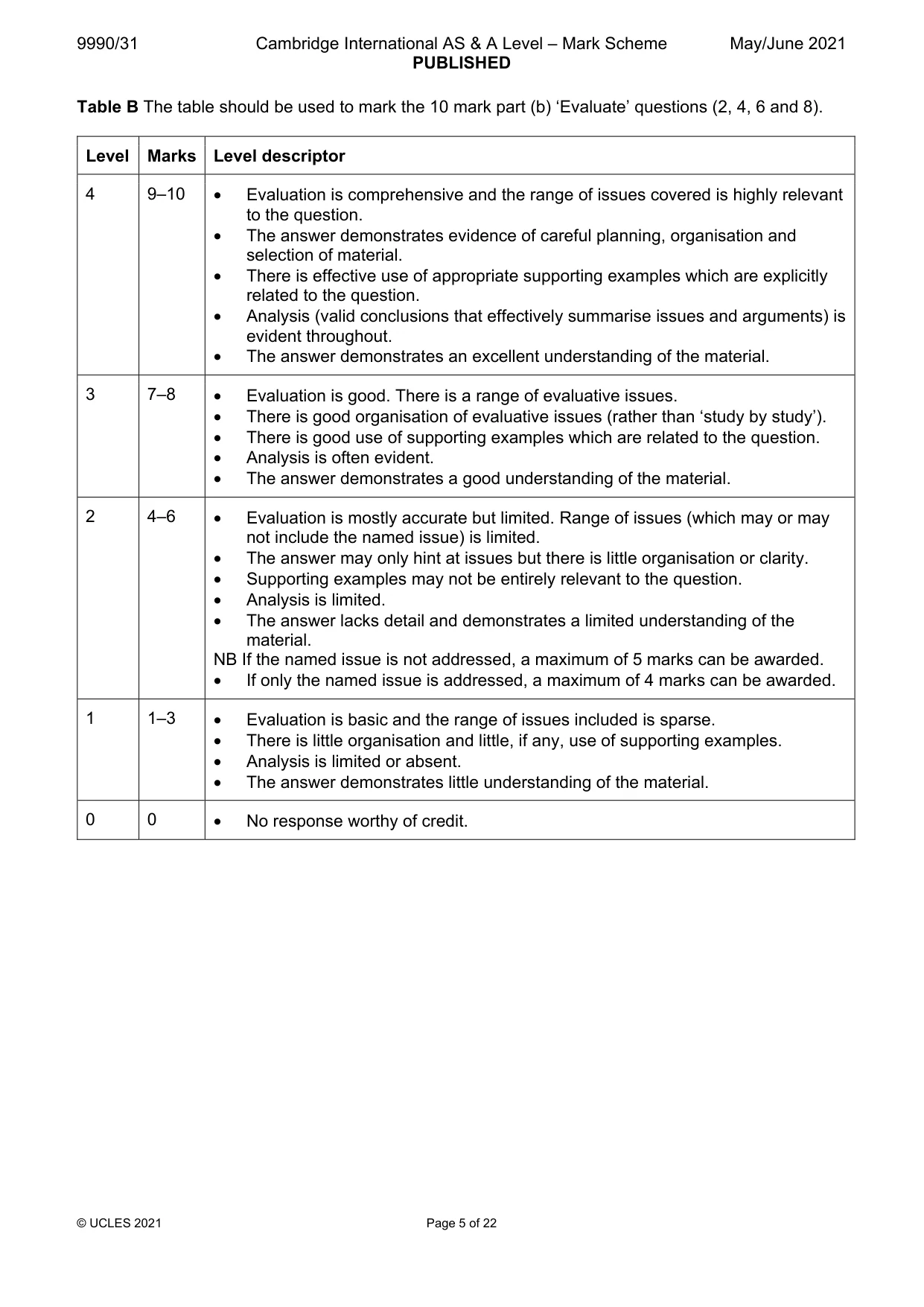
9990/31 Cambridge International AS & A Level – Mark Scheme PUBLISHED May/June 2021 © UCLES 2021 Page 5 of 22 Table B The table should be used to mark the 10 mark part (b) ‘Evaluate’ questions (2, 4, 6 and 8). Level Marks Level descriptor 4 9–10 • Evaluation is comprehensive and the range of issues covered is highly relevant to the question. • The answer demonstrates evidence of careful planning, organisation and selection of material. • There is effective use of appropriate supporting examples which are explicitly related to the question. • Analysis (valid conclusions that effectively summarise issues and arguments) is evident throughout. • The answer demonstrates an excellent understanding of the material. 3 7–8 • Evaluation is good. There is a range of evaluative issues. • There is good organisation of evaluative issues (rather than ‘study by study’). • There is good use of supporting examples which are related to the question. • Analysis is often evident. • The answer demonstrates a good understanding of the material. 2 4–6 • Evaluation is mostly accurate but limited. Range of issues (which may or may not include the named issue) is limited. • The answer may only hint at issues but there is little organisation or clarity. • Supporting examples may not be entirely relevant to the question. • Analysis is limited. • The answer lacks detail and demonstrates a limited understanding of the material. NB If the named issue is not addressed, a maximum of 5 marks can be awarded. • If only the named issue is addressed, a maximum of 4 marks can be awarded. 1 1–3 • Evaluation is basic and the range of issues included is sparse. • There is little organisation and little, if any, use of supporting examples. • Analysis is limited or absent. • The answer demonstrates little understanding of the material. 0 0 • No response worthy of credit.
Mark scheme, page 6
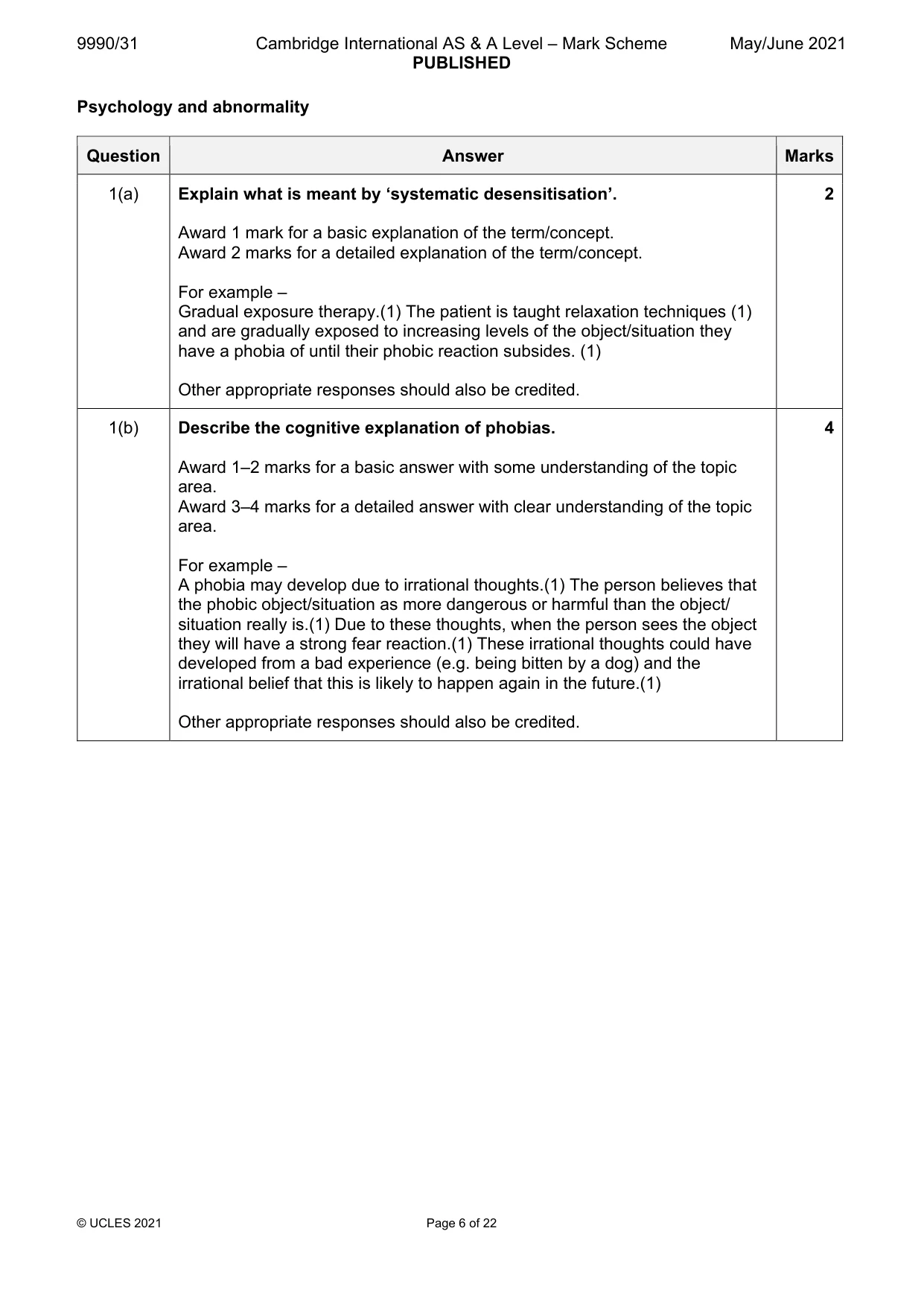
9990/31 Cambridge International AS & A Level – Mark Scheme PUBLISHED May/June 2021 © UCLES 2021 Page 6 of 22 Psychology and abnormality Question Answer Marks 1(a) Explain what is meant by ‘systematic desensitisation’. Award 1 mark for a basic explanation of the term/concept. Award 2 marks for a detailed explanation of the term/concept. For example – Gradual exposure therapy.(1) The patient is taught relaxation techniques (1) and are gradually exposed to increasing levels of the object/situation they have a phobia of until their phobic reaction subsides. (1) Other appropriate responses should also be credited. 2 1(b) Describe the cognitive explanation of phobias. Award 1–2 marks for a basic answer with some understanding of the topic area. Award 3–4 marks for a detailed answer with clear understanding of the topic area. For example – A phobia may develop due to irrational thoughts.(1) The person believes that the phobic object/situation as more dangerous or harmful than the object/ situation really is.(1) Due to these thoughts, when the person sees the object they will have a strong fear reaction.(1) These irrational thoughts could have developed from a bad experience (e.g. being bitten by a dog) and the irrational belief that this is likely to happen again in the future.(1) Other appropriate responses should also be credited. 4
Mark scheme, page 7
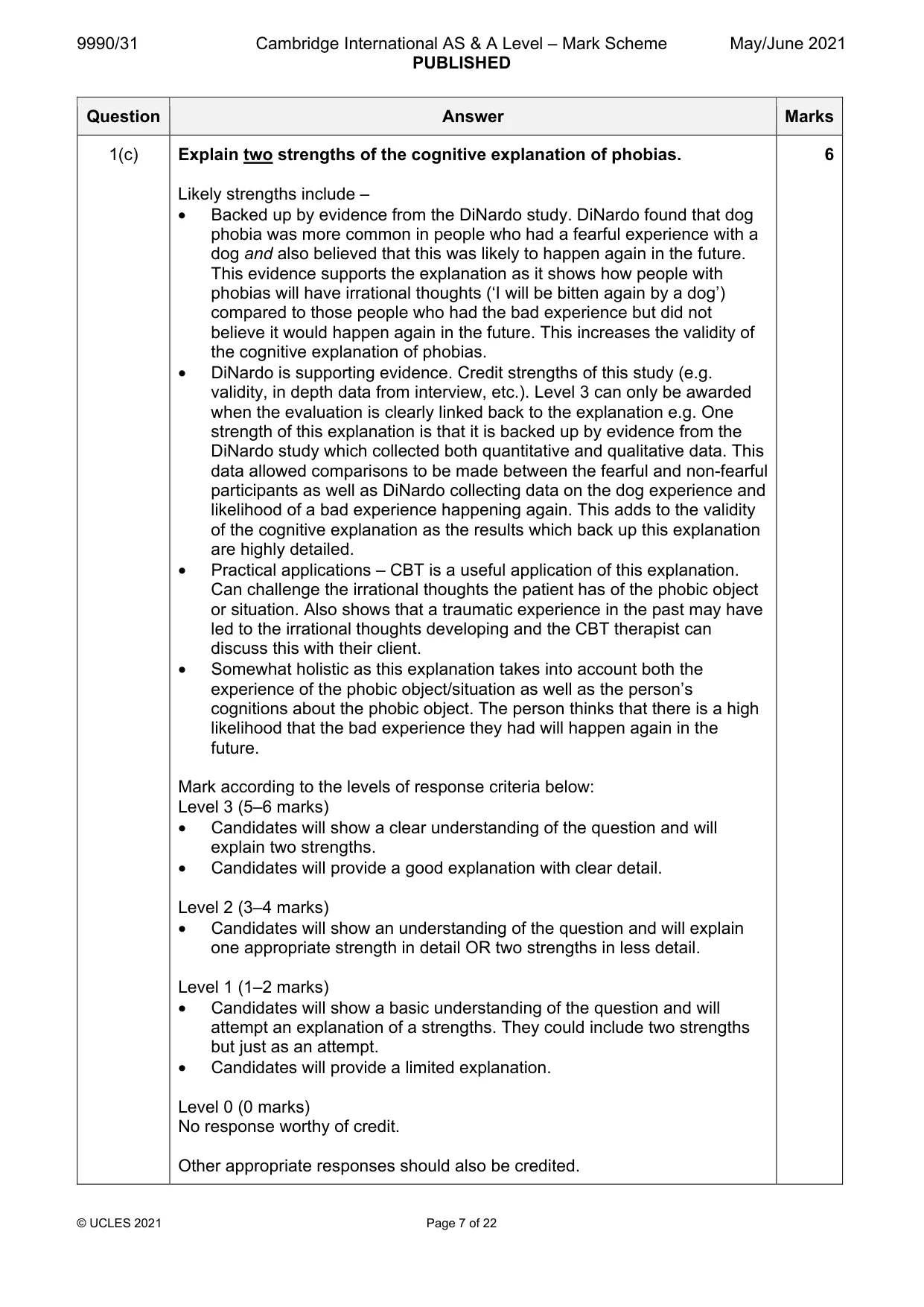
9990/31 Cambridge International AS & A Level – Mark Scheme PUBLISHED May/June 2021 © UCLES 2021 Page 7 of 22 Question Answer Marks 1(c) Explain two strengths of the cognitive explanation of phobias. Likely strengths include – • Backed up by evidence from the DiNardo study. DiNardo found that dog phobia was more common in people who had a fearful experience with a dog and also believed that this was likely to happen again in the future. This evidence supports the explanation as it shows how people with phobias will have irrational thoughts (‘I will be bitten again by a dog’) compared to those people who had the bad experience but did not believe it would happen again in the future. This increases the validity of the cognitive explanation of phobias. • DiNardo is supporting evidence. Credit strengths of this study (e.g. validity, in depth data from interview, etc.). Level 3 can only be awarded when the evaluation is clearly linked back to the explanation e.g. One strength of this explanation is that it is backed up by evidence from the DiNardo study which collected both quantitative and qualitative data. This data allowed comparisons to be made between the fearful and non-fearful participants as well as DiNardo collecting data on the dog experience and likelihood of a bad experience happening again. This adds to the validity of the cognitive explanation as the results which back up this explanation are highly detailed. • Practical applications – CBT is a useful application of this explanation. Can challenge the irrational thoughts the patient has of the phobic object or situation. Also shows that a traumatic experience in the past may have led to the irrational thoughts developing and the CBT therapist can discuss this with their client. • Somewhat holistic as this explanation takes into account both the experience of the phobic object/situation as well as the person’s cognitions about the phobic object. The person thinks that there is a high likelihood that the bad experience they had will happen again in the future. Mark according to the levels of response criteria below: Level 3 (5–6 marks) • Candidates will show a clear understanding of the question and will explain two strengths. • Candidates will provide a good explanation with clear detail. Level 2 (3–4 marks) • Candidates will show an understanding of the question and will explain one appropriate strength in detail OR two strengths in less detail. Level 1 (1–2 marks) • Candidates will show a basic understanding of the question and will attempt an explanation of a strengths. They could include two strengths but just as an attempt. • Candidates will provide a limited explanation. Level 0 (0 marks) No response worthy of credit. Other appropriate responses should also be credited. 6
Mark scheme, page 8
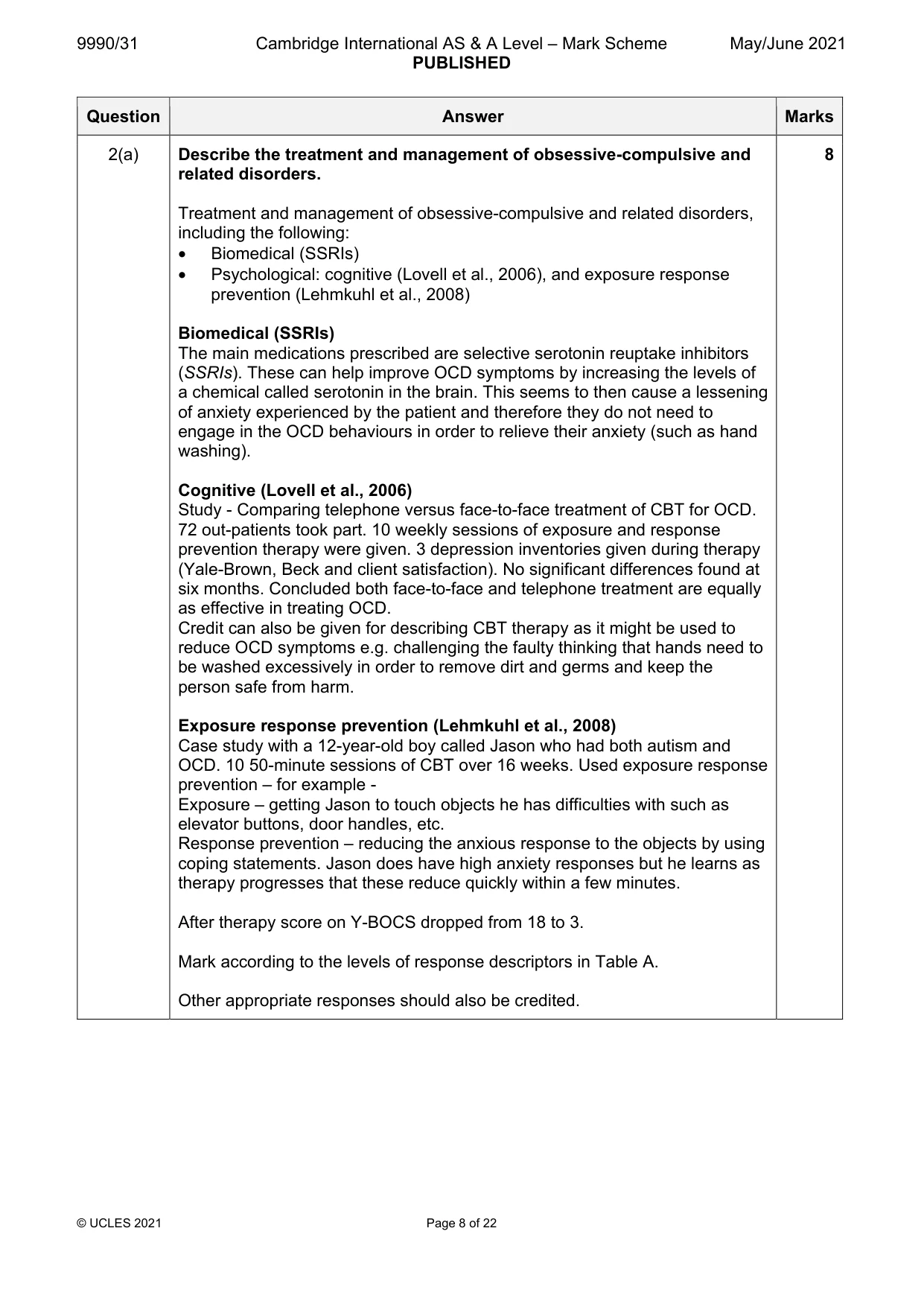
9990/31 Cambridge International AS & A Level – Mark Scheme PUBLISHED May/June 2021 © UCLES 2021 Page 8 of 22 Question Answer Marks 2(a) Describe the treatment and management of obsessive-compulsive and related disorders. Treatment and management of obsessive-compulsive and related disorders, including the following: • Biomedical (SSRIs) • Psychological: cognitive (Lovell et al., 2006), and exposure response prevention (Lehmkuhl et al., 2008) Biomedical (SSRIs) The main medications prescribed are selective serotonin reuptake inhibitors (SSRIs). These can help improve OCD symptoms by increasing the levels of a chemical called serotonin in the brain. This seems to then cause a lessening of anxiety experienced by the patient and therefore they do not need to engage in the OCD behaviours in order to relieve their anxiety (such as hand washing). Cognitive (Lovell et al., 2006) Study - Comparing telephone versus face-to-face treatment of CBT for OCD. 72 out-patients took part. 10 weekly sessions of exposure and response prevention therapy were given. 3 depression inventories given during therapy (Yale-Brown, Beck and client satisfaction). No significant differences found at six months. Concluded both face-to-face and telephone treatment are equally as effective in treating OCD. Credit can also be given for describing CBT therapy as it might be used to reduce OCD symptoms e.g. challenging the faulty thinking that hands need to be washed excessively in order to remove dirt and germs and keep the person safe from harm. Exposure response prevention (Lehmkuhl et al., 2008) Case study with a 12-year-old boy called Jason who had both autism and OCD. 10 50-minute sessions of CBT over 16 weeks. Used exposure response prevention – for example - Exposure – getting Jason to touch objects he has difficulties with such as elevator buttons, door handles, etc. Response prevention – reducing the anxious response to the objects by using coping statements. Jason does have high anxiety responses but he learns as therapy progresses that these reduce quickly within a few minutes. After therapy score on Y-BOCS dropped from 18 to 3. Mark according to the levels of response descriptors in Table A. Other appropriate responses should also be credited. 8
Mark scheme, page 9
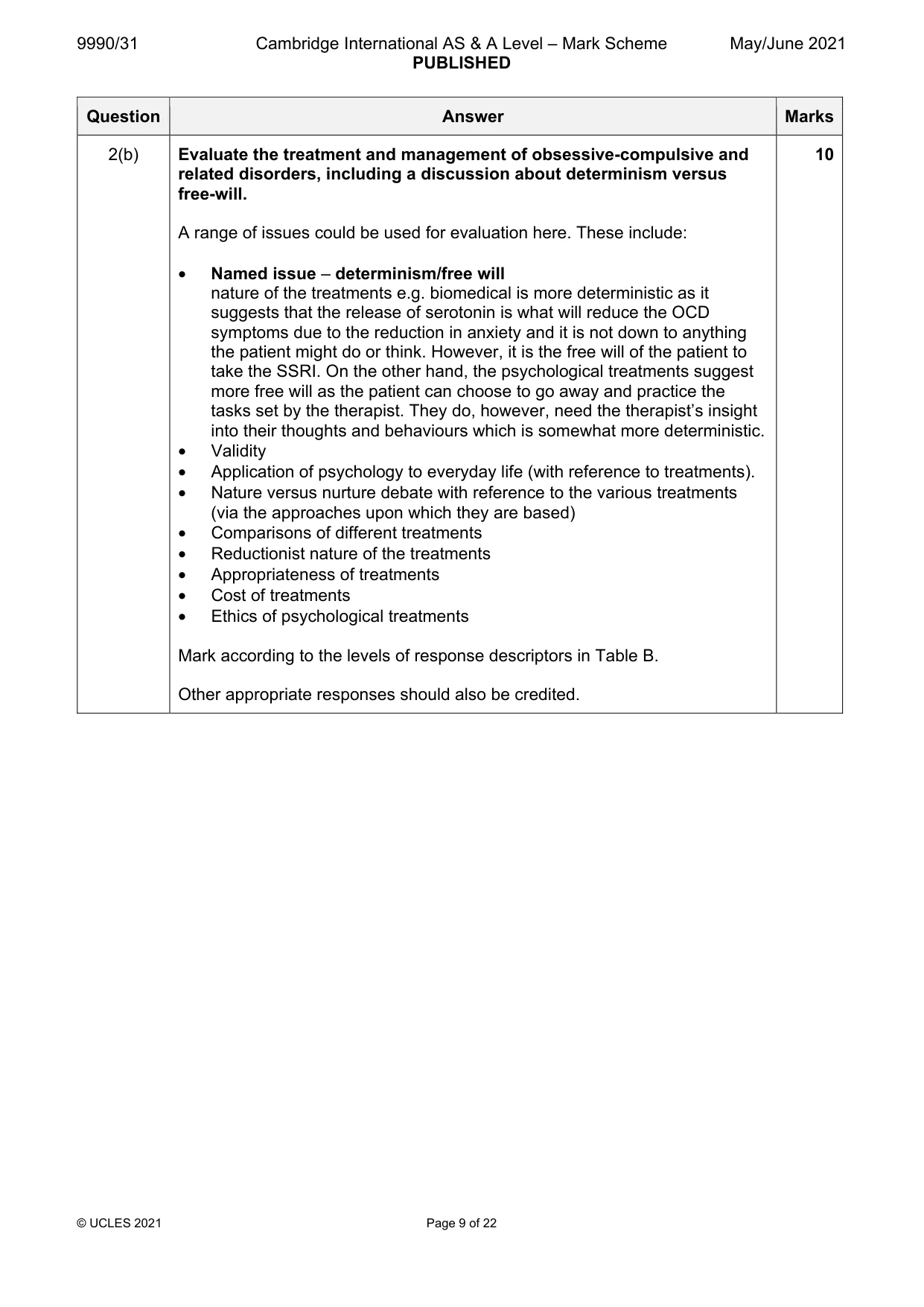
9990/31 Cambridge International AS & A Level – Mark Scheme PUBLISHED May/June 2021 © UCLES 2021 Page 9 of 22 Question Answer Marks 2(b) Evaluate the treatment and management of obsessive-compulsive and related disorders, including a discussion about determinism versus free-will. A range of issues could be used for evaluation here. These include: • Named issue – determinism/free will nature of the treatments e.g. biomedical is more deterministic as it suggests that the release of serotonin is what will reduce the OCD symptoms due to the reduction in anxiety and it is not down to anything the patient might do or think. However, it is the free will of the patient to take the SSRI. On the other hand, the psychological treatments suggest more free will as the patient can choose to go away and practice the tasks set by the therapist. They do, however, need the therapist’s insight into their thoughts and behaviours which is somewhat more deterministic. • Validity • Application of psychology to everyday life (with reference to treatments). • Nature versus nurture debate with reference to the various treatments (via the approaches upon which they are based) • Comparisons of different treatments • Reductionist nature of the treatments • Appropriateness of treatments • Cost of treatments • Ethics of psychological treatments Mark according to the levels of response descriptors in Table B. Other appropriate responses should also be credited. 10
Mark scheme, page 10
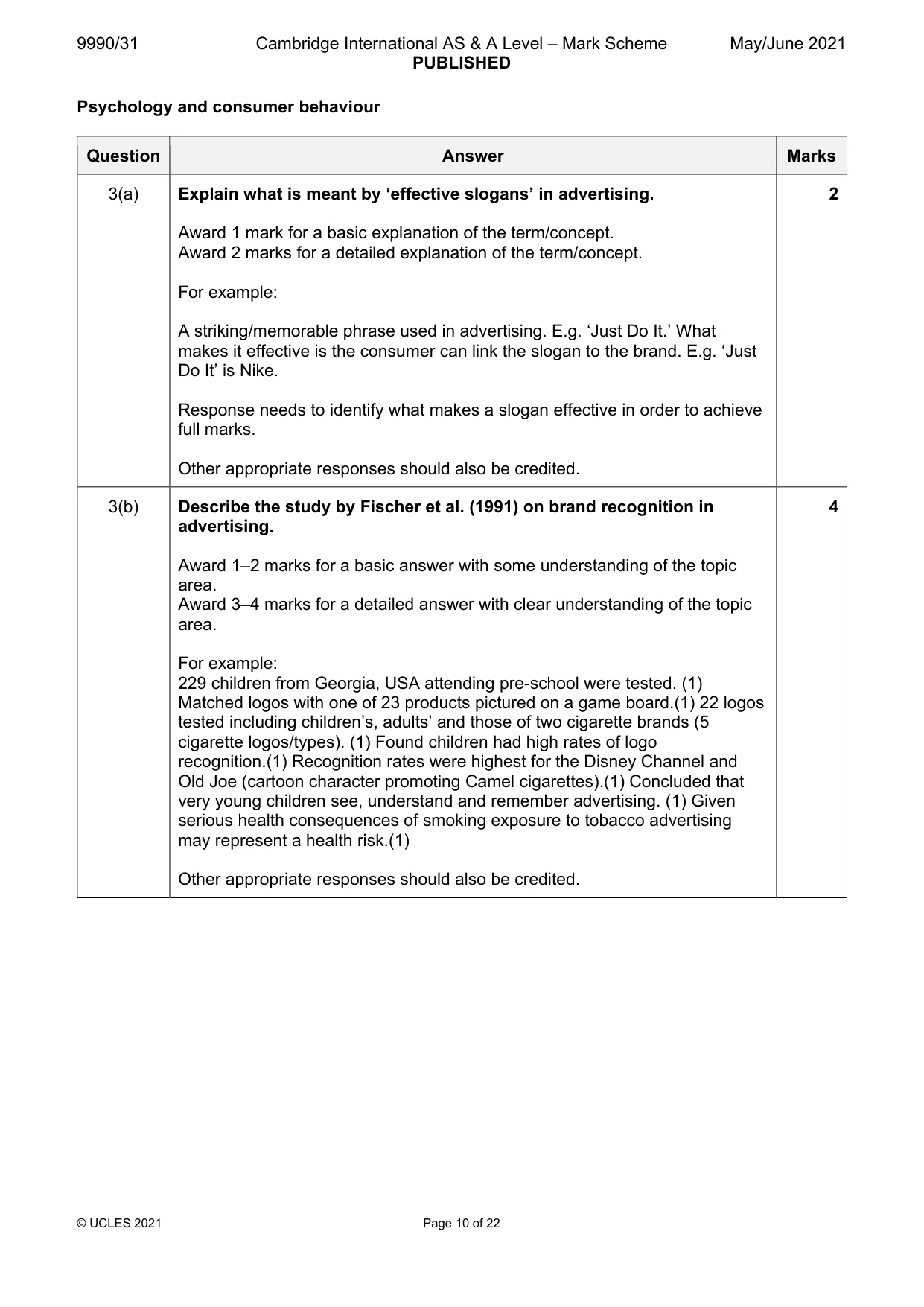
9990/31 Cambridge International AS & A Level – Mark Scheme PUBLISHED May/June 2021 © UCLES 2021 Page 10 of 22 Psychology and consumer behaviour Question Answer Marks 3(a) Explain what is meant by ‘effective slogans’ in advertising. Award 1 mark for a basic explanation of the term/concept. Award 2 marks for a detailed explanation of the term/concept. For example: A striking/memorable phrase used in advertising. E.g. ‘Just Do It.’ What makes it effective is the consumer can link the slogan to the brand. E.g. ‘Just Do It’ is Nike. Response needs to identify what makes a slogan effective in order to achieve full marks. Other appropriate responses should also be credited. 2 3(b) Describe the study by Fischer et al. (1991) on brand recognition in advertising. Award 1–2 marks for a basic answer with some understanding of the topic area. Award 3–4 marks for a detailed answer with clear understanding of the topic area. For example: 229 children from Georgia, USA attending pre-school were tested. (1) Matched logos with one of 23 products pictured on a game board.(1) 22 logos tested including children’s, adults’ and those of two cigarette brands (5 cigarette logos/types). (1) Found children had high rates of logo recognition.(1) Recognition rates were highest for the Disney Channel and Old Joe (cartoon character promoting Camel cigarettes).(1) Concluded that very young children see, understand and remember advertising. (1) Given serious health consequences of smoking exposure to tobacco advertising may represent a health risk.(1) Other appropriate responses should also be credited. 4
Mark scheme, page 11
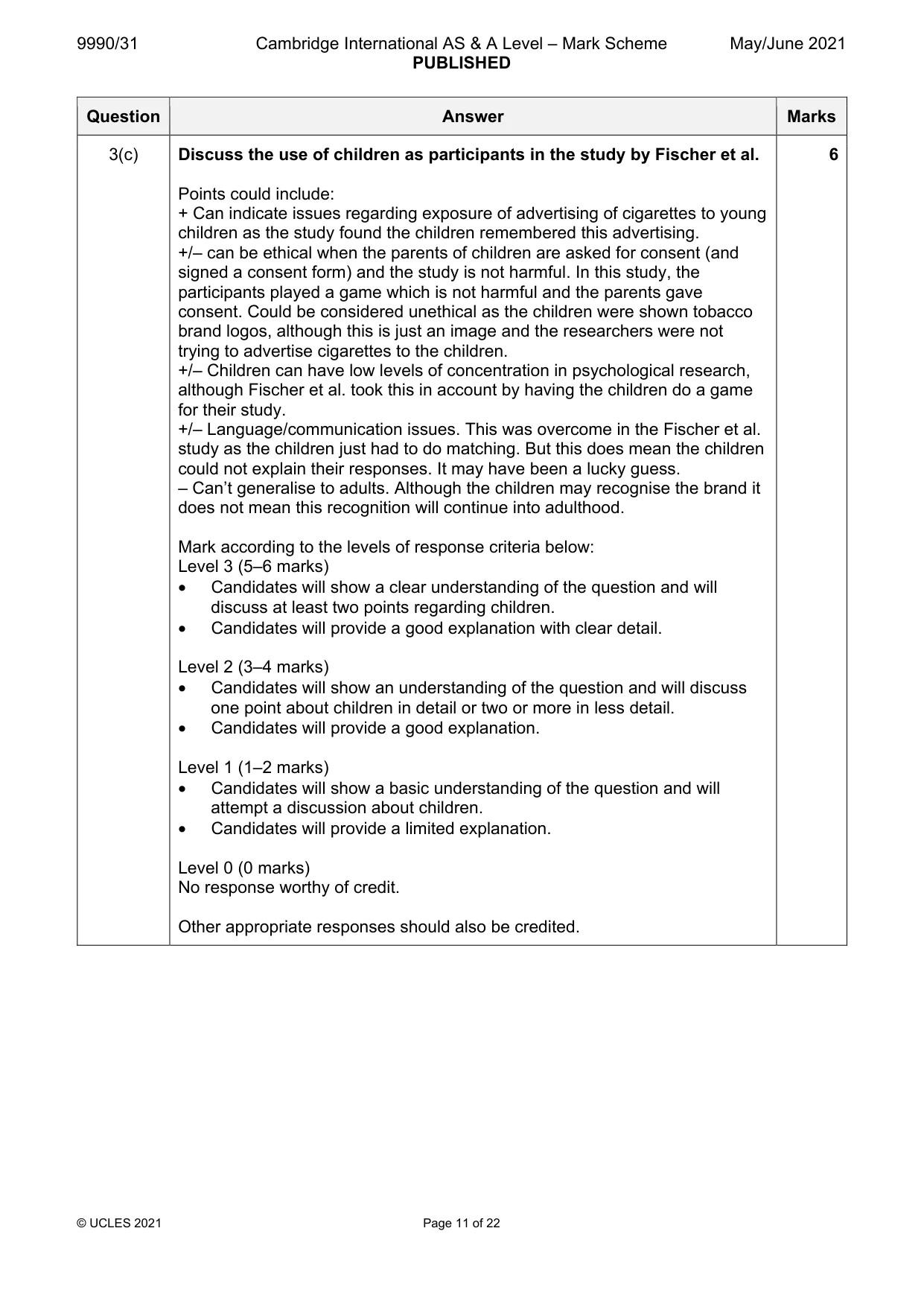
9990/31 Cambridge International AS & A Level – Mark Scheme PUBLISHED May/June 2021 © UCLES 2021 Page 11 of 22 Question Answer Marks 3(c) Discuss the use of children as participants in the study by Fischer et al. Points could include: + Can indicate issues regarding exposure of advertising of cigarettes to young children as the study found the children remembered this advertising. +/– can be ethical when the parents of children are asked for consent (and signed a consent form) and the study is not harmful. In this study, the participants played a game which is not harmful and the parents gave consent. Could be considered unethical as the children were shown tobacco brand logos, although this is just an image and the researchers were not trying to advertise cigarettes to the children. +/– Children can have low levels of concentration in psychological research, although Fischer et al. took this in account by having the children do a game for their study. +/– Language/communication issues. This was overcome in the Fischer et al. study as the children just had to do matching. But this does mean the children could not explain their responses. It may have been a lucky guess. – Can’t generalise to adults. Although the children may recognise the brand it does not mean this recognition will continue into adulthood. Mark according to the levels of response criteria below: Level 3 (5–6 marks) • Candidates will show a clear understanding of the question and will discuss at least two points regarding children. • Candidates will provide a good explanation with clear detail. Level 2 (3–4 marks) • Candidates will show an understanding of the question and will discuss one point about children in detail or two or more in less detail. • Candidates will provide a good explanation. Level 1 (1–2 marks) • Candidates will show a basic understanding of the question and will attempt a discussion about children. • Candidates will provide a limited explanation. Level 0 (0 marks) No response worthy of credit. Other appropriate responses should also be credited. 6
Mark scheme, page 12
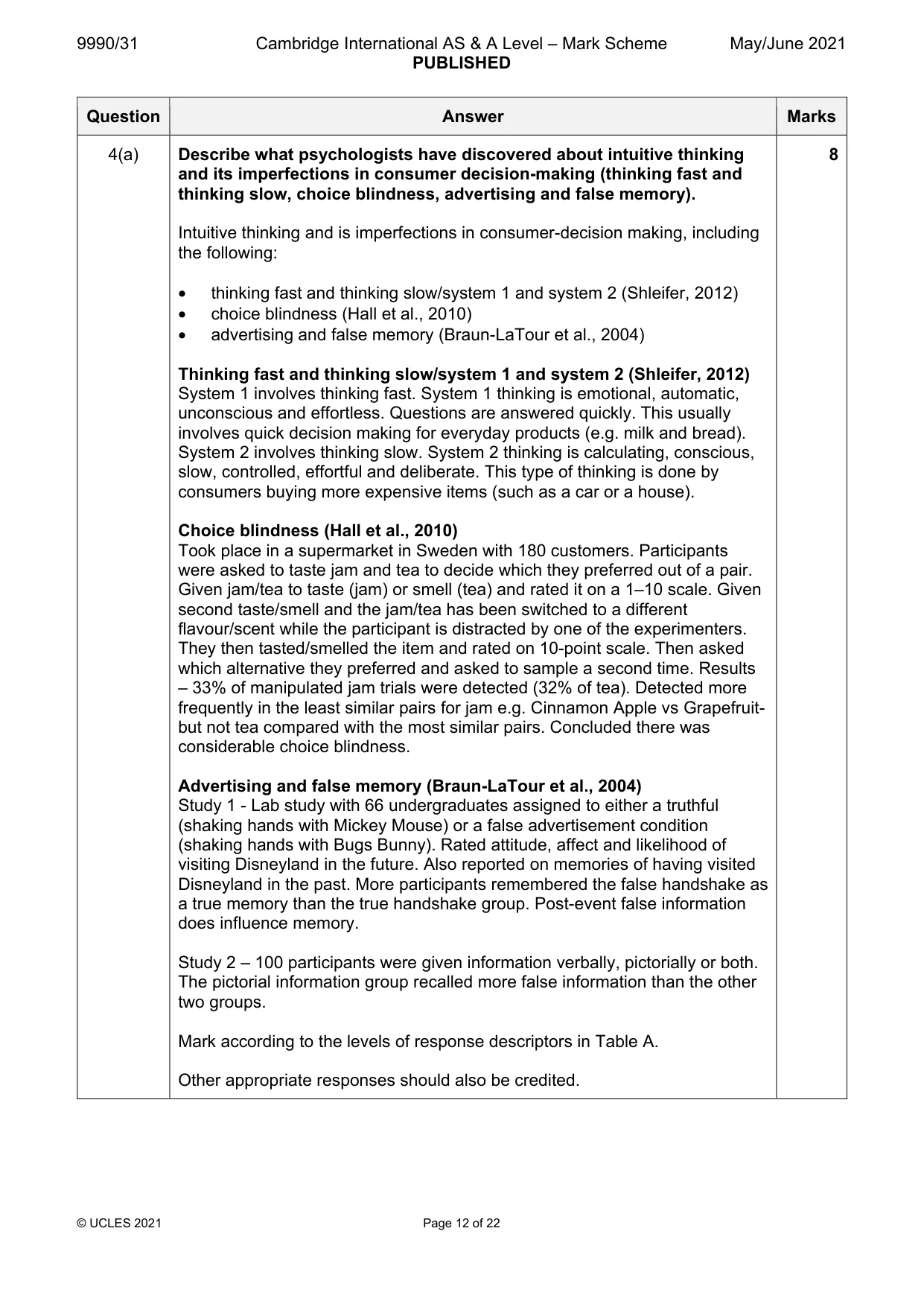
9990/31 Cambridge International AS & A Level – Mark Scheme PUBLISHED May/June 2021 © UCLES 2021 Page 12 of 22 Question Answer Marks 4(a) Describe what psychologists have discovered about intuitive thinking and its imperfections in consumer decision-making (thinking fast and thinking slow, choice blindness, advertising and false memory). Intuitive thinking and is imperfections in consumer-decision making, including the following: • thinking fast and thinking slow/system 1 and system 2 (Shleifer, 2012) • choice blindness (Hall et al., 2010) • advertising and false memory (Braun-LaTour et al., 2004) Thinking fast and thinking slow/system 1 and system 2 (Shleifer, 2012) System 1 involves thinking fast. System 1 thinking is emotional, automatic, unconscious and effortless. Questions are answered quickly. This usually involves quick decision making for everyday products (e.g. milk and bread). System 2 involves thinking slow. System 2 thinking is calculating, conscious, slow, controlled, effortful and deliberate. This type of thinking is done by consumers buying more expensive items (such as a car or a house). Choice blindness (Hall et al., 2010) Took place in a supermarket in Sweden with 180 customers. Participants were asked to taste jam and tea to decide which they preferred out of a pair. Given jam/tea to taste (jam) or smell (tea) and rated it on a 1–10 scale. Given second taste/smell and the jam/tea has been switched to a different flavour/scent while the participant is distracted by one of the experimenters. They then tasted/smelled the item and rated on 10-point scale. Then asked which alternative they preferred and asked to sample a second time. Results – 33% of manipulated jam trials were detected (32% of tea). Detected more frequently in the least similar pairs for jam e.g. Cinnamon Apple vs Grapefruit- but not tea compared with the most similar pairs. Concluded there was considerable choice blindness. Advertising and false memory (Braun-LaTour et al., 2004) Study 1 - Lab study with 66 undergraduates assigned to either a truthful (shaking hands with Mickey Mouse) or a false advertisement condition (shaking hands with Bugs Bunny). Rated attitude, affect and likelihood of visiting Disneyland in the future. Also reported on memories of having visited Disneyland in the past. More participants remembered the false handshake as a true memory than the true handshake group. Post-event false information does influence memory. Study 2 – 100 participants were given information verbally, pictorially or both. The pictorial information group recalled more false information than the other two groups. Mark according to the levels of response descriptors in Table A. Other appropriate responses should also be credited. 8
Mark scheme, page 13
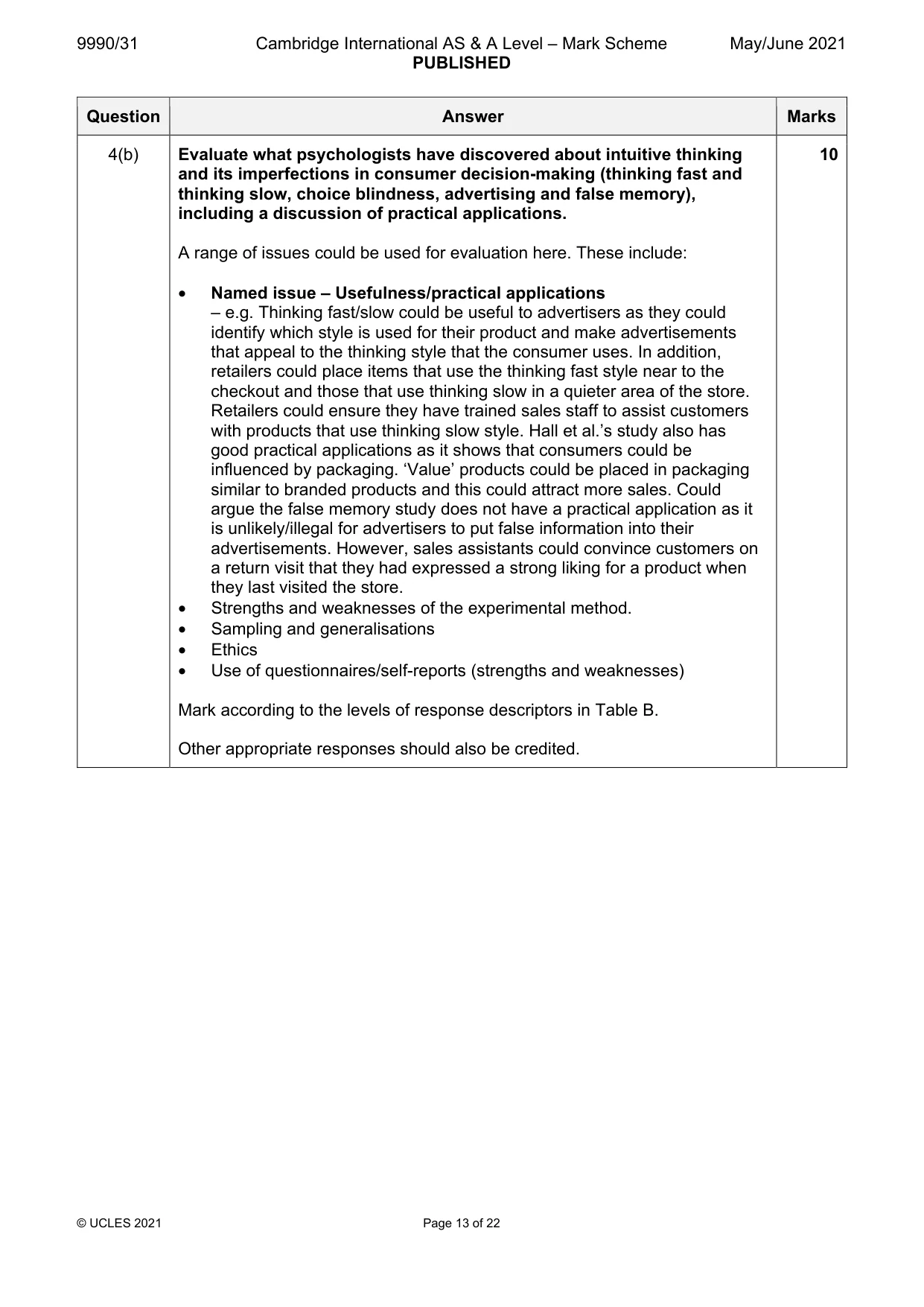
9990/31 Cambridge International AS & A Level – Mark Scheme PUBLISHED May/June 2021 © UCLES 2021 Page 13 of 22 Question Answer Marks 4(b) Evaluate what psychologists have discovered about intuitive thinking and its imperfections in consumer decision-making (thinking fast and thinking slow, choice blindness, advertising and false memory), including a discussion of practical applications. A range of issues could be used for evaluation here. These include: • Named issue – Usefulness/practical applications – e.g. Thinking fast/slow could be useful to advertisers as they could identify which style is used for their product and make advertisements that appeal to the thinking style that the consumer uses. In addition, retailers could place items that use the thinking fast style near to the checkout and those that use thinking slow in a quieter area of the store. Retailers could ensure they have trained sales staff to assist customers with products that use thinking slow style. Hall et al.’s study also has good practical applications as it shows that consumers could be influenced by packaging. ‘Value’ products could be placed in packaging similar to branded products and this could attract more sales. Could argue the false memory study does not have a practical application as it is unlikely/illegal for advertisers to put false information into their advertisements. However, sales assistants could convince customers on a return visit that they had expressed a strong liking for a product when they last visited the store. • Strengths and weaknesses of the experimental method. • Sampling and generalisations • Ethics • Use of questionnaires/self-reports (strengths and weaknesses) Mark according to the levels of response descriptors in Table B. Other appropriate responses should also be credited. 10
Mark scheme, page 14
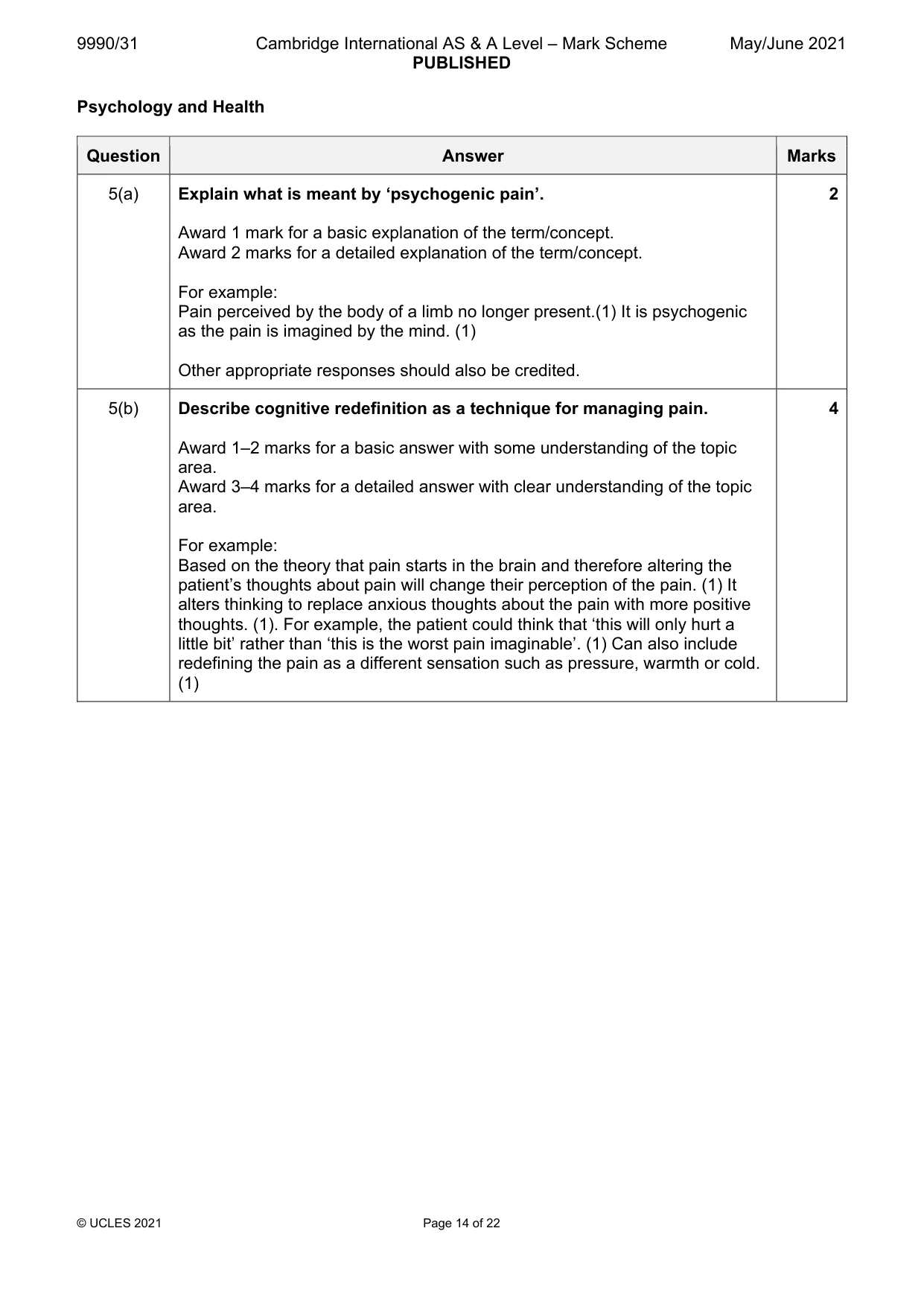
9990/31 Cambridge International AS & A Level – Mark Scheme PUBLISHED May/June 2021 © UCLES 2021 Page 14 of 22 Psychology and Health Question Answer Marks 5(a) Explain what is meant by ‘psychogenic pain’. Award 1 mark for a basic explanation of the term/concept. Award 2 marks for a detailed explanation of the term/concept. For example: Pain perceived by the body of a limb no longer present.(1) It is psychogenic as the pain is imagined by the mind. (1) Other appropriate responses should also be credited. 2 5(b) Describe cognitive redefinition as a technique for managing pain. Award 1–2 marks for a basic answer with some understanding of the topic area. Award 3–4 marks for a detailed answer with clear understanding of the topic area. For example: Based on the theory that pain starts in the brain and therefore altering the patient’s thoughts about pain will change their perception of the pain. (1) It alters thinking to replace anxious thoughts about the pain with more positive thoughts. (1). For example, the patient could think that ‘this will only hurt a little bit’ rather than ‘this is the worst pain imaginable’. (1) Can also include redefining the pain as a different sensation such as pressure, warmth or cold. (1) 4
Mark scheme, page 15
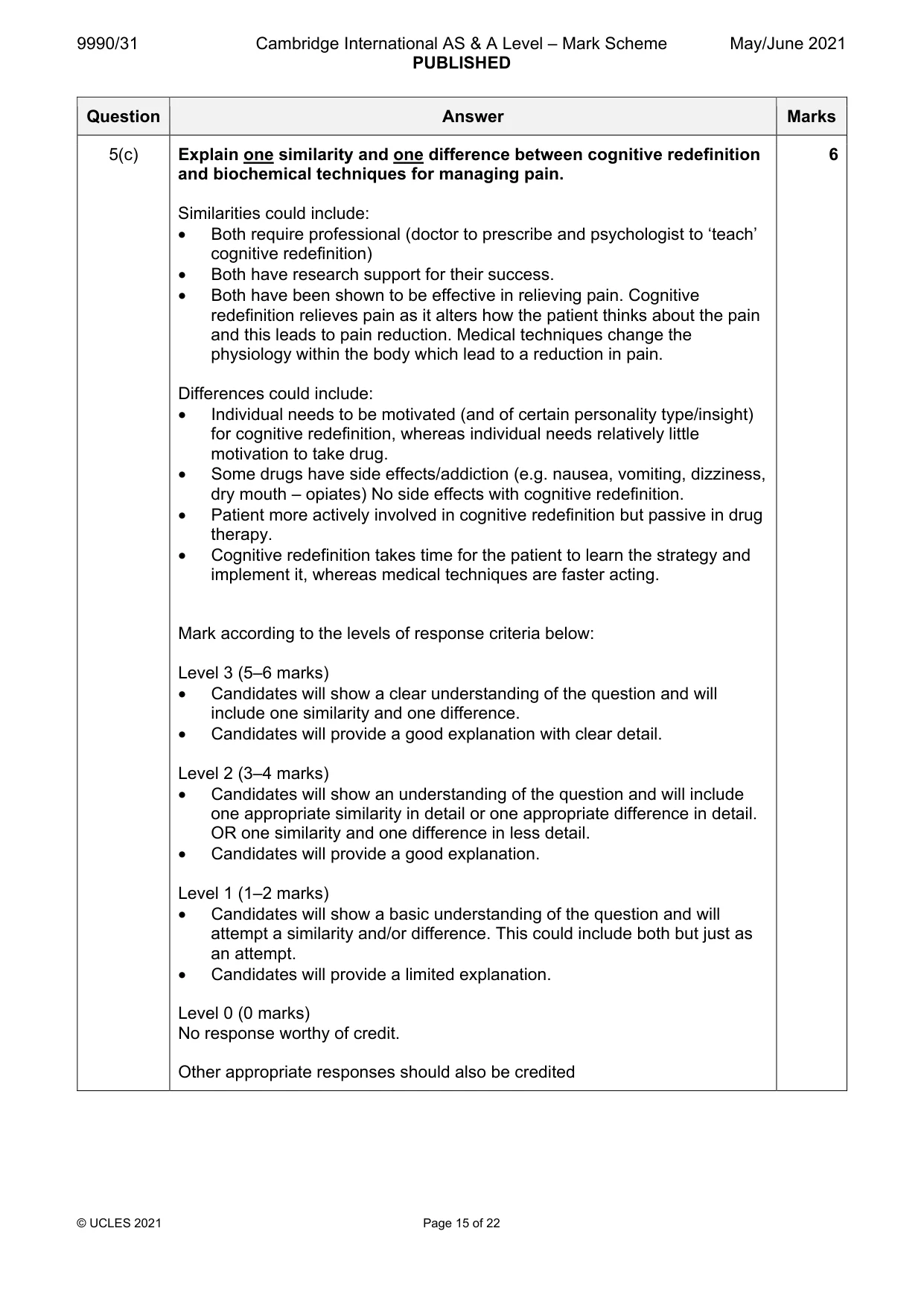
9990/31 Cambridge International AS & A Level – Mark Scheme PUBLISHED May/June 2021 © UCLES 2021 Page 15 of 22 Question Answer Marks 5(c) Explain one similarity and one difference between cognitive redefinition and biochemical techniques for managing pain. Similarities could include: • Both require professional (doctor to prescribe and psychologist to ‘teach’ cognitive redefinition) • Both have research support for their success. • Both have been shown to be effective in relieving pain. Cognitive redefinition relieves pain as it alters how the patient thinks about the pain and this leads to pain reduction. Medical techniques change the physiology within the body which lead to a reduction in pain. Differences could include: • Individual needs to be motivated (and of certain personality type/insight) for cognitive redefinition, whereas individual needs relatively little motivation to take drug. • Some drugs have side effects/addiction (e.g. nausea, vomiting, dizziness, dry mouth – opiates) No side effects with cognitive redefinition. • Patient more actively involved in cognitive redefinition but passive in drug therapy. • Cognitive redefinition takes time for the patient to learn the strategy and implement it, whereas medical techniques are faster acting. Mark according to the levels of response criteria below: Level 3 (5–6 marks) • Candidates will show a clear understanding of the question and will include one similarity and one difference. • Candidates will provide a good explanation with clear detail. Level 2 (3–4 marks) • Candidates will show an understanding of the question and will include one appropriate similarity in detail or one appropriate difference in detail. OR one similarity and one difference in less detail. • Candidates will provide a good explanation. Level 1 (1–2 marks) • Candidates will show a basic understanding of the question and will attempt a similarity and/or difference. This could include both but just as an attempt. • Candidates will provide a limited explanation. Level 0 (0 marks) No response worthy of credit. Other appropriate responses should also be credited 6
Mark scheme, page 16
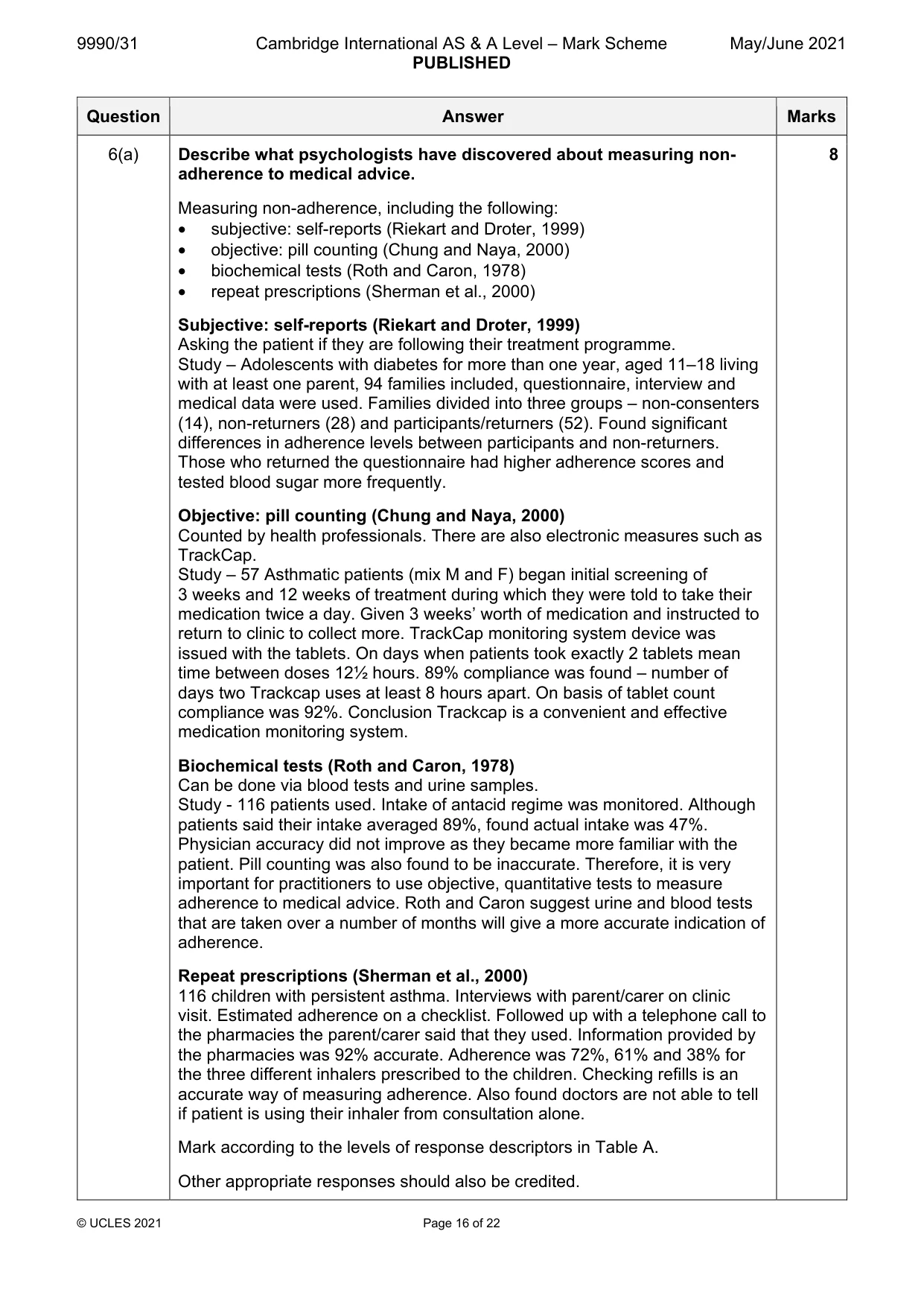
9990/31 Cambridge International AS & A Level – Mark Scheme PUBLISHED May/June 2021 © UCLES 2021 Page 16 of 22 Question Answer Marks 6(a) Describe what psychologists have discovered about measuring non- adherence to medical advice. Measuring non-adherence, including the following: • subjective: self-reports (Riekart and Droter, 1999) • objective: pill counting (Chung and Naya, 2000) • biochemical tests (Roth and Caron, 1978) • repeat prescriptions (Sherman et al., 2000) Subjective: self-reports (Riekart and Droter, 1999) Asking the patient if they are following their treatment programme. Study – Adolescents with diabetes for more than one year, aged 11–18 living with at least one parent, 94 families included, questionnaire, interview and medical data were used. Families divided into three groups – non-consenters (14), non-returners (28) and participants/returners (52). Found significant differences in adherence levels between participants and non-returners. Those who returned the questionnaire had higher adherence scores and tested blood sugar more frequently. Objective: pill counting (Chung and Naya, 2000) Counted by health professionals. There are also electronic measures such as TrackCap. Study – 57 Asthmatic patients (mix M and F) began initial screening of 3 weeks and 12 weeks of treatment during which they were told to take their medication twice a day. Given 3 weeks’ worth of medication and instructed to return to clinic to collect more. TrackCap monitoring system device was issued with the tablets. On days when patients took exactly 2 tablets mean time between doses 12½ hours. 89% compliance was found – number of days two Trackcap uses at least 8 hours apart. On basis of tablet count compliance was 92%. Conclusion Trackcap is a convenient and effective medication monitoring system. Biochemical tests (Roth and Caron, 1978) Can be done via blood tests and urine samples. Study - 116 patients used. Intake of antacid regime was monitored. Although patients said their intake averaged 89%, found actual intake was 47%. Physician accuracy did not improve as they became more familiar with the patient. Pill counting was also found to be inaccurate. Therefore, it is very important for practitioners to use objective, quantitative tests to measure adherence to medical advice. Roth and Caron suggest urine and blood tests that are taken over a number of months will give a more accurate indication of adherence. Repeat prescriptions (Sherman et al., 2000) 116 children with persistent asthma. Interviews with parent/carer on clinic visit. Estimated adherence on a checklist. Followed up with a telephone call to the pharmacies the parent/carer said that they used. Information provided by the pharmacies was 92% accurate. Adherence was 72%, 61% and 38% for the three different inhalers prescribed to the children. Checking refills is an accurate way of measuring adherence. Also found doctors are not able to tell if patient is using their inhaler from consultation alone. Mark according to the levels of response descriptors in Table A. Other appropriate responses should also be credited. 8
Mark scheme, page 17
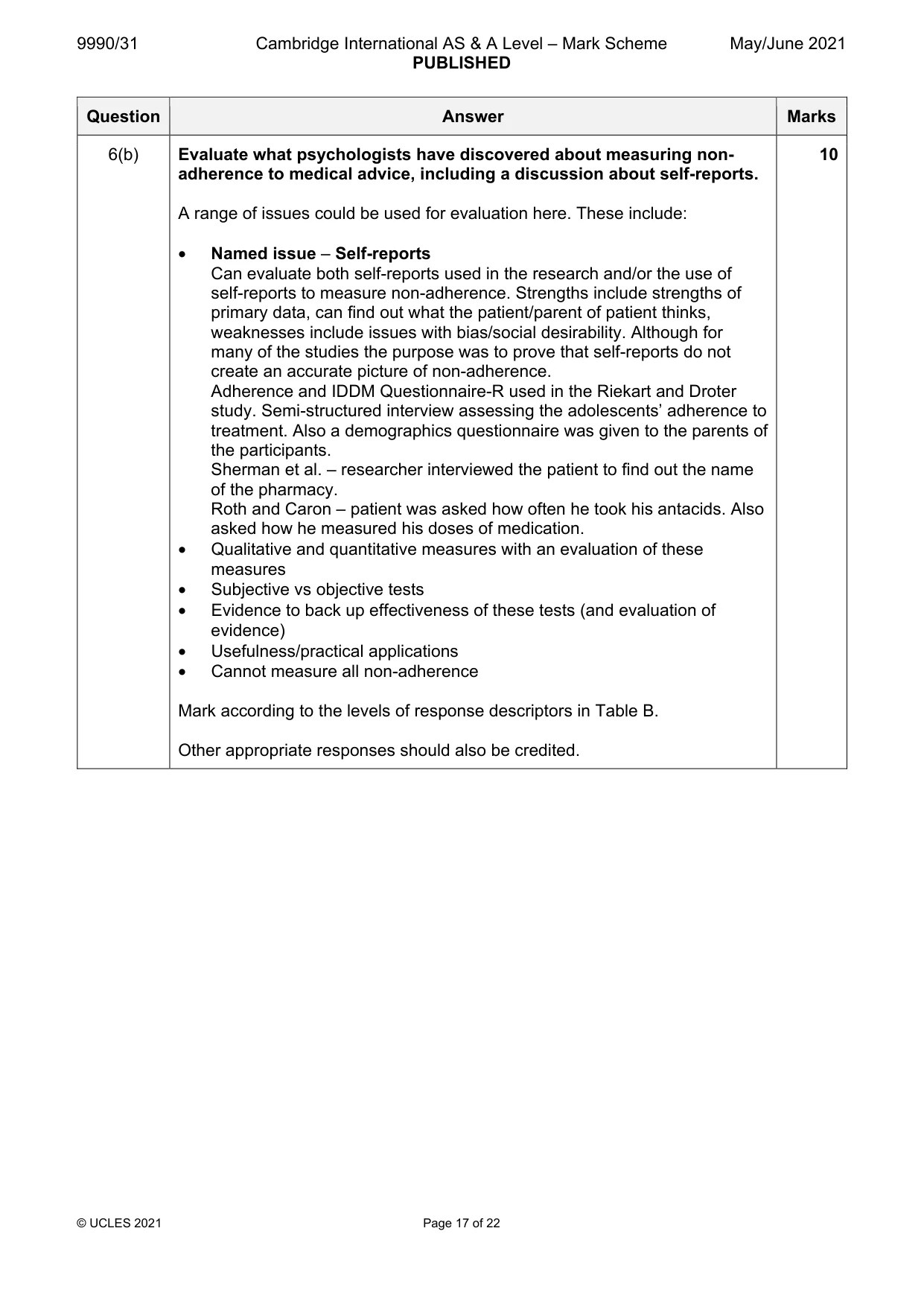
9990/31 Cambridge International AS & A Level – Mark Scheme PUBLISHED May/June 2021 © UCLES 2021 Page 17 of 22 Question Answer Marks 6(b) Evaluate what psychologists have discovered about measuring non- adherence to medical advice, including a discussion about self-reports. A range of issues could be used for evaluation here. These include: • Named issue – Self-reports Can evaluate both self-reports used in the research and/or the use of self-reports to measure non-adherence. Strengths include strengths of primary data, can find out what the patient/parent of patient thinks, weaknesses include issues with bias/social desirability. Although for many of the studies the purpose was to prove that self-reports do not create an accurate picture of non-adherence. Adherence and IDDM Questionnaire-R used in the Riekart and Droter study. Semi-structured interview assessing the adolescents’ adherence to treatment. Also a demographics questionnaire was given to the parents of the participants. Sherman et al. – researcher interviewed the patient to find out the name of the pharmacy. Roth and Caron – patient was asked how often he took his antacids. Also asked how he measured his doses of medication. • Qualitative and quantitative measures with an evaluation of these measures • Subjective vs objective tests • Evidence to back up effectiveness of these tests (and evaluation of evidence) • Usefulness/practical applications • Cannot measure all non-adherence Mark according to the levels of response descriptors in Table B. Other appropriate responses should also be credited. 10
Mark scheme, page 18
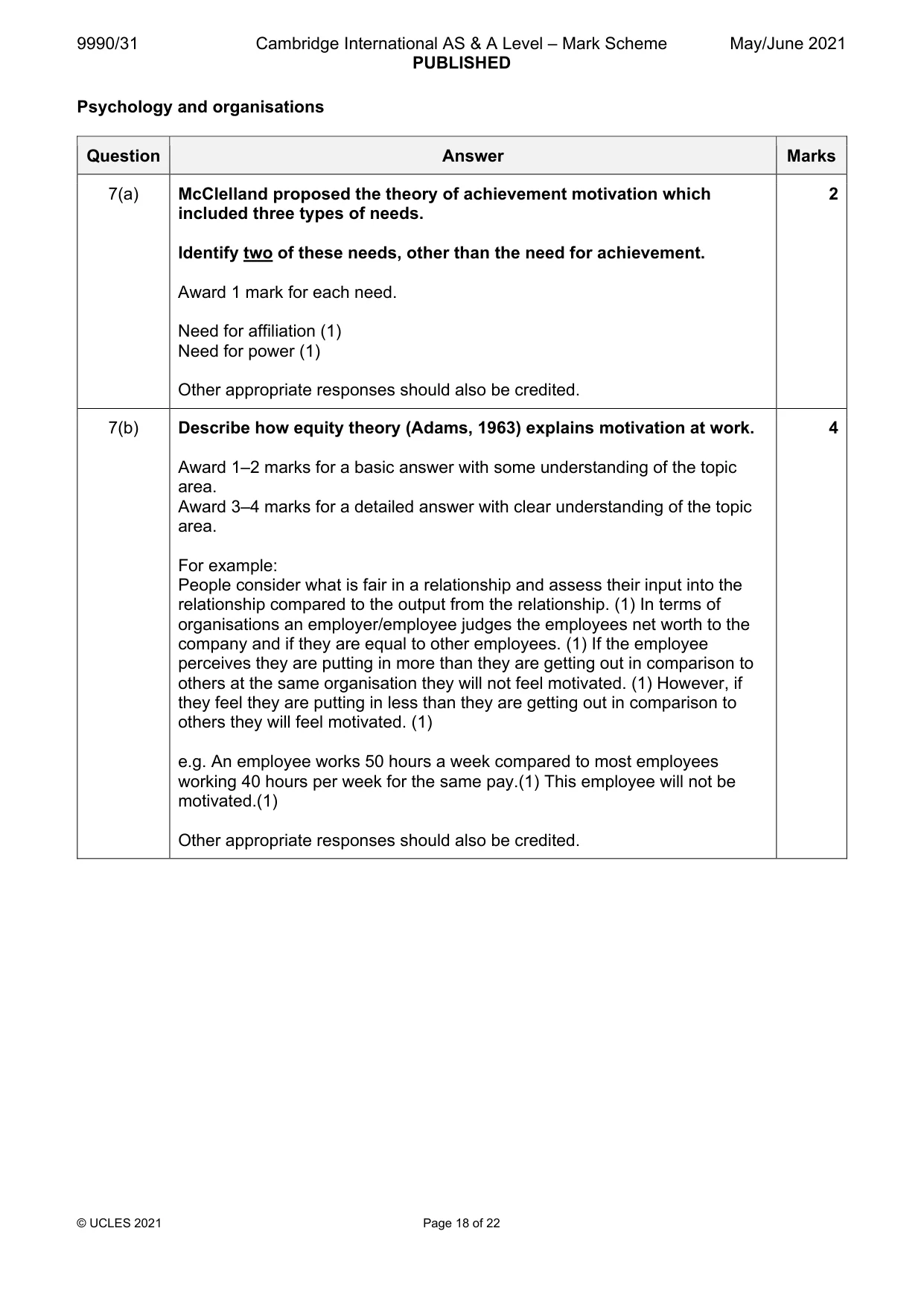
9990/31 Cambridge International AS & A Level – Mark Scheme PUBLISHED May/June 2021 © UCLES 2021 Page 18 of 22 Psychology and organisations Question Answer Marks 7(a) McClelland proposed the theory of achievement motivation which included three types of needs. Identify two of these needs, other than the need for achievement. Award 1 mark for each need. Need for affiliation (1) Need for power (1) Other appropriate responses should also be credited. 2 7(b) Describe how equity theory (Adams, 1963) explains motivation at work. Award 1–2 marks for a basic answer with some understanding of the topic area. Award 3–4 marks for a detailed answer with clear understanding of the topic area. For example: People consider what is fair in a relationship and assess their input into the relationship compared to the output from the relationship. (1) In terms of organisations an employer/employee judges the employees net worth to the company and if they are equal to other employees. (1) If the employee perceives they are putting in more than they are getting out in comparison to others at the same organisation they will not feel motivated. (1) However, if they feel they are putting in less than they are getting out in comparison to others they will feel motivated. (1) e.g. An employee works 50 hours a week compared to most employees working 40 hours per week for the same pay.(1) This employee will not be motivated.(1) Other appropriate responses should also be credited. 4
Mark scheme, page 19
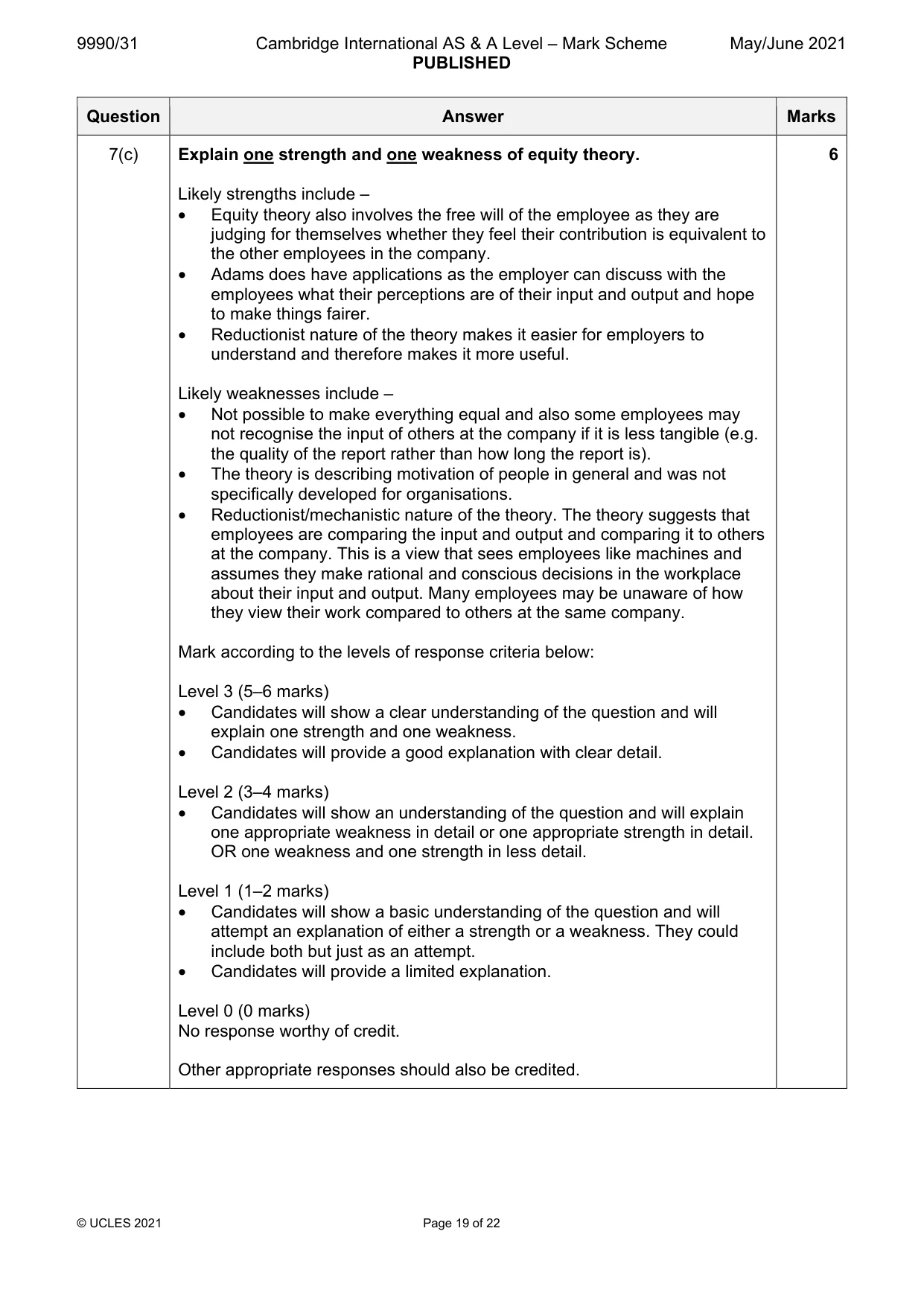
9990/31 Cambridge International AS & A Level – Mark Scheme PUBLISHED May/June 2021 © UCLES 2021 Page 19 of 22 Question Answer Marks 7(c) Explain one strength and one weakness of equity theory. Likely strengths include – • Equity theory also involves the free will of the employee as they are judging for themselves whether they feel their contribution is equivalent to the other employees in the company. • Adams does have applications as the employer can discuss with the employees what their perceptions are of their input and output and hope to make things fairer. • Reductionist nature of the theory makes it easier for employers to understand and therefore makes it more useful. Likely weaknesses include – • Not possible to make everything equal and also some employees may not recognise the input of others at the company if it is less tangible (e.g. the quality of the report rather than how long the report is). • The theory is describing motivation of people in general and was not specifically developed for organisations. • Reductionist/mechanistic nature of the theory. The theory suggests that employees are comparing the input and output and comparing it to others at the company. This is a view that sees employees like machines and assumes they make rational and conscious decisions in the workplace about their input and output. Many employees may be unaware of how they view their work compared to others at the same company. Mark according to the levels of response criteria below: Level 3 (5–6 marks) • Candidates will show a clear understanding of the question and will explain one strength and one weakness. • Candidates will provide a good explanation with clear detail. Level 2 (3–4 marks) • Candidates will show an understanding of the question and will explain one appropriate weakness in detail or one appropriate strength in detail. OR one weakness and one strength in less detail. Level 1 (1–2 marks) • Candidates will show a basic understanding of the question and will attempt an explanation of either a strength or a weakness. They could include both but just as an attempt. • Candidates will provide a limited explanation. Level 0 (0 marks) No response worthy of credit. Other appropriate responses should also be credited. 6
Mark scheme, page 20
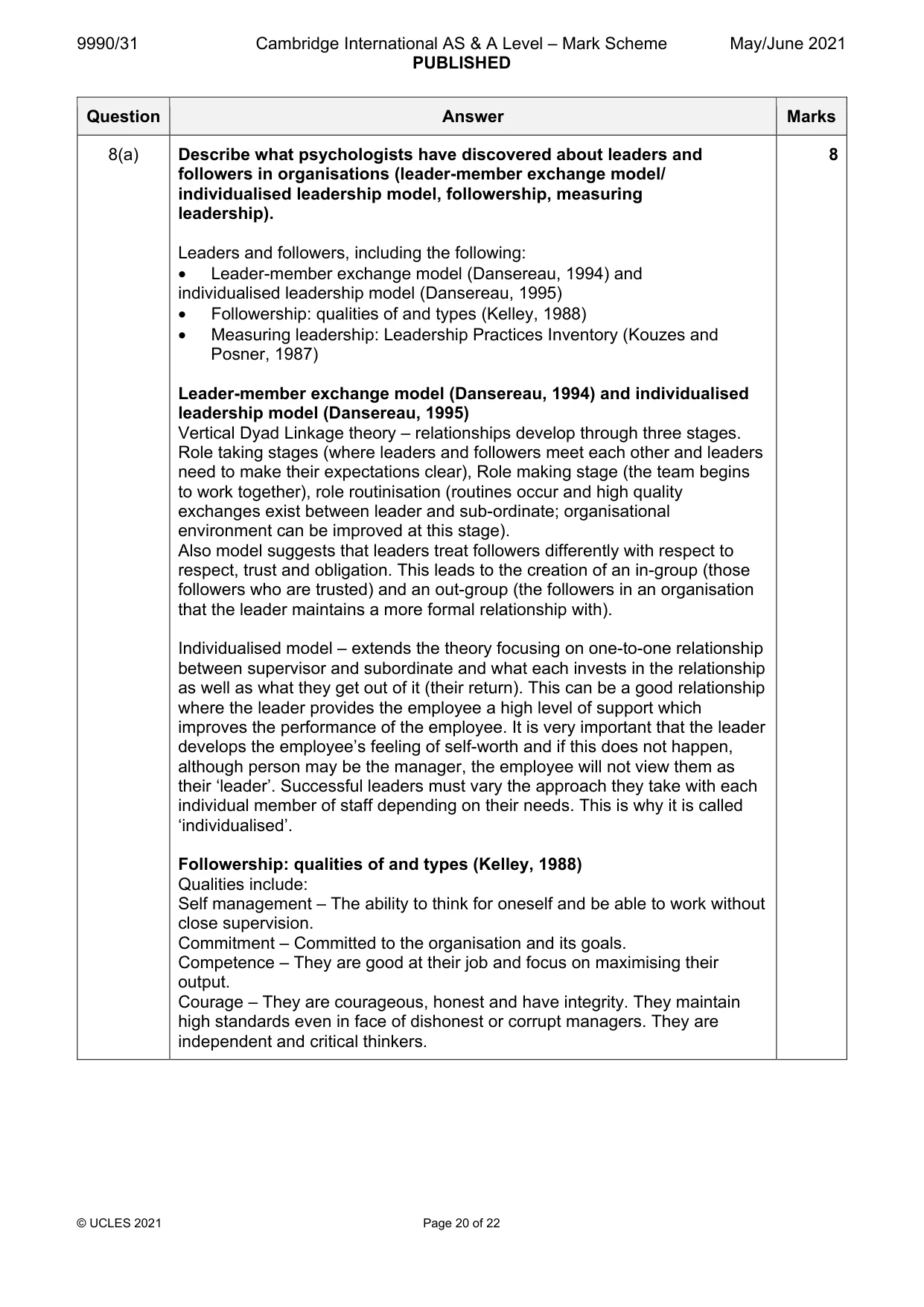
9990/31 Cambridge International AS & A Level – Mark Scheme PUBLISHED May/June 2021 © UCLES 2021 Page 20 of 22 Question Answer Marks 8(a) Describe what psychologists have discovered about leaders and followers in organisations (leader-member exchange model/ individualised leadership model, followership, measuring leadership). Leaders and followers, including the following: • Leader-member exchange model (Dansereau, 1994) and individualised leadership model (Dansereau, 1995) • Followership: qualities of and types (Kelley, 1988) • Measuring leadership: Leadership Practices Inventory (Kouzes and Posner, 1987) Leader-member exchange model (Dansereau, 1994) and individualised leadership model (Dansereau, 1995) Vertical Dyad Linkage theory – relationships develop through three stages. Role taking stages (where leaders and followers meet each other and leaders need to make their expectations clear), Role making stage (the team begins to work together), role routinisation (routines occur and high quality exchanges exist between leader and sub-ordinate; organisational environment can be improved at this stage). Also model suggests that leaders treat followers differently with respect to respect, trust and obligation. This leads to the creation of an in-group (those followers who are trusted) and an out-group (the followers in an organisation that the leader maintains a more formal relationship with). Individualised model – extends the theory focusing on one-to-one relationship between supervisor and subordinate and what each invests in the relationship as well as what they get out of it (their return). This can be a good relationship where the leader provides the employee a high level of support which improves the performance of the employee. It is very important that the leader develops the employee’s feeling of self-worth and if this does not happen, although person may be the manager, the employee will not view them as their ‘leader’. Successful leaders must vary the approach they take with each individual member of staff depending on their needs. This is why it is called ‘individualised’. Followership: qualities of and types (Kelley, 1988) Qualities include: Self management – The ability to think for oneself and be able to work without close supervision. Commitment – Committed to the organisation and its goals. Competence – They are good at their job and focus on maximising their output. Courage – They are courageous, honest and have integrity. They maintain high standards even in face of dishonest or corrupt managers. They are independent and critical thinkers. 8
Mark scheme, page 21
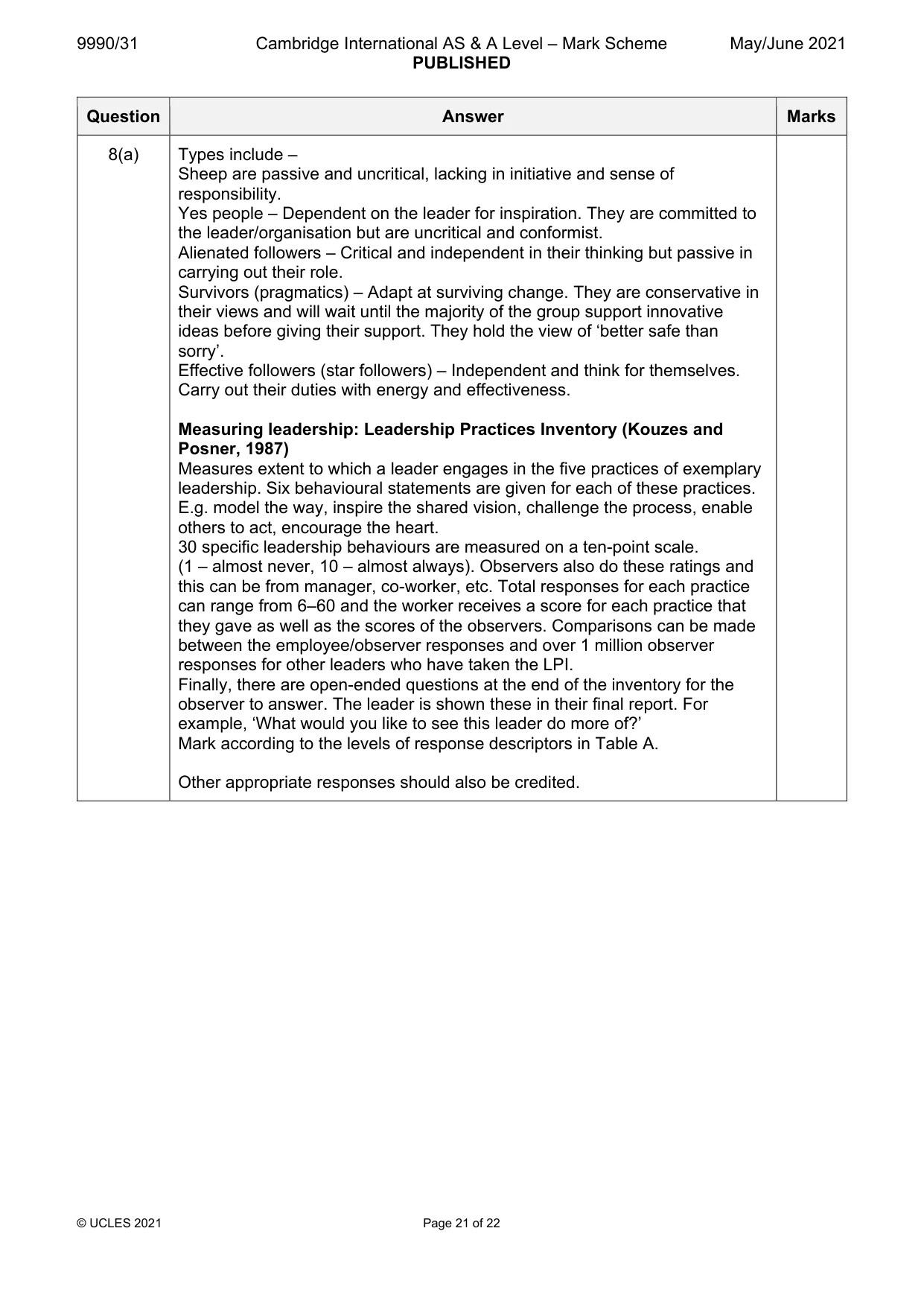
9990/31 Cambridge International AS & A Level – Mark Scheme PUBLISHED May/June 2021 © UCLES 2021 Page 21 of 22 Question Answer Marks 8(a) Types include – Sheep are passive and uncritical, lacking in initiative and sense of responsibility. Yes people – Dependent on the leader for inspiration. They are committed to the leader/organisation but are uncritical and conformist. Alienated followers – Critical and independent in their thinking but passive in carrying out their role. Survivors (pragmatics) – Adapt at surviving change. They are conservative in their views and will wait until the majority of the group support innovative ideas before giving their support. They hold the view of ‘better safe than sorry’. Effective followers (star followers) – Independent and think for themselves. Carry out their duties with energy and effectiveness. Measuring leadership: Leadership Practices Inventory (Kouzes and Posner, 1987) Measures extent to which a leader engages in the five practices of exemplary leadership. Six behavioural statements are given for each of these practices. E.g. model the way, inspire the shared vision, challenge the process, enable others to act, encourage the heart. 30 specific leadership behaviours are measured on a ten-point scale. (1 – almost never, 10 – almost always). Observers also do these ratings and this can be from manager, co-worker, etc. Total responses for each practice can range from 6–60 and the worker receives a score for each practice that they gave as well as the scores of the observers. Comparisons can be made between the employee/observer responses and over 1 million observer responses for other leaders who have taken the LPI. Finally, there are open-ended questions at the end of the inventory for the observer to answer. The leader is shown these in their final report. For example, ‘What would you like to see this leader do more of?’ Mark according to the levels of response descriptors in Table A. Other appropriate responses should also be credited.
Mark scheme, page 22
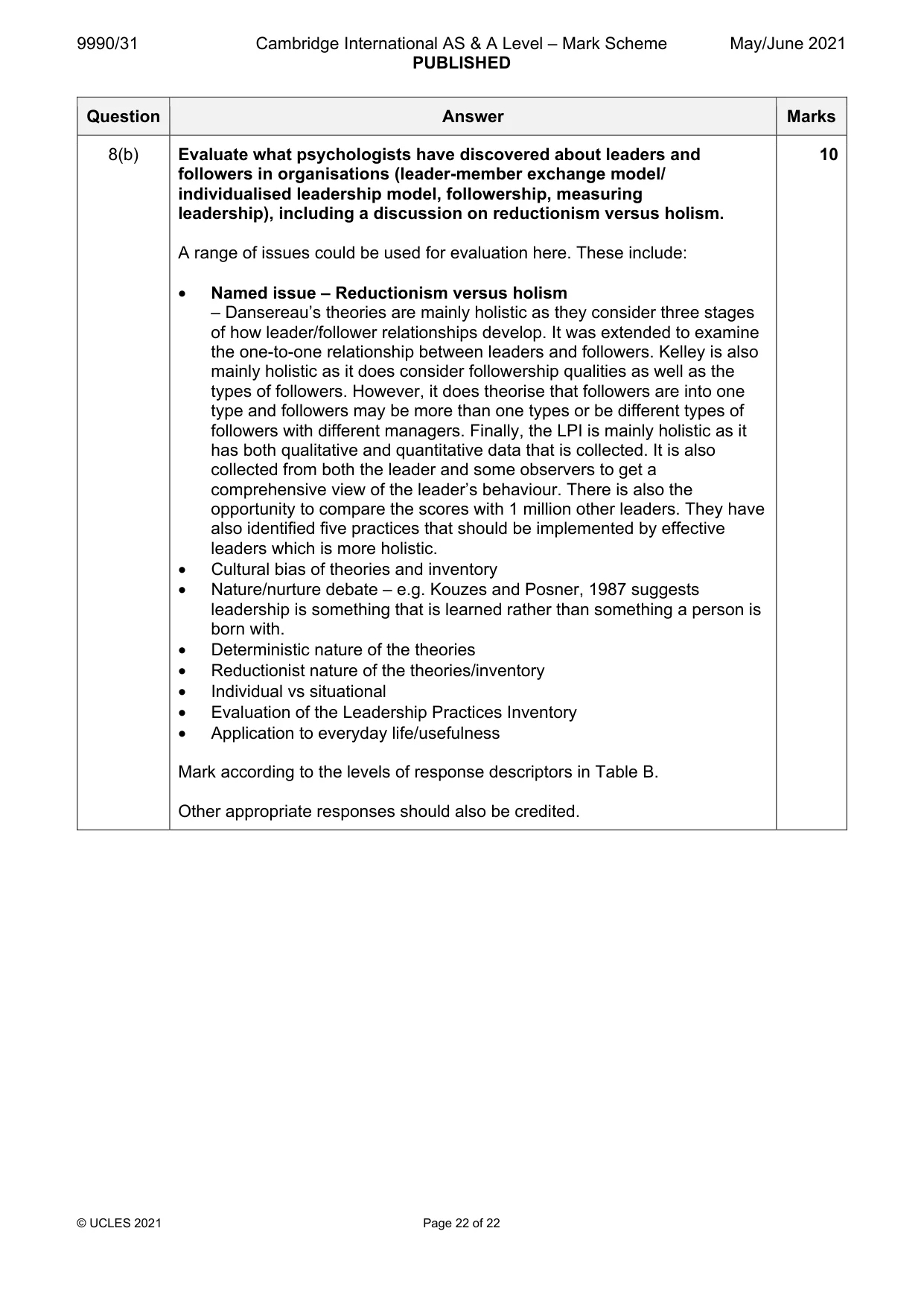
9990/31 Cambridge International AS & A Level – Mark Scheme PUBLISHED May/June 2021 © UCLES 2021 Page 22 of 22 Question Answer Marks 8(b) Evaluate what psychologists have discovered about leaders and followers in organisations (leader-member exchange model/ individualised leadership model, followership, measuring leadership), including a discussion on reductionism versus holism. A range of issues could be used for evaluation here. These include: • Named issue – Reductionism versus holism – Dansereau’s theories are mainly holistic as they consider three stages of how leader/follower relationships develop. It was extended to examine the one-to-one relationship between leaders and followers. Kelley is also mainly holistic as it does consider followership qualities as well as the types of followers. However, it does theorise that followers are into one type and followers may be more than one types or be different types of followers with different managers. Finally, the LPI is mainly holistic as it has both qualitative and quantitative data that is collected. It is also collected from both the leader and some observers to get a comprehensive view of the leader’s behaviour. There is also the opportunity to compare the scores with 1 million other leaders. They have also identified five practices that should be implemented by effective leaders which is more holistic. • Cultural bias of theories and inventory • Nature/nurture debate – e.g. Kouzes and Posner, 1987 suggests leadership is something that is learned rather than something a person is born with. • Deterministic nature of the theories • Reductionist nature of the theories/inventory • Individual vs situational • Evaluation of the Leadership Practices Inventory • Application to everyday life/usefulness Mark according to the levels of response descriptors in Table B. Other appropriate responses should also be credited. 10
What you needed in this session
Cambridge’s own grade thresholds for 2021 May/June, Paper 3 · Variant 1. A higher threshold means an easier paper — the bar moves with how the cohort did.