Cambridge A Level Psychology (from 2018) 9990 — 2020 Oct/Nov Paper 4 · Variant 2
9990/42/O/N/20 · 60 marks · ≈68 min
The question paper and its mark scheme, free to read here and free to download. This is Cambridge’s own paper, exactly as it was sat.
Question paper8 pages



Mark scheme24 pages
Answers below. Sit the paper first if you are practising.
Paper as text
Question paper, page 1
Cambridge International AS & A Level This document has 8 pages. Blank pages are indicated. DC (TC/FC) 191037/1 © UCLES 2020 [Turn over * 7 7 1 3 8 8 2 5 8 2 * PSYCHOLOGY 9990/42 Paper 4 Specialist Options: Application October/November 2020 1 hour 30 minutes You must answer on the enclosed answer booklet. You will need: Answer booklet (enclosed) INSTRUCTIONS ● Answer four questions in total: Answer questions from two options. Section A: answer two questions. Section B: answer one question. Section C: answer one question. ● Follow the instructions on the front cover of the answer booklet. If you need additional answer paper, ask the invigilator for a continuation booklet. INFORMATION ● The total mark for this paper is 60. ● The number of marks for each question or part question is shown in brackets [ ].
Question paper, page 2
2 9990/42/O/N/20 © UCLES 2020 Section A You must answer two questions from this section. Answer all the parts for the two questions you choose. Psychology and abnormality 1 Miller (2010) proposed impulse control therapy which he developed from his feeling‑state theory of impulse control disorders. This therapy uses what Miller calls the impulse control disorder protocol (ICDP), a procedure which uses a modified form of eye movement desensitisation and reprocessing (EMDR). (a) Explain what is meant by eye movement desensitisation and reprocessing (EMDR). [2] (b) Outline the procedure used in impulse control therapy, including reference to EMDR. [4] (c) (i) Suggest one similarity between impulse control therapy and imaginal desensitisation. [2] (ii) Suggest one difference between impulse control therapy and imaginal desensitisation. [2] (d) Discuss the strengths and weaknesses of using self‑report data from people with addictions. You should include a conclusion in your answer. [5] Psychology and consumer behaviour 2 The success of the disrupt‑then‑reframe (DTR) technique (Kardes et al., 2007) Experiment 1 shows that the DTR technique increases retail sales in a supermarket setting. Experiment 2 shows that the DTR technique increases the willingness to pay to join a student interest group. Experiment 3 shows that the DTR technique increases student support for a tuition fee increase. (a) Explain what is meant by the ‘disrupt‑then‑reframe’ technique. [2] (b) (i) Explain how an independent measures design was used in Experiment 1. [2] (ii) Suggest why this experimental design was used, rather than one other experimental design. [2] (c) Suggest two advantages of conducting field experiments, using examples from this study. [4] (d) Discuss the ethics of using the disrupt‑then‑reframe technique to sell a product. You should consider both sides of the argument and include a conclusion. [5]
Question paper, page 3
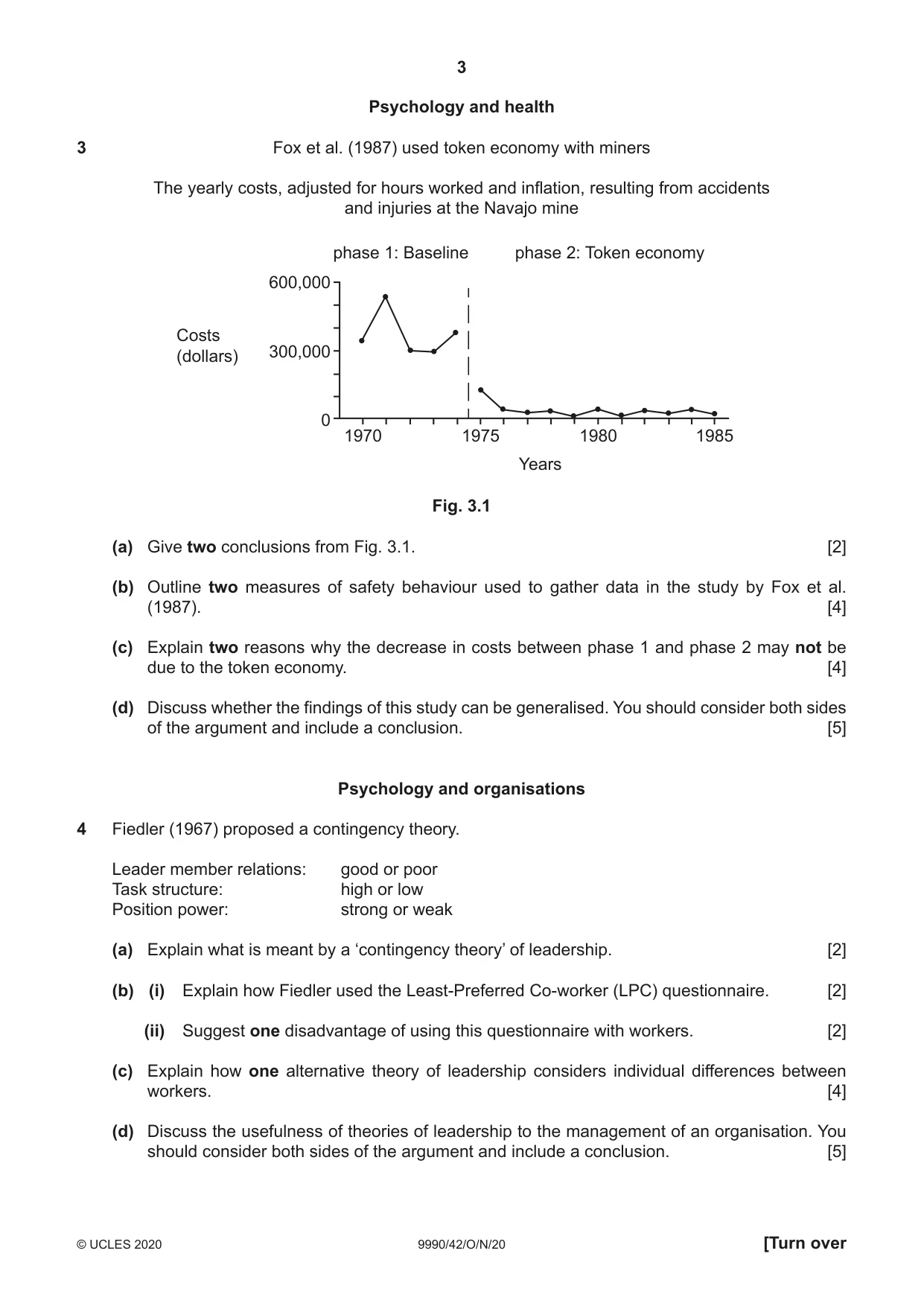
3 9990/42/O/N/20 © UCLES 2020 [Turn over Psychology and health 3 Fox et al. (1987) used token economy with miners The yearly costs, adjusted for hours worked and inflation, resulting from accidents and injuries at the Navajo mine 0 1970 1975 Years 1980 1985 300,000 Costs (dollars) phase 1: Baseline phase 2: Token economy 600,000 Fig. 3.1 (a) Give two conclusions from Fig. 3.1. [2] (b) Outline two measures of safety behaviour used to gather data in the study by Fox et al. (1987). [4] (c) Explain two reasons why the decrease in costs between phase 1 and phase 2 may not be due to the token economy. [4] (d) Discuss whether the findings of this study can be generalised. You should consider both sides of the argument and include a conclusion. [5] Psychology and organisations 4 Fiedler (1967) proposed a contingency theory. Leader member relations: good or poor Task structure: high or low Position power: strong or weak (a) Explain what is meant by a ‘contingency theory’ of leadership. [2] (b) (i) Explain how Fiedler used the Least‑Preferred Co‑worker (LPC) questionnaire. [2] (ii) Suggest one disadvantage of using this questionnaire with workers. [2] (c) Explain how one alternative theory of leadership considers individual differences between workers. [4] (d) Discuss the usefulness of theories of leadership to the management of an organisation. You should consider both sides of the argument and include a conclusion. [5]
Question paper, page 4
4 9990/42/O/N/20 © UCLES 2020 Section B You must answer one question from this section. Psychology and abnormality 5 (a) Design a study using an observation to investigate the characteristics of addiction in people with kleptomania. [10] (b) Explain the psychological and methodological evidence on which your study is based. [8] Psychology and consumer behaviour 6 (a) Design a study to investigate the effect of musical style on spending in different types of restaurant. [10] (b) Explain the psychological and methodological evidence on which your study is based. [8] Psychology and health 7 (a) Design a study using an interview to investigate the causes of stress at work in nurses. [10] (b) Explain the psychological and methodological evidence on which your study is based. [8] Psychology and organisations 8 (a) Design a study to investigate which type of ‘need for achievement’ is most likely to motivate workers. [10] (b) Explain the psychological and methodological evidence on which your study is based. [8]
Question paper, page 5
5 9990/42/O/N/20 © UCLES 2020 Section C You must answer one question from this section. Psychology and abnormality 9 ‘Medical techniques, such as drugs, can treat all patients with depression effectively.’ To what extent do you agree with this statement? Use examples of research you have studied to support your answer. [12] Psychology and consumer behaviour 10 ‘Determinism: Retail ambience may affect shoppers’ emotional states, but does not determine their reason to shop.’ To what extent do you agree with this statement? Use examples of research you have studied to support your answer. [12] Psychology and health 11 ‘Physiological measures of stress are much more useful than psychological measures.’ To what extent do you agree with this statement? Use examples of research you have studied to support your answer. [12] Psychology and organisations 12 ‘Situational leadership is irrelevant if the individual leader is a universalist ‘great man or woman’. To what extent do you agree with this statement? Use examples of research you have studied to support your answer. [12]
Question paper, page 6
6 9990/42/O/N/20 © UCLES 2020 BLANK PAGE
Question paper, page 7
7 9990/42/O/N/20 © UCLES 2020 BLANK PAGE
Question paper, page 8
8 9990/42/O/N/20 © UCLES 2020 Permission to reproduce items where third‑party owned material protected by copyright is included has been sought and cleared where possible. Every reasonable effort has been made by the publisher (UCLES) to trace copyright holders, but if any items requiring clearance have unwittingly been included, the publisher will be pleased to make amends at the earliest possible opportunity. To avoid the issue of disclosure of answer‑related information to candidates, all copyright acknowledgements are reproduced online in the Cambridge Assessment International Education Copyright Acknowledgements Booklet. This is produced for each series of examinations and is freely available to download at www.cambridgeinternational.org after the live examination series. Cambridge Assessment International Education is part of the Cambridge Assessment Group. Cambridge Assessment is the brand name of the University of Cambridge Local Examinations Syndicate (UCLES), which itself is a department of the University of Cambridge. BLANK PAGE
Mark scheme, page 1
This document consists of 24 printed pages. © UCLES 2020 [Turn over Cambridge International AS & A Level PSYCHOLOGY 9990/42 Paper 4 Specialist Options: Applications October/November 2020 MARK SCHEME Maximum Mark: 60 Published This mark scheme is published as an aid to teachers and candidates, to indicate the requirements of the examination. It shows the basis on which Examiners were instructed to award marks. It does not indicate the details of the discussions that took place at an Examiners’ meeting before marking began, which would have considered the acceptability of alternative answers. Mark schemes should be read in conjunction with the question paper and the Principal Examiner Report for Teachers. Cambridge International will not enter into discussions about these mark schemes. Cambridge International is publishing the mark schemes for the October/November 2020 series for most Cambridge IGCSE™, Cambridge International A and AS Level and Cambridge Pre-U components, and some Cambridge O Level components.
Mark scheme, page 2
9990/42 Cambridge International AS & A Level – Mark Scheme PUBLISHED October/November 2020 © UCLES 2020 Page 2 of 24 Generic Marking Principles These general marking principles must be applied by all examiners when marking candidate answers. They should be applied alongside the specific content of the mark scheme or generic level descriptors for a question. Each question paper and mark scheme will also comply with these marking principles. GENERIC MARKING PRINCIPLE 1: Marks must be awarded in line with: • the specific content of the mark scheme or the generic level descriptors for the question • the specific skills defined in the mark scheme or in the generic level descriptors for the question • the standard of response required by a candidate as exemplified by the standardisation scripts. GENERIC MARKING PRINCIPLE 2: Marks awarded are always whole marks (not half marks, or other fractions). GENERIC MARKING PRINCIPLE 3: Marks must be awarded positively: • marks are awarded for correct/valid answers, as defined in the mark scheme. However, credit is given for valid answers which go beyond the scope of the syllabus and mark scheme, referring to your Team Leader as appropriate • marks are awarded when candidates clearly demonstrate what they know and can do • marks are not deducted for errors • marks are not deducted for omissions • answers should only be judged on the quality of spelling, punctuation and grammar when these features are specifically assessed by the question as indicated by the mark scheme. The meaning, however, should be unambiguous. GENERIC MARKING PRINCIPLE 4: Rules must be applied consistently, e.g. in situations where candidates have not followed instructions or in the application of generic level descriptors. GENERIC MARKING PRINCIPLE 5: Marks should be awarded using the full range of marks defined in the mark scheme for the question (however; the use of the full mark range may be limited according to the quality of the candidate responses seen). GENERIC MARKING PRINCIPLE 6: Marks awarded are based solely on the requirements as defined in the mark scheme. Marks should not be awarded with grade thresholds or grade descriptors in mind.
Mark scheme, page 3
9990/42 Cambridge International AS & A Level – Mark Scheme PUBLISHED October/November 2020 © UCLES 2020 Page 3 of 24 Each option has three questions: Section A: (stimulus) Answer two questions from choice of four: (a) = 2, (b) = 4, (c) = 4 and (d) = 5 [15 total] Section A: candidates answer two questions from a choice of four, based on the two specialist options they have studied. Each question is based on stimulus material and is divided into four parts. There are 2 marks for part (a), 4 marks for part (b), 4 marks for part (c) and 5 marks for part (d). Section B: (design) Answer one question from choice of four: (a) = 10 marks, (b) = 8 marks [18 total] Section B: candidates answer one design-based question from a choice of four, based on either of the two specialist options they have studied. The question is divided into two parts. There are 10 marks for part (a) and 8 marks for part (b). Section C: (e) Answer one question from choice of four = 12 marks. Section C: candidates answer one essay question from a choice of four, based on either of the two specialist options they have studied. There are 12 marks for this question. Questions will require candidates to consider approaches, research methods and issues and debates. The questions will be based on two topic areas (a, b, c, d, e) covered within the chosen specialist option. The two topic areas for each specialist option will be different to the two topic areas assessed in Paper 3. In order to achieve the same standard across all questions in a Section, the same generic mark schemes are used for each option. These mark schemes are as follows: Section A: Stimulus (Generic response descriptor) (a) 0–2 1 mark for basic answer, e.g. identification. 1 mark for elaboration/example. (b) 0–4 Question always requires two ‘things’ 1 mark for basic answer. 2 marks for elaboration. Max 2 marks if only ‘one’ is answered. (c) 0–4 Questions require either one or two ‘things’. If two: 1 mark for basic answer. 2 marks for elaboration. If one: 1–2 marks for basic answer. 3–4 marks for detailed answer/elaboration. If two required and only one provided, max 2 marks. (d) 0–5 Question requires discussion. Question always plural of each argument. Question always requires conclusion. 1 mark for each for/against argument (however detailed) up to 4 max. 1 mark for conclusion. NB If three (or more) arguments for one side, best two credited. If one side only, max 2 marks. 0 0 No response worthy of credit.
Mark scheme, page 4
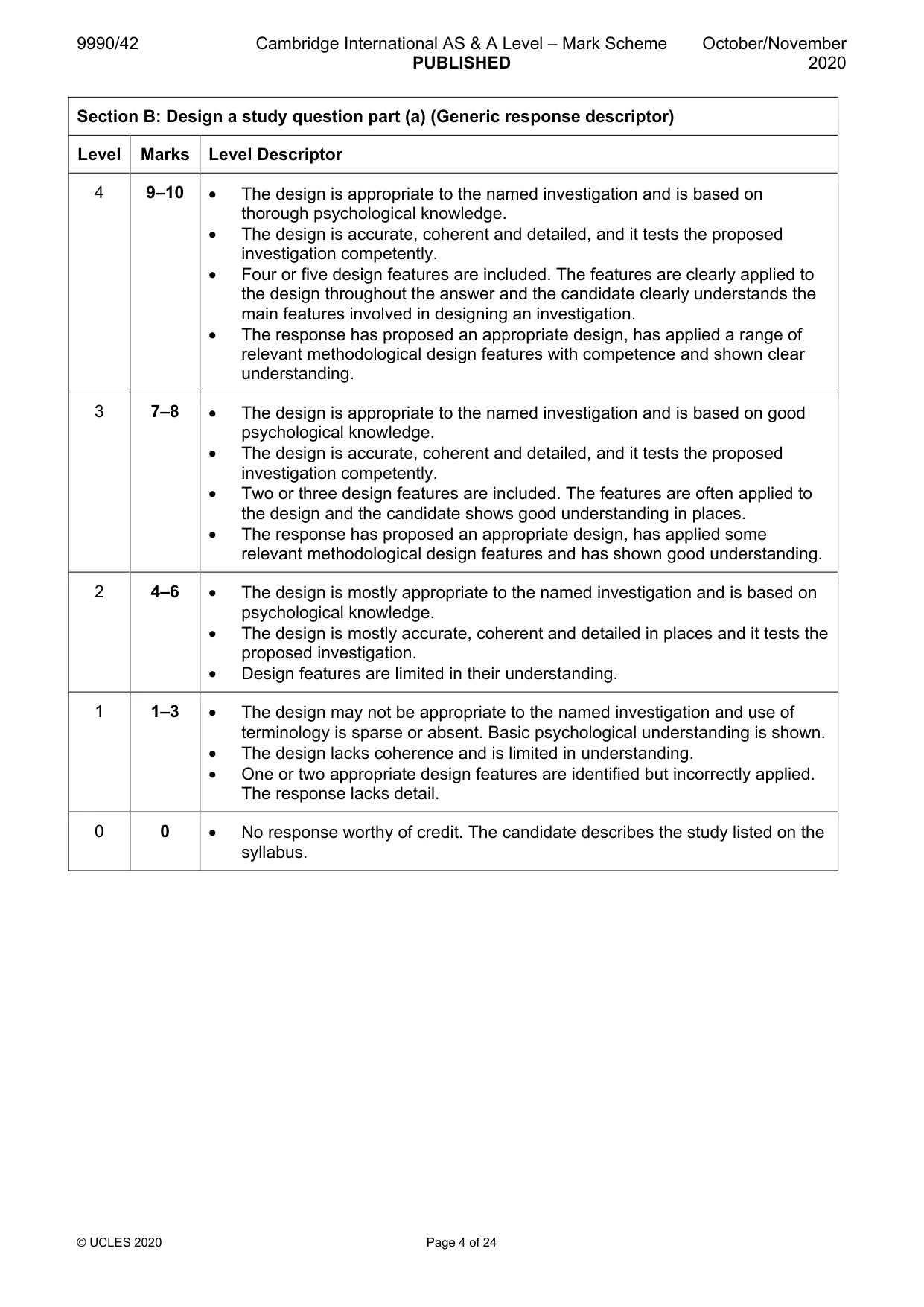
9990/42 Cambridge International AS & A Level – Mark Scheme PUBLISHED October/November 2020 © UCLES 2020 Page 4 of 24 Section B: Design a study question part (a) (Generic response descriptor) Level Marks Level Descriptor 4 9–10 • The design is appropriate to the named investigation and is based on thorough psychological knowledge. • The design is accurate, coherent and detailed, and it tests the proposed investigation competently. • Four or five design features are included. The features are clearly applied to the design throughout the answer and the candidate clearly understands the main features involved in designing an investigation. • The response has proposed an appropriate design, has applied a range of relevant methodological design features with competence and shown clear understanding. 3 7–8 • The design is appropriate to the named investigation and is based on good psychological knowledge. • The design is accurate, coherent and detailed, and it tests the proposed investigation competently. • Two or three design features are included. The features are often applied to the design and the candidate shows good understanding in places. • The response has proposed an appropriate design, has applied some relevant methodological design features and has shown good understanding. 2 4–6 • The design is mostly appropriate to the named investigation and is based on psychological knowledge. • The design is mostly accurate, coherent and detailed in places and it tests the proposed investigation. • Design features are limited in their understanding. 1 1–3 • The design may not be appropriate to the named investigation and use of terminology is sparse or absent. Basic psychological understanding is shown. • The design lacks coherence and is limited in understanding. • One or two appropriate design features are identified but incorrectly applied. The response lacks detail. 0 0 • No response worthy of credit. The candidate describes the study listed on the syllabus.
Mark scheme, page 5
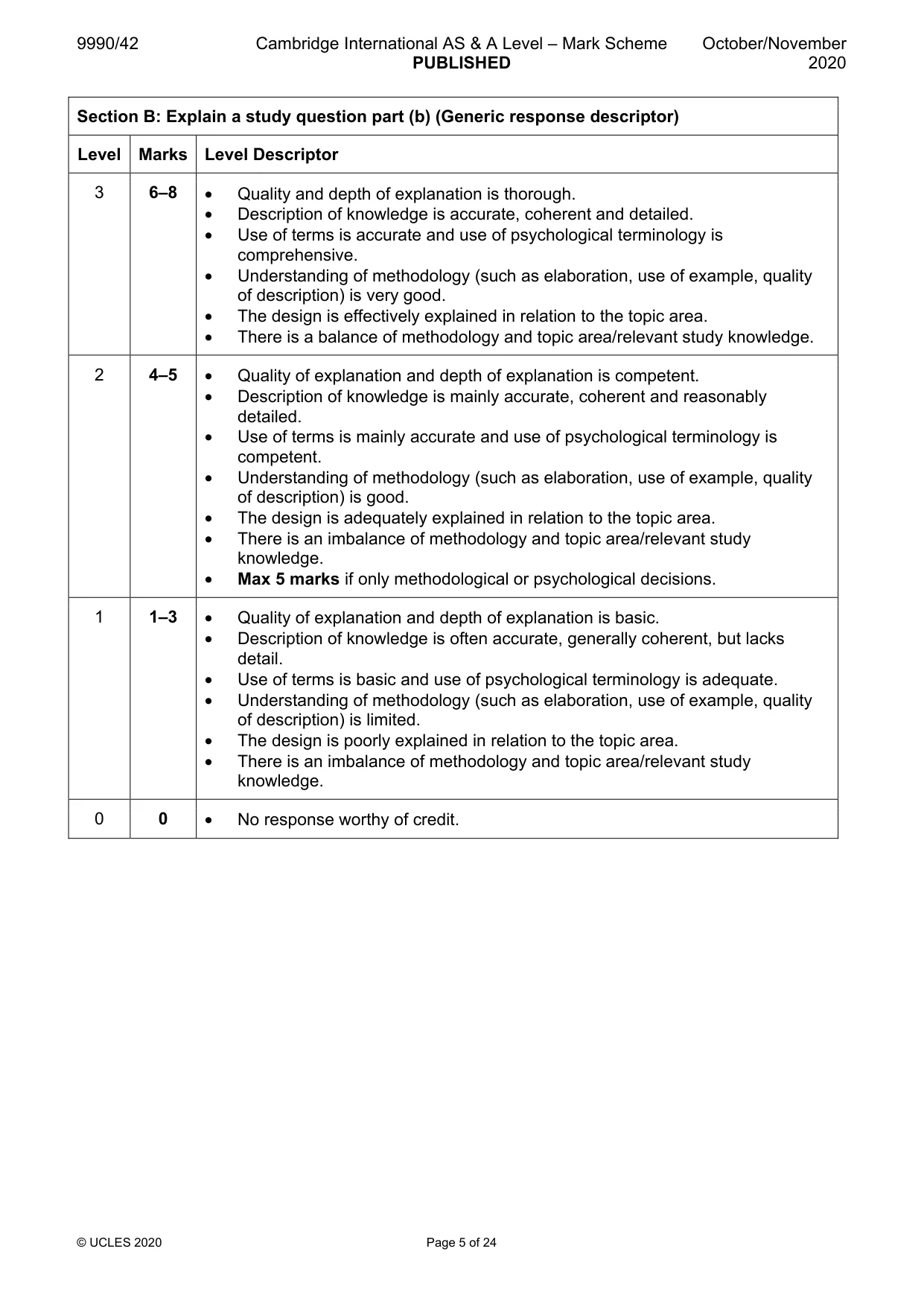
9990/42 Cambridge International AS & A Level – Mark Scheme PUBLISHED October/November 2020 © UCLES 2020 Page 5 of 24 Section B: Explain a study question part (b) (Generic response descriptor) Level Marks Level Descriptor 3 6–8 • Quality and depth of explanation is thorough. • Description of knowledge is accurate, coherent and detailed. • Use of terms is accurate and use of psychological terminology is comprehensive. • Understanding of methodology (such as elaboration, use of example, quality of description) is very good. • The design is effectively explained in relation to the topic area. • There is a balance of methodology and topic area/relevant study knowledge. 2 4–5 • Quality of explanation and depth of explanation is competent. • Description of knowledge is mainly accurate, coherent and reasonably detailed. • Use of terms is mainly accurate and use of psychological terminology is competent. • Understanding of methodology (such as elaboration, use of example, quality of description) is good. • The design is adequately explained in relation to the topic area. • There is an imbalance of methodology and topic area/relevant study knowledge. • Max 5 marks if only methodological or psychological decisions. 1 1–3 • Quality of explanation and depth of explanation is basic. • Description of knowledge is often accurate, generally coherent, but lacks detail. • Use of terms is basic and use of psychological terminology is adequate. • Understanding of methodology (such as elaboration, use of example, quality of description) is limited. • The design is poorly explained in relation to the topic area. • There is an imbalance of methodology and topic area/relevant study knowledge. 0 0 • No response worthy of credit.
Mark scheme, page 6
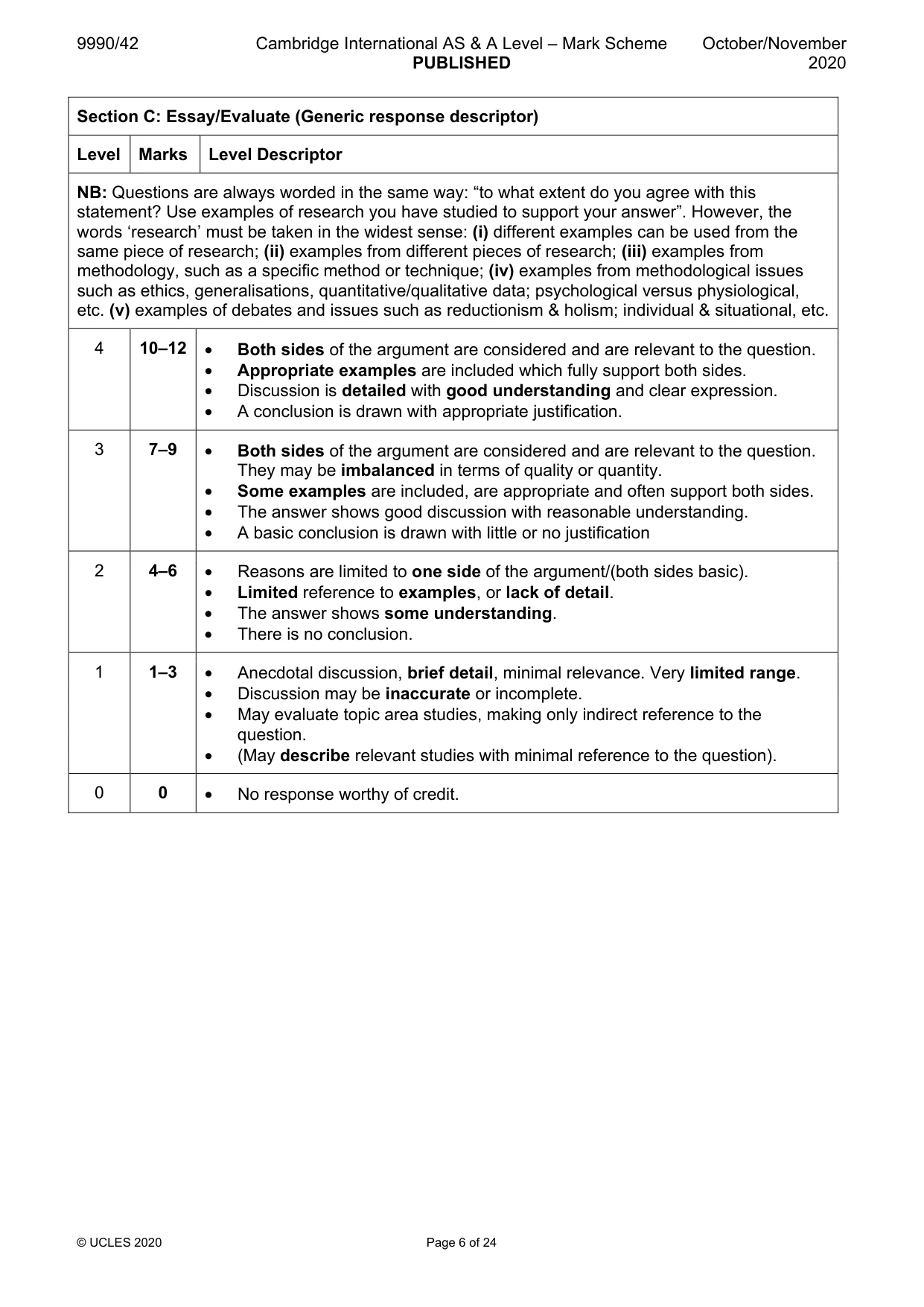
9990/42 Cambridge International AS & A Level – Mark Scheme PUBLISHED October/November 2020 © UCLES 2020 Page 6 of 24 Section C: Essay/Evaluate (Generic response descriptor) Level Marks Level Descriptor NB: Questions are always worded in the same way: “to what extent do you agree with this statement? Use examples of research you have studied to support your answer”. However, the words ‘research’ must be taken in the widest sense: (i) different examples can be used from the same piece of research; (ii) examples from different pieces of research; (iii) examples from methodology, such as a specific method or technique; (iv) examples from methodological issues such as ethics, generalisations, quantitative/qualitative data; psychological versus physiological, etc. (v) examples of debates and issues such as reductionism & holism; individual & situational, etc. 4 10–12 • Both sides of the argument are considered and are relevant to the question. • Appropriate examples are included which fully support both sides. • Discussion is detailed with good understanding and clear expression. • A conclusion is drawn with appropriate justification. 3 7–9 • Both sides of the argument are considered and are relevant to the question. They may be imbalanced in terms of quality or quantity. • Some examples are included, are appropriate and often support both sides. • The answer shows good discussion with reasonable understanding. • A basic conclusion is drawn with little or no justification 2 4–6 • Reasons are limited to one side of the argument/(both sides basic). • Limited reference to examples, or lack of detail. • The answer shows some understanding. • There is no conclusion. 1 1–3 • Anecdotal discussion, brief detail, minimal relevance. Very limited range. • Discussion may be inaccurate or incomplete. • May evaluate topic area studies, making only indirect reference to the question. • (May describe relevant studies with minimal reference to the question). 0 0 • No response worthy of credit.
Mark scheme, page 7
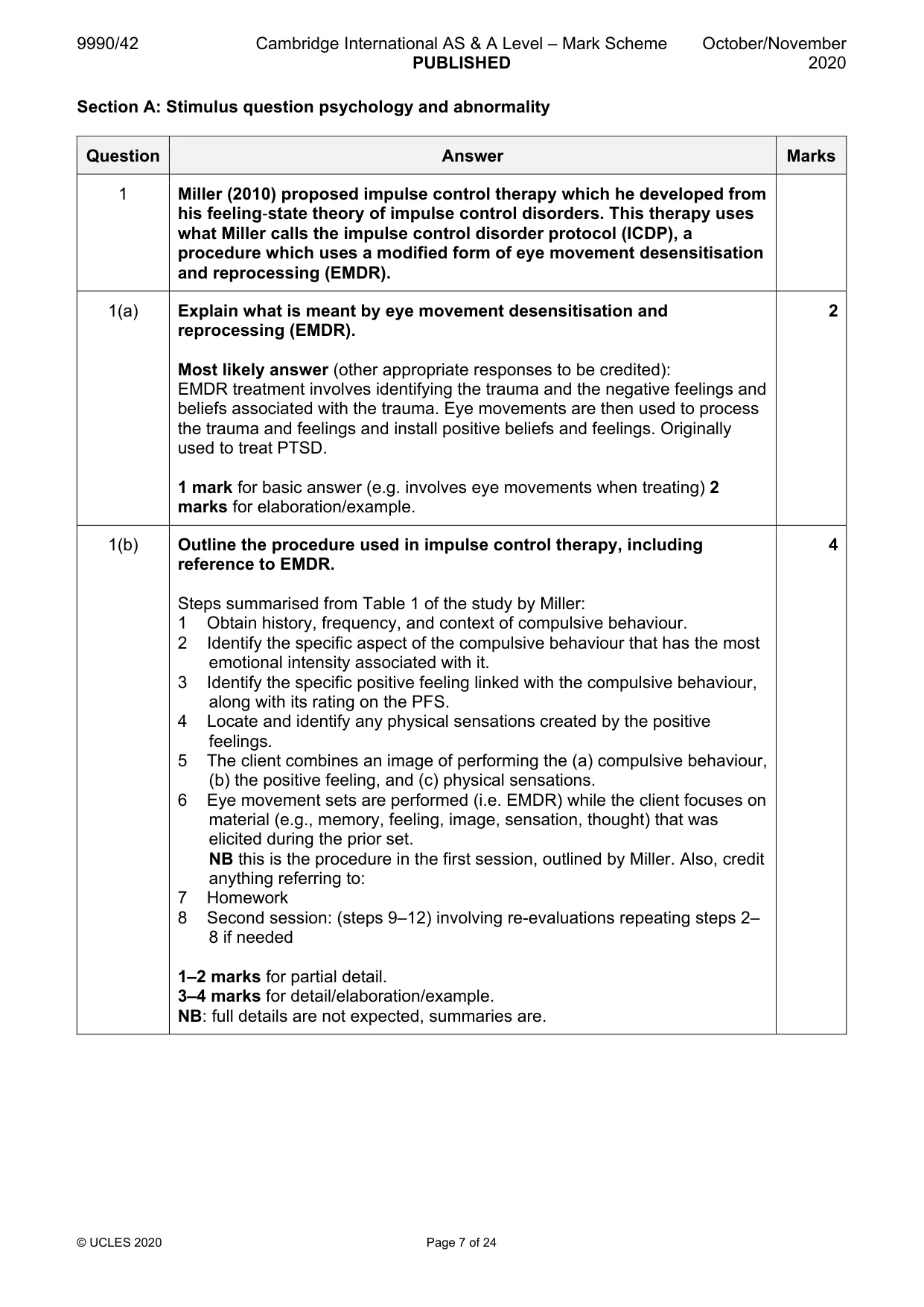
9990/42 Cambridge International AS & A Level – Mark Scheme PUBLISHED October/November 2020 © UCLES 2020 Page 7 of 24 Section A: Stimulus question psychology and abnormality Question Answer Marks 1 Miller (2010) proposed impulse control therapy which he developed from his feeling‐state theory of impulse control disorders. This therapy uses what Miller calls the impulse control disorder protocol (ICDP), a procedure which uses a modified form of eye movement desensitisation and reprocessing (EMDR). 1(a) Explain what is meant by eye movement desensitisation and reprocessing (EMDR). Most likely answer (other appropriate responses to be credited): EMDR treatment involves identifying the trauma and the negative feelings and beliefs associated with the trauma. Eye movements are then used to process the trauma and feelings and install positive beliefs and feelings. Originally used to treat PTSD. 1 mark for basic answer (e.g. involves eye movements when treating) 2 marks for elaboration/example. 2 1(b) Outline the procedure used in impulse control therapy, including reference to EMDR. Steps summarised from Table 1 of the study by Miller: 1 Obtain history, frequency, and context of compulsive behaviour. 2 Identify the specific aspect of the compulsive behaviour that has the most emotional intensity associated with it. 3 Identify the specific positive feeling linked with the compulsive behaviour, along with its rating on the PFS. 4 Locate and identify any physical sensations created by the positive feelings. 5 The client combines an image of performing the (a) compulsive behaviour, (b) the positive feeling, and (c) physical sensations. 6 Eye movement sets are performed (i.e. EMDR) while the client focuses on material (e.g., memory, feeling, image, sensation, thought) that was elicited during the prior set. NB this is the procedure in the first session, outlined by Miller. Also, credit anything referring to: 7 Homework 8 Second session: (steps 9–12) involving re-evaluations repeating steps 2– 8 if needed 1–2 marks for partial detail. 3–4 marks for detail/elaboration/example. NB: full details are not expected, summaries are. 4
Mark scheme, page 8
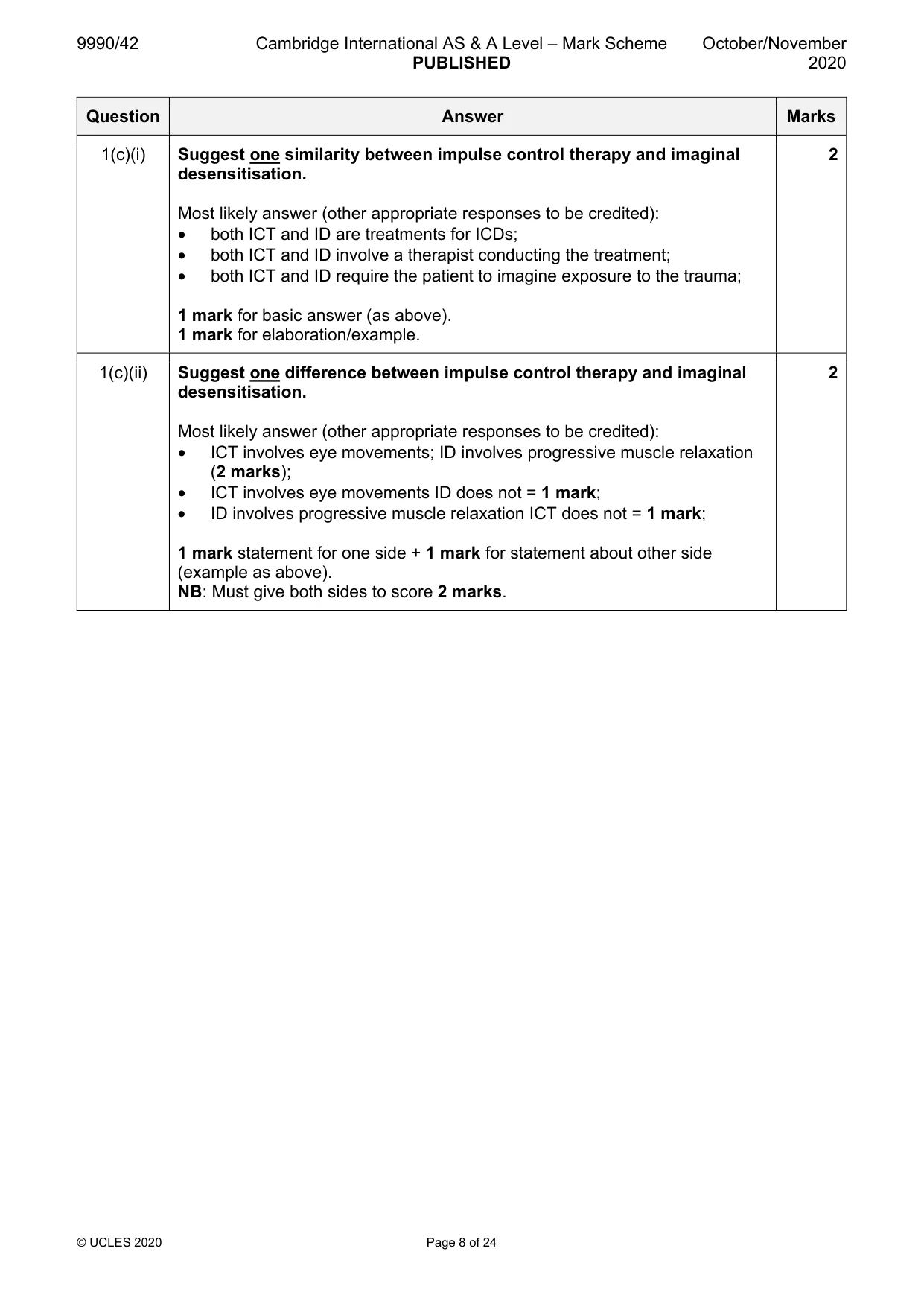
9990/42 Cambridge International AS & A Level – Mark Scheme PUBLISHED October/November 2020 © UCLES 2020 Page 8 of 24 Question Answer Marks 1(c)(i) Suggest one similarity between impulse control therapy and imaginal desensitisation. Most likely answer (other appropriate responses to be credited): • both ICT and ID are treatments for ICDs; • both ICT and ID involve a therapist conducting the treatment; • both ICT and ID require the patient to imagine exposure to the trauma; 1 mark for basic answer (as above). 1 mark for elaboration/example. 2 1(c)(ii) Suggest one difference between impulse control therapy and imaginal desensitisation. Most likely answer (other appropriate responses to be credited): • ICT involves eye movements; ID involves progressive muscle relaxation (2 marks); • ICT involves eye movements ID does not = 1 mark; • ID involves progressive muscle relaxation ICT does not = 1 mark; 1 mark statement for one side + 1 mark for statement about other side (example as above). NB: Must give both sides to score 2 marks. 2
Mark scheme, page 9
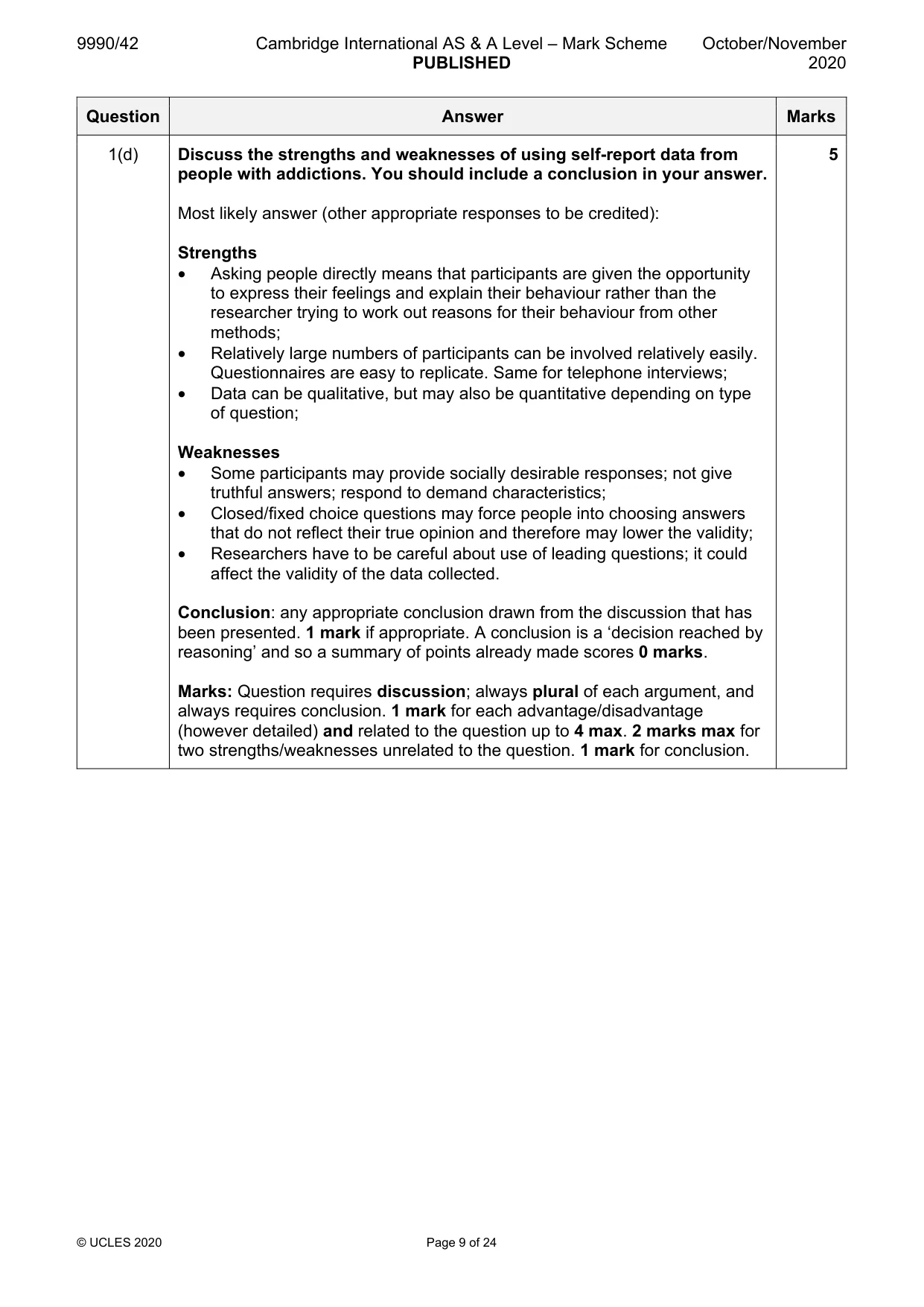
9990/42 Cambridge International AS & A Level – Mark Scheme PUBLISHED October/November 2020 © UCLES 2020 Page 9 of 24 Question Answer Marks 1(d) Discuss the strengths and weaknesses of using self-report data from people with addictions. You should include a conclusion in your answer. Most likely answer (other appropriate responses to be credited): Strengths • Asking people directly means that participants are given the opportunity to express their feelings and explain their behaviour rather than the researcher trying to work out reasons for their behaviour from other methods; • Relatively large numbers of participants can be involved relatively easily. Questionnaires are easy to replicate. Same for telephone interviews; • Data can be qualitative, but may also be quantitative depending on type of question; Weaknesses • Some participants may provide socially desirable responses; not give truthful answers; respond to demand characteristics; • Closed/fixed choice questions may force people into choosing answers that do not reflect their true opinion and therefore may lower the validity; • Researchers have to be careful about use of leading questions; it could affect the validity of the data collected. Conclusion: any appropriate conclusion drawn from the discussion that has been presented. 1 mark if appropriate. A conclusion is a ‘decision reached by reasoning’ and so a summary of points already made scores 0 marks. Marks: Question requires discussion; always plural of each argument, and always requires conclusion. 1 mark for each advantage/disadvantage (however detailed) and related to the question up to 4 max. 2 marks max for two strengths/weaknesses unrelated to the question. 1 mark for conclusion. 5
Mark scheme, page 10
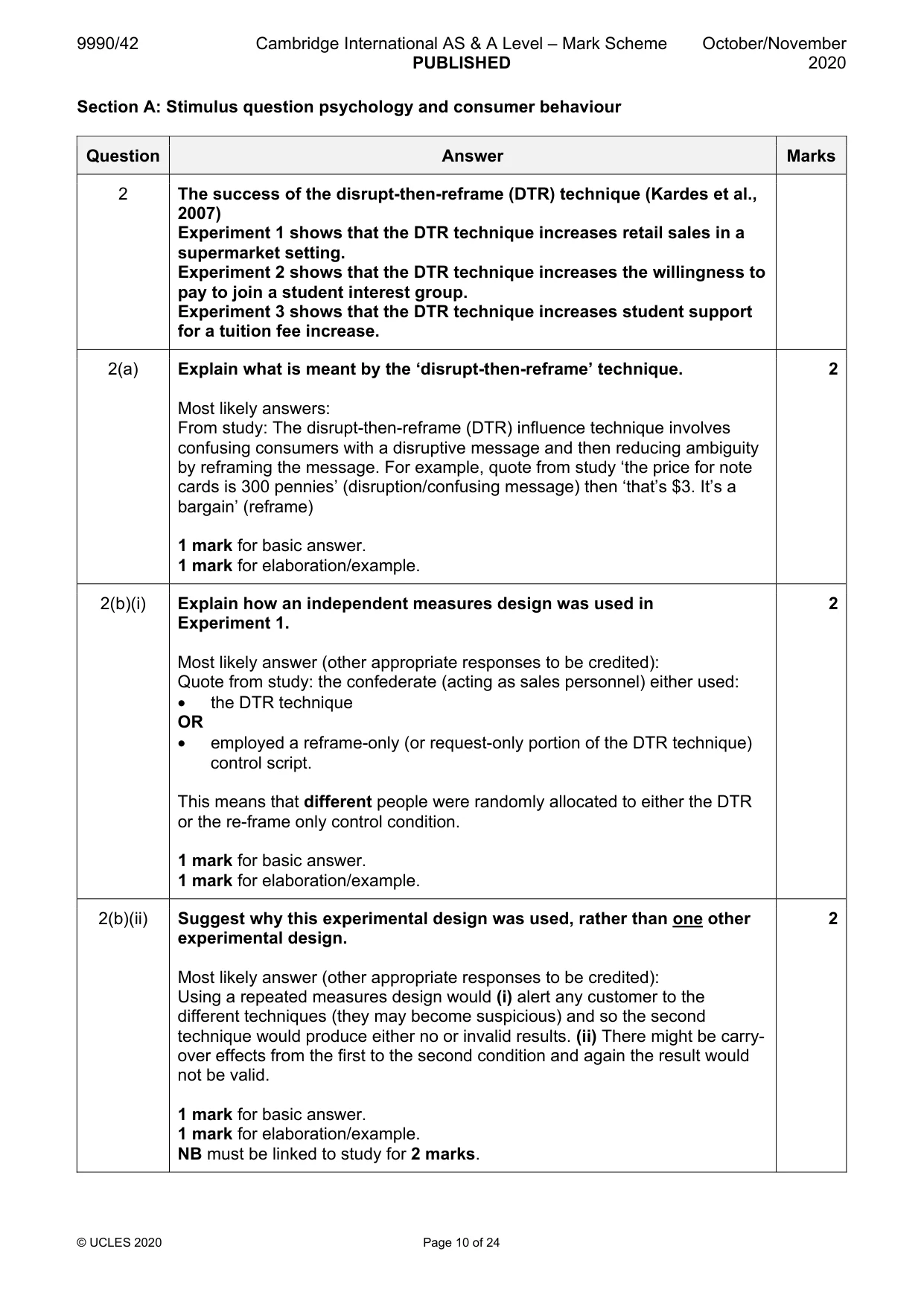
9990/42 Cambridge International AS & A Level – Mark Scheme PUBLISHED October/November 2020 © UCLES 2020 Page 10 of 24 Section A: Stimulus question psychology and consumer behaviour Question Answer Marks 2 The success of the disrupt-then-reframe (DTR) technique (Kardes et al., 2007) Experiment 1 shows that the DTR technique increases retail sales in a supermarket setting. Experiment 2 shows that the DTR technique increases the willingness to pay to join a student interest group. Experiment 3 shows that the DTR technique increases student support for a tuition fee increase. 2(a) Explain what is meant by the ‘disrupt-then-reframe’ technique. Most likely answers: From study: The disrupt-then-reframe (DTR) influence technique involves confusing consumers with a disruptive message and then reducing ambiguity by reframing the message. For example, quote from study ‘the price for note cards is 300 pennies’ (disruption/confusing message) then ‘that’s $3. It’s a bargain’ (reframe) 1 mark for basic answer. 1 mark for elaboration/example. 2 2(b)(i) Explain how an independent measures design was used in Experiment 1. Most likely answer (other appropriate responses to be credited): Quote from study: the confederate (acting as sales personnel) either used: • the DTR technique OR • employed a reframe-only (or request-only portion of the DTR technique) control script. This means that different people were randomly allocated to either the DTR or the re-frame only control condition. 1 mark for basic answer. 1 mark for elaboration/example. 2 2(b)(ii) Suggest why this experimental design was used, rather than one other experimental design. Most likely answer (other appropriate responses to be credited): Using a repeated measures design would (i) alert any customer to the different techniques (they may become suspicious) and so the second technique would produce either no or invalid results. (ii) There might be carry- over effects from the first to the second condition and again the result would not be valid. 1 mark for basic answer. 1 mark for elaboration/example. NB must be linked to study for 2 marks. 2
Mark scheme, page 11
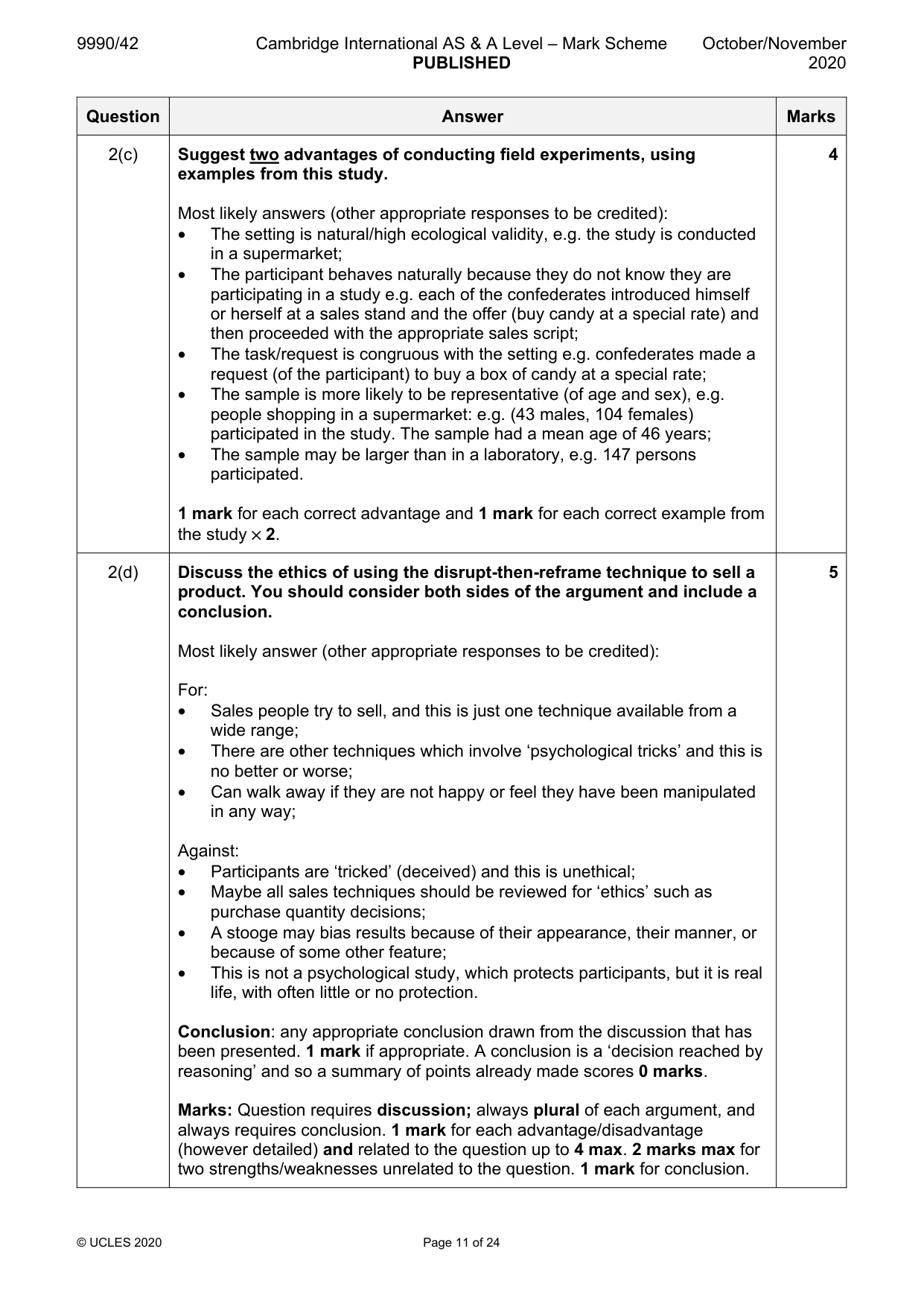
9990/42 Cambridge International AS & A Level – Mark Scheme PUBLISHED October/November 2020 © UCLES 2020 Page 11 of 24 Question Answer Marks 2(c) Suggest two advantages of conducting field experiments, using examples from this study. Most likely answers (other appropriate responses to be credited): • The setting is natural/high ecological validity, e.g. the study is conducted in a supermarket; • The participant behaves naturally because they do not know they are participating in a study e.g. each of the confederates introduced himself or herself at a sales stand and the offer (buy candy at a special rate) and then proceeded with the appropriate sales script; • The task/request is congruous with the setting e.g. confederates made a request (of the participant) to buy a box of candy at a special rate; • The sample is more likely to be representative (of age and sex), e.g. people shopping in a supermarket: e.g. (43 males, 104 females) participated in the study. The sample had a mean age of 46 years; • The sample may be larger than in a laboratory, e.g. 147 persons participated. 1 mark for each correct advantage and 1 mark for each correct example from the study × 2. 4 2(d) Discuss the ethics of using the disrupt-then-reframe technique to sell a product. You should consider both sides of the argument and include a conclusion. Most likely answer (other appropriate responses to be credited): For: • Sales people try to sell, and this is just one technique available from a wide range; • There are other techniques which involve ‘psychological tricks’ and this is no better or worse; • Can walk away if they are not happy or feel they have been manipulated in any way; Against: • Participants are ‘tricked’ (deceived) and this is unethical; • Maybe all sales techniques should be reviewed for ‘ethics’ such as purchase quantity decisions; • A stooge may bias results because of their appearance, their manner, or because of some other feature; • This is not a psychological study, which protects participants, but it is real life, with often little or no protection. Conclusion: any appropriate conclusion drawn from the discussion that has been presented. 1 mark if appropriate. A conclusion is a ‘decision reached by reasoning’ and so a summary of points already made scores 0 marks. Marks: Question requires discussion; always plural of each argument, and always requires conclusion. 1 mark for each advantage/disadvantage (however detailed) and related to the question up to 4 max. 2 marks max for two strengths/weaknesses unrelated to the question. 1 mark for conclusion. 5
Mark scheme, page 12
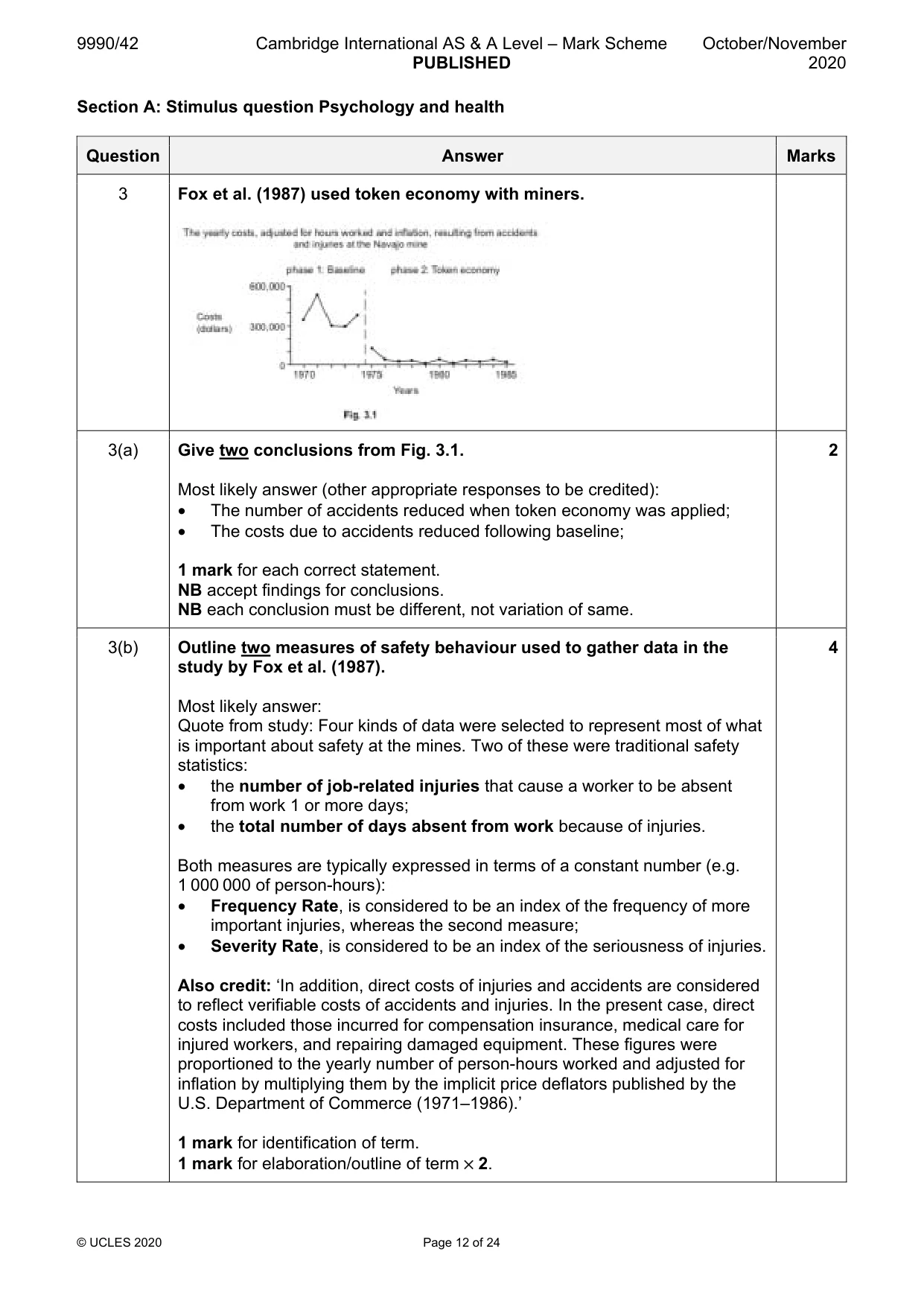
9990/42 Cambridge International AS & A Level – Mark Scheme PUBLISHED October/November 2020 © UCLES 2020 Page 12 of 24 Section A: Stimulus question Psychology and health Question Answer Marks 3 Fox et al. (1987) used token economy with miners. 3(a) Give two conclusions from Fig. 3.1. Most likely answer (other appropriate responses to be credited): • The number of accidents reduced when token economy was applied; • The costs due to accidents reduced following baseline; 1 mark for each correct statement. NB accept findings for conclusions. NB each conclusion must be different, not variation of same. 2 3(b) Outline two measures of safety behaviour used to gather data in the study by Fox et al. (1987). Most likely answer: Quote from study: Four kinds of data were selected to represent most of what is important about safety at the mines. Two of these were traditional safety statistics: • the number of job-related injuries that cause a worker to be absent from work 1 or more days; • the total number of days absent from work because of injuries. Both measures are typically expressed in terms of a constant number (e.g. 1 000 000 of person-hours): • Frequency Rate, is considered to be an index of the frequency of more important injuries, whereas the second measure; • Severity Rate, is considered to be an index of the seriousness of injuries. Also credit: ‘In addition, direct costs of injuries and accidents are considered to reflect verifiable costs of accidents and injuries. In the present case, direct costs included those incurred for compensation insurance, medical care for injured workers, and repairing damaged equipment. These figures were proportioned to the yearly number of person-hours worked and adjusted for inflation by multiplying them by the implicit price deflators published by the U.S. Department of Commerce (1971–1986).’ 1 mark for identification of term. 1 mark for elaboration/outline of term × 2. 4
Mark scheme, page 13
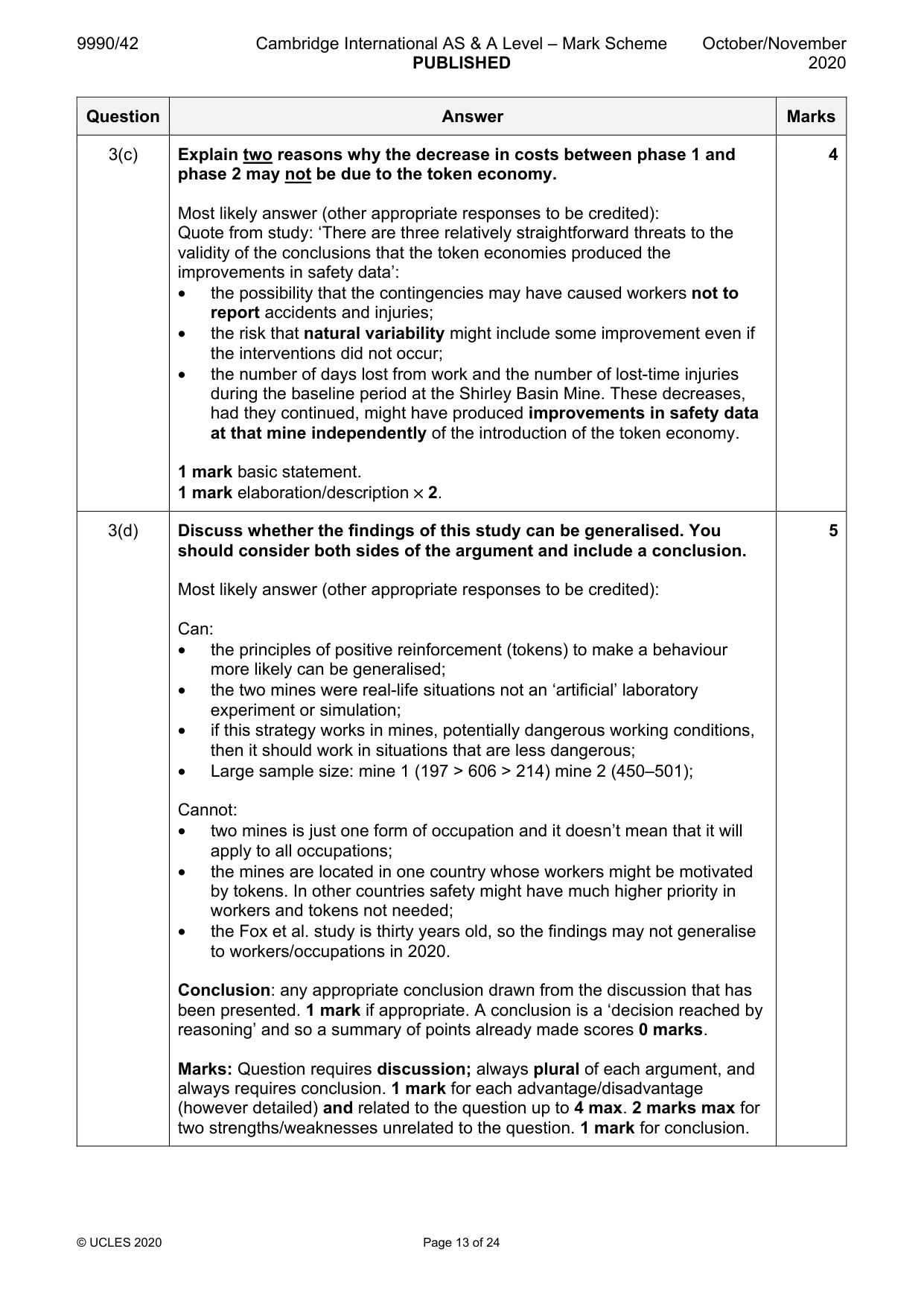
9990/42 Cambridge International AS & A Level – Mark Scheme PUBLISHED October/November 2020 © UCLES 2020 Page 13 of 24 Question Answer Marks 3(c) Explain two reasons why the decrease in costs between phase 1 and phase 2 may not be due to the token economy. Most likely answer (other appropriate responses to be credited): Quote from study: ‘There are three relatively straightforward threats to the validity of the conclusions that the token economies produced the improvements in safety data’: • the possibility that the contingencies may have caused workers not to report accidents and injuries; • the risk that natural variability might include some improvement even if the interventions did not occur; • the number of days lost from work and the number of lost-time injuries during the baseline period at the Shirley Basin Mine. These decreases, had they continued, might have produced improvements in safety data at that mine independently of the introduction of the token economy. 1 mark basic statement. 1 mark elaboration/description × 2. 4 3(d) Discuss whether the findings of this study can be generalised. You should consider both sides of the argument and include a conclusion. Most likely answer (other appropriate responses to be credited): Can: • the principles of positive reinforcement (tokens) to make a behaviour more likely can be generalised; • the two mines were real-life situations not an ‘artificial’ laboratory experiment or simulation; • if this strategy works in mines, potentially dangerous working conditions, then it should work in situations that are less dangerous; • Large sample size: mine 1 (197 > 606 > 214) mine 2 (450–501); Cannot: • two mines is just one form of occupation and it doesn’t mean that it will apply to all occupations; • the mines are located in one country whose workers might be motivated by tokens. In other countries safety might have much higher priority in workers and tokens not needed; • the Fox et al. study is thirty years old, so the findings may not generalise to workers/occupations in 2020. Conclusion: any appropriate conclusion drawn from the discussion that has been presented. 1 mark if appropriate. A conclusion is a ‘decision reached by reasoning’ and so a summary of points already made scores 0 marks. Marks: Question requires discussion; always plural of each argument, and always requires conclusion. 1 mark for each advantage/disadvantage (however detailed) and related to the question up to 4 max. 2 marks max for two strengths/weaknesses unrelated to the question. 1 mark for conclusion. 5
Mark scheme, page 14
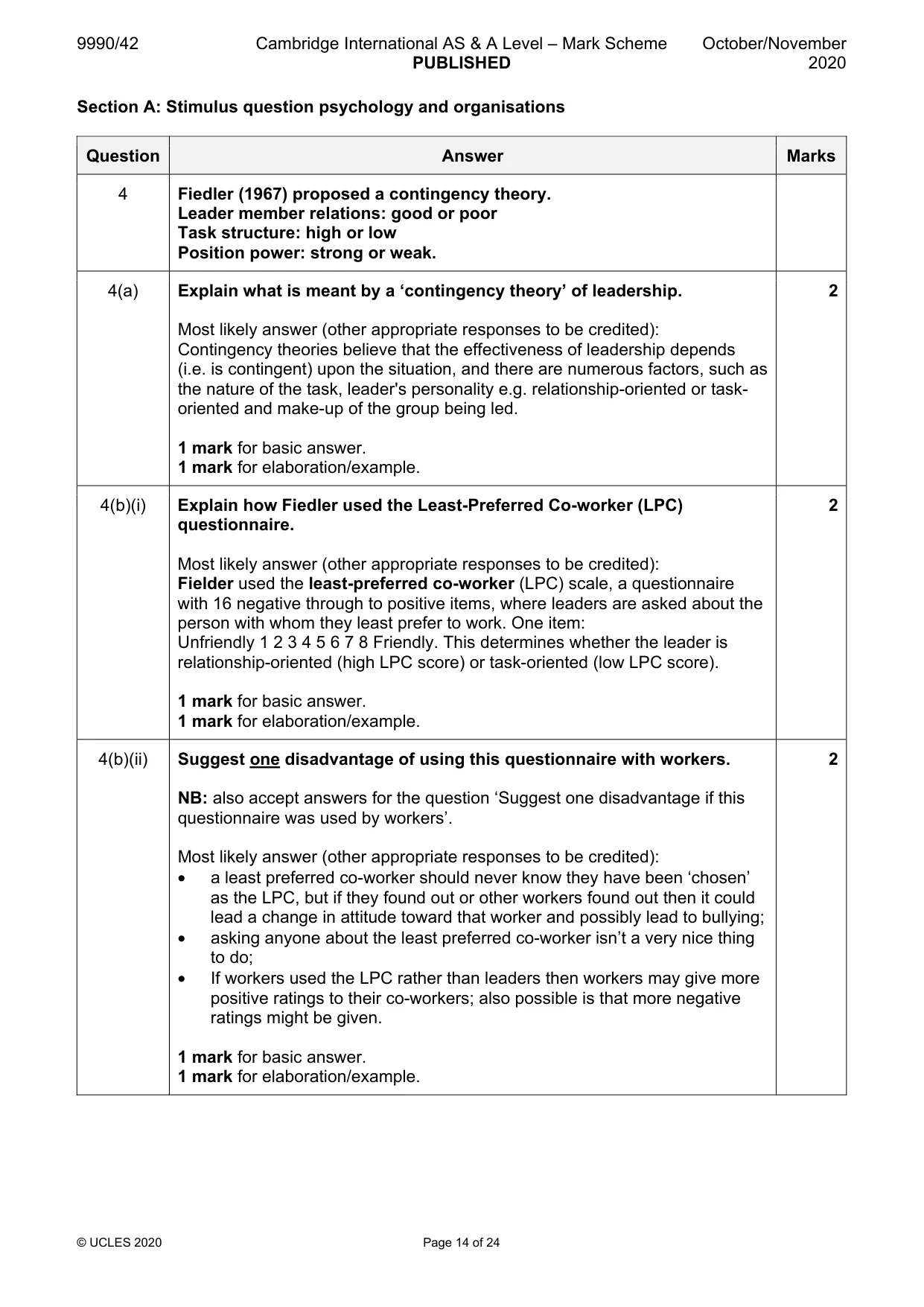
9990/42 Cambridge International AS & A Level – Mark Scheme PUBLISHED October/November 2020 © UCLES 2020 Page 14 of 24 Section A: Stimulus question psychology and organisations Question Answer Marks 4 Fiedler (1967) proposed a contingency theory. Leader member relations: good or poor Task structure: high or low Position power: strong or weak. 4(a) Explain what is meant by a ‘contingency theory’ of leadership. Most likely answer (other appropriate responses to be credited): Contingency theories believe that the effectiveness of leadership depends (i.e. is contingent) upon the situation, and there are numerous factors, such as the nature of the task, leader's personality e.g. relationship-oriented or task- oriented and make-up of the group being led. 1 mark for basic answer. 1 mark for elaboration/example. 2 4(b)(i) Explain how Fiedler used the Least-Preferred Co-worker (LPC) questionnaire. Most likely answer (other appropriate responses to be credited): Fielder used the least-preferred co-worker (LPC) scale, a questionnaire with 16 negative through to positive items, where leaders are asked about the person with whom they least prefer to work. One item: Unfriendly 1 2 3 4 5 6 7 8 Friendly. This determines whether the leader is relationship-oriented (high LPC score) or task-oriented (low LPC score). 1 mark for basic answer. 1 mark for elaboration/example. 2 4(b)(ii) Suggest one disadvantage of using this questionnaire with workers. NB: also accept answers for the question ‘Suggest one disadvantage if this questionnaire was used by workers’. Most likely answer (other appropriate responses to be credited): • a least preferred co-worker should never know they have been ‘chosen’ as the LPC, but if they found out or other workers found out then it could lead a change in attitude toward that worker and possibly lead to bullying; • asking anyone about the least preferred co-worker isn’t a very nice thing to do; • If workers used the LPC rather than leaders then workers may give more positive ratings to their co-workers; also possible is that more negative ratings might be given. 1 mark for basic answer. 1 mark for elaboration/example. 2
Mark scheme, page 15
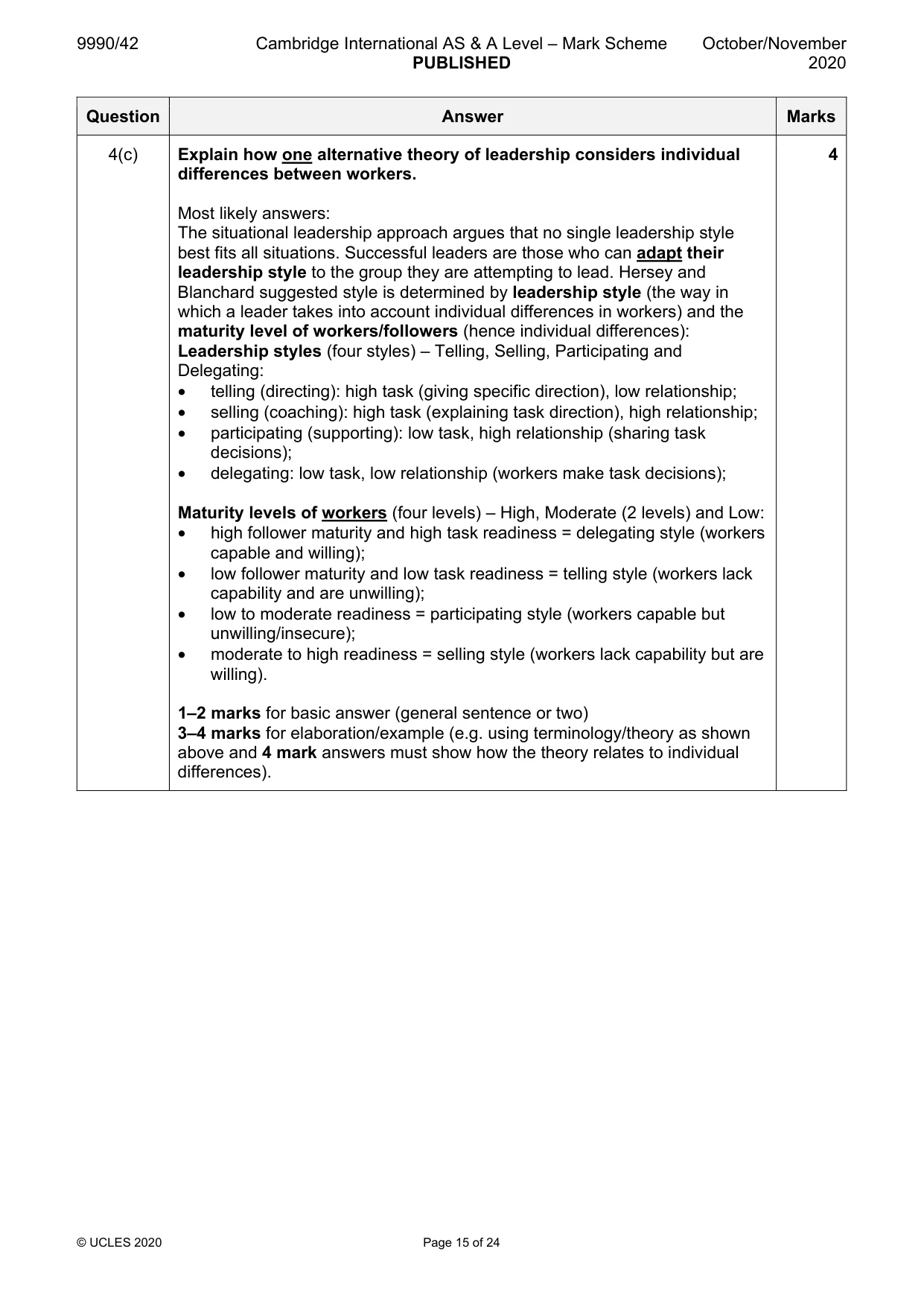
9990/42 Cambridge International AS & A Level – Mark Scheme PUBLISHED October/November 2020 © UCLES 2020 Page 15 of 24 Question Answer Marks 4(c) Explain how one alternative theory of leadership considers individual differences between workers. Most likely answers: The situational leadership approach argues that no single leadership style best fits all situations. Successful leaders are those who can adapt their leadership style to the group they are attempting to lead. Hersey and Blanchard suggested style is determined by leadership style (the way in which a leader takes into account individual differences in workers) and the maturity level of workers/followers (hence individual differences): Leadership styles (four styles) – Telling, Selling, Participating and Delegating: • telling (directing): high task (giving specific direction), low relationship; • selling (coaching): high task (explaining task direction), high relationship; • participating (supporting): low task, high relationship (sharing task decisions); • delegating: low task, low relationship (workers make task decisions); Maturity levels of workers (four levels) – High, Moderate (2 levels) and Low: • high follower maturity and high task readiness = delegating style (workers capable and willing); • low follower maturity and low task readiness = telling style (workers lack capability and are unwilling); • low to moderate readiness = participating style (workers capable but unwilling/insecure); • moderate to high readiness = selling style (workers lack capability but are willing). 1–2 marks for basic answer (general sentence or two) 3–4 marks for elaboration/example (e.g. using terminology/theory as shown above and 4 mark answers must show how the theory relates to individual differences). 4
Mark scheme, page 16
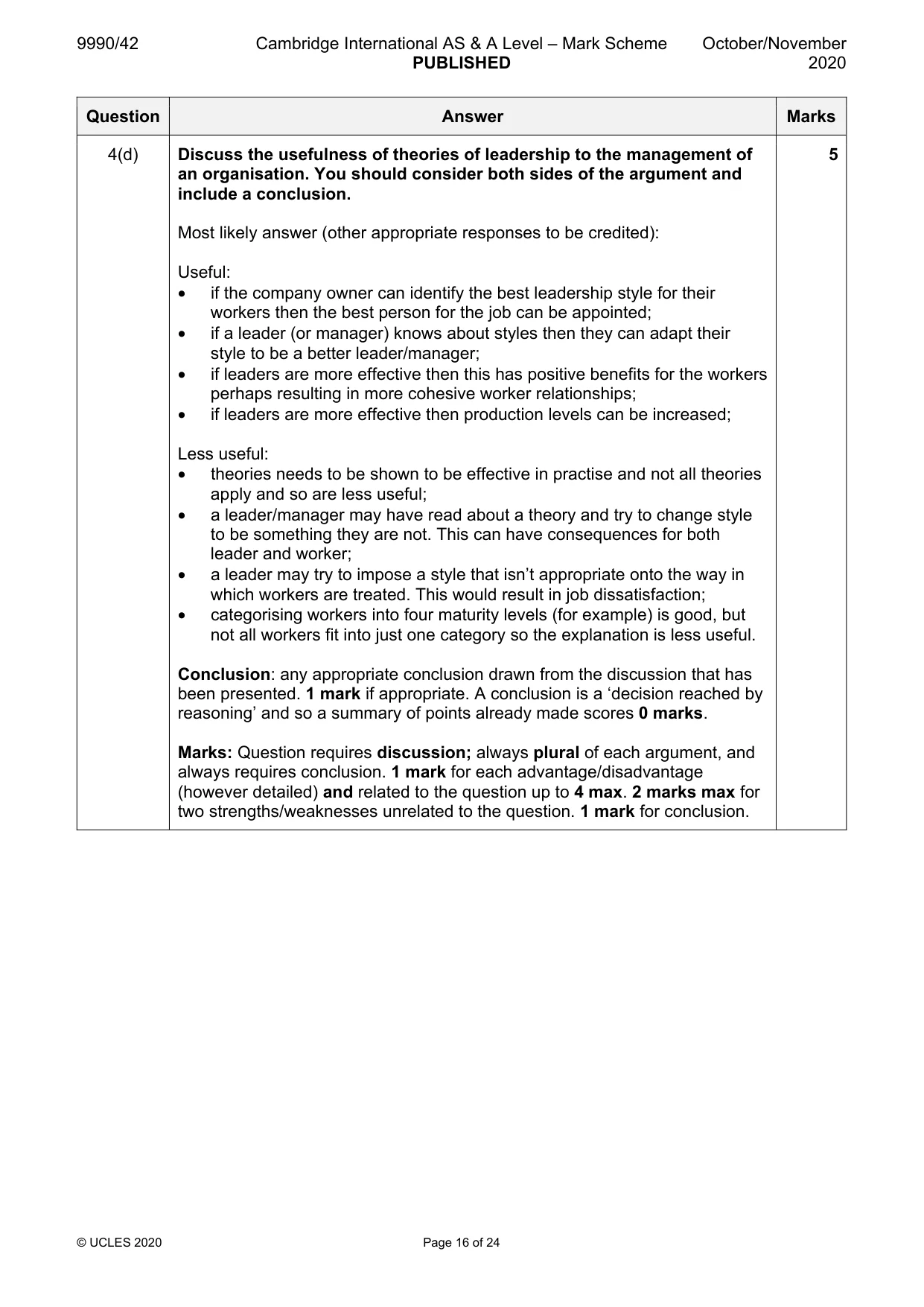
9990/42 Cambridge International AS & A Level – Mark Scheme PUBLISHED October/November 2020 © UCLES 2020 Page 16 of 24 Question Answer Marks 4(d) Discuss the usefulness of theories of leadership to the management of an organisation. You should consider both sides of the argument and include a conclusion. Most likely answer (other appropriate responses to be credited): Useful: • if the company owner can identify the best leadership style for their workers then the best person for the job can be appointed; • if a leader (or manager) knows about styles then they can adapt their style to be a better leader/manager; • if leaders are more effective then this has positive benefits for the workers perhaps resulting in more cohesive worker relationships; • if leaders are more effective then production levels can be increased; Less useful: • theories needs to be shown to be effective in practise and not all theories apply and so are less useful; • a leader/manager may have read about a theory and try to change style to be something they are not. This can have consequences for both leader and worker; • a leader may try to impose a style that isn’t appropriate onto the way in which workers are treated. This would result in job dissatisfaction; • categorising workers into four maturity levels (for example) is good, but not all workers fit into just one category so the explanation is less useful. Conclusion: any appropriate conclusion drawn from the discussion that has been presented. 1 mark if appropriate. A conclusion is a ‘decision reached by reasoning’ and so a summary of points already made scores 0 marks. Marks: Question requires discussion; always plural of each argument, and always requires conclusion. 1 mark for each advantage/disadvantage (however detailed) and related to the question up to 4 max. 2 marks max for two strengths/weaknesses unrelated to the question. 1 mark for conclusion. 5
Mark scheme, page 17
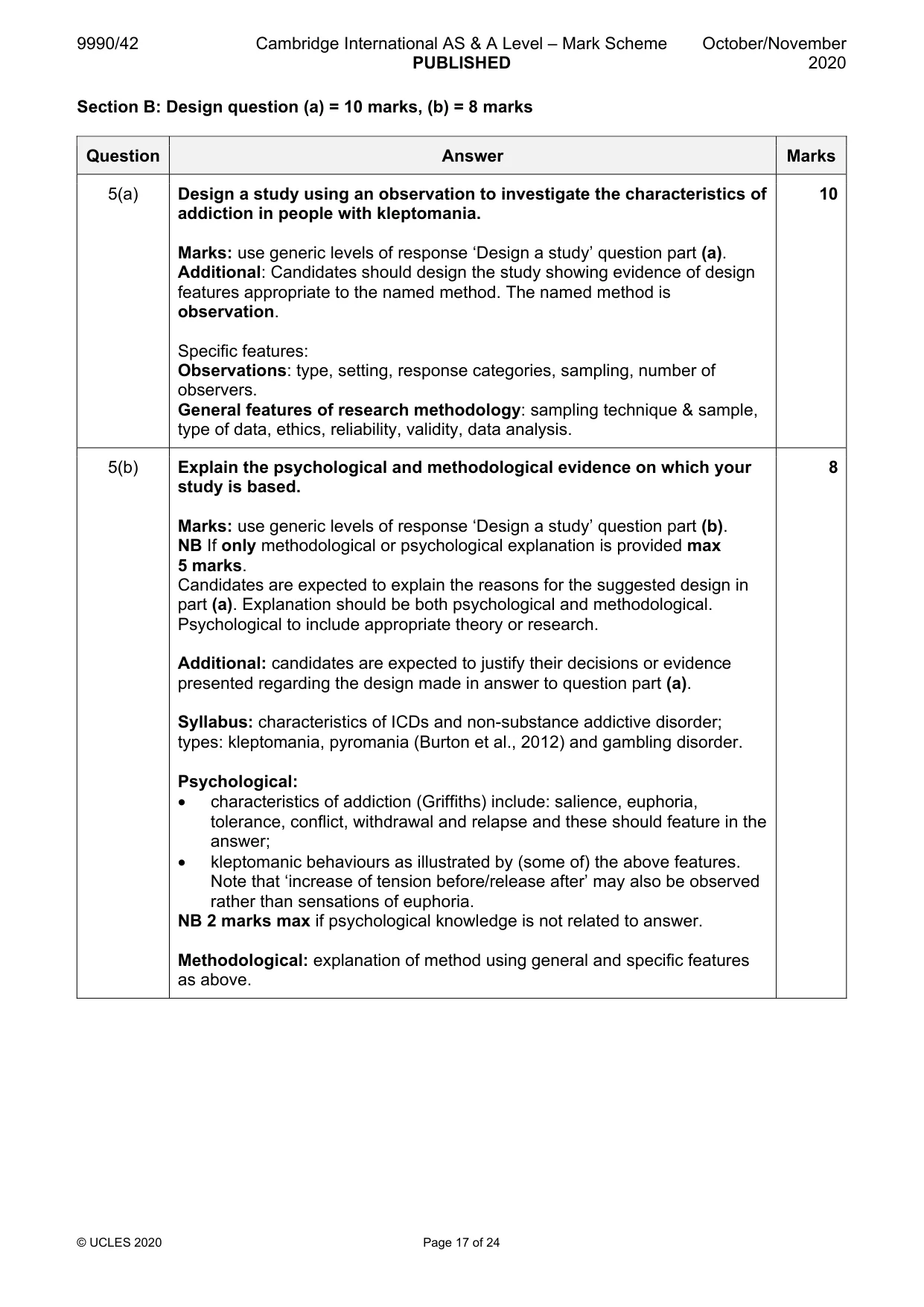
9990/42 Cambridge International AS & A Level – Mark Scheme PUBLISHED October/November 2020 © UCLES 2020 Page 17 of 24 Section B: Design question (a) = 10 marks, (b) = 8 marks Question Answer Marks 5(a) Design a study using an observation to investigate the characteristics of addiction in people with kleptomania. Marks: use generic levels of response ‘Design a study’ question part (a). Additional: Candidates should design the study showing evidence of design features appropriate to the named method. The named method is observation. Specific features: Observations: type, setting, response categories, sampling, number of observers. General features of research methodology: sampling technique & sample, type of data, ethics, reliability, validity, data analysis. 10 5(b) Explain the psychological and methodological evidence on which your study is based. Marks: use generic levels of response ‘Design a study’ question part (b). NB If only methodological or psychological explanation is provided max 5 marks. Candidates are expected to explain the reasons for the suggested design in part (a). Explanation should be both psychological and methodological. Psychological to include appropriate theory or research. Additional: candidates are expected to justify their decisions or evidence presented regarding the design made in answer to question part (a). Syllabus: characteristics of ICDs and non-substance addictive disorder; types: kleptomania, pyromania (Burton et al., 2012) and gambling disorder. Psychological: • characteristics of addiction (Griffiths) include: salience, euphoria, tolerance, conflict, withdrawal and relapse and these should feature in the answer; • kleptomanic behaviours as illustrated by (some of) the above features. Note that ‘increase of tension before/release after’ may also be observed rather than sensations of euphoria. NB 2 marks max if psychological knowledge is not related to answer. Methodological: explanation of method using general and specific features as above. 8
Mark scheme, page 18
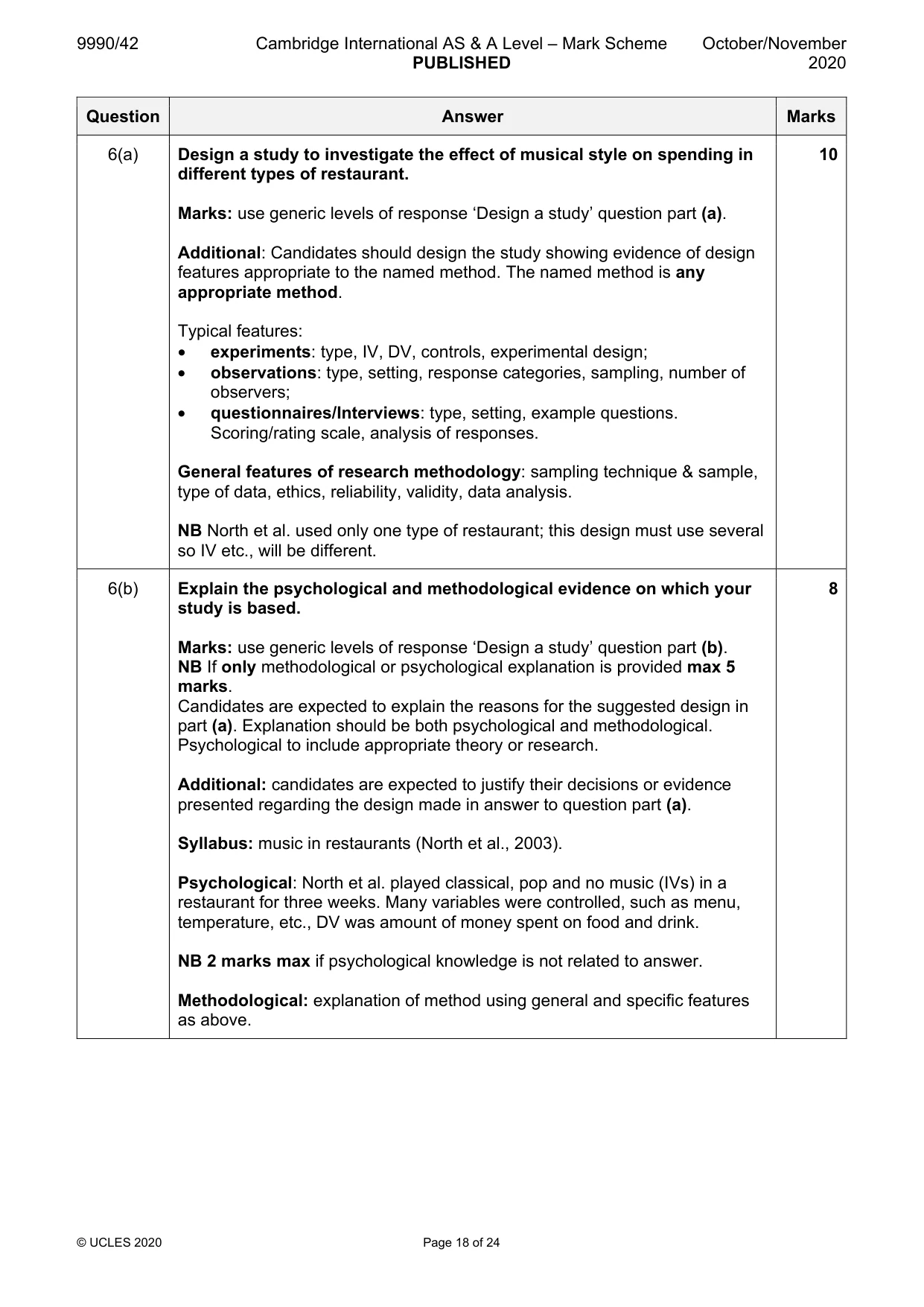
9990/42 Cambridge International AS & A Level – Mark Scheme PUBLISHED October/November 2020 © UCLES 2020 Page 18 of 24 Question Answer Marks 6(a) Design a study to investigate the effect of musical style on spending in different types of restaurant. Marks: use generic levels of response ‘Design a study’ question part (a). Additional: Candidates should design the study showing evidence of design features appropriate to the named method. The named method is any appropriate method. Typical features: • experiments: type, IV, DV, controls, experimental design; • observations: type, setting, response categories, sampling, number of observers; • questionnaires/Interviews: type, setting, example questions. Scoring/rating scale, analysis of responses. General features of research methodology: sampling technique & sample, type of data, ethics, reliability, validity, data analysis. NB North et al. used only one type of restaurant; this design must use several so IV etc., will be different. 10 6(b) Explain the psychological and methodological evidence on which your study is based. Marks: use generic levels of response ‘Design a study’ question part (b). NB If only methodological or psychological explanation is provided max 5 marks. Candidates are expected to explain the reasons for the suggested design in part (a). Explanation should be both psychological and methodological. Psychological to include appropriate theory or research. Additional: candidates are expected to justify their decisions or evidence presented regarding the design made in answer to question part (a). Syllabus: music in restaurants (North et al., 2003). Psychological: North et al. played classical, pop and no music (IVs) in a restaurant for three weeks. Many variables were controlled, such as menu, temperature, etc., DV was amount of money spent on food and drink. NB 2 marks max if psychological knowledge is not related to answer. Methodological: explanation of method using general and specific features as above. 8
Mark scheme, page 19
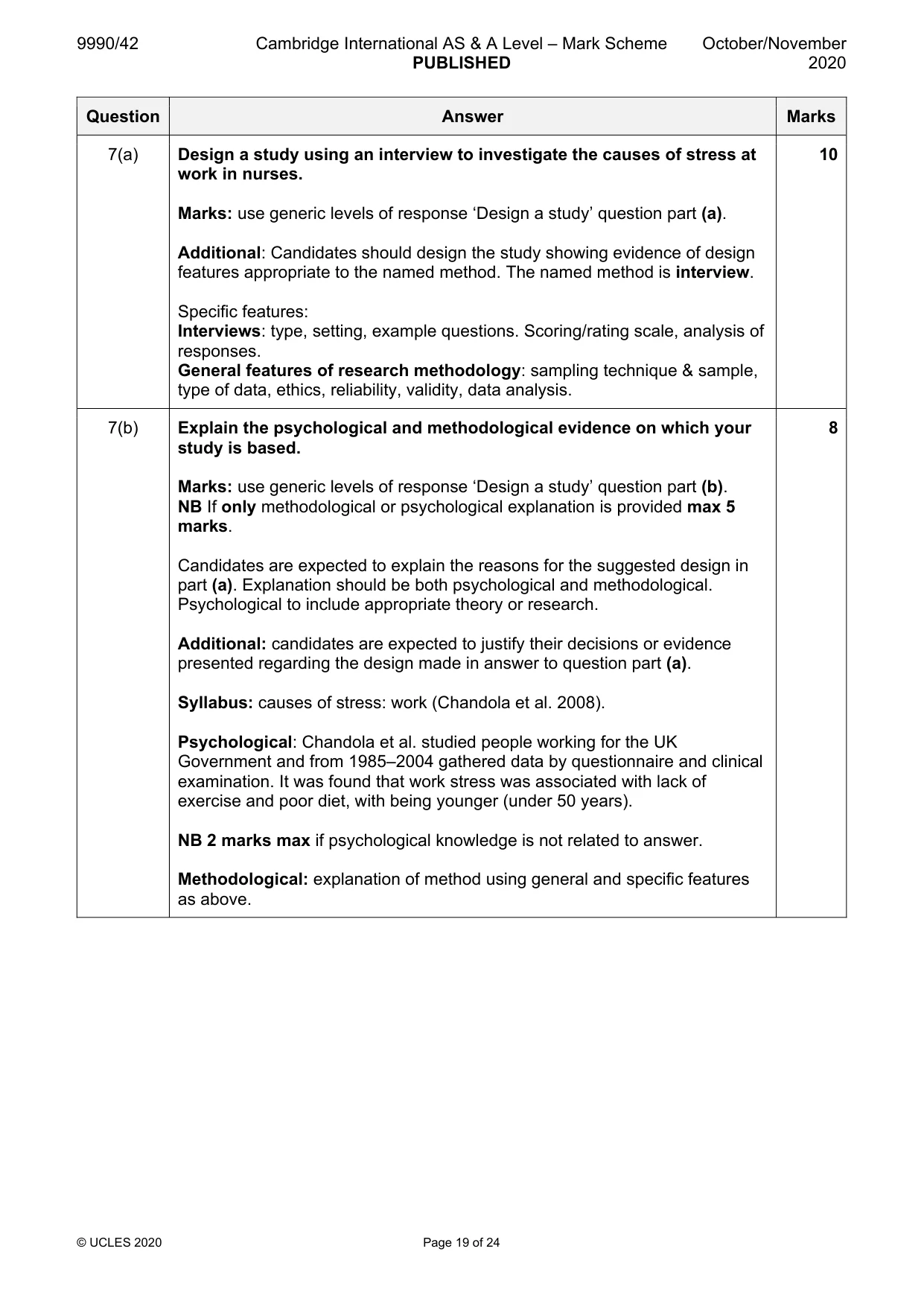
9990/42 Cambridge International AS & A Level – Mark Scheme PUBLISHED October/November 2020 © UCLES 2020 Page 19 of 24 Question Answer Marks 7(a) Design a study using an interview to investigate the causes of stress at work in nurses. Marks: use generic levels of response ‘Design a study’ question part (a). Additional: Candidates should design the study showing evidence of design features appropriate to the named method. The named method is interview. Specific features: Interviews: type, setting, example questions. Scoring/rating scale, analysis of responses. General features of research methodology: sampling technique & sample, type of data, ethics, reliability, validity, data analysis. 10 7(b) Explain the psychological and methodological evidence on which your study is based. Marks: use generic levels of response ‘Design a study’ question part (b). NB If only methodological or psychological explanation is provided max 5 marks. Candidates are expected to explain the reasons for the suggested design in part (a). Explanation should be both psychological and methodological. Psychological to include appropriate theory or research. Additional: candidates are expected to justify their decisions or evidence presented regarding the design made in answer to question part (a). Syllabus: causes of stress: work (Chandola et al. 2008). Psychological: Chandola et al. studied people working for the UK Government and from 1985–2004 gathered data by questionnaire and clinical examination. It was found that work stress was associated with lack of exercise and poor diet, with being younger (under 50 years). NB 2 marks max if psychological knowledge is not related to answer. Methodological: explanation of method using general and specific features as above. 8
Mark scheme, page 20
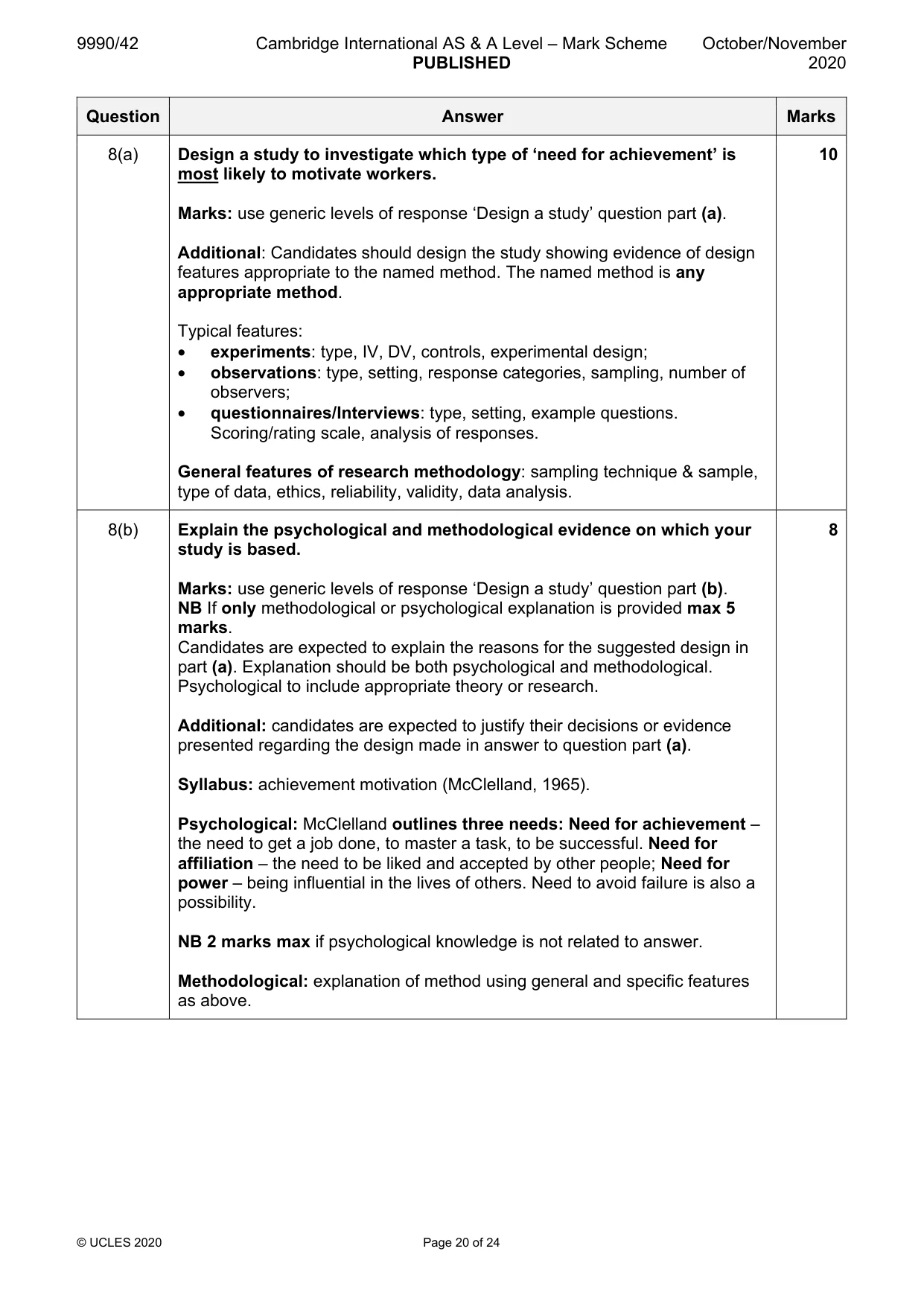
9990/42 Cambridge International AS & A Level – Mark Scheme PUBLISHED October/November 2020 © UCLES 2020 Page 20 of 24 Question Answer Marks 8(a) Design a study to investigate which type of ‘need for achievement’ is most likely to motivate workers. Marks: use generic levels of response ‘Design a study’ question part (a). Additional: Candidates should design the study showing evidence of design features appropriate to the named method. The named method is any appropriate method. Typical features: • experiments: type, IV, DV, controls, experimental design; • observations: type, setting, response categories, sampling, number of observers; • questionnaires/Interviews: type, setting, example questions. Scoring/rating scale, analysis of responses. General features of research methodology: sampling technique & sample, type of data, ethics, reliability, validity, data analysis. 10 8(b) Explain the psychological and methodological evidence on which your study is based. Marks: use generic levels of response ‘Design a study’ question part (b). NB If only methodological or psychological explanation is provided max 5 marks. Candidates are expected to explain the reasons for the suggested design in part (a). Explanation should be both psychological and methodological. Psychological to include appropriate theory or research. Additional: candidates are expected to justify their decisions or evidence presented regarding the design made in answer to question part (a). Syllabus: achievement motivation (McClelland, 1965). Psychological: McClelland outlines three needs: Need for achievement – the need to get a job done, to master a task, to be successful. Need for affiliation – the need to be liked and accepted by other people; Need for power – being influential in the lives of others. Need to avoid failure is also a possibility. NB 2 marks max if psychological knowledge is not related to answer. Methodological: explanation of method using general and specific features as above. 8
Mark scheme, page 21
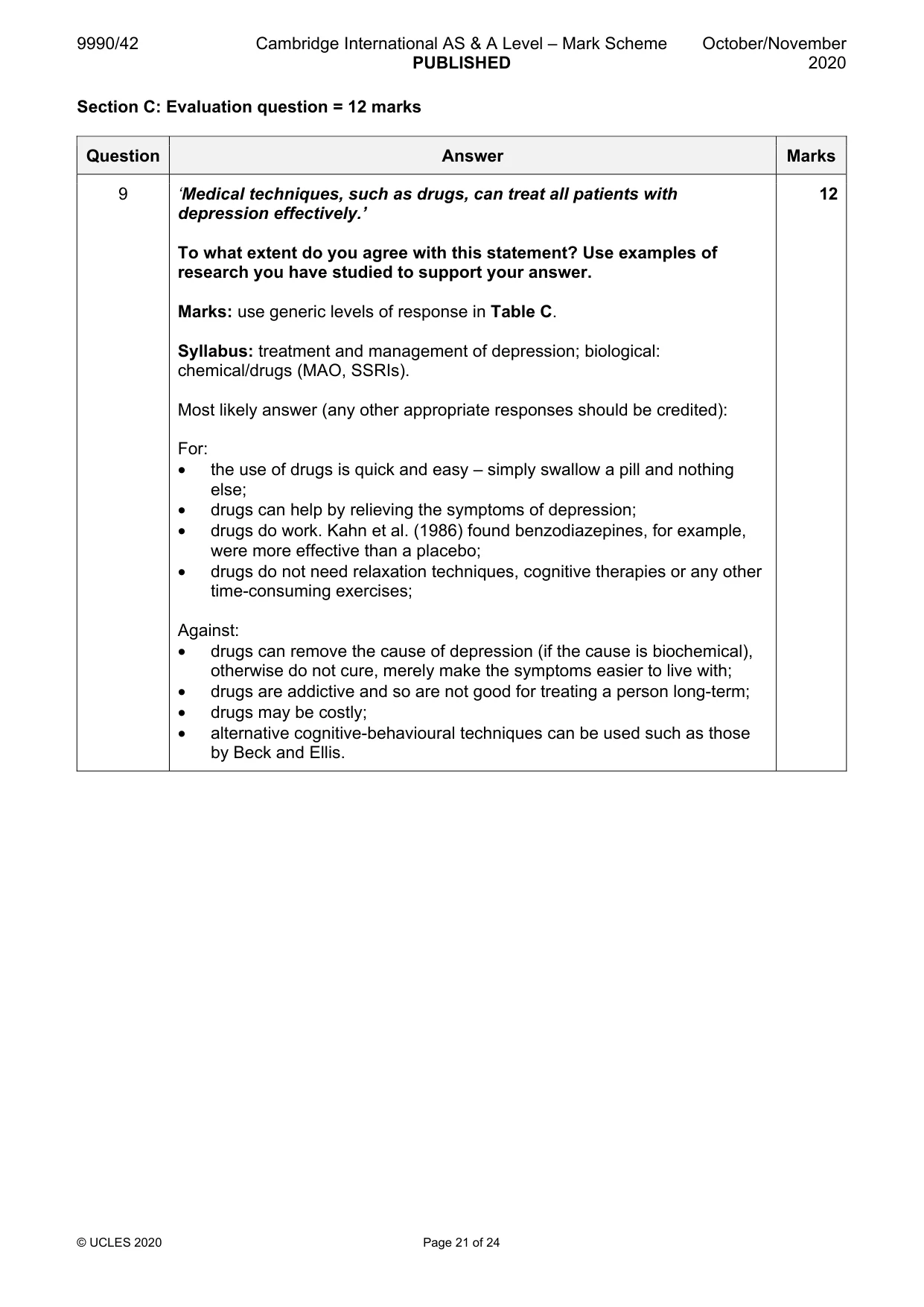
9990/42 Cambridge International AS & A Level – Mark Scheme PUBLISHED October/November 2020 © UCLES 2020 Page 21 of 24 Section C: Evaluation question = 12 marks Question Answer Marks 9 ‘Medical techniques, such as drugs, can treat all patients with depression effectively.’ To what extent do you agree with this statement? Use examples of research you have studied to support your answer. Marks: use generic levels of response in Table C. Syllabus: treatment and management of depression; biological: chemical/drugs (MAO, SSRIs). Most likely answer (any other appropriate responses should be credited): For: • the use of drugs is quick and easy – simply swallow a pill and nothing else; • drugs can help by relieving the symptoms of depression; • drugs do work. Kahn et al. (1986) found benzodiazepines, for example, were more effective than a placebo; • drugs do not need relaxation techniques, cognitive therapies or any other time-consuming exercises; Against: • drugs can remove the cause of depression (if the cause is biochemical), otherwise do not cure, merely make the symptoms easier to live with; • drugs are addictive and so are not good for treating a person long-term; • drugs may be costly; • alternative cognitive-behavioural techniques can be used such as those by Beck and Ellis. 12
Mark scheme, page 22
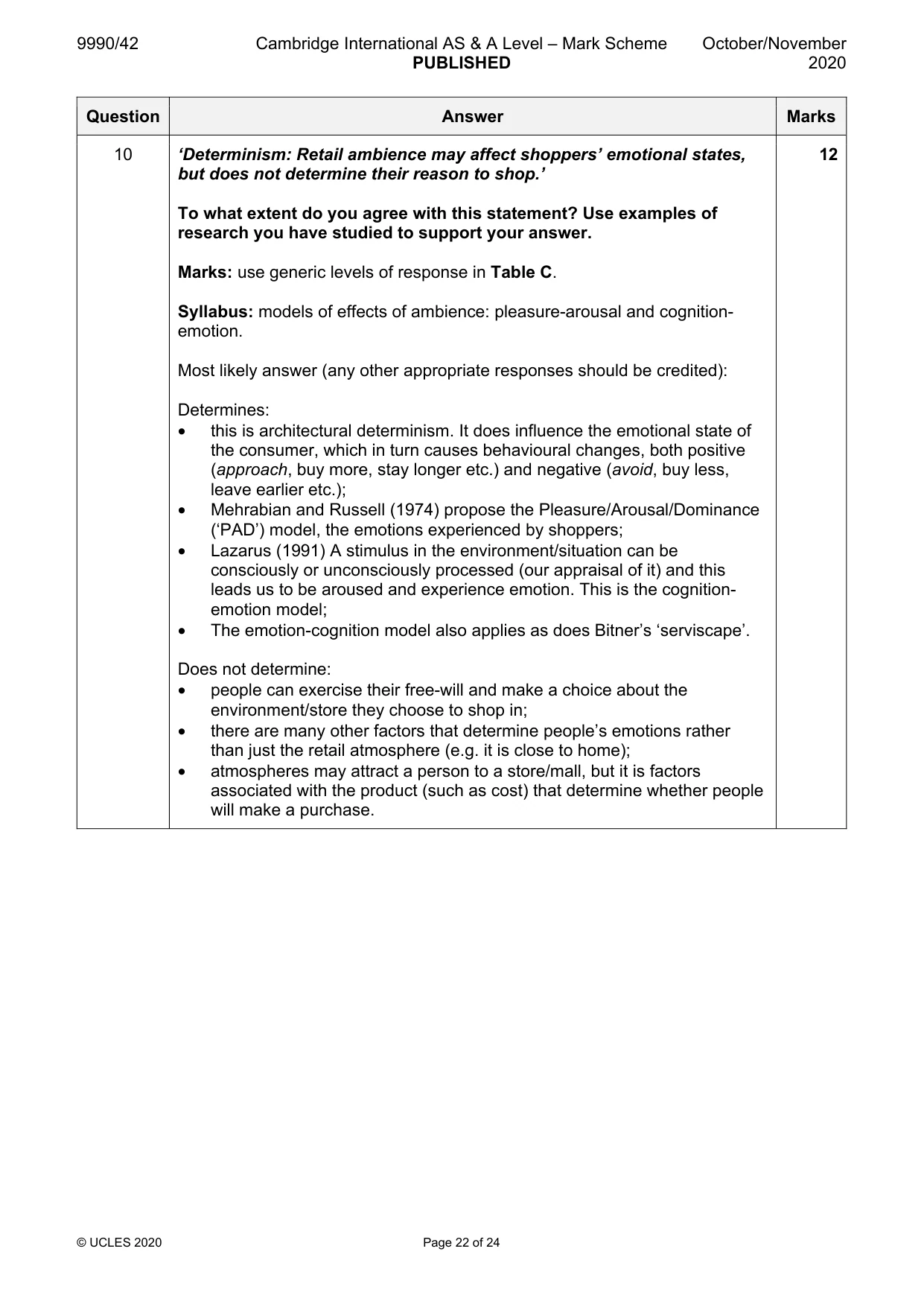
9990/42 Cambridge International AS & A Level – Mark Scheme PUBLISHED October/November 2020 © UCLES 2020 Page 22 of 24 Question Answer Marks 10 ‘Determinism: Retail ambience may affect shoppers’ emotional states, but does not determine their reason to shop.’ To what extent do you agree with this statement? Use examples of research you have studied to support your answer. Marks: use generic levels of response in Table C. Syllabus: models of effects of ambience: pleasure-arousal and cognition- emotion. Most likely answer (any other appropriate responses should be credited): Determines: • this is architectural determinism. It does influence the emotional state of the consumer, which in turn causes behavioural changes, both positive (approach, buy more, stay longer etc.) and negative (avoid, buy less, leave earlier etc.); • Mehrabian and Russell (1974) propose the Pleasure/Arousal/Dominance (‘PAD’) model, the emotions experienced by shoppers; • Lazarus (1991) A stimulus in the environment/situation can be consciously or unconsciously processed (our appraisal of it) and this leads us to be aroused and experience emotion. This is the cognition- emotion model; • The emotion-cognition model also applies as does Bitner’s ‘serviscape’. Does not determine: • people can exercise their free-will and make a choice about the environment/store they choose to shop in; • there are many other factors that determine people’s emotions rather than just the retail atmosphere (e.g. it is close to home); • atmospheres may attract a person to a store/mall, but it is factors associated with the product (such as cost) that determine whether people will make a purchase. 12
Mark scheme, page 23
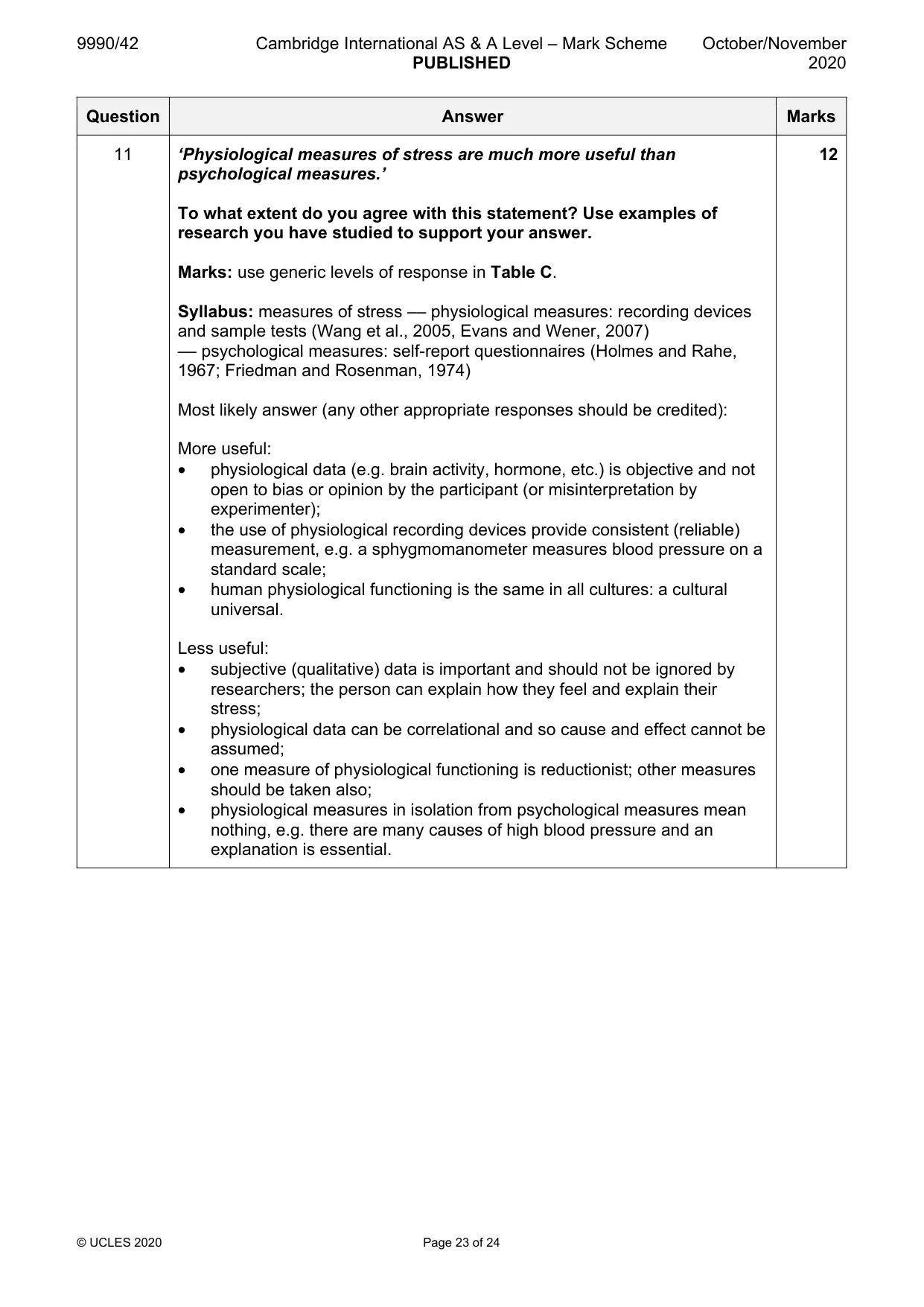
9990/42 Cambridge International AS & A Level – Mark Scheme PUBLISHED October/November 2020 © UCLES 2020 Page 23 of 24 Question Answer Marks 11 ‘Physiological measures of stress are much more useful than psychological measures.’ To what extent do you agree with this statement? Use examples of research you have studied to support your answer. Marks: use generic levels of response in Table C. Syllabus: measures of stress –– physiological measures: recording devices and sample tests (Wang et al., 2005, Evans and Wener, 2007) –– psychological measures: self-report questionnaires (Holmes and Rahe, 1967; Friedman and Rosenman, 1974) Most likely answer (any other appropriate responses should be credited): More useful: • physiological data (e.g. brain activity, hormone, etc.) is objective and not open to bias or opinion by the participant (or misinterpretation by experimenter); • the use of physiological recording devices provide consistent (reliable) measurement, e.g. a sphygmomanometer measures blood pressure on a standard scale; • human physiological functioning is the same in all cultures: a cultural universal. Less useful: • subjective (qualitative) data is important and should not be ignored by researchers; the person can explain how they feel and explain their stress; • physiological data can be correlational and so cause and effect cannot be assumed; • one measure of physiological functioning is reductionist; other measures should be taken also; • physiological measures in isolation from psychological measures mean nothing, e.g. there are many causes of high blood pressure and an explanation is essential. 12
Mark scheme, page 24
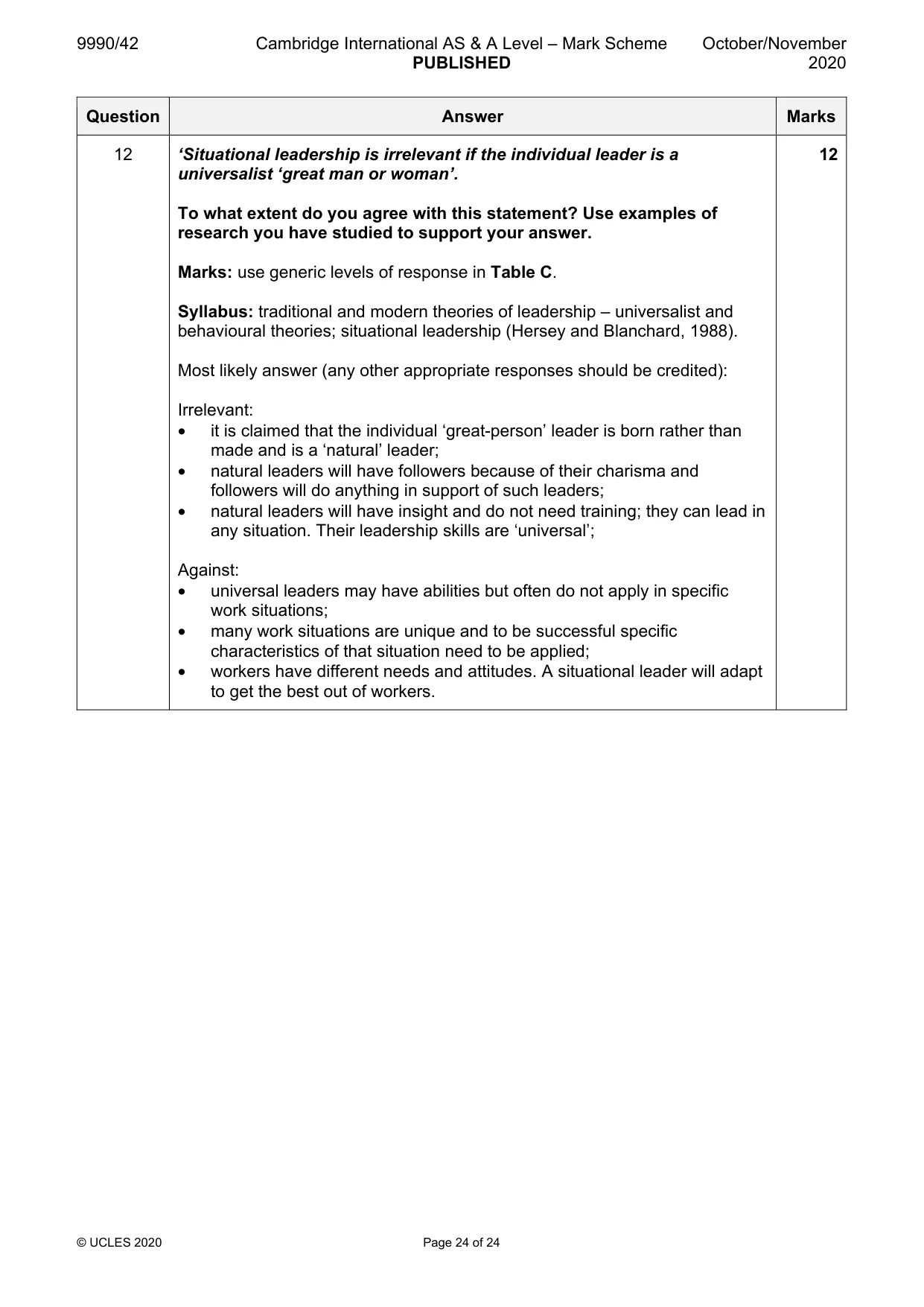
9990/42 Cambridge International AS & A Level – Mark Scheme PUBLISHED October/November 2020 © UCLES 2020 Page 24 of 24 Question Answer Marks 12 ‘Situational leadership is irrelevant if the individual leader is a universalist ‘great man or woman’. To what extent do you agree with this statement? Use examples of research you have studied to support your answer. Marks: use generic levels of response in Table C. Syllabus: traditional and modern theories of leadership – universalist and behavioural theories; situational leadership (Hersey and Blanchard, 1988). Most likely answer (any other appropriate responses should be credited): Irrelevant: • it is claimed that the individual ‘great-person’ leader is born rather than made and is a ‘natural’ leader; • natural leaders will have followers because of their charisma and followers will do anything in support of such leaders; • natural leaders will have insight and do not need training; they can lead in any situation. Their leadership skills are ‘universal’; Against: • universal leaders may have abilities but often do not apply in specific work situations; • many work situations are unique and to be successful specific characteristics of that situation need to be applied; • workers have different needs and attitudes. A situational leader will adapt to get the best out of workers. 12
What you needed in this session
Cambridge’s own grade thresholds for 2020 Oct/Nov, Paper 4 · Variant 2. A higher threshold means an easier paper — the bar moves with how the cohort did.