Cambridge A Level Psychology (from 2018) 9990 — 2020 Oct/Nov Paper 4 · Variant 1
9990/41/O/N/20 · 60 marks · ≈68 min
The question paper and its mark scheme, free to read here and free to download. This is Cambridge’s own paper, exactly as it was sat.
Question paper8 pages



Mark scheme23 pages
Answers below. Sit the paper first if you are practising.
Paper as text
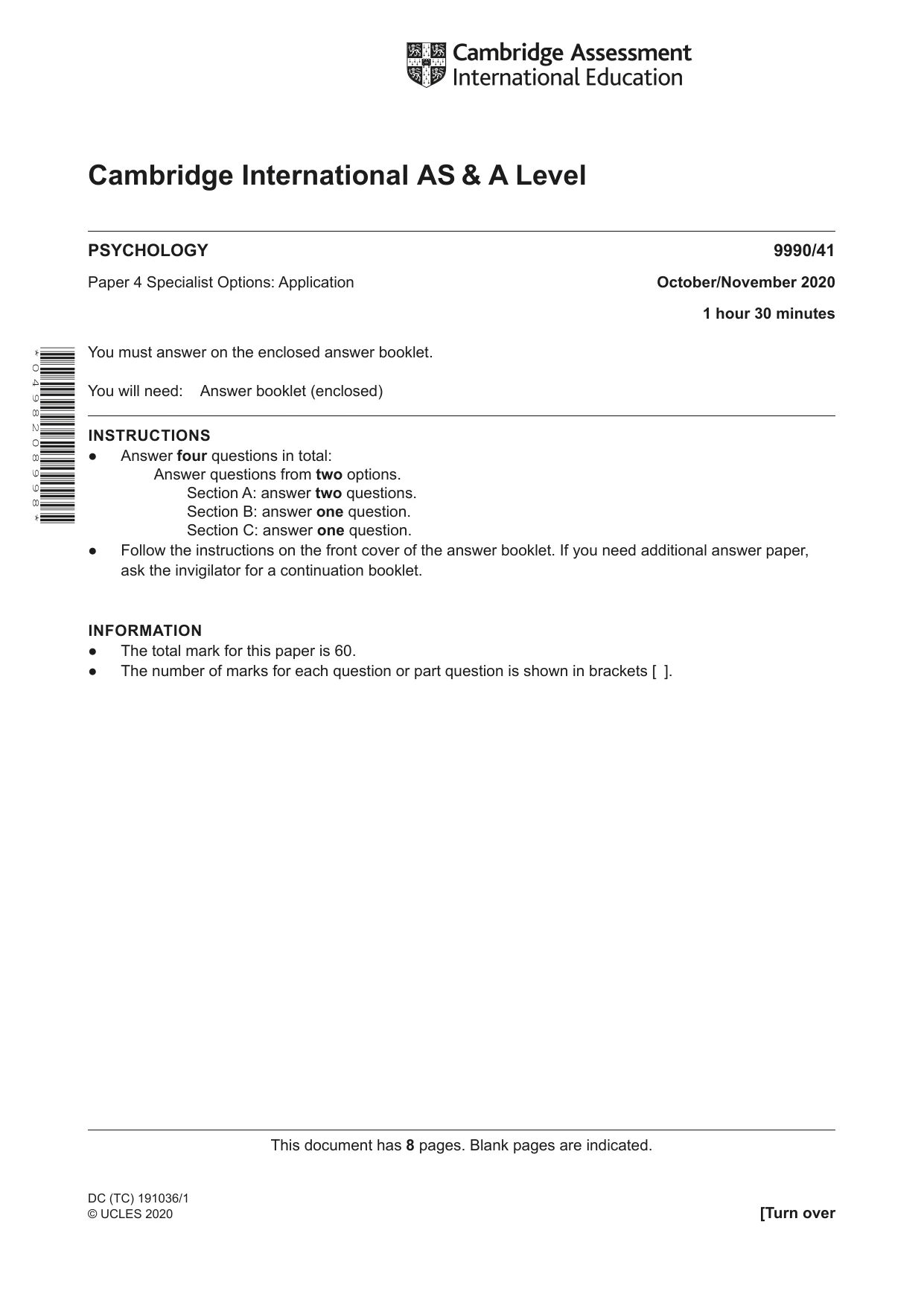
Question paper, page 1
Cambridge International AS & A Level This document has 8 pages. Blank pages are indicated. DC (TC) 191036/1 © UCLES 2020 [Turn over * 0 4 9 8 2 0 8 9 9 8 * PSYCHOLOGY 9990/41 Paper 4 Specialist Options: Application October/November 2020 1 hour 30 minutes You must answer on the enclosed answer booklet. You will need: Answer booklet (enclosed) INSTRUCTIONS ● Answer four questions in total: Answer questions from two options. Section A: answer two questions. Section B: answer one question. Section C: answer one question. ● Follow the instructions on the front cover of the answer booklet. If you need additional answer paper, ask the invigilator for a continuation booklet. INFORMATION ● The total mark for this paper is 60. ● The number of marks for each question or part question is shown in brackets [ ].
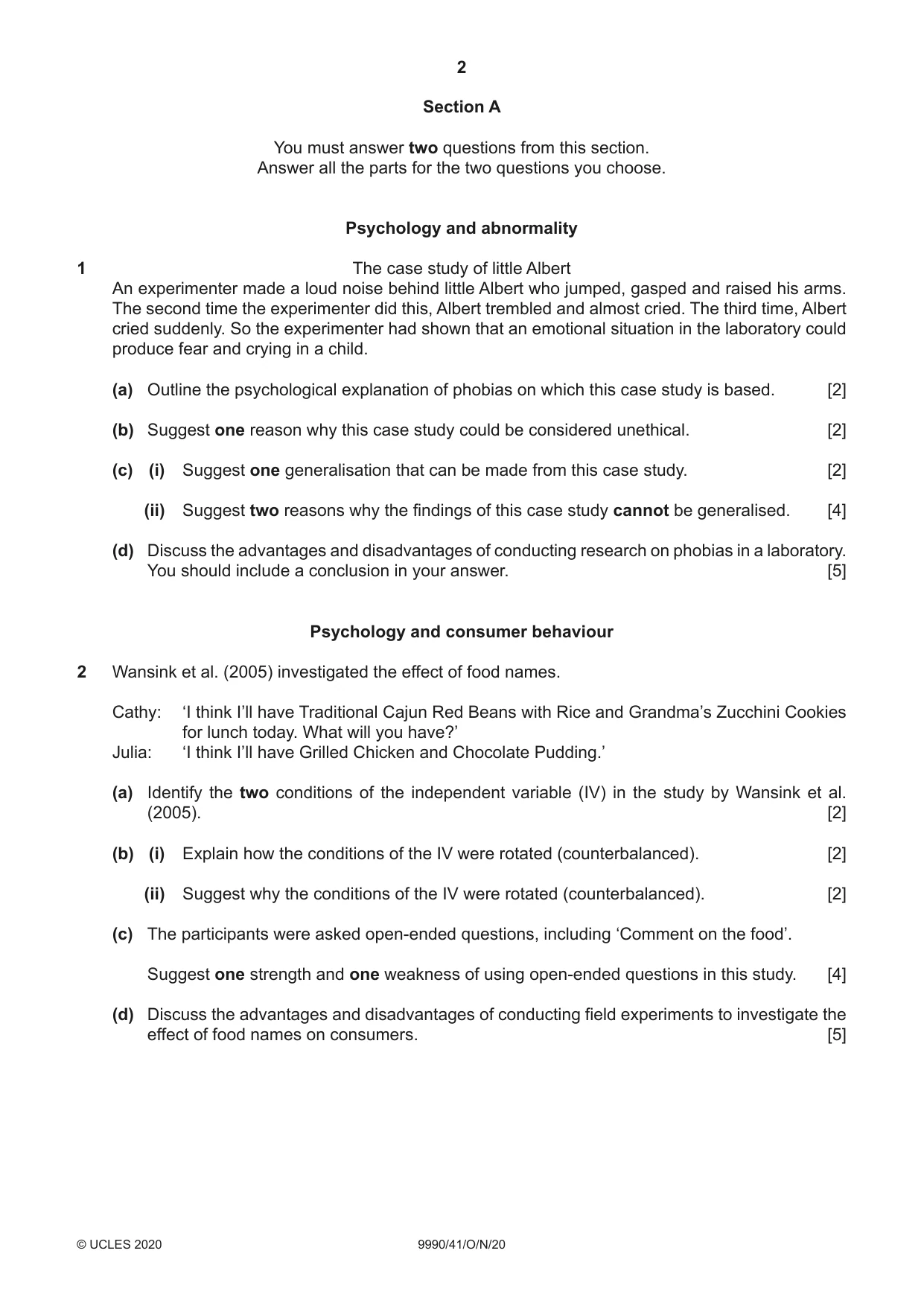
Question paper, page 2
2 9990/41/O/N/20 © UCLES 2020 Section A You must answer two questions from this section. Answer all the parts for the two questions you choose. Psychology and abnormality 1 The case study of little Albert An experimenter made a loud noise behind little Albert who jumped, gasped and raised his arms. The second time the experimenter did this, Albert trembled and almost cried. The third time, Albert cried suddenly. So the experimenter had shown that an emotional situation in the laboratory could produce fear and crying in a child. (a) Outline the psychological explanation of phobias on which this case study is based. [2] (b) Suggest one reason why this case study could be considered unethical. [2] (c) (i) Suggest one generalisation that can be made from this case study. [2] (ii) Suggest two reasons why the findings of this case study cannot be generalised. [4] (d) Discuss the advantages and disadvantages of conducting research on phobias in a laboratory. You should include a conclusion in your answer. [5] Psychology and consumer behaviour 2 Wansink et al. (2005) investigated the effect of food names. Cathy: ‘I think I’ll have Traditional Cajun Red Beans with Rice and Grandma’s Zucchini Cookies for lunch today. What will you have?’ Julia: ‘I think I’ll have Grilled Chicken and Chocolate Pudding.’ (a) Identify the two conditions of the independent variable (IV) in the study by Wansink et al. (2005). [2] (b) (i) Explain how the conditions of the IV were rotated (counterbalanced). [2] (ii) Suggest why the conditions of the IV were rotated (counterbalanced). [2] (c) The participants were asked open-ended questions, including ‘Comment on the food’. Suggest one strength and one weakness of using open-ended questions in this study. [4] (d) Discuss the advantages and disadvantages of conducting field experiments to investigate the effect of food names on consumers. [5]
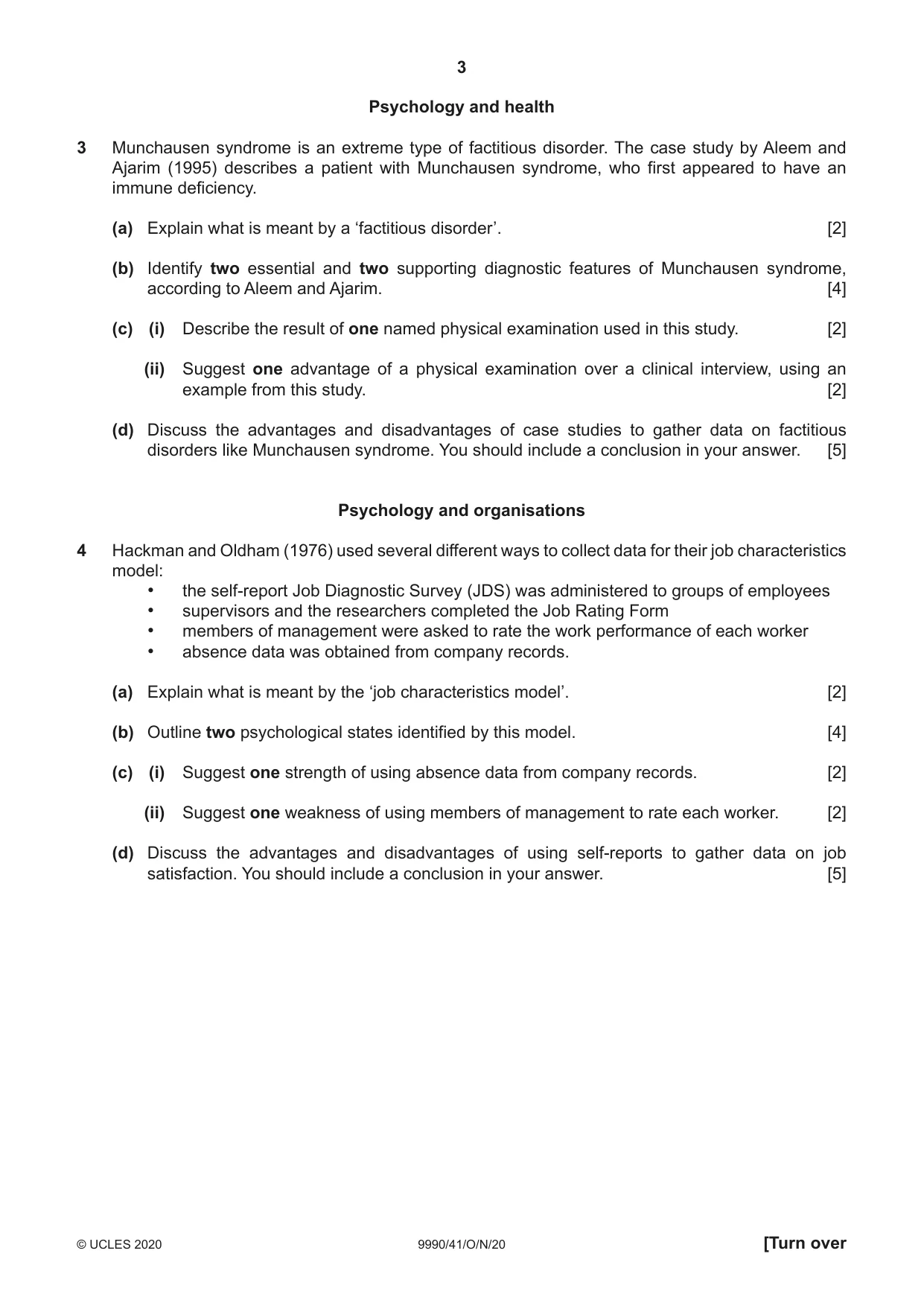
Question paper, page 3
3 9990/41/O/N/20 © UCLES 2020 [Turn over Psychology and health 3 Munchausen syndrome is an extreme type of factitious disorder. The case study by Aleem and Ajarim (1995) describes a patient with Munchausen syndrome, who first appeared to have an immune deficiency. (a) Explain what is meant by a ‘factitious disorder’. [2] (b) Identify two essential and two supporting diagnostic features of Munchausen syndrome, according to Aleem and Ajarim. [4] (c) (i) Describe the result of one named physical examination used in this study. [2] (ii) Suggest one advantage of a physical examination over a clinical interview, using an example from this study. [2] (d) Discuss the advantages and disadvantages of case studies to gather data on factitious disorders like Munchausen syndrome. You should include a conclusion in your answer. [5] Psychology and organisations 4 Hackman and Oldham (1976) used several different ways to collect data for their job characteristics model: • the self-report Job Diagnostic Survey (JDS) was administered to groups of employees • supervisors and the researchers completed the Job Rating Form • members of management were asked to rate the work performance of each worker • absence data was obtained from company records. (a) Explain what is meant by the ‘job characteristics model’. [2] (b) Outline two psychological states identified by this model. [4] (c) (i) Suggest one strength of using absence data from company records. [2] (ii) Suggest one weakness of using members of management to rate each worker. [2] (d) Discuss the advantages and disadvantages of using self-reports to gather data on job satisfaction. You should include a conclusion in your answer. [5]
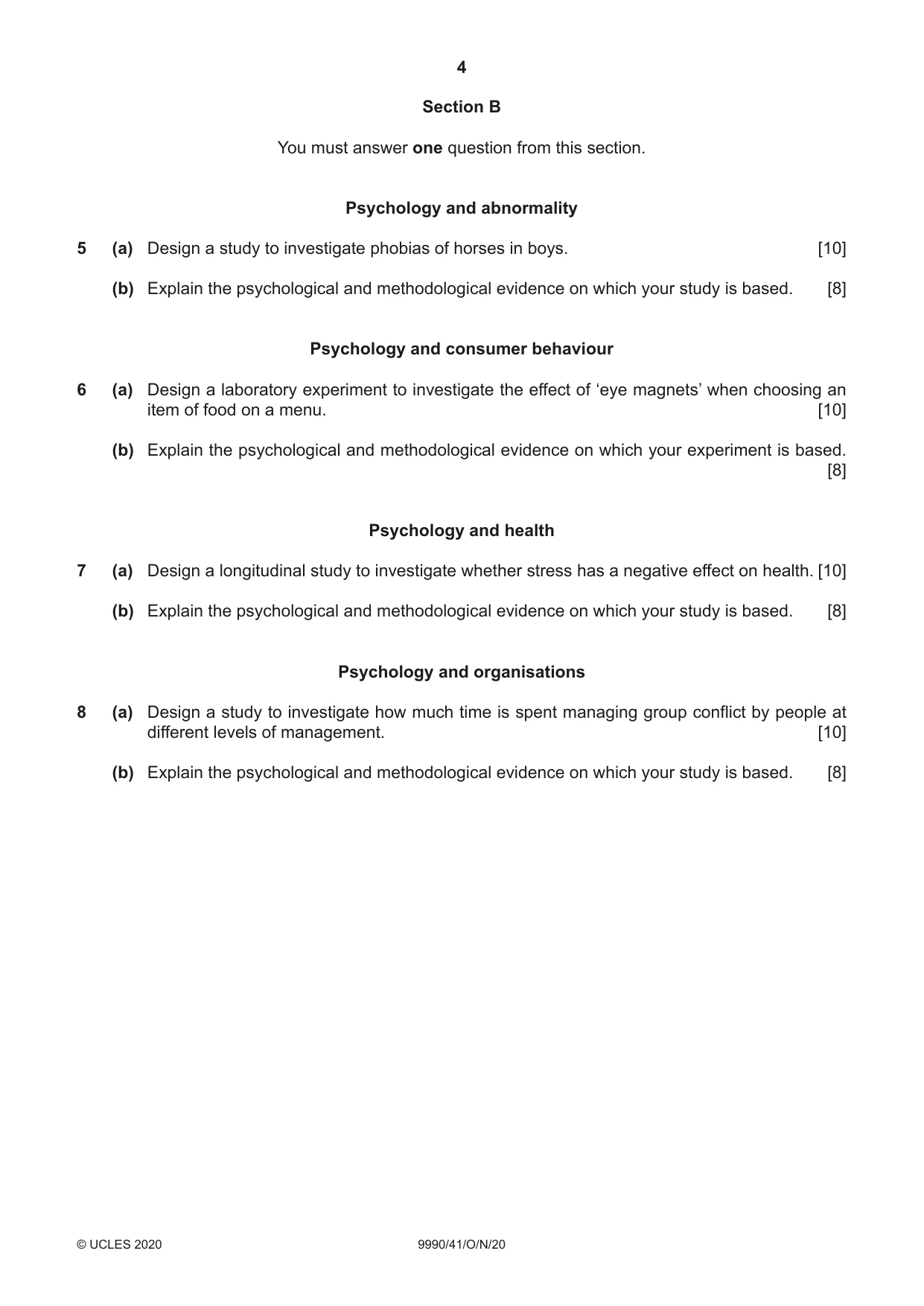
Question paper, page 4
4 9990/41/O/N/20 © UCLES 2020 Section B You must answer one question from this section. Psychology and abnormality 5 (a) Design a study to investigate phobias of horses in boys. [10] (b) Explain the psychological and methodological evidence on which your study is based. [8] Psychology and consumer behaviour 6 (a) Design a laboratory experiment to investigate the effect of ‘eye magnets’ when choosing an item of food on a menu. [10] (b) Explain the psychological and methodological evidence on which your experiment is based. [8] Psychology and health 7 (a) Design a longitudinal study to investigate whether stress has a negative effect on health. [10] (b) Explain the psychological and methodological evidence on which your study is based. [8] Psychology and organisations 8 (a) Design a study to investigate how much time is spent managing group conflict by people at different levels of management. [10] (b) Explain the psychological and methodological evidence on which your study is based. [8]
Question paper, page 5
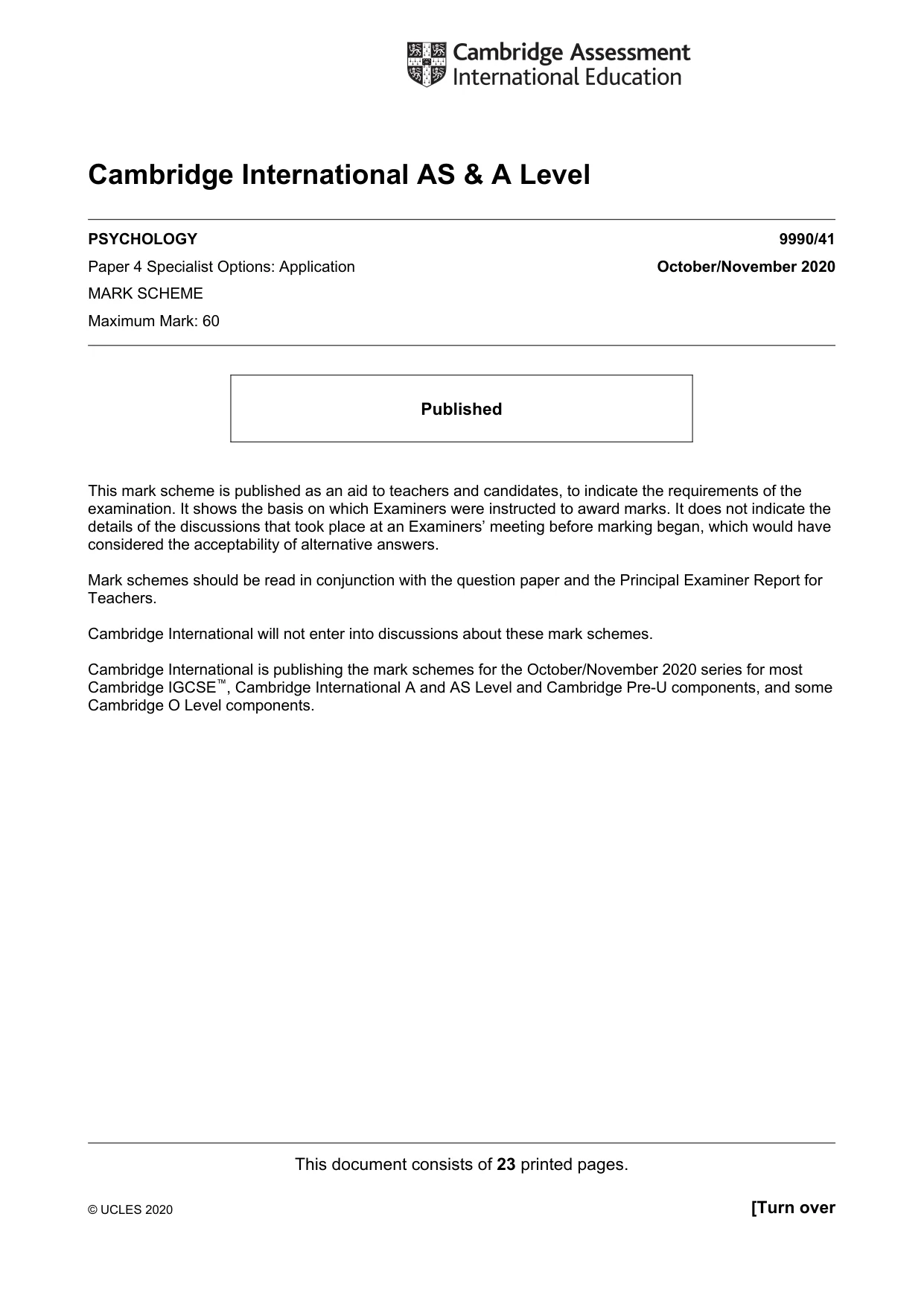
5 9990/41/O/N/20 © UCLES 2020 Section C You must answer one question from this section. Psychology and abnormality 9 ‘Exposure and response prevention is always successful in treating obsessive-compulsive and related disorders.’ To what extent do you agree with this statement? Use examples of research you have studied to support your answer. [12] Psychology and consumer behaviour 10 ‘Determinism: retail store architecture controls how shoppers behave.’ To what extent do you agree with this statement? Use examples of research you have studied to support your answer. [12] Psychology and health 11 ‘All patients would rather disclose to a computer than a human, in order to be diagnosed.’ To what extent do you agree with this statement? Use examples of research you have studied to support your answer. [12] Psychology and organisations 12 ‘Job satisfaction can only be measured effectively using closed questions.’ To what extent do you agree with this statement? Use examples of research you have studied to support your answer. [12]
Question paper, page 6
6 9990/41/O/N/20 © UCLES 2020 BLANK PAGE
Question paper, page 7
7 9990/41/O/N/20 © UCLES 2020 BLANK PAGE
Question paper, page 8
8 9990/41/O/N/20 © UCLES 2020 Permission to reproduce items where third-party owned material protected by copyright is included has been sought and cleared where possible. Every reasonable effort has been made by the publisher (UCLES) to trace copyright holders, but if any items requiring clearance have unwittingly been included, the publisher will be pleased to make amends at the earliest possible opportunity. To avoid the issue of disclosure of answer-related information to candidates, all copyright acknowledgements are reproduced online in the Cambridge Assessment International Education Copyright Acknowledgements Booklet. This is produced for each series of examinations and is freely available to download at www.cambridgeinternational.org after the live examination series. Cambridge Assessment International Education is part of the Cambridge Assessment Group. Cambridge Assessment is the brand name of the University of Cambridge Local Examinations Syndicate (UCLES), which itself is a department of the University of Cambridge. BLANK PAGE
Mark scheme, page 1
This document consists of 23 printed pages. © UCLES 2020 [Turn over Cambridge International AS & A Level PSYCHOLOGY 9990/41 Paper 4 Specialist Options: Application October/November 2020 MARK SCHEME Maximum Mark: 60 Published This mark scheme is published as an aid to teachers and candidates, to indicate the requirements of the examination. It shows the basis on which Examiners were instructed to award marks. It does not indicate the details of the discussions that took place at an Examiners’ meeting before marking began, which would have considered the acceptability of alternative answers. Mark schemes should be read in conjunction with the question paper and the Principal Examiner Report for Teachers. Cambridge International will not enter into discussions about these mark schemes. Cambridge International is publishing the mark schemes for the October/November 2020 series for most Cambridge IGCSE™, Cambridge International A and AS Level and Cambridge Pre-U components, and some Cambridge O Level components.
Mark scheme, page 2
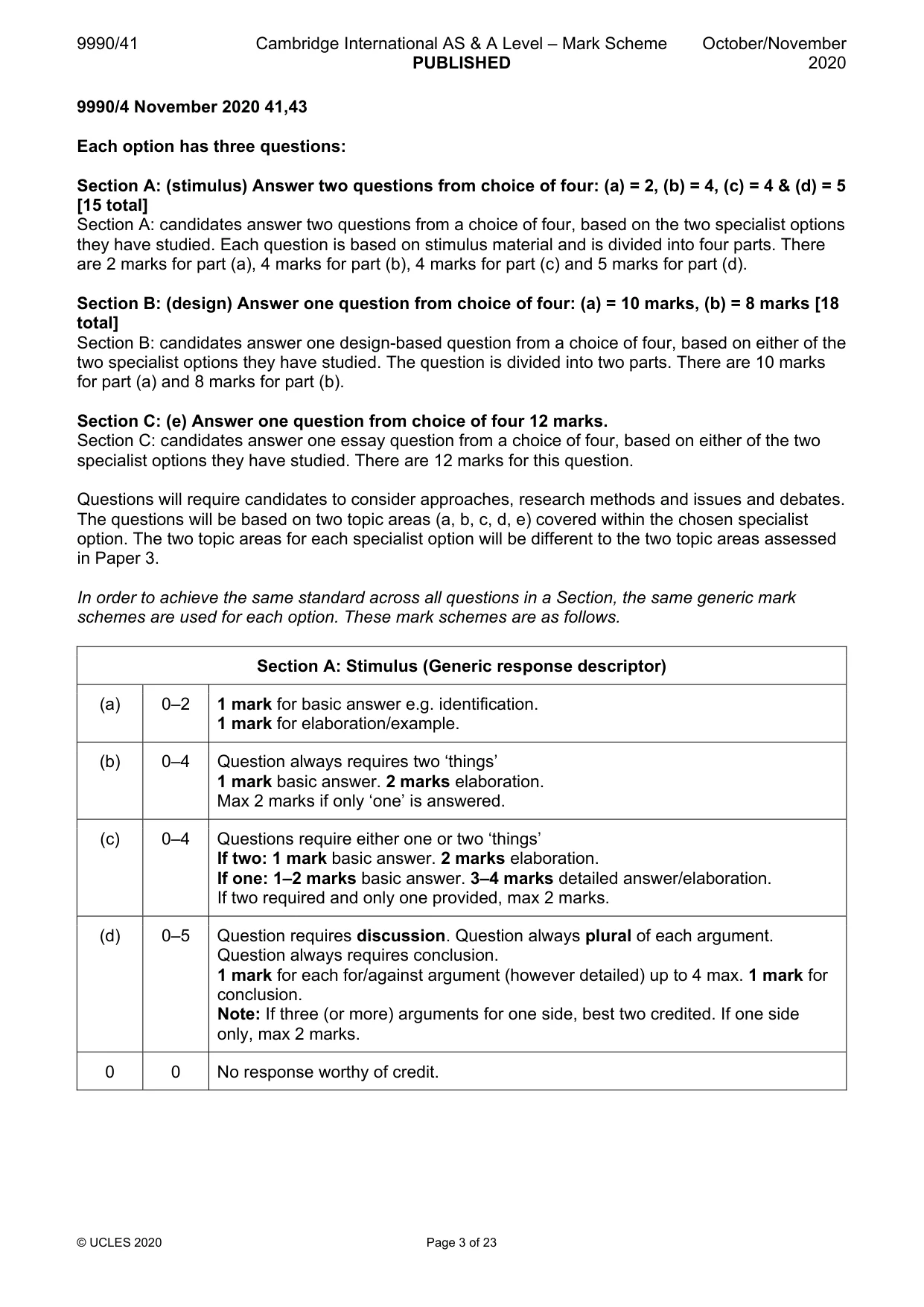
9990/41 Cambridge International AS & A Level – Mark Scheme PUBLISHED October/November 2020 © UCLES 2020 Page 2 of 23 Generic Marking Principles These general marking principles must be applied by all examiners when marking candidate answers. They should be applied alongside the specific content of the mark scheme or generic level descriptors for a question. Each question paper and mark scheme will also comply with these marking principles. GENERIC MARKING PRINCIPLE 1: Marks must be awarded in line with: • the specific content of the mark scheme or the generic level descriptors for the question • the specific skills defined in the mark scheme or in the generic level descriptors for the question • the standard of response required by a candidate as exemplified by the standardisation scripts. GENERIC MARKING PRINCIPLE 2: Marks awarded are always whole marks (not half marks, or other fractions). GENERIC MARKING PRINCIPLE 3: Marks must be awarded positively: • marks are awarded for correct/valid answers, as defined in the mark scheme. However, credit is given for valid answers which go beyond the scope of the syllabus and mark scheme, referring to your Team Leader as appropriate • marks are awarded when candidates clearly demonstrate what they know and can do • marks are not deducted for errors • marks are not deducted for omissions • answers should only be judged on the quality of spelling, punctuation and grammar when these features are specifically assessed by the question as indicated by the mark scheme. The meaning, however, should be unambiguous. GENERIC MARKING PRINCIPLE 4: Rules must be applied consistently, e.g. in situations where candidates have not followed instructions or in the application of generic level descriptors. GENERIC MARKING PRINCIPLE 5: Marks should be awarded using the full range of marks defined in the mark scheme for the question (however; the use of the full mark range may be limited according to the quality of the candidate responses seen). GENERIC MARKING PRINCIPLE 6: Marks awarded are based solely on the requirements as defined in the mark scheme. Marks should not be awarded with grade thresholds or grade descriptors in mind.
Mark scheme, page 3
9990/41 Cambridge International AS & A Level – Mark Scheme PUBLISHED October/November 2020 © UCLES 2020 Page 3 of 23 9990/4 November 2020 41,43 Each option has three questions: Section A: (stimulus) Answer two questions from choice of four: (a) = 2, (b) = 4, (c) = 4 & (d) = 5 [15 total] Section A: candidates answer two questions from a choice of four, based on the two specialist options they have studied. Each question is based on stimulus material and is divided into four parts. There are 2 marks for part (a), 4 marks for part (b), 4 marks for part (c) and 5 marks for part (d). Section B: (design) Answer one question from choice of four: (a) = 10 marks, (b) = 8 marks [18 total] Section B: candidates answer one design-based question from a choice of four, based on either of the two specialist options they have studied. The question is divided into two parts. There are 10 marks for part (a) and 8 marks for part (b). Section C: (e) Answer one question from choice of four 12 marks. Section C: candidates answer one essay question from a choice of four, based on either of the two specialist options they have studied. There are 12 marks for this question. Questions will require candidates to consider approaches, research methods and issues and debates. The questions will be based on two topic areas (a, b, c, d, e) covered within the chosen specialist option. The two topic areas for each specialist option will be different to the two topic areas assessed in Paper 3. In order to achieve the same standard across all questions in a Section, the same generic mark schemes are used for each option. These mark schemes are as follows. Section A: Stimulus (Generic response descriptor) (a) 0–2 1 mark for basic answer e.g. identification. 1 mark for elaboration/example. (b) 0–4 Question always requires two ‘things’ 1 mark basic answer. 2 marks elaboration. Max 2 marks if only ‘one’ is answered. (c) 0–4 Questions require either one or two ‘things’ If two: 1 mark basic answer. 2 marks elaboration. If one: 1–2 marks basic answer. 3–4 marks detailed answer/elaboration. If two required and only one provided, max 2 marks. (d) 0–5 Question requires discussion. Question always plural of each argument. Question always requires conclusion. 1 mark for each for/against argument (however detailed) up to 4 max. 1 mark for conclusion. Note: If three (or more) arguments for one side, best two credited. If one side only, max 2 marks. 0 0 No response worthy of credit.
Mark scheme, page 4
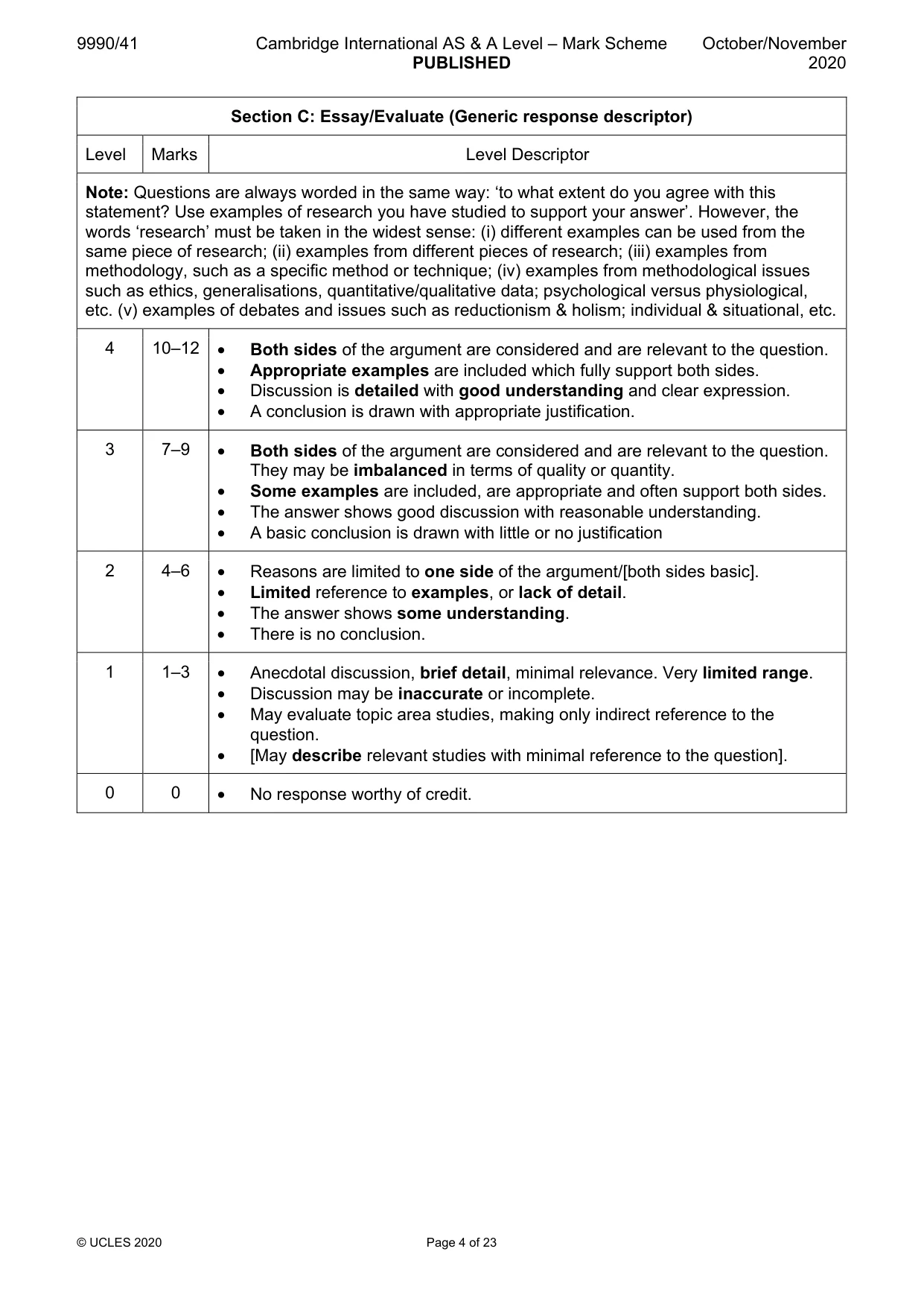
9990/41 Cambridge International AS & A Level – Mark Scheme PUBLISHED October/November 2020 © UCLES 2020 Page 4 of 23 Section C: Essay/Evaluate (Generic response descriptor) Level Marks Level Descriptor Note: Questions are always worded in the same way: ‘to what extent do you agree with this statement? Use examples of research you have studied to support your answer’. However, the words ‘research’ must be taken in the widest sense: (i) different examples can be used from the same piece of research; (ii) examples from different pieces of research; (iii) examples from methodology, such as a specific method or technique; (iv) examples from methodological issues such as ethics, generalisations, quantitative/qualitative data; psychological versus physiological, etc. (v) examples of debates and issues such as reductionism & holism; individual & situational, etc. 4 10–12 • Both sides of the argument are considered and are relevant to the question. • Appropriate examples are included which fully support both sides. • Discussion is detailed with good understanding and clear expression. • A conclusion is drawn with appropriate justification. 3 7–9 • Both sides of the argument are considered and are relevant to the question. They may be imbalanced in terms of quality or quantity. • Some examples are included, are appropriate and often support both sides. • The answer shows good discussion with reasonable understanding. • A basic conclusion is drawn with little or no justification 2 4–6 • Reasons are limited to one side of the argument/[both sides basic]. • Limited reference to examples, or lack of detail. • The answer shows some understanding. • There is no conclusion. 1 1–3 • Anecdotal discussion, brief detail, minimal relevance. Very limited range. • Discussion may be inaccurate or incomplete. • May evaluate topic area studies, making only indirect reference to the question. • [May describe relevant studies with minimal reference to the question]. 0 0 • No response worthy of credit.
Mark scheme, page 5
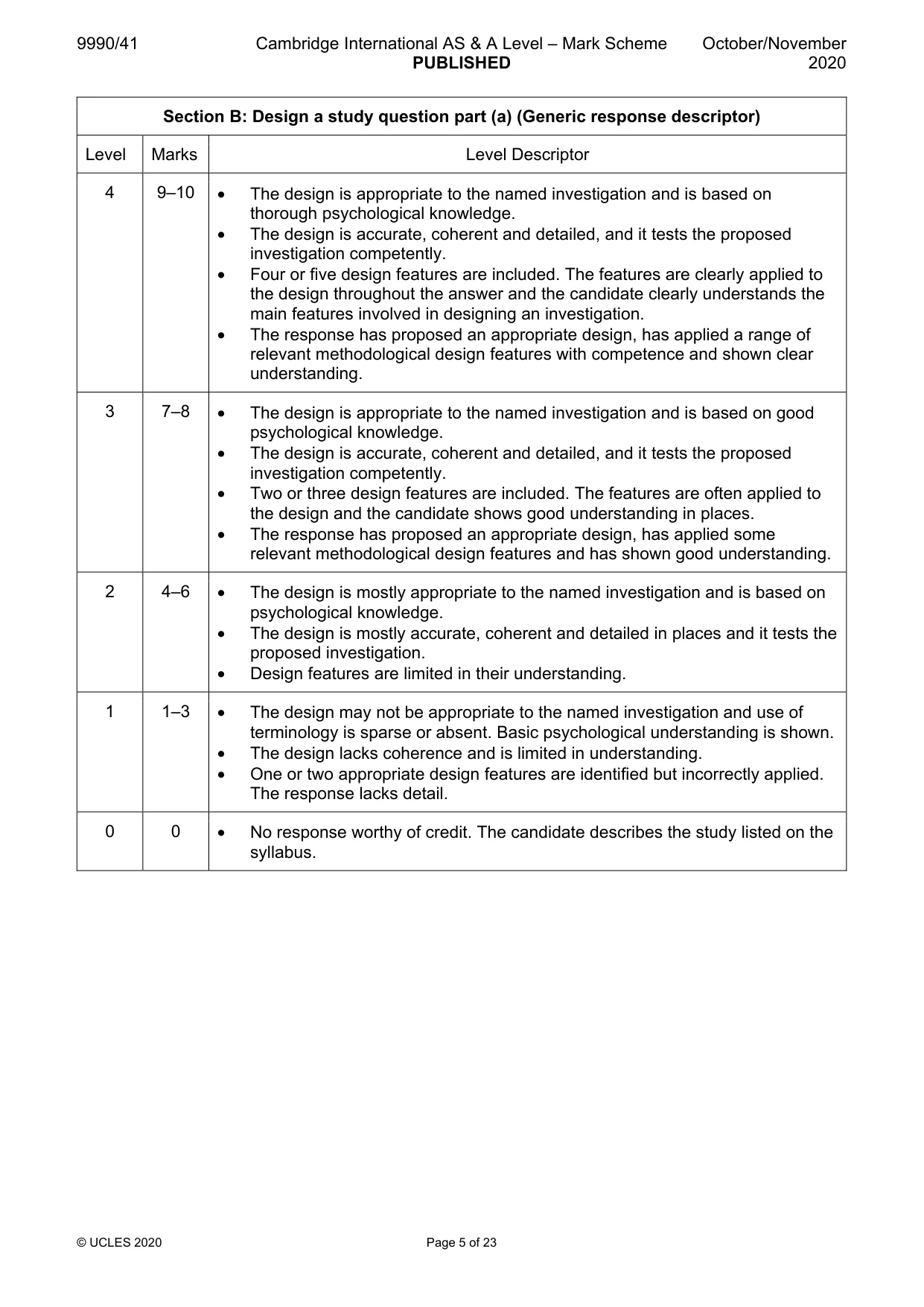
9990/41 Cambridge International AS & A Level – Mark Scheme PUBLISHED October/November 2020 © UCLES 2020 Page 5 of 23 Section B: Design a study question part (a) (Generic response descriptor) Level Marks Level Descriptor 4 9–10 • The design is appropriate to the named investigation and is based on thorough psychological knowledge. • The design is accurate, coherent and detailed, and it tests the proposed investigation competently. • Four or five design features are included. The features are clearly applied to the design throughout the answer and the candidate clearly understands the main features involved in designing an investigation. • The response has proposed an appropriate design, has applied a range of relevant methodological design features with competence and shown clear understanding. 3 7–8 • The design is appropriate to the named investigation and is based on good psychological knowledge. • The design is accurate, coherent and detailed, and it tests the proposed investigation competently. • Two or three design features are included. The features are often applied to the design and the candidate shows good understanding in places. • The response has proposed an appropriate design, has applied some relevant methodological design features and has shown good understanding. 2 4–6 • The design is mostly appropriate to the named investigation and is based on psychological knowledge. • The design is mostly accurate, coherent and detailed in places and it tests the proposed investigation. • Design features are limited in their understanding. 1 1–3 • The design may not be appropriate to the named investigation and use of terminology is sparse or absent. Basic psychological understanding is shown. • The design lacks coherence and is limited in understanding. • One or two appropriate design features are identified but incorrectly applied. The response lacks detail. 0 0 • No response worthy of credit. The candidate describes the study listed on the syllabus.
Mark scheme, page 6
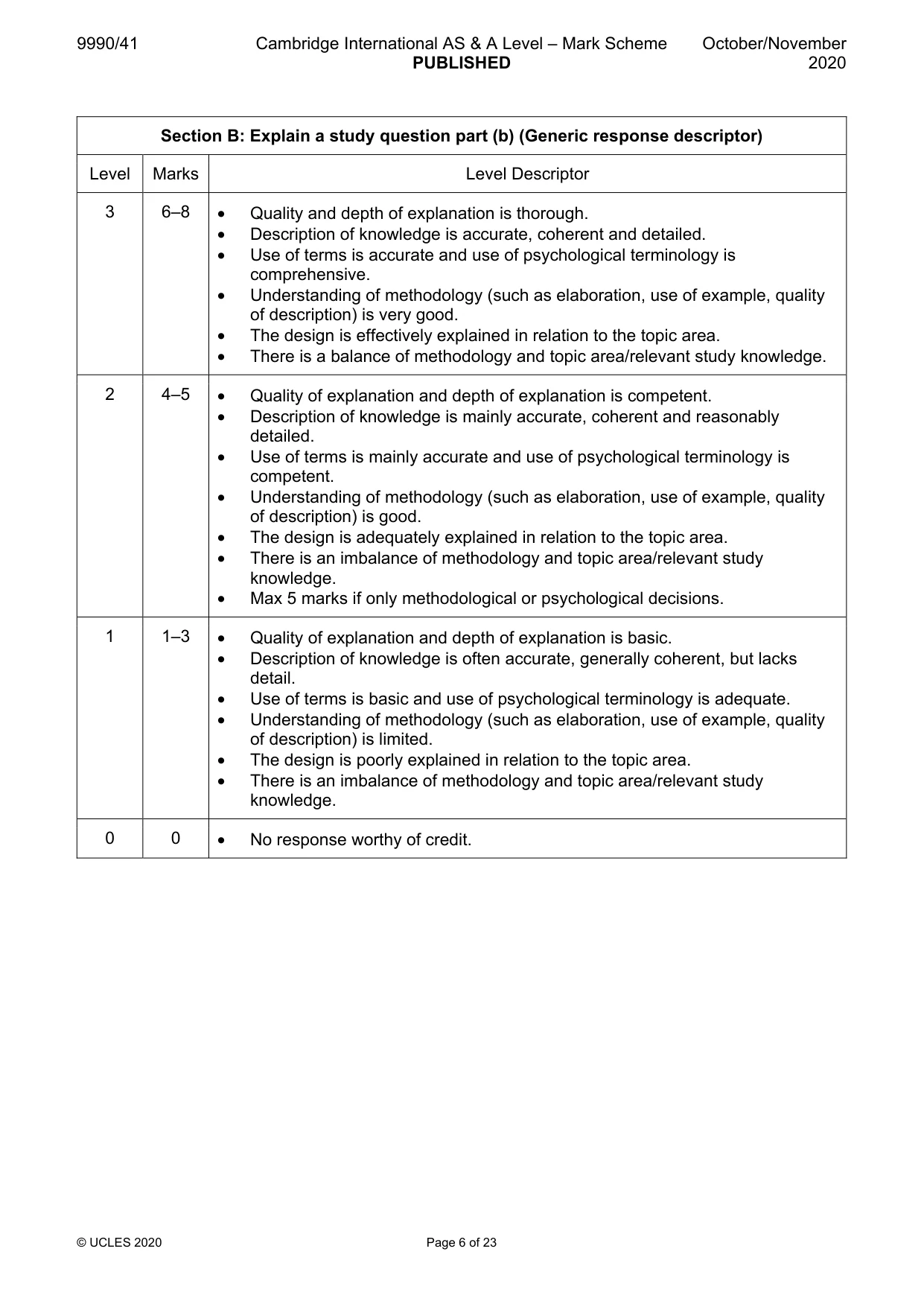
9990/41 Cambridge International AS & A Level – Mark Scheme PUBLISHED October/November 2020 © UCLES 2020 Page 6 of 23 Section B: Explain a study question part (b) (Generic response descriptor) Level Marks Level Descriptor 3 6–8 • Quality and depth of explanation is thorough. • Description of knowledge is accurate, coherent and detailed. • Use of terms is accurate and use of psychological terminology is comprehensive. • Understanding of methodology (such as elaboration, use of example, quality of description) is very good. • The design is effectively explained in relation to the topic area. • There is a balance of methodology and topic area/relevant study knowledge. 2 4–5 • Quality of explanation and depth of explanation is competent. • Description of knowledge is mainly accurate, coherent and reasonably detailed. • Use of terms is mainly accurate and use of psychological terminology is competent. • Understanding of methodology (such as elaboration, use of example, quality of description) is good. • The design is adequately explained in relation to the topic area. • There is an imbalance of methodology and topic area/relevant study knowledge. • Max 5 marks if only methodological or psychological decisions. 1 1–3 • Quality of explanation and depth of explanation is basic. • Description of knowledge is often accurate, generally coherent, but lacks detail. • Use of terms is basic and use of psychological terminology is adequate. • Understanding of methodology (such as elaboration, use of example, quality of description) is limited. • The design is poorly explained in relation to the topic area. • There is an imbalance of methodology and topic area/relevant study knowledge. 0 0 • No response worthy of credit.
Mark scheme, page 7
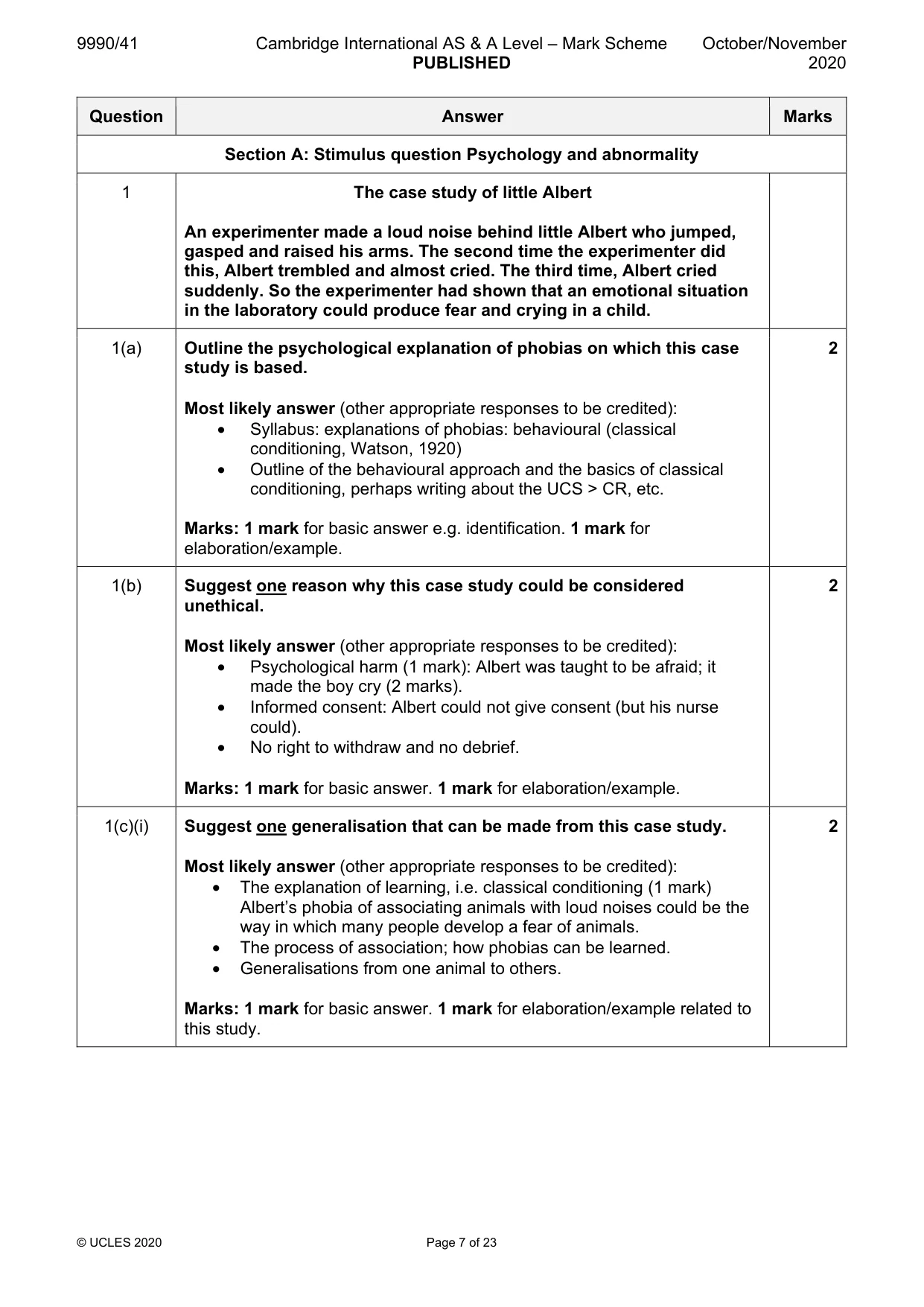
9990/41 Cambridge International AS & A Level – Mark Scheme PUBLISHED October/November 2020 © UCLES 2020 Page 7 of 23 Question Answer Marks Section A: Stimulus question Psychology and abnormality 1 The case study of little Albert An experimenter made a loud noise behind little Albert who jumped, gasped and raised his arms. The second time the experimenter did this, Albert trembled and almost cried. The third time, Albert cried suddenly. So the experimenter had shown that an emotional situation in the laboratory could produce fear and crying in a child. 1(a) Outline the psychological explanation of phobias on which this case study is based. Most likely answer (other appropriate responses to be credited): • Syllabus: explanations of phobias: behavioural (classical conditioning, Watson, 1920) • Outline of the behavioural approach and the basics of classical conditioning, perhaps writing about the UCS > CR, etc. Marks: 1 mark for basic answer e.g. identification. 1 mark for elaboration/example. 2 1(b) Suggest one reason why this case study could be considered unethical. Most likely answer (other appropriate responses to be credited): • Psychological harm (1 mark): Albert was taught to be afraid; it made the boy cry (2 marks). • Informed consent: Albert could not give consent (but his nurse could). • No right to withdraw and no debrief. Marks: 1 mark for basic answer. 1 mark for elaboration/example. 2 1(c)(i) Suggest one generalisation that can be made from this case study. Most likely answer (other appropriate responses to be credited): • The explanation of learning, i.e. classical conditioning (1 mark) Albert’s phobia of associating animals with loud noises could be the way in which many people develop a fear of animals. • The process of association; how phobias can be learned. • Generalisations from one animal to others. Marks: 1 mark for basic answer. 1 mark for elaboration/example related to this study. 2
Mark scheme, page 8
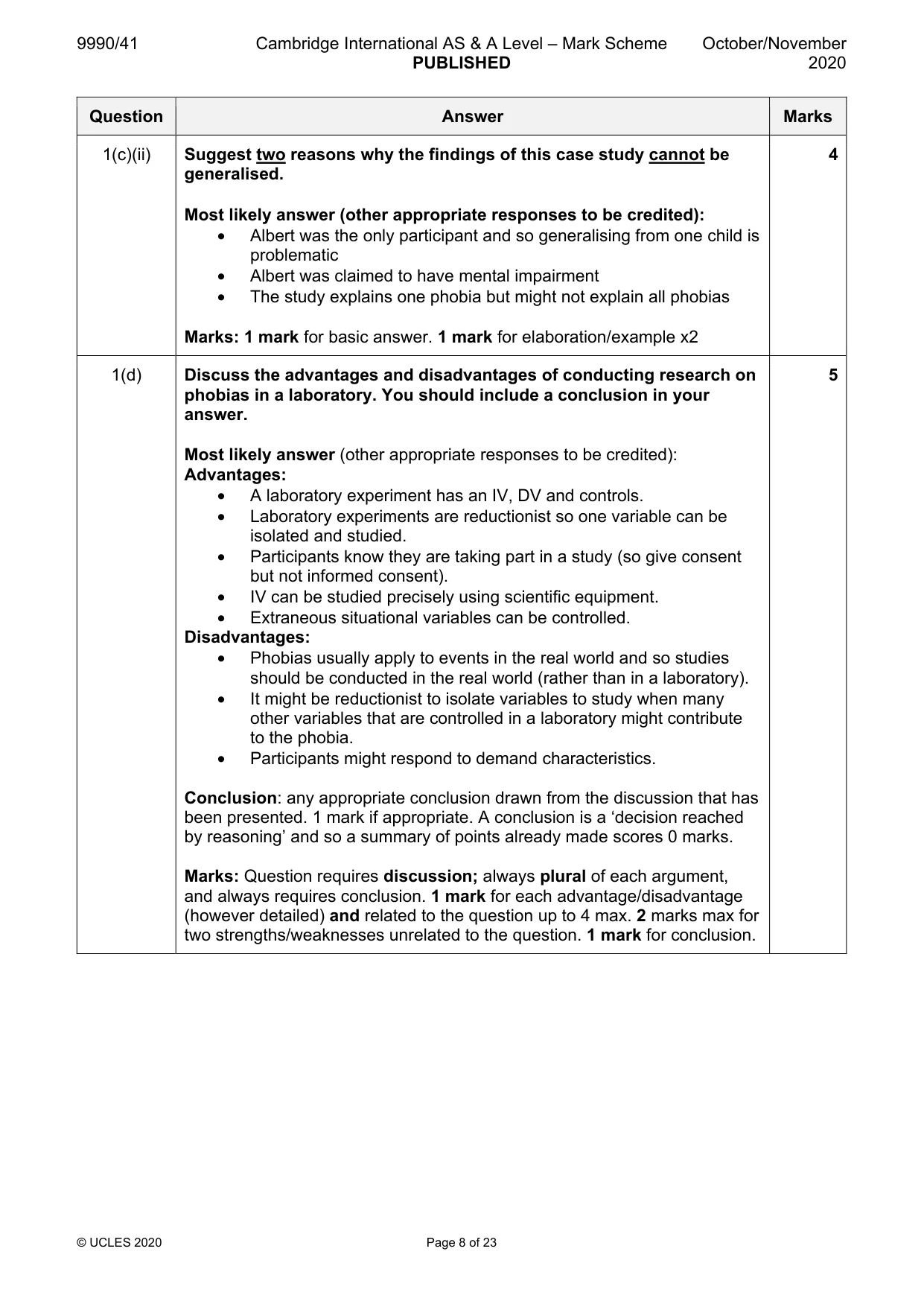
9990/41 Cambridge International AS & A Level – Mark Scheme PUBLISHED October/November 2020 © UCLES 2020 Page 8 of 23 Question Answer Marks 1(c)(ii) Suggest two reasons why the findings of this case study cannot be generalised. Most likely answer (other appropriate responses to be credited): • Albert was the only participant and so generalising from one child is problematic • Albert was claimed to have mental impairment • The study explains one phobia but might not explain all phobias Marks: 1 mark for basic answer. 1 mark for elaboration/example x2 4 1(d) Discuss the advantages and disadvantages of conducting research on phobias in a laboratory. You should include a conclusion in your answer. Most likely answer (other appropriate responses to be credited): Advantages: • A laboratory experiment has an IV, DV and controls. • Laboratory experiments are reductionist so one variable can be isolated and studied. • Participants know they are taking part in a study (so give consent but not informed consent). • IV can be studied precisely using scientific equipment. • Extraneous situational variables can be controlled. Disadvantages: • Phobias usually apply to events in the real world and so studies should be conducted in the real world (rather than in a laboratory). • It might be reductionist to isolate variables to study when many other variables that are controlled in a laboratory might contribute to the phobia. • Participants might respond to demand characteristics. Conclusion: any appropriate conclusion drawn from the discussion that has been presented. 1 mark if appropriate. A conclusion is a ‘decision reached by reasoning’ and so a summary of points already made scores 0 marks. Marks: Question requires discussion; always plural of each argument, and always requires conclusion. 1 mark for each advantage/disadvantage (however detailed) and related to the question up to 4 max. 2 marks max for two strengths/weaknesses unrelated to the question. 1 mark for conclusion. 5
Mark scheme, page 9
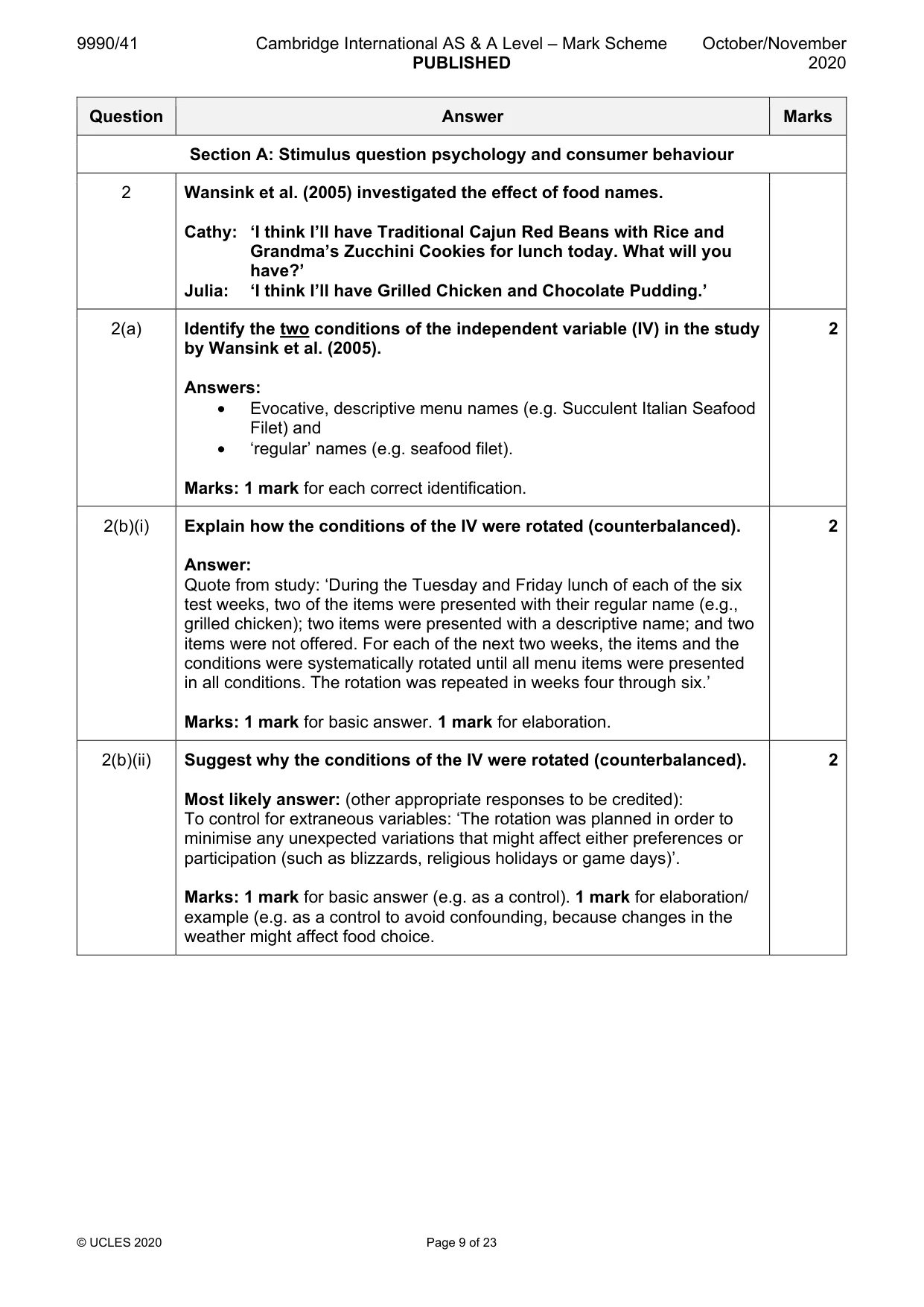
9990/41 Cambridge International AS & A Level – Mark Scheme PUBLISHED October/November 2020 © UCLES 2020 Page 9 of 23 Question Answer Marks Section A: Stimulus question psychology and consumer behaviour 2 Wansink et al. (2005) investigated the effect of food names. Cathy: ‘I think I’ll have Traditional Cajun Red Beans with Rice and Grandma’s Zucchini Cookies for lunch today. What will you have?’ Julia: ‘I think I’ll have Grilled Chicken and Chocolate Pudding.’ 2(a) Identify the two conditions of the independent variable (IV) in the study by Wansink et al. (2005). Answers: • Evocative, descriptive menu names (e.g. Succulent Italian Seafood Filet) and • ‘regular’ names (e.g. seafood filet). Marks: 1 mark for each correct identification. 2 2(b)(i) Explain how the conditions of the IV were rotated (counterbalanced). Answer: Quote from study: ‘During the Tuesday and Friday lunch of each of the six test weeks, two of the items were presented with their regular name (e.g., grilled chicken); two items were presented with a descriptive name; and two items were not offered. For each of the next two weeks, the items and the conditions were systematically rotated until all menu items were presented in all conditions. The rotation was repeated in weeks four through six.’ Marks: 1 mark for basic answer. 1 mark for elaboration. 2 2(b)(ii) Suggest why the conditions of the IV were rotated (counterbalanced). Most likely answer: (other appropriate responses to be credited): To control for extraneous variables: ‘The rotation was planned in order to minimise any unexpected variations that might affect either preferences or participation (such as blizzards, religious holidays or game days)’. Marks: 1 mark for basic answer (e.g. as a control). 1 mark for elaboration/ example (e.g. as a control to avoid confounding, because changes in the weather might affect food choice. 2
Mark scheme, page 10
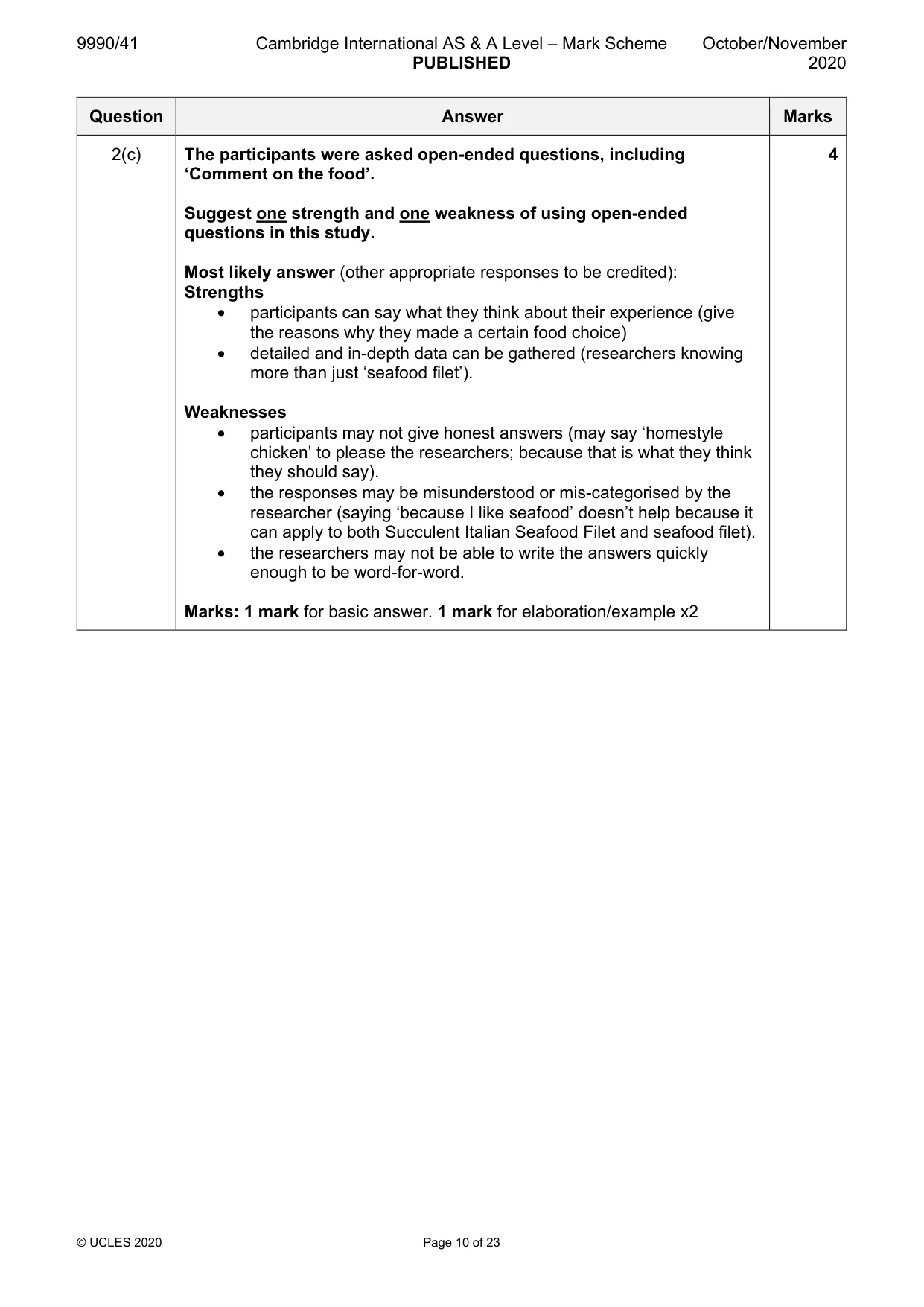
9990/41 Cambridge International AS & A Level – Mark Scheme PUBLISHED October/November 2020 © UCLES 2020 Page 10 of 23 Question Answer Marks 2(c) The participants were asked open-ended questions, including ‘Comment on the food’. Suggest one strength and one weakness of using open-ended questions in this study. Most likely answer (other appropriate responses to be credited): Strengths • participants can say what they think about their experience (give the reasons why they made a certain food choice) • detailed and in-depth data can be gathered (researchers knowing more than just ‘seafood filet’). Weaknesses • participants may not give honest answers (may say ‘homestyle chicken’ to please the researchers; because that is what they think they should say). • the responses may be misunderstood or mis-categorised by the researcher (saying ‘because I like seafood’ doesn’t help because it can apply to both Succulent Italian Seafood Filet and seafood filet). • the researchers may not be able to write the answers quickly enough to be word-for-word. Marks: 1 mark for basic answer. 1 mark for elaboration/example x2 4
Mark scheme, page 11
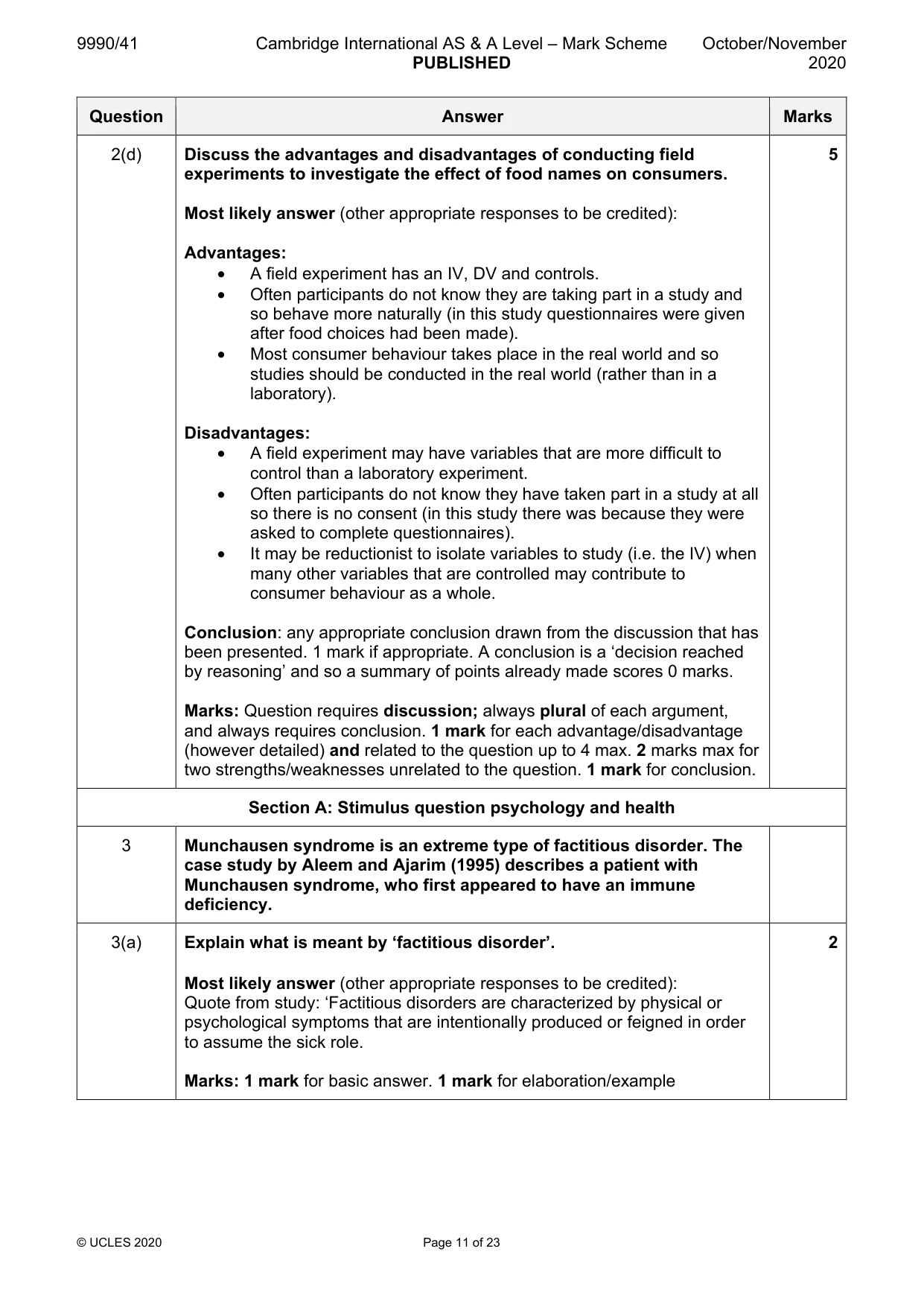
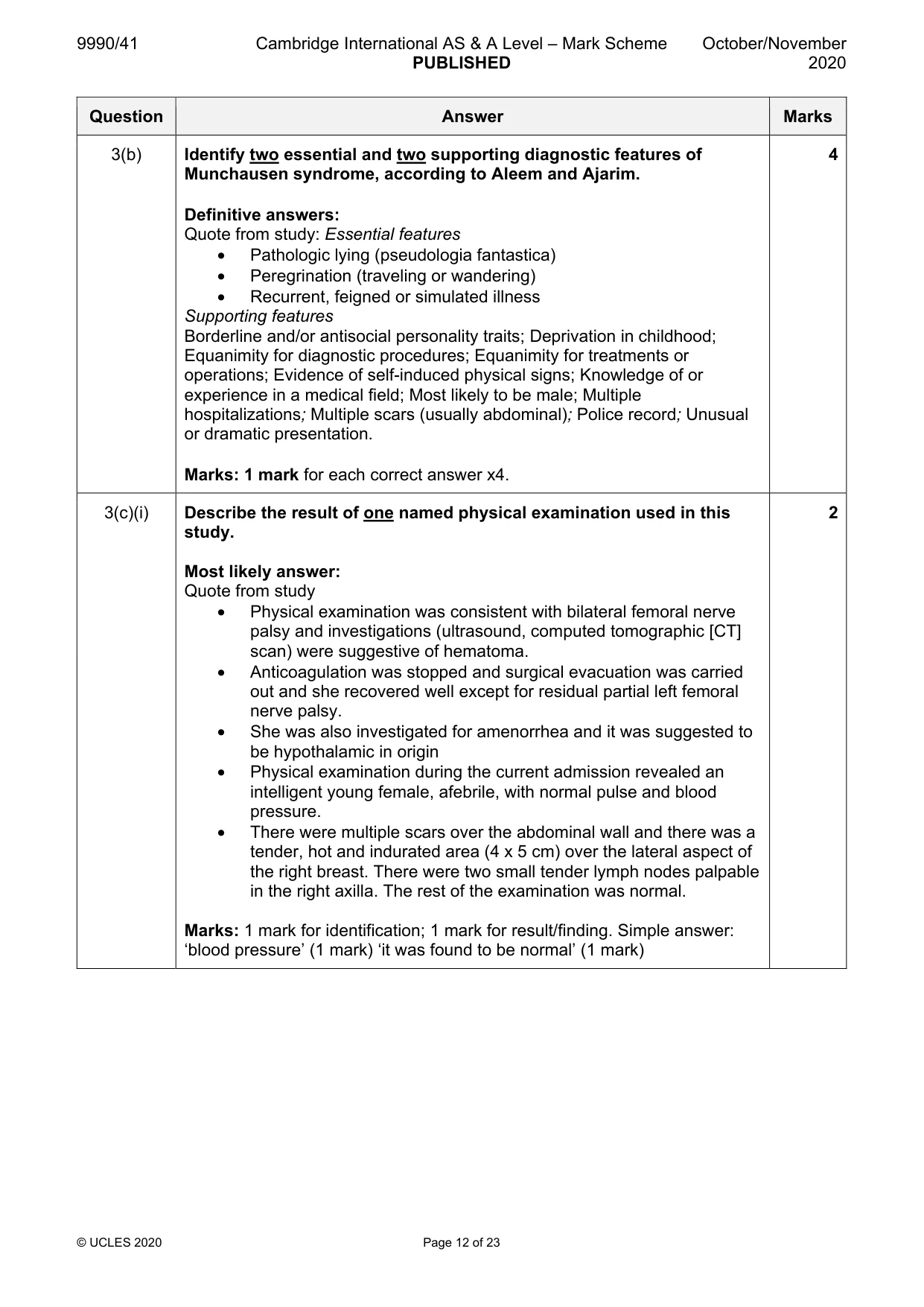
9990/41 Cambridge International AS & A Level – Mark Scheme PUBLISHED October/November 2020 © UCLES 2020 Page 11 of 23 Question Answer Marks 2(d) Discuss the advantages and disadvantages of conducting field experiments to investigate the effect of food names on consumers. Most likely answer (other appropriate responses to be credited): Advantages: • A field experiment has an IV, DV and controls. • Often participants do not know they are taking part in a study and so behave more naturally (in this study questionnaires were given after food choices had been made). • Most consumer behaviour takes place in the real world and so studies should be conducted in the real world (rather than in a laboratory). Disadvantages: • A field experiment may have variables that are more difficult to control than a laboratory experiment. • Often participants do not know they have taken part in a study at all so there is no consent (in this study there was because they were asked to complete questionnaires). • It may be reductionist to isolate variables to study (i.e. the IV) when many other variables that are controlled may contribute to consumer behaviour as a whole. Conclusion: any appropriate conclusion drawn from the discussion that has been presented. 1 mark if appropriate. A conclusion is a ‘decision reached by reasoning’ and so a summary of points already made scores 0 marks. Marks: Question requires discussion; always plural of each argument, and always requires conclusion. 1 mark for each advantage/disadvantage (however detailed) and related to the question up to 4 max. 2 marks max for two strengths/weaknesses unrelated to the question. 1 mark for conclusion. 5 Section A: Stimulus question psychology and health 3 Munchausen syndrome is an extreme type of factitious disorder. The case study by Aleem and Ajarim (1995) describes a patient with Munchausen syndrome, who first appeared to have an immune deficiency. 3(a) Explain what is meant by ‘factitious disorder’. Most likely answer (other appropriate responses to be credited): Quote from study: ‘Factitious disorders are characterized by physical or psychological symptoms that are intentionally produced or feigned in order to assume the sick role. Marks: 1 mark for basic answer. 1 mark for elaboration/example 2
Mark scheme, page 12
9990/41 Cambridge International AS & A Level – Mark Scheme PUBLISHED October/November 2020 © UCLES 2020 Page 12 of 23 Question Answer Marks 3(b) Identify two essential and two supporting diagnostic features of Munchausen syndrome, according to Aleem and Ajarim. Definitive answers: Quote from study: Essential features • Pathologic lying (pseudologia fantastica) • Peregrination (traveling or wandering) • Recurrent, feigned or simulated illness Supporting features Borderline and/or antisocial personality traits; Deprivation in childhood; Equanimity for diagnostic procedures; Equanimity for treatments or operations; Evidence of self-induced physical signs; Knowledge of or experience in a medical field; Most likely to be male; Multiple hospitalizations; Multiple scars (usually abdominal); Police record; Unusual or dramatic presentation. Marks: 1 mark for each correct answer x4. 4 3(c)(i) Describe the result of one named physical examination used in this study. Most likely answer: Quote from study • Physical examination was consistent with bilateral femoral nerve palsy and investigations (ultrasound, computed tomographic [CT] scan) were suggestive of hematoma. • Anticoagulation was stopped and surgical evacuation was carried out and she recovered well except for residual partial left femoral nerve palsy. • She was also investigated for amenorrhea and it was suggested to be hypothalamic in origin • Physical examination during the current admission revealed an intelligent young female, afebrile, with normal pulse and blood pressure. • There were multiple scars over the abdominal wall and there was a tender, hot and indurated area (4 x 5 cm) over the lateral aspect of the right breast. There were two small tender lymph nodes palpable in the right axilla. The rest of the examination was normal. Marks: 1 mark for identification; 1 mark for result/finding. Simple answer: ‘blood pressure’ (1 mark) ‘it was found to be normal’ (1 mark) 2
Mark scheme, page 13
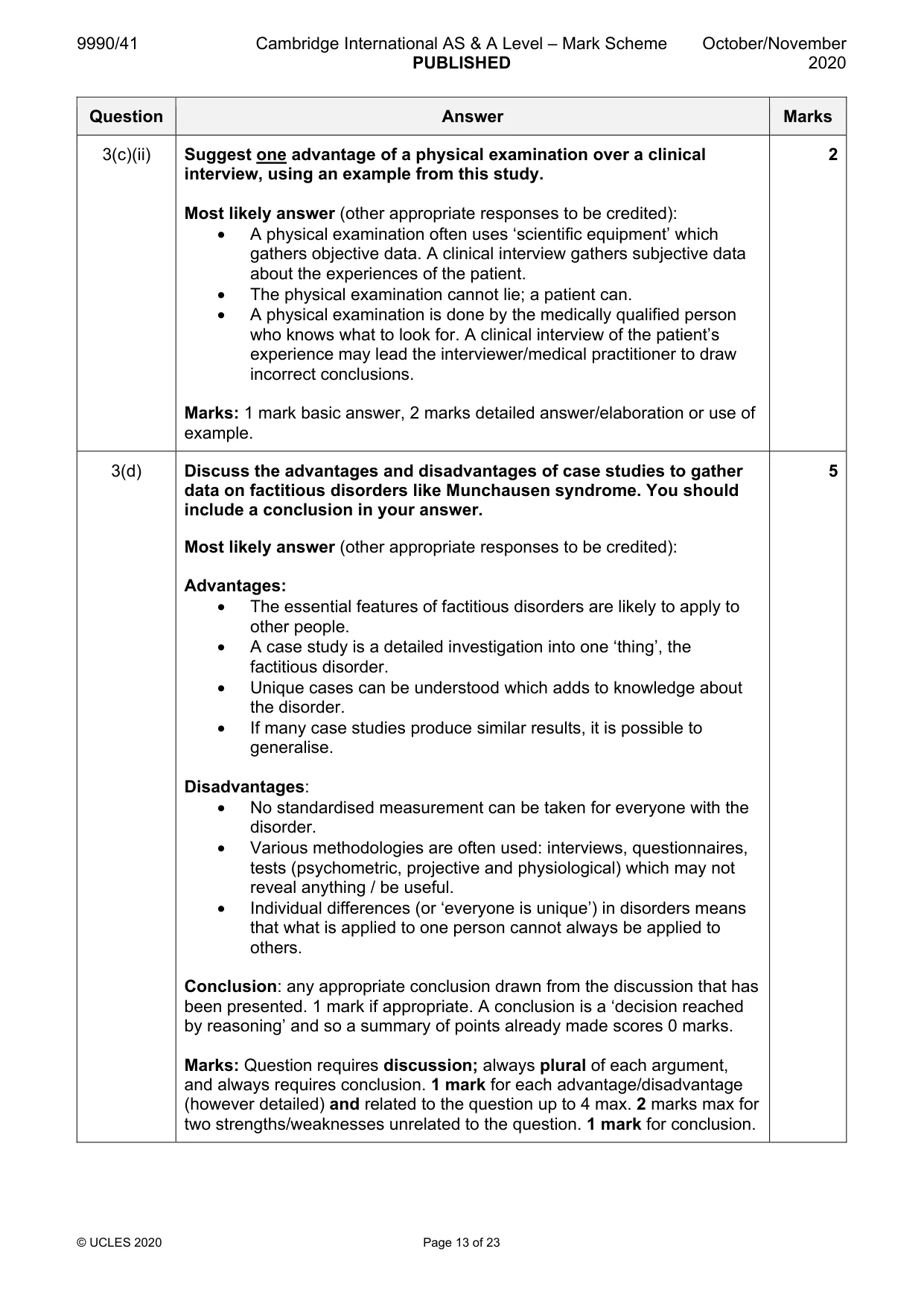
9990/41 Cambridge International AS & A Level – Mark Scheme PUBLISHED October/November 2020 © UCLES 2020 Page 13 of 23 Question Answer Marks 3(c)(ii) Suggest one advantage of a physical examination over a clinical interview, using an example from this study. Most likely answer (other appropriate responses to be credited): • A physical examination often uses ‘scientific equipment’ which gathers objective data. A clinical interview gathers subjective data about the experiences of the patient. • The physical examination cannot lie; a patient can. • A physical examination is done by the medically qualified person who knows what to look for. A clinical interview of the patient’s experience may lead the interviewer/medical practitioner to draw incorrect conclusions. Marks: 1 mark basic answer, 2 marks detailed answer/elaboration or use of example. 2 3(d) Discuss the advantages and disadvantages of case studies to gather data on factitious disorders like Munchausen syndrome. You should include a conclusion in your answer. Most likely answer (other appropriate responses to be credited): Advantages: • The essential features of factitious disorders are likely to apply to other people. • A case study is a detailed investigation into one ‘thing’, the factitious disorder. • Unique cases can be understood which adds to knowledge about the disorder. • If many case studies produce similar results, it is possible to generalise. Disadvantages: • No standardised measurement can be taken for everyone with the disorder. • Various methodologies are often used: interviews, questionnaires, tests (psychometric, projective and physiological) which may not reveal anything / be useful. • Individual differences (or ‘everyone is unique’) in disorders means that what is applied to one person cannot always be applied to others. Conclusion: any appropriate conclusion drawn from the discussion that has been presented. 1 mark if appropriate. A conclusion is a ‘decision reached by reasoning’ and so a summary of points already made scores 0 marks. Marks: Question requires discussion; always plural of each argument, and always requires conclusion. 1 mark for each advantage/disadvantage (however detailed) and related to the question up to 4 max. 2 marks max for two strengths/weaknesses unrelated to the question. 1 mark for conclusion. 5
Mark scheme, page 14
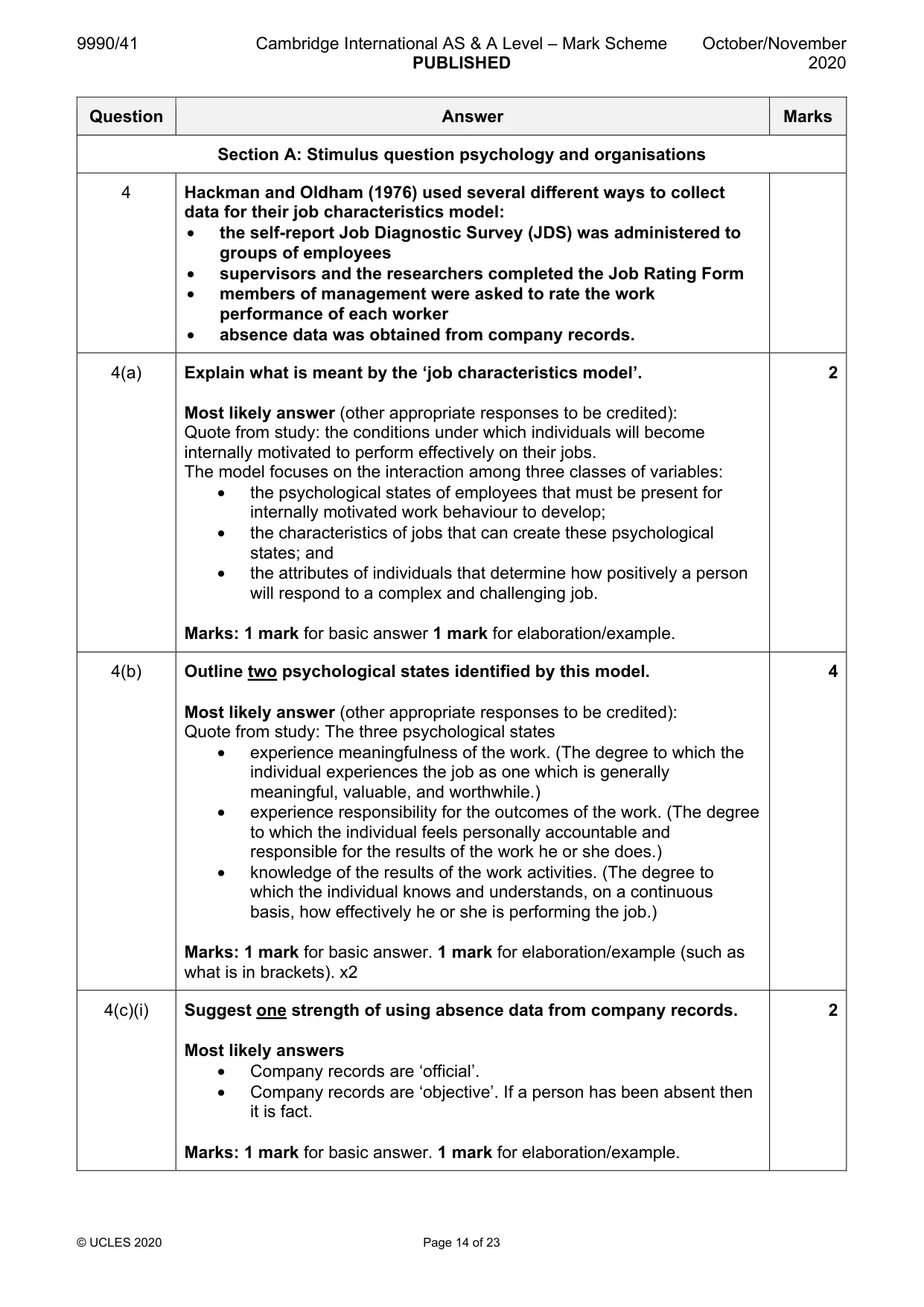
9990/41 Cambridge International AS & A Level – Mark Scheme PUBLISHED October/November 2020 © UCLES 2020 Page 14 of 23 Question Answer Marks Section A: Stimulus question psychology and organisations 4 Hackman and Oldham (1976) used several different ways to collect data for their job characteristics model: • the self-report Job Diagnostic Survey (JDS) was administered to groups of employees • supervisors and the researchers completed the Job Rating Form • members of management were asked to rate the work performance of each worker • absence data was obtained from company records. 4(a) Explain what is meant by the ‘job characteristics model’. Most likely answer (other appropriate responses to be credited): Quote from study: the conditions under which individuals will become internally motivated to perform effectively on their jobs. The model focuses on the interaction among three classes of variables: • the psychological states of employees that must be present for internally motivated work behaviour to develop; • the characteristics of jobs that can create these psychological states; and • the attributes of individuals that determine how positively a person will respond to a complex and challenging job. Marks: 1 mark for basic answer 1 mark for elaboration/example. 2 4(b) Outline two psychological states identified by this model. Most likely answer (other appropriate responses to be credited): Quote from study: The three psychological states • experience meaningfulness of the work. (The degree to which the individual experiences the job as one which is generally meaningful, valuable, and worthwhile.) • experience responsibility for the outcomes of the work. (The degree to which the individual feels personally accountable and responsible for the results of the work he or she does.) • knowledge of the results of the work activities. (The degree to which the individual knows and understands, on a continuous basis, how effectively he or she is performing the job.) Marks: 1 mark for basic answer. 1 mark for elaboration/example (such as what is in brackets). x2 4 4(c)(i) Suggest one strength of using absence data from company records. Most likely answers • Company records are ‘official’. • Company records are ‘objective’. If a person has been absent then it is fact. Marks: 1 mark for basic answer. 1 mark for elaboration/example. 2
Mark scheme, page 15
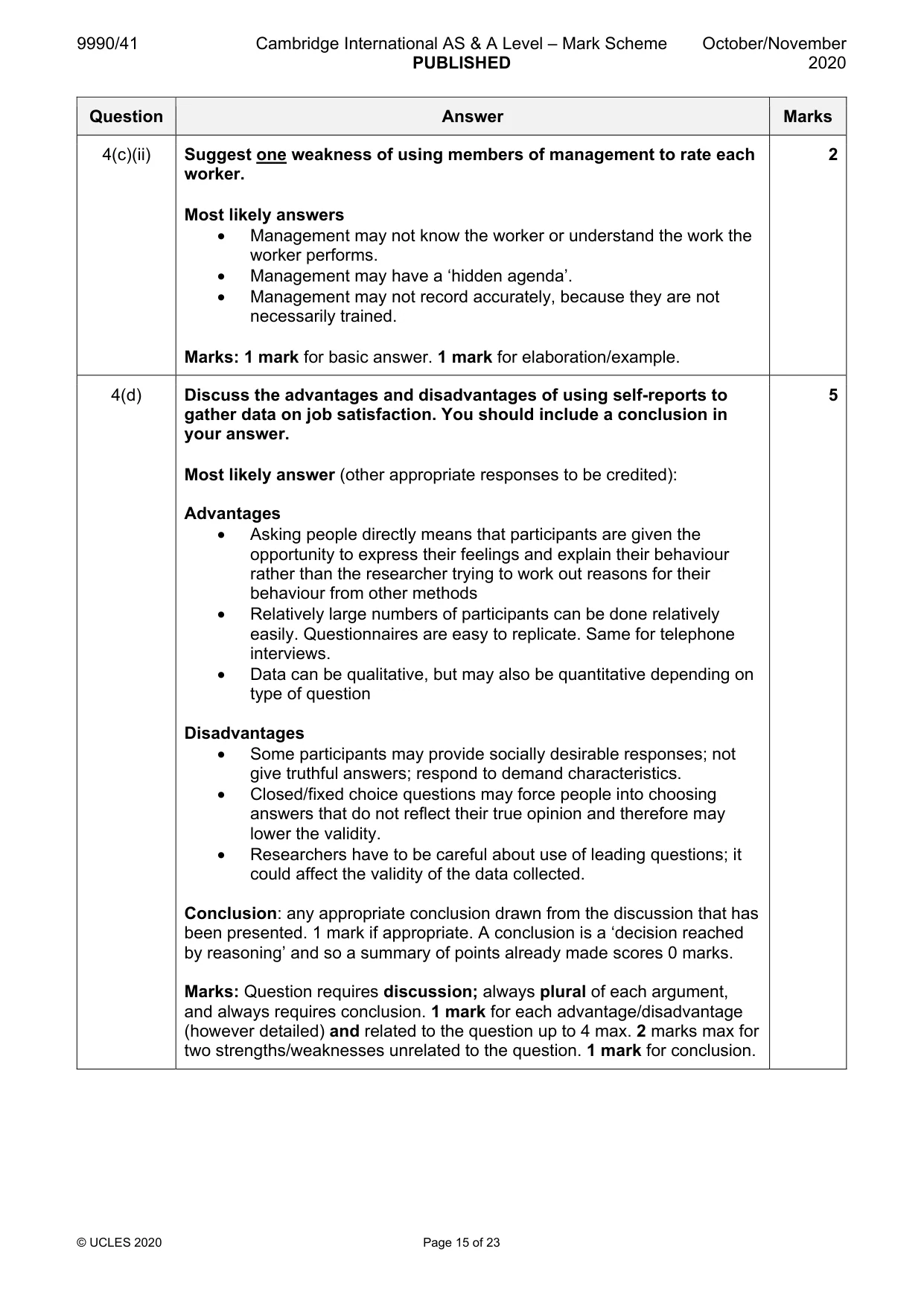
9990/41 Cambridge International AS & A Level – Mark Scheme PUBLISHED October/November 2020 © UCLES 2020 Page 15 of 23 Question Answer Marks 4(c)(ii) Suggest one weakness of using members of management to rate each worker. Most likely answers • Management may not know the worker or understand the work the worker performs. • Management may have a ‘hidden agenda’. • Management may not record accurately, because they are not necessarily trained. Marks: 1 mark for basic answer. 1 mark for elaboration/example. 2 4(d) Discuss the advantages and disadvantages of using self-reports to gather data on job satisfaction. You should include a conclusion in your answer. Most likely answer (other appropriate responses to be credited): Advantages • Asking people directly means that participants are given the opportunity to express their feelings and explain their behaviour rather than the researcher trying to work out reasons for their behaviour from other methods • Relatively large numbers of participants can be done relatively easily. Questionnaires are easy to replicate. Same for telephone interviews. • Data can be qualitative, but may also be quantitative depending on type of question Disadvantages • Some participants may provide socially desirable responses; not give truthful answers; respond to demand characteristics. • Closed/fixed choice questions may force people into choosing answers that do not reflect their true opinion and therefore may lower the validity. • Researchers have to be careful about use of leading questions; it could affect the validity of the data collected. Conclusion: any appropriate conclusion drawn from the discussion that has been presented. 1 mark if appropriate. A conclusion is a ‘decision reached by reasoning’ and so a summary of points already made scores 0 marks. Marks: Question requires discussion; always plural of each argument, and always requires conclusion. 1 mark for each advantage/disadvantage (however detailed) and related to the question up to 4 max. 2 marks max for two strengths/weaknesses unrelated to the question. 1 mark for conclusion. 5
Mark scheme, page 16
9990/41 Cambridge International AS & A Level – Mark Scheme PUBLISHED October/November 2020 © UCLES 2020 Page 16 of 23 Question Answer Marks Section B: Design question (a)=10 marks, (b)=8 marks 5(a) Design a study to investigate phobias of horses in boys. Marks: use generic levels of response Design a study question part (a). Additional: Candidates should design the study showing evidence of design features appropriate to the named method. The named method is: any appropriate method. Typical features: • Experiments: type, IV, DV, controls, experimental design. • Observations: type, setting, response categories, sampling frame, number of observers. • Questionnaires/Interviews: type, setting, example questions. Scoring/rating scale, analysis of responses. General features of research methodology: sampling technique & sample, type of data, ethics, reliability, validity, data analysis. 10 5(b) Explain the psychological and methodological evidence on which your study is based. Marks: use generic levels of response ‘Design a study’ question part (b). Note: If only methodological or psychological explanation is provided max 5 marks. Candidates are expected to explain the reasons for the suggested design in part (a). Explanation should be both psychological and methodological. Psychological to include appropriate theory or research. Additional: candidates are expected to justify their decisions or evidence presented regarding the design made in answer to question part (a). Syllabus: explanations of phobias: behavioural (classical conditioning, Watson, 1920), psychoanalytic (Freud, 1909), biomedical/genetic (Ost, 1992), cognitive (DiNardo et al., 1988) Psychological: study of little Hans: psychoanalytic (Freud, 1909) is likely to feature, but the question allows any other explanation, as listed above, to be used as relevant psychological knowledge. Note: 2 marks max if psychological knowledge is not related to answer. Methodological: explanation of method using general and specific features as above. 8
Mark scheme, page 17
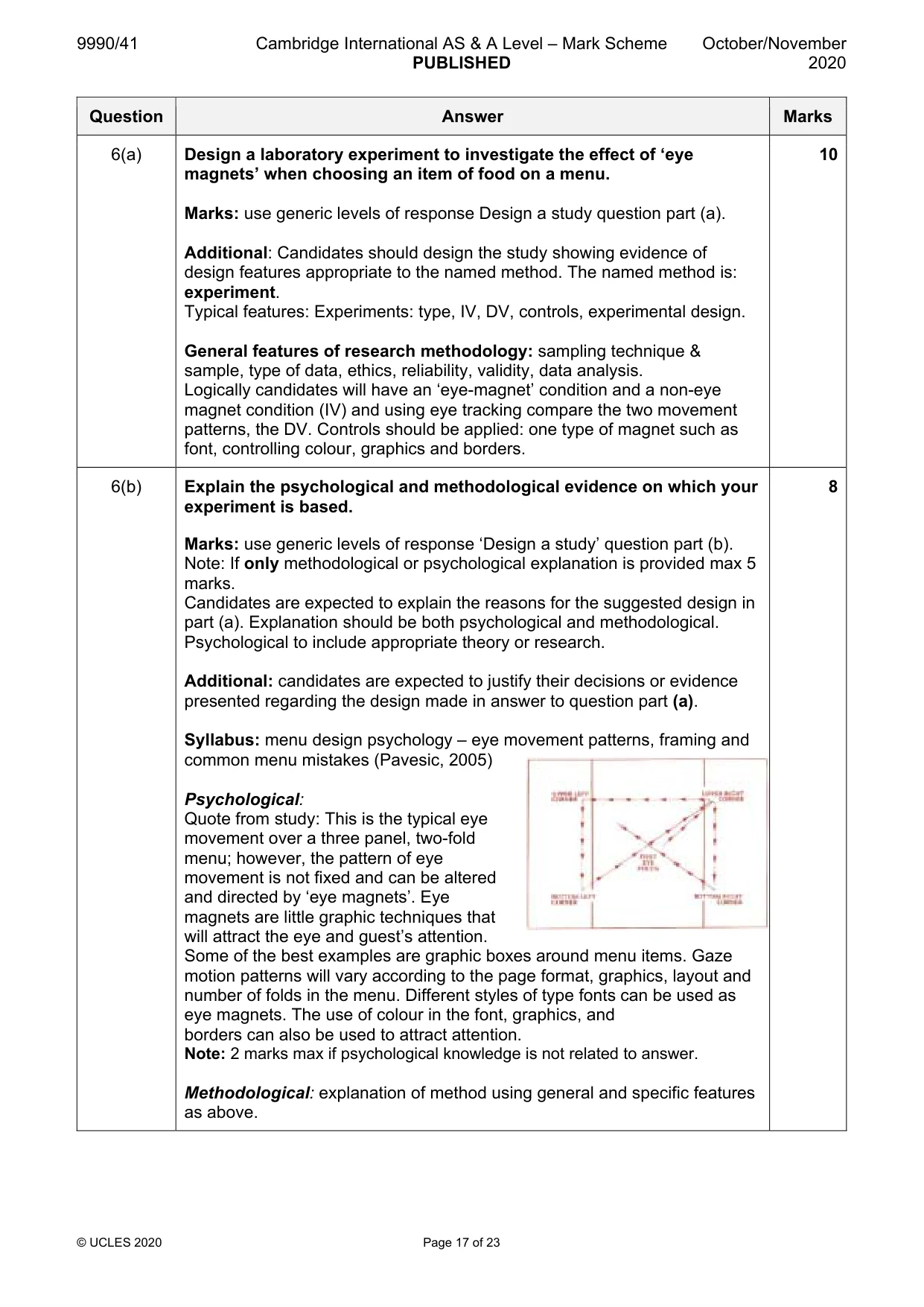
9990/41 Cambridge International AS & A Level – Mark Scheme PUBLISHED October/November 2020 © UCLES 2020 Page 17 of 23 Question Answer Marks 6(a) Design a laboratory experiment to investigate the effect of ‘eye magnets’ when choosing an item of food on a menu. Marks: use generic levels of response Design a study question part (a). Additional: Candidates should design the study showing evidence of design features appropriate to the named method. The named method is: experiment. Typical features: Experiments: type, IV, DV, controls, experimental design. General features of research methodology: sampling technique & sample, type of data, ethics, reliability, validity, data analysis. Logically candidates will have an ‘eye-magnet’ condition and a non-eye magnet condition (IV) and using eye tracking compare the two movement patterns, the DV. Controls should be applied: one type of magnet such as font, controlling colour, graphics and borders. 10 6(b) Explain the psychological and methodological evidence on which your experiment is based. Marks: use generic levels of response ‘Design a study’ question part (b). Note: If only methodological or psychological explanation is provided max 5 marks. Candidates are expected to explain the reasons for the suggested design in part (a). Explanation should be both psychological and methodological. Psychological to include appropriate theory or research. Additional: candidates are expected to justify their decisions or evidence presented regarding the design made in answer to question part (a). Syllabus: menu design psychology – eye movement patterns, framing and common menu mistakes (Pavesic, 2005) Psychological: Quote from study: This is the typical eye movement over a three panel, two-fold menu; however, the pattern of eye movement is not fixed and can be altered and directed by ‘eye magnets’. Eye magnets are little graphic techniques that will attract the eye and guest’s attention. Some of the best examples are graphic boxes around menu items. Gaze motion patterns will vary according to the page format, graphics, layout and number of folds in the menu. Different styles of type fonts can be used as eye magnets. The use of colour in the font, graphics, and borders can also be used to attract attention. Note: 2 marks max if psychological knowledge is not related to answer. Methodological: explanation of method using general and specific features as above. 8
Mark scheme, page 18
9990/41 Cambridge International AS & A Level – Mark Scheme PUBLISHED October/November 2020 © UCLES 2020 Page 18 of 23 Question Answer Marks 7(a) Design a longitudinal study to investigate whether stress has a negative effect on health. Marks: use generic levels of response Design a study question part (a). Additional: Candidates should design the study showing evidence of design features appropriate to the named method. The named method is: longitudinal study. Any method can be used, provided that the data gathered is over a period of time. Typical features: • Experiments: type, IV, DV, controls, experimental design. • Observations: type, setting, response categories, sampling frame, number of observers. • Questionnaires/Interviews: type, setting, example questions. Scoring/rating scale, analysis of responses. General features of research methodology: sampling technique & sample, type of data, ethics, reliability, validity, data analysis. 10 7(b) Explain the psychological and methodological evidence on which your study is based. Marks: use generic levels of response ‘Design a study’ question part (b). Note: If only methodological or psychological explanation is provided max 5 marks. Candidates are expected to explain the reasons for the suggested design in part (a). Explanation should be both psychological and methodological. Psychological to include appropriate theory or research. Additional: candidates are expected to justify their decisions or evidence presented regarding the design made in answer to question part (a). Syllabus: physiology of stress and effects on health: the GAS Model (Selye, 1936) Psychological: Selye’s third stage is exhaustion. The body cannot remain in a ‘heightened state’ and at some point, one or more parts of the system will break down. Effects can be high blood pressure, a haemorrhagic stroke; a myocardial infarction (‘heart attack’) and minor effects such as a stomach ulcer. Note: 2 marks max if psychological knowledge is not related to answer. Methodological: explanation of method using general and specific features as above. 8
Mark scheme, page 19
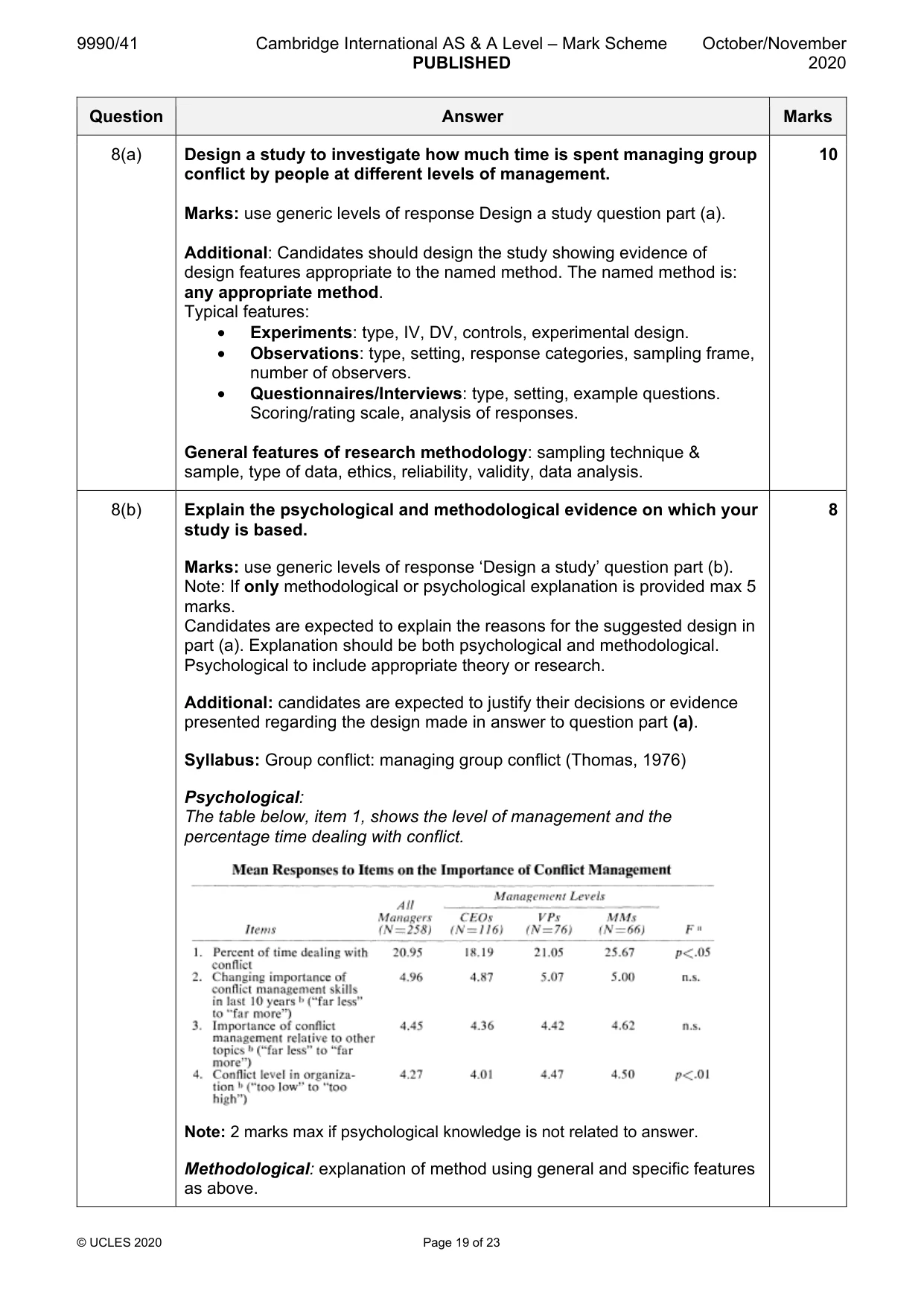
9990/41 Cambridge International AS & A Level – Mark Scheme PUBLISHED October/November 2020 © UCLES 2020 Page 19 of 23 Question Answer Marks 8(a) Design a study to investigate how much time is spent managing group conflict by people at different levels of management. Marks: use generic levels of response Design a study question part (a). Additional: Candidates should design the study showing evidence of design features appropriate to the named method. The named method is: any appropriate method. Typical features: • Experiments: type, IV, DV, controls, experimental design. • Observations: type, setting, response categories, sampling frame, number of observers. • Questionnaires/Interviews: type, setting, example questions. Scoring/rating scale, analysis of responses. General features of research methodology: sampling technique & sample, type of data, ethics, reliability, validity, data analysis. 10 8(b) Explain the psychological and methodological evidence on which your study is based. Marks: use generic levels of response ‘Design a study’ question part (b). Note: If only methodological or psychological explanation is provided max 5 marks. Candidates are expected to explain the reasons for the suggested design in part (a). Explanation should be both psychological and methodological. Psychological to include appropriate theory or research. Additional: candidates are expected to justify their decisions or evidence presented regarding the design made in answer to question part (a). Syllabus: Group conflict: managing group conflict (Thomas, 1976) Psychological: The table below, item 1, shows the level of management and the percentage time dealing with conflict. Note: 2 marks max if psychological knowledge is not related to answer. Methodological: explanation of method using general and specific features as above. 8
Mark scheme, page 20
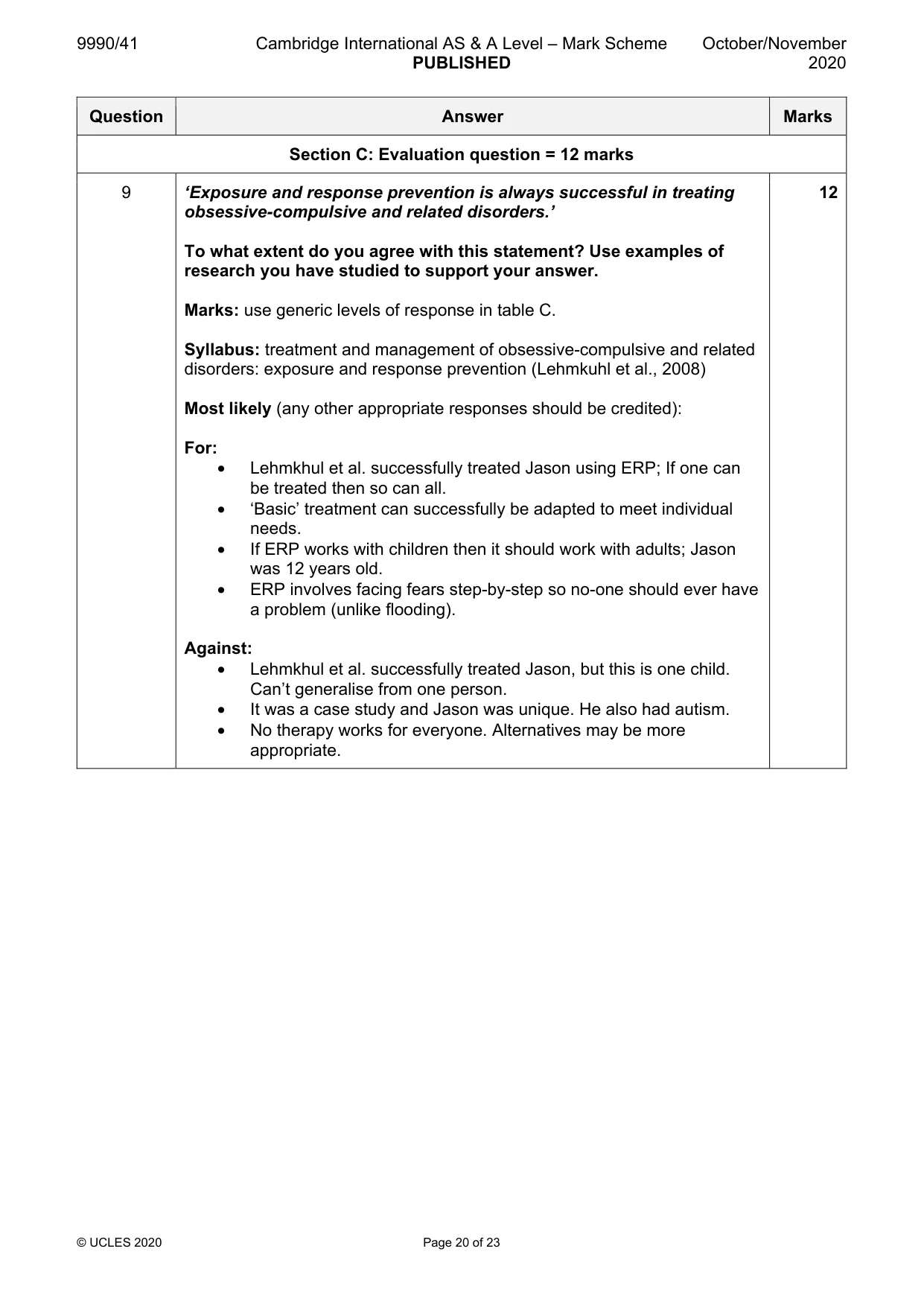
9990/41 Cambridge International AS & A Level – Mark Scheme PUBLISHED October/November 2020 © UCLES 2020 Page 20 of 23 Question Answer Marks Section C: Evaluation question = 12 marks 9 ‘Exposure and response prevention is always successful in treating obsessive-compulsive and related disorders.’ To what extent do you agree with this statement? Use examples of research you have studied to support your answer. Marks: use generic levels of response in table C. Syllabus: treatment and management of obsessive-compulsive and related disorders: exposure and response prevention (Lehmkuhl et al., 2008) Most likely (any other appropriate responses should be credited): For: • Lehmkhul et al. successfully treated Jason using ERP; If one can be treated then so can all. • ‘Basic’ treatment can successfully be adapted to meet individual needs. • If ERP works with children then it should work with adults; Jason was 12 years old. • ERP involves facing fears step-by-step so no-one should ever have a problem (unlike flooding). Against: • Lehmkhul et al. successfully treated Jason, but this is one child. Can’t generalise from one person. • It was a case study and Jason was unique. He also had autism. • No therapy works for everyone. Alternatives may be more appropriate. 12
Mark scheme, page 21
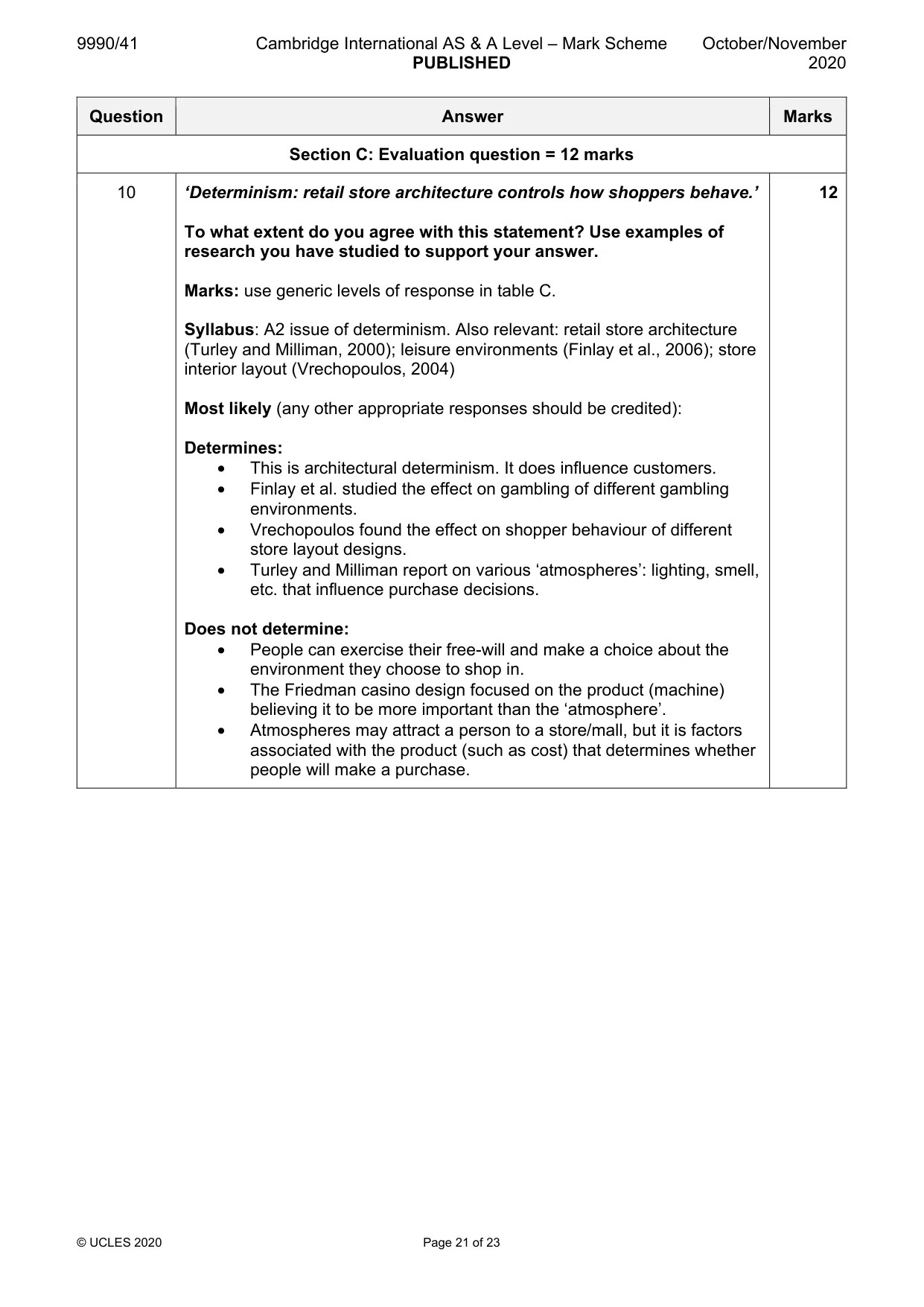
9990/41 Cambridge International AS & A Level – Mark Scheme PUBLISHED October/November 2020 © UCLES 2020 Page 21 of 23 Question Answer Marks Section C: Evaluation question = 12 marks 10 ‘Determinism: retail store architecture controls how shoppers behave.’ To what extent do you agree with this statement? Use examples of research you have studied to support your answer. Marks: use generic levels of response in table C. Syllabus: A2 issue of determinism. Also relevant: retail store architecture (Turley and Milliman, 2000); leisure environments (Finlay et al., 2006); store interior layout (Vrechopoulos, 2004) Most likely (any other appropriate responses should be credited): Determines: • This is architectural determinism. It does influence customers. • Finlay et al. studied the effect on gambling of different gambling environments. • Vrechopoulos found the effect on shopper behaviour of different store layout designs. • Turley and Milliman report on various ‘atmospheres’: lighting, smell, etc. that influence purchase decisions. Does not determine: • People can exercise their free-will and make a choice about the environment they choose to shop in. • The Friedman casino design focused on the product (machine) believing it to be more important than the ‘atmosphere’. • Atmospheres may attract a person to a store/mall, but it is factors associated with the product (such as cost) that determines whether people will make a purchase. 12
Mark scheme, page 22
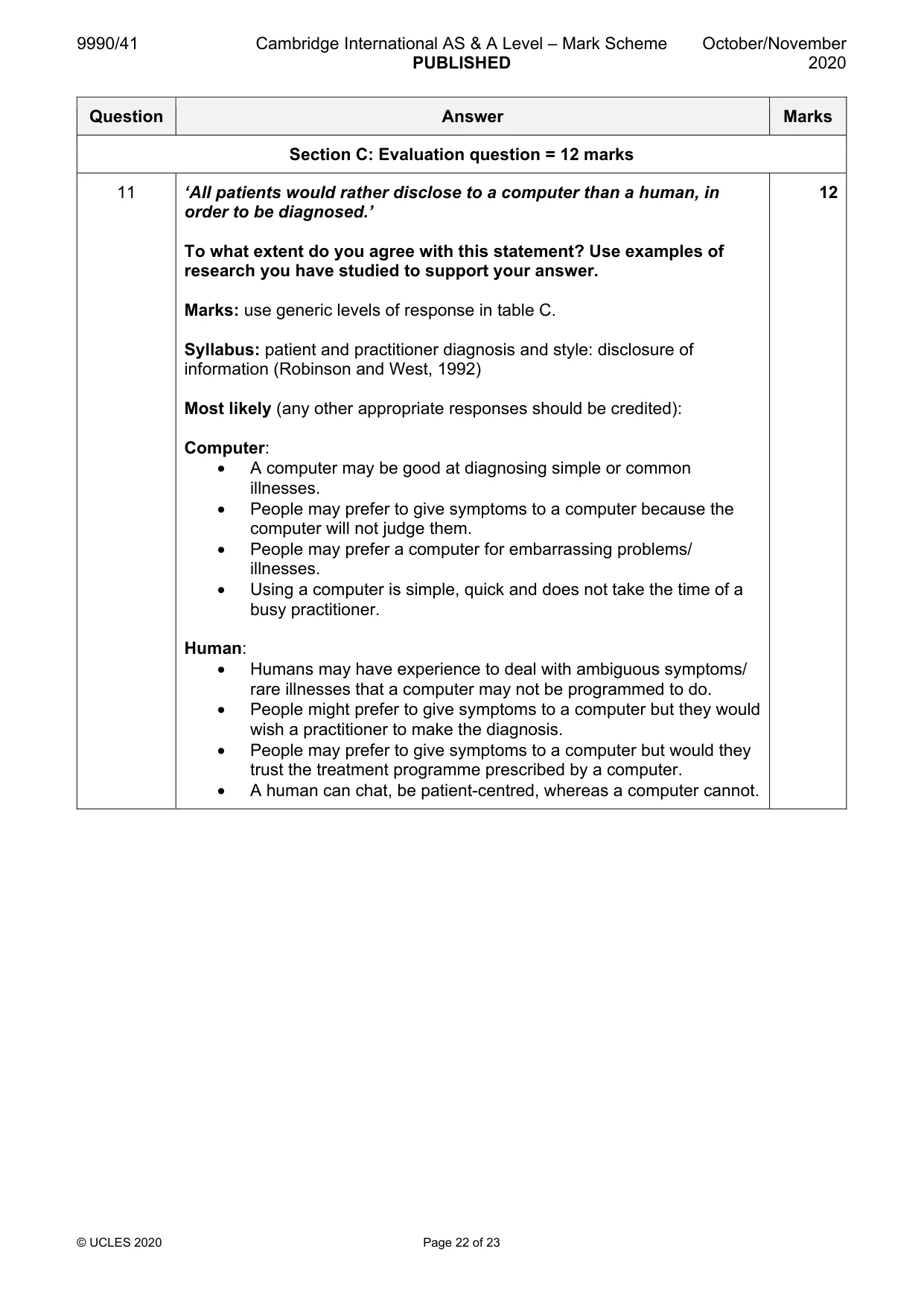
9990/41 Cambridge International AS & A Level – Mark Scheme PUBLISHED October/November 2020 © UCLES 2020 Page 22 of 23 Question Answer Marks Section C: Evaluation question = 12 marks 11 ‘All patients would rather disclose to a computer than a human, in order to be diagnosed.’ To what extent do you agree with this statement? Use examples of research you have studied to support your answer. Marks: use generic levels of response in table C. Syllabus: patient and practitioner diagnosis and style: disclosure of information (Robinson and West, 1992) Most likely (any other appropriate responses should be credited): Computer: • A computer may be good at diagnosing simple or common illnesses. • People may prefer to give symptoms to a computer because the computer will not judge them. • People may prefer a computer for embarrassing problems/ illnesses. • Using a computer is simple, quick and does not take the time of a busy practitioner. Human: • Humans may have experience to deal with ambiguous symptoms/ rare illnesses that a computer may not be programmed to do. • People might prefer to give symptoms to a computer but they would wish a practitioner to make the diagnosis. • People may prefer to give symptoms to a computer but would they trust the treatment programme prescribed by a computer. • A human can chat, be patient-centred, whereas a computer cannot. 12
Mark scheme, page 23
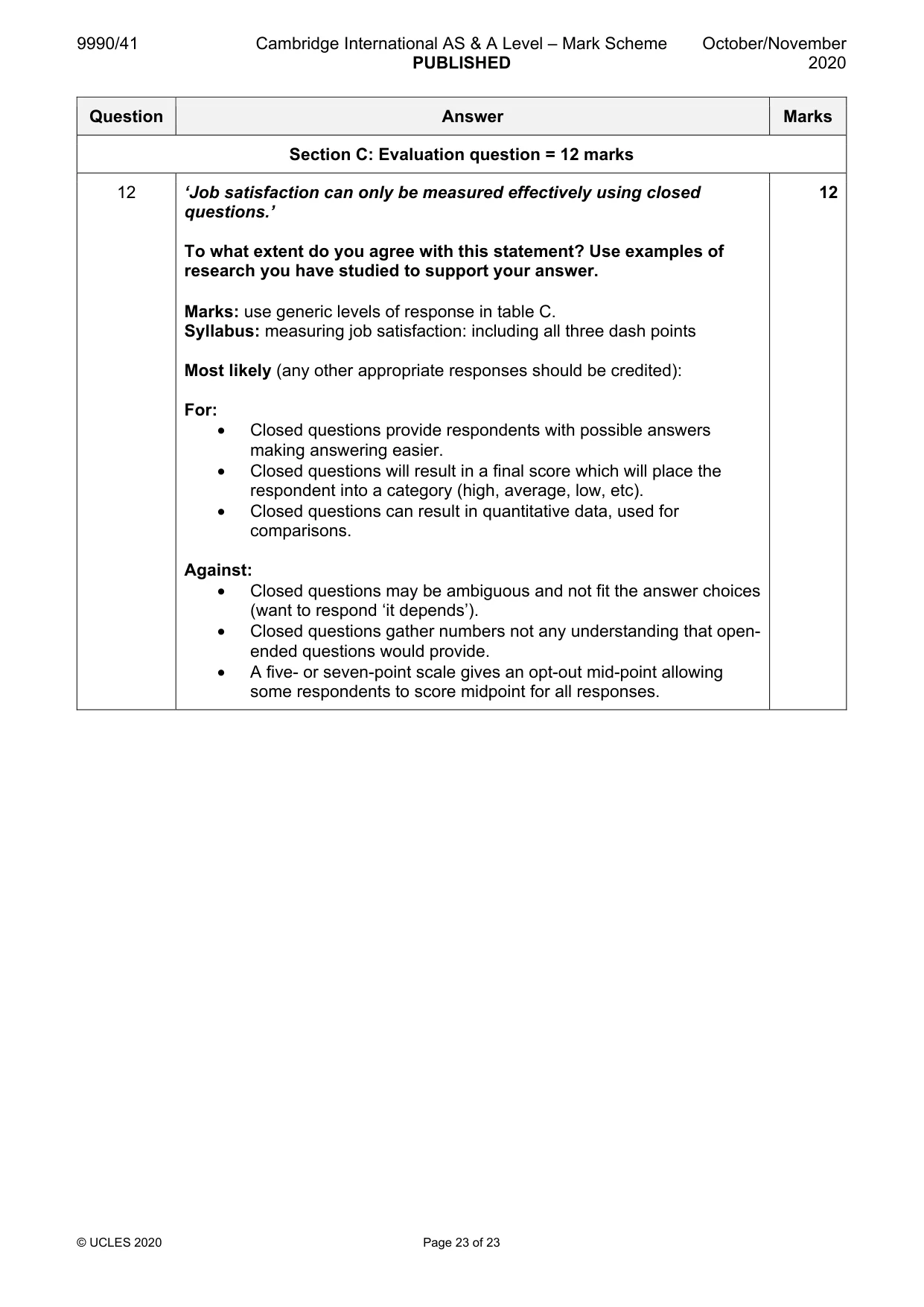
9990/41 Cambridge International AS & A Level – Mark Scheme PUBLISHED October/November 2020 © UCLES 2020 Page 23 of 23 Question Answer Marks Section C: Evaluation question = 12 marks 12 ‘Job satisfaction can only be measured effectively using closed questions.’ To what extent do you agree with this statement? Use examples of research you have studied to support your answer. Marks: use generic levels of response in table C. Syllabus: measuring job satisfaction: including all three dash points Most likely (any other appropriate responses should be credited): For: • Closed questions provide respondents with possible answers making answering easier. • Closed questions will result in a final score which will place the respondent into a category (high, average, low, etc). • Closed questions can result in quantitative data, used for comparisons. Against: • Closed questions may be ambiguous and not fit the answer choices (want to respond ‘it depends’). • Closed questions gather numbers not any understanding that open- ended questions would provide. • A five- or seven-point scale gives an opt-out mid-point allowing some respondents to score midpoint for all responses. 12
What you needed in this session
Cambridge’s own grade thresholds for 2020 Oct/Nov, Paper 4 · Variant 1. A higher threshold means an easier paper — the bar moves with how the cohort did.