Cambridge A Level Psychology (from 2018) 9990 — 2020 May/June Paper 4 · Variant 2
9990/42/M/J/20
The question paper and its mark scheme, free to read here and free to download. This is Cambridge’s own paper, exactly as it was sat.
Question paper8 pages



Mark scheme22 pages
Answers below. Sit the paper first if you are practising.
Paper as text
Question paper, page 1
Cambridge International AS & A Level This document has 8 pages. Blank pages are indicated. PSYCHOLOGY 9990/42 Paper 4 Specialist Options: Application May/June 2020 1 hour 30 minutes You must answer on the enclosed answer booklet. You will need: Answer booklet (enclosed) INSTRUCTIONS ● Answer four questions in total: Answer questions from two options. Section A: answer two questions. Section B: answer one question. Section C: answer one question. ● Follow the instructions on the front cover of the answer booklet. If you need additional answer paper, ask the invigilator for a continuation booklet. INFORMATION ● The total mark for this paper is 60. ● The number of marks for each question or part question is shown in brackets [ ]. * 3 8 7 1 1 2 9 9 7 9 * DC (CJ) 189490/1 © UCLES 2020 [Turn over
Question paper, page 2
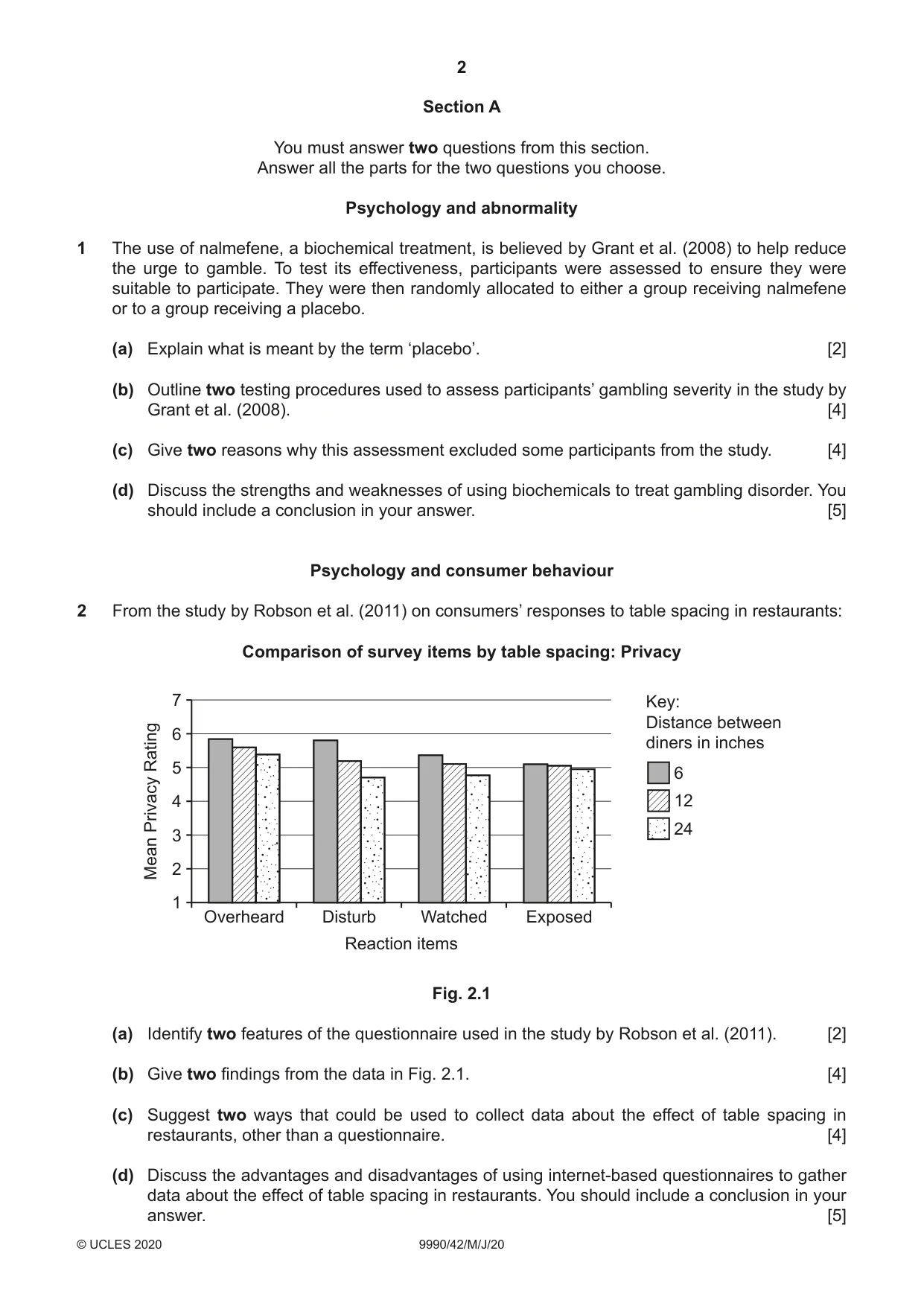
2 9990/42/M/J/20 © UCLES 2020 Section A You must answer two questions from this section. Answer all the parts for the two questions you choose. Psychology and abnormality 1 The use of nalmefene, a biochemical treatment, is believed by Grant et al. (2008) to help reduce the urge to gamble. To test its effectiveness, participants were assessed to ensure they were suitable to participate. They were then randomly allocated to either a group receiving nalmefene or to a group receiving a placebo. (a) Explain what is meant by the term ‘placebo’. [2] (b) Outline two testing procedures used to assess participants’ gambling severity in the study by Grant et al. (2008). [4] (c) Give two reasons why this assessment excluded some participants from the study. [4] (d) Discuss the strengths and weaknesses of using biochemicals to treat gambling disorder. You should include a conclusion in your answer. [5] Psychology and consumer behaviour 2 From the study by Robson et al. (2011) on consumers’ responses to table spacing in restaurants: Comparison of survey items by table spacing: Privacy Overheard Mean Privacy Rating 1 2 3 4 5 6 7 Disturb Watched Reaction items Key: Distance between diners in inches 6 12 24 Exposed Fig. 2.1 (a) Identify two features of the questionnaire used in the study by Robson et al. (2011). [2] (b) Give two findings from the data in Fig. 2.1. [4] (c) Suggest two ways that could be used to collect data about the effect of table spacing in restaurants, other than a questionnaire. [4] (d) Discuss the advantages and disadvantages of using internet-based questionnaires to gather data about the effect of table spacing in restaurants. You should include a conclusion in your answer. [5]
Question paper, page 3
3 9990/42/M/J/20 © UCLES 2020 [Turn over Psychology and health 3 Poor adherence in asthma patients has been associated with more wheezing and more frequent need for hospitalisations. Patients with the most severe asthma appear to have worse adherence than other asthma patients. The study by Sherman et al. (2000) was conducted to investigate whether telephoning the patient’s pharmacy to obtain a prescription refill history gathers accurate information about medication-taking behaviour. (a) Explain how the participants were selected for the study by Sherman et al. (2000). [2] (b) Give one strength and one weakness of selecting the participants in this way. [4] (c) (i) Suggest one way in which data on adherence could be gathered, other than by using pharmacy records. [2] (ii) Suggest one advantage of the way to gather data that you suggested in (c)(i). [2] (d) Discuss the strengths and weaknesses of using pharmacy records to gather data on adherence to taking medication. You should include a conclusion in your answer. [5] Psychology and organisations 4 The Minnesota satisfaction questionnaire (MSQ) measures satisfaction with the work environment. The long version takes 15–20 minutes to complete, using 100 satisfaction items. It is easy to read and Weiss et al. (1967) say it is both reliable and valid. It can be completed as a postal questionnaire or in an interview setting. (a) Explain how Weiss et al. (1967) know the MSQ is reliable. [2] (b) (i) Give two MSQ satisfaction items. [2] (ii) Suggest one problem that would arise if the questionnaire took longer than 20 minutes to complete. [2] (c) Suggest two disadvantages of using a five-point scale, using an example from the MSQ. [4] (d) Discuss the advantages and disadvantages of using postal questionnaires to gather data about work satisfaction. You should include a conclusion in your answer. [5]
Question paper, page 4
4 9990/42/M/J/20 © UCLES 2020 Section B You must answer one question from this section. Psychology and abnormality 5 (a) Design an experiment to investigate the effectiveness of covert sensitisation for treating kleptomania. [10] (b) Explain the psychological and methodological evidence on which your experiment is based. [8] Psychology and consumer behaviour 6 (a) Design a study to investigate whether males are ‘raider’ type shoppers and females are ‘explorer’ type shoppers. [10] (b) Explain the psychological and methodological evidence on which your study is based. [8] Psychology and health 7 (a) Design a study to investigate age differences in the disclosure of medical information to a health practitioner. [10] (b) Explain the psychological and methodological evidence on which your study is based. [8] Psychology and organisations 8 (a) Design a study to investigate how colour of lighting in a factory affects productivity level. [10] (b) Explain the psychological and methodological evidence on which your study is based. [8]
Question paper, page 5
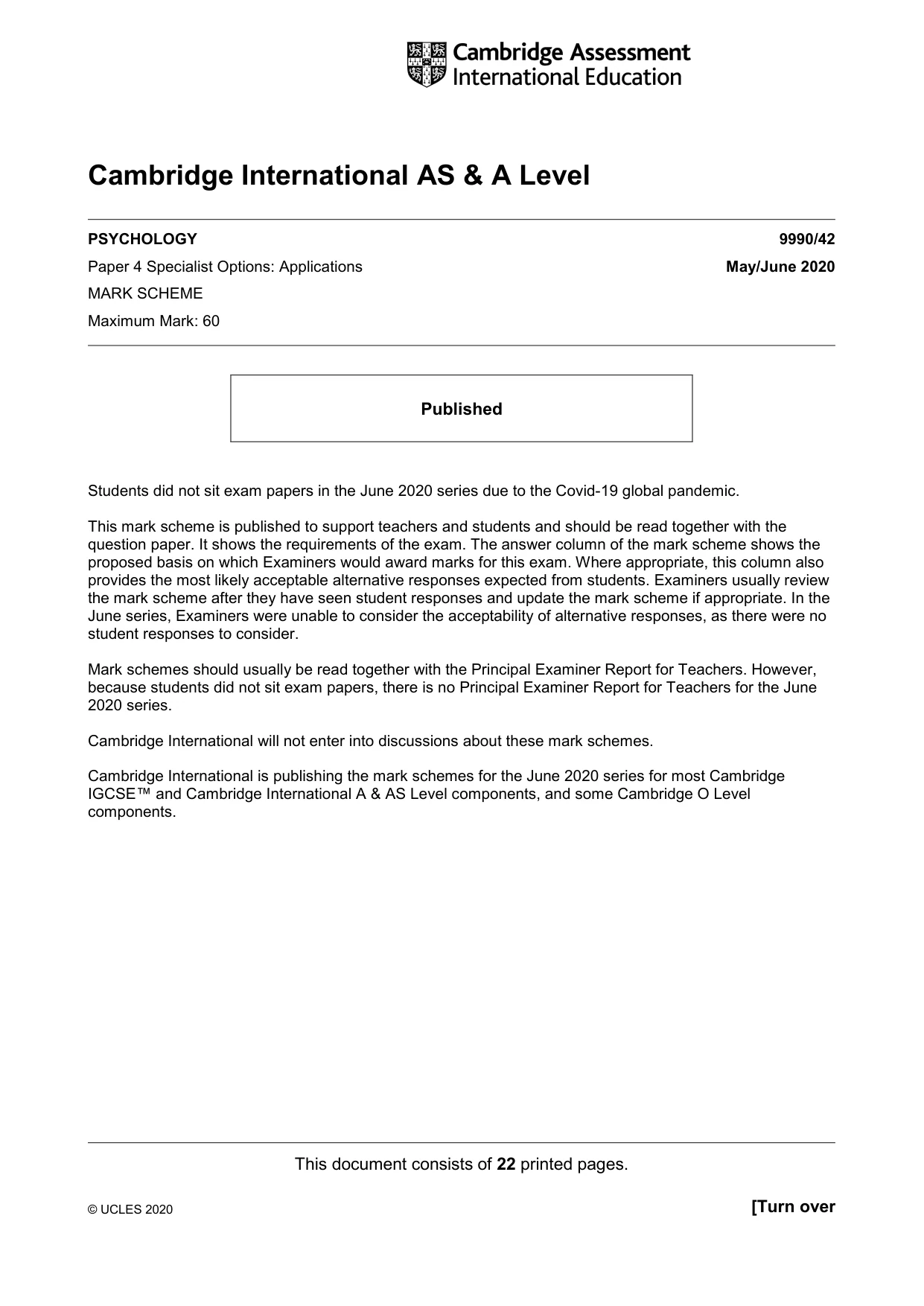
5 9990/42/M/J/20 © UCLES 2020 Section C You must answer one question from this section. Psychology and abnormality 9 ‘Telephone-administered cognitive-behavioural therapy (CBT) to treat obsessive-compulsive disorder (OCD) will never be as effective as face-to-face treatment.’ To what extent do you agree with this statement? Use examples of research you have studied to support your answer. [12] Psychology and consumer behaviour 10 ‘Satisficing is the only model needed to explain consumer decision-making.’ To what extent do you agree with this statement? Use examples of research you have studied to support your answer. [12] Psychology and health 11 ‘It does not matter whether patients understand the medical terms their doctor uses. In order to get better, they just have to do what their doctor tells them.’ To what extent do you agree with this statement? Use examples of research you have studied to support your answer. [12] Psychology and organisations 12 ‘The two-factor theory of job satisfaction is too reductionist to be useful.’ To what extent do you agree with this statement? Use examples of research you have studied to support your answer. [12]
Question paper, page 6
6 9990/42/M/J/20 © UCLES 2020 BLANK PAGE
Question paper, page 7
7 9990/42/M/J/20 © UCLES 2020 BLANK PAGE
Question paper, page 8
8 9990/42/M/J/20 © UCLES 2020 Permission to reproduce items where third-party owned material protected by copyright is included has been sought and cleared where possible. Every reasonable effort has been made by the publisher (UCLES) to trace copyright holders, but if any items requiring clearance have unwittingly been included, the publisher will be pleased to make amends at the earliest possible opportunity. To avoid the issue of disclosure of answer-related information to candidates, all copyright acknowledgements are reproduced online in the Cambridge Assessment International Education Copyright Acknowledgements Booklet. This is produced for each series of examinations and is freely available to download at www.cambridgeinternational.org after the live examination series. Cambridge Assessment International Education is part of the Cambridge Assessment Group. Cambridge Assessment is the brand name of the University of Cambridge Local Examinations Syndicate (UCLES), which itself is a department of the University of Cambridge. BLANK PAGE
Mark scheme, page 1
This document consists of 22 printed pages. © UCLES 2020 [Turn over Cambridge International AS & A Level PSYCHOLOGY 9990/42 Paper 4 Specialist Options: Applications May/June 2020 MARK SCHEME Maximum Mark: 60 Published Students did not sit exam papers in the June 2020 series due to the Covid-19 global pandemic. This mark scheme is published to support teachers and students and should be read together with the question paper. It shows the requirements of the exam. The answer column of the mark scheme shows the proposed basis on which Examiners would award marks for this exam. Where appropriate, this column also provides the most likely acceptable alternative responses expected from students. Examiners usually review the mark scheme after they have seen student responses and update the mark scheme if appropriate. In the June series, Examiners were unable to consider the acceptability of alternative responses, as there were no student responses to consider. Mark schemes should usually be read together with the Principal Examiner Report for Teachers. However, because students did not sit exam papers, there is no Principal Examiner Report for Teachers for the June 2020 series. Cambridge International will not enter into discussions about these mark schemes. Cambridge International is publishing the mark schemes for the June 2020 series for most Cambridge IGCSE™ and Cambridge International A & AS Level components, and some Cambridge O Level components.
Mark scheme, page 2
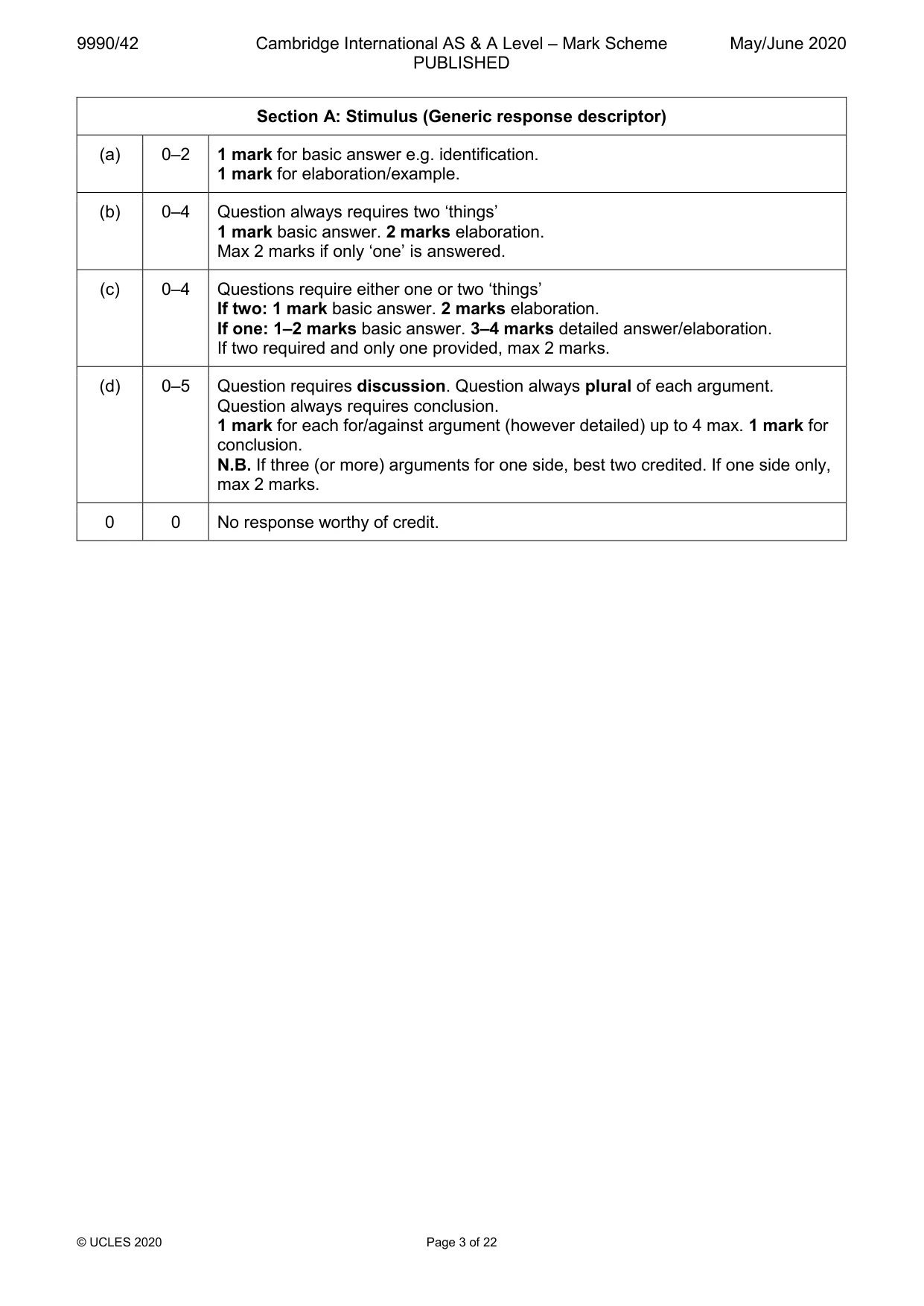
9990/42 Cambridge International AS & A Level – Mark Scheme PUBLISHED May/June 2020 © UCLES 2020 Page 2 of 22 Generic Marking Principles These general marking principles must be applied by all examiners when marking candidate answers. They should be applied alongside the specific content of the mark scheme or generic level descriptors for a question. Each question paper and mark scheme will also comply with these marking principles. GENERIC MARKING PRINCIPLE 1: Marks must be awarded in line with: • the specific content of the mark scheme or the generic level descriptors for the question • the specific skills defined in the mark scheme or in the generic level descriptors for the question • the standard of response required by a candidate as exemplified by the standardisation scripts. GENERIC MARKING PRINCIPLE 2: Marks awarded are always whole marks (not half marks, or other fractions). GENERIC MARKING PRINCIPLE 3: Marks must be awarded positively: • marks are awarded for correct/valid answers, as defined in the mark scheme. However, credit is given for valid answers which go beyond the scope of the syllabus and mark scheme, referring to your Team Leader as appropriate • marks are awarded when candidates clearly demonstrate what they know and can do • marks are not deducted for errors • marks are not deducted for omissions • answers should only be judged on the quality of spelling, punctuation and grammar when these features are specifically assessed by the question as indicated by the mark scheme. The meaning, however, should be unambiguous. GENERIC MARKING PRINCIPLE 4: Rules must be applied consistently e.g. in situations where candidates have not followed instructions or in the application of generic level descriptors. GENERIC MARKING PRINCIPLE 5: Marks should be awarded using the full range of marks defined in the mark scheme for the question (however; the use of the full mark range may be limited according to the quality of the candidate responses seen). GENERIC MARKING PRINCIPLE 6: Marks awarded are based solely on the requirements as defined in the mark scheme. Marks should not be awarded with grade thresholds or grade descriptors in mind.
Mark scheme, page 3
9990/42 Cambridge International AS & A Level – Mark Scheme PUBLISHED May/June 2020 © UCLES 2020 Page 3 of 22 Section A: Stimulus (Generic response descriptor) (a) 0–2 1 mark for basic answer e.g. identification. 1 mark for elaboration/example. (b) 0–4 Question always requires two ‘things’ 1 mark basic answer. 2 marks elaboration. Max 2 marks if only ‘one’ is answered. (c) 0–4 Questions require either one or two ‘things’ If two: 1 mark basic answer. 2 marks elaboration. If one: 1–2 marks basic answer. 3–4 marks detailed answer/elaboration. If two required and only one provided, max 2 marks. (d) 0–5 Question requires discussion. Question always plural of each argument. Question always requires conclusion. 1 mark for each for/against argument (however detailed) up to 4 max. 1 mark for conclusion. N.B. If three (or more) arguments for one side, best two credited. If one side only, max 2 marks. 0 0 No response worthy of credit.
Mark scheme, page 4
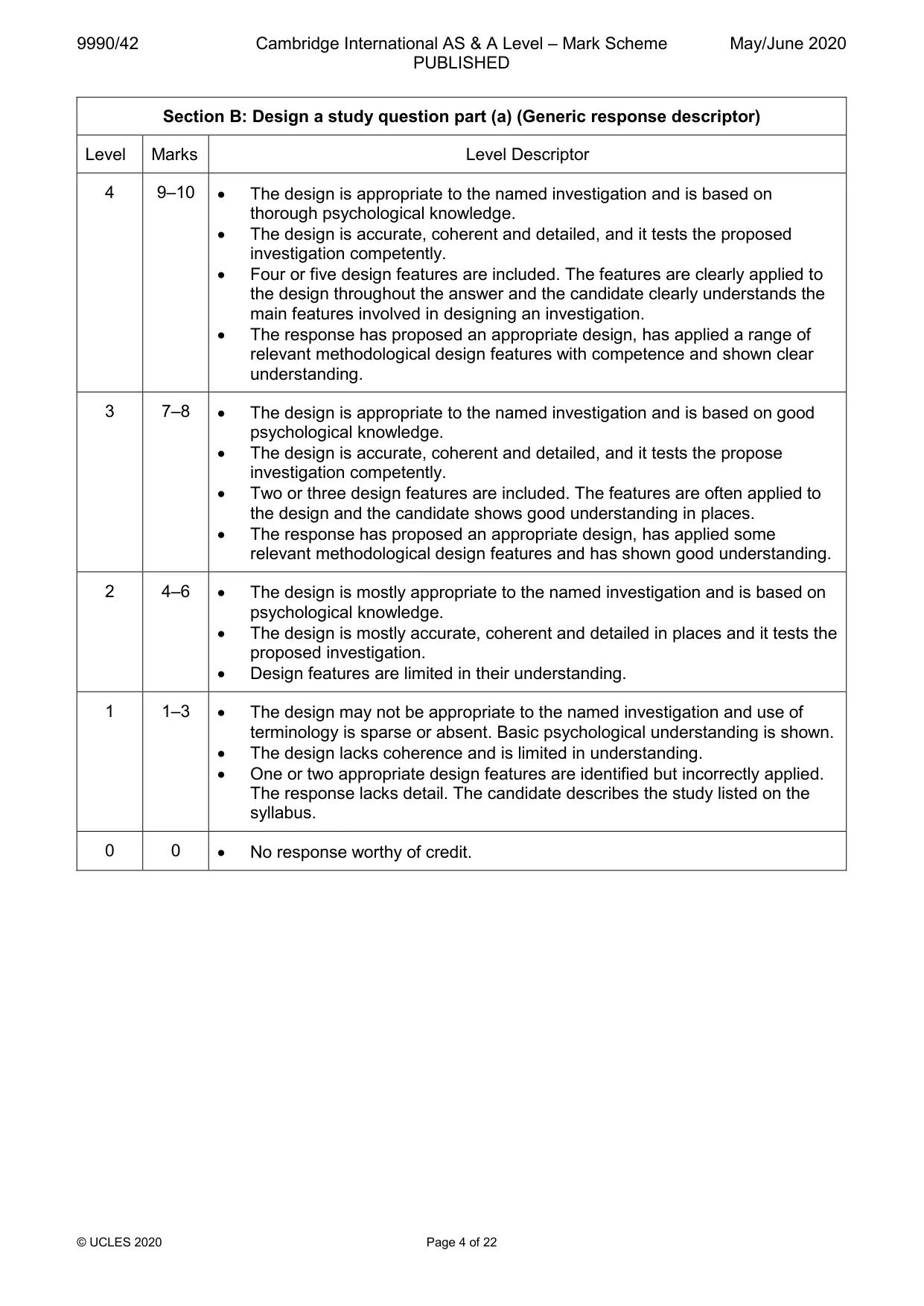
9990/42 Cambridge International AS & A Level – Mark Scheme PUBLISHED May/June 2020 © UCLES 2020 Page 4 of 22 Section B: Design a study question part (a) (Generic response descriptor) Level Marks Level Descriptor 4 9–10 • The design is appropriate to the named investigation and is based on thorough psychological knowledge. • The design is accurate, coherent and detailed, and it tests the proposed investigation competently. • Four or five design features are included. The features are clearly applied to the design throughout the answer and the candidate clearly understands the main features involved in designing an investigation. • The response has proposed an appropriate design, has applied a range of relevant methodological design features with competence and shown clear understanding. 3 7–8 • The design is appropriate to the named investigation and is based on good psychological knowledge. • The design is accurate, coherent and detailed, and it tests the propose investigation competently. • Two or three design features are included. The features are often applied to the design and the candidate shows good understanding in places. • The response has proposed an appropriate design, has applied some relevant methodological design features and has shown good understanding. 2 4–6 • The design is mostly appropriate to the named investigation and is based on psychological knowledge. • The design is mostly accurate, coherent and detailed in places and it tests the proposed investigation. • Design features are limited in their understanding. 1 1–3 • The design may not be appropriate to the named investigation and use of terminology is sparse or absent. Basic psychological understanding is shown. • The design lacks coherence and is limited in understanding. • One or two appropriate design features are identified but incorrectly applied. The response lacks detail. The candidate describes the study listed on the syllabus. 0 0 • No response worthy of credit.
Mark scheme, page 5
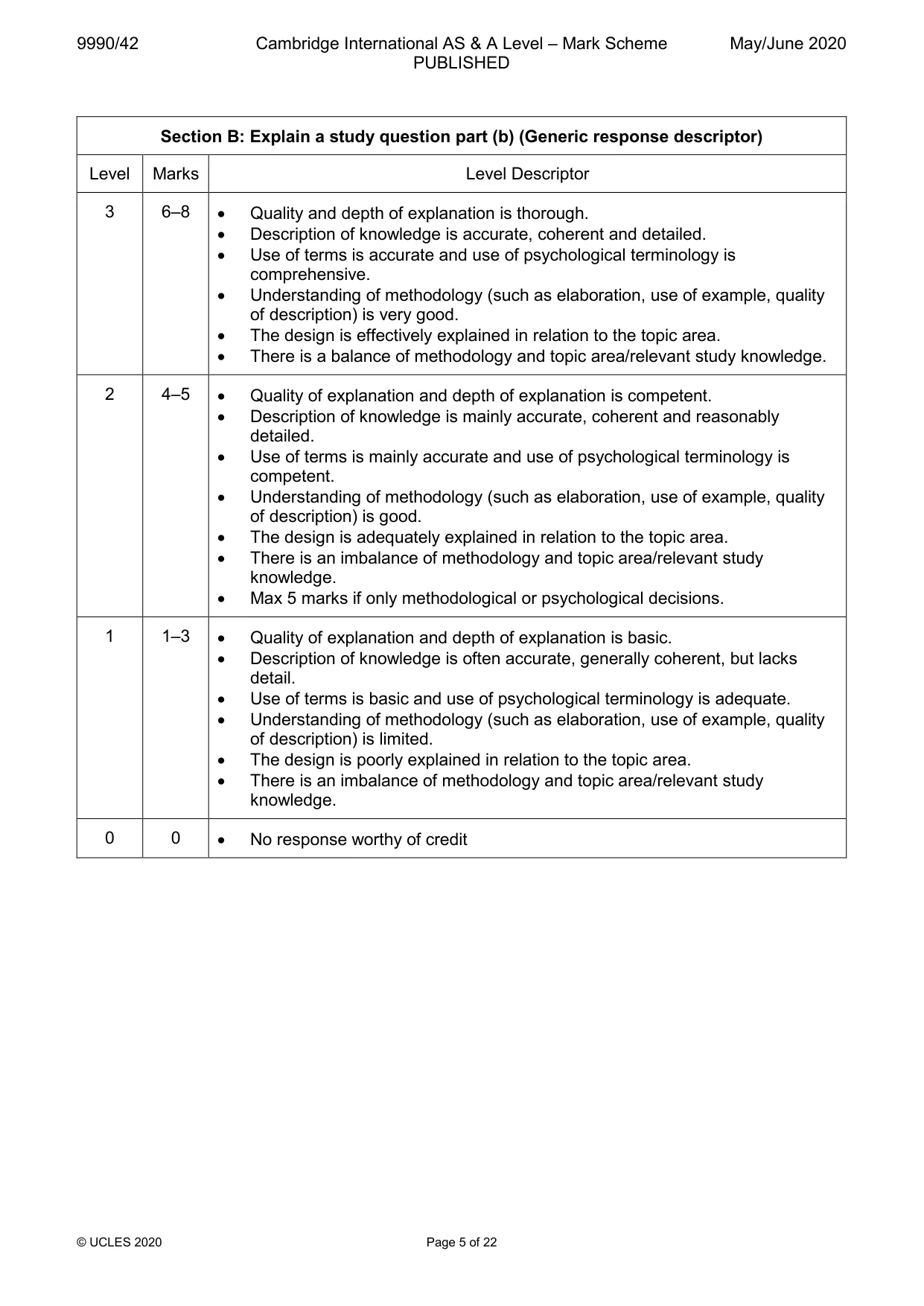
9990/42 Cambridge International AS & A Level – Mark Scheme PUBLISHED May/June 2020 © UCLES 2020 Page 5 of 22 Section B: Explain a study question part (b) (Generic response descriptor) Level Marks Level Descriptor 3 6–8 • Quality and depth of explanation is thorough. • Description of knowledge is accurate, coherent and detailed. • Use of terms is accurate and use of psychological terminology is comprehensive. • Understanding of methodology (such as elaboration, use of example, quality of description) is very good. • The design is effectively explained in relation to the topic area. • There is a balance of methodology and topic area/relevant study knowledge. 2 4–5 • Quality of explanation and depth of explanation is competent. • Description of knowledge is mainly accurate, coherent and reasonably detailed. • Use of terms is mainly accurate and use of psychological terminology is competent. • Understanding of methodology (such as elaboration, use of example, quality of description) is good. • The design is adequately explained in relation to the topic area. • There is an imbalance of methodology and topic area/relevant study knowledge. • Max 5 marks if only methodological or psychological decisions. 1 1–3 • Quality of explanation and depth of explanation is basic. • Description of knowledge is often accurate, generally coherent, but lacks detail. • Use of terms is basic and use of psychological terminology is adequate. • Understanding of methodology (such as elaboration, use of example, quality of description) is limited. • The design is poorly explained in relation to the topic area. • There is an imbalance of methodology and topic area/relevant study knowledge. 0 0 • No response worthy of credit
Mark scheme, page 6
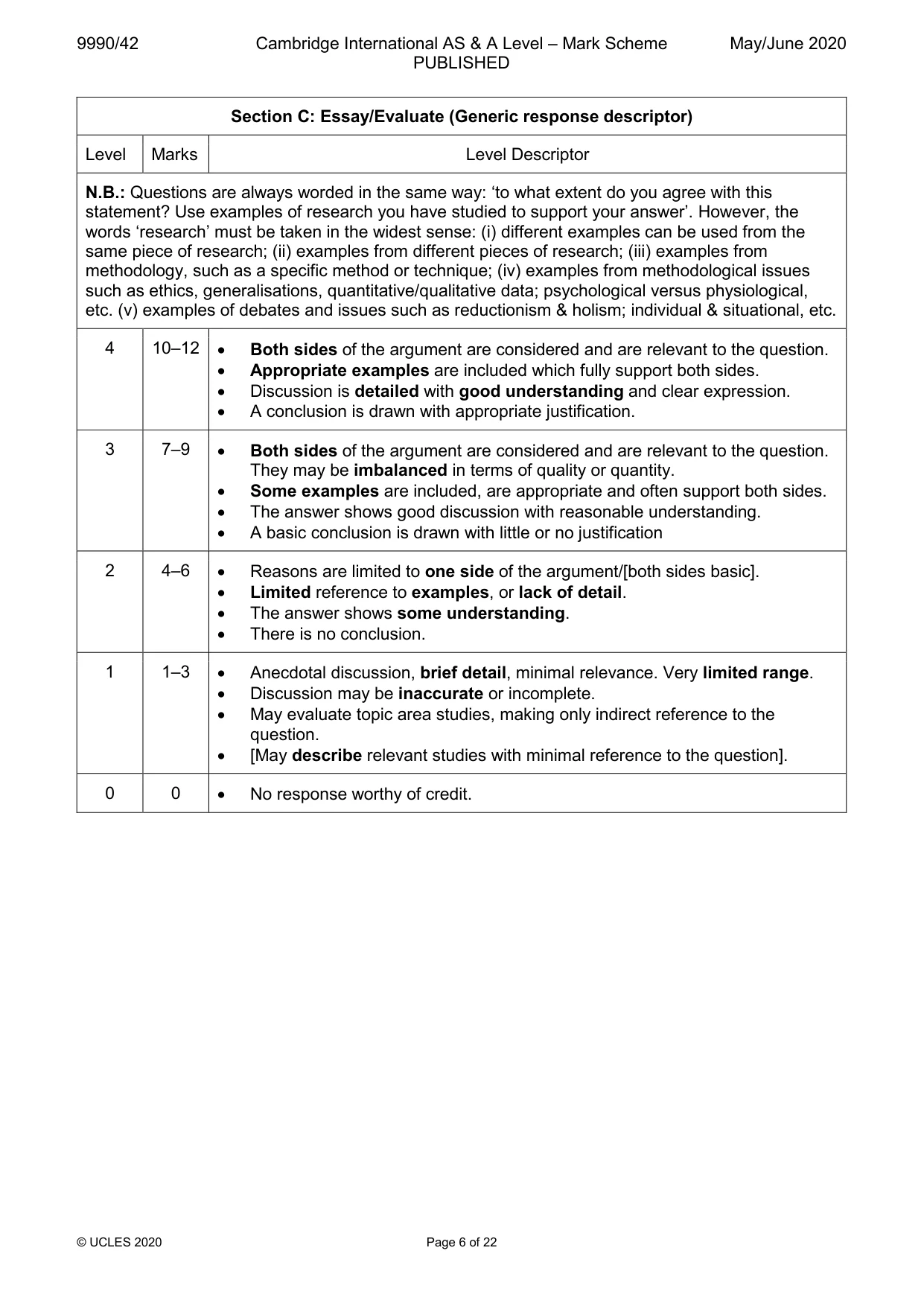
9990/42 Cambridge International AS & A Level – Mark Scheme PUBLISHED May/June 2020 © UCLES 2020 Page 6 of 22 Section C: Essay/Evaluate (Generic response descriptor) Level Marks Level Descriptor N.B.: Questions are always worded in the same way: ‘to what extent do you agree with this statement? Use examples of research you have studied to support your answer’. However, the words ‘research’ must be taken in the widest sense: (i) different examples can be used from the same piece of research; (ii) examples from different pieces of research; (iii) examples from methodology, such as a specific method or technique; (iv) examples from methodological issues such as ethics, generalisations, quantitative/qualitative data; psychological versus physiological, etc. (v) examples of debates and issues such as reductionism & holism; individual & situational, etc. 4 10–12 • Both sides of the argument are considered and are relevant to the question. • Appropriate examples are included which fully support both sides. • Discussion is detailed with good understanding and clear expression. • A conclusion is drawn with appropriate justification. 3 7–9 • Both sides of the argument are considered and are relevant to the question. They may be imbalanced in terms of quality or quantity. • Some examples are included, are appropriate and often support both sides. • The answer shows good discussion with reasonable understanding. • A basic conclusion is drawn with little or no justification 2 4–6 • Reasons are limited to one side of the argument/[both sides basic]. • Limited reference to examples, or lack of detail. • The answer shows some understanding. • There is no conclusion. 1 1–3 • Anecdotal discussion, brief detail, minimal relevance. Very limited range. • Discussion may be inaccurate or incomplete. • May evaluate topic area studies, making only indirect reference to the question. • [May describe relevant studies with minimal reference to the question]. 0 0 • No response worthy of credit.
Mark scheme, page 7
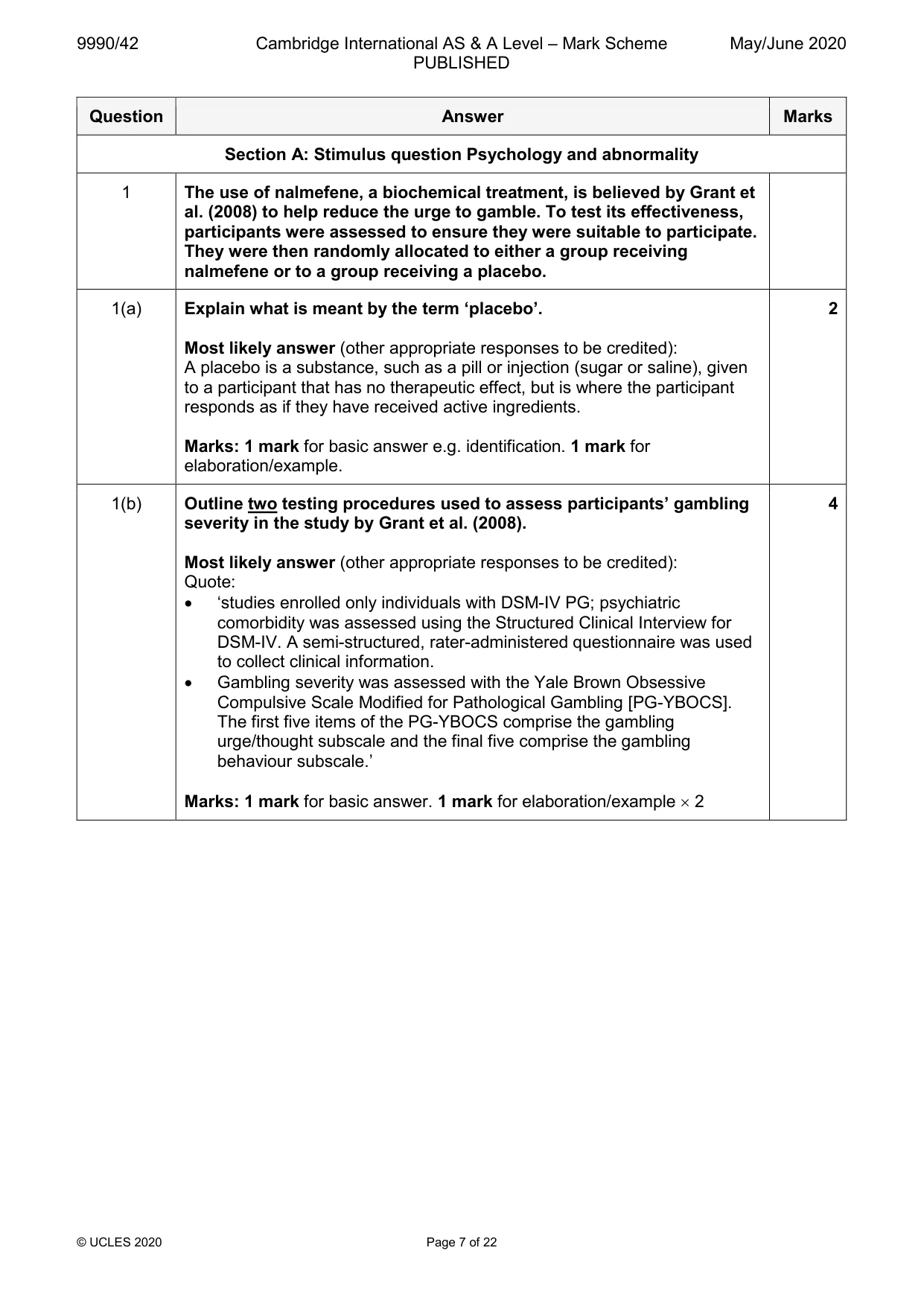
9990/42 Cambridge International AS & A Level – Mark Scheme PUBLISHED May/June 2020 © UCLES 2020 Page 7 of 22 Question Answer Marks Section A: Stimulus question Psychology and abnormality 1 The use of nalmefene, a biochemical treatment, is believed by Grant et al. (2008) to help reduce the urge to gamble. To test its effectiveness, participants were assessed to ensure they were suitable to participate. They were then randomly allocated to either a group receiving nalmefene or to a group receiving a placebo. 1(a) Explain what is meant by the term ‘placebo’. Most likely answer (other appropriate responses to be credited): A placebo is a substance, such as a pill or injection (sugar or saline), given to a participant that has no therapeutic effect, but is where the participant responds as if they have received active ingredients. Marks: 1 mark for basic answer e.g. identification. 1 mark for elaboration/example. 2 1(b) Outline two testing procedures used to assess participants’ gambling severity in the study by Grant et al. (2008). Most likely answer (other appropriate responses to be credited): Quote: • ‘studies enrolled only individuals with DSM-IV PG; psychiatric comorbidity was assessed using the Structured Clinical Interview for DSM-IV. A semi-structured, rater-administered questionnaire was used to collect clinical information. • Gambling severity was assessed with the Yale Brown Obsessive Compulsive Scale Modified for Pathological Gambling [PG-YBOCS]. The first five items of the PG-YBOCS comprise the gambling urge/thought subscale and the final five comprise the gambling behaviour subscale.’ Marks: 1 mark for basic answer. 1 mark for elaboration/example × 2 4
Mark scheme, page 8
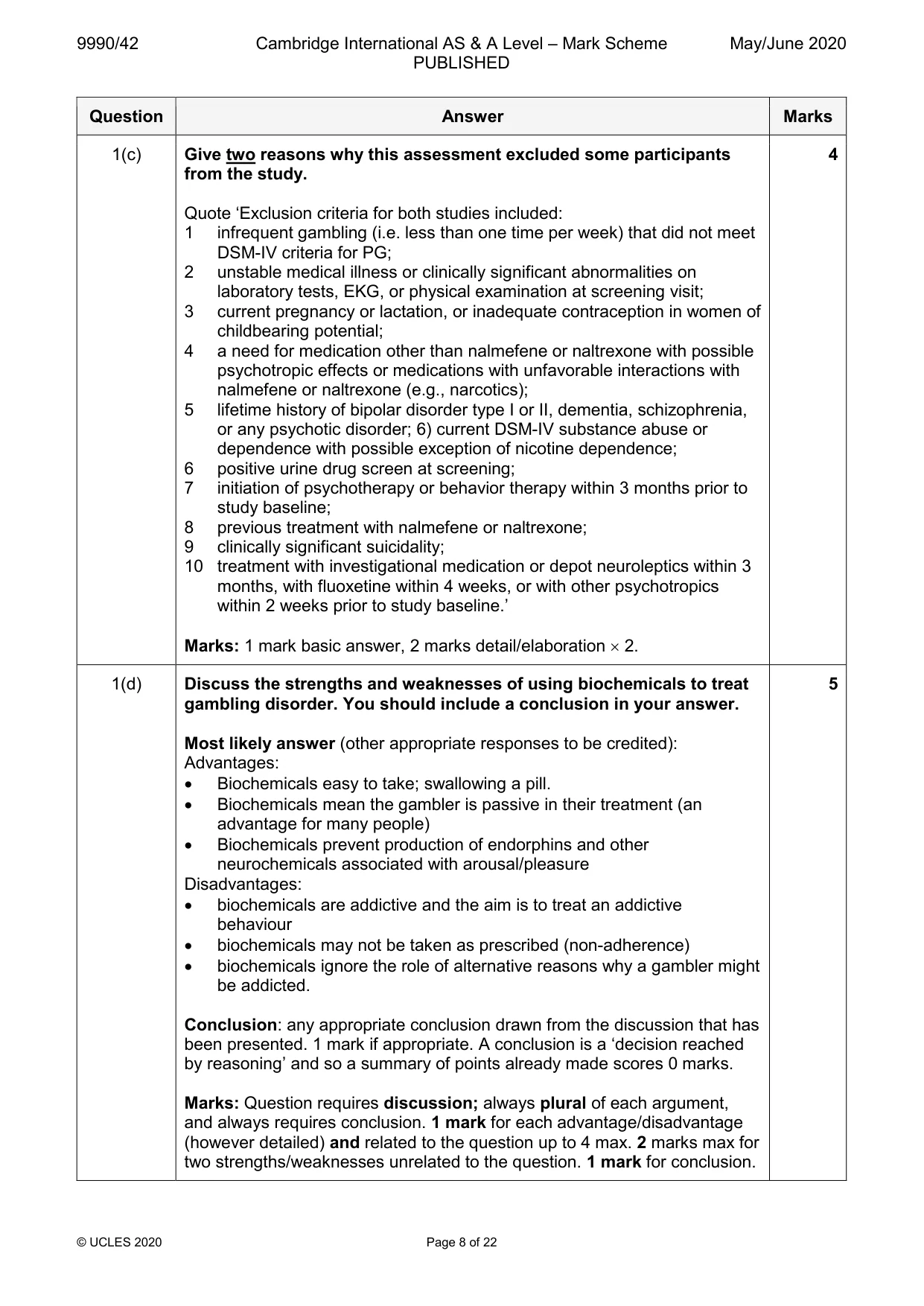
9990/42 Cambridge International AS & A Level – Mark Scheme PUBLISHED May/June 2020 © UCLES 2020 Page 8 of 22 Question Answer Marks 1(c) Give two reasons why this assessment excluded some participants from the study. Quote ‘Exclusion criteria for both studies included: 1 infrequent gambling (i.e. less than one time per week) that did not meet DSM-IV criteria for PG; 2 unstable medical illness or clinically significant abnormalities on laboratory tests, EKG, or physical examination at screening visit; 3 current pregnancy or lactation, or inadequate contraception in women of childbearing potential; 4 a need for medication other than nalmefene or naltrexone with possible psychotropic effects or medications with unfavorable interactions with nalmefene or naltrexone (e.g., narcotics); 5 lifetime history of bipolar disorder type I or II, dementia, schizophrenia, or any psychotic disorder; 6) current DSM-IV substance abuse or dependence with possible exception of nicotine dependence; 6 positive urine drug screen at screening; 7 initiation of psychotherapy or behavior therapy within 3 months prior to study baseline; 8 previous treatment with nalmefene or naltrexone; 9 clinically significant suicidality; 10 treatment with investigational medication or depot neuroleptics within 3 months, with fluoxetine within 4 weeks, or with other psychotropics within 2 weeks prior to study baseline.’ Marks: 1 mark basic answer, 2 marks detail/elaboration × 2. 4 1(d) Discuss the strengths and weaknesses of using biochemicals to treat gambling disorder. You should include a conclusion in your answer. Most likely answer (other appropriate responses to be credited): Advantages: • Biochemicals easy to take; swallowing a pill. • Biochemicals mean the gambler is passive in their treatment (an advantage for many people) • Biochemicals prevent production of endorphins and other neurochemicals associated with arousal/pleasure Disadvantages: • biochemicals are addictive and the aim is to treat an addictive behaviour • biochemicals may not be taken as prescribed (non-adherence) • biochemicals ignore the role of alternative reasons why a gambler might be addicted. Conclusion: any appropriate conclusion drawn from the discussion that has been presented. 1 mark if appropriate. A conclusion is a ‘decision reached by reasoning’ and so a summary of points already made scores 0 marks. Marks: Question requires discussion; always plural of each argument, and always requires conclusion. 1 mark for each advantage/disadvantage (however detailed) and related to the question up to 4 max. 2 marks max for two strengths/weaknesses unrelated to the question. 1 mark for conclusion. 5
Mark scheme, page 9
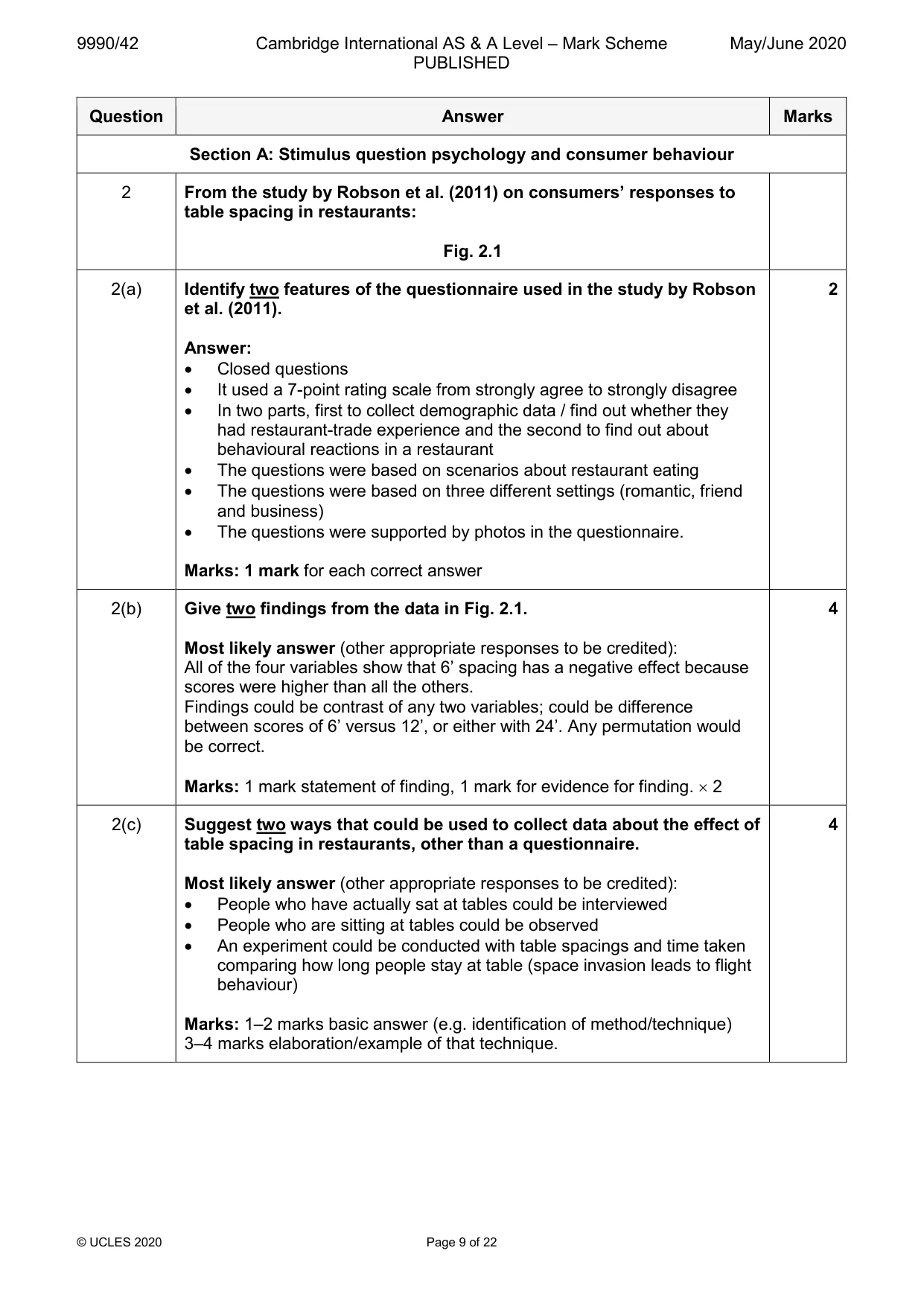
9990/42 Cambridge International AS & A Level – Mark Scheme PUBLISHED May/June 2020 © UCLES 2020 Page 9 of 22 Question Answer Marks Section A: Stimulus question psychology and consumer behaviour 2 From the study by Robson et al. (2011) on consumers’ responses to table spacing in restaurants: Fig. 2.1 2(a) Identify two features of the questionnaire used in the study by Robson et al. (2011). Answer: • Closed questions • It used a 7-point rating scale from strongly agree to strongly disagree • In two parts, first to collect demographic data / find out whether they had restaurant-trade experience and the second to find out about behavioural reactions in a restaurant • The questions were based on scenarios about restaurant eating • The questions were based on three different settings (romantic, friend and business) • The questions were supported by photos in the questionnaire. Marks: 1 mark for each correct answer 2 2(b) Give two findings from the data in Fig. 2.1. Most likely answer (other appropriate responses to be credited): All of the four variables show that 6’ spacing has a negative effect because scores were higher than all the others. Findings could be contrast of any two variables; could be difference between scores of 6’ versus 12’, or either with 24’. Any permutation would be correct. Marks: 1 mark statement of finding, 1 mark for evidence for finding. × 2 4 2(c) Suggest two ways that could be used to collect data about the effect of table spacing in restaurants, other than a questionnaire. Most likely answer (other appropriate responses to be credited): • People who have actually sat at tables could be interviewed • People who are sitting at tables could be observed • An experiment could be conducted with table spacings and time taken comparing how long people stay at table (space invasion leads to flight behaviour) Marks: 1–2 marks basic answer (e.g. identification of method/technique) 3–4 marks elaboration/example of that technique. 4
Mark scheme, page 10
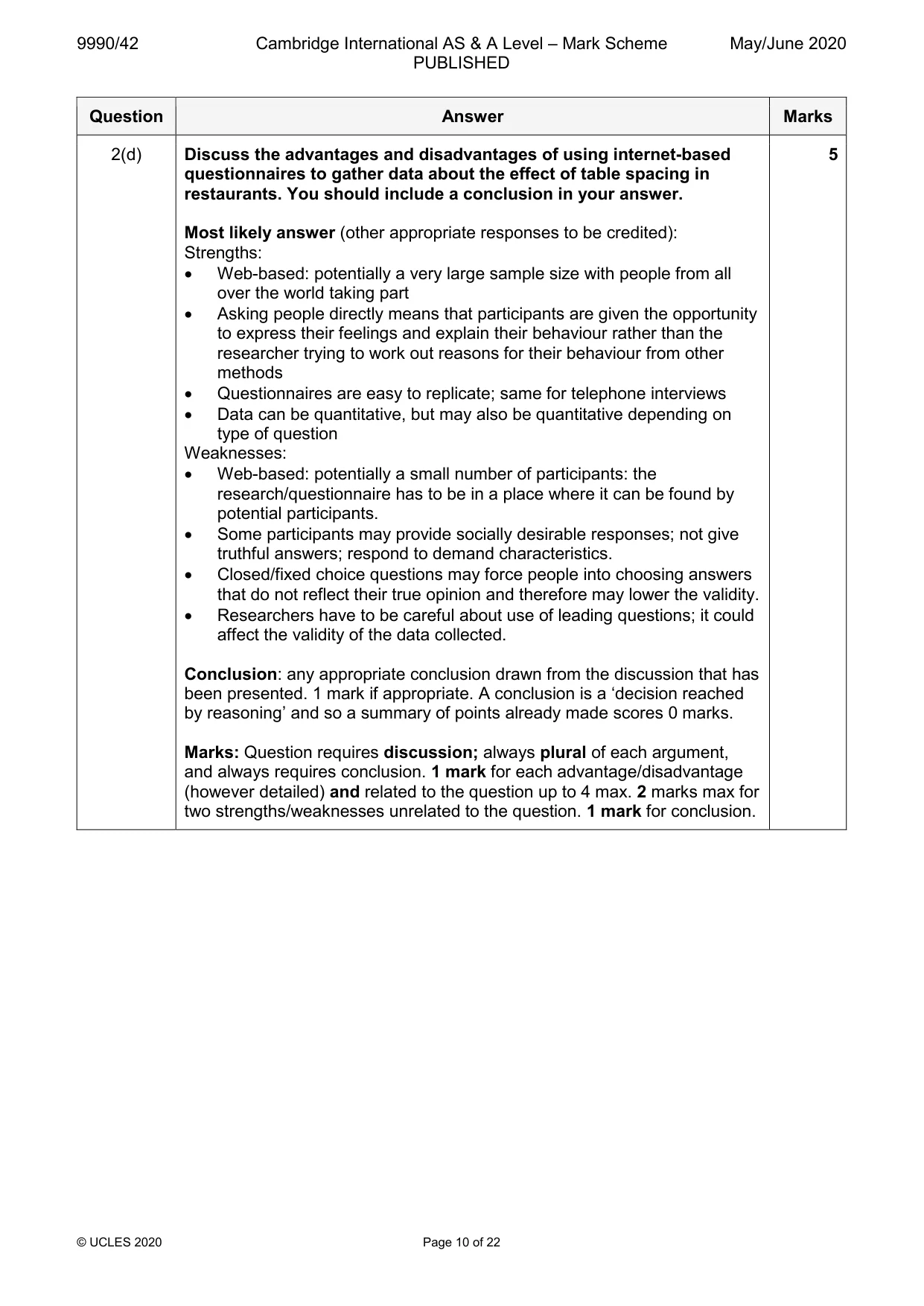
9990/42 Cambridge International AS & A Level – Mark Scheme PUBLISHED May/June 2020 © UCLES 2020 Page 10 of 22 Question Answer Marks 2(d) Discuss the advantages and disadvantages of using internet-based questionnaires to gather data about the effect of table spacing in restaurants. You should include a conclusion in your answer. Most likely answer (other appropriate responses to be credited): Strengths: • Web-based: potentially a very large sample size with people from all over the world taking part • Asking people directly means that participants are given the opportunity to express their feelings and explain their behaviour rather than the researcher trying to work out reasons for their behaviour from other methods • Questionnaires are easy to replicate; same for telephone interviews • Data can be quantitative, but may also be quantitative depending on type of question Weaknesses: • Web-based: potentially a small number of participants: the research/questionnaire has to be in a place where it can be found by potential participants. • Some participants may provide socially desirable responses; not give truthful answers; respond to demand characteristics. • Closed/fixed choice questions may force people into choosing answers that do not reflect their true opinion and therefore may lower the validity. • Researchers have to be careful about use of leading questions; it could affect the validity of the data collected. Conclusion: any appropriate conclusion drawn from the discussion that has been presented. 1 mark if appropriate. A conclusion is a ‘decision reached by reasoning’ and so a summary of points already made scores 0 marks. Marks: Question requires discussion; always plural of each argument, and always requires conclusion. 1 mark for each advantage/disadvantage (however detailed) and related to the question up to 4 max. 2 marks max for two strengths/weaknesses unrelated to the question. 1 mark for conclusion. 5
Mark scheme, page 11
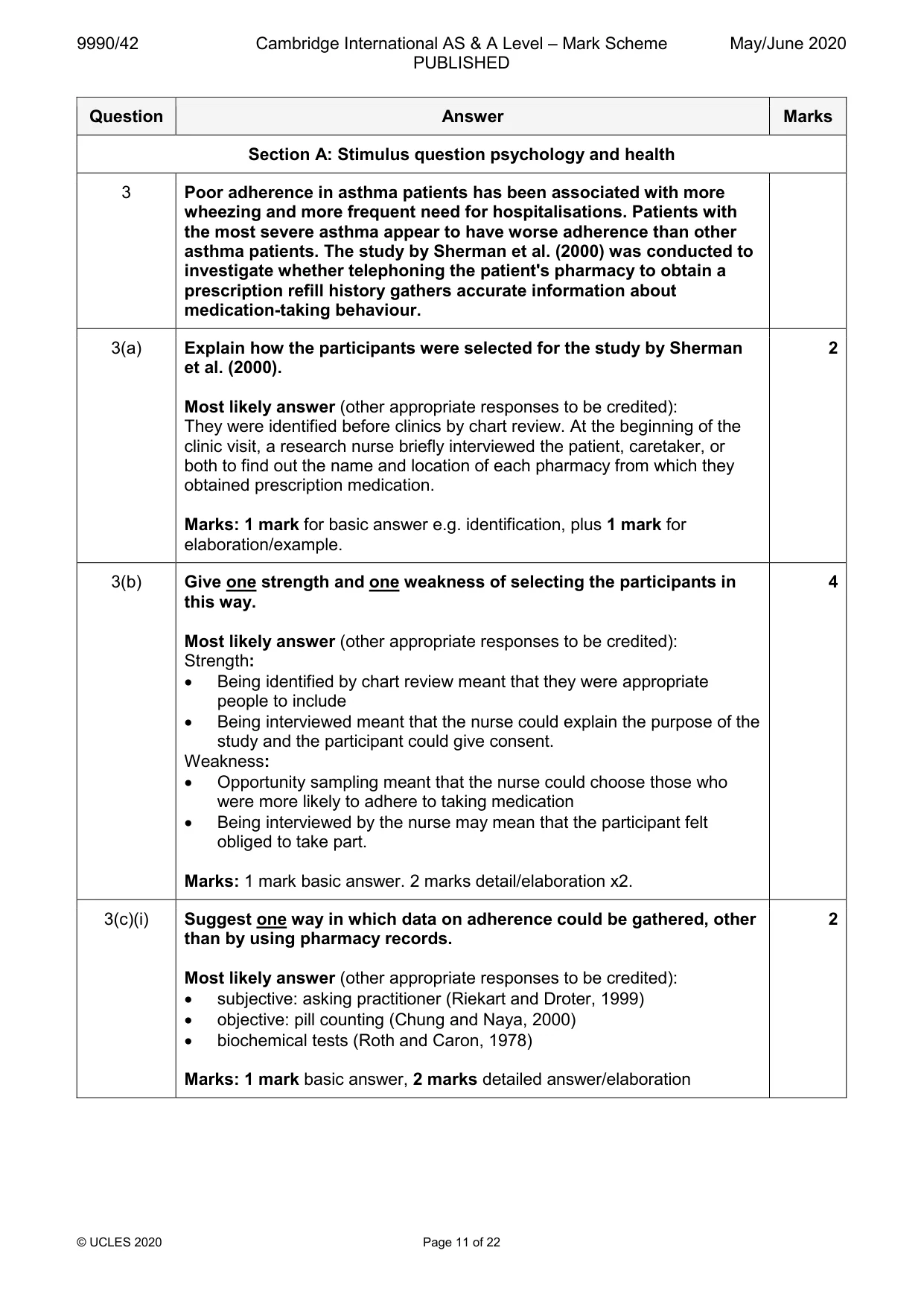
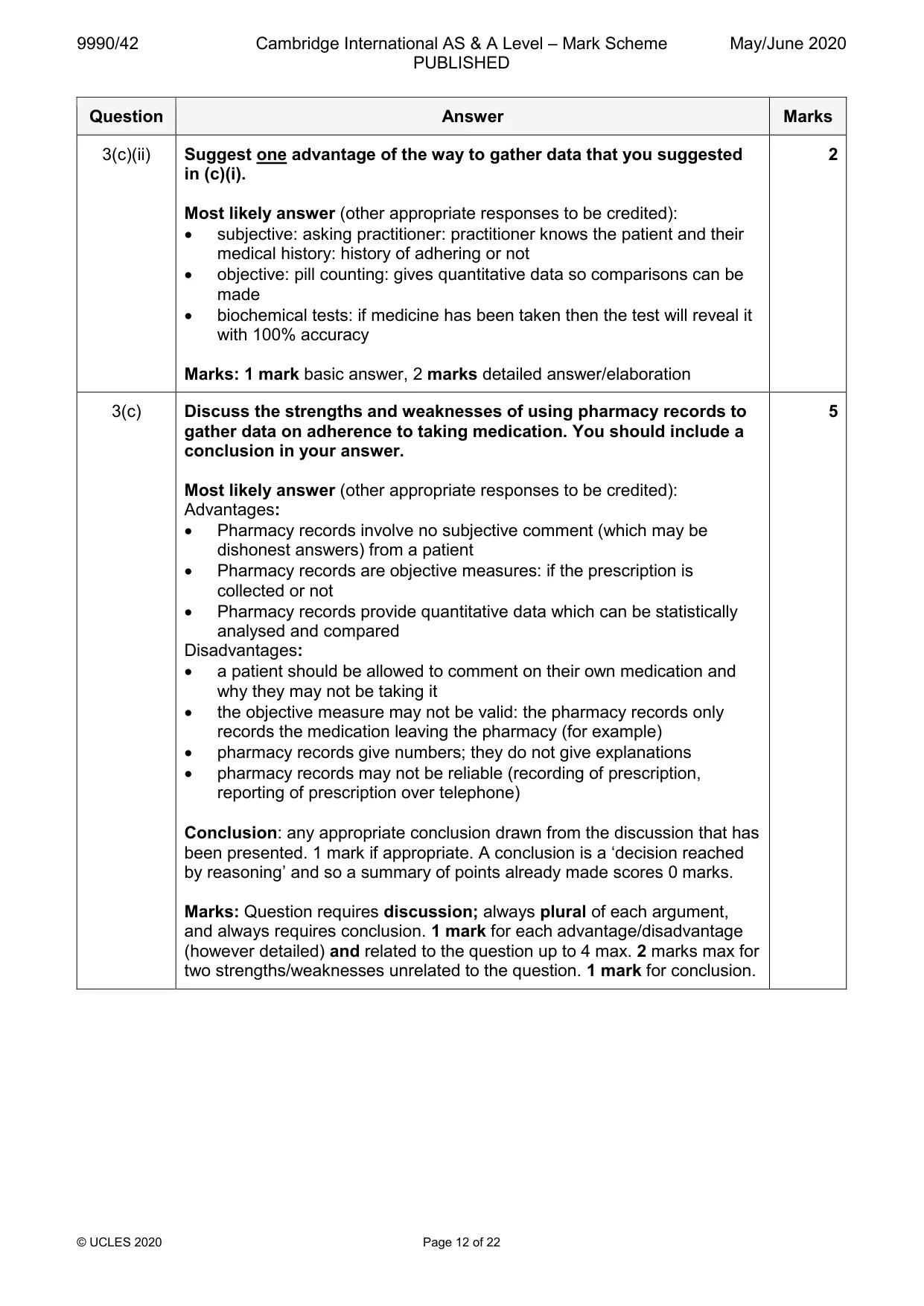
9990/42 Cambridge International AS & A Level – Mark Scheme PUBLISHED May/June 2020 © UCLES 2020 Page 11 of 22 Question Answer Marks Section A: Stimulus question psychology and health 3 Poor adherence in asthma patients has been associated with more wheezing and more frequent need for hospitalisations. Patients with the most severe asthma appear to have worse adherence than other asthma patients. The study by Sherman et al. (2000) was conducted to investigate whether telephoning the patient's pharmacy to obtain a prescription refill history gathers accurate information about medication-taking behaviour. 3(a) Explain how the participants were selected for the study by Sherman et al. (2000). Most likely answer (other appropriate responses to be credited): They were identified before clinics by chart review. At the beginning of the clinic visit, a research nurse briefly interviewed the patient, caretaker, or both to find out the name and location of each pharmacy from which they obtained prescription medication. Marks: 1 mark for basic answer e.g. identification, plus 1 mark for elaboration/example. 2 3(b) Give one strength and one weakness of selecting the participants in this way. Most likely answer (other appropriate responses to be credited): Strength: • Being identified by chart review meant that they were appropriate people to include • Being interviewed meant that the nurse could explain the purpose of the study and the participant could give consent. Weakness: • Opportunity sampling meant that the nurse could choose those who were more likely to adhere to taking medication • Being interviewed by the nurse may mean that the participant felt obliged to take part. Marks: 1 mark basic answer. 2 marks detail/elaboration x2. 4 3(c)(i) Suggest one way in which data on adherence could be gathered, other than by using pharmacy records. Most likely answer (other appropriate responses to be credited): • subjective: asking practitioner (Riekart and Droter, 1999) • objective: pill counting (Chung and Naya, 2000) • biochemical tests (Roth and Caron, 1978) Marks: 1 mark basic answer, 2 marks detailed answer/elaboration 2
Mark scheme, page 12
9990/42 Cambridge International AS & A Level – Mark Scheme PUBLISHED May/June 2020 © UCLES 2020 Page 12 of 22 Question Answer Marks 3(c)(ii) Suggest one advantage of the way to gather data that you suggested in (c)(i). Most likely answer (other appropriate responses to be credited): • subjective: asking practitioner: practitioner knows the patient and their medical history: history of adhering or not • objective: pill counting: gives quantitative data so comparisons can be made • biochemical tests: if medicine has been taken then the test will reveal it with 100% accuracy Marks: 1 mark basic answer, 2 marks detailed answer/elaboration 2 3(c) Discuss the strengths and weaknesses of using pharmacy records to gather data on adherence to taking medication. You should include a conclusion in your answer. Most likely answer (other appropriate responses to be credited): Advantages: • Pharmacy records involve no subjective comment (which may be dishonest answers) from a patient • Pharmacy records are objective measures: if the prescription is collected or not • Pharmacy records provide quantitative data which can be statistically analysed and compared Disadvantages: • a patient should be allowed to comment on their own medication and why they may not be taking it • the objective measure may not be valid: the pharmacy records only records the medication leaving the pharmacy (for example) • pharmacy records give numbers; they do not give explanations • pharmacy records may not be reliable (recording of prescription, reporting of prescription over telephone) Conclusion: any appropriate conclusion drawn from the discussion that has been presented. 1 mark if appropriate. A conclusion is a ‘decision reached by reasoning’ and so a summary of points already made scores 0 marks. Marks: Question requires discussion; always plural of each argument, and always requires conclusion. 1 mark for each advantage/disadvantage (however detailed) and related to the question up to 4 max. 2 marks max for two strengths/weaknesses unrelated to the question. 1 mark for conclusion. 5
Mark scheme, page 13
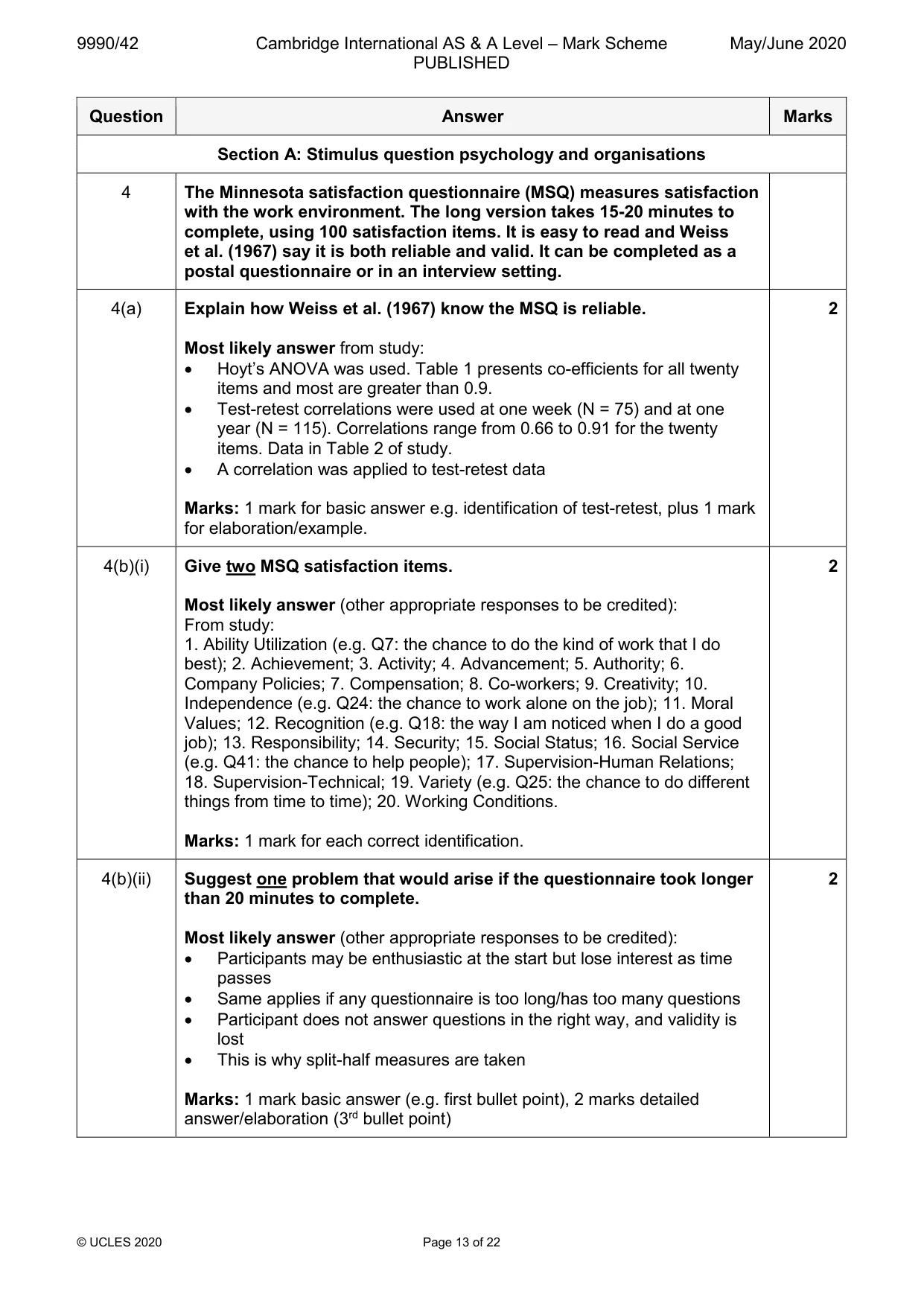
9990/42 Cambridge International AS & A Level – Mark Scheme PUBLISHED May/June 2020 © UCLES 2020 Page 13 of 22 Question Answer Marks Section A: Stimulus question psychology and organisations 4 The Minnesota satisfaction questionnaire (MSQ) measures satisfaction with the work environment. The long version takes 15-20 minutes to complete, using 100 satisfaction items. It is easy to read and Weiss et al. (1967) say it is both reliable and valid. It can be completed as a postal questionnaire or in an interview setting. 4(a) Explain how Weiss et al. (1967) know the MSQ is reliable. Most likely answer from study: • Hoyt’s ANOVA was used. Table 1 presents co-efficients for all twenty items and most are greater than 0.9. • Test-retest correlations were used at one week (N = 75) and at one year (N = 115). Correlations range from 0.66 to 0.91 for the twenty items. Data in Table 2 of study. • A correlation was applied to test-retest data Marks: 1 mark for basic answer e.g. identification of test-retest, plus 1 mark for elaboration/example. 2 4(b)(i) Give two MSQ satisfaction items. Most likely answer (other appropriate responses to be credited): From study: 1. Ability Utilization (e.g. Q7: the chance to do the kind of work that I do best); 2. Achievement; 3. Activity; 4. Advancement; 5. Authority; 6. Company Policies; 7. Compensation; 8. Co-workers; 9. Creativity; 10. Independence (e.g. Q24: the chance to work alone on the job); 11. Moral Values; 12. Recognition (e.g. Q18: the way I am noticed when I do a good job); 13. Responsibility; 14. Security; 15. Social Status; 16. Social Service (e.g. Q41: the chance to help people); 17. Supervision-Human Relations; 18. Supervision-Technical; 19. Variety (e.g. Q25: the chance to do different things from time to time); 20. Working Conditions. Marks: 1 mark for each correct identification. 2 4(b)(ii) Suggest one problem that would arise if the questionnaire took longer than 20 minutes to complete. Most likely answer (other appropriate responses to be credited): • Participants may be enthusiastic at the start but lose interest as time passes • Same applies if any questionnaire is too long/has too many questions • Participant does not answer questions in the right way, and validity is lost • This is why split-half measures are taken Marks: 1 mark basic answer (e.g. first bullet point), 2 marks detailed answer/elaboration (3rd bullet point) 2
Mark scheme, page 14
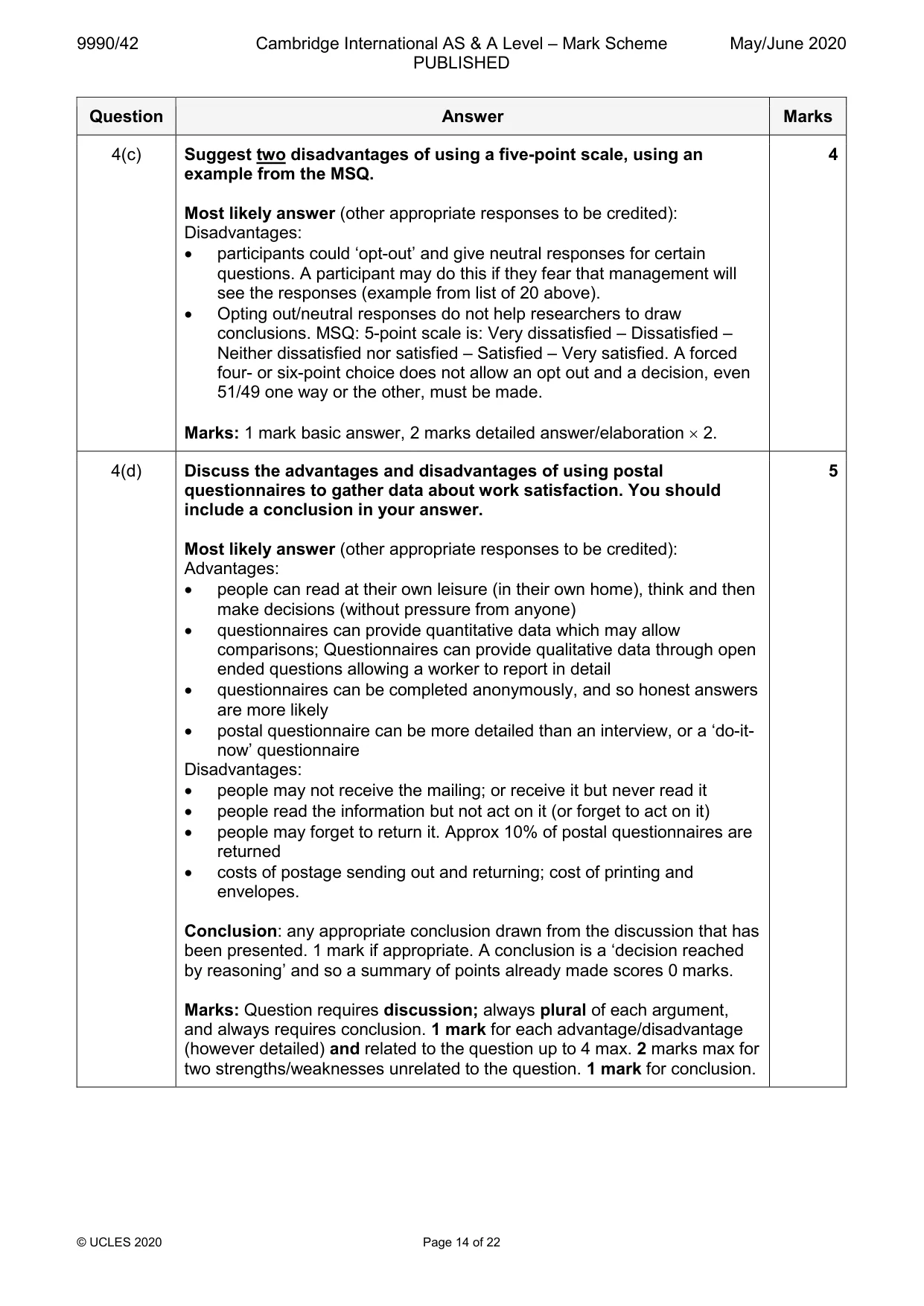
9990/42 Cambridge International AS & A Level – Mark Scheme PUBLISHED May/June 2020 © UCLES 2020 Page 14 of 22 Question Answer Marks 4(c) Suggest two disadvantages of using a five-point scale, using an example from the MSQ. Most likely answer (other appropriate responses to be credited): Disadvantages: • participants could ‘opt-out’ and give neutral responses for certain questions. A participant may do this if they fear that management will see the responses (example from list of 20 above). • Opting out/neutral responses do not help researchers to draw conclusions. MSQ: 5-point scale is: Very dissatisfied – Dissatisfied – Neither dissatisfied nor satisfied – Satisfied – Very satisfied. A forced four- or six-point choice does not allow an opt out and a decision, even 51/49 one way or the other, must be made. Marks: 1 mark basic answer, 2 marks detailed answer/elaboration × 2. 4 4(d) Discuss the advantages and disadvantages of using postal questionnaires to gather data about work satisfaction. You should include a conclusion in your answer. Most likely answer (other appropriate responses to be credited): Advantages: • people can read at their own leisure (in their own home), think and then make decisions (without pressure from anyone) • questionnaires can provide quantitative data which may allow comparisons; Questionnaires can provide qualitative data through open ended questions allowing a worker to report in detail • questionnaires can be completed anonymously, and so honest answers are more likely • postal questionnaire can be more detailed than an interview, or a ‘do-it- now’ questionnaire Disadvantages: • people may not receive the mailing; or receive it but never read it • people read the information but not act on it (or forget to act on it) • people may forget to return it. Approx 10% of postal questionnaires are returned • costs of postage sending out and returning; cost of printing and envelopes. Conclusion: any appropriate conclusion drawn from the discussion that has been presented. 1 mark if appropriate. A conclusion is a ‘decision reached by reasoning’ and so a summary of points already made scores 0 marks. Marks: Question requires discussion; always plural of each argument, and always requires conclusion. 1 mark for each advantage/disadvantage (however detailed) and related to the question up to 4 max. 2 marks max for two strengths/weaknesses unrelated to the question. 1 mark for conclusion. 5
Mark scheme, page 15
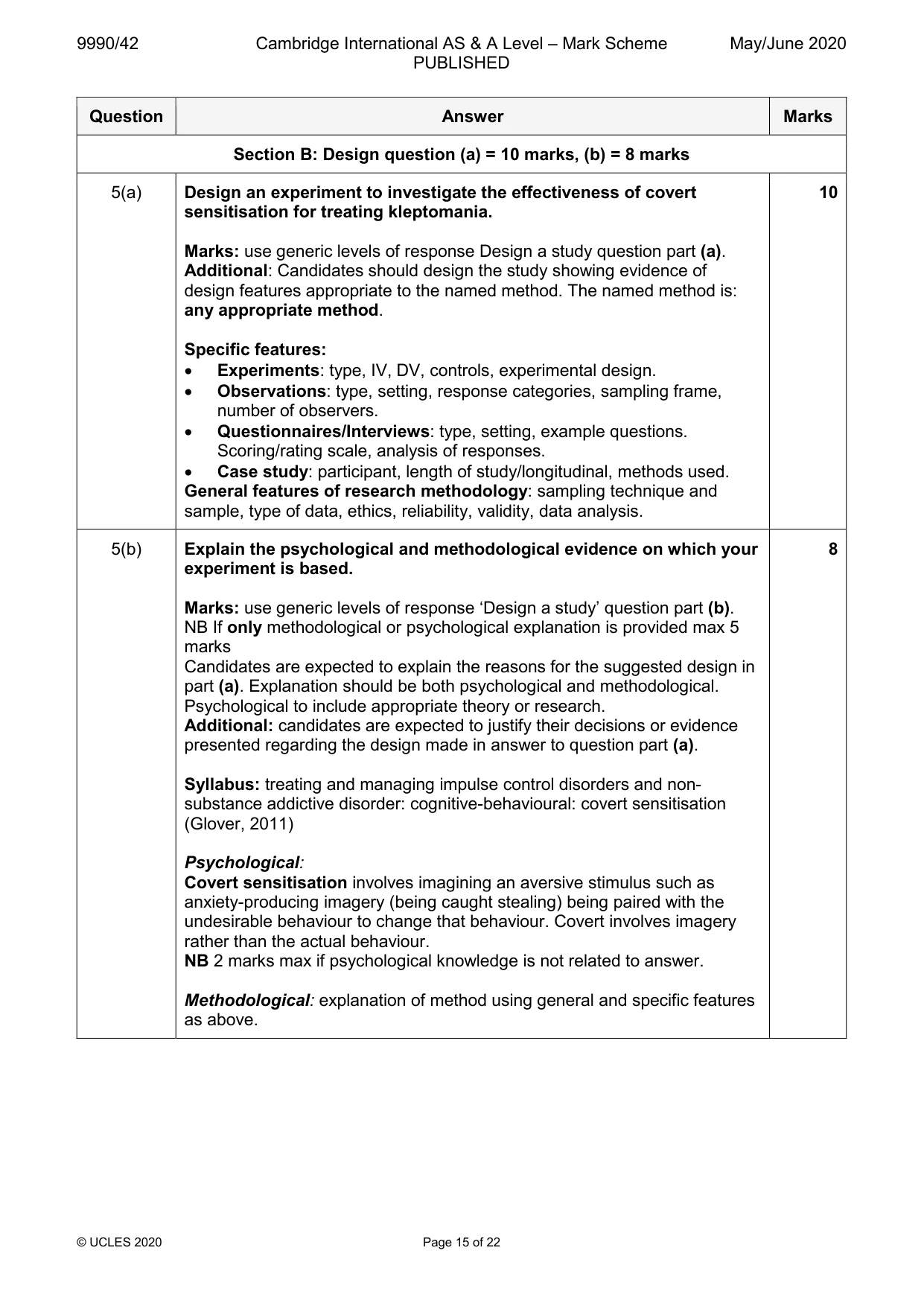
9990/42 Cambridge International AS & A Level – Mark Scheme PUBLISHED May/June 2020 © UCLES 2020 Page 15 of 22 Question Answer Marks Section B: Design question (a) = 10 marks, (b) = 8 marks 5(a) Design an experiment to investigate the effectiveness of covert sensitisation for treating kleptomania. Marks: use generic levels of response Design a study question part (a). Additional: Candidates should design the study showing evidence of design features appropriate to the named method. The named method is: any appropriate method. Specific features: • Experiments: type, IV, DV, controls, experimental design. • Observations: type, setting, response categories, sampling frame, number of observers. • Questionnaires/Interviews: type, setting, example questions. Scoring/rating scale, analysis of responses. • Case study: participant, length of study/longitudinal, methods used. General features of research methodology: sampling technique and sample, type of data, ethics, reliability, validity, data analysis. 10 5(b) Explain the psychological and methodological evidence on which your experiment is based. Marks: use generic levels of response ‘Design a study’ question part (b). NB If only methodological or psychological explanation is provided max 5 marks Candidates are expected to explain the reasons for the suggested design in part (a). Explanation should be both psychological and methodological. Psychological to include appropriate theory or research. Additional: candidates are expected to justify their decisions or evidence presented regarding the design made in answer to question part (a). Syllabus: treating and managing impulse control disorders and non- substance addictive disorder: cognitive-behavioural: covert sensitisation (Glover, 2011) Psychological: Covert sensitisation involves imagining an aversive stimulus such as anxiety-producing imagery (being caught stealing) being paired with the undesirable behaviour to change that behaviour. Covert involves imagery rather than the actual behaviour. NB 2 marks max if psychological knowledge is not related to answer. Methodological: explanation of method using general and specific features as above. 8
Mark scheme, page 16
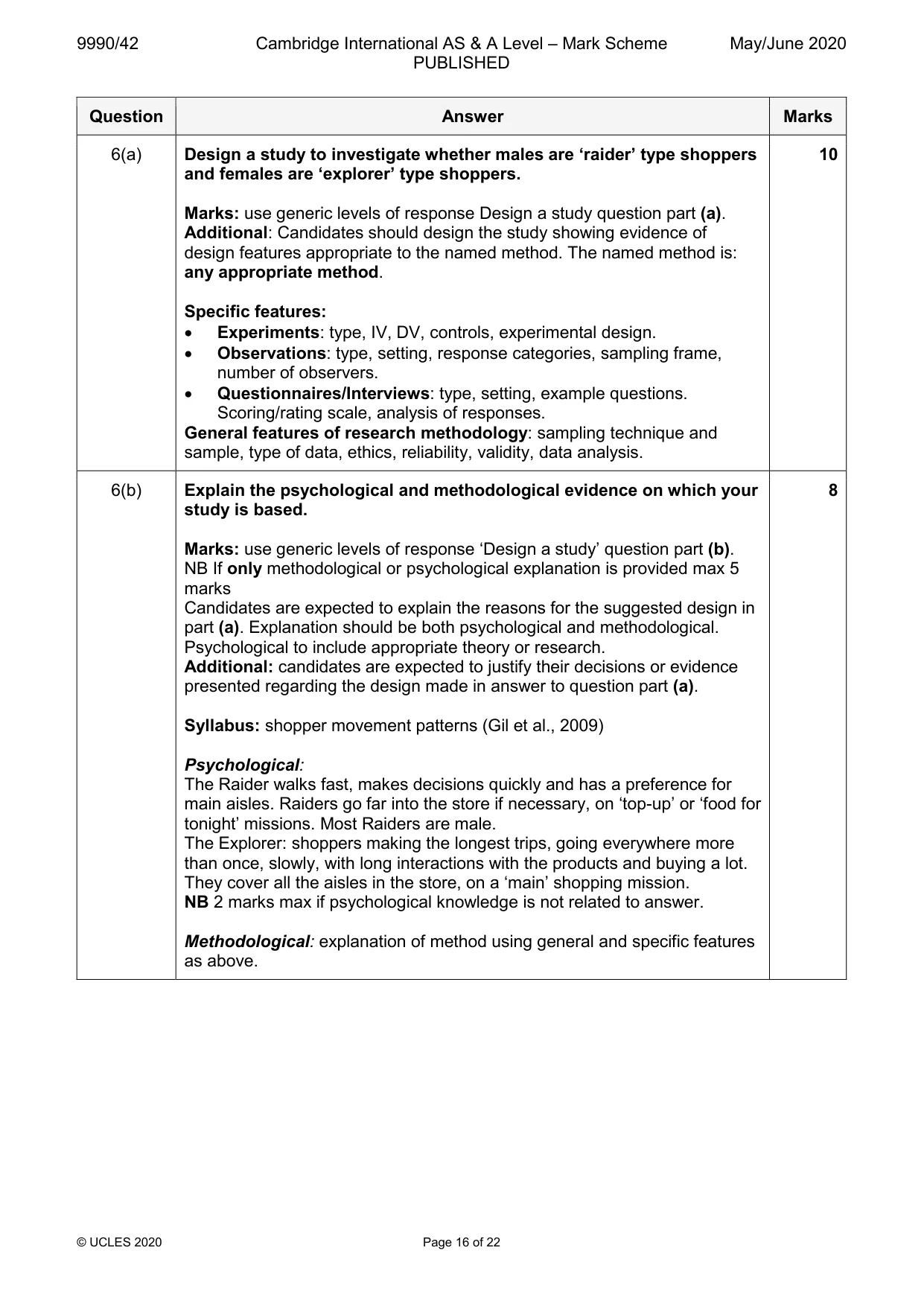
9990/42 Cambridge International AS & A Level – Mark Scheme PUBLISHED May/June 2020 © UCLES 2020 Page 16 of 22 Question Answer Marks 6(a) Design a study to investigate whether males are ‘raider’ type shoppers and females are ‘explorer’ type shoppers. Marks: use generic levels of response Design a study question part (a). Additional: Candidates should design the study showing evidence of design features appropriate to the named method. The named method is: any appropriate method. Specific features: • Experiments: type, IV, DV, controls, experimental design. • Observations: type, setting, response categories, sampling frame, number of observers. • Questionnaires/Interviews: type, setting, example questions. Scoring/rating scale, analysis of responses. General features of research methodology: sampling technique and sample, type of data, ethics, reliability, validity, data analysis. 10 6(b) Explain the psychological and methodological evidence on which your study is based. Marks: use generic levels of response ‘Design a study’ question part (b). NB If only methodological or psychological explanation is provided max 5 marks Candidates are expected to explain the reasons for the suggested design in part (a). Explanation should be both psychological and methodological. Psychological to include appropriate theory or research. Additional: candidates are expected to justify their decisions or evidence presented regarding the design made in answer to question part (a). Syllabus: shopper movement patterns (Gil et al., 2009) Psychological: The Raider walks fast, makes decisions quickly and has a preference for main aisles. Raiders go far into the store if necessary, on ‘top-up’ or ‘food for tonight’ missions. Most Raiders are male. The Explorer: shoppers making the longest trips, going everywhere more than once, slowly, with long interactions with the products and buying a lot. They cover all the aisles in the store, on a ‘main’ shopping mission. NB 2 marks max if psychological knowledge is not related to answer. Methodological: explanation of method using general and specific features as above. 8
Mark scheme, page 17
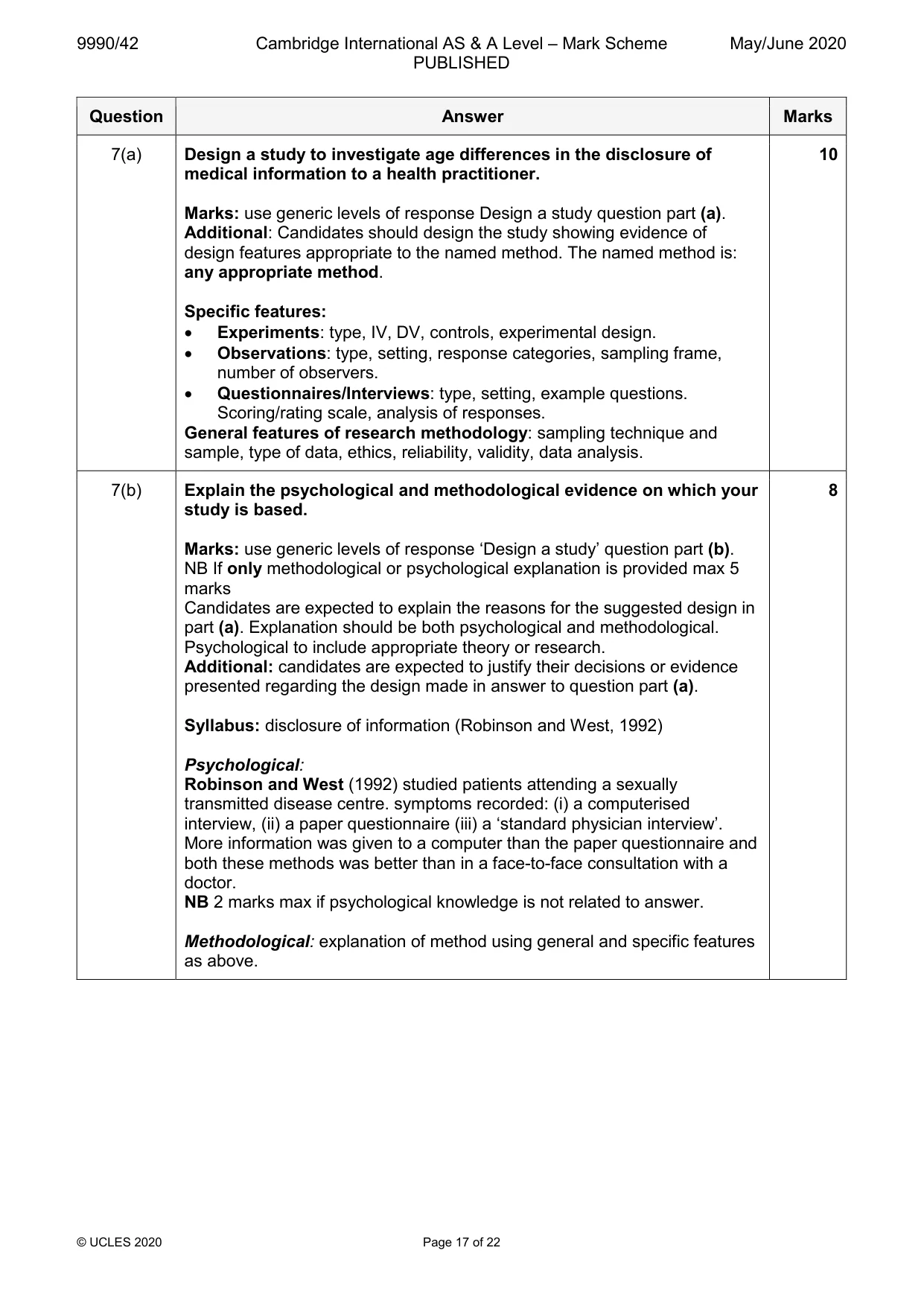
9990/42 Cambridge International AS & A Level – Mark Scheme PUBLISHED May/June 2020 © UCLES 2020 Page 17 of 22 Question Answer Marks 7(a) Design a study to investigate age differences in the disclosure of medical information to a health practitioner. Marks: use generic levels of response Design a study question part (a). Additional: Candidates should design the study showing evidence of design features appropriate to the named method. The named method is: any appropriate method. Specific features: • Experiments: type, IV, DV, controls, experimental design. • Observations: type, setting, response categories, sampling frame, number of observers. • Questionnaires/Interviews: type, setting, example questions. Scoring/rating scale, analysis of responses. General features of research methodology: sampling technique and sample, type of data, ethics, reliability, validity, data analysis. 10 7(b) Explain the psychological and methodological evidence on which your study is based. Marks: use generic levels of response ‘Design a study’ question part (b). NB If only methodological or psychological explanation is provided max 5 marks Candidates are expected to explain the reasons for the suggested design in part (a). Explanation should be both psychological and methodological. Psychological to include appropriate theory or research. Additional: candidates are expected to justify their decisions or evidence presented regarding the design made in answer to question part (a). Syllabus: disclosure of information (Robinson and West, 1992) Psychological: Robinson and West (1992) studied patients attending a sexually transmitted disease centre. symptoms recorded: (i) a computerised interview, (ii) a paper questionnaire (iii) a ‘standard physician interview’. More information was given to a computer than the paper questionnaire and both these methods was better than in a face-to-face consultation with a doctor. NB 2 marks max if psychological knowledge is not related to answer. Methodological: explanation of method using general and specific features as above. 8
Mark scheme, page 18
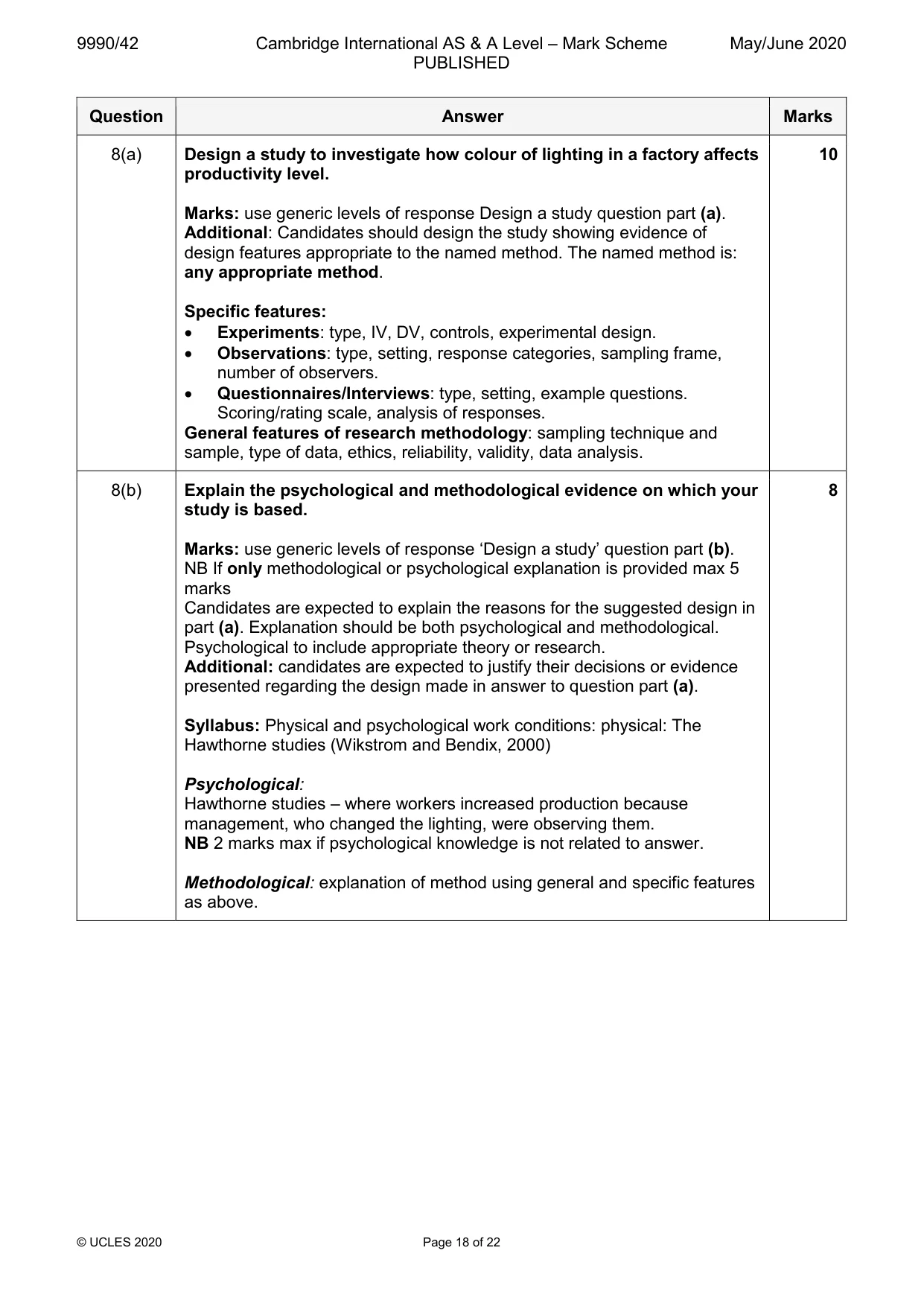
9990/42 Cambridge International AS & A Level – Mark Scheme PUBLISHED May/June 2020 © UCLES 2020 Page 18 of 22 Question Answer Marks 8(a) Design a study to investigate how colour of lighting in a factory affects productivity level. Marks: use generic levels of response Design a study question part (a). Additional: Candidates should design the study showing evidence of design features appropriate to the named method. The named method is: any appropriate method. Specific features: • Experiments: type, IV, DV, controls, experimental design. • Observations: type, setting, response categories, sampling frame, number of observers. • Questionnaires/Interviews: type, setting, example questions. Scoring/rating scale, analysis of responses. General features of research methodology: sampling technique and sample, type of data, ethics, reliability, validity, data analysis. 10 8(b) Explain the psychological and methodological evidence on which your study is based. Marks: use generic levels of response ‘Design a study’ question part (b). NB If only methodological or psychological explanation is provided max 5 marks Candidates are expected to explain the reasons for the suggested design in part (a). Explanation should be both psychological and methodological. Psychological to include appropriate theory or research. Additional: candidates are expected to justify their decisions or evidence presented regarding the design made in answer to question part (a). Syllabus: Physical and psychological work conditions: physical: The Hawthorne studies (Wikstrom and Bendix, 2000) Psychological: Hawthorne studies – where workers increased production because management, who changed the lighting, were observing them. NB 2 marks max if psychological knowledge is not related to answer. Methodological: explanation of method using general and specific features as above. 8
Mark scheme, page 19
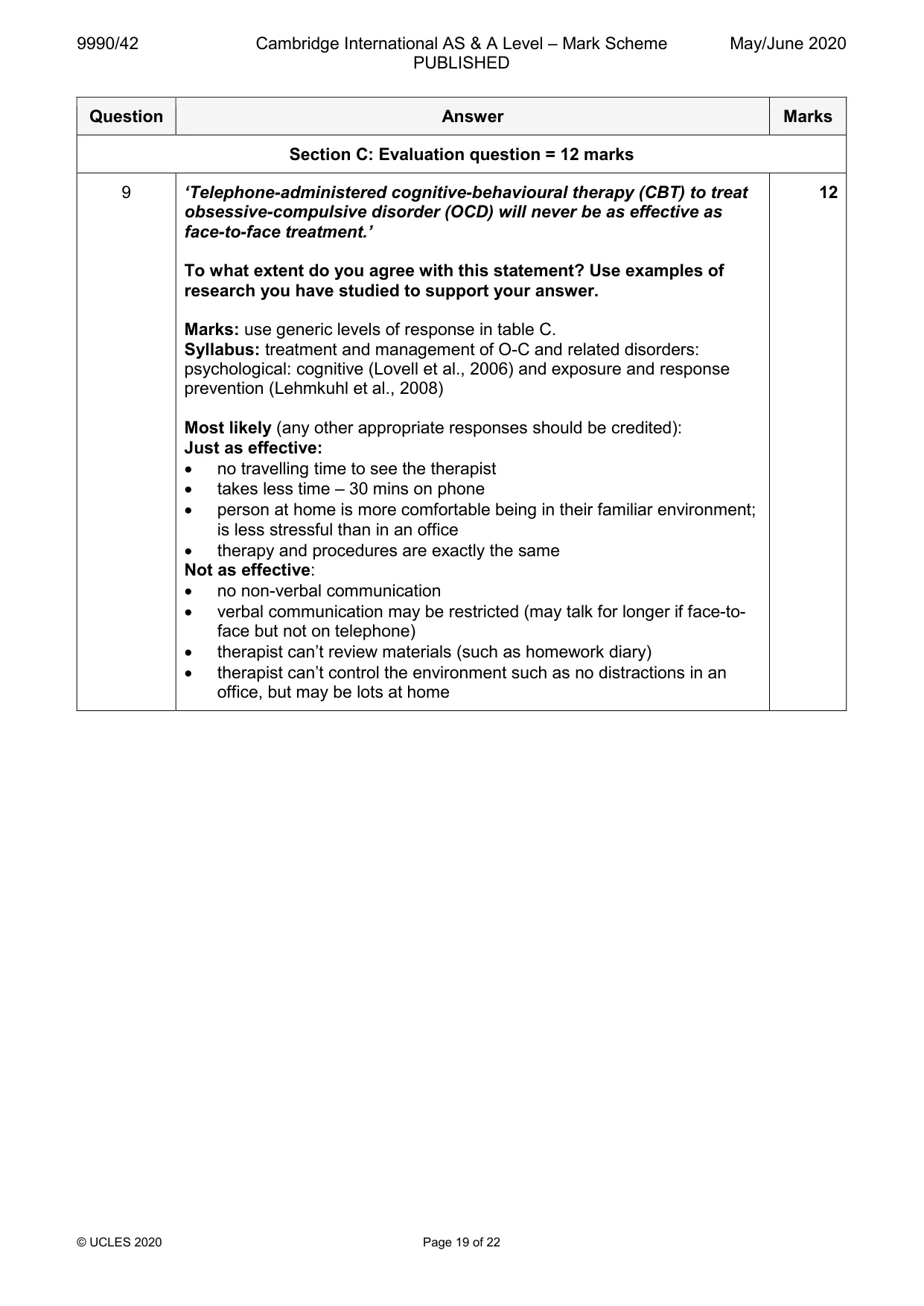
9990/42 Cambridge International AS & A Level – Mark Scheme PUBLISHED May/June 2020 © UCLES 2020 Page 19 of 22 Question Answer Marks Section C: Evaluation question = 12 marks 9 ‘Telephone-administered cognitive-behavioural therapy (CBT) to treat obsessive-compulsive disorder (OCD) will never be as effective as face-to-face treatment.’ To what extent do you agree with this statement? Use examples of research you have studied to support your answer. Marks: use generic levels of response in table C. Syllabus: treatment and management of O-C and related disorders: psychological: cognitive (Lovell et al., 2006) and exposure and response prevention (Lehmkuhl et al., 2008) Most likely (any other appropriate responses should be credited): Just as effective: • no travelling time to see the therapist • takes less time – 30 mins on phone • person at home is more comfortable being in their familiar environment; is less stressful than in an office • therapy and procedures are exactly the same Not as effective: • no non-verbal communication • verbal communication may be restricted (may talk for longer if face-to- face but not on telephone) • therapist can’t review materials (such as homework diary) • therapist can’t control the environment such as no distractions in an office, but may be lots at home 12
Mark scheme, page 20
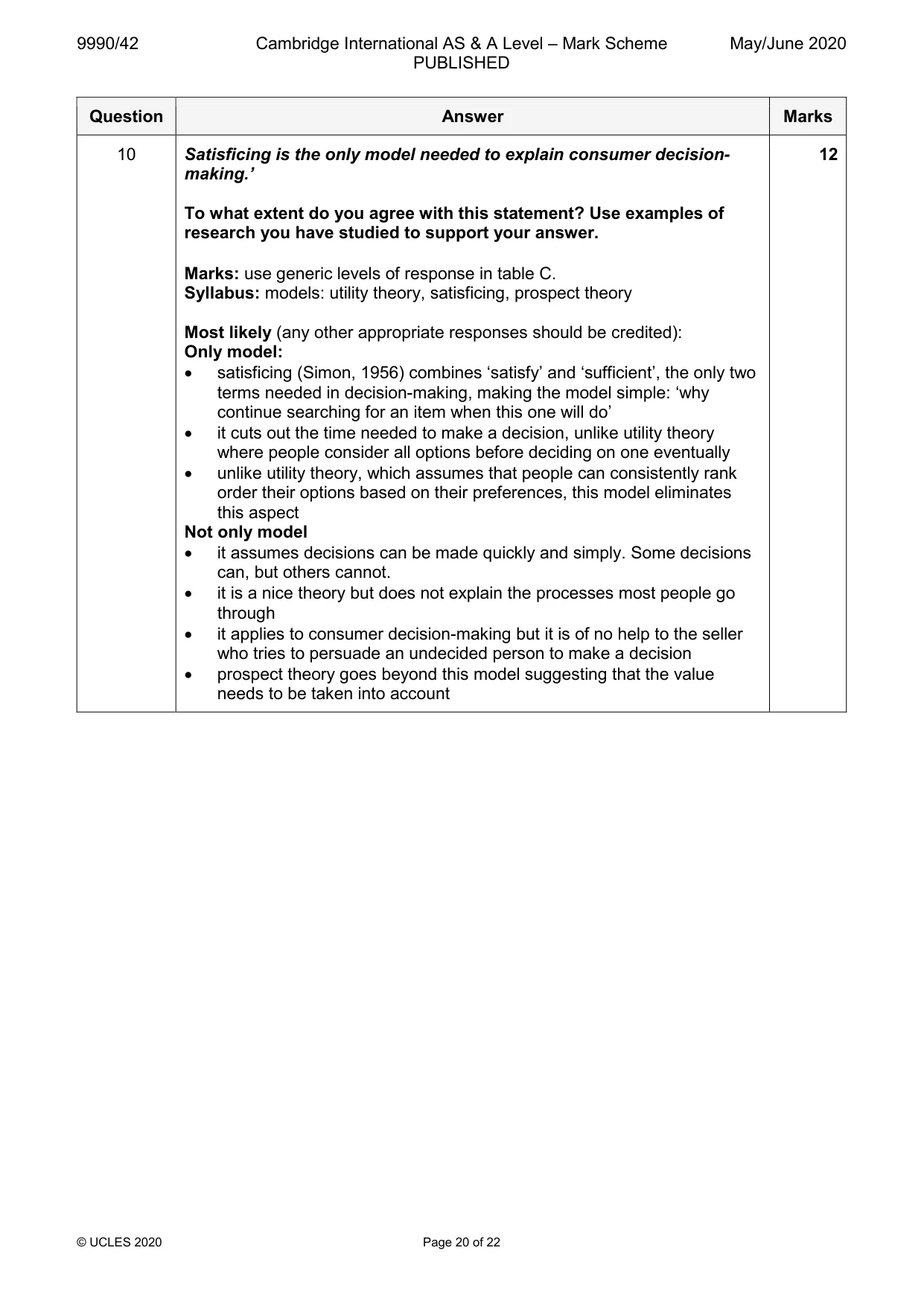
9990/42 Cambridge International AS & A Level – Mark Scheme PUBLISHED May/June 2020 © UCLES 2020 Page 20 of 22 Question Answer Marks 10 Satisficing is the only model needed to explain consumer decision- making.’ To what extent do you agree with this statement? Use examples of research you have studied to support your answer. Marks: use generic levels of response in table C. Syllabus: models: utility theory, satisficing, prospect theory Most likely (any other appropriate responses should be credited): Only model: • satisficing (Simon, 1956) combines ‘satisfy’ and ‘sufficient’, the only two terms needed in decision-making, making the model simple: ‘why continue searching for an item when this one will do’ • it cuts out the time needed to make a decision, unlike utility theory where people consider all options before deciding on one eventually • unlike utility theory, which assumes that people can consistently rank order their options based on their preferences, this model eliminates this aspect Not only model • it assumes decisions can be made quickly and simply. Some decisions can, but others cannot. • it is a nice theory but does not explain the processes most people go through • it applies to consumer decision-making but it is of no help to the seller who tries to persuade an undecided person to make a decision • prospect theory goes beyond this model suggesting that the value needs to be taken into account 12
Mark scheme, page 21
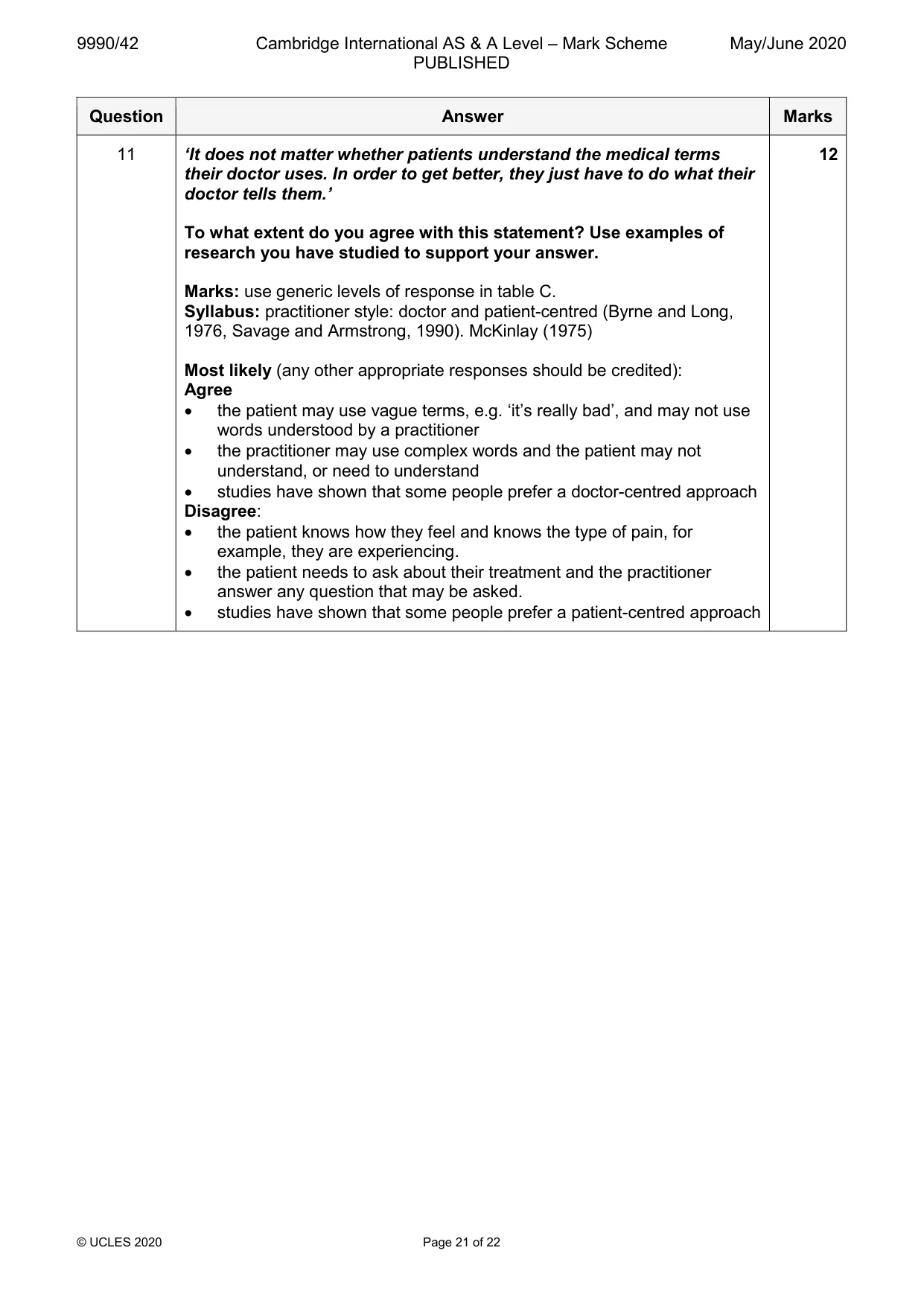
9990/42 Cambridge International AS & A Level – Mark Scheme PUBLISHED May/June 2020 © UCLES 2020 Page 21 of 22 Question Answer Marks 11 ‘It does not matter whether patients understand the medical terms their doctor uses. In order to get better, they just have to do what their doctor tells them.’ To what extent do you agree with this statement? Use examples of research you have studied to support your answer. Marks: use generic levels of response in table C. Syllabus: practitioner style: doctor and patient-centred (Byrne and Long, 1976, Savage and Armstrong, 1990). McKinlay (1975) Most likely (any other appropriate responses should be credited): Agree • the patient may use vague terms, e.g. ‘it’s really bad’, and may not use words understood by a practitioner • the practitioner may use complex words and the patient may not understand, or need to understand • studies have shown that some people prefer a doctor-centred approach Disagree: • the patient knows how they feel and knows the type of pain, for example, they are experiencing. • the patient needs to ask about their treatment and the practitioner answer any question that may be asked. • studies have shown that some people prefer a patient-centred approach 12
Mark scheme, page 22
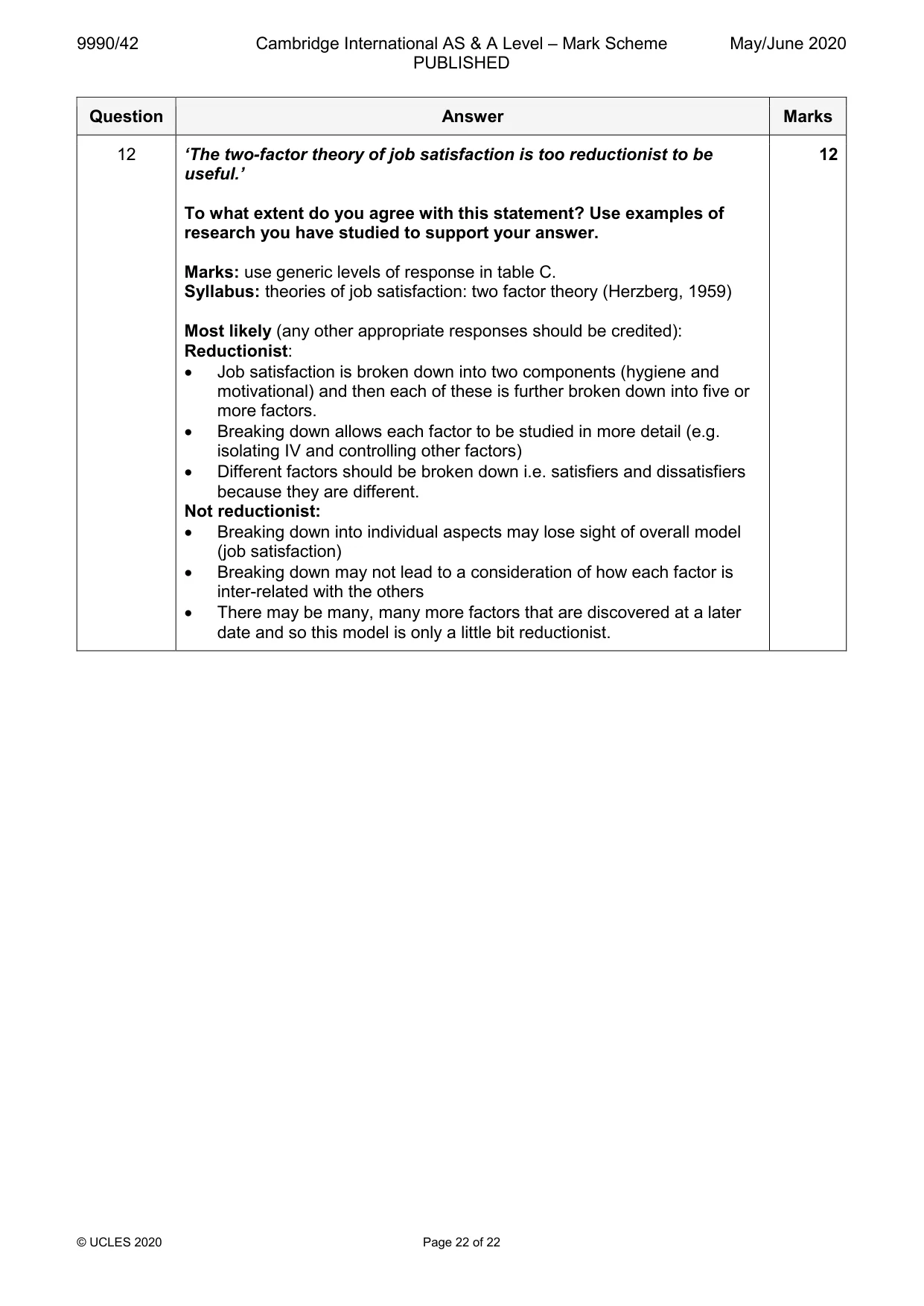
9990/42 Cambridge International AS & A Level – Mark Scheme PUBLISHED May/June 2020 © UCLES 2020 Page 22 of 22 Question Answer Marks 12 ‘The two-factor theory of job satisfaction is too reductionist to be useful.’ To what extent do you agree with this statement? Use examples of research you have studied to support your answer. Marks: use generic levels of response in table C. Syllabus: theories of job satisfaction: two factor theory (Herzberg, 1959) Most likely (any other appropriate responses should be credited): Reductionist: • Job satisfaction is broken down into two components (hygiene and motivational) and then each of these is further broken down into five or more factors. • Breaking down allows each factor to be studied in more detail (e.g. isolating IV and controlling other factors) • Different factors should be broken down i.e. satisfiers and dissatisfiers because they are different. Not reductionist: • Breaking down into individual aspects may lose sight of overall model (job satisfaction) • Breaking down may not lead to a consideration of how each factor is inter-related with the others • There may be many, many more factors that are discovered at a later date and so this model is only a little bit reductionist. 12