Cambridge A Level Psychology (from 2018) 9990 — 2019 May/June Paper 3 · Variant 2
9990/32/M/J/19 · 60 marks · ≈68 min
The question paper and its mark scheme, free to read here and free to download. This is Cambridge’s own paper, exactly as it was sat.
Question paper4 pages

Mark scheme20 pages
Answers below. Sit the paper first if you are practising.
Paper as text
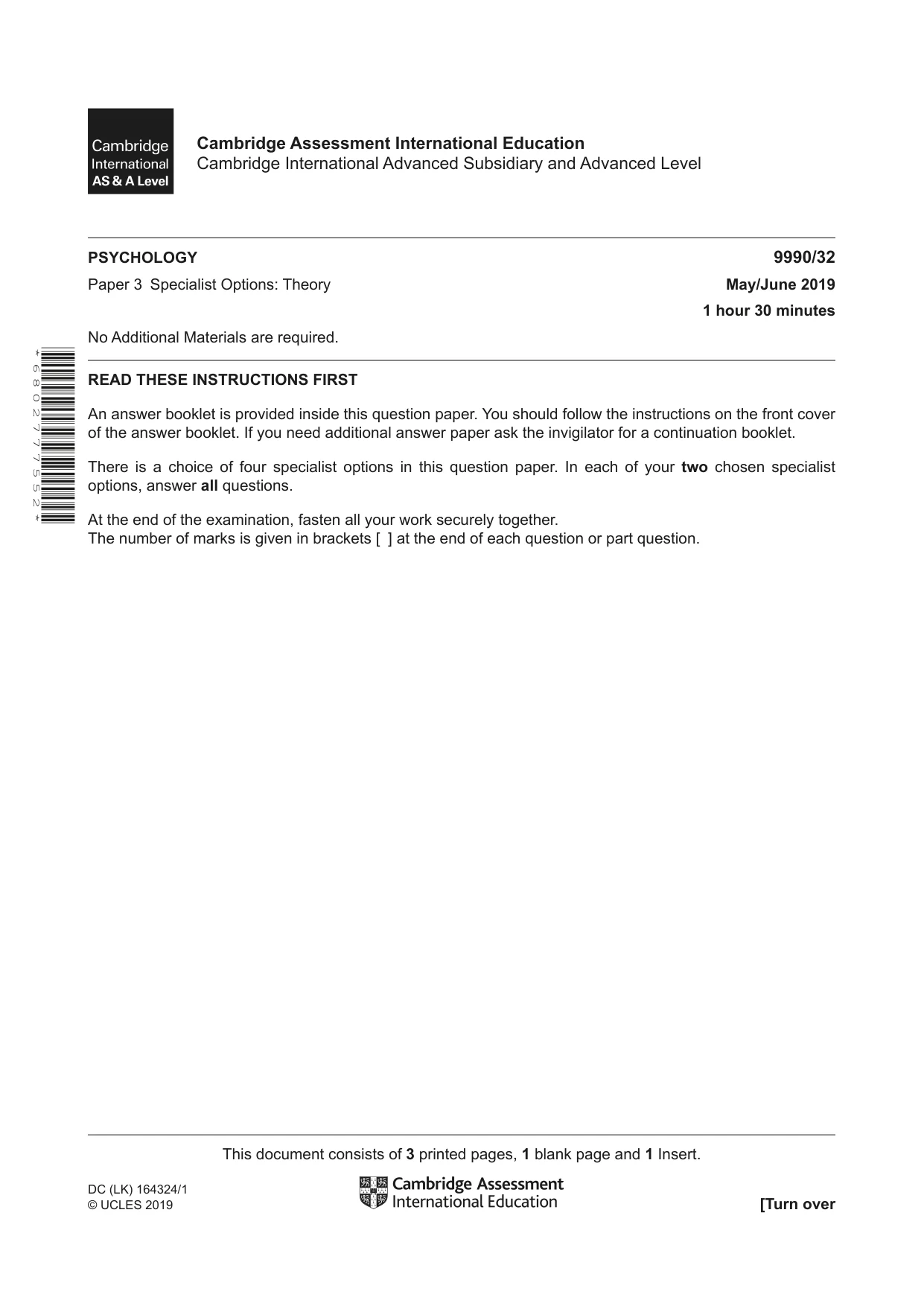
Question paper, page 1
This document consists of 3 printed pages, 1 blank page and 1 Insert. DC (LK) 164324/1 © UCLES 2019 [Turn over Cambridge Assessment International Education Cambridge International Advanced Subsidiary and Advanced Level * 6 8 0 2 7 7 7 5 5 2 * PSYCHOLOGY 9990/32 Paper 3 Specialist Options: Theory May/June 2019 1 hour 30 minutes No Additional Materials are required. READ THESE INSTRUCTIONS FIRST An answer booklet is provided inside this question paper. You should follow the instructions on the front cover of the answer booklet. If you need additional answer paper ask the invigilator for a continuation booklet. There is a choice of four specialist options in this question paper. In each of your two chosen specialist options, answer all questions. At the end of the examination, fasten all your work securely together. The number of marks is given in brackets [ ] at the end of each question or part question.
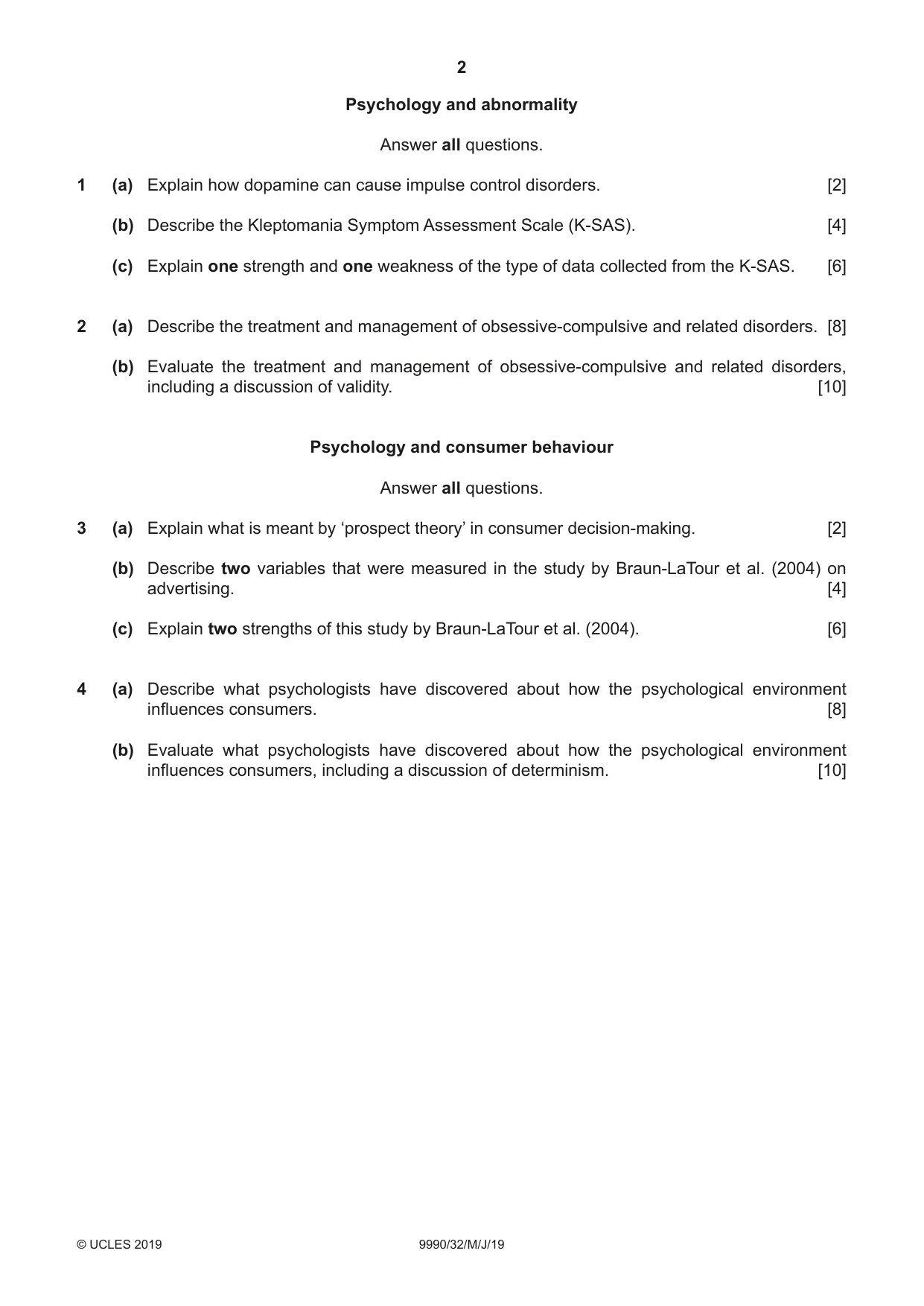
Question paper, page 2
2 9990/32/M/J/19 © UCLES 2019 Psychology and abnormality Answer all questions. 1 (a) Explain how dopamine can cause impulse control disorders. [2] (b) Describe the Kleptomania Symptom Assessment Scale (K-SAS). [4] (c) Explain one strength and one weakness of the type of data collected from the K-SAS. [6] 2 (a) Describe the treatment and management of obsessive-compulsive and related disorders. [8] (b) Evaluate the treatment and management of obsessive-compulsive and related disorders, including a discussion of validity. [10] Psychology and consumer behaviour Answer all questions. 3 (a) Explain what is meant by ‘prospect theory’ in consumer decision-making. [2] (b) Describe two variables that were measured in the study by Braun-LaTour et al. (2004) on advertising. [4] (c) Explain two strengths of this study by Braun-LaTour et al. (2004). [6] 4 (a) Describe what psychologists have discovered about how the psychological environment influences consumers. [8] (b) Evaluate what psychologists have discovered about how the psychological environment influences consumers, including a discussion of determinism. [10]
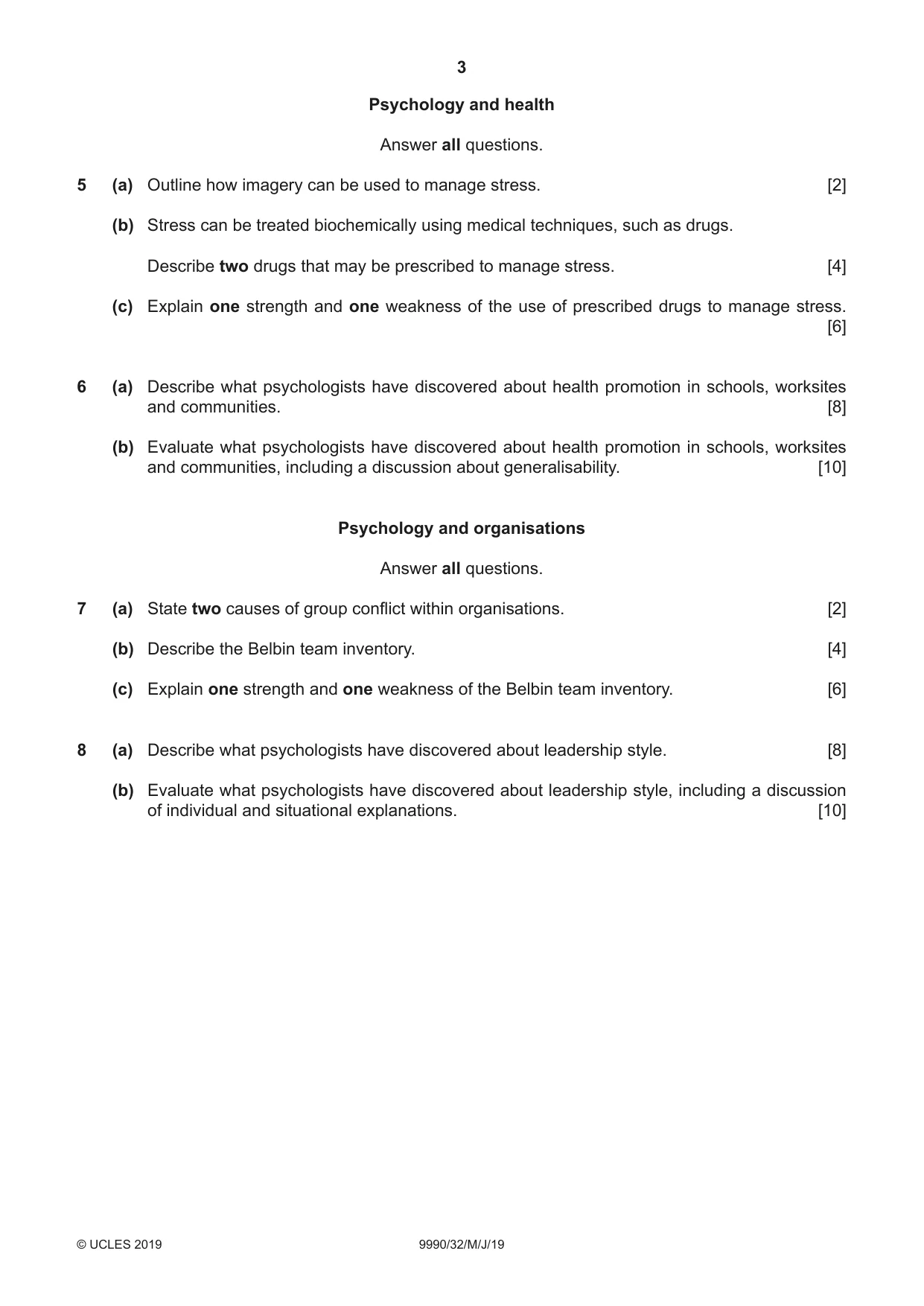
Question paper, page 3
3 9990/32/M/J/19 © UCLES 2019 Psychology and health Answer all questions. 5 (a) Outline how imagery can be used to manage stress. [2] (b) Stress can be treated biochemically using medical techniques, such as drugs. Describe two drugs that may be prescribed to manage stress. [4] (c) Explain one strength and one weakness of the use of prescribed drugs to manage stress. [6] 6 (a) Describe what psychologists have discovered about health promotion in schools, worksites and communities. [8] (b) Evaluate what psychologists have discovered about health promotion in schools, worksites and communities, including a discussion about generalisability. [10] Psychology and organisations Answer all questions. 7 (a) State two causes of group conflict within organisations. [2] (b) Describe the Belbin team inventory. [4] (c) Explain one strength and one weakness of the Belbin team inventory. [6] 8 (a) Describe what psychologists have discovered about leadership style. [8] (b) Evaluate what psychologists have discovered about leadership style, including a discussion of individual and situational explanations. [10]
Question paper, page 4
4 9990/32/M/J/19 © UCLES 2019 Permission to reproduce items where third-party owned material protected by copyright is included has been sought and cleared where possible. Every reasonable effort has been made by the publisher (UCLES) to trace copyright holders, but if any items requiring clearance have unwittingly been included, the publisher will be pleased to make amends at the earliest possible opportunity. To avoid the issue of disclosure of answer-related information to candidates, all copyright acknowledgements are reproduced online in the Cambridge Assessment International Education Copyright Acknowledgements Booklet. This is produced for each series of examinations and is freely available to download at www.cambridgeinternational.org after the live examination series. Cambridge Assessment International Education is part of the Cambridge Assessment Group. Cambridge Assessment is the brand name of the University of Cambridge Local Examinations Syndicate (UCLES), which itself is a department of the University of Cambridge. BLANK PAGE
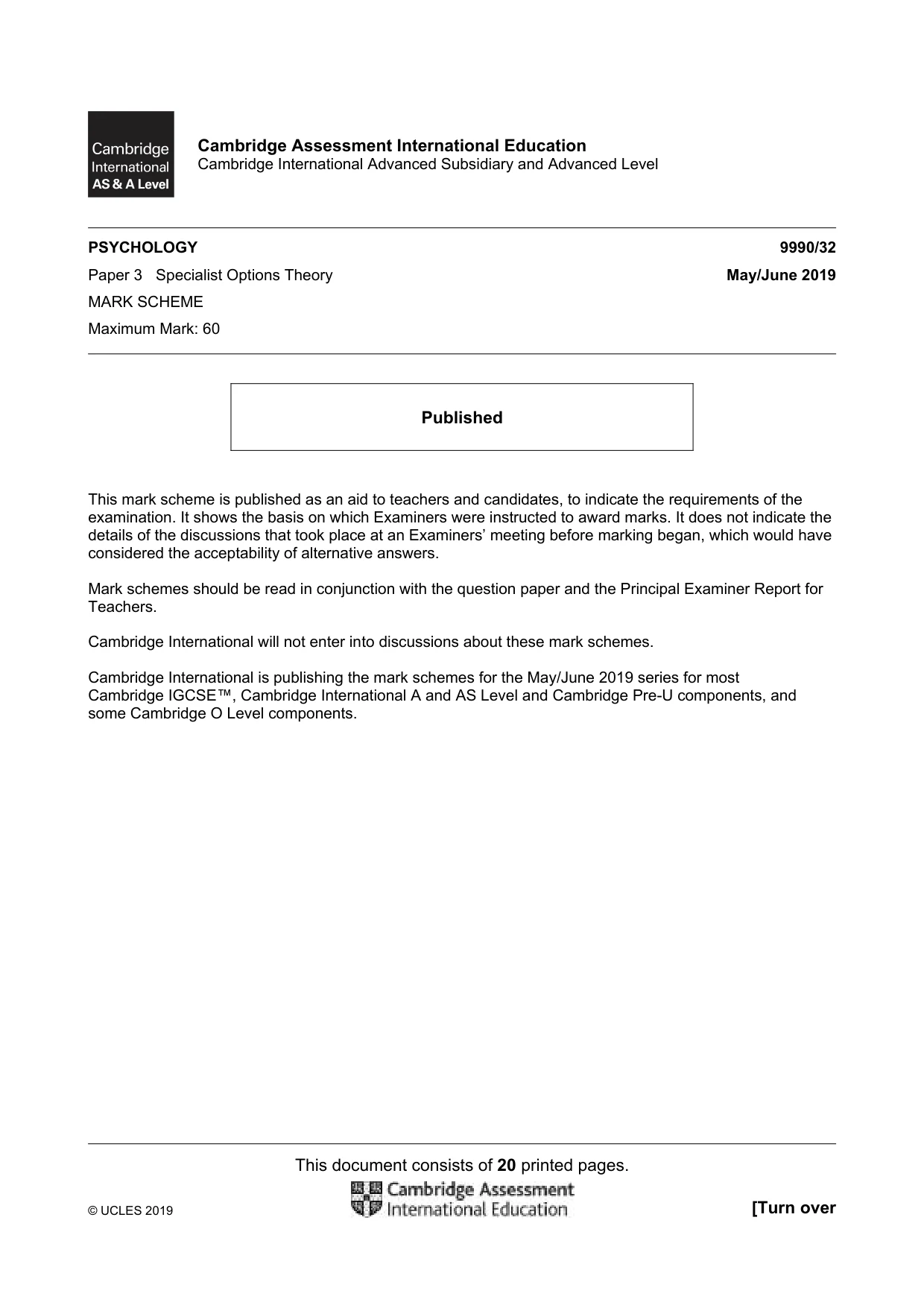
Mark scheme, page 1
This document consists of 20 printed pages. © UCLES 2019 [Turn over Cambridge Assessment International Education Cambridge International Advanced Subsidiary and Advanced Level PSYCHOLOGY 9990/32 Paper 3 Specialist Options Theory May/June 2019 MARK SCHEME Maximum Mark: 60 Published This mark scheme is published as an aid to teachers and candidates, to indicate the requirements of the examination. It shows the basis on which Examiners were instructed to award marks. It does not indicate the details of the discussions that took place at an Examiners’ meeting before marking began, which would have considered the acceptability of alternative answers. Mark schemes should be read in conjunction with the question paper and the Principal Examiner Report for Teachers. Cambridge International will not enter into discussions about these mark schemes. Cambridge International is publishing the mark schemes for the May/June 2019 series for most Cambridge IGCSE™, Cambridge International A and AS Level and Cambridge Pre-U components, and some Cambridge O Level components.
Mark scheme, page 2
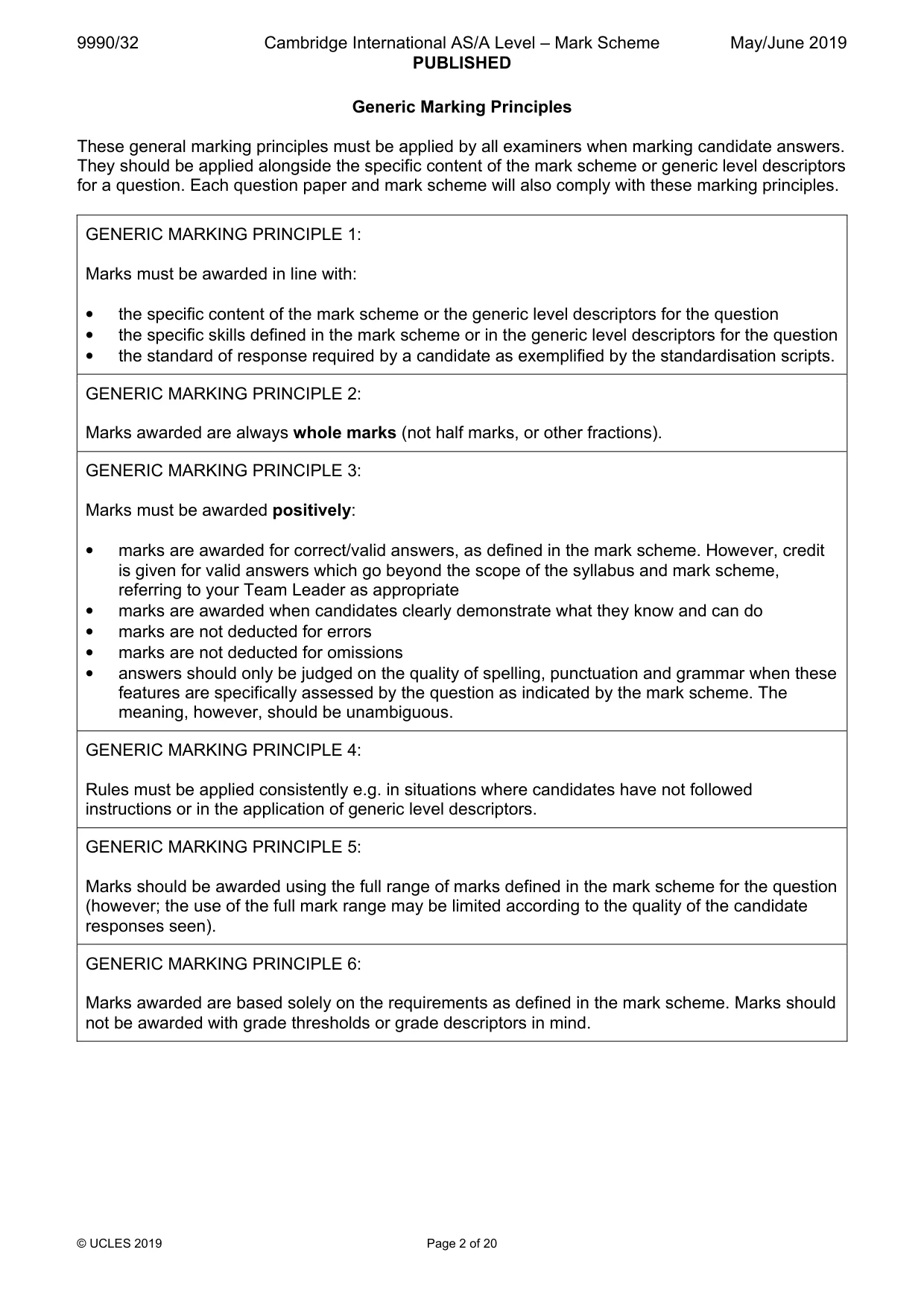
9990/32 Cambridge International AS/A Level – Mark Scheme PUBLISHED May/June 2019 © UCLES 2019 Page 2 of 20 Generic Marking Principles These general marking principles must be applied by all examiners when marking candidate answers. They should be applied alongside the specific content of the mark scheme or generic level descriptors for a question. Each question paper and mark scheme will also comply with these marking principles. GENERIC MARKING PRINCIPLE 1: Marks must be awarded in line with: • the specific content of the mark scheme or the generic level descriptors for the question • the specific skills defined in the mark scheme or in the generic level descriptors for the question • the standard of response required by a candidate as exemplified by the standardisation scripts. GENERIC MARKING PRINCIPLE 2: Marks awarded are always whole marks (not half marks, or other fractions). GENERIC MARKING PRINCIPLE 3: Marks must be awarded positively: • marks are awarded for correct/valid answers, as defined in the mark scheme. However, credit is given for valid answers which go beyond the scope of the syllabus and mark scheme, referring to your Team Leader as appropriate • marks are awarded when candidates clearly demonstrate what they know and can do • marks are not deducted for errors • marks are not deducted for omissions • answers should only be judged on the quality of spelling, punctuation and grammar when these features are specifically assessed by the question as indicated by the mark scheme. The meaning, however, should be unambiguous. GENERIC MARKING PRINCIPLE 4: Rules must be applied consistently e.g. in situations where candidates have not followed instructions or in the application of generic level descriptors. GENERIC MARKING PRINCIPLE 5: Marks should be awarded using the full range of marks defined in the mark scheme for the question (however; the use of the full mark range may be limited according to the quality of the candidate responses seen). GENERIC MARKING PRINCIPLE 6: Marks awarded are based solely on the requirements as defined in the mark scheme. Marks should not be awarded with grade thresholds or grade descriptors in mind.
Mark scheme, page 3
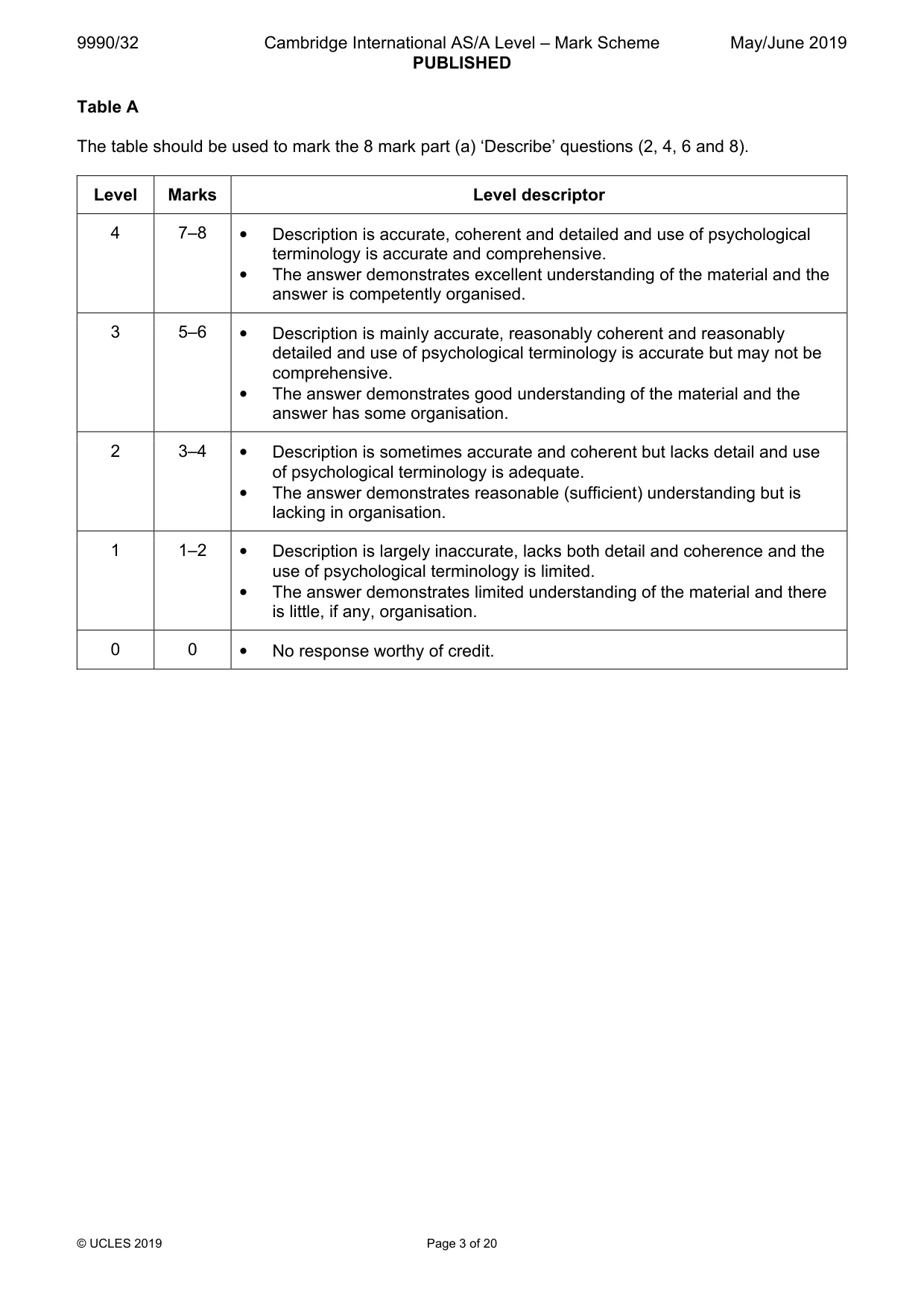
9990/32 Cambridge International AS/A Level – Mark Scheme PUBLISHED May/June 2019 © UCLES 2019 Page 3 of 20 Table A The table should be used to mark the 8 mark part (a) ‘Describe’ questions (2, 4, 6 and 8). Level Marks Level descriptor 4 7–8 • Description is accurate, coherent and detailed and use of psychological terminology is accurate and comprehensive. • The answer demonstrates excellent understanding of the material and the answer is competently organised. 3 5–6 • Description is mainly accurate, reasonably coherent and reasonably detailed and use of psychological terminology is accurate but may not be comprehensive. • The answer demonstrates good understanding of the material and the answer has some organisation. 2 3–4 • Description is sometimes accurate and coherent but lacks detail and use of psychological terminology is adequate. • The answer demonstrates reasonable (sufficient) understanding but is lacking in organisation. 1 1–2 • Description is largely inaccurate, lacks both detail and coherence and the use of psychological terminology is limited. • The answer demonstrates limited understanding of the material and there is little, if any, organisation. 0 0 • No response worthy of credit.
Mark scheme, page 4
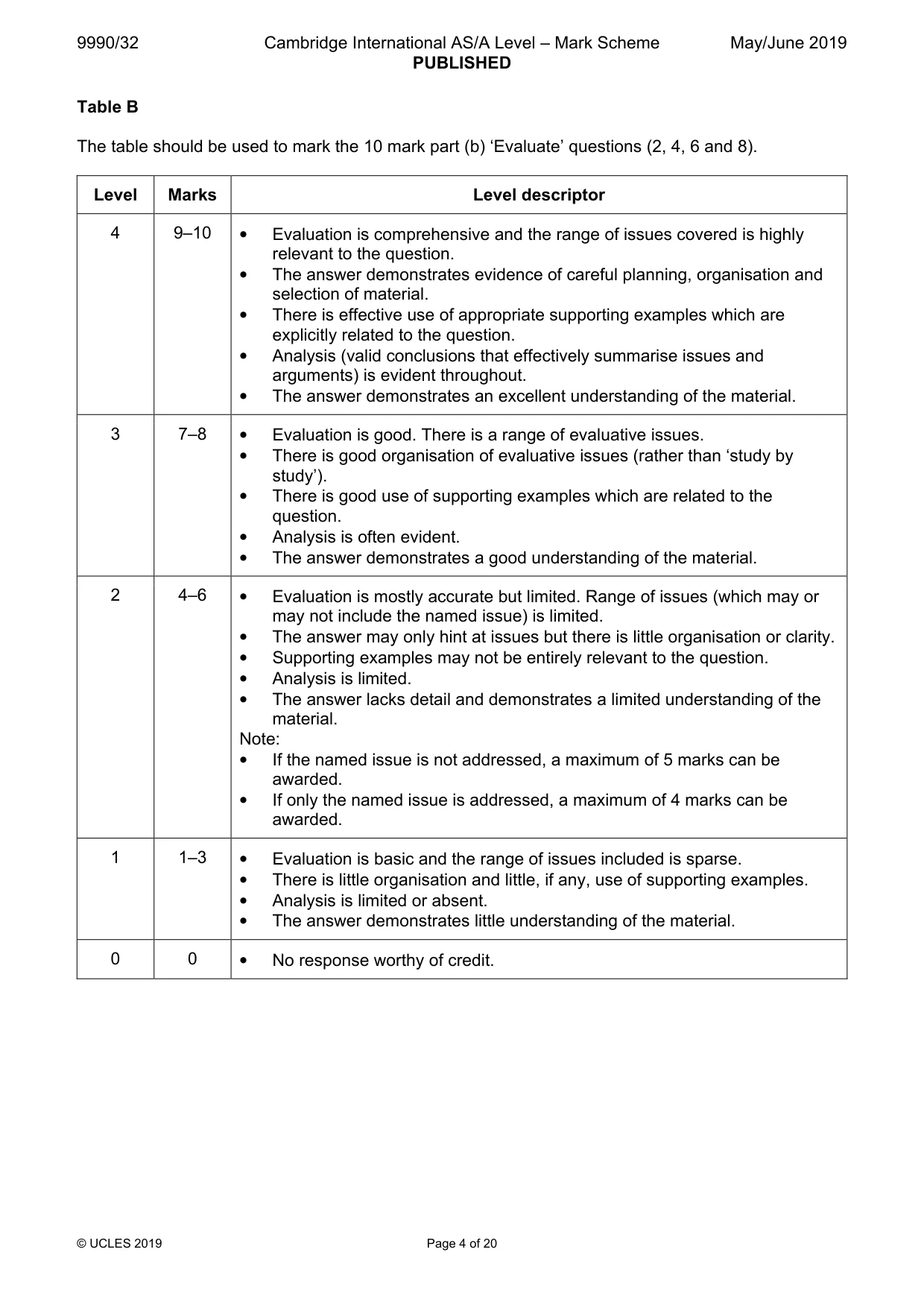
9990/32 Cambridge International AS/A Level – Mark Scheme PUBLISHED May/June 2019 © UCLES 2019 Page 4 of 20 Table B The table should be used to mark the 10 mark part (b) ‘Evaluate’ questions (2, 4, 6 and 8). Level Marks Level descriptor 4 9–10 • Evaluation is comprehensive and the range of issues covered is highly relevant to the question. • The answer demonstrates evidence of careful planning, organisation and selection of material. • There is effective use of appropriate supporting examples which are explicitly related to the question. • Analysis (valid conclusions that effectively summarise issues and arguments) is evident throughout. • The answer demonstrates an excellent understanding of the material. 3 7–8 • Evaluation is good. There is a range of evaluative issues. • There is good organisation of evaluative issues (rather than ‘study by study’). • There is good use of supporting examples which are related to the question. • Analysis is often evident. • The answer demonstrates a good understanding of the material. 2 4–6 • Evaluation is mostly accurate but limited. Range of issues (which may or may not include the named issue) is limited. • The answer may only hint at issues but there is little organisation or clarity. • Supporting examples may not be entirely relevant to the question. • Analysis is limited. • The answer lacks detail and demonstrates a limited understanding of the material. Note: • If the named issue is not addressed, a maximum of 5 marks can be awarded. • If only the named issue is addressed, a maximum of 4 marks can be awarded. 1 1–3 • Evaluation is basic and the range of issues included is sparse. • There is little organisation and little, if any, use of supporting examples. • Analysis is limited or absent. • The answer demonstrates little understanding of the material. 0 0 • No response worthy of credit.
Mark scheme, page 5
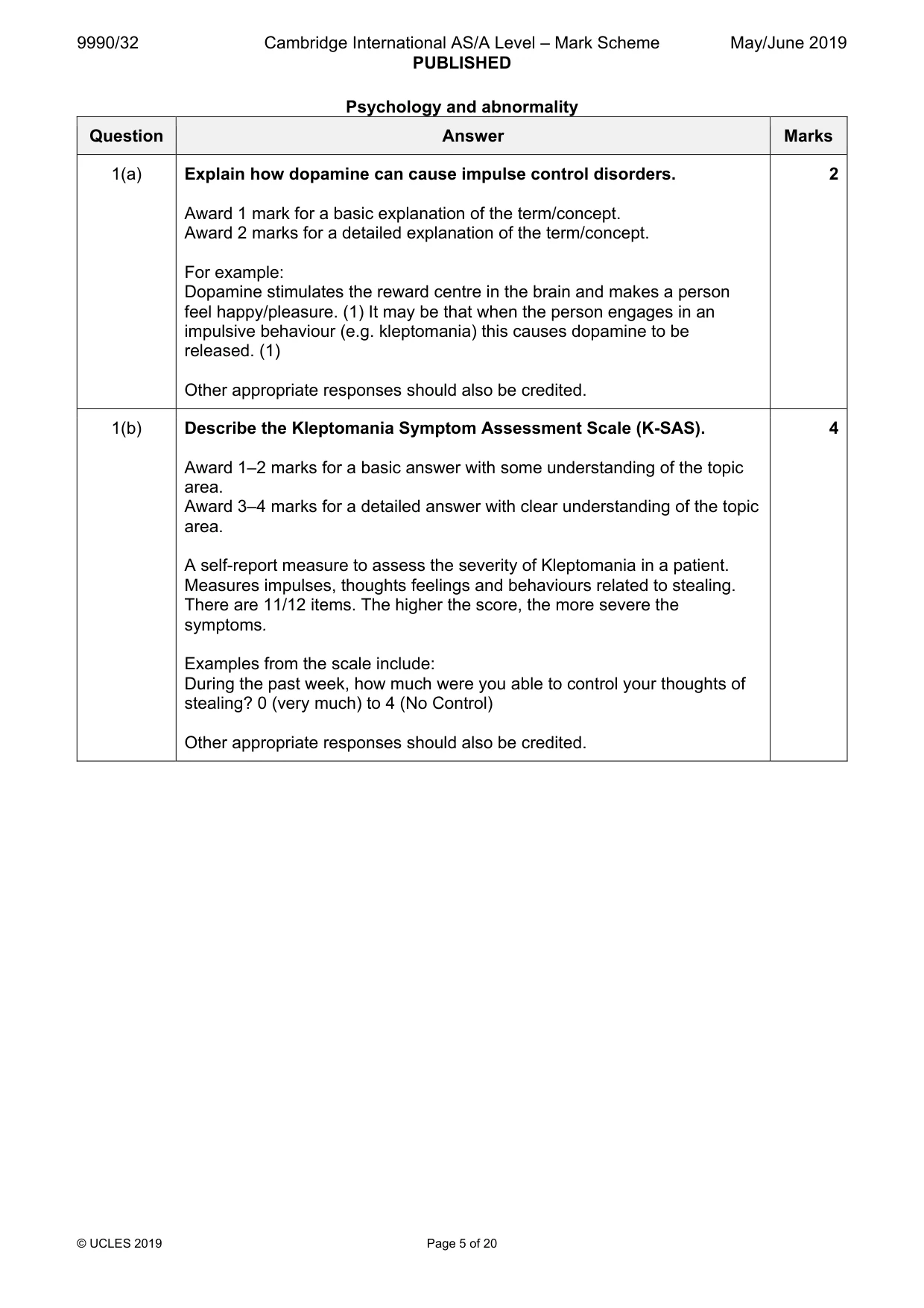
9990/32 Cambridge International AS/A Level – Mark Scheme PUBLISHED May/June 2019 © UCLES 2019 Page 5 of 20 Psychology and abnormality Question Answer Marks 1(a) Explain how dopamine can cause impulse control disorders. Award 1 mark for a basic explanation of the term/concept. Award 2 marks for a detailed explanation of the term/concept. For example: Dopamine stimulates the reward centre in the brain and makes a person feel happy/pleasure. (1) It may be that when the person engages in an impulsive behaviour (e.g. kleptomania) this causes dopamine to be released. (1) Other appropriate responses should also be credited. 2 1(b) Describe the Kleptomania Symptom Assessment Scale (K-SAS). Award 1–2 marks for a basic answer with some understanding of the topic area. Award 3–4 marks for a detailed answer with clear understanding of the topic area. A self-report measure to assess the severity of Kleptomania in a patient. Measures impulses, thoughts feelings and behaviours related to stealing. There are 11/12 items. The higher the score, the more severe the symptoms. Examples from the scale include: During the past week, how much were you able to control your thoughts of stealing? 0 (very much) to 4 (No Control) Other appropriate responses should also be credited. 4
Mark scheme, page 6
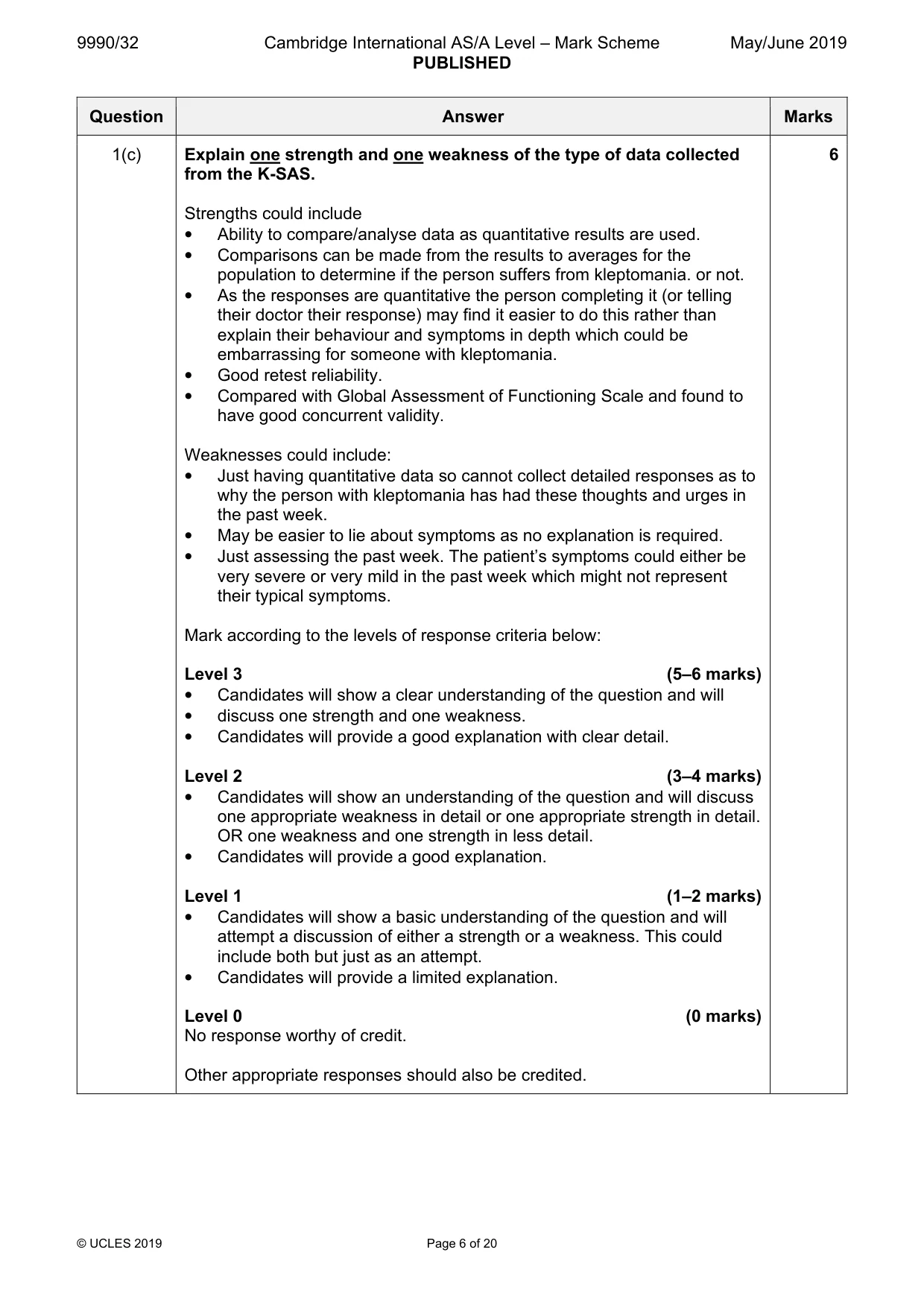
9990/32 Cambridge International AS/A Level – Mark Scheme PUBLISHED May/June 2019 © UCLES 2019 Page 6 of 20 Question Answer Marks 1(c) Explain one strength and one weakness of the type of data collected from the K-SAS. Strengths could include • Ability to compare/analyse data as quantitative results are used. • Comparisons can be made from the results to averages for the population to determine if the person suffers from kleptomania. or not. • As the responses are quantitative the person completing it (or telling their doctor their response) may find it easier to do this rather than explain their behaviour and symptoms in depth which could be embarrassing for someone with kleptomania. • Good retest reliability. • Compared with Global Assessment of Functioning Scale and found to have good concurrent validity. Weaknesses could include: • Just having quantitative data so cannot collect detailed responses as to why the person with kleptomania has had these thoughts and urges in the past week. • May be easier to lie about symptoms as no explanation is required. • Just assessing the past week. The patient’s symptoms could either be very severe or very mild in the past week which might not represent their typical symptoms. Mark according to the levels of response criteria below: Level 3 (5–6 marks) • Candidates will show a clear understanding of the question and will • discuss one strength and one weakness. • Candidates will provide a good explanation with clear detail. Level 2 (3–4 marks) • Candidates will show an understanding of the question and will discuss one appropriate weakness in detail or one appropriate strength in detail. OR one weakness and one strength in less detail. • Candidates will provide a good explanation. Level 1 (1–2 marks) • Candidates will show a basic understanding of the question and will attempt a discussion of either a strength or a weakness. This could include both but just as an attempt. • Candidates will provide a limited explanation. Level 0 (0 marks) No response worthy of credit. Other appropriate responses should also be credited. 6
Mark scheme, page 7
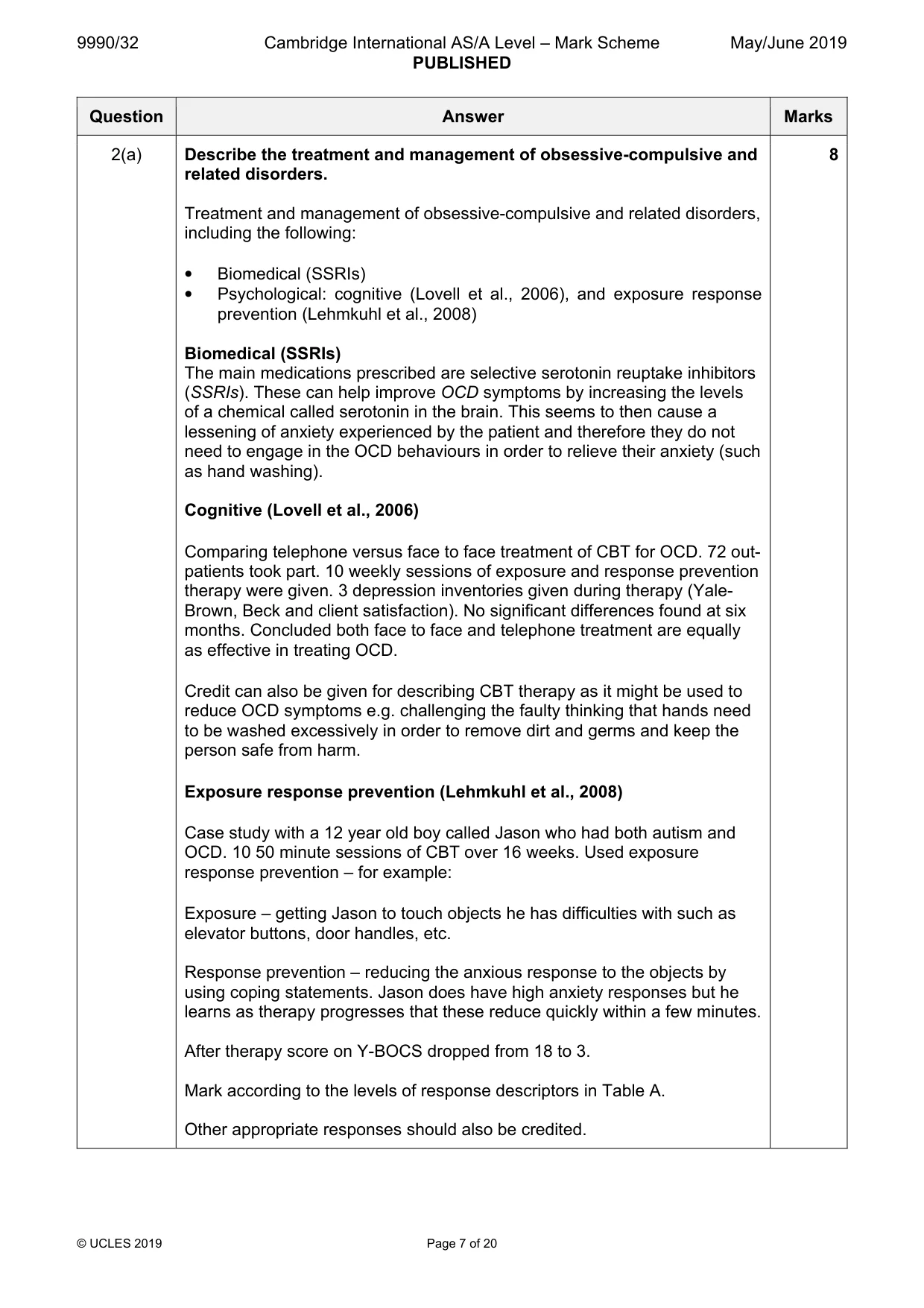
9990/32 Cambridge International AS/A Level – Mark Scheme PUBLISHED May/June 2019 © UCLES 2019 Page 7 of 20 Question Answer Marks 2(a) Describe the treatment and management of obsessive-compulsive and related disorders. Treatment and management of obsessive-compulsive and related disorders, including the following: • Biomedical (SSRIs) • Psychological: cognitive (Lovell et al., 2006), and exposure response prevention (Lehmkuhl et al., 2008) Biomedical (SSRIs) The main medications prescribed are selective serotonin reuptake inhibitors (SSRIs). These can help improve OCD symptoms by increasing the levels of a chemical called serotonin in the brain. This seems to then cause a lessening of anxiety experienced by the patient and therefore they do not need to engage in the OCD behaviours in order to relieve their anxiety (such as hand washing). Cognitive (Lovell et al., 2006) Comparing telephone versus face to face treatment of CBT for OCD. 72 out- patients took part. 10 weekly sessions of exposure and response prevention therapy were given. 3 depression inventories given during therapy (Yale- Brown, Beck and client satisfaction). No significant differences found at six months. Concluded both face to face and telephone treatment are equally as effective in treating OCD. Credit can also be given for describing CBT therapy as it might be used to reduce OCD symptoms e.g. challenging the faulty thinking that hands need to be washed excessively in order to remove dirt and germs and keep the person safe from harm. Exposure response prevention (Lehmkuhl et al., 2008) Case study with a 12 year old boy called Jason who had both autism and OCD. 10 50 minute sessions of CBT over 16 weeks. Used exposure response prevention – for example: Exposure – getting Jason to touch objects he has difficulties with such as elevator buttons, door handles, etc. Response prevention – reducing the anxious response to the objects by using coping statements. Jason does have high anxiety responses but he learns as therapy progresses that these reduce quickly within a few minutes. After therapy score on Y-BOCS dropped from 18 to 3. Mark according to the levels of response descriptors in Table A. Other appropriate responses should also be credited. 8
Mark scheme, page 8
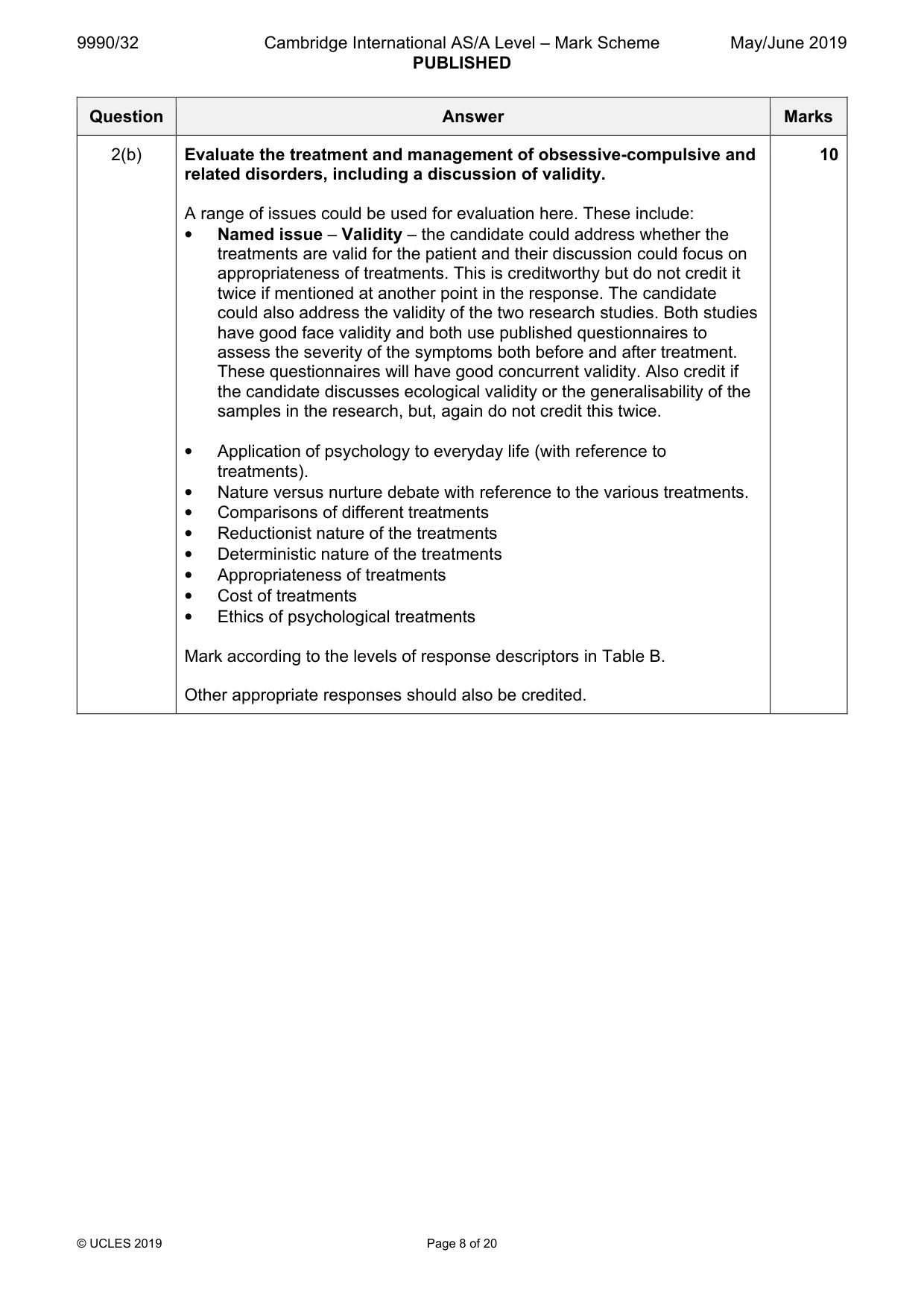
9990/32 Cambridge International AS/A Level – Mark Scheme PUBLISHED May/June 2019 © UCLES 2019 Page 8 of 20 Question Answer Marks 2(b) Evaluate the treatment and management of obsessive-compulsive and related disorders, including a discussion of validity. A range of issues could be used for evaluation here. These include: • Named issue – Validity – the candidate could address whether the treatments are valid for the patient and their discussion could focus on appropriateness of treatments. This is creditworthy but do not credit it twice if mentioned at another point in the response. The candidate could also address the validity of the two research studies. Both studies have good face validity and both use published questionnaires to assess the severity of the symptoms both before and after treatment. These questionnaires will have good concurrent validity. Also credit if the candidate discusses ecological validity or the generalisability of the samples in the research, but, again do not credit this twice. • Application of psychology to everyday life (with reference to treatments). • Nature versus nurture debate with reference to the various treatments. • Comparisons of different treatments • Reductionist nature of the treatments • Deterministic nature of the treatments • Appropriateness of treatments • Cost of treatments • Ethics of psychological treatments Mark according to the levels of response descriptors in Table B. Other appropriate responses should also be credited. 10
Mark scheme, page 9
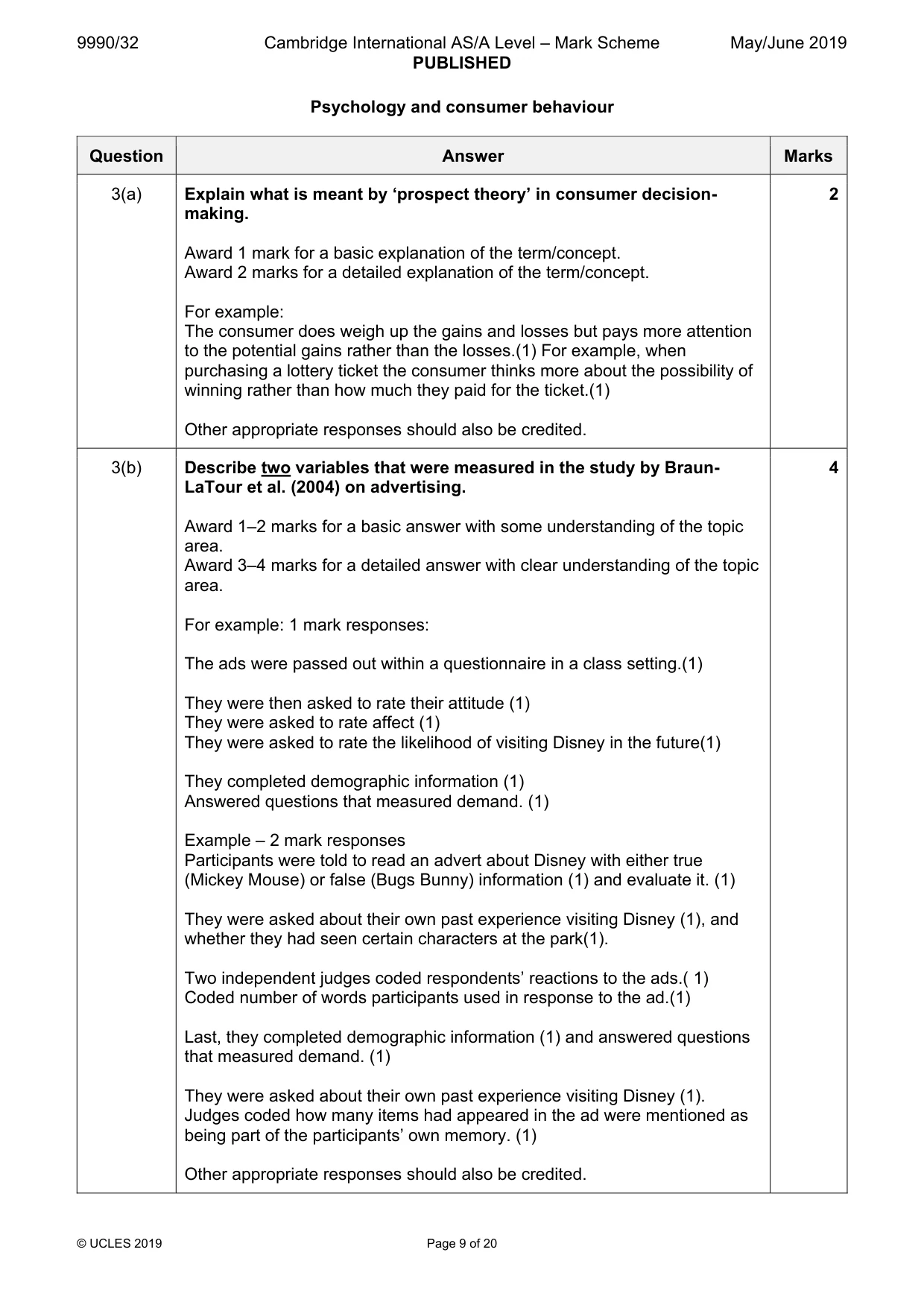
9990/32 Cambridge International AS/A Level – Mark Scheme PUBLISHED May/June 2019 © UCLES 2019 Page 9 of 20 Psychology and consumer behaviour Question Answer Marks 3(a) Explain what is meant by ‘prospect theory’ in consumer decision- making. Award 1 mark for a basic explanation of the term/concept. Award 2 marks for a detailed explanation of the term/concept. For example: The consumer does weigh up the gains and losses but pays more attention to the potential gains rather than the losses.(1) For example, when purchasing a lottery ticket the consumer thinks more about the possibility of winning rather than how much they paid for the ticket.(1) Other appropriate responses should also be credited. 2 3(b) Describe two variables that were measured in the study by Braun- LaTour et al. (2004) on advertising. Award 1–2 marks for a basic answer with some understanding of the topic area. Award 3–4 marks for a detailed answer with clear understanding of the topic area. For example: 1 mark responses: The ads were passed out within a questionnaire in a class setting.(1) They were then asked to rate their attitude (1) They were asked to rate affect (1) They were asked to rate the likelihood of visiting Disney in the future(1) They completed demographic information (1) Answered questions that measured demand. (1) Example – 2 mark responses Participants were told to read an advert about Disney with either true (Mickey Mouse) or false (Bugs Bunny) information (1) and evaluate it. (1) They were asked about their own past experience visiting Disney (1), and whether they had seen certain characters at the park(1). Two independent judges coded respondents’ reactions to the ads.( 1) Coded number of words participants used in response to the ad.(1) Last, they completed demographic information (1) and answered questions that measured demand. (1) They were asked about their own past experience visiting Disney (1). Judges coded how many items had appeared in the ad were mentioned as being part of the participants’ own memory. (1) Other appropriate responses should also be credited. 4
Mark scheme, page 10
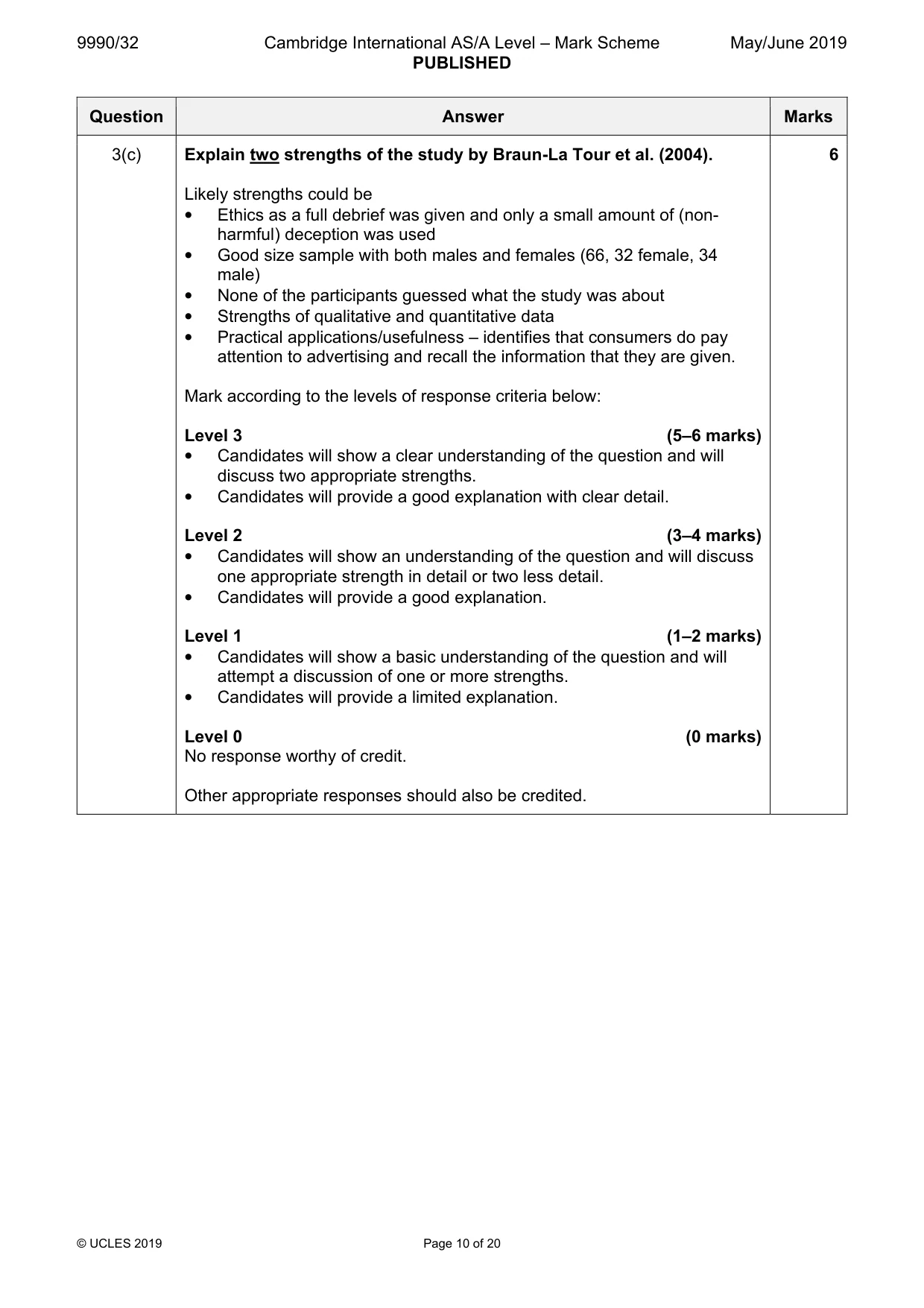
9990/32 Cambridge International AS/A Level – Mark Scheme PUBLISHED May/June 2019 © UCLES 2019 Page 10 of 20 Question Answer Marks 3(c) Explain two strengths of the study by Braun-La Tour et al. (2004). Likely strengths could be • Ethics as a full debrief was given and only a small amount of (non- harmful) deception was used • Good size sample with both males and females (66, 32 female, 34 male) • None of the participants guessed what the study was about • Strengths of qualitative and quantitative data • Practical applications/usefulness – identifies that consumers do pay attention to advertising and recall the information that they are given. Mark according to the levels of response criteria below: Level 3 (5–6 marks) • Candidates will show a clear understanding of the question and will discuss two appropriate strengths. • Candidates will provide a good explanation with clear detail. Level 2 (3–4 marks) • Candidates will show an understanding of the question and will discuss one appropriate strength in detail or two less detail. • Candidates will provide a good explanation. Level 1 (1–2 marks) • Candidates will show a basic understanding of the question and will attempt a discussion of one or more strengths. • Candidates will provide a limited explanation. Level 0 (0 marks) No response worthy of credit. Other appropriate responses should also be credited. 6
Mark scheme, page 11
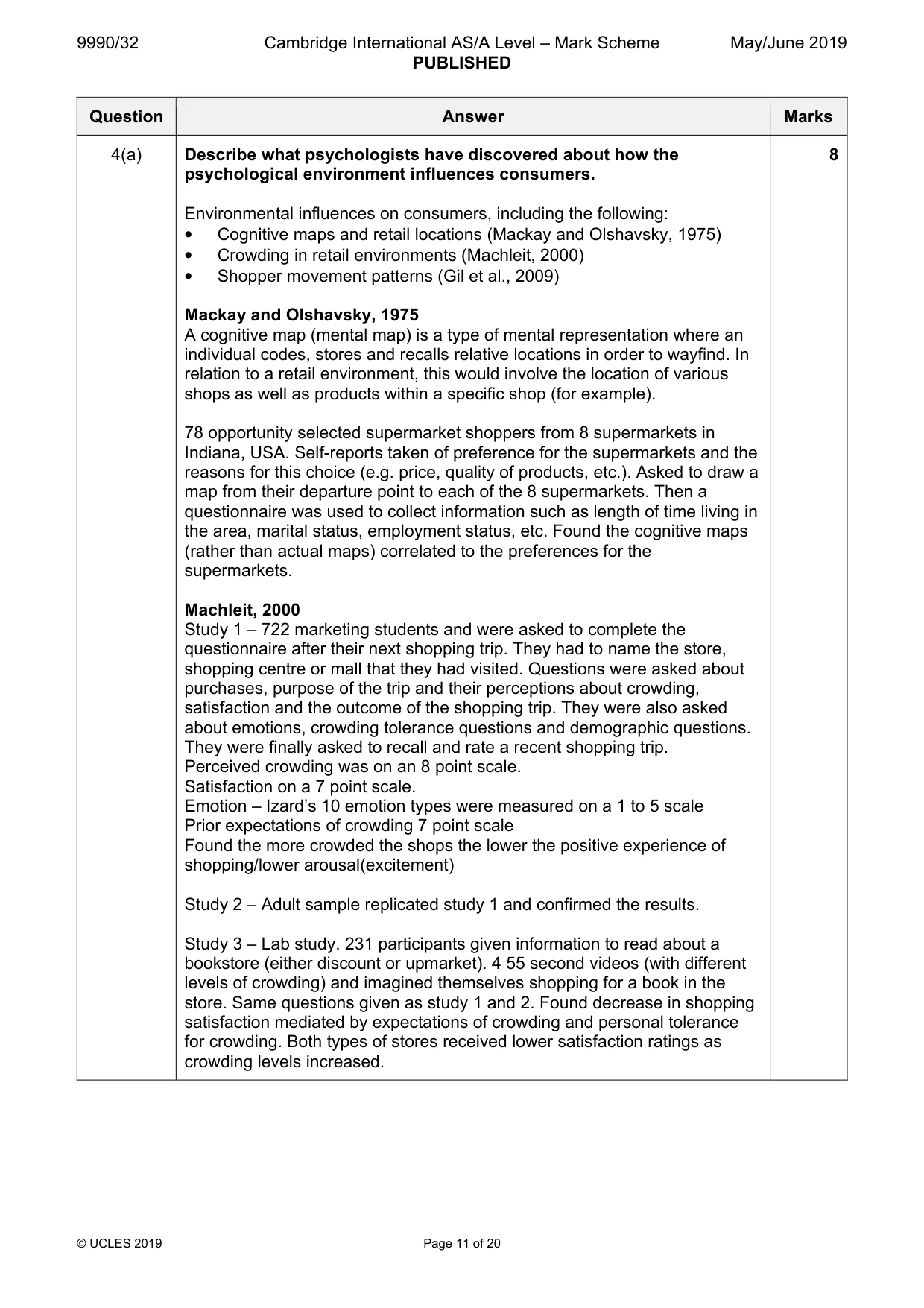
9990/32 Cambridge International AS/A Level – Mark Scheme PUBLISHED May/June 2019 © UCLES 2019 Page 11 of 20 Question Answer Marks 4(a) Describe what psychologists have discovered about how the psychological environment influences consumers. Environmental influences on consumers, including the following: • Cognitive maps and retail locations (Mackay and Olshavsky, 1975) • Crowding in retail environments (Machleit, 2000) • Shopper movement patterns (Gil et al., 2009) Mackay and Olshavsky, 1975 A cognitive map (mental map) is a type of mental representation where an individual codes, stores and recalls relative locations in order to wayfind. In relation to a retail environment, this would involve the location of various shops as well as products within a specific shop (for example). 78 opportunity selected supermarket shoppers from 8 supermarkets in Indiana, USA. Self-reports taken of preference for the supermarkets and the reasons for this choice (e.g. price, quality of products, etc.). Asked to draw a map from their departure point to each of the 8 supermarkets. Then a questionnaire was used to collect information such as length of time living in the area, marital status, employment status, etc. Found the cognitive maps (rather than actual maps) correlated to the preferences for the supermarkets. Machleit, 2000 Study 1 – 722 marketing students and were asked to complete the questionnaire after their next shopping trip. They had to name the store, shopping centre or mall that they had visited. Questions were asked about purchases, purpose of the trip and their perceptions about crowding, satisfaction and the outcome of the shopping trip. They were also asked about emotions, crowding tolerance questions and demographic questions. They were finally asked to recall and rate a recent shopping trip. Perceived crowding was on an 8 point scale. Satisfaction on a 7 point scale. Emotion – Izard’s 10 emotion types were measured on a 1 to 5 scale Prior expectations of crowding 7 point scale Found the more crowded the shops the lower the positive experience of shopping/lower arousal(excitement) Study 2 – Adult sample replicated study 1 and confirmed the results. Study 3 – Lab study. 231 participants given information to read about a bookstore (either discount or upmarket). 4 55 second videos (with different levels of crowding) and imagined themselves shopping for a book in the store. Same questions given as study 1 and 2. Found decrease in shopping satisfaction mediated by expectations of crowding and personal tolerance for crowding. Both types of stores received lower satisfaction ratings as crowding levels increased. 8
Mark scheme, page 12
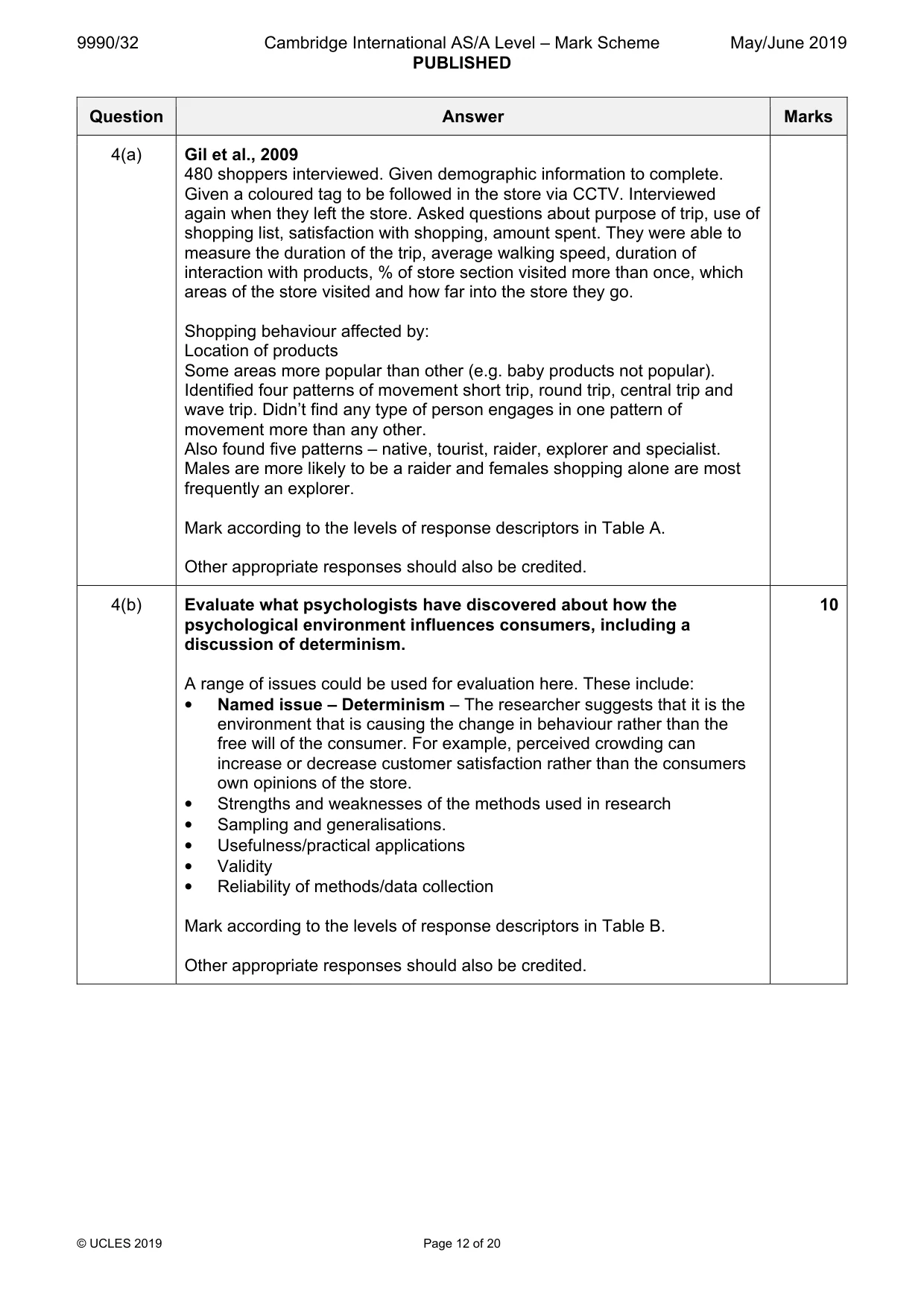
9990/32 Cambridge International AS/A Level – Mark Scheme PUBLISHED May/June 2019 © UCLES 2019 Page 12 of 20 Question Answer Marks 4(a) Gil et al., 2009 480 shoppers interviewed. Given demographic information to complete. Given a coloured tag to be followed in the store via CCTV. Interviewed again when they left the store. Asked questions about purpose of trip, use of shopping list, satisfaction with shopping, amount spent. They were able to measure the duration of the trip, average walking speed, duration of interaction with products, % of store section visited more than once, which areas of the store visited and how far into the store they go. Shopping behaviour affected by: Location of products Some areas more popular than other (e.g. baby products not popular). Identified four patterns of movement short trip, round trip, central trip and wave trip. Didn’t find any type of person engages in one pattern of movement more than any other. Also found five patterns – native, tourist, raider, explorer and specialist. Males are more likely to be a raider and females shopping alone are most frequently an explorer. Mark according to the levels of response descriptors in Table A. Other appropriate responses should also be credited. 4(b) Evaluate what psychologists have discovered about how the psychological environment influences consumers, including a discussion of determinism. A range of issues could be used for evaluation here. These include: • Named issue – Determinism – The researcher suggests that it is the environment that is causing the change in behaviour rather than the free will of the consumer. For example, perceived crowding can increase or decrease customer satisfaction rather than the consumers own opinions of the store. • Strengths and weaknesses of the methods used in research • Sampling and generalisations. • Usefulness/practical applications • Validity • Reliability of methods/data collection Mark according to the levels of response descriptors in Table B. Other appropriate responses should also be credited. 10
Mark scheme, page 13
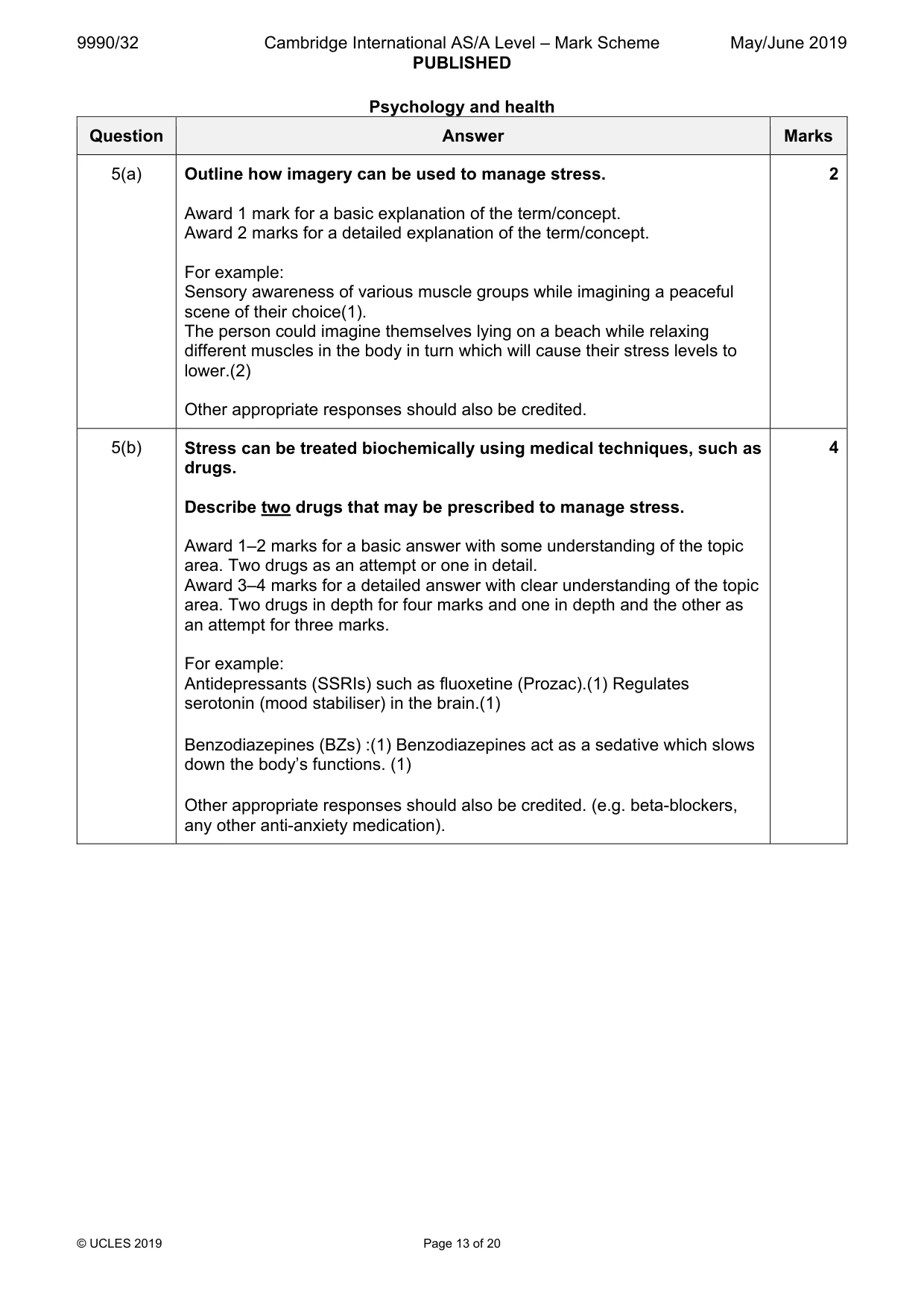
9990/32 Cambridge International AS/A Level – Mark Scheme PUBLISHED May/June 2019 © UCLES 2019 Page 13 of 20 Psychology and health Question Answer Marks 5(a) Outline how imagery can be used to manage stress. Award 1 mark for a basic explanation of the term/concept. Award 2 marks for a detailed explanation of the term/concept. For example: Sensory awareness of various muscle groups while imagining a peaceful scene of their choice(1). The person could imagine themselves lying on a beach while relaxing different muscles in the body in turn which will cause their stress levels to lower.(2) Other appropriate responses should also be credited. 2 5(b) Stress can be treated biochemically using medical techniques, such as drugs. Describe two drugs that may be prescribed to manage stress. Award 1–2 marks for a basic answer with some understanding of the topic area. Two drugs as an attempt or one in detail. Award 3–4 marks for a detailed answer with clear understanding of the topic area. Two drugs in depth for four marks and one in depth and the other as an attempt for three marks. For example: Antidepressants (SSRIs) such as fluoxetine (Prozac).(1) Regulates serotonin (mood stabiliser) in the brain.(1) Benzodiazepines (BZs) :(1) Benzodiazepines act as a sedative which slows down the body’s functions. (1) Other appropriate responses should also be credited. (e.g. beta-blockers, any other anti-anxiety medication). 4
Mark scheme, page 14
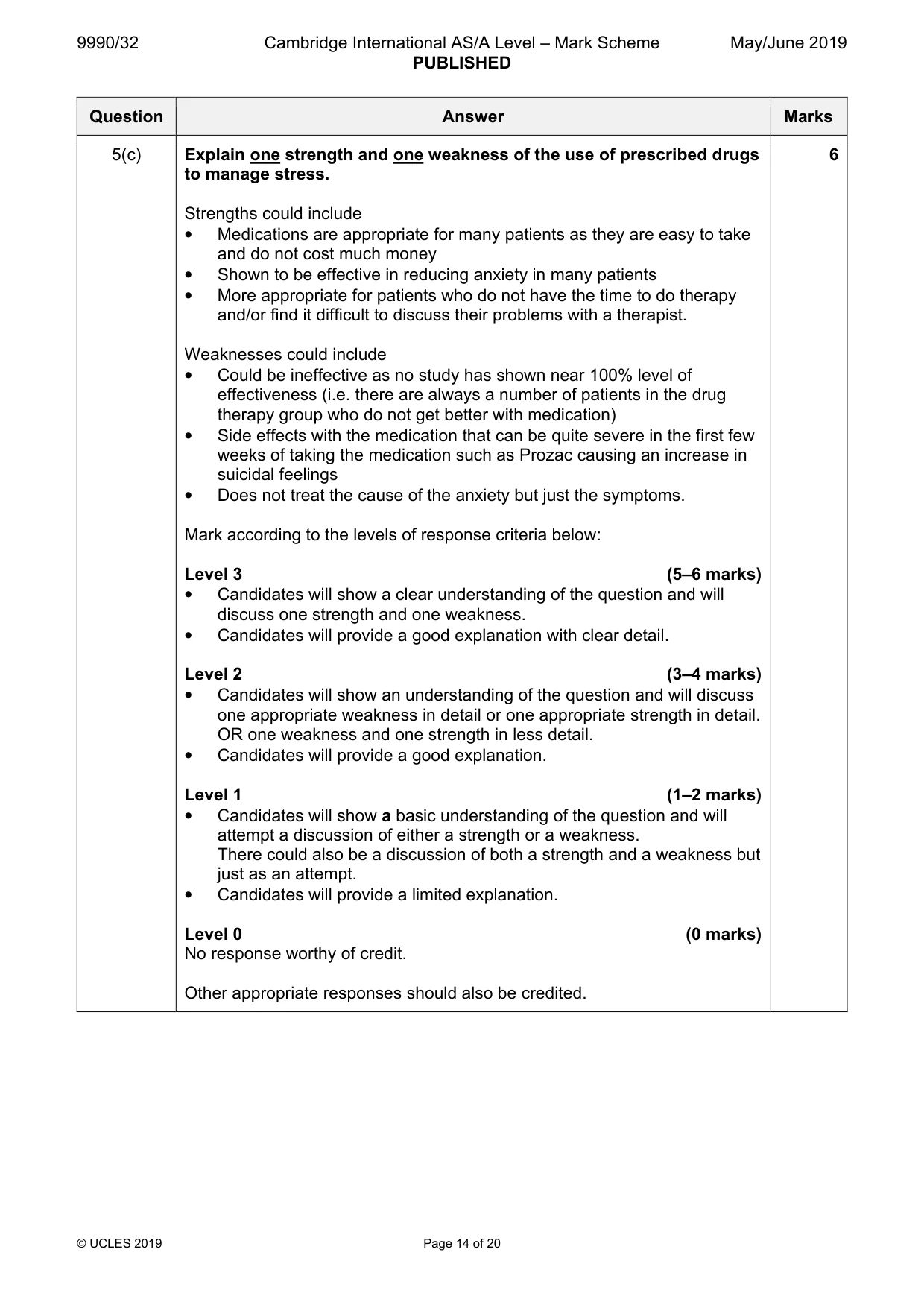
9990/32 Cambridge International AS/A Level – Mark Scheme PUBLISHED May/June 2019 © UCLES 2019 Page 14 of 20 Question Answer Marks 5(c) Explain one strength and one weakness of the use of prescribed drugs to manage stress. Strengths could include • Medications are appropriate for many patients as they are easy to take and do not cost much money • Shown to be effective in reducing anxiety in many patients • More appropriate for patients who do not have the time to do therapy and/or find it difficult to discuss their problems with a therapist. Weaknesses could include • Could be ineffective as no study has shown near 100% level of effectiveness (i.e. there are always a number of patients in the drug therapy group who do not get better with medication) • Side effects with the medication that can be quite severe in the first few weeks of taking the medication such as Prozac causing an increase in suicidal feelings • Does not treat the cause of the anxiety but just the symptoms. Mark according to the levels of response criteria below: Level 3 (5–6 marks) • Candidates will show a clear understanding of the question and will discuss one strength and one weakness. • Candidates will provide a good explanation with clear detail. Level 2 (3–4 marks) • Candidates will show an understanding of the question and will discuss one appropriate weakness in detail or one appropriate strength in detail. OR one weakness and one strength in less detail. • Candidates will provide a good explanation. Level 1 (1–2 marks) • Candidates will show a basic understanding of the question and will attempt a discussion of either a strength or a weakness. There could also be a discussion of both a strength and a weakness but just as an attempt. • Candidates will provide a limited explanation. Level 0 (0 marks) No response worthy of credit. Other appropriate responses should also be credited. 6
Mark scheme, page 15
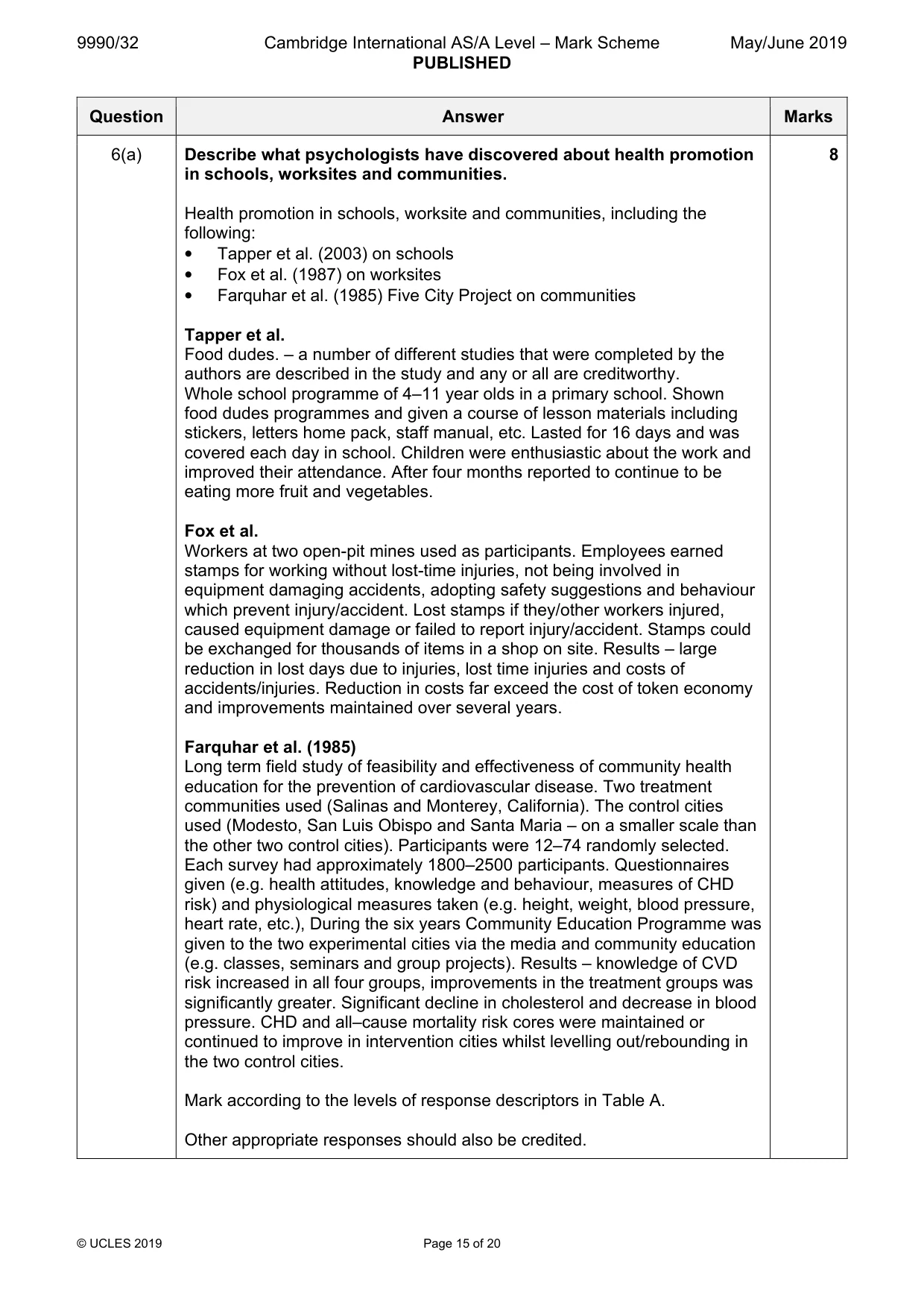
9990/32 Cambridge International AS/A Level – Mark Scheme PUBLISHED May/June 2019 © UCLES 2019 Page 15 of 20 Question Answer Marks 6(a) Describe what psychologists have discovered about health promotion in schools, worksites and communities. Health promotion in schools, worksite and communities, including the following: • Tapper et al. (2003) on schools • Fox et al. (1987) on worksites • Farquhar et al. (1985) Five City Project on communities Tapper et al. Food dudes. – a number of different studies that were completed by the authors are described in the study and any or all are creditworthy. Whole school programme of 4–11 year olds in a primary school. Shown food dudes programmes and given a course of lesson materials including stickers, letters home pack, staff manual, etc. Lasted for 16 days and was covered each day in school. Children were enthusiastic about the work and improved their attendance. After four months reported to continue to be eating more fruit and vegetables. Fox et al. Workers at two open-pit mines used as participants. Employees earned stamps for working without lost-time injuries, not being involved in equipment damaging accidents, adopting safety suggestions and behaviour which prevent injury/accident. Lost stamps if they/other workers injured, caused equipment damage or failed to report injury/accident. Stamps could be exchanged for thousands of items in a shop on site. Results – large reduction in lost days due to injuries, lost time injuries and costs of accidents/injuries. Reduction in costs far exceed the cost of token economy and improvements maintained over several years. Farquhar et al. (1985) Long term field study of feasibility and effectiveness of community health education for the prevention of cardiovascular disease. Two treatment communities used (Salinas and Monterey, California). The control cities used (Modesto, San Luis Obispo and Santa Maria – on a smaller scale than the other two control cities). Participants were 12–74 randomly selected. Each survey had approximately 1800–2500 participants. Questionnaires given (e.g. health attitudes, knowledge and behaviour, measures of CHD risk) and physiological measures taken (e.g. height, weight, blood pressure, heart rate, etc.), During the six years Community Education Programme was given to the two experimental cities via the media and community education (e.g. classes, seminars and group projects). Results – knowledge of CVD risk increased in all four groups, improvements in the treatment groups was significantly greater. Significant decline in cholesterol and decrease in blood pressure. CHD and all–cause mortality risk cores were maintained or continued to improve in intervention cities whilst levelling out/rebounding in the two control cities. Mark according to the levels of response descriptors in Table A. Other appropriate responses should also be credited. 8
Mark scheme, page 16
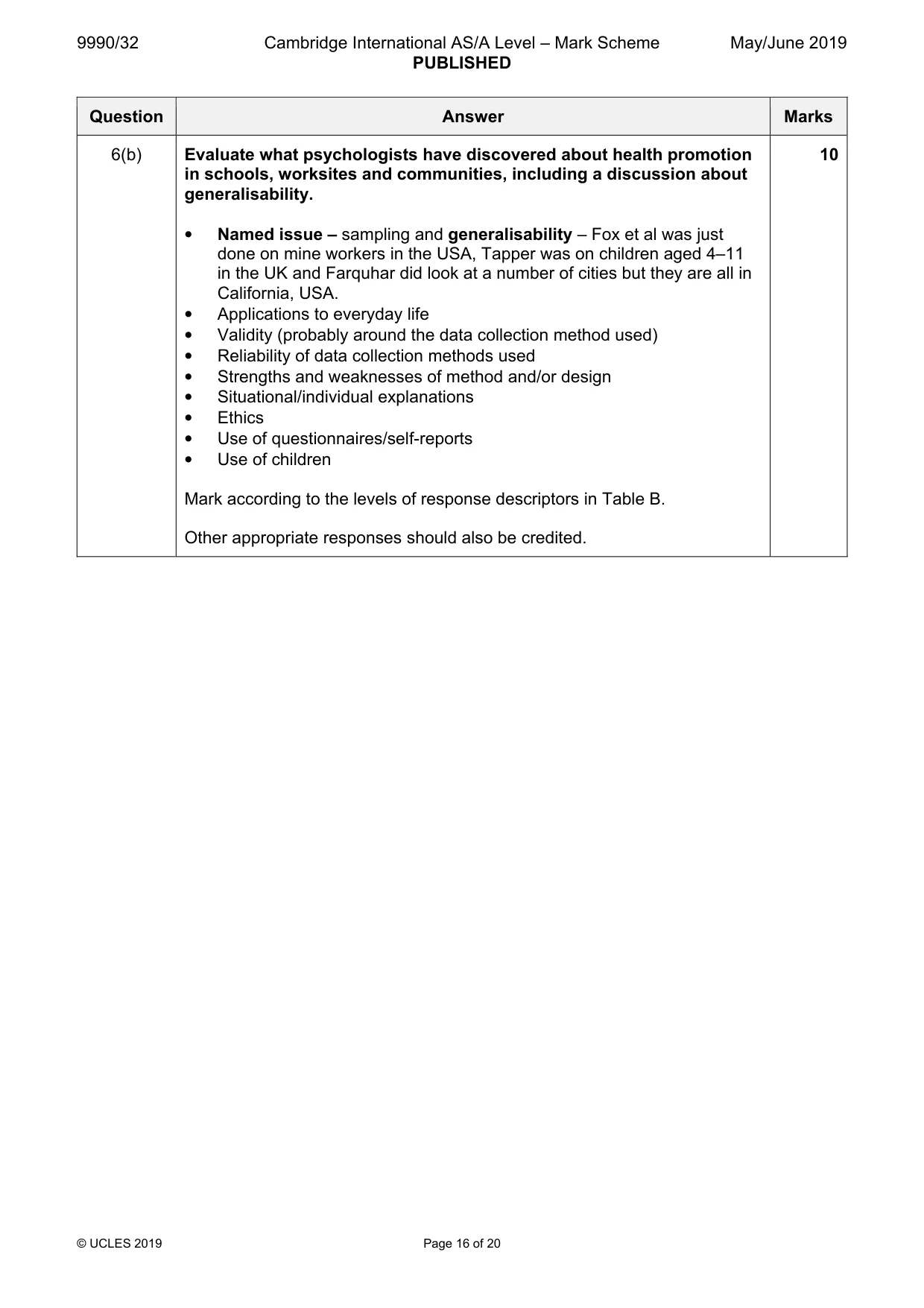
9990/32 Cambridge International AS/A Level – Mark Scheme PUBLISHED May/June 2019 © UCLES 2019 Page 16 of 20 Question Answer Marks 6(b) Evaluate what psychologists have discovered about health promotion in schools, worksites and communities, including a discussion about generalisability. • Named issue – sampling and generalisability – Fox et al was just done on mine workers in the USA, Tapper was on children aged 4–11 in the UK and Farquhar did look at a number of cities but they are all in California, USA. • Applications to everyday life • Validity (probably around the data collection method used) • Reliability of data collection methods used • Strengths and weaknesses of method and/or design • Situational/individual explanations • Ethics • Use of questionnaires/self-reports • Use of children Mark according to the levels of response descriptors in Table B. Other appropriate responses should also be credited. 10
Mark scheme, page 17
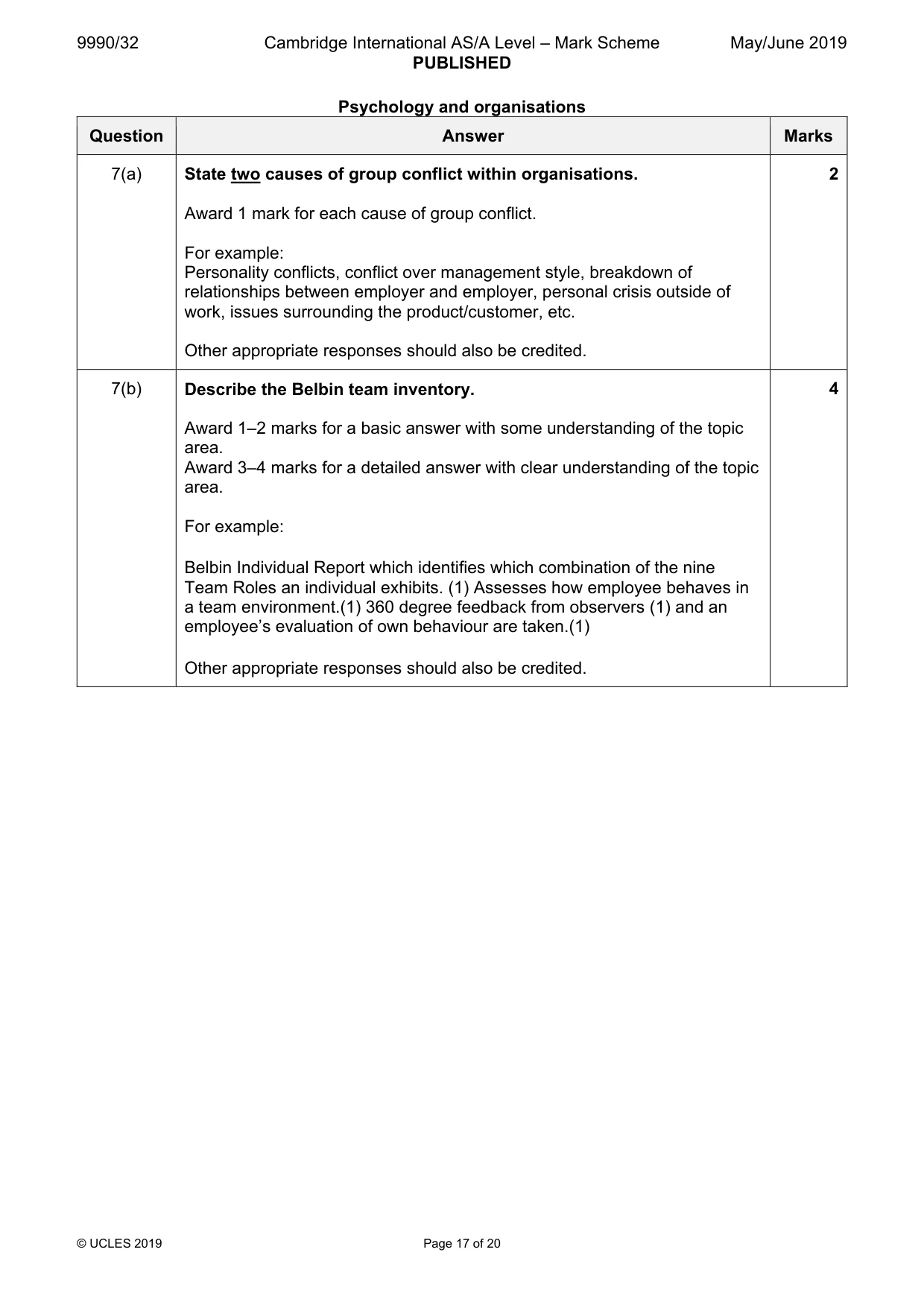
9990/32 Cambridge International AS/A Level – Mark Scheme PUBLISHED May/June 2019 © UCLES 2019 Page 17 of 20 Psychology and organisations Question Answer Marks 7(a) State two causes of group conflict within organisations. Award 1 mark for each cause of group conflict. For example: Personality conflicts, conflict over management style, breakdown of relationships between employer and employer, personal crisis outside of work, issues surrounding the product/customer, etc. Other appropriate responses should also be credited. 2 7(b) Describe the Belbin team inventory. Award 1–2 marks for a basic answer with some understanding of the topic area. Award 3–4 marks for a detailed answer with clear understanding of the topic area. For example: Belbin Individual Report which identifies which combination of the nine Team Roles an individual exhibits. (1) Assesses how employee behaves in a team environment.(1) 360 degree feedback from observers (1) and an employee’s evaluation of own behaviour are taken.(1) Other appropriate responses should also be credited. 4
Mark scheme, page 18
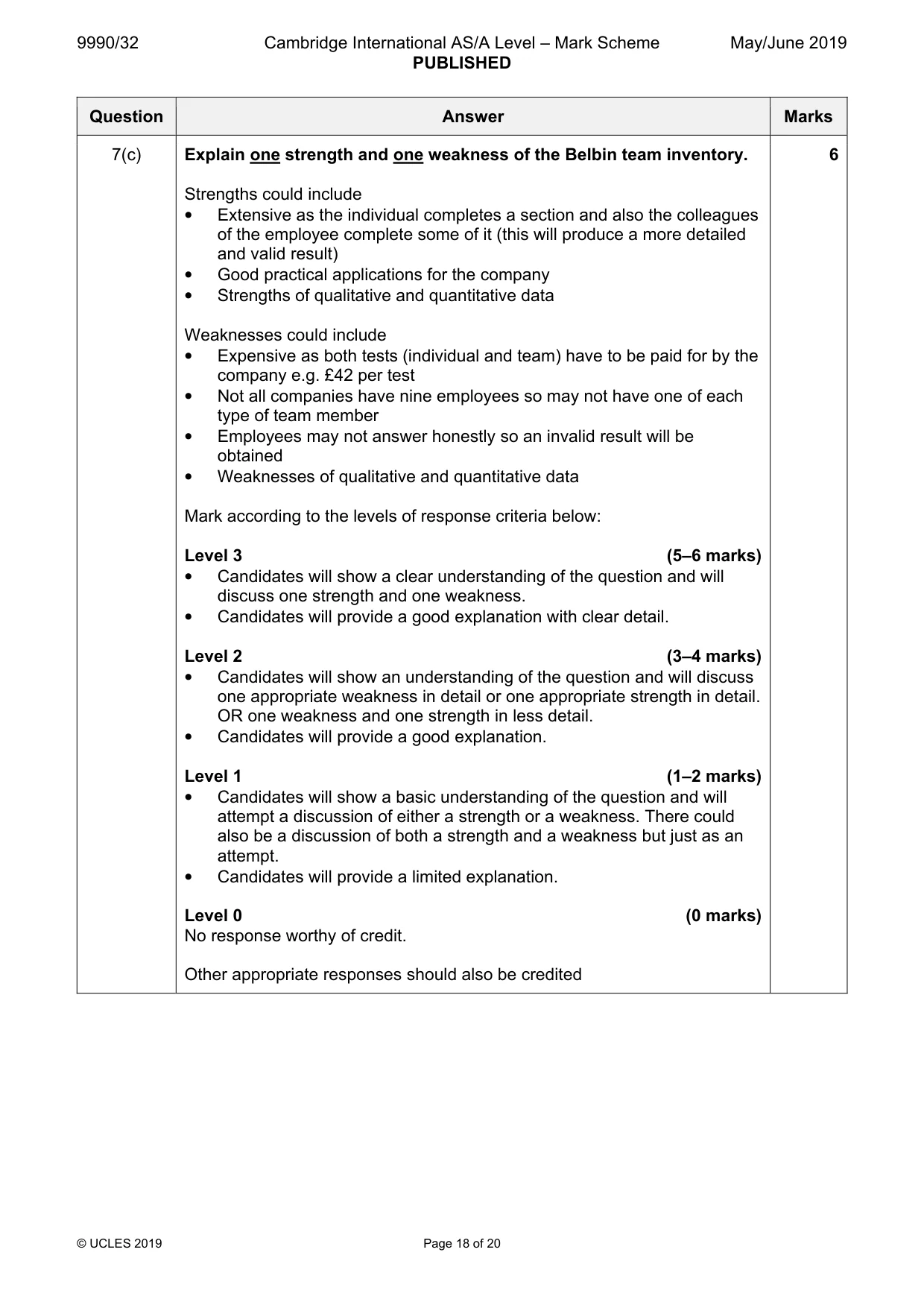
9990/32 Cambridge International AS/A Level – Mark Scheme PUBLISHED May/June 2019 © UCLES 2019 Page 18 of 20 Question Answer Marks 7(c) Explain one strength and one weakness of the Belbin team inventory. Strengths could include • Extensive as the individual completes a section and also the colleagues of the employee complete some of it (this will produce a more detailed and valid result) • Good practical applications for the company • Strengths of qualitative and quantitative data Weaknesses could include • Expensive as both tests (individual and team) have to be paid for by the company e.g. £42 per test • Not all companies have nine employees so may not have one of each type of team member • Employees may not answer honestly so an invalid result will be obtained • Weaknesses of qualitative and quantitative data Mark according to the levels of response criteria below: Level 3 (5–6 marks) • Candidates will show a clear understanding of the question and will discuss one strength and one weakness. • Candidates will provide a good explanation with clear detail. Level 2 (3–4 marks) • Candidates will show an understanding of the question and will discuss one appropriate weakness in detail or one appropriate strength in detail. OR one weakness and one strength in less detail. • Candidates will provide a good explanation. Level 1 (1–2 marks) • Candidates will show a basic understanding of the question and will attempt a discussion of either a strength or a weakness. There could also be a discussion of both a strength and a weakness but just as an attempt. • Candidates will provide a limited explanation. Level 0 (0 marks) No response worthy of credit. Other appropriate responses should also be credited 6
Mark scheme, page 19
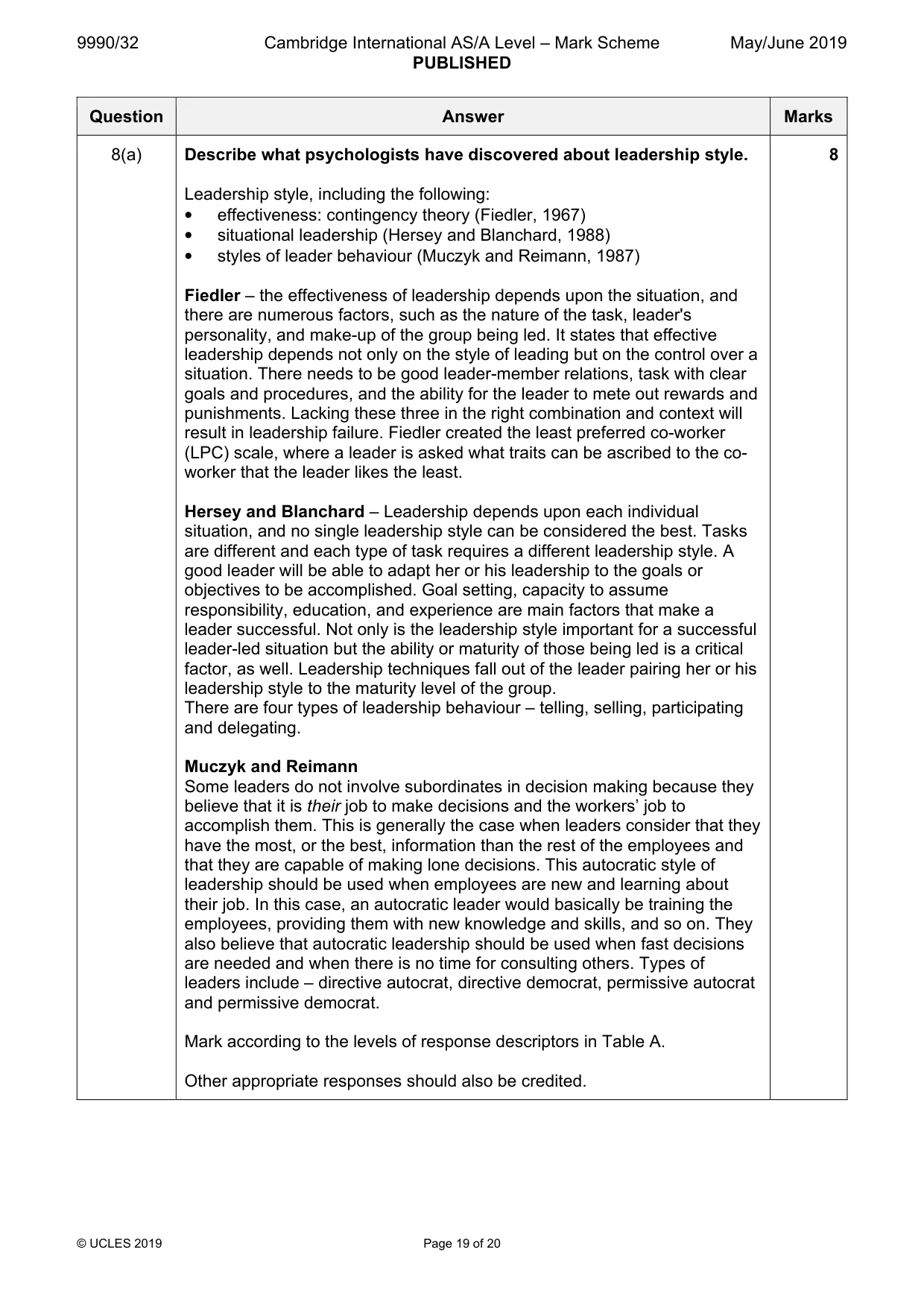
9990/32 Cambridge International AS/A Level – Mark Scheme PUBLISHED May/June 2019 © UCLES 2019 Page 19 of 20 Question Answer Marks 8(a) Describe what psychologists have discovered about leadership style. Leadership style, including the following: • effectiveness: contingency theory (Fiedler, 1967) • situational leadership (Hersey and Blanchard, 1988) • styles of leader behaviour (Muczyk and Reimann, 1987) Fiedler – the effectiveness of leadership depends upon the situation, and there are numerous factors, such as the nature of the task, leader's personality, and make-up of the group being led. It states that effective leadership depends not only on the style of leading but on the control over a situation. There needs to be good leader-member relations, task with clear goals and procedures, and the ability for the leader to mete out rewards and punishments. Lacking these three in the right combination and context will result in leadership failure. Fiedler created the least preferred co-worker (LPC) scale, where a leader is asked what traits can be ascribed to the co- worker that the leader likes the least. Hersey and Blanchard – Leadership depends upon each individual situation, and no single leadership style can be considered the best. Tasks are different and each type of task requires a different leadership style. A good leader will be able to adapt her or his leadership to the goals or objectives to be accomplished. Goal setting, capacity to assume responsibility, education, and experience are main factors that make a leader successful. Not only is the leadership style important for a successful leader-led situation but the ability or maturity of those being led is a critical factor, as well. Leadership techniques fall out of the leader pairing her or his leadership style to the maturity level of the group. There are four types of leadership behaviour – telling, selling, participating and delegating. Muczyk and Reimann Some leaders do not involve subordinates in decision making because they believe that it is their job to make decisions and the workers’ job to accomplish them. This is generally the case when leaders consider that they have the most, or the best, information than the rest of the employees and that they are capable of making lone decisions. This autocratic style of leadership should be used when employees are new and learning about their job. In this case, an autocratic leader would basically be training the employees, providing them with new knowledge and skills, and so on. They also believe that autocratic leadership should be used when fast decisions are needed and when there is no time for consulting others. Types of leaders include – directive autocrat, directive democrat, permissive autocrat and permissive democrat. Mark according to the levels of response descriptors in Table A. Other appropriate responses should also be credited. 8
Mark scheme, page 20
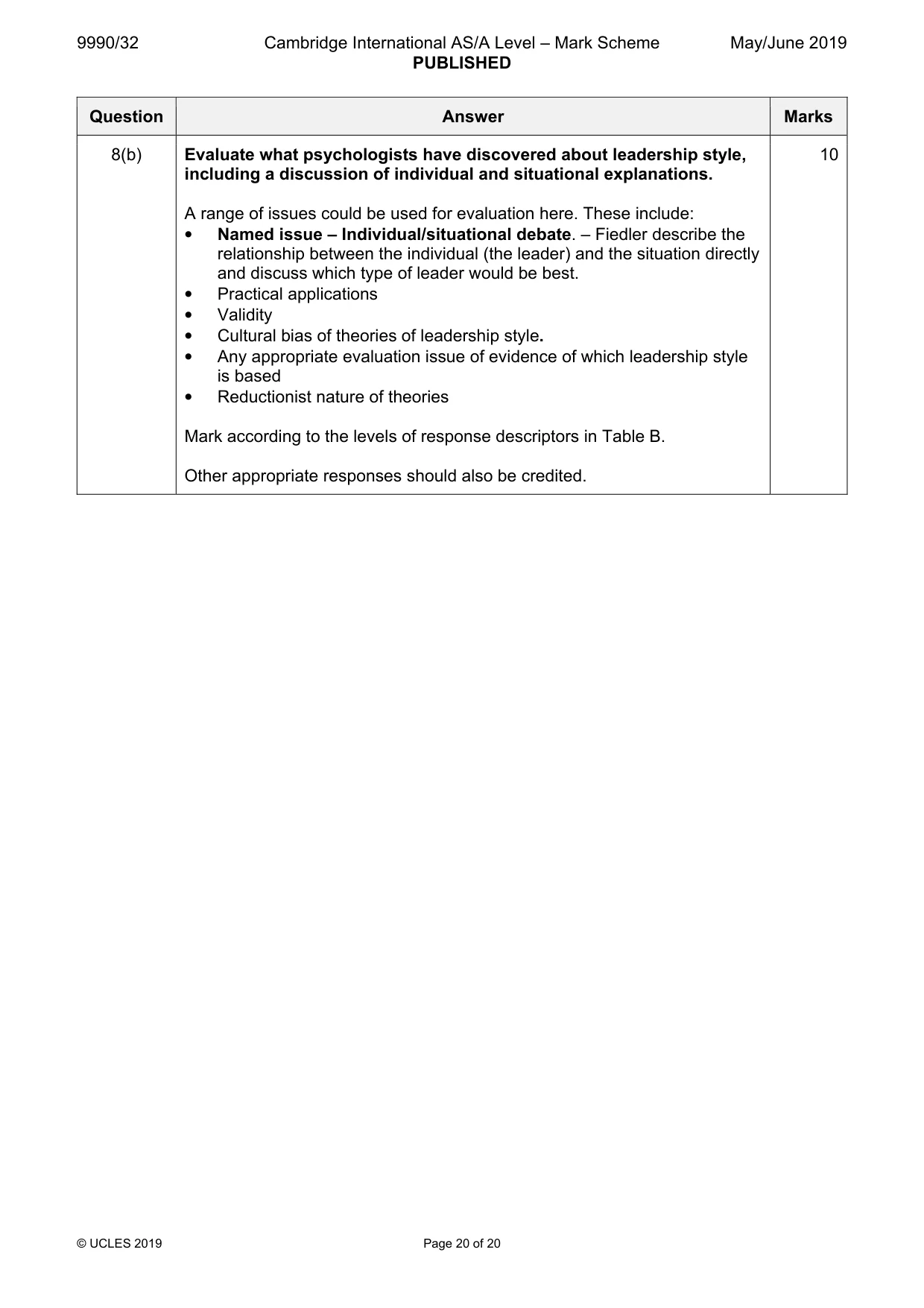
9990/32 Cambridge International AS/A Level – Mark Scheme PUBLISHED May/June 2019 © UCLES 2019 Page 20 of 20 Question Answer Marks 8(b) Evaluate what psychologists have discovered about leadership style, including a discussion of individual and situational explanations. A range of issues could be used for evaluation here. These include: • Named issue – Individual/situational debate. – Fiedler describe the relationship between the individual (the leader) and the situation directly and discuss which type of leader would be best. • Practical applications • Validity • Cultural bias of theories of leadership style. • Any appropriate evaluation issue of evidence of which leadership style is based • Reductionist nature of theories Mark according to the levels of response descriptors in Table B. Other appropriate responses should also be credited. 10
What you needed in this session
Cambridge’s own grade thresholds for 2019 May/June, Paper 3 · Variant 2. A higher threshold means an easier paper — the bar moves with how the cohort did.