Cambridge A Level Psychology (from 2018) 9990 — 2019 May/June Paper 3 · Variant 1
9990/31/M/J/19 · 8 questions · 60 marks · ≈68 min
The question paper and its mark scheme, free to read here and free to download. This is Cambridge’s own paper, exactly as it was sat.
Question paper4 pages
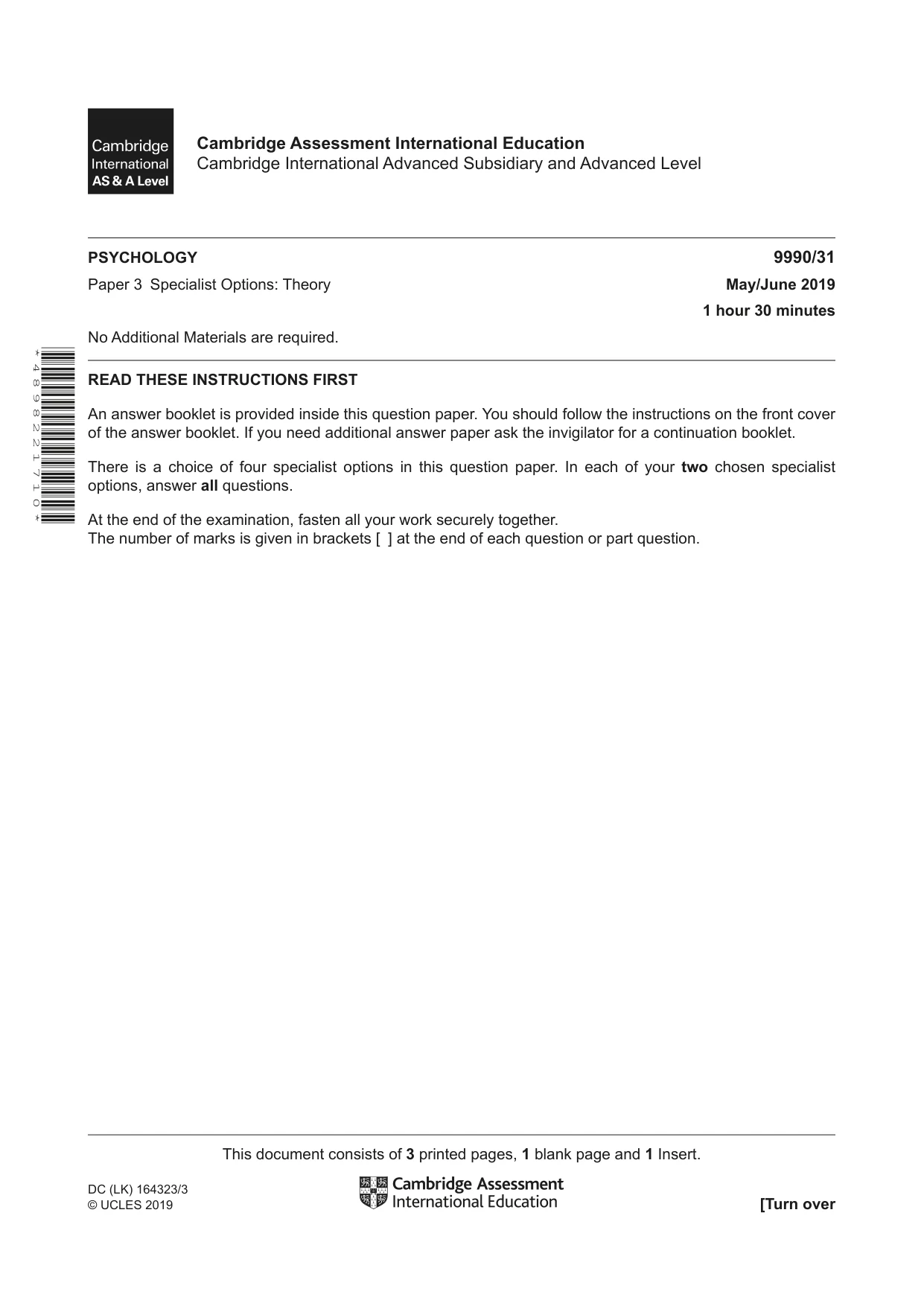
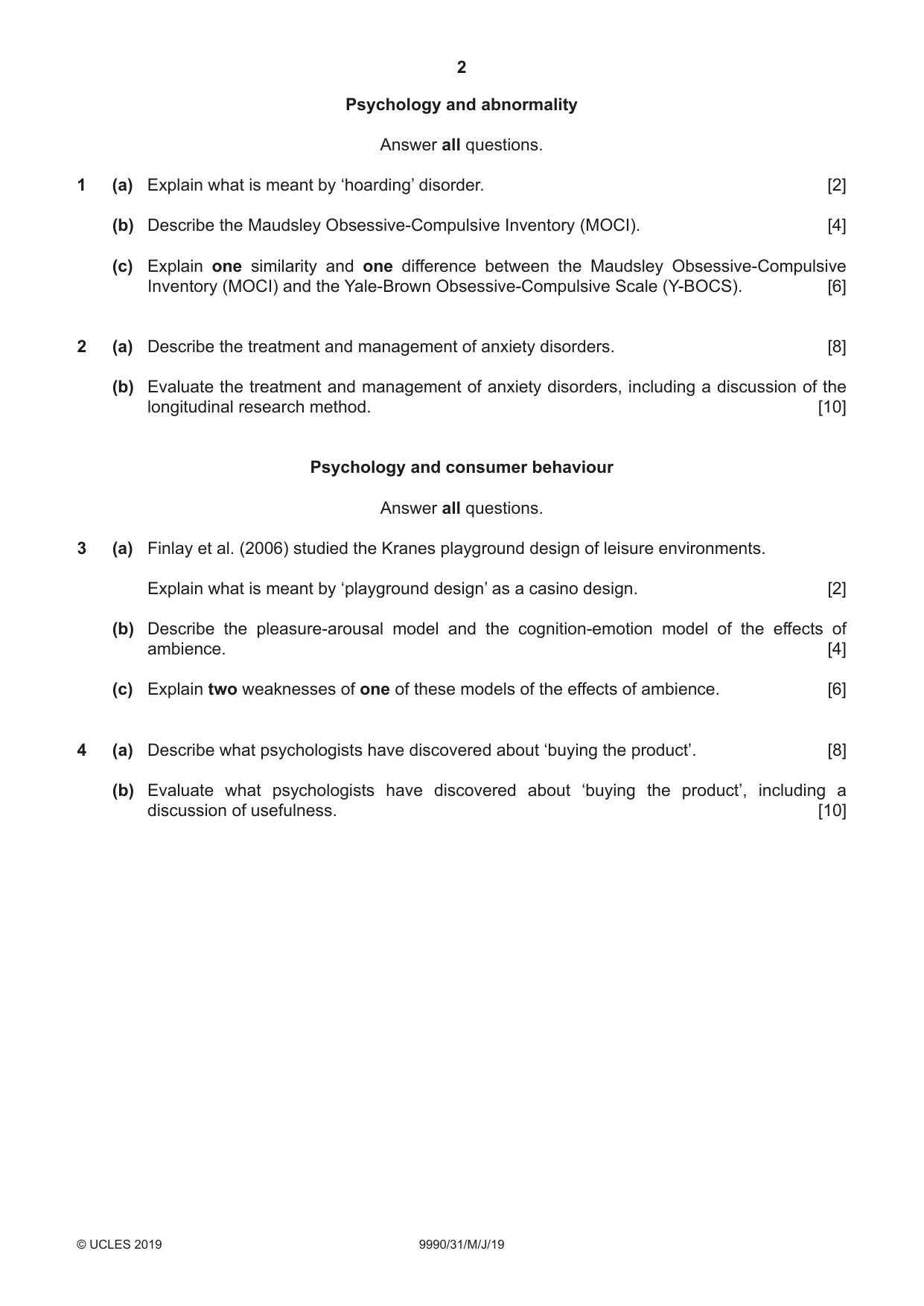
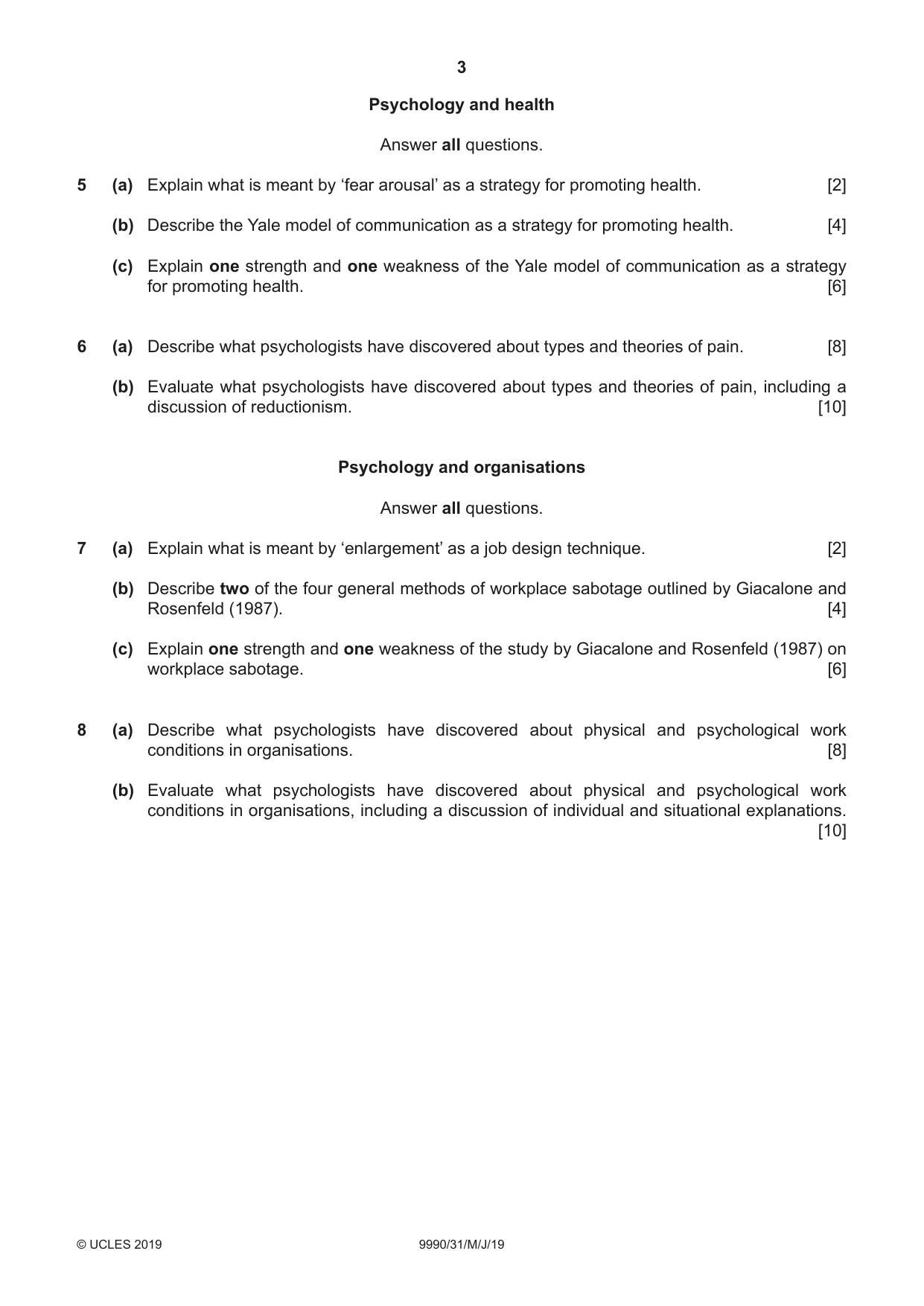

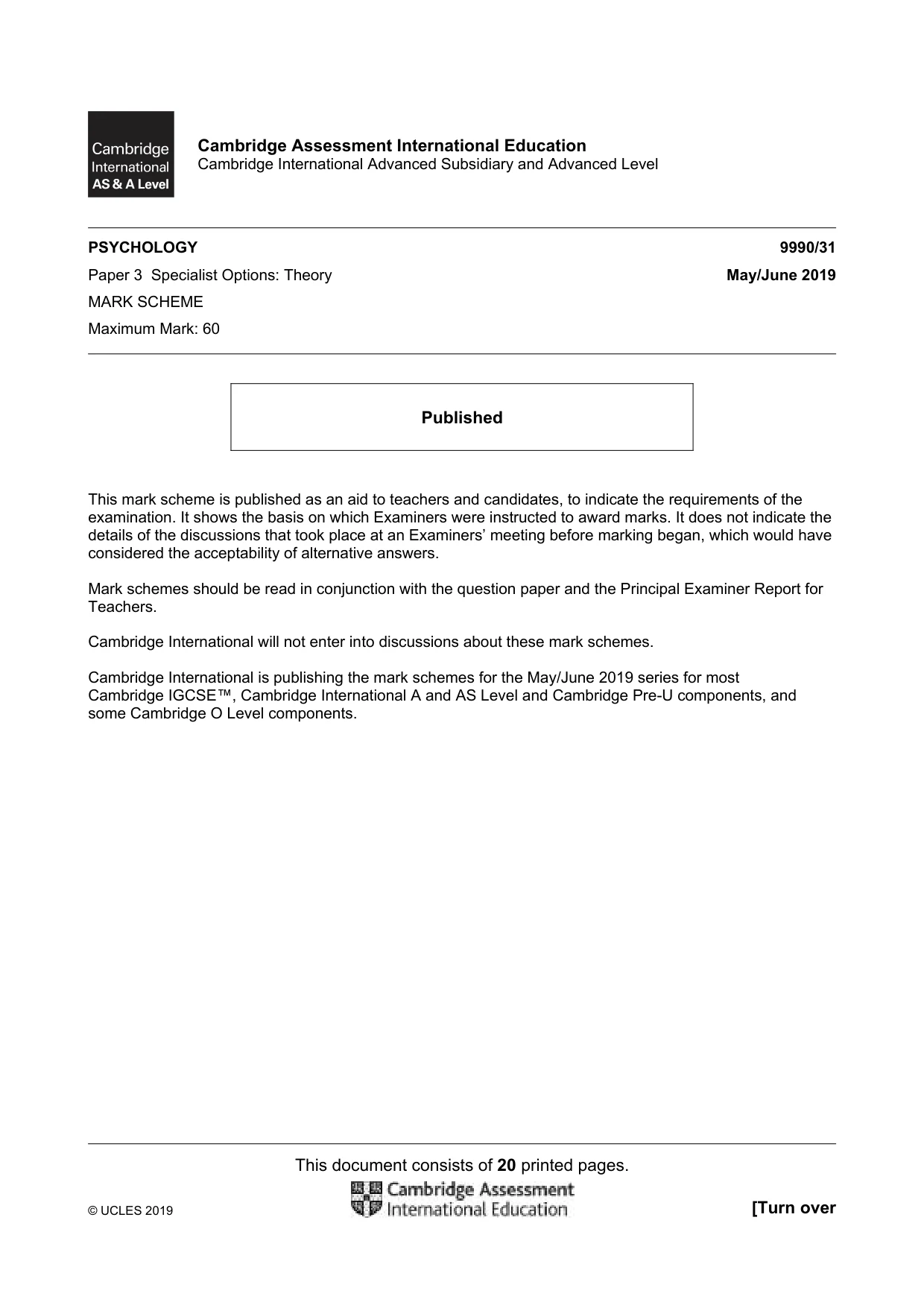
Mark scheme20 pages
Answers below. Sit the paper first if you are practising.
Questions as text
Q1 · Explain what is meant by ‘hoarding’ disorder
1 (a) Explain what is meant by ‘hoarding’ disorder. [2] (b) Describe the Maudsley Obsessive-Compulsive Inventory (MOCI). [4] (c) Explain one similarity and one difference between the Maudsley Obsessive-Compulsive Inventory (MOCI) and the Yale-Brown Obsessive-Compulsive Scale (Y-BOCS). [6]
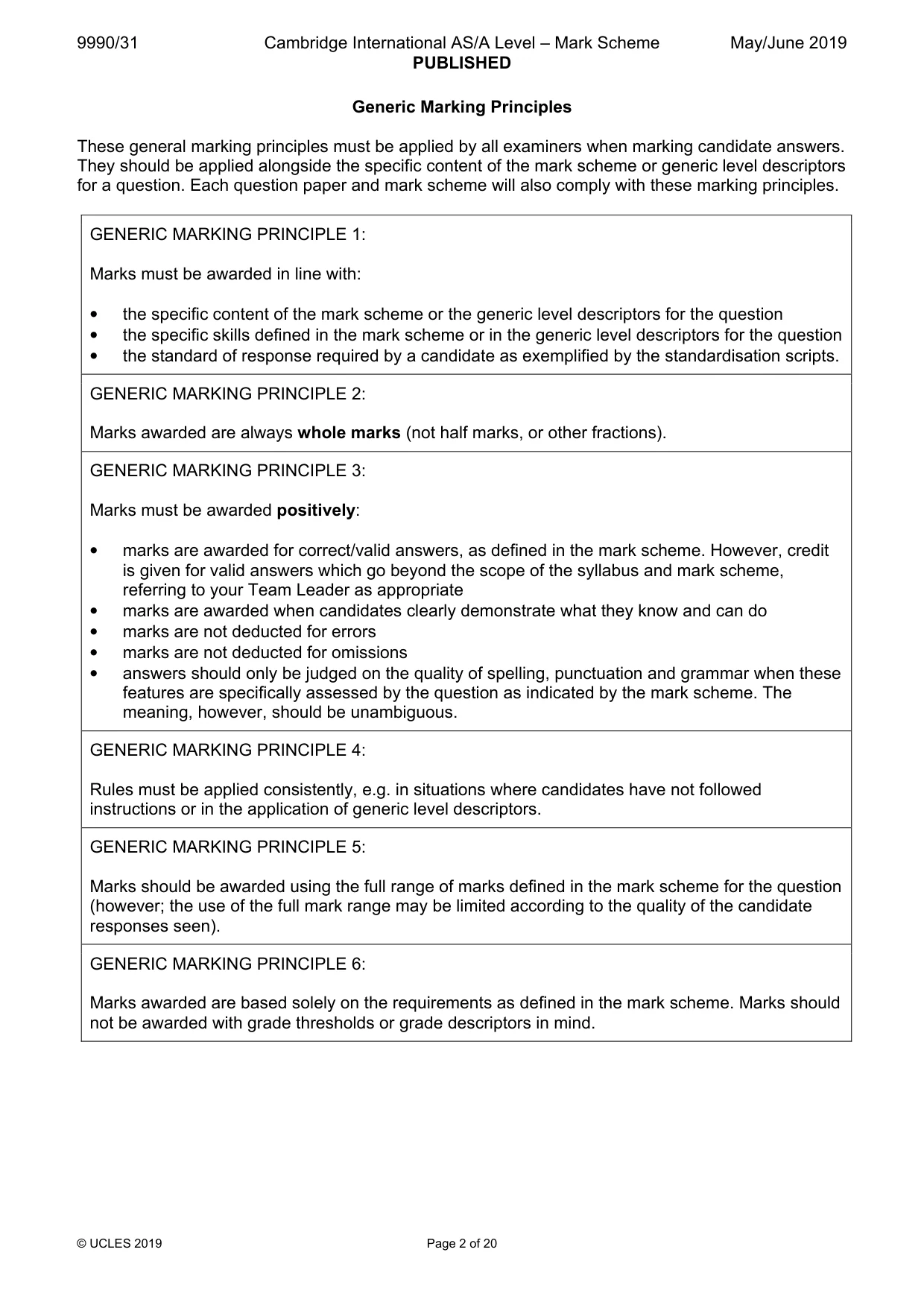
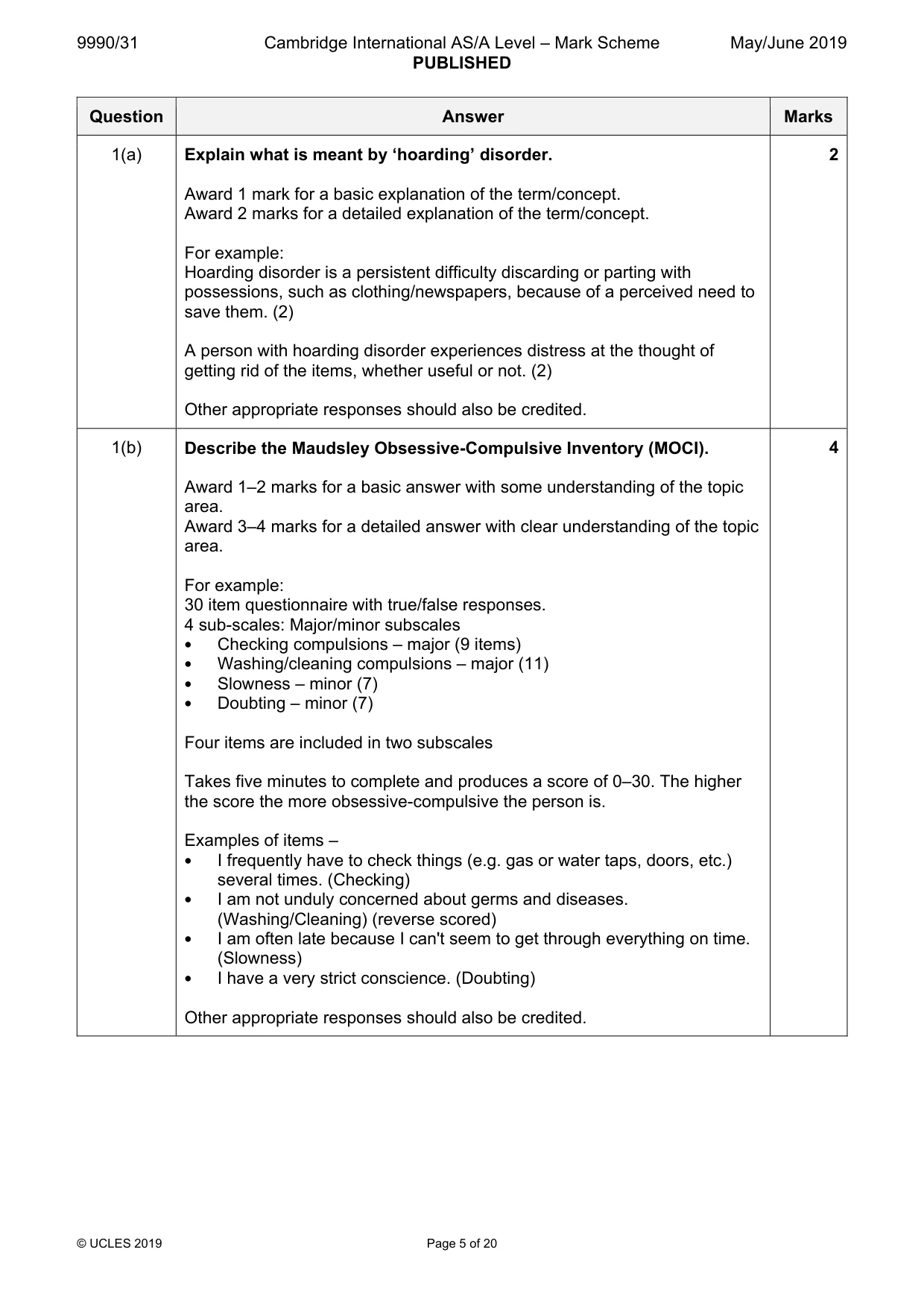
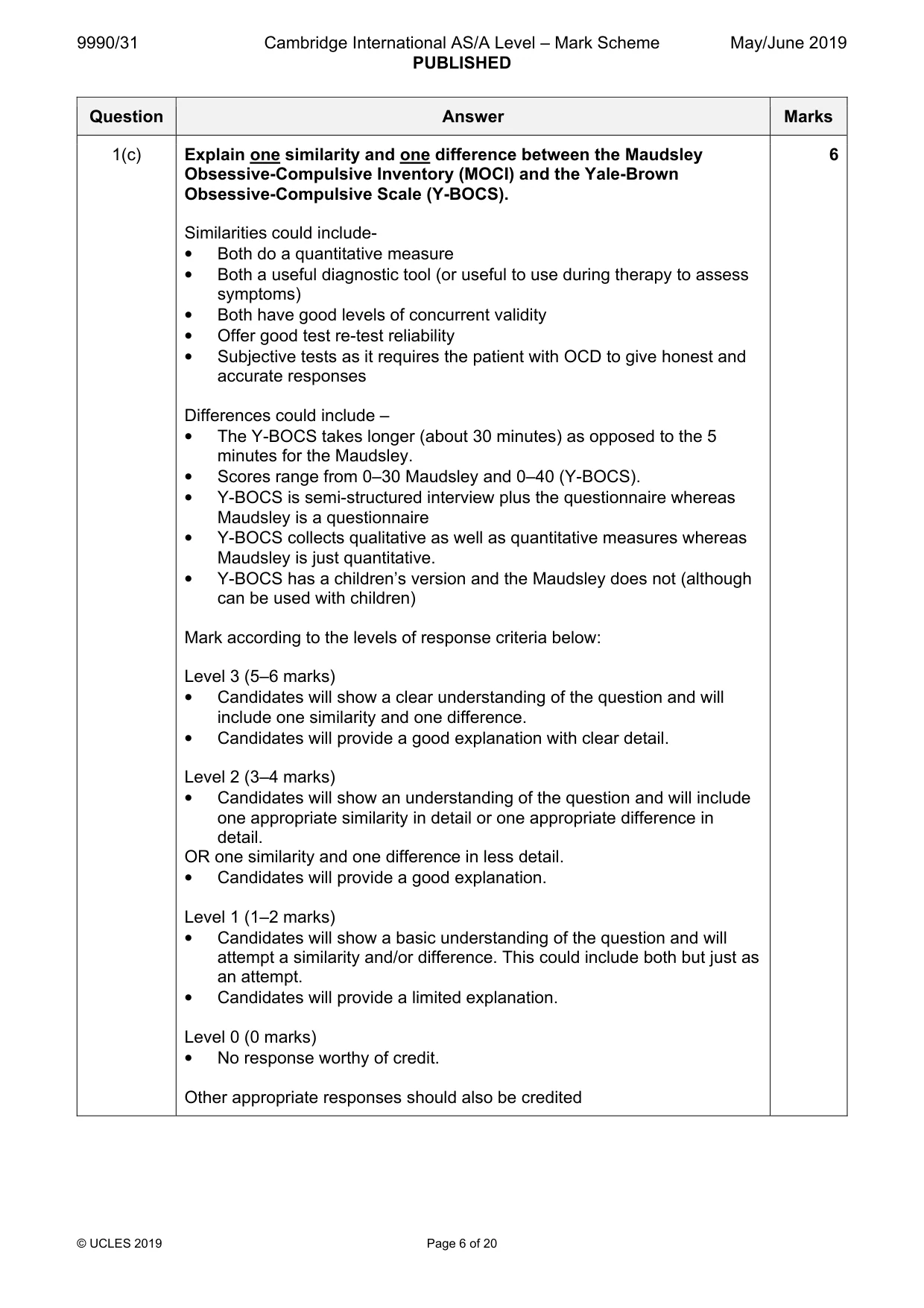
Mark scheme: Question Answer Marks 1(a) Explain what is meant by ‘hoarding’ disorder. 2 Award 1 mark for a basic explanation of the term/concept. Award 2 marks for a detailed explanation of the term/concept. For example: Hoarding disorder is a persistent difficulty discarding or parting with possessions, such as clothing/newspapers, because of a perceived need to save them. (2) A person with hoarding disorder experiences distress at the thought of getting rid of the items, whether useful or not. (2) Other appropriate responses should also be credited. 1(b) Describe the Maudsley Obsessive-Compulsive Inventory (MOCI). 4 Award 1–2 marks for a basic answer with some understanding of the topic area. Award 3–4 marks for a detailed answer with clear understanding of the topic area. For example: 30 item questionnaire with true/false responses. 4 sub-scales: Major/minor subscales • Checking compulsions – major (9 items) • Washing/cleaning compulsions – major (11) • Slowness – minor (7) • Doubting – minor (7) Four items are included in two subscales Takes five minutes to complete and produces a score of 0–30. The higher the score the more obsessive-compulsive the person is. Examples of items – • I frequently have to check things (e.g. gas or water taps, doors, etc.) several times. (Checking) • I am not unduly concerned about germs and diseases. (Washing/Cleaning) (reverse scored) • I am often late because I can't seem to get through everything on time. (Slowness) • I have a very strict conscience. (Doubting) Other appropriate responses should also be credited. 1(c) Explain one similarity and one difference between the Maudsley 6 Obsessive-Compulsive Inventory (MOCI) and the Yale-Brown Obsessive-Compulsive Scale (Y-BOCS). Similarities could include- • Both do a quantitative measure • Both a useful diagnostic tool (or useful to use during therapy to assess symptoms) • Both have good levels of concurrent validity • Offer good test re-test reliability • Subjective tests as it requires the patient with OCD to give honest and accurate responses Differences could include – • The Y-BOCS takes longer (about 30 minutes) as opposed to the 5 minutes for the Maudsley. • Scores range from 0–30 Maudsley and 0–40 (Y-BOCS). • Y-BOCS is semi-structured interview plus the questionnaire whereas Maudsley is a questionnaire • Y-BOCS collects qualitative as well as quantitative measures whereas Maudsley is just quantitative. • Y-BOCS has a children’s version and the Maudsley does not (although can be used with children) Mark according to the levels of response criteria below: Level 3 (5–6 marks) • Candidates will show a clear understanding of the question and will include one similarity and one difference. • Candidates will provide a good explanation with clear detail. Level 2 (3–4 marks) • Candidates will show an understanding of the question and will include one appropriate similarity in detail or one appropriate difference in detail. OR one similarity and one difference in less detail. • Candidates will provide a good explanation. Level 1 (1–2 marks) • Candidates will show a basic understanding of the question and will attempt a similarity and/or difference. This could include both but just as an attempt. • Candidates will provide a limited explanation. Level 0 (0 marks) • No response worthy of credit. Other appropriate responses should also be credited
Q2 · Describe the treatment and management of anxiety disorders
2 (a) Describe the treatment and management of anxiety disorders. [8] (b) Evaluate the treatment and management of anxiety disorders, including a discussion of the longitudinal research method. [10] Psychology and consumer behaviour Answer all questions.
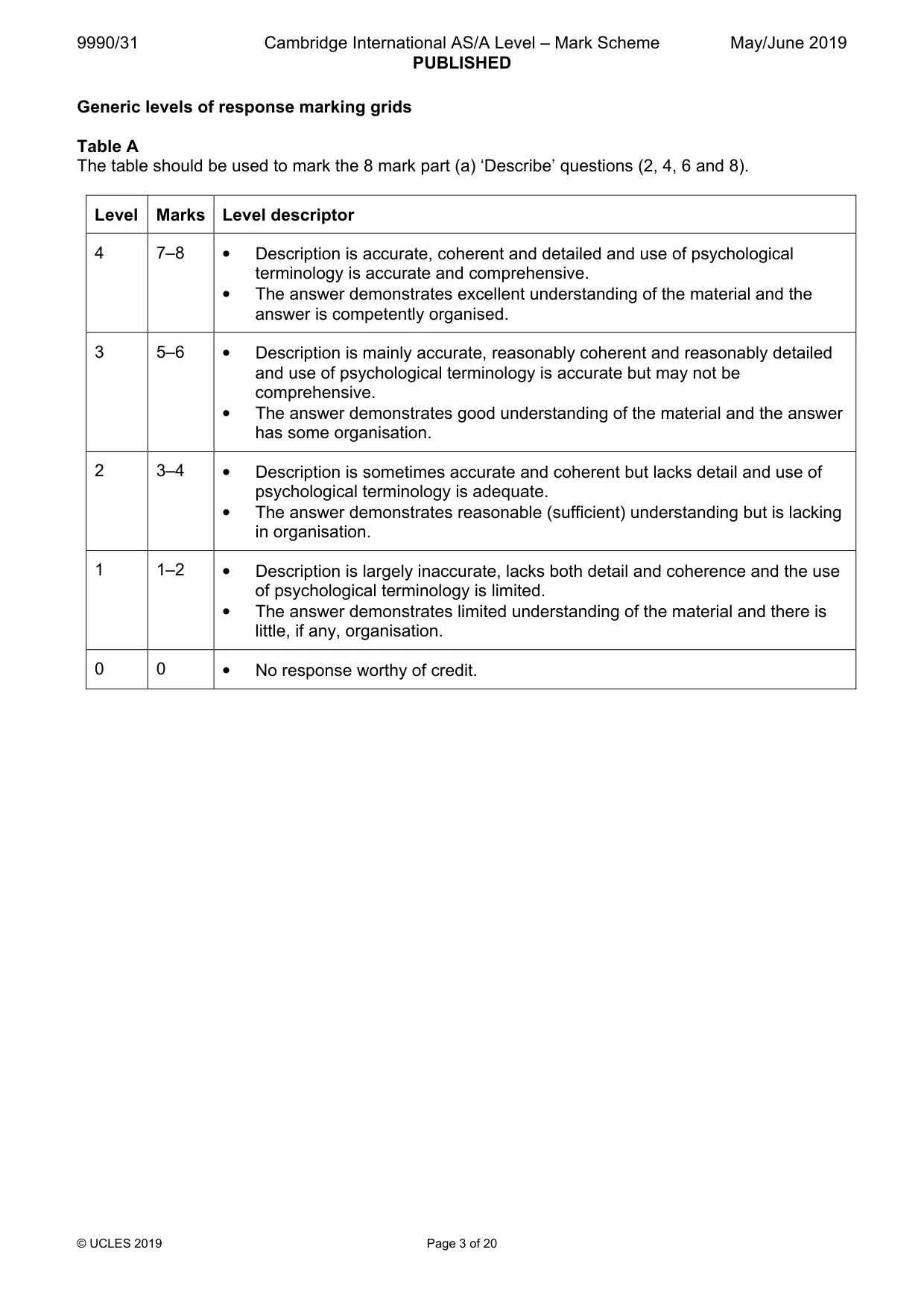
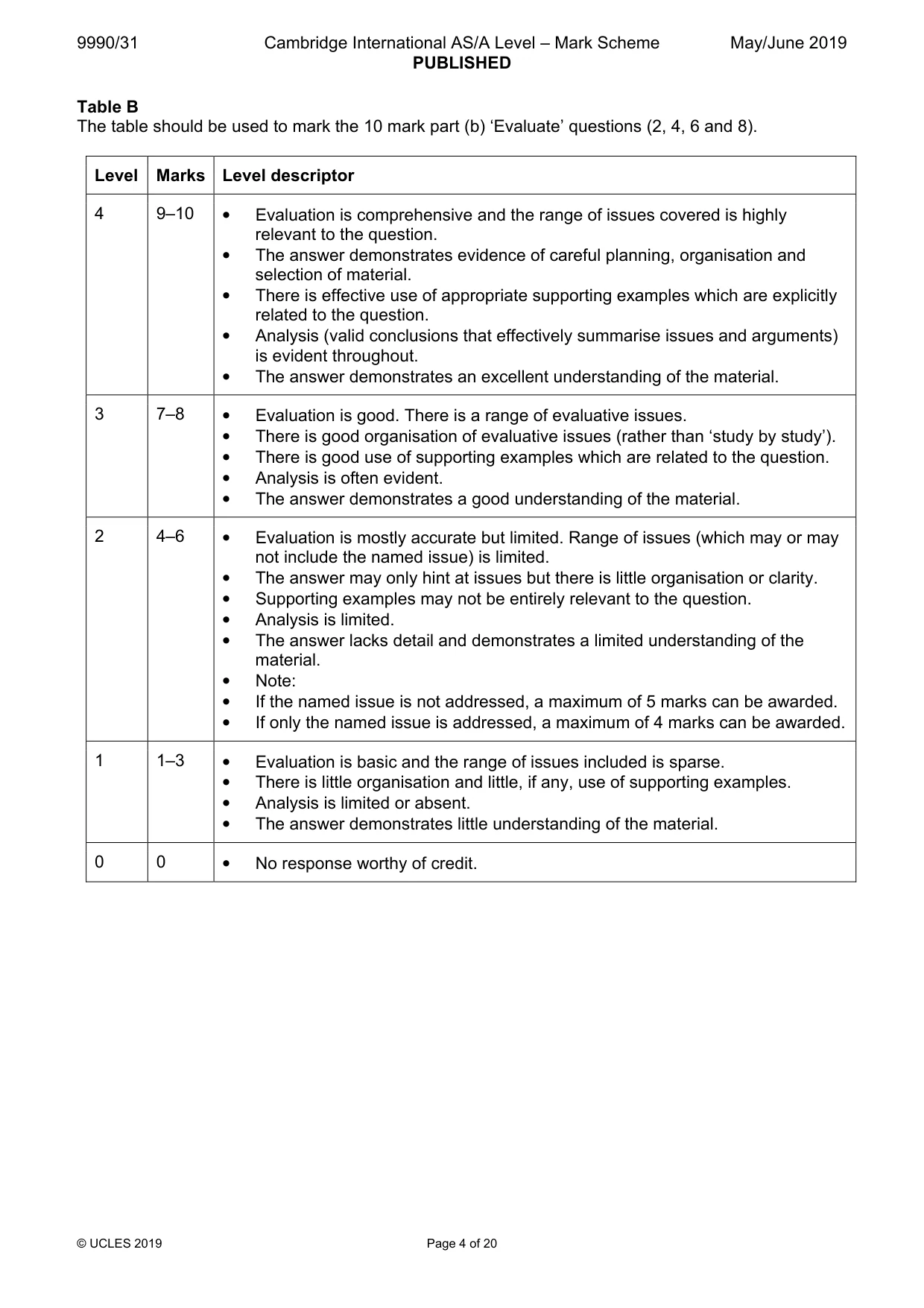
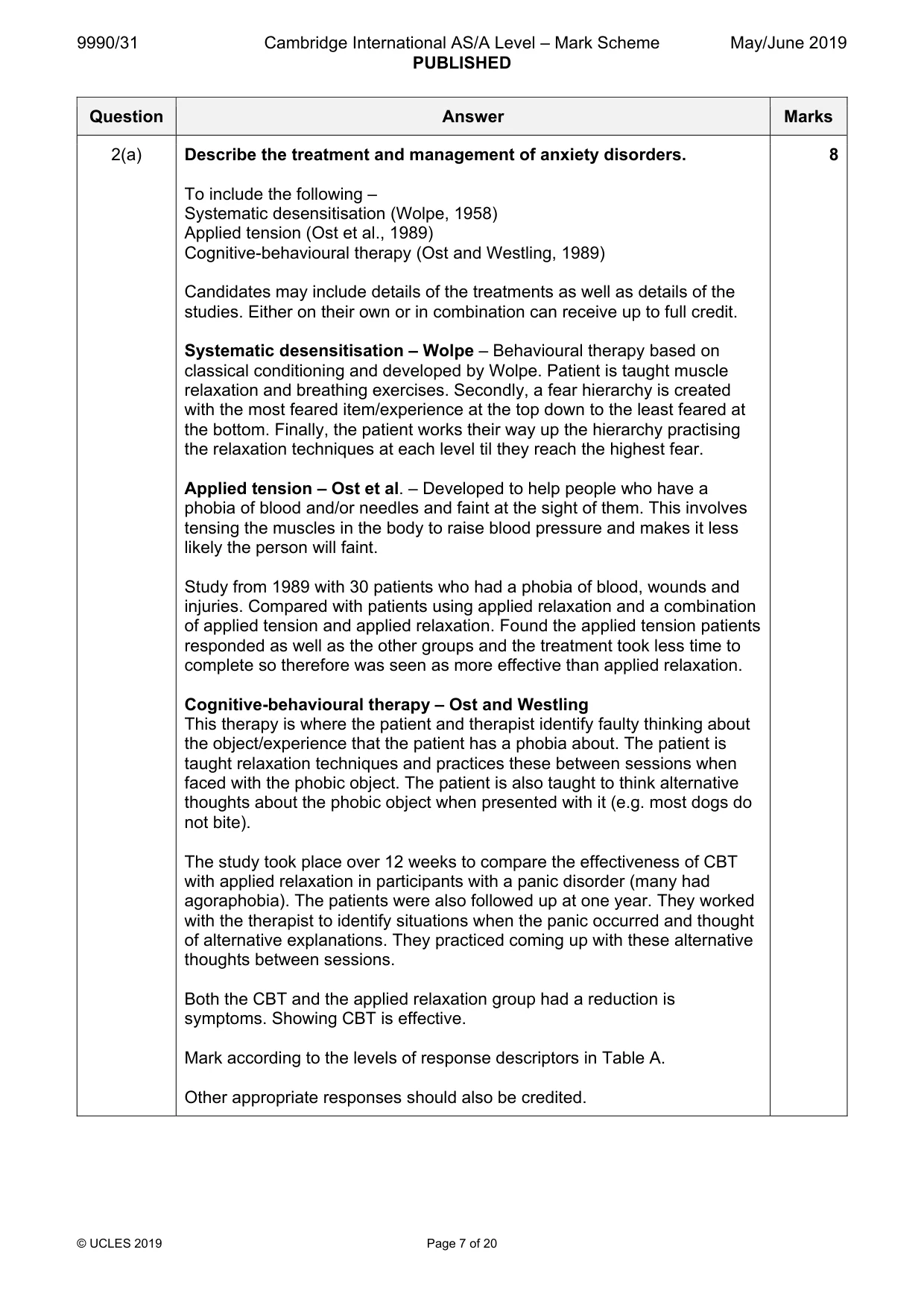
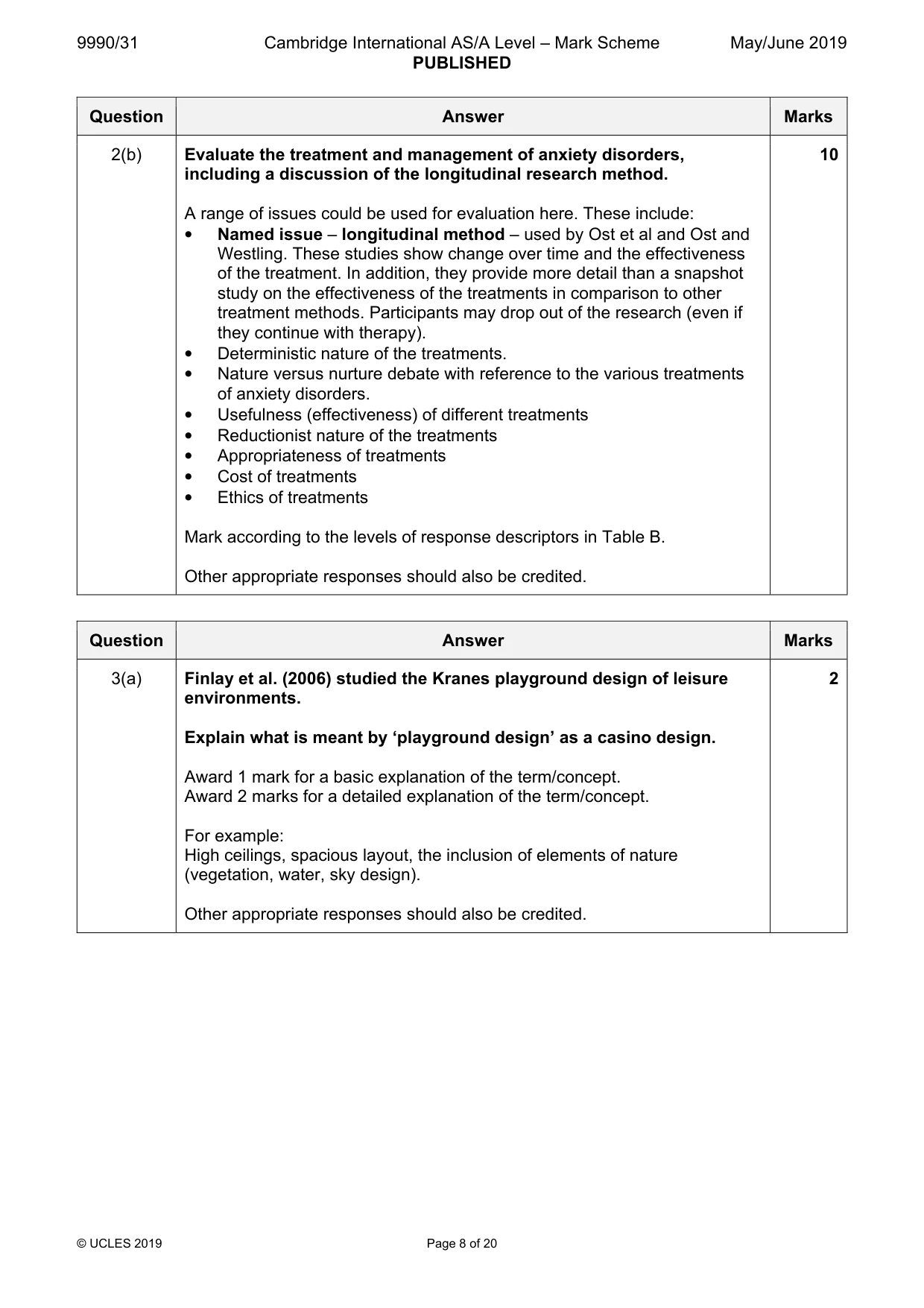
Mark scheme: 2(a) Describe the treatment and management of anxiety disorders. 8 To include the following – Systematic desensitisation (Wolpe, 1958) Applied tension (Ost et al., 1989) Cognitive-behavioural therapy (Ost and Westling, 1989) Candidates may include details of the treatments as well as details of the studies. Either on their own or in combination can receive up to full credit. Systematic desensitisation – Wolpe – Behavioural therapy based on classical conditioning and developed by Wolpe. Patient is taught muscle relaxation and breathing exercises. Secondly, a fear hierarchy is created with the most feared item/experience at the top down to the least feared at the bottom. Finally, the patient works their way up the hierarchy practising the relaxation techniques at each level til they reach the highest fear. Applied tension – Ost et al. – Developed to help people who have a phobia of blood and/or needles and faint at the sight of them. This involves tensing the muscles in the body to raise blood pressure and makes it less likely the person will faint. Study from 1989 with 30 patients who had a phobia of blood, wounds and injuries. Compared with patients using applied relaxation and a combination of applied tension and applied relaxation. Found the applied tension patients responded as well as the other groups and the treatment took less time to complete so therefore was seen as more effective than applied relaxation. Cognitive-behavioural therapy – Ost and Westling This therapy is where the patient and therapist identify faulty thinking about the object/experience that the patient has a phobia about. The patient is taught relaxation techniques and practices these between sessions when faced with the phobic object. The patient is also taught to think alternative thoughts about the phobic object when presented with it (e.g. most dogs do not bite). The study took place over 12 weeks to compare the effectiveness of CBT with applied relaxation in participants with a panic disorder (many had agoraphobia). The patients were also followed up at one year. They worked with the therapist to identify situations when the panic occurred and thought of alternative explanations. They practiced coming up with these alternative thoughts between sessions. Both the CBT and the applied relaxation group had a reduction is symptoms. Showing CBT is effective. Mark according to the levels of response descriptors in Table A. Other appropriate responses should also be credited. 2(b) Evaluate the treatment and management of anxiety disorders, 10 including a discussion of the longitudinal research method. A range of issues could be used for evaluation here. These include: • Named issue – longitudinal method – used by Ost et al and Ost and Westling. These studies show change over time and the effectiveness of the treatment. In addition, they provide more detail than a snapshot study on the effectiveness of the treatments in comparison to other treatment methods. Participants may drop out of the research (even if they continue with therapy). • Deterministic nature of the treatments. • Nature versus nurture debate with reference to the various treatments of anxiety disorders. • Usefulness (effectiveness) of different treatments • Reductionist nature of the treatments • Appropriateness of treatments • Cost of treatments • Ethics of treatments Mark according to the levels of response descriptors in Table B. Other appropriate responses should also be credited.
More questions on Anxiety disorders and fear-related disorders
Question 3
3 (a) Finlay et al. (2006) studied the Kranes playground design of leisure environments. Explain what is meant by ‘playground design’ as a casino design. [2] (b) Describe the pleasure-arousal model and the cognition-emotion model of the effects of ambience. [4] (c) Explain two weaknesses of one of these models of the effects of ambience. [6]
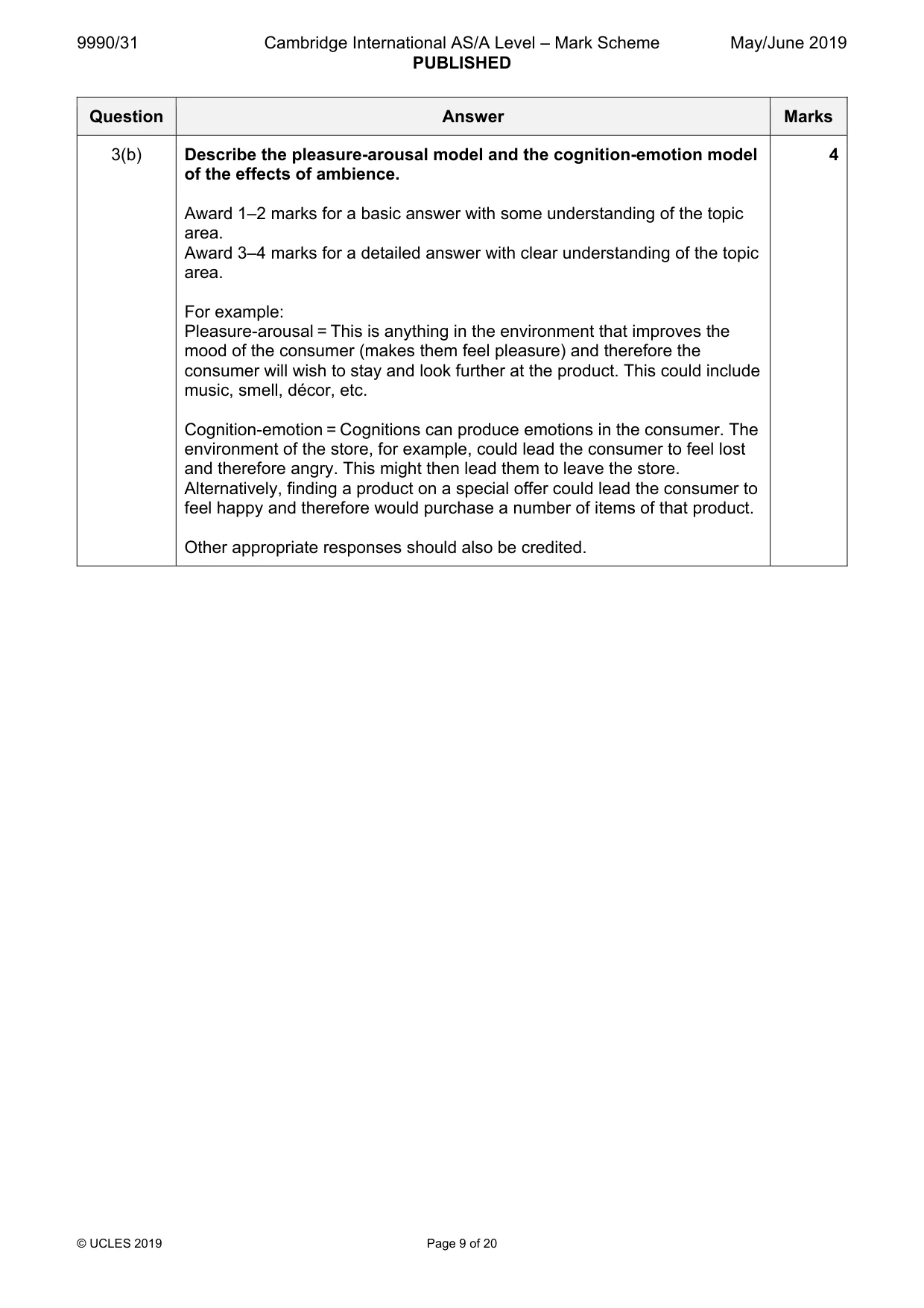
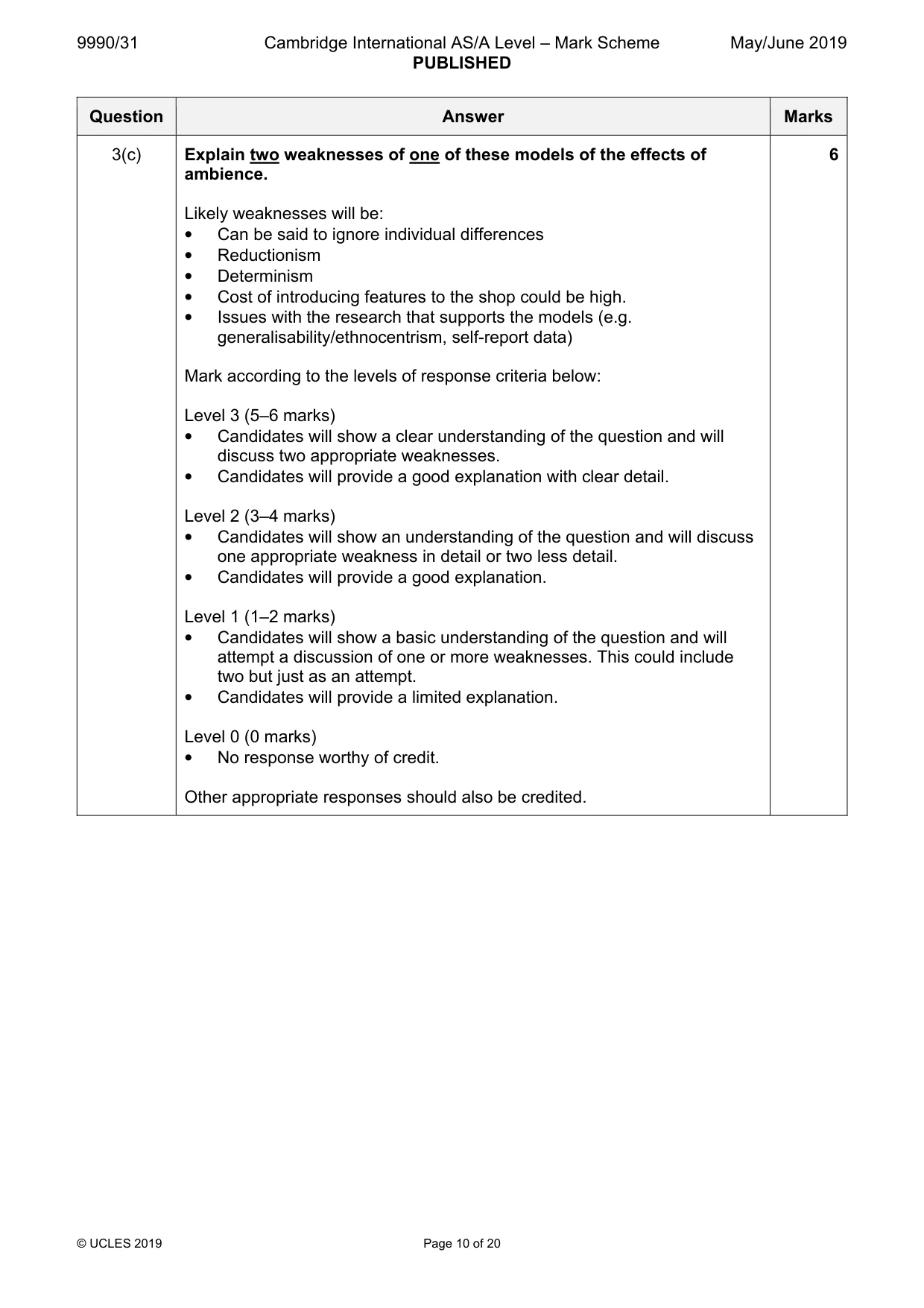
Mark scheme: 3(a) Finlay et al. (2006) studied the Kranes playground design of leisure 2 environments. Explain what is meant by ‘playground design’ as a casino design. Award 1 mark for a basic explanation of the term/concept. Award 2 marks for a detailed explanation of the term/concept. For example: High ceilings, spacious layout, the inclusion of elements of nature (vegetation, water, sky design). Other appropriate responses should also be credited. 3(b) Describe the pleasure-arousal model and the cognition-emotion model 4 of the effects of ambience. Award 1–2 marks for a basic answer with some understanding of the topic area. Award 3–4 marks for a detailed answer with clear understanding of the topic area. For example: Pleasure-arousal = This is anything in the environment that improves the mood of the consumer (makes them feel pleasure) and therefore the consumer will wish to stay and look further at the product. This could include music, smell, décor, etc. Cognition-emotion = Cognitions can produce emotions in the consumer. The environment of the store, for example, could lead the consumer to feel lost and therefore angry. This might then lead them to leave the store. Alternatively, finding a product on a special offer could lead the consumer to feel happy and therefore would purchase a number of items of that product. Other appropriate responses should also be credited. 3(c) Explain two weaknesses of one of these models of the effects of 6 ambience. Likely weaknesses will be: • Can be said to ignore individual differences • Reductionism • Determinism • Cost of introducing features to the shop could be high. • Issues with the research that supports the models (e.g. generalisability/ethnocentrism, self-report data) Mark according to the levels of response criteria below: Level 3 (5–6 marks) • Candidates will show a clear understanding of the question and will discuss two appropriate weaknesses. • Candidates will provide a good explanation with clear detail. Level 2 (3–4 marks) • Candidates will show an understanding of the question and will discuss one appropriate weakness in detail or two less detail. • Candidates will provide a good explanation. Level 1 (1–2 marks) • Candidates will show a basic understanding of the question and will attempt a discussion of one or more weaknesses. This could include two but just as an attempt. • Candidates will provide a limited explanation. Level 0 (0 marks) • No response worthy of credit. Other appropriate responses should also be credited.
Q4 · Describe what psychologists have discovered about ‘buying the product’
4 (a) Describe what psychologists have discovered about ‘buying the product’. [8] (b) Evaluate what psychologists have discovered about ‘buying the product’, including a discussion of usefulness. [10] Psychology and health Answer all questions.
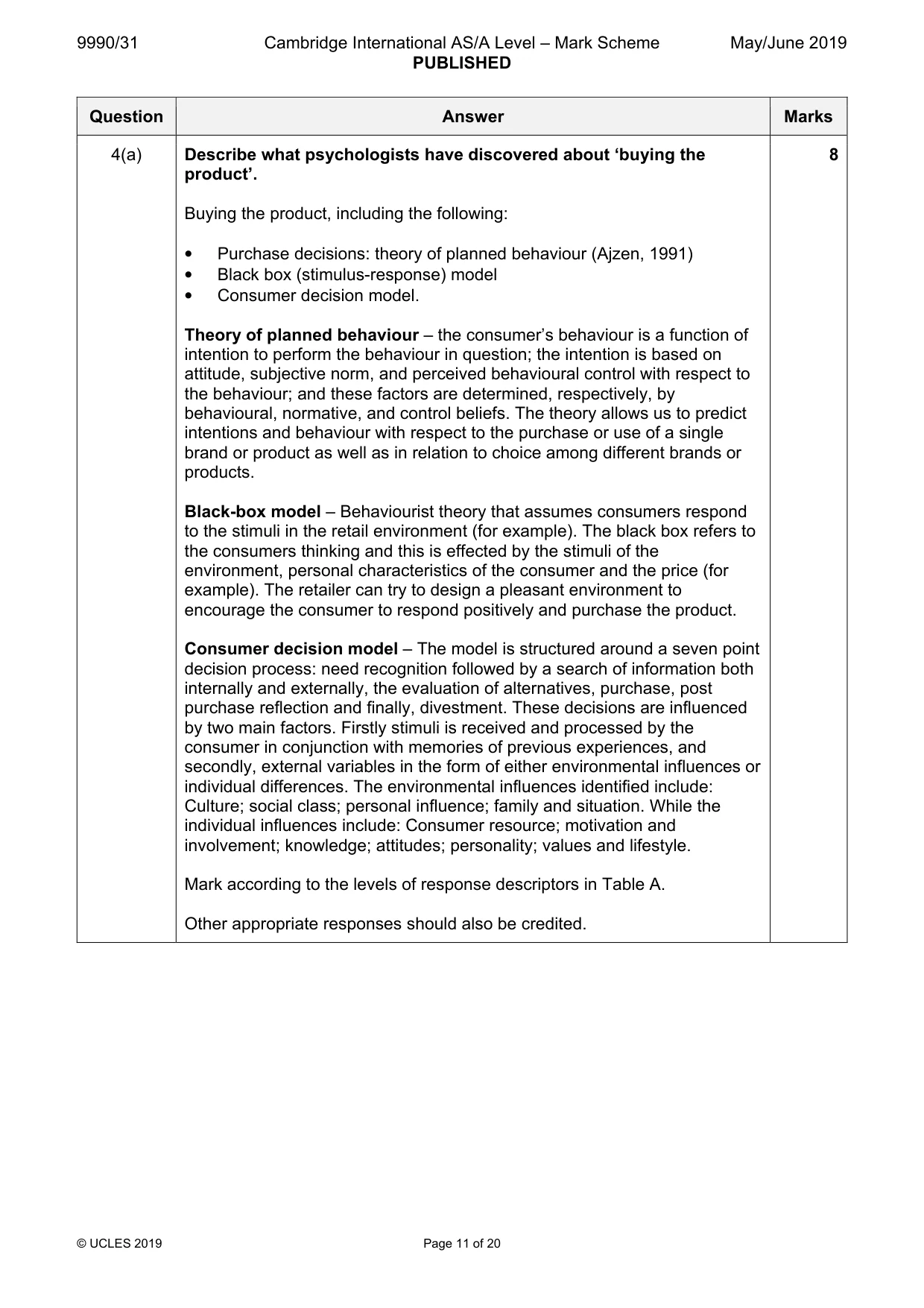
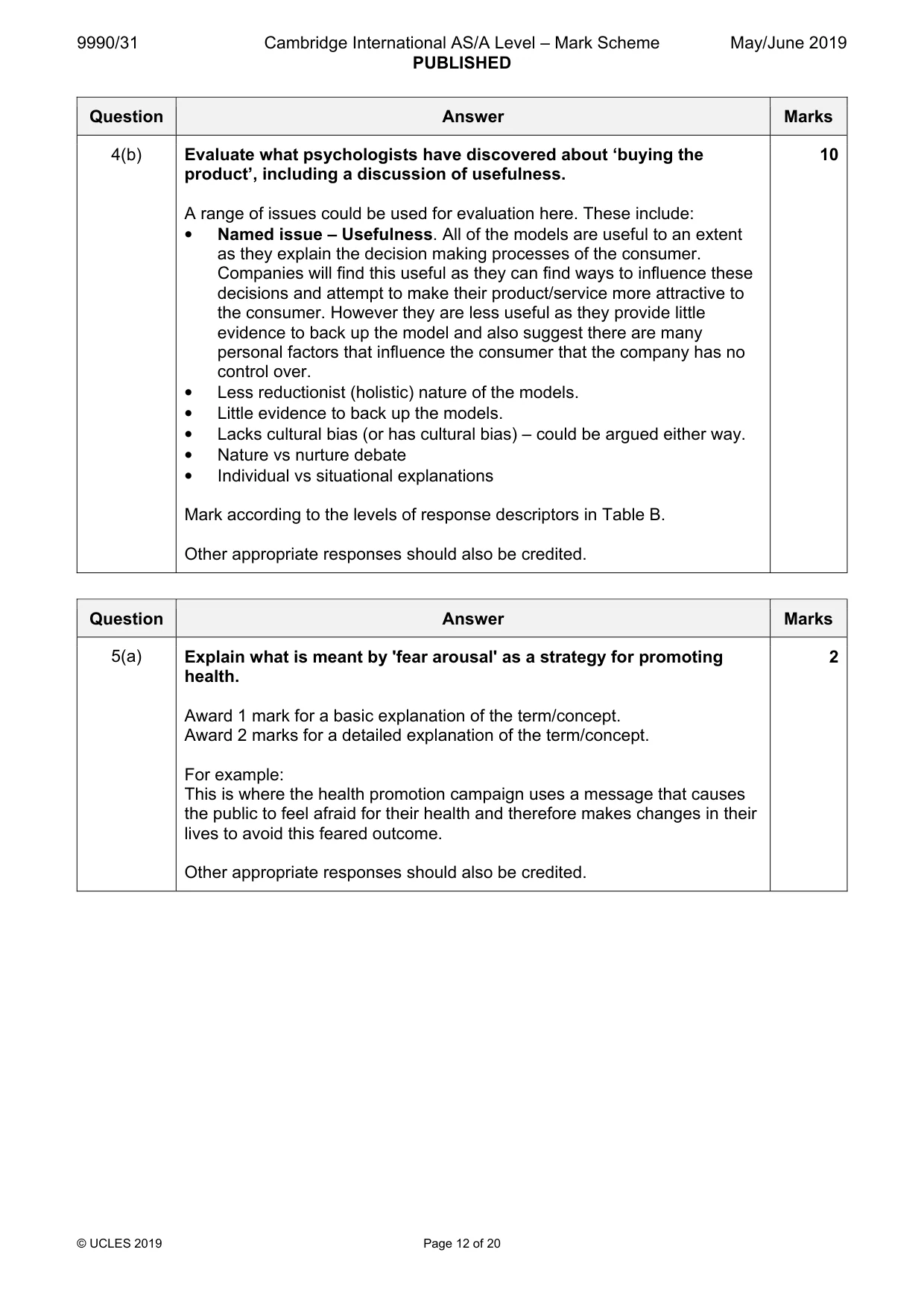
Mark scheme: 4(a) Describe what psychologists have discovered about ‘buying the 8 product’. Buying the product, including the following: • Purchase decisions: theory of planned behaviour (Ajzen, 1991) • Black box (stimulus-response) model • Consumer decision model. Theory of planned behaviour – the consumer’s behaviour is a function of intention to perform the behaviour in question; the intention is based on attitude, subjective norm, and perceived behavioural control with respect to the behaviour; and these factors are determined, respectively, by behavioural, normative, and control beliefs. The theory allows us to predict intentions and behaviour with respect to the purchase or use of a single brand or product as well as in relation to choice among different brands or products. Black-box model – Behaviourist theory that assumes consumers respond to the stimuli in the retail environment (for example). The black box refers to the consumers thinking and this is effected by the stimuli of the environment, personal characteristics of the consumer and the price (for example). The retailer can try to design a pleasant environment to encourage the consumer to respond positively and purchase the product. Consumer decision model – The model is structured around a seven point decision process: need recognition followed by a search of information both internally and externally, the evaluation of alternatives, purchase, post purchase reflection and finally, divestment. These decisions are influenced by two main factors. Firstly stimuli is received and processed by the consumer in conjunction with memories of previous experiences, and secondly, external variables in the form of either environmental influences or individual differences. The environmental influences identified include: Culture; social class; personal influence; family and situation. While the individual influences include: Consumer resource; motivation and involvement; knowledge; attitudes; personality; values and lifestyle. Mark according to the levels of response descriptors in Table A. Other appropriate responses should also be credited. 4(b) Evaluate what psychologists have discovered about ‘buying the 10 product’, including a discussion of usefulness. A range of issues could be used for evaluation here. These include: • Named issue – Usefulness. All of the models are useful to an extent as they explain the decision making processes of the consumer. Companies will find this useful as they can find ways to influence these decisions and attempt to make their product/service more attractive to the consumer. However they are less useful as they provide little evidence to back up the model and also suggest there are many personal factors that influence the consumer that the company has no control over. • Less reductionist (holistic) nature of the models. • Little evidence to back up the models. • Lacks cultural bias (or has cultural bias) – could be argued either way. • Nature vs nurture debate • Individual vs situational explanations Mark according to the levels of response descriptors in Table B. Other appropriate responses should also be credited.
Q5 · Explain what is meant by ‘fear arousal’ as a strategy for promoting health
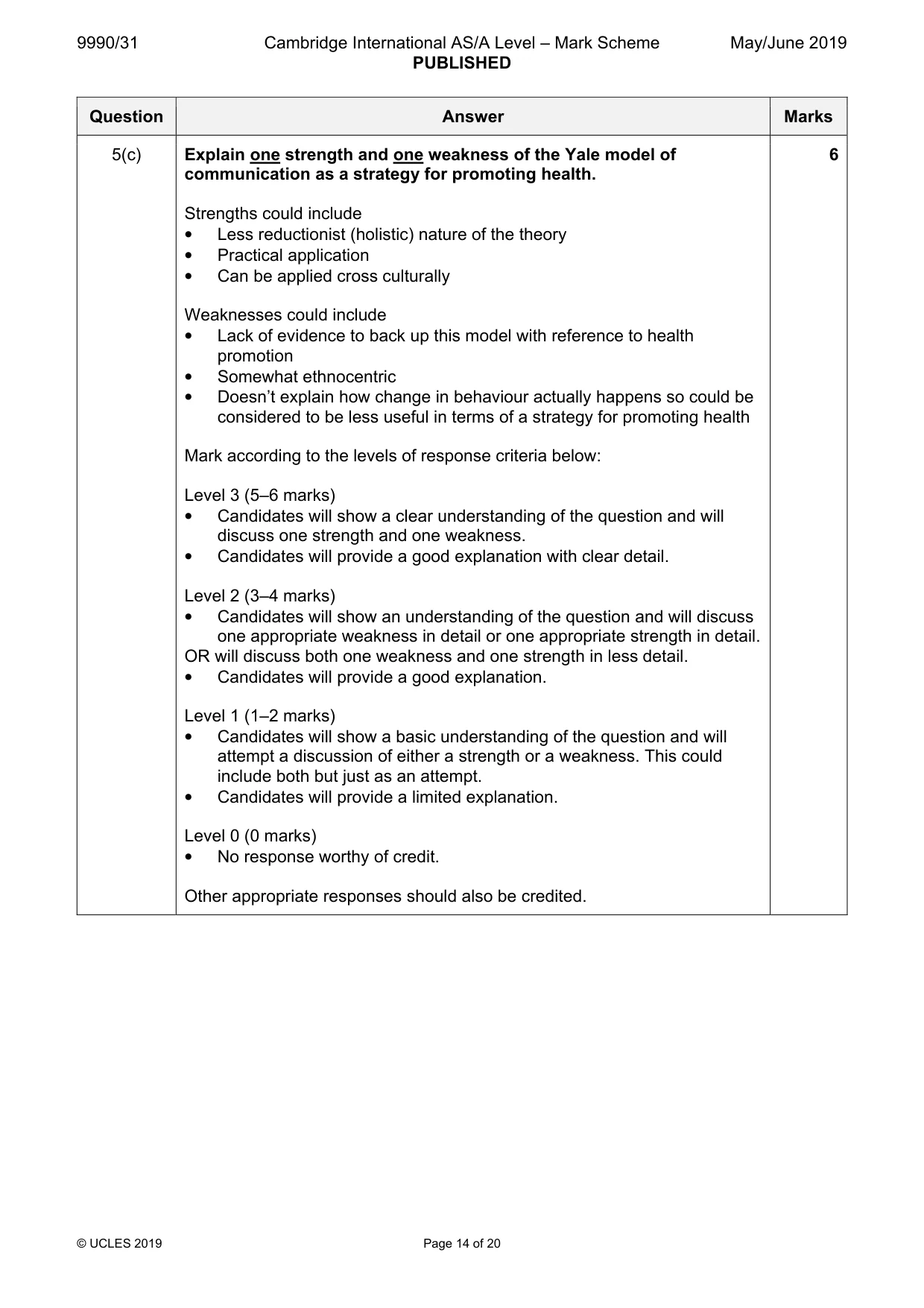
5 (a) Explain what is meant by ‘fear arousal’ as a strategy for promoting health. [2] (b) Describe the Yale model of communication as a strategy for promoting health. [4] (c) Explain one strength and one weakness of the Yale model of communication as a strategy for promoting health. [6]
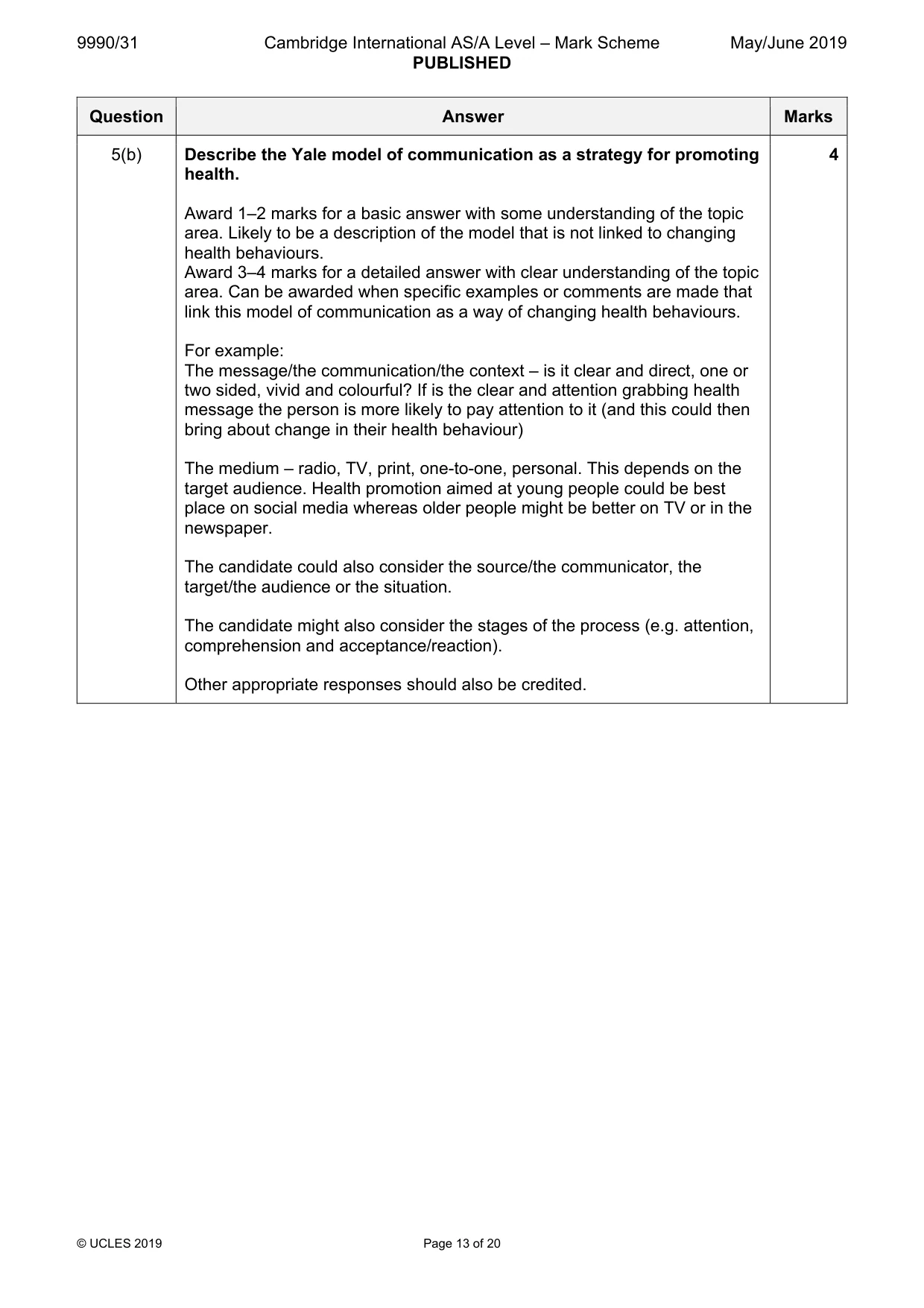
Mark scheme: 5(a) Explain what is meant by 'fear arousal' as a strategy for promoting 2 health. Award 1 mark for a basic explanation of the term/concept. Award 2 marks for a detailed explanation of the term/concept. For example: This is where the health promotion campaign uses a message that causes the public to feel afraid for their health and therefore makes changes in their lives to avoid this feared outcome. Other appropriate responses should also be credited. 5(b) Describe the Yale model of communication as a strategy for promoting 4 health. Award 1–2 marks for a basic answer with some understanding of the topic area. Likely to be a description of the model that is not linked to changing health behaviours. Award 3–4 marks for a detailed answer with clear understanding of the topic area. Can be awarded when specific examples or comments are made that link this model of communication as a way of changing health behaviours. For example: The message/the communication/the context – is it clear and direct, one or two sided, vivid and colourful? If is the clear and attention grabbing health message the person is more likely to pay attention to it (and this could then bring about change in their health behaviour) The medium – radio, TV, print, one-to-one, personal. This depends on the target audience. Health promotion aimed at young people could be best place on social media whereas older people might be better on TV or in the newspaper. The candidate could also consider the source/the communicator, the target/the audience or the situation. The candidate might also consider the stages of the process (e.g. attention, comprehension and acceptance/reaction). Other appropriate responses should also be credited. 5(c) Explain one strength and one weakness of the Yale model of 6 communication as a strategy for promoting health. Strengths could include • Less reductionist (holistic) nature of the theory • Practical application • Can be applied cross culturally Weaknesses could include • Lack of evidence to back up this model with reference to health promotion • Somewhat ethnocentric • Doesn’t explain how change in behaviour actually happens so could be considered to be less useful in terms of a strategy for promoting health Mark according to the levels of response criteria below: Level 3 (5–6 marks) • Candidates will show a clear understanding of the question and will discuss one strength and one weakness. • Candidates will provide a good explanation with clear detail. Level 2 (3–4 marks) • Candidates will show an understanding of the question and will discuss one appropriate weakness in detail or one appropriate strength in detail. OR will discuss both one weakness and one strength in less detail. • Candidates will provide a good explanation. Level 1 (1–2 marks) • Candidates will show a basic understanding of the question and will attempt a discussion of either a strength or a weakness. This could include both but just as an attempt. • Candidates will provide a limited explanation. Level 0 (0 marks) • No response worthy of credit. Other appropriate responses should also be credited.
More questions on 2 Health promotion in schools and worksites
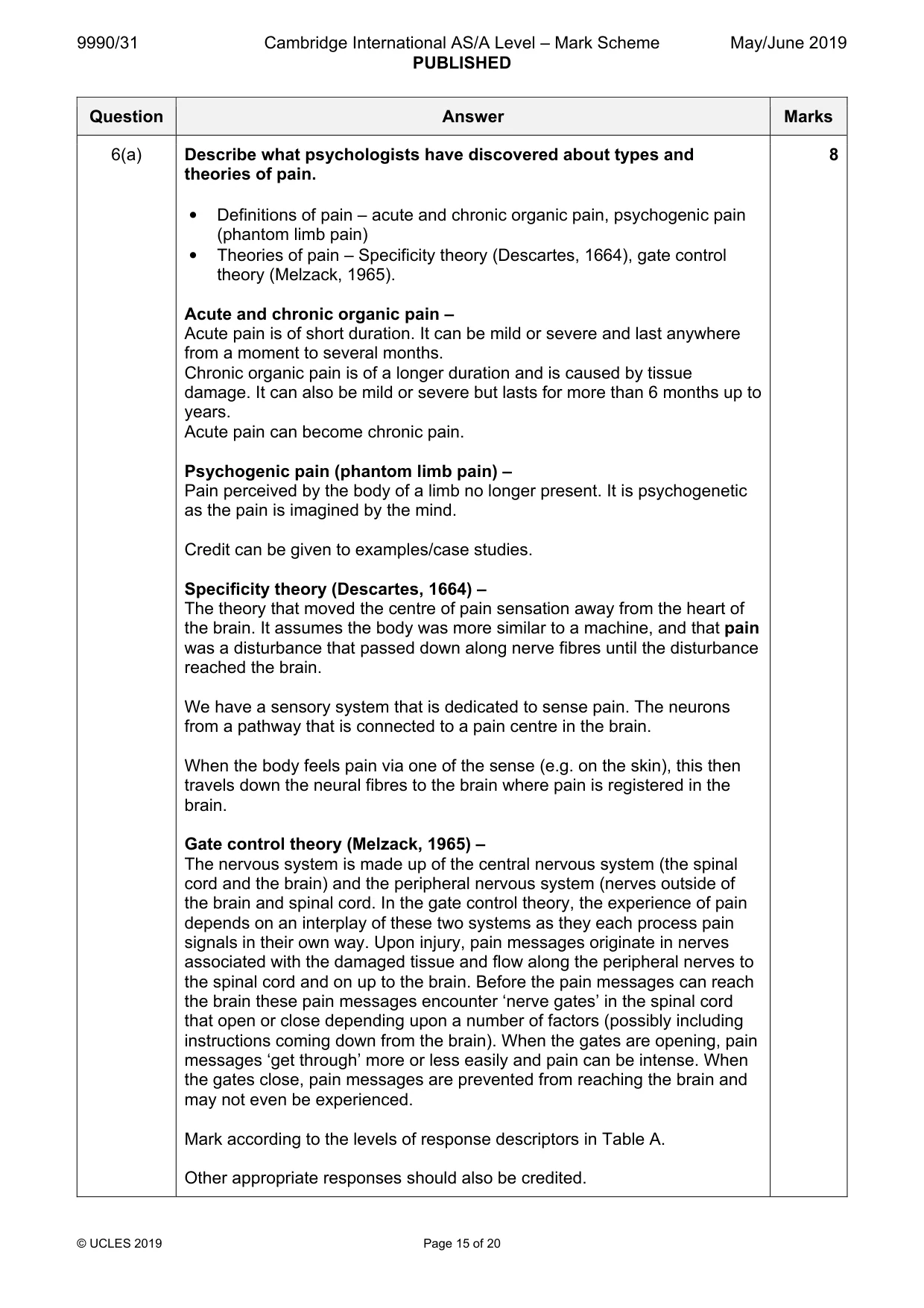
Q6 · Describe what psychologists have discovered about types and theories of pain
6 (a) Describe what psychologists have discovered about types and theories of pain. [8] (b) Evaluate what psychologists have discovered about types and theories of pain, including a discussion of reductionism. [10] Psychology and organisations Answer all questions.
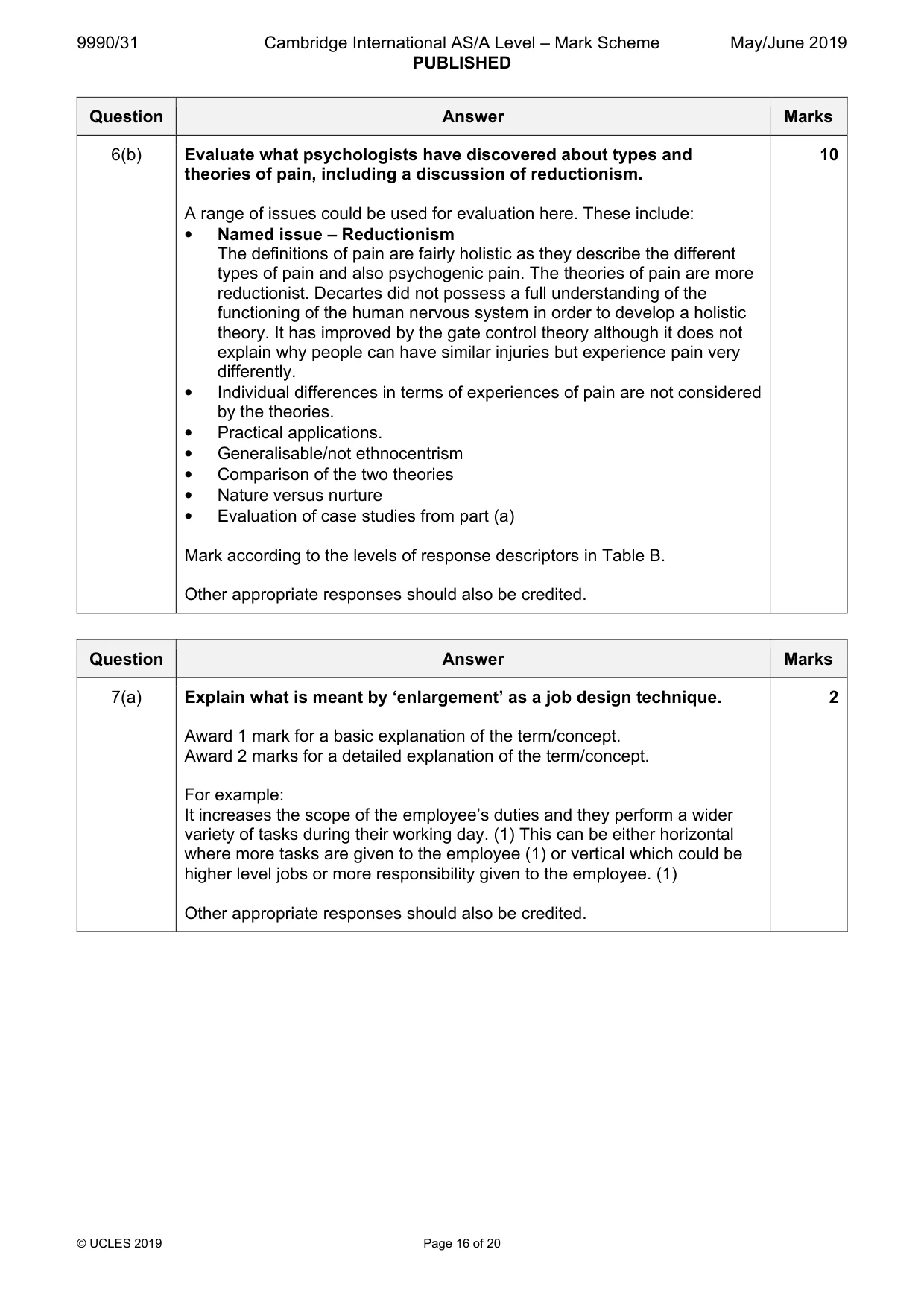
Mark scheme: 6(a) Describe what psychologists have discovered about types and 8 theories of pain. • Definitions of pain – acute and chronic organic pain, psychogenic pain (phantom limb pain) • Theories of pain – Specificity theory (Descartes, 1664), gate control theory (Melzack, 1965). Acute and chronic organic pain – Acute pain is of short duration. It can be mild or severe and last anywhere from a moment to several months. Chronic organic pain is of a longer duration and is caused by tissue damage. It can also be mild or severe but lasts for more than 6 months up to years. Acute pain can become chronic pain. Psychogenic pain (phantom limb pain) – Pain perceived by the body of a limb no longer present. It is psychogenetic as the pain is imagined by the mind. Credit can be given to examples/case studies. Specificity theory (Descartes, 1664) – The theory that moved the centre of pain sensation away from the heart of the brain. It assumes the body was more similar to a machine, and that pain was a disturbance that passed down along nerve fibres until the disturbance reached the brain. We have a sensory system that is dedicated to sense pain. The neurons from a pathway that is connected to a pain centre in the brain. When the body feels pain via one of the sense (e.g. on the skin), this then travels down the neural fibres to the brain where pain is registered in the brain. Gate control theory (Melzack, 1965) – The nervous system is made up of the central nervous system (the spinal cord and the brain) and the peripheral nervous system (nerves outside of the brain and spinal cord. In the gate control theory, the experience of pain depends on an interplay of these two systems as they each process pain signals in their own way. Upon injury, pain messages originate in nerves associated with the damaged tissue and flow along the peripheral nerves to the spinal cord and on up to the brain. Before the pain messages can reach the brain these pain messages encounter ‘nerve gates’ in the spinal cord that open or close depending upon a number of factors (possibly including instructions coming down from the brain). When the gates are opening, pain messages ‘get through’ more or less easily and pain can be intense. When the gates close, pain messages are prevented from reaching the brain and may not even be experienced. Mark according to the levels of response descriptors in Table A. Other appropriate responses should also be credited. 6(b) Evaluate what psychologists have discovered about types and 10 theories of pain, including a discussion of reductionism. A range of issues could be used for evaluation here. These include: • Named issue – Reductionism The definitions of pain are fairly holistic as they describe the different types of pain and also psychogenic pain. The theories of pain are more reductionist. Decartes did not possess a full understanding of the functioning of the human nervous system in order to develop a holistic theory. It has improved by the gate control theory although it does not explain why people can have similar injuries but experience pain very differently. • Individual differences in terms of experiences of pain are not considered by the theories. • Practical applications. • Generalisable/not ethnocentrism • Comparison of the two theories • Nature versus nurture • Evaluation of case studies from part (a) Mark according to the levels of response descriptors in Table B. Other appropriate responses should also be credited.
Q7 · Explain what is meant by ‘enlargement’ as a job design technique
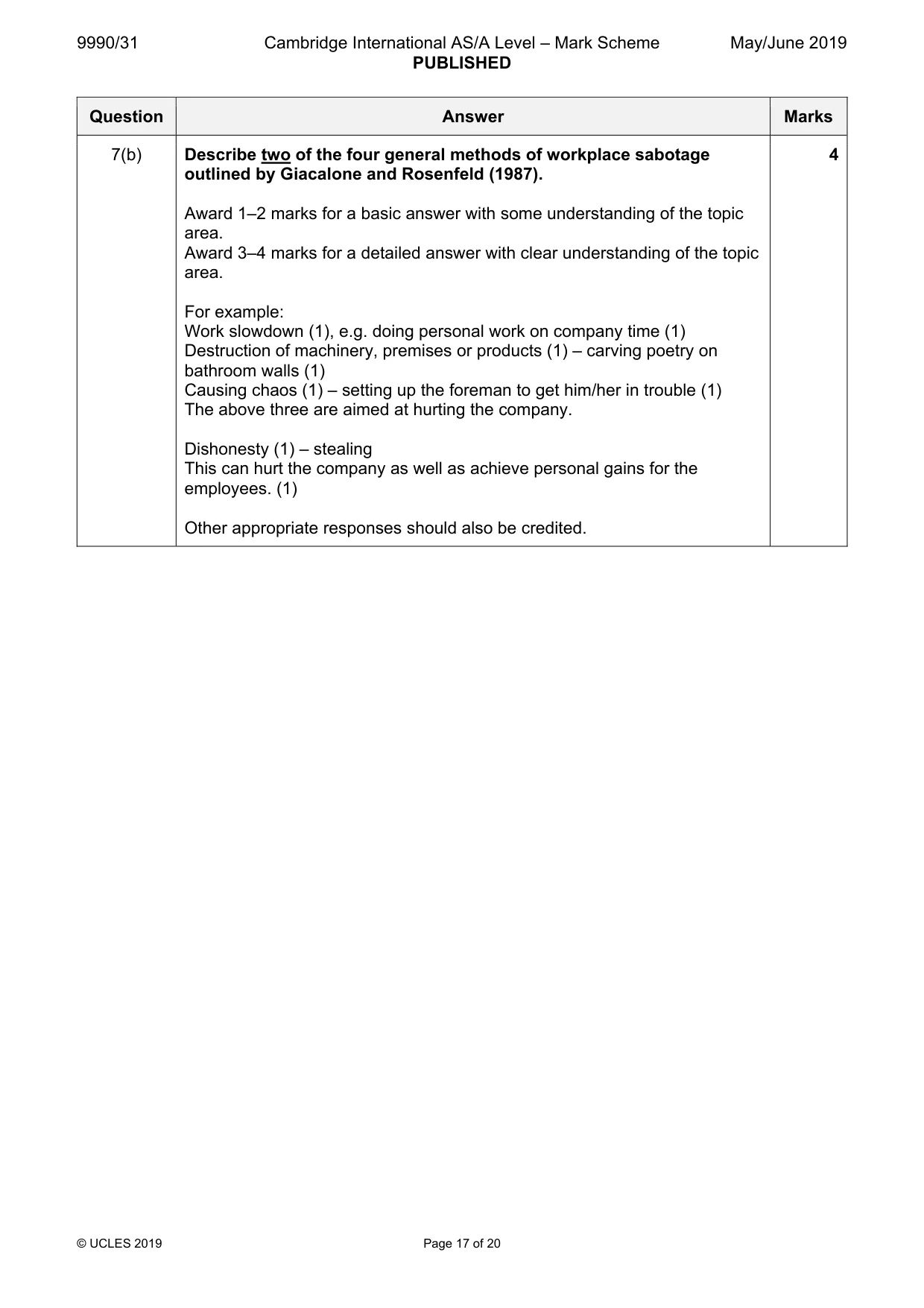
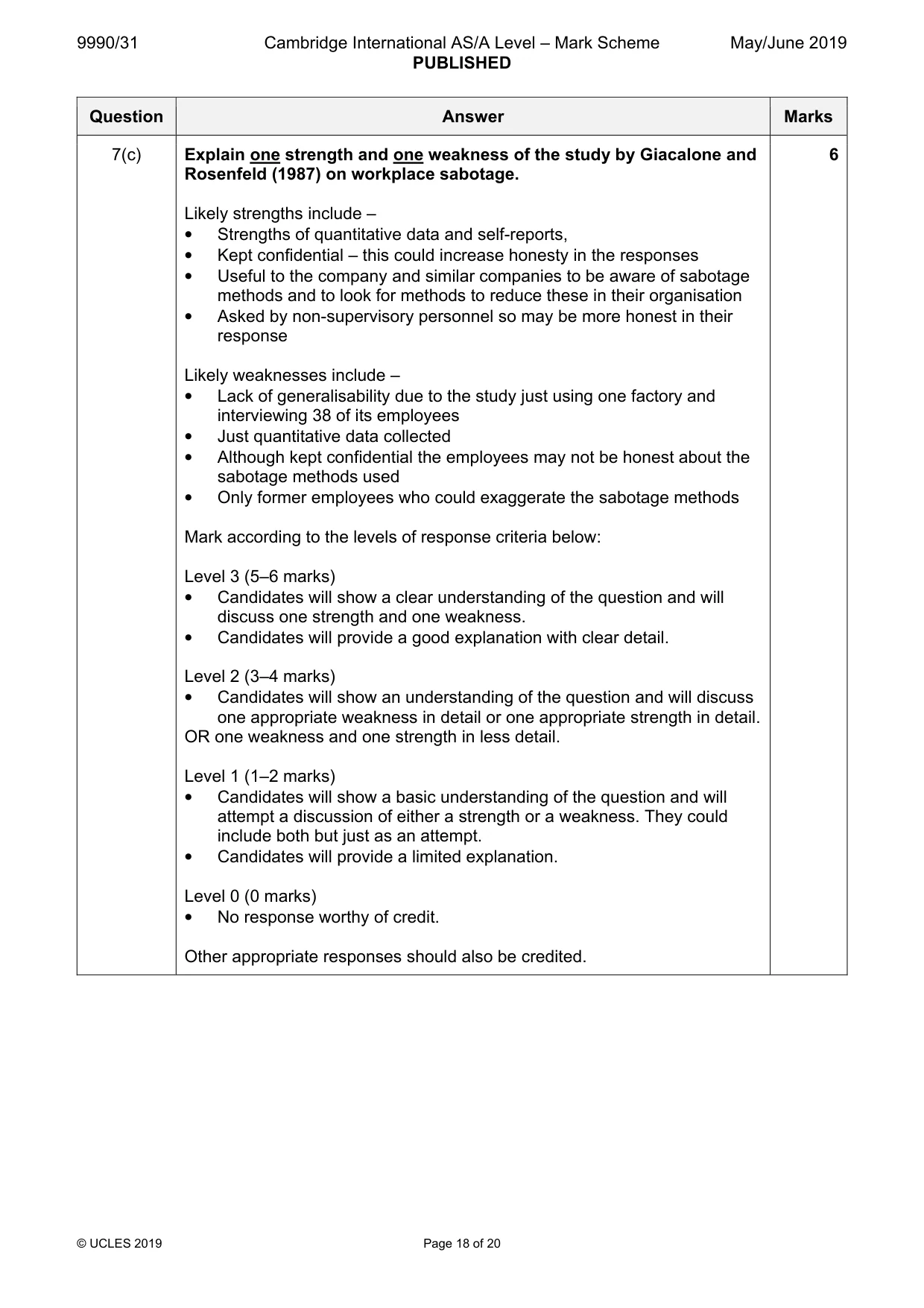
7 (a) Explain what is meant by ‘enlargement’ as a job design technique. [2] (b) Describe two of the four general methods of workplace sabotage outlined by Giacalone and Rosenfeld (1987). [4] (c) Explain one strength and one weakness of the study by Giacalone and Rosenfeld (1987) on workplace sabotage. [6]
Mark scheme: 7(a) Explain what is meant by ‘enlargement’ as a job design technique. 2 Award 1 mark for a basic explanation of the term/concept. Award 2 marks for a detailed explanation of the term/concept. For example: It increases the scope of the employee’s duties and they perform a wider variety of tasks during their working day. (1) This can be either horizontal where more tasks are given to the employee (1) or vertical which could be higher level jobs or more responsibility given to the employee. (1) Other appropriate responses should also be credited. 7(b) Describe two of the four general methods of workplace sabotage 4 outlined by Giacalone and Rosenfeld (1987). Award 1–2 marks for a basic answer with some understanding of the topic area. Award 3–4 marks for a detailed answer with clear understanding of the topic area. For example: Work slowdown (1), e.g. doing personal work on company time (1) Destruction of machinery, premises or products (1) – carving poetry on bathroom walls (1) Causing chaos (1) – setting up the foreman to get him/her in trouble (1) The above three are aimed at hurting the company. Dishonesty (1) – stealing This can hurt the company as well as achieve personal gains for the employees. (1) Other appropriate responses should also be credited. 7(c) Explain one strength and one weakness of the study by Giacalone and 6 Rosenfeld (1987) on workplace sabotage. Likely strengths include – • Strengths of quantitative data and self-reports, • Kept confidential – this could increase honesty in the responses • Useful to the company and similar companies to be aware of sabotage methods and to look for methods to reduce these in their organisation • Asked by non-supervisory personnel so may be more honest in their response Likely weaknesses include – • Lack of generalisability due to the study just using one factory and interviewing 38 of its employees • Just quantitative data collected • Although kept confidential the employees may not be honest about the sabotage methods used • Only former employees who could exaggerate the sabotage methods Mark according to the levels of response criteria below: Level 3 (5–6 marks) • Candidates will show a clear understanding of the question and will discuss one strength and one weakness. • Candidates will provide a good explanation with clear detail. Level 2 (3–4 marks) • Candidates will show an understanding of the question and will discuss one appropriate weakness in detail or one appropriate strength in detail. OR one weakness and one strength in less detail. Level 1 (1–2 marks) • Candidates will show a basic understanding of the question and will attempt a discussion of either a strength or a weakness. They could include both but just as an attempt. • Candidates will provide a limited explanation. Level 0 (0 marks) • No response worthy of credit. Other appropriate responses should also be credited.
Q8 · Describe what psychologists have discovered about physical and psychological work…
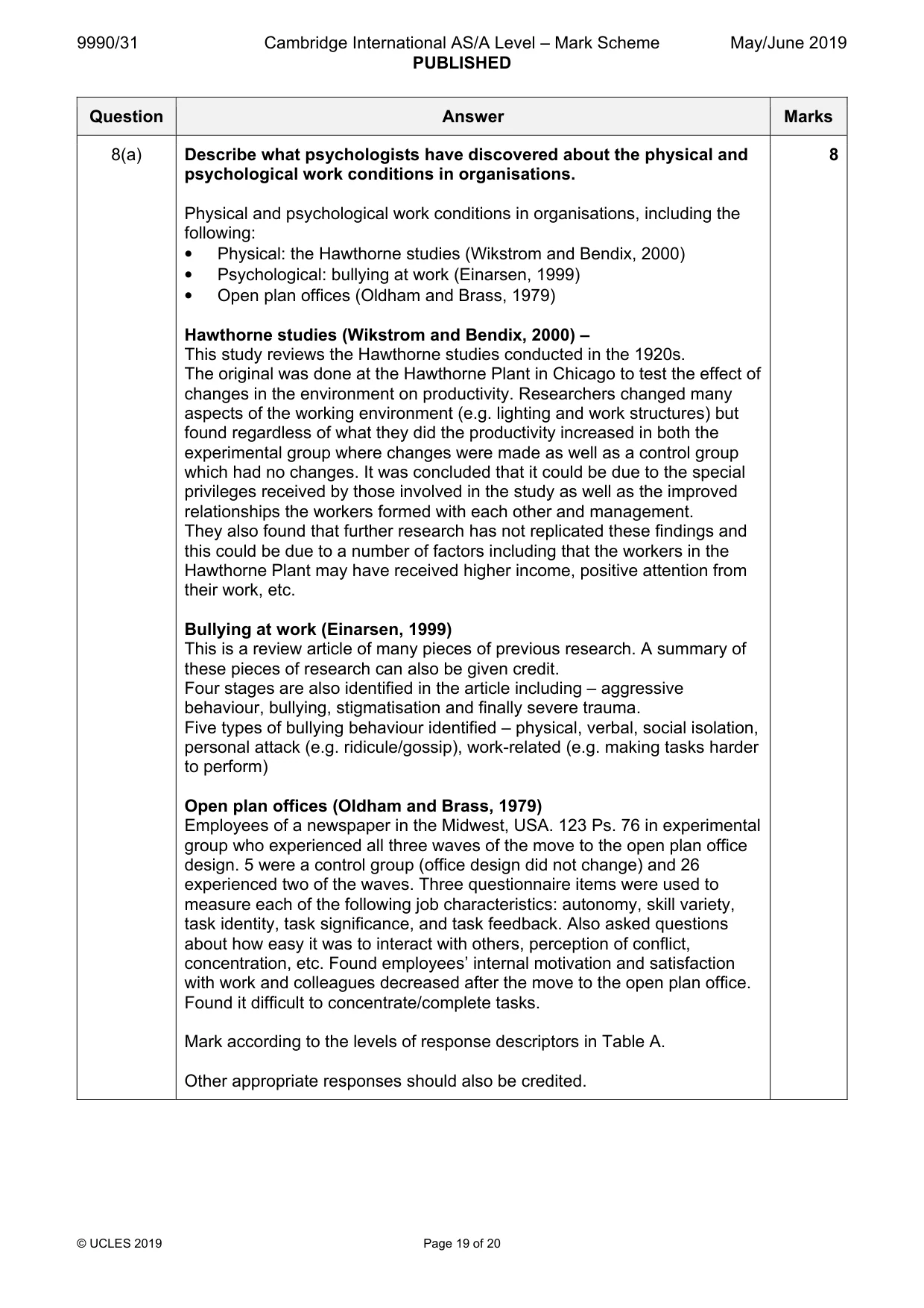
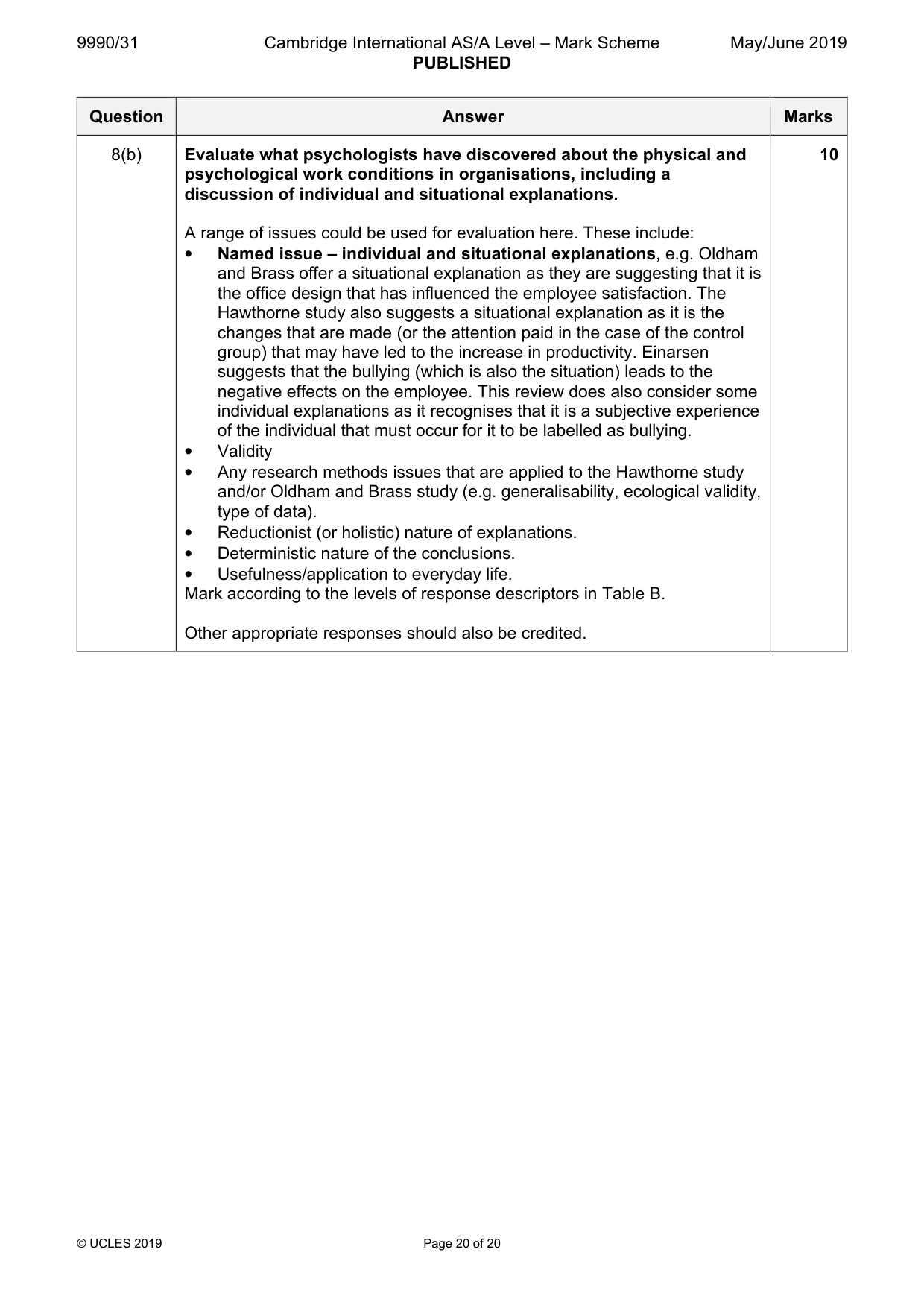
8 (a) Describe what psychologists have discovered about physical and psychological work conditions in organisations. [8] (b) Evaluate what psychologists have discovered about physical and psychological work conditions in organisations, including a discussion of individual and situational explanations. [10]
Mark scheme: 8(a) Describe what psychologists have discovered about the physical and 8 psychological work conditions in organisations. Physical and psychological work conditions in organisations, including the following: • Physical: the Hawthorne studies (Wikstrom and Bendix, 2000) • Psychological: bullying at work (Einarsen, 1999) • Open plan offices (Oldham and Brass, 1979) Hawthorne studies (Wikstrom and Bendix, 2000) – This study reviews the Hawthorne studies conducted in the 1920s. The original was done at the Hawthorne Plant in Chicago to test the effect of changes in the environment on productivity. Researchers changed many aspects of the working environment (e.g. lighting and work structures) but found regardless of what they did the productivity increased in both the experimental group where changes were made as well as a control group which had no changes. It was concluded that it could be due to the special privileges received by those involved in the study as well as the improved relationships the workers formed with each other and management. They also found that further research has not replicated these findings and this could be due to a number of factors including that the workers in the Hawthorne Plant may have received higher income, positive attention from their work, etc. Bullying at work (Einarsen, 1999) This is a review article of many pieces of previous research. A summary of these pieces of research can also be given credit. Four stages are also identified in the article including – aggressive behaviour, bullying, stigmatisation and finally severe trauma. Five types of bullying behaviour identified – physical, verbal, social isolation, personal attack (e.g. ridicule/gossip), work-related (e.g. making tasks harder to perform) Open plan offices (Oldham and Brass, 1979) Employees of a newspaper in the Midwest, USA. 123 Ps. 76 in experimental group who experienced all three waves of the move to the open plan office design. 5 were a control group (office design did not change) and 26 experienced two of the waves. Three questionnaire items were used to measure each of the following job characteristics: autonomy, skill variety, task identity, task significance, and task feedback. Also asked questions about how easy it was to interact with others, perception of conflict, concentration, etc. Found employees’ internal motivation and satisfaction with work and colleagues decreased after the move to the open plan office. Found it difficult to concentrate/complete tasks. Mark according to the levels of response descriptors in Table A. Other appropriate responses should also be credited. 8(b) Evaluate what psychologists have discovered about the physical and 10 psychological work conditions in organisations, including a discussion of individual and situational explanations. A range of issues could be used for evaluation here. These include: • Named issue – individual and situational explanations, e.g. Oldham and Brass offer a situational explanation as they are suggesting that it is the office design that has influenced the employee satisfaction. The Hawthorne study also suggests a situational explanation as it is the changes that are made (or the attention paid in the case of the control group) that may have led to the increase in productivity. Einarsen suggests that the bullying (which is also the situation) leads to the negative effects on the employee. This review does also consider some individual explanations as it recognises that it is a subjective experience of the individual that must occur for it to be labelled as bullying. • Validity • Any research methods issues that are applied to the Hawthorne study and/or Oldham and Brass study (e.g. generalisability, ecological validity, type of data). • Reductionist (or holistic) nature of explanations. • Deterministic nature of the conclusions. • Usefulness/application to everyday life. Mark according to the levels of response descriptors in Table B. Other appropriate responses should also be credited.
What was in this paper
The subtopics covered by these 8 questions, and how many questions each got. Open one in a new tab to see every Cambridge question on it.
What you needed in this session
Cambridge’s own grade thresholds for 2019 May/June, Paper 3 · Variant 1. A higher threshold means an easier paper — the bar moves with how the cohort did.