Cambridge A Level Psychology (from 2018) 9990 — 2018 May/June Paper 3 · Variant 3
9990/33/M/J/18 · 60 marks · ≈68 min
The question paper and its mark scheme, free to read here and free to download. This is Cambridge’s own paper, exactly as it was sat.
Question paper4 pages


Mark scheme20 pages
Answers below. Sit the paper first if you are practising.



Paper as text
Question paper, page 1
This document consists of 3 printed pages, 1 blank page and 1 Insert. DC (NF) 163641 © UCLES 2018 [Turn over * 6 6 6 8 7 1 4 7 6 0 * PSYCHOLOGY 9990/33 Paper 3 Specialist Options: Theory May/June 2018 1 hour 30 minutes No Additional Materials are required. READ THESE INSTRUCTIONS FIRST An answer booklet is provided inside this question paper. You should follow the instructions on the front cover of the answer booklet. If you need additional answer paper ask the invigilator for a continuation booklet. There is a choice of four specialist options in this question paper. In each of your two chosen specialist options, answer all questions. At the end of the examination, fasten all your work securely together. The number of marks is given in brackets [ ] at the end of each question or part question. Cambridge International Examinations Cambridge International Advanced Subsidiary and Advanced Level
Question paper, page 2
2 9990/33/M/J/18 © UCLES 2018 Psychology and abnormality Answer all questions. 1 (a) Explain what is meant by ‘body dysmorphic disorder’ (BDD). [2] (b) Describe the biomedical explanation of obsessive-compulsive disorder (OCD). [4] (c) Explain one similarity and one difference between the biomedical explanation of obsessive- compulsive disorder (OCD) and one other explanation of this disorder. [6] 2 (a) Describe the treatment and management of schizophrenia and delusional disorder. [8] (b) Evaluate the treatment and management of schizophrenia and delusional disorder, including a discussion of determinism. [10] Psychology and consumer behaviour Answer all questions. 3 (a) Explain what is meant by ‘customer focused sales technique’ used for selling a product. [2] (b) Describe how the data was collected in the study by Porublev et al. (2009) on gift wrapping. [4] (c) Explain two weaknesses of the study by Porublev et al. (2009). [6] 4 (a) Describe what psychologists have discovered about intuitive thinking and its imperfections in consumer decision-making. [8] (b) Evaluate what psychologists have discovered about intuitive thinking and its imperfections in consumer decision-making, including a discussion of the experimental method. [10]
Question paper, page 3
3 9990/33/M/J/18 © UCLES 2018 Psychology and health Answer all questions. 5 (a) Outline one type of non-adherence to medical advice. [2] (b) Yokley and Glenwick (1984) used six groups with different motivational conditions to compare adherence to medical advice for child immunisation. Describe two of these conditions. [4] (c) Explain one strength and one weakness of an independent measures design, using the study by Yokley and Glenwick (1984) as an example. [6] 6 (a) Describe what psychologists have discovered about health promotion in schools, worksites and communities. [8] (b) Evaluate what psychologists have discovered about health promotion in schools, worksites and communities, including a discussion about validity. [10] Psychology and organisations Answer all questions. 7 (a) Explain what is meant by ‘intrinsic motivation’ in relation to work. [2] (b) Describe the hierarchy of needs (Maslow, 1970). [4] (c) Explain one similarity and one difference between the hierarchy of needs and one other need theory of motivation to work. [6] 8 (a) Describe what psychologists have discovered about group development and roles in organisations. [8] (b) Evaluate what psychologists have discovered about group development and roles in organisations, including a discussion of reductionism. [10]
Question paper, page 4
4 9990/33/M/J/18 © UCLES 2018 BLANK PAGE Permission to reproduce items where third-party owned material protected by copyright is included has been sought and cleared where possible. Every reasonable effort has been made by the publisher (UCLES) to trace copyright holders, but if any items requiring clearance have unwittingly been included, the publisher will be pleased to make amends at the earliest possible opportunity. To avoid the issue of disclosure of answer-related information to candidates, all copyright acknowledgements are reproduced online in the Cambridge International Examinations Copyright Acknowledgements Booklet. This is produced for each series of examinations and is freely available to download at www.cie.org.uk after the live examination series. Cambridge International Examinations is part of the Cambridge Assessment Group. Cambridge Assessment is the brand name of University of Cambridge Local Examinations Syndicate (UCLES), which is itself a department of the University of Cambridge.
Mark scheme, page 1
IGCSE™ is a registered trademark. This document consists of 20 printed pages. © UCLES 2018 [Turn over Cambridge Assessment International Education Cambridge International Advanced Subsidiary and Advanced Level PSYCHOLOGY 9990/33 Paper 3 Specialist Options: Theory May/June 2018 MARK SCHEME Maximum Mark: 60 Published This mark scheme is published as an aid to teachers and candidates, to indicate the requirements of the examination. It shows the basis on which Examiners were instructed to award marks. It does not indicate the details of the discussions that took place at an Examiners’ meeting before marking began, which would have considered the acceptability of alternative answers. Mark schemes should be read in conjunction with the question paper and the Principal Examiner Report for Teachers. Cambridge International will not enter into discussions about these mark schemes. Cambridge International is publishing the mark schemes for the May/June 2018 series for most Cambridge IGCSE™, Cambridge International A and AS Level and Cambridge Pre-U components, and some Cambridge O Level components.
Mark scheme, page 2
9990/33 Cambridge International AS/A Level – Mark Scheme PUBLISHED May/June 2018 © UCLES 2018 Page 2 of 20 Generic Marking Principles These general marking principles must be applied by all examiners when marking candidate answers. They should be applied alongside the specific content of the mark scheme or generic level descriptors for a question. Each question paper and mark scheme will also comply with these marking principles. GENERIC MARKING PRINCIPLE 1: Marks must be awarded in line with: • the specific content of the mark scheme or the generic level descriptors for the question • the specific skills defined in the mark scheme or in the generic level descriptors for the question • the standard of response required by a candidate as exemplified by the standardisation scripts. GENERIC MARKING PRINCIPLE 2: Marks awarded are always whole marks (not half marks, or other fractions). GENERIC MARKING PRINCIPLE 3: Marks must be awarded positively: • marks are awarded for correct/valid answers, as defined in the mark scheme. However, credit is given for valid answers which go beyond the scope of the syllabus and mark scheme, referring to your Team Leader as appropriate • marks are awarded when candidates clearly demonstrate what they know and can do • marks are not deducted for errors • marks are not deducted for omissions • answers should only be judged on the quality of spelling, punctuation and grammar when these features are specifically assessed by the question as indicated by the mark scheme. The meaning, however, should be unambiguous. GENERIC MARKING PRINCIPLE 4: Rules must be applied consistently e.g. in situations where candidates have not followed instructions or in the application of generic level descriptors. GENERIC MARKING PRINCIPLE 5: Marks should be awarded using the full range of marks defined in the mark scheme for the question (however; the use of the full mark range may be limited according to the quality of the candidate responses seen). GENERIC MARKING PRINCIPLE 6: Marks awarded are based solely on the requirements as defined in the mark scheme. Marks should not be awarded with grade thresholds or grade descriptors in mind.
Mark scheme, page 3
9990/33 Cambridge International AS/A Level – Mark Scheme PUBLISHED May/June 2018 © UCLES 2018 Page 3 of 20 Generic levels of response marking grids Table A The table should be used to mark the 8 mark part (a) ‘Describe’ questions (2, 4, 6 and 8). Level Marks Level descriptor 4 7–8 • Description is accurate, coherent and detailed and use of psychological terminology is accurate and comprehensive. • The answer demonstrates excellent understanding of the material and the answer is competently organised. 3 5–6 • Description is mainly accurate, reasonably coherent and reasonably detailed and use of psychological terminology is accurate but may not be comprehensive. • The answer demonstrates good understanding of the material and the answer has some organisation. 2 3–4 • Description is sometimes accurate and coherent but lacks detail and use of psychological terminology is adequate. • The answer demonstrates reasonable (sufficient) understanding but is lacking in organisation. 1 1–2 • Description is largely inaccurate, lacks both detail and coherence and the use of psychological terminology is limited. • The answer demonstrates limited understanding of the material and there is little, if any, organisation. 0 0 • No response worthy of credit.
Mark scheme, page 4
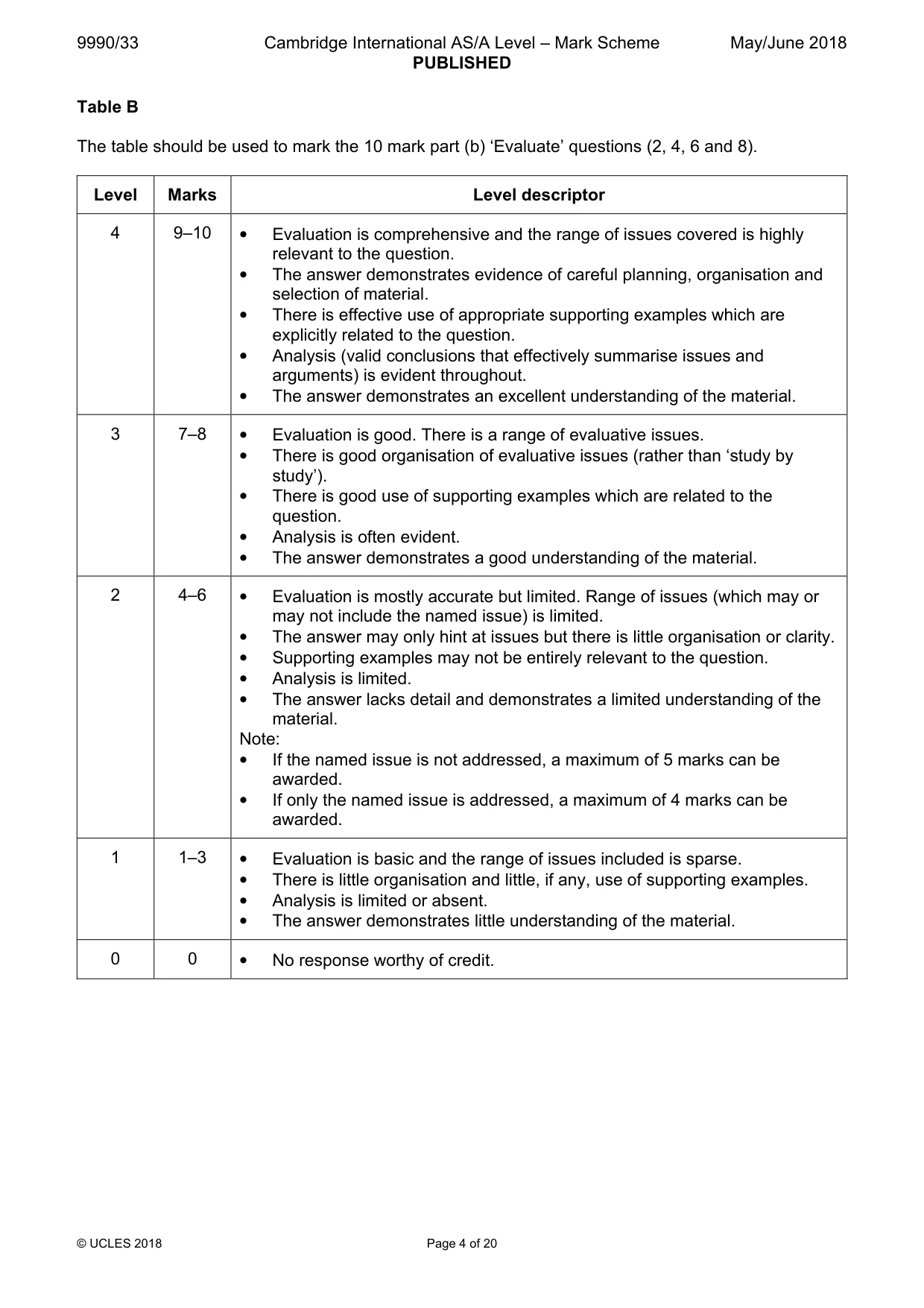
9990/33 Cambridge International AS/A Level – Mark Scheme PUBLISHED May/June 2018 © UCLES 2018 Page 4 of 20 Table B The table should be used to mark the 10 mark part (b) ‘Evaluate’ questions (2, 4, 6 and 8). Level Marks Level descriptor 4 9–10 • Evaluation is comprehensive and the range of issues covered is highly relevant to the question. • The answer demonstrates evidence of careful planning, organisation and selection of material. • There is effective use of appropriate supporting examples which are explicitly related to the question. • Analysis (valid conclusions that effectively summarise issues and arguments) is evident throughout. • The answer demonstrates an excellent understanding of the material. 3 7–8 • Evaluation is good. There is a range of evaluative issues. • There is good organisation of evaluative issues (rather than ‘study by study’). • There is good use of supporting examples which are related to the question. • Analysis is often evident. • The answer demonstrates a good understanding of the material. 2 4–6 • Evaluation is mostly accurate but limited. Range of issues (which may or may not include the named issue) is limited. • The answer may only hint at issues but there is little organisation or clarity. • Supporting examples may not be entirely relevant to the question. • Analysis is limited. • The answer lacks detail and demonstrates a limited understanding of the material. Note: • If the named issue is not addressed, a maximum of 5 marks can be awarded. • If only the named issue is addressed, a maximum of 4 marks can be awarded. 1 1–3 • Evaluation is basic and the range of issues included is sparse. • There is little organisation and little, if any, use of supporting examples. • Analysis is limited or absent. • The answer demonstrates little understanding of the material. 0 0 • No response worthy of credit.
Mark scheme, page 5
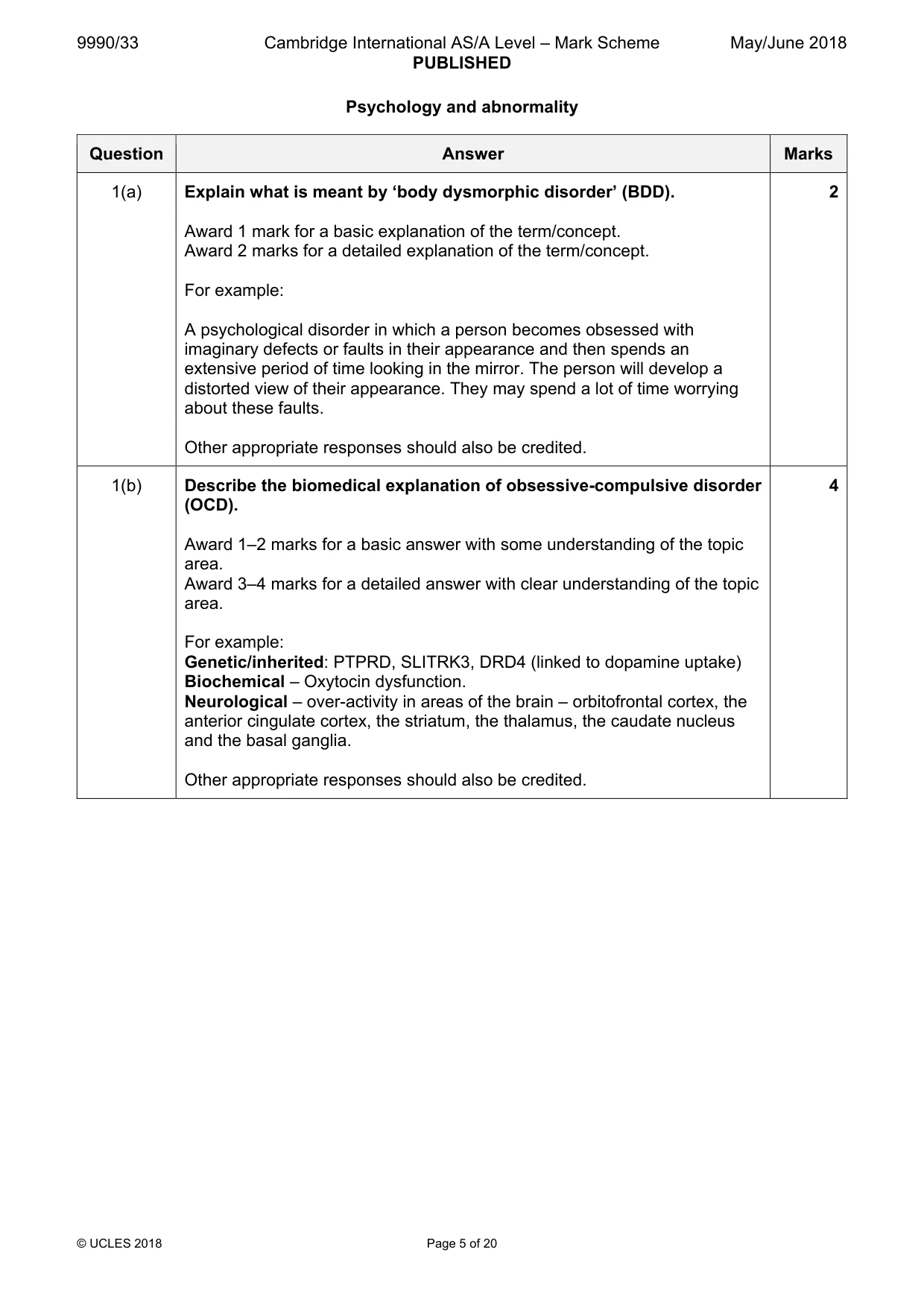
9990/33 Cambridge International AS/A Level – Mark Scheme PUBLISHED May/June 2018 © UCLES 2018 Page 5 of 20 Psychology and abnormality Question Answer Marks 1(a) Explain what is meant by ‘body dysmorphic disorder’ (BDD). Award 1 mark for a basic explanation of the term/concept. Award 2 marks for a detailed explanation of the term/concept. For example: A psychological disorder in which a person becomes obsessed with imaginary defects or faults in their appearance and then spends an extensive period of time looking in the mirror. The person will develop a distorted view of their appearance. They may spend a lot of time worrying about these faults. Other appropriate responses should also be credited. 2 1(b) Describe the biomedical explanation of obsessive-compulsive disorder (OCD). Award 1–2 marks for a basic answer with some understanding of the topic area. Award 3–4 marks for a detailed answer with clear understanding of the topic area. For example: Genetic/inherited: PTPRD, SLITRK3, DRD4 (linked to dopamine uptake) Biochemical – Oxytocin dysfunction. Neurological – over-activity in areas of the brain – orbitofrontal cortex, the anterior cingulate cortex, the striatum, the thalamus, the caudate nucleus and the basal ganglia. Other appropriate responses should also be credited. 4
Mark scheme, page 6
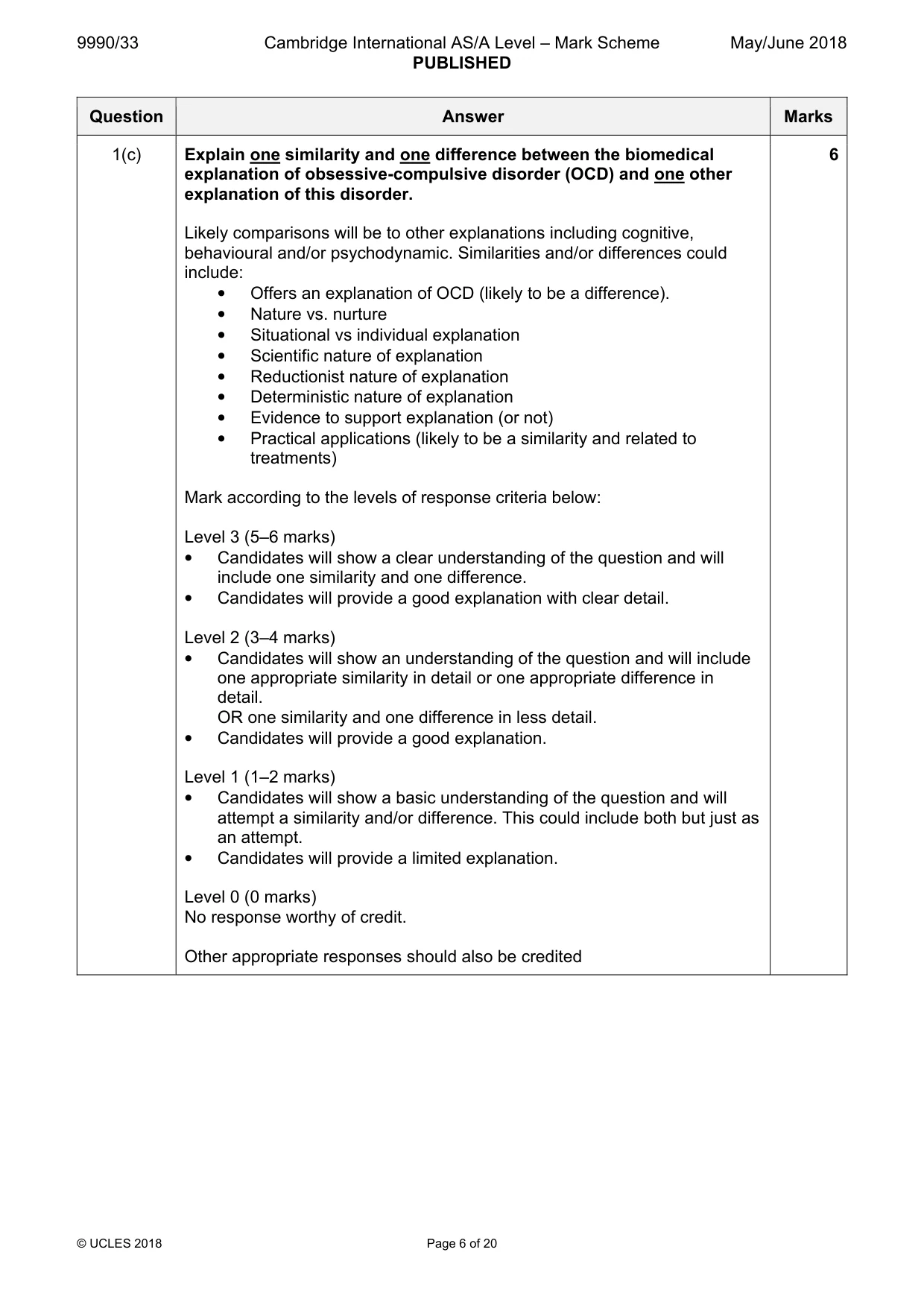
9990/33 Cambridge International AS/A Level – Mark Scheme PUBLISHED May/June 2018 © UCLES 2018 Page 6 of 20 Question Answer Marks 1(c) Explain one similarity and one difference between the biomedical explanation of obsessive-compulsive disorder (OCD) and one other explanation of this disorder. Likely comparisons will be to other explanations including cognitive, behavioural and/or psychodynamic. Similarities and/or differences could include: • Offers an explanation of OCD (likely to be a difference). • Nature vs. nurture • Situational vs individual explanation • Scientific nature of explanation • Reductionist nature of explanation • Deterministic nature of explanation • Evidence to support explanation (or not) • Practical applications (likely to be a similarity and related to treatments) Mark according to the levels of response criteria below: Level 3 (5–6 marks) • Candidates will show a clear understanding of the question and will include one similarity and one difference. • Candidates will provide a good explanation with clear detail. Level 2 (3–4 marks) • Candidates will show an understanding of the question and will include one appropriate similarity in detail or one appropriate difference in detail. OR one similarity and one difference in less detail. • Candidates will provide a good explanation. Level 1 (1–2 marks) • Candidates will show a basic understanding of the question and will attempt a similarity and/or difference. This could include both but just as an attempt. • Candidates will provide a limited explanation. Level 0 (0 marks) No response worthy of credit. Other appropriate responses should also be credited 6
Mark scheme, page 7
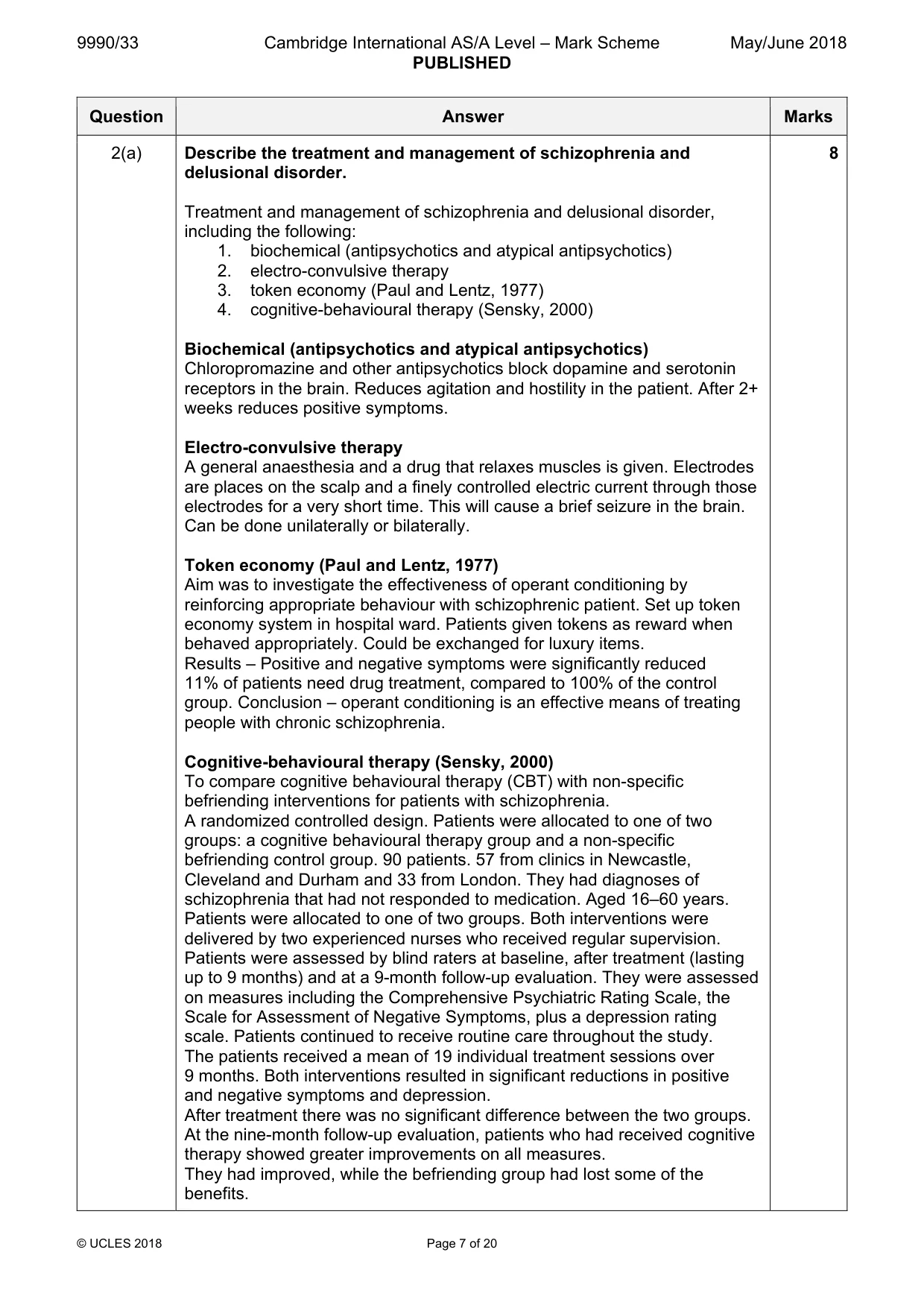
9990/33 Cambridge International AS/A Level – Mark Scheme PUBLISHED May/June 2018 © UCLES 2018 Page 7 of 20 Question Answer Marks 2(a) Describe the treatment and management of schizophrenia and delusional disorder. Treatment and management of schizophrenia and delusional disorder, including the following: 1. biochemical (antipsychotics and atypical antipsychotics) 2. electro-convulsive therapy 3. token economy (Paul and Lentz, 1977) 4. cognitive-behavioural therapy (Sensky, 2000) Biochemical (antipsychotics and atypical antipsychotics) Chloropromazine and other antipsychotics block dopamine and serotonin receptors in the brain. Reduces agitation and hostility in the patient. After 2+ weeks reduces positive symptoms. Electro-convulsive therapy A general anaesthesia and a drug that relaxes muscles is given. Electrodes are places on the scalp and a finely controlled electric current through those electrodes for a very short time. This will cause a brief seizure in the brain. Can be done unilaterally or bilaterally. Token economy (Paul and Lentz, 1977) Aim was to investigate the effectiveness of operant conditioning by reinforcing appropriate behaviour with schizophrenic patient. Set up token economy system in hospital ward. Patients given tokens as reward when behaved appropriately. Could be exchanged for luxury items. Results – Positive and negative symptoms were significantly reduced 11% of patients need drug treatment, compared to 100% of the control group. Conclusion – operant conditioning is an effective means of treating people with chronic schizophrenia. Cognitive-behavioural therapy (Sensky, 2000) To compare cognitive behavioural therapy (CBT) with non-specific befriending interventions for patients with schizophrenia. A randomized controlled design. Patients were allocated to one of two groups: a cognitive behavioural therapy group and a non-specific befriending control group. 90 patients. 57 from clinics in Newcastle, Cleveland and Durham and 33 from London. They had diagnoses of schizophrenia that had not responded to medication. Aged 16–60 years. Patients were allocated to one of two groups. Both interventions were delivered by two experienced nurses who received regular supervision. Patients were assessed by blind raters at baseline, after treatment (lasting up to 9 months) and at a 9-month follow-up evaluation. They were assessed on measures including the Comprehensive Psychiatric Rating Scale, the Scale for Assessment of Negative Symptoms, plus a depression rating scale. Patients continued to receive routine care throughout the study. The patients received a mean of 19 individual treatment sessions over 9 months. Both interventions resulted in significant reductions in positive and negative symptoms and depression. After treatment there was no significant difference between the two groups. At the nine-month follow-up evaluation, patients who had received cognitive therapy showed greater improvements on all measures. They had improved, while the befriending group had lost some of the benefits. 8
Mark scheme, page 8
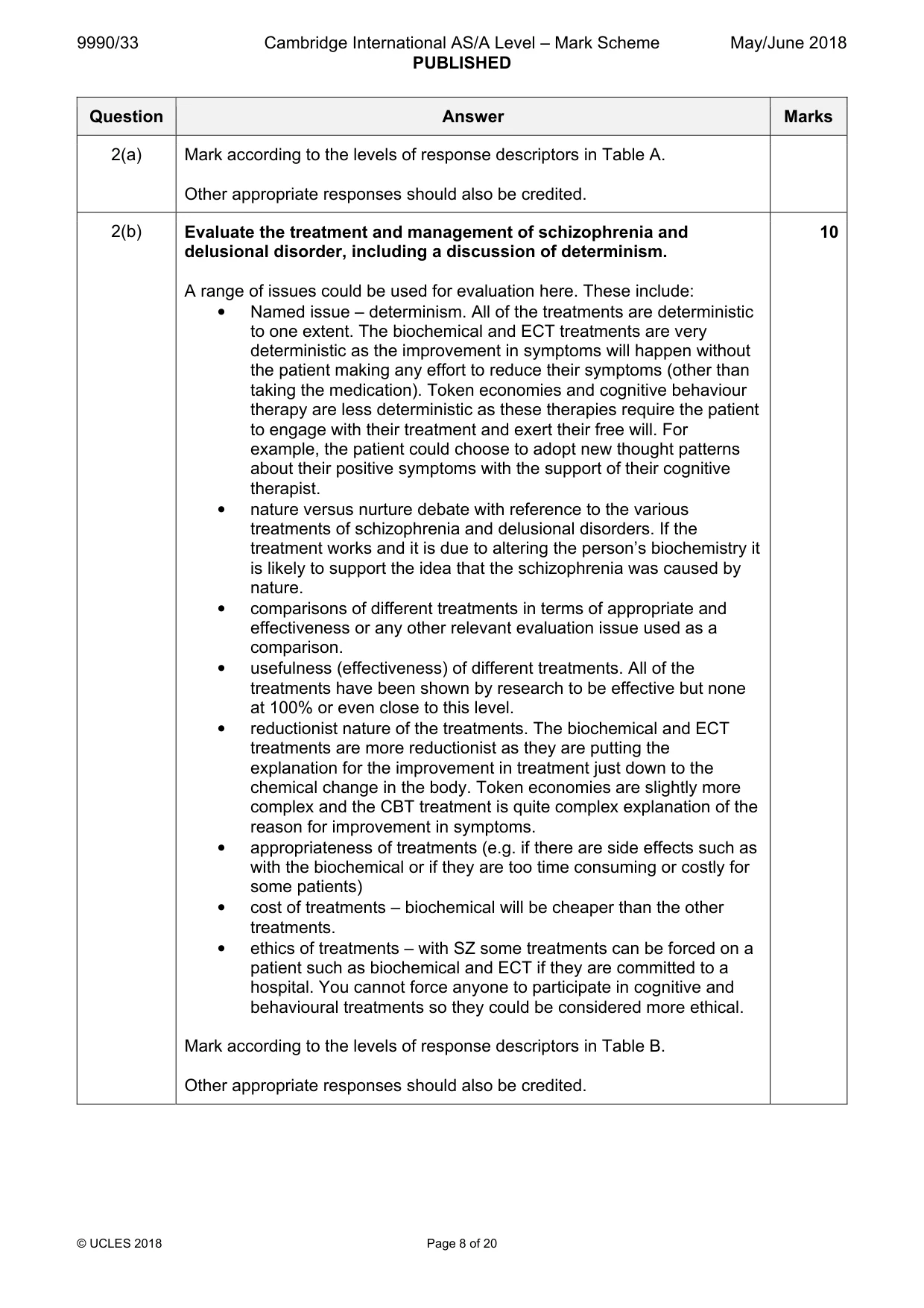
9990/33 Cambridge International AS/A Level – Mark Scheme PUBLISHED May/June 2018 © UCLES 2018 Page 8 of 20 Question Answer Marks 2(a) Mark according to the levels of response descriptors in Table A. Other appropriate responses should also be credited. 2(b) Evaluate the treatment and management of schizophrenia and delusional disorder, including a discussion of determinism. A range of issues could be used for evaluation here. These include: • Named issue – determinism. All of the treatments are deterministic to one extent. The biochemical and ECT treatments are very deterministic as the improvement in symptoms will happen without the patient making any effort to reduce their symptoms (other than taking the medication). Token economies and cognitive behaviour therapy are less deterministic as these therapies require the patient to engage with their treatment and exert their free will. For example, the patient could choose to adopt new thought patterns about their positive symptoms with the support of their cognitive therapist. • nature versus nurture debate with reference to the various treatments of schizophrenia and delusional disorders. If the treatment works and it is due to altering the person’s biochemistry it is likely to support the idea that the schizophrenia was caused by nature. • comparisons of different treatments in terms of appropriate and effectiveness or any other relevant evaluation issue used as a comparison. • usefulness (effectiveness) of different treatments. All of the treatments have been shown by research to be effective but none at 100% or even close to this level. • reductionist nature of the treatments. The biochemical and ECT treatments are more reductionist as they are putting the explanation for the improvement in treatment just down to the chemical change in the body. Token economies are slightly more complex and the CBT treatment is quite complex explanation of the reason for improvement in symptoms. • appropriateness of treatments (e.g. if there are side effects such as with the biochemical or if they are too time consuming or costly for some patients) • cost of treatments – biochemical will be cheaper than the other treatments. • ethics of treatments – with SZ some treatments can be forced on a patient such as biochemical and ECT if they are committed to a hospital. You cannot force anyone to participate in cognitive and behavioural treatments so they could be considered more ethical. Mark according to the levels of response descriptors in Table B. Other appropriate responses should also be credited. 10
Mark scheme, page 9
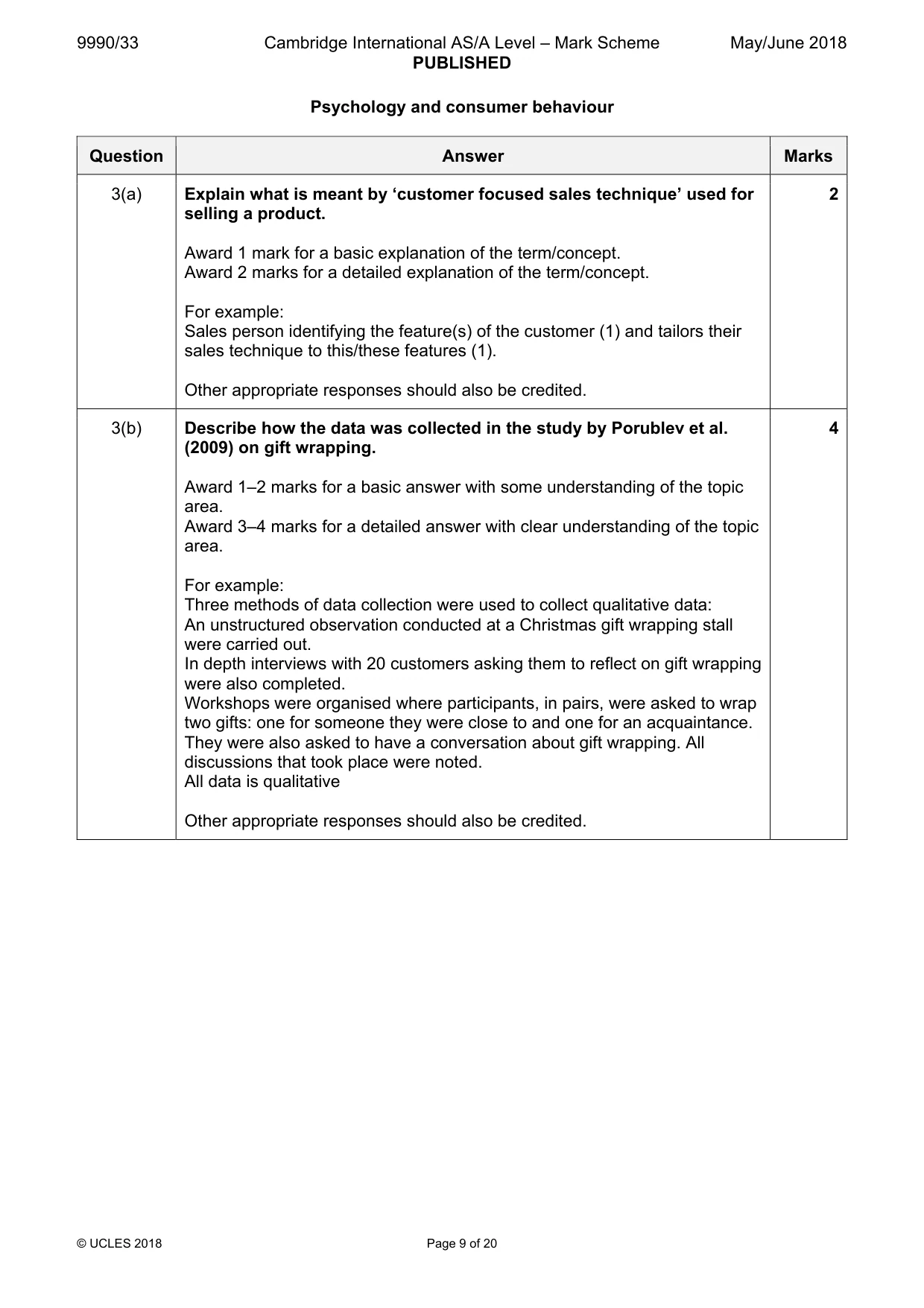
9990/33 Cambridge International AS/A Level – Mark Scheme PUBLISHED May/June 2018 © UCLES 2018 Page 9 of 20 Psychology and consumer behaviour Question Answer Marks 3(a) Explain what is meant by ‘customer focused sales technique’ used for selling a product. Award 1 mark for a basic explanation of the term/concept. Award 2 marks for a detailed explanation of the term/concept. For example: Sales person identifying the feature(s) of the customer (1) and tailors their sales technique to this/these features (1). Other appropriate responses should also be credited. 2 3(b) Describe how the data was collected in the study by Porublev et al. (2009) on gift wrapping. Award 1–2 marks for a basic answer with some understanding of the topic area. Award 3–4 marks for a detailed answer with clear understanding of the topic area. For example: Three methods of data collection were used to collect qualitative data: An unstructured observation conducted at a Christmas gift wrapping stall were carried out. In depth interviews with 20 customers asking them to reflect on gift wrapping were also completed. Workshops were organised where participants, in pairs, were asked to wrap two gifts: one for someone they were close to and one for an acquaintance. They were also asked to have a conversation about gift wrapping. All discussions that took place were noted. All data is qualitative Other appropriate responses should also be credited. 4
Mark scheme, page 10
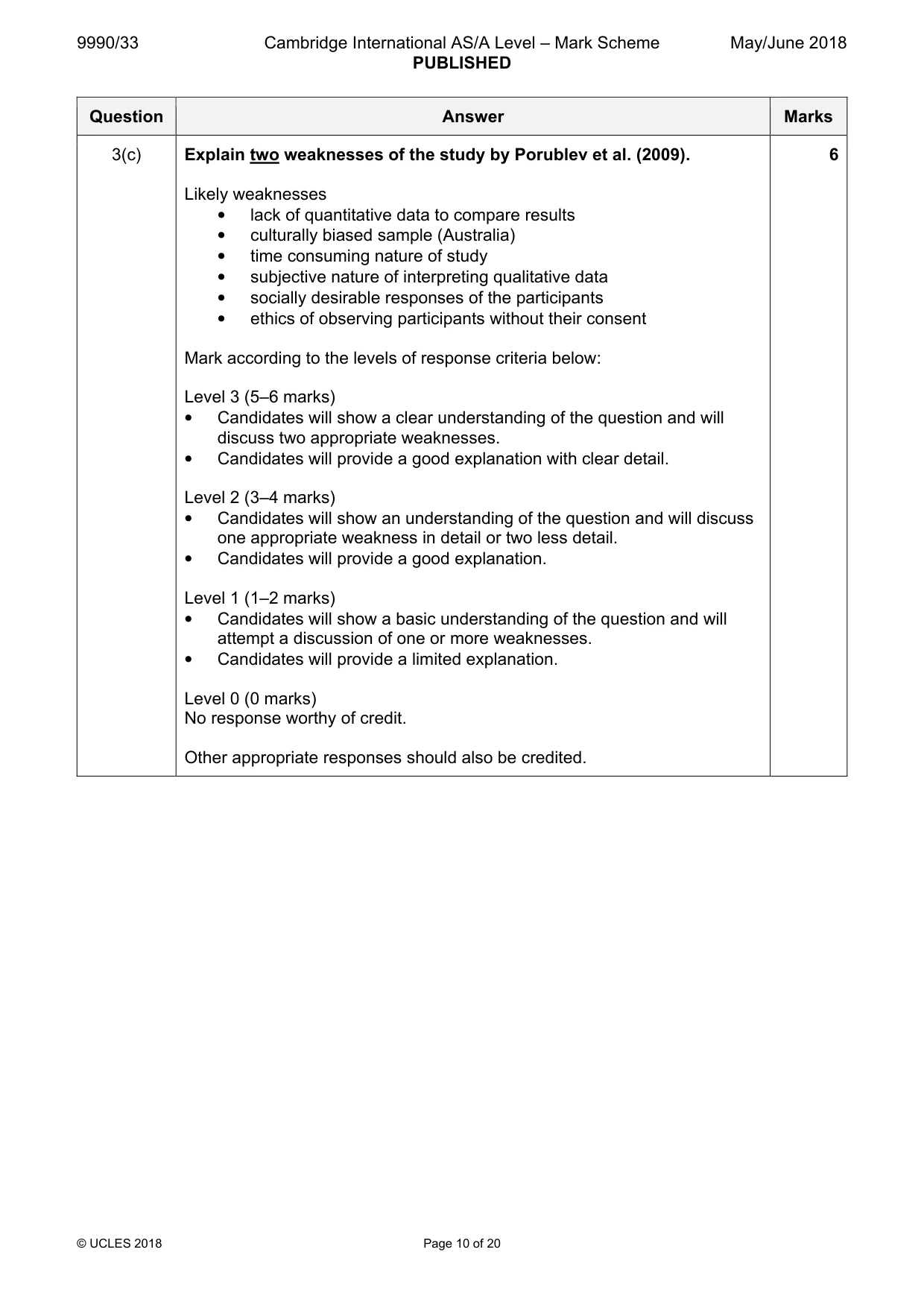
9990/33 Cambridge International AS/A Level – Mark Scheme PUBLISHED May/June 2018 © UCLES 2018 Page 10 of 20 Question Answer Marks 3(c) Explain two weaknesses of the study by Porublev et al. (2009). Likely weaknesses • lack of quantitative data to compare results • culturally biased sample (Australia) • time consuming nature of study • subjective nature of interpreting qualitative data • socially desirable responses of the participants • ethics of observing participants without their consent Mark according to the levels of response criteria below: Level 3 (5–6 marks) • Candidates will show a clear understanding of the question and will discuss two appropriate weaknesses. • Candidates will provide a good explanation with clear detail. Level 2 (3–4 marks) • Candidates will show an understanding of the question and will discuss one appropriate weakness in detail or two less detail. • Candidates will provide a good explanation. Level 1 (1–2 marks) • Candidates will show a basic understanding of the question and will attempt a discussion of one or more weaknesses. • Candidates will provide a limited explanation. Level 0 (0 marks) No response worthy of credit. Other appropriate responses should also be credited. 6
Mark scheme, page 11
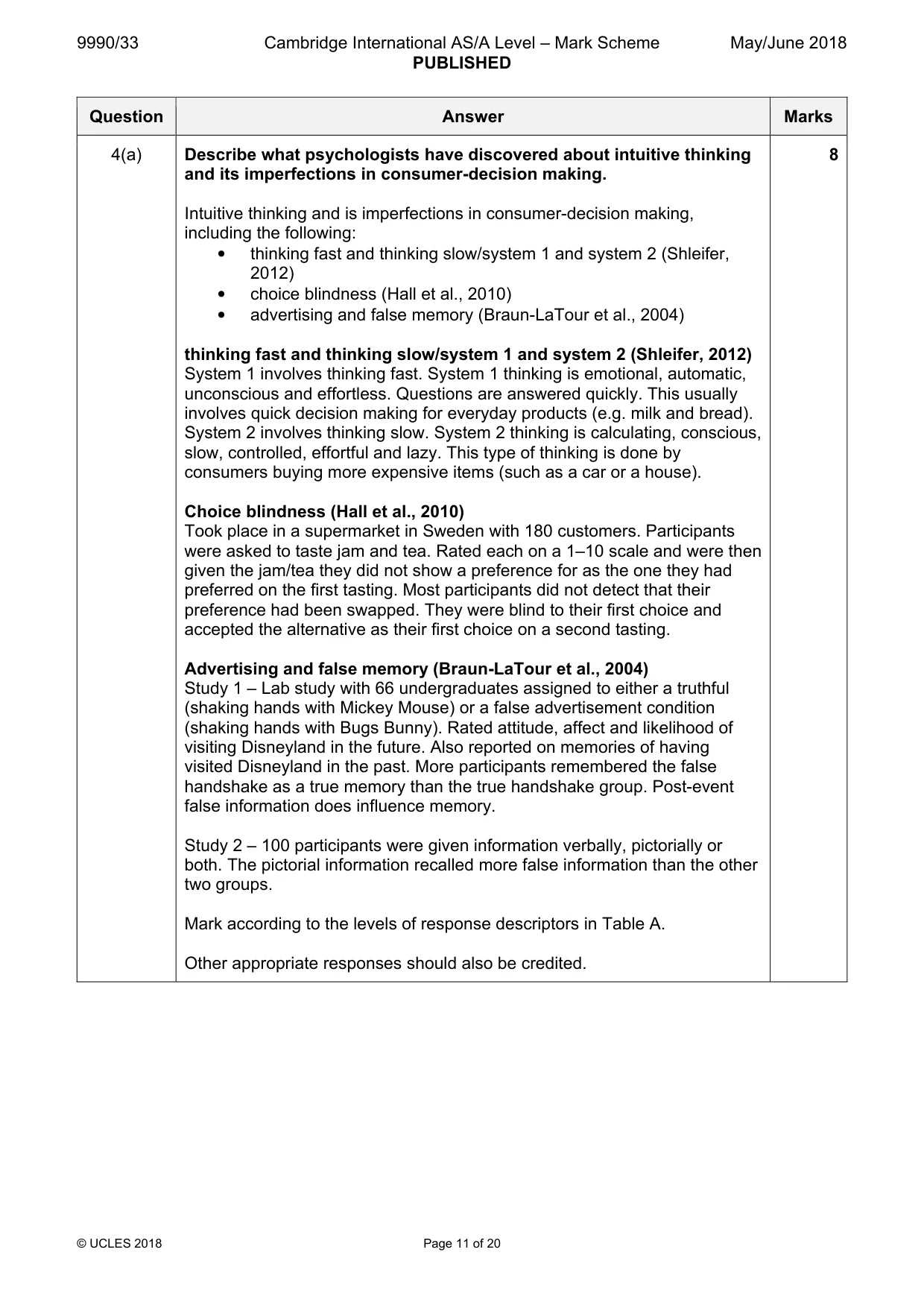
9990/33 Cambridge International AS/A Level – Mark Scheme PUBLISHED May/June 2018 © UCLES 2018 Page 11 of 20 Question Answer Marks 4(a) Describe what psychologists have discovered about intuitive thinking and its imperfections in consumer-decision making. Intuitive thinking and is imperfections in consumer-decision making, including the following: • thinking fast and thinking slow/system 1 and system 2 (Shleifer, 2012) • choice blindness (Hall et al., 2010) • advertising and false memory (Braun-LaTour et al., 2004) thinking fast and thinking slow/system 1 and system 2 (Shleifer, 2012) System 1 involves thinking fast. System 1 thinking is emotional, automatic, unconscious and effortless. Questions are answered quickly. This usually involves quick decision making for everyday products (e.g. milk and bread). System 2 involves thinking slow. System 2 thinking is calculating, conscious, slow, controlled, effortful and lazy. This type of thinking is done by consumers buying more expensive items (such as a car or a house). Choice blindness (Hall et al., 2010) Took place in a supermarket in Sweden with 180 customers. Participants were asked to taste jam and tea. Rated each on a 1–10 scale and were then given the jam/tea they did not show a preference for as the one they had preferred on the first tasting. Most participants did not detect that their preference had been swapped. They were blind to their first choice and accepted the alternative as their first choice on a second tasting. Advertising and false memory (Braun-LaTour et al., 2004) Study 1 – Lab study with 66 undergraduates assigned to either a truthful (shaking hands with Mickey Mouse) or a false advertisement condition (shaking hands with Bugs Bunny). Rated attitude, affect and likelihood of visiting Disneyland in the future. Also reported on memories of having visited Disneyland in the past. More participants remembered the false handshake as a true memory than the true handshake group. Post-event false information does influence memory. Study 2 – 100 participants were given information verbally, pictorially or both. The pictorial information recalled more false information than the other two groups. Mark according to the levels of response descriptors in Table A. Other appropriate responses should also be credited. 8
Mark scheme, page 12
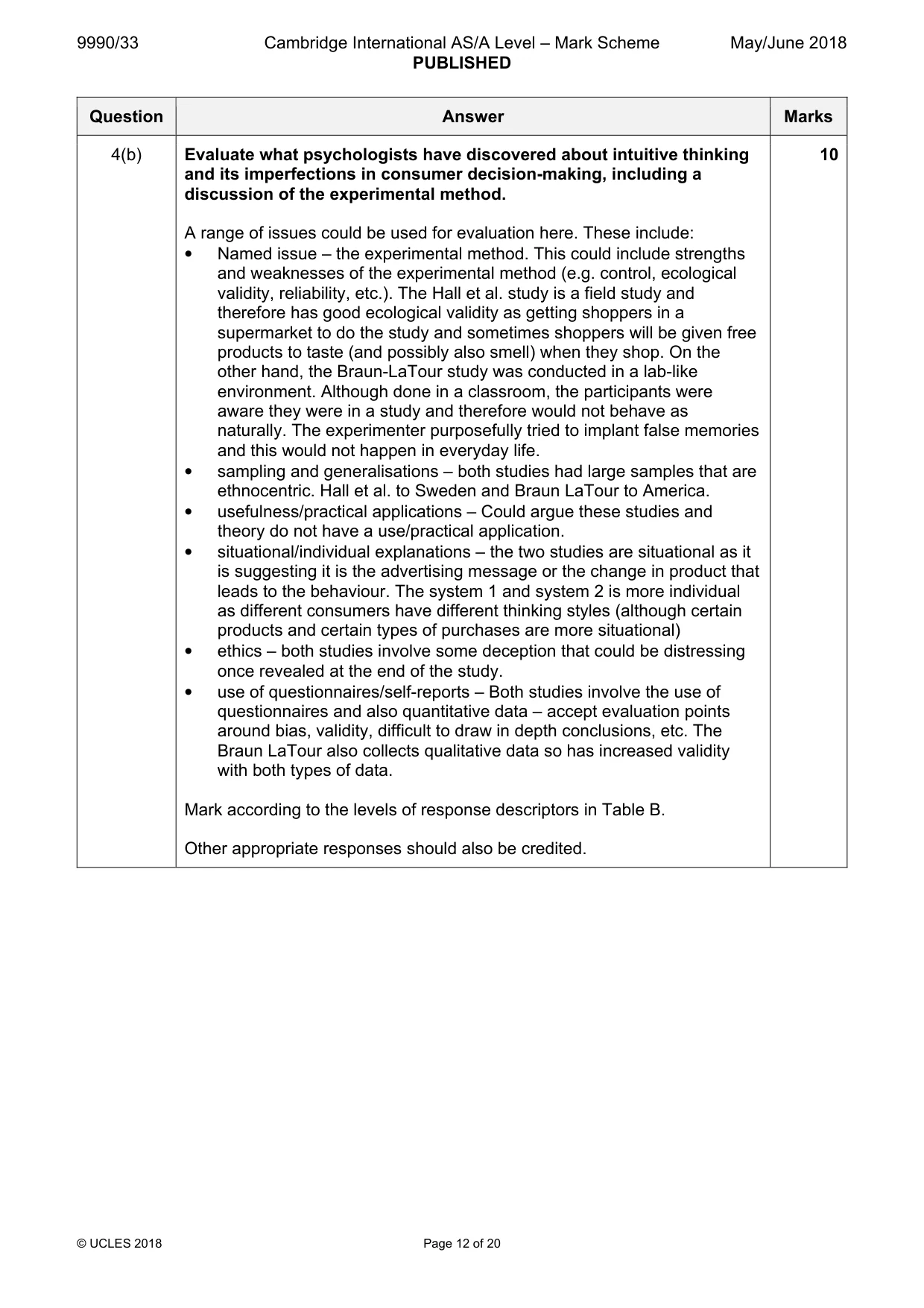
9990/33 Cambridge International AS/A Level – Mark Scheme PUBLISHED May/June 2018 © UCLES 2018 Page 12 of 20 Question Answer Marks 4(b) Evaluate what psychologists have discovered about intuitive thinking and its imperfections in consumer decision-making, including a discussion of the experimental method. A range of issues could be used for evaluation here. These include: • Named issue – the experimental method. This could include strengths and weaknesses of the experimental method (e.g. control, ecological validity, reliability, etc.). The Hall et al. study is a field study and therefore has good ecological validity as getting shoppers in a supermarket to do the study and sometimes shoppers will be given free products to taste (and possibly also smell) when they shop. On the other hand, the Braun-LaTour study was conducted in a lab-like environment. Although done in a classroom, the participants were aware they were in a study and therefore would not behave as naturally. The experimenter purposefully tried to implant false memories and this would not happen in everyday life. • sampling and generalisations – both studies had large samples that are ethnocentric. Hall et al. to Sweden and Braun LaTour to America. • usefulness/practical applications – Could argue these studies and theory do not have a use/practical application. • situational/individual explanations – the two studies are situational as it is suggesting it is the advertising message or the change in product that leads to the behaviour. The system 1 and system 2 is more individual as different consumers have different thinking styles (although certain products and certain types of purchases are more situational) • ethics – both studies involve some deception that could be distressing once revealed at the end of the study. • use of questionnaires/self-reports – Both studies involve the use of questionnaires and also quantitative data – accept evaluation points around bias, validity, difficult to draw in depth conclusions, etc. The Braun LaTour also collects qualitative data so has increased validity with both types of data. Mark according to the levels of response descriptors in Table B. Other appropriate responses should also be credited. 10
Mark scheme, page 13
9990/33 Cambridge International AS/A Level – Mark Scheme PUBLISHED May/June 2018 © UCLES 2018 Page 13 of 20 Psychology and health Question Answer Marks 5(a) Explain one type of non-adherence to medical advice. Award 1 mark for a basic explanation of the term/concept. Award 2 marks for a detailed explanation of the term/concept. For example: Failure to follow treatment (1) – this can be either failure to take medication (1) or failure to carry out behavioural changes requested by the practitioner such as stopping smoking, exercise, etc. (1) OR Failure to attend medical appointments (1) – missed appointment (1) or not making a follow up appointment (1). Other appropriate responses should also be credited. 2 5(b) Yokley and Glenwick (1984) used six groups with different motivational conditions to compare adherence to medical advice for child immunisation. Describe two of these conditions. Award 1–2 marks for a basic answer with some understanding of the topic area. Detailed description of one condition or less detail of two conditions (e.g. just naming them) Award 3–4 marks for a detailed answer with clear understanding of the topic area. Detailed description of two of the conditions. For three marks it may be detail for one of the conditions and less detail for the other (e.g. just naming it) For example: Participants were assigned to one of six groups: 1. General prompt group (195 participants) – general inoculation information and a prompt to get their child inoculated following 2. Specific prompt group (190 participants) – client specific inoculation information sent and told inoculations would be free. 3. Increased access group (185 participants) – also received a specific prompt and told about special extra clinic opening times. 4. Monetary incentive group (183 participants) – received specific prompt and told there would be cash prizes (via a lottery) if they had their child inoculated 5. Contact control group (189 participants) – received telephone contact requesting basic information. 6. No contact group (191 participants) – no contact made with these families for the entire study. Other appropriate responses should also be credited. 4
Mark scheme, page 14
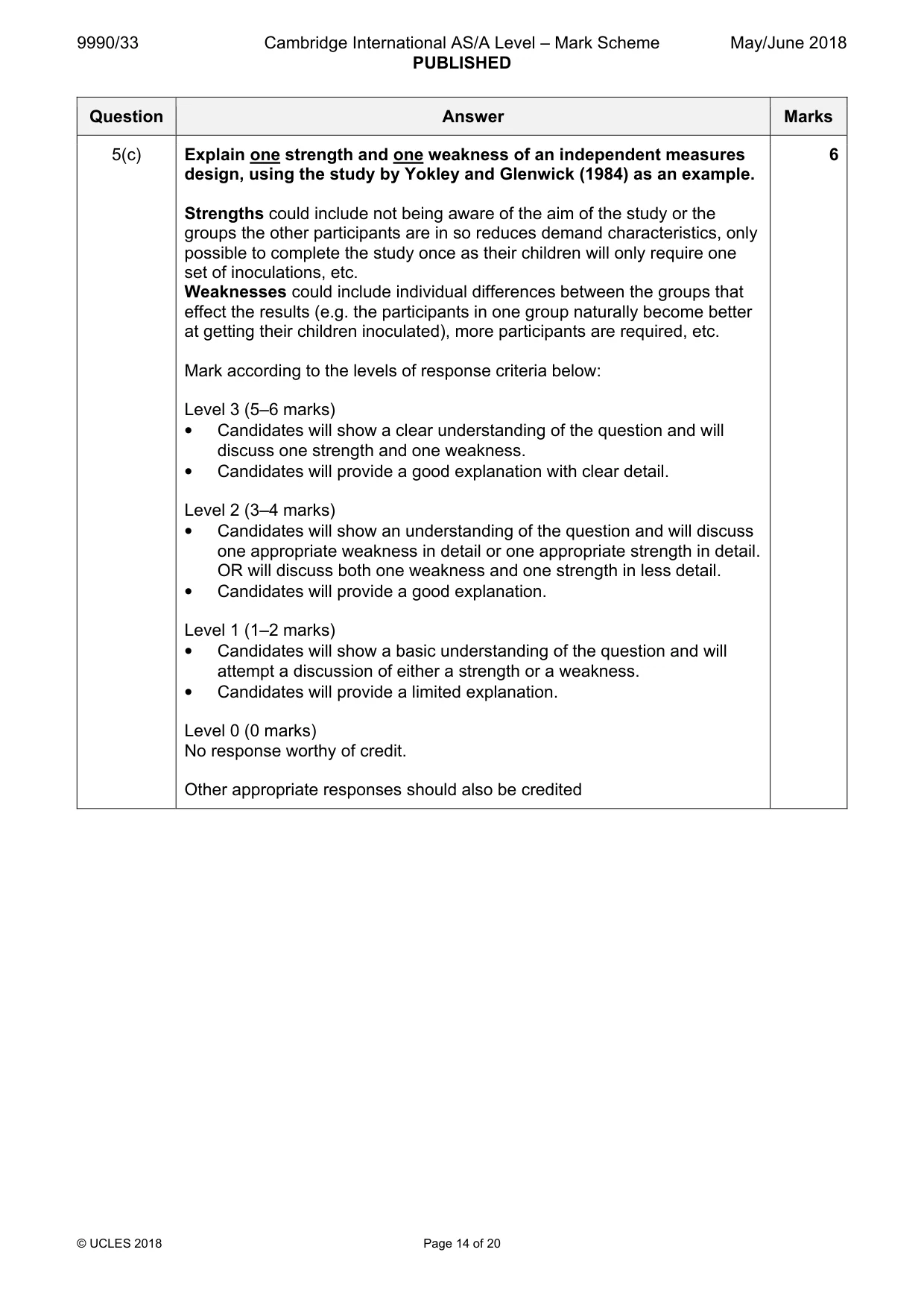
9990/33 Cambridge International AS/A Level – Mark Scheme PUBLISHED May/June 2018 © UCLES 2018 Page 14 of 20 Question Answer Marks 5(c) Explain one strength and one weakness of an independent measures design, using the study by Yokley and Glenwick (1984) as an example. Strengths could include not being aware of the aim of the study or the groups the other participants are in so reduces demand characteristics, only possible to complete the study once as their children will only require one set of inoculations, etc. Weaknesses could include individual differences between the groups that effect the results (e.g. the participants in one group naturally become better at getting their children inoculated), more participants are required, etc. Mark according to the levels of response criteria below: Level 3 (5–6 marks) • Candidates will show a clear understanding of the question and will discuss one strength and one weakness. • Candidates will provide a good explanation with clear detail. Level 2 (3–4 marks) • Candidates will show an understanding of the question and will discuss one appropriate weakness in detail or one appropriate strength in detail. OR will discuss both one weakness and one strength in less detail. • Candidates will provide a good explanation. Level 1 (1–2 marks) • Candidates will show a basic understanding of the question and will attempt a discussion of either a strength or a weakness. • Candidates will provide a limited explanation. Level 0 (0 marks) No response worthy of credit. Other appropriate responses should also be credited 6
Mark scheme, page 15
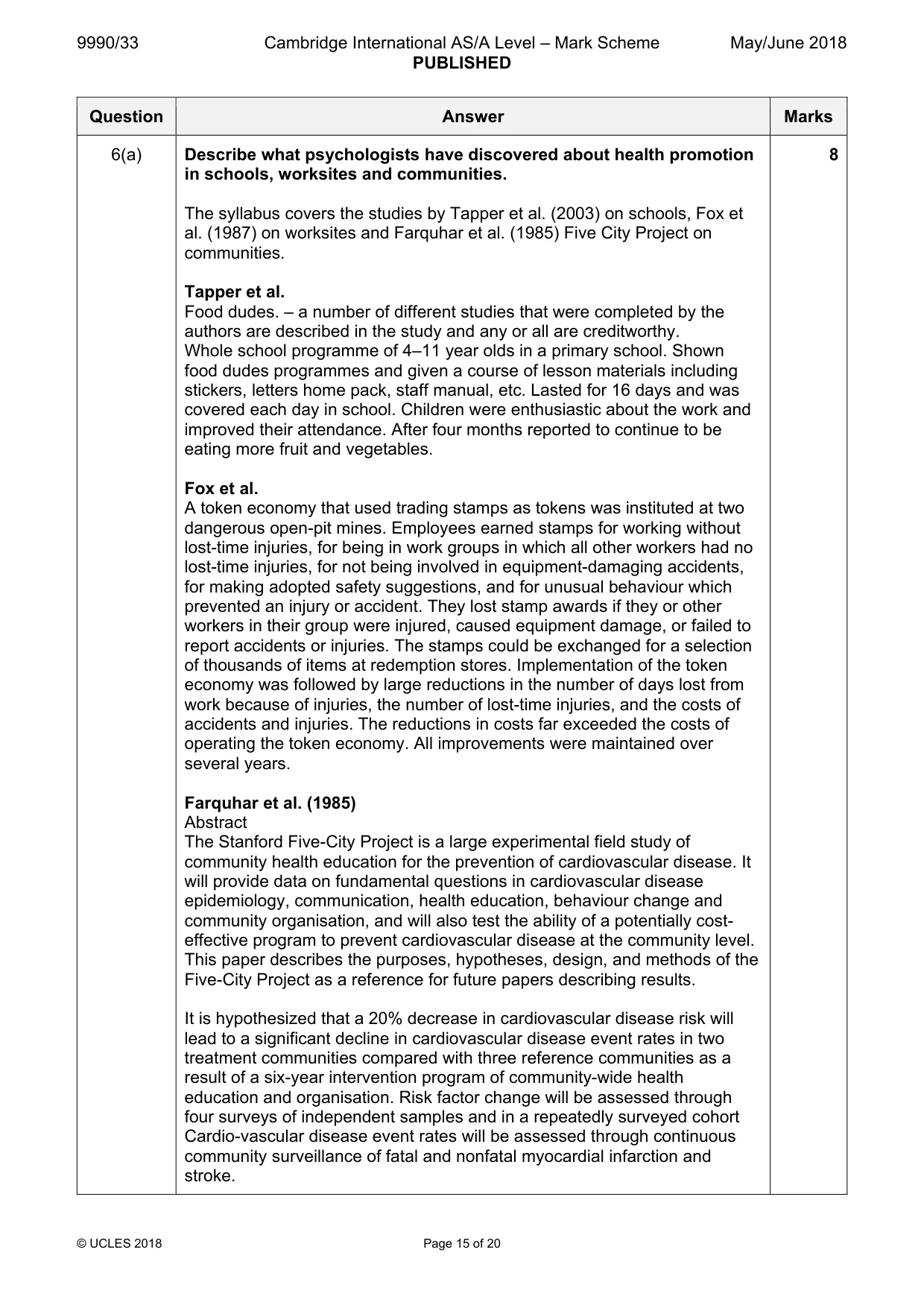
9990/33 Cambridge International AS/A Level – Mark Scheme PUBLISHED May/June 2018 © UCLES 2018 Page 15 of 20 Question Answer Marks 6(a) Describe what psychologists have discovered about health promotion in schools, worksites and communities. The syllabus covers the studies by Tapper et al. (2003) on schools, Fox et al. (1987) on worksites and Farquhar et al. (1985) Five City Project on communities. Tapper et al. Food dudes. – a number of different studies that were completed by the authors are described in the study and any or all are creditworthy. Whole school programme of 4–11 year olds in a primary school. Shown food dudes programmes and given a course of lesson materials including stickers, letters home pack, staff manual, etc. Lasted for 16 days and was covered each day in school. Children were enthusiastic about the work and improved their attendance. After four months reported to continue to be eating more fruit and vegetables. Fox et al. A token economy that used trading stamps as tokens was instituted at two dangerous open-pit mines. Employees earned stamps for working without lost-time injuries, for being in work groups in which all other workers had no lost-time injuries, for not being involved in equipment-damaging accidents, for making adopted safety suggestions, and for unusual behaviour which prevented an injury or accident. They lost stamp awards if they or other workers in their group were injured, caused equipment damage, or failed to report accidents or injuries. The stamps could be exchanged for a selection of thousands of items at redemption stores. Implementation of the token economy was followed by large reductions in the number of days lost from work because of injuries, the number of lost-time injuries, and the costs of accidents and injuries. The reductions in costs far exceeded the costs of operating the token economy. All improvements were maintained over several years. Farquhar et al. (1985) Abstract The Stanford Five-City Project is a large experimental field study of community health education for the prevention of cardiovascular disease. It will provide data on fundamental questions in cardiovascular disease epidemiology, communication, health education, behaviour change and community organisation, and will also test the ability of a potentially cost- effective program to prevent cardiovascular disease at the community level. This paper describes the purposes, hypotheses, design, and methods of the Five-City Project as a reference for future papers describing results. It is hypothesized that a 20% decrease in cardiovascular disease risk will lead to a significant decline in cardiovascular disease event rates in two treatment communities compared with three reference communities as a result of a six-year intervention program of community-wide health education and organisation. Risk factor change will be assessed through four surveys of independent samples and in a repeatedly surveyed cohort Cardio-vascular disease event rates will be assessed through continuous community surveillance of fatal and nonfatal myocardial infarction and stroke. 8
Mark scheme, page 16
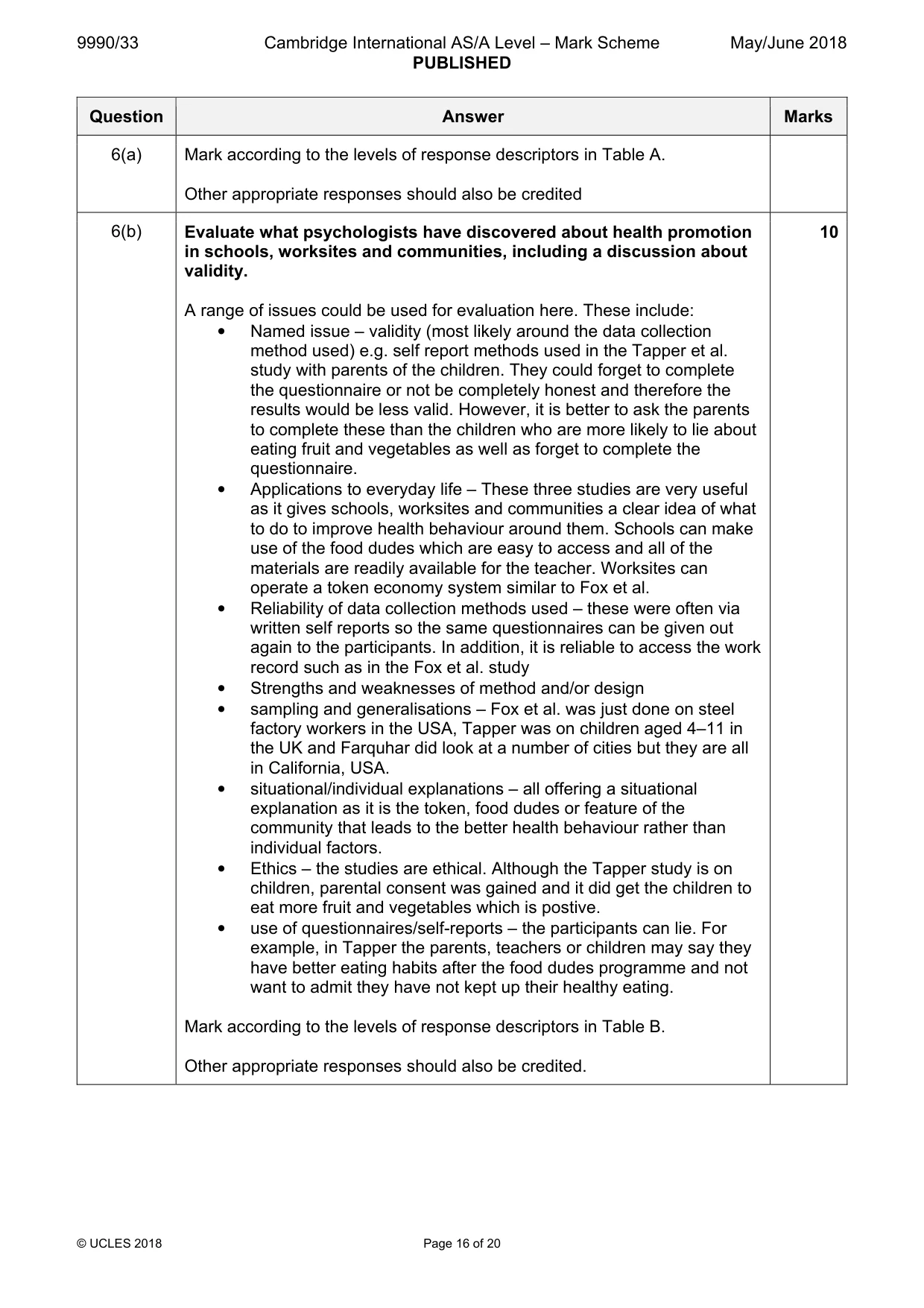
9990/33 Cambridge International AS/A Level – Mark Scheme PUBLISHED May/June 2018 © UCLES 2018 Page 16 of 20 Question Answer Marks 6(a) Mark according to the levels of response descriptors in Table A. Other appropriate responses should also be credited 6(b) Evaluate what psychologists have discovered about health promotion in schools, worksites and communities, including a discussion about validity. A range of issues could be used for evaluation here. These include: • Named issue – validity (most likely around the data collection method used) e.g. self report methods used in the Tapper et al. study with parents of the children. They could forget to complete the questionnaire or not be completely honest and therefore the results would be less valid. However, it is better to ask the parents to complete these than the children who are more likely to lie about eating fruit and vegetables as well as forget to complete the questionnaire. • Applications to everyday life – These three studies are very useful as it gives schools, worksites and communities a clear idea of what to do to improve health behaviour around them. Schools can make use of the food dudes which are easy to access and all of the materials are readily available for the teacher. Worksites can operate a token economy system similar to Fox et al. • Reliability of data collection methods used – these were often via written self reports so the same questionnaires can be given out again to the participants. In addition, it is reliable to access the work record such as in the Fox et al. study • Strengths and weaknesses of method and/or design • sampling and generalisations – Fox et al. was just done on steel factory workers in the USA, Tapper was on children aged 4–11 in the UK and Farquhar did look at a number of cities but they are all in California, USA. • situational/individual explanations – all offering a situational explanation as it is the token, food dudes or feature of the community that leads to the better health behaviour rather than individual factors. • Ethics – the studies are ethical. Although the Tapper study is on children, parental consent was gained and it did get the children to eat more fruit and vegetables which is postive. • use of questionnaires/self-reports – the participants can lie. For example, in Tapper the parents, teachers or children may say they have better eating habits after the food dudes programme and not want to admit they have not kept up their healthy eating. Mark according to the levels of response descriptors in Table B. Other appropriate responses should also be credited. 10
Mark scheme, page 17
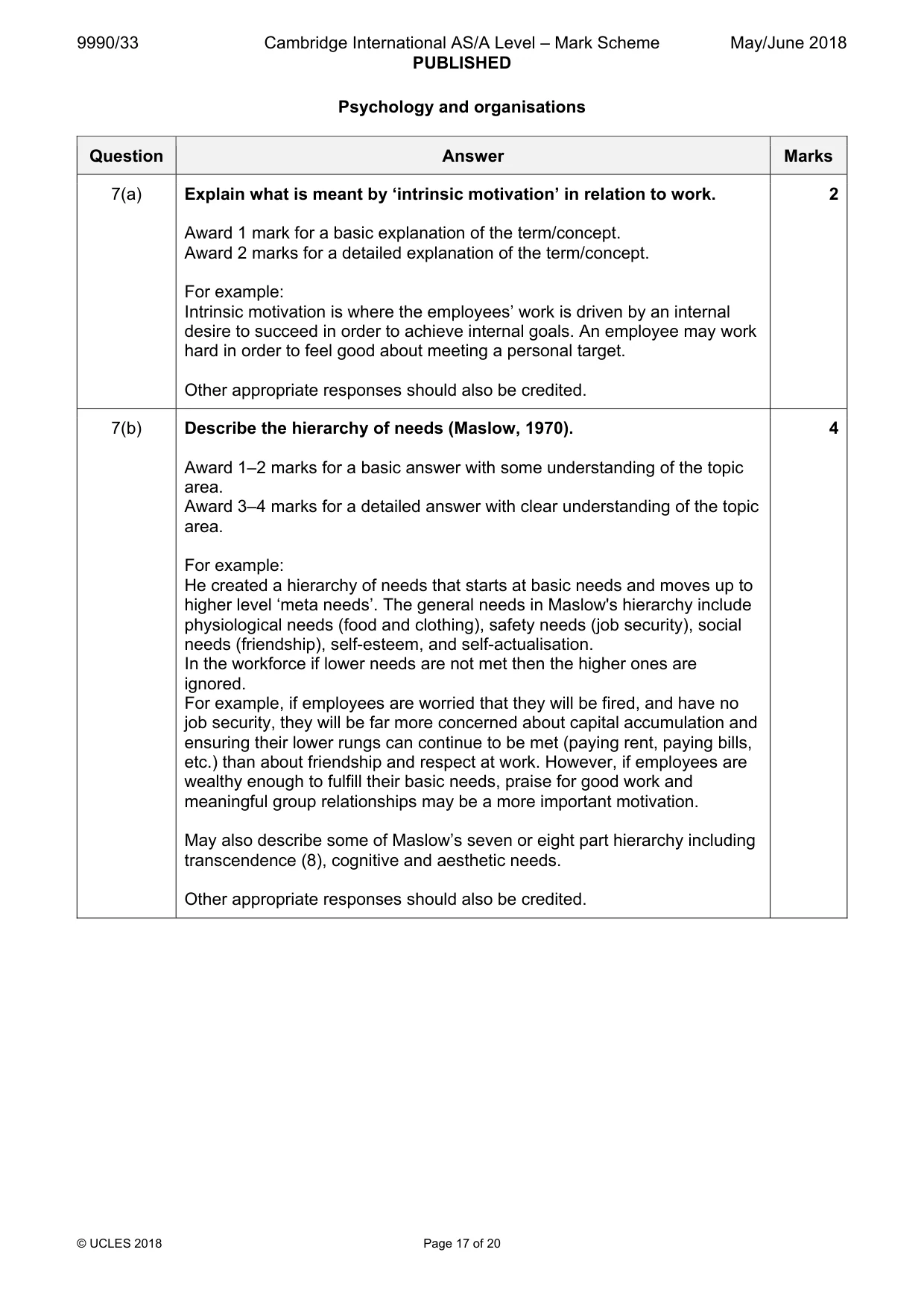
9990/33 Cambridge International AS/A Level – Mark Scheme PUBLISHED May/June 2018 © UCLES 2018 Page 17 of 20 Psychology and organisations Question Answer Marks 7(a) Explain what is meant by ‘intrinsic motivation’ in relation to work. Award 1 mark for a basic explanation of the term/concept. Award 2 marks for a detailed explanation of the term/concept. For example: Intrinsic motivation is where the employees’ work is driven by an internal desire to succeed in order to achieve internal goals. An employee may work hard in order to feel good about meeting a personal target. Other appropriate responses should also be credited. 2 7(b) Describe the hierarchy of needs (Maslow, 1970). Award 1–2 marks for a basic answer with some understanding of the topic area. Award 3–4 marks for a detailed answer with clear understanding of the topic area. For example: He created a hierarchy of needs that starts at basic needs and moves up to higher level ‘meta needs’. The general needs in Maslow's hierarchy include physiological needs (food and clothing), safety needs (job security), social needs (friendship), self-esteem, and self-actualisation. In the workforce if lower needs are not met then the higher ones are ignored. For example, if employees are worried that they will be fired, and have no job security, they will be far more concerned about capital accumulation and ensuring their lower rungs can continue to be met (paying rent, paying bills, etc.) than about friendship and respect at work. However, if employees are wealthy enough to fulfill their basic needs, praise for good work and meaningful group relationships may be a more important motivation. May also describe some of Maslow’s seven or eight part hierarchy including transcendence (8), cognitive and aesthetic needs. Other appropriate responses should also be credited. 4
Mark scheme, page 18
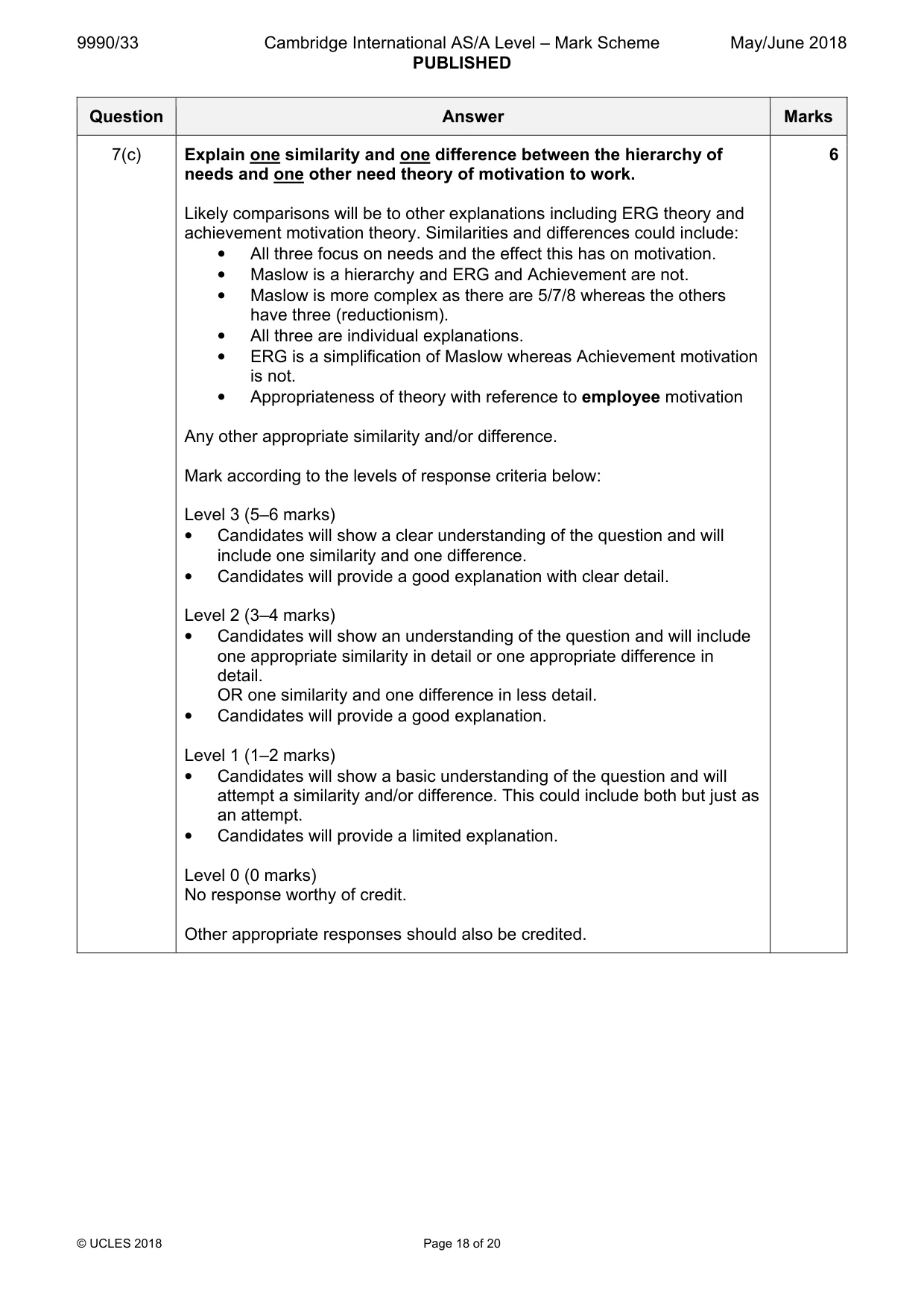
9990/33 Cambridge International AS/A Level – Mark Scheme PUBLISHED May/June 2018 © UCLES 2018 Page 18 of 20 Question Answer Marks 7(c) Explain one similarity and one difference between the hierarchy of needs and one other need theory of motivation to work. Likely comparisons will be to other explanations including ERG theory and achievement motivation theory. Similarities and differences could include: • All three focus on needs and the effect this has on motivation. • Maslow is a hierarchy and ERG and Achievement are not. • Maslow is more complex as there are 5/7/8 whereas the others have three (reductionism). • All three are individual explanations. • ERG is a simplification of Maslow whereas Achievement motivation is not. • Appropriateness of theory with reference to employee motivation Any other appropriate similarity and/or difference. Mark according to the levels of response criteria below: Level 3 (5–6 marks) • Candidates will show a clear understanding of the question and will include one similarity and one difference. • Candidates will provide a good explanation with clear detail. Level 2 (3–4 marks) • Candidates will show an understanding of the question and will include one appropriate similarity in detail or one appropriate difference in detail. OR one similarity and one difference in less detail. • Candidates will provide a good explanation. Level 1 (1–2 marks) • Candidates will show a basic understanding of the question and will attempt a similarity and/or difference. This could include both but just as an attempt. • Candidates will provide a limited explanation. Level 0 (0 marks) No response worthy of credit. Other appropriate responses should also be credited. 6
Mark scheme, page 19
9990/33 Cambridge International AS/A Level – Mark Scheme PUBLISHED May/June 2018 © UCLES 2018 Page 19 of 20 Question Answer Marks 8(a) Describe what psychologists have discovered about group development and roles in organisations. Group development and roles in organisations, including the following: • group development (Tuckman, 1965) • team roles (Belbin, 1981) • measuring team roles: Belbin team inventory Group development (Tuckman, 1965) Tuckman and Jensen noted five stages – forming, storming, norming, performing and adjourning which are creditworthy. Tuckman also proposed a four stage development procedure for a group – orientation to the task, intra-group conflict, development of group cohesion and functional role-relatedness (group begins to tackle the task at hand). Team roles (Belbin, 1981) Belbin identifies nine roles within a team divided into three categories– Cerebral (thought related) plant (creative problem solvers), specialist (skill and knowledge specialists), monitor evaluator (strategic thinkers), Action related roles shaper (risk takers and thrive on pressure), implementer (turn ideas into practical action), teamworker (work together and avoid friction within team), People related roles resource investigator (explore opportunities for the team), coordinator (good chairperson for the team), and completer finisher (good at finding errors and finishing projects on time). Measuring team roles: Belbin team inventory These Reports identify which of the nine key clusters of behaviour (or Team Roles) crucial to the success of a team or project individuals prefer, and pinpoint strengths and weaknesses. The starting point is the Belbin Individual Report which identifies which combination of the nine Team Roles and individual exhibits. To enhance the value of the Individual Reports, other people are invited to share their observations too (we call these Observer Assessments) via a quick five- minute online questionnaire. The Inventory assesses how an individual behaves in a team environment. The assessment includes 360-degree feedback from observers as well as the individual's own evaluation of their behaviour, and contrasts how they see their behaviour with how their colleagues do. The Belbin Inventory scores people on how strongly they express behavioural traits from nine different Team Roles. A person may and often does exhibit strong tendencies towards multiple roles Mark according to the levels of response descriptors in Table A. Other appropriate responses should also be credited. 8
Mark scheme, page 20
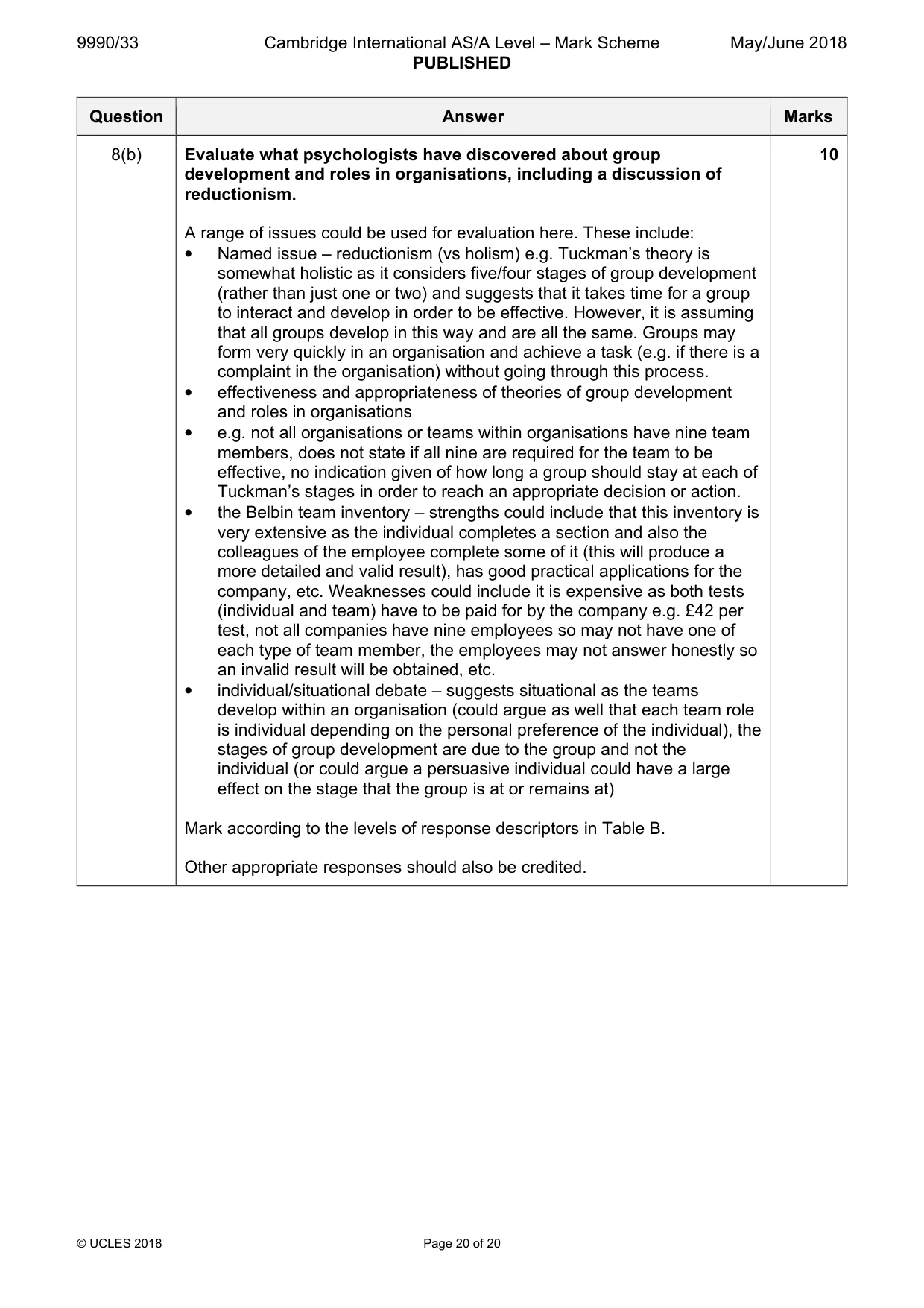
9990/33 Cambridge International AS/A Level – Mark Scheme PUBLISHED May/June 2018 © UCLES 2018 Page 20 of 20 Question Answer Marks 8(b) Evaluate what psychologists have discovered about group development and roles in organisations, including a discussion of reductionism. A range of issues could be used for evaluation here. These include: • Named issue – reductionism (vs holism) e.g. Tuckman’s theory is somewhat holistic as it considers five/four stages of group development (rather than just one or two) and suggests that it takes time for a group to interact and develop in order to be effective. However, it is assuming that all groups develop in this way and are all the same. Groups may form very quickly in an organisation and achieve a task (e.g. if there is a complaint in the organisation) without going through this process. • effectiveness and appropriateness of theories of group development and roles in organisations • e.g. not all organisations or teams within organisations have nine team members, does not state if all nine are required for the team to be effective, no indication given of how long a group should stay at each of Tuckman’s stages in order to reach an appropriate decision or action. • the Belbin team inventory – strengths could include that this inventory is very extensive as the individual completes a section and also the colleagues of the employee complete some of it (this will produce a more detailed and valid result), has good practical applications for the company, etc. Weaknesses could include it is expensive as both tests (individual and team) have to be paid for by the company e.g. £42 per test, not all companies have nine employees so may not have one of each type of team member, the employees may not answer honestly so an invalid result will be obtained, etc. • individual/situational debate – suggests situational as the teams develop within an organisation (could argue as well that each team role is individual depending on the personal preference of the individual), the stages of group development are due to the group and not the individual (or could argue a persuasive individual could have a large effect on the stage that the group is at or remains at) Mark according to the levels of response descriptors in Table B. Other appropriate responses should also be credited. 10
What you needed in this session
Cambridge’s own grade thresholds for 2018 May/June, Paper 3 · Variant 3. A higher threshold means an easier paper — the bar moves with how the cohort did.