Cambridge A Level Psychology 9698 — 2018 Oct/Nov Paper 2 · Variant 1
9698/21/O/N/18 · 4 questions · 70 marks · ≈79 min
The question paper and its mark scheme, free to read here and free to download. This is Cambridge’s own paper, exactly as it was sat.
Question paper4 pages

Mark scheme12 pages
Answers below. Sit the paper first if you are practising.
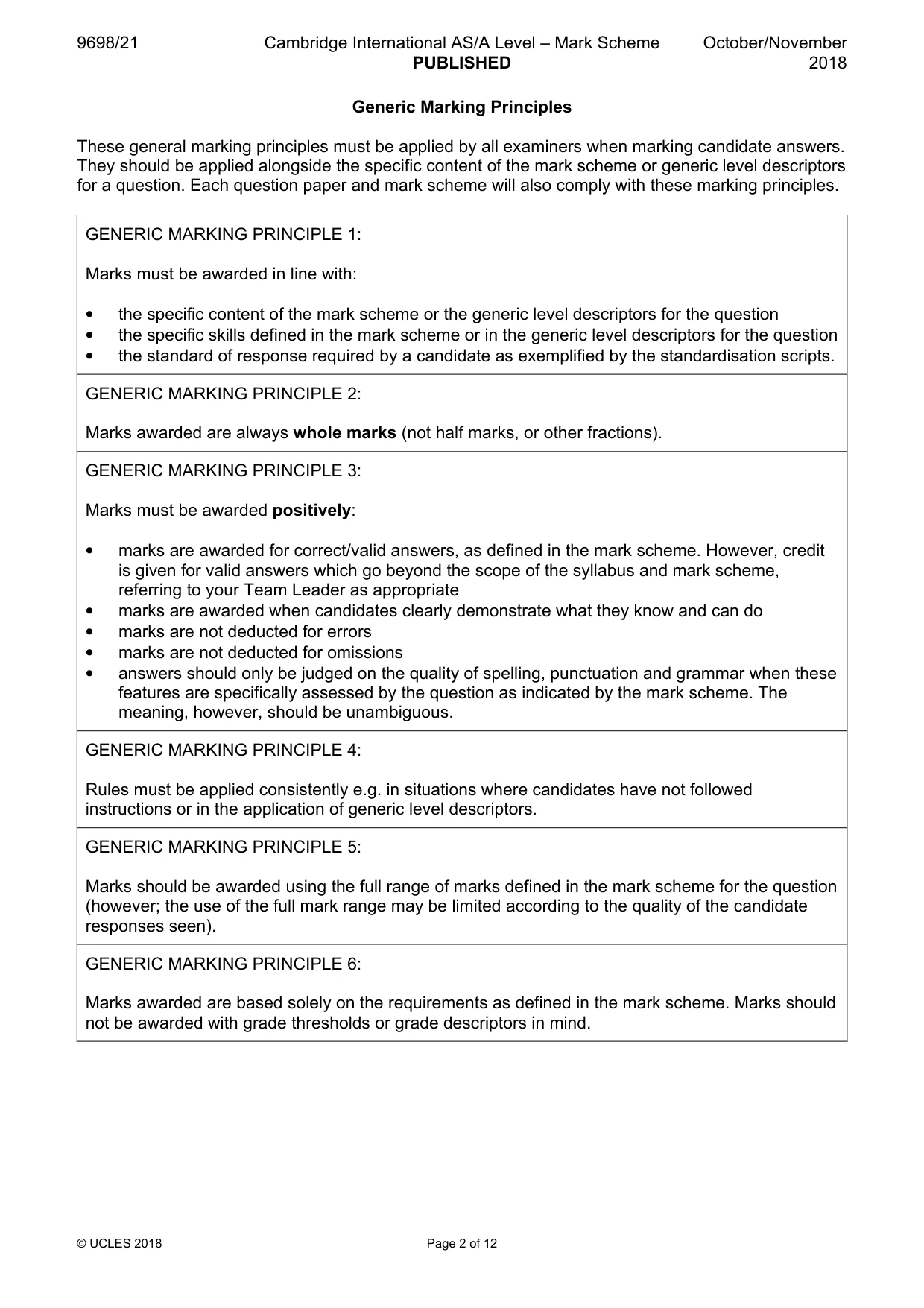

Questions as text
Question 1
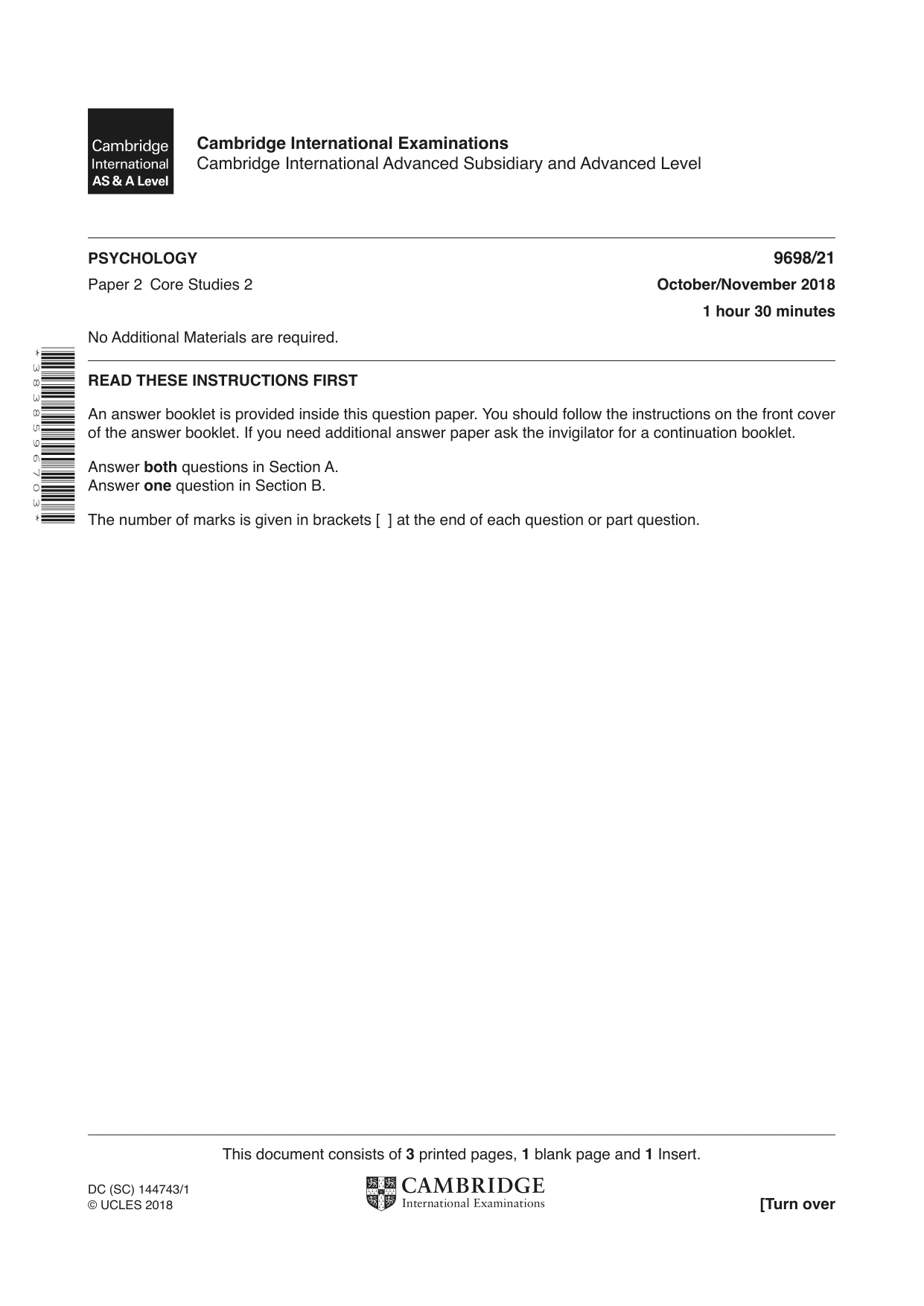
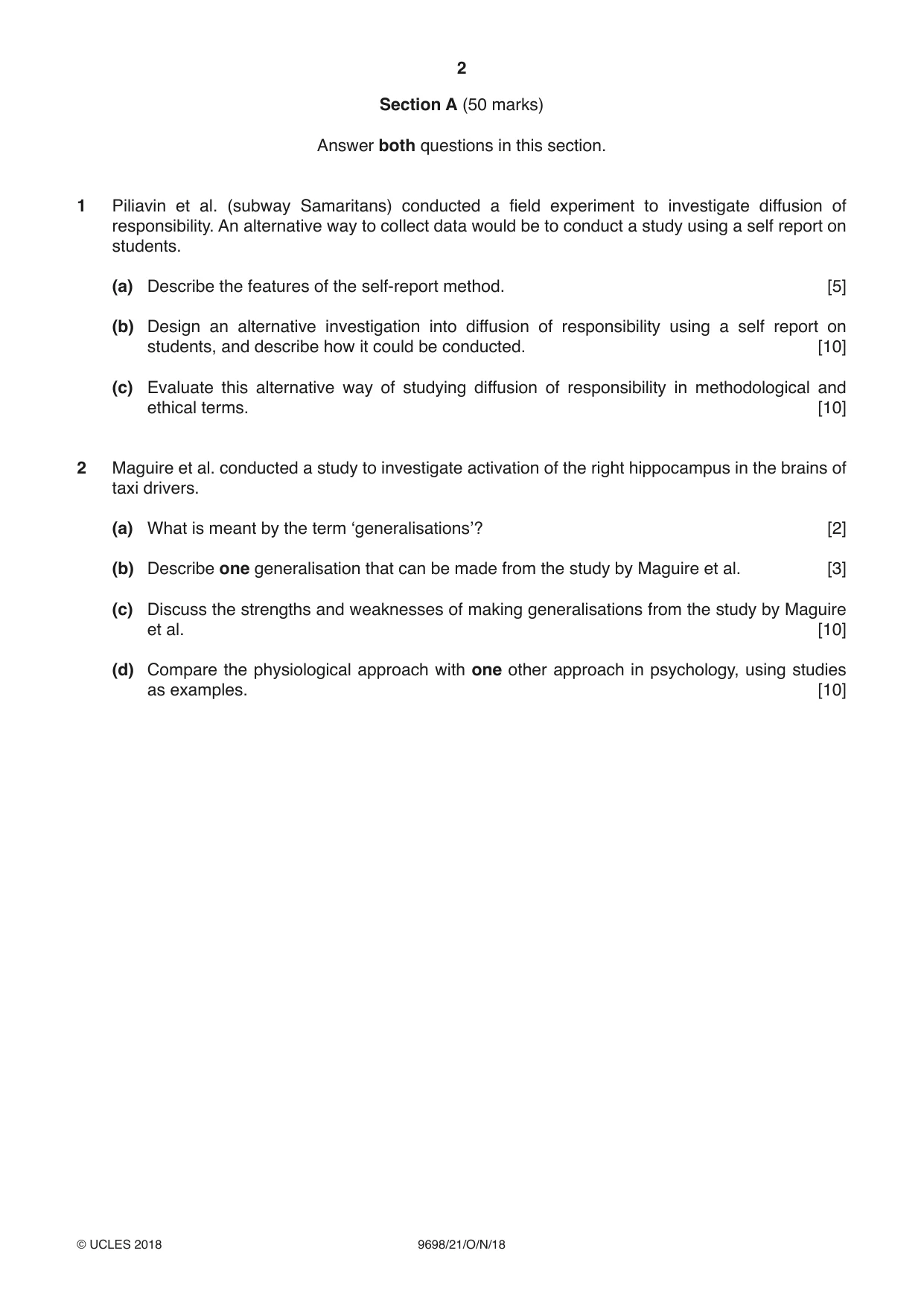
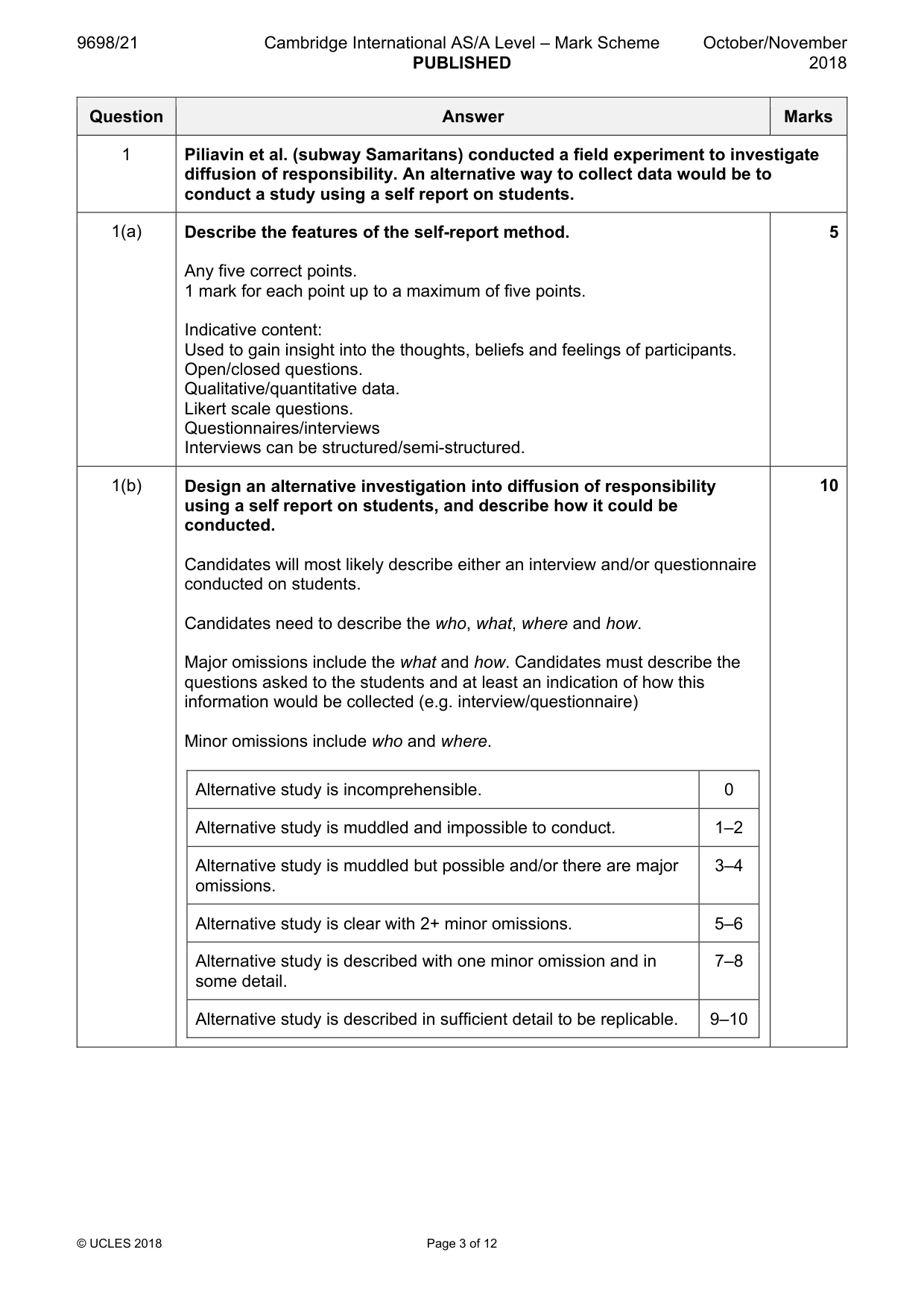
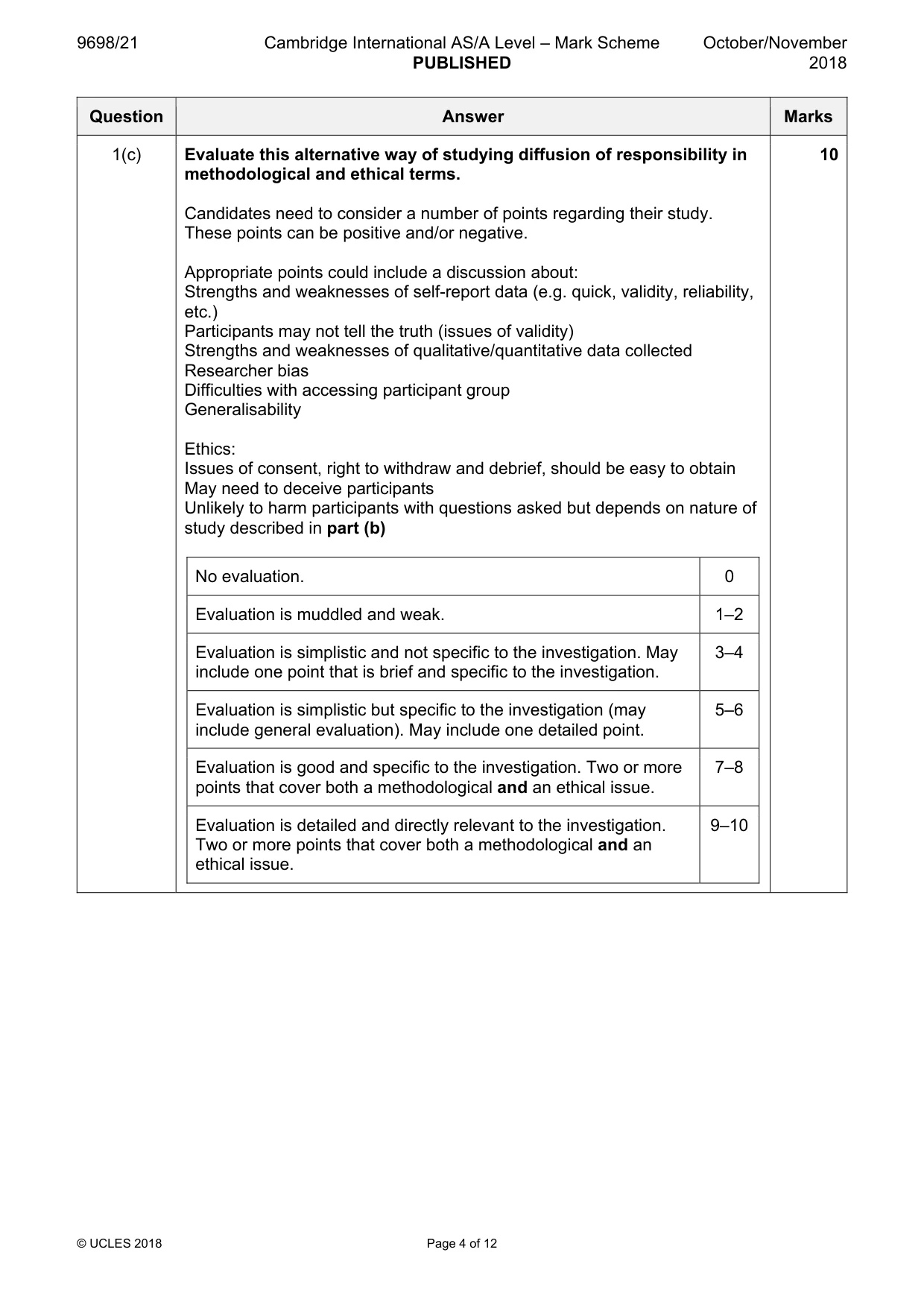
1 Piliavin et al. (subway Samaritans) conducted a field experiment to investigate diffusion of responsibility. An alternative way to collect data would be to conduct a study using a self report on students. (a) Describe the features of the self-report method. [5] (b) Design an alternative investigation into diffusion of responsibility using a self report on students, and describe how it could be conducted. [10] (c) Evaluate this alternative way of studying diffusion of responsibility in methodological and ethical terms. [10]
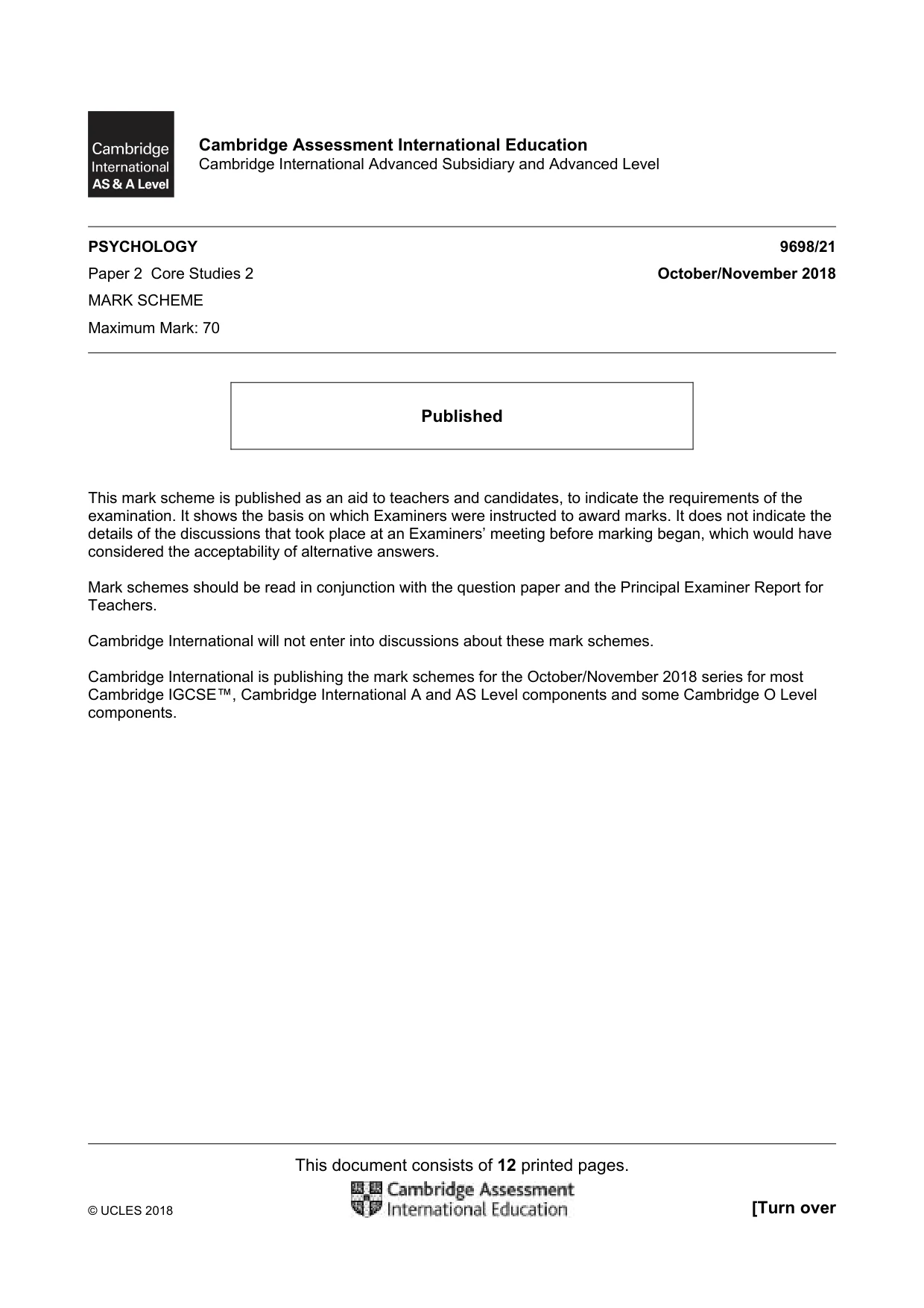
Mark scheme: Question Answer Marks 1 Piliavin et al. (subway Samaritans) conducted a field experiment to investigate diffusion of responsibility. An alternative way to collect data would be to conduct a study using a self report on students. 1(a) Describe the features of the self-report method. 5 Any five correct points. 1 mark for each point up to a maximum of five points. Indicative content: Used to gain insight into the thoughts, beliefs and feelings of participants. Open/closed questions. Qualitative/quantitative data. Likert scale questions. Questionnaires/interviews Interviews can be structured/semi-structured. 1(b) Design an alternative investigation into diffusion of responsibility 10 using a self report on students, and describe how it could be conducted. Candidates will most likely describe either an interview and/or questionnaire conducted on students. Candidates need to describe the who, what, where and how. Major omissions include the what and how. Candidates must describe the questions asked to the students and at least an indication of how this information would be collected (e.g. interview/questionnaire) Minor omissions include who and where. Alternative study is incomprehensible. 0 Alternative study is muddled and impossible to conduct. 1–2 Alternative study is muddled but possible and/or there are major 3–4 omissions. Alternative study is clear with 2+ minor omissions. 5–6 Alternative study is described with one minor omission and in 7–8 some detail. Alternative study is described in sufficient detail to be replicable. 9–10 1(c) Evaluate this alternative way of studying diffusion of responsibility in 10 methodological and ethical terms. Candidates need to consider a number of points regarding their study. These points can be positive and/or negative. Appropriate points could include a discussion about: Strengths and weaknesses of self-report data (e.g. quick, validity, reliability, etc.) Participants may not tell the truth (issues of validity) Strengths and weaknesses of qualitative/quantitative data collected Researcher bias Difficulties with accessing participant group Generalisability Ethics: Issues of consent, right to withdraw and debrief, should be easy to obtain May need to deceive participants Unlikely to harm participants with questions asked but depends on nature of study described in part (b) No evaluation. 0 Evaluation is muddled and weak. 1–2 Evaluation is simplistic and not specific to the investigation. May 3–4 include one point that is brief and specific to the investigation. Evaluation is simplistic but specific to the investigation (may 5–6 include general evaluation). May include one detailed point. Evaluation is good and specific to the investigation. Two or more 7–8 points that cover both a methodological and an ethical issue. Evaluation is detailed and directly relevant to the investigation. 9–10 Two or more points that cover both a methodological and an ethical issue.
Question 2
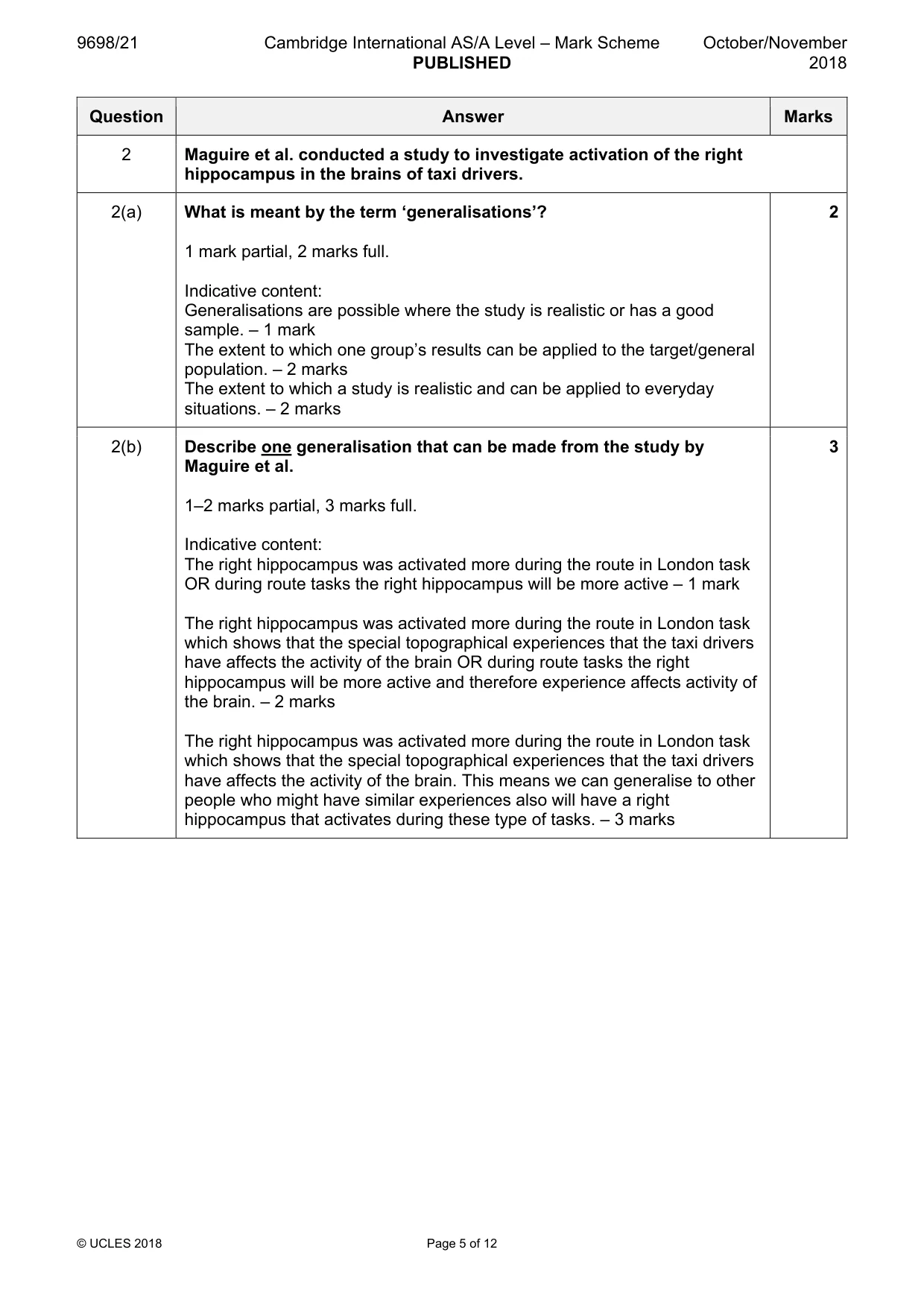
2 Maguire et al. conducted a study to investigate activation of the right hippocampus in the brains of taxi drivers. (a) What is meant by the term ‘generalisations’? [2] (b) Describe one generalisation that can be made from the study by Maguire et al. [3] (c) Discuss the strengths and weaknesses of making generalisations from the study by Maguire et al. [10] (d) Compare the physiological approach with one other approach in psychology, using studies as examples. [10]
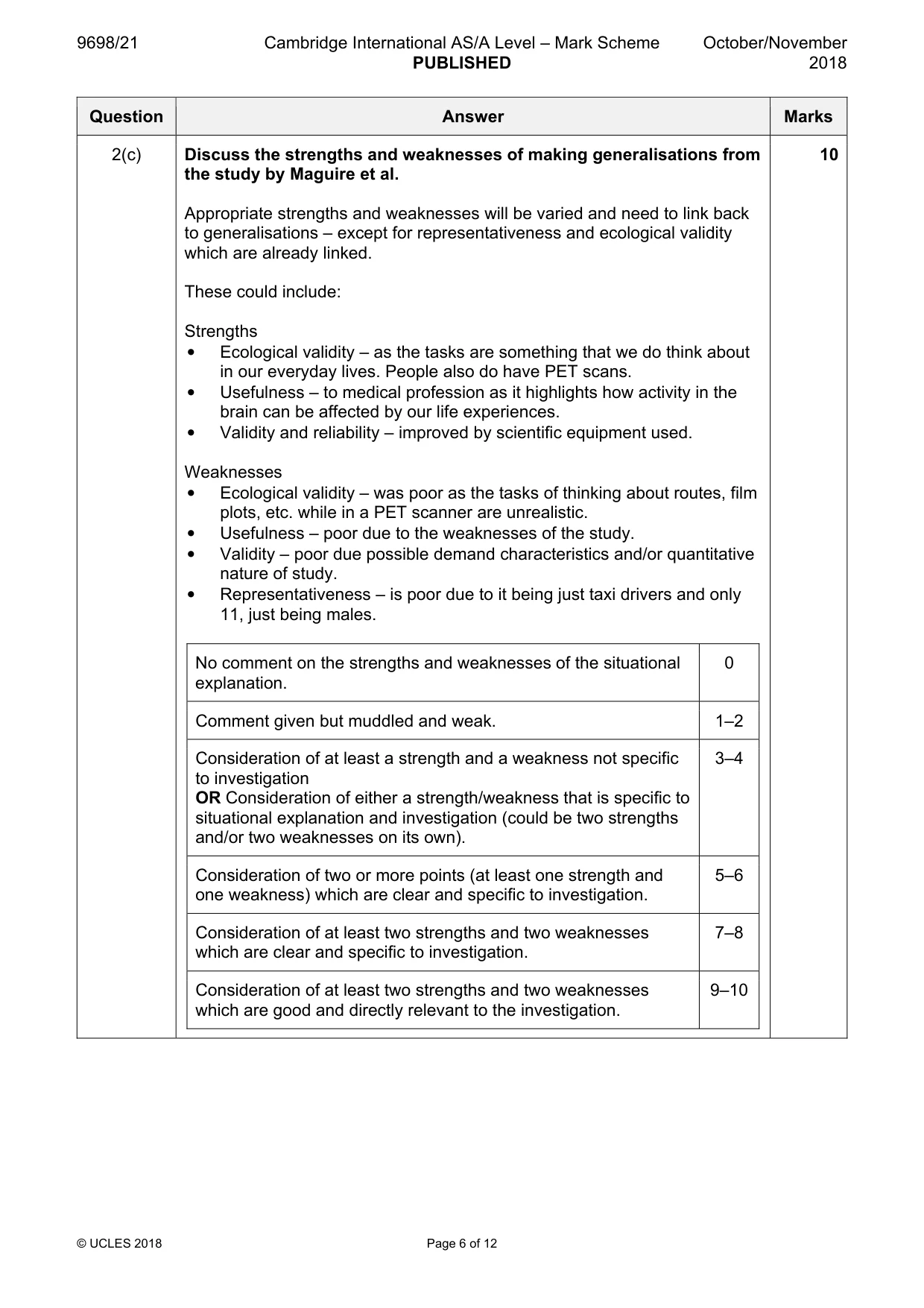
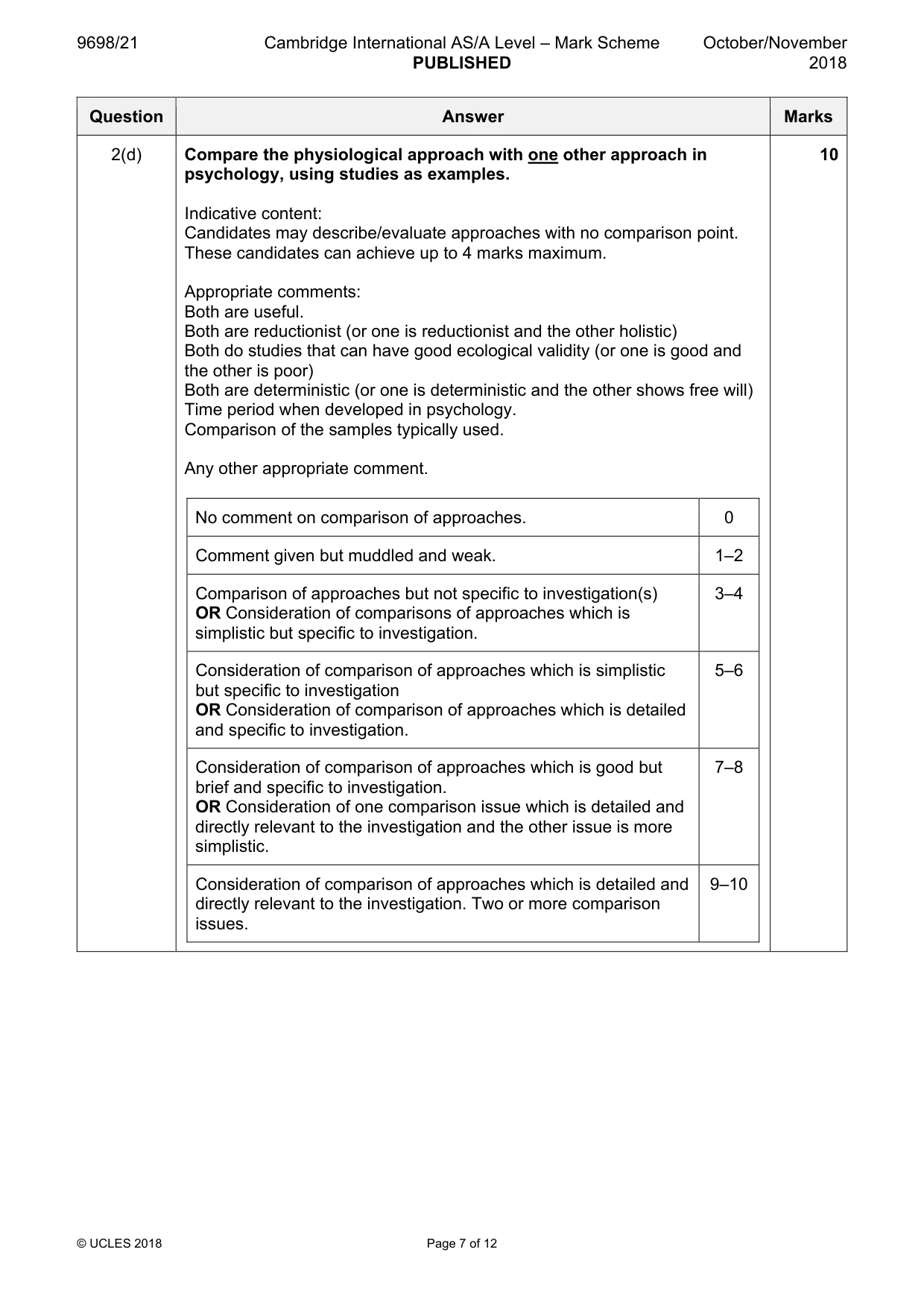
Mark scheme: 2(a) What is meant by the term ‘generalisations’? 2 1 mark partial, 2 marks full. Indicative content: Generalisations are possible where the study is realistic or has a good sample. – 1 mark The extent to which one group’s results can be applied to the target/general population. – 2 marks The extent to which a study is realistic and can be applied to everyday situations. – 2 marks 2(b) Describe one generalisation that can be made from the study by 3 Maguire et al. 1–2 marks partial, 3 marks full. Indicative content: The right hippocampus was activated more during the route in London task OR during route tasks the right hippocampus will be more active – 1 mark The right hippocampus was activated more during the route in London task which shows that the special topographical experiences that the taxi drivers have affects the activity of the brain OR during route tasks the right hippocampus will be more active and therefore experience affects activity of the brain. – 2 marks The right hippocampus was activated more during the route in London task which shows that the special topographical experiences that the taxi drivers have affects the activity of the brain. This means we can generalise to other people who might have similar experiences also will have a right hippocampus that activates during these type of tasks. – 3 marks 2(c) Discuss the strengths and weaknesses of making generalisations from 10 the study by Maguire et al. Appropriate strengths and weaknesses will be varied and need to link back to generalisations – except for representativeness and ecological validity which are already linked. These could include: Strengths • Ecological validity – as the tasks are something that we do think about in our everyday lives. People also do have PET scans. • Usefulness – to medical profession as it highlights how activity in the brain can be affected by our life experiences. • Validity and reliability – improved by scientific equipment used. Weaknesses • Ecological validity – was poor as the tasks of thinking about routes, film plots, etc. while in a PET scanner are unrealistic. • Usefulness – poor due to the weaknesses of the study. • Validity – poor due possible demand characteristics and/or quantitative nature of study. • Representativeness – is poor due to it being just taxi drivers and only 11, just being males. No comment on the strengths and weaknesses of the situational 0 explanation. Comment given but muddled and weak. 1–2 Consideration of at least a strength and a weakness not specific 3–4 to investigation OR Consideration of either a strength/weakness that is specific to situational explanation and investigation (could be two strengths and/or two weaknesses on its own). Consideration of two or more points (at least one strength and 5–6 one weakness) which are clear and specific to investigation. Consideration of at least two strengths and two weaknesses 7–8 which are clear and specific to investigation. Consideration of at least two strengths and two weaknesses 9–10 which are good and directly relevant to the investigation. 2(d) Compare the physiological approach with one other approach in 10 psychology, using studies as examples. Indicative content: Candidates may describe/evaluate approaches with no comparison point. These candidates can achieve up to 4 marks maximum. Appropriate comments: Both are useful. Both are reductionist (or one is reductionist and the other holistic) Both do studies that can have good ecological validity (or one is good and the other is poor) Both are deterministic (or one is deterministic and the other shows free will) Time period when developed in psychology. Comparison of the samples typically used. Any other appropriate comment. No comment on comparison of approaches. 0 Comment given but muddled and weak. 1–2 Comparison of approaches but not specific to investigation(s) 3–4 OR Consideration of comparisons of approaches which is simplistic but specific to investigation. Consideration of comparison of approaches which is simplistic 5–6 but specific to investigation OR Consideration of comparison of approaches which is detailed and specific to investigation. Consideration of comparison of approaches which is good but 7–8 brief and specific to investigation. OR Consideration of one comparison issue which is detailed and directly relevant to the investigation and the other issue is more simplistic. Consideration of comparison of approaches which is detailed and 9–10 directly relevant to the investigation. Two or more comparison issues.
Q3 · What is meant by the term ‘reliability’ in psychology?
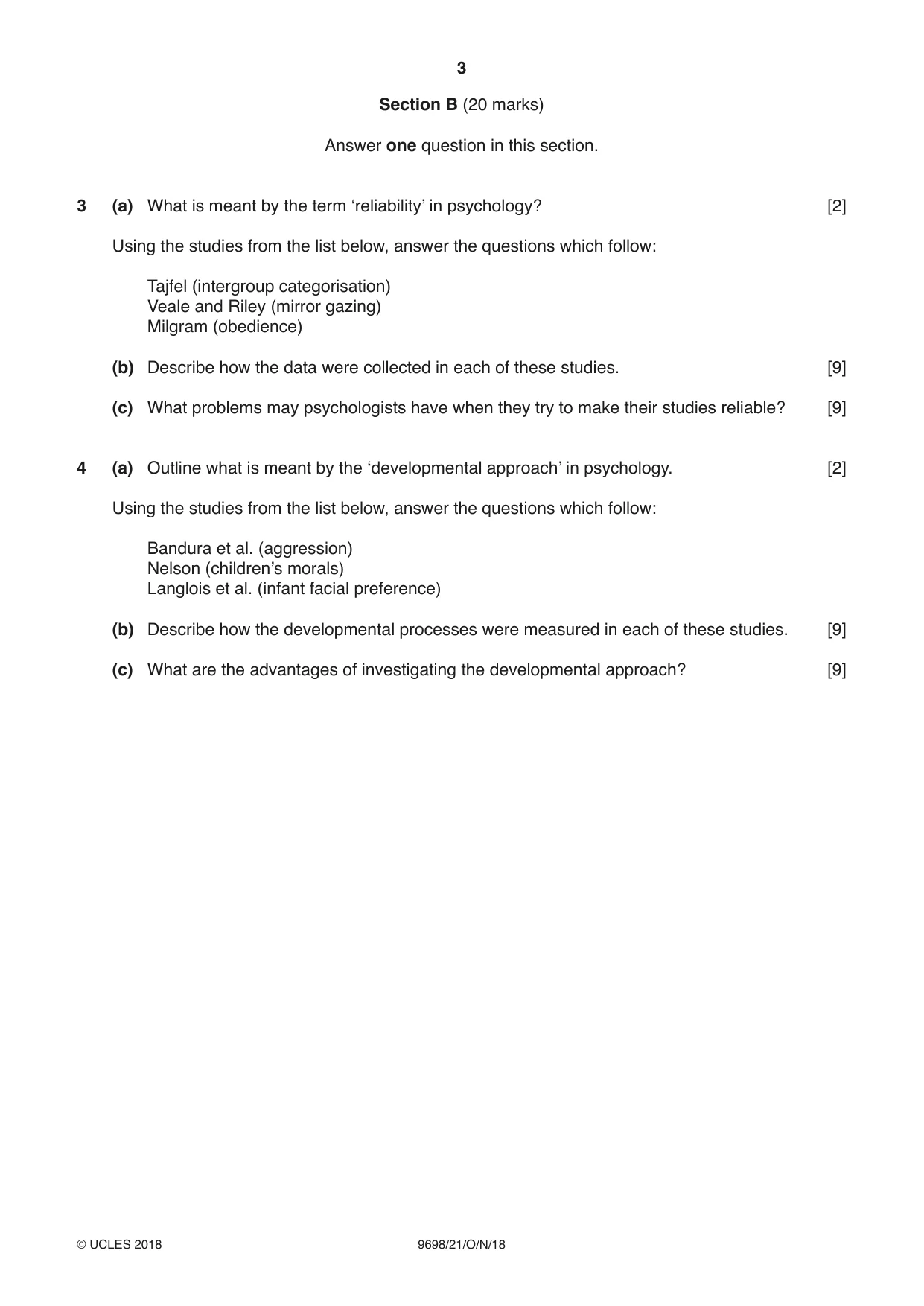
3 (a) What is meant by the term ‘reliability’ in psychology? [2] Using the studies from the list below, answer the questions which follow: Tajfel (intergroup categorisation) Veale and Riley (mirror gazing) Milgram (obedience) (b) Describe how the data were collected in each of these studies. [9] (c) What problems may psychologists have when they try to make their studies reliable? [9]
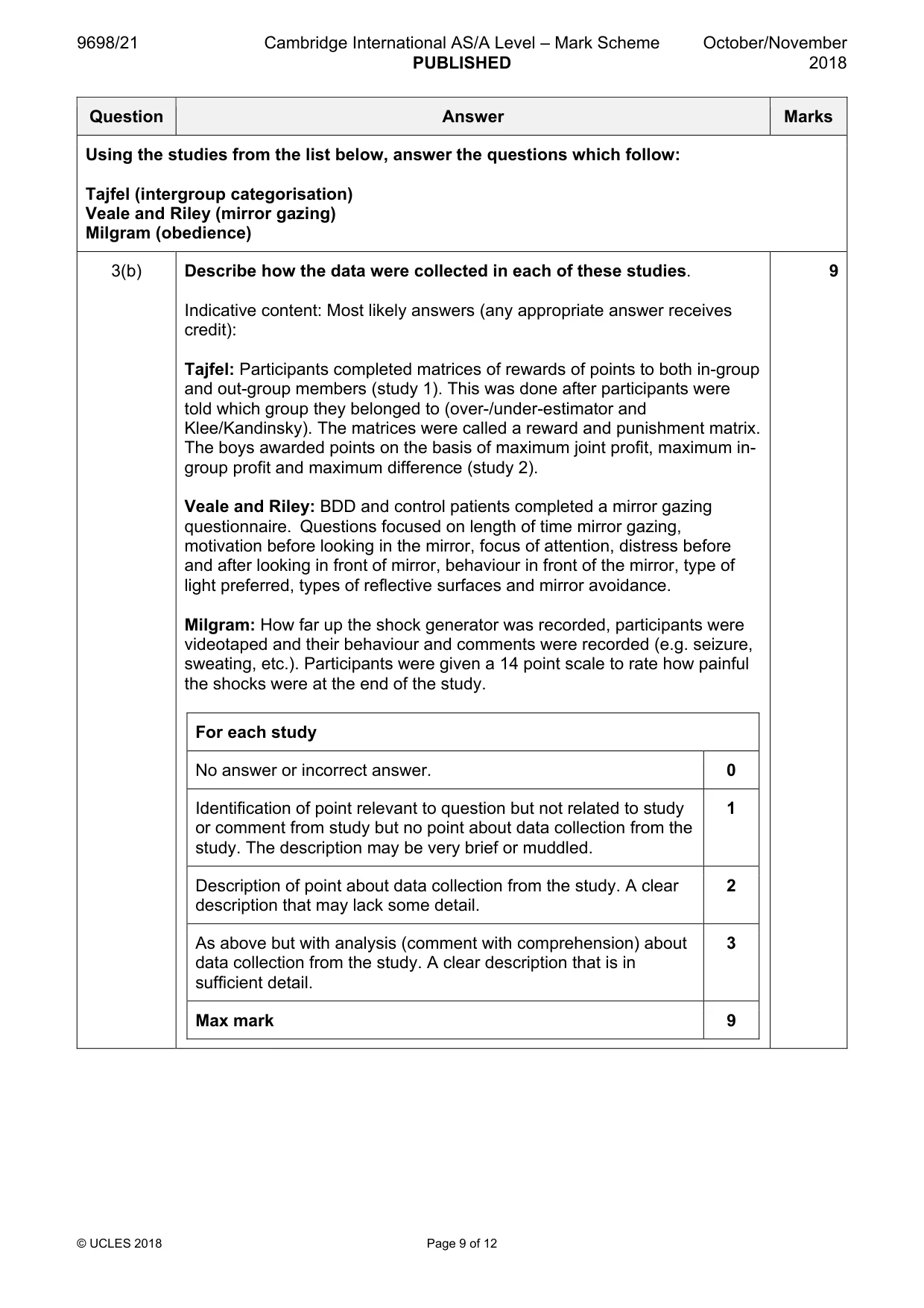
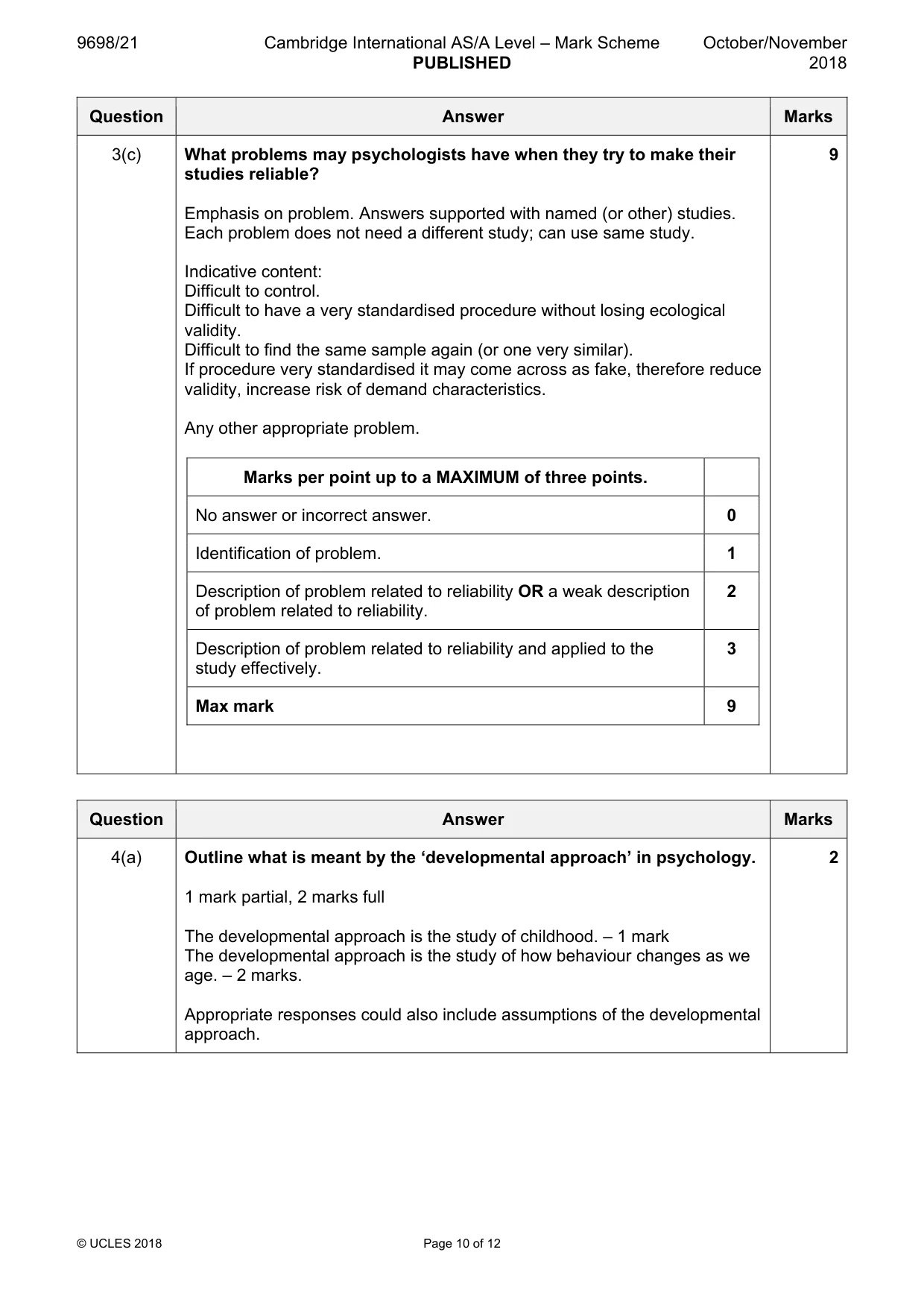
Mark scheme: 3(a) What is meant by the term ‘reliability’ in psychology? 2 1 mark partial, 2 marks full. 1 mark: Reliability is about getting the same results Reliability is about using the same method Reliability is about having controls. 2 marks: Reliability is the consistency of the measuring device. Using the studies from the list below, answer the questions which follow: Tajfel (intergroup categorisation) Veale and Riley (mirror gazing) Milgram (obedience) 3(b) Describe how the data were collected in each of these studies. 9 Indicative content: Most likely answers (any appropriate answer receives credit): Tajfel: Participants completed matrices of rewards of points to both in-group and out-group members (study 1). This was done after participants were told which group they belonged to (over-/under-estimator and Klee/Kandinsky). The matrices were called a reward and punishment matrix. The boys awarded points on the basis of maximum joint profit, maximum in- group profit and maximum difference (study 2). Veale and Riley: BDD and control patients completed a mirror gazing questionnaire. Questions focused on length of time mirror gazing, motivation before looking in the mirror, focus of attention, distress before and after looking in front of mirror, behaviour in front of the mirror, type of light preferred, types of reflective surfaces and mirror avoidance. Milgram: How far up the shock generator was recorded, participants were videotaped and their behaviour and comments were recorded (e.g. seizure, sweating, etc.). Participants were given a 14 point scale to rate how painful the shocks were at the end of the study. For each study No answer or incorrect answer. 0 Identification of point relevant to question but not related to study 1 or comment from study but no point about data collection from the study. The description may be very brief or muddled. Description of point about data collection from the study. A clear 2 description that may lack some detail. As above but with analysis (comment with comprehension) about 3 data collection from the study. A clear description that is in sufficient detail. Max mark 9 3(c) What problems may psychologists have when they try to make their 9 studies reliable? Emphasis on problem. Answers supported with named (or other) studies. Each problem does not need a different study; can use same study. Indicative content: Difficult to control. Difficult to have a very standardised procedure without losing ecological validity. Difficult to find the same sample again (or one very similar). If procedure very standardised it may come across as fake, therefore reduce validity, increase risk of demand characteristics. Any other appropriate problem. Marks per point up to a MAXIMUM of three points. No answer or incorrect answer. 0 Identification of problem. 1 Description of problem related to reliability OR a weak description 2 of problem related to reliability. Description of problem related to reliability and applied to the 3 study effectively. Max mark 9
Q4 · Outline what is meant by the ‘developmental approach’ in psychology
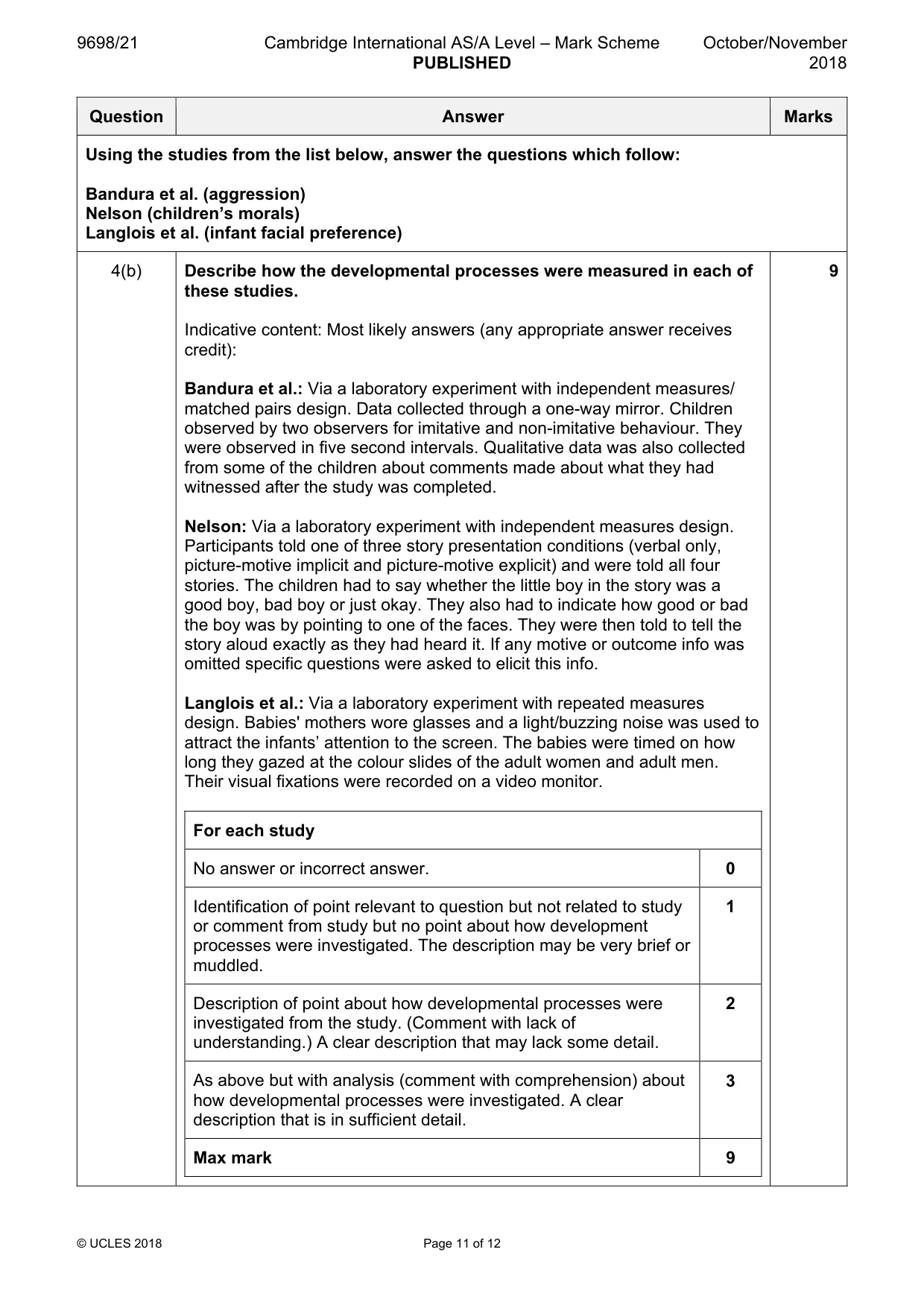
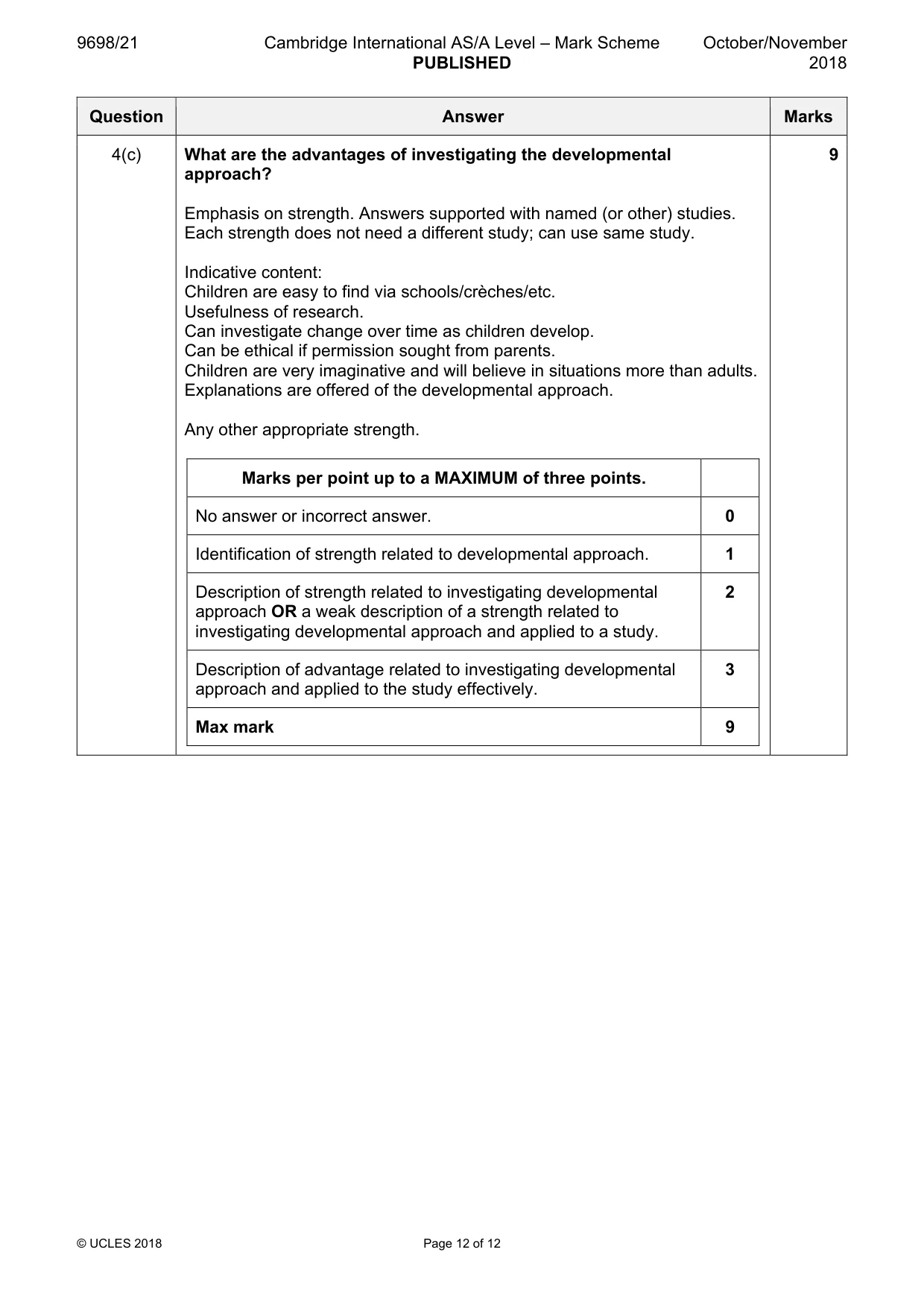
4 (a) Outline what is meant by the ‘developmental approach’ in psychology. [2] Using the studies from the list below, answer the questions which follow: Bandura et al. (aggression) Nelson (children’s morals) Langlois et al. (infant facial preference) (b) Describe how the developmental processes were measured in each of these studies. [9] (c) What are the advantages of investigating the developmental approach? [9]
Mark scheme: 4(a) Outline what is meant by the ‘developmental approach’ in psychology. 2 1 mark partial, 2 marks full The developmental approach is the study of childhood. – 1 mark The developmental approach is the study of how behaviour changes as we age. – 2 marks. Appropriate responses could also include assumptions of the developmental approach. Using the studies from the list below, answer the questions which follow: Bandura et al. (aggression) Nelson (children’s morals) Langlois et al. (infant facial preference) 4(b) Describe how the developmental processes were measured in each of 9 these studies. Indicative content: Most likely answers (any appropriate answer receives credit): Bandura et al.: Via a laboratory experiment with independent measures/ matched pairs design. Data collected through a one-way mirror. Children observed by two observers for imitative and non-imitative behaviour. They were observed in five second intervals. Qualitative data was also collected from some of the children about comments made about what they had witnessed after the study was completed. Nelson: Via a laboratory experiment with independent measures design. Participants told one of three story presentation conditions (verbal only, picture-motive implicit and picture-motive explicit) and were told all four stories. The children had to say whether the little boy in the story was a good boy, bad boy or just okay. They also had to indicate how good or bad the boy was by pointing to one of the faces. They were then told to tell the story aloud exactly as they had heard it. If any motive or outcome info was omitted specific questions were asked to elicit this info. Langlois et al.: Via a laboratory experiment with repeated measures design. Babies' mothers wore glasses and a light/buzzing noise was used to attract the infants’ attention to the screen. The babies were timed on how long they gazed at the colour slides of the adult women and adult men. Their visual fixations were recorded on a video monitor. For each study No answer or incorrect answer. 0 Identification of point relevant to question but not related to study 1 or comment from study but no point about how development processes were investigated. The description may be very brief or muddled. Description of point about how developmental processes were 2 investigated from the study. (Comment with lack of understanding.) A clear description that may lack some detail. As above but with analysis (comment with comprehension) about 3 how developmental processes were investigated. A clear description that is in sufficient detail. Max mark 9 4(c) What are the advantages of investigating the developmental 9 approach? Emphasis on strength. Answers supported with named (or other) studies. Each strength does not need a different study; can use same study. Indicative content: Children are easy to find via schools/crèches/etc. Usefulness of research. Can investigate change over time as children develop. Can be ethical if permission sought from parents. Children are very imaginative and will believe in situations more than adults. Explanations are offered of the developmental approach. Any other appropriate strength. Marks per point up to a MAXIMUM of three points. No answer or incorrect answer. 0 Identification of strength related to developmental approach. 1 Description of strength related to investigating developmental 2 approach OR a weak description of a strength related to investigating developmental approach and applied to a study. Description of advantage related to investigating developmental 3 approach and applied to the study effectively. Max mark 9
What you needed in this session
Cambridge’s own grade thresholds for 2018 Oct/Nov, Paper 2 · Variant 1. A higher threshold means an easier paper — the bar moves with how the cohort did.