Cambridge A Level Psychology 9698 — 2018 May/June Paper 2 · Variant 1
9698/21/M/J/18 · 4 questions · 70 marks · ≈79 min
The question paper and its mark scheme, free to read here and free to download. This is Cambridge’s own paper, exactly as it was sat.
Question paper4 pages
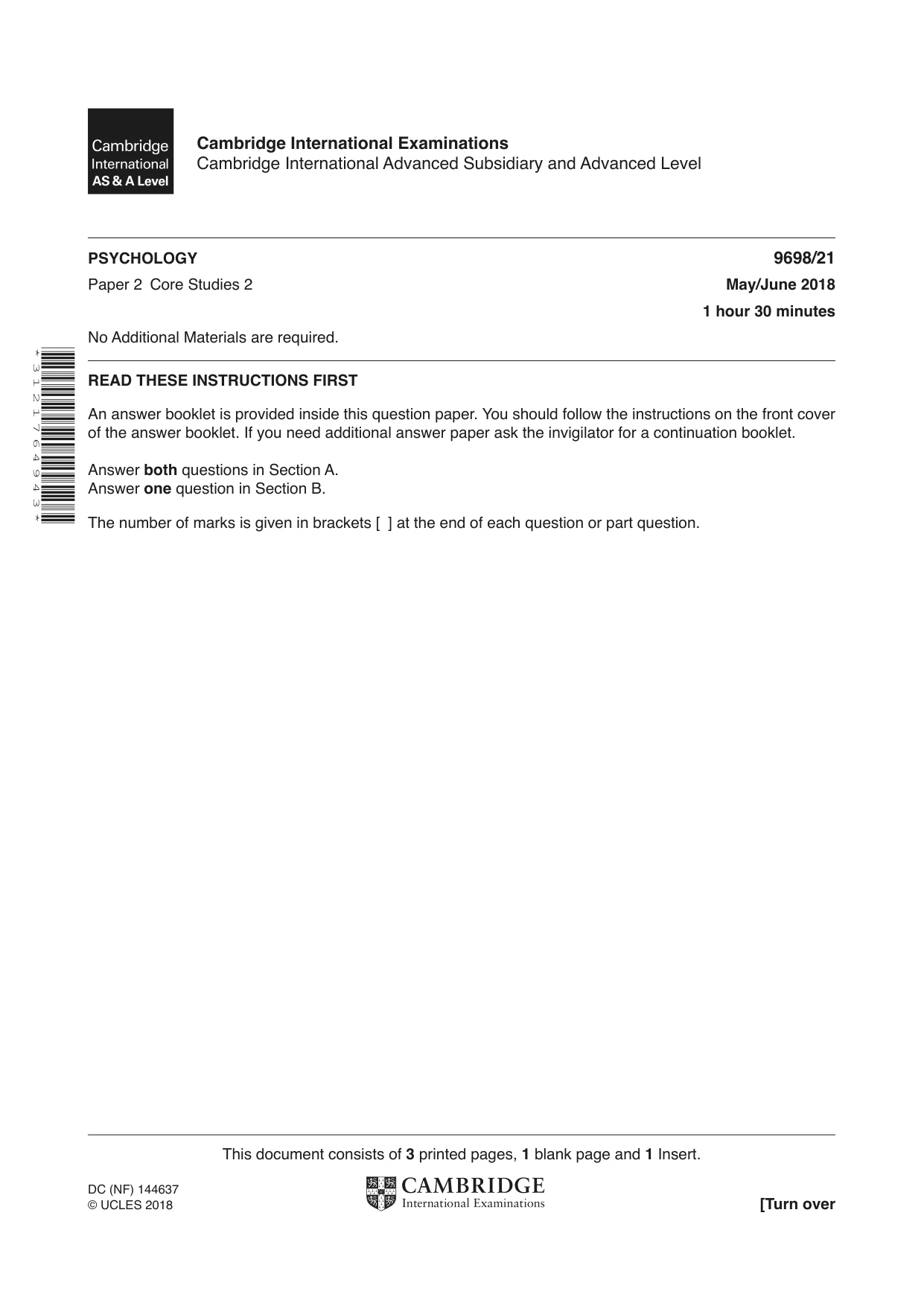
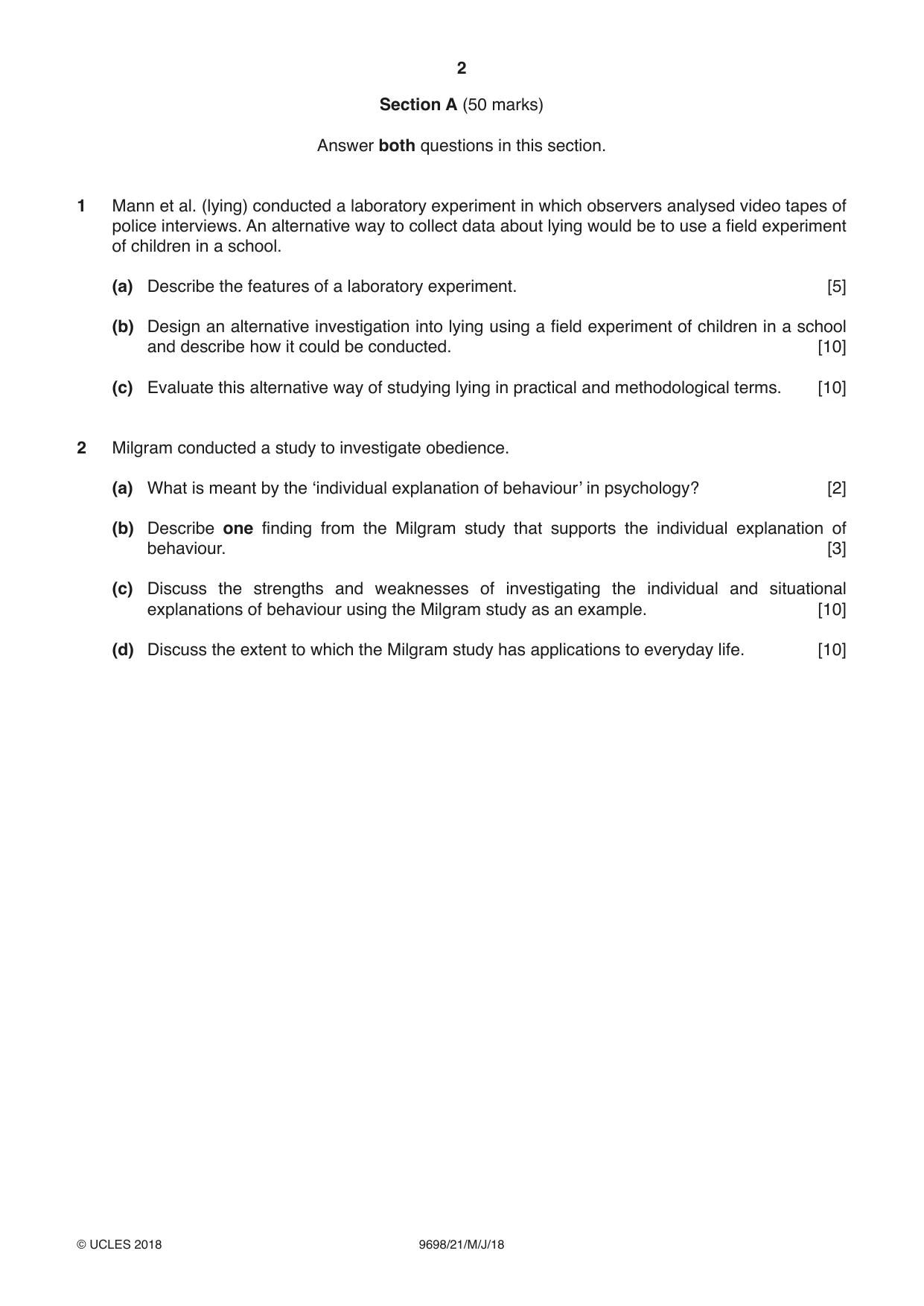
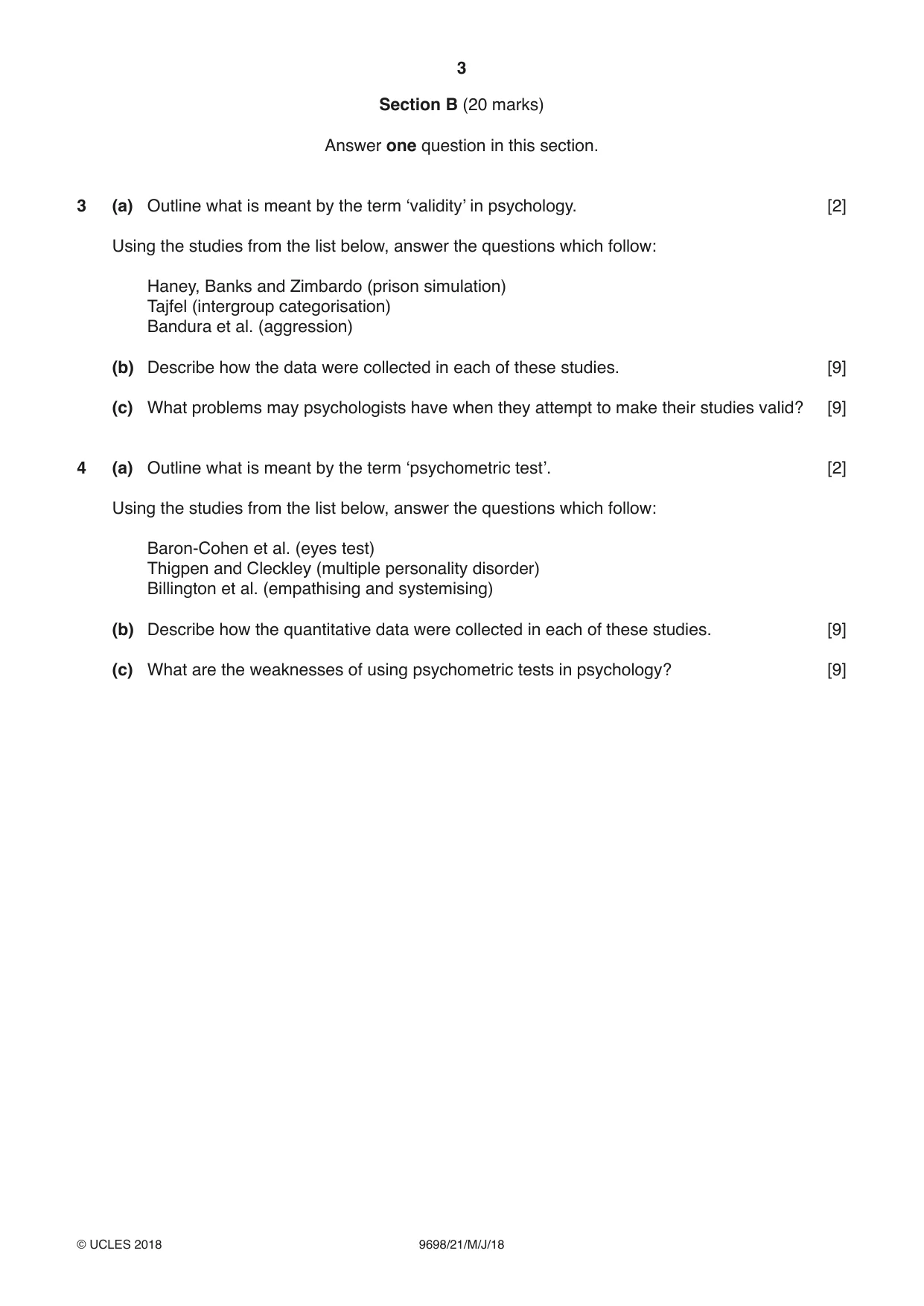

Mark scheme11 pages
Answers below. Sit the paper first if you are practising.
Questions as text
Question 1
1 Mann et al. (lying) conducted a laboratory experiment in which observers analysed video tapes of police interviews. An alternative way to collect data about lying would be to use a field experiment of children in a school. (a) Describe the features of a laboratory experiment. [5] (b) Design an alternative investigation into lying using a field experiment of children in a school and describe how it could be conducted. [10] (c) Evaluate this alternative way of studying lying in practical and methodological terms. [10]
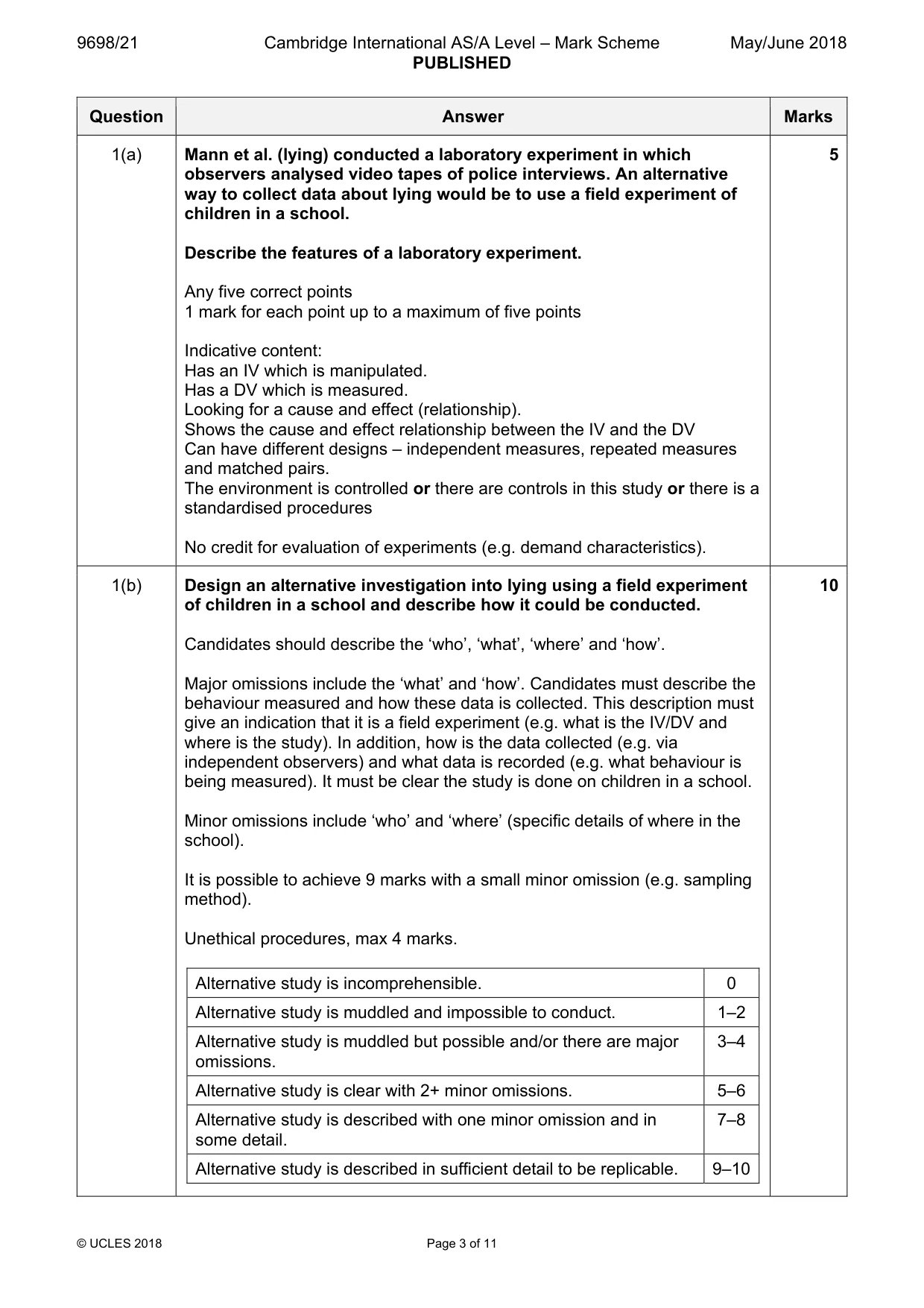
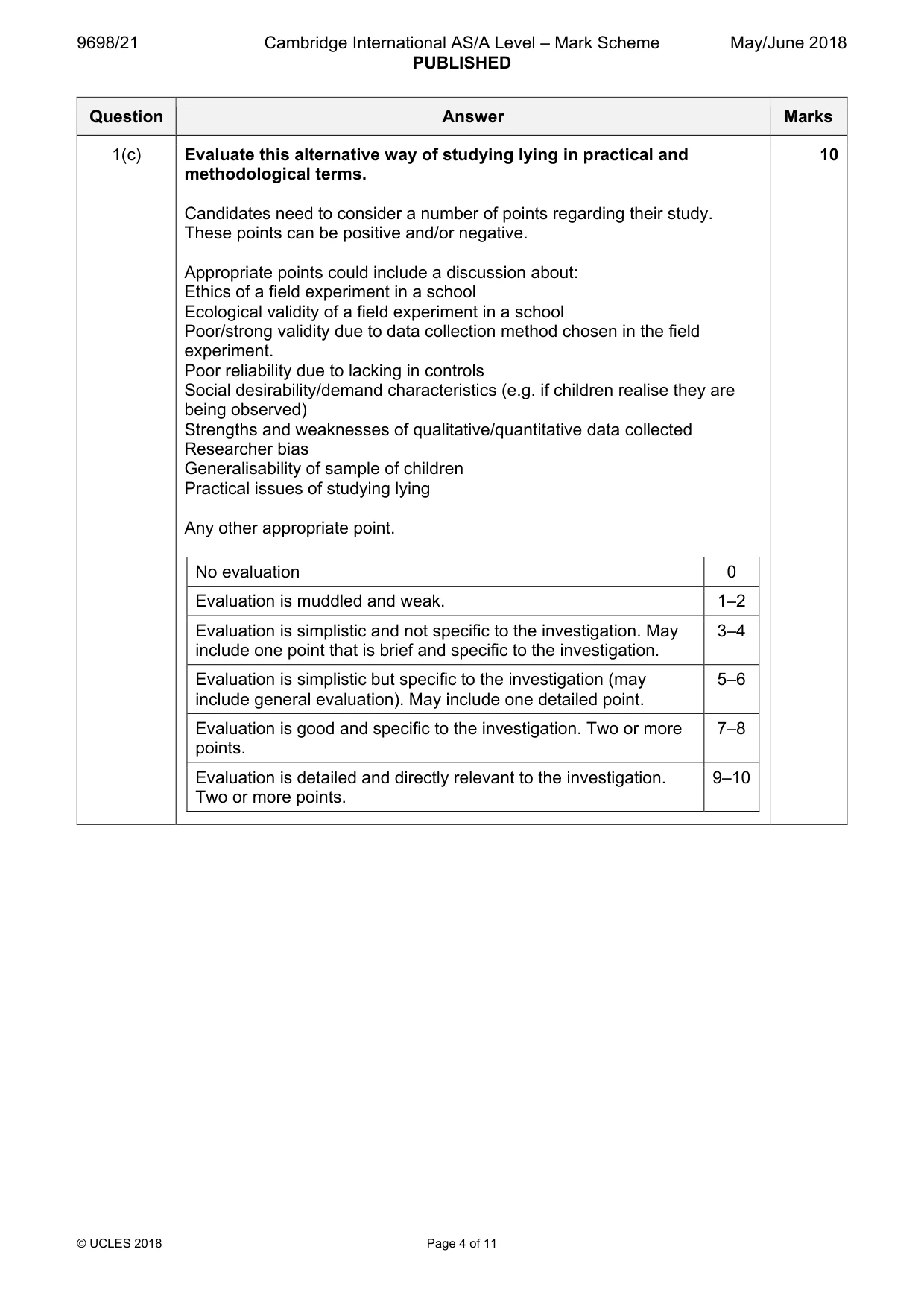
Mark scheme: Question Answer Marks 1(a) Mann et al. (lying) conducted a laboratory experiment in which 5 observers analysed video tapes of police interviews. An alternative way to collect data about lying would be to use a field experiment of children in a school. Describe the features of a laboratory experiment. Any five correct points 1 mark for each point up to a maximum of five points Indicative content: Has an IV which is manipulated. Has a DV which is measured. Looking for a cause and effect (relationship). Shows the cause and effect relationship between the IV and the DV Can have different designs – independent measures, repeated measures and matched pairs. The environment is controlled or there are controls in this study or there is a standardised procedures No credit for evaluation of experiments (e.g. demand characteristics). 1(b) Design an alternative investigation into lying using a field experiment 10 of children in a school and describe how it could be conducted. Candidates should describe the ‘who’, ‘what’, ‘where’ and ‘how’. Major omissions include the ‘what’ and ‘how’. Candidates must describe the behaviour measured and how these data is collected. This description must give an indication that it is a field experiment (e.g. what is the IV/DV and where is the study). In addition, how is the data collected (e.g. via independent observers) and what data is recorded (e.g. what behaviour is being measured). It must be clear the study is done on children in a school. Minor omissions include ‘who’ and ‘where’ (specific details of where in the school). It is possible to achieve 9 marks with a small minor omission (e.g. sampling method). Unethical procedures, max 4 marks. Alternative study is incomprehensible. 0 Alternative study is muddled and impossible to conduct. 1–2 Alternative study is muddled but possible and/or there are major 3–4 omissions. Alternative study is clear with 2+ minor omissions. 5–6 Alternative study is described with one minor omission and in 7–8 some detail. Alternative study is described in sufficient detail to be replicable. 9–10 1(c) Evaluate this alternative way of studying lying in practical and 10 methodological terms. Candidates need to consider a number of points regarding their study. These points can be positive and/or negative. Appropriate points could include a discussion about: Ethics of a field experiment in a school Ecological validity of a field experiment in a school Poor/strong validity due to data collection method chosen in the field experiment. Poor reliability due to lacking in controls Social desirability/demand characteristics (e.g. if children realise they are being observed) Strengths and weaknesses of qualitative/quantitative data collected Researcher bias Generalisability of sample of children Practical issues of studying lying Any other appropriate point. No evaluation 0 Evaluation is muddled and weak. 1–2 Evaluation is simplistic and not specific to the investigation. May 3–4 include one point that is brief and specific to the investigation. Evaluation is simplistic but specific to the investigation (may 5–6 include general evaluation). May include one detailed point. Evaluation is good and specific to the investigation. Two or more 7–8 points. Evaluation is detailed and directly relevant to the investigation. 9–10 Two or more points.
Q2 · Milgram conducted a study to investigate obedience
2 Milgram conducted a study to investigate obedience. (a) What is meant by the ‘individual explanation of behaviour’ in psychology? [2] (b) Describe one finding from the Milgram study that supports the individual explanation of behaviour. [3] (c) Discuss the strengths and weaknesses of investigating the individual and situational explanations of behaviour using the Milgram study as an example. [10] (d) Discuss the extent to which the Milgram study has applications to everyday life. [10]
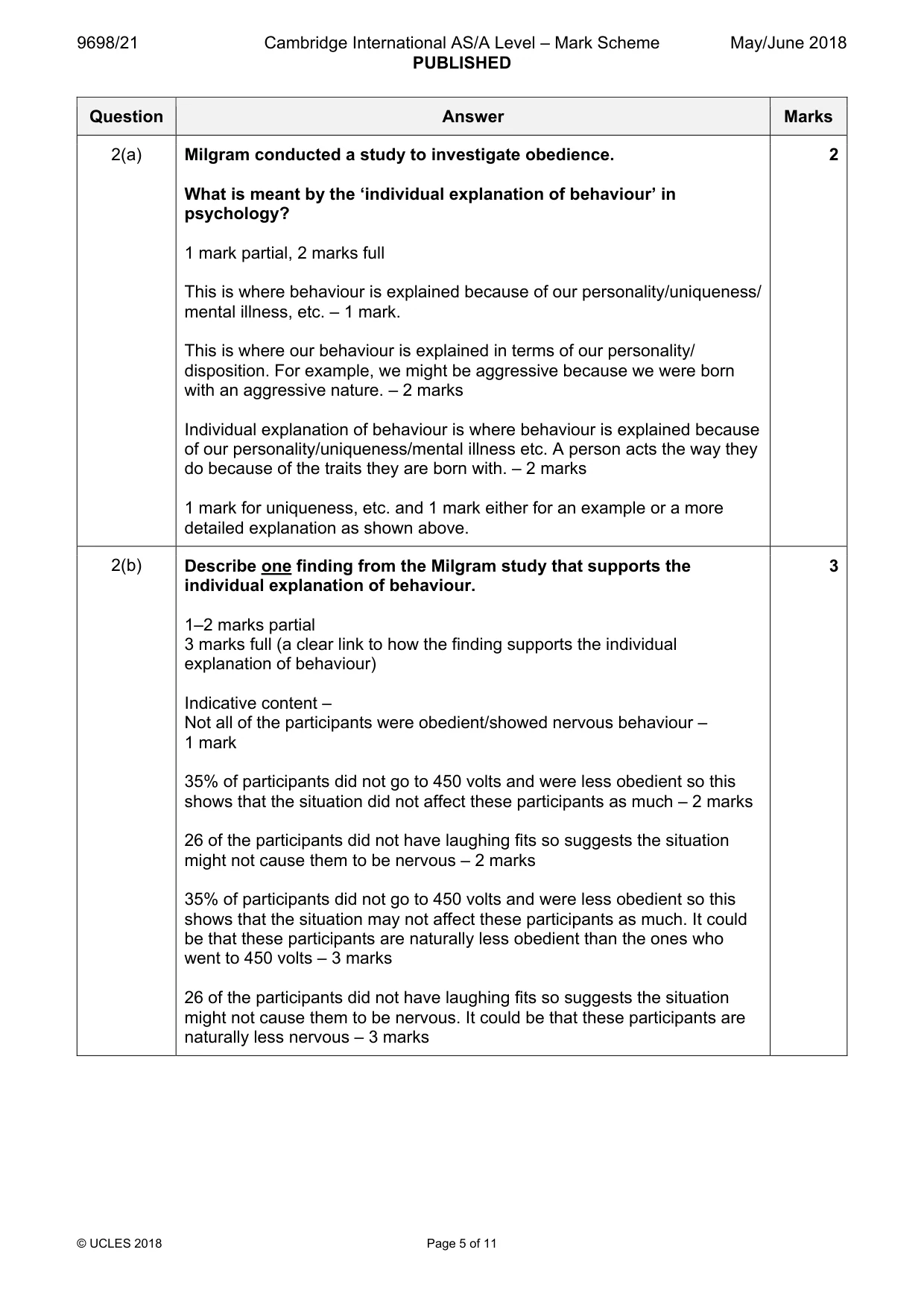
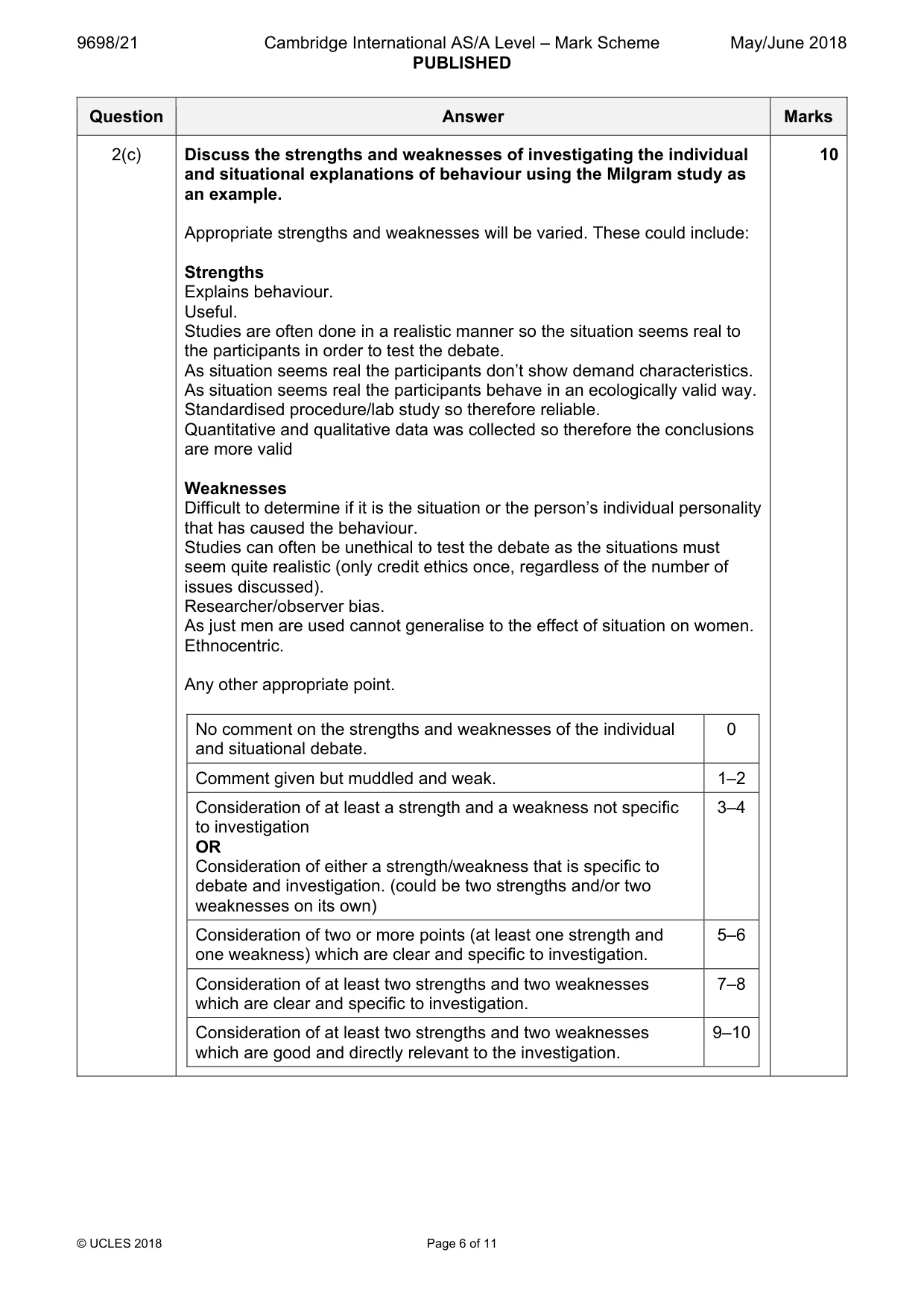
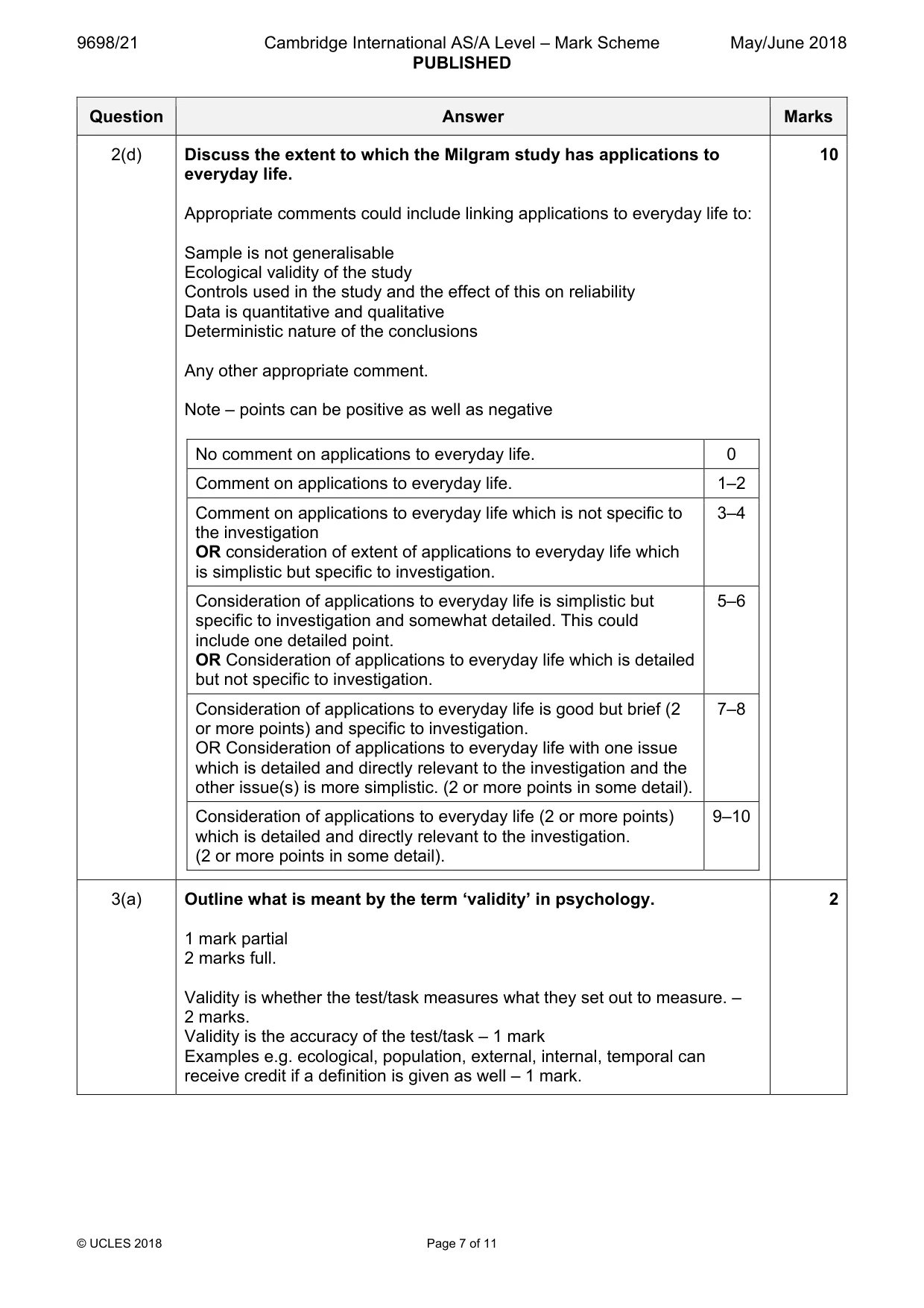
Mark scheme: 2(a) Milgram conducted a study to investigate obedience. 2 What is meant by the ‘individual explanation of behaviour’ in psychology? 1 mark partial, 2 marks full This is where behaviour is explained because of our personality/uniqueness/ mental illness, etc. – 1 mark. This is where our behaviour is explained in terms of our personality/ disposition. For example, we might be aggressive because we were born with an aggressive nature. – 2 marks Individual explanation of behaviour is where behaviour is explained because of our personality/uniqueness/mental illness etc. A person acts the way they do because of the traits they are born with. – 2 marks 1 mark for uniqueness, etc. and 1 mark either for an example or a more detailed explanation as shown above. 2(b) Describe one finding from the Milgram study that supports the 3 individual explanation of behaviour. 1–2 marks partial 3 marks full (a clear link to how the finding supports the individual explanation of behaviour) Indicative content – Not all of the participants were obedient/showed nervous behaviour – 1 mark 35% of participants did not go to 450 volts and were less obedient so this shows that the situation did not affect these participants as much – 2 marks 26 of the participants did not have laughing fits so suggests the situation might not cause them to be nervous – 2 marks 35% of participants did not go to 450 volts and were less obedient so this shows that the situation may not affect these participants as much. It could be that these participants are naturally less obedient than the ones who went to 450 volts – 3 marks 26 of the participants did not have laughing fits so suggests the situation might not cause them to be nervous. It could be that these participants are naturally less nervous – 3 marks 2(c) Discuss the strengths and weaknesses of investigating the individual 10 and situational explanations of behaviour using the Milgram study as an example. Appropriate strengths and weaknesses will be varied. These could include: Strengths Explains behaviour. Useful. Studies are often done in a realistic manner so the situation seems real to the participants in order to test the debate. As situation seems real the participants don’t show demand characteristics. As situation seems real the participants behave in an ecologically valid way. Standardised procedure/lab study so therefore reliable. Quantitative and qualitative data was collected so therefore the conclusions are more valid Weaknesses Difficult to determine if it is the situation or the person’s individual personality that has caused the behaviour. Studies can often be unethical to test the debate as the situations must seem quite realistic (only credit ethics once, regardless of the number of issues discussed). Researcher/observer bias. As just men are used cannot generalise to the effect of situation on women. Ethnocentric. Any other appropriate point. No comment on the strengths and weaknesses of the individual 0 and situational debate. Comment given but muddled and weak. 1–2 Consideration of at least a strength and a weakness not specific 3–4 to investigation OR Consideration of either a strength/weakness that is specific to debate and investigation. (could be two strengths and/or two weaknesses on its own) Consideration of two or more points (at least one strength and 5–6 one weakness) which are clear and specific to investigation. Consideration of at least two strengths and two weaknesses 7–8 which are clear and specific to investigation. Consideration of at least two strengths and two weaknesses 9–10 which are good and directly relevant to the investigation. 2(d) Discuss the extent to which the Milgram study has applications to 10 everyday life. Appropriate comments could include linking applications to everyday life to: Sample is not generalisable Ecological validity of the study Controls used in the study and the effect of this on reliability Data is quantitative and qualitative Deterministic nature of the conclusions Any other appropriate comment. Note – points can be positive as well as negative No comment on applications to everyday life. 0 Comment on applications to everyday life. 1–2 Comment on applications to everyday life which is not specific to 3–4 the investigation OR consideration of extent of applications to everyday life which is simplistic but specific to investigation. Consideration of applications to everyday life is simplistic but 5–6 specific to investigation and somewhat detailed. This could include one detailed point. OR Consideration of applications to everyday life which is detailed but not specific to investigation. Consideration of applications to everyday life is good but brief (2 7–8 or more points) and specific to investigation. OR Consideration of applications to everyday life with one issue which is detailed and directly relevant to the investigation and the other issue(s) is more simplistic. (2 or more points in some detail). Consideration of applications to everyday life (2 or more points) 9–10 which is detailed and directly relevant to the investigation. (2 or more points in some detail).
Q3 · Outline what is meant by the term ‘validity’ in psychology
3 (a) Outline what is meant by the term ‘validity’ in psychology. [2] Using the studies from the list below, answer the questions which follow: Haney, Banks and Zimbardo (prison simulation) Tajfel (intergroup categorisation) Bandura et al. (aggression) (b) Describe how the data were collected in each of these studies. [9] (c) What problems may psychologists have when they attempt to make their studies valid? [9]
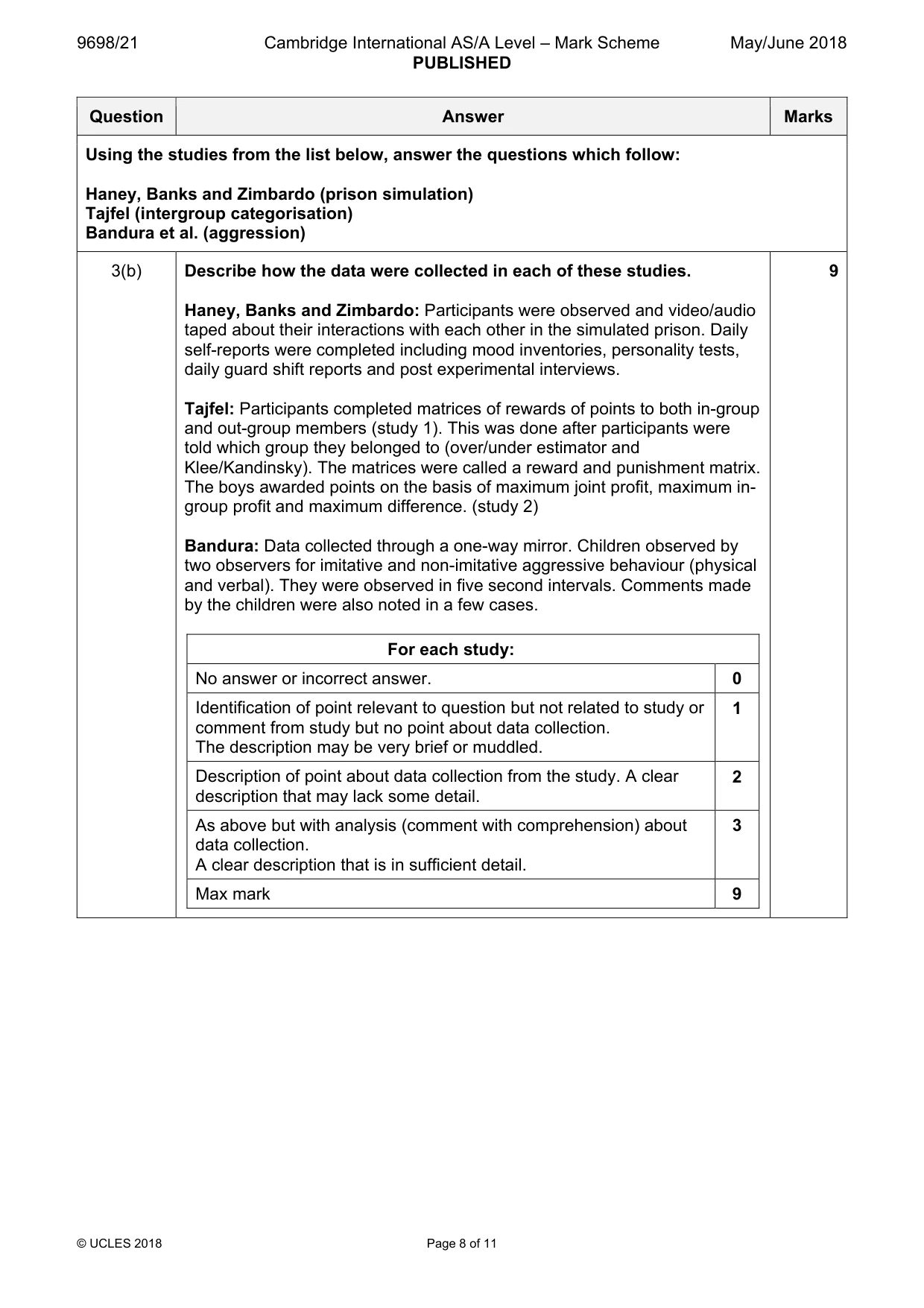
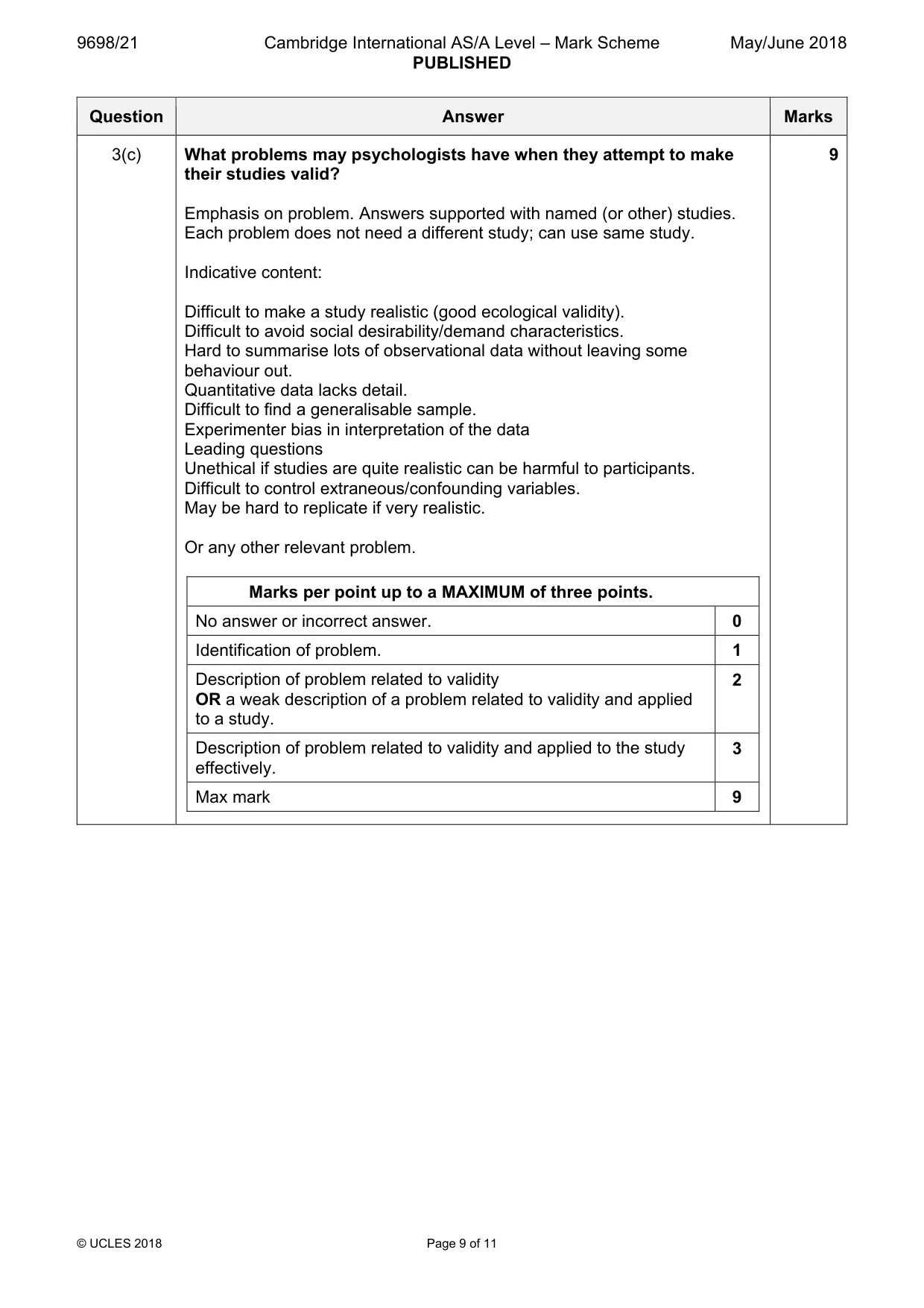
Mark scheme: 3(a) Outline what is meant by the term ‘validity’ in psychology. 2 1 mark partial 2 marks full. Validity is whether the test/task measures what they set out to measure. – 2 marks. Validity is the accuracy of the test/task – 1 mark Examples e.g. ecological, population, external, internal, temporal can receive credit if a definition is given as well – 1 mark. Using the studies from the list below, answer the questions which follow: Haney, Banks and Zimbardo (prison simulation) Tajfel (intergroup categorisation) Bandura et al. (aggression) 3(b) Describe how the data were collected in each of these studies. 9 Haney, Banks and Zimbardo: Participants were observed and video/audio taped about their interactions with each other in the simulated prison. Daily self-reports were completed including mood inventories, personality tests, daily guard shift reports and post experimental interviews. Tajfel: Participants completed matrices of rewards of points to both in-group and out-group members (study 1). This was done after participants were told which group they belonged to (over/under estimator and Klee/Kandinsky). The matrices were called a reward and punishment matrix. The boys awarded points on the basis of maximum joint profit, maximum in- group profit and maximum difference. (study 2) Bandura: Data collected through a one-way mirror. Children observed by two observers for imitative and non-imitative aggressive behaviour (physical and verbal). They were observed in five second intervals. Comments made by the children were also noted in a few cases. For each study: No answer or incorrect answer. 0 Identification of point relevant to question but not related to study or 1 comment from study but no point about data collection. The description may be very brief or muddled. Description of point about data collection from the study. A clear 2 description that may lack some detail. As above but with analysis (comment with comprehension) about 3 data collection. A clear description that is in sufficient detail. Max mark 9 3(c) What problems may psychologists have when they attempt to make 9 their studies valid? Emphasis on problem. Answers supported with named (or other) studies. Each problem does not need a different study; can use same study. Indicative content: Difficult to make a study realistic (good ecological validity). Difficult to avoid social desirability/demand characteristics. Hard to summarise lots of observational data without leaving some behaviour out. Quantitative data lacks detail. Difficult to find a generalisable sample. Experimenter bias in interpretation of the data Leading questions Unethical if studies are quite realistic can be harmful to participants. Difficult to control extraneous/confounding variables. May be hard to replicate if very realistic. Or any other relevant problem. Marks per point up to a MAXIMUM of three points. No answer or incorrect answer. 0 Identification of problem. 1 Description of problem related to validity 2 OR a weak description of a problem related to validity and applied to a study. Description of problem related to validity and applied to the study 3 effectively. Max mark 9
Q4 · Outline what is meant by the term ‘psychometric test’
4 (a) Outline what is meant by the term ‘psychometric test’. [2] Using the studies from the list below, answer the questions which follow: Baron-Cohen et al. (eyes test) Thigpen and Cleckley (multiple personality disorder) Billington et al. (empathising and systemising) (b) Describe how the quantitative data were collected in each of these studies. [9] (c) What are the weaknesses of using psychometric tests in psychology? [9]
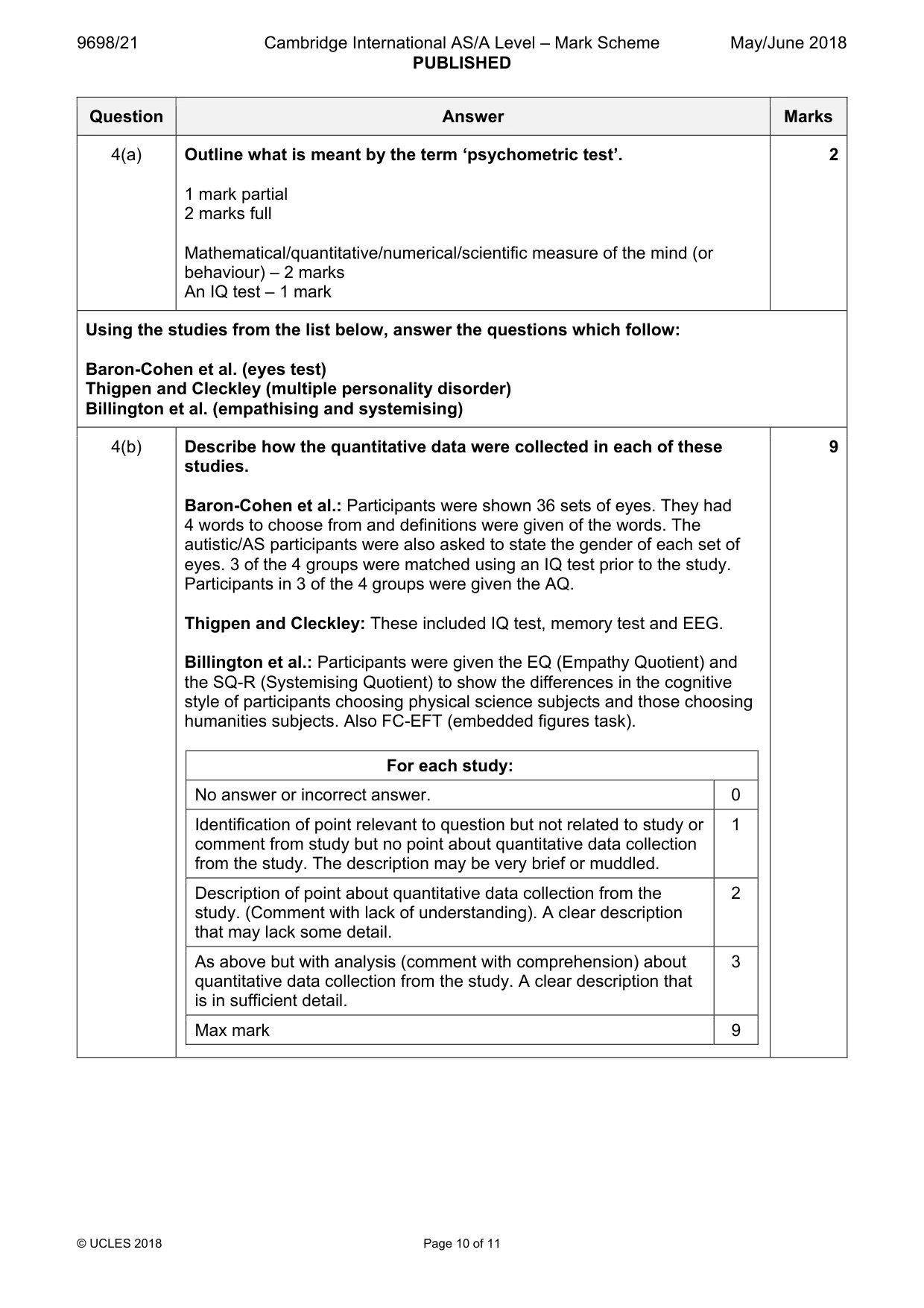
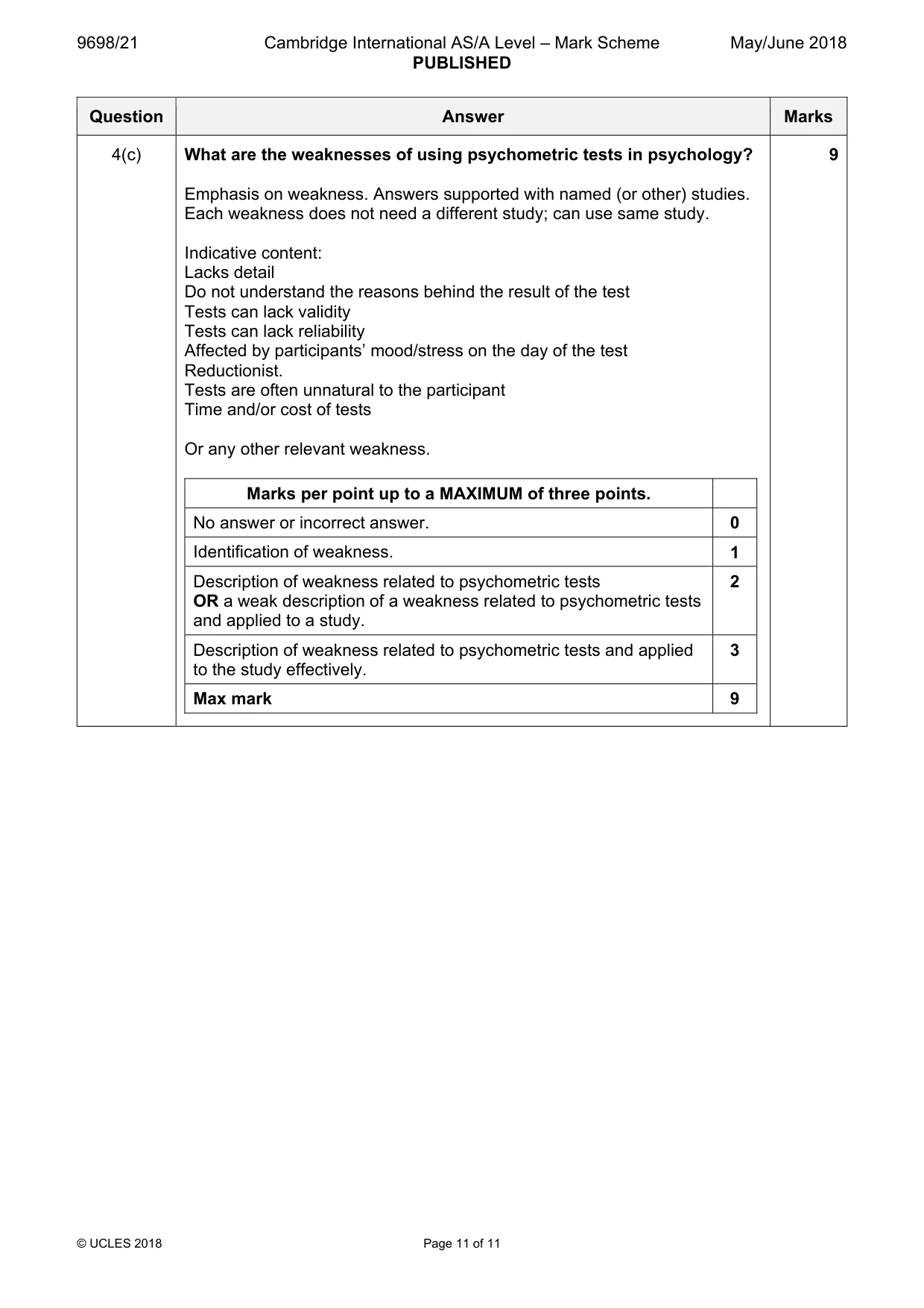
Mark scheme: 4(a) Outline what is meant by the term ‘psychometric test’. 2 1 mark partial 2 marks full Mathematical/quantitative/numerical/scientific measure of the mind (or behaviour) – 2 marks An IQ test – 1 mark Using the studies from the list below, answer the questions which follow: Baron-Cohen et al. (eyes test) Thigpen and Cleckley (multiple personality disorder) Billington et al. (empathising and systemising) 4(b) Describe how the quantitative data were collected in each of these 9 studies. Baron-Cohen et al.: Participants were shown 36 sets of eyes. They had 4 words to choose from and definitions were given of the words. The autistic/AS participants were also asked to state the gender of each set of eyes. 3 of the 4 groups were matched using an IQ test prior to the study. Participants in 3 of the 4 groups were given the AQ. Thigpen and Cleckley: These included IQ test, memory test and EEG. Billington et al.: Participants were given the EQ (Empathy Quotient) and the SQ-R (Systemising Quotient) to show the differences in the cognitive style of participants choosing physical science subjects and those choosing humanities subjects. Also FC-EFT (embedded figures task). For each study: No answer or incorrect answer. 0 Identification of point relevant to question but not related to study or 1 comment from study but no point about quantitative data collection from the study. The description may be very brief or muddled. Description of point about quantitative data collection from the 2 study. (Comment with lack of understanding). A clear description that may lack some detail. As above but with analysis (comment with comprehension) about 3 quantitative data collection from the study. A clear description that is in sufficient detail. Max mark 9 4(c) What are the weaknesses of using psychometric tests in psychology? 9 Emphasis on weakness. Answers supported with named (or other) studies. Each weakness does not need a different study; can use same study. Indicative content: Lacks detail Do not understand the reasons behind the result of the test Tests can lack validity Tests can lack reliability Affected by participants’ mood/stress on the day of the test Reductionist. Tests are often unnatural to the participant Time and/or cost of tests Or any other relevant weakness. Marks per point up to a MAXIMUM of three points. No answer or incorrect answer. 0 Identification of weakness. 1 Description of weakness related to psychometric tests 2 OR a weak description of a weakness related to psychometric tests and applied to a study. Description of weakness related to psychometric tests and applied 3 to the study effectively. Max mark 9
What you needed in this session
Cambridge’s own grade thresholds for 2018 May/June, Paper 2 · Variant 1. A higher threshold means an easier paper — the bar moves with how the cohort did.