Cambridge A Level Psychology 9698 — 2018 Oct/Nov Paper 2 · Variant 2
9698/22/O/N/18 · 4 questions · 70 marks · ≈79 min
The question paper and its mark scheme, free to read here and free to download. This is Cambridge’s own paper, exactly as it was sat.
Question paper4 pages

Mark scheme11 pages
Answers below. Sit the paper first if you are practising.
Questions as text
Question 1
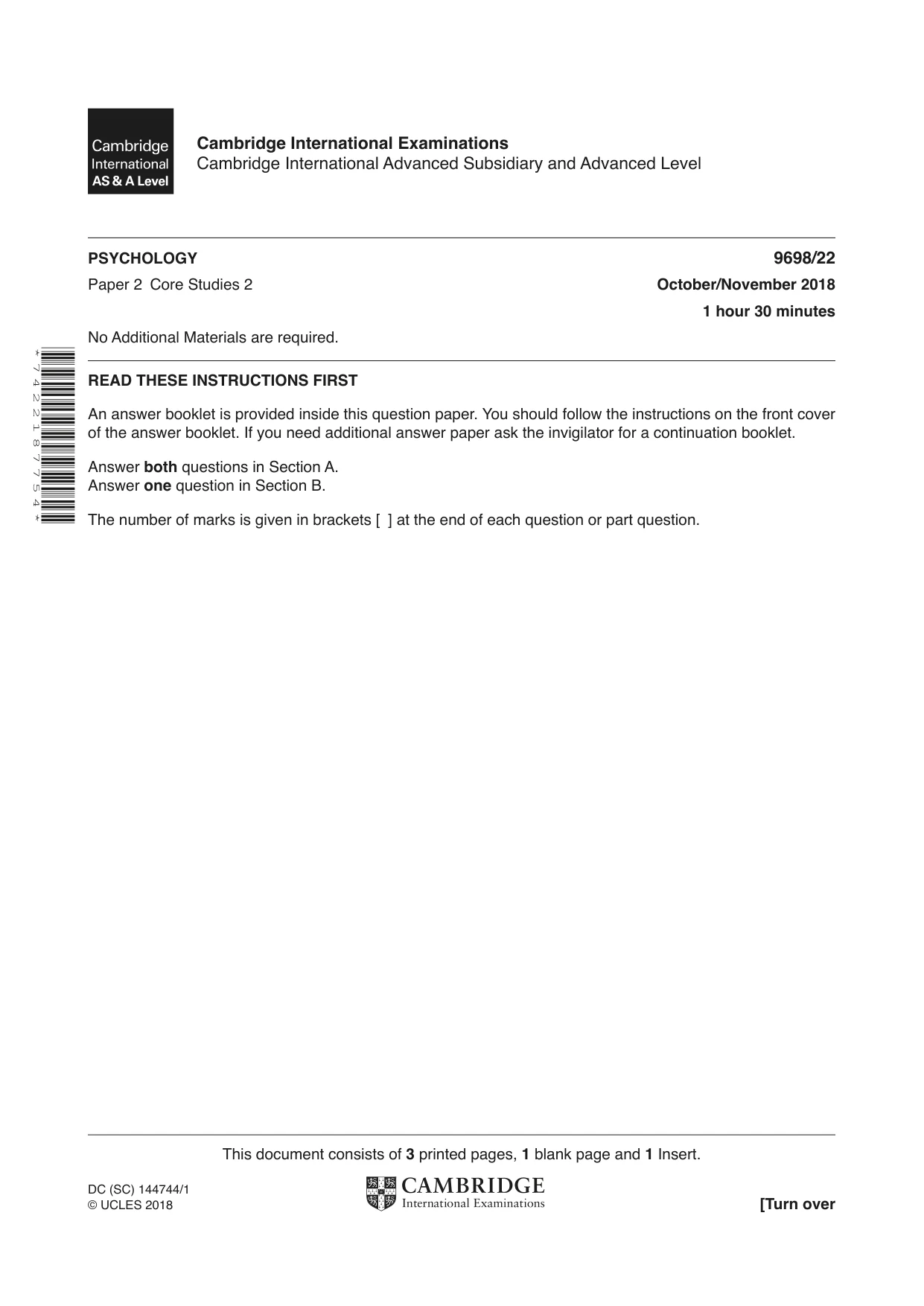
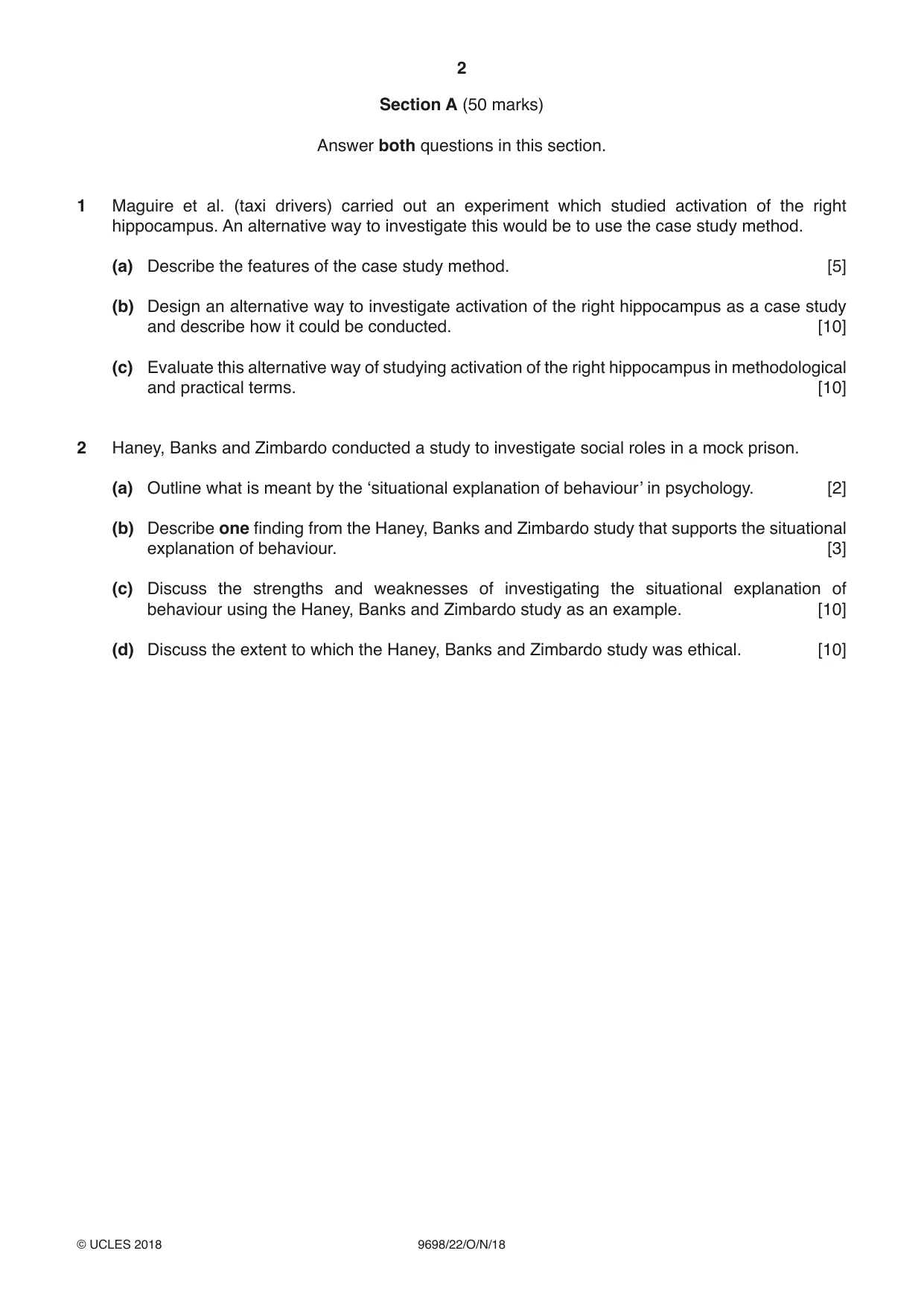
1 Maguire et al. (taxi drivers) carried out an experiment which studied activation of the right hippocampus. An alternative way to investigate this would be to use the case study method. (a) Describe the features of the case study method. [5] (b) Design an alternative way to investigate activation of the right hippocampus as a case study and describe how it could be conducted. [10] (c) Evaluate this alternative way of studying activation of the right hippocampus in methodological and practical terms. [10]
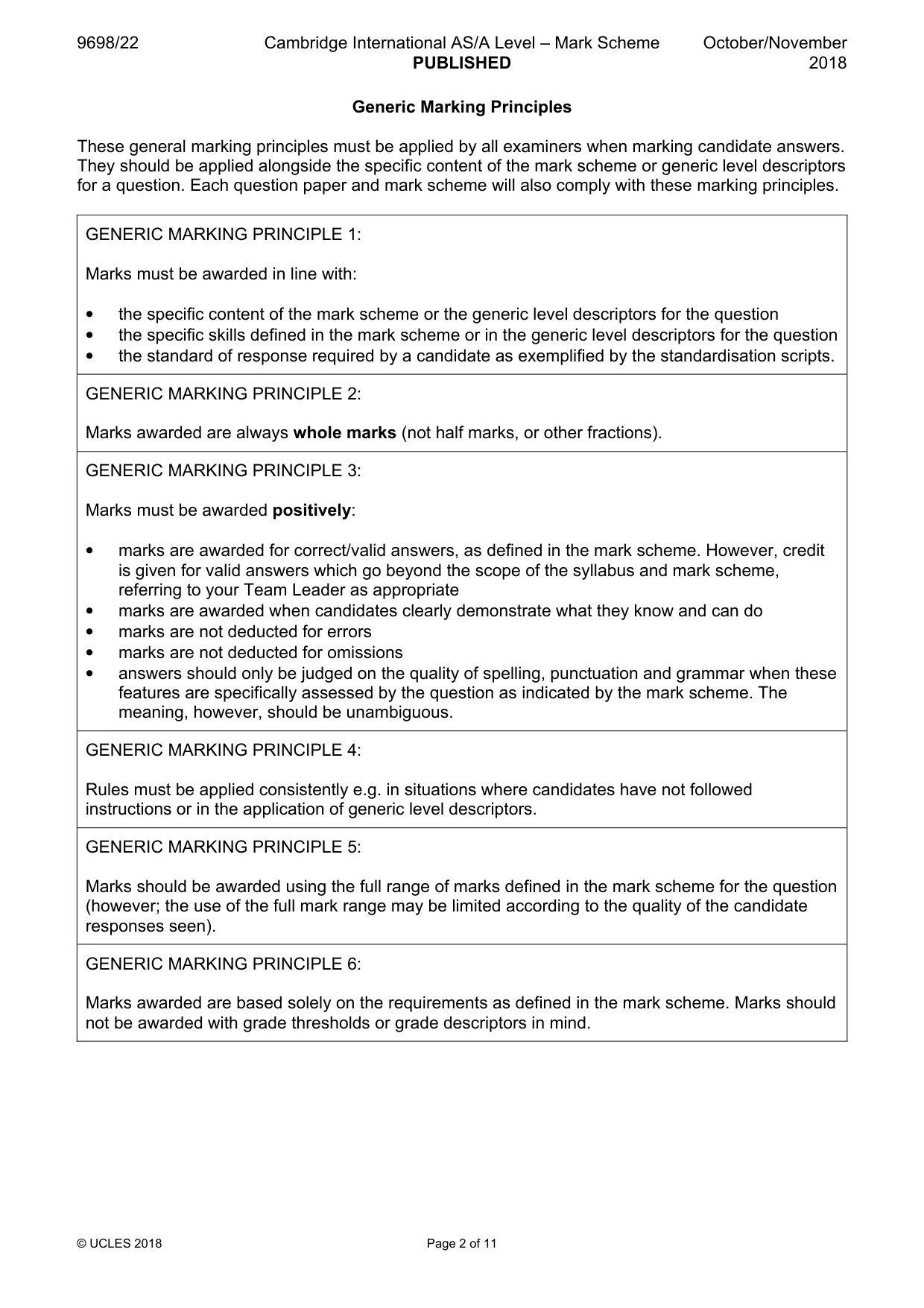
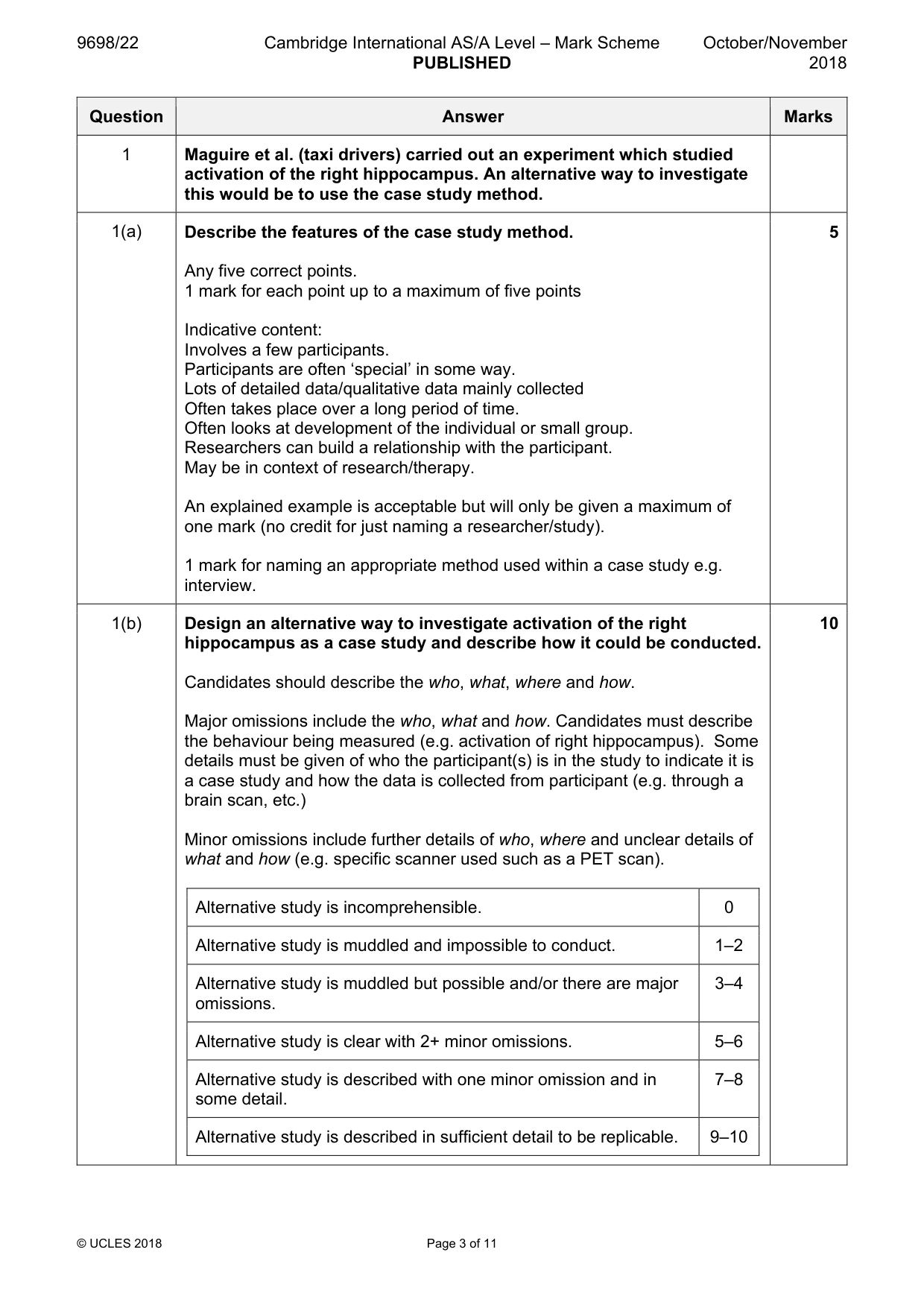
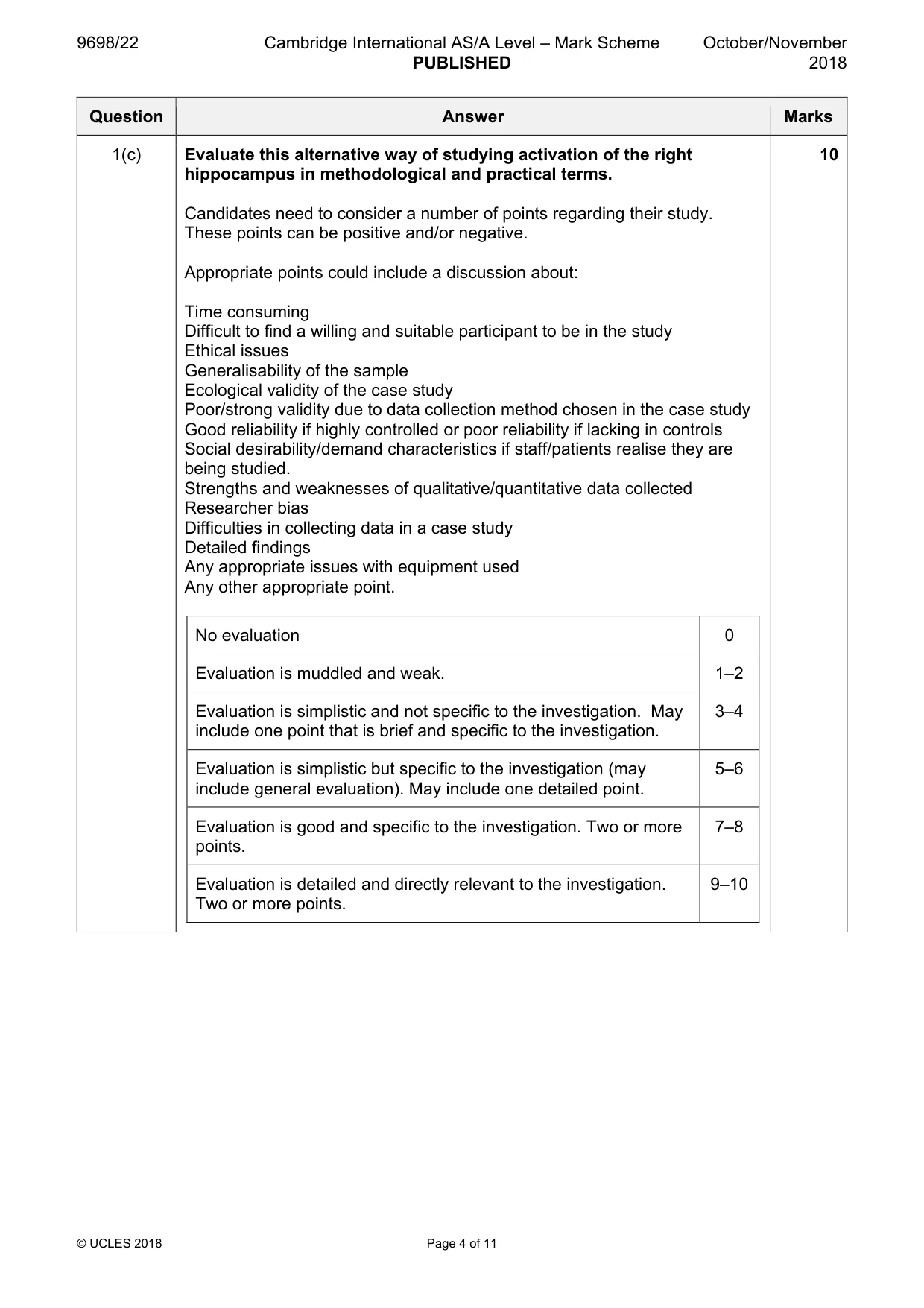
Mark scheme: Question Answer Marks 1 Maguire et al. (taxi drivers) carried out an experiment which studied activation of the right hippocampus. An alternative way to investigate this would be to use the case study method. 1(a) Describe the features of the case study method. 5 Any five correct points. 1 mark for each point up to a maximum of five points Indicative content: Involves a few participants. Participants are often ‘special’ in some way. Lots of detailed data/qualitative data mainly collected Often takes place over a long period of time. Often looks at development of the individual or small group. Researchers can build a relationship with the participant. May be in context of research/therapy. An explained example is acceptable but will only be given a maximum of one mark (no credit for just naming a researcher/study). 1 mark for naming an appropriate method used within a case study e.g. interview. 1(b) Design an alternative way to investigate activation of the right 10 hippocampus as a case study and describe how it could be conducted. Candidates should describe the who, what, where and how. Major omissions include the who, what and how. Candidates must describe the behaviour being measured (e.g. activation of right hippocampus). Some details must be given of who the participant(s) is in the study to indicate it is a case study and how the data is collected from participant (e.g. through a brain scan, etc.) Minor omissions include further details of who, where and unclear details of what and how (e.g. specific scanner used such as a PET scan). Alternative study is incomprehensible. 0 Alternative study is muddled and impossible to conduct. 1–2 Alternative study is muddled but possible and/or there are major 3–4 omissions. Alternative study is clear with 2+ minor omissions. 5–6 Alternative study is described with one minor omission and in 7–8 some detail. Alternative study is described in sufficient detail to be replicable. 9–10 1(c) Evaluate this alternative way of studying activation of the right 10 hippocampus in methodological and practical terms. Candidates need to consider a number of points regarding their study. These points can be positive and/or negative. Appropriate points could include a discussion about: Time consuming Difficult to find a willing and suitable participant to be in the study Ethical issues Generalisability of the sample Ecological validity of the case study Poor/strong validity due to data collection method chosen in the case study Good reliability if highly controlled or poor reliability if lacking in controls Social desirability/demand characteristics if staff/patients realise they are being studied. Strengths and weaknesses of qualitative/quantitative data collected Researcher bias Difficulties in collecting data in a case study Detailed findings Any appropriate issues with equipment used Any other appropriate point. No evaluation 0 Evaluation is muddled and weak. 1–2 Evaluation is simplistic and not specific to the investigation. May 3–4 include one point that is brief and specific to the investigation. Evaluation is simplistic but specific to the investigation (may 5–6 include general evaluation). May include one detailed point. Evaluation is good and specific to the investigation. Two or more 7–8 points. Evaluation is detailed and directly relevant to the investigation. 9–10 Two or more points.
Q2 · Haney, Banks and Zimbardo conducted a study to investigate social roles in a mock prison
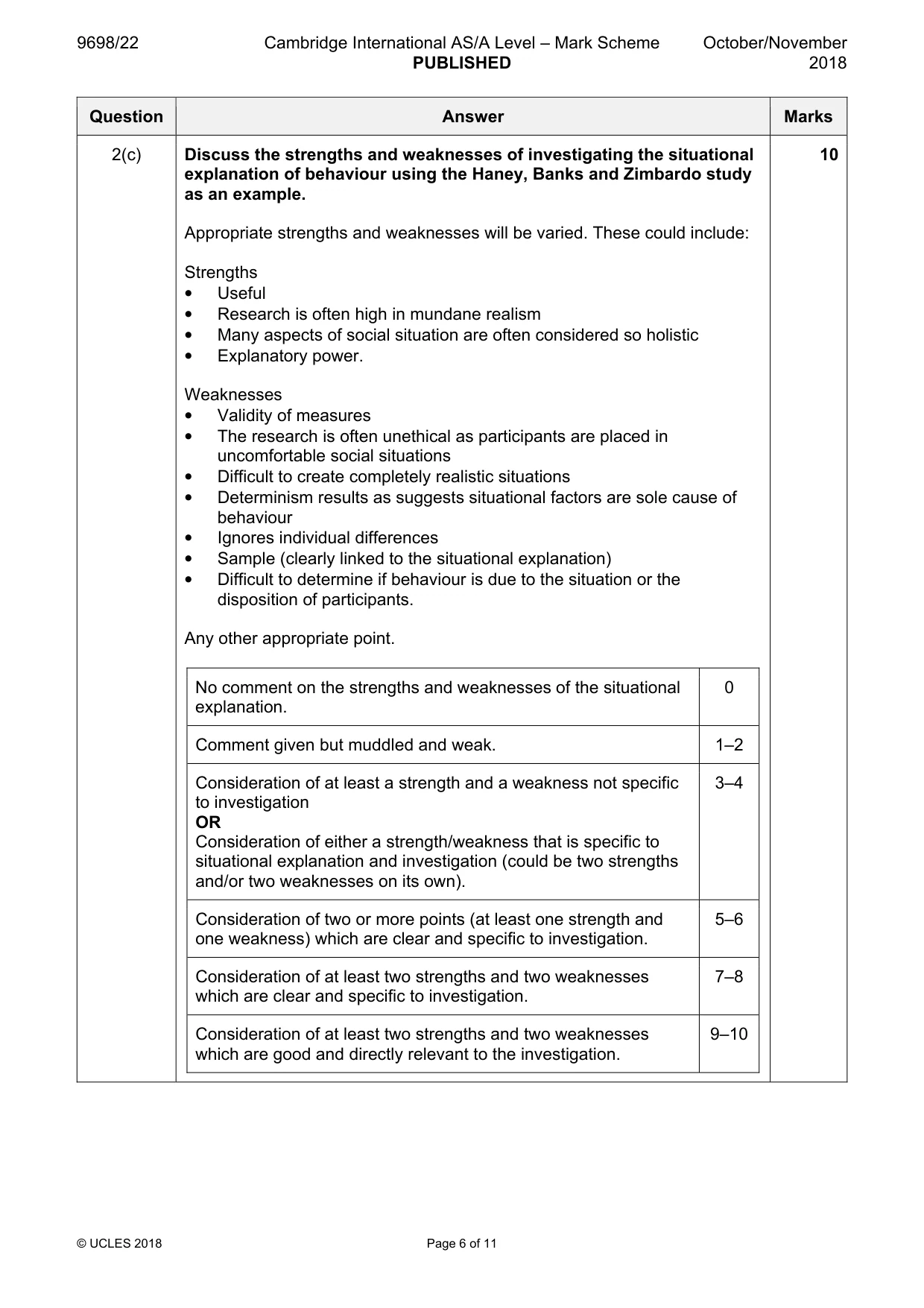
2 Haney, Banks and Zimbardo conducted a study to investigate social roles in a mock prison. (a) Outline what is meant by the ‘situational explanation of behaviour’ in psychology. [2] (b) Describe one finding from the Haney, Banks and Zimbardo study that supports the situational explanation of behaviour. [3] (c) Discuss the strengths and weaknesses of investigating the situational explanation of behaviour using the Haney, Banks and Zimbardo study as an example. [10] (d) Discuss the extent to which the Haney, Banks and Zimbardo study was ethical. [10]
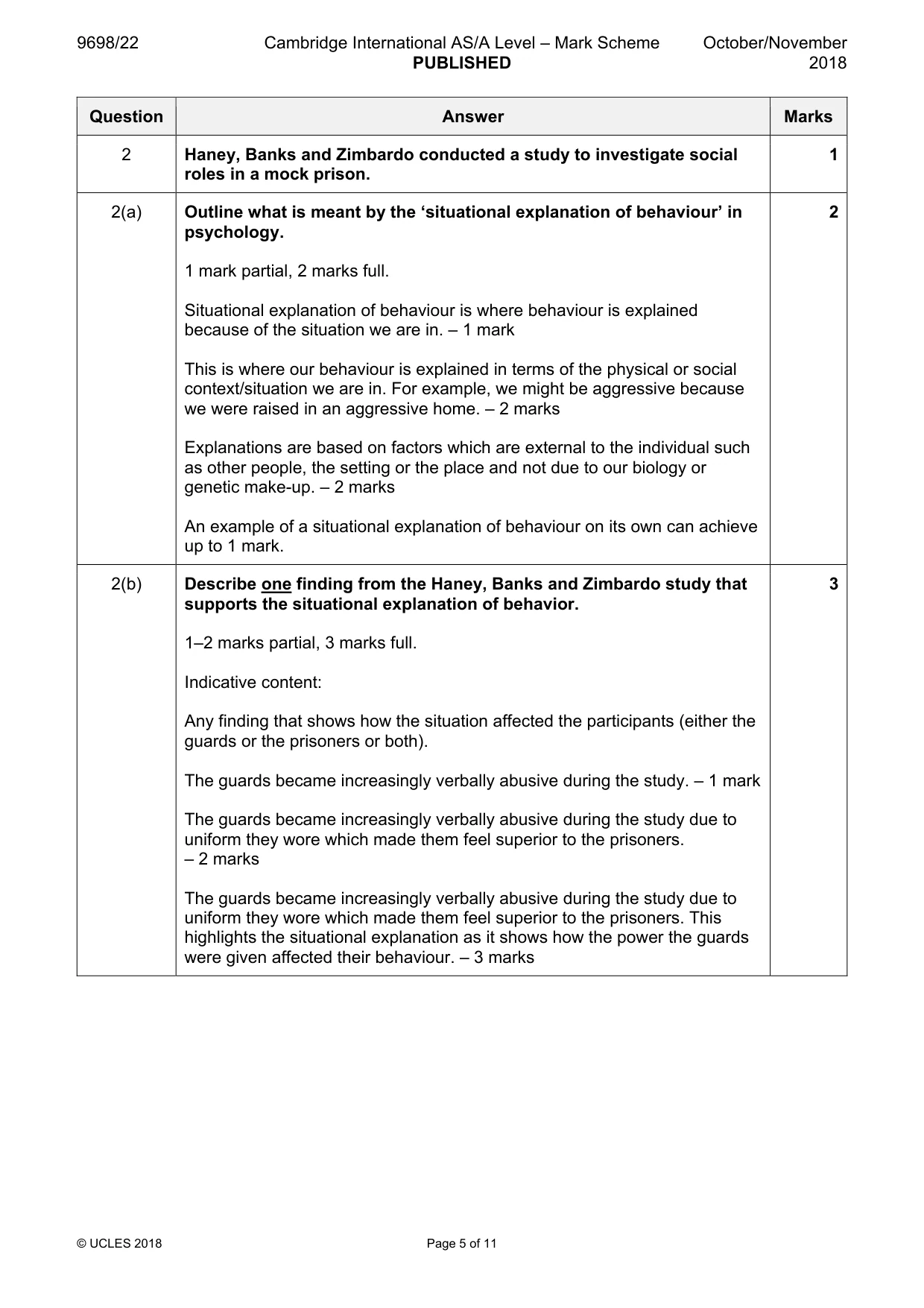
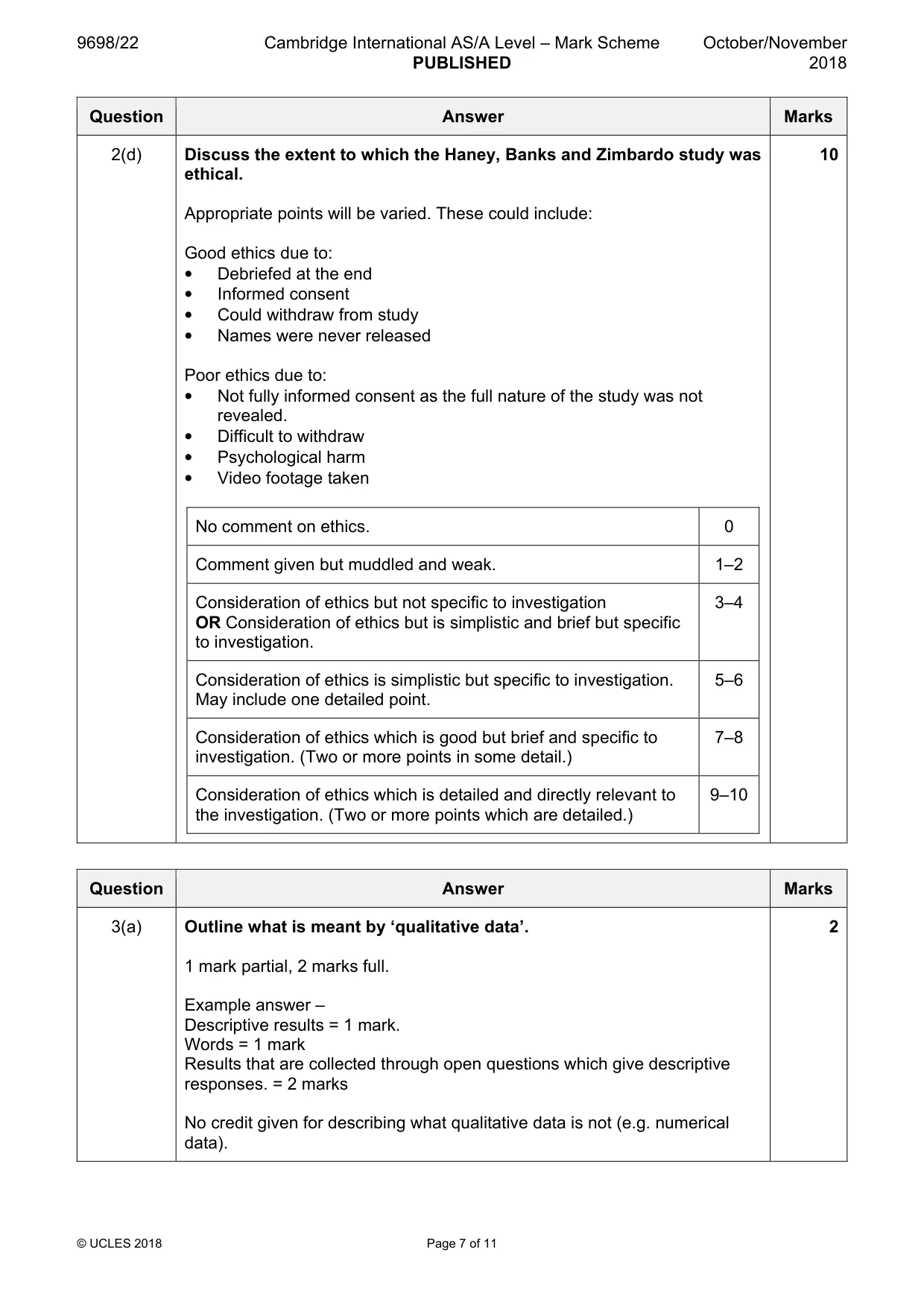
Mark scheme: 2 Haney, Banks and Zimbardo conducted a study to investigate social 1 roles in a mock prison. 2(a) Outline what is meant by the ‘situational explanation of behaviour’ in 2 psychology. 1 mark partial, 2 marks full. Situational explanation of behaviour is where behaviour is explained because of the situation we are in. – 1 mark This is where our behaviour is explained in terms of the physical or social context/situation we are in. For example, we might be aggressive because we were raised in an aggressive home. – 2 marks Explanations are based on factors which are external to the individual such as other people, the setting or the place and not due to our biology or genetic make-up. – 2 marks An example of a situational explanation of behaviour on its own can achieve up to 1 mark. 2(b) Describe one finding from the Haney, Banks and Zimbardo study that 3 supports the situational explanation of behavior. 1–2 marks partial, 3 marks full. Indicative content: Any finding that shows how the situation affected the participants (either the guards or the prisoners or both). The guards became increasingly verbally abusive during the study. – 1 mark The guards became increasingly verbally abusive during the study due to uniform they wore which made them feel superior to the prisoners. – 2 marks The guards became increasingly verbally abusive during the study due to uniform they wore which made them feel superior to the prisoners. This highlights the situational explanation as it shows how the power the guards were given affected their behaviour. – 3 marks 2(c) Discuss the strengths and weaknesses of investigating the situational 10 explanation of behaviour using the Haney, Banks and Zimbardo study as an example. Appropriate strengths and weaknesses will be varied. These could include: Strengths • Useful • Research is often high in mundane realism • Many aspects of social situation are often considered so holistic • Explanatory power. Weaknesses • Validity of measures • The research is often unethical as participants are placed in uncomfortable social situations • Difficult to create completely realistic situations • Determinism results as suggests situational factors are sole cause of behaviour • Ignores individual differences • Sample (clearly linked to the situational explanation) • Difficult to determine if behaviour is due to the situation or the disposition of participants. Any other appropriate point. No comment on the strengths and weaknesses of the situational 0 explanation. Comment given but muddled and weak. 1–2 Consideration of at least a strength and a weakness not specific 3–4 to investigation OR Consideration of either a strength/weakness that is specific to situational explanation and investigation (could be two strengths and/or two weaknesses on its own). Consideration of two or more points (at least one strength and 5–6 one weakness) which are clear and specific to investigation. Consideration of at least two strengths and two weaknesses 7–8 which are clear and specific to investigation. Consideration of at least two strengths and two weaknesses 9–10 which are good and directly relevant to the investigation. 2(d) Discuss the extent to which the Haney, Banks and Zimbardo study was 10 ethical. Appropriate points will be varied. These could include: Good ethics due to: • Debriefed at the end • Informed consent • Could withdraw from study • Names were never released Poor ethics due to: • Not fully informed consent as the full nature of the study was not revealed. • Difficult to withdraw • Psychological harm • Video footage taken No comment on ethics. 0 Comment given but muddled and weak. 1–2 Consideration of ethics but not specific to investigation 3–4 OR Consideration of ethics but is simplistic and brief but specific to investigation. Consideration of ethics is simplistic but specific to investigation. 5–6 May include one detailed point. Consideration of ethics which is good but brief and specific to 7–8 investigation. (Two or more points in some detail.) Consideration of ethics which is detailed and directly relevant to 9–10 the investigation. (Two or more points which are detailed.)
Q3 · Outline what is meant by ‘qualitative data’
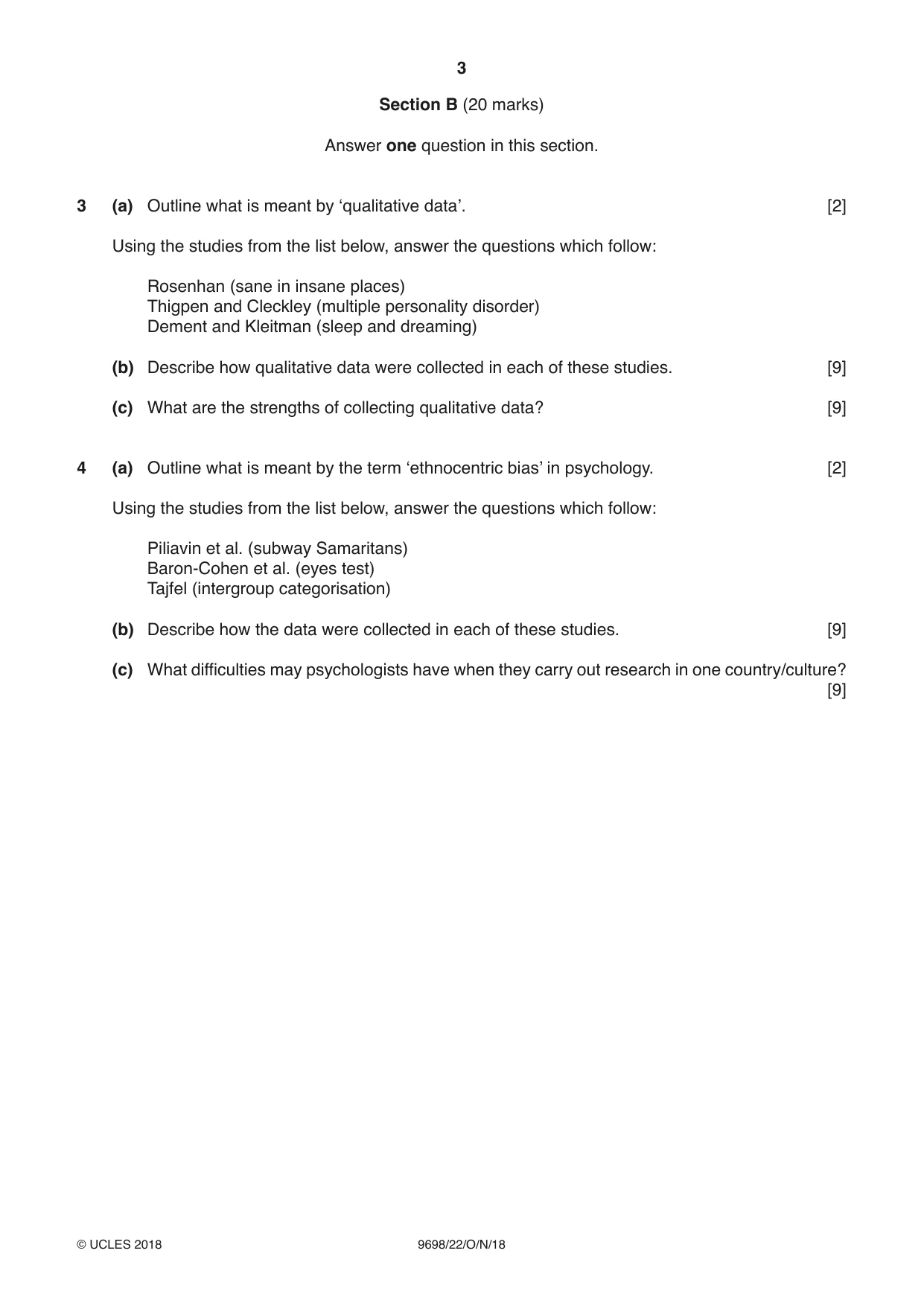
3 (a) Outline what is meant by ‘qualitative data’. [2] Using the studies from the list below, answer the questions which follow: Rosenhan (sane in insane places) Thigpen and Cleckley (multiple personality disorder) Dement and Kleitman (sleep and dreaming) (b) Describe how qualitative data were collected in each of these studies. [9] (c) What are the strengths of collecting qualitative data? [9]
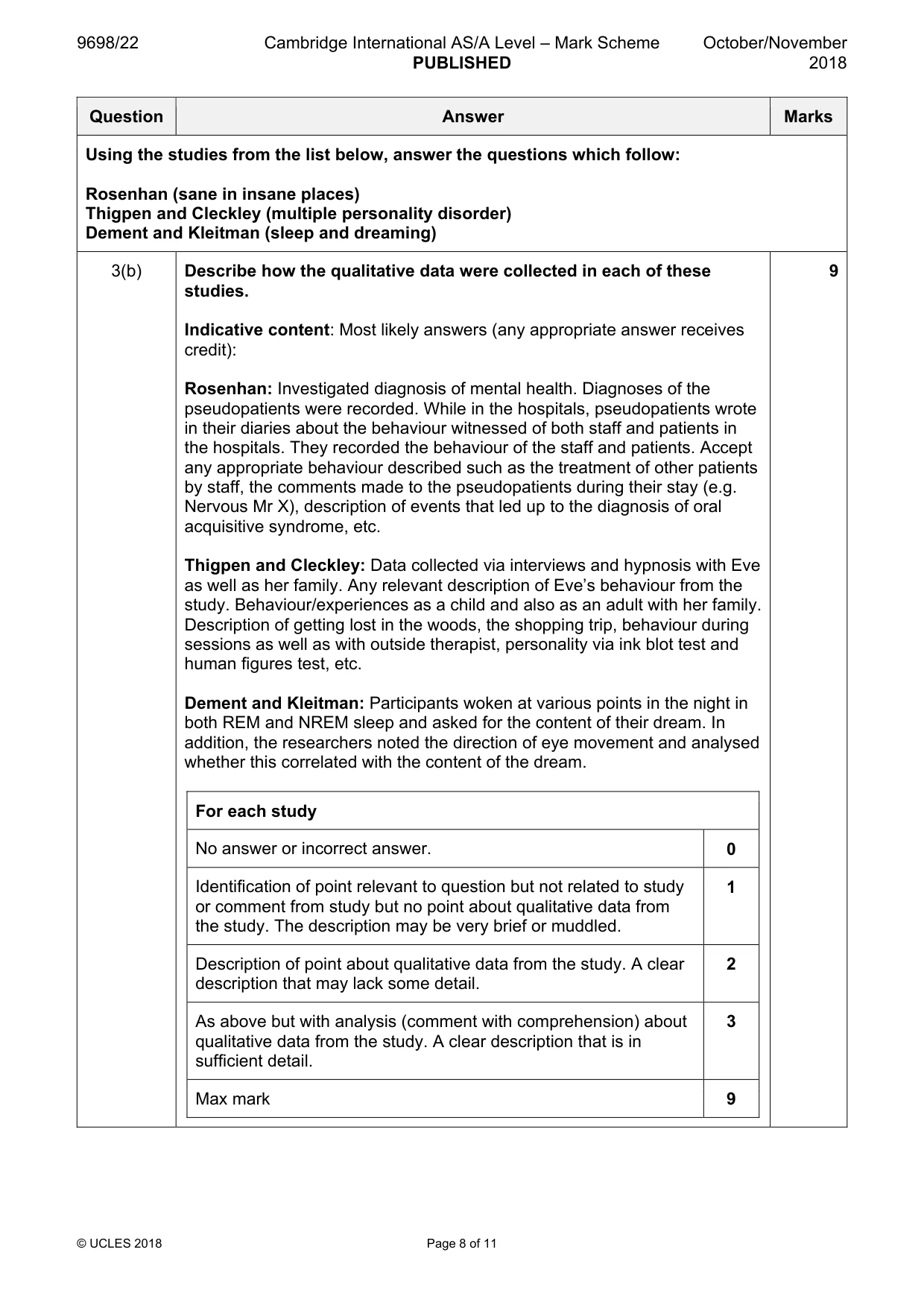
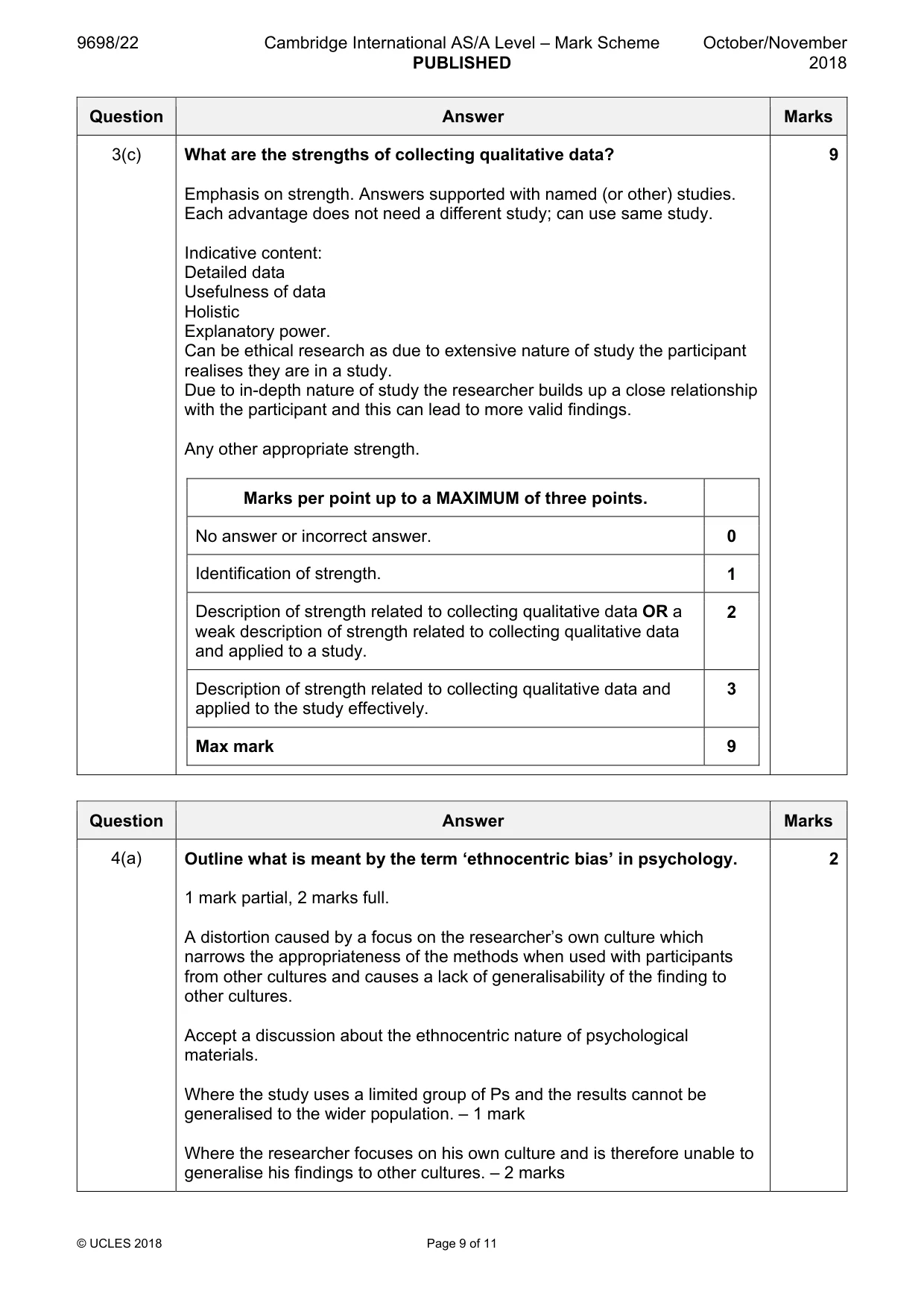
Mark scheme: 3(a) Outline what is meant by ‘qualitative data’. 2 1 mark partial, 2 marks full. Example answer – Descriptive results = 1 mark. Words = 1 mark Results that are collected through open questions which give descriptive responses. = 2 marks No credit given for describing what qualitative data is not (e.g. numerical data). Using the studies from the list below, answer the questions which follow: Rosenhan (sane in insane places) Thigpen and Cleckley (multiple personality disorder) Dement and Kleitman (sleep and dreaming) 3(b) Describe how the qualitative data were collected in each of these 9 studies. Indicative content: Most likely answers (any appropriate answer receives credit): Rosenhan: Investigated diagnosis of mental health. Diagnoses of the pseudopatients were recorded. While in the hospitals, pseudopatients wrote in their diaries about the behaviour witnessed of both staff and patients in the hospitals. They recorded the behaviour of the staff and patients. Accept any appropriate behaviour described such as the treatment of other patients by staff, the comments made to the pseudopatients during their stay (e.g. Nervous Mr X), description of events that led up to the diagnosis of oral acquisitive syndrome, etc. Thigpen and Cleckley: Data collected via interviews and hypnosis with Eve as well as her family. Any relevant description of Eve’s behaviour from the study. Behaviour/experiences as a child and also as an adult with her family. Description of getting lost in the woods, the shopping trip, behaviour during sessions as well as with outside therapist, personality via ink blot test and human figures test, etc. Dement and Kleitman: Participants woken at various points in the night in both REM and NREM sleep and asked for the content of their dream. In addition, the researchers noted the direction of eye movement and analysed whether this correlated with the content of the dream. For each study No answer or incorrect answer. 0 Identification of point relevant to question but not related to study 1 or comment from study but no point about qualitative data from the study. The description may be very brief or muddled. Description of point about qualitative data from the study. A clear 2 description that may lack some detail. As above but with analysis (comment with comprehension) about 3 qualitative data from the study. A clear description that is in sufficient detail. Max mark 9 3(c) What are the strengths of collecting qualitative data? 9 Emphasis on strength. Answers supported with named (or other) studies. Each advantage does not need a different study; can use same study. Indicative content: Detailed data Usefulness of data Holistic Explanatory power. Can be ethical research as due to extensive nature of study the participant realises they are in a study. Due to in-depth nature of study the researcher builds up a close relationship with the participant and this can lead to more valid findings. Any other appropriate strength. Marks per point up to a MAXIMUM of three points. No answer or incorrect answer. 0 Identification of strength. 1 Description of strength related to collecting qualitative data OR a 2 weak description of strength related to collecting qualitative data and applied to a study. Description of strength related to collecting qualitative data and 3 applied to the study effectively. Max mark 9
Q4 · Outline what is meant by the term ‘ethnocentric bias’ in psychology
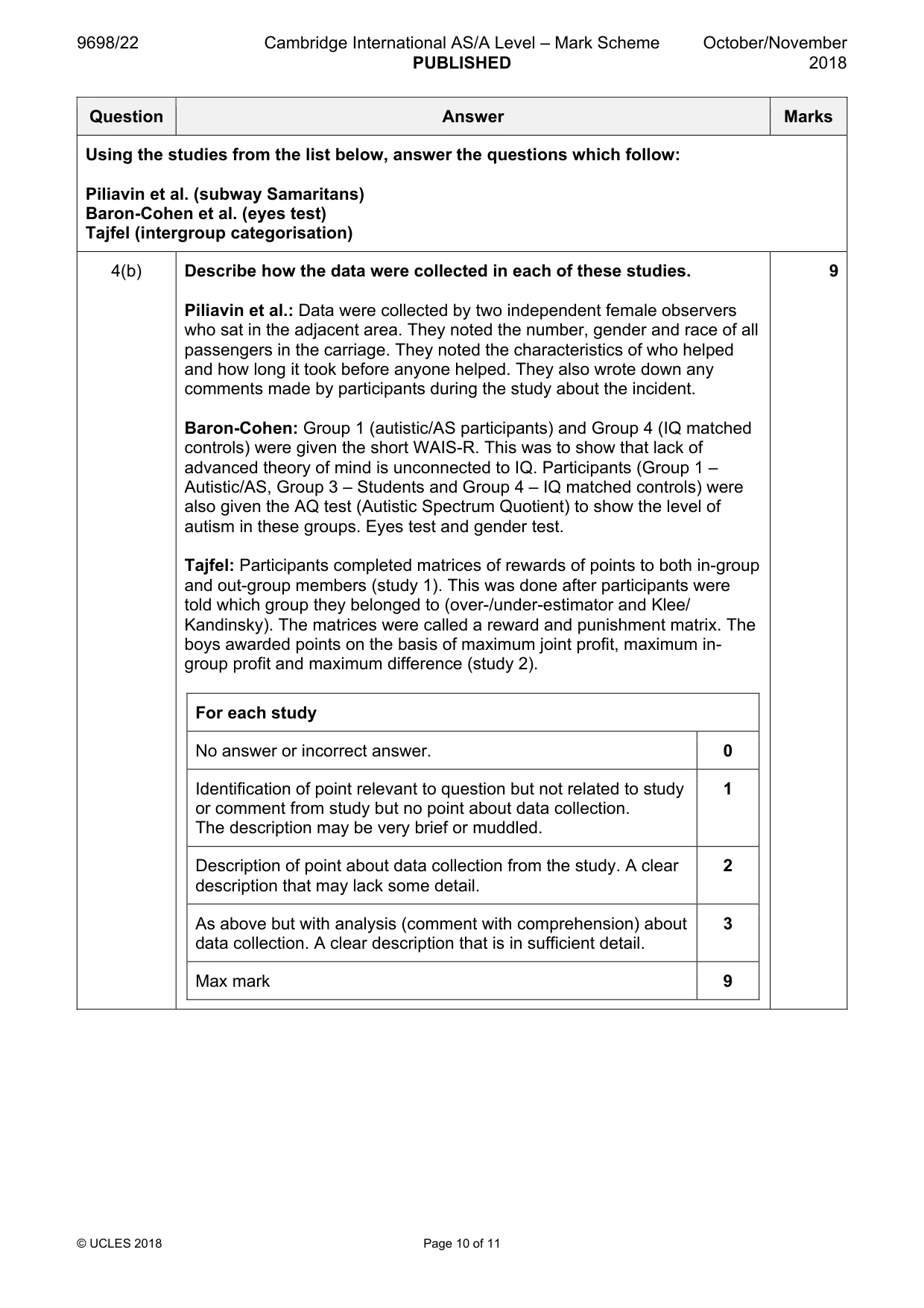
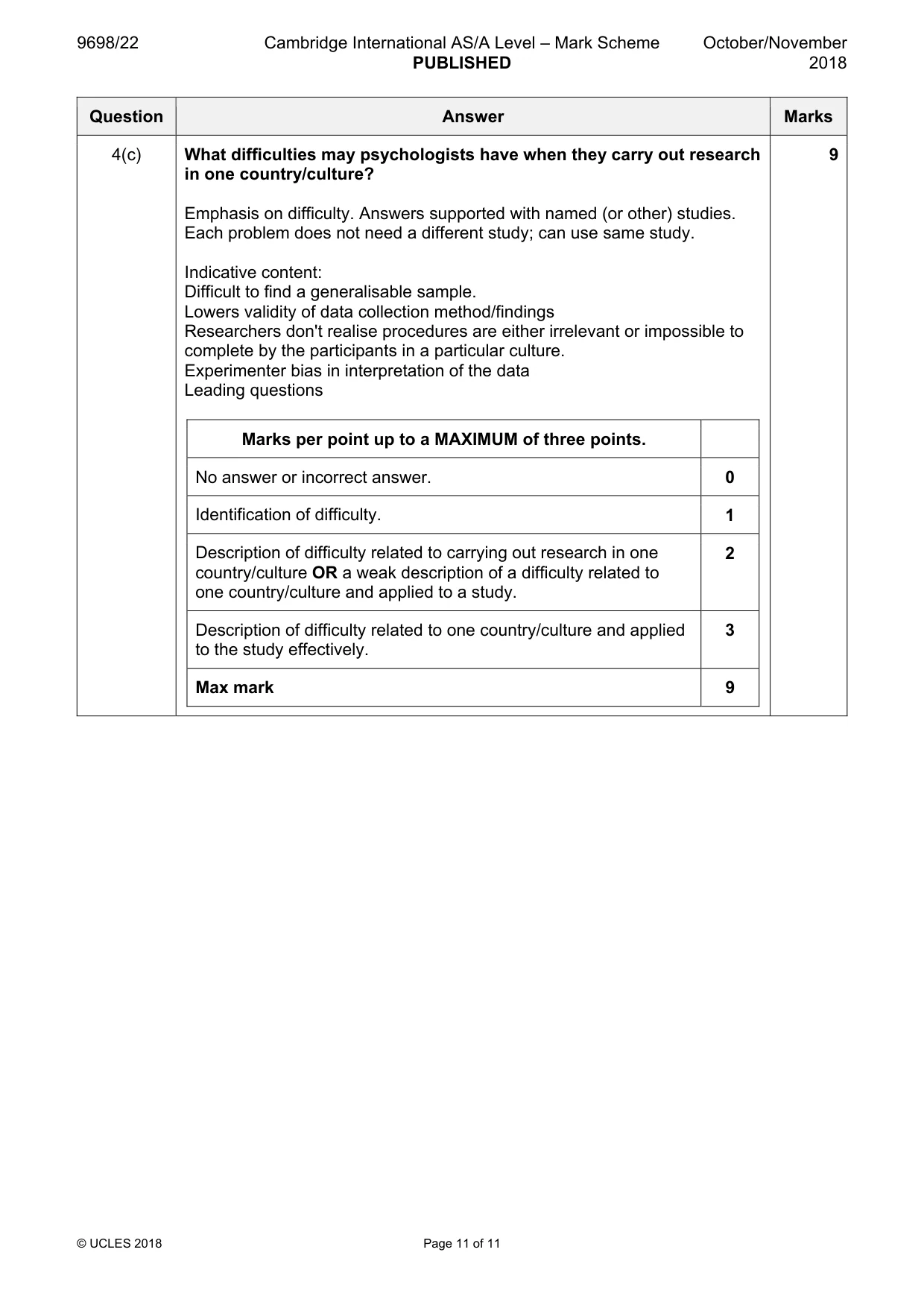
4 (a) Outline what is meant by the term ‘ethnocentric bias’ in psychology. [2] Using the studies from the list below, answer the questions which follow: Piliavin et al. (subway Samaritans) Baron-Cohen et al. (eyes test) Tajfel (intergroup categorisation) (b) Describe how the data were collected in each of these studies. [9] (c) What difficulties may psychologists have when they carry out research in one country/culture? [9]
Mark scheme: 4(a) Outline what is meant by the term ‘ethnocentric bias’ in psychology. 2 1 mark partial, 2 marks full. A distortion caused by a focus on the researcher’s own culture which narrows the appropriateness of the methods when used with participants from other cultures and causes a lack of generalisability of the finding to other cultures. Accept a discussion about the ethnocentric nature of psychological materials. Where the study uses a limited group of Ps and the results cannot be generalised to the wider population. – 1 mark Where the researcher focuses on his own culture and is therefore unable to generalise his findings to other cultures. – 2 marks Using the studies from the list below, answer the questions which follow: Piliavin et al. (subway Samaritans) Baron-Cohen et al. (eyes test) Tajfel (intergroup categorisation) 4(b) Describe how the data were collected in each of these studies. 9 Piliavin et al.: Data were collected by two independent female observers who sat in the adjacent area. They noted the number, gender and race of all passengers in the carriage. They noted the characteristics of who helped and how long it took before anyone helped. They also wrote down any comments made by participants during the study about the incident. Baron-Cohen: Group 1 (autistic/AS participants) and Group 4 (IQ matched controls) were given the short WAIS-R. This was to show that lack of advanced theory of mind is unconnected to IQ. Participants (Group 1 – Autistic/AS, Group 3 – Students and Group 4 – IQ matched controls) were also given the AQ test (Autistic Spectrum Quotient) to show the level of autism in these groups. Eyes test and gender test. Tajfel: Participants completed matrices of rewards of points to both in-group and out-group members (study 1). This was done after participants were told which group they belonged to (over-/under-estimator and Klee/ Kandinsky). The matrices were called a reward and punishment matrix. The boys awarded points on the basis of maximum joint profit, maximum in- group profit and maximum difference (study 2). For each study No answer or incorrect answer. 0 Identification of point relevant to question but not related to study 1 or comment from study but no point about data collection. The description may be very brief or muddled. Description of point about data collection from the study. A clear 2 description that may lack some detail. As above but with analysis (comment with comprehension) about 3 data collection. A clear description that is in sufficient detail. Max mark 9 4(c) What difficulties may psychologists have when they carry out research 9 in one country/culture? Emphasis on difficulty. Answers supported with named (or other) studies. Each problem does not need a different study; can use same study. Indicative content: Difficult to find a generalisable sample. Lowers validity of data collection method/findings Researchers don't realise procedures are either irrelevant or impossible to complete by the participants in a particular culture. Experimenter bias in interpretation of the data Leading questions Marks per point up to a MAXIMUM of three points. No answer or incorrect answer. 0 Identification of difficulty. 1 Description of difficulty related to carrying out research in one 2 country/culture OR a weak description of a difficulty related to one country/culture and applied to a study. Description of difficulty related to one country/culture and applied 3 to the study effectively. Max mark 9
What you needed in this session
Cambridge’s own grade thresholds for 2018 Oct/Nov, Paper 2 · Variant 2. A higher threshold means an easier paper — the bar moves with how the cohort did.