Cambridge A Level Psychology 9698 — 2017 Oct/Nov Paper 2 · Variant 1
9698/21/O/N/17 · 4 questions · 70 marks · ≈79 min
The question paper and its mark scheme, free to read here and free to download. This is Cambridge’s own paper, exactly as it was sat.
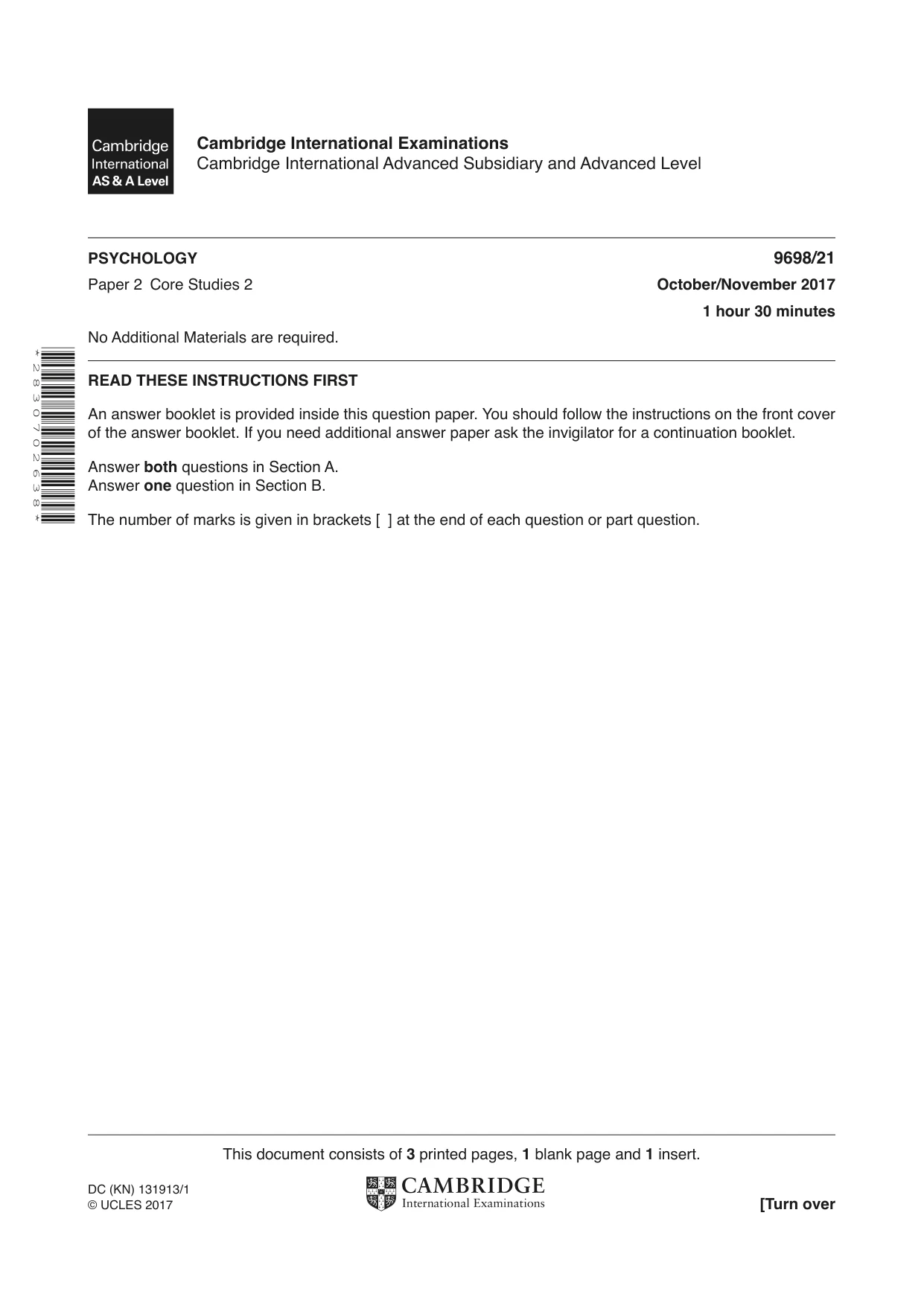
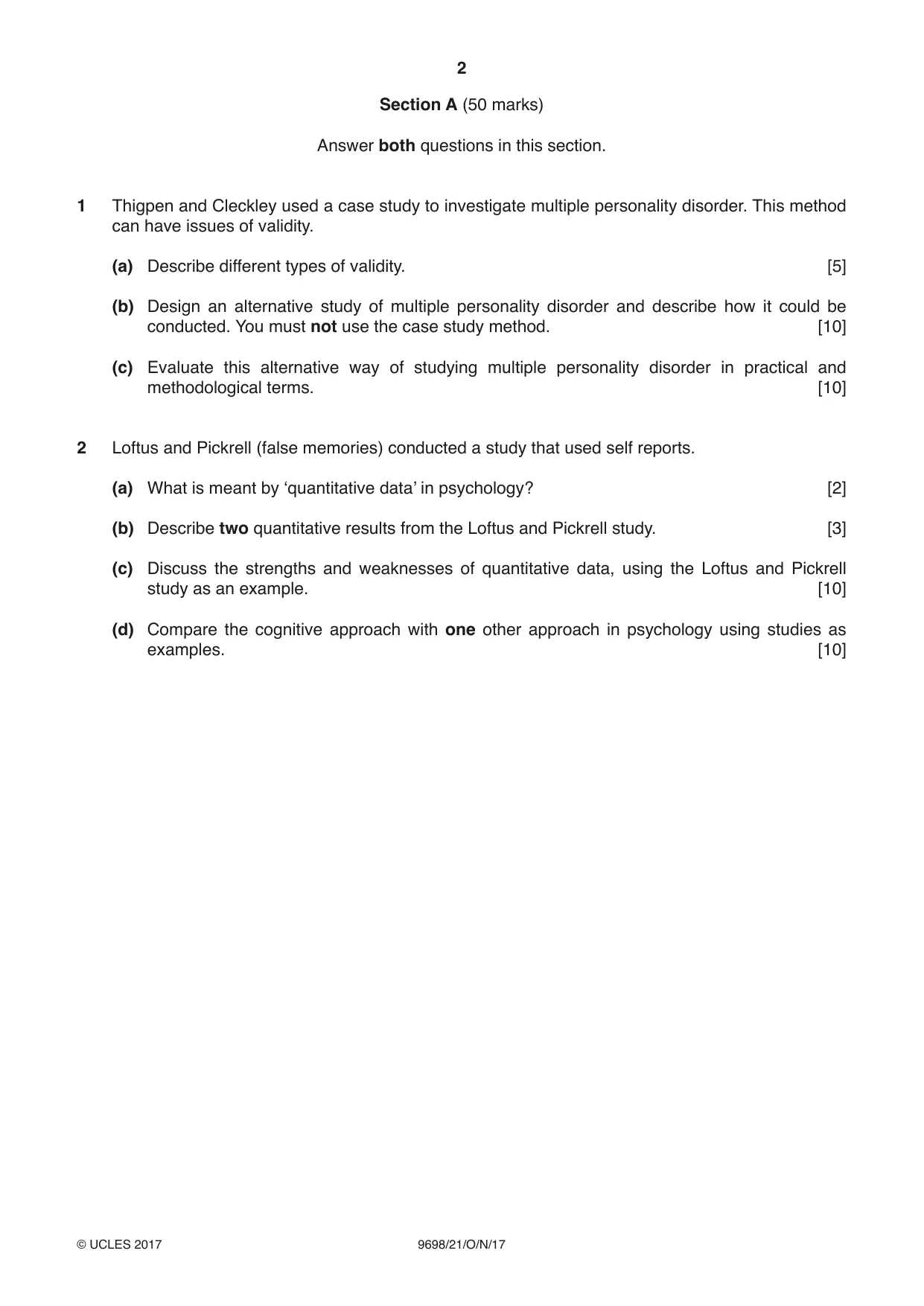
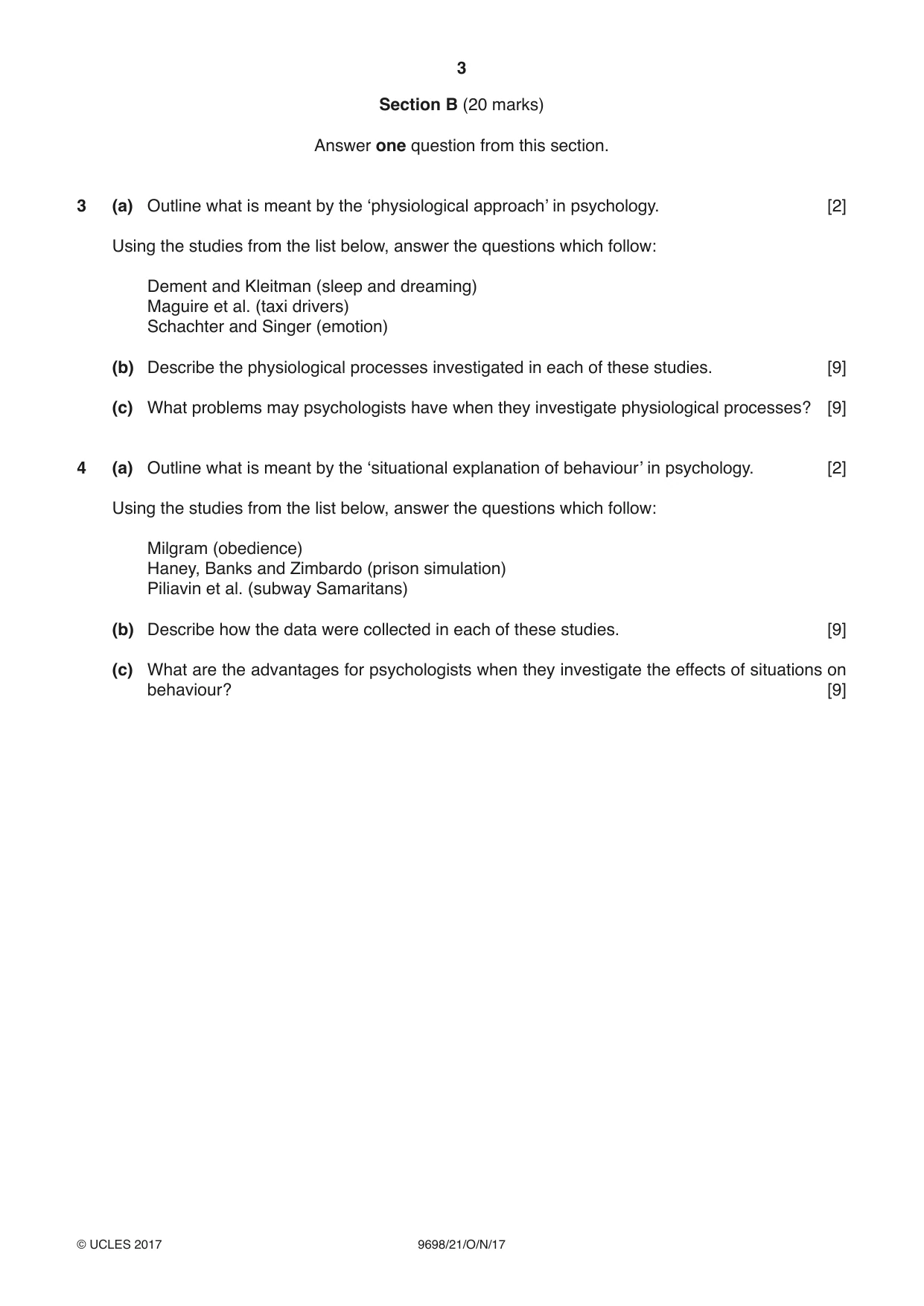
Question paper4 pages

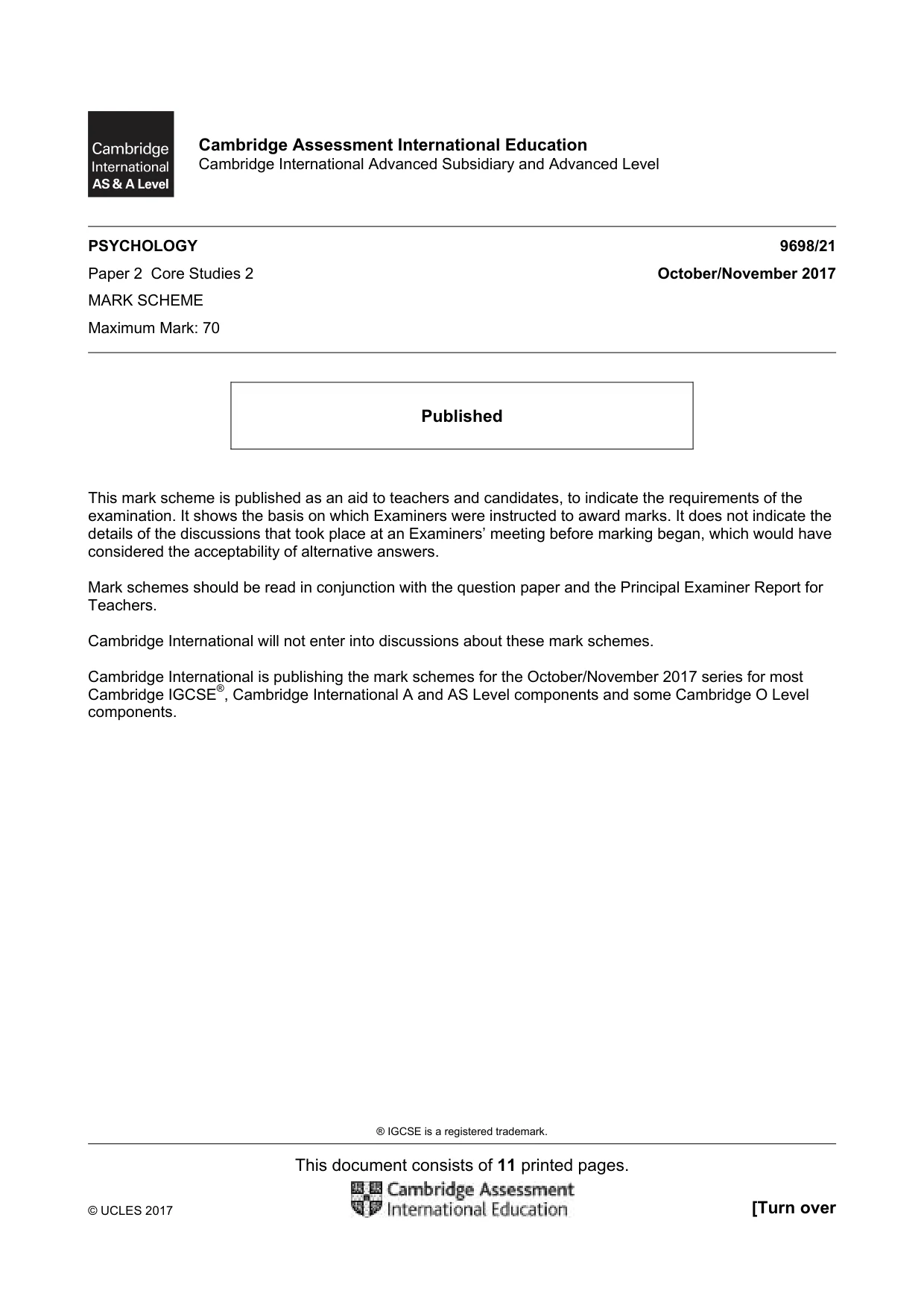
Mark scheme11 pages
Answers below. Sit the paper first if you are practising.
Questions as text
Q1 · Thigpen and Cleckley used a case study to investigate multiple personality disorder
1 Thigpen and Cleckley used a case study to investigate multiple personality disorder. This method can have issues of validity. (a) Describe different types of validity. [5] (b) Design an alternative study of multiple personality disorder and describe how it could be conducted. You must not use the case study method. [10] (c) Evaluate this alternative way of studying multiple personality disorder in practical and methodological terms. [10]
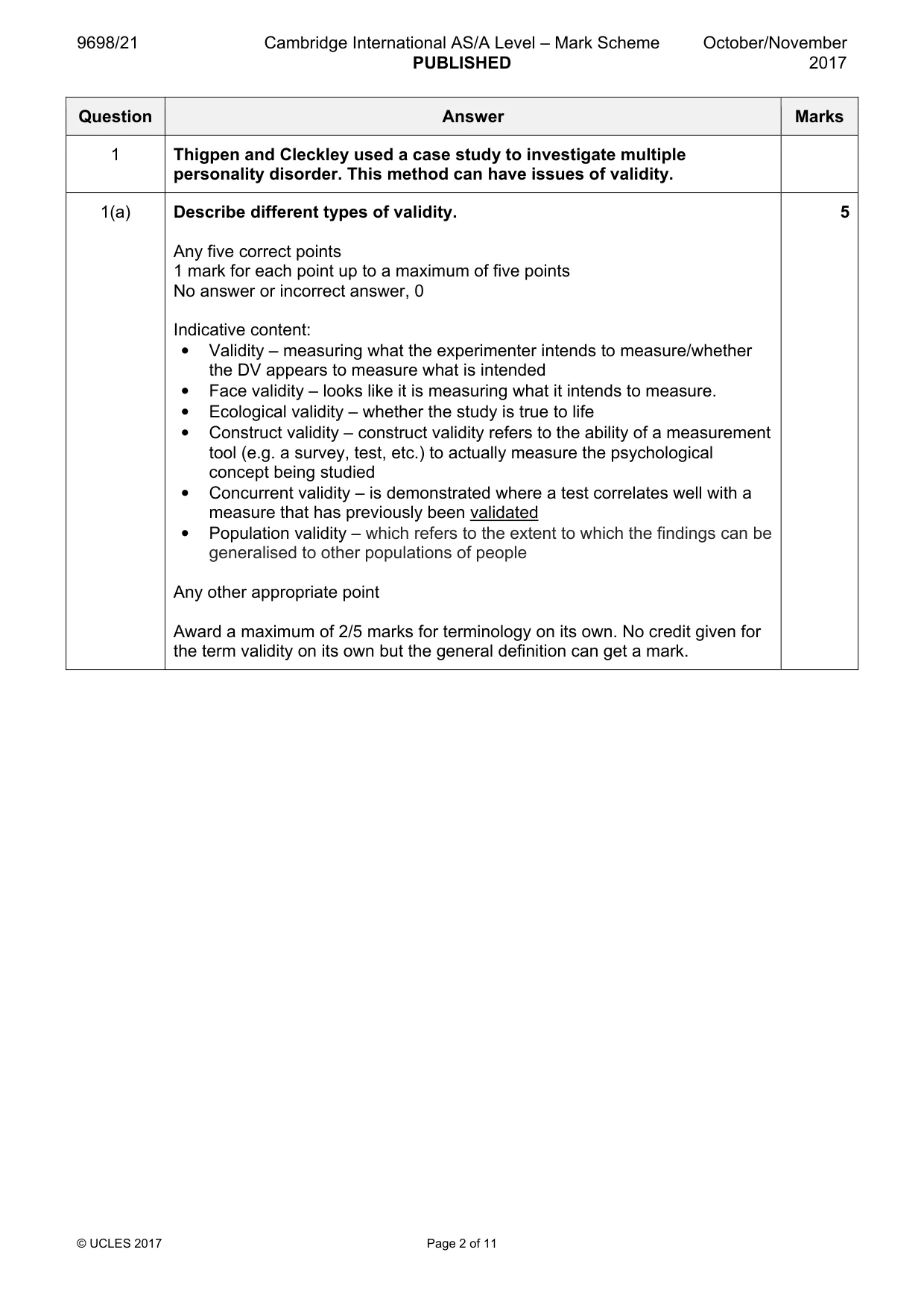
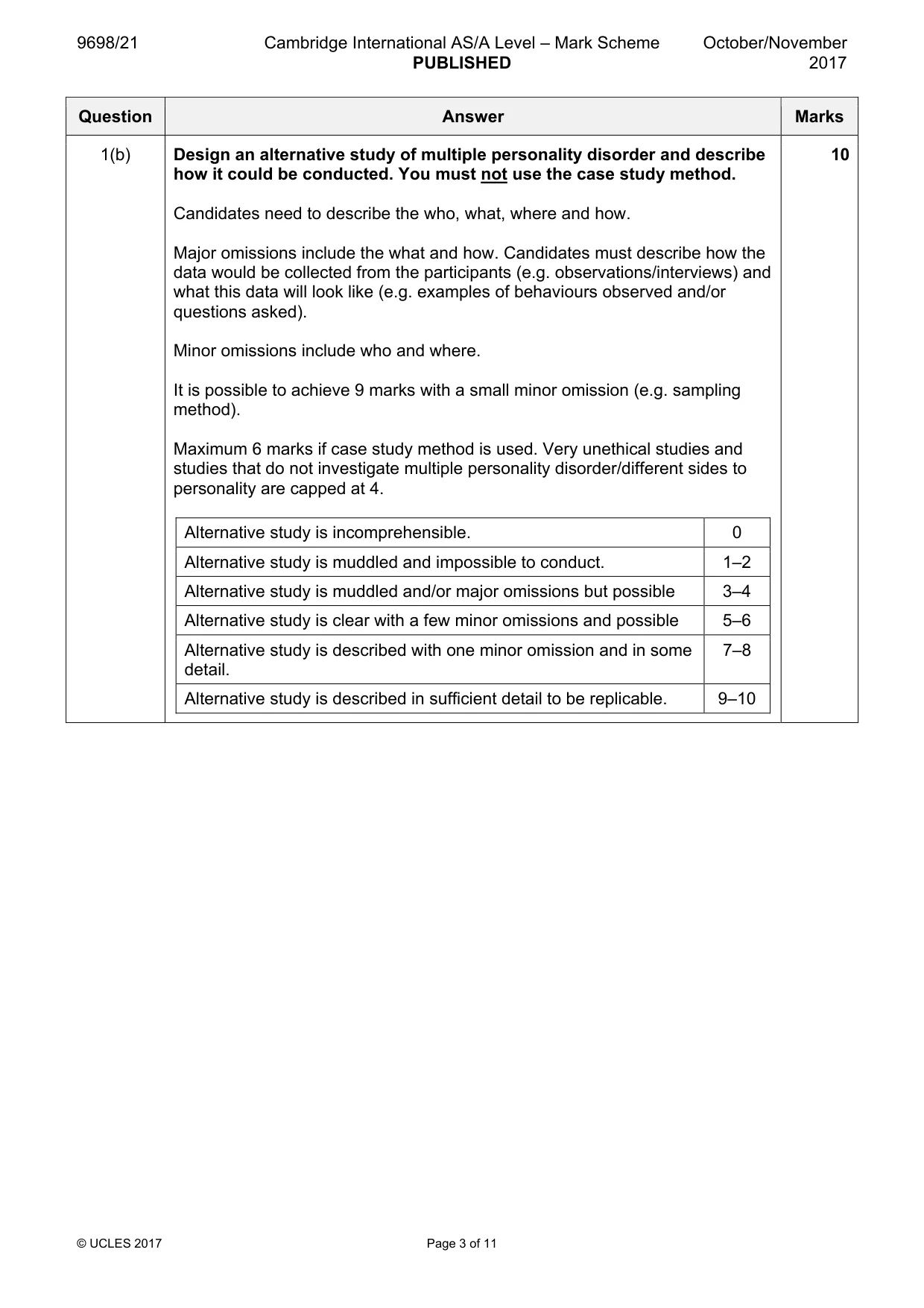
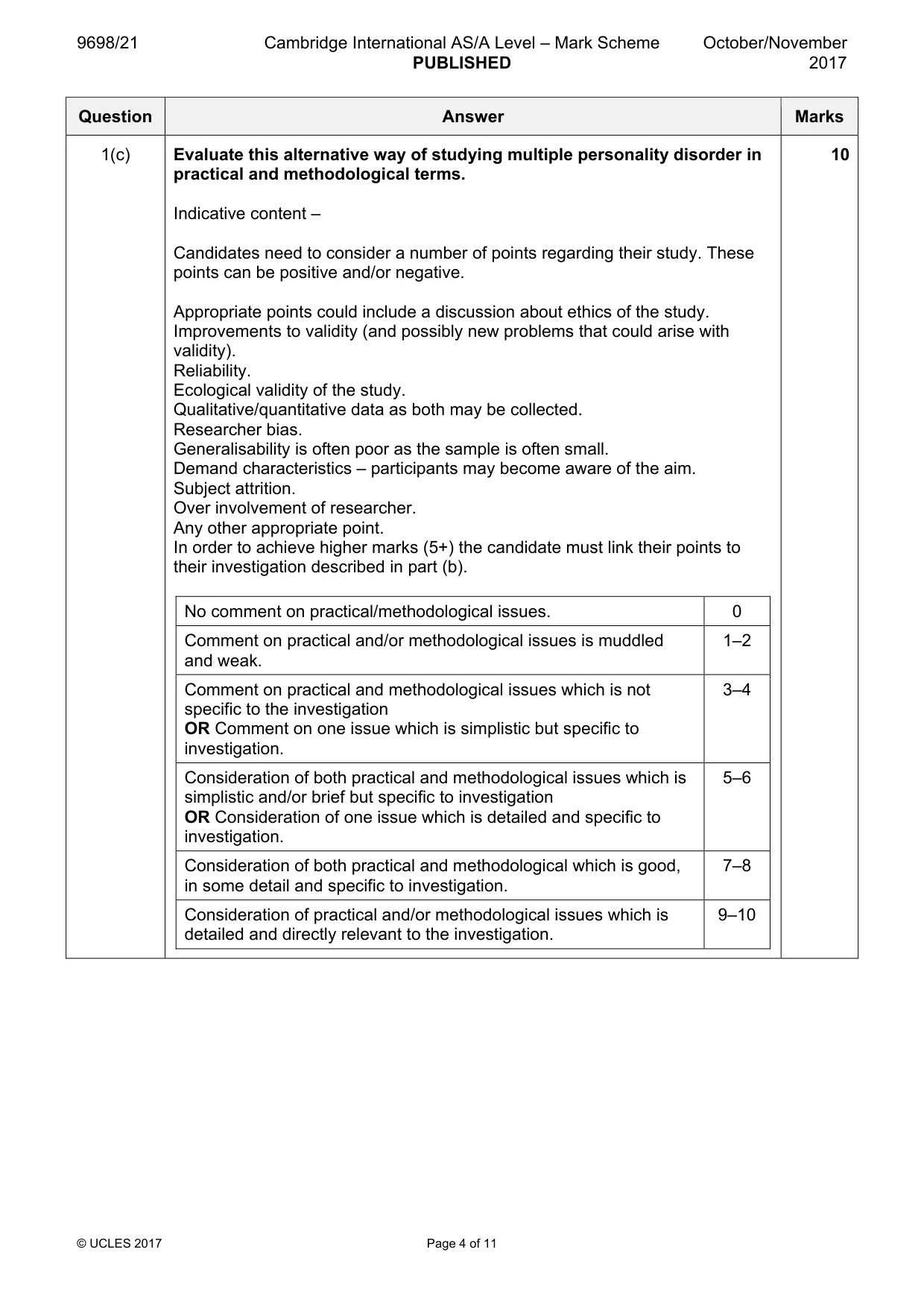
Mark scheme: Question Answer Marks 1 Thigpen and Cleckley used a case study to investigate multiple personality disorder. This method can have issues of validity. 1(a) Describe different types of validity. 5 Any five correct points 1 mark for each point up to a maximum of five points No answer or incorrect answer, 0 Indicative content: • Validity – measuring what the experimenter intends to measure/whether the DV appears to measure what is intended • Face validity – looks like it is measuring what it intends to measure. • Ecological validity – whether the study is true to life • Construct validity – construct validity refers to the ability of a measurement tool (e.g. a survey, test, etc.) to actually measure the psychological concept being studied • Concurrent validity – is demonstrated where a test correlates well with a measure that has previously been validated • Population validity – which refers to the extent to which the findings can be generalised to other populations of people Any other appropriate point Award a maximum of 2/5 marks for terminology on its own. No credit given for the term validity on its own but the general definition can get a mark. 1(b) Design an alternative study of multiple personality disorder and describe 10 how it could be conducted. You must not use the case study method. Candidates need to describe the who, what, where and how. Major omissions include the what and how. Candidates must describe how the data would be collected from the participants (e.g. observations/interviews) and what this data will look like (e.g. examples of behaviours observed and/or questions asked). Minor omissions include who and where. It is possible to achieve 9 marks with a small minor omission (e.g. sampling method). Maximum 6 marks if case study method is used. Very unethical studies and studies that do not investigate multiple personality disorder/different sides to personality are capped at 4. Alternative study is incomprehensible. 0 Alternative study is muddled and impossible to conduct. 1–2 Alternative study is muddled and/or major omissions but possible 3–4 Alternative study is clear with a few minor omissions and possible 5–6 Alternative study is described with one minor omission and in some 7–8 detail. Alternative study is described in sufficient detail to be replicable. 9–10 1(c) Evaluate this alternative way of studying multiple personality disorder in 10 practical and methodological terms. Indicative content – Candidates need to consider a number of points regarding their study. These points can be positive and/or negative. Appropriate points could include a discussion about ethics of the study. Improvements to validity (and possibly new problems that could arise with validity). Reliability. Ecological validity of the study. Qualitative/quantitative data as both may be collected. Researcher bias. Generalisability is often poor as the sample is often small. Demand characteristics – participants may become aware of the aim. Subject attrition. Over involvement of researcher. Any other appropriate point. In order to achieve higher marks (5+) the candidate must link their points to their investigation described in part (b). No comment on practical/methodological issues. 0 Comment on practical and/or methodological issues is muddled 1–2 and weak. Comment on practical and methodological issues which is not 3–4 specific to the investigation OR Comment on one issue which is simplistic but specific to investigation. Consideration of both practical and methodological issues which is 5–6 simplistic and/or brief but specific to investigation OR Consideration of one issue which is detailed and specific to investigation. Consideration of both practical and methodological which is good, 7–8 in some detail and specific to investigation. Consideration of practical and/or methodological issues which is 9–10 detailed and directly relevant to the investigation.
Q2 · Loftus and Pickrell (false memories) conducted a study that used self reports
2 Loftus and Pickrell (false memories) conducted a study that used self reports. (a) What is meant by ‘quantitative data’ in psychology? [2] (b) Describe two quantitative results from the Loftus and Pickrell study. [3] (c) Discuss the strengths and weaknesses of quantitative data, using the Loftus and Pickrell study as an example. [10] (d) Compare the cognitive approach with one other approach in psychology using studies as examples. [10]
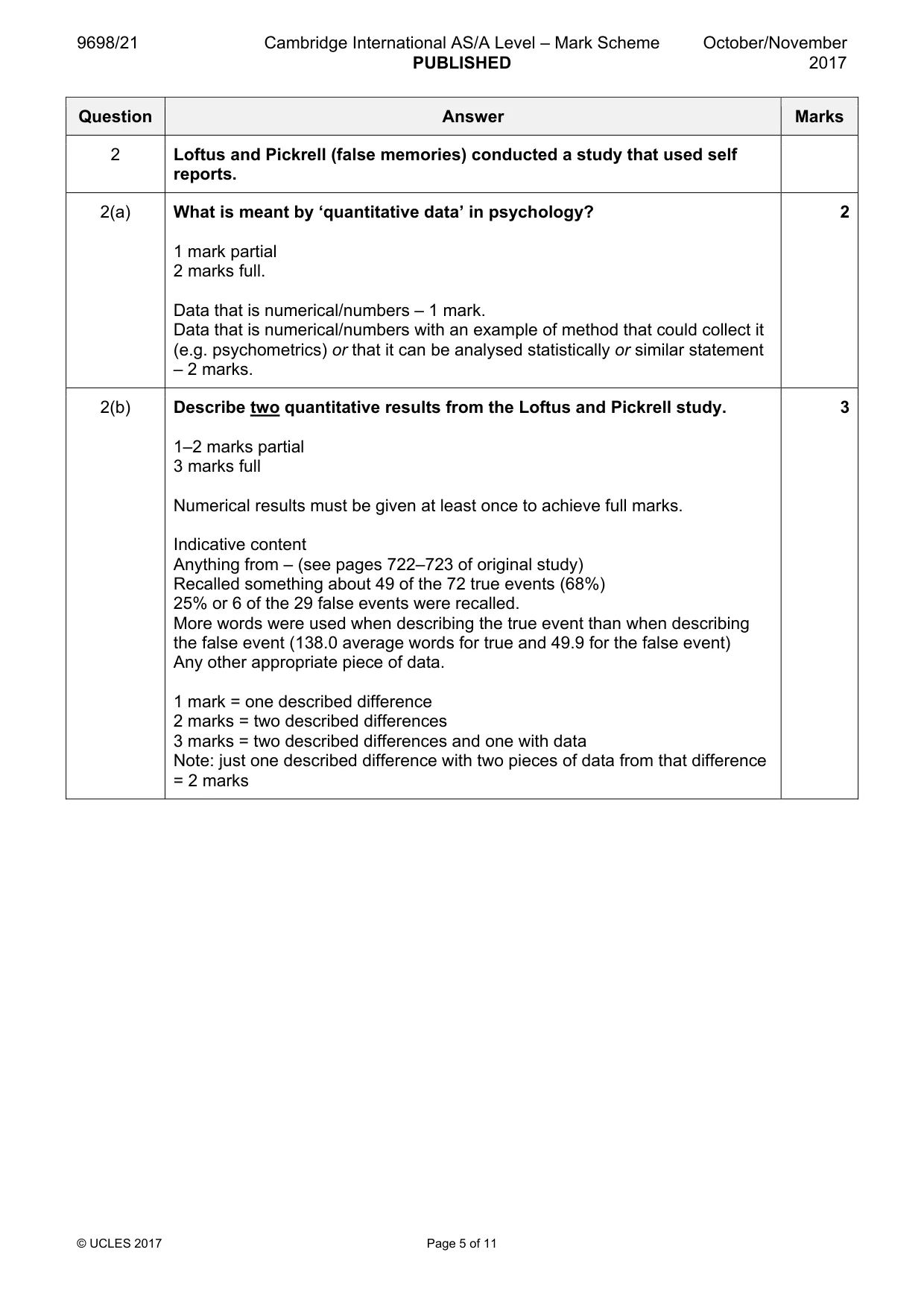
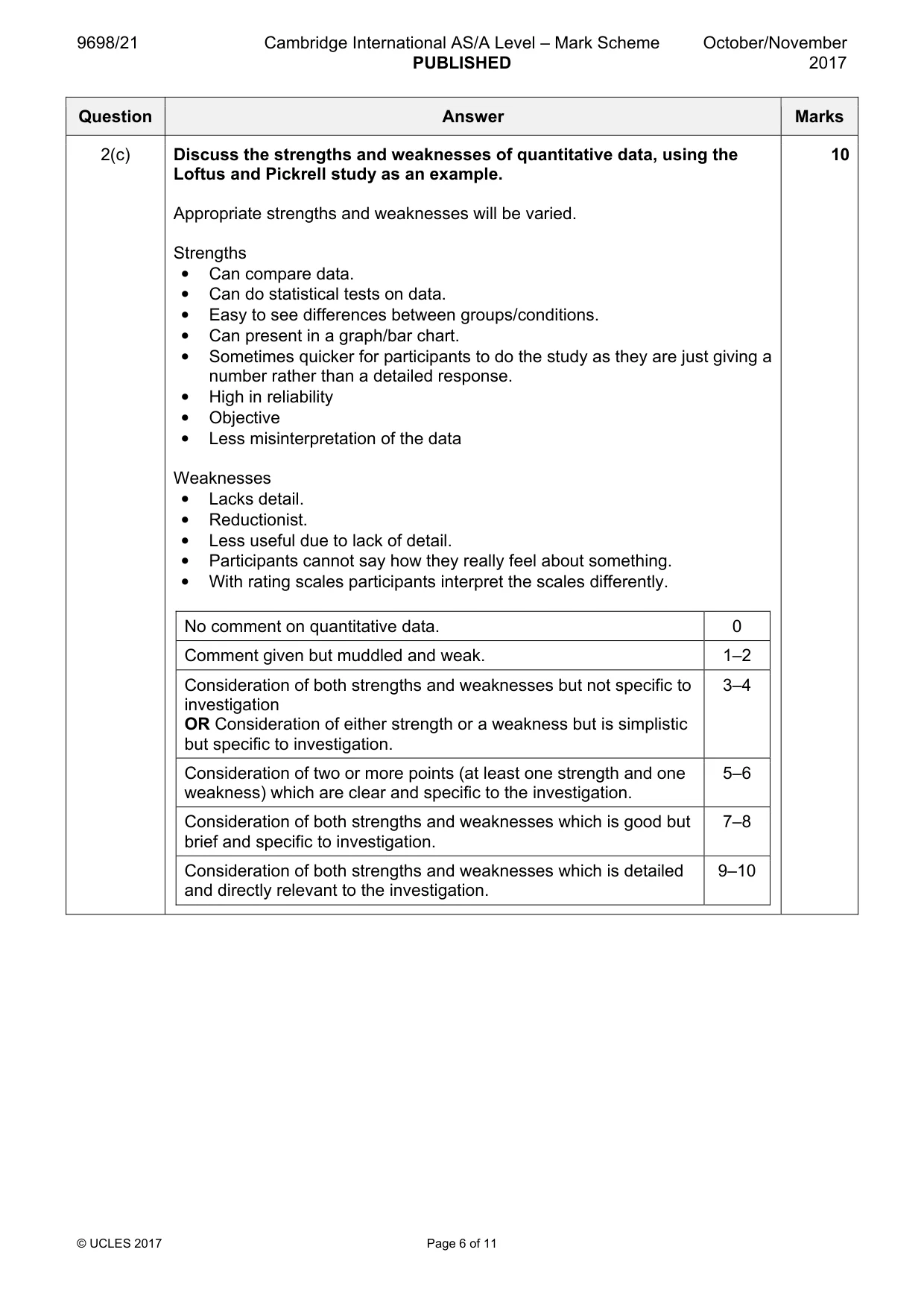
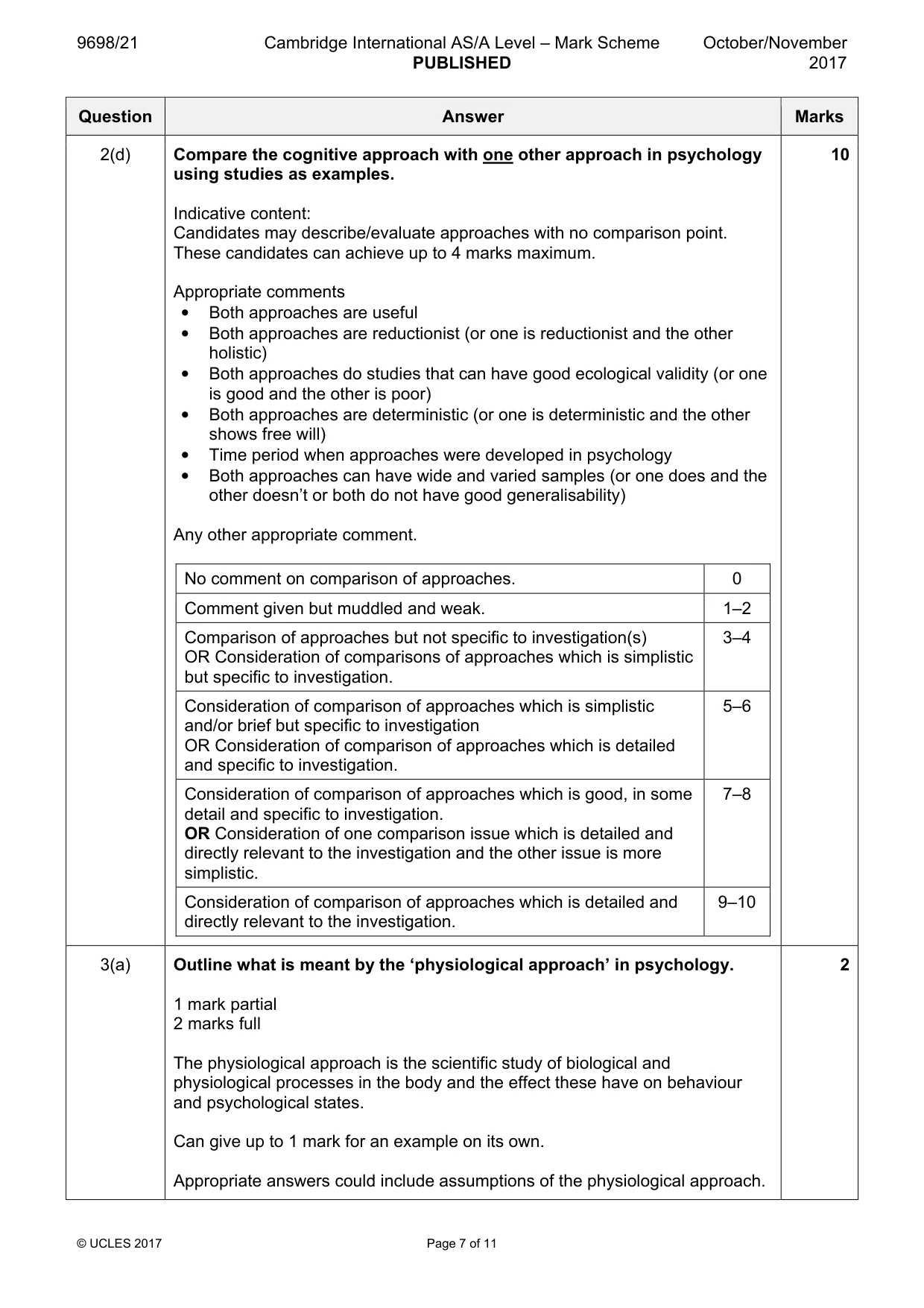
Mark scheme: 2(a) What is meant by ‘quantitative data’ in psychology? 2 1 mark partial 2 marks full. Data that is numerical/numbers – 1 mark. Data that is numerical/numbers with an example of method that could collect it (e.g. psychometrics) or that it can be analysed statistically or similar statement – 2 marks. 2(b) Describe two quantitative results from the Loftus and Pickrell study. 3 1–2 marks partial 3 marks full Numerical results must be given at least once to achieve full marks. Indicative content Anything from – (see pages 722–723 of original study) Recalled something about 49 of the 72 true events (68%) 25% or 6 of the 29 false events were recalled. More words were used when describing the true event than when describing the false event (138.0 average words for true and 49.9 for the false event) Any other appropriate piece of data. 1 mark = one described difference 2 marks = two described differences 3 marks = two described differences and one with data Note: just one described difference with two pieces of data from that difference = 2 marks 2(c) Discuss the strengths and weaknesses of quantitative data, using the 10 Loftus and Pickrell study as an example. Appropriate strengths and weaknesses will be varied. Strengths • Can compare data. • Can do statistical tests on data. • Easy to see differences between groups/conditions. • Can present in a graph/bar chart. • Sometimes quicker for participants to do the study as they are just giving a number rather than a detailed response. • High in reliability • Objective • Less misinterpretation of the data Weaknesses • Lacks detail. • Reductionist. • Less useful due to lack of detail. • Participants cannot say how they really feel about something. • With rating scales participants interpret the scales differently. No comment on quantitative data. 0 Comment given but muddled and weak. 1–2 Consideration of both strengths and weaknesses but not specific to 3–4 investigation OR Consideration of either strength or a weakness but is simplistic but specific to investigation. Consideration of two or more points (at least one strength and one 5–6 weakness) which are clear and specific to the investigation. Consideration of both strengths and weaknesses which is good but 7–8 brief and specific to investigation. Consideration of both strengths and weaknesses which is detailed 9–10 and directly relevant to the investigation. 2(d) Compare the cognitive approach with one other approach in psychology 10 using studies as examples. Indicative content: Candidates may describe/evaluate approaches with no comparison point. These candidates can achieve up to 4 marks maximum. Appropriate comments • Both approaches are useful • Both approaches are reductionist (or one is reductionist and the other holistic) • Both approaches do studies that can have good ecological validity (or one is good and the other is poor) • Both approaches are deterministic (or one is deterministic and the other shows free will) • Time period when approaches were developed in psychology • Both approaches can have wide and varied samples (or one does and the other doesn’t or both do not have good generalisability) Any other appropriate comment. No comment on comparison of approaches. 0 Comment given but muddled and weak. 1–2 Comparison of approaches but not specific to investigation(s) 3–4 OR Consideration of comparisons of approaches which is simplistic but specific to investigation. Consideration of comparison of approaches which is simplistic 5–6 and/or brief but specific to investigation OR Consideration of comparison of approaches which is detailed and specific to investigation. Consideration of comparison of approaches which is good, in some 7–8 detail and specific to investigation. OR Consideration of one comparison issue which is detailed and directly relevant to the investigation and the other issue is more simplistic. Consideration of comparison of approaches which is detailed and 9–10 directly relevant to the investigation.
Q3 · Outline what is meant by the ‘physiological approach’ in psychology
3 (a) Outline what is meant by the ‘physiological approach’ in psychology. [2] Using the studies from the list below, answer the questions which follow: Dement and Kleitman (sleep and dreaming) Maguire et al. (taxi drivers) Schachter and Singer (emotion) (b) Describe the physiological processes investigated in each of these studies. [9] (c) What problems may psychologists have when they investigate physiological processes? [9]
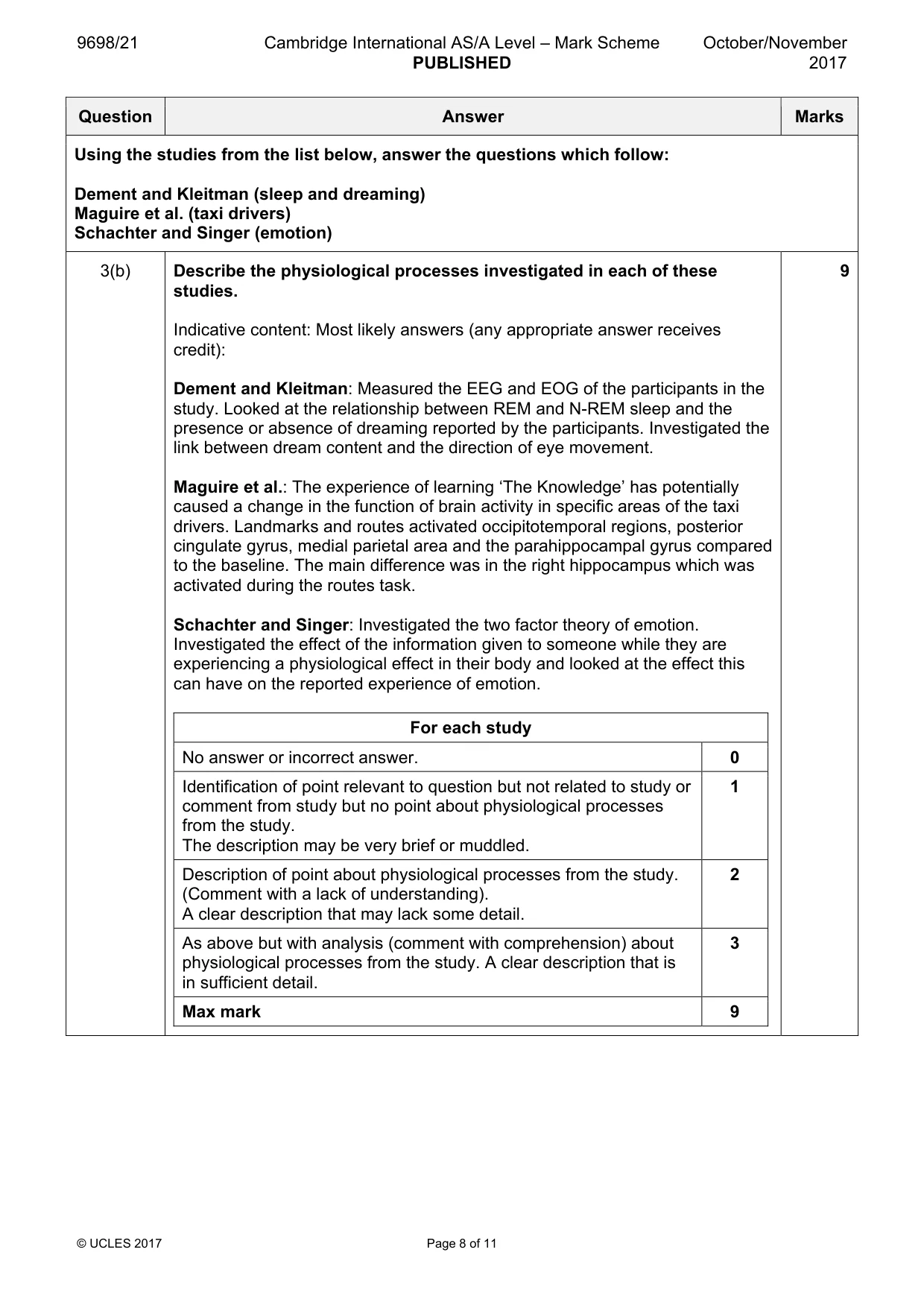
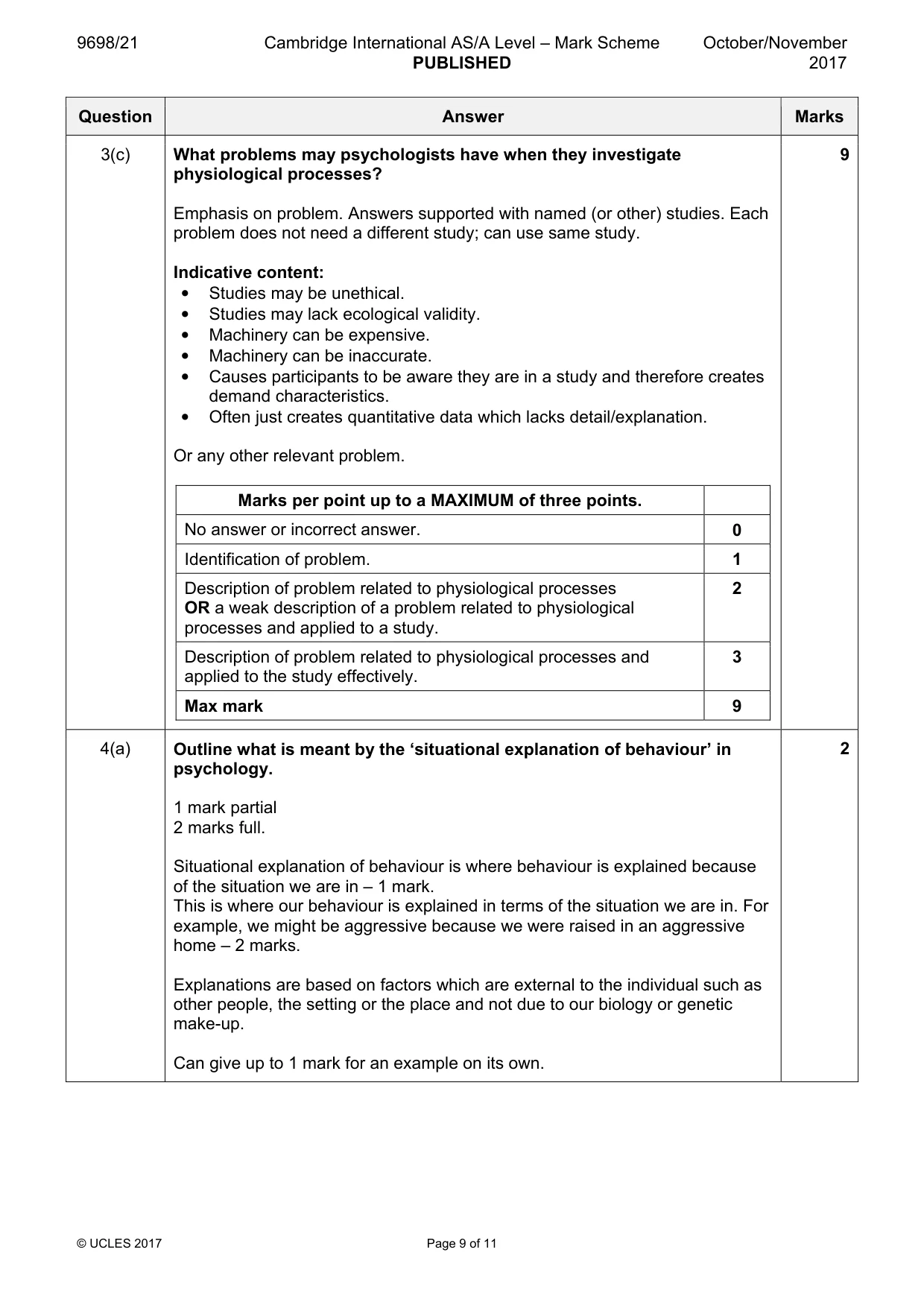
Mark scheme: 3(a) Outline what is meant by the ‘physiological approach’ in psychology. 2 1 mark partial 2 marks full The physiological approach is the scientific study of biological and physiological processes in the body and the effect these have on behaviour and psychological states. Can give up to 1 mark for an example on its own. Appropriate answers could include assumptions of the physiological approach. Using the studies from the list below, answer the questions which follow: Dement and Kleitman (sleep and dreaming) Maguire et al. (taxi drivers) Schachter and Singer (emotion) 3(b) Describe the physiological processes investigated in each of these 9 studies. Indicative content: Most likely answers (any appropriate answer receives credit): Dement and Kleitman: Measured the EEG and EOG of the participants in the study. Looked at the relationship between REM and N-REM sleep and the presence or absence of dreaming reported by the participants. Investigated the link between dream content and the direction of eye movement. Maguire et al.: The experience of learning ‘The Knowledge’ has potentially caused a change in the function of brain activity in specific areas of the taxi drivers. Landmarks and routes activated occipitotemporal regions, posterior cingulate gyrus, medial parietal area and the parahippocampal gyrus compared to the baseline. The main difference was in the right hippocampus which was activated during the routes task. Schachter and Singer: Investigated the two factor theory of emotion. Investigated the effect of the information given to someone while they are experiencing a physiological effect in their body and looked at the effect this can have on the reported experience of emotion. For each study No answer or incorrect answer. 0 Identification of point relevant to question but not related to study or 1 comment from study but no point about physiological processes from the study. The description may be very brief or muddled. Description of point about physiological processes from the study. 2 (Comment with a lack of understanding). A clear description that may lack some detail. As above but with analysis (comment with comprehension) about 3 physiological processes from the study. A clear description that is in sufficient detail. Max mark 9 3(c) What problems may psychologists have when they investigate 9 physiological processes? Emphasis on problem. Answers supported with named (or other) studies. Each problem does not need a different study; can use same study. Indicative content: • Studies may be unethical. • Studies may lack ecological validity. • Machinery can be expensive. • Machinery can be inaccurate. • Causes participants to be aware they are in a study and therefore creates demand characteristics. • Often just creates quantitative data which lacks detail/explanation. Or any other relevant problem. Marks per point up to a MAXIMUM of three points. No answer or incorrect answer. 0 Identification of problem. 1 Description of problem related to physiological processes 2 OR a weak description of a problem related to physiological processes and applied to a study. Description of problem related to physiological processes and 3 applied to the study effectively. Max mark 9
Q4 · Outline what is meant by the ‘situational explanation of behaviour’ in psychology
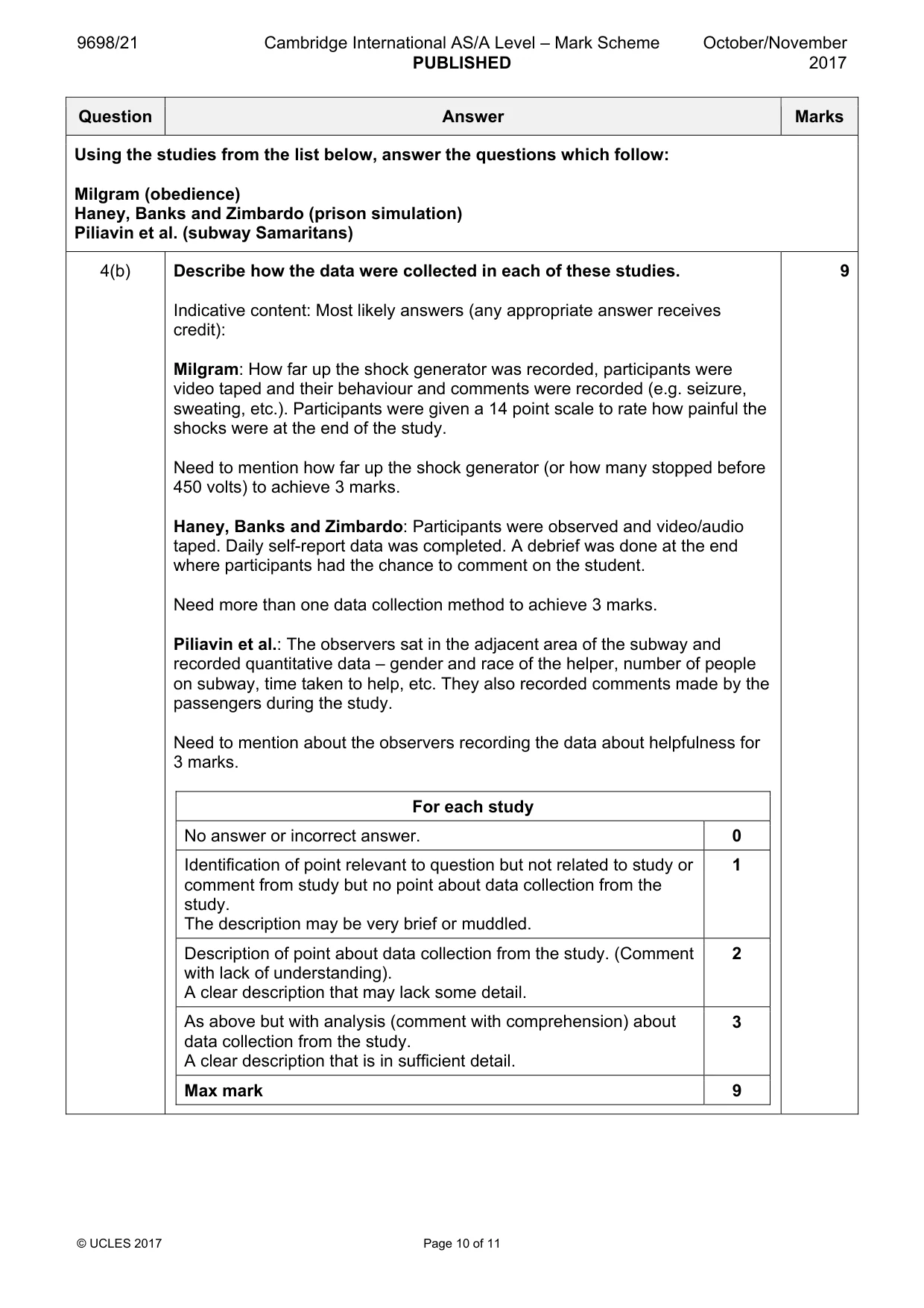
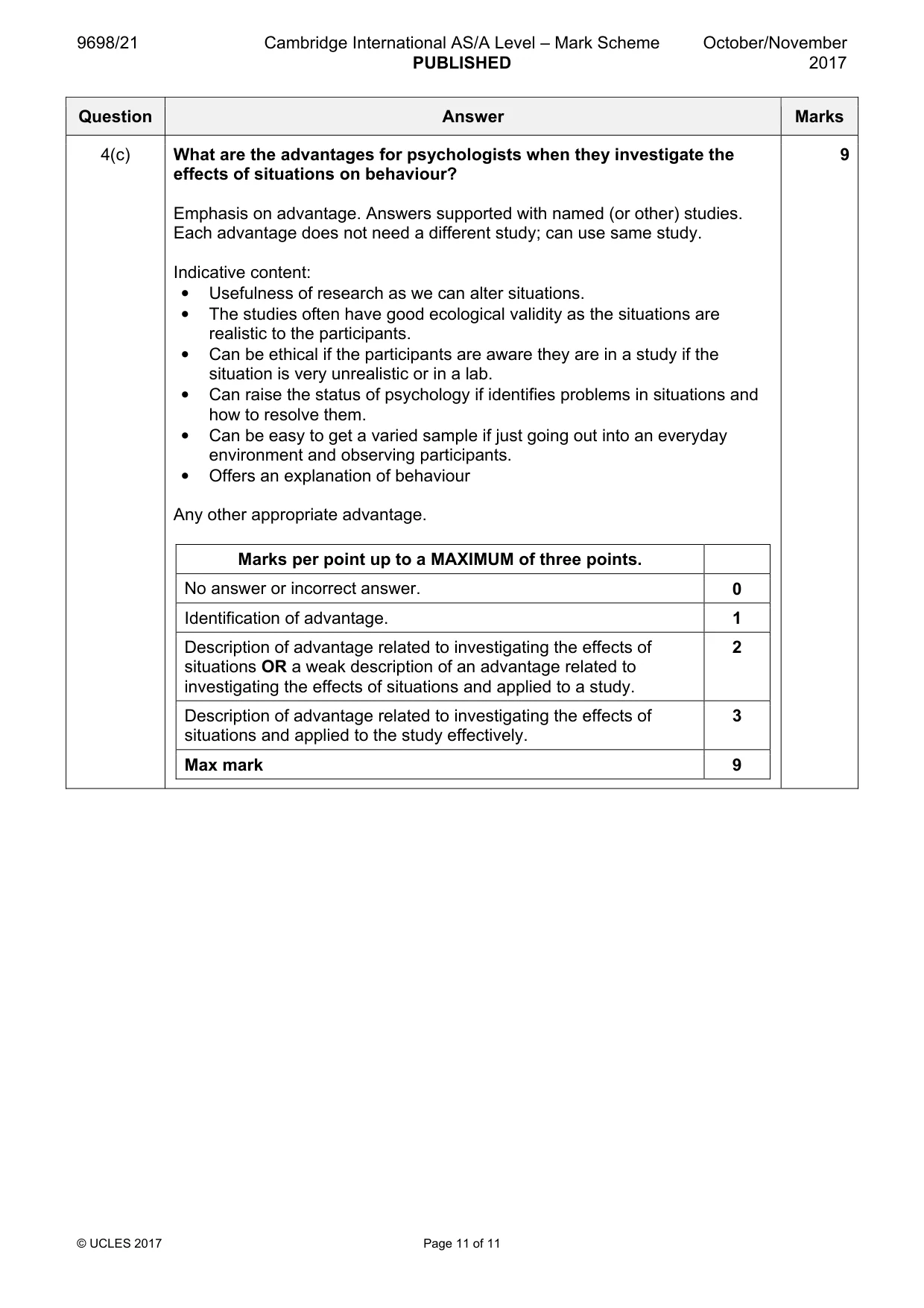
4 (a) Outline what is meant by the ‘situational explanation of behaviour’ in psychology. [2] Using the studies from the list below, answer the questions which follow: Milgram (obedience) Haney, Banks and Zimbardo (prison simulation) Piliavin et al. (subway Samaritans) (b) Describe how the data were collected in each of these studies. [9] (c) What are the advantages for psychologists when they investigate the effects of situations on behaviour? [9]
Mark scheme: 4(a) Outline what is meant by the ‘situational explanation of behaviour’ in 2 psychology. 1 mark partial 2 marks full. Situational explanation of behaviour is where behaviour is explained because of the situation we are in – 1 mark. This is where our behaviour is explained in terms of the situation we are in. For example, we might be aggressive because we were raised in an aggressive home – 2 marks. Explanations are based on factors which are external to the individual such as other people, the setting or the place and not due to our biology or genetic make-up. Can give up to 1 mark for an example on its own. Using the studies from the list below, answer the questions which follow: Milgram (obedience) Haney, Banks and Zimbardo (prison simulation) Piliavin et al. (subway Samaritans) 4(b) Describe how the data were collected in each of these studies. 9 Indicative content: Most likely answers (any appropriate answer receives credit): Milgram: How far up the shock generator was recorded, participants were video taped and their behaviour and comments were recorded (e.g. seizure, sweating, etc.). Participants were given a 14 point scale to rate how painful the shocks were at the end of the study. Need to mention how far up the shock generator (or how many stopped before 450 volts) to achieve 3 marks. Haney, Banks and Zimbardo: Participants were observed and video/audio taped. Daily self-report data was completed. A debrief was done at the end where participants had the chance to comment on the student. Need more than one data collection method to achieve 3 marks. Piliavin et al.: The observers sat in the adjacent area of the subway and recorded quantitative data – gender and race of the helper, number of people on subway, time taken to help, etc. They also recorded comments made by the passengers during the study. Need to mention about the observers recording the data about helpfulness for 3 marks. For each study No answer or incorrect answer. 0 Identification of point relevant to question but not related to study or 1 comment from study but no point about data collection from the study. The description may be very brief or muddled. Description of point about data collection from the study. (Comment 2 with lack of understanding). A clear description that may lack some detail. As above but with analysis (comment with comprehension) about 3 data collection from the study. A clear description that is in sufficient detail. Max mark 9 4(c) What are the advantages for psychologists when they investigate the 9 effects of situations on behaviour? Emphasis on advantage. Answers supported with named (or other) studies. Each advantage does not need a different study; can use same study. Indicative content: • Usefulness of research as we can alter situations. • The studies often have good ecological validity as the situations are realistic to the participants. • Can be ethical if the participants are aware they are in a study if the situation is very unrealistic or in a lab. • Can raise the status of psychology if identifies problems in situations and how to resolve them. • Can be easy to get a varied sample if just going out into an everyday environment and observing participants. • Offers an explanation of behaviour Any other appropriate advantage. Marks per point up to a MAXIMUM of three points. No answer or incorrect answer. 0 Identification of advantage. 1 Description of advantage related to investigating the effects of 2 situations OR a weak description of an advantage related to investigating the effects of situations and applied to a study. Description of advantage related to investigating the effects of 3 situations and applied to the study effectively. Max mark 9
What you needed in this session
Cambridge’s own grade thresholds for 2017 Oct/Nov, Paper 2 · Variant 1. A higher threshold means an easier paper — the bar moves with how the cohort did.