Cambridge A Level Psychology 9698 — 2018 Oct/Nov Paper 2 · Variant 3
9698/23/O/N/18 · 4 questions · 70 marks · ≈79 min
The question paper and its mark scheme, free to read here and free to download. This is Cambridge’s own paper, exactly as it was sat.
Question paper4 pages

Mark scheme11 pages
Answers below. Sit the paper first if you are practising.
Questions as text
Question 1
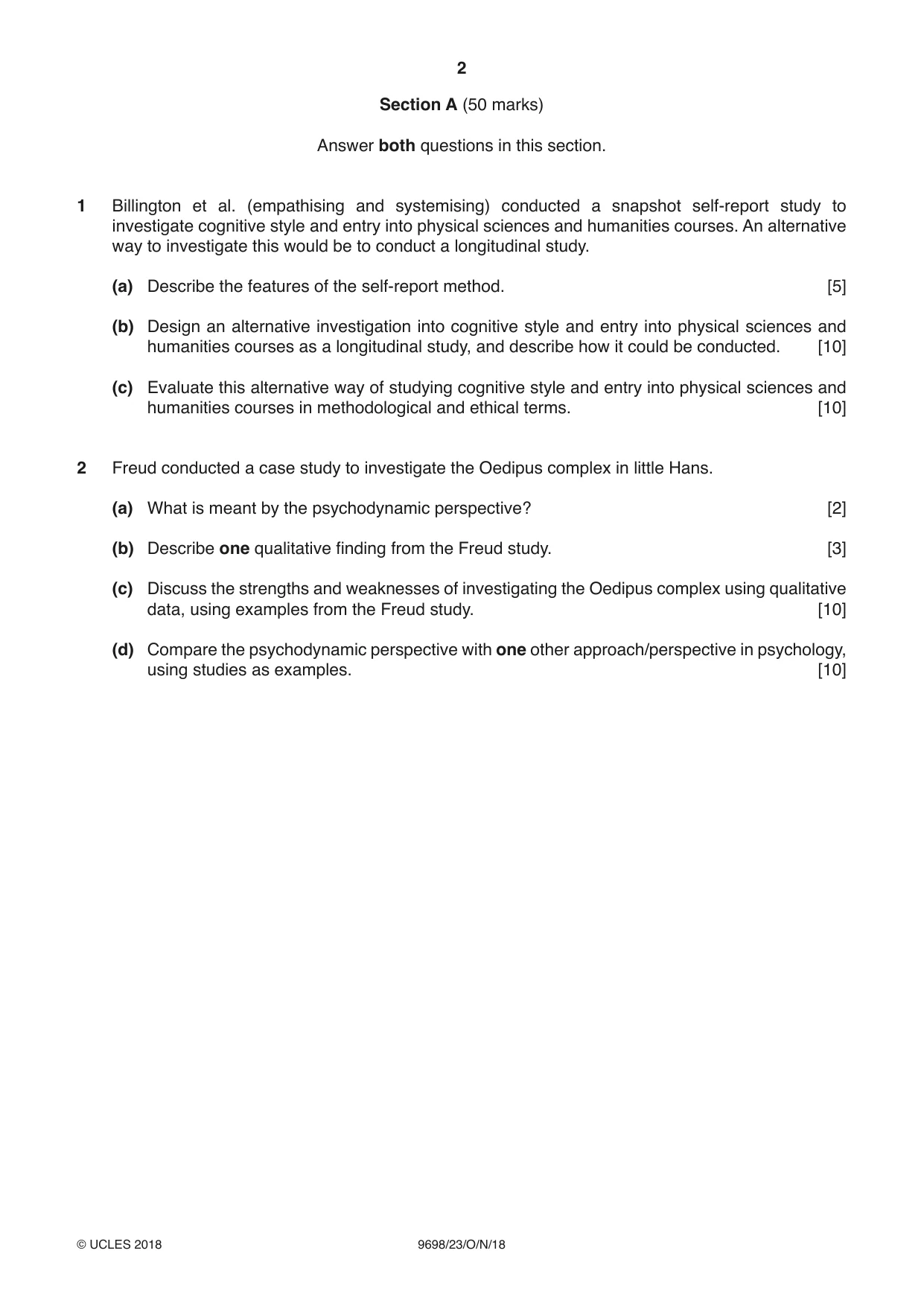
1 Billington et al. (empathising and systemising) conducted a snapshot self-report study to investigate cognitive style and entry into physical sciences and humanities courses. An alternative way to investigate this would be to conduct a longitudinal study. (a) Describe the features of the self-report method. [5] (b) Design an alternative investigation into cognitive style and entry into physical sciences and humanities courses as a longitudinal study, and describe how it could be conducted. [10] (c) Evaluate this alternative way of studying cognitive style and entry into physical sciences and humanities courses in methodological and ethical terms. [10]
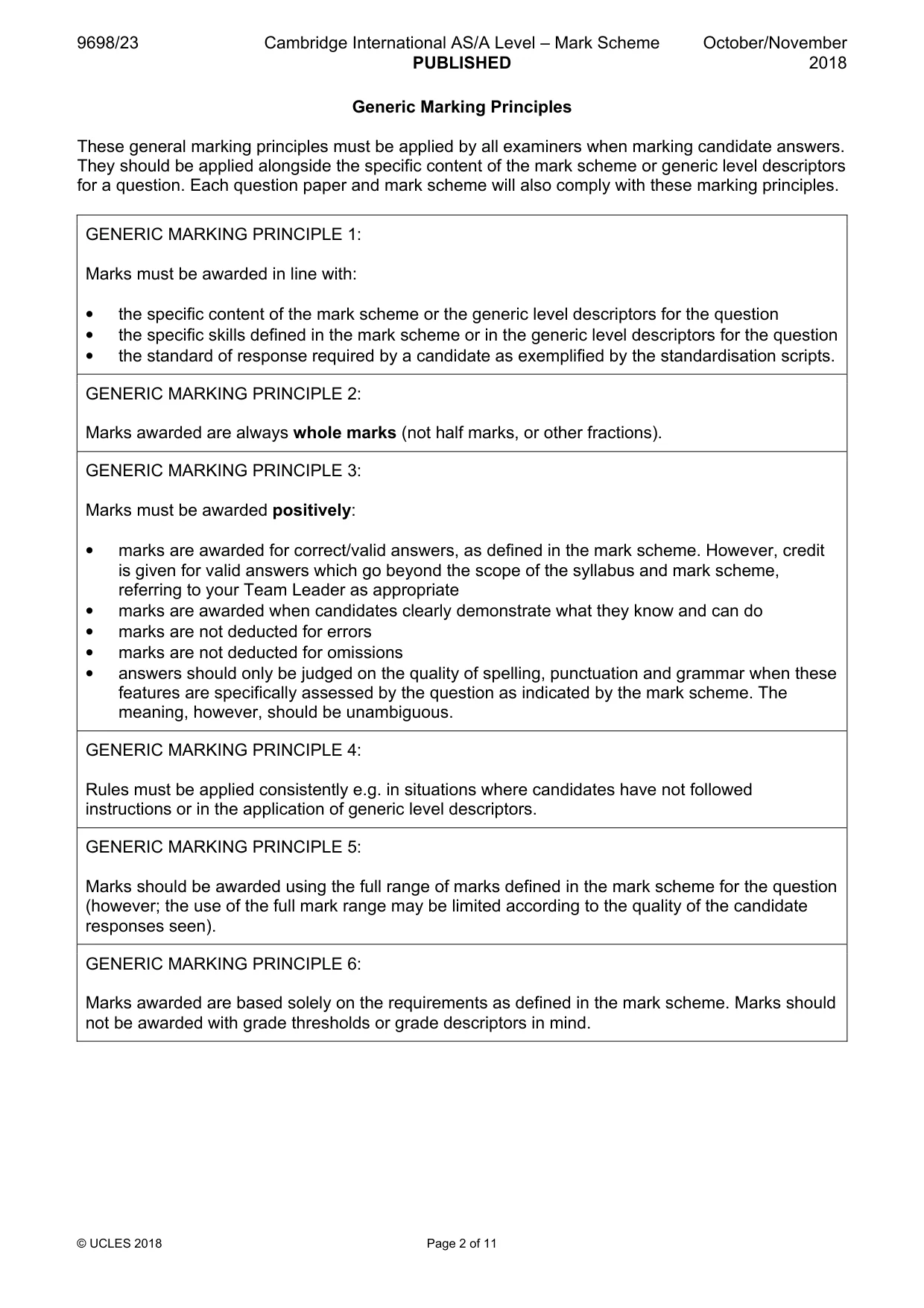
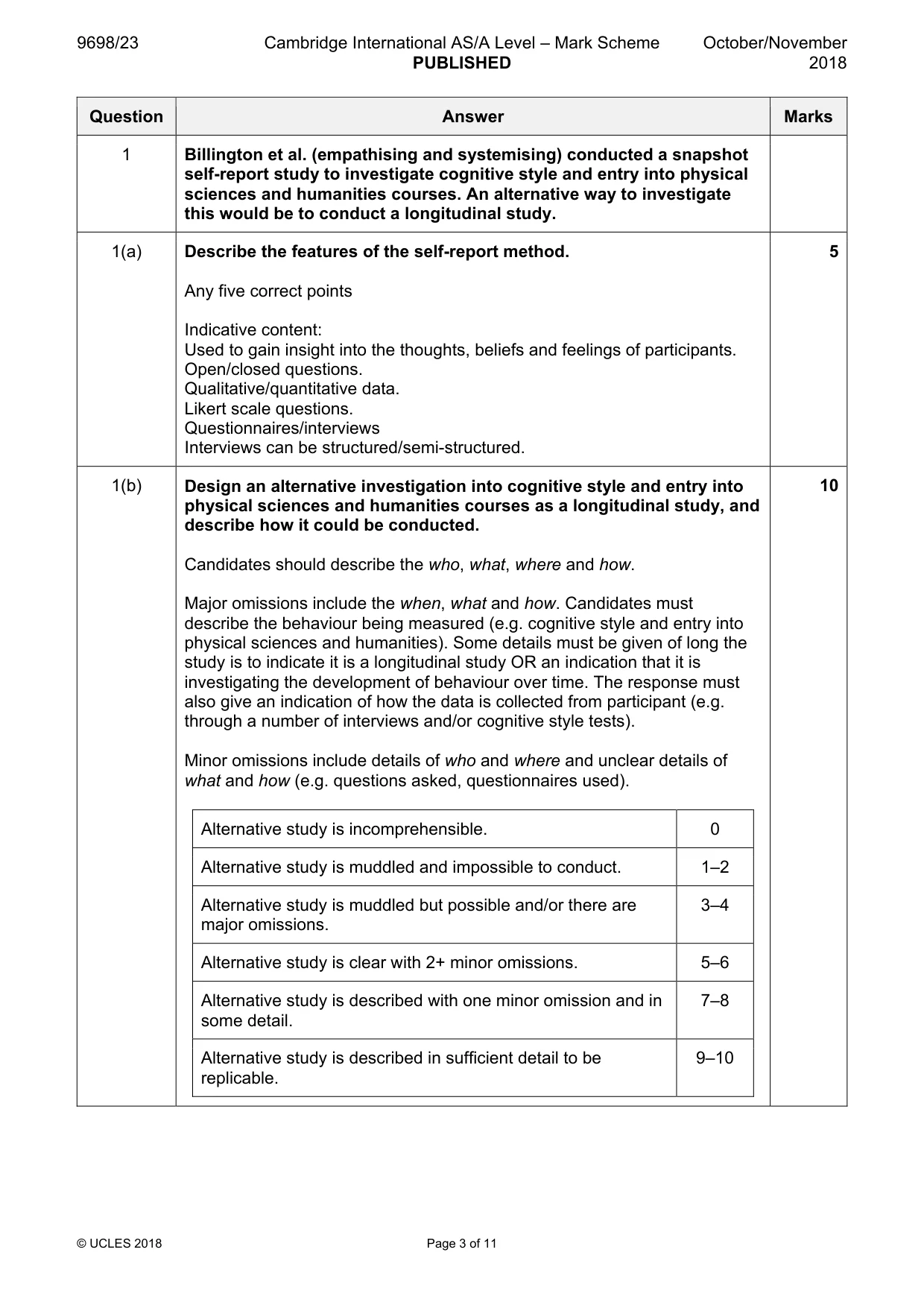
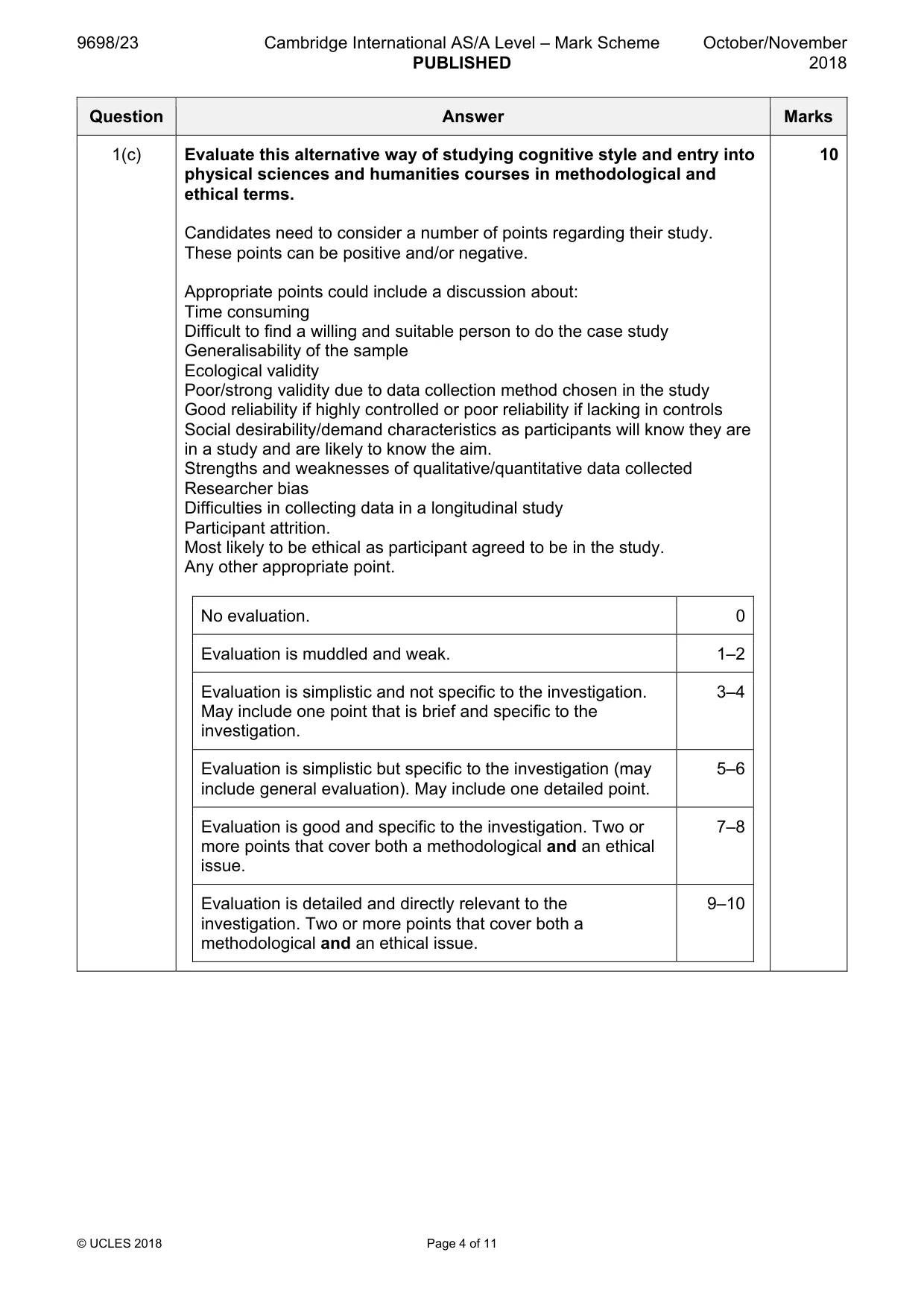
Mark scheme: Question Answer Marks 1 Billington et al. (empathising and systemising) conducted a snapshot self-report study to investigate cognitive style and entry into physical sciences and humanities courses. An alternative way to investigate this would be to conduct a longitudinal study. 1(a) Describe the features of the self-report method. 5 Any five correct points Indicative content: Used to gain insight into the thoughts, beliefs and feelings of participants. Open/closed questions. Qualitative/quantitative data. Likert scale questions. Questionnaires/interviews Interviews can be structured/semi-structured. 1(b) Design an alternative investigation into cognitive style and entry into 10 physical sciences and humanities courses as a longitudinal study, and describe how it could be conducted. Candidates should describe the who, what, where and how. Major omissions include the when, what and how. Candidates must describe the behaviour being measured (e.g. cognitive style and entry into physical sciences and humanities). Some details must be given of long the study is to indicate it is a longitudinal study OR an indication that it is investigating the development of behaviour over time. The response must also give an indication of how the data is collected from participant (e.g. through a number of interviews and/or cognitive style tests). Minor omissions include details of who and where and unclear details of what and how (e.g. questions asked, questionnaires used). Alternative study is incomprehensible. 0 Alternative study is muddled and impossible to conduct. 1–2 Alternative study is muddled but possible and/or there are 3–4 major omissions. Alternative study is clear with 2+ minor omissions. 5–6 Alternative study is described with one minor omission and in 7–8 some detail. Alternative study is described in sufficient detail to be 9–10 replicable. 1(c) Evaluate this alternative way of studying cognitive style and entry into 10 physical sciences and humanities courses in methodological and ethical terms. Candidates need to consider a number of points regarding their study. These points can be positive and/or negative. Appropriate points could include a discussion about: Time consuming Difficult to find a willing and suitable person to do the case study Generalisability of the sample Ecological validity Poor/strong validity due to data collection method chosen in the study Good reliability if highly controlled or poor reliability if lacking in controls Social desirability/demand characteristics as participants will know they are in a study and are likely to know the aim. Strengths and weaknesses of qualitative/quantitative data collected Researcher bias Difficulties in collecting data in a longitudinal study Participant attrition. Most likely to be ethical as participant agreed to be in the study. Any other appropriate point. No evaluation. 0 Evaluation is muddled and weak. 1–2 Evaluation is simplistic and not specific to the investigation. 3–4 May include one point that is brief and specific to the investigation. Evaluation is simplistic but specific to the investigation (may 5–6 include general evaluation). May include one detailed point. Evaluation is good and specific to the investigation. Two or 7–8 more points that cover both a methodological and an ethical issue. Evaluation is detailed and directly relevant to the 9–10 investigation. Two or more points that cover both a methodological and an ethical issue.
Q2 · Freud conducted a case study to investigate the Oedipus complex in little Hans
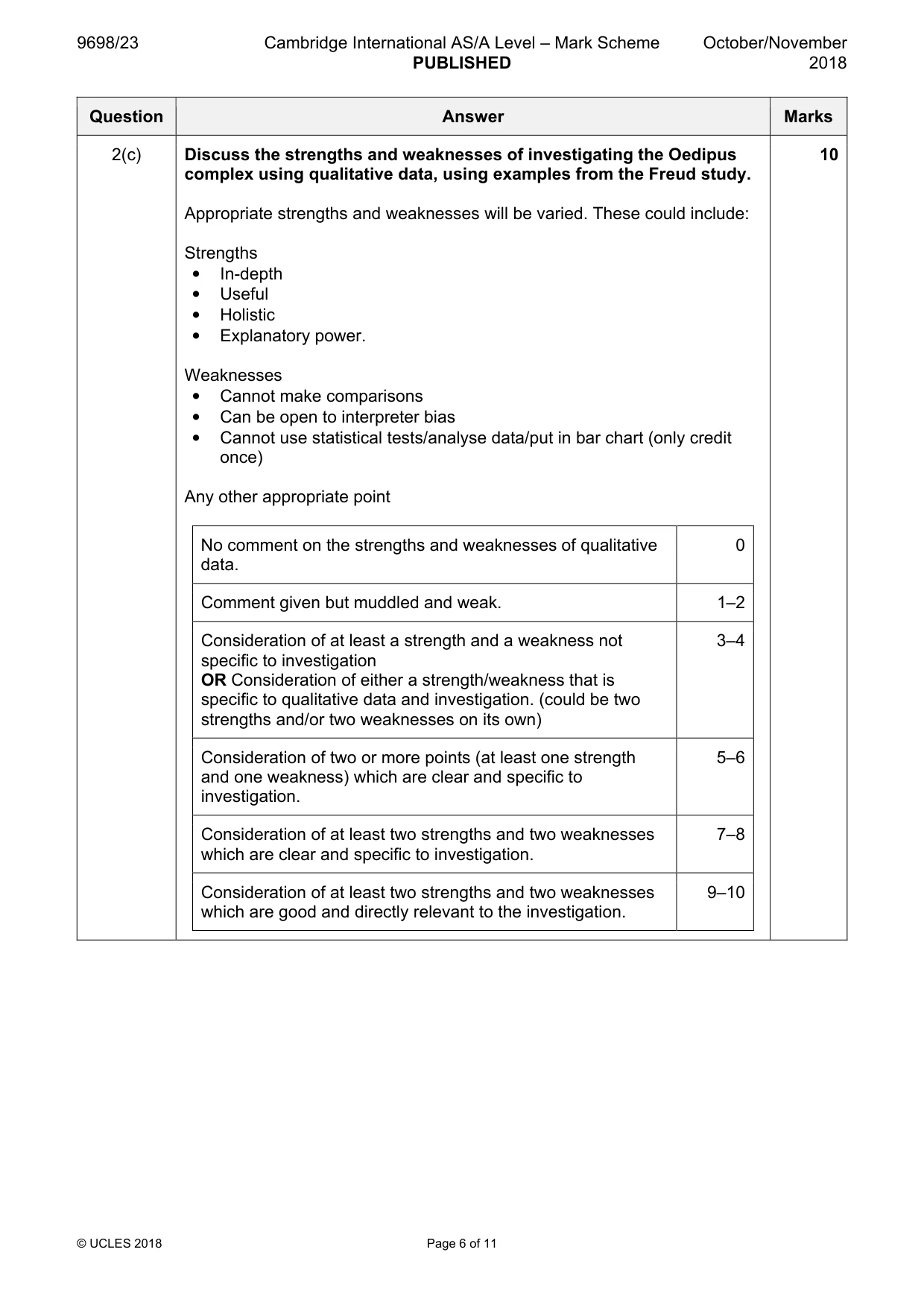
2 Freud conducted a case study to investigate the Oedipus complex in little Hans. (a) What is meant by the psychodynamic perspective? [2] (b) Describe one qualitative finding from the Freud study. [3] (c) Discuss the strengths and weaknesses of investigating the Oedipus complex using qualitative data, using examples from the Freud study. [10] (d) Compare the psychodynamic perspective with one other approach/perspective in psychology, using studies as examples. [10]
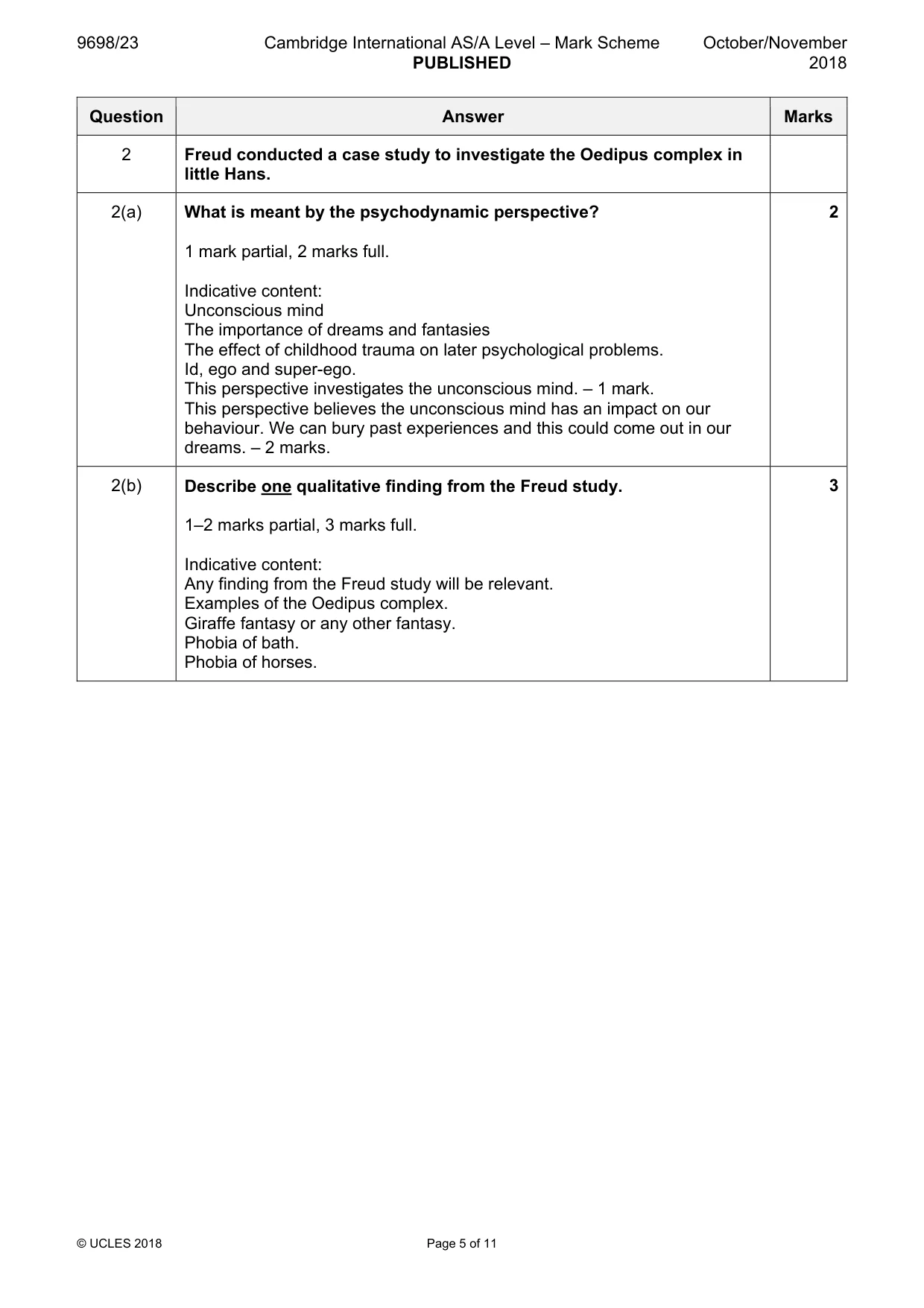
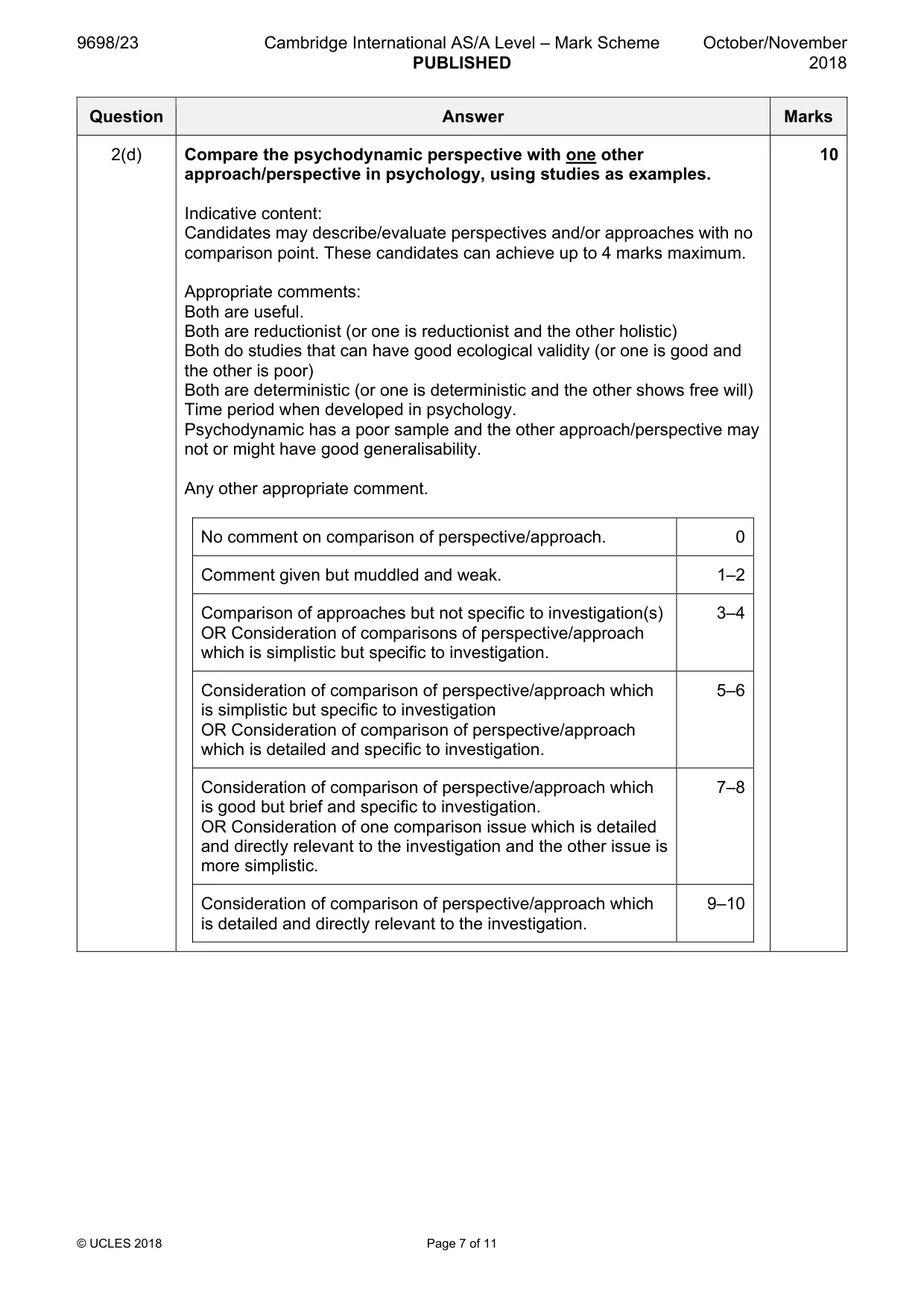
Mark scheme: 2(a) What is meant by the psychodynamic perspective? 2 1 mark partial, 2 marks full. Indicative content: Unconscious mind The importance of dreams and fantasies The effect of childhood trauma on later psychological problems. Id, ego and super-ego. This perspective investigates the unconscious mind. – 1 mark. This perspective believes the unconscious mind has an impact on our behaviour. We can bury past experiences and this could come out in our dreams. – 2 marks. 2(b) Describe one qualitative finding from the Freud study. 3 1–2 marks partial, 3 marks full. Indicative content: Any finding from the Freud study will be relevant. Examples of the Oedipus complex. Giraffe fantasy or any other fantasy. Phobia of bath. Phobia of horses. 2(c) Discuss the strengths and weaknesses of investigating the Oedipus 10 complex using qualitative data, using examples from the Freud study. Appropriate strengths and weaknesses will be varied. These could include: Strengths • In-depth • Useful • Holistic • Explanatory power. Weaknesses • Cannot make comparisons • Can be open to interpreter bias • Cannot use statistical tests/analyse data/put in bar chart (only credit once) Any other appropriate point No comment on the strengths and weaknesses of qualitative 0 data. Comment given but muddled and weak. 1–2 Consideration of at least a strength and a weakness not 3–4 specific to investigation OR Consideration of either a strength/weakness that is specific to qualitative data and investigation. (could be two strengths and/or two weaknesses on its own) Consideration of two or more points (at least one strength 5–6 and one weakness) which are clear and specific to investigation. Consideration of at least two strengths and two weaknesses 7–8 which are clear and specific to investigation. Consideration of at least two strengths and two weaknesses 9–10 which are good and directly relevant to the investigation. 2(d) Compare the psychodynamic perspective with one other 10 approach/perspective in psychology, using studies as examples. Indicative content: Candidates may describe/evaluate perspectives and/or approaches with no comparison point. These candidates can achieve up to 4 marks maximum. Appropriate comments: Both are useful. Both are reductionist (or one is reductionist and the other holistic) Both do studies that can have good ecological validity (or one is good and the other is poor) Both are deterministic (or one is deterministic and the other shows free will) Time period when developed in psychology. Psychodynamic has a poor sample and the other approach/perspective may not or might have good generalisability. Any other appropriate comment. No comment on comparison of perspective/approach. 0 Comment given but muddled and weak. 1–2 Comparison of approaches but not specific to investigation(s) 3–4 OR Consideration of comparisons of perspective/approach which is simplistic but specific to investigation. Consideration of comparison of perspective/approach which 5–6 is simplistic but specific to investigation OR Consideration of comparison of perspective/approach which is detailed and specific to investigation. Consideration of comparison of perspective/approach which 7–8 is good but brief and specific to investigation. OR Consideration of one comparison issue which is detailed and directly relevant to the investigation and the other issue is more simplistic. Consideration of comparison of perspective/approach which 9–10 is detailed and directly relevant to the investigation.
Q3 · Outline what is meant by the term ‘ethical guideline’
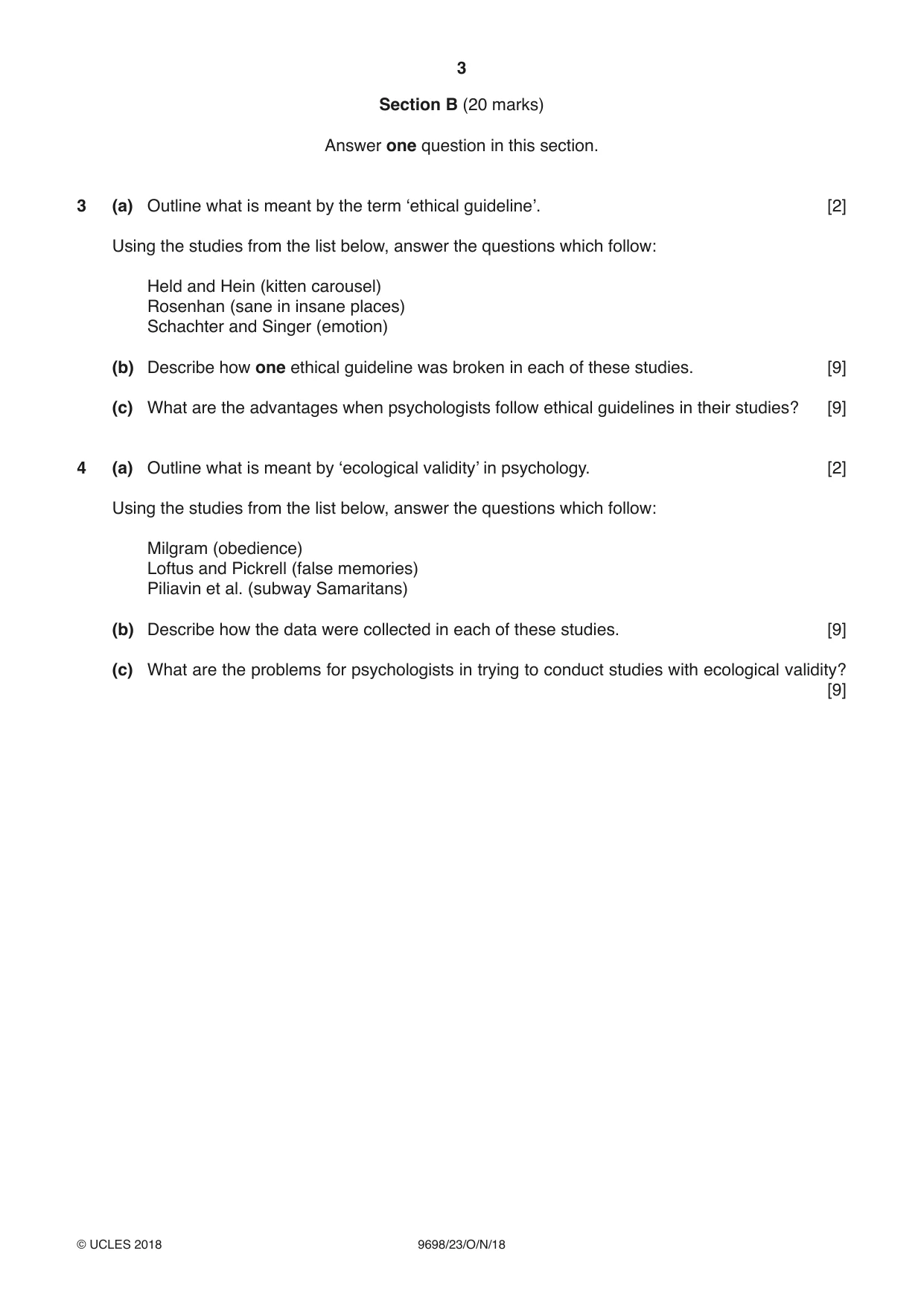
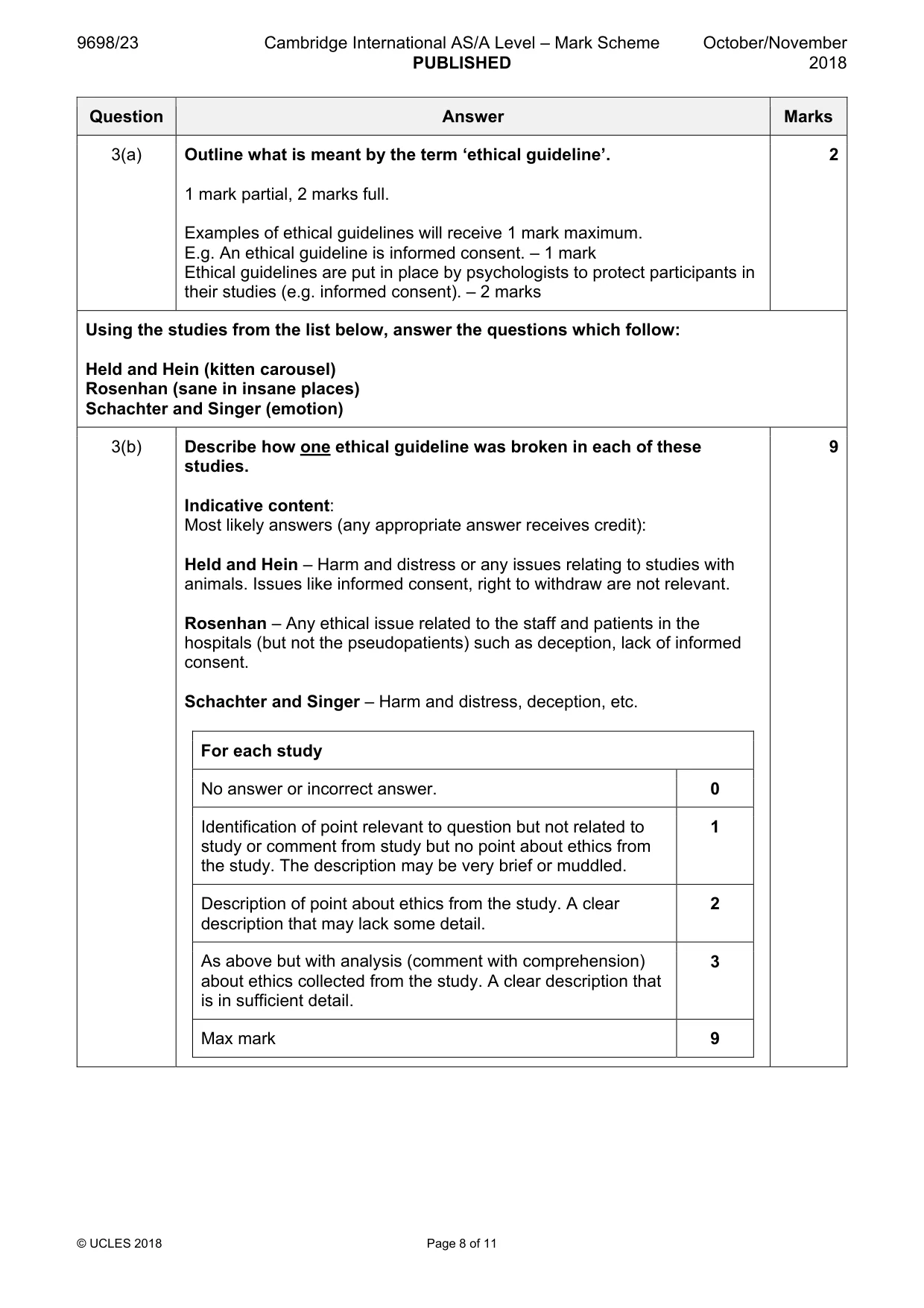
3 (a) Outline what is meant by the term ‘ethical guideline’. [2] Using the studies from the list below, answer the questions which follow: Held and Hein (kitten carousel) Rosenhan (sane in insane places) Schachter and Singer (emotion) (b) Describe how one ethical guideline was broken in each of these studies. [9] (c) What are the advantages when psychologists follow ethical guidelines in their studies? [9]
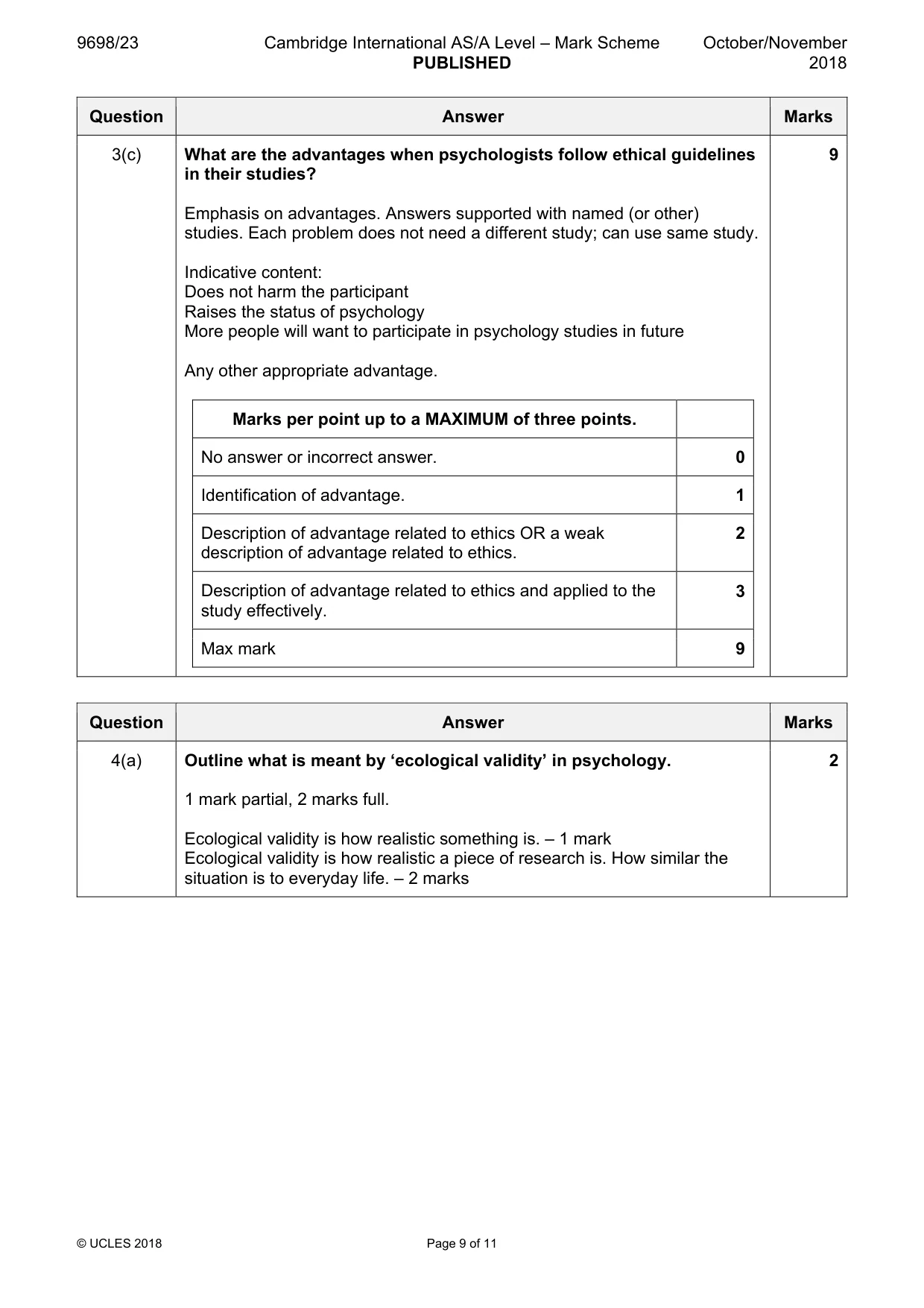
Mark scheme: 3(a) Outline what is meant by the term ‘ethical guideline’. 2 1 mark partial, 2 marks full. Examples of ethical guidelines will receive 1 mark maximum. E.g. An ethical guideline is informed consent. – 1 mark Ethical guidelines are put in place by psychologists to protect participants in their studies (e.g. informed consent). – 2 marks Using the studies from the list below, answer the questions which follow: Held and Hein (kitten carousel) Rosenhan (sane in insane places) Schachter and Singer (emotion) 3(b) Describe how one ethical guideline was broken in each of these 9 studies. Indicative content: Most likely answers (any appropriate answer receives credit): Held and Hein – Harm and distress or any issues relating to studies with animals. Issues like informed consent, right to withdraw are not relevant. Rosenhan – Any ethical issue related to the staff and patients in the hospitals (but not the pseudopatients) such as deception, lack of informed consent. Schachter and Singer – Harm and distress, deception, etc. For each study No answer or incorrect answer. 0 Identification of point relevant to question but not related to 1 study or comment from study but no point about ethics from the study. The description may be very brief or muddled. Description of point about ethics from the study. A clear 2 description that may lack some detail. As above but with analysis (comment with comprehension) 3 about ethics collected from the study. A clear description that is in sufficient detail. Max mark 9 3(c) What are the advantages when psychologists follow ethical guidelines 9 in their studies? Emphasis on advantages. Answers supported with named (or other) studies. Each problem does not need a different study; can use same study. Indicative content: Does not harm the participant Raises the status of psychology More people will want to participate in psychology studies in future Any other appropriate advantage. Marks per point up to a MAXIMUM of three points. No answer or incorrect answer. 0 Identification of advantage. 1 Description of advantage related to ethics OR a weak 2 description of advantage related to ethics. Description of advantage related to ethics and applied to the 3 study effectively. Max mark 9
Q4 · Outline what is meant by ‘ecological validity’ in psychology
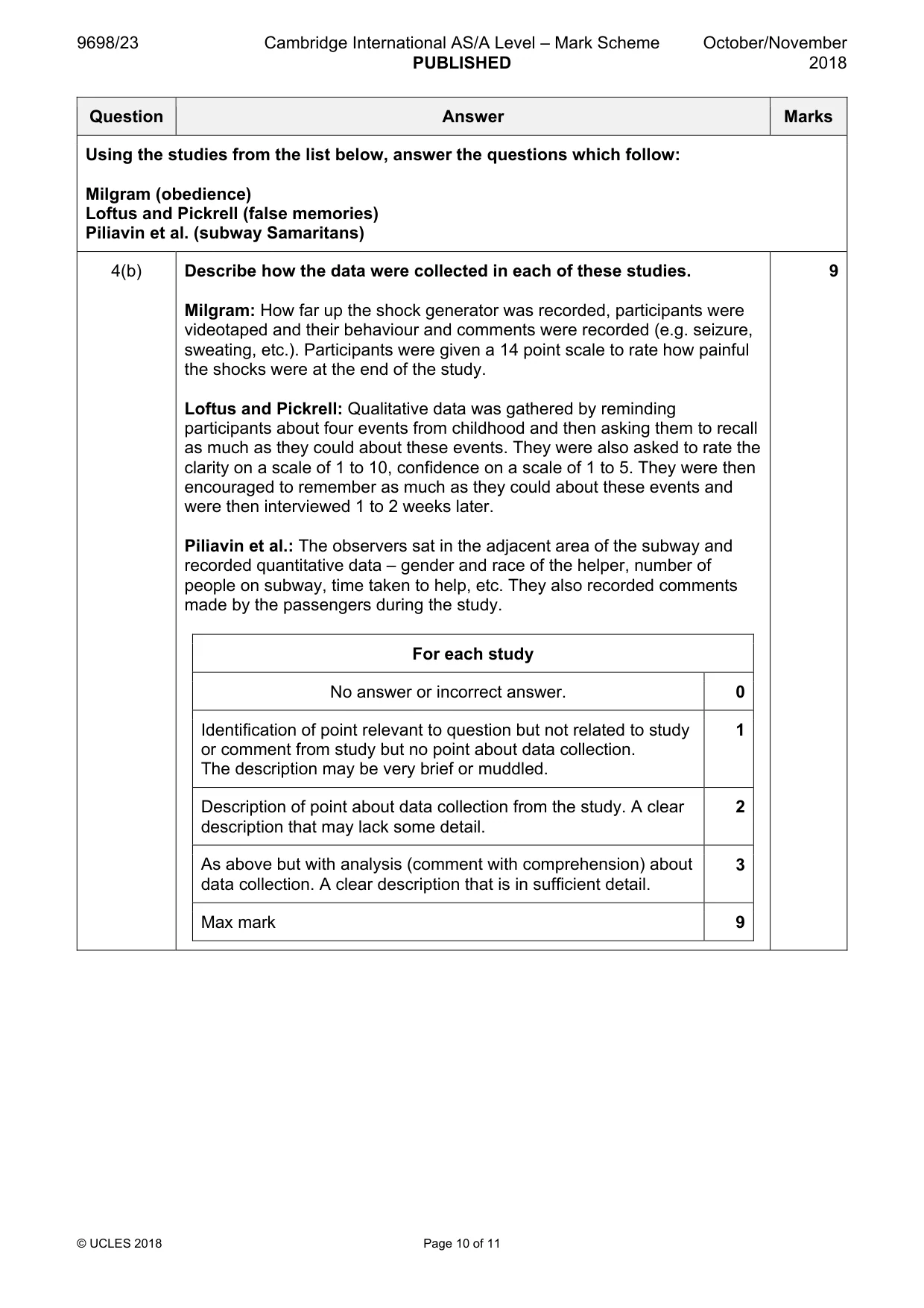
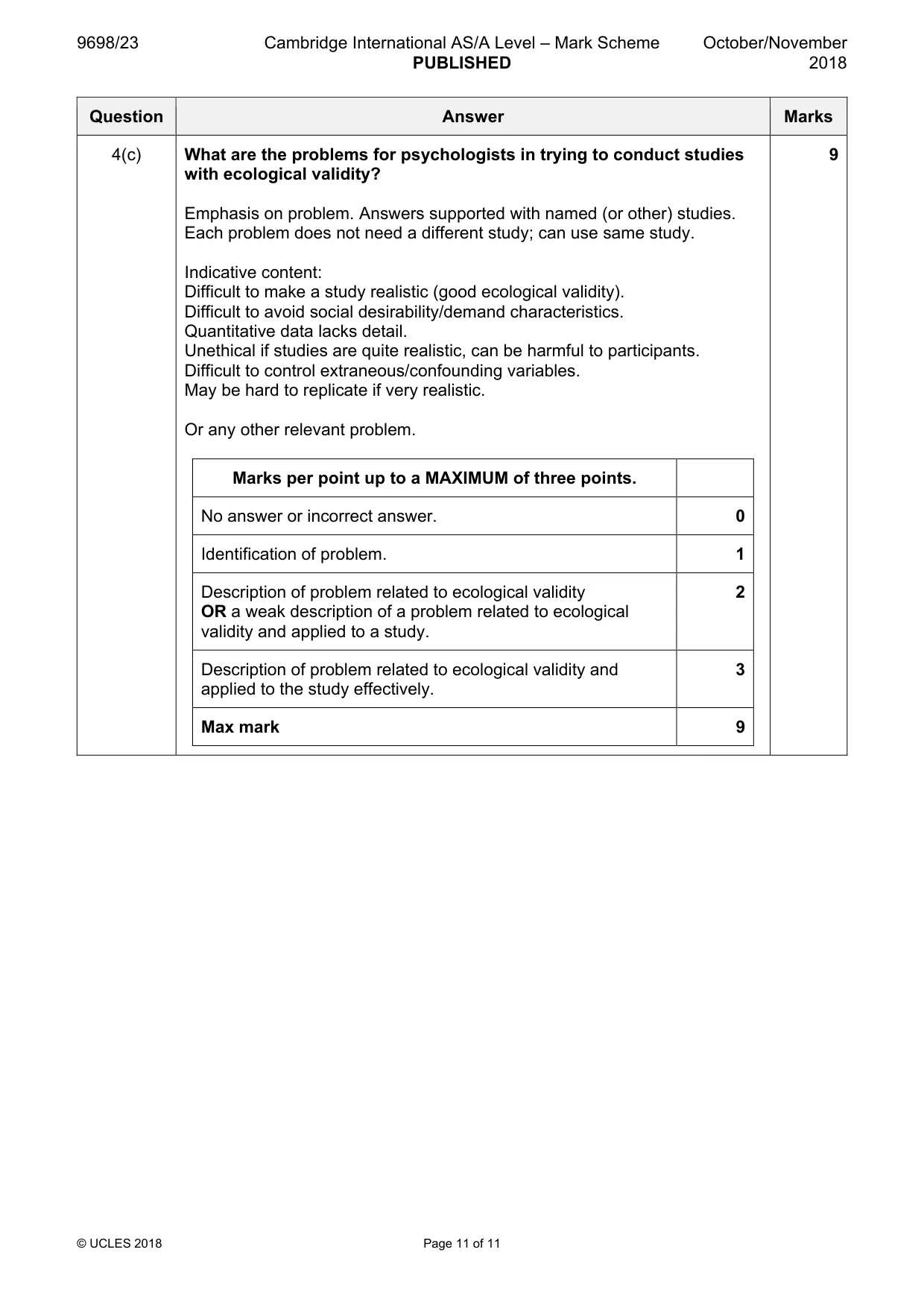
4 (a) Outline what is meant by ‘ecological validity’ in psychology. [2] Using the studies from the list below, answer the questions which follow: Milgram (obedience) Loftus and Pickrell (false memories) Piliavin et al. (subway Samaritans) (b) Describe how the data were collected in each of these studies. [9] (c) What are the problems for psychologists in trying to conduct studies with ecological validity? [9]
Mark scheme: 4(a) Outline what is meant by ‘ecological validity’ in psychology. 2 1 mark partial, 2 marks full. Ecological validity is how realistic something is. – 1 mark Ecological validity is how realistic a piece of research is. How similar the situation is to everyday life. – 2 marks Using the studies from the list below, answer the questions which follow: Milgram (obedience) Loftus and Pickrell (false memories) Piliavin et al. (subway Samaritans) 4(b) Describe how the data were collected in each of these studies. 9 Milgram: How far up the shock generator was recorded, participants were videotaped and their behaviour and comments were recorded (e.g. seizure, sweating, etc.). Participants were given a 14 point scale to rate how painful the shocks were at the end of the study. Loftus and Pickrell: Qualitative data was gathered by reminding participants about four events from childhood and then asking them to recall as much as they could about these events. They were also asked to rate the clarity on a scale of 1 to 10, confidence on a scale of 1 to 5. They were then encouraged to remember as much as they could about these events and were then interviewed 1 to 2 weeks later. Piliavin et al.: The observers sat in the adjacent area of the subway and recorded quantitative data – gender and race of the helper, number of people on subway, time taken to help, etc. They also recorded comments made by the passengers during the study. For each study No answer or incorrect answer. 0 Identification of point relevant to question but not related to study 1 or comment from study but no point about data collection. The description may be very brief or muddled. Description of point about data collection from the study. A clear 2 description that may lack some detail. As above but with analysis (comment with comprehension) about 3 data collection. A clear description that is in sufficient detail. Max mark 9 4(c) What are the problems for psychologists in trying to conduct studies 9 with ecological validity? Emphasis on problem. Answers supported with named (or other) studies. Each problem does not need a different study; can use same study. Indicative content: Difficult to make a study realistic (good ecological validity). Difficult to avoid social desirability/demand characteristics. Quantitative data lacks detail. Unethical if studies are quite realistic, can be harmful to participants. Difficult to control extraneous/confounding variables. May be hard to replicate if very realistic. Or any other relevant problem. Marks per point up to a MAXIMUM of three points. No answer or incorrect answer. 0 Identification of problem. 1 Description of problem related to ecological validity 2 OR a weak description of a problem related to ecological validity and applied to a study. Description of problem related to ecological validity and 3 applied to the study effectively. Max mark 9
What you needed in this session
Cambridge’s own grade thresholds for 2018 Oct/Nov, Paper 2 · Variant 3. A higher threshold means an easier paper — the bar moves with how the cohort did.