Cambridge A Level Psychology 9698 — 2016 May/June Paper 2 · Variant 1
9698/21/M/J/16 · 70 marks · ≈79 min
The question paper and its mark scheme, free to read here and free to download. This is Cambridge’s own paper, exactly as it was sat.
Question paper4 pages

Mark scheme10 pages
Answers below. Sit the paper first if you are practising.
Paper as text
Question paper, page 1
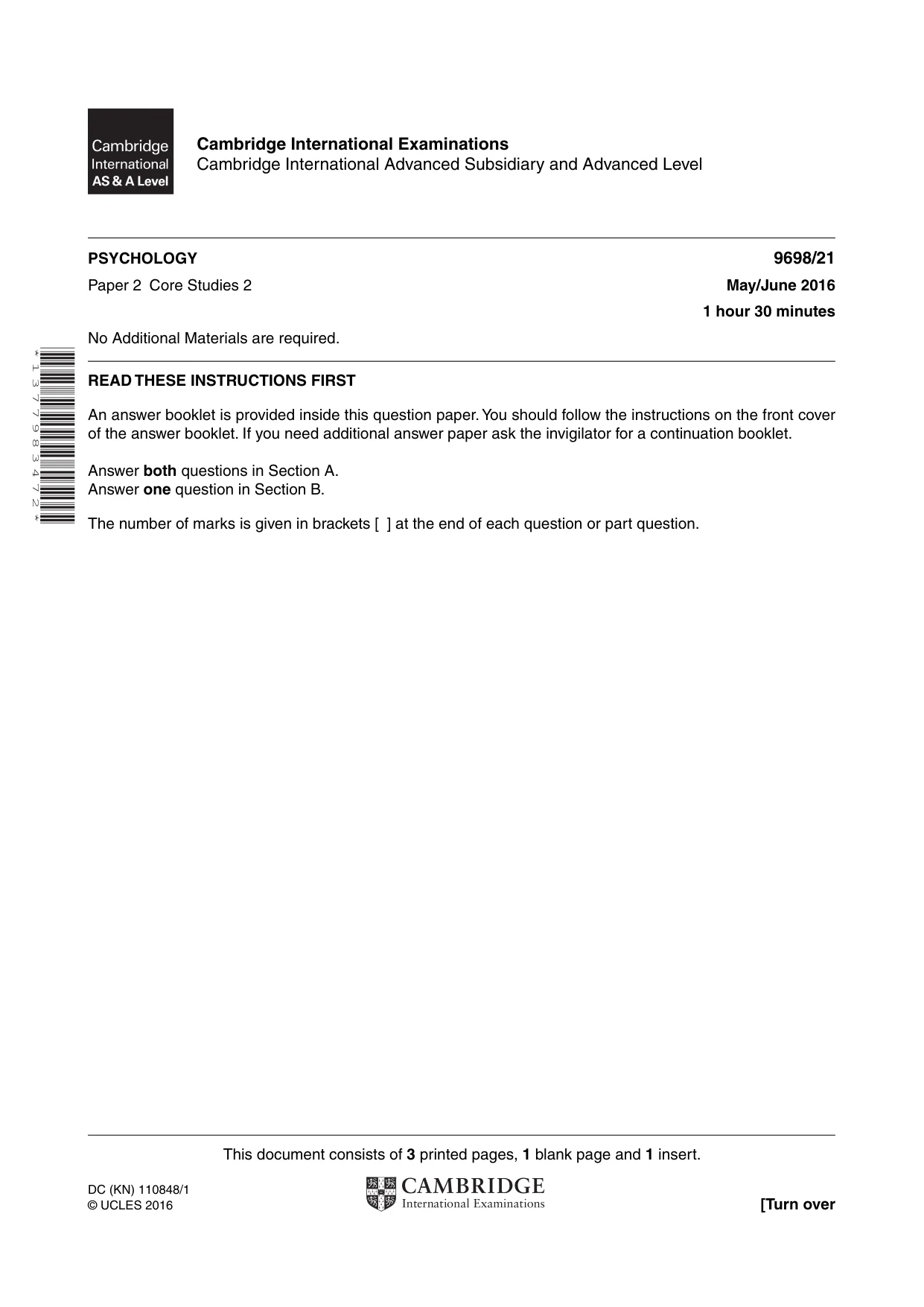
This document consists of 3 printed pages, 1 blank page and 1 insert. DC (KN) 110848/1 © UCLES 2016 [Turn over Cambridge International Examinations Cambridge International Advanced Subsidiary and Advanced Level * 1 3 7 7 9 8 3 4 7 2 * PSYCHOLOGY 9698/21 Paper 2 Core Studies 2 May/June 2016 1 hour 30 minutes No Additional Materials are required. READ THESE INSTRUCTIONS FIRST An answer booklet is provided inside this question paper. You should follow the instructions on the front cover of the answer booklet. If you need additional answer paper ask the invigilator for a continuation booklet. Answer both questions in Section A. Answer one question in Section B. The number of marks is given in brackets [ ] at the end of each question or part question.
Question paper, page 2
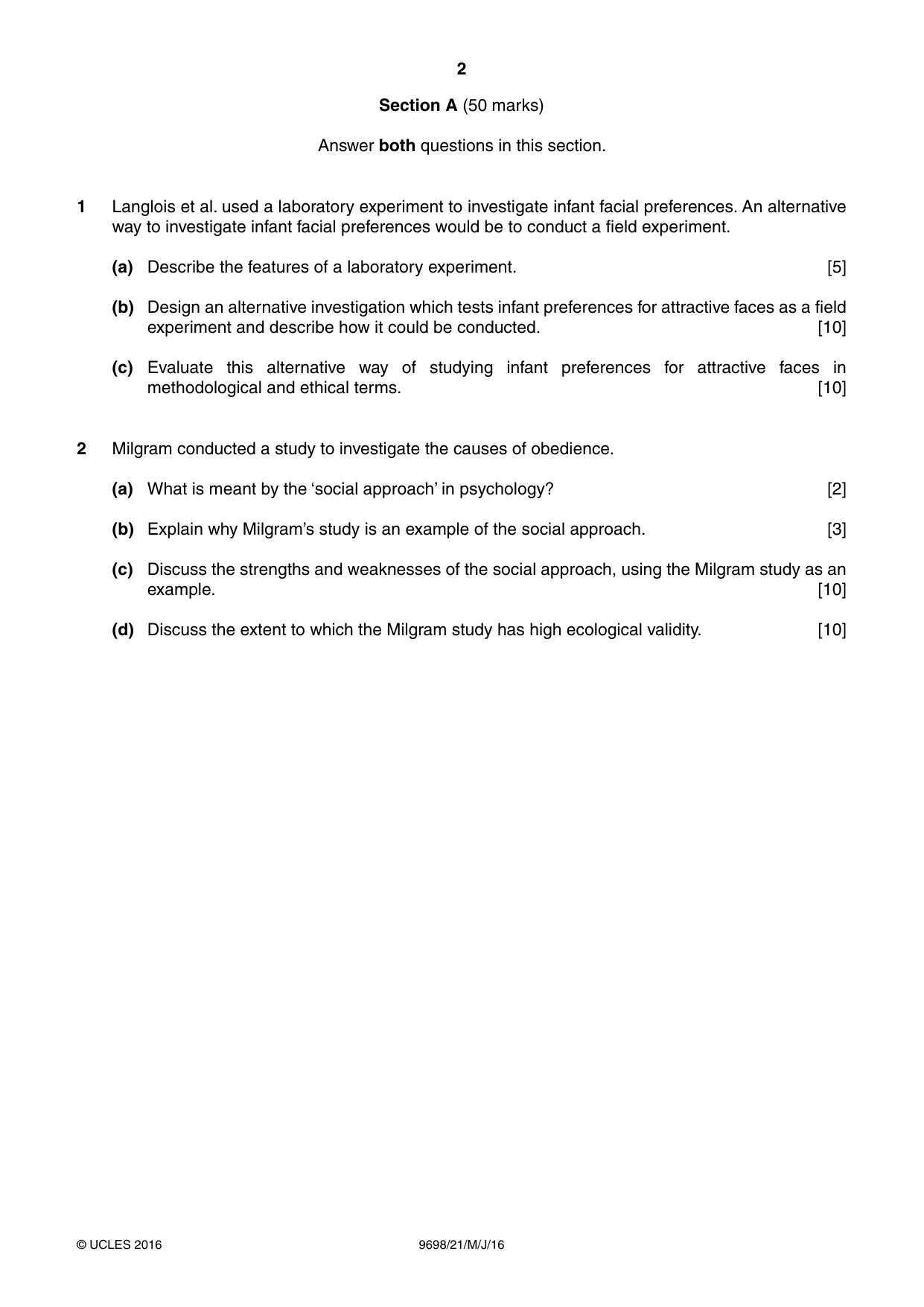
2 9698/21/M/J/16 © UCLES 2016 Section A (50 marks) Answer both questions in this section. 1 Langlois et al. used a laboratory experiment to investigate infant facial preferences. An alternative way to investigate infant facial preferences would be to conduct a field experiment. (a) Describe the features of a laboratory experiment. [5] (b) Design an alternative investigation which tests infant preferences for attractive faces as a field experiment and describe how it could be conducted. [10] (c) Evaluate this alternative way of studying infant preferences for attractive faces in methodological and ethical terms. [10] 2 Milgram conducted a study to investigate the causes of obedience. (a) What is meant by the ‘social approach’ in psychology? [2] (b) Explain why Milgram’s study is an example of the social approach. [3] (c) Discuss the strengths and weaknesses of the social approach, using the Milgram study as an example. [10] (d) Discuss the extent to which the Milgram study has high ecological validity. [10]
Question paper, page 3
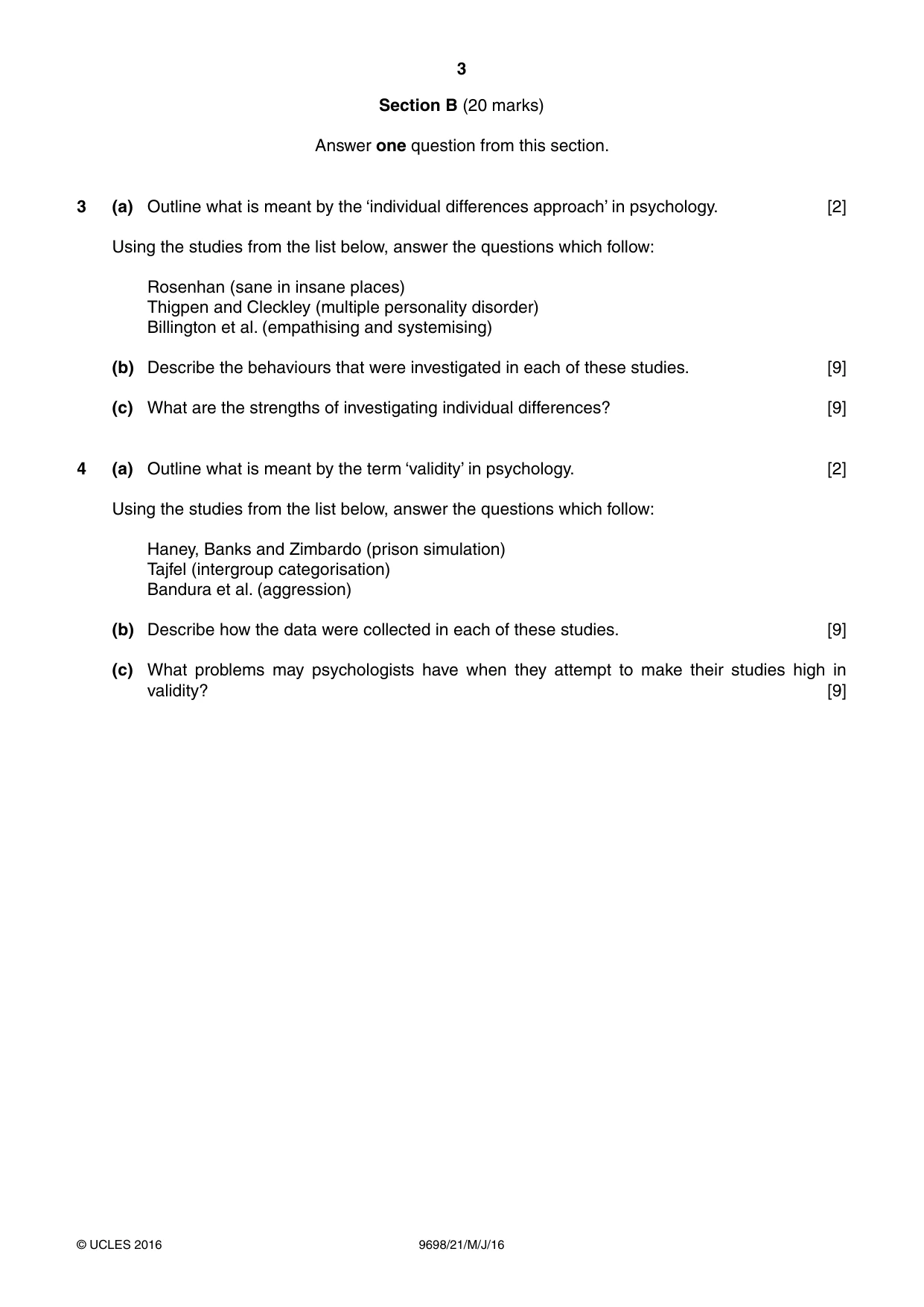
3 9698/21/M/J/16 © UCLES 2016 Section B (20 marks) Answer one question from this section. 3 (a) Outline what is meant by the ‘individual differences approach’ in psychology. [2] Using the studies from the list below, answer the questions which follow: Rosenhan (sane in insane places) Thigpen and Cleckley (multiple personality disorder) Billington et al. (empathising and systemising) (b) Describe the behaviours that were investigated in each of these studies. [9] (c) What are the strengths of investigating individual differences? [9] 4 (a) Outline what is meant by the term ‘validity’ in psychology. [2] Using the studies from the list below, answer the questions which follow: Haney, Banks and Zimbardo (prison simulation) Tajfel (intergroup categorisation) Bandura et al. (aggression) (b) Describe how the data were collected in each of these studies. [9] (c) What problems may psychologists have when they attempt to make their studies high in validity? [9]
Question paper, page 4
4 9698/21/M/J/16 © UCLES 2016 BLANK PAGE Permission to reproduce items where third-party owned material protected by copyright is included has been sought and cleared where possible. Every reasonable effort has been made by the publisher (UCLES) to trace copyright holders, but if any items requiring clearance have unwittingly been included, the publisher will be pleased to make amends at the earliest possible opportunity. To avoid the issue of disclosure of answer-related information to candidates, all copyright acknowledgements are reproduced online in the Cambridge International Examinations Copyright Acknowledgements Booklet. This is produced for each series of examinations and is freely available to download at www.cie.org.uk after the live examination series. Cambridge International Examinations is part of the Cambridge Assessment Group. Cambridge Assessment is the brand name of University of Cambridge Local Examinations Syndicate (UCLES), which is itself a department of the University of Cambridge.
Mark scheme, page 1
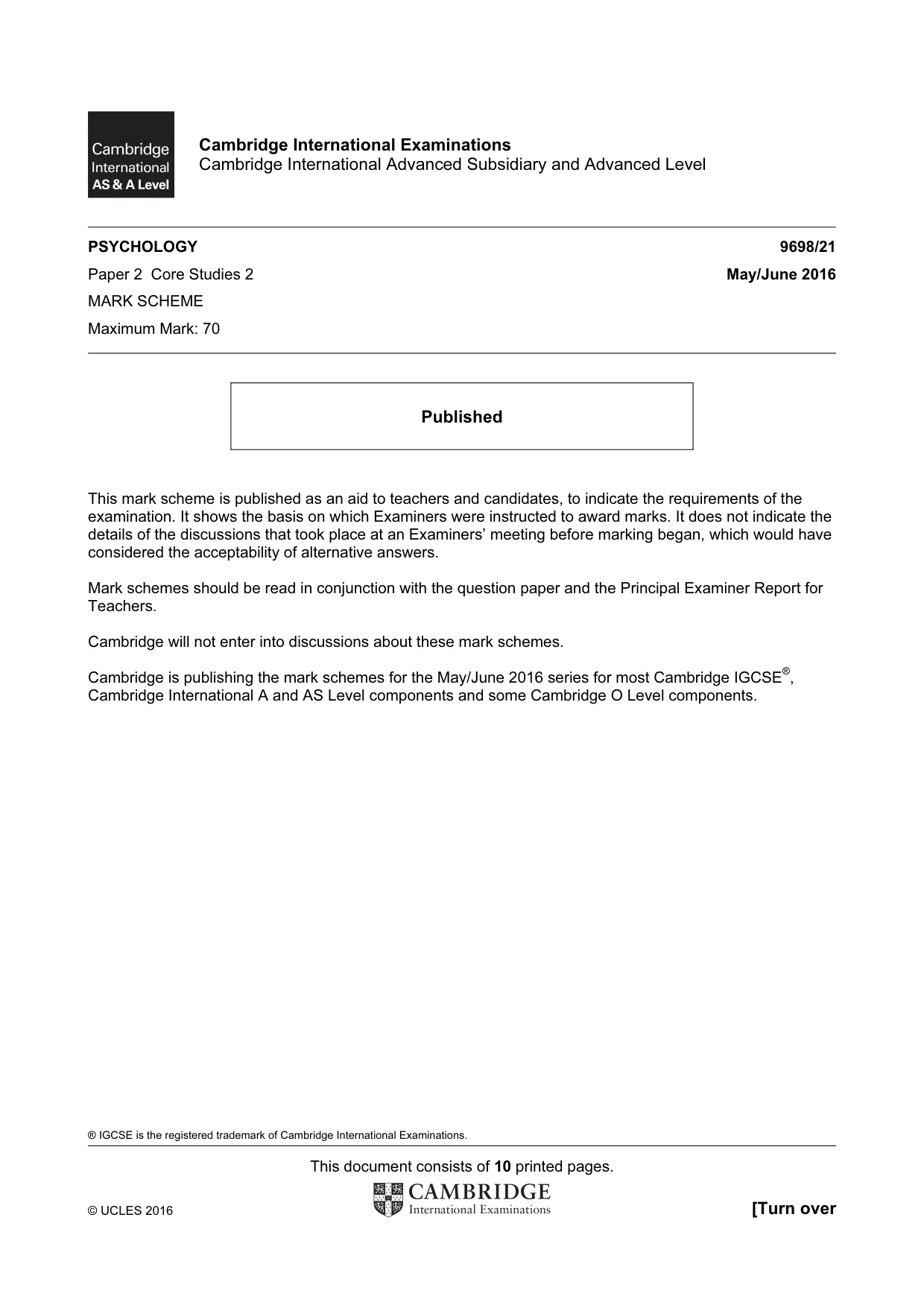
® IGCSE is the registered trademark of Cambridge International Examinations. This document consists of 10 printed pages. © UCLES 2016 [Turn over Cambridge International Examinations Cambridge International Advanced Subsidiary and Advanced Level PSYCHOLOGY 9698/21 Paper 2 Core Studies 2 May/June 2016 MARK SCHEME Maximum Mark: 70 Published This mark scheme is published as an aid to teachers and candidates, to indicate the requirements of the examination. It shows the basis on which Examiners were instructed to award marks. It does not indicate the details of the discussions that took place at an Examiners’ meeting before marking began, which would have considered the acceptability of alternative answers. Mark schemes should be read in conjunction with the question paper and the Principal Examiner Report for Teachers. Cambridge will not enter into discussions about these mark schemes. Cambridge is publishing the mark schemes for the May/June 2016 series for most Cambridge IGCSE®, Cambridge International A and AS Level components and some Cambridge O Level components.
Mark scheme, page 2
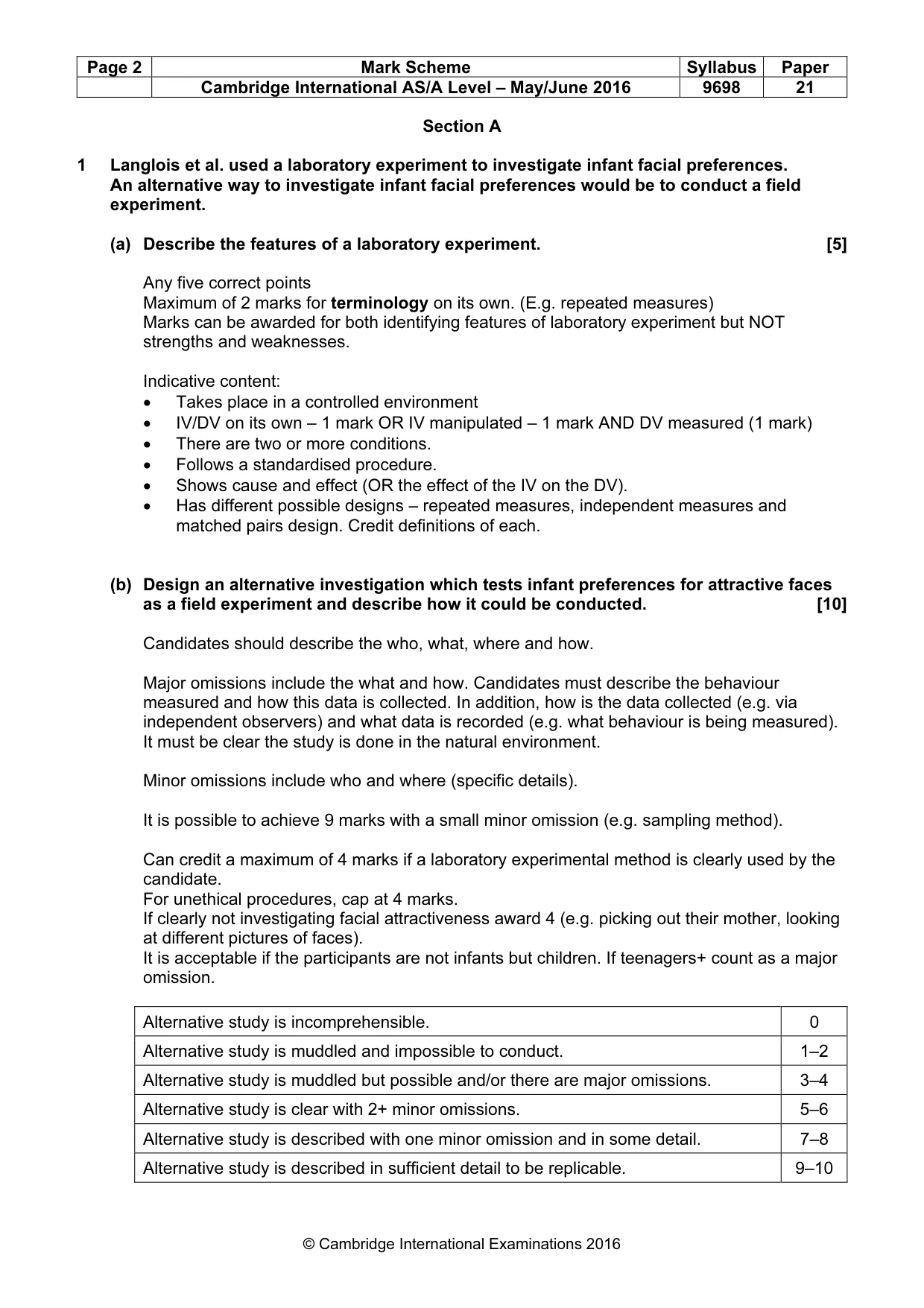
Page 2 Mark Scheme Syllabus Paper Cambridge International AS/A Level – May/June 2016 9698 21 © Cambridge International Examinations 2016 Section A 1 Langlois et al. used a laboratory experiment to investigate infant facial preferences. An alternative way to investigate infant facial preferences would be to conduct a field experiment. (a) Describe the features of a laboratory experiment. [5] Any five correct points Maximum of 2 marks for terminology on its own. (E.g. repeated measures) Marks can be awarded for both identifying features of laboratory experiment but NOT strengths and weaknesses. Indicative content: • Takes place in a controlled environment • IV/DV on its own – 1 mark OR IV manipulated – 1 mark AND DV measured (1 mark) • There are two or more conditions. • Follows a standardised procedure. • Shows cause and effect (OR the effect of the IV on the DV). • Has different possible designs – repeated measures, independent measures and matched pairs design. Credit definitions of each. (b) Design an alternative investigation which tests infant preferences for attractive faces as a field experiment and describe how it could be conducted. [10] Candidates should describe the who, what, where and how. Major omissions include the what and how. Candidates must describe the behaviour measured and how this data is collected. In addition, how is the data collected (e.g. via independent observers) and what data is recorded (e.g. what behaviour is being measured). It must be clear the study is done in the natural environment. Minor omissions include who and where (specific details). It is possible to achieve 9 marks with a small minor omission (e.g. sampling method). Can credit a maximum of 4 marks if a laboratory experimental method is clearly used by the candidate. For unethical procedures, cap at 4 marks. If clearly not investigating facial attractiveness award 4 (e.g. picking out their mother, looking at different pictures of faces). It is acceptable if the participants are not infants but children. If teenagers+ count as a major omission. Alternative study is incomprehensible. 0 Alternative study is muddled and impossible to conduct. 1–2 Alternative study is muddled but possible and/or there are major omissions. 3–4 Alternative study is clear with 2+ minor omissions. 5–6 Alternative study is described with one minor omission and in some detail. 7–8 Alternative study is described in sufficient detail to be replicable. 9–10
Mark scheme, page 3
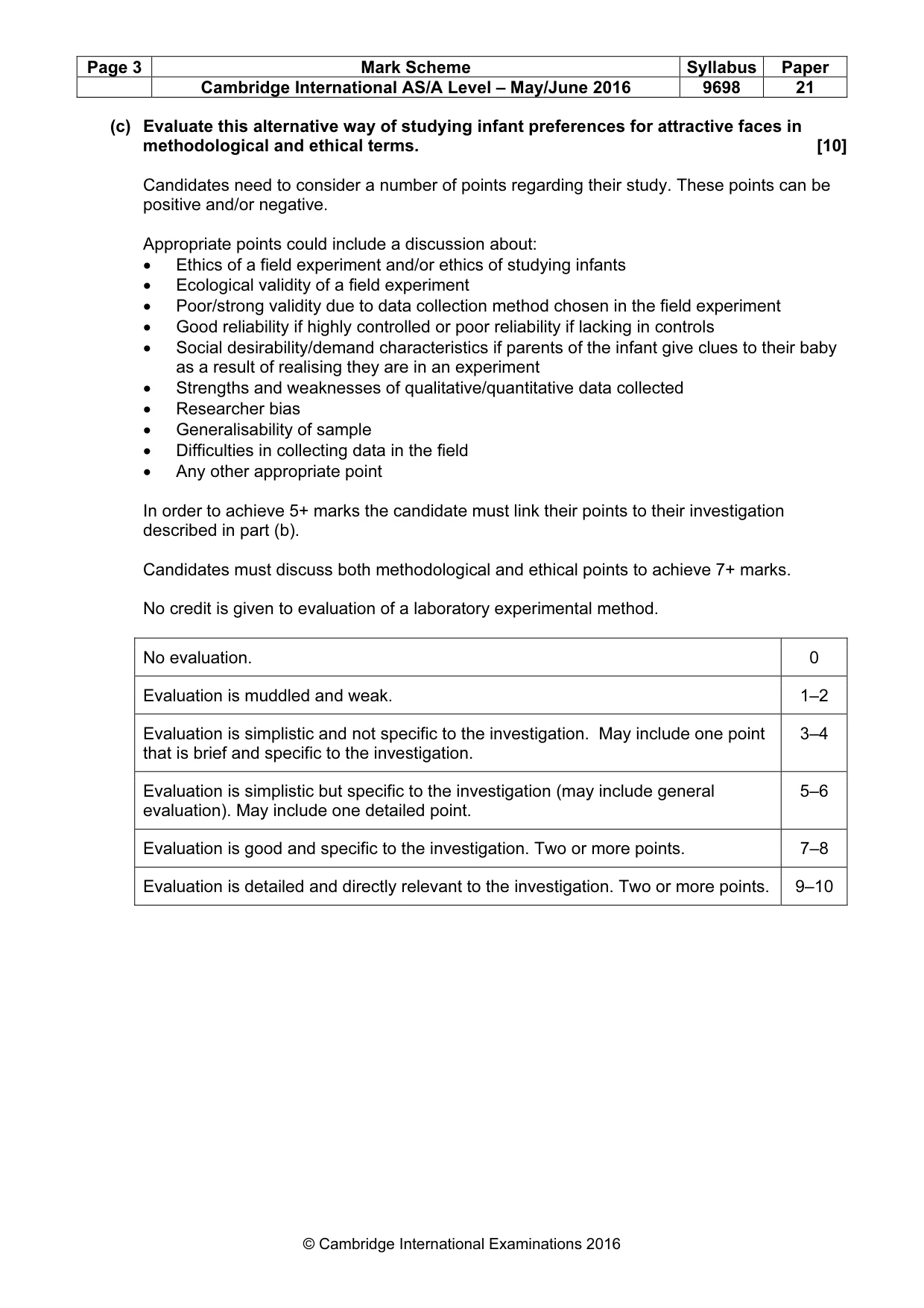
Page 3 Mark Scheme Syllabus Paper Cambridge International AS/A Level – May/June 2016 9698 21 © Cambridge International Examinations 2016 (c) Evaluate this alternative way of studying infant preferences for attractive faces in methodological and ethical terms. [10] Candidates need to consider a number of points regarding their study. These points can be positive and/or negative. Appropriate points could include a discussion about: • Ethics of a field experiment and/or ethics of studying infants • Ecological validity of a field experiment • Poor/strong validity due to data collection method chosen in the field experiment • Good reliability if highly controlled or poor reliability if lacking in controls • Social desirability/demand characteristics if parents of the infant give clues to their baby as a result of realising they are in an experiment • Strengths and weaknesses of qualitative/quantitative data collected • Researcher bias • Generalisability of sample • Difficulties in collecting data in the field • Any other appropriate point In order to achieve 5+ marks the candidate must link their points to their investigation described in part (b). Candidates must discuss both methodological and ethical points to achieve 7+ marks. No credit is given to evaluation of a laboratory experimental method. No evaluation. 0 Evaluation is muddled and weak. 1–2 Evaluation is simplistic and not specific to the investigation. May include one point that is brief and specific to the investigation. 3–4 Evaluation is simplistic but specific to the investigation (may include general evaluation). May include one detailed point. 5–6 Evaluation is good and specific to the investigation. Two or more points. 7–8 Evaluation is detailed and directly relevant to the investigation. Two or more points. 9–10
Mark scheme, page 4
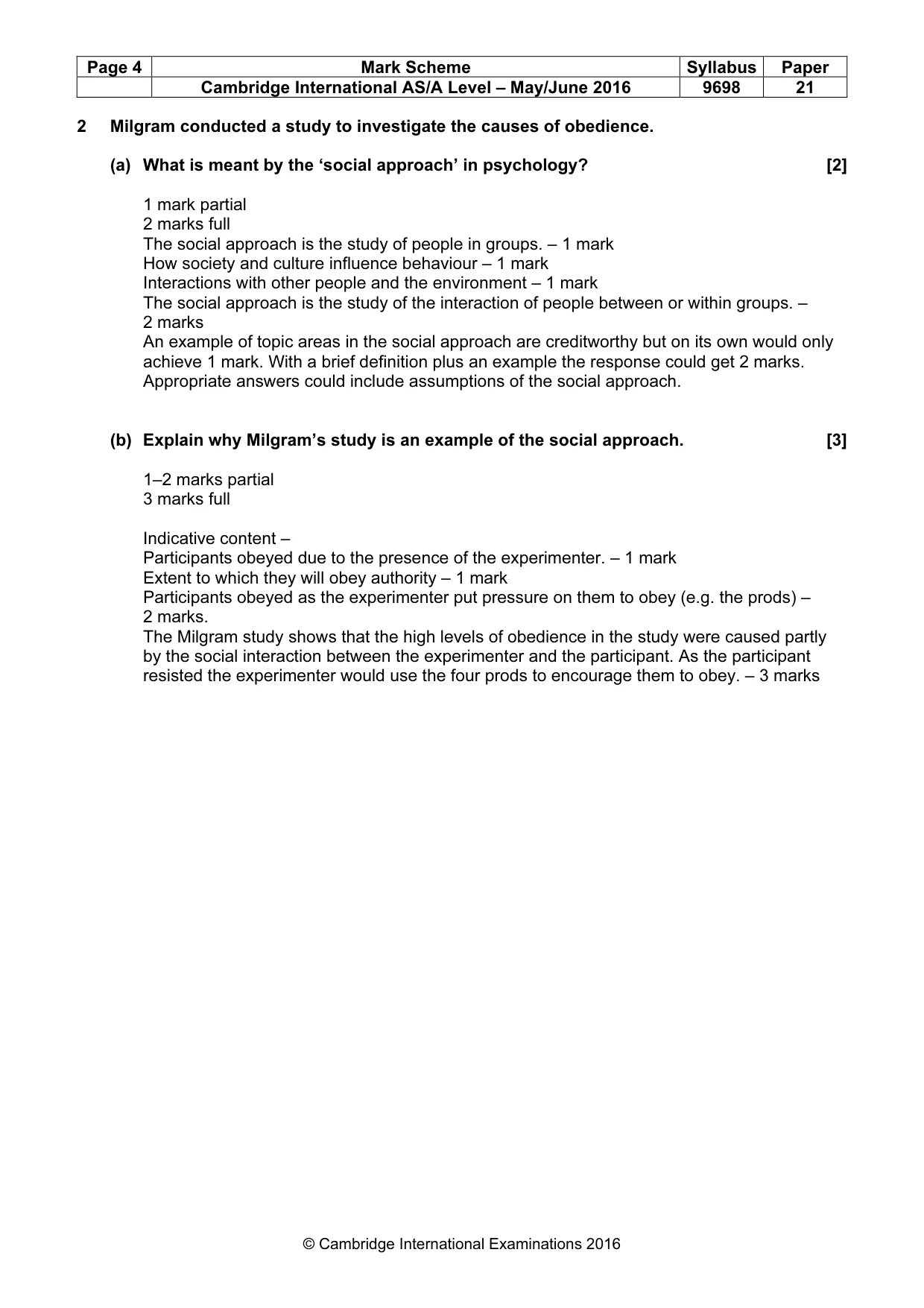
Page 4 Mark Scheme Syllabus Paper Cambridge International AS/A Level – May/June 2016 9698 21 © Cambridge International Examinations 2016 2 Milgram conducted a study to investigate the causes of obedience. (a) What is meant by the ‘social approach’ in psychology? [2] 1 mark partial 2 marks full The social approach is the study of people in groups. – 1 mark How society and culture influence behaviour – 1 mark Interactions with other people and the environment – 1 mark The social approach is the study of the interaction of people between or within groups. – 2 marks An example of topic areas in the social approach are creditworthy but on its own would only achieve 1 mark. With a brief definition plus an example the response could get 2 marks. Appropriate answers could include assumptions of the social approach. (b) Explain why Milgram’s study is an example of the social approach. [3] 1–2 marks partial 3 marks full Indicative content – Participants obeyed due to the presence of the experimenter. – 1 mark Extent to which they will obey authority – 1 mark Participants obeyed as the experimenter put pressure on them to obey (e.g. the prods) – 2 marks. The Milgram study shows that the high levels of obedience in the study were caused partly by the social interaction between the experimenter and the participant. As the participant resisted the experimenter would use the four prods to encourage them to obey. – 3 marks
Mark scheme, page 5
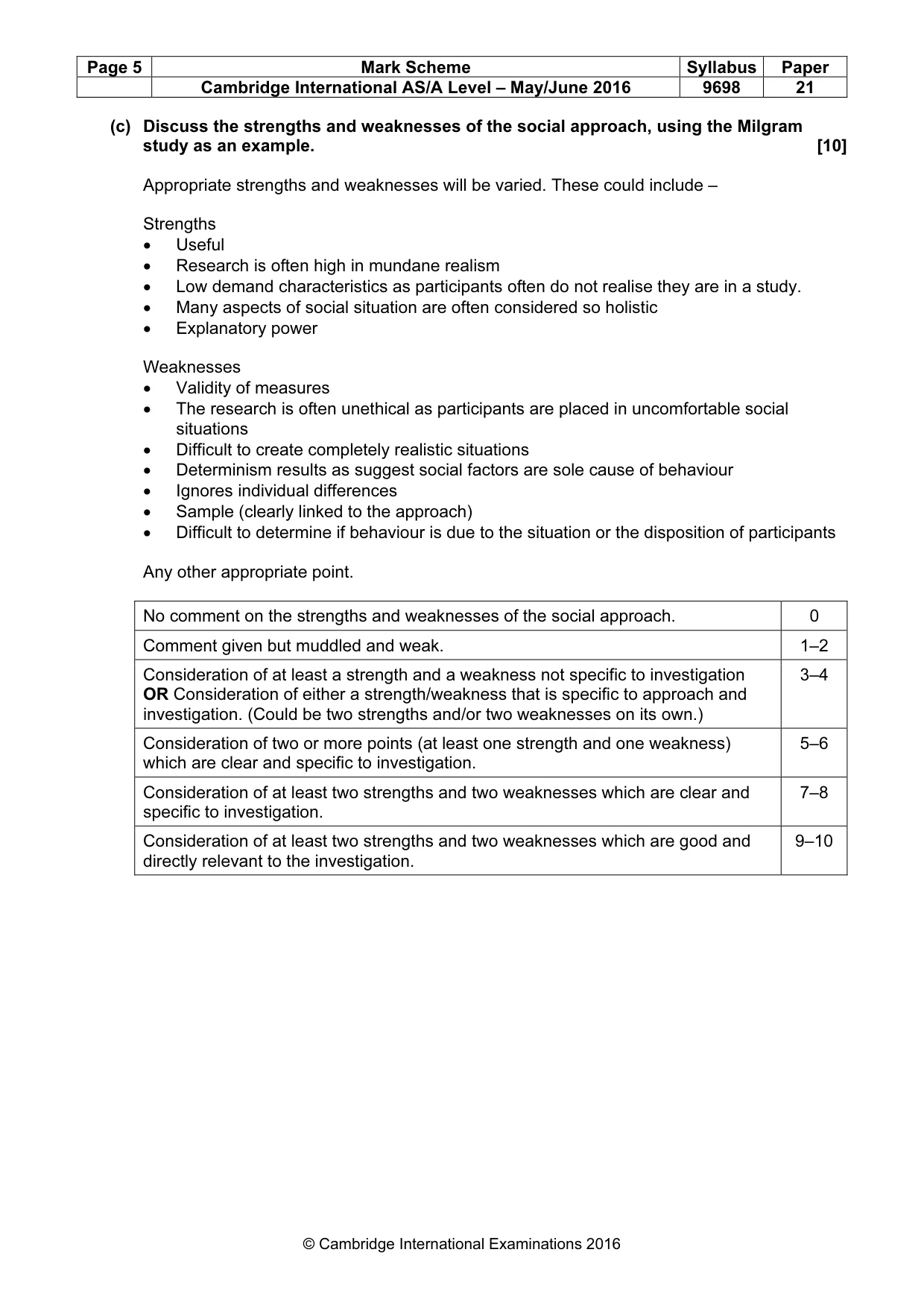
Page 5 Mark Scheme Syllabus Paper Cambridge International AS/A Level – May/June 2016 9698 21 © Cambridge International Examinations 2016 (c) Discuss the strengths and weaknesses of the social approach, using the Milgram study as an example. [10] Appropriate strengths and weaknesses will be varied. These could include – Strengths • Useful • Research is often high in mundane realism • Low demand characteristics as participants often do not realise they are in a study. • Many aspects of social situation are often considered so holistic • Explanatory power Weaknesses • Validity of measures • The research is often unethical as participants are placed in uncomfortable social situations • Difficult to create completely realistic situations • Determinism results as suggest social factors are sole cause of behaviour • Ignores individual differences • Sample (clearly linked to the approach) • Difficult to determine if behaviour is due to the situation or the disposition of participants Any other appropriate point. No comment on the strengths and weaknesses of the social approach. 0 Comment given but muddled and weak. 1–2 Consideration of at least a strength and a weakness not specific to investigation OR Consideration of either a strength/weakness that is specific to approach and investigation. (Could be two strengths and/or two weaknesses on its own.) 3–4 Consideration of two or more points (at least one strength and one weakness) which are clear and specific to investigation. 5–6 Consideration of at least two strengths and two weaknesses which are clear and specific to investigation. 7–8 Consideration of at least two strengths and two weaknesses which are good and directly relevant to the investigation. 9–10
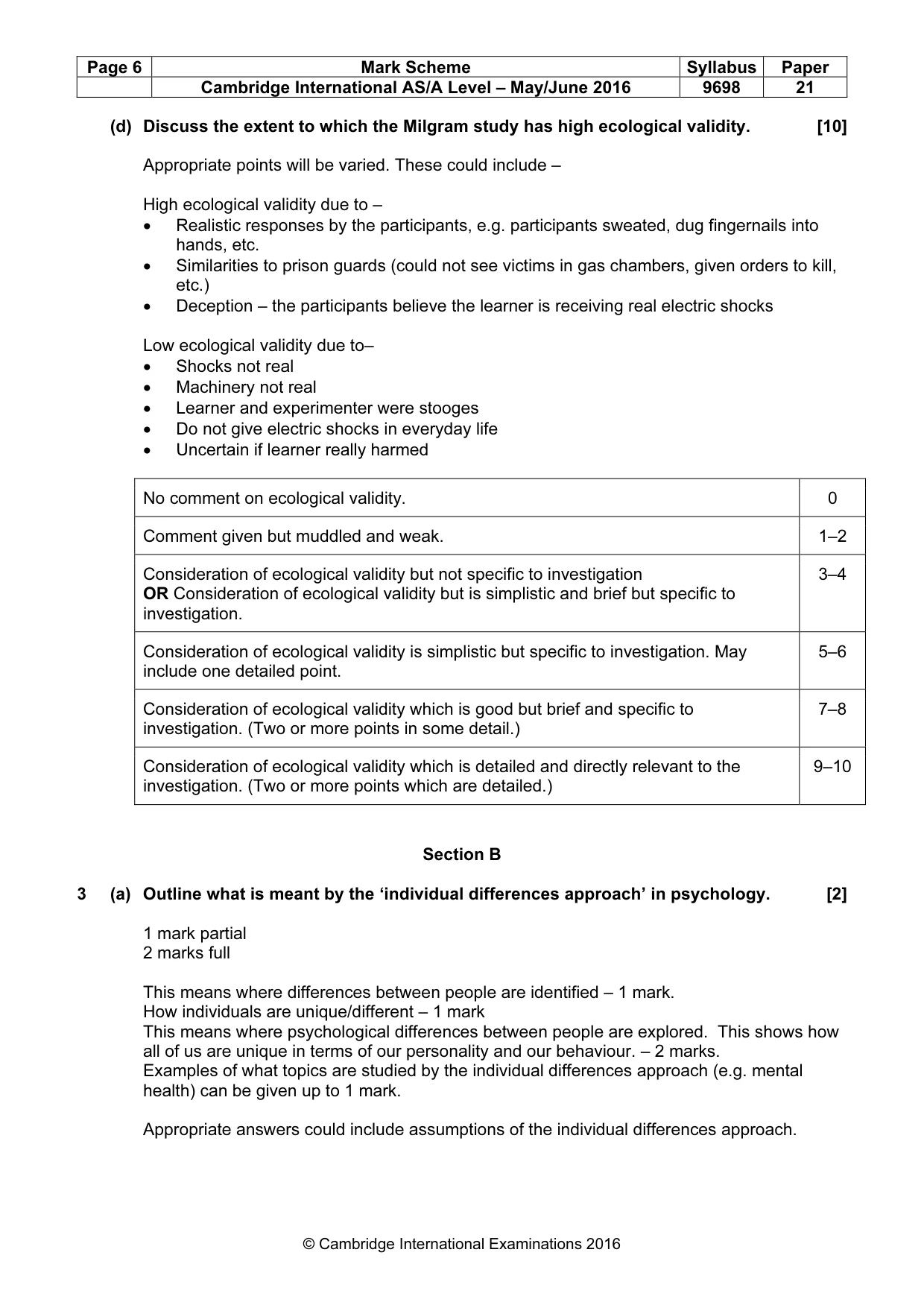
Mark scheme, page 6
Page 6 Mark Scheme Syllabus Paper Cambridge International AS/A Level – May/June 2016 9698 21 © Cambridge International Examinations 2016 (d) Discuss the extent to which the Milgram study has high ecological validity. [10] Appropriate points will be varied. These could include – High ecological validity due to – • Realistic responses by the participants, e.g. participants sweated, dug fingernails into hands, etc. • Similarities to prison guards (could not see victims in gas chambers, given orders to kill, etc.) • Deception – the participants believe the learner is receiving real electric shocks Low ecological validity due to– • Shocks not real • Machinery not real • Learner and experimenter were stooges • Do not give electric shocks in everyday life • Uncertain if learner really harmed No comment on ecological validity. 0 Comment given but muddled and weak. 1–2 Consideration of ecological validity but not specific to investigation OR Consideration of ecological validity but is simplistic and brief but specific to investigation. 3–4 Consideration of ecological validity is simplistic but specific to investigation. May include one detailed point. 5–6 Consideration of ecological validity which is good but brief and specific to investigation. (Two or more points in some detail.) 7–8 Consideration of ecological validity which is detailed and directly relevant to the investigation. (Two or more points which are detailed.) 9–10 Section B 3 (a) Outline what is meant by the ‘individual differences approach’ in psychology. [2] 1 mark partial 2 marks full This means where differences between people are identified – 1 mark. How individuals are unique/different – 1 mark This means where psychological differences between people are explored. This shows how all of us are unique in terms of our personality and our behaviour. – 2 marks. Examples of what topics are studied by the individual differences approach (e.g. mental health) can be given up to 1 mark. Appropriate answers could include assumptions of the individual differences approach.
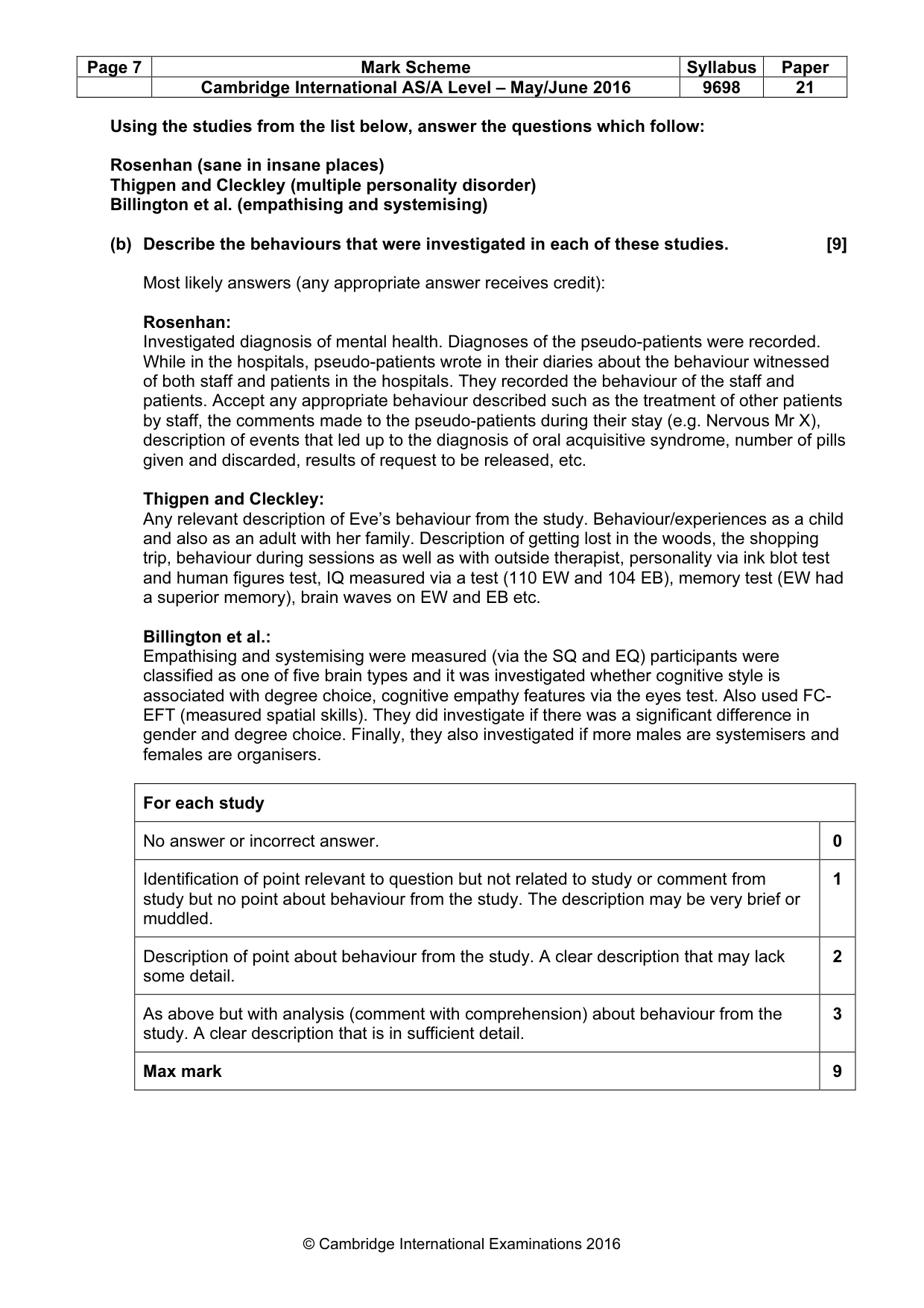
Mark scheme, page 7
Page 7 Mark Scheme Syllabus Paper Cambridge International AS/A Level – May/June 2016 9698 21 © Cambridge International Examinations 2016 Using the studies from the list below, answer the questions which follow: Rosenhan (sane in insane places) Thigpen and Cleckley (multiple personality disorder) Billington et al. (empathising and systemising) (b) Describe the behaviours that were investigated in each of these studies. [9] Most likely answers (any appropriate answer receives credit): Rosenhan: Investigated diagnosis of mental health. Diagnoses of the pseudo-patients were recorded. While in the hospitals, pseudo-patients wrote in their diaries about the behaviour witnessed of both staff and patients in the hospitals. They recorded the behaviour of the staff and patients. Accept any appropriate behaviour described such as the treatment of other patients by staff, the comments made to the pseudo-patients during their stay (e.g. Nervous Mr X), description of events that led up to the diagnosis of oral acquisitive syndrome, number of pills given and discarded, results of request to be released, etc. Thigpen and Cleckley: Any relevant description of Eve’s behaviour from the study. Behaviour/experiences as a child and also as an adult with her family. Description of getting lost in the woods, the shopping trip, behaviour during sessions as well as with outside therapist, personality via ink blot test and human figures test, IQ measured via a test (110 EW and 104 EB), memory test (EW had a superior memory), brain waves on EW and EB etc. Billington et al.: Empathising and systemising were measured (via the SQ and EQ) participants were classified as one of five brain types and it was investigated whether cognitive style is associated with degree choice, cognitive empathy features via the eyes test. Also used FC- EFT (measured spatial skills). They did investigate if there was a significant difference in gender and degree choice. Finally, they also investigated if more males are systemisers and females are organisers. For each study No answer or incorrect answer. 0 Identification of point relevant to question but not related to study or comment from study but no point about behaviour from the study. The description may be very brief or muddled. 1 Description of point about behaviour from the study. A clear description that may lack some detail. 2 As above but with analysis (comment with comprehension) about behaviour from the study. A clear description that is in sufficient detail. 3 Max mark 9
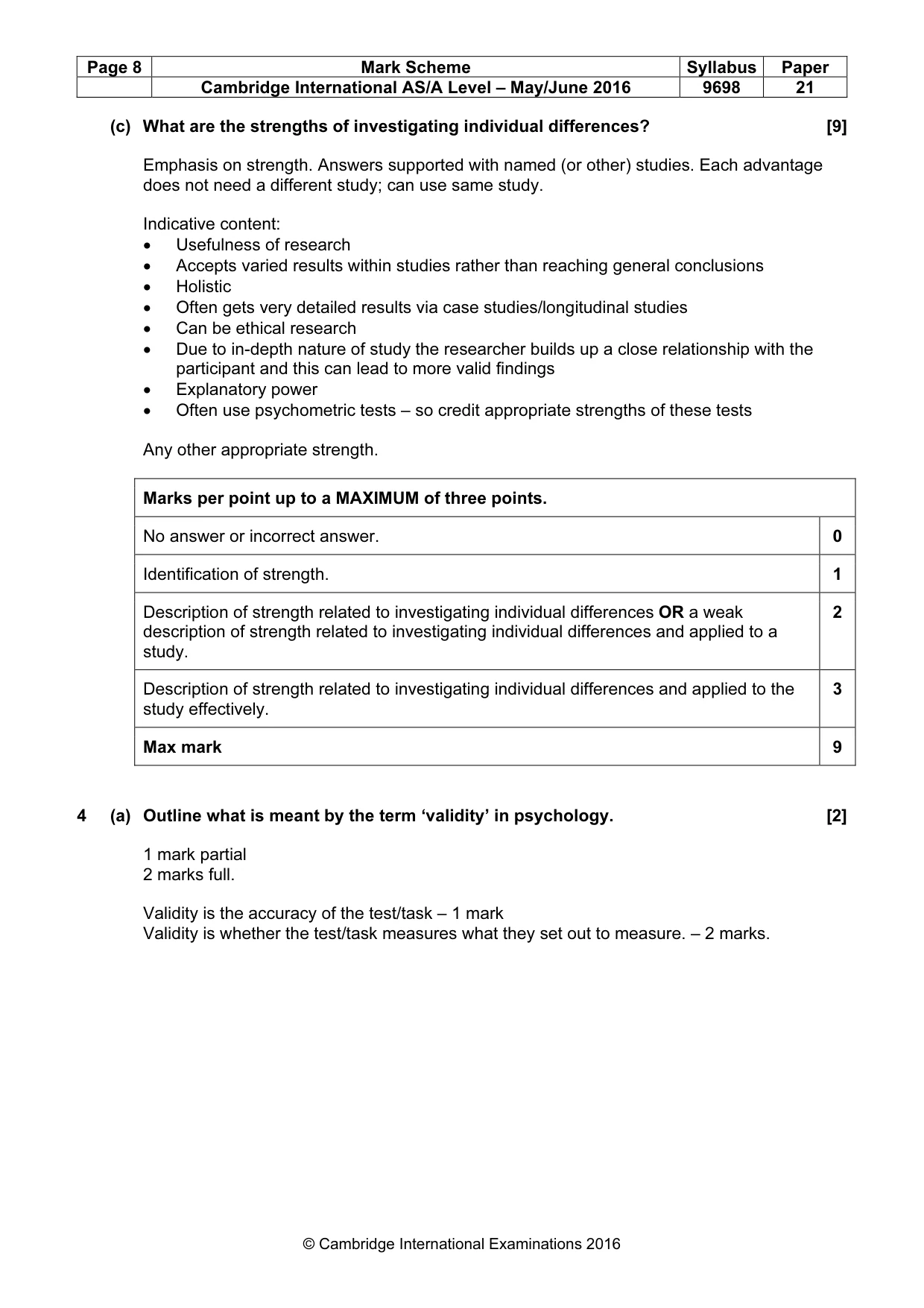
Mark scheme, page 8
Page 8 Mark Scheme Syllabus Paper Cambridge International AS/A Level – May/June 2016 9698 21 © Cambridge International Examinations 2016 (c) What are the strengths of investigating individual differences? [9] Emphasis on strength. Answers supported with named (or other) studies. Each advantage does not need a different study; can use same study. Indicative content: • Usefulness of research • Accepts varied results within studies rather than reaching general conclusions • Holistic • Often gets very detailed results via case studies/longitudinal studies • Can be ethical research • Due to in-depth nature of study the researcher builds up a close relationship with the participant and this can lead to more valid findings • Explanatory power • Often use psychometric tests – so credit appropriate strengths of these tests Any other appropriate strength. Marks per point up to a MAXIMUM of three points. No answer or incorrect answer. 0 Identification of strength. 1 Description of strength related to investigating individual differences OR a weak description of strength related to investigating individual differences and applied to a study. 2 Description of strength related to investigating individual differences and applied to the study effectively. 3 Max mark 9 4 (a) Outline what is meant by the term ‘validity’ in psychology. [2] 1 mark partial 2 marks full. Validity is the accuracy of the test/task – 1 mark Validity is whether the test/task measures what they set out to measure. – 2 marks.
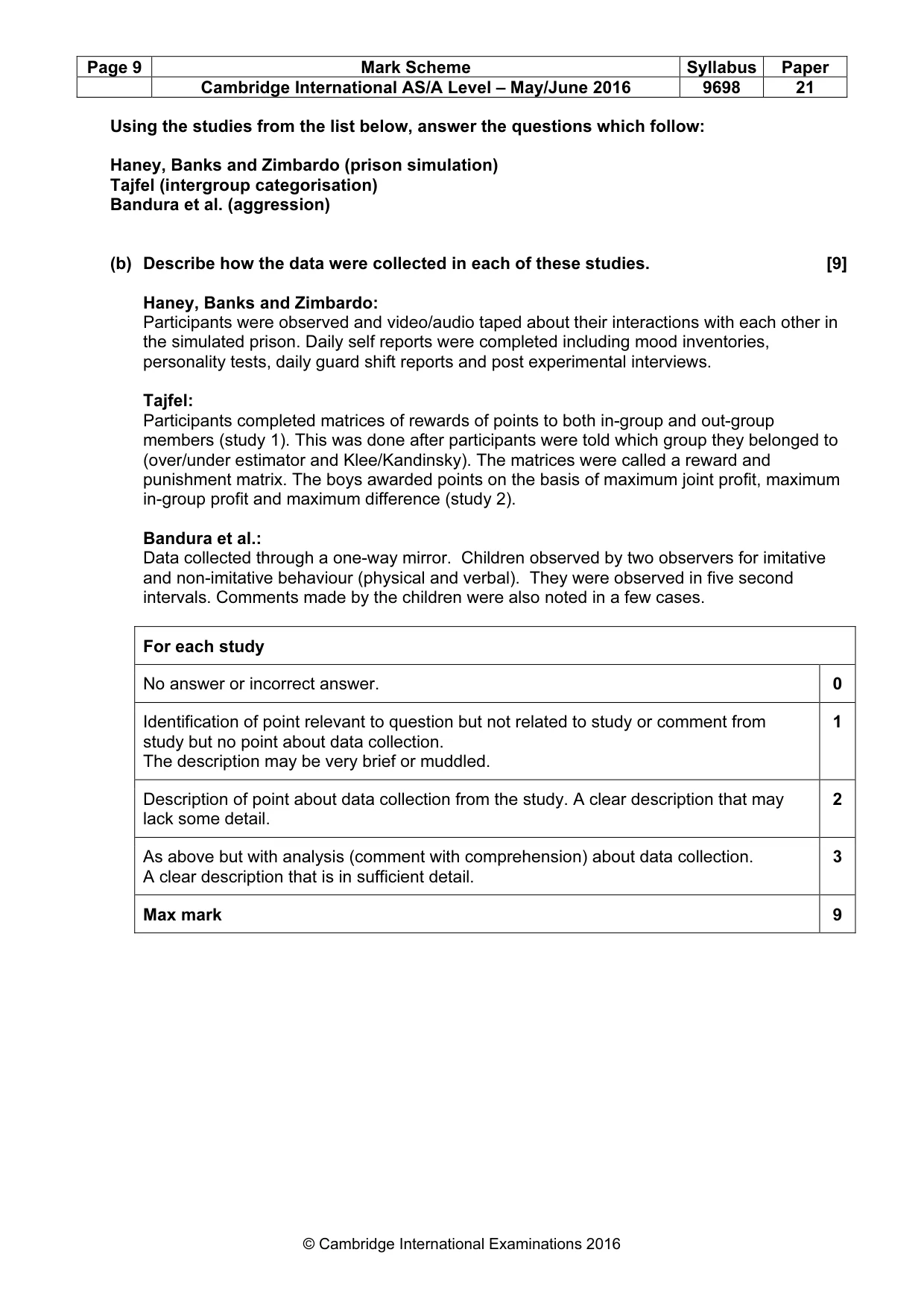
Mark scheme, page 9
Page 9 Mark Scheme Syllabus Paper Cambridge International AS/A Level – May/June 2016 9698 21 © Cambridge International Examinations 2016 Using the studies from the list below, answer the questions which follow: Haney, Banks and Zimbardo (prison simulation) Tajfel (intergroup categorisation) Bandura et al. (aggression) (b) Describe how the data were collected in each of these studies. [9] Haney, Banks and Zimbardo: Participants were observed and video/audio taped about their interactions with each other in the simulated prison. Daily self reports were completed including mood inventories, personality tests, daily guard shift reports and post experimental interviews. Tajfel: Participants completed matrices of rewards of points to both in-group and out-group members (study 1). This was done after participants were told which group they belonged to (over/under estimator and Klee/Kandinsky). The matrices were called a reward and punishment matrix. The boys awarded points on the basis of maximum joint profit, maximum in-group profit and maximum difference (study 2). Bandura et al.: Data collected through a one-way mirror. Children observed by two observers for imitative and non-imitative behaviour (physical and verbal). They were observed in five second intervals. Comments made by the children were also noted in a few cases. For each study No answer or incorrect answer. 0 Identification of point relevant to question but not related to study or comment from study but no point about data collection. The description may be very brief or muddled. 1 Description of point about data collection from the study. A clear description that may lack some detail. 2 As above but with analysis (comment with comprehension) about data collection. A clear description that is in sufficient detail. 3 Max mark 9
Mark scheme, page 10
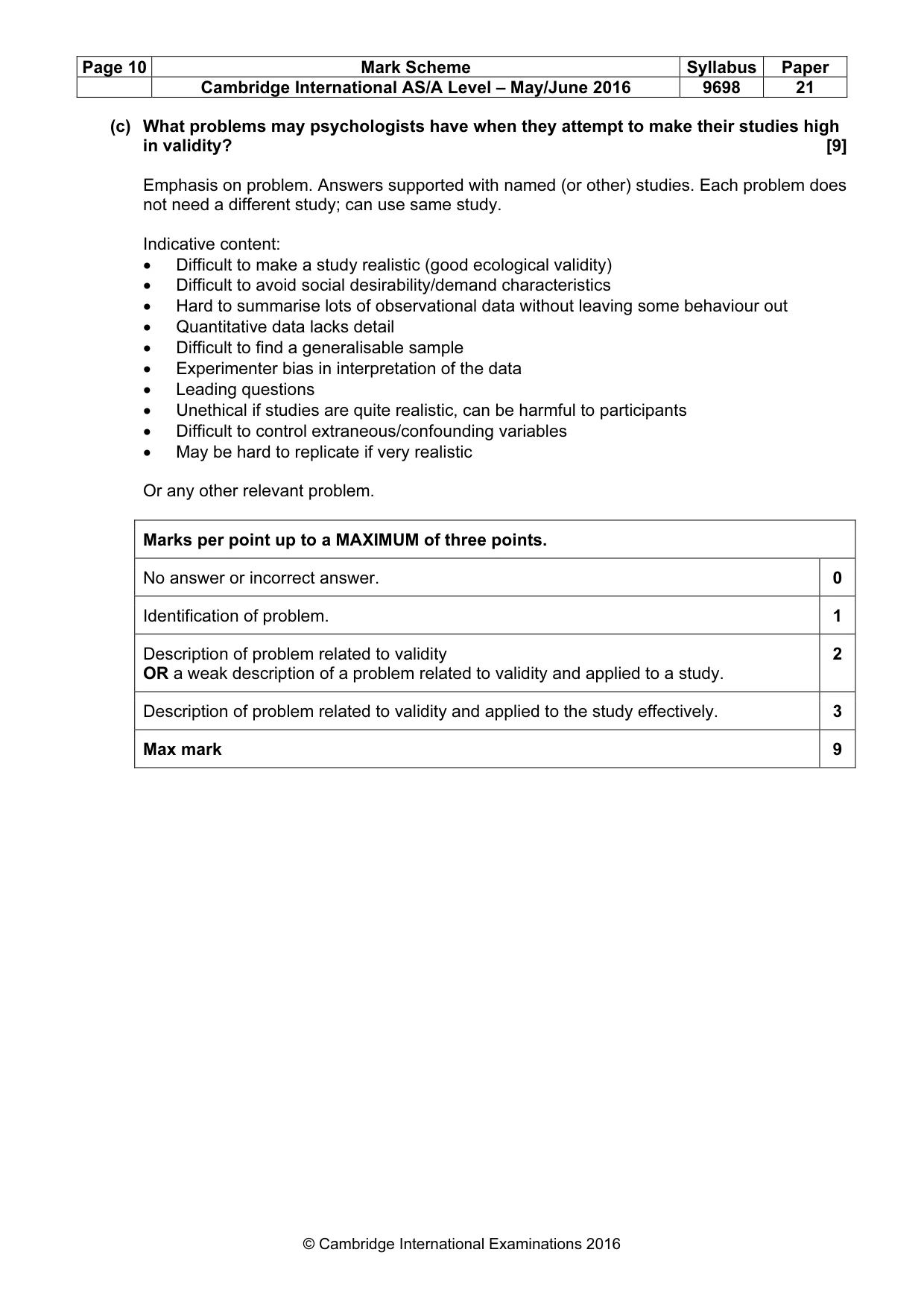
Page 10 Mark Scheme Syllabus Paper Cambridge International AS/A Level – May/June 2016 9698 21 © Cambridge International Examinations 2016 (c) What problems may psychologists have when they attempt to make their studies high in validity? [9] Emphasis on problem. Answers supported with named (or other) studies. Each problem does not need a different study; can use same study. Indicative content: • Difficult to make a study realistic (good ecological validity) • Difficult to avoid social desirability/demand characteristics • Hard to summarise lots of observational data without leaving some behaviour out • Quantitative data lacks detail • Difficult to find a generalisable sample • Experimenter bias in interpretation of the data • Leading questions • Unethical if studies are quite realistic, can be harmful to participants • Difficult to control extraneous/confounding variables • May be hard to replicate if very realistic Or any other relevant problem. Marks per point up to a MAXIMUM of three points. No answer or incorrect answer. 0 Identification of problem. 1 Description of problem related to validity OR a weak description of a problem related to validity and applied to a study. 2 Description of problem related to validity and applied to the study effectively. 3 Max mark 9
What you needed in this session
Cambridge’s own grade thresholds for 2016 May/June, Paper 2 · Variant 1. A higher threshold means an easier paper — the bar moves with how the cohort did.