Cambridge A Level Psychology 9698 — 2017 May/June Paper 2 · Variant 1
9698/21/M/J/17 · 4 questions · 70 marks · ≈79 min
The question paper and its mark scheme, free to read here and free to download. This is Cambridge’s own paper, exactly as it was sat.
Question paper4 pages
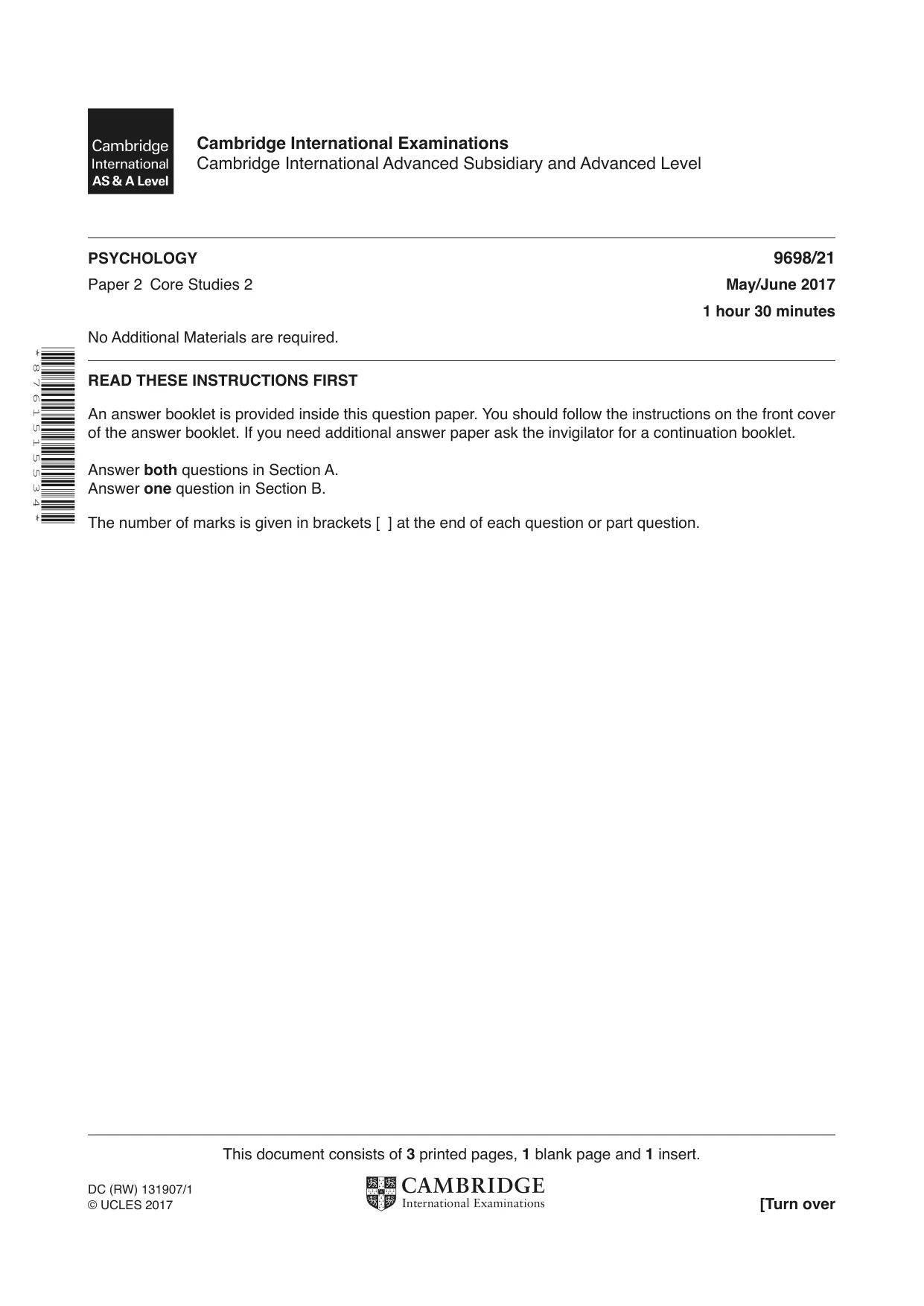
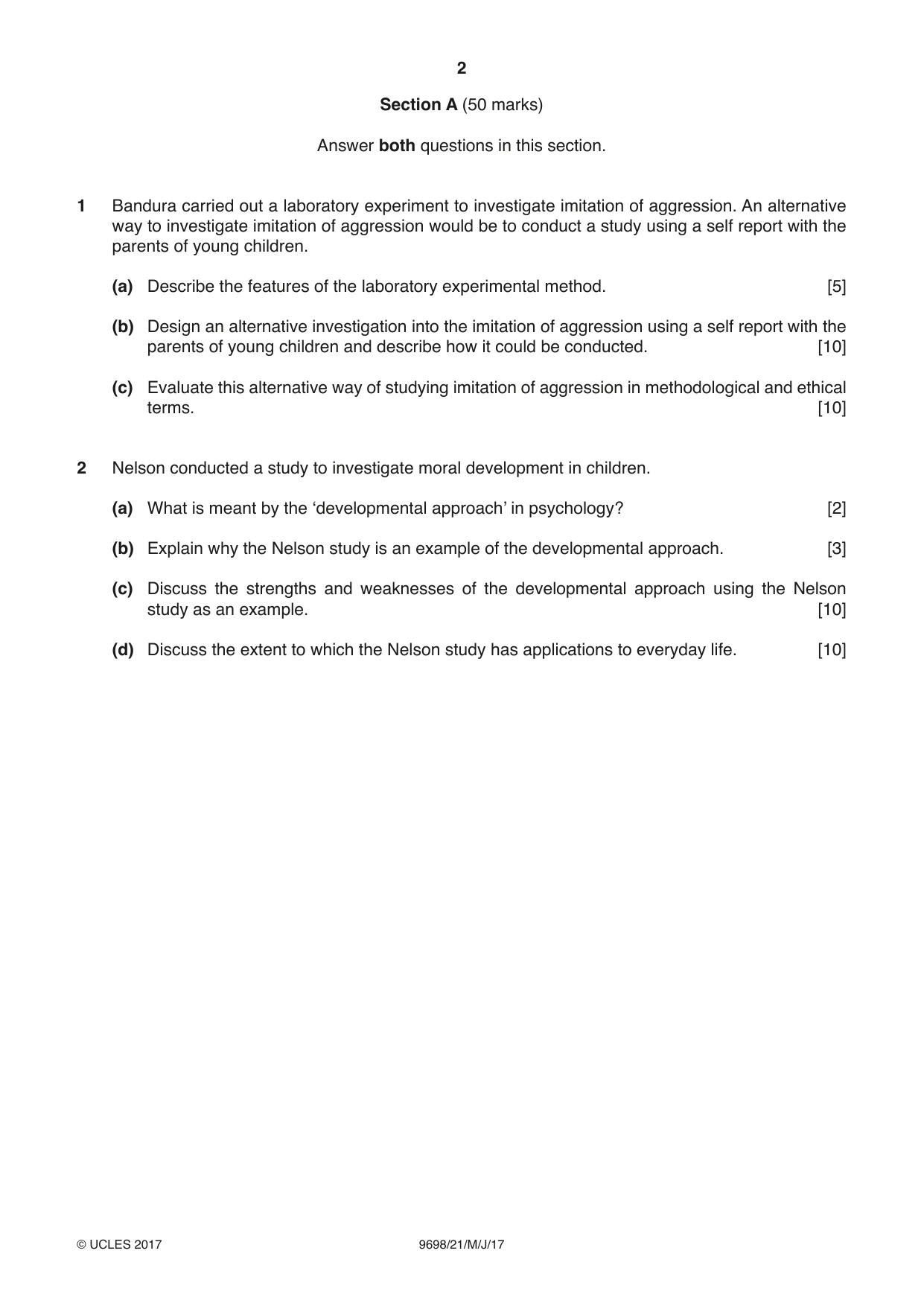
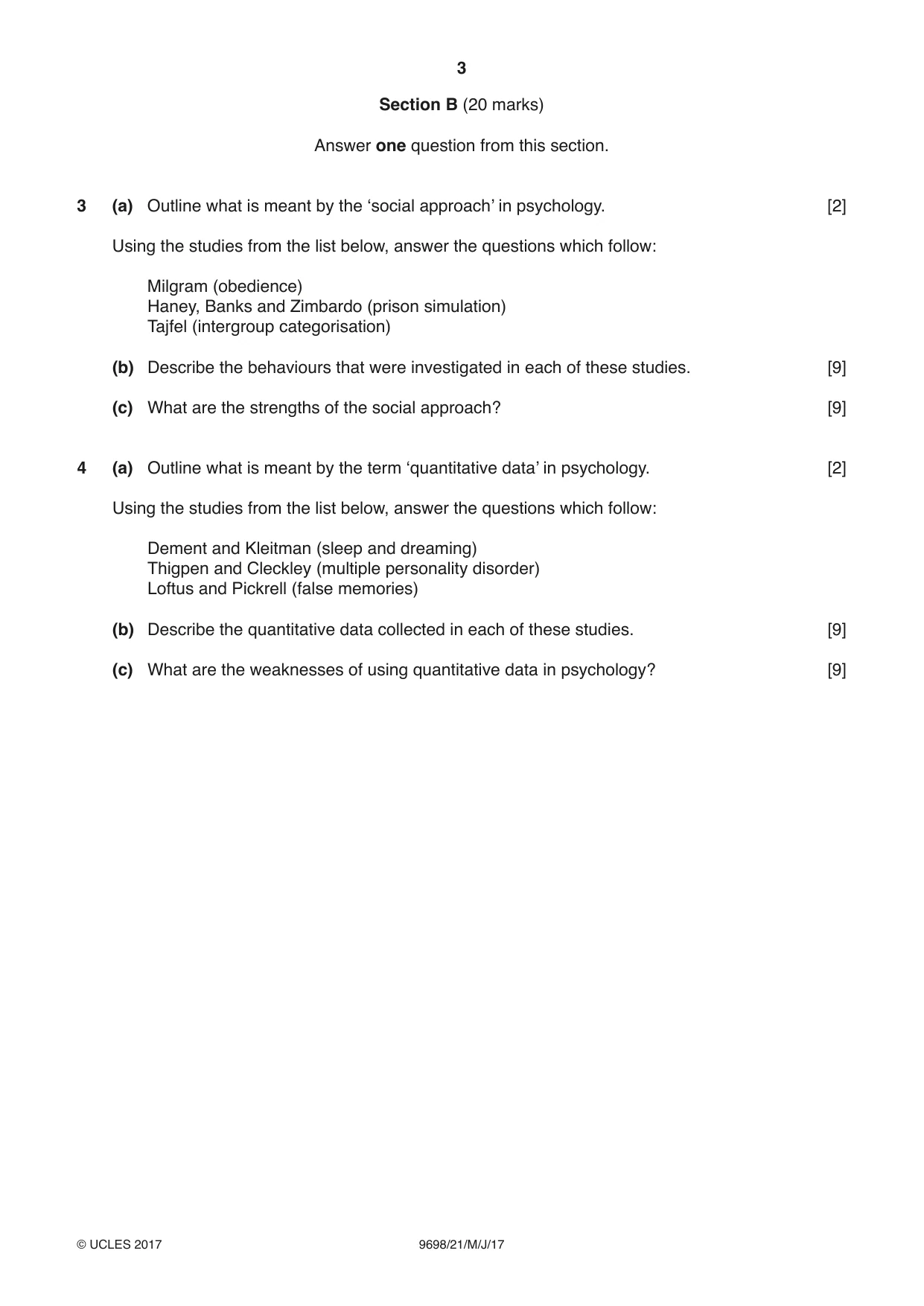

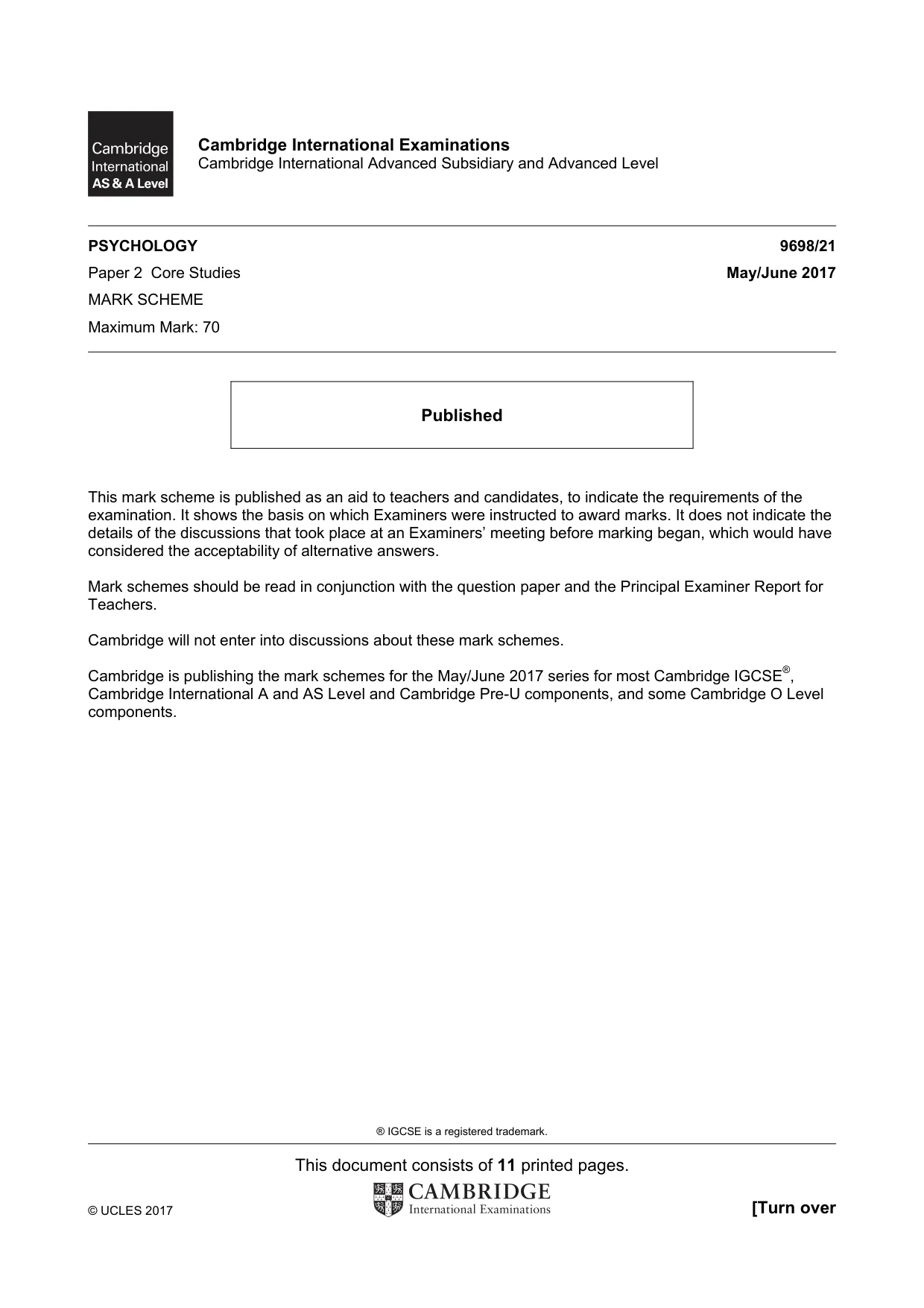
Mark scheme11 pages
Answers below. Sit the paper first if you are practising.
Questions as text
Q1 · Bandura carried out a laboratory experiment to investigate imitation of aggression
1 Bandura carried out a laboratory experiment to investigate imitation of aggression. An alternative way to investigate imitation of aggression would be to conduct a study using a self report with the parents of young children. (a) Describe the features of the laboratory experimental method. [5] (b) Design an alternative investigation into the imitation of aggression using a self report with the parents of young children and describe how it could be conducted. [10] (c) Evaluate this alternative way of studying imitation of aggression in methodological and ethical terms. [10]
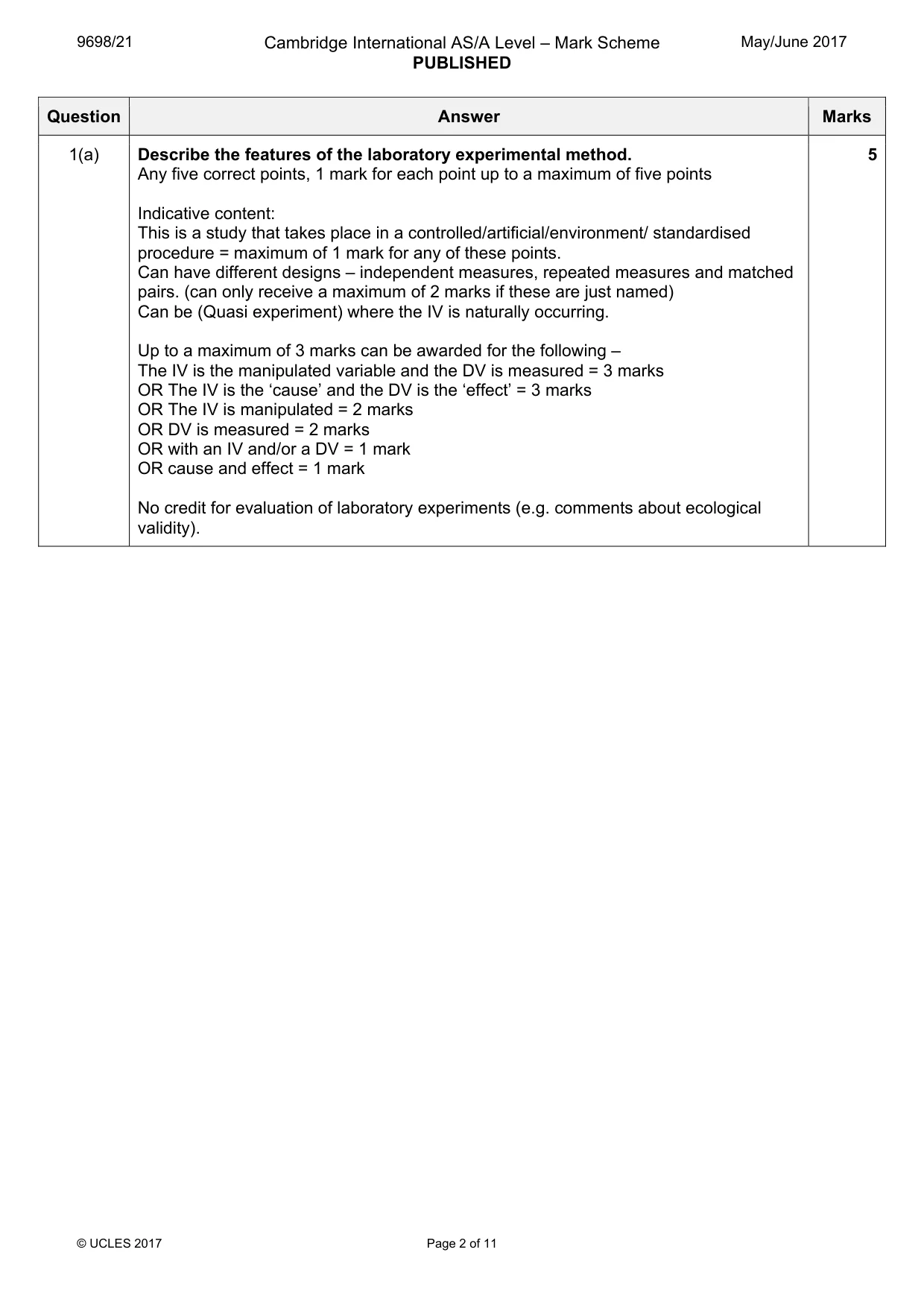
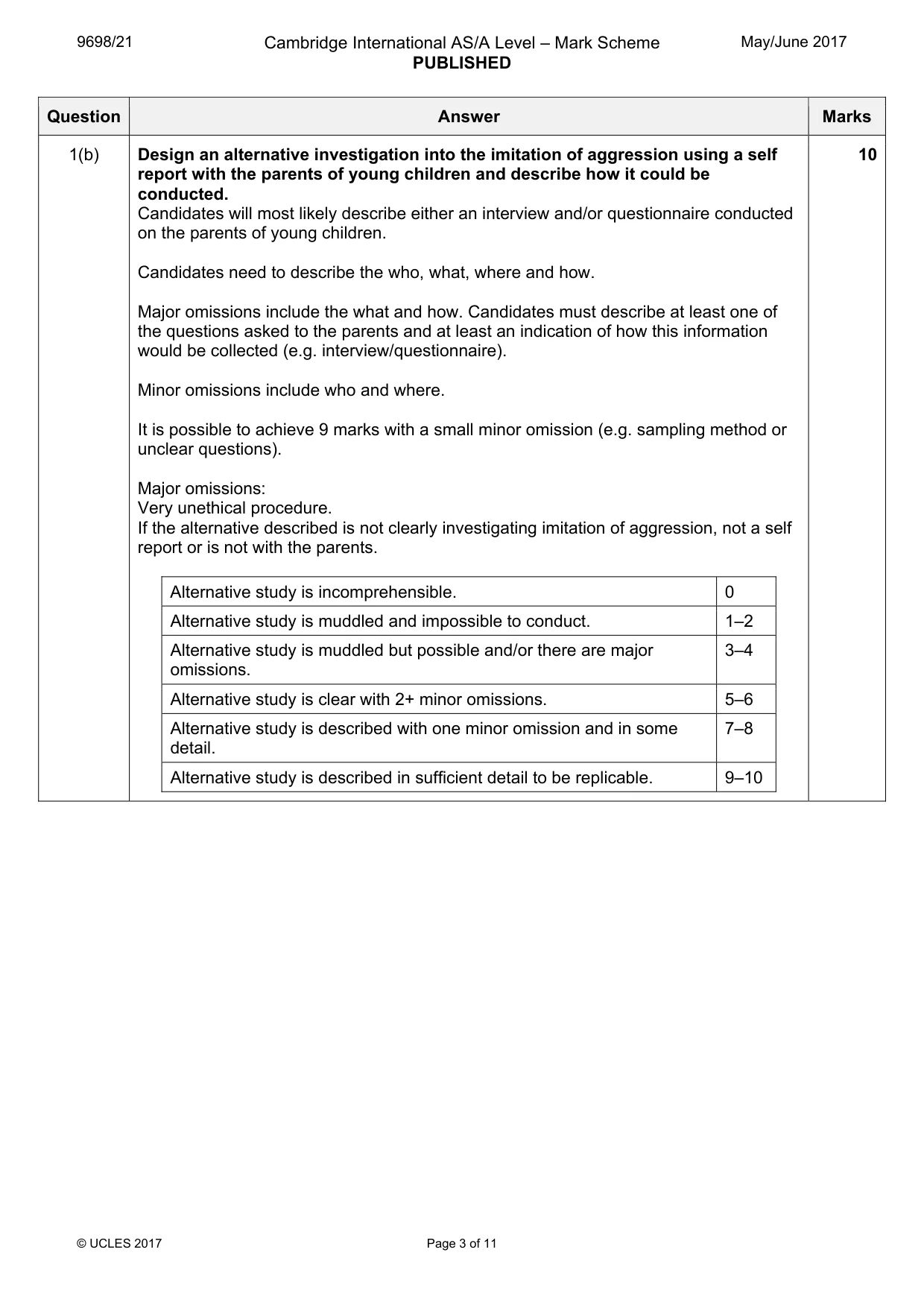
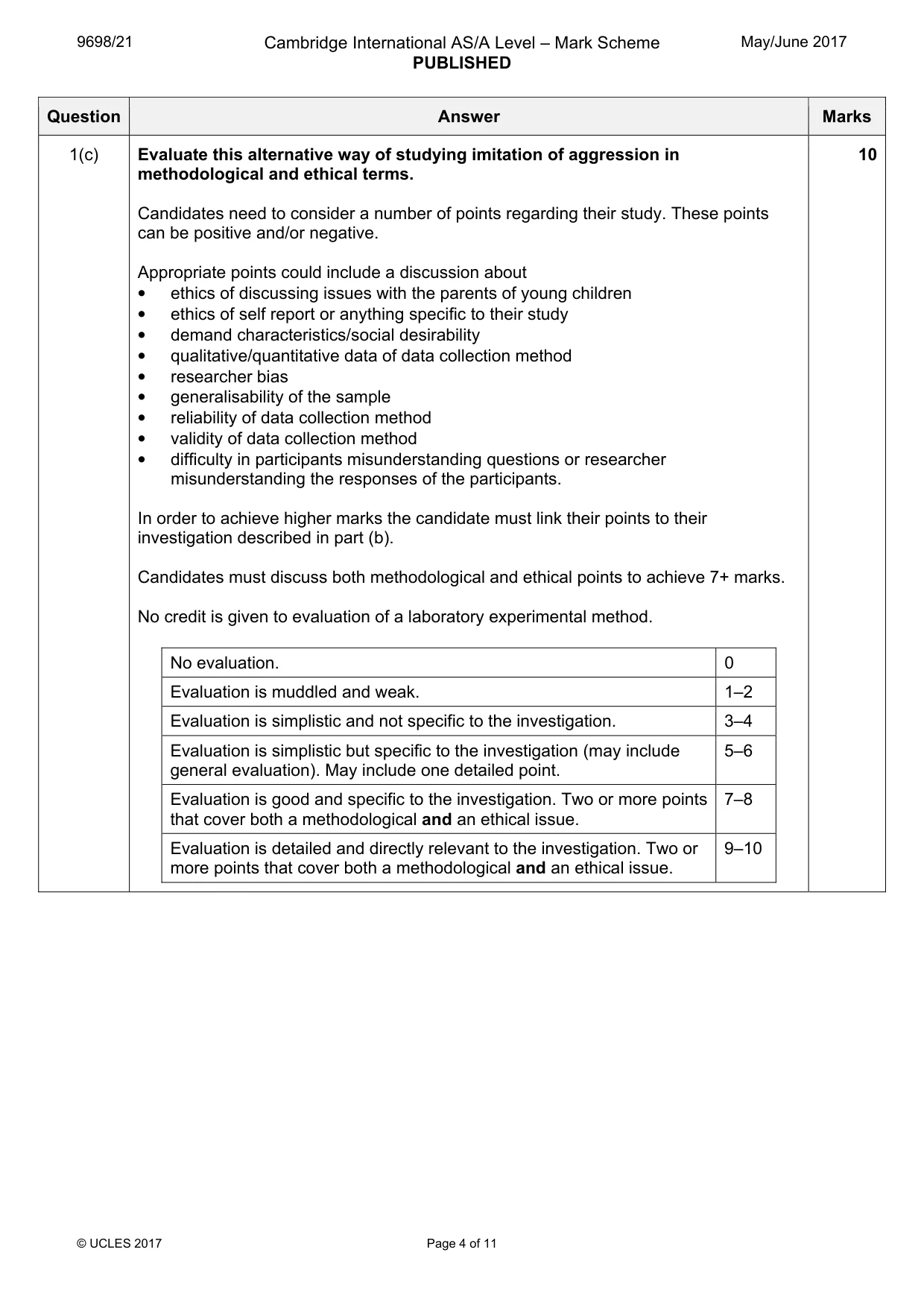
Mark scheme: Question Answer Marks 1(a) Describe the features of the laboratory experimental method. 5 Any five correct points, 1 mark for each point up to a maximum of five points Indicative content: This is a study that takes place in a controlled/artificial/environment/ standardised procedure = maximum of 1 mark for any of these points. Can have different designs – independent measures, repeated measures and matched pairs. (can only receive a maximum of 2 marks if these are just named) Can be (Quasi experiment) where the IV is naturally occurring. Up to a maximum of 3 marks can be awarded for the following – The IV is the manipulated variable and the DV is measured = 3 marks OR The IV is the ‘cause’ and the DV is the ‘effect’ = 3 marks OR The IV is manipulated = 2 marks OR DV is measured = 2 marks OR with an IV and/or a DV = 1 mark OR cause and effect = 1 mark No credit for evaluation of laboratory experiments (e.g. comments about ecological validity). 1(b) Design an alternative investigation into the imitation of aggression using a self 10 report with the parents of young children and describe how it could be conducted. Candidates will most likely describe either an interview and/or questionnaire conducted on the parents of young children. Candidates need to describe the who, what, where and how. Major omissions include the what and how. Candidates must describe at least one of the questions asked to the parents and at least an indication of how this information would be collected (e.g. interview/questionnaire). Minor omissions include who and where. It is possible to achieve 9 marks with a small minor omission (e.g. sampling method or unclear questions). Major omissions: Very unethical procedure. If the alternative described is not clearly investigating imitation of aggression, not a self report or is not with the parents. Alternative study is incomprehensible. 0 Alternative study is muddled and impossible to conduct. 1–2 Alternative study is muddled but possible and/or there are major 3–4 omissions. Alternative study is clear with 2+ minor omissions. 5–6 Alternative study is described with one minor omission and in some 7–8 detail. Alternative study is described in sufficient detail to be replicable. 9–10 1(c) Evaluate this alternative way of studying imitation of aggression in 10 methodological and ethical terms. Candidates need to consider a number of points regarding their study. These points can be positive and/or negative. Appropriate points could include a discussion about • ethics of discussing issues with the parents of young children • ethics of self report or anything specific to their study • demand characteristics/social desirability • qualitative/quantitative data of data collection method • researcher bias • generalisability of the sample • reliability of data collection method • validity of data collection method • difficulty in participants misunderstanding questions or researcher misunderstanding the responses of the participants. In order to achieve higher marks the candidate must link their points to their investigation described in part (b). Candidates must discuss both methodological and ethical points to achieve 7+ marks. No credit is given to evaluation of a laboratory experimental method. No evaluation. 0 Evaluation is muddled and weak. 1–2 Evaluation is simplistic and not specific to the investigation. 3–4 Evaluation is simplistic but specific to the investigation (may include 5–6 general evaluation). May include one detailed point. Evaluation is good and specific to the investigation. Two or more points 7–8 that cover both a methodological and an ethical issue. Evaluation is detailed and directly relevant to the investigation. Two or 9–10 more points that cover both a methodological and an ethical issue.
Q2 · Nelson conducted a study to investigate moral development in children
2 Nelson conducted a study to investigate moral development in children. (a) What is meant by the ‘developmental approach’ in psychology? [2] (b) Explain why the Nelson study is an example of the developmental approach. [3] (c) Discuss the strengths and weaknesses of the developmental approach using the Nelson study as an example. [10] (d) Discuss the extent to which the Nelson study has applications to everyday life. [10]
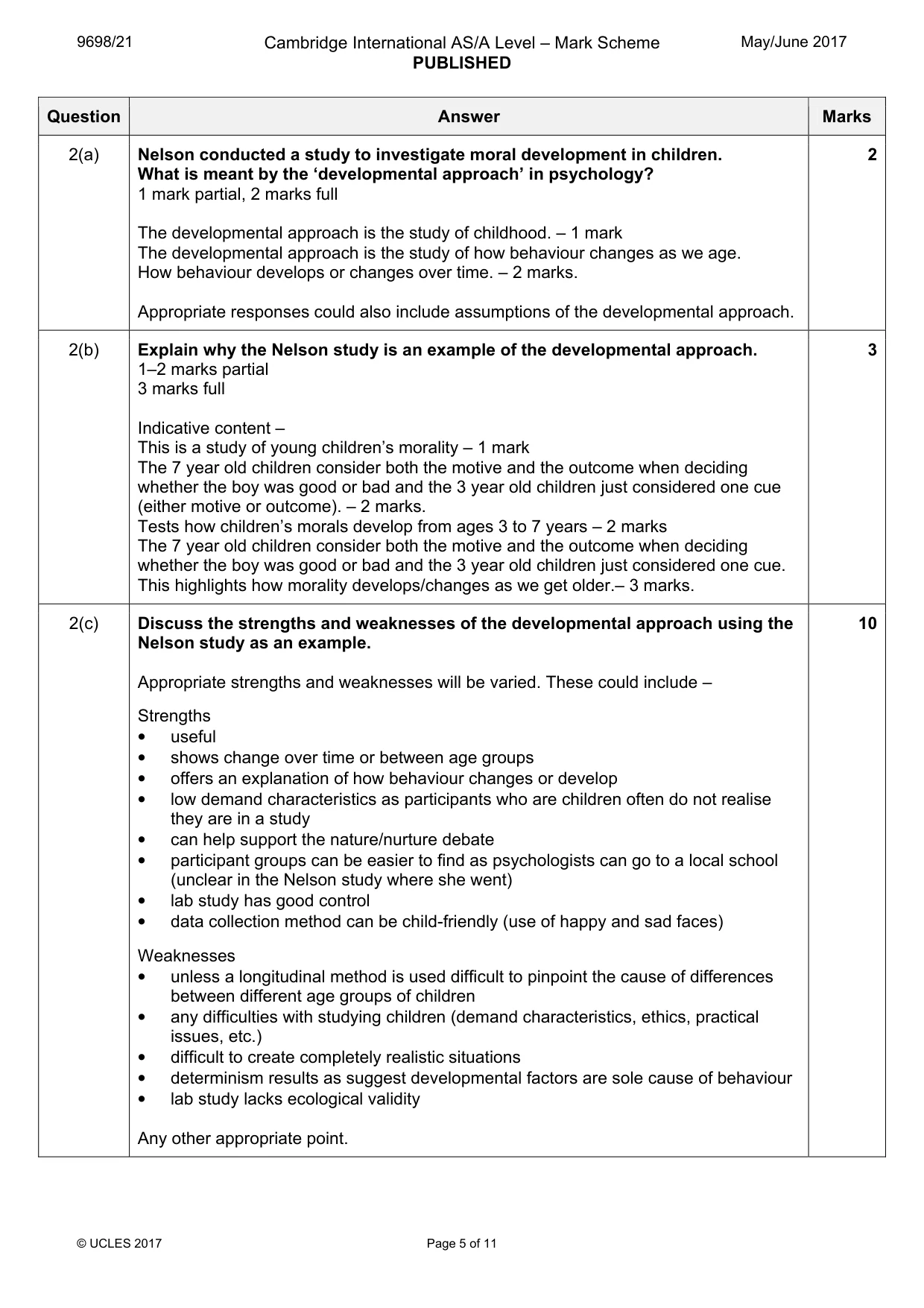
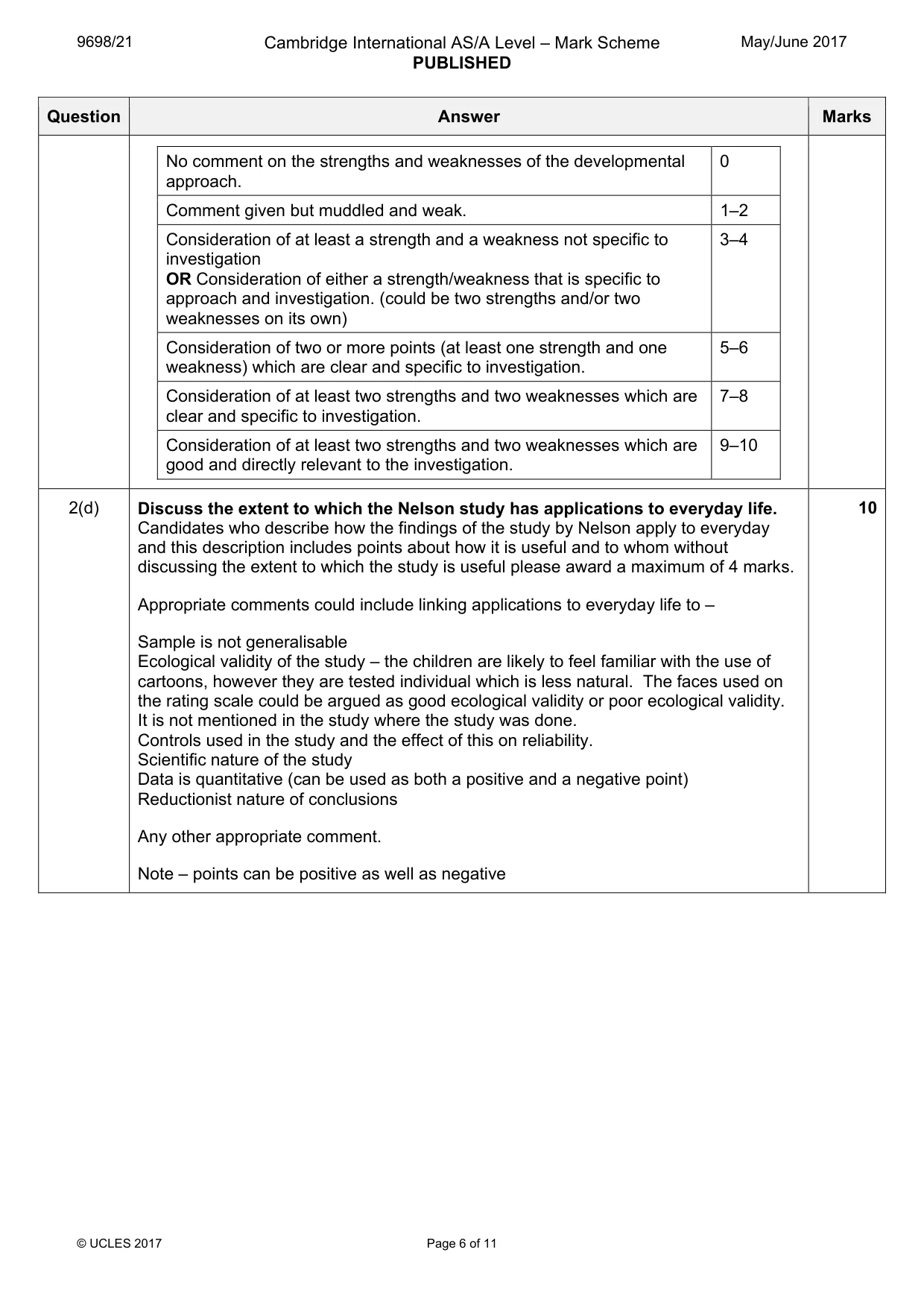
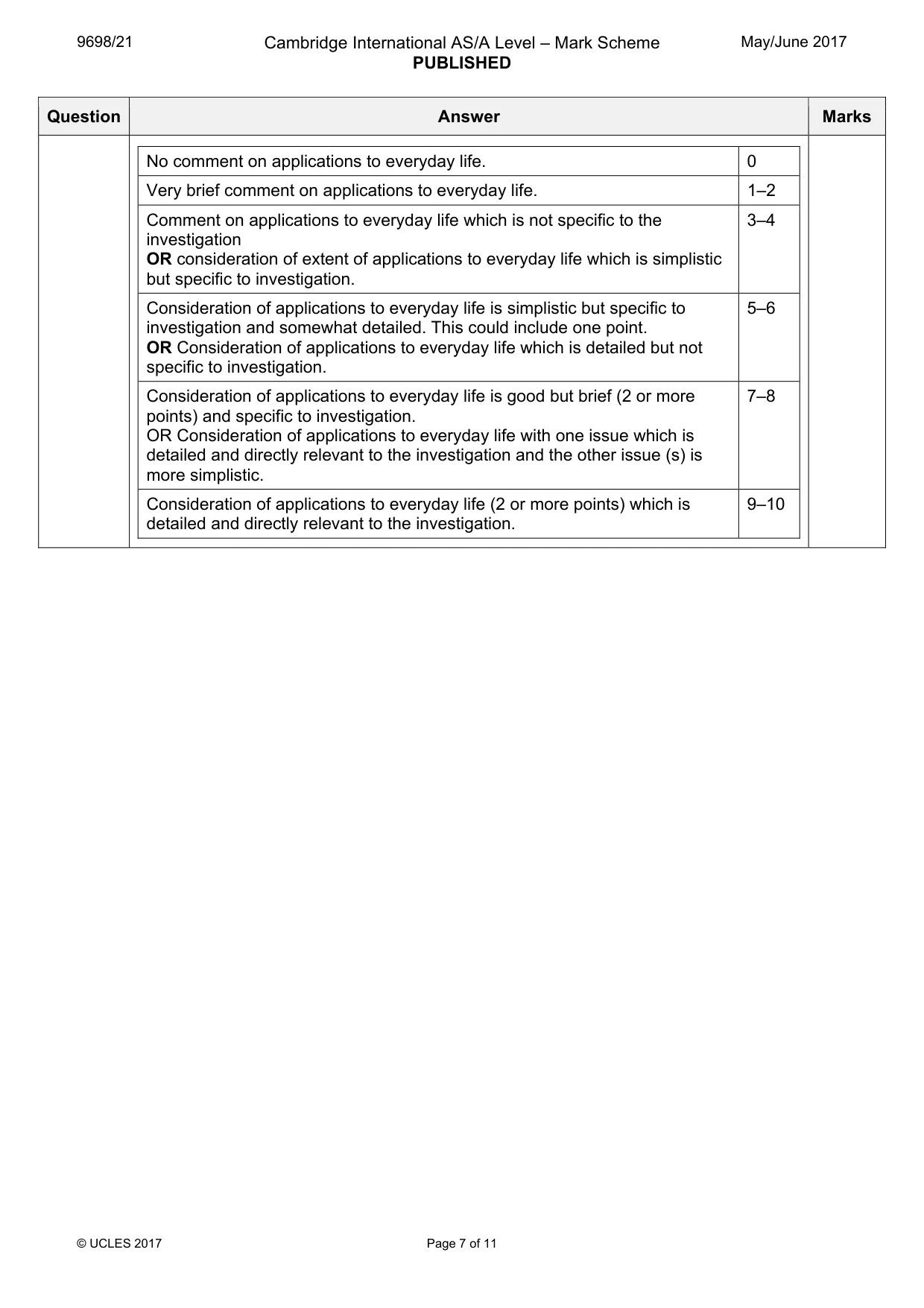
Mark scheme: 2(a) Nelson conducted a study to investigate moral development in children. 2 What is meant by the ‘developmental approach’ in psychology? 1 mark partial, 2 marks full The developmental approach is the study of childhood. – 1 mark The developmental approach is the study of how behaviour changes as we age. How behaviour develops or changes over time. – 2 marks. Appropriate responses could also include assumptions of the developmental approach. 2(b) Explain why the Nelson study is an example of the developmental approach. 3 1–2 marks partial 3 marks full Indicative content – This is a study of young children’s morality – 1 mark The 7 year old children consider both the motive and the outcome when deciding whether the boy was good or bad and the 3 year old children just considered one cue (either motive or outcome). – 2 marks. Tests how children’s morals develop from ages 3 to 7 years – 2 marks The 7 year old children consider both the motive and the outcome when deciding whether the boy was good or bad and the 3 year old children just considered one cue. This highlights how morality develops/changes as we get older.– 3 marks. 2(c) Discuss the strengths and weaknesses of the developmental approach using the 10 Nelson study as an example. Appropriate strengths and weaknesses will be varied. These could include – Strengths • useful • shows change over time or between age groups • offers an explanation of how behaviour changes or develop • low demand characteristics as participants who are children often do not realise they are in a study • can help support the nature/nurture debate • participant groups can be easier to find as psychologists can go to a local school (unclear in the Nelson study where she went) • lab study has good control • data collection method can be child-friendly (use of happy and sad faces) Weaknesses • unless a longitudinal method is used difficult to pinpoint the cause of differences between different age groups of children • any difficulties with studying children (demand characteristics, ethics, practical issues, etc.) • difficult to create completely realistic situations • determinism results as suggest developmental factors are sole cause of behaviour • lab study lacks ecological validity Any other appropriate point. No comment on the strengths and weaknesses of the developmental 0 approach. Comment given but muddled and weak. 1–2 Consideration of at least a strength and a weakness not specific to 3–4 investigation OR Consideration of either a strength/weakness that is specific to approach and investigation. (could be two strengths and/or two weaknesses on its own) Consideration of two or more points (at least one strength and one 5–6 weakness) which are clear and specific to investigation. Consideration of at least two strengths and two weaknesses which are 7–8 clear and specific to investigation. Consideration of at least two strengths and two weaknesses which are 9–10 good and directly relevant to the investigation. 2(d) Discuss the extent to which the Nelson study has applications to everyday life. 10 Candidates who describe how the findings of the study by Nelson apply to everyday and this description includes points about how it is useful and to whom without discussing the extent to which the study is useful please award a maximum of 4 marks. Appropriate comments could include linking applications to everyday life to – Sample is not generalisable Ecological validity of the study – the children are likely to feel familiar with the use of cartoons, however they are tested individual which is less natural. The faces used on the rating scale could be argued as good ecological validity or poor ecological validity. It is not mentioned in the study where the study was done. Controls used in the study and the effect of this on reliability. Scientific nature of the study Data is quantitative (can be used as both a positive and a negative point) Reductionist nature of conclusions Any other appropriate comment. Note – points can be positive as well as negative No comment on applications to everyday life. 0 Very brief comment on applications to everyday life. 1–2 Comment on applications to everyday life which is not specific to the 3–4 investigation OR consideration of extent of applications to everyday life which is simplistic but specific to investigation. Consideration of applications to everyday life is simplistic but specific to 5–6 investigation and somewhat detailed. This could include one point. OR Consideration of applications to everyday life which is detailed but not specific to investigation. Consideration of applications to everyday life is good but brief (2 or more 7–8 points) and specific to investigation. OR Consideration of applications to everyday life with one issue which is detailed and directly relevant to the investigation and the other issue (s) is more simplistic. Consideration of applications to everyday life (2 or more points) which is 9–10 detailed and directly relevant to the investigation.
Q3 · Outline what is meant by the ‘social approach’ in psychology
3 (a) Outline what is meant by the ‘social approach’ in psychology. [2] Using the studies from the list below, answer the questions which follow: Milgram (obedience) Haney, Banks and Zimbardo (prison simulation) Tajfel (intergroup categorisation) (b) Describe the behaviours that were investigated in each of these studies. [9] (c) What are the strengths of the social approach? [9]
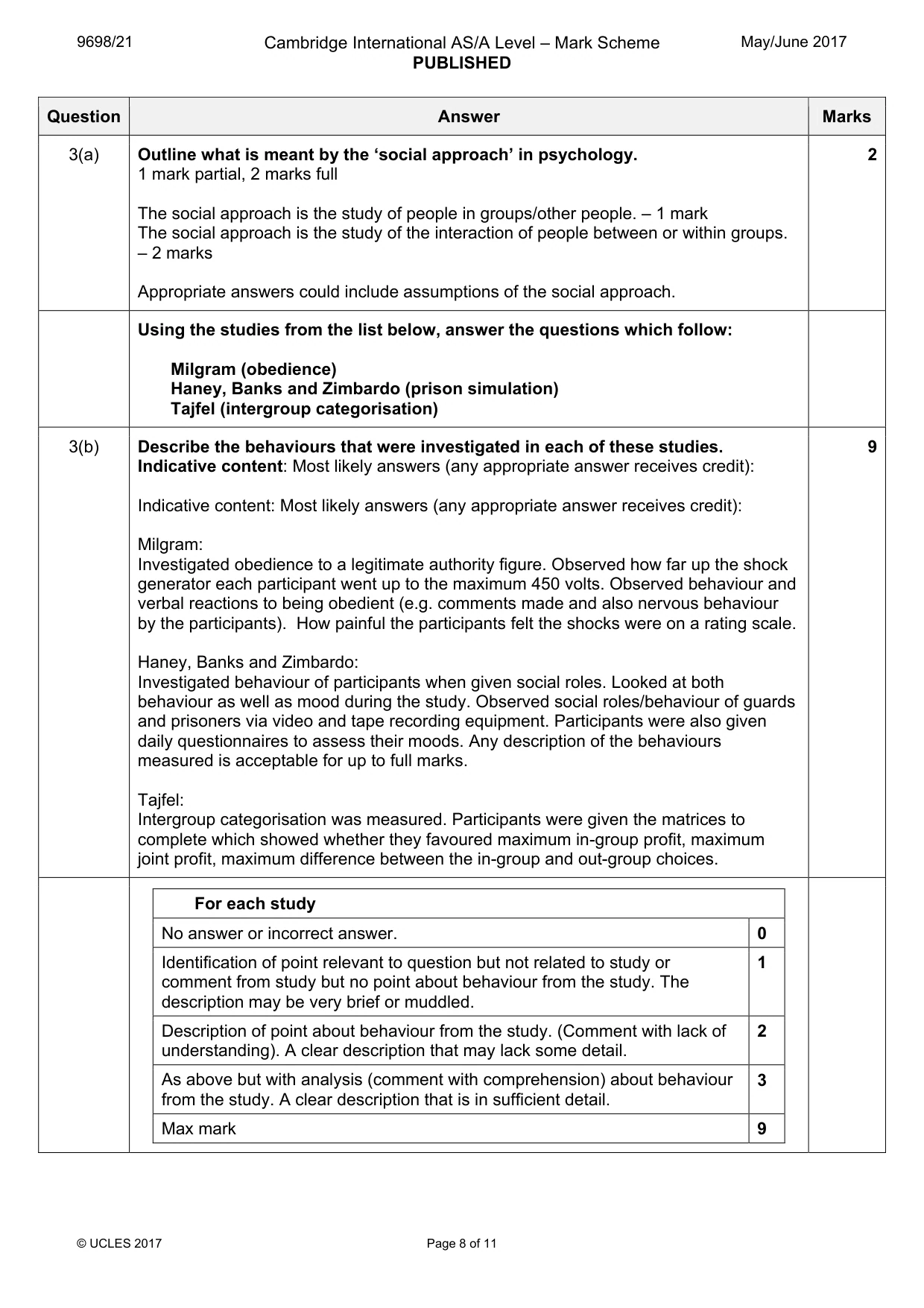
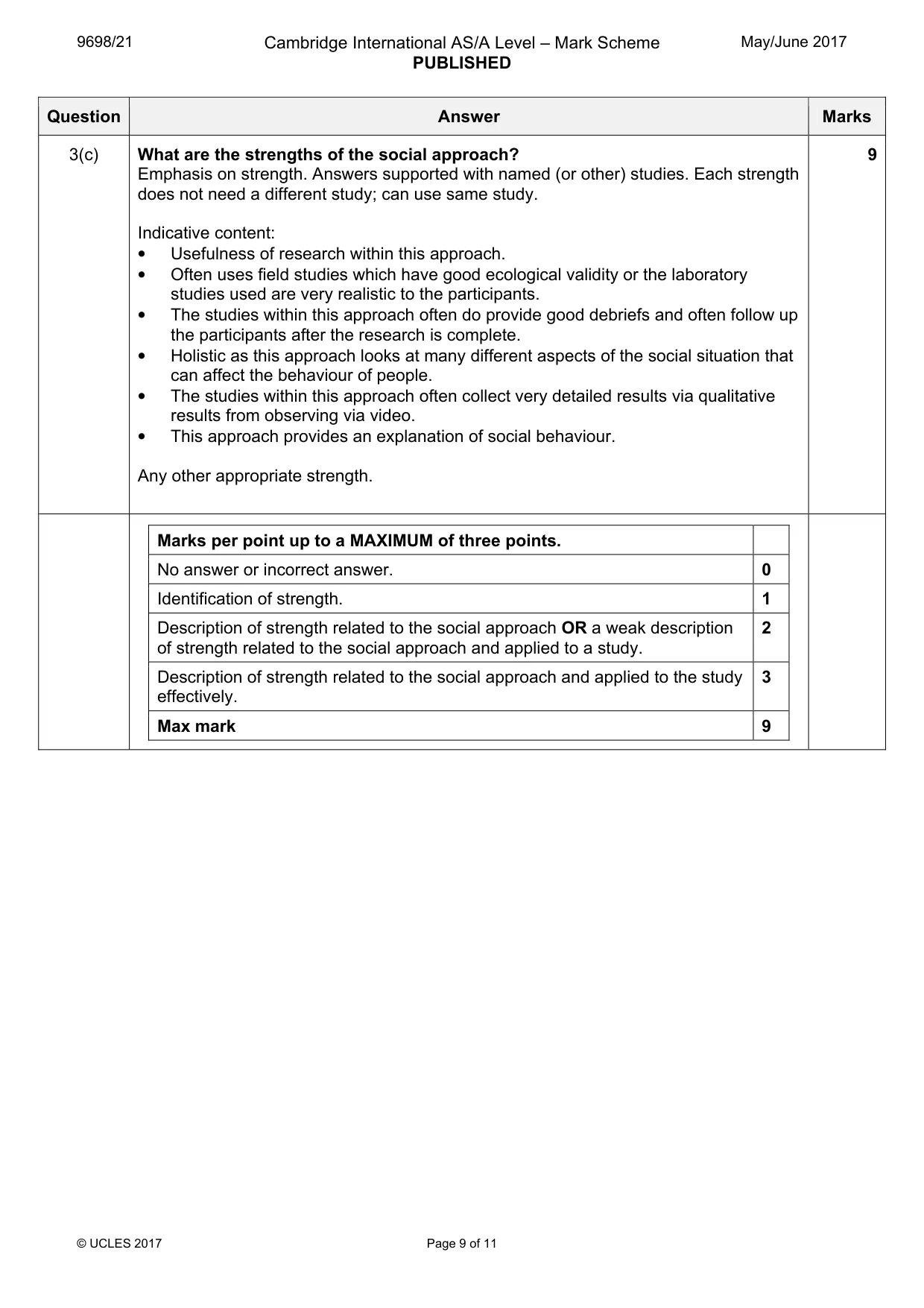
Mark scheme: 3(a) Outline what is meant by the ‘social approach’ in psychology. 2 1 mark partial, 2 marks full The social approach is the study of people in groups/other people. – 1 mark The social approach is the study of the interaction of people between or within groups. – 2 marks Appropriate answers could include assumptions of the social approach. Using the studies from the list below, answer the questions which follow: Milgram (obedience) Haney, Banks and Zimbardo (prison simulation) Tajfel (intergroup categorisation) 3(b) Describe the behaviours that were investigated in each of these studies. 9 Indicative content: Most likely answers (any appropriate answer receives credit): Indicative content: Most likely answers (any appropriate answer receives credit): Milgram: Investigated obedience to a legitimate authority figure. Observed how far up the shock generator each participant went up to the maximum 450 volts. Observed behaviour and verbal reactions to being obedient (e.g. comments made and also nervous behaviour by the participants). How painful the participants felt the shocks were on a rating scale. Haney, Banks and Zimbardo: Investigated behaviour of participants when given social roles. Looked at both behaviour as well as mood during the study. Observed social roles/behaviour of guards and prisoners via video and tape recording equipment. Participants were also given daily questionnaires to assess their moods. Any description of the behaviours measured is acceptable for up to full marks. Tajfel: Intergroup categorisation was measured. Participants were given the matrices to complete which showed whether they favoured maximum in-group profit, maximum joint profit, maximum difference between the in-group and out-group choices. For each study No answer or incorrect answer. 0 Identification of point relevant to question but not related to study or 1 comment from study but no point about behaviour from the study. The description may be very brief or muddled. Description of point about behaviour from the study. (Comment with lack of 2 understanding). A clear description that may lack some detail. As above but with analysis (comment with comprehension) about behaviour 3 from the study. A clear description that is in sufficient detail. Max mark 9 3(c) What are the strengths of the social approach? 9 Emphasis on strength. Answers supported with named (or other) studies. Each strength does not need a different study; can use same study. Indicative content: • Usefulness of research within this approach. • Often uses field studies which have good ecological validity or the laboratory studies used are very realistic to the participants. • The studies within this approach often do provide good debriefs and often follow up the participants after the research is complete. • Holistic as this approach looks at many different aspects of the social situation that can affect the behaviour of people. • The studies within this approach often collect very detailed results via qualitative results from observing via video. • This approach provides an explanation of social behaviour. Any other appropriate strength. Marks per point up to a MAXIMUM of three points. No answer or incorrect answer. 0 Identification of strength. 1 Description of strength related to the social approach OR a weak description 2 of strength related to the social approach and applied to a study. Description of strength related to the social approach and applied to the study 3 effectively. Max mark 9
Q4 · Outline what is meant by the term ‘quantitative data’ in psychology
4 (a) Outline what is meant by the term ‘quantitative data’ in psychology. [2] Using the studies from the list below, answer the questions which follow: Dement and Kleitman (sleep and dreaming) Thigpen and Cleckley (multiple personality disorder) Loftus and Pickrell (false memories) (b) Describe the quantitative data collected in each of these studies. [9] (c) What are the weaknesses of using quantitative data in psychology? [9]
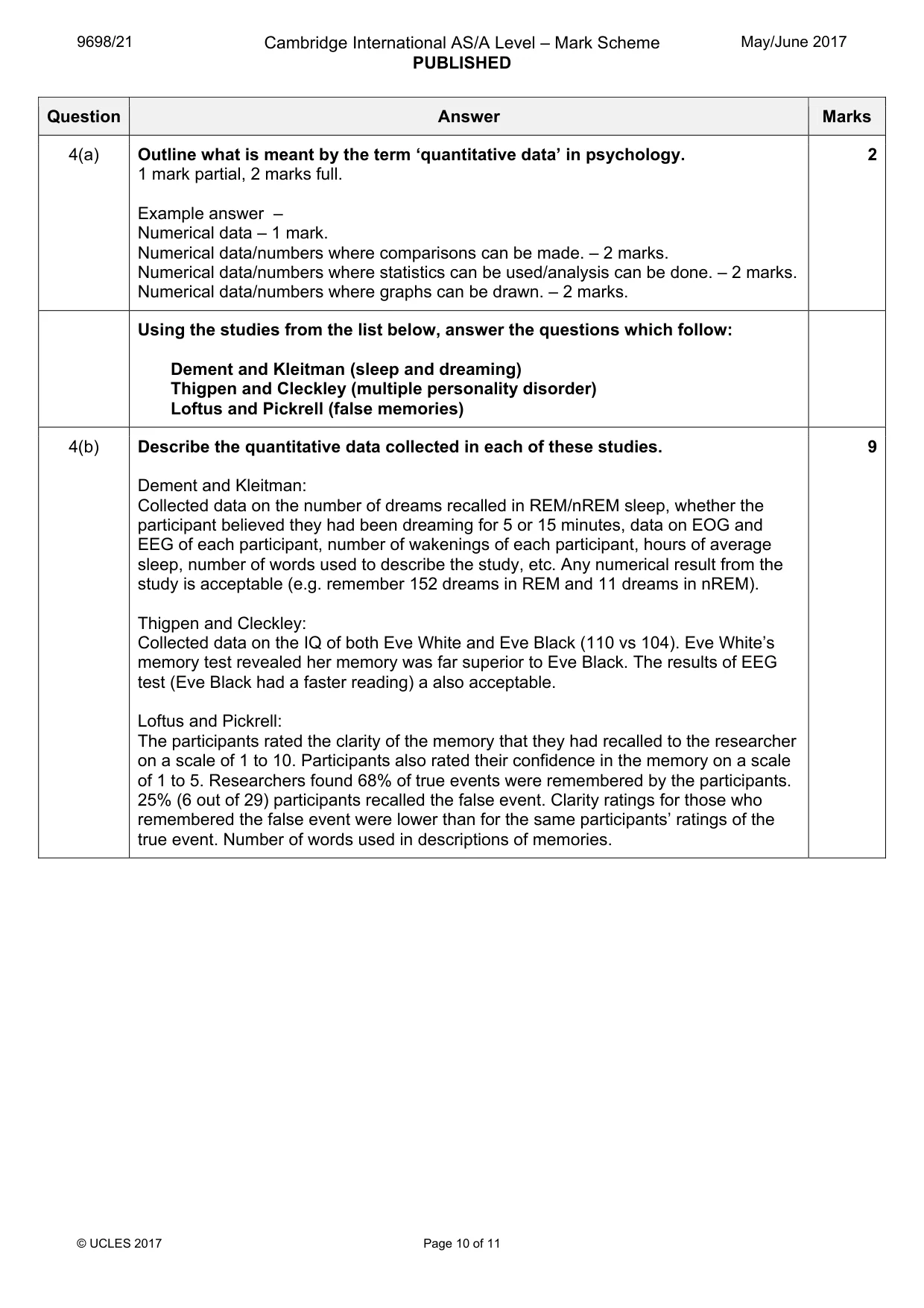
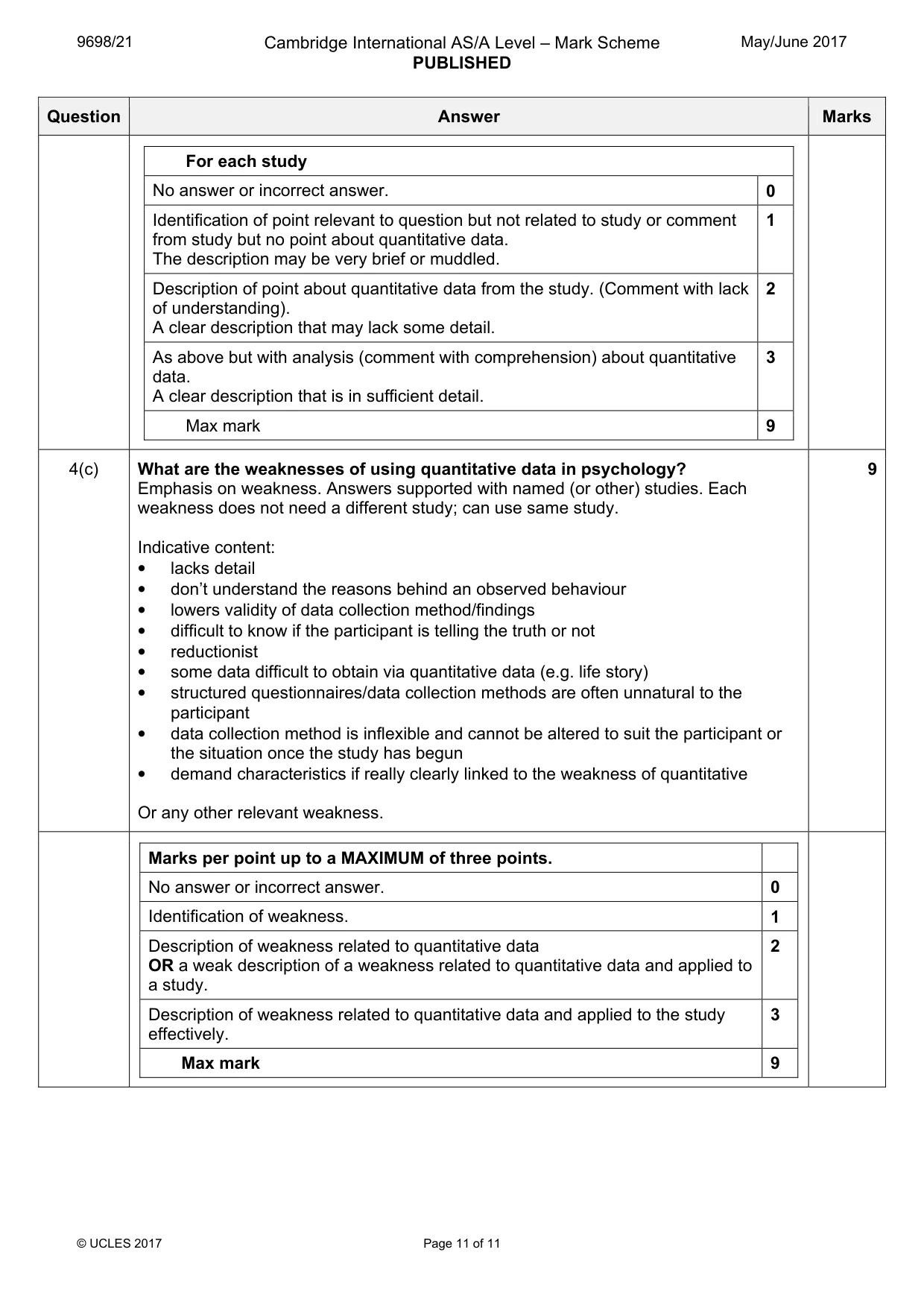
Mark scheme: 4(a) Outline what is meant by the term ‘quantitative data’ in psychology. 2 1 mark partial, 2 marks full. Example answer – Numerical data – 1 mark. Numerical data/numbers where comparisons can be made. – 2 marks. Numerical data/numbers where statistics can be used/analysis can be done. – 2 marks. Numerical data/numbers where graphs can be drawn. – 2 marks. Using the studies from the list below, answer the questions which follow: Dement and Kleitman (sleep and dreaming) Thigpen and Cleckley (multiple personality disorder) Loftus and Pickrell (false memories) 4(b) Describe the quantitative data collected in each of these studies. 9 Dement and Kleitman: Collected data on the number of dreams recalled in REM/nREM sleep, whether the participant believed they had been dreaming for 5 or 15 minutes, data on EOG and EEG of each participant, number of wakenings of each participant, hours of average sleep, number of words used to describe the study, etc. Any numerical result from the study is acceptable (e.g. remember 152 dreams in REM and 11 dreams in nREM). Thigpen and Cleckley: Collected data on the IQ of both Eve White and Eve Black (110 vs 104). Eve White’s memory test revealed her memory was far superior to Eve Black. The results of EEG test (Eve Black had a faster reading) a also acceptable. Loftus and Pickrell: The participants rated the clarity of the memory that they had recalled to the researcher on a scale of 1 to 10. Participants also rated their confidence in the memory on a scale of 1 to 5. Researchers found 68% of true events were remembered by the participants. 25% (6 out of 29) participants recalled the false event. Clarity ratings for those who remembered the false event were lower than for the same participants’ ratings of the true event. Number of words used in descriptions of memories. For each study No answer or incorrect answer. 0 Identification of point relevant to question but not related to study or comment 1 from study but no point about quantitative data. The description may be very brief or muddled. Description of point about quantitative data from the study. (Comment with lack 2 of understanding). A clear description that may lack some detail. As above but with analysis (comment with comprehension) about quantitative 3 data. A clear description that is in sufficient detail. Max mark 9 4(c) What are the weaknesses of using quantitative data in psychology? 9 Emphasis on weakness. Answers supported with named (or other) studies. Each weakness does not need a different study; can use same study. Indicative content: • lacks detail • don’t understand the reasons behind an observed behaviour • lowers validity of data collection method/findings • difficult to know if the participant is telling the truth or not • reductionist • some data difficult to obtain via quantitative data (e.g. life story) • structured questionnaires/data collection methods are often unnatural to the participant • data collection method is inflexible and cannot be altered to suit the participant or the situation once the study has begun • demand characteristics if really clearly linked to the weakness of quantitative Or any other relevant weakness. Marks per point up to a MAXIMUM of three points. No answer or incorrect answer. 0 Identification of weakness. 1 Description of weakness related to quantitative data 2 OR a weak description of a weakness related to quantitative data and applied to a study. Description of weakness related to quantitative data and applied to the study 3 effectively. Max mark 9
What you needed in this session
Cambridge’s own grade thresholds for 2017 May/June, Paper 2 · Variant 1. A higher threshold means an easier paper — the bar moves with how the cohort did.